VOICESof VELLORE NEWSLETTER New York, NY
vellorecmc.org
2014 Alumni Weekend Issue Janet and Philip Yancey
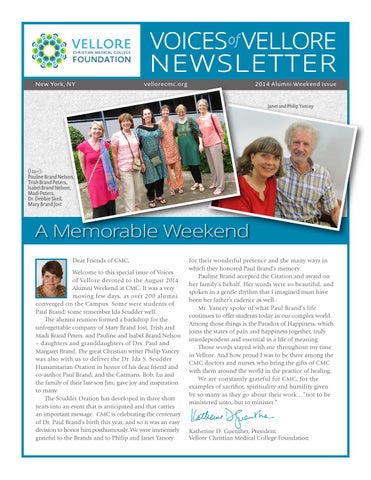
(l to r):
Pauline Brand Nelson, Trish Brand Peters, Isabel Brand Nelson, Madi Peters, Dr. Debbie Skeil, Mary Brand Jost
A Memorable Weekend Dear Friends of CMC, Welcome to this special issue of Voices of Vellore devoted to the August 2014 Alumni Weekend at CMC. It was a very moving few days, as over 200 alumni converged on the Campus. Some were students of Paul Brand; some remember Ida Scudder well. The alumni reunion formed a backdrop for the unforgettable company of Mary Brand Jost, Trish and Madi Brand Peters, and Pauline and Isabel Brand Nelson – daughters and granddaughters of Drs. Paul and Margaret Brand. The great Christian writer Philip Yancey was also with us to deliver the Dr. Ida S. Scudder Humanitarian Oration in honor of his dear friend and co-author Paul Brand; and the Carmans, Bob, Lu and the family of their late son Jim, gave joy and inspiration to many. The Scudder Oration has developed in three short years into an event that is anticipated and that carries an important message. CMC is celebrating the centenary of Dr. Paul Brand’s birth this year, and so it was an easy decision to honor him posthumously. We were immensely grateful to the Brands and to Philip and Janet Yancey
for their wonderful presence and the many ways in which they honored Paul Brand’s memory. Pauline Brand accepted the Citation and award on her family’s behalf. Her words were so beautiful, and spoken in a gentle rhythm that I imagined must have been her father’s cadence as well. Mr. Yancey spoke of what Paul Brand’s life continues to offer students today in our complex world. Among those things is the Paradox of Happiness, which joins the states of pain and happiness together, truly interdependent and essential in a life of meaning. Those words stayed with me throughout my time in Vellore. And how proud I was to be there among the CMC doctors and nurses who bring the gifts of CMC with them around the world in the practice of healing. We are constantly grateful for CMC, for the examples of sacrifice, spirituality and humility given by so many as they go about their work…”not to be ministered unto, but to minister.”
Katherine D. Guenther, President Vellore Christian Medical College Foundation
The Dr. Ida S. Scudder Humanitarian Oration
T
he 2014 Dr. Ida S. Scudder Humanitarian Oration was an emotional event that celebrated the centenary of one of CMC’s
great doctors and spiritual leaders – Dr. Paul W. Brand. The third annual oration was held Friday August 8, 2014, during Alumni Weekend at CMC. Three of Paul and Margaret Brand’s daughters came to Vellore for the occasion; Pauline Brand Nelson, youngest in the family, offered very fond remembrances of her father, his life and work, and his gentle, healing touch. The brilliant writer Philip Yancey, Dr. Brand’s friend and
Dr. M.C. Mathew presents the Citation to Pauline Brand Nelson. Looking on is (left) Kate Guenther and (standing right) Dr. Sunil Chandy and (sitting right) Dr. Honorine Ward
co-author, delivered the Oration.
Pauline Brand Nelson Accepts the Citation
her father when she was just about 12 years old.
Pauline was joined by two of her sisters,
The story is dear, funny, touching and a singularly
Mary Brand Jost and Trish Brand Peters on this
meaningful memory that spoke to each of us
three-day visit. They had a full agenda seeing friends
personally, making the deep loving gifts of her
and visiting campus landmarks with daughters
father fill the room. As she spoke she brought each
Isabel Nelson and Madi Peters. In the thoughts she
of us closer to knowing what it might have been like
shared at the Oration Pauline reflected tenderly on
to know Paul Brand: “I tell this story because I know
life at CMC, where she spent the early years of her
Dad was doing what every graduate of this school
childhood. Wearing her mother Margaret’s sari she
has done since Ida Scudder taught her first students,
brought over 900 guests into her warm, personal
whenever they encountered the wounded and
and emotional memories, delighted that the spirit
broken… the ones who call themselves unlovable.
of CMC remains unchanged and the presence of
He used the gift of healing touch, and his trained
God is still felt: “…a God who changes the name of
mind and his God-centered spirit to tell me… the
the wounded to whole, of the desolate to joyful.”
name by which I, and all of us, and all of those
Please take a few minutes to view Pauline’s
whom you serve, have been known by God since
message on the Vellore CMC Foundation website at
before we were born. The name, Beloved. I am
http://www.vellorecmc.org/videos/ScudderOration2014.
honored to accept the Citation as a witness and as a
Her tribute recalled a private moment she had with
beneficiary of this man’s extraordinary gifts.”
2
Philip Yancey Brings Paul Brand’s Legacy to Life
involves pain, struggle, and challenge. The experience of joy is only realizable with struggle,
Like Pauline’s remarks, we could not do justice to
with that pain.
Philip Yancey’s talk in this short summary. You are encouraged to watch it in its entirety on the Vellore
The Paradox of Success: what is “success” – is it
CMC Foundation website at http://www.vellorecmc.
material gain that brings the seduction of comfort
org/videos/ScudderOration2014. He spoke from a
and privilege? Mr. Yancey contrasted the outwardly
deep sense of appreciation, admiration, and
powerful with the true greatness of Paul Brand.
intimacy, considering Paul Brand to be a father
Seeking to share praise, exude equanimity, and
figure in his life.
downplay power, Dr. Paul Brand showed the virtues
Philip Yancey’s oration was a joyful lament
of ‘downward mobility.’ Paul Brand lived out the
addressed to the hundreds of CMC students in the
teaching that one finds one’s life by giving it away in
audience. He asked them to value Paul Brand’s
service to others.
extraordinary philosophy and spirituality –
Mr. Yancey encouraged his audience to find their
unnamed but so present at CMC. He wanted them
ultimate calling and their true purpose by following
to know that these gifts should not be taken for
the lessons of Paul Brand’s paradoxes, all of which
granted. Only partly tongue-in-cheek he implored
are rooted in Christ. He finished by sharing a
“Please don’t move to my country – the United
scripture: Then Jesus said to his disciples, Whoever
States!… because if you do, you will be in danger of
wants to be my disciple must deny himself, take up his
missing out on some of the great lessons in life
cross and follow me. For whoever shall save his life will
(embodied in Paul Brand’s actions).”
lose it, but whoever loses his life for my sake shall find
Mr. Yancey used three paradoxes that he gleaned
it. What good will come if a person gains the whole
from his knowledge of Dr. Brand work, to illustrate
world, yet loses his soul? (Matt 16:24-26)
his message: The Paradox of Reductionism: essential in research, critical to Paul Brand’s ability to reconstruct parts of the human body, but dangerous when a doctor begins to see the patient as a mass of cells and diseases rather than as a whole person. The whole person approach to medicine was the foundation of Dr. Ida S. Scudder’s work. Dr. Brand treated everyone, even the Dalits (untouchables), with the reverence due to those made in the image of God. The Paradox of Happiness: searching for the meaning of emotional and physical pain, contrasting pain and happiness as many do, Philip Yancey gained profound understanding in Paul Brand’s writing on the gift of pain. Dr. Brand taught that pain and happiness are not at polar opposites; rather they Kate Guenther presents the Oration Award to Philip Yancey
work together. The peak of happiness inevitably
3
Highlights of a Wonderful Visit THE BRANDS TAKE VELLORE!
Mary Brand Jost, Trish Brand Peters, Pauline Brand Nelson and Isabel Brand Nelson plant a tree in honor of their parents
Madi Peters volunteered in Vellore for six weeks at the beginning of Summer
Pauline and Isabel Brand Nelson
A reflective moment in the Hospital Chapel
The Brand family dressed beautifully in traditional saris at the Oration
VIDYALAM SCHOOL FOR CHILDREN OF CMC’S FACULTY & STAFF
Student leaders with Principal Irene Stanley singing the school song for the Brands who delighted them with stories
Students assemble according to their group names and colors
4
The Lungi Dance
THE ALUMNI TALENT SHOW: CMC’S GOT TALENT!
Alumni (Batch of ‘74) performing an hilarious spoof of Joseph & the Amazing Technicolor Dreamcoat
Live from Vellore... it’s Babu!
Dr. Shiv Pillai (Batch of ‘69) led the Batch in the Lungi Dance
RENOVATION, EXPANSION AND GROWTH!
Modale House the international student hostel gained a third floor
The Women’s Hostel is expanding A new Testing Center includes auditorium space for over 1000 students
V I S I T U S T O D AY AT V E L L O R E C M C . O R G 5
THE SPIRIT OF CMC VELLORE CONTINUES!
Philip Yancey, Hugh Skeil (Manager of CMC Development Office), Janet Yancey and Dr. Debbie Skeil
Dr. Gigi Chandy, Dr. Bob & Lu Carman, Dr. Sunil Chandy. Bob and Lu were special guests at Alumni Weekend, visiting CMC for the first time in six years. Bob’s father Dr. John Carman was the CMC Director from 1953 to 1967– one of the most exciting periods of growth in CMC’s history. After 27 years of their own service, Bob and Lu “retired” to the United States . They jointly ran the Vellore CMC Foundation for four years before settling in Minnesota
The Brand sisters had a wonderful visit with the Koshi family. (Standing) Deepa, Emma , Tharyan, George .(Seated) Susheela with her granddaughter, and Suzie
Marjorie Muecke, PhD (lower right) recently retired as the Assistant Dean of Global Health Affairs at the University of Pennsylvania School of Nursing. She continues to lead student groups to CMC to observe rural healthcare. Silva Titus Chacko, PhD, Dean of the College of Nursing (bottom center) hosted this year’s group
Our most recent USAID/ASHA grant provided a 3D CAT Scanner that can display a beating heart in three dimension
Dr. Shobha Anna George (Batch of ‘88) and her husband Dr. Ravi Ninan George (PG Alumnus) were honored with the College Motto Award - “Not to be ministered unto but to minister” - for the ways their life of faith and service uphold the spirit of CMC
6
An Interview That Still Resonates in My Heart Recollections of Dr. Paul Brand’s Early Years at CMC Vellore by Dr. M.C. Mathew victims of WWII. So it was an altogether a refreshing experience for him to come back to India to work in a teaching institution about which he had heard and read a lot. Paul Brand’s personal style was not typically British, meaning that he easily established relationships with faculty and students through his open, gentle and charming demeanour. He taught during bedside clinics and classroom sessions. And he continued to teach in his daily interactions with students on the campus, in the men’s hostel, in his own home. He attracted students through his ability to be a good and humorous story teller. Paul Brand’s CMC colleagues saw that his rapport with students allowed him to know students and inspire them for deeper learning and for missionary service. It was this informal contact that made him a sought-after teacher, speaker, and guest of honour. When the CMC surgical faculty was in place he moved on to orthopaedics where he again established high standards in teaching and patient care. There he was challenged by what he saw in patients suffering from leprosy: ulcers in the hands and legs, loss of fingers and toes, and disfigurement of the face, eyes, etc. On one occasion when a patient came to see him late in the evening, he had him stay at his home overnight until he could find a place for him in the hospital ward the next day. His family had some apprehensions; but for Dr. Brand this was another human being who needed bed and breakfast. Dr. Brand got more and more drawn into the mystery of leprosy as a disease through his visits to the Leprosarium at Chingelpet where Dr. Robert Cochrane was caring for patients. He deplored the social stigma that patients suffered and soon he started an ulcer ward on the college campus at Bagayam for such patients and a nearby New Life Centre where they could live after being cured of the active phase of the disease. With introduction of Dapsone as the mainstay treatment for leprosy, Dr. Brand immersed himself in understanding the pathology of the disease in the tissue and nerves, and its mode of spreading in the human body. It was this passion that led him to found the Schieffelin Institute of Health Research and Leprosy Centre at Karigiri with the help of The Leprosy Mission. He involved two other CMC
I first heard of Dr. Paul Brand in 1972 when I was in the final year of medical training at the Government Medical College in Nagpur. Our professor of orthopaedics was holding a bedside clinic on a young man who had sustained Erb’s palsy due to birth trauma; he mentioned that the only surgeon who could perform a successful tendon transplant for the boy would be Dr. Paul Brand. This professor had spent a week with Dr. Brand in 1967 at CMC Vellore learning some surgical techniques that Dr. Brand had developed for treating hand injuries. When I met my wife Anna I heard much more about Dr. Brand’s Bible classes, chapel sermons, messages during the week-long teaching missions, etc. I subsequently had many long conversations at CMC with Dr. Frank Garlick (a professor in the sixties and seventies) that inspired me to read and explore the spirituality of personal formation; the mystery of creation; ethos in professional life; work and relational ethics; compassionate service, etc. that Dr. Brand preached and practiced. It was in 1999 that I had an opportunity to interview Paul Brand and his wife Dr. Margaret Brand while they were on a visit to Karigiri and Vellore. I deliberately confined that three-hour interview to the early years of his life at Vellore, hoping that I would have other occasions to continue our conversation. Unfortunately those occasions did not arise. I am grateful to Kate Guenther, President of the Vellore CMC Foundation in New York, for asking me to make this interview available for publication in the centenary year of Dr. Paul Brand’s birth.
Transitions Paul Band was invited to the Christian Medical College Vellore at a time when a Professor of Surgery was needed to create a training curriculum for undergraduate students. He was not new to India as he had spent his early years in the remote Kolli Hills of Tamil Nadu where his missionary parents provided health and development services for the tribal community. His recollections of childhood were of happy family life, home schooling, living close to nature and working with one’s own hands to make a living. As a young man he trained to be a builder and carpenter. It was few years later that he studied medicine in London and then spent years in the army as a surgeon helping
V I S I T U S T O D AY AT V E L L O R E C M C . O R G 7
doctors, pathologist Dr. C.K. Job, and orthopaedic surgeon Dr. Ernest Fritchi, in this collaborative work to find answers. Together they researched the pathology of leprosy and the causal pathway of ulcer formation, disfigurement etc. His passion for caring for patients of leprosy was so intense that he was ready to dress the ulcer of a patient who had maligned him earlier as one with the intention of ‘converting’ patients to Christian faith. Speaking about this incident, he said, ‘that was an occasion to learn about forgiving seventy times seven,’ as he had to dress his ulcer almost every day for three months. During the initial years at Vellore, Paul Brand started as a general surgeon and teacher, moved on to orthopaedics, then to leprosy work and establishing hand surgery unit, ulcer ward and New Life Centre, etc., all because of his willingness to ‘accept the mantle of responsibility placed on him.’ During this time, his wife Dr. Margaret Brand provided help for patients who had ophthalmological complications with leprosy. None of these transitions was easy. There was resistance initially to leprosy patients being operated on in the regular operating rooms; to the location of the ulcer ward on the college campus; to his dedication to Karigiri while on the staff of CMC Vellore, etc. He saw all of these as opportunities to sensitize the CMC community toward a community approach to eradicate the ills of the disease caused by the Lepra bacilli. During our interview, Dr. Brand recalled getting CMC students to visit the ulcer ward on Sunday afternoons to sing for the patients and to dialogue with them – this dramatically changed the approach of the students and the faculty towards leprosy patients. The patients of leprosy ultimately became the guests of everyone on the CMC campus!
he could later welcome the members to his home or office for conversations. Dr. Brand realized that inspiring students was important in developing their personal motivation. He believed firmly that if a student passed the competitive entrance examination and the personal interview to be admitted to CMC, he or she was sufficiently capable of completing the course well. This unwavering attitude led him to take special interest in students who had poor attendance in lectures or clinics, or who were struggling to make the grade in the exit examinations. This is one of the reasons that the “Foster Parenting” system came into being at CMC, whereby each faculty was introduced to one or two students from each batch to mentor them during the undergraduate years. Dr. P. Zachariah, Dr. Chinoy Chacko, and Dr. Jacob Chandy were some others according to Dr. Brand who were very keen to make a difference in the quality of life of students in the college and their hostel life. This approach was far ahead of the approach to student development in India at the time. Most medical schools focused on the academics and left the students to fend for themselves for their personal formation. When meeting patients he remembered every person’s name. Dr. K.C.Mammen, an undergraduate student at CMC in Paul Brand’s time, once told me that ‘it was an education of the highest order when students went on clinical rounds with Dr. Brand. He would care for patients, teach about the illness, enquire about the family of the patient, request the nurse to bring a food tray if any patient was yet to have breakfast, and have personal chats with each student and his colleagues.’ These were small things with great significance that made Dr. Brand a great model in the art of communicating medical knowledge and human values. While making rounds it was Dr. Brand’s habit to pause for silent prayer when he was overcome by the challenges of a medical case. I had heard that he also had a practice of kneeling beside patients when examining the abdomen. When I asked his rationale for kneeling he reminded me that kneeling is what many would do while praying. He felt that by kneeling beside a patient, he was ‘humbling himself in prayer before God to receive wisdom to attend to even the unspoken needs of a patient.’ For his students such an act of humility was not only moving but a reminder to respect the human body. He taught students compassionately and took care of patients thoughtfully. He was learning all the time. He learned from his patients, colleagues, students, ward staff and visitors. He took notes in a small pocket notebook throughout the day so that he could more easily recall important observations or conversations or learning experiences of the day and transfer them to a journal for further reflection and reading. The books he co-authored with Philip Yancey, as well as his subsequent books, articles and presentations were always fresh, challenging and
Learning to Teach Paul Brand began as a teacher and ended up as Principal of the Christian Medical College for a term. This journey over 18 years was the most formative of his life. As a newcomer to the teaching profession, he would seek out students who were repeatedly absent from his bedside clinics or lectures. On one such occasion, a student admitted his difficulties understanding the subject, his financial stress coming from a low socio-economic background, and his loss of focus after completing the first professional examination. It was this conversation that inspired Dr. Brand to create tutorial groups for students to have close contact with their teachers. He was one of the architects of the scholarship program that helped economically needy students, and ultimately became a valuable resource for low-income students each year. This also helped him to befriend students so that no one suffered from loneliness or struggles in personal life. He would voluntarily attend the meetings of the Student Christian Movement and the Evangelical Union so that
8
original because he remained a student even in the midst of a heavy schedule and multiple responsibilities. About lifelong learning Paul Brand interpreted the words of Jesus of Nazareth: ‘...unless you become like little children, you cannot enter the Kingdom of God.’ This was his invitation to stay engaged in learning as children do. A great teacher remains a student and in doing so enlarges the learning intent of others.
new treatment modality or describe the causative factors of a disease when the team working together does not compete among themselves for acclaim. If the leader is an example of giving credit to others, then the team accomplishes a lot in a short time...’ This to me was the key to Dr. Brand finding so many answers about leprosy in a relatively short span of about twenty-five years. As we talked I was moved to listen to Dr. Brand narrate the names and contributions of his technicians and scientists in his laboratories at Vellore, Karigiri and Carville, all of whom he had recruited and trained. It was his habit to meet with them individually and collectively. He knew their birthdays, wedding anniversaries and kept in touch with them as friends. Today there are still a few people working at CMC who were operated upon for reconstructive surgery of their hands, feet or eyes by Paul or Margaret Brand. They readily recall the self-giving attitudes of both of the Brands. Going well beyond providing clinical care, Dr. Brand introduced carpentry skills to some of them by personally coming over to the New Life Centre in the evening. Many of them went on to have productive roles as craftsmen in CMC’s audio-visual unit. This was not a world renowned leprosy scientist to them, but a friend who restored dignity and significance to their lives.
Valuing Others After 18 years in India, most of which were spent researching and rehabilitating patients of leprosy, Paul Brand went on to become Chief of the Rehabilitation Branch at the U.S. Public Health Service Hospital in Carville, Louisiana. This position offered a convergence of overseas travel, lecturing and teaching in the global scientific community. One of his trail blazing journeys was to collaborate with the Madras Rubber Factory to create microcellular rubber for footwear for leprosy patients. Dr. Brand had demonstrated that patients of leprosy on losing their sensations would ignore minor injuries to the foot which subsequently became chronic non-healing ulcers. He got patients to wear the rubber footwear with spongy consistency and thereby reduced pressure on the feet. In time the application of this knowledge was extended to patients who suffered from diabetic neuropathy, and other peripheral neuropathy. There were other discoveries that Dr. Brand introduced to improve the treatment approach to leprosy. It was at this time that Rifampicin was under trial as an effective bactericidal drug to treat patients of leprosy; in addition the survey to detect patients and start treatment early had become the backbone of international leprosy prevention and treatment. With better treatment and preventive management to reduce the complications of leprosy, Dr. Brand was able to demonstrate to the global community that a new era of hope had dawned. Commenting on this turning point in treating leprosy Dr. Brand had something profound to say: “I trained as a carpenter and knew something about woodwork and craftsmanship. But it was altogether a new experience to delve into the mystery of a disease which people treated with disdain. I was fortunate to have been guided by able researchers and thinkers. Otherwise I too would have remained in the dark.” He spoke about others fondly and without a superficial veil of humility. His colleague Dr. C.K.Job said that ‘…Dr. Brand gave the credit to all of us for his ideas and original thoughts. He urged us to explore certain areas which yielded good returns. It was not his habit to attribute credit only to himself.’ David Morely, the late professor of tropical child health at the Institute of Child Health, London, once told me that ‘… in medicine one can anticipate a quick outcome to find a
The Mystery of Being Paul Brand’s study of human anatomy began initially out of curiosity and became essential for the scientific understanding required in his medical work. It was only later that he was taken up with the mystery of the body. He evoked this mystery by reading aloud Psalm 139:13-14: ‘Thou didst form my inward parts; Thou didst weave me in my mother’s womb. I will give thanks to thee for I am fearfully and wonderfully made.’ He read the passage twice to give it the emphasis it deserved. The first book that Paul Brand co-authored with Philip Yancey alludes to this scripture. Titled Fearfully and Wonderfully Made, it offers insight into Paul Brand’s philosophy of life and faith. Some years prior to the book’s publication, he delivered a series of talks for a teaching mission at CMC that were well attended and appreciated by the faculty and students. The notes from these talks became the basis for this and a second book, In His Image. I was moved as we talked, by the analogy he used to describe the perfection of the human body. He said that as a hand surgeon he struggled to find the ideal tension for a transplanted tendon in reconstructive surgery. In spite of sound and scientific calculations, he simply could not reproduce nature’s synchronization of the muscles and tendons of the hand. There is a Creator’s design that we cannot match even with the best of technology. Dr. Brand believed that this mystery of the body demanded reverence. He spoke of starting surgery with a
V I S I T U S T O D AY AT V E L L O R E C M C . O R G 9
prayer seeking the Creator’s permission to do what was necessary for the wellbeing of the patient. He recalled occasions when in the midst of an operation, he felt called to do something other than what he had originally planned, and he attributed that guidance to God. To Paul Brand this was the revelation of the Creator’s mind, conveying through the physician, optimal care. He felt that it was right to have trusted his intuition in those situations, having prayed for God’s blessing on his actions during treatment. He had a word of caution about giving so much centrality to scientific rationale without balancing it with a prayerful attitude and discernment. After four years of training to become a builder Paul Brand was drawn to study medicine, much against the advice of the president of his parents’ mission body. He was prompted to do so after completing one year of basic medical training designed to help missionaries in first aid and simple health care. His first wish was to join the mission body in a hospital on the Nepal border; he was not chosen. He then worked with the Central Medical War Committee of Great Britain when Dr. Robert Cochrane approached the committee to spare Dr. Brand to work at the Christian Medical College, Vellore. This was another illustration of the mysterious ways of God in human lives. While building the carpentry workshop for patients who needed rehabilitation in the New Life Centre, he needed the skills of engineering, carpentry and building that he had acquired before doing medical training. In hindsight, Paul Brand witnessed God’s hand in his life, preparing him uniquely to serve the needs of leprosy patients about whom he had no knowledge when he came to India for the first time in 1946. He quoted Romans 8:28: ‘Moreover, we know that to those who love God, who are called according to His plan, everything that happens fits into a pattern for good.’ (J.B.Phillips). Returning to his first days in Vellore, Dr. Brand spoke of being fulfilled with all that he was doing at the Christian Medical College. In time he saw that the people sitting at the entrances of temples, churches, public buildings or railway stations with deformed hands and legs never came to the hospital. He was disturbed, seeing their ulcerated feet and deformed bodies and believing that they were also God’s creations, carrying the mystery of God in their bodies. It was when he had a hand shake from a patient of leprosy that he knew instantly that his life was to be spent among them. He discovered his calling by being open to God at every stage of his life.
One of Dr. Brand’s research goals was to understand the extent of damage caused by the leprosy patient’s loss of pain sensation. He recalled the story of Sadan, whom Dr. Brand had sent home reluctantly after four years of rehabilitation. On the first night at home a rat bit his index finger and on the second night, a burning hurricane lamp fell on him accidentally and burned his skin. Sadan returned to Dr. Brand, his injuries inspiring a new and innovative solution to help other patients of leprosy. Dr. Brand initiated twice-a-day physical body checks to find new minor injuries as they occurred. He taught patients to examine each other, making them accountable to each other and also preventing injuries from developing into ulcers through early treatment; and he taught patients to dress each other’s ulcers so as to develop a caring attitude among them. Dr. Brand was known for simple and effective remedies. He introduced the use of rubber gloves while cooking and encouraged use of pots with insulated handles so that fingers did not get burned. He was a specialist in redesigning the homes of patients when they were ready to return home. He planned ahead with them to have appropriate beds and mattresses, to reduce the obstacles within the house to avoid getting hurt, making kitchens user-friendly, and teaching precautions while using work-related implements. He even visited homes to help redesign huts and floor space. The Karigiri Hospital microbiology laboratory is also a tribute to his inventing mind. He established modern techniques to handle tissue and trained the technicians accordingly. He developed a library of pathological specimens and a storage facility to preserve thousands of slides for future reference. He planned with an eye toward the future. Sometimes, his colleagues took time to recognise the significance of the futuristic steps he took, when he was planning the protocols in the laboratory. But just as there were many who admired him, there were villagers who kept away from him because he was the ‘leprosy doctor.’ Paul Brand combined the skills of a builder, designer, engineer, clinician, pathologist, operating surgeon, teacher, researcher, rehabilitation specialist, and mentor in his work. He was a caring husband and responsible father. He was a faithful follower of the teachings of Jesus Christ and an effective communicator of the grace and goodness of God. He lived his mission. He served the most disadvantaged in the society. His service was an offering to God an investment in transforming human lives.
An Inventing Mind Dr. M.C. Mathew is Chairman of the CMC Council and a consultant of Developmental Neurology. He retired as Professor of Paediatrics and Head of the Developmental Paediatrics Unit at CMC Vellore in 2008.
Dr. Brand was a keen observer and meticulous record-keeper from the time he started working with leprosy patients. He realized fairly early that he had to be innovative, as local technology and design capacity would not support him in his journey to help patients of leprosy.
10
In Memoriam
Dr. Cornelius Walter The entire CMC community mourns the passing of Dr. Cornelius Walter (MBBS Batch of 1958-59) on July 15, 2014 in Iowa City, IA. Dr. Walter made important contributions to many aspects of health care and was known internationally for his work on Leprosy. He was beloved by his family; he and his wife of over 40 years had just spent a joyous visit with family members in Bronxville, NY. Dr. Walter served as the Medical Superintendent of several Mission Hospitals; Director of The Leprosy Mission Trust – S.E. Asia; and Executive Director of the Aga Khan Health Services in Tanzania. Dr. Walter was Vice Chairman of the Christian Medical College Vellore Association from 2002-2003, and Chairman of the Christian Medical College Vellore Association from 2003-2009. Dr. Cornelius Walter and Dr. Sarah Walter (nee Tribhuwan) (MBBS Batch of 1962) made their home in Iowa City, IA with their second daughter, Dr. Alka, who is a PG alumna from CMC (General Surgery); she is married to Dr. Sarat Kuppachi (MBBS Batch of 1992). Dr. Walter has two other daughters: Sapna, whose husband Prasad is Treasurer of the Vellore CMC Foundation; and Anjali. Dr. Sarah can be reached at 6 Hunters Place, Iowa City, IA 52246-8671, or scwalter2002@yahoo.com. In memory of Dr. Walter, the Dr. Cornelius Walter Fund has been established at CMC. Tax-deductible donations can be made through the Foundation (vellorecmc.org).
Augustine P. Aiyadurai As CMC alumni and those honoring Dr. Paul Brand gathered in Vellore the sad news arrived that Mr. Augustine Aiyadurai had died on August 2 unexpectedly while serving missionary duty in Liberia. He was a dear friend of many at CMC as well as a longtime family friend of the Brands. At the Ida S. Scudder Humanitarian Oration on Friday August 8, Pauline Brand remembered Augustine saying “…Our joy in being here is mixed with sorrow, as we arrived just in time to say farewell to our dear friend Augustine; his loss reminds us that the work of the Lord is sometimes accomplished at great cost.” Augustine was the Administrative Officer at The Schieffelin Institute of Health - Research and Leprosy Centre and former Treasurer of CMAI. Mr. Aiyadurai is survived by his wife Valsa and son Dr. Thomas Anand Augustine (MBBS Batch of 2007); his brother Dr. Godfrey Aiyadurai; his sister and brother-in-law Viji and Ben Venkatesan, nephew Arun (Reena) Venkatesan of Ballwin, MO, and niece Latha (Suman) Nirmal of Santa Clara, CA. We praise God for Augustine’s life and hold his family up in prayer during this sorrowful time.
11
“Never have so many owed so much to so few.” Sir Winston Churchill
T
his is the time of year when most of us think seriously about charitable giving. Our Board member Albert Johnson (Batch of ‘61) is leading a special alumni campaign this fall to raise $400,000 to build an assisted living residence on the Bagayam Campus, for retired faculty who are alone and frail. What a timely and appropriate project for CMC alumni and friends to support. As we look back at the gifts of Dr. Paul Brand, what a compassionate and dignified place for the beloved faculty members who sacrificed so much to educate young CMC professionals. The building, to be situated on New Life Center property, will honor Dr. Brand’s spirit and his legacy. Approximately twenty rental units (priced on a sliding scale) will be available for doctors, nurses and Allied Health professionals who are alone and in need of help with their daily lives. A chapel, library, exercise area, walking paths and community dining room will be included. Many naming opportunities are available. Would you consider honoring a faculty member who inspired you to greatness? Please donate at vellorecmc.org/make-a-donation or call me directly at 212-870-3239 to discuss your gift. 100% of your gift is tax-deductible and will be sent to Vellore. Thank you. –KDG
THE FOUNDATION GOES DIGITAL! Beginning in 2015, Voices of Vellore will be digital! In an effort
to be better stewards of your resources, newsletters will be available on our website at www.vellorecmc.org/ publications. Please email us at foundation@vellorecmc.org to confirm your email address, or if you’d like to continue receiving a printed copy.
VELLORE CMC FOUNDATION BOARD AND CORPORATION Officers Honorine Ward, MD (’69), Chair George Varughese, Vice Chair Prasad Palla, Treasurer Madelon Finkel, PhD, Secretary
Rev. Dr. Franklin Ishida Susan Jacob, MD (’58) Diane Jedlicka, PhD Sajiv John, MD (’78) Cyrus Kapadia, MD (’59-’60) Shanta Kapadia, MD (’59-’60) Directors Shanker Krishnamurthy, MD (’65) S. Balasubramaniam, MD (’58-’59) Rev. B.B.C. Kumar Lisa M. Beardsley-Hardy, PhD Surendra Kumar, MD (’59-’60) Jamshed Bharucha, PhD Mani Mani, MD (’55) Rohan Ganguli, MD (’67) Rebekah Mani Meredith A. Hawkins, MD Susan Mathew (CON ’69) Albert Johnson, MD (’61) Thomas Mathew (AHS ’89) Rev. George I. Kovoor Arjun Mohandas, MD (’86) Emma Koshi Renu Mohandas, MD (’86) Margaret Kumar, PhD (CON ’67) Aparna Muralidharan Ranjit Mathew, MD (’68) Tina Narayan, MD (’73) Bibhuti Mishra, MD (’71) John J. Paul, PhD Raj K. Narayan, MD (’69) Catherine Poornaselvan (CON) Philip Ninan, MD (’68) Puthucode N. Rajamani Thomas Philips, PhD Rev. William Sadler H. David Reines, MD Annie Samuel (CON ’77, ’83) William Scudder Johnson Samuel Mark Steinhoff, MD Rev. Elizabeth Senft Prathibha Varkey, MD (’95) Edwina Scudder-Youth Christine Wanke, MD Jane P. Srinivasan, MD (’59) John Stevens, III MEMBERS OF THE CORPORATION* Ponna Thurairatnam, MD (’73) K. Varkey Abraham, MD (’55) Mark Tibbetts, PhD C.J. Alexander, MD Robin Varghese, MD Saramma Alexander, MD (’60) Nissi Varki, MD (’68) Rev. Benjamin Chan Abraham Verghese, MD Bobby Cherayil, MD (’74) Elise Youth, MD Susan Cherian, PhD (CON ’75) Rex Zachariah Abraham Fenn Cheriyan, MD Anindya Dutta, MD (’75) * In addition to those listed, every Board Robert H. Fish, DMD Member is a Corporate Member
WHEN YOU ARE SENDING A GIFT Gifts to CMC made through the Foundation are 100% tax-deductible and 100% accounted for in Vellore. We are grateful to serve CMC in the U.S. and CMC is grateful for your support. We work closely to maximize our potential to move CMC forward in its work.
Give online or by check (payable to Vellore
CMC Foundation, mailed to 475 Riverside Drive, Suite 725, NYC 10115). We accept pledges of up to three years for major gifts. Gifts of securities are most welcome. Thank you!
VELLORE CHRISTIAN MEDICAL COLLEGE FOUNDATION, INC. 475 Riverside Drive, Suite 725 • New York, NY 10115 800-875-6370 or 212-870-2640 • fax: 212-870-2173 vellorecmc.org • foundation@vellorecmc.org
VOICES OF VELLORE IS AVAILABLE ONLINE AT VELLORECMC.ORG 12