Research News Letter
CMC,VELLORE
From the Research Office
Volume 1, Issue 1
This Research News letter which will be published by the Research Office every quarter will focus on highlighting various aspects of research occurring within various departments in this institution.
INSIDE THIS ISSUE: Golden Jubilee Virology
2
Virology Research
3
Anatomy
5
Neuro physiology
6
Neurochemistry
8
Annual Research winners
9
Date : 30/01/2017
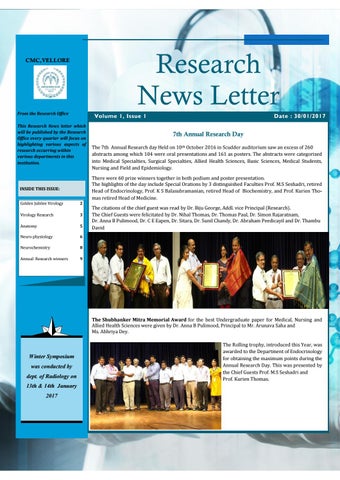
7th Annual Research Day The 7th Annual Research day Held on 10th October 2016 in Scudder auditorium saw an excess of 260 abstracts among which 104 were oral presentations and 161 as posters. The abstracts were categorized into Medical Specialties, Surgical Specialties, Allied Health Sciences, Basic Sciences, Medical Students, Nursing and Field and Epidemiology. There were 60 prize winners together in both podium and poster presentation. The highlights of the day include Special Orations by 3 distinguished Faculties Prof. M.S Seshadri, retired Head of Endocrinology, Prof. K S Balasubramanian, retired Head of Biochemistry, and Prof. Kurien Thomas retired Head of Medicine. The citations of the chief guest was read by Dr. Biju George, Addl. vice Principal (Research). The Chief Guests were felicitated by Dr. Nihal Thomas, Dr. Thomas Paul, Dr. Simon Rajaratnam, Dr. Anna B Pulimood, Dr. C E Eapen, Dr. Sitara, Dr. Sunil Chandy, Dr. Abraham Peedicayil and Dr. Thambu David
The Shubhanker Mitra Memorial Award for the best Undergraduate paper for Medical, Nursing and Allied Health Sciences were given by Dr. Anna B Pulimood, Principal to Mr. Arunava Saha and Ms. Abhriya Dey.
Winter Symposium was conducted by dept. of Radiology on 13th & 14th January 2017
The Rolling trophy, introduced this Year, was awarded to the Department of Endocrinology for obtaining the maximum points during the Annual Research Day. This was presented by the Chief Guests Prof. M.S Seshadri and Prof. Kurien Thomas.
Research
Page 2
Golden Jubilee celebration of Department of Clinical Virology The Department of Clinical Virology in CMC is a state –of- the- art National Resource Centre responding to investigation of many viral infections – Hepatitis (A, B, C, D, E), Dengue, Influenza, HIV, herpes viruses and HPV -began its Golden Jubilee Celebration on 12th October 2016. The department is a NABL accredited laboratory since 2011. It is one of the few Virology laboratories associated with a medical college offering the largest repertoires of diagnostic assays. The Department was started as anenterovirus laboratory in 1966 with initiative taken by Dr. Jacob Chandy, then Principal, and Dr Telford Work of Centre for Disease Control (CDC), Atlanta. It was established and headed for two years by Dr Roger Feldman of CDC and subsequently Dr. T. Jacob John took charge in 1968 making it India’s very first diagnostic virology laboratory. Some of the landmark initiatives of the laboratory include documentation of very low efficacy of oral polio vaccine leading to the designing and field testing of ‘Pulse vaccination’ in 1981, resulting in a polio-free Vellore in 1982 and 1983. Pulse polio immunization was eventually adopted nationally for polio eradication. In 1972, donor blood screening for HBV was established, for the first time in the developing world. In 1986, HIV infection was detected again for the first time in India in samples from commercial sex workers. By 1988 routine donor blood screening for HIV was established. The diagnostic virology laboratory became an independent Department of Clinical Virology in 1995 and expanded the diagnostic services immensely with the establishment of molecular tests in 1996. Currently the Department of Clinical Virology has three main divisions namely, Hepatitis laboratory, Cell culture based diagnostic laboratory and Retrovirus laboratory with all carrying out both serological and molecular assays. The celebratory function on 12th October 2016 began with a prayer by Rev. Pearson and Dr. Rajesh Kannangai, Head of the department welcomed the delegates after which. Dr. T. Jacob John gave a brief description on the history of department. The function was felicitated by The Director Dr. Sunil Chandy, the Principal Dr. Anna B Pulimood, and Dr.C.E Eapen the Medical Superintendent. Two eminent virologists in India, Dr. S.P Thyagarajan, former Vice Chancellor of Madras University and currently Prof. of Eminence & Dean (Research), SRMC, Chennai and Dr. V. Ravi, Professor of Neurovirology and Dean Faculty (Basic Sciences), NIMHANS, Bangalore graced the occasion. Dr. M.K. Lalitha and Dr. Mary V. Jesudason both former Heads of the Department of Clinical Microbiology, CMC Vellore were also present. Dr. Roger Feldman spoke about the initial days of the laboratory and honored the retired staffs of the department. A guest lecture on ‘oral vaccines in the developing world’ was delivered by Dr. Gagandeep Kang, Director, THSTI, Faridabad. The inaugural function was followed by the scientific session “Virology: the past, the present and the future”. Dr. Ramanda Kamath, currently a pediatrician at Westmead University, Sydney and Dr. P.S. Sundar Rao former Head of Bio statistics CMC who worked with Dr. Feldman shared their experience and the challenges in carrying out community studies during 1960s. Drs. TJ John, G.Sridharan, Priya Abraham, Asha Mary Abraham, Rajesh K, Shoba Mammen, Mahesh Moorthy and John Fletcher shared the work conducted in the department during the last decades in various areas like polio, hepatitis, neuroviroloy, HIV, respiratory viruses and arboviral infections. Dr. P. Vivekandan, IIT Delhi and Dr. Magesh Babu, SNHRC Vellore reflected on how the training in Virology at CMC shaped their careers and described the current work they are carrying out. The program was well attended by faculty, PhD and post graduate students from different colleges including CMC. The scientific program was awarded 10 credit points by the TN Dr. MGR Medical University. The golden jubilee celebration will continue and culminate with a national conference in July 2017.
Volume 1, Issue 1
Page 3
Department of Clinical Virology Research at a glance The Christian Medical College, Vellore has its grounding in diagnostics from the work started by Dr. Ida Sophia Scudder, its founder. Over the past century, Research is an integral part of the vision and the mission of CMC. Research at the institution has been oriented to areas of need and emphasizes application of knowledge to relevant problems. CMC has contributed significantly not only to the provision of health care to the poor and needy but also in generating and advancing knowledge to improve the provision of curative and preventive services to the people we serve directly and to the nation. The Department Virology, which is celebrating the Golden Jubilee this year, has its research roots going back to the days of Dr. Ruth Myers who, along with Dr. J.T. Cornelius, started the Department of Clinical Microbiology in the year 1944. Dr. Ruth Myers established the Arbovirus research unit in the early 1950s. Dr. Myers along with Dr. Donald Carrey undertook epidemiological studies on people, mosquitoes, birds and animals of this region. She has to her credits, several papers published on Arbovirus research. The pulse polio program, a flagship campaign towards the global polio eradication, originated from the laboratory findings with the guidance of Dr. T. Jacob John. Dr. John a pioneer in the field of polio, helped to set up the Enterovirus laboratory in 1964. Pulse immunisation, a phrase coined in 1981 by Dr. T. Jacob John, refers to discontinuous but repetitive vaccination to interrupt the transmission once routine immunization ensured that all children had a base level of protection against infection. This has finally led to the elimination of wild poliovirus in the country. An independent department of Clinical Virology was established in the year 1995 and under the guidance of Dr. G. Sridharan research that continued there on complemented the expanding diagnostic services. Currently, there are numerous research activities undertaken which are funded by both extramural and intramural research grants. The Department of Clinical Virology has three main divisions namely, Hepatitis laboratory, Cell culture diagnostic laboratory and Retrovirus laboratory Hepatitis Laboratory (Also human papillomavirus research lab): Christian Medical College as a hospital started the universal hepatitis B screening of blood before transfusion in the year 1972. This was the first in a developing world (excluding Taiwan). Although, there is a vaccine for Hepatitis B, India has the second largest pool of HBV carriers (50 million). The initial research focused on sero epidemiological studies and clinical profile of patients infected with Hepatitis B, C and D. Research was also carried out on unconventional hepatotropic viruses like GB virus C/hepatitis G virus (GBV-C/HGV) and TT virus (TTV) in patients with high parenteral risk such as hemodialysis and renal transplant recipients. We characterized the hepatitis B virus drug resistance mutations which paved the way for identifying signature mutations thereby preventing treatment failure. Also, a novel HBV genotype I and HCV genotype 4& 6 were identified to provide further evidence of these genotypes in Northeast India. In the field of human papillomavirus, several molecular and pathogenesis studies were carried out among women present with cervical cancer. Research was also carried out in collaboration with NIH on HIV positive Men who have sex with men (MSM) who represent unique population. There were fascinating outcomes with HPV 35 being the most common HPV type as against the norm of HPV 16/18. Interestingly, this type is also not included in the current nonavalent vaccine which is being licensed for use. Another study also found no role of HPV in oral cancers among patients from a region of southern India. The current research is focused on studying HPV DNA detection from urine of symptomatic and asymptomatic women for cervical neoplasia as well as HPV detection among the immunocompromised. The other area of research being perused is the lipidomics of HCV genotype 3 infected individuals to study HCV pathogenesis. Cell culture diagnostic laboratory (Neurovirology and Arbovirology Laboratory): Dr. Ruth Myers’ pioneering efforts in the field of Arbovirology led to the development of basic cell culture techniques in the early 1950s. Serosurveys during that period showed the presence of Japanese encephalitis, dengue, West Nile and Sindbis among others.
Page 4
Research
Early studies also observed co-infections with different arbovirues. Early research also focused on the seroepidemiology of herpes viruses and the clinical profile of patients presenting with genital herpes. The early enterovirus studies conducted by Dr.T. Jacob John were continued. This lab continues to work on arbovirus research specifically dengue. Collaboration with Emory University and ICGEB, New Delhi is being currently undertaken to study the immunological response (T cell/B-cell) to different serotypes of dengue. Also, epidemiological studies to assess the circulating dengue serotypes and different markers of severity in the early course of the disease are currently undergoing. Also, epidemiological and clinical studies have been undertaken on a globally emerging pathogen, West Nile virus. The laboratory is also looking at early detection and pathogenesis related to cytomegalovirus infection among transplant patients. In the field of respiratory viral infections, surveillance is undertaken to detect influenza A and B among patients presenting with influenza like illness and severe acute respiratory infections. A study was also undertaken to assess the influenza disease burden in the general population. Studies are also underway to look at the molecular epidemiology of respiratory viruses in children presenting with acute lower respiratory infection in Vellore Retrovirus laboratory: The detection of the first case of HIV in India was in our department with blood samples from Chennai in the year 1986. The initial research mainly focused on sero epidemiological studies and clinical profile of patients infected with HIV. Subsequently, several studies related to molecular epidemiology, pathogenesis of both HIV-1 & HIV-2 and real time evaluation of both screening and monitoring assays were carried out. Recently several studies demonstrated the mutations in the pol gene of HIV among treatment naĂŻve and treatment experienced individuals. Another area of interest of this laboratory is opportunistic viral infections among HIV infected individuals. One of the studies showed presence of multiple opportunistic viruses in the CSF and brain tissue suggesting one infectious agent leading to the reactivation of several other latent viruses. Ongoing projects include studying the role of host genetic and viral factors in the pathogenesis of HIV-2, the difference in the immunological and virological characteristics among HIV/HBV co-infections compared to mono infections and the role of IL-28 polymorphisms and IFNÎť in patients presented with immune reconstitution inflammatory syndrome (IRIS). The laboratory also serves as a National HIV reference laboratory for National AIDS Control Organization .
Clinical Virology A virological and immunological study of HIV-HBV coinfected individual in India by Mr. M. John Paul Demosthenes A virological and immunological study of HIV-1/HBV coinfected individual in India by Dr. Rajesh Kannangai Investigation on the variations in the capsid amino acid sequence of HIV-2 Subtype A, HIV-1 subtype C, its influence on the susceptibility to Tripartite Motif 5 alpha (TRIM5 alpha) a retrovirus restriction factor and association with HIV pathogenesis. By Dr. Rajesh Kannangai Investigation on the variations in the capsid amino acid sequence of HIV-2 Subtype A, HIV-1 subtype C, its influence on the susceptibility to Tripartite Motif 5 alpha (TRIM5 alpha) a retrovirus restriction factor and association with HIV pathogenesis. by Ms. Veena Vadhini. R Monitoring virological response and liver derived plasma albumin mRNA levels in tenofovir treatment of chronic HBV infection in Indian patients by Dr. Priya Abraham Characterization of immunological, virological and host factors in primary and secondary dengue infection by Mr. Anand K Investigation of immunological, virological and host factors that influence CMV reactivation among allogeneic stem cell transplant recipients in an Indian population by Mr. Santhosh Kumar. D Investigation of immunological, virological and host factors that influence CMV reactivation among allogeneic stem cell transplant recipients in an Indian population by Dr. Asha Mary Abraham Characterization of immunological, Virological and host factors in primary and secondary dengue infection by Dr. Asha Mary Abraham Dengue virus infection in India by Asha Mary Abraham A Pilot Sutudy to identify the influence of IL-28b gene polymorphisms and IFN by Dr. Rajesh Kannangai
Volume 1, Issue 1
Page 5
Department of Anatomy Research in the Anatomy Department is being carried out in isolation and also in collaboration with Departments like Orthopaedics, Neurosurgery, Hand surgery, Crictical care, Radiology, Radiotherapy, ENT, Head and neck Surgery, dental surgery, Biochemistry and Physiology.
Gross and Clinical Anatomy: Research in gross anatomy covers a variety of fields. Some examples or ongoing studies are: dimensions of the atlas vertebra from the point of view of lateral mass screw placement (in collaboration with neurosurgery), motor entry points in the hamstring muscles from the point of view of ideal injection sites for lower limb spasticity, a radiological study on the prevalence of duodenal diverticula in the Indian population, morphometric analysis of the human knee in correlation to current arthroplasty systems, cadaveric studies exploring novel approaches to the radius and the humerus (in collaboration with orthopaedics), estimation of regional anatomical dimensions of the adult and pediatric Indian population from Computed Tomography scans to generate reference values for radiation dosimetry calculations (along with radiology department), localizing the position of mandibular foramen in Bilateral Sagittal Section Osteotomy during mandibular reconstruction procedures (along with the department of dental surgery), Topographical Anatomy of structures of surgical importance like the radial nerve, extensor tendons of the hand etc. Microscopic Anatomy: Ongoing projects involve research into morphology and distribution CD1a positive Langerhans cells in various tissues, exploring their role in normal tissues, those with infective diseases and in malignancies. These immunohistochemical studies are also exploring their subtyping, interactions with lymphocytes and their ultrastructural features. Ultrastructural studies of the microsvasculture of the human uterine tube are also underway. Along with the ENT department, studies on mucosal changes in different modalities of treatment of inferior turbinate hypertrophy are being completed. In collaboration with the Biochemistry department there is research involving iron metabolism and deposition of iron in hepcidin knock-out mice in various tissues like the brain, liver, adipose tissue and muscle. Along with physiology, there is a project looking at chondrocyte survival in a fibrin scaffolds. Preservation techniques: The department is constantly on the look out for newer methods for preservation. Cheaper, safer and more surgeon friendly embalming fluids are being studied in order to facilitate surgical cadaveric workshops that are held. While the plastination laboratory is well established, studies regarding alternative methods, lightweight plastination, colour plastination, epoxy resin plastination and deplastination techniques are ongoing. One study published, recently compared a light weight plastinated torso with the standard Alderson Rando phantom for radiotherapy dosimetry. In conjunction with hepatobiliary surgery, radiology and nuclear medicine a study looking into the branching pattern of the portal tract using casting techniques is underway. Research in Medical Education: Current medical education projects involve looking at improving efficacy of histology teaching learning methods, one evaluating the role of structured functional histology practicals and another looking at how virtual microscopy could enhance current histology teaching and learning. There are plans to begin a study on implementation of a cross sectional anatomy curriculum for undergraduates. Another study looked at medical students perspectives of Anatomy learning during various programs organized in the undergraduate curriculum.
Research
Page 6
Anatomy A study of the extensor tendons of the human hand by Dr. Rex Joe Max. J Prevalence of duodenal diverticulum in Indian population – A radiological study by Dr. Minu Rekha. B A light and transmission electron microscopic study of the microvasculature of the non-pregnant human Fallopian tube by Dr. Tripti Jacob Retrospective analysis of outcomes of colorectal anastomoses in the past 6 years by Dr. Sasank K. Study of CD1a positive Langerhans cells in benign and malignant diseases of human lung by immunohistochemistry by Dr. J. Rajkohila Suitability of an alcohol based embalming solution containing common salt in body preservation and its comparability to formalin based preservatives by Dr. Deepak Vinod Francis Morphology of sigmoid colon in South Indian population – a cadaveric study by Dr. Stelin Agnes Topographical Anatomy of Radial nerve and its Muscular Branches to triceps by Dr. P. Mythraeyee Morphology and distribution of CD1a positive langer hans cells in normal, premalignant and carcinoma of oral mucosa by Dr. John Kandam Lulathu Mathew MBBS Students’ Perceptions of Learning Anatomy in a Clinical Context by Dr. Sunil Jonathan Holla Will structuring the histology practical time help students focus on the functional aspects of histology as well as make the subject more interesting and relevant? by Dr. Tripti Meriel Jacob Calcaneal entheseophytes in Indian population. by Dr. J. Rajkohila An anatomical landmark to identify the neurovascular bundle in the dorsum of foot – a cadaveric study in south Indian population. by Dr. J. Suganthy Morphological and morphometric analysis of accessory mental foramen in dry human mandibles by Dr. J. Rajkohila Incidence of calcaneal spurs in South Indian population by Dr. J. Rajkohila Study of the Anatomical variations of the liver in Human by Dr. Haobam Rajajee Singh The Supinator Muscle and the Anatomical Basis for the Posterior Interosseous Nerve Entrapment by Dr. Jenny Jacob Estimation of regional anatomical dimensions of the adult and pediatric Indian population from Computed Tomography to generate reference values for radiation dosimetric calculations by Dr. Vandana Nathan An anatomical landmark to identify the neurovascular bundle in the dorsum of foot - a cadaveric study in South Indian Population. by Dr. J. Suganthy Sodium Nitrite as an alternate oxidative agent in the preparation of Theils Soft fixed cadavers by Dr. Deepak Vinod Francis
Neurophysiology Dr. K. Srinivasa Babu, Senior Scientist is the Head of Neurophysiology laboratory at Christian Medical College, Vellore. He did his Doctoral training under Prof. Marcus Devanandan, which was awarded in 1990. In 1991 he started a full-fledged intraoperative monitoring facility for various neurosurgical procedures. These include monitoring and localization of epileptic foci, functional mapping of the cortex under general anaesthesia and during awake craniotomies, mapping of the white matter, monitoring spinal cord using somatosensory and motor evoked potentials, mapping of the brainstem, spinal roots, monitoring of aneurysm surgeries. He has several international publications on intraoperative monitoring. In 1997 he underwent special training in functional neurosurgical procedures in Emory University under Prof. Mahlon de Long and Prof. Jerry Vitek. In 2004 conducted a national workshop on Intraoperative monitoring. He also received two ICMR research grants for (1) localization of central sulcus (identification of motor cortex) using somatosensory evoked potentials in patients during the course of surgery (2) In collaboration with Dr. Rajshekhar he studied on electrophysiological monitoring of spinal cord during surgery using transcranial electrical stimulation (2004-07). He wrote a chapter on “Instrumentation for intraoperative monitoring” in “Text book of Operative neurosurgery”. He also coauthored a chapter on “Posterior quadrantic resection and disconnection” in the text book on “Pediatric Epilepsy Surgery: Preoperative assessment and surgical treatment”. Thieme publications. They have provided training in intraoperative monitoring for personnel from Asia-Oceania countries. Dr. Babu also has lab experience where he underwent training in Pavlov Institute of Physiology, St. Petersburg Russia in 1990-91 for characterizing the mechanoreceptors in skin. He and Dr. Devanandan received a DST grant to experimentally prove that autonomic
Volume 1, Issue 1
Page 7
nervous system has both diffuse and discrete control mechanism which is tacitly accepted (1995-1998). He worked in NIH grant in Prof. Esther Gardner’s laboratory in New York University Medical Centre, NYC (2000 – 02), on electrophysiological mapping of the parietal cortex in behaving monkeys. This work was published in a series of three articles in Journal of Neurophysiology and a book chapter. He along with Dr. Suresh Devasahayam and Dr.Suranjan Bhattacharjee received two DST grants (1) to study hand function in patients before and after intervention (2005 -2008) (2) to study functional outcome in stroke patients (2005 2008). He further continued to develop instruments such as skin friction measurement, spasticity measurement and precision grip apparatus for assessing hand function. Their objective is to use precision grip task as a tool for assessing hand function. Dr. Babu, Dr. Roy Daniel, Dr. Ari Chacko, Dr. Suresh Devasahayam have set up a facility specifically in the field of epilepsy research. He started a collaborative DBT project with Dr. Srinivas Chakravarthy, IIT Chennai, Dr. Suresh Devasahayam, Bioengineering, and Dr. Mathew Alexander, Neurology, CMC on developing models for understanding Parkinson’s disease. Their objective is to use precision grip task as a tool for assessing hand function. Dr. Babu, Dr. Roy Daniel, Dr. Ari Chacko, Dr. Suresh Devasahayam have set up a facility specifically in the field of epilepsy research. With this in view in 2006 he started a dialogue with Prof. Sumantra Chattarji, NCBS, Bangalore for the possibility of a collaborative work as he has expertise in studying stress particularly in amygdala which is also implicated in temporal lobe epilepsy. In this regard, they got a collaborative grant from DBT to study the Cellular mechanisms of temporal lobe epilepsy: in vitro studies in the human brain and animal models. Through this grant they have setup a facility for extracellular and patch-clamp recordings. He and Dr. Ari Chacko developed collaborative links with Dr. Stoop, Lausanne, Switzerland and wrote three training grants and industry collaboration under the Indo Swiss joint program through DST. He and Dr. Ari Chacko in collaboration with Dr. Srinivas Chakravarthy, IIT Chennai got a DST grant to study “Network interactions in Temporal Lobe Epilepsy: An integrated approach using Invitro studies and Computational Modeling in Human brain and Animal models”. His doctoral student Mr. Sanjay worked on computer modelling of epileptic activity, published in the journal Hippocampus, and they authored book chapters on Modelling Epileptic activity in hippocampal CA3. 2 nd Volume on Hippocampal Microcircuits: A Computational Modeler's Resource Book. Ed: Cutsuridis, V., Graham, B.P., Cobb, S. and Vida, I. (Eds) Springer, NY and also a chapter on Multiscale computer modeling of Epilepsy. In “Computational Models of Brain and Behavior ." Ed. Ahmed Moustafa , Published by WileyBlackwell. Insilico model of CA3 subfield is available in the ModelDB (https://senselab.med.yale.edu/ModelDB, Accession No. 186768). Dr. Rajesh Valmiki, joined Neurophysiology laboratory in the year 2015 as lecturer Grade II. He got his PhD from Bharathiar University, Coimbatore, Tamilnadu and post-doctoral training from National Institute of Animal Science, Suwon, South Korea and Dept. of Pathology, Baylor College of Medicine, Houston, USA. Currently they are focusing on understanding the mechanisms underlying antiepileptic drugs (AED) resistance. They want to identify the molecular markers to tag drug resistant epilepsy in earlier stages of the disease. To achieve this, they are working on genome wide single-nucleotide polymorphism analysis of pharmacogenomics variants in drug resistant epilepsy population. Recent research work in their lab has standardized an in vitro high potassium model to understand the neuronal networking in hippocampus during seizures. In addition, the work includes identification of molecular signaling pathways in memory loss induced by amyloid beta peptide. Towards this they have standardized an in vitro model for memory (long term potentiation) in rat acute hippocampal slices and further studying the role of Akt (protein kinase B) signaling pathways in memory process. In addition, we are working on microarray analysis for identification of seizure onset related gene expression in intractable temporal lobe epilepsy using the brain tissue samples from epilepsy surgeries. The output of this work aims to identify genes that are differently regulated in the epileptic focus and further to identify valid drug targets for improved therapy.
Research
Page 8
Neurochemistry Association of Single Nucleotide Polymorphisms in genes of the coagulation and fibrinolytic system with the risk of Cerebral Venous Thrombosis (CVT) by Dr. B. S. B. Salomi Hemostatic and genetic markers for Thrombosis in pregnancy and Puerperium by Dr. Christhunesa SoundararajanChristudass
Neurochemistry Currently Dr. K. Srinivasa Babu is the head of Neurochemistry laboratory. Dr. Christhunesa S. Christudass and Dr. V. Prabhakaran are working as faculty in laboratory. Dr. Christhunesa S. Christudass: Apart from regular diagnostic works related to neurological disorders as well as inborn errors of metabolism, is actively involved in research projects, focusing mainly on (i) genetic risk factors in different types of stroke (CVT, young stroke, etc.) and (ii) cancer stem cells (CSCs) in high-grade gliomas. His proposal on high-grade glioma stem cells and blood-brain barrier was selected for UGC research award (2014 – 16) under Biomedical Science category and he also has two other research projects sanctioned by DBT as principal investigator, one on CSCs from primary and secondary gliomas, and the other on hemostatic and genetic markers for thrombosis in pregnancy. Apart from this, he is mentoring two other post-Ph.D. scholars (one DST woman scientist and one SERB national postdoctoral fellow) in their works. He is a co-investigator in four other externally and institutionally funded ongoing projects. He is currently working on expanding the neurometabolic disorders diagnostic facility by involving mass spectrometry based assays for which he underwent a month-long hands-on advanced training in Biochemical Genetics Laboratory at Kennedy Krieger Institute, Baltimore, USA during Jan – Feb 2016. Dr. V. Prabhakaran is focusing on the role of inflammation and immunity of neuro-infections on the brain. They are exploring if chronic inflammation and reduced immune surveillance that occurs with neurocysticercosis can lead to brain cancer. (DST-SERB grant). In collaboration with Neurosurgery and Oklahoma University Health Sciences Centre, USA, they are trying to identify diagnostic blood inflammatory markers for neurocysticercosis to overcome the need of brain imaging. (NIH-RO1 grant). Besides this in collaboration with the Department of Biochemistry they are trying to understand the distribution of iron in hepcidin knock-out mice. In collaboration with the Department of Radiation Therapy they are studying cellular signaling induced by radiation & chemotherapy in cervical cancer and developing an in-vitro thermosdosimetric system for hyperthermia treatment.
Neurophysiology Role of Akt-specific isoform(s) in amyloid beta peptide mediated inhibition of Long term potentiation by Dr. R.V. Rajesh
Research
Page 9
Annual Research Day Winners Oral Presentation
Poster Presentation
Basic Science PG Roshna Ramachandran Jithu James Sangeetha Pillai
Basic Science PG Renu Raj Sophia Silas Balaji B
Basic Science faculty Sathya Subramanai Joseph Dianbondu Joe Varghese
Basic Science Faculty Bimal Patel Yesudas Sudhakar Mahalaxmi
AHS PG Naveen G Aarvin Joshua Divya Lakshmi
AHS/Nursing Faulty Alka Sara Saju Mini Joseph Roshan Livingstone
AHS Faculty Reema Samuel Mohamathu Rafiq Dharini
AHS PG Aravind N Abriya Dey Melinda Letitia
Medical PG Aswathy Ashok Menon Reny Joseph Praveen Gangadharan Saraswathi Ramanathan
Medical PG Sheraj Fernandez Esther Banu Salabh Arora
Medical Faculty Balu Krishna Riddhi Das Gupta Vandana Kamath Surgery PG Aureen Ruby D’cunha Sowmya Ramesh Sameer MD Field and Epidemiology Kusum Moray Anu Mary Oommen Sumanto Pal Nursing Faculty Irene Dorothy Anitha L Mythily Vandana Medical Students Ahikam Devadason J Jivansha Dua Arunava Saha
Medical Faculty Suceena Alexander Sahana Shetty Balukrishna Surgery PG Rahul Lakshminarayan Prajna Bhgargavi Kota Manju Deena Mammen Surgery faculty Naina Picardo Zeeshan Rahman Vasanth Mark Samuel Basic Science VIT Senthil Kumar B Yuvashree Nivetha A Field And Epidemiology Ananth Ram Martina Shalini Jeana Jacob
Research
Dr. Shubhankar Mitra Award Arunava Saha Abhriya Dey Rolling Trophy Endocrinology Department
Contact us: Dr. Biju George Addl. Vice Principal (Research) Carman Block Research@cmcvellore.ac.in/ Researchothers@cmcvellore. ac.in Ph: 0416-2284294