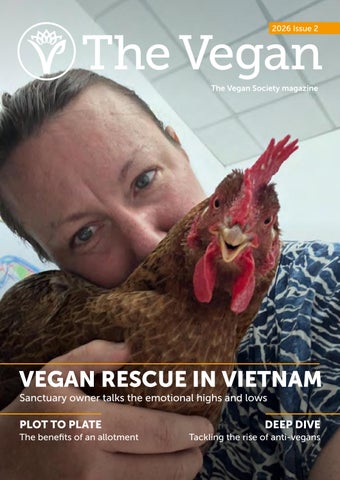
2026 Issue 2
VEGAN RESCUE IN VIETNAM Sanctuary owner talks the emotional highs and lows
PLOT TO PLATE The benefits of an allotment
DEEP DIVE Tackling the rise of anti-vegans
Protect your vegan or vegetarian wishes at home
If you receive care at home, new carers may not always understand your dietary beliefs. A simple, visible reminder can make all the difference. V for Life’s A4 kitchen poster clearly explains:
• You follow a vegan or vegetarian diet • This is a deeply held belief • Serving unsuitable food can cause real distress Designed to display on a cupboard door or fridge, it helps carers get things right from day one.
Practical support from V for Life • Friendly penand phone-pals who understand your values • Grants when money is tight • Guides, cookery classes and support to live well your way
ONE FREE POSTER PER PERSON. JUST £2 TO COVER P&P
Visit vforlife.org.uk Explore our shop | Find support | Make a donation V for Life is a charity registered in England and Wales, number 1120687
Editor’s letter and contents
EDITOR’S LETTER Spring is a time for rejuvenation and hope. But, for many vegans, the cheery focus on new life can feel bittersweet, reminding us of the exploitation and hidden realities of the farming system. Ethical communications expert Siobhan Dolan explores this on page 35 with her article on the dark side of petting farms. We talk to Vietnam Animal Aid Rescue founder Cat Besch in our feature interview, who explains the challenges of being the country’s only vegan rescue, while this issue’s deep dive explores the rise in anti-veganism and how vegans can weather this turbulent social media trend.
Our pick of recipes from Lisanna Wallance’s Plant-Based Magic may help soothe the bitterness, including aromatic bakes and a summery twist on pizza. Meanwhile vegan allotmenteer Woody River reveals the benefits of growing your own while showing some love to those custodians of the soil we call worms. And, among our regular features, writer Samuel Peters reviews plant-based living guide Vegan Made Easy, while dietitian Emily discusses micronutrients over in our nutrition segment. So, dig in and enjoy all the usual Vegan Society content from member news to the latest vegan spoils, and read how we are continuing to sow and grow the seeds of change in our 2025 Impact Report available on The Vegan Society website. Cat Thompson, Editor
CONTENTS 03
Highlights Essential updates on Vegan Society news
06 Interview Sanctuary founder on being
06 26
Nutrition
30
Deep dive
35
Petting farms
37
Events
39
Reviews
Selective supplementation
Why vegans trigger pushback
Vietnam’s only vegan rescue
10
Recipes
16
Grow your own
20
Volunteers
Wholesome and healing dishes
The veganic way
Volunteer of the Season
When cute becomes a commodity
10
Vegan events across the UK
Inspired recipes for new and stalwart vegans
84
Plant-Based Magic
16 Plant-Based Magie_5P.indd 84
22
Membership Letters and updates
vegans 40 Inspirational Animal-loving Oscar went vegan overnight at nineyears-old
24
Shoparound New vegan products to look out for
Issue 2 2026 The Vegan | 1
10/29/25 1:22 PM
From the CEO
FROM THE CEO Over the past year I’ve been struck by how many encouraging signs of progress are emerging across the vegan movement − from community outreach and research to policy shifts and public debate. While the challenges remain profound, conversations about our relationship with other animals and the future of food systems are clearly shifting. Colleagues from the society and I attended VARC – the UK’s largest vegan animal rights conference. I was delighted to see the charity’s contribution across the programme including hosting a meet-up for our Researcher Network, discussions on policy progress through collaboration, a presentation on our Veganism Around the World research, an exploration of humane and vegan-inclusive education and a session on vegan rights and legal protections. I was also pleased to contribute a session on mental health and the psychology of sustainable advocacy. Our teams continue to find creative ways to make veganism more visible and accessible. One of our Community Network volunteers recently delivered a ‘Veganism 101’ talk to The Deaf Society in London, sharing recipes and campaign materials while opening up a lively discussion. Feedback described the session as a huge success, with participants eager to continue the conversation afterwards. As part of the Live Vegan for Less campaign, the team recently developed a series of affordable three-course menus designed to show how straightforward vegan meals can be − including ideas inspired by family favourites and the versatility of beans, connecting neatly with The Food Foundation’s Bang In Some Beans campaign. With recipes designed to feed a household for under £20, initiatives like this demonstrate vegan living as both accessible and enjoyable. Our policy team has also contributed to the consultation on topics for the 2031 Census in England and Wales. Drawing on evidence from our Know Your Rights service, we highlighted the experiences of vegans navigating healthcare, education and other public services and made the case for including a voluntary question on philosophical belief that explicitly recognises veganism. Better data helps ensure the needs and rights of vegans are recognised in public policy and planning. Encouraging signals are also emerging in how governments
21 Hylton Street, Birmingham, B18 6HJ
and institutions are beginning to grapple with the future of food systems. In January, Amsterdam’s city council voted to ban advertising for meat in public spaces across the city. When the measure comes into force in May it will prohibit meat advertising on city-controlled billboards, bus shelters and other public spaces. Amsterdam will become the first capital city in the world to introduce a restriction of this kind, following a similar move by the Dutch city of Haarlem in 2022. Not all policy debates are moving in the same direction however. Following negotiations across EU institutions, new rules will restrict the use of certain ‘meaty’ terms for plantbased products. While familiar names such as ‘veggie burger’ and ‘plant-based sausage’ will remain permitted, some terms such as ‘steak’, ‘chicken’ and ‘beef’ will be reserved exclusively for animal-derived products. It’s difficult to view this decision as anything other than regulatory theatrics − a protectionist response from a meat sector unsettled by the growing popularity of plant-based foods. The UK government recently published a new Animal Welfare Strategy for England, setting out proposals aimed at improving certain welfare conditions for animals by 2030, including moving away from some confinement systems in farming and tackling practices such as snare traps. These developments reflect a growing recognition that animals are sentient beings whose experiences matter. At the same time, welfare reform is far from the end of the conversation. Measures that improve conditions within systems that use animals may reduce some suffering, but they do not address the underlying practice of treating sentient beings as commodities rather than individuals whose lives and freedom should be respected. The Vegan Society’s approach has always been to challenge and ultimately end the exploitation of animals and the systems that treat sentient beings as commodities − an end point on which we will not compromise. In closing, these developments remind me that progress rarely arrives all at once. It comes through thousands of conversations, policy shifts, cultural signals and practical initiatives that slowly reshape the landscape around us. Whether through community outreach, research, advocacy or everyday choices, each of us plays a part in that wider transformation − and step by step, the world we are working towards comes closer.
0121 523 1730 info@vegansociety.com vegansociety.com
Libby Peppiatt, CEO
© The Vegan Society Registered Charity No. 279228 (England and Wales) and SC049495 (Scotland) Registered Co. Nos. 01468880 and 12377572 (England & Wales). VAT Registration No. 361 7274 92.
Printed on recycled paper
Editor Cat Thompson Designer Violeta Pereira Cover image Cat Besch The views expressed in The Vegan do not necessarily reflect those of the Editor, the Council of Trustees of The Vegan Society or staff. Nothing printed should be construed to be The Vegan Society’s policy or position unless so stated. The society accepts no liability for any matter in the magazine. The acceptance of advertisements (including inserts) does not imply endorsement. Complaints should be made in writing to chair@vegansociety.com or info@vegansociety.com or by post. Visit vegansociety.com/complaints-procedure to find out more.
2 | The Vegan Issue 2 2026
Highlights
HIGHLIGHTS
The ‘base line’ for veganism is strong and ready for growth. CEO Libby Peppiatt
Plant-based makes a comeback In February, society CEO Libby Peppiatt welcomed headline news over the rise of chilled plant-based food sales. Market data from retail analyst NielsenIQ confirmed overall sales of chilled plant-based food in UK supermarkets grew by just under one percent, year-on-year, and by 1.7 percent in the last 12 weeks of 2025. Libby described the news as ‘positive’, in the face of negative media coverage about “the so-called ‘demise’ of veganism”. The figures follow a rise in sales of plant-based protein like tofu and tempeh – up by 12% last year, according to supermarket giant Tesco, and veggie mince up by a quarter – owing to a trend for healthier, veg-led cuisine. Libby added: “These hard sales numbers show that people want Je plant-based food – and they show an ett that the ‘base line’ for veganism is strong e Ro wley and ready for growth.”
Oat’s not so simple – more headline headaches Recently, Media and PR Officer, Damian Watson, challenged a Telegraph headline questioning the healthfulness of oat milk. The journalist insinuated all oat milk contains ‘added sugar’, which is not true. Unsweetened versions contain naturally occurring sugars, similarly to cows’ milk. The article went on to say the so-called ‘added sugars’ would cause a blood sugar spike.
The pushback worked and the content was changed to omit the suggestion of ‘added sugars’ – securing a minor win for Team TVS. The journalist also conveniently left out other nutrition factors such as the higher content of saturated fat and lack of fibre in dairy milk, and that potential sugar spikes can be managed when oat milk is consumed as part of a balanced meal, alongside protein and healthy fats. In another article the publication wrote about gut health, again insinuating vegans struggle with iron intake, without providing balanced information on plantbased sources of the mineral. After pointing this out, the editor added in a paragraph to say vegans and vegetarians can meet dietary iron needs with a balanced diet, providing examples and included a line about increased non-heme iron absorption observed in vegans and vegetarians within 12 weeks. It’s small wins like these that compel us to keep chipping away at media bias and strengthen our collective voice as veganism continues its overall growth.
Blog explores Wales school menu progress In a recent blog, Vegan Rights Advocate Jeanette Rowley explores new school menu regulations in Wales, which promote plant-based protein sources and dairy milk alternatives. The guidelines, which will come into force in October, permit unsweetened, calcium-fortified plant milks, mandate a weekly legumes-based protein alternative meal while plant-based ‘processed alternatives’ such as sausages
Issue 2 2026 The Vegan | 3
Highlights
Mercedes-Benz delivered the world’s first independently certified vegan car
and burgers are permitted twice a week. Although they don’t mandate a daily vegan lunch option, the guidelines mean vegans will be more easily accommodated and failure to follow the regulations could constitute discrimination. Read more at vegansociety.com/blog.
Interests rev up A mini campaign, run by the society’s Vegan Trademark team, revealed a third of Brits are interested in buying an entirely vegan car. Last year Mercedes-Benz made headlines after it teamed up with the society to deliver the world's first car with interiors certified by the Vegan Trademark. And now, growing awareness of brand transparency, as well as the true meaning of ‘vegan’, is influencing expectation in the automobile industry. The survey also found 40% of Brits would prefer a car interior Al ex Hu made from plant-based leather over ntle y animal leather or nylon/polyester while just over 70% think it’s important a car marketed as ‘vegan’ is certified by a trusted third-party.
Research manager chews on ‘plant-based’ ambiguity in popular retail mag Research Network manager Alex Huntley recently featured in leading retail publication The Grocer. In his comment piece, 'What’s in a name? Why the vegan vs plant-based label matters', Alex discusses the rise of the term ‘plant-based’ and how its interchangeable use with vegan is causing confusion. He suggests its ambiguity may be deliberate in fear the ‘vegan’ label may put consumers off; it’s a nod to veganism “without the deeper commitment”, says Alex. He rightfully draws the conclusion that clarity should always be a priority, especially in the interests of true compassion.
4 | The Vegan Issue 2 2026
Top of the Pods In the recent episode …And Food Justice for All, pod host Damian Watson speaks to Sarah Bentley, founder and ambassador of cookery school Made in Hackney, and former head chef Sareta Puri, who now works with sustainable food alliance charity Sustain. The duo shares how the school went from a health shop basement operation in 2012 to a nationwide movement, making headlines with its Community Meal service during covid. The guests describe the biggest barriers to food justice as access, poverty and marginalisation and explain how teaching individuals resourceful and healthy cooking skills sets them up for a healthy and sustainable future, building the foundations for wider food justice for all.
March was Free Wills Month Each March, we shine a spotlight on Free Wills Month, one of the two national campaigns held every March and October, giving supporters the chance to have a simple will written or updated for free. If you are aged 18 and over in the UK, please get in touch with our friendly Legacy Team as this offer is available all year round. Including a gift to The Vegan Society in your will is a powerful way to protect animals, the planet and the future of veganism. Legacy gifts of any size help fund our campaigns, policy work and outreach, ensuring we can continue creating meaningful change. If you’d like more information on writing or updating your will with Octopus Legacy, or on leaving a legacy gift to the society, contact us via email legacies@vegansociety.com or call 0121 507 9987. Visit vegansociety.com/legacies for more information.
Advertisement
turns your online shopping into everyday
Join through the QR code and we will receive a bonus £5 donation when you raise your first £5 donation! easyfundraising.org.uk
Registered Charity No. 279228 (England & Wales) and SC049495 (Scotland). Registered Co. Nos. 01468880 and 12377572 (England & Wales). VAT Registration No. 361 7274 92.
Issue 2 2026 The Vegan | 5
I was a militant anti-vegan, now I’m a militant vegan. To me, my origin story is important; it’s given me faith that anyone can change.
Rescue Jackpot in his wheelchair 6 | The Vegan Issue 2 2026
Interview
“IT’S SO VITAL WE KEEP DOING THE WORK BUT I DON’T EVER NOT SEE IT BEING A NIGHTMARE” Vietnam Animal Aid and Rescue founder on the harsh realities of being the country’s only vegan animal rescue Note: readers may find some rescue stories distressing. Cat Besch grew up in Virginia, US, in a town known as ‘the nation’s horse and hunt capital’, never dreaming she’d one day operate a vegan animal rescue – a value she refuses to compromise on, for love nor money (quite literally). Through much of Cat’s youth, grooming, riding and fox hunting were a daily norm. That was until she left ‘the echo chamber’, travelling and living around Europe and Mongolia, where fellow travellers began to change Cat’s perception of animals beyond sport or commodities. She says: “For me, the lightbulb moment was – when you’re suddenly in a room and nobody understands why you would do that. I was never in a room where people didn’t think that was normal. “I would not have sat at a table with a vegan 15 years ago, they were a joke to me. Then someone said to me, ‘Cat your whole life is about animals, but what is on your plate?’ I was a militant anti-vegan, now I’m a militant vegan. To me, my origin story is important; it’s given me faith that anyone can change.”
Change brews After a year of enduring Mongolia’s cold climate, a sixmonth, sun-seeking sojourn in Vietnam – where her parents had lived during the war – turned into 13 years and counting after the country’s notoriously strong coffee led Cat to a lifechanging decision. She explains: “Lots of people have a similar story, they drink this strong coffee and have dumb ideas. It’s like the Wild West – you can start anything. So, I started an animal sanctuary with a friend. I’d worked in rescue and with animals since age 16, so it seemed like it was possible. “Hoi An’s animals really needed help and when everyone got to know who I was they started coming to me. I don’t have formal training but I grew up managing barns and I had access to people I knew I could ask questions to.” Cat was unable to sustain the vet practice, which had originally been part of the sanctuary, due to poor funding opportunities and a skills shortage. Though she’d love to save
Issue 2 2026 The Vegan | 7
Sometimes I have chickens, ducks, puppies and kittens just climbing my curtains.
more farmed animals, she says there is a country-wide lack of veterinary knowledge in a country where most animals are considered ‘lunch’. Among the few farmed animals the team has cared for were two pigs unwanted by a neighbour. They lived comfortably until around age nine, when Cat says their decline was difficult to experience, with little effective treatment to hand. “A pig is not a patient; they’re never going to be treated the same. There’s no information if you want to save the life of a pig.” At the time of writing, Cat was caring for around 50 animals, between a shelter and her home, doubling as a ‘quarantine house’, with around 15 furry and feathered housemates. “Sometimes I have chickens, ducks, puppies and kittens just climbing my curtains. My daily world changes so much, sometimes there’ll be a chicken on my couch watching a movie with me.”
The difficulty of rescue Animal rescue in Vietnam is “a million times more complicated compared to Western countries”, says Cat. This is due to factors including landscape, laws, lack of veterinary skills, attitudes to animals and the weather. She adds: “It’s so different but so vital we keep doing the work, but I don’t ever not see it being a nightmare. The things we have to see and the total absence of societal support for what we do is disheartening – that’s a nice way to put it. It makes the work particularly hard. If I were to have a rescue at home, resources and donors would be there and people would be excited to come to a fundraiser, a trivia night at a local bar or something. But the Vietnamese would be like ‘why would I donate to an animal rescue?’ A lot of people care about animals in Vietnam but they’re a silent minority and that’s why it doesn’t count.” She explains cases where confiscation is necessary are difficult due to a lack of law and enforcement. “The hardest thing is there’s no legal recourse for anything that happens. No matter what abuse we see, we don’t have police back up. So, in major abuse cases where people won’t give up an animal, we often have to give up. There’s never been a prosecution for animal cruelty in the history of Vietnam.” Exotic wildlife kept for entertainment or status is a common problem. “We’re currently working on a bald eagle found in Saigon, after some backpacker posted a Tik Tok video of it sitting on a pole on a sidewalk. He was all like ‘Vietnam’s crazy, check out this bald eagle,’ and then others were like, ‘that’s not supposed to be there.’ We think whoever bought it is a wealthy, powerful person in Hanoi who has it for status. But it’s a heavily protected bird and we’ve got seven organisations working on its confiscation.” Occasionally, there are some success stories. Cat talks about a case where she was able to rescue a one-handed ‘pet’ monkey, kept on a chain on someone’s property. However, confiscation proved difficult and was only achieved after she was forced to pay the wildlife authorities to allow her to transfer the monkey to safety.
8 | The Vegan Issue 2 2026
Interview
When dogs have their day At the centre of Cat’s universe is a disabled dog named Jackpot, who’s paralysed from the waist down, after he was likely hit by a vehicle. “I was in a coffee shop and he was all bloodied up and he just dragged himself up to me and gave me this look I’ve now known for seven years of ‘hi, I need something, can you do something for me?’ I saw how pitiful he looked. We couldn’t take any more animals but I knew I couldn’t leave him there. I went to the bathroom and he came and sat behind the toilet. It was unnerving but I thought ‘he has to come with me now, we’ve peed together’. “We’ve tried him in a wheelchair but he hates it. He doesn’t acknowledge that he’s disabled. He gets around great and we pick up after him and that’s his life. It’s just the best job being the centre of his world.”
A twist in the tail The daily abuse of animals, when you’re powerless to stop it, is mentally draining to say the least. But occasionally, the emotional labour involved in her work can have its advantages for a confrontational vegan like Cat. The rescuer recalls an encounter with a cat catcher who had captured three cats trying to wriggle free from metal baskets attached to his motorbike. The rescuer describes how she’d “had it” and how the emotional toll of a morning when she’d put an injured cat to sleep drove her to risk her life for the would-be meat-trade victims. She stole the keys from the bike, which was parked up in a driveway, stuffing them in her bra for safe-keeping, leaving the catcher baffled and uncertain how to react. She said the neighbours came out to watch the spectacle “like it was a football game”. A man who, presumably planned to sell a cat to the catcher, emerged from his home with a machete. Cat explains, “I’m not usually a badass. I’m such a big baby most of the time but I was so full of adrenaline. I was just so burnt out; I hate my job more than anything in the world and I cannot stand any part of my day. So, I just called his bluff and put my hand up like ‘come on let’s go’.” The move worked and, with the support of a translator, and the villagers warning off the householder, Cat was able to safely secure the cats in a taxi to the rescue centre where she reveals, “once we were back, I fell to my knees and just started sobbing.”
On fundraising “A lot of people have told me over the years if you stop talking about veganism you’ll get more money. My son is a pig, my best friend is a chicken, my baby is a duck; I’m not selling them out because of cash. “Fundraising is very difficult for many reasons; it’s not only because we’re an outspoken vegan organisation – but that will be the case until the day I die.” To find out more or donate to Vietnam Animal Aid and Rescue-US, visit vnanimalaid.org/donate. By Cat Thompson
Issue 2 2026 The Vegan | 9
WHOLESOME AND HEALING DISHES Recipes from Plant-Based Magic: 120 Seasonal Recipes for Healing Body and Soul by Lisanna Wallance
All recipes from Plant-Based Magic: 120 Seasonal Recipes for Healing Body and Soul by Lisanna Wallance © 2026. Reprinted by permission of the publisher, The Experiment. Available everywhere books are sold. Visit theexperimentpublishing.com for more details.
154 10 | The Vegan Issue 2 2026
Plant-Based Magic
Recipes
Serves 4 as main
or 6 to 8 as a side
BEET-LEEK QUICHE For defence Gluten-free, no sugar added, nut-free
Ingredients
Directions
For the sweet potato crust
Preheat the oven to 350 °F (180 °C). To make the sweet potato crust, microwave the sweet potato slices for 2 to 3 minutes, until they are flexible enough to bend slightly. Grease the bottom and sides of a 9 inch (23 cm) springform pan with the oil and arrange the sweet potato slices in concentric, slightly overlapping circles over the bottom of the pan. Add a second layer, staggering the slices to cover the gaps in the first layer. To form the edges of the crust, cut the remaining sweet potato slices into half-moons, then press them along the sides of the pan, with their edges slightly overlapping and the straight side along the bottom. Add an extra drop or two of oil to any slices that don’t adhere well. Add a second layer of half-moon slices, staggering them to cover any gaps in the first layer. Set the crust aside. To make the onion-leek cream filling, add 2 tablespoons of the oil to a large pan and sauté the leeks and onion over high heat for 15 to 20 minutes, stirring frequently and adjusting the temperature as needed to prevent burning. Deglaze with a splash of water whenever they begin to stick and scrape the bottom of the pan to reincorporate any browned bits until the vegetables have cooked down and become tender and lightly caramelised. Lower the heat to medium, add the coconut cream and simmer gently for about 15 minutes or until the cream has reduced by half and thickened enough to coat the back of a spoon. Season with salt and pepper. Add the arrowroot flour and ground flaxseed and stir thoroughly to combine. Continue to stir the mixture for about 10 minutes, or until it thickens, then pour the filling into the sweet potato crust and spread it evenly. Bring a pot of water to a boil over high heat. Add the beets and boil for 20 to 30 minutes, until tender enough to be pierced with a fork, then drain and immediately submerge in cold water to cool them and make removing the peels easier. Peel, then slice in half and gently press the beets into the cream mixture, with the flat, cut side facing up. Arrange the reserved leek slices in between the beets. Drizzle the remaining oil over the top and sprinkle with salt and pepper. Bake for about 30 minutes or until the sweet potato crust is soft and slightly browned at the edges and the filling has set. Let cool for 5 minutes, then run a knife along the edges to loosen the quiche before removing the sides of the springform pan. Serve warm or let cool completely before serving.
2 sweet potatoes, peeled and cut into 1/8 inch (3 mm) slices 2 tbsp extra virgin olive oil
For the onion-leek cream filling 3 tbsp extra virgin olive oil 2 leeks, thoroughly rinsed, a few 1/8 inch (3 mm) crosswise slices reserved for serving, the rest minced 1 onion, minced One 13.5 oz (400 ml) can coconut cream or other plant-based cream 2 tbsp arrowroot flour or cornstarch 1 tbsp ground flaxseed 6 small beets
Magical benefits • Beta-carotene − carotenoids in beets and sweet potatoes act as antioxidants, that may help reduce the free radicals linked to degenerative diseases. Once converted to vitamin A in the body, they may also support immune function. • Sulphur compounds − vegetables from the allium family like leeks and onions are rich in sulphur compounds that may help protect cells from oxidative damage. • Linolenic acid − flaxseeds are high in alpha-linolenic acid (ALA), an omega-3 fatty acid that may have immunemodulating, anti-inflammatory and potential anti-tumour effects.
Issue 2 2026 The Vegan | 11
Recipes
Serves 2 to 4 as a main
Ingredients For the flatbread pizza 1 cup (120 g) all-purpose gluten-free flour blend 1 cup (120 g) fine corn flour or cornmeal ¼ cup (30 g) arrowroot flour 1 tsp garlic powder ½ tsp salt ¼ tsp pepper ¼ cup plus 2 tbsp (90 ml) extra virgin olive oil, plus more for drizzling
For the onion-blueberry topping 2 tbsp extra virgin olive oil 3 onions, thinly sliced ¼ cup plus 2 tbsp (90 ml) coconut milk 2/3 cup (110 g) blueberries ¼ cup (5 g) fresh basil leaves
Magical benefits • Anthocyanins − blueberries are rich in antioxidants, particularly anthocyanins, which may help combat the LDL (bad) cholesterol that contributes to plaque buildup in arteries. • Allicin − released when onions are crushed or chopped, this sulphurcontaining compound may help lower LDL cholesterol levels by reducing its production in the liver and promoting its removal from the body. • Quercetin − quercetin, found in blueberries and onions, may aid in blood vessel relaxation (vasodilation), improving blood flow and regulating blood pressure.
12 | The Vegan Issue 2 2026
BLUEBERRY PIZZA For heart support gluten-free, no sugar added, nut-free
Who says that heart-healthy foods can’t come in the form of a pizza? This summery pizza takes a crispy flatbread crust and transforms it into a sweet-and-savoury delight. The balsamic caramelised onions and tangy blueberries, the crunch of the golden crust, the rich sweetness of the onions and the bright, juicy pops of fruit are sure to make you fall in love!
Directions Preheat the oven to 400 °F (200 °C). Grease 2 rimmed baking sheets or line them with parchment paper. To make the flatbread pizza, mix the gluten-free flour, corn flour, arrowroot flour, garlic powder, salt and pepper together in a bowl. Add the oil and, while mixing, gradually incorporate just enough water to achieve a thin pancake batter-like consistency, starting with 1½ cups (360 ml) and adding up to 1 cup (240 ml) more, a few tablespoons at a time. Spread the batter onto the prepared baking sheets, creating 2 10−12 inch (25 to 30 cm) pizza crusts. Bake for 20 minutes, until the edges are light golden brown. Remove from the oven and set aside. Increase the oven temperature to 430 °F (220 °C). To make the onion-blueberry topping, while the crust bakes, add the oil to a large pan and sauté the onions over medium-high heat for 15 to 20 minutes until caramelised, stirring frequently and adjusting the temperature as needed to prevent burning. Deglaze with a splash of water whenever the onions begin to stick and scrape the bottom of the pan to reincorporate any browned bits. Add the coconut milk, reduce the heat and let it simmer for about 10 minutes or until it has the consistency of a thick, spreadable sauce. Season with salt and pepper. Spread the onion mixture evenly over the pizzas, leaving a perimeter around the edges for the crust. Sprinkle the blueberries evenly over the top. Bake the pizzas for 10 minutes, or until the blueberries are slightly softened and the crust is deep golden brown. Garnish with fresh basil leaves, an extra drizzle of olive oil, and a sprinkle of freshly ground black pepper. Enjoy straight from the oven or cold! Tip: The cooking process destroys some of the blueberries’ antioxidants but enhances others. Consider sprinkling with a few fresh blueberries just before serving to get their full antioxidant profile.
84
Plant-Based Magic
Issue 2 2026 The Vegan | 13
14 | The Vegan Issue 2 2026
252
Plant-Based Magic
Recipes
ROSEMARY CLEMENTINE CAKE Serves 4 to 6
Ingredients 1/4 cup (60 ml) extra virgin olive oil, plus\ more for greasing 2 tsp dried rosemary leaves, minced 1 cup (240 ml) aquafaba (chilled) Grated zest and juice of 4 clementines or 2 oranges 1 cup (200 g) cane sugar 1 ¼ cups (150 g) all-purpose gluten-free flour blend 1/3 cup plus 1 tbsp (50 g) arrowroot flour 1/2 tsp baking soda
For the orange glaze 1 to 1 ¼ cups (120 to 150 g) icing sugar Grated zest and juice of 1/2 orange, plus more zest for serving
Magical benefits • Rosmarinic acid − found in rosemary, rosmarinic acid may neutralize oxidative stress in the brain, supporting the growth, development and survival of neurons critical for brain function. • Vitamin C − this antioxidant in citrus may protect brain cells from oxidative stress and support neurotransmitter functions. • Monounsaturated fats − these healthy fats in olive oil may support cognition by reducing brain inflammation, promoting healthy blood flow and providing essential building blocks for cell membranes.
For cognition gluten-free, nut-free
The pine and olive notes of rosemary-infused olive oil meld with the brightness of clementines in this sweet sponge cake. Lightened with whipped aquafaba, it is baked to golden, airy perfection and brimming with brain-boosting magic. This sticky glazed cake is a delightful tea-time treat or dessert and is even better paired with a Guarana Latte!
Directions Preheat the oven to 350 °F (180 °C). Grease a 9-inch (23 cm) cake pan or 9-by-13 inch (23 by 33 cm) baking pan with oil. Fill a small saucepan with 2 to 3 inches (5 to 7.5 cm) of water and bring to a simmer over medium heat. Add the oil and rosemary to a heat-safe bowl and carefully set it over the saucepan. Keep the water at a low simmer and stir occasionally for 30 to 45 minutes to infuse the oil, then strain, let the oil cool and store in a clean container until ready to use. To a large bowl, add the aquafaba, clementine zest, clementine juice and infused rosemary oil, then whip with a hand-held mixer on high speed for about 10 minutes or until stiff, white peaks form. Add the cane sugar and continue whipping until the sugar dissolves and the peaks look glossy, about 5 minutes. In a separate bowl, combine the gluten-free flour, arrowroot flour, baking soda and a pinch of salt. Fold the dry ingredients into the wet and mix until smooth. Pour the batter into the prepared pan and bake for about 30 minutes or until a toothpick inserted into the centre comes out clean and the top is golden brown. Let the cake cool completely in the pan while preparing the glaze. To make the orange glaze, in a small bowl, combine the icing sugar, orange zest and orange juice. Whisk until smooth and pourable but still thick enough to coat the back of a spoon. Add more orange juice, 1 teaspoon at a time if the glaze is too thick or more icing sugar if too thin. Drizzle or spread the glaze over the cooled cake and garnish with extra orange zest before serving. Tip: When infusing herbs or plants into oils, such as extra virgin olive oil, it is better to use dried herbs as fresh herbs contain water, which blocks the extraction of many medicinal compounds.
Issue 2 2026 The Vegan | 15
Having an allotment has enriched my life in ways I never imagined. Allotment sites often serve as their own microcommunity whose members have at least one shared interest.
Freshly sown beds ready for spring 16 | The Vegan Issue 2 2026
Feature
GROW YOUR OWN – THE ORGANIC AND VEGAN WAY From embracing earthworm alchemy to brewing her own fertiliser, Woody River explains how her allotment journey has proven fruitful in more ways than one.
Getting started on a shoestring • Wire mesh for fence – £15, farm sale • Pallet collars for raised beds – £10 each, pallet merchant • Eco Wood Treatment – £32, online • Seeds – £2–4 per packet, garden centre • Old floorboards (path edges), pallets and aluminium roofing sheets, metal hoops – free from farmer friend • Cold frame, water butts, leaves (leaf mould), cardboard - Freecycle • Raspberry canes – inherited with plot • Currant bushes – free from allotmenteers • Clear plastic for mini polytunnel – swapped for plastic Wendy house left on plot • Woodchip for paths – free from friendly tree surgeon • Spade, trowel, watering can – refurbished from reclamation yard
Aside from the obvious huge savings on my weekly food bill, having an allotment has enriched my life in ways I never imagined. Allotment sites often serve as their own micro-community whose members have at least one shared interest. As a self-employed homeworker, isolation sometimes weighed heavy but, since starting an allotment, I’ve forged many new friendships. I've also learned a lot in such a short time − from knowledge of insects and soil quality to growing methods and vegetable and fruit varieties. Most learning occurs through trial and error but also by reading, chatting to fellow allotmenteers and wandering round the site, gaining inspiration. It’s also become part of my fitness routine: my weekly amount of exercise is increased by walking or cycling to the allotment, my body is more oxygenated by working outside in the fresh air and, when building paths or fences, the benefit to my cardiovascular system skyrockets.
Getting started The plot I inherited was a mess with piles of junk including a split bag of gravel and wayward plastic, not to mention very overgrown. It took weeks of trips to the dump and strimming before I could get started. Admittedly, I was so eager, I planned as I went along rather than creating a long-term vision. I used the no-dig method − a sustainable approach to gardening designed to preserve the vital natural structure of soil and the numerous life forms within it. This method requires far less work than traditional digging and hinges on one key concept − keeping the soil covered! By adding mulch on top, the soil is fed, weeds are suppressed, worms proliferate and water is retained, meaning less watering is required, saving time and a valuable resource. To get started, I flattened brown cardboard boxes, removed any tape and laid them on the ground and added organic matter, such as leaf mould and straw (kitchen waste may
Issue 2 2026 The Vegan | 17
attract rats), on top. I left the worms to do their work and, three months later, planted my squashes and courgettes straight in – no digging required. In some places, I created raised beds using pallet collars on top of the cardboard and organic matter, then covering it with topsoil – which is vital for plants to grow – either from a garden centre or dug out when I was creating paths. Raised beds help prevent weeds spreading and stay warmer, enabling plants to grow more quickly and have longer growing seasons. Having a good network of paths is essential and proved easy to make. I dug out the length of the path, made edges with old floorboards, treated with an environmentally-friendly wood treatment, lined the bottom with cardboard and covered it with woodchip. Creating a low makeshift polytunnel enabled me to start growing lettuce and spinach in a warmer environment despite the cold temperature outside. By simply using cardboard again but adding peat-free potting compost on top, I was able to sow seeds without digging to make the soil fine enough for them to start growing. They then grew down into the topsoil and a month later it was warm enough to remove the polytunnel.
Seasonal savings
I was able to cover all my vegetable needs and provide weekly salad vegetables, herbs and bags of spinach for my daughter’s family too − saving more than £500 for me and around £200 for my daughter.
18 | The Vegan Issue 2 2026
Measuring 90m² – around the size of half a tennis court – my allotment costs a mere £30 a year. During the spring and summer of 2025, utilising just half my plot, I was able to cover all my vegetable needs and provide weekly salad vegetables, herbs and bags of spinach for my daughter’s family too − saving more than £500 for me and around £200 for my daughter. What’s more, after I had picked all my berries (redcurrants, blackcurrants and raspberries, as well as foraged wild blackberries and plums), I filled my freezer with enough fruit to have with my daily breakfast bowl until the following spring, saving me around £100. Unlike last year, I’ve drawn up a comprehensive plan for four seasons of successive growing, including various methods to maximise production such as interplanting, companion planting and underplanting, and incorporating more flowers for bees and herb tea. Obviously, there will be some failures – my broccoli last year was not a success, its heads only growing to an inch in diameter – but my predictions are that I will be almost completely self-sufficient in fruit and vegetables, saving myself approximately £1500 across the entire year as well as supplying food to my daughter.
A bag deal However, it’s not just about the financial savings. Think about how much plastic is used in our food packaging − bags of salad leaves contain on average two grams of film plastic; bags of spinach, perhaps three or four grams; a bag of radishes, perhaps one gram and so on. That’s easily over 20 grams of film plastic per person per week, adding up to nearly one kilogram per year. All that stops when you grow your own. And it’s worth noting that this type of plastic is not easily recyclable and so goes to landfill, leading to increased microplastic pollution.
Feature
A simple solution The basic science of growing your own food is simple: it needs light, air, nutrients and water. If your soil is healthy, you will have most of the nutrients your plants need, but the key ones to add to promote growth are nitrogen (N), phosphorous (P) and potassium (K). We all know organic food is better for us (and also more expensive) but, for vegans, buying organic poses another problem. This is because organic farmers use bone meal as fertiliser since it releases essential nutrients very slowly. As an organic allotmenteer, I use a tea made from comfrey and nettle – two highly invasive and fast-growing plants and, importantly, free! This is easily made by gathering the leaves, stuffing them all in a big bin, adding water and leaving them for three to four weeks to brew. The ensuing ‘tea’ is a rich, dark brown colour and absolutely stinks but has a higher NPK content than farmyard manure. I feed my plants weekly throughout the main growing season. However, it’s important to remember this pongy liquid is very potent and so must be diluted.
No garden? No fear! If you don’t have an allotment or garden, do not despair – you can still grow your own! If you have a small patio area, you can grow tomatoes, aubergines, cucumbers, herbs, garlic, onions, salad leaves, dwarf fruit bushes and strawberries, either in containers or compost sacks with one long side removed for planting. Potatoes and carrots can be grown in large buckets, bins or old hessian sacks but not together. If you have no outdoor space at all, you still have options: salad leaves can easily be grown indoors in pots on a windowsill or in hanging baskets all year round. Radishes and salad leaves can be grown in outdoor window boxes or hanging baskets during the summer months and rocket can be grown in the same places all year round in mild conditions. My humble plot of land has supplied me with healthy, organic food, synching my diet with the seasons while also teaching me to store food where necessary. It has inspired me to learn, to try, to fail, to be creative, to be patient, to observe more closely and to value so much more the incredible vitality and complexity of life around us – from the microorganisms and invertebrates that dwell in the soil beneath our feet to the winged pollinators and birds that inhabit the sky. And what’s not to love about that?
My humble plot of land has supplied me with healthy, organic food, synching my diet with the seasons while also teaching me to store food where necessary. It has inspired me to learn, to try, to fail, to be creative.
Top tips • Use brown cardboard boxes to suppress weeds and grass, create new beds and line paths. • Always keep soil covered (unless germinating seeds) with organic matter to reduce weeds, increase water retention and encourage worms. • Use comfrey and nettle leaves to make a free, nutrient-rich vegan, liquid fertiliser.
Issue 2 2026 The Vegan | 19
Volunteers
VOLUNTEER OF THE SEASON
Meet volunteer proofreader Isi
What led you to volunteer at The Vegan Society? I left the UK at 18 and lived abroad for over seven years, during which time I completed a bachelor’s in Japan and an advanced master’s degree in the Netherlands. My research explored international socio-political issues around veganism, agriculture and food systems. When I returned, I was keen to continue developing these interests beyond academia and volunteering with The Vegan Society (TVS) gave me the opportunity to apply myself to real-world impact. In early 2025, TVS and Dr Jeanette Rowley were seeking an Advocacy Projects Assistant to help update the Employer’s Handbook. I applied and got the role. My work involved reviewing government guidance, exploring lived experiences of vegan workers and adapting the previous work to make the handbook both practical and engaging. After completing the project, I asked to continue volunteering with TVS as a proofreader and had the pleasure of attending the in-person volunteer meet-up last year in Glasgow.
What do you enjoy outside of volunteering? You’ll often find me listening to podcasts (my current favourites are Better Offline and It Could Happen Here) or picking up a new skill – I’ve always believed that if I don’t know how to do something, just give me a day. One project I’m especially proud of is Read In Peace, an event I started in 2024 inspired by Bookstor Cafe reading nights during university in the Netherlands. The event offers a safe space for locals, along with free nourishment (a good excuse for me to bake regularly). It’s been particularly popular with children and teachers have shared feedback about improved focus and reading levels, which has been incredibly rewarding. Currently I’m working at a local veggie cafe while looking for a full-time role. I love the work, not just for the vegan cakes, but because I love hearing how much people value having plenty of options. That said, hearing cow’s milk being referred to as ‘normal milk’ will never not confuse me. 20 | The Vegan Issue 2 2026
This year, at The Vegan Society, we looked at the concept of a vegan future. What does a vegan utopia look like to you? Setting aside the typical answers, I imagine a vegan utopia as a world bursting with colour − warm like a refreshing summer stroll in the woods. It would be a world grounded in community and global connection, rather than isolation and hate. In this utopia, whole foods and alternatives would be widely accessible, reliable and normalised. Not something you worry will disappear overnight, be limited to major cities or quietly be reformulated with a dash of cow’s milk. A vegan future, to me, is one where compassion is embedded into everyday life and where ethical choices are supported rather than constantly negotiated.
What does the future hold for you? My current plan is to stay in Scotland long term. Having left when I was 18, I feel like I’m returning with a fresh perspective and a real excitement to reconnect with the country. I’m especially keen to explore more of the Highlands and make up for the adventures I missed the first time around. Looking ahead, I would love to build a career in policy, governance or advocacy, as well as continue my volunteering and personal projects that bring me joy and help make the world even a bit brighter during these dark days.
Who inspires you and why? I am inspired by many people, from my mum, who showed me that it's never too late to shift career paths, to the Kyoto Vegans group, who accepted me before I became vegan and filled my life with delicious food and laughter. The person who inspired me most was my late grandad. He found gentle ways to encourage me to try new foods, showed me how beautiful and remarkable the natural world is and taught me that everything in life is connected in its own special way.
eganicity
®
suitable for everyone
SAVE
20% UNTIL 31-7-2026
VEGANICITY SPECIAL OFFER Order before 31 July 2026 and save 20% off the entire Veganicity range of supplements, including favourites like Red Yeast Rice Extra, essential Vitamin C 1000mg and the ever popular - and now improved - Omega-3 use code VEGAN226 DHA:EPA, as well as great new products when you order like Menopause Essentials, Prostate Essentials and Joint Essentials. Check out our website for our full range of supplements for all general and specific health needs!
tel: 01323 388150 web: www.veganicity.com ®
ü Recycled pots products ü 100+ to choose from in ü Made the UK UK üFree delivery
for orders over £30
üEasy EU deliveries with IOSS scheme
MEMBERSHIP AGM
It's lovely to start the day feeling this connection to something wild.
Morrígan the crow
22 | The Vegan Issue 2 2026
The 2026 AGM of The Vegan Society will take place on Saturday 16 May from 1pm to 5pm and will be held online via the Civica CESjoinIN platform. We have found that online meetings have enabled more members to attend and participate. This member engagement at the AGM is extremely important to Council. The AGM will therefore be held online in 2026. We have also explored the costs of a hybrid meeting however, unfortunately, to provide a good quality hybrid experience is prohibitively expensive. Members can vote on the election of trustees and on the motions to the AGM up until 12pm on Thursday 14 May, without any need to attend the AGM. Please note that postal ballots must be sent in good time to reach Civica, our election services provider, by this deadline. You should have received email or postal information from Civica regarding the motions and the candidates standing for election to four trustee positions. If you haven’t received this information, please contact membership@vegansociety.com or call or +44(0) 121 827 9905 (Monday to Friday 9am to 5pm) to check that we have your correct contact details. On the day of the AGM please use the same voting link and two-part security code that you were sent to vote by proxy to join the meeting. Lapsed members (or non-members) who wish to vote should be sure to join the society by 7 May at 9am to vote by post (on motions and candidates), by 12 May at 9am to vote online in advance (on motions and candidates), or by 15 May at 12pm to vote online on the day (on motions only). By voting on trustees and motions, members guide the society’s direction and priorities. We are proud to be a democratic organisation controlled by our members. We love to hear from our members and to understand your concerns. Members can submit questions to the AGM on any aspect of our activity, but priority will be given to questions on the 2025 Report and Accounts. In the interest of time and to allow more members to ask a question, the number of questions will be limited to a maximum of two per member. Related questions will be taken together and answered once. The 2025 Report and Accounts, the Agenda, Resolutions and Candidate Statements, the 2025 Impact Report and the minutes of the 2025 AGM can all be found on the society's website in the members' area (you need to be logged in as a member to do this – if you have any difficulty please contact the membership team for assistance) and on the CESjoinIN platform. Please send your questions to the Chair of Council Paras Shah (chair@vegansociety.com). You can also post them to Donald Watson House, 21 Hylton Street, Birmingham B18 6HJ. These must be received by 1 May at 5pm. We hope you will use your vote to choose trustees for the society and to decide on the motions to the AGM. We look forward to seeing as many of you as possible at the AGM.
Membership
Impact Report The latest 2025 Impact Report is now available to view digitally. The booklet brings together last year’s achievements from across the society − from membership growth and vegan nutrition training in universities to influencing government nutrition guidance on plant milks. The report is available to download from vegansociety.com/our-impact.
Our member and volunteer-only talks and webinars Following the successful launch of our member-only Nutrition Sessions programme in August 2024, our in-house dietitians have run several well-attended webinars, the latest being Raising Vegan Children on 17 February. We have extended the programme to include a variety of talks on Teams from internal and external speakers, including our Public Affairs and Policy Manager, Alistair Currie, our Media Officer, Damian Watson, author Stephen Balfour and our Research and Impact Manager, Alex Huntley. You can find recordings of past webinars and talks in the Members’ Area.
Discounts update In return for becoming a member of The Vegan Society and supporting our work and campaigns, we offer 10% off our multivitamin VEG 1 and a variety of third-party discounts, including the ever-popular 10% off at Holland & Barrett by showing your membership card in-store or using code vegan10 online. This spring why not: • Take advantage of three issues of Vegan Food & Living for just £5. • Try browsing Acala Low Waste Beauty with 10% off products.
• Spring clean with 10% off Astonish bundles. You can explore all the member discounts as well as other exclusive member-only content, including competitions, in the Members’ Area of our website at vegansociety.com/myaccount. Please contact us if you have any problems accessing your account.
Competitions Thank you to all who took part in our member-exclusive competition for World Vegan Month. The winner is this stunning image captured by John Vallance of Morrígan the crow. John said: “I've been feeding my local murder of crows every morning for the last few years. The photo is of Morrígan in April 2025. She had chicks in 2024, and for a while brought them for breakfast too. But Morrígan is always there, lets me get within a foot or two before casually hopping away, and sometimes follows me on walks and runs! It's lovely to start the day feeling this connection to something wild.” For next issue’s star letter feature, we are using the prompt: “What would you say to someone new to veganism about why they should join The Vegan Society as a member?” The winner will receive a copy of BOSH! More Plants – the latest offering from the vegan chef duo. Send your letters to editor@vegansociety.com or our usual postal address. Please note: letters may be lightly edited for clarity and brevity.
Contact us By email membership@vegansociety.com, on the phone on 0121 523 1730 or write to us at Donald Watson House, 21 Hylton Street, Birmingham, B18 6HJ.
• Treat yourself to a moisturising face balm with 20% off at SBTRCT skincare.
Issue 2 2026 The Vegan | 23
Promotional feature
SHOPAROUND
Shop with confidence for products registered with the trusted Vegan Trademark
Brothers Brothers Apple & Pear Cider (7% ABV) brings together crisp apples and mellow pears for a clean, easy-drinking blend with just the right touch of sweetness. Crafted in Somerset, this refreshing cider is Vegan Trademark certified and gluten-free and balances natural fruit flavours with smooth drinkability, making it a reliable choice for relaxed gatherings or weekend unwinding. Available from Tesco, Morrisons, One Stop and other retailers. For more information visit brotherscider.co.uk.
Fortae Fortae Áine Luxury Body Oil is a lightweight, fast-absorbing formula designed to deeply nourish skin while elevating everyday ritual. Centred around sacred sweetgrass and a carefully balanced blend of plant-based oils, it delivers lasting hydration and a soft, natural glow without residue. Available in two fragrance-free options, Sweetgrass and Jasmine, this body oil is certified vegan and thoughtfully crafted with respect for both planet and people. Available at yourfortae.com.
Bumboo Bumboo’s Zodiac Flowers wrapped bamboo toilet paper features exclusive artwork by Liv Lee alongside a 2026 horoscope from astrologer Sally Kirkman. Made from 100% bamboo, it is naturally soft, strong and gentle on sensitive skin, with no trees, plastic or harsh chemicals. Each roll is individually wrapped for hygiene and convenient storage. Good Housekeeping Institute Approved and from a certified B Corp, Bumboo combines design-led style with sustainable credentials. Available at bumboo.eco.
MPowder MPowder’s midlife supplement range is formulated to support women through key hormonal transitions with evidence-informed, naturopathic blends. Certified by The Vegan Society and free of flavour masks, bulking agents and sweeteners, the multi award-winning range provides foundational nutritional support when it is needed most. Developed using independent research and refined through real-life community feedback, each small-batch blend evolves to meet women’s changing needs. For a limited time, MPOWDER is gifting all readers 50% off their first purchase from their award-winning range with code: PLANTLOVE50. Available at mpowder.store and online at John Lewis, Selfridges and Boots.
24 | The Vegan Issue 2 2026
Promotional feature
Nourish London Nourish London Argan Skin Rescue Oil is a multi-award-winning vegan, 90% organic and alcohol-free formula developed to restore radiance and resilience. This lightweight blend of argan, Abyssinian and bitter orange oils, enriched with vitamin C, supports collagen production, improves elasticity and strengthens the skin barrier. Clinically tested to hydrate skin by up to 25% in one day, it locks in moisture for up to 24 hours while helping to reduce redness and irritation. In addition, it’s fast-absorbing and suitable for all skin types, including sensitive and menopausal skin. Available at nourishskinrange.com.
The Vegan Patty Lady The Vegan Patty Lady creates Jamaican-inspired vegan patties with a contemporary, health-conscious twist. The range includes ‘Salt-ish’, a plant-based take on saltfish, ‘Beof’, made with mushroom and walnut, and ‘Chik’n’, made with green lentil and walnut, with both standard and gluten-free options available. Each patty is rich in flavour, high in plant protein and carefully crafted without compromising on taste. It’s one of the only UK brands offering gluten-free, meat-style Caribbean patties, broadening access to this much-loved comfort food. Available at theveganpattylady.co.uk, Ocado (gluten-free assorted pack) and selected independent retailers across South East London.
BeautyPro BeautyPro BAKUCHIOL Facial Sheet Mask offers a gentle, vegan alternative to retinol, designed to support skin renewal without irritation. This 15-minute K-Beauty treatment helps reduce the appearance of fine lines, improve skin texture and boost radiance while maintaining hydration and balance, even for sensitive skin. It’s water-free and certified vegan and uses biodegradable packaging materials that break down with no microplastics left behind. Available at beautypro.com, Superdrug, Face the Future, Look Fantastic, Ocado, NEXT, Beauty Bay and Debenhams.
Faith In Nature Faith In Nature has been creating naturally derived hair and body care in the UK since 1974, guided by a commitment to ethics, accessibility and environmental responsibility. Formulated with 100% natural origin aromas and essential oils, the range is free from silicones, parabens, SLS and SLES. Proudly vegan for over 50 years, with products certified by the Vegan Trademark for 18 years, the brand continues, the brand continues to champion plant-powered formulations rooted in its founding ethos. Available at Sainsbury’s, Boots, Ocado as well as other retailers and online at faithinnature.co.uk.
Issue 2 2026 The Vegan | 25
THE SCIENCE OF SELECTIVE SUPPLEMENTATION Emily Angus talks key nutrients and how to keep on top of them Micronutrient supplementation on a vegan diet is almost always a hot topic in the media and often portrayed in a negative light. But what are the facts? Spoiler alert – supplementation is important for many people, not just vegans, highlighting an area of nutritional science that can help us to thrive.
Key nutrients For vegans, there are four key nutrients for which supplementation, or consumption of fortified foods, is recommended to achieve reliable and sufficient intakes – vitamin B12, vitamin D, iodine and selenium. This is because these nutrients are much less abundant or, in the case of B12, not present in plant foods.
Vitamin B12 Vitamin B12 is an important nutrient which acts as a ‘co-factor’ for many chemical reactions in our bodies. Deficiencies in this vitamin can cause a range of negative health outcomes including anaemia and damage to the nervous system. As vitamin B12 is produced by bacteria, it’s not naturally found within plants. While other herbivorous animals can absorb vitamin B12 created by the metabolic activity of bacteria living in their guts, this is not the case for humans. We rely on dietary sources which, for vegans, means consistent intake of fortified foods or regular supplementation. You can meet your B12 needs by: 1. Eating fortified foods two to three times each day, with a few hours between each serving, ensuring you obtain a total of at least 3 micrograms (mcg) of B12 daily. Commonly fortified foods include nutritional yeast flakes, plant-based dairy alternatives and yeast extract spreads. 2. Taking a daily B12 supplement containing at least 10 mcg of vitamin B12. 3. Taking a weekly B12 supplement containing at least 2000 mcg of vitamin B12. Vitamin B12 is absorbed much more efficiently in frequent, small amounts – about 50% of B12 is absorbed from doses
26 | The Vegan Issue 2 2026
Nutrition
of 1 mcg or less and as little as 0.5% for doses of 1000 mcg or more. This is why dosage recommendations for B12 are so different for fortified food consumption compared to daily or weekly supplementation. For a detailed breakdown of the science behind B12, head to vegansociety.com/resources/nutrition-and-health/ nutrients/vitamin-b12/what-every-vegan-should-knowabout-vitamin-b12
are few plant-based sources of this mineral. Seaweed is an exception but the amount of iodine it provides is unreliable. As such, relying on seaweed for iodine can inadvertently lead to either excessive or insufficient intakes. The safest and most reliable way for vegans to meet their iodine needs is by taking a supplement or drinking at least 500ml of iodine-fortified plant milk per day.
Other vitamins and minerals
Vitamin D
Other micronutrients that frequently come up in conversations about veganism are iron, calcium and Vitamin D plays a key role in our bone and muscle health, omega-3 fatty acids. The need for dietary planning to avoid helping to regulate the balance of calcium and phosphate in deficiencies of these nutrients is not specific to veganism our bodies. It also supports other aspects of our health such and it is possible for most people to meet their needs when as normal immune functioning. following a balanced vegan diet. Humans can make vitamin D in our skin when it is exposed to UV light. Unfortunately, in countries such as the UK, the Iron: good sources include firm tofu, nuts and seeds, leafy sunlight is too weak for this process to occur during autumn green vegetables, beans, pulses and dried figs. and winter, making vitamin D deficiency a common problem. Calcium: found in fortified plant-based dairy alternatives, A daily supplement of 10 mcg is recommended for calcium-set tofu, fortified breakfast cereals, white all people living in the Northern Hemisphere beans, almonds, sesame seeds, dried figs and from October to March as a minimum, some leafy green vegetables. irrespective of their dietary pattern. Omega-3: plant-based sources include Fortified foods can also provide hemp seeds, chia seeds, linseeds a valuable ‘top-up’ of vitamin D, (flaxseeds) and walnuts. A supplement for example plant-based dairy may be recommended for children and alternatives, margarine and during pregnancy. breakfast cereals. However, not all For more information on daily supplementary vitamin D is vegannutrient requirements, recommended friendly. Vitamin D2 is always a portion sizes and dietary planning, suitable option but vitamin D3 can Despite common head to vegansociety.com/nutrition. either be sourced from algae narratives, selective or lanolin taken from sheep’s supplementation is not wool. Keep an eye out for the In summary Vegan Trademark on products Despite common narratives, a ‘weak point’ in vegan such as fortified cereals and selective supplementation is diets. All diets have potential supplements for peace of not a ‘weak point’ in vegan mind. nutrient shortfalls, which diets. All diets have potential
Selenium
can be addressed through supplementation and the consumption of fortified foods.
Selenium forms a key part of many enzymes (compounds which help to speed up chemical reactions) in our bodies. Several plant foods including Brazil nuts, mushrooms, sunflower seeds, tofu and brown rice contain selenium, but the amount varies depending on the environment in which they were grown. The selenium content of European soils is low, so supplementation is considered the most reliable way to avoid deficiency.
Iodine Iodine is key in the creation of thyroid hormones, which are important for growth, development and metabolism. Creation of these hormones requires moderate, steady iodine intake, with too little or too much increasing the risk of thyroid disorders. Most plants don’t require iodine for growth, meaning there
nutrient shortfalls, which can be addressed through supplementation and the consumption of fortified foods. Supplementation of key nutrients does not need to be complicated or expensive. The Vegan Society's VEG 1 was developed with affordability and accessibility in mind, providing the recommended daily amounts of B12, vitamin D, selenium and iodine for adults and young people over the age of 12. In a world where scientific advancements support us to not just survive but thrive, as vegans we can be confident in looking after our own health as well as that of our planet and non-human animals. Please note that this article is reflective of general guidance for vegan adults. Children, those pregnant or breastfeeding and people with a restricted diet and/or a known micronutrient deficiency should seek additional, individual advice from their GP or a registered dietitian.
Issue 2 2026 The Vegan | 27
Nutrition
NUTRITIOUS BUDDHA BOWL Serves 4 Buddha Bowls are a simple, nourishing and customisable meal option. This particular bowl focuses on micronutrient density as well as texture and flavour, featuring several foods that provide those ‘harder to get’ vitamins and minerals.
Ingredients 200 g wholegrain rice, dry weight 1 large bunch of kale Juice of half a lemon A generous pinch of salt 2 medium carrots 4 small radishes ½ a small red cabbage 1 pack of calcium-set firm tofu (300 g) 1 large tin of chickpeas 24 walnut halves For the Caesar dressing 60 g tahini Juice of half a lemon 1 clove of garlic, finely chopped 1 tsp of pickle brine (from a jar of pickles) 1 tsp of Dijon mustard 1 heaped tbsp fortified nutritional yeast 2 tbsp of warm water
28 | The Vegan Issue 2 2026
Directions Cook the brown rice according to the packet instructions, drain and rinse in cold water before putting aside to cool. Add the kale leaves to a large bowl with the juice from half your lemon and a generous pinch of salt. Massage the kale until tender. Thinly slice or grate the carrots, radishes and cabbage and mix into the kale. Split the salad across four bowls. Chop the tofu into cubes and fry until lightly browned (using rapeseed oil in a pan on medium heat or for 5 minutes at 200 °C in an air fryer). While the tofu cooks, drain your chickpeas and add to each of the bowls, along with the cooled rice. Once the tofu is ready, add to the bowls along with the walnut halves. Place all the ingredients for the Caesar dressing in a blender cup and blitz until smooth. Add dressing to the bowls and serve.
Nutritional information per serving kcal 575 fat 25 g sat fat 3.3 g carbohydrates 52 g sugar 7.3 g fibre 12 g protein 29 g salt 0.48 g
Photography and recipe by Amber Woodhouse
VEG 1 BY THE VEGAN SOCIETY EXPLORE THE MULTIVITAMIN RANGE A solution for the whole family, VEG 1 offers nutritional support to all. Now including those as young as six months with VEG 1 Baby and Toddler!
SHOP THE RANGE NOW vegansociety.com/shop Also available on Etsy and eBay
Registered Charity No. 279228 (England & Wales) and SC049495 (Scotland). Registered Co. Nos. 01468880 and 12377572 (England & Wales). VAT Registration No. 361 7274 92.
Why do vegans trigger pushback? Internet memes might argue that vegans attract negative attention because they are too vocal about their preferences, and too pushy with their morals – they hijack shared mealtimes to talk about animal welfare and insist that others go vegan. While some corners of the internet may believe this to be fact, research by Bolderdijk and Cornelissen shows that vegans are in fact more likely to ‘self-silence’ than be vocal, concealing their preferences and quietly going about their business.
Rescued pig at Farm Animal Rescue Sanctuary (FARS) in Warwickshire 30 | The Vegan Issue 2 2026
Deep dive
Deep dive
WHY VEGANS TRIGGER PUSHBACK – AND WHAT WE CAN DO ABOUT IT By Dr Rebecca Gregson and Dr Jared Piazza, Lancaster University
With the recent growth in the global plant-based food market, now valued at roughly $64.7 (£47.5) billion, eating vegan has only gotten easier. However, being vegan – that is, identifying as such – remains a stiff social challenge. As a vegan reader yourself, you may attest to this, perhaps having faced interpersonal tensions with unsympathetic family members or colleagues. And it may or may not be comforting to know that your experience is not unique. In a recent study (Gregson & Piazza, 2025), we found that 64% of British plant-forward eaters reported at least one instance of interpersonal conflict as a direct result of their diet. Scientists who advocate for veganism on moral and sustainability grounds have also come under increased scrutiny in recent years. Take the case of Dr. Carol Jasper and her colleague Devon Docherty, who received relentless stalking and harassment from an anti-vegan troll following the publishing of their work on the Cheese Paradox, which details the ethical conflicts that vegetarians face when consuming dairy and egg products. These trends beg the question: why do vegans trigger pushback? Internet memes might argue that vegans attract negative attention because they are too vocal about their preferences, and too pushy with their morals – they hijack shared mealtimes to talk about animal welfare and insist that others go vegan. While some corners of the internet may believe this to be fact, research by Bolderdijk and Cornelissen shows that vegans are in fact more likely to ‘self-silence’ than be vocal, concealing their preferences and quietly going about their business. This apparent contradiction between popular belief and empirical evidence points to deeper underlying factors that contribute to the discrimination that vegans face. In this article, we unpack the theoretical perspectives and
Issue 2 2026 The Vegan | 31
Deep dive
psychological research that has sought to understand why vegans trigger pushback, and what we can do about it.
Vegans as a social threat Psychologists agree that vegans often elicit defensive reactions because they are perceived by others as threatening to the current social order. According to Integrated Threat Theory (Stephan & Stephan, 2000) minority groups can pose both “real” and “symbolic” threats to the dominant group. This is true for vegans. Vegans can be perceived as posing realistic threats to society – accusations that vegan diets will degrade public health, harm children, or leave farmers jobless. Likewise, because animal-product consumption is deeply woven into the fabric of most cultures, challenges to established eating practices can be received as symbolic attacks on what it means to be ‘us’ (e.g. ‘British’, ‘male’) as a cultural or social identity. Furthermore, at the interpersonal level, vegans can provoke ridicule as a consequence of the perceived threats they pose. The presence of individuals who engage in morally motivated behaviours implicitly challenges others’ self-concept as moral individuals. Awareness of the ethical and health motivations underlying vegan diets can lead non-vegans to think they are being judged or viewed as morally inferior. Psychologists refer to this as ‘anticipated moral reproach’ and it occurs even in the absence of explicit criticism. As a consequence of feeling judged, people engage in defensive strategies or ‘do-gooder derogation’, dismissing vegans as self-righteous, extreme, misguided or preachy in order to protect their own moral identity (Minson & Monin, 2012). These social costs, even the anticipation of such, lead vegans to self-silence, conceal their dietary identity and downplay their motivations in social interactions. Over time, these pressures contribute to the abandonment of vegan diets and discourage others from adopting them in the first place. What plays out is a vicious cycle in which the framing of vegans as a social threat legitimises collective action against them, thereby upholding the status quo of animal-product consumption and undermining the alternative of plantforward living.
The rise of anti-veganism For some, anti-veganism, or the ideological opposition towards vegans, is not simply a passive attitude but an important aspect of their identity. Consider Deonisy Khlebnikov and Gatis Lagzdins who consumed raw animal flesh outside of a vegan food stall in London, in a deliberate provocation directed at vegans – an act that they later defended as an attempt to ‘raise awareness’ about the dangers of veganism. While we know that veganism can be perceived as threatening by many, we are yet to understand why, for some, anti-veganism is such a personal crusade. In a recent body of research, we explored the beliefs and behaviours underpinning anti-vegan sentiment as it occurs online. Our research was motivated by the recent rise of vegan hate crimes unfolding across the United Kingdom. This hostility has ranged from public rhetoric such as Piers
32 | The Vegan Issue 2 2026
Morgan’s call for a “vegan resistance” to comments by the former editor of the Waitrose Food magazine, William Sitwell, expressing a desire to kill vegans “one by one”. Recent exposés highlight how some of this public bashing of vegans is commercially driven, funded by the meat industry (Pritchett, 2025). These broader patterns of hostility are reflected in legal cases such as that of Jordi Casamitjana, who was dismissed from his employment because of his ethical veganism. His successful tribunal claim established “ethical veganism” as a protected characteristic under UK law. We were also motivated by the transformative power of social media for accelerating such anti-vegan sentiments. Since the early 2000s, social media has been a powerhouse for connecting like-minded individuals, and the antivegan corners of the internet are no exception. Masses of individuals have been brought together in Reddit’s r/AntiVegan forum, Facebook’s Anti-Vegan Club and Flickr’s Anti-Vegan League. In our work, we used a blend of psychological research methods to better understand the views of self-identifying ‘anti-vegans’ and the values and beliefs that they hold. Who are anti-vegans and what do they think about vegans? In our first study (Gregson et al., 2022), we explored antivegan discourse within r/AntiVegan, a Reddit community of 18,000 individuals who advertise themselves as oppositional to the ‘cult of veganism’. We collected publicly available data from the r/AntiVegan forum, including a sample of 3800 members and 48,900 posts. With this data, we were able to understand the topics of conversation of this group and how anti-vegan members behave across Reddit, such as how often they post into other subreddits. Applying a battery of computerised text analytic tools, we found that anti-vegans were highly likely to engage in subreddits like r/AccidentalRacism and r/darkjokes, which boast of dark humour − a type of humour that finds comedic value in human suffering and taboo topics, such as racism and sexism. Looking at the themes of their online discussions, antivegans were largely preoccupied with three core issues: the negative health consequences of vegan diets, animal death as an unavoidable reality and moral absolutism as a misguided basis for veganism. First, they saw vegan diets as nutritionally inadequate − in their words, a “slow form of starvation”. They often accused vegans of ‘cherry-picking’ nutritional evidence to support their cause and pro-vegan nutritionists (e.g. American Physician Dr. Gregor) of having a biased agenda. In defence of their anti-vegan position, they often drew heavily on anecdotal evidence, such as the testimonies of former vegans, some of which were members of the r/Anti-Vegan community. While they expressed a distrust of industrialised agricultural systems, anti-vegans discussed animal suffering and death as ‘inevitable’ − that is, something we are powerless to avoid, irrespective of the decisions we make at mealtime. Finally, they viewed vegan ideology as underpinned by moral absolutism − a meta-ethical position which they fervently reject. They perceived vegans to be moral objectivists, who think their views about killing animals
Deep dive
apply to everyone. By contrast, the r/AntiVegan community espoused a commitment to moral relativism – the belief that there are no objective moral truths, only subjective moral opinions.
masculinity, hold speciesist beliefs, and support hierarchical and competitive views of society.
Finding common ground
Perhaps this description of the anti-vegan personality aligns with some of your own experiences − of people you’ve met or maybe even live with. How might vegans thoughtfully In our second study, we followed up with another sample engage with such people? of self-proclaimed ‘anti-vegans’ (Gregson et al., 2024). We Due to ideological differences, vegans may find that their developed an instrument for assessing anti-vegan identity appeals to animal welfare often go unheeded and may even (the ‘Anti-vegan Identification Scale’) and surveyed antilead to counterproductive outcomes. When talking to such vegan participants on several attitudinal items including individuals, adopting a more tailored approach and seeking many of the topics that emerged in the r/AntiVegan common ground, may be more effective. This approach discourse. We also profiled participants on their ‘dietarian may be particularly fruitful in close circles where levels of identity’, a measure of how a person’s diet relates to their trust and goodwill already exist and individuals can easily overall identity. We then compared the scores of antiidentify shared values. Based on our findings, this vegans against a sample of vegans and a sample of could mean directing conversations around omnivores who did not identify as ‘anti-vegan’. shared concerns for personal health, the This allowed us to compare self-identifying environment or distrust in capitalist anti-vegans with everyday omnivores who systems. For example, many anti-vegans lack this ideological commitment. in our first study expressed a targeted Here we found that compared to rejection of industrialised agriculture everyday omnivores, anti-vegans were systems, which could serve as a mutual significantly more likely to see their starting point (“I don’t think anyone anti-vegan identity as central to their truly disputes that factory farms are self-concept. In other words, their unfathomably and heart-wrenchingly status as an anti-vegan informs how cruel, as well as environmentally they describe themselves and their Vegans can provoke catastrophic”). lifestyle choices. What emerged Similarly, there may be value from these findings was a clear ridicule as a consequence in recognising that individuals sense that anti-veganism is not of the perceived threats ideologically opposed to just attitudinal but ideological. veganism tend to reject moral We also found that vegans they pose. The presence of absolutism. Vegans may wish tend to view people following individuals who engage in to reframe their arguments different diets more positively morally motivated behaviours away from absolutist claims than anti-vegans view those − which can be perceived as who do not share their antiimplicitly challenges overly forceful. This might be vegan stance. This suggests others’ self-concept as accomplished by avoiding overt vegans are more likely to hold claims about the ‘wrongness’ of favourable opinions of non-vegans moral individuals. animal husbandry and slaughter, than anti-vegans are of non-antiframing animal-welfare motives more as vegans. We also found no difference personal convictions than moral imperatives, between vegans and anti-vegans on a advocating for pragmatic shifts in dietary practices measure known as public regard, which involves a rather than accepting nothing short of moral purity and person’s feelings about how wider society views people who engaging individuals in a larger discussion about reducing follow their respective diets. Both groups scored lower than one’s overall impact on the planet and the benefits of a omnivores, suggesting that, like vegans, anti-vegans think the vegan diet. Being prepared to discuss the scientific evidence public hold them in low esteem. However, this cannot be for underlying these claims will help to steady these discussions. the same reasons as vegans. Instead, their understanding of Vegans may also draw on their own lived experience as their group’s low public regard likely comes from a different informal evidence that a vegan diet can be viable and healthy. source – for example, the awareness that their antagonism towards vegans may not be endorsed with the same fervour outside of their own community. Final word Moreover, the anti-vegan identity consisted of several While opposition to vegans may continue or even intensify, distinct qualities that set them apart from both vegans psychologists urge that such pushback is not only inevitable and everyday omnivores. Anti-vegan participants scored but integral to the process of social change. In order to gain higher on self-report measures of dark humour, compared traction, vegans must challenge entrenched eating norms to others. They were more likely to distrust science and and raise concerns about objectionable farming practices – scientists, endorse moral relativism, traditional views of actions that are bound to elicit ideological resistance.
What do anti-vegans believe and value?
Issue 2 2026 The Vegan | 33
VEGAN VEGAN Wellwoman Vegan is a unique supplement specifically designed for vegan or vegetarian women. With a comprehensive formula of 24 nutrients, including Evening Primrose Oil and Starflower Oil, plus iron, zinc and vitamin B12, Wellwoman Vegan is here to support you.
from Britain’s No.1 Vitamin Company* 20251210_ADWEWVEGCONP_E
From Boots, Holland & Barrett, pharmacies, health stores, and
www.wellwoman.com †UK’s No1 women’s supplement brand.
*Nielsen GB ScanTrack Total Coverage Value & Unit Retail Sales 52 w/e 04/10/25. To verify contact Vitabiotics Ltd, 1 Apsley Way, London, NW2 7HF.
Wellwoman supports
Feature
WHEN CUTE BECOMES A COMMODITY By Siobhan Dolan, Vegan Communications Specialist
Beneath this carefully curated experience lies a largely overlooked reality: animals used as attractions are exploited for profit. Young Nero was briefly fostered at Farm Animal Rescue Sanctuary (FARS) in Warwickshire
Petting farms, farm parks and petting zoos are widely promoted as wholesome family attractions. Marketed as educational, entertaining and a way to connect children with nature, they attract thousands of visitors each year. Yet beneath this carefully curated experience lies a largely overlooked reality: animals used as attractions are exploited for profit. For many visitors, this reality remains obscured. As a result, even committed animal lovers can unknowingly support practices they would otherwise question. This lack of awareness can create real strain for vegans and animal advocates, who may find themselves navigating difficult conversations with family members who do not share their concerns. What feels like a harmless day out for some can represent a significant ethical conflict for others. To understand the ethical considerations surrounding petting farms, it is important to first examine how they operate. At the heart of the petting farm model is what can only be described as the ‘cute factor’. Baby animals such as lambs, piglets, calves and chicks are deliberately positioned as the main attraction, drawing in families with young children seeking a fun day out. Infant animals are either bred on-site or purchased from external breeders. In both cases, they are often separated from their mothers shortly after birth, placed in unfamiliar environments and forced to socialise with other animals. The result is stress, anxiety and confusion during a critical stage of development. Visitors are actively encouraged to touch, hold and interact with them, resulting in animals enduring this ordeal for hours. Even with the best intentions, the noise, unpredictability and
constant handling associated with large groups of children can be overwhelming for animals. Biologist and medical scientist Dr Clifford Warwick has examined the impacts of keeping animals in captivity. Here, he explains why they have no place in our society: “In my view, petting farms constitute centers of poor animal welfare, threats to public health and miseducation operating under the façade of harmless entertainment. Most people attending such events will be unaware of the frequently maladjusted animals, exploitation, and disguised abuse. Moreover, farmed species are often described as ‘domesticated’, implying their comfort with captivity, whereas modern science considers them captive wildlife, with all that it infers. Animals do not belong in petting farms, and petting farms do not belong in a decent society.” Animals, like humans, are most vulnerable when they are young. Allowing paying members of the public to repeatedly handle them during this stage is not only irresponsible but deeply harmful for the animals involved. Lambing season has become one of the biggest commercial draws for petting farms across the UK. Families are encouraged to visit during this period, enticed by the promise of close contact with newborn animals. Bottlefeeding lambs and calves is often sold as a ‘fun’ add-on to the entrance fee, normalising the idea that animals exist for human amusement. What most visitors are unlikely aware of is, generally, animals only require bottle-feeding when their mother is absent. Removing lambs from their mothers prevents natural feeding behaviours and bonding processes, prioritising visitor experience over animal welfare.
Issue 2 2026 The Vegan | 35
Feature
rarely observe natural behaviours, as animals are bred and As the novelty fades, an uncomfortable question remains: conditioned for interaction with humans. These attractions what happens when the babies grow up? reinforce the misleading idea farmed animals live long, happy Hopefield Animal Sanctuary in Essex has spoken openly lives where welfare is prioritised. about the consequences of lambing attractions, explaining The reality is starkly different. More than 70% of farmed that bottle-fed lambs often face health complications animals in the UK are factory farmed, spending their lives including malnutrition and weakened immune systems. Many in cramped and often dirty conditions. Petting farms offer are later sold into environments where their wellbeing is not a sanitised version of animal agriculture, creating yet more prioritised. disconnect for consumers. This is not an isolated issue. To maintain footfall, petting Animal welfare is not the only concern. Close contact farms must constantly supply ‘new’ animals. Once animals between humans and animals poses serious public health grow too large, lose their cute appeal or become harder risks. Zoonotic diseases, which can be transmitted from to manage, they are quietly removed from public view. animals to humans, are a growing issue at farm attractions. Some are sold to farms for fattening and slaughter. Others In 2025, 81 people became ill after visiting a calf are repeatedly bred to produce more babies, and lamb feeding session at a petting farm perpetuating a cycle driven by demand and in South Wales. They had contracted profit. cryptosporidium, a highly infectious Two pigs, Pinky and Perky, were parasite commonly found among rescued by Pear Tree Farm Animal farmed animals. Sixteen people were Sanctuary in Somerset after their hospitalised, including a four-year-old lives at a petting farm left them with child. lasting physical damage. Their story According to the National Farmers’ is a prime example of the long-term Union, in 2024 the UK Health harm animals can suffer in petting Security Agency investigated 16 farm environments. cryptosporidium outbreaks linked to By the time they were rescued, farm visits, resulting in hundreds of they had outlived their ‘use’ and were infections nationwide. in a shocking condition. Years of Pinky and Perky's Animals are also put at risk. High confinement in a small concrete turnover, close confinement and stable – with no access to outdoors story is a prime constant exposure to humans or grass – had taken a terrible toll. example of the longcreate ideal conditions for disease Both pigs were severely overweight, term harm animals can transmission. their toes painfully overgrown and Despite these concerns, regulation they were unable to walk. suffer in petting farm of petting farms remains limited. Co-founder of the sanctuary, environments. Licensing requirements vary by local Katherine Mount, describes the lasting authority, enforcement is inconsistent consequences: and inspections often prioritise physical “Pinky and Perky came from a petting conditions over psychological wellbeing. There farm. Perky is still with us, living a lovely life is still no specific legislative protection for animals but his brother didn't make it. They were both almost exploited in petting farms and parks. euthanised in situ as they were so overweight and crippled. Consumers have more power than they may realise. They had clearly spent their whole lives on concrete, with no Choosing not to support businesses that treat animals as access to the outdoors at all." commodities is a meaningful first step. Wildlife reserves Although Perky now lives in safety, the damage caused and genuine sanctuaries that prioritise welfare, education, during his early years cannot be undone. Pinky never conservation and sustainability offer ethical alternatives. recovered. Their story highlights how the impact of Before visiting any animal centre, even one described as a confinement and neglect can last a lifetime. sanctuary, it is worth asking simple questions. Are visitors In 2024, animal activist Jodie Barchha Lang of Green encouraged to handle animals? Are enclosures spacious and Vegan helped rescue a bull named Nero from a petting farm. enriched? Are staff transparent about where animals came Without intervention, Nero would almost certainly have from? Are animals bred on site? Responsible sanctuaries do been slaughtered for meat. Instead, thanks to Jodie and The not breed animals. They care for those already in need. Retreat Sanctuary, he now lives safely and freely, no longer Beyond individual choices, people can raise concerns with treated as a disposable attraction. local councils or MPs and challenge the normalisation of Jodie later created the short documentary Petting Farm animal exploitation in everyday conversations, both offline Truth to raise awareness of the industry’s hidden realities. and online. “Many people visit petting farms unaware of what happens to Petting farms thrive because society has accepted the idea the animals,” she explains. “We owe it to them to tell the truth that animals exist for our entertainment. Building a kinder and to show better ways of educating children about animals relationship with the natural world begins with each of us − that are rooted in respect rather than exploitation.” through meaningful conversation, respectful education and Despite claims of education, most petting farms do little the courage to speak up for animals. to teach children about animals as sentient beings. Visitors 36 | The Vegan Issue 2 2026
Events
EVENTS Fife VegFest
We’d love to welcome fellow vegans to
Kittiwake Cottage, Bempton a self-catering holiday retreat for nature lovers on the stunning Yorkshire Coast
Sunday 3 May (11am–4pm) The Old Kirk, Kirk Wynd, Kirkcaldy, Fife fifevegfest.org
Taunton Vegan Fair Saturday 9 May (10am–3pm) Goodland Gardens, The Bridge, Taunton TA1 1UQ veganfairs.co.uk/upcoming-events/taunton-veganmarket
Sleeps up to 5 adults, a child & baby, in 3 bedrooms Recently renovated Vegan furnishings & toiletries Private, peaceful garden Wood-burning stove
Merseyside Vegan Festival Saturday 9 May 2026 (10.30am–4.30pm) Liverpool Guild of Students, 160 Mount Pleasant, Liverpool, L3 5TR veganeventsuk.co.uk
Exmouth Vegan Market Sunday 7 June (10am–3pm) Sideshore, Queen's Drive Space, Exmouth EX8 2GD veganfairs.co.uk/upcoming-events/exmouthvegan-market
Trowbridge Vegan Market Saturday 27 June (10am–3pm) Fore Street, Trowbridge BA14 8ER veganfairs.co.uk/upcoming-events/trowbridgevegan-market
1 mile from nesting seabirds & amazing views at RSPB Bempton Cliffs. Close to sandy beaches, coves, traditional resorts & seal-watching sites. To book visit
www.kittiwakecottagebempton.co.uk
Norwich Vegan Summer Fair (Action for Greyhounds) Sunday 9 August (10am–4pm) Millennium Plain, Norwich NR2 1TF vegansociety.com/news/events/norwich-summervegan-fair-hosted-action-greyhounds
WANT TO ADVERTISE HERE? For advertising in The Vegan, contact Wendy Kearns at: advertising@vegansociety.com Issue 2 2026 The Vegan | 37
THE VEGAN
A podcast by The Vegan Society Join us as we discuss topical issues from the vegan realm, covering everything from comedy to the climate crisis with a range of fantastic guests.
Find The Vegan Pod on vegansociety.podbean.com or search “The Vegan Pod” on Apple podcasts and Spotify.
Registered Charity No. 279228 (England & Wales) and SC049495 (Scotland).
Reviews
REVIEWS
Vegan Made Easy by Dr Camila Perussello and Dr Joanne Kong Reviewed by Samuel Peters There is a question near the start of Vegan Made Easy that gives you pause. Four words: "Who was your dinner?" Writers Dr Camila Perussello and Dr Joanne Kong don't labour the point. They simply observe that if the question made you uncomfortable, you already understand why this book exists. Vegan Made Easy is a comprehensive guide to plant-based living from two doctors who bring genuine care and clarity to the subject. Dr. Camila Perussello holds a PhD in food science while Dr. Joanne Kong, a Doctor of Musical Arts, has spent years advocating for veganism through music and education. Together they've written something that covers the full sweep of ethics, health, the environment, the shopping list, the dinner party and the sceptical in-laws, without ever talking down to the reader. Before recipes or nutrition facts, the authors want readers to understand what's happening to animals in the food system. They describe the legal reality of farmed animals – beings classified as property, subject to practices most of us would find difficult to defend if we stopped to think about them – and frame veganism as a natural extension of values many of us already hold. "Veganism is all about making obvious connections," they write. "Sentience is the only morally reasonable principle on which our treatment of others should be based." What follows this ethical foundation are practical chapters and an FAQ section, while recipes all carry more weight because of it but they're also genuinely useful in their own terms. There's advice on transitioning gradually, tips for navigating family gatherings and restaurant meals and a
clear breakdown of different plant-based eating styles. The shopping guide tackles the myth that vegan eating is expensive and the chapter on reading food labels is surprisingly helpful even for people who've been doing this for years. The FAQ chapter might be the book's strongest section. Twenty-two questions, from the nutritional basics − protein, calcium, B12, iron − to the trickier philosophical ones like “Animals eat animals, so why can’t I?” and “Don’t vegans care about plant suffering?” Each answer is thorough, fair and free of the defensiveness that can creep into these discussions. If you've ever struggled to articulate why you're vegan to a curious friend or relative, this chapter will be worth the price of the book. Then there are the recipes and they're a genuine pleasure. Contributed by 10 guest chefs and food writers, including Chef AJ and Marlene Watson-Tara, the collection spans breakfast through to dessert with real variety. Mornings are well served with savoury scrambles and nourishing porridge bowls. Mains lean hearty and satisfying highlights include a Sticky Coconut Milk-Braised Tofu and Mushroom Carnitas Tacos that will please anyone at the table. Soups, salads, sides and sweet treats fill out the rest, with photography throughout that makes you want to cook rather than just read. These aren't intimidating showcase dishes. They're real food, achievable on a weeknight, and proof that plant-based eating can be both simple and deeply satisfying. If there's a critique to make, it's that the opening chapters occasionally lean into absolutism. Statements like "nonviolence is only possible when we are vegan" may resonate with readers already committed to the lifestyle, but for someone still exploring, they risk feeling prescriptive rather than inviting. A slightly gentler touch in places might have kept more doors open. But that's a small reservation about an otherwise thoughtful and generous book. Vegan Made Easy is exactly what it claims to be: a thorough, intelligent and practical guide for anyone interested in understanding veganism more deeply or taking their first steps toward it.
Issue 2 2026 The Vegan | 39
Interview
INSPIRATIONAL VEGANS Animal sanctuary volunteer Oscar went vegan aged nine − before he knew what the word even meant. Here, the now 14-year-old tells us how coming across a rat trap prompted his decision overnight and how his compassion for animals has impacted his life.
Can you tell us about your vegan journey?
Rescue Farm Sanctuary involve?
I made the decision to stop eating animals but wasn't aware it was called being vegan at the time. I didn't want to eat animals as they have feelings. I saw a rat trap and asked my mum what it was when I was nine years old. I didn't like that the rats might be poisoned and not caught humanely. I became vegan straight away and haven't eaten any animal products from that day onwards. Being vegan has made me more aware of what I eat and why things happen. I feel it makes me closer to animals, especially the type which others use for food.
I spend time cleaning out the animal’s bedding, replacing it with straw, filling up the hay boxes, poo picking and helping with the daily pig feed. Whilst volunteering, I have learnt a lot about how to care for each animal and their needs. When The Retreat is open to the public, the vegan cafe is open for lunch and the volunteers take it in turns to cook a delicious meal. It is lovely to spend time with such a caring community.
Can you tell us about the sanctuary’s residents? There are many different animals. I particularly like Bunnycomb, a grumpy pig, who I'm working on trying to befriend; John Paul Goatier who is a cool, nice goat and Bert, one of the other goats who is a friendly guy, always comes up to the gate to say hello. I feel privileged to get time to be so close to them as a volunteer, often taking time to pat and hug a sheep, pig, goat or cow. They all have their own personality.
How have family and friends reacted to you adopting a vegan lifestyle?
e -fe ttle Oscar bo
My mum has been very good at helping me: cooking for my vegan diet and sourcing vegan clothes, accessories and shoes. She has started to eat a lot of vegan meals with me and no longer buys any non-vegan products. My dad and older brother were reluctant to try any food labelled vegan at first but are Who inspires you? re sc more willing now. Top of the list would have to be Billy ue dl I take a packed lunch to school. I have am Thompson, founder of The Retreat. I b at Th etreat eR to explain to a lot of people what vegan is would love to be able to run a sanctuary like but it’s not that difficult. None of my friends are Billy one day, but I know how much work and vegan but they are respectful about my choice to be dedication this takes. Romesh Ranganathan is another so. vegan I admire; I like to think I'm a bit of a funny guy like him.
ds
a
What does your volunteer role at The Retreat Animal
40 | The Vegan Issue 2 2026
And Ricky Gervais, who I admire, recently donated money to vegan causes. By Ursula Watson
Join in Join in the j y the j y
Discover new vegan treats, now exclusively in Tesco. GLUTEN-FREE
MILK & EGG FREE
VEGAN
HAND BAKED IN A NUT FREE FACILITY
lazydayfoods.com
Friendly Soap Ltd. Tel: +44 (0) 1422 400 282 Email: advice@friendlysoap.co.uk Website: friendlysoap.co.uk
Because our bars are all handmade, each may vary in shape and shade.
Caution: Avoid contact with eyes. If contact occurs, rinse with water immediately.
95g/3.35oz pH8-9 Made in the UK
Insert barcode 5060892900012
UK RP: Friendly Soap Ltd, Unit 6c, Topland Country Business Park, Cragg Vale, Hebden Bridge, West Yorkshire, HX7 5RW, UK EU RP: Advena Ltd, Tower Business Centre, 2nd Flr, Tower Street, Swatar, BKR 4013, Malta
Because our bars are all handmade, each may vary in shape and shade.
*occurs naturally in essential oils.
Ingredients: Sodium cocoate, Sodium rapeseedate, Aqua, Sodium shea butterate, Lavandula angustifolia (lavender) oil, Lavandula angustifolia (lavender) flower, Linalool*
Friendly Soap Ltd. Tel: +44 (0) 1422 400 282 Email: advice@friendlysoap.co.uk Website: friendlysoap.co.uk
Caution: Avoid contact with eyes. If contact occurs, rinse with water immediately.
95g/3.35oz pH8-9 Made in the UK
Insert barcode 5060892900074
UK RP: Friendly Soap Ltd, Unit 6c, Topland Country Business Park, Cragg Vale, Hebden Bridge, West Yorkshire, HX7 5RW, UK EU RP: Advena Ltd, Tower Business Centre, 2nd Flr, Tower Street, Swatar, BKR 4013, Malta
Friendly Soap Ltd. Tel: +44 (0) 1422 400 282 Email: advice@friendlysoap.co.uk Website: friendlysoap.co.uk
Because our bars are all handmade, each may vary in shape and shade.
*occurs naturally in essential oils.
Ingredients: Sodium cocoate, Sodium rapeseedate, Aqua, Sodium shea butterate, Pelargonium graveolens (rose geranium) leaf oil, Rubia tinctorum (madder) root, Citronellol*, Geraniol*, Linalool*
Caution: Avoid contact with eyes. If contact occurs, rinse with water immediately.
Ingredients: Sodium cocoate, Sodium rapeseedate, Aqua, Sodium shea butterate, Aloe barbadensis (aloe vera) leaf juice powder
Insert barcode 5060892900005
UK RP: Friendly Soap Ltd, Unit 6c, Topland Country Business Park, Cragg Vale, Hebden Bridge, West Yorkshire, HX7 5RW, UK EU RP: Advena Ltd, Tower Business Centre, 2nd Flr, Tower Street, Swatar, BKR 4013, Malta
Friendly Soap Ltd. Tel: +44 (0) 1422 400 282 Email: advice@friendlysoap.co.uk Website: friendlysoap.co.uk
Because our bars are all handmade, each may vary in shape and shade.
Caution: Avoid contact with eyes. If contact occurs, rinse with water immediately.
95g/3.35oz pH8-9 Made in the UK
Friendly Soap Ltd. Tel: +44 (0) 1422 400 282 Email: advice@friendlysoap.co.uk Website: friendlysoap.co.uk
UK RP: Friendly Soap Ltd, Unit 6c, Topland Country Business Park, Cragg Vale, Hebden Bridge, West Yorkshire, HX7 5RW, UK EU RP: Advena Ltd, Tower Business Centre, 2nd Flr, Tower Street, Swatar, BKR 4013, Malta
Friendly Soap Ltd. Tel: +44 (0) 1422 400 282 Email: advice@friendlysoap.co.uk Website: friendlysoap.co.uk
*occurs naturally in essential oils.
Insert barcode 5060892900081
UK RP: Friendly Soap Ltd, Unit 6c, Topland Country Business Park, Cragg Vale, Hebden Bridge, West Yorkshire, HX7 5RW, UK EU RP: Advena Ltd, Tower Business Centre, 2nd Flr, Tower Street, Swatar, BKR 4013, Malta
Friendly Soap Ltd. Tel: +44 (0) 1422 400 282 Email: advice@friendlysoap.co.uk Website: friendlysoap.co.uk
Because our bars are all handmade, each may vary in shape and shade.
UK RP: Friendly Soap Ltd, Unit 6c, Topland Country Business Park, Cragg Vale, Hebden Bridge, West Yorkshire, HX7 5RW, UK EU RP: Advena Ltd, Tower Business Centre, 2nd Flr, Tower Street, Swatar, BKR 4013, Malta
Insert barcode 5060892900043
Friendly Soap Ltd. Tel: +44 (0) 1422 400 282 Email: advice@friendlysoap.co.uk Website: friendlysoap.co.uk
Insert barcode 5060892900449
UK RP: Friendly Soap Ltd, Unit 6c, Topland Country Business Park, Cragg Vale, Hebden Bridge, West Yorkshire, HX7 5RW, UK EU RP: Advena Ltd, Tower Business Centre, 2nd Flr, Tower Street, Swatar, BKR 4013, Malta
Shampoo Bar
Because our bars are all handmade, each may vary in shape and shade.
Friendly Soap Ltd. Tel: +44 (0) 1422 400 282 Email: advice@friendlysoap.co.uk Website: friendlysoap.co.uk
The performance of natural shampoo bars can be affected by hard water. For more information visit our website.
95g/3.35oz pH8-9 Made in the UK
Lemongrass
UK RP: Friendly Soap Ltd,
Friendly Soap Ltd. Tel: +44 (0) 1422 400 282 Email: advice@friendlysoap.co.uk Website: friendlysoap.co.uk
Insert barcode 5060892900142
NATURAL SOAP
Ingredients: Sodium cocoate, Sodium rapeseedate, Aqua, Sodium shea butterate, Pogostemon cablin (patchouli) leaf oil, Pterocarpus soyauxii (sandalwood) wood extract
Caution: Avoid contact with eyes. If contact occurs, rinse with water immediately.
Friendly Soap Ltd. Tel: +44 (0) 1422 400 282 Email: advice@friendlysoap.co.uk Website: friendlysoap.co.uk
UK RP: Friendly Soap Ltd, Unit 6c, Topland Country Business Park, Cragg Vale, Hebden Bridge, West Yorkshire, HX7 5RW, UK EU RP: Advena Ltd, Tower Business Centre, 2nd Flr, Tower Street, Swatar, BKR 4013, Malta
Ingredients: Sodium cocoate, Sodium rapeseedate, Aqua, Sodium shea butterate, Melaleuca alternifolia (tea tree) leaf oil,
Caution: Avoid contact with eyes. If contact occurs, rinse with water immediately.
Insert barcode 5060892900067
UK RP: Friendly Soap Ltd, Unit 6c, Topland Country Business Park, Cragg Vale, Hebden Bridge, West Yorkshire, HX7 5RW, UK
Friendly Soap Ltd. Tel: +44 (0) 1422 400 282 Email: advice@friendlysoap.co.uk Website: friendlysoap.co.uk
Because our bars are all handmade, each may vary in shape and shade.
95g/3.35oz pH8-9 Made in the UK
Insert barcode 5060892900029
Tea Tree & Turmeric
Tea Tree & Turmeric
NATURAL SOAP
95g/3.35oz pH8-9 Made in the UK
Because our bars are all handmade, each may vary in shape and shade.
*occurs naturally in essential oils.
UK RP: Friendly Soap Ltd, Unit 6c, Topland Country Business Park, Cragg Vale, Hebden Bridge, West Yorkshire, HX7 5RW, UK EU RP: Advena Ltd, Tower Business Centre, 2nd Flr, Tower Street, Swatar, BKR 4013, Malta
Tea Tree
& Turmeric
Patchouli & Sandalwood
NATURAL SOAP
Ingredients: Sodium cocoate, Sodium rapeseedate, Aqua, Sodium shea butterate, Cymbopogon Citratus (lemongrass) leaf oil, Cannabis sativa (hemp) seedcake powder, Citral*, Geraniol*, Limonene*, Linalool*
NATURAL SOAP A rejuvenating, natural shower experience. Containing the famous therapeutic properties of tea tree and the revitalising, gentle goodness of turmeric.
NATURAL SOAP
Caution: Avoid contact with eyes. If contact occurs, rinse with water immediately.
95g/3.35oz pH8-9 Made in the UK
Because our bars are all handmade, each may vary in shape and shade.
*occurs naturally in essential oils.
Ingredients: Sodium cocoate, Sodium Unit 6c, Topland Country Business Park, rapeseedate, Aqua, Sodium castorate, Cragg Vale, Hebden Bridge, West Yorkshire, Argania spinosa (argan) kernel oil, Lavandula HX7 5RW, UK EU RP: Advena Ltd, Tower Business Centre, angustifolia (lavender) oil, Pelargonium 2nd Flr, Tower Street, Swatar, BKR 4013, Malta graveolens (rose geranium) leaf oil, Citronellol*, Geraniol*, Linalool*
Caution: Avoid contact with eyes. If contact occurs, rinse with water immediately.
Lemongrass
Lemongrass
NATURAL SOAP
NATURAL SOAP
NATURAL SOAP Immerse yourself in the rich, grounding scent of patchouli, enriched by the warm embrace of sandalwood. Your tranquil, fragrant oasis awaits.
Shampoo Bar
NATURAL SOAP
Lavender & Geranium
Ingredients: Sodium cocoate, Sodium rapeseedate, Aqua, Sodium shea butterate, Cedrus deodara (cedarwood) wood oil, Myristica fragrans fruit powder
NATURAL HEALTHY SHINE From its zesty, citrusy aroma to its gentle cleansing lather, this soap will awaken your senses and leave your skin feeling refreshed and revitalised.
Caution: Avoid contact with eyes. If contact occurs, rinse with water immediately.
95g/3.35oz pH8-9 Made in the UK
Shampoo Bar
Because our bars are all handmade, each may vary in shape and shade.
*occurs naturally in essential oils.
Ingredients: Sodium cocoate, Sodium rapeseedate, Aqua, Sodium shea butterate, Mentha piperita (peppermint) oil, Papaver somniferum (poppy) seed, Limonene*
Caution: Avoid contact with eyes. If contact occurs, rinse with water immediately.
Cedarwood
Lavender & Geranium
NATURAL SOAP
NATURAL HEALTHY SHINE
Cedarwood
NATURAL SOAP
NATURAL SOAP Embrace a cleaner, greener way to wash your hair. This Lavender & Geranium Shampoo Bar is the perfect choice for both you and the environment!
Peppermint & Poppy Seeds
95g/3.35oz pH8-9 Made in the UK
Cedarwood
Peppermint & Poppy Seeds
NATURAL SOAP
Ingredients: Sodium cocoate, Sodium rapeseedate, Aqua, Sodium shea butterate, Cedrus deodara (cedarwood) wood oil, Cinnamomum zeylanicum (cinnamon) leaf oil, Cinnamomum zeylanicum (cinnamon) bark powder, Eugenol*, Benzyl benzoate*, Linalool*
NATURAL SOAP Journey to the heart of the forest with every wash. With an earthy fragrance, this bar will cleanse and invigorate your senses.
Caution: Avoid contact with eyes. If contact occurs, rinse with water immediately.
95g/3.35oz pH8-9 Made in the UK
Because our bars are all handmade, each may vary in shape and shade.
*occurs naturally in essential oils.
Ingredients: Sodium cocoate, Sodium rapeseedate, Aqua, Sodium castorate, Hydrogenated soybean oil, Kaolin (clay), Lavandula angustifolia (lavender) oil, Citrus aurantium dulcis (orange) oil, Aloe barbadensis (aloe vera) leaf juice powder, Linalool*, Limonene*
Cinnamon
NATURAL SOAP
Caution: Avoid contact with eyes. If contact occurs, rinse with water immediately.
NATURAL SOAP Refreshing peppermint and the gentle scrub of poppy seeds. A truly rejuvenating bathing experience. Great for gardening hands too!
95g/3.35oz pH8-9 Made in the UK
Insert barcode 5060892900036
UK RP: Friendly Soap Ltd, Unit 6c, Topland Country Business Park, Cragg Vale, Hebden Bridge, West Yorkshire, HX7 5RW, UK EU RP: Advena Ltd, Tower Business Centre, 2nd Flr, Tower Street, Swatar, BKR 4013, Malta
Because our bars are all handmade, each may vary in shape and shade.
*occurs naturally in essential oils.
Ingredients: Sodium cocoate, Sodium rapeseedate, Aqua, Sodium shea butterate, Citrus grandis (grapefruit) peel oil, Citrus aurantium dulcis (orange) oil, Capsicum annuum (paprika) fruit powder, Limonene*
Lavender
Aloe Vera
Peppermint & Poppy Seeds
Cedarwood
95g/3.35oz pH8-9 Made in the UK
NATURAL SOAP
Rose Geranium
NATURAL SOAP
Fragrance Free
Orange & Grapefruit
Shaving Bar
Cinnamon
NATURAL SOAP
Orange & Lavender
NATURAL SOAP
NATURAL SOAP
NATURAL SOAP
Cinnamon
NATURAL SOAP Shaving Bar
Cinnamon
Shampoo Bar
NATURAL VELVETY LATHER Infused with warm and comforting cinnamon, this soap is a cozy treat for your skin. A perfect way to naturally spice up your daily routine.
NATURAL SOAP
Lavender & Geranium
Shaving Bar
Shaving Bar
Lemongrass
Orange & Grapefruit
Orange & Lavender
NATURAL VELVETY LATHER
Orange & Lavender
NATURAL SOAP
NATURAL SOAP to plastic waste and hello to Say goodbye an eco-friendly, sustainable shave. Crafted with care, this bar offers a smooth and soothing shaving experience.
NATURAL SOAP
NATURAL SOAP
Orange
Aloe Vera
& Grapefruit
NATURAL SOAP
Orange & Grapefruit
Patchouli & Sandalwood
NATURAL SOAP Awaken your senses and refresh your skin with the zesty goodness of real citrus. An uplifting experience with a burst of sunshine in every shower!
Aloe Vera
Fragrance Free
NATURAL SOAP
Aloe Vera
Fragrance Free
NATURAL SOAP Rose Geranium
NATURAL SOAP
NATURAL SOAP Pamper yourself with the gentle touch of nature. This fragrance free bar is the natural, eco-friendly choice for daily skincare routines. Simple, soothing, sublime.
Rose Geranium
Tea Tree & Turmeric
Rose Geranium
Lavender
NATURAL SOAP Lavender
Lavender
NATURAL SOAP The perfect way to start or end your day. This bar is a natural dose of self-care and relaxation. Cleansing skin and leaving it soft, supple, and beautifully scented.
NATURAL SOAP
Indulge in the soothing embrace of Lavender. Natural and oh-so-luxurious, the perfect addition to your self-care routine. A spa day in the palm of your hand!
NATURAL SOAP