2026 Issue 1
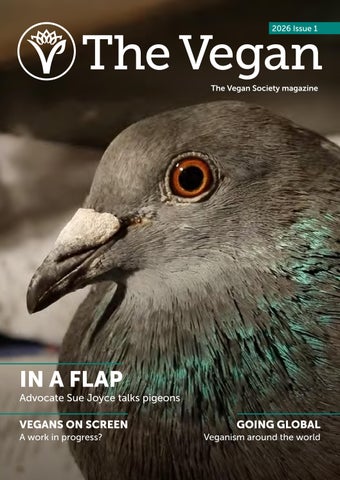
IN A FLAP Advocate Sue Joyce talks pigeons
VEGANS ON SCREEN A work in progress?
GOING GLOBAL Veganism around the world
CVoegoankM,astcercrelassaes tefor w,intecr &elebeyonbdrate Cosy evenings call for delicious plant-based food. Whether you’re new to vegan cooking or looking to expand your repertoire, V for Life’s Vegan Winter Cookery Masterclasses are the perfect way to get inspired.
Join their expert chefs for live, hands-on sessions that bring out the best in fresh, seasonal ingredients. Cook along in real time, ask questions, and pick up professional tips you’ll use every day.
Why join? l Expert tuition from professional chefs l Interactive learning with just 6 people per class l Exclusive recipes to recreate at home l Great value at £30 per 1.5-hour session From confidence-boosting solo cooking and DIY vegan nut-cheese to flavourlayered Indian curries, there’s a masterclass to inspire every cook.
Book your place now via the V for Life online shop – spaces are limited! vforlife.org.uk/shop
MAKES A THOUGHTFUL GIFT FOR FOOD LOVERS
V for Life is a charity registered in England and Wales, number 1120687
Editor’s letter and contents
EDITOR’S LETTER Happy 2026 and welcome to this year’s first edition of The Vegan! The midwinter slump can be a difficult time for many of us. However, I hope this issue inspires you to embrace the seasonal pause, hunker down and indulge in wholesome food and a good book or series. Pamela Hutchinson has some suggestions on page 35. Break out the popcorn and settle in for a journey through veganism on screen as she explores plant-based stars – on and off screen. In more good news for the sofabound – did you know you can help the planet simply by eating? Find out how in our food waste article, courtesy of
vegan cookery school Made in Hackney. If you’re feeling creative, why not give their banana peel recipe a try? Fibre is one good reason, which ties into trending health hack fibremaxxing – a phenomenon explored by our new inhouse dietitian Amber Woodhouse in this edition’s nutrition explainer. Elsewhere, we’re discussing why pigeons deserve more love, how the vegan movement is progressing across the globe and, over in our review section, contributor Ursula Watson gives her thoughts on All About Paul – a short film about 86-year-old ultramarathon runner Paul Youd. And, as always, our member news and highlights provide a peek into society life and our latest vegan wins. Happy wintering!
CONTENTS 03
Highlights
05
Special report
06 22
Membership
24
Shoparound
COP30
waste 06 Food Why it matters
26
Nutrition
09 Recipes Nourishing no-waste
30
Deep dive
35
Vegans on screen
37
Events
39
Reviews
Essential updates on Vegan Society news
dishes
16
Interview
20
Volunteers
21
In memory
Advocate Sue Joyce talks pigeons
Volunteer of the Season
Long-standing member Gil Osman
Cat Thompson, Editor
Letters and updates
New vegan products to look out for
Fibremaxxing: a trend to embrace
09
Veganism around the world
A work in progress?
Vegan events across the UK
16
A documentary on a vegan legend and exploring ‘moral disengagement’ Issue 1 2026 The Vegan | 1
From the CEO
FROM THE CEO As we begin 2026, I’m still reflecting on one of the standout moments of our 80th anniversary celebrations: our parliamentary reception at Westminster. Hosted by the wonderful Irene Campbell MP, it brought together around 180 guests – friends, allies, community organisers, parliamentarians, and partners from across the vegan movement. In addition to MPs Adrian Ramsay, Jim Dickson, Neil DuncanJordan, Navendu Mishra, Kerry McCarthy and Gurinder Singh Johal, we were grateful to other parliamentarians who made time to join us on the evening. In my speech, I spoke about the long arc of compassion that has shaped veganism, “a philosophy that not only rejects flesh but rejects exploitation itself”, reminding us that “the impossible becomes possible when enough people believe that compassion can be the foundation of progress”. That spirit of possibility feels especially strong as we look ahead. One of our major achievements this past year has been our work with Plant-Based Health Professionals UK and dozens of organisational partners on the Ten Point Plan for Plant-Rich Diets. The plan aims to inform and feed into the development of the government’s food strategy to ensure healthier, fairer, more sustainable food systems. Internationally, our role in advancing legal protection for vegans was recognised at the vegan rights conference in Barbados, where academics, lawyers and advocates from around the world gathered to influence public policy by promoting legal provisions that
protect vegans from discrimination. Another highlight I’m proud to share is the continued success of the Vegan Trademark. Recognised globally as a gold standard in vegan certification, it has gone from strength to strength this past year. Our partnership with Forest Green Rovers – the world’s first vegan football club – continues to set a powerful example of how strong collaborations can lead ethical change. And our work with Mercedes-Benz marks a major milestone in mainstream recognition, demonstrating how even the most established industries are embracing innovation rooted in compassion. These collaborations raise visibility and show what’s possible when values and vision come together. We also begin the year with clarity and purpose, having developed our new three-year rolling strategy, which commenced this month. This strategy will guide our priorities while giving us the agility to respond to emerging opportunities – a strong foundation for the society’s next chapter. Looking forward, 2026 will see the next phase of our Vegan and Thriving campaign and continued expansion of our vegan education work (more on that soon…). I’d also like to thank our newest trustees who have now fully settled into their roles and are making an excellent contribution to our governance. Their insight comes at exactly the right time, as we launch our new three-year rolling strategy – a framework that will keep us ambitious, agile and grounded in our mission. Thank you for being part of this movement. Here’s to another year of compassion, courage and meaningful progress. Libby Peppiatt, CEO
Sustainable Printing The Vegan Society cares deeply about the future of our planet and all those we share it with. We are committed to operating as a responsible, sustainable organisation which means we are conscious of the social, economic and environmental impact in all that we do. With this in mind, we are very pleased to announce that we work with Seacourt to print and distribute The Vegan. Seacourt are the UK’s leading environmental printing company and work closely with their clients to ensure that all material is produced with the lightest environmental footprint possible. In fact: • Their presses are 100% free from water, alcohol and harmful chemicals
21 Hylton Street, Birmingham, B18 6HJ
• They use inks that are vegan and free from volatile organic compounds • They are powered by 100% renewable energy • They send zero waste to landfill As a result, they are Net Positive (beyond carbon neutral including the entire supply chain). Every time they produce a piece of print, they take responsibility for more carbon than they are generating – what they call Planet Positive Printing. We hope you enjoy reading this issue, knowing that it has been produced in line with ethical, sustainable principles.
0121 523 1730 info@vegansociety.com vegansociety.com
© The Vegan Society Registered Charity No. 279228 (England and Wales) and SC049495 (Scotland) Registered Co. Nos. 01468880 and 12377572 (England & Wales). VAT Registration No. 361 7274 92.
Printed on recycled paper
Editor Cat Thompson Designer Violeta Pereira Cover image Sue Joyce The views expressed in The Vegan do not necessarily reflect those of the Editor, the Council of Trustees of The Vegan Society or staff. Nothing printed should be construed to be The Vegan Society’s policy or position unless so stated. The society accepts no liability for any matter in the magazine. The acceptance of advertisements (including inserts) does not imply endorsement. Complaints should be made in writing to chair@vegansociety.com or info@vegansociety.com or by post. Visit vegansociety.com/complaints-procedure to find out more.
2 | The Vegan Issue 1 2026
Highlights
HIGHLIGHTS
We have launched an online Memorial Tribute Wall
A vegan rev-olution The society’s Vegan Trademark team made global headlines after teaming up with auto powerhouse Mercedes-Benz to deliver the world’s first independently certified vegan car. Mercedes-Benz’ new GLC model can be ordered to include the unique Vegan Package, which means that all touch points in the vehicle’s interior, from replica leather seats to the steering wheel, door trims and centre console have been tested and certified by The Vegan Society’s Trademark team. A total of around 100 material components from various Mercedes-Benz suppliers were tested in accordance with Vegan Trademark certification standards. Read more on the news section of The Vegan Society website, at vegansociety.com/news.
First Caribbean vegan conference Vegan Rights Advocate, Dr Jeanette Rowley, the founder and chair of the International Rights Network (IRN), has been helping promote the legal protection of vegans in Barbados. Jeanette co-hosted a conference with lawyer Lalu Hanuman, founder and trustee of the Caribbean Vegetarian and Vegan Charity and an IRN member. Jeanette said, “It was an opportunity to promote the legal protection of vegans in the Caribbean for the first time.” Some IRN members lent support by attending or speaking at the conference, including lawyers representing vegans in legal cases regarding the right to vegan food for a detained vegan in Barbados, students in Peru, and an employee in Canada. The Vegan Society’s dietitian, Emily Angus, also attended and spoke about the healthy vegan diet and her and Jeanette’s work with prison caterers. Jeanette, Emily, Lalu and IRN member Marcelo Daidone Chalita who is a lawyer in Brazil, were also invited to discuss veganism and the conference on live TV show Mornin' Barbados.
The Honourable Mr Justice Leslie Haynes, S.C., Chief Justice of Barbados, who opened the conference, described animal rights as “the new legal frontier”. Read more at vegansociety.com/news.
Memorial Tribute Wall is launched The society has launched a Memorial Tribute Wall – a space where love, memory and compassion converge. This unique platform offers our community the opportunity to honour not only people but companion animals or any animal who has profoundly shaped lives and values. Visitors can share heartfelt messages, photos and stories, creating a vibrant mosaic of remembrance and advocacy and a collective celebration of kindness. Donations made as part of your tribute help fund The Vegan Society’s vital work, ensuring the values of those remembered continue to make a difference. Visit the wall at vegansociety.com/memorials to read inspiring stories or create your own dedication.
Yet another bogus headline Dietitian Emily Angus challenged a recent Telegraph headline The healthy guide to meat that every vegan should read. The article claims “extremes do not serve us well”, yet proceeds to adopt an extreme stance in favour of meat while misrepresenting the science on plant-based nutrition, including claims that iron and omega-3 fatty acids are “not naturally found” outside of meat. “In fact, omega-3 and iron are readily available from several plant-based foods, including chia and flaxseeds, lentils and beans,” argues Emily. Read more on the society’s website.
The Vegan Society at New Scientist Live The campaigns team were delighted to be a part of New
Issue 1 2026 The Vegan | 3
Highlights
Campaigns and Policy Officer, Helena Davidson, at the New Scientist Live.
Scientist Live this year, an educational festival exploring the latest in science, tech and innovation. From their stand, the team shone a light on our new #TheFutureIsVegan campaign where they encouraged attendees to immerse themselves in the benefits of a vegan world using virtual reality headsets. Campaigns and Policy Officer, Helena Davidson, also featured on the panel entitled The Future of Food: What’s on the Menu for 2035?, alongside representatives of the European Food and Farming Partnerships and Plumpton College. Helena highlighted the growth of plant-based diets, emphasising the need to reduce meat and dairy consumption to preserve our own health and that of our planet. She also flagged the need for a plant-based action plan to be included in the new UK food strategy and shared the Ten Point Plan for Plant-Rich Diets – a set of 10 policies which could help vegan food and diets become more affordable, accessible and attractive.
Top of the Pods Arguably, among the Vegan Pod’s most notable guests, environmentalist and political activist George Monbiot dropped in to speak to pod host Damian about his tireless green campaigning and political advocacy; from river pollution prompting his plant-based diet to a near-death experience, to restoring eco systems. Tune in to soak up some fresh inspiration from this environmental heavyweight. In The Power of the Sunflower episode, the trademark team discusses the state of the current vegan market, reveals insights into how certification shapes purchasing decisions and looks at some of the incredible innovation in the textile, cosmetic and food sectors to see how far we have come since 1990! Other episodes explore the impact of veganism on mental health, with a two-part special to mark World Mental Health Day. Host Damian talks triggers for poor mental health with vegan psychologist Claire Mann and activist Ayrton Cooper while, in part two, Vegan Society CEO Libby Peppiatt interviews owner of The Retreat Animal Sanctuary, Billy
4 | The Vegan Issue 1 2026
Thompson, on taking care of ourselves as we fight for our animal friends. Listen on Spotify, Podbean or Apple.
Veganism on the curriculum menu The Vegan Society’s dieticians, Amber Woodhouse and Emily Angus, are designing lectures to deliver to students across three universities. Amber’s dietetic course aims to provide students with tools to move into their professional practice with knowledge of a vegan diet – not currently taught on healthcare professional curriculums – allowing them to support patients and the public, as well as encourage the preservation of our environment. Meanwhile, Emily is cooking up a kitchen practical for Sport and Exercise Science students. The students will prepare a variety of vegan meals and snacks designed to optimise sports performance by providing the right balance of carbohydrates and protein for exercise and recovery.
Best of the blogs Vegan Rights Advocate Dr Jeanette Rowley is talking workplace inclusion. Now is the Time: Veganism and Workplace Inclusion was written for Inclusion Week – a dedicated time for reflection on enhancing inclusive environments. In the blog, Jeanette, who often supports vegan employees who feel marginalised, unfairly treated or discriminated against, describes different ways this can manifest. This includes being the brunt of uncomfortable banter and jokes, having dietary needs overlooked during events and being excluded when treats are brought for ‘everyone’. Elsewhere, to mark November’s International Men’s Day we spoke to Vegan Society volunteers about their reasons for going vegan and their role with the society. The trio also talk challenging masculine stereotypes and name their favourite vegan men.
Special report
SPECIAL REPORT: COP30 Veganism may have been on the COP30 menu but is it on the climate action agenda? Former interim Vegan Society Chief Executive Louise Davies was there to find out.
Former Interim CEO Louise, who now works for Scottish Fair Trade, says not enough is being done to push plant-based food onto the climate agenda.
on technological fixes rather than the obvious need to shift Back in 2021, when COP26 came to Glasgow and I was production and consumption. running campaigns and policy at The Vegan Society, we The standout exception was Denmark. Its pavilion pushed hard to get plant-based food onto the climate hosted practical discussions rooted in its national agenda. It wasn’t easy. Like the UK, most governments action plan for plant-based foods – covering chef were reluctant to talk about a transition away from training, school meals, research funding, export animal farming. Four years on at COP30, has support and targeted subsidies, plus a anything shifted? commitment to make plant-based policy a A little – though not nearly enough. European priority in 2026. It’s ambitious The vegan message was certainly I’m pushing and exactly the kind of leadership we visible. The Loving Hut team was out need. Encouragingly, politicians from in force with banners and leaflets for climate action Canada and Brazil at one session inside and outside the venue. While that respects people seemed genuinely persuaded. its style is a bit old-school the as well as the planet. It’s Realistically, food may take years enthusiasm was clear. to rise up the climate agenda. After One definite win was food a message I know will all, it took decades to agree a fossil provision. COP30 committed to resonate with vegans fuel phase-out. But we don’t have at least 40% vegan or vegetarian that long to transform our food catering and that played out on the who care about justice system. There’s still so much to do ground, with a couple of excellent in every part of the and The Vegan Society will remain vital. vegan and sustainable suppliers system. I’m here in my current Scottish Fair showing what good climate-friendly food Trade role, pushing for climate action that can look like. respects people as well as the planet. It’s a But in terms of conference content, we’re message I know will resonate with vegans who care still a long way from a food-system transition. about justice in every part of the system. Agriculture barely featured and most side events focused
Issue 1 2026 The Vegan | 5
Being mindful of food waste can help lower your carbon footprint, reduce costs and honour all the effort and resources that went into making that food in the first place. It also carries a huge economic cost – an estimated average of £470 per household per year. The food wasted in the UK alone could feed 30 million people.
6 | The Vegan Issue 1 2026
Feature
FOOD WASTE: WHAT’S THE BIG DEAL? Sarah Bentley, founder and ambassador of community cookery school and charity Made in Hackney, and cookery teacher Hannah Walker, discuss the problem of binning food – and serve up some resourceful tips to avoid it. We’ve all been there in the post-festive lull – resolutions have lost their New Year sparkle, wallets are in recovery and dancing sugarplums have been replaced by nightmares of wilting veg. Fear not: the Made in Hackney duo bring their expertise to the table with healthy and creative ways to divert your food from landfill – preferably to your gut.
Why shouldn’t we bin food? Food waste accounts for nearly 10% of all greenhouse gases – with household food waste making up a surprisingly high percentage of this. This is because, when buried in landfill, a lack of oxygen causes decomposing food to create methane. Being mindful of food waste can help lower your carbon footprint, reduce costs and honour all the effort and resources that went into making that food in the first place. It also carries a huge economic cost – an estimated average of £470 per household per year. The food wasted in the UK alone could feed 30 million people. That said, there’s more than enough food globally to go around but rampant inequality, colonialism, imperialism, climate change, war and the weaponisation of food are the root causes of hunger.
How can we eat healthily without letting fresh food go to waste? Although produce tends to be healthiest when it’s fresh, there’s still lots of vitamins and nutrients to be gained by using it up when it’s just past its best in soups, smoothies, stock cubes and sorbets, so you can’t tell it’s mushy, crinkly or discoloured. When you do your shop and meal planning, prioritise cooking the food with the soonest use-by date. If you’re trying to get a lot of variety in your diet, freeze any food you know you won’t come back to in the next few days. Another excellent tip is batch cooking so you’re using produce in meals when it’s at its best, but you can freeze
Issue 1 2026 The Vegan | 7
Feature
portions to have later. And, finally, don’t let produce go MIA at the back of your fridge or vegetable drawer. Bring things forward as a visible prompt to use it in your next meal.
What are some easy ways to use up leftovers? The easiest way to use up fresh food that’s about to go off is to blend it into a smoothie, soup or dip. These can be frozen and eaten later too. Or if you have wilting herbs, you can whiz them up and add them to an ice cube tray and freeze them for future meals. Another trick is to add the stalks, leaves, skins and other leftover veg to a Ziplock bag in the freezer to eventually use for a homemade stock. Stalks and tough stems from cruciferous veg work well in ferments too. Leftover bread can be whizzed up into crumbs in a blender and frozen ready to use in future recipes. Once you get into these habits, not wasting food becomes second nature.
What if you don’t have means to compost? Many local authorities provide a food waste collection service, usually for an annual fee. If they don’t, or you’re unable to opt in, it’s worth checking whether members of a local community garden or allotment site are happy to take your home compost. Alternatively, there’s a form of composting called Bokashi; a Japanese system that can be done on a small scale inside your home. You just need space for two small buckets (that can be kept in a cupboard under the sink for example) and Bokashi bran that is inoculated with good bacteria. You layer your food scraps with the bran, which breaks food down quickly into compost. It’s faster and more efficient than any other form of composting.
What’s your go-to low-effort food waste meal?
This is where I (Hannah) love to get creative so it’s hard to choose one! Zero-waste r chimichurri is a favourite, where you e What about composting? Sa alk can use carrot tops, beet greens or W rah ah Bentl Composting means you can recycle the ey and Hann any wilting herbs or even salad. nutrition from your leftover fruit and veg, Banana bread pudding is another great provide a food source for beneficial microbes and one for using up slightly stale bread, which is one prevent harmful greenhouse gas emissions. of the most commonly wasted foods in the UK. And then Organic compost has great benefits to soil structure and you can turn the banana peels into a great vegan bacon health while saving money on harmful chemical fertilisers or pulled pork substitute – yes you can eat banana peel and helping to grow more nourishing fruits and vegetables. (as long as it’s organic and/or well washed) and it’s highly We are constantly depleting the health of our soil nutritious! through toxic agricultural chemicals and other pollutants. And the good news is, you can try it for yourself! Turn Composting is a way to give back to the soil and add over for a selection of Hannah’s favourite recipes from Made nutrients back in – rather than just take them away. in Hackney’s debut cookbook We Eat Plants.
The easiest way to use up fresh food that’s about to go off is to blend it into a smoothie, soup or dip.
8 | The Vegan Issue 1 2026
NOURISHING NO-WASTE DISHES Recipes from We Cook Plants by Sarah Bentley and the Made In Hackney chefs
Issue 1 2026 The Vegan | 9
Recipes
HANNAH’S CARROT TOP CHIMICHURRI (shown on page 9)
Serves 4
Ingredients 1–2 cloves garlic 1 fresh red chilli 1 shallot or ½ onion 2 tbsp chopped preserved lemons, plus 2 tbsp preserving brine, OR 2 tbsp lemon juice, finely grated zest of 1 lemon and ½ tsp sea salt 40 g carrot top greens (or beetroot/beet greens, spinach, or leftover salad leaves/ greens, etc.) 30 g fresh herbs (parsley, coriander, mint, chives or a mixture) 1 tsp dried oregano ½ tsp ground paprika ½ tsp ground cumin/jeera 2 tbsp red wine vinegar 2 tbsp olive oil Pinch of sea salt Pinch of black pepper
Total time 10 minutes Equipment Sharp knife, food processor, small bowl, whisk
Chimichurri is a flavour-packed condiment that originated in Argentina and Uruguay. You can use most green leafy vegetables, herbs or those old wilting salad leaves in the back of your refrigerator. It makes a vibrant green, zesty addition to any meal. As well as a dressing, it can be stirred through beans or lentils, used as a dip or as a marinade. Carrot greens contain a whopping six times more vitamin C than the root, as well as being a good source of calcium and other phytonutrients. They have a slightly bitter flavour that contributes to their ability to aid digestion, so they’re best paired with other herbs or spices.
Directions Finely slice the garlic, red chilli (deseeded if you prefer less heat) and shallot/onion. Put all the ingredients – except the olive oil, salt and black pepper – in a food processor and pulse briefly until finely chopped but not completely blended. Transfer into a small bowl and whisk in the olive oil. Stir in the salt and black pepper, then serve drizzled over tacos or ovenroasted veggies, or like here on top of the banana peel carnitas.
We Cook Plants: For people. For the planet. With joy. by Sarah Bentley (Watkins Media Limited, £30)
10 | The Vegan Issue 1 2026
Recipes
HANNAH’S BANANA PEEL CARNITAS
(shown on page 9)
Serves 4
Ingredients 5–6 (ideally organic) banana skins White vinegar, for soaking (only if using non-organic banana skins) 2 tsp ground cumin/jeera 1 tsp smoked paprika 1 tsp dried oregano ½ tsp onion powder ½ tsp garlic powder ¼ tsp sea salt ¼ tsp black pepper 1 small onion 2–3 cloves garlic 1 fresh red chilli 1 tbsp olive oil 1 tbsp dark soy sauce (or use tamari if gluten-free) 3–4 tbsp freshly squeezed orange juice (from 1 orange) Small handful of fresh coriander/cilantro leaves, to garnish (optional)
Total time 30 minutes Equipment Bowl, sharp knife, frying pan with lid, wooden spoon
Banana peels are one of the most underappreciated ingredients most people have but don’t realise they can eat! The skins make up as much as 40% of the weight of a banana, and most people throw away (or hopefully compost) this super nutrient-rich part. They’re a great source of fibre, calcium, iron, vitamins A and C, potassium and essential fatty acids. And importantly, when prepared appropriately, they’re delicious! Loaded with warming spices and bright citrus, once cooked, you’d have no idea that it was banana peel you were eating!
Directions Peel your bananas and set aside the fruit to use in another recipe or eat later (you can refrigerate or freeze the fruit to use in a smoothie or nice cream). Now wash your banana skins. If using organic – which we highly recommend as we’ll be eating the skins – give them a light scrub and rinse. If using non-organic, soak the skins in a bowl of cold water and vinegar – 1 part white vinegar to 4 parts water – and leave for 20 minutes. Rinse the skins, then cut both ends off and pop them in the compost. Use a spoon to scrape out the remains of the fleshy white part of the fruit and set aside or eat. Use two forks to shred the banana skins into strips. Use one to hold the skin in place and the other to shred it. To create shorter strands after pulling them, cut them in half or even into thirds. In a bowl, mix the banana peel strips with the seasonings – cumin, smoked paprika, oregano, onion and garlic powders and salt and pepper. Set aside. Now finely slice the onion, garlic and red chilli (seeds removed for less heat). Heat the olive oil in a frying pan on a medium heat until hot, then add the onion, garlic and red chilli. Sauté for 5–6 minutes, or until the onion is soft. Next, add the seasoned banana peel strips to the pan and stir to combine. Finally, add the soy sauce and orange and lime juices. Save the peels of the orange and lime to zest, preserve, use as a tea, or to candy them for a dessert. Increase the heat to medium-high and bring to a simmer, then reduce to a low heat and cover. Cook like this with the lid on for 25–30 minutes until the banana peel strips are softly stewed. Remove from the heat, taste and adjust the seasoning if needed. Add more salt/soy sauce or lime juice to taste and garnish with the coriander leaves. Enjoy as a side dish, on top of a salad or in a taco. Although it’s imitating a pulled meat, it doesn’t have any protein, so add to black beans or tofu for a nutrient-packed punch.
Issue 1 2026 The Vegan | 11
Recipes
HANNAH’S PRESERVED LEMONS Serves 4+ (makes 1 jar)
Ingredients 4–6 lemons (depending on size of lemons and jar) – organic and unwaxed if possible 3–4 tbsp sea salt (or other non-iodized salt that doesn’t contain anti-caking agents often found in table salt) 2–3 bay leaves 1 cinnamon stick 4–6 cracked green cardamom pods 4 star anise 4 whole cloves ½ tsp coriander seeds ½ tsp black peppercorns Extra lemon juice to cover
12 | The Vegan Issue 1 2026
Total time 15 minutes, plus 3–4 weeks standing time Equipment Sharp knife, sterilised jar approx 10 cm in diameter and 18 cm tall (approx 350–500 ml) Preserved lemons are a lovely condiment for adding a depth of lemony flavour to dishes. They’re traditionally used in Middle Eastern and North African cooking. You pickle or ferment the lemons in a brine of salt and lemon juice to preserve them. It’s a great way of using the whole lemon, but you can also make it just from the lemon rinds, after using lemon juice in other recipes. In this recipe, I’ve added herbs and spices to the brine to give a Moroccan flavour, but experiment with alternative additions such as a fresh sprig of rosemary. You can use the same method to preserve limes and orange peel or do a combination of all of them! Once you’ve done this, you’ll never throw citrus peel away again!
Directions Wash the lemons, slice the tops and ends off (these can be added to your compost bin) and then cut into quarters. Try to remove the seeds but don’t worry too much about getting them all out. Cover the base of the sterilised jar with a layer of the salt and pack the lemons in, adding more layers of the salt as you go. It seems like a lot of salt, but don’t worry, it’s part of the preserving method and can be rinsed off before eating. As you layer the lemons, squeeze them down to release their juice, adding in the herbs and spices as you pack your jar. Once your jar is filled, pour over extra lemon juice (or cold filtered water if you run out of juice) so the lemons are completely submerged. Tightly seal the jar. Leave to sit at room temperature for 3–4 weeks. Shake every couple of days to redistribute the liquid. Once ready, refrigerate. The jar of preserved lemons will keep in the refrigerator for up to one year (ensure they remain submerged in the brine liquid once opened). To use the lemons in your cooking, use a clean spoon or tongs to remove them from the jar. Rinse off the salt before using, or leave on for flavour, but don’t add any more salt to the dish. They’re great finely sliced or blended as part of dressings, sauces and stews. Enjoy!
Issue 1 2026 The Vegan | 13
Recipes
V’S BANANA CHOCOLATE FLAPJACKS
By Veryan Wilkie-Jones
Makes 12 flapjack bars
Ingredients 5 tbsp coconut oil or vegan butter 3 ripe bananas 180 g mixed dried fruit and seeds or roughly chopped nuts of choice (I use dried apricots, sunflower seeds, pumpkin seeds and cashews) 180 g rolled or jumbo oats 2 tbsp sweetener of your choice (maple/ date syrup/brown sugar) Handful of dried coconut flakes (optional) 2 tsp vanilla extract (optional) 150 g vegan dark/bittersweet chocolate
Total time 25–30 minutes Equipment Medium-sized rectangular baking sheet, large mixing bowl, wooden spoon, palette knife/spatula I developed this one-bowl recipe as a healthy-ish packed lunch staple for my kids, which you can have in the oven in around 5–10 mins with hardly any washing up – result! The combination of chocolate and banana is pure comfort food and these beauties have been a firm family favourite for years – either eaten warm as a pudding with a drizzle of vegan cream, or enjoyed as a snack once cooled.
Directions Preheat the oven to 180 °C/350 °F/gas 4. Put the coconut oil or vegan butter in a medium rectangular baking pan – mine measures 17 x 22cm/6 x 8in. Place in the oven on the middle shelf for about 3 minutes until melted. While the oil/butter is melting, peel and mash the bananas using a fork. Chop any larger pieces of dried fruit (if using) into small pieces. Once the oil/butter is melted, take the baking pan out of the oven and swirl the contents around the baking pan getting into all the corners, then leave to cool a little. Mix the rest of the ingredients – except the chocolate – into the mashed banana. Scrape the melted oil/butter into the mixture (leaving a coating to create the greased baking pan you need) and stir to combine. Transfer the mix into the baking pan and spread evenly. Bake for 15–20 minutes until golden, then remove from the oven (see Tip). To add the chocolate coating, break the chocolate into squares and place evenly on top of the flapjacks when they come out of the oven. Pop back into the turned off oven leaving the door ajar – the chocolate will melt in 5 minutes. Spread the chocolate using a palette knife/spatula. Leave to cool in the baking pan, then cut into bars to serve. Enjoy! Tip: You can eat the uncoated flapjacks as they are. If not adding the chocolate topping, cool the flapjack mix slightly, then cut into bars. Remove from the baking pan once they have firmed up a bit.
14 | The Vegan Issue 1 2026
VEGAN VEGAN Wellwoman Vegan is a unique supplement specifically designed for vegan or vegetarian women. With a comprehensive formula of 24 nutrients, including Evening Primrose Oil and Starflower Oil, plus iron, zinc and vitamin B12, Wellwoman Vegan is here to support you.
from Britain’s No.1 Vitamin Company* 20251210_ADWEWVEGCONP_E
From Boots, Holland & Barrett, pharmacies, health stores, and
www.wellwoman.com †UK’s No1 women’s supplement brand.
*Nielsen GB ScanTrack Total Coverage Value & Unit Retail Sales 52 w/e 04/10/25. To verify contact Vitabiotics Ltd, 1 Apsley Way, London, NW2 7HF.
Wellwoman supports
It was the realisation all animals and insects are worthy of our care and love that helped me understand pigeons are intelligent social creatures and very complicated.
Sue and Phillip 16 | The Vegan Issue 1 2026
Interview
FALLEN FOE TO FEATHERED FRIEND Meet pigeon advocate Sue Joyce The ubiquitous pigeon has been domesticated over centuries by humans who held them in high regard for their loyalty, homing abilities and as a symbol of peace. Today they are subject to abuse, exploitation, hostile deterrents and the effects of urban neglect. Little Green Pigeon founder and former vet nurse Sue Joyce is on a pioneering mission to undo the unsavoury image of pigeons and rebuild the love and respect these gentle, once-revered birds deserve. She talks to us about her journey, from taking home feathered patients at night to founding a sanctuary and hosting the world’s first Pigeon Advocacy Conference.
Love takes wing Sue’s compassion for pigeons grew from her time as a registered veterinary nurse, working in a hospital practice in a city. Disheartened after seeing so many wild birds being turned away or euthanised, Sue approached the hospital owner about dedicating time to caring for them. She says: “I thought, ‘why are we turning them away? All they need is a bit of care’. The hospital provided a kennel to keep them in and after work they would all be taken home. Eventually, there were birds in every room so I built an aviary in the garden.” Though Sue admitted she’d initially believed the stories of pigeons being ‘pests’ and ‘dirty’, her transition to veganism fuelled her conviction to help the vastly misunderstood birds. She says, “It was the realisation all animals and insects are worthy of our care and love that helped me understand pigeons are intelligent social creatures and very complicated. They’re not designed to live on the streets and so they suffer more than garden birds.” Caring for birds in between her full-time work eventually became unmanageable so Sue decided to focus solely on setting up a dedicated pigeon sanctuary. At this time, she was receiving up to 20 calls a day from people concerned about injured pigeons. After relocating several times due to financial and logistical complications, she turned her attention to advocacy instead of rehabilitation and her flock was rehomed to other sanctuaries. Sue founded her community interest company Little Green Pigeon, which raises funds to help volunteers rehabilitate pigeons injured by people, predators or deterrents like spikes and nets, or birds suffering from ‘stringfoot’ – when debris from hair and fishing wire to dental floss tangles around their legs. Issue 1 2026 The Vegan | 17
Interview
Fall from grace
A major ‘coo’
Sue explains, in the 1960s, a local pigeon flock was blamed for an outbreak of meningitis, leading to widespread disdain courtesy of merciless media headlines and the infamous slur – thanks to Woody Allen no less – ‘winged rats’. Sue says: “People think they’re disease-ridden and they often get the term ‘winged rats’ because they’re everywhere and they are pooing everywhere and that’s what people see. What they don’t see is that we abandoned them there. But, because they’re not eating an appropriate diet, they have digestion issues and mess on buildings, and the assumption they’re dirty comes out.”
Sue’s latest endeavour, the National Pigeon Advocacy Association (NPAA), saw the launch of the world’s first ever Pigeon Advocacy Conference in England, with help from fellow registered vet nurses, animal rights activist Shakira Free and pigeon rehabilitator Sam Crick, last year. The conference brought together animal rights activists, pigeon rehabilitators and veterinarians from all over the world. Its aim? To support and educate volunteers – current or aspiring – to care for the city-slicking birds. “When you look at the way wildlife is cared for in this country, it’s often by people who are unqualified. That’s because there’s no one out there to teach us. But they’re doing it because they have compassion and because no one else will. “We need a conference to highlight the need for funding but, also, to get experts together to educate so we can all learn and network and get cohesion in how we care for these birds.” The conference proved a huge success, attended by some 130 people, hailing from as far as the US. “I never dreamed it’d become international. People from around the world came or logged in on Zoom; I was absolutely gob-smacked. It proves the world is huge and pigeons are everywhere, and we need to help each other to help these persecuted birds. They’re seen as dirty and ‘pests’ and, as soon as you say you look after pigeons, people sneer at you. That needs to change.”
Harper’s Fund Part of Sue’s charity work is campaigning for a pigeon racing ban. The project is named after one of Sue’s plucky patients, Harper – an abandoned racing pigeon. “Harper was an injured racing pigeon rescued by university students who hid her in their student halls for three years. I’m not sure how they did it because she was a big bird and quite noisy! She was terrified of our flock because she was just used to living with humans. She lived inside our caravan for quite a while; it took us over a year to get her to act like a pigeon. She loved it when my partner Matt played guitar in the aviary. She’d sit on his head.” The birds, known for their innate homing abilities, are raced for hundreds of miles, explains Sue. One way in which pigeons are encouraged to race home at top speed is called ‘widowing’. This involves periodically separating mating pairs to strengthen their bond, before sending one hundreds of miles away in a lorry packed full of pigeons. This means the separated pigeon will fly at speed to return to their loved ones as soon as possible. “Pigeons mate for life, they love very strongly. Both birds feed and sit on eggs and produce a hormone-based milk in their crop like a female mammal. They love their children. Pigeon racers use that to their advantage,” adds Sue. She explains that around 60% of those birds don’t make it. “They drown, they can be hit by cars, starve, be eaten by foxes because they don’t know how to survive in the wild. “Naturally, they can live into their 20s. I know of one in a sanctuary who lived until they were 26.”
The gateway to veganism? While Sue describes pigeons as ‘the forgotten domestic birds’, she believes they could prove intrinsic to the vegan cause. “I believe pigeons are the key to veganism. If you live in a city and you’re born in that city, you will see pigeons everywhere and possibly no other wildlife. You’re going to come across them much more than farmed animals. If we can show everybody they deserve our love and respect, and help them understand the lives of a city pigeon, and they have compassion for that bird at that moment, we can open up their minds to have compassion for all animals.”
FASCINATING PIGEON FACTS • The Ancient Egyptians were among the first to domesticate pigeons and use their homing abilities to send messages. • In some ancient cultures pigeons were symbols of fertility, thanks to their exemplary parenting. • On average, pigeons can fly up to 40 mph, although they are capable of speeds over 60 mph. • The wounded body of war messenger Cher Ami, who famously saved 200 troops under fire in WWI, is on display in the American History Museum. • Doves and pigeons are the same species. In fact, in 14th century French, the word ‘dove’ translates to ‘pigeon’. • In 1969, English man Glynne Wood had a pigeon living on his head for around a week. He was interviewed by the BBC with the bird perched on his head.
Visit the NPAA website to find out more about Sue’s mission and information on how to help your local pigeon flock.
18 | The Vegan Issue 1 2026
Advertisement
WILL YOU HELP US TURN COMPASSION INTO ACTION IN 2026? Every donation makes a difference. By giving a one-off gift or becoming a regular donor, you help us campaign for change, share vital resources, protect the rights of vegans, and inspire thousands more to choose compassion. Donate now at vegansociety.com/donate. For more ways to donate, feel free to contact our Fundraising Team via fundraising@vegansociety.com or call 0121 507 9987. Donate here: Walnut the lamb photographed at The Vegan Society’s staff volunteer day at Amberwood Animal Sanctuary. Registered Charity No. 279228 (England & Wales) and SC049495 (Scotland). Registered Co. Nos. 01468880 and 12377572 (England & Wales). VAT Registration No. 361 7274 92.
Issue 1 2026 The Vegan | 19
Volunteers
VOLUNTEER OF THE SEASON Volunteer Susanne talks veganism, living sustainably and making a meaningful difference.
You’ve been volunteering with The Vegan Society for nearly three years. What has changed for you over that time and what has kept you volunteering so consistently? I wanted to do something for a vegan organisation and contribute to the vegan community. As we all know, veganism is a lifestyle, so it seems like a no-brainer to do as much as we can in our everyday lives. With volunteering, you always gain something valuable in return, like forming new relationships and learning new skills. I started off by helping update the client social media database and preparing monthly competitor analysis reports. I’m currently helping to create web content about the marine environment and helping produce the monthly education newsletter. It only takes a few hours each month but it keeps me up to date with current vegan news as I research it weekly. I believe everyone should volunteer, as you gain hands-on skills and it’s a great way to contribute to charities and organisations, especially if you don’t have the means to contribute monetarily.
What else are you passionate about besides veganism? I am really passionate about the environment, particularly the marine environment. It’s surprising that we know more about the surface of the moon than we do about the ocean! I studied marine conservation at university and love being able to bring that knowledge into my volunteer work. I try to live sustainably without worrying too much about being perfect (it’s easy to get caught up in the small stuff!). I focus on practical, realistic choices that I can incorporate in my everyday life – I reuse and mend items, upcycle things and almost my entire wardrobe is second-hand. I also try to recycle as much as I can and walk or take public transport whenever possible. Being vegan, I already have the most environmentally friendly diet, but I also make an effort to buy items with less packaging, choose local produce where I can and use up food scraps to reduce waste. I also enjoy doing beach cleans, both in groups and on my own, and sometimes
20 | The Vegan Issue 1 2026
It’s surprising that we know more about the surface of the moon than we do about the ocean!
I upcycle what I find and use as material for art projects. I also love yoga, hanging out with friends, spending time at the beach, swimming or paddleboarding and being out in nature in general.
Being vegan in a non-vegan world can be hard. How do you stay optimistic for a vegan future? Being vegan in a mostly non-vegan world can sometimes feel overwhelming but, even though we are a small percentage of the population, the movement stays strong. I’ve been vegan for about eight years and, even though a couple of my favourite vegan places have closed, I’ve seen so many new ones open that continue today and there are so many more options now compared to the beginning of my journey. To me, it's encouraging to see how the vegan community has played a huge role in raising awareness about animal welfare and a lot of my friends have reduced their meat consumption and buy more cruelty-free products due to this. It’s also great to see more people noticing the environmental benefits of plant-based diets. Prominent voices like Sir David Attenborough and the late Jane Goodall make a real difference. My advice for anyone who feels isolated as the only vegan in their family, group of friends, or workplace, would be to stay connected to the vegan community in any way you can. Go to vegan events where you can meet like-minded people, even online if meeting in person isn’t possible, stay up to date with positive news on social media and, of course, volunteer!
What do you see in your future? In the future, I hope to have made a meaningful difference in both the vegan and environmental spaces through my work, volunteering and personal life. I also hope to spend more time around animals, doing volunteer work with rescued animals and one day having the space to care for as many rescue animals as I can.
Obituary
IN MEMORY OF GIL OSMAN Staff at The Vegan Society are sad to learn of the passing of long-time member Gil Osman.
Gil’s kindness and commitment to veganism lives on, in part through his posthumous donation to the society, in line with his wishes for a funeral collection. His daughter Sara Osman reflects on her dad’s legacy – from his childhood heartbreak of keeping backyard chickens, to discovering tinned soy sausages and powdered soy milk – Gil’s dedication sets an admirable precedent. Gil was born on 11 July 1939 and passed away at 85 on 16 June 2025. A longterm supporter of The Vegan Society, veganism was the most important thing in his life and defined who he was. There were several factors leading to his decision to become vegan. One was his secondary school teacher, Mr Trivet, who he described as “inspirational” and “the biggest influence of his life”. After lessons, Mr Trivet would encourage discussion on all sorts of topics, which really opened dad’s eyes to another world. As a Quaker, Mr Trivet astonished the boys by revealing that he was a pacifist and went to prison during the war because of his views. The other major influencing factor was growing up in a working-class family on the outskirts of Bristol. His mother was a maid and his father worked as a furnaceman. Admittedly they were different times; his father kept a large allotment and chickens in the backyard to feed the family. His childhood experience of seeing a headless chicken running around the backyard and puppies from the family dog being ‘dispatched’ because they could not afford to keep them, had
a lasting impact on Gil and led him to go against the grain of his family upbringing. He became vegetarian in 1956 when he was just 17 and a then a proud vegan in 1970. As children, we had great fun trying out unusual vegan food. Who knew sausages came in tins (Sausalatas) and soy milk came as a powder you had to mix with water? I often got told off for using too much to make it creamy – I guess, looking back, it was expensive stuff in its day! Being vegan did not stop him from travelling the world. He visited at least 25 countries, including two years in Fiji where he set up an integration programme for schools to include children with special needs and established a Special Educational Needs Curriculum for the country. He had many friends through Vegan Camp and was involved with the Bristol Vegans group, rarely missing an outing or opportunity to share food with like-minded folk, with who he could truly be himself. He was the ultimate entertainer, a quiz master and a pianist, but being with other people who shared his vegan and compassionate views on life was important to him. In his own words, “This is extremely important to me and my belief in the treatment of other animals.” I have no doubt he has influenced many people in thinking more compassionately about animals and inspired many to choose a vegan diet and lifestyle. The Vegan Society offers a number of options should you wish to leave a lasting legacy or donate on behalf of a loved one. Visit vegansociety.com/legacies to explore ways to help us create a compassionate future.
Issue 1 2026 The Vegan | 21
It was lovely to meet members and supporters at events in 2025
MEMBERSHIP Star Letter I am a new vegan – I transitioned from being vegetarian and now I feel like my skin finally fits! I don’t know if that makes sense but my internal values and beliefs have come into alignment with the world around me. I suppose I wonder why I did not do it sooner but we are all on a journey and my path has finally been made clear! I joined The Vegan Society in August (as I say, really a newbie! The ink is still drying on my membership card!). I just wanted to say a huge thank you for all of the support and information you have provided. As the only vegan (so far) in my home, I am able to navigate this new life with your help. I love the articles on veganism and family dynamics – I have found my transition has caused no tension, just curiosity. With all the information you have provided I am better prepared for my new life and to help answer questions from those around me. Thank you! Dayna Stewart
Congratulations to member Dayna who has won the debut cookbook from Made in Hackney, We Cook Plants. Next issue’s winner will receive a copy of Naturally Vegan by Julius Fiedler, a collection of default plant-based dishes from around the world. Send your letters to editor@vegansociety.com or our usual postal address. Please note: letters may be lightly edited for clarity and brevity.
2025 reflections By the end of 2025, we reached our highest-ever number of members – over 9,000. We are very grateful to all our members, long-standing and recent, who have continued to support us. During our 80th anniversary year, we shared long-standing members’ memories, introduced the Kind Food booklet and continued to offer free Youth Membership and ran more member-exclusive webinars.
Events It was lovely to meet members and supporters at events in 2025 at: • Farm Animal Rescue Sanctuary Open Day, 9 August • Vegan Camp Out, 28 August – 1 September • Vegan Life Live, 17–19 October We look forward to seeing many more of you this year. Watch this space to find out which shows and events the Supporter Services team will be attending in 2026. Vegan Camp Out
22 | The Vegan Issue 1 2026
Members’ roundup
Membership
Have you signed up for our twice-monthly Members’ Newsletter yet? The newsletter allows members to keep updated and get involved with society campaigns, research, media news, events and member benefits. Recently, we featured a member-exclusive offer for 50% off tickets to attend a match event at Forest Green Rovers football club, following news of their Vegan Trademarkregistered football kit. We reported on our parliamentary reception hosted by Irene Campbell MP and our presence at party conferences, promoting the Ten Point Plan for Plant Rich Diets. Recent member competitions have included Galaxy Dairy-Free festive range bundles, Bio-nature and Friendly Soap hampers and Made in Hackney’s debut cookbook. Contact membership@vegansociety.com if you would like to sign up for the Members’ Newsletter.
Discounts In return for being a member of The Vegan Society and supporting our work and campaigns, we offer 10% off our multivitamin VEG 1 and a variety of third-party discounts, including the ever-popular 10% off at Holland & Barrett. Simply show your membership card in-store or use code vegan10 online. This new year, why not: • Choose bamboo products with 10% off at Cheeky Panda or 15% off at Bumboo. • Take advantage of an offer to receive three issues of Vegan Food and Living for £5. • Enjoy 20% off at Phoenix Crown Hair Care. • Consider a vegan celebrant, with 5% off Maddie the Happy Celebrant’s services. All member discounts and offers can be found in The Members’ Area of our website at vegansociety.com/myaccount/shop-discounts. Please contact us at membership@ vegansociety.com if you have any problems accessing your account. Do you have any ideas on how we can improve the discount list? Contact us at discount@vegansociety.com or on 0121 523 1730
all trustees are commitment, enthusiasm and the ability to consider issues thoughtfully, communicate effectively and work well with others. This year, we are particularly interested in applicants with a professional background in: • Legal, HR, or charity governance • Financial, grant funding, or fundraising/income generation • Strategic planning • Marketing, communications, or public relations • Commercial/multi-retailing sector • Policy/public affairs and the public sector
Candidate Q&A session If you are considering standing for election to Council, we would encourage you to attend a Q&A session on Wednesday 4 February at 6pm. Please look out for the email inviting you to sign up. Alternatively visit vegansociety. com/q-and-a-trustee-candidates or email chair@vegansociety.com.
Time commitment and IT requirements The time commitment primarily consists of monthly meetings, usually lasting around three hours and held in the afternoon or evening (usually online). Training typically involves one to two days per year. Council members are expected to read papers and emails in advance of meetings, which can take several hours in the lead-up to a Council meeting or AGM. The time commitment can vary from month to month and is designed to be manageable alongside full-time professional responsibilities.
Eligibility requirements Candidates must: • Have been full members of the society for a year. • Be aged 16 or over on the date of appointment. • Support the society’s objectives and mission (vegansociety. com/society/strategy/our-vision-and-mission).
We value your feedback
• Be committed to a vegan lifestyle.
Get in touch with your comments on how you have found the last year of membership with us and any suggestions you may have for improving the membership experience.
Application process and guidance
Annual General Meeting 2026 The 2026 AGM will take place on Saturday 16 May at 1pm.
Election of members to Council Invitation to apply and desired skills Applications for membership of the governing Council (board of directors) of The Vegan Society are invited by Monday 2 March 2026 at 4pm. The role is voluntary, but reasonable expenses can be claimed. To ensure effectiveness and diversity, members from a wide range of backgrounds and with a broad base of experience and skills are encouraged to apply. Essential qualities for
You can download the candidate pack by visiting vegansociety.com/candidate-pack. We strongly encourage anyone thinking of standing as a candidate for Council to get in touch with the Chair, Paras Shah, at chair@vegansociety.com as soon as possible to discuss their application. The Chair can ensure that all the requirements for a valid application can be met, such as proposers or seconders being valid members of the society. Please note: applications made at the last minute which do not meet the requirements under the Articles must be rejected. The Chair can also be contacted by post at Donald Watson House, 21 Hylton Street, Birmingham B18 6HJ.
Issue 1 2026 The Vegan | 23
Promotional feature
SHOPAROUND
Shop with confidence for products registered with the trusted Vegan Trademark
Purendure Purendure Real Fruit Energy Gels offer clean, plant-powered fuel made with just four natural ingredients. Free from artificial sweeteners and additives, each gel blends real fruit with electrolytes for smooth, stomach-friendly energy. Certified with The Vegan Society’s Vegan Trademark and crafted for performance, they provide steady, reliable fuel whether you're chasing a finish line or enjoying a feel-good run. Available at purendure.com.
Moringa Chai Infusion Moringa Chai Infusion is the UK’s first chai blend to showcase the nutrient-rich superfood Moringa. Combined with ginger root, liquorice root, cloves, black pepper, cardamom and cinnamon, this uplifting plant-based chai delivers both flavour and nourishment. Certified by the Vegan Trademark, it has earned a twostar Great Taste Award 2024 and a Silver Award in Vegan Food & Living’s Product Awards 2025 in the drinks category. Available at ausha.co.uk.
Phoenix Crown Phoenix Crown’s haircare range is thoughtfully formulated to cleanse gently, restore softness and protect every strand with a science-led blend of biotin, keratin and argan. Rich oils including coconut, argan and linseed deliver deep nourishment, while the brand’s commitment to sustainability shines through recyclable glass bottles and sugarcane-based tubes. Made in the UK, these products are certified with the Vegan Trademark and are free from fragrance, sulphates, silicones and parabens. Available at phoenixcrown.com.
INIKA Organic INIKA Organic Serum Foundation is the world’s first 100% natural, certified organic serum foundation combining skin nourishment with refined, buildable coverage. Its feather-light texture melts seamlessly for a second-skin, satin finish while Ceramide and Baobab Seed strengthen the skin barrier, boost collagen and restore vitality. Clinically proven results include a 48% reduction in wrinkles, 31% increase in hydration and 29% improvement in elasticity. Dermatologist approved and housed in post-consumer recycled packaging. Available at uk.inikaorganic.com.
24 | The Vegan Issue 1 2026
Promotional feature
Kollo Health Kollo Health’s Premium Liquid Meno Support is a vegan-friendly, scientifically formulated supplement designed to support women through every stage of menopause. Created with menopause specialists and health professionals, it blends KSM-66® Ashwagandha, Red Clover and Siberian Ginseng with vitamins D3, B6 and B9, plus magnesium and hyaluronic acid. The result is a holistic, plant-based formula that helps ease hot flushes, balance mood, boost energy and support skin health. Available at kollohealth.com.
Neal & Wolf GLOW Super Shine Micro Mist is a lightweight, ultra-fine spray that delivers instant mirror-like shine while smoothing frizz and protecting hair from heat. Enriched with Sweet Almond, Moringa and Coconut oils, it enhances manageability, adds luminosity and protects against humidity and UV exposure, leaving every strand silky, glossy and radiant. Available at nealandwolf.com.
TanOrganic TanOrganic offers one of the cleanest and safest sunless tanning options for conscious, vegan consumers. B Corp certified, Vegan Society and Leaping Bunny verified, the brand prioritises ethical, skin-friendly formulas made with natural and organic skincare ingredients. Recommended by dermatologists, its hydrating, streak-free products are ideal for sensitive skin and suitable during pregnancy, breastfeeding and drug therapy treatment. Free from harsh additives, TanOrganic also removes 1 lb of oceanbound plastic with every product sold. Choose a natural glow that puts your skin and the planet first. Available at tanorganic.com.
TOTM TOTM delivers period care without compromise, using certified organic cotton across its range for gentle, breathable and naturally leak-proof protection. The brand’s Night Pads offer soft, overnight comfort made from organic cotton from cover to core, while the award-winning Organic Pads provide toxin-free, GOTScertified reassurance for everyday wear. The cardboard applicator Tampons feature an organic cotton core and veil, ensuring softness, comfort and reliable leak protection. Thoughtfully designed and free from pesticides and unnecessary additives, TOTM is a cleaner, kinder choice for your cycle. Available at TOTM.com, Ocado, Waitrose, Tesco and Morrisons.
Issue 1 2026 The Vegan | 25
FIBREMAXXING Dietitian Amber Woodhouse explores Fibremaxxing – the social media trend worth following. If you’ve spent any time scrolling through social media lately, you might have noticed a new buzzword: fibremaxxing. Think lentil-packed curries, chia puddings and overnight oats. But is this just another passing health trend? Or does the concept have genuine scientific merit?
What is fibremaxxing? In simple terms, fibremaxxing means intentionally increasing the variety and quantity of fibre-rich, plant-based foods in meals and snacks. The goal? To hit around 30 g of fibre a day – the amount 96% of us in the UK currently fall short of. However, don’t panic. It’s not about eating piles of bran or beans until you burst but, rather, making fibre-rich plants the foundation of your meals.
Why does fibre matter? Dietary fibre is a type of carbohydrate only found within plant foods that resists digestion in the small intestine, allowing it to sneakily travel to the large intestine where it’s either completely or partially fermented by gut bacteria. This ability to pass through early stages of digestion unblemished has made fibre a longstanding cornerstone of a healthy, balanced diet, with its numerous health benefits supported by extensive, high-quality evidence: • Digestive health: fibre helps prevent constipation by increasing stool bulk and promoting regular bowel movements. • Gut microbiome: some fibres act as food for the beneficial bacteria in your gut, helping them produce compounds called short-chain-fatty-acids (SCFAs), which in turn can offer a wide range of health benefits including supporting mood and immunity. • Chronic disease prevention: evidence suggests that for every 7 g increase in daily fibre, the risk of developing cardiovascular disease, type 2 diabetes, colorectal cancer and all-cause mortality, significantly reduces. Fibre can also help to slow digestion, increase feelings of fullness and overall assist in maintaining a healthy body weight.
Can you have too much of a good thing? One of the pitfalls of social trends is encouraging a mindset
26 | The Vegan Issue 1 2026
Nutrition
that ‘more is better’. For this particular trend, even the very use of ‘maxxing’ suggests going all in with increasing fibre. However, while it’s refreshing to see a food trend that shines a light on something we all need more of (fibre-rich, plant-based foods), there are some key cautions to be aware of before ‘maxxing’ it out: • Slow and steady wins the race: suddenly ramping up the fibre may trigger gastrointestinal (GI) discomfort, gas and bloating, especially if your current intake is low. Instead, gradually increase your consumption (e.g. adding 5 g extra of fibre per week such as 100 g boiled peas or beans, or two slices wholemeal bread). • Wholefoods over supplements: while supplements can be useful in certain contexts, heavily relying on them can mean you miss out on the energy, vitamins and minerals that fibre-containing foods also provide. Fibre supplements may also increase GI discomfort and should be discussed with a healthcare professional first.
3. Get creative with legumes and pulses Add lentils to shepherd’s pies, chickpeas to your curries or even blend black beans into your brownies (don’t knock it till you try it). 4. Use meal toppers Sprinkle nuts and seeds including chia seeds, ground flaxseeds or hemp seeds over meals like salads, oatmeal, avocado on toast and even pasta dishes (think almond parmesan crumb). 5. Diversify your fibre There are various types of fibres, all with distinct properties and benefits so try to consume a variety of high-fibre foods over the week. Diversifying your fibre also means diversifying your gut microbiome! 6. Reheat potatoes and pasta Turns out there’s even more to love about eating leftovers! Reheating cooled potatoes and pasta can increase resistant starch, which is a type of fibre that supports gut health.
• Hydration matters: fibre works by absorbing water and so, without adequate fluids, symptoms including constipation and bloating can worsen. A good tip is to have an additional 150 ml water for every portion of high-fibre food you add to your diet.
7. Distribute fibre evenly Rather than having one fibre-heavy meal, distribute your fibre-foods across all meals and snacks. This can support digestion and prevent discomfort.
• Seek personalised advice: for individuals living with gut conditions such as irritable bowel syndrome or inflammatory bowel disease, rapid increases in fibre may not be suitable and could worsen symptoms. Always seek advice from a registered health professional before making significant changes to your diet.
A dietitian’s final word
How to get started 1. Start with a realistic target The UK’s recommended fibre target is 30 g per day. 2. Swap your staples Swap white bread, rice and pasta for wholegrain versions, keep skins on vegetables, add tempeh into your meatalternative rotation and swap vegan butter for hummus.
When done right, fibremaxxing is a wellness trend we can genuinely get behind. It puts one of the most overlooked yet essential nutrients – fibre – at the centre of our plates while naturally supporting more sustainable, plant-based eating. After all, the foods richest in fibre (pulses, wholegrains, fruits and vegetables) are also among those with the lowest environmental footprints. While ‘fibremaxxing’ may be a modern label, its core message is timeless – increasing fibre intake (gradually) through diverse, minimally processed plant foods is one of the simplest and most effective steps towards better health.
Fibremaxxing puts one of the most overlooked yet essential nutrients – fibre – at the centre of our plates while naturally supporting more sustainable, plant-based eating.
Issue 1 2026 The Vegan | 27
Nutrition
CURRIED BLACK BEANS AND TEMPEH Serves 4 Ingredients 300–400 g tempeh 2 thumbs fresh ginger, peeled and minced 4 cloves garlic, diced 1 red onion, diced 1 tbsp red miso paste (brown-rice miso paste will also work) 3 tbsp tamari 1 low salt vegetable stock cube 1 400 g can peeled plum tomatoes 1 tsp cayenne pepper 1 tsp paprika 1 tbsp garam masala 300 g carton silken tofu 2 400 g cans black beans 3 handfuls of spinach To serve Fresh coriander 1 red chilli, sliced Handful of unsalted cashew nuts (optional) 1 lime 200 g wholegrain rice
Directions Start by boiling some water on the hob and cooking your rice according to packet instructions. Pre-heat your oven to 180 degrees Celsius (fan setting) and prepare a non-stick baking tray. Take your tempeh and dice into very fine chunks
28 | The Vegan Issue 1 2026
(the smaller the chunks, the crispier the tempeh will be). Spread out evenly on the baking tray and place in the oven while you begin to make your curry sauce. Start by frying the minced ginger, diced garlic and onion in a pan on medium-high heat for 6 minutes, until everything is soft and slightly caramelised. Whilst that’s cooking, mix the miso, tamari and a crumbled-up vegetable stock cube in a small bowl or cup, until smooth. Add this to the pan and cook for a further 1 minute. Pour in the canned tomatoes, cayenne pepper, paprika and garam masala. Mix and cook for a further 7 minutes and then take off the heat. Take out a blender and place your silken tofu inside, along with the curry sauce from the pan. Blitz for 20–30 seconds until smooth. Pour the sauce back into the pan and cook on medium heat for around 3 minutes. Drain the liquid from the cans of black beans, then add the beans to the sauce and mix. Add in the spinach and allow everything to simmer for 10–12 minutes, mixing halfway to prevent sticking. Finally, at this point, your tempeh should be nice and golden and your rice fully cooked. Mix the tempeh into the curry and serve up your rice. Pour your desired amount of curry over the rice, topping everything off with a sprinkle of sliced chilli peppers, fresh coriander leaves, cashew nuts and a squeeze of lime. Tuck in and enjoy!
Photography, article and recipe by Amber Woodhouse
VEG 1 BY THE VEGAN SOCIETY EXPLORE THE MULTIVITAMIN RANGE A solution for the whole family, VEG 1 offers nutritional support to all. Now including those as young as six months with VEG 1 Baby and Toddler!
SHOP THE RANGE NOW vegansociety.com/shop Also available on Etsy and eBay
Registered Charity No. 279228 (England & Wales) and SC049495 (Scotland). Registered Co. Nos. 01468880 and 12377572 (England & Wales). VAT Registration No. 361 7274 92.
Through comprehensive desk research and original polling, we compiled dozens of indicators, encompassing everything from eating habits and Google trends to the count of vegan NGOs and rates of animal product exports.
30 | The Vegan Issue 1 2026
Deep dive
Deep dive
VEGANISM AROUND THE WORLD Last year, The Vegan Society partnered with Bryant Research for a study entitled Veganism Around the World. This year, the results are in. Elise Hankins, social researcher and lead author of the study, highlights the standout findings. Through comprehensive desk research and original polling, we compiled dozens of indicators, encompassing everything from eating habits and Google trends to the count of vegan NGOs and rates of animal product exports. We also enlisted help from animal advocates around the world to dive deeper into 21 countries of interest resulting in some standout findings – unexpected and optimistic trends, paradoxes, and even some practical travel advice. We share a few noteworthy snapshots below.
Tracking veganism’s digital footprint In 2020, Google searches for veganism peaked around the world. Since then, interest has fallen back to about 2016 levels. But, that is not actually the full story, and we have three reasons to think so.
A few dropped stitches in the pattern We zoomed in on key countries of interest across continents. Most saw a similar trend, with 2020 ushering in the highest levels of interest after years of steadily climbing growth and the years since seeing a decline in search volume. However, there are some countries, such as South Korea, that break from the mould. The year 2020 came and went, with veganism still rising. In fact, interest did not peak until 2023. Since then, interest has shown a peculiar pattern, falling abruptly for two to four months at a time and just as abruptly recovering back to nearly peak levels. It is unclear what is driving these dips, or why South Korea’s pattern differs from the rest. If nothing else, South Korea showcases that interest in veganism is not a sinking ship around the world.
Lack of interest doesn’t necessarily mean lack of progress Consider Denmark as a case study. We observed a steep drop in veganism-related searches in Denmark in early Issue 1 2026 The Vegan | 31
Deep dive
2024, with levels now consistently standing at about 25% of the country’s peak interest level. But despite Denmark’s apparent lack of interest, veganism has made massive strides in the country. In 2023, Denmark launched the world’s first comprehensive government-led strategy specifically designed to engage the entire food system in a transition toward plant-based protein. However, what this plant-based action plan does not have is any mention of veganism, or vegetarianism for that matter, due to the potential for these terms to polarise. As such, veganism, by name, may not be gaining any additional attention. Meanwhile, as demonstrated in Denmark, under the surface, support for a plant-based food system could be growing exponentially.
Putting things into perspective Looking solely at veganism-related search trends inevitably leads to tunnel vision. So, we added more topics to our analysis. We added vegetarianism as a dietary (and lifestyle) comparison, climate change and mental health as similarly weighty social and political issues, and gardening as an entirely unrelated (but still popular) topic serving as a relative baseline. When we did this, four observations became obvious. First, veganism is around three times more popular than gardening, when considering all available data from 2004 to present. This was a great sign but it did not reveal anything that we did not already suspect. More telling trends emerged when we included the topics of mental health and climate change. Since 2022, veganism has shown the same level of interest as mental health. And, even more unexpectedly, climate change – arguably the most important issue of our time – is dramatically less popular as a search topic than veganism. Finally, for anyone thinking that veganism is only so popular because it has more use cases (e.g. people are frequently Googling vegan recipes, foods or restaurants), we found that even vegetarianism – with the same recipe, food and restaurant use cases – paled in comparison to veganism.
Found in translation So, after all this Googling, do people know what veganism really is? A fair few vegans have likely had to explain that ‘vegan’ does not necessarily mean ‘healthy’ (Oreos anyone?). Or, more bizarrely, they have had to explain that ‘gluten-free’ and ‘vegan’ are not interchangeable. These conversations indicate that people are thinking of veganism as a diet, a set of food rules and habits like any other. However, veganism is much more than the food on our plates. It is an entire way of life seeking to avoid the exploitation of our fellow animals in all facets, not just diet. But, prior to our research, we were unsure how the general public understands veganism. We were especially curious to see the geographical reach of the term – how might Americans interpret ‘veganism’ versus Danes or Kenyans? We polled 10 countries (Canada, United States, Mexico, Denmark, Kenya, South Africa, India, Japan, Australia, and New Zealand), asking “What does it mean to you if someone is vegan?” Across each country, the most commonly selected answer (41–64% of respondents) was that vegans “don’t use
32 | The Vegan Issue 1 2026
animals for food, clothing, or any other purpose. In their diet, they do not eat any meat, fish, dairy, eggs, honey, or any other foods derived from animals”. This indicated to us that veganism may actually be better (and more widely) understood than previously thought. We also found that the term ‘vegan’ itself has largely been adopted into the languages of the world – often with little to no adjustments. Take Estonian, for example, which uses the term ‘vegan’ directly, or Portuguese which uses the slightly altered ‘vegano’ (masculine form) and ‘vegana’ (feminine form). In fact, various languages with non-Roman alphabets simply transliterate the term into their own script. Take Greek, which uses the term βίγκαν or Russian which uses the term Веган(both pronounced ˈvēɡən). Chinese was an interesting case, offering numerous translations. The most common term appears to be 纯素食者 (‘pure vegetarian’ or ‘pure vegetable-ist’), which is identical to the term for vegetarian, apart from the first character (纯, meaning ‘pure’). Another common term is 素食者, which is used for both vegetarian and vegan alike (travellers beware!). And though less likely, you may even come across the terms 净素 and 纯净素, which are tied to Buddhism and denote additional restrictions that fall outside Western conceptions of veganism. A ‘pure Buddhist vegetarian’ will likely also exclude the ‘five pungent spices’ (garlic, onions, chives, leeks, asafoetida) and alcohol from their diet. Gaps remain, to be sure, and adoption rates of veganism are still relatively low in most of the world. However, the language and understanding of veganism has travelled the world over.
Silicon Valleys of food innovation As veganism continues to gain global traction, some countries have become hot spots of animal product alternative (APA) innovation. For example, the United States boasts 615 APA companies, 86% of which are plant-based (the remaining 14% are cultivated meat and blended protein companies). This is about the same as the next five leading countries combined, at 618. However, considering the number of APA companies per capita, Singapore and Israel are essentially the Silicon Valleys of food technology. Interestingly, over the course of our research, we noticed that these countries’ status as global APA leaders was predicted years beforehand. Back in 2017, the Sentience Institute predicted that Singapore would be one of the earliest adopters of cultivated meat. Three years later, it was – becoming the first country to ever approve and sell cultivated meat. But cultivated meat, which The Vegan Society does not consider vegan, is a minority of their APA innovation, with over two-thirds of Singapore’s APA companies actually being plant-based. The Sentience Institute similarly predicted that Israel would be another early adopter of the technology, which it now is. And, similar to Singapore, the country’s APA companies are mostly plantbased. However, embracing APA innovation – even plant-based APA innovation – does not necessarily mean embracing plant-based eating. Take Israel, for example, which has the
Deep dive
seventh highest number of APA companies in the world and the second most per capita. Yet, Israel also consumes more poultry per capita than any other country in the world and ranks fourth in beef consumption per capita globally. We infer that residents consume higher rates of these products to make up for the absence of pig meat in their diet, as pig meat is neither kosher for the majority-Jewish population nor halal for the Muslim population. Given these religious food laws, plus Israel’s industry leadership in APAs, the country might appear well-placed to adopt a more plantrich diet. For the Jewish community in particular, opting for plant-based alternatives in place of animal products offers a straightforward way to adhere to complex dietary laws. For example, meat and dairy cannot be consumed together, nor even prepared with the same cooking utensils. Replacing animal products with plant-based alternatives seamlessly removes the risk of accidental combination. However, such a dietary shift has clearly not yet taken place. The reality is much more complicated.
water buffalo who are slaughtered. Whether we distinguish between cows and buffalo or between beef and carabeef, one thing is undeniable: the dairy industry upholds animal slaughter. In India’s case, this means that a country known for vegetarianism paradoxically produces more beef than almost every other country in the world. India has embraced veganism more than most countries. And we can take a win for the animals wherever we find it. However, we would be remiss not to consider the rest of the picture, in all its complexity.
Securing your plant-based passport
If you are planning your next trip, our research offers some practical advice for the plant-based globetrotter. For those who prioritise convenience, New Zealand leads the world in vegan dining options per capita. This is not because the country is overflowing with vegan establishments. Rather, New Zealand’s mainstream restaurants are the most accommodating, with many non-vegan venues offering at least one vegan menu item. A case study of contradictions However, for travellers looking for exclusively vegan options, Taiwan should be at the top of We encountered various other paradoxes in the list. It ranks number one for dedicated our research. India presented perhaps the vegan restaurants per capita. Singapore most striking contradiction. According is another fascinating case since it is to our own polling, 9.2–18.6% of the global leader in vegetarian dining Indians identify as vegan (the Mapping the global per capita, boasting 95 vegetarian range is wide due to a relatively landscape reveals restaurants for every million people. small sample size). Put most This is driven largely by its ‘hawker conservatively, this means nearly 1 that there is no single, centre’ culture, where small, in 10 Indians is vegan. Indians also cohesive narrative for specialised stalls make it incredibly reported remarkably favourable veganism. Instead, we see easy to find traditional meat-free sentiment toward both veganism as options. a practise and vegans as people. a world of fascinating We also found a few hidden gems. Looking deeper, however, we contradictions. While some research has claimed a see that India is the world’s highest 9% vegan rate in Mexico, our polling producer of animal products overall. indicates only about 1%. Yet, Mexico has This is mostly due to the country’s a high absolute number of dedicated vegan extremely high level of dairy production. restaurants (402), hinting at a passionate, if smaller As the highest dairy producer in the world, India than previously suggested, movement. produced about 219 billion litres in 2023 (the latest year for As travellers, we can use tourism as a tool to support these which we have data) — enough to equal roughly 11% of the businesses, proving to local economies that the demand for Thames’ annual flow. That means that if we diverted the River animal-free food is universal. Thames, India’s annual dairy output could keep it flowing for about 40 days. But milk is not the whole story. What many people likely do A global perspective not know is that India is also the world’s fourth highest beef Mapping the global landscape reveals that there is no single, producer – despite having no dedicated beef industry at all. cohesive narrative for veganism. Instead, we see a world of And the reason goes back to dairy. fascinating contradictions. The dairy and beef industries are inextricably linked. The Despite the media backlash often highlighted in the dairy industry sends male calves and so-called ‘spent’ dairy headlines, our research shows that the philosophy of animals (those whose milk production has declined) to be veganism is widely understood and generally viewed with slaughtered for their meat. That finding may raise a few neutrality or positivity across borders. Even in countries eyebrows, given the cow’s sacred religious status. In fact, it is like Denmark, where interest in the term has dipped, illegal in most states to slaughter dairy cows. So, where is all government-led progress is accelerating under the surface. India’s beef coming from? India’s beef is primarily carabeef As members, we can take heart in the fact that while the (buffalo meat). In India, both dairy cows as we know them journey looks different in every time zone, the momentum and water buffalo (another bovine species) are used for milk toward a kinder food system is a truly global force. production. But when their milk production drops, it is the
Issue 1 2026 The Vegan | 33
Advertisement
34 | The Vegan Issue 1 2026
Feature
REFRAMING VEGANISM ON SCREEN Writer and film critic Pamela Hutchinson gives her take on vegan representation across the big and small screens.
It’s rare, but rewarding, to find a character who actually practises the plant-based lifestyle they preach
It’s not easy being vegan – on screen, at least. Films and TV shows are beset with fake vegans or caricatures of joyless militant activists. It’s rare, but rewarding, to find a character who actually practises the plant-based lifestyle they preach – and who also has a sense of humour. While the word ‘vegan’ crops up regularly these days in films and TV, it is often used to set up a punchline about how someone’s plant-based conviction is nothing more than a pretence. This is true for characters such as Lucy Punch’s hilariously narcissistic ‘alpha-mum’ Amanda in BBC’s Motherland and its spin-off Amandaland, who claims to be vegan “sometimes”. Frankie, Lily Tomlin’s hippy artist in Netflix’s Grace and Frankie who “rides her own wave”, frequently drops the courage of her vegan convictions. But Frankie, played by animal-rights supporter Tomlin, is endearingly funny about it, saying she eats vegan “only if I know the Doritos have been raised humanely”. The difference is that, for Frankie, veganism is not just a fad – she is genuinely trying to be plant-based, and we love that. If you are going to make a vegan joke, make it a good one. In the hipster comic-book movies Scott Pilgrim vs the World (Edgar Wright, 2010), our hero tries to battle Todd Ingram, a broad-shouldered, blond bassist, but cannot compete with his vegan super-powers. All it takes is to trick Todd into drinking coffee with dairy milk in it to cue the arrival of the ‘vegan police’, who have a list of previous violations to charge him with. Todd gets vaporised: “No vegan diet, no vegan powers.” See, we knew the vegan police were a real thing. Todd, who is technically a villain, is so daft he doesn’t realise chicken isn’t vegan – the revelation of his slip-ups undermine the pompous caricature of a smug vegan.
The Simpsons has some of the best vegan jokes. Partly because Lisa Simpson is a dedicated vegetarian with vegan aspirations, who genuinely wants to learn from characters like the animal-rights activist who is a “level-five vegan – I don’t eat anything that casts a shadow”, and conveniencestore owner Apu, who has been stealthily selling the residents of Springfield tofu hotdogs for years. Apu, who has sadly been written out of the show, was for years the most prominent fictional vegan in the world. He was friends with Paul and Linda McCartney, he had more recipes for chickpeas and lentils than you could count and he stuck to his principles. Who couldn’t chuckle when Lisa asks Apu whether he thinks she is a monster for eating cheese? Deadpan, Apu replies: “Yes indeed, I do think that.” He makes a good point, though: “I learned long ago, Lisa, to tolerate others rather than forcing my beliefs on them. You know you can influence people without badgering them always.” That is some advice that Lisa, whose father calls her a “barbecue-wrecking know-nothing know-it-all”, can use. To be fair, we all covet Apu’s “Don’t have a cow, man” T-shirt. Ultimately, his dry wit, Lisa’s earnest love for animals, and the show’s frequent return to animal-rights themes, give vegan viewers plenty to chew on. More recently, the funniest vegan on TV has to be Dina Fox, played by Lauren Ash on Superstore. Strong, eccentric and resolute, bird-lover Dina stands firm in her veganism, joyfully praising the “nut cheese renaissance”. You may have spotted her eating chicken in season three, but that was under duress, in order to help out a friend. And unlike so many vegan characters in TV and film, she definitely didn’t enjoy the taste or relapse into meat-eating afterwards.
Issue 1 2026 The Vegan | 35
Feature
Dina would appreciate the recent wave of films and TV shows that put forward the case for veganism by presenting the facts about factory farming in new ways, via satire, or surrealism. In the ‘Chickens’ episode of Bojack Horseman, a show created by a vegan, Raphael Bob-Waksberg, Todd rescues a factory-farmed chicken and pretends it is his wife. It is just one of many moments in the show that make meateating seem weirder than the alternative: as when a cow waitress in a diner serves a customer a steak. The original Chicken Run (Peter Lord and Nick Park, 2000) and its sequel Dawn of the Nugget (Sam Fell, 2023), feature a coop-full of plucky egg-laying heroines using their ingenuity and a barrage of classic movie references, to save themselves from the chop. You can change hearts and minds with a good joke. More serious in tone, but just as strange, Bong Joon Ho’s Okja (2017), a film about a teenage girl saving a genetically modified ‘super pig’ from the abattoir, was responsible for turning one of my friends vegan – and he was part of a wider trend. Sinister food company CEO, Lucy Mirando played by Tilda Swinton, brags that the new breed of pigs are “all edible, except the squeal” and suddenly, Google searches for the word 'vegan' rose 65% – a spike that has been directly linked to the release of the film. The director himself went vegan for two months after visiting a slaughterhouse as part of his research. Actor James Cromwell has been vegan since the second day of filming his role in Babe (Chris Noonan), in 1995. He went for lunch and had a revelation: “All the animals I’d worked with that morning were on the table, cut up, fricasseed, roasted and seared. That was when I decided to become a vegan.” It only takes a little nudge towards humanising animals to change human behaviour. Progress can be slow. Mr Spock, played by Leonard Nimoy on the original Star Trek TV series that aired in 1966, is thought to be the first vegetarian on TV. Twenty years later
in our lifetime and a century later in the show’s universe, in Star Trek: The Next Generation, Commander William T. Riker announced: “We no longer enslave animals for meat.” All the meat served on USS Enterprise is an artificial substitute thanks to a machine known as a replicator. While this may be, in part, due to space travel practicalities, Riker’s quote suggests more of an evolved approach to humanity’s place in the food chain, which is admirable. Meanwhile, Vulcans are largely portrayed as vegetarian while wine is frequently mentioned as part of Captain Jean-Luc Picard’s personal heritage. It seems that, across any time continuum, meat has no place in their aspirations – or on their menus. Since the 1990s, we have seen a big rise in vegetarians on our screens, including Lisa Simpson and the most famous of them all, Phoebe (Lisa Kudrow) on Friends, whose meat-free regime was impressively consistent – apart from the time she got dumped and ate a cheeseburger. Don’t forget Elle Woods (Reese Witherspoon) and her dog in Legally Blonde (Robert Luketic, 2001), who are both “Gemini vegetarians”. Next, we want a new generation of wise-cracking vegan heroes in film and TV. We have every reason to look forward to greater vegan representation in the future. Why not, when so many people working in Hollywood, from directors such as Paul Thomas Anderson and Darren Aronofsky to actors including Joaquin Phoenix, Jessica Chastain and Benedict Cumberbatch, are vegan? Of course, that means that when characters appear to be eating meat on screen, it may well be one of Apu’s tofu hotdogs, or something similar, that they are enjoying instead. That may be the best vegan joke of all. Pamela Hutchinson is a freelance writer and film critic. Her books include 30-Second Cinema and she regularly features on BBC Radio.
We have every reason to look forward to greater vegan representation in the future.
36 | The Vegan Issue 1 2026
Events
EVENTS Romsey Vegan Market
Hereford Vegan Market
Sunday 8 February (10am–3pm) Cornmarket and Market Place, Romsey SO51 veganfairs.co.uk/upcoming-events/romsey-veganmarket
Sunday 8 March (10am–4pm) High Town, Hereford HR1 2AA veganfairs.co.uk/upcoming-events/hereford-veganmarket
Caerphilly Vegan Market
Melksham Vegan Market
Saturday 14 February (10am–3pm) Castle Court Shopping Centre, Caerphilly CF83 1NW veganfairs.co.uk/upcoming-events/caerphilly-veganmarket
Saturday 14 March (10am–3pm) Market Pl, Melksham SN12 6EX veganfairs.co.uk/upcoming-events/melksham-veganmarket
Plant-based Food Fest
Cirencester Vegan Market
Saturday 14 February (10am–6pm) Kia Oval, Kennington, London, SE11 5SS whygovegan.org.uk/wgv-foodfests
Sunday 29 March (10am–3pm) Market Pl, Cirencester GL7 2NW veganfairs.co.uk/upcoming-events/cirencester-veganmarket-march
Stockport Vegan Festival Sunday 15 February (10.30am–4.30pm) Stockport Masonic Guildhall, 169–171 Wellington Road South, SK1 3UA veganeventsuk.co.uk/cus-events/stockport-veganfestival
Bath Vegan Market Saturday 4 April (10am–3pm) Green Park, Bath BA1 1HZ veganfairs.co.uk/upcoming-events/bath-vegan-market
WANT TO ADVERTISE HERE? For advertising in The Vegan, contact Wendy Kearns at: advertising@vegansociety.com
Issue 1 2026 The Vegan | 37
end Lav
La
o Ba mpo nium Shveander & Gera
E h SHIN HY w as o ALT y to po L HE r w a Sh a m h e UR A ene t m NAT r, gre Geraniu you and ane & th a cle end er r bo race av e fo Emb ir. This L choic r fe ct r ha y o u t he p e ! is B a r o n me n t envir
ng e
o Ba m po
r
no harsh chemicals
LV
e, mad and ade. all h are nd sh bars shape a in Ltd.
B ar R ving ETY LATHE
e our
S ha
L VE
r
Bar ving nder Sha & Lave ge
n
UR A
Ora
idg RP ntre, a . If co pland en Br UK oz ess Ce , Malt eyes ly. 6c, To Hebd 3.35 UK Busin R 4013 Unit g Vale, te t with wer 95g/ e in the ntac immedia Crag 5RW, UK Ltd, To atar, BK um d co 7 Mad t, Sw vena Sodi te, Avoi ith water a HX : Ad r Stree ate, ion: w ode stora vandul EU RPFlr, Towe coco Caut rs, rinse barc 0142 dium dium ca oil, La rt 2nd cu se So oc In , So rnel onium 290 nts: Aqua an) ke rg edie 089 Ingr seedate, a (arg ) oil, Pela oil, 506 os af rape nia spin vender nium) le l* (la oo Arga stifolia se gera Linal l*, oils. angu lens (ro eranio eo G ntial grav nellol*, esse lly in Citro tura urs na *occ
NAT
Ba ving der Sha & Laven
r
end Lav
r o Ba m mpo raniu S ha e r & G e
all are ry bars our ay va use ch m Beca e, ea ade. ad ndm and sh ha l e tura shap of na cted by n in fe io ance Ltd. 2 orm n be af format Soap 400 28 p.co.uk in ca perf 22 oa ndly The o bars r more Frie 4 (0) 14 friendlys o.uk po Fo +4 Tel: l: advice@ lysoap.c sham water. site. rk, nd , e, s Pa Emai site: frie hard r web ap Ltd Busines Yorkshir 9 ou t Web dly So untry e, West ntac Co pH8visit : Frien
recycled & recyclable
O ra
S ha
ER to ATH ello TY L LVE nd h E L VE te a C rafted w as UR A Y SHIN s t ic shave. and H NAT LT A o pla le h L HE ye t tainab smoo t b d UR A g oo rs a , s us NAT Say riendly ar offe ence. co -f peri his b an e care, t ving ex a wit h hing sh s oo t
r o Ba m mpo raniu S ha e r & G e
free from palm oil n
essential oil fragranced Bar ving nder Sha & Lave ge
always free from cruelty Ora
made from Plants
Reviews
REVIEWS
Happy Meat, Humane Animal Research, and Other Myths by Peter Marsh Reviewed by Calen Otto Happy Meat, Humane Animal Research, and Other Myths by Peter Marsh explores the complicated answer to the question most vegans can’t understand: how can people harm animals and justify it? Marsh breaks down the psychological gymnastics required – something referred to as ‘moral disengagement’ – in layman's terms. Inspecting our abuse of animals through food systems and animal testing, the writer dives into topics such as the ‘exonerative use of language’, denigrating victims’ and ‘disparaging critics,’ to name a few. With each new chapter comes a new form of moral disengagement, accompanied by examples of how these tactics have been employed throughout history. The Holocaust is frequently used to illustrate how moral disengagement is employed by the masses. For example, in World War II the Nazis systemically killed more than 70,000 people with disabilities who lived in state facilities. The group that organised these murders was called the Charitable Foundation for Institutional Care. The naming of a sinister group with a positive spin was no accident; they employed the ‘exonerative use of language’ – the act of misrepresenting harm through positive or neutral words – to
justify horrific acts. In comparison, those who test on animals use the phrase “died of nutritional insufficiency" – when an animal is intentionally starved to death. In the book, speciesism is often compared to sexism and racism. This comes as no surprise since Marsh has a background in defending human animals and non-human animals as a lawyer in addition to his grassroots activism. This unique background puts Marsh in the perfect position to write this book; he has witnessed the human tendency towards moral disengagement time and time again and has used his bachelor’s degree in psychology to dissect it. This book is highly recommended for anyone interested in exploring the complicated human mind, but one must be willing to confront and stomach the harm perpetuated by human beings worldwide.
The Vegan Creamery by Miyoko Schinner Reviewed by Vandana K In her latest book The Vegan Creamery, pioneering vegan cheesemaker, Miyoko Schinner, distils decades of culinary knowledge of non-dairy delicacies, inviting readers to cook from scratch with popular and lesser-known ingredients and techniques. In over 75 recipes, Schinner shares how to make plantbased milks, butters, yogurts, cheeses, ice creams and no-waste snacks. The ingredients are presented in both Issue 1 2026 The Vegan | 39
Reviews
volumetric and metric units. The full-page photos have a rustic yet modern charm, with especially stunning ice cream shots. Schinner’s cooking philosophy revolves around using whole foods and accessible ingredients as much as possible. What's most impressive is how systematic the book is, with ingredients clearly classified and recipes developed using both common (cashews, coconut milk) and uncommon (watermelon seeds, mung beans) ingredients, providing choices for those with allergies. Schinner also outlines the techniques used in the book, fermentation being the big one, and lists all the equipment you’ll need, from basic to specialised tools. Schinner’s conversational tone feels as though she’s talking to you from her kitchen counter, recalling amusing anecdotes and explaining what cannot be skipped or substituted. Over a third of the book is dedicated to cheeses – fresh and aged. This is the part of the book that requires the most out of a cook in terms of patience, attention and equipment. The variety is astounding – mozzarella, feta, cheddar and more. Cheese lovers who miss familiar flavours and vegan cafes and small businesses will benefit the most from these recipes. However, the recipes are written as paragraphs instead of lists, which may feel overwhelming for beginners. For those with less time, the ice cream section shines. You need a handful of ingredients, a blender and freezer to create mouth-watering flavours like a mango mint gelato. For an easy start, make the sweet whipping cream to add a bit of decadence to your warm drinks as a small treat. A wonderful surprise at the end of the book is the No Waste recipe section, which uses leftover plant milk pulp to make carrot muffins, hazelnut brownies and even Italian sausages. The Vegan Creamery is the kind of book novice cooks and chefs use until it begins to stain yet still refuse to lend.
40 | The Vegan Issue 1 2026
More Like Paul directed by Damian Sciberras Reviewed by Ursula Watson Paul Youd is 88-years-old and has an ambition to complete 100 ultramarathons by his 100th birthday. This life-affirming and uplifting documentary follows Paul over the last two years as he adds to his growing number of medals. To reach his goal he needs to complete six ultramarathons a year – and he is well on his way. What makes this a compelling watch is Paul himself. Directed by Damien Sciberras and produced by Ed Winters, this short film allows Paul’s character to take centre stage. Paul is striving for a cruelty-free world and this inspires all his actions. Not only does he use his runs to raise money for vegan charities, he is also an animal activist for outreach organisation We The Free and vegan charity Viva! In his 40s he suffered from osteoarthritis and was in too much pain to run. Learning the truth about animal agriculture, he adopted a vegan diet and he credits this for relieving the pain. Slowly but surely, he started running. His journey from running around his garden to completing park runs and then taking on ultramarathons is inspirational for everyone. Paul says all we need to do is put one foot in front of another and keep going. It is clear how much he enjoys these events. Despite completing his first ultramarathon in terrible weather, what he remembers is feeling alive and that he couldn’t think of anywhere else he would rather be. Even while being treated for a head injury during an event, he tells a medic his plans to complete 100 ultramarathons. He is absolutely undefeatable. At a rest stop he fits in some press ups – his aim is to complete a million of those by his 100th birthday and he’s on track for that too! More Like Paul is available to watch on Vimeo.
eganicity
®
suitable for everyone
SAVE
20% UNTIL 30-4-2026
VEGANICITY SPRING OFFER Continue your Veganuary journey, knowing we’ve got you covered, and save 20% off EVERY Veganicity product at the same time. Why not try one of our use code VEGAN126 latest additions like Sleep Essentials, when you order Ashwagandha (KSM-66®) 2500mg and Lion’s Mane 2500mg, all designed for emotional balance. Check out our website for full details about these and our full range at www.veganicity.com.
tel: 01323 388150 web: www.veganicity.com ®
ü Recycled pots products ü 100+ to choose from in ü Made the UK UK üFree delivery
for orders over £30
üEasy EU deliveries with IOSS scheme
N w in Tesco!
Mini Vic the Vegan Caterpillar Cakes VEGAN GLUTEN-FREE MILK & EGG FREE HAND BAKED IN A NUT FREE FACILITY
Also available from Morrisons and Co-op.
lazydayfoods.com