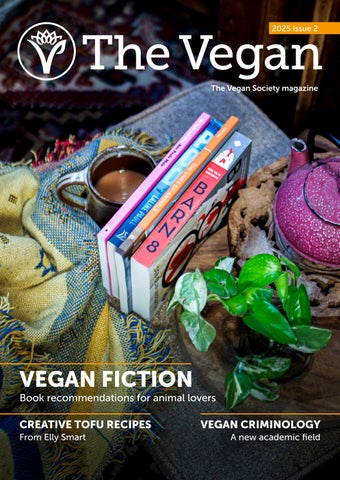
2025 Issue 2
VEGAN FICTION Book recommendations for animal lovers
CREATIVE TOFU RECIPES From Elly Smart
VEGAN CRIMINOLOGY A new academic field
0 .5 &P £7 s P u pl
Explore the latest issue of Vintage Magazine V for Life’s magazine for older veg*ns is packed with inspiration, expert advice, and practical tips for thriving on a veg*n lifestyle at any age.
In this issue:
Packed with recipes, ideas, and support for living well as a veg*n, this issue has something for everyone.
l A report from our eighth Awards for Excellence in Vegetarian and Vegan Care Catering, hosted at the Houses of Parliament – celebrating vegan fine dining in care. l Exclusive Golden Years supplement, featuring: • Wendy Turner-Webster on compassionate clothing. • Jasmine Harman with tips for veggie travel. • Nutritionist Rohini Bajekal on staying healthy in later life. l Practical advice ensuring veg*ns receive the right hospital care. l Fun and food. Learn sourdough baking or treat your furry friends with dog-friendly delights.
Vintage is free to V for Life supporters. Find out more and get your copy at vforlife.org.uk/shop or by calling 0161 257 0887 V for Life is a charity registered in England and Wales, number 1120687
Editor’s letter and contents
EDITOR’S LETTER As a lifelong book lover, I am excited to introduce John Yunker’s feature article ‘Is this book vegan?’ John examines what makes fiction vegan and suggests several contemporary novels to add to your reading list. Please email editor@vegansociety.com with your suggestions too. The Vegan Land Movement is a truly inspirational organisation which buys up land used for animal farming and gives it back to nature. On page 16, you can hear from one of the organisation’s co-founders, Gina Bates, in one of the most positive and hopeful interviews I have read in a while. Elly Smart’s new recipe book is bursting with creativity, including several innovative and delicious tofu recipes. I have
picked three of the best (after consulting with Vegan Society colleagues to see which recipes were most popular!) to include in our recipe feature on page 10. You will most likely have been inundated with talk of airfryers over the past couple of years. They are cited as a musthave kitchen gadget which speeds up food preparation and gives excellent results, as well as using less power – check out our nutrition feature to hear what a dietitian thinks of them. As well as the above, you can find all of our usual pieces on volunteering, Vegan Society highlights, reviews and more – as well as a fascinating insight into vegan criminology in our Deep Dive article and an introduction to The Vegan Society’s work on vegan-inclusive education.
06
CONTENTS 03
Highlights Essential updates on Vegan Society news
this book vegan? 06 IsNon-fiction for animal
24
Membership
26
Nutrition
Rescheduled AGM date
Air fryers: pros and cons
lovers
10
Recipes
16
Vegan Land Movement
20
Volunteers
22
Shoparound
Getting creative with tofu
Co-founder Gina Bates
Volunteer of the Season
New vegan products to look out for
Elena Orde, Editor
30
Deep dive
34
Education
37
Events
39
Reviews
10
Vegan criminology
Making education vegan-inclusive
Vegan events across the UK
16
Vegan-themed zombie film, anyone?
Issue 2 2025 The Vegan | 1
From the CEO
FROM THE CEO I hope this edition of The Vegan finds you very well. I am pleased to say that after a rigorous recruitment process, Libby Peppiatt will be joining The Vegan Society as CEO in May. Libby brings a wealth of experience and expertise from her previous role as CEO at Restore, a mental health charity where she oversaw strategic direction, service delivery and advocacy. Libby has also held senior positions at Mind and Rethink, where she played a key role in pioneering mental health initiatives for workplaces, universities, schools and community networks. She has been vegan since 2014 and is a passionate advocate for veganism. This issue of the magazine is accompanied by the third annual edition of Our Impact. This publication highlights the achievements of our organisation throughout 2024, bringing
our work to life through stories and testimonials from just a few of the amazing people who make The Vegan Society what it is. We have many exciting plans lined up for the coming months, as we make the most of our 80th anniversary. We’re sharing The Future is Vegan with as wide an audience as possible through a programme of events and outdoor advertising. Our exhibition on Veganism: Past, Present and Future will run from Saturday 17 May to Saturday 23 August in the Library of Birmingham. The 2025 AGM is now taking place on Saturday 28 June at 1pm. The meeting is open to all members and is your opportunity to discuss and influence the future direction of the society. You can find more details on page 25. Thank you, as ever, for all of your support. This is the start of an exciting new chapter for The Vegan Society, as we continue our work to make the world kinder, fairer and greener. Abbey Mann, Interim CEO
Sustainable Printing The Vegan Society cares deeply about the future of our planet and all those we share it with. We are committed to operating as a responsible, sustainable organisation which means we are conscious of the social, economic and environmental impact in all that we do. With this in mind, we are very pleased to announce that we work with Seacourt to print and distribute The Vegan. Seacourt are the UK’s leading environmental printing company and work closely with their clients to ensure that all material is produced with the lightest environmental footprint possible. In fact: • Their presses are 100% free from water, alcohol and harmful chemicals
21 Hylton Street, Birmingham, B18 6HJ
0121 523 1730 info@vegansociety.com vegansociety.com
• They use inks that are vegan and free from volatile organic compounds • They are powered by 100% renewable energy • They send zero waste to landfill As a result, they are Net Positive (beyond carbon neutral including the entire supply chain). Every time they produce a piece of print, they take responsibility for more carbon than they are generating – what they call Planet Positive Printing. We hope you enjoy reading this issue, knowing that it has been produced in line with ethical, sustainable principles.
© The Vegan Society Registered Charity No. 279228 (England and Wales) and SC049495 (Scotland) Registered Co. Nos. 01468880 and 12377572 (England & Wales). VAT Registration No. 361 7274 92.
Printed on recycled paper
Editor Elena Orde Designer Violeta Pereira Cover image Jennifer Jones The views expressed in The Vegan do not necessarily reflect those of the Editor or of The Vegan Society Council. Nothing printed should be construed to be The Vegan Society’s policy unless so stated. The society accepts no liability for any matter in the magazine. The acceptance of advertisements (including inserts) does not imply endorsement. Complaints should be made in writing to chair@vegansociety.com or ceo@vegansociety.com or by post. Visit vegansociety.com/complaints-procedure to find out more.
2 | The Vegan Issue 2 2025
Highlights
HIGHLIGHTS
Grow Green is The Vegan Society’s long-running campaign for transition away from animal farming
Parliamentary reception We were delighted when 12 MPs and many parliamentary staff members joined us at our drop-in event in Parliament in January. We met a number of new vegan and vegetarian MPs, plus many others who recognise the importance and value of plant-based foods. Jim Dixon MP spoke positively about veganism in a debate on diet and health a few days after our event. He said, "I commend the work to increase the level of plant-based food in people’s diets. Veganuary and vegan diets are good for our health and good for the planet. That could be part of the solution, and I urge the Minister and others, particularly those in local government, to consider it too.” Following the success of the event, we are looking forward to working with supportive parliamentarians in the months ahead as the government develops its new food strategy.
Grow Green Grow Green is The Vegan Society’s long-running campaign for transition away from animal farming. In November, we were very pleased to partner with the Veganic Summit to bring these ideas to a wider audience. Along with our friends at the Vegan Organic Network, we supported the Vegan Agriculture Network's co-founders Meghan Kelly and Stéphane Groleau in this second annual extravaganza of all things vegan-friendly growing. AC Baker and Alistair Currie represented The Vegan Society’s Policy Team and shared the message of how we can all influence policymakers to form a vegan-friendly food system. We're showing how the farming of animals is both unethical and unnecessary: just as plant-based diets can
meet all our nutrition needs, farming doesn't need nutrients from 'domesticated' animals either. Watch out for news, as we work with existing and aspiring vegan farmers to help more people transition to veganfriendly 'agroecological' techniques such as growing peas and beans for our food and our soil health, and trees for nuts, fruits and reduction of flooding risks too. Visit veganicsummit.com to watch the replays, using our discount code VEGAN15.
Vegan Animal Rights Conference On 30 March, at the Vegan and Animal Rights Conference, The Vegan Society’s Research Team held a workshop on identifying the research needs of the vegan and animal rights movement. The workshop brought together representatives from vegan NGOs, funders and researchers. One popular idea was to research why people stop being vegan and how we can address this. Another was the need to better understand which strategies are most effective in the movement, what kind of activism works with different target audiences, what has failed and why. The workshop also featured a presentation from Björn Ólafsson from Faunalytics on the importance of good research dissemination efforts. There is a clear demand for more opportunities to generate ideas and bring together vegan and animal rights experts. This workshop is a testament to the unique position that The Vegan Society plays in supporting research and developing new ideas.
Issue 2 2025 The Vegan | 3
Highlights
Videos of the presentations from 2024’s Research Day can now be found on our website
The Vegan Pod A recent episode of our podcast, The Vegan Pod, was titled 'Tackling the supplement stigma – do vegans need them?' We discussed the important topic of essential nutrients and when supplements might provide a helpful boost. You can listen to The Vegan Pod on Podbean, Spotify or Apple. Think you’d make a good guest or want to let us know your thoughts on the latest episode? Email podcast@vegansociety.com with your views.
Media
Another headline forecast the scrapping of Meatless Mondays when UK climate advisers merely mentioned a review of meat consumption guidelines. We secured a minor win after the headline was altered slightly in acknowledgement of its presumptuousness. The result has compelled us to keep chipping away at media bias and strengthen our collective voice as veganism undeniably continues to grow.
Research We have released a full playlist of presentations from 2024’s Research Day. Visit vegansociety.com/ research to find talks on topics including healthcare, masculinity, social media, food labelling and more. We have published a Research News article by Dr Jared Piazza on our website. The piece focuses on Jared’s research findings from developmental psychology regarding children’s relationship with animals and posits that childhood may be the ideal period for vegan education.
e Th
As a voice for vegans, it’s our duty to ensure journalists are reporting balanced articles when it comes to headlines around veganism and animal rights. We know there are many misconceptions around veganism, from nutritional deficiency and taste to Ve affordability, and the media is a ga nS 4 major vehicle in peddling stereotypes o ci 202 ety's Research Day that hide the compassionate values underpinning veganism as a way of life. Best of the blogs This is particularly prevalent at the moment, with headlines reporting drop-offs in vegan products and statistics We’ve shared some brilliant blogs at vegansociety.com/ about young people eating more meat. These messages blog over the past few months. Dietitian Emily Angus set the only paint half a picture and fail to acknowledge the reason, record straight about vegan diets and media attention, while beyond health and the environment, that more than half of Dr Will Tuttle wrote about Buddhism and vegan living. We vegans adopt this lifestyle. also shared an ultimate guide to vegan meat replacements. In recent months we have challenged editors over On International Women’s Day (IWD) in March we fearmongering headlines about vegan health and veganism’s published a Q&A with some of our staff and volunteers about ‘decline’, despite statistics from our recent survey showing an their roles, what IWD means to them and which women in overall increase across Britain. the vegan movement inspire them.
4 | The Vegan Issue 2 2025
Highlights
Nutrition In a single month, our Nutrition Team responded to 60 nutrition-related queries on topics including infant formulas, supplementation, prisoner malnourishment, medications, bone health and food labelling. Please email nutrition@ vegansociety.com if you have a question for our experts. Our dietitians also gave their expertise to a research project focusing on hospitals. The aim of the project is to assess the health, environmental and financial impacts of reducing barriers to plant-based choices amongst hospital patients and staff. Have you spotted our short nutrition myth-busting videos on social media? So far, we’ve tackled the topics of ultraprocessed foods, supplementation, vegan babies and plantbased milks.
Volunteers The Community Network has attended several events on behalf of The Vegan Society, including Islington Market, two Sustainability Fairs in Lewes and Hastings and the Greener Energy Fair in Kidderminster. Here they spoke to the public about the many benefits of veganism and some of our campaigns. They distributed resources, including recipe leaflets and were also successful in signing up some new members. A huge thank you to our volunteers, who help to share our messages far and wide!
Recent recipes We recently collaborated with two different chefs to bring more delicious recipes to our website. Yin (@RawChefYin) created two raw vegan recipes for Chinese New Year in February. These were a light and refreshing Chow Mein and a Braised Mushrooms with Vegetables dish that pairs well with a bowl of cauliflower rice.
Amee Vora (@Yummee.With.Amee) created an Indianinspired, flavour-packed Tikka Masala Naan Pizza recipe, as well as some indulgent Mocha Panna Cotta Hearts for Valentine’s Day. Head over to vegansociety.com/recipes to find the above and hundreds more.
Education The Vegan Society’s 'Springtime Vegan Learners' resource was created to help educators design inclusive lessons that respect vegan values. Covering topics such as animal life cycles, vegan-friendly seasonal treats and cultural celebrations such as Nowruz, it provides practical guidance to ensure all learners can fully participate. For example, instead of chick hatching projects, learners can research how different animals care for their young. The resource also highlights where to find vegan-friendly chocolate eggs and other seasonal treats in mainstream supermarkets, making inclusive shopping easy for families and schools.
Legacies Our legators mean the world to us – without them, our work would not be possible. In 2025, we have been deeply moved by the generosity of Patricia Evans, Christopher Edwards, Carl Greenaway, Mildred Francis, Karen Butson and Gordon Hayes whose gifts of £85,958.72 have been gratefully received. Their legacy gifts are not just donations – they are powerful acts of compassion that fuel our mission to advocate for veganism and support compassionate living. Consider leaving a legacy gift to The Vegan Society and help us create a kinder, more sustainable world for all. Your support will make a profound difference. For more information or to request a Legacy Guide, please get in touch with our friendly Legacy Team at legacies@vegansociety.com or call us on 0121 507 9987.
Thank you to our legators, who mean the world to us – without them, our work would not be possible
Issue 2 2025 The Vegan | 5
In the end, vegan readers determine vegan novels. If the book speaks to you then, yes, it’s an animal-friendly novel.
6 | The Vegan Issue 2 2025
Feature
IS THIS BOOK VEGAN? Ten contemporary animal-friendly novels to add to your reading list As vegans, we are accustomed to examining food ingredient labels to answer that never-ending question: is this vegan? Yet how often do vegans ask that same question about a book? For cookbooks and non-fiction, the subject matter itself typically indicates if the book is animal-friendly. But fiction is a different story. When it comes to finding our next great novel to read, we’re not likely to find a vegan section at the bookstore. It’s not that vegans cannot enjoy mainstream fiction, it’s just that we’ve grown weary of seeing meat-centric meals depicted as normal while vegan characters, if there are any at all, are portrayed as difficult, combative or simply strange.
What makes a novel vegan? As a vegan author and co-founder of a boutique publisher, I’ve learned that this is not an easy question to answer. First, there is the physical book to consider. Does the book use animal-based inks? Fortunately, these days most printers rely on water-based inks and also use sustainably harvested (and sometimes recycled) paper products. However, readers should be aware that some of the larger publishers outsource printing to China, which carries a greater environmental cost. Next, is the author vegan? And does the author need to be vegan for the novel to be considered animal-friendly? While I’d prefer to read more books by vegan authors, I’ve also read many books by non-vegan authors that speak powerfully on behalf of animals, some of which are included here. Just as food can be ‘accidently vegan’, so too can a novel. What defines an animal-friendly novel is the text itself and what it says. If the novel includes animals, does it portray the animals authentically and with empathy? If there are vegan or vegetarian characters, do these people ring true (as opposed to falling into stereotypes)? And does the novel question or challenge widely accepted traditions and practices within our society that harm animals? In the end, vegan readers determine vegan novels. If the book speaks to you then, yes, it’s an animal-friendly novel. With that in mind, here are ten books that resonate with me.
The Lives of Animals by JM Coetzee In 1997, JM Coetzee delivered two lectures at Princeton University in the form of short stories. These stories ended up in the novella The Lives of Animals and the subsequent novel Elizabeth Costello. In
Issue 2 2025 The Vegan | 7
Fiction often reflects society, but it can also push society forward and offer a glimpse of a better future.
these stories, Coetzee introduced the world to the character of Elizabeth Costello, a famous Australian novelist who has reached the ‘eff it’ years of her life and now lectures fellow academics on the horrors of a world that chooses to eat animals. I cannot overstate the influence that Elizabeth Costello has had on my life and writing.
Barn 8 by Deb Olin Unferth In Barn 8, two people set out to liberate chickens from an industrial egg farm. Along the way, we learn about chicken history, emotion and language. Unferth writes: “In the wild, chickens have complicated cliques and distinct voices. They talk among themselves, even before they hatch … Adult chickens have over 30 categories of conversation … Chickens gossip, summon, play, flirt, teach, warn, mourn, fight, praise and promise.” In absolute numbers, perhaps no other species of animal has suffered as greatly as chickens, and this novel shines a much-needed light on one of the greatest horrors of our time.
The Edible Woman by Margaret Atwood Published in 1969, The Edible Woman is Margaret Atwood’s first novel. Its protagonist, Marian, discovers one day that she can no longer eat meat. As the title suggests, consumption is a major theme of this novel, not just of animals but of the many products that define modern society. Marian, who works for a market research firm, creating and administering surveys on behalf of consumer brands, is both a consumer and observer of those who consume (and one who is consumed by a male-dominated culture). Everything we might construe to be normal about society in the late 1960s, Atwood questions and dismantles.
We Are All Completely Beside Ourselves by Karen Joy Fowler This powerful novel by Karen Joy Fowler blurs the lines between human and nonhuman, between family and stranger, and between animal rights activism and justice.
Of Cattle and Men by Ana Paula Maia, translated by Zoë Perry Environmental destruction looms large in Ana Paula Maia’s depiction of rural Brazil. Another meat processing plant is under construction. The river is dead. The protagonist of this novel is in the unenviable position of holding a stun gun: “Edgar
8 | The Vegan Issue 2 2025
Feature
Wilson prays for the salvation of the soul of each animal he slaughters and puts to sleep before its throat is slit. He’s not proud of what he does, but if someone has to do it, then let it be him, who has pity on those irrational beasts.” The desperation and the feeling of imprisonment is felt by human and animal alike, both trapped in a situation they are powerless to change. Until, one day, a cow breaks free.
Drive Your Plow Over the Bones of the Dead by Olga Tokarczuk In a remote Polish mountain town, Janina lives a solitary life of translating William Blake, caring for the summer homes of wealthy residents and doing battle with the local hunters and government officials who dare question her allegiance to animals over humans. She is sharp-tongued, highly educated and hiding a secret that will keep you reading until the end.
way. Caruso is the rare non-human narrator who can successfully carry an entire novel, with a full character arc; he is intelligent, single-minded and cunning – and, by the end of the novel, humble and generous as well.
Pod by Laline Paull Laline Paull is author of two novels written from the perspective of the greater-thanhuman – bees and a host of sea creatures. In Pod, a spinner dolphin named Ea must find her way in a polluted ocean that no longer speaks to her as it should. Along her epic journey readers learn about other species, including wrasse fish, eels, bottlenose dolphins and a rorqual whale. This world beneath the waves comes to light vividly with no less complexity than the human societies up above. An African proverb says, “Until the lions have their historians, tales of the hunt shall always glorify the hunter.” In Pod, Paull lets the animals of the ocean tell their story on their terms.
My Days of Dark Green Euphoria by AE Copenhaver
Lilith’s Brood: The Xenogenesis Trilogy by Octavia Butler Science fiction is a fecund genre for vegan literature, as it encourages new ways of thinking about the future and the present. And Octavia Butler, herself a vegetarian, weaved themes of meat-eating throughout her Xenogenesis trilogy. In this series, it is the more enlightened aliens, the Oankali, who don’t eat meat and have plucked the last few human survivors, including Lilith, from a war-torn planet. While the Oankali are giving these chosen few humans a second chance on a reborn planet, the killing of animals remains a point of conflict among survivors. While this trilogy tackles many significant themes – power, consent, coexistence and evolution – our relationship with the planet and its animals is front and centre.
In this book, thirtysomething Cara Foster is vegan, water-wise and reevaluating her boyfriend for killing a spider. Then, during a mimosa-soaked Sunday brunch, she meets his alluring mother, Millie, and before long has “fallen off the wagon” of her environmental ways, living a blissfully ignorant adventure with Millie yet also threatening her career, best friend and identity. Few novels tackle the eco-anxiety we all feel so irreverently and profoundly as AE Copenhaver.
The world needs more vegan novels Fiction often reflects society, but it can also push society forward and offer a glimpse of a better future. As more writers embrace veganism, we are seeing more books with animal-friendly themes. Given the power of fiction to reach not just the mind but the heart, these novels – and those to come – will help change the world for the better. By John Yunker
Love and Ordinary Creatures by Gwyn Hyman Rubio Love and Ordinary Creatures is a humorous and heartbreaking love story between a sulphur-crested cockatoo and his human caretaker, Clarissa. Snatched in a net from his Australian homeland as a young parrot, Caruso has come to terms with captivity, but because he has no avian mate, he is obsessed with Clarissa, whose affection for a fellow human gets in Caruso’s
John Yunker is co-author (with Midge Raymond) of the environmental mystery Devils Island and author of the novels The Tourist Trail and Where Oceans Hide Their Dead. He is co-founder of Ashland Creek Press, whose titles include My Days of Dark Green Euphoria and Love and Ordinary Creatures. Visit johnyunker.com and ashlandcreekpress.com to learn more.
Issue 2 2025 The Vegan | 9
ELLY’S PLATE Three creative tofu recipes from Elly Smart’s new book
10 | The Vegan Issue 2 2025
Recipes
STICKY HASSELBACK TOFU WITH CASHEW SLAW Serves 2
Ingredients 400 g block extra-firm tofu, drained 4 tbsp light soy sauce 2 tbsp sesame oil 2 tbsp mirin 1 ½ tbsp maple syrup 2.5 cm piece of fresh root ginger, minced Toasted sesame seeds, to serve
For the cashew slaw ½ sweetheart cabbage, finely shredded 1 large carrot, julienned or cut into ribbons ½ red onion, finely sliced 50 g roasted and salted cashew nuts Juice of 1 lime 1 tbsp maple syrup Pinch of salt
Prep 10 mins (+ marinating) Cook 20–30 mins Difficulty 3/5 Protein per serving 36.5 g
If you haven’t guessed by now, I’m a BIG advocate of tofu, and this is the perfect example of what I eat on a weekly basis. Glazed tofu with veggies equals lots of nutrition, minimal fuss and even less clean-up. It’s the perfect dish to make me feel great post-workout.
Directions Slice the block of tofu lengthways to form two equal ‘fillets’. Now make diagonal consecutive cuts into the surface of each piece, only slicing about halfway through the tofu. Mix together the soy sauce, sesame oil, mirin, maple syrup and ginger in a sealable container. Add the tofu to the marinade (ensuring it is fully covered), seal the lid and leave it in the fridge to marinate for 30 minutes (or overnight). If you’re short on time, you can simply cook the tofu straight away. Preheat your air fryer to 200 °C (400 °F) or your oven to 200 °C (180 °C fan/400 °F/Gas 6). Line a small baking tray (that will fit into your air fryer) with foil or baking paper. Remove the tofu from the marinade (reserving the excess marinade) and place it on the prepared baking tray, cut side up. Air fry the tofu for 20 minutes, or roast it in the oven for 30 minutes, basting with the reserved marinade every 5 minutes. Combine all the slaw ingredients in a bowl and mix well. Divide the slaw between plates then top with the sticky Hasselback tofu. Drizzle with any remaining marinade then sprinkle with sesame seeds before serving.
Elly's Plate by Elly Smart (DK), photographs by Jo Sidey 2024
Issue 2 2025 The Vegan | 11
Recipes
CRISPY SATAY BURGER Serves 4
Ingredients 2 x 250 g blocks extra-firm tofu, each drained and halved into 2 patties 100 g plain flour 200 ml dairy-free milk 160 g peanuts, finely chopped 100 g cornflakes (ensure vegan) 250 ml vegetable oil, for shallow frying Salt and freshly ground black pepper
For the satay sauce 4 tbsp smooth peanut butter Juice of 1 lime 1 tbsp dark soy sauce 1 tbsp rice wine vinegar 1 tbsp sesame oil 1 tsp agave syrup 1 tsp curry powder
To serve 4 vegan brioche burger buns (or your favourite roll), split and toasted 1 cucumber, sliced into ribbons Small handful of coriander (cilantro) leaves Shop-bought pickled red onions 4 tbsp vegan spicy mayo
12 | The Vegan Issue 2 2025
Prep 20 mins (+ marinating and chilling) Cook 6 mins Difficulty 3/5 Protein per burger 44.8 g
Move over breadcrumbs, because this coating makes these burgers a textural triumph. Cornflakes aren’t just for breakfast.
Directions Combine all the satay sauce ingredients in a bowl and mix until smooth. Taste and season with salt and pepper. Place the tofu in a sealable container and toss with half the satay sauce (you may need to add a little water to thin out the satay sauce to help it coat the tofu). Seal the lid and leave in the fridge to marinate for 30 minutes (or overnight). Grab three shallow bowls: place the plain flour in one bowl, add the milk to another bowl, then add the peanuts and cornflakes to the final bowl, scrunching them with your hands to break down the cornflakes a little. Season each bowl with some salt and pepper. Place each patty in the flour bowl, ensuring they are evenly dusted. Next, dip the patties into the bowl with the milk to fully coat. Finally, add them to the cornflake and peanut bowl and lightly toss to coat – you may need to press the pieces onto the tofu to coat the patties fully. Place the coated patties onto a small tray or plate, and transfer them to the fridge for 30 minutes. Heat the vegetable oil in a deep-sided frying pan (skillet) set over a medium heat. Once hot (test by adding a pinch of cornflakes – if they sizzle and turn golden in 30 seconds the oil is ready), fry the patties for about 3 minutes on each side until golden all over. Spoon the remaining satay sauce onto the bases of each toasted brioche bun. Layer on some cucumber ribbons, coriander leaves and pickled red onions then top with a crispy patty. Squeeze on some spicy mayo then finish with the bun tops.
Issue 2 2025 The Vegan | 13
Recipes
CHOCOLATE PROTEIN POTS Serves 2
Ingredients 70 g dark chocolate (ensure vegan) 300 g silken tofu, drained 2 tbsp almond or peanut butter 2 tbsp agave syrup 2 tbsp chia seeds 1 tbsp unsweetened cocoa powder ½ tsp vanilla extract Pinch of salt
To serve Handful of granola Fresh berries of your choice
14 | The Vegan Issue 2 2025
Prep 5 mins Cook 0 mins Difficulty 1/5 Protein per serving 20.8 g
Who doesn’t want to feel like they’re eating chocolate pudding for breakfast? These little pots are one of the easiest things in my book to prep and will keep you full all morning.
Directions Melt the chocolate in a small heatproof bowl set over a saucepan or in the microwave in 20-second bursts. Add the remaining ingredients to a blender or food processor, and pour in the melted chocolate. Blitz until completely smooth. Scrape the mixture equally between two bowls or glasses. You can either cover and refrigerate until needed or eat it straight away. When ready to serve, top the chocolate pots with a handful of granola and your choice of fresh berries.
Advertisement
VEGANICITY SPECIAL OFFER Order before 31 July 2025 and save 20% off the entire Veganicity range of supplements, including Red Yeast Rice use code VEGAN225 Extra, essential Vitamin when you order C 1000mg and the ever popular Omega-3 DHA:EPA. Check out our website for our full range of supplements for all general and specific health needs!
SAVE
20% UNTIL 31-7-2025
Free UK ü ü Recycled delivery pots products ü 100+ in the range üEasy EU deliveries in ü Made the UK for orders over £30
with IOSS scheme - no import fees
tel: 01323 388150 web: www.veganicity.com
®
eganicity
®
suitable for everyone
Issue 2 2025 The Vegan | 15
After hearing a shocking programme on the radio about how the far right were crowdfunding themselves, I wondered, “What if one million vegans donated just a few pounds monthly to buy land?”
16 | The Vegan Issue 2 2025
Interview
VEGAN LAND MOVEMENT Laura Buchenlicht interviews Gina Bates about returning land used for animal farming to nature Tell me about your vegan journey. When I was 19 (I'll be 63 this year), I met a vegetarian in college. At that time, I had no idea anyone could be vegetarian. I then thought that was all that was needed not to harm life. I moved from London to the Scottish Highlands at 36 and found myself surrounded by cattle, sheep and shooting estates. At 40, I had an epiphany after driving past a dairy farm and thinking, “Where are all the calves?”
What is the Vegan Land Movement (VLM) and how was it born? In 2018 I joined social media and suddenly became aware of how many vegans there were in the world. After hearing a shocking programme on the radio about how the far right were crowdfunding themselves, I wondered, “What if one million vegans donated just a few pounds monthly to buy land?” We could all be buying out dairy farms every two months, just for the price of a coffee each month. So that's what we do – use crowdfunding to buy land from animal agriculture and rewild it.
Could you tell us a bit about the other team members? Sara Eloquin and Kevin Greenhill, whom I was friends with on social media, were completely on board with the idea of a Vegan Land Movement. Sara and Kevin are both passionate about wildlife, and together we created the VLM. Kevin is great at finding the plots of land going up for auction, and as an accountant he manages the accounts. He is also the bidder at the auctions. Sarah Dekany also reached out to us on social media and loved the initiative. She joined the VLM as a Director in 2022. Sarah is a graphic designer and creates wonderful images to promote what we do. Karl is our tech expert volunteer and he sets up the fundraisers. The five of us are the core team at the moment, and then there are volunteers who come to plant trees or count species. We have a large volunteer group and the local antibadger cull sabs also keep an eye on one plot of land where badgers are living, and other local volunteers check on the other plots.
Issue 2 2025 The Vegan | 17
Interview
How many pieces of land have you acquired so far and what has happened to them since? We’ve acquired seven pieces of land so far. They're all different – but they are all surrounded by dairy farms. We chose the Somerset area exactly because of that. What was amazing to see was how quickly things changed. We've had these jumps in different species arriving – in the first year we only saw insects and maybe some amphibians. Then in the next year birds arrive and the next mammals and reptiles. On one plot of land, we saw some adders – we have no idea where they came from. There's been an increase in species of 523%, and that's just between 2022 and 2024.
How do you ensure that only native species settle on the land?
Community Interest Company, rather than a charity. We wanted to become a charity initially, but we were advised by our vegan lawyer who connected us to an expert in these matters. She recommended a Community Interest Company because it has something called an asset lock, which ensures that none of the land can be used for human gain. We had to write a constitution and explain how our project is of interest to the community. We wrote that it benefitted the non-human community, because nowhere did it say that a community had to consist of humans.
What is the VLM's biggest challenge? The biggest challenge is to get the word out to enough other vegans and to get them involved. We've had some bad experiences with other vegans not being able to believe that we aren't doing this for monetary gain. They kept saying, “But you've got to make some profit out of it!” There definitely can be a lot of hopelessness at times, especially with everything that's going on in the world right now, because it can feel like human greed rules supreme. But when I see a plot of land that we’ve removed from animal agriculture, teeming with life – when I see this universe full of butterflies or with birds nesting in the undergrowth – that makes it all worth it.
So far, we haven't had any problems with invasive species. We very much operate by a hands-off ethos, because we believe nature knows best and as humans, we need to stop thinking we know better. The only thing we do really is to plant native trees, to speed up the process in the beginning. And then we just watch and record what happens. We research which species are endangered in the area so we can try to create a habitat that would provide food for them in the future. We've done that We very for the hazel dormouse, for example, which is threatened with extinction much operate by a in Britain. We are hoping that by hands-off ethos, creating a habitat to support them because we believe they will eventually arrive.
Do you think we need more projects like the VLM?
Absolutely! Everyone should do it, everywhere. We’ve had people contacting us from all over the nature knows best and as Has there been any backlash to world – Spain, America, Australia, humans, we need to the VLM? New Zealand. They ask how to start stop thinking we something like this in their country, When we were planning to buy our and we always recommend looking first plot of land, we put the location know better. into what business structures they have to online. And then we lost that auction, protect the land in their region. Mostly they because farmers had seen us on social don't reply after that, but I hope that some will media and outbid us. So, we don't put out that find the right team and do it. It's the best we can do, to information anymore. Since then, we haven't had any inspire others and set an example for others to follow. issues. One of our volunteers, an expert in farm pollution, once got lost on his way to one of our plots of land to help plant What are the plans for the VLM and what are you trees. He stopped by a dairy farm to ask for directions, and most excited about for the future? the farmer complained “They'll pollute the land with their We plan to just keep growing, rewilding more land. For this rewilding”, all the while standing next to streams of muck year, I'm looking forward to planting trees and counting even running down into the drains! more species. We've also had unexpected allies, like an elderly farmer who at first berated us for leaving a track gate open. We then How can people support the VLM? explained to her what we do, that it's about returning the You can go to our website veganlandmovement.com and land to nature. She commented on the fact that she had seen become a member. Members can join us for tree planting or a decline in wildlife and asked if she should rewild her land species counting, or people can get in contact about other too to which we said “Yes!” We are now in communication volunteering skills. We're especially looking for people with with her about this. scientific knowledge, about ecology for example, to help with doing more research. And you can help by spreading Tell me why you chose to turn the VLM into a the word about us, online and in real life.
18 | The Vegan Issue 2 2025
Advertisement
Issue 2 2025 The Vegan | 19
Volunteers
VOLUNTEER OF THE SEASON Meet Punam, our brilliant Pharmacist Volunteer.
Can you describe your volunteer role at The Vegan Society? I have been volunteering for The Vegan Society as a Pharmacist Volunteer for around the last 10 months. I love the experience I have gained by contributing to the wider society through the queries we have received, and this has made my professional role as a pharmacist more rewarding. It allows me to help others, contribute and make a difference. Some of the medication-related queries I have assisted with have been challenging, but this has stretched me to research and investigate further. It has developed my knowledge and prompted me to look more widely than the medication itself, including considering whether or not manufacturing processes are vegan. The role has allowed me to reach a wider cohort of patients than my daily pharmacist role in General Practice. It is great to see a firm drive on veganism in healthcare.
What do you enjoy doing when you aren’t working or volunteering? I love spending quality time with my family and friends. I enjoy the outdoors, travelling and learning and developing myself all the time. I also love to do meditation and yoga, and I feel this keeps me spiritually aware and grounded in the face of the stresses and challenges we all face in the modern world. I recently travelled extensively with my husband, and we were both amazed at the number of vegan restaurants and dishes we came across, even in places like Chile where we thought we would have limited options. I enjoy learning about Ayurveda, which is an ancient form of Indian medicine. It emphasises the importance of maintaining balance within the body, that everything starts
20 | The Vegan Issue 2 2025
from within us, albeit through diet and lifestyle.
What’s a change you hope to see in the future? I would like to see more people sharing love in the world – to create an amazing and extraordinary life, we must see that we are all One. There is greatness and power in Oneness and world peace. I feel our self-love is so important – that we value and see ourselves as worthy. Embrace what Mother Earth is providing to us continuously with the change in seasons throughout the year. With this, we can change our consumption of different vegetables, spices, lentils and legumes. This allows us to create a state of wellbeing – mindfully, physically and spiritually.
What gives you hope for a more vegan world? The increasing awareness of veganism in the UK and around the world is great to see! I feel that society is now a lot more receptive to the vegan lifestyle as compared to 10 years ago. I hope to see healthier vegan food products available on the market. The fact that we are becoming more conscious of the types of foods we are consuming gives me hope for a more vegan world; what we eat can create balance in our minds and bodies. We want to lead healthier lifestyles, which is great to see. We should congratulate ourselves on even small changes we make to our diet and lifestyles, knowing that it will be for our greater good. A vegan lifestyle also helps us to protect our animals and the environment we live in. I feel that positive changes are coming, and there is always light at the end of the tunnel.
Advertisement
UK's #1 natural insect repellent
We're available in H&B, Boots, Waitrose and all other retailers, plus independent health stores.
20% off with discount code VEGAN20
Use insect repellent safely. Always read the label and product information. Clinically tested to provide 100% protection for at least 4 hours and good protection for up to 8 hours against mosquitoes that can carry dengue, chikungunya, yellow fever, Zika and more.
Donate
Celebrate Our Past, Fund Our Future
Together, we are creating a world where every life is valued. Your generosity is at the heart of The Vegan Society’s next chapter! Donate today vegansociety.com/donate
Registered Charity No. 279228 (England & Wales) and SC049495 (Scotland). Registered Co. Nos. 01468880 and 12377572 (England & Wales). VAT Registration No. 361 7274 92.
Issue 2 2025 The Vegan | 21
Promotional feature
SHOPAROUND
Shop with confidence for products registered with the trusted Vegan Trademark
Mama Bamboo Mama Bamboo wet wipes are made from sustainably sourced bamboo viscose. They are 100% compostable and made from 99.4% purified water, soothing aloe vera and coconut extract. Their no-sting moisture balancing formula is hypoallergenic and naturally anti-bacterial, so they are suitable for both sensitive and newborn skin. Containing zero plastic as well as being Vegan Trademark registered, these wipes provide a great option for eco-conscious parents with a high-quality, high-performing product which is kinder to babies’ skin and the planet. Available at mamabamboo.com.
Moving Mountains Winner of the two-star Great Taste Award, Moving Mountains succulent quarterpounder burgers are a great option for those craving a delicious vegan burger. Made with soy protein, the Moving Mountains burger is juicy and bursting with flavour. Not only are the burgers high in protein, they include your recommended daily amount of vitamin B12, are a source of fibre, are low in sugar, have recyclable packaging and are halal-certified. Available at Amazon Fresh, Ocado, Waitrose and Wholefoods.
Amplify Goods The Solidarity Bar Soap is more than a washroom essential – it’s a product with purpose, made with over 96% naturally-derived ingredients and infused with 100% essential oils. Upcycled olive stone granules offer gentle exfoliation, and the plastic-free packaging transforms into a bookmark, reducing waste. Each bar is packed at the Crisis warehouse, providing living-wage paid work experience for individuals facing barriers to employment, including those experiencing homelessness. Available at shopfromcrisis.org.uk/products/solidarity-soap.
Clevelli Bay Clevelli Bay creates eco luxury cleaning products in tablet form. They are Australian inspired, and British made. Registered vegan products in this range include multipurpose and bathroom cleaner tablets made from 100% essential oils, tablet wrappers that decompose in your food waste bin and multiuse bottles made from 100% Prevented Ocean Plastic with all carbon emissions offset through Climate Partner with the emPOWERing Africa project. Subscription tablet refills are posted through your letterbox for your ease and to reduce your carbon footprint. Available at clevellibay.com.
22 | The Vegan Issue 2 2025
Promotional feature
Catastrophy Sustainable Silver Jewellery Catastrophy offers handmade, edgy jewellery for cat lovers, crafted from recycled 925 sterling silver. The first jewellery to be certified by the Vegan Trademark, Catastrophy reflects a commitment to ethical practices, inclusivity and sustainability. Each piece is thoughtfully designed to celebrate the bond with felines while being kind to the planet. Ten percent of every purchase is donated to local organisations such as the Cat Welfare Society, improving the lives of cats in Singapore, and the Soi Dog Foundation in Thailand, rescuing vulnerable cats and fighting to end the cat meat trade in Asia. Available at catastrophy.com.
Beauty Kitchen Discover Beauty Kitchen’s Pure Collection, powered by nature’s most effective pure active ingredients. Each Vegan Trademark-registered product in the collection is carefully crafted and packaged sustainably. The range consists of Castor Oil, Abyssinian Oil, Vitamin E Oil and Aloe Vera Gel, all designed to enhance your skin’s vitality, health and appearance, empowering you to embrace your natural beauty. Available at beautykitchen.co.uk.
Shedid & Parrish Shedid & Parrish create award-winning products to make you and your hair feel fabulous. Using only the finest vegan ingredients, they will cleanse, nourish and strengthen your curly and coily locks, ensuring that they are a joy to look after. Their proprietary complexes help to reduce frizz, ease detangling and deliver a protective barrier against the elements. Their ingredients are sustainably sourced so you can be sure of full traceability, and they have aims to reduce both waste and their environmental impact. All of their award-winning products come in recycled aluminium. Available at shedidandparrish.co.uk.
Just Love Food Gruffalo Celebration Cake and Cupcakes A treat for mini and adult vegans alike! Just Love has expanded their vegan cake offering with the launch of their official Gruffalo Celebration Cake and Cupcakes. Made in a nut-free, peanut-free and milk-free factory, the vanilla-flavoured sponge is filled with a chocolate flavoured frosting and finished with an edible Gruffalo-themed soft icing and chocolate frosting. The cupcakes come in a pack of nine. These cakes make for the perfect hassle-free centrepiece to your little one’s party table. Available exclusively at Asda.
Issue 2 2025 The Vegan | 23
MEMBERSHIP Star Letter Ethical considerations surrounding dog adoption
I write in response to the article in The Vegan magazine (Issue 2, 2025) entitled ‘Vegan's best friend’. I have been a vegan (for ethical reasons) for over 35 years. I have also been involved in dog rescue as an independent volunteer for many years. I have always had an affinity and love of dogs but in line with my vegan beliefs I disagree with the ‘ownership’ of animals just to serve our human desires. When I take on a dog I do so with careful consideration of who I can best help and how I can best make a difference. Most people are only willing to adopt young, small, cute and 'easy' dogs, so there is actually quite a high demand for these dogs, with usually multiple applications for each one. If a vegan adopted one of these dogs, the knock-on effect is often that other people also wanting to adopt (but less ethically motivated) will buy themselves a puppy instead, thus fueling the cruel pet trade. Don't feel that just because you have a small home or no garden or limited time and energy to exercise a dog that you can only adopt a small dog. Taking on a dog with behavioural problems may seem scary and beyond your experience but I believe that adopting with an ethical approach greatly helps. However, I do not think that making an ethical choice means you must take the longest-staying, most ‘difficult’ dog. Always ask yourself if you are able to meet the needs of any particular dog. A good approach can be to contact a rescue local to you and rather than try to choose a dog yourself, ask to be matched with a dog that would suit you best, and emphasise that you are willing to take the overlooked and the unwanted. There are a very large number of mainly independent dog rescues in the UK. They all have different rules as to who they will adopt to. Finding the right rescue to adopt from is not always easy but if turned away from one please don't give up – try another one. Also don't forget that fostering might be a good option for you. It's a truly selfless way to help dogs in need. With my extensive knowledge of the UK dog rescue world, I'm always very happy to help anyone for free who would like assistance. I can guide you through finding a suitable rescue organisation, choosing a dog that would be a good match, understanding and managing behavioural problems and more. Please drop me an email at karenmorris431@yahoo.com. I would be delighted to hear from you. Karen Morris
24 | The Vegan Issue 2 2025
Membership
Congratulations to Karen, who has won a copy of High Protein Vegan by Rose Wyles. Next issue’s winner will receive a copy of My Vegan Kitchen by Dunja Gulin (featured in our previous magazine's recipe pages). Send your letters to editor@vegansociety.com or our usual postal address.
Letter sent to The Vegan Society along with some historic vegan publications (image on p 24) Dear Vegan Society, I am having to reduce the contents of the house and I thought you would be good recipients of the enclosed old vegan publications. I hope you will find these useful for your archives. It has been fascinating rereading them and seeing names of people I met in the early 1970s. Also remembering all the products that are no longer available, mainly because veganism is now mainstream and finding delicious products is so easy, as so many manufacturers are catering for vegans. Wouldn’t the pioneers be chuffed! Best wishes, J Pritchard
Membership news Our second member-only nutrition webinar Following the successful launch of our member-only Nutrition Sessions programme last year, our in-house dietitians delivered the second webinar in the series in February. The topic of this webinar was vegan nutrition and the menopause. We were delighted to see such high attendance and engagement. You can find recordings of past webinars in the Nutrition Hub in the Members’ Area of our website, as well as the questions and answers from each session. Our next session will take place in May and focus on childhood nutrition.
Discounts In return for becoming a member of The Vegan Society and supporting our work and campaigns, we offer 10% off our multivitamin VEG 1 and over 100 third-party discounts. This includes the ever-popular 10% off at Holland & Barrett, which you can claim by showing your membership card in-store or using code ‘vegan10’ online. This spring you could:
• Take advantage of a subscription to three issues of Vegan Food and Living for only £2.99. • Try browsing for a wide range of products at Alternative Stores, with 5% off. • Treat yourself to a Lifestyle Bar from Friendly Soap with 20% off. Did you know the brand also does a dog shampoo bar? • Discover a variety of pillow mist sprays with 15% off at The Little Peace Company.
Events The Supporter Services team attended Benjamin Zephaniah Day at Brunel University in London on 12 April to celebrate the life of our late Ambassador. Stay tuned for issue 3 of the magazine to find out about the summer events we will be attending.
Members’ Area You can explore all the member discounts as well as other exclusive member-only content in the Members’ Area of our website at vegansociety.com/my-account. Please contact us if you have any problems accessing your account.
Contact us By email at membership@vegansociety.com, by phone on 0121 523 1730 or write to us at Donald Watson House, 21 Hylton Street, Birmingham, B18 6HJ.
Important Update: New Date for Our AGM We’re pleased to share that our virtual AGM will now take place on Saturday 28 June 2025 at 1pm. This adjustment will allow us to align the meeting with the arrival of our new CEO, so that our members can receive valuable updates on ongoing efforts and future vision alongside the reporting from the past year. The closing dates for nomination of candidates for election to the Council of Trustees of The Vegan Society and for motions to the AGM have now closed. The AGM is an important way in which members can participate in the society and we warmly encourage you to attend. Additional details will be sent to you in May 2025. Please contact AGM@vegansociety.com with any queries in the meantime.
Blueberry and banana French toast, from My Vegan Kitchen – next issue's Star Letter prize!
Issue 2 2025 The Vegan | 25
AIR FRYERS: PROS AND CONS From little-known appliance to an almost viral trend, many people swear by their air fryer. But is the food we cook in them any healthier than the food we cook using more ‘traditional’ methods? There is not a huge amount of scientific literature looking specifically into the health pros and cons of air fryers. However, considering how they work and what we know about nutrition, there is still plenty to discuss.
How do air fryers work? An air fryer, despite the name, is not technically frying food at all. It is essentially a compact convection (fan) oven with a heating element and a fan that circulates hot air. Due to the air fryer’s small size, the fan circulates even very small amounts of fat very efficiently during cooking, coating the food and resulting in a crispy texture reminiscent of traditionally fried food with a fraction of the fat content, which brings us to the main benefit of air frying.
Reducing fat content Excess fat intake, particularly saturated fat, is linked to a higher risk of developing cardiovascular diseases due to the impact it has on our blood cholesterol levels. Whilst this is less of a consideration for people following a vegan diet, as most plant-based fats fall into the hearthealthy unsaturated category, fat is still the most caloriedense macronutrient and excess consumption can lead to weight gain. It is recommended to use small portions of unsaturated fats such as olive or rapeseed oil for cooking, whilst getting additional dietary fat from whole plant foods such as nuts, seeds and avocados. If you regularly consume fried food, swapping to an air fryer can represent a healthier choice, but if you generally use an oven for cooking there won’t be significant nutritional differences. The way the fat is distributed by the air fryer is different though, creating a crispy texture that isn’t too greasy or dry. Studies looking into food preferences pretty much universally find that crispness and crunchiness evoke satisfaction and enjoyment when eating.
26 | The Vegan Issue 2 2025
Nutrition
Other nutritional considerations
other methods of cooking. A 2024 study found that when compared to pan frying, deep frying, stir-frying and boiling, air frying emitted the fewest ‘volatile organic compounds’ (air pollutants) into an indoor environment.
Some evidence suggests that air frying may subtly change the nutritional profile of carbohydrates, such as potatoes and starchy vegetables, when compared to frying or oven cooking. Air frying appears to cause slower breakdown of the Addressing common concerns carbohydrate in these foods, leaving them higher in slowly digestible starches that have less of an impact on our blood Some people worry that the high heat in an air fryer may lead sugar levels. to the creation of inflammatory compounds, but there is no Speaking of carbohydrates, air frying may reduce current evidence to show this is the case. However, the formation of ‘acrylamides’ by up to 90% as with other methods of frying, reusing oil compared to deep frying. Acrylamides are increases the likelihood of oxidised fats formed when starchy carbohydrates are forming during cooking, so it is advisable cooked and ‘browned’ at temperatures to use fresh oil each time you cook above 120 °C, and high consumption and to clean your air fryer regularly. has been linked to an increased risk Another concern expressed of cancer. about air fryers is the material used Air frying may also reduce the to create their non-stick linings. production of other chemicals, Linings may include materials such as ‘advanced glycation end such as Teflon (also known as products’ (AGEs) and oxidised PTFE) and BPA. Unlike linings used fats, due to shorter cooking times. before 2013, non-stick linings no However, most studies look at what longer contain chemicals such as happens to the fats and proteins PFOA that have been linked to health contained within animal products, issues. with little evidence looking at plantWhilst modern materials are based foods. considered safe, if the lining becomes Finally – micronutrients. Boiling damaged, you may end up ingesting foods, particularly vegetables, One of the practical small particles from it. Most leads to a reduction in their commonly, damage comes from ‘pros’ of an air fryer is that water-soluble vitamin content using metal utensils on non-stick cooking requires very little due to loss in the water used for linings, so stick to wooden or cooking. Air frying, similarly to silicone utensils and wash parts supervision, as there is no roasting or steaming, helps to by hand to avoid scratches when need to constantly monitor retain nutrients, including betacleaning. carotene, vitamin K, vitamin C and There is no increased health the temperature of the flavonoids. risk associated with the materials oil, stir or turn for even used to make air fryers than for cooking. other kitchenware such as frying Practical considerations pans, baking trays or kettles. However, One of the practical ‘pros’ of an air if you are still concerned, you can opt for a fryer is that cooking requires very little product made using stainless steel or ceramic supervision, particularly compared to deep or coatings. shallow frying, as there is no need to constantly monitor the temperature of the oil, stir or turn for even cooking. Summary Air frying also saves time, as food cooks quickly, and there is no preheating required. This means you are So, is air frying healthy? It depends on what you're comparing saving money on electricity bills, although this may not it to and what you choose to cook in it. be all that noticeable in your bank account, particularly Whilst air frying is a healthier alternative to deep fat frying it when considering the initial cost involved in buying a new is nutritionally similar to oven cooking. Nutrient-dense foods appliance. will remain nutrient dense, and less nutrient dense foods are These considerations make air frying a particularly not transformed to more healthy versions, so it is important attractive option for cooking smaller amounts of food, to focus on your overall dietary quality and balance. such as for one or two people. However, if you are cooking There may be reasons other than nutrition that you choose larger meals with multiple components and utilising an air to cook using an air fryer – to save time, electricity, effort fryer in addition to the hob, microwave or oven, the energy and for creating an enjoyable food texture. efficiency benefit is lost. In terms of environmental impact, faster cooking and lack Visit vegansociety.com/nutrition for more information about of pre-heating save electricity, reducing carbon emissions. balanced vegan nutrition. Email nutrition@vegansociety.com Air fryers may also produce less indoor air pollution than with your suggestions for future topics.
Issue 2 2025 The Vegan | 27
Nutrition
MINI TACO POCKETS Makes 12 tacos Prep time ~15 minutes Cooking time 8–10 minutes
Ingredients 12 mini corn or wheat tortillas 200 g refried beans (1/2 large can) Sliced jalapenos 100 g salsa (tinned or homemade) Small tin of sweetcorn 60 g vegan cheese Vegetable oil (in spray bottle for misting) Optional, to serve: Sriracha Fresh coriander Unsweetened soya yogurt Vegan cream cheese
Load each tortilla with 1 tbsp refried beans, 1–2 slices of jalapeno, 1 tbsp salsa, a sprinkle of sweetcorn and cheese. Fold the tortillas in half and press around the edges to seal. Spray both sides of the tortillas with vegetable oil. Place the tortillas in the air fryer, standing upright. Some crowding is OK as long as the air can circulate. Depending on the size of your air fryer you may need to do this in more than one batch. Cook at 200 °C for 8–10 minutes until crispy. Serve with your chosen toppings – we like sriracha, fresh coriander and a blob of unsweetened soya yogurt or vegan cream cheese.
Directions
Nutrition per mini taco (not including toppings)
Soften the mini tortillas in stacks of six for 20–30 seconds in the microwave.
kcal 68 fat 3.7 g sat fat 2 g carbohydrates 3.5 g protein 3.2 g salt 1.2 g fibre 1.6 g
28 | The Vegan Issue 2 2025
Article and recipe by Emily Angus. Photography by Hannah Hossack-Lodge domesticgothess.com
VEG 1 BY THE VEGAN SOCIETY EXPLORE THE MULTIVITAMIN RANGE A solution for the whole family, VEG 1 offers nutritional support to all. Now including those as young as six months with VEG 1 Baby and Toddler!
SHOP THE RANGE NOW vegansociety.com/shop Also available on Etsy and eBay
Registered Charity No. 279228 (England & Wales) and SC049495 (Scotland). Registered Co. Nos. 01468880 and 12377572 (England & Wales). VAT Registration No. 361 7274 92.
Most crimes involving animals are viewed as ‘victimless’ in the eyes of the law and the criminal justice system.
30 | The Vegan Issue 2 2025
Deep dive
VEGANISM, ANIMAL RIGHTS AND CRIMINOLOGY Deep dive
Dr Melanie Flynn from Liverpool Hope University explores the intersections between these topics I am a criminologist who, since 2008, has been involved in the sub-discipline of green criminology. This approach focuses on crimes (and harmful but legal actions) that impact on the environment and/or animals. Green criminology has grown significantly since then, and it now features to some extent on most criminology degrees. However, environmental concerns are inclined to dominate, and consideration of non-human animals has tended to relate to wildlife crime and biodiversity. My particular interest is in laws, policies and criminal justice responses to harms involving non-human animals. I am also a vegan. In my work, I am frustrated to see animal harm being treated less seriously than violence towards humans. Most crimes involving animals are viewed as ‘victimless’ in the eyes of the law and the criminal justice system. Even worse, most of the harm that humans inflict on animals is not criminalised and where regulations exist, they are neither suitable nor effectively enforced. Along with a small group of other scholars, including Matthew Cole, Kay Peggs and Stacy Banwell, I have begun to explore developing a new branch of criminology to address these concerns. One that adopts a different, anti-speciesist perspective. A vegan criminology.
Veganism in academia Veganism may feature (a little) in lots of fields of study, including literature, history, philosophy, anthropology, health and nutrition. From a social sciences perspective, it is most likely to be considered as part of critical animal studies and in 2021, an edited collection on Vegan Studies was published, covering a variety of perspectives. There is a long history of debating animal rights, but recently there have been efforts to carve out more explicitly vegan spaces, for example animals and war, vegan geographies and vegan sociology. However, there has been little consideration within my discipline – criminology. In this article, I discuss how criminology has considered harms involving non-human animals and what a vegan criminology could contribute. I also consider some of the Photography: Jo-Anne McArthur / We Animals Media.
Issue 2 2025 The Vegan | 31
Deep dive
questions and challenges that pursuing this approach might raise.
Criminology and animal concerns It would be wrong to say criminology has not considered crimes (and non-criminal harms) to non-human animals, but this is limited and marginalised. It is possible to identify many areas of criminological study that could (and sometimes do) consider such harms. For example, studies into human violence may consider The Link – the idea that those who are cruel to, or abuse, animals are also violent to humans. This link has been particularly well established in intimate partner violence (domestic abuse). Studies in corporate crime may include fraud, corruption and regulatory breaches within animal agriculture as well as so-called ‘food crime’ (remember the horsemeat scandal?) The fields of transnational and organised crime, and my own field – green criminology – have produced studies relating to the trafficking of endangered species. However, all of these branches of criminology (and many other areas we could mention) at best marginalise non-human animals and none exclusively conceptualise issues through a vegan lens. But perhaps, through that lens, we might see the world differently, and criminological scholarship might benefit from that. There have been two recent developments in what I refer to as ‘veganish’ criminology. The first is a deliberate attempt to shift the focus in a vegan, anti-speciesist direction, which has culminated in an edited collection looking at violence in the animal industrial complex. This has chapters that cover bullfighting, companion animal theft and puppy farms, and includes my own contribution with Angus Nurse on horseracing as regulated cruelty. There have also been some limited efforts to introduce less speciesist language, such as ‘kidnapping’ for trafficked animals, ‘theriocide’ for animal killing, and, more recently, ‘abduction’ instead of ‘pet theft’. The second is my work on non-human animal victimology. This was inspired by previous efforts to highlight crimes and harms involving non-human animals by key scholars such as Piers Beirne and Gertrui Cazaux. However, I chose to focus on the discipline of victimology, which is the study of victims of crime, their experiences and how the criminal justice system responds to them. In the first paper on this topic, Matthew Hall and I proposed that even critical victimology was inherently speciesist as, like the law that deems animals to be property, it fails to recognise non-human animals as victims. We argued this was indefensible and called for scholars to acknowledge that non-human animals are victimised by crime, regardless of the legal position, and to embark on research considering them this way. Since then, I have outlined what a non-human animal victimology would look like and am currently using this perspective to research the experiences of abducted dogs. Alongside this, Stacy Banwell writes about what she refers to as the ‘war against non-human animals’, focusing particularly on the use of reproductive violence. These efforts contain or are consistent with vegan perspectives. However, except for Banwell’s work, this is rarely explicit or exclusive. A vegan criminology would look
32 | The Vegan Issue 2 2025
different, as it would adopt a vegan perspective from the start based on “a way of living which seeks to exclude, as far as possible and practicable, all forms of exploitation of, and cruelty to, animals for food, clothing or any other purpose…” (taken from The Vegan Society’s definition).
Veganising criminology Veganism is not just about focusing on diet and household provisions but all forms of human behaviour that result in animal consumption, exploitation or cruelty (which as vegan criminologists we might refer to as ‘harm’). I propose, therefore, that vegan criminology should consider four main areas. First, the effects of policies and practices, particularly among public sector and state organisations. This should include critically exploring the law and criminalisation (or lack of), considering responses to crimes that harm non-human animals, and researching the experiences of animals as victims. Vegan criminology would take a critical perspective, which means we would not just consider behaviours that have been criminalised, but we would question why extremely harmful behaviours remain legal or ignored. This is also consistent with a ‘social harm’ perspective, which is already common in green criminology. Second, we should study corporate activity that harms non-human animals. Though not exclusively, animal agriculture and vivisection would be key areas for critical research. We might seek to quantify the extent of victimisation and describe its nature, critiquing why such violent practices are permitted and telling the stories of their victims. Third, we should expand our focus to include policy and practice that have negative but indirect effects on nonhuman animals (such as environmental pollution). I have also called for scholars to consider the role of institutional speciesism – those ways in which speciesist ideologies create systems and structures that, whether directly or indirectly, negatively impact on non-human animals. Vegan criminology would also need to recognise intersectionality, those spaces where non-human animal exploitation overlaps with that of women and those marginalised through, for example, poverty or ethnicity. Vegan criminology is clearly an approach ‘for the animals’, but it is for humans too. The fourth area of study should consider the treatment of and responses to vegans and vegan activism. It could shine a light on vegans’ experiences of the criminal justice system. For example, what provision is there for employees in the uniformed services who wish to avoid leather or other animal products? Similarly, what about barristers or judges who, until the creation of a vegan alternative by barrister Samuel March, had to wear horsehair wigs? There is scope for prison research into the provision of nutritious food (and sundries) for vegan inmates. This also links to research into vegan human rights and equality (such as protections under the Equality Act 2010). There have been reports of increases in hate crime targeted towards vegans (The Vegan Review, 8 August 2020). Anti-vegan sentiments, online trolling and bullying of vegans have been explored within other disciplines, but there are very few studies looking at these potential hate crimes from a criminological perspective. Finally, there is a pressing need
Deep dive
to carry out more research into the ways that vegan beliefs and activism have been constructed as ‘extremist’ and the subsequent responses from authorities, including the police and the courts.
Challenges and questions
animals’ experiences through humans is problematic. We do not know if we are truly capturing how these experiences impacted them or made them feel and we run the risk of anthropomorphising them as we interpret and articulate their experiences into ones that we can understand (and empathise with). We must approach this with caution, but we maintain it is necessary to illuminate the harms caused. However, we expect to face challenges. Indeed, there is likely to be resistance towards the idea of vegan criminology, not least because it will (for now) remain a minoritised pursuit that challenges orthodox views and demands attention be given to issues that many criminologists may think don’t matter. It has even been suggested that viewing non-human animals as victims diminishes the experiences of ‘real’ (AKA human) victims. There is a further danger that vegan criminology might be pushed into a silo and end up being just vegans talking to other vegans and making little meaningful difference.
Of course, vegan criminology is likely to face many challenges and as an emerging perspective, there remain unanswered questions. It is to some of these I now turn. The first thing to consider is: what do we mean by ‘veganism’? There is what may be referred to as an ‘ethical pluralism’ associated with this term. In other words, there are different perspectives associated with veganism. For some, this might mean a rights-based approach, which can also take many forms. For others, it might be about anti-speciesism. Veganism may be seen as a lifestyle choice, an identity or a belief system that is a protected characteristic. How we view veganism and the ‘ethics’ of being vegan will obviously impact what vegan Conclusions criminology looks like. Another question I have been With some notable exceptions, asked is: can non-vegans adopt a criminology has tended to ignore vegan, anti-speciesist perspective harms that impact on nonin their research? The simple answer human animals, but the number of to this is yes, but it creates a further people who are focusing on such question. Would vegan criminology be issues is growing. My own work has a sub-discipline of criminology, or an argued for more attention to be paid ethical analytical framework applied to to non-human animals as victims. criminological issues, or would it be However, developing an explicitly I became a better to form a network of vegan vegan criminology would broaden criminologist because scholars to support and amplify the focus from those behaviours vegan voices working across that are already criminalised to I wanted to try to make a criminology (like the International include the regulated yet harmful difference – to make the Association of Vegan Sociologists)? commodification of non-human A criminology that focuses on animals, including those whose world better in my own non-human animals faces particular suffering is routinely ignored or small way. This is also difficulties and challenges. In terms normalised. why I became vegan. of research, data about non-human Kay Peggs, a vegan sociologist who animal harm may be particularly has written a book chapter calling for difficult to come by. Typical sources, the veganising of green criminology, asks such as police recorded crime data and whether those of us who are vegan have a official victim surveys, do not exist, so to find out moral imperative to incorporate advocacy into our about offences known to the police, researchers tend work. This raises the question of what relationship vegan to use Freedom of Information Act requests or approach criminology would have with activism. Academic activism organisations such as the RSPCA. However, even criminal is viewed negatively by those who believe social scientific offences involving non-human animals tend to be very enquiry should be value-free and objective. However, under-reported and under-recorded, meaning there is not a criminology, and victimology in particular, has a long history lot of data to access. of advocacy and involvement with activists seeking to bring Of course, non-human animal victims also cannot be about positive change for those affected by crime. interviewed or fill in surveys, meaning we may need to I became a criminologist because I wanted to try to make a explore more creative ways to collect data. For example, I difference – to make the world better in my own small way. was recently involved in a project looking at dog abductions. This is also why I became vegan. In trying to develop a vegan We were very keen to include the experiences of the dogs criminology I hope to be able to bring these two parts of my themselves, so we interviewed the caregivers of those dogs life closer together for the good of all non-human animals. who had been recovered. We asked specifically about the dogs’ behaviour (as well as if they knew what conditions they Please email editor@vegansociety.com for a list of had been kept in). Though necessary, filtering non-human references.
Issue 2 2025 The Vegan | 33
At The Vegan Society, we believe education holds the transformative power to create a more inclusive, compassionate and equitable world.
34 | The Vegan Issue 2 2025
Education
VEGANINCLUSIVE EDUCATION Education Officer Laura Chepner shares how The Vegan Society works to ensure veganism is respected and celebrated in learning environments Education is a cornerstone of societal development. It shapes minds, broadens perspectives and instils the values that guide future generations. At The Vegan Society, we believe education holds the transformative power to create a more inclusive, compassionate and equitable world. Central to this vision is the concept of vegan-inclusive education — a groundbreaking approach that acknowledges the unique needs of vegan learners while building a culture of understanding, respect and inclusion.
What is vegan-inclusive education? Veganism is more than a lifestyle; it is an ethical stance grounded in principles of compassion for non-human animals, people and the planet. For vegan children, young people and their families, navigating the education system can present challenges arising from a lack of awareness or accommodation. Vegan-inclusive education addresses these gaps by embedding the principles of equity and inclusivity into all learning environments. This approach ensures that no learner is excluded or made to feel invisible. From suitable meals in school canteens to alternatives to animal-based materials in lessons and ensuring that live non-human animals or activities involving their use are not part of educational practices; it reflects the importance of accommodating diverse ethical beliefs. For educators, it provides an opportunity to celebrate diversity and prepare learners to respect differing world views. Children naturally possess an innate love for non-human animals. Their curiosity, empathy and connection to other beings are qualities we should nurture and protect. By encouraging this compassion, we help children grow into thoughtful and caring adults, ensuring they retain the innocence and kindness they instinctively feel towards other animals. This is why we treasure the principles of veganinclusive education – it allows these values to thrive.
Issue 2 2025 The Vegan | 35
Education
The Education Network
lead to significant cultural shifts within schools. Vegan-inclusive education isn’t about imposing beliefs or creating divisions. It’s about providing every learner with an environment where they can thrive, regardless of their ethical stance. This approach supports individuals while contributing to a broader goal of building a more compassionate and understanding society.
L
The Vegan Society has been at the forefront of this movement, creating resources, delivering training and establishing networks to empower educators and institutions. As Education Officer, I coordinate the Education Network, a vibrant community of volunteers who dedicate their time and expertise to improving the experiences of vegan learners. This Network plays a vital role in developing relevant Respected and celebrated resources, sharing best practices and addressing Collaboration is at the heart of this work. I challenges, ensuring a collaborative and am humbled by the dedication of our supportive approach to advocacy. volunteers, educators and parents, who The contributions of our Network work tirelessly to foster inclusive include practical tools such as learning environments. My role as lesson plans, activity guides and a facilitator ensures resources case studies that show how are accessible, voices are heard veganism can be integrated and challenges are addressed. into curricula. One of our most Together, we can ensure veganism exciting resources is the Vivi the is not merely a topic of curiosity Supervegan teaching and learning but a lived experience that is pack, which introduces Year 1 respected and celebrated within learners to veganism through the schools. adventures of Vivi, a superhero If you’d like to learn more, I who champions kindness and encourage you to visit our education compassion. Packed with engaging r resources page on our website. It activities and thought-provoking offers a range of exciting and supportive discussion points, this resource not only materials for educators and parents. From When schools sparks curiosity but also helps children lesson ideas to guidance on engaging understand veganism in a fun and embrace inclusivity, with schools, these resources provide accessible way. they create ripples a practical and accessible starting point for creating a kinder, more inclusive Supporting educators that extend far world. Supporting educators is just as vital beyond their The journey towards vegan-inclusive as supporting vegan learners. To help education is one of continuous learning. walls. educators feel confident in addressing It challenges us to listen, adapt and veganism within their classrooms, I offer innovate to meet the needs of vegan learners Continuing Professional Development (CPD) in a dynamic world. This journey is worth every training sessions, at no cost, designed to provide effort – not only for vegan children, young people and practical knowledge and strategies for creating a vegantheir families but for the broader aim of building learning inclusive ethos. These sessions equip educators with the environments that celebrate diversity in all its forms. tools to ensure all learners feel respected and understood, In the words of Donald Watson, the founder of The Vegan while also addressing common challenges such as Society, “If we are intelligent beings, we must at some time integrating veganism into the curriculum or navigating question our place in the world.” Education is the ideal dietary accommodations. Empowering educators not setting for young people to ask these questions, explore their only benefits vegan learners but also creates a culture of answers and shape the future. understanding that enriches the entire school community. One of the most rewarding aspects of my role is seeing Get involved the tangible impact of vegan-inclusive education. When We are always seeking passionate individuals to join the schools embrace inclusivity, they create ripples that extend Education Network. Whether you’re an educator, parent or far beyond their walls. For vegan learners, this means being advocate, your unique perspective can help us advance this seen, valued and respected – a foundation for success. For important work. Volunteering is an opportunity to make a their peers and educators, it offers opportunities to engage meaningful impact while contributing to a more inclusive with new ideas and develop empathy. education system. A teacher shared with us how introducing vegan options at a school event sparked curiosity and deeper conversations To enquire about any of the points or services mentioned about sustainability and compassion among staff and here, please contact education@vegansociety.com. We learners. Another school integrated veganism into its would love to hear from you and support you in creating a citizenship curriculum, opening up respectful dialogue about more inclusive and understanding education system. diverse beliefs. These examples show how small steps can
au ra
Chep
tion ner, Educa
e fic Of
36 | The Vegan Issue 2 2025
Events
EVENTS Hexham Vegan Fair Saturday 3 May (10am–4pm) Hexham Community Centre, Gilesgate, Hexham, NE46 3NP facebook.com/events/1384880789586032
Pudsey Vegan Festival Saturday 3 May (10.30am–4.30pm) Pudsey Civic Hall, Dawsons Corner, Stanningley, Leeds, LS28 5TA facebook.com/YorkshireVeganFestival
Windsor Vegan Fiesta Saturday 10 May (10am–5pm) Peascod Street (opposite Windsor Castle), Windsor, SL4 1DG sparkleveganevents.com/windsor
Eaglescliffe Vegan Fair Saturday 17 May (10am–4pm) Egglescliffe Community Centre, TS16 0EH northeastveganfestival.com
Edinburgh Vegan Festival Saturday 17 May (10.30am–4.30pm) Edinburgh College, Granton Campus, 350 W Granton Rd, Edinburgh, EH5 1QE facebook.com/ScotlandVeganFestival
Swansea Vegan Festival Saturday 31 May (10.30am–4.30pm) LC Swansea, Oystermouth Road, Swansea, SA1 3ST veganeventsuk.co.uk
WWW.VEGANSOCIETY.COM
|
WWW.FRIENDLYSOAP.CO.UK
Self-catering holiday retreat for Vegans on the Yorkshire coast
Kittiwake Cottage, Bempton Newly-renovated. Well-equipped. Characterful. Private garden. Sleeps up to 5+. Peaceful location. Tel 07974 690210.
Freedom Fields Festival Friday 25 – Sunday 27 July The Farm Animal Sanctuary, Manor Orchard Farm, School Lane, Middle Littleton, Evesham, WR11 8LN sparkleveganevents.com/freedomfieldsfestival
Welsh Vegan Festival
1 mile from Bempton Cliffs Nature Reserve. Near beautiful beaches, coves, seals, countryside & resorts.
Book at www.kittiwakecottagebempton.co.uk
Sunday 10 August (10am–5pm) Tramshed Cardiff, Clare Road, Cardiff, CF11 6QP
WANT TO ADVERTISE HERE? For advertising in The Vegan, contact Wendy Kearns at: advertising@vegansociety.com Issue 2 2025 The Vegan | 37
VEGAN VEGAN Wellwoman Vegan is a unique supplement specifically designed for vegan or vegetarian women. With a comprehensive formula of 24 nutrients, including Evening Primrose Oil and Starflower Oil, plus iron, zinc and vitamin B12, Wellwoman Vegan is here to support you.
from Britain’s No.1 Vitamin Company* 20250303_ADWEWVEGCONP_E
From Boots, Holland & Barrett, pharmacies, health stores, and
www.wellwoman.com †UK’s No1 women’s supplement brand.
*Nielsen GB ScanTrack Total Coverage Value & Unit Retail Sales 52 w/e 25/01/25. To verify contact Vitabiotics Ltd, 1 Apsley Way, London, NW2 7HF.
Wellwoman supports
Reviews
REVIEWS
Plant-based 'vegg Benny' at The Vibe cafe
Hungry Beautiful Animals by Matthew Halteman, reviewed by Christa Hugo Like “a panicked search for missing keys that ends with their discovery in one’s hand” (to quote directly from the title in question), reading Matthew Halteman’s Hungry Beautiful Animals will be an enlightening read for all, whether vegan, curious or sceptical. This is more than a book about ‘going vegan’ – it’s a philosophical exploration of what it means to live with awareness, compassion and joy. With a storyteller’s finesse, Halteman flips the typical vegan narrative, moving beyond guilt and restriction to a perspective rooted in abundance, freedom and authenticity. Halteman explores the complexities of food structures – cultural traditions, practical limitations and societal norms – ensuring that every kind of reader feels seen and understood. He invites us to reflect on the stories we tell ourselves about food, ethics and identity, while never pushing a rigid agenda. Instead, he gently unravels old assumptions, allowing deeper truths to dawn on us in their own time. Halteman’s writing is a rare mix of intellect and heart. He digs deep into the soul of the matter, yet never loses his sense of humour, finding the funny in the contradictions and struggles of the vegan journey and offering you tantalising glimpses into the freedom and joy that come from discovering, and living in line with, your values. His words feel less like an argument and more like an open-ended question, leaving room for thought rather than insisting on an answer. This is such a well-thought-out book, offering
philosophical depth, emotional resonance and practical advice. However you show up, Hungry Beautiful Animals welcomes you with open arms. It’s a book about veganism, yes, but even more so, it’s about the stories we live by – and the possibility of rewriting our collective future into something quite beautiful.
The Vibe, reviewed by Ursula Watson Established four years ago and run as a family business, The Vibe is a busy vegan cafe in the centre of Liverpool. The menu is focused on whole food ingredients with many gluten-free options. Their most popular dish is the Shroom Gyros which are grilled oyster mushrooms packed with harissa houmous, potato bites and Greek salad. They ooze goodness and are very filling. I loved the tzatziki dressing. My favourite meal is the Earth Bowl, which includes roasted squash, flavoursome quinoa, creamy houmous and beautifully wrapped slices of cucumber drizzled with tahini and pomegranate seeds. It looks as delicious as it tastes. There are a range of toasties, such as chickpea ‘tuna’ melt. Breakfast can be ordered until 4pm and is extensive. Homemade vegan poached eggs with carrot salmon and an English muffin covered with cashew hollandaise sauce, anyone? Or a large stack of gluten-free pancakes with a berry compote? Alongside teas and coffees there are kombucha, cold drinks and smoothies with optional additions of sea moss, CBD or protein powder. There is also a selection of specialty caffeine-free lattes. I chose the Peruvian white chocolate latte, while a friend had the beautiful lavender latte topped with rose petals.
Issue 2 2025 The Vegan | 39
Reviews
Ibrahim A44 is a zombie movie with a purpose – and against all odds, that's not a bad thing. This groundbreaking, 100% vegan production is not just a horror comedy; it is a passionate manifesto wrapped in blood and brain matter. Cooney, who directs, writes and acts, takes an old formula – the mysterious outbreak, the desperate survivors – and twists it into something that is uniquely his own. It is a messy, ambitious and strangely moving film that lays bare its ethical principles, sometimes with flaws, but never without conviction. The premise is familiar: the college student stumbles
Dr Michael Greger appearing in A44
40 | The Vegan Issue 2 2025
ca fe
A44, directed by Chris Cooney, reviewed by Umar
upon a world where an unknown disease is turning people into zombies. But Cooney is not satisfied with the senseless carnage; he wants us to think about why the dead are walking in the first place. The metaphor of the film – humans as thoughtless consumers, animals as the genuine victims – is conveyed with a startling clarity that some will find effective and others didactic. And yet, there is something weirdly beautiful about the honesty of it all. The bond between the protagonist and his German Shepherd is surprisingly touching. Even while the film revels in the tropes of the genre, it never loses sight of its deeper message. Cameos from vegan advocates like Dr Michael Greger and Jane Velez-Mitchell give A44 a celebratory and communal appeal. Cooney's insistence on e ethical filmmaking, including vegan h tT ta catering and cruelty-free props, is s a f Break commendable, even if the film occasionally pats itself on the back in the process. But let's be fair: in a genre based on exploitation, isn't it refreshing to see someone trying to do better? As a horror comedy A44 has its imperfections, but as a cultural statement, it is bold. Cooney is not just making a zombie movie; he is advocating for compassion. And whether you're cheering or complaining, you have to admit it: that takes guts.
Vi be
But wait, there are also cakes! Home-made and delectable, there is a good range. I took a generously filled large almond croissant home with me. Delicious! All cakes also come with cream. Maria, who runs the business alongside her parents and brother, says, “We are first and foremost vegan for the animals. The focus is on whole food ingredients, creativity and kindness.” She adds, “We have big hearts and want to serve our community things that are nourishing for their mind, body and spirit.” The Vibe definitely lifts spirits and nourishes. Liverpool is blessed to have it.
Celebrate the Everyday Treating yourself on a Friday or celebrating life’s milestones? Do it with Lazy Day. VEGAN GLUTEN-FREE BRC AA+ ACCREDITED BAKERY HAND BAKED IN A NUT FREE FACILITY
Available from Sainsbury’s & Booths
lazydayfoods.com
N AT U R A L
•
SIMPLE
•
EFFECTIVE
Oh, that glow! Seraphic Skincare offers a full range of vegan-friendly exfoliators that result in a beautiful head-to-toe healthy looking glow.
Get spa-like results from the comfort of home! CU STOME R T E ST I MO N IA L
Amazing Exfoliation Tool! This exfoliating mitt is by far the best I’ve tried. It truly lives up to the exfoliating properties it claims and has helped my skin tremendously making it smooth, soft and silky! – by Chandra R. seraphic-skincare.com
Available for purchase on Amazon in: United Kingdom | United States | Canada | Europe | Australia | Japan