Virginia lawmakers skip bill reversing restrictions on campus speech, expression
ANDREW KERLEY
Executive Editor
Virginia lawmakers last month chose to hold off on requiring universities to lessen their restrictions on student speech, expression and demonstrations on campus.
Public universities in Virginia, including VCU, created new Campus Expression and Space Utilization Policies ahead of the 2024-25 academic year. They came at the behest of former Republican Attorney General Jason Miyares following a series of pro-Palestine encampment protests that led
to over 100 arrests.
VCU’s updated policy includes new rules that prevent students from protesting in certain spaces, such as the Compass, and requires them to pre-register for large gatherings. It also places restrictions on sign sizes, amplified sound, chalking and
VCU Qatar students shelter, classes moved online following Iranian missile strikes
ANDREW KERLEY
Executive Editor
Students at the VCUarts Qatar campus have been taking shelter indoors since Saturday as Iran launches missiles at Doha, causing explosions in the gulf nation’s capital. There are no reported injuries among students, faculty or staff, according to VCU spokesperson Michael Porter.
The strikes — which came after a coordinated attack on Iran by The United States and Israel — mark the second time VCUarts Qatar students have been forced to shelter this academic year. Israeli forces struck a building in Doha in September, according to a previous report by The CT.
While the Education City district where VCUarts Qatar is located is not immediately adjacent to the Al Udeid Air Base where it is believed missiles were directed on Saturday, the entirety of Doha was impacted by the missile activity, debris and subsequent national safety alerts, according to Porter.
A national emergency alert and shelterin-place order was enacted in Qatar on Saturday and is currently still in effect.
Classes were cancelled on Sunday following a directive by the Qatari Ministry of Education and Higher Education. Schools have temporarily
transitioned to virtual learning.
VCUarts Qatar is currently operating fully remote until at least the end of the week. The campus’ building is not officially closed, but is currently empty as all administrative and academic work is being conducted remotely.
No evacuations have taken place in Education City. However, the Qatar Foundation has suspended all campus activities, including the Education City Tram and all events.
In a statement released on Tuesday, VCUarts Qatar dean Amir Berbić said the school is permitting a temporary, out-of-county remote work option for students, faculty and staff. The choice is available to all faculty and staff, not just American citizens.
“I have spoken daily with VCU President Michael Rao, who expresses his strong support and encouragement for our community,” Berbić said. “Please know that our Richmond colleagues are standing with us and holding us in their thoughts during these difficult days.”
ATTACKS ON DOHA ARE ONGOING
At least 16 people were injured on Saturday after missile shrapnel landed in
multiple locations across Qatar, according to Al Jazeera. 66 missiles were fired at Qatar and authorities received 114 reports of shrapnel falling nationwide.
Explosions were heard across Doha on Monday in a third consecutive day of retaliatory strikes by Iran. Qatar’s air force successfully shot down two Iranian fighter jets, per Al Jazeera’s reporting.
Iranian attacks on Qatar have targeted civilian infrastructure, including the country’s international airport, its foreign ministry said. Qatar is among at least eight states that have closed their airspace, causing numerous flight delays and stranding travelers.
The United States, Bahrain, Jordan, Kuwait, Qatar, Saudi Arabia and the United Arab Emirates issued a joint statement on Sunday condemning Iranian attacks across the region and affirming their right to self-defence.
Gulf countries “will take all necessary measures to defend their security and stability and to protect their territories, citizens, and residents, including the option of responding to the aggression,” the statement said.
This story is developing. Please check commonwealthtimes.org for updates.
wearing masks to conceal one’s identity.
“The First Amendment of the United States Constitution requires VCU to strike a balance, allowing the widest latitude for free expression and debate while See SPEECH BILL on page 3
Unconfirmed ICE facility in Chesterfield worries locals
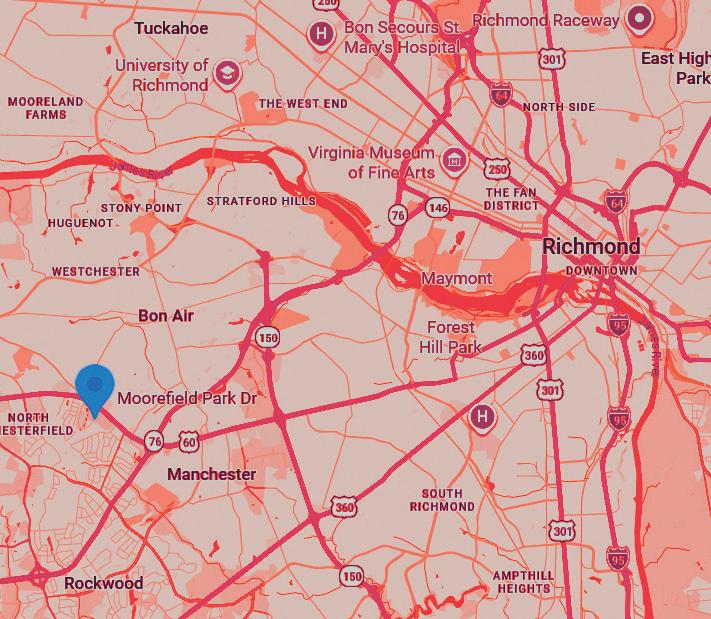
The reported location of
new office space of interest in the Richmond area. Screenshot from Google Maps.
SAPPHIRA MOHAMMED Copy
Residents are reacting to reported plans by United States Immigration and Customs Enforcement (ICE) to lease a building for expanded operations in Chesterfield County near several minority neighborhoods and institutions of higher education.
ICE’s search for office space in the Richmond area has been public
See ICE FACILITY on page 5
Editor
ICE’s
A VCU Police officer shoots pepper spray at Palestinian student alumnae and protest organizer Sereen Haddad during the April 2024 encampment riot. The incident led former Republican Attorney General Jason Miyares to direct universities to implement new campus expression policies. File photo by Andrew Kerley.
Stories of the week
national: Former president Bill Clinton and former secretary of state Hillary Clinton answered questions in a deposition about ties to Jeffrey Epstein and Gislaine Maxwell, according to video released Mar. 1 by the House Oversight Committee.
international: Joint strikes by the United States and Israel on Feb. 28 led to the killing of Iran’s supreme leader Ayatollah Ali Khamenei and sparked an ongoing war felt throughout the Middle East.
Attendees decry campus expansion, GRTC cuts at VCU Board of Visitors First meeting of semester marred by member removals
BRYER HAYWOOD Staff Writer
Students and concerned Richmonders warned VCU against unchecked expansion and disinvesting in the Richmond community at the VCU Board of Visitors meeting on Feb. 26 and 27 — the first since the General Assembly removed l three of its members.
Those removed were real estate developer Lara Tyler Chambers, tech employment founder Lori Jennings and CoStar CEO Andy Florance, according to a previous report by The CT.
In his report, President Michael Rao addressed the cuts to the board and expressed sadness about the departure of Chambers, Jennings and Florance. He reflected on each of their contributions to the board and looked back fondly at their achievements.
Rao mentioned that Florance — whose company is the namesake of VCU’s new arts and innovation center — was a good friend of his. He said he will miss him in Richmond.
The Office of the Provost declined to comment on the removals. The Office of the President did not respond by deadline.
BOARD REFORMS STALL IN GENERAL ASSEMBLY
Currently, there are four representatives on the board of visitors who represent undergraduate students, graduate students,
faculty members and staff respectively. All four of them are non voting members and are not allowed to sit in on the closed sessions of the board meetings.
This legislative session, the Virginia General Assembly has proposed several changes to university boards throughout the state, according to a previous report by The CT.
Sen. Creigh Deeds, D-Charlottesville, is now carrying a bill that would increase board members’ terms from four to six years, prohibit consecutive terms and require a two-year gap, and add nonvoting advisory members who represent students, faculty and staff.
Other board reform proposals were incorporated into one larger bill that added some of their administrative reforms and mandated nonvoting representatives from the faculty and student bodies.
That bill continues to move through the legislature — but the legislation no longer incorporates calls to add voting students, faculty or staff to university boards, and other proposals to that end did not make it past the committee stage.
The student representative having voting power and being able to sit in on closed sessions would allow them to represent as many students as possible and ensure that the BOV can make accurate decisions about the student body based on feedback, according to Asia Williams, the board’s current undergraduate student representative.
VCU faces ‘extreme’ costs for military waiver program
Bowen, press secretary of the Student Government Association, said the SGA firmly believes that the board should be reformed so that the undergraduate student representatives can actually have voting power.
“The process for [appointing] members to the BOV is flawed and should be changed to prevent political extremes and include student and faculty bodies,” Bowen said.
SPEAKERS DECRY EXPANSION, BOARD DECISIONS
The meeting otherwise focused on quantifying VCU’s financial impact on Richmond and the state, and on the university’s plans to address pedestrian safety. The board heard comments from people representing the interests of staff, graduate students, the sports community and others.
Maria Rivera, the current nonvoting faculty member representative on the board decried VCU’s newly adopted tenure policy as unpopular among faculty and said the university needs to do more to support faculty members.
During the public comment portion of the meeting on Feb. 27, several community members voiced their frustration with the board and recent decisions they have made, primarily about campus expansion and graduate student compensation.
ERIKA VASQUEZ Contributing Writer
The military waiver program that provides financial support for students was noted as one of VCU’s financial “challenges” at a Feb. 2 Board of Visitors meeting — leaving a projected total of $94.3 million in unfunded waiver costs through 2027.
The Virginia Military Survivor and Dependent Education program has been around since 1930, and was originally created to provide public college tuition to the children of active-duty service members
Jennifer Dodds, a realtor who advocates for the preservation of historic buildings in Richmond, criticized recent efforts by VCU to expand into the greater Richmond area.
“When demolition becomes default, we lose history,” Dodds said. “Rather than working with the community, VCU treats what stands in its way as collateral damage.”
Ashley Brown, president of the VCU NAACP chapter, called on the university to reinvest in public transportation infrastructure in Richmond, rather than pulling back support.
Dixon Kirk, a resident of the Church Hill area in Richmond, also called out the university’s rapid expansion.
“The question is whether VCU will be remembered as a steward of Richmond or a giant that could not see what was lost beneath its feet,” Kirk said.
The question is whether VCU will be remembered as a steward of Richmond or a giant that could not see what was lost beneath its feet.”
Dixon Kirk, Richmond resident
either killed in action or “permanently disabled” due to their service in World War I, according to VPM News.
The program has expanded since, and Virginia colleges must now waive up to eight semesters of tuition to spouses or children of military members or veterans who are considered 90% disabled, as a result of military service, according to the Department of Veterans Affairs.
Additionally, the program provides up to a $2,000 annual stipend to offset the costs of room, board, books and supplies for eligible dependents of military service members.
Natalie
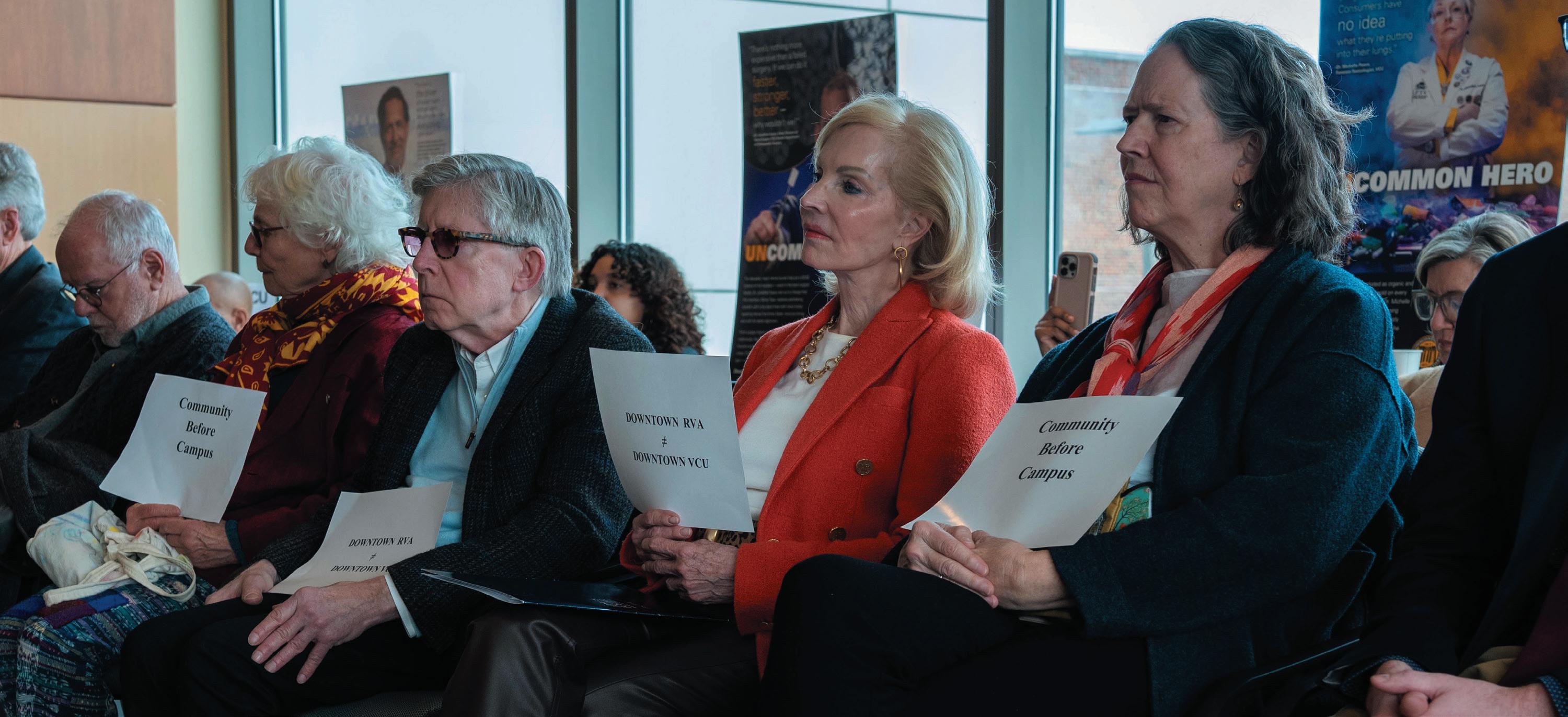
Richmond community members holding up signs reading, 'Downtown RVA ≠ Downtown VCU,' and 'Community Before Campus.' Photo by Kieran Stevens.
The program has been a key source of financial assistance for many VCU students.
Alex Paugh, a third-year information systems student, spoke to the impact it has had throughout his college career.
“The chapter 35 bill is helping a lot because it allows me to go through school
with monthly stipends to help for food and anything else that I need including housing, as well as VMSDEP, which will help me in my life in the future going forward,” Paugh said.
VCU spokesperson Mike Porter stated the program’s participants had risen
to more than 1,500 students in 2026, representing roughly 5% of VCU’S total student body.
Due to the expansion of participants, costs have now risen at an extreme rate, stirring an ongoing debate about the need for financial support. Porter noted that the yearly cost of the program has jumped from $2 million to $29 million in roughly eight years.
On Feb. 27, VCU chief financial officer Meredith Weiss said the funds were only available to 699 of the over 1,500 students
maintaining order and an educational environment free from disruption,” the policy states. “It allows VCU to regulate the time, place and manner of expression.”
House Bill 1473 was introduced by Del. Charlie Schmidt, D-Richmond, a VCU professor and constitutional lawyer. He was arrested “a lot” while protesting as a VCU student himself in the early 2000s.
The proposal would have required public universities in Virginia to not impose time, place and manner restrictions on student speech that occurs in outdoor areas on campus — with exceptions in some niche circumstances.
It would have prohibited universities from requiring students to pre-register gatherings, placing certain restrictions on amplified sound, withholding degrees from students solely for participating in protests and restricting which areas protests can occur.
It also would have required any policy changes to be reviewed by the Virginia General Assembly.
“That’s the basic problem we’re trying to address, to undo the previous administration’s sort-of scare tactic they got universities doing,” Schmidt said.
However, a House of Delegates subcommittee decided to push the bill and re-review it next year because universities “freaked out,” as Schmidt put it.
Seemingly every lawmaker on the Democrat-controlled panel vocally voted “Aye” to the continuation except Del. Tom Garrett, R- Hadensville, who said “No, I wanna kill it to death.”
Multiple VCU students spoke at the hearing in support of the bill, including Palestinian VCU alum and organizer Sereen Haddad, who had her degree temporarily withheld after protesting, NAACP chapter political action chair Abdullah Mohammed and Oscar Ferguson-Osborne — who was arrested and charged while demonstrating at a 2025 gathering that echoed the proPalestine encampments.
At that gathering, VCU Police asked students to relocate 100 yards away from the Cabell Library lawn to a “designated area for free speech” in Park Plaza Amphitheatre. They said students could not hold signs with political messages on them, according to a previous report by The CT.
Eli Weinger, a University of Virginia alum and vice president of Students for Equity and Reform in Virginia, called Schmidt’s proposal a “common sense bill.”
“In a time when constitutional rights and rights to free speech are increasingly uncertain, it is more important than ever that we model inclusive free speech policies and make Virginia a national leader in this field,” Weinger said.
Representatives from the Virginia Coalition for Human Rights and the Virginia Muslim Civic League also spoke in support of the bill.
Brian Turner, a member of the Virginia conference of the American Association of University Professors, said the reporting mechanism in the bill protects institutions and also keeps them honest.
The Hillel chapters of VCU, the College of William and Mary and Christopher Newport University lobbied against the bill. They stated the time, place, and manner restrictions are necessary for students to be able to freely access campus without disruption.
“The widespread campus unrest of the 2023–24 academic year demonstrated how breaches in student conduct can destabilize campuses. In the aftermath of that year, national survey data showed that 40% of Jewish undergraduate students felt the need to hide their Jewish identity on campus,” a joint Hillel statement read.
Ultimately, it was opposition from the police departments of VCU, James Madison University, Old Dominion University, George Mason University and Virginia Tech that led to the bill being pushed another year. They were all concerned about removing their schools’ preregistration requirements for gatherings.
“This is a challenge, as the university has time, place and manner considerations that are in place to provide a safe atmosphere
who have applied to the VMSDEP, creating an annual gap of $16.3 million in 2025.
The program has added up to $94.3 million in unfunded waiver costs since 2018. Weiss continually emphasized the financial burden and pleaded for financial support from the state to solve the growing issue.
“It’s an exceptional program but it’s a bit of an expense — we need some help from the commonwealth because when we have to make up that gap it really does impact the entire student body through reductions,” Weiss said.
Weiss noted the impact the issue could then have on the student population when coupled with increased tuition, especially for those who are of “higher need.”
Emily McFarland, a first-year social work graduate student, said if it was not for the waiver, she would not have been able to attend VCU or pursue higher education. She said its absence would make education inaccessible for other program participants and for people from her southwest Virginia hometown of Tazewell.
“I absolutely could not afford to go to college or Richmond if I didn’t have the tuition payment and the rent payment, I can’t afford it,” McFarland said. “I mean, I guess I can take out student loans and then be in debt forever, but I don’t wanna do that.”
for our students, faculty and the staff,” said VCU Police Chief Clarence Hunter.
A spokesperson for Hunter did not answer a request for comment by The CT about concerns that pre-registration requirements could impede on students’ First Amendment rights.
Schmidt told The CT he is willing to amend the bill to include registration rules for certain areas on campuses, but said students should not need a permit as long as their demonstrations do not hinder other people’s movements.
“There has to be flexibility to allow for students to spontaneously protest without punishment,” Schmidt stated.
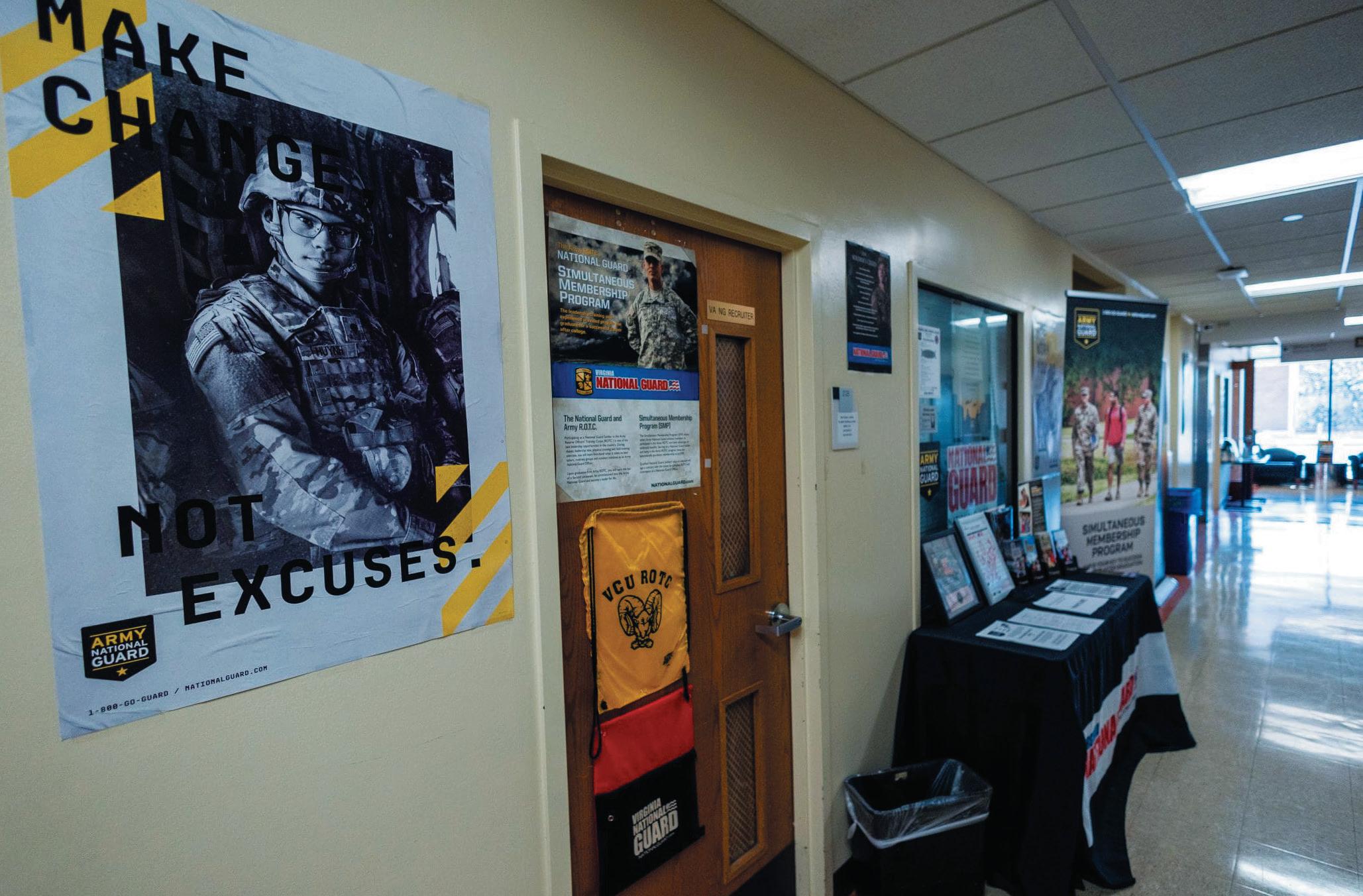
Tables highlighting military benefits outside the Military Student Services office in Harris Hall.
File photo by Anthony Doung.
Continued from front page
SPEECH BILL
Sereen Haddad rouses demonstrators on the Cabell Library lawn during the April 2024 encampment. File photo by Andrew Kerley.
VCUarts faculty call out job cuts, low morale
HECIEL NIEVES BONILLA News Editor
Students and faculty are expressing frustration with VCU’s engagement with complaints regarding tenure policies and faculty treatment — following both changes to policy and the recent and upcoming departure of several faculty members from VCUarts.
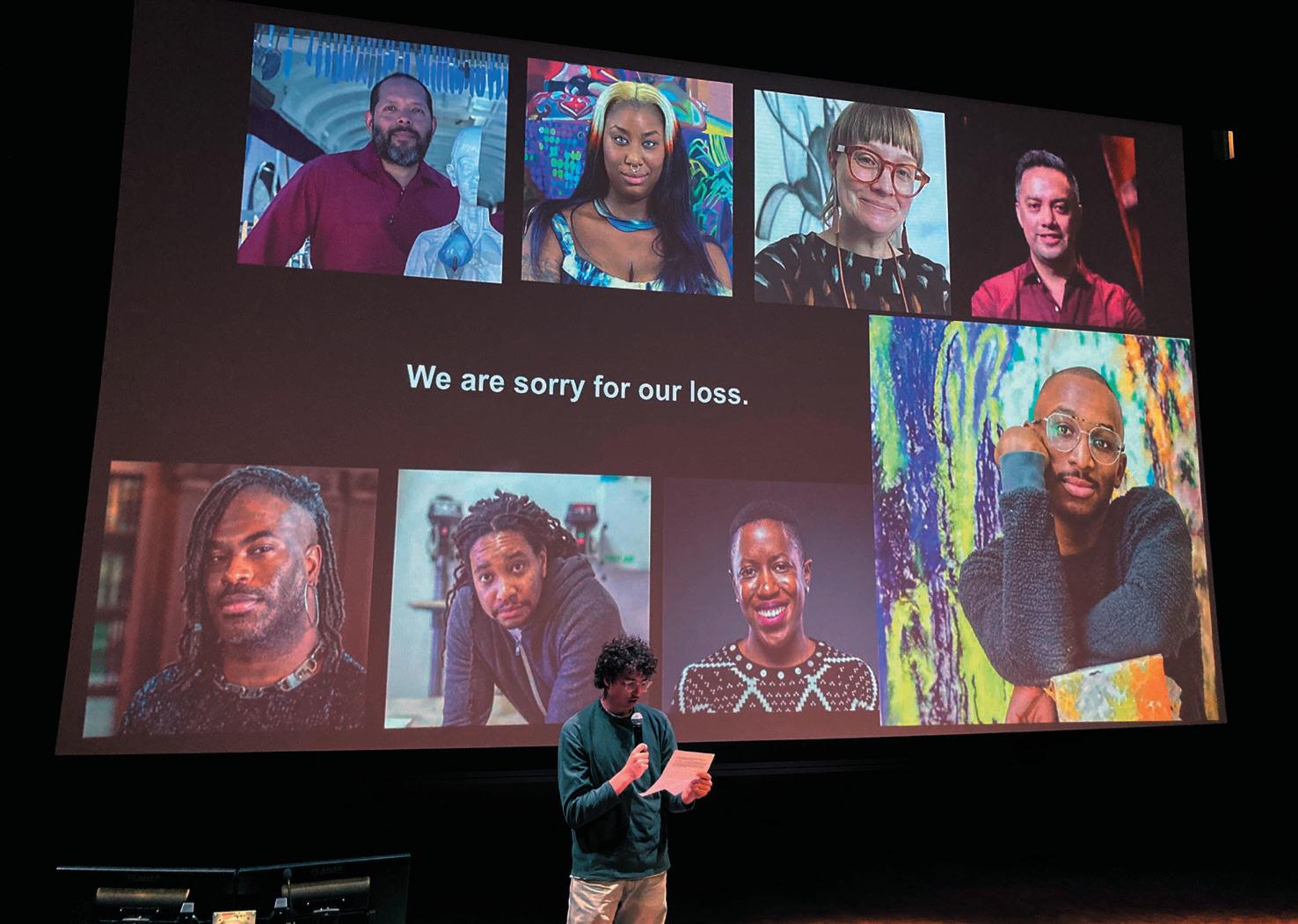
At a lecture at the Institute for Contemporary Art on Feb. 16, sculpture and extended media professor Lily CoxRichard led a discussion on tenure review woes, alleged racism and the firing of fellow professor Monsieur “Sandy” Zohore.
The firing comes after VCU’s decision not to renew the contract of the school’s only full-time woodworking professor in the fine arts program and as it moves on with the shuffling of its arts departments, according to a previous report by The CT.
A brief of the university’s resolution on the matter said the changes “will not alter or change any existing degree programs in the School of the Arts” and that faculty would see “limited change” as a result of the realignment.
A letter by fellow painting and printmaking faculty read aloud at the Feb. 16 event raised suspicion at the timing of Zohore’s removal, given he was to complete his tenure review cycle in the 2026-27 academic year.
“We argue that [Zohore’s] immediate termination at this juncture subverts our understanding of the established VCU promotion and tenure guidelines, and ignores the best interests of the department, our students and the university’s broader reputation,” the letter read.
Zohore is the only faculty of color in their department. Several speakers tied
their firing to racism experienced by faculty in the past, including their department colleague Cara Benedetto, who pointed out an incident within her own department in 2018 in which former professor Javier Tapia called security on a Black department colleague, Caitlin Cherry.
“The list of Black colleagues, artists and academics who have either been fired or sought employment elsewhere because they felt their work or person was exploited, manipulated or undervalued is long,” Benedetto said.
The list includes Black and brown faculty who have left the school to pursue work at other universities or in the broader art world, such as Nontsikelelo Mutiti, Caitlin Cherry and Madison Moore. VCUarts has experienced a high turnover of Black faculty
“At its best, tenure functions as a form of institutional safeguard, protecting intellectual freedom and helping prevent careers from being shaped by sudden or unilateral decision-making,” Cox-Richard said at the event. “I’m walking through this because when processes designed to safeguard fairness are bypassed, the consequences extend far beyond any single individual procedures.”
Cox-Richard said that she is preparing to leave VCU as it has “become unsafe” for her to stay. She spoke broadly about institutions using neutral language and procedural authority to quell dissent.
“We can’t expect our jobs to love us back. We can’t expect the institutions that we work for to show us care, but we are not the institution,” Cox-Richard said.
previously, according to VPM.
Tenure review normally involves a set cycle of evaluation of a professor’s work and teaching in the first years of their career in an institution, culminating in a full review by “disciplinary experts and outside reviewers” in their sixth year.
Tenure generally comes with more permanent employment, more benefits and greater discretion to pursue research. Cox-Richard bemoaned faculty’s tenuous relationship with the tenure process.
VCUarts dean Carmenita Higginbotham stated the school could not comment on the specific circumstances of Zohore’s employment and referred to the new tenure guidelines in response to “questions regarding tenure policy and process.” She did make a specific statement regarding student and faculty comments on the mistreatment of Black VCU faculty.
“VCUarts does not take this lightly,” Carmenita stated. “VCUarts remains committed to fostering an environment
where our faculty members are respected and we will continue to support every member of our community.”
An anonymous VCUarts faculty member said Black faculty have been fired unjustly and without cause, and called the school a toxic environment. They called Higginbotham “horrible, vindictive and reactionary” and named other grievances of faculty members at the school.
“All research funds were wiped out for faculty,” they stated. “Promises that were made, were not honored. Many term faculty have been let go of.”
The anonymous faculty described a lack of transparency from the department’s administration and a willingness to retaliate against faculty who do not take on additional tasks beyond their original contract.
“I’ve never seen the morale so bad and the distrust of administration so poor,” the anonymous faculty said. “I feel for the students because we have to be here more for the students than we’re here for the paychecks. That’s how schools work — we work for the students, not the other way around.”
During the Feb. 27 meeting of VCU’s Board of Visitors, Faculty Senate President Maria Rivera said she believes faculty at the university as a whole are facing burnout, low morale and are less satisfied with their jobs than the year prior, matching a trend found nationwide by the Chronicle of Higher Education.
“A limiting factor is faculty at VCU and many other institutions are asked to do more with their resources on a daily basis, and we have to acknowledge that that is contributing to diminished engagement that the faculty feel,” Rivera said.
Rivera said more should be done to support faculty in their own academic and research endeavors, and to communicate with faculty about the “new vision” of the university.
“If we don’t address this without clearly stating the goals of the post-tenure review process, and providing all faculty with the resources they need to meet those goals, faculty may continue to be suspicious of the initiative’s motives,” Rivera said. “And I have to be honest, that is how faculty feel about that.”
EDITOR’S NOTE: The CT made the decision to leave certain sources in this story anonymous to protect them from being reprimanded by their employers.
Researchers find new genetic information on Marshall Street Well victims
SAL ORLANDO Assistant News Editor
VCU initiated DNA analysis last month on the human remains found in the East Marshall Street Well as part of the university’s efforts to memorialize individuals posthumously stolen by what is now the VCU School of Medicine.
The remains of at least 44 adults and nine children, primarily of African descent, were found in an underground well during the 1994 construction of the Hermes A. Kontos Medical Sciences Building on the MCV Campus, according to the East Marshall Street Well project’s website.
The bodies are believed to have been used at the time by the Medical Department of
Hampden-Sydney College between 1848 and 1860. To obtain bodies, it was common for faculty to grave rob Richmond’s African American burial grounds.
The recent DNA analysis aims to highlight the lives of those excavated from the well, according to VCU News. The ancestral information and physical descriptions of the majority found in the well were revealed through the analysis.
The researchers were able to reassociate the remains of 33 individuals and identify their physical characteristics, growth and development.
Ambassador Kandeh Free Bangura, founder of Untold RVA, said she loves the DNA project, but believes commemoration cannot be complete until the DNA derived from the database connects those found with their ancestors, specifically with a broader database.
“It could be a huge opportunity to allow people to understand the migration patterns and what happened to their ancestors, place them within the context of who they belong to, you’d be able to find names, and everything,” Bangura said.
Untold RVA is an organization with the mission to “inspire non-traditional audiences with bold typography, audio enhanced street art and urban exploration,” according to Bangura.
Bangura mentioned that she had been working with VCU’s medical school, where she does week-long lecture series for first year medical students, teaching about the importance of cultural humility and respecting both living patients and the remains of deceased patients.
“If you talk to people from the [East Marshall Street Well] Family Representative council, you might hear a few of them say that it’s time to go ahead and inter the bones, that they’ve been pretty much on this side of the grave for a long time,” said Stephanie Rizzi, the director of Project Gabriel. “I think that there’s definitely a segment of the community that wants to go ahead and honor those people by burying their remains and having some kind of memorial for them.”
Project Gabriel was created by VCU in 2023 as an effort to address the university’s historic ties to slavery in accordance with the 2021 Virginia Enslaved Ancestors College Access Scholarship and Memorial Program, per a previous report by The CT.
Rizzi believes that the more information obtained of the victims through the DNA analysis, the better.
The East Marshall Well Project is a VCU initiative to ensure the remains of the individuals found in the well receive appropriate study, memorialization and reburial, according to the project website.
Stephen Davenport, an administrator and member of the planning committee staff for the project, said it is important for VCU to do its part to commemorate black history, including elevating local voices, conducting responsible research and engaging with the community.
“The East Marshall Street Well Project
“Richmond at one time was the center of the slave trade and so there is a lot of history in Richmond that’s related to that pretty much,” Rizzi said. “Most of the infrastructure in this city was built by enslaved people.”
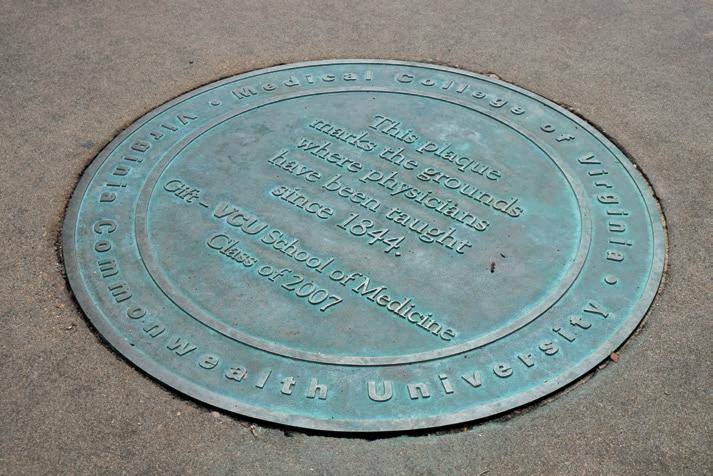
A plaque at the center of the site of where human remains were discovered in 1994. Photo by Burke Loftus.
A speaker at Lily Cox-Richard’s Feb. 16 lecture at the Institute for Contemporary Art stands before images of faculty who have departed VCU. Photo by Heciel Nieves Bonilla.
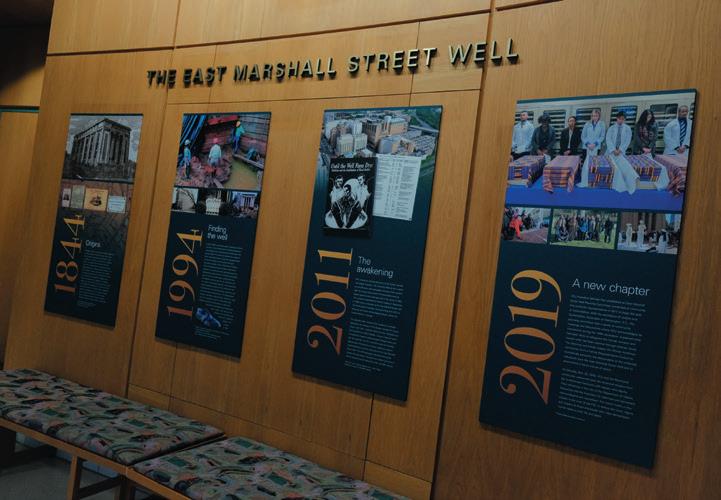
Panels highlighting the discovery, origins and reaction to the East Marshall Street well discovery, located outside the Kontos Auditorium. Photo by Burke Loftus.
is an important part of MCV’s history, and while the university’s actions were deplorable, they were not out of line with established practices of the time,” Davenport stated in an email.
Davenport believes it is good to see the wishes of the East Marshall Street Well Family Representative Council come to fruition.
The VCU East Marshall Street Well Family Representative Council submitted recommendations in 2018 to the VCU East Marshall Street Well Planning Committee to guide initiatives. The submission included 17 recommendations, three of which have since been completed.
The completed recommendations include the unveiling of the Kontos
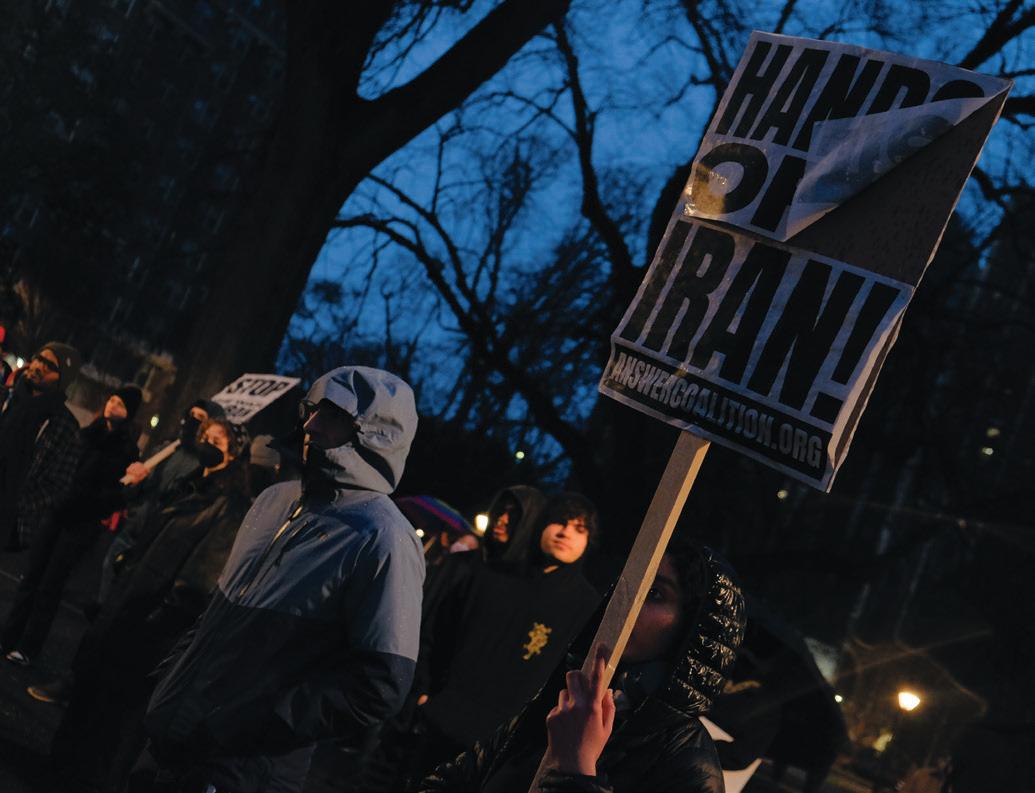
Protests emerge in Richmond over war in Iran
HECIEL NIEVES BONILLA News Editor
Several demonstrations occurred in Richmond over the weekend in opposition to the conflict in Iran, which began on Feb. 28 with a joint American-Israeli aerial attack.
The two countries’ strikes and bombing operations over the weekend have killed several leaders of the Islamic republic, including its supreme leader Ayatollah Ali Khamenei.
Many Iranians in the country and abroad have celebrated, while some have denounced the unilateral intervention or fear further violence, according to The Guardian.
Wide-scale conflict has since spilled out
into the region. Iran has executed retaliatory attacks throughout the Middle East, striking U.S. bases and declaring the closure of the Strait of Hormuz — a waterway which moves over a fifth of the world’s oil.
The conflict has caused massive disruptions in life across the Middle East and gulf region, including for VCUarts Qatar students, who have been sheltering and attending classes online since Saturday.
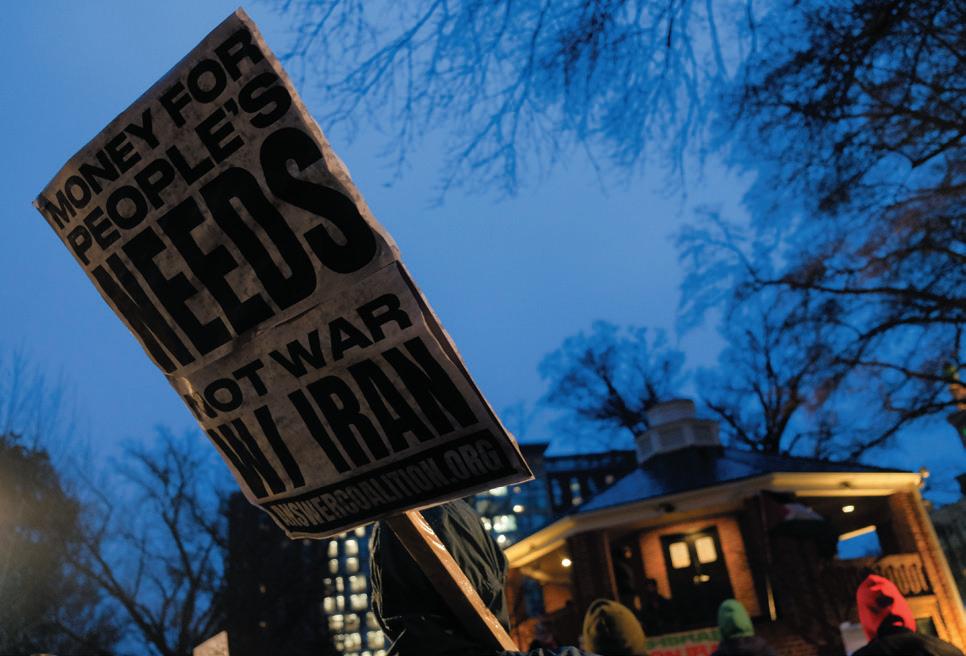
In Richmond, several protests since Saturday have expressed anger at the strikes on Iran, the latest of which occurred on Monday at Monroe Park. Over 100 people showed up despite cold and rainy weather.
Speakers at the demonstration hailed
request for comment by The CT.
Building memorization panels in 2021, the ancestral remains’ return to Richmond and the establishment of the Implementation Committees in 2019.
knowledge since September, but the exact location was not identified until a Feb. 10 article by WIRED revealed planned sites nationwide, obtained from federal records.
Per the records obtained by WIRED, the agency is planning to lease The Moorefield, a series of office complexes located at 808 Moorefield Park Dr. SFpartners, the company that owns the buildings Moorefield I, II & III, said that was untrue in a phone call with The CT. They declined to elaborate.
The Moorefield is on the same street as the Virginia School for Nurse Aides, who said they had no idea that ICE had plans to lease office space near them. Brightpoint, a community college in the Midlothian area, also said they were unaware of the plans. Both schools declined to comment further on the matter.
Thomas Dale High School arts teacher and Brightpoint educator Les Harper said that while he believes that the high school wouldn’t let ICE through their doors, he would be disappointed with the county if they were to build a facility in the area. Born and raised in Chesterfield, Harper advocates for people protesting against the potential facility.
“You’re seeing the things that have happened with the shootings — it’s just despicable,” Harper said. “It’s terrible and unnecessary. The people who are being deported, if you are someone [who] believed that it was only going to be the worst of the worst being deported, that certainly has not been the case. It is being twisted into something that is reminiscent of police forces in the past.”
The VCU Humanities Research Center conducted an oral history project with the Family Representative Council in 2024 to document the progress of the East Marshall Street Well Project, according to VCU News. The VCU College of Humanities and Sciences introduced a curriculum program in 2024 for high school students, focused on the ethical treatment of human remains, according to VCU News.
from the Virginia chapter of the Party for Socialism and Liberation, or PSL, Starbucks Workers United and Virginia 50501. They decried the United States’ expensive military actions with chants such as “not a penny not a dollar, we won’t pay for war and slaughter.”
Speakers denounced what they called imperialist and unjust violence and broadly tied Iran to other United States military actions and the experiences of people in Venezuela, Gaza and at home.
PSL member and frequent protest organizer Violeta Vega noted similarities to the domestic actions of Immigration and Customs Enforcement that she said have targeted people who look like her.
“ICE agents snatching children, snatching brothers, snatching fathers, snatching children, snatching fathers, taking away children, ruining lives — that’s the same force, the same aggression that is being given away to a country thousands of miles away,” Vega said.
At least 175 people, mostly children, were killed at an Iranian girls’ elementary school on Saturday in a strike by either the United States or Israel, according to the New York Times.
PSL member Reed Baldwin spoke against both the foreign policy of the Trump administration and against U.S. leadership and elites, broadly condemning the “pedophiles” at the helm of economic and political life.
“We have to be aware of these things and we have to fight against them,” Baldwin said. “It’s Iranians today, it is you tomorrow.”
Black Alliance for Peace member Taylor Clemmons promoted a petition to bar the U.S. and Israel from participating in international sporting events. She asked Richmonders to come out to future protests as the weather gets warmer.
“Tell people, ‘I know that the kids that are dying don’t look like you, it doesn’t matter,’” Clemmons said. “I used to work in education. So when I see that 50+ kids are dead, I think about the children that I used to teach, that I used to counsel. They will do the same thing to my Black children, my brown children and my poor white children.”
YouTuber Saji Sharma moved to Richmond in 2021 to study business marketing at VCU. His younger brother, a first-year student at VCU, expressed his fears about ICE to Sharma.
“We were in the car and he was just kind of displaying signs of concern, like ‘are we going to move at some point? Are we going to have to leave the country?’ I remember having to tell him, ‘I mean, you know it is bad, but we aren’t necessarily immigrants, we don’t have to be as concerned.’ But hearing that ICE is leasing a space near us, that is very scary,” Sharma said.
Davenport mentioned there will be more announcements for the project coming this summer.
Reynolds Community College student Sylvia Radoulov said she is concerned the conflict could spiral into more global violence. She called herself a “born and raised Richmond protester.”
“I think every person matters when it comes to a protest, especially when it’s a day like this one,” Radoulov said. “I think the situation is depressing and you’re allowed to sit in that and be sad for a while, but then you’ve got to come out and show some action.”
Political science student Kasra Sanatkar was born in Iran’s capital Tehran and expressed frustration at fellow politically left Richmonders over their reaction to the situation, particularly through the anti-war protests.
“That same crowd was completely silent last month when my friends and family were in the streets protesting and watched thousands of people get massacred,” Sanatkar stated. “But now all of the sudden when the U.S. and Israel are involved they have a lot to say.”
He described a situation in which, when faced with a choice between a repressive regime and violent intervention by the United States and Israel, many Iranians choose the latter.
“I hate to see my country at war and civilians die but the people inside of Iran have called for foreign help,” Sanatkar stated. “Even as an Iranian living in exile it’s not really my place to choose for them what they want under a dictatorship.”
VCU political science professor Bill Newmann told The CT a notable aspect of the war is the many goals the Trump administration has set out for its military action — with regime change, nuclear capability and ballistic missile destruction and degrading Iran’s military among them. Those tasks are individually difficult but could take weeks or longer to achieve as a whole, if at all possible, Newmann said.
“Iran’s government institutions and military structure are deeply institutionalized and won’t shatter easily,” Newman said. “There aren’t really alternatives to it, so destroying the regime may result in a chaotic situation.”
advocates for low-income and immigrant families. He said ICE’s plan to lease in Chesterfield disrupts the trust and increases uncertainty towards the government.
“They’re not setting the example of the American dream that we all dream of before we came to this country,” Zelaya said. “That doesn’t represent America.”
The office of the Virginia Community College System, which is a four-minute drive from the buildings, also declined a
Chesterfield County’s population was an estimated 46.6% non-white, with 12.6% being Hispanic or Latino in 2024, according to the U.S. Census Bureau. In 2023, foreign-born residents made up 9.37% of the population, according to Data USA. First-generation American and
This news also comes shortly after Hanover County’s planned ICE facility was canceled by the Canadian company that owned the space in late January, according to CBS 6. The Hanover County Board of Supervisors was already in opposition of the then-planned facility as it would put strain on the county financially as well as “place unplanned demands on county services, including public safety.”
Graduate student Eduardo Zelaya is the Virginia Organizing director of We Are CASA, a national organization that
A third-year psychology student at the University of Virginia and lifelong Chesterfield resident, who would like to remain anonymous, said ICE coming in could potentially shake their favorite aspect of the Richmond area — the hospitality and welcoming environment of the community.
“I think that it would just be chaos if they were to actually come and that they would not produce any good with coming into the Chesterfield area,” they said.
Chesterfield County declined a request for a comment by the CT regarding ICE, and found no communications between ICE and the requested county administrators following a Freedom of Information Act request. Continued from front page
ICE FACILITY
Protestors carry signs bearing slogans such as 'Hands off Iran' at a demonstration against war in Iran at Monroe Park on Mar. 2.
Photos by Burke Loftus. Collage by Quinn Lysek.
Sports
‘Confident, hard-working and high character’
VCU guard Terrence
Hill Jr. has taken a second year leap
ALEXIS WASHINGTON Assistant Sports Editor
VCU entered this season under new head coach Phil Martelli Jr. with a lot of questions. One of the biggest was “How will the offense look, and where will the scoring primarily come from?”
Terrence Hill Jr. was the answer.
The spark comes off the bench for VCU, and it arrives with Hill, a multi-skill second-year guard from the West Coast.
Before making his mark in Richmond, Hill split his high school days between football and basketball — following in the footsteps of his father, who played both sports.
Basketball runs deep in his family.
Hill’s aunt, who recently passed away, played as well, but it was not until one particular game he realized his full potential.
“We played against Cleveland High School,” Hill said. “Dame Lillard actually came to a game, and I hit a game winner while he was there. So that kind of was like a moment. I was like, ‘wow, this is kind of crazy.’”
As a high school senior in 2024, Hill was named Portland
Stat of the week VCU women’s track and field third-year Desi Akaolisa was named the Atlantic 10’s Most Outstanding Field performer after taking home bronze in the weight throw and gold in shot put in the A-10 Indoor Conference Championship.
Interscholastic League Player of the Year, to First Team All-State and to the Oregon School Activities Association’s 6A First Team All-Tournament.
Hill brought that same hunger to the Stu, but he had to pay his dues behind a stacked guard room in his first year. He was usually the last name off the bench, but even in his limited play time flashes of scoring potential shone through.
Now in his second year, Hill’s potential is being realized. He scored a career high of 24 points this season against Loyola Chicago on Friday, Jan. 30. On that same night he put up a season high of five threes. He also scored double figures in 22 out of 30 games this season.
Hill said he models his game after NBA guards Shai Gilgeous-Alexander and the legendary sixth man Jamal Crawford. He admires Crawford’s ability to change the game off the bench and works to bring that same impact to his own play.
Hill embraces that role, as he is VCU’s lead scorer coming off the bench averaging 14 points and 2.8 assists — a big improvement from last year where he averaged just 3.4 points.
“It speaks to the work I put in over the summer, the confidence I have going into this season, because I knew what I was capable of once I got the opportunity, so I just wanted to take advantage of it,” Hill said.
Watching Hill play, his energy is evident engaging with the crowd every chance he gets. He said he wants fans to remember him as the best player on the floor. The loud atmosphere gives him and his teammates a boost.
That momentum is what Martelli takes
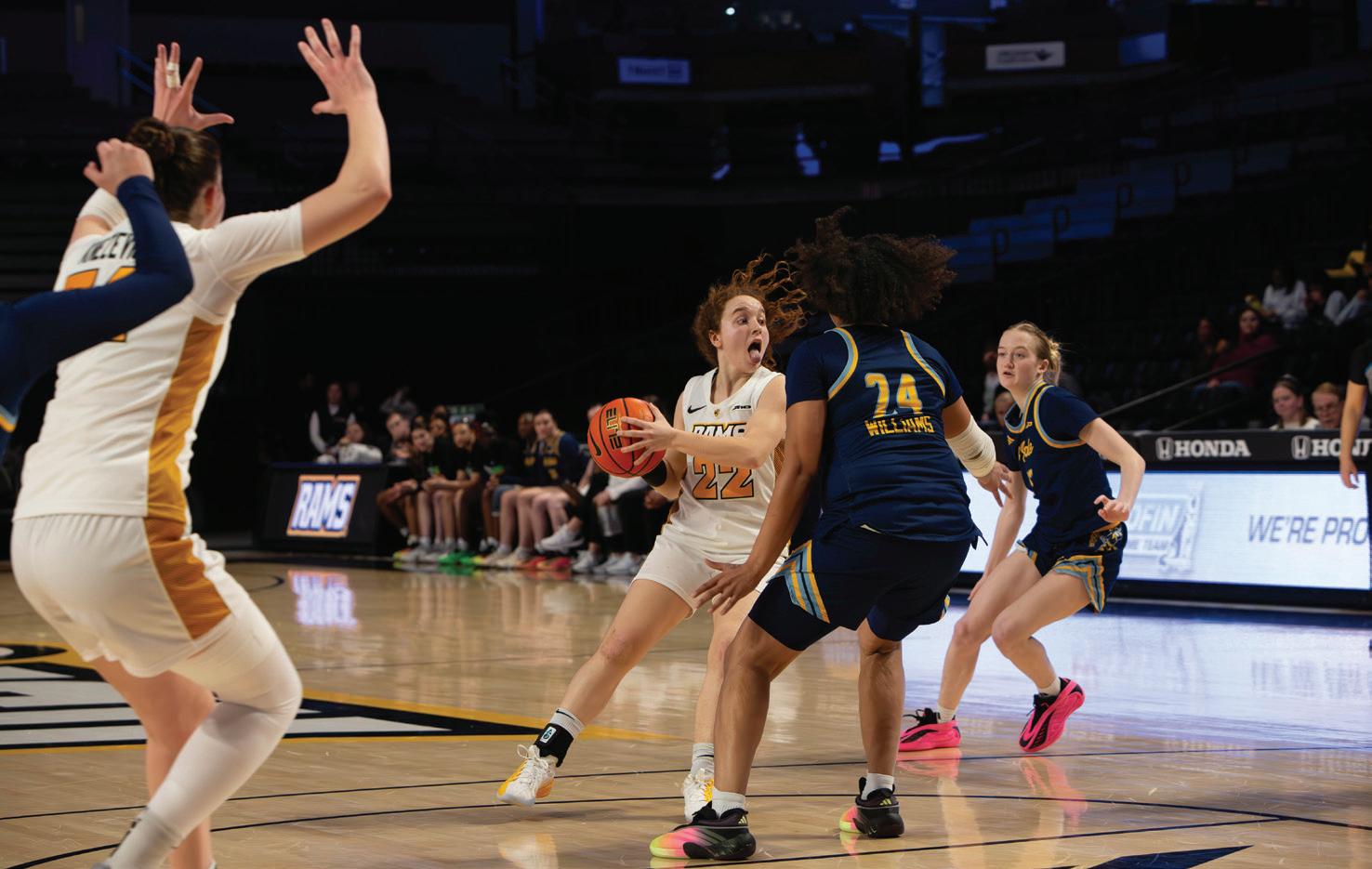
Women’s basketball loses seventh consecutive game to La Salle; goes winless to end season
BEN MARTINDALE Staff Writer
VCU women’s basketball matched up against La Salle University at the Siegel Center on Wednesday. The clash ended in a loss, extending the losing streak to seven for the Rams.
La Salle won the opening tip, but VCU got on the board first when fourth-year forward Makennah White knocked down a turnaround midrange jumpshot.
La Salle answered, tying the game at two before VCU reeled off a 7-0 run. Five of those points came from second-year forward Katarina Kneževic who knocked down two of her first three shots to start the game.
The Explorers responded by rattling off a 9-0 run of their own and taking an 11-9 lead to close the first quarter.
La Salle second-year guard Aryss Macktoon scored the first points of the second quarter, knocking down a pair of free throws.
VCU redshirt fourth-year guard Ty Williams tied the game at 13, getting her opponent to jump on a pump fake before hitting a smooth floater off one leg.
A smooth jumper from second-year guard Joan Quinn gave La Salle a 19-13 lead midway through the second quarter.
The Explorers gained momentum through the second half of the quarter, extending their lead to 11 with two minutes remaining.
VCU continued to fight hard but was no match for La Salle to close the half, falling behind 37-20.
La Salle picked up right where it left off to start the second half, forcing turnovers
on the defensive end and converting efficiently on the offensive end to take a 43-20 lead.
VCU managed to find a spark midway through the third quarter, cutting the Explorers lead to 15 forcing a timeout.
La Salle came out of the timeout firing on all cylinders and quickly went on a 7-0 run to extend the lead to 53-31.
La Salle opened the fourth quarter and continued jumping the passing lanes and applying defensive pressure, which led to VCU turnovers and more transition points for the Explorers.
A three-pointer followed by a fastbreak layup from VCU third-year Ann Zachariah cut the lead to 14 with six minutes remaining in the final quarter.
VCU continued to fight, cutting the lead to 12 before a La Salle three pointer
stopped the VCU run and ended the Rams hopes of a comeback.
From that point on La Salle cruised to the finish, stifling any brief spurts from the Rams and winning the game 71-54.
VCU is still without a win since the firing of former head coach Beth O’Boyle.
“Overall I think we’re making strides in some areas,” interim head coach Kirk Crawford said. “We really need to work on being consistent with what we do well.”
The Rams went on to lose their final game of the season against the University of Dayton, 62-79, on Feb. 28 at Dayton.
pride in. He describes Hill as someone who knows how to make the right play attacking the rim.
As the Atlantic-10 tournament approaches, Martelli is focusing on consistency — knocking down shots, watching defensive film and working in the weight room.
Off the court, preparation looks different for Hill. Maintaining that level of performance requires a balanced meal, and thanks to his mom, cooking has become a new hobby.
“I’ve been getting into cooking more,” Hill said. “My mom had come down recently, so she was teaching me how to cook more because she said I need to stop eating fast food.”
Hill knows what it takes to reach March Madness, with hopes of watching the confetti fall as an A-10 championship comes within reach.
“We know what we have ahead for us. So just taking these small games one by one, and just trying to perfect our craft every game, so when we get to that March Madness we will be ready,” Hill said.
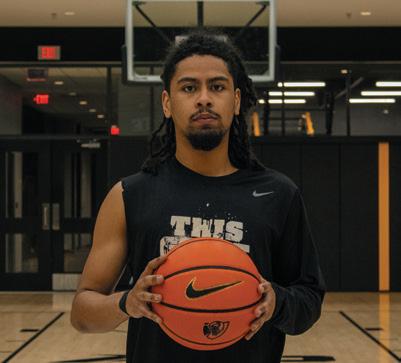
VCU second-year guard Terrence Hill Jr.
Photo by De Smaw.
Laia Crespin guards the ball at VCU’s game against La Salle on Feb 25th, 2026.
Photo by John Brown.
Spectrum
On This Day
On this day, March 4, 1933, Frances Perkins became the first woman to enter the Presidential Cabinet. President Franklin D. Roosevelt appointed her as U.S. Secretary of Labor.
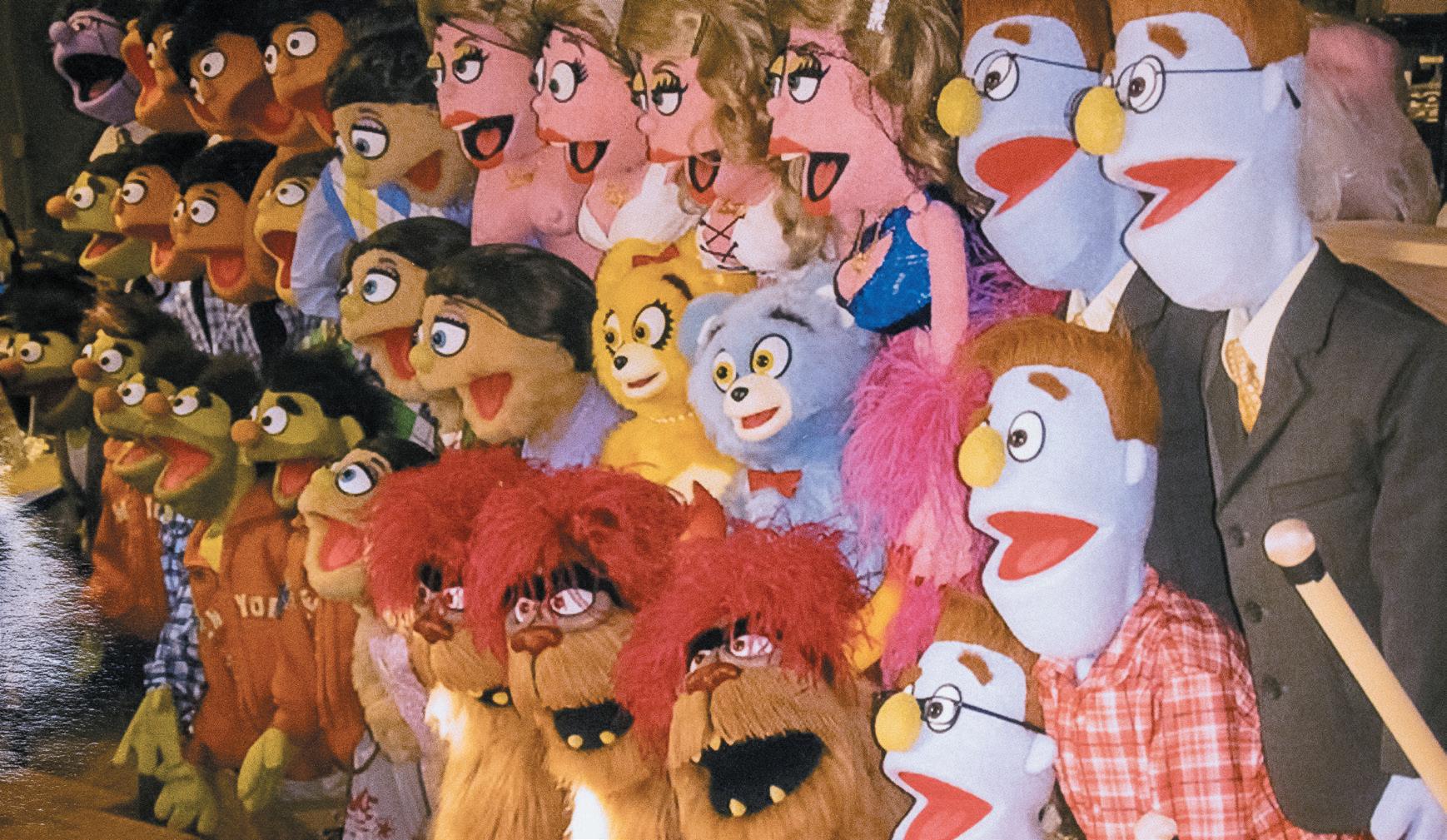
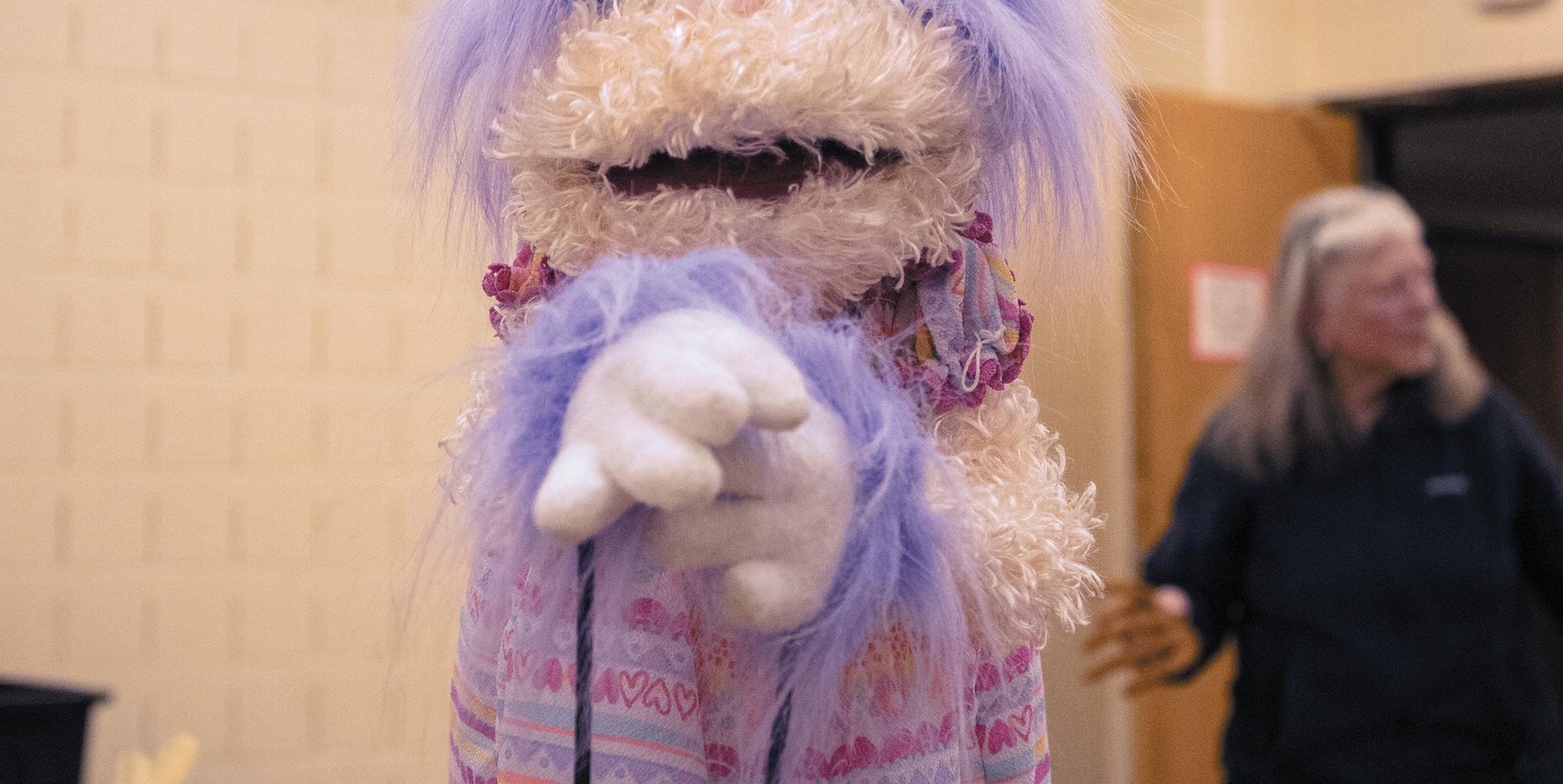
Puppet master teaches students how to create, care for felt friends
FAKEHA NAEEM
Contributing Writer
VCUarts Theatre, in collaboration with Virginia Repertory Theatre, returned with Puppetry 102, the second class puppet related workshops, with Mary Nagler, an artist and a puppeteer with 40 years of experience working in the performing arts.
The workshop was structured in a lecture format and took place from 5 to 6 p.m. at the Singleton Center. It was similar to the first Puppetry 101 event, which was held Feb. 4.
The second class offered students a more hands-on experience exploring a technique called “flat patterning,” which uses flat sheets of foam and their natural bend to make shapes. Nagler brought in a “naked puppet” and then showed attendees how to start building upon its base.
She spoke extensively on the techniques and material used to construct the “snap head” and mouth construction.
“I feel capable, and more welcomed in
the business, learning different aspects of costumes and ways to improve skills,” said Audri Ulm, a fourth-year theatre student who attended the workshop.
In her previous workshop Nagler walked students through the types of puppets that are being used in the industry such as shadow puppets, marionettes, hand puppets and table puppets. She brought in some of own puppets for demonstration that she created and has performed with over the years.
Nagler mentioned how in her previous workshop students were curious towards Muppets and their construction — which gave her the idea to demonstrate how to create foam puppets, which have material similarities.
Nagler’s students learned different ways they can make puppets, even out of recycled material after taking this workshop. Additionally, sharing ways to find materials in household objects and different places aspiring puppeteers can go to find things.
An essential part of being a puppeteer is making sure that the puppets are
Introducing VCU’s unofficial Yaoi Yuri Club
SAPPHIRA MOHAMMED
Copy Editor
CORA PERKINS
Assistant Spectrum Editor
From the iconic couple of Ilya Rozanov and Shane Hollander from “Heated Rivalry,” to the doomed ship of Rodney the Ram and WebstUR the spider, yaoi is everywhere.
Paralleling this intensity are the quintessential ships of Apple Jack and Rainbow Dash from “My Little Pony” and Villanelle and Eve Polastri from “Killing Eve,” bringing yuri to the table.
If you are looking for a place to celebrate those touchy-feely romances, the RVA Yaoi Yuri Club is your home.
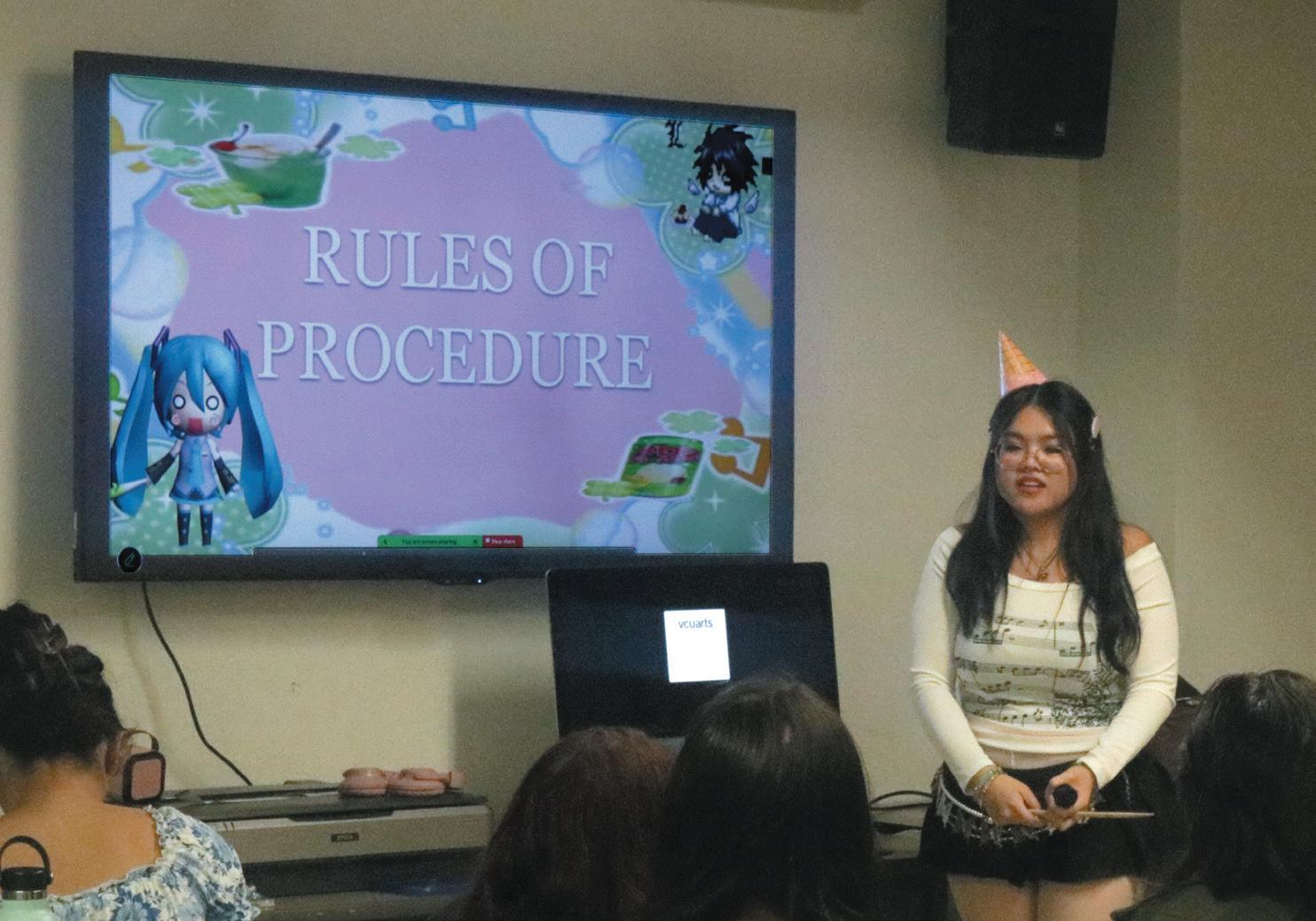
The unofficial campus club held their second PowerPoint night on Feb. 28 at Franklin Terrace. Students shared presentations on gay ballroom dancers, original character Vocaloid websites and even an educational lesson on pronouns in Chinese and Japanese.
Though the club has been meeting since September, its creator remains anonymous. The reasoning? The club bloomed out of a joke comment on an anonymous forum, according to third-year business administration student and club president Xiu-Bei Herbst.
Herbst was on YikYak, a social media app that lets users comment and post anonymously with their campus’s fellow students, when someone commented about a Yaoi Yuri Club meeting with a time and place attached. The post went viral and they had their first meeting at Cabell Library on Sept. 5.
“People were like ‘wait, this is kind of fun, we should actually make this real,’ because the host never showed up. So then we learned that it wasn’t an actual club, and so we just made it a real thing,” Herbst said.
Both yaoi and yuri do not have clear definitions because of their history in Japan, according to Them magazine. Yaoi, originally fan-made comics with mostly
packed properly to avoid destroying their material, Nagler said. Sometimes materials disintegrate and then puppeteers have to recreate their creations if they are not stored in a cool, dark place.
“Puppets are very therapeutic,” Nagler said. “ They become mediators helping children express difficult situations. Children on the spectrum are able to connect and respond to them positively.
They teach humanity and you don’t need words for that.”
Everyone responds and connects to puppets despite their cultural or language differences. Apart from working as a puppeteer, Nagler helps restore puppets for other artists who reach out to her seeking her expertise.
The puppeteer also started a “puppet adoption program” — the purpose of which is to restore abandoned or broken puppets found in thrift stores, bringing them back to life. The puppets are then sold at a nominal price at shows or events as a way to raise awareness of the art.
Nagler believes the future of puppetry is looking good. There are now more puppet festivals and international puppet groups. More puppets are seen on television and many theatre groups use them as part of their shows. More awareness and education about puppetry within universities has made it more accessible.
“Puppetry is a wonderful hobby and a profession,” Nagler said.
VCU alumnae Gracie Berneche is currently working on coordinating this event for Virginia Repertory Theatre hopes that this class shows you do not need to work for a huge puppet theater to be a puppeteer.
“We want them to see that you have the agency to go out and purchase these materials to make your own puppets and know that there are resources available to them to help them start,” Berneche said.
sexually explicit relationships between men, is now used to describe all media with sexually explicit relationships between men. Yuri, originally coined as a term for female and female, or F/F, relationships, is now an umbrella term for any relationship between women that’s at least emotionally intimate.
Story contines on next page
(Left) Mary Nagler’s felted friends that she has created and restored throughout the year. (Right) A puppet creation of Mary Nagler covered in fur and filled with love.
Photos by De Smaw. Collage by Zach Montgomery.
The president of Yaoi Yuri club, XiuBei Herbst, explaining the rules to her interactive presentation ‘Jail or Bail,’ at the club’s powerpoint night.
Photos by by Madi Wesser.
Illustrations by Zora Weir-Gertzog.
The club’s yaoi presentations were about everything but relationships canon to their chosen media universes.
Presenters testified that relationships in media such as “Hannibal” or “The world ends with you,” between the two male characters were just platonic ones. The audience cheered and applauded for the presenters’ testimonials about how a duel to the death or a two-minute interaction can mean more than what meets the eye to most viewers.
Raneem Hammouda, a first-year pre-dental hygiene student, enjoyed the “Naruto” ship presentation the most, which revolved around the titular character and his best friend, turned enemy, turned best friend again Sasuke Uchiha — being full of internalized homophobia and closeted yearning for decades.
“I love seeing everyone’s obsessions over their favorite ships, their favorite anime, their favorite yuris,” Hammouda said. “It’s so much fun to see people be passionate about what they love and especially if it’s a mutual interest.”
The yuri presentations were sometimes about canon relationships, such as the deep dive into “Revolutionary Girl Utena” that club members Evan Barrera and Casey Watkins went into. But board member Anelis Ortiz-Lugo shipped inanimate objects, such as the relationship between a cigarette and its lipstick stains or the Twin Towers with each other.
Outreach officer Maya Jones emphasized the importance of specialized clubs — noting the joy they bring amid hard times. Jones is also the founder of a mental health club and the leader of the Black Student Group Union.
“We are often identified by our marginalizations, it’s nice to have things that unite us in that marginalization, but also our focus on things that we can do the things that we can share, media that we all enjoy,” Jones said. “I do think it’s really nice to have a space where people can come and talk about interests, not just struggle.”
The club is not just about yaoi and yuri, it is a space to share about current media, all things anime, manga or just queer, said Jones.
“I think it’s important for people to know that the Yaoi Yuri Club isn’t just about yaoi yuri,” Jones said.
Social media chair and fourth-year math major Aya Yu said she loves the Yaoi Yuri Club because it is where she met all of her friends. She hopes other members can find that same community.
“I would say this is the club that I had the most fun at. So I really hope that this could be a place where people can find a friend,” Yu said.
Herbst and one of the club’s other social media chairs, Kylee Yanez, said that they want everyone to feel welcome, no matter their sexual orientation or identity.
“It’s a big, happy yaoi yuri family already,” Yanez said.
The Yaoi Yuri Club is not an official student organization, but has plans to become one in the Fall. Check out the Yaoi Yuri Club Instagram @rva_yaoi_yuri_club for more information on upcoming events.
We are often identified by our marginalizations, it’s nice to have things that unite us in that marginalization, but also our focus on things that we can do the things that we can share, media that we all enjoy. I do think it’s really nice to have a space where people can come and talk about interests, not just struggle.”
Maya Jones, outreach officer
‘Earth’s Greatest Enemy’
Byrd to show documentary about environmental impact of military
MOLLY MANNING Managing Editor
Director and journalist Abby Martin is bringing a preview of her second feature film “Earth’s Greatest Enemy” to Richmond’s Byrd Theatre on March 10.
The documentary explores the United States military’s environmental impacts as the No. 1 polluter in the world and its exemption from international climate agreements.
The screening is from 7 to 10 p.m. and tickets are available for either general admission for $10 or solidarity admission for $15, giving viewers the option to support the screening tour. Martin will hold a virtual Q&A after the film.
Ben Cronly, executive director of the Byrd, noted the showing is a private rental of the theatre, and as such is only the rental venue for the screening — they do not
endorse or oppose the content, he stated.
Abby Martin, who is also the creator and director of Empire Files, a 501(c)(3) media non-profit with a journalistic focus on U.S. foreign policy and militarism, said the film zooms out and tries to approach the topic in a historical and holistic way.
Martin said the film gives a myriad of examples of how the system perpetuates “collective insanity and collective suicide.” She said the topic felt like an obvious choice for her film as an anti-imperialist advocacy journalist.
Martin also shared that her husband is an anti-war Iraq war veteran who organizes soldiers to leave the U.S. military and find opportunities elsewhere.
“It just was really clear that this needed to be done and it needed to be done in a way that was with the accurate political lens of unapologetic anti-imperialism,” Martin
said. “Because I’m sick of kowtowing to the status quo and I’m sick of corporate media journalists who are just appendages of the system apologizing and excusing this horrific imperialism around the world.”
Martin said reception to the film has been extraordinary, with viewers often sharing their own testimonies or saying “I get it now,” — it has become bigger than the film, the filmmaker and her team, it has become a movement, Martin said.
“It’s become a movement of people who are not only unpacking the trauma of what the parasitic billionaire class has done to this planet and to our lives, to rob us of of a habitable future, but just to have the space that we can talk about these things because of how stifled these conversations are and how difficult it is to get truth and good media like this film,” Martin said.
Richmond is the ninth stop on Martin’s
“Director’s Tour,” which has so far taken the film to cities including Honolulu, New Orleans and Atlanta.
The strength of Richmond’s chapter of the Party for Socialism and Liberation was key in Martin’s decision to hold a screening in the city. She said one of the goals of the film is to intersect organizations like PSL and the Sierra Club to build momentum collectively.
“I’m completely blown away by the response. And I think it speaks volume to the moment that we’re in,” Martin said. “And how ready people are to be activated around something that is a collective force that we can really push power to account and hold them to account, especially with what we're seeing the complete impunity around the world.”
A still from the documentary ‘Earth’s Greatest Enemy,’ premiering at the Byrd March 10. Photo courtesy of Empire Files.
Illustrations by Zora Weir-Gertzog.
Jazz flourishes in Jackson Ward and beyond
LIZ DEFLURI
Contributing Writer
Trumpets blare throughout historic Jackson Ward, as Gallery5 hosts a free jazz night every fourth Friday to preserve the culture of the neighborhood that brought the genre to Richmond, through drum pounds and saxophone swirls.
This month’s fourth Friday show was headlined by local musician and VCU alum Kelli Strawbridge, who has been playing music since he began on the trumpet in sixth grade. He said his favorite parts of the shows are seeing the wide range of people who attend and how the scene remains alive and well throughout the city.
The melody’s momentum waxes and wanes as musicians work together to create a harmonious blend of urgency,
excitement and passion that retains the audience’s attention throughout the night’s captivating musical journey.
“It seems like jazz is evolving in an interesting way, and I’m very happy about that. It seemed like it had kind of gone out [for a while], but I think having proper venues for it, like Gallery 5, which is a great place to play jazz,” Strawbridge said.
Jazz is an improvisational music style that originated within Black communities in New Orleans, in the late 19th and early 20th centuries. Each performance is as unique as someone’s fingerprint — no two are the same.
The genre first became a cultural entity during the Roaring Twenties, due to factors such as the Great Migration and the rise of social liberation and rebellion during prohibition.
The apex of jazz’s popularity occurred during the Swing Era from the mid-1930s to the mid-1940s, and was shaped by revolutionary artists such as Duke Ellington, Louis Armstrong and Count Basie.
Despite its massive popularity and cultural impact, jazz began to lose mainstream appeal in the 1980s, as other genres of music, such as pop, rock and hip-hop rose in popularity. The genre fell into a niche, but retained a devoted fanbase consisting of mostly older individuals who cherished the genre’s unique sound and musical complexity.
However, in the 21st century, jazz is being embraced by an unlikely audience who is contributing to its resurgence — Generation Z.
Strawbridge is pleased to know that younger generations have a steadfast
ADVERTISEMENT
“Jazz used to be the premier dance music around 80 years ago. It’s interesting that now the new generations are really adapting to this music and finding newer [musicians] like Thundercat, Anderson Paak and Butcher Brown,” Strawbridge said.
Malik Gray, a VCU music student and jazz saxophonist, said his family is fans of jazz and older music, such as Motown and soul, which got him interested in the music from an early age.
“I definitely see a lot of interest rising, even in younger kids like my little cousin, who is about six or seven; she will sit down and listen to the music with me or watch me play and enjoy it,” Gray said.
Gray also noted that the over-saturation of technology in modern times may also be a contributing factor to Gen Z’s attraction to the scene.
“I think with technology and AI and stuff coming into online spaces, the performance aspect [of jazz] and actually being there and in the moment is another thing that people are taking an interest in.”
Simultaneously, the jazz scene in Richmond has experienced a revival through accessible and oftentimes free shows at locations such as the VMFA’s Jazz Café and at the art and music venue, Gallery5.
Richmond offers many other jazzrelated events, such as the Greater Richmond Bar Foundation’s “Jazz4Justice” event on Thursday, March 5, at VCU’s Singleton Center. The evening dedicated to raising awareness and funds for legal aid and jazz studies.
More information on the event and ticketing can be found on Jazz4Justice’s website.
It seems like jazz is evolving in an interesting way, and I’m very happy about that. It seemed like it had kind of gone out [for a while], but I think having proper venues for it, like Gallery 5, which is a great place to play jazz.”
Kelli Strawbridge, local musician and VCU alumn
The Pianist for the Kelli Strawbridge Quintet performs for Gallery 5’s Jazz Night, Feb. 27. Photo by Chiara Wells.
Features
FROM THE ARCHIVES
RVA Spotlight
Richmond is finally looking forward to a break from the dreary weather this weekend — to soak in the much-needed sunlight and warmth (hopefully), grab your picnic basket and head over to the Church Hill Overlook or Libby Hill Park to look out over the city and spend some time outside.
AFAM students had to fight for their major
ANDREW KERLEY Executive Editor
While many VCU students enjoy being African-American studies majors in 2026, it took decades of protest and advocacy by some of the most outspoken voices on campus to achieve such a status.
EARLY DAYS
VCU became VCU when Richmond Professional Institute merged with the Medical College of Virginia in 1968 — now making up the Monroe Park and MCV campuses respectively.
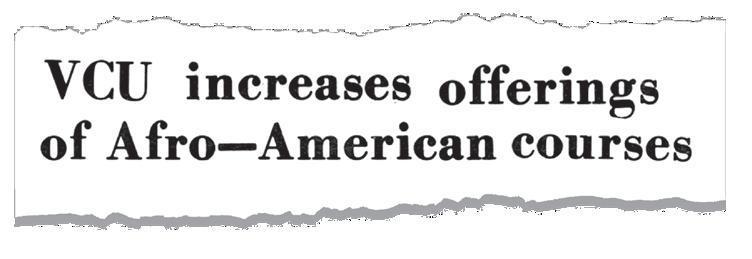
VCU’s first full semester was the fall of 1968. The new school launched with two AFAM courses: “AAS100-Africanism,” taught in Williams House, and “AAS201Intro to Afro-American Studies,” taught in Hibbs Hall.
The courses were organized by a committee at the request of students, as there was no full AFAM department at the time.
AAS100-Africanism — an “exploration of the works of the Black man” — was in such great demand that the newly-launched school had to open up another course section, according to CT archives. Three new 200 and 300-level courses were added the following Spring.
One group, Students for an African Philosophy, was very prominent on campus in the early years of VCU, according to CT archives. One record shows they received a sizable portion of funds raised by the student activity fee.
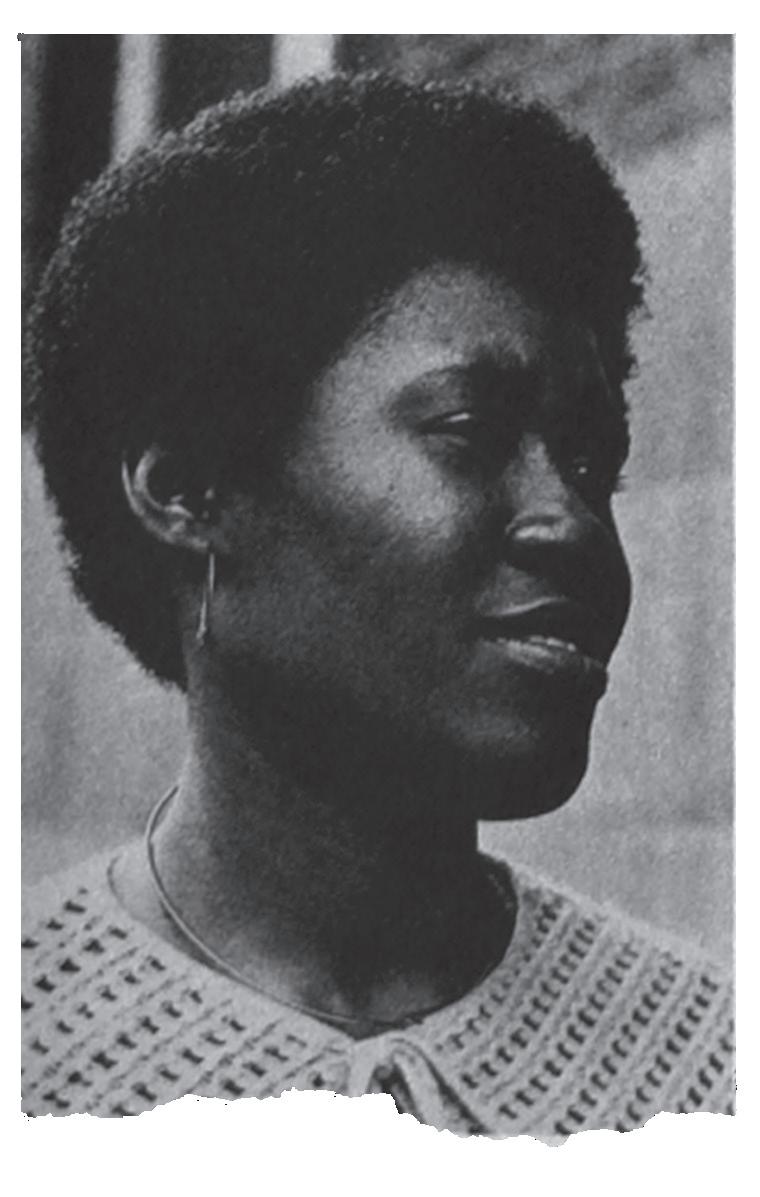
SAAP was VCU’s first Black student organization. It was founded by notable alumni, including VCU’s first Black basketball player Charles McLeod — who appeared frequently in The CT and even wrote an opinion-editorial decrying the draft and American war efforts.
VCU’s progress on creating an AFAM major was slow and gradual across decades, CT archives show. A minor in the discipline was not offered until 1977.
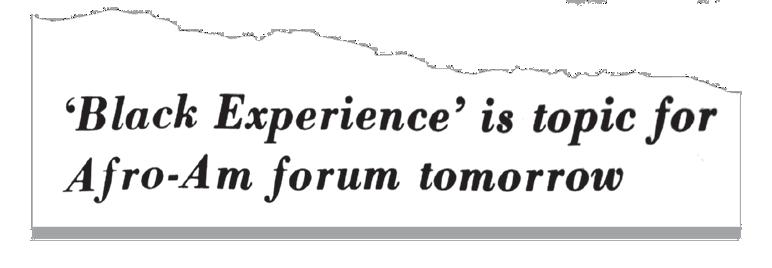
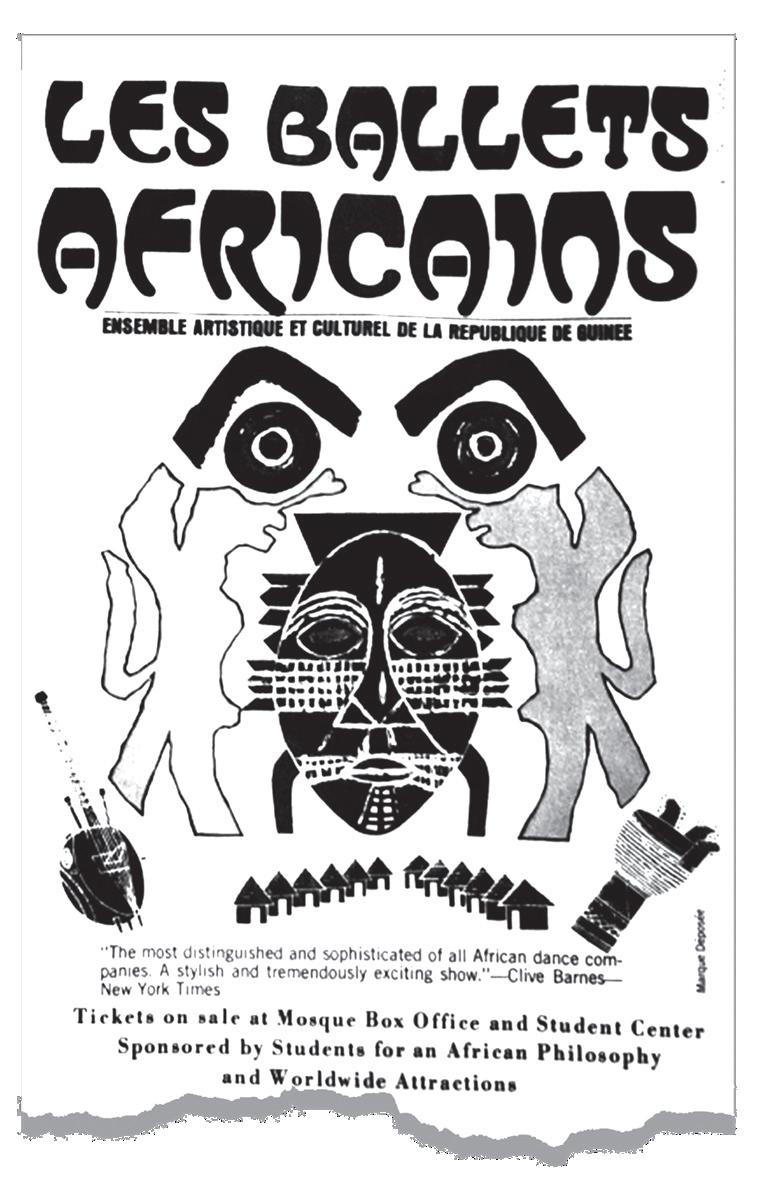
But student groups like SAAP satiated students’ desire for a robust AFAM education. They put on regular political and education forums and events around campus. At one point, they sponsored a visit by Les Ballets Africains, one of the first African national dance companies.
VCU first asked the State Council of Higher Education for Virginia, or SCHEV, for an AFAM degree in 1971, which was promptly rejected. The board said VCU’s faculty was not strong enough.
CONTINUING THE FIGHT DECADES LATER
VCU made headlines after a proposal by the VCU Board of Visitors to create a full bachelor’s of science in African-American studies, passed in 1993, was rejected again by SCHEV in 1997.
Critics said the liberal arts degree would divide the student body on racial lines, while supporters said it was an important academic field in a multicultural society and one that had existed at other schools for years, The CT wrote at the time. The University of Virginia was the first school in the state to have one.
Provost Grace E. Harris — the first Black woman to serve in her role at a four-year public university in Virginia and the namesake of today’s Harris Hall — was among the staunch supporters of the proposal.
One graduate student interviewed at the time by The CT, Eric Williams, said he thought the major’s presence would “increase the dialogue between students and faculty members and possibly find solutions to the problems that are going on.”
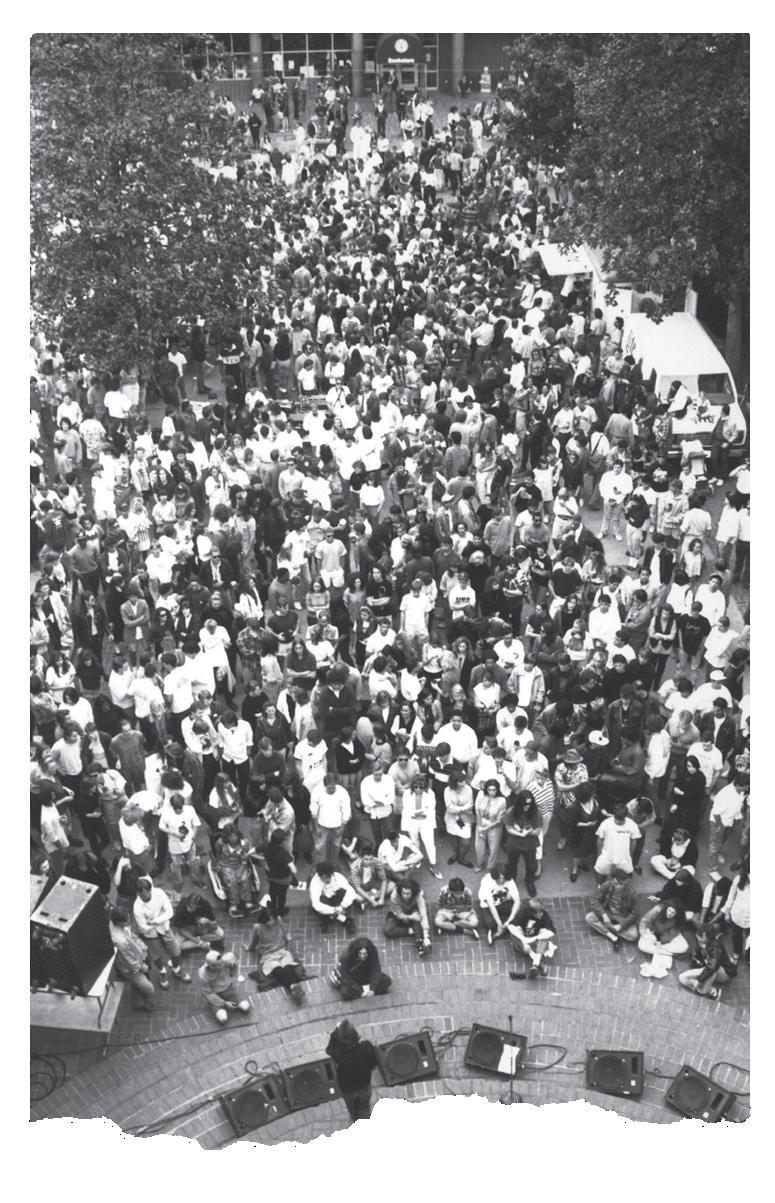
A number of students spoke of their dissatisfaction with the SCHEV’s decision, as well as their personal needs for the major. Many chose to study alternative programs only because they could not major in AFAM. A protest was held at Shafer Court Plaza.
By 2001, the effort to create an AFAM major was still in the works. The conversation had shifted to funding and enrollment, and whether VCU had enough of either to justify the degree — though critics still said it would separate students.
Without aggressive funding from the state budget, VCU would have had to seek other sources to power the program.
L.Victor Collins, the multicultural student affairs director at the time, told The CT VCU needed the major as it was one of the most diverse public universities in the state.
“African-American studies is already offered as a major by other public Virginia universities so why were we being singled out that we cannot offer it? This whole thing about ‘Balkanizing’ ... that offering African-American studies as a major somehow would cause our students to become disunited and break into small warring factions is completely ridiculous,” Collins said in reference to a comment by a member of SCHEV.
Yasmine Madden, a sociology major and African-American studies minor, challenged the idea that the major would somehow cause segregation.
“I think it’s time we had this major. We want it because it will allow us [AfricanAmericans] a sense of belonging when it comes to history,” Madden said.
VICTORY AFTER DECADES OF ADVOCACY
“It has been almost six years since VCU’s administrators learned they could not offer students a major in AfricanAmerican studies,” The CT wrote in 2003.
“That is no longer the case. Beginning fall semester, African American studies officially becomes a major.”
Provost Roderick McDavis believed VCU had a strong core of students who were already interested in the major — and promoting it would attract out-ofstate students.
“Major universities in the 21st century ought to have a multifaceted curriculum,” McDavis said. “African-American studies is one of these opponents that makes your curriculum multifaceted.”
Mark Wood, an associate professor of African-American studies and religious studies, was among the excited faculty quoted in The CT. He still teaches and advocates for progressive issues on campus today.
“It finally succeeded,” Wood said.
EDITOR’S NOTE: You really ought to check out “Seeds of Fire: The Untold Story of Black Student Activism at RPI/VCU,” a documentary by AFAM chair Shawn Utsey! It explores some of the earliest student movements that occurred as RPI transitioned to VCU.
This story is part of a series examining VCU history through The Commonwealth Times archives. If you have a suggestion for a topic you would like us to explore, please email it to editor@ commonwealthtimes.org
Images via CT archives. Graphic by Milena Paul.
‘Voices of Change’
How VCU student movements evolved through the decades
MAEVE BAUER
Spectrum Editor
CATHERINE COLOMBO
Contributing Writer
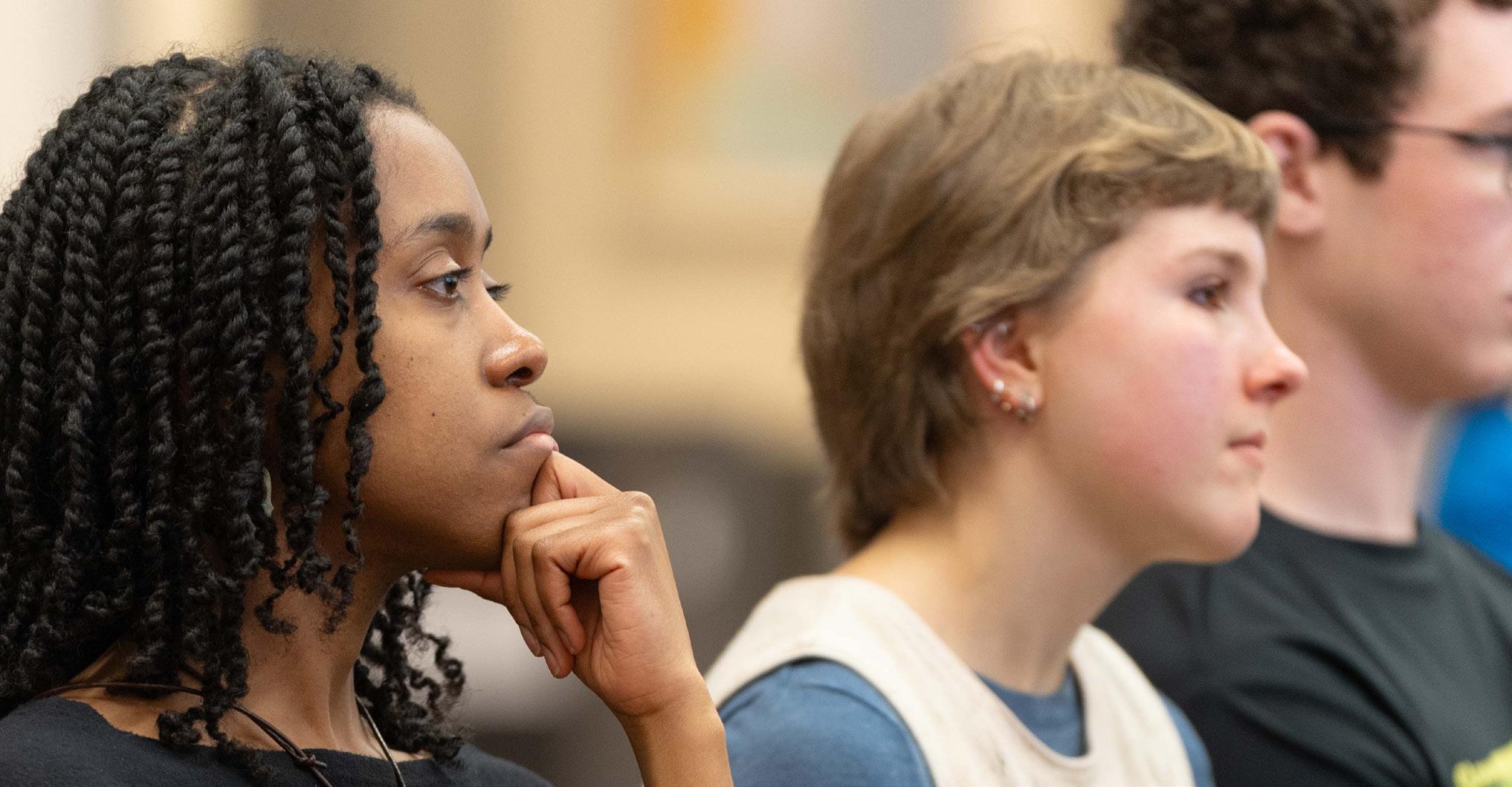
Since its inception in 1968, VCU has seen the work of student activists, journalists and free thinkers shape campus culture.
The VCU Libraries Special Collections and Archives department created an exhibition, “Voices of Change: Student Advocacy and Action from the Archives,” that delves into the very student movements that have made the “uncommon,” urban campus what it is today.
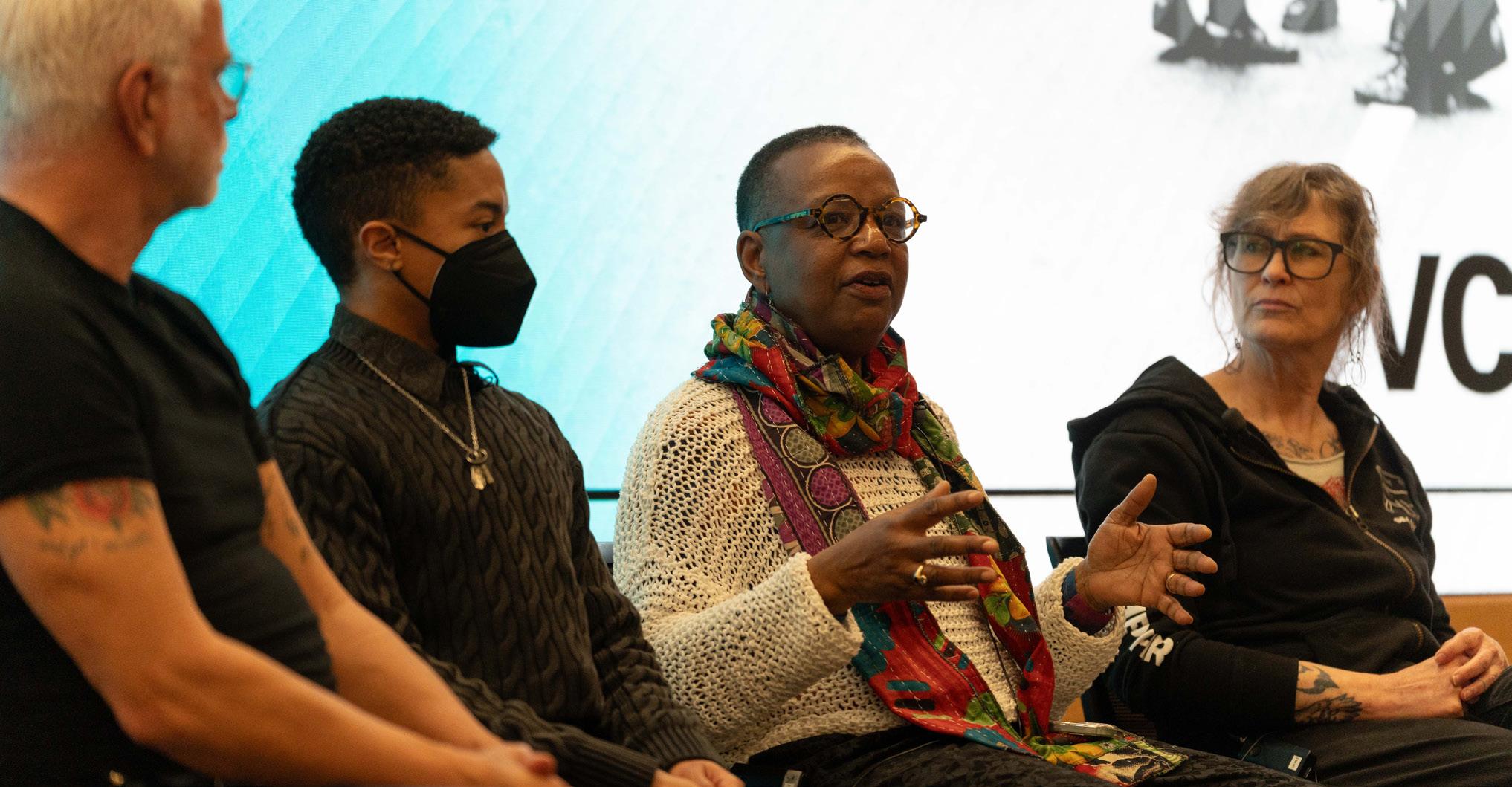
Special Collections held a panel last Thursday with four VCU alums who discussed their time at VCU and the different protests they were involved in. Panelists included Dale Brumfield, IBé Bulinda Hereford Crawley, Krissi Vandenberg and C. A. P. Ward. It was moderated by interdisciplinary studies director Vineeta Singh.
The four panelists studied at VCU at different times. Together, their words strung together an overall picture of student movements from the 1970s to the modern day. Many of them cited VCU as a second home — and they all held similar beliefs of building and relying on community.
“That’s where voice starts,” Crawley said. “People actively talking is where we make change.”
The exhibition was created in 2025 as a way to highlight movements throughout the years that have created an overall net positive to alums, in their time at VCU and after, as well as the university itself, according to university archivist Ruth Cody.
“We wanted to talk about the differences that the students made in the university itself and also the difference that the ability to do activism on campus made in students’ lives, not just while they were in college, but also when they went on [to] their future careers,” Cody said.
FORMER CT EDITOR ON CLASHES WITH ADMINISTRATORS AND ‘DICKIE DISGUSTING’
Brumfield — one of the panelists — was the production manager for The CT from 1978 to 1981. He even returned to the paper in 2013 as a contributing writer during his time as a graduate student.
The CT has gone through many changes both before and after Brumfield’s time, he said.
The paper started with a traditional format, but during Brumfield’s time — full of economic uncertainty and punk ideals — it was a news magazine. It then switched back to the traditional layout during the Reagan era and has been the same since.
“The look of the paper, the feel of the paper really kind of reflected a product of its time,” Brumfield said.
Brumfield also attributes the layout to the security it provides readers. As the internet took off, readers preferred something easily recognizable, Brumfield said.
The CT received a lot of pushback from administrators while Brumfield was on staff — when the paper shifted its focus from student life to the overall Richmond experience. It was a way to meet a niche that was not being hit by other publications
in the city at the time, Brumfield said.
“They weren’t reporting on the emerging punk rock movement or the art movement or all these things that were going on at the time,” Brumfield said. “The student paper should look at its community and see what’s missing, and respond to that and fill that void.”
That did not bode well with VCU, as administrators and the student government were trying to create a professional image as a fresh university.
According to Brumfield, the university’s president at the time, Edmund Ackell, threatened to cut funding to The CT if it did not go back to solely reporting about more wholesome student life.
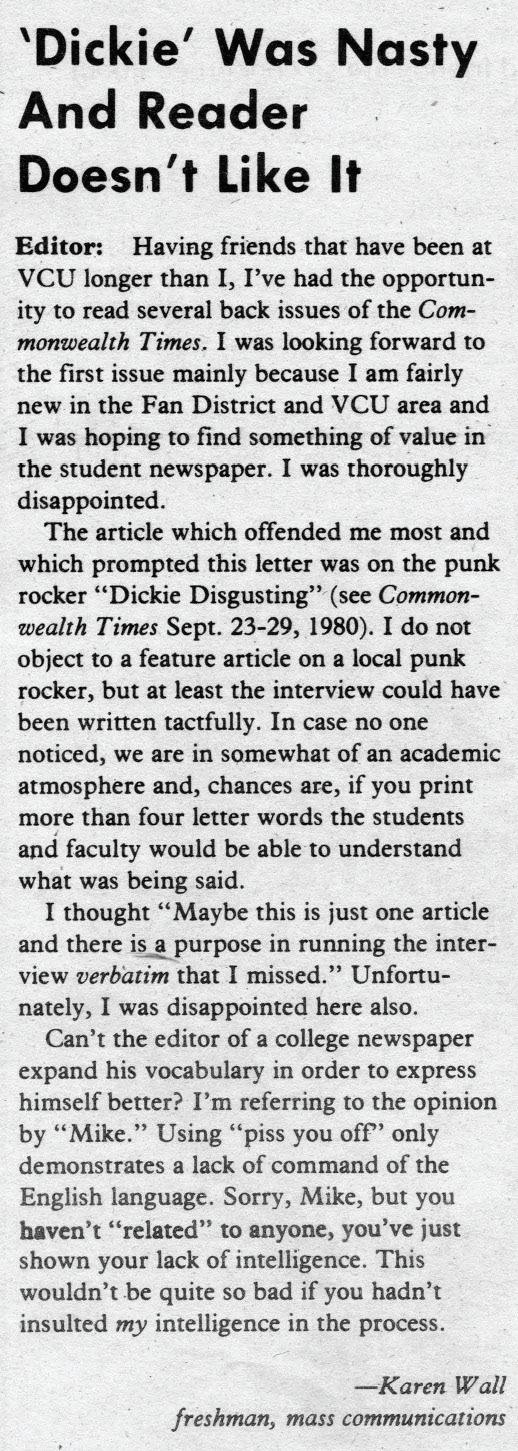
One particularly controversial moment saw The CT publish an interview with the punk musician Dickie Disgusting, with a cover that read, “I’m nasty and they don’t like it.”
Mr. Disgusting told The CT how he had made as much as $700 a night by pimping himself out to middle-aged women, according to a Style Weekly article by former CT editor Rich Griset.
He told staffer Bill Pahnelas “I have a half-inch cock — but I’ve got an 11inch tongue.”
Ackell wrote The CT and said that the article was a disservice to VCU. It made the president question VCU’s affiliation with the paper.
QUEER, BLACK CARTOONIST ON STUDENT PROTESTS
The voice on the panel representing the newer generation was Ward, a queer, Black
cartoonist and illustrator.
Ward actively participated in protests, especially regarding misconduct on the treatment of students and faculty.
“There was an incident where Caitlin Cherry, who was working as a visiting lecturer at the time, had campus security called on her. Students were very concerned, as that was a Black woman teaching at the institution, [who had] the institution acting against her,” Ward said.
Ward explained how the incident led to the broadening of different topics and issues discussed on campus.
Ward sees the actions of the current VCU administration as shameful, with regards to how they have been pushing back on student protesters — specifically the 2024 pro-Palestine encampment in which police deployed chemical irritants and arrested 13 demonstrators. They later modified the rules on where students can gather on campus.
“It genuinely feels like they have not had any textual understanding of the First Amendment and that they do not respect their students as adults,” Ward said. “It’s an urban campus and regardless of whether you’re arresting students or people who are participating in the protest, that doesn’t give them the right to set these boundaries on the entire city of Richmond.”
“Voices of Change: Student Advocacy and Action from the Archives,” is open on the fourth floor of James Branch Cabell Library in the Special Collections section. It is expected to remain open until 2028.
The panelists of ‘Voices of Change: Stories from Alumni,’ answering questions from moderator Vinetta Singh.
Photos courtesy of Jud Froelich, VCU Development and Alumni Relations.
Opinions
Quote of the week
“Some infinities are bigger than other infinities.” — John Green, The Fault in Our Stars
Stop glamorizing pregnancy
SHINY CHANDRAVEL
Assistant Opinions Editor
Loss of teeth.
Swollen joints and face.
Spontaneous allergic reactions, sometimes even to your own skin.
Vomiting, nausea and dehydration.
Tumors in the mouth and gums.
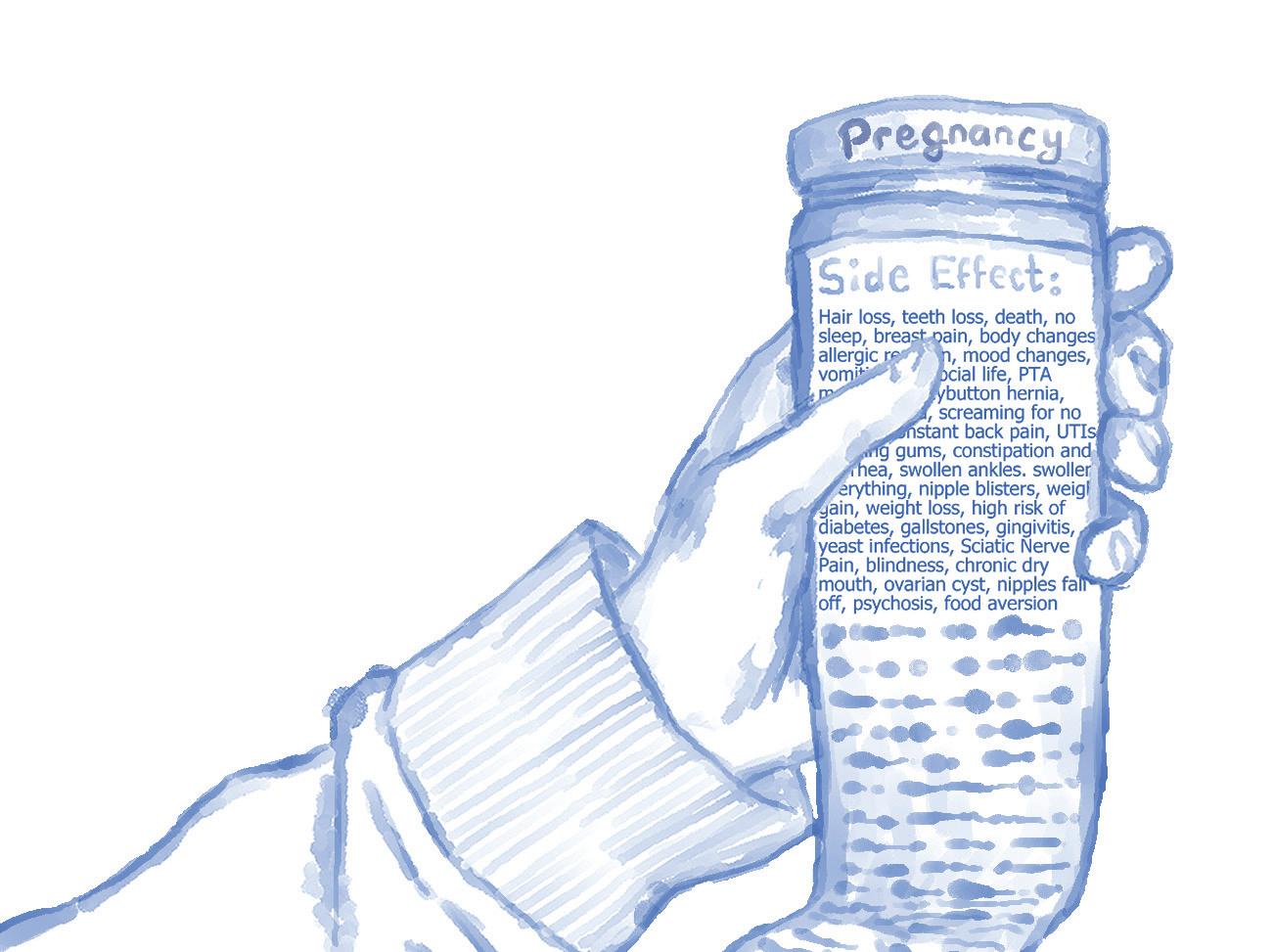
If this list sounds like it’s pulled from a profile on a rare tropical bacterial disease, it’s not. In fact, it describes side effects people have experienced from a condition that’s far closer to home, with the potential to affect nearly half of Americans and people worldwide — pregnancy.
More specifically, this list is a fraction of a much larger one created by TikTok creator @Zoomie, also known as “the girl with the list.”
The list started as a moment of TikTok virality as the creator accumulated reasons not to become pregnant. She compiled stories shared on the internet of unexpected pregnancy symptoms, which include physical, mental and financial changes. The
list currently has over 100 reasons and can be viewed online.
While some critique the list for spreading fear and misinformation, I find that the list has also inspired a muchneeded conversation. In the face of a culture that glamorizes pregnancy, we need to ensure we’re having an honest, transparent conversation of what pregnancy actually means for a mother’s quality of life.
The media plays a large role in this culture of glamour around motherhood and pregnancy. It praises celebrities who immediately bounce back to incredible physiques postpartum. It spotlights influencers decorating their nurseries with aesthetic, monochromatic toys.
Pregnancy has been marketed as this beautiful, miraculous endeavor. However, two realities can exist at once.
While it can be a meaningful journey for some, it can also be physically traumatic. It can cause drastic hormonal changes that have the ability to trigger autoimmune conditions, exacerbate mental health issues and leave individuals under financial strain. Pretending that all pregnancy does is leave behind a “dewy pregnancy glow” is doing women a great disservice and is antithetical to what health care is supposed to look like.
Acknowledging the negative side of pregnancy interrupts how we treat mothers as a whole. While we can praise mothers for their enormous sacrifice in maintaining their postpartum health, work life and personal responsibilities — all while tending to a newborn — it just becomes a cop out.
Applauding mothers for being superhuman only excuses you from treating them as human at all.
Women’s issues aren’t seen as problems, but as an expectation meant to be met. Any side effects that come with pregnancy are brushed off as the inherent sacrifice that “good” mothers make.
The more we tell women that suffering and sacrifice are just inherent to motherhood, the more we let systems fail with little to no pushback.
We can watch the government cut funding from the research that goes directly towards their health.
We let them slip through the cracks of health care after birth — left managing new pregnancy-related complications without a proper primary care provider — despite half of maternal deaths occurring within 42 days post-birth.
We can force them to try to balance work life and postpartum recovery
prematurely without any comprehensive paid maternity leave.
We can brush off the fact that our country has one of the highest maternal mortality rates of high-income countries, affecting Black women most often, with them dying more than three times more often than their white counterparts.
As the United States’s birth rate hits an all time low, falling farther from the replacement rate, pronatalist views are becoming more and more common from our economists and politicians.
Vice President J.D. Vance declared at his first address to the United States,“I want more babies in the United States of America!” But encouraging women to have more babies without the structural change to support them falls flat as empty rhetoric.
If we want healthier mothers, we have to stop selling pregnancy as some polished product to indulge in and start treating it as the complex medical event it is. We need transparent education, funding for women’s health research and a culture that views maternal suffering as an issue to solve — not some “rite of passage” to womanhood. Drop the applause and glamor. Mothers need structural change.
Illustration by Abbos Soliev.
Media literacy and mental health go hand in hand
Contributing Writer
There’s no escaping the news these days.
The algorithms that shape social media are ubiquitous to today’s culture — pushing the news to the front of our feeds. Worse, these algorithms tend to promote the most miserable news because it drives engagement. This incentivizes people
— and even some news networks — to promote the worst headlines, sometimes even making them up. This issue has only exacerbated with the increasing quality of AI generated photos and videos.
Like many students on this campus, I’m personally invested in justice for sexual assault victims and for the protection of women and young girls. My social media algorithm seems to know this. Every feed on every platform has shown me every
update on the Epstein files. Even though I care about this issue, it’s hard for me to see and read all these updates due to their explicit and disturbing content.
There’s really no “one size fits all” formula for media literacy, in the same way that there’s no single understanding of mental health. However, frequent exposure to these updates have left me hopeless and despairing. Despite this, it didn’t feel right to me to turn away from media and news consumption entirely — something needed to change.
The ease of access to distressing and disturbing news, information and images has led to concerns about the relationship between news and mental health.
Recent studies have discovered evidence that frequent exposure to news during times of crisis can lead to increased anxiety and poor mental health. This exposure can trigger your “fight or flight” response, which is associated with a rise in stress hormones, according to Mental Health America.
However, these facts exist within the reality that engagement with the news is necessary to remain an informed and responsible member of the community. Understanding what’s happening in the world and how it impacts others helps you conduct yourself in a way that is both empathetic and ethical.
That doesn’t mean that sacrificing your mental health is the “good” thing to do.
I’ve seen many people, especially in activist spaces, shame others for not being informed “enough” on a certain issue or
event. However, when people are inundated with bad news — and it’s always bad news — people become at risk for burn out or submitting to hopelessness.
It’s important to be informed, but it’s also important to protect your mental health for one simple reason — when you’re feeling well, you can help others feel better. If you care about an issue — or just people in general — it’s easy to feel as though you need to know everything, immediately. This is especially true when it seems like many people online agree that if you don’t know every detail, then you’re failing morally.
But the reality is that understanding how much information you need to stay informed while still keeping yourself safe is key to successfully creating real change. Knowing where and what the problem is while being well enough to help solve it is the best way to contribute to a movement.
That’s where an understanding of media literacy informed by psychological wellness comes in.
Rather than focusing on every new headline or image, it’s about understanding what you need to know and see to be informed enough so that if you are called on to help, you’d understand the situation and be able to act effectively.
An understanding of media literacy that considers mental health isn’t one that asks you to ignore the news. Instead, it is one that asks you to become both informed enough and healthy enough to actually make change.
Yes, the whitewashing in ‘Wuthering Heights’ is a big deal
KYLIE GRUNSFELD
Contributing Writer
The internet has been abuzz with conversation surrounding director Emerald Fennell’s adaptation of Emily Brontë’s 1847 novel “Wuthering Heights.”
One of the adaptation’s larger controversies is Fennell’s decision to cast Jacob Elordi, a white man, in the leading role of Heathcliff, an explicitly non-white character.
Fennell is not the first director to make the decision to whitewash Heathcliff; the character has been played by Tom Hardy, Ralph Fiennes and Laurence Olivier in past adaptations. So why is Elordi’s casting such a big deal?
First, we have to understand the role that Heathcliff’s race and skin color plays
in Brontë’s novel. It is not simply a decision Brontë made offhandedly — it is the reason why Heathcliff is treated the way he was and why he eventually turns into the man that he did.
It is Heathcliff’s perceived otherness that keeps him and Catherine, the antiheroine of the book, from each other.
How did Fennell justify the treatment of Heathcliff as “other” if skin color was not involved? She just decided that keeping him as lower-class would be enough.
Fine. The story still works. It starts a far less poignant, thought-provoking conversation, but it works.
But if the issue was finding an actor for Heathcliff that would sell tickets, I find that a lousy excuse. There are plenty of Black and brown-skinned English actors who are widely beloved. They don’t
even have to be English like the original characters — Elordi and the lead playing Catherine, Margot Robbie, are both Australian.
If the issue was trying to make Heathcliff as sexy and alluring as possible, I find that a disgusting excuse. Is the implication that Heathcliff can only be a convincing love interest if he is made white?
When asked about Elordi’s casting, Fennell had this to say: “You can only ever kind of make the movie that you sort of imagined yourself when you read it.”
When confronted with themes of race-based oppression and discrimination crucial to understanding the novel, Fennell still chose to imagine whiteness.
Criticism of Elordi’s casting has often been met with an argument that I’m tired
of hearing: “Movies have turned white characters non-white, so why is it an issue if it’s the other way around?”
Some examples of this are Halle Bailey playing Ariel in the live-action adaptation of “The Little Mermaid,” and Leah Jefferies as Annabeth Chase in the new “Percy Jackson” TV series.
Thousands of people announced their issues with these castings, citing “wokeness” as the cause of the raceswapping. There was even outrage in 2012 when Amandla Stenberg was cast as Rue in the “Hunger Games” movie — a character who was literally described as being darkskinned in the book.
These lamentations of “reverse whitewashing” don’t make much sense.
Unlike Heathcliff, Ariel and Annabeth’s skin colors do not play a role in their stories. Casting a Black woman as Ariel does not change the events of her movie. And after all, she’s a mermaid. If her being played by a Black woman is more unbelievable than her being half-fish, half-woman, I think that draws some questions.
Fennell’s “Wuthering Heights” missed a great opportunity to cast a leading man of color and let him be sexy, unforgiving and himself. Whether or not you like Elordi as an actor or believe that book-to-movie adaptations should be faithful is irrelevant — this casting was rightfully controversial. There is no shortage of white stories being told. A white main character is not an anomaly.
Had this not been an adaptation of a book where discrimination based on skin color is a central theme, perhaps the conversation would be different. But the fact is that Fennell chose to water down — or take out completely — themes that were explicit in the book. And considering her reach and influence, this cannot be ignored.
URJITA MAINALI
Illustration by Niranjana Rathinam.
Illustration by Lauren Smith.
Opinions
Stop trying to be ‘cool girl’
GRACE MIGLORIE
Contributing Writer
We all know “cool girl.”
We love cool girl. We wish we were cool girl. She’s almost like you, but she’s not — she’s better.
We see her on the street, across from us in the coffee shop, and on our Tiktok “for you” page while we scroll through thousands of variations of cool girl.
She shows us her new, cool bag, her new, cool jacket and her cool “dark academia whimsygoth y2k” makeup that she achieved through her 23-step routine — done all with products that are linked in her bio for us to purchase, so that we too can be cool girl.
She seems to have endless outfits, all perfectly curated to fit her niche aesthetic, probably one with a hyper-specific name
coined by an influencer. She is effortless and put together, and she is getting PR packages from brands you only wish you could afford.
But who is cool girl, outside of appearance? What do we really know about her other than what she wears and buys?
Being a “cool girl” is not about personality, hobbies or ideals — it is about consumerism. To be cool, you must have an aesthetic, and you must sanitize and reject the aspects of yourself that do not align with it.
We are subduing and lessening ourselves to fit into one heavily curated aesthetic, because if we don’t do that, then who even are we?
These aesthetics are defined by what we are wearing and the products we are using, not by a personality trait, hobby or values. This trend is making us lose ourselves at our core and instigating a culture of
aesthetics — a culture of people who are what they buy, not who they are.
There is no pretentiousness about this coming from me. I’m no better and less influenced than anyone else. I see the cool girl wearing a baggy Carhartt jacket and suddenly I’m on Depop for three hours trying to find the same one so that I can be cool girl too.
Is my identity even me anymore, or is it an identity that has been sold to me via algorithms that encourage me to purchase things that align with that identity? Is that tank top “so me-coded” or is it a product of years of marketing that tells me I should buy something so I can fit into the mold of what I think I should be?
The desire to perform, edit and dull ourselves down to a narrow label needs to end — it is ruining us. The obsession with purchasing something because we believe it will enhance our aesthetic, and therefore us
as a person, needs to stop. It is crucial that we start getting back to our core selves and losing the desire to fit in one box.
Our existence is not an aesthetic. We do not have to brand ourselves, especially with actual brands. The coolest girls I know are the ones who do what they truly enjoy, the ones who wear what they truly want, the ones who don’t feel the need to buy into the latest trend or aesthetic, the ones who don’t care if they’re cool girl or not.
Wear what you actually enjoy and find appealing, no matter if it’s 12 different styles in one. Buy the makeup you think is genuinely pretty, do your hair how you like it, not how you think you should do it because the girl on TikTok told you to.
You do not have to label yourself — you are not a product. I promise you, you are so much cooler when you embrace the things that bring you joy and are sincerely aligned with yourself. That’s cool girl.