‘We need to be more connected’ Rao touts enormous growth, interdisciplinary activities in university address
ANDREW KERLEY Executive Editor
VCU President Michael Rao emphasized the need for interdisciplinary activities at VCU moving forward during his annual State of the University address on Thursday.
FEATURES
Rao — who is entering his 17th year as the VCU’s fifth president — flaunted notable stats showing VCU and VCU Health’s growth in research and substantial economic impact on Virginia.
RAO ADDRESS
Continued on page 4
At VCU, Jewish students search for unity in wake of Gaza protests
SAPPHIRA MOHAMMED
Copy
Editor
“I’m in a weird place right now with my Judaism when it comes to my beliefs about Israel,” an anonymous VCU student said.
The anonymous student, Jewish by ethnicity and religion, said the teachings they received about Israel before Oct. 7, 2023 only consisted of praise for the country and included no mentions of conflict with Palestinians.
“What’s happening to the Palestinian people is a genocide and I absolutely believe that the Israeli government is not right at all,” the anonymous student said. “It’s just a very thin line, because I do have a history with Israel, but my love for it is within my memories and my experiences.”
The anonymous student’s viewpoint is growing in popularity. Nearly four out of every 10 Jewish Americans believe Israel has committed genocide against Palestinians in Gaza, according to a September 2025 Washington Post survey. Over six in 10 believe Israel has at least committed war crimes.
“When I transferred to VCU post-Oct. 7, I have felt a bit isolated when it came to my community,” the anonymous
student said. “So it’s been difficult to join any of the Jewish orgs on campus, because I don’t know where I fit in.”
VCU currently has three Jewish student organizations — Jewish Life at VCU, Hillel at VCU and the Progressive Jewish Student Union. But after the flashpoint that was Oct. 7, 2023, the genocide in Gaza and years of antiwar protests on campus, some students say they do not feel a sense of belonging in any of them.
STUDENT ORGANIZATIONS
SPLIT IN THE WAKE OF OCT. 7
On Oct. 7, 2023, the militant group Hamas executed an attack on Israel, killing around 1,200 citizens and kidnapping over 300, according to the Associated Press. In retaliation, Israel ramped up its genocide in Gaza.
It is estimated that roughly 11% of the Gaza Strip’s population has been killed or injured in the ensuing two years. While a permanent ceasefire was ordered in October 2025, there is still ongoing Israeli military action in Gaza and the West Bank.
JEWISH VCU
Continued on page 9
Lawmakers shelve in-state tuition for tribe members; pass history advisory board
Virginia college students who belong to federallyrecognized indigenous tribes and reside outside the state will have to wait another year before state lawmakers again consider granting them eligibility for in-state tuition.
Citizens of federally-recognized Indigenous tribes in Virginia — such as the Chickahominy, Upper Mattaponi and Pamunkey tribes — who live outside the state are not currently eligible for in-state tuition.
While the proposed update to the law was “laid on the table” in the Virginia House of Delegates and continued to 2027 in the Senate, both chambers did pass bills that create a board to advise state offices on the curriculums for African American, Asian American, Pacific Islander, Latino and Indigenous history in schools.
Both tuition benefits that match those of Virginia citizens and a greater curricular focus on their history in K-12 and higher education have been asks of Indigenous tribe leaders in the commonwealth, according to a previous report by The CT.
The former bill was unanimously recommended by the Commission on Updating Virginia Law to Reflect Federal Recognition of Virginia Tribes. Its passing would have granted students who are citizens or members of federally-recognized Virginia tribes eligibility for in-state tuition.
TRIBE TUITION
Continued on page 4
SAL ORLANDO Assistant News Editor
VCU President Michael Rao gives his ‘State of the University’ address at James Branch Cabell Library on Feb. 12.
Photo by Andrew Kerley.
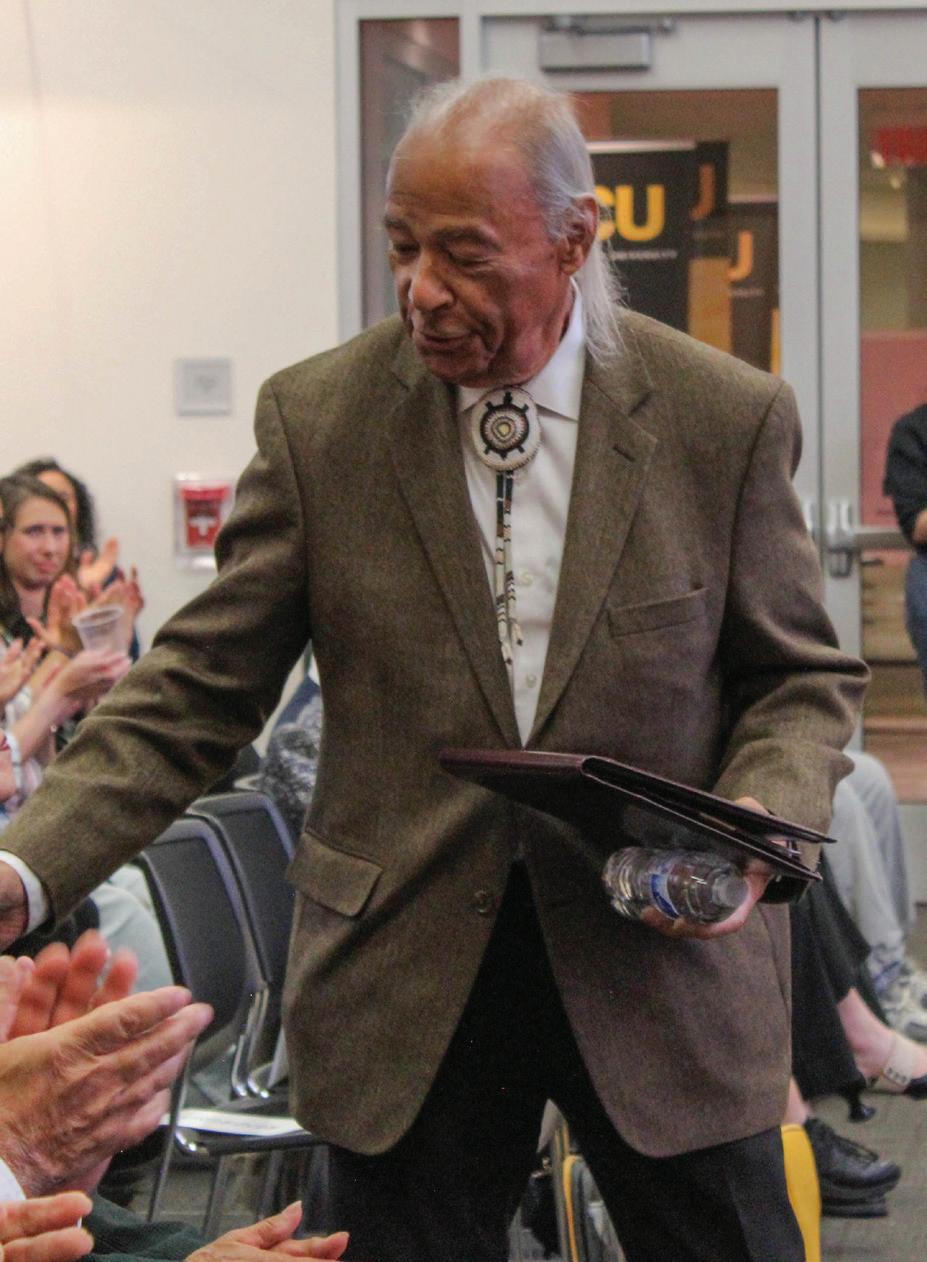
Chickahominy Chief Stephen Adkins addressing the crowd during the ʻOn Native Ground: Virginia Native Nations, Sovereignty, and Persistenceʼ event on Nov. 18, 2025. CT file photo by Catt Brito.
Stories of the week
national: Civil rights icon and two-time presidential candidate Jesse Jackson died in his home on Feb. 17 at the age of 84. His long career included organizing with MLK Jr., supporting the “rainbow coalition” and opposing police brutality.
international: Indonesia is preparing to send troops to the Gaza strip for medical and engineering purposes as part of a UN-prescribed “International Stabilization Force.” Israeli bombing of the strip has continued, with eleven dead to a strike on a tent camp on Sunday.
VCU performing arts to find new home at CoStar Center next year
BRYER HAYWOOD
Contributing Writer
VCU’s new interdisciplinary center at 535 W. Broad St. is planned to include more performance spaces for the theatre and music departments as construction nears its deadline next year.
The CoStar Center for Arts and Innovation is a new building on the southeast corner of Broad and Belvidere streets, designed to house multiple VCUarts programs. Construction began in 2024 and is expected to be completed in late 2027, per the VCU Master Plan.
A project webpage from the building’s primary architects, William Rawn Associates, promises collaborative space for several arts programs to work together to create “new art forms, inventive product prototypes and find new ways to innovate.”
The first floor of the building includes theater, innovation and scene maker spaces. The second floor is fully dedicated to “innovation,” and the third floor is set to have dance, studio and design areas. Other
noted sections throughout the other four floors include an ensemble, concert hall, costume lab, sound stage and faculty space.
The building will be eight stories high and 212,700 gross square feet, according to the building plans created by William Rawn Associates, the architecture firm tasked with designing the building.
The theater program intends to use the space as a performance venue, according to Bonnie McCoy, chair of the department.
“The building will be used in the same way we use Singleton right now. The plans are for the Theatre Department to move any Singleton activity to the new building. Shafer St. Playhouse will remain in use by the Theatre Department,” McCoy stated.
McCoy added that the CoStar building will create possibilities for collaboration between all students in the performing arts.
The location of the CoStar building is set to foster interaction between students and the local community through its proximity with the Arts District, according to Ryan Sprowl, interim director of communications for VCUArts.
“State-of-the-art rehearsal and performance spaces will enable dance, music and theatre students to work together more organically in shared facilities, breaking down the existing physical barriers between programs,” Sprowl stated.
Members of VCUArts have been involved in the planning and design process of the CoStar building since 2018, according to Sprowl. He added that VCU’s Center for Creative Economy and the Da Vinci Center would make use of the space alongside the arts departments of theatre, dance & choreography, music, cinema and kinetic imaging.
An email sent to arts students on Jan. 23 by VCUarts dean Carmelita Higginbotham described the CoStar center as the “future home” of performing arts at VCU. That email also formally announced the combining of theatre and dance & choreography into one “Department of Theatre + Dance,” a change which comes as the university implements its academic repositioning plan, according to a previous
report by The CT.
Though the new building has the aim of strengthening the relationship between the theatre and dance programs, the CoStar Center was not the impetus for the joining of the programs, according to VCU Spokesperson Brian McNeill.
The combining of the departments was independent of the university’s Repositioning Task Force, McNeill stated.
Construction costs for the building were estimated at $253 million as of 2024. According to the master plan website, $232.4 million came from the state, while CoStar contributed $18 million and VCU was to pay for the remaining $20.6 million.
VCU was approved to tear down three buildings on Broad Street. last October to facilitate the construction — at the time Historic Richmond executive director Cyane Crump objected to their demolition given their historic nature, ranging from 100 to 175 years old, according to Richmond Times-Dispatch.
A rendering of the currently under-construction CoStar Center for Arts and Innovation as seen from Belvidere St. Photo courtesy of VCU News.
Virginians to vote this April on new Congressional map favoring Democrats 10-1
HECIEL NIEVES BONILLA News Editor
Virginia Democrats have released their proposed congressional district map for the mid-decade redistricting that will go to voters in a referendum later this year.
The map secures a likely 10-1 Democratic majority in the U.S. House of Representatives — the most drastic shift in representation per-capita of any state engaging in middecade redistricting, according to Cardinal News — and splits the city of Richmond into two separate districts.
State Democrats revealed the proposed map on Feb. 5, and was spurred by redistricting done by Republicans in Texas which diluted and removed Democratic seats, spurring a race to counter potential losses in red states with similar moves by Democrats in states like California and Maryland.
During the press conference announcing the maps, state Sen. Louise Lucas, D-Portsmouth, compared the redistricting effort to Trump’s attempt to secure a midterm victory.
“That’s why he started this mess in the first place,” Lucas said. “These are not ordinary times and Virginia will not sit on the sidelines while it happens.”
Lucas has been at the forefront of district-drawing which unduly helps or hurts a political or racial group — a practice known as gerrymandering — in the past. She narrowly lost a congressional election in 2001 after Virginia Republicans moved her home city of Portsmouth into the district of the state’s only Black representative at the time, Rep. Bobby Scott, according to the Washington Post.
Lucas told The CT that she hopes the “power grab” by the White House and ensuing battle in the states over democratic
procedures will incentivize students to get involved in politics by contacting legislators, keeping up with issues and eventually running for office.
“It’s to the extent that we get younger people involved and stay involved that we’re going to be able to continue to keep our democracy intact,” Lucas said. “I think it’s extremely important.”
The Virginia map largely preserves a Voting Rights Act district in the Hampton Roads area but dramatically changes many of the rest.
Currently, the City of Richmond is represented in Congress by democratic Rep. Jennifer McClellan, Va-04. Under the new map, parts of West and South Richmond would instead be in Va-05, currently represented by Republican John McGuire.
Much of Henrico, Hanover and the western areas of metro Richmond are currently represented by Republican Rep. Rob Wittman, Va-01. Wittman’s district would now be made far bluer by including much of the I-95 corridor in Northern Virginia, and those western areas would be split between Va-05 and Va-07, which also includes parts of Northern Virginia.
All three districts would be expected to go blue if Democrats maintain their numbers. The result, barring Democratic underperformance, would be a metro Richmond entirely represented by Democrats in Congress.
The referendum to approve the redistricting is set for on April 21, despite a legal challenge brought by Tazewell Circuit Court judge Jack Hurley Jr. over procedural issues.
Constitutional amendments need to pass the General Assembly twice before going to voters, and the first must happen
before a House of Delegates election. Hurley argued that state Democrats broke procedure by initially approving the redistricting during the early-voting period of last year’s general election, and that the matter was improperly added to the assembly’s business.
On Feb. 13, Virginia’s Supreme Court allowed the referendum to continue while they work towards a final ruling on its constitutionality, according to Cardinal News.
VCU political science associate professor Alex Keena said it’s “hard to say” what the chances are of the referendum map becoming reality in light of the GOP lawsuit. Voters could reject the move in the referendum or approve it only for the courts to kill the plan, both of which would mean political defeat for state Democrats.
Keena is critical of the move by Virginia Democrats as a “strategic blunder” and stated it does not come with solutions to the deeper, procedural problems with U.S. democracy.
“So far I haven’t yet seen any specific pledges to make democratic reforms under a Democratic Congress next year,” Keena stated.
Keena also criticized the move for disrupting the primary process and making it harder in the immediate term for younger, lesser-financed primary candidates to succeed.
U.S. House minority leader Hakeem Jeffries, D-New York, said the national Democratic party is willing to do “whatever it takes” in Virginia to ensure the measure goes through in an appearance on CNN’s State of The Union program. This includes being willing to spend “10s of millions,” according to Jeffries.
That’s why he [Trump] started this mess in the first place. These are not ordinary times and Virginia will not sit on the sidelines while it happens.”
Louise Lucas, Virginia Senate President Pro Tempore
Graphic by Milena Paul.
Continued from front page
Rao also commented on VCU’s new AI course offerings, the school’s wealth of first-generation and Pell Grant-eligible students, tenure policies and the need for “discipline” in hiring faculty.
“We have to incentivize collaborations that will break down barriers and prepare our students as graduates for a world that’s changing very rapidly,” Rao said in the opening remarks of his speech. “That’s why we have to invest with purpose.”
Between emerging technologies and initiatives on campus, such as faculty rapidly developing AI courses and minors in recent years, Rao said VCU is uniquely positioned to meet people’s needs.
“That’s VCU getting itself to where the ball is going, rather than where the ball is,” Rao said.
Rao emphasized VCU’s typical brand of being “uncommon.” He highlighted Professor Amy Rector’s discovery of a species of prehistoric human, conservation biologist Matt Balazik’s efforts to preserve the Atlantic Sturgeon in the James River and VCU hand surgery Chair Jonathan Isaacs’s revolutionary “Nerve Tape” invention.
One notable interdisciplinary initiative at VCU highlighted by Rao was the Center for Human Simulation and Patient Safety, in which standardized patients use their theatre backgrounds to help medical students practice their clinical and communication skills.
Rao brought the program’s founder Aaron Anderson on stage, along with Rector, for a panel on their activities.
“Nobody goes into the arts for money,” Anderson said when asked by Rao about how creative, practice-based research can help people — in his case — communicate more effectively.
Anderson noted that most artists go into their fields because they can somehow make the world a better place.
“You can’t have interdisciplinary without discipline,” Anderson said.
At one point, Rao asked the audience to imagine what it would look like if institutions organized learning and research around the “big challenges of our time,” rather than the traditional structures higher education has relied on for centuries.
“Hint-hint, Oxford, Cambridge, lots of great things,” Rao said.
Enormous growth
VCU now ranks as the 46th best public research university on a national scale. It pulled in $568 million in sponsored funding in the 2025 fiscal year. In his speech, Rao set his sights on surpassing the $1 billion mark.
Time Magazine recently ranked VCU as the 211th best university in the entire world.
VCU has accumulated $1.27 billion in donations over the past five years, according to a slide shown during Rao’s address.
Most notably, Rao gave a sneak peek of an unfinished, independent report showing VCU and VCU Health to have a combined $18.5 billion economic impact on Virginia. The two entities support 95,707 jobs throughout the state — one in every 61 jobs.
Compared to the state’s signature school, the University of Virginia puts out an economic impact of $11.6 billion with 67,109 jobs, according to a similar report released in 2025.
“We provide Virginia enormous value,” Rao said.
Despite its growing stature, VCU still seeks out students from all economic backgrounds. 38% of the 2029 first-year class — VCU’s largest class ever — are first-generation students. 41% come from Pell-Grant eligible families. The university’s four year graduation rate has also improved significantly at 46%.
“Now to me, that’s the American dream,” Rao said.
VCU is at an all-time high in online student enrollment, according to Rao. Three of its online programs were recently ranked among the best in the United States.
“We give people who are stuck in, whatever their life circumstances are, we give them a chance to get a VCU degree,” Rao said.
Tenure policies, hiring with ‘discipline’
Rao spent a portion of his speech talking about how VCU will have to be very “disciplined” about many things moving forward — including “how we hire in the context of our mission.”
“We can’t just be like, ‘oh I like that person,’” Rao said. “It’s got to be a disciplined hire, and we’ve also got to be disciplined about how we support and promote our faculty and staff, and how we invest in faculty connections across the widest range of disciplines.”
When asked to clarify the meaning of his statement in an interview with The CT after the speech, Rao emphasized fostering the best possible learning and research experiences for students.
“Which means we can’t do everything for everyone, but we can definitely still make some choices and be really focused on that,” Rao said.
Some VCU faculty have been outspoken for years about layoffs, shorter work contracts being offered and changing policies that raise the degree requirement for faculty seeking tenure.
Rao called the notion that VCU is moving away from tenure and hiring more short-term faculty an “absolutely false assumption.”
“If you hire the people who are in alignment with the mission, and you’re realistic about what the mission is, and you’re very declarative, which is what I’ve done, I think you’ll be fine,” Rao said. “But you have to support faculty, not just leave them hanging.”
Continued from front page
Cristina Stanciu is a scholar of indigenous and multiethnic literature and the director of the VCU Humanities Research Center. She noted there has been similar legislation in states like Hawaii, Oregon and Colorado that has been successful.
“For communities that have been systematically displaced and marginalized, especially after the passing of the Racial Integrity Act in 1924 in Virginia, every student who can access higher education in Virginia represents a vital connection to ancestral homelands and an investment in tribal futures,” Stanciu stated.
In subcommittee hearings, lawmakers on both sides of the aisle and advocates of the bill went back-and-forth on exactly how many people it would affect and how many millions of dollars it would cost the state each year.
While some lawmakers believed roughly 80 students would benefit from the bill each year, advocates said that was a mistake, and in actuality that number was closer to 20. They said the bill was largely a symbolic gesture. Ultimately, its price tag was its downfall.
“We have a lot of needs right now that we’re trying to grapple with,” said Del. David Reid, D-Ashburn.
VCU takes steps to platform tribal leaders
Chickahominy Tribe Chief Stephen Adkins held a lecture last semester at VCU, calling for the university to teach a fuller version of Indigenous history and create more opportunities for Indigenous students.
Adkins mentioned in his lecture that state-funded universities should provide reduced tuition to Indigenous students aspiring to attend school.
VCU launched the Indigenous Elder in Residence Program last month in collaboration with Robert Gray, the former chief of the Pamunkey Indian Tribe.
“Robert Gray’s residency is designed to reach students through multiple touchpoints. He visits classrooms across disciplines, meets with students, faculty and staff individually and in group settings, and delivers public talks,” Stanciu stated.
VCU’s Humanities Research Center created the “On Native Ground” initiative in 2020 and has collaborated with local Indigenous communities on a series of projects since.
The purpose of the initiative is to “Indigenize curriculum and build meaningful collaborations with local Indigenous communities,” according to Stanciu.
Stanciu stated the initiative works with local tribes to build a strong network between VCU and Native communities.
Last year, the Humanities Research Center launched the Indigenous Humanities Lab, which was supported by a grant from the Mellon Foundation. The lab combines academic scholarship with community-based knowledge by integrating the approaches and voices of Indigenous people, according to Stanciu.
“The lab creates vital spaces for collaboration between our scholars, students, and Virginia’s tribal nations, fostering meaningful relationships that transcend traditional academic boundaries,” Stanciu stated.
Stanciu does not recall any similar
initiatives prior to the launch of “On Native Ground,” but there may have been pockets of research.
The Humanities Research Center’s activities involving Indigenous culture and communities include co-leading an international symposium on Indigenous Print Cultures, Media and Literatures, partnering with the Pocahontas Reframed Film Festival and establishing the Karenne Wood Native Writer/Artist Residency program.
Gregory Smithers, professor of Native American history, believes the bill would be a positive step, but lawmakers must consider legislation that is restorative of past injustices and present-day inequalities when dealing with democracy strengthening policies.
“In the case of Native communities, such policies should include free tuition for members of federally-recognized tribes in Virginia,” Smithers stated.
“Having highly educated and skilled Indigenous Virginians will strengthen both the commonwealth’s economy and reinforce the state’s democratic foundations, while at the same time nurturing the dynamism of sovereign Native communities in Virginia.”
United Native Voices secretary Rilee Langston believes initiatives like the Robert Gray residency are important for spreading the knowledge and education about Native history and modern lives.
“One difficulty we frequently face is building community and relationships from the ground up,” Langston stated. “For ourselves and many other Natives, we come from places of strong community and partnership and coming to a university, especially one where it seems that you’re the only person of your culture, can be intimidating. This leads to a lack of visibility.”
Langston noted that Indigenous students would like more opportunities to take classes emphasizing Indigenous culture and achievements.
“Many people are stuck seeing Indigenous people in westerns, or that once awkward scene from ‘Peter Pan,’” Langston added. “We are a people who are alive and thriving, we have our own fashion weeks, music awards, favorite Indigenous celebrities and athletes, etc.”
Zane Bernard, a fourth-year economics student, thinks VCU needs to become less adverse to risks that are not quantifiable monetarily, specifically by sponsoring more Indigenous art and artists.
“I’m coming from a background in natural resources, where I spent a lot of time in the Pacific Northwest, and what I really miss about Southeast Alaska in particular is how present the material culture of Indigenous communities is,” Bernard said.
Denaya Givens, a fourth-year interdisciplinary studies student, noted a time she was asked by an individual who grew up in their Diné culture asking how they got to college.
“I thought, ‘wow what an ignorant thing to say, do you think I’m the first Native to ever go to college?’ Questions like those, even though they are hurtful to me, come from not being educated and having a single story of what it is to be ‘Native,’ and that’s okay, you just have to teach and move on,” Givens stated.
TRIBE TUITION
RAO ADDRESS
Photo by Andrew Kerley.
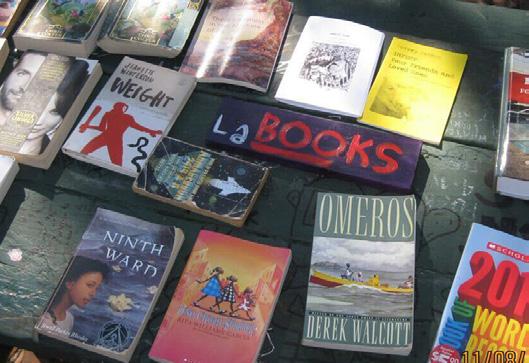
Books about Indigenous history and culture sit on a table at the "On Native Ground". event hosted at James Branch Cabell Library on Nov. 18. CT file photo by Catt Brito..
Sports
Stat of the week
VCU second-year guard Terrence Hill Jr. scored 20 points, and added five rebounds and four assists in the win over the University of Richmond.
Baseball walks-off Holy Cross in season opener; sweeps the series
DREW THOMPSON Sports Editor
VCU opened up its season with a series sweep over the College of Holy Cross after a lengthy offseason, winning 2-1, 14-1 and 19-7.
The season opener ended with a narrow win highlighted by dominant pitching and fielding.
The Rams’ graduate student starting pitcher Fenix DiGiacomo got through the top of the first inning with relative ease after a double play and a flyout.
The Crusaders matched their efforts in the bottom of the first with slick fielding plays from fourth-year right fielder CJ Egrie, third-year third baseman Ryan Grundy and third-year first baseman Braden Connors.
The defensive duel continued through the top of the second as DiGiacomo struck out two batters in a clean inning. VCU got the first hit of the game with a single up the middle from redshirt third-year first baseman Quinn Maher.
Maher moved to second base following a ground ball, giving the Rams a runner in scoring position with only one out. A
flyout to center field advanced Maher to third with two outs, however a ground ball to Holy Cross’ Grundy left him stranded and kept the score tied.
VCU coasted through the top of the third inning still not giving up a hit. The Rams’ third-year centerfielder Michael Petite got his first hit with a line drive to left field, before stealing second.
Second-year catcher Jacob Lee was then intentionally walked, putting two runners on with two outs for the Rams. However, a flyout to centerfield would get Holy Cross out of the inning.
DiGiacomo gave up his first hit of the game at the top of the fourth with a single to right field from Holy Cross’ Egrie. He stole second and third base before a wild pitch sent him home for the first score of the game.
VCU’s Maher got on base with a single to open up the bottom of the fourth. A walk put two on for the Rams with no outs as they looked to respond. A sacrifice bunt from third-year right fielder Trent Adelman advanced both runners before third-year third baseman Nate Kirkpatrick hit a sacrifice fly to get the Rams’ first score
BONNIES SHOW NO LOVE ON VDAY
Women’s basketball loses 64-53 in Crawford’s third game
JENNY
ALLEN Staff Writer
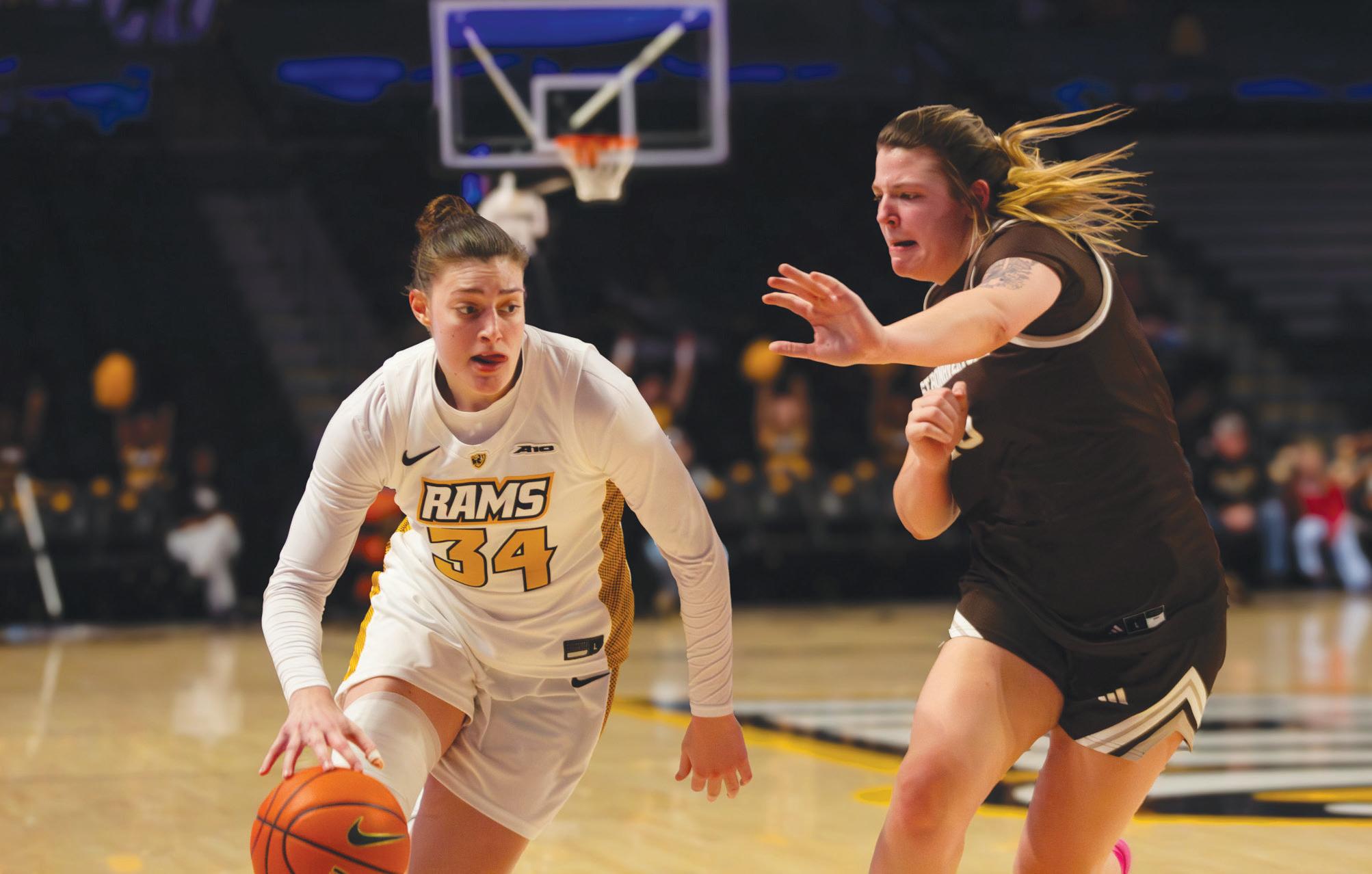
Despite it being Valentine’s Day, Saint Bonaventure University showed no love as it beat VCU women’s basketball 64-53 in its home gym. It was interim Head Coach Kirk Crawford’s first home game in his new position.
The Bonnies won the tip and immediately scored the opening points. St. Bonaventure soon followed it up with the first three of the game to jump ahead early.
The Rams tried to match the Bonnies’ quick start as fourth-year forward Makennah White responded with a layup.
St. Bonaventure began to pull away with a 16-6 lead when graduate guard Laycee Drake hit a jumper from the paint with five minutes and 15 seconds remaining.
VCU redshirt third-year forward Ann Zachariah tried to match the Bonnies’ energy and gave the Rams their first fast break points.
Bonnies third-year forward Brillana Boyd quickly took charge to shut down the Rams and keep their 10-point lead.
VCU outshined St. Bonaventure on the boards, however the team’s ability to finish the putbacks lacked.
“We just have to work on execution in critical times of the game,” Crawford said.
VCU redshirt fourth-year guard Ty Williams and second-year forward Katarina Kneževic used their skills to give their team momentum as they closed out the first quarter.
VCU entered the second quarter down four points, however it remained locked in on defense and got a steal right away.
Both teams struggled from three early in the game. Though Williams eventually knocked down the Rams first three — putting them down by three points with seven minutes remaining.
The close game turned scrappy as the Bonnies’ Pettinelli hit a controversial shot clock three to put them up by four points with five minutes remaining. After questioning, the three was later taken away.
Kneževic continued to stack up her stats with an offensive board and second chance jumper, and then a fast break lay up. It gave the Rams their first lead of the game, 26-25, with three minutes and 40 seconds remaining.
The tension thickened as Pettinelli hit a three in the Rams’ face, quickly taking the lead back by two with three minutes remaining before halftime.
of the game.
VCU brought in third-year relief pitcher Caleb Clover from the bullpen to open the fifth. Clover immediately opened with two strikeouts and a groundout. Holy Cross responded by striking out all three batters to end the inning.
The Rams quickly found themselves in trouble in the top of the sixth as Clover walked the first two batters. He quickly recovered by striking out the next two batters before a line drive saw VCU scrape out of the inning unscathed.
Holy Cross brought on second-year relief pitcher Jake Lenahan in the bottom of the sixth. He struck out two batters before graduate student shortstop Dante DeFranco hit a single line drive to left.
VCU fourth-year relief pitcher Zach Peters replaced Clover to start the seventh inning. Peters subsequently struck out the side: three up three down. Holy Cross similarly coasted through the bottom of the seventh as the game remained tied 1-1.
The Rams moved through the top of the eighth untouched as Peters continued to deal. VCU second-year second baseman Nick Flores singled on a line drive to left
field before reaching second on a dropped ground ball to first. Holy Cross escaped the inning on a fly ball caught in the foul zone. Peters cruised through the ninth still in control with two strikeouts swinging and a fly out. VCU started the bottom of the ninth with a bunt from Adelman that got him to second. The Holy Cross catcher threw past the first baseman giving Adelman ample time to advance.
Kirkpatrick followed with another bunt to move Adelman to third with only one out and the game in the balance. Third-year left fielder Ethan Acevedo then delivered a walk-off sacrifice fly to give VCU the 2-1 win on opening day.
“I’m not going to miss out on Kirk’s sacrifice bunt to get me into that position,” Acevedo said. “I was just happy to be able to do a job for my team.”
VCU displayed dominant pitching throughout the game, only giving up one hit in 27 plate appearances and racking up 17 strikeouts.
VCU will play its next game against the University of Illinois on Friday, Feb. 20 at 11 a.m. in Conway, South Carolina.
VCU out-rebounded the Bonnies 20-13 at halftime, however the Bonnies held a shooting advantage, 54% to 39%.
Back-and-forth scoring filled the beginning of the third until VCU missed a jumper and St. Bonaventure made a layup.
The Rams started with the ball as they entered fourth down 42-49 — hoping for a comeback.
Kneževic maintained her composure and gave the Rams momentum — less than a minute into the fourth — with a steal and a fastbreak layup.
An impressive steal by Williams and a no-look pass to Kneževic closed the gap to 46-51 with six minutes remaining.
Williams knocked down her third three of the day to bring the lead to nine with less than three minutes remaining.
St. Bonaventure kept its foot on the pedal however, not allowing VCU to bring it closer as the game came to an end.
Despite the Rams’ efforts, they fell short by 11 points, 64-53.
“We are taking that approach that our practices are our games and we are going to progress in every practice til’ the end of the year,” Crawford said.
VCU women’s basketball will play its next game against Davidson at the Stu on Feb. 18 at 6 p.m.
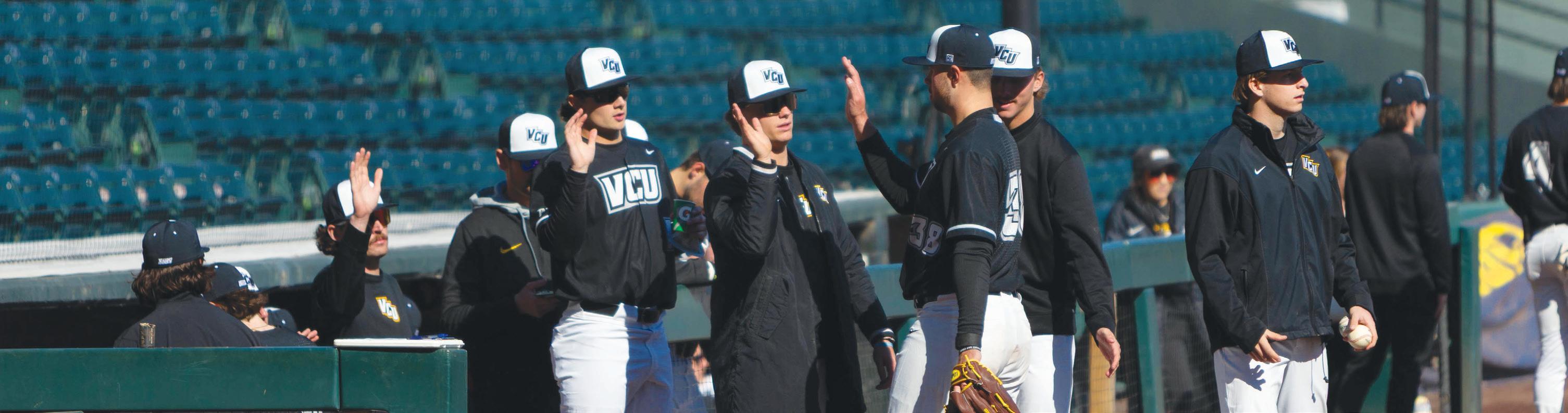
Rams congratulating each other during the game against Holy Cross on Feb. 13. Photo by John Brown.
Rams guard #34 Katarina Knezevic pushes the ball upcourt. Photo by Jonda Stephens.
Sports Under Martelli Jr., Rams showcase a faster, riskier play style
DREW THOMPSON Sports Editor
VCU men’s basketball is firmly in the Phil Martelli Jr. era as the season reaches its apex.
Martelli Jr. was brought in at the end of the last season after previous head coach Ryan Odom took a coaching job at the University of Virginia.
Martelli Jr. coached at Bryant University for two seasons — reaching the NCAA Tournament last season — before signing a six-year deal with VCU.
The Rams were a well-oiled machine under Odom, whereas Martelli Jr. ’s start of the season was rockier than fans have come to expect. The team is almost entirely different from last season, in terms of roster and play style.
However, VCU has flipped the script since starting Atlantic 10 play, currently on a nine-game win streak and sitting second in the A-10 only behind nationally ranked Saint Louis University.
Both this and last season’s teams were great around this time, so that brings forward the question: what difference has a year made for VCU?
The 2024-25 team was 20-5 and 11-2 in the A-10 at this time, and the 202526 team sits at almost the same. VCU is currently 20-6 and 11-2 in the A-10, however this year’s team has had a notably harder schedule.
The 2025-26 team has a slightly higherranked offense nationally, sitting at No. 48 in Kenpom compared to No. 51 last season.
However their defense is noticeably lower at No. 64 compared to No. 27 nationally.
The offense scores in much of the same way, shooting a large number of threes per game. About 48% of shots came from three under Odom compared to 44% under Martelli Jr.
The key difference in offense is the tempo. Odom played a more methodical approach, often letting the shot clock wind down over each possession. Martelli Jr.’s offense usually has shots going up earlier in the shot clock and more shots in the paint.
Martelli Jr. carried over the high-tempo style of play he employed during his tenure at Bryant. Odom played a slower brand of basketball, ranking at No. 246 in tempo, whereas Martelli Jr. has the Rams at No. 77 nationally.
Defense is where a lot of the difference lies. Odom made VCU one of the top defensive teams in the nation with many stats sitting in the 99th percentile on CBB Analytics.
Odom had teams shooting some of
Will the Rams run the table?
HAYDEN BRAUN Staff Writer
VCU faced a major overhaul this offseason with new transfers, senior players graduating and a new coaching staff. Many were optimistic for the Rams heading into the season; but figured it would be a rebuilding year after an inconsistent start.
Throughout the first 10 games, the Rams were sitting at 6-4. With losses to Utah State University, the University of New Mexico and two ranked teams being No. 25 NC State and No. 24 Vanderbilt. These games were competitive but exposed a lot of the Rams’ inconsistencies.
Now we are nearing the end of the season and the conversation feels almost entirely different.
VCU at the time of writing this is currently 20-6 and 11-2 in conference play sitting at second place right behind oneloss Saint Louis University who is 12-0 in conference play. The Rams are on a nine game win streak and look like the best team in the Atlantic 10 heading through this final stretch of games.
The turning point this season came when the Rams had back-to-back conference losses to Saint Louis and George Mason University back in early January. In both losses the Rams were shooting under 50% from the field and inconsistent on all fronts.
The Rams have caught fire after those losses. This version of VCU looks deeper and more reliable offensively than how they were playing earlier this season. The Rams have had numerous wins with multiple players in double digits. The breakout of second-year guard Terrence Hill Jr. has been key for the Rams’ success.
In conference play alone, Hill Jr. has posted multiple 20-point performances, including 24 against Loyola University Chicago and 21 against Duquesne University. Third-year forward Lazar Djokovic has matched that consistency, scoring 26 at La Salle University and 23 at George Mason earlier in the year, according to ESPN.
The remaining schedule will determine whether VCU can catch Saint Louis for the regular-season title. The Rams end
their worst numbers against VCU with suffocating defense. Martelli Jr. has aboveaverage numbers defensively in most stats, however they struggle with defending the paint.
This year the Rams are last in the A-10 for paint points allowed, opponents percentage of paint points scored and twopoint shot attempts per game.
VCU was the top team last season in the A-10 defensively in a majority of categories, whereas this season, it sits closer to the middle of the pack. This is seen best when comparing the average points scored a game by opponents.
Under Odom the Rams allowed an A-10 best 63 points a game, while Martelli Jr. ’s Rams allow 72.5 on average — ranking them in the lower half of the A-10.
Both teams are impressive and Martelli Jr. is undeniably looking to bring a second straight A-10 title to VCU. This season’s team is in the best shape right now to continue a push into the conference tournament and possibly secure a spot in March Madness.
the season with road games at Saint Louis and the University of Dayton, plus home matchups against George Washington University, Fordham University and George Mason.
The rematch at Saint Louis looms as the biggest matchup. The Billikens are 24-1 overall and undefeated in conference play. If VCU wants to claim the A-10 regular season crown, that is the game that must flip from the first matchup.
George Mason also returns to the Siegel Center on March 3. The Patriots handed VCU one of its two conference losses in Fairfax. Revenge at home could solidify the Rams as a top-two seed in the A-10 Tournament.
Realistically, even if Saint Louis remains perfect, VCU is positioned to finish no worse than second in the regular season standings. At 10-2 with six games left, a 14-4 or 15-3 conference finish is within reach.
As for the A-10 Tournament, VCU’s depth and current momentum make them a legitimate championship threat. The Rams have shown they can win in multiple ways, shootouts like the 99-73 win over Dayton or defensive grinders like the 63-59 victory at Fordham.
March Madness? That likely hinges on the conference tournament. Saint Louis’ 24-1 record gives it little room for error. VCU, sitting at 19-6 are going to have to win out.
The slow start feels like the past now. The team that dropped four of its first 10 games has evolved into one of the hottest teams in the conference.
If VCU can keep the momentum going, there’s a chance it can make a push this March.
GAME RESULTS
MBB AT LA SALLE UNIVERSITY WON 77-63 WBB AT RHODE ISLAND LOST 42-85
WTEN VS. THE COLLEGE OF WILLIAM AND MARY LOST 2-4
MTEN AT DAVIDSON COLLEGE WON 4-0
BASEBALL VS. THE COLLEGE OF HOLY CROSSE WON 2-1
BASEBALL VS THE COLLEGE OF HOLY CROSS WON 14-1 WON 19-7
WTEN AT EAST CAROLINA UNIVERSITY LOST 3-4
LAX VS. THE UNIVERSITY OF NORTH CAROLINA AT CHARLOTTE LOST 15-16
WBB VS. SAINT BONAVENTURE UNIVERSITY LOST 53-64
MBB AT THE UNIVERSITY OF RICHMOND WON 78-67
MTEN VS. GARDNER WEBB UNIVERSITY LOST 1-4
PRESS BOX
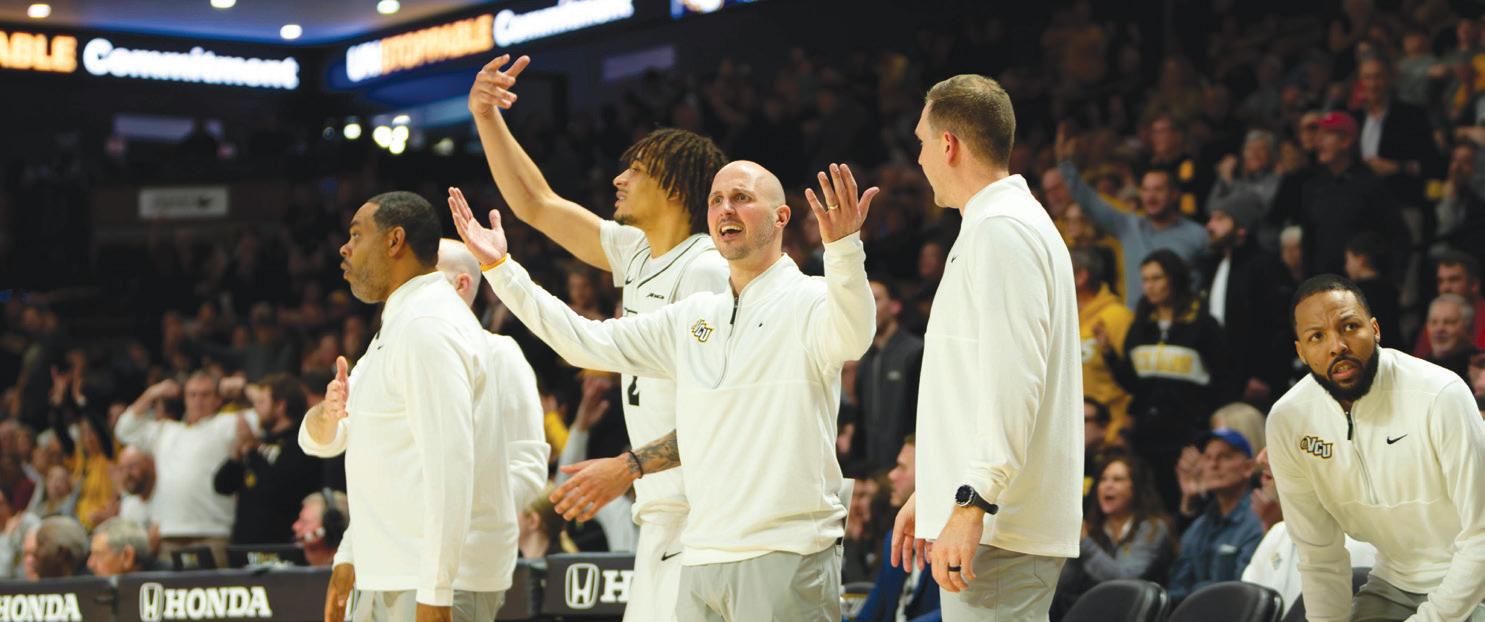
VCU Head Coach Phil Martelli Jr. visibly upset at courtside. Photo by John Brown.
Photo collage by Marty Alexeenko. CT file photos by John Brown, Jonda Stephens and courtesy of VCU Athletics.
On This Day
Spectrum Exposure screens films about Black cowboys at ICA
SAPPHIRA MOHAMMED
Copy Editor
JO STARKES
Contributing Writer
This month, Exposure Cinema presented “Nu West,” a series of films about Black cinema and the American West at the Institute for Contemporary Art. There is one screening left, and it is free to the public.
Exposure Cinema is a “collective cinematic investigation,” according to their website. Founder and VCU alum Brandon Shillingford got started in the film curating scene because, as an avid movie watcher, he wished there was a space for fans to talk
about movies after the showing.
Shillingford does not screen current blockbuster films. Instead, he does monthly screening events with movies from all eras of cinema centered around themes such as “bloodlines,” movies about Black vampires or “tekno erotica,” sexy sci-fi films.
“Nu West” is explained as “exploring the history, mythmaking and cinema that define the American West,” as stated on Exposure’s Instagram, and how it relates to the Black experience.
Shillingford explained that his childhood consisted of watching Western films, an experience he finds relatable to other Black people.
“I feel like if you’re like a Black person or anybody from a marginalized community in
On this day, Feb. 18, 2006, Shani Davis became the first Black athlete to win an individual gold medal in the Winter Olympics for men’s 1,000-meter speedskating.
America, it’s like ‘damn this is the medium — that’s so wonderful and there’s such possibility and like beauty to it,” Shillingford said. “There’s also a real history of violence and racism and misogyny and homophobia literally ingrained within the DNA of this medium, in America specifically, and that’s the tension I feel like is so key to the Western.”
Exposure Cinema has shown three of their four films in the “Nu West” series: “Buck and the Preacher,” “Nope” and “Thomasine & Bushrod.” Shillingford said the films have had a great turnout and were a success.
“The only problem is I wish I could play even more movies. I feel like there’s so many that could offer to this genre, I think would fit so well. But it’s exciting and I’m excited to kind
ICA immortalizes art exhibitions through publishing house
DEVYNN ALSTON
Contributing Writer
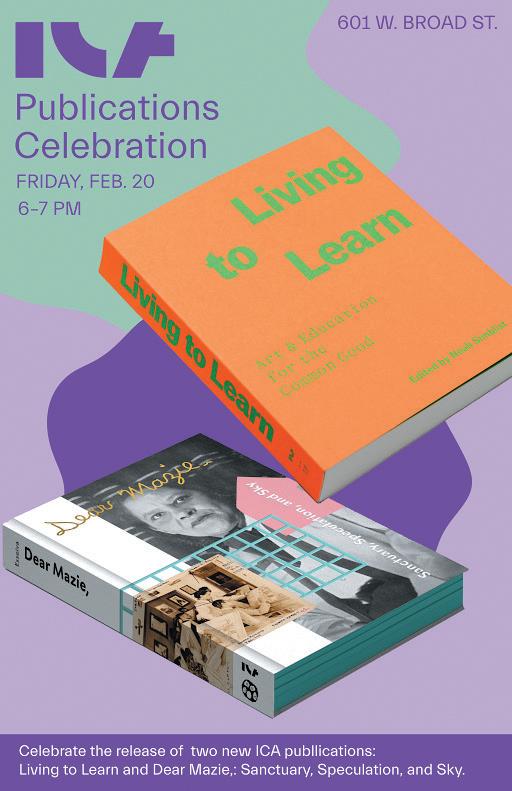
The Institute of Contemporary Art at VCU is hosting a reception to celebrate the release of two books from their publishing house on Feb. 20 — bringing art off walls and onto book pages.
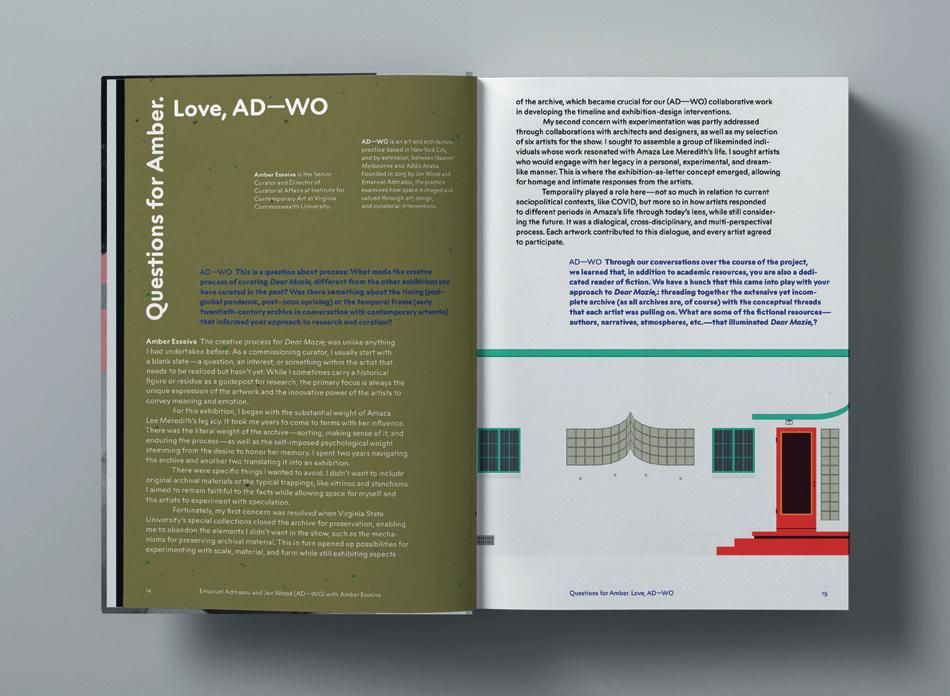
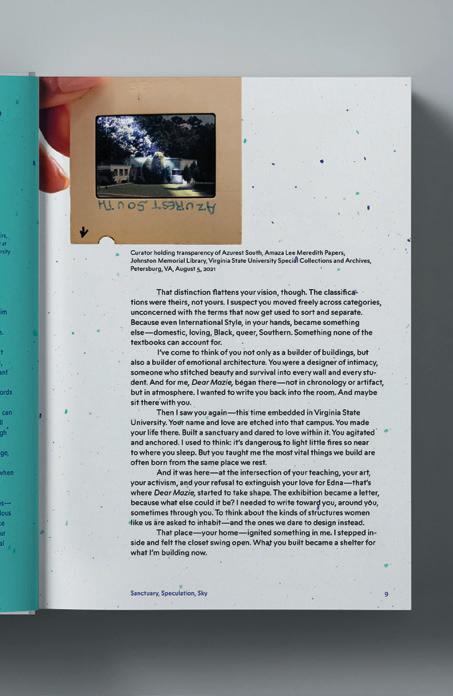
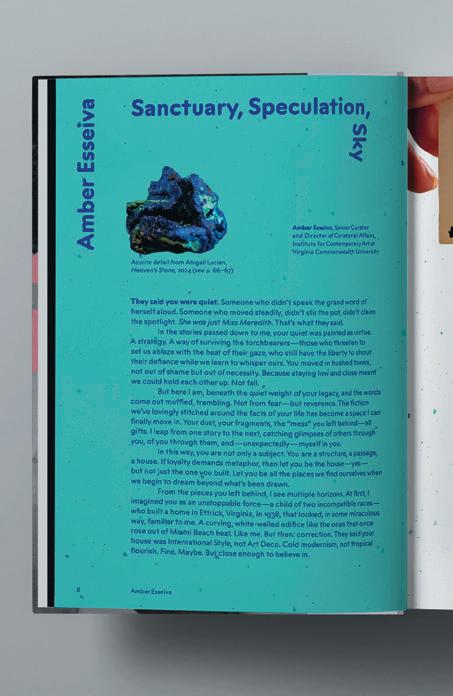
The two books featured are “Living to Learn: Art and Education for the Common Good,” by Noah Simblist, an associate professor at VCUarts and “Dear Mazie: Sanctuary, Speculation, and Sky,” by Amber Esseiva, a senior curator at the ICA.
Both Simblist and Essevia chose the ICA as their publishing house because of the connections they have to the institute.
The ICA is considered an academic museum that looks to combine art and education, according to Simblist.
“It’s a kind of project that makes sense to them [the ICA] because some museums put on shows for a general public. But, there’s an opportunity for a museum that’s inside of a university tied to scholarship and research that other public space might not be as invested in,” Simblist said.
The institution is not a large publishing house — both authors were editors of the books and outsourced the rest of their publishing processes.
The two books are meant to be seen
as extensions of the exhibitions they highlight. Living to Learn, highlights how artists over the last 25 years turn their exhibitions into schools.
“Dear Mazie is a book that followed a multi-site exhibition, also titled Dear Mazie, where a group of artists, architects and designers were responding to a legacy of a mausoleum narrative, which was the late Black, queer architects from Virginia at Virginia State University,” Esseiva said.
Creating books from exhibitions gives them longevity, as after an exhibition is completed, all the records of the work in it are gone, other than viewers’ memories and photos. That is why it was important to immortalize “Dear Mazie,” Esseiva said.
The idea for the book “Living to Learn” came from the desire to have an expansive project — called a triennial — that includes an exhibition, a conference and a publication with projects throughout the whole city with a primary theme of education, Simblist said.
Both books look to give the exhibition views an expanded view of the works they saw, as well as providing deeper understanding of the work.
ICA publication celebration will be Feb. 20 at the ICA from 6-7 p.m.
of explore a little further,” Shillingford said.
“Thomasine & Bushrod,” is a 1974 film directed by Gordon Parks Jr. Following the whirlwind, crime-fueled romance of the titular characters. The movie has anti-racist and anti-capitalist themes.
The founder of Ours, a co-working and community space in Richmond, as well as Shillingford’s roommate, Sam Taylor attended the Tuesday screening and felt that the movie was beautiful. He enjoyed the simultaneous modern and nostalgic feelings the film produced and said it captured the themes of Nu West perfectly.
“Being able to have the chance to see movies that I may not have seen otherwise, that we don't always get exposure to. I think just the premise of that is what makes it stand out to me,” said Trejahn Chauncey, another attendee at the screening.
There is one film showing left: “To Sleep with Anger” on Feb. 25. It starts at 6:30 p.m. To get tickets, visit https://exposurecinema.org/ about. Walk-ins at the ICA for the screenings are also welcome.
The cover and mockups of “Dear Mazie: Sanctuary, Speculation, and Sky,” an ICA publication by Amber Essevia.
Pictured top right is the flyer for ICA’s publication celebration. Photos courtesy of the Institute of Contemporary Art at VCU.
Flyers for the ‘Nu West’ film series presented by Exposure Cinema.
Photos courtesy of the Institute for Contemporary Art at VCU. Collage by Quinn Lysek.
RVA Spotlight Need a post-Valentine’s Day date? Snag a reservation or brave a wait and head on over to Lillie Pearl’s new location on Brook Road for a yummy brunch, lunch or dinner from one of Richmond’s favorite Black-owned restaurants.
Features Richmonders curb corporate consumption through ‘Barter Markets’
RACHEL NICHOLAS Staff Writer
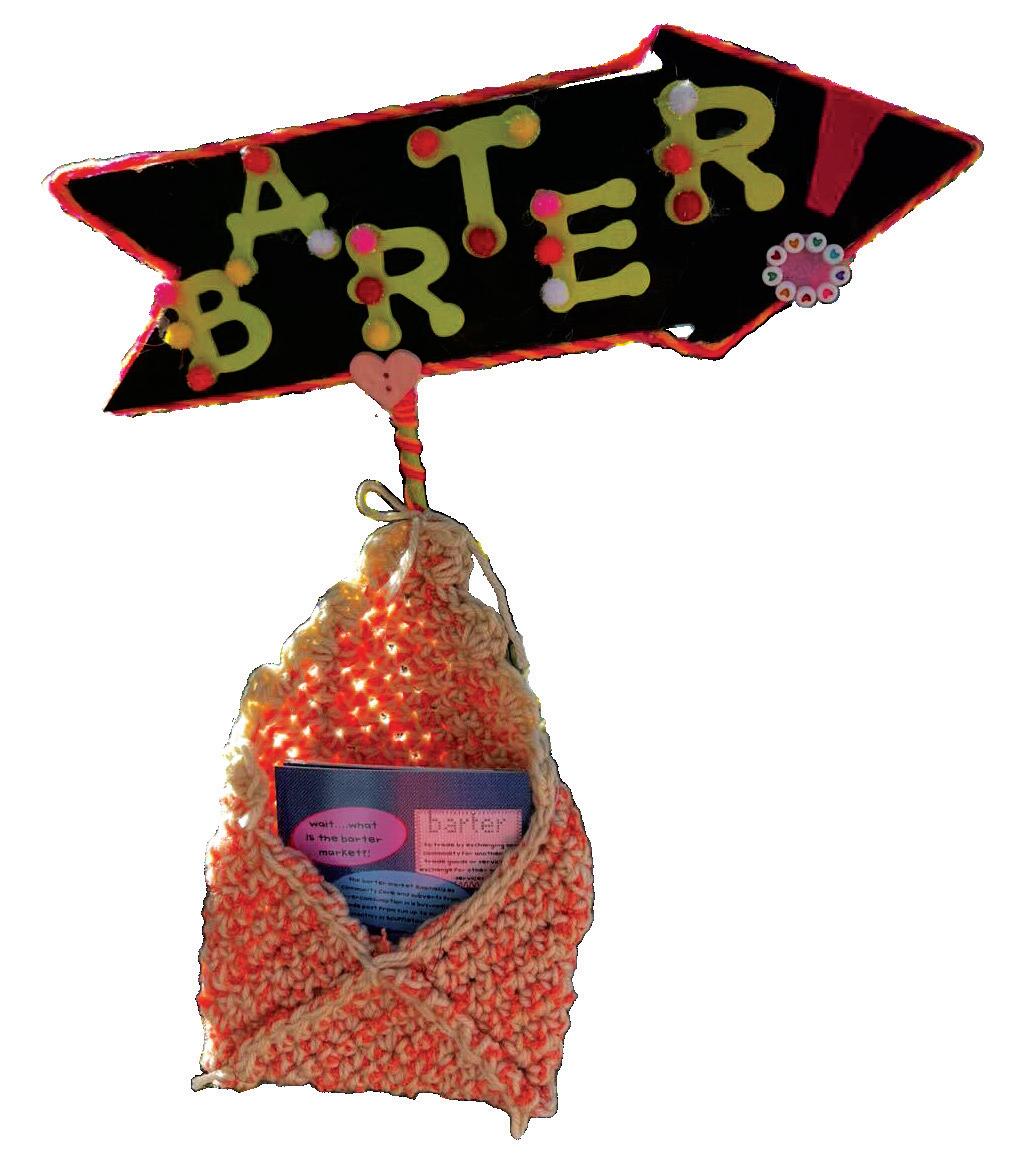
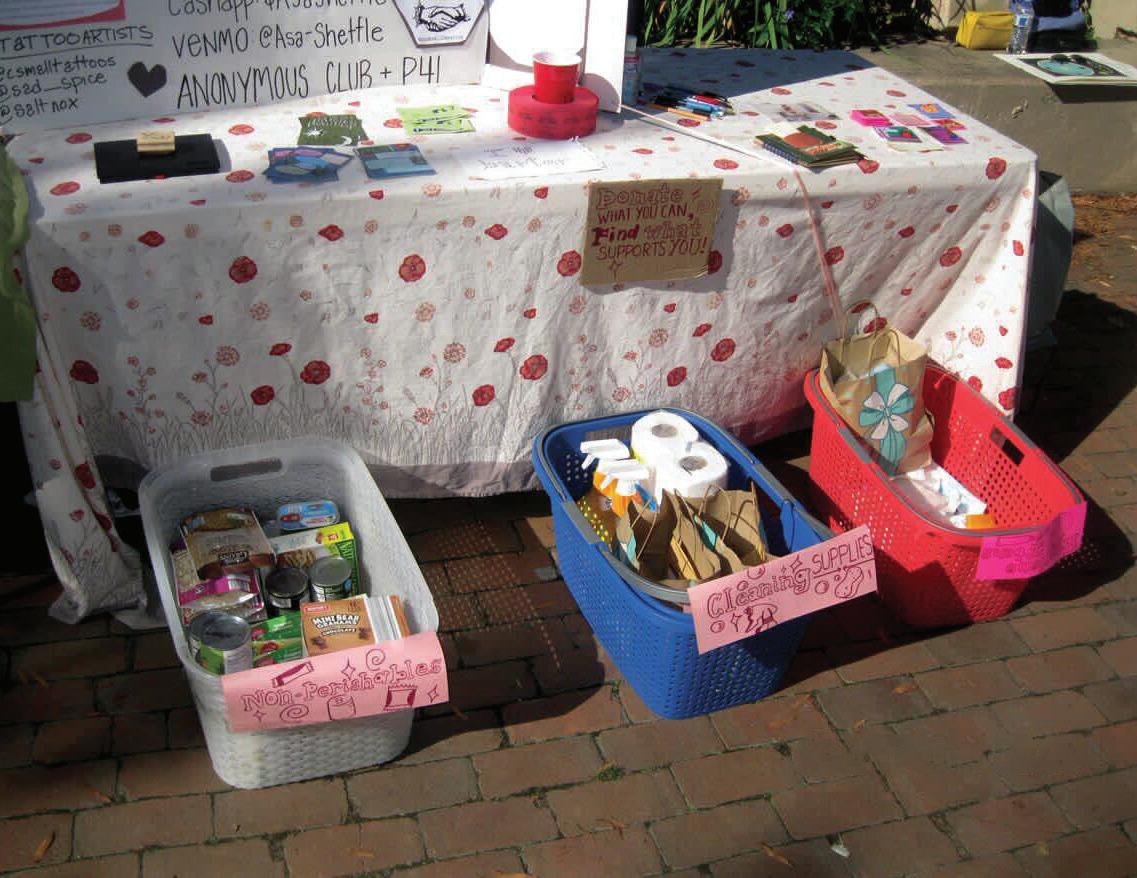
One man’s trash becomes another man’s treasure at Richmond’s Barter Markets — a reoccurring gathering rooted in camaraderie and sustainability hosted by the Anonymous Club.
The markets — in which barterers trade whatever they have for whatever they want — were created as a protest against corporate consumption amid the genocide in Gaza. The next one is on Feb. 21.
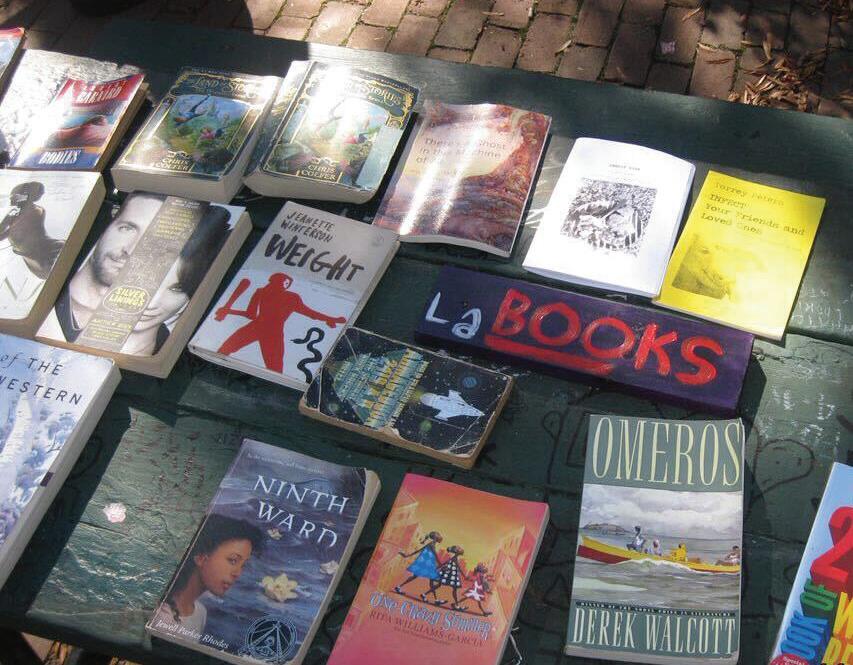
Tables of books, clothes, trinkets and more will span the Warehouse 317 Collective building, a hub built by artistic professionals for all things creative, as Richmonders exchange their unwanted items for whatever catches their eye.
“It was really cool to see, although at first I didn’t know what it was,” Richmond native Sophia Nealy said. “But once I realized it was a place to exchange items without having to pay, I was instantly drawn to it.”
Nealy went to the Anonymous Club’s November pop-up, which marked the fifth Barter Market by the group. As a big thrifter, she was happy to see the array of items that were on display, particularly the clothing, which she noted ranged across several different aesthetics.
“My friends and I love to go thrifting, you know?” Nealy said. “I thought it was pretty unique how literally anyone could bring their clothes and I could just take it. There were boots, jeans, t-shirts and a lot of stuff I probably would’ve spent hours at a shop looking for if I didn’t find them here.”
going to work, but when we did the first one in April of 2025, we felt that it happened very naturally,” Lumpkin said.
Lumpkin further noticed that many people had not wanted to take anything for themselves, but chose to donate items ranging from clothes to household items such as detergent.
“I think it broadened people’s minds to the idea of overconsumption and what value means,” Lumpkin said. “When you’re at the market, you stop and think ‘Oh, I was gonna go to Goodwill or Walmart, but you end up getting it for free.”
Through the market, Lumpkin has met and collaborated with members of other organizations, often sharing ideas and resources as a “network of activists.”
Eden Larkin, a member of Mutual Aid Distribution Richmond (MADRVA), a community-run aid service, began attending Anonymous Club meetings around mid-summer of 2025 before later becoming involved in the planning for the market.
Experiences like Nealy’s highlight the community interaction and accessibility the creators of the market hope to establish.
Bear Lumpkin, half of the founding duo that created the Anonymous Club, traces their start to October 2023.
“We started back when everything in Palestine started to ramp up,” Lumpkin said. “We were having a hard time grappling with our place in that, and we wanted to figure out something we could do to change the way we normally thought about resources or community.”
The idea behind the Barter Market was to avoid using corporate businesses like Goodwill and other donation services. Without the middle man, people are free to come together to trade and exchange however they want without the prices, Lumpkin said.
Initially, Lumpkin was worried about the overall set up of the market — how it would work and if people would know how to trade in a society where money is the ultimate form of exchange.
“At first, we weren’t sure how it was
“I was told about the club and the market by mutual friends,” Larkin said. “It was a nice way to decompress and talk to and hang out with new people, plus sharing items I no longer had a purpose for, got to be put in better hands.”
Larkin has designed several of the flyers for the event, emphasizing the importance of caring for the community.
“During unpredictable times, a community space needs to be created,” Larkin said. “It can be hard to know where to start with mutual aid, and this is just one event among many initiatives in the Richmond area. Everyone has something to contribute, and this is just one example.”
The Barter Market has gained enough traction within the creative world of Richmond where the current upcoming location, Warehouse 317 Collective, is hosting the market for free.
As an all-day affair now being held indoors, they have more space and room to set up without the worry of the winter cold nipping at the market-goers.
Many community members and collaborators hope that the Barter Market isn’t just an exchange of goods, but an exchange of ideas. In a world driven by consumption and price tags, the market stands as a reminder that building community and helping the environment does not have to be transactional.
What began as a small effort by the Anonymous Club to grapple with injustice continues to thrive as a local movement rooted in uplifting the environment and unifying communities, one trade at a time.
An attendee shops - or barters - for unique items at Anonymous Club's 'Barter Market.' Photo courtesy of the Anonymous Club.
At VCU, Jewish students search for unity in wake of Gaza protests
Continued from front page
Richmonders and VCU students began regularly protesting against the genocide in the weeks after Oct. 7, culminating in the April 2024 encampment protest that turned violent — riot gear-clad police arrested 13 people, injuring some students and spraying others with chemical irritants, according to a previous report by The CT.
Protests continued to a less-frequent extent the following academic year — after VCU changed its Campus Expression and Space Utilization policy — and another student was arrested in a demonstration echoing the 2024 encampment.
The Progressive Jewish Student Union was created in 2023, shortly after Oct. 7, as a space for those in the faith with different viewpoints on the attack.
The completely student-run organization was founded by the former presidents of Jewish Life and Hillel — both of whom left their organizations after facing exclusion and harassment for their ProPalestine views.
The Progressive Jewish Student Union is now led by Joseph Friedman, a fourthyear sociology student. They hold their own movie nights and holiday celebrations — on top of regularly protesting with organizations such as Students for Justice in Palestine.
“This is a point of fundamental disagreement, and so I wouldn’t affiliate with or be in an organization that supports the crimes against humanity committed by the state of Israel,” Friedman said. “We think that there should be spaces where you can be Jewish or for non-Jews that are curious about the culture and stuff that aren’t Zionist spaces.”
Zionism is defined by Merriam-Webster as “an international movement originally for the establishment of a Jewish national or religious community in the historical region of Palestine and later for the support of modern Israel.”
Hillel at VCU — which markets itself as being for “all kinds of Jewish” students — is a chapter of a Zionist organization on the national level. They provide opportunities to students such as the Birthright program, which sends students on free 10-day trips to Israel.
Sheri Rodman is the executive director of VCU’s Hillel chapter. She said they are not a hateful group.
“I’m a proud Zionist,” Rodman said.
“I don’t think that makes me mean or not supportive of Palestinian people. I think that word has become derogatory and people are confused by what it is and what it means.”
Hillel, established as a non-profit organization in 2023, has been a presence at VCU for over 50 years, according to Rodman.
Rodman said she does not want Jewish students to shy away from the topics of Zionism or Palestine while attending Hillel events. Instead, she wants them to have the difficult conversations — rather than finding information online or from less-informed people.
Dylan Cohen, a second-year music student and the social chair for the chapter, believes many of the student protests have had antisemitic themes. He said students are misinformed about Jewish people as a whole.
“People pinpoint issues that involve Jewish people so that they can reflect their antisemitism in other ways that have new words like ‘anti-Zionism,’” Cohen said. “And that also hurts us.”
There has been contention between Jewish Americans on what does and does not qualify as antisemitism. Some believe common protest chants like “from the river to the sea, Palestine will be free” are antisemetic because they imply the erasure of Israel as a nation.
Some Jewish Americans believe Zionism is a racist movement that excludes Palestinians. For others, Zionism and Israel are inseparable from their religion and culture.
After initial protests against the genocide in Gaza, former Republican Virginia Attorney General Jason Miyares opened a probe into VCU to address the “rise in antisemitism on campuses,” according to a previous report by The CT.
The following semester, Miyares sent a directive to Virginia universities that resulted in them limiting protest activities under new campus speech, expression and use of space policies.
Third-year forensic science student and Hillel intern Gabby Miller said since the Oct. 7 attacks, she has felt uneasy on campus as a Jewish student.
“I 100% support people fighting for what they believe in, but it can be difficult to know everybody else’s intentions,” Miller said. “Like a few weeks ago, I was walking in one of the residential areas, and there was some antisemitic thing written in sidewalk chalk near one of the elementary
schools around here.”
Miller has been a member of Hillel since her freshman year. She felt it was a better fit for her over Jewish Life — or Chabad — which she thought was looking for conservative or Orthodox Jews. Miller is a Reform Jew.
Jewish Life is a part of Chabad Lubavitch, an international Jewish organization with approximately 6,000 emissaries. Its mission is to create homes for Jewish people around the world, according to the VCU chapter’s director, Rabbi Menachem Lessoff.
Lessoff and his wife Daniela have run Jewish Life at VCU since 2023. Lessoff, who is originally from Israel, moved to the United States after getting married. They chose to lead a Chabad in Virginia, where they have family.
The VCU chapter was previously run by the regional Chabad emissary, who left for unknown personal reasons.
“Right after Oct. 7, we felt like there was a need for Jewish voices, over politics, as a safe place for students, a place that they can feel comfortable, a place that they can identify who they are,” Lessoff said. “That’s one of the motives that told us ‘you got to go over here and create a safe space above politics, connecting between the sides and bringing every Jewish student together.’”
VCU alum and former Jewish Life chapter president Lindsey Adams said the organization has a ‘no politics’ rule if things get heated in discussion, in order to keep the peace.
“I feel really grateful to have the Rabbi we have because there are times where we’ve had students who don’t necessarily all agree on something, and he’s always made it such a vital point to ensure that everybody is included and invited back always,” Adams said. “Even if you had an issue with another student, it does not matter — you are welcome here.”
Another VCU alum, who requested to remain anonymous, correlated the divide among Jewish students on campus with the divide between Gen-Z Jews who wanted to erase their ties to Israel and those who stayed loyal to the state after the Oct. 7 attacks.
“It’s hard for people to pick sides, and Americans in particular who have listened to the stories of their parents and their grandparents, have an even harder time because of that,” the anonymous alum said. “It’s hard to digest that you can be harming another person or your people can harm another person.”
The anonymous alum is half Jewish and half Egyptian with a Palestinian stepfather. While their opinions on Israel and Palestine are complex, the reason why they never joined Jewish organizations during her time in college was simple: they are ethnically Jewish, not religiously or politically.
“They didn’t feel right to me, because most of them are either religiously or politically affiliated, which I don’t want anything to do with,” the anonymous alum said. “There’s not really a space where you can be Jewish as an ethnic Jew, without it being intertwined with Israel in some way.”
One of the anonymous former Jewish student organization leaders said they found their time on campus after Oct. 7 to be extremely difficult.
While the alum’s former organization was respectful of their pro-Palestine and anti-Zionist views, another student from another organization called them antisemitic. That student allegedly reposted their Instagram stories to an anonymous forum, where users called the alum, then a student, a terrorist.
The anonymous alum said their organization tried defending them, but asked them to act as a shadow president where they would take their contact down from their sites and have them still act as president. The alum decided to step down after the request.
“I felt deeply betrayed, because I felt deeply connected to my Jewish identity and also deeply rooted in my beliefs as an antiZionist, and it felt like I was being asked to choose which was more important, and like I was being pushed out for holding that belief,” the student said.
While the anonymous alum’s views can clash with other members of Jewish organizations, the alum has since gone back to attending gatherings because of their love for their religion and community.
“Ultimately, community is necessary. We need Jewish community and people need to feel like they belong, if not in one space then in another,” the anonymous alum said.
Exactly 1,543 people in the U.S. have reported antisemitic offenses in the past year, according to the FBI. Students who have been victims of hate crimes can visit https://www.justice.gov/hatecrimes/ victims for help.
EDITOR’S NOTE: The CT made the decision to leave certain sources in this story anonymous to protect them from possible reprimanding or retribution from their communities and organizations.
Per a previous staff editorial, The CT style guide requires Israel’s actions in Gaza following Oct. 7, 2023 to be referred to as the “genocide in Gaza.”
JEWISH VCU
A menorah statue outside the Chabad building at VCU.
Photo by Catt Brito.
CHECKMATE A look into Richmond’s vibrant chess scene
MAEVE BAUER Spectrum Editor
CORA PERKINS Assistant Spectrum Editor
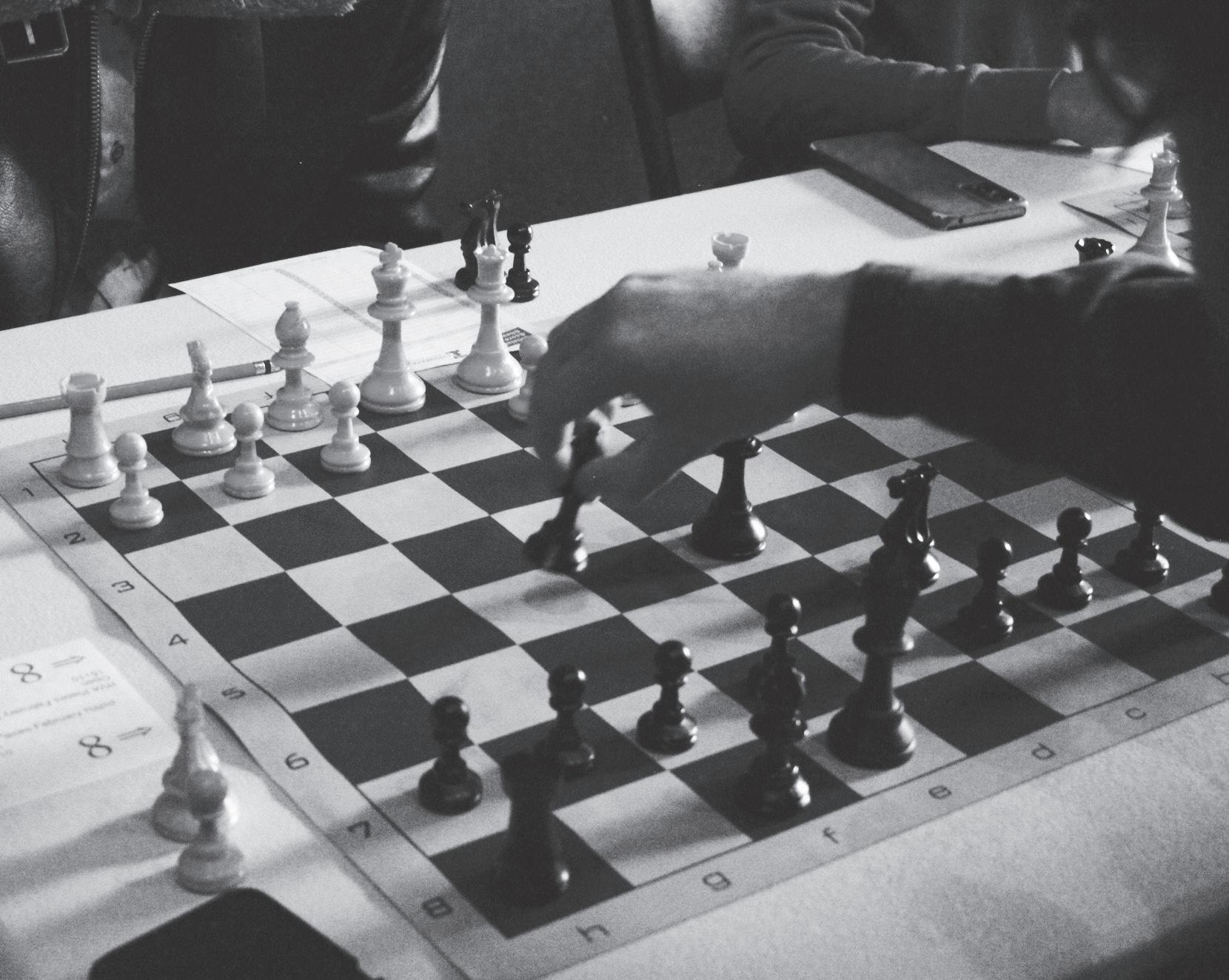
Chess is a game of patience, skill and quick thinking. Enthusiasts of the game from across Richmond gathered at the Black Iris club and gallery on Sunday to participate in a tournament of one of life’s most ubiquitous games hosted by RVA Pieces.
It was RVA Pieces’ third chess tournament at the Black Iris — and they have plans for more.
The game of chess has evolved across cultures since the sixth century, first enjoyed in India, then Persia and the world — even in Hollywood on the Starship Enterprise and Millennium Falcon. Chess is as universal as brushing your teeth.
Snuggly located to the right hand entrance of Cabell Library are chess boards for any passer by in the mood for a quick game.
Richmond’s chess scene is quite vast, with a good mix of children, college students and other age groups, according to Spenser Kearns, the president of RVA Pieces.
Kearns’ organization hosts three to four events each week that cater to people of all skill levels. They also play casual games at different bars and breweries, games in parks, lessons in libraries and tournaments at the Carytown Publix, according to Rvapieces.org.
“There’s different kinds of chess players, and some people don’t want to play in a bar and some people only want to play in a bar,” Kearns said.
Kearns touched on some of the social aspects of chess. He met a lot of friends through the club, including his girlfriend.
In the past there have been alternative chess gatherings such as the group Freak Chess who once threw a chess rave. They have been inactive since October.
The tournament
On a quiet, rainy Sunday morning, the dark gallery walls of Black Iris stood covered in works from local artists.
As members of RVA Pieces set up for the game they made subdued conversation and shared anecdotes — less of a club and more of a group of friends sharing their weekend together.
Players in the tournament ranged from elementary-aged children to seasoned players who have been playing since before their opponents were born. A handful of players started out in their youth, including Kearns who has played since he was six-years-old.
The game was not United States Chess Federation-rated and was played in the Swiss system, meaning there were five rounds with no eliminations. There was a chess clock in use, and each game spanned 15 minutes with 10 seconds allotted for each move.
With the game unrated, competitors were playing for the love of the sport.
Chess player and attendee Ethan Halfhide has been playing chess on and off for about five years, but started taking it more seriously this year.
“I like how it’s a good life skill. Like, second-order thinking and stuff like that. It’s a good way to run that,” Halfhide said.
In between rounds, opponents collaborated to examine their games, discuss their strategies and take notes on how they can improve.
Jackson Allen is a second-year mechanical engineering student, a member of the VCU Chess Club and RVA Pieces, said discussing the games afterwards can be helpful for particularly complicated matches, which is his favorite part of the game.
“I like how a simple-looking game with simple enough rules has so much detail and fine print. And I like how there's endless depth to be explored,” Allen said. Allen’s strategy focuses on the beginning moves, finding the game easier when you start off the right foot.
The tournament was played in two sections, one aimed toward players that are just starting out, who have a rapid rating under 1,300 on chess.com — a way of categorizing players based on their scores in quick chess matches.
The under 1,300 section ended in a fourway-tie between Liam Rowell, Eli Farley, Luce Mckown-Dawson and Jeremiah Hick-Whitaker.
Hick-Whitaker is 12-years-old and the tournament was his first time competing in a tournament. He was introduced to the game by his dad and continued to learn from his uncle. Hick-Whitaker likes how the game can be played by anyone.
“I like how it’s complicated but it’s also simple at the same time and how almost anybody could do it. It’s not like fighting with boxing where some people just can’t do it,” HickWhitaker said.
Hick-Whitaker wants to compete again and said he might get sponsored to go to a rated tournament.
The other section was open to all, including beginner-level players. The winner for that section was Noah Oneill, who ranks no.73 in Virginia, according to USchess.org
For those who want to learn the ancient game of chess, RVA Pieces hosts beginner classes at the Main Branch Library, 101 E. Franklin St. It is free and open to all, running from 1 - 4 p.m. every Saturday. Options for private lessons can also be found on their website.
Players compete against one another in a five-round chess tournament
by the
hosted
RVA Pieces Chess Club at the Black Iris Social Club on Feb. 15. Photos by Catt Brito. Collage by Raya Freeborn.
Opinions
Quote of the week
“Things change. And friends leave. Life doesn't stop for anybody.”
— Stephen Chbosky, The Perks of Being a Wallflower
Richmond Free Press Thank you,
THE COMMONWEALTH TIMES STAFF
Last week, the Richmond Free Press, the city’s decades-old, free Black-run newspaper, closed up circulation and released its final issue.
The Richmond Free Press has served the community with quality, principled news since 1992. It was created to “empower its readers,” as once said by its legacied founder Raymond H. Boone Sr., who passed away in 2014.
Boone created the Richmond Free Press as an alternative to a media environment that was then failing to capture the full picture, according to the paper’s final frontpage article.
“Newspapers, to a large degree, ignored the principles of journalism, of being fair,” Boone said. “Instead, they promoted segregation, and they promoted what was popular, rather than honoring the First Amendment, which stands for giving free expression to all segments of the community.”
Boone and the Richmond Free Press
staff provided an avenue for underserved community perspectives — all while braving hostility from whiteowned publications and some community members when it launched.
To put it simply, the Richmond Free Press was an absolute institution in the community. It highlighted stories that would not typically receive the same attention from the media.
At a time when most newspapers were experiencing layoffs and declines in readership, the Richmond Free Press was only growing, with a readership of more than 135,000 and a circulation of more than 35,000, according to its website.
The newspaper shuttered not because of a lack of a need, but because it no longer had the advertising support to continue, according to a Facebook post by Boone’s wife and the newspaper’s last publisher, Jean Boone.
The Richmond Times-Dispatch — the city’s printed paper of record — has grown increasingly inaccessible under its corporate owner. And The Commonwealth Times,
while we do our best, is largely catered toward VCU students and can only be found in particular parts of town.
The Richmond Free Press should be celebrated for its longstanding commitment to service and accessibility.
In its later years, the Richmond Free Press did not appear to be immune to the same tight budgets and layoffs plaguing the news industry.
It should be noted that the Richmond Free Press picked up plenty of studentwritten stories by VCU Capital News Service. The newspaper reposted stories by The CT on social media very often — for which we are thankful.
The Richmond Free Press was a training ground too, having highlighted so many student journalists looking to get their start. They platformed us, therefore we should honor them.
The sunsetting of the Richmond Free Press is a gut-punch reminder why people need to protect local news media.
Anyone who hopes to live in a free democracy has a responsibility to support
the outlets still standing, as well as the new outlets springing up from the ashes.
At the same time, local media — be they print, broadcast, digital, for-profit or nonprofit — have a responsibility to follow in the footsteps of the Black-run news outlets that pioneered the journalistic ethical principles we adhere to every day. Represent the unrepresented. Give a voice to the voiceless. Serve the people in your community. We at The CT do our best to follow those precedents every day.
“If a newspaper is only looking at its bottom line, it is looking too low.” — Raymond H. Boone Sr., founder of The Richmond Free Press
EDITOR’S NOTE: Staff editorials by The Commonwealth Times are written and edited by all members of staff. The content of editorials is voted on by staff members and must be unanimously agreed-upon ahead of publication.
Illustration by Zoë Luis.
Communities need to be built on collective care, not collective rage
URJITA MAINALI
Contributing
Writer
On Feb. 1, I joined my mother in paying respect to the venerable monks conducting the Walk for Peace. Just outside the city limits in Chesterfield, the usually empty
streets were filled with people carrying flowers and gifts, helping direct each other and traffic towards the path the monks would walk.
The next day, despite the biting cold and lingering ice, thousands of people filled the streets of Richmond as they
joined the monks on day 100 of their 2,300 mile journey. Their mission — to spread awareness of inner peace and mindfulness — has reached thousands of people across the nation and has brought communities together.
The venerable monks and their mission mean a lot to me, both religiously and culturally, but I was still shocked to see how many people were moved by their efforts. I couldn’t help but wonder why their message had resonated so deeply with so many people in so many different places.
In recent years, there’s been growing discussion about the effectiveness of peaceful demonstrations. While those questions don’t have easy answers — if any at all — I do know that within the reality of state-supported brutality, peaceful demonstrations are turned violent. Like many others, I have heard and felt how many such demonstrations have fallen short, often leaving participants and observers with a distinct feeling of hopelessness.
But the monks’ mission felt different — why?
Strangely enough, I found the answer in Bad Bunny’s Grammy acceptance speech. Accepting the award in a bulletproof vest — if the rumors are true — the artist took the moment to address the hurt and panic caused by the actions of Immigration and Customs enforcement, or ICE, across the country. He ended his speech by urging the audience to resist hate, which will only breed more hatred.
“If we have to fight, we have to do it with love,” the artist said.
For many people my age, it seems as though we, as a culture, have been angry forever. I’m not the first to say that it’s almost impossible to escape manifestations of hatred or anger, whether it be in-person or online. It’s near ubiquitous to our current cultural landscape.
That same anger and rage is what often fuels so much of our protests and political
movements. Surges of momentum are born out of moments of rage (think Liam Ramos and Renee Good). At first glance this seems obvious — protests are understood as expressions of grievances against unjust conditions.
But the call to action for love and peace by Grammy-winning artists to monks ask us: “what if we thought about protests differently?”
The impact of the Monk’s commitment to peace comes not in spite of violence, but because of it — because “the only thing more powerful than hate is love,” as Bad Bunny urges us to remember.
Our resonance with that great demonstration of peace and with Bad Bunny’s work and words is, in itself, a demonstration of our cultural need (and perhaps desire) for a change in the way we think about political action.
Rather than tying our aspirations and ambitions to our rage against systems of oppression, they are better served rooted in care, love and respect for the ones they hurt. Not only is it better for us emotionally and mentally, but it is far more effective in sustaining a movement and achieving its goals.
So many times I have heard of movements quickly burning out, dismayed by the often distressing reality of organizing for change. When people are able to continue this work, they don’t cite their motivation as anger — they will tell you about a person whose life they changed, who they loved or who is depending on them to keep going.
Communities are not built through collective rage, but through collective care for one another. Not one of us can stand up to an oppressive structure alone, and none of us can take it down overnight. But we can still take care of and protect each other, and when that time comes, it won’t be from anger towards the government, but out of care and respect for your neighbors.
For Richmond to thrive, Mayor Avula must put plans into clear action
KATIE MEEKER
Opinions & Humor Editor
This January marked the one year anniversary of Dr. Danny Avula’s ascension to Richmond’s mayoral office. He inherited a government rife with corruption and a city teeming with issues ranging from steep housing costs to aging public infrastructure. Restoring and reviving Richmond was never going to be an easy task. The city
made that apparent when, during the first week of Avula’s term, a winter storm wiped out the city’s water treatment plant, leaving people without water for nearly a week.
The desperate scramble to not only solve the issue, but assure Richmonders of City Hall’s competency, has set the tone for Avula’s tenure as mayor, which has remained consistent.
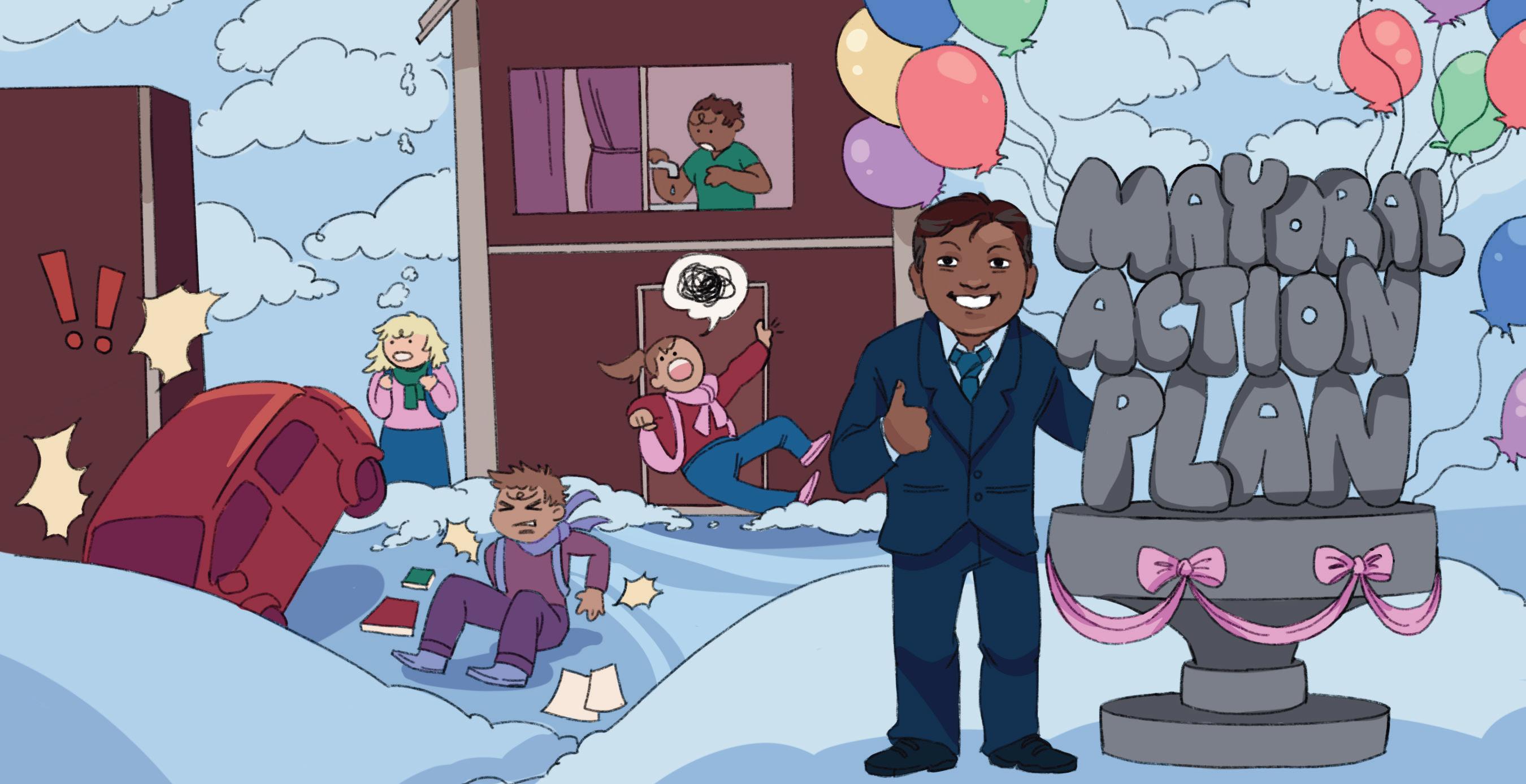
In October 2025, Avula unveiled a 25page strategy document called the Mayoral
Action Program, or MAP. The plan outlines a few goals — which includes developing accountability within City Hall, meeting housing needs and supporting families — and set a series of metrics to measure the city’s progress.
The announcement came with much fanfare and excitement, despite still being somewhat vague, aspirational and a continued work in progress. In many ways, the MAP doubles as both an actionable item
and a way for Avula to move past the longterm struggles that have thus-far defined his term as mayor.
While Avula’s promises — both within the MAP and those from his initial mayoral campaign — are big and flashy, we unfortunately have yet to see many of them come to full fruition.
Story continues on next page
Illustration by Anne Wu.
Illustration by Zoë Luis.
The lack of obvious progress has been frustrating, especially when compared against the success of New York City’s new mayor and Democratic darling, Zohran Mamdani, who has made good on many of his campaign promises in less than two months into office. Mamdani has proven that effective and quick progress can be achieved in local government, setting the bar high for other blue city mayors across the nation, including Avula.
Not every Mayor is Mamdani — and Richmond isn’t New York. Mamdani is also working under a Democrtic governor, whereas Avula spent his first year under former Gov. Glenn Youngkin.
But there are certainly notes to be taken both on the swiftness of Mamdani’s actions and his ability to communicate — or show them off — to the public.
We are only a quarter of the way through Avula’s term, to be fair, and many of his major projects are still in their infancy. Most of the progress he’s made has been internal; departmental overhauls, budget reallocations and restructuring communication and collaborative practices. Avula has had substantial backwork to do cleaning up City Hall, including leftover issues from former Mayor Levar Stoney’s administration. Stoney was notorious for his large array of incomplete, grandiose projects, such as the failed Navy Hill Development Project and his plan to build a $562 million casino-resort that was rejected by Richmond voters two years in a row.
It was Stoney’s prioritization of flashy projects over maintaining basic tasks of government — such as repairing the city’s water treatment facility — that got
Richmond into trouble beyond his tenure. Avula needs to make sure he does not make the same mistakes.
Smaller-scale issues related to city services and public utilities are continuing to crop up across Richmond. Sanitation service have been inconsistent, especially after bad weather. Utility bills have been delivered incorrectly. Roads and sidewalks remained unnavigable for weeks after winter storms.
The MAP, while a good step forward in encouraging transparency and accountability within City Hall, is an example of an issue that has plagued Richmond for years: theatrics over action. Richmonders don’t want or need fanfare — we just want to be able to live in a city where we don’t have to worry about whether or not the water is running.
“Every day I am focused on building a
thriving City Hall that stewards resources responsibly, meets community needs and earns the trust of residents, including VCU students,” Avula stated in an email to The CT. “Change won’t happen overnight but through steady, consistent progress, I feel confident that we will deliver smooth, reliable city services that Richmonders deserve.”
Year one of Avula’s tenure laid a foundation for him to start acting on his promises to create a better and thriving Richmond — let’s hope that year two and beyond see those promises realized.
Art
KYLIE GRUNSFELD
Contributing Writer
There’s a certain feeling of magic in the air at a Richmond house show. I can’t say for certain what everybody else is feeling when we sit around listening to someone’s performance. I do know, however, that we are all feeling something.
and poetry readings. Art gives us the space to feel in the presence of others. As quiet as an event may be, the energy is never static.
I encourage everyone reading to attend an art-related event, even if it’s not something that you consider “up your alley.” Even if you don’t know anyone going, even if you feel out of place, it’s so important that we build and maintain a community around art.
is essential to life and resistance
That is what great art can do — unite a room of people through the shared human experience of emotion.
Since my freshman year at VCU, I have had the privilege of both attending and performing at several house shows. A good friend and I started a tradition of hosting small acoustic shows in her apartment. Since that first show last year, attendance has grown rapidly, with people from other cities coming to sit and listen for an hour or two. I’ve seen old friends reunite. I’ve even seen people fall in love.
There is nothing like the community an intimate event like this provides. This goes for more than just music — I’ve experienced a similar connection with people I barely know at art galleries, ballet performances
Art is resistance.
Community is resistance.
Art is inherently political.
Music, for instance, consists of lyrics that, regardless of what they are about, are influenced by society’s shortcomings as well as its expectations.
Songs about love can contain themes of power dynamics, misogyny, queerness and so on. Songs about loss often discuss cultural stigmas around grief. That innate ability to reflect the cultural moment is why songs are often incorporated in protests and demonstrations.
Though the state of our country and
world can feel bleak, experiencing art alongside others can be a wonderful way of seeing another side of things. A person’s interpretation of a piece may be entirely different from your own. It may open an avenue of thought you weren’t aware existed — even inspiring optimism.
The friend I referenced earlier has a song condemning Elon Musk and his unimaginably large hoard of wealth.
She encouraged the room to sing along with the chorus: “What will you spend all that money on, Elon?”
I can’t tell you how hopeful I feel when
we are all chanting in unison with the same goal in mind: creating hope and, eventually, change.
I am so grateful for the communities in Richmond I have found through my consumption and creation of art. You are never “too” anything to participate in these environments. Participation can just look like listening.
When you decide to engage with an art community, you will feel so much closer — not just to the people around you — but also to yourself.