Graduate students struggle to afford living expenses with VCU pay rates
Trump
needs to prevent snowfall from being our downfall
KATIE MEEKER
Opinions & Humor Editor
To say Richmond was unprepared for the landscape of snow and ice that has been plaguing residents is an understatement.
Many sidewalks and backroads are still virtually unnavigable three weeks after the initial snowstorm that occurred the weekend of Jan. 24. The scourge has left many residents and VCU students unable to safely commute to work and class.
SNOW
Continued on page 13
BRYER HAYWOOD Contributing Writer
VCU graduate students say they are having a hard time affording living expenses with the pay they receive for campus work as costs rise across the region.
According to the MIT Living Wage Calculator, one adult working to support themself would need to be paid $25.21 an hour to make a living wage in Richmond. The site defines a ‘living wage’ as the fulltime hourly rate one needs to support themselves and/or their family.
The current minimum wage in Virginia is $12.77 an hour, a 2.9% increase from $12.41 in 2025. Graduate students are paid with stipends based on how many hours they work per week.
For nine and 10 month assistantships, minimum stipends are $4,000 for 10 hours of work per week and $7,500 for 20 hours of work — amounting to as little as $10.42 an hour.
There are 902 Graduate Assistants actively employed by the university as of Feb. 9, according to VCU spokesperson Brian McNeill.
For dissertation assistantships, the stipend is $9,375 semesterly. Participating Ph.D candidates must work on their dissertation full-time and cannot work elsewhere during the award period.
Continued on page 2
New bill would allow students to donate meal swipes to each other
ERIKA VASQUESZ Contributing Writer
A new bill that would allow university students to donate unused meal plan credits passed the Virginia Senate last month — the latest piece in a series of legislation seeking to address student hunger.
The proposal would add on to the HungerFree Campus Food Pantry Grant Program, an initiative enshrined into law last year to fund food banks on and around campuses.
The swipe donation bill was introduced by Sen. Danica Roem, D-Manassas, who is known for sponsoring bills to “feed hungry kids.” It renames the program and expands on the qualifications needed for a school to receive a Hunger-Free Campus grant.
Universities given the Hunger-Free Campus status that have meal swipe services — such as VCU — would be required to establish student meal credit sharing programs on top of continuing their on-campus food pantry programs.
Students would be able to voluntarily donate unused meal plan credits to be distributed for use by other students at campus dining halls or on-campus food pantries, such as the VCU Ram Pantry. Donated swipes could also be used by on-campus food pantries to support themselves.
The bill leaves the institutions responsible for developing procedures for the program, including how students may donate and receive their meal plan credits.
A VCU Dining Services spokesperson declined a request for comment regarding its position on the swipe donation program and any guidance to students who cannot use
their swipes, and said the university does not typically comment on pending legislation.
The bill was filed to create sustainable solutions to address basic food needs on campuses, raise awareness services offered [...]
Continued on page 3
SWIPES
A VCU student swipes their student ID at Bleecker Street. Photo collage by Zach Montgomery.
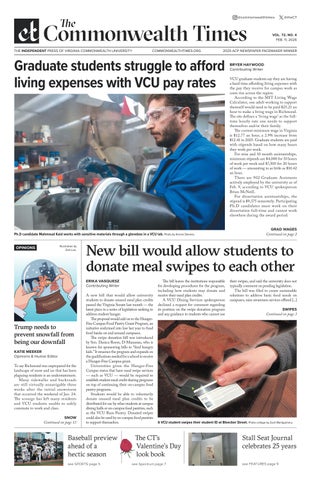
Ph.D candidate Mahmoud Kaid works with sensitive materials through a glovebox in a VCU lab.
Photo by Kieran Stevens.
Illustration by Zoë Luis.
GRAD WAGES
Stories of the week
national: Bad Bunny’s Super Bowl LX halftime show reached 128 million concurrent viewers, meanwhile Turning Point USA’s “All American Halftime Show” had 6.1 million viewers.
international: Conservatives have swept much-anticipated elections in Japan and Thailand, cementing the continued rule of their respective incumbent parties. Other countries in Asia will hold elections this week and next, including Bangladesh and Laos.
VCU Health employees petition for pay allegedly lost during winter storm
HECIEL NIEVES BONILLA News Editor
VCU Health employees published an online petition that asked for administrative pay to make up for paid time off hours they claim were used while outpatient services were closed last week due to a winter storm.
The petition states that during last week’s winter storm the health system deducted pay hours from employees’ accrued paid time off, which is generally meant for “vacation, personal days, sick time and holidays” according to Indeed.
The Change.org petition, anonymously created by “Employees of VCU Health,” states that requiring the use of PTO for a “weather-related, employer-mandated closure” was unfair to employees. It describes administrative pay, or full pay and benefits for a period determined by an employer, as a better fit for closures mandated by the employer and outside of employees’ control.
While employers are not required by federal law to offer pay for time not worked during inclement weather, many workers
GRAD WAGES
Continued from front page
The hiring webpage for VCU’s College of Humanities and Sciences states that graduate assistants cannot work another job without permission from their respective department graduate director and cannot work more than 29 hours per week.
The average stipend for a graduate assistant in the Department of English is $14,000 annually, with “those that coordinate VCU’s national literary awards” making $22,000 instead, per their website.
Harry Szabo, an assistant professor and former graduate teaching assistant (GTA or TA), said they earned $14,000 a year as a graduate student from 2015 to 2018.
“In order to make ends meet, I lived in a laundry room, like [a] washer, dryer,
— including federal and City of Richmond employees — do receive such pay.
VCU Health spokesperson Danielle Pierce said VCU had not been contacted about a petition and would be “unable to speak without reviewing it.”
“VCU Health has a longstanding inclement weather policy that is in alignment with current industry standards,” Pierce stated. “There have been exceptions to this policy during extenuating circumstances, i.e. the water disruption in 2025.”
While inpatient services remained open throughout the winter storm, some VCU Health locations and outpatient services were closed on Jan. 26, per a release by the hospital.
VCU began holding classes inperson again on Jan. 29 while some roads and walkways were still covered in ice, according to a previous report by The CT. Some students and faculty criticized the move.
VCU alum and former VCU Health employee Sophia Arabia signed the petition
twin bed. My graduate TA’s this year in 2025 told me that they also make $14,000 a year which is 10 years after I started my program,” Szabo said. “That wage was not a living wage in 2015 and it is not a living wage in 2026.”
Szabo said they do not know how TAs make ends meet.
Szabo called it an equity issue while speaking at the General Assembly on Tuesday in support of collective bargaining rights for university and other public employees.
“It means that the people who can afford to go to graduate school in Virginia are people who can afford to accept that rate of pay, which means that they have to get their money somewhere else,” Szabo said.
Mahmoud Kaid is a Ph.D. candidate working in a chemistry lab where he develops “materials and electrochemical systems” to improve lithium-sulfur batteries, reducing the cost and environmental impact of
and said the health system does not have a good track record with PTO.
VCU [Health] has no issue making employees use their own PTO for things beyond their control, i.e. weather closures [or] illness. I signed this petition because employees should not have to be forced to give up their earned PTO hours for something that was beyond their control.”
Sophia Arabia, VCU alum and former VCU Health employee
current lithium-ion batteries.
Grad student funding normally comes from either GTAs or research assistantships (GRAs) supported by external grants, according to Kaid. His current work depends on a grant from the American Chemical Society after federal funding cuts removed the grant that supported him as a research assistant.
“Graduate students play a central role in research, teaching, and innovation at universities,” Kaid stated. “Fair and competitive compensation is essential not only for financial well-being but also for academic productivity and mental health.”
Kaid’s stipend generally covers basic living expenses, but noted that financing rising housing, health care and daily costs can still be challenging.
The CT spoke to several graduate student workers who requested to remain anonymous
“VCU [Health] has no issue making employees use their own PTO for things beyond their control, i.e. weather closures [or] illness,” Arabia stated. “I signed this petition because employees should not have to be forced to give up their earned PTO hours for something that was beyond their control.”
A current VCU Health employee, who requested to remain anonymous, corroborated that VCU abides by a policy of requiring the use of accrued PTO for weather events and holidays.
“For example, I get five weeks of PTO but two of those are already gone for holidays which only leaves three weeks for all vacation and sick time,” the employee said.
The petition currently has 76 signatures, and is awaiting a response from the health system.
EDITOR'S NOTE: This story has been updated to better distinguish paid time off from administrative pay.
to protect their employment status. Many said the current wages are not enough, or are enough only to cover rent and utilities.
They shared that many graduate workers have to take on multiple jobs to afford living expenses, and some said their pay was only enough for a “per-semester basis.” In addition, one student who works in student support said they do not get paid when the university is closed during breaks or inclement weather.
An international student who works as a TA noted that their status disallows them from working anywhere off-campus.
“I am passionate about supporting college students through their academic journey, but I do not feel as if the campus administration will advocate for us financially,” one student said. “Especially considering the changes that the federal government is currently making towards financial aid options for students.”
The VCU Health Medical Center. CT File photo by Alessandro Latour.
Continued from front page on campuses to address food insecurity and build strategic partnerships at federal, state and local levels to address food insecurity.
Food insecurity among college students is an emerging public health issue. An estimated 23% of college students, or 3.8 million, experienced food insecurity in 2020, according to a report by the United States Government Accountability Office.
A 2022-2023 research study done at VCU stated that roughly 35% of the university’s 30,000 undergraduate and graduate students were food insecure. Researchers found links between physical, mental and academic performance and food security.
Student food insecurity is an equity issue that impacts many students, but students from underrepresented groups or lowincome backgrounds generally experience the challenge at a greater rate, according to the National Library of Medicine.
First-year pharmacy student Jason Ip said he has shared swipes with other students before — even without the proposed program.
“I just want to make sure my friends have something to eat at the moment, since some of my friends are also not on the meal plan and getting food is kinda inconvenient during school time and in between classes,” Ip said.
Ip further noted how the bill would make
sharing swipes more convenient, as students currently have to share their physical student IDs with each other to use each other’s swipes.
“It’s just more convenient, cause you won’t have to be with them to swipe for them, if we implemented a system where we can send swipes easily for them to get food for themselves, it would make things much smoother,” Ip said.
Some students said they wished something similar to the bill could have been implemented earlier.
“Man, that’s kinda not fair,” said Mai Nguyen, a fourth-year computer science student. “In my freshman year, a lot of my freshman peers didn’t eat out a lot, since they either didn’t like the food or they would instead rather save their swipes and cook, so at the end of the semester, they would still have a lot of swipes left in their account.”
Nguyen said passing the bill is a great opportunity.
“I’m glad that it’s becoming a thing, but I wish I had that opportunity to use it, but it’s going towards the right steps, so I’m not going to complain much,” Nguyen said.
The swipe donation bill has been referred to a House committee and could be heard by the chamber later this session. The General Assembly is expected to adjourn in March. The final deadline for the governor to sign or veto any legislation is May 25.
VCU works to cut, reallocate budget for academic, economic efficiency
KACY LEE Contributing Writer
VCU will cut $6.6 million from its $1.7 billion total budget between its fiscal years 2025 and 2026 as the university continues to pursue efficiency, including restructuring and combining key undergraduate departments.
Most prominently, the university reallocated $8.7 million to the reimagining of University College, a move described in the budget as a “deliberate repurposing of existing resources to support this highimpact program.”
VCU’s budget reductions follow a $20 million shortfall in fiscal year 2023-2024 — marking a trend in budget cuts in higher education over the last few years.
The reduction also follows a $600 million pause in university projects by former Gov. Glenn Youngkin last year.
This shift comes after the final recommendations of the VCU Repositioning Task Force released in 2024, including suggestions that spurred the investment into the University College rebrand.
It resulted in the combination of the bachelor’s and master’s of interdisciplinary studies, the master’s of product innovation and certifications in product innovation and venture creation previously spread out under the University College and the Da Vinci Center for Innovation.
Other programs in the merge include VCU Transformative Learning, Life Design and the Shift Retail Lab.
This along with other suggestions are part of a larger university-wide effort to make VCU more academically attractive and efficient, according to the Task Force’s website.
The budget reduction is being spread across the university to each department, according to a statement from the VCU Budget Office.
“This approach provides leadership with greater flexibility to assess and implement reductions within their respective areas of responsibility in a way that best supports unit-level priorities,” the office stated.
VCU spokesperson Mike Porter did not specify the exact figures of how the cuts are allocated between each area.
In terms of spending efficiently, VCU spends 30% less than similar institutions nationwide, according to a 2024 Joint Legislative Audit and Review Commission study.
While the spending of most Virginia institutions is “generally not excessive or unreasonable,” opportunities still remained to reduce spending to a more efficient degree, according to the study.
“Their spending level is at the average of their national peers or even below,” said Yan Zheng, assistant director of finance policy at the State Council of Higher Education for Virginia. “Virginia, actually, in terms of efficiency spending, is pretty good over the years.”
VCU is often compared to the University of Virginia and Virginia Tech fiscally, with all three universities classified as Research 1 institutions by the Carnegie Classification of Institutions of Higher Education.
While all three institutions hold R1 classifications in research spending and doctorate production, there is at least an $100 million difference in spending between the three universities, according to the Carnegie Classification of Institutions of Higher Education.
Discrepancies like these are why proper comparisons are difficult to properly ascertain,
according to Zheng.
The reallocation and economic downsizing of funds across the board leaves questions about what this means for VCU programs and departments moving into future semesters.
Previous efforts to decrease spending include the cancellation of work study program opportunities and the dismissal of 14 Focused Inquiry faculty members.
Many of these projects have since been continued after a delay due to Virginia being “severely challenged with resources,” according to Lee Andes, the director of finance policy and innovation at SCHEV.
Their spending level is at the average of their national peers or even below. Virginia, actually, in terms of efficiency spending, is pretty good over the years.”
Yan Zheng, assistant director of finance policy at the State Council of Higher Education for Virginia
A lot of factors come into play when state institutions make changes to their budgets, including inflation and salaries, according to Andes. While SCHEV is able to compare data across universities, the decisions about the budget and funding are ultimately up to the state.
VCU is not the only university to attempt to become a more cost efficient institute of higher education following budget cuts. However, how these cuts will impact VCU students remains to be seen, especially as the Task Force’s suggestions become further implemented at VCU.
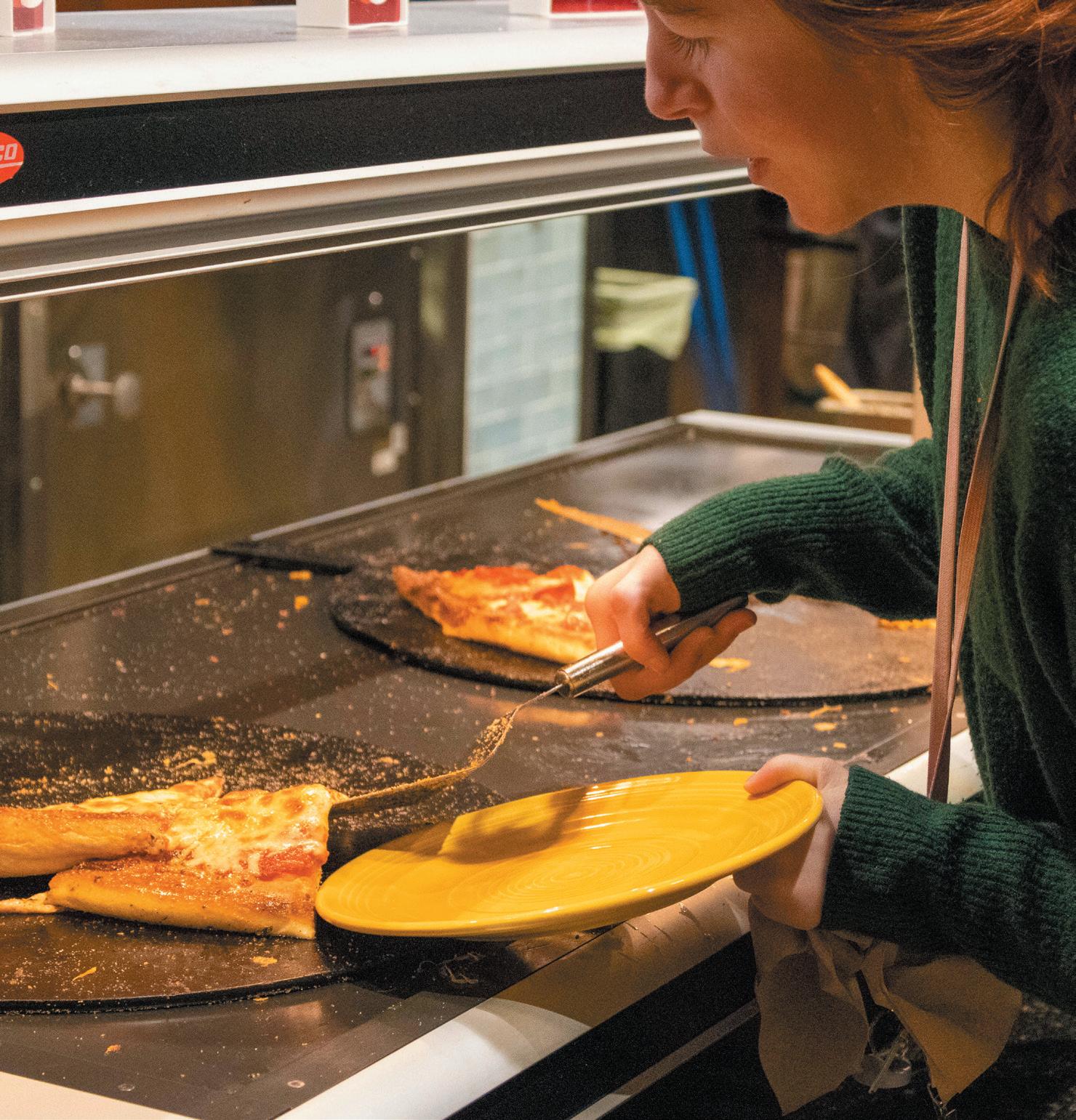
A student grabs some pizza at Shafer Court Dining Center. Photo by De Smaw.
Siegel Center becomes first Virginia venue to accept mobile ID
HECIEL NIEVES BONILLA News Editor
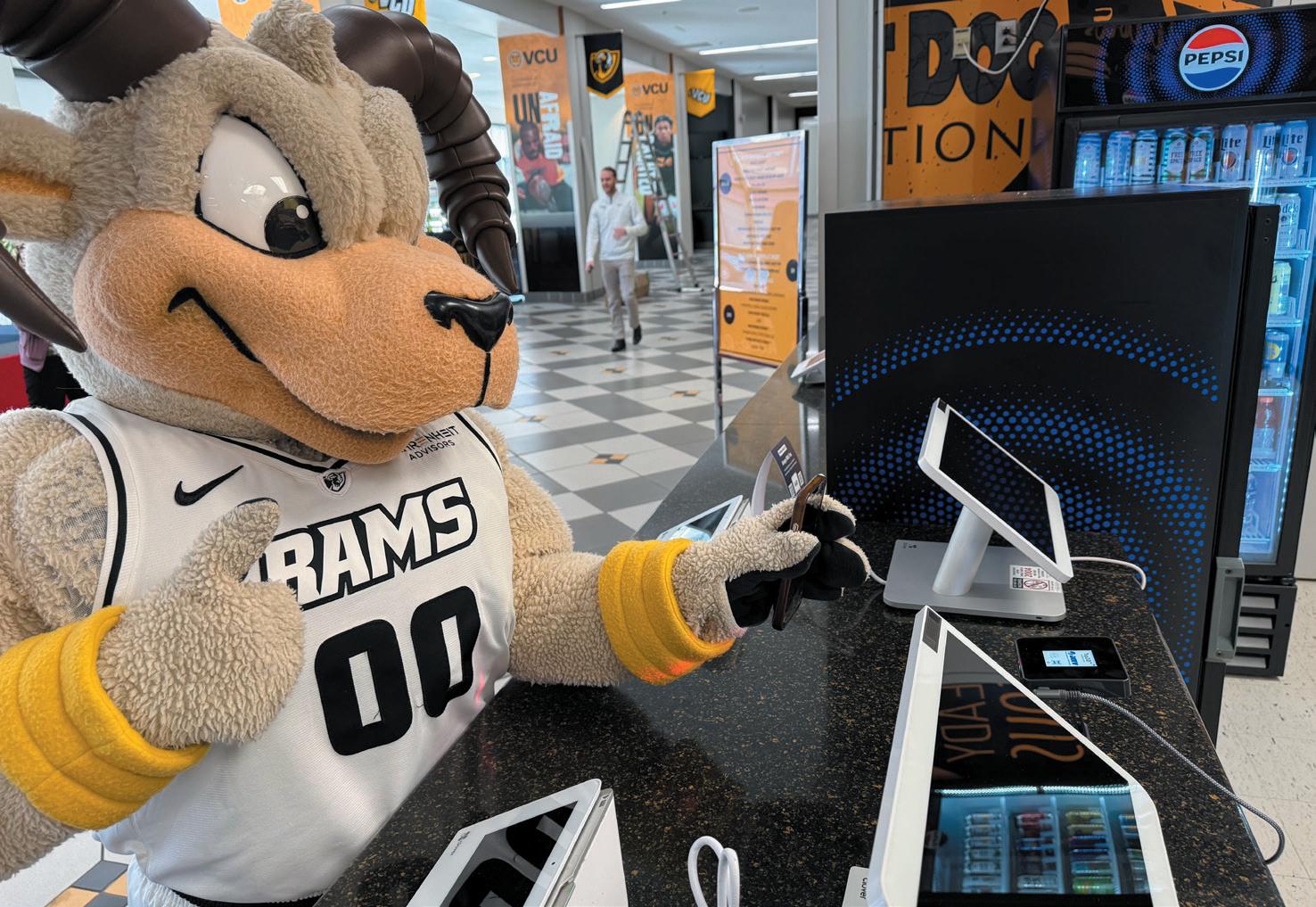
VCU’s Stuart C. Siegel Center — known by Ram Nation as “the Stu” — now accepts Virginia Mobile ID, a digital version of state identification, as a faster method of getting through an ID check. It is the first event venue in the state to do so.
The change was announced at the stadium on Feb. 5 in a press conference hosted by the Virginia Department of Motor Vehicles. It is now in effect for future events.
VCU started offering up the Siegel Center as a venue last year to help pay student athletes, the Richmond Times-Dispatch reported last year. At roughly 200,000 square feet it becomes Richmond’s largest indoor venue.
Virginia Mobile ID was launched as an iOS and Android app in November as a way to use a digital copy of either a Virginia driver’s license or state-issued identification card to process ID checks at airports, police stations, DMVs, ABC stores and other locations.
The DMV’s website calls mobile ID “a companion to your physical ID” and notes that users must still carry their physical ID on their person to use it.
Mobile ID is already accepted at multiple Richmond-area locations, including nine ABC stores and the Richmond International Airport — though some every-day establishments such as certain local bars do not accept the service yet.
Some commentators, including ACLU senior policy analyst Jay Stanley, have
warned the establishment of digital state ID programs brings a greater risk of identity and data theft, the expansion of surveillance and the quickening of the process of locking the user experience online behind ID checks.
At least 21 U.S. states and territories
VCU Police curb traffic violations with pedestrian safety operation
ANDREW KERLEY Executive Editor
VCU Police officers conducted at least 261 traffic stops and issued 187 traffic summons in the first week of their “Operation Safer Streets” campaign following recent fatal pedestrian crashes near the Monroe Park and MCV campuses.
The 90-day operation, which kicked off on Jan. 12, is designed to remind drivers to slow down, stay alert and reduce dangerous driving behaviors, according to VCU Police.
VCU Police assigned four officers, two during the day and two at night, to focus on enforcing traffic violations. Officers on other assignments are keeping watch and providing support along major corridors when they are available.
Broad, Leigh, Main, Cary, Belvidere and Marshall are among the streets where
certified speed-measurement officers are monitoring activity. Other officers have been assigned to monitor red lights with high pedestrian volumes, or areas with stop signs, yield signs or other signage.
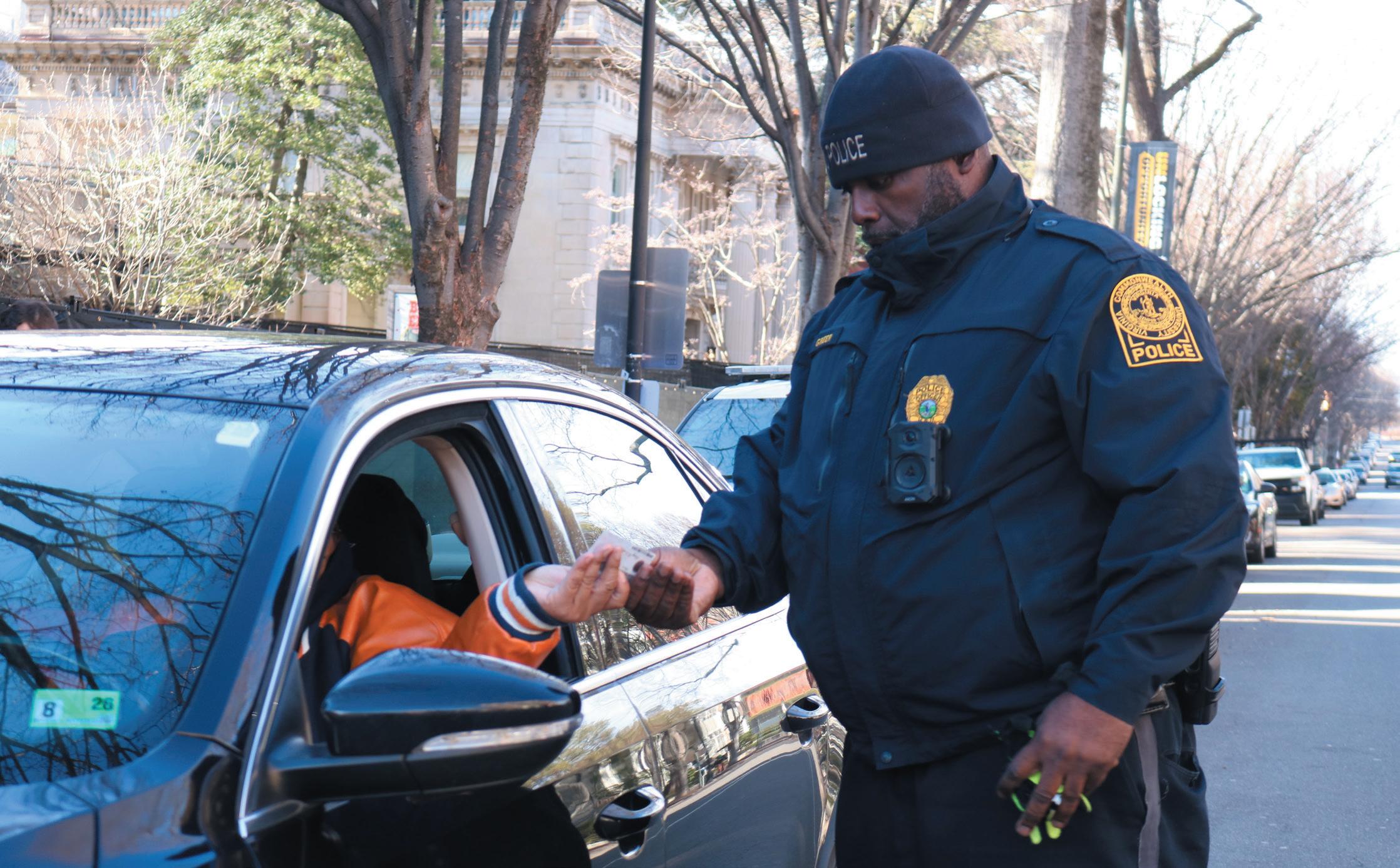
“That’s our goal, just to reduce the behavior,” VCU Police Lieutenant Edgar Greer said. “Not necessarily just to be out here writing tickets for the sake of doing it, but enforcement in areas that really need it, does reduce the amount of times that incidents like this happen.”
For officers like Greer, that enforcement can look like watching hightraffic intersections around campus, or issuing citations to drivers who fail to yield or take left turns when they should not — such as the intersection of Franklin and Shafer streets.
From 10 a.m. to 7 p.m. on Monday through Friday, drivers are prohibited from
taking left turns off of Harrison Street onto Franklin Street, where a busy crosswalk in front of one of VCU’s “front door” signs sits.
“It’s one of a few spots where we see the problems at,” Greer said.
When there are more cars and pedestrians on the road there is a higher likelihood for accidents to occur — especially during the week when students are going out and attending classes, according to Greer.
One big problem is distracted driving, Greer said. Some drivers use their cell phones, wear headphones or eat while in the car.
“Sometimes folks need to receive a summons to learn not to do that,” Greer said.
Police are not permitted by law to conduct enforcement against pedestrians, so when pedestrians are distracted while crossing, VCU officers practice what are called “consensual stops.”
currently accept some form of mobile ID, according to the United States Transportation Security Administration. New Jersey and Utah are the only two states with mobile ID that have also signed laws aimed at reducing related privacy risks, according to the ACLU.
Officers will stop pedestrians — many of whom are also guilty of not looking up or wearing headphones — and talk to them about the dangers of distracted crossing. Students have been largely receptive, according to Greer.
Greer also encourages students to use public transportation options like GRTC, RamSafe and RamsXpress buses.
“You’d have less pedestrians, less cars on the road, safer getting from point A to point B,” Greer said.
TRAFFIC-PEDESTRIAN INCIDENTS HAVE BEEN A PROBLEM FOR YEARS
The “Operation Safer Streets” campaign began after an uptick in fatal pedestrian crashes between semesters, including Bill Martin, the director of the Valentine Museum.
In 2023, VCU students Mahrokh Khan and Shawn Soares were killed in accidents on campus — the former being ruled a reckless driving incident.
The incidents sparked a similar campaign by VCU Police to promote pedestrian, cyclist and driver safety, according to a previous report by The CT.
So far this academic year, VCU Police are on pace to increase the number of traffic violations they issue by 27% over last academic year, according to a press release.
But despite the efforts, crashes involving pedestrians, bicyclists and scooters are also on pace to increase.
In the first five days of “Operation Safer Streets,” VCU Police issued 63 violations for speeding, 39 violations for disregarding-highway - signs and 24 red-light violations.
Anaiya Morgan, a first-year undeclared student, said she feels safe, but a lot of people in Richmond “drive crazy.”
“There are some times where you think you can go, but then there’s a car speeding past you, so you really have to be careful,” Morgan said.
Morgan said she would not personally rely on traffic signs, as many drivers do not follow the rules. While some do, “all it takes is one.”
“I love it here, because I come from a small town, so the city is actually great to be in,” Morgan said. “But when it comes to crossing the streets and stuff like that, I would just say be extra careful, look both ways and stay safe.”
Rodney the Ram checks in at the Stuart C. Siegel Center using his Virginia Mobile ID.
Photo courtesy of Hannah Robinson.
VCU Police Lieutenant Edgar Greer enforces traffic violations at the intersection of Shafer and Franklin St. It is one of multiple sites VCU Police are targeting to reduce crashes and traffic-related deaths. Photo by Andrew Kerley.
Sports Men’s tennis swats Richmond to open A-10 play
BEN MARTINDALE Staff Writer
VCU men’s tennis took the court against the University of Richmond on Friday.
The matchup followed a narrow defeat to East Tennessee State University. The Rams started their 2026 campaign with an even two wins and two losses.
VCU second-years Nicolo Consonni and Gervog Mnatsakanyan won their doubles match 6-3 to get VCU rolling.
Shortly after, VCU second-years Erwann Bouchet and Mats Bredschneijder won 6-3 to give the Rams their first point of the match and a 1-0 lead.
The third doubles match was not
finished as the Rams had already won the point, but VCU second-years Kostiantyn Mantach and Leon Zaorski put together a good performance. They were leading their match 5-4 by the time it ended.
VCU carried its momentum into singles play as Mnatsakanyan beat Richmond second-year Otto Sewell in straight sets, extending the VCU lead to 2-0.
Richmond second-year Charlie Burdell scored Richmond’s first point of the evening after beating Zaorski 6-4, 6-2.
VCU bounced back, riding Bouchet’s straight set victory against Richmond third-year Paxton Pritchard to a 3-1 lead.
On court one Consonni and Richmond fourth-year Davis Wiley slugged it out,
Stat of the week
VCU
going back and forth in a thrilling match that would see Consonni bounce back after dropping the first set 2-6 to win a razor close second set 7-6.
The third set played out much like the rest of the match, with Consonni falling behind early 3-0 before pulling off an incredible comeback to win the match 2-6, 7-6, 7-4.
“I always believe in myself,” Consonni said. “Ever since I was a kid, my dad was my coach and he would always say that if you believe in yourself the match is not over. In the third set it was a really close match. I knew it was about details; I think I closed out really well, always believing in myself.”
Consonni’s victory effectively secured VCU the win, as the Rams took a 4-1 lead with just two matches remaining.
Despite having the game wrapped up, VCU stayed dialled in, winning one of its final two matches.
“It was a close match. Doubles was close, singles was close, it could have gone either way,” Head Coach Dimi Kutrovsky said. “I’m just happy we got on top and we played tough in the big moments, and I think that was the difference today.”
VCU walked away with a final score of 5-2 over Richmond to start Atlantic 10 play.
VCU will play its next game at Davidson College on Friday, Feb. 13 at 5 p.m.
A look at Baseball ahead of a hectic season
DREW THOMPSON
Sports Editor
VCU baseball starts its season on Friday, Feb. 13, against the College of the Holy Cross. The game, along with all others Monday through Friday, will be free to the public, according to VCU Athletics.
The only home games excluded from this promotion are against the University of Virginia on April 14 and Virginia Tech on April 21.
Head coach Sean Thompson is entering his second year with the Rams and is looking to build off last year’s 17-37 record.
OFFSEASON
The Rams’ offseason notably featured controversy regarding their home venue.
VCU was supposed to follow the Richmond Flying Squirrels to CarMax Park in April after the stadium’s completion. However, contract complications with the Flying Squirrels will keep the Rams at the Diamond until further notice.
Story continues on next page
redshirt fourth-year guard Jadrian Tracey scored a career-high 26 points in the win over the University of Dayton.
Right Fielder Aden Hill celebrates with the Rams after an RBI. VCU baseball beat 3-1 in four game series. CT file photo by Kaitlyn Fulmore.
Leon Zaorski serves the ball during the February 6th match against Richmond. Nicolo Consonni hits the ball.
Photos by John Brown.
Nevertheless, VCU built on its roster from last season through new faces and inhouse progression. Thompson brought in four fresh recruits from high school — a trio of hitters and a right-handed pitcher — to bolster the squad.
Three of the recruits are Virginia natives. First-year third baseman Hank Brown is a 6-foot, left-handed hitter with all-field power from Virginia Beach, according to Thompson.
First-year outfielder BJ McIntyre stands at 6-foot-4-inches and hails from Chesapeake, Virginia. He is a notable athlete with heaps of potential, Thompson said.
First-year right-handed pitcher Tristan Lange is 6-foot-3-inches from Roanoke, Virginia, and commands the mound with an arsenal of off-speed pitches to complement his low 90 mph fastball, according to Thompson.
The final recruit is first-year shortstop Braydon Hallman from Leesville, South Carolina. He is 6-foot-2-inches and coming off a high school state championship.
Second-year catcher Jacob Lee is the player to watch after a record-breaking rookie season. He set the freshman home run record with 17 last season, was named the Atlantic 10 rookie of the year and was recently announced as the No. 7 catcher in
college baseball by Division1Baseball.
Redshirt fourth-year right-handed pitcher Patrick Steitz was similarly ranked in D1Baseball’s top-200 starting pitchers. The imposing 6-foot-8-inch pitcher transferred to VCU after spending his last two seasons at the University of Kansas. He compiled a career 2.63 earned run average and a sub-1.50 walks plus hits per innings pitched — both very good numbers — during his time as a Jayhawk.
NON-CONFERENCE SCHEDULE
VCU plays a challenging slate of nonconference games before it enters A-10 play. The Rams play a two-game series against the University of Illinois and No. 6 Coastal Carolina University in a tournament between Feb. 20 and Feb. 22 in South Carolina.
The Rams will follow that up with a one-off game at No. 11 University of North Carolina and then a three-game series against Virginia.
VCU will play in-state opponents William and Mary College and Old Dominion University at home before ending with a three-game home series against the United States Military Academy West Point, also known as Army.
The Rams will also play single matches against Virginia Tech, Virginia, ODU, Norfolk State University and Longwood University during their conference schedule.
CONFERENCE SCHEDULE
VCU will play all its conference opponents in a three-game series. The Rams finished second-to-last in the A-10 last season with a 10-21 conference record. Every series will be important, but the biggest challenge will come against reigning champions University of Rhode Island on the road.
The Rams will finish the A-10 season with series games against Saint Louis University, Saint Joseph’s University and Davidson College. All three teams finished in the top-five last season, and both Saint Louis and Davidson swept VCU last season.
VCU undoubtedly has its work cut out for it with a turbulent schedule, however Thompson is optimistic going into the season.
“We’ve just got to continue doing the right things on and off the field,” Thompson said in a press conference. “We’ve got to have great preparation and if we keep doing that I think we’ll be in a good place at the end of the year.”
PRESS BOX: C.J. Stroud must evolve to reclaim his trajectory
HAYDEN
BRAUN Staff Writer
After yet another disappointing season with two horrible playoff performances, there has been a lot of discourse on whether Houston Texans quarterback C.J. Stroud has fallen off.
Stroud had such an exciting rookie season, as he won rookie of the year, a playoff game and he led the Texans’ to a divisional title. There was a lot of hype that offseason that he was the next superstar quarterback in the league. While the hype was warranted, it may have gotten to his head.
Stroud was on a podcast where he ranked himself as a top-five quarterback in the league immediately following his rookie season. It’s good to be confident, but people were turned off by this, especially after he was fresh off his first year. The following season he had a “sophomore slump,” in which his stats were down in nearly every
category and he doubled the amount of turnovers from his rookie season, according to ESPN.
During Stroud’s second season, he was found in hot water again after he “little bro-d” Caleb Williams, the Bears’ then rookie quarterback. Stroud was mic’d up after a Sunday night football win against the Bears when he told Williams to “stop taking those big hits” and “learn from those mistakes.”
“Everything that you got, bro, is in you already — you’re going to be a hell of a player in this league,” Stroud told Williams.
Stroud later explained he didn’t mean to disrespect Williams and was just trying to give him advice, according to NBC Chicago. Fans and media personalities disagreed, myself included. It was an awkward exchange, and to be honest — a little cringe.
Now it’s almost ironic given how poorly it has aged. Stroud has struggled again in his third year with lackluster performances all season long. In his two playoff games this year he has combined for eight turnovers,
according to Sports Illustrated.
In Williams’ second season, he was given the nickname “ice man” for being clutch and leading the Bears to a playoff win and a division title. Though the Bears may not have won in the divisional round against the Rams, Williams threw a touchdown off his back foot with four defenders in his face on fourth down to take the game to overtime.
Stroud does have superstar potential still, and his teammates and coaches would agree, according to Bleacher Report. Some of his struggles can be put on the Houston Texans’ offensive line, but that explanation only goes so far.
Houston’s line has ranked in the bottom third of the NFL for most of the past three seasons — finishing No. 29 in 2023, No. 22 in 2024 and No. 24 in 2025 by Pro Football Network. This has clearly contributed to pressure, rushed throws and some of his turnovers. That instability has had a negative impact on Stroud’s game, but it is not the primary reason for his regression.
The main issue is Stroud’s approach has remained largely unchanged since his rookie season. Defenses now have extensive film on him and have exploited recurring issues with pre-snap reads and coverage recognition. These problems have persisted despite the circumstances around him.
Elite quarterbacks adapt as the league adjusts to them, and through his second and third seasons Stroud has yet to meaningfully evolve his game.
Ultimately, I do think Stroud will be able to move the needle and evolve like other quarterbacks have, most recently with the resurgence of Sam Darnold and Mac Jones. If they can do it, Stroud can too.
However, it is going to depend on whether he can evolve as a passer and improve things like what he does at the line pre-snap, speeding up coverage recognition and showing more willingness to adapt within structure. This will all be critical if he wants to reclaim his trajectory as a franchise quarterback.
Illustration by Abbos Soliev.
On This Day
On
Spectrum
day, Feb.
Six spots to hold the perfect Valentine’s, Galentine’s or solo date in Richmond
LIZ DEFLURI Contributing Writer
Valentine’s Day is just around the corner and whether you have a beau, some gal pals or are flying solo The Commonwealth Times is here with a list of Valentine’s plans that are not just dinner and a movie.
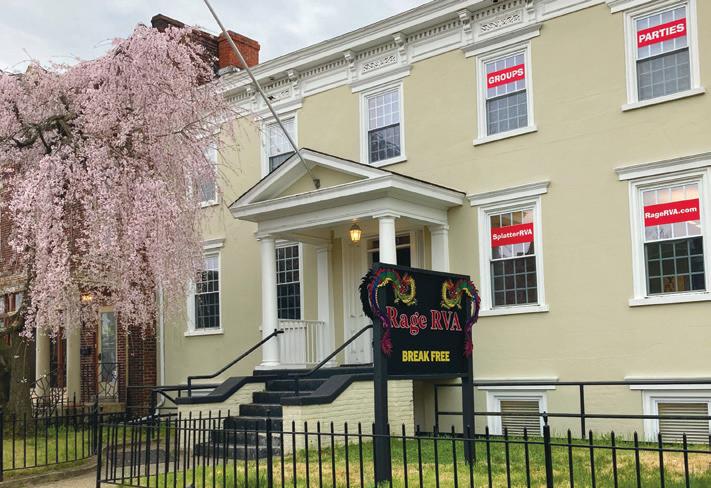
Going through a breakup, or just hate the holiday? Rage RVA has you covered. Located in the Fan neighborhood, Rage RVA provides thrills for those who want to spend Valentine’s Day, or any day, breaking things. Rage rooms have increased in popularity in recent years and oftentimes, Valentine’s Day is the most booked day of the year. Rage RVA offers a variety of sessions ranging in price and caliber to match your level of rage.
For an unforgettable Valentine’s or Galentine’s date, make a reservation at the Virginia Museum of Fine Arts’ Floris Tea Room.
Inspired by French and English tea services, Floris’ staff offer expertly crafted teas from various guest tea-makers paired with a plentiful rotating menu of sweets and savories.
You can enjoy a beautiful view of the museum’s Robbins Sculpture Garden while savoring delightful, chef-inspired creations.
If tea isn’t your scene, take a stroll through the VMFA’s diverse art galleries featuring over 50,000 artworks from various countries and historical periods — for free!
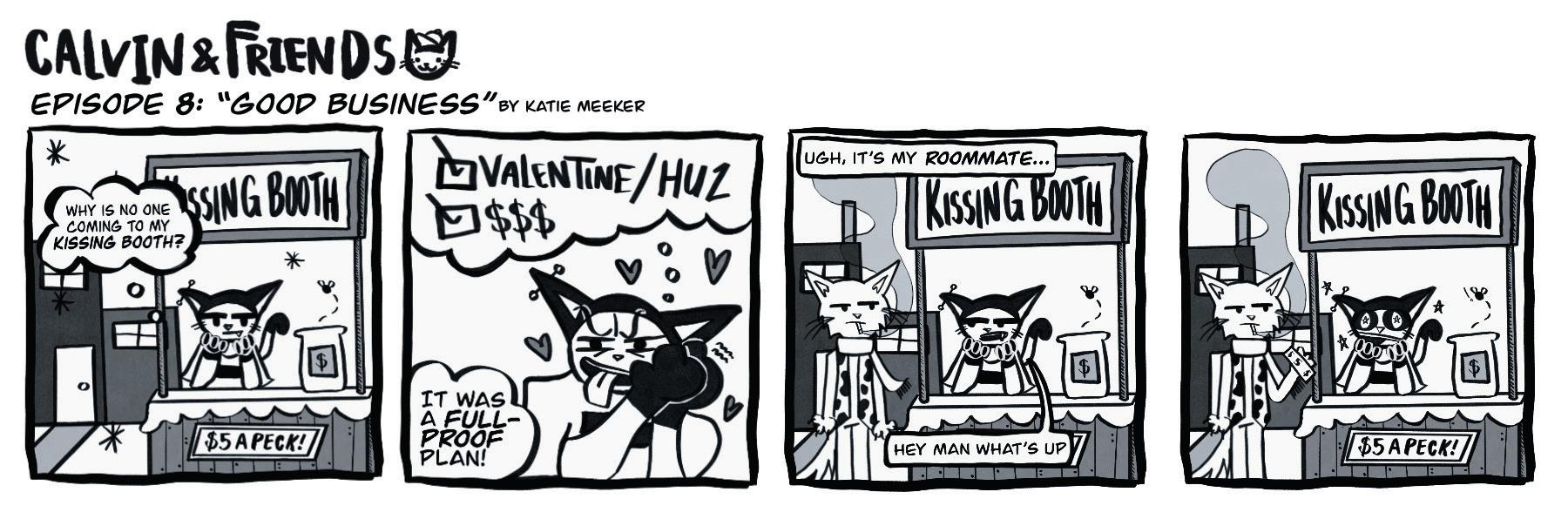
SPCA ‘DOG KISSING BOOTH’
The Richmond SPCA also hosts unforgettable Valentine’s Day events for all animal lovers. According to the Richmond SPCA’s communications project manager, Amanda Parker. The shelter will host its eighth annual Dog Kissing Booth event on Thursday, Feb. 12, where people can take a playful photo with their pet or one of the animals in the shelter.
The organization’s digital media specialist, Vanessa Gleiser, said guests are encouraged to visit with the shelter’s cats and dogs and share a sweet moment together.
“The Richmond SPCA is a great place to visit on Valentine’s Day to help guests and our pets feel the love,” Gleiser said.
In addition to the kissing booth, the SPCA is also hosting a Fur-Ever Adoption special through Sunday, Feb. 15, where adopters can spin the prize wheel for a chance at prizes such as a free collar, leash, toy or a percentage off the pet adoption fee.
For another unique shopping excursion or low-key date, Wax Moon Records on Alamont Avenue in Scotts Addition is the place to be.
Wax Moon is a metal and goth shop featuring vinyl records of all genres, horror and anime videos, t-shirts and other merchandise. The shop also features over 30 classic pinball machines and tournament events throughout the year.
Wax Moon’s owner, Andrew Griimoiire, said it costs $10 to play unlimited pinball at the shop during the week, and it can be a partner activity.
“Most people think of pinball as a oneplayer game, but actually, you can play it with up to four people,” Griimoiire said. “You can do couple versus couple, which is a format a lot of people like to play.”
Richmond’s record selection does not stop at Wax Moon. If you are looking for a cozy vibe, check out Deep Groove in Richmond’s Fan neighborhood. Hosting talents such as Lucy Dacus, as well as her partner and bandmate, Julien Baker, in the past, makes it the perfect hideaway for any indie lover.
There’s also Vinyl Conflict in Monroe Ward for all the Richmond hardcore enjoyers or Plan 9 if you are strolling the streets of Carytown.
For a delightful mix of retail and animal therapy, pay a visit to Furbish Thrift in the Stratford Hills Shopping Center of Forest Hill.
Furbish Thrift is a nonprofit consignment shop featuring donated furniture, clothing, art and various decor items. All of Furbish’s proceeds go towards animal welfare in the Richmond area.
Furbish Thrift’s general manager, Jada Nunn, says Furbish offers an accessible, budget-friendly way to curb the winter blues.
“You never know what’s going to come into the store. We’re a really good place where you can come in anytime and find something exciting and new,” Nunn said. “On top of helping people keep their pets, this is the kind of thing that helps feel love around the season of Valentine’s Day.”
Whether planning a date or a solo outing, Circle Thrift on West Broad Street is packed with unique finds.
Sales associate Celia Stewart says Circle Thrift is an ideal spot for anyone looking for a fun time and vintage or unique items, ranging from clothing and housewares to locally made artist wares.
“Since we have something for everybody, Circle is a good place to find something cute. This year, we even had two different artists make handmade Valentine’s cards. There’s also Rumors and Blue Bones that are within walking distance from here, so you can hit all three pretty quickly and make a day out of thrifting,” Stewart said.
Floris at VMFA, perfect for any afternoon tea with your friends or lover.
Richmonders got “Lucky in Love” sharing sweet treats, art, tattoos and more at a Valentine’s Love Market Saturday.
The market —hosted by Lucky in Love Chapel — featured flash tattoos by fineline and traditional tattoo artist Ryan Machado, who has been tattooing at Heroes and Ghosts in Carytown for two years. He got married at Lucky in Love in October and described his as a “milliondollar wedding for not a million dollars.”
Machado said he immediately offered to help out at any events or tattoo-related needs Lucky in Love had. For the market, he catered to the public with small, “lovey dovey” flash designs ranging for arms and legs in his style of fine line and traditional tattoos.
Other vendors included Field Day Boutique, which packed “pleasure boxes” filled with toys and accessories attendees could customize in addition to the other products they offered.
Photographer Aly Hansen, who photographs many of Lucky in Love’s weddings, took vintage-style polaroids for attendees.
For those who worked up an appetite between their tattoos or live doodles from Destiny Doodles, RVA’s Cake Pop Design
Company sold festive pops in flavors like chocolate-covered strawberry and red velvet.
The “Lucky in Love Ladies” — Tia Ballard, Kasie Murphy and Savannah Manzie, all licensed civil celebrants and wedding officiants authorized to perform legal ceremonies in Virginia, created Lucky in Love in June when Ballard and Murphy “married” their individual wedding consulting businesses “Hello Love” and “How Lucky Co.” to open the chapel.
“I think it provides an affordable, unique experience for getting married and it’s inclusive for everyone,” Ballard said.
“And we’re right in the middle of the city, so if you’re catching the bus to get married, or if you’re walking from your apartment, or if you’re driving in from Virginia Beach, we’re extremely accessible.”
At Lucky in Love, anyone with a marriage license has the option to book their wedding fully online or even make a same-day appointment for a ceremony that is fully customizable, Ballard said.
Ballard said Lucky in Love is the closest Virginians can get to a Las Vegas wedding
without flying to Vegas — the chapel has space for about 20 people.
The market was the first time the chapel opened its doors to the public for an event, but Ballard hopes the market will become an annual tradition and that attendees become acquainted with the local vendors present.
“We get a lot of knocks on our door, but it would be great for us to have a day where we can welcome the city who has brought us so much into our space and just celebrate love, because that is clearly what we’re all about at Lucky In Love,” Ballard said.
One couple that found their way to the Love Market were Andrea Cayassa and Ari Ynovy. The two have been together for over six years and got engaged in November. After hearing about the event on Instagram they wanted to check it out.
“We have heard of the chapel before, and we’ve also heard of Field Day, so it seems super cute, super heart and love,” Cayassa said.
According to Ynovy, they are still figuring out details for their wedding, but Lucky in Love is on their radar as a potential venue.
BATTLE AT THE BYRD
VCU alums put on ‘The Princess Bride’ screening, sword fight as opening act to Richmond Ren Faire
SAPPHIRA MOHAMMED
Copy Editor
SAANVI VOOTLA
Contributing
Writer
Hundreds of Renaissance fans banded together in full costume on Saturday, ready to witness the rebirth of “The Princess Bride” with a live, swordfighting shadow cast — and the birth of Richmond’s first ever, full renaissance fair.
In Virago Alley’s build-up to the Richmond Ren Faire, the nonprofit organization held a screening of the 1987 film at the Byrd Theatre.
Virago Alley’s founder Amanda Robinson said they wanted something magical for their first event of 2026.
“We just found the first week of February was a nice time to kick off this entire series of opening acts,” Robinson said. “ I think that this event is kind of a chance to highlight all three important facets of our organization and programming.”
The event was not a traditional screening, as a shadow cast made up of Virago Alley members performed in front of the screen during all of the fencing scenes.
VCU associate professor, alum and vice president of Virago Alley, Bizhan Khodabandeh, played Inigo Montoya in the shadow cast. He was nervous in the days leading up to the show because of how complex the fencing scenes are in the movie. He is a huge fan of “The Princess Bride,” having fallen in love with it as a young child.
“What I love about ‘Princess Bride’ is it’s a movie for everybody,” Khodabandeh
said. “It has a lot of comedy, it has romance, it has swashbuckling. It’s really a great balance of so many things and we’re pretty fortunate that it was made.”
Virago Alley revealed at the screening that they would soon teach weekly Historical European Martial Arts — or HEMA — combat training classes with Khodabandeh and Virago Alley member Patrick Glynn as instructors. They gave a demo on stage before the film started.
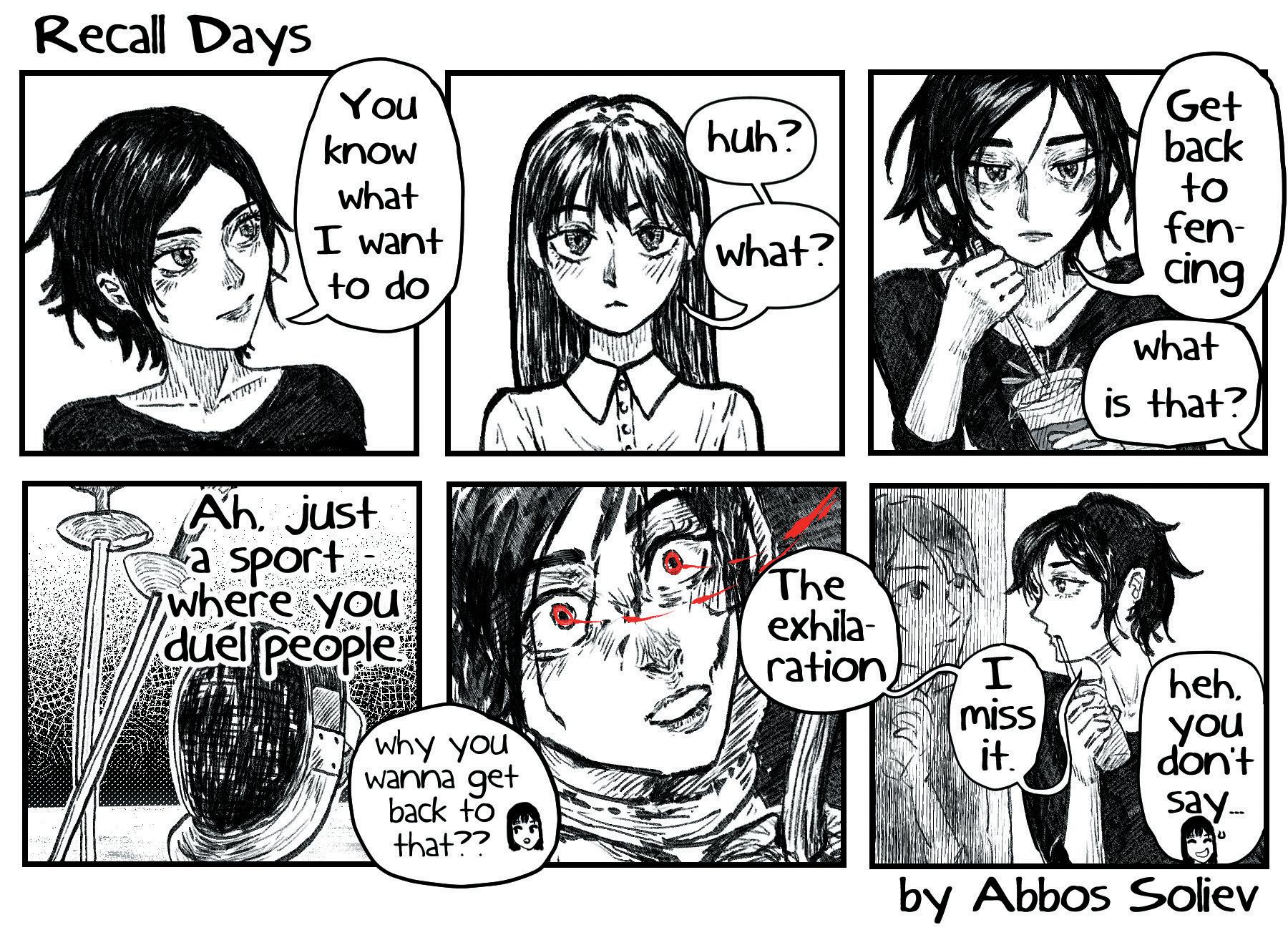
VCU has an active HEMA club that meets every week to teach students how to swordfight both causally and competitively. Their motto is “make new friends and stab them!” according to their Instagram bio.
Virago Alley also gave an exclusive first showing of the handcrafted sword that will be raffled off at the Richmond Ren Faire in April to fundraise money for the event. The sword was crafted using 8670 steel, a method that originated during World War II, and took over a year for Richmond bladesmith Join or Die Knives owner Brent Stubblefield to create.
Right before the film, there was a “Princess Bride” costume contest, in which attendees dressed up as their favorite character from the movie and had a chance to win two tickets to the Richmond Ren Faire as well as two tickets to AfterDark RVA’s upcoming events.
The contest was organized by cosplayer, VCU alum and Virago Alley board president Camille Trejo. Known as Chiara Scuro in the cosplay community, her first time watching “The Princess Bride” was at the Byrd as a college student, so she found the experience to be a full circle moment.
Trejo thinks people enjoy costuming in Renaissance wear because of the escapism and creativity it shows.
“A lot of it is exploring who you can be, how you would look as your favorite character,” Trejo said. “It’s just kind of nice to step into a different role.”
Attendee Daniel Martin went with his partner Jessie Boyd. He wanted to support the Richmond Ren Faire but had an ulterior motive.
“I wanted to do the costume contest because I’ve been told I vaguely look like Westley through most of my life. So I figured now is a good opportunity, I’m confident that I have a shot [to win],” Martin said.
Martin did, in fact, win the best Westley costume, the main character of the film, and won honorable mention in the whole contest.
director and VCU alum Ash Moore, hoped that people would
best Ren Faire attire and let themselves feel and explore a childlike whimsy.
“That’s a huge part of what we’re doing, giving people an opportunity to step outside of their daily lives and have a little bit of escapism and embrace the parts of themselves that allow themselves to have fun and be silly,” Moore said. “I think that this event really lends to that as well.”
Virago Alley will host multiple more events leading up to the big Richmond Ren Faire on April 18 and 19, from 10 a.m. - 6 p.m. at Dorey Park. To learn more, visit their Instagram page at @rvarenfaire.
A live doodling photo booth by @destinycandoit on Instagram at the Valentines Love Market on Feb. 7. Photo by Kendall Lott.
Inigo Montoya, played by VCU professor Bizhan Khodabandeh, challenges Westley at Virago Alley's rendition of 'The Princess Bride' on Feb. 7. Photo by Landon Walker.
Features Stall Seat Journal celebrates 25 years
RACHEL NICHOLAS Staff Writer
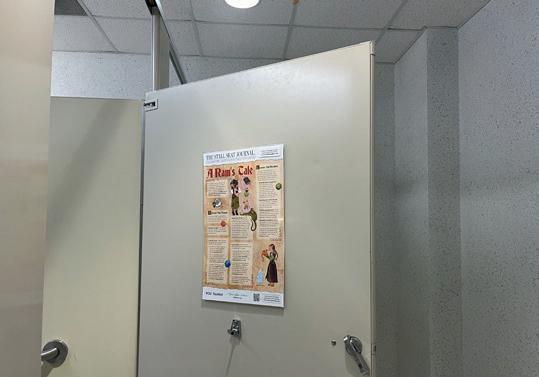
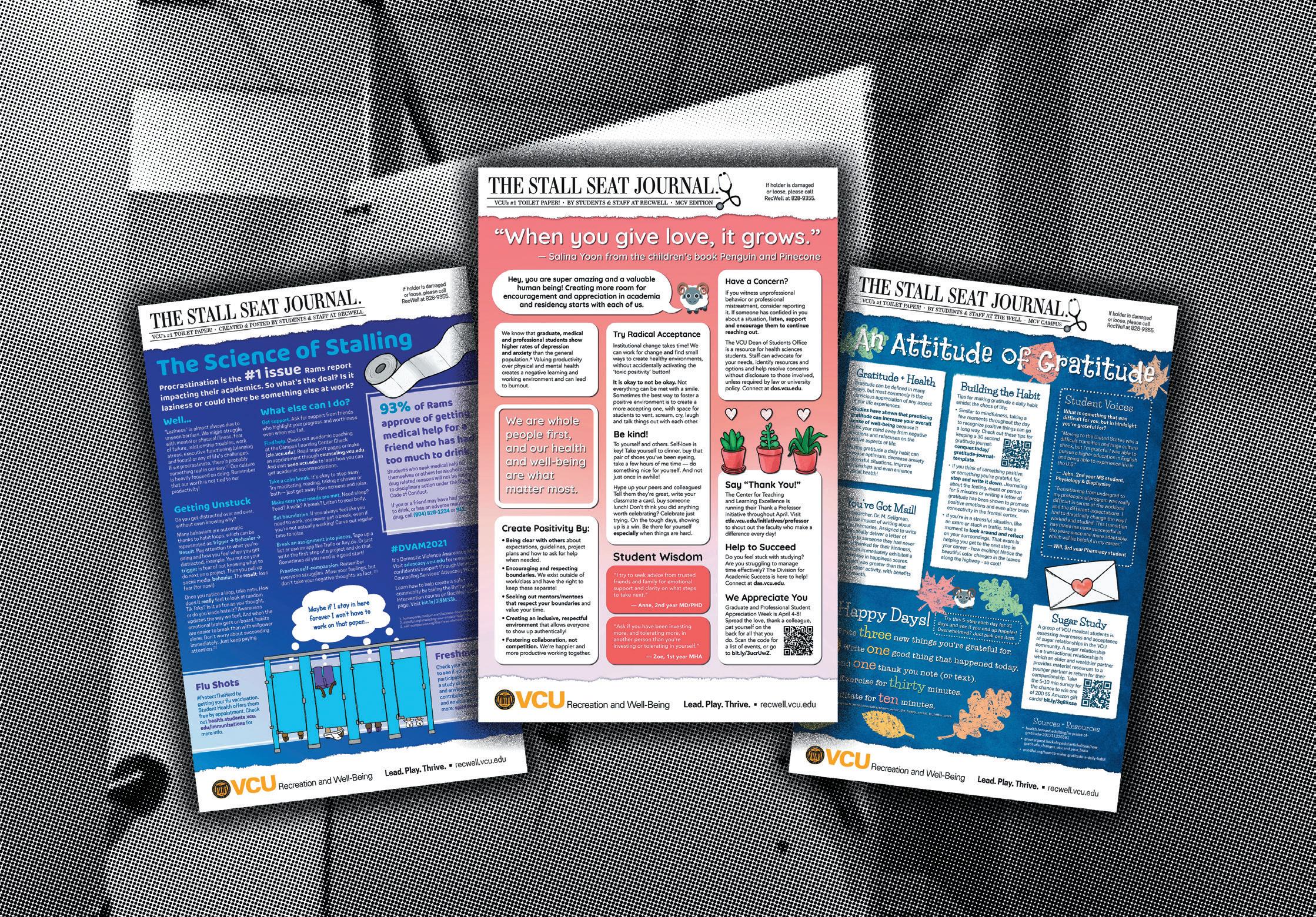
A bright and down-to-earth guide designed for students, in 2026, The Stall Seat Journal celebrates 25 years this year as “VCU’s #1 Toilet Paper.”
Spread out across the Monroe Park and MCV campuses, over 1,000 bathroom stalls are readily posted with health tips, safety information and where to find available resources.
Founded in 2001 as a health campaign from RecWell, the journal has produced many issues that blend humor and art — using illustrated “ramsonda” with distinct personalities and looks — to build relatable connections with the students.
“I think that the Stall seat Journal is a really cool idea,” first-year criminal justice student Sasha Hoo said. “The art is super nice and it makes the information a lot more engaging. Plus, they stuck it in a spot where people couldn’t just throw it away.”
Hoo notes that her high school had a similar paper, however she believes the VCU journal has a lot more to offer in terms of style and substance matter.
“The student health and safety facts can be really beneficial for those who need them, and their information is definitely helpful to those who read them,” Hoo said.
Each issue is designed to cover important topics students may not know or even feel comfortable discussing, offering a sacred space for them to become informed.
Topics range from mental health discussions, substance usage and where to seek help, healthy eating habits, physical fitness and sexual safety.
The journal has been recognized by the Virginia PR association in recent years in
the creative tactics category.
Part of the planning process for creating each issue begins in the summer, when staff reviews trends and data to decide on monthly themes. The academic calendar also plays an important role in timing out issues, including breaks and semester changes.
While the journal’s core mission has stayed the same, its style and tone have evolved. The Ramsonas have grown from simply dressed mascots to reflecting the diversity of the readers.
“One of my goals with creating the illustrations is to make them bright and engaging,” Stall Seat Journal illustrator Emily Leary said. “Also, for students to feel represented when they see them —to sort of be engaged with these fun whimsical illustrations that attract them more to the information we’re trying to share.”
Leary, a VCU alum, got her start as a content creator for RecWell when she was a senior in 2022, gradually taking on more and more work as an illustrator.
Over the years, Leary has added her own artistic flair to the production of the journal, honing her signature style and leaving a modern mark across the page.
“I started out sort of not really knowing what style I wanted to go with while I was still a student,” Leary said. “But as I’ve done more illustrations, I have created my own style of the rams using different lines and colors. It also helps with keeping each issue consistent.”
Leary’s work continues to build on a prosperous idea started just over a decade ago with then RecWell director, Linda Hancock. Hancock had hired Emily
Tompkins to create what would go on to become the first Stall Seat illustration - an ad for camping gear, according to Tompkins.
“I got hired for that and they paid me around $50,” Tompkins said. “I did that as a one-off as a student, and then they later hired a fellow classmate of mine to do the Ram illustrations.”
Tompkins later joined the journal as a part-time graphic designer and illustrator, one year after she graduated. She currently works on designing and putting together layouts in collaboration with Leary’s art.
When deciding what to put in the layout, Tompkins reviews a shared document containing a draft for that issue sent to her with information from RecWell’s health promotion team. Together with Leary, they begin the journal creation process, according to Tompkins.
“I share the document with Emily and
everything into a design document,” Tompkins said.“We’ll have repeated Zoom meetings where we’ll go over everything and usually we have to cut a lot of text to fit everything. It’s like one big game of Tetris.”
After every kink has been ironed out, which roughly takes about a month, Tompkins then sends the final copy to print and out to the stalls.
As the Stall seat Journal marks 25 years on campus, its presence remains as intentional as ever. It continues to quietly meet students where they are and offer information without judgment.
What began as a modest health campaign has evolved into a trusted and respected VCU staple that, in a place that is often overlooked, sparks awareness and reminds students of the support they have on campus — even in the most unexpected places.
THE COMMONWEALTH TIMES
@commonwealthtimes
@thecommonwealthtimes
The Commonwealth Times
@TheCT
@commonwealthtimes
Quote of the week
“The fool doth think he is wise, but the wise man knows himself to be a fool.”
— William Shakespeare, ‘As You Like It’
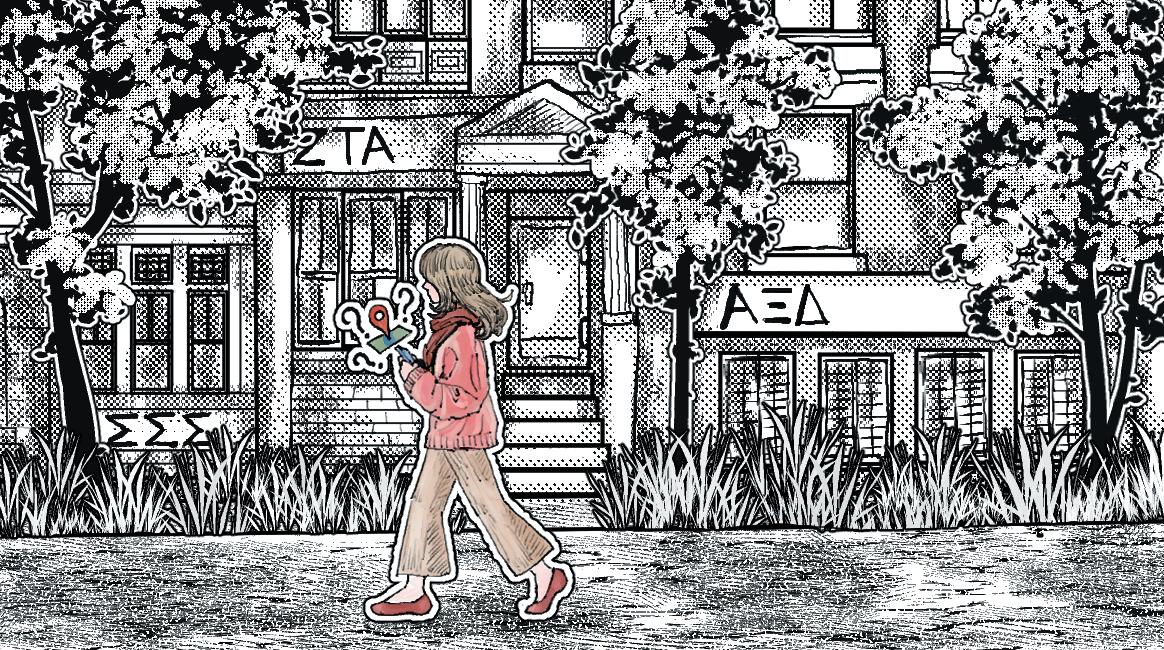
Opinions Transparency could help revive VCU greek life
MOLLY CHRISTIANSON
Contributing Writer
After being a hermit my first semester at VCU, I knew I wanted to join greek life. I thought it would be a great way to make friends, socialize and become more familiar with Richmond.
When looking into it online I tried to find out more information, and realized that there wasn’t much out there. The process is very mysterious.
I got a couple of questions in at the SOVO fair back in the fall, but they were pretty surface-level. Answers to more important questions about recruitment, culture and logistics were harder to find.
When spring recruitment did come this year — taking place during only one weekend, which is a much shorter time frame when compared to other colleges — no schedules or information were really given out until the day before recruitment started.
Not being able to compare VCU’s recruitment timeline to other colleges left me with many questions. What will the schedule look like? What are the dress codes for each day? What is expected of us? Is it more like an interview or a hangout? What are the organization’s respective aesthetics and general vibes? Is it better to stand out or fit in?
My difficulty in finding those answers left me puzzled. Why was finding information about VCU greek life culture so difficult?
Greek life is much less prominent at VCU than it is at most other Virginia universities. Many first-year students may be unaware of a big reason why that is.
VCU student Adam Oakes died in a severe hazing incident in the Delta Chi fraternity five years ago. Adam was told to drink copious amounts of alcohol in order to “pledge,” or join the fraternity. Despite having clear signs of alcohol poisoning and obviously needing help, he received none. Adam died in the Delta Chi house on Feb. 27, 2021.
Adam’s death deeply affected VCU greek life, and that effect is still being felt nearly five years later. It’s important that we acknowledge his impact, not only to honor his life, but to make sure that the mistakes and problems within greek life culture that led to his death are not repeated.
I had no idea who Adam was until I became interested in recruitment — I don’t think I should have learned about him due to hazing prevention training. Adam’s name should be spoken by fraternity and sorority members every single day.
Oakes’ family successfully fought for adjusted Virginia hazing laws, and refined VCU rules in regards to hazing. Their fight is the reason we get in-depth training and information on hazing when joining student organizations.
What happened to Adam is something that we, as a community, need to address and discuss outside of the bounds of mandatory training — especially as hazing allegations continue to surface every once in a while.
From things as small as dress codes and vibes to things as critical as hazing prevention — transparency and honesty
are desperately needed to maintain VCU greek life.
Transparency and availability would help make the process a lot less daunting and more comfortable for students looking to get involved. Being up front about the past and expectations for the future will not only help with recruitment, but also ensure the maintenance of a positive
and honest culture. It shouldn’t be a mystery.
As VCU’s 2026 formal recruitment season has come to an end, we are approaching the five-year anniversary of Adam’s death. The best way we can honor his impact is to stay true to ourselves, help each other out and ensure a safe and informed greek life at VCU.
Illustrations by Abbos Soliev.
LED Headlights are terrorizing
our
streets.
Our automakers and government have no plan.
SHINY CHANDRAVEL
Assistant Opinions Editor
Seatbelts fastened. Music up. Windows down. My ritual of driving at night is a sacred one. Yet, it was on these night drives home from work that my life flashed before my eyes.
As I shifted into the right lane to take my exit back to VCU, something unnatural happened.
My side and rear view mirrors suddenly flooded with a glaring light. My eyes burned from the brightness of a thousand suns. I slammed on the brakes because in that moment, I knew nothing could possibly create light like this, save for the rapture itself.
But I was wrong.
This was no heavenly feat. It was the result of modern LED headlights — straight from the depths of hell.
The norm for headlights used to be halogen bulbs, emitting a warm light, easy on the eye. These bulbs emit 1,000 lumens of light, modest compared to standard 4,000-lumen LED lights. Aftermarket LED additions, often illegal, have been recorded to emit up to 12,000 lumens, destroying the line of sight for any driver caught in their vicinity.
According to the Insurance Institute for Highway Safety’s publicly available data, headlight brightness has roughly doubled since 2015. These lights have grown international attention from drivers for being
incompatible with safe driving.
LED lights have been universalized in the past few years in our homes, street lights and signs due to their significant energy efficiency and customizability. But in the wake of the rapid introduction of these lights, we are left blinded, discovering repercussions on the fly.
The National Highway Traffic Safety Administration (NHTSA) is the agency responsible for establishing federal motor vehicle safety standards. Automakers must petition the agency if they want authorization on any new lighting technology. However, according to the Soft Lights Foundation, there has been no record found of automakers submitting a petition to use LED technology for headlights, taillights, brake lights or Daytime Running Lights.
With no submitted petition, there have been no motions by the NHTSA to update their light regulations to match the requirements LED lights impose. Despite the structural differences between halogen and LED headlights, the NHTSA has yet to study the glare caused by LED headlights.
The Soft Light Foundation president, Mark Baker, filed a lawsuit against the FDA, the only federal agency with Congressional authority and
mandate to regulate electromagnetic radiation emitted from electronic products. According to Baker, the FDA has failed in their responsibility to publish performance standards for LED lights from headlights to light-up children’s sneakers.
The foundation has listed several claims in the lawsuit, including that LED lights increase light pollution and risk of disease such as macular degeneration of the eyes, cancer, diabetes, obesity and mood disorders. Unfortunately, the U.S. District Court in California ruled against Baker, stating that he lacked the authority to compel the FDA to act on specific products, such as headlights.
As of early 2025, Rep. Mike Thompson of California has been pushing for a Congressional hearing to discuss the safety risks LED headlights pose. Today, over 70,000 individuals have signed a petition by the Soft Lights Foundation to ban LED headlights.
Until then, the Soft Lights Foundation encourages people to contact their local representatives to join Thompson in holding the FDA and the NHTSA accountable.
The people have overwhelmingly spoken, yet LED headlights still roam our streets. Until our government holds automakers accountable, we will continue to drive blindly by their destructive inaction.
Illustration by Julia Kellum.
Trump needs to prevent snowfall from being our downfall
SNOW
Continued from front page
Consistent freezing temperatures made clearing the snow and ice in traditional ways via plows and salt extremely difficult, according to The Richmonder. While Mayor Danny Avula and the rest of the Public Works Department have been working around the clock to address these difficulties, it’s been a clear struggle.
“We’re absolutely doing everything we can to clear up the streets,” Avula said during a Jan. 31 news conference. “Be patient.”
I suppose we should be grateful that, despite the issues the recent storm created, we didn’t have a repeat of last January’s “water crisis,” which left some residents without clean, safe water for nearly a week.
While Richmond’s response to the
winter weather was less than perfect, only so much blame can be placed on city officials. Richmond just isn’t really a city accustomed to snow. The city gets an average of about 8.8 inches of snow a year, according to a report by the National Oceanic and Atmospheric Administration.
Unfortunately, as the consequences of climate change increase with every passing year, Richmond needs to learn to adapt to extreme weather. However, the current federal administration is not making tackling that problem easy.
The Federal Emergency Management Agency (FEMA) — which was called in by Gov. Abigail Spanberger to help deal with the fallout of the recent storm — was created to help support state and local governments with disaster response, such as extreme weather conditions. Climate change has only made FEMA’s work a
more vital necessity.
However, instead of investing resources into FEMA, the agency has seen massive staff layoffs and bureaucratic sabotage under the Trump administration, who have previously stated the agency should be flat out eliminated. This has and will continue to affect FEMA’s ability to respond to disasters — placing unnecessary pressure on local and state governments to handle weather emergencies they are not prepared for.
climate action efforts, defunded research and spread misinformation.
When the federal government seems so dedicated to ignoring, mocking and actively exacerbating climate issues, it is no wonder that local and state governments are having problems dealing with extreme weather conditions — they’ve been left without essential support.
Beyond defunding FEMA, the Trump administration has also completely neglected the root of these problems — climate change. The U.S. withdrew from the landmark Paris Agreement, an international treaty aimed at combating the effects of climate change.
President Donald Trump has also repeatedly rejected climate change as a “scam” and has dismantled domestic
If the past two years — last year’s water crisis and this year’s ice issues — have taught Richmond anything, it’s that current weather-related infrastructure in the city needs a desperate upgrade. The federal government has made it abundantly clear that they cannot be relied upon for support, so Richmond needs to step up to the plate and accommodate their absence.
As climate issues worsen with each passing year, initiative needs to be taken, or we’ll find ourselves swept away with the storm.
No, fatphobic language still isn’t OK
MAYA KAMAT
Contributing Writer
“Oh my god. You are so fat!” my friend said to her older brother as he reached for her fries.
Everyone around me, including my friend’s older brother, started laughing. I remember this distinct, numbing feeling of shock. I hadn’t heard another person call someone fat so light-heartedly, so casually or so publically since I was in elementary school.
Since that day, I’ve felt like I can’t escape it.
“Time to go be fat!” a friend will exclaim with enthusiasm before dinner.
“I’m such a big-back,” someone else says as they reach for a snack after lunch.
“OK, skinny,” my coworker replies to the girl who admits to having skipped a meal.
Over time that sharp feeling of surprise
has dulled around the edges, but I am no less disturbed by this cultural shift.
Fatphobia has been an issue in our culture for decades, but recently it seems to have become terrifyingly normalized.
In November, when the government slashed government assistance programs as a result of the shutdown, we watched in horror as news anchors declared overweight people didn’t deserve food stamps.
Recently, it has felt like ads for GLP1 medications like Ozempic are plastered everywhere. The message is clear — the most highly regarded female athlete of her generation, Serena Williams, uses Roe (and so should you).
Given the world we live in, it’s not difficult to understand why people are feeling especially insecure about their bodies. However, addressing these insecurities in such a flippant manner with off-color jokes is simply not the solution.
The global prevalence of eating disorders has increased from 3.5% to 7.8% between 2000 and 2018, and nearly 22% of children and adolescents worldwide are impacted by eating disorders. Despite these significant numbers, eating disorders are still very underdiagnosed, especially in men. Many people get overlooked because they are considered to be at a “healthy” weight.
Many people have a complicated relationship with food. When people use fatphobic language, it’s possible that anyone around you, including someone you know who “looks healthy,” could be deeply triggered and affected by it.
The word fat isn’t an inherently bad one. Many advocates even encourage using the word in an effort to reclaim it as a neutral descriptor. The issue arises when people, who are objectively not in a large body, start using the word fat to describe an action as innocuous as eating lunch.
Fatness isn’t an action a person gets to indulge in for an hour, it’s the lived reality of many Americans. In a world where thinness is often inaccurately equated with health, ascribing fatness to indulging in a particularly heavy meal pushes the narrative that there needs to be guilt attached to food and eating.
The reality is that everyone needs to eat — every day and multiple times a day.
Villainizing food isn’t the answer, but there is power in the language we choose to use. Everyone’s relationship with food is different, and while some people may be able to be enthusiastic about eating without attaching guilt, for others it may be harder.
If you do struggle with food I suggest starting with talking about food with neutrality. Say “I’m hungry so I need to eat,” or “I have a busy day — I should fuel myself.” You aren’t a “big back” — you are just hungry.
DOING BUSINESS
By Gary Larson & Amy Ensz
Los Angeles Times Crossword Puzzle
12 Discouraging words 13 Puerto
DOING BUSINESS
Edited by Patti Varol
By Gary Larson & Amy Ensz
84 Entice
85 Job for a cheesemonger?
14 Anaheim’s county 15 “Star Wars: The Force Awakens” actor John 16 Compass reading 17 Repetitive musical composition
90 Ran off with 91 Bounces back
92 Bounce house filler
107 Feel poorly
93 Ginger
108 __ Goose vodka
94 Uni ref. work
109 Cedar Point state
97 Microbe
111 Wall alternative
98 Record player
115 More clear, as a photo
67 __ the wiser 68 Secret store 69 Sought damages
70 Part of a Latin 101 conjugation 71 __ Top Creamery
72 “The Good Dinosaur” dinosaur
12 Discouraging words
18 Properly pitched 19 Hearty dishes 24 Show up solo 28 Mentions in a footnote