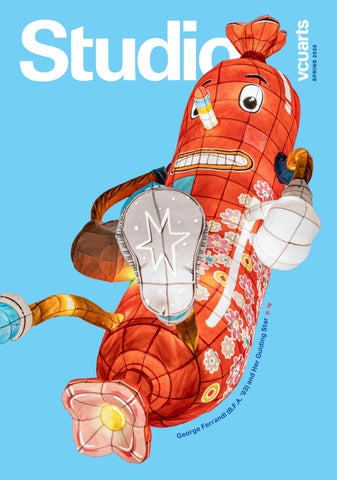
Ge
e org
Fe
r
d ran
.F
i(
.A
B
. ’9
3)
and
Her
Guid
ing S ta
r p. 16
SPRING 2026
2
Contents 02 From the Dean 03 VCUarts News 16 George Ferrandi's Guiding Star Perseverance is everything. Sculpture alum George Ferrandi spent five years building illuminated paper sculptures only to have the debut destroyed, then reborn. 24 Institute for Contemporary Art: At the Corner of Art and Opportunity Bringing Richmond to the world and the world to Richmond through worldclass, contemporary art 30 A Tutelage in Tulle Fashion students learn to see and sketch from legendary fashion designer and former Project Runway winner Christian Siriano. 34 The Weight of Money Colombian artist David Guarnizo explored the questions What do we truly value and who gets to decide? in his M.F.A. in Photography and Film. 42 One Singular Sensation Three performing arts departments unite for the first time to stage a thrilling production of A Chorus Line last fall. 52 Faculty Focus 60 Last Look: From the Archives
At the Corner of Broad and Belvidere The CoStar Center for Arts and Innovation draws the energy of the city inward through its curved, organic form, where each floor will organize complementary activities. A continuous vertical vortex connects every level, pulling students, faculty and visitors from the ground floor to the rooftop. PHOTO BY MCN AIR E VAN S
VCUarts Studio Magazine // Spring 2026
From the Dean Dear alumni, donors and friends. What a remarkable moment to be part of the VCUarts community—a vibrant time to engage in the impact and influence of creativity. The evidence has never been clearer that an arts degree is one of the smartest investments a student can make. Research consistently shows that art and design graduates enjoy strong career outcomes, competitive salaries and extraordinary adaptability in a rapidly changing world. An arts education provides the foundation for lifelong critical thinking, problem-solving, and cultural leadership that has increasing value throughout all sectors of society. It is a message I was proud to share with our 781 graduates and their families at this May’s Commencement celebration. Our graduates learned to imagine what does not yet exist and bring it to life. That’s what it means to be in the arts. I am thrilled to share that VCUarts has once again been recognized as a national leader: We are tied for No. 1 public fine arts graduate programs and ranked No. 2 overall by U.S. News & World Report in its 2026 Best Graduate Schools publication. It is a reflection of the excellent work happening here every day. You will find examples of that work on the following pages. For example, alumna George Ferrandi followed her own North Star to create dancing illuminated paper sculptures that reflect a celestial event that occurs once every 26,000 years. Fashion students gathered at the Branch Museum for a special sketching session with legendary designer Christian Siriano, learning to see and think in new ways. These stories demonstrate what is possible when people are given the space and support to dream. You can read about the new CoStar Center for Arts and Innovation, the most visible expression of our ambitions for the next generation of artists, performers and designers. The $253 million, 213,000-square-foot home for artistic expression, collaboration and discovery will open its doors in 2027. This transformative facility will unite many of our programs in one location and announce VCUarts’ vision locally, nationally and internationally. This fall, we will welcome two new chairs for our newly formed Department of Fine Arts and Department of Theatre and Dance. I look forward to their leadership to push past boundaries, further elevate our programs and inspire the next generation of artists and performers. This momentum carries us toward a milestone worth celebrating: the School of the Arts Centennial in 2028. That landmark year also marks the 10th anniversary of our Institute for Contemporary Art and the 30th anniversary of VCUarts Qatar, a testament to how far we have come and how bright our future is. With gratitude, Carmenita Higginbotham, Ph.D. Dean, VCU School of the Arts Special Assistant to the Provost for the School of the Arts in Qatar
2
Studio Magazine Virginia Commonwealth University School of the Arts 325 N. Harrison St. Box 842519 Richmond, VA 23284
Editor Debbie Farris Art Director & Designer Ryan Sprowl Photographer McNair Evans
Contributors Terry Brown Kim Catley Keshia Eugene David Hale Jeff Kelly William Lineberry Jonathan Mehring Tamurlaine Melby
K ES HI A EUG E N E
The Virginia Commonwealth University School of the Arts is a top-ranked, public art and design school in Richmond, Virgina, with a campus in Doha, Qatar. Founded in 1928, VCUarts is home to more than 3,200 undergraduate and graduate students and offers academic programs in 16 disciplines in design, narrative media and the performing and fine arts.
VCUarts News
NATIONAL PROMINENCE
KES HI A EUG E N E
VCUarts ties for No. 1 public fine arts graduate program in the nation, No. 2 overall VCU’s School of the Arts tied for No. 1 public fine arts graduate program and ranked No. 2 overall by U.S. News & World Report in its 2026 Best Graduate Schools publication, released in April. VCUarts climbed two spots from its previous position of No. 4 overall, placing it among the most elite graduate fine arts and design programs in the nation. “For nearly a century, VCUarts has stood at the forefront of creative education, producing artists, VCUarts Studio Magazine // Spring 2026
designers, scholars and leaders who shape culture and solve the most pressing challenges of our time,” said Carmenita Higginbotham, dean of VCU’s School of the Arts. The rankings are based entirely on peer assessment with evaluations submitted by deans and senior academics at 222 accredited art and design programs across the country, making the recognition a direct reflection of how VCUarts is regarded by its peers in the field. This is the
first time U.S. News has ranked M.F.A. programs since 2020, giving the 2026 results particular significance. “Being ranked No. 2 in the nation is a tremendous achievement that reflects the excellence of our faculty, the talent of our students and the strength of our institution,” said Higginbotham. “We are proud of this recognition and will continue to push the boundaries of what creative research can accomplish.” VCUarts has long been recognized as one of the nation’s premier destinations for graduate arts education. Its faculty of internationally recognized artists, accomplished alumni and talented, high-achieving students reflect the school’s commitment to exceptional professional art and design preparation within the context of a leading public research university. 3
VCUarts News
CAMPUS SPACES
4
M CN A I R E VA N S
Rising on Broad Street The landmark CoStar Center for Arts and Innovation building is set to transform the VCU campus and community.
Construction is well underway on one of the most ambitious projects in the history of Virginia Commonwealth University. The CoStar Center for Arts and Innovation (CCAI) is rising quickly at the corner of Broad and Belvidere Streets, heralding a new era for arts education, interdisciplinary research and collaboration, and community engagement. The eight-story, 213,000-square-foot building is designed to be far more than a new facility with additional space and upgrades. It will be a crucible for creativity, experimentation, engagement and lifelong learning—a reflection of VCUarts identity as both a global leader in the arts and a deeply invested partner in Richmond’s thriving arts scene and its future.
A Single Building. Many Worlds
For decades, VCUarts programs have operated in as many as 19 spaces and buildings. The CCAI will change that. The new building will be home to Theatre, Music, Dance, Cinema, Communication Arts, the Center for the Creative Economy and VCUarts student and faculty research programs. These programs will soon be under one roof, not merely sharing space, but intentionally designed to spark innovation and connection across disciplines. The building’s architecture reflects that vision. Curved, organic forms draw the energy of the city inward, while each floor is organized as a “strata strand” of complementary activities. A continuous vertical vortex connects every level, pulling students, faculty and visitors into spontaneous crossdisciplinary contact from the ground floor to the rooftop. World-class performance and production spaces will include a proscenium theater, concert hall, black box studio, screening room, soundstage, dance studios and maker spaces. Expansive glass facades will open the building outward, offering sweeping views of VCU’s hometown. A New Front Door for VCU and Richmond
The CCAI will anchor the Monroe Park Campus in a bold new way that serves as a center of gravity between the School of the Arts and VCU Health, a convergence that is both literal and figurative. The building’s location reflects a living partnership between VCUarts faculty and leading researchers from the university's academic medical center as they collaborate to explore how creativity can enhance healing, improve medical education and address real-world clinical challenges through art and design. Beyond the campus, the CCAI is designed to welcome the Richmond community. Striking floor-to-ceiling glass windows and a diagonal public passage at the Broad and Belvidere corner ensure the building’s creative activity is visible and inviting at street level, while a landscaped plaza and improved pedestrian infrastructure create a gathering space for students, neighbors and visitors. Together, these elements animate the Arts District and signal something essential: that VCUarts is integral to Richmond and that Richmond is integral to VCUarts.
RESEARCH
“When you are an artist, you are always borrowing and it becomes your own, not [through] appropriation but through a good positive attitude… When we travel and live abroad, we feel like we are an alien in this culture. We have to respect it, but we have an opinion that is kind of fresh.” VCUarts Uncharted, Episode 10: VCUarts Qatar-based international architects and interior designers Simone Carena and Marco Bruno explain the creative power of fresh starts and misunderstandings, the meaning of “dub design” and why arts research is like riding a motorcycle. Stream all 13 episodes of the first season of Uncharted, the podcast that takes listeners inside the research and creative lives of our extraordinary faculty. Listen now at arts.vcu.edu/uncharted or on your favorite podcast streaming platform.
The Road to 2027
With construction progressing rapidly, the project is on track to host an opening event in October 2027 and occupancy and full academic programming in 2028. The $253 million investment represents an extraordinary commitment to the future of the arts. This is all made possible thanks to the vision and generosity of the CoStar Group, which made an $18 million investment, and the Virginia General Assembly, state legislators, donors, partners and advocates who believe in what VCU and its arts community can achieve together. The CoStar Center for Arts and Innovation will be much more than a building. It will be a landmark, a gathering place and a statement that says the arts are essential, that creativity drives progress, and that Richmond and VCU are ready to lead. VCUarts Studio Magazine // Spring 2026
Listen now on Apple Podcasts:
5
VCUarts News
COMMUNITY IMPACT
VCUarts leaves its mark on Virginia’s historic inauguration of first female governor
6
jewelry for Spanberger to wear at the inauguration and inaugural ball. The project came together after Spanberger’s Inauguration Committee contacted Kimberly Guthrie, chair of the Department of Fashion Design and Merchandising, about the possibility of a VCU-made garment. When time constraints ruled that out, Guthrie connected the Spanberger team with Martin-Parker, who was teaching an embellishment course. Martin-Parker drew inspiration from Virginia’s state symbols—the dogwood flower, the cardinal and the
James River—and incorporated kyanite, a mineral mined in Virginia, into several pieces of jewelry. Ultimately, she designed six pieces for the governor, as well as a necklace and earrings for the governor’s mother, Eileen Davis. Spanberger chose the dogwood brooch to wear at the Capitol Square ceremony and a kyanite necklace evoking the curves of the James River for the inaugural ball. “I was shocked and excited at the possibility of the collaboration. I’m so thankful it all worked out,” MartinParker said.
CO U RE T ESY O F M A L LO RY M A RT IN - PA R KE R
When Virginia Gov. Abigail Spanberger was sworn in Jan. 17, 2026, as the Commonwealth’s first female governor, the fingerprints of VCUarts were all over the ceremony, literally. From custom jewelry to a handdrawn invitation illustration to a student design competition, VCUarts faculty, alumni and students helped shape the look and feel of a landmark moment in Virginia history. Mallory Martin-Parker (B.F.A. ’22), alumna and adjunct faculty member in the Department of Fashion Design and Merchandising, designed custom
Left: Fashion alum and adjunct instructor Mallory Martin-Parker (B.F.A. ’22) designed the dogwood and cardinal brooches Governor Spanberger donned at her inaugural events. Below: Communication Arts alum Asia Rorick (B.F.A. ’24) created illustrations of the Virginia State Capitol commissioned by Spanberger’s team for promotional materials.
The inauguration also provided Fashion students a real-world design challenge. The Fashion department held an informal design competition during the first week of classes. Twentythree students participated, using their creativity and technical skills to design possible attire for the governor all under real-world pressure of time constraints. “This opportunity highlights the interdisciplinary strength of VCUarts Fashion, showcasing how fashion design and merchandising students bring distinct yet complementary perspectives to real-world creative
projects,” Guthrie said. Asia Rorick (B.F.A. ’24), a Communication Arts alumna and VCUarts admissions counselor, was tapped by Spanberger’s team to create an illustration of the Virginia State Capitol for the formal printed invitations and gifts for inaugural team members and donors. The team wanted a Richmond-based artist with a personal connection to the city and location. Rorick gained widespread recognition in 2024 when her opossum-at-the-ballot-box design won Richmond’s “I Voted” sticker competition, going viral ahead of the election. “I really believe that the local RVA community, especially the arts community, was the biggest reason I received this opportunity,” Rorick said. Rorick credits her time as a Communication Arts major with sparking her interest in illustration. This helped her build an extensive professional network and teaching her the importance of maintaining an online portfolio filled with work that reflects her voice. Together, the contributions underscore what a VCUarts education can lead to: work that shows up at the highest levels of public life.
NEXT GEN
Class of 2026 by the numbers VCUarts welcomed the Class of 2026, celebrating 781 new graduates at its Spring Commencement Celebration May 8 at Richmond’s Altria Theater. Faculty, friends and family helped the grads herald in a new beginning.
729
Undergraduate students
52
Graduate students
CO U RT ESY O F AS I A RO R IC K , MC N AI R E VA N S
GRADUATES BY MAJOR Communication Arts: 179 Fashion Design and Merchandising: 71 Graphic Design: 71 Cinema: 54 Theatre: 53 Music: 50 Photography and Film: 49 Painting and Printmaking: 48 Kinetic Imaging: 41 Interior Design: 37 Craft and Material Studies: 35 Sculpture and Extended Media: 27 Art History: 26 Art Education: 25 Dance and Choreography: 15 VCUarts Studio Magazine // Spring 2026
7
8
ON THE RUNWAY In April, the annual VCUarts Fashion Event, Synergy, illuminated students’ strong collaborative spirit and brought to life their dazzling creative work. Seventy student models strutted down the runway at the Virginia Museum of Fine Arts, wearing designs from 40 emerging fashion designers. A special thank you to the following sponsors for their generous support of the 2026 VCUarts Fashion Event: Runway Sponsors Rachel Grove Dalton (B.A. ’05) Melanie Trent De Schutter (B.F.A. ’78) Kieran Donahue (B.F.A. ’93) and Joseph Marinucci Nita Enoch (B.F.A. ’97) and Jack Enoch Karen Parsons Phillips (B.F.A. ’88) and Family The Phoenix The Rock Foundation Deborah Valentine and Thomas Valentine Virginia Museum of Fine Arts Reception Sponsors Victoria Bleick and Charles Bleick Reji Carreras (B.F.A. ’70, M.A.Ed. ’80) Michelle Gluck and John McGurl (M.D. ’93) Marie Kimmel (B.F.A. ’84) Pam Royall Tracy Stallings (B.S. ’85, M.S.H.A. ’95) and Tom Stallings Marcia Thalhimer and Harry Thalhimer
J ON ATH A N M E H R IN G
Fashion Partners Deidra Arrington (M.B.A. ’09) and Steve Arrington Lloyd Backstrom and Art Backstrom Patricia Brown and Robert Bierly Molly Dodge (B.S. ’89) Debra Fitzgerald (B.F.A. ’86) and David Fitzgerald Frances Kahn Kimberly Guthrie (B.F.A. ’89, M.A.E. ’98) Carolyn Garner and Thomas Garner Karen Kelly (B.S. ’96) and Pat Kelly Sharon Larkins-Pederson Sophia Li (B.A. ’13) Sandra Mihaloff and Philip Klaus Candace Osdene (M.S.W. ’75) Our Life by Stella’s Karen Palen and John Palen Tamara Rabil (B.F.A. ’93) and Albert Rabil Alexandra and Brock Saunders Schroder Davis Law Firm, PLC Gail Schwartz and John Jay Schwartz, 1st Ultimate Ram (B.S. ’69) The Pink Lady Shop VCU Women’s Impact Network Verdalina Meredith Weiss Sandra Wilkins (B.F.A. ’72) and Tyrone Wilkins The VCUarts Fashion Event is supported by the newly established VCUarts Fashion Show Endowment through a generous gift from Kieran Donahue and Joseph Marinucci.
VCUarts Studio Magazine // Spring 2026
VCUarts News ART + INNOVATION
Where art becomes a voice Art education alum Amy Keenan-Amago has built more than a studio—she’s built an entire movement. BY DEBBIE FARRIS
Amy Keenan-Amago (Ph.D. ’26) has spent her entire adult life finding new ways to bring art to people. After earning her master's degree in Art Education, she taught across three states, in classrooms, museums, art centers and her own home studio, teaching every grade level and every kind of learner. When she had children and stepped back from full-time teaching, she kept going, finding creative ways to stay connected to students and the practice she loved. Through it all, one ambition stayed with her: she wanted to earn her Ph.D. and train the next generation of art educators. When she began exploring programs, VCUarts stood out. She enrolled in 2018, and what she discovered here would reshape everything she thought she knew about who art is for. Keenan-Amago taught a course called “Art for the Exceptional Learner,” which prepares art educators to teach students with disabilities or those with special capacities for learning. The course gave her the opportunity to research the intersection of art education and disability rights, including working directly with adults who have developmental disabilities. Part of the course was a practicum conducted in partnership with the Henrico Day Program, giving participants dedicated time and space to make art. Keenan-Amago never intended to establish an art studio. She has 10
loved artmaking since she was a child and completed her undergraduate education in studio art and psychology at the University of California, San Diego. Her life was full: she was a doctoral student at VCU School of the Arts, deep into research on art education and disability rights and searching for a place to do an externship. What she found in Charlottesville at the Arc of the Piedmont, a nonprofit founded in 1954 that provides services and advocacy to individuals with developmental disabilities, changed the course of her work and the lives of dozens of artists who never knew they were one. “Best job on earth,” she says, without hesitation. “I feel privileged every day that I get to do this.” Keenan-Amago, who graduated with her Ph.D. in art education in May 2026, opened The Arc Studio in June 2021 in an 11-by-15-foot room with two big tables, eight seats, no sink and
a lot of faith. The studio offers openaccess visual artmaking for adults with developmental disabilities—not as a classroom but as a true creative space where each artist directs their own work, chooses their own materials and tells their own story. “We're not teachers here,” she explains. "We facilitate, side by side, helping each artist develop material competencies, engage through their senses, and develop their own unique forms of creative expression.” The results have been extraordinary. Families reported transformations they hadn't anticipated. One artist who communicates through sign language began signing “Wow! Beautiful art!” at her own finished paintings, a gesture of pride and recognition. The parents of Julie, another artist, were told by a doctor that their newborn would never speak. She has since delivered two public artist talks. “Her family doctor didn't know she
was an artist until she was in her 50s, when she started making art here,” Keenan-Amago says. “When it's really open-ended and driven by the artists themselves, it blows the roof off every ableist belief about creative capacity.” The studio's rapid growth caught the attention of the Joseph & Robert Cornell Memorial Foundation, whose mission is a natural reflection of the Arc Studio's spirit: Joseph Cornell was a celebrated artist and his brother Robert had a developmental disability. After an initial grant of $75,000 in 2023, the Foundation awarded The Arc Studio two additional grants for $100,000 each in 2024 and 2025 in recognition of both the program’s impact and its potential. The funding has been transformative. It has allowed the studio to make community programming more accessible, hire additional staff and extend its network of partnerships with organizations across central Virginia. In December 2023, the studio moved into VCUarts Studio Magazine // Spring 2026
a significantly larger space, complete with a patio and garden, capable of welcoming up to 20 artists at a time. The expansion has opened doors to a plethora of new programs: • A membership studio collective for community artists • Partnerships with other disability support organizations • A monthly Saturday studio for children and families • Robust ceramics and garden programs • A new after-school arts program piloted in 2025 In 2026, the studio is developing programming beyond the visual arts through a new dance partnership with the Charlottesville Ballet and a pilot music program created with a disabled musician and composer. The studio continues to attract interns from VCU and other universities
along with a dedicated corps of community volunteers, which keep it vibrant with fresh energy and perspective. Keenan-Amago's dissertation— ”Making Art, Making Self”—explores the relationship between artmaking and identity, examining how creative engagement facilitates a profound, ongoing process of becoming. The studio is not just her externship. It is her research, her laboratory and her life's work. “We call this studio the joy machine,” she says. “We laugh, we make art, we tell stories. We're all growing together.” For VCUarts, Keenan-Amago's story is a vivid reminder of what an arts education makes possible—not only for the artist, but for the world an artist chooses to shape.
Note: This article was written from staff interview notes in spring 2025 with current updates from the artist. 11
VCUarts News
ARTS + TECHNOLOGY
Hollywood in a box VCUarts professor’s invention puts studio-grade 3D technology within reach
12
“Because it was so useful, I continued researching in that direction.” So he built his own. Cruz, an assistant professor of communication arts, spent three years developing the “Box Stage,” a portable, low-cost 3D scanning system that delivers studio-level
J O N AT H A N HA F F
When Ernesto Rodriguez Cruz set out to make a short animated film, he ran into a problem common to many independent artists: the technology he needed existed, but it was built for studios with million-dollar budgets. “I could use the technology in early development to scan my actor,” Cruz said.
facial detail comparable to the light stage technology used in Hollywood blockbusters and AAA video games. The technology is designed to capture the kind of hyper-detailed 3D surface information such as skin texture, pores and subtle wrinkles that Hollywood studios and top-tier video game developers rely on to make digital humans look like actual people. Traditional Hollywood-grade “light stage” systems are wildly expensive and rely on hundreds of lights, multiple camera arrays and specialized optical filters that require precise, timeconsuming calibration. Cruz’s invention sidesteps all of that, delivering comparable results at a fraction of the cost and making studio-grade 3D scanning, portable, accessible and
D E A N H O F F ME YE R
affordable to independent filmmakers, game developers and researchers. The Box Stage is a fabric cube lined with LED light strips and equipped with 11 digital cameras arranged in a semicircle. A person sits inside on a chair, and when cued by Cruz, doubleclicks a remote that fires a half-second burst of lights. Cameras capture each angle of the face, and as the light shifts, subtle changes in highlights across the face reveal the 3D shape of the surface—including fine details like pores and wrinkles. Cruz, whose background spans electrical engineering and 3D artistry with years spent working in the video game industry, puts it plainly: “With our technology, it is possible to achieve 3D surface reconstruction quality comparable to that of Academy Award-winning light stage systems, but at significantly lower cost and with far simpler hardware. We're taking something that was only possible in major studios and making it accessible to anyone.” Cruz has filed an invention disclosure with VCU TechTransfer and Ventures. The technology’s promising potential extends beyond entertainment to forensics, manufacturing, wound tracking, aerospace and even microscopic imaging. “We don't yet know exactly how people will use it,” said Brent Fagg, assistant director for innovation at VCU TechTransfer and Ventures. “That's part of why getting it in front of students and researchers is so valuable—it helps us understand where the real-world applications might be.” For Cruz, that openness is the point. What began as a personal workaround has grown into a technology that could reshape how artists, scientists and students think about and engage with 3D imaging. At VCUarts, it’s a reminder that some of the most consequential innovations start not in a corporate lab, but in the hands of someone who simply needed a better way. Note: Based on articles by Jeff Kelley for VCU News. VCUarts Studio Magazine // Spring 2026
CLASS OF 2026
Kel Raphael finds harmony at both piano and computer keyboards BY WILLIAM LINEBERRY Whether it’s code or a chord, the feeling of satisfaction is what drives Kel Raphael. The Honors College graduate earned two degrees this spring: a bachelor of fine arts from the School of the Arts with a concentration in piano performance and a bachelor of science in computer programming from the College of Engineering. To Raphael, the two pursuits overlap in a compelling way—both reward the same deep feeling of accomplishment when things finally go right. “The moment I can play through a piece of music and make it sound exactly how I want it to sound—or when I eventually figure out a problem with a piece of code after some head bashing, but I eventually get it to work, that moment always feels really good,” Raphael explained. Raphael has kept both sides of their interests balanced and thriving throughout their undergraduate career without sacrificing one for the other. The motivation, they say, was straightforward: “I’ve played piano my whole life, so I wanted to continue to pursue that—but not as a full-time job. So that, along with also having a real interest in computer science from high school is why I chose to pursue it as well.” What made it work is what Raphael credits in large part to VCU—specifically, what the university taught them about learning itself. The skills transfer across both disciplines in ways that aren’t
always obvious from the outside. At VCUarts, where interdisciplinary thinking is central to how the school approaches creativity and research, Raphael’s path feels less like an outlier than a natural expression of what’s possible here. “With music, if you have a piece, there are ways to practice it and figure out how to improve your playing. Or if you’re not sure what you want to do with the piece, you can experiment and figure it out. “With computer science, you will encounter a problem and not know what to do, so you have to look it up and figure out the problem until you understand what you want. And that’s a challenge, but it’s a very important skill.” Graduation isn’t the end of Raphael’s time at VCU. They will spend one more year in the College of Engineering completing an accelerated master’s in computer science, a program that allows students to begin graduate coursework while still finishing their undergraduate credits. After that, the vision is simple. Raphael hopes to play the occasional music gig—at church or wherever music calls—while building a career in computer science aimed at helping people. “I mostly just want to have a good life and generally improve things for other people,” Raphael said, “while also being a good person myself and just live my life.” It’s a quietly ambitious goal, and one that sounds, in its own way, like harmony. 13
VCUarts News
PAYING IT FORWARD
BY DEBBIE FARRIS 14
M CN A I R E VA N S
Shaping fire and sand into something enduring Glass artist and professor Jack Wax built a highly respected glassworking program. Now, a generous endowment will help the program thrive in perpetuity.
The process of glass making is an ancient and enduring art born from sand, ash and limestone. In an inferno of heat reaching over 2000 degrees Fahrenheit, a highly synchronized dance of heat, gravity and breath, shapes take form. Throughout the decades of collecting glass art, Florence Lee Wellons and her husband Harry A. “Bert” Wellons (M ’61) watched a medium evolve and an art form flourish. What they saw at VCUarts moved them to do something lasting about it. Through their collecting practices, the Wellons were well aware of VCUarts professor and internationally renowned glass artist and sculptor Jack Wax and his stature in the field. Wax blends traditional glassblowing with meticulous mixed-media sculptural techniques and his signature “imbrication,” in which he uses overlapping elements to create texture and depth with patterns resembling organic forms like fish scales or roof tiles. He challenges students and utilizes the hotshop to create abstract, contemplative sculptures based on personal narrative and visual concepts. “When enjoying a piece of glass art, the technical skill involved in its creation underlies the aesthetic pleasure,” Florence Lee said. “It demands an understanding of the medium and how it speaks with the creative goal of the artist.” For collectors so deeply invested in the art form to turn that passion into an endowment is a testament to the glassworking program’s impact and reach. The Wellons admired what Wax created and they wanted its impact to be sustainable through the years. In 2023, they initiated their support of the VCUarts glassworking program in the Department of Craft and Material Studies. In 2025, the Wellons established the Wellons Family Professorship in Glass Art, which builds on their earlier gift, to encourage both a deeper understanding of glass work and its techniques as well as how it reflects the artist. Professorships are the highest honor a university
may bestow on its faculty, rewarding excellence that begets excellence. This fund will support a faculty member in the program, recognizing the achievements, aesthetics and creative goals of the school’s finest professors. With its rich legacy in glass— VCUarts was just the second art school in the United States to initiate hot glass into the fine arts curriculum and establish a concentration in glass. The school’s glassworking program is dedicated to the use of glass as a medium of artistic expression and to the appreciation of glass as an
international art medium. Somewhere in the glow of a furnace in 1969, world-renowned cast glass artist Kent Ipsen established the VCUarts glassworking program that went from a glowing ember into a blazing national presence. An internationally acclaimed artist known for his sculptural works in cast glass, Ipsen exhibited his work in venues from the Smithsonian American Art Museum and the Brooklyn Museum to the Corning Museum of Glass and the Vatican Museum. When Wax arrived at VCUarts in
One of many glass pieces in the Wellons’ personal collection.
VCUarts Studio Magazine // Spring 2026
1999, he began significantly expanding the glassworking program. At the time, glassworking itself seemed to be fading, a remnant of pre-industrial craft culture overtaken by machines. Few would have predicted what came next. Wax opened the program to graduate students, tirelessly recruiting more students and pushing the curriculum toward rigor and ambition. Within five years, applications for the graduate program had grown to 22. National recognition followed. Today, VCU’s glassworking program is widely regarded as one of the best in the country, largely because of what Wax built. Wax compares glassworking to playing in an orchestra. Every musician must master their instrument through years of practice, discipline and the craft. But no matter how skilled the individual player, the music only comes alive in relationship to others. In the hotshop, it works the same way. The web of relationships between students and faculty mentors is not just part of the experience, it is inseparable from the art itself. “It’s really important that we have a sense of community,” he said. “Community is central to what we do because working with glass is not an individual effort.” Dr. and Mrs. Wellons wanted to ensure the VCUarts glassworking program remains a nationally and internationally recognized place for the next generation of artists to study, flourish and build their community.“The students do [this work] because they love it. And you see that,” Wax said. “They give over their hearts and souls, coming in at 4 a.m. and staying until midnight—caring and giving and being responsible human beings at the age of 20. They build a community and take care of each other.” VCUarts glass faculty have built a rich academic environment to nurture young artists, designers and artisans. Thanks to the Wellons Family Endowed Professorship in Glass Art, students will continue to learn the centuries-old art of glassmaking, explore the medium’s inherent properties and hone their skills in the hotshop all in pursuit of their own limitless artistic expression. 15
Perseverance is everything. Ferrandi spent five years building illuminated paper sculptures only to have the debut destroyed, then reborn.
BY KIM CATLEY 16
VCUarts Studio Magazine // Spring 2026
17
for thousands of years, sailors, travelers and wanderers have turned their eyes toward the heavens, searching the vast darkness of the night sky for the North Star that would guide them forward. While the North Star is our most enduring symbol of constancy amid uncertainty, its position above the North Pole isn’t as fixed as we believe it to be. A slight wobble in the Earth’s rotation shifts our perspective by just one degree every 72 years—a miniscule change that adds up with each passing generation. In ancient Egypt, it was Thuban—not Polaris—that held the title of the North Star. Our most recent was a pair of stars, Kochab and Pherkad, and our next will be Gamma Cephei. Every 26,000 years, the north polar axis completes a full rotation through the sky, and the cycle of North Stars begins anew. When sculpture and performance artist George Ferrandi (B.F.A. ’93) learned of this phenomenon, she wanted to create a new tradition to celebrate this celestial changing of the guard. She spent five years constructing a series of largescale illuminated paper sculptures, commissioning new orchestral works, and engaging local artists and community members in her process—only to have the ceremonial debut destroyed by a natural disaster. The sculptures sat in storage for another five years as Ferrandi waited for a new opening in the universe. Last year, that moment finally presented itself and Super!Giant!Jump!Star! premiered in Richmond’s Abner Clay Park—the solo featured work for 1708 Gallery’s annual InLight exhibition. The Richmond Symphony, indiepop musician Mirah and the United Voices of Ebenezer performed. Several VCUarts students helped construct a new addition to Ferrandi’s line-up of sculptures. And hundreds of Richmonders came out to create their own lanterns and light up the night sky. 18
Built in the Japanese Nebuta tradition, Ferrandi’s illuminated paper sculptures each represent a future North Star, proof the cosmos contains multitudes. This one takes an earthly form.
Eleven futures, eleven stars. Each illuminated sculpture represents a future North Star and a reason to celebrate.
“When we first started talking about doing this in Richmond, it seemed like a revelation,” Ferrandi says. “There’s such an excitement about public work and outdoor events and live music and interdisciplinary projects. “And then I realized this wasn’t a circuitous route to the right answer. Richmond is where I got started as an artist. It’s no coincidence that the project evolved the way it did.”
Big exhalations, tiny inhalations Ferrandi describes her work as “art all the way down,” where the process of creation and community engagement is the practice, and every element is its own work of art. It’s a practice that traces its earliest roots to VCUarts and the late Joe Seipel, former dean. Ferrandi chose to major in Sculpture and Extended Media after Seipel visited her Art Foundation class and introduced the expansiveness of the field. She later took classes with Seipel and worked as his teaching assistant and studio assistant. “His broad definition of sculpture and his interdisciplinary approach—the way he used sculpture as a departure point for performance, along with the humor in his VCUarts Studio Magazine // Spring 2026
19
PR E V I O U S PAG ES: T E R RY BROWN , O PPO S I T E : CO URT ESY O F G E RO G E F ER R AN D I
Lying in wait Collaboration and impermanence are common themes in Ferrandi’s work—and both are at the heart of Jump!Star. The project starts by posing a question: How on Earth will we say goodbye to Polaris? Ferrandi believes the answer can’t be invented by one person—including herself—so she spent five years bringing together scientists, musicians, artists and arts organizations, and community members to collaborate around the ideas of developing a new tradition. “Honestly, it grew from the inside out,” she says. “It started very small, and then it gained momentum with people’s interest in it. There was excitement about this idea of passing something down through the generations that could be in place when the next North Star moves into position.” Jump!Star grew to include 11 illuminated paper sculptures, one for each of the stars that will serve as our North Star. The sculptures were built using a traditional Japanese process called Nebuta, and were intended to dance in a celestial parade with choreography by New York artist Alan Calpe and music by Mirah. Jump!Star was set to premiere on June 15, 2019, in Kansas in conjunction with the annual music festival, Symphony in the Flint Hills. Ferrandi and her collaborators assembled
You say goodbye, we say hello. Ferrandi’s Jump!Star invites communities to dream up the cultural customs that will one day welcome our next North Star.
VCUarts Studio Magazine // Spring 2026
“
Now, I oscillate. I like to describe my practice as a kind of breathing. There are these big exhalations with hundreds of people, and then there are these tiny inhalations where it’s just me working on something in clay.
“
work—all shaped my sensibility,” she says. “I once wrote to Joe that his ‘sparkling-eyed inventiveness completely shaped the way I move through the world,’ and that he was my model for generous community-building and joyful, out-of-the-box thinking.” In her first major professional project, Cloud Seeding Circus, Ferrandi began to experiment with the idea of “art all the way down.” She and nine other visual artists created a mobile installation, exhibition space and vehicle for performance, and spent three years bringing the caravan to art venues. In addition to sculpture, video, installation and performance art, admission tickets and posters were editioned prints and viewers were participants in the recontextualized circus. A later project with the Fleisher Art Memorial, Wherever There is Water engaged the South Philadelphia community. Ferrandi collected stories and sketches of residents that she wove into a larger narrative. Others came to the Fleisher to create illuminated sculptures and paper lanterns that were carried in a parade that progressed through the narrative. “That’s when my studio practice changed,” Ferrandi says. “I started wanting to work with people and not be entirely alone in my studio. “Now, I oscillate. I like to describe my practice as a kind of breathing. There are these big exhalations with hundreds of people, and then there are these tiny inhalations where it’s just me working on something in clay.”
for a dress rehearsal the night before—just hours before a tornado ripped through the festival site. While the event was canceled, the sculptures survived. But the months that followed brought the Covid-19 pandemic and a period of global isolation. Ferrandi shifted focus to George’s Lovely Variety, a print newsletter with writings and drawings about the cosmos, Covid-era domestic life, animals and sea monsters—delivered to subscribers’ doorstep each month of 2021. Meanwhile, Jump!Star lay dormant. “For five years I paid to store the sculptures with no venue and no momentum,” Ferrandi says. “By the end of 2024, I had decided: if no presenter stepped forward, I’d set them up in storage in December, invite a few friends to see them, and then dismantle them in January.” Before that day could come, however, Ferrandi received a call. Seipel was preparing a retrospective, Joe Seipel: Yours & Mine, at the Anderson at VCUarts. 1708 Gallery, which he co-founded, asked if there was a former student he could recommend for a parallel exhibition. Seipel suggested Ferrandi. “I really did make it a habit never to say no to Joe,” she says. once & hopeful stars opened at 1708 Gallery in August 2024 and featured several of the Jump!Star sculptures, which Ferrandi brought out of storage. That’s when talks began to revive the project at the gallery’s annual InLight exhibition the following year. 21
‘The birth of a sprout is the death of a seed’ On October 17 and 18, Richmonders gathered in Abner Clay Park for a two-night celestial ceremony and the premiere of Super!Giant!Jump!Star! At a table near the entrance, children drew pictures on white paper to be wrapped around small electric lanterns. Across the park, the Richmond Symphony performed the world premiere of Jherek Bischoff’s original symphony for Jump!Star. Nearby, attendees walked among the illuminated sculptures before learning the songs and movements for the ceremonial procession. In the year between her solo exhibition at 1708 Gallery and InLight, Ferrandi’s ties to the city—and to VCUarts— have only deepened. Last summer, several sculpture students and recent alumni worked with Ferrandi to create Iota Cephei, a 12th addition to the Jump!Star project. The sculpture was later on view in Big Top Energy: Schemes & Souvenirs, an exhibition at the Anderson that traced Ferrandi’s evolution as an artist, leading up to the premiere of Super!Giant!Jump!Star!. In addition, Richmond-based artists and performers Cassie Works and Egbert Vongmalaithong recruited a team of improvisers to represent “almost” future North Star Kappa Draconis as a fiery flock that swirled through the procession. 22
Built by artists, musicians, dancers, scientists and dreamstormers over the course of a decade, this slow, deliberate craft culminated in Jump!Star ’s once-in-a-generation ceremony.
The morning after the ceremony in Abner Clay Park, Ferrandi gathered with collaborators and artists for another farewell—this one to the Jump!Star project, at least in its current form. About 60 people stood in a circle around the sculptures, their right hand on their heart, their left hand on the back of the person next to them, as Zuzana Ernst led a sound meditation. The First Galactic Season Ceremony continued with a chant and dedication from members of Richmond Zen. “We felt our heartbeats and then we gathered that energy in our hands and projected it into the future,” Ferrandi says. “Then we walked around and gave it to each sculpture. It was surprisingly touching to give these objects gratitude.” Ferrandi invited everyone to cut sections of the sculptures to take as artifacts before disassembling the pieces for new purposes. The steel wire from the frames went to salvage, the copper wire to an artist who builds exclusively from found and recycled materials. The sculpture bases went to local puppet collaboratives. Ferrandi took the lightbulbs for a future project. Just before the work that had been Ferrandi’s North Star for more than a decade fractured into stardust, she recited “Song for a Supernova Ceremony,” a poem she had written for the moment: The birth of a sprout is the death of a seed. The new day is the end of the night. Finally seeing the thing you’ve anticipated for years Means now it is over and you have seen that thing. Even if you haven’t been waiting at all, Now it is over and we have seen that thing. Standing in a circle after sharing something meaningful– A bloodline, a worldview, a service, a circus— Standing in a circle is the correct shape to talk about endings. I’m trying to get to the part where this ending is a beginning; Where one train hides another. Where all the odds hang even.
T E R RY B ROW N
Where the sky is indistinguishable between dusk and dawn.
VCUarts Studio Magazine // Spring 2026
And the circle is a smooth groove all the way around. •
Learn more about this celestial ceremony, Super!Giant!Jump!Star! at www.jumpstar.love. 23
C E H T AT
Bring ing R ichm to th ond e wo r l d and t world he to Ri chmo throu nd gh w o r ld -cl cont ass, emp orary art
24
UNIT Y
By Melby e n i a l r Tamu
O F A RT
R E N R CO
AND
25
O P PO R
The bustling intersection of Broad and Belvidere streets in Richmond is busier than usual. These days construction crews give shape to new classrooms, performance venues and makerspaces in the form of VCU’s CoStar Center for Arts and Innovation (story pp. 4-5). Across the street, a serene silver facade offers the illusion of comparative stillness, but make no mistake: Behind those zinc panels and frosted windows, the Institute for Contemporary Art (ICA) at VCU’s Markel Center is a hub of perpetual activity and innovation in its own right. Opened in 2018, the ICA is no longer the new arts center on the block, in more ways than one. It now has eight years of contemporary art exhibitions, diverse public programming and other ambitious initiatives under its belt, with more in the works. We spoke with Executive Director Jessica Bell Brown about where the ICA stands now, where it’s headed and why this is a coming-of-age story she’s excited to tell. 26
You’re at a party and someone asks you what you love about your job. What do you tell them? JBB: I tell them that I get to lead
one of the most unique and creative institutions in the country. We exist to support artists, to champion their visionary practices and to promote dialogue on contemporary art and ideas. We look at artists broadly, from painters, sculptors, filmmakers, podcasters, chefs, writers and worldbuilders. We are constantly changing and evolving, and that is what inspires me to come to work every day.
The ICA is a university-owned institute whose mission is to listen, create and make art public. How does this set it apart from a traditional (collecting) art museum, or from an art institute not connected to a university? JBB: Our strength is our agility.
PR E V I O U S S PR E AD : I WA N BA A N , T H IS PAG E : E TH A N H IC KE R SO N
We’re unencumbered by a collection, which means we’re 100% powered by artists and ideas. We have a built-in community of faculty, students and university administrators across disciplines, which means that we’re in a constant state of exchange, research and collaboration. As a public-facing institution, we are responsive to our neighboring communities, and we have a sprawling urban landscape that promotes reflection and gathering. We also are anchored by our community partnerships [programs produced in collaboration with local organizations], which supports the ICA being responsive to the moment and our ecosystem.
If the ICA were a person, which three adjectives would best describe its personality? JBB: Provocative, curious, electric. Can you tell us about some recent milestones the ICA has achieved? JBB: We’ve consistently grown our
attendance to over 20,000 visitors annually, we’ve launched a major public art initiative, and organized our first artist-centered fundraising gala that honors the creative visionaries that inspire our work here at the ICA. We’ve strengthened
VCUarts Studio Magazine // Spring 2026
our community partnerships and university partnerships. We launched a successful chef residency program for the ICA’s Abby Moore Cafe. For the first time, we have established a national tour of one of our phenomenal and groundbreaking exhibitions: Dear Mazie, inspired by the life of Amaza Lee Meredith. This is a huge accomplishment and a testament to the rigor and resonance of our global contemporary arts program. Looking ahead a few years, what is one of the biggest growth opportunities you see for the institute? JBB: Our biggest growth opportunity
is to broadcast even more loudly who we are as an institution, and the incredible programs and engagement
that we shepherd here. I often say, I want to widen the invitation of welcome to the ICA. In other words, more storytelling? JBB: Exactly. The ICA is a highly
collaborative engine for creativity and exchange, and we want to highlight that in our efforts and in our storytelling. We want our communities to know who we are, what we do, and to be on the journey with us. I want us to roll back the curtain to see how special this place is, and most importantly, the people and communities who power it—from our phenomenal visitor services team, to our curators and broad creative network. There are so many hands that go into the creation of exhibitions 27
and programs. We want to invite that greater visibility, because showcasing this aspect of our work supports the efforts of demystifying museums, and making them more inclusive spaces for all. Last May, you gave a public address that identified national museum accreditation as a long-term goal. Why is accreditation important, and what does the process look like? JBB: Museum accreditation will
place the ICA on par with nationally recognized institutions. In 2028, we will have been in operation for 10 years. As we approach this important milestone, we want to be in the habit of evaluating our practices and operations across other university galleries and contemporary art institutions that develop groundbreaking exhibitions and engage multiple publics. It means being very clear about who we are as an institution and who we serve. The process is mostly evaluative, meaning it takes a deeper dive into our current operations, from how we care for our facilities, how we engage audiences, how our mission shows up in our exhibitions, programs, etc. What this means for us is that we must establish a runway to clarify how our values and priorities show up in our operations through a new strategic plan. We’ll reflect on areas where we have growth opportunities. Accreditation is a longer-term goal for us, but our foundation for it will be established through the short-term with our strategic plan.
What are the priorities of that strategic plan? JBB: I want to position the ICA for
growth over the next few years, and our new strategic plan will prioritize connection, activation and access. We will harmonize our artistic program across exhibitions, the VPM + ICA Community Media Center and the Abby Moore Cafe. We will emphasize and grow our unique, reputable voice.
28
the Markel Center. A primary collaboration is the annual VCUarts M.F.A. Thesis Exhibition [in the spring], in which curators and the ICA’s exhibition teams work closely with VCUarts faculty and students to produce the show. It’s a full ICA takeover, and over the course of several months, the M.F.A. candidates get to collaborate with our team members, learn about best practices and advocate for the installation or interpretative needs of their specific thesis projects. In a way, any show at a university can be a practicum where these experiences move from the classroom to the real world. We also see teaching and learning show up in our VPM + ICA
Community Media Center, through which the fundamentals of sound design, podcasting and content development are taught to folks here on campus, in the city and beyond. Education gives us a toolkit to reach and connect with the public, to inspire them, to share ideas, and to ultimately sustain our work as a generator of creative research and exchange. Our core audience is first VCU students and faculty. By simply sharing our plans for shows and programs, inviting folks to visit with us, we tap into the incredible network that exists here at VCU. I’m encouraging our teams to make connections with organizations who work with youth and families across the city. We’re also exploring how to
DAV ID H A L E
Can you speak to the role education currently plays in the ICA’s work, and how you see that evolving in coming years?
JBB: We host VCU courses at
A Mutant Perfect by Amelia Ruth Baxter (M.F.A. ’26) on view during the 2026 M.F.A. Thesis Exhibition at the ICA
build greater connections with the educator community in Richmond city and the surrounding counties. Ultimately, we will need support to sustain these efforts on the staff side through interpretation and shaping the visitor experience, but I firmly believe that these community-driven efforts are what distinguish good from great institutions. Across the street from the Markel Center, VCU is building the CoStar Center for Arts and Innovation, scheduled to open in late 2027. How will this affect the ICA? JBB: The Markel Center and VCUarts’ forthcoming CoStar Center sit at Broad and Belvidere, VCUarts Studio Magazine // Spring 2026
the most creative intersection in Richmond. Together, the ICA and the CoStar Center will amplify the vibrancy and creativity on campus, as well as in the downtown arts district. We look forward to the rich exchanges, collaboration and dynamic programming opportunities ahead. The ICA just hosted its inaugural fundraising gala on April 18 and is preparing to unroll a new membership campaign. Why are efforts like these critical to the institute’s future? JBB: We continue to reflect on
how the ICA can grow its impact in Richmond’s creative ecosystem, and that means continuing to
position ourselves to be of civic good, to support ambitious artist commissions, and to showcase the incredible interdisciplinary talent emergent within our VCU community and beyond. The ICA is a vessel for dynamic engagement. Our community’s support through membership, giving and collaboration is what makes our ambitious vision possible. What role do you want the ICA to play in the lives of community members? JBB: I want our community to see the ICA as a source of inspiration and provocation, and as a place where deepened connections, through art and each other, are possible. • 29
A TUTELAGE IN TULLE FASHION STUDENTS LEARN TO SEE AND SKETCH FROM THE LEGENDARY CHRISTIAN SIRIANO BY TAMURLAINE MELBY PHOTOS BY ANNA-LOUISE CECIL
L
aughing, vcuarts student Montana Allen describes the moment she got the email last fall: her sudden scream, her scramble to fill out the registration form. “My roommate probably thought I was crazy,” she says. But no, she was simply a first-year fashion merchandising major who’d just learned that celebrity designer Christian Siriano would be offering a sketching workshop for students in the VCUarts Department of Fashion Design and Merchandising. As in, Christian Siriano, who rose to fame in 2008 on the reality TV show Project Runway, as its youngest winner ever at the age of 21. Christian Siriano, who creates visionary couture dresses for the likes of Beyoncé, Zendaya and Alicia Silverstone. Allen didn’t have to think twice: “I was probably the first or second person to sign up.” Six weeks later, that tantalizing email became a reality at The Branch Museum of Design on Richmond’s Monument Avenue. It was Friday morning, Jan. 17, and later that day, the museum would debut Undeniable, an original exhibition featuring more
than two dozen mannequins wearing Siriano’s designs alongside paintings by pop artist Ashley Longshore. But first, Siriano would lead 70 VCUarts fashion students through an hour of demonstration and guided practice as they sketched from life a cascading yellow ballgown once worn by Celine Dion in concert. “Fashion sketching is the beginning of every single one of my projects,” explains sophomore design major Ashley Deeds, who attended the workshop and wants to be a celebrity designer like Siriano one day. “Most of my ideas that I have in my head really don’t mean anything until they’re on paper, because that’s where they start to change and develop.” The hall of the Tudor Revival mansion filled with marker fumes as the students hunched over their sketchbooks with BIC pens and distinctive yellow markers gifted to them by the museum. The room was virtually silent except for when Siriano spoke to offer individual feedback or describe his technique— how he positions the imaginary model’s head, how he illustrates tulle
31
Rare silence of total concentration. In it, Siriano's voice guides students, making couture feel suddenly, impossibly learnable.
ruffles, how to capture the light as it spilled through the diamond bay window onto the fabric. “Everyone was so focused in,” recalls Kimberly Guthrie, chair and associate professor of Fashion Design and Merchandising. “It wasn’t on a screen, and it wasn’t a video. It was their hand and a piece of paper and their eye and their heart, engaged. It was purely magical.” Of course, even in a castle-like setting brimming with fairy-tale gowns, it can take a lot of planning to make magic happen. The workshop and exhibition marked the first-ever partnership between The Branch and VCUarts, as part of a directional shift and rebrand the museum underwent
32
last year under then-Executive Director Kristen Cavallo. Cavallo recently transitioned to artistic director at The Branch in order to resume her prior role as CEO of the Martin Agency. Beyond bringing in more outside collaborators, the reimagined museum places a stronger emphasis on bold, contemporary design. “Partnering with VCUarts felt like a natural fit,” says Katie Hoak, director of marketing at The Branch. “As one of the top public art and design schools in the country, they’re shaping the next generation of artists and designers, and this exhibition placed those students in direct conversation with creatives whose work has real cultural impact. “This sketching workshop brought
A cascading gold, timeless inspiration: Siriano guides fashion students in sketching one of Celine Dion's most unforgettable stage gowns.
that idea to life. Students weren’t just looking at Christian Siriano’s work— they were sketching alongside him, getting a window into his process, and seeing how creative ideas move from concept to studio to runway.” In addition to the sketching workshop, VCUarts student volunteers helped prepare the exhibition, allowing them to touch and arrange the garments and earning them tickets to a special opening reception. When it closed on March 22, Undeniable was The Branch’s most well-attended exhibition to date, drawing visitors from across the country. A number of individuals and organizations sponsored the show, including the VCUarts Pollak Society. But it was a particularly generous gift from Pollak Society member and VCUarts fashion alumna Rachel Grove Dalton (B.A. ’05) that made the workshop possible. “As an alumna, I’m always looking for ways to support opportunities that expand how students see themselves and their potential,” Dalton says. “If this [workshop] gave students a greater sense of confidence, inspiration or
VCUarts Studio Magazine // Spring 2026
clarity about their own creative path, then it’s something I’m incredibly proud to have supported.” There’s no “if” about it, according to Allen. Calling the workshop “a oncein-a-lifetime opportunity,” she says it “sparked the creative side of me again.” Afterwards, she found herself drawing constantly, a practice she’d previously set aside to focus on her merchandising studies. Deeds, too, has seen the effects of the experience in her own design sketches: They’re more efficient and stylized now, and she’s gained the confidence to sketch in pen instead of pencil. But what will remain with her most is one word Siriano uttered toward the end of the workshop, just before the event transitioned into a lively Q&A. As he circled the room assessing the students’ sketches with a critical eye, he paused before Deeds’. She heard him murmur “beautiful” under his breath. “I don’t need anyone to ever validate me ever again,” she says with a smile. “I got Christian Siriano to say my drawing was beautiful. •
33
COLOMBIAN EXPLORED
ARTIST THE
DAVID
QUESTIONS
GUARNIZO
WHAT
DO
WE
TRULY VALUE AND WHO GETS TO DECIDE? IN
HIS
M.F.A.
IN
PHOTOGRAPHY
DEBBIE
BY
THE
AND
WEIGHT
OF
FILM
FARRIS
MONEY
THERE ONE
IS MEMORY David Guarnizo returns to often. He’s exploring the Cocora Valley in Colombia, surrounded by towering wax palms, when someone hands him the new 100,000 Colombian pesos bill, issued in 2016. He looks down and sees the very landscape surrounding him—printed, miniaturized, made official—staring back. “That moment was transformative,” he says. "I realized I was experiencing the landscape both directly, through my body, and indirectly, through the image depicted on my country’s currency.” It’s the kind of revelation that reorients a practice. For Guarnizo, who graduated from VCUarts in 2025 with an M.F.A. in Photography and Film, that afternoon in the Cocora Valley set in motion a decade-long inquiry into one of the most fundamental questions a contemporary artist can ask: What do we value and how do we decide? FROM BOGOTÁ TO RICHMOND
36
CURRENCY AS A PORTRAIT OF POWER
Since arriving in Richmond in the summer of 2023, Guarnizo's work has grown into something expansive and urgent. At its center are the objects we touch every day without really seeing: bills and coins. For Guarnizo, a banknote is never simply money. It is an image, a political document, a compressed history of what a nation has chosen to celebrate. And what it has chosen to erase. “When I have a bill in my hands I ask ‘What story is being told here and what story is being left out’?” His M.F.A. thesis work exhibited at the Institute for Contemporary Art in Richmond in the spring of 2025 explores these questions across a stunning range of materials and methods. Guarnizo engraves historical imagery onto stacks of newsprint, transforms archival photographs from the Library of Virginia, casts hand sculptures in plaster and bronze, and transfers landscapes from currency onto river stones collected from Belle Isle and the James River. In each case, the move is the same: taking an image that operates invisibly within economic systems and making it suddenly, viscerally visible. One of the artist’s most resonant works began
PR E V IO U S S PR E A D : M CN A I R E VA N S
Guarnizo grew up in Bogotá, a dense city of concrete. As a child, any trip to the mountains or countryside felt like something close to sacred. That early sense of wonder about the natural world became the foundation of his artistic practice. After enrolling at the National University of Colombia, he began making work about landscape. He traveled to the northernmost landmass of South America at Punta Gallinas, chasing the horizon as a metaphor for the unreachable as well as for the intangible nature of the political lines, limits and boundaries of the territories where we live. From this perspective, David’s early works documented these personal encounters with the landscape through photography, video and performance. Guarnizo has always understood himself as two things at once: an artist and an educator. Throughout the years, he taught at universities, led education departments at two museums in his hometown and developed community-centered projects that used artworks as gathering points. This latter he calls a kind of fire around which people come together to ask questions and exchange stories. However, when the academic and institutional work began to crowd out his studio practice, he felt it physically. “One of my professors at the National University of Colombia used to say that studying and making art is like going to the gym,” he says. “You have to exercise regularly. I realized I had stopped, and I could feel it. You have to rebuild your strength, train your memory, recover your
physical dexterity. Over time, the creative practice becomes fluid and sharp again.” The decision to pursue an M.F.A. was partly a decision to recover himself. Guarnizo focused on public universities, following advice from colleagues at museums and universities in Bogotá where he worked who said “public education systems carry a different energy and a different kind of openness, and that definitely influences an artist’s practice.” He interviewed with several universities and was accepted into all of them. However, Guarnizo describes the way he came to VCU as “quite special.” When he spoke with associate professor Tesora Molina-Garcia in VCUarts’ Photography and Film department, a Latina professor from El Salvador who spoke with him not just about resources but also about the kind of practice he could build, his choice became clear. “I felt it was essential to leave [Colombia], even if only temporarily, in order to see how my work would evolve in a different context,” explained Guarnizo. “What I wanted was not just access to equipment and facilities. I wanted to be part of an interdisciplinary and supportive community. And that is exactly what I found at VCU. “It offered the perfect space to grow as an artist while also learning from my professors, classmates and students. At VCU, I have been able to cultivate a practice that is not only about making art, but also about sharing, exchanging and building knowledge collectively,” adds Guarnizo.
Above: Guarnizo working with newsprint and plaster in his M.F.A. studio at VCU’s Pollak Building.
Left: Detail of sculptural work: hands cast in various materials, holding different trading objects.
M CN A I R E VA N S
Above: In his studio: Guarnizo’s exploration of the idea of value in the 100,000 Colombian pesos bill.
VCUarts Studio Magazine // Spring 2026
37
with a stone he carried from Colombia in his luggage. It was just an ordinary rock onto which he transferred the landscape printed on the 5,000 peso bill: the páramo, one of Colombia’s most ecologically critical and fragile ecosystems. While he was making the piece as part of his thesis work, news broke about a fire burning through a Colombian páramo. He altered the bill’s image digitally to include the flames, then transferred it onto the stone. “It became a small but symbolic representation of how vulnerable these ecosystems are. How easily they can be destroyed if not protected.” The stone sits in his studio—modest in size, enormous in weight. THE HAND THAT HOLDS
Another thread running through Guarnizo’s thesis is the image of the hand. If land and nature are shaped by the concept of property, he began to ask, which part of the body best expresses that? He started casting his own hand in plaster, wax and bronze, placing orbs or stones in its palm, even transferring fragments of banknote landscapes onto them. The gesture of holding, possessing, offering and protecting shifts meaning with the addition of each new material. During a visit to the Warburg Institute in London in December 2024, just months before his thesis exhibition opened, Guarnizo was moving through the Eranos Collection of Jungian archetypes when he stopped cold. There, among hundreds of images, was a photograph of a Greek sculpture: the hand of Atlas holding a globe. He had already been making almost 38
Guarnizo sourced river stones from nearby Belle Isle and the James River for later use in his studio, where he would transfer numismatic images onto them.
Top Left: Paramo landscape in the 5,000 Colombian pesos bill, transferred onto stones. Part of Guarnizo’s M.F.A. candidacy exhibition, spring 2024.
M CN A I R E VA N S
Left: The gesture of holding: One of Guarnizo’s wax hand casts from his thesis exhibition.
exactly that form in his studio. “It felt uncanny, like a message from the universe saying, ‘You're on the right track.’” The serendipitous discovery deepened his understanding of a visual language that spans millennia—from Atlas bearing the weight of the world, to the orb held by monarchs as a symbol of dominion, to Leonardo da Vinci's Salvator Mundi, where Christ holds a crystal sphere as a sign of cosmic authority. In Guarnizo’s hands, that lineage connects to the first bills issued during the American War of Independence, which he laser-engraved onto sheets of VCUarts Studio Magazine // Spring 2026
newsprint, carefully cutting out the tiny printed hands that appeared on them. Those fragile fragments appeared alongside his sculptural hands in his thesis show, a sort of conversation across centuries about labor, ownership and what we choose to hold sacred. LEARNING IN COMMUNITY
Guarnizo speaks about his time at VCUarts with a gratitude that feels specific and earned, not generic. He credits a research seminar with associate professor Kate Sicchio for reshaping how he understood his own practice. It introduced 39
him to the idea that working with a material or process that demands its own methodology is itself research. He recalls seminars with associate professor Noah Simblist, where each student’s practice became the subject of collective inquiry, and studying alongside professors like Molina-Garcia and Sonali Gulati, whose international perspectives mirrored his own experience of navigating the United States art world as a Colombian artist. Guarnizo speaks warmly about his students. As a Graduate Teaching Assistant, he taught undergraduate photography courses and found that the exchange moved in both directions. “My students became a window into understanding the U.S. art system and the perspectives that young artists hold here. Their insights were as important to me as anything I was able to share with them.” A research grant from VCU made it possible to fund his thesis project, covering the cost of materials that were central to his work. The shift of his thesis exhibition to the Institute for Contemporary Art, where the curatorial and installation staff collaborated with students over months of studio visits and conceptual conversations, gave Guarnizo his first sustained experience of moving work from the studio into a major public institution. “It’s not only about research and making. It’s also about broadening your experience in how to circulate your images, to present your work in professional spaces, and to understand what it means to engage with institutions,” he reflects. ART ILLUMINATES
Guarnizo keeps returning to Edward Hopper when he talks about what art can do. “From my point of view, the role of a contemporary artist today is to detect and make visible problems, issues, phenomena or even emotions that were not so visible before.” Hopper, he points out, captured the particular loneliness of mid-20th-century American life at a moment of economic growth and excitement. The iconic American realist painter did this not through argument, but through light falling across an empty diner at night. “And that is how I see the role of the contemporary artist today. We begin from a phenomenon we notice in the world and then we let that question gather all our actions, techniques and materials around it,” says Guarnizo. “That is what I love about art: its ability to reveal. How can we create images to bring forward questions of diversity, migration, community, systems of value, landscape or the environment?” That is the standard Guarnizo holds himself to. Not explanation, but illumination. Not answers, but the kind of image that makes a question feel urgent and alive. 40
Cheap, disposable paper stacked. Guarnizo’s thesis work in progress.
Above: Installation with newsprint stacks (laserengraved with archival photos of Virginia farm workers from 1939 from the Special Collections of the Library of Virginia), stones and dollar bills. Part of Guarnizo’s M.F.A. thesis exhibition at the Institute for Contemporary Art (ICA), spring 2025. Left: Guarnizo with his installed thesis work at the ICA, spring 2025.
In one of his newsprint works, a stack of cheap, disposable paper becomes a cash stack the moment a single dollar bill is laid on top. Photographs of Virginia farmers from 1939, women and men who built the wealth of a state on their labor, are laser-engraved into its sides. When the rubber band loosens and the pages shift, the portrait dissolves. “[This work] speaks to the fragility of memory and labor. How easily these histories can vanish if they're not held together,” he says quietly. David Guarnizo’s work holds them together. In bills and stones, in plaster hands and translucent paper, he urges us to look at the images we carry in our pockets every day and to finally see what’s there and what’s not. “We are surrounded by complex issues, and as professional contemporary artists, we are constantly called to respond. Sometimes those images hold the power to shift perspectives, even to change the world. I believe we artists carry the responsibility to propose new possibilities: to imagine utopias and new beginnings, to create perspectives we have never seen before.” •
M CN A I R E VA N S
This article is based on interview notes between VCUarts photographer McNair Evans and the artist in spring 2025. David Guarnizo (M.F.A. ’25) is a Colombian artist and educator whose work engages with landscape, currency and systems of value. Since graduating from VCUarts, Guarnizo has been awarded the VCUarts Teaching Fellowship to be a professor in the Photography and Film Department. He also received the 2025 Fine Arts Research Grant from the District Institute of the Arts in Bogotá, Colombia, which will support the publication of a book on mediation and contemporary education in museums. From January to March of 2026, he served as an artist-inresidence at 1708 Gallery in Richmond.
41
42
A Chorus Line has always been a show about what happens when artists truly see each other. Fifty years after it first exhilarated Broadway audiences, its central theme feels more relevant than ever at VCUarts—where Theatre, Dance and Choreography and Music came together for the first time in a single mainstage production in November 2025. The production was made possible thanks to generous support from the E. Rhodes and Leona B. Carpenter Foundation. The production marks the first time all three performing arts departments have joined forces for a single performance. But the collaboration ran far deeper than shared stage time. VCUarts Studio Magazine // Spring 2026
43
44
PR E V IO U S S PR E A D : A ARO N S U T T E N , T H IS S PRE A D: MC N A IR E VAN S
began more than a year before opening night, when performers auditioned well in advance and enrolled in a dedicated spring 2025 class—a semester-long camaraderie that built the artistic and human bonds the show demanded. Meeting every Friday afternoon in the VCU Dance Center, students worked across disciplinary lines, developing skills and sensibilities outside their primary training. When rehearsals began, the group was already close—with a genuine understanding of each other’s disciplines. Leading the work was guest director Nathaniel Shaw, Producing Artistic Director of Richmond’s Firehouse Theatre and a former Artistic Director of Virginia Repertory Theatre. Shaw is also a director-choreographer with Broadway, off-Broadway and regional credits spanning decades. He taught the spring class himself, shaping both the artistry and the cohesion of the ensemble long before the first rehearsal. Matthew Couvillon joined Shaw as guest choreographer. Couvillon deepened his training at The School at Jacob’s Pillow under the direction of jazz master and Broadway veteran Chet Walker. As a performer, he has graced both national and international stages in productions such as West Side Story, A Chorus Line, Cats and many others. He also spent more than a decade as associate choreographer to Tony Award-winning legends Bob Avian and Baayork Lee—co-choreographer and original cast member in A Chorus Line, respectively. This gave both students and audiences a direct, living connection to the show’s original Broadway staging. VCUarts faculty and staff rounded out the creative team. Christopher Hansen served as voice coach, and Phillip “Duane” Coston was the pit conductor. Eric Rivera, associate professor of dance, offered guidance on movement. On the design side, BJ Wilkinson served as lighting designer, Chris Raintree brought the iconic stage to life as scenic designer; and Weston Corey designed the sound. Students stepped into key production roles, taking on professional responsibilities. Theatre students Emily Andrew Matteos designed the costumes and Annika Smith served as production stage manager. Dance student Shauna Paddyfoote served as dance captain. Alum Abby Bobb (B.I.S. ’16), who studied both Dance and Theatre, served as production supervisor. The result was much more than a production—it was a proof of concept. The yearlong partnership gave music, theatre and dance students a deep appreciation for other disciplines and helped them gain the kind of skills and experiences that open doors to new avenues of performance, explained VCUarts Dean Carmenita Higginbotham. The collaboration is a preview of what’s to come: the production is laying the groundwork for deeper cross-disciplinary work ahead of the departments’ move to the new CoStar Center for Arts and Innovation—the much awaited $275 million building currently under construction at the corner of Broad and Belvidere streets, anticipated to be completed by late 2027 (story pp. 4–5). The state-of-the-art center will feature flexible classroom spaces, interdisciplinary performance venues and makerspaces to bring multiple performing arts programs together under one roof. What you see in these photographs is the beginning of something magical.
A round of applause for a job well done. Long before opening night, this ensemble spent every Friday afternoon together in the VCU Dance Center, building the kind of trust that shows up onstage.
VCUarts Studio Magazine // Spring 2026
45
A Chorus Line is famously about artists seeing each other clearly. And this cast lived that theme as they spent grueling hours rehearsing before the curtain rose.
MC N A IR E VAN S
46
A semester of hard work turned students from across dance, music and theatre programs into an extraordinary ensemble— taking feedback, taking risks and taking care of each other.
VCUarts Studio Magazine // Spring 2026
47
Intense preparation, a talented cast and raw emotion met on stage as VCUarts students brought A Chorus Line’s 17 dancers to life. Each stepping out of the shadows to share their stories, struggles and dreams that drove them to audition and persevere.
48
A A RO N S U T TE N
The cast captured the show’s emotional honesty. The hope, heartbreak and humor of the dancers laying everything on the line for one shot at a spot in the chorus.
VCUarts Studio Magazine // Spring 2026
49
50
A A RO N S UT T E N
In the show’s iconic finale, “One,” the cast trades raw vulnerability for perfect, synchronized unity— the dancers who fought to be seen as individuals now move as one singular sensation, the embodiment of the chorus line they fought so hard to join.
A Chorus Line performances were dedicated to Theatre professor and Technical Director Preston Spence, a beloved member of the VCUarts community who passed away the day before the production opened. His absence was felt deeply by the Theatre department and by every student who had worked alongside him. The dedication was a quiet but meaningful acknowledgment of his lasting impact on the program and the people in it.
VCUarts Studio Magazine // Spring 2026
51
Faculty Focus Where art meets discovery VCUarts faculty and their students are redefining what it means to investigate, create and shape culture. BY DEBBIE FARRIS
When U.S. News & World Report recently named VCUarts No. 1 (tied for) public fine arts program in the country and No. 2 overall in its 2026 Best Graduate Schools ranking, it reflects what our alumni, students and faculty already know: this is a unique place where creative excellence and rigorous inquiry go hand in hand. Across disciplines and departments, VCUarts faculty and students are producing research and creative work that resonates locally, nationally and around the world. This is a testament to the quality and ambition of the work happening every day in our studios, creative spaces, performance halls and beyond our classrooms. The accomplishments of VCUarts faculty speak loudly. From Hong Kong to La Jolla, from the Smithsonian to the stages of New York and London, our faculty are creating, exhibiting, inventing and receiving recognition at the highest levels of their fields. They live, push and teach creativity, deploying it in service of something even bigger than the arts—solving real-world problems, shifting perspectives, creating meaning and improving lives. 52
Finding the Human Behind the Poetry
Featuring Sasha Waters, professor in the Department of Photography and Film
Sasha Waters directed a documentary Mary Oliver: Saved by the Beauty of the World, the first cinematic portrait of the beloved American poet. Waters goes well beyond the public image most readers know, exploring the full arc of her life. Mary Oliver is beloved for her evocative interpretations of the natural world, but Waters wanted to capture the more layered story behind the poetry. The film focuses on Oliver’s resilience in the face of childhood trauma and her deep affinity for nature as a source of salvation, which she credited for helping her deal with life’s realities. Oliver’s biographer served as a consultant on the film, offering rare insight into the poet’s creative process. The film also features readings by Helena Bonham Carter, Stephen Colbert, Lucy Dacus and Oprah Winfrey, among others. Waters collaborated with two VCUarts alumni, Tyler Kirby (B.F.A. ’14) and Janelle Proulx (M.F.A. ’14) of Departure Point Films, on the documentary. Previously, Kirby served as Line Producer on Waters’ 2018 feature film, Garry Winogrand: All Things are Photographable. Mary Oliver: Saved by the Beauty of the World reflects Waters’ longer body of work as a documentarian drawn to figures who are outsiders and arrive at recognition on their own terms.
The film is a co-production of Pieshake Pictures and WNET. The film will air Aug. 26 on the PBS series American Masters.
Lynne Sachs that premiered at the International Documentary Film Festival Amsterdam. For The Kitchen in New York, he authored an essay on the life and legacy of pioneering sound artist Steve Roden, a reflection rooted in years of close friendship and collaboration and a community of practice Vitiello has long helped shape. With his work in the permanent collections at MoMA and the Whitney, his live work has taken him from the New Ear Festival hosted at the Fridman Gallery in New York to CaixaForum Barcelona, where his trio with Canty and Rowe performed alongside the Barcelona-based duo Espacio Vacio—and shows no sign of slowing down.
of North American Goldsmiths’ IMPACT Award—two of the field’s most respected organizations. Ganch’s background in geology has heavily influenced her work centered on conversations about the environment, consumption, beauty and adornment. That unusual trajectory from mapping mineral deposits for mining companies to making art that challenges the very industry she once studied has produced one of the most distinctive and socially engaged practices in American craft today.
At the Intersection of Listening and Space
Featuring Stephen Vitiello, professor in the Department of Kinetic Imaging
Stephen Vitiello, former department chair of kinetic imaging from 2018– 26, has had a remarkable year by any measure. The past year involved new recordings, an international film premiere, a major live performance abroad, and an essay for one of New York’s most significant experimental art venues. The centerpiece is Second, his album on the Spanish label Balmat, made in collaboration with Brendan Canty of Fugazi, Hahn Rowe of Hugo Largo, and Geologist of Animal Collective. NPR Music named it one of the best albums of the month, and Hearing Things reached for an unlikely but apt metaphor, calling it a “post-rock tasting menu prepared by three James Beard awardwinning chefs.” Three of Vitiello’s additional releases in 2025 have each drawn critical attention from the experimental music press: Trinity with Australian sound artist Lawrence English, Sublingual Infinities with poet Edwin Torres, and the EP Brush with producer Taylor Deupree. In addition to the recordings, Vitiello composed the score for Every Contact Leaves a Trace, a new documentary by filmmaker VCUarts Studio Magazine // Spring 2026
One Eye on the Past, One Eye on the Future From Geology to Gold: Art as Environmental Advocacy
Featuring Jeremy ToussaintBaptiste, assistant professor in the Sculpture and Extended Media program in the Department of Fine Arts
Susie Ganch was recently awarded a grant from Anonymous Was a Woman Environmental Arts Grants and the New York Foundation for the Arts to support Radical Jewelry Makeover: Lending Library, which is part of her international traveling community mining project that links recycling and reuse with the creation of jewelry. The lending library aims to shift audience habits away from over-consumptive private ownership toward shared, sustainable ecosystems of reuse. In 2024, Ganch received the James Renwick Alliance Distinguished Educator Award and the Society
Jeremy Toussaint-Baptiste doesn’t shy away from difficult history. He walks straight into it, and invites the rest of us to follow. The award-winning artist was named one of 15 visual artists nationwide to receive a 2025 Creative Capital Award, one of the most prestigious honors in contemporary art. The award provides unrestricted project grants of up to $50,000 and connects recipients with advisors, mentors and peers who can help take ambitious work further into the world. Toussaint-Baptiste’s project “There, Eyes Were Watching” earned him national attention. The acclaimed, multidisciplinary conceptual work challenges how
Featuring Susie Ganch, professor in the Craft and Material Studies program in the Department of Fine Arts
53
Faculty Focus
54
Breathing With the Ocean: Art, Science and the Call of the Deep
Featuring Hope Ginsburg, professor and chair of the Department of Kinetic Imaging
Hope Ginsburg has brought one of the most ambitious immersive art installations in recent memory to national and international audiences: Meditation Ocean. She conceived
and directed the exhibition in collaboration with an extensive ecosystem of collaborators, using a six-screen installation at the Wexner Center for the Arts in Columbus, Ohio, to submerge viewers in the marine habitats of Biscayne National Park. This essentially created a physical link between the landlocked Midwest and the Florida Keys, inviting audiences to breathe alongside underwater species through synchronized video and soundscape. The work has since evolved into Meditation Ocean: Aquarius Reef Base at the Birch Aquarium at Scripps Institution of Oceanography in La Jolla, California. This iteration reimagines the world’s only active undersea research habitat as a space for contemplative practice, contextualized within the scientific legacy of Scripps. Visitors enter immersive projections filmed at the original underwater platform, surrounded by interpretive exhibits including a recreation of the aquanauts’ living quarters. The installation draws a striking
PHI L I PP R IT T E R MA N N
antebellum history is distorted through what is known as “heritage marketing,” the use of a place’s perceived history and legacy for promotional purposes. The specific physical site at the center of the work is an antebellum plantation in Louisiana rebranded as a bed-andbreakfast glorifying the antebellum South. Toussaint-Baptiste seeks to replace that structure with a monument and public space for local and Indigenous governance. The title is a deliberate play on Zora Neale Hurston’s novel Their Eyes Were Watching God, with one crucial substitution. By replacing “their” with “there,” ToussaintBaptiste anchors the work in something concrete and physical: the building itself, the land, the place where history happened and where it still quietly lives. While the work will physically transform the building, the artist cautions that transformation is not the same as erasure. His goal is not to rewrite a painful chapter in history but to shape it into something more nuanced, more honest and ultimately more just. The Creative Capital judges recognized the work for something rare—its ability to recontextualize a piece of the present still entangled in a deeply problematic past. “This recognition felt like an institutional vote of support from my peers in the field,” Toussaint-Baptiste says. “It’s a positive push towards this gesture that’s both deeply personal and also incredibly significant.” The multiyear project is evolving as a series of installations, writing and performances—a public art intervention whose impact radiates far beyond a single building. “My hope is that people who view this work will feel a sense of release,” Toussaint-Baptiste says. “I want them to walk away with the feeling that comes with a long exhale. I want them to know that this space now rightfully belongs to a group of people, and I want them to feel a sense of justice.”
Notable Faculty Research Art Education: Yiwen Wei was named 2026 Southeastern Region Higher Education Art Educator by the National Art Education Association, an honor recognizing outstanding art educators internationally. She received the 2026 National Art Education Foundation Research Grant to support research focused on art students’ creative experience with and without the use of generative AI. Her team research project, Capital and Global Knowledge Flow, is the first to critically examine global knowledge flows and the transformation of international scholars’ capital within U.S.-Taiwan art education context. Art History: Michelle Yee received the prestigious Postdoctoral Fellowship in Asian American Art at the Smithsonian American Art Museum and the Archives of American Art. Her research focuses on critical race visual culture, specifically contemporary Asian American and Asian diasporic art. Installation view: Hope Ginsburg’s Meditation Ocean: Aquarius Reef Base at the Birch Aquarium at Scripps Institution of Oceanography, 2026
parallel to the “overview effect,” which is the profound shift often reported by astronauts when viewing Earth as a borderless whole from space and applies that same concept to saturation divers living beneath the ocean’s surface. At its core, the project asks how the practice of paying attention “with” other species might strengthen communal resilience as the climate changes—a question that’s as urgent as it is poetic. And one that only an artist could frame this way. Ginsburg’s engagement with social practice, art that engages communities across diverse fields, goes back to her Sponge projects in 2006, which used the sea sponge as a model for porous, interdisciplinary learning and exchange. Meditation Ocean is the fullest expression yet of that lifelong inquiry. VCUarts Studio Magazine // Spring 2026
Cinema: J.M. Tyree is serving as editor-in-chief of Film Quarterly, the oldest academic film journal in the country, covering global film and television through essays, filmmaker interviews and more. His first issue featured recent releases, including the animated Hollywood blockbuster Inside Out 2, the Netflix series Ripley and offbeat gems like The Substance, Love Lies Bleeding and I Saw the TV Glow. Upcoming issues celebrating the journal’s 80th volume will feature dossiers on David Lynch and on Asian American film. Communication Arts: Ernesto Rodriguez Cruz’s animated short
The Discovery (2025) was screened in 24 countries across five continents, receiving over 35 awards and nominations. Told through a surreal and dreamlike narrative, the film explores the weight of past and present decisions, capturing the universal struggle of facing the unknown. Fashion Design and Merchandising: Jeannine Diego’s film A Wardrobe, An
Island took Best Documentary honors
at the Shanghai Indie Film Festival and Best Women Empowerment Feature at the Hong Kong Indie Film Festival. The documentary journeys through the mirrors and wardrobes of four Cuban women, revealing an intimate, subterranean Cuba through the unique challenge of dressing on the island. Kinetic Imaging: Semi Ryu’s
SentimentVoice virtual reality and emotion AI to amplify immigrant stories through immersive storytelling. The project was featured at these major venues: SIGGRAPH 2025 Immersive Pavilion in Vancouver, a leading conference on computer graphics and interactive technologies; the Ammerman Center Triennial Symposium for Arts and Technology; and the Microwave International New Media Arts Festival, for an invited main exhibition at Hong Kong City Hall.
Photography and Film: Tesora Molina-Garcia’s work exploring
migration politics and cultural memory appeared in several prominent exhibitions in 2026: Becoming Sticky: Equatorial Vision at the University of Oregon’s Decolonization and Global Justice Conference; Strategies of Resistance: Immigrant Legacies Beyond Assimilation at Chicago’s Heaven Gallery which examines how Mexican, Salvadoran and Guatemalan artists challenge displacement and cultural erasure; and Tiger Strikes Asteroid Greenville’s MEDIA SWAMP: New Media in the South, a group exhibition exploring how human and digital bodies intersect with cultural memory.
Sculpture and Extended Media: Michael Jones McKean’s planetary
sculpture Twelve Earths, which began in 2017, features a dozen vastly different sites located along a single geographical ring, forming a “unifying great circle” stretching 25,000 miles around the planet. This spring, he added a blue whale feeding and foraging ground off the coast of New Zealand. 55
Faculty Focus
Six distinguished faculty members retire after six decades of excellence This spring, the VCU School of the Arts honored six faculty members whose combined contributions have shaped generations of artists, designers, performers and scholars. BY DEBBIE FARRIS 56
Retiring VCUarts faculty members (left to right) Tawnya Pettiford-Wates, Deidra Arrington, Ken Wood, Pamela Turner, Laura Chessin and E. Gaynell Sherrod celebrate with Carmenita Higginbotham, VCUarts Dean (center).
It is rare enough for one exceptional faculty member to retire. Six retiring at once is something else entirely. This past April, Dean Carmenita Higginbotham joined faculty, staff and guests at the ICA to mark this singular moment at School of the Arts: the retirement of six faculty members whose careers collectively span more than 130 years of service to the school, to their disciplines and to generations of students. “The faculty of VCUarts are the foundation of everything we build here,” said Higginbotham. “Across decades of teaching, making, researching, performing and serving, they have left an indelible mark on this university, on their disciplines, and on the lives of everyone who worked and learned alongside them.” The six honorees—Tawnya Pettiford-Wates, Ken Wood, Deidra Arrington, Laura Chessin, Pamela Turner and E. Gaynell Sherrod—brought vastly different experiences, perspectives and backgrounds to VCUarts. What they share is a commitment to excellence that extends far beyond the classroom.
showrooms and fashion forecasters. She later developed the course “Survey of Luxury Fashion,” which she taught in Florence, Italy, through a partnership with the Santa Reparata International School of Art. As a campus leader, she served on the Faculty Senate and University Council, chaired numerous search committees and served as assistant chair of the department for a year and served as chair for four years, from 2022-26. She was promoted to associate professor with tenure in 2018.
Laura Chessin Department of Graphic Design 29 years
Deidra Arrington Department of Fashion Design and Merchandising 22 years
Arrington arrived at VCU School of the Arts in 2004, bringing the kind of industry experience that cannot be taught from a textbook. Before joining the faculty, she had risen to vice president and divisional merchandise manager at Stage Stores, overseeing a $41 VCUarts Studio Magazine // Spring 2026
million sales volume across 274 stores and developing a full range of merchandising, pricing and promotional strategies for the company’s Peebles Division. Arrington brought that deep expertise directly into the classroom and never stopped building on it. Throughout her 22-year tenure, Arrington became one of the department’s most prolific scholars. She co-authored the textbook Fashionomics, which was later translated into Korean, and contributed chapters to books on topics ranging from luxury brand identity to the ethics of sustainable fashion. Her peer-reviewed articles appeared in Film, Fashion & Consumption and Fashion, Style & Popular Culture, and she presented her research at Oxford University’s Global Conference on Fashion for several years. In 2012, Arrington created the Summer Luxury Program, taking students to New York City for immersive industry visits with designers,
Chessin joined VCUarts in 1997 and built a practice defined by rigorous craft, interdisciplinary curiosity and deep civic purpose. A graduate of the Rhode Island School of Design and Cornell University, Chessin also maintained a private design studio in Richmond whose clients included the Children’s Museum of Richmond, the Richmond Symphony and the Virginia Foundation for the Humanities. Chessin’s documentary projects took her work far beyond the studio. Mangrove Angels connected Virginia middle schoolers with students in Panama’s Chame Bay to explore the ecological importance of mangrove forests. She collaborated with VCU biologists, the Chesapeake Bay Foundation and Panama Audubon on the project. Another documentary, An Oral History of the Upper Mattaponi that was funded in part by the Virginia Foundation for the Humanities, preserved the story of the Sharon Indian School. This public school was built 57
Faculty Focus exclusively for American Indians in King William County and operated from 1919 until federally enforced desegregation closed it in 1964. Chessin’s ongoing Labyrinth Dialogues series captures conversations between scientists and artists at the intersection of research and creative practice. Chessin also forged a significant research partnership with the Smithsonian Institution’s Museum of American History, cataloging the American Typefounders Archives, a collection of source drawings for historical typefaces, and presenting her findings at ATypI Paris in 2023. Her typeface design practice, developed through the Type@Cooper program and ongoing since 2020, reflects the same precision and depth of attention she brought to every aspect of her work at VCU. Among her many honors, Chessin held a residency at the Haystack Mountain School of Crafts and served as artist in residence at VCU’s Rice Rivers Center.
Tawnya Pettiford-Wates Department of Theatre and Department of Gender, Sexuality and Women's Studies 22 years
Known affectionately as “Dr. T,” she is a playwright, director, actor, poet and writer whose Broadway credits include the New York Shakespeare Festival's landmark production of For Colored Girls Who Have Considered Suicide / When the Rainbow is Enuf, in 58
which she also performed in the first national and international touring companies. Her television, film and commercial credits are equally extensive, including featured voice talent for the video game Halo. Since joining VCU in 2004, Dr. T built a body of work inseparable from the life of the community around it. Among her most celebrated directing projects are uncle tom: deconstructed for The Conciliation Project, Detroit ’67 and Passing Strange for Firehouse Theatre and A Raisin in the Sun, Fences and Primary Trust for Virginia Repertory Theatre. Since co-founding The Conciliation Project in 2001, Pettiford-Wates has served as its artistic director, building one of VCU's most distinctive social justice theater programs. That sustained commitment helped secure a $5 million endowment for the Theatre Department to focus on social justice and applied theatre. Her scholarship extended to the page as well, with contributions to the bestselling textbook Black Acting Methods: Critical Approaches, which offers alternatives to Euro-American performance styles, and to the 2019 anthology African American Arts: Activism, Aesthetics, and Futurity, that explores the role of African American arts in shaping the future. A visiting scholar with vast global reach, Dr. T served as visiting professor in performance studies at the University of KwaZulu-Natal in Durban, South Africa, where she led students in creating a collectively authored performance piece that opened at the Elizabeth Sneddon Theatre on the Howard College campus. She took students to both the International Fringe Festival in Edinburgh and the National Arts Festival in Makhanda, South Africa. Dr. T was the recipient of many awards and grants throughout her career—including recognition from the Kennedy Center American College Theatre Festival and the VCU Presidential Award for Community Multicultural Enrichment. In 2023, she was the Ida Cordelia Beam Distinguished Visiting Professor at the University of Iowa, and in 2024, she was named an eminent scholar at the University of Maryland Baltimore Campus.
E. Gaynell Sherrod Department of Dance and Choreography 12 years
A Fulbright-Hays Program Scholar in African diasporic dance, Sherrod arrived at VCU in 2014 after an illustrious career. She performed with the Philadelphia Dance Company (PHILADANCO!) and Urban Bush Women in New York City. Sherrod served as the first Director of Dance for the New York City Department of Education’s Office of Arts and Special Projects, directing dance education initiatives across all five boroughs. She also taught at Florida A&M University and New York University. At VCU, she served as chair of the Department of Dance and Choreography and was promoted to full professor in 2022. She organized and implemented the VCUarts Friends of Dance initiative to provide discretionary funding to support student success. Sherrod developed an Arts Management course that helped launch students’ careers in arts administration and development at organizations including the Richmond Ballet, the University of Richmond and Dance/USA. She also secured thousands of dollars in scholarship support for students to attend summer intensives in the United States and abroad. Sherrod’s scholarly work culminated in The Dance Griots: Reading the Invisible Script, published 2022, rooted in the dance pedagogy of Katherine Dunham and the traditions of African diasporic dance that grew from her doctoral dissertation at Temple University. Her choreographic work earned equal recognition. TWINE, an original work exploring group identity and embodied practice, earned her a
Sage and John Cowles Visiting Artist Scholar residency at the University of Minnesota. A Katherine Dunham Certified Master Teacher Candidate, she has presented her research at Duke University, the Collegium for African Diaspora Dance and numerous international conferences. Sherrod amassed a strong record of leadership and service. A TEDxRVA speaker in 2016 and inductee of the Honor Society of Phi Kappa Phi, she served in the VCU Faculty Senate as Recording Secretary and was appointed Faculty Fellow for Faculty Affairs under Senior Vice President Mangala Subramaniam. Sherrod also served on the Executive Board of the International Association of Blacks in Dance. In 2019, as interim executive director of PHILADANCO!, she secured more than $450,000 in grants from the National Endowment for the Arts, the Andrew W. Mellon Foundation, the Doris Duke Charitable Trust and the William Penn Foundation. Most recently, she collaborated with VCUarts faculty and alumni to create the soundtrack for 350,000. This cinematic meditation focused on the more than 350,000 enslaved men, women and children who were sold from Richmond’s auction blocks between 1830 and 1860, and is part of the Virginia Museum of Fine Arts’ acclaimed Dawoud Bey: Elegy exhibition. The exhibition earned wide acclaim.
Pamela Turner (B.F.A. ’84, M.F.A. ’88) Department of Kinetic Imaging 29 years
A double VCU alumna, Turner spent her 29-year faculty career giving back to the university that educated VCUarts Studio Magazine // Spring 2026
“VCUarts is a richer, more vibrant institution because of their presence, and that will remain true long after they retire. We are deeply grateful, and we wish them all the very best in everything that lies ahead.” —CARMENITA HIGGINBOTHAM, VCUARTS DEAN
her. She joined the Department of Communication Arts and Design in 1997, transitioned to Kinetic Imaging in 2003 and served as department chair for eight years. In that role, she built the department into an internationally connected program, establishing exchange partnerships with the Bristol School of Animation in the U.K. and the Korea National University of the Arts. The latter is where she launched VCUarts' first summer study abroad program in animation and created an internship infrastructure that linked students with studios and creative industry professionals. Turner’s monograph Infinite Animation: The Life and Work of Adam Beckett, rooted in years of archival research at the Academy of Motion Picture Arts and Sciences, established her as a leading authority on experimental American animation, The work was introduced at a celebrated screening at the National Gallery of Art in Washington, D.C. In addition, she has presented at the Society for Animation Studies conferences in Toronto, Melbourne and Edinburgh and delivered the opening lecture for the Visual Music series at SIGGRAPH. More recently, Turner’s practice has turned toward place and ecology through her "Animating Place" courses along the James River and her ongoing work as a Richmond Cemetery Collaboratory Fellow, using animation as a form of witness to the histories embedded in the landscape around us. Turner’s animated films have been screened at festivals across the country, including the Brooklyn Film Festival, the Mill Valley Film Festival in California, the Palm Springs
International Festival of Short Films and the Nashville Independent Film Festival.
Ken Wood Department of Music 17 years
Wood served as voice area coordinator, director of VCU Opera and a teacher of applied voice, master classes and opera theatre. He was a finalist in both the International Opera Singers Competition in New York and the International Opera Competition of Wisconsin. Wood also performed leading and supporting roles with some of the country’s most respected companies, including the Western Opera Theater in San Francisco, the Lyric Opera of Dallas, the Fort Worth Opera and the Austin Lyric Opera. He gave solo performances with the Texas Choral Artists, the Chamber Music Festival, the Austin Symphony and the Fort Worth Ballet, among others. Notably, Wood served as state governor for the Virginia/Maryland area of the National Opera Association. 59
Last Look: From the Archives
60
P H O T O S C O U R T E S Y O F S P E C I A L C O L L E C T I O N S A N D A R C H I V E S , J A M E S B R A N C H C A B E L L L I B R A R Y, V C U
Happy 55th Birthday to the Pollak Building! The unforgiving-looking building was part of the 20th century American brutalist architectural tradition, which peaked in the 1960s and 1970s. Brutalist structures favored raw exposed concrete, geometric monumentality and functionalism over ornament. Pollak reflects the severe structural honesty of brutalist buildings, and fittingly, opened on what many say was an unassuming, gray November Sunday in 1971. The Pollak Building is named after Theresa Pollak, who founded VCU’s art program in 1928. That program, now VCUarts, will celebrate its centennial in 2028.
VCUarts Studio Magazine // Spring 2026
61
NON-PROFIT ORG. U.S. POSTAGE PAID
Virginia Commonwealth University School of the Arts 325 North Harrison Street, Suite 201 Box 842519 Richmond, VA 23284-2519
ON THE COVER George Ferrandi’s luminous sculpture Theta Boötis (aka “Boots”) was featured during the two-night celestial ceremony and premiere of Super!Giant!Jump!Star! at 1708 Gallery’s InLight exhibition. A large, smiling hot dog with blue boots, the sculpture represents a blue-white dwarf main sequence star that was in service during 4,000 BCE and will return in 22,000 CE. PH O T O B Y T E RRY BROWN
PERMIT NO. 869 RICHMOND, VIRGINIA