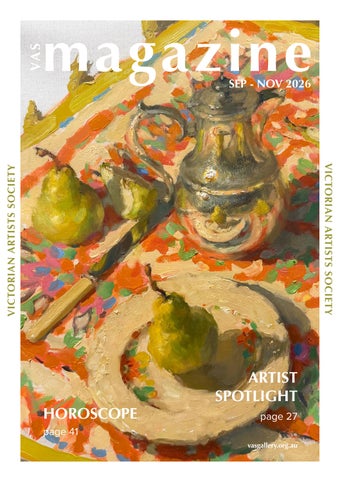
VA S
magazine SEP - NOV 2026
VICTORIAN ARTISTS SOCIETY
VICTORIAN ARTISTS SOCIETY
HOROSCOPE
ARTIST SPOTLIGHT page 27
page 41 vasgallery.org.au
1
The Victorian Artists Society acknowledges the Traditional Owners of the land on which we reside, the Wurundjeri people of the Kulin Nation, and pays respect to their Elders past and present.
Snowgums, (cropped), Julian Bruere VAS FVAS
1
INSIDE THIS ISSUE 27
05
15
35
33
03 Every Brushtroke Counts | Bruce Baldey VAS 05 VAS PPIA Day 2026 | Bruce Baldey VAS 07 What Is Art? | JD Park 12 VAS and the Melbourne Athenaeum | Dr Fiona Moore 15 Marine Paintings and the Sea | Julian Bruere VAS FVAS 20 Christopher Robin Is Saying His Prayers | Anne Scott Pendlebury HON FVAS 23 Centrefold | Gwendoline Krumins VAS FVAS 25 Photo References | Jemma Cakebread 27 Artist Spotlight | Bob Pelchen VAS 29 Michelle Payne OAM Statue | Judith Leman VAS 33 From the VAS Collection | Rosemary Noble HON FVAS 35 Art Unions | John Daniels and Bruce Baldey VAS 37 The Select Few | Gino Severin 39 Crossword 40 Quiz 41 Horoscope | Cassandra 43 VAS Reads 44 Answers 45 Upcoming Exhibitions
2
Landscape Study, Julian Bruere VAS FVAS
EVERY BRUSHTROKE COUNTS The 2026 VAS 9x5 Exhibition words Bruce Baldey VAS
T
he annual Victorian Artists Society 9x5 Exhibition once again shows that artistic ambition has little to do with the size of the canvas—or, in this case, the cedar lid of a cigar box. Inspired by the celebrated 1889 exhibition initiated by Tom Roberts, the event invites artists to work within the modest dimensions of 9” x 5”. This constraint continues to encourage, rather than limit, creativity. In keeping with the spirit of the original exhibition, participants are encouraged to work plein air, yet the range of responses is always striking. Each artist finds a distinctive way to use the intimate scale, reminding us that compelling art depends not on monumentality but on clarity of vision and imagination. While many artists honour the Heidelberg School through luminous landscapes, others confidently reinterpret the format through alternative genres, contemporary subjects, abstraction and humour. Its modest scale encourages careful attention. Visitors
3
instinctively slow down, leaning in to notice subtle brushwork, refined colour relationships and carefully balanced compositions. These paintings reward attention rather than overwhelm the viewer, offering an intimate counterpoint to the oversized works that often dominate contemporary exhibitions. Just as compelling is the exhibition’s inclusive spirit. Established artists show alongside emerging practitioners, creating a lively blend of confidence, experimentation and discovery. Some works impress through technical refinement, while others stand out for their spontaneity and freshness. Together, they reflect the energy of a Society that continues to support artists at every stage of their development. More than a century after the original 9x5 Exhibition challenged artistic convention, the Victorian Artists Society shows that this historic format remains as relevant and inspiring as ever.
Pierrot, Jen Urquhart
Frozen Fields, Nancye C Davison
Back Beach, San Remo, Maxine Wade
When the Circus Came to Town, Neil Whalebone
Anchor House, Linda Weil VAS
Mt. Buffalo View, Gwendoline Krumins VAS FVAS
4
Jemma Cakebread painting Christina Christensen
VAS PORTRAIT PAINTERS IN ACTION DAY
P
11 July 2026
ortrait Painters in Action Day fills the VAS Galleries with artists, live models, expectant members and visitors— and leaves nowhere to hide when the nose goes wrong. Audiences rarely see portrait painting’s private process: false starts, inspired corrections,
5
doubtful pauses, and the sudden strokes that bring a face to life. Congratulations to our artists, who painted with skill, courage and good humour under the audience’s and sitter’s unforgiving gaze—a wonderful demonstration of portraiture as a living art.
Left: Gwendoline Krumins VAS FVAS Right: Gabriel Gate
Lee Machelak VAS FVAS painting Liam
Left: Joe Whyte Right: Bruce Baldey VAS (VAS Council)
Left: Lucy Fekete VAS Right: Gabriel Gate Left: Annie Forbes (Coterie 2026) Right: Sally
Left: Lachlan McKenzie (Coterie 2026) Right: Christina Christensen
Left: Bruce Baldey VAS (VAS Council) Right: Ray Wilson VAS FVAS
Left: Sarah Anthony Right: Sally
Left: Tope Adepoyibi Right: Barbara McManus VAS FVAS
6
Still Life with Oranges, Henri Matisse
WHAT IS ART? words JD Park
7
“I dream my painting, then I paint my dream." Van Gogh
T
he early ‘VAS Fathers’ detailed the aims of VAS in the 1890 Articles of Association. These included “to promote the consideration and discussion of all questions affecting Art, …. which includes painting, drawing, etching, sculpture, decoration, architecture, and all ancillary and allied arts” …” Also to repress malpractice.” The 1890 articles have never been revised. More than a century later it may be worthwhile to briefly address the question of what constitutes Art in 2026? ‘Art’ means ‘the visual arts.’ Viewers have several possible responses to an image. Aestheticists have proposed a variety of explanations for these, which might help us resolve the complex question of what constitutes art? Responses to images may be invested in the artist, the observer or be a dialogue between the two. Some have identified great art as an emotional rather than an intellectual reaction. An example is the sublime, a feeling of awe and reverence as described by Immanuel Kant and Edmund Burke. Clive Bell was a member of the Bloomsbury Group and published ‘Art’ in 1913. Bell coined the term ‘significant form,’ which was a particular combination of line and colour which evoked an emotional response common to all great art. Bell considered this reaction was not universal but evolved through experience and education. Central to an emotional response is the attribute of beauty which the Oxford dictionary identifies as a “quality which delights the senses or mental faculties.” This property has often been viewed as central to art or at least great art. In just the last few decades, neurobiologists have finally revealed a neural key to beauty. Beautiful images and a variety of other experiences, uniformly light up a region in the medial orbitofrontal cortex. Semir Zeki said, “You can take 1000 people and show them very beautiful faces from Japan, from Africa, from
France, from Italy and you will find there’s very great consistency.” Beauty has been shown to be hard-wired. Contemporary with Clive Bell was Marcel Duchamp’s ‘readymades,’ in the form of a urinal and a bicycle wheel mounted on a wooden stool. This delivered the ‘coup de grace’ to the coexistence of art and beauty. The ‘readymade’ was art if the artist said so, but was not intrinsically beautiful. Semir Zeki observed that “the art object was then not rewarding, not pleasurable and not beautiful …. the beauty was in the philosophical reflection.” A second possible response to art is indifference. Visiting a gallery, we see individuals walk straight past a painting which immediately demands our personal attention. As we know taste is a very personal character, often said to be in the eye of the beholder. However, as we know taste can be modified by experience. It took a little over two decades for the French Impressionists to move from critical opprobrium to acclaim. Another path to some conclusion about the nature of ‘art’ might be to look for an answer in the artist himself. Perhaps the answer lies in examining the gradual evolution of the image making craftsman or artisan into the modern artist. How are these endeavours related and can we make a case for separating the craft from the profession of artist? Image making is as old as man himself. As a means of communicating ideas, it predates recorded music and the written word. Cave paintings conveyed ideas about which we can only speculate, however in many circumstances, the technical skill of the prehistoric image maker was undeniably of a high order. In a Shamanic environment, the cave painter may have been an early apprentice. Move forward to first recorded history and artisan image painters, potters and sculptors plied their trade in the service of kings and princes, the great religions, and funeral rites. Millennia have seen the transition of the artisan maker of images to the professional artist. The greatest leap forward in this evolution happened in the Italian Renaissance, when painters were liberated from the ‘monkish dogmatism’ of the Middle Ages. At some times, it is a fair generalization to say that great technical skill in image making exceeded the
8
visual capacity to explore and communicate great ideas. We might propose that after the Renaissance we can see an evolving distinction between the skilled artisan or tradesman and the independent professional artist. While the Renaissance freed up the painter and his patronage, great ideas remained wedded to the symbolism and iconography of the church and classical mythology. This nexus persisted for centuries until Romanticism bloomed in the late eighteenth century. Renaissance painters and sculptors were still trained as apprentices in the studios of artisan painters and goldsmiths. This is reflected in these comments by Giorgio Vasari (1511 – 1574) “Man was not then considered a good goldsmith unless he could draw well.” “When Michelangelo was introduced to Titian, he said... that Titian's colouring and his style much pleased him, but that it was a pity that in Venice men did not learn to draw well from the beginning, and that those painters did not pursue a better method in their studies.” “The best thing is to draw men and women from the nude and thus fix in the memory by constant exercise the muscles of the torso, back, legs, arms and knees, with bones underneath.”
1860). This spirited defence of JM Turner contained the following observation. “Painting or art generally, as such, with all its technicalities, difficulties, and particular ends, is nothing but a noble and expressive language, invaluable as the vehicle for thought, but by itself nothing. He who has learned what is commonly considered the whole art of painting, that is, the art of representing any natural object faithfully has yet only learned the language by which his thoughts are to be expressed. He has done just as much towards being that which we ought to respect as a great painter, as a man who has learned to express himself grammatically…”
The techniques of drawing and painting are still taught today in much the same form as to the eighteenthcentury students at the RA school. The evolution of the capacity to express ideas is more difficult to determine. The Middle Ages and Renaissance recognized complex symbols, but the iconography was largely restricted to religious and moral issues. The explosion of ideas in the Nineteenth century and beyond with images like ‘Liberty Leading the People,’ Picasso’s ‘Guernica,’ Manet’s ‘Absinthe Drinker’ and Sickert’s commentaries on seedy London were perhaps largely because they had been previously proscribed, not because they could not be expressed.
Clive Bell observed, “Anyone who is curious to discover why we call a Persian carpet or a fresco by Piero Della Francesca a work of art, and a portrait bust of Hadrian a popular problem-picture rubbish, will here find satisfaction.” “Art is not based on a craft, but on sensibility; it does not live by honest labour, but by inspiration. It is not to be taught in workshops and schoolrooms by craftsmen and pedants….”
The English RA was formed in 1768 and the artworld was significantly influenced by the ‘Discourses’ of its first President Joshua Reynolds (1723 – 1792). He believed in the importance of understanding and imitation of nature as well as the necessity of industry and personal study to achieve true artistic excellence. Reynolds emphasized that a mere copier of nature could not produce anything great, and that true art should be hidden and work its effect unseen. The great image was more than great technique. Exactly contemporary with Reynolds was the German metaphysical philosopher Immanuel Kant (1724 – 1804). Kant’s ideas had a profound impact on the content of images and he had a significant influence on art movements like Romanticism and Surrealism. He addressed issues of beauty, taste, and creativity. Victorian thinking about art was dominated by John Ruskin who published ‘Modern Painters’ (1843 –
Contemporary with Ruskin but far removed geographically and culturally, van Gogh said to the artist Anthon Van Rappard, “art is something greater and higher than our adroitness or accomplishments or knowledge.” Closer to van Gogh in time and space, the French novelist Gustav Flaubert said, “It might be that we are all tattooed savages since Sophocles. But there is more to art than the straightness of lines and the perfection of surfaces. Plasticity of style is not as large as the entire idea….”
Coeval with Bell was William Morris, who in a response to the poor quality of goods in the London Great Exhibition of 1851 initiated a great reproachment between art and craft in the ‘Arts and Crafts Movement’. Through Art Nouveau this morphed into the German Jugendstil and in 1919 Walter Gropius founded the Bauhaus. Gropius made the sentinel observation “There is no difference in kind between the artists and the craftsman. The artist is merely an inspired craftsman.” Finally, I will reference Desiderius Orban (1884 – 1986), the expatriate Hungarian, who became a prominent artist and teacher of John Olsen in Sydney. Orban wrote extensively on what constituted art and observed the following.” A painter is someone who tries to make a pictorial copy of reality; whereas the ‘artist’ uses the elements of reality to make a new creation…. a ‘painter’ is essentially a tradesman, and perhaps a tradesman who produces work which, technically, cannot be surpassed, but whose approach to painting is based on a fixed routine. …. On the other hand, the ‘artist’ is a person who looks at reality, then interprets it and transforms it into a pictorial or plastic image.”
Opposite: Still Life, Pieter de Ring. “This painter has all the attributes of an excellent painter, but lacks creative imagination. Therefore, he is a first-class painter, not an artist.” Orban (1968).
9
10
Almost coeval with Orban was the popular Melbourne artist Archie Colquhoun (1894 – 1983), student of Max Meldrum and teacher of William Dargie, Hayward Veal, and much-loved VAS member Joyce McGrath. Colquhoun observed, “It is only necessary to remember that the true artist is not engaged in making pictures, but in finding out more about what he sees. It is the analysis of the visual impression that is the thing. Painting is a means, not an end.” We can also examine some views of modern philosophers. Benedetto Croce (1866 – 1952) viewed art as a means of expression, part of general linguistics. Art is a vehicle for expressing the artist’s consciousness. The idea of art as beauty was replaced by art as expression. John Dewey (1859 – 1952) saw art as a manifestation of the artist’s experience and part of the adjustment of the living organism to its environment. Martin Heidegger (1889 – 1976) saw that art establishes truth and is a dialogue between the creator and the work of art. In each case the artist is central to the art. To conclude with a foil to academia, we have the sentiment of Leopold Bloom from James Joyce’s ‘Ulysses’. “Art has to reveal to us ideas, formless spiritual essences. The supreme question about a work of art is out of how deep a life does it spring? The painting of Gustav Moreau is the painting of ideas.” The VAS founding fathers chose to title us an ‘Artists Society’ and not an ‘Art Society.’ This far-sighted decision accords with the view of the great modern art historian Ernst Gombrich. “There really is no such thing as art. There are only artists.” This implies that the fundamental spark in the visual arts is not the art product but the idea in the mind of the creator. Of course, the viewer becomes critical in this exercise in visual communication. Does this person receive the artist’s idea, get another message, or even remain indifferent to the image? The answer to ‘What is art,’ commences with Plato and Aristotle and progresses through several millennia of ancient worthies and institutions. I have neither the capacity nor the space to address all these issues. This brief essay has cherry picked a few historic authorities to make a case for a separation between technique and creativity. An image might then be art, only if it displays unique creativity. This might then raise the case for photorealism being located outside the universal set of visual art – a controversial position which might not meet the approval of all VAS members. There is room for much debate. However, this point of view might provide some members with a different perspective which they can apply to pictures and sculpture displayed at VAS exhibitions.
11
Portrait of Ambroise Vollard, Paul Cézanne
References Victorian Artists Association, Articles of Association (1890) Philosophies of Art and Beauty, Albert Hofstater and Richard Kuhns. Uni. Chicago Press (1976) A Philosophical Enquiry into the Origin of our Ideas of the Sublime and Beautiful Edmund Burke London (1757) Art, Clive Bell (1913) Inner Vision, Semir Zeki Oxford University Press (1999) Interview 2025 https://www.thelatethinker.com/ beauty-and-the-neuroscientist-a-conversation-onneuroaesthetics-with-semir-zeki/ Lives of the Artists, Vasari Giorgio, Florence (1550) Discourses on Art, Joshua Reynolds (1769 – 1776) Modern Painters, John Ruskin (1843 – 1860) Writing and Difference, Jacques Derrida, Routledge (1967) Archie and Amalie Colquhoun’, Peter Perry, Castlemaine Gallery (2010) Understanding Art, Desiderius Orban, Ure Smith (1948) What is Art all About, Desiderius Orban, Hicks Smith 91975) Studies in the Art of the Renaissance; Symbolic Images’, Ernst Gombrich (1972) Ulysses, James Joyce, Paris (1922)
The Athenaeum Art Gallery operated for over seventy years and this image of 1920 shows an exhibition of Charles Wheeler's paintings on display at the Gallery. Photo: State Library of Victoria.
THE VICTORIAN ARTISTS SOCIETY AND THE MELBOURNE ATHENAEUM AN ARTISTIC COLLABORATION - PART 2 words Dr Fiona Moore, Archives Manager, Melbourne Athenaeum
C
ontinuing the discussion of the collaboration between the Victorian Artists Society (VAS) and the Melbourne Athenaeum, this article explores the two VAS annual members’ exhibitions that were staged at the Athenaeum Art Gallery in 1910 and 1911. The first of these VAS exhibitions was opened on 20 October 1910. It was an extensive display consisting of 137 works. A separate section devoted to sculpture also included works from acclaimed sculptors such as Bertram Mackennal, Charles Web Gilbert, and Margaret Baskerville. Of note was the number of female members who exhibited their work. In 1910, the VAS had three women serving on its Council Christina Asquith Baker, Jo Sweatman and Henrietta Gulliver. The VAS had a history of supporting female members, with Jane Sutherland being elected to its
Council in 1900. The opening address for the exhibition was delivered by politician and surveyor Sir John Forrest, who remarked that ‘members of the society might well congratulate themselves upon the number of fine paintings exhibited.’ The catalogue produced to accompany the exhibition also reveals that artists who were residing overseas were given the opportunity to exhibit their work. Nineteen VAS members who were listed as ‘Absent Australian Artists’ were represented in the display. These included Arthur Streeton, Max Meldrum, E. Phillips Fox, Thea Proctor, Tom Roberts, Rupert Bunny, and John Longstaff. Tom Roberts was appointed Secretary of the London-based selection committee and was commended for his efforts in securing works that would provide visitors to the exhibition with ‘an opportunity of seeing and judging
12
Betrand Mackennel, Circe, 1893, bronze, National Gallery of Victoria, Felton Bequest, 1910. Photo: National Gallery of Victoria, Melbourne
13
for themselves the class of work Australians are now doing.’ A review of the exhibition published in the 19 October 1910 edition of The Age reported that the ‘standard of the local work is necessarily high this year.’ However, the review was less than favorable towards the works sent from England citing the dark tone of the paintings and ‘the prevailing convention of sacrificing colour to tone values.’ Of the artists based overseas only the work of Arthur Streeton, E. Phillips Fox and James Quinn was commended for the use of colour. Leading the praise for local artists were paintings by Frederick McCubbin, including Summer Idyll, Winter Morning and Cottage Children as well as works by John Paterson, Hans Heysen, Ambrose Patterson, Christina Asquith Baker and Charles Wheeler. Wheeler’s painting, The Poem was also reproduced in the accompanying catalogue. In 1911 the VAS once again returned to the Athenaeum Art Gallery to stage its annual exhibition. Larger than the previous year’s display, it consisted of 214 works with a section devoted to miniatures and sculpture. Women artists were also well represented in the display. Notably absent from this exhibition was the inclusion of work by artists residing overseas. The Society’s Journal dated 1 July of that year had advised members that although last year’s exhibition had ‘in some respects [been] a record one’ it had been hampered by lack of space due to the representation of overseas artists. The decision was thus made to limit the 1911 exhibition to ‘the works of the local painters.’ A review of the exhibition appearing in Table Talk, dated 19 October, praised the works on show and singled out several portraits as being ‘distinctly good’. Portraits produced by Ambrose Patterson, Charles Wheeler, Rupert Bunny, Violet Teague and Christina Asquith Baker were all commended for their strength. The exhibition also featured in the Weekly Times with a large pictorial spread with images of works by artists such as L. Bernard Hall, Fredrick McCubbin, John Mather, Josephine Muntz Adams and Jessie Traill. The Age of 14 October also reviewed the display, noting the ‘exceptional level of achievement apparent’ throughout the show and further claiming it to be ‘probably the most interestingly varied exhibition the Society has held yet.’ The review also spoke of innovative landscapes on show by Frederick McCubbin, including The Quarry and Flood Waters, as well as paintings by several other artists including Walter Withers, Louis McCubbin and William McInnes. What is most notable about this exhibition as well as the 1910 show, is the large number of works that were on display that are now to be found in State Galleries as well as the National Gallery of Australia. Forming part of the collective history of Australian art, both exhibitions were testament to the depth of artistic talent of the period and the larger role
of the Melbourne Athenaeum in supporting this talent. The VAS did not return to the Athenaeum Art Gallery in 1912 for its annual exhibition nor did the organisation complete the four-year contract it had initially negotiated. One can surmise that members may have wished to return to their home premises in Albert Street, East Melbourne. However, this year also saw ruptures in the membership of the VAS with a breakaway group of artists led by Edward Officer forming a new representative arts body, the Australian Art Association. This newly formed group, which positioned itself as a national body, held its first exhibition at the Athenaeum Art Gallery in 1913 and went on to exhibit at the gallery on many occasions until it closed in 1933. Despite the VAS only holding two of its annual members’ exhibitions at the Athenaeum Art Gallery, the society played a vital and integral role in the development of the gallery. It not only provided financial support through hiring fees, but its members generously gave advice and direction as to how the gallery should be designed. The VAS reputation as Melbourne’s preeminent art society also did much to establish the stature of the Athenaeum Art Gallery as a significant venue within the Melbourne art scene. The Melbourne Athenaeum was also fortunate to have a Secretary at the time such as Reginald Wilmot who was supportive of the arts and understood its important role within the institution and the wider community. The Melbourne Athenaeum Art Gallery continued to operate until 1971. As a venue for hire, it welcomed both emerging and established artists and went on to play an important supportive role in the rise of new art movements and schools of art. Today, the VAS and the Melbourne Athenaeum continue to contribute to the cultural landscape of Melbourne, and the fine arts are all the richer for the important part both have played in fostering local artists and Australian art. “Victorian Artists Society Annual Exhibition Opened,” Age, 20 October 1910, p. 10. “Monday 12 September 1910”, Argus, 12 September 1910, p. 6. “Exhibition of Pictures Victorian Artists’ Society”, Age, 10 October 1910, p. 12. “Exhibition of Pictures Victorian Artists’ Society”. “Exhibition of Pictures Victorian Artists’ Society”. “The Victorian Artists Society”, VAS A Journal of the Arts, no. 1 (1 July 1911): 4. “The Victorian Artists Society”, 4. “Victorian Artists’ Exhibition,” Table Talk, 19 October 1911, p. 5. “The Victorian Artists’ Society’s Annual Exhibition”, Weekly Times, 21 October 1911, p. 28. “Victorian Artists Society Annual Exhibition of Pictures”, Age, 14 October 1911, p. 5.
14
A Third rate in a Storm, 1678, Oil Willem Van de Velde the Younger 1633 to 1707
MARINE PAINTINGS AND THE SEA words Julian Bruere VAS FVAS
15
Waves Breaking against the Wind, JMW Turner 1840’s, Oil
The Resolution in a Gale, Willem van de Velde, the Younger, Oil Admiral van Tromp’s Barge, JMW Turner 1820’s, Oil
M
arine painting, in its broadest sense, depicts life on and around the sea. It invites us away from the solidity of land and into a world of movement, atmosphere, and constant change. Later this year, the VAS Maritime Exhibition (23 Sep - 4 Oct) will offer a refreshing contrast to other exhibitions, it encourages interest in the marine genre and inspires artists to work beyond their usual manner. The sea in marine art offers rich possibilities for exploration and mastery. The development of Marine Art closely aligned with the expansion of shipping and maritime trade. From relatively simple and symbolic in the Dark Ages, it grew in sophistication during and after the Renaissance, when artists increasingly turned their attention to the natural world. Painting the sea, whether as a subject or as the setting for narratives of ships and seafaring,
has long been a distinctive artistic challenge. Before photography, artists had to observe and interpret the sea’s shifting forms through careful study and visual translation. Photography later introduced new possibilities for heightened realism, and contemporary practice now includes AI-generated experimentation. Marine Art and Painted Seas were quite naïve and uninspiring before the Van de Veldes of the mid-17th century. There followed in western Europe a brilliant lineage of artists aligned with the golden age of Maritime history up to the Revolutionary and Napoleonic Wars. The mid19th century was overtaken by more stylized imagery with static seas and ship portraits in profile. However, there were hidden gems to be found through the century. We can obviously evaluate the last century for ourselves but with photography there has emerged a hyper-realist approach, impactful but perhaps a little less
16
emotional and romantic. Painters pre-photography had to observe and understand the movement and actions of the sea and with this came a romantic and adventurous manner found in paintings over the last 300 years. The work of Willem van de Velde the Elder, JMW Turner, Henry Moore, Carl Evers and Chris Mayger show how artists can approach marine art and the sea through observation and feeling rather than with photographic reference. Even when using photographs, their example can encourage artists to bring greater emotion to their response. Having been apprenticed under Willem Van de Velde the elder who created highly illustrative grisailles of Dutch shipping, the son extended the family name with dynamically lit and emotional oils. Their work was the watershed between the previous era and the Baroque century ahead. Willem Van de Velde (younger) is undoubtably the greatest marine artist of all time. His seas had mountainous impact with realistic ships with a palette of warm greens and browns, colouring inspired by their location off the Texel where the shallow sandy seas were a contrast to the deeper blues and greens of the deeper channel between England and France. JMW Turner inspired all marine artists that followed. His earlier work was not unlike and certainly inspired by Van de Velde with lighting featuring the sunlit and shadowed sea planes in a similar palette. Later his romantic and energetic manner developed near abstract sea imagery which continues to inspire and influence marine artists today. His works were emotionally realistic disguising his more painterly approach to ships. Henry Moore painted the sea from acute observation and developed styling of wave action capturing the ‘feel’ of the sea. This is often forgotten when painting from a photographic
17
Opposite page Top: Friend of Nations, watercolour, William Lionel Wyllie early 1900’s Middle: A Dismasted Brig, Watercolour, John Sell Cotman, 1810, Middle: Lowestoft, Watercolour, (sir) Henry Moore, 1888 Bottom: Breakers off a Rocky Coast, Oil, (sir) Henry Moore, late 1800’s This page: Top: Fishing Trawler in a Heavy Sea (book cover) Watercolour, Carl G Evers, 1970’s Right: Grey Seas Under (book cover) Gouach, Chris Mayger, 1973
18
Nazi Wreath in the North Sea, Oil, Claus Bergen mid 1900’s
Sailing Ships on the Atlantic, Oil, Patrick von Kalkreuth early 20th century
reference. How does an artist paint a static moment of a perpetually moving element? The colouring of the sea is also something to be experienced and understood. The slightest change in overhead atmospheric conditions and the effect of underlying sand or rock impacts the colour from moment to moment.
19
Evers and Mayger (see previous page) both worked for Publishing Companies, painting book covers in the more commercial mediums of watercolour and gouache. Their work is to be admired for the stylistic and energetic freshness found in the seas, entirely imagined but ever convincing.
Eliphalet Huntington Blatchford and Charles Hammond Blatchford, Eastman Johnson, oil, 1880
“CHRISTOPHER ROBIN IS SAYING HIS PRAYERS“ (as we all are…) words Anne Scott Pendlebury HON FVAS
I
magine as an artist, you get together with a few close fellow painters to hold a Group Exhibition at the VAS. You are a like minded cohort who share a clear vision of how the exhibition should be presented and, apart from one fairly new member, everyone knows each other pretty well. You feel the delicate romantic Monet style of this new artist’s paintings will fit in perfectly and are supremely confident that in this exhibition to be held in three months time, you and your fellow painters will succeed in producing an elegant, coherent and unified body of work. Then imagine your shock when installation day finally arrives many weeks later, and this newest member of your team staggers from her car with the most ghastly,
unrecognizable, evil looking canvas imaginable. “But where,” you ask “are the watercolors, your lily ponds, beautiful cloudscapes and..” “Oh those old things?” your newbie sniffs, heaving an oversized acrylic up the steps of the VAS. “All gone - to the tip. I’ve moved on. This is what I do now." Think Michael Borremans; his Large Rocket, and smiling cadaver. You feel faint. You know nothing of Borreman’s rockets and cadavers. You can’t think straight. You now visualize a gallery filled with pastel studies of Paris life, monastery
20
gardens of Europe and black images of Satan vomiting up spiders, and what appear to be headless nuns amongst several other off putting images. What are you going to say to the other painters gathered in the Cato and to the Manager? The thing is, where now do you go from here? You have an Opening tomorrow evening... you have to think quickly…..and creatively. Something not too dissimilar happened to me many years ago. In the early 1990’s, I was contracted by a semi-professional theatre company in Melbourne, to direct a number of productions. One of the first shows was the classic ‘THE WINSLOW BOY’ by Terence Rattigan. This play is based on a true event involving a thirteen year old Navel Cadet “Ronnie Winslow” who is charged with a minor theft, which in turn creates a scandal deeply affecting his family. The play is set in England in the early 1900’s and although he was a young cadet in training, at home ‘Ronnie’ was the baby of the family, having an older brother as well as a sister in her mid twenties, plus two devoted mature age parents. I needed two young boys to play our small hero. This is a requirement when young people under the age of 16 are cast in adult stage dramas – two children share the same role. Auditions took place during the month of March, with rehearsals to commence three months later. I drew together a hugely talented group of actors which included two dear little boys of around 13 to play the role of young 'Ronnie'. Both children were experienced in school productions – so the stage was a comfortable and familiar place for them. They were just perfect, charming, intelligent and polite with strong young voices - everything I could have wanted. Their parents gave permission, signing a release form guaranteeing their respective sons’ presence at all rehearsals and performances required of them. Once casting was complete, wardrobe fittings immediately followed for everyone, and then we all parted ways for 3 months. I felt very pleased with my excellent choice of cast; they were a wonderful ensemble now under an agreement for rehearsals to commence in early June. Between March and June, I worked busily on pre production; set design, lighting and publicity. Finally a capable crew was brought together, the building of the set took place, and we were ready to call the first rehearsal. A key piece of music, was to be an arrangement of A.A Milne’s “Vespers” sung by boy soprano Aled Jones. Little boy kneels at the foot of the bed, Droops on the little hands little gold head. Hush! Hush! Whisper who dares? Christopher Robin is saying his prayers. It would be absolutely perfect and played during an early scene, when terrified little Ronnie has to confront his stern Edwardian father after running away from the Training Academy. The youngster was to wear a blue dressing gown and he might even carry a favourite
21
Full Length portrait of two boys, Andrew Geddes
toy. It was a scene in which we see the innocent child drawn into a terrible family dispute. I was more than excited with my interpretation of this important role, which is the reason I so carefully selected small lads who looked particularly young and vulnerable. It is worth remembering, that although young Ronnie attended Cadet school- he was still treated like a child at home, especially by his ‘Mama.’ Teenagers as we know them today did not exist in Victorian and Edwardian times- boys were children at home, and young men in the Officers’ Academies and training institutions. Girls were children until around the age of 16 when they put their hair up, and were introduced to eligible and marriageable young men. And so it was with our young Ronnie – a baby at home, an Officer in the making at Osborne Naval Academy. The first rehearsal after our 3 month break would be a round table reading and discussion, at which I would outline my vision and plans and hand out the rehearsal schedule. I would also bring to that first reading, a couple of old Victorian ‘props’ which I thought would be of interest to my two little boys – an old hoop, a set of tin soldiers and of course a genuine and very valuable child’s dressing gown circa 1900, kindly on loan from a local collector of valuable clothing. I imagined the excited look on the faces of both my young performers at the thought of wearing it. I would be explaining to the cast just how adored and cherished young ‘Ronnie’ was by his entire family. He would sit on ‘Mama’s’ knee after his bath in his ‘Christopher Robin’ dressing gown while she read to him and he would even kiss ‘Papa’ good night. I would outline how important it would be for the audience to get to know this tender child in preparation for the dramatic events which were to unfold.
So, three months later the afternoon of the first rehearsal finally arrived. It is an exciting time when the actors and crew first meet and the director experiences the pleasure of proudly looking at a well balanced cast all seated together for the first time. On this particular Sunday, my actors arrived one by one quite early, scripts in hand, full of optimism and anticipation. I counted off everyone as they came through the door, constantly on the look out for my two young boys along with one or two accompanying parents. The head of the lighting department arrived, (as the Production team was also joining us for this first read through.) I recognized two women from Wardrobe, the assistant Stage manager and a couple of lanky, unkempt youths, who no doubt would be back stage workers. A terrific team I mused. But still no sign of the two youngest performers now fifteen minutes late. Not a good start I thought. One of these back stage guys loped towards me carrying what looked like a script and draped himself at the table-his legs sprawled everywhere, hair over his eyes. A second chap- perhaps one of the technical crew- heaved himself into a chair next to me. He was wearing shorts and a T shirt displaying an extremely crude looking image. I guessed he was here to listen and get a feel for the play. He turned to me and indicated the other fellow sprawled everywhere. “We’re here. Me and Silas." I stared at him. “Pardon?” “I’m James. We’re the two ‘Ronnies” remember? We auditioned for you. Ha, ha- get it? “Two Ronnies!!” They both snorted with mirth. There was a moment of silence. I was in shock. Surely they were not MY little Ronnies? Not these untidy, pimply looking youths. Where were my two angelic thirteen year olds from several months back? I managed a weak smile. “You are my Ronnies?” I croaked, hardly recognizing either of them. “Yeah’’ came the less than enthusiastic response. “You have..er.. grown,” I swallowed miserably. “ Yeah-“ Silas replied sullenly. His voice was deeper than I remembered. James also responded with a disgusting sounding cough. No further conversation took place. Still in shock, I introduced everyone at the table – real names plus character names, and saw the disbelieving looks on the faces of the actors playing the Winslow family. The woman playing ‘Mama’ was an elegant but petite woman.There was no way either of these huge teenagers could sit on her lap holding a toy rabbit. The actor playing the important role of the stern ‘Mr. Winslow’, was scrutinizing these boys over the top of his glasses. I knew he would never allow these louts with spotty faces to kiss him goodnight on the cheekwhether it was in the script or not (and he was a stickler for observing the author’s stage directions). He glared towards me, looking appalled at my choice of casting. I sensed trouble. There was quite an awkward silence.
Right then and there I made several hastily thought out changes to the entire concept. The set of tin soldiers and baby blue dressing gown I had brought along to the reading were hastily kicked under the table. I decided that all intimate exchanges between ‘ Ronnie’ and ‘Mama’ and Papa’ plus the affectionate cuddles from the older siblings had to be entirely cut from the script. As well as this, any suggestion of ‘little Ronnie’ being carried upstairs to bed was simply out of the question. What had seemed perfectly manageable several months ago, was now an impossibility. These spotty teenage boys, James and Silas were the same height as all my adults. Over a three month period they had shed their baby faced innocent appeal and were no longer the Christopher Robin figures I had dreamt of. They towered over the young woman playing the older sister – how could she now possibly bend down and kiss the blonde, curly head of her ‘little’ brother fresh from his bath? They were no longer blonde, little or curly haired and unlikely to even fit in a bath ( let alone agree to having one?) How could such changes come about over such a short period of 12 weeks? This was a disaster. I had no choice. Thinking on my feet I then stood up and said "To begin with, I would like to share with you all my NEW, more CREATIVE concept of our production (pause). The play will now unfold in a series of dream sequences. (I prayed that the author Terence Rattigan was not turning in his grave). Our story will be told from the point of view of the now much TALLER Ronnie Winslow, and looking back to when he was a much SMALLER Ronnie Winslow. The two, er, actors, will reenact the events speaking Ronnie's lines with deep voices and wearing adult size Naval uniform. He is looking back on his traumatic past. This is what is called abreacting". There was a choking kind of sound from someone, and the performer cast as ‘Mama’ stifled a moan. A wardrobe assistant quickly rose to get her a glass of water. I continued, “So.. we need to close our eyes, look back and try and remember the LITTLE boy but we can only see him as an older much BIGGER boy who has returned to narrate his sad story. I paused awkwardly. I trust that all makes sense.” There was complete, utter silence. I hastened on, “So, with that in mind – let us begin reading at page 1- Scene 1. Thank you. “ I’m not sure that any of this actually made any sort of sense at all. It all felt like gobbledygook, but as there was no time to recast, this ploy would have to work. And, thanks to an unquestioning and co operative group of actors and lots of quick thinking at each rehearsal, it did. ( Just. )
22
23
Boranup Forest - Margaret River, Gwendoline Krumins VAS FVAS
24
Waiting for Autumn, Jemma Cakebread
PHOTO REFERENCES THE MIDDLE MAN words Jemma Cakebread
I
had an opportunity to think about the differences between working from life and photographs recently as I completed a commission with only photographs as references. Working from photos is often touted as ‘cheating’ or making the process of translating information from subject to canvas easier. However I found the process nothing but trouble. I was frustrated with the flat image backlit on the laptop screen. I struggled to block in the tones and made simple mistakes. And I ended up with an overworked, ‘photographic’
25
painting. But why, if I was using a shortcut? Let’s take a look. Our eyes work differently from cameras. Humans (mostly) have two eyes, resulting in binocular vision. That means, when you look at an object or person or landscape, each eye sees a slightly different perspective. Therefore we can see in 3D. A camera has one ‘eye’ and flattens the image it captures. It can’t replicate the 3 dimensionality our eyes can see. As well, our eyes can see values and colours more authentically than cameras. Cameras compress values and colours out of necessity
and to produce an image that reads well. Depending on whether you view via screen or print, photographs either radiate light throughout the entire image (screens) or radiate no light at all (print). We lose that quality that makes our eyes adjust in the dark or squint in the light. That humanity is lost in the photograph, making it difficult to translate values convincingly. Another detrimental quality, disguised as an advantage, is the ability to zoom in. Did I zoom in on my reference image when painting that commission? Yes. Did it trap me into making a painting with the same uncanny level of detail everywhere? Yes! Despite my view that photographic references can stand between the artist and subject as an unnecessary middle man, sometimes they are necessary and useful. We often lack funds to hire a model to sit, or struggle to paint fleeting moments such as dawn or dusk landscapes. In most cases a combination of studies from life, notes, and photographic reference can be used to create a convincing painting and to keep the liveliness of a subject viewed directly. Painting landscapes is an example. When I want to make a larger landscape over some time, it’s not convenient to drag a large canvas on location, at the same
time of day and weather conditions. A solution is to spend some sessions in the field, making composition and colour studies and noting down what I notice about the landscape. I will also take several photos, making sure to edit them to as close to what my eye sees as possible. Back in the studio, armed with my studies and a nice fresh canvas, I do something that seems nonintuitive. I make the photo greyscale and view it at a small scale, refraining from zooming. Now I have an accurate record of tone, proportion and detail. For colour and composition, I refer to my paintings made on location. When I need a refresher on what the landscape really looked like, or to refer to value, I view the photograph. This anchors my painting to reality and prevents the loss of detail that comes from translating a loose colour study to a much larger canvas. In my humble opinion, I would recommend working as much as possible from life, particularly when beginning creative instruction. Then when it is necessary to work from photos you have the tools and experience to visualise and translate how the subject would look when viewed with your own eyes.
26
BOB PELCHEN VAS
A
artist spotlight
ward-winning artist Bob Pelchen VAS is a master of watercolour, a medium he has dedicated himself to for over 50 years. Based in Victoria’s Gippsland region since 1969, Bob is highly regarded for the remarkable diversity of his subject matter. Many of his paintings are widely represented in prominent private and public collections across Gippsland, wider Australia, and internationally. An avid plein air painter, Bob enjoys the technical challenge of capturing shifting light, atmospheric moods, and vivid colour directly from nature. His artistic
Above: Relics Of The Past, Yaraka, Qld, Bob Pelchen VAS Right above: Outback Pub, Hebel, QLD, Bob Pelchen VAS Right below: Corowa on the Murray, Bob Pelchen VAS Opposite: Roadside Inspection, Winton QLD, (cropped), Bob Pelchen VAS
27
experience has been deeply enriched by painting expeditions to England, Italy, France, and Greece. More recently, travels into the rugged and colourful landscapes of northern and north-western Australia have brought a bold new dimension to his works. A member of the Victorian Artists Society, the Victorian Watercolour Society and the Australian Guild of Realist Artists, Bob has held several very successful exhibitions, as well as being involved in group exhibitions throughout Victoria and NSW sharing his enduring passion for the translucent beauty of the watercolour medium.
Old Gumtree, Zhonghua Fan
28
Above: Statue of Michelle Payne OAM by Judith A. Leman Opposite: Bronze statue of Roy Higgins by Judith A. Leman
29
JUDITH A. LEMAN FVAS MICHELLE PAYNE OAM STATUE
O
words Judith A Leman - FVAS
n Tuesday, 3rd November, 2015, a nation cheered. Michelle Payne defied the odds and became the first female jockey aboard Prince of Penzance to win the race that stops the nation. Across the world, the hearts of onlookers and racing enthusiasts were overjoyed to see ‘History in the Making’ of the 155th running of the great race, ‘The Melbourne Cup’, Victoria Racing Club, Flemington, Victoria. Four weeks prior to this historic event, I had the privilege to attend the unveiling of my life-size bronze statue of jockey Roy Higgins MBE, Turnbull Stakes Day, VRC. Ten years on and I was creating yet another life-size bronze statue, this being the essence of Michelle Payne, as jockey, in 2015. Although photography captured that moment in time, as sculptor, the
assignment was to represent the essence, the blood and breath of life. It is a force to be felt, not a polished academic work. The journey of an artist can be similar to that of a steeplechase – one obstacle after another. The concept was that of former race caller Bryan Martin OAM. The path was set with permission from both Michelle Payne and VRC to house their 5th life-size bronze statue. Photography of Michelle was the first stage to establish and formalise the pose. A trip to Ballarat where she resides came with a gaggle of spectators involved in this project. With ease, Michelle took up the pose holding the 2025 Melbourne Cup, where a blind eye was necessary as it was ‘gloves off’ so I could capture the hand and fingers holding the weight of such a valuable item. Michelle patiently rotated on
30
Statue of Michelle Payne by Judith Leman
Michelle Payne with statue
a 360 degree circle and the photography session was in full swing. This was an all important reference for my task in studio without the model. Measurements were also recorded although I must admit – I did not refer to them through the making. In studio – I created a maquette in oil based clay representing the pose. This was coupled with sketches and video watching of Michelle in the era of 2015. A time lapse of ten years had naturally altered Michelle in her appearance and presence. This was my challenge and dilemma to channel the young girl of 30 years, suppressed by the male domination of the racing industry. However, as it was, funding was an issue and in April 2025, the project was cancelled. Obviously all involved with the project were hugely disappointed and it was going to be hard to let go of the vision of ‘what could have been’. The next day after receiving this news,
31
my 95 year old mother declined in health and passed within the next two weeks….’A double whammy’. It was a time for healing for me and the thought of the statue was farthest from my mind. A few months later, August of 2025, opportunity arrived at a luncheon with good friends at The Australia Club, Melbourne. The cancellation of the statue was incidentally mentioned and then received with enthusiasm from philanthropist Lady Marigold Southey AC. Without going into detail – the long and the short of it – the project was back on track ! This gave us all the giddy-up as the sculpting stage needed to be complete by the end of October. Mal Wood foundry requested a four month period to complete the casting and foundation base stage…..not forgetting Christmas break. The statue was set to be unveiled at TAB Australia Cup, March 2026. With the steel armature in studio, a multitude of
Judith Leman with work in progress
photographs and clay, work started in full swing. It was a cross between photographs and videos of Michelle 2015 coupled with absorbing her presence during the times we met, and my observation of an extremely strong, confident woman who remains unpretentious a true country girl who loves her horses. With my own studio lock-down I achieved the time frame, although maybe a little worse for wear. Somehow the creator overcomes the stress of a situation to finish the commissioned artwork….but it is quite exhausting physically and mentally. Mal Wood foundry arrived in studio pre Melbourne Cup week 2025 to start the mould and fibre glass process. The aroma of fibreglass in the studio and house was not the best and I kept visiting family members at bay. Then work back at the foundry for casting and finishing, where I oversaw the makings.
Finally, March 26, 2026, and the statue was unveiled at Victoria Racing Club, Flemington, by Lady Marigold Southey (97 years) and Michelle Payne with an array of VRC committee, Chairman Neil Wilson and media; a heart stopping moment for both Michelle Payne and myself as the sculptor. Michelle identified her soul as a young jockey – her strength, fragility, desire and pain. Michelle in 2015 had dreamt big, ‘kicked-on’ and won, creating a milestone in Australian Sporting History. As for the sculptor, I am on a cause to continue my bronze narrative ‘ELEVEN’ commemorating the role our Australian horses played in WWI between 1914-1918. Eleven is my new body of work featuring 26 brumbies in full flight being herded to serve our country throughout the war. It's an epic story which will be revealed in time.
32
From the
VAS COLLECTION words Rosemary Noble HON FVAS
Artist: Title: Cat#: Date Medium: Size:
33
Patricia Moran (1944-2017) Our Bev 57 1987 Oil on canvas 90cm W x 120cm H
Still Life (Vermeer), Pat Moran, oil on canvas, Hawthorn Town Hall Gallery, 1984
A
ny regular visitor to the VAS galleries would be familiar with the painting on these pages. Titled “Our Bev”, the portrait was painted by Patricia Moran and donated by her to the Society in 1996. It has been a favourite in the VAS Collection ever since. Patricia Moran was born in Melbourne in 1944 and studied painting full time during the 1970s. She won numerous awards at local art shows, culminating in winning the prestigious A.M.E. Bale Overseas Study Fellowship in 1982. Moran’s early work was mainly in portraiture and landscapes. She tutored in portraiture at VAS during the 1980s and went on to write books, instructional DVDs and numerous articles on oil painting. In later years she turned to painting luxuriant floral arrangements and it is for these she is better known today. Her work has been exhibited in Australia and London and is held in many private and public collections. Still life (Vermeer) is regularly displayed in the foyer of the Hawthorn Town Hall Library. The subject of “Our Bev” is another popular figure familiar to long standing members of VAS. Bev Snelling was the Secretary of the Society during the 1990s.
Beverley Snelling with her portrait Our Bev by Patricia Moran
32 34
Too Late, Gordon Coutts, 1894, oil on canvas
ART UNIONS When Buying a Ticket Meant Backing the Arts words John Daniels and Bruce Baldey VAS
35
B
oys Town (now yourtown) Lottery, the RSL Dream Home Art Union and the Mater Prize Home are familiar names to millions of Australians who buy tickets for the chance to win a Gold Coast mansion while supporting charity. These lotteries are modern descendants of art unions, a tradition which began 200 years ago. An Art Union was a form of collective art patronage. Members paid small annual fees, which funded the purchase of contemporary art distributed by lottery. The concept began in Switzerland around 1800, spread through Germany by the 1830s, and reached England following a House of Commons inquiry in which Gustave Frederick Waagen, Director of the Berlin Royal Academy, gave evidence. By 1850, about 30 Art Unions operated in the United Kingdom and Ireland, with others in France, Australia, New Zealand and America. Founded in 1837, the Art Union of London was Britain’s largest and was distinctive for issuing coupons to buy art rather than distributing artworks directly. It was run by social reformers and prominent gentlemen. Its aim was to patronize British artists and raise the level of taste amongst the public. Each subscriber was charged one guinea and offered an engraving of a famous painting and the chance to win a painting in a lottery. The public were not the working class, but the new Victorian middle class created by the Industrial Revolution. The Art Union also became a connection to home for the colonial Englishmen who maintained the far flung British Empire. The London Art Union was the largest, most influential, oldest and most respectable of the art unions before it died of old age in 1912. Its annual reports and minutes reveal the changing concerns of the middle classes about the arts. During the 1840s exposure to art was presumed to create better citizens and a stable society. By the 1860s it was art for business’s sake, and by the 1870s education was again emphasised, although it was no longer thought to be enough to expose the population to art and assume its ennobling qualities. Art for art’s sake changed that. The Art Union of London represents one of the first attempts to define the role of art in an industrialised society and represents a positive response to industrialism. Rather than reject technology the Art Union embraced it to spread art
appreciation at all levels of society. Art Unions were quickly taken up in Australia, the first being in Parramatta in 1841. Australians were also members of the London Art Union and local papers reported on the local winners. The artists whose works were most offered included many of the leading colonial painters of the day, notably Conrad Martens, perhaps the most sought-after colonial landscape artist, famous for his views of Sydney Harbour, and Samuel Gill, known for his depictions of early Adelaide, the Victorian Goldfields and colonial life. In 1874 the Victorian Art Union offered a guinea a set of photographs of art works of the members of the Victorian Academy of Arts. The Academy amalgamated with the Australian Artists Association in 1888 to form the Victorian Artists Society. Under pressure from their mortgagee to reduce the loan on their new Albert Street building, the VAS exhibited 250 members’ works to be distributed by art union. Tickets were priced “so low as to bring them within the reach of all classes.”1 Among the works offered was Gordon Coutts’s heartrending Too Late. Other notable exhibitors included E.P. Fox, Withers and A. Colquhoun. Although art unions were criticised as a form of gambling, they evolved into lotteries, raffles and prize draws that raised funds for non-profits and community organisations. During World War I, the idea became a powerful fundraising tool. Because cash lotteries were largely illegal in early 20th-century Australia, organisations offered physical “works of art” or gold, then bought them back from winners for cash. The best-known example was the Golden Casket, launched in Queensland in 1916 by the Queensland Patriotic Fund to support wounded veterans and their families. Inevitably it was so successful that by 1920, the Queensland Government had taken it over to fund public hospitals and community welfare. Today the legal framework for charitable auctions is controlled by legislation in each State and Territory. The Queensland RSL is the last to use the moniker ‘art union’ for its Dream Home prize. 1 The Argus 8 June 1894
36
THE SELECT FEW The 2026 VAS Winter Select Exhibition words Gino Severin
T
he Victorian Artists Society Winter Select Exhibition 2026 ran from July 16th to August 2nd and serves as a cornerstone of the society's annual calendar. As the second of three prestigious qualifying rounds, this exhibition plays a critical role for artists competing for the Hylton Mackley Artist of the Year Award. This year’s show presented a diverse array of works from member artists across all creative mediums. The Select exhibitions have no overarching theme; instead, the focus remains squarely on showcasing the very best artistic output the VAS community has to offer, and this year did not disappoint. Congratulations go to It Hao Pheh whose winning watercolour piece masterfully balances vertical rigging against the low harbour buildings, creating a compelling asymmetrical composition. The moored vessel becomes both subject and storyteller, while loose washes and confident linework evoke atmosphere over detail. I feel this piece really celebrates quiet maritime heritage through light, reflection and restrained, expressive observation. Anne Melloy, Ben Winspear and Jennifer Fyfe all took out Highly Commended prizes with some wonderful depictions of still life and life paintings. Each artist presented their distinctive yet recognisable styles; these works are a testament to what the VAS has to offer. There were so many wonderful works this year, which
37
made it very difficult to pull out a favourite of my own. The people who know me also know that I enjoy contemporary artworks, so it was hard for me to go past Creagh Manning’s River Fishing, which manages to mix acrylic with oil paints. This painting invites quiet contemplation through a lyrical balance of scale and colour. The monumental tree anchors the composition, while the solitary figure and abandoned boat suggest a real connection to place. It jolts a memory of growing up on the farm, going fishing at the local river hole. I really enjoy the distinctive luminous hues that create a dreamlike perspective where landscape becomes an emotional experience. Bringing things back to a traditional sensibility, my favourite still life is Annie Forbes’ Floral Study, White Roses. This elegant still life demonstrates refined restraint through a carefully balanced composition and subtle tonal harmony. The soft, economical brush strokes capture the delicate roses with confidence, while the dark background heightens luminosity and depth, which is what we are all desperate to achieve as artists. This feels like a timeless approach to beauty, light and quiet intimacy. As selected works, all these were eligible for peer votes and the $1,500 first prize. Every member is encouraged to enter these annual exhibitions and be part of the celebration and talent that continues a legacy of excellence upheld by the society since its original establishment in 1870.
Novel, Jennifer Cromarty
In The Studio - 3 1/2 hour life study, Jennifer Fyfe VAS
Lancey's Lookout, Lachlan McKenzie
Floral Study, White Roses, Annie Forbes
River Fishing, Creagh Manning
Alchemist's Bench, Jemma Cakebread
38
CRYPTIC CROSSWORD Across
1. Puzzling leases, supporting artwork (6) 3. Observer’s baffling review (6) 6. Godot author is waiting for Clarice (7) 7. Pies, perhaps, to follow Vietnamese soup - once a negative (11) 9. Lag inside endless Coles - stick together (7) 11. Vincent’s missing piece – learn without extremities (3) 12. Vehicle to summon the dead (6) 15. Eclair, that is removed, adds to a lower hemisphere – made impression downunder (5,8) 16. In a series of firsts, Caravaggio gets intimate for digital pictures (1,1,1) 17. Warhol follows Seurat for beach colour (5) 21. Ultimate naval soldier is blue (11) 22. Parsimonious after reversing bushranger record, creating compositional device (6,4) 23. Banksys on laneway verges – early street posters (10) 24. Regularly curled after backwards religious chant gives negative impression (5) 25. Zinc and Titanium result from hit absorbed by filmmaker Anderson (6) 26. Australian state marks the spot for lost casting method (3) 29. Alien goes back and forth after friend, producing a range of colours (7) 31. Insert oneself into underwear for colourful products (6) 34. Strange traits? (6) 36. Dutchman in delivery vehicle to travel backwards in heartless galah (3,4) 37. Extreme praise deserved by artists based on commercial, you heard, before oxygen sucked into Roman language (9) 38. Audible groans when embarking on large work (4)
39
Down
2. Learning institution is endlessly loose and going backwards, with fifty percent chat in the middle (6) 3. Spooner declared “Christmas gift drift” for Johannes (7) 4. Former partner with confused permissions describes movement of Germans, famously (13) 5. Fired up and glazed over - Eric takes all morning to obtain head of Christian (7) 6. Add full stop to Picasso dispute? (4,6) 8. “Transport big cat” said office manager (4,4) 10. President exclaimed “you see why” with crazy haircut, before kiss and after final approval (4,6) 13. Steve Doyle's brother Stanley is vocal regarding treated linseed (5,3) 14. Largely befuddled exhibition space (7) 18. Mexican released a vehicle with reduced height, so I've heard (5,5) 19. Norwegian to masticate (5) 20. Margaret identified by heads of protesters rallying endlessly, seeking to overthrow nobility (7) 27. Amor turns wild animal’s home upside down resulting in neo-grotesque type face (5) 28. A precursor to surrealism, Da Vinci Code author Brown repeats himself without end (4) 30. One is behind time, from the light of dawn until the dark of night (4) 32. Kandinsky's head replaces Kiss in band with Michael Hutchence - used to blot copybook (4) 33. Capital spirits followed by beer to keep artists afloat (4) 35. Artists’ fragile sense of self importance - oddly goes in reverse, needs love (3)
Answers on Page 44
QUIZ Mrs Smith’s Trivia & the GBH Last Supper, Lucy Fekete VAS
1 2 3 4 5 6 7 8
In which century were collapsible metal paint tubes invented? From which mineral was the colour ultramarine originally sourced? What is the term for a sculpture that is attached to a background surface? What is the name of the Art Gallery in Central Park New York? Which Australian coin features a kangaroo and emu?
Which female artist was the subject of the Archibald Prize winning portraits by William Dobell (1948) and Ben Quilty (2011)? What is a “diptych”?
Which medium dries fastest: oil, acrylic, or watercolour?
9 10 11 12 13 14 15 16
What is the name for colours on opposite sides of the colour wheel? Are gouache paints opaque or transparent?
Which VAS alumnus won the Archibald Prize a record eight times?
World War?
Sir Arthur Streeton was an official war artist during which
What name is given to a picture or pattern comprised of small stones, and/or tile or glass?
sculpture?
What is the name for a small preliminary model for a larger
What is the term for applying thin, transparent layers of paint over a dry layer?
glazing?
17 18 19 20 21
The Persistence of Memory, featuring melting clocks, was painted by which Spanish Surrealist artist? Who was the winner of the 2026 VAS Autumn Select Exhibition?
country?
The Bauhaus art school originated in which European
What is the binder traditionally used in water colours?
Which 20th century British sculptor is famous for large abstract reclining figures?
Answers on Page 44
What medium is most traditionally associated with
40
SEPTEMBER - NOVEMBER
HOROSCOPE Your Astrologist: Cassandra of the Perpetually Ignored Studio
41
DECEMBER 22 - JANUARY 19
JANUARY 20 - FEBRUARY 18
FEBRUARY 19 - MARCH 20
You approach your creative practice with admirable discipline. While others wait for inspiration, you've already done the work. This season rewards consistency. The exciting part is that your steady progress may suddenly look a lot like success, which feels suspiciously efficient.
You continue ignoring established conventions in favour of your own peculiar logic. Not everyone will understand what you're doing, but that has never been a requirement. Whether you're ahead of the curve or simply wandering off the path remains delightfully unclear.
Your intuition is strong this season, which is fortunate because your planning remains somewhat optional. You drift between ideas, collecting inspiration from everywhere and nowhere. Trust your instincts—but perhaps write a few things down before they float away entirely.
MARCH 21 - APRIL 19
APRIL 20 - MAY 20
MAY 21 - JUNE 20
Spring arrives and so does your conviction that this will be your season. You embark on a wildly ambitious project involving several new techniques and at least one material you've never used before. By November, you'll either have a masterpiece or an expensive lesson in overconfidence. Both are valuable.
You spend most of the season acquiring beautiful things for your studio. Handmade sketchbooks. Imported pigments. A brush that costs more than a decent lunch. Strangely, buying art supplies continues to feel suspiciously similar to making art. No judgement here.
You discover a fascinating new artistic direction every three days. Friends will struggle to keep up as you enthusiastically explain your latest obsession. The challenge isn't inspiration—it's remembering which project you were working on before the next brilliant idea arrived.
JUNE 21 - JULY 22
JULY 23 - AUGUST 22
AUGUST 23 - SEPTEMBER 22
You're feeling unusually sentimental, which means old sketchbooks, unfinished works and questionable artistic decisions from years ago may resurface. Resist the urge to revisit every abandoned project. Some ideas are unfinished for a reason, and that reason is growth.
Recognition seems tantalisingly close this season. Whether it's an exhibition, a prize, or simply someone saying something nice about your work, you're ready to be appreciated. Just remember to accept compliments gracefully instead of explaining why the piece isn't actually finished.
You spend considerable energy correcting tiny flaws that nobody else can see. While your dedication is admirable, the artwork would like to formally request that you stop adjusting it. There comes a point where perfection is just procrastination wearing a sensible outfit.
SEPTEMBER 23 - OCTOBER 22
OCTOBER 23 - NOVEMBER 21
NOVEMBER 22 - DECEMBER 21
Decision-making remains unnecessarily difficult. Framing options, colour choices, exhibition layouts—each feels weighted with cosmic significance. The good news is that most artistic decisions are reversible. The bad news is you'll still spend three days thinking about them.
The temptation to create something dark, mysterious and emotionally devastating is particularly strong this season. As always. Your challenge is to remember that subtlety can be just as powerful as intensity. Not every artwork needs to stare directly into the abyss.
Curiosity takes the wheel. Workshops, demonstrations, unfamiliar mediums—you'll try them all. Some experiments will be surprisingly successful. Others will produce results that are best described as "part of the learning process." Fortunately, you enjoy the journey more than the outcome.
ARTISTS AND THEIR STARSIGNS SEPTEMBER - NOVEMBER VIRGO ARTISTS Man Ray (Aug 27) Charles Dana Gibson (Sep 14)
SCORPIO ARTISTS Claude Monet (Nov 14) René Magritte (Nov 21)
LIBRA ARTISTS Mark Rothko (Sep 25) Caravaggio (Sep 29)
SAGITTARIUS ARTISTS Marina Abramović (Nov 30) Edvard Munch (Dec 12)
Disclaimer: Horoscopes are for entertainment purposes only. Cassandra accepts no responsibility for impulsive art supply purchases, unfinished canvases, or sudden existential crises during framing.
42
VAS Reads A
rt is rarely just about the work itself—it is shaped by memory, relationships and ambition. This month's selections explore the lives behind the masterpieces, the weight of artistic legacy and the pursuit of creative purpose.
All titles are available through local Readings stores (readings.com.au).
Madame Matisse by Sophie Haydock
An Artist of the Floating World by Kazuo Ishiguro
The Italian Teacher by Tom Rachman
An ultimatum- her or me. A gunshot. A betrayal. A passionate story set in Paris and the French Riviera, about three women whose lives are set on a collision course when they meet the enigmatic artist Henri Matisse.
It is 1948. Japan is rebuilding her cities after the calamity of World War Two. The celebrated artist, Masuji Ono, fills his days attending to his garden, his house repairs, his two grown daughters and his grandson; his evenings drinking with old associates in quiet lanternlit bars. His should be a tranquil retirement. But as his memories continually return to the past - to a life and career deeply touched by the rise of Japanese militarism - a dark shadow begins to grow over his serenity. (Readings)
What makes an artist? With his signature compassion and humour, Tom Rachman conjures a life lived in the shadow of greatness. The Italian Teacher is a masterly novel about a son striving to make his own mark on the world. (Readings)
Based on a true story, Madame Matisse is a stunning novel about drama and betrayal; emotion and sex; glamour and tragedy, all set in the hotbed of the 1930s art movement in France. (Readings)
43
Whether historical, contemporary or quietly reflective, these novels linger long after the final page.
ANSWERS CROSSWORD
QUIZ 1. 19th century (1841) 2. Lapis lazuli 3. Relief 4. The Metropolitan Museum of Art (The Met) 5. 50 cents 6. Margaret Olley 7. A work of art divided into two panels 8. Acrylic 9. Complementary 10. Opaque 11. William Dargie 12. WW1 13. Mosaic 14. Maquette 15. Glazing 16. Oil 17. Salvador Dali 18. Jennifer Fyfe VAS 19. Germany (1919) 20. Gum Arabic 21. Henry Moore (1898-1986)
Draped Reclining Woman, Henry Moore, NGV International Melbourne
44
UPCOMING
Gaze Beyond, Hamid Abbasi
VAS SPRING SELECT 3 - 20 SEP 2026
Kallista, Ellsworth Overton
Melissa Fraser & Susannah Bond
OCEANS APART 9 - 20 SEP 2026
Beyond the Needles, Marketa Kemp
ELLSWORTH OVERTON
VAS MARITIME
22 SEP – 4 OCT 2026
23 SEP – 4 OCT 2026
Factory Interior, Ray Hewitt VAS FVAS
TMPS 22 OCT – 1 NOV 2026
45 45
Morocco Riad, Melissa Fraser VAS
Croissants with Red Percolator, T.J. Murphy VAS
AOTY 5 – 29 NOV 2026
PATRON IN CHIEF Governor of Victoria, Her Excellency Professor the Honourable Margaret Gardner AC
STAFF
MAGAZINE COMMITTEE
MANAGER & SECRETARY Kari Lyon PhD
EDITOR Bruce Baldey VAS
COUNCIL
ADMINISTRATION OFFICER Rhiannon Lawrie
SUB EDITOR Rosemary Noble HON FVAS
PRESIDENT Lucy Maddox TREASURER Raymond Barro
MARKETING & DESIGN COORDINATOR Catherine Jaworski
EXHIBITING Bruce Baldey VAS Gino Severin D’Arcy Rouillard Liz Gridley Swathi Madike Tim Murphy VAS Leonie Khoury Liz Moore Golding VAS Meg Davoren-Honey OAM VAS FVAS
EDUCATION & PROGRAMS OFFICER Lucy Wilde
NON-EXHIBITING Rosemary Noble HON FVAS Ron Smith OAM HON FVAS
ARCHIVIST Anne Scott Pendlebury HON FVAS
INSTALLATION & CURATION SERVICES Sam Bruere VAS GALLERY ASSISTANTS Olivia White Thomas Bladon
HONORARY HISTORIAN Andrew Mackenzie OAM HON FVAS
GRAPHIC DESIGNER Catherine Jaworski Opinions expressed herein are not necessarily those of the VAS Council or the editors of this magazine. Articles from members will be appreciated. Contributions will be published on a strictly honorary basis and no payment will be made. ADVERTISING ENQUIRIES Bruce Baldey VAS magazine@vasgallery.org.au MAGAZINE SUBMISSIONS Deadline for DEC-FEB issue: 15th October email: magazine@vasgallery.org.au
SUPPORTERS
46
CONTACT Telephone 03 9662 1484 Website vasgallery.org.au Email info@vasgallery.org.au Address 430 Albert St East Melbourne 3002 Standard Opening Hours 10am – 4pm Weekdays 11am – 4pm Weekends
Front cover artwork: Picnic (cropped), Jennifer Fyfe VAS Back cover artwork: The Bonnie Banks O'Loch Lomond, Michael Wesley
47