The Victorian Artists Society acknowledges the Traditional Owners of the land on which we reside, the Wurundjeri people of the Kulin Nation, and pays respect to their Elders past and present.
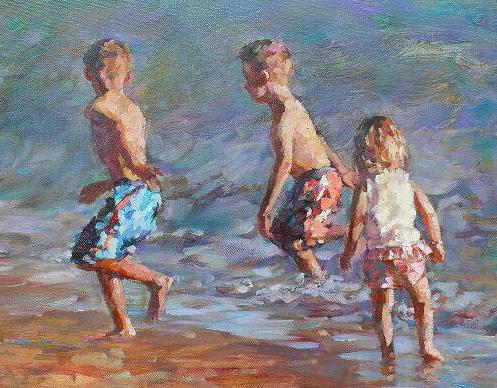
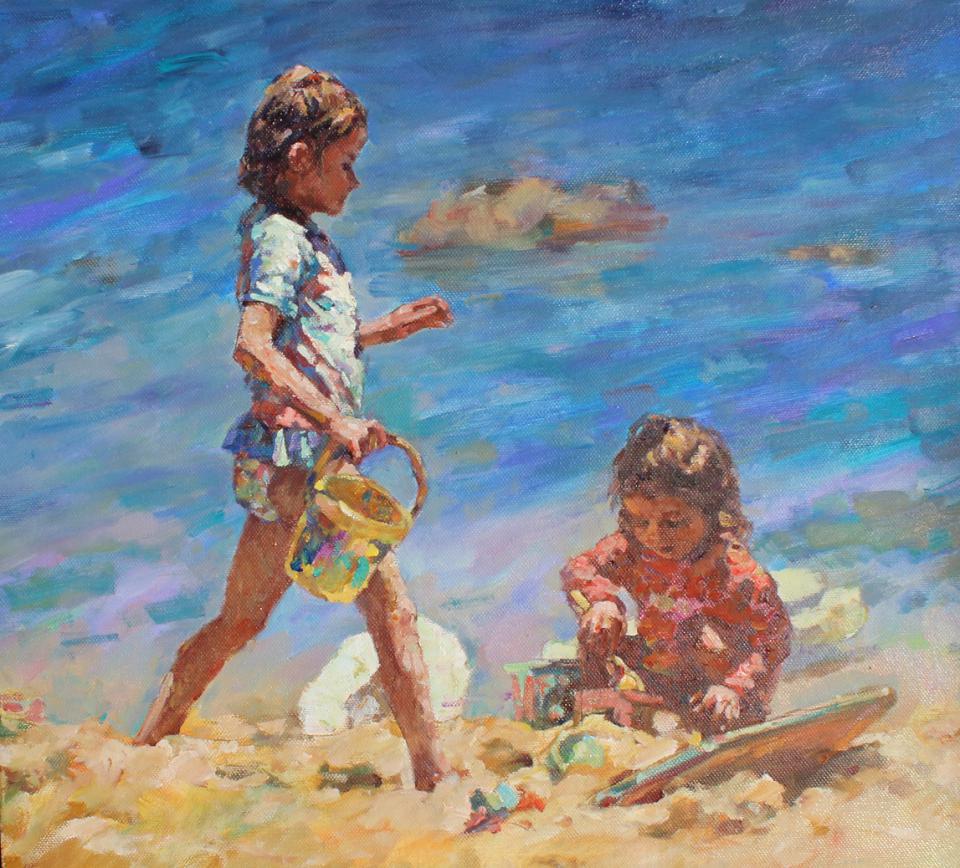
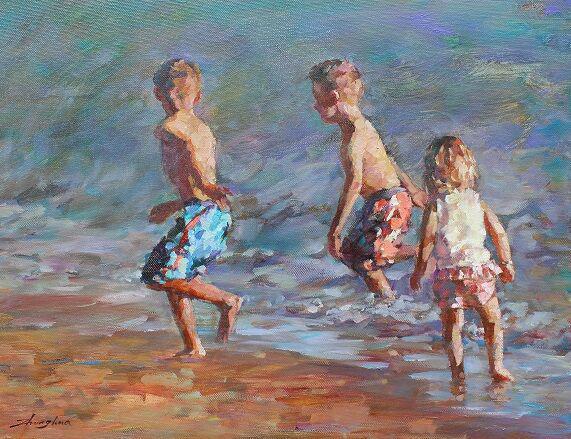
Walking with Friends, Lana Daubermannn
The Victorian Artists Society acknowledges the Traditional Owners of the land on which we reside, the Wurundjeri people of the Kulin Nation, and pays respect to their Elders past and present.
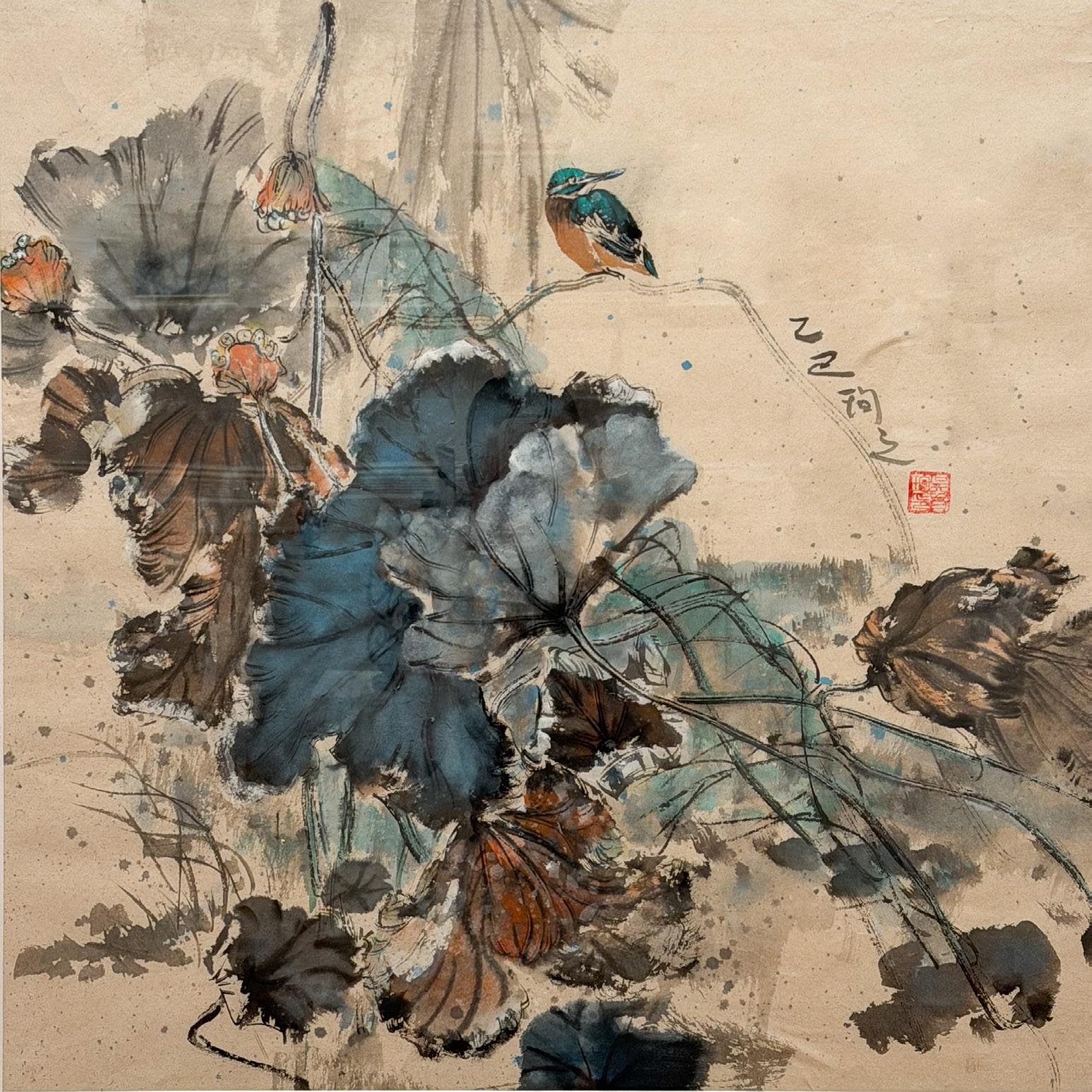
he VAS Summer exhibition brought ingenuity to our freshly painted walls.
Visitors and artists were met with turquoise ocean skies, juxtaposed with melancholic portraits and contemporary still lifes. The works invited their own originality through reflection, connection and contemplation. Echo Wu was the winner of the show with Whisper of Blue Lotus; fluid ink saturated and dissipated with pen details layered on xuan paper, echoing the dreamy nature of the lotus. Lucy Fekete VAS was awarded the Curator's Choice with her smallscale intricate offering Lulu's Pearls, reimagining the bathroom through a romantic lens, using antique greens and pinks presenting a comforting yet
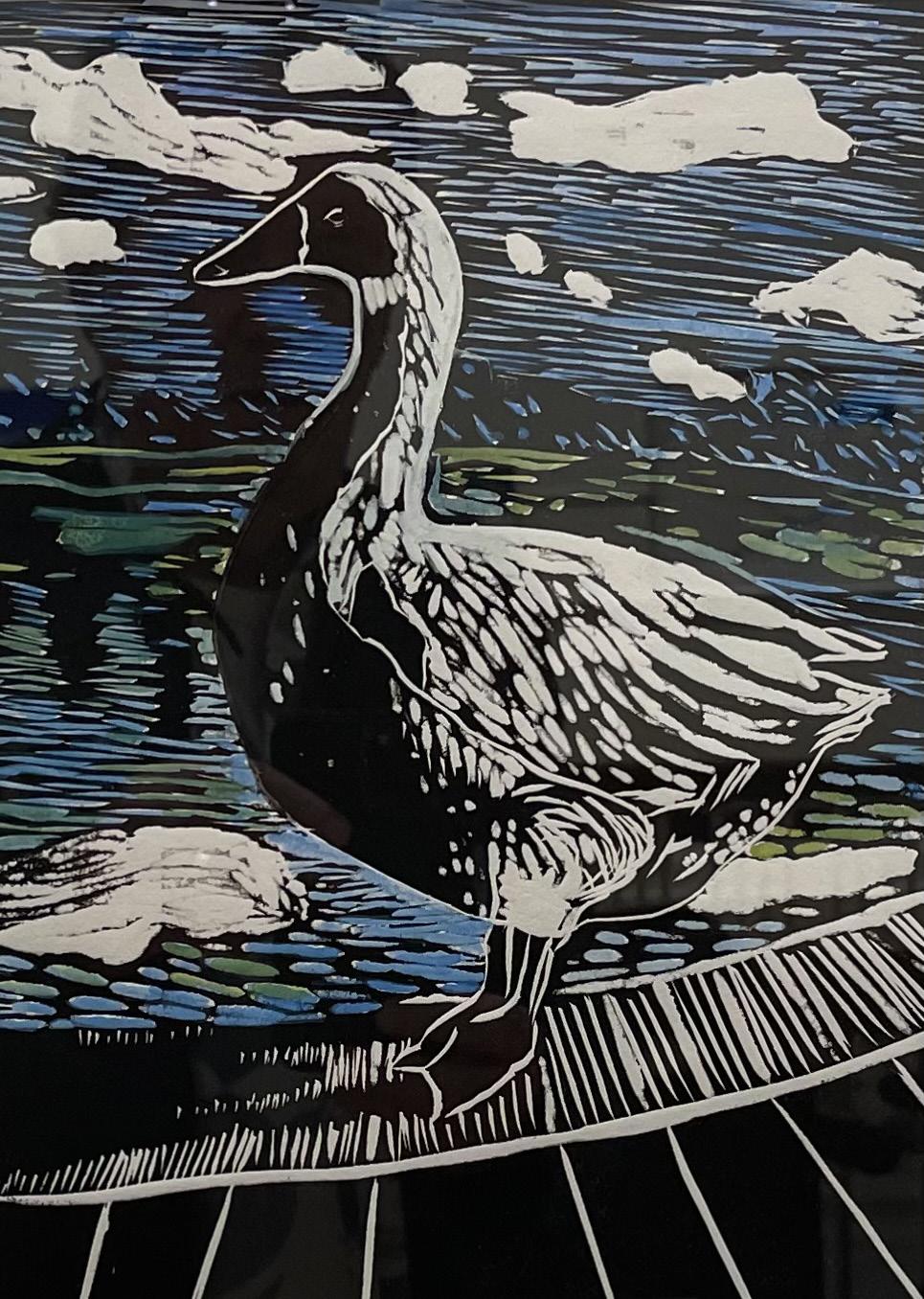
regal interior oil painting set within an ornate gold frame. Highly Commended awards included Helene Oberman’s Pacific Black Duck, which utilises the traditional technique of lino cut; a nostalgic perspective conjuring up fond memories of summer days in the park. Terri Macdonald's watercolour Summertime Reflections melts into the mosaic etchings of the pool's floor; an imaginative and fluid summer moment. Joseph Luczynski's Summer in Paris ruminates on the suffocating heat felt in concrete cities, emulated through painterly brushwork, the mirrored glow of the sun cascading on the river Seine and framed by the harshness of the concretes edges. Overall a successful show that can be absorbed as the last summer days begin.
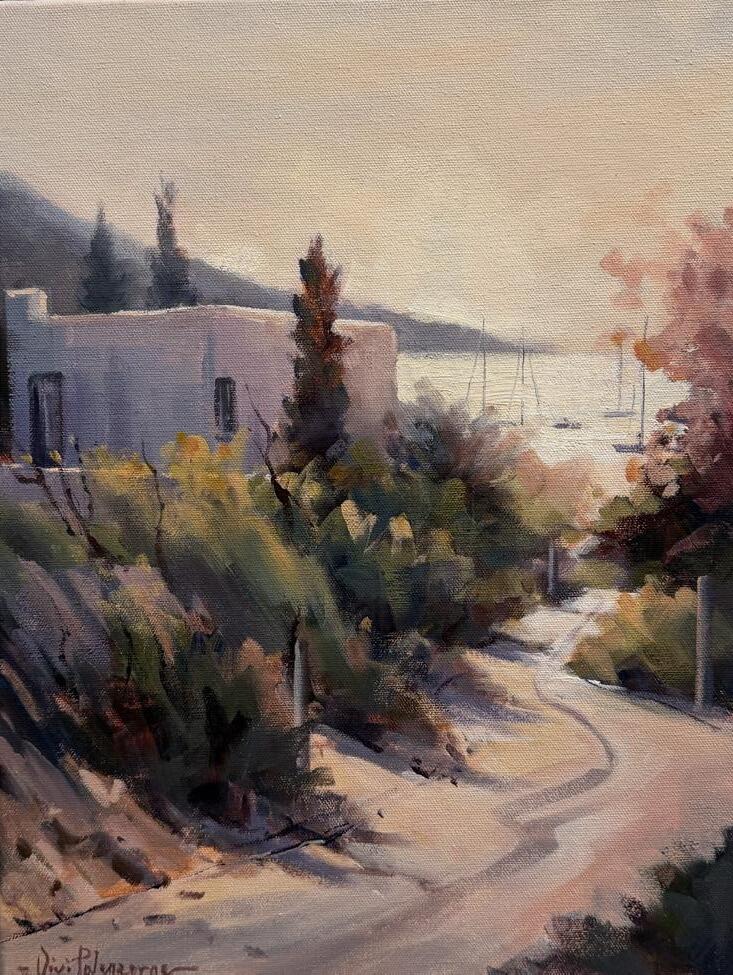
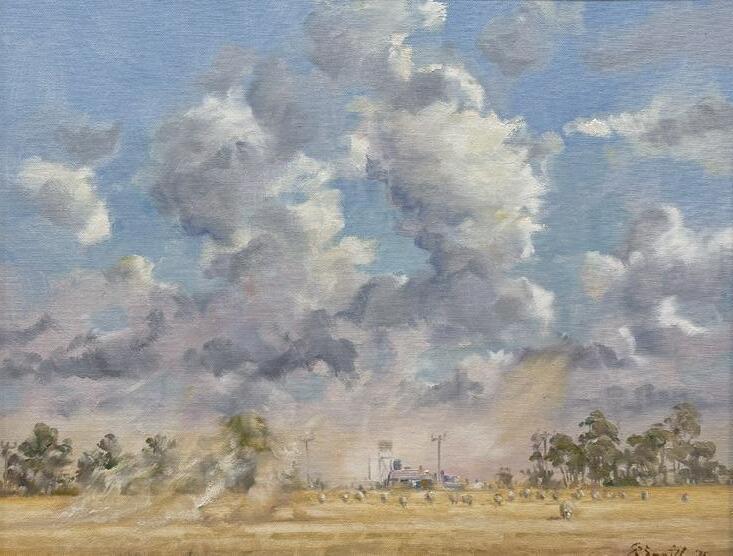
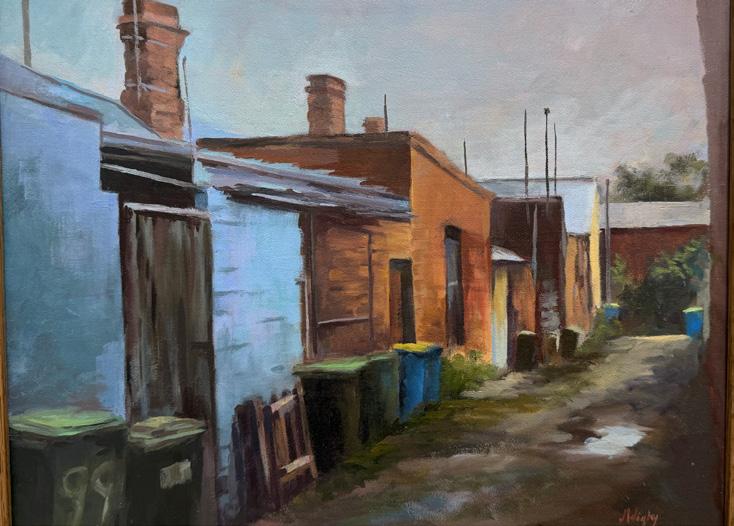
VAS Hylton Mackley Artist of the Year Exhibition 19 November - 14 December 2025
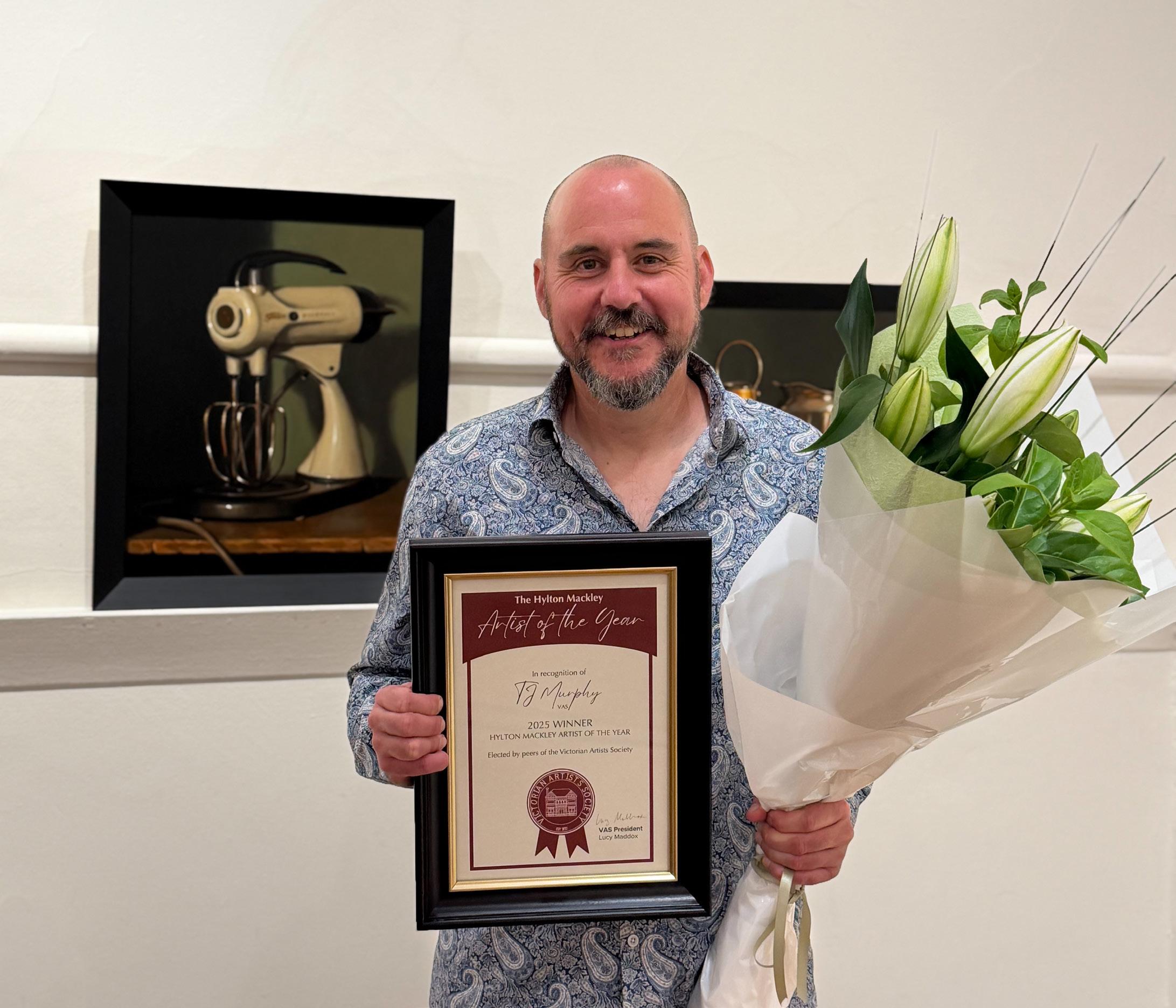
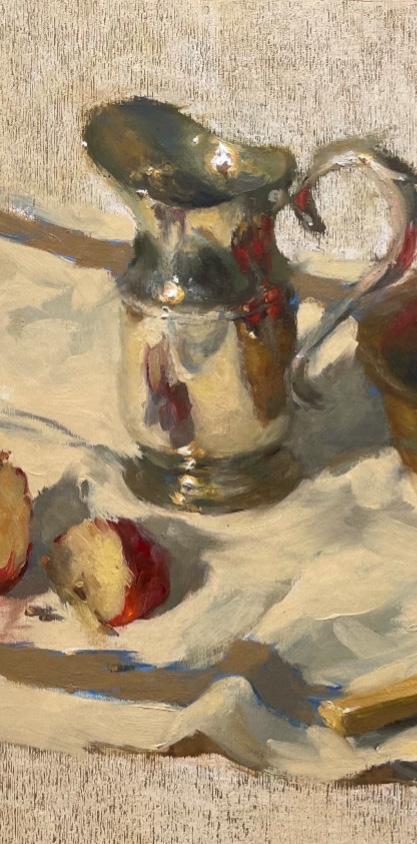
Popular VAS artist and teacher Tim Murphy VAS took out the top honour at the 2025 Hylton Mackley Artist of the Year. His tonal realist still lifes prevailed over a talented field which included six previous winners of the Victorian Artists Society’s premier award. The winner of the AOTY is determined by the total votes of Members at the three seasonal exhibitions and the votes of the finalists at the AOTY Exhibition. The endorsement of his peers capped off Tim’s strong performances at 2025 Select Exhibitions. The creamy colours of vintage home appliances feature in all three paintings he entered in the final exhibition.
“Observation is, for me, a perpetually engaging pastime, and my paintings are a result of my endeavours to translate my visual perception into two dimensions whilst wrestling with the unavoidable limitations of pigment. Tonal order is a primary focus as I believe this is the key to reality”1
Clive Sinclair VAS FVAS received the Members Award for the most votes from Members throughout the year and Swathi Madike was awarded the Noel Waite Exhibitors' Choice Award for the most votes from her fellow finalists.
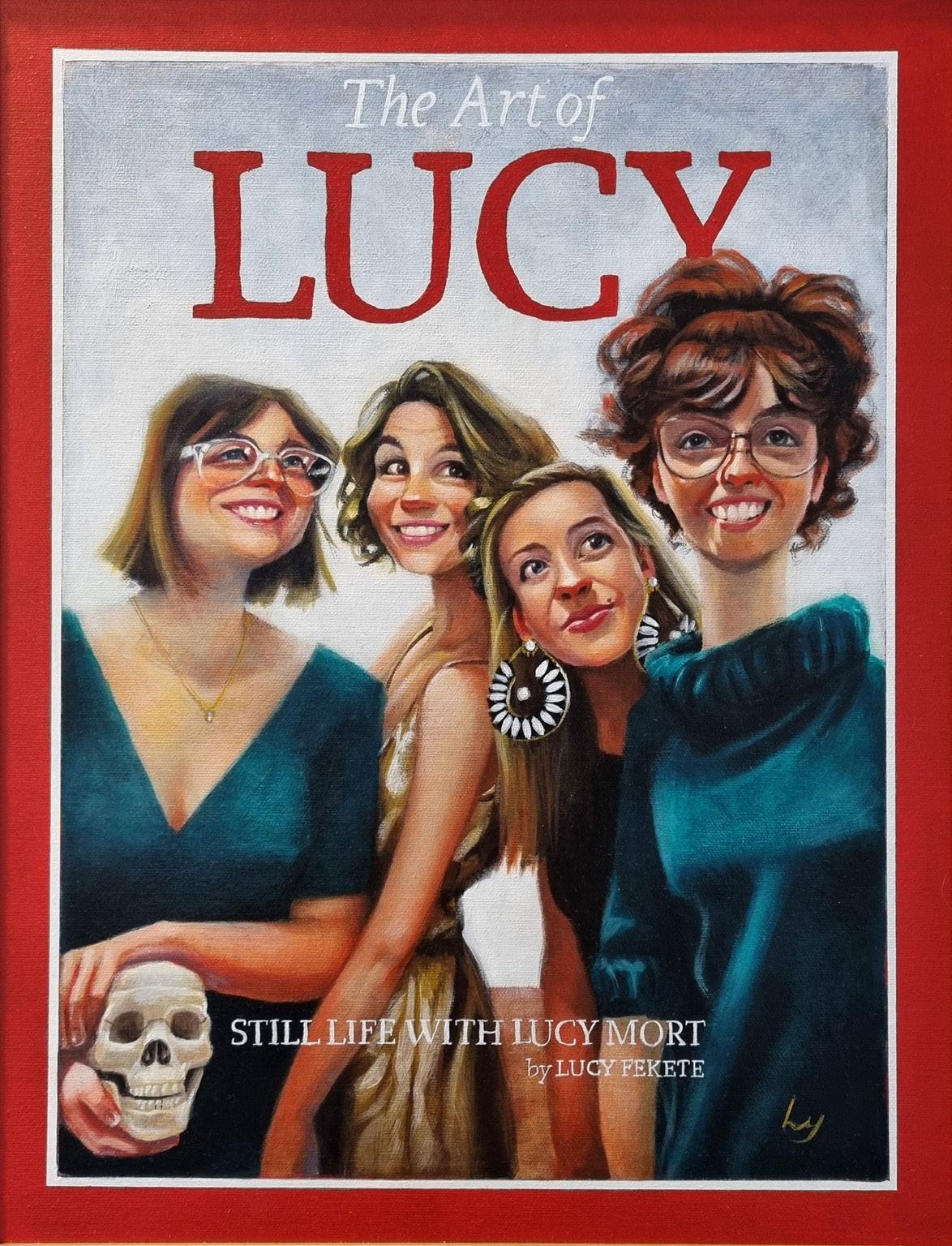
We have a luminance of Lucys at the VAS, so eyes were inevitably drawn to Lucy Fekete's The Art of Lucy. Lucy received her VAS Signatory Award at this event. VAS Signatory Awards are awarded to artists who have been selected to exhibit in VAS Select Exhibitions 12 times or more during five consecutive years. It Hao Pheh, Susannah Bond and Maxine Wade also received Signatory Awards on the evening.
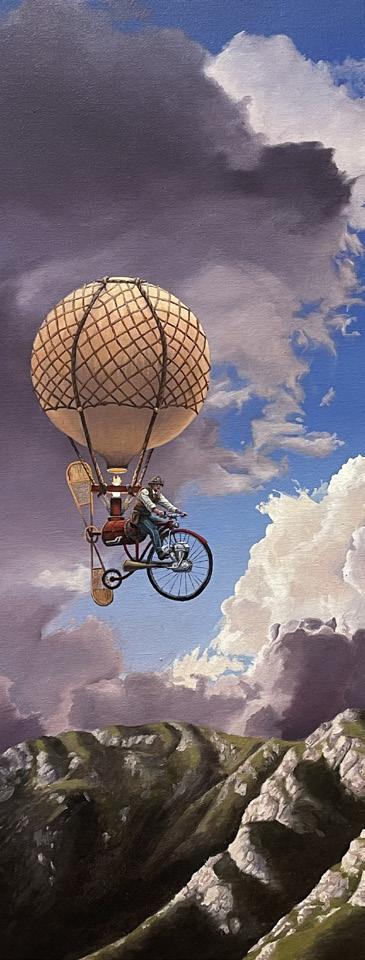
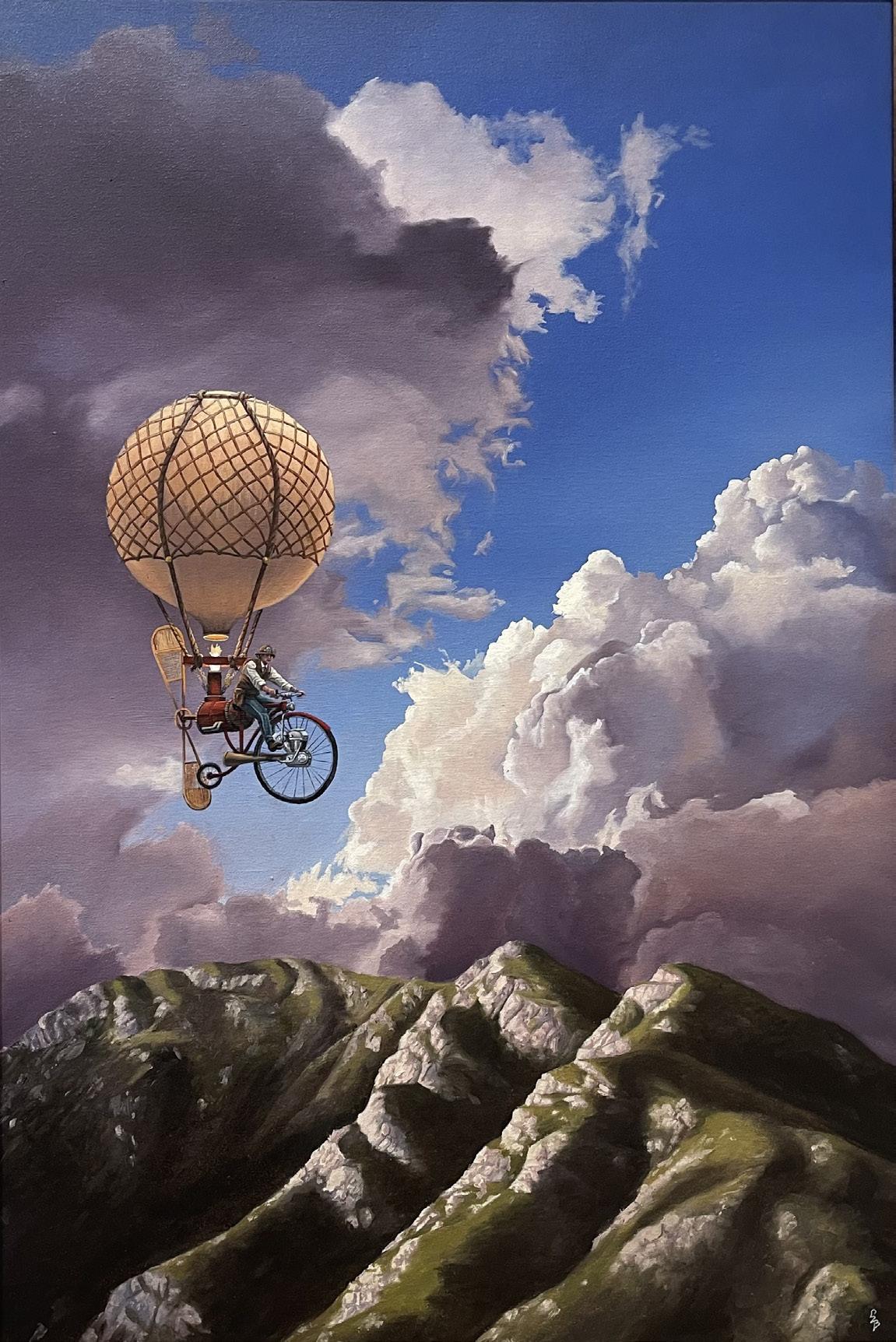
The wit and creativity of another finalist Sam Bruere VAS was also on display; his Maiden Voyage goes beyond realism into fantasy and features a steampunk-inspired flying machine drifting through a luminous landscape.
“Influenced by cinematography, he often uses composition, staging, and subtle scenic clues to craft visual stories with layered meaning”1
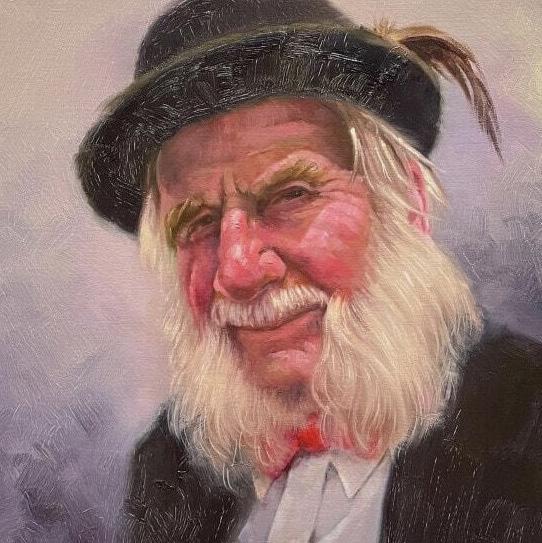
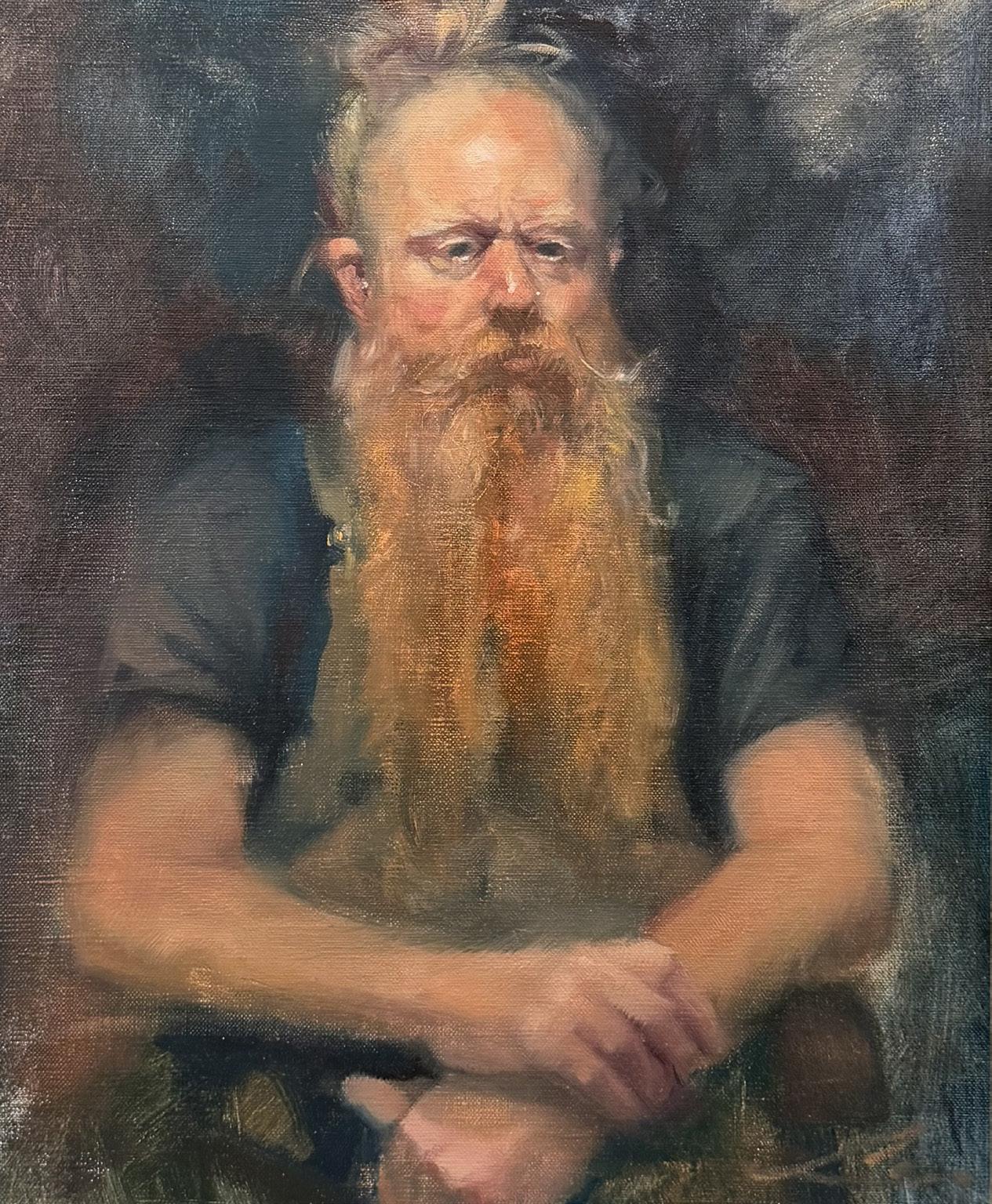
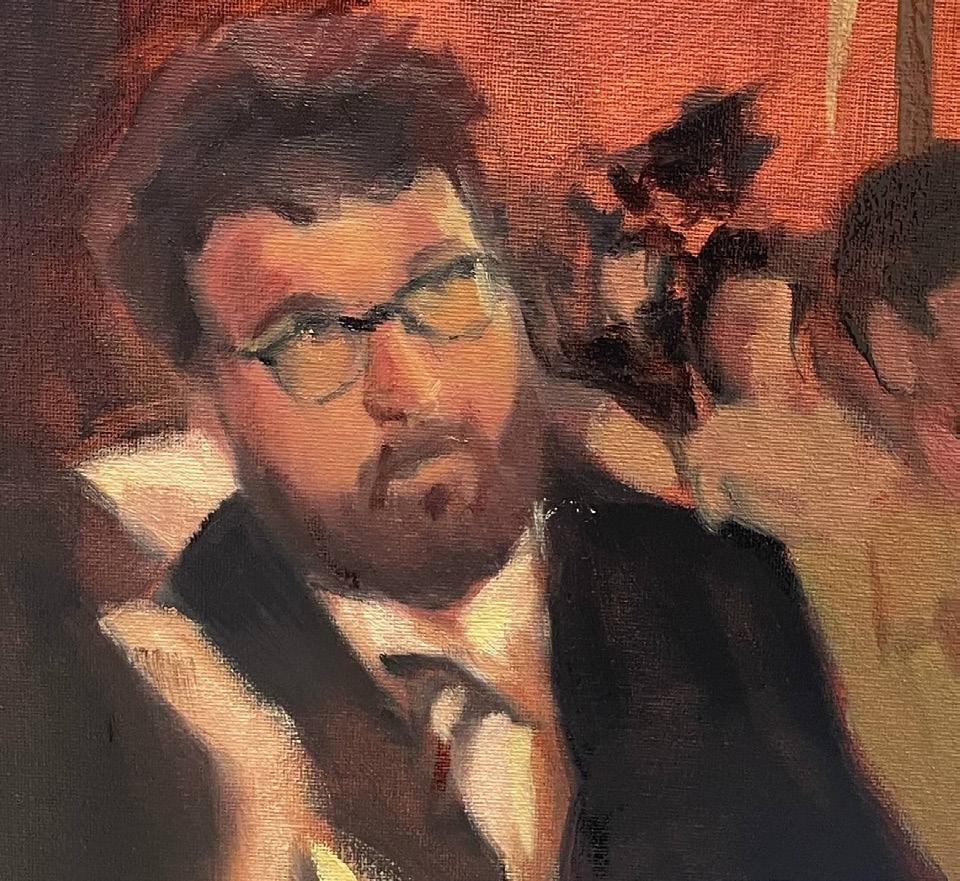
Portraiture is a traditional and popular genre among VAS artists. The reviewer was uncertain if it was technique or the luxuriant auburn beard of the artists subject that makes Liz Gridley’s Ready to Craft so attractive; both, no doubt.
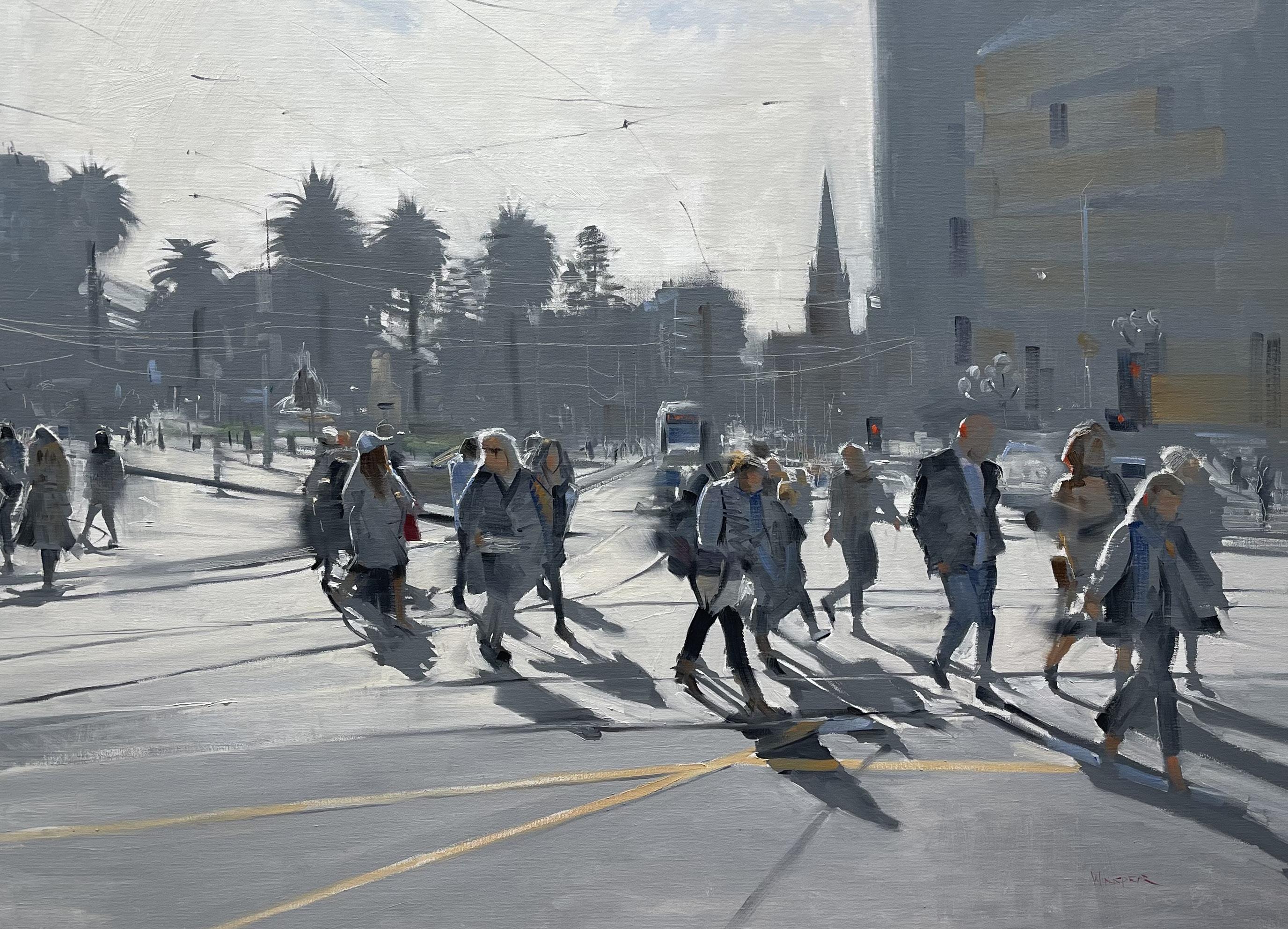
2016 AOTY Ben Winspear VAS loves “... both the portrait/figure and the Australian landscape”1. His Silver Morning, Melbourne CBD generates
action with a cold and wintry palette.
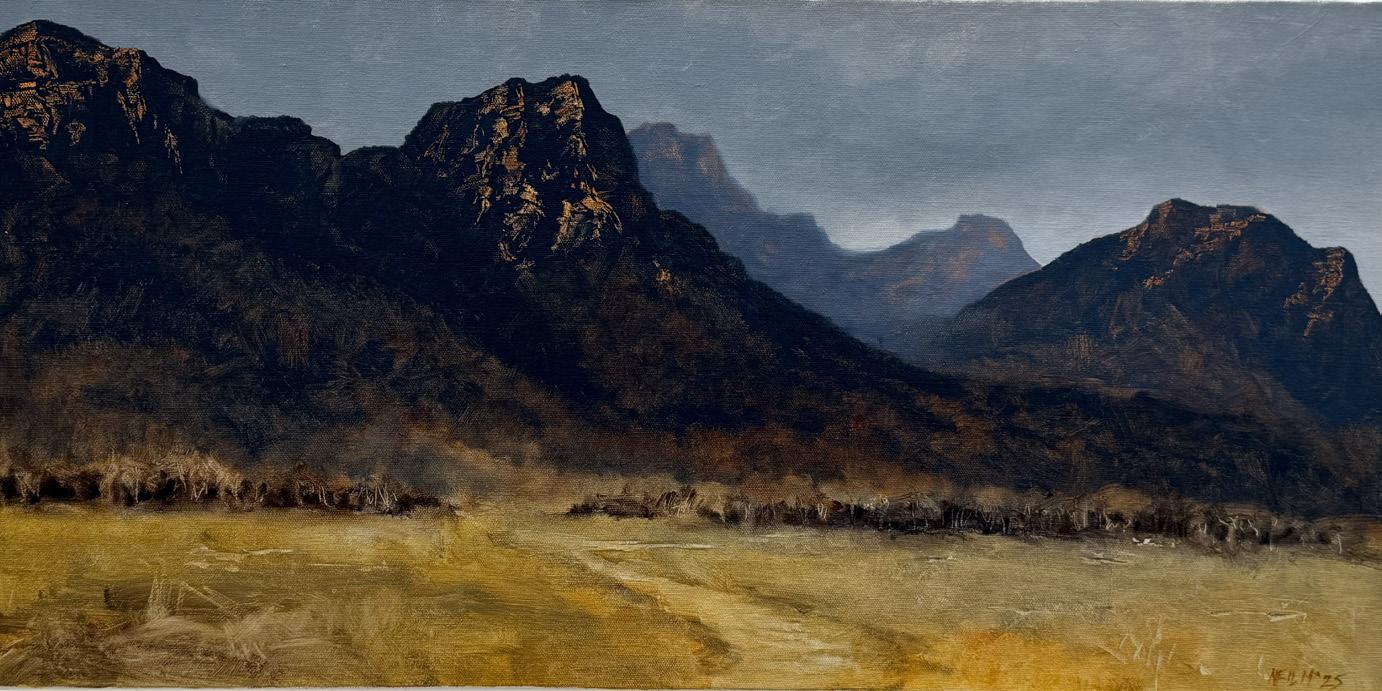
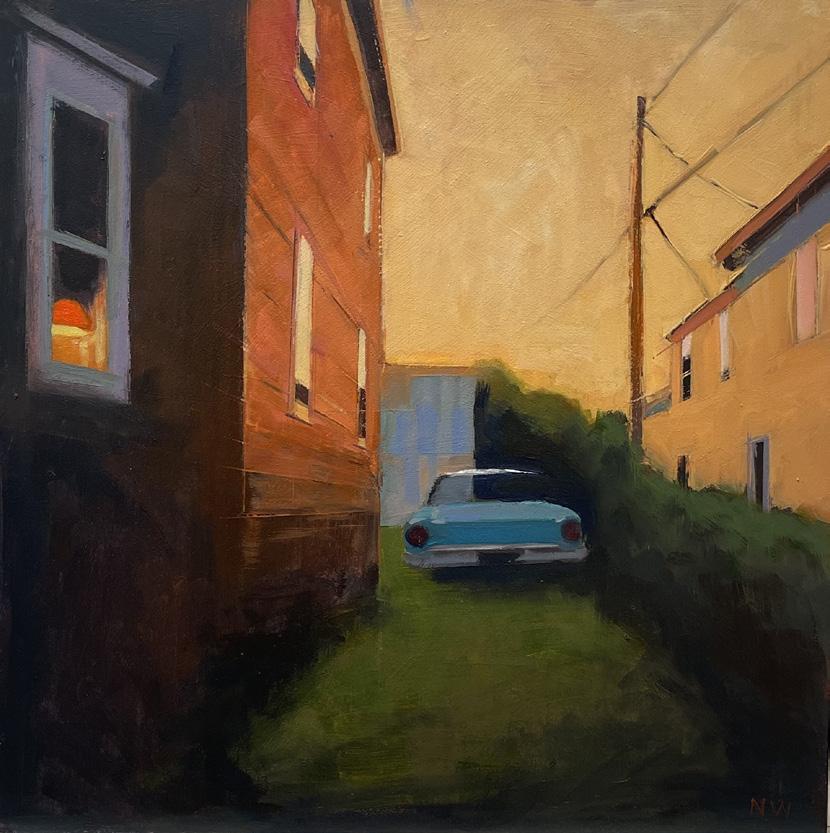
This is Neil Whalebone’s first appearance at the AOTY finals and judging by the simplicity and appeal of his Afterglow, it won’t be his last.
“I am seeking a balance between the quiet precision of traditional realism and the energy of abstraction”1
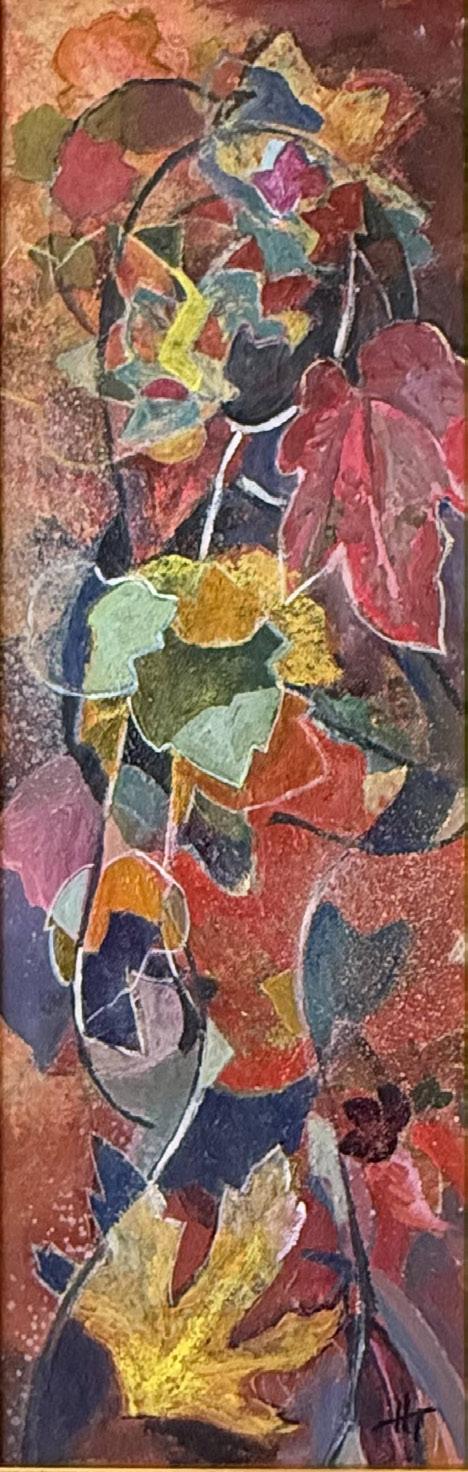
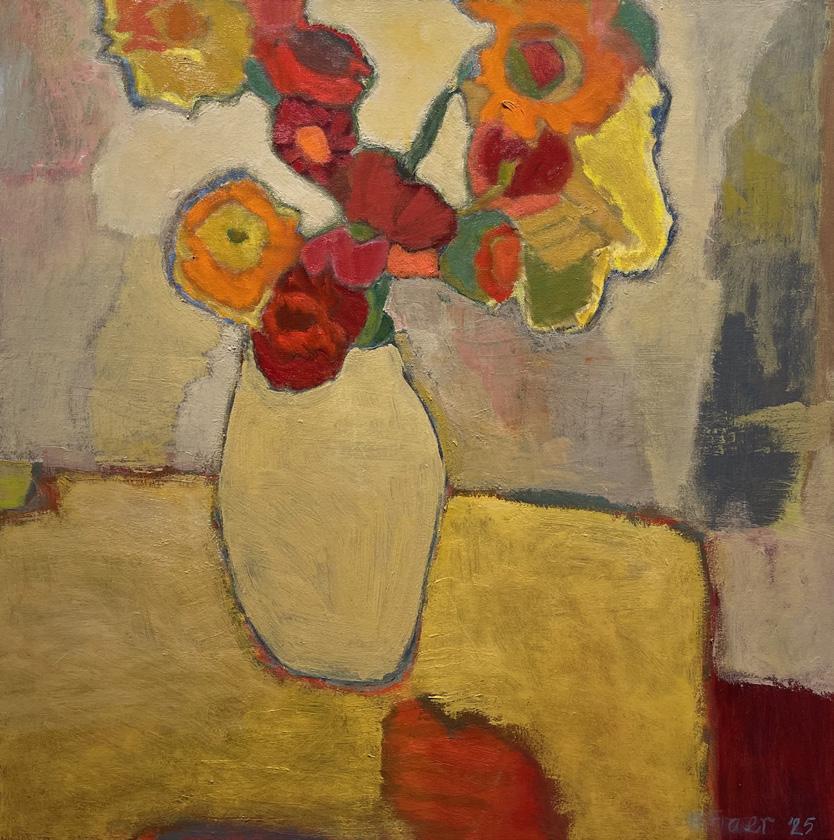
And speaking of the abstract, Melissa Fraser’s The Persistence of Colour could not be more different from Tim Murphy’s winning method and style; a tribute to colour and the diversity of artistic pursuits at the Victorian Artists Society.
1 Extracts from the 2025 VAS AOTY catalogue
Above:
Left: Ready to Craft, Liz Gridley, oil on linen panel
Right: The Art of Lucy, Lucy Fekete VAS, acrylic on canvas board
Opposite:
Top: Silver Morning, Melbourne CBD, Ben Winspear VAS, oil on linen
Left: Maiden Voyage, Sam Bruere VAS, oil
Right centre: The Persistence of Colour, Melissa Fraser VAS, oil
Right bottom: Afterglow, Neil Whalebone, oil

artist spotlight
Zhonghua has been a professional artist for over 20 years. He regularly holds collective and solo exhibitions and his artworks are in numerous private collections both nationally and internationally.
Zhonghua has devoted his time to painting the
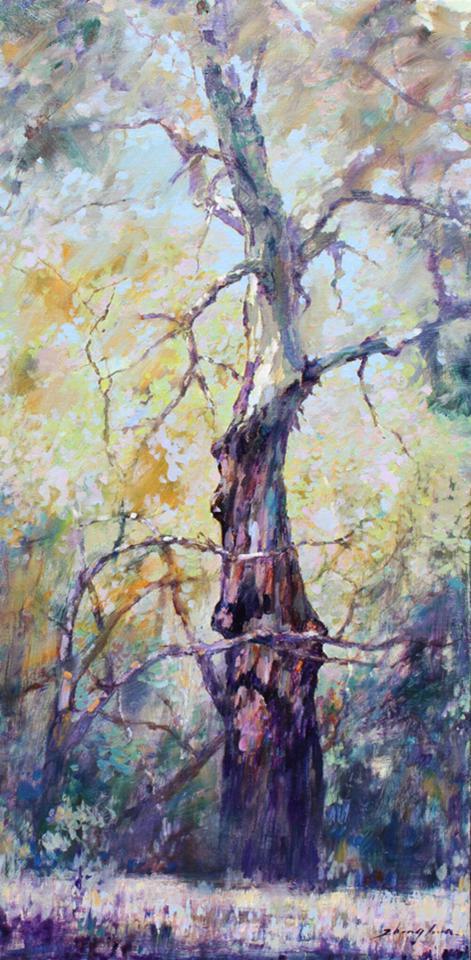
landscapes and seascapes of Australia; his paintings capture their raw light. Zhonghua also enjoys sketching at life drawing classes with local art societies.
Most recent awards of his paintings and drawings can be found on the VAS Online Gallery and www.gallery247.com.au/zhonghua-fan.
Frater, Hammond & McCubbin Galleries 11 - 22 February 2026
words Bruce Baldey VAS
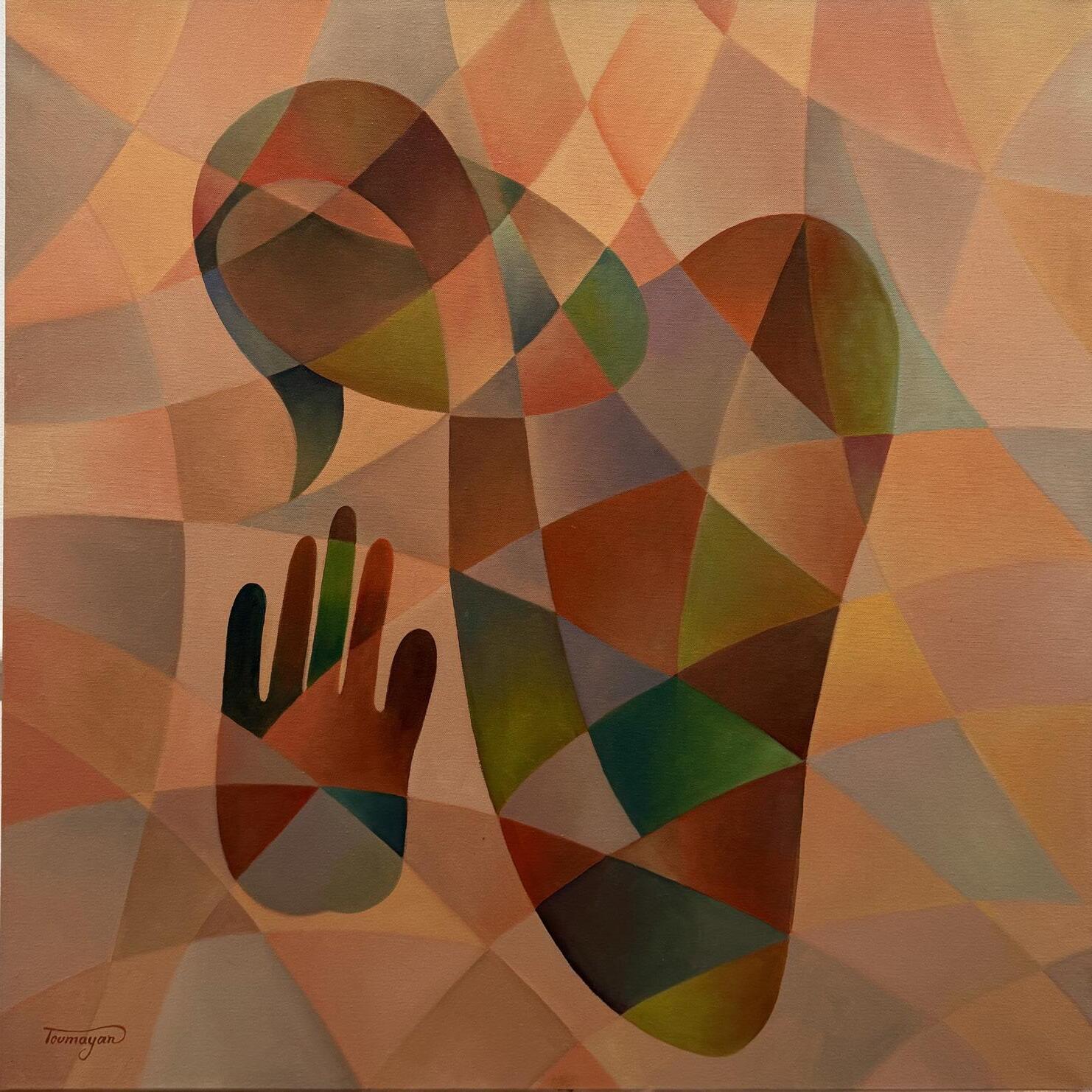
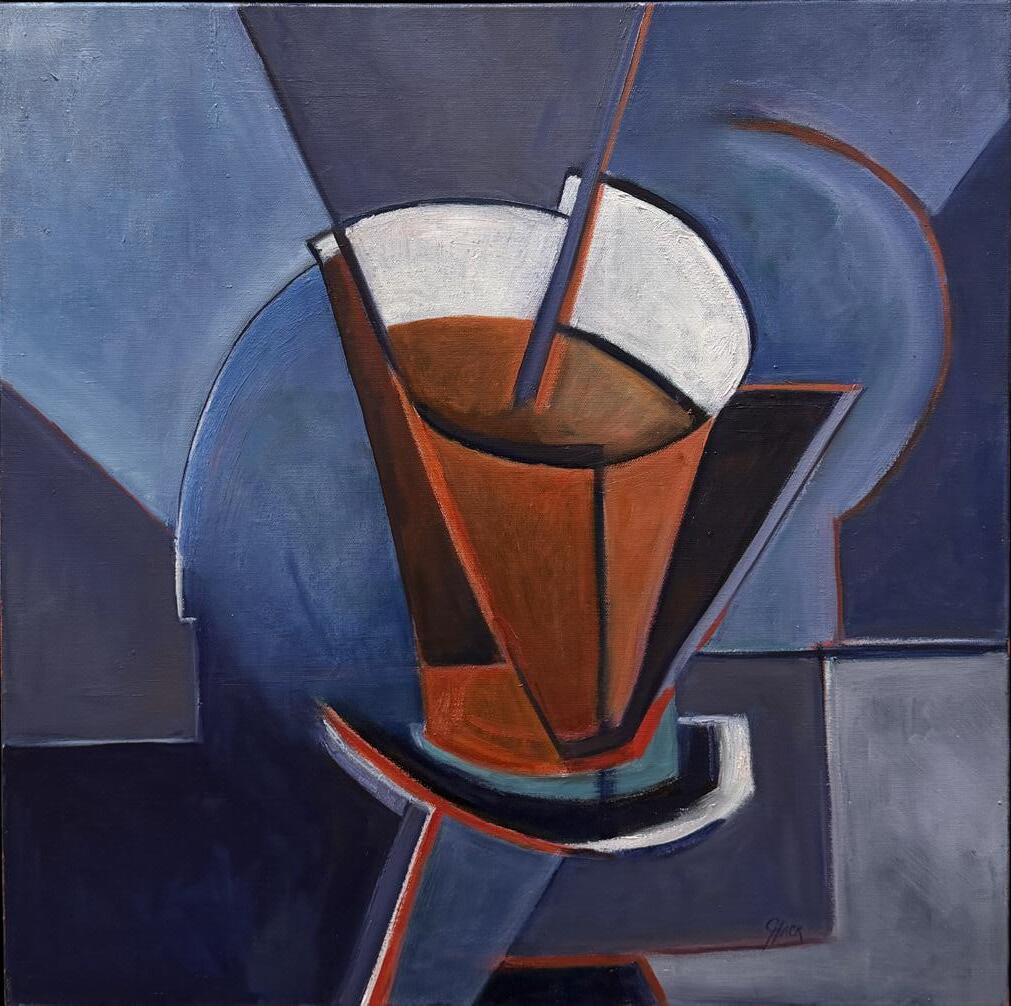
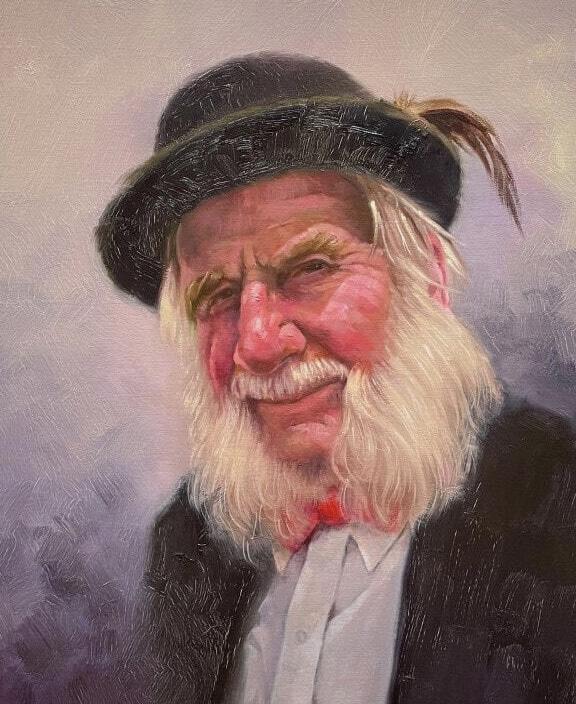
Perennial exhibiting VAS artist and former Councillor Fred Toumayan VAS has taken out the 2026 VAS George Hicks Foundation Contemporary Art Prize. Fred is well known at the VAS for his portraiture1 and occasional forays into constructivist sculpture. His slightly retro abstract Enough is Enough was described by Judge Mark Feary as a “play between abstraction and figuration”. Feary also noted “the restraint and balance of the composition and palette. The nowness but also the out of timeness of the work… its playful suggestion of reaching one’s limit”; contemporary indeed.
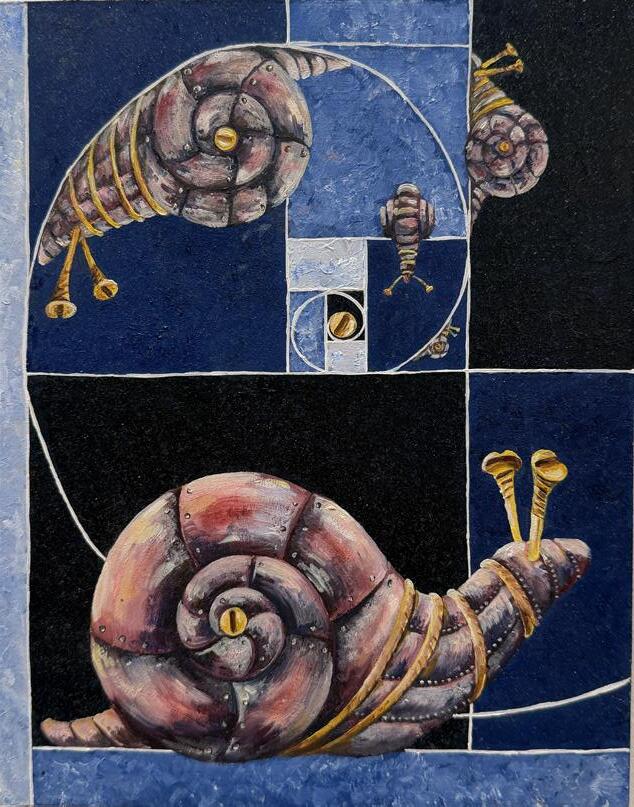
The Exhibition attracted the characteristic wideranging selection of artworks, though this year’s offerings were perhaps more conservative. Among the standouts, Zulu’s work Fibonacci Connection was Highly Commended; emblematic of her distinctive style, deftly balancing line and colour in a carefully controlled fashion. In sharp contrast, Nick Scholes presented the minimalist piece So Much Distance Amongst Extreme Conditions. The Judge’s remarks highlighted the artwork’s compelling “synergy of canvas and frame” and praised its “eloquence of simplicity”.
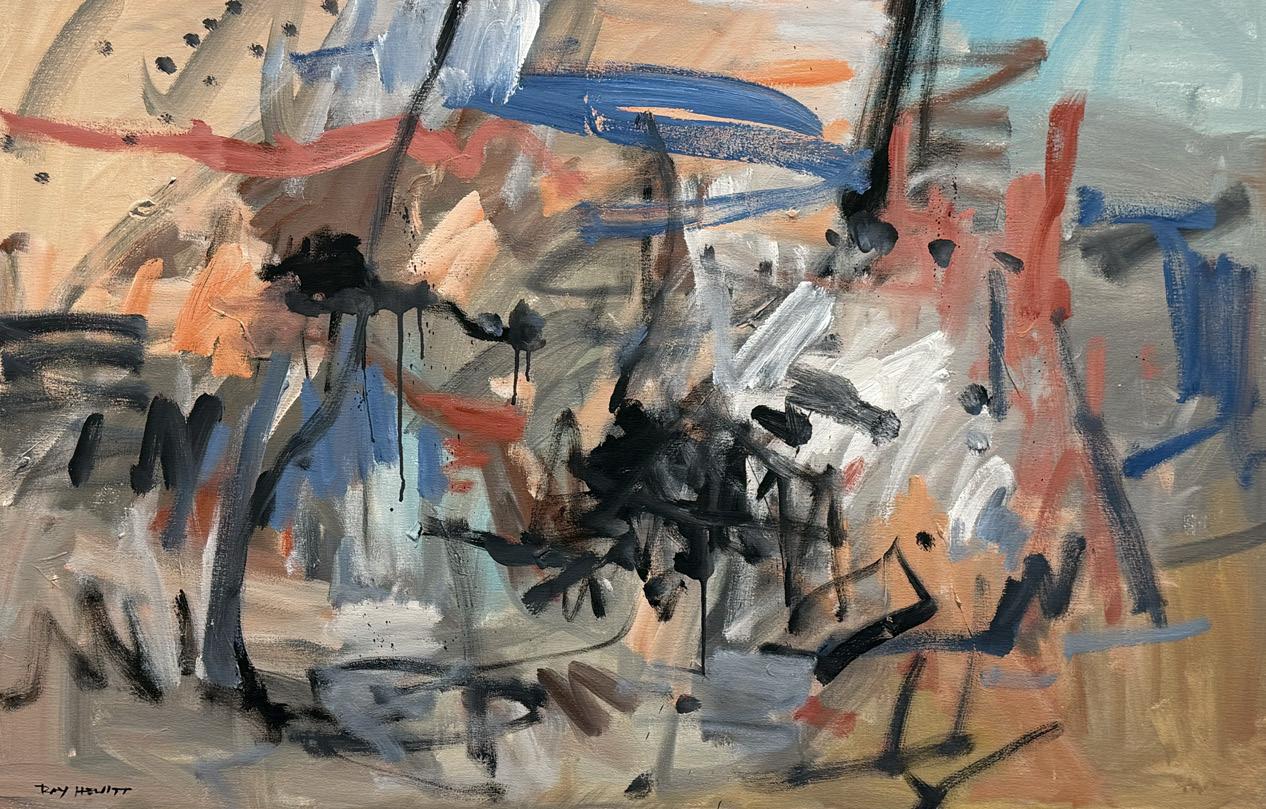
The emerging ‘School of Contemporary Grunge', as I classify it, continued to impress at this year’s exhibition.
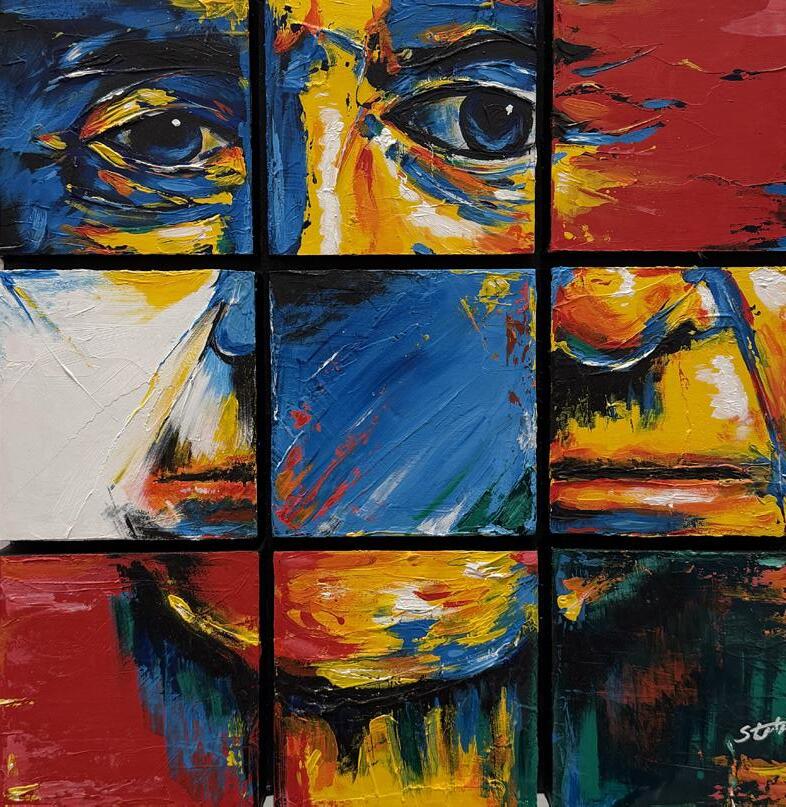
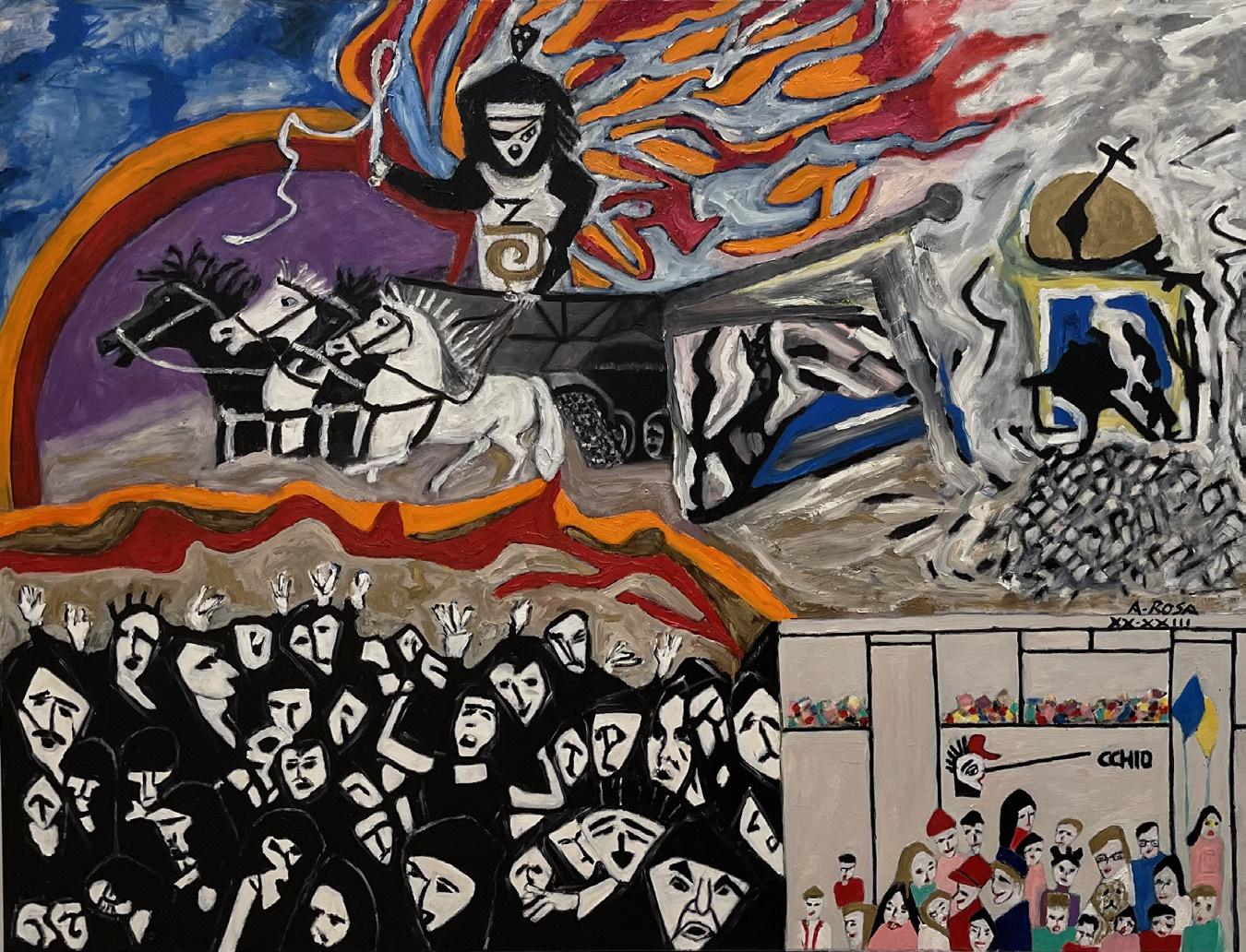
Among its noteworthy entries, Aldo Rosa's Apotisse stood out for its dynamic energy and well-controlled execution. The composition expertly balanced intense, shadowy elements with vibrant colour, providing relief and contrast to the big darks. This interplay created a striking visual impact, affirming the group’s reputation for combining raw expressiveness with thoughtful structure.
Paris Post-card caught the eye of the architect within. Sean Hogan has produced a very correct and compelling rendering of this modernist icon. For decades architects (e.g, Archigram, Cedric Price, et al) dreamt of building like this; supporting skeletal structure is relegated to the outside of a building along with boldly coloured mechanical services and ductwork. Piano and Rogers were awarded the commission to design the Centre Pompidou in 1971 and subsequently oversaw its construction.
Finally, full marks to Helene Oberman for reviving the ancient art of woodcuts (albeit linocut in this instance). Everything old is, after all, contemporary again.
1 Fred’s portrait of the late Walter Magilton features in the tribute to Walter on page 26 of this issue.
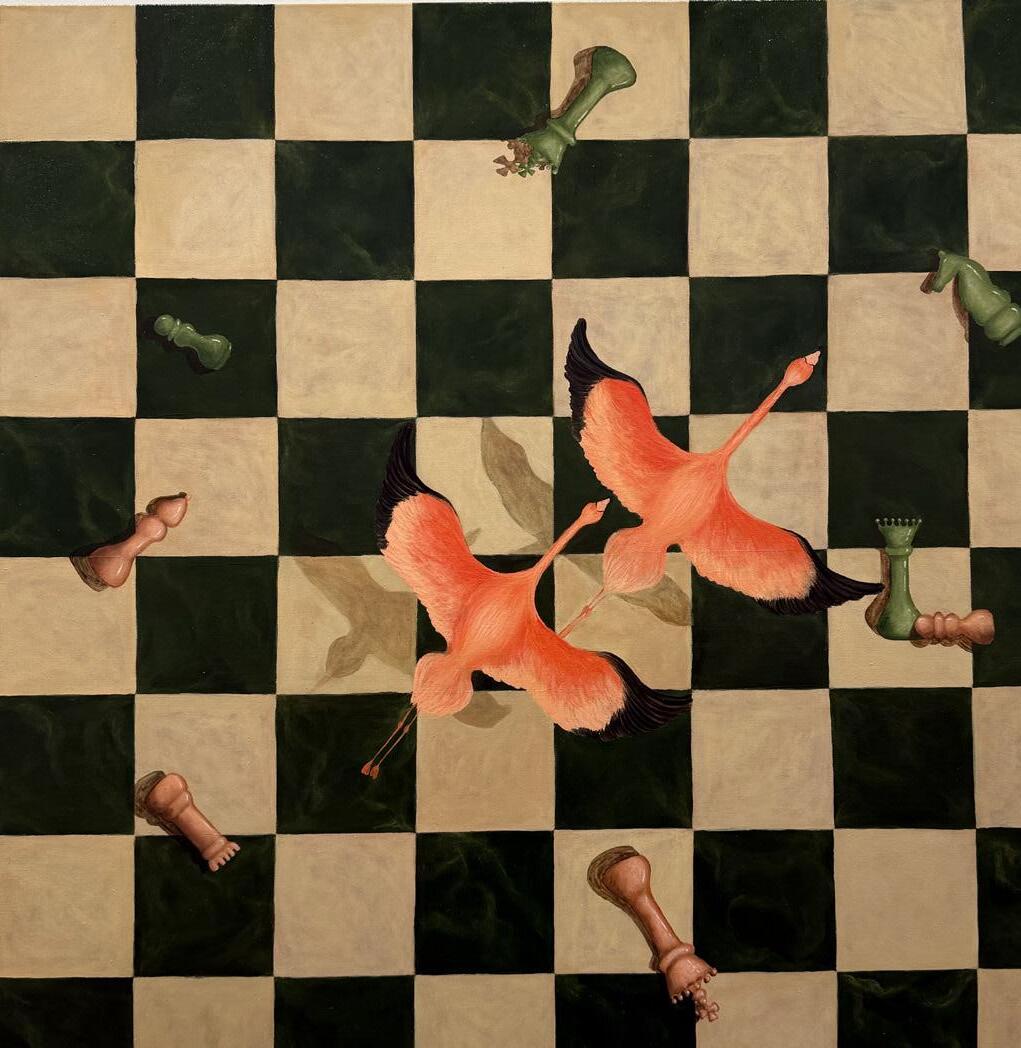
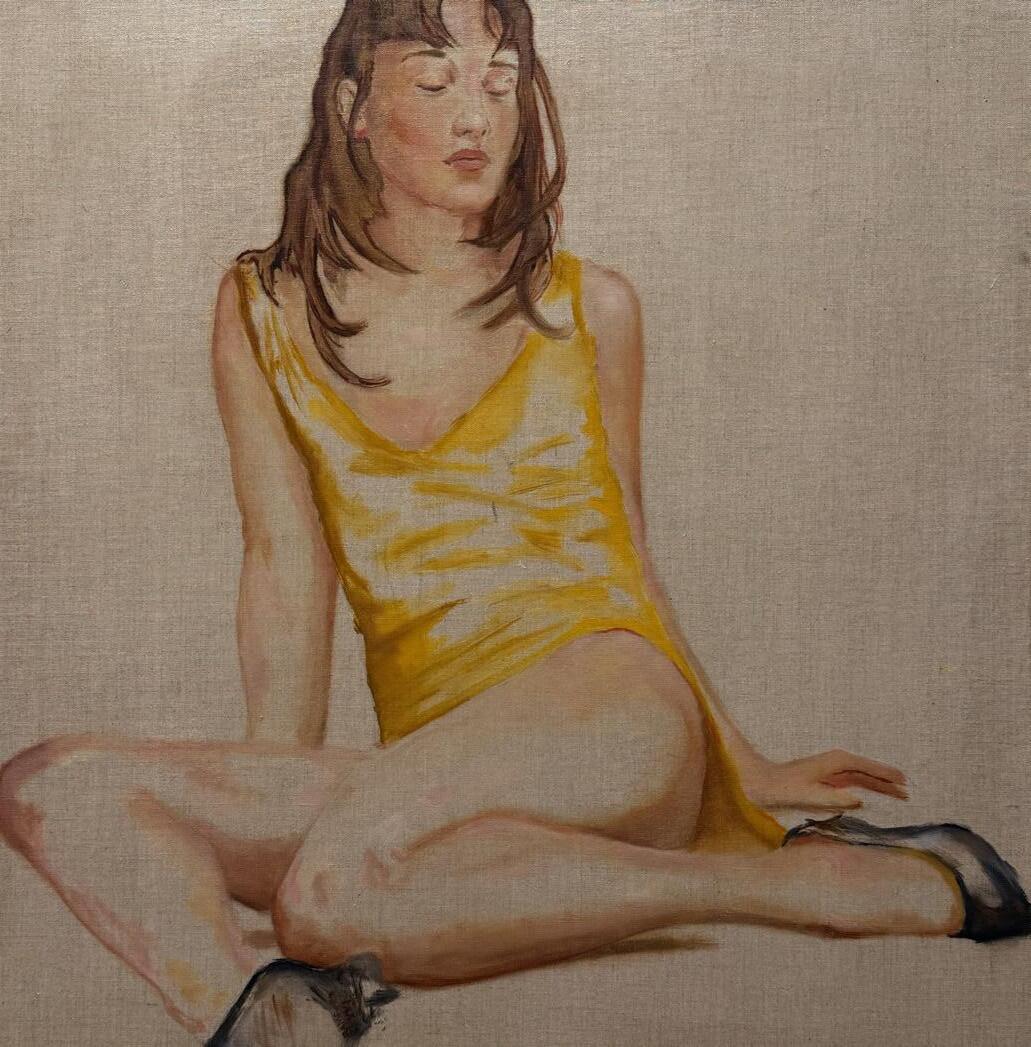
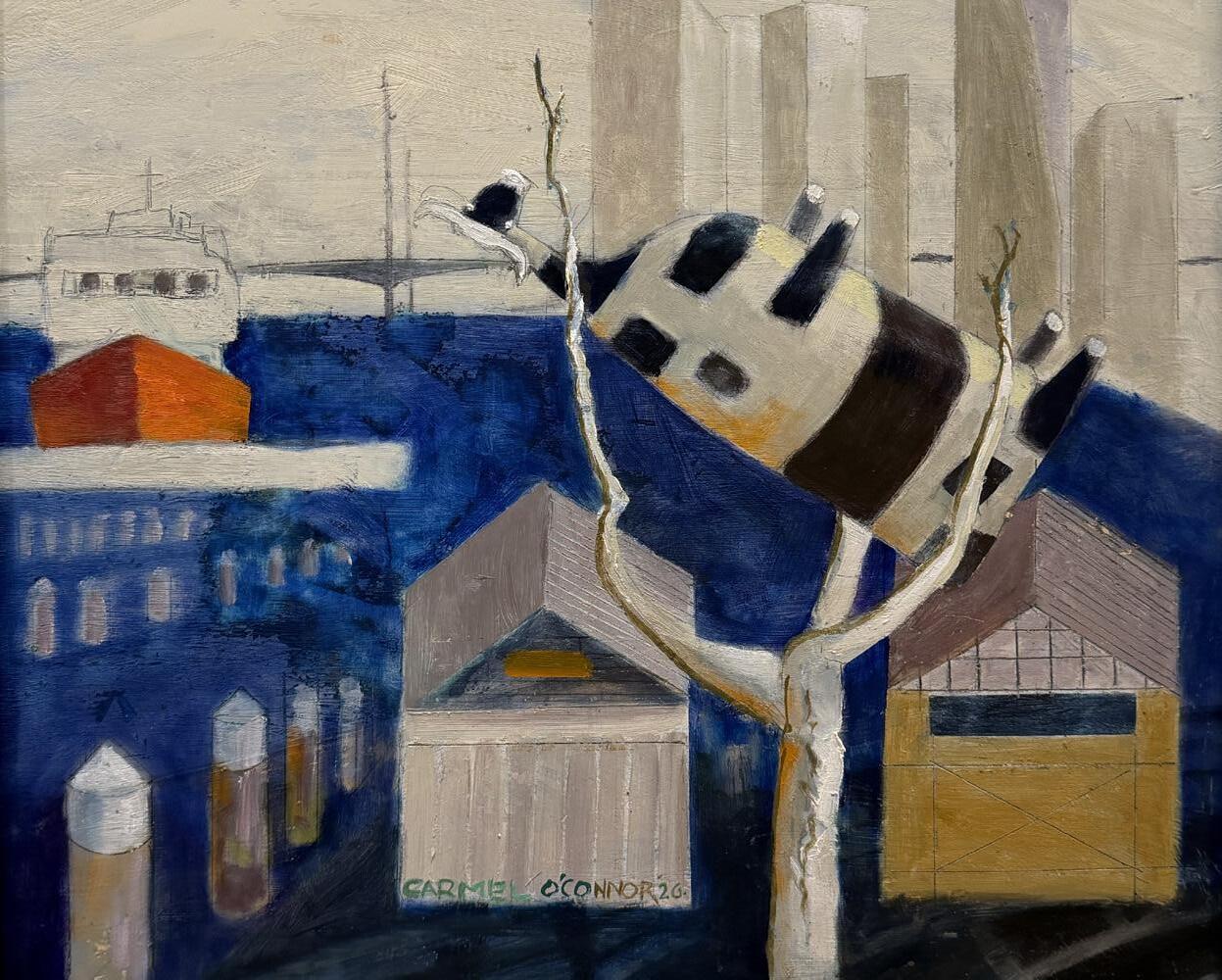
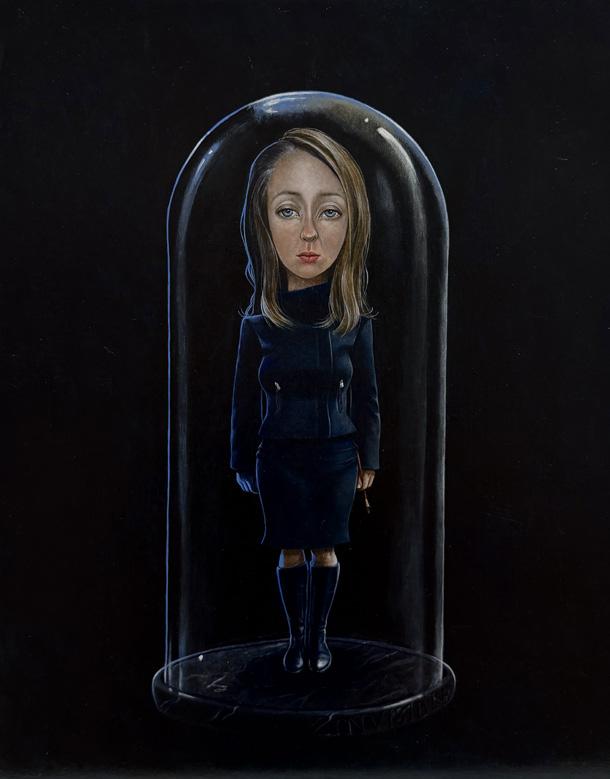
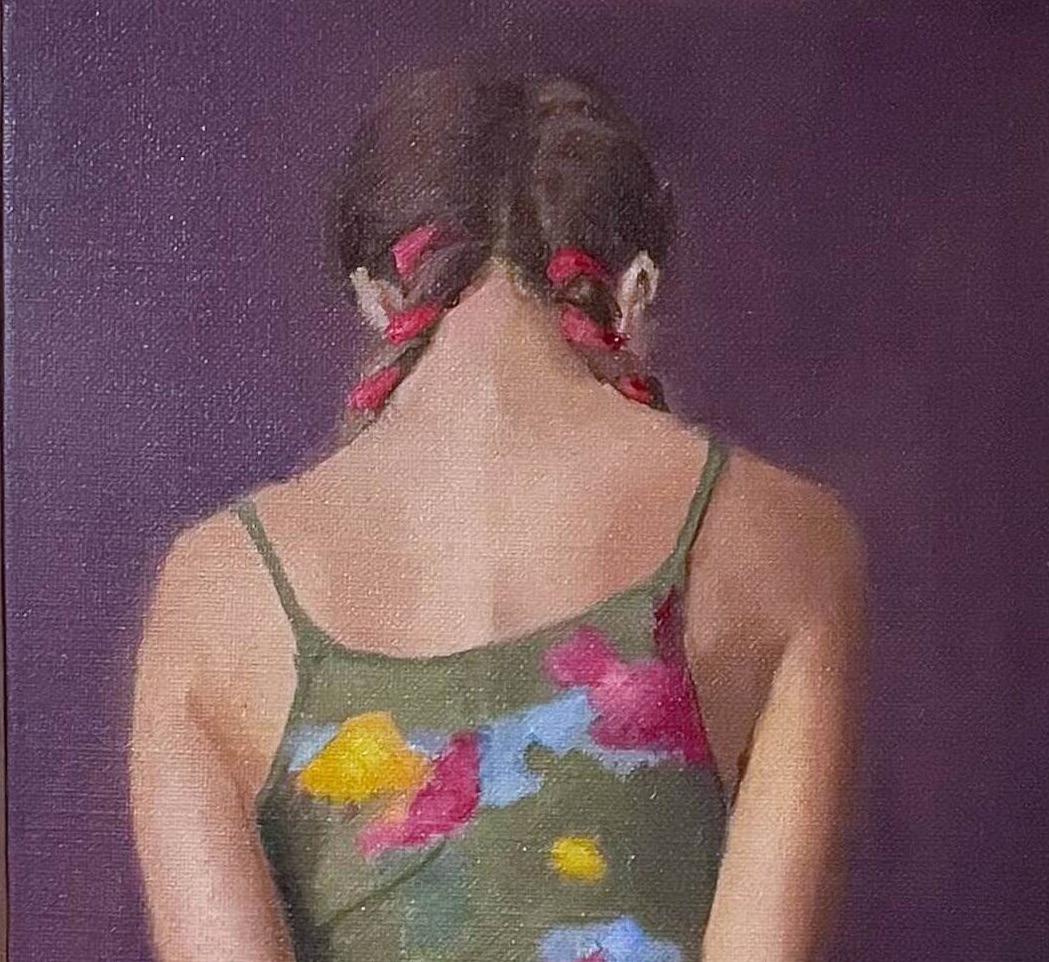
Introducing our 2026 Hansen Little Coterie Members! The Victorian Artists Society is thrilled to welcome our new Coterie Members for a year of creative residency.
Generously supported by the Hansen Little Foundation, this program supports professional artists at critical stages of their early to mid-careers, offering the opportunity to exhibit, connect, and grow within the VAS community. Our 2024 and 2025 cohorts have demonstrated exceptional growth and achievement, and we have no doubt this group will continue that tradition. We can't wait to see what they create this year!
Scott Bamford is a designer and fine artist who studies classical drawing and tonal painting from life, and regularly exhibits at the VAS. He creates work that resonates through storytelling and strong visual language, exploring themes of identity, everyday life, and the subtle narratives within ordinary moments.
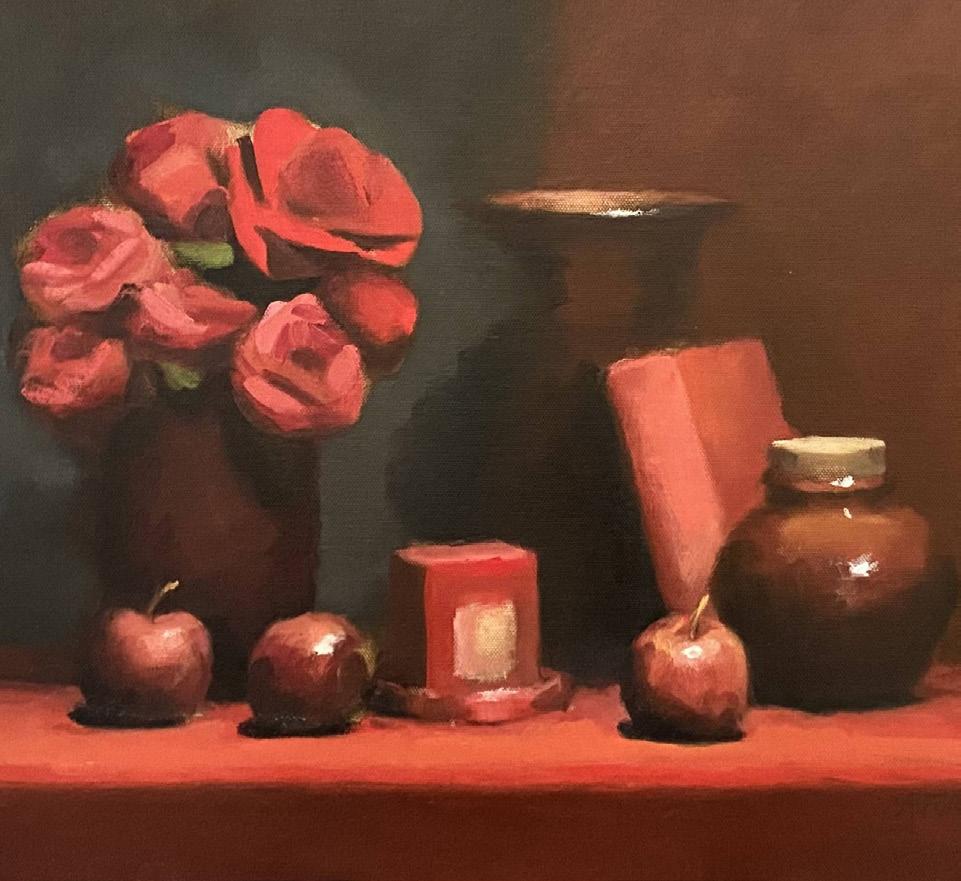
Annie Forbes is a tonal realist painter working across portraiture, still life, and plein air painting with an emphasis on accurate tonal placement to capture light and depth. Her early recognition includes 2nd Place at the Allan Wolf-Tasker Memorial Central Victorian Landscape Award and Highly Commended at the VAS Summer Exhibition.
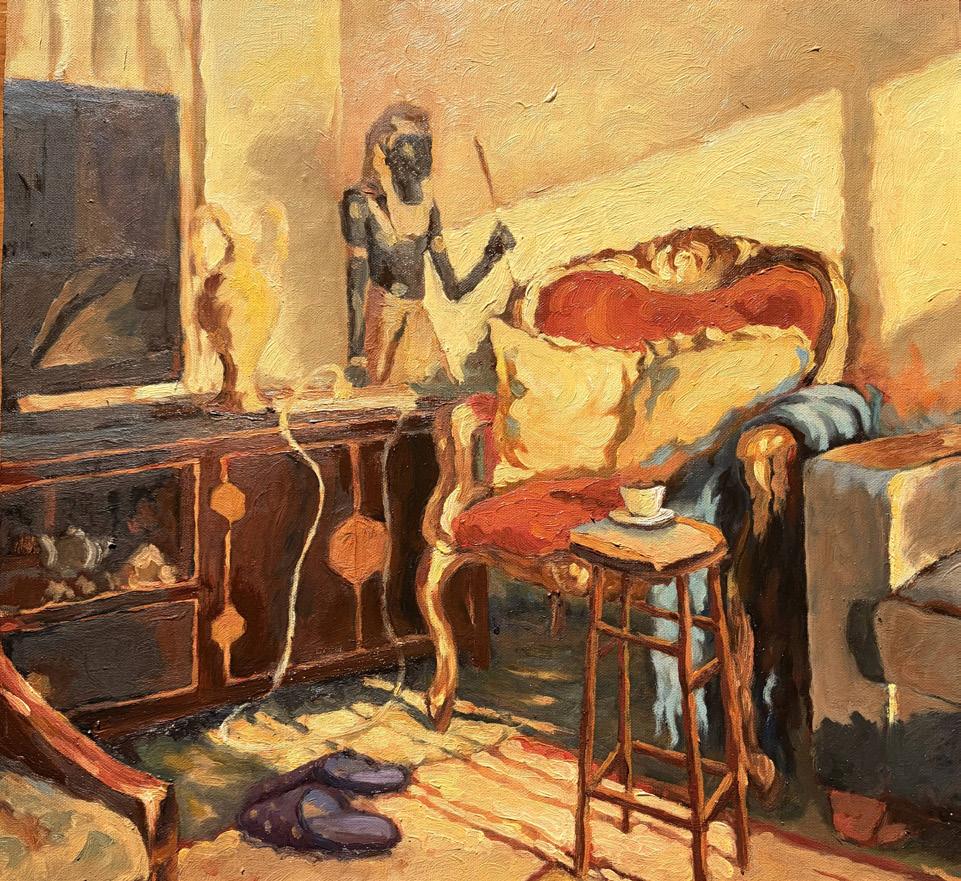
Ramanpreet Kaur is an oil painter and printmaker who completed her Bachelor's degree in painting and printmaking in 2023. She works extensively en plein air and in her upcoming solo exhibition at Angela RobartsBird Gallery, explores themes of life through absence and quietude, drawing on Impressionist influences and the study of light.
Lachlan McKenzie is a second-generation artist who has trained under Australian and international landscape painters. With a passion for plein air work, he seeks to contribute to Victoria's rich tradition of landscape painting and artistic community.
Marlon McKinnon is an artist of Filipino-Australian heritage who works in oil painting, watercolour, and charcoals, drawing inspiration from John Singer Sargent and the old masters. He maintains a disciplined daily practice and regularly attends life drawing sessions at Hawthorn Artists Society and Coates Community.
Led by Jane Hansen AO, the Hansen Little Foundation is a committed supporter of VAS. Following their sponsorship of the Mavis Little Artist of the Year award (2016-2022), the Foundation now focuses its resources on building the future of the Society by nurturing emerging artists through the Coterie program. The Victorian Artists Society is deeply grateful for their continued support.
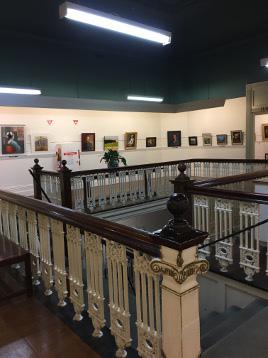
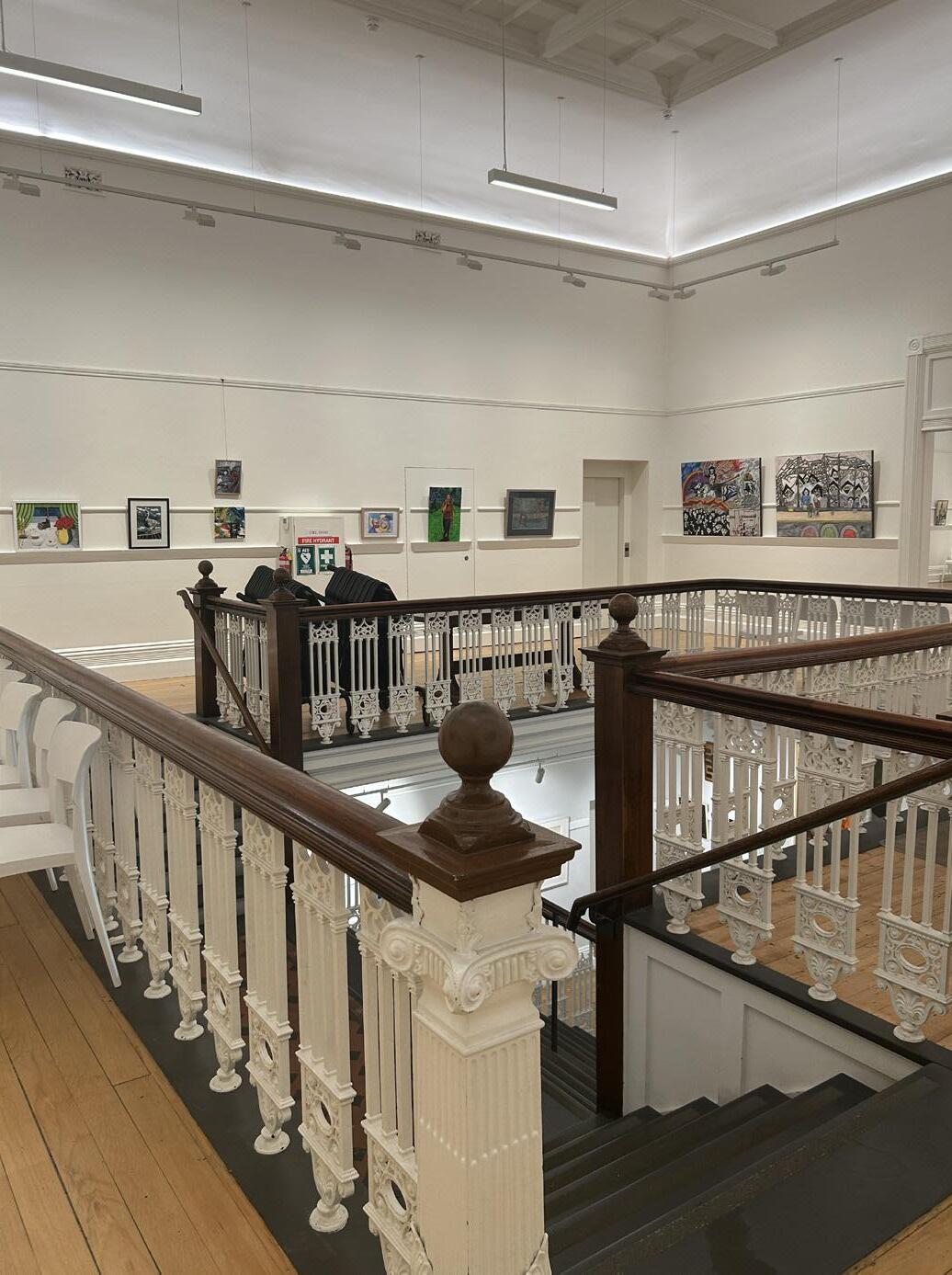
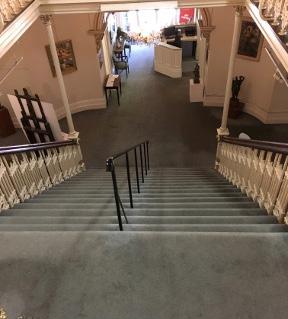
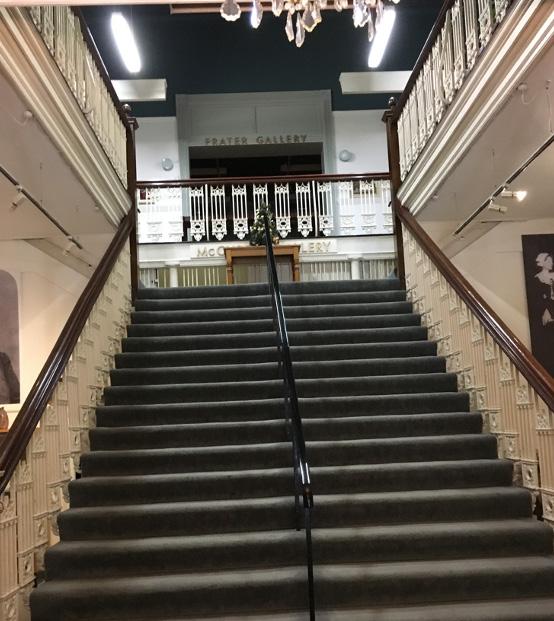
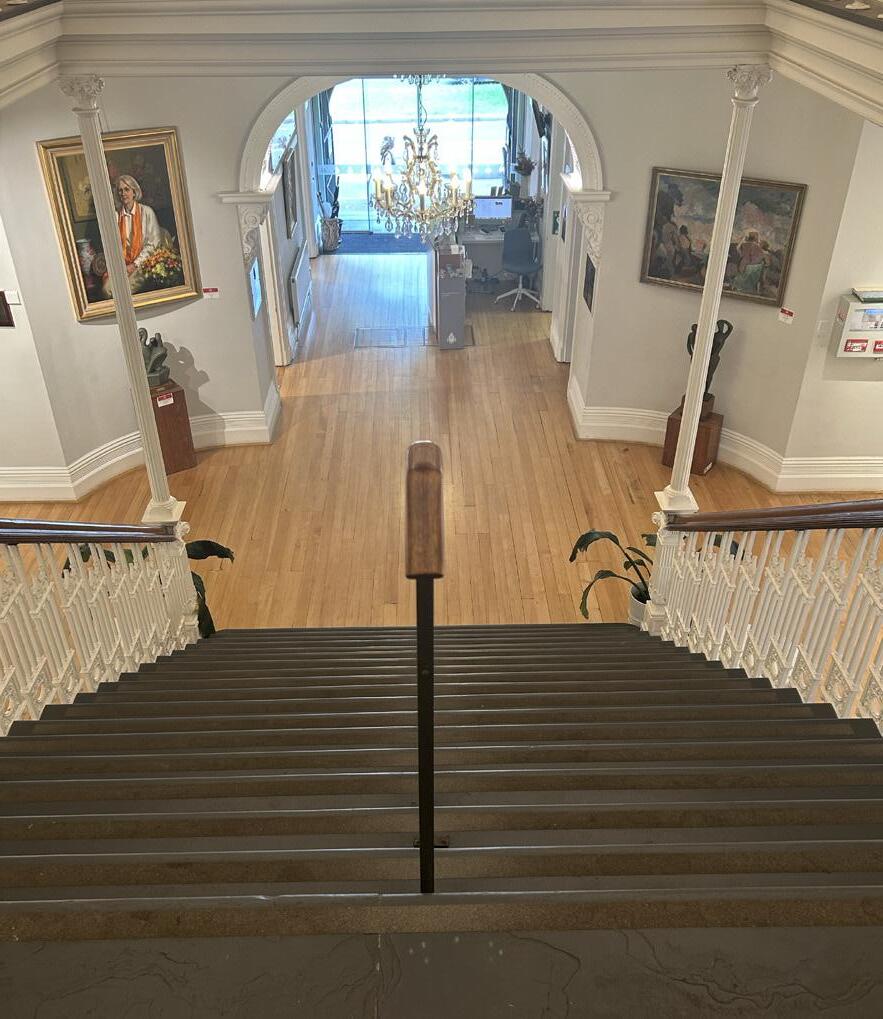
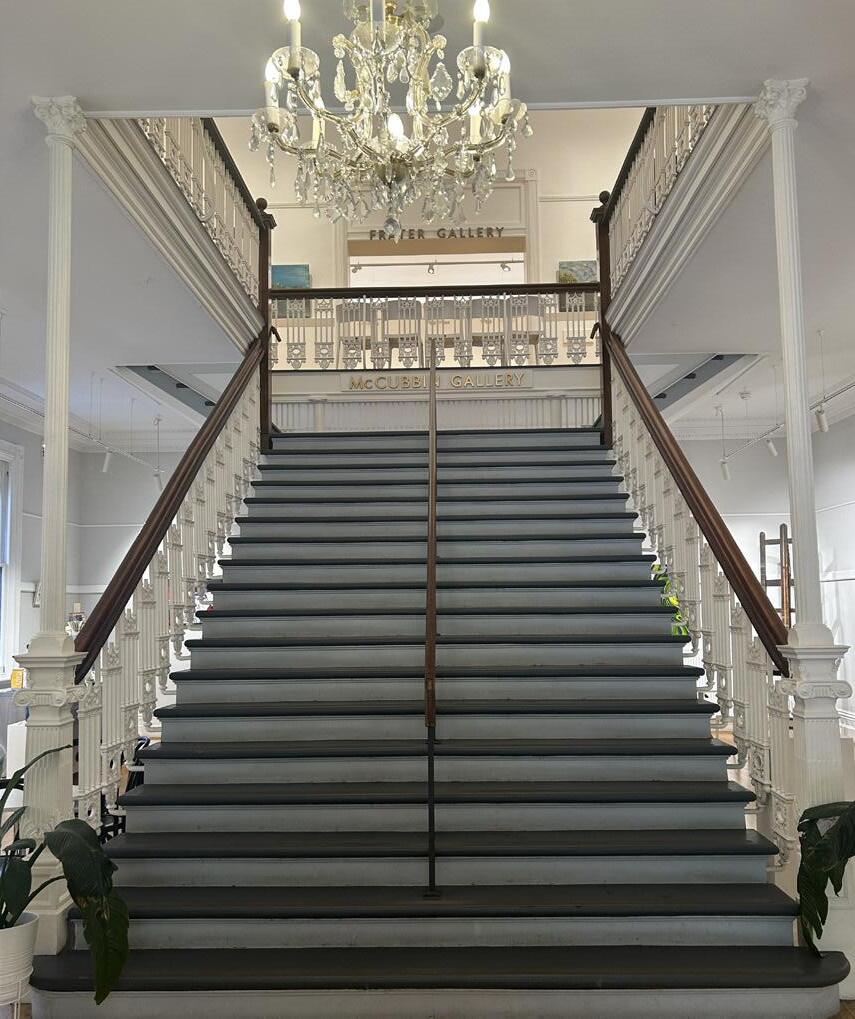
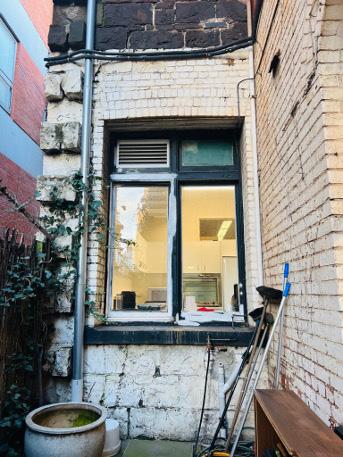
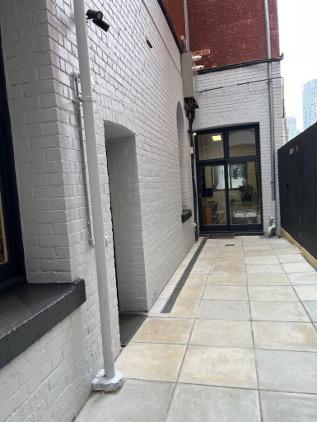
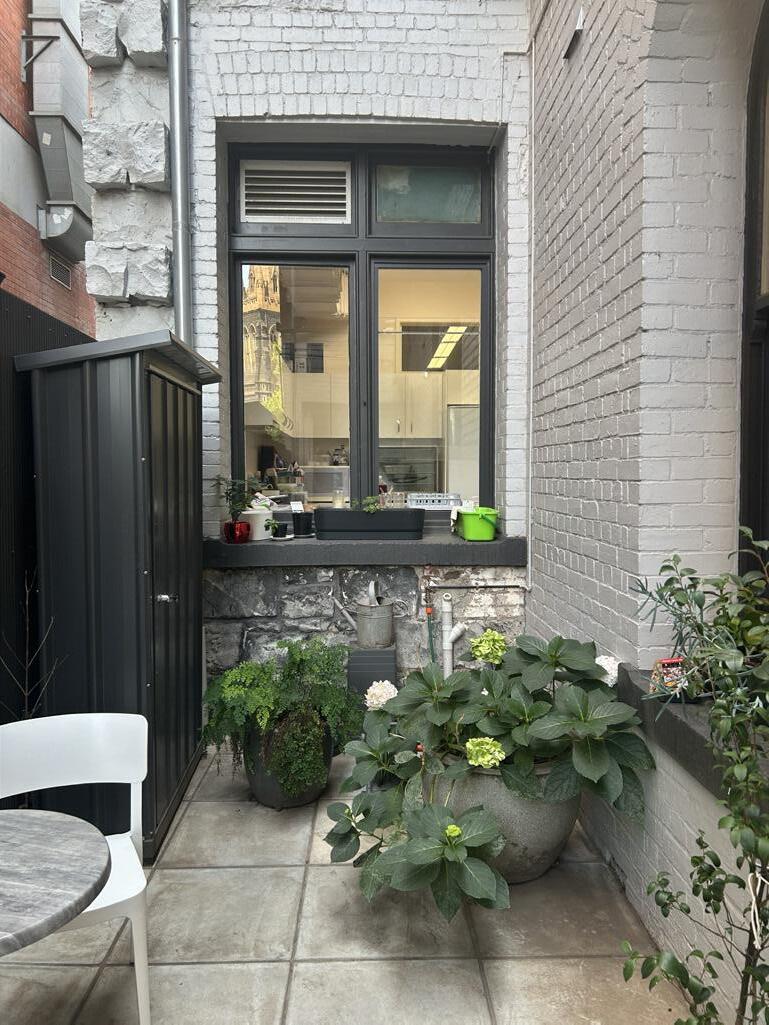
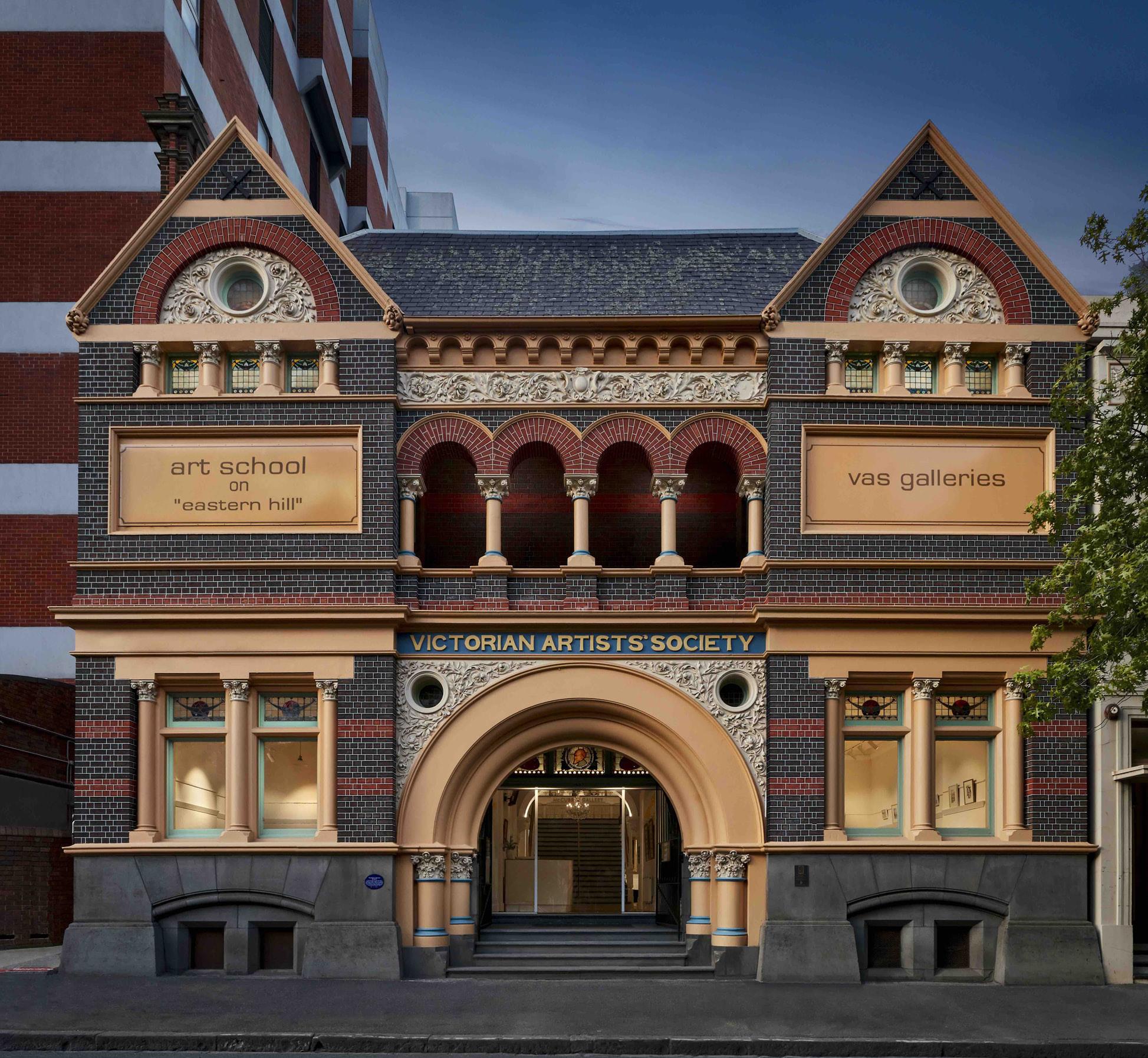
It’s been nearly five years since the renovations to the Victorian Artists Society were completed, and to mark this occasion I spoke with former VAS Manager Chris Reade about her experiences. There were ups and downs, along with some trousers in the ceiling, but she recalls the experience fondly –mostly.
The restoration project, which began in 2017 and finished at the beginning of 2020, was a massive undertaking. Most impressively, the fundraising, which began in 2015, just one week after Chris began working, was entirely covered by private donors. “The government didn’t give us one red cent!” Chris said.
Chris recalled how instrumental the Mackleys were to the entire project. She described how, during her job interview, Eileen Mackley showed her around the building. The upstairs alcoves were boxed in and filled to the brim with furniture, cupboards, and bric-a-brac. The balcony, a stunning symbol of the Society, was
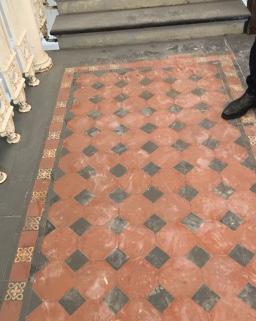
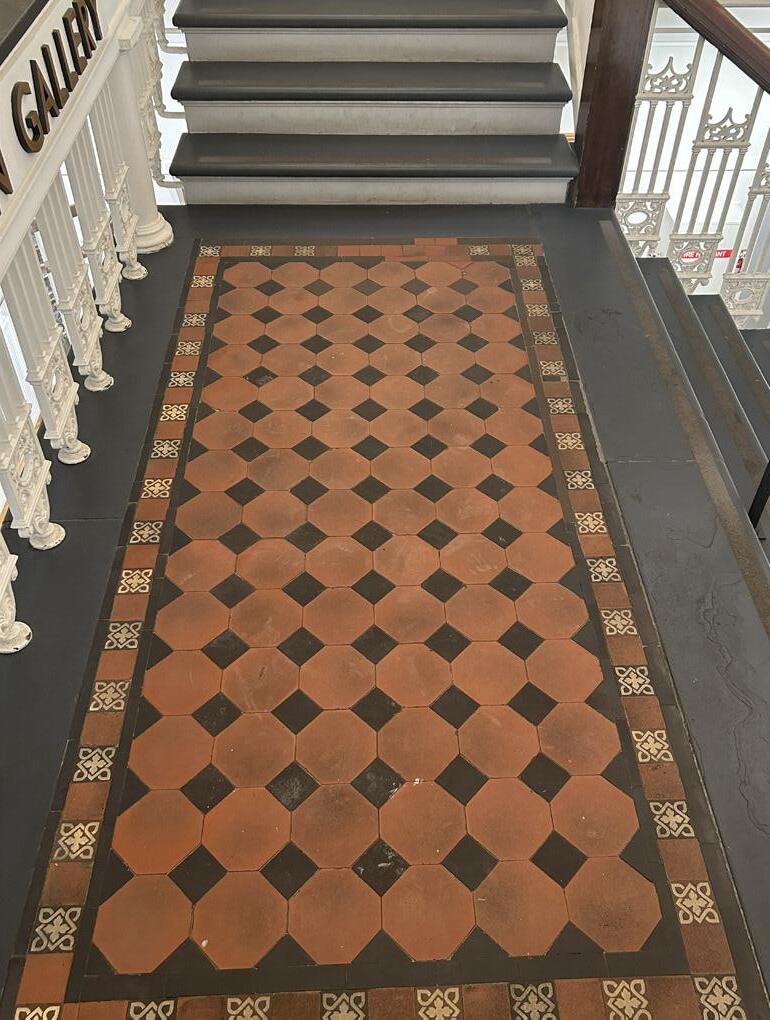
completely inaccessible. There were storage rooms taking up a large portion of the ground floor, which was also carpeted in khaki green. Repairs and fixes had taken place in various stages throughout the years, but there hadn’t been a major renovation project in a dangerously long time.
Chris reminded me that, as the Victorian Artists Society sits on Crown land, there is an agreement that if the building falls into disrepair, “the Crown has the right to take it back!” When Hylton Mackley came on board to discuss what repairs the building needed, he was told, “This place is starting to crumble.” That sense of urgency, along with the determination of Eileen and Hylton Mackley and their industry contacts, is what Chris said got the job done.
The first step was to raise the necessary money for the restoration. This was no mean feat and required multiple funding avenues. VAS members donated paintings and other objects for crowdfunding auctions,
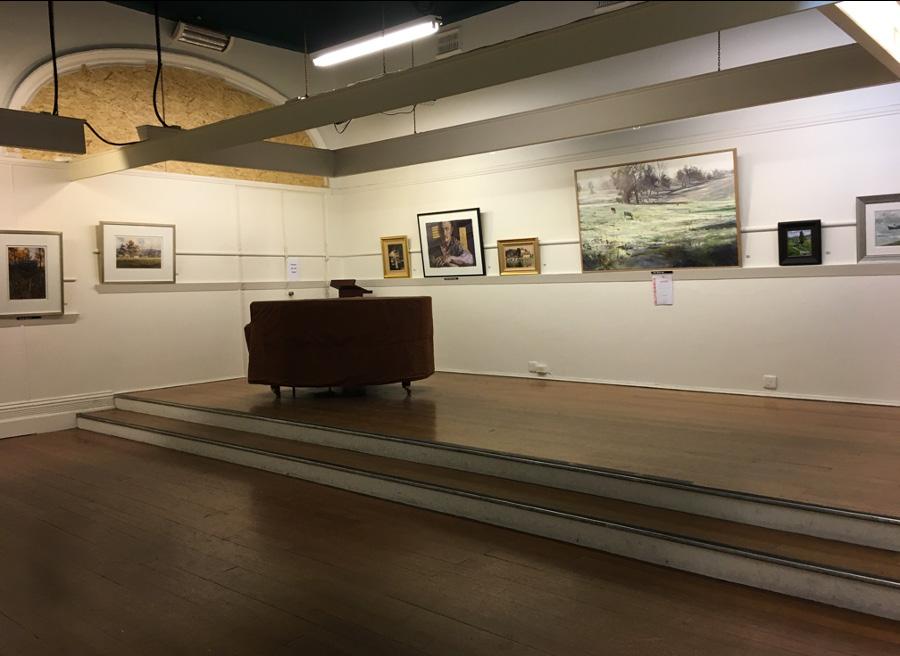
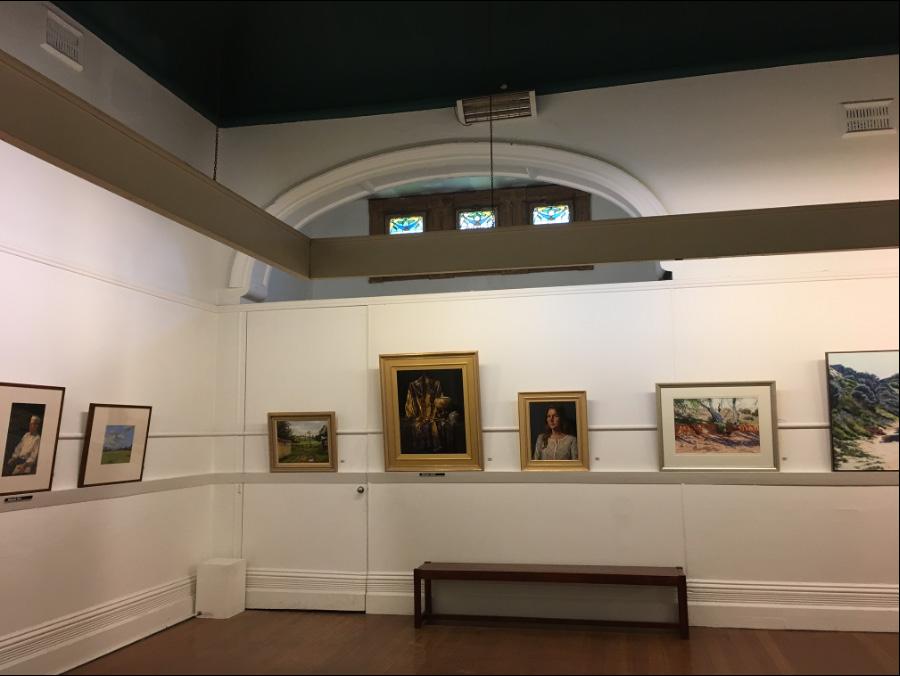
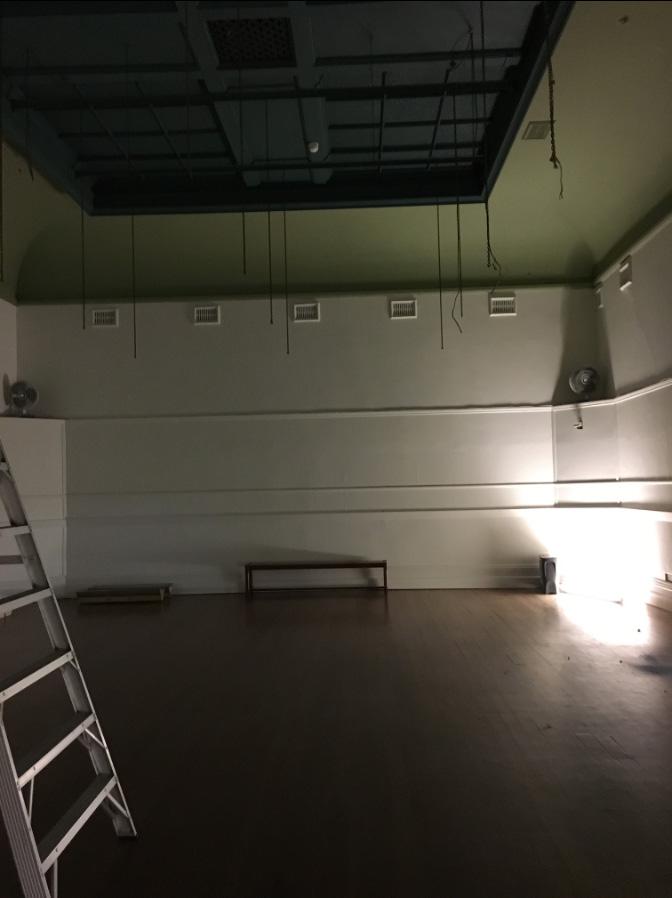
and there was an fundraising gala in 2015 headed by Hylton Mackley to bring in donors with deep pockets and a passion for art. Chris said, “There was a red carpet like you were going to the Oscars from the front door to the stairs, and lush red velvet curtains over the arch in front of the staircase.” The foyer was decorated with historical photos of the Society to show off its importance in the history of Melbourne. Over two million dollars was raised to cover the renovations. Work on site began in 2017.
Chris said the first day of construction was one she would never forget. Chris was alone in the office that Friday, as Ray Wilson and Kate Galea were out. The project manager and lead builder Brian (a character who “had a joke a minute”) arrived and got to work. Within ten minutes, he had managed to cut through a power line, throwing the Friday painting group into utter darkness in the studio and sending everyone into a panic.
With that eventful start, the repairs took place section by section throughout the building. The roof was first,
as parts of it needed replacement. As a heritage listed building, access was tricky – without any back access or lift, the workers had to carry the sheets of roofing iron through the front door and up the stairs “looking like chimney sweeps,” covered head to toe in soot and dust from the roof cavity. The administration offices had to move four times during the repairs, and at one point the desks were surrounded by holes in the floor, the staff trying to keep up with Society business while builders hammered away beneath the floorboards. “OHS went out the window!” she said.
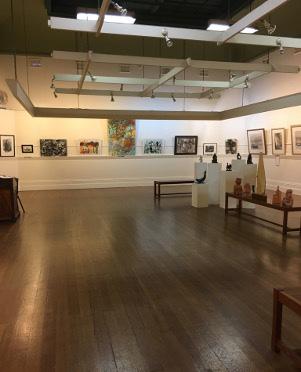
They tried to maintain a sense of normalcy during this time for the members, squeezing in exhibitions and workshops wherever possible and shuffling the studio classes to the Cato gallery. “It felt like a lottery,” Chris said, as class sizes were limited and some students were pushed out of courses. But VAS members were excited about the changes and eager to see the results of all the improvements.
There were a few interesting discoveries during the renovations. An old pair of trousers from the turn of the


century was found inside the roof cavity, possibly left behind by a previous builder. Sanding down the skirting boards revealed old paint colours chosen by the Society. Some rooms had been painted in bright purple and green, a nod to both the fashions of the day and the bohemian nature of the Society in its earlier days. Chris said rumour has it that Dame Nellie Melba herself had a hand in picking the paint colours! Once the khaki carpet was ripped up, it revealed the beautiful original floorboards and tiles on the ground floor and staircase that had been hidden away for decades.
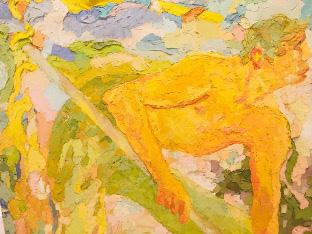
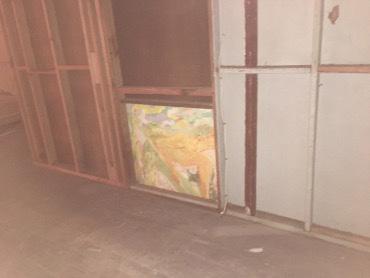
The most intriguing find was a secret painting. Stashed away inside the wall between the studio and the kitchen, it dated from around the 1940s or 50s; this is only a guess, however, as the painting is neither signed nor dated. Painted on Masonite in bright greens, oranges and yellows, it seems to depict a man bent over at work in a garden. Who was the artist, and why did they very deliberately hide it there?
The last step of the restoration was the design and construction of the front desk, overseen by Chris’ partner Dave Reade. He went out of his way to source Kauri pine for the desktop –now extremely difficult to find, the hardwood had been used
throughout the building for the floorboards, and he wanted to tie the new desk to its historic surroundings.
Finally, the renovations were complete, and the Victorian Artists Society was ready to make its debut. A huge launch event was planned, with patron and Governor of Victoria Linda Dessau as a guest of honor alongside a long list of VIPs and donors. Invitations were sent out, catering was finalized, and everything was ready for the celebration. Unfortunately, this was March of 2020, and one day before the event the entire state of Victoria was locked down due to the COVID-19 pandemic.
The grand building was sparkling, but there was no one to see it. Chris came into the building throughout 2020 to work and keep an eye on the place, but she said it felt extremely sad, an anticlimax after all the work and effort that had been put into fixing it up.
Thankfully, the building reopened in 2021. Chris is thrilled at the wonderful state of the Victorian Artists Society today, and marvels at its lively energy and buzzing atmosphere. There is no doubt that the restoration of the building has been a major factor in this change, bringing in artists and visitors alike to the Society and keeping it alive over 150 years after its founding.
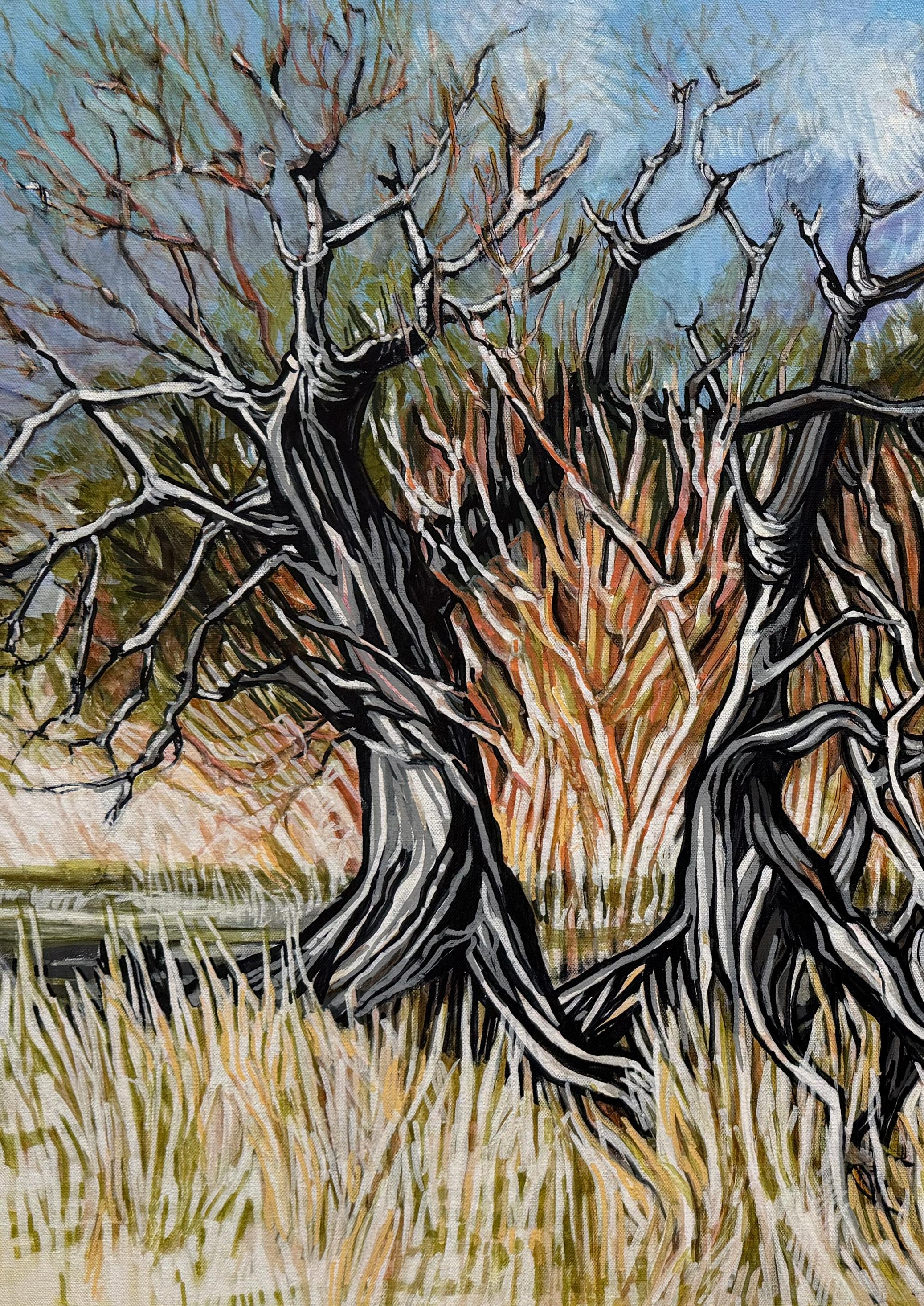
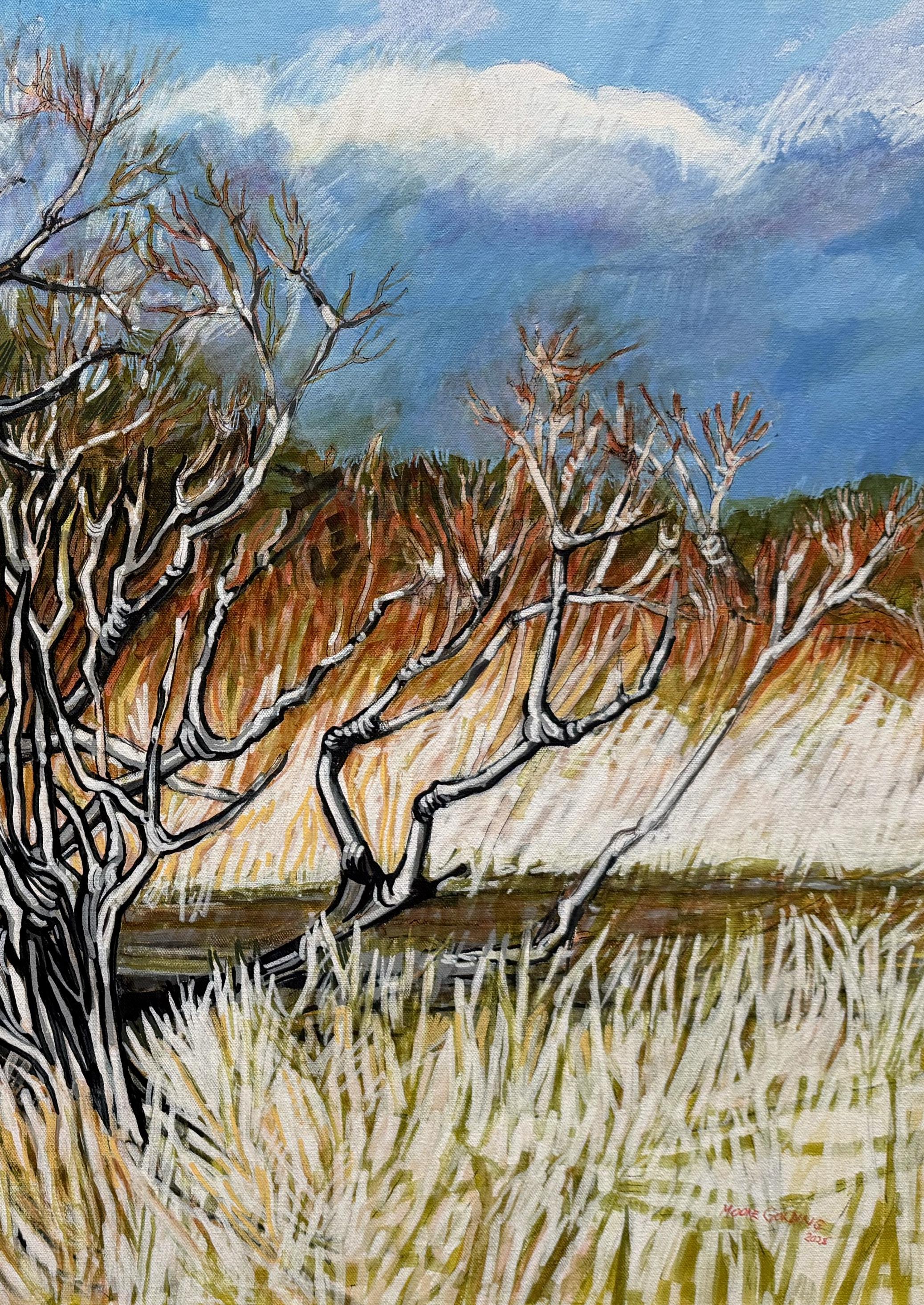
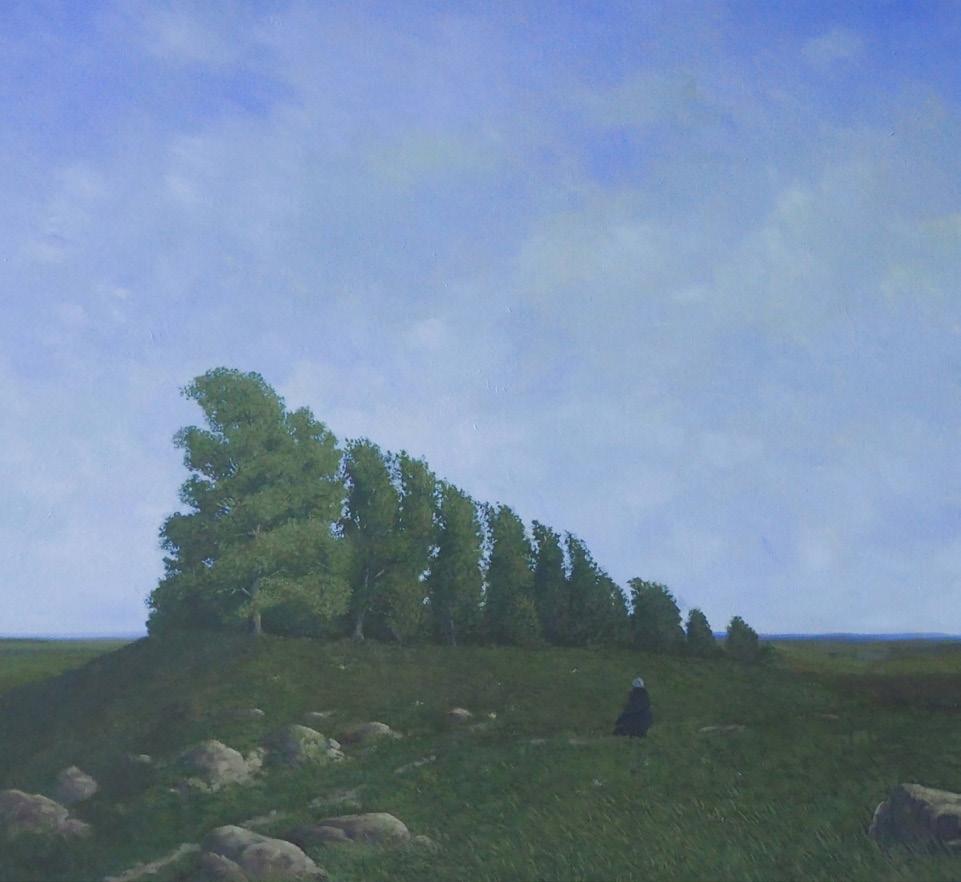
Travelling through Western Victoria and seeing so many pristine and ordered paddocks of grain, and peaceful grazing animals, this scene caused me to think of its former life. Perhaps now returning to how it once was before human cultivation took over. I love sketching, this time on canvas with pens and watercolour.
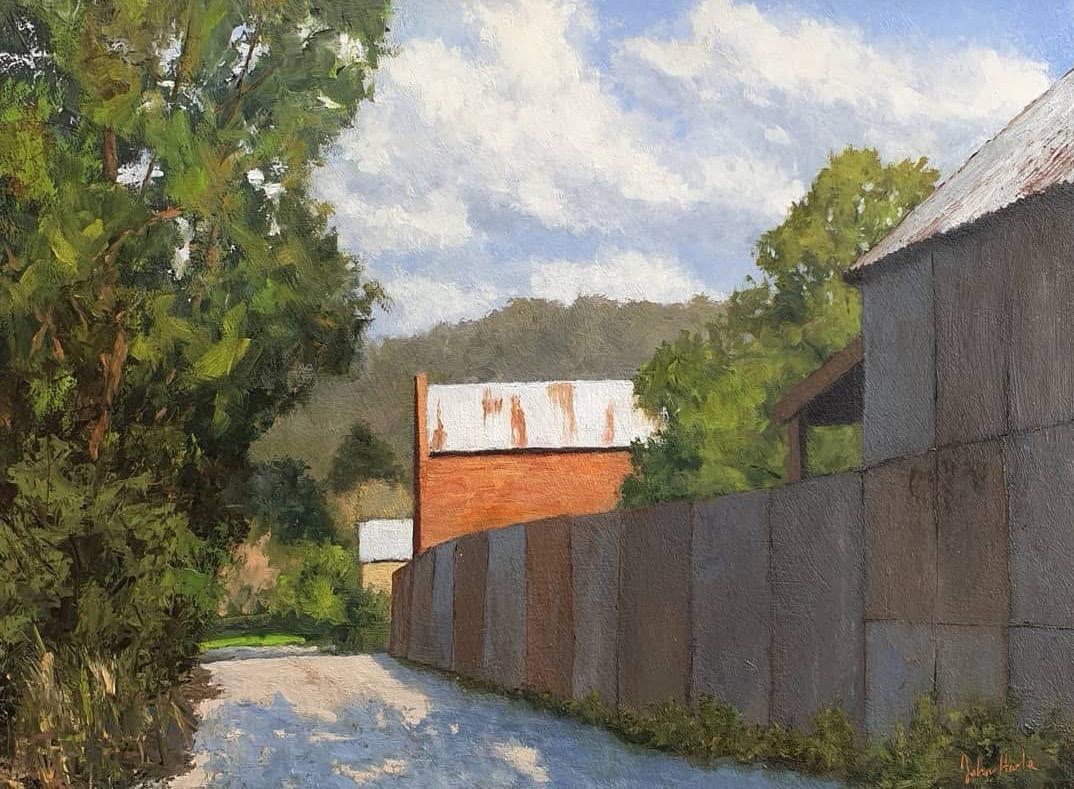
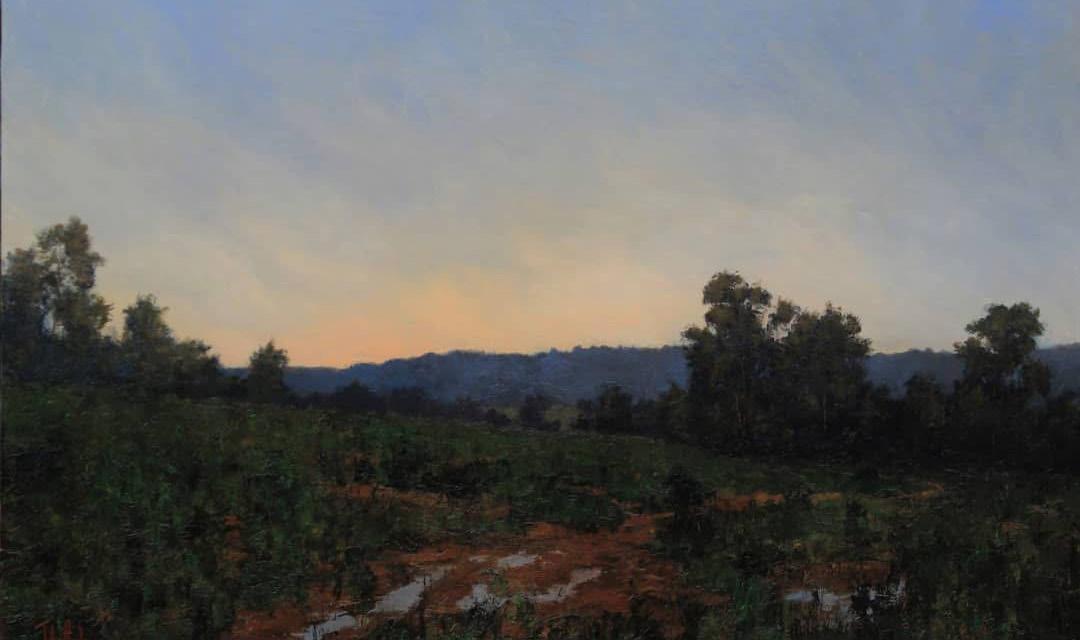
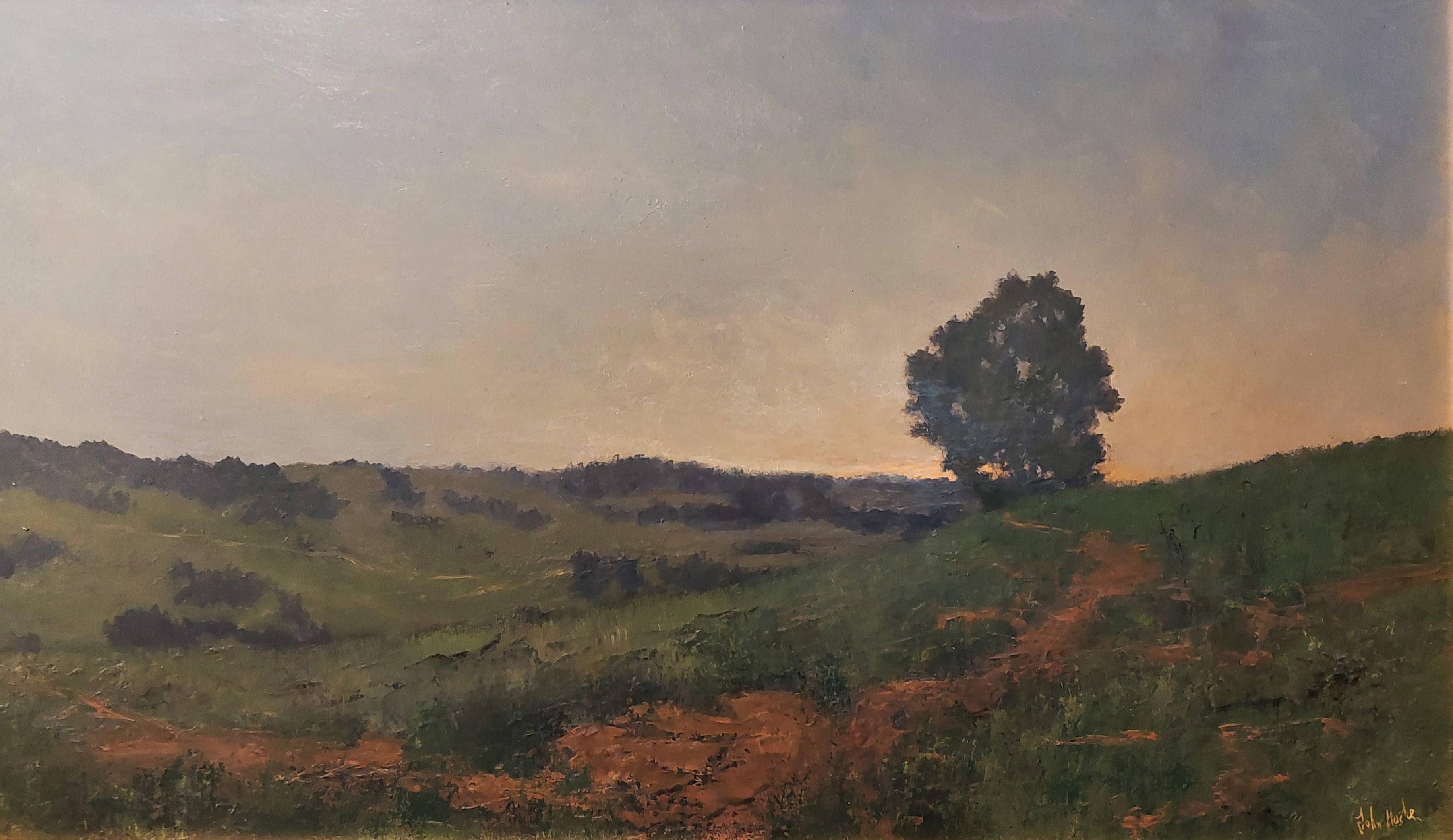
Vale John Hurle and
words Bruce Baldey VAS
We have recently lost 2 long-time, long-serving and valuable VAS Members - John Hurle FVAS and Walter Magilton VAS FVAS
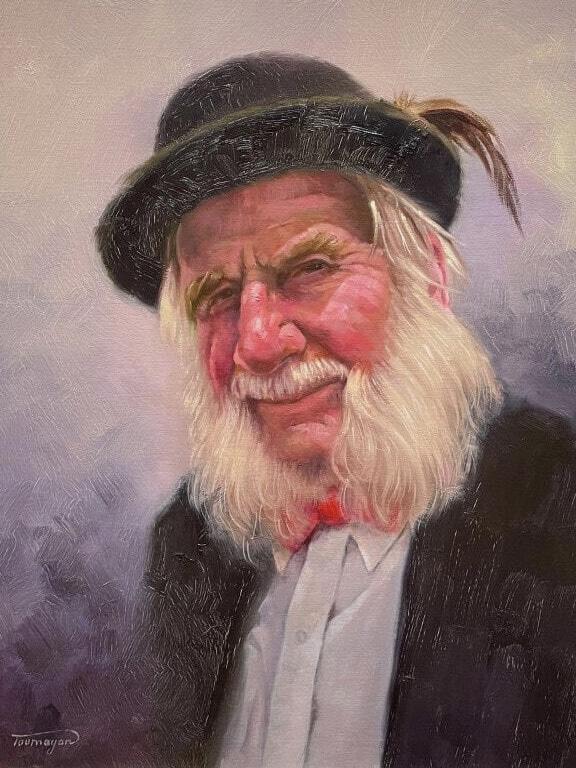
Walter remained an active and dedicated presence within the VAS community right up until his passing. Even in December 2025, he attended the AOTY Awards, demonstrating his ongoing enthusiasm for both art and the Society. Over the course of more than forty years as a Member of VAS, Walter participated in upwards of 200 exhibitions held in our
Galleries, including several AOTY Exhibitions. His unwavering passion and involvement have left a lasting impact on the organisation and its members.
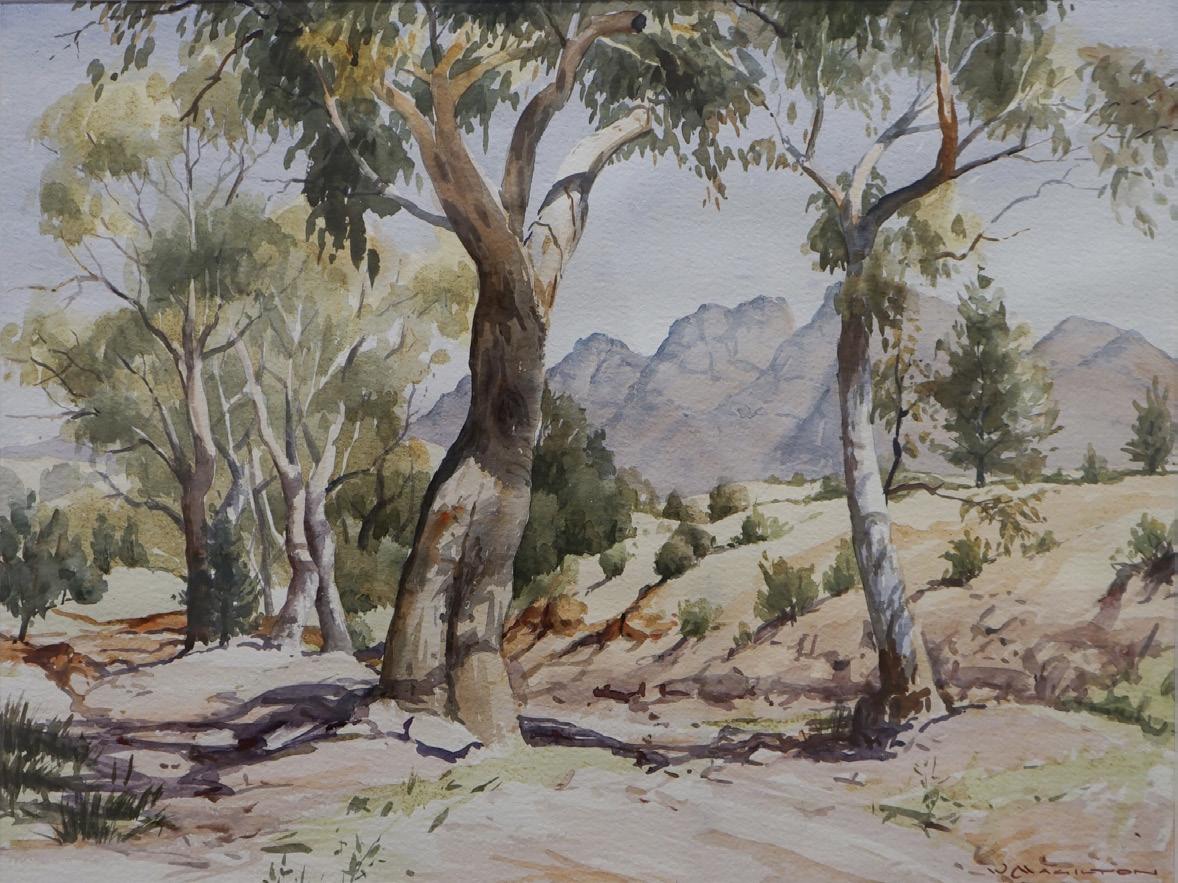
Walter Magilton was born and raised on a dairy farm in rural Victoria, where his close connection with the natural environment profoundly influenced both his artistic practice and his approach to teaching. This deep communion with nature became a central theme throughout his career, shaping the way he viewed and depicted the world around him. Walter was steadfast in his commitment to traditional realist methods, using these techniques to authentically capture the unique qualities of the Australian landscape. Through his art, he conveyed the space, light and air that define Australia’s natural beauty, bringing these elements vividly to life for viewers and students alike.
He was a regular at VAS AGMs and a presence at VAS Maritime Exhibitions where he ignited the event by reciting saltwater verse. Although oils were his favoured medium, he also impressed VAS members with his timeless skill in creating linocuts. Walter Magilton was truly one of the real characters of the VAS. His presence brought energy, warmth and a unique spirit to every gathering and activity. The mark he made on our Society was significant, and his absence will leave a gap that will be difficult to fill. Members and friends alike will feel the loss keenly, remembering not only his contributions but also the personality and camaraderie that defined his time with us.
1965 - 2025
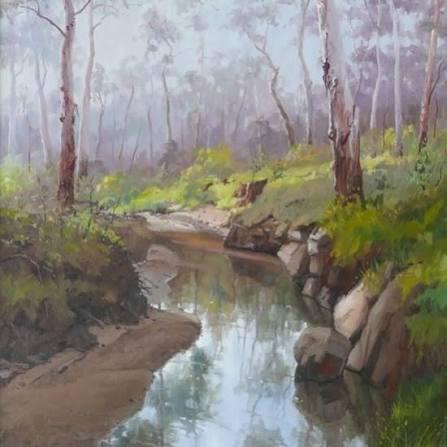
John was a long-term member of VAS Council and responsible for the VAS Collection and VAS outdoor painting activities. For 10 years John arranged the monthly Sunday venues near Melbourne and regular 4-day events around regional Victoria. John Hurle played a pivotal role in organising painting excursions for VAS Members. His responsibilities included scouting for new destinations suitable for painting trips and securing affordable accommodation, whether nearby or further afield. John meticulously documented each location, noting their accessibility and, when necessary, sought approvals from relevant Local Authorities to ensure the smooth running of these events.
During visits to some of the more remote areas, John was often seen providing clear signposting and
directing traffic along obscure laneways. His efforts ensured that Members did not stray into unfamiliar territory, allowing everyone to arrive safely and focus on their artistic pursuits.
In 2016 with Grant Cavenagh, he commenced the process of photographing and cataloguing the VAS Collection. He rewrote the VAS Accessions and Deaccessions Policy and initiated 3 deaccessions. John retired from Council in 2023 but remained active on the Collection Committee. John was not only instrumental in making the VAS Collection what it is today but he was also an accomplished artist. He is especially remembered for the rural nocturnes he painted near his retirement residence in East Gippsland.
Gregory R. Smith
Many years back, I recall a perfect VAS paint out day at Flinders Ocean View Lookout. Arriving quite early meant I was able to stake claim to a picnic table with a view, set up the easel and gear, and rip into the first painting before the troops gathered. As it was a long drive from home I had rushed off without lunch. Luckily, I hadn’t forgot my thermos. By midmorning I was somewhat peckish. One of our artists asked if he could sit with me while I painted. ‘Absolutely’, I replied. Not only did we share the views but we solved all the problems of the world, artistically that is. I was saved when he kindly opened a Tupperware container of curry puff things and offered them to me. His beautiful wife had cooked them up for him to take on his day out. As we devoured every crumb and decided this painting outdoors business is pretty good, it was well noted that a very important item of equipment needed was a full lunchbox. This very kind and generous man was John Hurle. I knew we were going to be great mates from that day on. We often referred to our days outside as paint-out picnics. I wish I could sit with you again and talk some more. You’ll be missed forever. Rest in peace dear John.
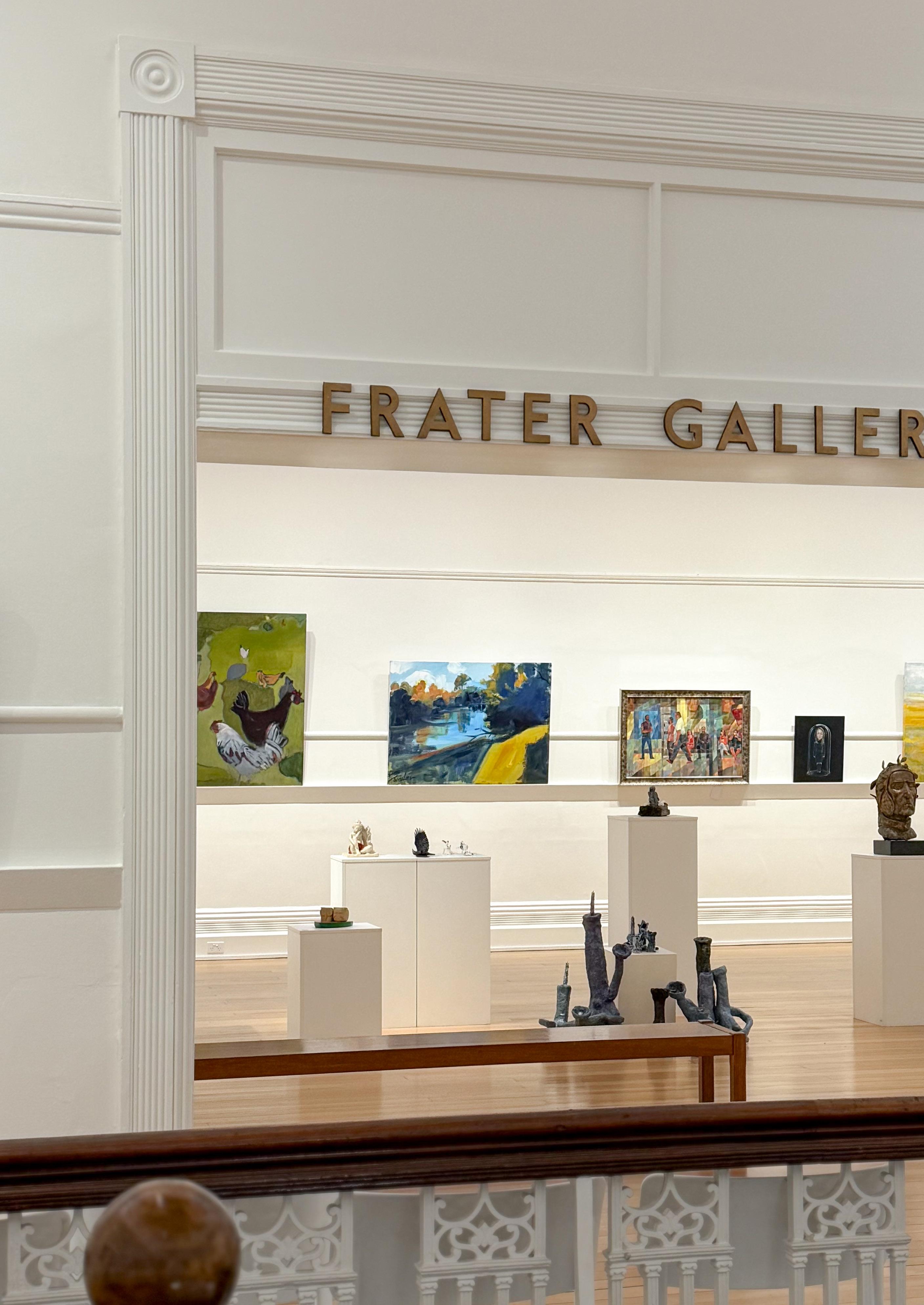
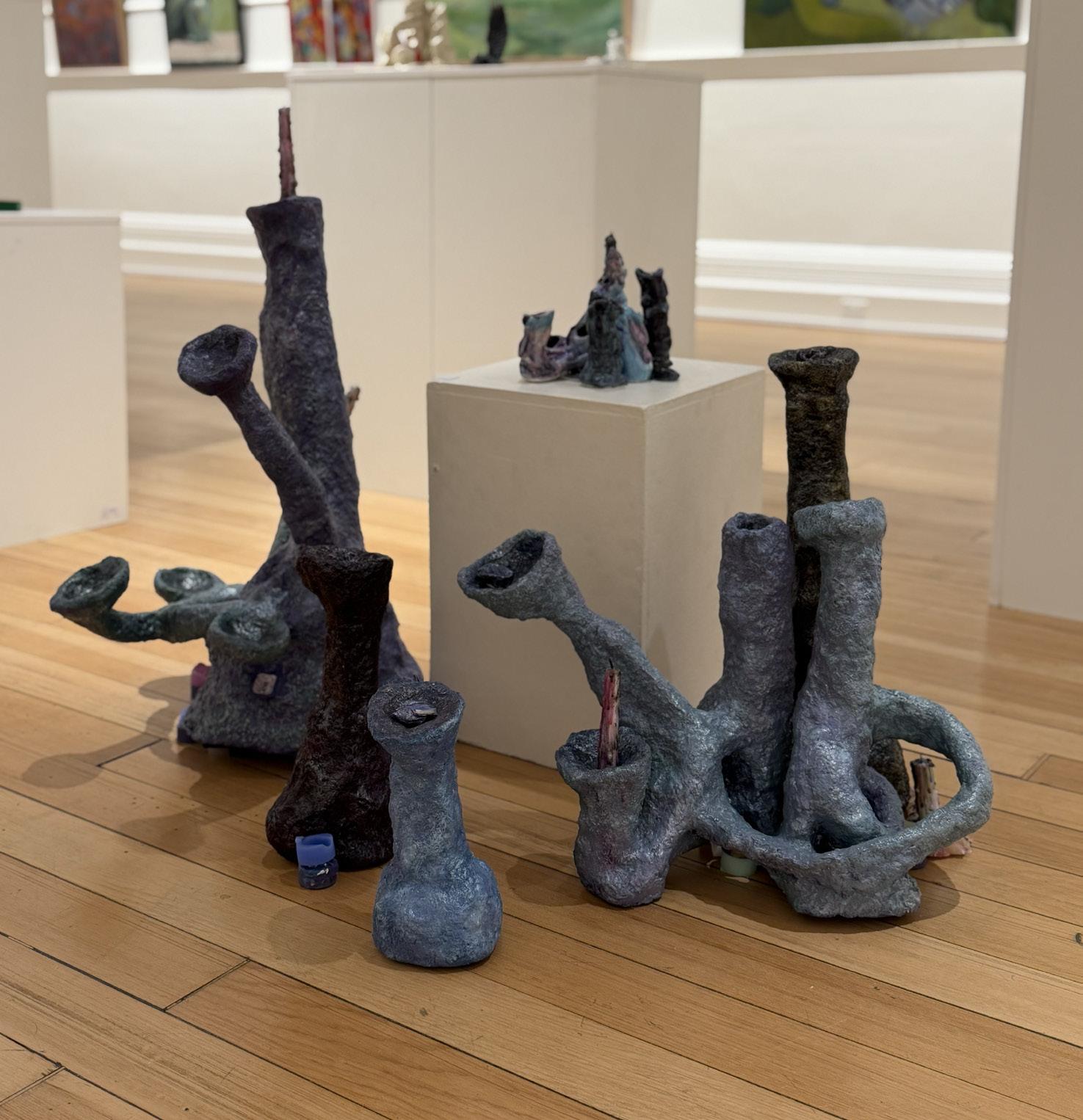
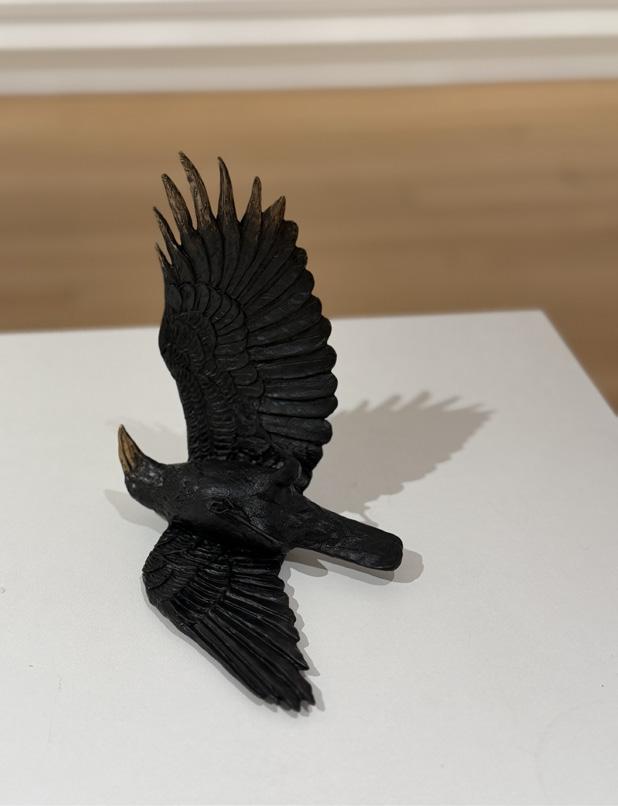
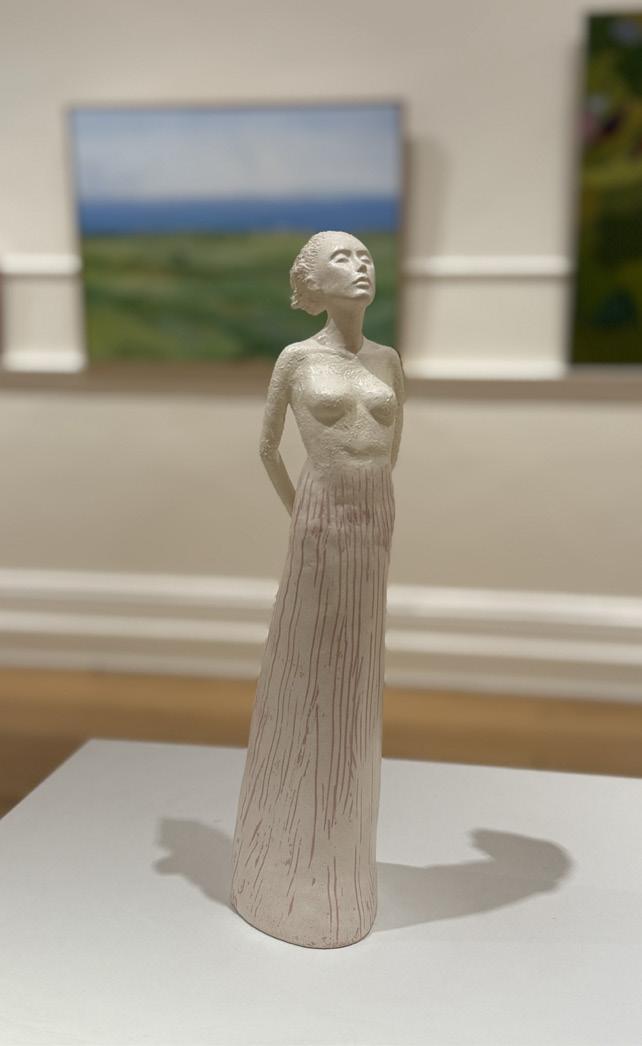
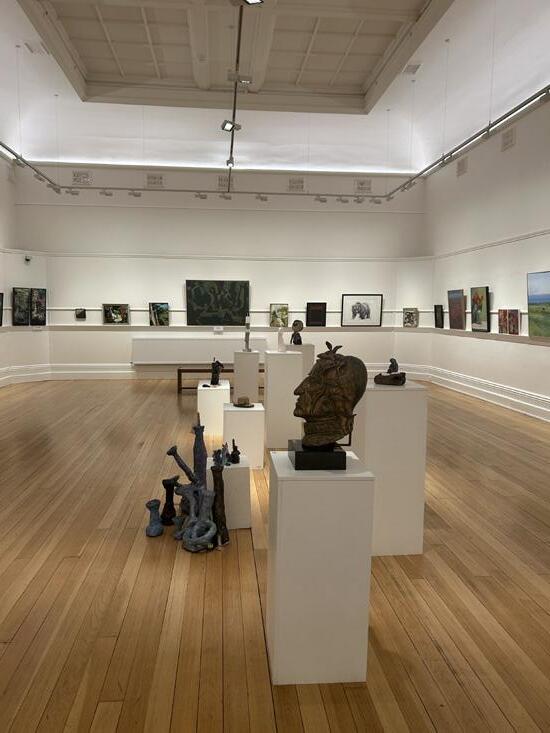
This February we got the chance to highlight sculpture in the VAS George Hicks Foundation Contemporary Exhibition. The winner of the show, Olivia Jane’s You Left the Light On, Sweetheart was an immersive addition to the gallery. Olivia’s soft colours is a celebration of textures and a romantic use of light. Marija Patterson supplied two beautiful figures with her touch of peaceful femininity. D’Arcy Roulliard’s bronze work Extremis explored the beauty in the macabre; Judge Mark Feary noted "The integration of steadfastness and permanence of material". Other stand out works exhibited included the whimsical piece by It Hao Pheh VAS Balloon Blower Machine, a demonstration of his skill as a multimedia artist amongst our ranks. Aytac Ishik Mia’s I am Power was a striking bust with clever detail work. We are looking forward to seeing such strong sculpture work in future VAS Exhibitions.
words Bruce Baldey VAS
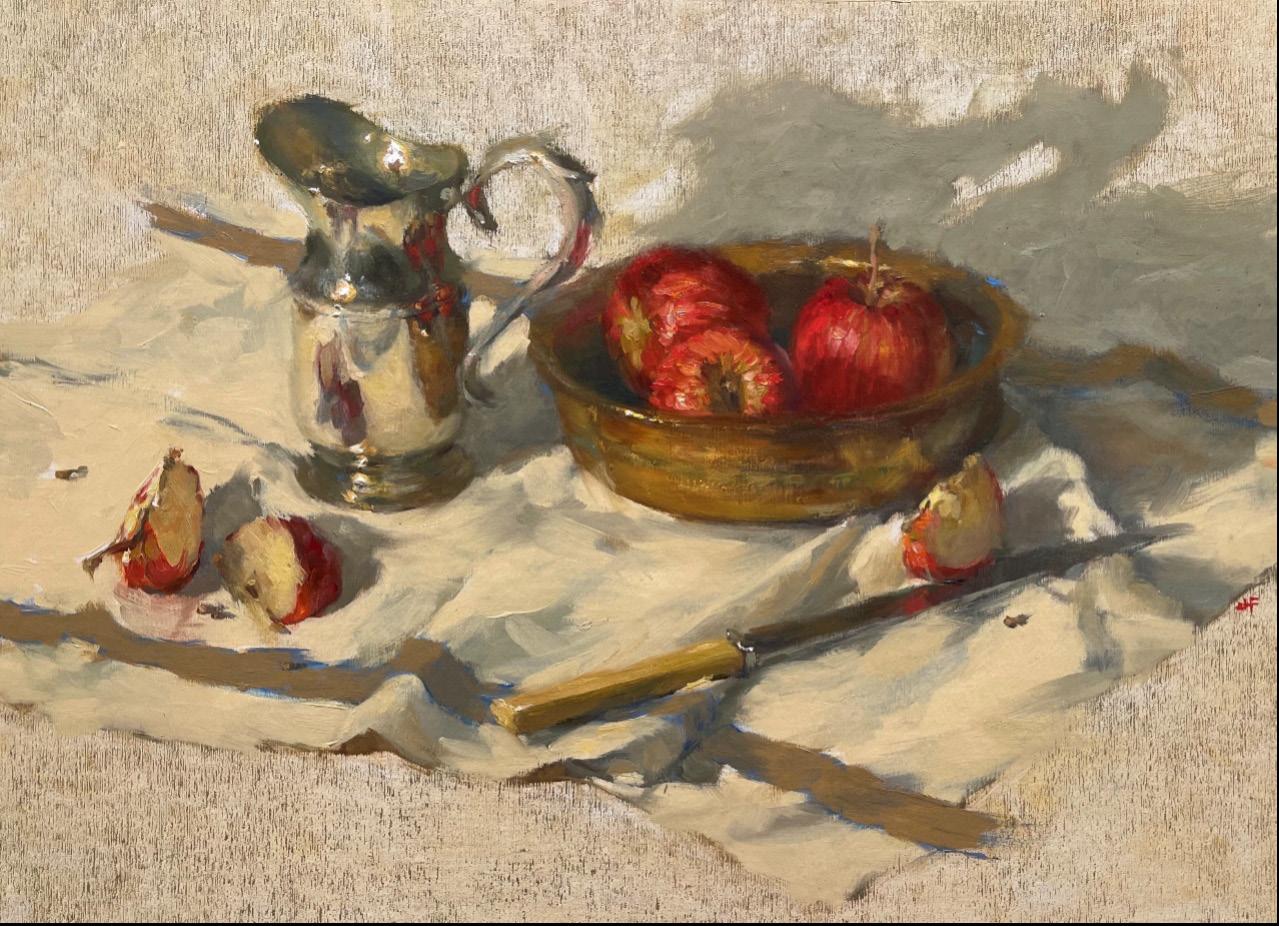
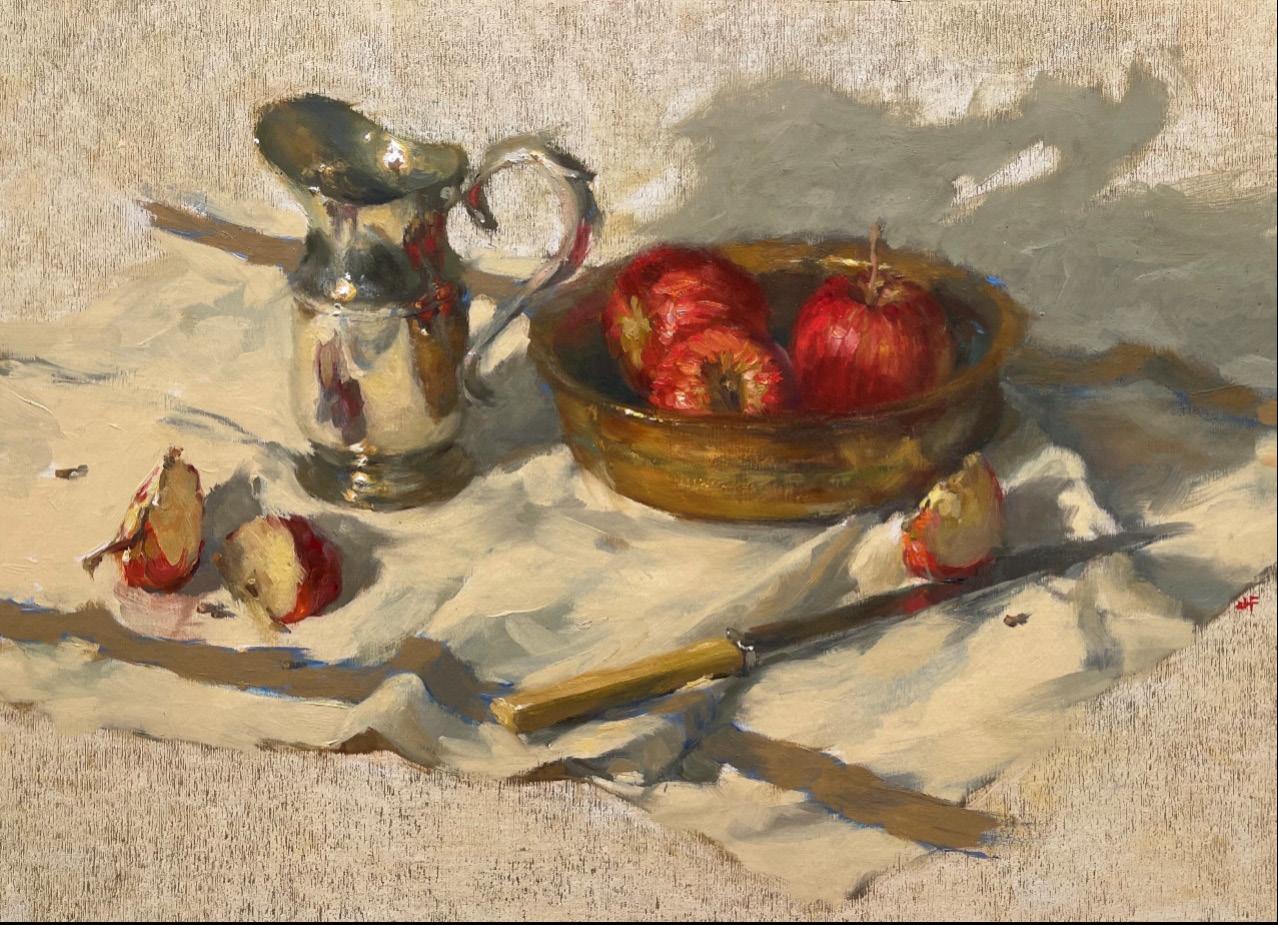
Artist: Jennifer Fyfe VAS
Title: Crisp
Cat. # 128
Date 2025
Medium: Oil on board
Size: 55.5cm W x 39.5cm H
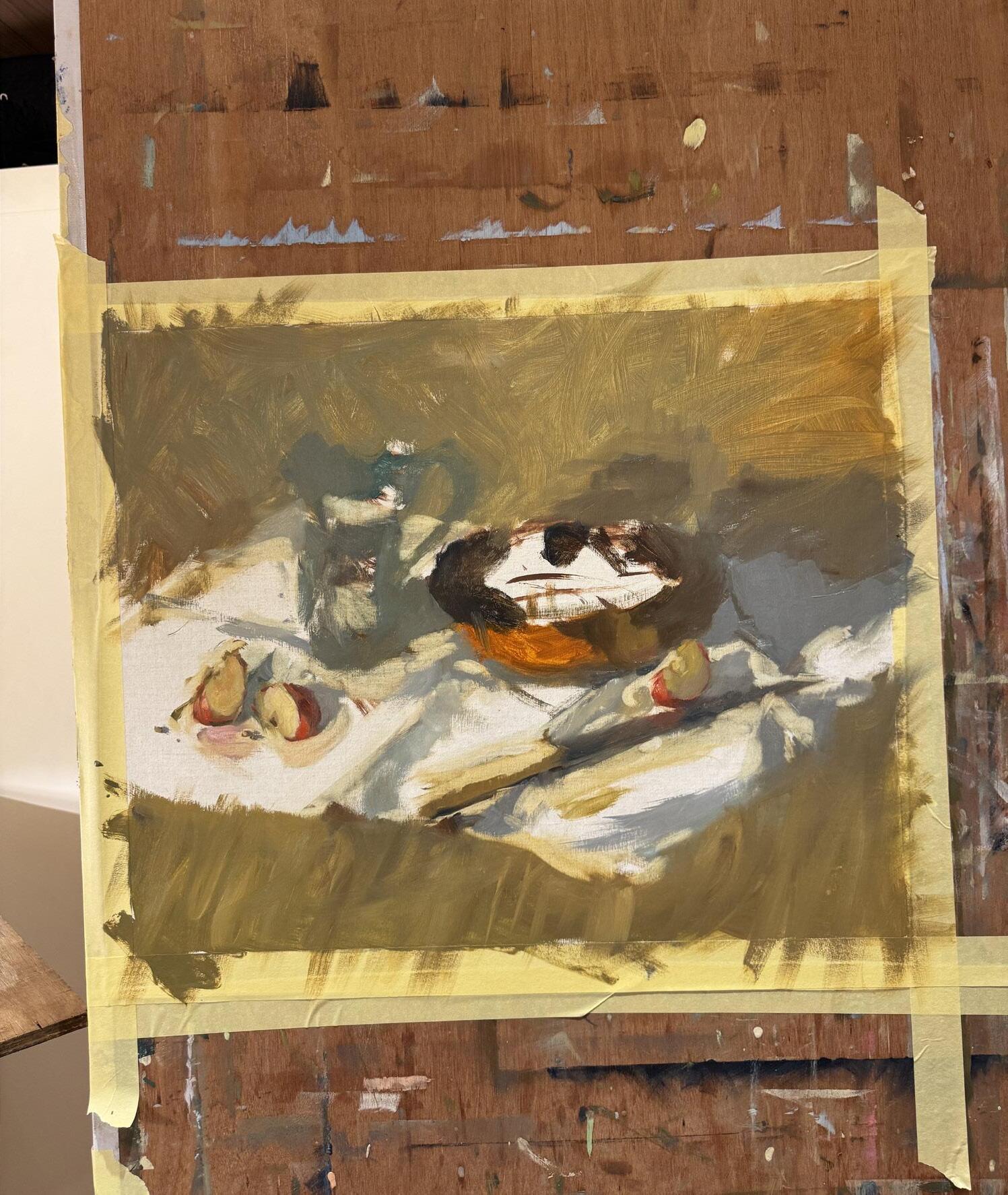
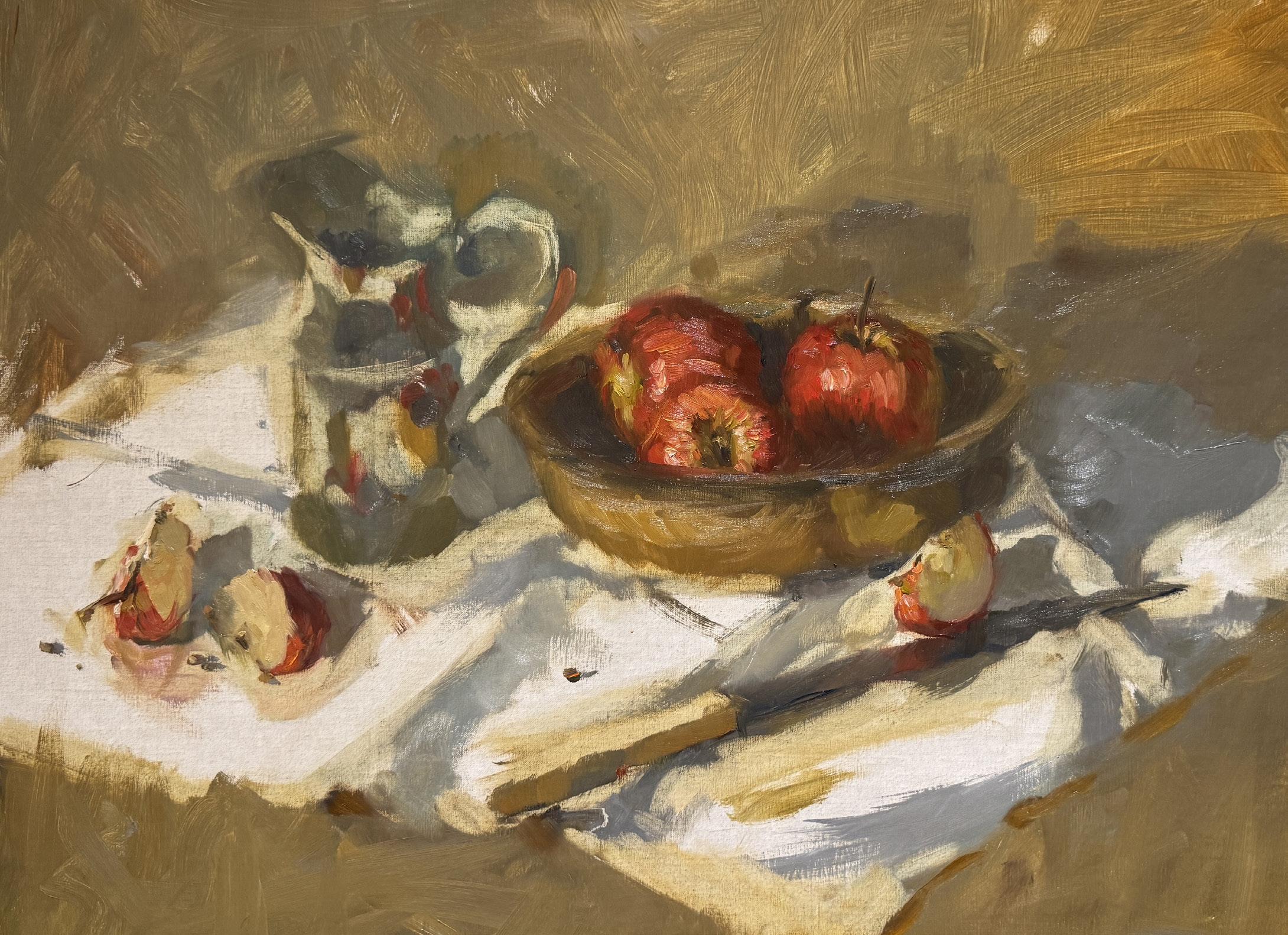
The VAS Collection recently acquired a work by Jennifer Fyfe VAS titled Crisp The Collection Committee had for some time been considering the purchase of the work of this artist given her ability, her dual VAS AOTY achievements, and her service to the Victorian Artists Society. In the opinion of the Committee Jennifer Fyfe and her work meet all the criteria of the VAS Collection Acquisitions Policy.
Jennifer paints in a distinctive realist impressionist style which features vigorous brushwork, lively highlights, clean colour, and bright tonal contrasts. She is a VAS signatory, a dual VAS Artist of the Year (2015, 2019) and a member of the Twenty Melbourne Painters Society. Jennifer has taught in the VAS Studio and is currently a convenor of the VAS Friday Life Session. Still life is a popular genre with VAS members and features in VAS Studio sessions. Still life works are scarce in the VAS Collection.
Jennifer studied life drawing with Margaret Cowling at Malvern Artists Society from the age of 15. This was instrumental in building knowledge of the human figure including skeletal and muscle structure and understanding proportion and perspective. In 2000, Jennifer studied at VAS for one year under Maxwell Wilks in the foundations of oil painting. From oil classes
she learned the basics of the tonal technique and from Max, the joy of loose, enthusiastic brushstrokes and colour.
Jennifer enjoys the work of Toulouse Lautrec, William Nicholson, Rix Nicholas, Édouard Vuillard, Merritt Chase, John Singer Sargent, and Ethel Carrick amongst others.
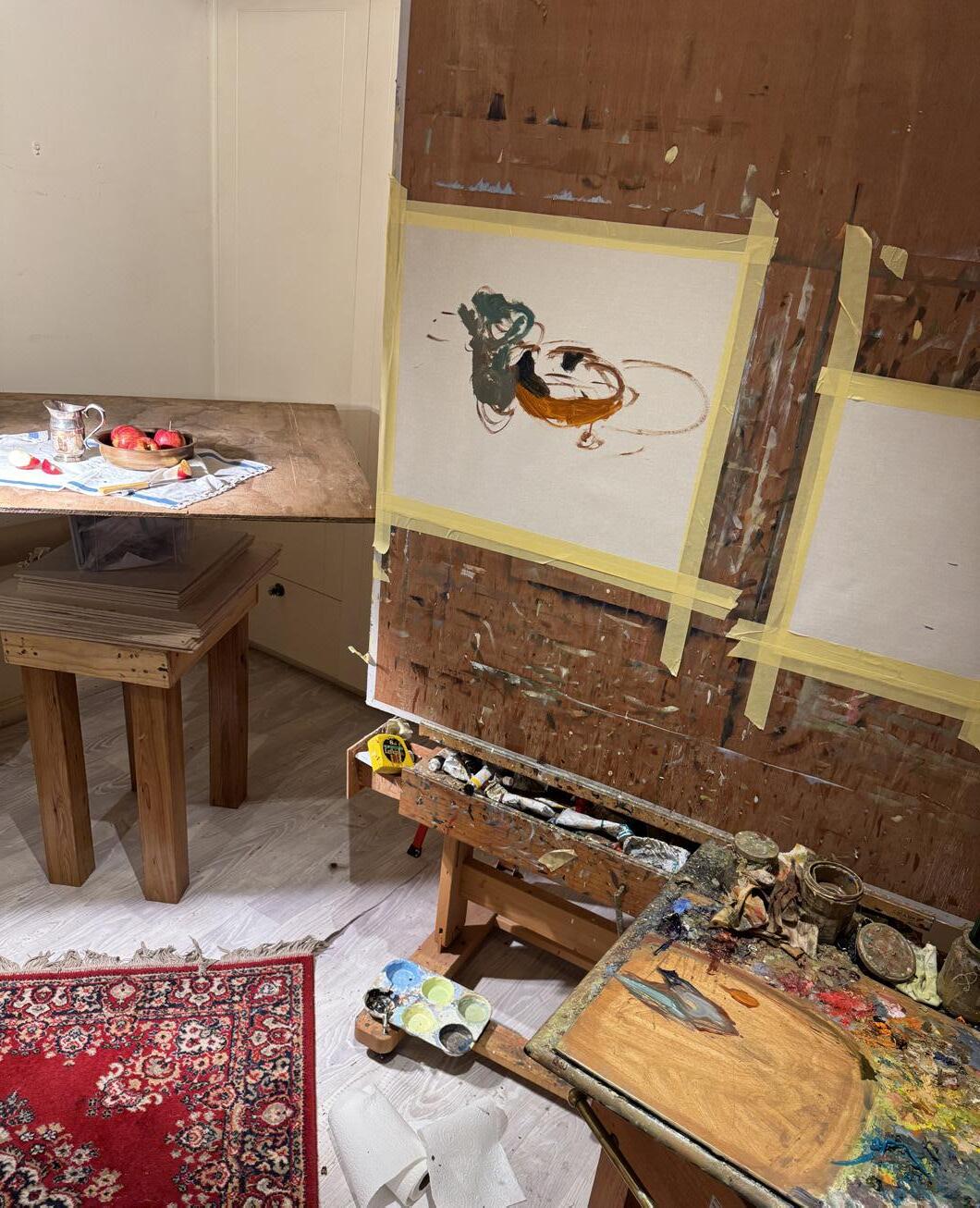
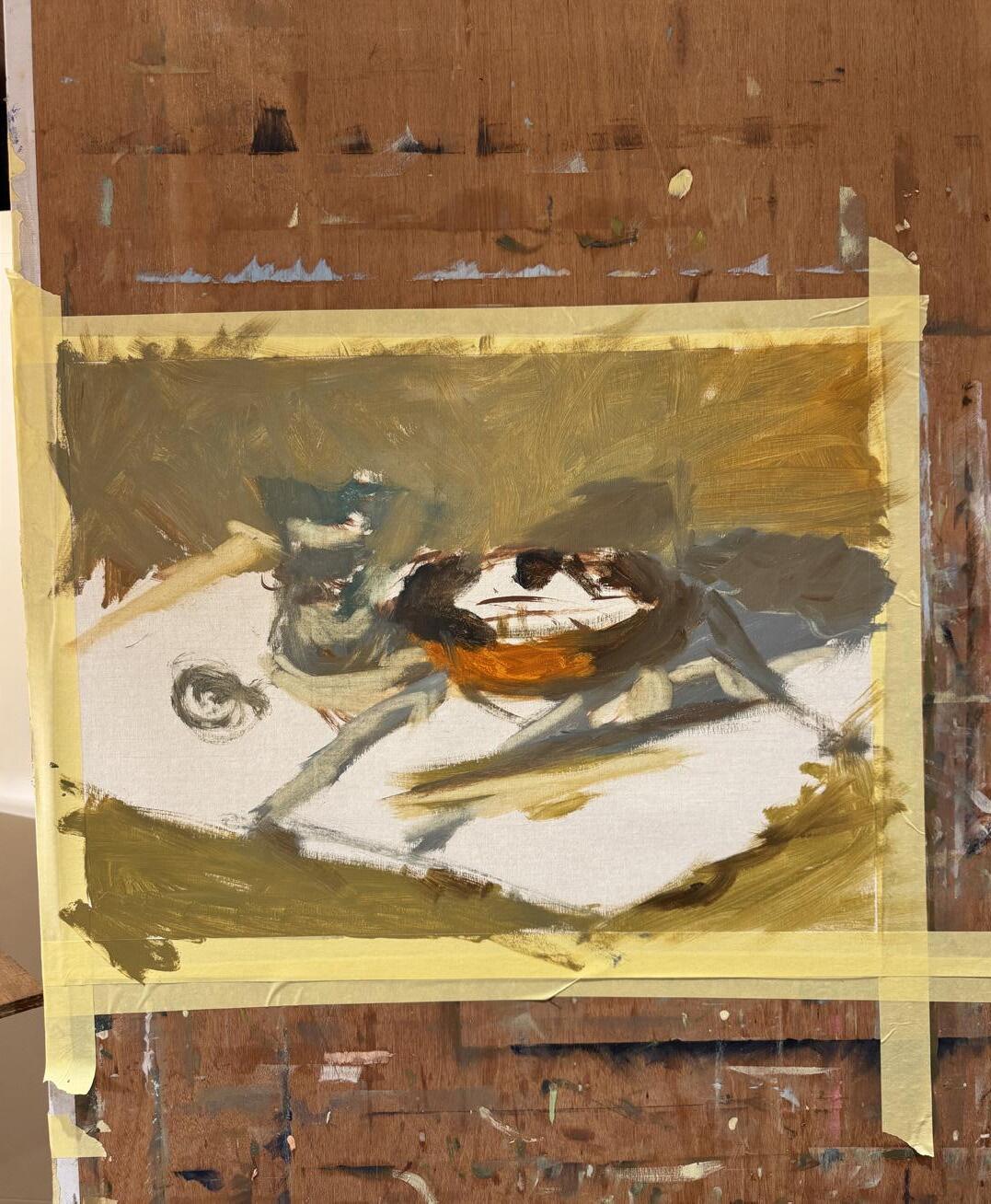
Jennifer creates her still lifes with a tonalist approach, but she does not follow all its conventions. She usually blocks in the basics, then works on the fresh fruit, vegetables, or botanicals first, getting them to near completion, until finally taking her time with the other elements. Jennifer often changes the composition as the painting progresses to achieve the balance and patterns she wants between shadows and light, sometimes switching in and out, bowls and fruit, mid-paint. The loose brushwork and broad areas of colour always come at the end when the structure of the painting subject is satisfactory. In Crisp, the dark timber of the tabletop was too overwhelming and so a decision was made to paint in the basic colour then rub it back to raw canvas to achieve a reference to the timber colour but with a fresher, lighter 'country table' feel.
1. Most famous painter and inventor of the Renaissance (8,2,5)
8. Matisse and others were known as The ……, rhymes with mauves (6)
9. Nude painting at Young and Jackson’s Hotel (5)
10. Word for art exhibitions in Paris (6)
14. Buttocks, backside (in French), often depicted in life drawing (8)
15. National Gallery of Australia (abbrev) (3)
17. Flemish painter, Pieter Bruegel the ………, not the Younger (5)
19. One-person exhibition (3)
21. Reds, oranges and yellows are …. colours, not cool (4)
22. Edvard Munch is known for his painting
The ….. (6)
23. A common fruit often used in still lifes (plural) (6)
25. The colour black in French (4)
27. Old name for a mental institution, Van Gogh spent time in one (6)
30. A preliminary drawing (5)
34. Most famous Aboriginal painter of last century in contemporary style (6, 9)
36. WA sculptor, Robert Hitchcock, (initials) (2)
37. There are over 150 years of paint …… on the floor of the VAS studio, spatters (8)
38. Many have painted Adam & Eve in this garden (4)
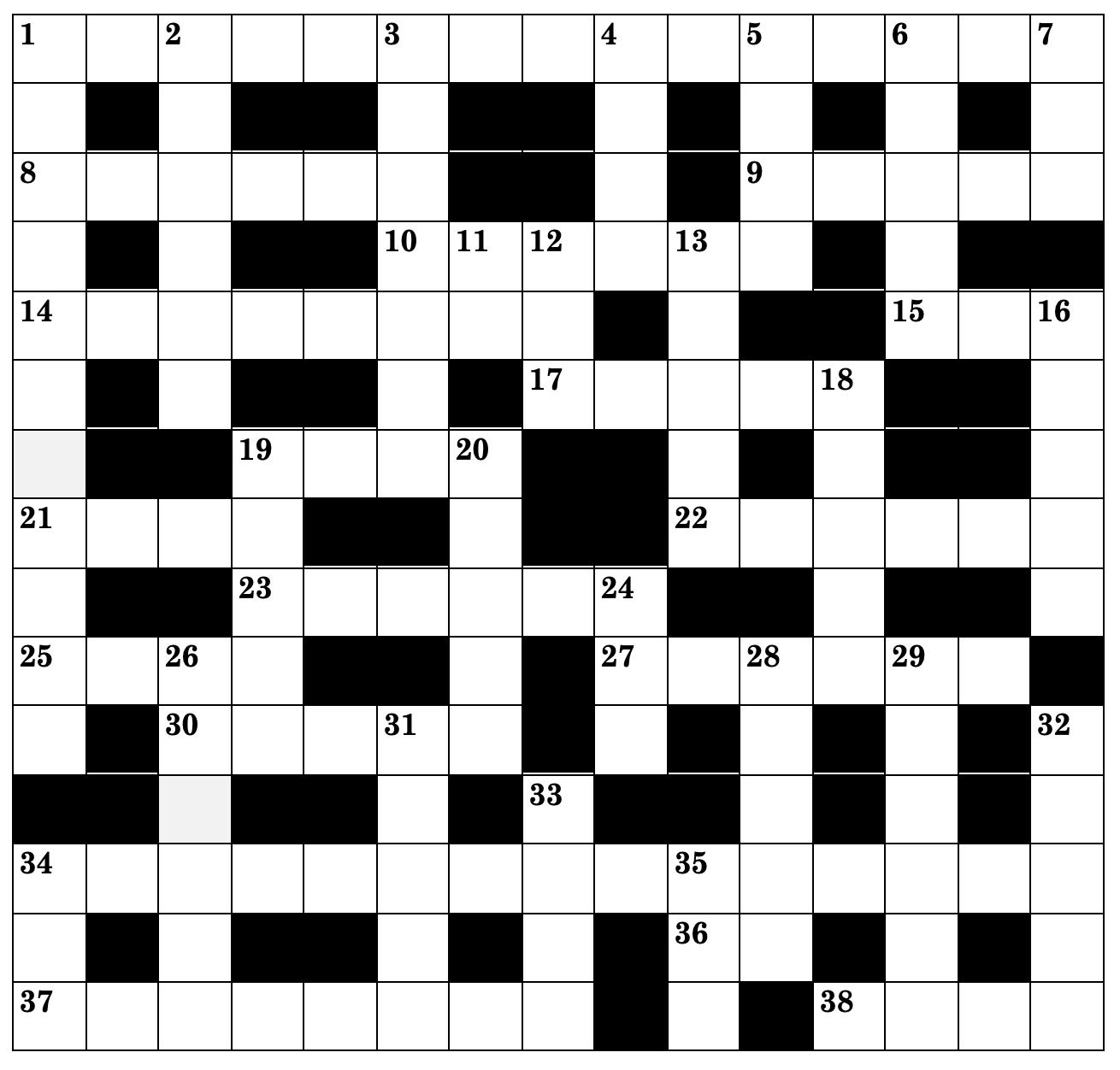
1. Class where the nude figure is painted (4,7))
2. An artist’s body of work (6)
3. Rural and outback painter Drysdale’s first name (7)
4. Art ….. was a design style in the 1920s and 30s (4)
5. The … is an older, affectionate name for the VAS (4)
6. Artist known for Ned Kelly Series, Sidney …. (5)
7. “Put the champagne on ….!, I’ve just won Best in Show” (3)
11. Sydney painter, Alison Rehfisch, 1900-1975 (init) (2)
12. Signatory member of the VAS, …. Machelak (3)
13. Paintings of the naked body (5)
16. Pleasant smell, such as that of old paint in the VAS Studio (5)
18. Of the country, as in a …… landscape (5)
19. Australian artist, Jeffrey ……, 1921-2013, name means intelligent (5)
20. Treasured Sydney painter of still lifes and interiors, Margaret …. (1923-2011) (6)
24. VAS exhibition installer, … Bruere (3)
26. Modern artist, ……. Tweddle, 1875-1945 (6)
28. Picasso could already paint well in his ….., that is, adolescence (5)
29. Some art critics can be ……, that is, unpleasant, nasty (6)
31. Nationality of Vermeer (5)
32. Picasso born in this country (5)
33. Dutch painter of 1500s, …. Holbein the Younger (3)
34. American Art Society (init) (3)
35. Visual form of depiction, a word for all painting (3)
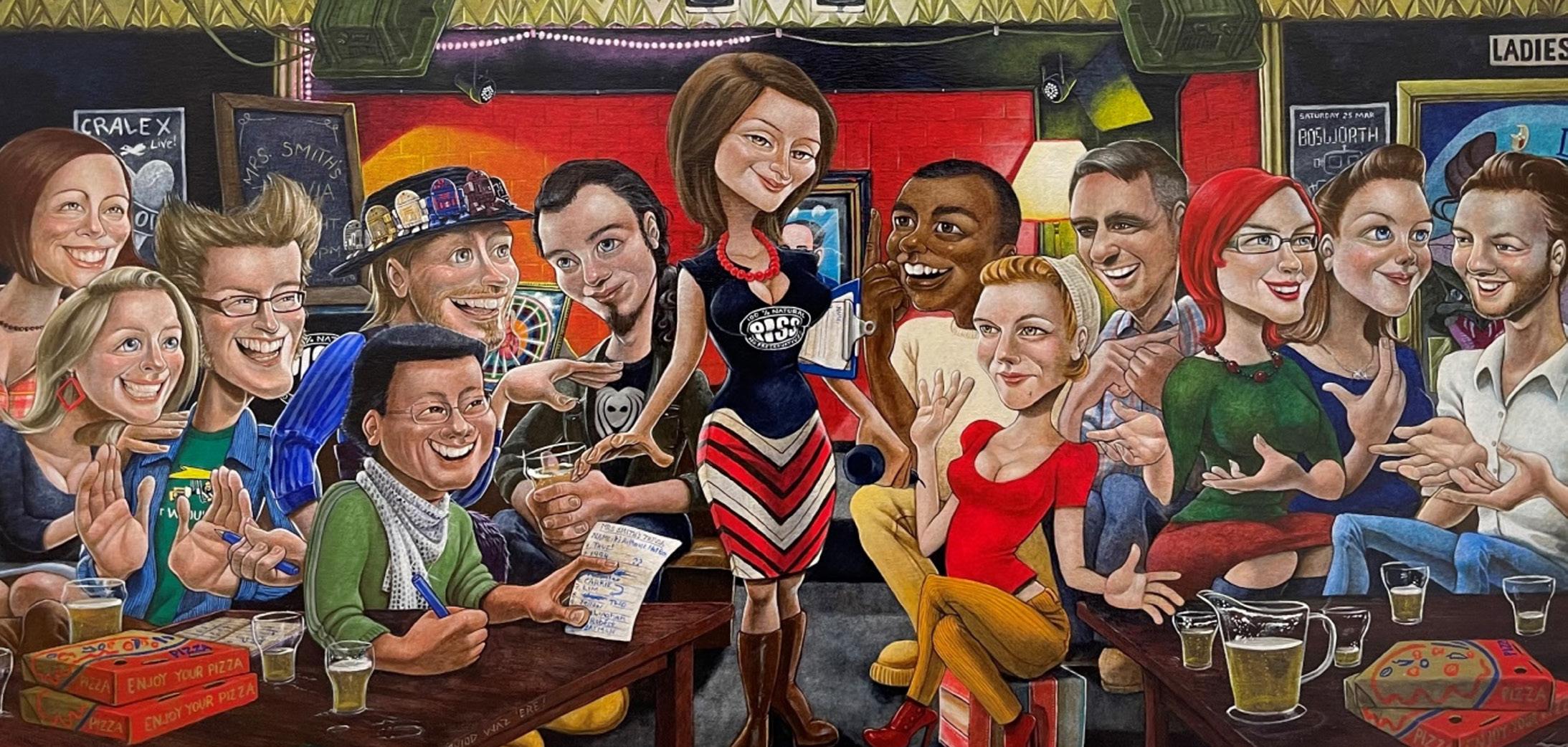
1
2
3
4
What primary colour forms the base for amber?
How many faces or sides are there in a hexagon?
Which two colours are present on the national flag of Ukraine
Which national football team is called the Oranje?
5
6
7
Which Australian coin features the platypus?
Who painted the triptych “The Pioneer” in the NGV Collection
LS Lowry painted industrial scenes in which country?
8
The ancient Roman city of Pompeii was preserved in ash erupted from which volcano?
9
What term is given to the surface alteration of an image caused by ageing?
10
Which Spanish artist’s output has been categorised by Blue, Rose and Cubist periods, among others?
11
Who is the sculptor of the Adam Lindsay Gordon statue located in the Gordon Reserve at the intersection of Spring and Macarthur Streets, Melbourne.
12
The statue of which animal can be found near the New York Stock Exchange?
13 Much of Georgia O’Keefe’s art was inspired by what region of the United States?
14 According to the Old Testament in the Bible, which tower was built in defiance of God?
15 Which is the Japanese art of flower arrangement called?
16
Which aesthetic system, based on Daoist ideas, emphasises harmony with nature?
17 Who is the 2025 VAS Artist of the Year?
18 Barangaroo is an urban redevelopment site in the centre of which Australian city?
19 Which British artist is known for preserving a tiger shark in formaldehyde?
20
“Puppy,” the giant flower-covered dog sculpture outside the Guggenheim Bilbao, was created by which artist?
Answers on Page 43
55
2025 Archibald Prize Finalists: Editor’s Choice
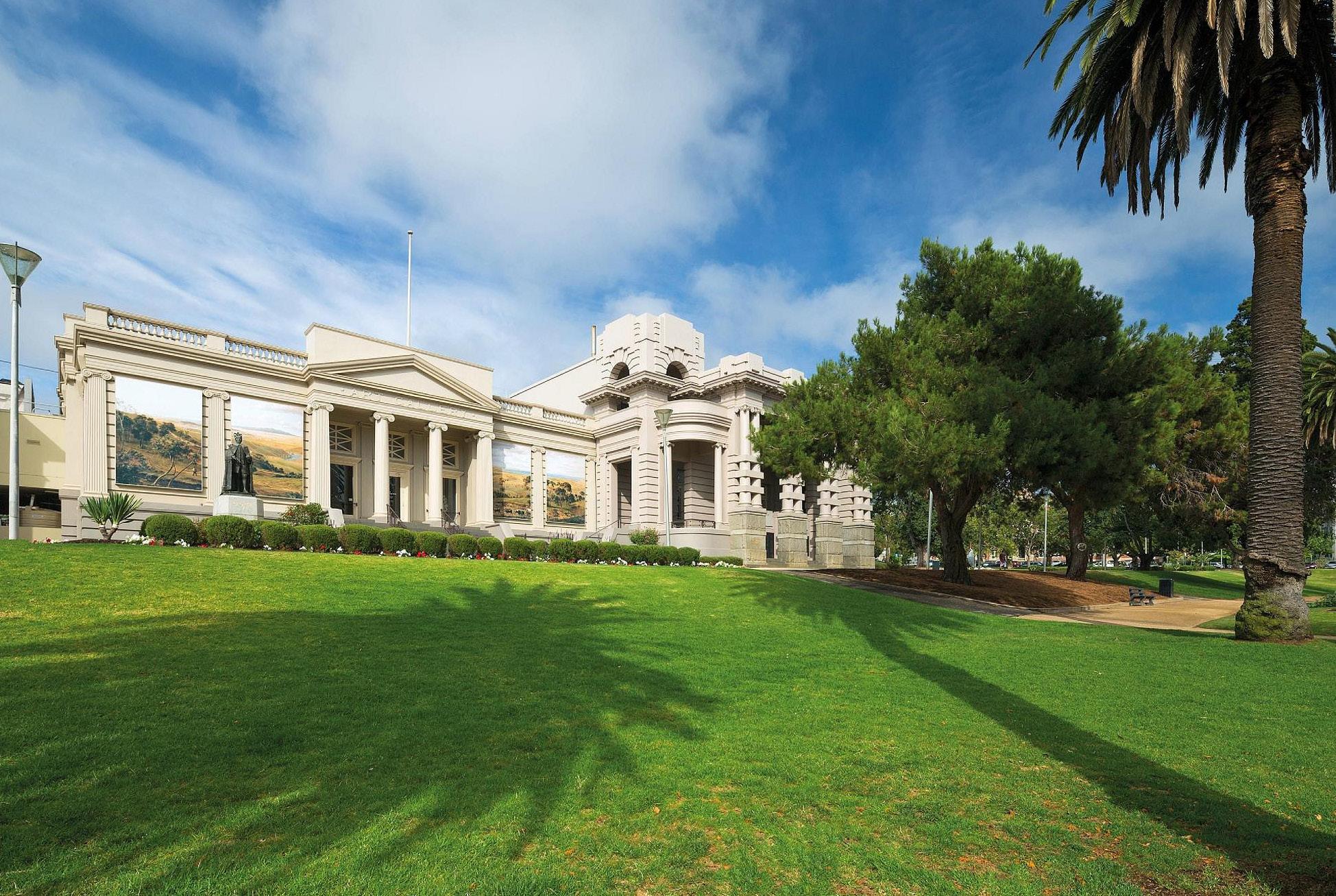
Geelong Gallery | 30 August – 9 November 2025
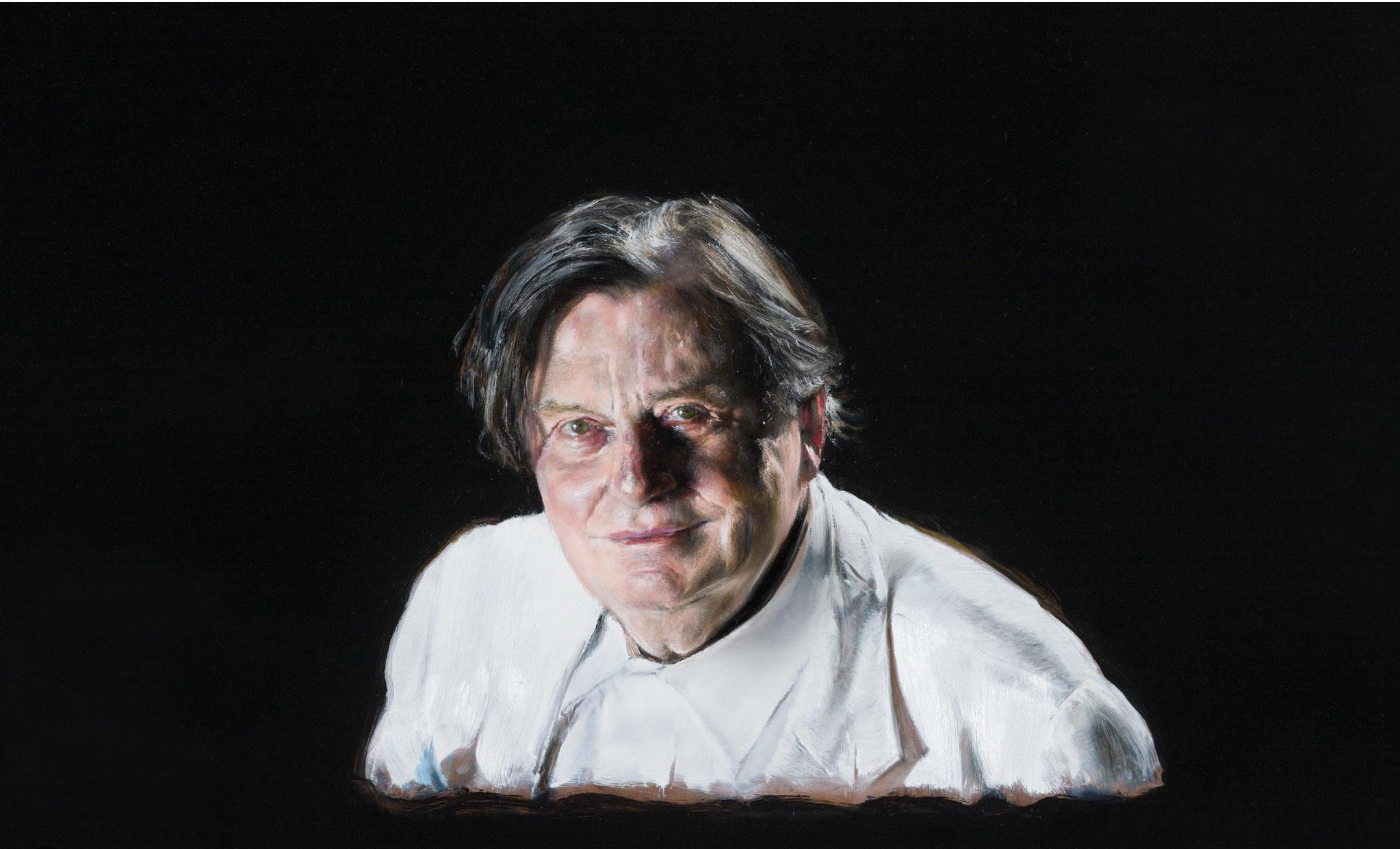
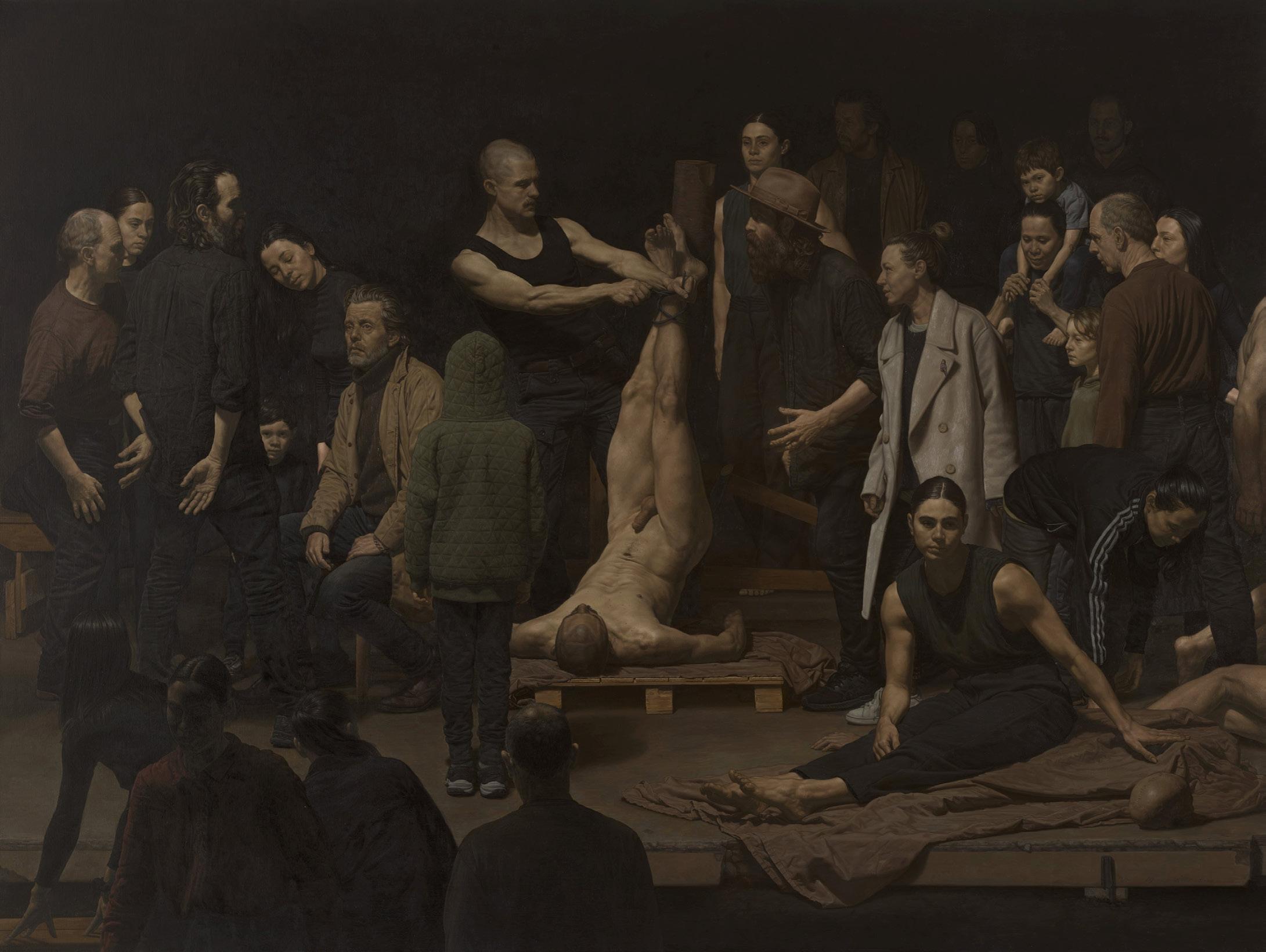
The Archibald Prize Exhibition offers an opportunity to not only engage with a diverse array of portraits, but also to reflect on one’s own artistic preferences. The Competition has been heavily criticised in recent years for favouring content over form; especially content associated with Indigenous and gender issues. The content now includes controversial subjects, which are sometimes addressed informally often with written messages provided to clarify the intended meaning.
Once upon a time you could expect to see a tenebrous collection of portraits painted in the traditional manner. During this era VAS artists featured prominently in the prizegiving: William McInnes, for example, won the Prize 7 times. VAS artists have won the Archibald twenty-one times in the competition’s 104-year history. The last Victorian Artists Society member to win the Archibald Prize was William Dargie in 1956 who, by this time, had secured the prestigious award on eight earlier occasions, illustrating both his remarkable skill and enduring influence in Australian portraiture.
Having viewed the finalists online, and to temper my prejudices and sharpen my critical eye, I divided finalists into the following categoriesTraditional Realism, Contemporary Allegory and Contemporary Punk. I will admit that I look for something beyond reality in a portrait; something that reveals the inner psychological reality; the result of hours spent seeing, drawing, and painting the sitter.
Traditional Realism features a realistic rendering
Above:
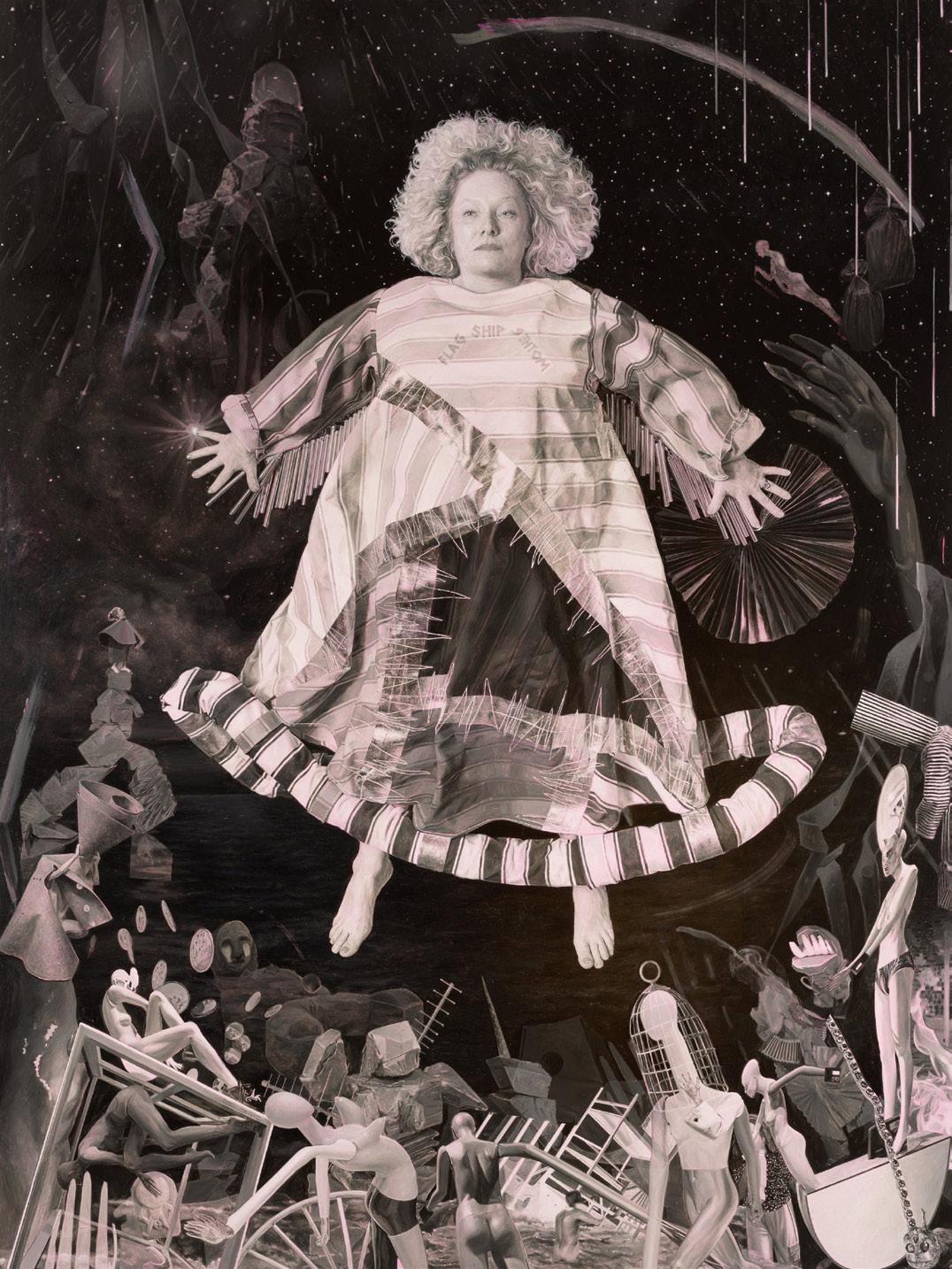
Left: Winner Archibald Prize 2025, Julie Fragar ‘Flagship Mother Multiverse
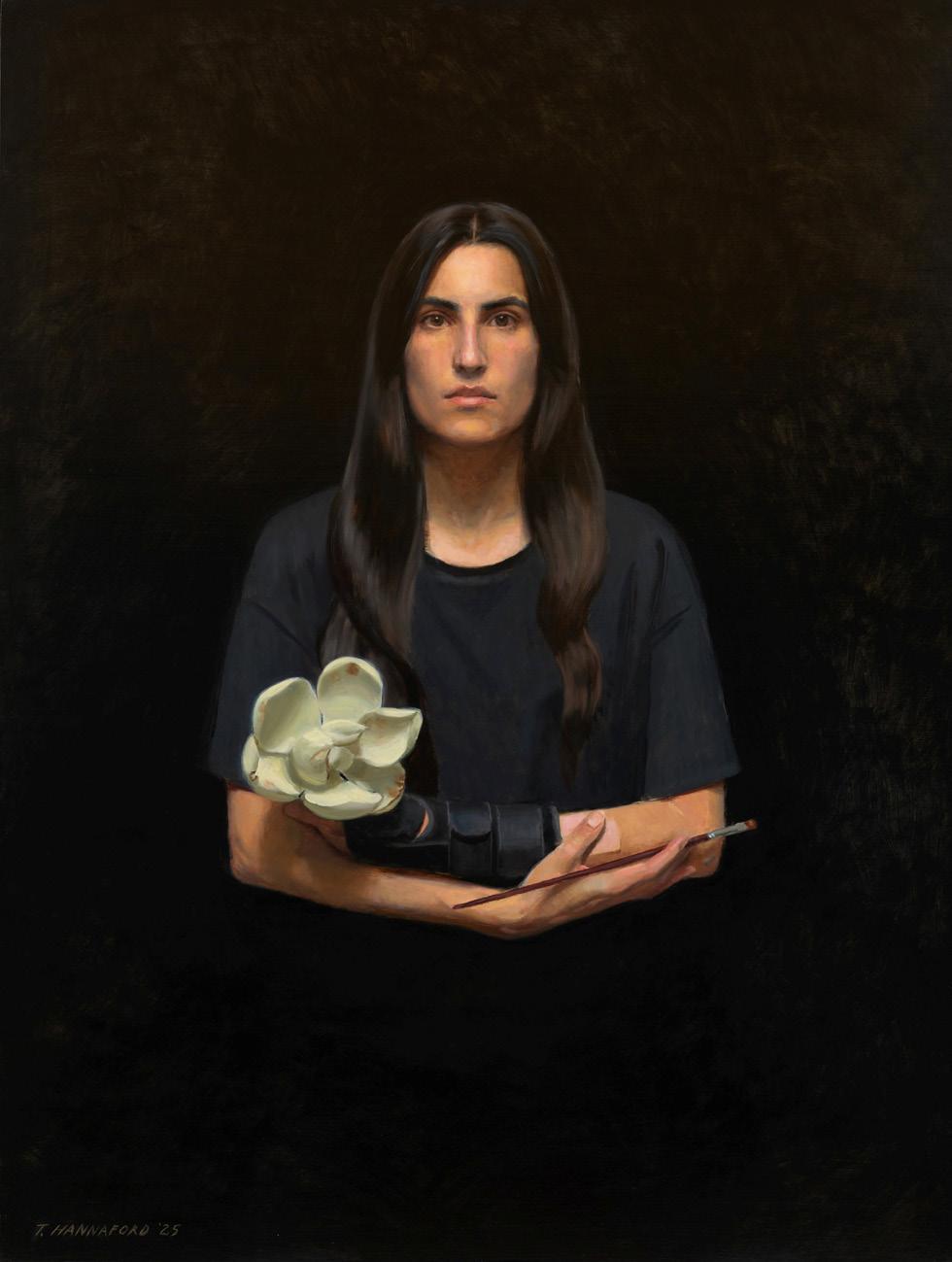
of the subject using tonalism and traditional chiaroscuro techniques. Tsering Hannaford’s Meditation on Time I judged best in this class although not achieving the standards set by Louise Herman’s Barry, her 2016 winning portrait of Barry Humphries. Herman captured the subtle colours and tones around the eyes, mouth, and nose; areas that reveal character and inner reality beyond what a camera can achieve.
Contemporary Allegory uses realism, but values symbolism and narrative as much as form. Julie Fragar’s Archibald winning
entry Flagship Mother Multiverse (Justene) succeeds in portraying the complexity of her friend’s life and achievements in a transparent and legible fashion. Her treasures, family and accoutrements artfully surround Justene rising.
Cormac in Arcadia by Marcus Wills conceals its message behind a dark veil and some impenetrable antiquarian references. I felt like I was reading Byron or Tennyson where Greek and Roman mythology obscure the meaning from those of us who never had a classical education.
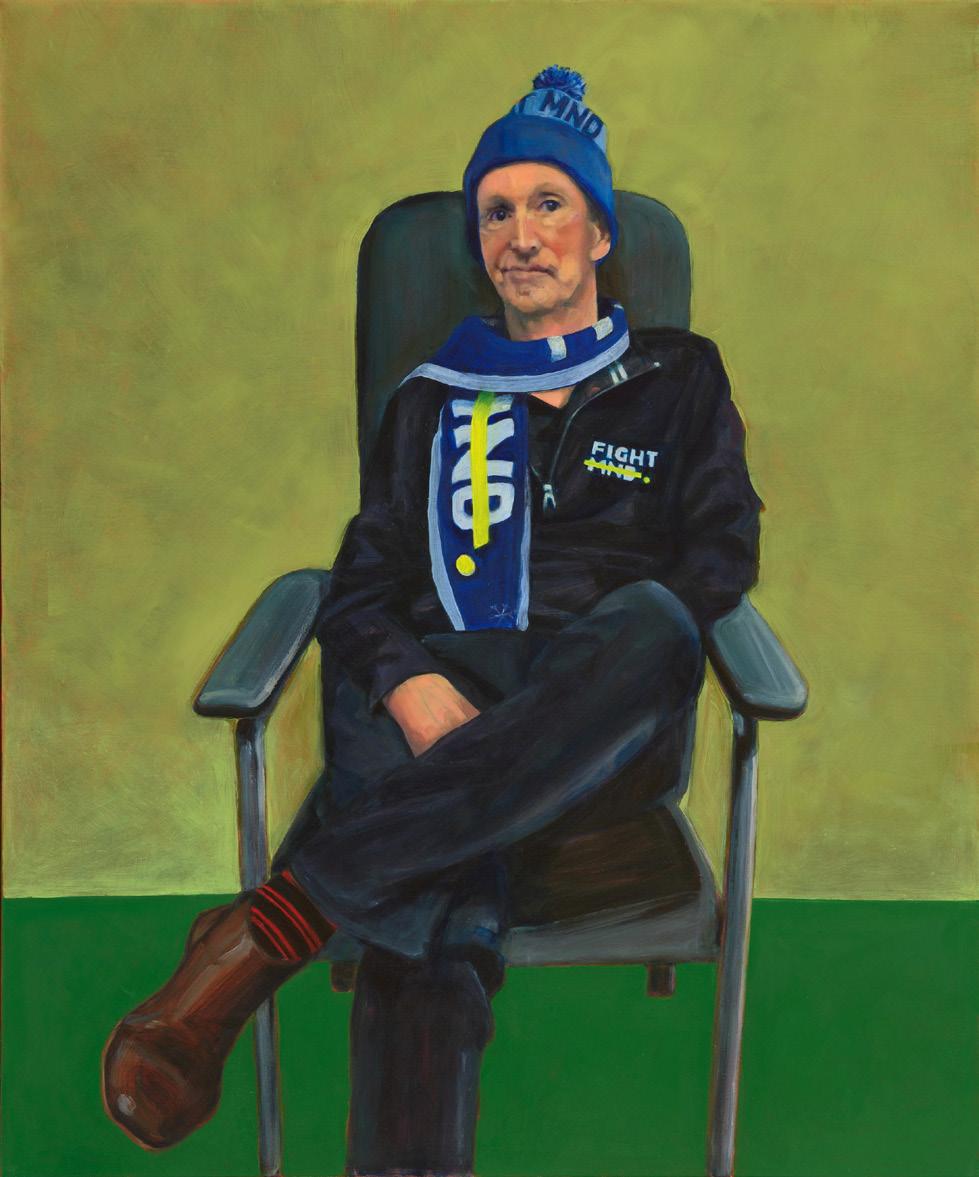
Contemporary Punk is raw and either deliberately imperfect or untrained, filtered through today's cultural, political, and aesthetic landscape. At the Archibald we are seeing more in this category where content dominates form.
It is a bit unfair to include in this category Linda Gold’s portrait of MND survivor Neale Daniher Still standing and fighting. Although the painting is flat and posterlike with little modelling or tonal variation, the emotion and poignancy in the face are arresting. Compare this with Adrian Robertson’s Warwick Thornton - what
is this inept and meaningless painting doing at the Archibald finals?
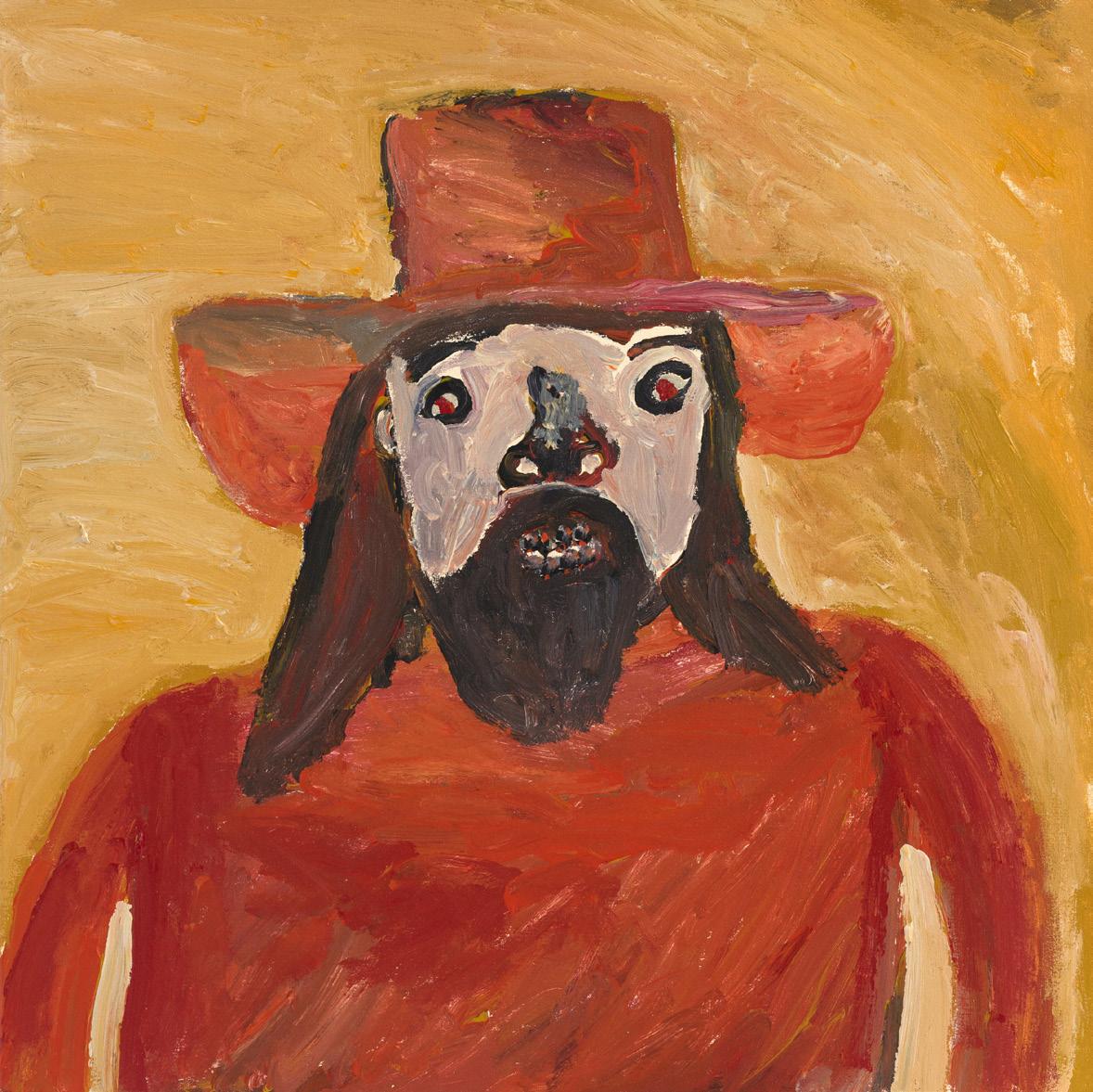
I tend to favour a position that lies somewhere in the middle of the spectrum when it comes to evaluating portraits. Rather than leaning excessively towards either extreme - be it traditional realism or contemporary trends - I prefer works that balance both innovation and technique. In this spirit, I singled out the dynamic portrait crafted by Loribelle Spirovski, an Archibald Prize finalist on four occasions. Spirovski's approach exemplifies the kind of energetic composition and thoughtful execution that appeals to my sense of both artistry and psychological depth in portraiture. The painting appeals directly to emotions and intellect and needs no background in classical art or antiquity. William Barton is a virtuoso of the didgeridoo, and his concert performances are characteristically ‘electric’. The expressive technique applied to both the face and the background imbues the portrait with a sense of movement and vitality that is noticeably absent from other works in the Exhibition. This dynamic finger painting not only brings the subject to life but
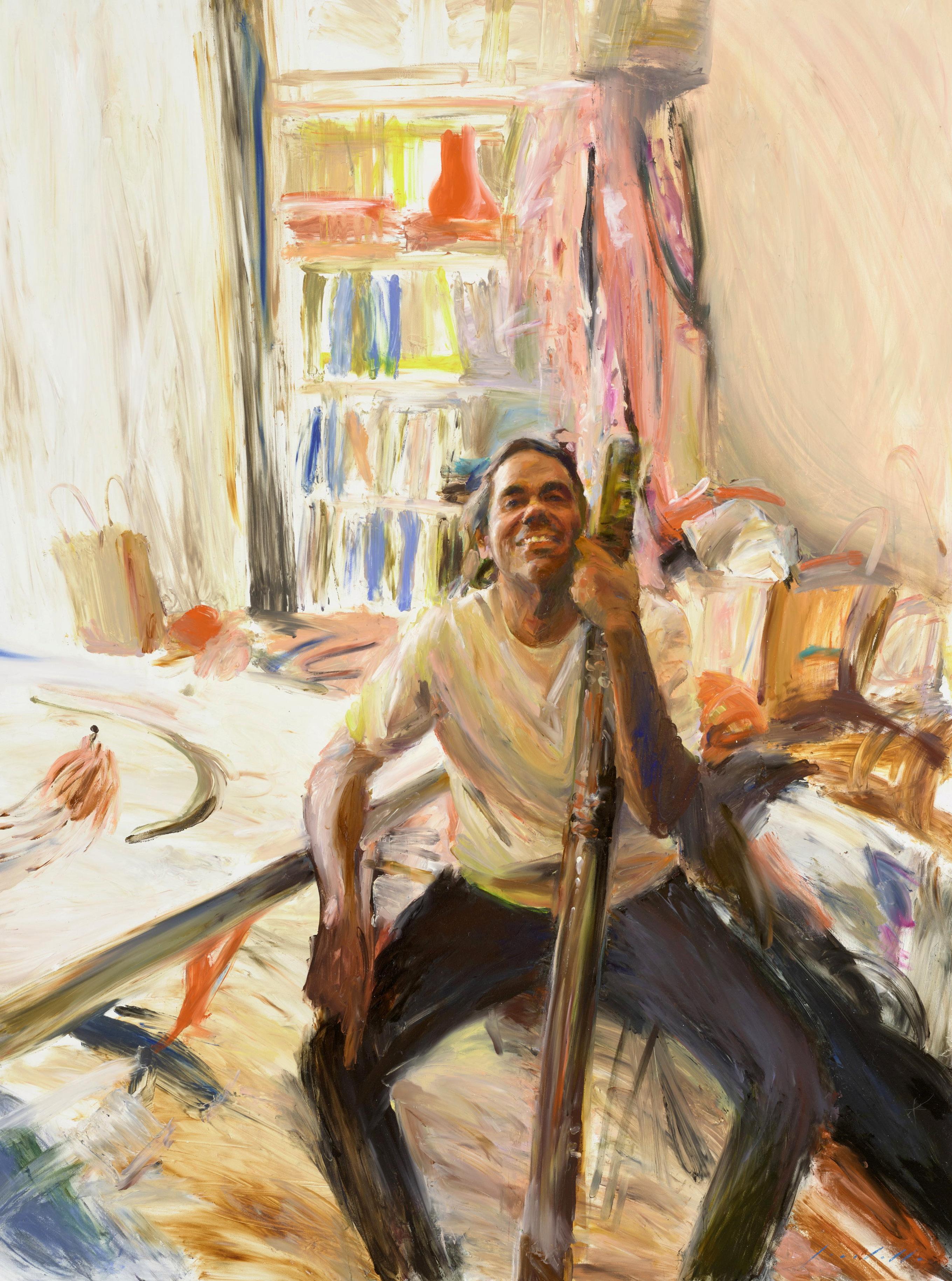
also distinguishes this piece through its ability to convey psychological depth and artistic innovation.
There is a satisfying unity to the composition, combining the use of colour, form and texture. Barton’s portrait is not only striking in its execution and emotional resonance, but it also resonated deeply with the public. Spirovski received the People’s Choice Award, a testament to the
impact and accessibility of the work. This result provided a sense of personal fulfillment, and I was reminded of the perspective of a recently deceased prominent politician who frequently asserted that consensus prevails. The public’s endorsement reinforces the painting’s significance and validates the immediate connection it forges with its audience.
If you love reading about the art world, here are three works of fiction to explore over the coming months. These novels delve into the inner lives of artists, offering imaginative entry points to artistic practice and what it means to make and live with art. All titles are available through local Readings stores (readings.com.au). Book discussions will be scheduled
throughout the coming months – follow VAS on Instagram and Facebook to receive updates!
Readers are invited to submit suggestions for future selections or book reviews for consideration in upcoming issues to magazine@vasgallery.org.au
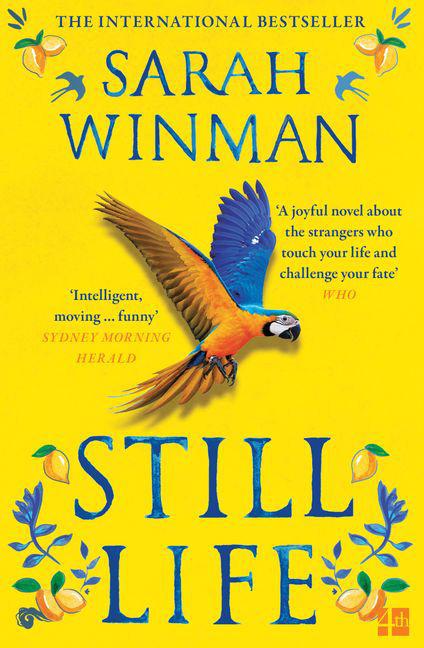
March Still Life by Sarah Winman
Beginning in 1940s Italy, Winman’s award winning novel is grounded in the capturing of domestic spaces, both the relationships that emerge over the course of the narrative and the still life art it references throughout. (Harper Collins)
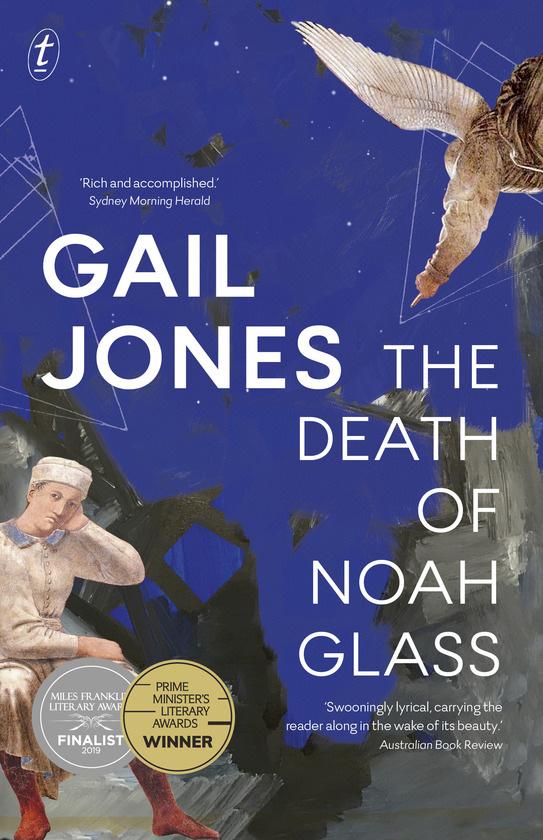
April
The Death of Noah Glass by Gail Jones
Selected as a tie in with our IMPRINT: What Remains program, Jones’ novel traces interconnected lives of an art historian and his children in the wake of his death. The Death of Noah Glass was shortlisted for the Miles Franklin Literary Award. (Text Publishing)
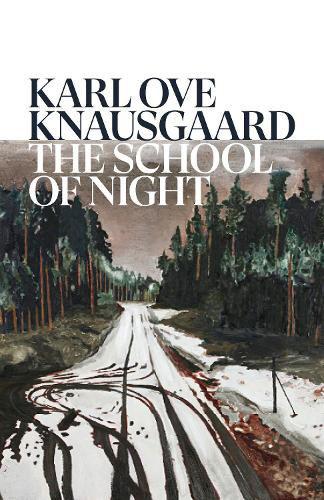
May
The School of Night by Karl Ove Knausgard
The School of Night is a novel about how art is created and about how human life is destroyed. It is the story of one terrible man's rise and fall, and the forces that surround us all, both the light and the dark.” (Random House)


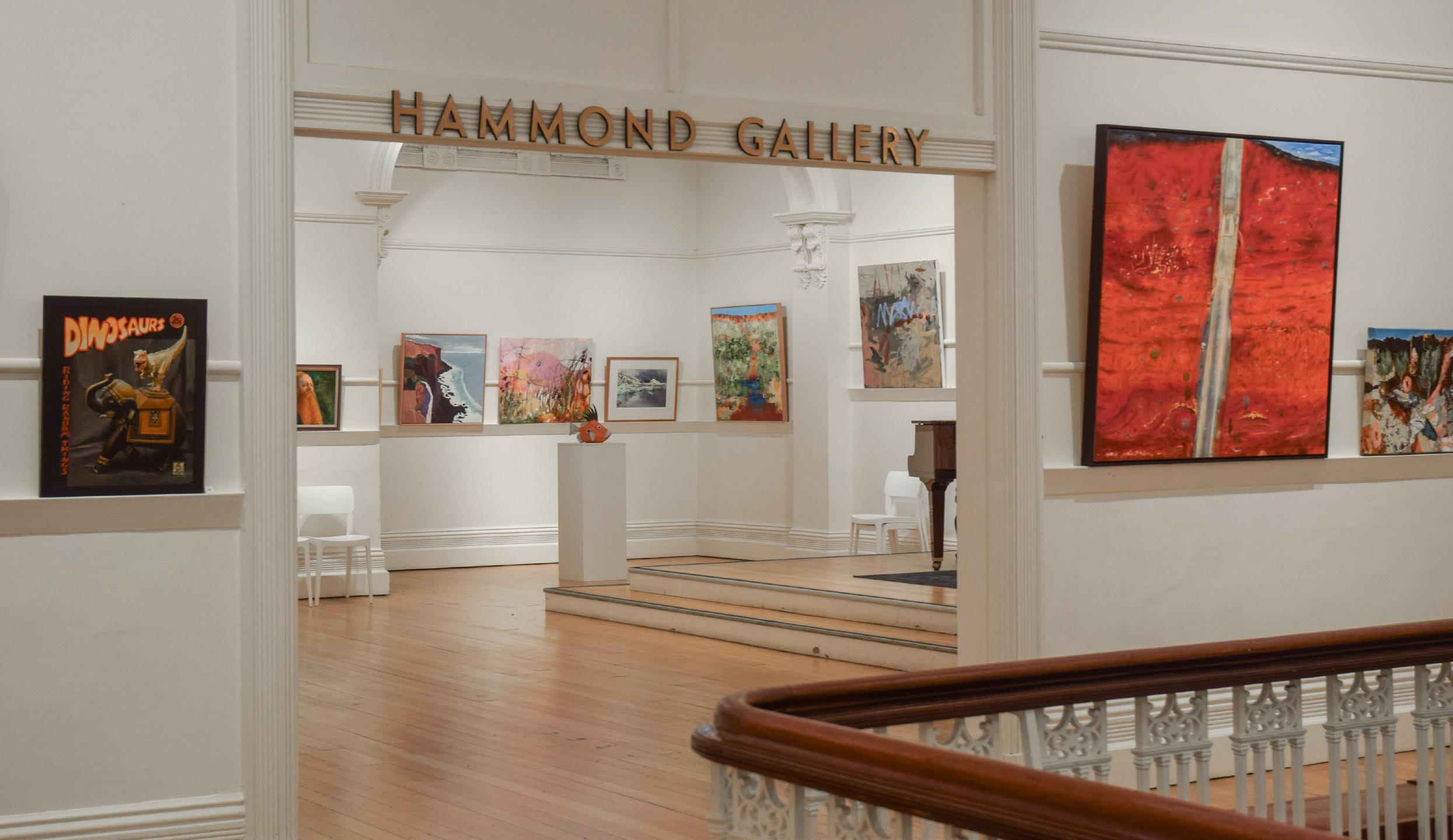
words The VAS Curation Team
Every year, artists pour time and energy into preparing works for submission. When a piece doesn't make it into a show, it can feel baffling or even personal. But rejection from one exhibition doesn't mean rejection full stop. Curatorial decisions are rarely about the quality of an individual work in isolation, and transparency about the process can help.
VAS exhibitions fall into two broad types. Select exhibitions involve a formal selection process in which each work must be chosen for the show by an appointed panel. Member exhibitions, by contrast, can in some instances accommodate all works that meet basic presentation standards. However, when submissions exceed available wall space, curators face choices that have little to do with artistic merit. Adequate spacing between works isn't just a preference; it's a curatorial principle. A piece shown with breathing room commands attention in a way that a crowded wall never allows and slightly fewer works shown well will almost always produce a stronger exhibition.
Presentation requirements, including proper framing or appropriate finishing and compliance with exhibitionspecific guidelines, are applied consistently and without exception. These guidelines exist to ensure a coherent and professional showing for every artist
whose work appears.
It is also worth noting that experience and history with an organisation do not secure a place in any given show. Decisions are made in the context of each exhibition and every submission is weighed against the same considerations. That consistency is ultimately what makes inclusion meaningful.
At the Victorian Artists Society, these principles take on a particular texture. Our membership spans a wide range of experience levels, styles, and mediums, which makes for a rich community but also a curatorial challenge. Bringing those works into a cohesive whole requires careful thought about how pieces sit alongside one another. We are always conscious of representing a broad cross-section of our membership, and of showing each artist's work in a context where it can shine. We are also mindful that many of our artists submit work in the hope of finding it a new home, and the overall experience we create for visitors matters to that outcome.
When our team makes a curatorial call, it is always in service of these goals: a show that comes together, reflects the breadth of our membership, and gives every exhibited work the best possible chance of finding an audience.
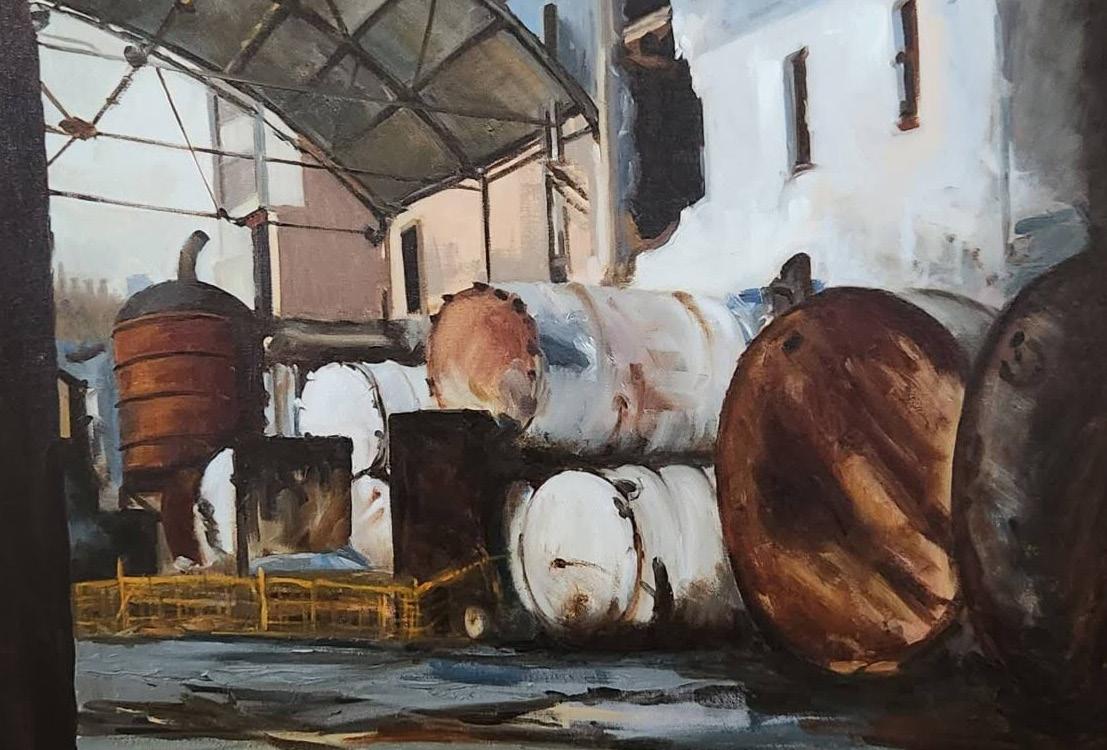
26 Mar – 12 Apr 2026
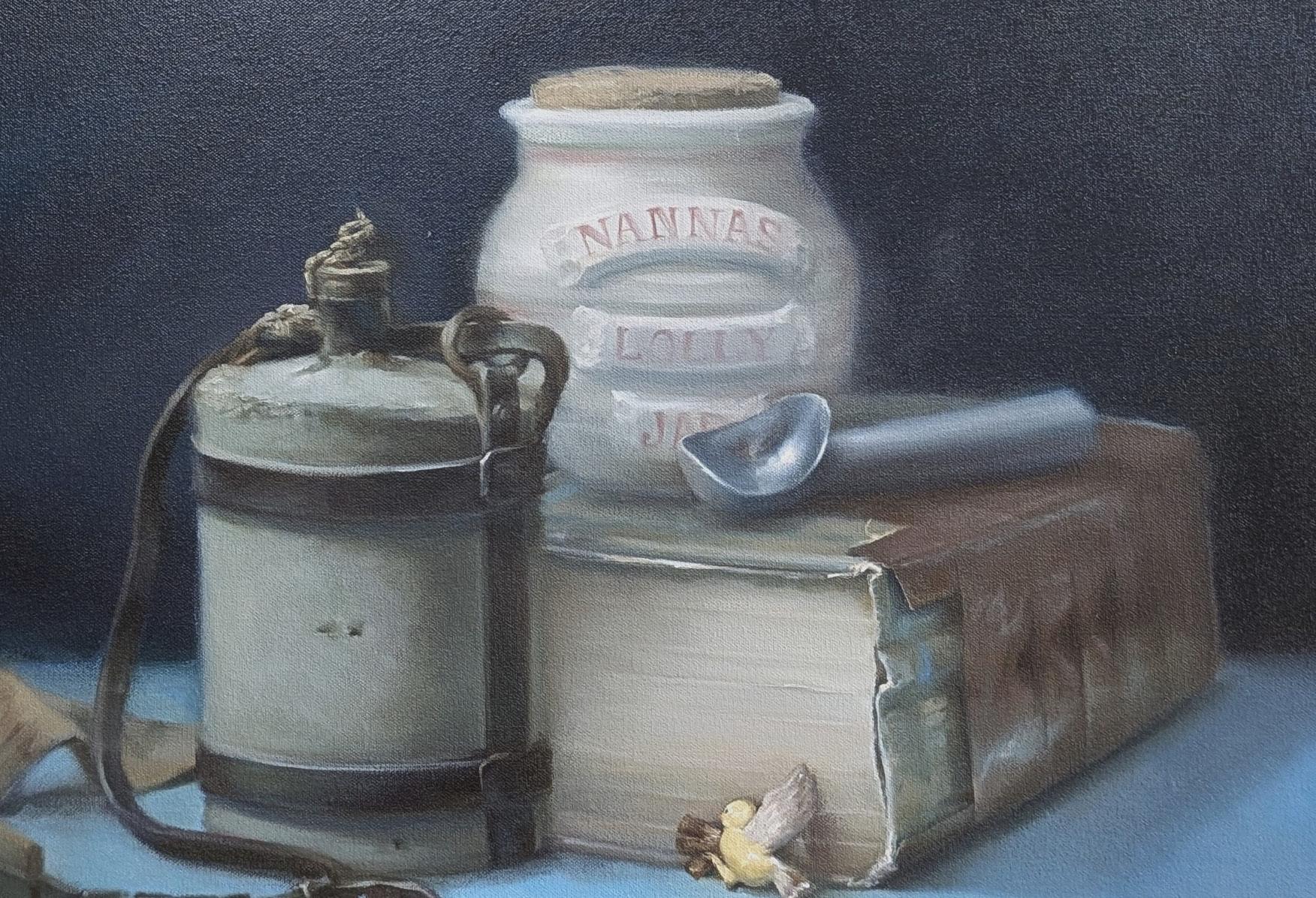
15 Apr – 10 May 2026
PATRON IN CHIEF
Governor of Victoria, Her Excellency Professor the Honourable Margaret Gardner AC
COUNCIL
PRESIDENT
Lucy Maddox
TREASURER
Raymond Barro
EXHIBITING
Bruce Baldey VAS
Gino Severin
D’Arcy Rouillard
Liz Gridley
Swathi Madike
Tim Murphy VAS
Leonie Khoury
Liz Moore Golding VAS
Meg Davoren-Honey OAM VAS FVAS
NON-EXHIBITING
Rosemary Noble HON FVAS
Ron Smith OAM HON FVAS
HONORARY HISTORIAN
Andrew Mackenzie OAM HON FVAS
STAFF
MANAGER & SECRETARY
Kari Lyon PhD
ADMINISTRATION OFFICER
Rhiannon Lawrie
MARKETING & DESIGN COORDINATOR
Catherine Jaworski
EDUCATION & PROGRAMS OFFICER
Lucy Wilde
INSTALLATION & CURATION SERVICES
Sam Bruere
GALLERY ASSISTANTS
Olivia White
Thomas Bladon
ARCHIVIST
Anne Scott Pendlebury HON FVAS
MAGAZINE COMMITTEE
EDITOR
Bruce Baldey VAS
DESIGNER
Catherine Jaworski
Opinions expressed herein are not necessarily those of the VAS Council or the editors of this magazine. Articles from members will be appreciated. Contributions will be published on a strictly honorary basis and no payment will be made.
ADVERTISING ENQUIRIES
Bruce Baldey VAS magazine@vasgallery.org.au
Telephone 03 9662 1484
Website vasgallery.org.au
Email info@vasgallery.org.au
Address 430 Albert St East Melbourne 3002
Standard Opening Hours
10am – 4pm Weekdays 11am – 4pm Weekends