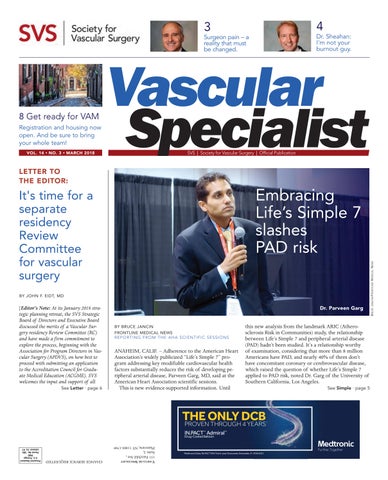
Registration and housing now open. And be sure to bring your whole team!
LETTER TO THE EDITOR:
It's time for a separate residency
Review Committee for vascular surgery
BY JOHN F. EIDT, MD
[Editor’s Note: At its January 2018 strategic planning retreat, the SVS Strategic Board of Directors and Executive Board discussed the merits of a Vascular Surgery residency Review Committee (RC) and have made a firm commitment to explore the process, beginning with the Association for Program Directors in Vascular Surgery (APDVS), on how best to proceed with submitting an application to the Accreditation Council for Graduate Medical Education (ACGME). SVS welcomes the input and support of all
3
Surgeon pain – a reality that must be changed.
4
Dr. Sheahan: I'm not your burnout guy.
BY BRUCE JANCIN
FRONTLINE MEDICAL NEWS REPORTING FROM THE AHA SCIENTIFIC SESSIONS
ANAHEIM, CALIF. – Adherence to the American Heart Association’s widely publicized “Life’s Simple 7” program addressing key modifiable cardiovascular health factors substantially reduces the risk of developing peripheral arterial disease, Parveen Garg, MD, said at the American Heart Association scientific sessions. This is new evidence-supported information. Until
this new analysis from the landmark ARIC (Atherosclerosis Risk in Communities) study, the relationship between Life’s Simple 7 and peripheral arterial disease (PAD) hadn’t been studied. It’s a relationship worthy of examination, considering that more than 8 million Americans have PAD, and nearly 40% of them don’t have concomitant coronary or cerebrovascular disease, which raised the question of whether Life’s Simple 7 applied to PAD risk, noted Dr. Garg of the University of Southern California, Los Angeles.
Dr. Parveen Garg
IN.PACT
ADMIRAL
DCB PROVEN THROUGH 4 YEARS1
More Than Double the Time to First Reintervention
Patients treated with IN.PACTTM AdmiralTM Drug-Coated Balloon demonstrated more than double the time to first reintervention compared to patients treated with PTA.
IN.PACT SFA TRIAL: Days to First Reintervention1
Surgeon pain, disability on the rise
BY KARI OAKES FRONTLINE MEDICAL NEWS
The evidence has been accumulating for decades: Practicing surgery can exact a toll on surgeons’ physical well-being in ways that can shorten careers and contribute to professional dissatisfaction.
“Ergonomists have described the surgeon’s work environment and working conditions as equal to, if not at times harsher than, those of certain industrial workers,” wrote Sherise Epstein, MPH, and the coauthors of the systematic review and meta-analysis of studies addressing the issue. Ms. Epstein, currently a 4th-year medical student at the University of California, San Diego, and her team found a high prevalence of work-related musculoskeletal disorders and pain among surgeons and interventionalists, with pooled prevalence estimates for pain among these physicians ranging from 35% to 60% of all respondents. Cervical spine disease, rotator cuff pathology, and degenerative lumbar spine disease were each reported by nearly one in five respondents in the pooled analyses, with increasing prevalence over the duration of the study period (JAMA Surg. 2017 Dec 27. doi:10.1001/ jamasurg.2017.49).
The results of the study are in line with previous work that finds a high – and increasing – rate of pain
Indications for Use
Pain is all too common
Musculoskeletal pain secondary to performing vascular surgery is a real issue. Our group recently presented survey results showing that 44.2% of vascular surgeons experience moderate to severe pain even before starting their operative day. During their operative day, these numbers increased to 78%. By the end of a full day doing procedures, 83% of vascular surgeons reported moderate or severe pain. The physical costs of being a vascular surgeon are real. The use of lead aprons, loupe magnification, headlights, foot pedals, and monitors only magnifies these problems.
Samuel R. Money, MD, (pictured) is Chair of Surgery and Victor J. Davila, MD, is a general surgeon, both at the Mayo Clinic, Phoenix.
The impact to the health care system is significant, with 6% of vascular surgeons stopping the practice of vascular surgery because of musculo-
and disability among at-risk physicians, who endure long work hours, awkward positioning, and few opportunities for breaks. The study also suggested a
The IN.PACT™ Admiral™ Paclitaxel-Coated PTA Balloon catheter is indicated for percutaneous transluminal angioplasty, after appropriate vessel preparation, of de novo, restenotic, or in-stent restenotic lesions with lengths up to 180 mm in superficial femoral or popliteal arteries with reference vessel diameters of 4-7 mm.
Contraindications
The IN.PACT Admiral DCB is contraindicated for use in:
• Coronary arteries, renal arteries, and supra-aortic/cerebrovascular arteries
• Patients who cannot receive recommended antiplatelet and/or anticoagulant therapy
• Patients judged to have a lesion that prevents complete inflation of an angioplasty balloon or proper placement of the delivery system
• Patients with known allergies or sensitivities to paclitaxel
• Women who are breastfeeding, pregnant or are intending to become pregnant or men intending to father children. It is unknown whether paclitaxel will be excreted in human milk and whether there is a potential for adverse reaction in nursing infants from paclitaxel exposure.
Warnings
• Use the product prior to the Use-by Date specified on the package.
• Contents are supplied sterile. Do not use the product if the inner packaging is damaged or opened.
• Do not use air or any gaseous medium to inflate the balloon. Use only the recommended inflation medium (equal parts contrast medium and saline solution).
• Do not move the guidewire during inflation of the IN.PACT Admiral DCB.
• Do not exceed the rated burst pressure (RBP). The RBP (14 atm [1419 kPa]) is based on the results of in vitro testing. Use of pressures higher than RBP may result in a ruptured balloon with possible intimal damage and dissection.
• The safety and effectiveness of using multiple IN.PACT Admiral DCBs with a total drug dosage exceeding 20,691 μg of paclitaxel in a patient has not been clinically evaluated in the IN.PACT SFA Trial.
Precautions
• This product should only be used by physicians trained in percutaneous transluminal angioplasty (PTA).
• This product is designed for single patient use only. Do not reuse, reprocess, or resterilize this product.
• Reuse, reprocessing, or resterilization may compromise the structural integrity of the device and/or create a risk of contamination of the device, which could result in patient injury, illness, or death.
• Assess risks and benefits before treating patients with a history of severe reaction to contrast agents.
• The safety and effectiveness of the IN.PACT Admiral DCB used in conjunction with other drug-eluting stents or drugcoated balloons in the same procedure or following treatment failure has not been evaluated.
• The extent of the patient’s exposure to the drug coating is directly related to the number of balloons used. Refer to the Instructions for Use (IFU) for details regarding the use of multiple balloons and paclitaxel content.
• The use of this product carries the risks associated with percutaneous transluminal angioplasty, including thrombosis, vascular complications, and/or bleeding events.
• Vessel preparation using only pre-dilatation was studied in the clinical study. Other methods of vessel preparation, such as atherectomy, have not been studied clinically with IN.PACT Admiral DCB.
• This product is not intended for the expansion or delivery of a stent.
Customer Support Tel: +1.763.526.7890 Toll free: +1.877.526.7890
skeletal pain, only exacerbating the shortage of vascular surgeons we are currently experiencing. Efforts should be made to educate vascular surgeons on ergonomic modifications to help reduce this problem.
Table height, posture, monitor height, and minimizing positions of high stress during surgery are crucial to avoid chronic musculoskeletal pain (MSP) and injury. Formal micro-breaks (stretching exercises at regular intervals during long cases) are a cost-effective way to begin to combat MSP in the operating room. However, ergonomic education and careful attention to operating room and equipment setup can also be key components toward minimizing MSP.
possible linkage between work-related pain and other factors, such as burnout and depression, that lead
Pain continued on page 5
Potential Adverse Effects
The potential adverse effects (e.g. complications) associated with the use of the device are: abrupt vessel closure; access site pain; allergic reaction to contrast medium, antiplatelet therapy, or catheter system components (materials, drugs, and excipients); amputation/loss of limb; arrhythmias; arterial aneurysm; arterial thrombosis; arteriovenous (AV) fistula; death; dissection; embolization; fever; hematoma; hemorrhage; hypotension/hypertension; inflammation; ischemia or infarction of tissue/organ; local infection at access site; local or distal embolic events; perforation or rupture of the artery; pseudoaneurysm; renal insufficiency or failure; restenosis of the dilated artery; sepsis or systemic infection; shock; stroke; systemic embolization; vessel spasms or recoil; vessel trauma which requires surgical repair.
Potential complications of peripheral balloon catheterization include, but are not limited to the following: balloon rupture; detachment of a component of the balloon and/or catheter system; failure of the balloon to perform as intended; failure to cross the lesion.
Although systemic effects are not anticipated, potential adverse events that may be unique to the paclitaxel drug coating include, but are not limited to: allergic/immunologic reaction; alopecia; anemia; gastrointestinal symptoms; hematologic dyscrasia (including leucopenia, neutropenia, thrombocytopenia); hepatic enzyme changes; histologic changes in vessel wall, including inflammation, cellular damage, or necrosis; myalgia/arthralgia; myelosuppression; peripheral neuropathy. Refer to the Physician’s Desk Reference for more information on the potential adverse effects observed with paclitaxel. There may be other potential adverse effects that are unforeseen at this time.
Please reference appropriate product Instructions for Use for a detailed list of indications, warnings, precautions and potential adverse effects. This content is available electronically at www.manuals.medtronic.com.
CAUTION: Federal law (USA) restricts this device to sale by or on the order of a physician.
PERSPECTIVE by Dr. Samuel R. Money and Dr. Victor J. Davila
I am not your burnout expert
BY MALACHI G. SHEAHAN III, MD DEPUTY MEDICAL EDITOR, VASCULAR SPECIALIST
Look, I am not a burnout expert. And neither are you (presumably). None of us know much, but that won’t stop the regulations from coming. Program directors are already being asked to provide “wellness plans.” Through the SVS, experts have been enlisted to help, but it is now clear that what works for others won’t necessarily work for vascular surgeons. The next step is up to us. We are the only ones with detailed knowledge of our lives. I believe we are moving closer to answers but still face a few significant hurdles. Don’t worry, there are solutions. Hear me out …
Previously, I shared three studies with you, which found that vascular surgeons had the highest rates of suicidal ideation and career dissatisfaction among surgeons while spending more hours in the hospital than any other specialty. So what has been done to address these horrific numbers? Very little. We need answers now, but most of the data are over 10 years old. Much has changed in our specialty. The endovascular revolution created an entirely new working paradigm. A busy vascular surgeon used to perform 300 cases annually; now this number approaches 1,000. More procedures means more clerical work. Lead aprons and radiation exposure
Dr. Sheahan is the Claude C. Craighead Jr. Professor and Chair, Division of Vascular and Endovascular Surgery, Louisiana State University Health Sciences Center, New Orleans.
have added new ergonomic and medical concerns. Reimbursement dynamics now favor shorter, more frequent patient interactions over longer, more complex cases. We are benchmarked against old work standards while CPT bundling continuously lowers current RVU designations. EMR was supposed to make our lives better; it has done the opposite. Patient-centered health care has become a mantra, but the measures taken often backfire. Practicing medicine where the desired outcome is a high score on patient satisfaction surveys will likely lead to unnecessary tests, poor cost allocation, and low physician fulfillment. Quality of care is now measured scrupulously while the quality of our lives remains undocumented.
In the absence of organized reform, burnout appears to be increasing. A recent Mayo Clinic–AMA study found the current prevalence to be 54% among physicians. All of this has not happened overnight. I believe practic-
VASCULAR SPECIALIST Medical Editor Russell H. Samson, MD
Deputy Medical Editor Malachi Sheahan III, MD
Associate Medical Editors Bernadette Aulivola, MD, O. William Brown, MD, Elliot L. Chaikof, MD, PhD, Carlo Dall’Olmo, MD, Alan M. Dietzek, MD, RPVI, FACS, Professor Hans-Henning Eckstein, MD, John F. Eidt, MD, Robert Fitridge, MD, Dennis R. Gable, MD, Linda Harris, MD, Krishna Jain, MD, Larry Kraiss, MD, Joann Lohr, MD, James McKinsey, MD, Joseph Mills, MD, Erica L. Mitchell, MD, MEd, FACS, Leila Mureebe, MD, David Rigberg, MD, Clifford Sales, MD, Bhagwan Satiani, MD., Larry Scher, MD, Marc Schermerhorn, MD, Peter Scheider, MD, Murray L. Shames, MD, Niten Singh, MD, Frank J. Veith, MD, Robert Eugene Zierler, MD
Resident/Fellow Editor Laura Drudi, MD.
Executive Director SVS Kenneth M. Slaw, PhD.
Director of Marketing and Membership SVS Justin Cogswell
Managing Editor SVS Beth Bales
Vascular Specialist is the official newspaper of the Society for Vascular Surgery and provides the vascular specialist with timely and relevant news and commentary about clinical developments and about the impact of health care policy. Content for Vascular Specialist is provided by Frontline Medical Communications Inc. Content for the News From the Society is provided by the Society for Vascular Surgery.
The ideas and opinions expressed in Vascular Specialist do not necessarily reflect those of the Society or the Publisher. The Society for Vascular Surgery and Frontline Medical Communications Inc. will not assume responsibility for damages, loss, or claims of any kind arising from or related to the information contained in this publication, including any claims related to the products, drugs, or services mentioned herein.
ing vascular surgeons are resilient by default. The majority of us trained prior to the enforcement of duty hour restrictions. Out of high school, I enrolled in a 6-year BA/ MD program (skipping 2 years of college seemed like a great idea in high school, less so when I got there). Half of my class never finished. In my intern year, six of the eight categorical residents dropped out. My odds of reaching PGY 2 were 12.5%. Fuzzy math aside, all of your stories are similar. We have proved our resilience over and over again. What is happening here is different. Burnout is described as emotional exhaustion, low self-esteem, and depersonalization/cynicism. It develops slowly, progressively as stressors increase. A common thread seems to be the feeling that you alone are not enough. Examine your daily life. What are your most common stressors? For me, they relate to time management, clinical documentation, and whatever fresh hell my kids’ teachers have cooked up for “school projects.”
*****Scene*****
Wife: Can you help Luke (kindergarten) finish his diorama? It needs to be a scale depiction of his 3 favorite scenes from Wagner’s Ring cycle. Me: Sure, I just need to complete
POSTMASTER Send changes of address (with old mailing label) to Vascular Specialist, Subscription Service, 151 Fairchild Ave., Suite 2, Plainview, NY 11803-1709.
The Society for Vascular Surgery headquarters is located at 633 N. St. Clair St., 22th Floor, Chicago, IL 60611.
Vascular Specialist (ISSN 1558-0148) is published monthly for the Society for Vascular Surgery by Frontline Medical Communications Inc., 7 Century Drive, Suite 302, Parsippany, NJ 07054-4609. Phone 973-206-3434, fax 973-206-9378
Subscription price is $230.00 per year.
National Account Manager Valerie Bednarz, 973-206-8954, cell 973-907-0230, vbednarz@frontlinemedcom.com
Digital Account Manager Rey Valdivia 973-206-8094 rvaldivia@ frontlinemedcom.com
the wind tunnel testing on Jack’s (3rd grade) carbon-neutral peanut-free alternative fuel source rocket booster. Off stage – 7th Grade Son: The genetically modified spiders got loose again!
*****End Scene*****
We want to do a good job, but more hurdles are placed in our way. A recent AMA/Dartmouth Hitchcock study found that 50% of physicians’ time is spent performing data entry and other administrative work. Only 27% of time was spent on patient care. Every hour of face-to-face patient time requires 2 hours of EMR/clerical work. We are trapped in a bureaucratic prison. For years, every quality initiative was solved with a new form. To enter a simple note today, we must first “establish our relationship” with the patient, then ably click through a minefield of “warning boxes” signifying impending DVT prophylaxis catastrophes and antibiotic crimes and misdemeanors, next we scroll through a pre-populated postapocalyptic hellscape of minuteby-minute vital sign entries and lab values dating back to inception. Then, and only then, finally, ON PAGE 11, we can meagerly type: Patient at wound care, will come back on evening rounds. Another important component of the burnout syndrome is dehumanization. Recently I spoke with Donald Zimmerman, PhD, author of the
Vice President, Human Resources & Facility Operations Carolyn Caccavelli
Vice President, Marketing & Customer Advocacy Jim McDonough
Vice President, Operations Jim Chicca
Vice President, Sales Mike Guire
Vice President, Society Partners Mark Branca
Circulation Director Jared Sonners
Corporate Director, Research & Communications Lori Raskin
Editor in Chief Mary Jo M. Dales
In affiliation with Global Academy for Medical Education, LLC
Scan this QR Code to visit vascularspecialistonline.com
Vice President, Medical Education & Conferences
Sylvia H. Reitman, MBA Vice President, Events David J. Small, MBA
Simple from page 1
When the AHA originally developed the Life’s Simple 7 concept to support the organizational goal of substantial reduction of the burden of cardiovascular disease by the year 2020, the targets were coronary heart disease (CHD) and stroke. The scope of the program was later broadened to include all cardiovascular disease, including PAD.
ARIC is a National Heart, Lung, and Blood Institute–sponsored prospective study of nearly 16,000 black or white individuals who were middle-aged at enrollment and have been followed for more than 2 decades. Dr. Garg’s analysis focused on 12,865 participants who were free of CHD, heart failure, prior stroke, and PAD at baseline, and have been followed for a median of 24 years.
The metrics for Life’s Simple 7 consist of total cholesterol, blood pressure, blood glucose, smoking status, body mass index, physical activity, and adherence to a healthy diet score. Each element can be scored 2 points for ideal, 1 for intermediate, and 0 for poor. The composite Life’s Simple 7 score is rated optimal at 10-14 points, average at 5-9, and inadequate at 0-4. During follow-up, 3.4% of ARIC participants developed PAD sufficiently severe to involve hospitalization. The incidence was 5.2 cases per 1,000 person-years for the 1,008 subjects categorized as having an inadequate Life’s Simple 7 score, 1.1/1,000 person-years for the 8,395 people in the average category, and 0.4 cases/1,000 person-years for the 3,462 in the optimal Life’s Simple 7 group.
DLinda Harris
What has the greatest impact?
r Garg and colleagues assessed the ARIC (Atherosclerosis Risk in Communities) study, sponsored from the NHBLI, for risk of PAD development related to “Life’s Simple 7” program. Not surprisingly, patients who did not smoke, ate a healthy diet, exercised, had normal cholesterol, blood pressure and glucose levels, and a normal body weight at initial assessment, had a significantly lower chance of developing clinically significant PAD over time. The ARIC study, and multiple projects arising from it, should be applauded for their efforts to decrease cardiovascular mortality.
The true incidence of PAD in this study is not known, as the only indicator of PAD was hospitalization. It is possible that patients with “bad habits” were more often assessed for PAD, and diagnosed, whereas patients without “bad habits” might not have been assessed, as was frequently the case with women and cardiovascular disease a few decades ago. A measure of ABI at baseline, and at multiple time points throughout the study would have been helpful. Popliteal artery assessments, which were performed in the ARIC study, were not reported in this substudy.
More importantly, what this sub study does not assess, is the impact these lifestyle changes have once present.
Compared with subjects in the inadequate category, those in the average group were 56% less likely to develop PAD. Those in the optimal Life’s Simple 7 category had an 86% reduction in risk.
For each of the seven components of Life’s Simple 7 a person scored ideally in, the risk of incident PAD was reduced by 28% in a multivariate analysis fully adjusted for demographics,
to attrition in the surgical profession. Adrian Park, MD, who has long studied the issue of work-related musculoskeletal disorders (MSDs) among surgeons and interventionalists, was not surprised by the study’s findings. “These aren’t just sporadic instances of individual surgeons having a tough time; this is an increasingly broadly recognized problem. ... These are the consequences of surgeons simply getting up and going to work each week,” Dr. Park said in an interview.
A total of 21 articles composed the meta-analysis, which included responses from 5,828 physicians. Most of the respondents were male (78.5%), with a mean age of 46 years and a mean 12.8 years in practice. The mean number of hours spent in procedures per week was 14.4. Fourteen studies met eligibility criteria for quantitative synthesis. A total of 4,245 physicians were included in this portion of the analysis: 1,232 orthopedic surgeons, 1,118 interventional cardiologists, and 582 general surgeons (other subspecialties made up the remainder).
While it is ideal for people to never engage in bad habits, much of our country currently does. Certainly the vast majority of patients we see have at least several factors that would not qualify as healthy. For example, if an individual was a smoker at the onset of the study, and quit within 1 year of being enrolled, would he have had as high a risk as those who were smokers, or those who were not. As this sub study only assessed these characteristics at baseline, it is unclear whether they remained stable or changed over time. Clearly, most of us already encourage our patients to quit smoking; exercise; control their diabetes, blood pressure, and cholesterol; and to eat a healthy diet. The question is how much of an impact changing lifestyle has, and whether there is a critical time point at which it needs to be done to decrease the risk of developing PAD or progression once developed. We do know from smoking research that quitting does impact progression of PAD, even once present. Less is known about some of the other factors, such as diet and body weight. Further evaluation to see whether particular risk factors have more of an impact on PAD than others would also be helpful, as would a more reliable measure of the true incidence of PAD in this population. PERSPECTIVE by Dr.
alcohol consumption, aspirin use, study site, left ventricular hypertrophy, and other potential confounders.
The inverse relationship between Life’s Simple 7 score and PAD risk was stronger in women than men. However, the association didn’t differ by race.
Dr. Garg noted that his study undoubtedly underestimates the true incidence of PAD in the ARIC
The career prevalence of degenerative lumbar spine disease was estimated at 19%. The investigators’ estimate of lumbar spine disease prevalence from their own data also showed an increase, to 21%, for studies published within the past decade.
Rotator cuff pathology during the study period was estimated at 18% overall, and carpal tunnel syndrome at 9% overall; carpal tunnel syndrome also appears to be increasing in prevalence, estimated at 12% within the last decade.
Twelve of the studies met criteria for inclusion in the quantitative synthesis of musculoskeletal pain. Neck, back, and shoulder pain were all common in this group. Neck pain had a 60% estimated 12-month prevalence; shoulder pain had a 52% prevalence; and back pain was reported for about half (49%) of respondents.
Just 10 of the included studies addressed disability burden, said Ms. Epstein and her colleagues. Overall, 12% of physicians responding in this subset of studies reported that they required work
population, since a hospital diagnosis was required. Also, to date he and his coinvestigators have only analyzed the results in terms of baseline Life’s Simple 7 score. It would be useful to also document the impact of change in the score over time.
Dr. Garg reported having no financial conflicts of interest. ■ bjancin@frontlinemedcom.com
modification, leave of absence, or early retirement because of work-related MSDs.
A lack of awareness of ergonomic recommendations on the part of the surgeons themselves was identified in several studies. “A few studies have found that ergonomics education during medical training appears feasible, accepted, and effective at changing behaviors and reducing symptoms,” the investigators said.
Work-related pain and disability among surgeons remains underreported and underestimated, according to both Dr. Park and the study investigators. Further research is needed, and the investigators wrote: “Ultimately, this work should be integrated with research on preventing surgeon burnout and attrition given shared risk factors.”
Micro breaks can help
What’s the solution? Dr. Park says that some fixes are low tech, and can be put in place immediately. He and his team implemented a series of brief
Pain continued on page 13
Dr. Linda Harris is chief, division of vascular surgery, State University of New York at Buffalo and an associate medical editor for Vascular Specialist.
Pain continued from page 3
Vascular Surgery RRC
Letter from page 1
partner organizations across the specialty of vascular surgery. In the following letter to the editor, John Eidt details why vascular surgeons should support the establishment of a separate Vascular Surgery residency RC within the auspices of the ACGME. – Russell Samson, MD, Medical Editor, Vascular Specialist.]
It is my belief that the Accreditation Council for Graduate Medical Education (ACGME) should establish an autonomous Review Committee (RC) for vascular surgery. I believe that vascular surgery has achieved sufficient differentiation from other surgical and medical specialties to justify such an action and I believe that an independent Review Committee would have a beneficial effect on vascular surgery education.
The ACGME is an independent, not-for-profit, physician-led organization that sets the educational standards for graduate medical education in the United States. The ACGME was founded in 1981 as the restructured offspring of the Liaison Committee for Graduate Medical Education (LCGME). The LCGME, initially established in 1972 by the American Medical Association (AMA), the American Board of Medical Specialties (ABMS), the American Hospital Association (AHA), the Association of American Medical Colleges (AAMC) and the Council of Medical Specialty Societies (CMSS), was somewhat dysfunctional owing
and two RCs that relate to the American Board of Psychiatry and Neurology (Psychiatry and Neurology). Thus, there is a precedent that would support the concept of two RCs related to the ABS.
The Surgery RC consists of 16 members that have been nominated by one of four organizations: ABS,
Dr.
Eidt is vice chair of vascular surgery at Baylor Hamilton Heart and Vascular Hospital, Dallas, and an associate medical editor for Vascular Specialist.
American College of Surgeons (ACS), AMA, and American Osteopathic Association (AOA). Each nominating organization submits a list of qualified candidates from which the RC elects new members for a 6-year term. The chairman of the Surgery RC is elected by the members and serves a 3-year term.
The current chairman is Jeff Matthews, MD, a hepatobiliary surgeon and Chief at the University of Chicago. The vascular surgeons on the Surgery RC are Joe Mills, MD, Jim Valentine, MD, and David Han, MD. The Surgery RC is responsible for reviewing General
Vascular surgery is the only medical or surgical specialty with a primary certificate that does not have an independent RC.
to complex reporting and approval processes.
Since 1981, the ACGME has assumed the administrative responsibility for ensuring the quality of graduate medical education in the United States. In the 2016-2017 academic year, there were 130,000 residents and fellows in approximately 10,700 programs. There are currently 28 Review Committees that largely reflect the member boards of the ABMS. There are two RCs that relate to the American Board of Radiology (Radiology and Radiation Oncology)
the educational content. The current program requirements in vascular surgery, applicable to both integrated and independent pathways, prescribe 36 months of vascular-specific training in addition to a variable amount of “surgery” experience. For independent programs (5+2), it is expected that trainees obtain at least 12 months of vascular training during general surgery residency in addition to the 24 months of vascular training during fellowship. For integrated programs (0+5), the program requirements include 24 months of “core surgery” rotations in addition to the 36 months of vascularspecific rotations. The core rotations are designed to ensure that vascular trainees have a broad exposure to the essentials of patient care including fluid and electrolyte balance, management of shock and resuscitation, critical care, wound care, nutrition, surgical infection, and thrombosis and hemostasis.
These core surgical skills may be obtained on a variety of rotations based on the resources unique to each institution. There have been ongoing discussions with the Vascular Surgery Board regarding the need for specific case minimums, the need for required rotations and the duration and content of “core” surgery.
ABS sets the requirements for initial certification and maintenance of lifelong certification, and develops the In-Training examination, the Qualifying and Recertification Exams (written), and the Certifying Exam (Oral). Recent discussions have focused on improving the MOC process including alternatives to the 10-year recertification exam.
The VSB functions largely autonomously within the framework of the ABS. Technically, the primary certificate in vascular surgery is awarded by the ABS (rather than the VSB) though the requirements for certification are independently determined by the VSB. The chairman of the VSB (currently Vivian Gahtan, MD) also serves as a Director of the ABS, must be currently certified in General Surgery, participate in the committee activities of the ABS and serve as an examiner for the General Surgery certifying (oral) exam.
Surgery, Complex General Surgical Oncology, Hand Surgery, Pediatric Surgery, and Surgical Critical Care in addition to Vascular Surgery programs including both independent (5+2) and integrated (0+5) vascular programs.
The Surgery RC, in consultation with the Program Directors, the ABS and others, sets the standards for surgical training in the form of the Program Requirements, which describe in detail the roles of the faculty, the responsibilities of the sponsoring institution, and the composition of
Applications for new programs can be submitted to the residency RC throughout the year and are reviewed by the members during three meetings annually. Until recently, ACGME policy precluded the approval of new (5+2) vascular surgery programs in institutions that did not have a General Surgery program. This policy was recently changed by the Board of Directors to give greater discretion to the RCs in determining specialty-specific needs. The RC Surgery at its September 2017 meeting determined that new applications for fellowship programs without an affiliated surgery program will be considered for accreditation. This is welcome news and will allow surgeons like Tim Sullivan, at Abbott Northwestern, to submit an application for an independent vascular program despite the absence of a surgery residency in his hospital.
While the ACGME is responsible for setting and reviewing program standards, the member Boards of the ABMS are responsible for the certification of individual physicians. The Vascular Surgery Board of the
At the present time, approximately 70% of certified vascular surgeons are also certified in Surgery, a proportion that will decrease with the influx of trainees from integrated (0+5) programs. The members of the VSB are nominated by the major national and regional vascular societies and elected by the VSB independent from the ABS. It is my opinion that the current Board structure has largely served the interests of the vascular surgery community as evidenced by the autonomy of the VSB to set the standards for vascular surgery certification free from ABS oversight. The chief drawback is that vascular surgery does not have a seat at the ABMS and relies on the ABS to represent the interests of vascular surgery in this important forum.
The American Board of Medical Specialties (ABMS) is the parent organization for 24 member boards including the American Board of Surgery, the American Board of Internal Medicine (Cardiology), and the American Board of Radiology (Interventional Radiology). The ABS offers primary certification in Surgery and Vascular Surgery and secondary certificates in surgical critical care, complex surgical oncology, pediatric surgery, hand surgery and palliative care. Vascular surgery is the only medical or surgical specialty with a primary certificate that does not have an independent RC. There is a separate Review Committee for colorectal surgery despite the fact that certification by the American Board of Colorectal Surgery requires prior certification in Surgery by the ABS, a curious anomaly arising from the fact that the Colorectal Board predat-
ed the establishment of the ABS by more than a dozen years.
So where is vascular surgery now? We have active national and regional societies, two training paradigms, textbooks, journals, a primary certificate, a national quality registry, and innovative research initiatives. We’ve come a long way in short time but I think that we need to continue to strive to improve our specialty. One important step would be the establishment of an independent RC for vascular surgery.
I believe that vascular surgeons should be responsible for determining the optimal methods for training the next generation of vascular surgeons. I should emphasize that I have no complaint with the performance of the Surgery RC. In fact, the Surgery RC has been remarkably responsive to the needs of the vascular community. The current program requirements for vascular surgery
performance of laparoscopic cholecystectomy significantly improves the ability to perform vascular procedures. Rotations on cardiology, thoracic surgery, transplant, interventional radiology, and hematology may have more relevance to eventual vascular practice than rotations on breast, GI and burn services.
The question is who should be responsible for making these decisions: an RC composed of vascular surgeons or an RC composed predominately (>80%) of non–vascular surgeons. I think vascular surgeons are in the best position to determine the best way to train vascular surgeons just as surgical
specialists in orthopedics, ENT, neurosurgery, urology, ophthalmology, plastic, and thoracic surgery determine their optimal training paradigms. The success (or demise) of the future of vascular surgery should be in the hands of those with the most skin in the game: vascular surgeons. ■
were developed in a collaborative manner with input from both General surgery and Vascular surgery and a vascular surgeon is always assigned to review new vascular surgery programs. In addition, it can be argued that cross-pollination between surgery, surgical oncology, pediatric surgery, surgical critical care, and vascular surgery may allow for the rapid adoption of best practices. But for the future of vascular surgery training, I would argue that we ought to begin a dialog with the ACGME to consider the merits (and drawbacks) of an independent Vascular Surgery Review Committee.
It seems apparent that general surgery, surgical oncology, pediatric surgery, and surgical critical care have more in common with each other than with vascular surgery. There is some evidence that surgical training is largely specialty-specific with limited transferability.
For example, I am not aware of any evidence that competence in the
loupes
SugiTel loupes feature patented designs which reduce head tilt (right), so you can work with a safe and comfortable posture.
If you look like the clinican on the left and not on the right, you may end your career early and in pain. Contact your local SurgiTel representative to experience the ergonomic difference!
• The SurgiTel frame with leaded glass to protect against harmful repeated exposure to x-ray and other radiation
• Features side panels to ensure all around eye protection during diagnostic procedures
• Front-lens-mounted design allows for on-the-go adjustability and complete eye protection
EDUCATION: VAM Registration, Housing Now Open
With the opening of registration and housing, the 2018 Vascular Annual Meeting officially takes a big step forward.
All scientific meetings and exhibits will be at the Hynes Convention Center. Committee meetings, the SVS Board of Directors meeting, and alumni and committee receptions will be held at the Sheraton Boston Hotel, the VAM headquarters hotel.
Attendees have several hotel options to meet a variety of needs.
(See vsweb.org/VAM18 for the complete list of VAM hotels and pricing.) To receive the special VAM rates, attendees must reserve their rooms through MCI (formerly Wyndham Jade) by May 22. After that, attendees must make their own housing arrangements.
Of course, the real excitement lies in the meeting itself. “This year, it’s all about the vascular team,” said SVS President R. Clement Darling III, M.D. “There are reasons for everyone to attend – surgeons, nurses, nurse practitioners, technologists, PAs. We have special programming for PAs and the Society for Vascular Nursing has aligned its schedule with VAM.”
(See story on next page.)
In addition, Dr. Darling cited:
• Topics and practical sessions for community practitioners and young surgeons, including on clinical practice guidelines, practice management, even physician burnout.
• More opportunities to interact with presenters.
• Ideas and translational research participants can take home to their practices.
• VAM on Demand. “If you miss a session, you can catch up at home,” said Dr. Darling. VAM on Demand is available at a big discount before the meeting closes. The VAM Planner and a new, mobile app will help each attendee design his or her own meeting (see story below).
Familiar favorites will be back, Dr. Darling added, including workshops, postgraduate courses, a full day of events for international members, collaborative sessions with other societies, plenty of opportunities to network and connect with friends and colleagues, and educational credits, not to mention the chance to explore a fascinating city.
“We have a great mix of old activities and some new initiatives,” said Dr. Darling. “And we’re excited for you to experience it all at VAM 2018.”■
TAcorn Street in the famous Beacon Hill neighborhood is one of the most photographed streets in Boston. Artisans and trades people of the 19th century lived there; today, these row houses are considered a prestigious address.
Personalize VAM Experience With VAM Planner
his year’s VAM attendees will enjoy a new schedule website and planner. VSweb.org/VAMPlanner offers a full range of options to VAM attendees, who will be able to create a personal VAM schedule filled with individual “must-attend” activities.
Website visitors can learn about sessions and faculty and can filter, by format, such details as audience, area of interest, and credits. Searching the program is an easy way to explore VAM ahead of time. A bonus – this year the online planner will sync with the mobile app.
The planner includes the full schedule, of course, plus faculty; activities for fellows, residents, and students; general VAM information; and links to the Society for
Vascular Nursing and Vascular Quality Initiative programs.
“Spotlight” will present interesting information about VAM and what attendees can expect.
All VAM social activities are part of the planner as well. These include not only the alumni receptions, Vascular Live programming, and industry-sponsored satellite symposia, but also the Friday evening Closing Reception in the Exhibit Hall, new this year.
To access the planner, SVS members will use their SVS log-in credentials. Non-members will need to establish an account.
Make VAM your own. Visit the VAM Planner site starting March 26.
When: June 20-23
Where: Hynes Convention Center, Boston Scientific Sessions: June 21-23 Exhibit Hall: June 21-22
Register: vsweb.org/VAM18
Bring Your Vascular Team to VAM; Programming Scheduled for PAs
This year’s Vascular Annual Meeting, June 20-23 in Boston, is geared to the entire vascular team: doctors, vascular nurses, PAs working in the vascular setting, technologists … everyone. In fact, VAM’s theme is “Home of the Vascular Team – Partners in Patient Care.”
So, SVS members, consider bringing your team members along. The Society for Vascular Nursing will hold its 36th Annual Conference in conjunction with VAM. The SVN meeting will be June 20-21 and the registration fee includes access to both meetings. Both meetings take place at the Hynes Convention Center in Boston.
The SVN program will focus on vascular areas, including carotid disease, venous, aneurysms, lower extremity and PAD, wound care,
critical limb ischemia, and renal disease.
“VAM will include sessions on most, if not all, of these topics,” said Program Committee Chair Matt Eagleton, M.D. “We at SVS hope that after the SVN conference closes, those participants come to VAM to learn even more about vascular illnesses. Our final two days include a host of sessions, much of it relevant to vascular nurses and others on the vascular team.”
SVS created a section within the affiliate membership category late last year for physician assistants, and already has more than 135 members. The PAs will have an afternoon of programming on Thursday created by and for them. PAs submitted ideas for programming – interesting
cases, quality initiatives – and also will speak on topics relevant to PAs in the vascular setting.
In addition, VAM will present a vascular team forum Friday, June 22.
“Improving Metrics in Clinical Practice” is set for 1:30 to 3 p.m.
“I can’t wait to feel the energy and enthusiasm that will be part of VAM this year,” said Dr. Eagleton. “Our students and residents have always contributed interest and passion to VAM. We’ll be turning the dial up a few notches. It’s going to be great.”
VASCULAR RESEARCH INITIATIVES CONFERENCE
The Vascular Research Initiatives Conference brings together researchers
WASHINGTON UPDATE: The State of Medical Liability Reform
The SVS Washington office is working to get legislation introduced in the Senate on medical liability reform that is identical to a House bill.
The House of Representatives passed House Resolution (H.R.) 1215, Protecting Access to Care Act, in June 2017. This comprehensive medical liability reform legislation is similar to laws already enacted in Texas and California. It would cap non-economic damages for pain and suffering at $250,000, create a three-year statute of limitations for filing lawsuits and allow states to keep laws that may differ from federal laws. It also would ease the cost burden shared by both patients and physicians, as a lack of federal liability reform increases
health care costs and reduces access to care.
SVS participates in the Health Coalition on Liability and Access (HCLA), which supports the resolution. This coalition represents physicians and patients working to reduce medical lawsuit abuse and enacting federal legislation that eliminates inconsistent and ever-changing state liability laws.
The coalition has now turned its attention to the Senate, which presently has not introduced a companion bill. Though consideration is seen as an uphill battle, the HCLA “remains committed to advancing true reform legislation.” The SVS will likely organize a grassroots effort when legislation is introduced.
The SVS and coalition also support the Good Samaritan Health Professionals Act, H.R. 1876/S.781,
QUALITY: Get AAA, Other Guidelines in Several Forms
T
he new abdominal aortic aneurysm (AAA) guidelines are some of the most extensive ever developed by the Society for Vascular Surgery, with 112 recommendations and 774 supporting references. For convenience, the guidelines are included in the SVS iPG Mobile App and have been turned into a Pocket Guide. An educational slide set can be used as a teaching tool.
Mobile App
The free app was launched in Fall 2015 and is available at Google Play and iTunes. It features concise summaries of the latest SVS clinical practice guidelines. Each summary includes key information, an abstract and an explanation of the GRADE framework used to evaluate quality scientific evidence and strength of guideline recommendation.
Pocket Guides
SVS has partnered with Guidelines Central to create a Pocket Guide version of the AAA guidelines. It lists all recommendations, tables with helpful evaluation and risk-scoring schemes as well as treatment algorithms. Cost for the digital version is free for SVS members and $8.99
for non-members. The printed Pocket Guide is $11.95.
SVS also has Guideline Pocket Guides for three other recent guidelines: Diabetic Foot Infection, Peripheral Arterial Disease and Venous Leg Ulcers. All are free online for SVS members ($8.99 for non-members). The printed guides cost $9.95 for diabetic foot, $11.95 for PAD and $13.95 for leg ulcers.
All three cards and the Pocket Guides are available as a bundled set. The digital version is $27.99 for non-members (free to members) while the printed bundle is $37.95.
Educational Slide Set
SVS members now can access the slides that present the AAA guidelines, a useful tool to help educate vascular professionals and colleagues about state-of-the-art practices in vascular care. As with the Pocket Guides, content is available for the four most recent guidelines.
The slides and online pocket guides are available at vsweb.org/Guidelines.
The SVS seeks ideas for other knowledge tools to help disseminate and implement guideline-concordant care. Send recommendations to guidelines@vascularsociety.org ■
bipartisan legislation introduced in both the House and Senate. The House bill was passed by the Energy and Commerce Committee on Feb. 14. These companion bills would eliminate the threat of medical liability lawsuits for licensed health care providers who assist victims of federally declared natural disasters.
SVS and 29 other health care organizations signed a letter supporting the legislation (see vsweb.org/Samaritan) writing that it “will ensure that an adequate supply of trained health care professionals are ready, willing and able to volunteer their services during a catastrophe and that they will not be deterred or turned away due to the threat of lawsuits.” ■
VQI: Still Time to Join TCAR Project
Vascular surgeons can still join the SVS Vascular Quality Initiative’s (SVS VQI) surveillance project to evaluate the safety and effectiveness of trans-carotid artery revascularization (TCAR) in comparison with carotid endarterectomy (CEA). In a TCAR procedure, carotid stenosis is treated with a stent inserted into the proximal common carotid artery via a neck incision. Flow reversal during the stent placement provides cerebral protection. Initial publications suggest that TCAR may have a lower stroke rate than CEA, potentially due to avoidance of aortic arch catheterization combined with the carotid flow reversal.
Project leaders want to obtain more data about real-world outcomes of TCAR compared with CEA. Additional information about the project can be found at vsweb.org/TCARSurveillance. Procedures must be performed on high-surgical risk patients (asymptomatic or symptomatic) using FDA-approved or FDA-cleared devices labeled for the transcarotid approach. To qualify for Medicare coverage, data about the procedure and one-year follow-up must be submitted to the SVS VQI Carotid Artery Stenting (CAS) Registry. Surgeons must be set up to enter TCAR cases into the registry. Sites interested in participating in the project can enroll in the SVS VQI CAS Registry if they do not already participate and obtain the National Clinical Trial identifier required for billing.
For more information, contact vqi@m2s.com or call (603) 298-6717. ■
VQI: QPP Webinar Materials Are Available Online
Materials from the February webinar on the Quality Payment Program, including how surgeons can still avoid reimbursement penalties for 2017, are now available online.
The materials will also inform surgeons and their staff how to:
• Get started with 2018 reporting
• The increased requirements to avoid penalties and obtain bonus payments
• The MIPS (Merit-based Incentive Payment System) reporting requirements to maximize reimbursement based on their 2018 data.
The SVS Quality and Performance Measures Committee and the SVS Patient Safety Organization presented the webinar. It also included information on the SVS Vascular Quality Initiative (SVS VQI) and how
FROM JVS: Distinguish Between Diabetes Types
Areview suggests physicians and surgeons pay increased attention to insulin-dependency in diabetics with chronic limb-threatening ischemia. Such diabetes is associated with poorer outcomes after first-time revascularization for the patients compared with noninsulin-dependent diabetics or nondiabetics.
The study is published in the April Journal of Vascular Surgery and is available free through May 31. Visit vsweb.org/JVS-DMvCLTI ■
it can help vascular surgeons meet MIPS requirements. The SVS VQI is an approved Qualified Clinical Data
Registry, which provides 25 quality measures that can be used to fulfill the Quality Measures component of
MIPS reporting requirements. View the materials at vsweb. org/215webinar ■
JOIN US FOR THE
JUNE 20–23
Home of the Vascular Team Partners in Patient Care
SCIENTIFIC SESSIONS: June 21-23, 2018
EXHIBITS: June 21-22, 2018
ALL EVENTS HOSTED AT THE HYNES CONVENTION CENTER, BOSTON, MA
> Come to HISTORIC BOSTON
MEETING HIGHLIGHTS
c CUTTING-EDGE RESEARCH
c TECHNICAL & EDUCATIONAL EXHIBITS
c ALUMNI & COMMITTEE RECEPTIONS
c IMPROVED PLANNER, FOR PERSONALIZING YOUR VAM EXPERIENCE
c SESSIONS FOR THE ENTIRE VASCULAR TEAM
c SESSIONS FOR A WIDE RANGE OF PRACTICE TOPICS
c ASK AN EXPERT / TIPS & TRICKS SESSIONS
c MORE INTERACTION WITH PRESENTERS
AFFINITY PROGRAM: Is Your Income Adequately Protected?
SVS members may think their disability insurance plans have them covered. But in cases of disability or illness, their incomes as vascular surgeons, specifically, may not as secure as they believe.
The SVS has teamed up with Principal® to help members guard their incomes as vascular surgeons.
“This coverage helps replace more of your income if you can’t work due to a disabling illness or injury. It supplements your existing group
long-term disability insurance,” said Mark Blocker, of SVS’ Affinity Program of expanded benefits.
SVS members receive a 10 percent discount. Coverage can’t be canceled and renewal is guaranteed, at the same rate, to age 65 or 70.
Other advantages include:
• Taxes. Participants are eligible to receive $17,000 in monthly benefits tax-free. Group employer-paid benefits are taxed. If that benefit is $15,000 a month, taxes likely re-
SPOTLIGHT ON LEADERSHIP:
duce that to $9,000 a month.
• Ownership. Participants own their SVS policies; rates and discounts are guaranteed even in the case of changing practices. And there are no new medical questions or exams.
• Simplicity, with few medical/financial requirements.
• Extended coverage, with the vascular surgery specialty covered to age 65 or 70. Many group plans either do not cover a specialty or may do so for a limited time such
Interview with Dr. Bhagwan Satiani
BY MANUEL GARCIA-TOCA, MD
CLINICAL ASSOCIATE
PROFESSOR
OF SURGERY, STANFORD UNIVERSITY, ON BEHALF OF THE LEADERSHIP DEVELOPMENT AND DIVERSITY COMMITTEE
Inspiring and communicating a Shared Vision; Importance of adding leadership to learning portfolio of vascular surgeons.
This is the latest column in this year’s series highlighting the evidence-based behaviors and attributes that define great leadership.
Ihad the privilege of interviewing Dr. Bhagwan Satiani, professor of clinical surgery in the Division of Vascular Diseases & Surgery, and Medical Director, Non-Invasive Vascular Laboratory and Director of the Faculty Leadership Institute at Wexner Medical Center at The Ohio State University College of Medicine in Columbus, and commissioner and secretary of the state of Ohio Minority Health Commission. His professional interests and accomplishments are impressive and include clinical research with more than 170 peer-reviewed publications, several book chapters, coordinating and teaching physician leadership development and business education to residents and physicians, and conducting practice management seminars for surgical residents. Most pertinent to this article, his current research focuses on faculty retention, physician work effort and compensation issues, appropriateness of utilization of diagnostic tests, and physician shortages. I talked with Dr. Satiani about his expertise regarding leadership.
A: I believe the efforts of many are creating a strong foundation for change, and we will continue on this positive path because the data demonstrate that diversity is simply good for business. In 2015, McKinsey completed a survey of 346 companies’ research (mostly based in the United States and the United Kingdom), noting an anemic increase in average gender representation on their executive teams of only 2 percentage points, to 14 percent, and ethnic and cultural diversity by 1 percentage point, to 13 percent. So change is slow. However, in a more recent study of more than 1,000 companies covering 12 countries, and using two measures of financial performance, a statistically significant correlation was shown between diversity of the leadership team and financial performance. In this study, companies in the top quartile for gender diversity on executive teams were 21 percent more likely to outperform on profitability and 27 percent more likely to have superior value creation. Thus, there are obvious benefits to supporting a diverse work force, and these benefits will ultimately catalyze continued change.
as 24 months. After that, group plans can limit benefits to “any gainful occupation,” not the vascular surgery specialty. “This can make a big difference in benefits,” said Blocker.
Receive a quote for a comprehensive proposal, and/or policy comparisons with existing coverage, with just contact information, income and date of birth. Contact Blocker at 312-291-4472 or at Mark@ nationalaffinity.net. ■
homogenization of leadership.
Jim Kouzes, the famed author and speaker, says that “envisioning exciting possibilities and enlisting others in a shared view of the future is the attribute that most distinguishes leaders from non-leaders.” Our leaders have to be forward-looking and share their vision of what diversity really means for our societies. Diversity should be practiced not only in the traditional sense of people’s physical attributes but also of ideas and thought. We will be stronger for it.
Q: As you think about the future of vascular surgery, how can SVS members best position themselves to lead effectively?
Q: During your career, you have advocated in multiple publications for more diversity in membership and leadership positions in vascular societies. What can be done to inspire a shared vision on this topic?
In medicine and surgery, diversity is commonly oversimplified as a means to increase quotas of gender, race and sexual orientation represented in the work force. I believe we must expand our definitions and constructs of diversity beyond physical attributes to the power that is created through synergy of new and diverse perspectives. If the members of a group of leaders sitting around a table all look alike, think alike and have similar backgrounds, it is unlikely they will be able to do much more than preserve the status quo, which in business is not a winning formula. As leaders, we need to find our voice and values and speak out when we see the
A: I tell our medical students that I would pick the same specialty if I had another life to live. It is the single most innovative specialty, which attracts the brightest and therefore has a boundless future. My suggestions include: stay current with knowledge and envision how to stay ahead of the curve, involve yourself in SVS affairs to influence change, give to the political arm of SVS, take advantage of SVS offerings, stay curious to solve clinical and research problems even in private practice, and do not ever forget your families that support you every day.
Q: How can SVS best support its members to lead change in the healthcare system and in their own practices?
A: Continuing to survey membership to stay in touch with their needs. Push to get involved more on the political side. Private practitioners constitute about two-thirds of the membership. Having been one for almost 25 years, I know some issues are more pressing for that community. Leadership positions should be shared with the entire membership. If people are given a chance, most will rise to the challenge. Leadership continued on page 13
DR. SATIANI
DR. GARCIA-TOCA
VRIC: Clowes Lecturer to Discuss Aneurysmal Location
Asystem “absolutely pivotal” in regulating blood pressure affects other areas of the circulatory system and could be an underlying cause of aortic diseases, according to Alan Daugherty, PhD.
exerted by angiotensin II.
Angiotensin II is produced from a precursor called angiotensinogen through cleavage by the enzymes renin and angiotensin-converting enzyme (ACE).
Register for VRIC Today
RDr. Daugherty, associate vice president at the University of Kentucky, will discuss his research at the SVS Vascular Research Initiatives Conference in May. His talk, “Angiotensin II and Cellular Complexity of the Aorta, a Recipe for Aneurysmal Location,” is the second annual Alexander W. Clowes Distinguished Lecture.
This lecture at VRIC honors the late Dr. Clowes, an SVS member, frequent VRIC presenter and renowned surgeon-scientist.
“The renin-angiotensin system is a hormone system that has been known for decades to regulate blood pressure and fluid balance,” said Dr. Daugherty. It is now known that the system has many bioactive peptides, although the much of the focus remains on numerous effects
Leadership continued from page 12
Q: Which leadership skills have you found to be most critical in your day-to-day leadership success?
A: While I do not consider myself a ‘successful’ leader, I have been able to teach based on my observations of both successful and less successful leaders. I believe authenticity and integrity are ahead of all the technical and relational skills we teach. After those two, being selfaware about your own dominant style and being versatile using it, knowing the art of compromise and sharing your knowledge with others are very important. Followers are much smarter than leaders think and are able to spot fake actors.
Q: For those on the learning path of leadership, are there practical pieces of advice you can provide that may save them time and discomfort?
A: Watch those who inspire you and attach yourself to them so you can learn from them. Read as much as you can about leadership, then com-
Drugs that stop the synthesis or activity of the angiotensin II, such as ACE inhibitors and angiotensin receptor blockers (ARBs), are currently used to treat blood pressure and congestive heart failure, but may also be useful to treat aortic diseases as well, Dr. Daugherty said.
His current research focuses on how angiotensin II works as a regulator of producing and propagating aortic bulges.
Working with mice, he and his colleagues have discovered that “the aorta doesn’t just bulge anywhere during infusion of angiotensin II. The bulges are localized to one region in the abdominal aorta, and also in the aortic area adjacent to the heart,” said Dr. Daugherty.
“There are biological properties of angiotensin II that we haven’t recognized fully,” he said. “We don’t know why it’s causing the pathology that is experimentally in a very localized manner.”
The researchers hope that inhibiting the actions of angiotensin III will
bine this knowledge with what you observe at work and outside. Only by learning your own strengths and weaknesses and capitalizing on your personal strengths can you lead successfully.■
egister today for the Vascular Research Initiatives Conference and prepare to be immersed in research that ultimately can change lives.
“Think of VRIC as the ‘Annual Meeting’ for basic and translational vascular researchers,” said Edith Tzeng, M.D., chair of the SVS Research and Education Committee.
“We’re presenting research before it reaches the patient – but it’s research that can eventually lead to great breakthroughs in patient care.”
reduce aortic diseases, he said. “We hope that the highly consistent data in animal models can be translated to human studies.”
He cautioned that drug selection will be important, as major differences exist in drug properties and their effectiveness in reducing aortic diseases.
Pain continued from page 5
breaks, taken every half hour during a procedure, that they dubbed “targeted stretching micro breaks.”
These are 45- to 50-second breaks during which a series of exercise physiologist–designed brief stretches are undertaken that do not require breaking scrub.
In a study of 66 surgeons and operating room staff, Dr. Park, chair of the department of surgery at Anne Arundel Medical Center, Annapolis, Md., and his collaborators found that surgeons reported less pain and fatigue, and improved mental focus, when they took micro breaks during a procedure. When surgeons took micro breaks, operative time was no longer than when they didn’t take the breaks (Ann Surg. 2017 Feb;265[2]:340-6).
“We do this all the time in our operating room now,” said Dr. Park. “And it makes a difference in terms of pain, in terms of alertness, in terms of stamina. And it costs nothing.”
Major redesign of tools and workspace
Other targets for technological improvement include offering better-designed handles for laparo-
The Vascular Research Initiatives Conference will be held Wednesday, May 9, in San Francisco. For the past several years, VRIC has been held the day before the American Heart Association’s Arteriosclerosis, Thrombosis and Vascular Biology (ATVB) Scientific Sessions, May 10-11. The title of this year’s AHA meetings is “Vascular Discovery: From Genes to Medicine.”
Both meetings will be at the Hilton San Francisco Union Square. Visit vsweb.org/VRIC18
“We need to be specific about the drug and pick the one that will be highly effective in reducing the effects of angiotensin II around the clock, day after day,” he said. ■
scopic instruments. Dr. Park made the point that the influx of women – whose hands are smaller on average than men’s – into the surgical professions makes this a particularly pressing issue. In addition, a fundamental redesign of the operating room will eventually be in order, he said, contrasting the surgeon’s environments with that of an airline pilot. In the cockpit, the pilot sees a “heads-up” display of a limited amount of data, with an eye to controlling the cognitive workload for the operator. By contrast, said Dr. Park, in the OR, there are “lights flashing, and things pinging,” and pieces of equipment don’t “talk” to each other, presenting sometimes overwhelming sensory input that just potentiates the stress of the environment. Operating room design, he said, should move toward an ergonomically improved and stimulus-controlled environment.
“It has never felt safe or appropriate to talk about ourselves.” But for the good of the profession, and ultimately for patient care, “this has to change,” Dr. Park concluded.
Ms. Epstein and her coauthors reported no conflicts of interest. ■ koakes@frontlinemedcom.com
DR. DAUGHERTY
textbook “Person-Focused Health Care Management.” His thoughts on health care were dramatically altered after spending 43 days in an ICU following abdominal aortic aneurysm repair. He describes the experience as “my worst nightmare that then got worse and then never ended.” While we can learn from his experience, how many of us were trained to face this horror? Dehumanization is a natural protective response, especially when we have so little time for patient interactions. Compassion fatigue sets in when we don’t have the time and resources to care for our patients.
While poor outcomes have been cited as a result of burnout, this appears to be an end-stage result. The Minimizing Error, Maximizing Outcome (MEMO) study funded by the AHRQ found that physicians often served as a buffer between their patients and poor medical environments. The organizational flaws that led to burnout also independently resulted in substandard patient care.
The burnout physicians experienced was a symptom of the defective health care system and not causative of the poor care. Doctors were literally sacrificing their well-being to care for their patients.
Not surprisingly, attitudes regarding burnout vary significantly between health care executives and physicians. A New England Journal of Medicine survey of their Insights Council found that 96% of respondents agreed that burnout is a moderate or serious problem, although physicians were significantly more likely than executives to rate the problem as “serious.” Opinions on solutions varied as well, with executives more likely to support redesign of EMR, while physicians favored reduction of documentation and clerical work. Obviously the physicians’ solution would be more costly to the corporation as the executives deflected the problem back to the EMR designers. Neither group favored the use of resilience/wellness programs as a primary solution.
Of all the remedies proposed, I
find resilience training to be especially egregious. Studies consistently show a 40%-50% prevalence of burnout among physicians. How can this be an individual problem? Why train doctors to endure a broken system? This type of problem solving is why burnout continues to flourish. Doctors are not suffering from a disease but rather exhibiting a symptom.
To arrive at possible solutions, let’s look at the elite athlete analogy. What are you trained to do? What are your exceptional skills? For me it is clearly EMR documentation (just checking to see if any of my residents have read this far). How many of us would describe ourselves as expert at billing? Paperwork? Medication reconciliation? Discharge summaries? Should LeBron James hawk 16-ounce Miller Lites in the nosebleeds during halftime? This may sound like I am expressing a cocky attitude that these tasks are beneath us, but we now have concrete evidence that forcing physicians to perform these duties hurts patient care and literally kills us. Full stop. Physician
CLASSIFIEDS
Also available at MedJobNetwork.com
PROFESSIONAL OPPORTUNITIES
burnout can lead to suicide in the absence of clinical depression. While hopelessness is part and parcel of the burnout syndrome, there are now potential solutions within our grasp. Clearly a reduction in clerical duties will be a key component of any realistic plan. Our time must be proportioned. Few of us are asking to work less. Reducing patient interactions while increasing the average time of these encounters has been shown to reduce burnout without decreasing work hours. We want to do a good job. It is time to remove these barriers.
Our next steps have already been taken, and for me it represents the best example of the potential of Vascular Specialist and the SVS. Under the leadership of SVS President Clem Darling, MD, and Executive Director Ken Slaw, PhD, a task force was created to address this issue. Ably chaired by Dawn Coleman, MD, and including Sam Money, MD, from the SVS Executive Council and Past SVS President Julie Freischlag, MD, the Burnout continued on page 15
VASCULAR SURGERY OPPORTUNITY
Penn State Health St. Joseph is seeking a BC/BE vascular surgeon to join an exis�ng prac�ce in Berks County, PA. This is an excep�onal opportunity to be part of a collegial, pa�ent-focused group with a rich history of providing great care to the community. The selected candidate will enjoy a compe��ve salary and comprehensive benets, including:
• Health, dental, vision, malpractice, long- and short-term disability insurances
• 401K
• CME stipend + days off
• Generous PTO allowance
• Sign-on bonus, relocation and educational loan forgiveness
About Penn State Health St. Joseph
Requirements:
• Medical degree - M.D., D.O. or foreign equivalent
• Completion of an accredited residency program
• Board certification/eligibility in Vascular Surgery
Penn State Health St. Joseph is a two-campus health system located in Berks County, PA, with our acute care hospital in Bern Township on Route 183 and our Downtown Reading campus at 6th and Walnut Streets. We have outpa�ent loca�ons and physician offices throughout Berks County and beyond.
St. Joseph physicians and staff have worked hard to earn recogni�on for innova�on and high quality of care in various special�es, including our Heart Ins�tute and Chest Pain Center, as well as our thriving Cancer Center which partnered with Penn State Hershey Cancer Ins�tute in 2010. In 2015, St. Joseph became Penn State Health’s rst member of the not-for-prot health enterprise.
Penn State Health is a mul�-hospital health system offering exci�ng career opportuni�es in both academic and community se�ng across Central Pennsylvania.
For immediate consideraƟon, please forward your CV to:
Greg Emerick, DASPR, Physician Recruiter
Email: gemerick@pennstatehealth.psu.edu
Phone: 717-531-4725
Penn State Health St. Joseph is commi
task force has collaborated with actual burnout experts Tait Shanafelt, MD, and Susan Hallbeck, PhD, to create a survey designed to identify the causes, prevalence, and potential solutions to the burnout problem in vascular surgery.
The first survey has been completed and will be issued to all SVS members this month to coincide with the SCVS annual symposium. The second, which will focus more on physical issues, will
W.L. Gore
Associates
First Patient Enrolled in Investigational Study of the GORE® EXCLUDER®
Conformable AAA Endoprosthesis with ACTIVE CONTROL System
The first implant of the GORE® EXCLUDER® Conformable AAA Endoprosthesis occurred recently in the United States. The successful procedure took place in December 2017 at Maimonides Medical Center in New York by Robert Rhee, MD, Chief of Vascular and Endovascular Surgery, and National Principal Investigator. This EVAR device, which is the first to feature angulation control, is part of an investigational clinical study approved by the U.S. Food and Drug Administration (FDA). The clinical study will assess the safety and effectiveness of the device in treating infrarenal abdominal aortic aneurysms (AAA) in patients with challenging anatomy. The clinical study consists of two sub-studies, each assessing the device for a different range of patient anatomies. The implantation by Dr. Rhee is part of the short neck sub-study to assess the device in aortic neck angles of 0 to
be released during the VAM in June. Look, no one hates surveys more than I do. We simply have to get this information. Each survey is designed to only take 10 minutes. Things are going to change one way or another. Let’s lead, not wait to follow. With your help this will be the last time I write this ignorantly on this crisis. Vascular surgeons are few in number but this gives us the potential to deliver the most comprehensive self-assessment any specialty has ever performed. Lend your
voice to the coming change. Finally, there are now innovations in use which have proved beneficial in mitigating burnout. A Stanford University School of Medicine program allows physicians to “bank” time spent on committees, teaching, or other administrative duties and exchange these credits for home delivery meals, cleaning services, or even work tasks such as grant applications and paper writing. While the physicians could certainly afford to
ADVERTISING
60 degrees and aortic neck lengths of 10 mm or greater. The high neck angulation sub-study will evaluate proximal aortic neck angles of 61 to 90 degrees and aortic neck lengths of 10 mm or greater.
The GORE® EXCLUDER® Conformable AAA Device builds on the proven clinical performance of the GORE® EXCLUDER® Device, which represents 20 years of worldwide experience and more than 300,000 patients treated*, a history unmatched by currently available AAA stent grafts. The new device leverages the limb design of the GORE® EXCLUDER® Device which has demonstrated exceptional clinical performance as evidenced by 0.5% limb occlusion through 3-year follow-up.** The limbs, a unique combination of proprietary ePTFE graft material and a fully supported, nested, nitinol stent, are designed to prevent kinking and occlusion.
The GORE® EXCLUDER® Conformable AAA Device debuts the GORE® ACTIVE CONTROL System into the abdominal aorta. This delivery system includes angulation control, giving physicians the option to angle or bend the device to achieve orthogonal placement to the aortic blood flow lumen and to maximize the conformability and seal of the device. Like the GORE® C3® Delivery System, the GORE ACTIVE CONTROL System offers the ability to reposition the device if needed after initial deployment to achieve optimal device placement.
The GORE EXCLUDER Conformable AAA Device is part of the growing
family of endovascular products that share a mission to effectively treat aortic disease, backed by Gore’s highly rated clinical support team and educational offerings. For more information on Gore devices currently available, visit www.goremedical.com
* Based on the number of Trunk-Ipsilateral Legs distributed.
** GREAT. n = 3,273. To calculate the overall event rates from procedure through end of study period, all subjects who could have had events, regardless of length of follow-up, were
pay for these assistances, the success of the program demonstrates it is the time saved in arranging the services that the doctors truly valued. Our happiness seems to excel when we spend our time performing the tasks for which we are best suited. It is time to change. When a system reaches this point, something breaks. Let’s stop being the thing that breaks. Fill out the survey. Get involved. There is time to act before we all burn out on burnout. ■
included. For outcome data, GREAT only collects site reported serious adverse events.
For complete indications and other important safety information for Gore commercial products referenced herein, refer to the applicable Instructions for Use (IFU).
Products listed may not be available in all markets.
GORE®, ACTIVE CONTROL, C3® , and EXCLUDER® are trademarks of W. L. Gore & Associates. AW2044EN1 JANUARY 2018
INDICATIONS FOR USE IN THE U.S.: The GORE® VIABAHN® VBX
Balloon Expandable Endoprosthesis is indicated for the treatment of de novo or restenotic lesions found in iliac arteries with reference vessel diameters ranging from 5 mm – 13 mm and lesion lengths up to 110 mm, including lesions at the aortic bifurcation.
CONTRAINDICATIONS: Do not use the GORE® VIABAHN® VBX
Balloon Expandable Endoprosthesis in patients with known hypersensitivity to heparin, including those patients who have had a previous incident of Heparin-Induced Thrombocytopenia (HIT) type II. Refer to Instructions for Use at goremedical.com for a complete description of all contraindications, warnings, precautions and adverse events.
GORE® VIABAHN® VBX Balloon Expandable Endoprosthesis Products listed may not be available in all markets. GORE®, VBX, VIABAHN®, and