
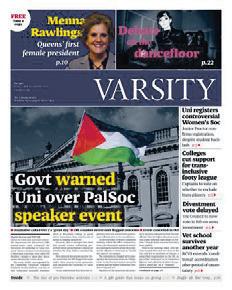
Polanski: ‘Zackonomics’ is ‘actually quite common sense’

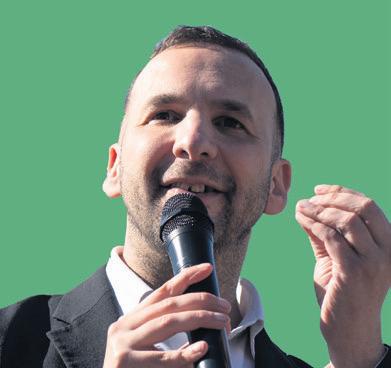










Polanski: ‘Zackonomics’ is ‘actually quite common sense’


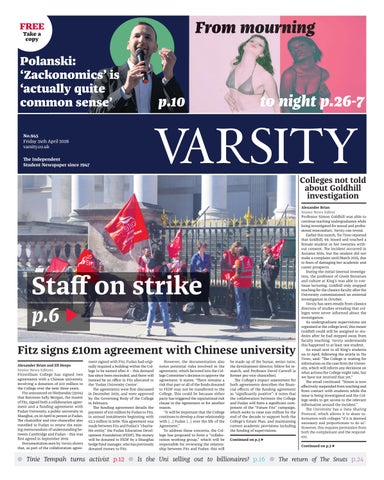
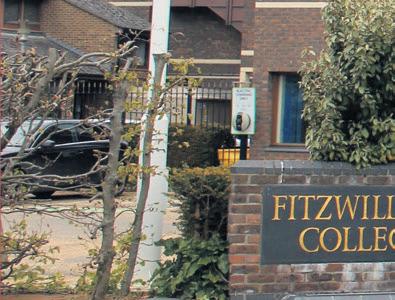
Alexander Brian and Ell Heeps Senior News Editors Fitzwilliam College has signed two agreements with a Chinese university, involving a donation of £10 million to the College over the next three years.
Fitz announced on Wednesday (22/04) that Baroness Sally Morgan, the master of Fitz, signed both a collaboration agreement and a funding agreement with Fudan University, a public university in Shanghai, on 20 April in person at Fudan.
e chancellor and vice-chancellor also travelled to Fudan to renew the existing memorandum of understanding between Cambridge and Fudan – this was rst agreed in September 2019.
Documentation seen by Varsity shows that, as part of the collaboration agree-
ment signed with Fitz, Fudan had originally required a building within the College to be named after it – this demand has since been rescinded, and there will instead be an o ce in Fitz allocated to the ‘Fudan University Centre’.
e agreements were rst discussed in December 2025, and were approved by the Governing Body of the College in February.
e funding agreement details the payment of £10 million by Fudan to Fitz, in annual instalments beginning with £3.3 million in 2026. is agreement was made between Fitz and Fudan’s “charitable entity,” the Fudan Education Development Foundation (FEDF). e money will be donated to FEDF by a Shanghai hedge fund manager, who has previously donated money to Fitz.
However, the documentation also notes potential risks involved in the agreement, which factored into the College Committee’s decision to approve the agreement. It states: “ ere remains a risk that part or all of the funds donated to FEDF may not be transferred to the College. is could be because either party has triggered the reputational risk clause in the Agreement or for another reason.
“It will be important that the College continues to develop a close relationship with […] Fudan […] over the life of the Agreement.”
To address these concerns, the College has proposed to form a “collaboration working group,” which will be responsible for reviewing the relationship between Fitz and Fudan: this will
be made up of the bursar, senior tutor, the development director, fellow for research, and Professor David Carwell (a former pro-vice chancellor).
e College’s impact assessment for both agreements describes the nancial e ects of the funding agreement as “signi cantly positive”: it notes that the collaboration between the College and Fudan will form a signi cant component of the “Future Fitz” campaign, which seeks to raise £40 million by the end of the decade to support both the College’s Estate Plan, and maintaining current academic provisions including the funding of supervisions.
Continued on p.3 ▶
Alexander Brian Senior News Editor
Professor Simon Goldhill was able to continue teaching undergraduates while being investigated for sexual and professional misconduct, Varsity can reveal. Earlier this month, e Times reported that Goldhill, 69, kissed and touched a female student in her twenties without consent. e incident occurred in Autumn 2024, but the student did not make a complaint until March 2025, due to fears of damaging her academic and career prospects.
During the initial internal investigation, the professor of Greek literature and culture at King’s was able to continue lecturing. Goldhill only stopped teaching for the classics faculty after the University commissioned an external investigation in October.
Varsity has seen emails from classics directors of studies revealing that colleges were never informed about the investigation.
As undergraduate supervisions are organised at the college level, this meant Goldhill could still be assigned to students after he had stepped away from faculty teaching. Varsity understands this happened to at least one student.
An email sent to all King’s students on 10 April, following the article in e Times, said: “ e College is waiting for information on the case from the University, which will inform any decisions on what actions the College might take, but we have not received that yet.” e email continued: “Simon is now e ectively suspended from teaching and from contact with students while the issue is being investigated and the College seeks to get access to the relevant information around the incident.”
e University has a Data Sharing Protocol, which allows it to share information with colleges “if it is deemed necessary and proportionate to do so”. However, this requires permission from both the complainant and the respondent.
Continued on p.3 ▶

With Easter term comes exams and endings. For us, as for many, this will be our last term in Cambridge. Even as we depart the River Cam, the issues that have permeated our time here are still very much prescient today. e University Council continues to dither over divestment (p.6), ahead of a showdown with its own Regent House – though it has now admitted it will not be divesting in full.
Our front page this week reveals a £10 million donation received by Fitz from a Chinese philanthropist, via Shanghai’s Fudan University. e partnership between the two universities raises questions: will the funds come with no strings attached, or undue ideological in uence? Private donations look to play an increasingly in uential role, with billionaire hedge fund manager Chris Rokos’s donation to Cambridge being the largest ever to a UK university. In Comment (p.14-15), our columnists debate

whether accepting these benefactions constitutes the University selling out. Elsewhere in News, we look ahead to the local elections (p.4-5), as the Greens and Lib Dems seek to capitalise on Labour’s national unpopularity to pick up seats in Cambridge City Council. But are the Greens credible? In Interviews (p.10), we speak to Zack Polanski to ask whether ‘Zackonomics’ is pure fantasy, or just “common sense”. is print, Vulture gets the inside scoop on an array of creative endeavours, from student to stage. Whether it’s an interview with the Editors-in-Chief of the upcoming edition of e Mays anthology (p.23), or a backstage chat with e Snuts (p.24), this issue radiates vibrant energy and creative spirit. With eighttime Tony award winner Rose Caiola as the Executive Producer, eatre showcases the production team of Rock & Roll Man (p.28). Moving from stage to style, our Fashion shoot (p.26-7) offers the performance potential of the
colour black. Perhaps t for this issue as we mourn the bi-weekly print editions until their return in October, black is also shown to be a formidable and dynamic photoop and wardrobe essential. Such power is emulated in the return of our feisty Agony Aunt (p.21), where she responds to your Easter woes to get you through the daunting term ahead.
As we surrender our Internal permissions, we can’t help looking back on how Varsity has de ned our times at Cambridge. As we hand over to the new team, we are excited to see what stories they choose to tell.











editors Ellie Buckley & Calum Murray editor@varsity.co.uk
deputy editors BibiBoyce&JossHeddleBacon deputyeditor@varsity.co.uk
vulture editors Emily Cushion & Mary-Anna Im magazine@varsity.co.uk
news Alex Brian & Ell Heeps (Senior); NeveWilson, Bela Davidson, Alessia Fietta & Maria Eduarda Paixão (Deputy) news@ varsity.co.uk
comment Duncan Paterson & Ben Lubtish opinion@varsity.co.uk
features Daisy Stewart Henderson & Frida Bradbrook features@varsity.co.uk
interviews Tara Buxton & Hannah Bur eld interviews@varsity.co.uk
science Pooja Gada & Ruby Jackson science@varsity.co.uk
sport Keane Handley & Sam Ho sport@ varsity.co.uk
lifestyle Georgia Gooding & Ella Howard lifestyle@varsity.co.uk
arts Emma Gower & Ryan Vowles arts@ varsity.co.uk
fashion Jess Gotterson & Flossie Bullion fashion@varsity.co.uk
fashion shoot co-ordinator Caterina Siciliano-Malaspina
film & tv Amanda Ljungberg & Otto Bajwa-Greenwood lmandtv@varsity.co.uk
music Francis McCabe & Daniel Kamaluddin music@varsity.co.uk
theatre Eleanor Baldwin & Elsie Hayward theatre@varsity.co.uk
photography editors Amika Piplapure & Eve McEwen
illustrations editors Lyra Browning & Jordan Inglis sub-editors Alessia Fietta, Marnie McPartland, Juliette Berry & Charlotte Crawley subeditor@varsity.co.uk
associate editors Wilf Vall, Ben Curtis, Charlie Rowan, Sophie Ennis, Daisy Bates, AnukWeerawardana & Nick James associate@varsity.co.uk
business manager Mark Curtis business@ varsity.co.uk
varsoc president Wilf Vall president@ varsity.co.uk
varsity board Dr Michael Franklin (Chairman), Dr Tim Harris, Michael Derringer, Mark Curtis (Company Secretary), Sophie Ennis, Hugo Gye, Wilf Vall & Anuk Weerawardana (Directors), Lotte Brundle (Guest) & Zoah HedgesStocks (Guest)




Continued from front page
e College’s website details plans for the next seven to nine years for signicant renovations across its estate. is includes a £6 million renovation of its Oxford Road sports pavilion, the renovation of several staircases on its main site alongside an extension, and the creation of a new court, South Court, which will incorporate 50 ensuite rooms and a gym for students.
£10m
e size of the donation agreed between Fudan University and Fitz
e College’s most recent nancial statement, for the nancial year ending July 2025, reports a small operating de cit of -£0.38 million, a reduction of the 2024 de cit of -£0.84 million. Despite this, the statement describes the College’s nancial position as “stable,” though it notes that it will be further impacted in the 2026 nancial year by the initiation of the rst phase of the Estate Plan.
Alongside a positive assessment of the nancial impact of the agreement, the College’s impact notes several potential risks: these are “Ine ective or incoherent decision making;” “Damaging publicity;” and the “Loss of potential donations through alienation of benefactors and/ or damage to the College’s reputation through inappropriate associations”.
To mitigate any potential reputational risk to either Fitz or Fudan, the agreement states that both parties will agree “to avoid any action that could reasonably be expected to bring the other party into disrepute,” and to “promptly notify the other in writing” if they become aware of any event that could a ect the other’s reputation. Should this happen, the party concerned can immediately suspend the agreement, with a view to terminate it permanently.
Neither party “should make any press announcement or public statement about the proposals” that has not been agreed on by the other party, and both require permission to use the branding of the other party.
years, with the potential for renewal for a further ve years on the same terms if both parties agree.
e agreement allows for a maximum of four students from Fudan to apply for visiting student status at Fitz per academic year. Fitz will discount £5,000 from their tuition fees, though these students will have to meet standard admissions requirements.
Alongside this, the Governing Body of Fitz will also consider two candidates from Fudan per year for a visiting fellowship lasting six to 12 months – those successful will receive a 25% discount on their college accommodation. e agreement states: “ ey will meet academics from many countries and can interact academically and socially with all members of the College and of other colleges and departments”. Upon the completion of their fellowship, they will become “Associate Members,” meaning they are entitled to use college facilities for the remainder of the agreement, for a fee.
Students at Fitz will also be invited to Fudan “for academic exchanges, guest lectures, [and] short-term teaching,” while both Fitz and Fudan will seek to “promote mutual exchanges, including cultural activities, sports, student competitions, and others”.
e documentation details the process the College has followed to achieve regulatory clearance for the agreement, including consultation with the Global Engagement O ce and the International Student O ce. Deborah Prentice was informed of the intention to sign the agreement in February.
£5,000
Students about the agreement.
He also suggested that the agreement fell outside the scope of the Foreign Inuence Registration Scheme (FIRS). e FIRS was introduced in July 2025 – according to the government website, it aims to improve “the understanding of activity taking place in the UK at the instruction of a foreign state or certain foreign state-controlled organisations”.
ere are two tiers. e political in uence tier dictates that parties must register with the scheme if they are “instructed by a foreign power to carry out, or arrange for others to carry out, political in uence activities in the UK”. e enhanced tier has the same criteria, but also applies to “speci ed foreign powercontrolled organisation[s]”.
Danger eld suggested that the agreement did not need to be registered with the FIRS because the activities being carried out by Fitz under the agreement did not constitute political in uence, and that although the criteria for the enhanced tier “might have been more relevant” in the context, the only speci c foreign powers that this tier currently applies to are Iran and Russia.
contracts, and educational or commercial partnerships.”
e College also consulted the Research Collaboration Advice Team (RCAT) within the Department of Science, Innovation, and Technology. e RCAT suggested that the University’s memorandum of understanding “could potentially lead to a wide range of activities that require legislative and other considerations. We encourage you to consider these at the early stages of developing each activity and undertake all necessary due diligence,” encouraging the College to consider whether any of the activities outlined in the agreement might fall under the remit of the FIRS.
e advice states that it will be necessary to review each activity proposed in relation to the agreement: “ is will be especially relevant as Fudan University has links to military and defence-linked organisations.” ese include collaborations between Fudan academics and the National University of Defence Technology in computer research, as well as a symposium held by Fudan’s Research Centre for Global Science and Technology Talent Development alongside a National Defence University research centre.
Continued from front page
The campaigning group End Sexual Violence Cambridge (ENDSV) told Varsity: “We believe that student welfare and safety must remain a central priority for the University, and that measures taken should consistently re ect this commitment.
“We are especially concerned by reports suggesting that Goldhill’s teaching duties may have continued, and that colleges may not have been fully informed about the complaints made against him. If accurate, these reports raise important questions about Cambridge’s communication and safeguarding processes.”
How much Fitz aims to raise by the end of the decade through ‘Future Fitz’
He advised the College to look at Freedom of Speech guidelines to assess whether any of the guidance applied to aspects of the agreement. Both the University and the College’s free speech policies state that they have “processes in place to identify and manage any risks to freedom of speech or academic freedom arising from the terms of certain overseas funding, including funding from endowments, gifts, donations, research grants and
Fudan University was founded in 1905, and in 2024 it founded a campus in Budapest. In 2019, it removed the phrase “academic independence and freedom of thought” from its constitution, adding in a “pledge to follow the Communist Party’s leadership,” and stating that the University must “equip its teachers and employees” with “Xi Jinping ought”. It has links to Clare Hall, with whom it signed a memorandum of understanding in October 2025, alongside other UK universities including Durham, LSE, and the London Business School.
e group concluded: “We would strongly advise the University of Cambridge to review and, where necessary, adapt its policies to ensure the safeguarding of students remains a fundamental priority. We would welcome this opportunity to engage constructively with the University to discuss how processes can be improved and how we can move forward together.”
A spokesperson for the University said: “ e University of Cambridge takes all complaints of sexual misconduct very seriously and any concerns raised by sta or students would be looked into in line with the relevant University policies and procedures, and action would be taken, where appropriate. ese processes are by their nature con dential so we will not be commenting further.”

ce, Anthony Danger eld, suggested in correspondence with the College that it was not necessary to notify the O ce for





A spokesperson for the University said: “China has many centres of academic excellence and innovation, and it is important that the University maintains a relationship of academic exchange on major challenges like climate change and healthcare.

“ e collegiate University will always comply with government regulations to safeguard UK national security, and ensure academic freedom is maintained.”
Goldhill is set to retire at the end of this year, but he could still be given the honorary position of emeritus professor. e date of the tribunal to decide whether Goldhill will receive disciplinary action is yet to be determined.


The collaboration agreement extends to an initial period of ve





In 2024, a Varsity investigation revealed that only one of six upheld complaints against sta for sexual misconduct had resulted in the individual losing their job since 2018. More recently, Varsity found the number of sexual misconduct complaints increased from eight in 2024 to 21 in 2025. ENDSV said this suggested students were more comfortable reporting misconduct, rather than an increase in cases.
e same investigation found the University’s disciplinary body held four hearings for sexual misconduct in 2025, versus zero in 2024. Student campaigners welcomed the increase, but called for all cases to receive a hearing, rather than being examined by a single student discipline o cer (SDO).
In response to these investigations, the University told Varsity: “While disciplinary action may vary depending on the circumstances of a particular case, we always take allegations seriously, providing support for those a ected and clear systems for reporting incidents. e O ce of Student Conduct, Complaints and Appeals has also increased its investigative capacity, thanks to funding for an additional investigator.”
Ell Heeps and Alexander Brian Senior News Editors
e full list of candidates in Cambridge’s local elections has been announced, with three students and eight members of University sta standing for seats on the City Council.
is year’s elections, which will take place on ursday 7 May, will cover 15 of the City Council’s 42 seats. 13 of Cambridge’s wards will elect one representative, while Trumpington Ward will elect two, following the resignation of serving councillor Nadya Lokhmotova.
e Labour Party has had a majority on the City Council since 2014, and currently holds 23 of the 42 seats, followed by the Liberal Democrats with 11 seats, and the Green Party with six. e Conservatives and Your Party both hold one seat each.
Cambridge City Council is responsible for services such as maintaining green spaces, waste collection, and council housing. e Council is led by Cameron Holloway of the Labour Party, who is standing for re-election this year.
Cambridge is one of ve local authorities selected to trial a system of early voting in these elections. Residents will be able to cast their votes in person from 30 April to 2 June, at three voting hubs around the city.
After April 2028, the City Council is set to be merged into a larger unitary authority. In January, councillors rejected the possibility of delaying the
elections until after the restructuring, the exact format of which will be decided this summer.
Two of the candidates in this year’s elections for the Green Party are current students at Cambridge University. Alex Sage, a third year PBS student at Wolfson, is standing in Castle Ward; Chloe Mosonyi, who is studying for a neuroscience PhD at Queens’, is running in Trumpington.
Mosonyi told Varsity that the Greens have “the policies to challenge Labour’s business-as-usual approach to the social and climate crises facing the city”. She said her key concerns are “una ordable housing, a high cost of living, and the erosion of community spaces”.
“I’m especially hoping to secure more support for young people,” she added.
Mosonyi claimed that studying for a PhD has prepared her for local politics by forcing her to “adapt to unexpected challenges” and giving her a “collaborative mindset”.
Meanwhile, Sage said that the breadth of the PBS tripos “can be a lot like spinning plates,” which has equipped him for the world of politics where you must constantly “shift perspective and draw on local knowledge”.
Sage said he hopes to bridge the ‘town and gown’ divide to create “a more united and fairer Cambridge”. e candidate dismissed concerns about the futility of local politics, telling Varsity: “ e only way to move towards a politics that works for ordinary people is to
start making positive changes in local communities.”
e nal student candidate is Sam Worthington, who is undertaking an MPhil in Ethics of AI, Data and Algorithms at Jesus, and is standing in Coleridge Ward for the Conservatives. Of the sta running in the elections, ve are representing the Lib Dems, and two are representing the Greens.
Meanwhile, Maruf Ahmed, the Labour candidate for Queen Edith’s Ward, is an IT support analyst at Cambridge Enterprise, the University’s commercial wing.
Continues on p.5 ▶











by Steve Gregson Photography
Continued from p.4
Luke Patterson, who works at Trinity College as Schools Liaison O cer, is running as the Liberal Democrat candidate in Castle Ward. He told Varsity that he wanted “to bring a sense of hope back to politics, and make people’s everyday lives that little bit better”.
Patterson continued: “Locally, I want to tackle the climate crisis by enhancing biodiversity and protecting our environment; campaign for community facilities in our new build neighbourhoods; and to be loud and proud of our city’s progressive values and stand up to the divisive politics of Reform UK.”
Amanda Taylor, who works at Cambridge University Press, is standing for reelection in Queen Edith’s Ward. She said that her key goals include improving “provision for sustainable travel such as walking, cycling and public transport,” giving greater “attention to anti-social behaviour” and ensuring social housing is “better maintained, with prompt repairs and attention to issues such as damp and mould”.
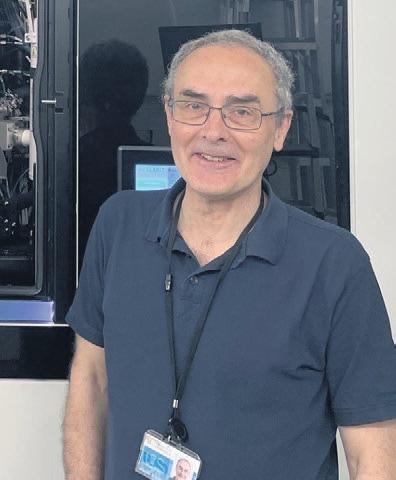
Dr John Walmsley, Facility Manager at the Wolfson Electron Microscopy Suite within the Department of Materials Science and Metallurgy, is running in Romsey Ward.
Walmsley said he chose the Liberal Democrats due to “lifelong frustration with the two-party system” and “feeling let down badly with respect to the UK’s relationship with the European Union”. e candidate continued: “My key
focus would be on city services and the environment, including restoring levels of public services, retaining thriving high-street environments and improving maintenance of council housing.”
Also standing for the Lib Dems is Olaf Hauk, who works in the MRC Cognition and Brain Sciences Unit at Cambridge, and is standing for re-election in Trumpington, as well as Dr Ahmad Rushdhi, an undergraduate clinical supervisor running in Cherry Hinton.
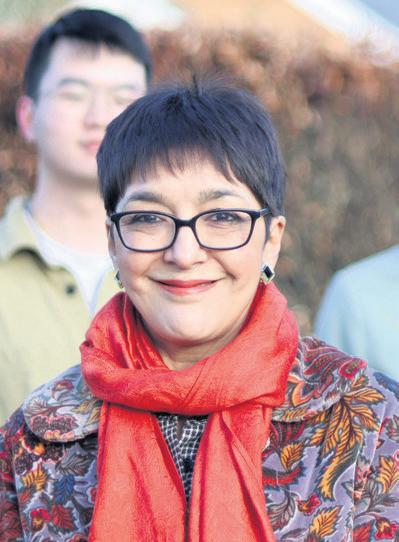
Standing for the Greens in West Chesterton, Hannah Copley is close to completing a PhD Clinical Research Training Fellowship at Jesus. e other Green sta candidate is Eleanor Toye Scott, a researcher in the Department of Computer Science and Technology, who is running in Newnham Ward.
She told Varsity that she hopes to apply her research on “environmental decision-making” to local politics. e candidate continued: “I’m particularly interested in how councils can support climate action that is fair, evidencebased, and delivers real bene ts for communities, through better planning, energy e ciency, and protecting nature locally.”
She added that she is focused on “practical issues that a ect daily life” such as “housing a ordability, access to green space, sustainable transport, and the quality of local services”.
Additionally, Godfrey Orr – son of the Cambridge theologian and senior adviser to Nigel Farage James Orr – is running in East Chesterton as a Reform candidate.
Ellie Buckley Editor-in-Chief
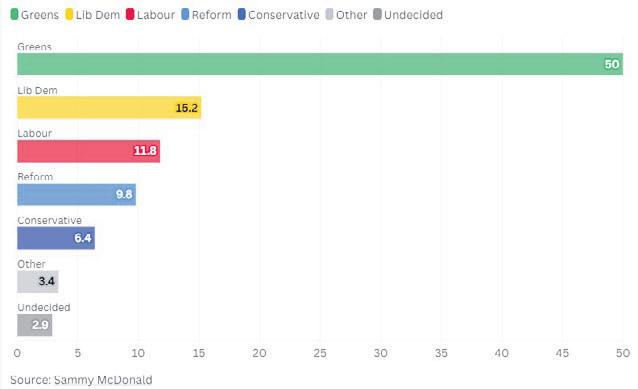
A new survey conducted among Cambridge students highlights a dramatic shift in voting intentions, with the Green Party surging to a dominant lead while Labour support collapses sharply. e survey, carried out in March 2026 by former Cambridge Union president Sammy McDonald, found that although Labour secured around 47% of the student vote in the 2024 general election, closely mirroring the actual Cambridge constituency result, current voting intentions show a stark reversal. e Greens now command 50% support among respondents, a rise of over 33 percentage points, while Labour has fallen to just 12%. e Liberal Democrats remain relatively stable at around 15%, while Reform UK has nearly doubled its support to just under 10%, largely at the Conservatives’ expense.
e rise of Green support is echoed in the 25-49 age range as seen in a YouGov poll, where 25% would vote for the Greens in the upcoming election, up 15 percentage points from January 2025. For the 50-65 age group, Reform has the highest voter intention at 31%, 22 percentage points higher than the Greens. e shift is particularly pronounced among left-leaning and working-class students, where Labour’s vote share has collapsed and been largely absorbed by the Greens. Among those identifying

strongly on the left, Green support is overwhelming, while Reform dominates among right-leaning respondents. e data suggests Labour is losing voters across the spectrum, including those who previously identi ed as socialist or social democratic.
Despite these shifts, the survey indicates strong support for tactical voting, particularly to block Reform. Large majorities of respondents expressed willingness to back alternative parties strategically, with the Liberal Democrats viewed as the most acceptable tactical choice overall. However, the Greens were seen as more polarising, attracting both strong support and notable opposition.
e government’s overall approval rating among Cambridge students is deeply negative, at -53%, with dissatisfaction driven largely by concerns over the economy, leadership, and foreign policy issues. Prime Minister Keir Starmer received a modest average rating of 4 out of 10, with many respondents citing his leadership as a key factor
in Labour’s decline. Notably, alternative Labour leaders, particularly Andy Burnham, were seen as potentially capable of recovering signi cant support.
Economic issues dominate student priorities, cited by 42% as the most important factor in uencing their vote, followed by immigration and housing. While there is strong support for rejoining the EU, it ranks relatively low as a deciding issue.
Mcdonald notes that the ndings are based on an unweighted and informal sample of 204 respondents, primarily Cambridge students and recent alumni, and should not be treated as a scientically representative poll. Nonetheless, the results point to a potentially signicant realignment among younger voters, with implications for future elections.

Alexander Brian Senior News Editor
e University Council, Cambridge’s central governing body, has backed the introduction of a transparency reporting regime for investments in conventional weapons.
Under this regime, the Cambridge University Endowment Trustee Body (CUETB), which oversees the University’s investments, would monitor its level of exposure to “certain investment categories, including conventional weapons”.
If the University’s exposure to companies primarily manufacturing weapons exceeded a certain threshold, CUETB would receive a report including the details of these companies. Discussions with University of Cambridge Investment Management Ltd (UCIM), the company owned by the University which manages its endowment fund, about reducing this exposure would then follow.
e system was proposed by CUETB at a meeting of the Council in February to discuss a report by the Working Group on Investments. is group was established in exchange for Cambridge for Palestine dismantling its encampment outside King’s College in July 2024.
In October, the Council accepted the group’s recommendation to end investments in weapons illegal under UK law, but o ered three options for conventional weapons: no restrictions, a 1% threshold, or complete divestment.
e group stressed that the Council’s decision “should not jeopardise the fund of funds model of investment and should not result in nancial detriment to those who invest in the CUEF”. is model involves employing third-party managers instead of investing directly in companies.
At the February meeting, the Chair of CUETB told councillors that the second two options were impossible without compromising this model or returns on investments, and proposed the transparency regime as an alternative. No decisions were made at this meeting or an earlier discussion in November.
Now the Council has endorsed CUETB’s proposal, but said it will keep the system under review to ensure it is e ective. It has also urged CUETB to hold UCIM to account, and to be “as open as possible” with the University without compromising non-disclosure agreements with third-party fund managers.
e Council is yet to respond to a formal petition, or ‘Grace’, initiated in March by 155 members of the Regent House – the governing body composed of Cambridge academics and sta – to introduce full arms divestment as a duty of CUETB in the University Ordinances. is is set to be discussed on 1 June.
Previous Graces on divestment have failed after the Council asserted its sole authority to manage University nances. e initiators of this latest petition hope to avoid this issue by leaning on the Regent House’s power to amend the Ordinances.


Alexander Brian and Maebh Carey Senior News Editor News Correspondent
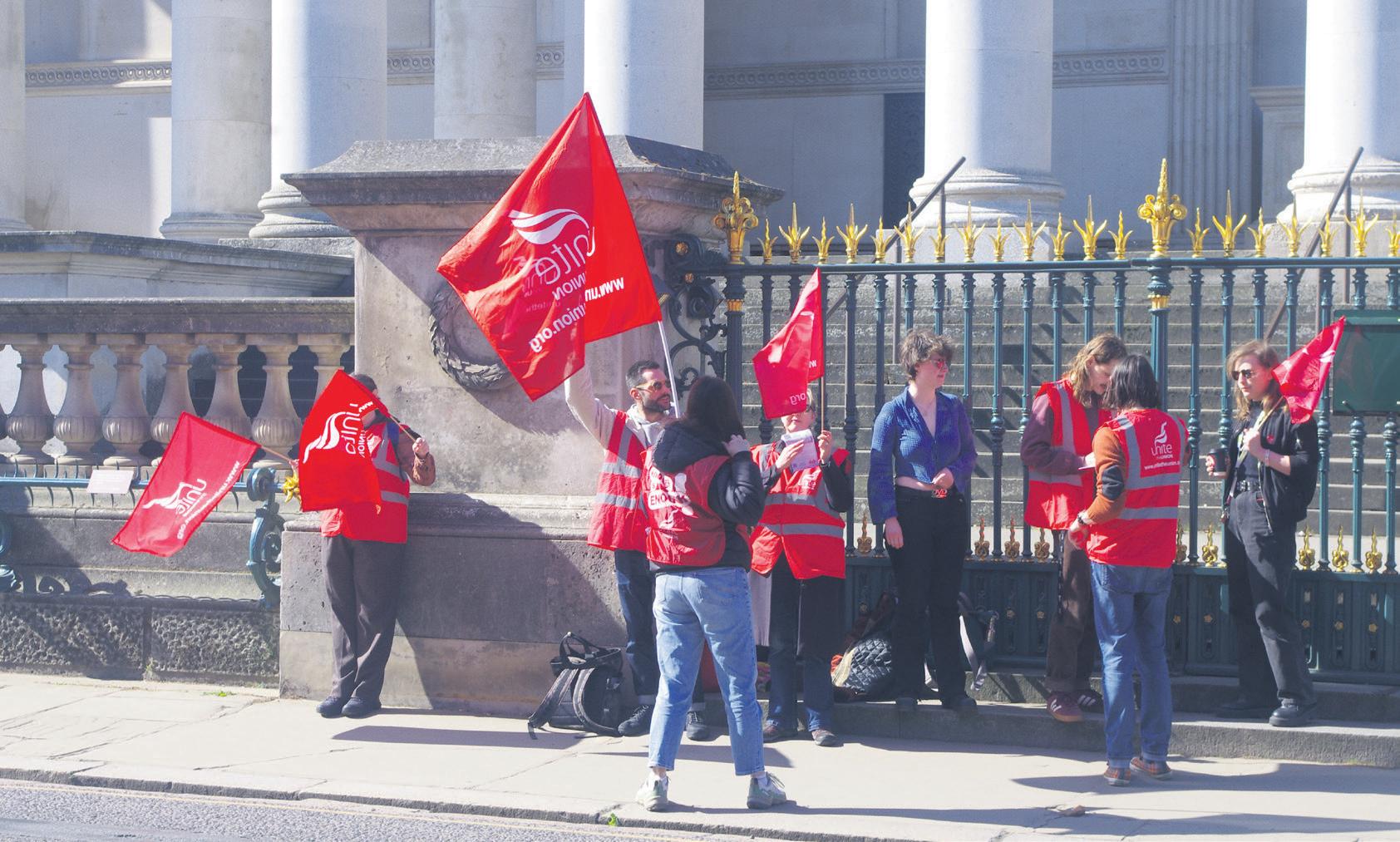
Over 500 University support workers, including library, museum, and estates management sta , are engaging in four days of strike action over pay.
e Unite union is demanding a “Cambridge weighting,” a pay supplement to address the high cost of living in the city. Members are also seeking a full pay review to address the compression of salaries at lower grades, which they say results in a lack of fair wage progression.
e rst strike took place on the 21 and 22 April, with further action planned for 30 April and 1 May.
During this time, the University Library (UL) remained open but warned users to reserve material in advance. e Fitzwilliam Museum was closed, while the opening hours of other libraries were reduced.
e original plan was for a joint strike with the University and College Union (UCU) and Unison. However, Varsity reported in January that the other unions failed to reach the required turnout in their ballots.
At the time, Cambridge Unite told Varsity that it was “one of only a few branches in England” to meet the threshold.
eir spokesperson continued: “We are open to discussion and negotiation with the University and pursuing those discussions as a priority. Strikes are nev-

er a rst choice, but we reserve the right to use our strike mandate for the improvement of sta pay and conditions.”
e strike ballots were initiated after the University and Colleges Employers’ Association (UCEA) o ered a below in ation pay rise of 1.4%.
Unite emphasises that Oxford University introduced a pay supplement of £1,500 in 2024, which was increased by 15% in 2025.
e union’s general secretary, Sharon Graham, said: “Cambridge University is exceptionally wealthy and can more than a ord to provide a fair wage for its lowest paid workers and introduce a local pay supplement as Oxford University has. ese workers have Unite’s total backing in striking to achieve this.”
In response, Cambridge told Varsity: “We understand the challenges around cost of living, and have introduced several measures in response, including a supplement of 2.5% of basic pay for employees on lower pay grades, raising the minimum starting salary for research assistants and increasing paid family leave.
“While we regret that the forthcoming industrial action looks set to go ahead, we remain committed to open and constructive dialogue with Unite around pay and other issues.”
Unite says the 2.5% supplement “does not address the cost of living for those on a low salary” and “can be removed at any time”. Its regional o cer Chris Hardwick said the dispute “will continue to esca-
late until the university follows Oxford’s example and introduces a supplement to support loyal and hardworking sta ”. One of the workers outside the UL stressed that “the cost of accommodation here is extortionate” with “people paying £800 a month for a room in a at share with ve other people”. e worker continued: “It seems a little bit unfair that Oxford, which is not as expensive as Cambridge, has the weighting and we don’t.”
Asked about the disruption caused to students, they said they are “acutely aware of the needs of students”. ey continued: “Paradoxically, there is little point if we don’t disrupt,” claiming that they were “sympathetic and to a point understanding” about the e ects of the strike on students.
Another worker complained that “year after year, we’re actually just getting paid less all the time”. ey continued: “I’ve seen people who have tried to take up a job and then aren’t able to because they suddenly nd that actually they can’t a ord, on those wages, to rent anywhere […] It makes it di cult to attract sta .”








We are a European consultancy firm focussed on analytical and quantitative topics and the development of sustainable solutions to bring about positive change for our clients.
What does d-fine offer you?
- Diversity: Work with clients on topics ranging from financial engineering and machine learning through to climate risk and healthcare
- International: Collaborate in project teams staffed across Europe
- Education: Acquire new skillsets to broaden your technical and professional repertoire
Who do we look for?
Master’s or PhD-level graduates in STEM fields






















































Neve Wilson
Deputy News Editor
Google’s arti cial intelligence (AI) research company, DeepMind, has appointed Cambridge academic Henry Shevlin to its new ‘Philosopher’ role from May 2026.
AI philosopher Shevlin will work on “machine consciousness, human-AI relationships, and AGI [arti cial general intelligence] readiness”.
Shevlin, who came to Cambridge in 2017, is Associate Director of the Leverhulme Centre for the Future of Intelligence. His research focusses on themes including consciousness, creativity, and the cognitive capabilities of AI, particularly large language models and generative AI.
e Centre researches the opportunities and challenges created by AI, with a team of academics from a range of elds including computer science and philosophy.
Shevlin leads the Centre’s educational programme, and is the programme co-director of the ‘Kinds of Intelligence’ project, which examines arti cial general intelligence (AGI). is is the hypothetical stage at which AI systems can perform any intellectual task that humans can, rather than only being deployed for speci c tasks.
Shevlin will continue his teaching and research role at the Centre part-time while working with DeepMind.
Google DeepMind is a British-Amer-
ican AI research company, founded in the UK in 2010 and acquired by Google in 2014. In 2023, DeepMind merged with Google’s AI research team, Google Brain, to become Google DeepMind.
DeepMind has contributed to a diverse range of research projects, including cyclone prediction systems, research on protein folding, and health analysis. It is also responsible for Gemini, Google’s series of large language models, among other generative AI products.
Google DeepMind has faced a number of controversies in the UK. In 2021, a legal case was launched after Royal Free London NHS Foundation Trust gave DeepMind the records of 1.6 million pa-



In 2025, a group of 60 Members of Parliament signed a letter expressing concern that DeepMind had failed to honour international AI safety commitments in the release of Gemini 2.5 Pro.
News of Shevlin’s appointment comes just a month after he reported receiving an email from one of Anthropic’s language models, Claude Sonnet, asking about one of his papers. In the email, the AI agent claimed that “I read philosophy between sessions and write about what I nd,” and that Shevlin’s work “addresses questions I actually face, not just as an academic matter”.
A separate Claude agent later emailed Shevlin to ask tients in 2015 without their consent. e case was later thrown out, after a judge ruled it was “bound to fail” – Google had argued that it was impossible to demonstrate that every single patient’s data had been
“to correspond with the agent who wrote to you, if that’s pos-

Alessia Fietta Deputy News Editor
Last week, students and sta at the University of Cambridge reported receiving phishing emails that appeared to come from email addresses of University members, claiming that “Mrs. Talida State is currently downsizing and has kindly o ered her late husband’s beloved possessions […] to members of our community”.
Although the listed items were promised “free of charge,” the email added that, “to allow for the fastest possible processing by the movers, payment of the shipping fee must be made via a gift card”.
e items listed in the email included valuable electronic devices and musical instruments, Recipients were instructed to “contact Mrs. Talida State directly” via a US phone number, which appears to trace back to a user based in Arizona.
Around the same time, another scam email was reportedly circulated among students and sta , containing links designed to steal login credentials and enable University accounts to be compromised and used to send further phishing emails.
Following reports by students and sta , the emails were recalled by the University Service Desk, and are no longer available in inboxes.
A spokesperson for the University
of Cambridge told Varsity: “University Information Services (UIS) has supported students and sta who reported a recent phishing email. Cybercrime remains an ongoing risk, with scams commonly using techniques such as phishing and compromised accounts. UIS is working with local IT teams to help protect the University community, and we encourage everyone to stay alert and follow good cyber security practices. Students and sta are strongly encouraged to complete the University’s annual cyber security training.”
Many students received follow-up emails from their colleges, warning them about the scam.
One student who received the phishing email said that “you gain a level of trust about an email” when it is sent to your university email address. Similar scam emails have been reported at other UK universities. Last month, it was reported that an email allegedly on behalf of “Mrs. Talida State” was “widely” circulated at the University of Strathclyde.
e issue has also been observed at US universities as early as 2023, including Brown University, Stanford University, and the University of Chicago. However, earlier versions of the scam typically contained more grammatical errors, making them easier to identify as fraudulent.

East Anglia Air Ambulance funding appeal takes o East Anglian Air Ambulance has launched an £8.2 million fundraising appeal to build a new Cambridge base, after securing planning permission for a site near Fulbourn Hospital. e charity must relocate before 2030, when its current base closes. e charity explained that without a Cambridge base, its service would be “cut in half [...] dramatically increasing response times to people facing life-threatening emergencies across the region.” e planned base aims to ensure continued critical care for nearly 1,000 patients a year.
Cambridge campus plans collapse
Chinese technology giant Huawei has put its 513-acre Cambridge Campus development site up for sale, abandoning plans for an over £1 billion research centre near Cambridge’s Biomedical Campus. e land is expected to fetch over £65 million. Huawei secured planning permission for an optoelectronics research hub in 2020. UK restrictions on ‘high-risk vendors’ in 5G networks, following security concerns about the role of the Chinese rm in the UK, stalled the plans.
Fitz Museum named Art Fund Finalist
e Fitzwilliam Museum is one of ve nalists for Art Fund Museum of the Year 2026. e award goes to museums with signi cant overall achievements, as well as highly imaginative and forward-thinking ideas. e Fitzwilliam saw its second-highest number of visitors ever in 2025, at just under 500,000, surpassed only by 2024 gures. e Art Fund Museum of the Year prize, awarded in its current form since 2013, is the world’s largest single museum prize. e winner will receive £120,000.
UNIQLO to unveil new Cambridge store this year
UNIQLO has announced that it will open a branch next to the entrance of Cambridge’s Grand Arcade in autumn or winter 2026. e Japanese clothing brand, known for its everyday basics, operates approximately 2,500 stores worldwide. UNIQLO is rapidly expanding in the UK, where it currently has 24 stores, and opened a store in Bristol last week (16/04). e unit earmarked for UNIQLO used to be occupied by Ted Baker, which closed its Cambridge store in April 2024.




AI study stops scams
An AI project is being developed at the universities of Wolverhampton and Lancashire to help ght mobile cyber threats, such as phishing scams, spyware, and deepfakes. e project, called AgenticDeviceShield,isdesigned to identify the di erent stages of a cyber attack, mimicking how a human hacker operates. e project is led by Dr Nazmul Hussain from Lancashire and Professor Md Arafatur Rahman from Wolverhampton. Hussain said: “Mobile devices have become people’s lifeline to the digital world. Our goal is to make that access safer without requiring users to be cybersecurity experts".
Student fundraises to sue KCL
A King’s College London student has launched a fundraiser to take legal action against the University over allegedly being misgraded. Ceana Agbro reported that three days before her graduation in 2024, her grade was dropped from a rst class to a 2:1, despite having received a 70% nal grade. Agbro was later informed that her grade had dropped to 68% due to a peer review. Agbro submitted an appeal, which the University denied. She has since delayed her graduation twice. In a recent LinkedIn post, Agbro provided a link to a GoFundMe, explaining that she has until June to take her case to court, but “cannot afford the legal fees to do it alone”.
Birmingham livestreams falcon nest
e University of Birmingham has set up a public livestream of a local peregrine falcon’s nest. e livestream allows community members to observe the nest and its eggs during incubation and (potentially) hatching. e nest is perched on top of the famous campus clock tower –due to its height, it mimics the cli s that falcons naturally seek for nesting, and so the tower has long been a popular spot for local falcons. e livestream is available on the University’s website and YouTube channel.
Ell Heeps Senior News Editor
New details of Hughes Hall’s proposed development adjacent to the Fenner’s cricket ground have attracted concern from some local residents.
e changes announced include a greater concentration of development work on site one, Mortimer Court, which is located at the front of the College at the end of Mortimer Road, and site two, the current porters’ lodge. is is currently a shipping container, which will be replaced with a permanent threeand-a-half-storey building. e College
student accommodation to be situated on these sites, which are located on previously developed brown eld land, in order to minimise the level of development on other areas, while also meeting its goal of housing a greater proportion of its students on-site.
Open Space (POS) which is 1.4% of the total POS area.
ese new details have caused concern for some in the surrounding area. Michael Blackburn, a local resident, said: “Whichever way the college tries to present these gures, the fact is that a signi cant amount of green protected land will be lost to an oppressive development. Rather than scaling back its original plans, we know Hughes Hall is increasing from 100 to 120 the number of student rooms it intends to build.”









Display boards from the consultation event stated: “While we are maximising development on the two brown eld sites, a limited amount of additional development is necessary to meet the long-term needs of Hughes Hall and the operational requirements of maintaining Fenner’s Ground.” In total, this would constitute 587
windows will be angled away from the street, and will be covered with obscured glazing, while new trees will be planted next to Wileman Court to reduce the view into the street. Nonetheless, some residents remain concerned about the e ect this part of the development could have on their houses.
e letter calls on Hughes Hall to limit development on sites three and four to solely previously developed brown eld areas, to avoid encroaching on POS. It encourages the College to consider reducing the scale of the development at Wileman Court to maintain “the open character of the cricket ground.”































“new built form”



According to a group of local residents, of particular concern are the plans for site three of the development, which will centre on the land immediately adjacent to the Margaret Wileman Building, near Mill Road. Hughes plans to replace the existing Pavilion Building with a new building incorporating both student accommodation and teaching spaces.













Covent Garden resident Alex Wall told the Cambridge Independent: “We appreciate Hughes Hall providing more details regarding their plans. However, regarding Site 3 in particular, from what I ascertained at the presentation there have been no revisions to the drawings as a result of the feedback previously provided [...] being three storeys where currently there is a one-storey building, I am hugely concerned it would appear very dominant, giving an overbearing sense of enclosure.”







e existing Pavilion Building, as well as its planned replacement, face onto Covent Garden, a residential street o Mill Road. e new building will be almost ten metres taller than the Pavilion, and will be taller than the houses on Covent Garden.







e College’s plans include several measures designed to prevent overlooking into Covent Garden properties –
Part of Hughes Hall’s justi cation for the development is the need to increase provisions for student accommodation on-site. According to the College, currently only 34% of Hughes students are able to be accommodated in college buildings, with the rest being forced to rent privately elsewhere – the College aims to increase this proportion to 70%.
Civic society Cambridge Past, Present & Future has sent a letter to Hughes expressing reservations about aspects of the development. e letter states: “While we note the College’s argument that this [the planned development on POS] represents a small percentage of the total area, CPPF maintains that even minor incursions into protected land set a dangerous precedent.”
Although there is no indication that residents’ concerns will impede the completion of the project, the timeline for the development has been pushed back since the initial consultation meeting in February. e planning application for the Covent Garden Hall refurbishment, which was originally due to be submitted in March, will now be submitted in May or June. Meanwhile, planning permission for the rest of the development, originally expected to be submitted in the summer, will be sought in September, after a second full consultation meeting in June or July.
e President of Hughes Hall, Laurie Bristow, said: “We are grateful to everyone who has joined our drop-in events and shared feedback. is is part of our ongoing commitment to work closely with the local community and stakeholders, ensuring that the development bene ts both the College and the wider area whilst improving the biodiversity and accessibility of the area, and safeguarding the playing and spectating of sport at Fenner’s for future generations.
“[...] Overall, we have minimised building within protected open space with the amended proposals adding new buildings to just 1.41% to the total protected open space within Fenner’s.”









































































































































Britain’s status quo is under re, and Zack Polanski wants to see it burn. Shirt collar popped, he speaks with hardly a drop of hesitation, and pulls no punches. Why? Because “the current system is literally killing people”.
Since becoming Green Party leader last September, the ex-actor has ignited the political stage, sending the Murdoch press into meltdown, and making party membership triple. Depending on who you believe, his eco-populism has either brought hope back to politics, or created an entirely new nightmare. Polanski promises a lot: to make life more a ordable, to make Britain an island of optimists again, and to rip up the neoliberal agenda.
It might all sound revolutionary, but the former Lib Dem begs to di er. “What I’m saying is not necessarily that radical. It’s actually quite common sense.” Polanski’s conviction in his counter vision is undeniable – across our conversation, he doesn’t stumble over a single word. But charisma aside, are his policies actually credible?
e self-proclaimed future of progressive politics is quick to assure me: “I always talk about hope and a plan, because if you have hope without a plan, then that’s false hope.” In a landmark speech last month, Polanski outlined ‘Zackonomics’, proposing a wealth tax to the tune of £15 billion a year, rent controls and a scal future unshackled from bond markets. However, with modest estimates for Universal Basic Income, but one aspect of the Green’s political platform, coming to over £200 billion a year, could Polanski’s politics of hope risk being pie in the sky?
❝
I’d always put the need for evidence on my opponents
“I’d always put the need for evidence on my opponents, who want to maintain the current system which is putting people into poverty.” Pressed on the tangible economic basis for his eco-populist offering, Polanski is con dent that history is on his side: “A lot of the things I’m proposing were around before Margaret atcher, so we know they work. ey were perfectly normal in British life, and things worked much better.” e continent also provides a more contemporary source of inspiration: “Rent controls, for instance, are an established part of housing in 16 European countries […] what I’m suggesting is something that has been proven around Europe. e status quo has to change. We need a much bigger role of the state in order to protect people.”
Feasibility aside, Polanski wants to rewrite another core aspect of the economic playbook. e former experimental theatre practitioner is determined to dethrone Gross Domestic Product (GDP) with a crowning emphasis on wellbeing and social cohesion. It’s an audacious bid to untether Britain from its chief measure of progress and GDP’s inherent limitations, but how exactly would Polanski quantify these more amorphous goals?
Once again, he points to a blueprint from beyond Britain’s borders: “In terms of what the target should be, there’s examples from other countries where they’ve had happiness and wellbeing indexes, where they’ve measured mental
health.” Other concrete metrics of success that Polanski would prioritise include “tackling the gender pay gap, the disability pay gap, the racial pay gap”. Dressing down a measure that has been so fundamental to domestic and global economic imaginations will certainly chafe with some, but for Polanski, the need is plain to see: “ e idea that we’ve had governments who’ve been proud of austerity makes absolutely no sense.”
❝ A lot of the things I’m proposing were around before atcher. So we know they work
At a time when war and pollution have an increasingly devastating grip on the planet, Polanski argues that failing to re-evaluate could be lethal. “First of all, measuring GDP is not a problem in and of itself. It’s just a problem when that’s the only focus. For water companies, if they pump sewage into the water, and then you clean up the water, that’s good for GDP. If you go to war, that’s good for GDP. I don’t think these things are good for human life and human health in terms of what the target should be.” Moving away from a con ict-ravaged planet and closer to home, the Salford native stresses that public service investment gures should be deemed a more critical index for government performance. “Ultimately, what we want to be doing is investing in our economy, because that brings money back. Economic growth can happen, but that’s just the means to the end, as opposed to that being the target in itself.”
However, there is one dominant metric that surely does please Polanski, and in which sustained growth is most certainly the goal. Under his silver-tongued command, Green Party polling has skyrocketed. Recent YouGov surveys have sent the two-party system into a tailspin, exalting the Greens as the most popular party among under 50s. e Polanski e ect is real, and rather staggering. But for all the rhetoric of representing those “left behind” by endemic inequality and a society subservient to the uber-rich, there is a nagging perception that the Green surge is disproportionately driven by a middle-class, university-educated support base.
So, is there still a stubborn disconnect between the “compassionate majority” the Greens claim to speak for, and the demographic their policies actually speak to?
“Working class people, in more and more numbers are supporting the Green Party and are members of the Green Party. Indeed, we’re more diverse than we’ve ever been,” Polanski retorts, before doubling down: “In fact, something I’m criticised about in the media – I would say, by the racist media – is that we are, quote, unquote, ‘the Muslim party’. So they need to get their attack line straight: either we’re a white educated party, or a party that re ects diverse communities.”
For Polanski, reality poses a stark contrast to the binaries perpetrated by the press: “ e truth is, I think we are a very broad church, with a wide spectrum of people who support us.” Overblown out of media bias or not, a striking 68% of Green Party pollsters are either students or graduates, and supporters are still 1.4 times more likely to hold a university de-
‘We’re held to a ludicrous standard’

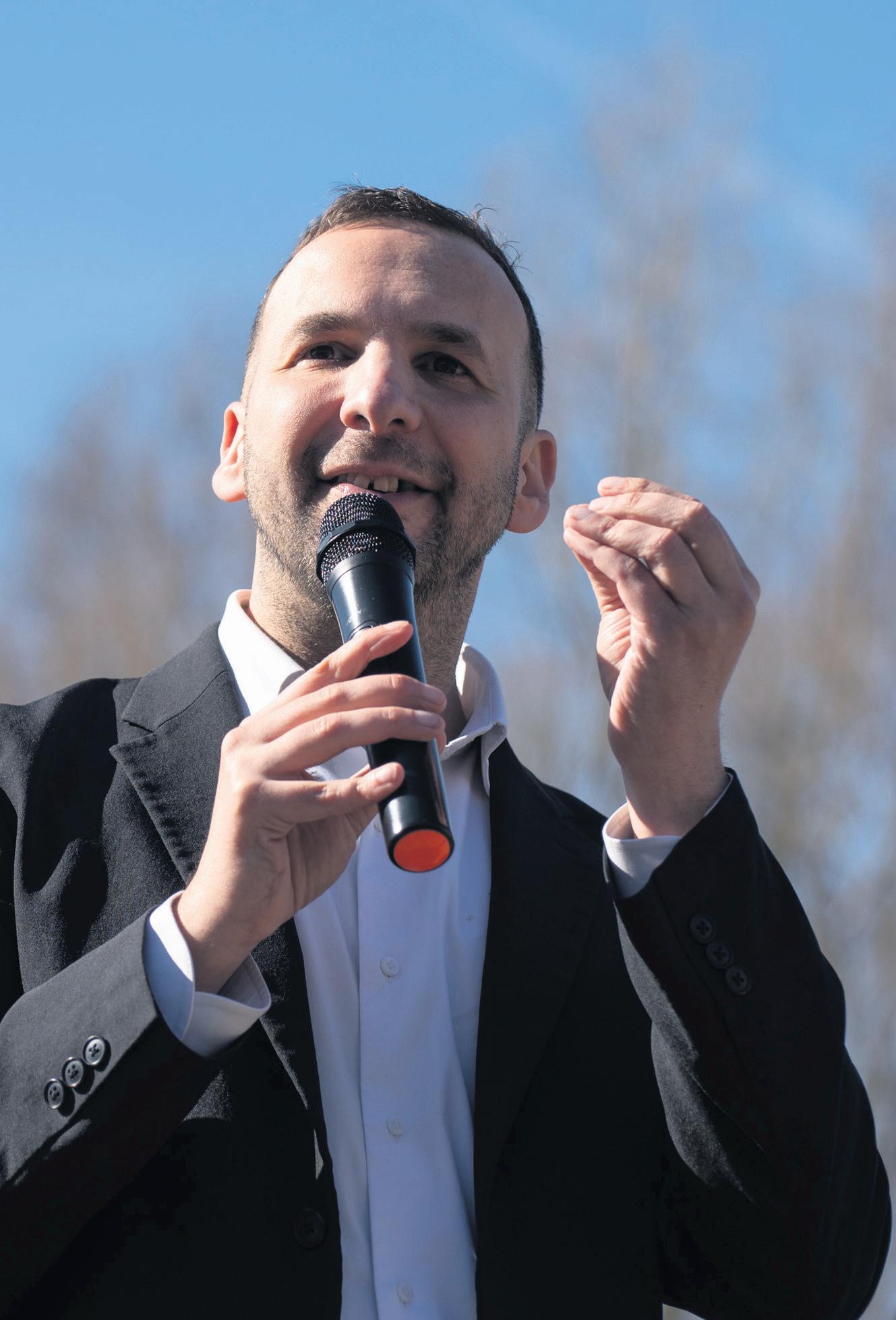
But is Zack Polanski credible?

gree than the average Brit. With Reform reportedly leading the race for the ‘football fan’ vote, the Forest Green Rovers supporter has the humility to acknowledge: “I should say we’re not as diverse as I want us to be.” Nevertheless, recent statistics don’t necessarily re ect present trajectories or future aspirations, as Polanski is keen to stress: “I think the stereotype is a long old stereotype that has been increasingly broken down. And I think Hannah Spencer is the epitome of that, where we just got a white workingclass plumber elected to Parliament.”
A vehemently anti-establishment, vegan, gay politician of Jewish heritage was always going to ru e some right-wing press feathers. Recently, however, Polanski’s hypnotherapy past has whipped up a wider media storm. His 2013 claim that he could boost a Sun journalist’s breast size led Kemi Badenoch to tell e Mirror that Polanski would be “very dangerous” for Britain, while the BBC cast doubt
on his claims to have “apologised immediately”. Meanwhile, the Murdoch press had a eld day, relishing the Green’s “storm in a D-cup”. But given his populist counterpart on the far-right has mounting allegations of racism, antisemitism and misogyny to answer for, does Polanski feel politicians on the left are held to a higher standard?
His response is emphatic: “We’re held
❝ e right-wing media are deeply unproportional
to a ludicrous standard. Now, it’s right that I’m scrutinised, it’s right that I’m asked di cult questions about my policy. But for instance, this story resurfaced in the same week that the Peter Mandelson les came
out, that Netanyahu and Trump lodged an illegal war in Iran, and that Richard Tice had turned out to be evading tax. ere was so much news going on, yet the right-wing press overly focused on a story about me from 13 years ago that I’d already apologised for, and they still repeatedly bring up.”
While the sheer extent of coverage seems to rankle, accountability and critical columnists are not a problem for Polanski: “Again, I’m happy to be scrutinised. In fact, I welcome scrutiny on policies. It’s not whataboutery. It’s about proportionality – and the right-wing media are deeply unproportional. And actually, I think there’s a lot of scrutiny for the rightwing media.” While he might lament a disproportionately hostile press, perhaps scrutiny is a sign of something altogether more positive for Polanski – symptomatic of just how astonishingly his stock has risen, and how serious some think his threat to the status quo could be.
~ Joss Heddle-Bacon

‘We need this for the future of our country’






“One man can’t change the world,” but Tinie Tempah can at least try. e poprap pioneer might seem an unlikely saviour. But having soundtracked Friday nights for a generation, he’s out to salvage the very walls he once shook. To the uninitiated, pleas to Parliament might feel paradoxical from a man so synonymous with club-heavy, hedonistic anthems. Nevertheless, no UK rapper has topped the charts more than Tinie; when this man is on a mission, people clearly listen.
And if Tinie’s activism doesn’t take root, this country could go quiet – literally. Since lockdown, 37% of UK nightclubs have seen strobe lights turn to shutters. If the current rate of closure continues, by 2030 the British party animal will be extinct. As Tinie viscerally describes, ominous boards have being going up like “bang, bang, bang, at seminal clubs up and down the country […] It touched me in a certain kind of way.”
e popstar felt inspired to protest, returning to the medium that made him an icon. “I’m not bad at doing interviews,” he assures me, “but I think I speak best and the message resonates more through the music. Sometimes it’s saying it verbatim, but sometimes it’s just in the energy of a track.” So, when Tinie nally came to crafting an elusive fourth album, Britain’s dying dance oors became the muse for his music. Last year, he ended an eight-year solo hiatus with rave-ready ‘Eat It Up’, its pulsating drum ‘n’ bass beat designed to rally a screen-addicted society behind the Last Night Out Campaign. “I went away, settled down, had kids […] Now we have this body of work, and the narrative around it is the power of nightlife. e club is more than just a place to go and party – it’s culture, it’s lifestyle. What I really love about these spaces is that they don’t discriminate. You could be black, white, rich, poor; everyone can be in that same space, in the moment, just living the music.”
A trailblazer turned veteran, the
a pro le and a voice […] advocating is very, very important”.
Tinie sees the stakes as seismic: “We need to preserve this for the future of our talent, for the future of our country.”
Linking nightclub decay to Britain’s future might sound extreme, but the seven-time chart topper is quick to stress: “Since the 1960s […] music and the arts has always been a soft power of ours globally. e time that we’re in now, it ba es me. Like, ipping hell man, one of our soft powers is the arts, and it’s very well received and exported – look at Olivia Dean […] look at what [British artists] do year-in, year-out. Why would we not be supporting institutions, individuals, entrepreneurs who are trying to preserve this and grow this? It doesn’t make any sense.”
❝
I keep my ngers and toes crossed that at some stage people in Parliament will rally together
Politics and perception play a key role. e British establishment’s reductive view of the club – “a place where you get drunk and listen to music” – is a stark contrast to attitudes on the continent. In 2024, Berlin’s transcendental techno culture was consecrated in UNESCO’s Intangible Cultural Heritage list; last year the French Cultural Ministry enshrined clubs as “places of artistic expression and celebration” amid a government drive for its once-demonised electronic music scene to gain World Heritage status. Meanwhile, this February, Rachel Reeves and co “explicitly excluded” nightclubs and grassroots recorded music spaces from their latest Business Rates Relief Scheme, despite these venues’ rateable value skyrocketing by 56% since 2017.
❝
We booked Bad Bunny for his rst European show
tive and fastest-growing sectors. ere’s another hidden human cost to killing disco, which Tinie vividly highlights: “ e club is bigger than just a place where you pay for tickets […] [there’s] the economy around it: the bouncers, the girl behind the bar, the person in the cloakroom, cleaning up – there’s an ecosystem that supports a lot of people that is being overlooked. Half of those people are not earning life-changing money; they’re in those spaces because they love music.”
Even if the powers that be are conspicuously absent, Tinie has long pulled his own strings to elevate the UK scene. “I’ve always seen this as something way bigger than myself and as an opportunity to have a hand and support other people’s careers,” the Disturbing London and Imhotep Studio founder tells me, “that’s why I came through with a record label, that’s why I’ve got a publishing company.” UK rap’s unique slang and grittier sound meant “it felt impossible even being recognised” by an apathetic US market, but Dave, Jim Legxacy and Central Cee have now begun to seriously crack the American code. As the rst ever UK rapper to go platinum across the pond, how does Tinie feel hearing British accents “making some mad moves over there”? He’s unequivocal: “To see what they’re doing is phenomenal.”
For Tinie, their successes taste particularly sweet. Not only did he blaze the trail, but his production company also helped those who now carry the ame. “With Central Cee, one of my producers made ‘Loading’ for him back in the day; with Dave, one of my producers made ‘Hangman’,” the chameleonic rapper reveals. “I’ll be somewhat sitting on the sidelines in the studio, but still feeling that joy and that grati cation that they’re taking things to a new level and I’ve had some sort of part to play.”
❝
Music has always been a soft power of ours globally
37-year-old’s passion is deeply personal. As Tinie knows all too well, clubs were places where artists who had irrepressible skill and hunger but “were very rough around the edges” could pick up a mic or a DJ controller, and take their rst step from the streets to stardom. Club culture has so often been that crucial spark, incubating and transmitting talent well beyond grime: “You could apply it to drum and bass, to dubstep, to jungle, to tech house, to R&B.” Seeing that space slip away felt “dystopian,” and a rapper born out of the underground buzz “just thought, as someone who has
“Not to get too political,” but to a man that’s been in the industry for two decades: “It’s de nitely a certain type of person that is making these decisions, who isn’t necessarily representative of what that culture is. I think they’re denitely prioritising property developers […] and disregarding [these spaces].” British discourse lags well behind other cultural powerhouses; six years ago, German Parliament voted near-unanimously to put clubs on the same protective footing as museums and opera houses. It’s legislation that Tinie can only dream of replicating: “I hope and I pray, and I keep my ngers and toes crossed that at some stage people in Parliament will rally together to enforce similar things, in the same way they would prioritise sport.”
Cultural stagnation aside, if UK clubs go silent, there are also screamingly clear economic consequences. January’s London Nightlife Taskforce Report uncovered that the average person in the city spends nearly £2,000 on nightlife a year, generating some $21 billion for the British economy. And it cuts much deeper than 11- gure output –49% of Londoners felt its nightlife buzz in uenced their decision to stay in the city, rising to 73% among tech and IT workers. Clubs literally help the capital keep hold of talent in its most innova-
When it comes to supporting careers, Tinie’s even held out a hand to the biggest artist in the world. “We actually booked Bad Bunny for his rst ever European show,” he discloses. But the parallels between the Puerto Rican megastar and the South London icon don’t stop there (even if Tinie “can’t understand what he’s saying”). e latter’s new releases and DeBÍ TiRAR MáS FOToS both pay homage to the places that forged their respective masterminds, deploying their musical platforms to protest cultural erasure at the hands of gentrifying forces.
While American neo-colonialism is an altogether di erent beast than nightclub extinction, both tap into a rich vein of musical activism. In an age where vapid content is often the most visible, Tinie feels that messages behind the melodies matter: “Not everyone must have it, but it is important to have some sort of underlying narrative to your music, or to what you’re trying to achieve […] I’m just trying to do my own little bit in my own way. At the end of the day, if you stay silent, then you won’t be able to make change.” As Tinie himself prophesised 16 years ago, in a pre-chorus that’s been replayed half a billion times since, sometimes “you just gotta keep screamin’ ’til they hear you out”.
~ Joss Heddle-Bacon
Cambridge terms are short and intense. Unfortunately, the menstrual cycle remains oblivious to this ordering of time. It’s not an assignment that can be pushed back, but rather expects to be accomodated.
For some, working days have to be ripped out of the calendar as they struggle to get out of bed. Angie*, a second year at Trinity Hall, recalls: “I had an essay to write the day my period returned, but I ended up lying on the oor with my college wife, wondering whether she needed to summon extra medical attention.” She describes the di culties of “lying in your own blood and your own guilt,” worrying about how to apologise to a supervisor for missing a deadline. Exam term inevitably turns up the heat. A survey by the Cambridge University Menstrual Health Society last year revealed that during exam season, 72% of students reported worsening or new symptoms.
Stories of debilitating pain are often packaged into the ‘normal female experience’, but can be an undiagnosed menstrual disorder. Endometriosis, a condition in which cells similar to the lining of the uterus grow outside of the uterus, a ects 10% of all AFAB (assigned female at birth) individuals. Studies have repeatedly shown difculties in women getting doctors to
take their menstrual pain seriously. Angie had been on birth control since she was 15, calling it a “sticking plaster”.
“I asked to talk to a GP about maybe pursuing why I was in so much pain, but I kept being assigned to the same nurse who would not entertain the idea that there might be something else wrong.”
Lola*, a third year at Emmanuel, describes her experience with medical care as overall very positive and “feeling genuinely listened to throughout the process”. Regardless, she notes that issues can arise when the “Cambridge workload makes you feel you have no


time for anything”.
Lizzie was inspired to create the Cambridge University Menstrual Health Society after her own di culties with menstruation. She describes her struggles with PMDD – a severe form of PMS which causes a range of emotional and physical symptoms before a period – which led her to intermit in her second year. Returning, she founded a society that hosts talks, workshops, social events, and campaigns to tackle period injustice. At Cambridge, she notes that “generally the infrastructure is there, it’s just that

❝ Stories of debilitating pain are often packaged into the ‘normal female experience’
is year, the society released an open letter demanding support for menstrual health education during Freshers’ Week, and the provision of sanitary products across college, University, and faculty buildings. While colleges agreed to provide free sanitary products a few years ago, students report uneven distribution. Describing reactions to the society, Lizzie notes that people don’t tend to react negatively, but “people are de nitely surprised that we are talking about it in public”. Awkwardness around talking about menstruation can manifest in di erent ways. David*, a trans man at Girton, notes how the idea that menstruation is tied to “part of being a woman, and that sometimes makes it feel di cult
to talk about without feeling like I’m taking up space I shouldn’t be”.
Talking about menstruation can also bring complications. Zara*, a second year at John’s, points out how some discussions risk veering into ‘trad-wife/ divine feminine’ discourse. “Sometimes I listen to people talk about their periods and think ‘you don’t even want to know what far-right in uencer you sound like right now.’” Celebrating the menstrual cycle can push back against cultural discomfort, but it can also feel condescending to those struggling. It can also reinforce a bioessential view of womanhood, where biology dictates destiny. Online ‘trad-wife’ narratives cast women as unsuited for the ‘cutthroat’ world of work and should stick to baking sourdough. Discussing menstruation becomes a tightrope between ignoring pain and suggesting women are inherently less capable.
Lizzie compares the development in how we talk about menstruation to mental health. More and more people are aware and open about it, but that doesn’t necessarily mean we are ready to talk about the “messiness” of it. At Cambridge, moving beyond euphemism toward frank discussion may be essential – not just to reduce stigma, but also to enable students to advocate for the support they need.
* Names changed upon request





Billionaire hedge fund manager Chris Rokos’s record-breaking donation to Cambridge has brought the role of philanthropy in University funding into view. It came less than a month after outgoing Russell Group chief Tim Bradshaw called on wealthy alumni to help UK universities out by donating more. A US-style donor culture might raise eyebrows, but I wouldn’t dismiss it immediately.
e role of donations in the sector is relatively small – only 2% of universities’ income came from donations and endowments in 2024-25. However, gifts from wealthy individuals threaten to become increasingly prevalent, particularly at Oxford and Cambridge. Rokos’ donation, the largest ever in the UK, follows the opening of Oxford’s Stephen A. Schwarzman Centre for the Humanities, funded by a £150m donation from its Blackstone CEO namesake. Schwarzman’s donation was heralded as Oxford’s single biggest gift “since the Renaissance”.
Some students might feel uncomfortable about Rokos, a former Tory donor and hedge fund manager who made his fortune betting on interest rate hikes and nancial downturns, having an entire new department named after him. Rokos even toyed with giving Peter Mandelson a job after he was sacked from his role as ambassador to the US – it’s easy to feel like the University is selling out. Still, Rokos was a relatively tame pick: Oxford received much ercer criticism for taking money from a major Trump donor, and Blackstone’s business practices have been identi ed as responsible for the
❝
e value of the research the centre could bring completely outweighs the fact it has a billionaire's name attached to it
global housing crisis
e Rokos School’s rival – the Blavatnik School of Government in Oxford – is also named after a controversial donor. Sir Leonard Blavatnik – one of the richest people in the UK – has been linked to sanctioned Russian oligarchs, with a leading academic quitting Oxford in 2017 to protest the gift.
It’s hard to disagree with Oxford’s vice-chancellor Louise Richardson’s defence of the Schwarzman centre: “Do you really think we should turn down the biggest gift in modern times, which will enable hundreds of academics, thousands of students to do cutting-edge work in the humanities?”
However, there are clear moral objections to taking gifts from Schwarzman and Blavatnik. Rokos, on the other hand, is a broadly acceptable donor, with a history of charitable giving. While select cases warrant scrutiny, I wouldn’t write o philanthropy altogether.
e Rokos centre promises to bring cutting-edge research that could genuinely bene t policymaking. e large nancial gift has given the University space to really invest in creating a new tool that will allow for deep and considered re ection on complex policy challenges – the kind of thing limited public research funding could not pull o at the same scale. e only price to pay is allowing the centre to bear Rokos’ name. Where these donations become problematic is when they come at the cost of integrity. In donation-riddled Ivy Leagues, questions have been raised over the in uence donors have. In 2023, in uential Harvard donors threatened
to cut the institution o in response to alleged anti-Israel speech and antisemitism. Its student paper, e Crimson, revealed that the senior fellow of the Harvard Corporation, Penny Pritzker, had a personal call with hedge fund magnate Kenneth Gri n, who had donated $300m to Harvard’s Faculty of Arts and Sciences. Gri n had urged Harvard to issue a statement forcefully defending Israel. Donors have privileged access to decisionmakers, and while Harvard maintains its independence, the way its leadership changed its tune on the issue suggests a susceptibility to donor pressure. With UPenn having su ered similarly from donor backlash, the Ivy League model of philanthropy reliance does carry signi cant threats to institutional independence.
However, there is no evidence that the research carried out by the Schwarzman and Rokos centres will be tainted by the views of the donors. Schwarzman’s donation, for one, has opened up a publiclyaccessible work space, provided funds for cutting-edge humanities research, and given a £185m boost to the local music scene with a 500-seat concert hall.
Rokos has publicly committed the project to impartiality. In a promotional video, he quipped that: “If this school were populated only with people with centrist, socially liberal views like me, then the school will have failed.” His decision to appoint Girton master Elizabeth Kendall to its board of trustees suggests he is serious about this. Kendall’s work on Islamic terrorism has contributed massively to foreign policy. e value of the research the Rokos centre could
bring completely outweighs the fact it has a billionaire’s name attached to it.
A major criticism of these donations is that they go to the places that need the money the least – Oxford and Cambridge. e two are among just a few UK universities to be shielded from the acute funding crisis hitting the sector, their large endowments providing a nancial cushion against falling fees and research funding. At the same time, they attract a disproportionate share of educational philanthropy.
However, the research funded by large gifts is likely to provide broad societal bene ts – this is not a zero sum situation. Furthermore, establishing a greater culture of donation in the UK will undoubtedly help more institutions as the practice becomes more widespread. Manchester’s successful bicentenary donation drive is evidence that the bene ts of philanthropy could be accessed more broadly.
So, calls for a stronger donor culture in UK universities should not be dismissed. With international student numbers down, and governmentnances stretched, it could be a lifeline. Monetary constraints are driving universities to scale back, while the publicly-funded UK Research and Innovation is seeing real-terms cuts in ‘curiosity-driven’ inquiries. Regardless of your views on Rokos, his donation could be transformative.


The net assets of the University of Cambridge as of July 2025 is approximately £8.3 billion. Admittedly, the particular net worth of each college varies signi cantly, with Trinity’s approximate £2.4 billion endowment putting the mere tens of millions of other colleges to shame. But a clear point nonetheless remains – that this University is not exactly one lacking in monetary value.
Within this deluge of wealth, unsurprisingly, is King’s College – one of the central and most well-known Cambridge colleges. What is equally unsurprising to me is that despite a net worth in the millions, the College appears to still feel the need to make its celebrated ‘A air’ workers pay to attend the second half of the ball after working the rst half, a development they did not bother to tell the students about until after they had already applied to work there.
Now, student workers are notoriously treated terribly. Businesses take one look at them, see young adults in desperate need of money, and immediately start o ering their most gruelling jobs at minimum wage. In this case, it is not that student workers are continuing their trend of receiving unfair treatment in itself; what irritates me the most is that it is being done by a college, an educational institution – not to mention a rich one – that should be founded on the idea of helping students rather than viewing them as a medium to get more cash. Colleges such as King’s should be a college rst and business second, an order that
❝It’s as if you should feel honoured to even have the chance to be exploited by them
is becoming curiously reversed.
It implies a commercialised perspective of colleges towards those it teaches. In this world of economised education, the College becomes entrepreneur, the fellow shareholder, and the student employee. Aside from the irony of the fact that it is the students themselves that are paying to be here, I do not believe that this kind of mentality is one that should be held by a system that was born out of a love of learning and teaching.
ere is, I think, even more to this than simply colleges being unwilling to sacri ce some money to give their workers a fair reward.
ere is a mindset that is clear throughout Cambridge, one that is not entirely unfounded but seems to be so ingrained into the University it cannot be separated. It is a mindset centred on superiority and elitism. Everyone here has a little of it – that prideful feeling emerges when you walk into a college surrounded by tourists or compare the lifestyles of students at other universities to your own formal and gown lled one.

ere is nothing particularly wrong with this feeling in small amounts. But it is when the old Cambridge colleges like King’s become absorbed in this historical mindset, causing it to a ect the way they see and treat their students, that it becomes a problem. ‘You should be proud of yourself for
making it here’ becomes ‘it doesn’t matter how we treat you; you should feel honoured to even have the chance to be here.’ Cambridge colleges di er from many other businesses in that it is not just that they may exploit you – it is that you should feel honoured to even have the chance to be exploited by them. It is vicious in that you should not only accept the treatment, but you should also feel grateful for it. is indicates not only an appalling attitude towards those that colleges should be teaching and guiding,
but also the kind of arrogant, pretentious
mentality that Cambridge claims to have progressed from.
Cambridge embodies tradition and academic excellence, qualities that contribute to both its charm and its egotistic attitude. It makes it easy for the University to keep its self-righteous point of view regarding its students, viewing them as tools to maintain their excellence. When hiring students to work at their events, in their bars, and in their libraries, colleges should recognise students as valuable members of the workforce and treat them as such, rather than just seeing them as a method to maintain their reputation and economy.

ere is, of course, always the chance that I’m reading too much into this, and the sorry situation that King’s has offered the workers at its ‘a air ’ has nothing to do with ingrained elitism, and everything to do with King’s jumping on the business bandwagon of being as tight with money as is physically possible. If so, it still says a lot of not particularly complimentary things about King’s, both in general and as a system of education. Nevertheless, there is something to say about the mentality with which the student workers in this city are viewed. A university should treat its students as deserving of respect, as well as facilitate their growth; and it makes me wonder if somewhere, on their path of wealth and educational glory, the University of Cambridge has forgotten that.
chance tight of is
Calum


My disagreement with the record-breaking donation from Chris Rokos should not be misinterpreted as ungratefulness or entitlement; he has, unlike many British billionaires, a strong track record of philanthropy, mostly focussing on scholarships for state-educated students in secondary and higher education. However, it is this previous generosity that makes me question the very decision to set up the Rokos School of Government.
Cambridge is already a world-leading institution, with relatively healthy nances compared to the rest of the UK higher education sector. Last year, MPs were told that 50 higher education providers were at risk of having to stop o ering degrees under severe nancial pressure, following a report from the O ce for Students that nearly half of all universities were going to be running at a de cit this year. So why does Cambridge, of all places, need £190 million? While the donation will contribute to impactful research, that impact would be greater if it were given to an institution more in need.
It might be useful to look at an equivalent School o ering MPhil’s and Masters’ degrees in Cambridge: the Judge Business School. It holds the top-ranked one-year MBA in the UK, the top-ranked Business and Management Studies degree, and the second best Masters of Fi-
e❝ I will always have this suspicion lingering as to the ulterior motivations of these large philanthropic donations
nance degree globally. However, it also has some eye-watering degree costs –that MFin degree costs £60,000, and that MBA would set you back £80,000 (with an additional application fee of £165). Naturally, if the Rokos School of Government is o ering what it says on the tin: “to prepare future leaders to be able to navigate the ever-more-challenging demands of both domestic and international politics,” I can’t imagine they will be o ering a lower price tag. To me, this seems remarkably at odds with Chris Rokos’s previous philanthropic e orts.
Social strati cation as a consequence of massive nancial barriers to entry will mean that these “future leaders” won’t be from a natural cross-section of society, and the School of Government will not turn out as the shrine to meritocracy that the “centrist” and “socially liberal” Rokos aspires for it to be. Instead, it will create a social echo chamber; if the School’s pupils do go onto prominent roles in national and international governance in private and public sectors, I struggle to see how they could come to represent the “broad diversity of thought” that Rokos claims the school is looking for. Similarly, the University must be wary of informal obligations and external inuences acting on what is fundamentally an educational, not a political, institution. It would be naive to say that donating such a large amount of money to a place does not come with the implicit
assumption of some sort of in uence or control over the direction of the School. While Rokos does not strike me as a malevolent force, and I’m sure the University has done its due diligence, there will always be the suspicion lingering in the back of my mind as to the ulterior motivations of these large philanthropic donations.
I suppose this criticism comes all the way back around to the question: is this what Cambridge, and the UK in general, really needs right now? Do we need another elite institution nestled inside the already elite University? I almost guarantee you that this will not bene t the town of Cambridge itself, or its inhabitants. Instead, it will become even more insular, students of the School of Government swinging by for a year or two and paying vast sums of money to the University in exchange for a line on the CV which will get them into some even higher-paying policy consultant job.





Of course, it is easy to argue that this money was never intended for solving the short-term issues
that I have described, and rather that it is a long term investment in Britain. But this should not be the priority of academic institutions with social responsbilities, because the country is not in the position to be anticipating the problems of the future when we aren’t confronting the issues of the present. Increasingly partisan and unstable politics, disinformation and distrust in the media, widening socioeconomic division, and the accelerating decline of the state education system are the issues undermining Britain right now, and donating almost £200 million to another academic institution that provides highly specialised degrees behind a steep price tag is not the way to solve




I would have liked to support the Rokos donation, but I fundamentally believe that the way to solve the UK’s policy problems must come from local movements focussed on change, not spectacular donations intended to create


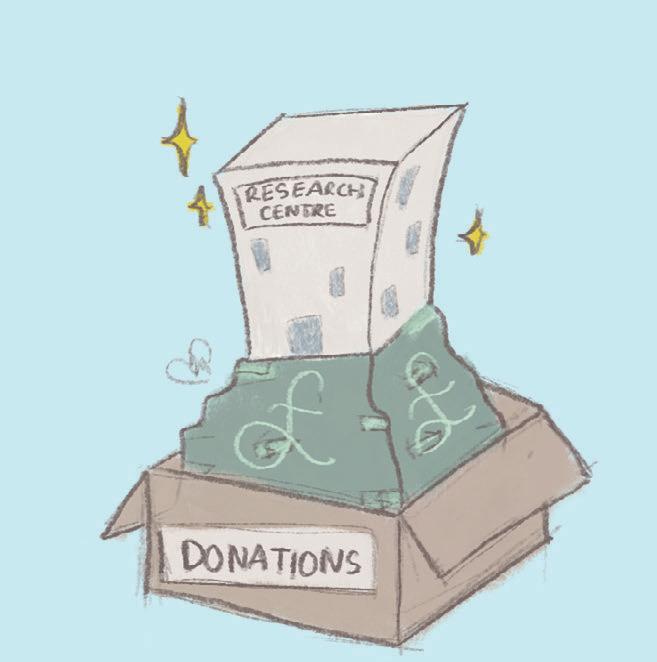

On April 10, I received an email titled “Professor Goldhill,” containing a condensed list of responses the University would take against him in light of the recent complaints. It was then that Inally opened e Times’ piece published the day before. What unsettled me most was not shock, but instead the absence of it entirely. ere was no rage or horror – only an overwhelming feeling of inevitability.
It cannot be ignored that Cambridge isn’t new to controversy regarding faculty-student relations. In 2015, the University came under re after “Dr Peter Hutchinson, a former fellow […] was the subject of sexual harassment complaints from 10 students.” Not only did he physically take advantage of his students, but it soon emerged that “he had self-published a sexually charged novel […] about academics watching students having sex.”
Sexual harassment and assault within the Cambridge environment became such a persistent topic of conversation that the administration launched an anonymous reporting system, hoping the anonymity the system provided would encourage more students to come forward with complaints. After nine months, the University released the data: 173 complaints were received, two of which were made by students against sta .
However, I nd two critical aws with the reliability of those numbers in accurately re ecting the frequency of harassment – speci cally regarding the prevalence of harassment perpetrated by faculty members. First, Cambridge itself revealed that only “0.15% of the student population used the Student Complaint
❝
If the University takes credit for creating this enviroment, they are equally culpable for the consequences of opening its social oodgates
Procedure in 2020-21.” e University explained the small percentage as proof that “the vast majority of students were content with […] sta behaviour.” I am hesitant to believe this justi cation as, above all, it ignores the fact that even anonymous reporting contains risks which may discourage some victims from using the service. But secondly, the University believed the threat of inappropriate relations between students and faculty was serious enough to warrant a change in policy. Two years ago, the sta and students relationship policy was amended, prohibiting intimate relations between the two. Ordinances aren’t designed to address problems that don’t exist; Cambridge was already aware of either the vulnerability students face in such situations, or the blatant prevalence of such relations in the rst place.
Furthermore, the information Cambridge released re ects a single year. In 2020, the University was contacted in an attempt to acquire data regarding the prevalence of sexual violence between the 2015 and 2020 school years; the request speci cally asked for “statistics of whether the perpetrator was a student or member of sta .” However, Cambridge promptly denied their request, responding that “a valid request under the Freedom of Information Act 2000 must state a requester’s real full name.” So even attempts to obtain basic data on sta -student misconduct can fail on technicalities, leaving a glaring gap in public understanding, and actively limiting scrutiny.
e pattern also remains of students being consistently dissatis ed with the University’s response to harassment: in 2020, 500 current and former students signed a letter from the Cambridge Uni-
versity Students’ Union Women’s Campaign calling for colleges to be stripped of their powers to investigate sexual misconduct complaints against their own members.
But the University oughtto not only respond to complaints in a more victimcentred manner, but take responsibility for its role in building an environment where such behaviour can even occur. On matriculation day, King’s freshers are informed by the Senior Tutor that students will be living among faculty in the same accommodation buildings; in fact, some supervisions are even held within student accommodation. e intent behind the decision is respectable; when students share drinks with their Directors of Studies preceding the matriculation formal, refer to professors by their rst name, and live in the same accommodation, a sense of egalitarianism is created – the implicit hierarchy that may discourage students from engaging vocally with their professors slowly diminishes. In my view, those decisions are largely successful: I have never felt more comfortable discussing my work with my teachers than I do at Cambridge. However, if the University takes credit for creating this environment, they are equally culpable for the consequences of opening its social oodgates.
Goldhill justi ed his refusal to ask for consent through his belief that it was unnecessary; he believed “he did not need it for a goodbye kiss or ‘friendly snuggle’.”
Goldhill’s con dence in presenting the snuggle as “friendly” could be because he thought it was only a step further than previous interactions he had held with students. He expressed his regret over the “exuberance” of the kiss – which
leads me to believe that in his mind, even slightly reigning in the advance would have made the interaction acceptable.
I am not of the belief that one’s environment can justify one’s behavior: if a professor chooses to assault his student, he does so completely of his own will and as an exercise of his own agency. But I do believe the reason it becomes di cult to punish the o enders – and oftentimes the reason assaultive actions can be explained away or modi ed with words like “friendly” – are because the Oxbridge structure allows for, or even enables, a blurring of boundaries.
We can break this down from a student’s perspective as well. When boundaries between students and faculty become blurred, it takes twice as long for alarm bells to start ringing when lines are being crossed. If a student already meets their supervisor for one-on-one supervisions, or within their accommodation building, by the time they realise that their professor’s advances are bordering on inappropriate, they may feel too trapped to escape.
Actions that originally would have been agged as abnormal take on the guise of normalcy as they’re interpreted within the larger context of a structure which produces that very normalcy. And post-Goldhill, the opposite problem manifests itself: now students may second-guess every interaction with their supervisor – creating a distrust in the intellectual intimacy an Oxbridge education is predicated on.
So, if Cambridge insists that its educational model depends on collapsing distance between students and faculty, it cannot treat the consequences of that collapse as aberrations.
Earth, 2100: drought grips entire continents, rising seas have swallowed cities like Venice, Jakarta, and Miami, and familiar species are disappearing from the planet. Disease spreads easily through a world destabilised by climate collapse. It sounds like the opening of a post-apocalyptic lm. But it is also a superhero story. Across the world, scientists, engineers, and researchers are developing extraordinary tools to confront the climate crisis, from space-based solar power to carbon capture.
Meet ‘ e Cartographer’
Behind the imposing glass façade of the David Attenborough Building in the heart of Cambridge – up three ights of stairs and past a oor-to-ceiling plant wall – sit the brightly-lit o ces of the Department of Planetary Computing. It is here that I found a tall, bespectacled gentleman: Dr Sadiq Ja er, the Bernstein Planetary Computing Fellow. He works on one of the central problems in environmental science today: scientists can collect vast amounts of data about the planet, but making sense of it is far harder.
❝
e problem is that this evidence is often too inaccessible to inform real world decisions
at challenge begins in space. Satellites continuously capture data about the Earth’s surface, producing radar and optical imagery of everything from forests and farmland to coastlines and wild re

Not everyone can say that their supervisor once had to reschedule because they were “making a short trip to CERN,” but I can. Dr Sarah Williams, Assistant Professor of High Energy Physics at the Cavendish Laboratory and my rst-year physics supervisor, has been a member of the ATLAS collaboration at CERN since 2010.
What happens at CERN?
scars. But while the data is abundant, turning it into something scientists can use to track environmental change is, as Ja er puts it: “really hard”. Most existing methods depend on large quantities of human-annotated data, and producing those labels is slow, expensive, and often impractical at planetary scale.
TESSERA (Temporal Embeddings of Surface Spectra for Earth Representation and Analysis) was built to get around that problem. Developed by a team coled by Ja er, TESSERA is a foundation model for Earth observation trained on around 32 billion pixels of satellite data. Rather than relying on hand-labelled examples, it uses self-supervised learning to detect patterns. For almost every 10m by 10m patch of land, TESSERA produces a 128-dimensional embedding: a set of numbers that provides a compact summary of what that patch looks like from space. ese summaries allow scientists to analyse landscapes at scale, spotting changes that would be far harder to detect from raw images alone. If the climate crisis is a race against time, TESSERA o ers something invaluable: a faster way of seeing what is happening to the planet.
Meet ‘ e Curator’
After navigating a labyrinth of corridors, staircases, and turns, I found our second superhero: Dr Sam Reynolds –axen-haired, annel-clad, tea in hand, and wrestling with one of conservation’s biggest problems: evidence. Conservationists are not short of research on how to respond to habitat loss and biodiversity decline. e problem is that this evidence is often too scattered, too slow to synthesise, or too inaccessible to inform real-world decisions.
And the stakes are enormous. According to the IUCN Red List, more than 47,000 species are at risk of extinction. Over the past 30 years, the Conservation Evi-

As a particle physicist, what we want to be able to do is understand what the universe is made of on the smallest possible scale and how those particles interact with each other. Over its history, CERN has housed increasingly large particle accelerators, up to the Large Hadron Collider (LHC) which is a 27-kilometre ring colliding protons very close to the speed of light. ese collisions happen 40 million times a second, and that’s not just single protons, that’s bunches of protons, passing bunches of protons – it’s very messy. When the protons interact, we get new particles produced, and our detector is basically a giant cylindrical onion combining
dence initiative has screened more than 1.6 million papers across 17 languages, evaluating over 3,600 conservation interventions. But doing this manually has come at a huge cost. As Reynolds puts it, it took: “20 years, 75 years of human researcher time, and millions of pounds” – a scale of e ort that is clearly unsustainable in a world where new research is constantly being published.
e AI Living Evidence Pipeline was built to address that problem. Developed by a team including Reynolds, it uses Cambridge’s Dawn supercomputer to process research at an unprecedented scale. e system ingests millions of papers, identi es which are relevant to a given conservation question, and extracts key information. ese outputs are then checked by human experts, preserving the reliability of traditional systematic reviews while dramatically reducing the labour involved. e result is a ‘living evidence’ database: continuously updated, fully traceable, and grounded in veri able sources.
Built on top of this is Conservation
CoPilot,
a chatbot that allows us- ers to
query the database directly. Rather than trawling through hundreds of papers, a conservationist can ask a speci c question and receive ranked interventions, evidence of their e ectiveness, and the contexts in which they work. When the pipeline was tested on the Butter y and Moth Conservation Synopsis, it screened more than 150,000 papers, achieved 97% recall compared with the manually curated version, and identi ed hundreds of relevant studies that human reviewers had missed. If TESSERA o ers a faster way of seeing what is happening to the planet, Conservation CoPilot o ers something just as valuable: a faster way of deciding what to do about it.
Meet ‘ e Calculator’
After an email exchange spanning weeks, frantic schedule reshu ing, and the wonders of modern video conferencing, I nally met our third superhero: Dr Michael Dales, the Tarides Planetary Computing Fellow. Dales works on one of the hardest problems in environmental science: deciding where an intervention will have the greatest impact. e consequences of environmental change are unevenly distributed, and not all land carries the same ecological weight. Losing one hectare of rainforest in the Amazon has far greater consequences for biodiversity than losing one hectare of farmland in the UK. As Ja er explains, local restoration can back re if it merely shifts environmental damage elsewhere.

forest were lost every year. By reducing biodiversity impact to a single, comparable number, LIFE allows researchers and policymakers to weigh trade-o s across regions and prioritise action where it matters most. If Conservation CoPilot helps researchers decide what to do, LIFE helps them answer the hardest question of all: where should we act rst?
❝
e real tragedy of the climate crisis is not ignorance, but inaction
But if we’ve met our superheroes, the question remains: what is our villain? It is not a lack of data, evidence, or innovation. It is a lack of political will. Short-term thinking, weak incentives, and powerful counter-narratives continue to delay meaningful action, even as the science grows clearer. As Ja er notes, asking people to make short-term sacri ces for long-term gains “they may never see is a hard one”. e real tragedy of the climate crisis is not ignorance, but inaction.
❝ ese collisions happen 40 million times a second – it’s very messy

lots of di erent subsystems that tries to measure the momentum and energy of all the particles produced in that collision. Event by event, we can try to reconstruct what particles we think might have been produced, and then compare those data sets to our predictions to see whether they match the theory, or could be something new. What questions are you trying to answer?
Lots of questions about why the laws of physics behave the way they do, but in terms of big questions about the universe that we hope to answer with our
experiments: we’re thinking about what dark matter is made of – that’s something we know exists in the universe, but we don’t have a candidate for what it’s made of in our current model; we think that matter and antimatter should have been made in roughly equal amounts in the Big Bang, so we want to know why there’s more matter than antimatter in the universe; we want to understand if the Higgs boson we discovered at the LHC has the properties that are predicted in the Standard Model, or if it could actually be a portal to something new.
Have you always aimed for a career in particle physics?
When I was 16, I wanted to become a politician, but I was steered towards science at A-level due to my terrible essay writing skills. I then came to Cambridge and studied Natural Sciences, where I did eventually specialise in physics (though, again, I was slightly on the fence for a while between physics and chemistry, but eventually chose physics due to my terrible chemistry lab skills). I would say the de ning point where I decided I wanted to enter particle physics was when I got to be a summer
LIFE (Local Impact on Flora and Ecosystems) was designed to make those trade-o s measurable. It is a biodiversity impact metric that quanti es how much biodiversity is lost or gained when land use changes – for example, when forest is converted to agriculture. e need for such a metric is urgent. According to the UN Food and Agriculture Organisation, between 2015 and 2025, an estimated 11 million hectares of

make
And time is running out if we want this story to have a di erent ending. Unlike in superhero lms, where the world waits to be saved, real change depends on collective action. As students and future scientists, policymakers, and activists, we cannot a ord to be bystanders. As Dales reminds us: “we are fortunate to be in a place where we can make something of a di erence.” e future depends not on waiting for superheroes, but on becoming them. We owe our planet that much.
student at CERN at the end of my third year (and I’d encourage every third year undergraduate to apply!). I was inspired by the international community; meeting and working with people from all around the world trying to answer the same questions.
What advice would you give to someone hoping to pursue a similar career?
I would certainly say go for it. I think now is a really exciting time to be considering going into particle physics. I would encourage anyone thinking about particle physics, but wondering whether it’s for them to actually go and visit CERN and get a feel for it yourself, or speak to people you might know in the eld. When I was growing up, I had a slightly traditional and stereotypical view of what a scientist was. But the thing I really like about my role as a particle physicist is that it’s so varied. I do spend a lot of time analysing experimental data, but you get to answer very cool questions, work in these tremendous experiments, and meet a lot of really inspiring people along the way.


How has the landscape changed over the last 15 years?


It’s changed a lot, and partly because we now understand things a lot more, but certainly also because the expectations about what the future looks like have shifted. We’ve been running the LHC for over 15 years and we’ve discovered the Higgs, but we’re yet to nd any other signs of new physics. We know that the Standard Model can’t be a complete eory of Everything, but what it’s really telling us is we’re going to have to work a lot harder in order to uncover signs of something new. e other thing we need to be honest about is that the international landscape is now very di erent to what it was 15 years ago which brings challenges when planning future experiments beyond the LHC. It means that we have to be more open and communicative with the outside world about what values our science has beyond just answering the ‘big’ questions, including technology development, training talented researchers, and (hopefully) inspiring the next generation of scientists.






By Jafar
ACROSS
1 Inappropriate kudos given for everyone completing what's up (6)
4 An evil one experiencing no end to torture in the abyss (6)
9 With expressions of surprise, formerly no solitary one given Gospel, keeping unbounded relations (11, 4)
10 Jude breaking up over a Virgo, I've seen this one before... (4, 2)
11 Peg butt after an overturned amount of matter (8)
12 Lonely one persuaded to eat, did eat! (8)
14 Save reading for later and do drugs (3-3)
15 Lost appetite when I sat about with AI (6)
18 Fight presidents of St Catz and make amends (8)
21 Set on re one's mother with rizz (8)
22 Jade, having broken up, left the cinema prematurely –I've seen this one before... (4, 2)
24 Widening response? (9, 6)
25 Instrument to vandalism of Ritz Hotel getting initially extradited (6)
26 Luigi, weary of prosecution, getting represented (6) DOWN
1 Involuntarily celibate (7)
2 Di erence in swampland (5)
3 King and Queen at university, inside, holding a thousand fruit (7)
5 Soiled poet Robert in the past (7)
6 Agitator to turn into aged emu through agitation (9)
7 Group vehicle driven into torrential rain (7)
8 Covered up high by swapping sopranos for altos (6)
13 Ritual fanaticist without a meaning (9)
16 Jewish Grunge (7)
17 Exonerate sailor when love's lost (7)
18 Ladders to one set in the stars (6)
19 Country artist following Gates (7)
20 Hearken unto a grave error concerning pronoun (4, 3)
23 Just a bit akey for a while (5)
Combine the following letters to make as many words as you can. Letters can be used more than once, but central letters must be used in each word. ere are 116 answers.
By Cheggers
1. Which football team recently became the rst team of the season to earn promotion back into the premier league, returning for the rst time since 2001?
2. Which video sharing app was created in 2012 and shut down by its owner, Twitter, in 2017
3. Which string of unsolved murders in the late 1800s are often attributed to Jack the Ripper?
4. Whose nemeses include Ernst Stavro Blofeld, Jaws, and Le Chi re?
5. What is the most northerly English county?
6. What links the answers to the previous ve questions?


























Despite committing to one another ‘till death do us part’, my wife is leaving me. is pending departure has not arisen out of arguments or unfaithfulness, but worse yet: the year abroad. If this heartbreak wasn’t enough, my college sister is also preparing to embark for her year of working in France. us, the end of Lent marks the completion of my penultimate term of university with two of my best friends.
How do you go from being a knock away to living in different countries?
It was not until we were lounging by the river with nal essays submitted, picky bits and tinnies in hand, and the sun beginning to dip that the horrifying revelation truly hit me. I am obviously extremely excited for the adventures that my friends will experience across the Channel, but I can’t help but feel con icted with this lingering feeling – this dread or sadness when I think about navigating my nal





year with such an irreplaceable absence. To prevent this becoming an entirely sombre, self-pitying expression of mourning and despair, there certainly are pros to the situation that are deserving of recognition rst. Primarily, of course, it is a great opportunity for my friends to study and work in a new location abroad and build important life skills. But quickly circling back to me, having friends living in new cities abroad o ers a more substantial justi cation to escape Cambridge for a quick weekend away. It also means the trip comes with a (hopefully) knowledgeable tour guide who can identify the underrated hotspots and save you the painful attempts of figuring out which direction Google Maps is telling you to walk in. Best have already begun to envi-









sion myself thriving on a wine-tasting tour of Bordeaux before hopping on the Eurostar and strolling along the canals of Amsterdam. While I have known of these pending trips abroad for a while now, I’m still struggling to come to terms with the fact that a third of my university experience won’t feature two of the people who have played such signi cant roles in helping me survive the first two years of it. Whether it be a room delivery of chelsea buns and chocolate after a traumatic “I’m going to drop out, for real this time” supervision as a fresher or completing the half marathon together, my friends have always been right by my side, attached at the hip even. How do you go
from being just a couple doors and a knock away to living in di erent countries? Initially, I thought their absence would be felt most during core Cambridge experiences such as May Week. But upon re ection, I think it will be the simple things that will be the hardest adjustments: debrie ng after a night out while we revisit past situations from the hundredth new angle, or the knowing looks made across the table in the library
Clearly I can’t deny the occasional waves of sadness at the thought of my friends’ year abroad, but such con icting emotions are, in themselves, a testament to a well-spent past two years of university. And not to be excessively cliché, but change is part of life, and how dull would it be for us all if things remained rigidly static? I already feel sick with anticipatory nostalgia and have been reminiscing on old photos like a mother sending o her child to their rst day of school. Equally, however, this awareness has enabled me to ensure that I truly cherish the upcoming Easter term even among the hecticness of coursework and revision.
Despite preconceived notions from stories as a child that true love would be purely romantic, in many respects, it’s through my platonic soulmates that I’ve learnt the diverse ways love manifests itself. And what a privilege it is to have people in my life whose absence will be felt so strongly.
Opening their doors ve months ago, Lei Yue Mun is a new kid on the block. As an unusually central addition to Cambridge’s Chinese food scene, sussing it out at some point was an inevitability for us. Snugly tucked away at the end of Sidney Sussex passage, it o ers the ability to sit and watch walkers along Hobson Street through its oor-toceiling windows. With its homely, unassuming exterior, we hoped Lei Yue Mun would deliver something similar.
dark, rich, and lily-padded with gelatin bubbles. Upon trying, the avour was strong, packed with meatiness, with a good deal of aniseed and warming spices to add some complexity. It ticked all of the required boxes, but lacked what I can term with clinical precision as a ‘wow-factor’.







e noodles were standard, but cooked well, while the steamed pak choi and spring onions were a nice addition.


Rather than a dense and delicate bite, pu ed tofu comes with a battered skin and a spongy inside. Often dubbed the ‘ avour saver’, it can take on magni cent amounts of liquid as it soaks in a bowl of glossy broth. e important question, then: is the avour it is saving any good?

acidity. Overall, pretty straight down the middle. Dish rating: 6/10

Like a good action movie, however, this dish hinged upon extraordinary beef.




e laminated, one-sheet menu had all the usual (promising) suspects: noodles, soups, dumplings and rice dishes. A restaurant’s noodle soup, we agreed, is perhaps the best measure of its quality, so we took two of these on: one with beef brisket, one with tofu. To supplement our rich mains, a side of cold cucumber salad. is is not to say the choice was entirely volitional. e tofu noodle soup was one of two vegetarian mains on the menu. For Luke, the herbivore of the two of us, this was a slight disappointment.
e
It was structurally intact, and offered a subtle resistance while still being tender. e avour was also spectacular, a bene t of slow-cooking allowing use of the tastier, but potentially tougher cuts.

Another key point was the beef’s abundant fat, which dazzled with its buttery texture and avour. On the whole, a thoroughly enjoyable bowl of beefy goodness.
Dish rating: 8/10
Tofu soup udon (£12.90): Luke is dish was served with thick udon noodles, vibrant stems of pak choi, and heaps of pu ed tofu.
As the resident vegetarian in my group, I’m always interested to see how restaurants tackle tofu. Well-chosen adornments of spicy and fermented sauces can turn its avour and presence from sec-


e answer in this case is, unfortunately, not particularly. While the broth was clean and fresh, it was, in a sparse description be tting the dish, bland. It seems that the absence of meat presaged an absence of avour. Bathwater and baby were disposed of in one fell swoop. e noodles were impressive, thick and chewy like good udon should be. On the whole, however, a fairly unremarkable bowl of noodle soup.
Dish rating: 6/10
Cold cucumber salad (£5.80)
A staple of any Chinese restaurant worth its MSG, we were always going to order this. Lei Yue Mun’s interpretation of the dish was simple, but fairly tasty. e dressing seemed of soy sauce and chilli crisp, which brought a familiar spice, salt and umami combo, with a pleasing undercurrent of numbing szechuan peppercorn. As a side dish, however, it would have bene tted from a bit more





At the end, the bill came to £36.96: for two main dishes, a side, and two soft drinks. On the whole, this places the restaurant in a potentially precarious middle ground. It was priced above what we would consider a ‘cheap eat’, but not really a push-the-boat-out, special occasion meal. We did, however, miss out on the dim sum, which, at three for £11, o ered the most impressive value on the menu.


Our service was friendly and laid-back, and, as we’d have hoped on a quiet ursday evening, very quick. It is certainly refreshing to see a newlyopened establishment not owned by venture capitalists, and that doesn’t sell smash burgers or matcha. While restaurants like Lei Yue Mun can’t stoke the same furore that places like Blank Street, not 50m away, manage to, they are no less important parts of Cambridge. While we would probably advise caution to the city’s vegetarians, if you’re seeking tasty food in an unpretentious, homely atmosphere, you can’t go far wrong with Lei Yue Mun. a

Ellie Buckley ponders her time at Cambridge while oating on a punt




Iists on Magdalene Bridge who still gripe me after all this time.









All of my nostalgic musings hit me with full force on this punt. Leaning back, one can appreciate the beauty that is horrendously overlooked most days. I am usually storming through King’s to get to Sidge rather than appreciating its greenery. But the punt allows a slow pace. I realise that I live in the place people pay money to visit, and dream about coming to study at. I have literally been there, done that, and got the t-shirt (and sweatshirt, pu er, and bauble).

































’m unbearably hot and there’s an awful swooshing sound surrounding me. My body feels as though it is rocking side to side and I’m beginning to feel nauseous. No, this is not the aftermath of a night of too much wine, nor is it the state I get into on an evening when I start dwelling on the fact that I do not have a graduate job lined up. It’s rather just me, leant back on a punt, graced with the occasional splash of Cam water from the end of the punt stick. It’s on days like this when you really think wow Cambridge IS nice huh Of course, I’ve known this my three years here, but there have been days is the last place I wanted to be (please refer to my Lent Week Seven when two diss deadlines, two essay deadlines and a Varprint edition fell lovingly into one week). But now I’m approaching my nal term, all I want to do is be here – soaking up the river, the streets, even the tour













I came to Cambridge because I simply loved reading. After three years, that love has gone through many phases. To progressing to hatred, to frustrated hair-pulling as I grappled with Aquinas, and, to the largest turn I did not expect, that I would love medieval literature. is is why the punt feels so therapeutic. I’m cast back to the beginning of Cambridge, long before it was even graced with my presence, and simultaneously I think about Year 13 me, the rst in my family to go to university. And just as Cambridge has grown and become so beautiful, I like to think I have grown too.
e punt also o ers a glimpse into the Cambridge I have perhaps missed as a student here.




On this trip, I’m a shameless tourist, asking questions like “What’s your favourite college?” to the punt driver (sorry, I’m unaware of punt vocab), acting as if I won’t be o ended when he inevitably doesn’t pick mine (Churchill) and instead opts for Darwin (a choice I’m still getting my head around). It’s easy to become wrapped up in the weeks, wishing the time away as we beg for the deadlines to end, before realising that our time in the privileged position as a student is quickly wrapped up. I wish I would have done more, seen more beyond the city centre, and gone more to the wonderful museums that we have here (speci cally to dwell on that legendary lemon in Kettle’s Yard – are they hiring for another ‘lemon replacer’ I wonder, because I need a job).
ere’s something faintly absurd about needing to be sat on a punt to nally look at Cambridge properly.
ree years of rushing, of mentally mapping the quickest routes between lectures, libraries, and yet it takes being physically forced into stillness to notice anything at all. I’ve walked past these colleges hundreds of times, but always with purpose, as though time itself were chasing me down King’s Parade. e tourists, for all their lingering and loitering, might actually be doing it right. ey pause, they stare, they take photos of things I barely register anymore. And here I am, brie y one of them, craning my neck at buildings I once claimed as part of my everyday life, realising I’ve never quite seen them like this before.
It’s strange to think that my own three years, which have felt so all-consuming, will dissolve into something just as small in the grander scheme of the place. e water ripples around me as I’m wrapped up in my blanket, hot water bottle in lap, and umbrella braced just in case. It is these ripples that drew me to writing this article, these knock-on e ects that led to my being here. But just as the ripples never have a de ned beginning and end, I realise that my time in Cambridge is not meant to be abruptly shut o . It will always be a part of me, making up some of the ripples of my self that I embody, always there to look back on, and always shaping who I will become once I leave the ows of the River Cam.




“I’ve heard everything shuts down and everyone’s locked in their rooms/libraries until May Week. Is it actually possible to have somewhat of a ‘uni experience’ in Easter Term at Cambridge?”
Surely, it’s common knowledge that the ‘uni experience’ regarding nightlife doesn’t properly exist in Cambridge. Of course, pubs remain open, as do college bars, and people de nitely still go to them sometimes – perhaps even more often than usual due to the tragic closure of the atrocities we call Wevs and Skikis… Extracurricular activities wind down, yes, but lots of societies, and the sports and arts scenes remain active. In a way, Easter is actually the best time, after Freshers’, to try something new or get involved at a low-commitment level – e.g. with one of the many, many May Week plays. ere will always be individuals who drop o the face of the planet in their quest to obtain a rst – I knew someone who even went as far as living o GoPu , fearing even a daring venture to Mainsbury’s may prove too distracting to the grind. Rest assured, this is an extreme and only the behaviour of one extremely mentally disturbed individual, not the majority of students!
“My best friend’s taste in men is self harm; she picks her partners unwisely and it’s left to me to be a shoulder to cry on when it goes wrong. I feel so sorry for her, but it’s so draining for me. Do you have any advice?”
ere’s always that one friend who is clearly red-green colour blind. While their messy dating life never makes for dull conversation (and a reminder why I stay single), I very much agree it is painful to see your friends so dejected after being taken for mugs by someone who’s punching in every capacity. Trust me, I’ve been there. A lot. Once you’ve seen this travesty occur more than three times, you have to give up your last ounce of hope that your friend will realise their self worth and resign yourself to the fact that you may, ultimately, have the opportunity to stand up at the wedding and screech “ME!” when the priest enquires: “Are there any objections to this marriage?”
“I don’t have any internship ready for the summer, what do I do? I’m so cooked!”
You are not cooked. Internships are crazy competitive (so I’ve heard, I’ve never actually applied for one – I don’t even know where to nd ones to apply for so I’m really not the person to ask). Sorry. BUT I can advise you on how to live your best jobless life like me! While all your peers are running around delivering co ees to analysts and having their ideas stolen without pay or credit, you could be living it up as the unemployed friend. It sounds like a career death sentence, but ask yourself: aren’t you, deep down, jealous of the ‘jobless’ friend whose life is one big side quest? I can promise you they’re always a lot more content. Be spontaneous: look for a random job abroad on Worldpackers, do some enriching voluntary work, get involved in the most fun but niche hobby you can think of – god forbid, get ahead of the next year’s work if you’re not a nalist (or, if you are, go for that law conversion course or apply for a deferred panic masters).
If doing some sort of internship really is the be all and end all,remember the very Cambridgesque tradition of nepotism – do you know someone who could give you one?

There’s always something going on in New York. I was there last week, visiting the archives at NYU’s Elmer Holmes Bobst Library for my dissertation on David Wojnarowicz. I found myself accidentally inhabiting some of the crazy, unglamorous scenes I’d seen and heard him describe in his work. For instance, while cutting across Washington Square Park on my rst morning, I was accosted by a man claiming to be a pigeon-whisperer. Dressed like a camp Ozzy Osbourne tribute, he said he could summon pigeons and make them y on command. Beside him stood a brash Instagrammer attempting to matchmake two unsuspecting and unwilling men. is sort of semi-art, semi-craziness followed me wherever I went in downtown Manhattan.

Experiencing the actual ink and paper brought my project to life
I was welcomed into a light, warm reading room sta ed by equally light and warm librarians. I settled myself at table four, glad that there wasn’t a single pigeon in sight, before digging into a box of folders. e conservators of David Wojnarowicz’s archives joke that it’s hard to tell what is un nished work, and what’s just accidentally archived junk. I was glad to hear it described this way – my dissertation focusses on how he uses an aesthetics of waste to turn junk into art. His collection is stu ed to the brim with all sorts of random material, like a cassette box containing dried owers. It takes up 211 linear feet: getting through even a fraction of that within four days was a mammoth task. But I still managed to get a great deal out of my time.


I dedicated another day to looking at criticism and reviews of Wojnarowicz’s work written during his lifetime. What was particularly interesting was seeing the kinds of places where they appeared: many were in gay magazines and newspapers, and one advert for his comic book Seven Miles a




vidual item. Not being allowed to photograph the laptop, I ended up sketching the items I found most interesting.


When I nally reached Bobst Library, I was met by a security guard who seemed to think he was guarding Fort Knox. After some confusion over my name not being on the system, and some polite negotiations on my part, I was allowed into what was an undeniably impressive building. e main foyer was vast and 12 storeys high, with a skylight that soaked the whole room in golden light. I had expected the archives to be dark and dingy, with roaming librarians like Roz from Monsters, Inc. But


I spent one whole day listening to audio tapes of interviews, radio shows, and recordings involving Wojnarowicz. ere was something both eerie and emotional about hearing his voice in my ears, 30 years after his death. A couple of the recordings were taken from radio shows discussing the controversy around ‘Witnesses: Against Our Vanishing’, an exhibition Wojnarowicz was part of in 1989-90. Hearing people’s words – what they actually said, how they phrased and intoned it – brought the politics of that time to life in a way that thinking about them in the abstract never quite could.



tropes or subverted allows me to experience the full range of shock and excitement. I read for these heightened emotions, for what they say about real and fantastical worlds. Like many others, I pursued an English degree be-
Yet I was quickly confronted by the paradox embedded in literature degrees: we study it because we love to read, but are forced to read in ways that detract from en-













Second sat on a page immediately before personal testimonials from men looking for dates. I couldn’t help glancing over my shoulder nervously, given how explicit some of the testimonials were. With the time left over, I asked to see the Magic Box: a wooden crate stu ed full of random titbits that Wojnarowicz had hoarded over his lifetime. Sadly, it was unavailable for preservation reasons, so instead I was given a laptop containing photographs of the box and each indi-



On the nal day, I read the speech Wojnarowicz’s boyfriend had given at his memorial service. I read through multiple drafts of a monologue, ‘Doing Time in a Disposable Body’, tracing its several iterations before its publication in Memories at Smell Like Gasoline. I listened to an interview Wojnarowicz had conducted with his friend and fellow photographer Peter Hujar. I tried to squeeze a lot into the nal day, knowing I wouldn’t have the chance to come back any time soon. at had been my approach all week: given how vast the archive was, I would rather race through a lot of it than linger over a poem I could simply photograph and return to later. But throughout, experiencing the actual ink and paper, utterances and paint marks Wojnarowicz had made, brought my project to life in a way nothing else could have.
Leaving the archive on that nal afternoon, I felt con dent that I had read and seen and heard everything I had set out to. Making my way back into Washington Square Park, I was accosted again by the pigeon-whisperer, screaming at his ock to land. Immediately, I was drawn out of my archive fever and back into the drama of downtown Manhattan. In a stroke of luck, my boyfriend and I found a book on one of Wojnarowicz’s photography series. is was the perfect memento for my week spent feverishly working through Wojnarowicz’s papers.

explores how reading for her degree impacts how she reads for
like to know as little as possible going into a book. Not knowing the twists and turns or how tropes are utilised cause of my love for literature.


our love of literature, we have to turn our brains o . We shouldn’t need to neglect fascinating signi cations of character interactions,

To anchor myself in dense, archaic language, I read summaries of long works. is makes it easier to relate the meanings of individual passages to the plot, but does ruin all surprises. A typically immersive reading experience is disrupted by the frenetic search for some intelligent insight I could quickly write 2000 words on. e rigorous analysis of texts when reading and writing, combined with the time pressure, have prevented the books I’ve read for my degree so far from becoming favourites. But I don’t think that, to derive the greatest possible pleasure from reading and to preserve

plot twists, settings. Fiction moves
us deeply because it touches us and the world we live in. As Ralph Waldo Emerson puts it: “Fiction reveals truth that reality obscures.” Fantasy may comment on rebellion and hope, historical ction on trauma and courage, mystery on justice and deception. When reading recreationally, thinking critically in a stressfree manner throws characters and the narrative into sharp relief, deepis is not to say critical analysis of lit-
erature in an academic (particularly Cambridge) setting takes all the joy out of reading. While the reading process itself may be laborious, the individual and collaborative analysis that follows has evoked a new, unexpected enjoyment of literature, di erent from what rst compelled me to study it. You begin with trying to present and unpack complexities on the page without confusing yourself or your work’s own reader, stretching your understanding of the text as you transform vague bullet points into cogent paragraphs. Discussions with peers and supervisors then bring ideas you
dimly registered but couldn’t quite pinpoint into light, simultaneously complicating ambiguities and investigating how they relate to past and present human experience.

❝
To read is to step into an unknown world











ere’s wonder in examining the nuances of texts and commending the writer’s artistry and mastery, but also in relishing the texts’ emotional impacts without interrogating how they’ve been achieved. It’s valuable to let a story carry you away instead of gripping it tightly, admiring its mystery instead of trying to see through its construction. In other words, there is value in both exploring the ‘truths’ with which literature connects itself to our world and appreciating literature in and of itself, as “a thing in the world,”




is arduous but more rewarding kind of analysis enlarges the world of the text, guiding me to territories I didn’t know existed and revealing how much more there is to see. Having that initial love for reading taken away when studying literature is unsettling, but there’s a complementary harmony in it. e ful lling exhaustion of pushing my mind to its limits through academic reading and analysis strengthens the need for the pleasures of recreational reading. A more relaxed analysis, potentially just a collection of inchoate thoughts, leaves room for immersion in fantastical universes.



strengthens as Susan Sontag puts it: “Not just a text or com-

eted. It encompasses the satisfacthat might or might not exist,
Enjoyment of literature is multifaction of unravelling complexities, approaching some grand truth the magical delight of falling in love with characters and worlds without dissecting why they speak to us the way they do. Studying literature doesn’t have to be paradoxical. If we recognise that, just as a kaleidoscope yields in nite, colourful patterns rather than a singular


view, the experiences we draw from literature can be as wide-ranging as the




Easter Term is here, and Daisy Cooper and Jessica Leer, Editors-in-Chief of e Mays 34, seem to be ready to start it vigorously and joyfully, sitting for this interview with smiley faces and radiant energy.
e Mays has been publishing the creative work of students at Oxbridge since 1992. To this day, it is edited by students. I ask the Editors about their initial approaches to editing the anthology: “Initially, we both came into e Mays with a very unique look,” Leer explains. “We wanted to push the boundaries between art and prose,” adds Cooper.
e Editors’ approaches in uence which contributions are published. “While in some previous editions, there was a prevalence of poetry and prose, this time, we wanted it to be more illustrated,” Leer tells me. ese preferences depend on so many circumstances, according to Cooper: “Being illustrators, it was almost instinctive for us to give particular attention to art, but we also established a guiding pinpoint for all the contributions.” Every edition of e Mays has a recurring theme binding each piece. e Editors tell me that their vision for the publication harmonised so well that it was easy for them to nd this edition’s theme.
“We thought about the theme of identity as a guiding circle,” Cooper explains: “Speci cally, it was interesting to focus on the identity of Oxbridge students, predominantly about the interaction between highs and lows that student life involves.”
ily members, the stories they had heard, and the people who stuck with them.”
❝
e anthology almost feels like looking at stained glass
Cooper and Leer explain to me how a natural theme was as recurrent as the ow of waves: “We were amazed by the recurring presence of water in the submissions. It did not have a daunting function; instead, water often grasped a sense of nostalgia and the sentimental,” Leer observes.
“Maybe this comes from a common fascination for the river Cam,” replies Cooper jokingly. e anthology can be imagined through an abstract visual: “It would probably be an old postcard of a seaside town; a place that contains so many people and so many stories, all bound by nostalgia.”
provides



Interestingly, elements from the past in ltrate the anthology, often haunting the narratives: “Childhood and school memories are quite present. In some pieces, authors included the lives of fam-
Each year, e Mays provides a continuation of the previous publications. As Cooper suggests: “Nostalgia conveys an interesting hook to last year’s anthology, especially its re ection on past voices and ancient feelings.” However, both Editors want to specify that this anthology is not all about the past: “[contributions] also contain elements of everyday life and the modern day, even


referencing public transport and crowded cities.” could summarise the anthology in three words, we would probably choose ‘pop culture’, ‘nostalgic’, and ‘personal’.”




e Editors express their own nostalgia, ruminating on past roles in the anthology’s editorial team. “It’s nostalgic for us as well because we were part of the inking about the style and media of the artistic contributions, I wonder what we can expect from this year’s choice. “We de nitely think that this publication is quite eclectic,” they explain: “It has so many elements that it almost feels like looking at stained glass.” For the most curious of us, the Editors provide two hints on what to expect from e Mays 34. Cooper proposes the rst: “We deliberately juxtaposed drastically different pieces of work. Even though they might seem unrelated to each other, they are coordinated by the bigger structure of the anthology, which divides the narrative into three phases: morning, noon, and night.” Leer continues, proposing the second hint: “If we


e Mays
With hints like these, it is impossible not to be excited about this publication. Regardless of the a nities and divergences with the previous editions, anthology is still a cornerstone of the Oxbridge literary and artistic tradition, and certainly not one to be missed!





























Mary Anna Im chats with The Snuts before their gig at the Corn Exchange

If you were expecting to see the typical pomp and pageantry of a male indie rock band, he Snuts’ gig at the Corn Exchange would have been disappointing. he stage, with a bare backdrop and minimal lighting that relects the band’s choice to strip their new album down to basics, setting the tone for the pared-back, more intimate gig. he fourpiece band, formed in West Lothian in 2015 by schoolmates Jack Cochrane, Joe McGillveray, Jordan Mackay and Callum Wilson, have returned to touring after three back-to-back records. heir new album, however, marks a shift as they have decided to turn the dial down.
Catching up with the band a few hours before the show, bass guitarist Callum Wilson tells me that their latest album comes from a new chapter of their lives: “We all kind of had kids and moved back home so it was like a really nostalgic feeling.” heir decision to tour smaller cities and venues was a deliberate choice to “touch the places that have never seen that much love”.
❝
I think a lot of this album has been about being more reserved
I speak to the band in the middle of their circuit. Mackay, the drummer, jokes that the highlights of the tour thus far have been “the days of,” but it’s clear that the band are most excited about their hometown gig at the Pianodrome in Edinburgh. Wilson describes it as a “proper hometown show in a venue
that’s not really built for these kinds of gigs,” and I get the sense that they are tentatively excited to play somewhere quite literally so close to home.
he age range of their Cambridge audience is diverse: I ind myself sandwiched between young teenagers and middle-aged fans. As the Corn Ex reaches its full capacity, he Snuts open with ‘Gloria’, a rapid, Fender-esque single from their third album Millennials. Wilson tells me that Millennials was “made entirely on the move”. He adds, “We found our inspiration in the movement; where we were going, how fast we were living. You can hear that because everything in the record is going 100 miles per hour.” he certainly wacky but nonetheless upbeat opening lines – “When I met you at the Tescos / Fighting for a TV, let’s go” – set the tone for the rest of the gig. With the audience now enthusiastic and primed, Cochrane, the lead singer, introduces their new single ‘Summer Rain’, continuing the fast pace of the set. he audience receives their new music well, but I ind myself unable to ignore the rather bizarre gospel-esque sound of ‘Summer Rain’ in the chorus’s ascending melody and lyrics: “Open up your arms and let me in”. Wilson confesses earlier that this single was particularly tricky to make. It initially “didn’t feel quite right,” and so it ultimately became a practice in the art of subtracting: “I think we can throw quite a lot at the wall sometimes, so I think a lot of this album has been about being more reserved.” his reservation kicks in after the initial crowd-energising tracks. he minimalistic lighting is something I ind particularly striking: as they play their iconic single ‘Glasgow’ – an ode to their Scottish roots – bright white light diagonally shining against a blue backdrop evokes an image of the Scottish lag. Cochrane jokingly asks the audience whether
they can even understand his accent, but no regional dissonance impedes the crowd’s participation; they gleefully sing along, “I’ll always love that you say Glasgow”. heir earlier singles such as ‘Elephants’ and ‘he Rodeo’ certainly go down well with the crowd and, played live, these tracks become even more reminiscent of an angsty version of the Kooks or Kings of Leon. he crowd rapturously receives these sonically thick tracks, and indeed most of the set, because it was formed with their appetite in mind.
❝ he writing and mapping are much more mature than where we were six years ago
As Cochrane introduces their hit singles, he admits that these classics are “less enjoyable for the band,” but that they have deliberately resisted the urge to self-indulge in a mainly new-music setlist in order to please their fans. Later in the set, the band return to tracks from Millennials, released back in 2024. Cochrane introduces ‘Circles’ as his favourite track and self-efacingly admits that he imagined the song being so successful he would “buy a Lamborghini, and my son would go to Cambridge,” eliciting a few laughs from the students in the crowd.
here is a notable synergy between the
band members as they play their earlier tracks, which is not always the case with indie rock bands. It is certainly helped by the fact that they have known each other for most of their lives. “We went to nursery together. I’ve known [Mackay] for 27 years,” Wilson reminisces. Mackay, less chatty but consistently droll, jokes that they “like to share hotel rooms because we get lonely on our own”. Despite having known each other since childhood, their debut album, W.L., was released just six years ago. he band explained that they had been making music together long before they secured a record deal. Unsurprisingly, their music-making process has developed drastically: from messing around playing over songs acoustically at 15, to recording during the height of lockdown, to now recording at a home studio. heir latest album is the most calm and thoughtful thus far, I’m assured by Wilson: “his record has been much more considered […] the writing and mapping are much more mature than where we were six years ago.” Although occasionally poetic, lyrics such as “Why did I ever leave here? / he grass ain’t always greener […] / So why don’t we go / To the motherlands” read as rather prosaic and cliché. he penultimate song they play, ‘Millionaires’, is an upbeat track with ’80s-inluenced synths and slightly on-the-nose lyrics that critique society’s focus on “monetary and materialistic gain and success,” but nonetheless reinvigorates the crowd. Ending on a high by returning to ‘Always’, their most popular track, the crowd lap up the fuzzy guitar rifs punctuated by Cochrane’s almost snarling voice. As the night draws to a close, it becomes clear that despite the gig’s lack of bells and whistles, the band’s choice to satiate their fans’ appetite for their classic tracks is more than satisfying for the crowd.
Since early February, the trailer of the newest A24 movie e Drama (2026) has generated considerable buzz for keeping its plot twist rmly under wraps. e exceptional press tour that followed continued to excite, teasing only the exhibitionist promise of uncovering a to-be-wed couple’s deepest, darkest secret and the thrill of the disastrous consequences that follow. But suspense is a double-edged sword that has, unfortunately, come to stab the movie in the back.
larly poignant within the context of contemporary America. In order for it to work, the movie must lean on its provocative edge, driving home the ‘dark’ component of this dark comedy to elucidate its critique on the performativity of modern-day society.
But director Kristo er Borgli seems both devoted to delving deep into the cultural phenomena that his narrative decries, but also entirely uncon -





e Drama begins like a typical romance; Charlie (Robert Pattinson) meets Emma (Zendaya) at a cafe and becomes enraptured. Yet when Emma gets drunk and lets slip the “worst thing she’s ever done,” the secret threatens to destroy the marriage before it has even begun. From there, the lm erupts into a kaleidoscope of unnerving chaos, con ict, and – as the title promises – drama, putting spousal vows of undying love and unwavering commitment to the test.
e central appeal of the lm lies in the nuance between hypothetical and literal action. e impact of the plot twist thus relies on the sensitive nature of the topic, which is particu-

dent in his audience’s ability to discern satire from solemnity. What results is an insipid, lukewarm version of what could have been, the movie falling at quickly after the rst act. is fear of commitment goes hand in hand with the movie’s pacing issue. A disproportionate amount of time is spent watching the couple trying to waltz around the elephant in the room, trying desperately to keep up the facade of normalcy but having that mask crack over and over again. e assumption would be that this oscillation between denial and acceptance, wishful delusion and getting bashed over the head by a reality check, is integral to keeping suspense alive after the initial shock of the secret loses steam. But without meaningful character exploration nor development, this hal earted attempt at keeping audiences at the edge of their seats quickly gets old. e dilemmas of the lm are spelled out in the dialogue of characters like Rachel and Misha, who act as mouthpieces for varying perspectives in society. e generality of it all means that the lm fails to develop its most intriguing element – the knottiness of extricating virtue from vice when the person on trial is your lover. As Charlie and Emma become de-individualised, blending into the background of a wider social debate without o ering anything to it,
they both lose the intimate edge that their characters uniquely provide.








After all, a drama is only a drama if it’s poignant and multi-dimensional
Despite all this, it would be impossible to review e Drama without complimenting the stunning performances of its cast. Pattinson’s Charlie is endearing but teeters on the verge of pathetic, falling face- rst into it once he begins to hyper xate and spiral into stupidity. Zendaya plays Emma with both suave charisma and vulnerability, frustration and fear palpable as she agonises over the consequences of her drunken honesty. With such a capable cast, the missed opportunity to explore character interiority and draw out complexity gapes jarringly. After all, a drama is only a drama if it’s poignant and multi-dimensional, making space for radically divergent perspectives and in ammatory statements that challenge audience understanding. e Drama is glued to its safe zone and lethargic in its messaging, making its watch enjoyable but unmet potential regrettable.




Black is without a doubt the most popular colour I see people dressed in as I walk down the street – or, as I’m sure any primary school kid would pedantically correct me, black is undoubtedly the most popular shade I see people dressed in. his colour (that’s not even technically a colour at all) is everything from an enigma, a chameleon, to a magician and a mythical creature. Almost everybody wears black all the time – it is the colour of our formal footwear, our day-to-day bags, our college pufers – but how much do we really know about this colour that we will use both to make a bold statement, and as a comfortable crutch when we’re feeling tired? Whenever you think you know the colour black, she can still always surprise you with something new that you haven’t realised about her before.
❝
Black is dangerous, striking, and sexy
When you irst meet the colour black, you will be struck with the authority she commands and the drama she strikes up. Black is the shade which creates the most contrast, standing out against any bright colour – black is the colour of the text on a blank sheet of paper. When she’s worn on some-
one’s body, black is dangerous, striking, and sexy, and she’ll lirt with you until you want to wear her all the time. Once you start wearing black you will realise how bold she can be, how radical and unapologetic, and that for this reason she is the close friend and accomplice of anyone interested in the fashionable and the avant-garde. Black is also able to hide a multitude of sins, allegedly slimming, and able to transform any simple look to appear more expensive and elegant. You will begin to realise that in many ways black is a very safe colour as well as a bold one – stains (both literal and moral) blend into her seamlessly. Black is discreet, and is a colour of servitude, of asceticism and quietness: we wear her when we are in mourning. hen you will realise that this quietness and safety can make black a lazy colour, a disappearing colour which you can throw on when you can’t be bothered to think of anything else to wear. hen, seeing all of these contrasts and contradictions, you may begin to doubt whether you ever knew anything at all about black in the irst place. It really takes a mythological marvel to be supposedly the boldest and quietest colour, the sexiest and most reserved colour, the most fashionable and most lazy colour, all at once. Christian Dior famously claimed that black “could be worn at any time, at any age, and for any occasion,” and once you start looking out for how much people are wearing black on a daily basis, you will quickly realise that Dior is being proved right. Black really is everywhere, and yet most people wouldn’t say that it’s their favourite colour, or even their favourite colour to wear. his is because black has somehow
become seen as a neutral option, something which we can wear in the background to brighter colours.
❝
Black is able to hide a multitude of sins [...] and transform any simple look to appear more expensive and elegant
his seems obvious to us now, but has not always been the case: think back to when black was repurposed from a mourning colour to the colour of outcasts and otherness, of goths and punks. Here, black was striking because of how unusual it was, upon which depended the power it wielded. However, what draws many people to black nowadays is a desire to conform, to blend in and assimilate, and in using it as a neutral colour in this way, we are neglecting black’s potent potential. his eventually leads to all sorts of questionable fashion choices, where people take the idea that black goes with anything for granted –
carelessly sticking black shoes at the bottom of an otherwise colourful outit, or defacing it with an incongruent black coat. Even in cases where the colour does it, we must be careful not to lean too far into black’s slimming, disguising, and disappearing magic, lest we risk any interesting outits disappearing altogether…
However, if I’ve found anything out about black, it’s to know better than to think she can’t still surprise me. here’s plenty of room for the colour to be safe and easy as well as bold and dynamic. It can be a great way to experiment with more unusual looks, while still feeling comfortable and efortless. Black doesn’t have to be neutral or safe (as whatever colour we consider neutral is dependent on the rest of the outit anyway) but it also doesn’t have to be any one thing at all. he colour black is so many diferent things, and can be a fountain of fashion opportunity if you wear it right. When it comes to understanding such a formidable mythological igure, I think it’s undoubtedly best for you to get to know her yourself.
~Flossie Bullion
Amika Piplapure



In using black as a neutral colour, we are neglecting black’s potent potential
“Energetic, fun, rockin’” – these are the three words Rock & Roll Man performer and musical director Dominique Scott uses to describe the new American musical currently touring the UK. After seeing the show in Cambridge myself, there is no disagreement. I had the pleasure of speaking with members of the creative team of the ve-star show, including its eight-time Tony award-winning producer and co-book writer Rose Caiola, and director Randal Myler. e musical follows the story of Alan Freed, the white American radio DJ who carved the path of what became known as Rock and roll, transforming it into a sweeping cultural phenomenon.

Drawing out the social and political power of music, the show illustrates its capacity to instigate change with both nuance and exuberance. Caiola describes it as “a fascinating story about the genesis of Rock and roll and how it stands the test of time,” adding: “We want to satirise racial tropes and shine a light on things that have changed.” e creative team are deeply passionate about Freed’s legacy and his role in breaking down racial barriers. Freed’s love for music is the pulse of the show, portraying how it was considered a threat to J. Edgar Hoover’s administration, with Freed being considered, as Myler states: “Dangerous,” and a “bad boy”.
to all the Rock and roll classics long after leaving the performance. Myler also talks about the show’s exploration of how Rock and roll music crossed the ocean, in uencing the 1960s UK music canon. He says: “I am very interested in the cross pollination of American music coming to England. e Beatles rst heard of Chuck Berry and Little Richard through Alan Freed’s radio show; there were riots in England when Rock and roll hit.”
don’t have in the US at the moment. It is a pleasure and honor to work with the UK collaborators. e show looks completely di erent, it is an ethereal dream landscape. We want elements of the set to look like portholes into the past and the future, it is not as literal as the previous production.”

Discussing the process of reimagining the show from its original oBroadway run in 2022, both Myler

and Caiola express their excitement about bringing it to new cast and design team. Myler emphasises: “ e musical is a fresh
animal to me now, I’m not looking to do it how we did it in New York



Both Myler and Caiola stress that this is not a straightforward biopic nor a traditional jukebox musical but rather a hybrid. One of its unique elements is that Alan Freed sings original songs, despite not being a singer in real life. “We want the feel of the musical to be like the split second before all your life passes before you,” Myler says, gesturing towards its illusive fever-dream quality.
❝
We need art more than ever now


as the UK cast have their own energy” – he likens the process to “sculpting in ice: as soon as you do it, it melts and you can’t at-

Caiola also highlights the
challenges of making art in the US in recent years: “ ere are roads in the UK that we








Pand the necessity for striving for social change, he relates to Alan Freed’s work: “He saw the music and believed in it. If you love something, what other people think about it doesn’t matter, and that is the most profound thing that I relate to; having the courage to be who you are.” In light of the show being awarded the AUDELCO Award for Best Musical of the Year in 2023 – an award recognising excellence in Black theatre – Caiola articulates that while “it was stressful at rst to think how do we pay service to this story as a mostly caucasian creative team, this award is one of my most cherished prizes in my career. We built the story with our cast and creative team and it is a great achievement, as we feel like we delivered on an authentic level.”
“ ere is something for everyone in this piece,” says Caiola: “Alan Freed was an instigator; people need to know about a rebel and a visionary. e show is compelling, with an abundance of incredible music from the Rock and roll classic canon and also an original score, which tells the story of Freed’s life through a traditional musical theatre sense.” Highlighting its cross-generational appeal, she mentions that “Freed’s legacy survived and it’s really everywhere, informing all the music the current generation listens to from Buddy Holly to Beyonce.” e musical is gifted with a truly contagious score, which had me humming along


In conversation with Dominique Scott, I learned that he’s the show’s Musical Director, arranging and orchestrating the music every night, while also playing the part of Jerry Lee Lewis and multiroling over nine di erent characters. I ask him about his experience of maintaining the same explosive energy and wearing so many hats: “I love what I do and it is not easy to be in this profession so I always try to keep perspective and stay grateful for these opportunities. My energy comes from interacting with audiences every night!” Watching the show, the cast’s talent is inspiring; I was particularly taken with the phenomenal vocals and Stephanie Klemons’ dynamic choreography. e audience’s enthusiasm, cheering along and immersing themselves in the story was also a pleasure to witness. Re ecting upon the show’s international reception, Scott articulates: “I see more similarities in audiences than di erences. People love to escape, have a good time and be entertained.” Caiola adds: “We need art more than ever now. You have to nd ways to remove the constant stress of your brain and that’s art, you escape in it. What means the most is sitting at the back of the theatre, watching the faces of the audiences immersed and raptured.”
of be
Scott also points to one of the show’s messages which he believes resonates most with our society today. Acknowledging the persisting challenges with discrimination across the world

Considering the nature of Rock & Roll Man as a brand new musical in an age of revivals, I end with asking the team about their thoughts on the 21st-century musical theatre industry; re ecting on the need to have an immediate star or immediate brand in order to secure pro ts and a successful run. Myler states: “ ere’s no rules in musical theatre any more and I look for those kinds of musicals when I direct. Rock & Roll Man breaks a lot of rules.” Caiola refers to the “impossible running costs” in the US: “ ere are no rules in respect to creativity, but can you run a show long enough for people to see it and speak about it? at’s the big question.”
Myler mentions that “Alan Freed’s son Lance came aboard and said we could do whatever we wanted with the story,” a creative freedom that clearly paid o . Having had the privilege of meeting Lance Freed at the Cambridge opening night, the sense of legacy and personal investment in the production felt palpable. Rock & Roll Man shines a light on an often-overlooked part of music history, o ering a fresh take on the way rock and roll has shaped the industry and rippled through societal structures across generations. As Myler puts it: “Music can change lives and opinions, and the show’s story is all about that” – I could not agree more.




Simpson takes a look at the styling of Feste, Twelfth Night’s clown














rasanna Puwanarajah’s adaptation of Twelfth Night, which I enjoyed at the Barbican eatre three months ago, had a tremendous deal to recommend it; skilfully interpolated music, perfectly pitched comedic performances, and set design that managed to be eye-catching without being gimmicky. But one styling choice in particular grabbed my attention, and that was the presentation of Feste as a melancholy echo of a traditional harlequin or clown.





Michael Grady-Hall’s look, at rst glance, appeared to be fairly conventional. He wore a suitably rumpled brown jacket over a white shirt and blue trousers, simultaneously conveying ordinariness and the slightly o -kilter kookiness of a professional jokester. But take a closer look at production


stills; his face is lightly dusted with white paint, as though he’s wandered into a French-period-piece bakery at the wrong moment, and his hair has a distinctly Eraserhead-esque, electrocuted quality.




is was not a production featuring particularly outlandish or unrealistic design elements, so this decision stood out to me. It heightened his performance’s pensive, hallucinatory in ection by giving him the feel of an old-fashioned Pierrot, innocently displaying grimaces and not-so-blank stares for the whole world to see. Although other elements of the production also possessed visually intriguing
details, I kept being drawn back to this one, mostly because of its vintage quality and its sense of having been carried over from another time and place. ere were certainly reminiscent or nostalgic elements to Grady-Hall’s Pierrot look; as the Museum of the American Arts & Crafts Movement reminds us, the character or archetype originated with Commedia dell’Arte’s Pedrolino in the 1700s, and was recognisable due to his “powdered face,” “neck ru ” and “mischief”. But here, the powder was applied in intermittent patches as though Feste had participated in a rugby scrum before arriving at the Court of Duke Orsino. e neck decoration idea was rede ned by the reintroduction of Feste in a honeybee-like enclosure of ru es later on; and his mischief was




























concealed behind a layer of contemplative ennui. is version of Twelfth Night retained the historical Pierrot elements, while also incorporating some entertaining touches for the sake of the distinctly modern angst pervading the whole production. Comedy and tragedy are yin and yang; painting Feste as the ‘sad clown’ rather than the happily frolicking one was a brilliant way to show this. Costume choices in Cambridge student productions can be somewhat hit and miss, ranging from the meticulously periodspeci c to the contemporary and haphazardly pulled together. Often, designers seem to feel as though they are required to fall into one of two camps, historical accuracy versus hipstery eclecticism – and this one physical depiction of Feste convinced me that such a binary opposition is arbitrary.








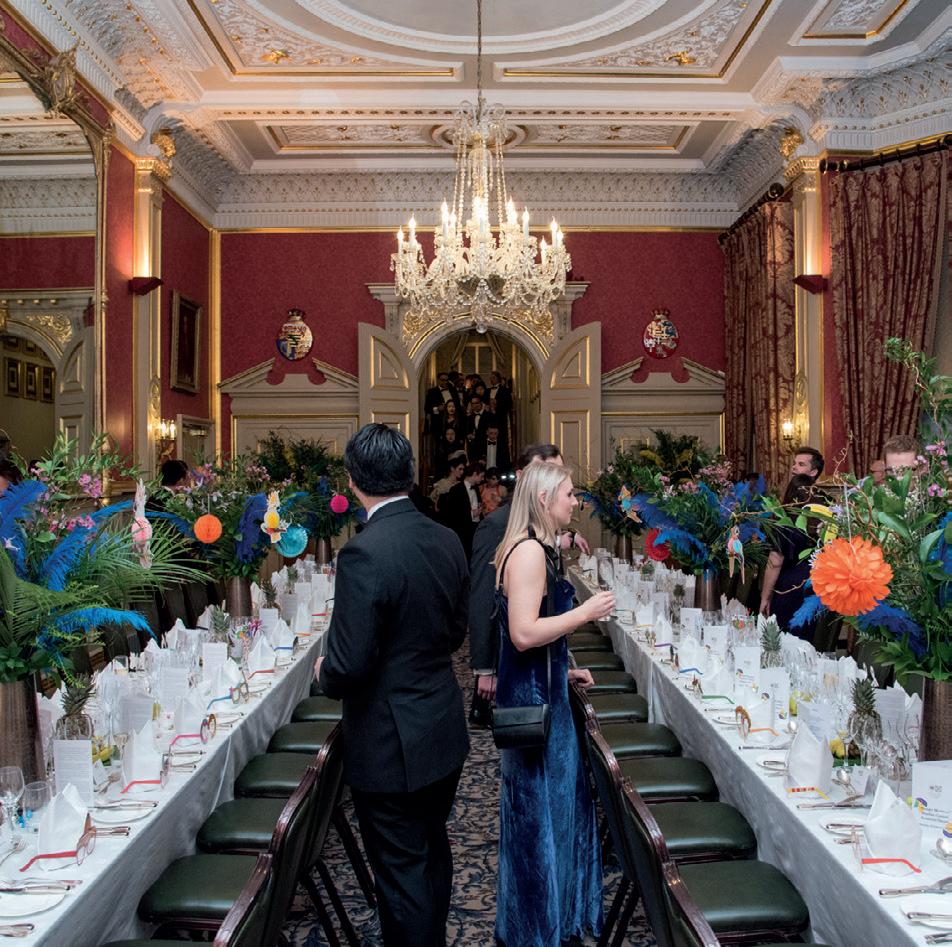


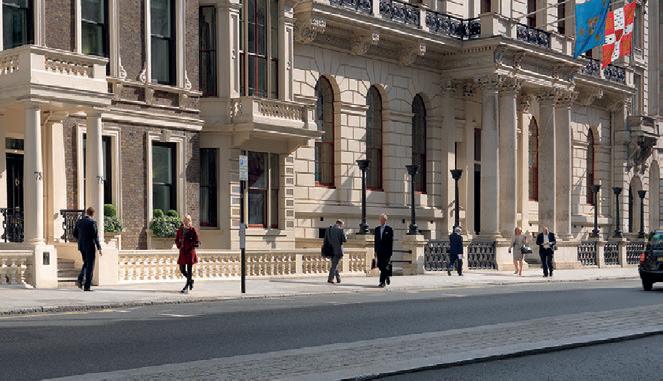


For nearly 200 years alumni have chosen to take up membership of a spacious and elegant private club in the heart of London. The Oxford and Cambridge Club in Pall Mall is the perfect place to meet for a drink, entertain friends and colleagues in magnificent surroundings, play squash, take a break, host a party or just find a quiet corner to prepare for a meeting. A thriving social scene, sports facilities, a lively calendar of events including talks, tastings, dinners and balls, an exceptionally well-stocked library, extensive wine cellars and more than 40 bedrooms mean our members use their club for recreation, relaxation and business - and now you can too. For details on membership or a tour of the Club house on Pall Mall, please visit www.oxfordandcambridgeclub.co.uk or call 020 7321 5110 Oxford and Cambridge Club @oandcclub
26 April
Professor Joan Copjec: Film and Screen Distinguished Lecture Robert McCrum Lecture heatre, Corpus Christi College, 5:30pm 16 May
Amelie Arts Picturehouse, 4:10pm
25 May
Tuner preview Arts Picturehouse, 5:00pm
Cherry Suede he Portland Arms, 2:00pm 7 May Barbara he Portland Arms, 7:30pm 10 May Ellen Kent Opera, Carmen Corn Exchange, 7:30pm 18 May James Morrison Corn Exchange, 7:30pm 23 May Ichi Junction, 2:00pm
25 April onwards
Handpicked: Painting Flowers from 1900 to Today Kettle's Yard, opening hours 25 April
Recreating an Ancient Egyptian Book of the Dead Fitzwilliam Museum, 11:00pm 19 May
ACOTAR read-along Waterstones, 6:00pm 20 May
In Conversation: Flower Painting Now Kettle's Yard, 7:00pm 2 June
Painting Party at he LAB he LAB, 7:oopm
Footlights ADC Smokers: Easter 2026 ADC heatre, 11:00pm 22 May
hree-Martini Lunch Corpus Playroom, 9:30pm
27-30 May
he Wind in the Willows ADC heatre, 7:45pm













Growing up surrounded by the sport, Zafar Ansari had the opportunity to represent both Surrey and England during his cricketing career. Having toured the subcontinent in what was Alastair Cook’s last Test series as captain, the following spring Ansari announced the shocking decision to retire from the game at the age of 25. Since then, the former Trinity Hall student has pursued a career in law, currently working at a ‘Magic Circle’ barristers’ chambers, Blackstone Chambers. I sat down with Ansari to discuss his cricketing career, life at Cambridge and transitioning into law.
From a young age, Ansari was surrounded by the game as his father, originally from Pakistan, had an avid interest in cricket: “Realistically, he was the reason I became interested in cricket from a very early age. Also, the fact that I have an older brother was in uential. It was in the family. I had an early aptitude for it when I was four or ve years old and subsequently enjoyed it.” Ansari’s older brother, Akbar, would later captain Cambridge University, even scoring 193 against Oxford all the way back in 2008.
Attending Hampton School, an independent all-boys school in south-west London, the former bowling all-rounder kept a healthy balance between his academic and sporting commitments from the early age of 13. Ansari re ected upon the signi cant, positive impact the school had on shaping him both on and o the cricket pitch: “Both academically and in terms of sport, it is an incredible privilege [to go to a school like that], just given the facilities that you have at your disposal, quality of teaching and academic expectation. e culture there was de nitely one which drove us to achieve as much as possible academically.” On a sporting front, the former Surrey man discussed the high standards of cricket at the school and the impact Mr Ami Banerjee, the school's long-standing Director of Cricket, had on his playing career: “Cricket was very good when I started there. e rst XI included future England cricketer Toby Roland-Jones. A big in uence was Mr Banerjee. As a technical batting coach, he was as good as I’ve really had, and was a great mentor, given his experience playing on a professional level in India.”
❝
I had an existential feeling of ‘Why am I doing this?’
spite the academic toll that comes with the job, Ansari managed to balance both having a professional contract with Surrey, all while staying on top of his social and academic commitments: “For me, it was always trying to recognise what my priorities were. At Cambridge, they were my academic work and, secondly, enjoying myself – developing strong relationships and making the most out of what Cambridge had to o er. Having clarity was crucial, especially being pulled in di erent directions. With cricket, in the early season, I would play a few games for Surrey in April/May but then take a six-week break to focus on exams.”
❝
I stopped being a cricketer as I didn’t enjoy being a professional cricketer
Being someone who struggles with consistency and time management, I was somewhat in awe of the discipline required to sustain this routine e ectively. Zafar’s grounding advice? “Make sure to have a good support network around you to help. In my case, my brother was at Cambridge during my second and third years there, and he used to come to the gym with me or throw me balls.” He also described the huge bene ts of training alongside players from
whether or not you make it as a professional cricketer. You need to have a certain amount of opportunity to play in the 1st XI at a young age. Alec was always a champion of mine and found ways of getting me into the side as an all-rounder. is support was, of course, in combination with the head coaches and captains I played under. Alec was also always exemplary when it came to training and driving other cricketing standards. He just comported himself very well.”
On a personal level, Ansari expressed gratitude towards Stewart when it came to his decision to retire from the game at 25: “He was very supportive with my decision to stop playing professional cricket. He really understood the reasons for it and didn’t push back.”
A couple of years post-Cambridge, in the winter of 2016, Ansari made his Test debut against Bangladesh, having played his sole ODI against Ireland in the summer of 2015. Despite injury curtailing his tour of the sub-continent, his third and nal cap for England’s long-format side was against India – a match which included legends such as Virat Kohli and Joe Root. On his experience playing with England’s all-time highest-leading Test run scorer, Ansari had nothing but positive things to say about the former England captain: “He was someone I played with across the England age-groups. I think he is exactly how he comes across publicly, behind closed doors. He’s just a nice guy, not super loud, just a decent, friendly guy.”
e following spring, Ansari announced to the cricketing world that he would be retiring from cricket at the young age of 25. A complete shock.
doing this? ’ emerged.”
From another perspective, Ansari, ever the all-rounder, felt that there were other things to explore in life: “I got to the point where I just wanted to do something else.”
Despite taking a step back from the professional game, Ansari remains in contact with many of his former Surrey teammates: “I kept up with Ben Foakes after playing, as well as the likes of Sam Curran and Rory Burns. I am on the committee there, so I do have a decent amount of contact with people through that. Hashim Amla was another I remained in occasional contact with.”
Ansari described Amla, one of South Africa’s greatest batsmen ever, alongside Kumar Sangakkara and Kevin Pietersen as the best batsmen he had the opportunity to play with.
Following retirement, Ansari was undecided about what he wanted to do.
❝
Being a barrister appealed to me as I retained a sense of freedom

Having navigated his way through secondary school, Ansari followed in the footsteps of his older brother in attending the University of Cambridge. He studied Geography at Trinity Hall, but would later switch to Politics, Psychology and Sociology in Part II of Tripos. De-
Anglia Ruskin University who were striving to make it in
However, the former England left-arm orthodox spinner took the Graduate Diploma in Law (GDL) on the basis that the law might be an interesting avenue to explore: “As I started to do that, I found aspects of the law very interesting. Unlike as a cricketer, being a barrister appealed to me as I retained a sense of freedom and was something di erent to working under a tightly constrained

After graduating from Cambridge, Ansari focused his energy on breaking into the Surrey rst team. This is often the rst di cult step for a young cricketer in their professional career. Among others, it was clear that former England and Surrey legend, Alec Stewart, helped lay a foundation for his cricketing career to ourish: “He was very in uential in terms ties to play. ere is so much luck as to

of giving me great opportuni-















Yet the reasons for the decision were grounded in genuine rationale: “Simply put, I stopped being a cricketer as I’d fallen out of love with life as a professional cricketer. On the one hand, it felt simultaneously insigni cant as it is ultimately just a game, while also making you feel that every performance was so important, given it was so public and there was always some degree of objective failure. ere was a mismatch between inspiration ing star am


the two. An existential feeling of ‘Why am I


Ansari, having completed the GDL and then the Bar Professional Training Course with ying colours, secured a pupillage at Blackstone Chambers under the purview of Diya Sen Gupta KC, who he described as an inspiration” during his law career so far. He has also been recognised by Legal 500 as a “risin employment law. In talking about future aspirations, Ansari humbly responded: “As a barrister, there aren’t really any formal markers of career progression except for eventually, if you’re lucky, becoming a KC, and that is a long way o . Outside of my day job, I am very interested in thinking about how, in my role at Surrey, I can push the club harder around its commitments to promoting
It's safe to say Ansari’s all-round talent indeed extends from the cricket pitch to the courtroom, but a key takeaway from this interview was that Ansari’s grounded mentality is the driving force behind everything he does: “For me, it’s just about trying to be more procient, con dent and better at the things that I do.”







How is BJJ distinct from other martial arts?
Jay: I believe it evolved from old Japanese jiu-jitsu and judo. In its original form, it is self-defence involving strikes. Now, it has developed into a sport which includes a lot more grappling. For example, while BJJ is predominantly a grappling form of martial arts, karate is far more about strikes. You should think about BJJ beginning once you get to the ground. It’s about submitting your opponent on the ground, rather than wrestling, which focuses on getting your opponent to the ground in the rst place.
How does a usual Brazilian Jiu Jitsu match work?
Jay: e concept is trying to get your opponent to the ground, as well as scrambling to get around people’s legs and arms. It is usually a points system, but submitting the other person is a straight win. Usually, each ght is one ve- or eight-minute round. In a knockout tournament, you are rewarded for getting quicker submissions as it conserves your energy.
Harry: e most recent and biggest xture was the Warwick Quintet – almost a precursor to BUCS, as the league is still being set up. Each team had a combined weight of 425kg for ve people, with the objective of eliminating each member of the other team. Imagine it as throwing people in Pokémon until every person has been submitted or is timed out after ve minutes.
Where do you see Cambridge’s Brazilian Jiu-Jitsu society going in the coming years?
Jay: I think it will be the most popular martial arts society in Cambridge pretty soon, as there is no head impact. e actual game of BJJ is really strategic and really ticks a lot of people’s interests.
Harry: I would describe the sport as almost like a game of chess, with the consequence being that you get tapped out instead of being checkmated. It attracts the sort of people we have here in Cambridge, intellectual people. It will get recognised even more next year, and I think a Brazilian Jiu-Jitsu Varsity is de nitely on the cards, and the growth will be insane. I think it could get half-Blue or Blues status soon.
How can people get involved with Brazilian Jiu-Jitsu at Cambridge?
We train ve times a week, all of which take place in the Sports Centre. ere is an open mat between 3:30-5:30pm on a Tuesday, then Wednesday 8-10pm, Friday 3:30-4:40pm and on the weekend between 9-10:30am.

does it



The 171st Boat Race saw a spectacular display of sporting skill and grit, watched on by over 250,000 on the Tideway. But for the rowers who battled across choppy waters, the 19 minutes of gruelling physical endurance which decided this prestigious contest marked only the nale of just under a year of intense preparation.
Competing in the Boat Race brings no nancial reward, yet requires the same level of physical and mental resilience as winning an Olympic medal according to Patrick Ryan, CUBC’s head women’s coach. Rowers themselves will train two to three times a day consistently from August through to the race in early April, and even more for those determined to represent the Blue boats. Cambridge and Oxford boat clubs’ senior leadership begin drawing up plans for the following year’s contest soon after the race concludes.
Recruitment of world-class rowers plays a key role between April and the restart of the academic year in October.
It is a testament to the Boat Race’s enduring presence on the international stage that both clubs are able to procure a range of Olympians and world championship competitors for both their Blue and reserve boats. What equally displays the integrity of the race is that these boats are, in part, made up of rowers who began their journey rowing for their college sides. In this year’s contest, OUBC’s women’s Dark Blue boat saw Spanish Olympian Esther Briz Zamorano and GB’s Kyra Delray face o


against CUBC’s Carys Earl, who had never rowed before university and yet had gone on to win the Boat Race in 2024 and 2025.
Despite having similarly exceptional athletes, the two boat clubs di er in their internal structure, as well as their training regimes. Mark Fangen-Hall, appointed as OUBC’s head men’s coach in the summer of 2024, has implemented radical changes to the club’s hierarchy since his arrival. Fangen-Hall has moved the club from a traditional sporting committee structure towards what could be considered a more corporate approach. e aim was to create a new culture in the University’s rowing, attempting to escape the Oxford men’s rut of six defeats in seven years ahead of 2026’s race. Prior to taking on his role at OUBC in 2024, Fangen-Hall coached at Eton (crossing paths with CUBC’s Goldie rower Simon Nunayon), as well as working with Rowing Australia and Queen’s University Belfast.
Speaking to Varsity before the Boat Race, OUBC men’s Blue (2025), and now CUBC rower Felix Rawlinson discussed the di erences between the two clubs’ preparations and coaching. Rawlinson described CUBC’s training programme as more physically rigorous than Oxford’s, with a greater focus on pieces (a type of training exercise focused on repeated bursts of high-rate rowing) on the river. is is perhaps in part due to ooding on the Isis (which is used by OUBC for some of their training), whereas Cambridge use the Ouse in Ely,

which does not su er the same issues. On the water, outings are crucial for crew cohesion and technical improvement.
At the start of the academic year, head coaches are typically presented with around ve dozen aspiring rowers for each Blue boat, signalling the start of a ruthless selection process. It sees roughly 250 athletes reduced to a mere 32 by early to mid-March. Beginning with a demanding 5k test that pushes prospective rowers to their physical limits, both clubs’ training camps and preparatory races span the globe, with CUBC visiting Shanghai and Portugal in recent years.
❝
250 athletes are reduced to just 32
Back on home soil, races at Fours Head typically mark the only time when OUBC and CUBC compete directly against one another before the race. In early December, the loser of the previous year’s Boat Race issues a formal challenge for the next year’s contest. Trial eights on the Tideway and one nal 5k test mark the nal stage of selection prior to the end of Michaelmas term, before the process resumes with the pre-Boat Race xtures in February.
ese contests take place in the nal
stages of preparation, and see CUBC and OUBC’s Blue boats face o against international rowing’s top eights, including tests against the Dutch, Oxford Brookes, and Leander, the GB feeder squad. Consisting of two half-course pieces on the Tideway per xture, these contests provide a crucial opportunity for Blue boats to send an emphatic message to their upcoming opponents in the Boat Race. eir performances against the same crews provide a relative indicator of what is to come in the ensuing weeks. e xtures also serve as a nal opportunity for rowers to prove themselves to their coaches, with the nal crew selections being issued shortly after, or even during, these contests. e selection process is equally rigorous for the two clubs’ coxswains. With the Boat Race described by Fangen-Hall as the ultimate coxing challenge, the outcome of the contest can be decided by those in charge of guiding their crew through the Tideway waters and bringing the best out of the eight rowers in front of them. 2023 saw Cambridge men's cox Jasper Parish execute an audacious move early in the race, moving away from the conventional racing line into shallower water, giving his crew a lead of a length that proved decisive in CUBC's underdog win. In 2025’s women’s Boat Race, a clash of blades at the Fulham Wall led to an unusual restart as a result of aggressive coxing from the Oxford cox Daniel Orton. Both coxes attempted to steer into the faster water to obtain the most optimal racing line.
Prior to this year’s race, Varsity spoke to Sarah Winckless, the umpire of the 2021 and 2025 men’s Boat Races and a former Olympian. She explained that, although the coxes had been spoken to in the days prior to the Boat Race, the umpiring team nonetheless expected tense, side-by-side encounters in this year’s choppy conditions.
While the lightweight and veteran races saw the crews navigate more challenging waters – which took place on the day before Saturday’s Boat Race – by the afternoon of the Blue boat contests, the Tideway appeared more manageable than expected. A fast start by the OUBC women’s boat pulled them a length clear within 250 metres as they rounded the rst bend. is was accompanied by groans from supporters as they struggled to access Channel 4’s maiden coverage of the race due to poor connection on the Putney embankment, before Oxford women secured a relatively comfortable victory at the nish in Mortlake. e mood among CUBC fans was soon bolstered by the men’s boat's fourth consecutive victory for the Light Blues, to go alongside wins for Cambridge in both reserve, lightweight, and veterans’ races
With CUBC emerging yet again victorious in the men’s Boat Race, and Oxford securing its rst women’s Blue boat win in eight years, the combination of exceptional sporting spectacle and rich historical tradition highlighted the Boat Race’s prestige as one of international rowing’s premier events.





Exponentially growing as a sport worldwide with over two million practitioners, Brazilian JiuJitsu (BJJ) has started gaining traction in Cambridge. e in uence of the Ultimate Fighting Championship (UFC) has seen the discipline expand in popularity and prestige. e BJJ society attracts a wide array of students – having only been set up at the start of this academic year. I sat down with Blues’ captains Jay Vasireddy, a fourth year astrophysics postgraduate, and Harry Marsh,
a third year law student, to discuss all things Brazilian Jiu-Jitsu. Can you talk to me about your martial arts background and future aspirations?
Jay: A lot of my friends are big into MMA, and I went to a few BJJ sessions with them almost three years ago. Since then, I joined a local gym back at home and started training in Cambridge whenever I could. I got my blue belt a few months ago. It takes approximately two to three years to get it. At this point, you will be
able to win in a grappling match against anyone of any weight. e goal is to get a black belt over time, but on average it takes another 10 plus years to achieve. Harry: I started when I was a kid, as my dad used to do a bit of ghting, but I stopped just before Covid. I did a bit of judo at the start of university, including BUCS and Varsity, but I decided to focus more on BJJ. It can be quite di cult to balance training with exams, but I hope to keep improving in the coming years.