
From crime novelist to reality





No.944 Friday 6th March 2026
varsity.co.uk
e Independent Student Newspaper since 1947












Ell Heeps Senior News Editor
e University invested money in a fund that has stakes in rms linked to human rights abuses by the Israel Defence Force (IDF).
e Middle East Eye (MEE) recently reported that the University endowment fund invested £140 million in the iShares ESG Select Screened S&P 500 fund in the last nancial quarter of 2025. e fund holds shares in companies including Palantir, Caterpillar, and GE Aerospace.
e endowment fund is managed by the University of Cambridge Investment Management Limited. According to MEE, the University has previously refused to disclose which companies are part of its
endowment portfolio for “legal reasons of con dentiality”. However, the size of this investment, being more than $100 million, meant that the University was required to disclose the details to the US Securities and Exchange Commission.
MEE reports that the investment includes around £800,000 worth of stock in the software company Palantir, which was co-founded by the billionaire entrepreneur and right-wing activist Peter iel; around £900,000 worth of stock in GE Aerospace, an American company which produces aircraft engines; and around £1 million worth of stock in Caterpillar, an American construction company.
In 2024, Palantir signed a deal with the Israeli defence ministry, as well as a
£240 million “strategic partnership” deal with the UK Ministry of Defence, involving developing “AI-powered capabilities […] to speed up decision making, military planning and targeting.” MEE describes the company as “a major partner” of the US Immigration and Customs Enforcement agency.
e Campaign Against Arms Trade reports that GE Aerospace provides the engines for many of the Israeli Air Force’s military jets that are used in Gaza. Caterpillar is a construction equipment manufacturer, which has been accused by Amnesty International of human rights violations due to its sales of bulldozers to the Israel Defense Forces, which have been used to destroy properties in Gaza.
e iShares ESG fund is managed by
BlackRock, a global asset management rm with major shares in Palantir, GE Aerospace, and Caterpillar.
A member of Cambridge for Palestine told Varsity: “Education institutions must uphold human rights and moral accountability, not pro t from systems that fuel occupation, violence, and genocide.
While the University increasingly talks about ‘responsible investment’, these ndings reveal a clear gap between rhetoric and reality.
“We urge the University to immediately commit to a full divestment from [...]any company complicit in violations of international law, including those connected to the occupation of Palestine.”
e University of Cambridge was contacted for comment.
Postgraduate president results delayed as candidate is disquali ed p.3 ▶
Students warned about criminals posing as deaf people p.6 ▶
psychiatrists
An open letter called for the government to look into puberty blockers p.7 ▶
Moves backed by the Chancellor and leading academics p.9 ▶

May Ball ticket-buying season is upon us. While setting this week’s print, welearned from the King’s A air committee that workers would be forced to shell out just under £40 to attend the second half of the ball they would work the rst half of. Justi ed outrage reminded us of the ethical dilemma May Balls pose – events so extortionate that the salary for working the ball does not cover the ticket price.
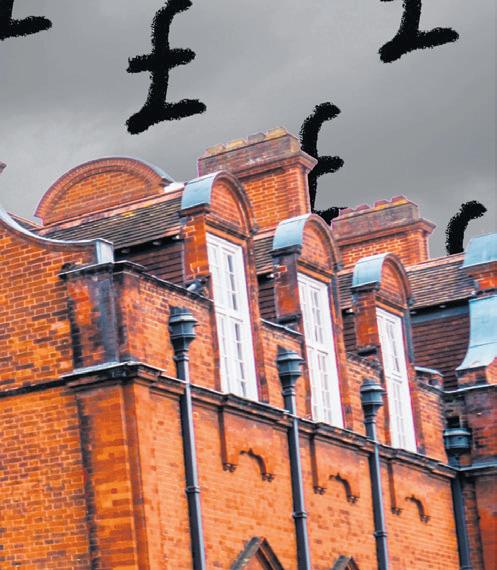
Ethical dilemmas meet the University endowment after a Middle East Eye investigation found indirect investments in Peter iel’s Palatnir (p3). Pressure to divest is intensifying after Newnham set the example, agreeing to rewrite its investment principles (p.4).
e University’s academic relationship with the con ict has also been brought into view, after the Chancellor pledged his support to establishing a Palestine studies institute (p.9). As our Newsin-depth shows, such a move is likely to be fraught with complexity, embroiled
in activism and high-pro le political controversy.
e News-in-depth piece interrogates how our values as a student body interact with the academic aims of the University. Values are also the central topic of this issue’s long-read Feature (p.16), which wrestles with the complicated feelings Cantabs have towards British identity. With politicians increasingly divided over what it means to be British, Cantabs provide a refreshingly nuanced snapshot. Students value the quaintness of unifying tradition, but worry deeply about prevalent ethnonationalism.

In Vulture we’ve highlighted the myriad of ways students get creative in Cambridge. From female organists celebrating International Women’s Day (p.24) to rising student poets featured in Arts (p.22), and a preview for the upcoming Measure for Measure in St John’s Chapel (p.27), the ambition within the arts appears to be thriving this Lent Term. From the present day cre-
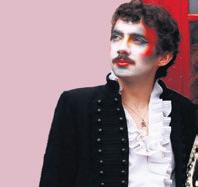
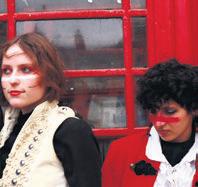
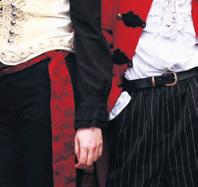
ativity, Fashion takes us back to the 1980s with a spotlight on New Romanticism, a movement that emerged from London clubs (p.26).
In Theatre and Arts, Cambridge alumni return to the arts. Sir Trevor Nunn discusses his experiences with Cambridge theatre (p.27), while Tom de Freston’s new exhibition in the Museum of Classical Archeology highlights the love between him and his wife, which was sparked in Cambridge (p.23).

So, as the sun begins to come out and the da odils are blooming, we hope that this edition of Varsity continues to shine a light on the voices of students.




editors Ellie Buckley & Calum Murray editor@varsity.co.uk
deputy editors BibiBoyce&JossHeddleBacon deputyeditor@varsity.co.uk
vulture editors Emily Cushion & Mary-Anna Im magazine@varsity.co.uk
news Alex Brian & Ell Heeps (Senior); NeveWilson, Bela Davidson, Alessia Fietta & Maria Eduarda Paixão (Deputy) news@ varsity.co.uk
comment Duncan Paterson & Ben Lubtish opinion@varsity.co.uk
features Daisy Stewart Henderson & Frida Bradbrook features@varsity.co.uk
interviews Tara Buxton & Hannah Bur eld interviews@varsity.co.uk
science Pooja Gada & Ruby Jackson science@varsity.co.uk
sport Keane Handley & Sam Ho sport@ varsity.co.uk
lifestyle Georgia Gooding & Ella Howard lifestyle@varsity.co.uk
arts Emma Gower & Ryan Vowles arts@ varsity.co.uk
fashion Jess Gotterson & Flossie Bullion fashion@varsity.co.uk
fashion shoot co-ordinator Caterina Siciliano-Malaspina
film & tv Amanda Ljungberg & Otto Bajwa-Greenwood lmandtv@varsity.co.uk
music Francis McCabe & Daniel Kamaluddin music@varsity.co.uk
theatre Eleanor Baldwin & Elsie Hayward theatre@varsity.co.uk
photography editors Amika Piplapure & Eve McEwen
illustrations editors Lyra Browning & Jordan Inglis sub-editors Alessia Fietta, Marnie McPartland, Juliette Berry & Charlotte Crawley subeditor@varsity.co.uk
associate editors WilfVall, Ben Curtis, Charlie Rowan, Sophie Ennis, Daisy Bates, Anuk Weerawardana & Nick James associate@varsity.co.uk
business manager Mark Curtis business@ varsity.co.uk
varsoc president Wilf Vall president@ varsity.co.uk
varsity board Dr Michael Franklin (Chairman), Dr Tim Harris, Michael Derringer, Mark Curtis (Company Secretary), Sophie Ennis, Hugo Gye, Wilf Vall & Anuk Weerawardana (Directors), Lotte Brundle (Guest) & Zoah HedgesStocks (Guest)



● Postgraduate presidential results delayed
● Candidate disqualiied for voting on other students’ phones
● Another given campaigning ban for appearing in video
Alexander Brian
Senior News Editor
he full results of last week’s Students’ Union (SU) elections have still not been announced due to outstanding appeals of decisions relating to breaches of election rules.
his year’s elections have seen an unprecedented number of infringements, resulting in the disqualiication of postgraduate presidential candidate Roman Shainskyi and a brief campaigning ban for his competitor Jeeves Rohilla.
he results of the elections for undergraduate president, university councillor, and the three vice-presidents were announced last hursday (26/02). However, the identity of the next postgraduate president remains unknown, with the SU saying it is “working to resolve this as swiftly as possible”.
he Deputy Returning Oicer (DRO) made the decision to disqualify Shainskyi last hursday (26/02) after receiving multiple complaints against him. he candidate then appealed the ruling, which was upheld by the Returning Oficer (RO) on Sunday (01/03).
Shainskyi is accused of voting on another student’s phone in the Engineering Library, interfering with the election platform on a student’s device at Trinity College, but being blocked by two-factor authentication, as well as of selecting himself for a third student and then waiting for them to conirm before leaving. he candidate strongly denies voting for other students, telling Varsity: “Where students asked for assistance navigating the SU website – particularly locating the postgraduate category – I showed them how to access the correct page. Once they began reading manifestos and making their decision, I stepped away. Helping someone locate the correct page is not equivalent to inluencing or casting their vote.”
However, the SU explained that providing voters with technical assistance breaches their rules. hey further noted that Shainskyi has been reported for engaging in “an aggressive campaigning style where he would not leave students alone
until he saw them voting for him,” and attempting to form a slate with another candidate, who refused to join him.
According to the SU, these incidents alone would have been enough to disqualify Shainskyi, but were made worse by the fact that he had already been given a “formal and inal warning” on Tuesday (24/02) for other breaches of election rules.
hese included displaying posters in a college bar without permission, being disrespectful towards SU staf at a mobile polling station, and campaigning while less than three metres away from a student casting their vote. Shainskyi was also reported for using materials displaying the SU logo – though the DRO conceded that this last breach was unlikely to imply an endorsement.
For these infringements, the candidate received a 24-hour campaigning ban, which was reduced to 12 hours on appeal after Shainskyi claimed to have received permission from an unknown college staf member to display the posters, and to not have been disrespectful. However, the RO airmed that the posters had breached college policy.
In blocking Shainskyi’s most recent appeal, the RO added that another complaint had been made against the candidate since his initial disqualiication, for which there was photographic evidence. his complainant requested that their vote be reset as they had felt pressure to vote for Shainskyi.
he RO also noted that Shainskyi has accused other students of attempting to “disrupt and interfere with the candidate’s campaigning activities”. he SU said that because these complaints are not against other candidates, they must be dealt with under a diferent procedure.
Shainskyi told Varsity: “During hustings and throughout campaigning, I made clear that if elected, I would not prioritise political activism within the Student Union, regardless of the cause. Following that position, I experienced repeated disruption from pro-Palestine activists who strongly disagreed with my stance.
“I was followed between campaign locations, interrupted while speaking to students, and had individuals shout “Free Palestine” during conversations. Several students later informed me that they were approached and encouraged to submit
complaints against me. I have witnesses prepared to conirm both the disruptions and these subsequent approaches.”
Shainskyi, an MPhil student at Judge Business School, centred his programme on encouraging startups and expanding cryptocurrency and AI opportunities for students. At a hustings last Friday (20/02), he promised to end the SU’s “propaganda about certain sides of politics”.
he candidate explained that he was pursuing a further appeal because “I believe the complaints do not accurately relect what occurred and that the broader political context has not been fully weighed”.
In response, the DRO told Varsity: “In reviewing complaints, I have followed due process, considering evidence and irst-hand accounts from multiple parties including the candidate concerned, and this consideration is addressed in my rulings. All rulings are available on the SU website, which address the rationale of decisions made. As the independent arbiters of this election, the Returning Oicer and I are committed to reviewing and improving Cambridge SU’s democratic processes.”
Another postgraduate presidential candidate, Jeeves Rohilla, received a one-and-a half-hour hour campaigning ban for appearing in a collaborative Instagram post with the University’s oicial account.
Rohilla, a PhD student in theology and the current president of Lucy Cavendish MCR, ran on a platform of reducing college wealth inequality and improving afordability for students. He is best known for his social media interviews with fellow students, some of which are made in collaboration with the University.
Last hursday (26/02), his latest video appeared on the Cambridge Instagram page, which has 1.5m followers, which the SU said gave him an “unfair advantage”.
he DRO recognised that Rohilla must have actively accepted the collaboration, but that the breach was still likely inadvertent. As the candidate removed the collaboration within two hours,and immediately notified the Elections Team, he was not disqualiied, despite another candidate appealing to have him removed from the race.
Responding to the appeal, the RO said they “understand the strength of feeling of other candidates” but that they had conirmed with the University that Rohilla was not anticipating the post. he candidate told Varsity: “he video made no mention of the SU elections. I had no idea it was being posted, as this was done on the University of Cambridge account, and it was ilmed months ago.”
Another complaint was submitted last Wednesday (25/02) after Cambridge for Palestine (C4P), which is not a registered society, published a list of endorsements on Instagram. he SU ruled that no candidates had breached election rules as they had not sought out this external endorsement.
Alexander Brian Senior News Editor
Melanie Benedict has been elected undergraduate president of the Students’ Union (SU) and will take up their position in July.
he current vice-president for liberation and welfare ran on a platform of stopping rent increases, reducing workloads, and protecting trans students. Benedict has also promised to support divestment and climate activism, increase the visibility of the SU, and improve the welfare support ofered by tutors.
he candidate was elected in one round with 1706.5 votes. hey told Varsity that they felt “very good” about their victory, but that “it has been really fulilling to see such an array of good candidates this year, people who are really passionate about student advocacy”.
Regarding their priorities as president, Benedict commented: “I never think with student organising that there’s one thing that you work on irst. he reality is that lots of these projects are chip-away projects. What I have learned as a sabbatical oicer is that you have to work on all of those projects in an interweaving fashion […] as soon as you start the role in July.”
In preparation for the role, Benedict said they would work with the current undergraduate president Matthew Copeman “to learn about the intricacies of the role and how he has done such impactful work”. hey also plan to “build relationships with University staf I haven’t met yet who will be integral to the work that I do as president”
and engage with the SU’s new CEO, Bethan Dudas.
he former CEO resigned in November 2024 after numerous claims of bullying by the Senior Management Team towards other staf. Dudas will replace the current interim CEO in April after leaving her role as CEO of London Met Students’ Union.
here was no increase in turnout from 2025, which saw a substantial increase from the usual 10% participation to just under 19%.
he SU uses the ‘Single Transferable Vote’ system, which means that students can rank as many candidates as they like in order of preference. For this reason, the winner may only emerge after several rounds of elimination, and the results can contain decimals.
18%
he turnout in last week’s SU elections
Sabbatical oicer roles are full-time, paid positions, for which the candidates are either inal-year students or intending to intermit if elected. Sitting on the University Council – the main decision-making body of the University – is undertaken alongside one’s studies and is separate from the SU. A referendum on whether to update the SU’s constitution, known as the Articles of Association, also passed. 1,460 students voted ‘yes’, 182 opposed, and 1,527 abstained.
Vice-president (Education and Widening Participation
Sarah Misraoui
hird year historian, Peterhouse Elected at stage four with 1244.5 votes
Key priorities:
● Access schemes after admission
● Afordability Task Force
● Compensation for academic representatives
Vice-president (Liberation and Welfare)
Tallula Harris
hird year geographer, Homerton
Elected at stage one with 1428.5 votes
Key priorities:
● Standardising rents across college
● Supporting student activists
● Improving safety for marginalised groups
Vice-president (Student Communities and Societies)
Stella Wilkinson
Fourth year Natsci, Medwards Elected at stage one with 1399.5 votes
Key priorities:
● Walk-through access to all colleges
● Preventing course closures
● Reporting system for abuse
University Councillor
Bethan Watson
Second year historian, Lucy Cav Elected at stage four with 983.5 votes
Key priorities:
● Reforming sexual violence reporting
● Universal access to college libraries
● Process for petitioning the University Council
Alexander Brian Senior News Editor
Newnham College has agreed to establish a working group to review its current investments and rewrite a statement of investment principles.
is comes after the activist group Newnham for Palestine (N4P) published an open letter in October accusing the College of investing “at least £20 million in companies complicit in genocide, occupation, and human rights abuses”.
In an Instagram post, the group claimed that Newnham has agreed to divestment, writing: “ e updated investment principles will guide a divestment away from companies complicit in genocide, occupation, human rights abuses, international law violations, and fossil fuel production.”
A spokesperson for Newnham told Varsity: “At a meeting of the College Council on 3 December 2025, the Council agreed to set up a Task and Finish Group, including elected student representatives, to review the College’s Statement of Investment Principles. Any revision will be made public in due course”.
At the same meeting, the Council agreed to advocate for the Cambridge University Endowment Fund (CUEF) to disclose its investments and divest from “complicit companies”.
e CUEF is a £4.2 billion fund which is separately managed but wholly owned by the University. Several Cambridge aca-
demics recently accused the University of “maximal obfuscation” over its failure to reveal which defence companies it invests in. However, others, such as engineering professor Richard Penty, have urged the University not to “turn its back on UK national security”.
N4P acknowledged that its campaign is “not over” and that it still needs “to ensure the College follows through on its commitments”.
However, the group added: “Newnham College Council’s decision proves once again that divestment is possible – even if some colleges or university ofcials claim otherwise.”
N4P’s original open letter, which has received over 450 signatures, included a long list of companies it accused the College of investing in, including £3.9 million in Microsoft, £2.8 million in Alphabet, and £105,800 in Palantir.
At the time, Newnham denied the allegations, telling Varsity: “Newnham College does not invest directly in any of the companies listed. Newnham College invests in the State Street World Screened Index Equity Fund which follows the MSCI Word Screened Choice Index, which has about 1,250 companies in it.”
e College has refused to concede two of N4P’s demands, namely adopting the principles of Universities of Sanctuary – a national network which campaigns for universities to support refugees and asylum seekers – and cut-


ting “non-investment ties to complicit companies”.
As an example of this second point, the group cites the College’s use of Booking.com to list Newnham rooms for short-term rentals. Activists have called for a boycott of the website due to its operation of holiday rentals in parts of the West Bank.
is comes as the University Council has repeatedly delayed a vote on the extent to which Cambridge will divest from arms manufacturers. e University ceased investments in weapons illegal under UK law in October, following a report from a Working Group on Investment. However, this report stopped short of proposing full divestment, instead o ering the Council three options to consider.
N4P emphasise that they “intentionally recommended a broader divestment” than advocated by the University’s Working Group, instead taking inspiration from King’s, which became the rst College to divest from weapons manufacturers in May.
e group explained: “Our Council paper made a point to include companies which produce conventional weapons as well as dual-use products that are signi cantly used for both military and non-military goods.”

Ell Heeps
Senior News Editor
e University has announced that the School of the Biological Sciences (SBS) will no longer be responsible for the management of the Vet School, following the decision by the General Board two weeks ago to continue the course.
In a notice published on Tuesday (03/03), the General Board outlined the need for “new leadership” in the shortterm, while the School attempts to regain full accreditation and nds savings in the day-to-day running of the veterinary hospital.
e notice outlines the two primary problems facing the Vet School in its current form as the “small size of the course, which is constrained by the number of places available in the Colleges,” and the “science-intensive curriculum, which is di cult to align with the evolving accreditation standards of the Royal College of Veterinary Surgeons (RCVS)”.
It goes on to say that the SBS originally stepped in to support the Vet School towards the end of 2024, when issues surrounding the accreditation of the course by the RCVS, as well as the Vet School’s nancial di culties, had “reached a crisis point”. is took place alongside an evaluation by the SBS of possible alternative models for the continuation of the course, which concluded with the recommendation that the Vet School be closed.
e General Board states that although it ultimately did not take on this recommendation, it “a rms the careful and rigorous analysis carried out by the School of the Biological Sciences” in this regard, and “will draw on it as it considers options for the course going forward”.
However, it also states that while the Vet School will continue to work towards regaining full accreditation by the RCVS and eliminating overspends in relation to the veterinary hospital, these matters “will no longer be the responsibility of the School of the Biological Sciences”. It continues: “As the Department recognises, implementation will require new leadership, and the Faculty Board of Veterinary Medicine will manage and oversee these changes”. e notice concludes: “Following its decision, the General Board now encourages colleagues to work together in a positive and supportive way, and to help deliver the goals the Board has set out for the bene t of sta and students.”
In the town hall meeting held on 24 February after the General Board’s decision to continue the course, students expressed concern about the damage that the deliberation had done to the Vet School’s relationship with the SBS. In response to this Professor Bhaskar Vira, the pro-vice chancellor for education, said: “we have to learn to disagree well”.


Ell Heeps
Senior News Editor
An open letter has been submitted to the University chancellor, calling on the University Council to reconsider a recent nominee for an honorary doctorate over his links to the expulsion of a student activist.
e 45 signatories, who are all from Hong Kong but now live in the UK, express concern about the nomination of
Professor Dennis Yuk-ming Lo, the current vice-chancellor and president of the Chinese University of Hong Kong (CUHK), for an honorary doctorate in medical science. In January, CUHK expelled a student, Miles Kwan, who had recently been arrested on suspicion of “seditious intent”, after he handed out yers calling for an independent investigation into a deadly re at a highrise residential block last November.
Kwan was detained for two nights before being released on bail – CUHK then referred him to a student disciplinary committee, before he was expelled for misconduct. According to Kwan, he was not expelled for his arrest, but because he described the committee as a “kangaroo panel”, and for being charged with criminal damage in 2023, for putting stickers on lampposts in 2022 to mark the anniversary of the Tiananmen Square crackdown.
e letter states:

“While we hold the University of Cambridge in the highest esteem for its historic commitment to academic freedom, we believe this speci c nomination at this juncture presents a serious ethical and reputational dilemma.”
It continues:
“While his scienti c achievements are remarkable, his recent administrative leadership has been marked by a deeply controversial decision regarding a stu-
dent, Mr. Miles Kwan”.
It describes the decision by CUHK to expel Kwan as “a departure from the university’s role as a sanctuary for constructive civic engagement and the protection of student welfare”, and says that to proceed with awarding Lo an honorary doctorate “carries the risk of damaging the University’s reputation among the international academic community and the signi cant Hong Kong diaspora within the United Kingdom.”
e letter draws parallels between the high-rise re and the 2017 Grenfell Tower re, in which 72 people were killed after the cladding on a highrise residential block caught re. It requests that the University Council reviews the nomination, before the grace to award the honorary degree is submitted to Regent House. However, the grace has since been passed, and Professor Lo is due to be granted the honorary doctorate, alongside eight others, in a ceremony in June.
A representative for the group, Dr. Sammy Chiu, who previously served as a professor at CUHK, told Varsity: “I believe it is our duty as educators to protect academic freedom and support those who no longer have a platform to speak for themselves.
“[…] Many of us signed this letter because we feel a profound responsibility toward our students and
younger colleagues. We want to ensure that those currently in the academic system, both in the UK and in Hong Kong, can pursue truth without fear of repercussion or censorship.
He continued: “By nominating Professor Dennis Yuk-ming Lo for an honorary degree at this juncture, the University risks signaling indi erence to the broader political climate in which its partners operate. My hope is that the Cambridge University Council will hear our concerns and reconsider this nomination”.
Kwan was advocating for an investigation into a re at the Wang Fuk Court housing estate in Hong Kong in November, in which 168 people died, making it the deadliest residential building re in the world since 1980. A petition started by Kwan in the aftermath of the disaster called for an independent investigation into the circumstances, for government o cials to be held accountable, and for residents to be appropriately resettled. It garnered more than 10,000 signatures, before being deleted in the aftermath of Kwan’s arrest. A petition calling for Kwan’s reinstatement to the university, along with an acknowledgment that the disciplinary hearing breached due process, has nowreceivedover1000signaturesfrom students, sta , and alumni of CUHK. e University of Cambridge was contacted for comment.


Photo by Steve Gregson Photography
Alessia Fietta Deputy News Editor
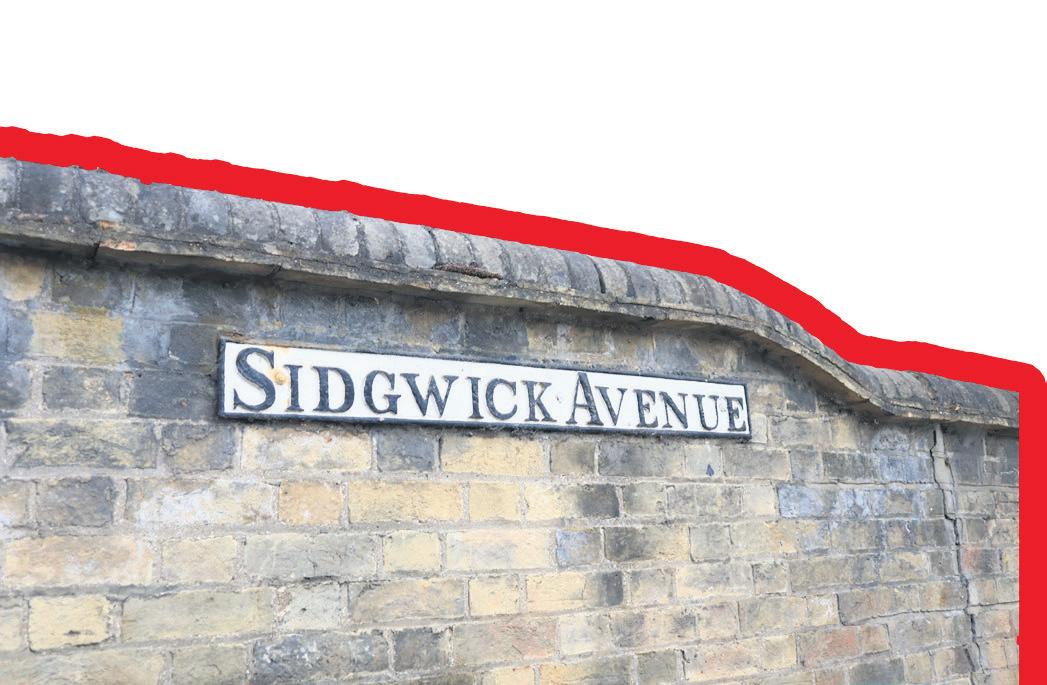
Students have reported scammers operating around Sidgwick Avenue, posing as deaf people or claiming to represent charities supporting deaf causes.
e scammers are said to approach students carrying clipboards with forms that appear to contain false signatures and pre- lled nancial details, before asking for donations or bank information.
One student who was scammed over a month ago told Varsity that, on the way to Sidgwick Site “this woman came up to me with a clipboard and just pointed at
it – she didn’t actually speak at all,” and that she “said something about a charity to help build a centre for deaf kids”.
“ ey take your donation and then they just keep charging your account randomly afterwards,” the student claimed. ey explained that they had agreed to give a £10 donation on the form, but after the initial £10 was withdrawn from their bank account, an additional £6 and then a further £3 were also taken, all a couple of days apart.
As a result of the scam, the student said they had to order a new bank card. However, they said that the issue was linked to Apple Pay, and that they had to disable Apple Pay on their original card in order to stop the payments.
Another student claimed that the scammers have been actively tar-
geting students for weeks, saying: “I encountered them for the rst time around the start of term, and, most recently, on Tuesday (03/02).
“I encountered the scammers four times in total – each time it was just past the tra c lights leading up to Sidge. e interaction was the same all four times – a person walked over to me and told me, ‘I’m deaf, I read lips’, and they said that they were trying to raise money for a school. ey then showed me a clipboard with some more information about it, and some signatures were already on the piece of paper. I then said I was busy and walked away.”


e student told Varsity that the signup sheet said they were raising money to “build a national centre for the dumb, deaf and the handicapped and the poor children”.
e head porter at Newnham College sent three emails to students at the College around two weeks ago, alerting them of the issue.
In the rst email, sent on 19/02, they wrote: “ e Police are aware and concerned that they are targeting students, so please be careful, avoid being drawn into providing any personal informa-

tion and politely decline any requests for payment. If it’s a genuine survey or questionnaire, they should not be asking for money.
“If you have been stopped or are in the future, please let me know and I can (anonymously if you wish) pass on your experience to the Police.”
A second email followed on 20/02, stating: “Unfortunately, we seem to have had a few experiences with this group of scammers. e additional information I have received is that the scammers were claiming to be from a support group for the deaf and, in some cases, may be pretending to be deaf themselves. at ‘cause’ may of course change over time. I know how uncomfortable these things can be to relive, so l’d like to thank all those who felt able to reply and share their experience.”
e third email, sent on the same day, explained that “a College member who made a donation […] called the bank after my email, [and] was advised that a block should be placed on the card and a new one ordered”. Students who believed they may have been a ected were advised to “consider this precautionary step”.
e Cambridge University Islamic Society (CUISoc) also warned its members of the scamming incidents in an email sent last month.
e email read: “We’ve been made aware of scammers operating near Sidgwick Site and Avenue, including close to
the Prayer Room. ey may approach students with clipboards, sometimes posing as or claiming to support deaf individuals or charitable causes, and may ask for donations or bank details.” ey suggested that students “ask for a registered charity number if needed,” and added: “If you have shared your details and are concerned, please contact your bank as soon as possible for advice on how to secure your account.”
Another student approached by one of the scammers on Tuesday (03/03) told Varsity: “I was on my way to a lecture at around midday, and a woman approached me on Sidgwick Avenue with a clipboard, pointing to her lips and indicating that she was deaf but could lipread. She showed me a form with a couple of seemingly fake signatures and credit card details lled in, explaining that they needed as many donations as possible to help support deaf and poor children. roughout the interaction, she appeared to be pretending to use sign language while speaking.”
A student who encountered the scammers at the start of term also shared with Varsity: “I was just walking between the crossroads and Sidgwick, and there were about ve people with clipboards dotted around the pavements. ey were waving at people to stop and asked me to take o my headphones so that I could sign a clipboard for what I think they said was a deaf charity."








We are a European consultancy firm focussed on analytical and quantitative topics and the development of sustainable solutions to bring about positive change for our clients.
What does d-fine offer you?
- Diversity: Work with clients on topics ranging from financial engineering and machine learning through to climate risk and healthcare
- International: Collaborate in project teams staffed across Europe
- Education: Acquire new skillsets to broaden your technical and professional repertoire
Who do we look for?
Master’s or PhD-level graduates in STEM fields






















































Alexander Brian Senior News Editor
Two Cambridge academics were among 19 consultant psychiatrists who wrote a letter in e Times last week (23/02) calling on the government to enable a study into the outcomes of patients at the now closed Tavistock gender clinic.
e letter was signed by the head
Isobel Heyman.
Progress towards their demands was made last ursday (26/02), when Health Secretary Wes Streeting introduced legislation to facilitate such a study, due to come into e ect on 20 March.
e letter comes after the UK medicines watchdog ordered the pausing of a trial designed to investigate the risks and bene ts of puberty blockers for
the 220 children participating in the trial.
e authors stressed that this puberty blocker trial “was only one of the recommendations made by Dr Hilary Cass” in a 2024 report into child gender services in the UK. “We would urge the government and research community to now pursue the suggested tracing and followup study,” they added.
is study aims to link data on 9,000 children and young people who received care at the Tavistock gender clinic with data about the same individuals as adults. It was due to be completed as part of the Cass Review, but most of the adult gender clinics chose not to collaborate.

of the Department of Psychiatry, Prof Tamsin Ford, as well as another senior child and adolescent psychiatrist, Prof
minors experiencing gender dysphoria on 20 February. e regulator expressed “concerns related to the wellbeing” of


tion does not compel the adult gender clinics to cooperate. However, Streeting said there was a “clear expectation that all relevant organisations will now provide the data required to complete this study”.
e psychiatrists commented: “It was alarming to learn that NHS adult clinics refused to co-operate with the research team who were tasked with this follow-up study, and we would hope that a reinvigorated e ort would now be undertaken. ere will be a lot we can learn from this cohort and this should now be the priority.”
e new legislation allows the disclosure of data otherwise protected under the Gender Recognition Act 2004 for the sole purposes of the study. It also updates the list of organisations contributing to the study, and re ects the fact that NHS England took over responsibility for the research in January 2024.
e study is still awaiting research and ethics approval, and the new legisla-


Prof Heyman told Varsity: “One reason for undertaking this follow up study without further delay is that there will be a long wait to see how children treated with puberty blockers in a new trial are doing as young adults. We would be waiting 10-15 years. e data on people now in their 20s who were treated at the Tavistock are available now – there is a real opportunity to nd out about, for example, education, employment, identity, and health care.”
She added: “Our opinion on this is based not so much on being particular specialists in the eld of gender medicine. Rather, it is imperative that when we o er assessments and interventions to young people with any condition we should do our very best to gather data about the di culties, measure outcomes and follow up into the future as far as is possible. is is to determine both bene ts and any potential harms.”
Tavistock was opened in 1989, and until it closed in March 2024, the centre was the UK’s only dedicated gender identity clinic for children and young people. In 2020, the clinic was rated “inadequate” by inspectors following concerns raised by whistleblowers. is led to Dr Cass, a retired consult-
ant paediatrician, being appointed to write a review into the care o ered by the clinic. e interim report, published in March 2022, led to the closure of the centre two years later, and its replacement by two regional hubs linked to the Great Ormond Street and Alder Hey children’s hospitals.
e nal report was published in April 2024 and o ered 32 recommendations. Cass concluded that the evidence for using puberty blockers was inconclusive, leading to a UK-wide ban on the drugs for minors experiencing gender dysphoria, except for in clinical trials.
While the report was largely welcomed by UK medical associations and the major political parties, its methodology received criticism from LGBTQ+ advocacy groups and international health organisations. e British Medical Association voted to “publicly critique the Cass Review” and called for its implementation to be paused while it carried out its own evaluation.
Announcing the new legislation, Streeting described the study as “another step to achieving our manifesto commitment to implement recommendations of the independent Cass Review”.
Heyman described the study as “a unique opportunity to help with optimising the care of young people, in exactly the way one would do for any other question in medicine”.
On 26 February, Cambridge saw the opening of its rst Greggs on Fitzroy Street. e launch of the popular bakery chain has created 12 new jobs for the city, and is part of Greggs’ recently announced broader expansion plans. e chain announced that they plan to open 120 more shops this year to meet their overall goal of running 3000 shops in the UK. Greggs’ opening follows the launch of Cambridge’s rst Blank Street. e American co ee chain opened their new Sidney Street location a week prior.
Cambridge’s BrewDog, which opened in 2019, is among 38 locations across the country marked for closure. e new administrators plan to keep 11 pubs open in the UK, but 484 jobs have been lost from the immediate closures. Unite the Union called the plans “devastating” and pledged to secure “legal and nancial justice” for its impacted members. Unite’s national lead for hospitality said relaying the announcement to workers in a 15-minute conference call, was “deplorable”.
buses here to stay
e Greater Cambridge Partnership (GCP) has said that Cambridge is closer to the commercial use of driverless buses than any other UK city, announcing plans to extend a trial of the buses until June 2028. e selfdriving buses have been operating in Cambridge since 2025. e buses are supported by cameras and exterior sensors to spot obstructions – GCP said that driverless buses could "signi cantly improve the public transport o ering" in Cambridgeshire.
Student bands set for Cambridge showdown
e University of Cambridge’s annual Battle of the Bands, 'Take it to the Bridge', will take place at Cambridge Junction’s J1 next Friday (13/03). Four student bands will compete in front of a live audience of students and residents, as well as a judging panel of industry professionals. Previous champions performed at the Cambridge Club Festival. Chloe Brown, communications assistant at the university’s Centre of Music Performance, said: “It’s a brilliant evening, showcasing some real talent in popular music.”




Aberdeen management warn £12m in cuts required
Management at the University of Aberdeen have informed sta that they need to make £12 million in savings over the next two years. In a letter, the University outlined proposed cost-cutting measures, including introducing a 10-student limit to undergraduate and postgraduate courses and ending postgraduate courses that recruit less than six students. e latest warning follows the announcement of four strike dates in the next month by unions over cuts. e University said nal decisions will be reached in April.
Durham sta protest ‘unbearably high’ workloads
Durham University sta have initiated industrial action in response to a dispute over workload pressures. e University and College Union (UCU) claimed management had imposed “unbearably high” workloads on employees after “axing hundreds” of jobs. However, Durham University said that no compulsory redundancies had been made or planned, and that the decision of sta to work to rule was “without justi cation”. Sara Uckelman, UCU Durham president, urged that bosses listen to “exhausted sta ” and work with the UCU to “reduce workload and stress”.
Unions pass no con dence vote in Nottingham leadership
Union members at the University of Nottingham have passed a motion of no con dence in the University’s vice-chancellor, the executive board and the chair of the University Council, citing a “complete breakdown of trust”. e University and College Union (UCU), Unison and Unite said the vote came after “years of shocking nancial decisions and governance failures”. e decision was described as “really disappointing” by a spokesperson for the University. e unions are now calling for the appointment of a new leadership team.
Calum Murray and Alessia Fietta Editor-in-Chief and Deputy News Editor Cambridge’s Centre for Palestine studies is pushing for formal recognition by the University of Cambridge, Varsity has learned.
is comes after the Chancellor, Lord Chris Smith, voiced his support for the introduction of Palestine studies as a standalone academic discipline at the University during a panel discussion event at the Cambridge Union last Tuesday (24/03).
At the event, the Chancellor said that the University “should engage actively and academically with Palestine Studies,” urging “everyone with an interest in the creation of a proper programme of Palestine studies in Cambridge to work together”. e Chancellor claimed that “there have been some initial moves in the History Faculty” to introduce Palestine studies.
e Chancellor emphasised that these were his personal views, and should not be interpreted as “committing the University to anything”. Lord Smith, elected Chancellor in July, has a mostly ceremonial role with no executive power, although he advises senior Cambridge o cials and acts as an ambassador for the University.
e panel, ‘Why Palestine Studies at Cambridge? ‘, was organised jointly by the Cambridge Centre for Palestine Studies (CCPS) and the Cambridge Union.
e CCPS’ academic director Professor
Stefan Sperl, and founding director, Dr Makram Khoury-Machool, also spoke.
Sperl, who is an academic at SOAS, argued that it is “more necessary than ever that educational institutions set time and resources aside” to introduce Palestine studies as a discipline. He argued that Israel studies is widely established, while Palestine studies is marginalised.
He said that the study of Palestine is crucial to understand “how Palestine could have become the scene of such injustice […] and what could be done to alleviate it”. He continued: “Israel now controls the entirety of Palestine […] permanently institutionalising the inferior legal status of some 8 million Palestinian citizens”.
Khoury-Machool called the panel a “signi cant event” where “Palestine studies, for the rst time, will be discussed and debated academically”. He stated that the CCPS’ work and the participation of several Cambridge college masters in the Centre over the years is “not part of a political process”.
Rowan Williams, the rst patron of CCPS, former Archbishop of Canterbury, and ex-master of Magdalene College, also spoke at the event.
Academics at the CCPS, which was set up in 2015, have been pushing for formal recognition by the University. Professor Sperl told Varsity that “CCPS is certainly ready to make an active contribution to university teaching. It has developed twelve teaching modules covering vari-
ous disciplines at undergraduate and postgraduate levels.” Endorsement by the Chancellor and former Archbishop of Canterbury had, he felt, raised the pro le of the centre, adding fuel to its ambitions for formal recognition.
He explained that there have been a number of other academic centres that began life outside of the University, and were later incorporated into it. He argued that formal recognition would provide the centre with the resources needed to “foster empathy, historical understanding, and nuanced dialogue” and “contribute to decolonizing curricula”.
He pointed to historical connections between the University and Palestine –with Lord Balfour, whose 1917 Balfour Declaration indirectly led to the eventual establishment of the state of Israel, having been Chancellor of the University from 1919 to 1930.
Two UK Universities currently have dedicated Palestine centres – the University of Exeter and SOAS. Exeter’s centre, established in 2009, aims to establish a scholarship fund, particularly for students from Gaza and the West Bank.
Centres like Exeter’s proceed from the belief that the eld of Palestine studies is underdeveloped, with Palestinian voices and historiography underrepresented in research on the region. e director of Exeter’s MA in Palestine Studies, Dr Nadia Naser-Najjab, explained: “researcher interest in Palestine has grown signicantly, not only in response to the cur-
rent events in Gaza […] but well before that.”

Palestine studies, she argued, placed post-colonial theory and ethnographic methods at the heart of research, in order to “unsettle colonial power, inequality, racism, and neoliberalism”. She linked its increasing prominence to pro-Palestine protest and activism.
Academic literature following the outbreak of war in Gaza has called for the discipline to adopt activist solidarity with Palestinian liberation, while the UN Special Rapporteur on Palestine has linked universities to the production of “the political ideology underpinning the colonization of Palestinian land”.
At the same time, the academic study of Palestine has become embroiled in political contention over issues of protest and antisemitism on university campuses. Last year, Columbia University ended the independence of its department of Middle Eastern, South Asian and




Da Vinci is a propietary trading house made up of
and
the
African studies,
from
Cambridge academic Dr James Sun-
who studies interactions between di erent faith communities in Israel as part of the Woolf Institute, welcomed the push towards increasing the role of Palestine studies. He told Varsity that he did not see any animosity between Hebrew-speaking academics like him and the CCPS, welcoming dialogue between the two. He was positive about moves to spotlight Palestinian perspectives in his eld of research.



Ally Louks was never that interested in social media before November 2024. “I’d pretty much universally avoided it,” she tells me, only downloading X when starting her PhD at Peterhouse during the COVID-19 pandemic. en, after lockdown, she abandoned socials altogether. But when she nished her PhD, she felt that she ought to tell her community of smell studies and literary specialists – “I had maybe two hundred followers” – that she had completed her thesis on Olfactory Ethics: e Politics of Smell in Modern and Contemporary Prose ey might need her for a project or a postdoc, she thought, so she posted a picture “with a very speci c means to an end in mind”.
You might recognise that PhD title, because what happened next made national news. Louks’s post was viewed more than 130 million times and attracted over 10,000 responses. She was suddenly the locus of an anti-intellectual onslaught. Louks received rape and death threats over her “woke” topic of study, with one popular comment reading “you would have spent your years better by getting married and having children”. Plenty also tell her that she is doing “nothing for the furtherance of society”. At the time, Louks said she was mentally “unscathed,” but how does she feel about the vitriolic response now?
❝
I couldn’t imagine my life without having done that PhD. It was an obsession of mine
“I’m still not used to being known, that’s for sure,” says Louks with an uncomfortable laugh. “But has it changed the way I work? I think if I were to look back at some of the talks I’ve given in previous years, I’d wonder why I wasn’t being more direct. e tone and rhetoric I use is slightly di erent now”. e virality has had an emboldening e ect on Louks. “I think I feel more strongly than ever that, for my own work specically, I want to be making a di erence. I don’t really want to be worrying away at something that nobody else could ever care about.” roughout our conversation, it becomes clear that Louks has always prioritised the social conscience of her work.
Louks’ academic writing “is in her heart and soul” – it’s “always felt that way, even if that sounds a bit, well, pathetic,” she giggles. “It’s partly because smell is so misunderstood, so little understood”. Ever since she started working on smell – almost a decade ago now – she’s felt “a genuine sense of purpose” and that her work is “actually furthering knowledge”. People often comment that studying smell is “niche,” but she ghts her corner: “It’s one of our senses. Is it that niche? You wouldn’t say that about any other sense”. I echo her sentiment by noting how many articles us English students read on sound: “Yeah! Sooo overrated, right?”
Our informality begs a confession –this interview isn’t my rst time meeting Louks. Before the viral PhD post, she taught my college cohort some critical
theory classes on, you guessed it, smell. Louks was an endearingly eccentric supervisor. When we met, we were given a jellybean each and instructed to hold our noses while eating. en, we were to try another, noses unblocked. Louks took a hands-on approach to teaching us that almost 80% of what we think is taste is actually smell. She remained a memorable supervisor by promising, at the start of the next supervision, to be “less weird than last time”. She remarked at the class’s close that she hadn’t quite managed it.
is self-proclaimed weirdness has served Louks well in her current role as ‘the smell lady’ online. She’s become the internet’s resident smell-analyst, often answering people’s questions about why they feel “compelled by certain smells that are generally deemed taboo” (like their partner’s sweat, for example). “Being online adds that layer of mediation that means that people open up a little bit more, which is great, because I’m quite di cult to faze!”
Louks’ engagement with a public audience will continue with the release of her trade book. is project is “vastly di erent” to her book based on her PhD thesis. Louks has been freed up to do more interdisciplinary work on smell science in the trade book, to “draw on all the learning that never made it into the thesis”. Her role on social media for the past year, she observes, has trained her “to be alive to all of the potential eyes that might be on the book”.
Returning to the subject of anti-intellectualism, I’m curious whether Louks believes that the hate she was subject to was intensi ed by her role as a literary scholar, not just a researcher in the humanities. Are scholars of literature made to extensively justify themselves?
“In some ways, I think literary scholars aren’t asked enough to justify themselves,” even though she doesn’t think there is anything wrong with doing work that doesn’t have a major social impetus. However the idea that all academic work is inseparable from politics is, to Louks:“a bit barking mad, especially at places like Cambridge or Oxford”.
❝
It’s one of our senses. Is it that niche?
It’s an age divide, too, Louks suggests. Many academics who are further on in their careers have “never really been forced to fully justify why it is that their work is important,” but for younger academics, “it is almost impossible to get a job in academia without having a really strong argument for why your work matters.”
Louks’s devotion to her specialism is refreshing. “I couldn’t imagine my life without having done that PhD. It was an obsession of mine.” e uniqueness of her subject matter gave her not only valuable academic expertise, but a sense of duty: “I felt responsible to really understand smell because I was the rst person to work on it”.
Much of Louks’s work focuses on olfactory prejudice, which refers to the othering of a person or group by commenting on their smell, often by implying that someone is disgusting, lesser than, or animalistic. Louks details that there are “so many ways” that olfactory prejudice plays a role in society. “Being online, the




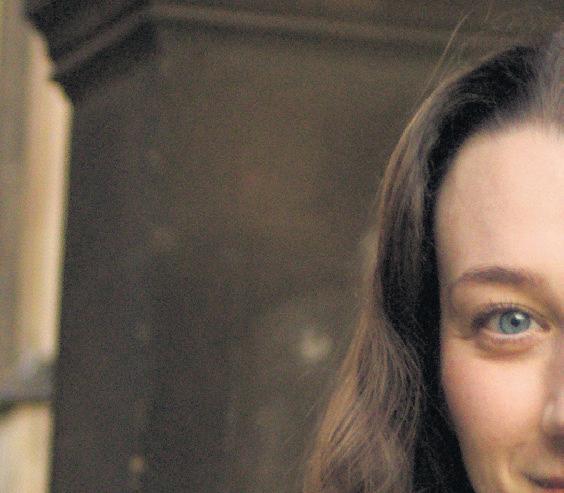


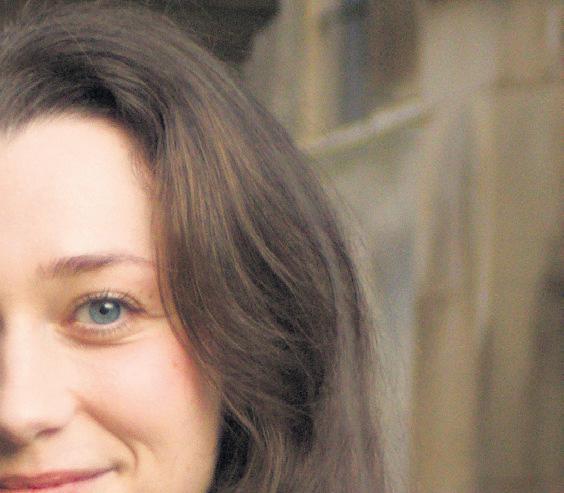

Cambridge’s viral smell expert Tara Buxton talks to


thing I’ve noticed the most is the discourse surrounding smell and race,” most speci cally, “smell and India”. Her thesis has a chapter that focuses on smell and anti-blackness, but when she rejoined social media, “it became immediately obvious that the prevalent sentiment was this idea that Indian bodies somehow smell worse”. It shocked her that these posts were getting tens of thousands of likes –“that disturbed me”. Louks argues that we see olfactory prejudice applied “to basically anyone who is consistently maligned in contemporary culture”. Comments on smell vary from “really serious and really concerning to more silly and playful. e problem is that we don’t ever really think critically about it. People don’t understand how demeaning it can be to have smell connected with your identity in some way”.
So how does Cambridge’s own olfactory expert suggest we think more critically about smell? “ ere’s really not that much we can do about whether you like or dislike a smell; it’s about how you react to your feelings”. In our “sanitised culture,” Louks suggests, “there are certain situations in which it is ethically and politically valuable to resist reacting in a phobic manner. Imagine you’re sitting next to someone ungroomed or smelly on a bus. Trying to foster respect and fellow-feeling is more important than giving into your desire to be disgusted and move away”. Louks reminds us that there are some odours that we shouldn’t tolerate, since they are “genuinely harmful”. She argues that our lack of olfactory vocabulary complicates our ability to decipher which smells are actually dangerous.
Despite the thousands of commenters who turned their noses up at Louks’ thesis title, she has never once rested on
her laurels. Her enduring belief in her work’s relevance has remained ever since she submitted her undergraduate dissertation on Nabokov’s Lolita with its own scent pamphlet. She’s unapologetic about her work, her introversion, and the fact that her favourite scent is vanilla (“so far from basic” if you look into its cultivation history).
One commenter on Louks’s viral post decided to quote Hamlet: “something is rotten in the state of Denmark”. Presumably, he was suggesting that a woman writing on olfactory ethics is some failsafe indicator of a country’s reeking corruption. Ah, a literary reference that uses smell, invoking disgust to degrade a woman’s academic achievement. How tting. Anti-intellectuals 0, Ally Louks? 1.
Anna Im speaks to Harriet Tyce about taking career risks, drinking culture, and her time on the hit BBC show
The weakest link in a game usually gets voted out early. But despite her early exit on the BBC smash-hit show e Traitors, Harriet Tyce was certainly not the weak link. e pressurised environment in the castle culminated in the emotionally charged breakfast table scene that went on to become one of the most iconic moments in Traitors history. It was memorable not only because of the pure drama of Tyce’s wording – “Set the cat amongst the pigeons, Roxy!” – but also because the public saw a con dent woman de antly express frustration.
Tyce acknowledged in her exit speech that her audacious actions were “a kamikaze move,” but later pointed out that it is “empowering for younger women to see someone like me get angry […] there is an awful lot of societal pressure to make women tone themselves down,” while also admitting that her vehemence was “misplaced at the time”.

When I catch up with Tyce, she Witch Trial, but her
is about to release her fth crime ction novel, journey to becoming an author was an unconventional one.



After graduating with a degree in English from Corpus Christi College, Oxford in 1994 – a degree she tells me she “wasn’t quite sure what to do with”
– Tyce gravitated towards criminal law
and pursued a career as a criminal barrister for just under a decade.
❝
ere were a lot of moments when I thought: ‘What the hell have I done?’

e Traitors attracts contestants from all walks of life, but Tyce’s background feels almost perfectly suited to the role: “It just seems of all the reality TV shows, Traitors is the most on-brand with being a crime writer,” she tells me. e show rewards discernment, sharp cross-examination, and lucidity, but looks less favourably on fervour. When the erce side of Tyce’s personality came to the fore, she was shortly banished at the round table.







“because it had the best stories and was by far the most interesting”
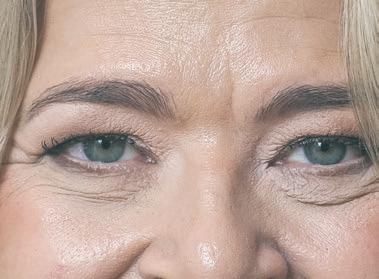





















tors




Tyce’s boldness makes it unsurprising when she admits she found her time as a criminal barrister tricky, admitting she “wasn’t temperamentally brilliantly suited to the hierarchy of chambers or the constraints”. Her interest in becoming an author came a bit later in life: “I started doing an evening course in creative writing just as a hobby to get out of the house, to meet some new people. And obviously I always had an interest e life of an author strikes me as solitary, which makes Tyce’s choice to enter a show that’s a magnet for intense public scrutiny (with the season four nale attracting over nine million viewers) all the more unexpected. Although Tyce does not express any regret, she explains it was certainly not a walk in the park – even for someone who made a career out of prosecuting individuals in criminal trials. “ ere were a lot of moments when I thought: ‘What the hell have I done?’ I’m used to things being under control and I do operate in a solitary way.” Some have speculated Tyce’s decision to go on e Traiwas a PR stunt, but if it were, it certainly required a great deal of strength: “ ere are many stages to it. e more I went through them the more I thought ‘I want to do this’. And then when I was actually offered it, I had a real moment of ‘Oh my God do I want to do this?’ But then I just thought ‘Why not?’ – it’s all a bit carpe diem!” From Chaucer to Love Island, our conversation naturally bounces across the full spectrum of culture.
Tyce is attentive, asking me questions about my course and reminding me of the importance of
reading widely as I complain about having to translate medieval literature and being neck-deep in Romantic poetry: “If you’re going to write, you’ll have to have read. You need to read widely –everything from Chaucer to Jilly Cooper, otherwise you can’t bring anything to the page.” From our conversation, it is clear that Tyce’s taste can only be described as eclectic. She tells me “I do love reality TV,” and that her choice to enter the show was one that stemmed from her love of the game. “I love [ e Traitors]. at’s rst and foremost […] and obviously I’m not going to do something like Love Island, [given my] age and being married. I read high literature and I watch reality TV – and that’s a space I occupy happily.”
We talk about the snobbery that surrounds reality television – the stereotype that it lacks intellectual merit, and those that watch and go on it therefore lack intellect too. “It causes me a huge amount of frustration because I don’t see why it’s not possible to enjoy both low and high culture at the same time. It’s a complete fallacy that [enjoying reality TV] means you’re intellectually lacking […] because it ignores the fascination of human psychology.” Tyce has clearly re ected on this misconception, her emphasis mounting with each example she cites: “Watching Love Island, you can learn so much about people. Watching Married at First Sight, my God, you can learn so much about how you can be set up. e snobbery that attaches to it […] drives me up the wall because I think it’s a mark of insecurity that people feel they can’t say they enjoy it.”
❝
I think I was quite chaotic and I was de nitely drinking too much
Tyce is strikingly candid. When she re ects on her time as a criminal barrister, there is hardly a trace of rose-tinted nostalgia. “I think I was quite chaotic and I was de nitely drinking too much in those years.” Our conversation turns to the drinking culture at Oxford and Cambridge, and how easily it can foster toxic relationships with alcohol. She is unsurprised to hear how embedded alcohol still remains in university life after I mention my recent Halfway Hall. “I sort of feel comforted in a way that some things never change. ere’ll always be a clock, there’ll always be green grass and there’ll always be someone throwing up in the corner of the quad because they’ve had too many pints.” When Tyce asks me, bluntly, “Do you get as hammered
as we did?” I momentarily freeze; for a second, it’s as if I’m being interrogated at the round table. She re ects: “I loved it because I would be there getting three bottles at formal hall […] but if I could go back and tell my 20-year-old self anything it would be: just stop [drinking].” e 53-year-old has openly spoken about how she really did ‘just stop’ drinking alcohol four years ago; however, she is not one to dwell on regrets. Her debut novel Blood Orange, which put her on the crime ction scene, follows a female criminal barrister who has an alcohol dependency. While it would be reductive to make direct comparisons, Tyce remarks that her previous relationship with alcohol “did give me a lot of material that I write about in psychological thrillers – so, you know, nothing is wasted”.
❝
Watching Love Island, you can learn so much about people
Fresh from the success of e Traitors, Tyce has returned to writing. Her latest novel, Witch Trial, is a pivot from her previous work as she explores themes of the supernatural and the occult. “I’ve always avoided the occult and the supernatural because I’m scared of it, but at the same time I’m fascinated by it.” It was seeing her son’s school production of e Crucible that rst sparked her interest. It is slightly surprising to hear such a pragmatic person confess to being drawn to the supernatural: “ e fact that you can buy hexes on Etsy fascinates me. I’m a very rational person but I don’t not believe either. e tropes are obviously really good fun!” She does, however, insist on drawing the line at participating: “I would never do an Ouija board because bad things happen!” Tyce resists o ering a de nitive stance on the supernatural. “You sort of want to believe, but you also don’t want to believe – and I think there’s something quite fun in playing with that space that is completely non-intellectual but quite compelling.” Her philosophy of playful dabbling seems to extend beyond supernatural ction, whether in taking career risks or entering the pressure cooker of e Traitors. Most of all, I am struck by the optimism with which she frames her life events and her time on the show. “I think it’s good to step out of one’s comfort zone and challenge oneself. It seems to have come o alright and it’s certainly led to a lot of interesting conversations!”
Dhruv Shenai talks to the mathematician and YouTuber about the importance of outreach
With over 240,000 subscribers on YouTube and more than 26 million views, Dr Tom Crawford – better known as Tom Rocks Maths – is something of a rockstar mathematician. He’s also a Teaching Fellow at Robinson College, supervising rst and secondyear mathematicians at Selwyn and Robinson. I sat down with Tom to discuss his journey, his work in outreach, and how mathematics can be made more interesting and accessible.
❝Students can go through their whole undergraduate degree without having a female supervisor
“Maths is a way of making sense of the world,” Tom explains. “It’s just one of the tools to understand the things around us.” His passion for maths started young. After completing his undergraduate degree at Oxford, he pursued a PhD in uid dynamics at Cambridge. It was during his doctorate that he began an internship with the BBC as a science radio presenter – the start of his career in popular mathematics. I asked Tom about what outreach means to him. “I feel disbelief being here,” he says, holding back emotion, “in the best way”.
Tom looks back fondly on his time at Oxbridge, grateful for the opportunities education has given him. As the rst person in his family to attend university – and one of the rst from his school to go to Oxbridge – he recalls the barriers




Lucy George and Asha Torczon explore some of the latest scienti c research
that he faced. “Bless my teachers, but they were basically clueless about the admissions process. I’d tell them about tests I needed to do, and they’d be like, ‘You need to do a test?’”
For Tom, being able to do maths every day is a genuine privilege. “I think it’s really just emphasised to me how much a really good education, and being surrounded by similarly motivated people, can change your life,” he says. Yet, despite the glamour of his achievements, he remains aware that many of his family and friends didn’t have access to the same opportunities – and that enjoying your job is far from universal.
“Something I’ve just noticed […] for example, my parents […] they don’t enjoy their jobs. And even a lot of my friends. It’s just very rare to nd someone who actually enjoys what they do.” He contrasts this with his experience. “ e vast majority of my days just don’t feel like I’m working. It’s just like: ‘Oh cool, I get to think about this really cool maths thing.’”
Tom’s gratitude for the opportunities he’s had (and worked hard for) is clear – and it fuels his desire to widen access for the next generation. But how does he do that?
“I think the most important thing to do is to help young people see themselves in that position.” is means using inclusive language and ensuring proportional representation. “I nd it crazy that students can go through their whole undergraduate degree in maths without having a single female supervisor.”


ing supervisions more diverse, helping students relate to their supervisors and, in turn, build con dence in their abilities. “When people think of a Cambridge mathematician, they don’t think of me,” he jokes. “But I do think the work I do is relatable.” He stresses the importance of providing a positive experience to his audience. “It’s possible that I’m providing someone with their rst good experience of maths.”
So, what’s been keeping him busy recently? “I’ve just submitted the rst draft of my new book. It’s called How many Pikachus would it take to power a lightbulb?” he says cheerfully. “It’s 400 pages of ridiculously silly questions like that – answered mathematically!”

mat. I’m just going there to do some fun maths. I’m not telling them to apply – I’m just trying to provide a positive experience with maths.”
When we turn to admissions and the Tripos, it becomes clear that Cambridge still holds a few surprises for him. Compared to Oxford’s exam structure, the Cambridge Maths Tripos has a unique system of alphas and betas. e result is that working out exam strategy is itself a task – trying your hardest to maximise Alphas and Betas in the right combination.
sheets must be perfect, rmly emphasising that supervisions are where learning should happen.
❝
e gami cation of exams is inherently competitive and alienates students




From the maths of Harry Potter to the Marvel Cinematic Universe, Tom views the world through a unique, mathematical lens. Communicating maths in a fun way is central to his mission. His role at Robinson complements that work. “Apart from my teaching duties, I do a lot of outreach for Robinson College, and by extension, Cambridge maths in general,” he explains. e day after our interview, he was set to visit a local secondary school. “ ere’s no set

for-
E ectively, along with raw marks scored in the exam, students get an additional alpha or beta mark if they score highly in a question. erefore, in grading, the di erence between 14 marks and 15 marks (which scores an extra alpha mark) is actually more like 11 marks lost rather than one.
“I feel it’s way more complicated than it needs to be,” Tom comments.
“And I feel like change is likely coming. Whether that’s ten years or sooner, who knows.” He notes, however, that many senior examiners feel pride in tradition, and that many students enjoy the system. As an outsider, though, I can’t help but feel that the gami cation of exams is inherently competitive and alienates students rather than motivates them (plus optimising an exam mark is the antithesis of having fun).
I ask about access to o cial mark schemes for past papers – currently unavailable to students. “I think it’s not a big deal,” he says, “provided that your supervisor is willing to mark your exam practice questions.” He adds that this probably falls within a supervisor’s remit, though formal recognition in supervisors’ timesheets might help.

us, one of Tom’s rst actions at Robinson was to work towards mak-

A recent study from Harvard University suggests that drinking more co ee may be associated with a lower risk of dementia. e study tracked the ca eine intake of over 100,000 participants across 43 years, monitoring who went on to develop dementia. It was discovered that those with the lowest co ee intake were the most likely to develop the condition, while those who drank the most co ee showed noticeably lower rates. Co ee was not the only drink to have this apparent protective e ect – higher tea consumption was also associated with a reduced dementia risk.
While previous research has hinted at ca eine’s neuroprotective properties, this is among the rst studies to examine its long-term relationship with dementia risk. Previously, ca eine has been shown to lower the levels of betaamyloid in the brains of mice. is protein plays a central role in Alzheimer’s Disease, accumulating into plaques that damage brain cells and contribute to cognitive decline. Ca eine has also at


been linked to reduced in ammation in the brain, which is thought to underlie many symptoms of dementia, including memory loss and impaired thinking.
Interestingly, the protective e ects observed in the study did not extend to deca einated co ee – suggesting that ca eine itself may be the key factor. However, co ee and tea contain numerous other bioactive compounds, including polyphenols, which are known to confer health bene ts such as protection against heart disease.


As a supervisor, Tom comes across as incredibly supportive. “One of the rst things I do in Freshers’ Week for rst year students is drill into them that I’m there to help them and that it’s part of my job to teach them.” He pushes back against the idea that problem
I was keen to get his thoughts on admissions. Tom is especially known for his YouTube videos analysing maths entrance exams and A-level papers. So, what does he make of Cambridge’s system? “Compared to Oxford, where in my college, about six students get o ers each year and like 99% of them get in after exams, Cambridge has the unique system of STEP.”
STEP (Sixth Term Examination Papers) forms part of almost all Cambridge maths o ers. Even after a successful interview and conditional o er, students must achieve the required STEP grades – and some ultimately miss out. e result is that Tom may give o ers to 14 diverse students, but many won’t meet the STEP requirement. “ ere’s evidence to suggest that girls are disadvantaged in exam halls, and it’s possible that the exam system will discourage girls from applying to maths,” he notes with concern. is issue is something Tom hopes he can address while working here. ere is clearly much afoot for mathematics at Cambridge. For Tom, however, the goal remains simple: to make maths more diverse, welcoming, and fun. As Tom asserts, his experience at Oxbridge was overwhelmingly positive – and he aims to help ensure the next generation can say the same.


Despite the bene ts observed, further studies need to be done. Most participants were healthcare professionals, meaning the results may not generalise to the wider population. e study also did not distinguish between di erent types of tea – such as black or green –nor did it examine variations in co ee preparation methods, both of which can in uence chemical composition.
Nevertheless, the ndings add to a growing body of evidence suggesting that moderate ca eine consumption may form part of a healthy lifestyle –welcome news for co ee and tea drinkers alike.



A team of researchers at Stanford University are developing so-called “universal vaccines” – a technology that could reshape how we think about preventing infection. Traditionally, vaccines work by training the immune system to recognise antigens: speci c molecules that allow immune cells to rapidly eliminate a familiar pathogen. is means most vaccines are highly speci c. In addition, if a virus or bacterium mutates and alters the targeted antigen, vaccine e cacy can decline. Instead of prompting a highly speci c response from the adaptive immune system, this new approach harnesses the body’s innate immune system, which responds more broadly to threats. e vaccine e ectively nudges innate immune cells into a heightened state of readiness, priming them to react rapidly to unfamiliar pathogens. An additional compound in the vaccine recruits T cells – part of the adaptive immune system – to

communicate with innate immune cells and sustain this activated state.
In experiments, the vaccine was administered intranasally to mice, who subsequently acquired immunity to multiple viral and bacterial respiratory infections, including SARS-CoV-2 (the virus that causes COVID-19) and Staphylococcus aureus. It also appeared to dampen immune responses to allergens such as dust mites, potentially by shifting the immune system from a 2-dominant pro le (associated with allergic responses) toward a 1 pro le, which is more e ective at targeting certain pathogens.





e researchers envision a future where people receive a single seasonal nasal vaccine that o ers broad protection against a range of respiratory infections – and perhaps even common allergens. However, despite media portrayals of a vaccination ‘revolution’, the technology has not yet been tested in humans. Moreover, the long-term consequences of persistently modulating the immune system remain unknown. Sustained immune activation could carry risks, including excessive in ammation or autoimmunity.

As a budding geologist, I’ve recently found myself inspired by the stones which make up the iconic Cambridge cityscape – both the physical building blocks of the city and the bedrock itself. Collating information about these stones has led me on a journey involving monarchs, dinosaurs and the Wars of the Roses.
In a city of never-ending spires, a ribbon that weaves it all together is the instantly recognisable yellow-y stone used to build Cambridge from the ground up (think Corpus Christi New Court, Downing College and Trinity College’s Wren Library).
I was amused to discover that this stone is a Jurassic ‘oolite’ – a name that sounds coincidentally similar to the ‘oohs’ and ‘ahhs’ one can often hear from tourists around these spots. ey’re not wrong to be awestruck. Jurassic oolite is, as you might expect, from a long-departed age of dinosaurs strolling the earth, free from the misery of weekend supervisions.
e speci c Jurassic oolite that provides the distinctive rough lustre and pale yellow glow of a classic Cambridge building is known as Ketton stone. If you’ve ever wondered how Cambridge manages to achieve that otherworldly feeling of detachment,your answer may be here. Nowhere else on the planet has such a signi cant level of this Jurassic stone used
in construction, making it no surprise that Cambridge feels like it has been left on pause while time marches on.
Nowhere else on the planet has such a signi cant level of this Jurassic stone
Undoubtedly one of the most quintessentially Cantabrigian sights, King’s College Chapel is partially made from a limestone from Yorkshire, dating back to the Permian period (around 300 million years ago). On discovering this I came across a conundrum. How did Permian limestone from Yorkshire travel so many miles to get here during the construction of the chapel in the 15th century? I imagined the cost would have been astronomical and the blood, sweat, and tears shed unimaginable. Where there was enough money, there was a way to move this beautiful stone and we need not look further than the
monarchy to nd this source.
Henry VI founded, and funded the development of, King’s College, originally part of his educational foundation, which also included Eton. Unsurprisingly, there were some bumps in the road to the Chapel’s completion following the Wars of the Roses. A Yorkshire limestone was a curious choice for the last Lancastrian king of England. After Henry VI’s death, work was paused (the story tells that the masons didn’t have the motivation to continue) and resumed using a cheaper and more local oolite. e original limestone used before Henry VI’s death is mostly present in the lower portion of the chapel, and can be distinguished when looking at the chapel by its notably paler colour than the oolite used later.
Don’t let all this talk of building stone fool you into believing geology is only relevant to the physical building blocks of this city, as it inuences our lives from beneath too. Cambridge, like much of the south east of England, has extremely hard water. As a Londoner myself, this required no great adjustment, but for those of you fortunate to be from areas of softer water this will have been an unwelcome surprise; kettles and showerheads build up
limescale, water has a distinctive taste, and your hair might feel di erent after a shower. Whether water is hard or soft is down to the minerals it contains, specically calcium and magnesium, which are abundant in areas like Cambridge, built on limestone and chalk.
When cycling at breakneck speed
try to let myself slow down (mentally) and appreciate my surroundings. Yes, I may be late to a lecture, but I am surrounded by buildings made of iconic Jurassic stone from the time of the dinosaurs. Perhaps next time you nd yourself appreciating the otherworldly feeling of the Cambridge bubble, realong King’s Parade, running late for yet another 9am, I mind yourself it’s not magic




























Before joining Cambridge, I was advised to create a Facebook account. I now know why: the informal online spaces, largely operating as Facebook groups and pages, mark a de nitive aspect of the so-called ‘Cambridge experience’. Whether you’re selling a Revs ticket on ‘Ticketbridge’ or anonymously shooting Cupid’s arrow on ‘Crushbridge’, these spaces are integral for students – even if just as a distraction method in your lecture. But something is missing from this current array: we don’t have a confessional space dedicated to complaints.
e catch-all page for confessions is, of course, Camfess, but when complaints come through we often see discourse against negativity, or simply minimal engagement. Are these responses correct – is it all just arbitrary complaining and pointless negativity on the internet, or are we feeding into a particular complacency that means we lose an opportunity for accountability? While perhaps symptomatic of a dying Cambridge Facebook culture, I believe this actually points to a bigger problem: we actively lack a designated (online) space for complaining. While pages such as Camfess can operate as such, if we truly want to create a culture of accountability in Cambridge, we need to acknowledge that it is more complex than just having a general online space.
‘Grudgebridge’ provides the salient case study for this conversation. It does (or rather, did – more on that to follow) what it says on the tin: provide a space for students to voice both trivial concerns and complaints, as well as a forum for sharing experiences or ‘evidence’ of serious behavioural concerns

A❝ Colleges can only comfortably uphold an exclusionary culture when they are not questioned and reminded of their pasts
in Cambridge. “Grudgebridge to Queens’ for deciding anyone who receives the Cambridge Bursary will no longer be supported under the Queens’ Bursary,” or “Grudgebridge to the third year engineers who voted not to take a break in the middle of a two-hour lecture” display the generic format. Unsurprisingly, it was also lled with plenty of petty or foolish posts, but I don’t think this means we should dismiss it – that’s just the nature of internet culture. ere are, of course, valid concerns about this leading to bullying or false claims, but it still begs the question of whether a complaint-speci c confessional page can aid in shedding light on situations in the University that would otherwise be swept under the rug.
e death of Grudgebridge followed a series of events sparked by Caesarian Sunday in 2018. A video taken in e Regal’s smoking area of the Trinity Hall all-male drinking society (the Crescents) was leaked onto the Facebook page, where an individual stated that “inclusivity [is the] single biggest problem facing the Crescents in the modern age”. ey were banned from the college bar, the Crescents garden party was cancelled, and soon after, the society disbanded. Days later, a Grudgebridge admin posted an update stating that “AS OF TODAY, GRUDGEBRIDGE IS DEDICATED TO TAKING DOWN DRINKING SOCIETIES”. e page was then ooded with anonymous allegations of bullying and sexual harassment. Varsity noti ed readers less than a month later that the “crusade” had come to an end, with administrators condemning it as a “hate platform”. While this culminated in a complete asco, I believe there is
something to be learnt from both the page when it was active, and what the loss of the platform means for us now as Cambridge students.
e immediate fallout saw labels of McCarthyism and witch-hunts, including CUCA critiquing the entire debacle as “blatant slander without accountability,” particularly after Grudgebridge’s mission developed “beyond [the] eradication of drinking societies, with a number of posts making unsubstantiated allegations about the culture within CUCA in accusing members of behaviours including racism, sexism, classism and bullying”. Rather than comparisons to the Red Scare, I think another common parallel o ered at the time more tting: the #MeToo movement.
I do not intend to argue that this is the primary way we should go about reporting sexual harassment and malpractice; an anonymous platform protects the whistleblower but simultaneously gives unjust power to the deceiver. e administrators admitted they could not verify everything posted. ere are formal routes for a reason, and these are invaluable, but not everyone is comfortable pursuing formal action – for some, Grudgebridge may have provided an invaluable space to air necessary grievances and shed light on uncomfortable topics.
While the page was deleted after claims of it being a “hate platform,” it also encouraged an accountability around the behaviour of drinking societies and led to tangible change: one third of Cambridge’s drinking societies committed to a formal code of conduct. Whether or not these are being followed eight years later is a di erent question, but without
having these online spaces that promote accountability we simply move further away from fostering a safe and fun student life.
So, is Cambridge student culture at risk of, or already falling into, complacency regarding bad behaviour? Perhaps for the eagle-eyed reader, you will have spotted that, again, Trinity Hall has found itself at the centre of a classist display. ese ‘new policies’ don’t re ect a shift, they re ect a longstanding culture in the College – under a decade ago members clearly felt comfortable spewing classist rhetoric in public, and at that, in broad daylight in a Wetherspoons. Colleges can only comfortably uphold an exclusionary culture when they are not questioned and reminded of their pasts. We shouldn’t let the misbehaviour of colleges and students go undocumented, and we must cultivate the spaces where we are able to challenge this behaviour.
I’m not necessarily making a case for the revival of Grudgebridge – online spaces, particularly those whose purpose is to complain, can very quickly fall into bullying, and it is the role of the administrators to make sure that baseless complaints targeting individuals are blocked – but we should not write o complaints pages solely for a fear of bullying. We have something to learn from the successes and failures of Grudgebridge: sharing anecdotes and widespread discussion is important for creating a better and more informed university culture. Without these spaces, we lack a key source of accountability and miss an opportunity to create tangible change.
doesn’t have to sell out tradition
piece of cloth waving in the sky may not seem like the most controversial event in the 21st century, but the question of which one ies is anything but trivial. Flags have never been a neutral decoration, nor have they been apolitical. Historically, ags have marked territories, declared allegiances, and established power. From national identity to the college crest, ags do not simply represent a community – they de ne it. So when an institution insists their banners are merely traditional, and not political, they misunderstand the very history of the symbols they defend.
Gonville and Caius’ recent decision to withhold from ying a Pride ag this month, LGBT+ History Month, illustrates the misjudgement of a ag’s power. Despite 200 students voting in favour of ying the Pride ag, the proposal failed to meet the College’s strict turnout policy. For this reason, Caius continues to y solely their college ag this month. ough this tight voting process exists at Caius as a result of student democracy, the College has a strong history of prioritising tradition over social progress. In 2022, fellows agreed to ban the ying of any other ag apart from the College’s. Although this motion was quickly reversed, its message remains clear. For many, ags still exist solely to preserve institutional power and tradition, rather than to o er solidarity.
Yet the Caius controversy is not only a simple issue about turnout thresholds.
❝
For many, ags still exist solely to preserve institutional power and tradition, rather than to o er solidarity
It exposes a deeper assumption that preserving the college crest grants them neutrality, whereas another ag would imply political intervention. However, the historic use of ags demonstrates that whatever you choose to display (or hide) will inherently be political –but I don’t think this is something we should fear.
We shouldn’t hide political views and discussions when we live in a time of such political uncertainty. e only way to progress as a society is if we are able to have healthy and open discussions, even if people’s views don’t align. us, to y solely a college ag feels like an easy way to retreat into the comfort of apoliticism. To claim that a ag can be neutral suggests that it speaks for everyone, but college crests inherently represent histories shaped by privilege, hierarchy and exclusion. ese symbols can be neither timeless nor apolitical, which is okay as long as we accept that truth.
leges should embrace their crest and identity.







be feared that, if colleges start to align themselves with possibly contentious movements, they overstep the mark as educational bodies. But this concern assumes that solidarity is inherently divisive. In reality, selecting additional recognised symbols, like the Pride ag, does not fragment institutional identity; it simply re ects the diversity already present within it. Symbolic acknowledgement does not require a college to abandon its traditions – it’s about embracing communities that already exist within their student and teaching body, and society as a whole.







College pride is essential to the collegiate system in Cambridge since it creates a rm sense of identity and community within an institution that can often feel intimidating and impersonal. erefore, I’m certainly not advocating for a removal of college ags, nor do I think Caius should be ashamed of their traditional history. In the same way we should nd pride in our national ag, col-






However, we should embrace our college pride whilst also celebrating and including other communities. Pembroke, for example, has committed to ying the Rainbow Pride ag this year alongside the four Patron Saint ags, showing that di erent symbols can be placed together to unite the student body. Catz have a range of ags that they y depending on the occasion, including the Union Flag on the King’s birthday and the Bahamian Flag during Black History Month. Despite committing to multiple ags, both colleges still y their college ag to mark important events. On degree days, bumps and reunions, Catz will display their own ag while also making room for other communities. eir acceptance of multiple ags has not displaced their own: rather, it has expanded what their public symbolism can encompass. Of course it can be argued that once colleges begin flying multiple ags, when does it end? Do they risk entering an endless cycle of symbolic demands? It could certainly






A ag may be only fabric, but it carries the de nitive weight of the story an institution chooses to tell about itself. We live in an increasingly polarising society, and to regard the college ag as apolitical is ignorant to the fact that institutional silence is never neutral. Colleges are powerful establishments that shape political life through admissions, funding, and public reputation, so they can never be truly neutral civic spaces. us the question is not whether a college is political itself, but what kind of politics it is prepared to embody. A crest honours centuries of history and tradition that individuals should be proud of, but they should also celebrate the people that today make up their student body. In a world that can often seem full of divisiveness and hostility, it is truly beautiful to see two ags ying together in solidarity, suggesting history and the present were never meant to compete.


I'm


tudent loans have been thrust to the top of the political agenda after Rachel Reeve’s decision to freeze repayment thresholds for plan 2 student loans, retrospectively changing the terms of a contract agreed to by 5.8 million British graduates. With two thirds of 2012-2023 graduates failing to even pay o the interest on their student loans, the freeze serves to ensure that graduates are forced to sacri ce even more of their salary. e Institute for Public Policy Research estimates that graduates earning between £28,470 and £50,270 face e ective deduction rates of 42%. Since most borrowers will never repay their loans, this amounts to a nancial penalty on Britain’s graduates that is leaving many feeling rather strapped for cash. 85% of graduates in a recent poll said that their vote at the next election would be in uenced by student loan policies. is particular political ashpoint concerns plan 2 graduates. For many current undergraduates, student debt seems abstract and a problem for the future. However, the malaise of increasingly oppressive student debt is an issue that they should care deeply about too. Current undergrads will get a slightly better interest rate xed at the rate of in ation, rather than above it. However, fee increases, lower repayment thresholds, and a longer 40-year wait until the debt is forgiven will all serveto increase what they pay to the state. According to MoneySavingExpert, the government’s proportional contribution to each current undergraduates’ loans will drop to just 19p on the pound down from 44p,
❝
e state is punisihing young graduates for the crime of studying a subject they enjoy
with the responsibility for nancing higher education falling increasingly on the individual.
Exuberant loan repayment costs combine with a decreasing graduate premium – the additional earnings potential gained by obtaining an undergraduate degree. Add this to a challenging graduate job market, and the conditions faced by current students present a serious deterioration from the optimism of New Labour’s embrace of higher education – when the target of sending 50% of students to University was rst set. is target has now been abandoned by Labour, while both the Conservatives and Reform have started to argue that we send too many people to University – especially on perceived ‘low-value courses’.
their loss in the Gorton and Denton byelection risks driving young graduate voters – who have overwhelmingly supported the party – to the Greens. While Reeves is attempting to stand rm, describing the status quo as ‘fair and reasonable’, other Labour MPs are showing disquiet. Deputy Labour Leader Lucy Powell described the system as “unfair” and “egregious”.
erefore, current students should be worried about their loan, and should be pushing for change. e pertinent question is what form this change should take. e Tories’ proposal to reduce interest rates will make little di erence to most – with the IPPR pointing out that this would only help the small minority who earn enough to pay o their entire loan.
footing a signi cant bill.


Disappointed, but never surprised. I knew that someone at Cambridge was somehow going to be linked to the paedophile nancier Je rey Epstein. I mean, what did Epstein and his associates all love? Money, power and access to the elite – three things Cambridge o ers in spades. Of course David Stern was going to jump at the opportunity to be on the Judge Business School’s advisory board: another accolade for my macho mantelpiece please! Let everyone see how much status, sex and street-cred I have! Now, I’m not attacking the University for appointing Stern to the board; it is unclear whether there was any knowledge of his ties to Epstein before his resignation, and I have enough faith that his greasy hands wouldn’t have been near it if anyone knew. It’s just another depressing reminder of how deeply entrenched that seedy, boys’ club type is in our institutions. Oh, it’s never shown in public – woe betide you damage that polished, charming reputation you’ve cultivated for yourself before you land the Deutsche Bank job that was de nitely not arranged for you – it’s just hidden, be that in emails or in the comfy corners of your secret society’s headquarters. It’s the pull of power, of being included with the excluders. It’s not di cult to imagine someone like Stern leaping at the chance to have been a member of the Bullingdon or Pitt Club had he been an Oxbridge undergraduate. He wants to brush shoulders with the elite, accumulate as many connections as possible to secure his success and self-image. at’s business! Wonder if he gave that advice
❝ Another depressing reminder of how deeply entrenched that seedy, boys’ club type is in our institutions




e system, as it stands, is inherently unfair. Young graduates with little hope of paying o their debt are being burdened with endless loan repayments, the state punishing them for the crime of studying a subject they enjoy and seeking to improve their career prospects. Having an educated workforce bene ts the country, and having widespread aspirations for higher education has been revolutionary for social mobility. Regrettably, it is those from disadvantaged backgrounds who su er the most from student loan repayments, since they tend to borrow the most money, and don’t have wealthy parents to bail them out.
Some would abolish student loans altogether. Stretched government budgets, however, will not o er the room to accommodate this. Forcing the taxpayer to fund the entirety of a student’s educa-
tion, furthermore, could risk tipping the balance of unfairness too far away from the graduate, as those who did not attend university are included in


Others have suggested that the root of the problem is that there are too many attending university. A recent report from think-tank e Centre for Social Justice has accused an emphasis on widespread access to high-education of delivering a “graduate excess”, where many are overquali ed for available jobs. Much of this is exaggeration – having a degree remains a reliable, if substantially less potent, way to increase your earnings potential. Improving the quality of non-university routes in education and careers is certainly key to improving opportunities for young people, yet it is concerning that rhetoric is increasingly warning against attending university. Ultimately, those most susceptible to fears around nancial sustainability are students from disadvantaged backgrounds. ey should not be punished for their ambition, ambition which cannot be represented by numerical cost or bene t analyses. If students value their degrees, they should take notice of the increasingly dire situation, and push for change.



e political consequences of this are signi cant, and the government risks taking graduate voters for granted. Labour MPs have speculated that


e IPPR, backed by a number of think-tanks and MPs, have called for adjusting repayment payment thresholds up and repayment rates down in order to decrease the nancial strain being thrust upon young graduates. is is a crucial rst step in reforming a system which is unfair and risks discouraging future generations from attending university at all. For both sel sh and sel ess reasons, current students should join young graduates, and start giving a serious damn about tuition fees.
to the Judge Business School.
In no way am I linking all of Oxbridge’s privileged men to the perversities of Epstein and co. It’s not about the people, it’s about the system. And you can’t evade the truth that there has been a historic culture in these elite circles of letting abhorrent behaviour slide. It begs belief that Stern and his associates had no idea what Epstein was doing.
ere’s no strong image though for a man who resigns and runs away instead of taking accountability. It’s all about optics: David Cameron, George Osborne and Boris Johnson were only embarrassed at the leak of the Bullingdon Club photo because they were caught. ey were worried about the potential reputational damage, not ashamed to have been members. But misogynistic songs, smashing up furniture, burning money in front of homeless people was all ne in the end: you can still (allegedly) do all that and be prime minister! Or chancellor, bad luck George.
And, honestly, it’s not just amoral. It’s embarrassing. Stern pitching those business deals to Epstein, sending him sexts, having this weird “general”/”soldier” dynamic going on, smacks of desperation. Stop courting a convicted paedophile and have some self-respect: he literally turned down being godfather to your child, that’s how little he cares about you. ere is nothing more pathetic than trying to cosy up to the devil just to cling to the illusion of in uence. at’s what’s key to these powerful social networks. It doesn’t matter what someone does if they can give you connections and a good time. eir entitle-
ment eclipses their ethics. Here we have a global elite who play by di erent rules and don’t care about the rest of us. Especially women. We’re all just disposable, there to pour champagne over and use as birthday banter.
When you’re happily consorting with a sex criminal, all you’re doing is creating a vicious circle of enablement. And you feel protected – safely wrapped up in the tentacles of Epstein’s ring, these men feel untouchable. Scandal is always survivable. at’s why Stern’s resignation and the Andrew formerly known as Prince’s arrest felt more like a birthday gift to me than anything. Sure, Stern is safely tucked away in the United Arab Emirates (of all places, you have to laugh) and no longer being on an advisory board of a University department is nowhere near the worst of punishments, but it’s a chink at the armour. Resigning before being forced out to save a modicum of face, it signals that these men aren’t quite as untouchable as they like to think.
We’re still so far from justice – we need only look to the inertia of the US to see that. Until only recently, Andrew Mountbatten-Windsor was a Prince, and Stern was sat next to the Queen. But their disgrace, their weakness, gives me hope that things can change. And that starts from change within these kinds of circles.
Oxbridge has historically been perceived as a part of this ring: it was unattainable, unknowable, only for people (or, really, men) from the most privileged of backgrounds. A place where they could get their contempt for normal peo-
ple out before they ruled the country, the banks, the courts. But over time that has begun to change. While work is far from over (*cough* Trinity Hall), Cambridge has started to feel more accessible. at only happened because change came from within. Now do I think the members of this particular cohort will listen to me? Probably not. Indeed, they might point to their e orts of widening the participation pool: women, BAME students, people from non-elite boarding schools are admitted into these secret socs now. We should thank them. But just because the people in the room might look a little di erent doesn’t mean that the behaviour is. We’re all just expected to take part in it, complicitly clapping as they carry on. Oxbridge doesn’t have anything quite as extreme as an Epstein class (thank god), but after university these circles don’t just disappear. ey get older and closer to power. If we want a fundamental shift, a world where behaviour like Epstein’s, Andrew’s and Stern’s doesn’t slip through the cracks, then change has to happen from within. It’s time to hang up your blazers and think about whether this hierarchy is what you want. We can all say how terrible its consequences are, but the only way to stop enabling it from happening is for the people born, or invited into, these worlds to call it out. It might sound dramatic, but this culture starts and is nurtured somewhere and somehow. I hope our generation is progressive and moral enough to say ‘no more’
If you eavesdrop on the many tour groups that pass by our colleges for long enough, it quickly becomes clear that for many visitors Cambridge is as British as Buckingham Palace or Big Ben. Indeed, Cambridge (along with the Other Place) has long been part of the British establishment, a step on the path to power and an incubator for intellectuals and creatives who help to put Britain on the map.
Recent studies suggest that, at a time when patriotism has become a thorny issue, teenagers are prouder to be British than their parents. 'Positive patriot-
ism’ as a palatable alternative to nationalism has become a buzzword. But with rising ethno-nationalism and declining national pride, it risks feeling naive. Where do Cambridge students stand?
A Varsity survey of Cambridge students found that the majority considered themselves patriotic. By contrast, 41% of Gen-Z nationally are proud to be British. For most respondents, this meant British patriotism, though some identi ed as Welsh, English, or primarily loyal to a speci c region. Just under half reported becoming more patriotic at Cambridge; the rest said their views had not changed.


Students who described themselves as patriotic cited similar sources of pride: the countryside, queuing, politeness, and even “world-beating cuisine”. Anglican choral music was important for one student, while another mentioned an appreciation of Britain's literary tradition, which has led her to “love Burns Night as a non-Scot”.

While as-



pects of political heritage — the unwritten constitution, the monarchy, respect for institutions — surfaced occasionally, pride was largely cultural. Contemporary politics was conspicuously absent. By contrast, politics was the prevailing source of shame. Brexit, Reform UK, hostility towards immigrants, and the “racist co-option of our ag” undermined patriotic feelings. Imperialism and an awareness that “so much of our wealth nationally has been obtained through the exploitation of others” also weighed heavily. For Addy, in the current political climate, it’s “hard to go around saying I’m proud to be British without people assuming you mean in a rightwing way”.
Far-right politics loomed especially large in discussions of Englishness. One student described feeling “very ashamed” by the use of “the term ‘British’, and often more speci cally, ‘English’ with exclusionary intentions while covering this up as a sense of pride”. Peter* describes himself as British rather than English because he is “a believer in the union” and thinks “Englishness comes with a slightly negative hostile connotation”. Nevertheless, Lily* would rather be British due to the right-wing connotations of the Saint George’s ag, as well as her “close a nity with Wales and Scotland and Northern Ireland”. is aligns with a perception of Englishness as a more exclusionary identity among the general public. On the other hand, Addy described herself as “probably more likely to say I’m English than British,” because “I think British has a more
colonial identity than English” – which “feels slightly demeaning to the actual relationship between the countries”. Regional identity and mixed heritage further complicated matters. Tom* has felt increased regional patriotism since coming to Cambridge because he “doesn’t know many people from the Midlands here,” so “I feel more of a regional identity”. By contrast, Harry identi ed as a Londoner more than British or English, because he likes “the diversity of London”. Katie, who grew up in Wales, is more likely to identify as British than Welsh because her parents are English, but is more patriotic about Wales and feels “there is more Welsh pride than British pride”. Kira*, who grew up in England but is half-Spanish, says: “I feel comfortable with my Spanish and British identities co-existing,” and describes this as re ective of the diversity of Britishness.
❝ Englishness comes with a slightly negative, hostile connotation
Ultimately, this variation re ected not so much political division as di ering interpretations of patriotism itself. Many echoed the sentiment that “it feels
strange to be proud of something I have no control over”. However, for Nell*, a Canadian student studying at Cambridge, the experience of living abroad has caused her to re ect on her patriotism. She describes the relationship witrh your home country as “irrefutable” and “like the relationship you have with a parent”. She con des: “when I came to England, I wanted to cease to be a Canadian,” but now realises that “you can’t choose your place in history”.
What of patriotism and Cambridge? Kira feels that for many at Cambridge, “patriotism is performative” and “linked to an image of the establishment,” which “partly stems from feeling excluded” from it. Charlie* “never would have connected” Cambridge to British pride. For Peter, on the other hand, going to Cambridge “extends my Britishness” because of the “incredible amount of heritage and tradition”. Sophie agreed that Cambridge “makes me feel more connected to certain British traditions and history”, but “not particularly patriotic” as “Cambridge’s selective nature” means “these traditions are Cambridge students’ views re ect broader tensions in British society. While there is no single perspective, debate is overshadowed by the rise of the far right and the nationalism it breeds. Can we reconcile our cultural a ection for our country with a co-option of national pride as exclusion? We’re forced to question what the place of patriotism is in modern Britain, and indeed, whether it even has a place at all. *Names changed to protect anonyminity
The college dining hall is often a lifeline for the tired student, dreading empty fridges and the depressing idea of eating alone. For some, the choice between pasta or curry, veggie or meat, one scoop or two, is inconsequential. For others, it carries far heavier meaning. In a university where gym memberships and wellness culture sit alongside struggles with disordered eating, mealtimes are shaped by more than appetite. Calorie labelling sits at the uneasy intersection of these experiences, promising empowerment to some while posting risks to others.
❝
To be afronted with nutritional information when simply looking for a home cooked meal would be too much





Since April 2022, calorie labelling has been mandatory for large out-of-home food businesses with over 250 employees, covering chain cafés and restaurants across the UK. College dining halls, smaller and semi-private, are exempt. Only one college currently displays calorie information on its dining hall menus. At Downing College, weekly menus are published via a ‘Kafoodle’ link listing ingredients, allergens, dietary tags, and nutritional breakdowns. A touchscreen in the hall provides the same information at the point of choice. e college told Varsity that it “anticipated future calorie-labelling regulations applying to mass caterers and wanted to be prepared rather than reactive,” adding that feedback has been “extremely positive”. Downing student Ben Lubitsh said he only notices the information when looking for high-protein meals. While many of his more gym-focused friends take note of it he thought “the majority probably don’t notice it or make an e ort with it”. He had “not personally heard of anyone nding the system di cult,” and overall felt the college was “trying to do something genuinely helpful rather than putting a

greater burden on them,” describing it as a subtle approach - a system that is simply “there if you want it.” He supported the idea of other colleges adopting a similar system because “there are loads of people out there who want to formally track their calories or even just be a bit more conscious of them, and it’s such an easy thing for a college to do”. Yet the impact of such information is rarely neutral. What is introduced as













enced as a moral signal about what and how students should eat. One student explained: “Having only recently recovered from an eating disorder, I can’t stress enough the damage that adding calories to college dining hall menus could do. College is a safe space for me, but to be a ronted with nutritional information when I’m simply looking for a home-cooked meal would be too much”. is aligns with concerns raised by eating disorder charity Beat’s Chief Executive, Andrew Radford, who argued that “calorie labelling exacerbates eating disorders of all kinds”.










thinks having calories on a menu could be helpful “because I think sometimes in my mind things have more calories than in reality,” and she would like to be better informed.
Whether expanded labelling leads to meaningful behaviour change is unclear. Cambridge’s Behaviour and Health Research Unit found that PACE labels, which show how much physical activity is required to burn o a food item, had little to no impact on the total calories purchased. Information, it seems, may not necessarily translate into changed behaviour.


Opinion remains divided. Nutritional information can o er autonomy for those following sport, medical, or tness goals. One student thought: “It would be super helpful for me with cutting and bulking.” Another student admitted in the past to struggling with skipping meals but

Some colleges attempt to promote healthy choices without providing numerical details. For example, Robinson College’s dining hall labels some options with a ‘healthy eating’ tag. Yet one Robinson student claimed they “barely notice” the icon at all, suggesting that gentle nudges may be easily ignored, or that health messaging has become so ambient as to lose meaning.
In a university where health is variously de ned as nourishment, performance, recovery, or control, no single approach to food information can meet every need. As colleges weigh transparency against wellbeing, the absence or presence of calories on menus remains less a technical decision than a negotiation about our relationship with food.
If the area of the outside square is 100cm², what is the area of the inside square?
What percentage of respondents successfully solved this?
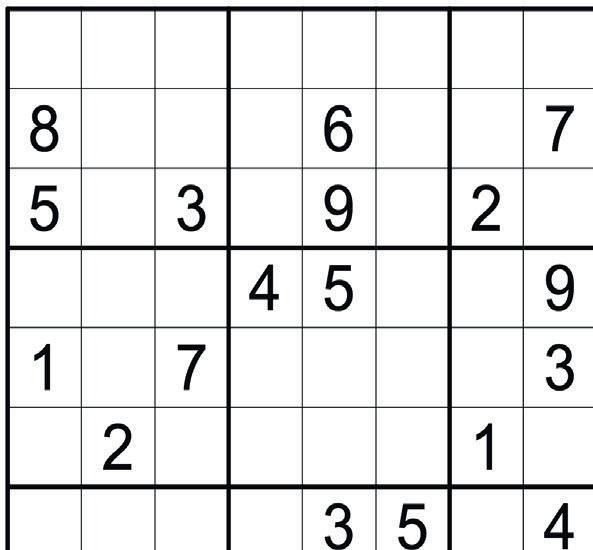
By Cheggers
(3)
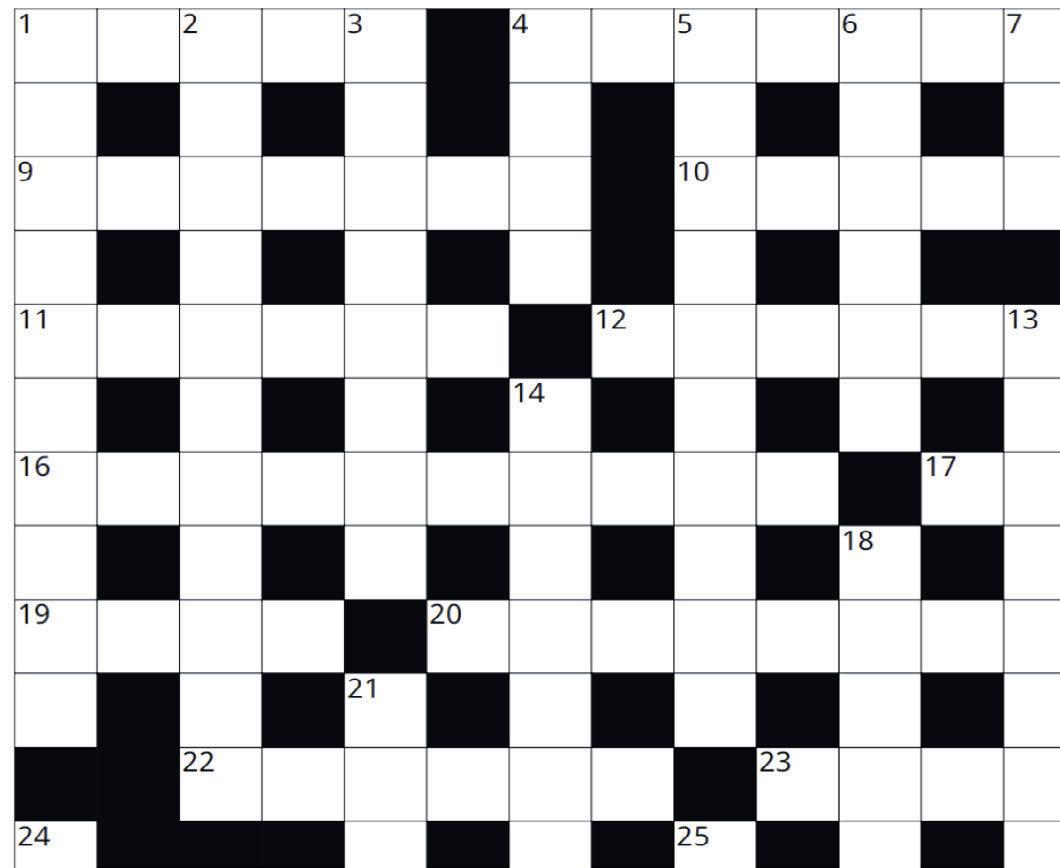
1 Act dutifully at rst, after turning RAF unit (5)
4 Complete shout of surprise? Use hand (4,5)
9 Graduates from cycling since taking in personal trainer (7)
10 ree males brawl with a hot giant (7)
A cut around one unknown sharpness (6)
Head advances twice in rst-class
overrun (6)
16 Inca lit all over the place before peak disappointment (10)
17 Jewel I made to hide capital city (4)
19 Completed to increase initial gure tenfold for German song (4)
20 Illiterate, tiny creature encloses crumbling Elphaba (10)
22 Godly belief is in those people (6)
26 Something to nish is emphasised over without end (7)
28 Nameless serranid goes wild for Las Vegas team (7)
29 Ear network is home for a Minotaur (9)
By Jafar
1. I would like to walk from JESUS to JOHNS by changing one letter at a time, such that all steps are between real words E.g. TOAST → BOAST → BEAST &c. What is the smallest number of steps required to achieve this dream?
2. My three housemates are sharing a 14 inch pizza. ey didn’t bother to invite me but still took my pizza wheel which has seen better days, and deteriorates with each unit length of material that it cuts, at a constant rate. What is the minimal length of cutting that is required to divide the pizza into three pieces of equal area? ( ey need not be similar shapes, and assume the whole pizza is a perfect circle)

30 Repeated communist documents (5) DOWN
1 Artist breaks up dahlia with fork (5,5)
2 Right to disintegrate multicentre without learner enlistment (11)
3 Richard is impaled by police sergeant with titanium depth measurer (8)
4 Primary losing right hand (4)
5 Sorrowful loss over end of prayer desk (10)
6 Play makes elma break down (6)
7 One under no other initials (3)
8 Repeat ends of epic hero (4)
13 Wild ower blew into thee mid
3. How many kinds of trees can be named using only the two-letter symbols from the periodic table? (E.g. Sulfur + Yttrium + Calcium + Molybdenum + Rhenium → SYCaMoRe )
4. Which is the only Shakespeare play whose title contains ve vowels plus the letter Y?
5. Two identical twins, May and Suzanne, (their real names have been redacted to protect their identities) are playing a good game of darts. May’s objective is to throw all her darts such that they land on a straight line with as little angular variation as possible, whereas Suzanne ’s objective is to throw all her darts such that they lie on a circle with as little radial variation as possible. Since they are identical , when scoring there is no way to remember who threw which dart, and so all the darts will be counted to both players. e outcome will be determined based on whether the variance of the distance of darts from the bullseye is greater than the variance of the angle they form with the vertical (in which case May will win.) Who is the more probable winner?
disaster (11)
14 Inmates on receiving terrible treatment in front of no American (10)
15 Tormented by multinational about not initially destroying slide (10)
18 More run down German beer under rising expressions of contempt (8)
21 Swerve around neon overlay (6)
24 Hero is doing nothing on the radio (4)
25 Curve walk without leader (4)
27 Wail after Hugo rises without tail (3)



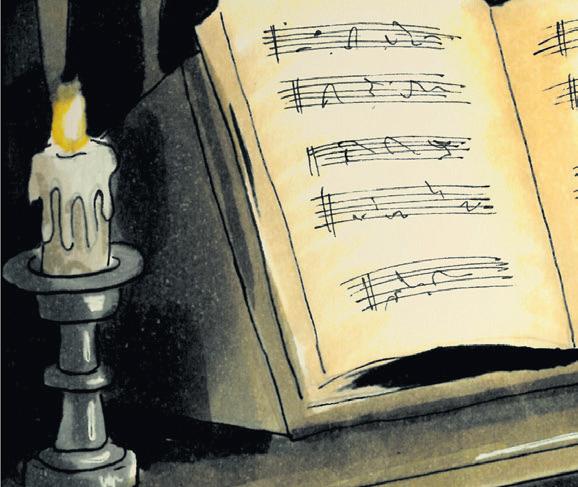















Expect
Aries
March 21st -April 19th
sense of completion and for overdue supervision essays to seem less daunting.
Taurus
April 20th - May 20th

Remain grounded in yourself, your principles and your relationships.

Gemini May 21st - June 20th
ese past few weeks have been hectic but remain con dent that you are on track.
Cancer
June 21st - July 22nd

Life may feel increasingly introspective, but this can fuel grand future schemes.

Leo July 23rd - August 22nd
You may nd yourself entering into new relationships or commitments.
Virgo
August 23rd - September 22nd

Now is the time to start something new and discard past limitations!

Libra
September 23rd - October 22nd
Consider the balances in your life. Now is the time to re ect and edit if unsure.
Scorpio
October 23rd - November 21st

is is a time for creation; previous moulds break as life ows through you freely.

Sagittarius
November 22nd - December 21st
is calm period will provide a well-needed break and a chance to revisit the past.
Capricorn
December 22nd - January 19th

e nostalgia you may be feeling is a chance to nd inspiration and peace.

Aquarius
January 20th - February 18th
Be prepared for your point of view to change.
Pisces
February 19th - March 20th

You are at your peak emotionally and spiritually – ride this peak in all aspects of your life.






Later the same day, I found myself in Blank Street. I hadn’t heard of Blank Street until maybe a week ago, but friends, especially Londoners, seemed to know all about it. I ordered a ‘shaken vanilla bean’ matcha, with the redundantly described ‘dairy milk’, and pain au suisse, which, in fairness, looked incredible. You can tell, before even taking a bite, that there are teams and teams of recipe researchers behind the perfection of that pastry. I found a table, and went to queue for my drink. e man called out “Ryan!” before making my drink, as if to ensure I didn’t miss the show. Into a metal cup went the milk mixture and a bright green syrup, and after a few performative shakes, I was served. Bizarrely, much like in G’s Artisan, everything came in takeaway cups and bags, whether sitting in or not.

I'm not sure there are any other better pastries in town
If you like matcha lattes, you’ll obviously love Blank Street. As far as I can tell, matcha lattes are the entire point. As for me, I remain undecided. I love vanilla, and in many ways it was like the vanilla milkshake I had been denied that morning, but grassy. It was extremely cold, not nearly as sweet as I feared, and a naturalish shade of green (or, in my opinion, Cambridge Blue). It being 7pm,
There are two new additions to the town’s co ee-house culture.
G’s Artisan Co opposite e Round Church and Blank Street opposite Mash have both opened in the past few months. is begs the question: which is better? With only a little eye-rolling bias against Blank Street, I went to nd out. ere was an uneasy feeling about G’s Artisan Co. e shop is a threeway between a café, deli, and grocers, with a loose Mediterranean theme. In terms of decoration, it felt very much like it ought to be attached to a garden centre. I thought the menu looked very good, lots of things I’ve not often seen in Cambridge: mortadella, spanakopita, and the like. I’m afraid to say, co ee was the last thing I fancied – recovering, as I was, from a pub crawl – so I asked for a vanilla milkshake and the New Yorker sandwich. Somehow, vanilla was sold out. I ended up with a bizarrely named ‘co ee dairy’ milkshake,
and all was well.
ey must have 10 types of Gouda there, each a massive wheel. Shelves and shelves of dried pastas, pastes, and pestos, alongside panettoni hanging from the ceiling. I was eating in, but for whatever reason my order came in a plastic cup and on a styrofoam plate. It was a good sandwich – pastrami, turkey, tomato, lettuce, mustard – absolutely the sort of thing you’d see on Seinfeld. Yet, I’m afraid to say I’ve had better milkshakes. e liquid had sort of separated from the body, so that it was at once watery and lumpy. A bit of mixing helped a lot, and if nothing else it all seemed to make my hangover subside.
I was eating in but [...] my order came in a plastic cup and on a styrofoam plate
e view of e Round Church is naturally a boon, and the shoppers make for interesting viewing: Bridge street being the absolute Mecca of yummy-mummy shopping in Cambridge. I left, dropping my styrofoam plate and take-away cup in the bin at the door, as seemed customary, and went to work somewhere with bigger tables. Clearly, the food is the appeal. I imagine the other sandwiches would be fantastic. If I were to go again I’d have a focaccia sandwich, and I’m sure the co ees are perfectly good.
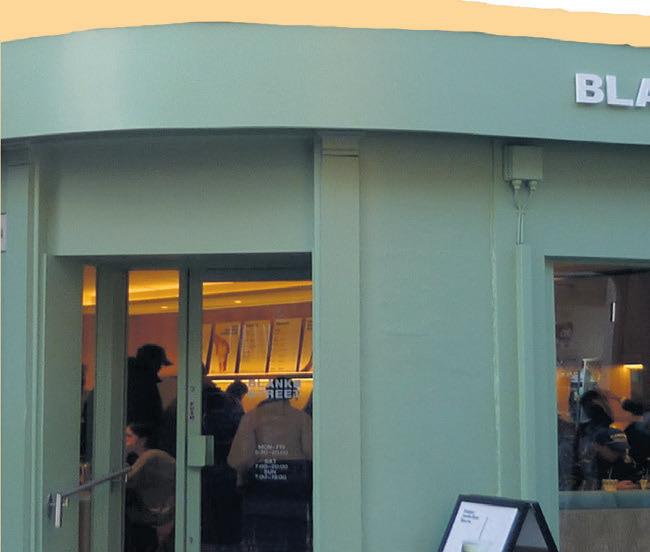
the pastry was a little stale, but even so, it was spectacular. I’m not sure there are many better pastries in town, and certainly none more attractive
So good was it, that for the briefest moment, all thoughts of arms investment, Americanisation, and hedge-fund backing subsided. For the second time that day, I threw my plate and cup into a bin by the door, and left.
Re ecting on these two new arrivals, I suppose each have a place in Cambridge. If you are a particular fan of Gouda, Mediterranean sandwiches, or imported pestos, there’s a new café on Bridge Street just for you. And it's clear Blank Street had a loyal fanbase ready before they opened. For me, I’m not impressed by either. Both cut all sorts of corners only to charge standard café prices. Blank


street use automatic co ee machines, pre-made ‘matcha’ syrup, and both seem unaware of dishwashers and dishes.
❝ I suppose both have a place in Cambridge
e classics are classic for a reason: I’m happy to stick with Bould Brothers, Fitzbillies, and the best Cambridge café, Trockel Ulmann & Freunde.
Crawling is human nature. In the steps of those wise Roman pioneers who rst thought to multiply the night’s enjoyment by hopping from tavern to tavern, we all love a pub crawl. Why stay put, after all, when a stretch of inviting establishments – each vying for your attention – adorns every street? en, of course, there’s its daytime counterpart: the cafe crawl, for those who prefer to drift from one bakery to the next, croissant in hand and ca eine coursing through veins. As recent TikTok trends have proven, there are many more versions to choose from – the study crawl, the museum crawl, and the book shop crawl all routinely surface on my For You Page. Today, though, I’d like to present to you a new variant: the lecture crawl.
It was on a crisp ursday in October, when the autumn air felt particularly opportune, that I embarked on my rst venture. Stealthily, I creeped into Little Hall, downplaying the anticipation of sitting in on a lecture about the Victorian novel. As my experience has shown, lecture hopping can be a bit of a gamble. You’re never quite sure what you’re about to witness. at day, though, the projector ickered on and revealed that the topic of the class was to be on e Moonstone, that Wilkie Collins book that T.S. Eliot
deemed “the best of English detective novels”. Miraculously, the timing was perfect. Having read
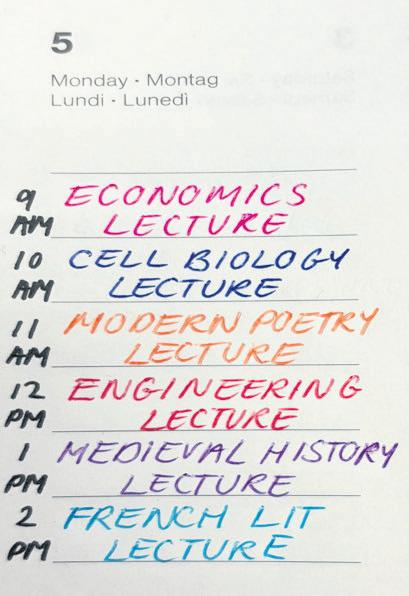
While the humanities are especially close to my heart, I like to cast my net wide. Occasionally, this means being humbled by a slew of scientists and mathematicians. One early morning I ventured into Lady Mitchell Hall to attend a maths-focussed economics class. Certain that I’d left the Taylor series in high school, my brain was not quite prepared for this turn of events. And yet, there I was: scratching variables into Goodnotes and nodding enigmatically at the lecturer who, making eye contact with me, optimistically asserted that the theorems were “obvious, of course”. Half of the lecture ew above my head but, slowly and subtly, cloudy whirls of derivatives and sequences spurred from the caves of my memory. It was a miracle. I almost longed to study calculus again.
Even if a lecture is radically outside your eld, you’re sure to learn something interesting. rough these crawls, I’ve formed a neat collection of fun facts: ‘billion’ means ‘trillion’ in German; a master was vicariously liable for his servant’s wrongdoings so long as the latter was not ‘on a frolic of his own’; and, Elizabeth Barrett Browning published her epic e Battle of Marathon when she was only 14. So, if you’re a wannabe pub quiz champion like me, you might just nd what you’re looking for.
My adventures have also shown me that subjects
Freya Compton questions the supremacy of the city
as Lent term gets into full swing, after-lecture chats become a humiliation ritual of listening to everyone discuss their post-graduation plans. And whether you’re succumbing to the panic masters propaganda, jumping on the graduate job search, or resisting the urge to go to Australia as soon as that diploma hits your hands, one city seems to remain the centre focus for most: London. But is it not time we stop neglecting our other Great British cities?


Lecture hopping can be a bit of a gamble
are like planets, with atmospheres, environments, and inhabitants of their own. On the law planet, you’ll nd documents stretched out to cover every square millimeter of each computer screen, and a hailstorm of typing in every moment of the lecturer’s silence. On the philosophy planet, there’s a palpable pensiveness that accompanies pages of handwritten notes. Yet, despite these di erences, our galaxy is the same. Across lectures, lessons of comparative analysis, tales of decolonial e orts, and envelope-pushing, innovations creep up. Sure, we’re all Cambridge students, but there is far more that unites us.
So, on a day when you don’t have any pressing assignments, give it a try! Whether the stars align and you end up at a lecture perfectly tied to your interests, or you nd yourself in a place most outside of your orbit, one thing is guaranteed: your time will not be wasted.

at why so many of us consider ending up in a Northern or, God forbid Scottish city, a sub-par destination?
Is it unreasonable to question London’s status as the be-all and end-all when most Londoners you meet in Cambridge would die on the hill that it is the place to be? ey have a strong argument: I mean, there’s nothing quite like the vibe of a capital city, and the culture and diversity of London has long been the pride of England, but does never being more than ten minutes from a Blank Street really make it worth the hype?

Cambridge graduates end up all over the world, and yet there is a distinct pattern of London being the rst step. Just think back, not only to the trajectory of your recently graduated friends, but to those who have populated yearbook spreads for generations. It’s been the destination of oaters for decades, and if you just listen to the shroud of actors and writers who hailed from Cambridge in the 90s, they’ll remind you: just follow the tide of people to London, and everything will work out! But it’s not so easy these days, you can’t just pile together into a basement at and nd a job just like that. Nowadays, it’d be four to a bed, the Chocolate Factory on is treated as a cardinal sin and rationing olive oil is a non-negotiable. Yes, house prices feel una ordable no matter where you look in Britain right now, and yes, the job market is daunting in every city, but you can’t ignore the many reports shouting that London is one of the most expensive places to live in all of Europe. So there must be something else drawing us there – but what is it?

ere seems to me to be an unspoken attitude that comes from the South, one that says leaving the London-sphere for anywhere else (perhaps barring a chic European city or Japan) is a ‘step down’. Of course, this connects to a long history of North-South divides. e feeling of disenfranchisement is nothing new – fuelled by a tumultuous history of class wars, Westminstercentred politics, and engrained cultural pride from both sides. But surely we should be taking a long hard look
I merely implore you to look wider, to seriously consider some of the gems that the UK has to o er.
On top of getting you far more bang for your buck, Liverpool boasts a huge friendliness and a unique sense of community, not to mention being less than two hours from the Lake District.



Glasgow – with an a ordable, if limited, metro system and world class music locations, from the Barrowlands to King Tut’s Wah Wah Hut – is a whopping 20% cheaper to live in than London! What’s more, life in the capital can be incredibly isolating. When it doesn’t live up to the expectations created by hearsay wealthy in uencers and TV idealisations, the constant business and intense competition can lead to everyone carrying around their own parcel of pressure, getting lost among the bustle of suits and sirens. e don’t-you-dare-disturb-me vibe you get when you make the mistake of smiling at someone on the tube is no joke, and not to mention the dating scene of despair with its commitment-phobia epidemic and soul-destroying Hinge culture.
I am in no way discounting everything London has to o er (I couldn’t, the list is too long to tackle in one article), but attempting to challenge some of the closedminded attitudes that Cambridge tries to instil in us. Moving to London may not actually be the right choice for you; it might just seem like it as graduation looms. It’s important to remember that the world, and the UK, is bigger than the capital, and to really think about what kind of city suits each of us individually.






Cambridge’s poetry scene is thriving, kept alive by students like Joe Wright and Millie Je ery, who both balance creative writing with nal year degrees in English literature. Wright founded Magdalene Poetry Society in his rst year, while Je ery is currently president of e Pem. Both have had work in Cambridge’s student publications: Wright’s poem ‘Killhope Cross’ was chosen for has been featured in zines such as Intrigued by this hybrid lifestyle, I sit down with them to discuss their work, and what writing poetry while at Cambridge is like.
You might think the daily routines of university would be conducive to a regular writing practice. Wright confesses the opposite: “I don’t have any brainspace when I’m in Cambridge.” Instead, he writes at home, and reserves term time for learning. Je ery agrees: the intensity of Cambridge means that she gets the impulse to be creative less and less regularly as term progresses, only “in really inconvenient moments,” like late at night or when she should be nishing her essays. She admits to nding this strain unexpectedly stimulating: “I nd when I have loads of time it’s also quite hard to channel that, and if I’m stressed and a bit overworked it gets easier to access di erent things.” Is poetry a kind of release, then? “Yeah, I guess so, sure. Or just like, a way of making sense of something that you didn’t even know had to be made sense of.”



surprisingly: Wright is dubious about writing about somewhere so poetically infamous, while Je ery confesses she only writes about the city from a distance – Coe Fen or Castle Hill. It seems that it is hard, then, to



for e Mays 32, and Je ery e Wicked Ant nd a home for your interested








I ask both of them whether Cambridge as a location has
It’s such a privilege to be able to be moved by something
Poetry Society as a place for students to share and develop their own work. “I really like reading stu aloud… I think it’s one of the ways in which I edit a lot – just on hearing – especially with an audience, it does change it, for me.” Je ery similarly credits the passion of her peers at open mic events and sharing sessions like those of the Shirley Society, but admits that she didn’t immediately see the diversity of it, having come from an extremely varied London writing scene.
“But then I think I just started listening, and people are just very di erent, and I think it’s just about paying more attention. And everyone’s so good!”








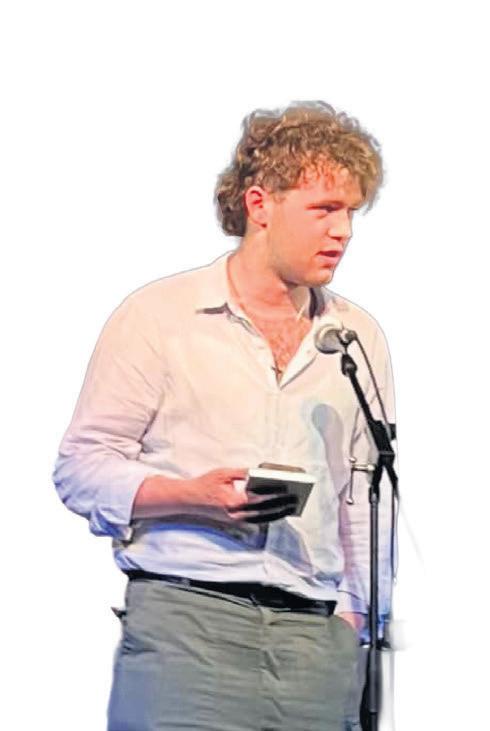

work in a city that feels to be possessed by so many people, and to be so eetingly yours. Instead, Je ery is inspired by churches (“gold and Catholics and all that kind of drama”), trains, tunnels, as well as “those kinds of late night holes that you nd yourself in”. She is particularly interested in the liminality of these places, and the social contracts between strangers that govern public spaces. For Wright, it is primarily the landscape around his home county of Durham, and the traces that its industrial past has left upon it. He talks about the “weird, mythological space” of the abandoned mine shafts that he went down as a teenager, and the complex relationship he has with this part of his region’s identity. It makes him pay attention to “what the voice is doing in a poem, and what it takes ownership of”.
I wonder if the objects of study from an English degree are liable to invade poetry. Referencing the more alien literary worlds that the period papers open up, Wright describes playing with the register of a poem by smashing the medieval into the contemporary – for example, a Durham ghost trying to understand its rights under modern land law.
“I guess I’m trying to play around with where we feel we are in time; where we feel we connect with other people in time. And I’m interested in voices and characters that feel very marooned between something that feels like now and something that feels like then.” So can a poem be a kind of seance?
agrees with Audre Lorde that poetry is a “skeleton architecture of our lives” – for him, it is a “through form,” a “way of thinking”. But, in a time when more people write verse than read it, he admits that “the emphasis is less on what a poem might do to somebody else, than how it might help you as a writer.” It becomes more marginal: “there’s a kind of awareness intrinsic to that, that we’re recording things in this poem that are only maybe ever going to exist in this poem.” Je ery is more Aristotelian with her answer: “I think [a poem] is successful when it e ects emotion. When poetry doesn’t do anything, you read it and you feel the same afterwards. Even if it’s minute, that change, of just slightly altering what someone thinks… it’s such a privilege to be able to be moved by something in that way.” She thinks poetry is key to ghting current trends of polarisation, as it forces readers to pay attention to the nuances of a view di erent




“I don’t think I can do that. I want what I’m writing to at least engage with that idea and problematise it a bit. Fragmentation is really important, I think, to that. A sense of having fragmented voices that come to us, and where those t into our own lives.”
But a Cambridge degree doesn’t spell the complete death of poetic enterprises. Wright stresses the signi cance of nding a community of friends and writers with whom he could talk about poetry. is love for an oral, dialectic approach
“I don’t think I can do that. I want what I’m lives. nd
Meanwhile, Je ery wrote her second year dissertation on female Beat poets. She says their interest in a permeable and uid female body have started to come out in her writing. I ask her if she could imagine a Cambridge college as generating the same kind of symbiosis that she saw in the Beat generation. She admits there are parallels: “You nd people inspiring your work and you inspire other people’s work.”



Finally, what would it feel like to interview their own poetry? “A year ago, I would have asked it: Why are you trying to be so northern?’” laughs Wright. Jeffery also finds the idea amusing: “They’d probably look like me but… extreme, like a concentrated version




ever inspired their work. No, to writing saw him start the Magdalene


he Fitzwilliam Museum sits beside my college, Peterhouse, making it easy to escape there when the workload becomes too much. For instance, I spent most of last week trying to write an introduction to what will (hopefully) become a 15,000-word Master’s dissertation. Structure, voice, style: all of it seemed to slip away from me the second my ngers touched the keyboard. Paralysed by perfectionism, I watched my cursor hover accusingly over “this essay argues” for minutes. It had all become so awed and fragmented on way to the Greek & Roman Gallery of the Fitzwilliam Museum where, in the far corner, I came across mis red Greek pots and fragments of amphorae. ese were objects on display because of their aws, not despite them. In their scu s and skews, I found an answer to

One vitrine in the corner of the Greek & Roman processes of ring clay plates and bowls is explained through a series of plaques and examples. Amongst them are mis red fragments of pottery, included both as instances of the process going awry but also as interesting and exemplary artefacts in their own right. In their uncommon gradients of red and black, these fragments have a characterful beauty that is just as stunning as the ‘perfect’ pots beside them. Safe to say, they drew my eye. Bringing with me the anxiety of my failing introduction, I was reminded that sometimes the essayistic mis res can have their own experimental charm and intrigue – certainly worth discussing and learning from in a supervision or redraft. Sometimes the quirkiest parts of an essay or seminar contribution are its best bits, and they combine to make something that is even
I am interested in how this new generation of poets think about their work. What does it do, to a reader, to the things that are written into it? Wright







Inside the vitrine is a vase which has been reconstructed from a collection of fragments and shards. A plaque explains that “the edges of the foot, which does not belong to the original vase, have been ground down to t on to the bowl”. ere are large parts missing, yet the shape can be observed and appreciated regardless. e fact that this pot is cracked and incomplete makes it more precious, not less. Such imperfections are the making of the pot, just
as our own imperfections are the making of us. Sometimes we can punish ourselves for struggling to nd the ‘perfect’ phrasing for a sentence or the ‘perfect’ reference to a rm our argument, but then sometimes we need to let go of this perfectionism and recognise that our work makes sense as it is – having its own observable and appreciable shape. e absence of one part does not mean the failure of the entirety. Walking back to the library from the museum, I had a rmed to myself a holistic, imperfection-
ist approach to work. I was reminded that the scu ed and skewed parts were just as viable and valuable as the supposedly ‘perfectly’ polished parts. At Cambridge, it is all too easy to trick ourselves into believing that we have to get everything right on our rst go, or that we have to compare ourselves to the people who we think have never been wrong in their supervisions, seminars, essays, or lives. What my trip to the Fitzwilliam Museum reminded me of was that even the ancient Greeks – who built the Parthenon, invented democracy, and wrote literature that has lasted millennia – misred pots and vases. And, what’s more, those mis red pots and vases have lasted millennia too, precisely because they have value and intrigue in their own right. If a pot can outlive its mis ring, then perhaps my dissertation introduction can outlive its weak opening line.
The Museum of Classical Archaeology’s new exhibition, Tom de Freston’s poíēsis, does not only provide refreshing bursts of colour to the space, but also creates a most interesting dialogue between a collection and its host gallery.
poíēsis was rst presented in London last winter to critical acclaim. Since its arrival in Cambridge, the exhibition has become even more connected to its roots and speaks loudly as a result: it is inspired by the mythology of the very cultures which the museum displays (the title derives from ancient Greek, meaning ‘to make, create’), and is also connected to de Freston’s roots as a Cambridge alumnus. e artist met his wife in Cambridge in 2008, the duly acclaimed author Kiran Millwood Hargrave, who this collection depicts lovingly, frequently faceless but bearing the swollen stomach of pregnancy.
ese portraits are the result of a period of great love and loss in the couple’s lives, as they su ered a pregnancy loss in 2020 and six subsequent miscarriages before welcoming their child in 2023. e artist has transformed these experiences into mixed media works, with a combination of fear, grief and ery love radiating from them. ere are haunting black shadows and mysterious silhouettes painted alongside the hopeful pinks and blues of gender reveals. ere are mixed media textures, as if the canvas itself has stretch marks and cellulite. ere’s even an incorporation of faded fragments from Millwood Hargrave’s Eurydice
poems, written for the couple’s graphic-poetic exploration of the classical Orpheus myth.
e Cast Gallery is host to primarily male busts and statues, so de Freston’s work is a refreshing addition in subject matter as well as colour.
Where there are female statues, often naked objects of desire, de Freston’s portraits stand alongside them, depicting a woman who is not an object but a creator in her own right. Nestled between, behind, below and above the museum’s mostly colourless casts are



























canvases of various sizes. It is a physical investigation by the visitor. rough peering around the thigh or between the legs of a nude, colourless statue to seek a portrait of the pregnant body of a woman in emotive colour, visitors can appreciate de Freston’s work.
❝
Freston depicts a woman who is not an object but a creator in her own right
Tom de Freston’s newest exhibition, poíēsis, is deeply moving and thought-provoking, and its new context in the Museum of Classical Archaeology initiates cross-cultural and cross-temporal dialogues between the pieces: old and new, pale and colourful, but speaking the same language. Embedded within the colours, textures, and shapes of de Freston’s work are years of emotion and hard work, complementing and complemented by the casts around them. It is a testament to the work of both the artist and the museum’s curatorial team. roughout the collection, de Freston’s clear love for his wife and child speaks with the loudest voice of all.













































































































From adjustable benches, to acquiring tightly controlled music scores and readjusting the choral repertoire, both organists Alice Smith and Amelia Parkin recognise that the world of the organ is highly restrictive despite recent progression. In a 2024/25 study, e Society of Women Organists found that women made up only 11% of all recitalists. To celebrate International Women’s Day, Smith and Parkin have organised a series of concerts on Sunday 7th March featuring the music of powerful female composers, and a speci c 1pm recital at Trinity College with six female organ scholars playing.
“ is event is a celebration of women who have written for the organ,” Alice begins, “we are trying to show that there is such a wide variety of female composed music out there which should be played”. She states that many seemingly minute factors can largely in uence female participation, such as the height of organ benches and the traditional route of coming through church or cathedral choirs which may only have boys singing.

al female composers, such as Elsa Barrain and Florence Price. Elsa Barraine was a 20th century composer who combined “rhythmic drive” (James Briscoe) with intricate musicality. Barraine composed her works in support of the French Resistance to German occupation of France in 1940-1944 as a member of the Front National des Musiciens, who put on concerts of contemporary and banned music to raise money for Jewish musicians and wider rebellion.


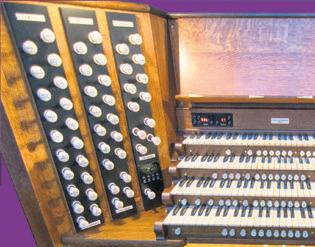
Alice states that: “ e organ gives the player the ability to make so much noise and be commanding – the instrument allows me to be dominant as a woman in any room.” Alice began her organ journey under the guidance of the prominent Anne Marsden omas MBE at St Giles-without-Cripplegate and attributes her enjoyment of the organ without any gendered concepts to being “lucky enough to be around a really prominent woman in the eld”. Featuring in their event are many inspiration-
Florence Price is one of the most strikingly inspirational out of all the female composers in the selection. Born in Arkansas in 1887, Price is known for being the rst African American woman to have her composition performed by a major orchestra and composer of over 300 works. Leaving Arkansas amid the Great Migration and moving to Chicago, Price became a member of the Chicago
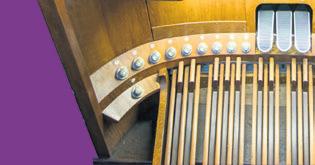
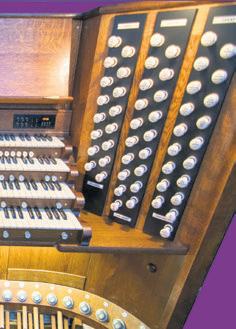


Black Renaissance and won a Wanamaker Foundation Award for music of critical acclaim, such as her powerful Concerto in D minor. A pioneer for female composers and musicians, Price also stood up against racial injustice: her song ‘My Soul’s Been Anchored in de Lord’ was featured in the infamous 1939 Easter Sunday Concert held on the steps of the Lincoln Memorial. The concert highlighted American racial prejudice to the world because of forced location change due to segregation, as Black contralto Marian Anderson wasn’t allowed to perform in segregated Washington DC.
❝
The traditionally malecentric music of the choral world can be diversified greatly
Also featuring among Smith and Parkin’s line-up of music is the Swedish organist and composer Elfrida Andrée. Involved in signicant progression of gender equality, Andrée


was the rst woman in Sweden to graduate as an organist, and the rst to become a cathedral organist. She worked with her father to enable women to hold organist appointments, and later for women to be able to be employed as telegraph operators. According to Alice, playing music composed by women feels like “a great responsibility as a representation of all women”. My conversation with Alice and Amelia emphasised the disparity in musical performance due to gender, and the extreme pressure placed on women when playing pieces as they feel the need to represent a whole group of underrepresented women. Stretching far beyond a singular day to celebrate women, Alice and Amelia’s event points to a larger hope that through pioneering the importance of the female composer and player, all organ and general music performance can create daily celebration.
Contemporary pop music bursts with classic literary allusions. From Taylor Swift’s subtle references to Daphne du Maurier’s Rebecca to Lana Del Ray’s evocations of Plathian imagery, the link is clear. is connection between music and literature, however, is no new phenomenon. e arts are inextricably connected, and they’ve been this way for ages.
It is known that ancient Greek epics were designed to be sung or spoken alongside musical accompaniment. e Iliad and e Odyssey, which rst appeared around the 7th or 8th centuries BCE, are some noteworthy examples. ese pieces of poetry were performed aloud together with music from a four-stringed lyre. Fascinatingly, Oxford classicists recently resurrected these musical pieces, pairing their knowledge of ancient Greek in ections with instruments modelled on ancient illustrations to speculate how Homer’s works originally sounded. As time went on, the tradition of pairing the written word with music persisted. Somewhat similarly to the authors of ancient Greece, some musical virtuosos integrated writing into their compositions through self-authored poetry. is is how Vivaldi, composer of the haunting, perennially appreciated Four Seasons, embedded literature into his 18th-century works. To supplement each of his seasonal violin concertos, he produced sonnets, vibrantly detailing relevant scenes. Winter , for instance, is accompanied by verses of precarious, windy journeys on ice, and ‘Spring’ provides a fusion of murmuring streams and chirping songbirds. As scholar and musician Nicholas Lockey puts it, Vivaldi’s sonnets help us better envision the com-



poser’s intended narrative. ough it is uncommon to hear the poems prior to orchestral performances, they are easily accessible online. So, try listening to mer with its accompanying sonnet in mind. e experience of it all – and especially of the nal movement – is nothing short of rapturous. Then, in the 19th century, Romantic composers were again drawn to the merging of arts. In lieu of producing textual accompaniments themselves, though, several musicians drew inspiration from great literary authors. Beethoven, for example, having delighted in Goethe since childhood, dreamt ardently




plays, including the 1815 und glückliche Fahrt known as Voyage
of an encounter with the writer. And, indeed, an encounter: Beethoven yearned to set his idol’s texts to music. “Mention me to Goethe,” he urged Goethe’s lover Bettina Brentano, for “melody is the sensual life of poetry”. After a long-awaited meeting, Beethoven released numerous compositions in uenced by Goethe’s poetry and Meeresstille . is cantata, also Calm Sea and Prosperous , is based on a pair of Goethe’s poems which trace a progression from deceitfully calm, and consequently perilous, waters to a liberating wind promising safe homecoming. Interestingly, in 1828, Mendelssohn drew on the same literary
source, releasing his own overture of the same name, a work that was even more successful than Beethoven’s.
❝
The relationship between music and words is not unidirectional



liberating of
In some cases, 19th-century musical adaptations have entirely usurped the traditionally literary versions of stories. Take, for example, Carmen or e Nutcracker. Both Bizet’s collection of iconic arias and Tchaikovsky’s elegant ballet are rooted in literature. e former, a world-famous opera which premiered in 1875, sprouted from Prosper Mérimée’s identically titled 1845 novella. Furthermore, this is a noteworthy testament to how musical adaptations can become more popular than the originals. While the ‘Habanera’ has become a household classical piece, Mérimée’s work has receded into the background.
In sum, centuries of symphonies, sonatas, and songs are laden with literary references. And, of course, this relationship between music and words is not unidirectional. Monumental writers – from Marcel Proust to George Eliot – are known to allude to musical pieces in their works. So, if one thing’s clear, it’s that literary melodies, and melodic literatures, are here to stay.

There always comes this moment at Christmas, where, quiet and caught with nothing to do on the sofa, food- lled and square-eyed from TV, my uncle asks the fateful question. “So, what have you been listening to?” Soon to be followed up with “What’s your album of the year?” I breathe, play it cool. “Ooh. Let me have a think,” and stall for time.
Over these 12 months, I’ve been readying myself for this quasi-intellectual-gladiatorial battle. All in good spirit of course, but where do you even start with suggestions to a PhD-bearing, highly literary, Cambridge-educated uncle? Mine likes well-crafted prog rock: Dream eater, Bi y Clyro, Frank Zappa. My armoury I have prepared – Irish jazz/RnB with a 90s garage twist, alternative piano rock, local trip-hop classics – won’t even make a dent. But the chess game is going well this year: he takes my opening gambit, tantalised by Warhaus’ Belgian chamber pop. I even make a big capture: the Ben Folds Five are a personal favourite from his glory days.
Clyro, Quick,
en, the chess game is over; I step into a right hook. “Have you listened to Taylor Swift’s newest album?” he asks.Quick, a defence: a patterned coordination of “No, it’s just not my thing,” supplemented by “my friends like her though” In response, he pours out praise for her songwriting, her acoustic sound, all polished with awless production. He begins an exhibition on Apple Music,
asking what my friends think of her new album – e Life of a Showgirl. Dizzied and desperate, I throw out a cheap counterattack: Oh yeah, that one with the song about Travis Kelsey’s penis? It’s a low-blow, I know, but he laughs me o in orid,
And it’s here, feet up on my desk, relistening to all 53 minutes of Cunningham’s nely crafted album, that my eyes settle on my dad’s old, electric-
my

His knowledge doesn’t simply






encompass discography: he proves more than well-informed on public a airs, scandals, all of it. Charli XCX, Sabrina Carpenter, Jake Gyllenhall, Matty Healy. He swiftly sets out a comprehensive taxonomy of her diss tracks, of each undaunted moment – “ e Smallest Man Who Ever Lived” is my personal favourite. ey’re songs which say I’m not afraid to write to their faces He o ers to show me his album of 2025. But far from a live album at a European concert hall, he plays Take Two from Madison Ace

songs about celebs and sing them


pressed into my hands, ears aching




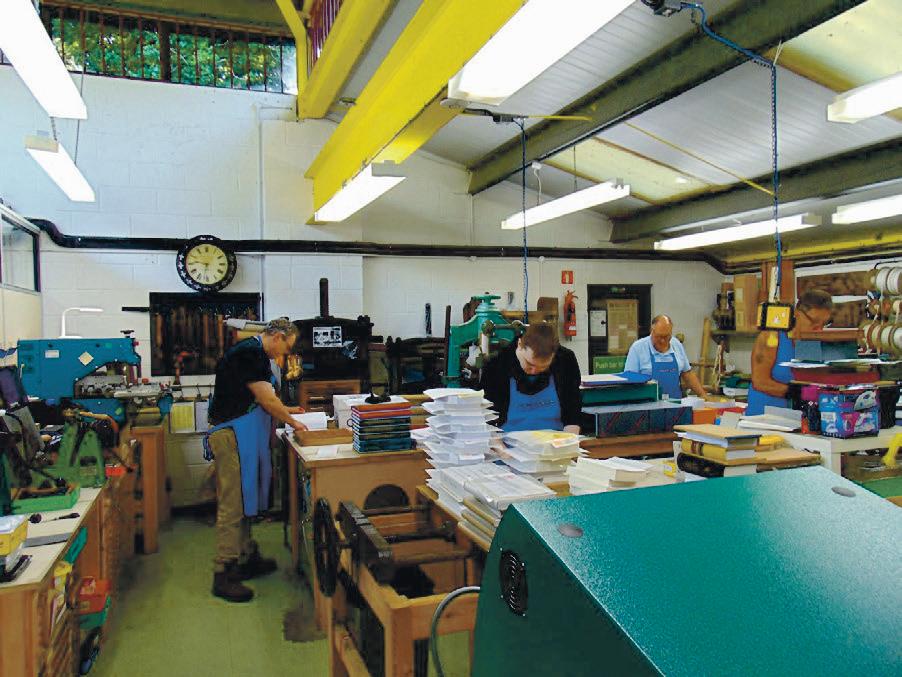


My consciously crafted music taste betrays its Darwinian origins. A 19-year-old experiment comprised of dad’s skate punk anthems and mum’s sprinklings of Suede, Nitin Sawhney and Sheryl Crow.
More than well informed [...] he swiftly sets out a comprehensive taxonomy of her diss tracks



blue iPod Shu e. Brushing the thin layer of dust that coats its surface, I know it’s long dead. But memories come pouring back of it being from hours of listening with earbuds too large for small ears. I remember Dizzee Rascal’s Bonkers cranked up to full, followed by the familiar opening of Chaka Khan’s Ain’t Nobody , LMFAO’s Party Rock Anthem eliding into the Kooks’ slow Seaside . Artists and anthems from disparate times and genres all mentally interlinked by this small, blue tech-relic. ough he stays more towards the Pink Floyd end of things now, it was another surprising Swift mo-
Sometimes it takes toe-to-toe battles between preferences, and sometimes it takes a backhand of your own biases. If there’s a lesson, it’s to listen to uncles, aunts, mums, dads, cousins, and grandparents. ey might just tell you something about yourself. While you’re at it, listen to neighbours, acquaintances, strangers. Lean a little closer to the leaky AirPod of your next-door neighbour on the bus. Dive into dust-ridden CD collections. What was the album of the year in 1989? e course of music taste never did run smooth.


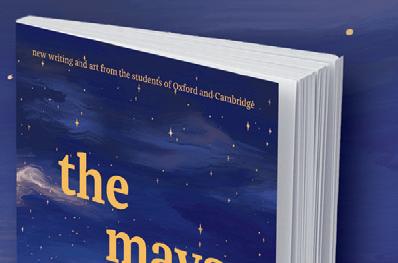








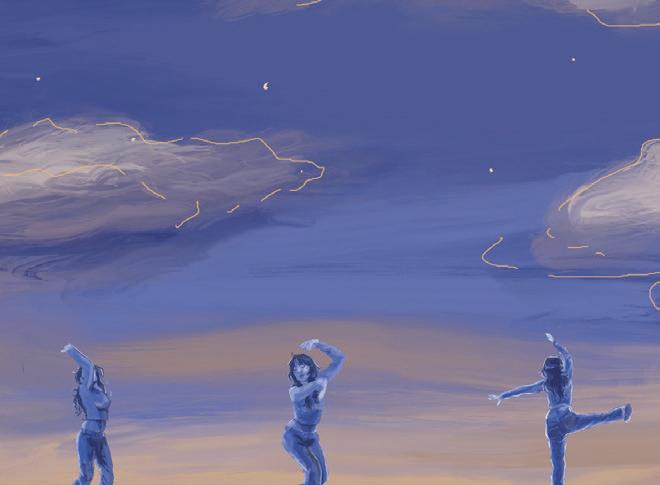

If a bouncer held up a mirror at the door of Mash and asked, “Do you think your outit’s creative enough for entry?” it’s safe to say you would be surprised (and likely ofended). But for those trying to enter London’s Blitz nightclub in the early 1980s, this scenario was a documented reality. To gain entry, you had to look like a walking piece of artwork, and the more avant-garde you dared to dress, the easier it was to slip past the bouncers. And easy, it was not. Even Mick Jagger was denied entry. An invitation to the Blitz was an invitation into a world where outlandish outits were the norm, faces were powdered and painted, and gender boundaries blurred… so, perhaps a little diferent from your average trip to Mash.
“Too much” might be just enough
What might have seemed only to belong in a wild fantasy was known as a normal Tuesday night at the Blitz. he club’s exclusive events were publicised only by word-of-mouth, like a secret society with the promise of added disco. Regular club attendee and famous milliner Stephen Jones is quoted saying: “I’d ind people at the Blitz who were possible only in my imagination. But they were real.”
You may, rather reasonably, be wondering how this rule revolution even began. Before eventually moving their venue to the Blitz, another club in Soho – a gay discotheque named Billy’s – was making quite the splash by hosting weekly “Bowie Nights”. Without dressing as well as David Bowie (or, perhaps impossibly, even better than him), access inside was of-limits. By the time the Blitz had replaced Billy’s, this weekly format of brilliant and bizarre costuming was already set in stone.
Somewhere in this explosion of synth, androgyny, and frills, the New Romantic subculture was born – and it readily resisted being born quietly. What had begun as an underground scene formed in the bright lights of the Blitz club had quickly danced its way into the mainstream.

vented for the group, including the New Dandies, the Romantic Rebels and, of course, the Blitz Kids.
Had you ever heard of the New Romantics before beginning this article? If your answer is no, fear not: it’s always possible you might recognise another of the multitude of names the press in-
A Daily Mail article from late 1978 even dismissively refers to them as “peacocks” and “poseurs” whose only aim is “to bring a little bezazz and brightness to their lives”.
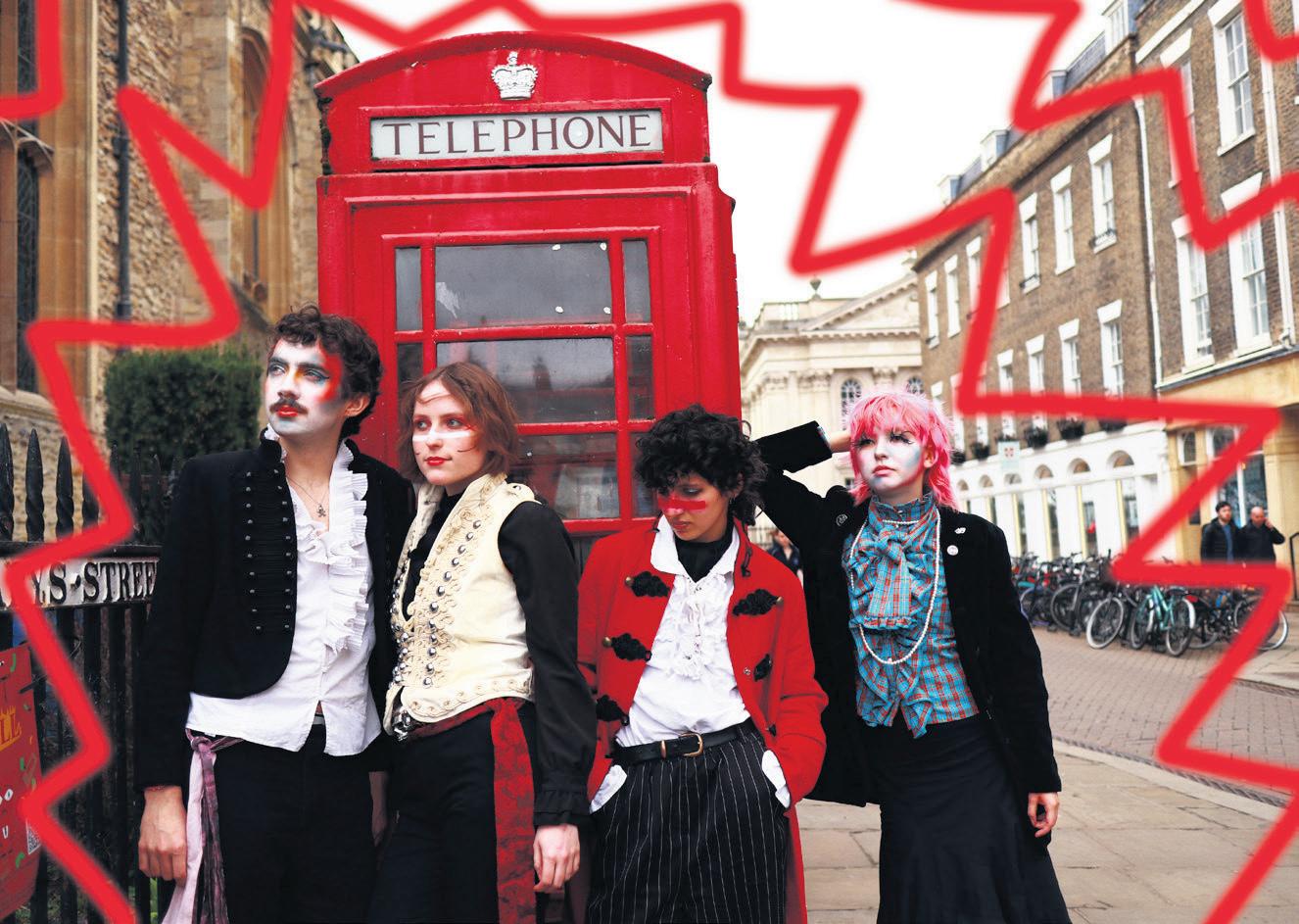
But the Daily Mail couldn’t have been more wrong than to dismiss the movement so quickly. he New Romantics dressed up the ashes of punk in technicolour and lamboyance. heir style was famously inspired by the English Romantic period, putting a 1980s twist on foppish shirts, Napoleonic military jackets, piratey sashes and ruffs (think Bridgerton, but with added eyeshadow and bright blue blush). hey refused to conform to the socially and economically conservative norms of a hatcherite society, and with this deiant spirit emerged radical new modes of gender performance and sexual expression.
In the foreword to a 2003 special edition of MOJO,
post-punk pioneer Siouxsie Sioux recalls the irst time she saw David Bowie (I mean, who wasn’t mesmerised the irst time Bowie appeared on their screen?). Bowie would, of course, go on to inspire the glitz, glamour, and androgyny of the Blitz Kids. Sioux, a frequenter of the Blitz club, writes how “hat ambiguous sexuality was so bold and futuristic that it made the traditional male/female role-play thing seem so outdated.” If you’ve read any of Judith Butler’s Gender Trouble, I’m sure Sioux’s mention of “roleplay” will bring the theory of gender performativity to mind. he queering of New Romanticism and its distinctive wardrobe challenged the constructed nature of gender. Members of the scene dressed in a way that naturally questioned the emphasis placed by hatcher’s government on Victorian, patriarchal, and heteronormative values.
he Blitz Kids’ outwardly androgynous gender presentations caused shockwaves of controversy in Reagan’s conservative America. A 1982 edition of Melody Maker, called ‘Boy George Corrupts America Shock’, discusses the queerphobic demonisation of the New Romantics, who conservatives considered to be “corrupting” American youth with their ambiguous sexualities and gender nonconformity. Like Boy George, other dandies such as Steve Strange, who was Visage’s frontman and the host of Billy’s and the Blitz club, were also particular targets of the tabloid press.
When we look away from those who made it into the mainstream and back to the Blitz Kids’ beginnings in a vibrant (if slightly grungy) discotheque, it becomes clear that the true heart of the movement is still applicable. he Blitz was a melting pot of diferent people of all genders, from various cultures and walks of life. And in this same way, New Romantic fashion should be accessible to everyone – if they dare decide to embrace the rule.
As the rst play to be staged in St John’s College Chapel, Measure for Measure presents Shakespeare’s well-loved dark comedy in a new space. Exploring morality, justice, and the complexities of human relationships, the Lady Margaret Players delve into the striking hypocrisies of the powerful in this adaptation.
When I was speaking with director Jay Palombella and assistant director Zach Foster, the joy they had found within the rehearsal process was palpable. Jay described working with the cast and production team as “enlightening,” “collaborative,” and “diverse”. is was especially true when having to deal with a larger cast than expected of Shakespeare productions (around 26, to be precise) and having important conversations around the play’s problematic, and misogynistic representations. e cast have enjoyed a longer than usual rehearsal process, being already ve weeks in, which has allowed the cast and crew to “go through the script in detail and stage a lot of rehearsals around character exercises, especially in the rst few weeks,” Zach adds. Some of the dramaturgical techniques used in rehearsals have been inspired by German director omas Ostermeier, accompanied by directorial techniques from Peter Brook and Jerzy Grotowski.
I liked most about it, the ambiguity that it gives. ere’s also not that many interesting productions of the play happening right now, that push the boundaries, and that’s what we want to do. We have some whacky plans, both musically and with the sheer
Edie Carter conversed with me over email about her experience in Measure for Measure’s production so far, calling it “unique and rewarding”. She recalls “hilarious correspondence” with the Chaplain “regarding the theological propriety of fake blood and
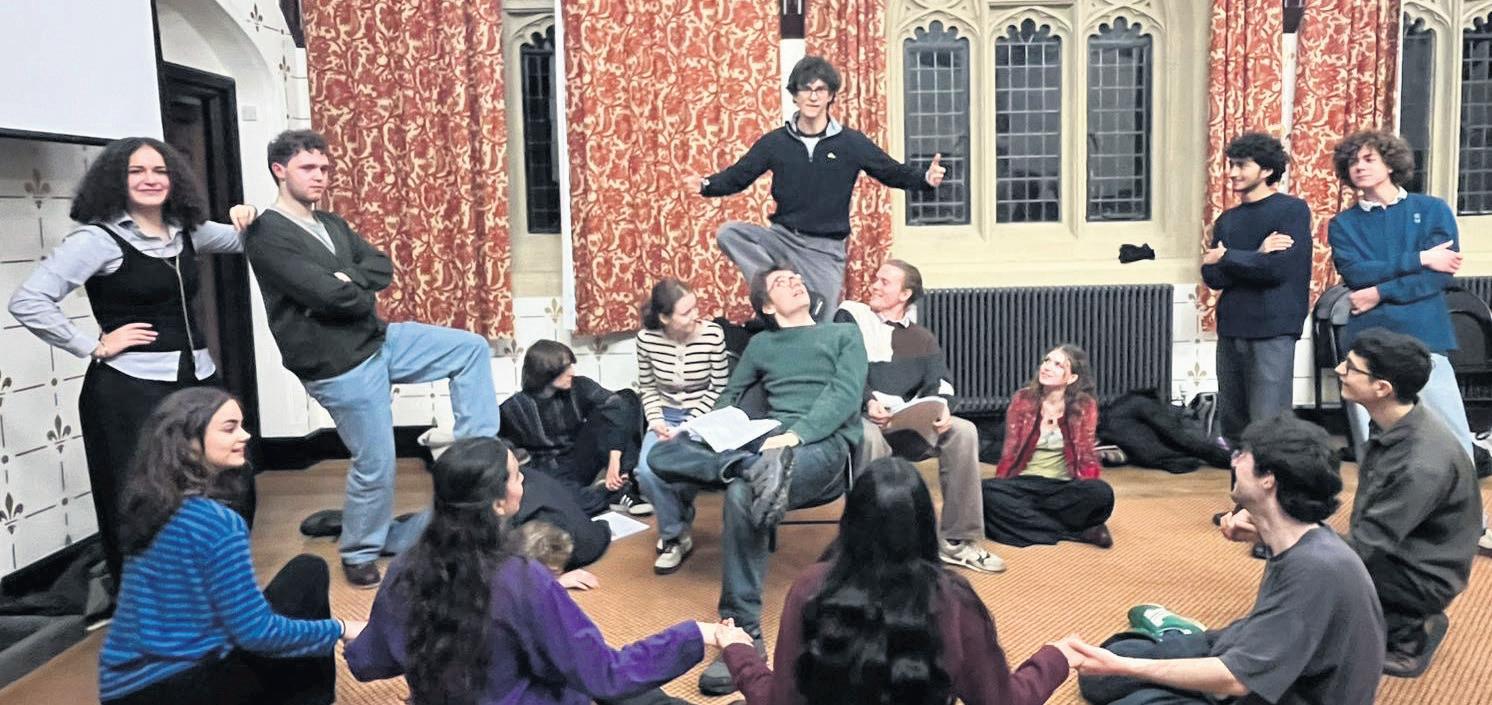
dience to immerse themselves in the experience of the play and take in its words rather than worrying about trying to gure out its historical placement. He states that the play is complex, especially in its characterisation and requires actors to uncover a “Janus form of acting” as “everyone in the play is playing someone else at some point”.
Jay’s love for Shakespeare is clear; he recalls the words of academic Emma Smith who speaks of Measure for Measure as having one face towards comedy and one to tragedy. “I think that’s what
size of the cast.” e pair also remain passionate about its relevant themes in society today, playing with the role of the law and surveillance alongside ethics. Jay is candid about the di culties of balancing comedic aspects of the production alongside darker, political ideas. Both praise producer Edie Carter, who pitched the play initially, and St John’s chaplain, Rev Graham Dunn (a former dramatist himself), who have been highly supportive throughout the process.
a mock severed head in the chapel!” Overall, there is a real sense of enjoyment from all those involved. ough much of the play’s content speaks to modern audiences, this production is careful to not make Shakespeare become ‘too relevant’ to the 21st Century. “Audiences are far more intelligent and can understand something that may not be directly applicable to them now,” Jay tells me, not wanting to be too ‘on-the-nose’ with this adaptation. What remains more important, Jay clari es, is for the au-
The play’s staging plans sound creative and unique, hopefully utilising the altar and organ loft. e set will also have a raised section, allowing for exibility in the actors’ movement. Zach believes that “the way the audience sees the play will intrinsically be shaped by the use of the chapel,” as he recalls the production team going to Evensong in St John’s to get a real sense of the drama that its space could cultivate. Yet Jay is keen to “not give too much away,” preserving an element of dramatic reveal and surprise. Overall, Jay wishes for audiences to be “moved in some way, leaving in a thinking state”. ‘ ough one thing they were adamant about was their intention for the audience to immerse themselves within the play’s world, hoping that they gain an “appreciation of our joy of working with such a great cast and extraordinarily talented actors”.
Measure for Measure comes to St John’s Chapel from Monday 9th- ursday 12th March.
Dhyan Ruparel speaks to the illustrious director on his return to the
Ispoke to Sir Trevor Nunn three days after the press night for his latest show: Noël Coward’s Easy Virtue at the Cambridge Arts eatre. Now 85, Nunn is no stranger to opening a show, heralding credits from Cats and Les Miserables to all 37 of Shakespeare’s plays. “Nothing has changed at all, really,” he tells me. Among these constants, it emerges, is a life-long passion for Cambridge and its vibrant dramatic scene.
Nunn is, surely, the master of Cambridge theatre. He began, as many Cambridge thespians do, with a proli c run of undergraduate productions at the ADC eatre, as well as at the Arts eatre with the Marlowe Society. He laughs as he lists his ADC peers: Ian McKellen, Derek Jacobi, Miriam Margolyes, John Cleese, among others. “ ere we all were, together in Cambridge, and it was a very, very exciting time,” he tells me. Now, via 18 years leading the Royal Shakespeare Company, seven years at the National eatre, three Tony awards and four Oliviers, Easy Virtue marks his grand return to Cambridge.
I asked why he chose this 1924 play for such a sentimental project, which marks the re-opening of the Arts eatre. Nunn expresses an interest in the “revolutionary” qualities of this play: “Coward wrote Easy Virtue when he was 24 years old, and when he o ered the play to a London management, they discovered that it was banned by the Lord Chamberlain’s o ce. It was too risque, too sexual.”
I’m reminded, in these descriptions of Coward, of a young Trevor Nunn and his rst experiments with theatre at Cambridge. Like Coward, Nunn’s
career started early – he was appointed as Artistic Director of the Royal Shakespeare Company in Stratford when he was only 27 years old. I described this as unprecedented in today’s climate, to which he responds: “I do assure you, it was unheard of then too.”













sents a medley of Nunn’s entire career, balancing a Shakespearean central gure with the slapstick comedy and farce of his musical theatre work.
Signi cant, also, is the inclusion of several Cambridge students as ‘supernumeraries’ – demonstrating his focus in looking forward to the next era of




He attributes much of his success to luck, from getting a scholarship to attend Downing College to discovering a young Hugh Jackman. What has carried Nunn through all these years of luck and hard work is a consistent directorial ethos, developed as a student: “ e rehearsal process isn’t a director saying ‘do what I tell you’ […] it’s a dialogue. It’s two-way tra c. e director learns from the acting company just as the acting company learns from the director.”






Now in itsnal weekend at the Arts, Easy Virtue pre-








In this spirit, Nunn praises the current state of Cambridge theatre: “I went for nostalgic walks while I was in Cambridge to the ADC, and saw that there were lovely posters and the ADC was ourishing. It’s just so exciting that the ADC is still going full blast –how wonderful.” e Arts have plans to open a 200-seat studio space in phase two of their redevelopment; Nunn tells me that “it would be thrilling to have the big and small theatre on the same premises, absolutely thrilling”. Easy Virtue is not intended as a swansong for Nunn. He tells









me about future projects: American transfers of new musical e ird Man and the Brian Cox-led play e Score, as well as an immersive experience presenting the life and work of Andy Warhol, which he hopes to stage over the next few months. As he looks back, I ask for his advice to Cambridge theatre students: “I would have to say – be as daring as you possibly can. Don’t take no for an answer. Pursue the ideas even when management bodies say ‘no, no, I’m not sure we can a ord that.’ at’s what we had to do on so many occasions when I was part of the ADC.”
I imagine that his legacy will be characterised by this “daring,” Noël Coward-like ethos that he took from Cambridge to the international stage. As he points out, the potential for today’s students to take on his mantle is rife, with the re-opening of the Arts, the continued thriving of the ADC eatre, and the ongoing work of his former societies: CUADC, Marlowe and the Footlights. “Have the courage,” he tells me as we end our conversation, and I am certain that this ‘courage’ is what has driven Nunn forwards, from his rst ADC show in 1959 to Easy Virtue and beyond.
The 98th Academy Awards are on the horizon. We hope you’re ready for long acceptance speeches about people’s inspirational mums, zoomed-in shots of celebrities sweating through their black tie attire, and some out-of-touch jokes about being out-oftouch. Once again, the event will be hosted by Conan O’Brien, which will be great news for those who love ‘dark humour’, and less great news for those who are actually looking for dark humour. Nevertheless, we at Varsity have been readily sharpening our witty one-liners, and preparing (as always) to put pen to paper to espouse our lmic opinions. We are sure you all have thoughts on how the ceremony on the 15th of March might turn out, but in case you need any help or persuading, allow us to be that guiding hand.
Amanda Ljungberg (Film & TV Editor)
As is the case with most self-respecting people, I have become so disillusioned with the Academy that the thought of o ering any sincere commentary feels impossibly trite and collusive. ey have so cheekily shielded themselves against criticism from almost every possible angle that debating the nominations as re ective of anything other than market interests seems pointless. I have been mostly checked out since the Everything Everywhere panderfest of 2022, but Sinners’ record-breaking 16 nominations has sealed it. Something feels deeply insidious about this spineless institution setting that perfectly decent lm up as the fall project for their populism. Granted, the Oscars are just one victim of cultural enshitti cation, but after a childhood spent believing these awards meant something, to give this mockprestige sham the time of day just feels tiring.
Otto Bajwa Greenwood (Film & TV Editor)
My Oscar predictions come more in the form of a rant than anything else. How Guillermo Del Toro’s Frankenstein has been nominated for anything is honestly shocking.
Kate Hawley’s aesthetic eye helping to secure the Oscar for Best Costume Design, fair enough. But everything else can only be the result of the lm’s big names (Jacob Elordi, Oscar Isaac) and its in ated budget. ere has been a lot of recent controversy over Emerald Fennel’s adaptation of Wuthering Heights, but Del Toro’s Frankenstein – working with similar classic material – also deserves criticism. It really retains none of the thematic depth of Mary Shelley’s original text, attening the
nuanced antagonist into an unproblematic and sympathetic monster. Elordi for Best Supporting Actor in this role? is is not only an insult to Shelley’s original, but also the other incredible performances in the category, from Sean Penn to Stellan Skarsgård to Delroy Lindo.
❝
e craft categories feel far more daring to me than the headline races...
Pam Noonpackdee (Film & TV Writer) e most overlooked but egregious snub on the Oscars horizon is the likelihood that ‘Golden’ from K-pop Demon Hunters is set to win Best
I Lied To You
of its soundtrack, it completely paled in comparison to the impact of hearing Sinners’ nominated song for the rst time. To have something so bland and safe win over something that feels like it only comes around once in a generation and will be remembered for generations to come is exactly what the Oscars would do.


Hilary Lau (Film & TV Writer) ough I’d have no gripes with Paul omas Anderson winning Best Adapted Screenplay with One Battle After Another, I can’t help but feel that the rest of this year’s nominees leave something to be desired. No Other Choice, adapted from Donald E. Westlake’s novel e Axe, outdoes Bugonia in every way as a black comedy. Park Chan-wook matches Lanthimos in his fanatic storytelling, but whereas Bugonia comes o as messy and erratic, No Other Choice utilises pacing meaningfully to amplify tension while underpinning the lm with a deep sense of melancholy. is movie leaves space for the conclusion to really hit, leaving viewers haunted at its implications. No Other Choice utilises pacing meaningfully to amplify tension while underpinning the lm with a deep sense of melancholy. is movie leaves space for the conclusion to really hit, leaving viewers haunted at its implications, while Bugonia’s nuance completely ies over its audiences’ head from just how rushed and de ated it seems.
Heidi Lewis (Film & TV Writer)
Although I am still mourning the Wicked: For Good Oscar nominations for makeup and costuming, I am still very excited for a lot of the nominations this year. Sinners obviously made history with its impressive 16 nominations, which are incredibly well deserved! If not Best Picture, I imagine it will secure Best Original Score, and is de nitely the strongest nomination on that list. Personally, I’m rooting for Chloé Zhao as Best Director, and Jessie Buckley as Best Actress. Hamnet deserves all of its owers and more, and I am glad to see its success in award season so far. Buckley should start clearing room on her trophy shelf now! Marty Supreme was completely ignored at the BAFTAs, but I think it’ll pick up some pace at the Oscars. Whether that is deserved is something else entirely, but Chalamet is clearly chasing these awards in his – self-proclaimed –“pursuit of greatness”.
Dylan Ingram (Film & TV Writer)
I’d love to see Wagner Moura win for Best Lead Actor in e Secret Agent. My money was previously on Timothée Chalamet for Marty Supreme: he certainly thinks that he deserves it, but the lm’s recent awards failures might suggest the shine is wearing o that performance. It was con dent and I thought it was
very entertaining, but it’s hard to tell how much acting really went into it. A big part of the sell was the overlap between Chalamet and Marty’s psychologies. I respect the dedication for the spanking scene though. ere’s a recent turn towards international lms at the Oscars, which might swing in e Secret Agent’s favour. I doubt it will clinch the award for best picture: it’s too culturally speci c and alienating. I expect any international momentum will go towards Sentimental Value instead. Moura’s performance is sensitive, ickering through emotions across the lm’s distinct timelines. He looks so thoroughly seventies, but retains a modern sense of cool. Sadly, the Oscar for ‘most aura’ still hasn’t been formally introduced. If only we lived in that world, Wagner Moura would win a clean sweep – sorry Timothée.
Daniella Adetoye (Film & TV Writer)
I think 2026 is the year the Academy will nally crown Timothée Chalamet Best Actor, completing his years of campaigning (begging) to be enlisted in the hall of ‘the greats’ e machinery behind Marty Supreme has been impossible to ignore: the method anecdotes, the self-mythologising interviews, the supposed ‘sacri ce’ of wearing contacts and glasses to inhabit the role. It all feels meticulously engineered. However, his potential success is not something I am particularly excited about. If he does win, it will be for his least emotionally a ecting performance to date. We’ve seen this ambitious, morally dubious character in lms before, and we’ve certainly seen it rewarded time and time again throughout the history of the award ceremony. What’s more exhausting is the discourse orbiting the nominee and the endless certainty from people who haven’t even seen the entire category list.
❝
To have something so bland and safe win [...] is exactly what the Oscars would do
Nevertheless, the craft categories feel far more daring to me than the headline races we seem to be cyclically arguing around. I need to see Ludwig Goransson sweep in Sound and Music Design for the atmospheric soundtrack and original songs in Sinners. Costuming, especially, feels genuinely competitive this year with the potential toss-up between Ruth E. Carter (Sinners) and Kate Hawley (Frankenstein), not to mention the textured work in Hamnet, Marty Supreme, and even Avatar. ese craft races still o er the possibility of surprise and cinema that isn’t campaigning quite so loudly for its own importance. Looking for more?
From institutional apathy to indie-invective to craft focus, hopefully these varied takes have helped to stimulate your own thoughts. e Academy Awards will be hosted on the 15th of March at 11:00 pm GMT. Get ready, if you can, for the barrage of think pieces coming your way.
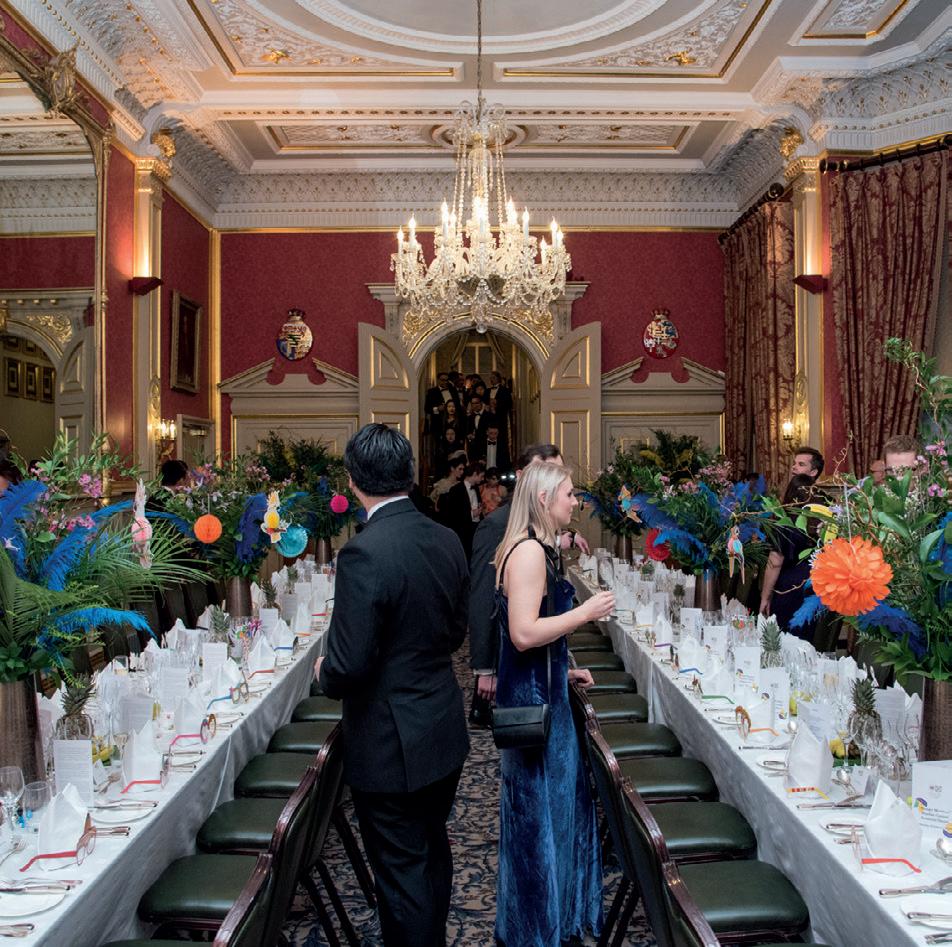


For nearly 200 years alumni have chosen to take up membership of a spacious and elegant private club in the heart of London. The Oxford and Cambridge Club in Pall Mall is the perfect place to meet for a drink, entertain friends and colleagues in magnificent surroundings, play squash, take a break, host a party or just find a quiet corner to prepare for a meeting. A thriving social scene, sports facilities, a lively calendar of events including talks, tastings, dinners and balls, an exceptionally well-stocked library, extensive wine cellars and more than 40 bedrooms mean our members use their club for recreation, relaxation and business - and now you can too. For details on membership or a tour of the Club house on Pall Mall, please visit www.oxfordandcambridgeclub.co.uk or call 020 7321 5110 Oxford and Cambridge Club @oandcclub
6
7:45pm 17 March
Playtime Arts Picturehouse, 1:00pm 20-21 March
Transitions and Beyond: Women’s Work in Spanish and Portuguese Cinema and TV (two day symposium) Lubbock Room, Peterhouse
9 March
he Best of Tubular Bels, I, II & III Corn Exchange, 7:30pm 10 March
Green Mind presents the HARA he Portland Arms, 7:00pm 13 March Take it to the Bridge Junction, 7:00pm 14 March Lily Allen Corn Exchange, 7:30pm 19 March he Snuts Corn Exchange, 7:30pm
March
Painting party at he Castle Inn he Castle Inn, 7:00pm 13 March
Exhibition Opening: ‘Artists for Kettle’s Yard’ Kettle’s Yard, 6:00pm 18 March
An Evening with Catherine Carr Waterstones, 6:00pm 21 March
Recreating an Ancient Egyptian Book of the Dead Fitzwilliam Museum, 11:00am hroughout March
Making Angelina: he World of Helen Craig exhibition Museum of Cambridge, 10:00am-5:00pm 10-14 March
Tuesdays are for Pub Quizzes Corpus Playroom, 7:00pm 11-14 March One Brazy Night Pembroke New Cellars, 9:30pm 12-14 March [BLANK] Queens’ College Black Box Studio, 7:30pm 15-16 March Oedipus! Newnham Old Labs, 6:45pm 18-20 March Hamlet in the Chapel King’s College Chapel, 8:00pm













Evans speaks to students about their half marathon e

It was two days before the 2025 TTP Cambridge Half Marathon, when a collision in a college mixed netball match left me sprawled on the oor with a sprained ankle and no hope of racing that weekend. After watching more than 13,500 runners raise around £1 million for good causes, I made a quiet promise to be one of those nishers next year. Fast-forward to this term, and Cambridge’s cobbled streets are alive with runners, sprinting down King’s Parade or rambling through Coton Countryside Reserve. With the sold-out 2026 race on the 8th March fast approaching, I speak to Martha, Grace, Corey, Pooja and Keane, all runners preparing for this challenge, who are cultivating the discipline it takes to cross that nish line.
❝
“It provides a broader perspective [...] encouraging runners to support meaningful causes
After completing the Half last year, Martha is returning to the start line. e race holds a special place in her heart, where running through the colleges “really helped me fall in love with the city”. Despite nerves about repeating
the challenging race, she reminds herself “how good I felt after it last time,” especially after crossing the nish line to see “loads of people happy, relieved and celebrating”.
e roads over ow with supporters waving funky signs, from 'Hot Girls Run Halfs' to 'On a Scale 1-10 you’re a 13.1!' Inspired by this electric atmosphere, Grace has signed up for the 2026 event, saying it “would be a great place to run my rst ever race!” Both Grace and Corey have friends and family down to cheer on the runners as they face the daunting 21.1km distance. Ultimately, her aim is to cross that nish line, in whatever time it takes! is term’s socialising has shifted from co ee catch-ups to a long-run natter. From kudos on Strava and a Saturday morning parkrun to the Cambridge Run Club collective’s 10 week training programme, the sense of community around running is hard to miss. Clare has a social run club every Sunday morning, which is a great chance for Corey to unwind and catch up with friends over a staple of brunch afterwards.
e viral Franco Manca Map My Pizza Run added energy to training this January. When 1km equates to £1, many runners are hitting new distance goals, and Grace remarks that this motivated her to “get up to some longer distances I’d never run before”. I too bene tted from a delicious free pizza after a long, gruelling run, while Martha says her pizza runs have provided the chance to run more interesting routes and added a “whole new social dynamic to running”.
Martha has “found loads of friends through running” while also “developing existing friendships”. A regular parkrunner, she commits to the weekly trek to Eddington for the 9am start, often followed by brunch with course and college friends. Grace also enjoys the occasional parkrun, although sometimes nds it daunting running with friends “because I run so slowly!” Training alone can be a
great way to avoid comparison culture and discover a more personal love of running. Keane similarly prefers solo runs, down streets among “a lot more runners this term, especially down the stretch towards Trumpington Street”. “I’ve had to sacri ce my Saturday morning lie-in for a morning run,” Grace laughs, noting the changes running makes to her routine now. Keane nds running o ers a counterbalance to “unwind after a day of work and the hectic Cambridge termtime lifestyle,” while providing distraction from tasks “like my dissertation!” For Pooja, balancing training with a Computer Science degree has “de nitely been challenging,” but echoes the stress relief which running provides.
❝
Running through the colleges really helped me fall in love with the city
Training is not always sunshine and rainbows, especially during long winter evenings with deadlines constantly looming. Although the Cambridge weather has sometimes “dampened both the paths and spirits,” Corey has found his early morning runs “really rewarding and a great way to nd routine during nals. Martha admits balancing work and running can be di cult due to time and exhaustion. Grace has found running improves her focus, but adds that an exhausting long run can also be a “good excuse for a midday nap”. Running through Grantchester meadows,
with the sun glinting o the river and the gentle breeze waving through the willows, is a runner’s favourite, as Corey and Pooja comment that it’s a view they’ll never get tired of.
Strava’s kudos culture can heighten pressure, where a misrecorded or slow run leads you questioning whether it was even worth it. e Half has provided a broader perspective than this, encouraging runners to support causes that are meaningful to them. For Keane, who has faced mental health struggles in recent years, running for a local branch of Mind was a cause he was “deeply passionate about,” helping raise awareness of their vital work which ensures nobody faces mental health battles alone.
❝
Pizza runs have provided more interesting routes and add a whole new social dynamic to running
Corey is running for Alzheimer’s Research UK, having watched his Nana su er with dementia for over 10 years, before passing away recently over Christmas. It has been a “huge honour” for him to be able to raise over £1,000 for the charity from family and friends, both at home and here in Cambridge.
Pooja will be sporting the signature purple top of Cambridge Rape Crisis Centre (CRCC), a cause she cares deeply about. Commenting on the stigma and silence around the topic of sexual assault and rape, the work of CRCC is incredibly vital, but can be be shied away from compared to more ‘palatable’ or traditional causes. e charity has been incredibly supportive, o ering runners a Team CRCC WhatsApp group, and have raised over £13,000 from their runners.
e countdown to 8th March is on, and as I run with aching legs and blistered feet, I hope and pray netball will not be my downfall again! After more than a decade, this historic race has clearly inspired, and will continue to inspire, runners throughout the city and beyond. Martha, Keane, Corey, Pooja and Grace will cross the nish line to join more than 95,000 nishers who have run in one of Cambridge’s biggest sporting events. Grace concludes that her training has “really shifted my perspective on running and has made it so much less daunting to get out and go for a run,” and Pooja adds with a smile, “I’ll de nitely keep running afterwards!” but will at least “take a week o !”








Tell us a bit about your football journey growing up before arriving at Cambridge.
Deniz: I started playing football when I was ve, for di erent local teams. After that I was playing for the youth teams of semi-pro teams for a while; from age 14 to 18 I was playing for Kingstonian FC with Reece James’ dad as coach. We won the treble in my last year, and got to play Charlton in the FA youth cup.
It’s your nal year in Cambridge. What’s your best CUAFC memory and how do you feel about leaving them?
Deniz: Winning Varsity last year, 4-1 against a big home crowd, was amazing. And the tour in China this summer, playing in huge stadiums against other Universities. Winning the Midlands cup, too. ere’s been so many highs it’s hard to say, but I’ve had the best footballing experiences here, and I’m leaving a great group of lads behind. It’s sad to be moving on but I know loads of great players who’ll continue to add success to the club.
How do you feel about playing at home for the third year in a row?
Deniz: e home advantage for the third year in a row has really helped us, having 2,000 Cambridge supporters there. We’re really excited to be at Grange Road too, the fans are so close and so we should be able to get a good atmosphere going. It’s also where we train three times a week, so we really know the setting well and should be able to bene t from that.
Have you been keeping an eye on Oxford throughout the year?
Deniz: Our coaches have been. But the players are just focussing on ourselves, playing our best game and thinking about winning the league before doing anything tactical about Oxford.
What’s your go-to pre-match song?
Deniz: e team generally listens to house music in the changing room before the game. e boys like Sammy Virji.
And one essential song for the after party at Kiki’s?
Deniz: What You Know . Two Door Cinema Club. Always.
What can fans expect from the game?
Deniz: Fans can expect to see a hungry Cambridge side looking to retain the Varsity title and playing high-quality, con dent football.

Sam Ho and Ben Madden
Sport Editor and Sport Correspondant
Both light blue out ts were outmatched by resurgent Oxford teams at StoneX stadium on Saturday, as the women fell 52-8 and the men succumbed 37-25 in the 2026 Varsity Matches. A much-changed men’s Blues were riding the momentum of three consecutive Varsity wins, but Oxford’s pack physically dominated throughout.
For the Women’s Blues, it was a chastening defeat at StoneX, as Oxford successfully defended their title for the rst time since 2014. is year’s game was always going to be a tough test against a side ranked a division higher in BUCS this year. Cambridge’s challenges were compounded by their captain and vicecaptain being ruled out due to injury, alongside record inexperience in the squad – which featured ve freshers, and 18 new players.
Nevertheless, the women in light blue had stormed out the blocks to the Oxford 22 within minutes, before marauding runs got them within yards of the try line until Oxford triggered a knock-on. Having stalled the early momentum, Oxford then roared back in the opening


ten minutes. Cambridge fought to keep them at bay, and two defenders brilliantly stopped four dark blue players from bundling Estelle Onwuka over the line. Cambridge then forced a knock-on, but Oxford made their pressure count and subsequently broke the deadlock.
Flanker Harris-Lovett powered away to score near to the posts, and a conversion duly followed. is sparked Oxford into rhythm, but while they advanced with pace, Cambridge held them o and had chances to ght back. Inside centre Amelia Edwards intercepted brilliantly, but an almost-certain try was called back for an advantage. It was Oxford who would score second, a resilient Cambridge defence struggled to release the pressure and it told through Onwuka’s power. A gutting end to the half followed: Cambridge were yards away from the try line, before Oxford took advantage of both a penalty advantage and Cambridge fatigue to score another try, meaning the light blues went into halftime 19-0 down and with it all to do.
Oxford started the second half strongly, but a crucial knock-on prevented a fourth try. Errors compounded when Liv Rosin conceded a yellow from a Cambridge scrum, but the dark blues kept up enough pressure to eventually
add a fourth. Nevertheless, Cambridge would soon have their magic moment. Clare winger Esther Makourin broke a tackle on the halfway line and carved a wonderful, curving 40-yard run through the Oxford line, outsprinting everyone to score brilliantly in the corner – a wonderful moment for the fresher that made it 26-5.
Unfortunately for the light blues, Oxford experience soon became telling in the second half, and they continued to rack up more tries to seal Varsity victory. However, it would be Cambridge who had the nal word, as they won a late penalty 20 yards out, which number 19 Charlotte Cooper converted with aplomb to leave the nal scoreline 52-8. e result will be tough to swallow and the scoreline a grim read, but the performance was de ant against stacked odds. ere were lots of positives to take from the match, and a young team in transition will continue to grow ahead of next year’s encounter. Scarcely an hour later, the men’s Blues had the opportunity to avenge their female counterparts. On a particularly windy afternoon in North London, the opening passages foreshadowed the game’s overall theme, Oxford scoring their rst points o a driving maul in the fth minute. At set-pieces, they
The Varsity football matches are a highlight of the Cambridge sporting calendar, with Grange Road playing host as Oxford come to town seeking revenge. Last year, the men’s side backed up the women’s victory, sweeping aside the dark blues 4-1, I sat down with league top scorer and men’s captain Deniz Ozer, and asked him whether there is added expectation after recent triumphs.
Deniz: After last year’s score, we
were repeatedly able to apply sustained pressure throughout the game on the smaller Cambridge pack. Nevertheless, minutes later Cambridge replied with a try of their own. James Wyse, Cambridge’s loosehead prop, bundled over, captain George Bland adding the extras. Subsequently, opposing y-half Josh Hallett – who pulled the strings of the Oxford attack – set up winger Wolfe Morn for Oxford’s second try and a 10-7 lead. However, a Bland penalty then levelled things after 32 minutes. Just before half-time, Oxford utilised their rolling maul again to give hooker Will Roddy his second try of the game and go into the break 15-10 up.
Despite Oxford’s defensive edge, proceedings seemed evenly poised, but minutes into the new half one of Cambridge’s key men, Nate Bottomley, was forced o injured. is led to a complete shu e of the backline, and in the 44th minute Oxford capitalised on another driving maul to score in the far corner and give Roddy his hat-trick.
Cambridge’s glimmer of hope came through Patrick Shrimpton, who burst through the gainline on multiple occasions, and the inside centre pegged Oxford’s advantage back to 20-15. A lack of mid eld cohesion and set-piece preci-
know how to approach the game. We’re just trying to go into this game with the same approach and mindset as last year – we’re focussed on winning.
How do you see your role as captain in the run-up to the xture?
Deniz: I believe we should train as we mean to play. I like to maintain high standards because if you have a team that treats a training session as a nal, that’ll translate to a result
sion thwarted any Cambridge momentum however, and Oxford soon scored again after 55 minutes. An exchange of penalties between Bland and Hallett left Oxford 30-18 ahead with 15 to go. However, Cambridge then failed to capitalise on their opponents being a man down followng a sin-binning, as dropped balls and stolen lineouts cost them dearly. When yet another Oxford rolling maul soon gave Roddy his fourth try in the 73rd minute to make it 37-18, Cambridge had left too much to do. A late consolation try for Lewis Cooper following a clever overload by Arnaud du Roy left the nal score 37-25.
In phases of the game, both teams posed a threat, but Oxford’s physical dominance and consistency at set-pieces ultimately overwhelmed the Cambridge defence. e light blues would build patches of momentum, only to disrupt it with poor discipline or simple errors. Cambridge’s lineout and maul defence was a particular Achilles’ heel, conceding four tries in a similar fashion. A lack of real cohesion between the backs also let Cambridge down, often failing to release their wingers. For Oxford, this represented a real ght back, both physically and symbolically, having failed to pick up a win in the last three Varsity games.
on game day. I want to see a culture of high standards throughout. Who was your favorite player growing up?
Deniz: Eden Hazard. I play in a similar position as him and I love the way he plays. He’s so con dent on the ball, always looking to create something out of nothing. Seeing him do that in the Premier League growing up moved me.