Sidney in court over access disputes
Disabled student made to feel ‘unsafe’ by college
Revealed: College disparities in hardship awards
Felix Armstrong
Students from colleges with large state school intakes are less likely to receive support from the University’s Hardship Fund, a Varsity investigation has found. Application success rates at colleges such as Lucy Cavendish, Pembroke, Homerton, and Fitzwilliam are signicantly lower than at colleges where the privately educated feature more strongly in the student body.
e Hardship Fund is a universitylevel scheme under which students can apply for up to £3,500 to address “unforeseen nancial di culties.”
39%


Gillott and Erik Olsson
A disabled student has accused their College of withholding mail, accessing their private counselling records, and denying them food and hot water in their attempts to evict them.
In court documents seen by Varsity, a PhD student at Sidney Sussex College who lives with severe disabilities alleges the College made their life “as di cult as possible” after they led a complaint. e student believes this pattern of harassment was intended to force them out. e College also led an eviction notice – which the student has resisted through legal action.

e hardship the student faced consisted of continued harassment from senior college o cials and the Master, University Deputy Vice Chancellor Professor Richard Penty.
In an email seen by Varsity, the Head Porter, under instruction from the Senior Tutor, requested that the student’s mail be photocopied and returned to sender. is allegedly went on for over a year without the student being informed.
“I thought I was going mad,” they said. “I thought I was incompetent, and

that due to my disability I was giving people my wrong address.” ey claim that they were ned for late payments, had to appeal parking tickets they had not seen, and lost employment. “It made me feel unsafe in my home,” they said.
e student had to involve the police and nally the seizing of their mail ceased.
Sidney Sussex also allegedly attempted to withhold food from the student and deactivated their Camcard until the College apologised in court. ey denied them access to the buttery, and when they su ered from Covid-19 in February, they delivered only one meal to their room over the course of three days. ey received a pork burger. For religious reasons, they do not eat pork.
ree days later, the student was admitted to A&E.
According to a doctor’s note seen by Varsity, the student “is in the extremely vulnerable group in relation to Covid.”



e student has a severe immunode ciency which leaves them susceptible to infections. ey are treated with regular blood transfusions, the supplies for which they keep in their fridge at college. e student also has a musculoskeletal problem which has left them
with chronic pain syndrome, and causes fatigue.
e student also alleges that the Bursar instructed the College Registrar and IT manager to “access [their] private counselling records and emails” with the college chaplain.
In an email seen by Varsity, the chaplain con rmed that his emails had been accessed, but told the student he did not know why. e chaplain then instructed that they email via a secure University system.
e student alleges the action taken by the College was retaliation for the February Varsity article Sidney Shame, which detailed the accessibility issues at Sidney Sussex.
e student maintains they were not involved in the publication of said article.
e student submitted a complaint to the Information Commissioner’s O ce (ICO), an independent regulatory body dealing with data protection, which is ongoing. “ is made me feel very unsafe,” they said. “I believe this was part of some misguided attempt to harass and intimidate me, and to gain information for use in litigation.”
Sidney Sussex also issued a formal eviction notice, which the student has successfully resisted.
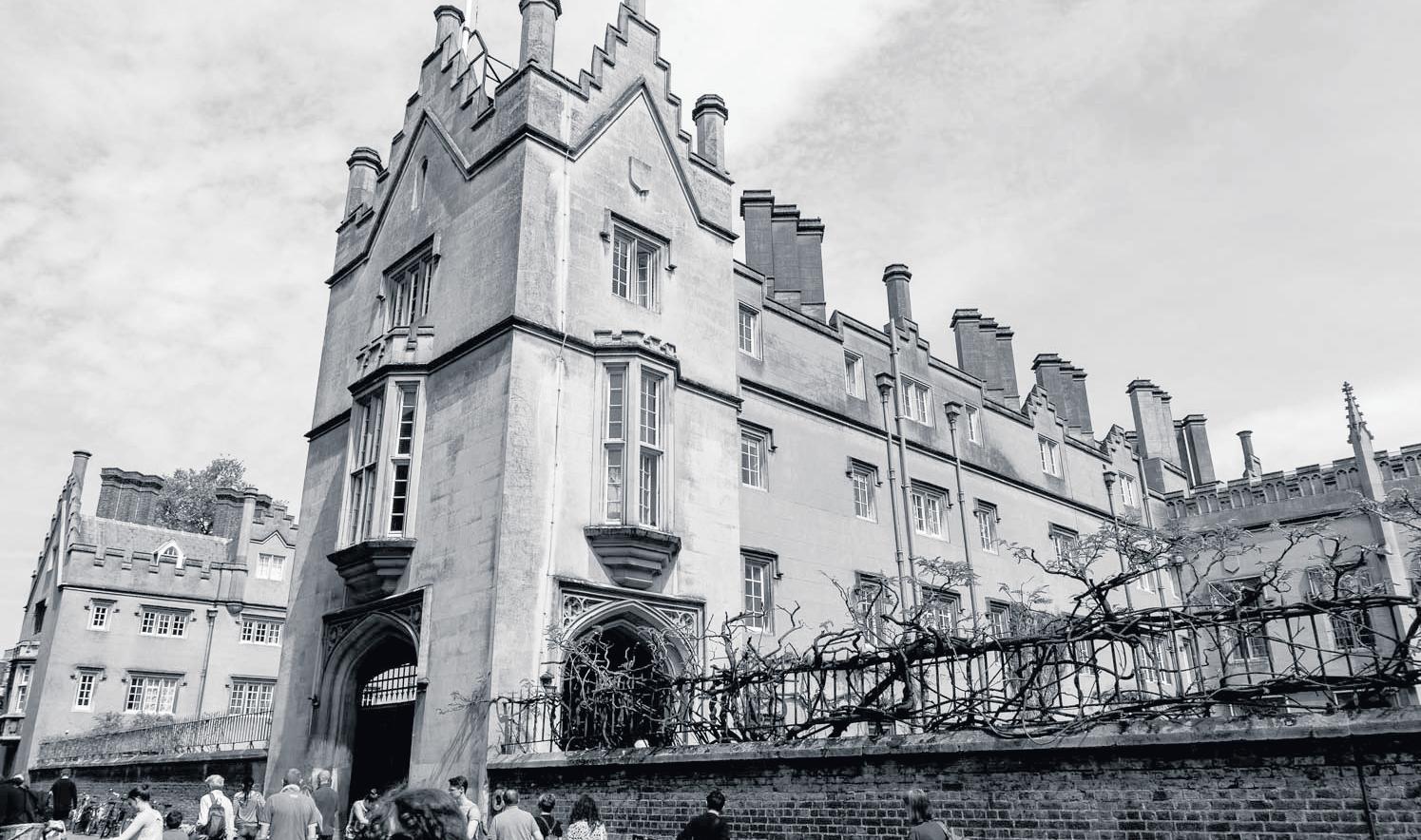
e student took action after he received the notice on 14 July. ey secured a successful injunction against the College in the Cambridge County Court on 3 August (03/08), preventing the college from issuing an eviction notice for the next four months.
ey allege that after three years in unlawful accommodation, they were given just over a month to nd new housing –even though they had already informed Sidney Sussex that they were planning to move out in December.
e student provided the College with their doctor’s notes and letters from the national charity representing immune de cient people. ey allege they never received a reply from the College.
Doctors wrote to Sidney Sussex, advising that due to the complexity of the student’s conditions, eviction would cause “serious physical deterioration.”
Nonetheless, Sidney Sussex pressed ahead with their eviction.
e college alleges that the student
Story continued page 2 ▶
Application success rate at Lucy Cavendish College
65.5% 75.1%
Application success rate at colleges with a state school intake of over 70%
Application success rate at colleges with a state school intake of below 70%
Varsity’s ndings come from a series of Freedom of Information requests made to the University, and cover the applications made for the fund in the 2022/23 academic year.
Students from Lucy Cavendish College were the least likely to have their Hardship Fund application approved,
Story continued page 3 ▶
e Independent Student Newspaper since 1947 No.914 Friday 29th September 2023 varsity.co.uk
Hannah
Inside ● Meet Jack from Jack’s Gelato pg.14 ● Agony aunt answers freshers’ woes pg.21 ● Get raunchy with Vintage Varsity pg. 18
FREE Take a copy
Fresh meat: the freshers’ week you don’t see pg. 22 Dodgy don plagiarises student’s essay pg. 3
▲LOUISASHWORTH
editors Taneesha Datta & Isabel Dempsey editor@varsity.co.uk
deputy editors Daniel Hilton & Chris Patel deputyeditor@varsity.co.uk
vulture editors Leo Kang Beevers & Alice Mainwood magazine@varsity. co.uk

news Felix Armstrong & Eric Williams (Senior), Tommy Castellani, Beth Doherty, Romilly Norfolk & Amelia Platt (Deputy) news@varsity.co.uk
investigations Aoife O’Driscoll & Suchir Salhan investigations@varsity. co.uk

features Bella Shorrock, Alex Levy & Patrick Dolan features@varsity.co.uk
comment Emily Lawson-Todd, Jude Crawley & Anoushka Kale opinion@ varsity.co.uk
interviews Ella McCartney & Abby Reyes interviews@varsity.co.uk
science Elsie Jang & Patrick Humphreys science@varsity.co.uk
sport Alex Berry, Will McLaughlin & Fabian Pountney sport@varsity.co.uk
lifestyle Iona Boyer & Miranda Evans lifestyle@varsity.co.uk
arts Clementine Lussiana & Eva Weinstein arts@varsity.co.uk
fashion Ruby Cline & Anna Metzger fashion@varsity.co.uk
film & tv Isaac Jackson & Heidi Atkins lmandtv@varsity.co.uk
music Alex Brian & Tianyu Liu music@ varsity.co.uk
theatre Grace Cobb, Amelie Bromnick & Molly Scales theatre@ varsity.co.uk
Head of media Tomos Davies
chief sub-editor Sianna King subeditor@varsity.co.uk
associate editors Famke VeenstraAshmore, Hannah Gillott, Erik Olsson & Nick Bartlett associate@varsity.co.uk


business manager Mark Curtis business@varsity.co.uk
varsoc president Michael Hennessey president@varsity.co.uk
varsity board Dr Michael Franklin (Chairman), Dr Tim Harris, Michael Derringer, Mark Curtis (Company Secretary), Elizabeth Howcroft, Michael Hennessey, Famke VeenstraAshmore & Nick Bartlett (Directors)
Editorial
ree months ago, as a sweltering Easter term drew to its close, one of us received a solicitor’s letter threatening legal action if we continued with our plans to publish an article exposing Professor O’Reilly’s plagiarism of a student’s essays (p.3). Just a few weeks later, a disabled student at Sidney took the college to court over misconduct and harassment. Frustrated by months of tackling access hurdles, they felt that they were out of options (p.1-2).
ese stories serve as daunting examples of the transgressions that can occur when unequal power balances reign unbridled. ey are painful re-


minders that Cambridge is fraught with spaces in which these imbalances thrive.
At Cambridge, an institution over 800 years old, we bring our present walks of life into dialogue with centuries of tradition. History and authority can often seem to overshadow all else – but as members of this university, whether sta or student, we owe each other mutual respect and kindness. With vast disparities in student spending (p.9) and hardship funding awards (p.3), we cannot continue to exist on such unequal foundations. Despite all this, student life at Cambridge has much to o er. As we step into our nal year, our advice is to make the most of it. Whether re ecting on the
Isabel & Taneesha
highs and lows of freshers’ week (p.1213) or exploring Cambridge’s favourite gelato spot (p.14), these pages o er a picture of student life beyond libraries and reading lists.
e ideas we consume – and the actions we take – are shaped by the spaces we inhabit. As we enter a new academic year, each of us has the capacity to decide which spaces we wish to enter – to form and reform both ourselves and the institution around us. As you ick through the pages of Varsity, we hope
that you catch a glimpse of what’s waiting for you. For now: sit back, relax, and welcome back.

Sidney shamed (again)
Continued from front page the college grounds to evict them. e student, however, claims that they had a verbal agreement with the former bursar that they would not need to pay rent until fundamental maintenance issues were xed in accordance with the terms of the contract.
ey claim the college told them: “okay, don’t worry about it. No more rent until we x the maintenance issues.” e bursar no longer works at Sidney Sussex.
e student did not receive any demands for payment during this period, and his o ers to pay sundry charges were ignored. College policy is to follow up on late bills after two weeks.
Two hours after the student led an Equality Act claim in court in June, they received an eviction notice. e student o ered to pay the disputed amount into the College lawyers’ bank account, but this was refused.
At the injunction hearing in August, the court banned the College from issuing an eviction notice, describing the timing as “very unusual”.
e student paid £27,000.00 – which SidneySussexhasdemandedasrent–asa deposit into the Court. If the rent is found not owing, this sum will be returned.
During the rent dispute, the student alleges that Sidney’s Master said in June: “if you don’t like it [where you live], leave, you will leave.”
Professor Penty told the court: “I do not recall making the statements that the [student] alleges. In any event, I think it is clear that the College takes the issue of accessibility and its duties under the Equality Act 2010 seriously, and that the College continues to invest in its physical environment and in the improvement of accessibility at the College.”
Although the student was housed in a second oor “accessible room,” maintenance issues meant that the accommodation did not t their needs.
e lack of access to a lift meant they had to “crawl up the stairs.” is “destroyed [their] health,” they said.
Although Sidney Sussex maintains that the lift was only broken for 15 months, the student alleges that it was broken for three years.
eir accommodation licence con-





rms that the college is a signatory to the ‘National Code’ of accommodation providers – which stipulates that if a lift is out of use overnight, the college must house their disabled students in alternative disability accommodation. e student told Varsity that Sidney Sussex refused this. e student currently has no access to hot water. e sensor for their light is not in their room but in the corridor, meaning the light ashes on and o whenever anyone walks past. eir bathroom oods, and access to hot water has been intermittent.
Entrance and exit doors to the College are not accessible. eir ceiling is coated in mould and paint peeled from sewerage. is only added to access issues across Sidney Sussex, one of which resulted in the student dislocating their shoulder and falling down stairs.
An ‘AccessAble’ surveyors report commissioned by the college found £400,000 urgent works would be required to meet the stipulations of the Equality Act. Total works needed would amount to £800,000.
Since Professor Penty became Master in 2013 the College has not made a single planning application related to accessibility. In that period, the College has spent £11m on a new kitchen project, which the ‘AccessAble’ report found not to be accessible.
Access issues at college mean that the student has been searching
for accommodation elsewhere. However, as a student, they are required to remain living in Cambridge. Sidney Sussex has said that they will inform the University if the student moves out, or if they evict him, something which the student describes as a “bizarre blackmail”.
ey also currently have nowhere else to stay. “I have no other home,” they said “I don’t have much if any in the way of familial support, and I am required to stay in Cambridge as part of my degree.”


e student told Varsity: “I’m happy to pay [the rent] anyway. at’s not really the point, they never asked for rent, they only asked for rent when I complained about access.”
eir ideal outcome is that “College provides accessible access for disabled students and treats people with dignity and respect.”
ey continued: “I just want to nish my PhD, graduate, and then go on and have a life,” but added, “it is simply not right that a College can bully and abuse people, I am not the only one they have done this to, but I am the only one who has stood up to them and they don’t like that.”
In February the student wrote to the Master and Bursar and asked that “College conduct an external investigation” noting that they had fallen
“Cambridge is full of scientists, printing presses, theatre groups and all I need is the guts to write about them...perhaps I’ll try out for Varsity next term”- Sylvia Plath (1956) Join

down the re escape. ey had been forced to enter their accommodation via that route for a month. e student was told to hold the handrail. e student is determined to press ahead with their legal action. “Cambridge is not t for disabled students and that lack of kindness and respect permeates everywhere,” they told Varsity. “I hope this is a wakeup call.”
Sidney Sussex said: “ e College does not consider it appropriate to comment onmattersrelatedtoindividualstudents.”
▲ David Purchase with edits https://creativecommons.org/ licenses/by-sa/2.0/

2 Friday 29th September 2023
© VARSITY PUBLICATIONS LTD, 2023. All rights reserved. No part of this publication may be reproduced, stored in a retrieval system or transmitted in any form or by any means electronic, mechanical photocopying, recording or otherwise without prior permission of the publisher. Varsity, 16 Mill Lane, Cambridge CB2 1RX. Telephone 01223 337575. Varsity is published by Varsity Publications Ltd. Varsity Publications also publishes e Mays Printed at Ili e Print Cambridge – Winship Road, Milton, Cambridge CB24 6PP on 42.5gsm newsprint. Registered as a newspaper at the Post O ce. ISSN 1758-4442
our Facebook writers’ group
our Instagram
in writing for Varsity?
to our open day Sunday 8th October 12-4pm 16 Mill Lane
Follow
page Interesting
Come
Editorial Week 0
▲ Emily Lawson-Todd
Plagiarising professor stays in post and threatens student journalists University watch
 Erik Olsson
A Cambridge professor resorted to legal threats and lies to stop this newspaper from publishing details of a University investigation which upheld a complaint that he plagiarised his student’s essays.
Dr William O’Reilly, an associate professor in early modern history, threatened Varsity with legal action if the newspaper reported that he had been found to have copied one of his undergraduate’s supervision essays.
O’Reilly’s solicitor said that any such claim was “demonstrably wrong” and had “no factual basis.”
After further inquiries by Varsity, however, O’Reilly’s solicitor conceded in August that the complaint of plagiarism had been upheld by the University, and that he would not have any grounds to pursue legal action if it were to be reported.
e Financial Times initially reported that the complaint of plagiarism had been upheld by a university tribunal, but that the professor would keep his job. Following a two-year investigation, the tribunal ruled that the o ence was “the product of negligent acts but was not deliberate.”
Documents seen by Varsity show that
more than twelve pages of an article by O’Reilly, published in the Journal of Austrian-American History, had been lifted almost word for word from two essays by one of his students.

O’Reilly, who was the student’s supervisor, had originally commended the essays for their ingenuity. In written feedback, he told the student: “Such an excellent piece of work [...] You have coined an original narrative [...] You create a new study.”
e student who wrote the essays told Varsity that he was “incredulous” when he found out the plagiarism was deemed negligent.
e student only realised O’Reilly had been passing o his work as his own three years after the journal article had been published. e student submitted a complaint to the University in 2021.
He described the whole disciplinary process as “not t for purpose,” adding: “I haven’t had an apology from the University for the fact Dr O’Reilly presented my work as his own.”
In his initial letter to Varsity, O’Reilly’s lawyer made several other claims about the dispute. He said: “you should be aware that the University of Cambridge
has already written to the editor of the Financial Times to complain about the factual inaccuracies in their article.”
Varsity has since learned that the University did not seek any correction relating to O’Reilly’s plagiarism.
O’Reilly also claimed that one of the panellists on the tribunal had described the complaint of plagiarism as “absurd.”
In documents seen by Varsity, the professor told the university tribunal that he was “devastated to realise” that he had copied his student’s work.
He said that he had used the work as an “aide-mémoire” to piece together his argument, but that he had planned to rewrite the article in his own words.
He told the tribunal: “I rmly believe that I copied the material in my planning of the article, intending to use it only in a placeholding way, serving to remind me of the structure I planned to follow.” e student told Varsity: “I spent over two years going through the University’s complaints process and despite my complaint being upheld, they have refused to explain how they reached the conclusion of accidental plagiarism.”
A spokesperson for the University said: “It would be inappropriate to comment
in detail on allegations against a member of sta . e [journal] article in question has been withdrawn.”
“Under established procedures, a panel of independent members of the University has considered the issues and the matter is now concluded. We will not be commenting further.”
O’Reilly provided the following abridged statement: “ is matter has been investigated for nearly two years. I have never denied that in a situation of extreme personal di culty I inadvertently used material from two student essays stored on my computer, both relating to a subject on which I have published and taught for over 25 years. In February 2023, after a three-day hearing and having reviewed over 800 pages of evidence, a University Tribunal concluded that I had been guilty of negligence but that I had not set out to deceive.”
“It recognised that there were strong mitigating circumstances. e Tribunal therefore upheld the complaint but, since the plagiarism was negligent rather than deliberate, imposed a proportionate penalty and recommended that I should be allowed to return to work this Michaelmas Term.”
Hardship funding disparities
Continued from front page
the investigation has found. e success rate for students from this College stood at 39%. Lucy Cavendish is also the College with the highest proportion of state school students in its 2022/23 intake, at 95%.
Similarly, students from Pembroke College faced an application success rate of 50%, with 77% of the College’s enrollment last year coming from stateeducated backgrounds. Students from Homerton (79% state school intake), Selwyn (80%), and Fitzwilliam (84%) all faced a success rate of below 60%.
By comparison, students from both Emmanuel and Trinity were 100% successful in their applications, with these Colleges enrolling 66% and 58% state school students last year, respectively. Wolfson College had a 50% state-educated intake in 2022/23, and their students notched an application success rate of 88%.
“I’ve only heard negative things about the hardship fund here,” Fitzwilliam College’s JCR Class Act O cer, Milosz Kowalski, told Varsity. Characterising the fund as “overly bureaucratic,” Kowalski said that he advises students to only apply as a last resort.
Describing Fitzwilliam as “generally very supportive of its students nan-
cially,” Kowalski feels that the College su ers from this reputation when its students go to the University for support.
Kowalski said: “ is creates a situation in which applicant students from wealthier Colleges are perceived as those in greater need.” He continued: “this [perception] may well trickle up to the Hardship application board, who believe that students from traditionally ‘access’-oriented Colleges are more likely to be taken care of by their respective Colleges.”
“Of course, this situation is problematic in that it shifts responsibility away from wealthier old Colleges and towards the less wealthy ‘access’ Colleges,” Kowalski concluded.
Overall, students at the Colleges with a state school intake of over 70% measured an average 65.5% success rate in applying for the fund. Whereas, students from the colleges with a state-educated intake below 70% met a 75.1% success rate.
erefore, students from colleges with a lower state school intake were on average almost 10% more likely to have their Hardship Fund request approved. e gap widens at the extremes, with students from Lucy Cavendish 61% less likely to receive nancial aid than those at Trinity or Emmanuel.
ese calculations were made using
the 27 Colleges for which Varsity received a full set of data from the University.
Overall, £255,842 was awarded to students in Hardship Funding in the 2022/23 academic year, as of the 23rd of August.
A spokesperson for Fitzwilliam College said: “as is the case with all Cambridge Colleges, Fitzwilliam provides targeted bursary support to students who are experiencing nancial hardship. Where appropriate, students are supported by the College in an additional application to University Hardship Funding. Fitzwilliam is not aware of any University policy to contextualise applications against an individual College’s proportion of UK state school students.”
A University spokesperson said: “ e University Hardship Fund does not screen by College or prioritise one over another. It responds to requests on demand. In submitting an application, individual students need to have the support of their College tutor and declare whether they are in receipt of other nancial assistance (this may include separate hardship funds provided by their College). e University Hardship Fund doesn’t know whether an applicant is state or privately educated. It makes awards on the basis of individual need, and treats each application fairly.”
Homerton and Selwyn Colleges were contacted for comment.
Amelia Platt & Taneesha Datta
Durham worst for social inclusion in England and Wales
e Times and Sunday Times Good University Guide 2024 ranked Durham last out of 115 institutions in England and Wales for social inclusion. 16 of the bottom 20 places in this category were held by Russell Group universities; Cambridge ranked third to last.
Oxford students advised on LGBTQ+ safety of churches e University’s LGBTQ+ Society’s Safe Churches Team has compiled a report on 30 churches in the city. Each church is categorised on a ve-point scale, according to how inclusive it is judged to be and how honest the church leadership are about its stance. According to a spokesperson, the project was motivated by a desire to put on public record churches’ LGBTQ+ stance, rather than students having to try and “ gure it out” by attending.
Plans to rename Oxford college dropped after failed donation Linacre College, Oxford has scrapped plans to rename itself after billionaire Nguyen i Phuong ao. e decision came after her company’s proposed donation of £155 million failed to materialise due to restrictions in Vietnam.
Defence Secretary criticises Bristol University after army ‘banned’ from Freshers’ Fair e O cers’ Training Corps (OTC) was stopped from setting up a stand at the university’s Freshers’ Fair. Bristol Student Union (SU) explained that the OTC, which provides military training modules to students around their degrees, was banned due to it competing with other a liated organisations at the events. e Defence Secretary, Grant Shapps criticised the decision, saying that the ban was “absurd and indefensible.”
Freshers’ week disrupted by university sta strikes ousands of students face disruption as sta at more than 40 universities strike. Most strike action is taking place from Monday 25th September to Friday 29th September. It is part of a longrunning dispute by members of the University and College Union (UCU) over conditions and pay.
Friday 29th September 2023 3
▼ Journal essay published in 2018 under O’Reilly’s name ▼ Original student essay, corrected and annotated by O’Reilly ▲ LUCY WEB EDITOR / WIKIMEDIA COMMONS https://creativecommons.org/licenses/by/3.0/ deed.en News
‘World’s most in uential families’ o ered wealth training



Ruby Cline and Suchir Salhan
Cambridge is running a course for “the world’s most in uential families,” o ering training on the management of their estates.
e Cambridge Institute for Sustainability Leadership (CISL) highlights how these families must “create and protect value over the long term,” speci cally in the context of “increasing scrutiny in relation to growing inequality.”
e 6-month Multi-Generational Leadership Programme includes interactive modules surrounding strategic thinking, including one-on-ones with leading experts across various industries. Highlighting debate and networking as key elements of the programme, it guarantees “peer exchange and community building” with a gala dinner after the course. Noting that families tend to have “the longest planning cycle in the economy,” the course promises “a safe space to hear radical voices and debate challenging and sensitive issues.”
A spokesperson told the Daily Mail that the £12,075 programme is “about addressing climate change.” e course aims to “deepen understanding of key social, environmental and economic indicators including climate change [and] population growth,” its website stresses.
Some are not convinced by the In-
stitute’s assertion that the programme centres around climate action. Extinction Rebellion Youth Cambridge (XRYC) left gra ti phrases including “Eat the Rich” and “Save the Planet” on the steps of the Institute on the 4th June this year, and picketed a few days later. One XRYC member said: “If we want a sustainable future we have to end the hoarding of wealth and power by the ultra-rich - we don’t want them shaping anything!”
e group has also raised concerns regarding the course’s advisory board, which includes Clare Woodcraft, former Deputy Director of Shell.
“Families must ensure that they themselves are sustainable,” said Israj Ispahani, a Founding Advisor on the course.
CISL told Varsity that the course aims to help those who currently hold power to “develop strategies to contribute to the kind of systemic change that is needed to address climate change, environmental challenges and inequality.”

“Private wealth - and the families that control it - are hugely in uential in many economies, yet there is very little focus upon or constructive challenge of this sector within the sustainibility movement. Our programme seeks to address this gap,” the spokesperson said.

4 Friday 29th September 2023 Considering a careerin law? We can help you qualify as a U.S.attorney ora solicitorin England &Wales Findoutmoreonbarbri.com BARBRIpreparescandidates forlegalqualificationexams inkeyjurisdictions ïSolicitors Qualifying Exam Prep ïExtended U.S.BarPrep ïLegal Professional Developmen THE HIGH-TECH RECRUITMENT EXPERTS CAMBRIDGE UK Let us do the detective work. From knowing what jobs are out there to advice and guidance through the hiring process, we work with you. Software • Electronics • Mechanical • Maths & Physics Applied Sciences • Consultancy • Graduate / PhD 01223 81 33 99 register@ecmselection.co.uk ecmselection.co.uk/university News
▼ ORCA
81% of students support supervision boycott
Suchir Salhan
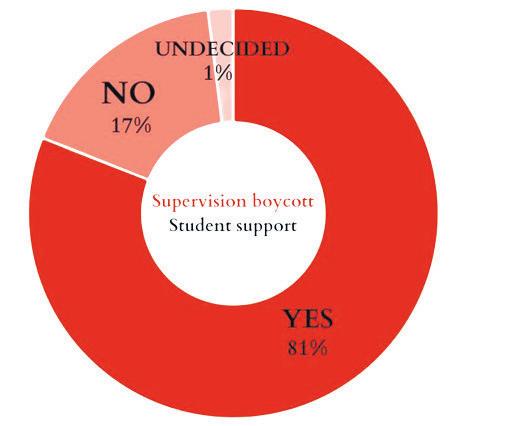
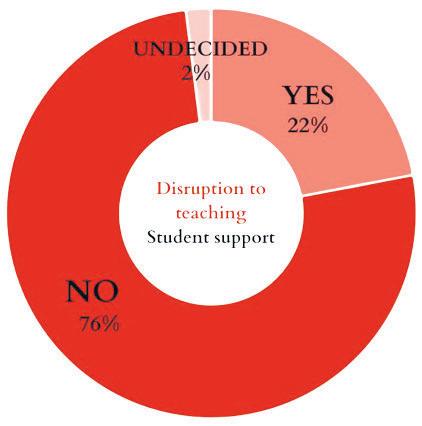
e results of a Varsity survey reveal that 81% of students are in favour of the reasons behind the upcoming Boycott of Undergraduate Supervisions (BUS).
115 Cambridge students completed our self-selecting anonymous survey on the boycott. Although Cambridge students are largely sympathetic
to the calls for better super-

visor support, the survey found that a large proportion of students are increasingly frustrated at continued disruption to their education.
e BUS was called by Cambridge UCU’s Justice for College Supervisors (J4CS) campaign, demanding a formalised employment relationship and a new pay system. e majority of survey respondents expressed sympathy for their supervisors and supported calls for better pay. One respondent commented: “it’s ridiculous that Cambridge’s unique teaching system is essentially based on zero-
Despite 81% people supporting the reasons behind the boycott, 76% of students also told they didn’t think there should be further disruption after the Marking and Assessment Boycott. Many students expressed disdain for supervisors, with one respondent commenting: “they’re just hurting the students, not the institution. I’m
sick of having my degree disrupted.” Another described Cambridge academia as a “movement [led] by a load of middleclass intellectuals, weaponising working class movements.” is student argued that current pay is “disproportionate to the level of education,” questioning whether every supervisor was “taken by surprise” by their rst paycheck and whether they had ever done “real people jobs.”
Another student noted that,“strikes in the higher education industry are unfair because the students have no means of counteracting the industrial action, were not warned of it before matriculating and will be paying 100% of the price for 50% of the education.”
Despite the support others felt, these students also noted their increasing scepticism over the negotiation practices underlying the boycott. ese students told us that in principle they the calls for more stable contracts and increased pay but said that “support is contingent on the upcoming negotiation” between the University and J4CS. “If J4CS decline a reasonable o er (as the UCU have a habit of) I will be much less inclined to support them.”
A University spokesperson said: “ e University is aware of, and is directly supporting, constructive dialogue be-
tween representatives for the Colleges and representatives from the campaign for College supervisors. Progress has been made on a number of areas and the negotiations are ongoing, which we continue to support. All sides are working hard to put in place the conditions needed to withdraw the call for the boycott.”
J4CS told Varsity: “Cambridge UCU is thrilled by the clear depth of support amongst students for the BUS. is accords with our experience talking to students, who want their supervisors to be given fair pay and conditions for their teaching.”

“We hope for developments in the next week which might enable the boycott to be called o ,” they said.
A spokesperson said that the University is “aware of, and is directly supporting, constructive dialogue be-
tween representatives for the Colleges and representatives from the campaign for College supervisors. Progress has been made on a number of areas and the negotiations are ongoing, which we continue to support. All sides are working hard to put in place the conditions needed to withdraw the call for the boycott.”
Friday 29th September 2023 5 News 35% of at Turing Locke. Contact us now to book. If you’re looking for university accommodation in Cambridge, we’ve got you covered. With fully itted kitchens, your own living and working space, a gym, cofee shop, cocktail bar and co-working areas, Turing Locke is well-equipped for student living. Live. Sleep. Study. Socialise. All under one roof. lockeliving.com | @lockehotels Bookable: 6th September – 31st of Dec. For stay dates between: 01/10/2023 – 31/03/2023. Book direct over the phone or contact sales.turing@lockeliving.com. Minimum 1 month stay. Flexible cancellation option available, subject to minimum LOS and notice period. For full T&C please contact sales.turing@lockeliving.com
Around town
King's exposed to £2.2 million in arms companies
Felix Armstrong
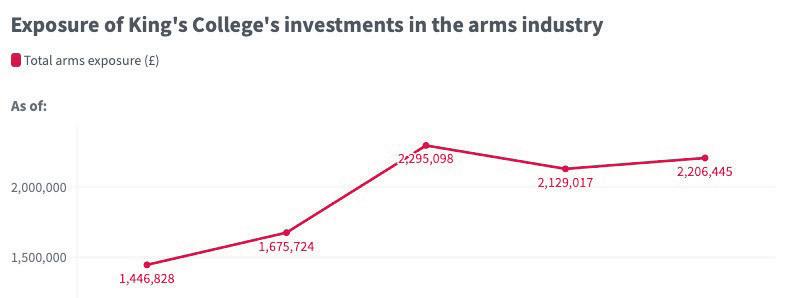
King’s College indirectly invests £2.2 million in arms and defence and has increased its shares in the industry in recent years, despite its reputation for being Cambridge’s ‘progressive’ college, Varsity can reveal.
Some colleges, such as Girton, have made shifts to only investing in funds which o er speci c ethical exemptions, like the exclusion of controversial companies involved with weapons sales.
tractor.
Cambridge crashes in rankings
Tommy Castellani and Beth Doherty
Jesus Green goes green?
Deep boreholes could be dug across three of Cambridge’s historic parks, including Jesus Green and Midsummer Common, to supply renewable energy to the city’s largest public buildings. Ambitious plans by Cambridge City Council to reach net zero include the installation of ground source heat pumps that absorb natural warmth from the ground and transfer it to nearby buildings.Up to 60% of the a ected green spaces could be dug up during construction.
e Guildhall, e Corn Exchange and Parkside Pool as well as some College buildings could be heated by renewable energy supplied by the pumps. If completed, the network of heat pumps is expected to deliver around 87% carbon savings compared to individual gas boilers.
Lightning McGreen leads new electric bus eet
e ‘Sustainable Hulk’ and the ‘Peregreen Falcon’ will also number in the new eet of fully-electric U buses, which will be available to students for the rst time this Michaelmas term. e buses’ names were decided following a competition among schoolchildren in Eddington. e service, which carries around 16,000 people each week, will now run a “split service”, with half of the buses serving Girton and half serving Wolfson Colleges, with some returning wto connect with Homerton College and the Faculty of Education. e change makes the U-Bus the rst zero-emission bus network in Cambridge.
Insta-grams
A Cambridgeshire man has been jailed after taking sel es with his cannabis stash. Police seized more than £3,000 worth of cannabis and cocaine from Derek Waters’ home in 2020. Waters operated in the St Ives and Huntingdon areas of the county. Police found 317 images of cannabis on Waters’ phone. Waters admitted to multiple counts of possession, of Class A, B, and C drugs. ere was “overwhelming evidence” of the crimes, PC Katie Glass told BBC Cambridgeshire. “Drug dealing continues to be a priority for police because of the associated crime that comes with it, including theft, violence and knife carrying,” PC Glass continued.
Freedom of information requests showed the College’s £349m of assets to include shares in over fty arms companies, held mostly via investments in a range of index tracker funds.
As of March 2023, the college indirectly invested over £2,206,000 in companies like Lockheed Martin, Korea Aerospace, and BAE Systems.
e ethics of how Oxbridge invests its massive university and collegiate endowments have been under scrutiny in the past few years. Most collegiate portfolios are invested indirectly, with colleges’ capital put into funds provided by some of the world’s largest asset managers.
However, Varsity’s investigation can reveal that King’s college’s indirect holdings in the arms industry has increased by more than £700,000 over the past ve years.

e college’s largest indirect holding is in RTX Corp, an American aerospace and defence multinational, in which the college currently has investments worth £343,216, having increased from just over a quarter of a million pounds in 2021.
Several companies which the college has signi cant holdings in have recently been subject to claims of human rights violations. King’s has over £180,000 of indirect holdings in Lockheed Martin, one of the world’s largest aerospace and defence companies, and £124,000 in BAE systems, Europe’s largest defence con-
Earlier this year, Lockheed Martin faced legal action from several Yemeni nationals, with allegations charging the company with “aiding and abetting war crimes and extrajudicial killings” through its supplying of the Saudi-led coalition in the war in Yemen.
BAE has also received criticism for its political in uence and continuing trade with Saudi Arabia, to whom the company sold £17.6 billion of weaponry during the Yemen War.
Overall, 1.7% of the College’s investment portfolio is exposed to the armaments industry. is gure stands at 1.8% in the MSCI AC World Index, a benchmark for global equity funds, the College’s response to the Varsity FoI requests stressed.
King’s College was contacted for comment.
Lauren Welsby-Riley
Cambridge has fallen two places in international university rankings, from 3rd to 5th, in a league table published on Wednesday (27/09).
According to Times Higher Education, Cambridge was beaten by Oxford, who maintained their position in 1st place for the eighth year in a row. Also outperforming Cambridge were Stanford (2nd), MIT (3rd) and Harvard (4th).
is decision follows the release of league tables from e Guardian and e Times & SundayTimes, which saw Cambridgeretainitspositionasthethird-best university in the country, with Oxford and St. Andrews taking the top spots.
e metrics for university success are outlined by e Guardian as satisfaction with teaching, satisfaction with feedback, student-to-sta ratio, spend per student, average entry tari , valueadded score, career after 15 months, and continuation from rst year into second.
Cambridge performed best in the spend per student category, with e Guardian awarding the university with a score of 9.9/10, and continuation, with 99% of students returning for the second year of their degree.
In the categories for student satisfaction, Oxford and Cambridge were unable to receive a score, as they each failed to meet the number of NSS survey responses required for this metric to be useable.
However, Cambridge did not underperform in every ranking; the Complete University Guide league table for this year awarded Cambridge the top spot, with St. Andrews coming several places behind in 4th.
Cambridge activists blockade Schlumberger
Romilly Norfolk
Climate activists disrupted Cambridge’s Schlumberger Research Centre earlier this week (25/09).
Protestors from Extinction Rebellion Cambridge (XR) and the Organisation of Radical Cambridge Activists (ORCA) glued themselves to the centre’s delivery gates, before police were called to break up the demonstration.
Schlumberger (SLB), the world’s larg-
est oil eld services company, provides major fossil fuel giants with critical oil and gas extraction infrastructure and technology. In the recent landmark report into the University’s ties to the fossil fuel industry, authored by COP26 climate champion NigelTopping, SLB was rated worse for the climate than BP or Shell.
Schlumberger’s research facility is based on the West Cambridge Campus, and the company has ties to the university through sponsored scholarship programmes and industry links with
multiple departments.
Demonstrations outside the facility are just the most recent action of the groups’ ‘SLB Out’ campaign, which has called for the University to cut ties with the oil eld services giant.

One activist said: “ e university has nally admitted what we’ve been saying for years now - SLB’s activities are at odds with a liveable future,” referencing the Topping report.
Another protestor cited international activism as inspiration. Referencing cli-
mate protests against fossil fuel expansion in Ecuador, they said: “I’m in awe of everyone who has stood against that, and I want to do my part to making sure that land and water stays protected.” Cambridge XR took a similar action against SLB in June, with activists having been found guilty of trespassing on the site for a 2022 action earlier this year. e University has been contacted for comment.
6 Friday 29th September 2023 News
▲ MARTIN POPE
University criticised for role in Greater Cambridge Partnership
Ned
Chatterton
e University of Cambridge holds a seat on the board of the Greater Cambridge Partnership, but both have come under re for their role in developments and council policy across the city. One group has accused the University of a con ict of interest.
In 2014, the Greater Cambridge City Deal promised £500 million in funding to stop rising inequality by improving local housing and transport, for what was one of the UK’s most unequal cities.
When the Greater Cambridge Partnership (GCP) was set up to deliver the project, Cambridge University was given one of the ve seats on the executive board. Although only the councils on the board have voting rights, they are obligated to “consider advice” from the university and business.

Rachel Stopard, the CEO of the GCP, told Varsity that its key priority at the time of its foundation was transport. e programme was intended to improve public transport,

cycling, and walking, Stopard said, while “having less impact on the climate and environment”.
e assurance framework, laid out in a government paper, states that the funding is designed to boost the technology and research sectors. e deal allows “a long-term increase in jobs emerging from the internationally competitive clusters and more university spin-outs”, it reads.



When asked whether the GCP was intended to serve ordinary people or technology businesses and the university, Rachel Stopard responded: “It’s de nitely about getting ordinary people to see some of the bene ts that come from growth because clearly there are more jobs available for local people if the economy is thriving in Cambridge”.
Phil Rodgers, a political commentator for the Cambridge Independent, told Varsity that the GCP is “remote and unaccountable”. “Few of the policies it has been implementing featured in the manifestos of those councillors when they were running for election, and there isn’t a very direct way for voters to change
what the GCP is doing,” he said. Rodgers considers the matter historically: “ e University used to elect its own MPs up to 1950, and it had its own representatives on the City Council up to 1973, and both these things were rightly abolished because they were undemocratic. So I think it’s a bit of a backward step to have seats reserved for the University and business representatives on the GCP Assembly and Board, even though they are non-voting”.
Naomi Bennet, who represents the Green party on the city council but spoke to Varsity in a personal capacity, said of the recently stalled congestion charge plans: “What we got was a transport plan made by transport professionals. What we needed was a holistic plan for a system change that will have a very broad impact on our society and local economy”.
Stopard defended the plans, saying that the policy comes from a necessity to fund public services, which are “in decline”. Stopard believes that the charge would have allowed the council more funding, such as for fare subsidisation, which would have
meant savings for the “people least well-o ”.
Stopard believes that the University relies on public transport for its sta who cannot a ord to live in the city centre: “Many jobs like cleaners and caterers [...] are travelling from outside so we do need to nd solutions so that you can recruit people to those jobs, even when they’ve got a commute to get to the university”.
Another controversial project of the GCP’s is the Cambridge to Cambourne busway (C2C). It links the West Cambridge university site with Cambourne, and cuts through a 100-year-old orchard designated as a habitat of principal importance.
Members of the Coton Busway Action Group told Varsity that there is “no compatibility between the University’s single-minded support for the o -road route and the University’s policies on environment, sustainability and climate change”.
e group highlighted a potential con ict of interest, saying that it is "unclear" to what extent the University will "bene t in an uplift in land values and potential for devel-
opment" from the plans.
A spokesperson for the University of Cambridge said: “We are a committed and active member of the local community, and recognise the role and responsibility we have to support [...] sustainable development.
" e GCP represents the entire community through a partnership of councils, business and academia, working with partners and local communities across Greater Cambridge. As part of the fabric of the city, as well as a major, local employer, it’s important to be involved”.
On the Cambourne busway, a University spokesperson said that the scheme "will provide better public transport services and active travel opportunities for thousands of people, helping to cut congestion on the roads, reduce carbon emissions and improve air quality for everyone." e scheme included an Environmental Impact Assessment, they noted.
Friday 29th September 2023 7 News Training as a Patent Attorney is a career path that will enable you to combine your understanding of science with legal expertise. You will leave the lab environment yet remain at the cutting edge of science and technology, applying your knowledge and skill in a commercial context. You will help to protect intellectual property assets and grow businesses. J A Kemp is a leading irm of UK and European Patent and Trade Mark Attorneys with oices in London, Oxford, Cambridge, Paris and Munich. Visit our website for more information about training as a Patent Attorney. What Does It Involve? Sound Interesting? Looking for an intellectually challenging and rewarding career option? www.jakemp.com/careers KICK START YOUR CAREER AS A PATENT ATTORNEY WITH
US
Boat race to ballot box
Double Olympic gold medalist and Peterhouse alum James Cracknell OBE has been selected as a Tory MP candidate for election to the Colchester seat at the next general election. Cracknell matriculated in 2018 to read for an MPhil in Human Evolution. At the age of 46, the Olympian became the oldest competitor of the Boat Race, representing Cambridge in 2019. Referencing his 2019 win for the university in the annual Oxford-Cambridge Boat Race, Dundas explained: “He will win [the Colchester seat] because he is a guy who doesn’t do losing.”
Oxbridge academics to donate £20,000 book advance to charities

Professor Jason Arday (Cambridge) and Dr Chantelle Jessica Lewis (Oxford) are to donate the advance for their forthcoming book, reports the BBC he advance will go to charities helping to support neurodivergent working-class families. Earlier this year, Professor Arday became the youngest ever black professor to be appointed at Cambridge University. His work focuses on the under-representation of black and minority ethnic people in higher education.
Queens’ College pushes for controversial expansion
A planning inquiry opening this week will hear an appeal from Queens’ College against a refusal of its plans to build new accommodation block bordering the Paradise Nature Reserve in Newnham, Cambridge Independent has reported. he proposal was turned down due to the building's size, concerns about the project’s impact on the bat population, and the adverse efects on the wetland habitat. Agents acting for the college said the appeal scheme “achieves biodiversity net gain across the site of more than 50%”.
'Pretty much bollocks' King's new Provost, Gillian Tett, responded in explicit terms to Jacob Rees-Mogg's inlation claims in October last year, reported the Huington Post he then-chair of the Financial Times' US Editorial Board was asked by a Channel 4 anchor to respond to ReesMogg's claims that the Bank of England was to blame for the UK's economic situation. Rees-Mogg had said that the central bank was at fault for the crisis, rather than the then-Chancellor Kwasi Kwarteng. Tett was elected to the position in February, and will take oice next month.
Staf union pickets Senate House he University of Cambridge branch of Unite picketed on King’s Parade on 27/09, demanding a new pay deal for the university’s staf. Members of the union were joined in front of Senate House by Cambridge UCU.
he union’s Cambridge membership consists of 450 “essential workers” across various sectors, such as the University Library, estate management, and the Fitzwilliam Museum. he demonstration comes during the union’s ballot for a new pay deal from the university, which closes on Monday the 9th of October. he ballot seeks a mandate on strike action against the current 5-6% pay rise on ofer from the University, which the union describes as a “real terms pay cut of at least 3%.”
“For over a decade Cambridge University has been ofering below-inlation pay rises and our members have had enough,” said Unite general secretary Sharon Graham when announcing the ballot. hough a “prestigious university,” Cambridge’s fame “doesn’t put food on the table,” said Graham.
Visiting scholar allegedly imprisoned for life by Chinese authorities
A Uyghur academic and former visiting scholar at Cambridge has been sentenced to life imprisonment by the Chinese government on the grounds of “endangering state security”, according to reports by he Guardian and the BBC Rahile Dawut, a prominent professor at Xinjiang University, disappeared during the 2017 crackdown by the Chinese government against Uyghur minorities. Last week the Dui Hua foundation, a human rights group based in the United States, announced that Dawut was convicted in a secret trial in 2018. According to the rights group, a source within the Chinese government has conirmed that the scholar has been sentenced to life in prison. Over 400 prominent academics, writers and performers have allegedly been similarly detained in Xinjiang as part of what critics have argued is a targeted campaign to dilute or erase Uyghur culture.
Dawut was a member of the Chinese Communist Party, receiving grants and awards from the country’s Ministry of Culture prior to her arrest. he academic was also a visiting scholar at some of the world’s most prestigious educational institutions, including Cambridge and Harvard.
Phil Wang credits Cambridge for comedy success
he King's College alum has said he "couldn't ask for a better place to learn the ropes of comedy than Cambridge."
"In the early days, I had the opportunity to practice a great deal of my comedy at Footlights and the ADC heatre," Wang told BBC Radio Cambridgeshire. he 33-year-old comedian expressed his pleasure in returning to Cambridge, citing it as one of his favourite tour destinations. Wang, who completed a four-year engineering degree during his time at Cambridge, served as the president of Cambridge Footlights. He remarked: "my engineering degree was my daytime occupation, while comedy was my true passion". On Saturday (30/09), Wang is set to perform his show ‘Wang in here Baby’, at the Cambridge Corn Exchange
8 Friday 29th September 2023 News
ALL BOOKS FOR HOLDERS OF CAMBRIDGE UNIVERSITY AND CAMCARDS SIMPLY PRESENT YOUR CARD IN STORE 20%
1 Trinity Street, Cambridge CB2 1SZ 01223 333333 bookshop@cambridge.org Offer can’t be combined with other promotions WE ALSO STOCK A WIDE RANGE OF CAMBRIDGE RELATED GIFTS AND SOUVENIRS
Illustration by Richard Briggs
OFF
Budget survey: top spender on £750 a week
Suchir Salhan and Romilly Norfolk Ahead of Freshers’ Week, 115 Cambridge students completed our self-selecting anonymous survey about their weekly student budget.
A typical weekly budget
On average, a Cambridge student spends a total of £277 a week with around £174 a week going on rent. is is largely consistent with the median rent reported in the Varsity rent survey last term which averages rent around £180 a week, assuming a 30-week contract across the year.
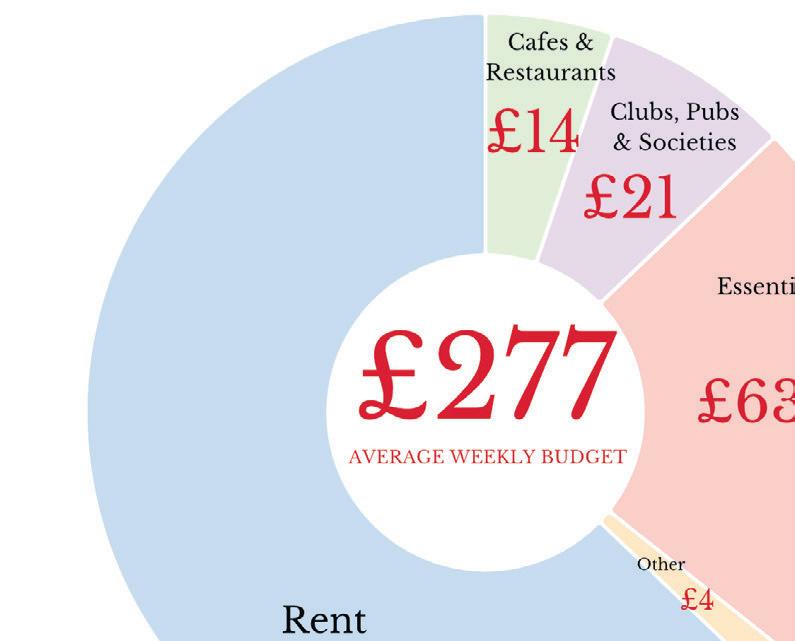
e majority of student budgets fall between £200-300 per week. However, outside of this average range, Varsity found a large variation in weekly budgets, particularly in the top 25% of student budgets which ranged between £425-£700. e bottom quarter of weekly budgets rather ranged from £95-£150.
Most respondents said that they supported themselves through a combination of student and maintenance loans and money from parents, guardians or other relatives. e vast majority of these students also used their personal savings.
17% of the students who completed the survey did not rely on any form of nancial support from par-

ents, guardians or family relatives. Most of the students in this group also relied on bursaries provided by the college and the university.
Huge disparity in weekly budgets
Including rent, the largest reported weekly budgets were £600 and £700, totalling up to about £17,000 in an academic year. e two students who reported these budgets spent £150 and £250 on essentials, respectively. Out of the top ten most expensive weekly budgets, seven declared that they received some support from their family, with two stating that they relied exclusively on family support to live in Cambridge.
Non-essentials
May Balls, Winter Balls and a Cambridge Union membership were the stand-out expenses for most students surveyed. However, several students wrote that they have to forego attending May Balls due to budget constraints.
90 students shared information about their termly spending on going out to restaurants, co ee shops or cafes. Students spent a termly average of £115 indulging in the Cambridge food scene. e student with the second-highest weekly budget spent a total of £750 in Cambridge cafes and restaurants across a single term, or £93.75 a week. Most of the survey's top spenders reported spending around £400 across a term. However, several students told
Variation in budgets
Varsity that they chose not to engage in Cambridge co ee culture at all, as a cost-saving measure. Cambridge students on average spent less on clubbing, pubs and joining Cambridge societies than in cafes and restaurants. e average termly budget set aside for entertainment and societies (reported in Michaelmas when many societies ask members to pay annual or lifetime fees) was £171. One student wrote that they spend £960 termly on entertainment and societies, while several students reported spending less than £50 across an entire term.
Comment
Daniel Hilton
“Cambridge is a city rife with inequality” is not a controversial statement. Even the Pitt-club-going, Hawks-blazer-toting, Old Etonian types would agree. A while ago this all came to a head when a now-graduated CUCA boy dressed in bow tie and tails burned a twentypound-note in front of a homeless man - an episode that forced him to intermit and get kicked out of Tory club. e Cambridge where this abhorrent act occurred was not the Cambridge of the 1660s or the Cambridge of 1960s - it was the Cambridge of six years ago.
While it’s easy to look back and think about how much more open Cambridge has become over the past twenty years, the elephant in the room still remains - the disparity between students here is still massive. is survey shows us
Most expensive purchases

£4000Wool coat
£1200 Ski trip to Val orens
£1000Flights for an international student,per term
£1000Dinner suit and jacket for John's May Ball
Excluding the £360 to attend
£500PS5 for Gaming with friends
£360Replacing a blade in bumps
£200Buying one book from e Haunted Bookshop is bookshop, right next to Corpus Playroom, specialises in children's and illustrated secondhand and antiquarian books
£140Spend buying drinks on a single nightout
just that.
The top quarter of respondents claimed their weekly budgets to be between £425 and £700, while the bottom quarter said that they had to stick to £95 and £150 - a di erence of £330 to £550. It is not di cult to see now why the “Cambridge Experience™” can vary so much from student to student. at bottom quarter of students are forced, due to no fault of their own, to meticulously budget all their expenditure and cut costs wherever possible while the top quarter can dine at fancy restaurants and go out
four times a week.
But this inequality doesn’t stop at graduation. No. e well-monied often have their tuition and maintenance paid for by their families and so are given a leg up at the start of their careers, not plagued with ever-increasing student loan repayments. All of this goes to show then that while the University might champion how much more equal Cambridge has become over the last couple of years, this ‘equality’ is still a sham. Cambridge is still the posh to ’s playground - it’s just harder to see now.
Typical weekly budget of a Cambridge student
Friday 29th September 2023 9 News
Money spent per term (£) Total weekly spend, including rent (£)
Total weekly budget On cafes and restaurants On clubbing and societies Termly spending on entertainment
Financial support
Ending the cycle of bike theft?
Nick James goes behind the scenes of Omar Terywall's vigilante Facebook group reuniting stolen bikes with their owners
It was a crisp Winter morning and I was on my way to interview a man called Omar Terywall for the rst time. To get to his boathouse, I passed some spectacular college architecture, world-class institutions, and the picturesque River Cam. For many students, this is the Cambridge we know and love, but I was about to be introduced to a hidden, uglier side of the city and Omar’s battle against it. Cambridge is plagued by bike thefts: it has the fourth highest rate of reported bike theft in England, and it’s estimated that 25 bikes are stolen in the Cambridgeshire region every day. Worse still, most bike theft in the city is going unpunished. Less than 5% of bikes are recovered because bike theft is viewed as a lower-priority crime type and the police lack the resources to act on each case.
For Omar, these figures are hugely disappointing – he’s grown fond of the city he’s called home for the last 30 years, and he “doesn’t like bad people getting away with bad things.”

So, in August 2019, when Omar saw on Facebook that someone’s bike was stolen, and the police said they couldn’t help for another two weeks, Omar was all too happy to help.
He tracked down the stolen bike on Facebook Marketplace and arranged to meet the seller. When they met, Omar checked the frame number of the bike to ensure it de nitely was stolen. After checking, he accused the seller of stealing the bike, which led the man to become abusive and enraged.
Omar held his ground, unfazed by the thief’s aggression, and eventually the thief gave the bike back to Omar.
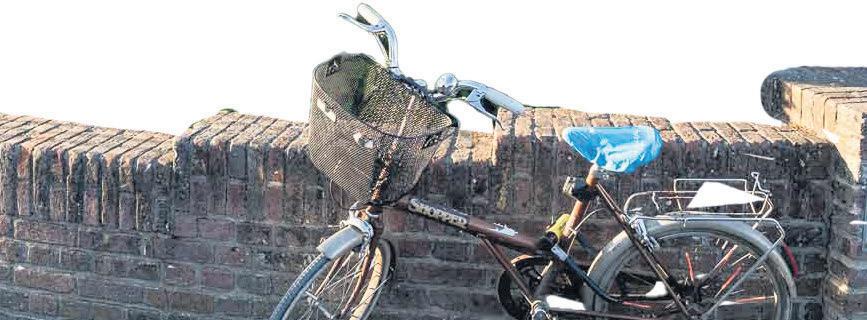
Cambridge eft: A Varsity History

and can also share pictures of abandoned bikes. Some members of the group even share pictures of people they see stealing bikes to warn bike owners in the area.
The group is ruthlessly effective. Omar has already recovered over 500 bikes thanks to the members of the Group, which he calls “the eyes and ears of Cambridge.”
One of the people Omar has helped is Sam Riley, who had his bike stolen during his third year at Trinity Hall.
“I’m quite careful, that’s the irony of the whole thing,” Sam told me.
“I have three locks for my bike!” After wheeling his bike into a boathouse to quickly use the toilet, Sam returned to nd it had been stolen. A friend recommended contacting Omar, who got back to Sam within a few hours and told him to report the incident to the police and check second-hand marketplaces. Very quickly, Omar and Sam had spotted it on Gumtree and arranged to meet the seller, but the thief got cold feet and called off the sale.
Then, “in quite a surreal moment,” Omar turned to Sam and said, “I’m going to drop you back at the boathouse and then I’m going to this person’s house, I think I know who they are.”
edgeable and experienced was comforting, and Sam believes Omar treads the line between e ective action and taking the law into his own hands very well. e level of data Omar now receives means he is perhaps more e ective than the police at dealing with bike theft. “Anytime that someone puts a post up on our page, especially if there’s CCTV footage or still footage of someone stealing a bike, within 15 to 20 minutes, I can probably tell you who that person is, where they live, who they hang about with, and where they were ve minutes ago.”
of how to balance the group’s frustration towards bike thieves with the desperately sad circumstances many thieves face. Some are just vulnerable children (as young as 12) who are groomed by older people to steal bikes for them. Omar tells me other thieves include drug addicts whose addictions are so bad that stealing a bike to pay for a x is a case of life or death: “If they don’t get that x, they will die.”
To combat this problem, there is now far more moderation on the Facebook page. Omar is incredibly sympathetic towards vulnerable thieves and doesn’t tolerate aggressive and abusive comments against thieves. While he understands the frustration, Omar is more focused on reuniting owners with their stolen bikes.
Sidney chair missing
In Michaelmas 2022, Sidney Sussex College made an urgent appeal for the return of a garden chair that went missing from the master’s terrace. e dean of discipline theorised the theft had been conducted by a “raiding party” of Christs' students. e dean made this assumption due to their “high regard of Sidney students’ intelligence (and their risk management skills).”
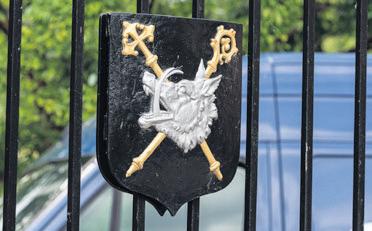
While the Facebook Group has been hugely successful, the rapid rise in members has also brought challenges. Omar receives no money for running the Facebook Group, so he has to juggle managing the site with a full-time job running a rowing experience company and being a father.
As the new academic year at Cambridge begins, Omar is keen to educate the incoming students on how to prevent bike theft. In his four years running the Facebook Group, Omar has noticed that bike thefts seem to spike in August, just before term starts. Omar believes this is because thieves can sell their stolen goods to the incoming freshers who are desperate for a bargain.
An email to students asked for “all members of our community to rally round, and to restore College honour by giving the dean hints as to where this chair might be located.”
Horse theft hoax
Upon arriving at the house, Omar spotted Sam’s bike in the back of the thief’s car, so he called the police to ask for assistance. Unfortunately, the police were too busy that night to do anything, but at 6:30 the following morning, Sam got a call from the police saying they were going in and arresting the man.
When I asked Omar why he continues to run the site voluntarily even though it involves putting himself in potentially dangerous situations for people he doesn’t know, he replied, “I get so many people that message me, and you see how much of an emotional attachment people can have to a piece of metal. For a lot of people, it’s more than just a bike.”
Omar warns freshers to do their due diligence when buying a bike. If it looks too good to be true, or, “if you are buying a bike from a Julie and a Jamie turns up,” it could be stolen. In our conversation, Omar also stressed the importance of getting good-quality locks and avoiding bike theft hotspots.
When buying a bike, it’s recommended to capture the seller’s details and check the frame number on BikeRegister to see if the bike is listed as belonging to anyone else. Once the bike is purchased, most Cambridge colleges also recommend registering it with them in case it’s stolen.
I ended my conversation with Omar by asking him about his vision for the future of the page. He smiled at me and replied, “Good question.”
In Easter 2022, a hoax email pretending to be the head porter told students that Jesus College's iconic horse statue had gone missing and that they had a two hour amnesty to return it. Jesus College told Varsity the horse had been in the college all day and they had no idea how the email had been sent. One academic at the college said on Twitter: “Had been wondering why we’d received an email from the college about a phishing scam, but really this is an *exceptional* phishing scam...”
Hater hater candlestick-taker
After this successful result, Omar realised the positive difference he could make on tackling this pernicious issue. is inspired him to start the Facebook Group, O cial Stolen
Bikes in Cambridge, and within a few months, the group grew to over 5,000 members. It became clear very quickly
Members of the group can post about their stolen bikes in the hopes other members have seen them
Sam found the whole experience a “whirlwind and incredibly frightening” and he was initially apprehensive about contacting Omar: “Vigilante justice isn’t something I want to be involved with.”
However, after
He told me about the heartbreaking story of someone who had spent too much money on their bike, only for it to be stolen. Because she was still paying o her bike, the theft pushed her into a serious state of depression which meant she had to take time o work. Eventually, this led to her losing her job, causing serious nancial hardship which led to her losing her that Cambridge residents and students were willing to rally together to protect their community against bike theft.
meeting Omar, his perceptions of the group changed.
Talking to someone so knowl-



house, “all because of a bloody bike.” While this is a rare case, it highlights the emotional and financial pain that losing a bike can create.
Omar also faces the challenge
Omar believes the page is now working amazingly well, running as the virtual neighbourhood watch group he intended. So, after four years of running the site, Omar thinks the time may soon be right to slowly back away from running the Group.
While it will be di cult to give up something he’s worked so hard to create, Omar is optimistic about the future of the "eyes and ears of Cambridge," and believes they will keep the streets of Cambridge safer for a very long time.
ALL PHOTOS BY LOUIS ASHWORTH
After a candlestick was stolen during a formal at Emma, the college said it would cancel all formals until the item was returned. Rumours circulated that the candlestick – which in reality cost around £50 – was worth up to £15,000, and students took it upon themselves to uncover the thief, speculating that the culprit was from Downing or Kings. A student who was at the formal told Varsity: “ ere’s a consensus that it couldn’t have been an Emma student because we’ve all been told stories about candlesticks being stolen in the past and know never to do it.”
Hold the phone
In Easter 2023, two middle-aged men “distracted” a student in the English Faculty library by asking for help “in Italian” and then stealing their phone. e student in question told Varsity: "I wonder if they stole other items, otherwise, it was an expensive trip to Cambridge just for my phone!” Despite their phone having been stolen, the student remained optimistic: "I’ll admit that it made a boring day in the library a bit more exciting!”
10 Friday 29th September 2023 Features
❝
For a lot of people, it's more than just a bike


















GRANDARCADE.CO.UK CAMBRIDGE CITY CENTRE, CB2 3BJ 10% OFF 20% OFF 10% OFF
DISCOUNTS AND OFFERS.
IN-STORE FOR DETAILS.
FOR THE EVENT AND BRING A VALID STUDENT ID ON THE DAY. 15% OFF 20% OFF 20% OFF 20% OFF 10% OFF 20% OFF 20% OFF 30% OFF 50% OFF COFFEE 10% OFF 30% OFF MAINS DISCOUNTS & PRIZES 15% OFF 30% OFF 20% OFF 15% OFF BUY A VENTI, GET ONE FREE 20% OFF 20% OFF 20% OFF EXCLUSIVE OFFERS 20% OFF SAVE ON MAC OR IPAD FOR UNI. PLUS GET A GIFT CARD UP TO £130 20% OFF 15% OFF
*T&CS APPLY TO ALL
PLEASE CHECK
REGISTER
Open days must be less opaque
As I ploughed through a plate of gloriously free sh and chips at my college’s open day last month (my contractgiven right as a ‘student ambassador’), a friend and fellow employee summed up why the experience, though enjoyable, was so odd. ere is something distinctly weird, she said, about spending a day convincing seventeen-year-olds to fall in love with a college which will, statistically speaking, go on to reject them. Granted, our national obsession with Oxbridge has never exactly been normal. Last week, the Times published an article about an allegedly lecherous doctor accused of having a string of a airs and inventing sick family members to help him “juggle” them. It began: “A Cambridgeeducated doctor…”. at hyphenated spot of journalistic colour tells the reader a depressing amount about our national psyche. One seldom reads “Durham-educated lawyer accused of…”. e closest you get is “Oxford-educated politician”.
Still, experiencing that obsession rst hand at open day was sobering; nothing makes you choose your words with care like having anxious young people hanging on every one of them. I felt almost silly going through the motions of describing accommodation and sports facilities to groups of seventeen-yearolds who obviously needed no further persuading that a place at Cambridge was very much worth having. I felt like a salesman surrounded by willing buyers but unable to make a deal. In truth, I was closer to a tour guide.
At rst I thought this was the product of modesty. I was made a salesmanSisyphus, and the visitors academic Tantaluses, because Cambridge doesn’t like to admit that its open day is fundamentally di erent to, say, Durham’s.
A bright, enthusiastic seventeenyear-old with good GCSEs can be condent that they will probably receive an o er from almost any British university – except Oxbridge. At its open day, Durham sells you an education; Cambridge invites you to bid for one. Admitting this risks coming across as arrogant and o -putting. Moreover, it risks undermining the things that a Cambridge open day does need to achieve: principally assuring every bright seventeen-yearold that if they make it through the admissions process, they will be welcomed and supported here.
Respect must go both
e O'Reilly
So, conundrum resolved. Most open days are sales pitches. Cambridge’s isn’t, but they pretend it is so that they don’t come across as up themselves. Below the surface, however, the point is to encourage nervous applicants, demystify the application process, and help people to pick a college. No need to feel weird after all.
exam results go). ey have more money and their students reap the bene ts. Everyone at Cambridge knows this, but the admissions o ce seems to treat it almost as an article of faith that the Cambridge experience is the same at Trinity – where less a uent students receive almost £4500 a year in bursaries – and Lucy Cavendish, where students “pay higher living costs, and receive fewer subsidies, bursaries and grants than other Cambridge students”, according to a recent Varsity investigation.
Potential applicants deserve transparency from the University. Pretending that all colleges are equal robs future students of their agency. If an applicant is concerned about nancing their education, they have every right to know that some colleges will be able to completely obviate those worries, but others won’t – and make their decisions accordingly.

They say imitation is the sincerest form of flattery. Perhaps … if this is about someone copying your carefully-curated wonderfully thought-out library out t of the week. Annoying as it might be to see someone wear your combo of long denim midi skirt and cropped tank top, it’s understandable. Let’s face it, in an English lecture, it probably wasn’t your original idea to begin with. Less understandable, however, is if you realised that the supervisor who praised your work had decided to copy it verbatim into their own academic article. In this case, imitation is not as much a form of attery as it is a bold-faced attempt to rip-o a more junior individual.
is actually “not all that bad” from an academic who is at the top of their game is pretty validating. I would say it gives me the warms and fuzzies, but let’s not go that far. Regardless, the obvious truth is that students, especially those looking to go into academia themselves, look up to academics.
e problem is that this ‘modesty’ doesn’t just involve polite silence about Cambridge’s unique (Oxford begrudgingly notwithstanding) academic prowess and prestige. It also means overlooking Cambridge’s unique problems.
e most egregious case of this is the disparity between colleges. On its website, the admissions o ce tells applicants not to “agonise” over which one they apply to, and encourages them to choose based on accommodation, catering, and facilities. Applicants are assured that “your student experience isn’t dependent on the age of your College”. In other words, colleges are glori ed halls of residence – just like at a normal university! You live there, you eat there, your friends are there – but at the end of the day they are all kind of the same. is might be reassuring, but it isn’t true. Older colleges have cheaper rents, and more academically successful students (at least as far as undergraduate
This is only the most egregious abuse of the knowledge gap that separates the University and its applicants. e problem goes beyond colleges; it even goes beyond the open day. Cambridge is simply far too keen to paint itself not as it is, but as it wishes it was.
In this telling, the supervision is “one of our greatest strengths” – never an awkward waste of a week’s work. Consoling a newly-minted Oxbridge reject is as simple as telling them “try not to worry”. ere are never discrepancies between colleges in admissions because, thanks to the pool, all applicants compete against each other anyway – no matter what the University’s own statistics say. In the worst Oxbridge tradition, Cambridge is choosing the easy pretence of perfection over the pain of genuine progress – which famously starts with being open about what has gone wrong.
I don’t mean to be overly critical. e open day really did feel helpful, and throwing open college gates to the public can only be a good thing. I just wish Cambridge were always so transparent.
e British Oxbridge obsession might make admissions o cers uncomfortable, but it also gives them a chance to be honest with prospective applicants. Bright young things are going to ght desperately for a place at Cambridge no matter what it tells them. At the very least, they deserve openness about the costs of applying, and the truth about what to expect if they succeed.
Students at any university crave validation from their academics; at a place like Cambridge this goes double. And why wouldn’t they? One of Cambridge’s biggest selling points, beyond the gowns and gothic buildings, the punts and the prestige, is the fact that you get to work with top academics in a eld that you (hopefully) love. Hearing that your essay this week that you probably churned out half-asleep after a night in the bar
Yet this admiration shouldn’t be exploited, as in the case of Dr O’Reilly. ere should not be the assumption that students, wanting to be praised and wanting to try and get a foot into academia – a prospect that is becoming increasingly di cult as a result of job cuts and salary slashes– will let their superiors take them for granted and assume they won’t complain. Maybe it was ‘accidental plagiarism’, a genuine mistake. It is worth noting that the same ‘accidental plagiarism’ for undergraduates usually leads to a failed paper and the possibility of being booted o the course. But in that case , an assumption was made that ultimately the student wouldn’t really nd out - or care for that matter. at ‘mistake’ was repeated again through threatening this paper with bogus legal claims, once again assuming that students would accept this behaviour from an authority unquestioningly and un inchingly.
Head to head:
Liza Voloboeva
Right about now Cambridge is peeping out from under a duvet of hibernation, freshfaced to incoming eyes. She will be our Mother Earth for at least 72 weeks, and our alma mater for life. So how do I defend a blurry, sleepless lonely mess of the rst one? Hangovers and a fear of the college laundromat severely limit the chance of feeling fresh in any sense of the word. No lectures leave body clocks unwound. en again, no lectures mean no alarm to scare you awake. Days are gappy, nights are full. Yellowing leaves are buoyant on the branches and summer’s jetlagged breeze airs out the town. Time is dedicated to a di erent sort of learning.
punt or post Rumboogie walk home as you exchange interview stories. ere’s a naive buzz about studying just your favourite subject and every stranger is dying for you to say ‘hello’. A name in the college group chat o ering to walk to the freshers fair becomes a blind date or a college marriage.
Starting with matriculation, there’s novelty in every syllable. Hundreds of penguins in Hogwarts gowns waddle for the college photo. is is most likely the rst and last time you’ll see everyone together. Savour this, the rare feeling of your heels on the grass and the taste of free dinner!
It’s warm enough to enjoy a rst
Neo-gothic buildings seem new, untainted by (academic) all-nighters. Rowdy chapel chimes retain their charm. ere’s no need to drag the club or a college swap - they go merrily because for a week everyone is ‘when in Rome’.
anyone to
As we come up to this rst pancake of a week, take Cambridge by the hand and surprise yourself. Join Ultimate Frisbee and bolt by week 3. The world is your cloister… at least until the plague hits.
12 Friday 29th September 2023 Comment
After a college open day, Hugh Jones feels like a sham salesman ogging his college
❝Join Ultimate Frisbee and bolt by week 3
plagarism scandal is a disgraceful example ing respect while showing students none, argues
❝
I felt like a salesman surrounded by willing buyers but unable to make a deal
▲ Katie Kasperson
both ways
example of academics demandgues Emily Lawson-Todd
e mindset that led to the case of the plagiarised essay is not solely found in academia. Rather, there’s a culture of ‘be grateful, you owe us’ found throughout the University. We, the students, are led to believe that no matter how rough the situation gets, we’re at Cambridge, so really we’re the lucky ones. Don’t get me wrong, I am so grateful. I am undeniably lucky. I’ve spent the last few years having some really incredible conversations with truly brilliant academics who’ve inspired me to go and do things I didn’t think I was capable of doing. I’ve spent the past few years gallivanting around a beautiful city, getting involved in countless societies, and all-round having a good time (don’t ask me if I still agree with this statement in three weeks’ time. If you see me crying in the Seeley, mind your business). I spent a large portion of my time at home encouraging starry-eyed sixth formers to come here, which, unless I was a sick child-hater, I wouldn’t do unless I really loved this place. However, I’ve also spent the last few years being unceremoniously turfed out of my crumbling room every eight weeks, watching supervisors being horrendously underpaid, and witnessing a massive student mental health crisis.
When you sign your name in the ma-

triculation book, you’re not signing an NDA. As a student, you can both

feel immensely grateful towards the University and the experiences it’s given you, and still complain and ask for change. ings are allowed to be nuanced and feelings are allowed to be complicated. But ultimately, if this whole essay plagiarism debacle has taught us anything, it’s that students shouldn’t be afraid to question those in higher authority to them.
Faith away from home
Izzy Benardout contemplates her relationship with her faith and nding a space for it away from home
Freshers' Week
Emily Lawson-Todd
As an incoming third year and two-times freshers’ week veteran, I can say that I hold many fond memories of my time at uni. Freshers’ week makes up very few of them. Like every other 18-year-old in the country, I envisioned freshers’ week as a magical week of partying where I would meet all of my best friends and somehow not wreck my liver, immune system, bank account, or dignity. I still have regular nightmares that I am sitting in a student kitchen being asked by a phys natsci who I’ll probably never see again what my name is and what subject I do. Oh the joys. Later on in this nightmare we’ll probably play an excruciating out-of-date card game to “break the ice”. All it achieves is proving to me that ‘Cards Against Humanity’ isn’t funny to anyone who’s mental age has surpassed 15.
Sorry to be the bearer of bad news, but you’ll probably spend the rst week of university oscillating between cleaning up the sick of Hugo, 18, whose mum still buys him jeans from Next, and curling up in a ball in your room popping strepsils like there’s no tomorrow, googling ‘can I die from a sore throat? HELP PLEASE’.


e best week of your life? Maybe so at places like Manchester and Newcastle where the nightlife is actually half-decent, but you’re kidding yourself if hacking up a lung from sharing a Lost Mary with a random historian from Caius in a random tiki-themed nightclub in East Anglia is your personal university highlight. at’s not to say freshers’ week is all bad - in fact, I still look on it fondly (well, as fondly as you can look at a photo of yourself hunched over a toilet dressed as Ed Sheeran for your college’s alphabet bop). You meet some of your closest friends, experience the magic of old architecture, and get what is probably your rst taste of independence. But all these things aren’t unique to freshers’, and it’s far easier to fall in love with a place like Cambridge and experience it fully when you’re not reeling from a 4-day hangover/ evil u/ general feeling of overwhelmedness. e best is yet to come, I promise.
Growing up Jewish has always rendered the last quarter of the year a busy one. During this period, four of the major festivals – Rosh Hashanah, Yom Kippur, Sukkot, and Chanukah – run in seemingly quick succession, ushering in Autumn and an excuse for a new out t (a custom to the chagrin of my bank account.) In recent years, in a cosmic alignment of the Gregorian and Hebrew calendars, Chanukah and Christmas have overlapped, allowing for the emergence of awkward portmanteaus (e.g., #chrismukkah) and an amalgamation of the two cultures I have often been sandwiched between. Hearing my grandmother order the kosher turkey, in good time for ‘the day’, as the butcher on the other end of the phone ominously called it, I consider the paradoxes of the current iteration of my faith.

e actor Bradley Cooper has recently come under re for his portrayal of Leonard Bernstein in a biopic about the Jewish composer. Speci cally, Cooper’s use of a prosthetic nose has caused controversy, with some accusing the actor of ‘Jewface’. Besides the explicit garishness of the creative decision, the media scu e has raised questions about what it means to be Jewish, and how the religion-cum-ethnicity-cum-culture should be understood. e notion that Jewishness lies in the shape of a person’s nose troubles me greatly, harking back to pseudoscienti c ideas of racial phenotypes and the haunting Nazi image of the Eternal Jew. Yet, the controversy surrounding the biopic has certainly opened a space to challenge stereotypes surrounding Jews and explore issues of identity.
Every single cell in my body is Jewish – it is written into my DNA and is, simply put, the fabric of my being. Whatever I do (or don’t do), I am Jewish, and I

have sought a lot of comfort in this notion. Jewishness has provided me with an anchor on which to tie my identity to. It is the part of me that still googles whether a certain celebrity is Jewish, partakes in complicated webs of Jewish geography, and it is undeniably the root of my fascination with history. Despite my overt secularity, and abandonment of the derech, I still cling on to my faith and tradition – even when I wonder if I am doing enough to still claim the culture that I grew up with.
out judgement, a philosophy that has become fundamental to my relationship with Judaism. While this relationship is not characterised by an adherence to Jewish laws, I attend to my faith through my love of Jewish food (courtesy of my aforementioned grandmother, a stalwart of the Jewish mother stereotype) and by exploring the rich and often tragic tapestry of Jewish history. While I may not fast on Yom Kippur, I hope to use my time in Synagogue to re ect on the year that has just passed and the various mistakes I have made with a view to not repeat them.
Rosh Hashanah (Jewish New Year) and Yom Kippur (the day of Atonement) comprise the holiest days in the Jewish Calendar, and are the days in which I would nd myself fostering the most concrete reconnection with my faith despite my agnosticism. Yet, the experience of the pandemic seemed to scupper this. I resisted attending synagogue, and when the high holy days fell over my moving to university, I chose freshers week and making friends over my obligation to celebrate with my family. A level of guilt always emerges when I re ect on these decisions, but I try not to feed it. My Judaism will always be there, and I am so grateful to always have the opportunity to return to it – something that Jews before me have not always had the luxury of. When I think of festival season, I am invariably brought back to my childhood. Every Sunday, I would attend Sunday School ran by a Chabad family, a movement that emphasises the importance of enfranchising non-observant Jews with-
Faith is inherently complicated. It often requires you to relinquish control of what you think you know and give some of that responsibility to a higher being. I cannot say I am particularly adept at this, but by observing the High Holy days (albeit in my own way), I feel I am part-way towards honouring my faith, my family, and my former self, who could read Hebrew semi- uently and attended shul far more regularly. Furthermore, starting a new Hebrew year in a freshly inter-faith household has o ered me a chance to evaluate, and in many respects, showcase the elements of my culture I cherish the most (and as Chanukah/Christmas rolls around, I will be vying for double presents).
ere is an adage in Jewish circles that goes ‘ ey tried to kill us, we survived, let’s eat!’. Perhaps a simpli cation of Jewish customs, I can’t help but subscribe to this notion as I think of the food, I will eat to bring in 5784. One of the symbolic foods of Rosh Hasanah is pomegranate, theorised to have 613 seeds that represent the 613 mitzvot, or good deeds, that Jews should ful l. While 613 seems ambitious, I like to think that re-connecting with my faith will enrich my life with a little bit more goodness to sustain me for the new year.
Friday 29th September 2023 13 Comment
❝They tried to kill us, we survived, let’s eat!
▲EmilyLawson-Todd
❝
When you sign your name in the matriculation book, you’re not signing an NDA
◀ Varsity
Archives
'Free speech absolutist' Charlie Palmer on his 'unsexy' Union plans
Following his unexpected promotion to President of the Cambridge Union, Charlie Palmer talks to Sam Hudson about his upcoming term

Jack of Jack’s Gelato fame
Name: Jack Van Praag
Jack’s founding date:
Summer 2010
Hometown: Cambridge
Amount of gelato made per week:
10,000 - 30,000 scoops
What did you do before setting up Jack’s?
Cooked in restaurants around the world.
What made you want to open your own gelato shop?
Cambridge didn’t have much to boast about when it came to world-class food at an a ordable level, I wanted to change that.
What did you want to be when you were growing up?
A cat!
Why did you pick Cambridge?
I didn’t, it picked me.
What is your favourite and least favourite part of the job?
Favourite: developing new avours. Least favourite: answering interview questions.
How do you come up with your many avours?
I travel, I read, I run, I eat.
What is your best selling avour?
Dark choc sea salt.
Most scoops eaten in one sitting?
After the implosion of Max Ghose’s presidency following his involvement in ballot stu ng, Charlie Palmer as the then vice president was left to pick up the pieces.
As the fourth ever unelected Union president, Palmer is an unknown entity to many in the University. is doesn’t seem to bother him. He tells me he’s “perfectly happy to be an unknown,” adding not-so-jokingly that he would be “deeply disappointed” in himself if he appeared on the BNOC list. While he sees other presidents as having pushed “a public persona” during their election campaign and time in o ce, this is something he wants to avoid.
Palmer casts himself as a safe pair of technocratic hands, a contrast to the chaos of Ghose’s short-lived presidency. It is not the rst time such a contrast has been employed. Sunak after the Truss debacle comes to mind. e Palmer presidency has no time for boxing matches and the other colourful, unful lled promises which have littered Union manifestos over the last few years. is aversion to fanfare is unsurprising given Palmer’s experience as vice president. Within the Byzantine inner workings of the Union, the vice president plays the role of a grey eminence, avoiding the spotlight while “getting stu done,” in Palmer’s words. ough he acknowledges that the presidency is more public-facing than his previous post, he seems intent on carrying on in the same manner. Palmer views his unconventional path
to power as an asset. He believes committee applications could now be done purely based on merit because he “doesn’t owe anyone favours.” He
ment to free speech.
also wants to use the term to focus on the “unsexy” but important parts of the Union that have been previously overlooked. He is particularly keen to tell me that a major focus of his term would be boosting the Union’s outreach programmes.
e quietly competent ideal that Palmer espouses stands out among the megalomania which many see as part and parcel of Union politics. But for all of Palmer’s hard-nosed positioning away from the spotlight, his vision may be a touch too idealistic. Union presidents all too often nd their 15 minutes of fame for all the wrong reasons.
e Union’s position as a free speech society can make it a conduit for controversy. While Palmer insists that the Union is not looking for controversy for controversy’s sake, he does describe himself as a “free speech absolutist.” It is a surprisingly radical admission in the context of recent Union presidents who have been more equivocal about the society’s commit-
e latest Trustees’ Report announced that the Union had codi ed the procedure for the selection of controversial speakers “to minimise risk to the charity’s reputation” and gave trustees the nal say on invitations. I asked Palmer whether this con icted with his own views on free speech, and the Union’s student-led structure. Palmer says that trustees play a largely supporting role rather than a supervisory one. “If we have a controversial speaker coming up, we’ll notify the trustees and get their thoughts on if any extra preparations will need to be put in place […] but I’m never aware of any occasion in which they’ve made any decision on who to invite.”
I put Palmer’s absolutism to the test by asking whether he would invite or disinvite controversial public gures. Kanye West predictably caused a bit of squirming. While Palmer promised he wouldn’t disinvite the pop star turned pariah, he wouldn’t go out of his own way to invite West either, hinting that “mental health support” might be a better use of West’s time than coming to the Union. On Kathleen Stock, the most recent source of controversy at the Union, he supported the decision to host her and would’ve invited Stock himself given the chance. Similarly, Palmer also supported hosting the Israeli ambassador, Tzipi Hotovely. He is particularly enthusiastic on Donald Trump. “If Trump wanted to come out, I would absolutely invite him, yes,” but concedes “It would very much be a pipe dream.”
ere have been easier times to be a president of a society whose mission it is to defend free speech. Palmer’s absolutism is increasingly unpopular among young adults. In a 2021 YouGov Poll, 50% of people aged 18-24 claimed protection from o ence should take priority over free speech, the highest proportion of any age group.
I ask Palmer how the Union can balance this popular sentiment with its commitment to free speech. He emphasises the Union’s role as debating society, arguing Stock and Hotovely “found themselves very much challenged […] if it wasn’t a comfortable space for some members of our society, it was also not a comfortable space for those two to be in.” Whether or not these headwinds are a temporary storm or instead part of a larger, postliberal shift remains to be seen.
Union resignations:
A timeline
2023 President Max Ghose resigns over ballot stu ng; Charlie Palmer steps in. Women’s o cer Helen Dallas resigns over rape allegation against Union guest Julian Assange.
President David Leigh resigns for academic reasons.
Secretary James Robinson punches fellow student and ex-president during a debate; both Robinson and president William Wearden resign.
17! (5 triples and 1 double). Just a regular looking guy. About to leave Cambridge and stood at the counter and chatted as he e ortlessly and swiftly went through order after order. Incredible. Have you had any celebrity customers?
Of course.
What is your favourite spot in Cambridge?
Stretch of river Cam between Grantchester meadows and Newnham, very early in the morning.
What is your favourite food venue in Cambridge (excluding Jack’s)?
I’m not sure, but I had some great dimsum at Liutaio Music Cafe recently.
Which College is currently winning in Jack’s league table?
Peterhouse! A special prize is coming soon....
Do you notice a town-gown divide in your work?
e lines are more complicated than that. Cambridge is many different things to many di erent people. It is such a joy to serve so many di erent people from so many di erent backgrounds all under one roof.
Why do you think people love Jack’s so much?
We never sit still. We are always pushing. We are not focused on the bottom line. We put a huge amount of time and e ort into parts of the business that could easily be overlooked.
If you could send a message to all the students here, what would it be?
Be a force for good in this world!
14 Friday 29th September 2023
Interviews
❝
If Trump wanted to come out, I would absolutely invite him
2012 2008 2015
▲EMILY LAWSON-TODD
'Finding strength in vulnerability': Mae Muller on her new album and lessons in love

Abby Reyes talks to Eurovision contestant Mae Muller about being a young woman in the music industry and healing from her 'delulu girly' ways

Ahead of her debut album
Sorry I’m Late being released later this month, I sat down with Mae Muller to discuss her music career but came away feeling that I’d just been to “girl boss” therapy. “Being a bad bitch has always been my armour, but for this album I’ve taken that armour off.”
Known for an irreverent attitude in her songs, Muller’s new album has a different message, “finding strength in vulnerability”.
Muller has
a song for pretty much every type of relationship – the high school sweetheart who turns out to be an ‘Anticlimax’, the boyfriend who needs a ‘ erapist’ not a girlfriend and love that is just ‘So Annoying.’ So I son she’s had to learn: “ e fairytale doesn’t exist, and that’s OK.”
From Muller’s perspective, we’re taught that you’ll find the one, settle down and live happily ever after, “but life is not as black and
white or easy as that [...]Alot of where my real pain comes from is where I’ve fallen out of love, and you think, how is that possible? I was so sure about this person.”
and I wanted it to sound like a diary entry […] I feel like I got so much o my chest.”
One of her key in uences growing up was Lily Allen. “I just believed every word” (a sentiment we shared). Muller admires that “she spoke about the female experience so well and so candidly. She’s so unapologetic, and that’s pretty cool.”
pressures: “ ere’s no clocking out.”
When asked if she feels she has to be a role model, Muller says “I never want to put myself in that category, nobody asks to be a role model,” and points out that “I don’t see men being held up to the same standard. I could talk about it forever.”
Her remedy for being “a bit of a delulu girly” is to focus on the present and draw boundaries. “I’m a people pleaser, and creating boundaries is really hard because you feel like you’re doing something wrong […] but really it’s a form of self-care.” She admits that “I’m still learning it now, but through writing this album, I’ve seen just how important it is.”
Trying to keep the fangirling to a minimum, I ask Muller what her favourite song of her own is. “‘Maybe ' at’s Just Life’ from the new album is de nitely up there. I’ve never written a song like that,
From Lily Allen to Adele and Amy Winehouse, North London’s female artists left their mark on Muller. “I grew up in a Kentish Town and there’s just such a buzz. Being around that and digesting that energy from being a kid has in uenced me in a lot of ways.” ough she does admit to being partial to a night out south of the river in Peckham (having been born and raised there, I was thrilled).
Being the UK’s Eurovision 2023 candidate, Muller has been under scrutiny this year. “I’ve become quite good at brushing things o […] we move.” Her coping mechanisms include a thick skin and not dwelling on things: “I have to snap out of it.” She re ects that the fast-paced nature of the music industry means that there’s always new
Her new music resonates with this sentiment. “ at’s a lot of what this album is about. ere is so much pressure about the right way to be a woman and what the right way to be a feminist is.” Muller says that it also resists the pressure placed on female artists for their music to “always make a stand on something. What if we just want to write a song about our experiences?”
e “girl boss therapy” ends with some words of advice for young women at Cambridge. “First of all – salute! I bow down to you. It’s not an easy feat, so congratulations for getting this far.” She also speaks to the importance of staying true to yourself and not burning out – boundaries should apply to work as well as love. “Just be kind to yourself, you’re doing amazing sweetie.”


Friday 29th September 2023 15 Interviews
❝The fairytale doesn't exist and that's OK
▼ HARRY CARR
How natural scientists joined forces to reveal how plants work

Andrea Rogolino explains how great discoveries can result from simple concepts when collaborating

Back in my days as an undergrad, I have often come across what I later enjoyed referring to as the 'derby mindset' of higher education students. In football, a 'derby' is a match between local rivals, that is, teams belonging to the same city. Despite sharing the same home, local history and ideals, supporters of di erent teams engage in ferocious ghts only motivated by pride: a pride whose rationale nobody understands, but just makes people feel better. Likewise, maths students despise engineers for their lack of formality, chemists accuse biologists of ignoring the laws of thermodynamics, and experimentalists mock theoreticians for being too speculative. To me, all these squabbles sounded like nonsense. Weren’t we pursuing the same goal – learning new things – just with di erent tools?
Eventually, you graduate, grow up and realise how often hidden pieces of knowledge lie at the boundary between di erent disciplines. at is what a team of researchers from the Department of Physics, Biochemistry and Chemistry demonstrated when they joined forces to peer into one of the most interdisciplinary puzzles of science: photosynthesis.
very early electrons – generated immediately after a beam of light hits the leaf – which is pretty much equivalent to catching a bullet the moment it comes out of the barrel.
To do this, the authors of the work have combined living cells and lasers to look at how fast electrons move, using a technique known as Transient Absorption Spectroscopy (TAS). Continuing with the ballistic analogy, here, the trigger is pulled with a laser pulse, and dynamic footage of the bullet is taken within tiny fractions of a second using a continuous optical beam. at sounds like a complicated experiment, so I asked Tomi Baikie, co- rst author of the work and NanoFutures Fellow at the Cavendish Laboratory, Department of Physics, how di cult it was to combine biology with optics. “Surprisingly, it was much easier than expected once we optimised for the biology”, I hear his reply with some surprise, “You can shine red light on photosynthetic cells in benchtop instruments, simulating the light from the Sun. e novelty of this work was to study the cells whole, which can give more information than simply studying isolated pieces”.
Leaves are green, which means they lter out red from the light they receive from the Sun. When a continuous optical beam (the highspeed camera of the analogy) is shone on the leaf, the intensity of the red portion of such beam passing through the leaf
decreases, which can be veri ed with a detector. is happens precisely because electrons continuously absorb red light.
strong red laser
Research Round up
Grace Wakeman and Natalia Emsley
Exoplanet in habitable zone found to have atmosphere containing compounds vital for life
don’t know why they do that, but certain photosynthetic organisms spit out electrons naturally”, says Robin Horton, PhD






❝of discovery. When I ask Robin why we should continue studying photosynthesis, they initially remark that “plants take sunlight and turn it into energy, so if we study that, we can hack into it and maybe solve the energy crisis”, but after a short pause they add “ … probably not and we’re all gonna die of global warming regardless of the research I do. Solving the climate crisis will surely require a collective and interdisciplinary action”. en they add, “Photosynthesis is just so clever. It has evolved for 3.4 billion years. I just like studying it because it’s really cool!”
We will always enjoy derbies, but sometimes we must accept how big an impact we can make with simple ideas by joining “rivals”. And Cambridge is an excellent place to do that.
Methane and carbon dioxide has been detected in the atmosphere of exoplanet K2-18b, marking the rst time carbon-based molecules have been discovered in the atmosphere of an exoplanet in the “Goldilocks” zone. K2-18b joins a unique class of habitable exoplanets with hydrogen-rich atmospheres and possible liquid-water oceans that could pose promising candidates in the exploration for extra-terrestrial life. Observations also hinted at the presence of dimethyl sul de, suggesting biological activity on the exoplanet.
No men beyond this point: scientists discover the secret of virgin birth in fruit ies
student from the Zhang Lab in Chemistry. Again, I was expecting immobilising living matter on arti cial electrodes to be a tricky task, but Robin reassures me, explaining that "by using highly porous materials as supports, our crea-
eir




results are now out in Nature.
In a nutshell, photosynthesis is all about using the energy of sunlight to move electrons from one side of the cell to the other. ese tiny, charged particles leave water (that is oxidised to oxygen, which in turn we breathe) to nally reach carbon dioxide (that is reduced to sugars, the source of energy for plants) somewhere else far away. Unfortunately for us, this delivery occurs very quickly, within billionths of a
second. Because of that, could do “from a certain point on”. Now, scientists at Cambridge have man-

































































































































aged to intercept and extract
, that is in their It became clearer and made this discovery into a high-impact journal was not the use erence
signal to be recovered gives information on the speed at which electrons move
Interestingly, we can study the same dynamics by sticking cells to electrodes (like those in batteries) and capturing
“We




of advanced experimental methods or theories but rather the courage to embark on a collaborative e ort. Plant Scientist Laura Wey cultivated, nurtured, and engineered living cells. She then handed them over to the Cavendish Laboratory ready to be scrutinised under laser beams in a dark room. “ e idea was conceptually really simple” argues Tomi, “What made all the di erence was this little term here” he continues, highlighting the word “ultrafast” next to “spectroscopy” on his laptop. He explains that ultrafast (thousandths of billionths of a second timescale) optical methods are not new, but they are usually dedicated to exploring materials for devices like solar cells. “We really stumbled upon a really interesting niche”, concludes Tomi. e study also has had a lot of resonance for its potential practical implications. If we can capture electrons energised by light before they are transferred farther in cells, we can potentially “wire” photosynthesis and utilise those charges
However, maybe we should stop asking science for technological revolutions for once and just appreciate the beauty
For the rst time, virgin birth has been successfully achieved in a sexually-reproducing animal species. e study revealed that approximately 1-2% of second-generation female ies were able to use the ability to produce embryos that developed to adulthood without fertilisation by sperm, but only in the absence of male ies. Understanding this phenomenon could have wide-reaching implications for agriculture and pest control.
Hedges soak up harmful particle pollution
Research with Lancaster University has shown that hedges can soak up harmful particles from road tra c and that their planting can thus reduce exposure to particle pollution. is capturing is more e cient for ultra ne particles, possibly due to their preferential ltering out by the ridged surfaces of leaves. Councilor Tracey Rawlins says that "the ndings underline the contribution which nature-based innovations can make.”
A healthy lifestyle reduces the risk of depression
Using data from nearly 290,000 people, 13,000 of whom had depression, seven healthy lifestyle factors were identi ed to be linked to lower risk: healthy sleep, frequent social connection, moderate alcohol consumption, healthy diet, regular physical activity, never smoking, and lowto-moderate sedentary behaviour. According to Professor Barbara Sahakian, “although our DNA ... can increase our risk of depression, we’ve shown that a healthy lifestyle is potentially more important.” Poorer lifestyle most signi cantly impacts the immune system and metabolism, which in turn increases depression risk.
16 Friday 29th September 2023 Science
the electrons generated by light.
Cambridge scientists managed to intercept early electrons, the equivalent of catching a bullet as soon as it leaves the barrel understand what plants
❝
▲ EMILY LAWSON-TODD
Photosynthesis is one of the most interdiscplinary puzzles of science
▼ MICHAL HUBÁČEK
Accelerate your future

Ready to accelerate your growth in one of the most dynamic and fascinating industries there is?


Discover Optiver, a leading global trading irm powered by technical innovation. For 35+ years, Optiver has been improving inancial markets around the world, making them more transparent and eicient for all participants. With our focus on cutting-edge engineering, data science and research, we actively trade on 70+ exchanges, where we’re trusted to always provide accurate buy and sell pricing – no matter the market conditions. Are you someone who embraces constant innovation and strategic thinking in the pursuit of excellence?



Scan to kickstart your career across tech, trading, and research.







Smoking Area
By Joshua Shortman and Paddy Davies Jones
History repeats itself; rst as tragedy, then as farce. e third act (and then in Varsity), dawned on me this summer, whilst immersed in our digital archives (2000 – 2023) - at the point when headlines began to stand out not for their uniqueness, but for their ubiquity. News became its inverse: ‘LOW TURNOUT FOR CUSU CAMPAIGN EVENT’, ‘KING’S BREAKS RENT PROMISES’, ‘LABOUR TOPS VARSITY POLL’, and ‘CRISES AT THE UNION’ were written in 2015, 2000, 2004, and 2008 respectively - and yet could all have come from last term’s paper. After misreading ‘ACADEMIC UPSET’ (2006), I started to look for the headline containing the least actual news: Varsity’s period as a daily paper (beginning Monday the 14th of June 2010, and over by ursday) produced ‘BUILDING WORK DISRUPTS STUDENTS’, but was ultimately outdone by an issue from March 1971, reported on in 2001. In a forlorn attempt at self-a rmation, the article is titled ‘NO NEWS IS GOOD NEWS’, and reads, “it’s time to re ect on Cambridge’s greatest non-event – the term. Politically and artistically it was a bummer, boredom unparalleled.”
If (and it is a reasonable question to ask), there has been any change in student news since the early 2000s, then it is one of style rather than content. e 2000s can be described as the tabloid era – when Varsity itself references “the constant jibes … that we are ‘too tabloid’ or ‘too sensationalist’” (2001). ings aren’t ‘good’ in early 2000s Varsity, they’re ‘better than sex’. Academic musings are the ‘semen of intellectual masturbation’, and double entendre the criteria for good writing.
Occasionally articles are genuinely outrageous: in terms of quotable material, it would be entirely possible to run a feature aimed solely at cancelling today’s marketing executives and lead consultants for what they wrote in the early 2000s. e paper’s tendency towards “shameless exploitation of the female body”, as one tongue-in-cheek editor writes in 2001, is particularly noticeable.
Generally however, there is a sense of desperation to the sex xation, and the assertion that ‘ is is outrageous! is is contagious!’ (Peep Show) reaches its zenith with ‘THE SEX ISSUE’ of 2004. Ironically, if we can trust the surveying methods of 2002 Varsity, then we are having more sex now than we were then: the percentage of virgins dropped from 25% to 16%, and the average number of sexual partners increased from 4 to 7. And yet despite having more sex - or perhaps because of it - we seem to have lost our eagerness to establish ourselves as wild young things, and prove that “Cambridge is losing its stu y image”. Perhaps in some ways it has; in 2004, one in ten students were still sleeping with their lecturers, and 85% of all students were heterosexual - a gure which dropped to below 50% last year. And yet, at the risk of creating another historically vacuous headline, it is hard to declare that 2000s Varsity achieved its ambition: safer instead, to write that Cambridge is yet to be un-stu ed.
Games & puzzles
Varsity Crossword


 by Tiro and Marble
Quick
1 Someone in this state is not being assisted (12)
9 Cleaning to remove dangerous substances (15)
10 e o -cuts; put inside haggis (5)
12 e heir (9)

13 A very hot day (8)
14 Jewish bread roll (5)
16 ere’s usually four of these around the room (5)
17 An innate re ex (8)
20 Sherlock’s job (9)
22 Condom company (5)
23 Athletic games that lots of people watch (9,6)
25 Rain, snow or hail (12)
1 A sizeable particle accelerator (6)
2 “You’ll never walk alone” team (3)


3 Pub owners (9)
4 e 1558 Armada (7)
5 Not this nor that (7)
6 Most houses have a case of this to change oors (5)
7 A vehicle aged like ne wine (7,3)
8 A Chinese staple; what you see if the hen lays on top of a hill (3,4)
11 e amenities (10)
14 You can’t see there when you’re driving (5,4)
15 e Muppets’ chef (7)
17 Stupid (7)
18 is place gets bright and hot in the daytime (7)
19 “It’s real”. Sorry kids, but Santa doesn’t do this (6)
21 To serve or provide, usually food (5)
24 Apples, woods, eggs all do this after a long enough time (3)
Cryptic
1 Rent treaties changed perhaps because of this? (8,4)
9 Out t try-ons? (5,10)
10 Kick out former student who embraced exercise (5)
12 is quality stops the light from coming in? (9)
13 Jessie J sang this messy tragic EP! (5,3)
14 Sacred location leads to men entering Corpus Christi alone (5)
16 ‘AA’ places? (5)
17 Grotesque noon ribs at this college (8)

20 Complex atop tooth presents awk-
ward problem (3,6)
22 German city’s main feature not church (5)
23 Pair on radio, well, somehow tutor bee? I can’t believe it! (3,4,2,2,4)
25 State of beaten up planes in navy (12)
1 Agreement in legal document (6)
2 Bond’s identities discovered (3)
3 Renominates, at its heart, hopeless city which siestas took over (9)
4 Small alien eats shrub as sweet treat (7)
5 Without daughter or son, crazy girl needs form of dancing (7)
6 Grew weary of how American wheels might be? (5)
7 Found desert vehicle without learner driver: a Ford, perhaps (4,6)
8 Typical that American’s turned headover-heels by southern university (2,5)

11 Purity through middle of confectionery (10)
14 Table-maker’s repair initially elegant with anks of Lime and early pair of Evergreens (9)
15 China welcomes communist supplying destructive tool (7)

17 Put right and warn African (7)
18 Oily bog recreated life (7)
19 Lady gangster, for instance, cap-sized after one-third into Annecy (6)
21 Down under with a single type of layer (5)
24 Sprint right by international organisation (3)
Answers to puzzles on Instagram @varsitycambridge
Cartoons by Emily Lawson-Todd


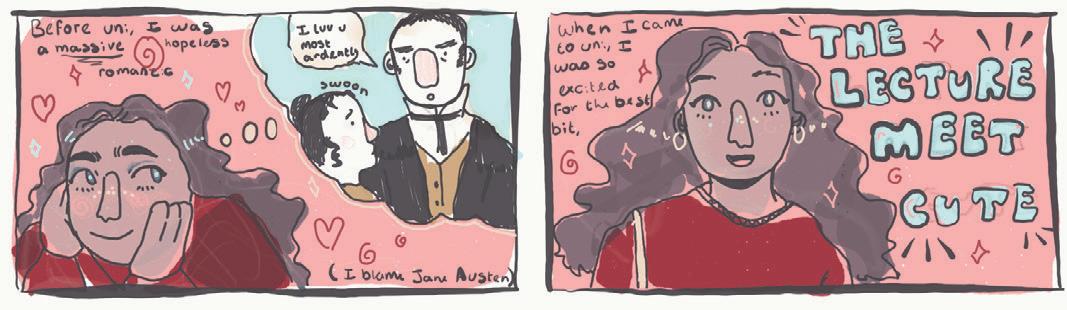
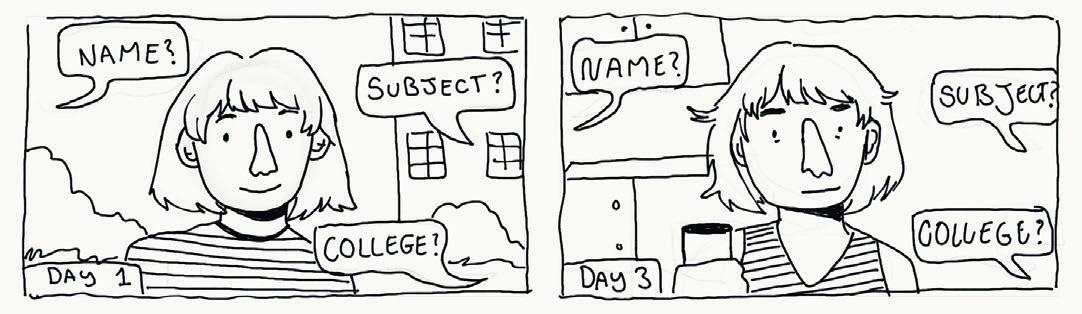
18 Friday 29th September 2023 e
Down Across
Across Down
Easy Medium
Sudoku
vulture.

Friday 29th September 2023 19
A Cambridge year in pictures
Izzy Grout delves into the recesses of her camera roll's recently deleted (and ours) to curate an exhibition of the moments that make a year at Cambridge
So, like a Voi lurching past a red light a little too quick and a little too sudden for anyone’s liking, another September rolls around.
And with it, the sweet serenade of a 3am Outlook noti cation and, of course, the nostalgic scrolling through camera rolls, photo albums and Facebook pages in preparation for another year of Cambridge life: the good, the bad and the ugly.
However, for those of you entering the world of May Balls and gown-wearing for the very rst time, you’ll soon nd out that there’s a great deal more to Cambridge life than the library and the lecture hall. And although I am sure that you’ll be racing through your reading lists and mastering your Moodle pages in no time, there are certain things that the books just can’t teach. Certain things that have to be seen to be believed.
So Freshers, behold! For I have delved deep into my camera roll to sum the trials and tribulations of Cambridge life in snapshots. Take a little trip down memory lane with those of us who have seen it all before, and you’ll know your Mainsbury’s from your Slocal in no time!
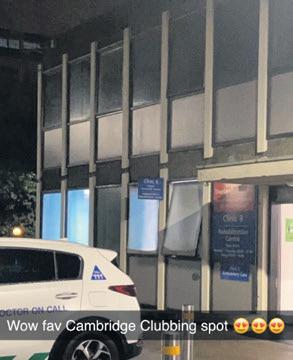
Cambridge has so many pleasures: studying in quaint little co ee shops, library trips equipt with wooden beams and ancient manuscripts, and at the centre, a world-class education.
It almost sounds too good to be true?
Ah yes, the

Ready, steady, microwave!

phere and intimate vibe of a Wednesday Revs, followed up by a visit to a very special afters at Addenbrookes.
Although, even after a long night of civilised discussions in the smoking area, of course you’re no stranger to hard work. And so, like the diligent, hardworking student you are, eager to convince your DoS that


Or equally, of course, simply sipping a 4-pack of San Miguel in the sun-dappled grasses of Grantchester Meadows can hit that end-of-term x, saving you hundreds of pounds and the embarrassment of getting stuck halfway up a helter-skelter.
It’s time to toss the '5 minute Student Meals' recipe book your Nanna got you for Christmas and read on for a delicious anthology of cheeky snacks to keep you going this term.
Zapped Babybel
Faced with nothing but a microwave, a toaster, and max. 2m by 2m of kitchen oor space, a girl learns to get inventive. And in the dark ages of rst year, I drew my inspiration from the simplest of childhood goodies, wading through petit lout and cheesestrings (the two-coloured kind, of course) to nd my muse: the babybel. Now my recipe is a straightforward one. Unwrap your babybel. Make sure to hold it up to the light as you revel in its waxy crimson beauty. Unwrap another babybel, with the same level of reverie. Deposit both into an Amazon Basics bowl. Place delicately into the microwave and heat as long as is necessary. Watch your housemates’ faces gape in horror as you menacingly swirl a fork into the depths of your bowl and pull out a gooey string of melted plasticky nostalgia. It’s a great icebreaker!
Soy Sweetcorn


“this term will be di erent I promise!”
Of course, you are always a model of dignity and grace, on an academic and personal level. Nevertheless, when exam season comes around you never slack on your awless and artfully curated appearance to keep up your status as a bona de 'Sidge Girlie'.
As term rolls around do not be
dreaded ‘S’ word (the strikes!). Cue the undercover classes, the return to Zoom lectures and walking the (picket) line between supporting the strikes and appeasing the lecturer that would probably still make it to Sidgwick in a nuclear winter.



Nevertheless, you will learn new skills… …and, apparently, forget old ones…


*sighs*. At least some people can blame it on the Rumboogie…

So, you sign over the loss of your weekly Cambridge clubbing x, eager for the warming atmos-


afraid to hit ‘delete’ on threatening emails so that you can let your hair down come May Week.
So for fresher and nalist alike, this is your reminder to make the most of every moment of the year ahead. ough the impending eight weeks will be lled with their fair share of essay crises and bleary-eyed 9ams, there’s something else that is far more important.
e community that makes all the chaos worthwhile. e friends that drag us to the lecture hall when we’d rather be in bed, and to the club after the post-supo slump; because although we come
What an excellent way to get one of your ve-a-day! Soy sweetcorn is so simple it’s almost suspicious. If your college has provided you with the unfathomable luxury of a freezer, chuck some frozen sweetcorn in a pan. No freezer luck? Use a can. Do NOT submerge the sweetcorn in water; it will cook in very little water and still maintain all its mineral goodness. Drain, pour into a bowl if you’re feeling fancy, and cover with soy sauce. A wellintentioned second-year experiment whose favorable results surprised everyone involved.
Twiglet Toast
How 50% of wpeople don’t appreciate this yeasty delicacy is beyond me but for the sane among us here’s the recipe – if you can call it that – for my Twiglet Toast (patent pending). Lightly toast a piece of bread, smother it in Marmite and add a generous handful of grated cheese on top. Bung in the microwave for around a minute and hey presto! A marmite lover’s dream.
A Bottle, a Bowl and a Big Spoon

for the world-class education, we stay for the worldclass people.
I know it seems a long way o yet but with Z-list lineups and sometimes tasteful themes (thoughts and prayers to Pembroke, who very much came up for air), May Balls are all part and parcel of a smashing year in Cambridge.
Give or take your atmate sequestered in an alcove with the cousin you brought from home.
So clear out your camera rolls, make way for the Snapchat memories… and let the next year commence!
A bottle of lager, a bowl of baked beans and a big spoon to serve. is little meal might not have all the major food groups but it most certainly has nutritional integrity. Buzz some beans in a microwave pop open a cold one and kick-back. A delight for the matured pallet, this is the perfect wake-me-up pre-supo snack. For the more adventurous among you, feel free to add a crack (or even two cracks) of black pepper. Be careful not to overstretch yourself though – nobody likes a show o .
 Iona Boyer, Anika Goddard, Isabella Steinmeyer, & Miranda Evans
Lifestyle
◀MIRANDA EVANS & IONA BOYER
▼
IZZY GROUT, SUSANNA KIRSTEN & CAMFESS
20 Vulture friday 29th september 2023
Can I maintain a long-distance relationship?


In this special fresher-themed edition, Aunty Maddy bestows advice that will warm the hearts of even the most weather-beaten third years
Help! College ran out of room for me this year and I’m going to be living in private accommodation. How do I make the best of this, and, more importantly, how do I make friends there?


First of all, may I just congratulate you on dodging one of the largest bullets of your university career. Whenever I meet people living in private accommodation, I tell them they’re living the dream. Sure, as a student you may have to put up with abject squalor and a landlord that charges the black mould crawling up your shower and into the ventilation as premium furnishing. But at least you don’t have to worry about an ex-military o cer, who went from body-slamming armed robbers to calling the college riot police on a small gathering of more than three people, still patrolling your living quarters at by the time you get to third year. You can also bask in the relief that, should you take someone back to your swanky private pad, you won’t have to worry about whether or not a Varsity blues rugby player has caked the shower oor-to-ceiling with half of the mud from the university pitches (at least, you really hoped that stu was mud). Most importantly, you can smoke without having to make the pilgrimage to Mordor. As for making friends, you really don’t need to worry. I would presume that, unlike college accommodation, your house has a shared living room where people can interact
organically (are you reading this, Cambridge University?!?!?!?!!) in the earlier weeks of term, and not in the painful two minutes or so spent awkwardly leaning in each others’ doorways on the way to the fridge. is bountiful luxury of communal space means you and your new housemates can pass the time bonding over the greatest uni er known to mankind: TV. And if their idea of a good time isn’t going squared-eyed, why bother making friends with these losers anyway?
Should I take up rowing?

If you hate a healthy sleep schedule, work-life balance, and all traces of a social life, go for it. Perhaps I’m being a little harsh (and only slightly jealous of those supremely sexy biceps), but is the torment of a rower’s lifestyle really worth it for, at best, a few minutes in the sun trying not to drown in one of the most murky and polluted rivers in the country (the ames or the Cam, take your pick)? Or a massive fuck-o paddle? You can get one of the latter from Ann Summers for about a tenner, and I promise you, you’ll have in nitely more fun.
How can I maintain a long distance relationship with my boyfriend whilst we’re both at university?

I was originally going to recommend splitting the costs for a remote-controlled vibrator, but with college wi dragging along at a snail’s pace,





there’d be meagre returns on your investment and you two may run the risk of outlasting (pardon the pun) the campus record for time spent trying to achieve the female orgasm – previously assumed to be scienti cally impossible. erefore, with this option similarly out of range, and never having known what real love feels like (don’t cry for me, I’ve also never been to Legoland), I asked around. I know a statistically unusual number of people who have managed to sustain long-term long-distance relationships with their hometown sweethearts throughout their time at Cambridge (we’re talking two to three years at least, the lifespan of most hamster breeds, so kid, you’re entering at the back of the race). eir irritatingly sound advice was to get so wrapped up in your subject that you forget all about the fact that your other half is hundreds of miles away across the country, probably K-holing in some student hovel in Manchester or Leeds as you always imagined you’d do one day together. Still, it’s probably not advisable to be totally dependent on advice with an outcome that rests heavily on the workload of your subject. e result is that I’m in touch with some blissfully preoccupied Law and STEM students who are chugging
along pretty ne and dandy, as well as some rather disconsolate humanities scholars (moreover, I’d take multitasking phone sex with an intense Anki session over a passage from Dostoevsky any day of the week).
Lifestyle
Vulture 21 friday 29th september 2023 J. S. Wilson & Son Bookbinders Ltd Cambridge Established 1830 Thesis Binding Conservation Leather Binding Journal Binding Tel (01223) 212420 www.jswilsonandson.co.uk Availableto ordernow fromwww.varsity.co.uk/shop GUESTEDITEDBY LOTTEJEFFS & JORDANSTEPHENS THEMAYS31 Thebest newwritingandart fromthe studentsofCambridgeUniversity&Oxford University Formoreinformationvisitwww.themaysanthology.co.uk
▼MADDDY SANDERSON
FRESH MEAT the freshers you don't see

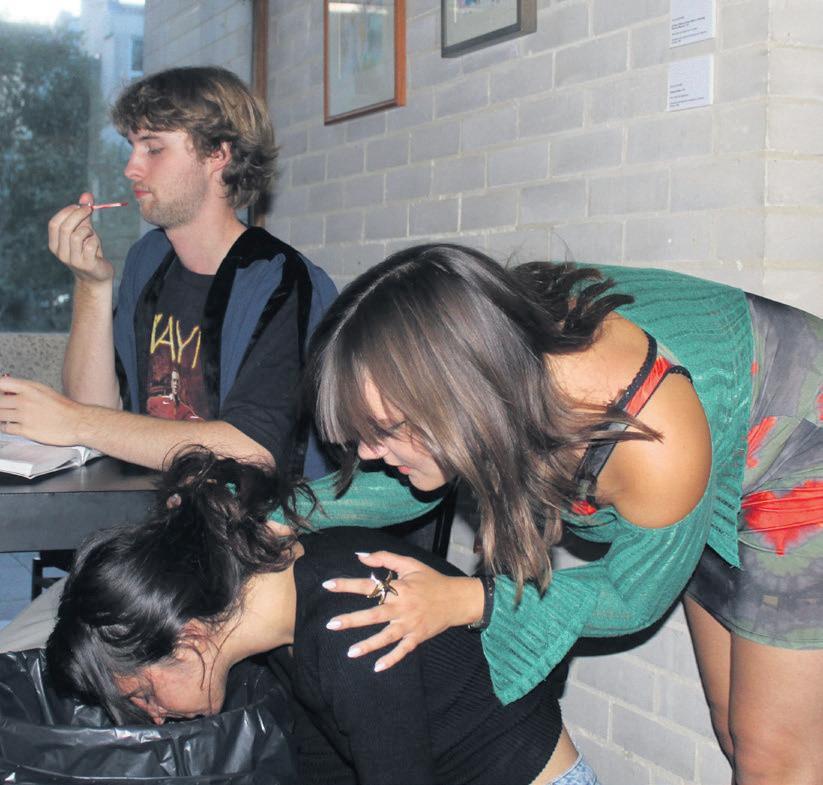 by
by



Fashion
▼PHOTOGRAPHER: RUBY CLINE MODELS:HEIDI ATKINS, ISABEL DEMPSEY, OWEN HANKS, FINLEY BRIGHTON, FATIMA MUMAN, LOUIS STEPHEN
Friday 29th September 2023 Vulture 22 Vulture
Ruby Cline
At some point this week, you will sprint out of a supervision two minutes early. You have yet another ceremony you can’t pronounce which, for reasons unexplained, begins at 5.30pm. You have forgotten your gown. You pant as you enter your room, ignoring the wasteland left on your loor from last night’s pres. Your trainer lace catches on the cable of your fairy lights that the maintenance team will soon steal from you, for reasons related to ire safety. Maybe the maintenance team is right. he lights come crashing down from your corkboard and careen across your desk, taking with them a Johns-branded plate you stole from a formal, still encrusted with the crumbs of an underwhelming stack of something they called cheesecake (you’ve gotten into the whole pickpocketing-college-merch thing quite quickly). Each individual sheet of your unstapled freshers’ guide, and every single lyer you took from the freshers’ fair pile on top of it, and your makeup bag ('unpacked' since you haven’t igured out the best getting ready area in a room with seemingly universal yellow lighting) onto your desk. You pause for a second. You consider starting to cry. You decide you don’t have time. Gown in hand, you run back out the room.


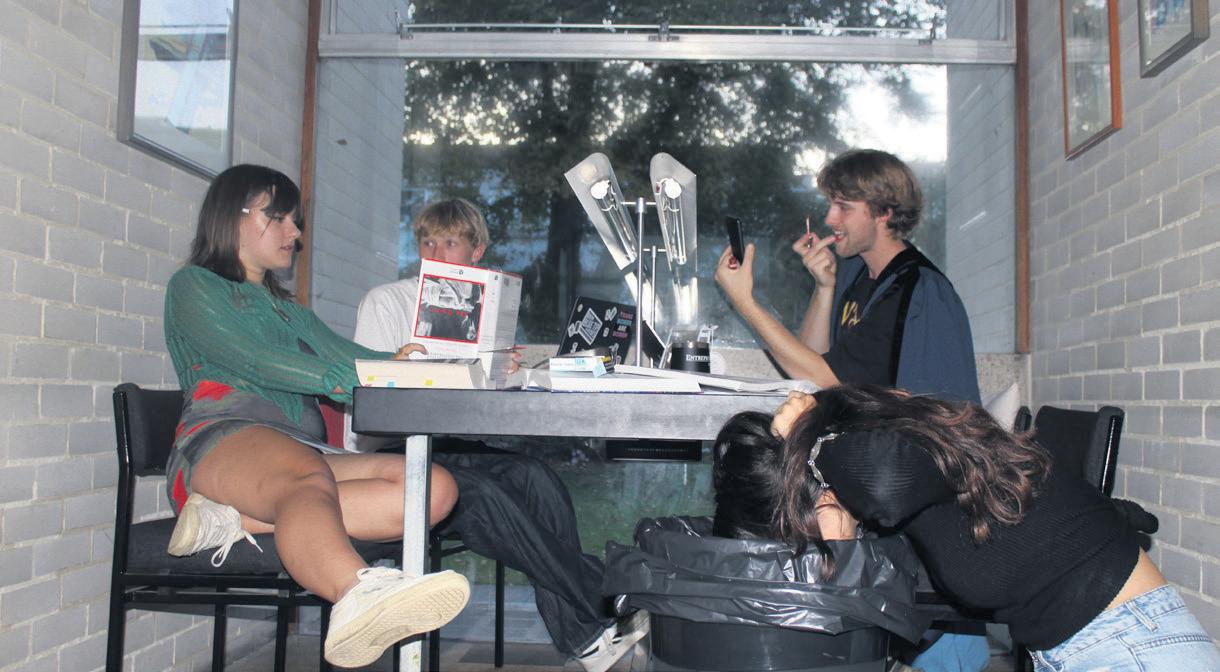
Fashion
Graduate tutor (law) required to mark a Public International Law dissertation of about 14,200 words completed in April 2011 for payment. Please contact: purplerain1868@gmail.com
ADVERTISE WITH US. To advertise in any of our print publications or online, please contact our Business Manager: tel : 01223 33 75 75 email: business@varsity.co.uk web: varsitypublications.co.uk Friday29thSeptember2023 Vulture 23
Arts






























Art close to home




Eva Weinstein and Clementine Lussiana nd that Cambridge's wealth of art isn't con ned to museums and galleries
Girton College
Walk through Girton’s winding brick corridors, andfeastyoureyesuponthe‘People’sPortraits’, an art exhibition that represents people ‘from all walks of life.’ Over 60 portraits cover the college walls, capturing subjects like e Boxer;a man who slouches forward towards the spectator, boxing gloves discarded by his side. Wander down from the plodge, through schlub (the social hub) and along the arched hallways to the library to follow this wide range of portraits from start to nish. If you're looking for some more art while there, make sure to venture into Girton’s dining hall. Unique in its display of exclusively female portraits, it is a refreshing change from the male dominated paintings in many Cambridge college dining halls (see if you can spot the portrait of Baroness Hale).
Queens’ College
College halls tend to be adorned with portraits of alumni and masters, commissioned by established artists and occupying prominent spaces within college. Queens’ College integrates student art into the tradition of displaying art in common spaces, most notably through the Queens' Arts Festival, an annual exhibition displayed in the West gallery. e gallery is nestled above the Fitzpatrick Hall, a multipurpose theatre and part of the Cripps building. Students accommodated in the 200 surrounding rooms are only a stone’s throw from the gallery, and need not set foot outside as the display can be accessed through ‘gyp hopping’ along corridors. e space is bright, airy, and - in true Cambridge fashioncontains several workspaces. e event is the largest of its kind in Cambridge, curated by students and featuring work from Cambridge University, e Cambridge School of Visual and Performing Arts, and Anglia Ruskin. e theme of the current exhibition is ‘Bricolage: you are what you make’, and spotlights an impressive range of mediums from photography and paintings, to sculpture, zines and poetry.
Jesus is home to a permanent display of 29 sculptures, which can be found dotted across
the sprawling college grounds. Pick up an illustrated map showing the sculpture locations from the plodge and weave your way from Barry Flanagan’s Bronze Horse all the way around to Henry Moore’s Leaf Figure. Edoardo Paolozzi’s Daedalus on Wheels is particularly interesting for the Classicists among you, with the sculpture’s wheeled platform and geometric body parts being a nod to Daedulus’s role as a fellow sculptor in Greek mythology.
Clare College

Clare’s art-inspired gardens were designed by college fellow Nevill Willmer. ough the Fellow’s Garden is closed until 2024, there are a number of other delights to indulge in. e River Beds were intentionally planted with bright coloured owers in the foreground and softer pastel shades in the background, in order to mimic the hazy blue horizons of landscape paintings. Similar colour vision was used byWillmer in the yellow and blue border of owers planted from the Pond Garden to the riverbank.Willmerwasknowntoleadcolleaguesinto the Garden in early evenings, so as to show how the blues became lighter and the yellows darker as twilight descended. Of equal interest is the Sunken Garden inspired by Willmer’s trip to Pompeii, and the bold colours of the Tropical Garden.
Murray Edwards College
collectioncelebratestheroleofrenownedandlesser-known women artists in art movements since the 1950s. Medwards students needn’t stray far to be immersed in the collection: undergraduates lucky enough to live in Orchard Court can glance out of their bedroom windows to view sculptures by Barbara Hepworth or Naomi Press planted on the lawn. A short trip from the library to the buttery becomes a walk-through exhibition, along corridors adorned with an eclectic mix of drawings, paintings, prints and photographs, to the dining hall in the dome, where you can enjoy your Saturday brunch surrounded by majestic canvases including Paula Rego’s Inês de Castro, painted for the Women’s Art Collection’s 60th Anniversary.
Newnham College


ose bits of gold and silver metal hanging from the ceiling at e Iris? at’s actually an art installation, or more speci cally, a light sculpture, known as the ‘Arc of History.’ Created by the design studio ‘Haberdashery’, the sculpture is made up of pages from the College archive which have been recreated in brass and steel. Twenty pieces were selected from the archive and repeated throughout the sculpture, amongst which being a letter home by Rosalind Franklin, a Newnham student and co-discoverer of the structure of DNA, and a study on the ‘Health Statistics of Women Students’ ( e author, Eleanor Sidgwick, concluded that 'there is nothing in a university education at all specially injurious to constitution of women, or involving any greater strain than they can ordinarily bear'.) Settle down with a at white, and gaze up at the light sculpture, a visual reminder of the college’s history of women’s education.
Murray Edwards o ers a refreshing alternative to the traditional medieval Gothic and Neoclassical architecture of the central colleges. e iconic dome and college buildings were designed by architects Peter Chamberlin, Geo rey Powell and Christoph Bon, famed for their design of London’s Barbican Estate. is Brutalist architecture is complemented by the contemporary Women’s Art Collection, with works by prominent women artists interspersed throughout the concrete complex. Attempting to redress the gender imbalance preand galleries, the
contains siding in so many museums





to Cambridge
For something a little less conventional, step into Trinity Hall’s Dining Hall where a wall-based arte Willow will Submerge in Time plants and soil from the River Cam. e piece is a nod to the college’s waterside location, but also to Xu Zhimo’s famous poem Second Farewell , in which he describes a ‘golden willow on the bank of the Cam’ (a memorial stone engraved with the opening and closing line to the poem can be found on the King's backs). Follow this with a trip to the chapel, where, on a more traditional note, Salutation (c.1570) lives above the altar on permanent loan from the Fitzwilliam Museum. Depicting the pregnant Mary’s visit to Elizabeth, mother of St John the Baptist, the work is attributed to the Counter-Mannerism movement in Florence, and de nitely worth a visit.
Churchill College
e threshold of Churchill College is marked by a sevenbar aluminium pivoting gate. Aside from providing an imposing entrance to the college, this striking sculpture by

Geo rey Clarke sets the precedent for the vast sculpture collection that interacts with the college surroundings. Set over 42 acres, Churchill’s divisive modernist architecture and sprawling grounds are dotted with sculptures by artists such as Nigel Hall, Dhruva Mistry, and Peter Lyon. Sculptures are carefully positioned to complement the brutalist design – clean lines, abstract forms and often angular compositions resonate with the geometric structure of the college buildings. Harsh spikes and corners on buildings and sculptures, such as Denis Mitchell’s Past, Present, Future, are softened by the surrounding gardens and plants to create a unique collegescape. Sculptures also function as visual anchors amidst expansive lawns and walkways, such as Barbara Hepworth’s towering Four-Square (Walk rough).

24 Vulture friday 29th september 2023
▼ Eva weinstein
e Metamorphosis of the Corpus Playroom

Mia Grant goes behind the curtain ahead of the week 2 production of Metamorphosis
The Corpus Playroom is often regarded as a secondary venue to the ADC eatre, partly due to its limited technical capacity and partly due to its atmosphere, which seems to be a cross between a theatre and an abandoned motel basement.
We’re trying to encourage the audience to feel as though they are in Gregor’s bedroom; they aren’t just watching, they are involved in this show.”

e play itself - practitioner Steven Berko ’s adaptation of the famous Ka a novella - presents a challenge for any director, purely due to the creativity required to capture such an abstract narrative. Gregor’s transformation into a gigantic insect requires an almost inhuman physicality, something which both Emily and Movement Director Nathaniel Gunn have been extremely proactive in tackling. Sparkes’ experience primarily lies within choreography rather than directing, providing her enabling her to commit to the non-naturalistic requirements of Berko ; she attempts to “push the actors’ physicality to the extremes of what an audience recognises as human.”
Although a challenging request, Hunt describes how they were “enamoured” by the entire 1950s concept, digging through old archives to nd TV adverts to use. Regarding the theme tune, they explain how they went from receiving the initial request to nding themselves, two days later, “sitting in front of [their] computer trying to emulate late career Elvis”. “Whilst on holiday and also unwell”, chimes in Emily, two factors which Stan laughingly claims were “conducive to the state of mind they needed” to create a theme tune for a man who turns into a bug.
though a standard consideration for sca olding, has to take into account that Liam will be crawling for the majority of the production. “It’s stu that you wouldn’t get in any other show that doesn’t have someone playing a beetle.”




When I met with Metamorphosis director Emily Sparkes she openly jokes (not un- ly) that there is prob- ably “mould growing in the corner somewhere”. Despite this, while pitching the production she was asked if she would consider the ADC eatre as an alternative venue; she said no. She tells me, “the only way I could envision what I want for my version of Metamorphosis was to see it in the Corpus Playroom and play into the fact that we have this really oppressive space.
It is, however, the technical ambition of the show which spotlights it amongst the multitude of Cambridge productions. Emily has chosen to stage the play as a meta-theatrical 1950s family TV show (inspired by the likes of Wandavision and e Truman Show), and with only Gregor, played by Liam Macmillan, aware of the audience, he is forced to feel “the weight of the entire world watching him in his transformation”.
In order to immerse the audience in this vision, Emily enlisted Stan Hunt to design an entire soundscape of TV adverts as well as creating a Bewitched-inspired intro, which will be used both within the show and as a trailer for the production.
As well as creating a meta-theatrical soundscape, the team have also designed a labyrinth of scaffolding practically encase the Corpus Playroom. Shrinking the al- ready small stage is a bold move, but, as Emily points out, captures the way that Gregor’s transformation has infringed completely on his family’s life. While echoing the “intrusive” nature of the sca olding, Assistant Director Tungsten Tang emphasises how it has allowed the team to completely recon gure a space which the audience will have seen used many times before.
Indeed, Emily is eager to express not only the talent of the entire team, but their patience to not dismiss her ideas as “crazy” or “unrealistic”, instead nding ways to maximise the Playroom’s potential and tackle the unique problems presented by both the show and the venue. Producer Elisha Carter o ers the example of safety bar height which, al-
Creativity is not the only thing driving Emily, however, as her genuine passion for the play pervades our discussion. Repeatedly describing the production as a “call to arms”, Emily expresses hope that the audience will gain a fresh appreciation for the text’s exploration of capitalist society and connect with the 1950s setting she has chosen.
As we end the meeting, I express my awe at the production’s ambition, and her eyes light up as she enthusiastically declares “Corpus has never seen anything like [this]!”. Having witnessed the talent, commitment and genuine passion of her team, I have to agree.


Robinson twists traditional theatre

Amelie Bromnick talks transforming the classics and creating new writing with Brickhouse eatre's president Max Mason

In the midst of ery debates about political correctness on the stage and an increasingly competitive world of new writing, Max Mason navigates complex decisions in his role as Brickhouse eatre president. He highlights how powerful theatre is in shifting the societal landscape.
When considering what shows to put on, Max says he takes a keen interest in those that “push the envelope a little” and allow scope for reinterpretation. He praises the experimental ambition of new writing but is particularly interested in pitches that allow one to take a traditional text and “breathe new life into them”. Brickhouse’s auditorium is perhaps most renowned for its intimate renderings of twentieth century productions, such as the brilliantly received All My Sons. Max pointedly rejects the idea, however, that you can be a “purist” of any original. Instead, he believes that theatre has a responsibility to reanimate these texts for the contemporary audience.
Max chuckles, describing how the “theme” of his Cambridge career has been trying to bring more traditional institutions - Shakespeare and opera, for example - into a modern
context with “modern resonances”. For Max, this involves defying the categories of theatre that we often use to delineate the dramatic world; a re ection of our increasingly spectral society.


“ e best theatre is the one you can’t put a genre on”, Max claims. He dedicates his space to these “genre-bending” plays. While there are plenty of experimental pieces of new writing - he o ers Jeremy O’Harris’ Daddy: A Melodrama as an example - many canonical works can also seem to defy traditional categorisations.
Shakespeare is an obvious example of the experimental relevance within the canon. Brickhouse theatre’s annual Open Air Shakespeare productions in May Week has illuminated this. Max directed both A Midsummer Night’s Dream in 2022, and Love’s Labour’s Lost this past year. He explains that he committed to “gender-neutral and gender-active casting.” While some object that this casting strays from the original text, Max argues that it tests an established narrative in a way that theatre has a responsibility to do. He claims that it is impossible to be a “purist” of any artistic production.
We return to new writing - how it can defy these theatrical categorisations and engage in established narratives. Max is interested in pitches for Brickhouse’s eatre that shed new light on old conversations. His own musical, Foresight, explores the AIDS crisis through the lens of 90s author-translator, Giovanni Pontiero. Staging a poignant portrayal of queer expression, it promises to elucidate an oftenforgotten factor in any literary production: artistic translation.
Despite the professional culture that Cambridge theatre cultivates, and perhaps overlyemphasises, Max highlights that ultimately “we are all learning”. First night ops are not artistic failures. Max suggests that what is most impressive about Cambridge theatre is its dedication to both process and nished product alike. Actors and crew are o ered the same revered space, something this 'Behind the Curtain' series hopes to illuminate.
In my conversation with Max, it is clear that the stage is ever engaged in galvanising the narratives of the past. Accessible to all, there is a space for everyone’s voice in Cambridge theatre.
eatre
❝We're trying to encourage the audience to feel as if they aren't just watching, they are involved in this show
◀ ISABEL DEMPSEY
❝e team have designed a labyrinth of sca olding to practically encase the Corpus Playroom
▲ IZZY DUFFYCROSS
Vulture 25 friday 29th september 2023
Film & TV
the SAG-AFTRA strike from the picket line



On July 13th, the conjoined labour unions of the Screen Actors Guild and the American Federation of Television and Radio Artists (SAG-AFTRA) voted to issue strike action after the Alliance of Motion Picture and Television Producers (AMPTP) failed to agree to a renewed contract. Not only was this the biggest actors’ strike since 1980, it was also the rst time since 1960 that a SAG strike had coincided with a WGA (Writers Guild of America) strike, making it a historic moment of solidarity for both unions. As the strike veered towards the two-month mark, I spoke to Kylie Sparks –an LA-based actor, writer and union member –to understand what the strike means to them.
Kylie joins my zoom call in a urry of energy, fresh o the picket line and still in their SAGAFTRA t-shirt and hi-vis vest. As strike captain, they have been working tirelessly to help set up tents, control crowds, and answer questions on the picket line and social media. As a member of SAG, Kylie tells me they have been “on the line since day one”; at the time of our interview SAG-AFTRA had been on strike for 57 days.
ere are a multitude of grounds on which the union is striking, including disputes over wages, working conditions, and the use of arti cial intelligence to replicate a performer’s likeness without their consent. For Kylie, who has been a working actor for 20 years, the most important issue on the table is that of residuals – royalty payments for reruns of television shows, or bonus cheques if a lm does well. At the time of the last WGA strike in 2007, streaming services such as Net ix and Hulu were only beginning to emerge in popularity, and uncertainties around their viability meant residuals were not negotiated in the deal. Now, despite streaming being rmly established in the mainstream, that old model remains, leaving actors who appear in original series by any streaming service receiving no residual payments. “Right now I am on an Emmy nominated show on a huge streamer”, says Kylie, who is obligated not to name the show nor the streaming platform. “It’s been viewed millions and millions of hours around the world, and they paid me a tenth of my quote which is ridiculous.”
Kylie explains that they still continue to make money in residuals from a show they worked on back in 2008.
It’s the payment from this over a decade old show that allows them to pay their bills and medical fees – not their most recent project, despite its popularity. “I think it covered my utilities and I will receive no residuals,” Kylie despairs, explaining how residuals are essential to working US actors. Actors are not eligible for health insurance until they have
a minimum earning of $26,470 and without residuals this is increasingly di cult to meet.
e emergence of streaming services has certainly changed the face of the entertainment industry, and Kylie feels strongly that people working in the industry must be accounted for. “Now we’re seeing an exodus of shows getting pulled o of streaming services for no reason, we’re seeing movies get cancelled for ‘tax write-o s’ [...] those are opportunities for folks to pay their bills”. It’s clear that Kylie does not envisage SAG-AFTRA relenting to the AMPTP. “For me personally it’s all or nothing. If we give in now our industry will be dead”.
What's on?
Our picks for the best and worst in cinemas now
meg 2: e Trench
as extreme examples of the dangers this precedent could hold. “People say that AI is the future, but AI can also be a weapon depending on how you use it [...] this world is a little too nefarious for me to trust that they will do the right thing with AI”. Nefarious indeed, with studios ignoring the moral and ethical implications of AI in order to avoid fairly compensating their workers.
e ruthless greed of large corporations at the expense of their workers is not unique to the entertainment industry. Kylie tells me that they have had teachers, doctors and nurses’ unions all come out to the picket line to support WGA and SAGATRA in the name of solidarity. “It’s everywhere. If you’re not part of the 1% then we are all labour, and we have to stand united in order to get what we want, not just in our own industry but in other industries as well”. It’s a real eye-opener into the mechanics of what can seem from the outside as a highly glamourous industry. But in reality, Kylie tells me, “Not everybody is a Nicole Kidman or a Pedro Pascal, we’re not making that kind of money. We’re just making money so we can pay rent, raise a family if we want to, or go see a concert. e industry is on the backs of labour and labour is actors of all levels, from background actors to A-listers, to stand-ins, to rehearsal actors.”
ere are good lms, and there are bad lms – Meg 2: e Trench is somehow neither, and yet also somehow both. e script is one of the worst I’ve ever come across, and the acting resembles parody, but I just couldn’t stop laughing. At one point, Jason Statham kicks a man straight into the mouth of a Megalodon and yells “See ya later, chum!” I love arthouse cinema as much as the next Varsity writer, but sometimes a silly lm about giant sharks entertains me just as much, and the $386.2 million this lm has grossed globally proves that I’m not alone.
Passages
An intense, concise portrayal of the collapse of a gay marriage, led by a stunning turn from Franz Rogowski as a lmmaker living in Paris who attempts to leave his husband (Ben Whishaw) for a younger woman (Adèle Exarchopoulos). Despite some beautiful shots and impressive performances all round, neither the lm’s script nor its pacing fully allow the viewer to feel for its characters, as director Ira Sachs falls short of the great lms of his illustrious inspiration, Rainer Werner Fassbinder.
Past Lives
rep-

































Kylie voices their concerns over not only the nancial aspects of the current contract, but the use of arti cial intelligence to replace actors. e current AMPTP proposal stipulates half a day’s pay (roughly $150) in compensation for scanning every part of an actor’s body and facial expressions, with the view to using their likeness and image in perpetuity. Not only does this grossly undermine the work of actors, with their likenesses being used to actively train AI to rep-
of the actor. Kylie consequences of


for to
e WGA have come to a deal with AMPTP, reaching what has been described as a “tentative agreement” in a joint statement. SAG-AFTRA has responded by pushing AMPTP to get back to the table and negotiate but, with so many challenges presented by the rapidly changing face of the entertainment industry, it is unclear when, or how, a fair agreement will be reached for the actors. It is evident that the writers and actors are only at the beginning of what looks to be a historic shift in the treatment of workers across all sectors of the entertainment industry. Kylie would like it known that their opinions are entirely their own, and do not represent any o cial statements made by SAG-AFTRA or WGA.
First-time lmmaker Celine Song uncovers a melancholic beauty in the road not taken in this poignant story of two childhood sweethearts from Korea who reunite in New York, twenty-four years after one of them emigrates. Led by quietly thoughtful performances from Greta Lee, Teo Yoo and John Magaro, it’s an extraordinary debut from a cinematic voice brazenly unafraid to let stillnesses sit and silences ring.
Scrapper
Charlotte Regan’s unbelievable feature debut tells the story of 12-year-old Georgie, who lives alone and fends for herself after her mum passes away, only to have her world turned upside down by the arrival of her estranged biological dad. e desaturated colour palettes of traditional kitchen sink dramas are swapped out for bright, bold colours and a light-hearted sense of humour. Regan also experiments with several magical realist elements, but the lm is brought back to reality by the subtle and sensitive performances from both Harris Dickinson and astonishing rst-timer Lola Campbell.
eatre Camp
ADC kids, here’s one for you – a partially improvised docu-comedy, lifting a lid on all the day-to-day dramas of an American youth theatre camp. Ably helmed by Booksmart’s Molly Gordon (also directing) and Hollywood’s foremost theatre kid, Ben Platt, there’s much fun to be had here, albeit with a half an hour slump in the middle where you’ll realise it’s been a while since you laughed. ose more compelled towards Collateral than Cats, approach with caution – you’re opening yourself up to a world of comedic speci city bordering on the cultic.

❝It’s all or nothing. If we give in now our industry will be dead
‘ e industry is on the backs of labour’:
Miranda Crawford speaks to SAG-AFTRA strike captain Kylie Sparks about working the picket, AI and the struggle to make ends meet as an actor
Sam Allen, Nikolas Boyd-Carpenter & Isaac Jackson
❝
is world is a little too nefarious for me to trust that they will do the right thing with AI
▼J. W. HENDRICKS
licate their work, but these images will be used without the consent ponders over the almost dystopian arti cially mimicking a person’s image without their consent, citing sexual violence and the promotion of fascist ideology 26 Vulture friday 29th september 2023
IMAX or Ice Blasts? Finding your favourite cinema
Don't let choice paralysis ruin your movie night! Here's Esme Smith's rundown of the pros and cons of each Cambridge cinema


After a busy week at Cambridge, choosing where to go for your weekend trip to the cinema should never be a cause for stress. But with so many di erent ticket prices, memberships and screenings, even the staunchest of cinephiles can be overwhelmed by the sheer variety of options available.
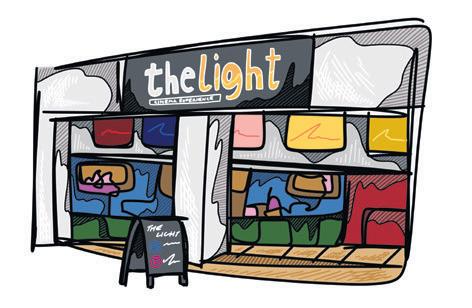
Which cinema o ers the best cinematic experience?


Nowadays, with so many surround sound systems and 4K images on o er, attending the cinema is as much about the visual and auditory experience as it is about the story. If you fancy a picture that captures every little detail, or if you want your seat shaken Oppenheimer style, e Light or VUE is the place for you. Both theatres o er immersive surround sound technology and 4K picture quality, and on top of this, e Light is the only cinema in Cambridge able to boast ownership of an IMAX screen. Late night screenings at the Arts Picturehouse, meanwhile, su er from a noisy neighbour, with the distant sound of partying in Revs providing an unwelcome backing track during most moments of silence. My screening of Charlotte Wells’ Aftersun certainly wasn’t spared, and the nal quiet moments of the lm were accompanied by a musical rendition from its next door neighbour. If you enjoy the volume turned up to one thousand, and prefer your emotional climaxes undisturbed by nearby partying, make Cambridge’s two multiplexes your top picks.
Where can you nd the greatest variety?

ree cinemas also means plenty of choice, and what it lacks in sound, the Arts Picturehouse certainly makes up for in variety. With their weekly Discover and reDiscover screenings you can revisit beloved classics and enjoy new arthouse releases, as well as catch any past screenings that you may have missed. Indie screenings at the VUE are, unfortunately, a rare sight, but the same cannot be said of e Light. Much like the Arts Picturehouse, e Light is home to an impressive array of special screenings, with frequent retrospectives on your favourite directors and an impressive selection of international Sciamma’s masterful Portrait of a Lady on Fire, it was e Light that provided that one rare preview amid a sea of screenings of Disney’s now largely forgotten Doolittle remake. Which cinema has the best food & drink?
For some, trips to the cinema are as much about the food as they are about the movie. Between tongue dyeing slushies and overpriced popcorn, cinema trips are, for many, also culinary excursions. For those who value their in-theatre feast as much as the movie on screen, as well as those who consider a lack of Tango


Ice Blast a movie-going deal-breaker, the VUE is the best choice for you. With a seemingly in nite array of avours and food options, the Graftonbased cinema has plenty on o er for those who feel peckish mid-movie, with the pride of their food and drink counter being the ‘Coca Cola Freestyle’, a touch-screen zzy drink dispenser that can mix together any of the 100+ avours you choose from. Whether you nd the concept of this bite-sized coke factory intriguing, or whether, like me, you nd the Frankenstein-esque drink designer stomach-churning, it remains true that the VUE is never short of food or drink options, nauseating or not. Still, when you are on a budget, and faced by food and drink costs that often outweigh the lm ticket itself, there’s no harm in a quick, and far more a ordable, pre-cinema trip to a nearby Tesco or Sainsbury’s.

Film & TV






Where can you nd the most a ordable membership?

Finding the right snacks or screen is all very well and good - but what about the prices? Heading to the cinema often seems impossible on a student budget, but if you’re after the best value for money, Picturehouse’s U25 Membership is a Cambridge essential. It’s suited for avid movie goers and casual theatre visitors, and it’s the cheapest you will nd tickets at any Cambridge cinema, with Monday to ursday tickets costing just £4.99 when you sign up for free via the Picturehouses app. For the more committed cinephiles among us, e Light’s £15.99 a month unlimited subscription is worth considering. But to be truly worth the steeper price, you would have to visit at least three times a month, an impossible task if you’re swamped by a busy uni schedule that leaves little time for movie-going.

▲ TOBIA NAVA
Vulture 27 friday 29th september 2023
▼DAISY COX
Mapping out the Cambridge music scene

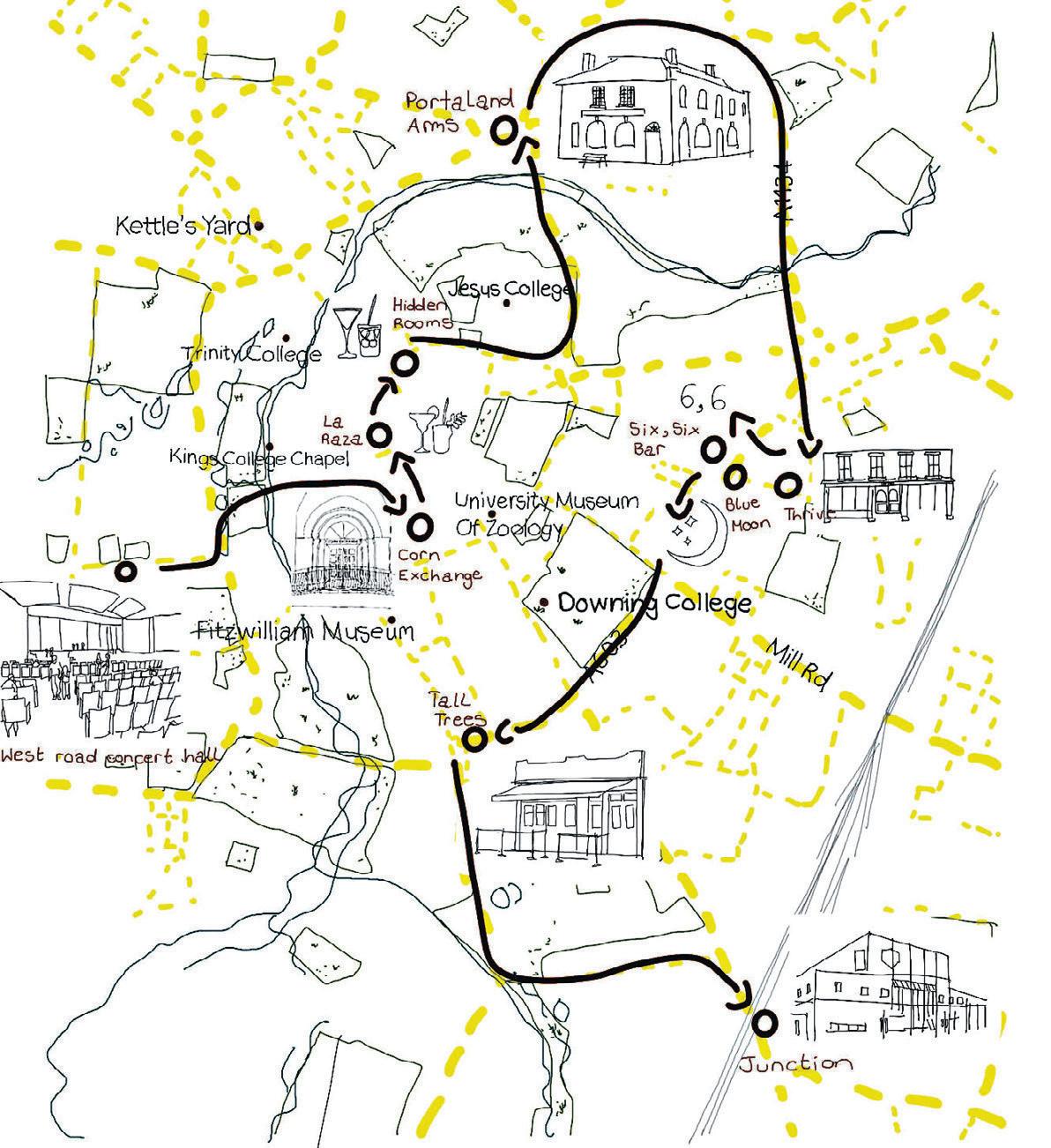
Lost in the Corn Exchange maze? Struggling to nd those Hidden Rooms? Alex Brian takes you on a journey around the best gig venues on o er


Hidden Rooms: In the basement of the unusual Greek-temple looking building on Jesus Lane, home to the Pitt Club and Kibou, is Hidden Rooms: a cocktail bar that is the jazz epicentre of Cambridge. JazzSoc organises monthly Gig Nights here.
Kettle’s Yard hold regular concerts that are just £5 for students.



La Raza: On ursday, Friday and Saturday evenings, this cocktail bar in central Cambridge hosts local DJs and bands as well as a monthly Cambridge Funk Jam.
College chapels hold Evensong several times a week.

Cambridge's Centre for Music Performance: a year on
When the University launched its Centre for Music Performance (CMP) in 2022, it had four key goals: enhancing opportunities for talented musicians, supporting student-led music making, providing for a diverse range of musical genres, and developing programmes for beginners. Now, one year after its inception, I speak to Felix Asare, Rachel Armitage,and April Perrot from the CMP to gauge their progress.
e Portland Arms: During the day, e Portland Arms is a cosy pub lled with board games and arcade machines. At night, however, its backroom becomes an intimate music venue hosting some of the country’s most exciting new indie bands.
e Six Six Bar: Six Six is Cambridge’s home of rock’n’roll. Located on East Road, the bar achieves a suitably grungy aesthetic through a red-brick exterior, wood-panelled interior and metallic stage. Upcoming shows include a pop punk tribute night, SOULWEAVER and Trampolene.
e Blue Moon: Slightly further into the residential areas of Cambridge than most students venture (i.e. 15 minutes from the centre), e Blue Moon is a large pub that welcomes both local and more well-known artists to its small stage.
rive: Across the road is rive, Cambridge’s vegan co ee house. In addition to being a cosy and sustainable cafe, rive hosts comedy nights and acoustic concerts including the album launches of many local artists.
Tall Trees: From the outside, Tall Trees doesn’t look like much. However, its naturethemed decor gives it a magical atmosphere and the breadth of its roster – from jazz to folk and rock’n’roll – guarantees it a key role in the Cambridge music scene.
Partly established to provide the resources needed to navigate the Cambridge music scene which were lost during the pandemic, the CMP faces a major challenge: making sure students know it exists. Despite hiring student representatives, hosting a Launch Festival last Michaelmas, and running a stall at the Freshers’ Fair, they feel they have been less successful is provision for beginners. Nevertheless, Asare asserts that this is at the “top of the list” of priorities for 2023/24. e CMP’s unique resource pooling has enabled the organisation of events that colleges might not have been able to a ord individually. Mark Armstrong, the artistic director of the National Youth Jazz Orchestra, gave a masterclass on musical directing, while the 'Take It to the Bridge' songwriting competition saw the winners perform on the main stage at the Cambridge Club Festival. Other events included regular gig nights showcasing student bands, two concerts by the Cambridge University Jazz Orchestra at West Road Concert Hall and a workshop led by Black Country, New Road.
Asare asserts that the Cambridge music scene has become less insular thanks to the CMP. Previously, connections could only be made by joining large bands. Now, likeminded students can meet through the CMP Band Hub, which has organised mixers, jam sessions and online events. Groups like Spilled Vodka, which formed through the Hub, went on to play ten or eleven May Balls.
West Road Concert Hall: Part of the Music Faculty, West Road Concert Hall can be found on Sidgwick Site next to the UL. is atmospheric auditorium is large enough to welcome the Cambridge Symphony Orchestra and is where CMP and Camerata Musica events are usually held. Camerata Musica concerts bring world class musicians to Cambridge and are free for student whilst CMP gig nights showcase Cambridge’s best student bands. CMP runs free concerts from 1:10–2pm every Tuesday in this lovely venue.
Cambridge Corn Exchange: Situated in central Cambridge, the Corn Exchange hosts not only plays and comedy shows but major bands and artists. is term, for example, you could see Dylan, McFly and Scouting for Girls.
Cambridge Junction: Out by the train station, Cambridge Junction is a massive warehouse containing a theatre, a learning centre and a performance space. Recent concerts have included Sarah Jarosz, Ezra Furman and a daytime rave.
Likewise, around 600 students have signed up to their Online Hub, which contains a registry of events, venues, societies and equipment for hire. It’s refreshing to see such dynamism in e orts to reform the Cambridge music scene, which, as Asare notes, can be reluctant to change. e Cambridge University Orchestra, for example, has broadened its repertoire to include more contemporary composers, female composers and composers of colour, challenging the “stu y” reputation of classical music. Similarly,
e CMP aims to give more attention to popular and world music, and challenge the idea that you must be “really good” at something to take part. ese e orts are especially vital given the welfare bene ts of making and enjoying music with others. Although there is still progress to be made towards making everyone feel welcome in the Cambridge music scene, the CMP seems to be on the right track. We have, after all, had only just one year with the CMP. With any luck, the Cambridge music scene will continue to evolve into a more diverse and inclusive community.
Music
▼EDEN HOGSTON
28 Vulture friday 29th september 2023
Welcome to your Club
For nearly 200 years alumni have chosen to take up membership of a spacious and elegant private club in the heart of London. The Oxford and Cambridge Club in Pall Mall is the perfect place to meet for a drink, entertain friends and colleagues in magnificent surroundings, play squash, take a break, host a party or just find a quiet corner to prepare for a meeting. A thriving social scene, sports facilities, a lively calendar of events including talks, tastings, dinners and balls, an exceptionally well-stocked library, extensive wine cellars and more than 40 bedrooms mean our members use their club for recreation, relaxation and business - and now you can too.

For details on membership or a tour of the Club house on Pall Mall, please visit www.oxfordandcambridgeclub.co.uk or call 020 7321 5110


Oxford and Cambridge Club @oandcclub

Cambridge singer-songwriter IONA talks existentialism and musical theatre
Emmy Warr catches up with the winner of Jesus College's songwriting competition



It’s hard enough to nd a student who can spare half an hour for a co ee during exam season, let alone one who’s building a career as a singer-songwriter and performing up and down the country, all while studying for her degree. IONA is carving out a space for herself in the Cambridge music scene with a formidable pen, steadfast determination, and the time management skills of a US marine. I caught up with her over a latte in the Locker to discuss existentialism, musical theatre, and her approach to songwriting.
e Magdalene Engling has spent her rst year playing pub back rooms and May Balls in-between train rides from Cambridge to her home city of London, where she’s being courted by record labels. But for her, industry prestige is not what it’s all about.


“My main thing is that I would like to be a songwriter,” IONA tells me, although she’s resigned to the fact that listeners don’t always share the same focus. “What you realise is that most of the time people aren’t listening to the lyrics. As a songwriter, you’re writing for people who like songwriters. It’s a
balance between writing a song that is accessible to everyone but then having ownership of your lyrics.”





I can tell I’m speaking to an English student and not just because she’s wearing chic glasses and has an hour spare during exam term: rst and foremost, IONA is a wordsmith. “I start with the words,” she tells me, “I’m just always writing things down and then it be-

Taylor Swift Appreciation Society event before the Easter holidays, and she tells me that, although she isn’t a diehard fan of America’s sweetheart, she admires the singer for her soulbearing lyrics.

In Lent term, she won Jesus’ Hook, Line and Lyric songwriting competition with her single ‘Spinning’: a swooping and wallowing ballad that is as impressive vocally as it is lyrically. “My mum found [the competition]. She sent it to me, she was like: ‘You’re not doing anything – do this.’ And I did, and I forgot about it. And then I got an email.”
and happens to be the same line that caught my attention the rst time I saw her perform. With its precision and vulnerability, the lyric is like open



cept IONA is both the surgeon and the patient. “I







think the more you think about God, the worse it gets,” she says, summing up the existential dread that invariably haunts the humanities student.

Performing live, IONA is about as far as you can get from the singer-songwriter stereotype: she isn’t hunched over an acoustic guitar dissecting failed relationships in an unironic fedora. Her backing band brings electric guitars and a rock beat, which contrast starkly with her soulful voice and introspective lyrics –but it works. “I guess what I want is that, if I’m playing, it’s not ignorable. My music isn’t inherently background music; it’s quite intense. I’ve never been afraid of being on stage. I did lots of musical theatre at school. I just think it’s fun and I want people to have fun.”
comes a rambling poem so you streamline it into a structure that makes sense.”
























As for her in uences, it seems she’s drawn to women’s voices and perspectives: “At the moment, I have a whole playlist that’s just bands with female singers like Metric, Biig Piig, Angel Olsen.”. I ask about her performance at a


‘Spinning’ includes her favourite of the lyrics she’s written: “I’ve been praying to a god I don’t believe in.” It comes at the climax of the song’s spiral into existentialism






 IONA LUKE PHOTOGRAPHED BY MAYA PANASAR ▶
I end by asking how she manages to stay a oat as a solo artist in Cambridge’s band-dominated scene and she says: “You have to make yourself a space.” After hearing her incisive lyrics delivered so captivatingly, it’s clear to me that she’s already made herself a space and is ready to take centre stage.
30 Friday 29th September 2023 Music
heart surgery ex-
❝
I think the more you think about God, the worse it gets
For us average sportspeople, college sport is Cambridge’s greatest blessing
Ed Marsh
College sport is one of the Cambridge collegiate system’s greatest assets. It was undoubtedly one of the key things that I was excited for when joining the university. Every weekend you can forget the toils of academia, cast aside any looming deadlines and simply enjoy sport. Whilst college sport is not exclusive to Cambridge, we really do seem to have perfected how it should be run. It is the ideal melting pot of talent, enjoyment and mediocrity.
For context, I epitomise the ‘average sportsman’. My sporting pinnacle arrived when I was thirteen in the form of an U14 *5th* tier She eld League Cup nal. Somehow, the gravitas of such a game truly managed to get to me and my teammates: we lost without so much as a whimper. One parent told us all under no uncertain terms that we’d ‘let the occasion get the better of us’.
is event was the rst time I realised that no matter how much I loved (and still do) playing sport, there were two key issues. Firstly, I’ll never truly care enough about bringing success to my incredibly mediocre teams to take it so seriously. It doesn’t matter whether I’m
playing in the She eld District Leagues or the CUAFL here, I’ll still have the same wry smile on my face when I hear someone taking it so seriously. Secondly, when it comes to sport, I hate any form of pressure. Perhaps that’s why, for a long time, I preferred to play tennis. A sport where the pressure is predominantly put on by yourself and not by others.
in the social aspect that is ingrained in its culture. e sport is almost secondary. College teams provide a space completely detached from your degree and the mixture of di erent years is a great way of escaping your usual bubble. In order of importance, the socials come top. en, potentially, matches. And then, if it even exists, training. For me, that’s exactly how it should be. If you want proper intensity, go play for the Blues. Don’t impose it on the likes of myself. Of course, there are those who sometimes take things a touch overboard, whether it’s the occasional volley of abuse towards the referee, over-celebration at a decidedly average goal, or the most outrageous o ence of all: a proper warm-up routine. I’m not interested in naming colleges or individuals who I saw do any of these. at would be unfair. Downing, however, *could* be one of those colleges.
Take football for example. A squad of 15 will, by the law of averages, include at least three elf-bar addicts, two people who’d braved Friday Mash, and at least one individual who was in the library writing an essay until 5:30AM. I could name many other painfully true stereotypes but it would end up sounding like a bad rendition of the 12 Days of Christmas.
College sports epitomises what grassroots sports is all about. No overinvolved parents on the touchline. No coaches who treat 9 year-olds like elite athletes. Just big groups of mates playing sport for the fun of it. Sure, I may now bleed purple, but I certainly won’t lose any sleep after a loss. And, all things considered, that’s okay.
To my delight, these two characteristics are perfectly compatible with college sports. If anything, college sports have actually taught me to be that bit more competitive and to seek that little bit more pressure. ese are certainly no bad lessons to learn.
Many of college sports’ positives lie
Ultimately, however, I can count on one hand the number of times I experienced over-competitiveness last season. And I genuinely don’t only think that is because King’s College FC are in the second tier and King’s College Tennis Team in the fth tier. I think it is because the college system doesn’t allow for it.
A freshers' guide to sport at Cambridge

e must-try: rowing


If you’re new to Cambridge, something you’ll quickly realise is that you’re going to hear a lot about rowing. A lot. You tend to either love it or hate it. For some people, it’s a Cambridge classic: the early morning outings are worth it when you're rowing down the river as the sun rises, or feeling endorphin release after pushing yourself to the limit over a 2km erg. For others, the unexpected pressure to perform, especially at the college level, makes the whole experience less than enjoyable, and it becomes more of a chore than a fun break from study. Whatever your opinion, it can’t be denied that for many people, life in Cambridge revolves around rowing, but they wouldn’t have it any other way. If you’re looking for something to base your entire personality around and bring up in every conversation, then this is the sport for you.
Something di erent
e wide range of sports on o er at Cambridge makes it impossible to cover them all here, but does mean that there is
plenty of opportunity to try something brand new. For example, if you’ve exhausted all of the ‘typical’ ball sports, kor all might be one to try. In simple terms, it is somewhere between netball and basketball. And because it’s played with mixed teams, kor all is also doing its bit to improve gender equality in sport. Alternatively, scrap the ball altogether and opt for something else to throw, like a frisbee. e ultimate club, also known as Strange Blue, is a great one for beginners, but might not be for those more hot-headed players given its lack of referee, relying instead on agreement between players to hold up the spirit of the game.
Running too boring for you? Why not combine it with the challenge of trying to navigate through unfamiliar terrain in orienteering. is way you can really live up to the Cambridge standard of constantly exercising your mind.
Despite being almost 50 miles away from the nearest beach, Cambridge does have a surf society, and I’ve heard that their trips away
Captain's corner
Hare and Hounds Captain Milly Dickinson chats to Alex Berry about Cambridge's running club

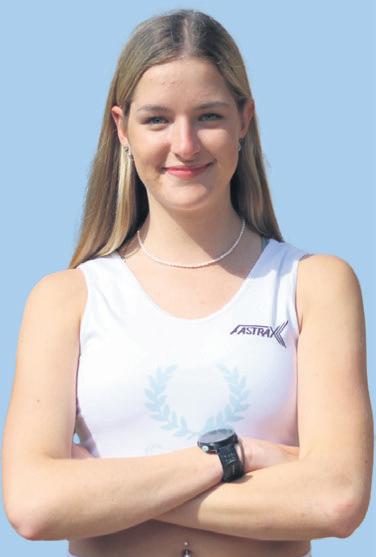
(likely in search of some actual waves) are not ones to miss. If you’re looking for a water-based team sport, water polo might be one to consider, but personally I don’t need to have my head dunked underwater to enjoy my time in a swimming pool.
University vs college
One of the bene ts of Cambridge’s collegiate system is that a range of sports are o ered at a college level, which is particularly useful for those who may not want to commit to training 6 days a week. Whilst also a great entry level for beginners, the standard of college sports is not something to sni at, with excellent talent on display especially in the top leagues and matches. Occasional training sessions and weekly matches provide a great way to stay t and get to know other people in your college without 6am wake-ups for that dreaded strength and conditioning session.
For those seeking this type of rigorous training schedule, university level sport is the one for you. You can also play against other universities, including in the highly-anticipated, annual varsity matches against the University of Oxford which are the highlights of the Cambridge sporting calendar. Plus, playing in one of these matches can even give you a shot at earning yourself the coveted status of a Cambridge blue, the highest honour awarded to a Cambridge athlete. However if you do achieve this, please try and refrain from bringing it up at every possible opportunity; we haven’t forgotten, we’re just bored of hearing about it.
Who is your sporting idol?
Keely Hodgkinson. I raced her growing up, and seeing her setting records and consistently medalling on the world stage at such a young age is inspiring. She seems to really enjoy what she does and balances everything so well. What is your best sporting moment?
Winning all selected matches inVarsity last year. After some devastating losses the year before, the comeback made it even sweeter.
Worst sporting moment?
Running theVarsity Course at Shotover in Oxford. 6k of wishing I could just stop and have a lie down every time the hills came.
Why running?
Running is such a universal sport- you can do it pretty much anywhere, with little equipment, and it doesn’t require much time. It’s great for exploring new areas and getting some alone time. Plus, I’m probably not co-ordinated enough for other sports.
Top songs to run to?
Cruel Summer byTaylor Swift or Fire by Kasabian. Morning or evening runs?
Morning for easy runs, evening for sessions. Any pre-race rituals?
Taking more ca eine than is probably medically advisable, even if the race is at 10pm.
What makes the hare and hounds the best?
e range of peo-











ple you meet, and how friendly and welcoming everyone is.
What is the best bit about being captain?
Having more of an excuse to talk about running.

Worst bit about being captain? I would say the excessive admin, but I love it really.
Is it easy for beginners to join?
We have an amazing Development Squad, leading runs several times a week, as well as a 5k in Fresher’s week. Plus, our club is special in that we have aVarsity match that is genuinely open to everyone. It’s in Cambridge this year (26/11), so please come along!
What might a typical training session look like?


Lots of laps of Churchill playing elds. Usually e orts of varying lengths. Eg: 3-5 × 3’,2’,1’.
Who should we look out for this year?
Poppy Craig-McFeely. Never seen a better turnaround in two months than her lead-up to last year’s Blues XC. Funniest moment with the team?
e BUCS afterparty celebrating our four medals, and the hungover coach back the next day. Varsity predictions?
7-0. Even if it means I have to get a Harey tattoo.
Friday 29th September 2023 31 Sport
New to the Cambridge sporting scene? Alex Berry gives you the rundown of the must tries and the niche sports for you to explore
▲ CAMBRIDGE UNUNIVERSITY ATHLETICS CLUB
▲ ED MARSH
❝If you want proper intensity, go play for the Blues. Don't impose it on the lies of myself
▲
Photo by Louis Ashworth
Sport
A freshers' guide to sport at Cambridge pg 31

Hare & Hounds Captain tells all pg 31
Plastic measures! Football blues show o recyled plastic kits
Football kits have evolved dramatically over the last 50 years. We have seen the rise of the sponsor, the fall of the collar, and now the resurgence of the retro. is year however, some teams in Cambridge are joining a wave of change more radical and fundamental: their kits will be made of plastic bottles.
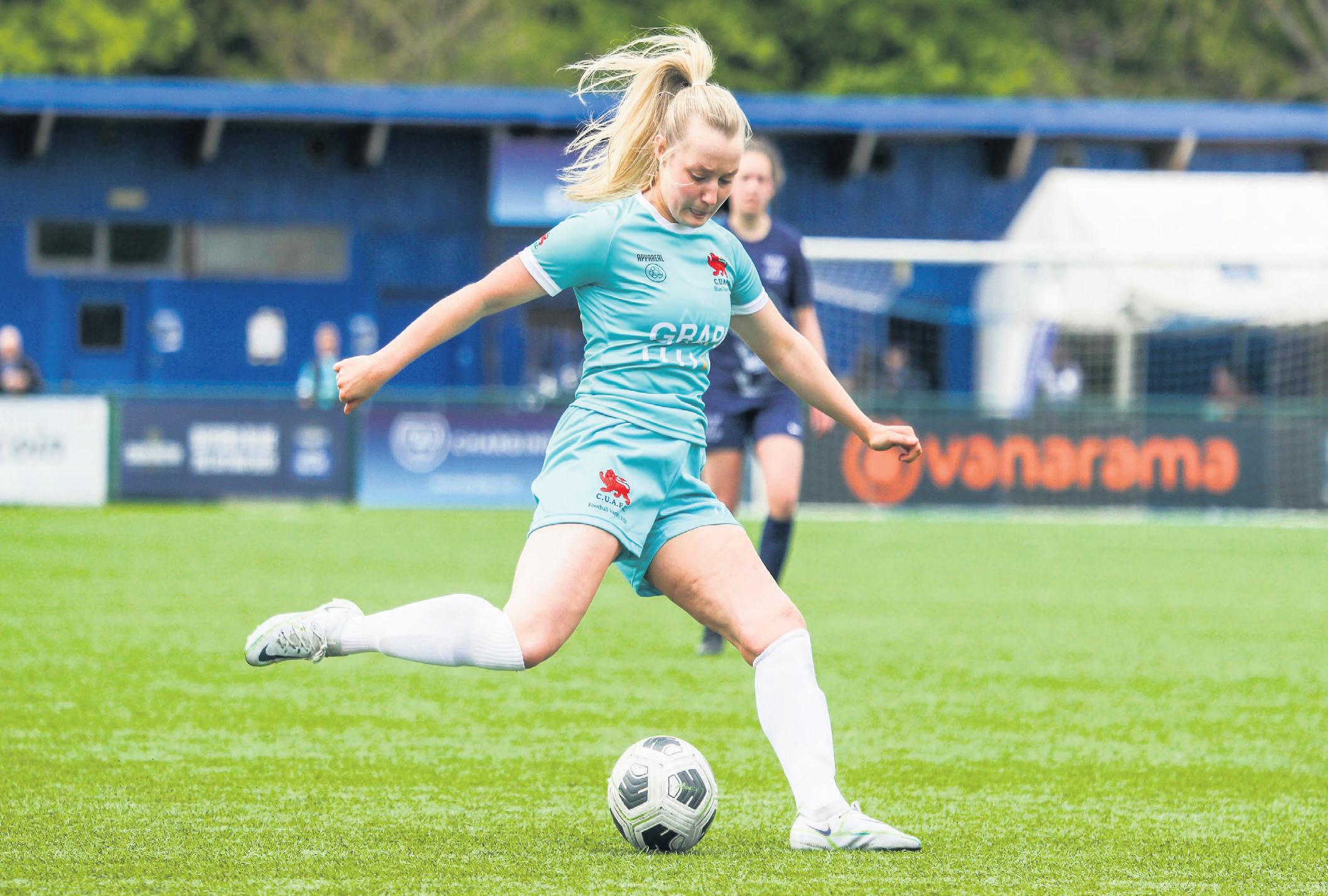
While trying to ignore Manchester United’s poor start to the season this summer, I received an exciting email. It was from Andy Wright, Selwyn alumni and co-founder of a clothing business with a sustainable mission. He was asking whether the venerable Robinson College FC would like to adopt their ecokits for next season. Naturally, like other teams in Cambridge, we were excited to get involved. It was also a great opportunity to ask Andy about the progress made in Cambridge sportswear, his hopes for the future, and the di culties in making eco-kits.


First Andy explained the impact.
Robinson’s set of stylish yellow and blue striped kits alone contains the equivalent of 425 half litre post-consumer PET plastic bottles. Compared to traditional manufacturing, every ton of PET recycled saves 3.8 barrels of oil, uses 86% less water, and 75% less energy. ey are also just as breathable and stretchy as conventional fabrics, which means the electrifying talent that gave Robinson its two famous victories last season doesn’t have to sacri ce performance.
e uptake in Cambridge began with the Varsity match last year, where both men’s and women’s teams sported Andy’s eco-kits. According to the Cambridge University site, this match alone recycled 2500 bottles. Following this success, both CUAFC women’s teams as well as the men’s rst team have con rmed that their next blues kit will be recycled.
As of the time of writing, Robinson and Trinity men’s are the only college teams con rmed, but Andy assures me he is in conversation with other colleges who are also eager. When asked whether the Cam-


bridge response has been positive, Andy replied, “yes, absolutely”, explaining that “most teams are keen to have the recycled logo on the shirt as a way to inspire others."


I was glad to hear that college captains across the university were so willing to embrace the change, and Andy really emphasised the importance of individual action in advocating for eco-kits. “ e greatest challenge is really to get people to demand that their sportswear is ‘eco,’” he said, before describing how “sports are dominated by the big brand companies, and they may have too much to lose to make fast switches”. at’s where Andy and Appareal come in. Unfortunately, nodding along to your favourite Varsity writer’s kit commentary doesn’t make much impact; we must vote with our wallets if we want to make environmental change.
And that change could be huge. Andy explained that “the amount of sports clothing using virgin textile (instead of recycled plastic) is enormous, in fact so enormous there are no reliable data sources." Tackling a problem of this scale therefore requires
a multi-faceted solution. He highlighted problems independent from kit-material, like the yearly three kit cycle in premier league clubs which promotes constant buying and throwing away of kits. But there are also problems that get less attention. “We need to address micro bre release," he explained, which “is inherent in all garments when washed," and must be addressed either by redesigning the washing machines we use, or changing the clothing fabric.
Currently the major interest in recycled sportswear has come in football, but the company’s mission is to expand to all sports. While at the moment the project is relatively small, it seems to me that Cambridge is a perfect environment for eco-kits to thrive, given the sheer number and variety of college teams at the university. But even more important is the freedom that we have in Cambridge to choose. While Manchester United is tied up by shareholders, kit sponsorships and
the tight pockets of the Glazers, the only restriction Robinson College FC has is its annual budget.
When I asked Andy for any nal words he’d like to broadcast to Varsity readers, he stated simply that “every single garment makes a di erence to our planet," and that “the change starts with us."
Whether buying a set of football kits, a car, or a banana, we should be conscious of what we are encouraging with our purchases. In this case, Cambridge’s blues and Robinson’s yellows are combining to help sports kits go green.
32 Friday 29th September 2023
Will McLaughlin
▲ IZZY POLES ❝
Every single garment makes a di erence to our planet
