VOLUME XCIX / NO. 4 · OCTOBER 25, 2026 · THE OFFICIAL STUDENT PUBLICATION OF THE UNIVERSITY OF SANTO TOMAS · Manila, Philippines
ON SOCIAL MEDIA
facebook/varsitarian
twitter@varsitarianust
youtube/TheVarsitarianUST
BREAKING NEWS & REAL-TIME UPDATES AT www.varsitarian.net
instagram varsitarian.ust
UST SUSPENDS 4 STUDENT ACTIVISTS; OSA ALLOWS APPEALS By Louisse Raye Shara C. Santos
FOUR THOMASIAN student activists have been suspended over their confrontation with Philippine Air Force (PAF) personnel during a military exhibit on campus, with the Office for Student Affairs (OSA) saying the students may seek a review and appeal the decisions. Sean Capalar of the College of Architecture, Dex Frogoso of the Faculty of Pharmacy, Ralph Manuel and Raven Racelis of the Faculty of Arts and Letters received separate suspension orders dated Oct. 2, according to OSA resolutions. The suspensions stemmed from the April 21 incident at the PAF exhibit held during the University’s 415th anniversary celebrations, when the students questioned military personnel about equipment, operations and alleged human rights abuses. Capalar received a five-day suspension and was removed as Central Student Council (CSC) public relations officer because of the effective loss of
her certificate of good moral character. Racelis was suspended for 10 days, while Manuel and Frogoso received eight- and four-day suspensions, respectively. The resolutions addressed complaints from the PAF and a UST alumnus, who raised concerns that the confrontation had drawn national attention and the reaction of Defense Secretary Gilberto Teodoro. The OSA said students found liable in disciplinary proceedings may challenge decisions through the University’s established review and appeal mechanisms. “Students may avail themselves of the review and appeal processes available under applicable University rules, subject to the prescribed procedures and requirements,” OSA Director Jaezamie Ong told the Varsitarian in an email. Ong said the office would maintain the confidentiality of disciplinary proceedings to protect the privacy of those involved and preserve the integrity of SUSPENDED PAGE 8
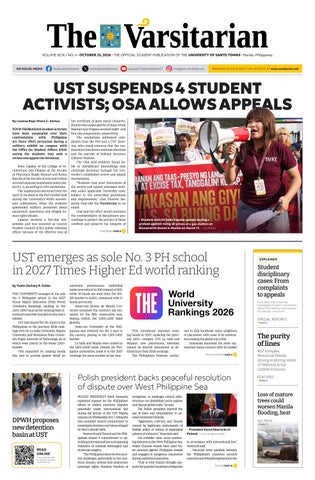
► Student activist Sean Capalar speaks during a
protest against rising oil prices at a gas station on Blumentritt Street in Manila on March 17. — FILE PHOTO
►
UST emerges as sole No. 3 PH school in 2027 Times Higher Ed world ranking By Yuahn Zachary B. Guilas
THE UNIVERSITY emerged as the sole No. 3 Philippine school in the 2027 Times Higher Education (THE) World University Rankings, landing in the 1,601-1,800 band as the ranking body introduced narrower brackets in this year’s edition. UST had shared the No. 3 spot in the Philippines in the previous 2026 rankings with De La Salle University, Mapúa University, and Mindanao State University-Iligan Institute of Technology, all of which were placed in the broad 1,501+ bracket. THE expanded its ranking bands this year to provide greater detail on
university performance. Individual ranks now extend to 300 instead of 200, while 18 bands are used from the 301325 bracket to 2,001+, compared with 11 bands previously. Jesuit-run Ateneo de Manila University remained the country’s top university for the fifth consecutive year, staying within the 1,001-1,200 band globally. State-run University of the Philippines also retained the No. 2 spot in the country, placing in the 1,201-1,400 bracket. La Salle and Mapúa were ranked in the 1,801-2,000 band. Overall, six Philippine universities made it to the 2027 rankings, the same number as last year.
EXPLAINER
Student disciplinary cases: From complaints to appeals How does the University investigate student misconduct, determine liability, and impose disciplinary sanctions?
SPECIAL REPORTS ► PAGE 5
THE introduced narrower ranking bands in 2027, replacing the previous 1,501+ category. UST, La Salle and Mapúa’s new placements, therefore, cannot be directly interpreted as declines from their 2026 rankings. The Philippines, however, contin-
ued to trail Southeast Asian neighbors in placement, with none of its universities making the global top 1,000. Indonesia remained the most represented Asean country with 42 ranked TIMES HIGHER ED PAGE 9
►
Polish president backs peaceful resolution of dispute over West Philippine Sea
DPWH proposes new detention basin at UST READ ONLINE
► Scan the QR code
to read this story at varsitarian.net
POLISH PRESIDENT Karol Nawrocki expressed support for the Philippines’ efforts to resolve maritime disputes peacefully under international law during his lecture at the UST Manila campus on Wednesday, Oct. 7, citing the two countries’ shared commitment to sovereignty, freedom and values shaped by their Catholic faith. Nawrocki said Poland and the Philippines shared a commitment to upholding international law and opposing violations of national sovereignty and territorial integrity. “The Philippines faces its own security challenges, particularly in the maritime domain. Actions that undermine sovereign rights, threaten freedom of
navigation, or endanger critical infrastructure can destabilize entire regions and disrupt global trade,” he said. The Polish president rejected the use of force and intimidation to advance territorial interests. “Aggression, coercion and threats cannot be legitimate instruments of foreign policy or means of expanding spheres of influence,” Nawrocki said. His remarks came amid continuing tensions in the West Philippine Sea, where Chinese vessels have used water cannons against Philippine vessels and engaged in dangerous maneuvers during maritime encounters. “That is why Poland strongly supports the peaceful resolution of disputes
The purity of lines BSP complex, Peninsula Manila among enduring works of National Artist Gabriel Formoso FEATURES ► PAGE 6
Loss of mature trees could worsen Manila flooding, heat SCI-TECH ► PAGE 11
► President Karol Nawrocki of
Poland. — UST FACEBOOK PAGE
in accordance with international law,” Nawrocki said. Nawrocki drew parallels between the Philippines’s maritime security concerns and Poland’s experience in the POLISH PAGE 10
►
2
THE VARSITARIAN • OCTOBER 25, 2026
NEWS
EDITOR: CARLO JOSE H. RUGA
Obiena, impeachment prosecutor Tolosa, Albert Martinez among 61 alumni awardees By Alexandra S. Demaisip
TWO-TIME OLYMPIAN pole vaulter Ernest John “EJ” Obiena, private impeachment prosecutor Benjamin Tolosa and veteran actor Albert Martinez are among 61 Thomasians who will be honored at the 11th Distinguished Thomasian Alumni Awards on Nov. 27. Obiena will receive the Young Thomasian Achiever Award, while Tolosa, who served as spokesperson and private prosecutor for the House prosecution panel in Vice President Sara Duterte’s impeachment case, will be recognized by the UST Law Alumni Foundation Inc. Martinez will be honored by the UST Education High School Graduates Association Inc. The awards, organized by the UST Alumni Association, recognize graduates who have distinguished themselves in their respective professions and contributed to society.
7 Thomasians land in top 10 of physician board exams SEVEN THOMASIANS landed in the top 10 of the October 2026 physician licensure examinations, led by Maxine Baculo, who recorded the highest score in the examination’s history, as UST emerged among the top-performing schools with a 100-percent passing rate. Baculo topped the examinations with a record 95.50-percent rating, while Ian Tan placed sixth nationwide with 94.25 percent and Justin Ang ranked ninth with 93.83 percent. Four other Thomasians — Alvin Alangco, Jeremee Cabral, Alain Chong and Mikaela Magpayo — tied for 10th place with identical scores of 93.75 percent. UST recorded a perfect passing rate as all 312 Thomasian examinees passed, improving from its 95.92-percent passing rate, or 47 of 49 examinees, in the March 2026 cycle. The University shared the top-performing school distinction with the University of the Philippines Manila, University of the East Ramon Magsaysay Memorial Medical Center, Ateneo School of Medicine and Public Health, and West Visayas State University, all of which also posted 100-percent passing rates. Nationwide, 4,165 of 4,445 examinees passed, equivalent to a 93.70-percent passing rate, up from 70.41 percent, or 1,954 of 2,775 examinees, in the previous cycle. LOUISSE RAYE SHARA C. SANTOS
Imee Marcos blocks UST law prof’s reappointment READ ONLINE
► Scan the QR code
to read this story at varsitarian.net
Three Thomasian bishops will be recognized by the UST Alumni Lay and Priests Association: retired Urdaneta Bishop Jacinto Jose, Bacolod Bishop Patricio Buzon and retired Kalibo Bishop Jose Corazon Tala-oc. Jose served as bishop of Urdaneta, Pangasinan, for more than two decades before retiring in May. Buzon was appointed bishop of Kabankalan, Negros Occidental, in 2003 before assuming leadership of the Diocese of Bacolod in 2016. Tala-oc served as bishop of Romblon beginning in 2003 before becoming bishop of Kalibo in 2011. He retired in 2025. The UST Law Alumni Foundation Inc. will also recognize Reginaldo Oben, chairman of the Oben Group of Toyota Dealers, and Department of Transportation Assistant Secretary for Communications and Commuter Affairs Hector Villacorta. Joining Obiena as Young Thomasian Achiever Award recipients are UST Communications Bureau Director Philippe Jose Hernandez, Jeremy Balusero and
side Asst. Prof. Rodelio Tiburcio, president of structural design consultancy firm RA Tiburcio & Associates Inc. Architecture alumna Maria Nina Arce, the first female Filipino architect listed in both the Association of Southeast Asian Nations and Asia-Pacific Economic Cooperation architect registries, will receive recognition from the UST Graduate School Alumni and Grants Association Inc. The association will also honor UST educator Asst. Prof. Jonathan Manalad and former United Architects of the Philippines national president Ma. Benita Regala. The UST High School Alumni Alliance Foundation will recognize Reynaldo Lopez, a co-founder of the Faculty of Arts and Letters Student Council, political science alumnus and former Artlets faculty member and program coordinator, alongside Ezequiel Delgado and Alfred Lasala II.
► From left: Actor Albert Martinez, athlete Ernest John “EJ” Obiena, and
lawyer Benjamin Tolosa.
Marcelino Bugaoan Jr. The UST Alumni Association will also honor Fine Arts alumnus Bayani Rumbaoa, a retired Bangko Sentral ng
Pilipinas coin designer who served as the central bank’s first and sole engraver for 35 years. Martinez will be recognized along-
ALUMNI AWARDEES PAGE X
►
Thomasians win at 48th Catholic Mass Media Awards SIX THOMASIAN entries, including an investigative report by UST Journalism students and a news story co-written by a former Varsitarian managing editor, won honors at the 48th Catholic Mass Media Awards (CMMA), announced during a Facebook livestream on Oct. 17. Nyah de Leon, a Journalism alumna and former managing editor of the Varsitarian, won the Best News Coverage award alongside Philippine Daily Inquirer colleagues Krixia Subingsubing and Dexter Cabalza for their report, “Debt service eats up biggest slice of budget pie; PH debt stock
projected to hit P19T by end of 2026.” Six UST Journalism students — Luisa Arranz, Kristine Concepcion, Neona Dela Cruz, Macie Maniquis, Kyanne Reyes and Renuel Novero —
won Best Investigative Report for their story, “A feast without a catch: Why fishing is no longer Angono’s economic lifeblood.” Fr. Allen de Guzman, O.P., former assistant regent of UST Junior High School, won Best Inspirational Song (Religious) for “The Lord is my Shepherd,” a composition inspired by Psalm 23 and performed by the Caleruega Children’s Choir. UST also bagged two awards in the student public service advertising categories. The University’s “Are You Human?” won Best Student Public Ser-
vice Print Ad, while “Ano, Tara?” received the Best Student Public Service Radio Ad award. Inter Nos, the official student publication of the UST Faculty of Sacred Theology, received a special citation in the Best Student Organ (College) category. Established in 1978 by the late Manila Archbishop Jaime Cardinal Sin, the CMMA recognizes outstanding works in print, broadcast, advertising, social media and student publications that promote Christian values, human dignity and social responsibility. TATYANA SABEERAH R. MARANAN
Philosophy prof: Removal of gen ed courses risks producing ‘efficient robots’ By Louisse Raye Shara C. Santos
REMOVING GENERAL education (GE) courses from the higher education curriculum risks producing “efficient robots” lacking cultural consciousness and critical and ethical thinking, a UST philosophy professor warned at a Commission on Higher Education (CHEd) symposium. Prof. Paolo Bolaños, former chairman of the UST Department of Philosophy, said GE courses were crucial to developing cultural knowledge and civic consciousness among students. “These [general education courses] are profoundly crucial because [they] are the very vehicles in the transmission of cultural consciousness,” Bolaños said during CHEd’s symposium titled “Goals and Structure of Higher Education Degree Programs.” “We risk producing very efficient robots who will not be able to think critically and decide ethically,” he added. Bolaños argued that cultural knowledge and civic consciousness form part of the foundation of economic growth and human capital and should not be viewed as being at odds with them.
“Citizens are members of society. To be a member of society means having cultural knowledge and civic consciousness,” he said. “Their consciousness will be devoid of national and institutional memory, and perhaps they will be blind consumers of AI-generated poetry and music because they have lost the ability to create art by themselves,” Bolaños added. CHEd previously proposed an overhaul of the GE curriculum that would reduce the required units from 36 to 18, raising concerns among academic groups over the possible removal or consolidation of courses in the humanities and social sciences. The implementation of the reframed GE curriculum was deferred to 2028 to allow further review of the proposal and consultations with stakeholders. Bolaños called for the planned curriculum changes to remain on hold while authorities assess whether they would actually improve graduate employability and quality. “We have been producing incompetent and employable graduates, but either we send them away to work abroad or they
‘‘
Their consciousness will be devoid of national and institutional memory, and perhaps they will be blind consumers of AI-generated poetry and music because they have lost the ability to create art by themselves. Prof. Paolo Bolaños
FORMER CHAIR OF THE UST DEPARTMENT OF PHILOSOPHY
don’t find work here at home,” he said. The symposium also tackled reforms implemented at the basic education level, including the K to 12 program. Bolaños said the country’s three main education agencies—the Department of Education, Technical Education and Skills Development Authority and
CHEd—lacked a unified framework. “We have three different offices that we have to admit, most of the time, don’t really talk with each other. The right hand doesn’t know what the left hand is doing. And so, fragmented ‘yung policies,” he said. (And so, the policies are fragmented.) He also urged the government to increase funding for research in the humanities. “The government should invest more in education, research, possibly in all fields, but most especially in fields that promote the highest expressions of human freedom,” Bolaños said. Among the subjects that could be affected by the proposed curriculum reform are humanities-related courses such as Ethics, Art Appreciation and the Contemporary World. Bolaños was joined at the symposium by House Committee on Higher and Technical Education Chair Jude Acidre, House Committee on Basic Education and Culture Chair Roman Romulo, Government-Academe-Industry Network President Monette Hamlin and IBON Foundation Research Executive Director Rosario Guzman.
THE VARSITARIAN • OCTOBER 25, 2026
3
WITNESS
ACTING EDITOR: YUVSHENKA ANDREA R. OSEA
Manila prelate: Rosary an antidote to isolation, division By Alexandra Gabrielle C. Mansineros
► UST CONFERS HONORARY
DOCTORATE IN THEOLOGY ON CARDINAL ADVINCULA. Advincula, a UST Sacred Theology alumnus, was recognized for his contributions in priestly formation, ecclesiastical leadership and pastoral service. — PHOTOS BY JOACHIM NIGEL Z. TANGLAO
Cardinal Advincula receives honorary doctorate in theology By Enzo Miguel D. Mejia
MANILA ARCHBISHOP Jose Cardinal Advincula received an honorary doctorate in theology from UST on Oct. 15, in recognition of his contributions to priestly formation, Church leadership and pastoral service. The degree of Doctor of Theology, honoris causa, one of the University’s highest distinctions, will be conferred at the Dr. Robert C. Sy Grand Ballroom of the Blessed Buenaventura García Paredes, O.P. Building. In an Oct. 8 memorandum, UST Secretary General Fr. Louie Coronel, O.P. said the conferment would recognize Advincula’s contribution to his ministry. “More than an academic celebration, this solemn occasion is an expression of thanksgiving to God for the gift of a faithful shepherd whose life and ministry reflect Christ’s loving care for His people,” Coronel said. The secretary general said the honorary degree would also affirm that “authentic wisdom finds its fullest expression when knowledge is placed at the service of faith, human dignity, and the common good.”
‘‘
A pastor is expected to teach, to preach, to make decisions, to give direction, to lead. But before all of these, he must learn to listen: to God, to the Church, to the signs of the times, to the people entrusted to his care, and especially to those who are voiceless. Cardinal Advincula
IN HIS ACCEPTANCE ADDRESS
Advincula obtained his bachelor’s degree in sacred theology from UST in 1975 and later studied canon law at the Pontifical University of St. Thom-
as Aquinas, or Angelicum, in Rome. He served as bishop of San Carlos in Negros Occidental beginning in 2001 before becoming archbishop of
Capiz in 2012. Pope Francis elevated Advincula to the College of Cardinals in November 2020 and appointed him archbishop of Manila in March 2021. He was installed at the Manila Cathedral on June 24 that year. In May 2025, Advincula became the first UST alumnus to participate as a cardinal elector in a papal conclave, which elected Pope Leo XIV. The Manila archbishop is also a member of the Priestly Fraternities of St. Dominic in the Philippines, having received honorary membership in 2022. Coronel highlighted Advincula’s episcopal motto, Audiam, or “I will listen,” which reflects his commitment to listening to the needs of the faithful. “Before we can teach, we must learn to listen; before we can lead, we must learn to serve; and before we can speak of God, we must first learn to hear His voice,” Coronel said. Advincula has kept close ties with his alma mater. On Oct. 4, he presided over the episcopal coronation of the centuries-old image of Our Lady of the Most Holy Rosary, patroness of the UST Santísimo Rosario Parish.
CBCP backs ‘Dapat Isa Lang’ signature drive vs. political dynasties THE CATHOLIC Bishops’ Conference of the Philippines (CBCP) has endorsed the citizen-led “Dapat Isa Lang” signature drive seeking the enactment of an anti-political dynasty law, calling on Catholic institutions and the faithful to support the initiative. In a pastoral letter signed by CBCP President and Lipa Archbishop Gilbert Garcera and issued on Friday, Sept. 25, the bishops’ conference called on dioceses, Catholic institutions, religious communities and lay individuals to back the initiative. “Public office must never become a family inheritance. It is a public trust, entrusted by the peo-
ple to serve all,” the CBCP said in the pastoral letter. The conference cited Article II, Section 26 of the 1987 Constitution, which provides for equal access to
opportunities for public service and the prohibition of political dynasties as may be defined by law. The CBCP said the constitutional provision had yet to be fulfilled and framed the proliferation of political dynasties as a “moral and ethical concern.” “When public authority is treated as private privilege, the common good suffers. When political opportunities are effectively reserved for a few, equal access to public service is diminished,” it said. The bishops’ conference warned that concentrating political authority within families could weaken political competition and limit opportunities for other qual-
‘‘
Whenever we bring the rosary, we are brought to charity and service. The rosary leads us to recognize and foster the dignity of the small and the vulnerable. Cardinal Jose Advincula ON HIS HOMILY
ified individuals seeking public office. It clarified that its support for the initiative was not directed against any specific political family, party, candidate or public official. “Our support is not directed against any particular family, political party, candidate, or public official. This initiative should not become an occasion for hatred, retaliation, or partisan division,” the statement said. Call to Catholic institutions, laity
The CBCP encouraged Catholic educational institutions and dio‘DAPAT ISA LANG’ PAGE 7
THE ROSARY can counter isolation and division by drawing people into communion and acts of charity, Manila Archbishop Cardinal Jose Advincula said during the episcopal coronation of Nuestra Señora del Santísimo Rosario de la Universidad de Santo Tomás on Sunday, Oct. 4. In his homily during the fiesta high Mass, Advincula said praying the rosary brought the faithful into communion with Christ and the Church and should lead them to serve others. “Whenever we bring the rosary, we are brought to charity and service. The rosary leads us to recognize and foster the dignity of the small and the vulnerable,” Advincula said. He said the Church began in communion and that Mary was at the heart of that communion. “Let reconciliation and solidarity win over our divisions in our families and communities. And especially here in this parish. Let us reach out our hands and open our hearts to welcome and accompany those who feel abandoned or [discouraged],” he said. Advincula said Mary, having received and borne Jesus, the “author of life,” was a bearer of life in the Church. “In her (Mary) company, we feel alive, at home, and at peace. In the evening rosary is the prayer that helps us receive, nurture, and give life,” the cardinal added. He urged devotees to practice charity, particularly toward the poor and underprivileged, and become agents of unity and assistance to others.
►
“Let our acts of devotion to Our Lady flow into acts of charity for one another, especially those who are needy and underprivileged among us. Let us foster and promote charity like Mary, our queen,” Advincula said. Advincula crowned the patroness during the 84th parish fiesta, following his issuance of an episcopal decree on July 16. An episcopal coronation is an honor granted by a diocese in recognition of an image’s history and the devotion surrounding it. With Pope Leo XIV scheduled to travel to Asia for World Youth Day 2027 in South Korea, the parish is seeking a pontifical coronation for the image next year.
4
THE VARSITARIAN • OCTOBER 25, 2026
EDITORIAL Beyond class suspensions: The problem isn’t just the rain
EDITORIAL
Heavy-handed safety measures on campus are mere stopgap without gov’t resolve ADDRESSING THE country’s growing problem of school violence requires tackling its root causes, because until then, the University’s measures will remain ineffective. Passing the burden to educational institutions to keep and maintain a violence-free environment is only a band-aid fix when it is the government that, for years under two administrations, blatantly fostered a culture of violence. It permitted an anti-drug president to denigrate Catholic figures, objectify women, and allow extrajudicial killings to stain the nation red. Schools should be safe environments, ones that allow growth. Yet, recent events led schools to question if their premises and stakeholders are still safe– a load that shouldn’t be theirs to begin with. Last June 22, an incident in San Jose National High School in Tacloban City that left three students dead and 20 injured rattled the nation with the first school mass shooting to be reported. This was followed by a stabbing incident in Las Piñas City last July 31. Most recently, gun-related incidents occurred at more schools. Last Aug. 18, Ateneo de Zamboanga University suffered from a shooting incident that took the lives of two students. Another school shooting occurred on Sept. 18 at Banga National High School in South Cotabato, leaving three students dead. Police investigations reveal that these events were caused by exposure to violent online games, school bullying, and easy access to firearms. However, psychologists and UST As-
sociate Professors John Manuel Kliatchko and Rodel Canlas refuted this, emphasizing that no single factor causes such acts of violence. Instead, a complex interplay of home life and environmental influences plays a pivotal role. These recent incidents prompted schools to heighten security and surveil-
Protecting students and stakeholders requires more than surface security measures.
It means restoring schools as safe spaces for learning, free from looming threats of violence. lance. While the measures offer temporary relief, it remains ineffective without government action. The University, in an attempt to make the campus safer, introduced mandatory bag inspections and metal detectors across gates and building entrances. While the effort is commendable, the heavy-handed approach to the problem
Newsdesk Notes CARLO JOSE H. RUGA
remains a concern, especially when the solution lies beyond tightening campus security. Instead of turning schools into barracks and intimidating students with overkill security, officials should probe more into the actual multifaceted roots of why students resort to violence in the first place. The government has undoubtedly contributed to this outcome, particularly as violence gradually embedded itself within the nation’s social fabric. Although children learn to distinguish right from wrong, when an environment normalizes such behavior, such actions inevitably occur. Schools and universities should not carry the blame for this reality. What the government can do instead is to investigate social media platforms for moderating content, strengthening gun ownership and responsibility status in the country, and taking steps to promote peace and social cohesion. To support high school students in particular, the University could enhance its mental health programs, encourage safer social media habits, and strengthen its existing anti-bullying measures. Although the school shooting incidents may be isolated cases that stem from deeper and more complex reasons, some of them very personal admittedly, this shouldn’t be the leeway for the government to delay resolving this issue. They should not wait until school violence replaces intermittent weather and rising heat indices as reasons for class suspensions. This pressing issue needs present EDITORIAL PAGE 6
►
THE OPENING weeks of the 2026-2027 academic year were marked by repeated class suspensions as the southwest monsoon, or habagat, brought heavy rains to Metro Manila. Beyond disrupting classes, however, these suspensions exposed deeper gaps in the country’s ability to forecast severe weather and protect communities. UST began classes through the enhanced virtual mode of instruction (EVM), while some freshman welcoming activities were postponed. Although remote learning maintained academic continuity, repeated schedule changes complicated students’ and faculty members’ plans. Inaccurate forecasts should not automatically be treated as failures by local officials or the Philippine Atmospheric, Geophysical and Astronomical Services Administration (PAGASA). Forecasting involves uncertainty, and authorities must make decisions based on available information. The more pressing concern is whether the country has invested enough in systems that make forecasts more reliable. PAGASA’s 2026 budget included P114.7 million for maintaining its weather surveillance radar network and P398.6 million for repairing and rehabilitating damaged weather stations and information technology facilities. These allocations must translate into functioning equipment, reliable data and timely warnings. Still, better forecasts alone cannot prevent flooding. Manila needs comprehensive drainage and flood-control infrastructure, not temporary measures such as using school grounds as catch basins. Investigations into alleged irregularities in flood-control projects also underscore the need to ensure public funds produce effective, properly maintained infrastructure. Local governments must establish clear protocols for translating weather advisories into suspension announcements. Manila Mayor Francisco “Isko Moreno” Domagoso faced criticism over the timing of an Aug. 17 announcement and later pledged to issue suspensions earlier. Yet mayors cannot independently predict the weather. They must weigh available forecasts against the risks faced by students and workers traveling during severe conditions. The Aug. 18 incident in which Thomasians were stranded on campus should prompt a review of emergency procedures and communication, not merely blame over individual decisions. UST, meanwhile, must strengthen its learning continuity plan. EVM provides an alternative when campus attendance becomes unsafe, but remote instruction cannot fully replace face-to-face learning. Clear transition procedures, timely announcements and reasonable flexibility for faculty members can prevent disruptions from becoming overwhelming workloads for students. Preparedness must also account for extreme heat, which can interrupt classes beyond the rainy season. The goal is not to eliminate every inaccurate forecast or suspension. It is to improve weather-monitoring systems, ensure flood-control projects work and prepare institutions before disasters strike. A resilient academic year requires more than a backup mode of instruction. It demands coordinated disaster planning so students’ safety and education do not depend on luck when the next storm arrives.
FOUNDED JANUARY 16, 1928 Amanda Luella A. Rivera Editor in Chief Frenchshield Shayne G. Delovieres Managing Editor Billy Andrei P. Ramos Associate Editor Carlo Jose H. Ruga News Editor Amador Denzel M. Teston Assistant News Editor Lilah Mikaela S. Paredes Sports Editor Luis Angelo N. Palma Special Reports Editor Yuvshenka Andrea R. Osea Acting Witness Editor Justin Jacob S. Urag Acting Features Editor Marielle F. Pesa Science and Technology Editor Kirsten Therese C. Barrameda Circle Editor Ashley Valkyrie E. Bueno Acting Literary Editor Aidan Raphael F. Caluyo Art Editor Mhyzell Dayne J. Oblepias Assistant Art Editor Djenhard Yreneo Raphael Y. Sapanhila Photo Editor Jed William V. Gocatek Layout Editor
News Paolo Emmanuel D.C. Blanco, Czeantal Naomi P. Delos Santos, Alexandra S. Demaisip, Yuahn Zachary B. Guilas, Tatyana Sabeerah R. Marananan, Louisse Raye Shara C. Santos Sports Dan Cedric V. Latasa, Charles Martin A. Manalang, Kurt Russel Vincent I. Miranda, Jay-Z V. Perez, Clyde Leanne M. Salamatin, Allanee Raye C. Valeriano Special Reports Nyl R. Dadiz, Ashley Madeleine D. Lampa, Mikaela Angela C. Villacorta Features Elihoenai Hazael B. Cortez, Alejandro Mari C. Eusebio, Phoebe Elaine B. Pua Witness Bruce L. Buenaventura, Alexandra Gabrielle C. Mansineros, Enzo Miguel D. Mejia Filipino Dan Cedric V. Latasa, James Maverick R. Talavera Science and Technology Bernadette E. Alpas, Marigela Isabel R. Cirio, Regis Avalo Jophiel L. Lim Circle Lianne Therese G. Espiritu, Inah Denise A. Manansala Literary Elizabeth Joy C. Castro, Charlize Ann D. Lavastida, Psalmuel D. Reyes, Prince Cassel O. Trono
Art Kathryn Grace S. Enriquez, Allana Elaine J. Libunao, Rich Harry A. Marbella, Arlene F. Turla, Natasha Aizhen B. Zaño Photography Danielle D. Atienza, Rogina Cassandra G. Baltazar, Jerick Marc Laurence C. Grimaldo, Ethan Joshua Nikholai F. Guisama, Mickaela Jamylle C. Sison, Joachim Nigel Z. Tanglao, Vio Neiro M. Villaescusa Editorial Assistant Joshua Emmanuel E. Camacho
Felipe F. Salvosa II Assistant Publications Adviser
Joselito B. Zulueta Publications Adviser
THE VARSITARIAN • OCTOBER 25, 2026
5
SPECIAL REPORTS
EDITOR: LUIS ANGELO N. PALMA
ART BY ARLENE F. TURLA
EXPLAINER
How UST handles student disciplinary cases, from complaints to appeals BY LUIS ANGELO N. PALMA AND AMANDA LUELLA A. RIVERA
HOW DOES the University investigate student misconduct, determine liability, and impose disciplinary sanctions? The suspension of four student activists following a confrontation with Philippine Air Force (PAF) personnel on April 21 has drawn attention to the University’s disciplinary procedures, including who may file complaints, how hearings are conducted and what remedies are available to students. Raven Racelis and Ralph Manuel of the Faculty of Arts and Letters received suspensions of 10 and eight days, respectively, while Sean Capalar of the College of Architecture and Dex Frogoso of the Faculty of Pharmacy were suspended for five and four days. Capalar was also removed as public relations officer of the UST Central Student Council. The Office for Student Affairs (OSA) imposed the sanctions through resolutions dated Oct. 2, citing violations of the University’s Code of Conduct during a military exhibit held as part of UST’s 415th anniversary celebrations. Who can file a complaint?
Under Policy, Procedure and Standard (PPS) No. 1032 of the 2026 Student Handbook, any person with personal knowledge of a possible violation of the Code of Conduct may file a complaint or incident report. The OSA handles cases involving outsiders, parties from different academic units and matters outside the jurisdiction of the Student Welfare and Development Committee (SWDC), which handles certain disciplinary cases within faculties and colleges. In the activists’ case, the OSA received an incident report from the PAF Public Affairs Office on April 25 and a complaint from alumnus David Nadora Jr. on April 28. The PAF later clarified that its report was not a formal complaint against the students. Nadora, a 2010 political science graduate, told the Varsitarian that he filed his complaint independently af-
ter repeatedly watching a video of the encounter posted by the students. He said his complaint concerned their conduct under the handbook, not their political views or exercise of freedom of expression. Although the revised handbook requires personal knowledge of an alleged violation, it does not specify whether this must come from firsthand observation or may be based on a recording. The handbook also allows proceedings to continue without the complainant’s participation. Withdrawing a complaint does not remove the University’s authority to investigate and resolve the case. How are students notified of the allegations?
Students facing disciplinary proceedings must be informed of the allegations and given an opportunity to respond. The four activists received notices to explain on July 31, accompanied by the PAF incident report and Nadora’s com-
plaint. The notices cited provisions of the 2018 Student Handbook concerning courtesy, peace and order, disrespect, serious disturbance, instigating or leading illegal activities, and unruly behavior. According to Racelis and Frogoso, the University applied the substantive provisions of the 2018 handbook but followed the disciplinary procedures of the revised 2026 handbook. What happens during a disciplinary hearing?
University disciplinary hearings are administrative and fact-finding proceedings, unlike adversarial criminal or civil trials. Students may retain legal counsel, but hearings do not necessarily follow courtroom procedures involving witness presentation and cross-examination. The four activists attended an OSA hearing on Sept. 17, where they were questioned individually. According to their accounts, the questions focused on their conduct toward PAF personnel and Racelis’s role in the confrontation. In their joint response, the students said they had approached the exhibit to inquire about military equipment and its possible involvement in operations linked to reported civilian deaths. They also alleged that PAF personnel questioned their political beliefs and organizational affiliations. The OSA cited video footage of the encounter among the evidence considered. Under the 2026 handbook, the OSA forms a three-member panel to investigate and resolve cases within its jurisdiction. What evidence is required to impose sanctions?
RELATED
AIR FORCE DENIES FILING COMPLAINT VS. 4 SUSPENDED ACTIVISTS READ ONLINE ► Scan the QR code to read this story at varsitarian.net
University disciplinary proceedings apply the standard of substantial evidence, defined under PPS No. 1032 as “such relevant evidence as a reasonable mind might accept as adequate to support a conclusion.” This is a lower standard of proof than proof beyond reasonable doubt in criminal cases and preponderance of evidence in civil actions.
Before imposing sanctions, the revised handbook requires the University to notify students and give them an opportunity to be heard. Written decisions must identify the relevant facts, summarize the student’s response, specify the violated rule, explain the findings and state the penalty. The OSA’s Oct. 2 resolutions imposed suspensions ranging from four to 10 days, withheld the activists’ certificates of good moral character and warned that similar conduct could result in more severe sanctions. What penalties may be imposed?
The 2026 handbook distinguishes students sanctioned with non-readmission, exclusion or expulsion from those given suspensions or lesser penalties. Students sanctioned with non-readmission, exclusion or expulsion for Code of Conduct violations are not issued certificates of good moral character. Those given suspensions or lesser penalties may receive qualified certificates if the OSA or SWDC determines that they have demonstrated rehabilitation during their remaining time at the University. The activists’ alleged violations were evaluated under the 2018 handbook, which may affect how their sanctions are treated. The old handbook states that organizations, officers or members “with on-going administrative case(s) or with penalties of suspension to expulsion shall not be allowed to take part in any organization-related activity.” How can students appeal?
Under PPS No. 1032, students may appeal disciplinary decisions on three grounds: grave abuse of discretion; serious errors in findings of fact or conclusions of law; and disproportionate or excessive penalties. Appeals must be filed in writing within 10 days of receiving the decision. SWDC decisions, after approval by the academic unit head and regent, may be appealed to the OSA, while OSA decisions may be appealed to the
Office of the Rector. Filing an appeal does not automatically suspend the implementation of a disciplinary decision unless the appellate authority orders otherwise for compelling reasons. Can students bring disciplinary cases to CHEd or the courts?
Education lawyer Joseph Noel Estrada, a UST Civil Law alumnus who represents Catholic schools, has emphasized universities’ constitutional academic freedom to establish disciplinary rules and impose sanctions. In an Oct. 12 column in The Manila Times, Estrada said universities may regulate student protests and penalize misconduct, provided they observe due process and impose proportionate sanctions. He also recognized students’ constitutional rights to freedom of speech and expression, including the right to peaceful assembly and protest. Estrada raised questions about whether the activists followed University regulations on permits, protest venues and proper conduct toward persons in authority, as well as whether the sanctions were proportionate, consistently imposed and carried out in good faith. In a subsequent Facebook post, he said the Commission on Higher Education (CHEd) is not an appellate body for student disciplinary sanctions. Students may seek judicial review of University decisions, although courts generally exercise restraint in matters involving academic freedom. Citing Garcia v. Faculty Admission Committee, Estrada said courts may intervene in academic decisions when there is marked arbitrariness. He also cited Ateneo de Manila University v. Capulong and Cudia v. Superintendent of the Philippine Military Academy, which recognized educational institutions’ authority to enforce disciplinary rules. Universities may enforce discipline, but their authority remains subject to due process and proportionality, while students retain their rights to freedom of speech and expression.
6
THE VARSITARIAN • OCTOBER 25, 2026
FEATURES ART BY ARLENE F. TURLA
ACTING EDITOR: JUSTIN JACOB S. URAG
The purity of lines BSP complex, Peninsula Manila among enduring works of Thomasian National Artist Gabriel Formoso BY ALEJANDRO MARI E. EUSEBIO AND JUSTIN JACOB S. URAG
THE BANGKO Sentral ng Pilipinas (BSP) Main Building Complex and The Peninsula Manila hotel are among Metro Manila landmarks designed by Thomasian architect Gabriel Formoso, whose works continue to be admired for their proportions, simplicity and adaptation to the Philippine climate decades after their construction. Formoso, a 1937 graduate of the former UST College of Architecture and Fine Arts, was posthumously proclaimed National Artist for Architecture under Proclamation No. 1414, signed by President Ferdinand Marcos Jr. on Sept. 1. The Varsitarian broke the news of his recognition on Sept. 9, alongside the proclamation of fellow Thomasian Alfredo Buenaventura as National Artist for Music. UST College of Architecture Dean Rodolfo Ventura said Formoso’s buildings have retained their appeal despite
Editorial ► FROM PAGE 4 solutions and focused eyes from the higher-ups. Protecting students and stakeholders requires more than surface security measures. It means restoring schools as safe spaces for learning, free from looming threats of violence. Amid the rise in cases of bullying and cheating to life-threatening conflicts, schools should not carry the burden alone of stemming violence on campus: they must also be supported by the government that has the principal duty to provide civil defense and peace and order. Quick patches such as metal detectors, bag inspections, and tighter security only provide temporary solutions to problems with deeper underlying causes. They are effective; however, they will remain only a stopgap unless there is national resolve.
changes in architectural styles and construction materials. “Hindi ka magsasawang tignan kahit ginawa ‘yan in the early ‘70s,” Ventura told the Varsitarian. (You will never tire of looking at it, even though it was built in the early 1970s.) Formoso’s architectural style was influenced by Brutalism, characterized by exposed concrete, rigid geometry and functional design. Ventura said the enduring appeal of Formoso’s works lay in their proportions rather than the materials used in
their construction. “The architects now are sometimes recognized for the materials that they use, which in a few years will be passé,” he said. “Of our alumni who became National Artists, we have five. Kung titignan mo ‘yong style at discipline nila, consistent. He’s like [Leandro] Locsin. Locsin has something about why the Cultural Center of the Philippines is still beautiful–not because of the material but because of the proportion. That is something you cannot buy.” (Of our alumni who became National Artists, we have five. If you look at their style and discipline, they are consistent. He is like Leandro Locsin. There is a reason the Cultural Center of the Philippines remains beautiful— not because of its materials, but because of its proportions. That is something you cannot buy.) Locsin, also a UST alumnus, was named National Artist for Architecture in 1990 and designed such landmarks as the Cultural Center of the Philippines and the Philippine International Con-
vention Center. Ventura also noted that Formoso’s designs took into account the country’s tropical climate and natural environment. “Kino-consider niya kung ano ‘yong makatotohanan sa Pilipinas. Malakas ang araw sa Pilipinas–tropical tayo dito. So ang design approach nila ay mahabang overhang na bahay, kasi ‘yon ang kailangan. Lush din ‘yong vegetation,” Ventura said. (He considers what is appropriate for the Philippine setting. The sun is strong because we have a tropical climate. Their design approach therefore incorporates long overhangs in houses because these are needed. The vegetation is also lush.) Other major projects attributed to Formoso include the former Metropolitan Museum along Roxas Boulevard, the Asian Institute of Management, the Development Academy of the Philippines, the Pacific Star and Lepanto buildings in Makati City, Club Filipino in San Juan and the Valley Golf Club Main Clubhouse in Antipolo.
Formoso obtained his professional license in 1939 and worked with architects Andres Luna de San Pedro and Pablo Antonio before establishing his own practice, Gabriel Formoso and Partners, now GFP Architects. Over more than four decades of practice, he designed about 80 buildings and more than 150 residences. Ventura described Formoso as belonging to a generation of Thomasian architects who were “disciplined, focused, and principled.” He said their architectural principles were reflected in the purity of their lines and their emphasis on proportion, balance and symmetry. “That makes them special, because they are the kind of architects who have great belief in something that will last forever,” Ventura said. Formoso’s distinctions include the Patnubay ng Sining at Kalinangan award from the City of Manila in 1977, as well as the Gold Medal of Merit and Likha Award from the United Architects PURITY OF LINES PAGE 10
►
Circle
Blanco brothers unveil mural depicting Artlets history
READ ONLINE
► Scan the QR code
► The 54 x 288-in. oil on canvas mural by the Blanco brothers is mounted at the lobby of the St. Raymund de
Peñafort Building. — PHOTO BY DJENHARD YRENEO RAPHAEL Y. SAPANHILA; CLOSE-UP SHOTS FROM HENRY SOLETA TENEDERO
to read this story at varsitarian.net
THE VARSITARIAN • OCTOBER 25, 2026
7
CIRCLE
EDITOR: KIRSTEN THERESE C. BARRAMEDA
How Thomasian National Artist Alfredo Buenaventura kept rondalla music alive LONG BEFORE he was named National Artist for Music, Thomasian composer Alfredo Buenaventura was helping preserve the Filipino rondalla tradition through arrangements, recordings and original compositions that brought the traditional string ensemble to wider audiences. Buenaventura arranged numerous pieces for the rondalla, with some recorded by the Villa Escudero Rondalla and Philippine Normal University (PNU) Rondalla and released by the Cultural Center of the Philippines (CCP) and the National Commission for Culture and the Arts (NCCA). In 2016, he composed “Rondalla Fantasy,” a work for the bandurria and octavina, two of the plucked-string instruments associated with the Filipino rondalla. His contributions to the rondalla formed part of a musical career spanning more than six decades, during which he incorporated Filipino folk songs, indigenous instruments and themes drawn from Philippine history and folklore into classical compositions. Buenaventura was named National Artist for Music under Proclamation No. 1414, signed by President Ferdinand Marcos Jr. on Sept. 1, alongside fellow Thomasian Gabriel Formoso, who was posthumously proclaimed National Artist for Architecture. The Varsitarian first reported their recognition on Sept. 9. From hometown band to national recognition
Born on Oct. 14, 1929, in Santa Maria, Bulacan, Buenaventura was introduced to music by his father, Vitallado, a violinist, and his mother, Felisa Santos, who enjoyed singing. He joined six of his brothers in their hometown band before moving to Manila
to study at Colegio de San Juan de Letran. While at Letran, he joined the tiples, or boys’ choir, of the prewar Santo Domingo Church, where he received training in piano, solfeggio and Gregorian chant. When World War II broke out, Buenaventura returned to Bulacan, where he served as a church organist, band conductor and arranger at about 13 years old. He returned to Letran after the war and completed high school in 1949 before enrolling at UST, where he pursued liberal arts and music. He earned an associate in arts degree from UST in 1951 and a bachelor’s degree in music, major in composition and conducting, from Centro Escolar University (CEU) in 1958. He later obtained a sacred music certificate from the Gregorian Institute in Manila in 1961. Assoc. Prof. Renato Lucas of the UST Conservatory of Music and the Research Center for Culture, Arts, and History described Buenaventura as a composer who remained connected to ordinary Filipinos through his music. “Looking at his works for the symphonic band, he’s a grassroots musician. He’s a grassroots composer. Nagkokompose siya para sa karaniwang tao,” Lucas told the Varsitarian. (He composes for ordinary people.) Buenaventura wrote extensively for symphonic and brass bands, producing music suited to both formal concerts and community celebrations. His compositions included “Overture
Among his major orchestral works were “Kayumanggi” (1971), “Bagong Pilipinas” (1973) and “Celebration for Piano and Orchestra” (1976). “Celebration for Piano and Orchestra” was performed at Carnegie Hall in New York by the American Symphony Orchestra, with Carol Rosenberger as soloist. He also composed “Lakambini” (1982) for violin and orchestra, which was recorded for the international market by violinist Carmencita Lozada and the Philippine Philharmonic Orchestra. His later works included “Maharlika” (2014) for violin and orchestra, “Trystan” (2016), a concerto for cello and orchestra, and “Hinaing” (2016), a one-act ballet. Operas rooted in Philippine history
ART BY JED WILLIAM V. GOCATEK
in C” (1958), “Bathaluman Concert Overture” (1965), “Dugong Kayumanggi” (1981) and “Dakilang Lahi” (1985), a concert overture for brass band. He also composed marches for festivals, religious processions and other community occasions. Preserving Filipino musical traditions
Buenaventura’s rondalla arrangements were among his contributions to preserving Filipino instrumental music. According to the CCP Encyclopedia of Philippine Art, recordings of some of his arrangements were performed by the Vil-
la Escudero Rondalla and PNU Rondalla and released through the CCP and NCCA. He also conducted rondalla ensembles, in addition to professional orchestras and brass bands. His work with the rondalla reflected a broader approach to composition that drew from traditional Filipino musical forms while employing techniques associated with Western classical music. Buenaventura incorporated folk melodies and indigenous instruments into orchestral compositions, helping establish a repertoire rooted in Philippine culture.
►
► FROM PAGE 3
‘Wantawsan’ weighs survival against political allegiance THOMASIAN FILMMAKER Joseph Abello makes his Puregold CinePanalo Film Festival debut with the full-length comedy-drama “Wantawsan,” which examines the uneasy choice between political allegiance and survival through a struggling father trying to provide for his son. The film follows Chito (Joross Gamboa), who receives P5,000 from a newly appointed mayor in exchange for his political support. Using part of the money, Chito sets out to provide an extravagant birthday celebration for his son Chester (Zion Cruz), but soon finds himself caught between patronage politics and his own principles. As Chito struggles to cover his family’s daily expenses while fulfilling the birthday celebration he promised his son, the consequences
RONDALLA ALIVE PAGE 9
‘Dapat Isa Lang’
CINEPANALO 2026
By Prince Cassel O. Trono
Buenaventura also drew inspiration from Philippine history, legends and folklore in his theatrical compositions. His operas included “Maria Makiling” (1961) and “Hinilawod” (1972), while his musical works for the stage included “Ginintuang Alaala” (1980) and “Banahaw and Juan Tamad” (1985). He received the Republic Cultural Heritage Award twice: in 1964 for “Maria Makiling” and in 1972 for “Kayumanggi Symphony.” His other distinctions included the Hiyas ng Bulacan Award in 1976, the Patnubay ng Sining at Kalinangan Award from the City of Manila in 1985 and The Outstanding Filipino Award for Music in 1995. Beyond orchestral and theatrical compositions, Buenaventura wrote sacred music for major religious celebrations, including “Philippines for Christ” (1964), “Salamat, O Birheng Mahal” (1978) and “Recoletos Mass” (1989). He also composed hymns, marches and commissioned works for educational institutions and Filipino communities.
of his political allegiance become increasingly difficult to ignore. The film’s political commentary emerges from Chito’s predicament, showing how patronage politics can exploit vulnerable citizens by turning their immediate needs into political obligations. At one point, Chito turns to a former employer and asks for a loan of “wantawsan,” his pronunciation of “one thousand,” or P1,000. His loyalty to the mayor repeatedly clashes with his immediate needs, forcing him to navigate the uncomfortable space between holding on to his principles and doing what he believes is necessary to survive. Chester serves as Chito’s moral compass throughout the film, stirring his father’s conscience whenever Chito is on the verge of compromising his principles. Their relationship eventually
► Chito, portrayed here by actor Joross Gamboa, takes a selfie
with a P5,000 dole from a politician in “Wantawsan.” — STILL FROM ‘WANTAWSAN’ TRAILER
becomes a means for Chito to view political power from a distance, underscoring the social divide between ordinary workers and those who wield authority. Through comedy, “Wantawsan” explores the contradictions of po-
litical allegiance, particularly when loyalty is sustained by material dependence. Beneath its humor, the film portrays an individual repeatedly forced to negotiate between personal integrity and basic survival.
ceses to facilitate peaceful dialogue and assist those supporting the initiative. In a direct appeal to the lay faithful, the bishops urged Catholics to integrate Gospel values into society by assessing the initiative and participating in the constitutional process. Citing Pope Francis’s apostolic exhortation “Evangelii Gaudium” and encyclical “Fratelli Tutti,” the letter described politics pursued for the common good as “a lofty vocation and one of the highest forms of charity.” The CBCP concluded its statement by calling for the constitutional provision against political dynasties to be put into effect. “After almost forty years, the constitutional command against political dynasties should no longer remain merely an aspiration. The time has come to give it genuine meaning in law and in political life,” the statement said. The citizen-led “Dapat Isa Lang” movement was launched in 2026 by the People’s Initiative Coalition Against Dynasty alongside civil society, religious and grassroots groups. ENZO MIGUEL D. MEJIA
8
THE VARSITARIAN • OCTOBER 25, 2026
FILIPINO
Grammarly pero Filipino?
Website para iwasto ang sulatin, binuo ng mga Tomasino BINUO NG apat na Tomasinong nagtapos mula sa College of Information and Computing Sciences (CICS) ang isang website na nagwawasto ng baybay at gramatika sa wikang Filipino bilang kanilang tesis. Tinawag na “ABKDa: Filipino Grammar Checker,” layon nina Arianne Ashley Manaog, Julia Melle Pascua, Lance Bernardino, at Miguel Carlo Fajardo na makapag-ambag sa akademikong pagsusulat gamit ang wikang pambansa. “Ito po ay isang kasangkapang idinisenyo upang tulungan po ang ating mga mag-aaral na nagsasalita ng Filipino na mapabuti ang kanilang akademikong pagsulat sa pamamagitan ng pagtukoy at pagwasto ng mga pagkakamali sa gramatika,” ani ng tagapayo ng grupo na si Asst. Prof. Edwin De Guzman. Ayon kay Manaog, naging daan ang kakulangan ng mga sanggunian sa online platforms para sa gramatikang Filipino upang mabuo ng grupo ang ABKDa. “Kasi napansin [namin] sa wikang Ingles, may mga reliable source tayong magagamit na website, specifically ang Grammarly,” aniya sa panayam kasama ang Varsitarian. “Makakatulong ‘to sa mga up-andcoming na mga students ngayon, kasi napapansin ko mostly, mga fluent sa English tapos hirap sa Filipino,” wika ni Fajardo. Ibinahagi ni Bernardino na isa sa mga inspirasyon nila ang umusbong na usapin
Suspended ► MULA PAHINA 1
the process. She added that the OSA remained available to guide students through the procedures. Under the 2026 student handbook, respondents may appeal decisions on grounds including grave abuse of discretion, serious errors in factual findings or legal conclusions, and disproportionate or excessive penalties. Appeals involving cases handled by the OSA must be filed with the Office of the Rector within 10 days of receipt of the decision. The OSA resolutions said the four students violated the Code of Conduct by failing to uphold the University’s principles and ideals. They also stated that the students would not be issued certificates of good moral character. The students faced disciplinary proceedings over alleged violations of handbook provisions on courtesy and peace and order, disrespect, and disturbance. Students, lawmakers protest suspensions
The sanctions drew criticism from student leaders and activists, who argued that the proceedings penalized the students for questioning military authorities and exercising their right to dissent. CSC Secretary Clarence Mindo described the suspensions as a weaponization of the student handbook against student expression and dissent. “This is unacceptable against genuine student rep-
hinggil sa wastong paggamit ng Filipino sa social media. “Nagkaroon ng maraming Facebook post tungkol sa paggamit ng ‘ng’ na maikli at ‘nang’ na mahaba,” wika niya. “At isa rin ‘to sa parang nagbigay ng ideya na maaari nating [gamitin] ang [ABKDa] bilang grammar checker.” Ipinaliwanag ni De Guzman na gumagamit ang ABKDa ng lemmatization, isang proseso sa lingguwistika na ibinabalik ang salitang may panlapi sa root word nito o salitang-ugat. Halimbawa nito ang “nag-aaral” “magaaral,” o “inaaral.” Sa pamamagitan ng ABKDa, awtomatikong matutukoy ang salitang-ugat nito na “aral” upang maging pare-pareho ang pagsusuri sa mga salita sa isang teksto. “It converts words to their root form to ensure consistency in text analysis,” wika ni De Guzman sa isang talakayan. Gumamit din ang mga mananaliksik ng calamanCy model, isang open-source natural language processing na inilapat sa ABKDa upang magsagawa ng part-ofspeech tagging. Layunin nitong matukoy ang gamit ng bawat salita batay sa konteksto at matukoy ang mga pagkakamali sa estruktura ng pangungusap. Halimbawa, sa pangungusap na “Si Juan ay mabilis na tumakbo sa paaralan,” tutukuyin ng ABKDa ang bahagi ng pananalita, gaya ng panghalip, pangngalan, pangatnig, pang-uri, pang-angkop, pandiwa, pang-abay at pang-ukol.
resentation,” he said, urging student leaders to speak out for their constituents. The four students separately opposed the decisions in statements released Sept. 17. Capalar argued that questioning authorities should not constitute a disciplinary offense, while Frogoso questioned the proceedings’ supposed focus on his political leanings. Manuel challenged the evidence used against the students, and Racelis defended dissent and criticism of state institutions. Racelis later described the suspensions as tactics to discourage students from speaking out. “And by filing case[s] against us, ito ay isang taktika para patahimikin ang buong komunidad para takutin na magsalita,” she said in a video statement. (And by filing cases against us, this is a tactic to silence the entire community and make people afraid to speak.) Activists staged a lightning protest along España Boulevard on Sept. 18 in support of the four students. On Oct. 6, Makabayan Bloc lawmakers also filed House Resolution No. 1512 seeking an inquiry into alleged cases of student repression and violations of academic freedom in universities, including the suspensions at UST. The lawmakers claimed the decision against the four students followed a hearing that relied principally on the PAF’s incident report. They also sought an investigation into 10 other cases involving students from different universities.
DIBUHO NI ALLANA ELAINE J. LIBUNAO
Gayunman, sinabi ni De Guzman na mahalagang magkaroon ng disclaimer ang mga mananaliksik sa paggamit ng ABKDa upang ipaalala sa mga gumagamit na maaaring magkaroon ng pagkakamali ang mga mungkahi o pagsusuri na ibinibigay ng artificial intelligence o AI. Isa rin sa katangian ng ABKDa ang error detection na kayang magsuri ng baybay at gramatika hanggang 2,000 na karakter. “Ang kaya niyang i-analyze ay hanggang sa 200 characters para po sa spelling at grammatical mistake using part-ofspeech tagging at predefined rules,” ani De Guzman. “Maaari din po mag-upload ng mga
dokumento basta po ito ay hindi lalagpas sa 2,000 or dalawang libong character,” dagdag pa niya. Hamon sa pagbuo ng Filipino grammar checker Ipinaliwanag ng miyembro ng grupo na si Pascua ang mga hamon na dala ng paggamit ng wikang Filipino sa paglikha ng isang grammar checker. “Ang mahirap din kasi sa language natin, iisa lang ‘yong spelling pero magkaiba ng intonasyon and use do’n sa mismong sentence,” wika ni Pascua sa panayam ng Varsitarian. “So chini-check niya rin ‘yun kung tama ba ‘yung pagkaka-structure no’ng context, sentence, or paragraph.”
Dagdag pa niya, gumamit ang ABKDa ng guardrails o mga limitasyong gumagabay sa AI upang makontrol ang mga tugon nito sa pagsusuri ng teksto. Naging batayan ng grupo ang “Manwal sa Masinop na Pagsulat” ng Komisyon sa Wikang Filipino sa pangangalap ng corpus. Ayon kay Bernardino, pinili nilang gumamit ng isang batayan para sa estandardisadong pamantayan na susundan. “Dahil kung mas maraming magiging basehan ‘yong rules ng Filipino, mas mahihirapan o magkakaroon ng confusion sa iba’t ibang standards na mayroon do’n sa isang libro,” aniya. Higit sa teknikal na aspekto ng pagbuo ng ABKDa, naniniwala ang mga tagalikha na mahalagang isama ang wikang Filipino sa pag-unlad ng teknolohiya. Ayon kay Manaog, pangunahing ginagamit ang wikang Ingles sa mga umuusbong na teknolohiya dahil naaabot nito ang internasyonal na antas ng komunikasyon, dahilan upang madalas naisasantabi ang wikang Filipino. “‘Yong wikang Filipino kumbaga hindi na siya masyado nagagamit or nagagamit lang siya kapag required,” wika niya. Nais nilang ipagpatuloy at paunlarin ang website upang hindi ito magtapos bilang isang tesis lamang. Dagdag ni Pascua, nais din nilang ipagpatuloy ang ABKDa para makasabay ito GRAMMARLY PERO PAHINA 10
2 Tomasino, wagi sa 2026 F. Sionil Jose Young Writers Award DALAWANG TOMASINONG manunulat ang pinarangalan sa kategoryang Filipino ng patimpalak pampanitikan na F. Sionil Jose Young Writers Award noong Sabado, ika-10 ng Oktubre, sa Henry Sy Sr. Building ng De La Salle University – Manila. Nagkamit ng unang gantimpala si Benjamin Joshua Gutierrez, instruktor mula sa UST Department of Creative Writing, para sa kaniyang maikling kuwento na pinamagatang “+1.” “Tungkol ‘yon sa kuwento ng isang ride-hailing app [driver] na gusto sanang umuwi bago mag-alas dose para makapag-celebrate ng birthday niya kasama [ang] mga mahal niya sa buhay,” ani Gutierrrez sa panayam ng Varsitarian. Dahil sunod-sunod na aberya at problema ang kanyang hinarap sa kalsada, hindi siya nakauwi sa takdang oras. Ginamit ni Gutierrez ang satirikal na tono sa paglalarawan ng kalagayan ng mga habal-habal rider na naghahanapbuhay sa kabila ng mga utang, sugal, at malisyosong tukso mula sa paligid. Noong 2018, kinilala bilang Rector’s Literary Awardee si Gutierrez sa ika-34 Gawad Ustetika, ang taunang patimpalak pampanitikan sa UST na inoorganisa ng Varsitarian. Nagtapos si Gutierrez ng journalism at kumuha ng masterado sa creative writing sa Unibersidad. Nagwagi ng ikatlong gantimpala si Jericho Christian Lopez, mag-aaral mula sa UST Graduate School, para sa kanyang akdang “Kasalang Bayan.” “Social critique ko ito sa nagpapatuloy na isyu ng flood control sa Pilipinas,” wika ni Lopez. “Mga ilang buwan na rin nang masulat ko ‘to ngunit parang wala pa ring nagbago at swak pa rin sa sit-
► Benjamin Gutierrez (kaliwa) at Jericho Lopez (kanan) — RETRATO NI ROGINA CASSANDRA G. BALTAZAR
wasyon ng bayan natin.” Sentro ng maikling kuwento kung paano ginagamit ng mga pulitiko ang krisis at midya upang hubugin ang pananaw ng publiko para sa pansariling interes. Inilalarawan ito sa pamamagitan ng paniniwalang nagpapakasal ang mga tikbalang kapag umuulan habang maaraw. “Angkop na tawaging fantasy ang aking kuwento na mayroong nakahalong political satire, commentary, at allegory sa state negligence at disaster management,” dagdag pa ni Lopez. Nagkamit ng ikatlong gantimpala si Lopez sa ika-41 Gawad Ustetika para sa parehong akda sa ilalim ng kategoryang Katha. Tatanggap si Gutierrez ng P25,000 para sa unang gantimpala, habang P10,000 naman kay Lopez para sa ikat-
long gantimpala. ‘Double-edged sword’ na AIverification policy
Sa unang pagkakataon, ipinatupad ng mga nag-organisa ng patimpalak ngayong taon ang AI-verification policy sa mga lahok na akda. Para kay Gutierrez, “magandang armas” ang pagpapatupad ng polisiyang ito sa kompetisyon upang bigyang-halaga ang pagsisikap ng mga kalahok sa paglikha ng mga orihinal na akda. “Gusto ko rin na sa ganiyang paraan, sinasabi nila na walang puwang ang mga makina sa proseso ng paglikha na dapat ginawa ng tao,” aniya sa panayam ng Varsitarian. Gayunpaman, itinuturing ni Lopez YOUNG WRITERS AWARD PAHINA 10
►
►
THE VARSITARIAN • OCTOBER 25, 2026
LITERARY
ACTING EDITOR: ASHLEY VALKYRIE E. BUENO
Manila Int’l Book Fair draws record crowd amid concerns over print decline THE 2026 Manila International Book Fair (MIBF) drew nearly 240,000 visitors, its highest attendance in 46 years, amid concerns that digital media are drawing readers away from print. The fair recorded 239,499 visitors during its five-day run at the SMX Convention Center in Pasay from Sept. 9 to 13, nearly double last year’s turnout of 123,000. Authors who participated in this year’s MIBF pointed to the record turnout as an indication that physical books continue to attract readers despite the proliferation of digital media. First-time MIBF participants Trish Shishikura and Ma. Cecilia Brainard challenged the notion that readers were veering away from physical books. Shishikura, who signed copies of her poetry collection “the end comes on without a gasp,” published by the Ateneo de Manila University Press, said physical books offered a different reading experience that could encourage focus and retention. “You know when you have a book and you’re holding on to it, there’s a certain tangibility that your brain associates with,” Shishikura told the Varsitarian. She added that reading a physical book could help readers avoid distractions from social media and other notifications. A study titled “Comparing Comprehension of a Long Text Read in Print Book and on Kindle: Where in the Text and When in the Story?” found that readers who used a printed pocketbook performed better than Kindle users in measures of chronology and temporality. The crowd at this year’s fair made Brainard reconsider her perception that people were reading less because of digitalization. “I always thought that people
Times Higher Ed ► FROM PAGE 1
universities, up from 35 last year, followed by Malaysia with 29, Thailand with 24, Vietnam with 14, the Philippines with six, Singapore with three, and Brunei Darussalam with two. A total of 120 universities from seven Asean countries and territories were included in the rankings, up from 104 in the previous edition. Asean top 100, global top 30
Five of the six Philippine universities in the rankings made THE’s list of the top 100 institutions in the Association of Southeast Asian Nations.
Rondalla alive ► FROM PAGE 7
A legacy in music education
Buenaventura devoted much of his career to teaching and developing Filipino musicians. He served as dean of the CEU Conservatory of Music from 1970 to 2000 and taught at several institutions, including the University of the Philip-
9
► Eager readers flock to the Manila International Book
Fair, the country’s longest-running book festival, at the SMX Convention Center in September. — PHOTO BY ROGINA CASSANDRA G. BALTAZAR
were reading less or shorter material, but I’m just overwhelmed at all these people buying books, being here, and being curious,” she said. Broadcast journalist Howie Severino, who launched his debut title “People I Knew: And Some I Didn’t, But Wrote About Them Anyway,” published by the UST Publishing House, said digital media had expanded the ways people accessed information without necessarily displacing print. “I think people just have more options in terms of getting their information,” Severino told the Varsitarian. “But I don’t think books will ever die.” Former Varsitarian editor in chief and author Cristina Pantoja-Hidalgo likewise pointed to the MIBF crowd as evidence that print continued to have a place alongside newer forms of media. “I don’t think it’s going to die. I think these two will proceed in tandem, print media and everything else that has happened since,” Hi-
dalgo said. Creative writing instructor Benjo Gutierrez said the digital divide reinforced the relevance of print, while online platforms influenced how readers consumed information. “Kapag may access sa digital media, usapin siya ng pribilehiyo rin sa isang banda,” he said. (Access to digital media is also, in some ways, a matter of privilege.) Another study, “A Comparison of the Influence of Electronic Books and Paper Books on Reading Comprehension, Eye Fatigue, and Perception,” found that students experienced greater eye fatigue when reading on digital devices, which could affect reading comprehension.
Ateneo de Manila was the first Philippine school to appear, 31st on the list, while the University of the Philippines was 49th. No Philippine university appeared among the first 30 institutions on the Asean list. UST, Asia’s oldest university, founded by the Dominicans in 1611, was the third Philippine school on the list, appearing 80th. La Salle of the Christian Brothers was 82nd and Mapúa, owned by the Yuchengco family, 86th. The National University of Singapore (NUS) remained the top Southeast Asian institution after climbing two places to a record-high 15th globally from 17th in the 2026 rankings. NUS joined China’s Tsinghua Uni-
versity, ranked 11th, and Peking University, ranked 13th, as the three Asian institutions in the global top 15. Singapore also placed two universities in the global top 30 for the first time, with Nanyang Technological University rising to 28th from joint 31st. Phil Baty, THE chief global affairs officer, said the latest ranking reflected a broader shift in the geography of global higher education, citing the record placements of universities in Singapore, Malaysia and Indonesia and the presence of three Asian institutions in the world’s top 15.
pines, Philippine Women’s University, St. Scholastica’s College, Ateneo de Manila University and Philippine Normal University. He also served as the first official organist of Manila Cathedral in 1961 and was active in professional organizations such as the League of Filipino Composers and the Pambansang Samahan ng mga Banda sa Pilipinas. As a conductor, he worked with the
Philippine Philharmonic Orchestra, Manila Symphony Orchestra, Metro Manila Symphony Orchestra and local brass bands. For Lucas, Buenaventura belonged to a generation of Filipino composers who helped create opportunities for musicians and sustain the country’s musical institutions. “They (significant musical figures in the Philippines) were catalysts in creat-
Crowding, bulk buying
The record turnout also prompted complaints about crowding and the availability of some titles. Some attendees took to social media to complain about limited space and alleged bulk purchases by online resellers.
In a comment on the MIBF’s official Facebook page, user Aki Kho claimed that some resellers bought limited stocks of popular titles in bulk and offered them online at higher prices. Several bookstores reportedly imposed purchase limits on selected titles. “It’s honestly sad to see, especially for readers who simply want to purchase books for themselves but end up missing out because certain titles are being purchased in large quantities,” Kho wrote. Initially called “Bookfair Manila,” the MIBF began in 1980 as a month-long exhibition organized by the Book Development Association of the Philippines and the Philippine Center for International Trade and Expositions. Carrying the theme “GET LIT: Reading in a New Light,” this year’s fair hosted more than 165 exhibitors. The next MIBF is set for Sept. 8 to 12, 2027. PRINCE CASSEL O. TRONO, WITH REPORTS FROM PSALMUEL D. REYES
Global ranking
The University of Oxford in the Unit-
ed Kingdom remained the world’s top university for the 11th consecutive year. It was followed by the Massachusetts Institute of Technology at No. 2, while Princeton University and Stanford University tied for third. The University of Cambridge rounded out the top five. A record 2,297 institutions from 118 countries and territories were ranked this year, up by 106 universities from 2,191 in the previous edition. THE World University Rankings assess research-intensive universities across their core missions using 17 performance indicators grouped into five areas: teaching, research environment, research quality, international outlook and industry.
ing jobs for musicians… ‘yung mga katalud namin mga regular musicians; we live through them,” Lucas said. Buenaventura’s contributions extended from the concert hall and classroom to community bands and rondalla ensembles, helping preserve Filipino musical traditions while developing original works for succeeding generations of performers. KIRSTEN THERESE C. BARRAMEDA
Creative writing alumnus explores anime, politics ANIME CAN shape political consciousness by giving audiences fictional worlds through which they can u n d e rs t a n d ►De Mesa complex realities, UST creative writing alumnus Franz Austin De Mesa argued in an essay published by Hong Kong-based Cha: An Asian Literary Journal. In his essay “A Look Back on Anime: Memoir, Poetics, and Literary Hedonism,” De Mesa reflected on the influence of Japanese animation on his childhood and its lasting impact on how he understood reality. “Sometimes, reality can be extremely complex that we gravitate towards fiction because it’s much [simpler],” he told the Varsitarian. “It has order. It has structure.” De Mesa recalled seeing the black flag inspired by the hit anime series “One Piece” during the “Baha sa Luneta” mass protest over the alleged multibillion-peso flood-control mess on Sept. 21, 2025, the 52nd anniversary of the declaration of Martial Law. The flag, associated with the series’ Straw Hat Pirates, has been used by protesters as a symbol of resistance. De Mesa said fictional characters and narratives could help people articulate calls for justice, particularly when real-world institutions failed to meet public expectations. Beyond political expression, De Mesa examined how anime could inform creative writing by drawing audiences into unfamiliar worlds without necessarily catering to their preferences. “There are a lot of different lessons that you can pick up in fiction that can be applied or most definitely must be applied to reality,” he said. De Mesa said compelling works reflected their creators’ visions and passions, inviting audiences to explore unfamiliar narratives, philosophies and perspectives. Anime also shaped De Mesa’s relationships with family members and friends, whom he considered important in making his stories more meaningful. His sister first introduced him to anime through her collection of compact discs, sparking a shared interest that they continue to bond over. De Mesa and his siblings would watch and discuss ongoing series, including “Bleach: Thousand-Year Blood War,” based on the final story arc of Tite Kubo’s original “Bleach” manga, and the romantic comedy “You and I Are Polar Opposites,” based on Kōcha Agasawa’s manga of the same title. “There’s this community of people who are in the same boat as you. That they’re all watching this simultaneously and all theorizing, analyzing the episode as it comes,” he said. De Mesa was a recipient of Gawad Ustetika, the Varsitarian’s annual literary competition in 2026 and 2022. He earned his degree from the UST Creative Writing program and is pursuing a master’s degree at the UST Graduate School. Founded in 2007, Cha: An Asian Literary Journal publishes essays, reviews, fiction, creative nonfiction, photography, poetry and visual art in English. PSALMUEL D. REYES
10
THE VARSITARIAN • OCTOBER 25, 2026
COMICS
ART EDITOR: AIDAN RAPHAEL F. CALUYO
THE BALDE IN ESPAÑA ARLENE F. TURLA
CRAVINGS NATASHA AIZHEN B. ZAÑO
Polish ► FROM PAGE 1 Baltic Sea, where threats to transport routes, energy infrastructure and supply chains also pose regional security challenges. He said the two countries’ commitment to freedom and sovereignty was rooted in their historical experiences of foreign domination and their struggles to preserve their national identities. “These shared experiences help explain why freedom, sovereignty and national independence hold such a special place in both our nations,” he said. Poland lost its independence for 123 years following its partition by neighboring powers in the late 18th century. It later came under communist rule and Soviet domination after World War II before the Solidarity movement helped bring about democratic change. Nawrocki also cited Catholicism as a common foundation of relations between Poland and the Philippines, particularly in shaping their values and commitment to solidarity. “Although Poland and the Philippines are separated by thousands of kilometres, religion plays an important role in both our societies,” he said. “Catholicism has helped to shape our values, strengthening our attachment to family, solidarity, responsibility and care for others,” he added. The Polish president paid tribute to St. John Paul II, whom he described as an important figure connecting the two predominantly Catholic countries. John Paul II visited the Philippines in 1981 and 1995, with his second visit coinciding with World Youth Day in Manila, the
Purity of lines ► FROM PAGE 6
of the Philippines in 1990. Ventura called for the preservation of Formoso’s architectural legacy, expressing concern over the deterioration of buildings designed by prominent architects. “They’re really worth preserving, and I’m very happy with the efforts, to a certain extent. Because I also get frustrated seeing other structures done by other
first to be held in Asia. “I know that he also visited this university, and I am proud to see how deeply you continue to remember and honour his legacy,” Nawrocki said. The Polish president also acknowledged the Philippines’s support for Poland’s accession to the Treaty of Amity and Cooperation in Southeast Asia, describing it as part of his country’s longterm commitment to strengthening relations with Southeast Asian nations. “In this sense, Poland and the Philippines share a similar ambition. By working together, we can contribute to a more inclusive, balanced, and representative international order,” he said. Nawrocki delivered the lecture, titled “Poland and the Philippines: From Shared History to a Shared Future,” during his visit to UST as part of his Oct. 5 to 8 state visit to the Philippines, the first by a Polish head of state since the two countries established diplomatic relations in 1973. During his visit to Malacañang on Oct. 6, Nawrocki and President Ferdinand Marcos Jr. discussed cooperation in defense and security, trade, agriculture, technology, tourism and cultural exchanges. Concluding his lecture at the Dominican-run university, Nawrocki invoked its patron, St. Thomas Aquinas, quoting the theologian on charity and friendship. “Charity, by which God and neighbor are loved, is the most perfect friendship,” he said. “Although the Philippines remains geographically distant to Poland, we indeed treat you like close neighbors and perfect friends,” Nawrocki added. ALEXANDRA S. DEMAISIP
prominent architects going to waste,” he said. The dean urged architecture students to emulate Formoso’s discipline and dedication to the profession. “Start with discipline and dedication to the craft, to the profession,” he said. “I believe everything else would follow if you have the focus and the love for it, and the dedication for it, the indepth aspiration to excel in this field.”
Alumni awardees ► FROM PAGE 2
The Tourism and Hospitality Management Alumni Association will honor Supreme Court administrator Maria Therea Toralba, Anchor Land Holdings Inc. executive director Digna Elizabeth Ventura and Frederic Tan Ching. Christian Rey Rimando, president of the Philippine Therapy Association, will be recognized by the UST Thomasian Alumni Leaders Association alongside Maria Lourdes Pacino and Luis Ubaldo. The UST Alfredo M. Velayo Accountancy Alumni Association Inc. will recognize Conrad Alvis and Fr. Marc Lim. The UST Atelier Alumni Association Inc. will honor miniature painter Nelson Castillo, Juanito Galang and Romeo Gutierrez. The UST College of Rehabilitation Sci-
Grammarly pero ► MULA PAHINA 8
sa mga modernong AI models. “Gusto namin mas mai-improve na architectural diagram ng ABKDa [para] makasabay siya sa sa mga AI models ngayon. Gusto rin namin syempre ma-develop na magamit siya sa research ng iba and lalo na when it comes to Filipino,” aniya. Sa kasalukuyan, nanatiling pribado ang website ng ABKDa nang isara ito ng mga tagalikha kasunod ng pagkumpleto sa proyekto. Ayon sa kanila, wala pang nakatakdang petsa para sa online publication ng ABKDa dahil sa kakulangan ng pondo para sa deployment at patuloy na operasyon ng cloud infrastructure.
Largest Asiad haul ► FROM PAGE 12
football team reached the quarterfinals for the second-straight time. The Philippine men’s baseball team featuring Mark Beronilla and JR Vargas placed fifth after bowing to Hong Kong in the classification round. Former Tiger judokas Chino Sy, Khrizzie Pabulayan and Daryl Mercado saw their campaigns end in the Round of 16 in the men’s under-100-kilogram, women’s under-63-kilogram and men’s under-60-kilogram divisions, respectively. Laila Delo was eliminated in the Round of 16 of the women’s -67-kilogram kyorugi event. In kurash, Margaret Fajardo and Czar Bayas ended their respective campaigns in the Round of 16 of the women’s
ences Alumni Association Inc. will recognize Paolo Manuel Jimenez, Mark Henry Joven and Assoc. Prof. Michael Jorge Peralta. Jose Bandong Jr., Rolando Diwa and Maria Cristina Rilloraza will receive recognition from the UST Golden Cross and Saber Alumni Association Inc. The UST Faculty of Pharmacy Alumni Association and Scholarship Foundation Inc. will honor Prof. Ma. Frieda Hapan, Judylyn Hidalgo and Erlinda Sabilo. Philippine Nurses Association President Norma Flores, Denise Angelo Pridencio and Gian Carlos Torres will be recognized by the UST Nursing Alumni Association. UST Graduate School alumni will honor its dean, Michael Anthony Vasco, alongside Jae Gu Kim, vice president of Geochang Provincial College in South Korea, and Emmanuel James Pattaguan. Ma. Theresa Cuaresma, Ramona Olga Ko
and Karen Pineda will receive recognition from the UST Pax Romana Alumni Association. Stroke Society of the Philippines President Arnold Angelo Pineda and Epifana Cantal will receive the Tomasinong Kapampangan Award. The Distinguished Thomasian Alumni Awards is an annual recognition for UST graduates who “embody Thomasian values and have achieved exceptional accomplishments in their fields, both in the Philippines and abroad.” The awarding ceremony will take place at the Dr. Robert C. Sy Grand Ballroom of the Buenaventura Garcia Paredes, O.P. Building. The Distinguished Thomasian Alumni Awards is different from the The Outstanding Thomasian Alumni or Total Award, the highest alumni distinction conferred jointly by UST and the alumni association.
Inilahad ng grupo sa Varsitarian ang tinatayang $2.50 to $82 o humigit-kumulang na ₱150 hanggang ₱4,800 kada buwan na gastusin para sa pagpapatakbo ng ABKDa, na nakasalalay sa paggamit ng iba’t ibang cloud services. Ang tinatayang gastos ay ang mga sumusunod: • Route 53: $0.50–$2 o P31 – P126 kada buwan • CloudFront: $0–$20 o P0 – P1,258 kada buwan • S3: $1–$5 o P63 – P315 kada buwan • API Gateway: $0–$10 o P0 – P629 kada buwan • Lambda × 4: $0–$10 o P0 – P629 kada buwan • SQS FIFO: $0–$5 o P0 – P315 kada buwan
• DynamoDB: $0–$15 o P0 – P944 kada buwan • CloudWatch / Logs: $0–$15 o P0 – P944 kada buwan “Maaaring mas mababa ang aktuwal na gastos kung maliit lamang ang traffic at storage requirements ng application,” paliwanag ni Manaog. “Maaari naman itong tumaas habang dumarami ang users, requests, data storage at iba pang paggamit ng cloud services,” dagdag pa niya. Bukod dito, hindi pa tiyak ng grupo kung ilan at sino ang magiging aktwal na gagamit ng ABKDa, kaya kinakailangan munang suriin ang potensiyal na bilang ng users bago ito gawing publicly accessible. JAMES MAVERICK
under-78-kilogram and men’s under81-kilogram divisions, respectively, while Bayas also exited the under-66kilogram tournament in the Round of 32. Janna Allysah Catantan was eliminated in the Round of 32 of the women’s individual foil, while Noelito Jose Jr. exited in the Round of 16 of the men’s individual épée. Alexa Larrazabal and Daniel Villanueva failed to advance from the group phase of the women’s individual épée and men’s sabre, respectively. They later competed in the team events of their respective disciplines but were eliminated in the Round of 16. China topped the medal standings with 169 golds, 89 silvers and 83 bronzes. Thailand was the highest-ranked Southeast Asian nation in seventh with 18 golds, 13 silvers and 21 bronzes.
R. TALAVERA
Young Writers Award ► MULA PAHINA 8
na may kaakibat na pakinabang at panganib ang naturang polisiya. “Pabor ako pero isa siyang double-edged sword,” wika niya. “Sa isang banda, naaagapan natin ‘yong invasion ng mga gawang-AI sa mga spaces ng panitikan, ngunit sa kabilang banda, AI rin naman ang ilang mga tool na ginagamit natin para makita kung gawang-AI nga ba ang isang akda,” saad ni Lopez. Dagdag pa niya, maaaring humantong sa maling akusasyon laban sa mga manunulat ang kawalan ng kredibilidad ng mga AI tool checker. Binigyang-diin niya ang “alinlangan” ng ilang manunulat sa paggamit ng bantas na em dash dahil kadalasang naiiugnay ito sa kung paano magsulat ang AI.
THE VARSITARIAN • OCTOBER 25, 2026
11
SCI-TECH
EDITOR: MARIELLE F. PESA
Loss of mature trees could worsen Manila flooding, heat according to campus biologist THE LOSS of mature trees along Quirino Avenue could aggravate flooding and urban heat in Manila and trigger a “domino effect” on air quality, biodiversity and public health, a UST biologist warned. Amid recent flooding in Metro Manila caused by the southwest monsoon, or habagat, Asst. Prof. Melanie Arbias of the Department of Biological Sciences stressed the role of mature tree canopies in absorbing rainfall and regulating temperatures in highly urbanized areas. Tree-cutting operations began in May after the Department of Environment and Natural Resources (DENR) issued a special permit covering 617 mature trees between Quirino Avenue and Roxas Boulevard. The clearing was undertaken to make way for the elevated four-lane Quirino segment of the 40.6-kilometer Southern Access Link Expressway. Arbias said the removal of mature trees could worsen flooding in the area and intensify heat during hotter months, while affecting air quality and local biodiversity. “What’s critical in terms of the presence of mature trees in Quirino is that, ilan na lang ‘yung mga mature trees sa City of Manila,” Arbias told the Varsitarian. (What is critical about the presence of mature trees along Quirino Avenue is that there are only a few mature trees left in the City of Manila.) “Since kakaunti na lang talaga din sila, lalong-lalo na ‘yung malalaking puno talaga, so kailangan talaga natin silang i-maintain. Actually, dapat nga paramihin pa ‘yung green spaces,” she added. (Since there are already so few of them, especially the large trees, we really need to maintain them. In fact, we should expand green spaces further.) Earth-UST President Sophia Padua likewise stressed the importance of having the appropriate trees in urban environments, particularly for air quality and public health. “Trees are like a natural filter for our air quality, and the type of tree matters because it cannot just be any kind of tree. If it is not suitable for its environment and the infrastructure around it, it can also pose a threat to public health,” Padua said.
duce water retention and the availability of nutrients needed to sustain plant life. The effects could extend to animals that depend on trees and other vegetation for food and habitat, she added. “Marami tayong interesting na mga fauna that depend on trees or plants,” Arbias said. “So, posibleng mag-migrate sila o kung hindi makaka-adapt, mamamatay at bababa talaga iyong population.” (We have many interesting fauna that depend on trees or plants. So, it is possible that they will migrate, or if they cannot adapt, they will die and their populations will decline.) Arbias said disruption of local biodiversity and the displacement of wildlife could also push animals into human settlements, potentially increasing the risk of zoonotic diseases, or diseases transmitted between animals and humans. As a mitigation measure, project proponent San Miguel Corp. has committed to planting 50,000 seedlings to replace trees felled and earth-balled along Quirino Avenue. But Arbias, a member of the Philippine Native Plants Conservation Society Inc., said seedlings could not immediately replace the ecological functions performed by mature trees.
‘‘
The youth can contribute to this by practicing green habits on their own, and if they don’t know how, [they can] learn how Ecological domino effect Arbias warned that the effects of los- to practice green. ing mature trees could extend beyond The resources are flooding and heat because human, animal and environmental health are inter- always available connected. She called for a “One Health” ap- online. proach to development rather than pursuing projects without fully considering their effects on ecosystems. “The health of humans, the health of animals, the health of the environment, they are interconnected and interrelated with one another,” Arbias said. She said the loss of mature trees could degrade soil quality and fertility and re-
‘Very strong’ El Niño threatens PH with drought, water shortages READ ONLINE
► Scan the QR code
to read this story at varsitarian.net
Sophia Padua
EARTH-UST PRESIDENT
“Kahit na 100,000 pa ‘yung ipalit mong seedling diyan, kailan pa sila lalaki?” she said. (Even if they plant 100,000 seedlings there, how long will it take for them to grow?)
Settle for silver ► FROM PAGE 12
fore a Cassie Carballo block on Mordi ultimately handed the 25-23 set to the Tigresses. The Lady Falcons found momentum in the third set as they established an 11-4 cushion, highlighted by kills from Nitura. UST, however, responded with a 12-5 spurt, capped by Em Banagua’s block against Third Tuddao, to take over the lead, 16-15. From there, both teams traded kills to deadlock at 23-all when an off-
Arbias said protecting existing mature trees was particularly important for conserving native species. “Unfortunately, walang makakapalit sa ecological roles ng trees and plants,” she said. (Unfortunately, nothing can replace the ecological roles of trees and plants.) Padua likewise stressed the value of mature trees in heavily built-up areas. “Trees are really vital to our community as they provide oxygen, they provide quality air. They’re a natural barrier to flooding, and they also bring life to the urban city,” she said.
► STUMPED. Only a
number of stumps remain on the sidewalks of Quirino Ave. after the tree-cutting operations in May. The tree-lined central island was replaced with concrete barriers, presumably to make way for the construction of an elevated tollway.
Island before tree-cutting (APRIL 2026)
— PHOTOS BY JOACHIM NIGEL Z. TANGLAO; STREET VIEW CAPTURE RETRIEVED FROM GOOGLE
‘Tip of the iceberg’
For Arbias, the tree removal along Quirino Avenue reflects the broader tension between urban development and the preservation of natural ecosystems. She described the tree-cutting and earth-balling along the avenue as only the “tip of the iceberg” and called for science-based sustainability measures to accompany economic development. “Maraming reclamation projects na nangyayari sa mga natural ecosystems pa. ‘Yung urban green spaces, kailangan natin sila kasi nga kakaunti na lang sila, so dapat talagang i-protect,” Arbias said. (There are many reclamation projects taking place in natural ecosystems. We need these urban green spaces, especially because so few of them remain, so they really need to be protected.) She also cited development pressures on wildlife habitats, including the proposed relocation of the Las PiñasParañaque Wetland Park. “Gusto pa natin ‘yung mga ibon ang mag-adjust para sa atin,” Arbias said. (We even expect the birds to adjust for us.) Padua said nature should be treated as an integral part of cities rather than something that could simply be removed
the-block attack from Mordi brought Adamson to set-point, 24-23. Rubin delivered an off-the-block hit to force deuce but an ensuing service error and a back-row kill from Mordi handed the set to the Falcons, 26-24. UST trailed closely in the fourth set until attacks from Mordi and Nitura powered Adamson to a six-point lead, 19-13. Nitura’s attack on an overpass sent the Lady Falcons to the championship point before an attack error from Marga Altea ultimately secured the match for Adamson, 25-15.
Island after tree-cutting (OCTOBER 2026)
to accommodate development. “I don’t think an urban area can properly function without nature in it because we are simply living in nature,” she said. “I don’t think you can take nature out of its home. You can only live in it.” Citizen science
Arbias urged communities to take part in citizen science and conservation activities to deepen public understanding of biodiversity. “Pwede pa rin tayong tumulong sa conservation at ma-appreciate ang ganda at kahalagahan ng biodiversity by being actively involved or mag-initiate ng tree walk activities, nature walk activities, and bird watching activities,” she said. (We can still help in conservation and appreciate the beauty and importance of biodiversity by becoming actively involved or initiating tree walks, nature walks and bird-watching activities.) “‘Yung maliliit na effort natin to con-
serve what we still have in terms of biodiversity, importante ‘yon,” Arbias added. (Our small efforts to conserve what we still have in terms of biodiversity are important.) Padua said Thomasians could contribute through environmental awareness, education and individual practices. UST has its own “green” initiative discouraging students from using single-use plastics. “The youth can contribute to this by practicing green habits on their own, and if they don’t know how, [they can] learn how to practice green. The resources are always available online,” Padua said. San Miguel had felled and earthballed 225 trees along Quirino Avenue before suspending the operations amid public backlash. The DENR has not issued an extension or a new permit since the previous permit expired on June 24. BERNADETTE E. ALPAS
Batter Ateneo ► FROM PAGE 12
a 26-all deadlock before Ateneo mounted a 6-1 run to move ahead, 32-27. Akowe and Buenaflor answered with consecutive baskets to give the Tigers a slim 34-32 lead at halftime. UST came out firing in the third quarter, unleashing a 15-0 run highlighted by a Mark Llemit self alley-oop and capped by an Acido 3-pointer to build a 49-32 cushion. The Tigers continued to stretch their advantage as Charles Esteban
and Landyn Jumawan knocked down 3-pointers, sending UST into the final frame with a 63-42 lead. Ateneo attempted to rally with a 14-6 run in the fourth quarter, sparked by Shawn Tuano’s baskets and Jared Bahay’s 3-pointer to cut the deficit to 69-56. Akowe and Llemit then combined to put the game away and secure UST’s 80-68 victory. Alas led Ateneo with 18 points on 5-of-20 shooting, while Andrew Bongo added 13 points and 6 rebounds. The league has yet to announce the schedule for the second round.
Sports
ONLINE
READ ONLINE
Tigers stun top-seeded Tamaraws to break 2-game skid
FOR REAL-TIME SPORTS UPDATES, FOLLOW:
@VSportsUST
► Scan the QR code
to read this story at varsitarian.net
The Varsitarian OCTOBER 25, 2026
► TIGER’S BITE. From left to right: Sofiah Pagara, Khylem Progella,
EJ Obiena, Jeus Yape, Juliana Candelaria, Tachiana Mangin. — ART BY AIDAN RAPHAEL F. CALUYO
HISTORIC
THOMASIANS CONTRIBUTE 6 MEDALS ON PH’S LARGEST ASIAD HAUL IN 64 YEARS BY LILAH MIKAELA S. PAREDES
THOMASIANS COMBINED for six medals as the Philippines wrapped up its campaign at the 20th Asian Games in Japan with four golds, nine silvers and 16 bronzes—the country’s biggest medal haul in 64 years. Thomasian athletes accounted for two gold, two silver and two bronze medals at the Games. The Philippines placed 17th overall, marking its strongest medal output since the 1962 Jakarta Games. UST Tiger Jin Jeus Yape spearheaded the Thomasian medal haul with a gold and a bronze, becoming one of only two athletes to secure two medals alongside gymnast Carlos Yulo. Yape captured gold in the mixed individual virtual taekwondo event and bronze
in the men’s individual poomsae. Thomasian standout EJ Obiena defended his men’s pole vault title after clearing 5.91 meters, surpassing his own Asian Games record of 5.90 meters set in Hangzhou in 2023. The victory also marked Obiena’s second consecutive Asian Games gold medal. Juliana Candelaria contributed a silver medal in the women’s individual poomsae after scoring 9.1300 points in the final. Fitness and Sports Management student Tachiana Mangin also earned silver in the women’s -49-kilogram kyorugi event. She advanced to the final after defeating Japan’s Ruko Okamoto in the semifinals before falling to China’s Ma Jingyue in the gold-medal bout. Tiger Sands duo Sofiah Pagara and
Khylem Progella secured bronze in women’s beach volleyball after defeating China’s Cao Shuting and Dong Jie, 13-21, 23-21, 15-13. Their podium finish delivered the Philippines’ first-ever Asian Games medal in beach volleyball. Several current and former Thomasian athletes also represented the Philippines in the Games. Former UST standout and Hangzhou Games gold medalist Annie Ramirez failed to retain her women’s -52-kilogram jiu-jitsu title after exiting in the Round of 16. Eya Laure and Josh Ybañez represented the Philippine indoor volleyball teams, which finished ninth and 13th, respectively. Sisi Rondina also competed in women’s beach volleyball but was eliminated in the quarterfinals.
Nic Cabañero and Koji Buenaflor helped Gilas Pilipinas reach the men’s 3×3 semifinals before the team finished fourth after losing to Iran in the bronze medal match. Kent Pastrana made her Asian Games debut with the Gilas Pilipinas women’s 5×5 team, which finished fifth after falling to Chinese Taipei in the quarterfinals. Former Tiger Softbelle Charlotte Sales and the Philippine Blu Girls missed the podium after falling to Chinese Taipei in the bronze medal match. The women’s 4x100m relay team featuring Lianne Pama placed fifth in the finals. Charisa Lemoran and the women’s LARGEST ASIAD HAUL PAGE 10
►
Tigresses settle for V-League silver By Jay-Z V. Perez
THE UST Golden Tigresses settled for silver in the V-League Collegiate Challenge after bowing down to the Adamson University Lady Falcons in Game 2 of the finals, 25-23, 23-25, 2624, 25-15, on Friday, Oct. 9, at the Filoil EcoOil Centre. Reigning UAAP MVP Shaina Nitura returned to action and spearheaded Adamson’s advantage in attacks, 62-47. Nitura and Frances Mordi scored 21 points apiece to lead Adamson to back-to-back titles. UST’s Angge Poy-
► Collins Akowe — PHOTO BY VIO NEIRO M. VILLAESCUSA
TIGERS BATTER ATENEO, END ROUND 1 WITH A BANG By Clyde Leanne M. Salamatin
THE UST Growling Tigers closed Round 1 on a winning note after battering the Ateneo Blue Eagles, 80-68, for their second straight victory in the UAAP Season 89 men’s basketball tournament Saturday, Oct. 17, at the Quadricentennial Pavilion. UST moved up to fourth place with a 4-3 record, while Ateneo slipped to seventh at 3-4. Collins Akowe paced the Tigers with 18 points and 15 rebounds, while Amiel Acido and Mark Llemit
added 15 points each. Kieffer Alas knocked down two 3-pointers to hand Ateneo an early 11-6 advantage before Koji Buenaflor responded from deep and Kirk Cañete followed with a basket to level the score at 11-all. Late-quarter turnovers from UST allowed Ateneo to reclaim the lead, 19-18, heading into the second quarter. The teams continued to trade baskets in the second frame, reaching BATTER ATENEO PAGE 11
►
os earned Best Outside Spiker honors alongside Mordi. Blessing Unekwe led UST with 12 points behind 7 attacks and 5 blocks, while Reg Jurado and Kim Rubin contributed 11 each. Down 5-0 in the first set, UST unleashed a 13-7 blitz, highlighted by attacks from Jurado, to lift UST ahead, 13-12. Adamson regained momentum when Nitura’s off-speed shot sparked an 8-3 Adamson run, 20-16. The Tigresses rallied behind a Jurado service ace that pulled UST within one, 22-21, yet two UST service errors
in the final stretch handed the set to the Lady Falcons, 25-23. The Tigresses came alive in the second set, building a 10-4 cushion behind back-to-back points from Unekwe. Middle plays allowed UST to maintain control in the set, 14-10, UST middles allowed UST to retain control yet Adamson snatched the lead with an 8-0 spurt, 18-14. Unekwe catched fire from there, to tie things at 19-all. The Tigresses took the lead behind an Unekwe attack beSETTLE FOR SILVER PAGE 11
►
Golden Booters vow to tighten defense
► Trez
READ ONLINE
► Scan the QR code
to read this story at varsitarian.net
Mariñas (left) and the Golden Booters (right).