VOLUME XCIX / NO. 3 · SEPTEMBER 27, 2026 · THE OFFICIAL STUDENT PUBLICATION OF THE UNIVERSITY OF SANTO TOMAS · Manila, Philippines
ON SOCIAL MEDIA
facebook/varsitarian
twitter@varsitarianust
youtube/TheVarsitarianUST
instagram varsitarian.ust
BREAKING NEWS & REAL-TIME UPDATES AT www.varsitarian.net
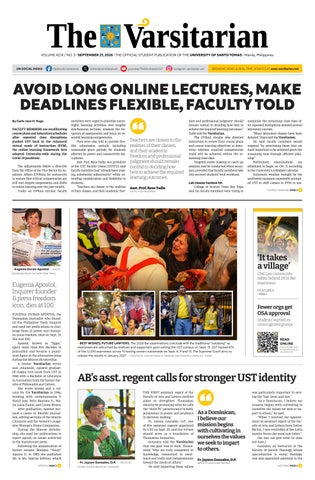
AVOID LONG ONLINE LECTURES, MAKE DEADLINES FLEXIBLE, FACULTY TOLD By Carlo Jose H. Ruga
FACULTY MEMBERS are recalibrating course plans and laboratory schedules after repeated class disruptions pushed UST back to the enhanced virtual mode of instruction (EVM), the online learning framework first adopted University-wide during the Covid-19 pandemic. The adjustments follow a directive from the Office of the Vice Rector for Academic Affairs (OVRAA) for instructors to ensure that critical competencies are still met despite suspensions and shifts to online learning over the past month. Under an OVRAA circular, faculty
members were urged to prioritize meaningful learning activities over lengthy synchronous lectures, reassess the frequency of assessments and focus on essential learning competencies. They were also told to provide flexible submission periods, including reasonable grace periods for students affected by power and connectivity disruptions. Asst. Prof. Rene Tadle, vice president of the UST Faculty Union (USTFU), said faculty members had “already been making substantial adjustments” while extending consideration and flexibility to students. “Teachers are closest to the realities of their classes, and their academic free-
‘‘
Teachers are closest to the realities of their classes, and their academic freedom and professional judgment should remain central in deciding how best to achieve the required learning outcomes. Asst. Prof. Rene Tadle USTFU VICE PRESIDENT
dom and professional judgment should remain central in deciding how best to achieve the required learning outcomes,” Tadle told the Varsitarian. The OVRAA circular also directed instructors to review their course plans and course learning objectives to determine whether required competencies could still be achieved within the remaining class days. Targeted onsite makeup or catch-up sessions may be conducted when necessary, provided that faculty members take into account students’ total workload. Lab classes hardest hit
College of Science Dean Rey Papa said his faculty members were trying to
FLEXIBLE DEADLINES PAGE 5
►
‘It takes a village’
► Eugenia Duran-Apostol — PHOTO
Civil Law community rallies behind 2026 Bar examinees
RETRIEVED FROM THE NEW YORK TIMES
Eugenia Apostol, Inquirer founder & press freedom icon, dies at 100
FEATURES ► PAGE 4
EUGENIA DURAN-APOSTOL, the Thomasian journalist who founded the Philippine Daily Inquirer and used her publications to challenge those in power and champion press freedom, died on Sept. 13. She was 100. Apostol, known as “Eggie,” spent more than five decades in journalism and became a prominent figure in the alternative press during the Marcos dictatorship. A former Varsitarian writer and columnist, Apostol graduated magna cum laude from UST in 1948 with a Bachelor of Literature in Journalism from the former Faculty of Philosophy and Letters. She wrote stories and a column for the Varsitarian in 1946, working with contemporaries F. Sionil Jose, Felix Bautista Jr., Maria Luisa Zumel, and Cenon Rivera. After graduation, Apostol pursued a career in lifestyle journalism, editing sections of the Manila Chronicle and the women’s magazine Woman’s Home Companion. During the Marcos dictatorship, she used her publications to report openly on issues restricted in the mainstream press. Following the assassination of former senator Benigno “Ninoy” Aquino Jr. in 1983, she published Mr. & Ms. Special Edition, which APOSTOL PAGE 2
maximize the remaining class days after repeated disruptions delayed several laboratory courses. “Many laboratory classes have been delayed,” Papa told the Varsitarian. He said faculty members would respond “by prioritizing those that are most important to be achieved given the remaining time through efficient planning.” Preliminary examinations are scheduled to begin on Oct. 9, according to the University’s collegiate calendar. Inclement weather brought by the southwest monsoon repeatedly prompted UST to shift classes to EVM or sus-
►
Fewer orgs get OSA approval Students warned vs. unrecognized groups
► BEST WISHES, FUTURE LAWYERS. The 2026 Bar examinations conclude with the traditional “salubong” as
examinees are welcomed by relatives and supporters upon exiting the UST campus on Sept. 13. UST hosted 674 of the 12,010 examinees across 15 testing centers nationwide on Sept. 6, 9 and 13. The Supreme Court aims to release the results in January 2027. — PHOTOS BY JOACHIM NIGEL Z. TANGLAO AND MICKAELA JAMYLLE C. SISON
READ ONLINE
► Scan the QR code
to read this story at varsitarian.net
AB’s asst. regent calls for stronger UST identity
► Fr. Jayson Gonzales, O.P. — PHOTO BY ETHAN JOSHUA NIKHOLAI F. GUISAMA
THE FIRST assistant regent of the Faculty of Arts and Letters (Artlets) plans to strengthen Thomasian identity by promoting what he calls the “three Ps”: perseverance in faith, persistence in prayer and prudence in decision-making. Fr. Jayson Gonzales, O.P., one of five assistant regents appointed by UST on Sept. 10, said the virtues should serve as a foundation of Thomasian formation. Gonzales told the Varsitarian that the goal was to form Thomasians “who are truly competent in knowledge, committed to excellence and truth, and compassionate toward the needs of others.” He said imparting these values
‘‘
As a Dominican, I believe our mission begins with cultivating in ourselves the values we seek to impart to others. Fr. Jayson Gonzales, O.P. ARTLET’S ASSISTANT REGENT
was particularly important in serving the “last, least, and lost.” “As a Dominican, I believe our mission begins with cultivating in ourselves the values we seek to impart to others,” he said. “When I received my appointment as assistant regent of the Faculty of Arts and Letters from Father Rector, I was reminded of the Latin maxim Nemo dat quod non habet.” (No one can give what he does not have.) Gonzales, an instructor at the Faculty of Sacred Theology whose specialization is moral theology, was also appointed assistant to the ASSISTANT PAGE 2
►
2
THE VARSITARIAN • SEPTEMBER 27, 2026
NEWS
EDITOR: CARLO JOSE H. RUGA
UST labor groups hit P25 cut in Metro Manila wage hike
Ex-CNN editor: human reporting key to trust in AI era
UST LABOR groups joined a protest outside the Manila Hotel on Thursday, Sept. 10, opposing the newly approved P60 minimum wage increase in Metro Manila and calling for the full P85 increase granted under an earlier wage order. The National Wage Coalition and other labor groups held the protest as the Department of Labor and Employment’s (DOLE) National Wages and Productivity Commission met at the hotel to discuss the P60 wage increase under Wage Order No. NCR-28. The groups called for the revocation of NCR-28 and the implementation of the P85 increase under NCR-27, which was halted by a court order. The Metro Manila wage board approved NCR-28 through a 4-3 vote on Sept. 7. The order, which raises the daily minimum wage by P60 to P755 from P695, has been forwarded to the National Wages and Productivity Commission for review. Under NCR-27, workers were supposed to receive a P60 increase starting July 25 and another P25 on Jan. 20, 2027, raising the minimum wage for nonagricultural workers to P780 from P695. Donnel Siazon, president of the Ugnayan ng Nagkakaisang Manggagawa ng UST Hospital, said the P25 difference could significantly affect workers’ monthly take-home pay. “Malaki ‘yung impact ng difference ng P25,” Siazon said, noting that the re-
► The Ugnayan ng Nagkakaisang Manggagawa ng UST Hospital (UNM-USTH) and United Private Hospital Unions
of the Philippines (UPHUP) joined other labor groups in a mobilization outside The Manila Hotel on Sept. 10, to protest the reduction of the approved minimum wage increase. — PHOTO BY JERICK MARC LAURENCE C. GRIMALDO
duction translates to a P400 to P500 reduction in a worker’s monthly earnings. Siazon said the impact could extend to tenured workers who might be entitled to wage distortion adjustments following a minimum wage increase. Siazon warned that the wage issue could affect some 1,200 workers at the UST Hospital. Rene Luis Tadle, vice president of the UST Faculty Union (USTFU), also rejected Wage Order NCR-28, saying
the P60 increase fell short of the P85 adjustment originally granted under NCR-27. “This is not a small amount for workers,” he said, noting that private educational institutions also employ minimum-wage earners. Tadle said the reduction would directly affect workers’ families, livelihoods, and dignity. In a Sept. 9 statement, USTFU said the single P60 increase would deprive
workers of the additional P25 that was supposed to take effect in January. “Labor policy must consistently uphold the principle of non-diminution of benefits; rights already secured ought never to be scaled back by administrative decree,” the statement read. The union also said the issuance of NCR-28, while legal proceedings involving NCR-27 remained pending, underWAGE HIKE PAGE 4
►
Bus loses brakes on España, leaves 1 dead, 9 injured in crash
► The front portion of the colliding bus is completely wrecked
from the impact of the multi-vehicle crash along España Boulevard on Sept. 11. — PHOTO BY JOACHIM NIGEL Z. TANGLAO
Assistant ► FROM PAGE 1 vice rector for religious affairs. He earned his bachelor’s degree in philosophy from the Philippine Dominican Center of Institutional Studies in 2011 and his bachelor’s degree in sacred theology from UST in 2014. He obtained his licentiate and master’s degrees in theology, major in moral theology, from UST in 2018. Gonzales passed the Licensure Examination for Teachers in 2014. He defended his doctoral thesis on May 5 at the Pontifical University of St. Thomas Aquinas in Rome. The other assistant regents appointed were Fr. Cecilio Magboo, O.P. for the Conservatory of Music; Fr. Ivan Obando, O.P. for the Faculty of Pharmacy; Fr. Valentinus
NINE PEOPLE were injured after a bus lost its brakes and crashed onto several vehicles on España Boulevard on Friday night, Sept. 11. Among the vehicles hit were a motorcycle, two jeepneys, a sport utility vehicle (SUV) and a minibus. The RAHA Volunteers Fire Department, one of the responding groups, said three people sustained injuries requiring hospital treatment, while five others suffered minor injuries. As of Sept. 13, one person has died following the collision, while nine others were injured, according to the Land Transportation Franchising and Regulatory
Ruseno, O.P. for the Faculty of Engineering; and Fr. Rudolf Seño, O.P. for the Junior High School. It was the first time UST appointed assistant regents to academic units other than the old UST High School, now the Junior High School, which had an assistant regent before, the Education High School and the College of Education. Regents are Dominican priests assigned to the University’s academic units to oversee their religious and spiritual formation and help ensure that their programs and activities remain consistent with UST’s Catholic and Dominican character. Gonzales will work with the Artlets regent, Fr. George Phe Mang, and Dean Melanie Turingan-Marcos. YUAHN ZACHARY B. GUILAS
Board. The agency identified the fatality as a senior citizen. The motorcycle driver and passenger were among those who required hospital treatment after they were trapped between two jeepneys. Responders at the scene told the Varsitarian that some of the injured were brought to UST Hospital. RAHA said its team and the Manila Disaster Risk Reduction and Management Office confirmed that others were taken to Jose R. Reyes Memorial Medical Center and Ospital ng Maynila.
Apostol ► FROM PAGE 1 documented Aquino’s assassination and funeral and the growing opposition to the Marcos administration. In December 1985, Apostol, Betty Go-Belmonte, and Max Soliven founded the Philippine Daily Inquirer, which became the country’s leading newspaper and played a significant role in covering the 1986 People Power Revolution. She later founded Pinoy Times, a tabloid that reported on corruption allegations against President Joseph Estrada amid the events leading to his ouster during the 2001 EDSA II uprising. UST honored Apostol in 1999 with the Outstanding Thomasian Alumni Award for Media for her contributions to press freedom. In 2006, she received the Ra-
ESPAÑA CRASH PAGE 4
►
mon Magsaysay Award and was named one of Time magazine’s “Heroes of Asia.” During a 2008 lecture, Apostol urged campus writers and media practitioners to practice “fearless journalism,” emphasizing the press’s role in holding those in power accountable. “The main job of the newspaper is to be a watchdog, not to be anybody’s puppy dog or tuta,” Apostol said. (The main job of the newspaper is to be a watchdog, not to be anybody’s puppy dog.) Apostol credited her UST education with helping shape her career as a journalist. “You can see the evidence of how UST can train a journalist, and my training came from it,” she told the Varsitarian in 2004.
JOURNALISM MUST remain human-led even as newsrooms adopt artificial intelligence (AI) if the profession is to rebuild public trust, former CNN deputy managing editor James LeMay told aspiring journalists at UST on Sept. 15. LeMay, who also ran CNN’s “Newsource” bureau in Washington, D.C., said human judgment remained critical as journalists contend with misinformation and the growing use of AI in news production. “You need to be distinctive, and you need to understand what it takes to be powerfully important to the people you’re talking to…human judgment still remains critical to the consumer,” he said during the forum “The Future of AI in Journalism.” The Peabody Award-winning journalist said reporters should draw on their understanding of the communities they cover rather than allow technology to diminish the human element of reporting. He also urged aspiring journalists to prioritize verification and transparency amid the proliferation of false and misleading information, some of it generated or amplified using AI. “Transparency is the new currency; everything you do needs to be transparent. The current consumer wants to know how you got that story, what you did with that story, what tools you used to verify that story,” LeMay said. LeMay cautioned against relying on AI as a substitute for critical thinking, warning that doing so could “diminish a journalist’s distinct voice.” He encouraged journalists to develop verification skills such as reverse-image searching, checking metadata and geolocating digital material. LeMay also called on journalists to take part in discussions over policies governing AI and journalism rather than leave regulation solely to governments. “Governments tend to think they’re the experts in this area, and they create legislation that often doesn’t always fit the problem. So the result that we need to make clear here is do the best you can to make sure you’re creating your own regulations, your own policies,” he said. LeMay served as vice president of news at WJLA in Washington, D.C., and WEWS in Cleveland. He has received an Emmy for investigative reporting, a Peabody Award, a duPont-Columbia Award and an Edward R. Murrow Award. The forum, held at the UST Civil Law Auditorium, was organized by the UST Department of Journalism and the U.S. Embassy. JED L. AMPONGAN
SPECIAL REPORTS
DUTERTE MAKES FIRST IN-PERSON APPEARANCE BEFORE ICC READ ONLINE ► Scan the QR code to read this story at varsitarian.net
THE VARSITARIAN • SEPTEMBER 27, 2026
3
EDITORIAL A date of reckoning Acid Test AMADOR DENZEL M. TESTON
FOR THOSE without firsthand experience of how the country was governed during Ferdinand Marcos Sr.’s declaration of Martial Law, September 21 may seem like nothing more than an ordinary date on the calendar— easily dismissible. For the more than 8,000 individuals—including senators, civil libertarians, journalists, and activists— who, according to the government’s Official Gazette, were detained without due process following the declaration of Martial Law, however, it cannot be easily dismissed. For them, September 21 was a date of reckoning, marking the start of the repression of their civil liberties and public dissent. When the late dictator imposed Martial Law nationwide, it triggered the slow descent of the country toward systemic corruption and normalized human rights violations. Trust in institutions eroded and public resources were continuously siphoned. The free press was gutted. Only administration-approved news media agencies were allowed to operate. Many of them were owned and controlled by Marcos cronies.
EDITORIAL
Patchwork basin
As memories fade and disinformation persists, remembering the past becomes more than an act of remembrance—it becomes a responsibility for the generations that inherited its lessons.
Why Manila’s flood fix demands real (not ghost!) comprehensive infrastructure THE PROPOSED underground rainwater detention facility beneath the University of Santo Tomas’ Open Field is intended to temporarily store excess rainwater and release it gradually into the drainage system. The Metropolitan Manila Development Authority has proposed a facility with a capacity of about 72,000 cubic meters, arguing that it could hold roughly twice the estimated flood volume along España Boulevard during a major downpour. A detention basin can, in principle, serve a legitimate purpose. Underground storage is already used elsewhere as one component of flood mitigation. The problem is not necessarily the idea of temporarily storing water. The problem is treating storage as though it addresses the larger system that caused the water to accumulate in the first place. The government’s own statements make this clear. In August, DPWH Secretary Vince Dizon said España Boulevard’s drainage system is decades old and needs to be enlarged. He also acknowledged that one of the problems in España is that there is “no outlet” for the water once the existing drainage system fills up. The government plans to construct four cross-drainages to carry water toward Manila’s esteros and eventually the Pasig River, while larger drainage improvements are being lined up in the 2027 budget. That raises a basic question: if the water has nowhere to go, how much does it really solve to simply give it another place to sit? The flooding around UST is not an isolated phenomenon. Historical accounts of Manila’s waterways show that Sampaloc was once a swampy area where water flowing from higher
areas of what are now Santa Mesa and parts of Quezon City was drained by creeks and esteros, including waterways near UST and FEU. Many of these waterways were eventually buried as Manila urbanized. The upstream branches of the Estero de San Miguel, which once drained the UST campus and portions of Sampaloc, have also disappeared. So, yes, the UST–España area has a historical relationship with water. But the lesson from that history should not simply be to dig another hole. It should be to understand where the water comes from, where it naturally used to flow, where it is supposed to go now, and why the existing system fails to carry it there. That distinction matters because Metro Manila’s flooding does not respect political boundaries. Water moving through Manila is connected to a much larger network of rivers, tributaries, drainage channels, and pumping stations. Quezon City, for instance, has developed a city-wide Drainage Master Plan that accounts for its 44 tributaries, five major river systems, and existing man-made drainage networks. The government itself has recognized that flood mitigation requires more than one intervention. The MMDA has been upgrading pumping stations across Metro Manila, while other proposed projects include additional detention and impounding facilities. The national government has likewise said flood management projects must be appropriate to the conditions of each area rather than treated as a single solution for the entire metropolis. This is why the UST proposal deserves scrutiny beyond the question of whether a 72,000-cubic-meter basin can hold floodwater. The UST Open Field is not an empty lot
waiting to be excavated. UST identifies its open field as one of Manila’s biggest open green spaces and a historical landmark that has hosted major University events and even a papal appearance. The Grandstand and Open Spaces were declared a National Cultural Treasure in 2010. Any construction beneath it, therefore, is not merely an issue of cost and construction. It involves a heritage site far older than most of the people who might consider potentially ruining it, an existing green space—arguably one of the last remaining open areas—and a cultural heritage designed to outlive any obstacle the country faces. And there is already evidence that the University has invested in addressing its own drainage limitations. UST completed a stormwater drainage improvement project designed to replace existing drainage lines and provide detention facilities within its 21.5-hectare campus. The question, then, should not be whether Manila can find another place to put its floodwater. It should be whether Manila is fixing the system that keeps putting communities underwater in the first place. Pressuring UST to surrender its historic grounds—a National Cultural Treasure declared by the state itself—to serve as a catchbasin is merely an attempt to evade accountability for decades of poor planning, corrupt lawmakers, and “ghost” flood control projects tied to DPWH contractors. Digging under UST offers a reductionist distraction rather than a genuine solution. Manila needs no more performative stopgaps; it demands real, honest, and comprehensive infrastructure that targets the root of the crisis.
Now, 54 years after Martial Law was declared, we once again find ourselves confronting circumstances reminiscent of those our elders once lived through. After five decades, the nation appears to have come full circle, finding itself in an era of unrelenting corruption and rampant disinformation anew. Scandals over anomalous flood-control projects continue to make waves in national media as natural calamities worsen. Allegations of misuse of public funds and calls for greater transparency and accountability from officials remain the battle cry of the public. Ballooning inflation and a high cost of living continue to exacerbate poverty in the country. Despite the restoration of the free press with the EDSA Revolution of 1986, disinformation and deception have continued, perhaps worsened by social media. Memories of the suffering endured during Martial Law seem to be slowly fading from the minds of Filipinos. The clearest example of this is the election of the scion of the deposed strongman in 2022. The removal of the EDSA anniversary from the country’s list of public holidays also serves as irrevocable proof of the lengths that revisionists go through to erase the nation’s dark past. Still, vestiges of the courage that defined earlier generations continue to flicker within the hearts of the younger Filipinos. This can be seen in the myriad demonstrations that broke out last year, as people from different public sectors and demographics banded together on September 21 and November 30, 2025, to protest the government’s alleged corruption. Known as the Trillion Peso March, the movement drew its name from the alleged trillion-peso losses atACID TEST PAGE 5
FOUNDED JANUARY 16, 1928 Amanda Luella A. Rivera Editor in Chief Frenchshield Shayne G. Delovieres Managing Editor Billy Andrei P. Ramos Associate Editor Carlo Jose H. Ruga News Editor Amador Denzel M. Teston Assistant News Editor Lilah Mikaela S. Paredes Sports Editor Luis Angelo N. Palma Special Reports Editor Yuvshenka Andrea R. Osea Witness Coordinator Justin Jacob S. Urag Acting Features Editor Marielle F. Pesa Science and Technology Editor Kirsten Therese C. Barrameda Circle Editor Ashley Valkyrie E. Bueno Acting Literary Editor Aidan Raphael F. Caluyo Art Editor Mhyzell Dayne J. Oblepias Assistant Art Editor Djenhard Yreneo Raphael Y. Sapanhila Photo Editor Jed William V. Gocatek Layout Editor
News Jed L. Ampongan, Paolo Emmanuel D.C. Blanco, Czeantal Naomi P. Delos Santos, Alexandra S. Demaisip, Yuahn Zachary B. Guilas, Tatyana Sabeerah R. Marananan, Louisse Raye Shara C. Santos Sports Charles Martin A. Manalang, Kurt Russel Vincent I. Miranda, Jay-Z V. Perez, Clyde Leanne M. Salamatin, Allanee Raye C. Valeriano Special Reports Nyl R. Dadiz, Ashley Madeleine D. Lampa, Mikaela Angela C. Villacorta Features Elihoenai Hazael B. Cortez, Alejandro Mari C. Eusebio, Phoebe Elaine B. Pua Witness Bruce L. Buenaventura, Alexandra Gabrielle C. Mansineros, Enzo Miguel D. Mejia Filipino Dan Cedric V. Latasa, James Maverick R. Talavera Science and Technology Bernadette E. Alpas, Marigela Isabel R. Cirio, Regis Avalo Jophiel L. Lim Circle Lianne Therese G. Espiritu, Inah Denise A. Manansala, Rhamiel Mae T. Vicente Literary Elizabeth Joy C. Castro, Charlize Ann D. Lavastida, Psalmuel D. Reyes, Prince Cassel O. Trono
Art Kathryn Grace S. Enriquez, Allana Elaine J. Libunao, Rich Harry A. Marbella, Arlene F. Turla, Natasha Aizhen B. Zaño Photography Danielle D. Atienza, Rogina Cassandra G. Baltazar, Jerick Marc Laurence C. Grimaldo, Ethan Joshua Nikholai F. Guisama, Divina Eloisa P. Meguines, Mickaela Jamylle C. Sison, Joachim Nigel Z. Tanglao, Vio Neiro M. Villaescusa Editorial Assistant Joshua Emmanuel E. Camacho
Felipe F. Salvosa II Assistant Publications Adviser
Joselito B. Zulueta Publications Adviser
►
4
THE VARSITARIAN • SEPTEMBER 27, 2026
FEATURES
ACTING EDITOR: JUSTIN JACOB S. URAG
► PHOTOS BY JOACHIM NIGEL Z. TANGLAO AND MICKAELA JAMYLLE C. SISON
‘It takes a village’
Civil Law community rallies behind 2026 Bar examinees THE THREE-DAY Bar examinations may test examinees individually, but Thomasian aspiring lawyers reached the finish line with a community behind them. Through the traditional Bar hatid and salubong, UST students, administrators, alumni and volunteers mobilized to send off examinees, assist them at testing sites and welcome them back after months of preparation. The UST Law Bar Operations coordinated the effort from distributing review materials and deploying volunteers to providing food, medicine and personalized assistance to examinees, while the Faculty of Civil Law Student Council (CLSC) cooperation ensured a smooth flow of the tradition. “There are so many things that revolve around how a law student goes from studying, sitting in front of his desk, studying the law, and then the next day, he’s already taking the bar. The amount of pressure that that kind of environment puts you through,” CLSC President Jan Carlo Zamora told the Varsitarian.
Flexible deadlines ► FROM PAGE 1
pend onsite classes when ordered by the Manila city government. Papa said EVM allowed teaching and learning activities to continue during such disruptions, particularly for lecture courses. “Though for most [laboratory] classes, the shift to EVM cannot effectively replace onsite learning, especially in classes where hands-on experiments need to be conducted,” he said. College of Science Student Council President Karl Nicolas raised the same concern for laboratory-heavy programs. “[Laboratory] classes conducted online are just not conducive because [laboratory] classes focus on hands-on activities, which you can’t have in an EVM setup,” Nicolas said.
Wage hike ► FROM PAGE 2
mined due process. The implementation of NCR-27 was blocked by a court case filed by two construction firms. The Pasig Regional Trial Court issued a preliminary injunction against the wage hike’s implementation on July 30. The Council of Teachers and Staff of Colleges and Universities of the Philippines, a coalition led by Tadle, also opposed
“It takes a village to raise lawyers,” he added. The CLSC coordinated with the administration on Bar-related activities and facilitated student participation, while UST Bar Operations handled onthe-ground preparations, including distribution, repacking and logistics. Other local organizations took part in this initiative such as the UST Law Comelec, UST Law Review, and UST Law Debate and Moot Society, in a joint effort to support the examinees. “Each organization has their own way of complementing the Bar Operations. It’s in the latter’s mandate to support the Bar examinees,” Zamora said. “But again, the students, student organizations, the administration, and of course, alumni, they all work together to send off and to cheer and support the Bar examinees in every way possible,” he said. UST Bar Operations also provided examinees with specialized review materials such as “Golden Notes,” “Questions Asked More than Once” and “Last Minute Tips” during their fi-
According to Nicolas, some laboratory-heavy programs instead assign asynchronous activities because synchronous online sessions are ill-suited to practical work. Pandemic-era framework revisited
UST introduced EVM as its official mode of instruction in the first term of Academic Year (AY) 2020–2021, when the Covid-19 pandemic prevented the resumption of regular onsite classes. The framework combined synchronous and asynchronous learning through the UST Cloud Campus, building on an e-learning program, Blackboard, that had already been in place at the University for about two decades. UST switched to Canvas in AY 20232024. When UST announced EVM in May 2020, academic units were tasked to develop discipline-specific policies based
NCR-28, calling the P60 increase unacceptable amid rising tuition and the cost of basic necessities. “A benefit already granted to workers should not be withdrawn, reduced, or extinguished simply through the issuance of a new wage order,” the group said in its Sept. 9 statement. The council said the P85 increase must be implemented rather than replaced by a new regional wage order. YUAHN ZACHARY B. GUILAS WITH REPORTS FROM ALEXANDRA S. DEMAISIP
‘‘
left behind,” UST Bar Operations introduced initiatives to extend support even to examinees assigned to other testing sites. For Paul Samuel Robles, a Bar examinee and UST Faculty of Civil Law graduate, the support went beyond encouragement. Examinees were also provided with food, medicine and reviewers during the grueling examinations. “It’s really just heartwarming. Honestly, going out, I thought I was just going to look for my parents, I was just going to look for my brothers,” Robles told the Varsitarian. “But, seeing everyone so supportive, seeing everyone cheer was so heartwarming. I really don’t have any other words for it. I’m just grateful to everyone,” he said. Zamora said the tradition recognizes not only the perseverance required to finish the Bar examinations but also the years of preparation and sacrifice behind them. “Taking the Bar exams and finishing
UST BAR OPERATIONS CHAIRPERSON
nal preparations. Led by Chairperson Earl Paula Cabigo, the organization deployed volunteer teams to every exam site and launched a “Bar Buddy” system to provide examinees with personalized assistance. Cabigo said the salubong was more than a celebration marking the end of the examinations. It symbolized the University welcoming its aspiring lawyers home after months of preparation. “The Bar Examination is one week, but to get there, marami pang pagdadaanan. […] It’s really a long journey of uncertainty, anxious moments, adrenaline—and the salubong is like a culmination that okay, we’re here, we’re ready to welcome you home again, and we’re waiting at the finish line,” Cabigo said. (The Bar Examination is one week, but to get there, there is still a lot to go through. It’s really a long journey of uncertainty, anxious moments and adrenaline—and the salubong is like a culmination that says, okay, we’re here, we’re ready to welcome you home again, and we’re waiting at the finish line.) Guided by its goal of “no Bar takers
on the particular requirements of their programs. The University then described the framework as a way to preserve “dialogue and ensure accessibility and flexibility in learning” while adapting to pandemic restrictions. A year later, EVM won an excellence award for flexible and responsive management at the Gawad Edukampyon Awards of the Commission on Higher Education and Rex Education. The OVRAA said at the time that UST’s earlier investment in e-learning had helped Thomasians transition to University-wide online and offline instruction. Six years after its pandemic-era rollout, EVM is again being used as a contingency mode when weather disturbances and other disruptions prevent regular onsite classes. The Faculty of Arts and Letters
scrapped two previously scheduled EVM days on Oct. 19 and 20, reverting to onsite classes after unplanned online shifts caused by earlier suspensions. The latest OVRAA directive, however, emphasizes that shifting online should not simply mean keeping regular classroom schedules through prolonged videoconferencing. Faculty members were urged to make learning materials accessible to students with limited connectivity by uploading downloadable and offline-friendly resources to Canvas. They were also told to reconsider the frequency of assessments and give students affected by flooding, power interruptions or poor connectivity reasonable flexibility in meeting deadlines. USTFU President Emerito Gonzales said he still preferred onsite instruction, with EVM reserved for circumstances that prevented face-to-face classes.
“It would shift to EVM only during bad weather or strikes or similar scenarios. All forms of assessment remain given onsite,” Gonzales told the Varsitarian. He said flexibility also had limits because faculty members themselves worked within deadlines for submitting students’ grades. “[W]e, the teachers, can be flexible within limits that do not disrupt or compromise the schedule of the [department] or the unit,” Gonzales said. Tadle said instructors should retain discretion in determining how best to make up for disrupted class time while meeting course objectives. “We trust that our faculty know their students, their courses, and what adjustments are most appropriate under the circumstances,” he said. WITH REPORTS
The Bar Examination is one week, but to get there, there is still a lot to go through.
It’s a long journey of uncertainty, anxious moments and adrenaline—and the salubong is like a culmination that says we’re ready to welcome you home again. Earl Paula Cabigo
España crash ► FROM PAGE 2
The Manila Police District (MPD) said in a media interview that the bus lost its brakes, causing it to hit multiple vehicles. Eduardo Ramos, driver of a jeepney that crashed into the motorcycle, said the bus began hitting vehicles after its brakes failed. Joel Llenero, the minibus driver, recalled how the bus suddenly en-
‘IT TAKES A VILLAGE’ PAGE 6
►
FROM TATYANA SABEERAH R. MARANAN,
AMANDA LUELLA A. RIVERA AND LOUISSE RAYE SHARA C. SANTOS
tered an open space near UST’s Gate 6 before hitting several vehicles. “Nakahinto kami diyan [in front of Gate 6], nagulat na lang kami, bigla na lang may pumasok na bus — kasi may vacant dito sa gitna, bakante ‘yan eh. Bigla na lang may pumasok na bus, ‘yun, inararo na. Sumalpok-salpok na siya sa amin atsaka sa SUV,” Llenero said. (We were at a stop in front of Gate 6 when we were suddenly surprised by a bus coming in because there was
an empty space in the middle. Suddenly, the bus pulled up and hit us. It hit us and then the SUV.) Llenero suspected that the bus driver tried to enter the middle lane when the brakes failed, causing the collision. The MPD said the bus driver was brought to the Manila Traffic Enforcement Unit for questioning. TATYANA
SABEERAH
R.
MARANAN
WITH REPORTS FROM JOACHIM NIGEL Z. TANGLAO
THE VARSITARIAN • SEPTEMBER 27, 2026
5
CIRCLE
EDITOR: KIRSTEN THERESE C. BARRAMEDA
Architect Formoso, composer Buenaventura named National Artists By Kirsten Therese C. Barrameda
TWO THOMASIANS, architect Gabriel Formoso and composer Alfredo Buenaventura, have been proclaimed National Artists for Architecture and Music, respectively. The Varsitarian broke the story on the new National Artists on Sept. 9, more than a week after Proclamation No. 1414 was signed by President Ferdinand Marcos Jr. on Sept. 1. Formoso, who graduated from the UST College of Architecture and Fine Arts in 1937, became a registered architect in 1939 and worked for Andres Luna de San Pedro and Pablo Antonio before establishing his own practice. In more than 40 years of practice, he designed about 80 buildings and more than 150 residences. His major works included the Bangko Sentral ng Pilipinas complex and the former Metropolitan Museum along Roxas Boulevard, the Manila Peninsula Hotel, the Asian Institute of Management, Club Filipino and Development Academy of the Philippines. Formoso believed that architecture should create beauty, respond to its social environment and strive for simplicity. His works were also marked by a sensitivity to Filipino architectural traditions. He received the Patnubay ng Sining at Kalinangan award from the City of Manila in 1977 and the Likha Award and Gold Medal of Merit, the highest honor of the United Architects of the Philippines, in 1990. Buenaventura studied liberal arts and music simultaneously at UST
and earned an associate in arts degree from the University in 1951. He later obtained a bachelor of music degree, major in composition and conducting, from Centro Escolar University in 1958. A composer, conductor and educator, Buenaventura drew inspiration from Philippine history and folklore, incorporating folk songs and indigenous Filipino instruments into his compositions. His orchestral works included “Kayumanggi” (Brown Race) and “Bagong Pilipinas” (New Philippines), while his works for symphonic band included “Bathaluman Concert Overture” and “Dakilang Lahi” (Great Race). His “Celebration for Piano and Orchestra” was performed at Carnegie Hall in New York by the American Symphony Orchestra, with Carol Rosenberger as soloist. Buenaventura also arranged extensively for the rondalla, with some of his arrangements performed and recorded by the Villa Escudero Rondalla and Philippine Normal University Rondalla and released by the Cultural Center of the Philippines and National Commission for Culture and the Arts. He also composed “Rondalla Fantasy,” a solo for bandurria-octavina, in 2016. Buenaventura composed operas, theater music and sacred works and guest-conducted the Philippine Philharmonic Orchestra, Manila Symphony Orchestra and Metro Manila Symphony Orchestra. He served as dean of the Centro Escolar University Conservatory of Music and taught at several universities. He received the Republic Cultural Heritage Award twice, for his opera
“Maria Makiling” in 1964 and “Kayumanggi (Brown) Symphony” in 1972. Buenaventura was given The Outstanding Filipino award in 1995. Also proclaimed National Artists were Nonoy Froilan for Dance; Patis Tesoro for Fashion Design; Armando “Bing” Lao for Film and Broadcast Arts; Gregorio Brillantes and Nicanor Tiongson for Literature; Teddy Hilado for Theater; and Imelda Cajipe Endaya and Nunelucio Alvarado for Visual Arts. The 10 new National Artists include four who received the distinction posthumously: Formoso, Brillantes, Lao and Hilado. A total of 91 National Artists have been proclaimed. The Order of National Artists is the country’s highest national recognition for Filipinos who have made distinct and significant contributions to the development of Philippine arts and letters. It is conferred by the president upon the recommendation of the Cultural Center of the Philippines and the National Commission for Culture and the Arts (NCCA). National Artists receive the title and rank of National Artist, a gold-plated medallion minted by the Bangko Sentral ng Pilipinas, a citation and a Grand Collar during formal ceremonies. Living National Artists are also entitled to a minimum cash award of P200,000, a P50,000 lifetime monthly stipend and medical and hospitalization benefits of up to P750,000 per year under current NCCA guidelines. National Artists are accorded a state funeral upon death and given a place of honor at state functions, national commemorations and cultural presentations.
► Gabriel Formoso
(left) and Alfredo Buenaventura (right)
‘EDJOP’ film talkback weighs martial law AHEAD of its nationwide premiere, the team behind “EDJOP: The Movie” brought its story of Martial Law-era student activism to UST, urging young people to engage with the history of the dictatorship and their role in shaping society. Director Katski Flores, producer Joyette Jopson and cast members Elijah Canlas and Simone “Kakie” Pangilinan met with Thomasians during “Edjop Campus Conversations: Veritas in Leadership” on Sept. 2 at the Thomas Aquinas Research Complex Auditorium. The film traces the life of Edgar “Edjop” Jopson, a student activist during the dictatorship of Ferdinand Marcos Sr., from his college years and involvement in the First Quarter Storm to his killing in 1982. Canlas portrays Jopson, while Pangilinan plays a young Joy Jopson, Edjop’s wife. The film was produced by Edjop’s daughter, Joyette. Flores said the campus conversations were intended to engage young audiences directly with the film’s message and production rather than rely solely on conventional promotions such as trailers and social media materials. “Pero, ‘yung heart talaga, ‘yung audience na tina-target namin, mga kabataan. Instead na mag-promote lang kami nu’ng nakikita n’yo na kami sa social media, magpalabas na kami ng trailer. Gusto namin ilapit ‘yung pelikula. At makipag-usap talaga sa kanila,” Flores told the Varsitarian. (But at the heart of it, the audience we really want to reach is the youth. Instead of simply promoting the film on
‘‘
What was really important about Edjop as a figure to me was [that] he exemplified how long and cruel that era was and how important it is to be talked about and discussed. Simone “Kakie” Pangilinan EDJOP CAST MEMBER
social media and releasing a trailer, we want to bring the film closer to them and actually have conversations with them.) Joyette described the film as a “dream movie” that also became a process of discovery and healing after losing her father when she was three years old. “I didn’t grow up looking up to him. But I guess part of why we did the film was, for me, and through the process, I got to know him,” she said.
► The Central Student Council (CSC) hosts a campus conversation for “ED-
JOP,” a documentary film about the life of Filipino student activist Edgar Jopson, who fought against the Marcos Sr. dictatorship. — PHOTO BY MICKAELA JAMYLLE C. SISON
For Canlas, portraying Edjop rekindled memories of his own involvement in student activism in high school. He said he had already been familiar with the activist before landing the lead role. “Marami tayong nararamdaman, marami tayong gustong gawin, marami tayong gustong sabihin… bilang alagad ng sining, parang gusto mo gamitin ‘yung craft mo para may maiambag sa lipunan. Edjop just seemed like the perfect project for me,” Canlas said. (We feel a lot, we want to do a lot, and we want to say a lot. As an artist, you want to use your craft to contribute something to society. Edjop just seemed like the perfect project for me.) Pangilinan recalled first encounter-
ing Jopson’s story through “U.G.: An Underground Tale” by Benjamin Pimentel, a book given to her by her father, Sen. Francis “Kiko” Pangilinan. She said the book strengthened her sense of nationalism and belief in the role of young people in bringing about change in a democracy. “What was really important about Edjop as a figure to me was [that] he exemplified how long and cruel that era was and how important it is to be talked about and discussed,” Pangilinan said. The UST Central Student Council organized the talkback session. “EDJOP: The Movie” will premiere in cinemas nationwide on Sept. 16. PHOEBE ELAINE B. PUA
Acid Test ► FROM PAGE 3 tributed to various public officials through ghost projects and defective flood-control infrastructure. Church groups, civil society organizations, political coalitions, and progressive groups joined the protest, which drew at least 100,000 people, according to modest estimates. This year, various youth sectors and progressive groups have come together to commemorate the 54th anniversary of the declaration of Martial Law. These groups demand accountability and transparency from the government, particularly in light of the controversy surrounding flood-control projects. This is a welcome development for the country that has grown indifferent and apathetic to its own suffering. Now, Filipinos must continue on this path, channeling the flames of revolution no matter how small the embers become. If they do not act now, they will inherit a country riddled with impunity and patronage. They would be inheriting a broken system that is simply beyond repair. For the younger generation, September 21 must never be reduced to just another date on the calendar. It must be remembered for what it truly was: a date of reckoning for people who lived through the hardships, fear, and suffering Martial Law brought about. If Filipinos continue down the path of apathy that so many of our countrymen appear to be taking, we may find ourselves facing another date of reckoning sooner than we think.
6
THE VARSITARIAN • SEPTEMBER 27, 2026
FILIPINO LITERARY
How Resil Mojares corrected flawed critiques of UST, Spanish-era education NATIONAL ARTIST for Literature Resil Mojares reexamined the nationalist critique of Spanish colonial education in the Philippines, arguing that despite its constraints, institutions such as UST helped create an educated class whose ideas and actions ultimately exceeded what colonial authorities could control. In “Brains of the Nation,” his landmark work on the Filipino intelligentsia, Mojares described Santo Tomas as the “only real university” in 19th-century Southeast Asia, noting that no other country in the region had as many Western-educated native students as the Philippines. Mojares, the eminent Cebuano historian who died on Sept. 5 at 83, argued that colonial education produced contradictions that helped undermine the very system it was meant to serve. “In spite of the nationalist attack on colonial education, the educational system was remarkable,” Mojares wrote. “Santo Tomas was the only real university in nineteenth-century Southeast Asia.” “No country in the region at the time had such a large number of Western-educated native students as the Philippines,” he added. Mojares wrote that Cristianismo and Ilustracion bound Spanish colonial authorities to humanistic ideals that also created contradictions within their rule. “Colonial education constrained but had effects the colonialists could neither fully predict nor contain. Curricula and textbooks did not account for what students made out of the books they read and their experience in school,” he wrote. Mojares’s death on Sept. 5, a day after his 83rd birthday, prompted tributes recalling his contributions to Philippine history and literature. His daughter, Leigh Go Mojares, confirmed his death in a Facebook post on Sept. 6. “Papa Resil was a pillar of our family, and although we will miss him dearly every day, we find comfort in knowing that he is now reunited with our dear mother, Sally, who left us in 2022,” she wrote. Mojares was born on Sept. 4, 1943, in Polanco, Zamboanga del Norte. He earned his bachelor’s and master’s degrees in literature from the University of San Carlos and later obtained his doctorate in literature from the University of the Philippines. Acclaimed as the “Visayan Titan of Letters,” Mojares
► Resil Mojares — PHOTO FROM THE UP DILIMAN INFORMATION OFFICE ARCHIVES
‘‘
In spite of the nationalist attack on colonial education, the educational system was remarkable.
Santo Tomas was the only real university in nineteenthcentury Southeast Asia. Resil Mojares
BRAINS OF THE NATION (2026)
was named National Artist for Literature in 2018 and received the National Book Award six times. Among his major works were “Origins and Rise of the Filipino Novel: A Generic Study of the Novel Until 1940” and “Brains of the Nation,” which examined the lives and intellectual formation of Pedro Paterno, T.H. Pardo de Tavera and Isabelo de los Reyes. Mojares began teaching at San Carlos in 1964 and later became professor emeritus. In 1975, he founded the Cebuano Studies Center, which pioneered regional cultural research in Cebu. San Carlos paid tribute to Mojares on Sept. 6. “His work not only shaped the landscape of Philippine letters, but also deeply touched generations of students, educators, and scholars who had the privilege of learning from his wisdom,” the university wrote on Facebook. Mojares served as editor and business manager of San Carlos Publications until 1996. In 1971, he earned recognition at the Carlos Palanca Memorial Awards for his short story “Beast in the Fields.” ELIZABETH JOY C. CASTRO
‘Gen Z sociolect, hindi polusyon sa wika’ HINDI DAPAT ituring na banta sa pagpapaunlad at preserbasyon ng wikang Filipino ang sociolect o ang paraan ng paggamit ng mga salita ng Generation Z (Gen Z), ayon sa tagapangulo ng UST Department of Creative Writing. “The grammar we know is no longer the grammar that’s being practiced outside the realm of our classroom,” ani Prop. Joselito Delos Reyes sa isang panayam ng Varsitarian. Tinalakay niya ang konsepto ng “emoji-topia” na tumutukoy sa paggamit ng emojis bilang bahagi ng makabagong linguistic at multimodal communication. Batay sa 2020 census ng Philippine Statistics Authority, 81 porsyento ng Gen Z ang gumagamit ng social media bilang paraan ng komunikasyon. Ayon kay Delos Reyes, hindi na lamang salita ang ginagamit upang maghatid ng kahulugan sa internet. Bahagi na ang emojis, memes, Graphics Interchange Format o GIF, at iba pang visual forms para makatulong sa pagpapahayag ng tono, damdamin at intensiyon sa social media. Binigyang-halimbawa niya ang pag-uulit o pagpapahaba ng mga letra sa online conversations, gaya ng “pooooo” o “sirrrrr,” na maaaring magsilbing paraan upang maipahiwatig ang lambing o tenderness sa halip na simpleng pagkakamali sa spelling. Tinukoy niya ang obserbasyon ng social linguist na si Nick Guinto, na kumuha ng doktorado sa University of Hong Kong at King’s College London, na maaaring ituring ang ganitong pagsulat bilang isang “graphophonemic affordance.” Gayunpaman, inihayag ni Delos Reyes na maaaring banta ang ganitong anyo sa pagbabahagi ng mensahe sa mga digital platform, lalo na sa mga seryosong usaping panlipunan. Halimbawa nito ang paggamit ng mga emoji sa mga post tungkol sa mga
‘It takes a village’ ► FROM PAGE 4
it, that’s another. And of course, what everyone hopes to be at the end of the day is to hurdle the Bar itself,” he said. “So what we really just want to impart or at least leave when the Bar examinees see us while we support them is, of course, they would always know that the whole Thomasian community, the whole student body, the whole village, is behind them and supporting them, and is very proud of them
Tiger Cubs ► FROM PAGE 8
Beyond their former Tiger Cubs teammates, the pair will also share the court with former UAAP juniors standout Collins Akowe, last season’s Best FSA, and UST high school product Mark Llemit, who will share captaincy duties with Gelo Crisostomo. Esteban and Cañete also gained valuable experience in UST’s offseason tournaments, allowing them to get an early feel for the level of competition awaiting them in the UAAP. “Sobrang laking tulong noon adjusting from high school to college,” Esteban said. “Naramdaman namin kung paano maglaro ‘yong ibang teams and nadagdagan ‘ying ex-
► Tinalakay ni Joselito delos Reyes ang wikang Filipino sa panahon ng
“Emojitopia” bilang bahagi ng pagdiriwang ng Buwan ng Wika at Buwan ng Kasaysayan. — RETRATO NI JOACHIM NIGEL Z. TANGLAO
bagyo at mga isyu sa kalikasan. Dahil dito, sinabi ni Delos Reyes na mahalaga ang konteksto sa paggamit ng wika at ng mga kasamang elemento nito. “Kung paano ang wika ay contextual din ang pagkakagamit,” aniya. “Ang wika ay instrumento lang sa pagpapadala ng mensahe. Kung ano man ang makatutulong dito at makakapag-reinforce, if it can help, why not?” dagdag pa niya. Sa inilabas na datos ng Pulse Asia nitong Hulyo, 85 porsyento ng Filipino adults ang internet users habang 80 porsyento ang nag-o-online nang higit pa sa isang beses bawat araw. Gayunpaman, hindi nangangahulugan ang pagkilala sa pagbabago sa digital communication na dapat nang talikuran ang tradisyonal na gramatika. Ani Delos Reyes, mahalaga pa rin ang wastong paggamit ng wika, lalo na sa mga akademiko at propesyonal na institusyon na nangangailangan ng malinaw, tiyak at mabisang komunikasyon. Sa bagong lunsad na elective ng creative writing department na Advanced Grammar and Editing, layong paigtingin ang wastong gramatika ng mga magaaral sa kabila ng pagbabagong dala ng social media. Mungkahi niya, dapat umangkop
ang mga guro sa pagbabago ng linguistic landscape sa pamamagitan ng pagtuturo sa mga estudyante kung paano lumipat mula sa impormal patungo sa pormal na gamit ng wika batay sa sitwasyon. “Ang bagong kabihasaan: marunong ka sa wika ng internet, dapat marunong ka rin sa tradisyonal, at alam mo kung kailan mabilis itong pagbabaligtarin,” wika niya. Dagdag pa niya, maaaring gamitin ng mga guro ang social media posts, screenshots, video, chat at iba pang multimodal na teksto bilang kasangkapan sa pagtuturo upang maipakita sa mga magaaral ang pagkakaiba ng gamit ng wika sa iba’t ibang konteksto. “We can integrate students’ social media fluency as an entry point rather than treating it as a linguistic pollution. We need to bridge the gap instead of widening it,” aniya. “We adapt so that language and grammar instructions stay meaningful in a world where language is now fluid, playful, nakakatawa at saka platform-dependent,” saad niya. Nagsalita si Delos Reyes sa isang lektura na may titulong “Wikang Pambansa sa Panahon ng Emojitopia,” noong Agosto 24 sa Centro de Turismo Intramuros, Manila. DAN CEDRIC V. LATASA
already,” he said. Zamora said the support was also about sustaining a culture that future batches of Thomasian lawyers could pass on. “It’s more on passing it forward. It’s always about building the sense of community within the student body. It’s a way of support, because it’s not just students who flock to bar exam sites to support them [bar examinees],” he said. He added that the effort was not motivated by reciprocity but by the desire to strengthen the legal profession.
“The whole community would really want to support the lawyers just to promote and to advance the idea that we really have to have more lawyers and more public servants.” For Cabigo, simply reaching the examinations after the long preparation was already worth recognizing. “Showing up is not stagnant; it keeps us moving forward,” she said. ELIHOENAI HAZ-
perience namin preparing for the UAAP.” (It was a huge help as we adjusted from high school to college. We experienced how other teams play, and it added to our experience as we prepared for the UAAP.) Cañete’s promotion gives UST another option in its guard rotation following the departures of Forthsky Padrigao and Kyle Paranada. Esteban, meanwhile, adds another piece to the Tigers’ wing rotation alongside Crisostomo, Landyn Jumawan, Amiel Acido and Buenaflor. Coming from a championship team that ended a 24-year drought, Cañete is eager to fulfill his role and help the Tigers achieve their ultimate goal.
“Two decades na ‘yong last championship ng UST, and eto ‘yong napalaking chance na makuha namin ‘yong championship. Buo kami, walang superstar, mas intact ‘yung team,” Cañete said. (I feel hungrier because I’ve been reading on social media that it has been two decades since UST’s last championship. Now, it feels like we have a great chance to win the title because we are complete, there is no superstar, and the team is more intact.) The Tigers will begin their Season 89 campaign against the University of the Philippines Fighting Maroons on Sunday, Sept. 13, at the Araneta Coliseum. ALLANEE RAYE C. VA-
AEL B. CORTEZ AND ALEJANDRO MARI E. EUSEBIO, WITH REPORTS FROM PHOEBE ELAINE B. PUA
LERIANO WITH REPORTS FROM CLYDE LEANNE A. SALAMATIN
THE VARSITARIAN • SEPTEMBER 27, 2026
7
SCI-TECH
EDITOR: MARIELLE F. PESA
MANILA DECLARES LEPTOSPIROSIS OUTBREAK Expert warns against lesser-known risks
► A FAMILIAR
MANILA DECLARED leptospirosis an “epidemic condition” on Monday, Sept. 7, after the disease’s attack rate nearly tripled in a week and city government district hospitals reached full capacity. The Manila Health Department recorded an attack rate of 3.48% this week, up from 1.27% last week, prompting the declaration amid rising infections. The development comes weeks after severe flooding hit Manila, including UST, where thousands of Thomasians were stranded inside campus buildings on Aug. 17 after heavy rains brought by the southwest monsoon. Assoc. Prof. Maria Rhona Bergantin of the Faculty of Medicine and Surgery warned that the danger does not end when floodwaters recede, as leptospirosis symptoms can take weeks to appear and may initially resemble other illnesses. Bergantin, an internal medicine and infectious diseases specialist, said people exposed to floodwaters should seek medical advice, particularly if they develop symptoms. Leptospirosis is a zoonotic disease caused by Leptospira interrogans, a bacterium commonly transmitted to humans through contact with water contaminated by the urine of infected animals, particularly rodents. The bacteria can survive in water for extended periods and enter the body through open cuts or micro-abrasions. “The bacteria, the Leptospira interrogans, [are typically] transmitted to humans via [contact] with urine-contaminated water,” Bergantin told the Varsitarian. While leptospirosis cases usually spike following torrential rains, Bergantin said infections may also occur among people whose occupations expose them to contaminated water or rat excrement. “Mayroon kami nakikitang mga patients na mga plumbers, o kaya ‘yung mga nasa sa marketplaces where they have their legs soaked in water din,” she said. (We see patients who are plumbers or those working in marketplaces where their legs are also soaked in water.) Symptoms easily missed
Leptospirosis may initially resemble other illnesses, with symptoms including fever, severe muscle pain in the calf area and, in some cases, abdominal pain.
About time ► FROM PAGE 8
Everyone is finding their own way to score and contribute to the team.) This season’s Tigers roster features returning players Llemit, Crisostomo, Season 88 Best Foreign Student-Athlete (FSA) Collins Akowe, Koji Buenaflor, Carl Manding, Ice Danting, Amiel Acido and Jiro Sevilla; Tiger Cubs products Kirk Cañete and Charles Bucsit; oneand-done players Landyn Jumawan and Donovan Sevilla; transferees Mur Alao and Kris Porter; backup FSA Peter Osang; and former Gilas Youth player Andrew Chio. “Maraming players ang nag-step up after gumraduate nina Cabañero and
SIGHT. Manileños wade through the flooded streets of the metro last Aug. 17. — PHOTOS BY JERICK MARC LAURENCE C. GRIMALDO, ETHAN JOSHUA NIKHOLAI F. GUISAMA AND JOACHIM NIGEL Z. TANGLAO
“You might even confuse it with dengue kasi lalagnatin lang, akala trangkaso, masakit ‘yung mga muscle, masakit ‘yung mga joint, and then, ‘yun pala, leptospirosis na,” Bergantin said. (You might even confuse it with dengue because it may present only with fever. You might think it is the flu because of muscle and joint pain, only to find out that it is already leptospirosis.) Bergantin said some patients may not develop fever at all, while about 10% may experience gastrointestinal symptoms. “Baka mamaya, they might pass it off just as something that they ate, something that’s [not] well-prepared. Pero ganoon siya, sobra siyang non-specific,” she said. “Ang pinaka-importanteng tool will always be an exposure to risk factors for [the] possibility of leptospirosis.” (Patients might pass it off as due to something they ate or something that was not well-prepared. But that is how the disease is: its symptoms are very non-specific. The most important indicator will always be exposure to risk factors for the possibility of leptospirosis.) Symptoms may take weeks to emerge
A person exposed to contaminat-
Padrigao. Gutom ‘yong mga bata,” Jarencio said. (Many players stepped up after Cabañero and Padrigao graduated. The young players are hungry.) For Cañete, who is expected to take on a key role in the backcourt, the Tigers have the pieces to make the season special. “Two decades na ‘yong last championship ng UST, and eto ‘yong napalaking chance na makuha namin ‘yong championship. Buo kami, walang superstar, mas intact ‘yung team,” Cañete said. (UST’s last championship was two decades ago, and this is a great opportunity for us to win the title. We are a complete team, there is no superstar, and the team is more intact.)
ed water may not immediately show signs of infection because of the disease’s incubation period, or the interval between infection and the onset of symptoms. Bergantin said the incubation period for leptospirosis could range from about one to three weeks, during which the bacteria multiply in the body before symptoms begin to manifest. “In such a way, there are certain patients na kahit matagal na ‘yung exposure, saka lang sila nagma-manifest,” she said. (In some patients, symptoms manifest only long after the exposure.) She said the severity of the disease could depend on a patient’s immune response and how soon medical care is sought. “One of the things that probably can also influence is the fact that there are certain patients who would consult a bit late. If the medicine is not given earlier on, definitely the organism has time to increase in numbers,” Bergantin said. Prevention and treatment
Treatment depends on the severity of the infection, Bergantin said. Patients with mild cases may be given antibiotics, while those with severe manifestations may require hospitalization and additional interventions
The Tigers enter the season carrying momentum from a productive offseason, winning the Asiabasket NSAC College Basketball Campus Tour, finishing runner-up in the Asiabasket World Invitationals and claiming another championship in the Pinoyliga The Big Dance. For Acido, that run gave the Tigers both a confidence boost and valuable championship experience heading into their UAAP Season 89 campaign. “May mga tight games kami na na-figure out namin paano namin i-close and ipanalo. Na-realize namin na kaya pala naming makipagsabayan and kaya namin mag-dominate,” he told the Varsitarian. (We had tight games where we figured out how to close them out and win.
“Basically, we have to give antibiotics to these patients. Most especially if nandun na ‘yung symptoms niya,” she said. “‘Yung iba nag-undergo ng dialysis, ‘yung iba nag-undergo din ng respiratory support.” (Basically, we have to give antibiotics to these patients, especially if symptoms are already present. Some undergo dialysis, while others require respiratory support.) For people exposed to floodwater, Bergantin advised immediately washing exposed areas upon reaching home and consulting a health professional about post-exposure prophylaxis, which may vary depending on the level of exposure. “Pagdating sa bahay, maghugas, maligo na agad. Hugasan ang paa or areas kung saan na-expose na nga. Soap and water, and then eventually alcohol. Huwag nang hintayin na magkaroon ng symptoms bago mag-control,” she said. (Once you get home, wash and take a bath immediately. Wash your feet or other areas exposed to floodwater with soap and water, and then eventually alcohol. Do not wait for symptoms to appear before taking action.) “You have to take prophylaxis. It’s very important for any individual to consult kasi depende ‘yung prophylaxis doon sa category ng pagkaka-expose
We realized that we could compete with other teams and that we could dominate.) UST will face an early test when it opens its campaign against the Fighting Maroons on Sept. 13. While Jarencio wants expectations kept in check, he hopes the league’s unpredictability can once again work in the Tigers’ favor and allow them to surprise the field, much like they did in 2006. “Bilog ang bola, ika nga. Hindi natin malalaman kung ano ang mangyayari. Basta kami, lalaban lang kami,” Jarencio said. (As they say, the ball is round. We never know what will happen. As for us, we will simply fight.) WITH REPORTS FROM CHARLES MARTIN A. MANALANG
doon sa patient,” Bergantin said. (You have to take prophylaxis. It is very important for any individual to consult because the prophylaxis depends on the patient’s category of exposure.) Bergantin stressed that prophylaxis does not guarantee protection against infection. “The public should also know that even if a person takes in prophylaxis, it’s not 100% effective. Hindi parang naka-inom ako ng doxycycline, ibig sabihin, okay na ako, hindi na ako pwedeng magkaroon ng leptospirosis,” she said. (The public should also know that even if a person takes prophylaxis, it is not 100% effective. Taking doxycycline does not mean you are already safe and can no longer develop leptospirosis.) She advised the public to avoid unnecessary contact with floodwater and use protective boots or foot coverings when exposure cannot be avoided. Households should also be kept clean to discourage rodents. Leptospirosis is not the only health concern associated with flooding, Bergantin said. Prolonged exposure to wet conditions may contribute to fungal infections, while contaminated water supplies may cause gastrointestinal illnesses such as diarrhea. JOSHUA EMMANUEL E. CAMACHO
Trinidad ► FROM PAGE 8 became known for his long-running column “Bare Eye.” The Philippine Sportswriters Association gave Trinidad a special citation in 2016 for his contributions to Philippine sports journalism. He received the Lifetime Award in Sports Journalism in 2023. Trinidad also continued writing literary works. His “Tales from My Lost River” was published in Tomás, the official literary journal of the UST Center for Creative Writing and Literary Studies. His wake was held at the Garden of Life Memorial Park in Mandaluyong. TATYANA SABEERAH R. MARANAN
Sports
ONLINE
FOR REAL-TIME SPORTS UPDATES, FOLLOW:
@VSportsUST
Junior Golden Tigresses open Season 89 with dominant win over UE
READ ONLINE
► Scan the QR code
to read this story at varsitarian.net
ART BY MHYZELL DAYNE J. OBLEPIAS
The Varsitarian SEPTEMBER 27, 2026
► Recah Trinidad
Veteran sports journalist Recah Trinidad writes 30 VETERAN SPORTS journalist Ricardo “Recah” Trinidad, a Thomasian writer who built a decades-long career in the Philippine press, died on Sept. 13. He was 83. His daughter-in-law, Nice Trinidad, announced his death in a Facebook post, saying he died peacefully in his sleep at about 6 a.m. “Our hearts are heavy as we say goodbye to our beloved Dad, Ricardo ‘Recah’ Trinidad, who peacefully joined our Creator at around 6 a.m. today,” she wrote. Trinidad had struggled with his health in recent months after suffering a heart attack in June, his daughter-in-law said. “Rest peacefully, Dad, no more pain. You are home. Thank you for being our Dad, I love you. We love you! We will miss you forever,” she said. Trinidad was the father of sports journalist and commentator Chino Trinidad, who died in 2024. A UST journalism alumnus, Trinidad was already writing poetry and fiction during his college years, contributing to the Blue Quill and the Varsitarian, according to writer and former Varsitarian editor in chief Cristina Pantoja Hidalgo. Trinidad was the lone winner of a University short-story writing contest in 1964 that had intended to award three winners. Trinidad went on to build a decades-long career in sports journalism. He worked for the Philippine Herald and Manila Times and also wrote for the Daily Express, Malaya, and Sports Flash. He became the first editor of Tempo in 1982. Trinidad later wrote for the Philippine Daily Inquirer, where he
COULD 2006 HAPPEN AGAIN? 20 years since last title, Tigers believe it’s ‘about time’ By Lilah Mikaela S. Paredes
IT HAS been 20 years since the UST Growling Tigers last captured a UAAP championship—a drought that predates the original iPhone and has now stretched into the era of Apple’s first foldable. Since then, UST has made four finals appearances—in 2012, 2013, 2015 and 2019—but fell short of claiming the crown each time. Now, after five coaching changes, Pido Jarencio, the coach who delivered UST’s last championship, is back on the sidelines for his fourth season, hoping to bring the Tigers back to the top. What makes this year different? During the UAAP Season 89 basketball press conference on Sept. 8, Jarencio stopped short of making any guarantees but pointed to a Tigers squad eager to advance after consecutive Final Four exits and challenge the three-year finals domi-
nance of the University of the Philippines and De La Salle University. “Sila pa kasi ang defending champion at runner-up e,” Jarencio said with his usual sarcasm. “Kami, baka makasingit lang kami. Pero maganda kung ibang kulay naman ang [nasa finals].” (They are still the defending champion and runner-up. We might just sneak in. But it would be good to see a different color in the finals.) The Tigers lost key contributors Nic Cabañero, Forthsky Padrigao and Kyle Paranada, but UST was not alone in seeing major pieces depart. De La Salle University lost Season 88 Finals MVP Mike Phillips, Kean Baclaan and EJ Gollena, while the Fighting Maroons said goodbye to Gerry Abadiano, Harold Alarcon, Terrence Fortea, Reyland Torres and Janjan Felicilda. With many expecting a more balanced season, newly appointed UST co-captain Mark Llemit believes the Tigers are due for a breakthrough
‘‘
Two straight years na kaming hanggang Final Four lang—bitin.
So ngayon, mindset ko, ‘It’s about time.’ Hindi siya madali, pero tatrabahuin step by step. Mark Llemit
GROWLING TIGERS CO-CAPTAIN
beyond the Final Four and a chance to contend for the title. “Two straight years na kaming hanggang Final Four lang—bitin,” he told the Varsitarian. “Para sa akin, sobrang bitin. So ngayon, mindset ko, ‘It’s about time.’ Hindi siya madali, pero tatrabahuin step by step.” (We’ve made it as far as the Final Four for two straight years—it’s not enough. For me, it feels really incomplete. So now, my mindset is, ‘It’s about time.’ It won’t be easy, but we’ll work on it step by step.) Llemit assumes the captaincy vacated by Cabañero and Padrigao alongside Gelo Crisostomo, who said the Tigers have become closer than ever during the preseason. “Mas matatag ‘yong team namin today,” Crisostomo told the Varsitarian. “Lahat gumagawa ng way nila kung paano sila makaka-score and paano sila makakatulong sa team.” (Our team is stronger today. ABOUT TIME PAGE 7
TRINIDAD PAGE 7
►
Tiger Cubs champion guard, captain make jump to Tigers
► Kirk Cañete (left) and Charles Esteban (right)
UST’S BASKETBALL pipeline continues to produce players for the senior ranks, with Kirk Cañete and Charles Esteban making the jump from the Tiger Cubs to the Growling Tigers. After establishing themselves in the juniors division, Cañete, a starting guard, and Esteban, the Tiger Cubs’ Season 88 captain, have earned promotions to the Tigers, where they will reunite with former teammates Koji Buenaflor, Carl Manding and Charles Bucsit. In their final juniors season, Esteban averaged 7.07 points and 4.43 rebounds per game, while Cañete recorded 9.64 ppg, 5.21 rpg, 7.21 assists and 1.93 steals per game. Having spent years playing together with the Tiger Cubs, Esteban believes their chemistry will remain an advantage as they move up. “Ang tagal na naming magkakasama; hanggang ngayon, sobrang connected pa rin kami, and ‘yong game namin, natutulungan
pa rin namin ‘yong isa’t isa,” Esteban told the Varsitarian. (We have been together for a long time, and we remain very connected to this day. We still help each other on the court.) Their familiarity with one another, however, will not erase the challenges of the seniors division, where more experienced players are expected to set the tone. “Siyempre malalim na din ‘yong pinagsamahan namin nong mga dati kong teammates na nag-champion pero, hindi lang naman kaming lima ‘yong naglalaro,” Cañete told the Varsitarian. (My bond with my former teammates with whom I won the championship is naturally strong, but the five of us are not the only ones playing.) TIGER CUBS PAGE 7
►
WE’RE UNSTOPPABLE The Tigers are back to roar, hunt, and reign in #UAAPSeason89.
WATCH ONLINE
► Scan the QR code to
watch The Varsitarian’s UAAP S89 Primer.
►