VOLUME XCVIII / NO. 9 · JULY 28, 2026 · THE OFFICIAL STUDENT PUBLICATION OF THE UNIVERSITY OF SANTO TOMAS · Manila, Philippines
ON SOCIAL MEDIA
facebook/varsitarian
twitter@varsitarianust
youtube/TheVarsitarianUST
instagram varsitarian.ust
BREAKING NEWS & REAL-TIME UPDATES AT www.varsitarian.net
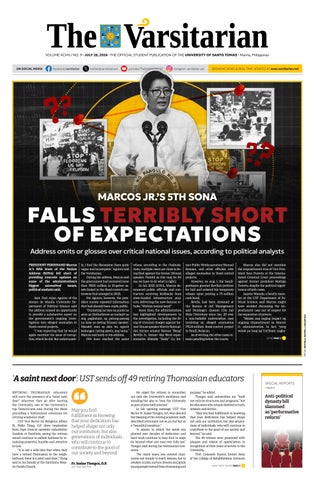
MARCOS JR.’S 5TH SONA
FALLS TERRIBLY SHORT OF EXPECTATIONS PRESIDENT FERDINAND Marcos Jr.’s fifth State of the Nation Address (SONA) fell short of providing concrete updates on some of the administration’s biggest unresolved issues, political analysts said. Asst. Prof. Arjan Aguirre of the Ateneo de Manila University Department of Political Science said the address missed an opportunity to provide a substantive report on the government’s ongoing investigation into alleged anomalies in flood-control projects. “I was expecting that he would again mention the issue of corruption, which he did. But unfortunate-
ly, I find the discussion there quite vague and incomplete,” Aguirre told the Varsitarian. During his address, Marcos said the government had recovered more than P800 million in ill-gotten assets linked to the flood-control controversy that emerged in 2025. For Aguirre, however, the president merely repeated information that had already been made public. “Dumating na tayo sa punto na ayon sa Ombudsman ay malapit na ang paghahain ng patung-patong na kaso sa dating [House] speaker. Masakit man sa akin ito, ngunit kailangan nating gawin ang tama,” Marcos said early in his address. (We have reached the point
where, according to the Ombudsman, multiple cases are close to being filed against the former [House] speaker. Painful as this may be for me, we have to do what is right.) In his 2025 SONA, Marcos denounced public officials and contractors receiving kickbacks from state-funded infrastructure projects, delivering the now-famous rebuke: “Mahiya naman kayo!” Since then, the administration has highlighted developments in the investigation, including the filing of criminal charges against former House speaker Martin Romualdez, former senator Ramon “Bong” Revilla Jr., former Ako Bicol representative Elizaldy “Zaldy” Co, for-
mer Public Works secretary Manuel Bonoan, and other officials over alleged anomalies in flood-control projects. However, on Aug. 1, the Sandiganbayan granted Revilla’s petition for bail and ordered his temporary release upon posting a P1-million cash bond. Revilla had been detained at the Bureau of Jail Management and Penology’s Quezon City Jail Male Dormitory since Jan. 20 over a non-bailable malversation case involving an alleged anomalous P92.8-million flood-control project in Pandi, Bulacan. As of writing, the other cases remain pending before the courts.
Marcos also did not mention the impeachment trial of Vice President Sara Duterte or the International Criminal Court proceedings against former president Rodrigo Duterte, despite the political significance of both cases. Jazztin Manalo, a faculty member at the UST Department of Political Science, said Marcos might have avoided discussing the impeachment case out of respect for the separation of powers. “Malaki ang naging impact ng ongoing impeachment sa Marcos Jr. administration. In fact, ‘yong watak pa lang ng UniTeam nagkaSONA PAGE 2
‘A saint next door’: UST sends off 49 retiring Thomasian educators RETIRING THOMASIAN educators will carry the presence of a “saint next door” wherever they go after leaving the University, one of the University’s top Dominicans said during the Mass preceding a testimonial ceremony for retiring academic staff. UST Vice Rector for Religious Affairs Fr. Pablo Tiong, O.P. drew inspiration from Pope Francis’ apostolic exhortation Gaudete et Exsultate, saying the retirees would continue to radiate holiness by remaining prayerful, humble and attentive to God. “It is not a wild idea that when they have a retired Thomasian in the neighborhood, there is a saint next door,” Tiong said in his homily at the Santisimo Rosario Parish Church.
‘‘
May you find fulfillment in knowing that your dedication has helped shape not only our institution, but also generations of individuals who will continue to contribute to the good of our society and beyond. Fr. Isaias Tiongco, O.P. UST VICE RECTOR
►
SPECIAL REPORTS ► PAGE 3
He urged the retirees to remember not only the University’s excellence and standing but also to “own the University as part of your faith journey.” In his opening message, UST Vice Rector Fr. Isaias Tiongco, O.P., who also led the blessing of the retiring academic staff, described retirement not as an end but as a “beautiful transition.” “A season in which the seeds you planted over decades of dedication and hard work continue to bear fruit in ways far beyond what you may ever fully see,” Tiongco said during the testimonial ceremony. “For many years, you entered classrooms not simply to teach lessons, but to awaken minds, nurture dreams and guide young people toward lives of meaning and
purpose,” he added. Tiongco said universities are “built not only by structures and programs,” but by educators who remain faithful to truth, wisdom and service. “May you find fulfillment in knowing that your dedication has helped shape not only our institution, but also generations of individuals who will continue to contribute to the good of our society and beyond,” he said. The 49 retirees were presented with plaques and tokens of appreciation in recognition of their years of service to the University. Prof. Consuelo Suarez, former dean of the College of Rehabilitation Sciences, SAINT NEXT DOOR PAGE 5
►
Anti-political dynasty bill slammed as ‘performative reform’
ART BY NHYZELL DAYNE J. OBLEPIAS
Address omits or glosses over critical national issues, according to political analysts
2
THE VARSITARIAN • JULY 28, 2026
NEWS
EDITOR: CARLO JOSE H. RUGA
Former Artlets dean, longtime professors among 49 faculty retirees to be honored
SONA ► FROM PAGE 1
roon na kaagad ng matinding divide sa administration niya. How much more ngayon na ‘yong sarili niyang bise presidente ay under the impeachment process?” Manalo told the Varsitarian. (The ongoing impeachment has had a significant impact on the Marcos Jr. administration. In fact, the split within the UniTeam had created a deep divide. How much more now that his own vice president is undergoing the impeachment process?) The Senate, sitting as an impeachment court, is trying the case stemming from allegations that Duterte misused confidential funds while serving as vice president and education secretary.
Madrunio, also a former dean of the Graduate School, retired after 37 years of service. An applied linguist known for her work in foreign and legal linguistics, Madrunio served as dean of the Graduate School beginning in 2013 before heading the Faculty of Arts and Letters from 2019 to 2022. Other retirees include Assoc. Prof. Herminigildo Ranera of the Conservatory of Music, Senior Counselor Christine Quita of the Counseling and Career Center, Asst. Prof. Gerardo Castro of the UST-Alfredo M. Velayo College of Accountancy, Asst. Prof. Maria Vicenta Sanchez of the College of Architecture, Asst. Prof. Ma. Elena Ramirez of the College of Nursing and Asst. Prof. Felix Silbor of the Institute of Physical Education and Athletics. Asst. Prof. Faye Abugan, Asst. Prof. Emelita Samala and Asst. Prof. Anna Ward, all longtime faculty members of the Artlets, also retired. The Faculty of Engineering’s re-
MIKAELA ANGELA G. VILLACORTA WITH REPORTS FROM RALENT M. PENILLA
ART BY ARLENE F. TURLA
Unaddressed issues
Although Marcos reaffirmed the country’s commitment to defending its territorial rights in the West Philippine Sea, Aguirre said the president failed to outline specific measures to address tensions in the disputed waters. “Just like the previous SONA, he was not brave enough to be direct on this. I was waiting for the term West Philippine Sea. I was waiting for concrete actions that we must do in the next few months within the fiscal year,” Aguirre said. The proposed anti-political dynasty law is another missed opportunity. The measure, which seeks to implement the Constitution’s prohibition on political dynasties, remains pending in Congress despite renewed calls for its passage after the 2025 midterm elections. Ederson Tapia, a political science faculty at the University of Makati, said Marcos’ penultimate SONA should have focused on reporting the administration’s progress on commitments made since he assumed office in 2022. “We’re no longer at that stage when the president is being expected to do agenda-setting. Now, the people would be expecting more concrete reports on things that he has mentioned in the past,” he said. The president cited progress in food security, digitalization, healthcare, infrastructure, renewable energy, and education, all of which have been among the administration’s priorities since 2022. However, several initiatives highlighted in the address were existing government programs with limited coverage, duration, or eligibility. Among them were agricultural loan relief for farmers and fisherfolk, truck toll waivers, and tariff reductions on electric vehicles. Despite the administration’s plans to increase foreign tourist arrivals and improve employment, tourism received little attention in the president’s speech. Tourism contributed 8.1% to the economy in 2025, according to the Philippine Statistics Authority. Although the country recorded 6.48 million international visitor arrivals that year, it continued to trail regional tourism leaders such as Malaysia and Vietnam. “If he were really serious about the corruption problem, not just the flood control problem, he could have made some serious efforts in pushing for some long-term changes or reforms in our government,” Aguirre said. The July 2026 Pulse Asia survey found that 50% of Filipinos disapproved of the Marcos administration’s performance, while 29% approved and 21% were undecided. “I would expect the president to fulfill the promises that he made earlier on in his administration and even earlier on, going back into the campaign,” Tapia said. “I think that’s the only way that he could salvage whatever kind of confidence the people have in him,” he added. ASHLEY MADELEINE D. LAMPA AND
► Former
THE UNIVERSITY recognized 49 retiring members of the academic staff on July 17, led by former Faculty of Arts and Letters (Artlets) dean Marilu Madrunio and several longtime faculty members.
Graduate School and Artlets dean Prof. Marilu Rañosa Madrunio receives a plaque of appreciation for 37 years of service in a ceremony honoring retiring academic staff held on July 17. — PHOTO BY JERICK MARC LAURENCE C. GRIMALDO
tirees are Assoc. Prof. Peter Lim, Prof. Lola Pestaño and Asst. Prof. Vilma Santos, while the College of Fine Arts and Design will honor Asst. Prof. Stephen Buñi, Asst. Prof. Santiago Caaway III and Asst. Prof. Noli Vicedo. Retired from the Faculty of Med-
icine and Surgery are Assoc. Prof. Ma. Cartrini Cruz, Assoc. Prof. Maria Cumagun, Asst. Prof. Ma. Clarissa Fortuna, Prof. Ramon Gonzalez, Assoc. Prof. Dennis Lusaya, Assoc. Prof. Vivienne Lusaya, Assoc. Prof. Alberto Paulino Jr., Asst. Prof. Juan Perez de Tagle,
Class of 2026 sees sharp drop in graduates with Latin honors By Micah G. Pascua
THE NUMBER of Thomasian graduates with Latin honors fell to 38% this year from 45.12% in the previous year, with 2,651 of the University’s 6,912 graduates earning academic distinctions, according to data from the Office of the Registrar obtained by the Varsitarian. Of the 2,651 Latin honor recipients in the Class of 2026, 91 graduated summa cum laude, 706 magna cum laude, and 1,854 cum laude. The figures were lower than last year’s tally of 97 summa cum laude, 913 magna cum laude, and 2,451 cum laude graduates. Despite the decline, this year’s 38% rate was among the highest since 2013, when the proportion of graduates receiving Latin did not exceed 15%.
A decade ago, only 11.12% of the Class of 2016 graduated with Latin honors. The proportion of honor graduates rose as UST switched to hybrid learning in the aftermath of the Covid-19 pandemic. The College of Tourism and Hospitality Management posted the highest proportion of Latin honor recipients this year, with 79% (328 of 413) of its graduates earning distinctions. It was followed by the Faculty of Canon Law, where 75% (18 of 24) of graduates received Latin honors. The Faculty of Theology ranked third, with 71% (36 of 51) of its graduates earning Latin honors. The Faculty of Arts and Letters produced the highest number of summa cum laude (21), magna cum laude (143), and cum laude (230) graduates. It also posted the seventh-highest proportion of honor graduates,
with 65% or 459 of its 705 graduates receiving Latin honors. Twenty Latin honors were awarded by the Faculty of Philosophy despite the academic unit having only 12 graduates this academic year. Asst. Prof. Warren Maneja, faculty secretary of the Ecclesiastical Faculty, said this was because several graduates earned the distinction across multiple degrees. The Faculty of Civil Law recorded the lowest proportion of Latin honor recipients, with only 10 of its 110 graduates, or 9%, receiving academic distinctions. UST concluded its monthlong solemn investiture rites with the graduation ceremonies of the College of Rehabilitation Sciences on June 30. WITH REPORTS FROM AMADOR DENZEL M. TESTON, CARLO JOSE H. RUGA, AND PRINCE RAPHAEL M. BRIZ
Asst. Prof. Antonio Rebosa, Prof. Estrellita Ruiz, Prof. Consuelo G. Suarez and Asst. Prof. Francis Villanueva. Also retired are Asst. Prof. Marife Narcida and Asst. Prof. Ma. Gina RETIREES PAGE 5
Other academic units posted the following numbers of Latin honorees: College of Nursing
Graduate School of Law
Faculty of Philosophy
Faculty of Medicine and Surgery
69% (96 of 140) 60% (20 of 12)
19% (3 of 16)
28% (148 of 522)
College of Information and Computing Sciences
College of Science
42% (247 of 592)
30% (162 of 547)
College of Fine Arts and Design
College of Architecture
College of Rehabilitation Sciences
Graduate School
53% (207 of 392) 45% (117 of 260)
Conservatory of Music
40% (23 of 58)
College of Education
37% (94 of 254)
Faculty of Pharmacy
34% (237 of 707)
College of Commerce and Business Administration
42% (242 of 583)
College of Nursing
69% (96 of 140)
26% (56 of 219) 16% (40 of 256)
Faculty of Engineering
16% (101 of 650)
Alfredo M. Velayo College of Accountancy
22% (55 of 247)
Institute of Physical Education and Athletics
18% (17 of 97)
►
THE VARSITARIAN • JULY 28, 2026
3
SPECIAL REPORTS ART BY ARLENE F. TURLA
EDITOR: RALENT M. PENILLA
Anti-political dynasty bill under Marcos Jr. slammed as ‘performative reform’ BY RALENT M. PENILLA DESPITE EFFORTS to pass an antipolitical dynasty law nearly four decades after the ratification of the 1987 Constitution, political scientists and electoral reform advocates remain skeptical of the Marcos Jr. administration’s commitment to the measure, describing the latest proposal as a diluted reform that preserves rather than dismantles entrenched family rule. One of the measures seeking to prohibit political dynasties is House Bill 8389, which has advanced further than previous proposals and is awaiting plenary deliberation in the House of Representatives. The bill was principally authored by House Speaker Ferdinand Martin “Bong” Romualdez and Senior Deputy Speaker Sandro Marcos, oldest son of President Ferdinand Marcos Jr. The principal authors, however, come from political dynasties. Romualdez’s relatives hold elective posts in Leyte, while Marcos, the president’s son, also has numerous relatives in positions of power. For Prof. Julio Teehankee, lead convenor of the Anti-Dynasty Network and a longtime scholar of Philippine electoral politics, such developments warrant “cautious optimism.” “Since he’s not strong enough and does not have the political capital to push through with the reform, it has become performative reformism — he wants to appear reformist, but in reality, he’s not serious,” Teehankee said. The renewed push comes amid mounting political pressures facing the administration. Recent public opinion surveys have shown President Marcos’ approval ratings declining while Vice President Sara Duterte continues to keep higher levels of public support. At the same time, the administration coalition in the House has faced internal strains, including reports of possible realignments among major political parties. Asst. Prof. Michelle Castillo of the University of the Philippines National College of Public Administration and Governance said the administration’s support for an anti-dynasty measure could also be interpreted as an attempt to restore public confidence. “Mababa naman na talaga ’yong
trust pero lalo lang nag-erode pa and very sobrang negative na ’yong opinion sa kanila,” Castillo said. She added that the measure could become part of Marcos’ political legacy amid controversies that have marked his presidency. Among the most prominent controversies confronting the administration is the investigation into alleged irregularities in government flood control projects, which has resulted in graft and corruption complaints against some public officials and contractors. UST Department of Political Science Chair Dennis Coronacion described the anti-dynasty proposal as a “high-cost, high-benefit” reform politically. “I don’t think that he’s really aiming for it. His role as an anti-corruption crusader happened by accident,” Coronacion told the Varsitarian. The president’s reform push began with his remarks against corruption during his State of the Nation Address last year. Only two contractors and 14 officials from the Department of Public Works and Highways were awaiting trial over the fiasco, despite the president’s claims of delivering justice. Castillo added that despite the push for an anti-dynasty bill, the measure should be pursued not only as a constitutional duty. “Hindi lang siya constitutional and legal na requirement and mandate and responsibility of Congress, it’s already a moral obligation. There’s an ethical and moral component to it,” Castillo said. The Constitution prohibits political dynasties but requires an enabling law from Congress. Since 1987, the few attempts to fulfill this mandate have failed in Congress. A constitutional mandate left unfulfilled
The debate over political dynasties traces its roots to the 1987 Constitution. Article II, Section 26 states that the State shall “guarantee equal access to opportunities for public service, and prohibit political dynasties as may be defined by law.” Eric Alvia of the National Citizens’ Movement for Free Elections (Namfrel) said support for the measure from members of political dynasties should be
‘‘
Since he’s not strong enough and does not have the political capital to push through with the reform, it has become performative reformism Professor Julio Teehankee
LEAD CONVENOR, ANTI-DYNASTY NETWORK
viewed with caution. “We are uncomfortable with that position because it only legitimizes political dynasties. It creates spheres of influence or spheres toward running for public office,” Alvia said. “Technically, it’s not anti-political dynasty legislation,” he added, referring to House Bill 8389. The bill prohibits only relatives up to the second degree of consanguinity and affinity from simultaneously seeking or holding certain elective positions in the same locality. These include parents, children, siblings, grandparents, grandchildren, and in-laws. Critics argue that the measure would still allow members of political dynasties to retain power by seeking office in different localities or levels of government. For Teehankee, the push for what he described as a watered-down version of the bill reflected lawmakers’ unwillingness to set aside personal interests. “The vote of the committee in the House shows that they cannot rise above their familial interest, and they missed a very historic moment to prove that they are truly representatives of the people,” he said.
The House Committee on Suffrage and Electoral Reforms consolidated more than 25 anti-dynasty proposals into House Bill 8389, prompting some lawmakers to withdraw their authorship because of what they considered weak provisions. Among them was Caloocan Rep. Edgar Erice, who called the bill a “budol,” or sham, and described it as a “pro-political dynasty bill” for failing to meaningfully regulate political dynasties. As Coronacion explained, compromise is often necessary to pass legislation. “If we are expecting a very idealistic version of an anti-dynasty law that will truly implement the constitutional provision, I think that’s going to face strong opposition from members of both chambers of Congress,” he said. If enacted, House Bill 8389 would affect nearly 10,000 local elective officials, according to estimates from the Congressional Policy and Budget Research Department. In the Senate, several incumbent senators with siblings in public office could also be affected by the measure. Politics of redemption
Teehankee said the president’s support for the bill could serve as a political smokescreen. “He more or less instituted policies that are quite different from his father and predecessor. So this could have been a historic moment for him to redeem his family’s legacy.” The Marcos Jr. administration has pursued policies that differ from those of former President Rodrigo Duterte, particularly in foreign policy and relations with major powers. For Coronacion, having an “insider” in dynastic politics such as the president could help push reforms. “Parang anti-corruption crusader, at magiging hero pa ‘yung character mo. So I think that’s a legacy that President Marcos should really think about very hard,” he added. For Alvia, the administration’s support for the initiative could also form part of its “quest for a legacy.” “It would also probably partially absolve the questionable history of his family and put the possible opposition on the defensive,” Alvia said. Vice President Duterte, who also belongs to a political dynasty, has expressed
her intention to run for president in 2028. Ensuring that the bill becomes law should go hand in hand with a careful review of its provisions, said Prof. Eric de Torres of the UST Department of Political Science. ‘Exceptions rather than the rule’
For Castillo, a distinction can be made between “performing” and “non-performing” political dynasties. “The big picture shows you that it’s not really so much about prohibiting families or individuals. It’s the system and the prevalence of dynastic families that we are trying to address,” she said. A 2013 study by the Ateneo School of Government found that localities dominated by political dynasties tend to experience higher poverty rates and weaker political competition. Teehankee said the public should not be overly concerned about politicians who might be displaced by such reforms. “If it’s going to cause them inconvenience, then so be it, because it’s the people’s turn right now,” he said. The House passed House Bill 8389 on third reading on June 3, with 267 legislators voting in favor of the measure. The bill is now awaiting action in the Senate. Meanwhile, Senate Bill 1548, filed by Sen. Risa Hontiveros, seeks to prohibit political dynasties up to the fourth degree of consanguinity and affinity. Alvia also warned against dependence on short-term assistance from dynastic politicians. “We cannot ever move on kung ganoon ang pag-iisip ng mga botante because we are not providing them with an alternative,” he said. Senate Bill 1458, a broader proposal, seeks to prohibit members of political dynasties from running as party-list representatives. Data from the Philippine Center for Investigative Journalism (PCIJ) have shown that several party-list groups have links to established political families. As De Torres noted, an anti-dynasty law was not a “silver bullet” but could serve as one step toward broader electoral reforms, including strengthening political parties. “Nothing to lose ka naman na e, patapos ka na, e ’di gawin mo lang kung ano ’yong dapat, rather than still play politics,” he said.
4
THE VARSITARIAN • JULY 28, 2026
EDITORIAL EDITORIAL
The arbitral win will remain hollow without national resolve TEN YEARS after the Philippines secured one of the most consequential legal victories in its history, the 2016 Arbitral Award stands as both a triumph and a reminder of unfinished work. On July 12, 2016, an arbitral tribunal constituted under the United Nations Convention on the Law of the Sea (UNCLOS) ruled overwhelmingly in favor of the Philippines in its case against China. The tribunal invalidated China’s sweeping “nine-dash line” claim, affirmed that no feature in the Spratly Islands generates an exclusive economic zone that overlaps with the Philippines’ own, and upheld Manila’s sovereign rights over resources within its exclusive economic zone, including areas in the West Philippine Sea. It also found that China had violated the Philippines’ sovereign rights by interfering with fishing and petroleum exploration and had caused severe environmental damage through large-scale island-building and destructive fishing practices. Yet a decade later, the legal victory remains only partially realized. China continues to outrightly reject the ruling. Philippine vessels continue to face dangerous maneuvers, water-cannon attacks, and obstruction in waters that the tribunal unequivocally recognized as falling within the Philippines’ maritime entitlements. Even after repeated affirmations by allies
and like-minded states that the Award is final and legally binding, enforcement ultimately depends not on the tribunal itself but on sustained political will among states committed to a rules-based international order. Foreign Affairs Secretary Theresa Lazaro described the Award as a “lighthouse” for the international community. The metaphor is apt. A lighthouse does not eliminate storms, but it
in international legal discussions involving maritime entitlements, ocean governance, environmental protection, and the peaceful settlement of disputes. As Lazaro emphasized, defending the Award is ultimately about defending the rules-based international order itself; the principle that international law, rather than military might, governs relations between states.
These developments did not emerge in a vacuum. They are responses to an increasingly contested maritime environment in the West Philippine Sea.
They reflect a growing recognition that legal victories require institutions capable of protecting the rights those victories affirm. provides certainty amid dangerous waters. Likewise, the Arbitral Award settled questions of law even if it could not compel compliance. By rejecting the legal basis of the socalled nine-dash line, the tribunal replaced decades of ambiguity with legal clarity rooted in UNCLOS. The ruling has increasingly been cited
But law, alone, cannot safeguard sovereignty. That reality framed Defense Secretary Gilberto Teodoro Jr.’s keynote address. While the Award established the Philippines’ rights, he argued, preserving those rights requires what he called “credible deterrence.” For Teodoro, deterrence is not merely a military concept but a national undertaking requiring modern
defense capabilities, resilient industries, secure supply chains, critical infrastructure protection, and broad public support. His remarks reflect the Marcos administration’s Comprehensive Archipelagic Defense Concept, which reorients Philippine defense planning toward protecting the country’s extensive maritime domain after decades of prioritizing internal security. The shift has been accompanied by expanded defense cooperation with treaty allies and strategic partners, larger multilateral military exercises such as Balikatan, and accelerated modernization of the Armed Forces of the Philippines. These developments did not emerge in a vacuum. They are responses to an increasingly contested maritime environment in the West Philippine Sea, where China’s coast guard and maritime militia have maintained an aggressive presence around Philippine features despite the tribunal’s decision. They also reflect a growing recognition that legal victories require institutions capable of protecting the rights those victories affirm. Teodoro’s proposed civic value of “yakap,” embracing the country’s maritime domain, therefore deserves attention beyond its rhetorical appeal. His point is that sovereignty cannot remain the exclusive concern of diplomats, soldiers, or lawyers. A democracy cannot sustain expensive defense modernization or EDITORIAL PAGE 6
►
FOUNDED JANUARY 16, 1928 Chalssea Kate C. Echegoyen Editor in Chief Karis M. Tsang Managing Editor Sofiah Shelimae J. Aldovino Associate Editor Carlo Jose H. Ruga News Editor Amador Denzel M. Teston Acting Assistant News Editor Rob Andrew L. Dongiapon Sports Editor Ralent M. Penilla Special Reports Editor Vince Alfred M. Pillagara Witness Editor Billy Andrei P. Ramos Features Editor Frenchshield Shayne G. Delovieres Patnugot sa Filipino Marielle F. Pesa Science and Technology Editor Aidan Raphael F. Caluyo Art Editor Regina Louise DLC. Sanota Assistant Art Editor James Michael M. Magboo Photo Editor Jed William V. Gocatek Layout Editor Amanda Luella A. Rivera Social Media Editor
News Sydney Venice V. Berba, Paolo Emmanuel DC. Blanco, Prince Raphael M. Briz, Alexandra S. Demaisip, Czeantal Naomi P. Delos Santos, Micah G. Pascua, Louisse Raye Shara C. Santos Sports Joaquin Edgardo A. Cortez, Miguel Angelo B. Marco, Kurt Russel Vincent I. Miranda, Jay-z V. Perez, Lilah Mikaela S. Paredes, Clyde Leanne M. Salamatin Special Reports Alexandra S. Demaisip, Fritz Nathan A. Diaz, Ashley Madeleine D. Lampa, Luis Angelo N. Palma, Justin Jacob S. Urag, Mikaela Angela G. Villacorta Features Ashley Valkyrie E. Bueno, Rev E. Dela Cruz, David Nigel C. Cortes, Elihoenai Hazael B. Cortez Witness Alexandra Gabrielle C. Mansineros, Reya Vincent P. Misa, Yuvshenka Andrea R. Osea Filipino Ma. Irish F. Fery, Jamiebeth Pereyra Ortega, Sofia Gabrielle G. Rosario Science and Technology Marigela Isabel R. Cirio, Nyl R. Dadiz, Regis Avalo Jophiel L. Lim, Mary Dawn S. Santos Circle Kirsten Therese C. Barrameda, John Kobe S. Balod, David Nigel C. Cortes, Inah Denise A. Manansala Literary John Kobe S. Balod, Charlize Ann D. Lavastida
Art Kathryn Grace S. Enriquez, Aisha Sofia M. Fortes, Allana Elaine J. Libunao, Rich Harry A. Marbella, Mhyzell Dayne J. Oblepias, Jinmarson Chester V. Pua, Denisse Amber N. Reyes, Antoinette Lindsey G. Solis, Arlene F. Turla Photography Precious Kae A. Andaya, Danielle D. Atienza, Maximilian Hans R. Briones, Nadine T. Felismino, Ethan Joshua Nikholai F. Guisama, Chloe Elysse B. Ibañez, Divina Eloisa P. Meguines, Djenhard Yreneo Raphael Y. Sapanhila, Joachim Nigel Z. Tanglao, Vio Neiro M. Villaescusa Editorial Assistant Reyza Bianca B. Ferranco
Felipe F. Salvosa II Assistant Publications Adviser
Joselito B. Zulueta Publications Adviser
THE VARSITARIAN • JULY 28, 2026
5
OPINION Saint next door ► FROM PAGE 1
The ‘V’ that made us Beyond Odyssey CHALSSEA KATE C. ECHEGOYEN
NOT EVERY year in an institution’s history is meant to be remembered. Some years become milestones by virtue of a number. The first year marks a beginning. The 50th becomes a celebration of lessons and endurance. The hundredth promises commemoration before it even arrives. They are the years that naturally invite speeches, ceremonies, and, well, retrospection. Then, there are years like the ninety-eighth. It is an unremarkable number, at least on paper. Too late to be a beginning, too early to be a centennial. It possesses none of the symbolism that history usually reserves for round figures. Yet perhaps that is precisely what makes it interesting. Without the expectation of grandeur, the 98th year demands something quieter: preparation. Publications like The Varsitarian, after all, are sustained less by the moments that history remembers than by the ordinary years in between. Leading the ‘V’ on its 98th year made that difficult to ignore. It meant leading a publication that already knew who it was long before we arrived. Our task was never to reinvent it. It was simply to leave it a little stronger than we found it. Every editorial board inevitably leaves its own mark. Publication Year 2025-2026 became a year of growth—not because we in the Editorial Board set out to change the V into something different, but because we constantly asked ourselves how a publication ap-
proaching its centennial could continue serving the Thomasian community with the same relevance and conviction that had defined it for decades. Our editorial work extended beyond the routines people often associate with campus journalism. It became an exercise in finding new ways for a nearly century-old publication to remain present in the lives of
Looking back, I’d say that this has always been what the V meant to me throughout the past four years. Home. Solace. I think that’s what I will remember most. Not the exhaustion itself, but how everyone kept showing up anyway.
Thomasians while staying true to the principles that brought it this far. On some days, we went beyond the traditional definition of a campus publication by expanding our coverage of events and issues. Many of us carried responsibilities beyond the newsroom. We balanced deadlines with classes, examinations, internships, graduations, personal
struggles, and the uncertainty that naturally comes with preparing for life after college. In our little space at Room 105 of the Tan Yan Kee Student Center, we found our solace. On days when we could not function as students, on days when we could not function as writers, and on days when we could not function as humans, the V office was there to force us to keep going; but above all, it was there to embrace us. Looking back, I’d say that this has always been what the V meant to me throughout the past four years. Home. Solace. I think that’s what I will remember most. Not the exhaustion itself, but how everyone kept showing up anyway. Throughout the year, we chronicled not only the stories that shaped campus life but also the issues that reverberated far beyond España. We covered student-led initiatives and protest actions, graft and corruption, documented one of the largest Traslación gatherings in history, and reported on developments that directly affected the Thomasian community, from changes in campus concessionaires and student services to policies involving the administration and faculty. In mid-August, the staff, led by our amazing Sports team, began its coverage of UAAP Season 88. For the publication, it became one of the most important coverages we would ever have because UST was the season’s host school. Our team held meetings, sleepovers, and presswork to cover the marvelous opening ceremonies and other UAAP events. To Karis, Rob, Hirro, Chloe, Aidan, Jed, and the entire Sports section—you didn’t disappoint. With that, I’m so proud of what we have done together. In September, the University, led by several stuBEYOND ODYSSEY PAGE 10
►
Chronicling arts and culture at the ‘V’ In the Round KARIS M. TSANG
“HOW CAN you write for the Varsitarian when you don’t know anything about National Artists?” That was what a member of the selection committee told me during a Zoom panel interview when I applied to join the Varsitarian. And I spent four years of my career at the V trying to turn what seemed like a weakness during my interviews into my biggest strength. Joining the V
It was an awkward time to join the V. UST was still fully online and offering limited classes, and activities in-person were just an idea back then. I was in my second year as a journalism student. Wide-eyed. Full of dreams. I remember when I took my exams, they were through Zoom. I was among the over 100 screen boxes of applicants hoping to fill a small spot at the V. I applied to be a Features writer for the V. As I was writing my heart out, under the watchful eyes of then editorial assistant Jessica Asprer, I couldn’t help but second-guess every word I spilled out, whether it was
enough to prove that I’m a writer. When I got the news that I could move on to the interviews, I didn’t know what to expect. I wasn’t a “press con” kid, nor was I part of my high school’s student paper. I was a blank slate. No experience. I didn’t know how I could sell myself. But I held on with my grit and integrity. Entering the video conference call to face the Selection Committee, every answer was a test. Everything was going well until I made the mistake of admitting that I was not well-versed in the biggest names in Philippine culture and notable UST alumni in the arts. It was then that I realized that to be a features writer, it is not enough to be a good writer. It is knowing what stories are worth telling. ‘Soft Sections’
We often view journalism as being about the hard and the rigorous. Oftentimes, we forget the stories that champion Thomasian artistic and cultural accomplishments. Stories that highlight the beauty of human creation. During my time at the V as a features and circle writer, eventually becoming Circle (arts and media) editor and managing editor, it wasn’t about proving whether I was equipped to write quickly and gather the most relevant facts. It was about writing stories that remind us of our humanity.
For me, being a journalist was about writing about how love blooms within the four walls of the University. (“UST Couple’s Love Story Takes a Page from Taylor Swift’s ‘You Belong with Me’” – Feb 14, 2024) Journalism was also about celebrating each individual’s global recognition and achievements. (“Thomasian Racer’s Crazy Journey Leads Her to Victory in F1 Academy” — May 28, 2023) Writing was chronicling aesthetics that could define a generation. (“Next-Generation Thomasian Artists Celebrated in ‘Distinguisged’ Exhibit” — Nov. 25, 2023) Journalism was also about keeping the arts in check, pointing out what needed improvement, and shedding light on mistakes to prevent culture from falling into mediocrity. (“Debunking Some Missed in Hit Film ‘GomBurZa’” — Feb. 17, 2024) St. Thomas Aquinas defined beauty in three terms: integritas, proportio or consonantia, and claritas. Whether it was among my intentions or not, being a culture writer at the V opened my eyes to the meaning of beauty as St. Thomas Aquinas described it. I came to realize that a piece of art must have integrity, all elements must be harmonious with each other, and its inner splendor must be manifested in its materiality. As I went on to write for the V, I was slowly introduced to Rolando S. Tinio (National Artist for Theater IN THE ROUND PAGE 10
►
delivered the response on behalf of the retirees, expressing gratitude to the University for helping shape her career as an educator and researcher. “[UST] taught me to relate to my patients and students with the utmost care, ensuring patients heal and students reach their full potential, but more than this, UST gave me the opportunity to pay back for the person I have become,” Suarez said. Aside from Suarez, former deans of the Faculty of Arts and Letters (Artlets) and the Faculty of Engineering were among the 49 honorees. Prof. Marilu Madrunio is retiring after 37 years of service, including back-to-back terms as dean of the Graduate School and Artlets from 2013 to 2019. Assoc. Prof. Peter Lim, who served as Engineering dean from 2006 to 2009, taught at the University for more than four decades and also served as project manager for various infrastructure projects in UST. Vice Rector for Academic Affairs Cheryl Peralta thanked the retiring educators for their patience and dedication in guiding students toward finding their purpose. “When our students lost their way, thank you for being the compass that gently guided them back to finding their purpose and pursuing their dreams,” Peralta said. “You have spent a lifetime writing beautiful chapters in the lives of others. Now it is time to write your own masterpiece,” she added. The testimonial ceremony, organized by the Office of the Secretary General and the Office of the Vice Rector for Academic Affairs, was held at the Dr. Robert C. Sy Ballroom of the Buenaventura Garcia Paredes, O.P. Building. PAOLO EMMANUEL DC. BLANCO AND TATYANA SABEERAH R. MARANAN
Retirees ► FROM PAGE 2
Sadang of the Faculty of Pharmacy; Asst. Prof. Vanessa Gonzalez, Asst. Prof. Denis Ngo and Assoc. Prof. Rosalynn Papa of the College of Rehabilitation Sciences; Prof. Rosario Garcia, Assoc. Prof. Florencia Ledesma and Loreto Juelar of the College of Science; and senior high school teachers Judy Aguinaldo and Marlene Navera. The Miguel de Benavides Library bid farewell to senior librarians Leonila Manuel and Juanita Subaldo. The academic staff recognition was held with a Eucharistic celebration at the Santisimo Rosario Parish Church, presided over by Fr. Isaias Tiongco, O.P. The testimonial program follow ed at the Dr. Robert C. Sy Grand Ballroom of the Buenaventura Garcia Paredes, O.P. Building. Earlier, the University recognized nine retiring support staff members during the “Parangal at Pasasalamat” program on July 10. The support staff retirees are Emelina Certeza (Office of the Vice Rector for Finance), Maria Ladisla (Office of the Registrar), Dionisio Layacan (College of Science), Perla Martin (Miguel de Benavides Library), Arsenio Medel (Faculty of Engineering), Jimmy Payot (OVRAA), Adolfo Silva and Claudio Subido (Facilities Management Office) and Glenn Vasquez (Faculty of Pharmacy). The support staff Eucharistic celebration and testimonial program was also held at the Grand Ballroom. PAOLO EMMANUEL DC. BLANCO
6
THE VARSITARIAN • JULY 28, 2026
FEATURES
EDITOR: BILLY ANDREI P. RAMOS
Editorial ► FROM PAGE 4
► Stanley Co. — ART BY MHYZELL DAYNE J. OBLEPIAS
Robinsons Retail chief reflects on how UST formation prepared him for leadership By Billy Andrei P. Ramos
CURIOUSITY — RATHER than certainty — shaped Stanley Co’s journey from a UST Commerce student to president and chief executive officer of Robinsons Retail Holdings Inc., a lesson he shared with students as he urged them to pursue opportunities beyond the classroom during the University’s annual Students Awards Day on May 22. Addressing awardees at the Quadricentennial Pavilion, Co said success is often built on the willingness to embrace unfamiliar experiences rather than having every career move mapped out from the start. Like many students nearing graduation, Co recalled being
‘‘
Many times, they saw potential in us before we saw it ourselves. And so they gave us the opportunities with a constant hope that we would be more capable, more confident, and more willing to try. Stanley Co
ROBINSONS RETAIL HOLDINGS INC. CEO
uncertain about what lay ahead. Unsure whether to join the family business or pursue a different career, he said the experiences he embraced at UST ultimately shaped his approach to leadership and lifelong learning. A graduate of the UST College of Commerce and Business Administration, where he earned a Commerce degree major in Economics in 1998, Co said he spent his years on campus saying yes to opportunities beyond the classroom. He joined the choir, played sports and became a member of the debate team after professors encouraged him to take on roles they believed he was capable of handling. “Many times, they saw potential in us before we saw it ourselves. And so they gave us the opportunities with a constant hope
This Thomasian is preserving the forgotten history of Philippine basketball By Elihoenai Hazael B. Cortez
WHILE MANY PHYSICIANS spend their careers interpreting medical images, Dr. Michael Rico Mesina dedicates his free time to uncovering another kind of diagnosis: the largely forgotten history of Philippine basketball. Mesina serves as a practicing radiologist and faculty member of the Department of Radiology at the Pamantasan ng Lungsod ng Maynila College of Medicine. Driven by a mission to preserve a legacy that even the nation’s basketball institutions have yet to showcase in a museum, the Thomasian radiologist has assembled one of the country’s most comprehensive private collections, from century-old photographs and magazines to rare memorabilia tracing the sport’s arrival in the Philippines. Mesina, a College of Science alumnus, was raised near Reyes Gym in Mandaluyong, where he spent countless school breaks watching Philippine Basketball Association (PBA) teams train. Encouraged by his uncles, who introduced him
to stars like Johnny Abarrientos and Alvin Patrimonio, he began buying basketball magazines with his weekly allowance. The gym also became the setting for moments that deepened his love for the game. During one Pepsi practice, PBA legend Yoyoy Villamin invited the young Mesina to retrieve basketballs during shooting drills. On another day, he witnessed Robert Jaworski, Ginebra’s legendary playing coach, instruct his players not to leave until every waiting fan had received an autograph. His passion eventually took a back seat as he entered medical school and focused on his studies. It was only during the Covid-19 pandemic, when daily life slowed and physicians were advised to minimize unnecessary exposure outside hospitals, that he rekindled his interest in collecting. What started as a search for the magazines he owned as a child eventually grew into a much larger preservation effort. Mesina first rebuilt his collection of BASKETBALL HISTORY PAGE 9
►
► Medallions from the Asian Basketball Confederation’s 25th anniversary, the 1990 Beijing Asian Games and the 2013 FIBA Asia Championship in Manila.
that we would be more capable, more confident, and more willing to try,” he said. One experience that stayed with him was volunteering for crowd control during Pope St. John Paul II’s visit to UST for World Youth Day in 1995. Although the role came without recognition or reward, Co said it reinforced the importance of participating for the experience itself. “Not every experience has to become an achievement. Sometimes, the value is in the trying. And sometimes, the value is in learning what you are good at, what you are not good at, and what you still need to work on,” he said. That mindset, he added, beROBINSONS PAGE 8
►
consistent foreign policy if its citizens view the West Philippine Sea as distant from their daily lives. That connection is easier to see than many assume. The waters recognized by the Award contain rich fishing grounds that support coastal communities, potential energy resources that could strengthen the country’s long-term energy security, and sea lanes through which much of global trade passes. The dispute is therefore not merely about maps or competing historical narratives. It concerns food security, economic resilience, environmental stewardship, and the welfare of future generations. The country has made measurable progress over the past decade. Public support for asserting Philippine rights in the West Philippine Sea has steadily increased. More countries have publicly affirmed the validity of the ruling. Manila has deepened defense and security partnerships with the United States, Japan, Australia, and European partners while continuing to anchor its maritime policy on international law. Still, these gains remain vulnerable if they depend solely on the resolve of one administration or the attention generated by each new maritime incident. Universities have a responsibility to sustain informed public discourse on issues of sovereignty and international law. They should not merely commemorate July 12 each year but cultivate scholarship, research, and civic engagement that deepen understanding of the country’s maritime rights and responsibilities. The 2016 Arbitral Award settled what international law had to say about the West Philippine Sea. What it could never settle was whether Filipinos themselves would consistently defend what the law had already affirmed. A decade after, that remains the country’s unfinished task.
► Autographed VHS
tapes of Filipino basketball-themed films (top). An archival photograph of a women’s basketball team from the early years of the sport (middle).
► Dr. Michael Rico Mesina — PHOTO BY JOACHIM NIGEL Z. TANGLAO
THE VARSITARIAN • JULY 28, 2026
7
SCI-TECH
EDITOR: MARIELLE F. PESA
PCOS is now ‘PMOS’:
Why the name change can transform women’s care By Marigela Isabela R. Cirio
► Genea Nichole Cortez and her book ‘Mangroves for Youth.’ — ART BY JINMARSON CHESTER V. PUA
Thomasian biologist turns to children’s book to grow mangrove literacy AS MANGROVES forests continue to decline because of coastal development, reclamation, and poorly planned rehabilitation projects, a Thomasian biologist is using children’s literature to teach young Filipinos that protecting coastal ecosystems begins with understanding them. Through Mangroves for YOUth Workbook, UST College of Science faculty member and mangrove botanist Genea Nichole Cortez translates complex ecological concepts into stories, illustrations and interactive activities to improve mangrove literacy among Filipino children. “The primary purpose of this book is to transmit complex information about Filipino mangroves to Filipino youth,” Cortez told the Varsitarian. Supported by the Small Grants Programme of the Asean Centre for Biodiversity, the book is divided into three parts: the story Atia and the Crying Seedlings, Mangrove ABCs, and Let’s Mangroove!, an activity section with games and reflection exercises. At the center of the book is Atia, a young girl trying to care for mangrove seedlings that mysteriously begin to cry. Cortez said the story introduces one of the most persistent problems in mangrove conservation: incorrect planting. “Why are the seedlings crying? And later on, you will see in the book that this is the reason why the seedlings are crying. It’s primarily due to incorrect planting,” she said. According to Cortez, the story reflects real conservation challenges she had encountered during fieldwork. She said improper planting often undermines rehabilitation efforts and is sometimes carried out by institutions expected to lead environmental protection. “There are really many cases of incorrect planting,” she said. “It destroys our efforts, and sometimes it is even driven by government agencies that we are supposed to look up to, but the implementation is wrong.” The workbook also addresses what Cortez described as the limited discussion of mangroves in the basic education curriculum. Its second section, Mangrove ABCs, introduces foundational concepts through child-friendly explanations of common Philippine mangrove genera such as Sonneratia, Rhizophora and Avicennia, alongside terms such as propagules and specialized roots. The final section, Let’s Man-
groove!, reinforces these lessons through word searches, crossword puzzles, matching exercises, fillin-the-blanks and reflection activities. “I know that the information that I have to provide is basic, but at the same time engaging curiosity,” Cortez said. Cortez said her background in secondary education helped her design the workbook for young learners, while her specialization in mangrove botany ensured its scientific accuracy. Even before publishing the workbook, she has been using art to communicate mangrove science. Through a personal illustration project inspired by pneumatophores, or mangroves’ breathing roots, she creates and shares educational artwork online. “Before I started illustrating, I studied the plants, the mangroves
Rather than a condition confined to the ovaries, it is now recognized as a systemic disease with long-term endocrine and metabolic consequences. The new term, published in The Lancet in May 2026, seeks to correct what experts describe as a misleading name that emphasizes ovarian findings while overlooking the disorder’s hormonal and metabolic features. The initiative to rename PCOS was the result of an international collaboration involving 56 academic, clinical and patient organizations, drawing on data from more than 14,000 patients and multidisciplinary healthcare professionals. According to the consensus, the term “PCOS” inaccurately suggests the presence of pathological ovarian cysts, obscuring the condition’s endocrine and metabolic manifestations and contributing to delayed diagnosis, fragmented care and stigma. Although the proposed change has sparked discussion among clinicians and patients, Assoc. Prof. Maria
ic or anything else, but may have incidental finding of polycystic ovaries on ultrasound,” she said. “That is not the syndrome.” Although obesity was once considered closely associated with PCOS, physicians now recognize that the condition occurs across different body types, she said. For Luna, the proposed renaming reflects medicine’s growing emphasis on preventing chronic disease before complications develop. “Medicine is not supposed to be treating what is already there,” she said. “To be a good doctor, you need to be able to prevent what could be prevented in the future. And I think that is the very thrust of why the terminology was changed.” Untreated chronic anovulation may cause continuous thickening of the uterine lining, increasing the risk of endometrial hyperplasia, which can progress to endometrial cancer. Patients with insulin resistance, particularly those with obesity and other risk factors, also face an increased likelihood of developing diabetes. As they age, these metabolic abnormalities may coincide with hypertension and other components of metabolic syndrome. The broader framework proposed under PMOS also encourages more comprehensive patient assessment. “It will entail more laboratory exPMOS PAGE 9
►
‘‘
Mangroves are not just a plant. There’s a lot of intertwined connections, [a] network of communities that is really important.
ART BY NATASHA AIZHEN B. ZAÑO
By Mary Dawn S. Santos
FOR WOMEN diagnosed with polycystic ovary syndrome (PCOS), a proposed name change to polyendocrine metabolic ovarian syndrome (PMOS) reflects a broader shift in how physicians understand one of the most common hormonal disorders affecting women.
Teresa Luna, chair of the UST Faculty of Medicine and Surgery’s Department of Obstetrics and Gynecology, said it was intended primarily to improve understanding of the disease rather than alter how it is diagnosed. “The [term] endocrine metabolic syndrome is different because it already has a connotation of having a prolonged, or a long-term outcome, a long-term consequence of the disease,” Luna told the Varsitarian. By incorporating the terms “endocrine” and “metabolic,” the proposed name underscores that the disorder extends beyond reproductive health and may predispose patients to chronic conditions such as diabetes and hypertension if left unmanaged. Despite the terminology change, the diagnostic criteria remain unchanged. Diagnosis continues to rely on a combination of chronic anovulation, hyperandrogenism and polycystic ovarian morphology on ultrasound rather than any single finding. Chronic anovulation may emerge as prolonged absence of menstruation or infrequent menstrual periods, while hyperandrogenism may manifest as severe acne or excessive hair growth. Luna emphasized that polycystic ovarian morphology alone does not establish the diagnosis. “A patient may very well be asymptomatic, menstruating regularly with no manifestations, dermatolog-
Genea Nichole Cortez MANGROVE BOTANIST
themselves,” she said. “In order for me to gain expertise, what I did was to really draw it.” Her advocacy was further shaped by years of fieldwork and community engagement. As a graduate student, Cortez joined the research team that surveyed the Del Carmen Mangrove Reserve in Siargao before its designation as the Philippines’ 10th Ramsar site. The Philippine Clearing House Mechanism lists the Del Carmen Mangrove Reserve, within the Siargao Island Protected Landscape and Seascape, as Ramsar Site No. 2553. During field surveys, she recalled, local boatmen and children often became curious about her work, giving her opportunities to explain the ecological importance MANGROVE LITERACY PAGE 8
►
UST Hospital uses diamond-tipped device to clear blocked artery By Marigela Isabela R. Cirio
A DIAMOND-tipped device has helped doctors at UST Hospital clear a severely hardened heart artery for the first time, expanding treatment options for patients whose blockages are too calcified for conventional angioplasty. The procedure, called orbital atherectomy, uses a rapidly rotating diamond-coated crown to sand down calcium deposits inside the artery before a stent is placed, allowing doctors to restore blood flow in cases where conventional balloon angioplasty may not be enough. Dr. Eric John Marayag, an interventional cardiologist at UST Hospital,
said the procedure was the first orbital atherectomy case performed outside the Philippine Heart Center, where fewer than 10 similar cases had been done. Marayag led the two-hour procedure in May with senior interventional cardiologist Dr. Ronaldo Estacio, cardiovascular catheterization laboratory nurses, a cardiac anesthesiologist and the company Abbott, which provided the Diamondback 360 orbital atherectomy system. The patient was an 80-year-old man with severe coronary artery disease and extensive arterial calcification. Marayag said the patient had vague chest pain and was later found to have a high calcium score in the heart, a sign of heavy calcium
buildup in the coronary arteries. “Ideally, this patient was for coronary artery bypass graft because he had a very calcified lesion, and there were a lot of blockages,” Marayag told the Varsitarian. “But because of his age, he opted for a less invasive [option].” Coronary artery disease occurs when the blood vessels that supply the heart become narrowed or blocked by plaque. In some patients, these blockages harden because of calcium deposits, making them difficult to open with standard tools. “In balloon angioplasty, we insert a balloon inside the artery and inflate the DIAMOND-TIPPED PAGE 10
►
8
THE VARSITARIAN • JULY 28, 2026
WITNESS
EDITOR: VINCE ALFRED M. PILLAGARA
Journalism alumnus, former ‘V’ news ed named co-secgen of Carmelites Order in Rome ► Fr. Clarence Victor Marquez, O.P.
WHEN Bro. Marc Jozsef Lester Hallig received a call from the Carmelite General Curia in Rome, the unexpected news left him dazed.
— ART BY JED WILLIAM V. GOCATEK
Vatican appoints UST Central Seminary rector
Hallig, 54, a journalism alumnus and former news editor of the Varsitarian, is set to become the first Filipino from the Province of St. Titus Brandsma to serve as co-secretary general of the Carmelites’ General Curia. He will serve as the English correspondent of the mendicant religious order for the next six years, beginning in July. New role in Rome
Hallig admitted he initially hesitated when the opportunity came. “At first, I was hesitant, but then it was an opportunity. Lalo na for growth. And you don’t say no when an opportunity for growth comes up,” he said. One of Hallig’s preparations is learning Italian to overcome the language barrier, similar to what he experienced when he was first assigned to the Visayas and Mindanao. “The Lord has a sense of humor. It’s important to have a sense of humor in life. It will help you go through so many things, kung may sense of humor [ka],” he said, recalling that Carmelite nuns once told him they would pray for him to become a Carmelite friar. A vocation
At the University, Hallig spent much of his mornings at the Santí-
► Fr. Clarence Victor Marquez, O.P. — ART BY ALLANA ELAINE J. LIBUNAO
simo Rosario Parish Church and the Miguel de Benavides Library, where he read theology books. Drawn to the priesthood, he sought the advice of their parish priest in Imus, Cavite, but was told to finish his studies first because he was still too young. “Because it doesn’t go away…and if the Lord really wants you in His service, He will not stop. He will keep bugging you until you do something about it. So I did,” Hallig said. During a reporting assignment in Bacolod, Hallig met five Carmelite nuns and spoke with them about spirituality.
When one of the nuns asked, “Why don’t you become a Carmelite?” he realized it was the sign he had been waiting for. “And then that’s when it dawned on me. I asked for one [sign], God gave me five. Siguro sabi ni Lord, ‘kulit mo!’” he said in jest. (And then that’s when it dawned on me. I asked for one sign, God gave me five. Perhaps the Lord was saying, “You’re so persistent!”) In 2010, Hallig left secular life and entered the Benedictine monastic order. “There was resistance because this was totally new to them. They
felt that having a career was really the be-all and end-all,” Hallig said. Three years later, he joined the Carmelite order. Although he never felt called to become an ordained priest, Hallig found fulfillment in ministries that involved teaching, writing and engaging with people. He said he never imagined that entering religious life would still allow him to pursue work similar to his former profession. Hallig also serves as a postulator, a Church-accredited researcher who prepares causes for beatificaCARMELITES PAGE 9
►
TO THE HOLY See’s Dicastery for the Clergy has appointed Fr. Clarence Victor Marquez, O.P., as the new rector of the UST Central Seminary, according to an announcement from the seminary on Wednesday, July 22. Marquez has been serving as the inter-diocesan seminary’s acting rector since December 2024, succeeding Fr. Quirico Pedregosa Jr., O.P., who reached the end of his third and final term. The decree issued by the dicastery granted Marquez a term of four years, effective July 1. The Dominican priest previously served as rector and president of Colegio de San Juan de Letran Manila. He was ordained to the priesthood in 1995. Marquez served as the acting vice rector of the University from 2007 to 2008, vice rector for finance from 2006 to 2007, and director of the Institute of Religion from 2004 to 2008. The newly appointed rector obtained his bachelor’s and doctorate degrees in Sacred Theology at the Ecclesiastical Faculties, and took his licenciate in Sacred Scripture at the Pontificium Institutum in Rome. E.M.B. MEJIA
OP laity, campus religious groups mount exhibit-forum to mark Frassati’s 1st feast as saint By Vince Alfred M. Pillagara
TO MARK the first feast day of St. Pier Giorgio Frassati on July 4, a Thomasian and lay Dominican group, along with the saint’s local promoters, mounted an exhibit dedicated to the Italian youth activist at the Manila Cathedral on June 26. The Young Thomasian Professionals-Lay Dominican Fraternity and Frassati Society Philippines (FSP) mounted “Frassati: The Man of Eight Beatitudes,” an exhibit showcasing the life and works of the lay Dominican saint, which will run until Sunday, July 5.
Robinsons ► FROM PAGE 6
came even more valuable after graduation, particularly in business, where adapting to change demands continuous learning. “Curiosity keeps you humble. It reminds you that there is always something to learn from the person beside you,” he said. Before assuming the role of Robinsons Retail president and CEO in 2025, Co served as the company’s chief operating officer, overseeing retail brands such as
“St. Pier Giorgio stands as living proof of the Church’s affirmation of youth involvement in society. Holiness does not require being rigid or detached; rather, it is fully attainable through joyful companionship, relatable human emotions, and active service,” Froiland Sampiano, project head of the feast day events, told the Varsitarian. Local organizers will also mark Frassati’s feast with “Frassati Day 2026,” bearing the theme “Pataas sa Diyos, Pababa sa Kapwa,” at the Manila Cathedral. Fr. Christopher Jeffrey Aytona,
O.P., spiritual adviser of FSP, and Dave Dela Cruz, O.P., president of a lay Dominican chapter, will deliver talks on Frassati, youth, and social action during the conference. The enthronement of Frassati’s image and relic, followed by the recitation of the rosary, will precede the Mass. Cardinal Jose Advincula will preside over the feast day Mass at 12:30 p.m. On Sept. 7, 2025, Pope Leo XIV canonized St. Pier Giorgio Frassati and St. Carlo Acutis, the first saints he elevated to the altars as pope. A native of Turin, Italy, Frassati
was a member of the Third Order of St. Dominic and dedicated his life to prayer, political and social activism, and service to the poor. Pope St. John Paul II beatified the university student in 1990 and dubbed him the “Man of the Eight Beatitudes.” He died in 1925 at age 24 after contracting polio while caring for the sick. Frassati is venerated as the patron saint of youth and athletes for his passion for mountaineering and hiking. With reports from
Robinsons Supermarket, Shopwise and Handyman. He also pointed to fellow Thomasian graduates now leading various Robinsons Retail business units — including Robinsons Easymart, Uncle John’s, finance, information technology and marketing — as evidence that the University’s formation continues to shape its alumni long after graduation. Despite leading one of the country’s largest retail companies, Co remains involved with his alma mater through industry
talks and the College of Commerce and Business Administration’s mentorship program. One of the students he mentored, Arian Garcia, now works as a marketing officer at True Value, an experience that Co said underscored the importance of creating opportunities for others. “Someone opened the door for me once. And if curiosity has taught me anything, it is this. The greatest thing it can lead you to is someone else’s beginning,” he said. Reflecting on his Thomasian education, Co said growth
does not require abandoning one’s roots but building on them through continuous learning and new experiences. “You do not have to discard where you came from. You build from it one question at a time, one opportunity at a time, and one uncomfortable but useful experience at a time. That is what UST did for me,” he said. Robinsons Retail Holdings operates more than 2,700 stores nationwide, including more than 2,100 The Generics Pharmacy branches.
ALEXANDRA GABRIELLE C. MANSINEROS
Mangrove literacy ► FROM PAGE 7
of mangroves. Those experiences, along with her work with coastal communities such as the Tubo-Tubo Fisher Folks Association in Bataan, reinforced for Cortez that mangroves are inseparable from the people who depend on them. “Mangroves are not just a plant,” she said. “There’s a lot of intertwined connections, [a] network of communities that is really important.” Beyond protecting coastlines from storm surges and typhoons, she said mangroves also sustain fisheries by serving as habitats for shellfish, crabs, shrimps and fish. “It’s very important because mangroves are one of our shields against climate change,” Cortez said. She hopes schools, families and communities will use the workbook as a starting point for conversations about conservation, emphasizing that environmental stewardship begins with early education. “It’s best to use the book interactively and use it as a conversation for protecting mangroves,” she said. “What we are instilling is hope and action for the youth. They will be doing their own stories, they will have more stories to tell. With that, we can help promote conservation.” The workbook is available free of charge through the Asean Centre for Biodiversity’s publications page, where readers may also access its interactive digital edition. Cortez serves as science communication lead of Mangroves Matters PH, a youth-led organization that promotes mangrove conservation through science communication, education, policy engagement and community-based advocacy.
THE VARSITARIAN • JULY 28, 2026
9
FILIPINO
EDITOR: FRENCHSHIELD SHAYNE G. DELOVIERES
UsapangUste
Protesta laban sa pangnukleyar na aktibidad ng France noong 1995 Ni Frenchshield Shayne G. Delovieres ► Mula Kaliwa: Paul Castillo, Victor Emmanuel Carmelo “Vim” Nadera, at Roy Cagalingan — DIBUHO NI MHYZELL DAYNE J. OBLEPIAS
Tatlong Tomasinong manunulat, nahalal sa bagong lupon ng UMPIL TATLONG TOMASINONG manu nulat ang nahalal bilang miyembro ng bagong lupon ng Unyon ng Manunulat sa Pilipinas (UMPIL) para sa terminong 2026-2029. Inaasahang mangunguna sila sa pagsusulong ng mga adbokasiya para sa panitikan at edukasyon. Kabilang sa mga nahalal sina Victor Emmanuel Carmelo “Vim” Nadera Jr., dating punong patnugot ng Varsitarian, Paul Castillo na kawaning dalubguro ng panitikan at malikhaing pagsulat ng Unibersidad, at Roy Rene Cagalingan, senior language researcher sa Komisyon sa Wikang Filipino (KWF) na nagtapos sa programang marketing management sa UST. Ayon kay Nadera, mahalagang maisulong ng UMPIL ang pagtaas ng suweldo ng mga manunulat at mapababa ang gastos sa paglalathala upang higit na mailapit ang panitikan sa masa. “Kapag naluklok ka sa isang posisyon na may kakabit na kapangyarihan, ito ay isang anyo ng hindi lamang paniniwala kundi ng pagtitiwala,” ani Nadera ukol sa kaniyang pagbabalik sa kalupunan. Nagsilbi siyang secretary general ng UMPIL noong 2001 hanggang 2007 at naging tagapangulo
Basketball history ► FROM PAGE 6
1990s PBA memorabilia before tracing the league’s roots back to the 1970s. His search later expanded beyond professional basketball, leading him to artifacts documenting the sport’s earliest years in the Philippines during the early 1900s. Among the most prized pieces in his collection are memorabilia from the Philippines’s first Olympic basketball appearance at the 1936 Berlin Games, as well as artifacts from the 1948 London Olympics, where the national team placed 12th. The collection covers both professional and collegiate basketball, featuring memorabilia from franchises such as Toyota, Crispa, Gordon’s Gin (now Barangay Ginebra), Alaska, Sta. Lucia, Purefoods (now Magnolia), and San Miguel, alongside decades of UAAP and NCAA history. Its collection includes newspapers, magazine clippings, books by Filipino authors, game-worn jerseys, jackets, medals, pins, toys, cassette tapes, and countless other artifacts chronicling more than a century of Philippine basketball. Mesina believes the value of the collection lies not in its size, but in the stories each artifact carries. “Naniniwala ako na bawat item,
ng organisasyon noong 2007 hanggang 2010. Para kay Castillo, isa sa mga pangunahing usaping dapat pagtuunan ng bagong lupon ang mungkahing rebisyon sa general education curriculum ng Commission on Higher Education (CHEd), na maaaring magbawas ng mga asignaturang humanidades. “Sa ngayon, nararapat munang harapin ang inihahaing reframed general education courses ng CHEd na malaki ang magiging epekto sa mga mag-aaral sa kolehiyo,” wika niya sa panayam ng Varsitarian. Dagdag ni Castillo, mahalagang magkaroon ng kinatawan ang UST sa UMPIL upang maiparating ang mga pangangailangan ng mga Tomasinong manunulat at mapalawak ang mga kolaborasyon. Kabilang dito ang mga programang gaya ng Adrian Cristobal Lecture Series na pinangunahan ng UMPIL katuwang ang UST Center for Creative Writing and Literary Studies noong Pebrero. Miyembro ng kalupunan ng UMPIL si Castillo mula pa noong 2023. Binigyang-diin ni Cagalingan ang papel ng mga manunulat sa pakikilahok sa mga usaping pampolitika at panlipunan sa bansa.
meron siyang history behind it and if you put enough items together, you can see how each item is intertwined. Then you can create a timeline for Philippine basketball history using those different items available to you,” he said. Part of his home in Antipolo serves as a temporary mini-museum, housing the growing collection while he pursues a more ambitious vision: establishing a permanent Philippine Basketball Museum that the public can visit. Although the project is still in its early stages, Mesina said several organizations had expressed interest in supporting the initiative. His subspecialty in musculoskeletal radiology occasionally brings him face to face with athletes seeking second opinions on injuries, creating an unexpected connection between his profession and his passion. Outside the hospital, collecting serves as a welcome escape from the pressures of patient care. “It is important to stay grounded and to have an outlet for all of the stress that you’re encountering at work,” he said, adding that sharing his collection with fellow basketball enthusiasts gave him fulfillment beyond personal satisfaction. Looking at the state of Philippine basketball today, Mesina believes the country is rich in talent. What is needed, he said, is stronger grass-
“Ang [maging bahagi ng] unyon ay isang anyo ng pagsabak sa politika, kasi gusto nating magkaroon ng pagbabago,” aniya. Dagdag pa ni Cagalingan, ang pakikipag-ugnayan sa mga batang manunulat sa iba’t ibang rehiyon ng Filipinas ang pangunahin niyang layunin bilang miyembro ng lupon. “Kasama ang mga manunulat sa laban na ‘yon ng pagtataguyod ng makataong edukasyon [at] humanistikong edukasyon,” wika niya. Mula sa dalawampung manunulat na nominado, labinlima ang hinirang na miyembro na bubuo sa kalupunan ng UMPIL na pinangasiwaan ng dating pangulo na si Michael Coroza. Kabilang dito sina Romulo Baquiran Jr., Susan Lara, Clarissa Militante, Abner Dormiendo, Junley Lazaga, Jazmin Llana, Diandra Ditma Macarambon, Jimmuel Naval, Aldrin Pentero, Joey Tabula, John Iremil Teodoro, at John Enrico Torralba. Idinaos ang halalan kasabay ng pagkilala sa mga nagkamit ng Gawad Pambansang Alagad ni Balagtas sa Pambansang Kongreso ng mga Manunulat noong ika-25 ng Abril sa Unibersidad ng Pilipinas Baguio. CHARLIZE ANN D. LAVASTIDA
roots development, longer preparation, and a system that allows teams to build chemistry before competing on the international stage. “We cannot treat it like an allstar game na malapit na ‘yong FIBA. Sige two weeks, kuha ka ng mga stars and then get them together. Doon pa lang sa camaraderie, doon pa lang sa chemistry, talo na agad tayo, and then expect us to compete well against teams which have been playing together for years,” he said. Mesina hopes his lifetime project will endure long after he is gone—not merely as a collection of memorabilia, but as a permanent home for the history of Philippine basketball. “You won’t be alive forever so what is the thing that you can leave behind which can be appreciated by your sons and then your sons, your children’s children? So I think ‘yong museum na ‘yon if mabuo, ‘yon ‘yong maiiwan ko,” he said. At UST, Mesina was editor in chief of a biology newsletter and represented the College of Science in Pautakan, the Varsitarian’s longest-running intercollegiate quiz bee. “’Yong natutuhan ko rin kasi sa UST is to be well-rounded. Kasi maraming binibigay na opportunities ‘yong university for you to explore your different talents,” Mesina said. WITH REPORTS FROM JOAQUIN EDGARDO A. CORTEZ
TATLONG dekada na ang lumipas mula nang magmartsa ang libo-libong Tomasino laban sa mga aktibidad nukleyar ng France sa rehiyong Pasipiko. Muling umigting ang usapin hinggil sa mga sandatang nukleyar sa gitna ng tensiyon sa Gitnang Silangan, kung saan isa sa mga ikinababahala ng Estados Unidos at Israel ang umano’y pagbuo ng Iran ng mga sandatang nukleyar. Batay sa ulat ng Varsitarian noong Oktubre 1995, libo-libong estudyante, guro, administrador at iba’t ibang organisasyon sa loob ng UST ang nakiisa sa kilos-protesta noong Set. 14, 1995 sa Tinoko Park, na ngayo’y Rosarium. Pinangunahan ang protesta ng AB Political Science Forum at ng Arts and Letters Student Council (ABSC). Ayon sa noo’y pangulo ng ABSC, ipinakita ng kilos-protesta na mulat at may pakialam ang mga Tomasino sa pandaigdigang usaping pampulitika at pang-ekonomiya. Sinuspinde noon ni Ophelia Di-
PMOS ► FROM PAGE 8 amination, screening for diabetes, maybe asking the patient to do self-blood pressure monitoring, of course, watching her weight, which though it sounds very simple, it’s commonly not done at all,” Luna said. Traditional evaluation often centered on medical history, physical examination and pelvic ultrasound, she explained. Recognizing the disorder’s endocrine and metabolic components, however, may prompt additional laboratory testing and long-term monitoring. The proposed terminology can strengthen collaboration among gynecologists, endocrinologists and primary care physicians. “We are moving towards universal health where the primary physicians play a major role because they are the first to see the patient,” Luna said. “So from there, [they proceed by] recognizing what specialty needs to be involved, because it’s not just simply gynecologic or dermatologic.”
Carmelites ► FROM PAGE 8
tion and canonization for the Carmelite Philippine province. He is working on two causes for sainthood but both remain in the early stages. In the media
Interested in religion writing, Hallig applied for the Witness section when he joined the Varsitarian in 1992. Instead, he was assigned to the News section, which he initially wanted to avoid because of its stressful pace and “immediate deadlines.” At the same time, he contributed articles to the Manila Bulletin‘s Youth and Campus section. In his second year with the V, he sought the Witness editorship but eventually became News editor in his senior year. After graduating from the University in 1994, Hallig joined The Philippine Star, where he began writing for the spe-
malanta, noo’y dekana ng Faculty of Arts and Letters, ang mga klase upang bigyang-daan ang pakikilahok ng mga estudyante sa protesta. Nagsuot ng pulang damit ang mga kalahok bilang sagisag ng pagkamilitante, at ng itim na laso bilang pagtuligsa sa nuclear testing. Kabilang sa mga nakiisa ang UST Haribon, League of Filipino Students, Ugat-Lahi, Salakot, at mga student council ng College of Education at Faculty of Medicine and Surgery. Lumahok din ang ilang mag-aaral mula sa high school. Mahigit 3,000 Tomasino ang lumagda sa isang dokumentong tumutuligsa sa desisyon ng noo’y pangulo ng France na si Jacques Chirac na ipagpatuloy ang mga aktibidad nukleyar na nagsimula pa noong 1966. Nagkaroon din ng noise barrage na pinangunahan ng ABS-CBN Channel 2, kung saan nakilahok ang ilang magaaral mula sa College of Education, Institute of Physical Therapy at Faculty of Medicine and Surgery sa pamamagitan ng pagsigaw at pagbusina ng kani-kanilang sasakyan.
Luna urged young women to seek medical advice instead of relying on information from social media and online forums. “The problem here is because of the amount of information available on the internet. Unfortunately, it’s not totally accurate,” she said. “You may learn from other people’s experience, but it doesn’t necessarily mean that everything applies to you.” Personal experiences shared online cannot replace professional evaluation because every patient’s condition is different, she stressed. Luna emphasized that the disorder remains manageable through sustained treatment and lifestyle modifications despite its long-term risks. To help reduce future complications, she recommended adopting realistic dietary changes, engaging in regular physical activity and taking medications to regulate menstruation. “We just want our patients to cooperate in the management because ultimately, it will be their lives,” she said.
cial features section. “I just want one foot in the door, and that’s okay, na. Then, I can work my way,” Hallig said, recalling that he had initially wanted to join the entertainment beat. In 1996, he transferred to the entertainment section and was promoted to assistant editor. Hallig joined the Bank of the Philippine Islands in 2000 to work in public relations. He said the move gave him a new perspective on writing. “Not only was it different, but it gave me a new insight into writing,” Hallig said. He returned to journalism in 2006, rejoining The Philippine Star as a travel writer covering destinations across the Philippines. On June 25, Hallig was reappointed to the editorial board of Carmel in the World, a magazine published by the Carmelite Institute in Rome, after serving on the publication since 2023.YUVSHENKA ANDREA R. OSEA
10
THE VARSITARIAN • JULY 28, 2026
COMICS
ART EDITOR: AIDAN RAPHAEL F. CALUYO
TULOG MHYZELL DAYNE J. OBLEPIAS
SUMMER CLASS JINMARSON CHESTER V. PUA
Beyond Odyssey ► FROM PAGE 5
dent leaders, staged a campus walkout to denounce widespread corruption in the Department of Public Works and Highways (DPWH), the two houses of Congress, and other government institutions. I am grateful to have such an amazing team composed of the News, Special Reports, and Photography sections, together with our moonlighters, in delivering comprehensive coverage of this historic event. Throughout the year, the Features, Literary, Filipino, Science and Technology sections quietly but consistently reminded us that journalism extends beyond
In the Round ► FROM PAGE 5
and Literature), Leandro V. Locsin (National Artist for Architecture), National artists for the Visual Arts Carlos “Botong” Francisco, Victorio Edades, and Jeremias Elizalde Navarro, who was the V’s Art Director, Arturo Luz, and more. Proving that my time at the V was a full circle experience. I entered this place ignorant of what it means to be a journalist in the arts and culture, and I’m leaving with the knowledge that I have taken steps, however tentative, to becoming a bit of an expert on these topics. That’s the beauty of being a V staffer: you will always come out a better person, a better journalist. I have learned more about writing and journalism at the V than in the four years I spent studying for my journalism degree. Leadership
Being a V staffer was not just about writing; it was also about leadership. The V’s extra editorial will test how well you work with a team, how far you can keep respecting authority, and to what extent you are willing to sacrifice for a successful event. In addition to my editorial duties, I had the pleasure of heading the 26th Inkblots, a campus journalism fellowship that brings together students from across the country to learn about journalism practices and issues from invited professional speakers. It was a joy to lead the staff in mounting an event of this magnitude. To have witnessed the curiosity and passion of fellow student journalists from different parts of the Philippines. To learn from their own practices and views of journalism. Of course, my involvement in other
breaking news and sports. Their compelling feature stories, thoughtful literary pieces, and meaningful human-interest narratives brought depth, color, and heart to every issue we produced. To Billy, Shield, and Marielle, thank you for pouring your talent and passion into the works you give. In January, among their extensive Church-related coverages, our Witness or Religion section led the Traslación coverage from the early hours of the morning until the procession concluded. They worked tirelessly to capture one of the country’s largest annual religious events. To Vince, I’m so proud of you. Thank you for embracing the responsibility of telling stories of faith with compassion and integrity.
Beyond these, we continued the work through our extra-editorial initiatives, some of which also reached significant milestones. The Creative Writing Workshop, for instance, celebrated its 20th edition, continuing its tradition of nurturing young writers and storytellers. The publication also expanded beyond the España campus with the establishment of The Varsitarian in UST General Santos. And somewhere in between all of that, the recognitions came too. This year, the ‘V’ earned six awards at the 11th Philippine Student Quill Awards; emerged as a multi-category winner at the College Media Association Pinnacle Awards and won seven Apple Awards in the United States; became
extracurricular events of the V, namely the Creative Writing Workshop, UST National Campus Journalism Awards, Gawad Ustetika, and Pautakan, whether as a committee member or as a head, has contributed to making me a leader who focuses on fairness and efficiency.
Dave, and Inah. I only hope I was able to provide enough advice to help you nurture the Circle section on your own. To the ever reliable editorial assistant, Reyza: Without you I would not have been able to survive my demanding role as a managing editor. Thank you for always helping me with the ever complicated administrative work. To my fellow EBs: Ate Chals and Sofi. I am incredibly grateful to work with an editorial board that unconditionally supports each other. Being in management can sometimes feel isolating, but working with both of you, I never once felt alone. I am so proud of the work we did together. I know that we are destined for greater success, beyond the V.
Utmost gratitude
I would also like to take this opportunity to express my utmost gratitude to the people who have helped shape me into the journalist I am today: To Sir Lito, thank you for your frank comments on my writing and pitches throughout the years. It has always encouraged me to become a better writer. It was an honor to have learned how to become a good arts and culture writer from a veteran journalist of your caliber. To Sir Ipe, thank you for pushing me to pursue roles that helped me become a better leader. To the EBs who came before me, whom I also consider my friends: Hirro, Edj, Ate Jacq, Logan, and Nyah, thank you for your mentorship and endless patience. It wasn’t easy to work with an inexperienced writer, but your guidance provided me with the opportunity to keep getting better. To the section editors that trained me and had the pleasure of sitting through hours of story conferences with: Ate Faith, Ate Geli, Ate Sam, Ate Joselle, Kuya Marvs, Kuya Chan, Kuya Jan, Peter, Mabel, Kai, Bjorn, Ralent, Brother Ammiel, Diana, Jenna, Aidan, Jeremy, Carlo, Denzel, Rob, Vince, Billy, Frenchy, Marielle, Chloe S., Amanda and Jed. Thank you for allowing me to learn from you and for providing me with a safe space, knowing that we are all equally nervous to share our pitches. To the Circle writers, I had the greatest honor of sharing my passion for the arts and culture: Nana, Div, Kobe, Ten,
Arts and culture
It is so easy to dismiss arts and culture as a significant beat in journalism. Why not? It does not deal with life-anddeath situations. Its stories are often seen as unessential. But, in the age of Artificial Intelligence (AI), chronicling culture has become necessary more than ever. We need more writers who have an eye for beauty and appreciate human craft, all of which AI can never replace. To student journalists of UST, as you explore what kind of journalism you want to pursue, I hope you consider writing for the soft part of the profession. It is here that you will witness beauty amidst the noise. Moments where you will be reminded of the infinite potential we have as human beings, as a society, as a community. And if you are looking for a place that offers the opportunity to explore this type of writing, I also hope you will consider the V. I hope you will find a sense of appreciation and love for the arts and culture, just as I did at the V.
the first Philippine and Asian student publication to receive honors on both the national and regional levels of the Society of Professional Journalists’ Mark of Excellence Awards; and received several recognitions during UST’s Student Awards Day. These recognitions stand as a testament to the V’s commitment to excellence, made possible by the dedication, passion, and hard work of the people behind it. Four years ago, I walked into the V hoping simply to become part of it. I had no idea that one day I would have the honor of leading it. Some of the most important and happiest moments of my life happened here. And I’m glad you all witnessed them.
From Chals, who was a Special Reports writer, to Chals, who became the Special Reports editor; to Chals, who became the Associate Editor; and finally, to Chals, the Editor in Chief—I’m glad I got to become the Varsi Chals everyone knew. However, I always knew that the version of me everyone had come to know would end the moment I passed on the torch. Looking back, I’m grateful that it did because I truly would not have wanted it any other way. To the Editorial Board, Karis and Sofi, there were days when the work felt overwhelming and moments when the weight of everything seemed impossible
Diamond-tipped ► FROM PAGE 7
balloon in order to crush [the blockage],” Marayag said. “And since this is a balloon, sometimes when the blockages are very hard, especially when it’s already calcified, the balloon is not enough.” Orbital atherectomy begins with coronary angiography, an imaging test that allows doctors to see blockages in the heart’s blood vessels. A catheter is inserted through an artery in the wrist or groin, followed by a wire and the atherectomy device. “When you press the activation of the atherectomy device, the diamond will rotate at 80,000 to 125,000 rotations per minute,” Marayag said. “During that rotation, it somehow modifies the calcium by sanding it.” Once the calcium is sanded down and the artery becomes expandable, doctors insert a stent, a small mesh tube that keeps the artery open and helps restore blood flow. Marayag said modifying the calcium first was crucial because a stent could fail to expand in a heavily hardened artery, reducing blood flow and raising the risk of future blockage. “The patient is at risk for future cardiac events if you are not able to open the stent during the procedure,” he said. The patient remained awake but was mildly sedated during the procedure. The team monitored his blood pressure, heart rate, oxygen levels and overall stability throughout the intervention. “More than the procedure itself
BEYOND ODYSSEY PAGE 11
►
and more than the outcome itself, patient safety is our highest priority throughout the intervention and any intervention for that matter,” Marayag said. Marayag said the patient was discharged after two days of monitoring and was stable and asymptomatic after the procedure. Compared with open-heart bypass surgery, which may require seven to eight days of recovery, orbital atherectomy is minimally invasive and allows faster recovery. Marayag said patients may walk the day after the procedure but must continue medication, lifestyle changes and regular follow-up. UST Hospital’s use of orbital atherectomy could help widen access to advanced cardiac procedures, especially for patients in Manila and those referred from the provinces. “Usually, full ang schedule sa Heart Center,” he said. “So at least this can be a pivot or a crossroad, and I’m glad that UST Hospital is the first outside [the] Heart Center to offer this,” Marayag said. The cardiology section seeks to develop UST Hospital into a cardiovascular institute that will bring together cardiologists, cardiac surgeons, anesthesiologists, specialized nurses and other health professionals involved in cardiovascular care, he said. The hospital also plans to submit the case as a research report and make complex cardiac procedures available to indigent patients under its clinical division. “We want to expand and share this milestone with them as well,” Marayag said.
THE VARSITARIAN • JULY 28, 2026
SPORTS
EDITOR: ROB ANDREW L. DONGIAPON
Turnover-prone Tigers eliminated as Gammad-led Letran prevails in OT
‘‘
By Lilah Mikaela S. Paredes
THE UST Growling Tigers bowed to the Letran Knights in overtime, 103102, in the quarterfinals of the FilOil EcoOil Preseason Cup on Friday, July 10, at the FilOil EcoOil Centre after costly turnovers spoiled their campaign. Ball security proved decisive as UST committed 22 turnovers, seven more than Letran. Powered by Chad Gammad’s 27 points on seven 3-pointers, the Knights converted those miscues into 34 points, while the Tigers managed just 15 points off Letran’s turnovers. “Personally, feel ko marami pang kulang, marami pa akong kailangan matutuhan,” Amiel Acido told the Varsitarian. “‘Yung mga endgame, kung paano namin i-coclose ‘yung games, we have to stay composed and we have to communicate more.” Holding a 102-101 lead with less than 10 seconds remaining in overtime, UST’s Kirk Cañete turned the ball over in the backcourt, allowing George Diamante to score the game-winning layup for Letran. Acido paced the Tigers with 20 points, seven rebounds and six assists, while Koji Buenaflor and Peter Osang chipped in 18 and 17 points, respectively, in the losing effort. Collins Akowe, Gelo Crisostomo, Donovan Sevilla and Ivanne Calum
Feel ko marami pang kulang, marami pa akong kailangan matutuhan.
► The UST Growling Tigers succumb late in overtime to the Letran Knights
‘Yung mga endgame, kung paano namin i-coclose ‘yung games, we have to stay composed and we have to communicate more.
in the quarterfinal, to end their FilOil EcoOil Preseason Cup campaign at the FilOil Centre. — PHOTO BY DJENHARD YRENEO RAPHAEL Y. SAPANHILA
Amiel Acido
did not see action. After falling behind by seven early, UST answered with a 7-0 run to knot the score at 20-all. Titing Manalili then scored on consecutive possessions to give Letran a 24-20 lead at the end of the opening quarter. Gammad sparked an 8-0 run of his own to stretch Letran’s advantage to 32-20. The Tigers responded by out-
seconds left. However, a UST turnover led to a Gammad triple that forced overtime at 89-all. The Tigers regained a four-point lead, 102-98, after Mark Llemit made two free throws with 17.1 seconds remaining. Letran answered with a corner 3-pointer by Jimboy Estrada before Diamante capitalized on UST’s late turnover to complete the comeback.
scoring the Knights 29-14 for the remainder of the second quarter to take a 49-46 halftime lead. Letran stayed within striking distance throughout the third quarter before Diamante knocked down a 3-pointer to give the Knights a 72-69 edge heading into the fourth. With the score tied at 86 in regulation, Acido buried a 3-pointer with 27
GROWLING TIGERS SHOOTING GUARD
Beat Benilde ► FROM PAGE 12
points built on 18 attacks, one block and two service aces, while Angge Poyos, who was named tournament MVP, added 20 points. UST grabbed an early 11-8 lead in the opening set behind back-to-back kills from Jurado before responding with a 9-1 run to turn a three-point deficit into a 17-12 advantage. UST trimmed the deficit to 23-21 behind late attacks from Poyos, but a quick attack from Camila Bartolome and a service ace by Shekaina Lleses sealed the set for the Lady Blazers, 25-22. The Tigresses seized the momentum in the second set as six attacks from Kim Rubin helped build a 13-5 lead. UST never looked back, closing with a 12-3 run to level the match at one set apiece, 25-8. UST stayed in control in the third set, opening an 18-8 cushion before consecutive blocks from Blessing Unekwe and Rubin sparked a 7-4 closing run to claim the frame, 25-12. UST carried a slim 22-20 lead in the fourth set after an unsuccessful Benilde challenge. The teams traded points before Rubin delivered an offthe-block kill to bring up championship point. A Benilde attack error by Mary Grace Borromeo then sealed the 25-22 victory and the title for the Tigresses. Bartolome scored 16 points to lead the Lady Blazers. UST completed a sweep of the 2026 SSL National Invitationals titles after its junior and senior teams both went undefeated in their respective divisions. JAY-Z PEREZ
11
► Miguel Carlo Hubillar. — DIBUHO NI MHYZELL DAYNE J. OBLEPIAS
Thomasian stars as eGilas wins historic first eFIBA world championship By Joaquin Edgardo A. Cortez
A THOMASIAN played a key role as eGilas Pilipinas swept Türkiye, 64-62 and 68-60, to claim its first-ever eFIBA world championship in the Season 4 grand finals in Doha, Qatar, on Saturday, July 4 (Philippine time). Incoming financial management sophomore Miguel Carlo Hubillar was named the Most Valuable Player of the International Basketball Federation’s e-basketball tournament after averaging 24.0 points and 7.4 assists. He also secured a spot on the All-Star Five alongside fellow Filipinos Kenneth Gutierrez and Joshua Machado. The historic title came after the Philippines finished fourth in both the 2023 and 2024 editions of the tournament. “Sobrang saya, … first year ko tapos champion agad. It cannot get any better than that,” Hubillar, who also plays for the UST Teleti-
gers’ NBA 2K squad, told the Varsitarian. “Matagal kong pinaghandaan ‘to. I prepared for this for a very long time. I just needed an opportunity. And once the opportunity was given, I made sure that I was there and I was gonna deliver. And I’m very thankful na ganoon ‘yong nangyari.” Hubillar said the team spent more than a year preparing for the tournament, highlighted by a monthlong boot camp before the competition. eGilas opened its campaign with victories over France, Algeria and Germany in the group stage before eliminating Lebanon, 67-58, in the upper-bracket semifinals. The Philippines suffered its lone defeat against France in the upper-bracket finals, 61-52, but bounced back with consecutive wins, 63-59 and 67-64, to book a place in the championship round. After consecutive fourthplace finishes in previous editions, Hubillar said stronger team
chemistry proved to be the difference in their title run. He also credited his experience as the UST Teletigers’ senior high school team manager for helping him remain composed in pressure-filled situations. “Nakatulong sa akin doon ‘yong learning how to compose yourself during high-stakes games. ‘Yan ‘yong sigurong pinaka-natutunan ko,” Hubillar said. “Kahit anong mangyari sa game, kung mag-struggle, alam kong paano hindi ma-rattle. Alam kong paano maging composed.” In UAAP Season 87, the UST Teletigers Esports Club settled for silver after being swept by the Ateneo Blue Eagles in the NBA 2K25 tournament. Following that runner-up finish, Hubillar now hopes to carry his eFIBA success over to the Teletigers. “Hopefully, makapaglaro ako sa UAAP and win gold for UST and I want to run it back next year sa World Finals,” he said.
Shakey’s win ► FROM PAGE 12
tack sealed a 25-18 win, forcing a deciding fifth set. The deciding set lived up to expectations as Kristel Mirasol and Pelaez traded attacks with the teams deadlocked at 12-all. UST capitalized on St. John’s errors in the closing stretch to escape with a 19-17 victory. Pelaez led the Junior Golden Tigresses with 27 points on 24 attacks, two blocks and one ace, while Romais and Manzanillo added 17 and 14 points, respectively. Pelaez was named the tournament’s Most Valuable Player, while Manzanillo and Andreaj Tan Chun Bing earned the Best Middle Blocker and Best Setter awards, respectively. Celis finished with a gamehigh 28 points for St. John’s Institute-Bacolod. CHARLES MARTIN A. MANALANG
Beyond Odyssey ► FROM PAGE 10
to carry. Yet we got through everything because of your strength and courage. I am forever grateful that it was Chals, Karis, and Sofi who did it—the first female-led EB after a long while. To Reyza, thank you for everything. To every staffer who gave this publication year a part of themselves through sleepless nights, missed weekends, endless revisions, and unwavering commitment— thank you. To our section editors, Carlo, Denzel, Ralent, Rob, Vince, Billy, Shield, Marielle, Aidan, Chloe, Jed, James, and Amanda—thank you. To our advisers, Sir Ipe, thank you for your patience, wisdom, and guidance that you have given me since I shifted from the College of Education to Journalism. To Sir Lito, thank you for being a father figure in the publication. Your confidence in our decisions, especially during moments of uncertainty, allowed us to lead with greater courage. We will always remember your kindness and warmth that made every story conference memorable. To the generations of editors and staffers who came before us, thank you for leaving behind a publication worth inheriting. To Hirro, who was my first editor in chief and who also became one of my best friends in the V; to Edj, my best friend and my first managing editor; to Ate Jacq, my first associate editor, who I now look at as my ate— thank you for inspiring and motivating me over the past four years. To Logan and Nyah, my first editorial board—thank you. To Ate Camille, my first editor, thank you for believing in me. To my co-writers in Special Reports, Kuya Eduardo and Luna—thank you. To Ralent, who worked under me for three years, thank you for being the best writer one could ever ask for. Thank you for being my go-to buddy, a great brother, and my best friend. And to those who will come after us, I hope we have done the same. As this chapter comes to an end, I leave with nothing but gratitude, for every story, every lesson, every mistake, every friendship, every difficult conversation, every victory, and every ordinary day that, looking back now, turned out to matter more than I ever realized. Thank you for trusting me with this publication. Paalam, Varsi. I’ll celebrate you every day—quietly, but always with pride. Minsang V, Mananatiling V.
Sports
► PAGE 11
FOR REAL-TIME SPORTS UPDATES, FOLLOW:
@VSportsUST
Turnover-prone Tigers eliminated as Gammad-led Letran prevails in OT
The Varsitarian JULY 28, 2026
JUNIOR GOLDEN TIGRESSES WIN SHAKEY’S LEAGUE TITLE THE UST Junior Golden Tigresses captured the 2026 Shakey’s Super League National Invitationals championship after outlasting St. John’s InstituteBacolod in a thrilling five-set final, 25-19, 25-23, 23-25, 18-25, 19-17, on Saturday, July 18, at the FilOil Centre. The title completed an unbeaten tournament run for UST, which went undefeated from the preliminary round through the championship match while dropping just three sets, including two in the finals. The championship capped the Junior Golden Tigresses’ first tournament since bolstering their roster with a major recruiting class following the graduation of several key players from last season. “Proud kami sa performance ng mga bata,” UST assistant coach Yani Fernandez told the Varsitarian. “Walang imposible, basta kailangan maniwala lang sa isa’t isa, magtulungan sa puntos.” The Junior Golden Tigresses faced an
early test in the opening set after the match was tied at 15-all. Mary Nicole Pelaez then scored three straight points to spark a 10-4 closing run and give UST the opening set, 25-19. UST carried that momentum into the second set, racing to a 7-3 lead behind four combined attacks from Pelaez and Jyrah Romais. St. John’s responded with consecutive service aces from Annelli Sophia Manzanillo to stay within striking distance, but Romais sealed the set with a block, 25-23, for a commanding two-set lead. St. John’s refused to back down in the third set as Edz Escultura scored four early points to give her team a narrow 16-15 advantage. Both teams committed eight errors in the frame before Caera Celis strung together three straight attacks to secure a 25-23 victory and extend the match. Celis also led St. John’s in a dominant 16-8 run in the fourth set. The two teams traded points late before another Celis atSHAKEY’S WIN PAGE 11
►
Resurgent Obiena posts season-best clearance in Madrid By Lilah Mikaela S. Paredes
► EJ Obiena — PHOTO BY JAMES MICHAEL M. MAGBOO
THOMASIAN POLE vaulter EJ Obiena captured the silver medal and set a season-best mark of 5.85 meters at Meeting Madrid 2026 on Friday, July 17. Germany’s Bo Kanda Lita Baehre claimed the gold after clearing 5.90 meters, while Portugal’s Pedro Buaro took bronze after also clearing 5.85 meters but
needing three attempts. The 5.85-meter clearance eclipsed Obiena’s previous season-best of 5.81 meters, which he posted at the Fly Athens Street Pole Vault on July 6, where he placed fourth. Obiena is currently ranked No. 14 in the men’s pole vault world rankings as he continues his climb back after injuries dropped him from as high as No. 2.
► The UST Junior Golden Tigresses capture the Shakey’s Super League National Invitationals title after besting the St. John’s Institute-Bacolod, 25-19, 25-23, 23-25, 18-25, 19-17 at the FilOil Centre on July 18. — PHOTO BY JERICK MARC LAURENCE C. GRIMALDO
► The UST
Golden Tigresses capture the 2026 Shakey’s Super League National Invitationals championship after thwarting the College of St. Benilde Lady Blazers on July 26, at the FilOil Centre. — PHOTO BY JERICK MARC LAURENCE C. GRIMALDO
SHAKEY’S LEAGUE
Golden Tigresses finish perfect season, beat Benilde for title THE UST Golden Tigresses clinched the 2026 Shakey’s Super League (SSL) National Invitationals title after disposing of the College of Saint Benilde Lady Blazers, 22-25, 25-8, 25-12, 25-22, on Sunday, July 26, at the FilOil Centre. The victory capped a dominant tournament run for UST, which dropped just two sets in seven matches. It also marked the Tigresses’ first SSL National Invitationals crown after an early exit in 2024 and a runner-up finish in the 2025 SSL Pre-Season Unity Cup. “Sobrang laking bagay sa amin nito [championship].
‘‘
Palalakasin namin ‘yong overall skills. Mas i-maximize namin ‘yong height ng team this coming UAAP. Shaq Delos Santos GROWLING TIGRESSES HEAD COACH
Maganda ‘yong impact nito para sa team, especially na nag-i-start na kami na ipaadopt ‘yong system,” UST head coach Shaq Delos Santos told the Varsitarian. “Palalakasin lang namin ‘yong overall skills, and then siguro mas i-maximize din namin ‘yong height ng team this coming UAAP,” he said. “Aaralin namin kung ano pa ‘yong kulang. Alam namin na marami pa kaming kailangang i-improve.” Team captain Reg Jurado led the Tigresses with 21 BEAT BENILDE PAGE 11
►