State of Military-Connected Communities


This page is left intentionally blank

This page is left intentionally blank
State of Military-Connected Communities
Housing and Financial Stability Across the Service Lifecycle
2026 Report
Published by the Veterans Association of Real Estate Professionals (VAREP) VAREP.org
© 2026 Veterans Association of Real Estate Professionals. All rights reserved.
This publication is nonpartisan and intended to inform policymakers, industry leaders, and the public. It does not endorse any political party or candidate.
For policy inquiries: nlc@varep.org
Prepared under the direction of the O ce of the Founder & National President, Veterans Association of Real Estate Professionals (VAREP) DBA VHFA.
This report synthesizes publicly available federal, academic, and industry data, including:
U.S. Department of Defense (DoD) demographic and spouse survey datasets
U.S. Department of Veterans A airs (VA) population projections and program reports
U.S. Census Bureau and American Community Survey (ACS)
U.S. Department of Housing and Urban Development (HUD)
Consumer Financial Protection Bureau (CFPB)
Bureau of Labor Statistics (BLS)
Home Mortgage Disclosure Act (HMDA) datasets
Peer-reviewed policy research and national housing market sources
Military service is not a single chapter.It is a sequence of transitions that begins with accession and continues through training, deployment, relocation, reintegration, and civilian life. Each stage carries real financial and housing consequences.
For more than fourteen years, VAREP has served military-connected households at the intersection of housing, finance, and civilian reintegration. One truth has remained consistent: instability rarely begins at crisis. It accumulates quietly across transitions.
Most civilian systems are designed for permanence. They presume geographic stability, continuous employment, and uninterrupted credit formation. Military families live outside those assumptions. They relocate on compressed timelines. They re-enter rental markets repeatedly. They rebuild credit across jurisdictions. They move from a fully structured environment into fragmented civilian systems.
This report begins a national conversation that has been missing: how to design housing and financial systems around the realities of military life.
State of Military-Connected Communities frames stability as a continuous requirement of service itself, not merely a post-service concern. It introduces a lifecycle lens, recognizing that housing and financial outcomes are shaped by predictable stages from accession through reintegration and beyond.
This publication is o ered to inform policymakers, institutions, and partners seeking durable solutions. It is grounded in data, focused on systems, and centered on outcomes. Stability is not achieved at separation. It is built over time. Our systems must be designed accordingly.
Son Nguyen Founder & National President Veterans Association of Real Estate Professionals (VAREP)

Military-connected households—service members, veterans, spouses, and dependents—constitute one of the largest and most mobile populations in the United States. When veterans and family members are considered together, this community exceeds 20 million Americans and spans every state, metropolitan region, and housing market.
Federal and national datasets consistently demonstrate that this population experiences conditions that di er structurally from those of civilian households:
Repeated geographic relocation over short intervals
Income disruption tied to service obligations and spousal employment barriers
Fragmented credit formation across jurisdictions
Compressed housing decision timelines
Abrupt transition from fully structured systems to civilian fragmentation
These conditions shape housing and financial outcomes in predictable ways.
Data from the Department of Defense, Department of Veterans A airs, U.S. Census Bureau, and related federal sources show that military-connected households are:
More likely to rent for extended periods due to mobility
More exposed to cost burden in transitional housing markets
More likely to experience credit volatility during PCS cycles and separation
Disproportionately a ected by post-service income disruption
Highly dependent on a small number of federal benefit systems for civilian reintegration
Housing stability emerges as the central anchor of long-term outcomes. Stable housing is associated with improved credit trajectories, reduced financial distress, and higher rates of workforce participation and family continuity. Conversely, housing instability compounds financial stress, impedes credit recovery, and accelerates downward mobility during transition.
continuity. Conversely, housing instability compounds financial stress, impedes credit recovery, and accelerates downward mobility during transition.
Within this environment, the VA Home Loan stands apart as the federal government’s most significant civilian reintegration benefit. It is the only national program designed specifically to convert military service into long-term household stability through sustainable homeownership.
Its scale and reach exceed any other housing or financial intervention serving this population.
Yet the data also reveal a systemic gap.
No federal or civilian infrastructure is designed to accompany military-connected households across the full service lifecycle. Risk accumulates across stages, but responsibility is fragmented across agencies and sectors. As a result, instability often emerges not from individual behavior, but from systemic discontinuity.
This report applies a lifecycle framework to these findings. It demonstrates that:
Housing and financial outcomes are shaped across predictable stages of service and civilian life
Risk is cumulative rather than episodic Intervention limited to crisis moments is structurally insu cient
Durable stability requires continuity, cultural competence, and benefit navigation across the lifecycle
The sections that follow establish the population context necessary for policy and system design. They demonstrate why housing, credit, and financial readiness for military-connected households cannot be treated as isolated program areas, and why the VA Home Loan cannot succeed in isolation.
This report is designed for policymakers, federal agencies, housing and financial institutions, and national partners. It is structured to support both full reading and targeted reference. Each section may be read independently, while the full report presents a unified lifecycle framework for understanding housing and financial stability in military-connected communities. The analysis is population-level and systems-focused, intended to inform durable policy design rather than evaluate individual behavior.
Cover & Imprint
Credits & Methodology
Foreword Executive
1. Military life is defined by transition, not permanence.
2. Military-connected households constitute a distinct population.
Service members and their families experience repeated, compulsory relocation across duty stations, deployments, and civilian reintegration. These transitions are structural features of service, not anomalies.
3. Housing is the central engine of stability.
Their mobility, service obligations, and transition patterns create housing and financial conditions that di er fundamentally from civilian norms. Treating them as ordinary consumers produces systemic misalignment.
Stable housing anchors employment, credit formation, family continuity, and long-term economic security. For military-connected households, housing is the primary platform for reintegration.
4. Risk is cumulative rather than episodic.
Instability does not emerge at a single moment of failure. It accumulates across predictable stages of service and civilian life, compounding through repeated moves and fragmented systems.
5. Crisis-only intervention is structurally insu cient.
6. No institution owns continuity.
Systems that activate only at default, eviction, or homelessness address symptoms rather than causes. For a population defined by transition, waiting for crisis is a design failure.
DoD, VA, HUD, and civilian market actors each perform discrete functions, but no system is designed to accompany military-connected households across the full lifecycle.
7. The VA Home Loan is a reintegration instrument, not merely a mortgage.
It is the federal government’s most powerful mechanism for converting service into long-term stability. Its e ectiveness depends on the ecosystem that surrounds it.
8. System design, not individual behavior, determines outcomes.
Divergent results among similarly situated service members reflect exposure to systems, not personal merit. Stability for this population is a matter of architecture.
The Veterans Association of Real Estate Professionals (VAREP) is a national Veteran Service Organization and the only HUD-approved housing counseling organization in the United States founded specifically to serve military-connected households.
VAREP operates at the intersection of housing, finance, and civilian reintegration. Its work spans:
HUD-certified housing counseling
VA home loan navigation and readiness
Credit and debt stabilization
Foreclosure prevention and post-default recovery
Professional training for military-competent housing and lending practitioners
National policy development and advocacy

The findings in this report align with VAREP’s policy framework, which is built on six principles:
Military-connected households constitute a distinct population requiring population-aware policy design.
Housing stability is foundational to financial and economic outcomes.
The VA Home Loan is a national reintegration instrument, not merely a mortgage product.
Crisis-only models are structurally insu cient for a mobile population.
One-on-one, military-competent guidance materially improves outcomes.
Veterans require independent representation within housing and financial systems.
These principles translate into a simple operational premise:
Stability must be designed as a continuum, not a reaction.
The VA Home Loan system
Default dynamics
Housing counseling modernization
One-on-one intervention models
Independent representation for VA borrowers
This publication does not advocate for programs in isolation. It establishes the structural context in which durable solutions must operate.
Military-connected communities include:
Active-duty service members
National Guard and Reserve members
Veterans of all eras
Spouses, dependents, and caregivers
When veterans and family members are considered together, this population represents tens of millions of Americans. According to the U.S. Census Bureau, there were approximately 15.8 million living U.S. veterans in 2023, representing about 6.1 percent of the adult civilian population.¹
Federal and VA-aligned projections place total veteran counts in the 16–18 million range in the mid-2020s.²
When spouses and dependents are included, the military-connected population expands well beyond veteran headcounts.³
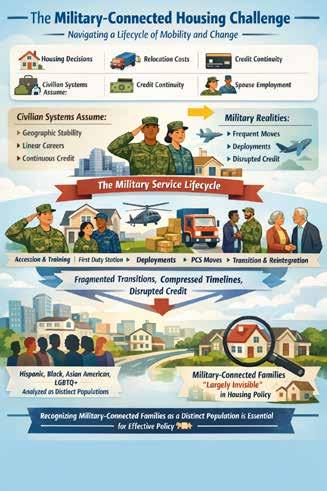
These mobility patterns influence:
Housing decisions, including whether to rent or buy and when
Lease terminations and relocation costs
Credit continuity across jurisdictions
Spouse employment and credential portability
Civilian housing and financial systems presume geographic permanence, linear employment trajectories, and continuous credit histories. Military-connected households operate outside those assumptions. Families re-enter rental and purchase markets repeatedly under compressed timelines. Credit histories are built and disrupted across states.
Upon separation from service, households move from a fully structured environment into fragmented civilian systems.
What distinguishes this community is not merely service. It is structural mobility—a pattern of life shaped by orders, deployments, and transitions.
Military-connected households experience recurrent geographic relocation and housing transitions. Research indicates that military families typically move every two to three years due to Permanent Change of Station (PCS) orders—far more frequently than civilian households.⁴
Understanding this population therefore requires a lifecycle lens. Military service unfolds across predictable stages:
Accession and training
Early career and first duty station
Deployment cycles
PCS transitions
Transition and reintegration
Veteran life and long-term stability
Each stage introduces distinct housing and financial conditions. Risk is cumulative rather than episodic. Outcomes that appear individualized are often system-driven.
Other demographic groups of comparable scale—Hispanic, Black, Asian American, and LGBTQ+ communities—are routinely analyzed as distinct populations in federal research and housing policy. Military-connected households, despite similar magnitude and complexity, remain largely invisible as a population in civilian housing and financial system design.
This invisibility has consequences. Systems optimized for permanence underperform for a population shaped by service obligations, relocation cycles, and transition into civilian life. Recognizing military-connected households as a distinct population is therefore a prerequisite for e ective policy design and durable outcomes.
Military-connected communities are not a niche population. They constitute one of the largest and most economically consequential demographic groups in the United States. Across every state and metropolitan region, military-connected households participate in housing markets, labor markets, and credit systems. Their economic footprint is visible not only in household spending, but in business formation, employment, and housing demand.
Federal data confirm this scale. The U.S. Census Bureau reports that veteran-owned employer businesses generated approximately $884.5 billion in annual receipts in 2022 and employed more than 3.2 million workers nationwide.⁵ These figures reflect business activity alone and do not capture household consumption, housing transactions, or credit use.
In addition, widely cited market research estimates place the broader military community—including active-duty personnel, veterans, spouses, and dependents—at approximately $1 trillion or more in annual consumer spending power.⁶
While these figures derive from market research rather than federal accounting, they are used across housing, finance, and defense-adjacent industries and underscore the scale at which this population influences the national economy.
This scale carries direct implications for:
National and regional housing markets
Mortgage origination and servicing systems
Rental markets and housing supply
Credit access and consumer finance
Workforce participation and small business formation
Military-connected households purchase homes, sign leases, open businesses, and relocate across jurisdictions at rates unmatched by any other civilian population. Their outcomes therefore a ect not only individual families, but local economies and national market stability.
Despite this scale, civilian housing and financial systems do not recognize military-connected households as a distinct economic population. Other populations of comparable size and complexity—Hispanic, Black, Asian American, and LGBTQ+ communities—are routinely profiled in federal research and industry analysis, with their housing outcomes tracked through population-aware frameworks.⁷–¹¹
Military-connected communities are not a niche population. They constitute one of the largest and most economically consequential demographic groups in the United States. Across every state and metropolitan region, military-connected households participate in housing markets, labor markets, and credit systems. Their economic footprint is visible not only in household spending, but in business formation, employment, and housing demand.
Federal data confirm this scale. The U.S. Census Bureau reports that veteran-owned employer businesses generated approximately $884.5 billion in annual receipts in 2022 and employed more than 3.2 million workers nationwide.⁵ These figures reflect business activity alone and do not capture household consumption, housing transactions, or credit use.
In addition, widely cited market research estimates place the broader military community—including active-duty personnel, veterans, spouses, and dependents—at approximately $1 trillion or more in annual consumer spending power.⁶
While these figures derive from market research rather than federal accounting, they are used across housing, finance, and defense-adjacent industries and underscore the scale at which this population influences the national economy.
This scale carries direct implications for:
National and regional housing markets
Mortgage origination and servicing systems
Rental markets and housing supply
Credit access and consumer finance
Workforce participation and small business formation
Military-connected households purchase homes, sign leases, open businesses, and relocate across jurisdictions at rates unmatched by any other civilian population. Their outcomes therefore a ect not only individual families, but local economies and national market stability.
Despite this scale, civilian housing and financial systems do not recognize military-connected households as a distinct economic population. Other populations of comparable size and complexity—Hispanic, Black, Asian American, and LGBTQ+ communities—are routinely profiled in federal research and industry analysis, with their housing outcomes tracked through population-aware frameworks.⁷–¹¹
Military-connected communities are not.
Population / Community
Military-Connecte d Communities (Service members, veterans, families)
General U.S. Population
Hispanic / Latino Households
Black / African American Households
Asian American & Pacific Islander Households
Asian American & Pacific Islander Households
LGBTQ+ Households (est.)
~20M veterans (plus families)
Veteran-owned businesses:
$884.5B in annual receipts (2022)⁵; market estimates place total community spending at ~$1T+ annually⁶
Varies by lifecycle stage High mobility, PCS cycles, transition risk
This comparison underscores two central realities.
Buying power approaching $2.8T⁸
Buying power approx. $2.1T⁹
Buying power approx. $1.3–$1.4T¹⁰
Buying power approx. $1.3–$1.4T¹⁰
Geographic stability
homeownership⁷ Younger households, first-time buyers
homeownership⁷ Historic access barriers
homeownership⁷ Urban concentration
Urban concentration
Below national average Legal and social barriers
First, military-connected communities are comparable in size and economic consequence to populations that already receive targeted housing and economic policy attention.
Second, unlike those groups, military-connected households are not treated as a distinct population in civilian housing and financial system design.
Recognizing this community as an economic population is therefore not symbolic. It is a prerequisite for e ective policy design, market stability, and durable outcomes.
Housing and financial outcomes for military-connected households are not random. They are shaped across a predictable sequence of stages that define military life. Each stage introduces distinct conditions that a ect income continuity, credit formation, housing access, and long-term stability.
Unlike civilian households, whose lives often unfold within a single region and labor market, military-connected families experience repeated, compulsory transitions.
The transition into service often marks a first departure from family housing and civilian credit patterns. Young recruits enter a fully structured environment in which housing is provided, financial decisions are constrained, and civilian systems recede from view. At this stage, civilian rental histories may pause, credit formation may stagnate or begin under limited guidance, and financial behaviors are shaped by institutional structures rather than market navigation.¹²

While this environment provides stability, it also delays the development of independent housing and financial decision-making. The return to civilian systems later in life therefore occurs without a continuous foundation.
The first permanent duty station introduces market exposure. Service members and families must secure o -base housing, often in unfamiliar regions and under compressed timelines.
Typical conditions include limited local market knowledge, time-constrained rental or purchase decisions, entry into high-cost or supply-constrained housing markets, and reliance on allowances calibrated nationally rather than locally.¹³ These first housing choices frequently determine early credit trajectories. Lease structures, deposits, utilities, and initial consumer credit establish patterns that persist through subsequent moves.
Deployments introduce income variation, household separation, and decision-making under stress. Financial management may shift between partners. Expenses change while obligations remain.
Housing impacts include maintaining leases or mortgages during absence, managing utilities and property remotely, exposure to delinquency risk during administrative disruption, and deferred relocation planning.¹⁴
While statutory protections exist, the operational complexity of deployment often exceeds the capacity of generic civilian systems to accommodate military realities.
PCS transitions are the defining structural feature of military life. Occurring every two to three years on average, they impose mandatory geographic relocation across state lines and housing markets.¹⁵
Each PCS cycle typically requires termination of an existing lease or sale of a home, entry into a new rental or purchase market, reestablishment of utilities, schools, and services, and rebuilding local financial and professional networks.
These moves disrupt continuity. Credit histories span jurisdictions. Housing histories fragment. Equity accumulation is constrained by forced sale timing. Rental churn replaces stability.
For civilian households, relocation is elective. For military households, it is compulsory.
Separation from service represents the most significant structural shift in the lifecycle. A fully coordinated system is replaced by fragmented civilian institutions.
At this stage, income becomes market-dependent, housing allowances end, benefit navigation becomes individualized, and institutional guidance disappears. Households must rapidly secure civilian housing, establish new employment, rebuild community ties, and translate service experience into market value. Housing instability at this stage is strongly correlated with broader financial distress.¹⁶
This is the point at which cumulative risk often becomes visible.
Veteran life is not a single outcome. It is a long horizon shaped by earlier stages. Households that achieve housing stability, particularly through sustainable homeownership, demonstrate improved credit trajectories, lower financial volatility, greater workforce continuity, and higher intergenerational stability.¹⁷
Conversely, households that enter civilian life without stable housing face persistent rental churn, elevated cost burden, delayed wealth formation, and increased exposure to default and displacement.
These outcomes are not the result of isolated decisions. They are the product of cumulative structural conditions.
This lifecycle analysis yields three central conclusions. First, risk is cumulative. Instability emerges over time through repeated transitions, not at a single moment of failure.
Second, crisis-only intervention is structurally insu cient. Models that activate only at default, eviction, or homelessness address symptoms rather than causes. Third, continuity is the missing design principle. No federal or civilian system accompanies military-connected households across stages. Responsibility fragments as conditions evolve.
Civilian housing and financial systems are built for permanence. Military life is defined by transition.
Bridging that mismatch requires rethinking how stability is designed, not as a one-time outcome, but as a continuous process aligned with the realities of service. The next section demonstrates why housing sits at the center of that process.
Across civilian society, housing is widely understood as a foundation of financial security. For military-connected households, it is more than that. Housing is the central engine of reintegration, credit formation, and long-term economic stability.
Stable housing anchors employment, education, healthcare access, and community connection. It determines whether a household can plan, save, and recover from disruption. In military-connected communities, where transition is structural, housing is the di erence between continuity and compounding instability.
Federal research consistently demonstrates that households with stable housing exhibit more predictable income trajectories, lower financial volatility, stronger credit outcomes, and greater workforce participation.¹⁸ Conversely, housing instability accelerates financial stress, increases cost burden, erodes savings, delays credit recovery, and constrains employment options.¹⁸ These dynamics apply to all households, but they are magnified in a population defined by mobility and transition.
For military-connected families, housing is not merely shelter. It is the platform from which civilian life is rebuilt.
Credit formation is deeply tied to housing stability. Lease continuity, utility histories, mortgage performance, and local financial relationships shape credit profiles over time. Frequent relocation fragments these histories.
Military-connected households often experience repeated resets of rental and utility accounts, discontinuous local banking relationships, forced timing of home purchase or sale, and credit inquiries and short-term debt tied to relocation.
These patterns introduce volatility that is not behavioral in origin. It is structural. Stable housing interrupts this cycle. Whether through long-term rental continuity or sustainable homeownership, housing stability allows credit to compound rather than reset. It enables households to build history, preserve equity, and recover from disruption.
Among all housing pathways, sustainable homeownership produces the most durable outcomes.
Homeownership is associated with higher net worth accumulation, greater financial resilience, increased geographic stability, intergenerational wealth transfer, and stronger community attachment.¹⁹ ²⁰
For military-connected households, these e ects are magnified. Homeownership provides a fixed point after years of compelled movement. It converts service into permanence. The VA Home Loan program functions as the federal government’s primary reintegration instrument in this domain. It is the only national benefit designed specifically to translate military service into long-term household stability through access to ownership.²¹
Its structure reflects this purpose. The program reduces barriers to entry, accommodates service-related income patterns, and recognizes mobility. It is not merely a mortgage product. It is a civilian reintegration mechanism.
Yet the success of this mechanism depends on systems that extend beyond the loan itself.
If housing is the stability engine, then the question becomes one of system design. For military-connected households, e ective housing systems must recognize mobility as structural, anticipate transition rather than react to crisis, integrate housing, credit, and benefit navigation, provide continuity across jurisdictions, and embed military-competent guidance.
Without these elements, even the strongest benefits underperform.
The VA Home Loan demonstrates what is possible when policy recognizes service. What remains absent is a civilian infrastructure designed to carry that recognition across the full housing journey. Housing is where military service becomes civilian life. It is where readiness becomes reintegration.
The next section examines where current systems fail to provide that continuity.
Section V – The Continuum Gap
The preceding sections establish three realities.
First, military-connected households are structurally distinct.
Second, their scale carries national economic consequence.
Third, housing is the central engine of stability across transition.
Yet despite these realities, no federal or civilian system is designed to accompany military-connected households across the full service lifecycle. Responsibility fragments as conditions evolve. Continuity is absent by design.²³
This structural absence is the Continuum Gap.
The institutions that touch military-connected households operate in silos.
The Department of Defense prepares individuals for service, not for civilian housing outcomes.²⁴
The Department of Veterans A airs administers benefits, but does not provide continuity across markets or life stages.²⁵
The Department of Housing and Urban Development serves civilians and does not operate with consistent military context.²⁶
Lenders, servicers, and housing providers transact at moments in time without lifecycle awareness.²⁷
Each system performs a legitimate function within its mandate. None is structured to own continuity.
As a result, military-connected households move between:
DoD readiness frameworks
VA benefit systems
Civilian housing markets
Financial institutions
Local service providers
With no coordinating spine.
Every transition becomes a hando . Every hando introduces friction. Over time, friction becomes instability.
The absence of continuity produces predictable outcomes.
Benefits are underutilized or misapplied.²⁵
Housing decisions are made under time pressure without guidance.²⁷
Credit volatility compounds across moves.²⁹
Early warning signs are missed.²³
Intervention occurs only after damage is visible.²⁸
This is why default, eviction, and homelessness become the system’s primary activation points.²⁸
The problem is not a lack of goodwill. It is a lack of design.
Civilian systems assume permanence. Military life is defined by transition. When systems built for stability encounter a population defined by movement, failure becomes structural.
Because no institution owns continuity, most intervention models activate only at crisis. A household is noticed when:
A mortgage becomes delinquent
A lease is broken
A foreclosure is initiated
A veteran enters homelessness
By that point, instability is no longer emerging. It is entrenched.²³
Crisis-based systems are e cient at triage. They are ine ective at prevention.²⁷ For a population whose risk accumulates across predictable stages, waiting for failure is not neutral. It is a design choice.
What is missing is not e ort. It is architecture. No system is designed to:
Track military-connected households across stages
Anticipate housing risk before crisis
Integrate benefit navigation with market realities
Provide military-competent guidance over time
Maintain continuity across jurisdictions
The result is a structural vacuum between service and civilian life.²³
This vacuum is filled by chance.
Some households encounter knowledgeable professionals. Others do not. Outcomes diverge not because of behavior, but because of system exposure. Continuity becomes accidental.
The absence of a Continuum of Service is not merely ine cient. It is inequitable.
Two service members with identical records can experience radically di erent outcomes based on:
The lender they encounter
The housing counselor they find
The market they enter
The moment a crisis is noticed
This is not a market failure alone. It is a systems failure.²³
Military-connected households are asked to navigate civilian housing and financial systems alone at the very moment institutional structure disappears.
The Continuum Gap is therefore the central structural issue underlying housing instability, credit volatility, and default in this population.
The findings in this report establish that military-connected households are a structurally distinct population, that their scale carries national economic consequence, that housing is the central engine of stability, and that no system is designed to provide continuity across the service lifecycle.
These realities carry direct implications for federal policy and civilian market design. They do not call for isolated programs. They call for alignment.
Federal housing and financial policy has historically treated military-connected households as individual beneficiaries rather than as a population with predictable structural conditions.³⁰ Legislative frameworks governing housing, credit, and transition services are organized by agency jurisdiction rather than by lifecycle need, which contributes to fragmented authority and unowned continuity.³¹

For Congress, the central implication is that military-connected households require population-aware policy design. Stability for this community cannot be achieved through episodic benefits alone. It must be designed as a continuous system spanning service and civilian life.
Policy that recognizes service without addressing ransition will continue to underperform.³¹
DoD is the first institutional environment military households encounter. It shapes financial behavior, housing expectations, and readiness norms. Yet DoD’s mandate ends at service.
Transition preparation focuses primarily on employment and benefits awareness, not on housing continuity or financial system navigation.³¹
This leaves households underprepared for civilian market complexity at the precise moment institutional structure disappears.
For DoD, the implication is not mission expansion. It is integra tion. Transition must be treated as a housing and financial event, not solely a career event.³¹
The VA administers the nation’s most powerful civilian reintegration benefit in housing, the VA Home Loan. Yet the benefit operates transactionally. It does not provide continuity before readiness or after origination.
Borrowers enter the VA loan system unevenly prepared. They exit without coordinated guidance. Default becomes a primary point of system activation rather than an exception.³²
For VA, the implication is that benefit design alone is insu cient. Outcomes depend on the ecosystem in which the benefit operates. A reintegration instrument requires reintegration infrastructure.³²
HUD’s housing counseling and homelessness prevention systems are built for civilian populations and do not operate with consistent military context or engagement during service.³³
As a result, military-connected households often encounter HUD-aligned systems only after instability becomes visible.
Mortgage origination and servicing models are largely transactional. They evaluate risk at a moment in time and intervene at delinquency or default. Military-connected borrowers are often evaluated as if volatility were behavioral rather than structural.
PCS cycles, deployments, and transition periods introduce predictable patterns of disruption that are not consistently embedded in risk modeling or borrower engagement frameworks.³⁴
For HUD, the implication is population recognition. Military-connected households are a distinct mobility-driven population whose housing pathways di er structurally from civilian norms. Without this recognition, prevention and counseling frameworks will remain misaligned.³³
For lenders and servicers, the implication is lifecycle awareness. Systems that do not recognize predictable military transition patterns will continue to misclassify risk and intervene too late.³⁴
Civilian housing counseling models are typically designed around discrete events such as pre-purchase education, foreclosure prevention, or rental readiness. Military-connected households require longitudinal engagement.
Across agencies and markets, the implication is the same. Military-connected households do not fail systems. Systems fail to recognize military life.
The required shift is from episodic intervention to continuous design, from transaction to lifecycle, from crisis response to anticipatory architecture.³¹ This does not require the creation of a new bureaucracy. It requires alignment among those that already exist.
A population-aware housing and financial system would recognize mobility as structural, anticipate transition rather than react to crisis, integrate benefits with market realities, provide continuity across stages, and embed military-competent guidance.
They need guidance that spans service, relocation, transition, reintegration, and recovery.³¹ For intermediaries, the implication is continuity. One-time counseling cannot meet the needs of a population defined by repeated transition.³³
Absent this shift, even the strongest benefits will underperform. The VA Home Loan will continue to function as a powerful tool without a system designed to carry it across the service lifecycle.³²
This report demonstrates that stability for military-connected households is not primarily a matter of individual behavior. It is a matter of system design.³⁰
U.S. Census Bureau, Veterans Day 2024: November 11 (American Community Survey).
U.S. Department of Veterans A airs, veteran population projections and federal demographic estimates (mid-2020s).
U.S. Department of Defense, definition of military dependents.
4.
Department of Defense–aligned research on Permanent Change of Station (PCS) frequency, indicating average relocation every two to three years.
U.S. Census Bureau, Annual Business Survey, Veteran-Owned Employer Businesses, 2022.z
Military consumer market research and industry estimates on military-community spending power.
U.S. Census Bureau, American Community Survey, homeownership rates.
Selig Center for Economic Growth, Hispanic Buying Power in the United States.
Nielsen and Selig Center for Economic Growth, Black Buying Power reports.
Nielsen and Selig Center for Economic Growth, Asian American and Pacific Islander Buying Power reports.
LGBT Capital and Human Rights Campaign Foundation, LGBTQ+ spending power estimates. 11.
U.S. Department of Defense, Profile of the Military Community, sections on junior enlisted demographics and financial readiness.
Government Accountability O ce, reports on housing access and cost variation near military installations.
U.S. Department of Defense, Military OneSource and Family Readiness research on deployment impacts.
U.S. Department of Defense, Demographics: Profile of the Military Community, PCS frequency and relocation data.
Government Accountability O ce, Transitioning Veterans: Improvements Needed in Coordination and Outcomes; U.S. Department of Veterans A airs transition studies.
Federal Reserve, Survey of Household Economics and Decision-making; U.S. Department of Housing and Urban Development research on housing stability and financial outcomes.
U.S. Department of Housing and Urban Development, research on housing stability and financial outcomes; Federal Reserve Bank studies on housing insecurity and financial volatility.
Federal Reserve, Survey of Household Economics and Decision-making, findings on homeownership and financial resilience. 19.
U.S. Census Bureau, wealth and housing tenure data; academic research on intergenerational wealth and homeownership.
U.S. Department of Veterans A airs, VA Home Loan Guaranty Program reports.
Government Accountability O ce, analyses of housing assistance models and crisis-oriented intervention systems.
23.
Government Accountability O ce, Transitioning Veterans: Improvements Needed in Coordination and Outcomes.
U.S. Department of Defense, Profile of the Military Community, transition and readiness frameworks.
25.
U.S. Department of Veterans A airs, VA Home Loan Guaranty Program borrower engagement and outcome analysis.
26.
U.S. Department of Housing and Urban Development, Housing Counseling Program scope and civilian service framework.
27.
Government Accountability O ce, analyses of crisis-driven housing and financial intervention models.
28.
U.S. Interagency Council on Homelessness, reports on veteran homelessness pathways and late-stage system activation.
29.
Federal Reserve, Survey of Household Economics and Decision-making, findings on financial shocks and delayed response.
30.
31.
Congressional Research Service, analyses of veteran policy frameworks and benefit structure.
U.S. Department of Defense, Transition Assistance Program evaluations and readiness assessments.
32.
U.S. Department of Veterans A airs, VA Home Loan Guaranty Program borrower outcome and program reporting.
33.
Federal Reserve and Government Accountability O ce, analyses of mortgage servicing models and crisis-based intervention timing.