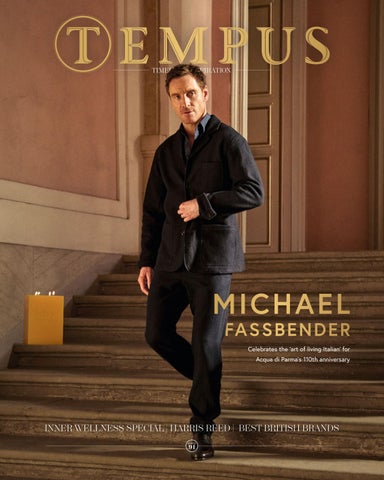
FASSBENDER MICHAEL
Celebrates the ‘art of living Italian’ for Acqua di Parma’s 110th anniversary

INNER WELLNESS SPECIAL | HARRIS REED | BEST BRITISH BRANDS


Where
Set in a restored Grade II listed former bank on Cavendish Square, Aki London blends Kyoto craftsmanship with contemporary London style. Expect refined sushi, robata signatures and an omakase that showcases ingredients at their best.
Beyond the dining room, a discreet bar unfolds, a little more exclusive, tucked away from the crowd and built for late night moments with energy. Private dining rooms offer something more intimate, while contemporary art and live DJs bring the space to life from Tuesday to Saturday. Aki London is an experience shaped by flavour, sound and design.


Effortless wellness

Aficionados of luxury living will be familiar with the Italian expression sprezzatura Coined in the 16th century by Baldassare Castiglione – a courtier, diplomat and tastemaker – it describes a studied nonchalance; the art of making the difficult look effortless.
In fact, it is one of the founding principles of Acqua di Parma, the Italian fragrance house that is celebrating its 110th anniversary this year with a little help from charismatic Oscar-nominated actor Michael Fassbender. On page 30, the maison’s CEO Giulio Bergamaschi tells me that, in his view, “Elegance, simplicity and light-heartedness are not opposites. They coexist.”
While today sprezzatura is mostly discussed in relation to fashion or the arts, there’s a sense of joy and liberation to this way of being that, in many ways, can inspire us across all parts of life.
Take our health and wellbeing, for example. In our social media-led wellness-obsessed culture, it can feel like we’re falling behind if we’re not on the grid performing endless checklists of all the things we “should” be doing to better our physical and mental health – step counts, calorie logs, supplement regimes and scheduled self-care. Often, it feels like the very act of optimising our wellbeing is exhausting in itself.
Instead of heightening the pressure we place on ourselves by chasing the latest fads or worrying about the “correct” approach, the sprezzatura philosophy invites us to rethink our relationship with our wellbeing by letting go of the performance and embracing the practice. Whether that’s joining the social wellness club revolution (52) or focusing on our spiritual wellness as part of self-care (46), the question to ask is, how can we make the wellness industry work for us?
Far from abandoning discipline or intention, we can instead shift our focus from health being something we chase to something we inhabit – all by focusing on inspiration, repetition and work that disappears into our habits and lifestyle until our effort looks and, most importantly, feels effortless.
Also in this issue, the art of sprezzatura continues with interviews with two of Britain’s most exciting pillars of fashion, designer Harris Reed (62) and Sunspel’s Nicholas Brooke (90); artist Ini Archibong shares the creation of his magnificent contemporary standing stone to honour Port Ellen (16); and we examine the unexpected travel trends (40) and understated luxury brands (86) set to dominate 2026 in style.
Enjoy the issue,

Michelle Johnson Editor-in-chief Tempus
While today, sprezzatura is mostly discussed in relation to fashion, there’s a sense of joy and liberation that can inspire us across all parts of life


Contributors


Dominique Afacan
Superyacht specialist and editor Dominique talks to Yachts for Science founder Rosie O’Donnell about how she is making vital marine research happen (38).
Rikesh Chauhan
Tempus style columnist Rikesh shows us how to brighten our days with sophisticated pops of colour for any winter wardrobe on page 112.
Lysanne Currie
Taking a look back at the year that was, Lysanne discovers the most surprising 2025 trends in our British Luxury Review (98), as well as finding out what to tick off on our travel to-do lists (40).
Stephanie Gavan
Art and culture expert Stephanie looks back on a ground-breaking Frieze fair and turns her eye to the impact of contemporary sculpture (66).
Editorial team
Editor-in-chief
Michelle Johnson michelle@tempusmagazine.co.uk
Creative Director Ross Forbes ross@tempusmagazine.co.uk
Digital Editor
Shivani Dubey shivani@tempusmagazine.co.uk
Contributors
Dominique Afacan, Rikesh
Chauhan, Judy Cogan, Lysanne Currie, Stephanie Gavan, Ed 'Jungle' Kerr, Josh Sims, Susan Springate, Alexandra Wilby
Chief Sub-Editor
Dominique Dinse
Designer Emma Howcutt-Kelly
COMMERCIAL
Head of Partnerships
Dan Scudder dan@tempusmagazine.co.uk
+44 (0) 203 519 1005
VANTAGE MEDIA
Managing Director
Peter Malmstrom
COVER IMAGE
Michael Fassbender photographed on location in Parma, Italy, for Acqua di Parma
Photographer: ©Brett Lloyd/Acqua di Parma
Article on page: 30
@tempusmagazine
@tempusmagazine
Tempus Magazine

CONTENTS


12 The Luxe List Our essential guide to this season’s finest gifts and most exciting new launches
16 The atlas of smoke Artist Ini Archibong on capturing the essence of Port Ellen
20 Horse power Celebrate the Chinese New Year of the Horse with these horological marvels
26 Pure power McLaren pushes the limit of personalisation – and performance –with the new W1
30 The art of living Italian Michael Fassbender joins Acqua di Parma to celebrate 110 years of sprezzatura
34 Plane sailing We join VistaJet’s Private World for an ultra-luxe journey to Monaco
38 The superyacht matchmaker Yachts for Science’s Rosie O'Donnell on making oceans of impact
40 Main character energy Forget the bucket list – these are the 2026 trends set to transform our travels
46 Finding balance Healthy living doesn’t stop at body and mind. Here’s how to find wellness from within
52 Get together Discover the social clubs putting community at the social centre of well-being
56 Wild & free As the non-alcoholic drinks market continues to boom, Wild Idol CEO Paul Beavis is in sparkling form
58 Wine in a million Enjoy a taste of Porto’s unique heritage, protected history and extraordinary flavours
62 The spirit of fashion Designer Harris Reed on breaking fashion’s gender divide and working with Royal Salute
66 Out of the shadows We look back on the most powerful sculptures at Frieze
72 Racing spirit Amalgam founder Sandy Copeman talks craftsmanship, precision and devotion to motorsport
76 Alchemy & emotion William P Lauder shares his secrets to great leadership, giving back and learning from the next generation
80 Creative collagen Tempus discovered the collagen-infused lifestyle brands set to shine in 2026
84 Grey matter Could Brain-Computer Interfacing advance medicine and tech – or are we living in science fiction?
86 Best of British Meet the brands redefining the meaning of luxury – and poised to take 2026 by storm
90 Anything but casual Sunspel executive chairman Nicholas Brooke on the art of dressing well
98 The British luxury review Tempus’s review of the state and status of British luxury returns
103 RE:VIEW The Dalmore shares its latest 17 Year Old release, plus our pick of the best events, festivals and more
108 Save the date The finest events of the season
112 Colourful intentions Add a splash of colour to your wardrobe with the help of Tempus style columnist Rikesh Chauhan


The LUXE LIST
Our essential guide to the most exciting new launches and finest seasonal gifts

2
Baker Brothers Diamond and Emerald Heather Brooch
Netflix series The Crown reignited interest in the life and style of Princess Margaret, the rebellious and enchanting younger sister of Queen Elizabeth II. The fashionable royal’s exceptionally good taste extended to her jewellery collection. Diamond specialists Baker Brothers successfully bid for a number of the Princess’s personal jewels at a Sotheby’s auction, including this historic diamond and emerald heather brooch (right), presented to her in 1947 to mark the launch of the RMS Edinburgh Castle. The 6.2cm brooch is a masterclass in mid-century design and craftsmanship, with brilliant-cut diamond adorning a delicate spray of Scottish heather, with calibre-cut emeralds on the stem. A sparkling piece of history.
Contact 01234 430042 for more information. bakerbrothersdiamonds.com


3
The Dalmore 17 Year Old Three rare and exclusive sherry casks enrich the newest single malt whisky release from The Dalmore, Aged 17 Years (left). Rare Apostoles, Amoroso and Matusalem Oloroso sherry casks from world renowned sherry Bodega, González Byass impart deep, sweet and intricately layered flavours. Available now via The Dalmore’s online boutique. Salud! Discover more on page 104.
thedalmore.com
Tiffany & Co Tiffany Timer
Charles Lewis Tiffany recognised the demand for finely-made, highprecision timepieces in 1847, debuting the Tiffany & Co Timing Watch in 1866 –one of the first American pocket watches – designed for use in science and sporting events. To celebrate 160 years since its creation, the high jewellery brand has reinvented the Tiffany Timer (left) in a limited-edition of 60 pieces, which debuted at the LVMH Watch Week in Milan in January. The new watch comes in a platinum case equipped with a customised El Primero 400 movement featuring the maison’s Bird on a Rock design. The dial is in Tiffany blue lacquer and set with 12 baguette-cut diamond indexes and completed with a taupe alligator strap and triple folding clasp in 18k white gold. American history on the wrist.
tiffany.co.uk
Riva Cento
Get ship shape with the limitededition Riva Cento open yacht (right). Produced in only 12 units and debuted at the Cannes Yacht Festival in autumn 2025, this magnificent open yacht for collectors enhances the brand’s classic, elegant character with new stylistic and functional details. The distinctive stern area is fitted with an electro-hydraulic system that opens the stern door, revealing mahogany steps under which there are two chaises longues with detachable cushions that create two comfy sunbeds, transforming this space into a splendid beach area. The yacht’s cockpit is fitted with a C-shaped sofa that frames a stainless-steel table. Below deck, there is a generous open space designed to offer ultimate comfort when cruising and for overnight stops at anchor. »
riva-yacht.com


6
The Cinnamon Club 25th Anniversary Tasting Menu
The Cinnamon Club, chef Vivek Singh’s acclaimed Michelin-star restaurant, is celebrating 25 years of serving world-class Indian cuisine at its Westminster flagship. Inside the historic Grade II Listed former Westminster Library, chef Vivek weaves together tradition, innovation and storytelling into each course. The restaurant’s nine-course 25th anniversary tasting menu includes signature dishes such as Vivek’s scallop and tuna ceviche chaat (right), and new creations including a Mangalore stir-fried king crab ghee roast. Showstopping British lamb sits at the heart of the menu, where smoked tandoori saddle with Punjabi-style lamb mince, seekh kebab in roomali bread and a

5
Loquet London
Treasure your precious memories with Loquet’s new Lunar Cushion locket (left), which can be opened and personalised with your chosen charms. Handcrafted in 18k solid gold, illuminated by a single cushion-cut diamond, this round locket is edged with diamonds and set with a faceted crystal that draws inspiration from the moon’s gentle constancy. Four flower charms are handcrafted in 18k gold set with marquise and pear-shaped sapphires and diamonds. Loquet’s Sugar Plum charm in 18k solid gold, set with green tsavorite leaves and a pink cabochon sapphire, is a perfect sweet treat. Founded in 2013 by British environmentalist and columnist Sheherazade Goldsmith, Loquet takes a contemporary approach to the eraspanning idea of a keepsake locket. A charming piece.
loquetlondon.com

7
L’Or de Jean Martell Zodiac Edition, Assemblage du Cheval
Raise a glass to the Year of the Horse with Maison Martell’s L’Or de Jean Martell Zodiac Edition, Assemblage du Cheval (left). A limited release of just 500 individually numbered decanters worldwide, the blend draws on very old eaux-de-vie from past Years of the Horse and is presented in a mouthblown crystal decanter created in collaboration with Baccarat. Crowned by a striking horse’s head stopper in deep red crystal, the decanter rests on a golden pedestal embellished with horseshoe printed pattern. The neck is engraved with the name and series number of the limited edition. Each bottle comes nestled inside a beautifully crafted wooden case decorated with an intricate horseshoe motif. The perfect way to toast the lunar new year.
martell.com

Nobu Wellness
Nobu has entered the wellness arena with a global collection of signature offerings designed to inspire balance and renewal. From restorative sleep and mindful movement in Barcelona to oceanfront Ryokan rituals in Malibu and bespoke Omakase spa journeys in Miami, each programme is a reflection of the Nobu lifestyle and its philosophy of holistic wellness. No matter where you are in the world, Nobu’s new wellness offerings will help you recharge and rejuvenate for your journey ahead: in Warsaw, unwind with a signature Nobu Zen massage in the hotel’s spa suite; in Ibiza, trade the club for a sunrise water massage inspired by Japanese Watsu therapy and more. Wellness that travels with you.
nobuhotels.com
THE MARKET Classic Cars
When it comes to buying and selling classic cars, online auctioneers THE MARKET are a welcome break from the dead ends of fruitless searches. While not all cars come with the £1m-plus hammer price that this Ferrari F40 achieved, THE MARKET offers purchases with no buyers’ fees and sellers’ fees capped at £7,000. So, whether you’re searching for a Fiat or Ferrari, Austin or Aston, the Oxfordshire-based firm brings online buyers and sellers together so that you can drive away with your dream car.
themarket.co.uk


Leeds Castle Lakeside Lodges
Nestled in 550 acres of stunning Kent parkland, Leeds Castle is the ultimate romantic getaway.
The 16th-century Maiden’s Tower, on the castle island – once allegedly used by Catherine of Aragon’s maid of honour for her wedding to King Henry VIII – combines period elegance with contemporary comfort. Alternatively, the castle’s luxury Lakeside Lodges offer an enchanting and serene retreat surrounded by nature. Accessed by a private walkway, these lodges provide a tranquil and relaxing escape, where guests can unwind in private outdoor bathtubs on a private deck with stunning views of the Great Water and native wildlife. A serene escape fit for royalty.
leeds-castle.com

THE ATLAS OF SMOKE
ISLAY, 1825
Artist Ini Archibong on capturing the essence of Islay in a new sculpture to mark the renowned Port Ellen distillery’s 200th anniversary
Words: Michelle Johnson
When artist and designer Ini Archibong first visited Port Ellen, the renowned whisky distillery on the Scottish isle of Islay, he was struck by the deep connection between the island and its whisky. But it wasn’t until his latest project with the brand, creating a magnificent sculpture displayed in the distillery itself, and tasted the Port Ellen 1979 Cask of Distinction, that the significance of that connection became a source of artistic inspiration.
“I considered myself a connoisseur but soon realised I had never tasted whisky before,” said Ini (right). “Tasting the 1979 [cask], it was like the sun was rising on my tongue. I think, from that moment, [the sculpture] ceased to be about a project or a brand and became more about how to express the spiritual essence of that experience.”
The result is a monumental glass art installation – titled The Atlas of Smoke: an Interpretation – that draws inspiration from the island’s spiritual and cultural heritage – from the ancient standing stones to peat bogs utilised in the whisky making process. Standing at 2.3m tall and weighing around 350kg, the crystalline standing stone blends translucent glass with wisps of smoke swirling through in organic forms that seem to take new shapes the closer one looks. The bronze base features a natural, organic patina that incorporates byproducts from whisky production, allowing the distillery workers who collected the material to be forever a part of the artwork.
“My approach is to try to find the visual and spiritual connection between whatever I’m representing and the people that are going to be consuming it. Creating something for the
distillery meant I’m creating something for the people of Islay. It’s all about the people and the heritage.” says Ini, who found commonalities with his own American-Nigerian cultural ancestry. “When I asked to visit special places on the island and was taken to Finlaggan ancestral burial grounds, that resonated with me, culturally. Coming from a West African perspective, there’s the same reverence for your ancestors, and for knowing the stories of your lineage, and paying homage to that. I connected with that immediately.”
Another major inspiration was the blend of tradition and modernity that defines Port Ellen’s approach. The distillery was first established in the 1920s and was a powerhouse of scotch production, especially in the 1970s. Like many of the legendary ghost distilleries, Port Ellen ceased production in 1983, and remained closed for nearly 40 years until luxury spirits group Diageo reawakened the site with a multimillion-pound reconstruction that culminated in a grand reopening in 2024.
“I try to find the meeting point of science and spiritual landscape… There’s a very scientific approach in how Port Ellen does things that aligns with how I approach things technically,” says Ini, who took inspiration not just from the burning of peat, the smoke, and the traditional stills, but also the experience of the master distillers at work.
“This piece required taking a highly scientific material called Vitro glass, which has never been created at this scale,” he explains. “This is the largest piece ever made of this nature, taking technical know-how to bring about a spiritual, and very human, response. That’s what’s happening in Port Ellen.” »


Tasting the 1979 cask, it was like the sun was rising on my tongue. I think, from that moment, [the sculpture] ceased to be about a project or a brand and became more about how to express the spiritual essence of that experience

shock people into a state of the sublime,” he says, adding he hopes it momentarily shocks people out of their day-to-day worries and intentions.
“The hope is that they walk through the door and there’s a moment of awe, even if it’s just a fleeting moment, before they start to analyse it.”
Interestingly, those who view Ini’s glass sculpture may make out different shapes and symbols in the swirling colours of this contemporary standing stone but, he says, the different interpretations and feelings that it evokes in the viewers is part of the joy of the artwork.
“I lean into the inherently chaotic nature of reality and materials. You find where the chaos reveals itself and lean into it – you don’t try to control it,” he says. “That’s why, if you get close, there’s an entire universe inside of it. The universe is a chaotic place, but [people] find the order in the chaos. So, when you get close, you’re going to look in and see whatever you see in there.”
“I know that I’ve created something that is a fantasy, that is a metaphor for exactly how whisky came to be,” Ini adds, adding that he wanted to reflect the profound impact that the Islay landscape and Port Ellen team had on his creative process. “It’s as if whisky was handed down by the gods, and I needed to make something that embodied that – and that was it.”
portellen.com


Sublime sculpture: Artist Ini Archibong (above) was inspired by his visit to Port Ellen distillery (right). Above centre, a close-up view of his installation, The Atlas of Smoke: an Interpretation


HORSE POWER


The Lunar New Year marks the beginning of China’s traditional annual calendar with a 16-day celebration, which this year begins on 17 February and culminates in the Lantern Festival held on 3 March. On these important dates, the world will gallop on from the Year of the Wood Snake into the Year of the Fire Horse.
This auspicious elemental zodiac sign signifies freedom, independence, energy, endurance, success and ambition; a year reserved for movement, growth and momentum. Unlike last year, which focused on introspection, the Fire Horse is all about
As the watch world celebrates the Year of the Fire Horse, we pick our favourite horological masterpieces paying tribute to the Chinese zodiac
Words: Shivani Dubey
progress, the rise of new opportunities and the courage to move forward and pursue new goals in life with confidence. In Chinese culture, the horse is also considered lucky –admired for its strength, spirit and sociable nature. Because of this, it is believed that the Year of the Horse brings opportunities for growth, exploration and positive change.
To mark this momentous occasion, many luxury horology brands have released special, limited-edition watches that pay tribute to the Year of the Horse. Here, we take a look at five special designs that capture the spirit of the Chinese New Year.

IWC SCHAFFHAUSEN | PORTUGIESER
AUTOMATIC 42 YEAR OF THE HORSE
IWC Schaffhausen has unveiled its limitededition version of the Portugieser Automatic 42 to welcome the Year of the Horse. The Portugieser Automatic 42 Year of the Horse features a stainless-steel case with a 42mm diameter. The case construction has a slender side profile and box-shaped sapphire crystals on the front and back. The burgundy dial, inspired by the auspicious red tones widely used in Lunar New Year celebrations, features the characteristic Portugieser design. Inside the case, the IWCmanufactured 52011 calibre is at work while, visible through the sapphire glass case back, the gold-plated rotor is crafted in the shape of a galloping horse to pay tribute to the Lunar New Year. The watch (right) comes in a black alligator leather strap and an additional burgundy alligator leather strap. Both straps can be fitted with the stainless-steel folding clasp that is delivered with the watch. »
iwc.com
VACHERON CONSTANTIN | THE LEGEND OF THE CHINESE ZODIAC – YEAR OF THE HORSE
Vacheron Constantin has long paid tribute to Chinese culture through its Métiers d’Art The Legend of the Chinese Zodiac collection. This year, the brand has introduced two 25-piece limited edition watches (opposite) dedicated to the Year of the Horse. Set in a 40mm case, both timepieces are powered by the brand’s calibre 2460 G4, with dials that feature intricate relief engraving, micro-painting and grand feu enamelling, available in a 950 platinum or 18K 4N pink gold case (left). The dials are dominated by the three-dimensional figure of a horse leaping over a large rock and set against a delicately painted enamel background. The use of relief engraving creates visual depth and enhances the impression of dynamic movement. The horse and rock are sculpted from 18K white or pink gold. The pink gold expression is completed by a brown alligator leather strap, while the platinum is complemented by one in blue alligator.
vacheron-constantin.com


JAEGER-LECOULTRE | REVERSO TRIBUTE ENAMEL ‘HORSE’
Jaeger-LeCoultre always has an exciting release up its sleeve come Chinese New Year –and the limited-edition Reverso Tribute Enamel ‘Horse’ (this page) is no exception. Limited to just 10 pieces, the watch is the fourth in a series paying homage to the Chinese Zodiac, following the Years of the Tiger, Dragon and Snake. Turning the watch case to its reverse side reveals a majestic hand-engraved horse whose head and forelegs seem to leap out from golden clouds suspended in the sky. Surrounding it, the opaque black grand feu enamel – which also features on the glossy dial – complements the shine of the horse’s polished surfaces, while contrasting details on the mane, muzzle and hooves – hand-drawn with black rhodium – add a lifelike appearance to the horse. A sand-blasted texture on the clouds enhances the illusion of movement. And the watch runs on the Calibre 822 movement. The timepiece comes with a black alligator strap with interchangeable folding buckles.
jaeger-lecoultre.com


DIOR | GRAND SOIR CNY HORSE
Limited to just 30 pieces, the Dior Grand Soir CNY Horse features a 36mm stainless steel case with pink gold bezel set with 52 brilliant-cut diamonds. It has a milky translucent sapphire crystal case-back with pink gold metallisation. The dial is motherof-pearl, printed with a floral pattern of mother-of-pearl bushes and flowers set with amethysts, spessartites, and yellow and blue sapphires. There are also horses, butterflies and flowers in pink gold on the dial, bringing a beautiful and serene scene to life. The hour and minute hands are in pink gold, with the Christian Dior logo featured in the same colour. The watch is powered by the Sellita SW300 calibre movement and comes with a beige satin strap with a steel ardillon buckle set with 18 brilliant-cut diamonds.
dior.com
PIAGET | ALTIPLANO ZODIAC HORSE EDITION
Piaget is the epitome of sophistication when it comes to watchmaking, celebrating the Chinese Zodiac with a limited edition Altiplano Zodiac Horse Edition watch (left). Limited to just 18 pieces, this timepiece is set with 18 baguette-cut diamonds. At its core lies the ultra-slim Calibre 830P. The 41mm Altiplano case is encircled by baguette-cut diamonds, with the lugs accented by additional brilliant-cut stones and a rose-cut diamond crowns the winding stem. Rising above this landscape is a three-dimensional horse captured mid-leap, sculpted in cloisonné enamel. In shades of blue to white, the tension of the muscles and the reflections of the coat, the horse comes alive, making this watch a true horological marvel.
piaget.com


Reimagining inherited jewellery
How Baker Brothers’ expert gemmologists and bespoke team can help you reawaken beloved jewellery pieces


Some of the most meaningful jewellery is already in our possession. Rings passed down, brooches tucked away, necklaces worn once and then carefully stored. These pieces often hold deep personal significance yet no longer reflect how they are worn today. Reimagining inherited jewellery offers a considered continuation, one that respects the past while allowing new moments to take shape.
For generations, Baker Brothers Diamonds has worked with jewellery that carries history. Their bespoke service is guided by care and understanding, recognising that inherited pieces deserve thoughtful attention rather than quick solutions. Each piece is first assessed for its craftsmanship, materials and condition, ensuring decisions are informed from the outset.
Older diamonds and gemstones often require specialist knowledge. Cuts, proportions and settings from earlier eras differ from contemporary designs, and their character must be carefully understood before they can be reimagined. At Baker Brothers, this expertise is shaped by generations of experience and supported by recognised gemmological training, allowing gemstones to be handled with confidence and respect.
The bespoke process begins with conversation. Clients are invited to share the story behind the piece, as well as how they would like it to live now. Some choose to preserve familiar elements; others seek a more contemporary interpretation. In every case,
the approach is collaborative and unhurried, allowing ideas to develop naturally.
From initial sketches to final craftsmanship, each stage is carefully considered. A diamond may be reset into a modern ring, a brooch transformed into a pendant, or gemstones divided into multiple pieces to be worn and shared. What matters is that the finished design feels true to its origins yet entirely suited to the present.
This approach ensures that inherited jewellery remains wearable, relevant and personal. A piece once reserved for special occasions can become part of everyday life, its meaning deepened rather than diminished.
The Baker Brothers team is highly trained and consistently recognised for their expertise and approachability. Frequently mentioned in customer reviews, they are praised for being friendly, knowledgeable, and attentive. They understand that not every design immediately aligns with personal taste, and that sentiment often matters more than style alone. The team takes genuine enjoyment in reimagining pieces so they feel right to wear, helping clients transform meaningful jewellery into something they truly love – making the process both personal and enjoyable.
Sometimes, the most meaningful jewellery is not made from the beginning, but thoughtfully continued.
Contact Baker Brothers via their website bakerbrothersdiamonds.com or phone +44 (0) 1234 438 770
Brothers team gives new life to your beloved gems through bespoke design

PURE POWER
W1 | SILVERSTONE | MSO
Tempus heads to Silverstone to discover how McLaren Special Operations is introducing a new level of hyper-personalisation to its range of luxury supercars – and experience the phenomenal new W1
Words: Ed 'Jungle' Kerr
It was a most unusual autumn day on which I arrived at the historic Silverstone race circuit for an intimate first look at the much-anticipated McLaren W1 hosted by McLaren Special Operations. Rather than the expected wind and damp, the temperature was more reminiscent of a mid-summer’s day as the sun shone down upon the gathered collection of McLaren cars that decorated the venue, both statistically displayed and blasting round the track.
Launched on the 50th anniversary of Mclaren’s first Formula 1 World Championship win, the W1 is the fastest, most technically advanced and capable hybrid hypercar the marque has ever conceptualised, designed and built. I was joining an audience of owners, enthusiasts and press at this McLaren Pure experience – part of the special ownership
club benefits that are exclusively on offer to McLaren owners.
This Pure event saw owner-drivers spend two days experiencing the latest advancements from the brand, while also getting the chance to work their own cars to the absolute limit around the Formula 1 circuit, with professional driver instruction available if desired.
But the highlight of the event was the W1, which, to be clear, is bonkers fast. Limited to just 399 models, the supercar is the fastest accelerating road-legal McLaren ever produced, able to reach 200km/h from standstill in just 5.8secs thanks to an allnew, high-performance hybrid powertrain consisting of the MHP-8 V8 engine – a combined 4-ltr V8 fuel engine and E-module derived from F1 battery technology – and an eight-speed dual clutch transmission, which
includes an integrated E-Differential.
This hybrid engine creates 1,258 bhp and 1,340 Nm of torque, balanced by 1,000kg of downforce created by the innovative integrated aero system. This technological feat comprises a purpose-built Aerocell and Active Long Tail, which, when the car is in race mode, extends backwards by 300mm in a mesmerising display of automatically adjusting control surfaces that optimise performance in any given moment – it’s not unlike watching a fifthgeneration fighter jet in action.
But to reduce this phenomenal machine to mere stats is to do it a massive disservice.
As I joined the McLaren Pure members on the Silverstone circuit – driving flat out in a McLaren Artura on the hanger straight – the W1, piloted by Bruno Senna, flew passed me at such speed it was as if I was standing still. »
1,258 BHP / 1,340 NM / 1,000 KG DOWNFORCE / 5.8 SECS TO 200 KM/H


FUNCTION AND FORM
But even beyond the feat of technical engineering, McLaren’s Special Operations team are ensuring that owners make each of the 399 manufactured W1s, all of which have been pre-sold with a starting price of £2m, entirely their own. This hyper-personalisation includes customised finished such as unique colour tines for carbon fibre components and wheel finishes, tailored interiors, from material choice – including patented McLaren InnoKnit fabric and bespoke stitching – to customised interior lighting, and unique details such as personalised patterns, graphics, or functional components.
The personalisation works around yet more innovative details designed to ensure weight,


control and performance are held in pin-point accuracy. The car’s doors open differently to any other McLaren to aid aerodynamic performance; the car’s pedals and steering wheel move to fit the driver’s seat; driving mode selectors are positioned intuitively just a fingerclick away. McLaren’s InnoKnit fabric can be knitted perfectly to the shape and size of the seats, meaning there is no waste of space, air or weight. Visually, there are no buttons or dials on the steering wheel itself: the sense is one of no clutter, no distractions, just deliberately engineered simplicity that focuses on the things that really matter.
Taken as a whole, the W1 seems to defy physics. While at Silverstone, I heard the phrase, ‘Excellence everywhere’ repeated multiple times
– an undeniably refreshing sentiment that is evident throughout the W1’s concept, design and build. McLaren has built a veritable space rocket that is just at home doing a few laps of Silverstone’s F1 circuit as it is impressing the neighbours, then eventually, when you decide you really must go home, gliding the last 300m of your driveway in electric-only mode so you don’t wake up the neighbourhood.
McLaren really has thought of everything. The W1 is beautiful, smart, perfectly executed and incredibly fast. Car lovers would have to be mad not to want one. With a production run limited to just 399 customer-designed cars, this is a very special creation, indeed.
SPREZZATURA & LEGGEREZZA
THE ART OF LIVING ITALIAN
Michael Fassbender embodies Acqua di Parma’s 110th anniversary with a stylish new campaign as the Italian brand’s CEO Giulio Bergamaschi tells Tempus about the key to evolving with intention
Words: Michelle Johnson
Exploring the sun-dappled streets of Parma, Italy, and the hidden luxuries that abound, Michael Fassbender is taking life at his own pace in his latest starring role. As Acqua di Parma’s first ambassador, the Oscar-nominated actor is starring in a new campaign film alongside Italian actress Sabrina Impacciatore to celebrate the fragrance brand’s milestone 110th anniversary.
At the heart of the campaign is Colonia, Acqua di Parma’s classic fragrance, first created in 1916. It has since become synonymous with timeless sophistication, with an alluring blend of Calabrian bergamot, lemon, orange, lavender, rosemary and woody base notes that make it coveted by men and women alike.
“Sophistication, beauty and elegance lie in simplicity,” says Michael, who embodies the ‘art of living Italian’ in the first episode of the campaign, by enjoying a morning espresso, admiring a classic car, sampling fresh lemons at local produce stores and dining with friends. “For me, that is what personifies Italy and brings Italian philosophy to life. It is embodied in its food, culture and art.”
Shot on film by British director Talia Collis and photographed by Brett Lloyd, the campaign features six episodes and one feature video, all bringing the atmosphere and feeling of Parma to life – and celebrating a trio of Colonia expressions celebrating the brand’s milestone. Alongside the Colonia and 2025’s Colonia Il
Profumo eau de parfum – with creamy ylangylang and a warm base of patchouli and vetiver – Acqua di Parma has also released the new limited-edition Colonia Profumo Millesimato. The Millesimato reinterprets the 1916 Colonia based around an exceptional 2024 harvest of Ylang-Ylang White from Nosy Be in Madagascar.
“The intention was not to add complexity, but to reveal a deeper dimension of what already exists,” says Acqua di Parma CEO Giulio Bergamaschi. “It was the ideal way to honour the fragrance: by choosing an element whose richness is felt, but whose effort remains invisible.”
For Michael, these scents epitomise the brand’s legacy. “Aqua di Parma’s Colonia captures that essence within a fragrance. A true reflection of its heritage and birthplace,” he says.
It’s a feeling returned by Giulio, who tells Tempus: “Michael embodies our approach through attitude”.
“It is not about look, nor about image,” Giulio explains. “He represents a very Italian idea of sprezzatura: the art of concealing effort, of mastering complexity so completely that it appears effortless. Beyond his remarkable acting skill, he does not perform discreet elegance – he inhabits it.”
This discreet mastery of craft has been seen on screen in a carefully curated selection of projects since Michael’s return to acting in 2023, including 2025’s Black Bag and the 10-part spy
thriller The Agency, which mark a departure from his previous blockbusting turns in the X-Men and Alien franchises.
“I did make a conscious decision of taking a break,” he told Indiewire at the release of Black Bag. “I was doing three, four films a year, sometimes. That wasn’t by design. Sometimes you sign up to something and there’s a delay. The next thing you know, three films are backto-back. But I wanted to get into racing, and approach it seriously and give my time to it.
And obviously it’s impossible for me to do a race season and film, just for insurance reasons alone. It was good for me to take a break and get some perspective and try something totally different.”
Michael, who has been married to fellow actor Alicia Vikander since 2017, turned to his love of racing during his acting hiatus, undertaking the Porsche Carrera Cup Germany in 2019, and starring in Porsche’s documentary Road to Le Mans. He finished fourth in the European Le Mans Series in 2021 with his Proton Competition team, achieving his first podium – and personal best finish – at the series’ last race in Portimão, where his team achieved second place.
In 2023 he told talkshow host Graham Norton, “[Racing is] an obsession and feels so right as I have no affinity with any other sport. It’s not just about the speed; it is about getting into a place where you’re not thinking of anything else. I love it.” »


THE SOUL OF SPREZZATURA
“For me, everything starts with the why of Acqua di Parma,” says Giulio, making a clear link between product, philosophy and friends of the brand. “Our fragrances are built on a dialogue of contrasts: elegance and vibrancy, simplicity and light-heartedness. This tension is what gives them life. It is what we call vibrant sophistication – the ability to understand complexity deeply, but to express it with ease… The effort is never visible.”
It is this dedication to understatement that Giulio credits with Acqua di Parma’s enduring charm. “Our scents do not shout; they stay close to the skin,” he says. “They are not complex, but they are never banal. What keeps them fresh today is precisely this balance: simplicity that hides depth, freshness that carries structure, and creativity that feels natural rather than demonstrative.”
This is what he defines as the ‘art of living Italian’, the very heart of the new campaign, which blends universal values of elegance, presence, curiosity and lightness.
“Michael Fassbender was a natural choice: a two-time Oscar nominee with a timeless sense of style and quiet charisma. His presence carries a rare elegance – never overstated, always intentional,” he says of his search for an ambassador who could effortlessly embody such values. “We were not looking for a face to promote products, but for someone who could carry values. Michael approached it with great intelligence and restraint, fully understanding that this campaign was about meaning rather than visibility. That alignment made the work feel natural and precise.
“Paired with Sabrina Impacciatore, who brings leggerezza, a natural lightness of spirit, they form an unexpected balance. Together, they express something deeply Italian: confidence without display, depth with ease,
and a way of living that feels both timeless and entirely contemporary.”
Acqua di Parma’s legacy began with understated fragrances before expanding into complementary craftsmanship – including small leather goods and fine tableware –inspired by Italian living. Giulio explains that these, too, share the same “logic of contrasts… revealing the exceptional within everyday moments”, and speak to his polysensory approach to the maison.
“What we do are polysensorial objects –fragrances, leather pieces, design elements –that bring pleasure to simple gestures and daily rituals,” he explains. “Exceptional know-how and traditional expertise are present, but they are deliberately concealed within a contemporary and vibrant expression.
“Across all categories, the maison expresses the same idea: elegance, simplicity, and light-heartedness are not opposites. They coexist. That coherence is what makes every expression of Acqua di Parma feel immediately recognisable, regardless of form.”
Reflecting on 110 years of Italian elegance, what does Giulio believe drives Acqua di Parma’s continued appeal?
“Longevity is not about remaining unchanged – it is about remaining recognisable. Acqua di Parma has always been guided by a clear philosophy: an Italian idea of elegance expressed through light, discretion and quality. What allows that philosophy to endure is the ability to reinterpret it with intelligence and restraint.
“We observe how lifestyles evolve, how people relate to fragrance and objects today, and we respond without compromising our values,” Guilio says. “Balance comes from knowing what must remain constant, and what can evolve with sensibility and intention.”
acquadiparma.com
Michael’s presence carries a rare elegance – never overstated, always intentional
–

Giulio Bergamaschi, CEO, Acqua di Parma
A class act: Michael Fassbender (previous and right) stars in Acqua di Parma’s new campaign. Above, with Cate Blanchett in Black Bag. Below, Acqua di Parma CEO Giulio Bergamaschi.


NOTES
Colonia Profumo Millesimato 2024 Ylang-Ylang White, aromatic citrus, Italian bergamot, Patchouli and Vetiver
IMAGES: MICHAEL FASSBENDER ©BRETT LLOYD/ACQUA DI PARMA. BLACK BAG ©2025 FOCUS FEATURES, LLC/UNIVERSAL PICTURES UK. ©ACQUA DI PARMA
PLANE SAILING
Tempus experiences the ultimate jet-to-yacht voyage as VistaJet Private World launches a new ultra-luxe experience at the Monaco Yacht Show
Words: Dan Scudder

FARNBOROUGH → MONACO I VISTAJET BOMBARDIER GLOBAL 7500

Making its debut as the private aviation sponsor of the 2025 Monaco Yacht Show, private jet company VistaJet opened the doors to its Private World programme in September for us to discover how their exceptional journeys are shaping the future of private travel for the most discerning global travellers, at every altitude and latitude.
Boasting seamless luxury, precision and personalisation, VistaJet aims to provide the world’s most influential corporations and ultra-high net worth individuals (UHNWIs) alike to something truly remarkable. Through its Private World, the brand collaborates with a global network of carefully-curated partners to offer bespoke itineraries and rare access experiences – now including Monaco Yacht Show – giving members the opportunity to
Farnborough Airport’s private terminal was a memorable moment. The stunning silver and red fuselage and beautifully sharp features of the jet gleamed in the autumn sunshine, cranking up the anticipation and excitement of the journey ahead.
After a quick chat with the captain and cabin hosts, we headed out of the private lounge to find ourselves floating up the steps and onto the largest and longest-range business jet currently in operation. The Global 7500 is capable of flying up to 17 hours non-stop with a top speed of Mach .95 – making her the fastest plane since Concorde. Precision-engineered wings provide an unbelievably smooth ride in the large and comfortable cabin, which boasts four separate living spaces, including a permanent stateroom, meaning that this incredible aircraft is perfectly
with amenities that wouldn’t be out of place in a five-star hotel. With the safety briefing in the bag, we taxied down the runway and almost immediately had liftoff. The acceleration power was unbelievable; we were airborne in what felt like mere seconds. It was an exhilarating experience but, even with that extreme power, our flight felt effortlessly smooth. Within minutes we are cruising above the clouds (around 10,000 feet higher than commercial airliners) and able to settle back into sky-high relaxation.
VistaJet understands that the level of wellbeing expected from top hospitality brands is just as crucial in the air, particularly for frequent flyers. Starting with good nutrition. In-house nutritionists have created an in-flight menu and works with members to refine meals tailored to their specific lifestyle goals and


pre-flight consultations and specially curated menus that allow members to feel empowered and at home when flying with VistaJet,” says Matteo Atti, VistaJet’s global chief marketing officer.
For more self-care, an exclusive In-Flight Kit has been designed by Dr Barbara Sturm, the globally renowned aesthetics doctor, to provide guests with the ultimate skincare essentials for in-flight pampering, such as toner, eye patches, mask, serum, cream and lip balm. Curated items like cashmere eye masks, pyjamas and socks are also available for passenger comfort and – an aviation first – cabin crew are trained by Dr Sturm’s team to provide bespoke facials and treatments at 40,000ft.
In November, VistaJet took rest and relaxation to an even higher level with the launch of its Sleep Programme. Designed for longer flights in response to VistaJet statistics that 58% of the brand’s flights cross multiple time zones and McKinsey research that says two-thirds of global executives are dissatisfied with how much they sleep (and 55% dissatisfied with their quality of sleep), the programme applies scientific principles of recovery, circadian alignment and cognitive performance to rest in-flight. Developed in collaboration with longevity and health expert Peter Attia, the programme offers curated ‘sleep menus’ to find ideal sleep windows for power naps and REM sleep.
Temperature, lighting and sound are adjusted to encourage melatonin release presleep; hypoallergenic bedding and temperature control is monitored to sustain sleep; and waking is aided through optimum lighting changes, hydration and nutrition to support alertness, focus and physical recovery. “Sleep is a critical component of health, performance, and longevity – yet it is often the first thing disrupted by travel,” says Peter. “By creating an environment where light, rest, and recovery are carefully shaped to support circadian alignment, traveling becomes a restorative experience instead of a disruptive one.”
PRESTIGIOUS PARTNERSHIPS
In just 90 minutes we began our descent into Nice airport, catching a glimpse of Monaco’s Port Hercule – and the glittering yachts gathered there for the prestigious show – as we made our descent. The landing was as smooth as the take-off and, soon enough, we were seamlessly ushered into the private lounge where our luggage was delivered moments later.
Waiting to take us to Monaco was a fleet of Bentleys, VistaJet’s official transfer partner. This mirrors the same elite travel experience that VistaJet members receive, with complimentary transportation throughout the show.
After a chauffeured journey around the picturesque Cote d’Azur, we head to the Hôtel Métropole Monte-Carlo, another of VistaJet’s luxury partners, for a private event attended by VistaJet ambassador and Spanish Formula 1 racing driver Carlos Sainz Jr. Members can access the grand dame hotel’s beautiful rooftop area as well as VIP events through the yacht show.
The next morning, we head for the show itself, eager to experience the yachting world’s latest and greatest assembly in Monaco’s Port Hercule. Once inside the port, the heat, hustle and bustle are mind boggling, making the tonguein-cheek suggestion that one could cross the harbour by walking from deck to deck a little less unbelievable than it first appeared.
After hours of being immersed in the show, we head for a gelato activation hosted by the VistaJet team – which seemed to be one of the most popular events at the show, with the frozen treat devoured by visiting attendees and exhibitors alike, as others conducted business in peaceful surroundings away from the chaos of the show itself.
Another of VistaJet’s elite Private World partners is Wajer Yachts, the Dutch family-owned shipyard that designs and builds luxurious, high-performance open day-boats and motor yachts, known for their blend of elegant design, performance, and comprehensive customer
care. We chartered the exceptional Wajer 55 HT boat for a high-octane sunset thrash around the harbour that brought out the inner James Bond in every passenger.
Final destination for the evening – and showcasing another Private World partner –was Beefbar Monaco, known for its exceptional cuts of meat from around the world and lively, luxurious atmosphere. A reference for all meat lovers on the French Riviera since 2005, Beefbar offers a unique dining experience with great views of the Fontvieille Marina, and a truly exceptional dining experience.
As masters of their craft, VistaJet’s efforts to elevate the private aviation experience to unrivalled heights, from industry-leading cutting-edge aircraft, on-board services and – perhaps most importantly – acute levels of customer service and a finely curated list of partners to ensure that the journey remains the focus, far beyond the destination. In this, they are flying high in every sense.
vistajet.com
Seamless luxury, precision and personalisation, at every altitude and latitude
Taking flight: VistaJet’s Private World heads to the Monaco Yacht Show (right and top centre).
The VistaJet Bombardier Global 7500 private jet (top left) and luxury partner Bentley (top right)


The superyacht matchmaker
Yachts for Science’s award-winning project lead Rosie O’Donnell on connecting the worlds of superyacht ownership and vital marine research
Words: Dominique Afacan
There’s a quiet shift happening in the superyacht industry as owners, more than ever, are seeking purpose alongside their play. Where once the post-charter chat might have been about swanky portside restaurants and hidden hotspots, these days you’re just as likely to hear billionaires comparing notes on which environmental project they’ve helped or which scientists most recently hung out on their yacht.
Rosie O’Donnell (pictured above) is the woman who makes it all happen. As the project lead at philanthropic platform Yachts for Science, Rosie has helped to build a bridge between two worlds that rarely intersect: ultra-high-net-worth superyacht owners and marine scientists who desperately need access to the oceans.
Rosie is now steering multiple research
FREEDOM AND PURPOSE
Rosie grew up with a freedom that many children today would envy. Born in Cornwall, she moved to Canada at the age of three after her parents relocated. “My mum was an artist and just wanted to sit and do her work in the basement, so she’d kick me and my sister out,” she says. “We’d get left climbing trees, fishing along the riverbank, falling in during the big tides. We used to get lost all the time.”
Those hours roaming outdoors instilled resilience, a sharp sense of direction and a comfort with wilderness that never left her. After a period living in Saudi Arabia, the family returned to Cornwall. Rosie longed to explore the islands and coastlines she had only ever read about, but she needed a way to get there.
“I couldn’t afford to travel by the usual means, so I had to sail,” she says. What began in a 14ft dinghy soon expanded into offshore yacht racing, five Atlantic crossings and a circumnavigation.
When Yachts for Science began to take shape in 2019, she was quickly identified as someone who could knit together owners, researchers and vessels.
collaborations, with several major missions underway this year. One scientist, Maya Santangelo has just returned from a private vessel to monitor a newly identified manta ray population in the Marquesas, home to the largest, yet least studied, population of manta rays within French Polynesia.
“One of the things we’re trying to get people to think about when they’re in their superyacht going somewhere, is, ‘right, we’re going to an amazing area of biodiversity that marine biologists would love to go to – how can we help?’”
A recent project on a superyacht called Papillon is another good example of that, as a group of marine scientists joined a four-day expedition to the Silver Bank marine sanctuary in the Dominican Republic.

“Silver Bank is the largest whale breeding area in the world and only a handful of boats are ever able to get a permit,” says Rosie. “We worked with the [Dominican] government and they issued us with one. That’s an example of how Yachts for Science can help.”
Her ability to facilitate missions like these led to her being one of three honourees at this year’s Superyacht Foundation Honours Awards at the Fort Lauderdale International Boat Show. The awards celebrate the people making a lasting impact on the industry and wider society –something Rosie is passionate about.
“Every yacht has the ability to become a vessel of discovery – and when owners, crew and scientists come together, what we can achieve is extraordinary,” she says.
“You have to find the right project for the right boat and the right person,” Rosie explains. “Sometimes you have the right boat, but the personalities might not work.”
Owners find their way to her in all manner of ways, often through events or word of mouth. Importantly, the programme is free to join, thanks to funding from the Ocean Family Foundation. What has surprised Rosie is how many owners want to participate directly.
“They want to be part of it; they want to learn. They even bring their children,” she says. “It’s a shift in attitude. UHNWs can have whatever they want, but using their vessel for a better purpose than just luxury – that resonates.”
For Rosie, the value of Yachts for Science lies in what she calls the “win-win-win triangle”. Scientists gain unparalleled access to the ocean; the ocean gains protection; and owners gain purpose. The benefits extend to crews, too.
“I see a lot of goodness happening for mental health in yacht crew,” she says. “It can be a real gamechanger. If you’re a vessel that strikes a balance between service and purpose, it can help with crew retention.”
Her own daughter, 14-year-old Darcy, is a competitive sailor who has travelled the world with the GBR team. “Girls who play sport are half as likely to develop mental health problems,” Rosie says. “My passion for her sailing is just as a vehicle to keep her off her phone, and luckily she enjoys it.”
Looking ahead, she sees leisure and conservation merging more closely than ever. Hybrid propulsion, sustainable materials, improved waste systems and expedition-capable designs are becoming the norm. “It’s moving away from being an individual boat to a vessel that can also support a project,” she says.
For many owners, that duality is increasingly the point. “Yachts are extremely expensive to own and manage,” Rosie says. “If you can increase the pleasure from the investment and use your yacht for good, that expenditure feels more rewarding.”
With momentum building and YFS projects accelerating worldwide, Rosie’s unique brand of matchmaking is proving that the future of yachting may not be about where you go – but what you can help with when you get there.
yachtsforscience.com

Main character energy
Never mind the bucket list. Luxury travel in 2026 is all about time, space and emotional connection. High-net-worth travellers still want adventure – but also reflection; thrills – but also serenity; spontaneity –but with curation. We discover six trends for the year ahead
Words: Lysanne Currie


01 SLOWING DOWN
FOMO might get travellers on the plane, but SLOW-MO defines the trip itself. High-networth travellers want fewer transfers, longer stays, and more relaxed itineraries. Think temple visits and tea ceremonies in Kyoto – and the serenity of Tuscan vineyards.
The 5,000-acre Castiglion del Bosco (left and top right) features its very own historic Brunello di Montalcino winery and an organic kitchen garden where guests can join the chefs as they pick ingredients for dinner at the two-Michelinstarred restaurant or use them to prepare dishes in the cookery school.
Elsewhere, Oli Broom’s Slow Cyclist company has added a new trips around Albania (right), Norway and France to its existing portfolio, which started 10 years ago with a Transylvania route; while Rose Cameron Rides offers lovely trips for experienced horse riders through Exmoor and Dorset.
Of course, the ultimate in slow travel is by train: and 2026 sees the start of the longanticipated Orient Express journey from Paris to the sumptuously cinematic Amalfi Coast (below). Imagine sipping late-night Negronis while a resident pianist plays requests on the baby grand, before tucking into a breakfast of smoked salmon, truffles and caviar in handrestored 1920s cabins, while Europe’s great landscapes sleepily unfurl beyond the window… La dolce vita indeed. »


02 BACK TO NATURE
Luxury travellers are increasingly seeking a deeper connection with the natural world: enter, stage left, retreats combining comfort with conservation, such as Botswana’s Okavango and New Zealand’s Fiordland lodges, offering everything from guided safaris to Māori storytelling.
High-altitude European sanctuaries – such as the cloud-kissing Hotel Saltus perched 1,100m above sea level in South Tyrol’s “green riviera” – are a big hit too. The hotel’s aptly named Forest Spa draws on research showing that time spent among the trees calms the mind and also strengthens the immune system. As well as an outdoor infinity sky pool, forest yoga and guided foraging hikes, there’s it’s signature Alpine Hay Sauna, sun-dried mountain hay, rich in coumarin, releases a soothing aroma that eases inflammation, relaxes muscles and promotes deep wellbeing.
03 IT’S OH, SO QUIET…
A clear trend is quiet luxury, with discerning travellers seeking selective engagement with the world – discreet, measured experiences above overstimulating ones. Leading the shift is the newly formed PuLi Group: East Asianinspired serene, luxury hotels, whose aesthetic is considered rather than showy.
It’s a sensibility shared by longevity retreats such as Clinique La Prairie in Switzerland, and Blue Zone-inspired private-island sanctuaries such as Six Senses Zil Pasyon in the Seychelles, whose itineraries focus on practices like yoga, guided breathwork and nutrition. Technology recedes quietly into the background, and a sense of calm permeates everything. Where do we sign up?
04 FUSION TRAVEL
Speaking at the invitation-only International Luxury Travel Market, Cannes, in December, Virtuoso CEO Matthew Upchurch explained that the luxury traveller’s “number one creative tension” in 2026 is the desire to revisit places they admire – while simultaneously experiencing somewhere new or getting there in an unusual way.
“Just like we have fusion food, one of the big trends we’re seeing is fusion travel,” he noted, citing the example of Venice: a visit to which can be paired with a short train ride to Ljubljana in Slovenia to create a seamless mix of old and new. Elsewhere, a day might start out with a private ski lesson on an untouched Alpine slope – and end with a Michelin-starred chef-led tasting of local truffles. A morning meditation session at a cliffside temple in Bangkok might transition into a twilight tuk-tuk crawl through Chinatown. Literally the best of both worlds. »


Green living: Mountain retreat Hotel Saltus in South Tyrol offers guests the chance to reconnect with nature in its Forest Spa


05 COOLCATIONS
From hiking glaciers in Greenland to shivering in icy forest retreats, cold-weather (including off-season) escapes are increasing in appeal, with Antarctica, Iceland and Norway leading the way. It’s partly down to climate change. Luxury is increasingly being measured in impact –and climate-conscious travellers are choosing destinations such as Whitepod in the Swiss Alps, powered by hydropower, or Cervo Mountain Resort in car-free Zermatt.
White Desert, the world’s leading luxury Antarctic expedition company, offers immersive journeys to the South Pole – with their high-end camps limited to just 12 guests. Here, they can explore ethereal blue ice tunnels, trek glaciers, visit emperor penguin colonies, and sleep in heated pods.
As White Desert co-founder Patrick Woodhead reflects: “Antarctica cannot help but have a powerful effect on you… it is the reconnection to nature in its purest form.”
06 LEADING ROLE
First came ‘set-jetting’ – travelling to places you’ve seen in TV and films – now, ‘main character energy’ is set to change how we travel. This trend is all about taking on experiences and adventures that let you feel like the lead in your own story.
For Gen-Z, in particular, it means trips that are cinematic, immersive and self-directed – such as Abercrombie & Kent’s highly personalised yacht charters in the Greek Isles, where every experience feels like starring in your own personal Hollywood movie. Get ready for your spotlight.
South for the winter: White Desert’s unique south pole excursions combine luxurious camps with out-of-this-world adventure.
MIND I SPIRIT I JOY
FINDING BALANCE
Whether your 2026 resolutions are focused on work or leisure, it’s time to follow in the footsteps of big business and include a bid for better spiritual wellness in your goals – we explore a range of solutions that are good for the soul
Words: Alexandra Wilby
Year in year out, January comes with the promise of a blank slate – the perfect opportunity to set goals for the year ahead. But while most new year’s resolutions focus on external aims – fitness, career, finances and relationships for example – what about our minds and spirits? In a world with increasing levels of mental health issues and burnout, should we be focusing more on our spiritual wellness?
Yes, according to Farzana Ali (right), a leading expert in sound meditation and author of Sound Healing: How to Use Sound to Beat Stress and Anxiety. “It’s all connected. We aren’t just physical beings, we’re spiritual as well. You’d never start a business without taking a 360˚ approach and looking at everything from every angle, so your
health shouldn’t be any different.”
Farzana, who works with clients one-on-one as well as running group and corporate sound baths, explains: “I think sometimes people don’t understand what spiritual wellness actually means. It’s about the relationship you have to yourself, your relationship to those around you as well as your goals and your vision. Many successful people will admit they had a “calling” about their work, or a “gut feeling” about an idea, or they just knew they wanted to work with someone based on how well they got on with someone immediately – that’s all energy work. And to tap into that you need to make sure you are taking care of your spiritual wellbeing”. If you want to relax, release blocked emotions, tackle burnout or stress or simply find more
balance this coming year, sound can be a powerful place to start. “We evolved to respond strongly and fully to different sounds in order to stay safe and avoid danger. Sound healing works by activating our vagus nerve, which makes up a huge portion of our parasympathetic nervous system,” says Farzana. “It works via a process called entrainment – which basically means that your brainwaves change to match the slower soundwaves created by the instruments. It’s these slower brainwaves that tell both your brain and body that you are safe and that it can go into recovery and rejuvenation mode.” With sound baths surging in popularity, you should have plenty of local options to try this wellness trend out for yourself. “It’s meditation without the effort,” she adds. »

GROUNDING ENERGY
Hannah Baldwin (right, inset), a former city trader whose burnout led her to seek more balance in her life, agrees that spiritual wellness underpins everything else – so acts to support your goals whether they relate to fitness, work or relationships. “It ties into your self-worth, your self-confidence and your selfesteem,” says Hannah, now a reiki healer and host of her own podcast, Wholeness with Hannah.
“So, a lot of people, for example if they’re always stressed, are like: ‘Well, this is my lot, I can’t do anything else, I’ve just got to get on with it’ – because they don’t actually believe in themselves. Because they’re not connected to their power. But when we’re connected to our own power, anything feels possible. It’s a process and it’s a journey, but it becomes about living from alignment rather than depletion.”
Reiki can help with this. “When we’re living on autopilot, like we are when we’re heading for burnout, we’re living in fight or flight. But reiki activates the parasympathetic nervous system, so it lets your body go into that state of rest and digest. Think of your energy as a hose pipe – when there are kinks in the hose, the energy can’t flow properly. And when your energy isn’t flowing as well as it could be, you’re just not going to be experiencing life with as much ease or as much alignment. You might feel more drained, you might feel more disconnected, and your emotions will be stuck in your body – which will be creating the lens through which you see the world.”
She adds: “One thing I always say to people is that we have an energy field around us – science shows that it’s a bio-field, or I like to call it an aura. And it’s our energy fields that are actually interacting with people. So, when you meet someone for the first time and you’re like, ‘Oh my God, this person’s great, we’re really vibing’ – that’s energy. Just like if you walk into a room where there’s an argument happening, the vibe might feel off.”
Hannah delivers ‘energy audit’ workshops to brands and big businesses – clients include Meta –and one of the frameworks she teaches is ‘ground, cleanse, protect’, which harnesses the power of visualisation to stop energy leaks. If you ever feel harassed or drained after a meeting, or being on the tube, or any other situation, you could be picking up other people’s energy – so this is a technique we can all use in our daily lives to help combat that.
“You can ground yourself by either going outside and putting your feet on the earth or doing a visualisation – imagine you’re grounded in the earth, with roots coming out of your feet. The difference you feel when your energy goes back down and you’re not so scattered is really quite life changing. To cleanse your energy, imagine a waterfall washing away any energy that isn’t yours, and for protection, visualise a bubble around yourself.”

FOCUS ON JOY
For Sama Trinder (right), who runs Bhuti – an ecofriendly wellness and wellbeing centre at Bingham Riverhouse in Richmond – 2026 is set to be the year of ‘soul health’. “Over the last 10 years, the wellness industry has grown but public health has declined – from one-in-three [people] having cancer in 2015 to now one-in-two,” says Sama, a multidisciplinary wellbeing practitioner with qualifications in fields including yoga, breathwork and somatic dance. “We’re also looking at increases in stress-related illnesses, heart disease, autoimmune conditions, obesity, and a rise in depression and addiction. Especially going into the new year – we focus on our physical goals, we eat healthily, we know what we should do or shouldn’t do. But I think the spiritual connection is what is missing.”
The solution? Focus on joy – particularly if the idea of spirituality feels a bit much for you. “If you’re in spiritual connection you’re generally in joy as well – and everyone knows what joy is,” she says, recommending somatic dance – holistic, freeform movement – as a way to tap into this. “Everything is stored in the body so somatic dance is a way of allowing people to literally move stress out of their body through movement and sound. You get loads of endorphins, serotonin, dopamine, connection with each other, and with the music,” she explains, pointing out that around 70% of nightclubs have closed nationwide in recent years. “It’s in our DNA to dance together but there are fewer and fewer places to do it.”
Different rhythms or beats are used to help evoke different feelings. “It releases pent up stress and emotions, it clears energetic blocks and can boost creativity. And when you do it for long periods –maybe two, two and a half hours – you feel emptied of everything that’s been weighing you down.”
So, in order to strive towards our most successful year yet, the best strategy could be to look within, rather than outside, of ourselves. “It feels like this was all booming in the 1960s and ’70s but we’ve gone backwards since then,” says Sama, adding: “But it’s resurging again now.”
thesoundtherapist.com; wholeofhannah.com; samatrinder.com


The magic is the stones, the steam, and the silence

Hot topic
Are saunas the new lifestyle medicine?
Wildhut shares how to get all the benefits from the privacy of your home
The rise in home saunas is being fuelled by our desire for good mental and physical health. As GPs shift their thinking from fixing disease to nurturing resilient, thriving humans, sauna is being mooted as the ultimate lifestyle medicine.
Rooted in Baltic and Nordic cultures, the traditional outdoor sauna is the ultimate lifestyle prescription. Thaisa Box (above left, with Wildhut’s co-director Lisa Deller), cofounder of luxury garden sauna company Wildhut, cites two main reasons behind the healing powers of sauna therapy: the ability to connect with nature, and the emphasis on a fully sensory experience.
“Outdoor saunas are especially popular
DESIGN AESTHETIC
Modern or classic? Interior designer Lisa Deller (inset above, right), co-director of Wildhut, says: “For Wildhut, we wanted a classic British design that would fit a contemporary city garden as perfectly as a country estate – and create a timeless asset. If you’re investing in a sauna, the best advice is to buy one that will look as good in years to come as it does when new.”
CONSTRUCTION
The choice of material and method of construction makes all the difference between a sauna that buckles and warps, or stands the test of time. Lisa says: “We source premium, slow-grown timber from cold climates that is then thermo-treated, and build our saunas with an ultra-strong and sustainable core, using cutting-edge cross-laminated timber construction. This offers incredible stability compared to framed saunas, which is great for longevity, while the thickness of the timber provides the best sauna experience.”
QUALITY AND COST
If you want quality, durability and lifespan, it’s all in the detail. “We invested in architectural and structural engineering expertise to create unique powder-coated stainless steel
for the sensory experience that comes with connecting to nature, disconnecting from life, creating a retreat and enjoying the many health benefits of sauna use,” explains Thaisa.
“The magic of a traditional sauna lies with the intense, immersive heat coming from the stones and the steamy air within the sauna,” she adds. “As water pours over the stones, it turns to steam and fills the sauna with a beautiful steamy heat that opens pores and promotes a deep, intense sweat that improves blood circulation and muscle recovery. An infrared sauna, by comparison, heats up the body, providing a different experience and effect.”
If you’re planning your own private health sanctuary, here are the key points to consider:
supports that ensure a perfect installation, maintain stability and ventilation and give you the option to relocate the sauna in the future,” says Lisa. “We chose Estonia for manufacture because sauna is in their blood and the quality is unrivalled. We also added insect mesh protection around the base, to deter insects and protect the timber.”
LUXURIOUS FEATURES
Wildhuts come in four sizes, with customisable options, like wood-fired heaters – ideal for remote locations – or an electric heater for energy efficiency and convenience. Triple glazed windows, sized and positioned for a great view or calming privacy, provide excellent thermal efficiency, and high-spec sauna LED lighting creates the perfect ambience. Bluetooth speakers are an optional extra. Marine-grade showers make for easy contrast therapy in a small city garden, while an ice plunge alongside your sauna is a must for those who want to extract the full health benefits of going from hot to cold, which is proven to stimulate improved circulation, muscle recovery, reduced inflammation, boosted immune function, mental wellbeing and enhanced skin health.
wildhut.com


GET TOGETHER
Self-care doesn’t have to be solitary. Tempus discovers three of the pioneering wellness clubs that are putting community at the social centre of well-being
Words: Judy Cogan
With ‘self-care’ as a universal buzzword, we’ve become used to wellness rituals being a solitary act. Think introspective silent retreats, mindful walking and meditation apps.
But, moving further into 2026, people across the world are waking up to the benefits of healing that’s rooted in human connection. Studies have shown that community and social connection are as important for a long, happy, healthy life as diet and exercise, and now a new wave of social wellness clubs are opening their doors – luxurious spaces with wellness offerings that include communal saunas, ice baths, inner-child activation and sound baths as well as social Friday night DJ-led contrast therapy sessions.
“People are realising the value and importance in the commonality to want to mix with others in a calm, compassionate and healthy manner,” says psychotherapist Dee Johnson. “It’s this idea that healing and destressing together is more beneficial and meaningful than doing it alone – it promotes a stronger sense of respect, understanding and acceptance. This then emanates in our interactions with others in everyday life.”
Here, we talk to the founders of three sensational social hubs in London, New York and Dubai to find out why social wellness is the key to longevity.


OTHERSHIP | NEW YORK, TORONTO
At Othership, you can expect to share a highly social sauna with up to 100 people to a DJ soundtrack of EDM music and an LED light show. Your session guides will swirl the hot air around using their towels in choreographed moves (left), stopping to throw an essential-oilinfused snowball on to the hot stones with each beat drop. It’s a high-energy, fully immersive experience that borrows heavily from night clubs. The New York Times declared this sauna and ice-bath club as “the SoulCycle of spas” while a Goop review called it NYC’s buzziest new bathhouse. But its founder Robbie Bent sums it up as “a Cirque du Soleil performance that you are a part of, meets group therapy”.
“First timers will get one of those ‘wait, what did I just walk into?’ moments in the best possible way,” he tells Tempus. “You’re transported into a completely different state emotionally, physically and socially. Nothing about it is passive. It’s a guided journey designed to move you, hype you up, crack you open and leave you feeling lighter, clearer and buzzing with energy.”
He explains that while some classes are introspective others – like their socials or music nights – are “electric, full of dance, rhythm and strangers who suddenly feel like friends”.
The first club opened in downtown Toronto in 2022 with three more opening since between Toronto and New York City. Robbie is “deeply inspired” by traditional bathhouses and each club remains in lockstep with a communal experience rooted in heat, water and togetherness. “What we’ve added is structure: guided breathwork, music, emotional facilitation,” he explains.
It all comes, post-Covid 19, from a universal need for authentic connection. “We’ve never been more ‘connected’ and yet somehow more disconnected from ourselves and each other,” he adds. “Self-care became something you do alone, on an app, with headphones in, but people are craving experiences that feel real, physical and actually meaningful. Social wellness is booming because people want to feel part of something again.’” »
othership.us

PEAQ WELLNESS | DUBAI
The first social wellness club to arrive in the UAE, Peaq combines a holistic approach to health with meaningful social connections in a bid to redefine wellness in the region. The luxurious futuristic setting is the perfect backdrop for the selfie-loving residents of Dubai and the roster of wellness offerings ranges from contrast therapy, ice baths and Lagree classes to classes in breathwork, sound healing and restorative yoga. The club also hosts in-studio socials with past events including matcha parties and music nights.
Founder Ali Hassoun describes Peaq as much more than a wellness studio. “It’s a ‘third place’, a space where people feel they belong – like a community hub,” he says. “I’ve always cared about wellness, but in Dubai I wanted to create a place where wellness feels natural and enjoyable.”
Born in the UAE to Lebanese parents, Ali is also out to challenge the idea that healing is a solo pursuit. “The concept of shared wellness isn’t new; it’s something deeply ingrained in all of us,” he says. “Here, individuals can cultivate meaningful relationships – with themselves and with others – fostering both personal growth and a sense of community that extends far beyond our studio walls. We see health and wellbeing very much as a collective experience.”
The members-only space also offers treatments such as compression therapy, red light masks and IV drips. “People are curious and here they can explore these wellness tools in a way that feels guided and social, not clinical,” says Ali, adding members can also sign up to meditation circles, longer-term wellness programs and interactive workshops. “By integrating all these aspects, we create spaces that nurture growth and collective empowerment. As social beings, we thrive when we come together – sharing activities, supporting one another and building strong communities. This is how we succeed, grow and flourish together.”
peaqwellness.com


ARC SAUNA | LONDON
The first social wellness club in the UK, Arc opened in January 2025 in a subterranean complex in Canary Wharf. Inspired by the banya sauna culture of her Ukrainian heritage, co-founder Alanna Kit set out to blend European sauna traditions with modern science.
The main draw here is communal contrast therapy sessions in which groups alternate between a 65-person sauna (the UK’s largest), eight stainless steel cold plunges and a dedicated lounge – moving fluidly in a cycle of heat, cold and rest.
“Guests can experience contrast therapy as a communal ritual that supports mental clarity, emotional resilience and a deeper sense of community,” Alanna tells Tempus. “It’s unlike any other sauna experience – a blend of scientific education, ancient ritual and the grounding power of nature. Held in a way that feels immersive, safe and deeply human.”
The Canadian West Coast forest where Alanna grew-up features throughout, from the 700-year-
old monolithic cedar altar in the lounge (above) to the wooden benches in the sauna and the cooler volcanic-like benches in the plunge room.
“The atmosphere is intentional,” says Alanna. “Curated lighting, steady breath cues, gentle music or silence and a rhythm that helps your body transition between stress and calm. The collective environment creates a sense of psychological safety that allows people to soften, open up and feel at ease.”
Each session, Alanna explains, offers a “quick escape” from London and is “held” by experts who guide the group through a sensory experience that feels both ancient and completely new. The Arc After Dark sessions bring in DJs to encourage people to ‘connect, vibe and party’.
“Wellbeing isn’t just about the individual anymore; it’s deeply social – humans regulate through other humans,” adds Alanna. “It’s the unknown, the surrender, the discomfort and the radical shift of state you feel coming out of that ice bath with everyone around.”
arc-community.com
More social hubs to soothe the soul…
REMEDY PLACE
Touted as the world’s first ‘social wellness club’, “self-care made social” is the tag line here and you can find swanky clubs in Los Angeles, New York City and Boston offering ice baths, saunas, vitamin IVs, NAD+, chiropractic, acupuncture, hyperbaric oxygen and much more. remedyplace.com
TRAMP HEALTH
An exclusive Mayfair party hotspot for over 50 years, Tramp is the storied member’s club where royals mingled with Rolling Stones and A-listers swung from chandeliers. In spring 2026 owner Luca Maggiora will open a 16,000sq ft wellness off-shoot in Grosvenor Square. tramphealth.co.uk
CONTINUUM
The brainchild of American Jeff Halevy, Continuum opened in New York’s Greenwich Village in 2024 with serene interiors and a $10,000-a-month membership fee – capped at 250. Treatments range from sciencebacked from cold plunge and saunas to hyperbaric oxygen therapies. continuum.club
Wild&free
In the fast-growing world of non-alcoholic beverages, premium alcohol-free sparkling alternative Wild Idol is making its name through its fine winemaking process and sommelier endorsements. Here, CEO Paul Beavis shares why the brand’s ‘conscious hedonism’ is so inspiring.
Words: Michelle Johnson
The incredible boom of alcohol-free spirits in recent years has introduced a wealth of alternatives to our drink cabinets and bars but, when it comes to premium wines, it has historically been difficult to find an alcohol-free beverage that can compete with the flavour and storytelling of traditional wine. Enter Wild Idol.
With 20 years of experience at the forefront of the champagne industry, including as managing director at Champagne Lanson, Wild Idol CEO Paul Beavis (above) is well-placed to vouch for the brand’s quality. His journey from the prestigious houses of Champagne to pioneering the alcoholfree sparkling alternative category represents a fascinating evolution in luxury beverages – one driven by changing consumer attitudes and an unwavering commitment to excellence.
“The most important thing for us is to be authentic,” says Paul, reflecting on the two years that the brand spent refining their first signature blends of sparkling white and sparkling rosé. “We reached out early on to the best sommeliers and restaurants in the UK to talk to them about our process and flavour profile. Out of the 100 sommeliers I originally contacted, 80 immediately wanted to serve Wild Idol, based on the flavour and sophistication of the product.”
This remarkable endorsement from industry professionals speaks volumes. In an era where mindful drinking is no longer a compromise but a choice, the brand has managed to bridge the gap between abstinence and indulgence – something Paul describes as “conscious hedonism.”
Paul says it is the winemaking philosophy itself that ensures the brand’s two expressions stand out from the crowd. “We wanted to make an alcohol-free alternative to alcoholic sparkling wines as naturally as possible, so unlike many de-alcoholised brands

that add artificial flavourings and sweeteners to the liquid to get the wine-like taste, Wild Idol’s flavour comes entirely from the grapes themselves from each of their single vintages.”
This dedication sets Wild Idol apart in a category often dominated by processed alternatives. Wild Idol uses Merlot and Müller-Thurgau grapes from southwest Germany’s winemaking region, which are then enhanced using the same techniques and craftsmanship as traditional winemaking – just without the fermentation process. Instead, the Müller-Thurgau and Merlot grapes are chilled to maintain their freshness and purity of fruit to prevent any form of fermentation, then they undertake the process of blending allowing all natural flavours to harmonise. Wild Idol’s delicate bubbles are introduced through a highly refined carbonation approach which uniquely gives them a pressure of over 5.4 bar per bottle, similar to that of other high quality sparkling wine producers. Finally, Wild Idol is allowed to rest in the finest vintage champagne bottles and sealed with the highest quality diam corks.
REASON TO CELEBRATE
“A great sparkling wine creates an experience,” says Paul. “The flavour is the most important thing –and we’ve worked tirelessly to ensure that opening a bottle of Wild Idol delivers the same sense of occasion and sophistication as opening a bottle of fine champagne.”
The brand’s two expressions (right) each offer distinct tasting experiences that rival their alcoholic counterparts. The Sparkling White is extremely bright and fresh, presenting a pale straw hue in the glass. With tasting notes of white peach and honeyed melon, it’s finished with soft, fine bubbles that dance elegantly on the palate.
Meanwhile, the Sparkling Rosé is a vibrant, twilight pink colour and abundant in aromatic fruit notes.
The appeal of Wild Idol extends beyond those abstaining from alcohol entirely. Paul notes that the brand resonates particularly with what he calls “the conscious consumer”; individuals who want to enjoy the ritual and pleasure of fine wine without the effects of alcohol, whether that’s during the working week, at lunch, or simply when they choose to drink less without sacrificing quality.
“Sparkling wine is about celebration, and that shouldn’t be something that is limited,” says Paul. “People choose to drink alcohol-free for a number of reasons – perhaps they are driving, training for a sport event, or just want to enjoy a glass of something special over lunch but stay sharp for a busy afternoon.
“It’s important to say that we’re not trying to copy champagne or alcoholic wines. Instead, we’re creating a premium beverage that respects the winemaking philosophy and can therefore stand up on its own – and be celebrated.”
This idea of conscious hedonism reflects a broader shift in the luxury sector, where today’s discerning consumers are seeking out products that align with their values, while maintaining the high quality and experience that they expect. Wild Idol answers this demand with a sophisticated, indulgent and celebratory offering that supports wellbeing and mindful living while still focusing on the joy of winemaking.
As the alcohol-free category continues its meteoric rise, Wild Idol’s authenticity, natural ingredients and sommelier-approved quality stands at the forefront of a movement that may be redefining what it means to drink well –consciously, joyfully and without compromise.
wildidol.com

Wine in a Million
Enjoy a taste of Porto’s unique heritage, protected history and extraordinary flavours as Audley Private Concierge proves why the gateway to the Douro Valley is in a league of its own
Words: Shivani Dubey

There aren’t many places in the world where modernity and heritage move together in tandem. But in Porto, the Portuguese city that boasts Unesco World Heritage status, you will find a vibrant, charming town where every corner has the history to inspire generations of stories. Here, sustainability and innovation meet tradition to create something extraordinary. Not to mention, the free-flowing port wine that sweetens your visit with every sip.
From neo-classic treasures to medieval gems and quiet romance at every corner, Porto has something to offer for even the most discerning traveller: incredible contemporary art museums, the world’s most beautiful bookstore, and centuries-old cultural monuments that have stood alongside each other for aeons. All of this, complemented by the robust food and wine scene in the region, makes it a compelling destination to explore.
I am visiting Porto with Audley Private Concierge – from luxury tour operator Audley Travel – known
for its cutting-edge curation and attention to detail when delivering experiences to its HNW clientele. Aiming to go beyond expectations with curated itineraries that are completely tailored to you. But with Audley Private Concierge, they go a step further, offering unparalleled access to the world’s most exclusive and transformative travel experiences.
Upon arrival, I am taken to the first of two extraordinary luxury hotels hosting our stay. Located along the scenic banks of the Douro River in Vila Nova de Gaia, The Rebello Hotel and Spa blends historic charm with contemporary elegance. Set within a cluster of restored 19thcentury warehouses, the property features a range of gorgeous suites, each showcasing high ceilings, large windows, custom furnishings that nod to the hotel’s industrious past – and views that rival even the most beautiful seafront villas.
At the hotel’s rooftop bar, we take a moment to recharge with a buffet of mouth-watering tapas and refreshing cocktails, before heading for one of the
true highlights of the trip: an after-hours excursion to Livraria Lello.
Often dubbed one of the most beautiful bookstores in the world, Livraria Lello is a social media sensation, with queues lasting for miles, but our private after-hours access grants us total exclusivity in a space usually filled with booklovers and social media influencers. With the entire bookstore – and its rich history and culture – all to ourselves, we are treated to a private, uninterrupted look into this century-old architectural masterpiece, which serves as a living gateway to history, culture and literature. From its enchanting central staircase to books that carry heritage in its very pages, the weight of its legacy is present in every corner of the room. In the bookstore’s historic archives, we discover rare and luxury editions of iconic books – as well as the private collections of celebrated pop culture figures such as singer-songwriter Amy Winehouse.
After diving into bibliophilic good taste, it’s time to sample Porto’s most famous export: port. »

WINE AND DINE
Audley Private Concierge offers port experiences to suit all palates, from winery tours to a private picnic inside a wine cellar (with free-flowing port, of course). Our education into this magical liquid begins at Graham’s Port Lodge, where we are transported via vintage motorcycles across Porto to take in the sights and hues of the city.
Established in 1820 by brothers William and John Graham, Graham’s is renowned for its production of exceptional port wine. Originally textiles traders, the brothers accepted 27 barrels of port in payment of a debt in 1820, and were so inspired by the fine wine they quickly turned their energy into producing the best port wines from the Douro Valley. They built Graham’s Lodge in Gaia and acquired Quinta dos Malvedos vineyard in 1890 and, today, their legacy combines the best of traditional winemaking with contemporary methods that ensure sustainability and minimal intervention for the native grapes.
Our private tour of the unique vintage room and cellars in the company’s Porto lodge includes a curated tasting of premium ports, followed by another motorcycle trip to the banks of the Douro, where we hop aboard a majestic yacht for a cruise across the waters, and the many bridges of Porto and Gaia.
After a luxurious evening watching the sun set upon the water, we head to the five-star Hospes Infante Sagres, part of the Small Luxury Hotels of the World collection. Taking its name from the royal title of Prince Henry the Navigator, who was born in Porto and began the first school of navigation in the nearby Sagres, the hotel is situated in the heart of the city, just a short walking distance from Porto’s major sights.
Inside, beautifully opulent common spaces are punctuated by stained glass windows, gilded wooden pieces and intricate rugs and tapestries. Our rooms are equally elegantly appointed, but there’s no time to linger, as dinner at the nearby Michelin-starred Le Monument is calling.
Le Monument offers the most thoughtfully curated multi-course gastronomical experience in Portugal, designed by French chef Julien Montbabut, who is known for taking local delicacies, produce and dishes, and reinventing them with his own gastronomic perspective. Choose from the 10-course Grande Viagem (“grand journey”) or six-course Passeio (“stroll”) menus and enjoy mouth-watering delights such as Julien’s signature Sapateira (brown crab), Peniche (turbot), Faro octopus and Serra de Estrela (lamb with serra cheese and beetroot).
The next day, it’s time to travel a short way
Gateway to the Douro Valley: Audley Private Concierge offers understated luxury to guests in Porto (right and previous) and further afield (top). Far right and centre, port tastings with Graham’s.
from the city into the nearby Douro Valley, for a wine tour of 200-year-old 120-hectare estate Quinta Nova de Nossa Senhora do Carmo. The verdant estates, terraced vineyards, wine cellars and barrel rooms are a relaxed and refined way to discover the modern age of port – particularly when one includes the indulgent wine tasting experience with local cheese and cured meats. Once owned by the Portuguese royal family, this estate is home to one of the oldest wineries in the region – but remains a leader in advancements to the winemaking process, both in terms of architecture and manufacture.
From here, a luxury Cadillac takes us on a classic car tour of the picturesque valley to our second winery, Quinta da Foz, where we take in an intimate and authentic glimpse into the region’s winemaking heritage, followed by a beautiful picnic lunch inside the historic cellars, complete with local Portuguese delicacies and of course, a memorable sample of vintage port.
To further explore the link between the region’s winemaking heritage and the terroir itself, we head to Pinhão, where Pipadouro Vintage Wine Travel takes us on a leisurely cruise of the Douro’s Unesco landscape – then, we taste-test local produce at a three-course dinner in the home of a professional chef, where we are invited to get up close and personal in the preparation, learning recipes passed down through generations.
There couldn’t have been a better way to end this extraordinary trip where, thanks to Audley Private Concierge and its many unexpected contacts, we were able to truly immerse ourselves into the culture of Porto, and enjoy experiences I will cherish forever.
audleytravel.com/apc


The spirit of fashion
Renowned designer Harris Reed on breaking fashion’s gender divide, sparking conversation through fashion, and his collaboration with Royal Salute
Words: Shivani Dubey
Harris Reed is one of the most exciting and dynamic designers working in fashion. Known for his genderfluid fashion, which often subverts themes of masculinity and femininity, the AmericanBritish designer (opposite) launched his eponymous label in 2021, was appointed creative director of French fashion house Nina Ricci in 2022, and has collaborated with a roster of celebrity clients including Harry Styles –whom he dressed for a pioneering Vogue cover – Adele, Emma Watson and more.
One of Harris’s signature demi-couture looks is the fusion of masculine form with structured, sculptural skirts, often combined with extravagant accessories such as a hat or a bold headpiece – something the designer brought into his limited-edition whisky collection with Royal Salute, the second iteration of which was released in December 2025.
“I took a lot of that idea of what we do with the Harris Reed brand, which is being quite graphic, being very bold, being very luxurious, and took that to the next level,” explains Harris. “The level of detail this time around is also 10 times more.”
The Royal Salute Fashion Collection collaboration with Harris Reed began when Royal Salute master blender emeritus Sandy Hyslop hosted the acclaimed designer for
a private blending session at the Strathisla Distillery in Speyside, Scotland, where together they crafted the new 21 Year Old blend. Harris worked with the brand to bring his signature fluid and avant-garde glamour to the collection, taking something already incredible to something truly extraordinary.
To dress the bottle, Harris took inspiration from his own signature headpieces – including one he made for superstar Beyoncé – and Royal Salute’s heritage to create a modern interpretation of a royal crown. A halo of feathers adorns each theatrical flagon design, cast in three different colourways.
The decision to work with the acclaimed whisky brand was a “no-brainer” for the designer, who is something of a connoisseur himself – and saw an opportunity to break some of the stereotypes surrounding whisky.
“I’ve always been a whisky drinker, and my grandfather was a big whisky drinker. I think sometimes people who aren’t as well-versed in whisky think of it as an old thing, but it’s actually something that’s for every gender, for every age.
“The creation process was similar to [designing] a collection, from a visual standpoint. Imagery that evokes joy and creativity that got my ideas sparking as if I would do a runway collection.” »


FASHIONING WHISKY
Harris explains that he has lived his entire life breaking gender norms and stereotypes; his bold, non-conforming approach to fashion is what puts him a class apart from others. While studying at renowned London fashion school Central Saint Martins, Harris’s work caught the attention of celebrities, leading to him design looks for former One Direction star Harry Styles’s solo world tour – as well as the now-famous dress for the singer’s Vogue cover in 2020, which featured a caged ballgown skirt with a fitted double-breasted suit. The photoshoot, marking the title’s first male cover star, evoked celebration and controversy for its bold exploration of gender fluidity in contemporary fashion.
“[Designing] is a very personal process, which is why I love it,” says Harris, adding that, having now worked with some of the biggest names in the business, he and his team are skilled in navigating collaborations with individuals and brands alike and, in many ways, the creative process behind creating the Royal Salute 21 Year Old Harris Reed Edition II and a fashion collection starts the same way. “I would say the process is very similar, because both start with a brief. Then you ask: ‘Are you aligned?’, then work back and forth. It’s the same thing here, just one end result is a bottle of whisky and the other is a dress for the Grammy Awards,” he says.
“What I’ve loved with Royal Salute is speaking to the people making it happen. You get to be there with the people actually creating every step of the way.”
Where the two creative forms find the most kinship, however, is the level of detail that each entails. “There’s so much craftsmanship and love that goes into [whisky]. It’s a lot more technical,” he says. “Although, with fashion, you can wing it a little bit. You can, kind of, jam a feather here, staple a crystal there, whereas here, the technicality and the craftsmanship across the whole process is so integral.”
Telling a story through each bottle or couture collection is an integral part of both the brands, and is a skillset Reed brought to this second whisky edition as well.
“When working on the packaging for 2.0, we started with this idea of the headpiece, like we did for the first season with Royal Salute. This season, we really pushed ourselves to be a bit more daring: taking the idea of a headpiece and making it a bit more global. It’s a crown that feels very universal, and evokes the sense that you are the king or queen of your own world.
“I love this idea of whisky being the perfect gift for yourself. It’s obviously something gorgeous to give, but I feel like this is your own beautiful moment with your whisky, with your friends, with your loved ones. I think the gold really provokes this idea of it being a little touch of glamour just for yourself,” says Harris.
THE HARRIS REED WAY
Harris has always had a keen understanding of the transformative power of clothing and its correlation with identity and liberation. He speaks of dealing with ridicule on the school playground at nine-years-old and having the self-confidence to come to London at age 18 and wearing makeup for the first time. He has long been attuned to the psychology of fashion and how people react to it – he recalls playing with vintage clothing, spiking his hair and reclaiming fashion in a way that felt individual – and this, in turn, has shaped the designer he is today.
“I remember my first Met Gala with [supermodel] Iman, and having that validity on those stairs to stand next to someone I’ve looked up to my whole life – and to have that recognition from an industry… These moments of self-discovery, self-affirmation and selfacceptance have made me the 29-year-old I am today,” says Harris.
While Harris never forgets that art has a responsibility to spark joy, curiosity and escapism, his guiding motto when designing a new collection, whether for Harris Reed or Nina Ricci, is: “Are we having fun?”
“At Harris Reed, I always think about how we can encourage those nine-year-old kids to dream and see fashion through a different lens. How can we evoke joy and fun in the amazing individuals who are wearing these pieces?
“I work with [stylist] Carine Roitfeld, who always asks: ‘Does that bring you joy? If not, we’re not doing it.’ And I’ve always loved that… if we’re putting something out [into the world] it has to have purpose and meaning. I try to keep that at the forefront of what that we do.”
This philosophy influences Harris’s creations as well as how he approaches gender fluidity in his designs. Being hyper aware of the harassment people face daily for what they wear and how they present themselves, he believes he has a responsibility through fashion to challenge perception.
“Fashion is the first thing people see whether intentional or not,” he says. “I think it’s my responsibility to make sure fashion makes people ask questions, for people to be in a space where what they wear evokes thought.
“I used to say that, when I would wear a pair of platform boots and something crazy and someone would scream a slur at me, I would think, ‘Maybe they’re confronting something within themselves, because they have this immediate hate or anger’. And I think it’s important, when you have the safe space to do so, to provoke people to face something within themselves,” he says.
Harris intends to continue to be such a force –challenging expectations and provoking thought in whatever space he chooses to make his own.
Crowning glory: Harris Reed (previous) presents his Royal Salute Fashion Collection collaboration (opposite and left). Above, his designs on the runway.
“I want to continue collaborating with people I respect, whether that’s in spaces like spirits, interior design, fashion or celebrity, he says. “Do everything our way and not the way that’s expected.”
royalsalute.com; harrisreed.com

OUT OF THE SHADOWS
Tempus explores the power of form with five of the Frieze Sculpture festival’s most notable artists
Words: Stephanie Gavan
Frieze Art Fair 2025 was notable in many ways. With two new curatorial sections, and a slew of international galleries making their debut, it was perhaps the most global and diverse edition yet. Adding to this season of innovation, Frieze Sculpture, which ran from 17 September to 2 November, also marked a historic first by introducing a single, unifying central theme – ‘In the Shadows’ – to which all participating artists responded.
Spread across the English Gardens of London’s Regent’s Park, Frieze Sculpture’s latest edition showcased works by 14 international artists, each of whom pushed the limits of medium by exploring not just what sculpture is, but what it could be in the future. Curated for the third time by Fatoş Üstek, the renowned Turkish independent curator and writer, the works challenged human scale while employing aspects of other mediums to create porosity across disciplines.
Reflecting on the year’s theme, Fatoş explains, “I wanted to create a space for contemplation and reflection, because when you look at shadows, they are multifold.”
On a literal level, the theme is activated by the exhibition’s outdoor setting, where autumn’s shadows interact dynamically with the works. More profoundly, Fatoş’s research highlighted the shadow as the “unspoken, unvoiced, and under-represented protagonist” of art history, noting that while Renaissance masters avoided painting shadows due to their murky surfaces, they are crucial for conveying volume, shape, and texture.
Extending the theme further, Fatoş drew upon Carl Jung’s ‘shadow self’ – the part of the psyche that embodies suppressed traits and emotions. She ties this directly to our tumultuous contemporary moment.
“I feel that there is an accumulation of shadows in society today,” she said, explaining how this is often manifested as separation from or indifference to difficult subjects. By contrast, Frieze Sculpture invited visitors to step into the light, offering hope that, as Fatoş herself suggests, “We might find something better than we anticipated.”
frieze.com
ANDY HOLDEN | AUGURIES (LAMENT) , 2025
Andy Holden’s Auguries (right) is a bittersweet meditation on extinction, drawing its title from the Roman practice of predicting future events based on the flight paths of birds. For Frieze Sculpture, the artist wanted to make a piece that referenced other, non-human, lives that have occupied the park.
The result is three bronze sculptures mounted atop wooden telegraph poles; an apparatus used for human communication that is also a symbol of deforestation. The forms of these sculptures imitate the sound waves of different bird calls, specifically the cuckoo and the nightingale, alongside the crow. This phonetic representation is intended to be read vertically, transforming sound into a vanishing visual trace.
Andy’s research highlights the profound decline of these species – the nightingale population in the UK, for example, has fallen by more than 90% in the last 50 years – imbuing the work with a sense of urgency. The nightingale has long been associated with British nationality, especially in Romantic literature. In John Keats’ famous Ode to a Nightingale, the poet talks of the bird as a perennial species that will continue long after himself. For Andy, that may not be the case. By placing these vanishing voices on communication poles, the artist invites us to imagine the consequences of this loss, stressing the fragility and interconnectedness of our ecosystem. »

EDWIN WURM | GHOST (SUBSTITUTES) , 2022
Edwin Wurm shot to stardom in the 1990s with his influential One Minute Sculptures, a series that invited participants to pose with everyday objects for a set amount of time. Now an established player in the art world, the Austrian artist continues to use this signature absurdism to comment on consumerism and human behaviour.
In stark contrast to the season’s crimson foliage, his work at Frieze Sculpture was drenched in a striking Yves Klein-esque blue. It’s a figurative work, in a sense, though the figure remains absent. In its place, a hollowed-out suit presented a portrait of its would-be wearer. Taken from his new series Substitutes, the work (right) examines how the clothes we wear function as a ‘second skin’, conveying information about who we are and how we live. True to form, Edwin’s characteristic slice of satire showed up in the sculpture’s comically large stature, which towered over visitors casting a dramatic shadow across the lawn.
I wanted to create a space for contemplation and reflection
— Fatoş Üstek, Curator, Frieze Sculpture 2025


ASSEMBLE | FIBREDOG , 2025
Since winning the prestigious Turner Prize a decade ago, the architecture collective Assemble has become known for socially engaged projects that prioritise community and sustainability. As architects, naturally the group tends to think from the perspective of dwellings, and this extends to its Frieze Sculpture contribution, Fibredog (below).
The piece takes the form of a giant dog – a creature that serves as a shadow thanks to its propensity for mimicking
human behaviour. This makes the piece both symbolic and functional, since it also doubles as a shelter from the rain. Inspired by folklore, the creature was constructed from straw and thatched willow, the latter of which was historically used in rural English housing partly thanks to its inherent healing properties. The resulting structure had a potent sensory quality. Standing beneath the dog's belly guests could perceive the scent of straw, evoking communal folkloric traditions of ritual and mead-fuelled dancing, a lighthearted antidote to the exhibition’s more serious works. »

ELMGREEN & DRAGSET | LIFE RINGS, FIG. 3 , 2023
Represented by Victoria Miro Gallery, the Scandinavian artist duo Elmgreen & Dragset (real names Michael Elmgreen and Ingar Dragset) are renowned for using humour to critique power. Their contribution, Life Rings, Fig. 3 (below), is part of an ongoing series Powerless Power Structures, which takes its cue from a misreading of the famous Michel Foucault quote: “Structures impose no
power, only the way we deal with them”. The sculpture itself, composed of multiple candy-striped life rings looped into one another, appears frozen in a moment of apparent chaos. Formally, the piece has no central spine; instead, its weight relies on triangulation, creating a dynamic, tumbling effect. This unstable structural tension mirrors the conceptual core: the rings, cast in metal, no longer float. Instead, these objects meant for salvation are rendered futile.


HENRIQUE OLIVEIRA | DESNATUREZA 8 , 2025
In the middle of the English Gardens, painter-turned-sculptor Henrique Oliveira’s piece, Desnatureza 8 (above), appears like a singular mass of intertwining roots or an otherworldly growth, In reality, it’s actually the combination of thousands of layers of salvaged woodchips and plywood.
Oliveira collects salvaged wood – from cupboards, doors, tables, or even palettes that carried other sculptures – then transforms what he’s found into tangled,
organic structures that wouldn’t look out of place in an Amazonian forest. This process alchemises the original material, channelling the memory of its past.
The installation establishes a poignant connection with the other logs in the park which are unofficially used as seating for the guards or climbing blocks for children. While those logs are the remains of a single tree, Oliveira’s sculpture is a body made up of global histories. By repurposing waste into something magnificent, Oliveira reinforces themes of regeneration and circularity, suggesting that nature adapts, and returns.
RACING SPIRIT
AMALGAM COLLECTION | 1:18 SCALE | 2025 SEASON
From classic cars to racing icons, Amalgam Collection offers automotive fans a way to own a piece of history in 1:18 scale. As the luxury model-maker joins forces with Tempus to present two incredible cars commemorating the 2025 Formula 1 season, we speak to founder Sandy Copeman about the craftsmanship, precision and devotion that goes into every model
Words:

FERRARI SF-25 (1:18)
Michelle Johnson
In the world of luxury automotive collectables – where car ownership is just the start of a lifestyle of design, style and objets d’art – a new category is quietly commanding attention: large-scale automotive models. Enter Amalgam Collection, whose founder Sandy Copeman has devoted nearly three decades to demonstrating that precision engineering is not just limited to the racetrack.
Established in 1985, Amalgam initially specialised in architectural models before pivoting to automotive replicas in the mid-1990s. Sandy’s vision was clear from the outset: these models would be loyal recreations, as detailed as the cars themselves. By 1998, Ferrari had come on board, beginning a partnership that would redefine what scale models could achieve. Working directly with manufacturers’ CAD data, original paint specifications and the expertise of marque historians, Amalgam began producing 1:18 scale models that weren’t interpretations – they were

authoritative records of specific cars at specific moments in time.
Today, each model is the culmination of thousands of hours of development and, in many cases, more than 2,000 individually engineered components. Every fastener, every surface finish, every mechanical assembly is recreated with forensic fidelity. Amalgam’s catalogue now includes iconic cars by Ferrari, Bugatti, McLaren, Lamborghini, Bentley and Mercedes-Benz, among others.
Beyond these historic masterpieces, Amalgam’s Tailor Made service allows owners to commission exact scale replicas of their own vehicles. Employing advanced on-site digital scanning –previously undertaken with designer Ralph Lauren’s renowned car collection – Amalgam captures each car with absolute precision, transforming personal ownership into a permanent, highly collectible legacy. Here, Sandy tells us how his team brings moments of automotive history to life. »

Sandy, how did Amalgam’s relationship with Formula 1 start?
In the mid-90s we had a few people in the company who were big Formula 1 fans, and we had the idea to approach F1 teams and show them what we could do. The Jordan F1 Team gave us the opportunity to make a model presented to sponsors and partners in 1995. In 1998, I presented to Ferrari and their thenpresident, Luca di Montezemolo, who was personally a fan of the idea. He was a visionary and recognised that the models were a way to bring the car into the homes and offices of its fans. From there, we started making road cars as well as the classics.
How did you transition to creating luxury collectables for fans?
When we started, we were making models directly for the F1 teams to use for their own purposes, but we’ve grown to now be recognised as the producers of luxury objects for our customers as well. A big step in our evolution was being invited to work with Ralph Lauren, who has an amazing car collection. We made models that captured the design DNA of his car collection and brought it into his stores worldwide. He decreed that he wanted the models to be available to his customers in perpetuity.
Can you tell us about making the models?
There are two parts to the process. First, the development of the model, which usually takes between 2,500-5,500 hours – F1 cars and modern GTs take less time because we can receive the authentic CAD data from the marques, whereas with classic cars that’s not available, so we need to make an incredibly accurate digital scan of the original car. We also take around 1,000 photos of the car, giving us precise visual reference for designing each part each part of the model, the finishes and any specifications.
Then, we make original components out of various materials – whether resin, metal or something else – to represent the materials as accurately as possible. Finally, we build the model itself, which takes between 250-550 hours.
You also have a weathering process, which recreates how the cars look after specific races. Could you tell us more?
Often, with the most iconic cars and races, there are specific details that capture a moment in time – particularly with endurance races like Le Mans. Dust and dirt, wear and tear. Little dents for marks from touches with other cars along the way, for example. The 1969 Ford GT40, which won the 24 Hours of Le Mans with Jacky Ickx and Jackie Oliver, famously had finger-marks on the front of the car. These are the details that tell the story
of these cars, and that we’re able to immortalise through our weathering process. We use different painting and airbrushing techniques on multiple layers to recreate these effects on the models. One recent example is our limited-edition weathered McLaren MCL39 – driven by Lando Norris in the 2025 Australian Grand Prix – which raced partly in the wet, so it’s a great opportunity to show all the dirt distributed over the car, revealing patterns produced by the aerodynamic flows driving the rain across the surfaces at speed.
Why do you think Amalgam’s scale models are so appealing to automotive fans?
Every car has a fascinating story and history, and that’s the feeling that we’re trying to capture. Take the Ferrari SF-25, which celebrates Lewis Hamilton’s debut drive for Scuderia Ferrari HP. It’s being able to possess something that is a constant reminder of that excitement – whether it’s a momentous win, a daring rally or an iconic moment in automotive history. But there’s something else that goes on, which is the little frisson of excitement about the actual model being a miniature thing – it’s the same feeling that you get from watches. It’s about channelling the passion and craftsmanship of the model-maker – and the car’s engineers – to bring something to life in miniature.
amalgamcollection.com
Authentic reproduction: Each Amalgam car is the culmination of thousands of hours of development and more than 2,000 individual components


Introducing the Tempus Collection, by Amalgam
Amalgam Collection is recognised worldwide as makers of the finest scale models of Formula 1, modern and classic cars. Working with Ferrari, McLaren, Lamborghini and more, their work is unique in its attention to detail and authenticity, together with a focus on creating collectible models that truly capture the style and spirit of each extraordinary car.
Amalgam’s new Tempus Collection celebrates the 2025 Formula 1 season with two exquisite vehicles: the Ferrari SF-25, celebrating Lewis Hamilton’s debut for Scuderia Ferrari HP, and series champion Lando Norris’ McLaren MCL39. Each limited-edition model is available as a meticulously hand weathered version, recreating the precise dirt and patina of the cars at the end of the race.
To discover more and buy your model, visit www.tempusmagazine.co.uk/amalgam


Alchemy emotion
&
William P Lauder on the values at the heart of The Estée Lauder Companies, over 30 years of the brand’s ground-breaking Breast Cancer Campaign, and giving back to the next generation
Words: Michelle Johnson

“We’re in a business that is meant to evoke our consumers’ emotions, to surprise and delight,” says William P Lauder, grandson of visionary businesswoman Estée Lauder and chair of the board of directors of The Estée Lauder Companies. This philosophy is at the heart of William’s leadership, which spans nearly four decades shaping one of the beauty industry’s most celebrated empires.
William joined the family business in 1986, helping build a portfolio of more than 20 brands – from Estée Lauder and Clinique to La Mer and Jo Malone London. His achievements include roles as founder of Origins, president of Clinique Laboratories (and Clinique soon after), and serving as CEO and later executive chairman of The Estée Lauder Companies. Today, William’s focus remains on supporting innovation and crafting experiences consumers can’t live without.
As The Estée Lauder Companies celebrates over three decades of its Breast Cancer Campaign – founded by his mother Evelyn in 1992 and having raised more than $156m (£115m) for research, education and medical services – William is committed to giving back. He is enthusiastic about his role teaching leadership at his alma mater, the Wharton School of the University of Pennsylvania, where he also endowed the William P Lauder Wharton Leadership Fellowship Program.
From the launch of the Fragrance Atelier to new cosmetics combining makeup and skincare, The Estée Lauder Companies is on a mission to find the perfect meeting point of science and emotion. Here, William tells us more… »

William, how important is it to understand your consumers’ needs to a group like The Estée Lauder Companies?
We’re in a business that is meant to evoke our consumers’ emotions, to surprise and delight. We want the consumer to see something they never imagined, but now they can't do without. We have more than 20 brands in our portfolio that appeal to our consumers in different ways.
Skincare is about loyalty; when a consumer finds the right treatment that makes them feel good, they’ll stick with it. Makeup is more transactional; the consumer might have a favourite lipstick shade, but its more experimental – you can buy different products to go with an event, outfit, season or mood. Fragrance is as based on personality and environment; you might have an array of fragrances for different occasions, perhaps to layer or combine them, or to reflect your mood.
What innovations or trends are exciting you across your portfolio of companies?
Each of our brands has its own expertise and knowledge, but the universal questions we ask are whether a product enhances or simplifies our consumer’s routine, and whether we can use technology to improve the look, feel or scent. There’s a lot of work being done to blend makeup and skincare in one product, for example –particularly foundations, where consumers want good coverage that delivers treatment benefit.
In contrast, our fragrance brand Le Labo have done wonderful things with bespoke scents. I really love how they created a unique scent for their major city stores – whether Paris, New York, London or Tokyo, you can find the scent that evokes the city.
In October you opened the Fragrance Atelier in Paris. What makes fragrance such a fascinating area?
The Fragrance Atelier brings together innovators and leaders in this space to develop new fragrances and scents. Our sense of smell is our most developed sense from the moment we’re first born. Scent invokes memory and emotion – it’s such a fundamental part of who and what we are. As an industry, fragrance is constantly

More than skin deep: William P Lauder (previous, main) at the Wharton School (right); Cutting-edge products by Clinique and Estée Lauder (above, l-r). Previous: Celebrating the Estée Lauder Breast Cancer Campaign with ambassador Elizabeth Hurley previous, inset)
developing to better evoke emotion. How we use and create ingredients on a technical level, how we replicate specific scents into a liquid and atomised form, is constantly evolving. It’s the blending of art and science, where the science backs up the evocation of emotion.
Congratulations on more than 30 years of the Estée Lauder Breast Cancer Campaign. What does this mean to you? What I’m most proud of is the way The Estée Lauder Companies employees around the world have so fully embraced the Breast Cancer Campaign. One in seven women will be diagnosed with breast cancer at some point in their lives, and so we’re committed to making a difference. [Since founding the campaign] we’ve raised $156m (£115m) that funds extraordinary breast cancer research, education and medical services. The treatments and the therapies that have been developed gives women a higher likelihood of survival and living a full life. What we’ve been able to do since founding the campaign has been extraordinary. My mother [Evelyn Lauder] always says that our mission is to go out of business, because we will have found a cure for breast cancer. We’re not there yet, but we’ve made a lot of progress, and we want to keep plugging away until we get to a point where we can say: “We’ve got a cure”.
You are a lecturer at Wharton School, teaching the next generation of business leaders. Why is this important to you?
I enjoy teaching and working with students. I work with second-year MBAs, teaching a class on leadership – sharing how we can be effective leaders, teachers and trainers, so that they can make a difference in whatever organisations they lead. Each week I invite a different leader to share their story and their rules of engagement. I enjoy the curiosity that students have for learning, sharing the wisdom I’ve acquired, and learning from my guests.
What are some of the important traits for a great leader in today’s business landscape?
You have to be curious and eager to learn. I believe
very strongly that, to lead an organisation, you have to encourage people to try new things. To do that effectively, you have to give them permission to try but, just as importantly, permission to fail. Celebrate success and celebrate failure – what did we learn from this? How will we do better, having learned what didn’t work? Ultimately, an executive leader is only as good as the people they lead, who are only as good as you empower them to be.
Could you share any advice you valued from your mentors?
I worked for Donald Regan, Secretary of the Treasury under President Ronald Reagan, right after university. He told me: “If you’re not in control of your calendar, you’re not in control”. We’re each given the same amount of time every day, dividing life into work, sleep, and everything else – and if you don’t control that, what do you control? It’s an important element for success and happiness. I also learned to be a good listener, a good learner; to be curious and quiet. You can learn more by having an open mind and listening to others.
How do you continue to develop mentorship within Estée Lauder?
My role is to share the wisdom I’ve learned over time. We have a well-developed programme of ‘reverse mentorship’ where older executives, such as myself, learn from younger executives, who see things with a completely different perspective. Those younger executives are the future, and we can learn as much from them as they can learn from those of us who are older.
What are your goals for the year ahead?
I want to make sure I’m spending quality time with my children, continue teaching, and do what I can to remain as healthy as possible. I’m always trying to improve myself. I’ve been saying that about my golf game for close to 30 years: some days I think I’ve got it figured out, and the next day proves me wrong. I guess that’s how the game treats everybody, but I think it’s a parable for life.
elcompanies.com; bcrf.org

CREATIVE COLLAGEN
Collagen has already grabbed our attention when it comes to beauty and supplements but that’s not where our obsession with this powdered protein ends. Tempus discovers the collageninfused lifestyle brands set to shine in 2026
Words: Judy Cogan
Collagen is everywhere right now and the promises are big: younger-looking skin, stronger nails and thicker hair, to name a few. The supplements, drinks and powders come heavily endorsed by A-list stars including Jennifer Aniston, Kate Hudson and Kourtney Kardashian Barker. So, it’s no surprise that the global collagen market looks set to surpass $5.3bn ($4bn) in 2026. But trust us, the collagen takeover won’t stop at beauty and wellbeing – it’s about to get physical. Brands around the world are already rolling out innovative new products infused with this magic protein across everything from denim jeans and temperature-controlled shapewear to
artful desserts and health supplements.
“Collagen’s cross-category expansion reflects a growing consumer fluency in the body’s structural biology,” explains Olivia Houghton (below), insights and engagement director at The Future Laboratory, who highlighted collagen’s new product frontiers as part of the trend agency’s Innovation Debrief Report. “While questions around efficacy persist, its integration into fashion, food and drink demonstrates how wellness ingredients are being reframed as tools for daily care, resilience and regeneration.”
thefuturelaboratory.com


GUMMY GLOW UP
Probably the closest to ‘supplements’ on our list, the rising popularity and fast expansion of Lemme (with clinically studied ingredients and a modern wellness vision) can’t be denied. Kourtney Kardashian Barker’s (pictured) line of gummies was named Brand of the Year by the WWD Beauty Inc Awards 2025, and the American reality TV star recently launched Lemme Glow Lollipops, limited-edition watermelon-flavoured lollies designed to support skin health.
Each 18g lollipop contains grass-fed collagen peptides (extracted from grass-fed cows), antioxidant-rich vitamin C and cocoa butter, to promote skin elasticity and hydration. They’re free from synthetic colours, flavours and sugar alcohols as well as being gluten-free.
“These affordable lollipops offer a nostalgic, Y2K-inspired alternative to traditional supplements, blending beauty benefits with a sweet indulgence,” says Olivia, adding:
“As seen with the success of gummies, the supplement aisle is now becoming the snack drawer. Just like Lemme Glow, can other brands re-imagine collagen as cute, craveable and Instagrammable?” »
lemmelive.com


DENIM REVOLUTION
Never considered your favourite jeans as a wellness tool? That’s about to change. Soorty’s new Collagen Denim combines fashion with skincare to offer jeans that nourish and support. Using advanced Umorfil technology the Pakistan-based brand (this page) has infused denim with collagen peptides derived from upcycled fish scales. This collagen-infused fabric is soft, breathable and luxurious while supporting hydration and soothing sensitive skin. Magic jeans, in other words.
The fit and shape retention aren’t compromised and the jeans come in one indigo shade. “This turns everyday wear into a wellness experience,” says Olivia. “The collagen acts as a natural moisturiser, making the jeans ideal for people with delicate skin. This innovation redefines clothing as a skincare solution, delivering functional fashion that hydrates, comforts and cares while showcasing the brand’s commitment to sustainability and ethical innovation.”
It also opens new possibilities for designers tempted by a future in wellness-driven fashion.
soorty.com


SWEETER TREATS
Introducing a range of seriously delicious “luminous jelly euphoria” desserts that were born out of a chef’s obsession with bone broth. Gelée is “a lush, fruit-forward powdered Jell-O” and the brainchild of Californian chef and artist Zoe Messinger.
Made from non-GMO whole fruit powders and beef gelatine, the dessert is free from added sugars and rich in collagen and probiotics and designed to be nourishing for the body, mind and soul. It’s available in flavours such as guava, passion fruit and pineapple-coconut.
“Gelée aligns with health-conscious trends while reviving the nostalgic appeal of gelatine desserts,” says Olivia. “Gelée encourages users to craft edible art (at home) by mixing the powders with hot water and setting them in moulds. Collagen-infused food will become a playground for texture-driven creativity. Its aesthetic recalls the nostalgic, soothing appeal of childhood’s gelatinous, gummy, sticky and viscous snacks and toys.”
Once a symbol of medieval wealth, this “jelly renaissance” – as dubbed by Vogue – is seeing top chefs embrace wibbly foods and supermarkets reporting a sharp rise in sales. Instagram is awash with jelly appreciation, from bags and blush to jelly sandals being the shoe of the summer. Gelée (this page) is the result of Zoe’s mission to redefine what it means to nourish ourselves. There are more flavours in the works, ranging from salty to acidic, and a selection of silicone and vintage copper moulds – sourced from France – are even available for purchase on the website. geleegelee.com

Grey matter
As Brain-Computer Interfacing brings science-fiction into the present, we explore the technological and medical advancements suggesting we might be closer to cyborgification than we think…
Words: Josh Sims
The cyborg man-machine has long been the stuff of science-fiction, but recent scientific advancements would suggest we’re edging closer to that reality – and faster than might be widely understood. In January 2024 Noland Arbaugh, an American man who had been a quadriplegic since a 2016 diving accident, became the first person to have an electronic chip implanted in his brain. The implant, by US neurotechnology company, Neuralink, allows Noland to control his home computer using his thoughts alone via a Brain-Computer Interface (BCI).
The potential of BCIs doesn’t stop at addressing physical impairments, either. Just as remarkably, a recent Stanford University study has made it possible to use a BCI to decode the recipient’s inner speech, in real-time and direct from their thoughts. King’s College Hospital, London, is now set to trial brain implants to treat alcohol and opioid addiction, with experts in the field predicting the use of BCIs to treat schizophrenia or depression may become routine.
These adventures in grey matter are not exactly new. Electrodes have been ‘installed’ in human brains since the 1990s. What is changing is both the increasingly compact nature of BCIs – making surgery less invasive and allowing them
DEUS EX MACHINA
Dr Laabs points out that the human brain remains, by far, the most complex thing humanity has ever come across. Consequently, some plug-andplay adaptation – an engineering solution to a scientific challenge – will likely only follow when that complexity is significantly less opaque to us.
“I imagine that advancement in our understanding of the brain, and of invasive brain technology, will develop in tandem,” says Christof Koch, chief scientist of the Allen Institute for Brain Science in Seattle. “[And] I don’t see why eventually we shouldn’t ultimately enhance our brain function. After all, it’s just physics, not magic.”
Not everyone is so sure: were the kinds of brain enhancements suggested through implants in some distant future even possible, there is an argument that evolution would already have
to work wirelessly – and the two-way nature of their function: not just sending signals out but receiving input, too.
That, in particular, has ethicists pondering a world in which BCIs are not just about fixing what is already broken but offer abilities beyond normal brain function. Depending on your point of view, that’s either a science fiction dystopia or the next exciting, inevitable and necessary step in human evolution – the integration of tech and flesh.
But, for all that the Society for Neuroscience has reported that a team at the University of Southern California has developed an implant that can boost memory in non-human subjects, Dr Tracey Laabs, chief development officer at the Wyss Centre for Bio and Neuroengineering in Geneva, reckons it’s likely to be a long time before enhanced brains become a reality.
“The idea of using brain implants clinically is well-established – just think of cochlear implants, or deep brain stimulation,” explains Dr Laabs. “Of course, many people have an interest in making their brain function somehow ‘better’ too. But [the fact is that] we don’t understand the brain virtually at all – and I say that as someone with a neuroscience PhD”.
I don’t see why eventually we shouldn’t ultimately enhance our brain function.
After all, it’s just physics, not magic
– Christof Koch, the Allen Institute for Brain Science
selected for them. And even if they were possible, whether the technology to provide them should be developed is, of course, a bigger question. Would there be demand? Practically-speaking, there is also the “yuck factor”, as Andrew Jackson, professor of neural interfaces at the University of Newcastle, puts it.
There may, in time, be a way around this. Pharmacological methods might be preferable –not least because fragile brain matter doesn’t get along well with bits of metal and wiring, eventually forming a barrier of scar tissue around the implant. That’s why the race to create injectable implants is already on. Stentrode, the world’s first endovascular electrode array – meaning it enters the brain through a blood vessel in the neck – has been developed by Synchron, a company seedfunded by the US Defence Advanced Research Projects Agency.
No wonder then, that if such developments circumvent the dissuasive prospect of having a hole drilled in one’s head, some worry it sets society on a path of making those who could afford the implants smarter than those without –effectively creating an artificially high-functioning, high status ‘technocracy’.
But Dr Laabs says that even a member of this new elite will have to deal with some of the mundanely practical questions we ask about much other tech: how long should their implants be expected to last before they will need replacing? Even though it will be part of them, will the manufacturer actually continue to own the implant? Who would own the data the implant generates? And, if BMIs can receive as well as transmit, what kind of firewall are they going to need? Nobody, after all, wants their brain hacked.
BEST OF BRITISH
As Walpole honours the organisations that shaped British luxury in 2025, we take a look at the brands redefining the meaning of refinement – and poised to take 2026 by storm
Words: Shivani Dubey

The 2025 annual Walpole British Luxury Awards celebrated 14 of the UK’s finest brands and organisations defining the creativity, innovation and global cultural relevance of Britain in the ever-changing luxury landscape. Hosted at The Dorchester Hotel (pictured) in London on 10 November 2025, the event was a celebration of the UK’s position as the leading heritage powerhouse.
Hosted by Bafta and Olivier Awardnominated actor Omari Douglas, the evening saw brands and organisations including Gusbourne, the Royal Ballet and Opera, David Collins Studio, and individuals such as Jamie Lloyd and Cush Jumbo OBE honoured for their excellence and contributions to the industry.
Speaking about the event, Helen Brocklebank, CEO of Walpole
highlighted how British luxury endures with confidence and determination. Currently valued at £81bn, the industry is witnessing an 11% growth annually, supporting half a million jobs across the UK.
“We celebrate the imagination, creativity and excellence that makes British luxury so cherished worldwide. Despite trade tensions and economic constraints, British luxury tells a powerful story of confidence, ingenuity and determination. Our collective contribution has never been greater,” said Helen. “This success is built on our members’ exceptional commitment to developing talent, nurturing the next generation, and constantly pushing the boundaries of innovation and excellence.”
Here, we highlight some of the awardwinning brands to watch in 2026… »


ELVIS & KRESSE
Over the last few years, we’ve noticed a trend of luxury brands putting sustainability at the forefront of their ethos, but few do it better than Elvis & Kresse, who have pioneered their approach to circular luxury. The brand rescues materials from decommissioned fire hoses to leather off cuts, transforming them into exceptional lifestyle pieces like bags (right), notebooks, belts and more accessories. Elvis & Kresse has diverted over 315 tonnes of waste from landfill and donated more than £480,000 to charity, exemplifying purpose-led luxury. Its regenerative farm and commitment to renewable energy demonstrate that sustainability and sophistication can thrive together in the luxury sector.
elvisandkresse.com


GUSBOURNE
Walpole named Gusbourne its British Luxury Brand of the Year – and for very good reason. In the 20 years since this brand entered the scene, Gusbourne has produced world-class sparkling wines (above) from its Kent vineyards, continuing to set new standards for excellence, sustainability and storytelling. At the Gusbourne Estate, you can enjoy vineyard platters, vineyard tours and of course, sample from its plethora of wines. From its most awarded chardonnays to blanc de noirs, Gusbourne has embodied what true British luxury really means – rooted in craft, elevated by innovation, and inspired by nature.
gusbourne.com


HAMILTON & INCHES
Hamilton & Inches is a fine jewellery brand based in Edinburgh specialising in jewellery, luxury watches and hand-crafted silver. Founded in 1866, the brand has maintained its silver and jewellery workshops since inception and held a Royal Warrant for over 135 years. A standout collection is the Scottish Freshwater Pearl Masterpiece Collection (right). Crafted entirely from local gold and pearls, it celebrates provenance, sustainability and the artistry of the human hand. Hamilton & Inches also puts a huge focus on sustainability, promoting an eco-minded attitude towards jewellery and reimagining forgotten pieces into brand new creations.
hamiltonandinches.com
ASTON MARTIN
Aston Martin is one of the few British automotive brands that continues to redefine its legacy while staying true to its heritage. Nothing exemplifies this more than the marque’s supercar Valhalla (left), which combines Formula 1 engineering with British craftsmanship, resulting in an evolution of design, performance and innovation. With its pioneering hybrid technology and sculptural beauty, it embodies the future of automotive luxury. Elsewhere, Aston Martin Aramco Formula 1 Team’s partnership with Elemis is also a game changer, bridging the gap between the sport and its many female fans.
astonmartin.com
THE HOUSE OF SWAINE
If there’s one brand that encapsulates the UK’s longstanding legacy in luxury craftsmanship, it is The House of Swaine. Established in 1750, the brand received Walpole’s Made in the UK award for its ‘unwavering commitment to preserving and advancing British craftsmanship’. Swaine enlists its skilled artisans to handcraft hats, umbrellas and leather goods using techniques passed down for generations. From heirloom gifts and cigar humidors to leather bags (right), knitwear and more, Swaine continues to champion excellence and bespoke craftsmanship at its core. The brand invests in training, international expansion and British manufacturing, ensuring that the art of making goods by hand in Britain continues to thrive.
swaine.london


ANYTHING BUT casual
Sunspel executive chairman Nicholas Brooke shares the story of how boxers came to England, and sheds light on the enduring appeal of true British luxury
Words: Susan Springate

Synonymous with James Bond since Daniel Craig wore a range of bespoke Riviera Polo shirts in Casino Royale in 2006, Sunspel is known for its quality and understated style. Brad Pitt (above) made a similar impact when he wore the brand’s Loopback Sweatshirt in last year’s F1 while Cillian Murphy’s appreciation for their Classic T-shirt “has reinforced it as an icon”, says executive chairman Nicholas Brooke.
The former barrister turned the thenailing underwear company into a leading British luxury casualwear brand when he took the helm in 2005, redefining the product and fine-tuning production at its craft-based Long Eaton factory in Derbyshire (opposite). “I was drawn to the challenge of reviving [Sunspel], preserving its heritage and bringing it into the modern world,” says Nicholas.
Founded as an undergarments and textile company in 1860, Sunspel survived both World Wars, and is credited with introducing the boxer short to Britain in 1947.
More recently, Nicholas steered the company through the 2008 financial crash and the 2020 Covid-19 pandemic and, with vision, innovation and expertise, has secured its future, as well as spearheading international success in Japan, the US, and beyond.
Closer to home, there have been three new store openings in London’s Covent Garden, as well as Edinburgh and Paris, in the past year alone – not to mention a limited-edition 40-year archive reissue of its iconic underwear, to cap Nicholas’s 20th year in style at every layer. »


Is it true Sunspel introduced the boxer short to the UK in 1947?
Yes. Our founder’s great-grandson, John Hill, discovered the boxer short on a trip to the US and brought it back to Britain. He refined the design with a back panel, smooth seams and the finest cotton, turning an American basic into a British luxury essential. At the time, most British men wore Y-front briefs. The Sunspel boxer offered comfort, freedom and a more stylish alternative to the unglamorous underwear of the 1950s. Nick Kamen famously wore our boxer shorts in the 1985 Levi’s Laundrette advert, which made the style an icon almost overnight.
How did associations with the likes of Brad Pitt and Daniel Craig come about?
These happened organically. Stylists and costume designers are drawn to our pieces for their quality, understated style and authenticity. Lindy Hemming, the costume designer for Casino Royale, chose the Riviera Polo for Daniel Craig because she had long used Sunspel in film and theatre and felt it suited the modernisation of Bond. Julian Day, who designed the costumes for F1, approached us and selected the Loopback Sweatshirt worn by Brad Pitt. Many other actors, musicians and public figures wear Sunspel, but we’ve never sought celebrity endorsement. People find the brand because they value genuine quality.
What impact have these film associations had on Sunspel?
The Riviera Polo we re-designed for Casino Royale went from being a niche piece to one of our bestknown and best-selling products. Cillian Murphy’s appreciation for our Classic T-shirt has reinforced it as an icon, and sales of the Loopback Sweatshirt rose after Brad Pitt wore it in F1. These moments bring global awareness but, most importantly, they reflect genuine appreciation for the brand rather than marketing.
Is there a quintessential Sunspel customer? We don’t have a typical customer. Our customers
Luxury is about quality, integrity and longevity. It comes from authenticity, craftsmanship and a connection to the past that brings real expertise. It’s defined by how something feels rather than how loudly it announces itself
– Nicholas Brooke
range in age but share a similar attitude. They’re discreet, confident and discerning. They value quality, comfort and subtlety over overt branding and often look for the best of British craftsmanship.
Where does Sunspel look for inspiration?
We start with our archive. We reinterpret timeless British style for modern life: relaxed, intelligent, quietly luxurious. Inspiration often comes from art, architecture and the lives of our customers rather than trends. The 1950s and ’60s and the style and characters of the French nouvelle vague and British social-realist films of the time, such as Alfie (1966) and The Ipcress File (1965). We also continue to explore new fabric developments.
You still manufacture in Long Eaton, where you’ve been based since 1937. Why is that important?
It’s central to who we are. Craftsmanship and quality control begin there, and many of our makers have decades of experience. The factory connects us to our history, ensures continuity and allows us to innovate responsibly.
How did you come to take over the reins of the company?
I’d known and admired Sunspel since I was young. I came to take over the business through a family connection. My wife’s aunt’s companion was the owner and great-grandson of the founder. Although it was still making beautifully crafted products, the company had fallen into difficulty. When I took over, everything about the company felt oldfashioned, from the handwritten accounts ledgers to the outdated factory electrics. But the brand still had strong foundations and was stocked by exceptional retailers such as Harrods, Selfridges and Isetan in Japan. It was losing money, but the potential was clear. The key was refining the product, focusing on quality and defining a clear brand identity. We rebuilt around core garments, fabric innovation and a modern, international outlook.
You appointed Jonathan Anderson (who now heads Dior) as creative director in 2009. What did he bring?
I was fortunate to be approached early on by a young Jonathan Anderson, who helped shape a forward-looking creative identity rooted in the brand’s character. He brought a fresh sensibility while respecting our heritage. His later success is no surprise. He’s one of the most talented designers of his generation.
What have been your greatest challenges in recent times?
The financial crisis in 2008 tested us early on, just after we’d taken on the challenge of reviving the brand. Sales contracted and we only just survived. The pandemic was another major test, affecting every part of the business, and at the same time I was seriously ill with cancer. It was an incredibly difficult period, but we emerged stronger than before. More recently, inflation and cost pressures have demanded careful management. The key throughout has been discipline, a focus on quality and long-term investment.
How would you define luxury?
For me, luxury is about quality, integrity and longevity. It comes from authenticity, craftsmanship and a connection to the past that brings real expertise. It’s defined by how something feels rather than how loudly it announces itself. True luxury is quiet, confident and enduring.
What’s in store for 2026?
Physical retail remains central to our brand experience. It’s where people can truly feel the difference in our products. We’ll continue to grow internationally across the US, Japan and Europe, with our first directly managed store in Japan opening in March. We’re also focused on further elevating quality across everything we do, including the development of a new cashmere fabric to stand alongside our Sea Island cotton.
sunspel.com
Style and substance: Sunspel’s executive chairman, Nicholas Brooke (left) and Sunspel’s Edinburgh store (right). Previous: Brad Pitt wears the Sunspel Loopback Sweatshirt; modern collections are produced in the brand’s Long Eaton factory, Derbyshire


AN ICON REIMAGINED
Timeless contemporary design powered by savoir
faire – Tempus takes a closer look at the return of the Louis Vuitton Monterey X Gae Aulenti
Visionary architect Gae Aulenti was one of the defining European design forces of the 20th-century, contributing her distinctive postmodernist style to landmarks including the Musée d’Orsay, Paris, and Venice’s Palazzo Grassi. But her 1988 collaboration with atelier Louis Vuitton, in partnership with IWC Schaffhausen, to create the LV I and II –the maison’s first ever wristwatches – began a tradition of fine watchmaking that the brand can trace to today’s extraordinary Swiss manufacture courtesy of Louis Vuitton La Fabrique du Temps.
Now, the new Louis Vuitton Monterey X Gae Aulenti (opposite) presents a refined contemporary expression of these stylish, collectible original timepieces, made in entirety by La Fabrique du Temps, Louis Vuitton’s manufactory near Geneva.
The limited-edition tribute is made up of just 188 pieces, bringing Gae’s signature minimalist profile, lug-free construction and crown-attwelve positioning into the contemporary age.
Powered by the maison’s in-house automatic
calibre LFTMA01.02 (which boasts a 45-hour power reserve). The new 39mm case is crafted from 18-karat yellow gold, retaining the distinctive pebble-shaped, lug-free form that made the original so revolutionary. The crown’s position at 12 o’clock is a nod to vintage pocket watches – the original inspiration behind the timepiece – and highlights the pared-back clarity of the time-only dial.
Designed under the direction of the brand’s artistic director Matthieu Hegi, the modern dial features Grand Feu enamel, fired at temperatures between 700°C and 1,200°C to create a porcelain-like gleam. Red hour and minute hands reference the 1988 original – and are matched beautifully by the red and blue railway-track hours and minutes markers that race around the dial.
“Reinterpreting a creation means respecting its design and spirit,” says Matthieu of honouring the timepiece with this stylish reinterpretation. “We maintain the same graphic codes, but strive for a more modern and elevated feel.” »
PERSONALITY AND PRECISION
Born Gaetana Emilia Aulenti in 1927, the Italian architect was one of only two women to graduate in her Milan Polytechnic University class in 1954. In an era where architecture was overwhelmingly male-dominated, Gae shone as a beacon of originality and style throughout her international six-decade career.
She was known for her involvement in the neoliberty movement – building continuity between historical and contemporary architectural styles rather than completely breaking from the past. This can be seen in her works from building design to the LV I, which clearly references the pocket watches of the earliest personal timepieces while being distinctly and unerringly modern.
Gae’s impact is best seen in the Musée d’Orsay, Paris. The at-first controversial project, completed in 1986, saw her transform the discontinued Gare d’Orsay (train station) into one of the French capital’s most important museums. She received the country’s highest honour, the Legion d’Honneur, in 1987.
Her portfolio also included Venice’s Palazzo Grassi, Paris’s Centre Pompidou, Barcelona’s Museu Nacional d’Art de Catalunya, and the San Francisco Asian Art Museum. She was known for her work as an industrial designer, as well as designing showrooms for Fiat, Olivetti and Knoll.
“I am convinced that architecture is tied to the polis,” Gae said, explaining how her mix of styles and aesthetics blended into a fluid, holistic design. “It is an art of the city, of the foundation, and as such, it is necessarily related and conditioned by the context in which it is born.”

DESIGN OF THE TIMES
For Louis Vuitton, bringing such a cult classic into the modern age meant finding the balance between heritage and reinvention. On the surface, it would seem that minor differences set the two watches apart: the diameter of the original LV I was a millimetre larger, it contained a complex quartz movement courtesy of partner watchmakers IWC, and packed in more complications. The LV II, at just 37mm diameter, made ground-breaking use of ceramic for its case material.
Both stood out from the crowd thanks to Gae Aulenti’s distinctive case profile and crown position, opening up the watch face in an optical illusion that, to this day, defies traditional watch design.
Interestingly, the name ‘Monterey’ reportedly emerged when the watch hit the US market and the local pronunciation of ‘montre’ (French for ‘watch’) evolved organically into the name we now know.
In comparison to these ground-breaking techniques, the contemporary savoir faire of La Fabrique’s Metiers d’Art team is no less impressive for its subtlety. The beautiful glossy dial is crafted through 20 hours of Grand Feu enamel work, with multiple firings at 800-900°C to create an elegant, porcelain-like base from which the design notes can pop.
La Fabrique’s in-house calibre is completely enclosed in the gold case, while the movement, also in-house, was developed from the Louis Vuitton Tambour Taiko Spin Time collection. The result is a timepiece that highlights what made the original watch architecture so special – and built entirely from within the maison.
Although she died in 2012, Gae’s timeless style lives on both in the architectural brilliance in the cities she worked and in Louis Vuitton’s reinvention of the Monterey, which so fittingly transforms the ever-evolving designer’s concept into a masterpiece for the modern age.
louisvuitton.com

Reinterpreting a creation means respecting its design and spirit
— Matthieu Hegi, artistic director, La Fabrique du Temps


BRITISH LUXURY REVIEW
Our annual review of the state and status of British luxury returns: from Louis Vuitton trainers and Labubus to AI and art, we look back at the key players in an exciting year for British luxury
Words: Lysanne Currie
2025
Resilient. That was the word used about so much of business in 2025, not least the luxury sector.
Yes, there was a slowdown in luxury fashion in 2025, but the UK market for high-end clothing, leather goods, and accessories has remained pretty robust.
Based on the most up-to-date exchange rates and major industry forecasts, the overall UK luxury goods market is

estimated at £18bn–£22bn, with apparel accounting for the largest share.
There were challenges for sure: postBrexit trade barriers continued to weigh on Britain’s luxury sector. A 2025 Walpole study, using data up to 2022, found luxury exports to the EU were on average 43% lower than they would have been without Brexit – with fashion and accessories down 64%, and interiors, home, and
craftsmanship down 50%. And of course, the ongoing refusal by governments to reinstate tax-free shopping has reduced the UK’s appeal to tourists.
However, nothing can dent the spirit and creativity of Britain’s luxury sector: it’s currently valued at £81bn and, buoyed by domestic demand and global reputation, is forecast to reach £125bn by 2028. »
AI AND LUXURY
Artificial intelligence is rapidly reshaping the luxury sector, changing how UK consumers discover, evaluate and interact with premium brands. New research shows that UK shoppers now trust AI-powered virtual agents almost as much as luxury brand websites when it comes to product information. According to a recent study, 67% of UK consumers rated AI agents highly for product details, nearly matching the 68% who trusted luxury brand websites, ahead of physical stores and other channels. Meanwhile, according to a 2025 Wifi Talents report, 62% of luxury brands consider AI essential for future growth – no wonder, when AI-driven pricing algorithms have already increased profit margins for 60% of them. Some 65% of luxury brands have incorporated AI into their customer service operations –AI chatbots handle 80% of customer inquiries in the luxury sector. And 85% of luxury shoppers prefer brands that use AI to help facilitate a “seamless digital experience”.
Britain’s luxury sector is valued at
£81bn
London is the SIXTH wealthiest city in the world
33
The number of dollar billionaires (wealth over $1bn/£750m) in the UK
£40,000
Mandarin Oriental Mayfair’s fourbedroom penthouse is Britain’s most expensive hotel per night
BAGS OF STYLE
Leather goods, including designer handbags, were a particular growth area: affluent domestic shoppers and international visitors continue to prize these durable, high-quality “investment” pieces. And British brands have adapted strategically: Burberry, for instance, has reduced prices on selected handbags
while keeping its flagship items, like its iconic trenchcoats, at higher price points, protecting both brand positioning and margins during a cooling market. Looking ahead, leading datasets currently estimate UK luxury fashion revenues at around £66.5bn – reflecting low-to-modest growth over the decade rather than a rapid postpandemic surge.
MOST POPULAR
LUXURY BRANDS IN THE UK 2025
BRANDED RESIDENCES
If you’re looking for the healthiest sector of the luxury property market, turn your head towards branded residences. Back in 2011, the global market consisted of 169 branded residence schemes, most offshoots of luxury hotels; it’s now predicted there will be 1,000 projects worldwide and London is a key city. Branded residences are mostly located in central London areas such as Mayfair, Knightsbridge and Hyde Park – but some also emerging out of the centre but in places such as Acton, along the super-fast Elizabeth Line. Key residences in development in 2025 and due to finish this year include Chelsea Barracks and Mandarin Oriental Mayfair. Prices are healthy –UHNW individuals are prepared to pay a premium for a great location, luxury hotel services and facilities, the brand cachet and the ready-made community of like-minded people.
the UK’s most expensive cocktail is Salvatore’s Legacy at Brown’s Hotel, London surge in UK sales of the viral Pop Mart doll Labubu in 2025
£7,500
The UK luxury sector is currently valued at £81bn and forecast to reach £125bn by 2028
The record-breaking Louis Vuitton LV Maxi Trainers became the UK’s most expensive trainers at

72% of art collectors are seeking out emerging artists
1,500%
£4,750
WELLNESS AND LONGEVITY
The UK wellness economy remains one of the largest in the world and ‘longevity’ is a luxury to be acquired. According to the Global Wellness Institute, the UK spa market was valued at around US $224bn in 2022 –roughly £170-£180bn – making it the fifth largest wellness economy globally and contributing about 7.3 % of UK GDP. The spa sector alone was worth £2.5bn in 2023/24, with 3,797 facilities nationwide. According to a 2025 UK Spa Association survey, covering 82 spa properties, 60% of spas saw growth in day guest numbers over the past year. Consumer interest in treatments is also strong: between April 2024 and March 2025, the word ‘massage’ averaged 541,891 Google searches per month, followed by ‘pedicures’, ‘facials’, ‘reflexology’, ‘infrared saunas’, and ‘cryotherapy.’

RE :VIEW

British sporting stars prepare to push the limits of athleticism at the Paralympic Winter Games
PLUS+
• The Dalmore reveals its latest fine single malt release
• Style meets streetwear for London Fashion Week
• Stars gather in London for the Bafta Film Awards
• Save the Date: your global luxury calendar


NEW RELEASE | THE DALMORE
Sunshine in a glass
Where exceptional Highland single malt scotch meets Spanish flair – The Dalmore Aged 17 Years is infused with the warmth of Andalusian sunshine, exquisitely aged in rare sherry casks

Three thousand hours of sunshine bathe the chalky white Albariza soil in Jerez every year, producing beautiful growing conditions for the Palomino and Pedro Ximénez grape varieties to make truly exceptional sherry from the world-renowned bodega, González Byass.
Sherry born from these grapes form half of the story of the newest single malt release from The Dalmore, Aged 17 Years.
The distillery’s famously idiosyncratic copper stills yields a robust spirit with prominent malt and citrus notes, introducing a depth of flavour that is perfectly suited to long maturation.
This spirit is initially matured in American white oak ex-bourbon barrels, before continuing its journey into a trilogy of hand selected González Byass’ sherry casks – Rare Apostoles, Amoroso and Matusalem Oloroso, imparting their intricate flavours accumulated over decades maturing in the Bodegas.
The three sherry casks are made exclusive to The Dalmore, demonstrating the longstanding partnership between the Highland single malt and González Byass, providing the whisky makers with casks of great provenance, age, and character that
lend individual, enriching characteristics to the whisky. Apostoles anchors the spirit with depth, Amoroso balances savoury with sweet, and Matusalem Oloroso provides a rich, rounded sweetness.
This careful cask selection by the master whisky makers delivers in drawing out more of the sweet oak influence and delicate spice notes, and achieving this vision is more than a feat of curation.
It is the fruit of The Dalmore’s centuries old excellence and artistry of harnessing sherry casks to enhance their single malt, culminating in a whisky with an inherent richness and decadence, unfolding through notes of poached pears, forest berries and orange marmalade on the palate, with hints of cinnamon and nutmeg on the finish.
As a new and permanent addition to The Dalmore’s core range, the Principal Collection, this is an expression created with a reverence for sherry cask maturation, distinguished by its deeper complexity of flavour. A single malt as special as the moment it celebrates.
Available from thedalmore.com online boutique now, and UK whisky specialist stores from March 2026
The 50th Paralympic Winter Games brings showstopping athleticism to Italy

Get set for one of the world’s most showstopping sporting tournaments as the Milano Cortina 2026 Paralympic Winter Games brings 600 of the world’s most accomplished para-athletes together in Italy, where they will compete in 79 medal events across six sports – alpine skiing, biathlon, crosscountry skiing, ice hockey, snowboarding, and wheelchair curling.
Starting on 6 March, Milano Cortina will mark the 50th anniversary of the first Paralympic Winter Games – and see the tournament return to Italy for the second time in history. The handover for this tournament took place at the closing ceremony of the 2022 Winter Paralympic Games in Beijing, with the torch relay set to take
place from 24 February to 6 March.
In December last year, ParalympicsGB named the first wave of its squad for the Games. Six snowsport athletes were named, including alpine skier defending champion Neil Simpson – who made history when he became the first British male athlete to win gold on snow alongside his guide and brother Andrew on the slopes at Beijing 2022 – snowboarders Ollie Hill and James Barnes-Miller, and Nordic skier Scott Meenagh. A seven-strong wheelchair curling squad features Jo Butterfield, Jason Kean, Hugh Nibloe, Karen Aspey, Graeme Stewart, Austin McKenzie and Stewart Pimblett. Further athletes scheduled to be selected in February.
The Games will showcase the extraordinary
resilience and determination of para-athletes from around the globe, with competition venues spread across the stunning Italian Alps. Milano will host the opening and closing ceremonies, while Cortina d’Ampezzo serves as the mountain hub for alpine events. This milestone celebration promises to inspire millions worldwide, demonstrating that athletic excellence knows no limits. With state-ofthe-art facilities and Italy’s renowned hospitality, Milano Cortina 2026 is poised to deliver an unforgettable spectacle that honours both Paralympic heritage and the future of adaptive winter sports.
Milan & Cortina d’Ampezzo, Italy. 6-15 March 2026 paralympic.org
London Fashion Week brings sartorial splendour to the capital
Fashion Week returns to London this February for a celebration of British creativity and craftsmanship that promises to captivate the global style scene. Showstopping designers including Harris Reed (who reveals his design inspiration on page 62), Nadine Merabi, and Burberry are set to unveil their autumn/winter collections in what promises to be a sartorial extravaganza worth securing a front-row seat for. Beyond the runway, London Fashion Week will host exclusive panels, intimate talks, and innovative presentations featuring industry luminaries across womenswear, menswear, and gender-neutral fashion, offering unparalleled insight into the creative minds shaping tomorrow’s trends.
Various venues, London. 19-23 February 2026 londonfashionweek.co.uk


Sinners and Hamnet lead nominations at the 2026 British Academy Film Awards
Film’s biggest stars will descend upon the Royal Festival Hall in London to celebrate the pinnacle of British and international cinema at the British Academy Film Awards 2026 (Baftas). With acclaimed actor and presenter Alan Cumming hosting the evening, the glittering ceremony will see blockbusting contenders including Hamnet, One Battle After Another, Sinners (left), Sentimental Value, and I Swear battle it out for the coveted best film trophy. A constellation of A-list talent – Cynthia Erivo, Timothée Chalamet, Paul Mescal, Emma Stone, and more – are expected to grace the red carpet in show-stopping style. The question on everyone’s lips: who will claim victory on UK cinema’s most prestigious night?
Royal Festival Hall, London. 22 February bafta.org
Your luxury events calendar for this season

13-21 Feb 11-15 Feb 8 Mar
Miami International Boat Show
Soak up the sun as you revel in the action at this year’s Miami International Boat Show, hosted at the city’s Beach Convention Centre and surrounding marinas. The event showcases the latest boat models, superyachts and cuttingedge marine technology, drawing boating fans from around the globe. miamiboatshow.com

Rio de Janeiro Carnival
The world’s biggest party returns to the Brazilian capital city as Rio de Janeiro comes alive with events and hospitality all based around latin rhythm. VIP camarotes (suites) at the Sambadrome ensure exclusive viewing experiences with premium bars, gourmet catering and other amenities. sambadrome.com

International Women’s Day
Celebrate the creativity of women worldwide at the Royal Albert Hall. Hosted by organist Anna Lapwood MBE (the “Taylor Swift of classical music”), this special concert showcases the work of female composers, with performances by saxophonist Jess Gillam and singersongwriter Katie Melua. royalalberthall.com

The Academy Awards
15 Mar
27-29 Mar


13-20 Apr
Formula 1 Japanese Grand Prix
Hollywood’s most glamorous night returns as the 98th Academy Awards comes to the Dolby Theatre. Expect dazzling red-carpet moments and honours for the year’s standout films, with US horror film Sinners starring Michael B Jordan (above) leading the pack with a recordbreaking 16 nominations. oscars.org
Formula 1 returns to the Suzuka Circuit for the thrilling Japanese Grand Prix. The racetrack is known for its challenging figure-eight layout and global fanbase, promising highspeed drama, cutting-edge engineering, and unforgettable motorsport action in one of the sport’s most exciting locations. formula1.com
While every effort has been made to ensure accuracy, changes to event calendars may occur. Please check with individual event organisers for more information.
Watches & Wonders
Timepiece aficionados gather in Geneva once again for the prestigious Watches & Wonders, where the latest luxury watch designs and innovations are set to be unveiled. Featuring renowned maisons and exclusive launches for collectors and connoisseurs, this is the watch fair worth waiting for. watchesandwonders.com

Legacy. Connections. Expertise.


SUBSCRIBE NOW TEMPUS ONLINE
Get all the essential news and views from the world of luxury delivered direct to your door FOR YOUR DAILY DOSE OF THE BEST IN LUXURY NEWS, FEATURES AND EXCLUSIVE CONTENT
Four copies of Tempus magazine delivered to your address every year
Exclusive invitations to private events, from shoot days and polo matches to supper clubs and boutique showcases
Access to exclusive digital content
Regular newsletters featuring the latest news, reviews and exclusive member benefits
Visit tempusmagazine.co.uk/subscribe

tempusmagazine.co.uk

COLOURFUL INTENTIONS
Add a refined but playful pop of colour to your transitional wardrobe with Rikesh Chauhan’s top picks of the season
London – and pretty much everywhere in the UK that isn’t snow-peaked – can look and feel pretty dreary during the late winter months. The grey skies make way for pitch darkness come early evening, the rain and bitterly cold wind ensuring no journey is without risk, and our wardrobes don’t exactly help the matter. In fact, there’s been many a time where friends visiting from abroad would note how monochrome Londoners dress come wintertime. From the shoes all the way to the hats and umbrellas, everything is presented in similar dark shades. It’s not necessarily a criticism, especially given that until this year I’ve also fallen into that category, but it has had me reflecting on how one can implement colour without looking wholly out of place in the city’s most fashionable meeting spots.
This brings me to the wonderful styling buzzword of which we all become so fond as soon as the temperature changes: layering.
It really is that simple. Stick to your charcoals, blacks, mid-greys, and browns but, if you’re wearing a gilet or a

A

jumper between your jacket and shirt, make it a touch more exciting with a pop of colour that doesn’t clash. A bright red won’t necessarily complement a black suit and charcoal overcoat the way a deep wine-red or burgundy would, for example. It’s a subtle shift, but an important one; there are ways to implement the right colours into your outfit to keep things looking harmonious as opposed to forced. Prior to this year, my colour accents came via accessories – ties, pocket squares, socks and scarves. This winter, I wanted to be more intentional and to give colour more prominence in my wardrobe. It does help when several brands also seem to be singing from the same hymn book, such is the vast availability of colour knitwear that graced the 2025 Autumn/Winter collections. Here, I’ve highlighted three (of many) favourites.
If you follow me on Instagram, you’ll no doubt have seen this incredible Trombone Lambswool jumper by Sirplus. A friend of mine suggested ‘chartreuse’ would’ve been a better colour name, and I don’t disagree: the yellow has strong green undertones and can differ depending

on what you wear it with. Either way, it’s probably my favourite recent wardrobe addition.
I’ve really enjoyed what Aubin & Wills have been doing recently, especially with their cardigans. I own a canary yellow one, which I adore; however, to give you a little more variety by way of colour palette, I’d suggest the elegant Green Leonard Cable Cardigan as a refined layering piece between a shirt and suit jacket. The added bonus of a cashmere blend means it’s got a super soft handle.
Remember my point on a wine red as opposed to bright scarlet? This jumper by A Day’s March is the perfect example. It’s also not a run-of-the-mill crew neck either, which is actually what stands out for me. The ribbed neckline, sleeves and hem are bold and almost overexaggerated, giving the piece more of a rakish, relaxed feel. I wouldn’t wear this with tailoring, but pairing it over a button-down shirt, dark jeans and a raglan-sleeve overcoat makes it a winter essential with the art of colour front and centre.

Trombone Lambswool Jumper by
no extra notes.
adaysmarch.com
This fine gauge knitwear is perfectly designed to wear beneath a suit to brighten up chiller days. The intricate cable design of the cashmere-yarn mix adds to the sensory interest. Pop over a shirt and tie for an elegant and preppy look.
aubinandwills.com
Sirplus’s signature crewneck is made of tightly knit UK lambswool, with ribbed collar, cuffs and hem complement the sleek silhouette. The wonderfully bright ‘trombone’ yellow is both striking and subtle for a touch of winter sunshine.
sirplus.co.uk
Wine Red Tietar Boiled Merino Sweater by A Day’s March
beautifully designed sweater in an incredible shade of wine red, this nonmulesed merino wool design features oversized ribbing in the cuffs and hem for extra interest. With a relaxed fit that exudes effortless cool, this needs
Green Leonard Cable Cardigan by Aubin & Wills
Sirplus