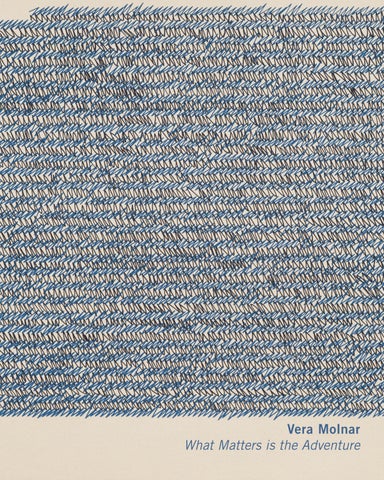
Vera Molnar: What Matters is the Adventure

Page 1


What Matters is the Adventure

Vera Molnar

What Matters is the Adventure Vera Molnar’s Works on Paper

Although she was active in Paris from the late 1940s until her death in 2023, Vera Molnar only began receiving broad recognition in the last twenty years, primarily for her pioneering role in the field of digital art. In the late 1960s, she was one of the first artists to create computer-based drawings. Throughout her career she investigated the potential of systems and series to generate works that charted new directions in the history of abstract art. The significance of her contribution was celebrated in a major exhibition that opened at the Pompidou Center in February 2024, two months after Molnar’s death at the age of 99.

Molnar’s interest in computer art grew out of her practice of geometric abstraction, which she embraced early on. Born in Budapest in 1924, she received a traditional art education at the Hungarian University of Fine Arts. She discovered Cubism through reproductions of paintings by Braque and Picasso. “That’s where my life started,” she later recalled. “My practice changed from a well-bred girl’s occupation to a passion.”1 In 1947 she moved to Paris. A portrait from that year of her future husband François Molnar in his studio (pg. 5) shows her early predilection for linear drawing and profound disregard for classical rules of composition.2 Picasso remained a touchstone in Molnar’s search for what she called “the geometrization of nature,” as can be seen in a series of drawings from the late 1940s inspired by the Paleolithic sculpture of the Venus of Willendorf (pgs. 6,7,11,14). Starting from the profile of a female nude, she transformed it into a series of triangles and circles. “In the end,” she said, “nature went away, and geometry remained.”3

Molnar’s move toward pure abstraction was stimulated by the debates raging in postwar Paris around abstract art. While in the United States the dominance of Abstract Expressionism had rendered other movements irrelevant, geometric abstraction still played a major role in the French avantgarde, in opposition to “lyrical abstraction.” Geometric art had its own annual Salon (“Les Réalités Nouvelles”) and was supported by prominent galleries, notably Denise René, whose stable was led by Molnar’s friend and compatriot, Victor Vasarely. Among the various geometric tendencies—many of which derived from prewar movements such as Constructivism and Neoplasticism—the most original (and the one that would eventually have the greatest influence internationally) was Concrete Art, which appealed to Molnar for its emphasis on science. Launched in 1930 by Theo van Doesburg (who had earlier founded the De Stijl group with Piet Mondrian), it was promoted in the 1940s by the Swiss artist Max Bill, a close friend of the Molnars and the author of a 1949 influential essay on

1 Vera Molnar: Interview with Vincent Baby (Paris: Manuella editions, 2022), p. 14. The quote by Vera Molnar that serves as the title of the present essay is from the same source, p. 79.

2 François and Vera Molnar met in Budapest and were married in Paris in 1948. He was also an artist but his interest in science led him to abandon art in 1960 and devote himself to research in the field of experimental aesthetics.

3 Vera Molnar, “The Thirteen Venuses,” in Vera Molnar. Pas froid aux yeux, exh. cat. (Mouans-Sartoux: Espace de l’Art Concret, 2021), p. 22.

the role of mathematics in art. As she sought to downplay the artist’s subjectivity, Vera Molnar was drawn to the systematic and modular approach of Concrete Art. Her drawings and collages from the 1950s (pgs. 15, 16, 17, 18, 20) present combinations of squares, rectangles, and circles arranged according to predetermined sequences. A possible source of inspiration for these drawings can be found in the work of Sophie Taeuber-Arp, who was associated with the Concrete Art movement, and whose 1930s paintings featured similar rows and stacks of basic geometric shapes. Although Molnar never met Taeuber-Arp, who died in 1943, she knew Hans Arp, who, in 1948, published a catalogue raisonné of Taeuber-Arp’s oeuvre.

By 1960, Molnar had developed a working method, which she called the “imaginary machine,” in which she conceived simple programs that set forth how a form could be altered. She then executed all the possibilities by hand. The resulting drawings evoke Conceptual art, as it would develop in the second half of the 1960s—notably in Sol LeWitt’s work. Indeed Molnar’s 30 lines out of 60 possibilities by chance linked 2 by 2 horizontal and vertical alternatively (pg. 22) anticipates the instructional titles of LeWitt’s drawings. But while the Conceptual artist claimed that “the idea or concept is the most important aspect of the work” and “what the work of art looks like isn’t too important,” Molnar remained committed to executing the works and reserved the right to decide which ones were visually successful and worth keeping.4

The imaginary machine was a time-consuming procedure. Molnar was thrilled when, in 1968, she gained access to a computer lab in one of Paris universities, which enabled her to dream up more complex programs. (It was an auspicious year: While the students were busy demonstrating in the streets, she could spend more time in the lab.) Her first experiments involved working blindly as she had to enter data with punch cards and wait to see the result in drawings produced by a plotter printer. After the advent of the computer screen, in the 1970s, the possibility to visualize the images beforehand allowed for a more “conversational” approach.5 Molnar elaborated a step-by-step, trialand-error process in which she started with a particular structure and progressively altered some of its parameters. Des (Ordres) (pg. 27), for instance, began with a pattern of concentric squares, which she tweaked gradually by introducing variations according to chance-based operations. The drawing’s title encapsulates Molnar’s fascination with the combination of order and chaos that resulted from inserting random elements into the system.

4 Sol LeWitt, “Paragraphs on Conceptual Art,” in Sol LeWitt, exh. cat. (New York: Museum of Modern Art, 1978), p. 166.

5 Vera Molnar, “Toward Aesthetic Guidelines for Paintings with the Aid of a Computer,” Leonardo 8, no. 3 (Summer 1975), p. 187.

When the home computer gave her more freedom to experiment, in the 1980s, Molnar expanded the range of images she used as a starting point. A particularly compelling series was inspired by the letters her mother had sent her from Hungary. Over the years the handwriting had become less and less legible, but Molnar found the letters “so beautiful to see.” She admired the rhythm of the lines, which started regularly on the left-hand side and “became more and more nervous, worried, almost hysterical” toward the right.6 With the help of a computer, she created drawings that simulated her mother’s handwriting. She produced multiple variations on the subject, for instance by shifting the inclination of certain letters or exaggerating the crescendo of disorder. In some drawings, she added her own handwriting to the computer image, in a different ink color (pgs. 29, 31). Although Molnar described this series as a pretext to experiment with unconventional types of compositions, the personal reference endows the drawings with a degree of poignancy at odds with the mechanical connotations of a computer-based image. Ultimately, the juxtaposition of the digitally-created lines with her own, slightly smudged handwriting epitomizes the dialogue between the artist and the machine that was at the core of Molnar’s work for most of her career.

Isabelle Dervaux is an art historian and curator. From 2005 to 2023 she was Head of Modern and Contemporary Drawings at the Morgan Library & Museum. Previously she held curatorial positions at the National Gallery of Art and the National Academy Museum. She holds a Ph.D. in art history from the Institute of Fine Arts, NYU, and a Master’s degree from the University of Paris-Sorbonne. She has curated exhibitions and published essays on numerous topics in twentieth and twentyfirst century European and American art—notably Surrealism, Arshile Gorky, Roy Lichtenstein, Jean Dubuffet, Georg Baselitz, Cy Twombly, and Helen Frankenthaler.

6 Vera Molnar, “Letters from My Mother (1981-1990),” in Vera Molnar: Interview with Vincent Baby, p. 65.

1/2 x 10 3/8 in (29.2 x 26.4 cm)

Francois Dans L’Atelier (Francois In The Workshop), 1947
Ink on paper
Untitled, 1947
Ink and watercolor on paper
10 5/8 x 8 in (27 x 20.3 cm)
Untitled, 1948 Ink on paper
10 3/8 x 4 in (26.4 x 10.2 cm)
Untitled, 1948 Ink on paper
14 3/4 x 11 in (37.5 x 27.9 cm)
Untitled, 1948 Oil and graphite on paper
15 1/2 x 12 in (39.4 x 30.5 cm)
Untitled, 1948
Watercolor on paper
10 5/8 x 8 1/4 in (27 x 21 cm)
Untitled, 1949
Watercolor and graphite on paper
11 7/8 x 8 3/8 in (30.2 x 21.3 cm)

13 5/8 x 10 1/4 in (34.7 x 26 cm)

Untitled, 1948
Watercolor and graphite on paper
Untitled, 1949
Gouache, graphite, and collage on paper
7 3/4 x 10 1/4 in (19.7 x 26 cm)
Untitled, 1950-51
Gouache on paper
9 1/2 x 11 7/8 in (24.1 x 30.2 cm)
Untitled, 1951
Gouache and graphite on paper
4 5/8 x 8 5/8 in (11.7 x 21.9 cm)
Untitled (Circles), 1951 Gouache on paper
14 1/2 x 19 1/2 in (36.8 x 49.5 cm)
Herbin est Un Imbecile (Herbin is an Idiot), 1952
Collage of painted paper
8 1/4 x 10 1/2 in (21 x 26.7 cm)

, 1952

8 13/16 x 8 3/8 in (22.4 x 21.3 cm)

Untitled
Watercolor and graphite on paper
Icone (Icon), 1966
Gouache and collage on board
10 3/4 x 10 3/4 in (27.3 x 27.3 cm)

30 lignes (sur 60 possibles) au hasard liant 2 á 2 horizontale et verticale alternativement (30 lines out of 60 possibilities by chance linked 2 by 2 horizontal and vertical alternatively), 1959

Glossy tape collage on board

15 3/4 x 15 3/4 in (40 x 40 cm)

Inclinaisons (Inclinations), 1971

Computer graphic on Benson plotter paper

19 3/4 x 19 3/4 in (50 x 50 cm)

MAO Computer Drawing, 1971

Computer graphic on Benson plotter paper

20 1/4 x 14 1/8 in (51.4 x 35.9 cm)

Molndrian, 1974
Computer graphic on Benson plotter paper 19 1/4 x 16 in (48.9 x 40.6 cm)

Ordres ((Some) Orders), 1976

(Des)
Computer graphic on Benson plotter paper 19 1/2 x 14 in (49.5 x 35.6 cm)

Computer graphic on paper 11 5/8 x 12 1/8 in (29.5 x 30.8 cm)

Structure De Quadrilatères (Square Structures), 1985

12 1/2 x 16 3/8 (31.8 x 41.6 cm)

Lettres de Ma Mere (Letters from My Mother), 1988-90
Computer ink and handwork on paper

Computer ink and handwork on paper

12 1/2 x 16 3/8 in (31.8 x 41.6 cm)

Lettres de Ma Mere (Letters from My Mother), 1990

Molnar (b. 1924 – d. 2023)

Vera Molnar is one of the pioneers of computer and algorithmic arts. Trained as a traditional artist, Molnar studied for a diploma in art history and aesthetics at the Hungarian University of Fine Arts. She iterated combinatorial images from as early as 1959. In 1968, she began working with computers, where she began to create algorithmic paintings based on simple geometric shapes and geometrical themes.

In the 1960s, Molnar was a founding member of two artist collectives: GRAV (Groupe de Recherche d’Art Visuel), a collaborative that expanded the boundaries of kinetic and optical art, and Art et Informatique, the focus of which was algorithmic art and color variables. Molnar learned the early programming languages of Fortran and Basic, and gained access to a computer at a research lab in Paris, where she began to make computer graphics drawings on a plotter.

Vera Molnar’s works have been widely exhibited around the world, and her works reside in public collections, including but not limited to: Centre Pompidou, Paris; The National Gallery of Art, Washington D.C.; The Museum of Modern Art, New York; The Museum of Fine Arts, Houston; The Morgan Library & Museum, New York.

Vera Molnar (b. 1924 – d. 2023)

Education

1942-1947 Hungarian University of Fine Arts, Budapest, Hungary

Selected Solo Exhibitions (since 1990)

2026

Vera Molnar:What Matters is the Adventure, Van Doren Waxter, New York, NY

2025

Vera Molnar: Order and Deviation, Galerie LaLigne, Basel, Switzerland

2024

Vera Molnar: Parler à l’oeil, Musée National d’Art Moderne, Centre Pompidou (MNAM), Paris, France

À La Recherche de Vera Molnar, Ludwig Múzeum and Stiftung für Kunst und Kultur, Budapest, Hungary

2022

Re-Re-Res: Hommage a Vera Molnar, Institute Liszt, Paris, France

Vera Molnar: Couper Coller Construire,Galerie BerthetAittouares, Paris, France

Vera Molnar: Variations, Beal Center for Art & Technology, University of California, Irvine, CA

2021

Vera Molnar: Is it a Line?, Vintage Galeria, Budapest, Hungary

Vera Molnar: Pas froid aux yeux, Espace de l’Art Concret, Centre d’Art contemporain d’interet National, MouansSartoux, France; traveled to Musee Des Beaux-Arts, Rennes, France

2020

De la main a l’ordinateur, allers-retours, Galerie 8 + 4, Paris, France

2019

Code and Algorithm: Homage to Vera Molnar, Vasarely Museum, Budapest, Hungary

Vera Molnar: Paintings and Drawings, 1947-1986, Senior & Shopmaker Gallery, New York, NY

Vera Molnar, Museum of digital Art (MUDA), Zurich,Switzerland

Vera Molnar: Work from 1949-2019, Galerie Linde Hollinger, Ladenburg, Germany

2018

Vera Molnar: Durer, Cézanne, Klee, Galerie BerthetAittouarès, Paris, France

Vera Molnar: A Line, Musée des Beaux-Arts de Caen, Caen, France

Vera Molnar: Drawing 1949-1986, Senior & Shopmaker Gallery, New York, NY

2017

Vera Molnar: Playful, Minimal, Dam Gallery, Berlin, Germany

2016

Love Story : Paper works from 1974, Galerie Torri, Paris, France

Vera Molnar: 1% of disorder or the vulnerability of the right angle, Galerie Berthot-Aittouares, Paris, France

2015

Vera Molnar - recherche d’art visuel, Galerie Linde Hollinger, Ladenburg, Germany

Regarding The Infinite Drawings 1950-1987, Senior & Shopmaker Gallery, New York, NY

Mes 90 ans à la Ligne, Galerie La Ligne, Zürich, Switzerland

(Un)Ordnung / (Dés)Ordre, Museum Haus Konstruktiv, Zurich, Switzerland

2014

(Un)Ordnung / (Dés)Ordre, Museum Für Konkrete Kunst, Ingolstadt, Germany

Solo, DAM Gallery, Berlin, Germany

Née en 1924 (curated by Jean-Pierre Bruaire & Catherine Melotte), Granville Gallery, Paris, France

2013

Tremblement (curated by Sylvie Boulanger), Collection Nationale de l’Edition et de l’Art Imprime, Paris, France

2012

Vera Molnar, Kunsthaus Rehau, Institut für Konstruktive Kunst und Konkrete Poesie, Rehau, Germany

Vera Molnar, Une Rétrospective 1942-2012, Musée des Beaux Arts de Rouen, France

One Percent Disorder, Kepes Központ, Eger, Hungary

2011

86 (Part III), Galerie Torri, Paris, France

2010

Vera Molnar/Cézanne, Museum of Fine Arts, Budapest, Hungary

86 (Part II), Galerie Torri, Paris, France

86, Galerie Torri, Paris, France

Tourner en rond, Galerie Cour Carrée, Paris, France

Variations Ste-Victoire, Musée des Beaux-Arts, Budapest, Hungary

60 Years of Squares, Galerie Oniris, Rennes, France

2009

Perspectives et Variations, FRAC Lorraine, Metz, France

Né en 1924, Galerie März, Mannheim, Germany

2008

Pliages, Tableaux, Dessins, Galerie März, Mannheim, Germany

The Early Beginnings-Vera Molnar, DAM Museum, Berlin, Germany

Hommage à Dürer (avec François Morellet), Musée Vasarely, Budapest, Hungary

Hommage à Paul Klee, Galerie La Ligne, Zürich, Switzerland

Hommage à Dürer, variations (avec François Morellet), PAKS Gallery, Paks, Hungary

2007

Car je n’aime pas la couleur verte, Musée des BeauxArts de Rouen, France

Vers l’épure, Galerie Cour Carrée, Paris M…, Galerie Oniris, Rennes, France

Lignes, März Galerien, Ladenburg, Germany

2006

Parallèles (avec MCBA), Galerie La Ligne, Zürich, Switzerland

Tableaux et Séries, März Galerien, Ladenburg, Germany

Vera Molnar, Etudes et Multiples, März Galerien, Mannheim, Germany

Monotonie, Symétrie, Surprise, Kunsthalle Bremen, Bremen, Germany

2005

Droites et Courbes, Galerie Cour Carrée, Paris, France

Vera Molnar, Galleria Charpa, Valencia, Spain

Signes et Signatures, Galerie Oniris, Rennes, France

Vera Molnar et Marta Pan – Thèmes et Variations, Musée des Beaux-Arts de Brest, Brest, France

2004

Vera Molnar/Julije Knifer, Lignes et méandres, Fondation Claudine et Jean-Marc Salomon, Alex, France

M, comme alevitch und andere Buchstabenbilder, März Galerien, Mannheim, Germany

Vera Molnar – Als das Quadrat noch ein Quadrat war, rétrospective pour le 80ème anniversaire, WilhelmHack-Museum, Ludwigshafen, Germany

Drawings, Sala do Risco, Lisbon, Portugal

2003

Hasards Canalizes, Gutmann Galéria, Budapest, Hungary

Vera Molnar, Musée Municipal, Györ, Hungary

Dessins, März Galerien, Mannheim, Germany

2001

Vera Molnar, Espace Fanal, Basel, Switzerland

Variations, Galerie Oniris, Rennes, France

Tableaux, März Galerien, Ladenburg, Germany

Hasards Prémédités, Galerie Cour Carrée, Paris, France

Des Chemins Sinueux, März Galerien, Mannheim, Germany

Fragments de Méandres, Institut Culturel Hongrois, Stuttgart, Germany

Peintures, Collages, Dessins, Musée de Grenoble, Grenoble, France

Entre Droites et Courbes, Galerie Emilia Suciu, Ettlingen, Germany

reConnaître – Vera Molnar, Musée de Grenoble, Grenoble, France

2000

Lignes-Œuvres Récentes, Galerie Oniris, Rennes, France

Au crayon, à la plume, au pinceau, à l’ordinateur, Centre d’Art Contemporain Bouvet-Ladubay, Saumur, France

Computerzeichnungen, Galerie St. Johann, Saarbrücken, Germany

Lettres de Ma Mère, Centre d’art CAMAC de Marnay-surSeine, Marnay-sur-Seine, France

Promenade à Ladenburg, Exposition + Installation, März Galerien, Ladenburg, Germany

1999

Une Visite Guidée à Travers Mon Cerveau, Espace Gustave-Fayet, Sérignan, France

Inventaire – Hommage au 75ème anniversaire de Vera Molnar, März Galerien, Ladenburg, Germany

Extrait de 100,000 milliards de lignes, Le Crédac, Ivrysur-Seine, France

Réflexions Contemporaines (avec F. Malaprade), Galerie Cour Carrée, Nancy, France

1998

Sensibilité Numérique – 1957-97, Vismara Arte, Milan, Italy

Sculptures, Dessins (avec M. Pan), Espace de Luynes, Chevreuse, France

Vera Molnar, Manfred Mohr, Galerie Lahumière, Paris, France

1997

Peintures 1966-1996, Galerie Oniris, Rennes, France

Lettres de Ma Mère, Institut Hongrois, Paris, France

1996

Lettres de Ma Mère, Galerie ITS.ART.IST, La Hulpe, Belgium

Pink und Rouge, März Galerien, Ladenburg, Germany

Tango, Musée d’Art et d’Histoire, Cholet, France

4 Livrimages, Ecole des Beaux-Arts, Valenciennes, France

Line, Musée Ernst, Budapest, Hungary

1995

De l’Esprit à l’Œuvre (dans le cadre de « La science en fête »), Musée d’Art et d’Histoire, Cholet, France

Tableaux (avec François Morellet), März Galerien, Mannheim, Germany

1994

Tableaux, Dessins, März Galerien, Mannheim + Ladenburg, Germany

Ordres et (Des)ordres, Wilhelm-Hack-Museum, Ludwigshafen, Germany

Géométrie du Plaisir, Gesellschaft für Kunst und Gestaltung, Bonn, Germany

Sommaire 1992-93, März Galerien, Mannheim + Ladenburg, Germany

1993

La Quadrature de l’Art (avec G. Honegger), Cloître du CRDP Poitou-Charentes, Poitiers, France

1992

Travaux Anciens, Galerie St. Johann, Saarbrücken, Germany

1991

9 Quadrate – Zeichnungen, Collagen, Bilder Gesellschaft für Kunst und Gestaltung, Bonn, Germany

1990

Galerie St. Johann, Saarbrücken, Germany

Lignes, Formes, Couleurs, Musée Vasarely, Budapest, Hungary

Stiftung für konkrete Kunst, Reutligen, Germany

Selected Installations

Perspectives, FRAC Lorraine, Metz, France (peinture murale) (1957-2009)

Promenade (presque) aléatoire, FRAC Lorraine, Metz, France (fil et clous) (1999-2009)

Trapèzes penchés à droite, FRAC Lorraine, Metz, France (collage mural) (1987-2009)

Hommage à Dürer, Musée Vasarely, Budapest, Hungary + Musée de PAKS, Hungary (2008)

Ligne vagabonde, Fondation Salomon, Alex, France, (2004)

Promenade à Ladenburg, März Galerien, Ladenburg, Germany (2000)

Promenade aléatoire à Ivry, Le Crédac Ivry-sur-Seine, Ivry-sur-Seine, France (1999)

Ligne, Musée Ernst, Budapest, Hungary (1999)

Tango, Musée de Cholet, Cholet, France (1996)

Pink & Rouge, März Galerien, Ladenburg, Germany (1996)

Déchirement, März Galerien, Ladenburg, Germany (1994)

9 Carrés, Gesellschaft für kunst und Gestaltung, Bonn, Germany (1991)

Hommage à Dürer, Stiftung für Konkrete Kunst, Reutlingen, Germany (1990)

Gothique, S. Bahnhof Schöneberg, Berlin, Germany (1988)

Écran d’eau, Festival des Arts Electroniques, Rennes, France (1988)

Artist Books

2007

M comme…, 60 ex. + 7 Ea., 44 pages, 18 x 18 cm, éd. Lafabrie, France

2006

16 études sur les origines de Blum, éd. 1 ex. commande L. Koenders, Switzerland

2000

Rythmes et logique, éd. Albin Michel Education, France

Love Stories, Leporello, 32 faces, 18,5 x 36,5 cm, 30 ex., éd. März Galerien, Mannheim,Germany

1999

Solo d’un trait noir, livre typographique, 21 x 21 cm chaque volet, 27 ex., éd. F. Arnaud et M. Guiol, France

1996

Tango/1974, éd. PACA, France

1994

Out of square/1974, 21 x 21 cm, 400 ex., éd. WilhelmHack Museum, Ludwigshafen, Germany

Sommaire, éd. März Galerien, Mannheim, Germany

1991

4 carrés, 4 modes, 28 x 28 cm, 30 ex., éd. Fanal, Basel, Switzlerland

1990

Lettres de ma mère, 32 x 42 cm, éd. Musée Vasarely, Budapest, Hungary

1986

36 carrés, 8928 quadrilatères, Géométrie du plaisir, 30 x 30 cm, 100 ex., éd. A. Buyse, Lille, France

1980

1% désordre, 21 x 21 cm, Wedgepress & Cheese, Bjerred, Sweden

Selected Publications

2024

Vera Molnar re-publication of Vera Molnar, Une Rétrospective 1942-2012, Musée des Beaux Arts de Rouen, France with additional text by the artist and additional reproductions (published to coincide with the exhibition Vera Molnar: Parler à l’oeil, Musée National d’Art Moderne, Centre Pompidou (MNAM), Paris, France)

2021

Vera Molnar: Pas froid aux yeux, Espace de l’Art Concret,

Centre d’Art contemporain d’interet National, MouansSartoux, France

2012

Vera Molnar, Une Rétrospective 1942-2012, Musée des Beaux Arts de Rouen, France

2010

Vera Molnar/Cézanne, éd. Musée des BeauxArts, Budapest, Hungary

2007

Vera Molnar, éd. O.S.A.S., Budapest, Hungary

2006

Vera Molnar, Monotonie, Symétrie, Surprise, Kunsthalle Bremen, Germany

2005

Vera Molnar-Marta Pan, Thèmes et variations, Musée des Beaux-Arts de Brest, France

2004

Vera Molnar/Julije Knifer, Fondation Salomon, Alex, France

Vera Molnar, Als das Quadrat noch ein Quadrat war, Wilhelm-Hack-Museum, Ludwigshafen, Germany

Inventaire 1946-2003, V. Molnar, Linde Hollinger (livre rouge), Preysing-Verlag, Ladenburg, Germany

2001

reConnaître, Vera Molnar, Musée de Grenoble, Grenoble, France

1999

Extrait de 100 000 milliards de lignes, Le Crédac, Ivry-sur-Seine, France

Inventaire 1946-1999, V. Molnar, Linde Hollinger, Preysing-Verlag, Ladenburg, Germany

1994

Vera Molnar, Bilder, Zeichnungen, März Galerien, Mannheim + Ladenburg, Germany

1993

La Quadrature de l’art – G.Honegger & V. Molnar, Centre Régional du Poitou-Charentes, Poitiers, France

1991

9 Quadrate, Gesellschaft für Kunst und Gestaltung, Bonn, Germany

1990

Zür Künstlerischen Arbeit von Vera Molnar, Galerie St. Johann, Cahier n°3, Saarbrücken, Germany

Vera Molnar, Lignes, Formes, Couleurs, Musée Vasarely, Budapest, Hungary

1989

Rouges, Galerie Municipale Edouard Manet, Gennevilliers, France

1984

Textes, (1974-1984), éd. C.I.S.I., Commissariat à l’Energie Atomique, Paris, France

1979

Vera Molnar, Atelier de Recherche Esthétique, Caen, France

1976

Transformations, Polytechnic of Central London, Galerie PCL, London, UK

Selected Public Collections

Arithmeum, Bonn, Germany

Bibliothèque Nationale, Paris, France

Buffalo AKG Art Museum, Buffalo, NY

National Diet Library, Tokyo, Japan

The National and University Library, Zagreb, Croatia

Carré Estampes, Luxembourg, Luxembourg

Collection Centre d’Art Bouvet-Ladubay, Saumur, France

Collection Hoppe-Ritter, Waldenbuch, Germany

Collection Matzon, Budapest, Hungary

Collection Ruppert, Würzburg, Germany

Collection Vass, Budapest, Hungary

Fonds National d’Art Contemporain, Paris, France

FRAC Basse Normandie, France FRAC Bretagne, France

FRAC Lorraine, France

FRAC Nord-Pas-de-Calais, France

FRAC Poitou-Charentes, France

Hungarian National Gallery, Budapest, Hungary

Hochschule für bildende Künste, Saarbrücken, Germany

Kunsthalle Bremen, Germany

Mondriaanhuis, Amersfoort, The Netherlands

Musée d’Art Contemporain, Paks, Hungary

Museum gegenstandsfreier Kunst, Otterndorf, Germany

MACC - Museo d’Arte Contemporanea Calasetta, Calasetta SU, Italy

Musée des Beaux-Arts, Brest, France

Museum of Fine Arts, Budapest, Hungary

Musée des Beaux-Arts, Rouen, France

Kassák Múzeum, Budapest, Hungary

Musée National d’Art Moderne, Centre Pompidou (MNAM), Paris, France

Muzeum Sztuki, Łodzi, Poland

Xantus János Múzeum, Gyür, Hungary

Muzeum Narodowe we Wrocławiu, Poland

National Gallery of Art, Washington, D.C.

Sainsbury Centre for Visual Arts, Norwich, UK

Staatliche Kunstsammlung Dresden, Dresden, Germany

Stiftung für konkrete Kunst, Reutlingen, Germany

Stiftung Für Konkrete Kunst, Ingolstadt, Germany

The Morgan Library & Museum, New York, NY

The Frances Young Tang Teaching Museum and Art Gallery, Skidmore College, Saratoga Springs, NY

The Museum of Fine Arts, Houston, TX

The Museum of Modern Art, New York, NY

Victoria and Albert Museum, London, UK

Wilhelm-Hack-Museum, Ludwigshafen, Germany

Worcester Art Museum, Worcester, MA

Published on the occasion of the exhibition

Vera Molnar

What Matters is the Adventure

January 30 – March 6, 2026

We would like to express our sincere gratitude to Laurence Shopmaker and Isabelle Spaak, who have been instrumental in bringing this exhibition to fruition.

Design by Nick Naber

Edited by Dorsey Waxter & Kieren Jeane

Artwork Photos by Charles Benton Essay ©Isabelle Dervaux

Cover: Detail of, Lettres de Ma Mere (Letters from My Mother), 1990, p. 30–31

Inide front cover: Vera Molnar in her home / studio, rue de Gergovie, Paris, 1961. Photo: Francois Molnar, Vera Molnar Archives.

Page 32: Vera Molnar in her home / studio, rue Halle, Paris, 2014.  Photo: Laurence Shopmaker

Inside back cover: Detail of, Untitled, 1948, p. 10–11

Back cover: Detail of, Untitled, 1951, p. 17

VAN DOREN WAXTER

23 EAST 73RD ST

NEW YORK, NY 10021

Phone 212 445-0444 info@vandorenwaxter.com www.vandorenwaxter.com

© VAN DOREN WAXTER, New York, NY.

All rights reserved. No part of the contents of this catalogue may be reproduced without permission of the publisher.

Turn static files into dynamic content formats.
Create a flipbook
Issuu converts static files into: digital portfolios, online yearbooks, online catalogs, digital photo albums and more. Sign up and create your flipbook.