FAMILLE VERTE
最大的美丽在于最精细的事物
Zui da de meili zai yu zui jingxi de shiwu
The greatest beauty lies in the most delicate things
FAMILLE VERTE
INTRODUCTION
Chinese Porcelain with Dutch DNA
We are delighted to present our catalogue, devoted to famille verte porcelain. The majority of the objects featured, have distinguished Dutch provenances and most were acquired from Dutch dealers over the past hundred years. As such, they reflect the long-standing tradition of Chinese porcelain collecting in the Netherlands.
Eleven of the objects originate from the Nieuwenhuys collection, formed in the second half of the 20thcentury. Three of these were handed down from B.J.V. van Hees, who started significantly collecting Chinese porcelain in the interbellum period. Both Ben van Hees and Henk Nieuwenhuys, worked in finance in Amsterdam, regularly visiting the nearby antique dealers located along the Rokin. The Nieuwenhuys collection of Chinese porcelain was dispersed amongst its heirs in 1991; 31 of these pieces - including distinguished Kangxi underglaze blue, famille verte and powder blue porcelain - have now returned to the hands of a Dutch dealer again!
Four objects in this catalogue come from the Louisa Treves collection. She was a much cherished client, whom my aunt and uncle (Clemens and Neeltje) first met in the late 1970s, during a Chinese-themed event in the Dutch department store De Bijenkorf in Amsterdam. She remained a loyal customer, continuing to acquire pieces from Vanderven well into her eighties. In 2025, we were fortunate to acquire her collection of
Chinese works of art – yet another collection, formed through (and returning to) a Dutch dealer.
We hope you will enjoy this catalogue as much as we have enjoyed researching, handling, and bringing together these remarkable objects; all united by their shared history of Chinese artistry and Dutch connoisseurship.
Floris & Nynke van der Ven
Vanderven Oriental Art
The Netherlands info@vanderven.com www.vanderven.com
FAMILLE VERTE PORCELAIN: A COLLECTOR’S
CHRISTIAAN J.A. JÖRG
APPRECIATION
Among the many celebrated categories of Chinese porcelain, famille verte holds a special position. Developed during the reign of the Kangxi Emperor (1662-1722) of the Qing Dynasty (1644-1912), it quickly became admired both in China and abroad. Its name, given in the 19th century by the French author Albert Jacquemart, means ‘green family’ and refers to the dominant use of translucent green enamels in its decoration. The Chinese call it wucai (五彩, fivecolours) and regard it as a sub-group of enamelled wares. Based on earlier ceramic developments during the Ming Dynasty (1368-1644), verte employed the full possibilities of overglaze enamels. Its brilliance as well as the quality and variety of its decorations ensured it was highly prized.
The sudden popularity of famille verte can be explained by both technical and cultural factors. On the one hand, advances in ceramic technology at Jingdezhen allowed artisans to apply a wide range of overglaze colors - green, yellow, iron red, black, purple, gold and blue - fired at a lower temperature than the porcelain body. This gave painters greater freedom of design than had previously been possible with the more limited palette of enamels. On the other hand, the decorative richness of famille verte suited contemporary tastes. In China, Kangxi’s court favored brilliant colors and detailed figural scenes that reflected Confucian ideals, auspicious symbols, and
literary themes. At the same time, in Europe, the rise of collecting and the growth of private maritime trade created a new demand for luxury Chinese porcelain with exotic motifs, painted in vibrant enamels.
In fact, private Dutch trade became instrumental in providing the Netherlands with underglaze blue as well as enamelled Kangxi porcelain. The VOC did not make enough profit on porcelain and stopped buying it in 1694, leaving this specific trade to private merchants in Batavia, who shipped relatively small amounts on freight with Company ships. Therefore most of the famille verte porcelains, too, were not part of the Company’s porcelain trade, but reached Holland as private merchandise.
The variety of decorations within this group is one of its greatest attractions for collectors. Some pieces depict narrative scenes drawn from popular novels, complete with garden pavilions, figures, and natural landscapes. Others carry auspicious motifs such as mythical animals - phoenixes, dragons, qilinsor trees and flowers like pines, peonies and chrysanthemums, each chosen for its symbolic meaning. Also attractive are complex borders ornamented with geometric patterns or delicate ru-yi (cloud) motifs. The porcelain forms themselves are very diverse, ranging from plates and dishes to vases, covered jars, bottles, ewers, bowls, teapots, and even
Famille verte porcelain embodies the artistic innovation of the Kangxi period, the creativity of Jingdezhen potters and the global reach of Chinese ceramics
Western shapes in verte are not rare. We know, for instance, salts, funnels, beer mugs, helmet-ewers and even monteiths. It is enigmatic, however that European-style decorations are absent, with the exception of some armorial designs that were made to order for Western clients, in particular the dishes and shaving bowls with the coat-of-arms of Dutch and Flemish provinces and cities. Why no other commande decorations were ordered and painted is still subject to research.
sculptural figures. Incense burners and brush pots were made for the domestic market, but sometimes reached Europe by chance.
Within famille verte, several distinct subtypes developed, each appealing in its own way. The combination of verte enamels with an underglaze powdered blue ground produces a dramatic contrast: the mottled cobalt background sets off vividly painted panels of flora and fauna or figural scenes. Another prized category is the use of enamels on biscuit porcelain, where the decoration is applied directly to the unglazed ceramic body. These pieces, often small figures, possess a velvety surface and have a charm of their own. A further variation pairs verte enamels with coral red, creating another contrasting, but warm palette much admired for its elegance.
In the 1720s, during the reign of Yongzheng (1723-1735), famille verte was gradually succeeded by famille rose, which introduced soft pinks and a wider chromatic range. Yet, despite this shift in fashion, famille verte retained its reputation as one of the highlights of Kangxi porcelain. Its subtle colors, imaginative decoration, and technical finesse continue to fascinate collectors and art historians alike.
In conclusion, famille verte porcelain embodies the artistic innovation of the Kangxi period, the creativity of Jingdezhen potters and the global reach of Chinese ceramics. It was admired at home for its refinement and symbolism, and abroad for its novelty, exoticism and colorful appearance, fitting the contemporary Baroque interior. Today, it remains an example of the enduring dialogue between East and West through ceramics.
Last but not least, for collectors, each piece of famille verte offers a wealth of aesthetic pleasure!
China, Kangxi period (1662 – 1722), 1700-1715
H: 48.5 cm & 49.6 cm
PROVENANCE
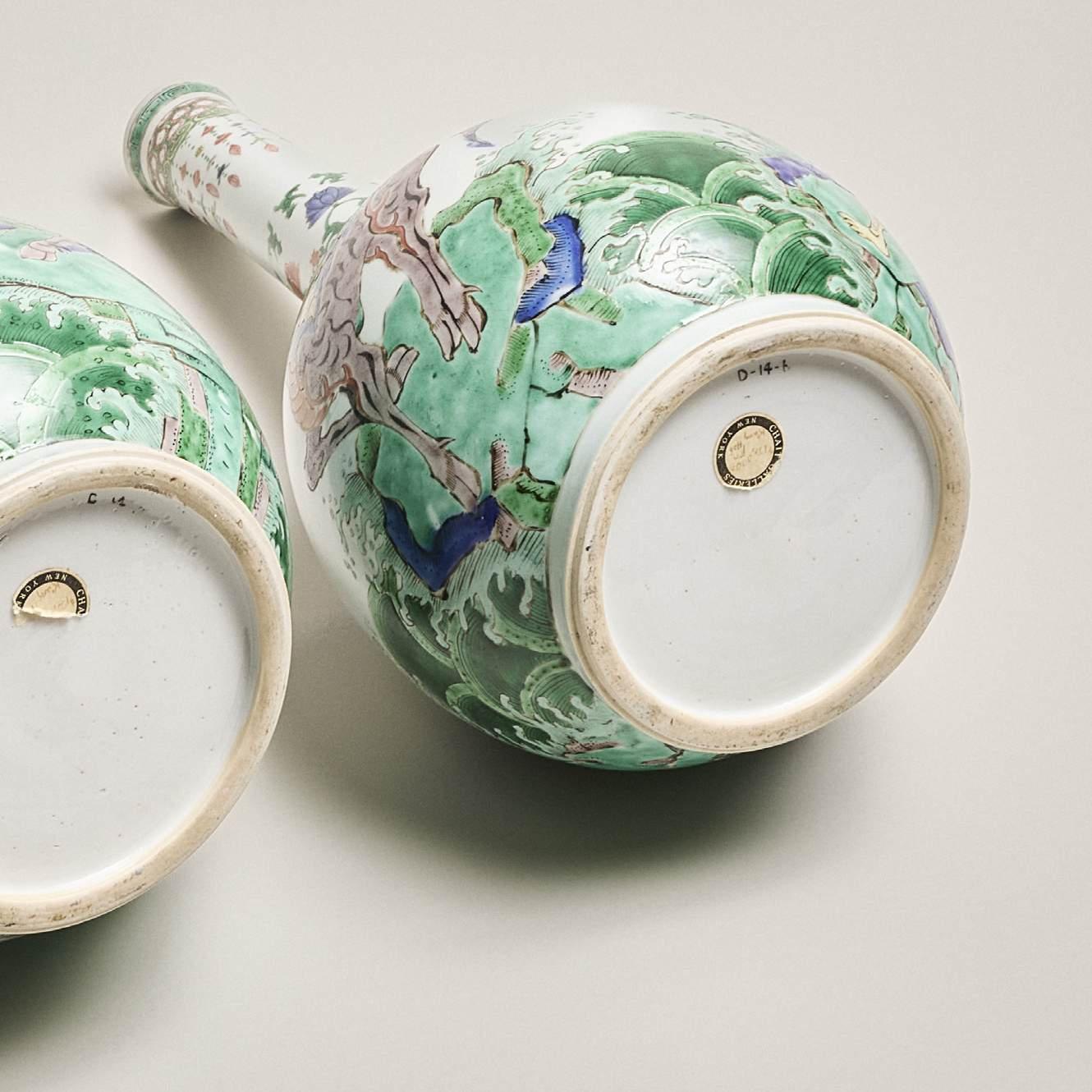
With Ralph M. Chait Galleries, New York 1950s (label)
Henry Ford II Collection, UK 2021 (nr. D-14-A & B)
LITERATURE
Bushell 1904, p.66, nr.398 & 399 p.184, case 14
Gorer & Blacker 1911, nr.117
Hildesheim 1990, nr.213
Jörg & van Campen 1997, p.166, nr.182
Kassel 1990, p.344-345, nr.126
Petzäll & Engel 2002, p.437, nr.160
Pinto de Matos 2003, p.94-97, nr.19
Ströber 2001, p.98, nr.41
Welch 2008, p.140-141 & 147
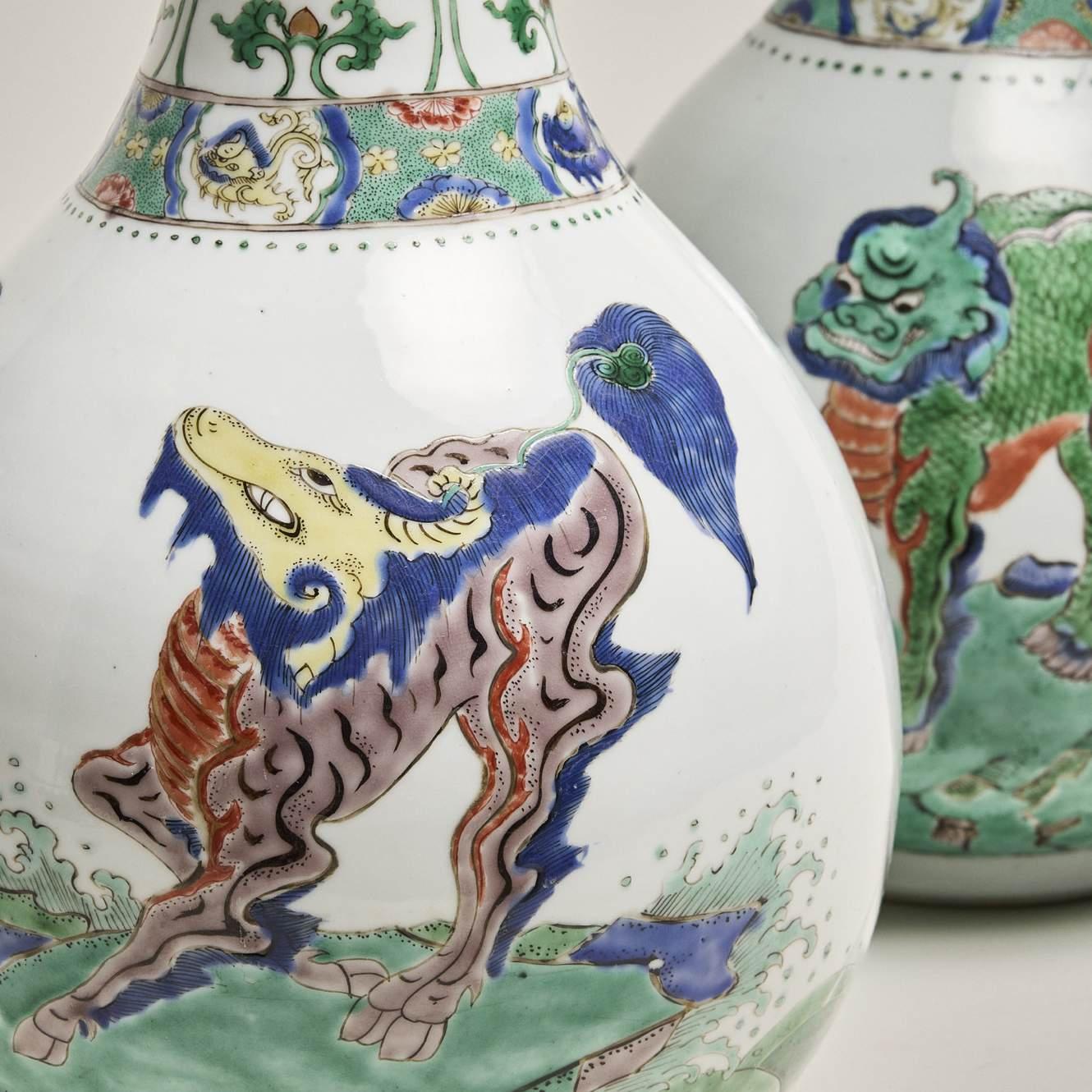
1 | Auspicious Beasts
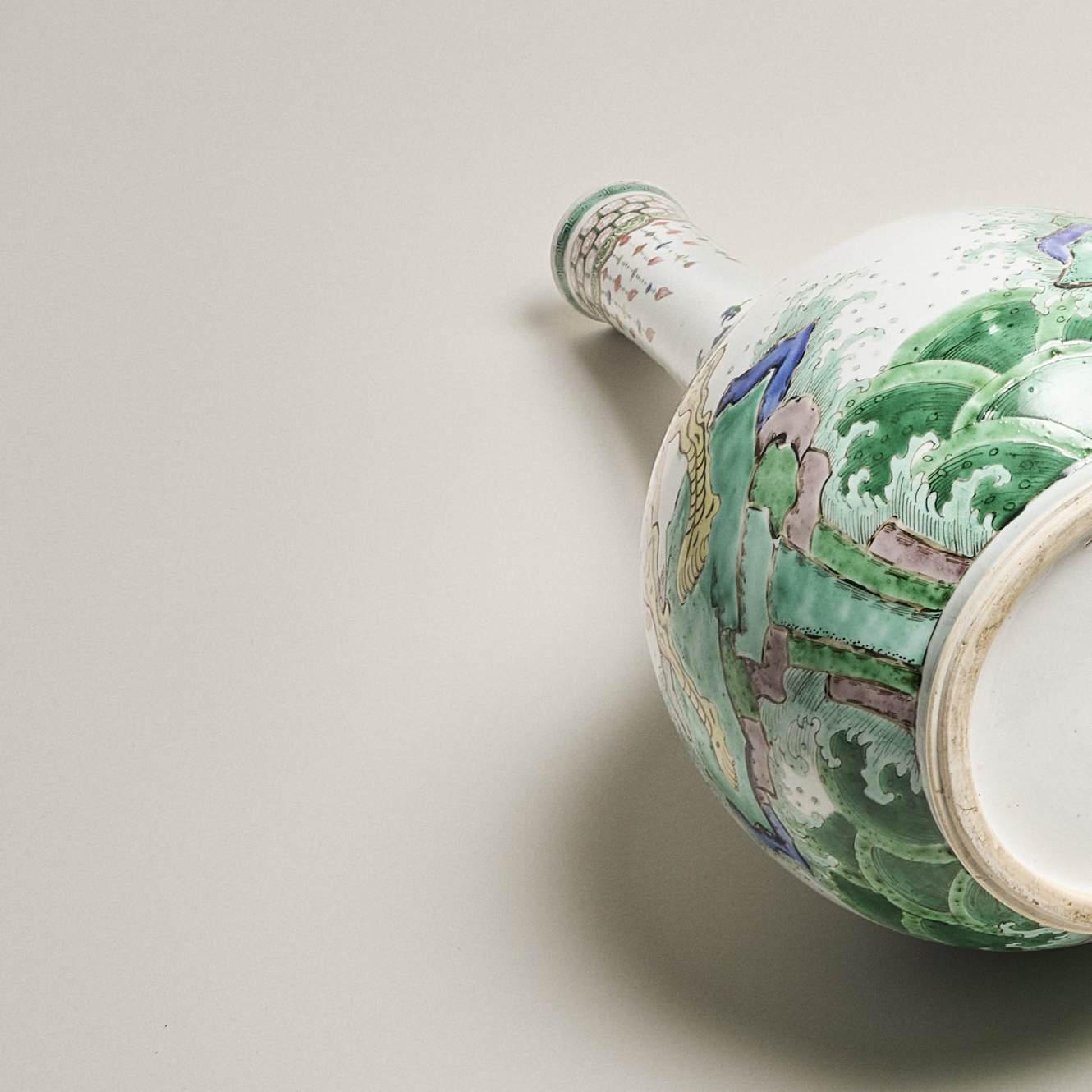
A pair of large bottles on a high foot-ring, lavishly decorated with mythical beasts in bright famille verte enamels. The rounded pearshaped body, tapers into a long cylindrical neck, flaring slightly at the mouth. The main decoration around the body is of three large auspicious animals, standing on rocks amongst waves. Each beast has red flames around their legs underlining their mythical powers. Around the shoulder is a green stippled band with flower heads, interrupted by four blue edged cartouches each with qilong dragons in yellow or blue. The lower part of the neck has lotus scrolls in green with red and blue buds and flowers. The top of the neck has pending tassels hanging from a band of green and yellow ruyi-yuntou 如意雲頭
(‘wish-fulfilling’ stylised cloud scrolls). Above this is a diaper border with red starbursts. The edge of the neck is decorated with a band of black key-fret on a green ground.
The three depicted beasts each have a different coloured body and a different animal head - dragon, lion and goat. It appears that some of their features have interchanged, making identification harder, but they appear to represent the mythical qiling (yellow), baize (green) and xiezhi (aubergine). The dragon-headed qilin brings peace and prosperity - only appearing on the arrival or death of an illustrious ruler. The fur bodied baize, has the body of a lion with scaling on its shoulders and flanks. It can comprehend the nature of all things and is a symbol of purity and righteousness. The xiezhi, with dark fur and a single horn, has the capability to distinguish right from wrong. Each of these three creatures represents different outstanding virtues and good fortune, together forming a potent wish for good prosperity.
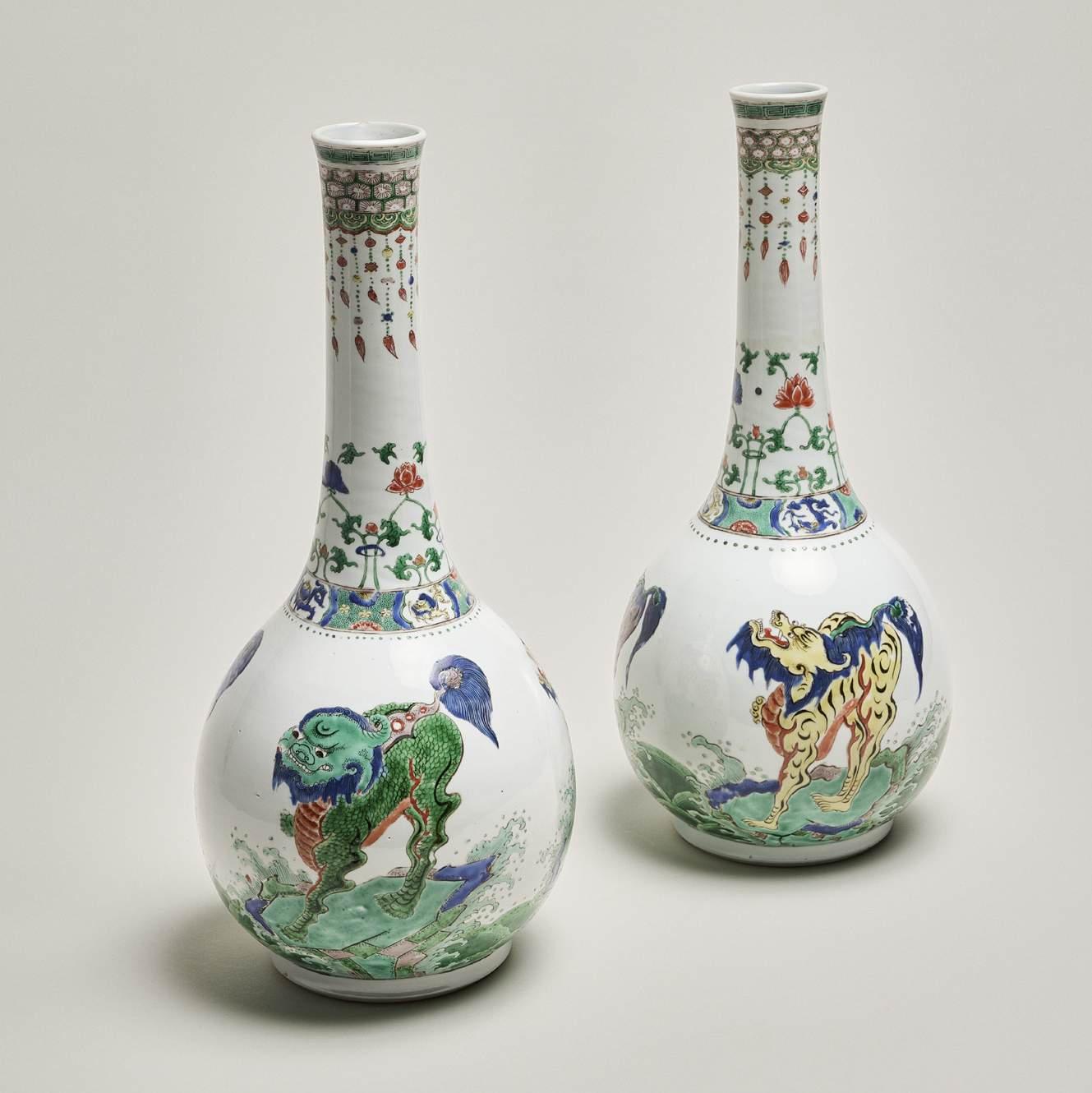
The National Trust, UK, has an identical pair but mounted, held at Melford Hall, Suffolk (inv.nr. NT 926293). All the other comparable large bottles, generally just depict Buddhist lions. Examples are in the Royal Porcelain Collection, Dresden (inv.nr. PO 6859) and the Rijksmuseum, Amsterdam (AK-RBK 15822). The Victoria & Albert Museum London has a pair with frolicking Buddhist lions (acc.nrs. C.1194-1910 & C.1193-1910), as does the Museu Calouste Gulbenkian, Lisbon (inv.nrs. 2302 A & B). The Metropolitan Museum, New York has a single bottle (acc.nr. 37.191.10).
Each of these three creatures represents different outstanding virtues and good fortune, together forming a potent wish for good fortune
China, Kangxi period (1662-1722), circa 1700 H: 8.3 cm | Ø: 22 cm
PROVENANCE
With Bernhard Stodel, Amsterdam, after 1965 (label BS1620)
Nieuwenhuys Collection, 1991
Private collection, Belgium 2025
LITERATURE
Boulay 1984, p.225, nr.12
Canepa 2021, p.475 & 477, nr.III.4.158 Schumacher 2010, p.95, nr.65
2 | Conical Bowl
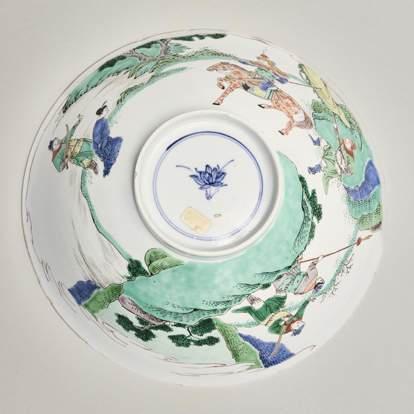
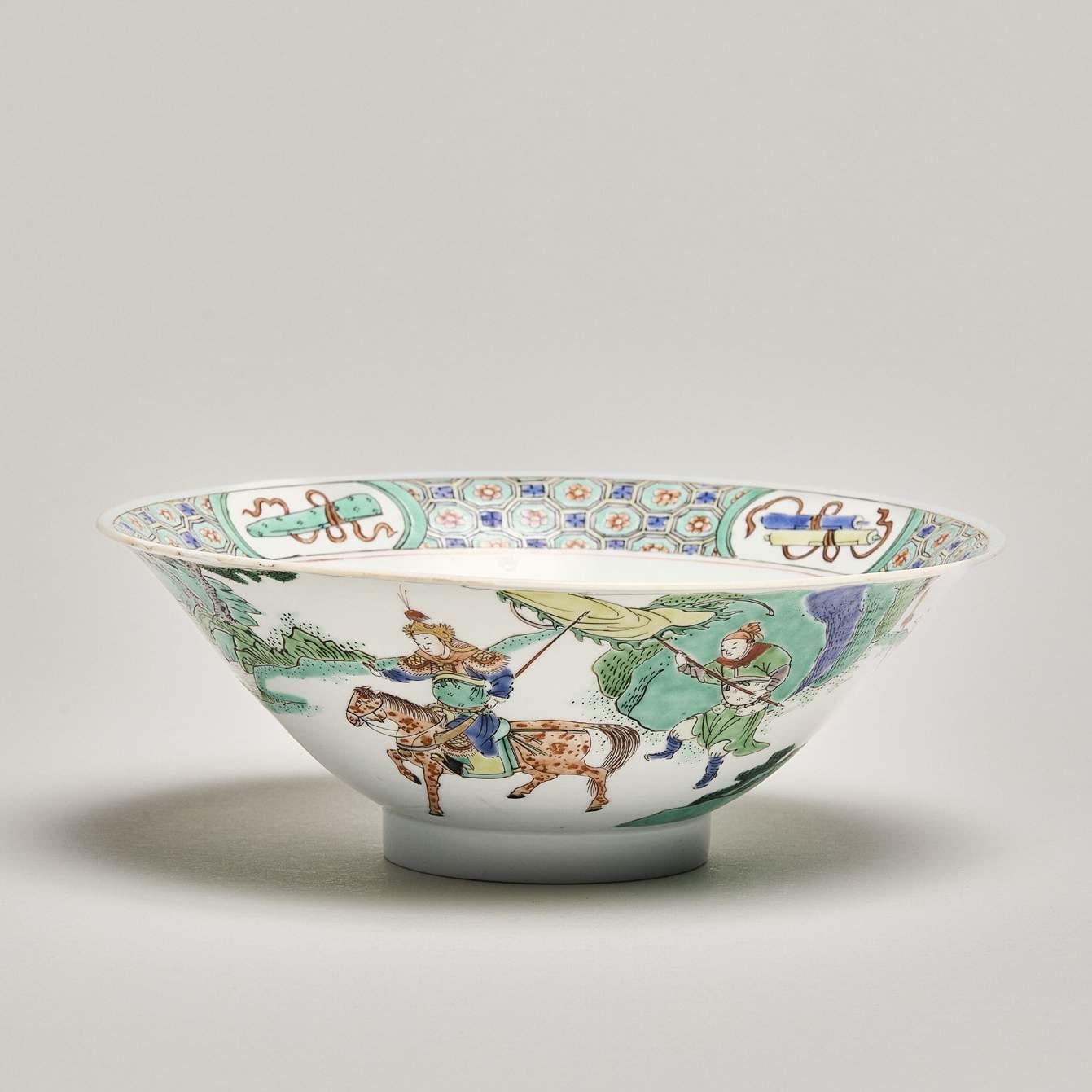
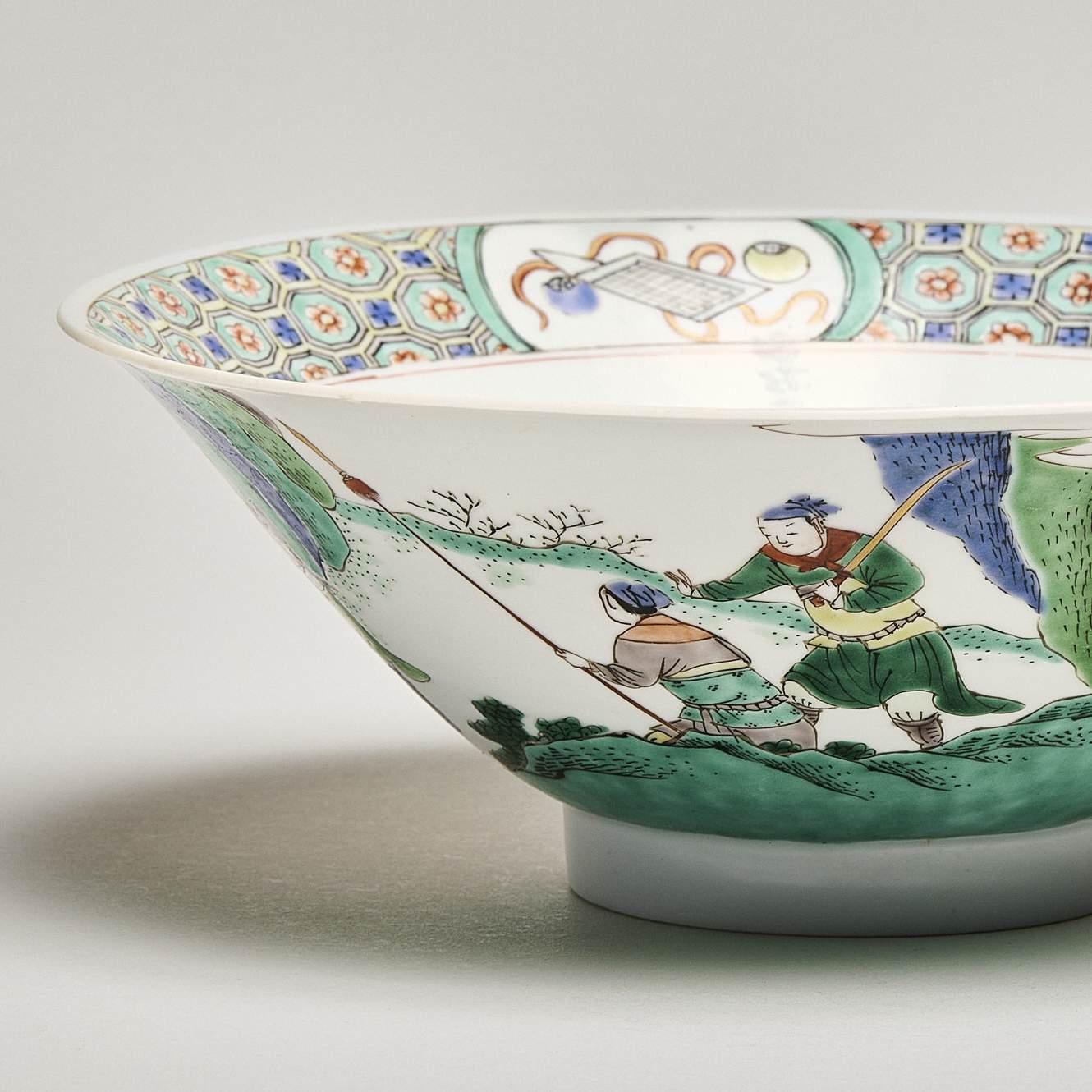
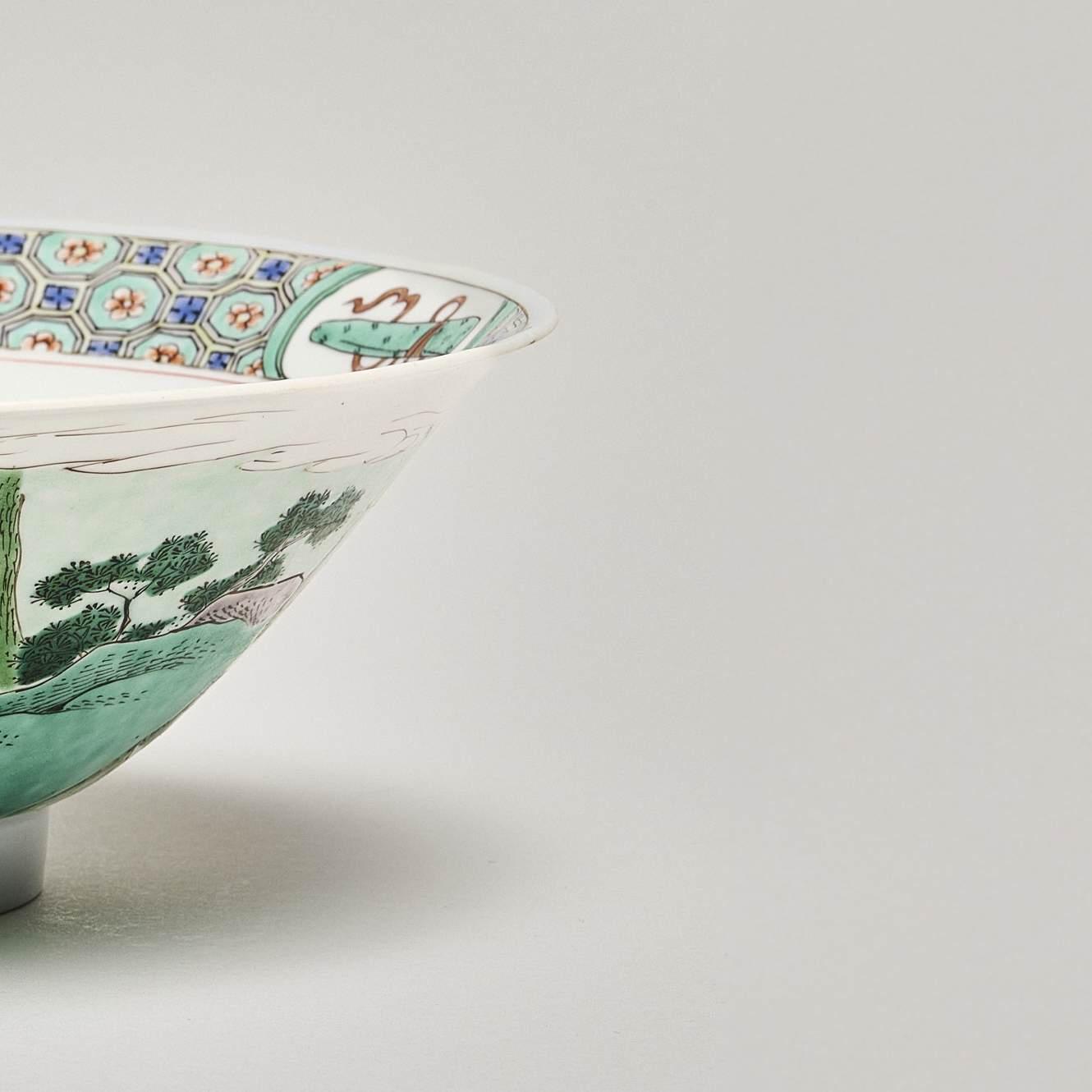
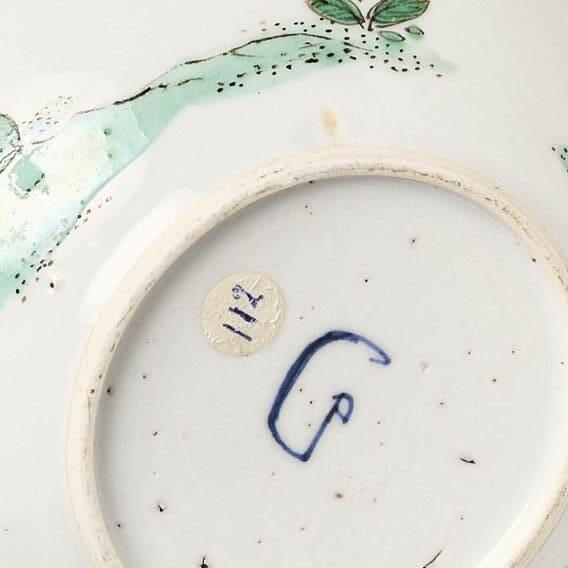
This unusual conical bowl, is decorated on the outside, with a continuous narrative scene in fine famille verte enamels. It is divided into three different figural episodes set in a rocky landscape, executed in three shades of green, blue, red, yellow and black enamels. The first scene is of a warrior on horseback holding a guandao polearm, followed on foot by a guard bearing a yellow standard. The second scene is of a mustachioed man holding a sword and a kneeling figure in a blue robe, who is about to be executed. The final scene is of a man holding a sword approaching a crouching figure holding a spear. The inside of the bowl is decorated on the bottom with a small figure of a kneeling scholar. The inside rim has a green, yellow, blue and red honeycomb diaper border, with four cartouches in reserve - each with an auspicious emblem representing the Four Scholarly Accomplishments (siyi 四藝). The bowl stands on a high undecorated foot-ring and the underside has a loosely painted blue lotus flower within a double ring. A slightly worn white rectangular label, bears a stock number of the renowned Amsterdam dealer Bernhard Stodel.
The narrative on this bowl possibly depicts a popular episode from the Romance of the Three Kingdoms. The main scene is of the famous warrior Guan Yu, carrying his iconic crescent blade (青龙偃月刀) and mounted on his famously swift horse, Red Hare (Chitu 赤兔). Another scene is of an imminent execution, which Guan Yu will step in to prevent. This combination reflects the iconic moral saying: Guan Yu manifests righteousness and stays the blade (关公显义,刀下留人). The scene emphasizes the importance of correct moral judgement at a critical moment. When this image is placed on everyday objects, such as this bowl, it expresses the wish for moral justice to enter ones daily life.
The Grandidier Collection - housed in the Musée Guimet, Paris - has a comparable example (inv.nr. G785). It has a different narrative on the outside, but a similar scholar on the inside of the bowl and the same blue lotus flower on the bottom.
FAMILLE VERTE PORCELAIN
Famille verte - literally translated as “green family” - was a term coined in the 1860s by Albert Jacquemart. He was the first to classify Chinese porcelain, according to the predominant enamel colour used. Typical famille verte wares are made with a highly refined white porcelain clay, decorated with bright, almost translucent, enamels which slightly rise above the surface of the porcelain. In addition to the various vivid greens, the colour-set includes yellow, aubergine and a coral toned iron-red and a composite black. The blue over-glaze enamels in this palette, have a violet or royal blue tone. Gold is also occasionally applied, to further enhance the decoration. Underglaze blue was still used for the markings on the base or circles around the foot, rim or central panel.
China, Kangxi period (1662-1722)
H: 22 cm | Ø: 12 cm
PROVENANCE
Nieuwenhuys Collection, 1991
Private Collection Belgium, 2025
LITERATURE
Ayers 1985, p.142, nr.113
Boulay 1995, p.651
Jörg & van Campen 1997, p.250-60, nr.298 & 299
Jörg 2011, p.132, nr.120
Suebsman 2015, p.271, nr.48
3 | Rocks & Flowers
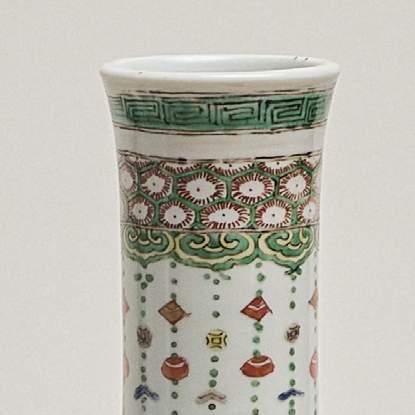
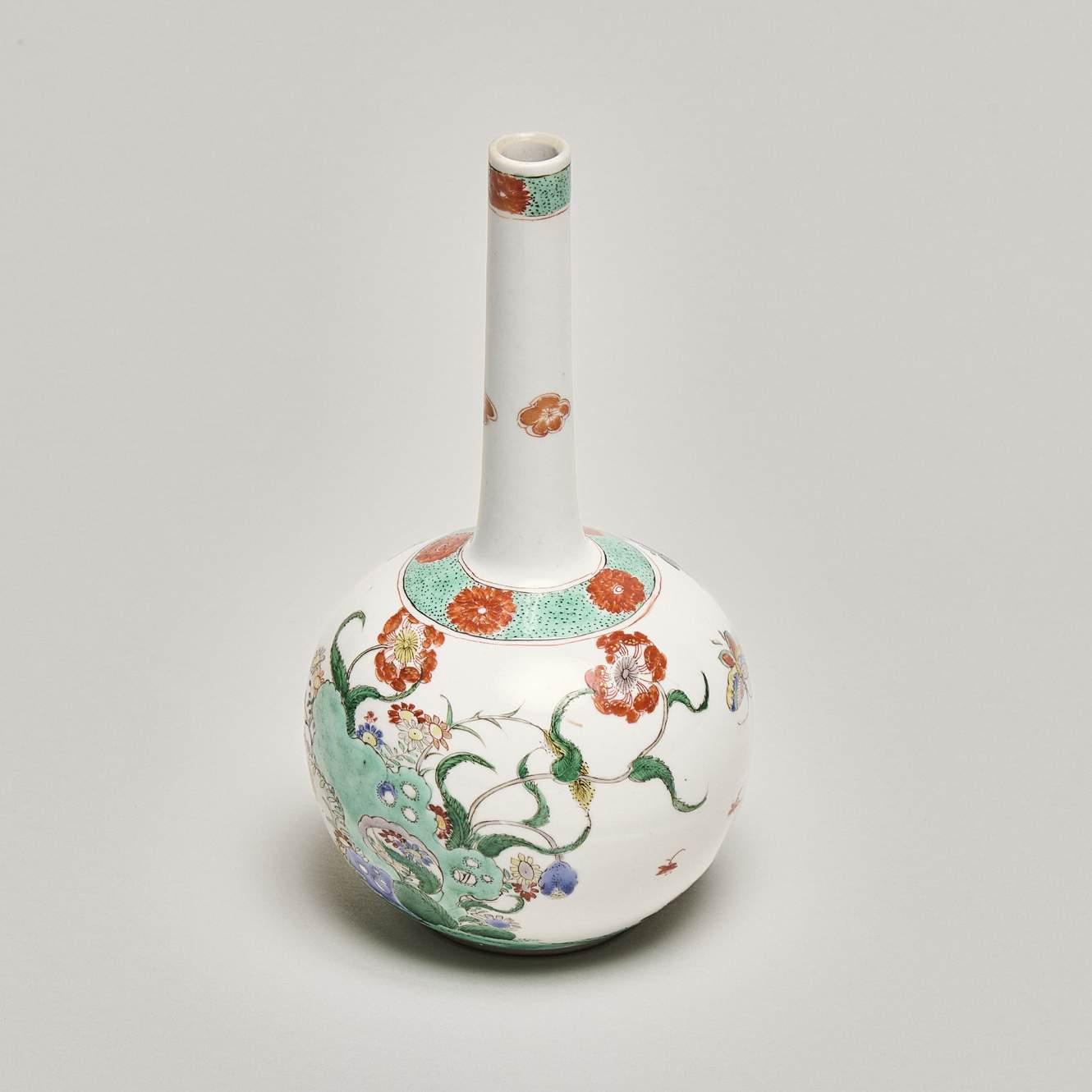
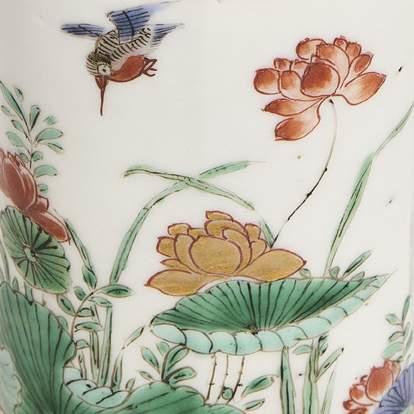
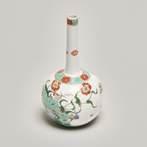
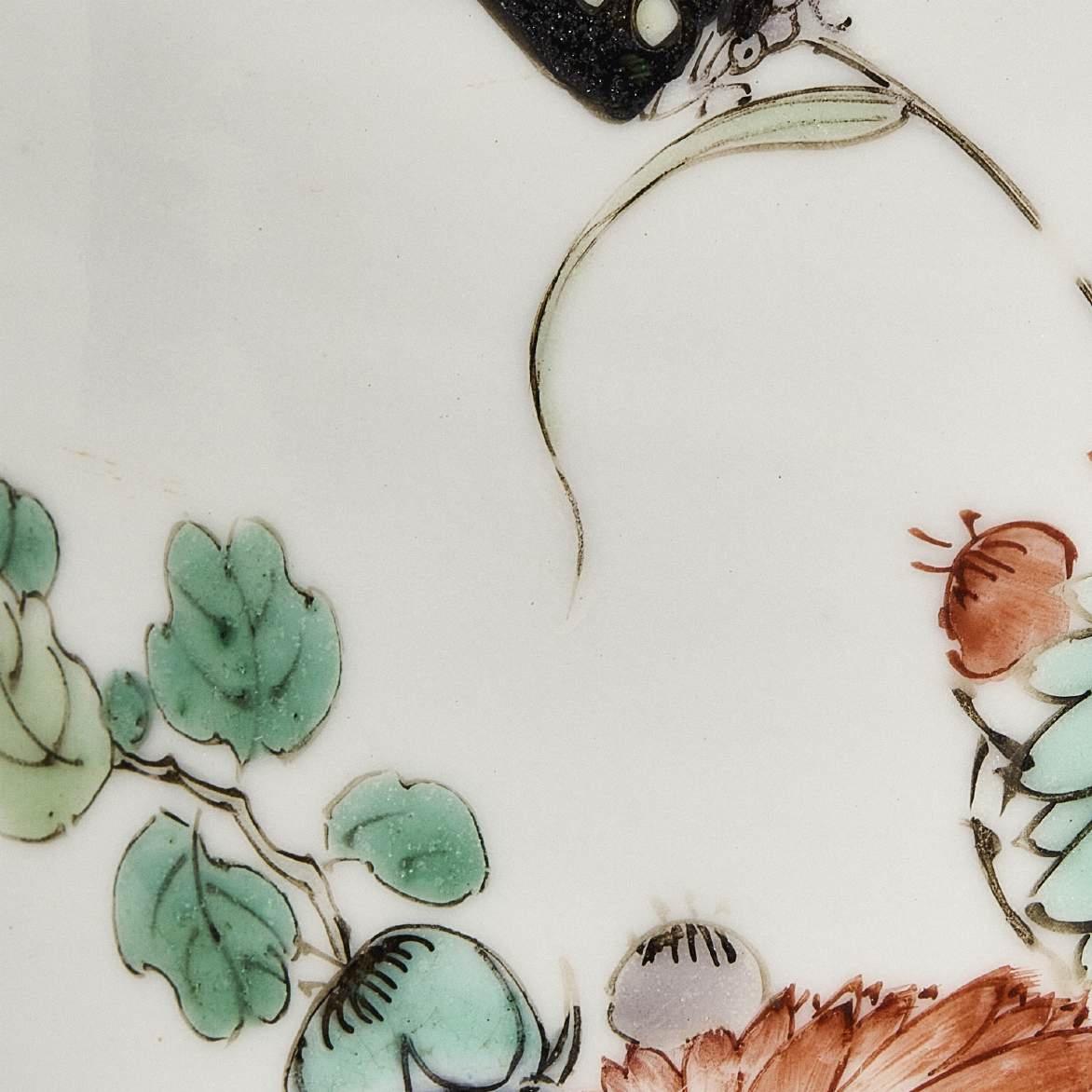
A famille verte bottle vase, with a globular body and straight slender neck. The body is decorated with rockwork, flowers and butterflies, in bright green, red, yellow and blue enamels - some flowers highlighted with gold. The neck has three single red blossoms; around both the mouth and shoulder is a matching band of red peony flowerheads on a green speckled ground. The base bears a letter in underglaze-blue, often identified as the Latin capital G or the Persian letter ye (ی).
Chinese porcelain with this intriguing letter-mark is relatively rare. As it is unlike other marks on porcelain, it is puzzling and as yet not fully explained. It occurs on objects with different shapes; mainly decorated in famille verte enamels, but occasionally in underglaze blue. For many years it was thought to represent the European letter G, but when rotated 90 degrees, it also reads as the Persian letter ye (ی). Either way, this still does not explain its use or meaning. One theory is that it is a mark or initial, applied to specific porcelain orders for a Chinese, Dutch or Persian merchant.
Similarly decorated vases - with the same letter mark - are in the Fitzwilliam Museum, Cambridge (inv.nrs. OC.14A-1938 & OC.14B-1938) and the Royal Porcelain Collection, Dresden (inv.nr. PO 4638). Dresden also has a bowl with the same mark (inv.nr. PO 6881). The Rijksmuseum has a pair of famille verte bottles as well as an underglaze blue vase - of a similar size and shape - also with the letter G. (inv.nr. AK-RKB 16303 & AK-RBK 16340). The Groninger Museum has a famille verte teapot with this mark (inv.nr. 1899-42).
China, Kangxi period (1662-1722), circa 1700 H: 18 cm
PROVENANCE
Van Hees Collection,
The Netherlands 1900-1953 (inv.nr. 150)
Nieuwenhuys Collection, 1991 (nr. 108)
Private Collection, Belgium 2025
LITERATURE
Ayers 2016, p.230-231, nr.499 Koeppe 2012, p.332
4 | Wine Pot
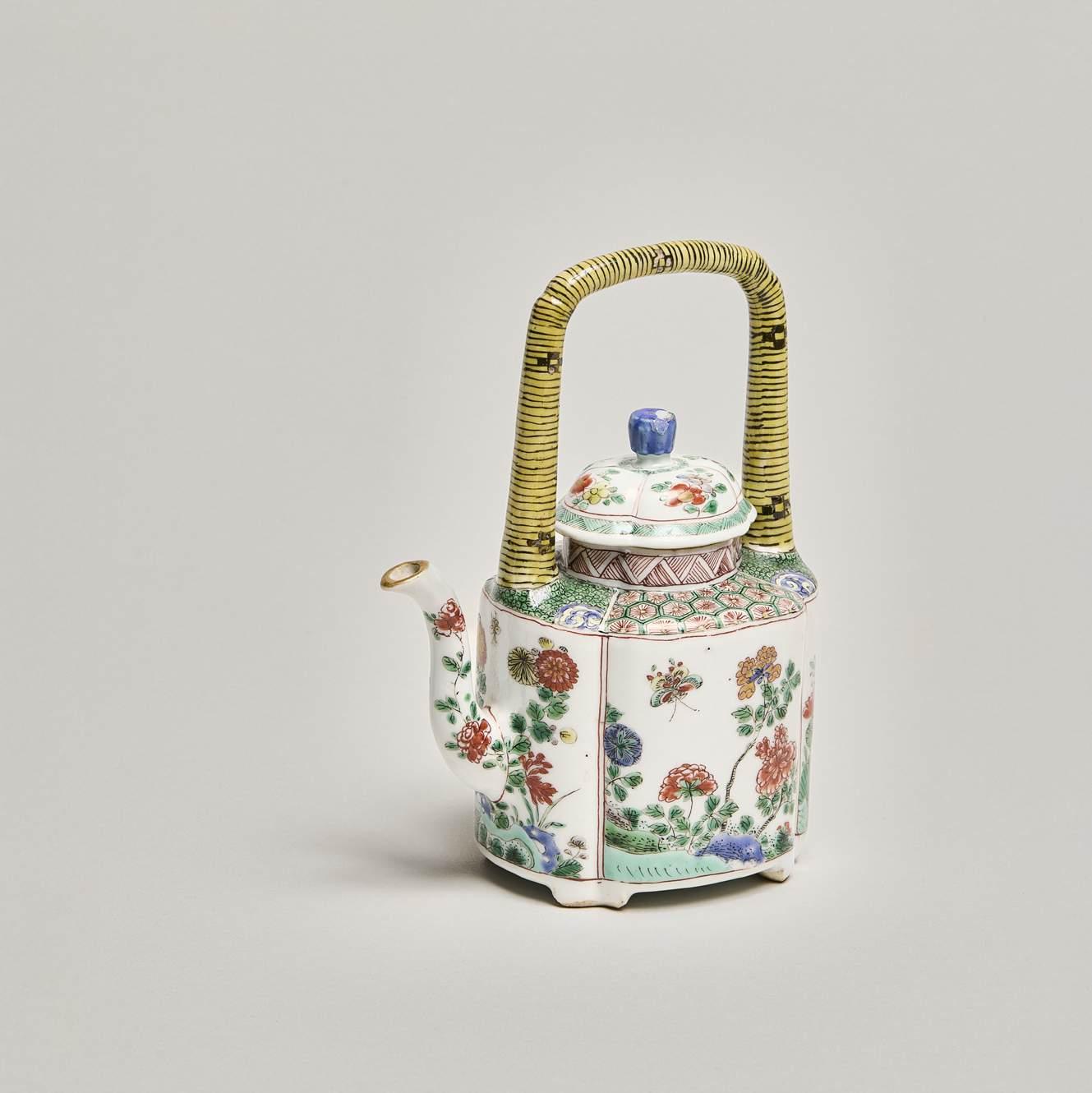
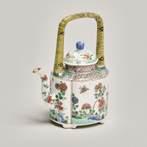
A wine pot with a quatrefoil ovoid section, a high neck, an s-shaped spout and tall arched handle. It stands on four small feet, which are indented to follow the shape of the body. Each lobe of the body, has a landscape with rocks, insects, and birds, painted in several shades of green, red, black, yellow, and aubergine enamels, with some flowers highlighted in gold. The shoulder of the wine pot has two diaper patterns, the sides have a green honeycomb with red starburst; the other two panels green ‘frog-spawn’. The neck is decorated with a chevron pattern in red. The domed lid has the same lobed quatrefoil shape, the four panels are decorated with flower sprays and edged with a green chevron pattern. The handle has been cleverly painted to resemble yellow cane or bamboo. The underside has a glossy transparent glaze.
This type of coloured enamelling, using multiple shades of green, is referred to in the West as famille verte. In China these coloured wares are referred to as wucai (five colours) - particularly when all the coloured enamelling - including blue - were added after the first firing. Although these type of wine pots are often considered export porcelain, this shape with a high handle would have been used in China for serving warm rice wine or holding hot water.
The Metropolitan Museum, New York has a very similar wine pot (inv.nr. 1975.1.1720) as does The Royal Collection Trust, UK (inv.nr. RCN58477).
China, Kangxi period (1662-1722)
Cups: H: 6.1 cm | Ø: 12 cm
Saucers: H: 3.5 cm | Ø: 16 cm
PROVENANCE
Nieuwenhuys Collection, 1991 (nr. 501A)
Private Collection, Belgium 2025
LITERATURE
Ayers 2004, p.88, nr.65
Jörg 2011, p.46, nr.37
Welch 2008, p.140-141
5 | Qilin & Phoenix
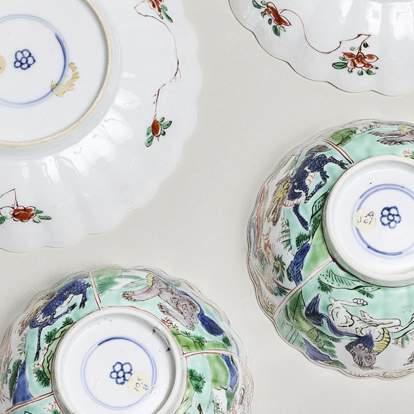
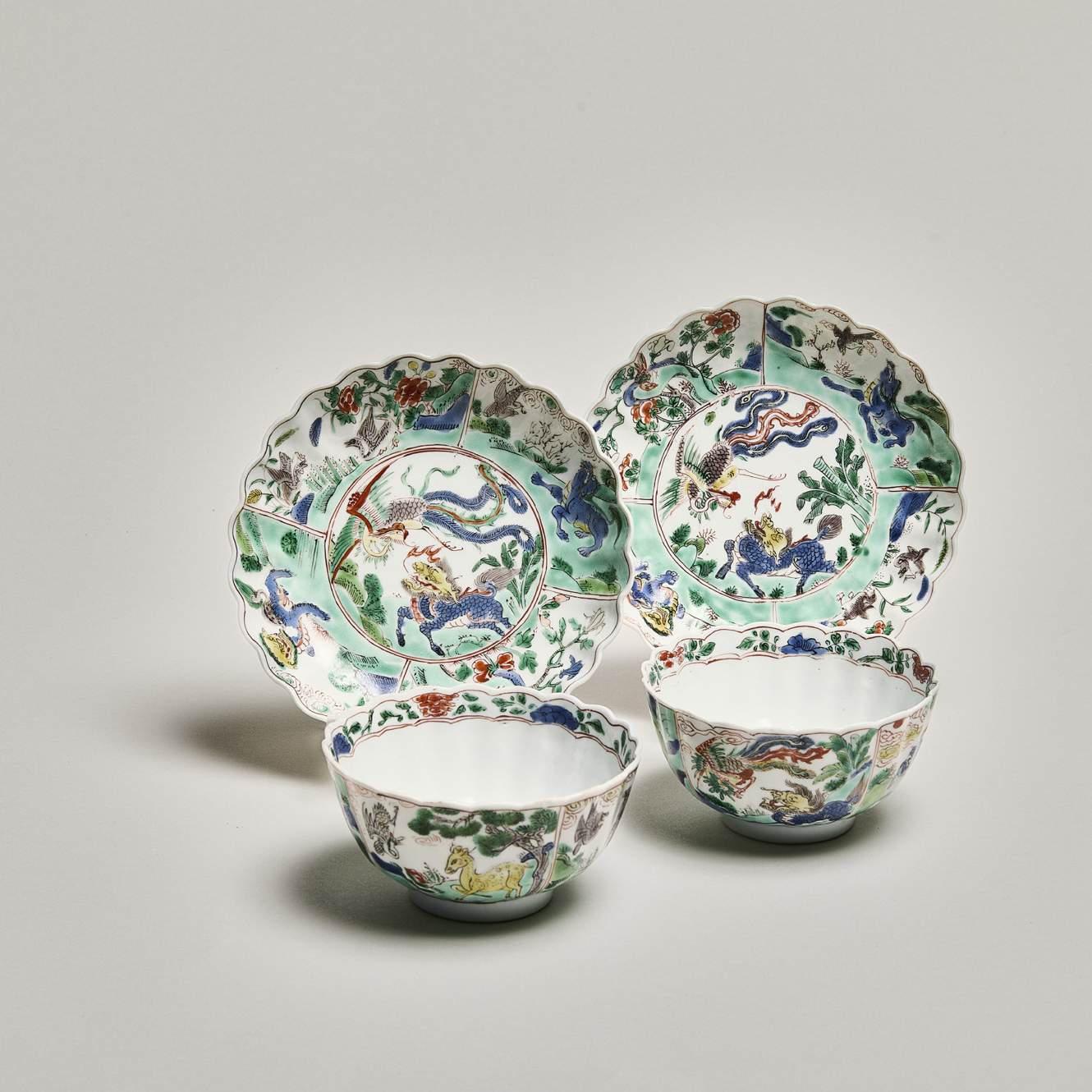
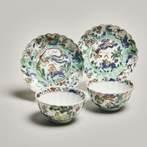
This pair of scallop-edged small bowls and saucers, are fluted to resemble a chrysanthemum flower. They are decorated in bright overglaze enamels in the famille verte palette of greens, red, blue, yellow and aubergine. The saucers have a large central panel with a colourful flying phoenix and a crouching qilin in a garden. The high curved rim, is divided into four panels outlined with a red line. Two have scenes with fabulous creatures, including a Buddhist lion and a Xiezhi. The other two panels are decorated with a scene of a bird on a rock, amongst peony and magnolia bushes; the other with mandarin ducks with reeds and flowers. The backs of the saucers have three simple sprays of peonies and on the base a simplified blossom within a double ring in underglaze blue.
The bowls are divided around the outside into four panels, also decorated with auspicious and mythical animals: a baize with red flames, a qilin with a phoenix in flight, a xiezhi with an eagle and a deer with a crane and a pine tree. The inner rim of the bowl, has a band of flowers and leaves within red lines and the cavetto has a round medallion with a peony bush, rocks and tiny insects. When featured together, these animals and plants have great auspicious significance. The powerful mythical creatures depicted together, represent good fortune, justice, and wisdom. The deer, crane and pine tree are emblems of longevity and the peony a symbol of riches and honour.
Even though there are several collections which have either cups or saucers, it is rare to find them together. The Groninger Museum has two cups (inv.nr. 1962.0177) and one saucer (inv.nr. 2011.0074).
The Burrell Collection, Glasgow also has two bowls (inv.nrs. 38.788 & 38.789). The Vergottis Collection, Lausanne has a single saucer with the same decoration.
China, Kangxi period (1662-1722)
H: 11.5 cm
PROVENANCE
Van Hees Collection, 1953 (nr. 163)
Nieuwenhuys Collection, 1991 (label nr. 108)
Private Collection, Belgium 2025
LITERATURE
Altenburg 1998, p.65, nr.80
David 1958, p.7 & plate V, nr.826
Stamen & Volk 2017, p.242-243, nr.114 & 115
Welch 2008, p.55
Zhang & Rasmussen 2008, p.72-73
6 | Peach Ewer
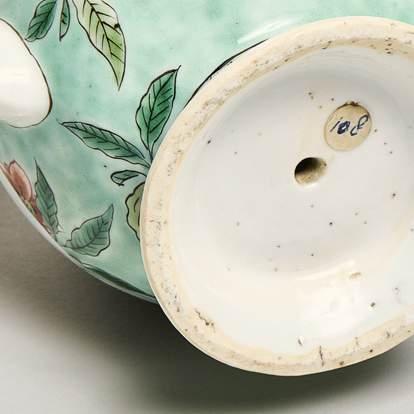
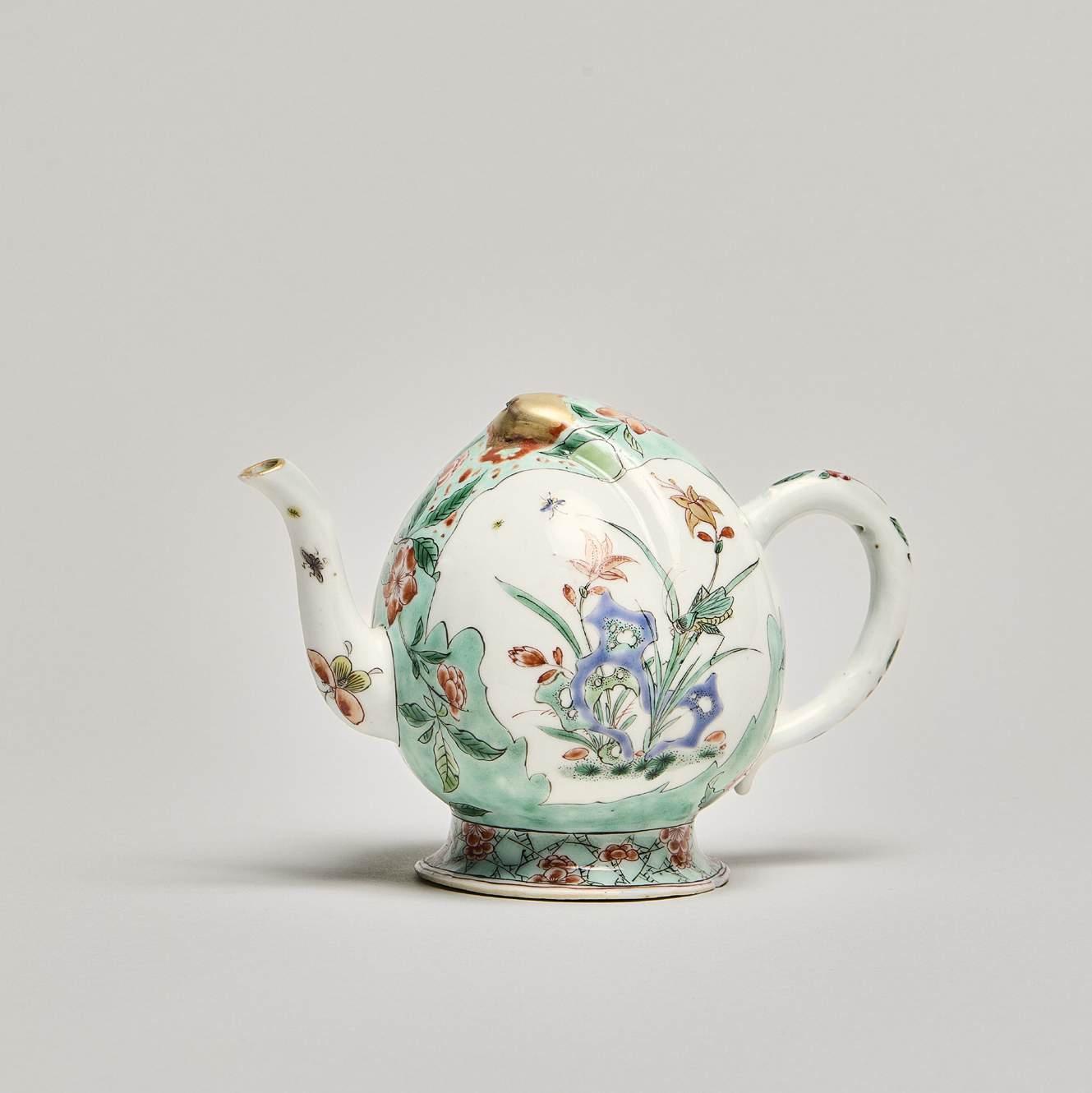
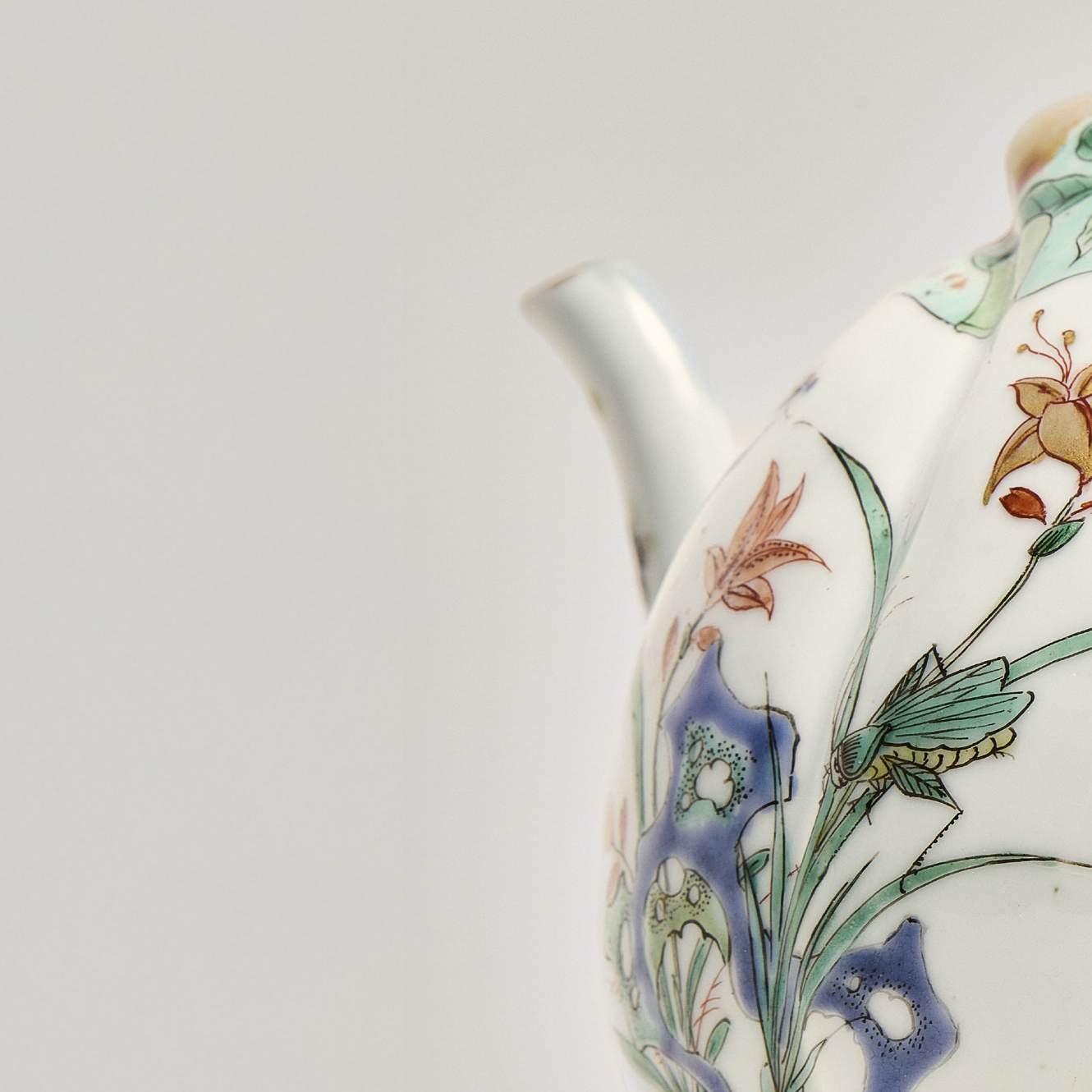
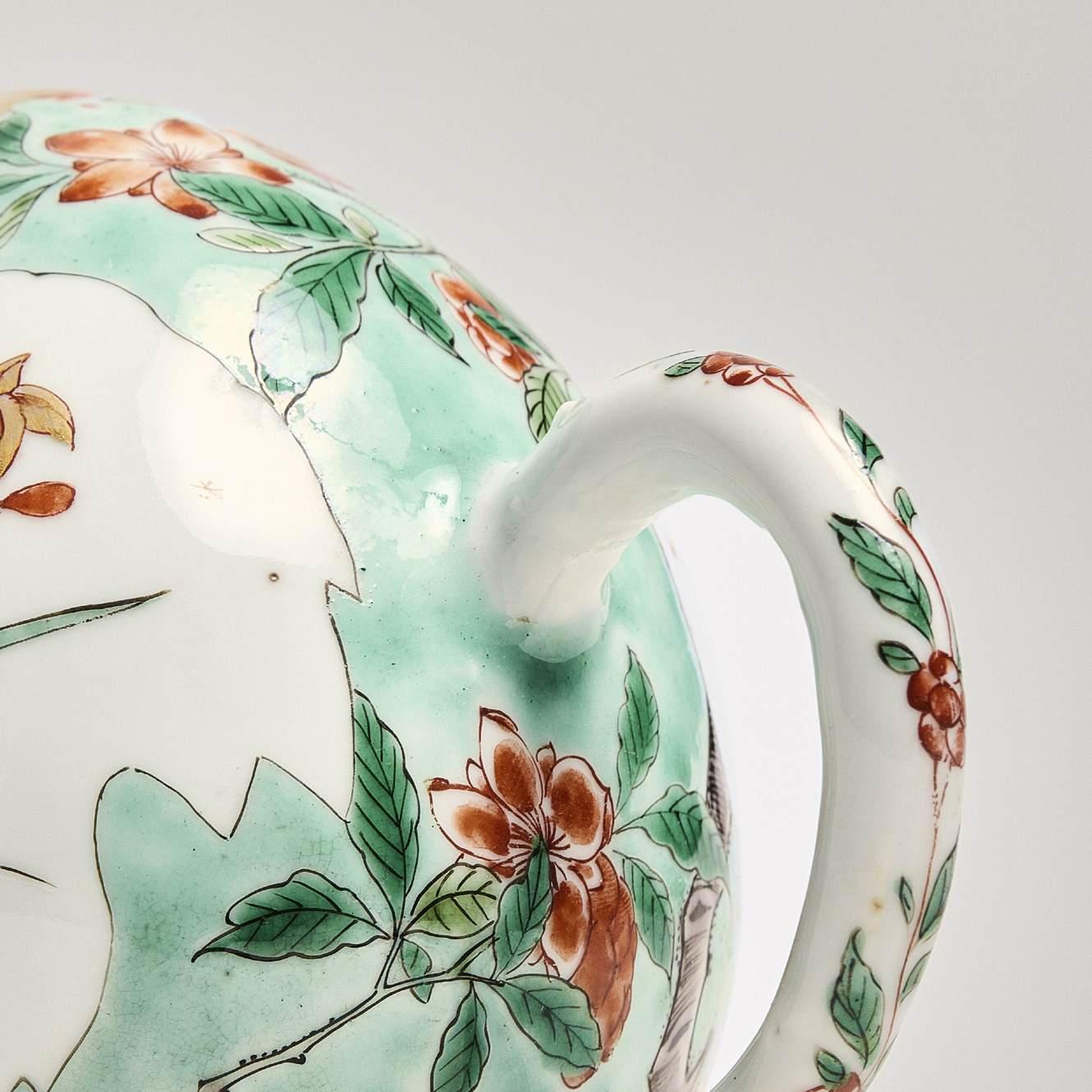
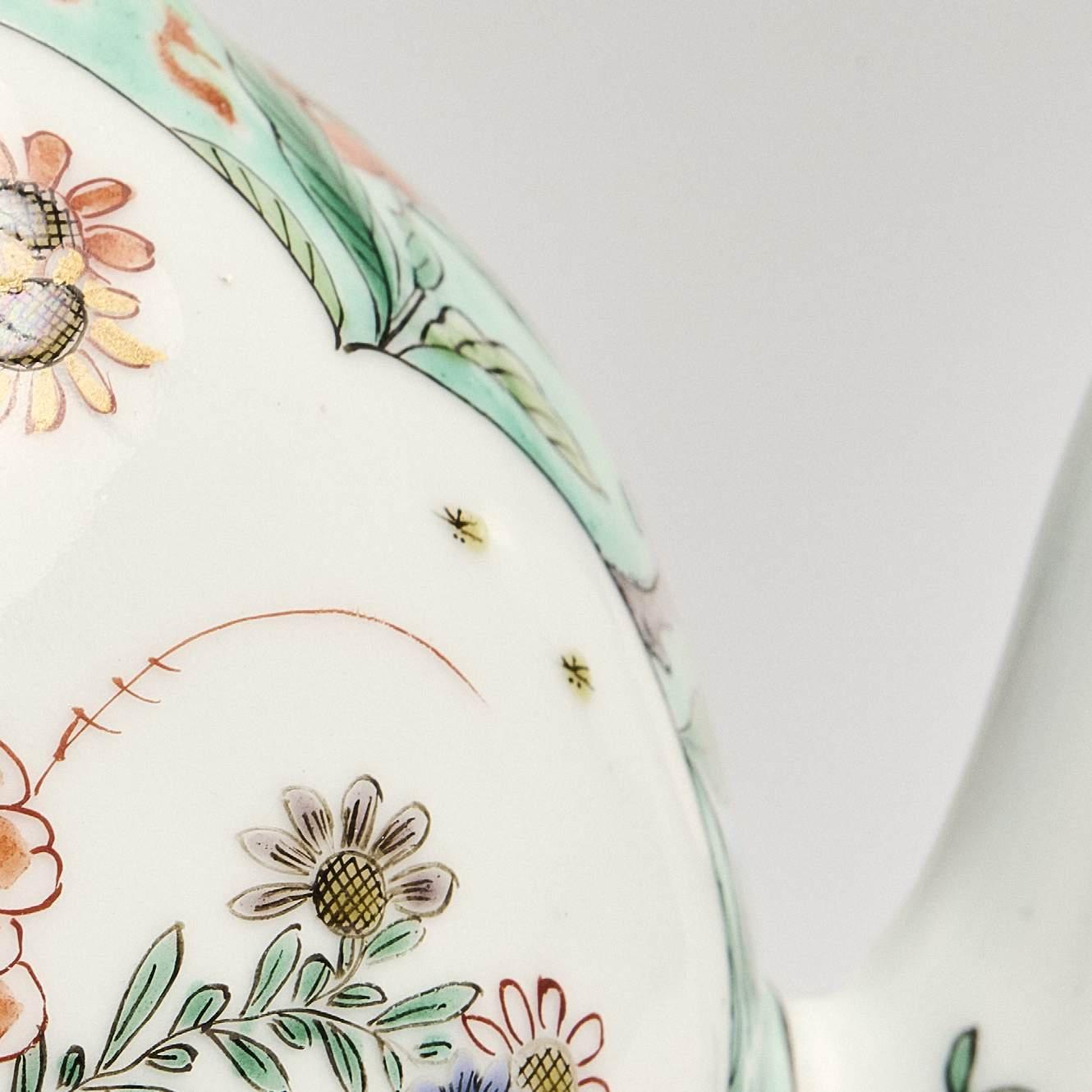
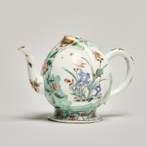
A brightly enamelled Cadogan ewer, decorated in famille verte over-glaze enamels with some gilding. The bright green body is moulded in the shape of a peach, with a forward pointing tip and the characteristic ridge down one side. Over the green body, is a decoration of red prunus blossom with brown stems and dark green leaves. The tip of the peach has been gilded. The reserved panels - one in the shape of an artemisia leaf, the other a quatrefoil form - have a decoration of flowers, rocks and insects. The leaf-shaped cartouche has auspicious daylilies and a large green cricket. The other panel has peonies with colourful chrysanthemums, a large butterfly and small flying insects. It has a curved spout with scattered insects and a rounded handle with a trailing branch with red flowers and green leaves. It stands on a high splayed concave foot, decorated in green with a cracked ice pattern in black, dotted with red blossom flowers. The underside has a transparent glaze and a small hole in the bottom.
This curious type of ewer, first originated in China, where it is known as a dao guan hu - upside down filling wine pot. Having no cover, it is filled upside down through the hole in the base; this leads to a long tube high up into the ewer. When filled, the liquid runs through the tube, overflowing into the body preventing a backflow. When the pot is righted, it can be poured through the spout. Standing upright, the ewer appears to have no way to be filled, making it an intriguing curiosity. This type of novelty lidless ewer, is also known as a Cadogan - said to be named after William, 1st Earl of Cadogan (1675-1726). He and his wife brought an example to Britain, where they used it as an entertainment, mystifying their guests as it had no apparent means to fill it.
It is often difficult to tell the difference between a wine pot and a tea pot, since their forms overlap, making them virtually indistinguishable. But a larger form and lack of an airhole in the lid, could indicate that the pot was intended for wine rather that tea. We do know that this lidless peach-form, was certainly used for wine in China.
These vessels appear to have had great appeal in Europe as several collections have peach ewers with famille verte enamelling. The British Museum, London has an example (acc.nr. 1947,071297), as does the Victoria & Albert Museum (acc.nr. C.1166-1910).
TEA & WINE IN CHINA
The consumption of tea and wine, has a very long history in China and is deeply rooted in its culture. These two beverages are also inseparable from literati traditions and were drunk for medicinal purposes as well as during important rituals. The preparation and consumption of these drinks developed into a veritable art form, sometimes with great emblematic meaning. In China tea is associated with clarity, quietude and uprightness. However, as an alcoholic drink, wine has more emotive connotations such as joy, sorrow, oblivion and passion.
As tea and wine were both drunk warm, the various vessels used by Chinese for serving the hot wine or water into bowls, created an overlap in function and form. In the 17th century, when Europeans starting importing Chinese porcelain, wine ewers and teapots certainly looked very similar. The blurring of function between Chinese wine ewers and teapots increased, as porcelain imports grew along with the consumption of tea.
In Europe the beautiful and elegant Chinese wine ewers, were often repurposed for tea; and it is certainly obvious they inspired European teapot shapes. In the course of the 17th and 18th centuries, Chinese potters added requested features to export tea wares, such as spout gratings for tea leaves and handles on cups. The transitioning form - from wine servers to dedicated teapots - was therefore an evolution driven by trade and changing teadrinking customs.
RICE WINE
Traditional Chinese rice wine (huangjiu or mijiu), has been a cornerstone of Chinese culture for over 9,000 years. Historically, it was the main alcoholic beverage in China, before the later rise of distilled spirits. Made from double fermented steamed rice, using a special starter called jiuqu, it was left to ferment in vats for several weeks, before filtration. The wine was then stored in large ceramic jars to age further. Generally rice wine was served warm, to enhance its aroma and flavour. It was mainly drunk with food at formal dinners, banquets and festivals, but also during important religious rituals and offerings. It was used in cooking and had medicinal uses too. Wine vessels, were therefore far more than functional objects, as they were used in formal festivities and religious rituals.
In the military, Chinese generals encouraged consumption of wine before battle and if a warrior fell, his brothers in arms would sprinkle wine on the ground where he lay. Some teapot-like forms, with overhead handles, are also known wine ewers. Slightly larger than pots for brewing tea, they obviously shared features as they were both used for warm beverages.
The consumption of tea and wine, has a very long history in China and is deeply rooted in its culture
TEA IN CHINA
Tea is inextricably linked with China and later the China Trade. Tea is harvested from bushes, which have two main varieties: Camellia Sinensis Sinensis with small, tender leaves and Camellia Sinensis Assamica, with larger, thicker leaves. White tea, yellow tea, green tea, oolong, dark tea (including pu-erh tea) and black tea are all harvested from these two major shrub varieties. However, the plucked leaves are processed differently to attain varying levels of oxidation, from fully oxidized black tea, through semi-oxidized white tea and oolong, to those with no oxidation at all in the case of green and yellow teas. Records tell us, that during the Tang Dynasty tea leaves were steamed, pounded and dried into brick shapes. Later, during the Song Dynasty (960-1279AD), production methods changed and loose-leaf styles of tea were generally preferred. The powdered teas forms travelled from China with the Buddhist monks to Japan, where it is called matcha, which means “powdered tea”.
The earliest actual drinking of tea, can be dated back to the Shang Dynasty (1600-1100 BC), when it was imbibed for medicinal purposes. However, the first written record of tea drinking dates to c.200 AD - in a medical text written by physician Hua Tuo. By then it had evolved into an elite beverage, gradually becoming a mainstay of Chinese culture during the Tang and Song Dynasties (618-1279). Firmly established as China’s national drink, teashops and tea art flourished across the country. It was particularly popular among scholars, monks, and royalty, early texts like The Classic of Tea by Lu Yu (8th century) documenting its cultivation and use.
TEA IN THE WEST
During the 17th century, tea was only grown in China and Japan. Initially arriving in the Dutch Republic in small quantities, it formed part of the Dutch East India Company (VOC) cargo. It was first introduced into Europe, as a detoxifying and laxative medicinal herb; its use as a beverage only emerging slowly. The actual drinking of tea, was probably introduced by the VOC employees who learned to consume it in the East. However, it was not until the 1660s, that the Dutch and English started to ship it in larger quantities. By the end of the late 17th century, it had gained such popularity that tea houses were established in most major cities; and tea circles where woman could meet socially became the fashion. Fermented black tea was drunk, but also various green tea varieties. Due to the increasing taste for tea, the prices rose dramatically and the competition between the merchants intensified. By the 18th century the demand for tea was so high, that a large part of the profits of the East India Companies came from the tea trade.
As in China, strong tea was steeped in tiny teapots - known in Dutch as trekpotjes - and drunk from delicate porcelain cups. The increase in popularity of tea (and later coffee) also insured an increase in demand for porcelain tea wares such as pots, cups, saucers, bowls and caddies. Tea, as well as all the accompanying tea wares, were expensive luxuries and considered an outward display of wealth and high fashion. During the Kangxi period, tea and silk comprised the larger share of the export market with porcelains only claiming third place.
China, Kangxi period (1662-1722), circa 1700
Bowl: H: 7.7 cm | Ø: 17.4 cm
Plate: Ø: 24.4 cm
PROVENANCE
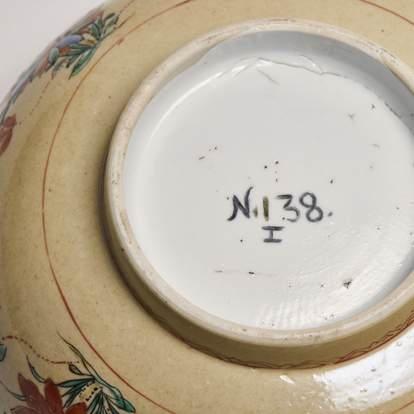
Augustus the Strong, 1721 (inventory mark: N.138. I)
Private Collection, Switzerland
2025
LITERATURE
Bartholomew 2006, p.47
Jörg 2002, p.111, nr.74
Krahl & Ayers 1986, part III, p.1265, pl.3236
Lepke’s 1919, pl.33, nr.251 & 252
Stamen & Volk 2017, p.221, nr.93
Ströber 2001, p.9-13
Suebsman 2015, p.176-177, nr.97 & 98
7 | Dresden Bowl & Plate
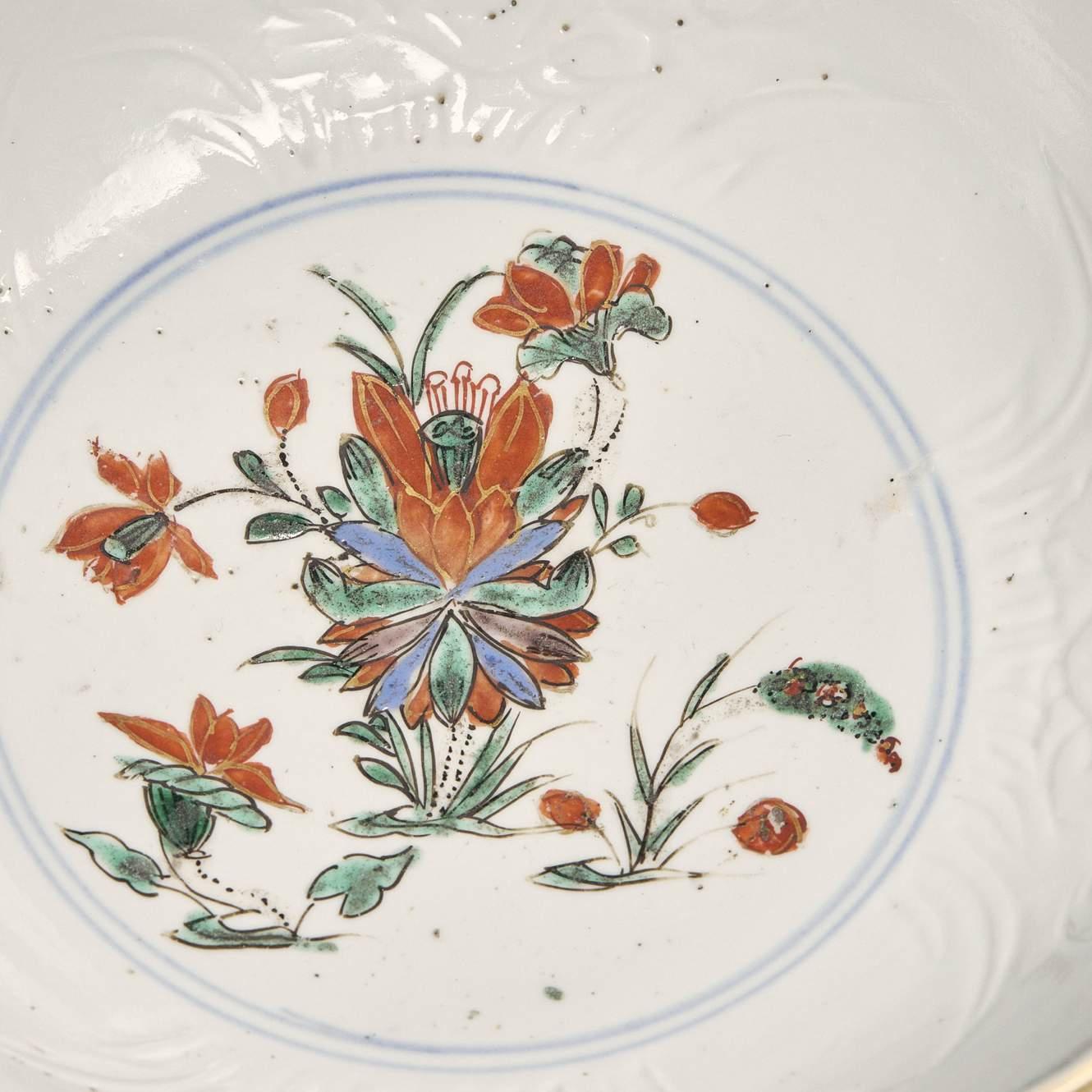
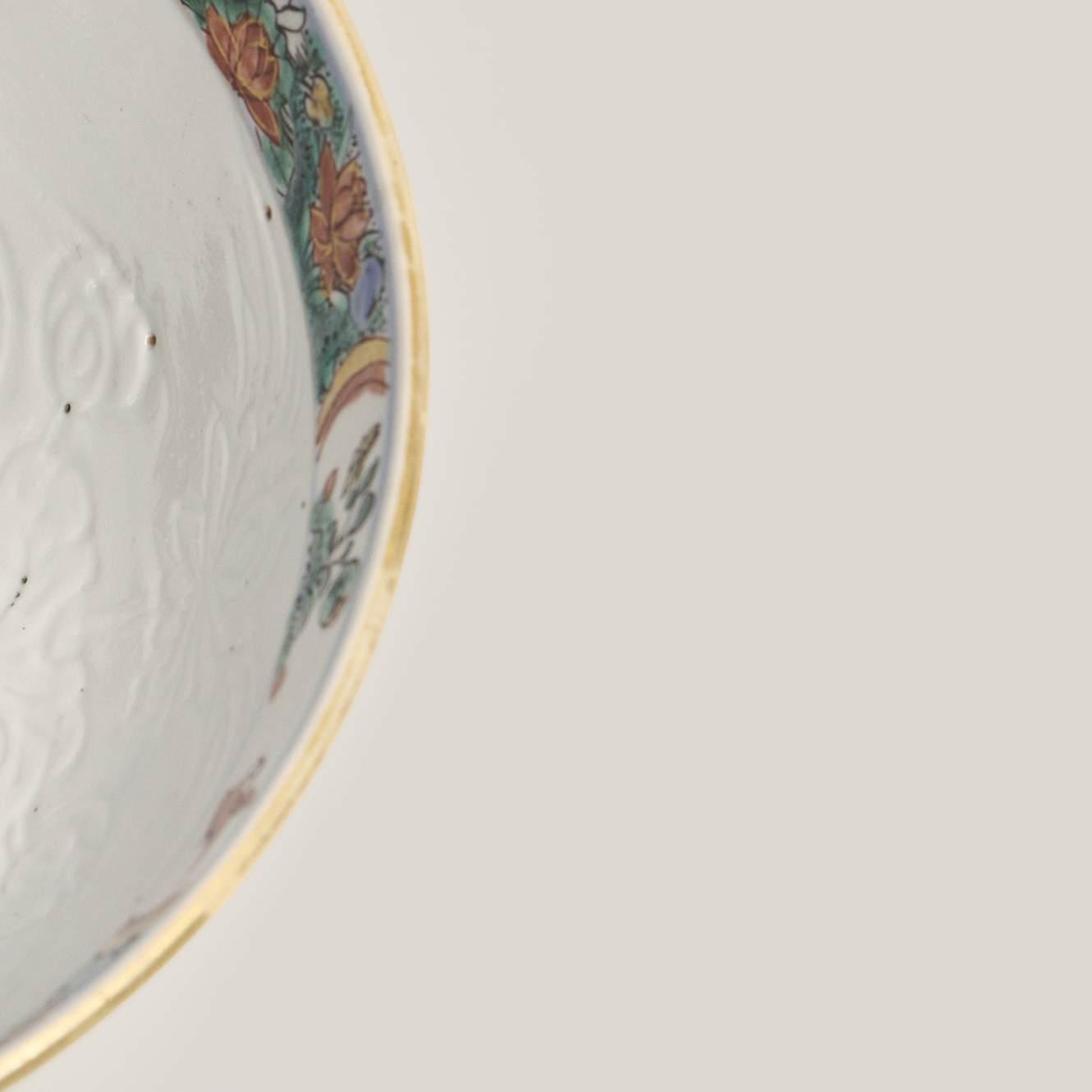
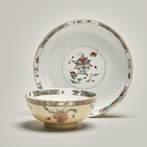
A matching café au lait bowl and dish, decorated with multi-coloured lotus flowers. Both are covered around the outside with a yellowbrown café au lait glaze, with four large stylized lotus flowers in famille verte enamels. Both cavettos have an incised underglaze decoration of large lotus flowers and leaves. On the inside is a double blue circle, with a large blue, green and red lotus surrounded by smaller red flowers. On the outside, a similar floral arrangement is repeated four times, over the café au lait ground. Around the inside and the outside of the rim is a green band, with red and blue flowerheads – interrupted by four cartouches decorated with flowering plants, colourful birds and butterflies. Many of the flower petals on the bowl still have their gilt outline. The bowl stands on a high foot-ring with a band of red zigzag lines. Both the bases have an incised inventory number N.138 I - indicating that these pieces once belonged to the Royal Porcelain Collection in Dresden.
Chinese porcelains with this striking light brown café au lait glaze, combined with famille verte enamels, were predominantly made to order for the European market - as this colour combination is seldom seen in porcelain for domestic use. In the Netherlands this glaze colour is known as zeemleer (meaning chamois leather). Incised or impressed decoration under the glaze, is referred to as anhua (暗花 - secret decoration). This indented pattern, often in the form of flowers or animals, is very subtle and can only be seen when it catches the light in a certain way.
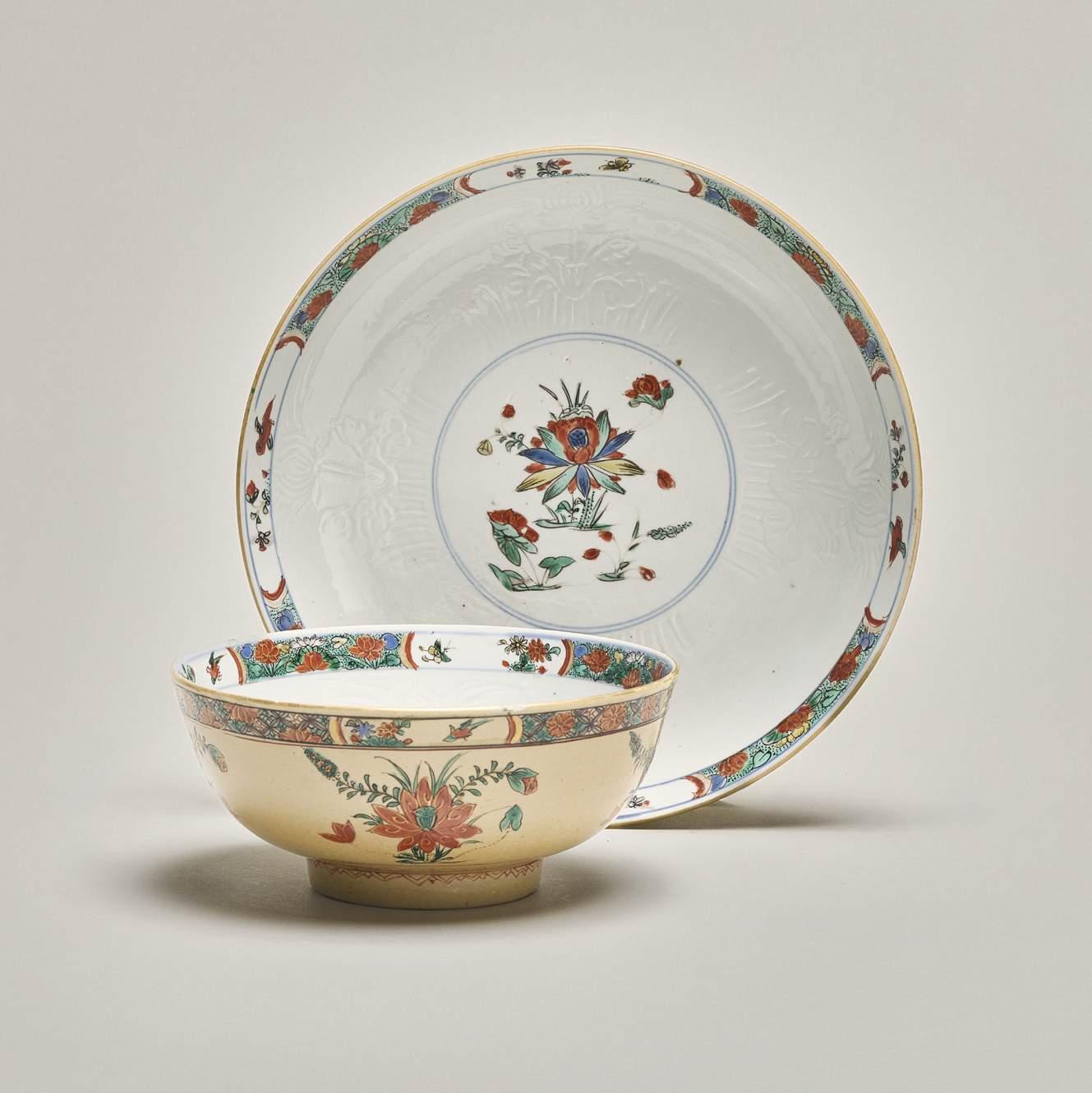
The magnificent porcelain collection in Dresden, was founded by the enormously wealthy Augustus the Strong, Elector of Saxony (1670-1733). He famously acquired vast quantities of Chinese and Japanese porcelain in the first half of the 18th-century – largely intended to decorate his Japanische Palais. Each piece in the monumental collection was given an incised number and registered in (still extant) record books. The three inventories of 1721, 1727 and 1779 (now available online) make each recorded piece datable. Part of the collection was dispersed at various points in time, including several auctions at Lepke’s in Berlin at the beginning of the 20th-century.
In an addendum to the Dresden inventory of 1721, this bowl and dish appear under “Green Chinese, Chapter III: Tableware Services and Companion Wares”. The entry records that on 24 May 1724, the merchants Landsberger and Kell delivered a group of famille verte objects. This included a series given the number N.138 I, described as sixteen slop bowls with companion stands. The preceding inventory number (N.137) describes ten similar bowls, described as gilt-rimmed slop basins, brown on the exterior and florally decorated on the interior, with a so-called “Marseilles-type” design.
The Royal Porcelain Collection in Dresden still holds a number of these dishes and bowls (incl. PO612 & PO6434). The Topkapi Museum, Istanbul has a comparable bowl (TK15/5719). In the Lepke’s sale catalogue from October 1911, we see that lot numbers 251 and 252 have the same inventory marks as our pieces.
China, Kangxi period (1662-1722)
H: 14 cm | Ø: 11.7 cm
PROVENANCE
With Salomon Stodel, Amsterdam 1990 (label PCV46)
Private Collection, Belgium 2025
LITERATURE
Bartholomew 2006, p.41, nr.176
Beijing 1999, p.97, nr.89
Marsh 2020, p.230-231 & p.246-247
Pei 1997, p.29-63
Rinaldi 1993, p.90-99
Stamen & Volk 2017, p.141, nr.53
8 | Bitong
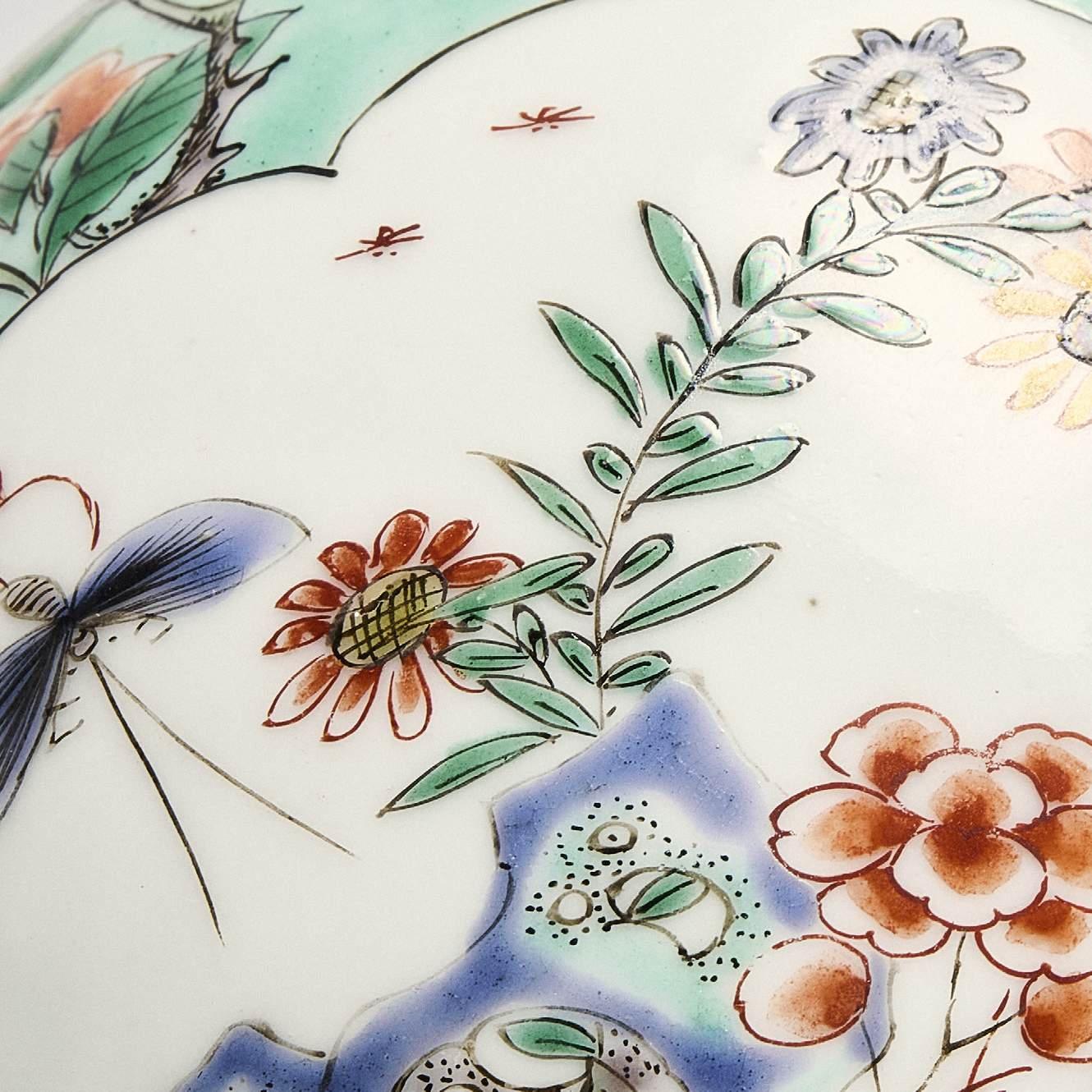
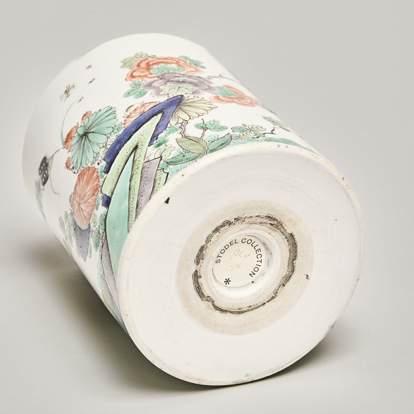
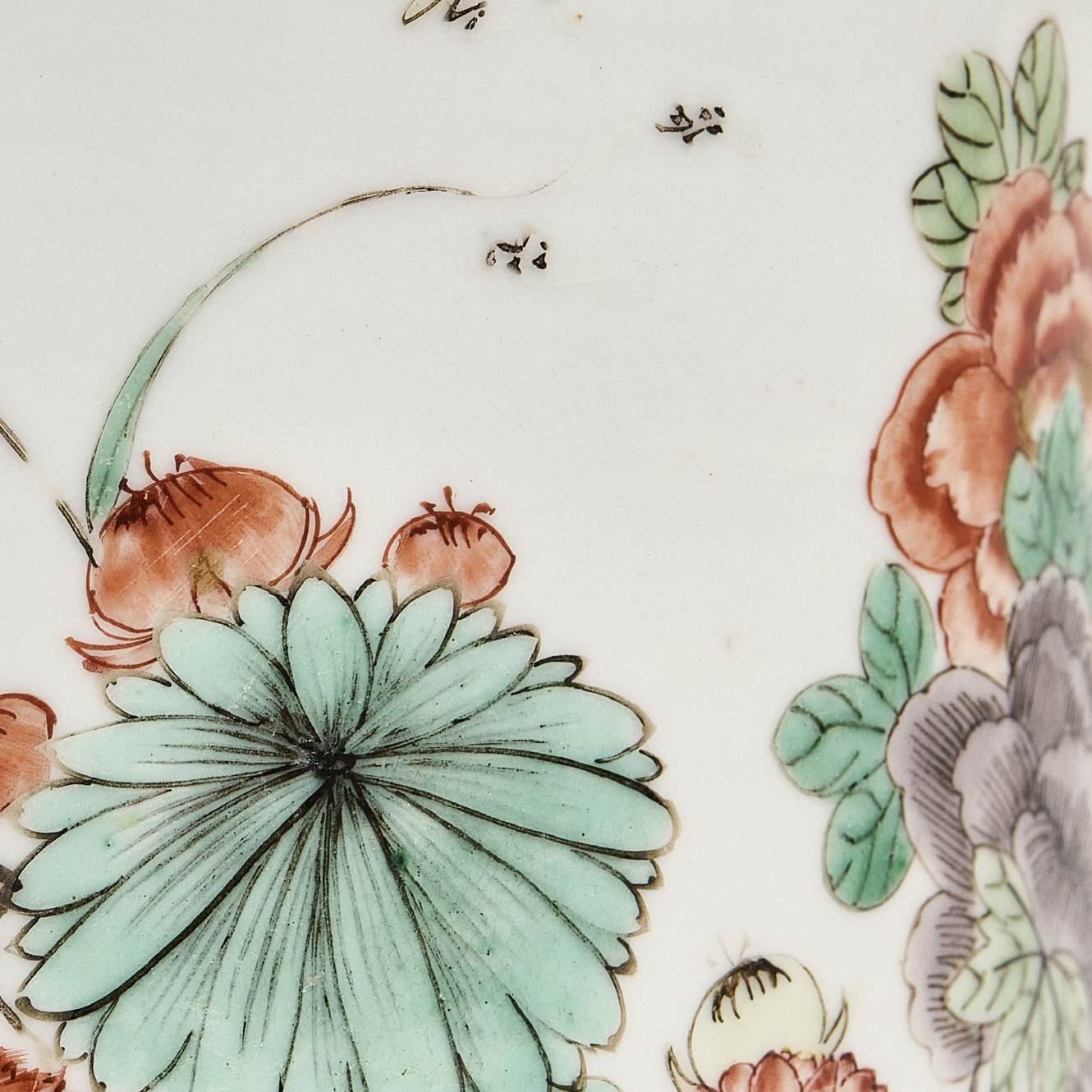
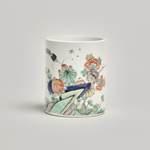
A sturdily potted cylindrical brushpot (bitong 笔筒), decorated with a continuous scene of large flowering peonies and chrysanthemums issuing from craggy rocks. Above the flowers are fluttering insects such as a butterfly, dragonfly and other tiny insects. A large black beetle with white spots, sits on a bending reed plume. The scene is painted in bright overglaze famille verte enamels, including a strong transparent blue with black outlines underneath. The other colours used are three shades of green, yellow, red, aubergine and a touch of gilding. The base of the pot is partially covered in a thin transparent glaze, leaving a ring around the centre unglazed. A circular recess in the middle is unglazed and unmarked. A large round label from the Stodel Collection (Amsterdam), has a stock number written in pen.
The symbolic combination of peonies (mudan) and chrysanthemums (juhua) can be read as: “may you enjoy long life, wealth and honour”. In China all blooming flowers are considered auspicious, because they represent prosperity. When depicted in combination with butterflies (hudie) - symbols of joy, longevity and blessings - it also forms a motif for joy, love and good fortune. On the other side of the pot, a large green flowering plantago (Cheqiancao 车前草 ) is depicted sprouting from the ground. This common plant, used in traditional Chinese medicine, also had symbolic meaning; its resilience and ability to grow in common places, reflected the humble yet strong spirit of the ideal Chinese scholar.
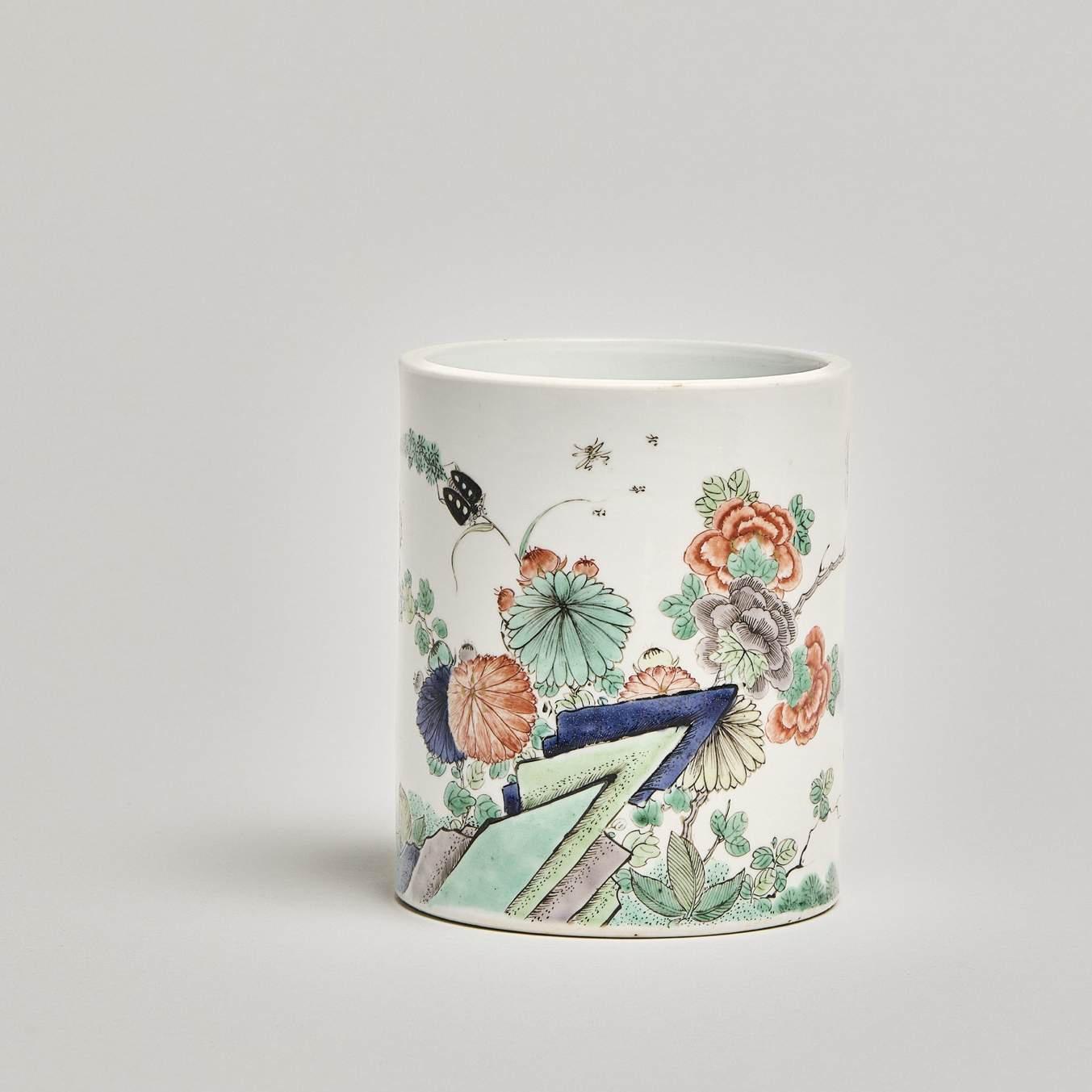
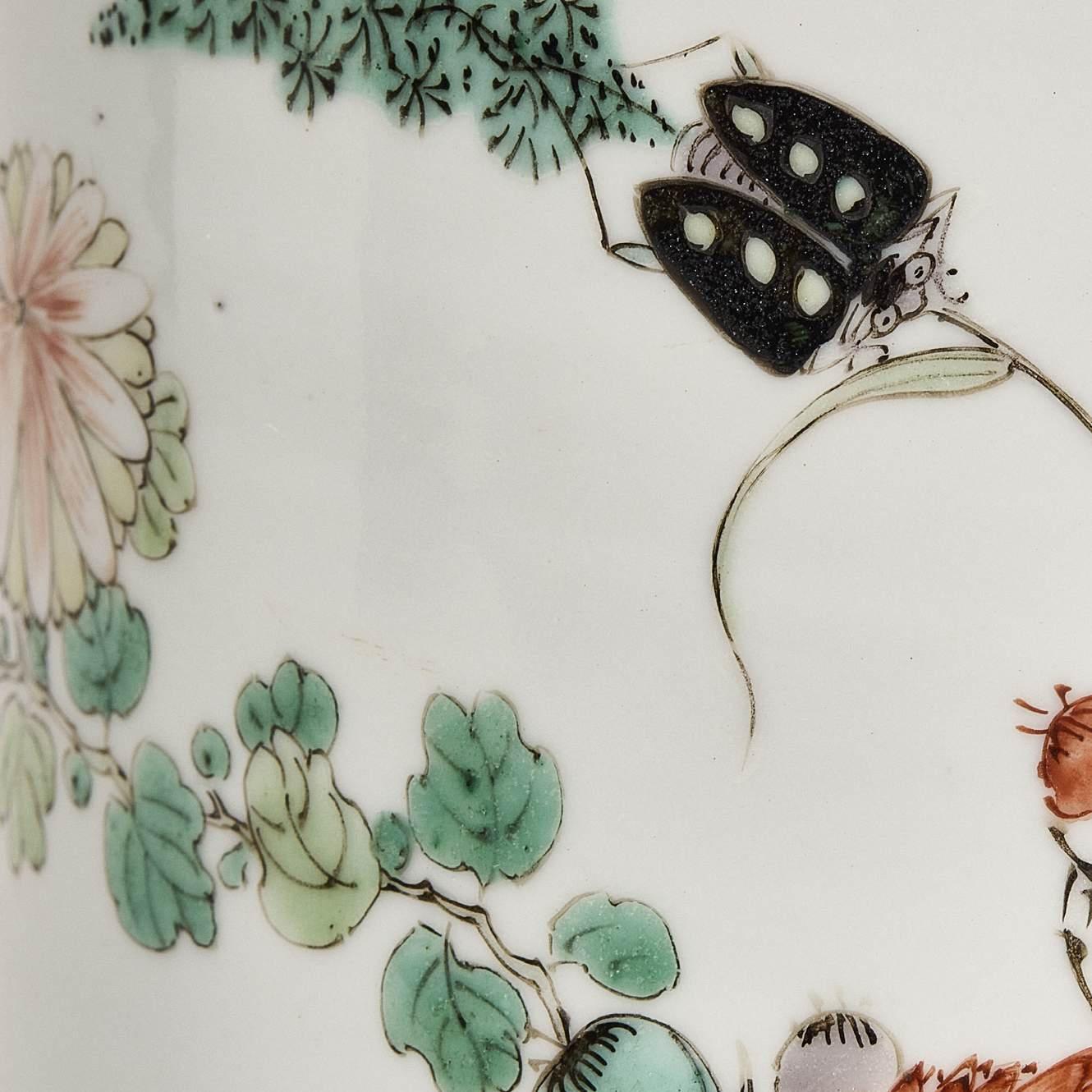
All these emblematic references, would have appealed greatly to the Chinese scholar gentlemen (wenren), for whom such brush holders were intended. As their brushes were a crucial item for the important activity of calligraphy and painting, containers to hold them were a constant feature on every scholar’s desk. They were not only functional but also essential objects for every literati.
A suitable brushpot would no doubt be selected with great care, reflecting the owner’s status, intellectual refinement, and appreciation for the arts. Used to store a variety of brushes, the bitong comes in many different sizes, shapes and materials. Apart from brushes, they might also be used to hold other useful implements such as tools for incense burning or decorative items such as peacock feathers or a ruyi sceptre.
A slightly wider pot with a similar floral scene with insects is in the Grandidier Collection in Musée Guimet, Paris (acc.nr. G4633).
China, Kangxi period (1662-1722), circa 1700 Ø: 15.7 cm
PROVENANCE
With Kunsthandel Morpurgo, Amsterdam (label ORRR-IVRR)
Private Collection, Belgium 2025
LITERATURE
Bartholomew 2006, p.156, nr.6.34.3
Pei 2004, p.33
Welch 2008, p.34 & 92
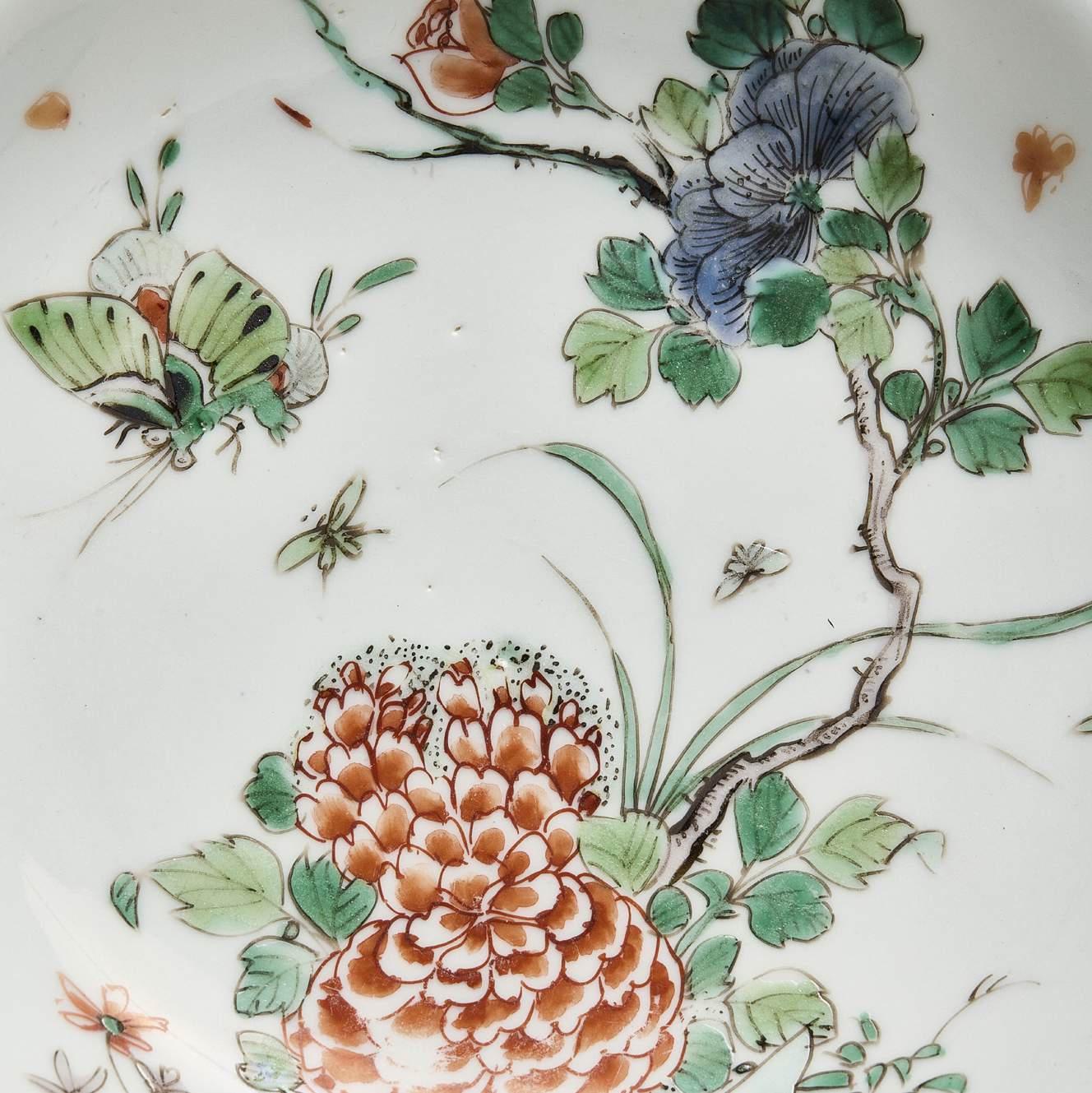
9 | Peonies & Butterflies
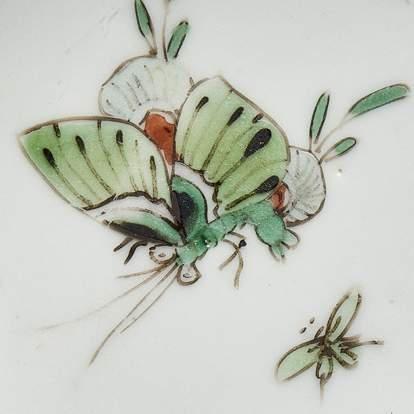
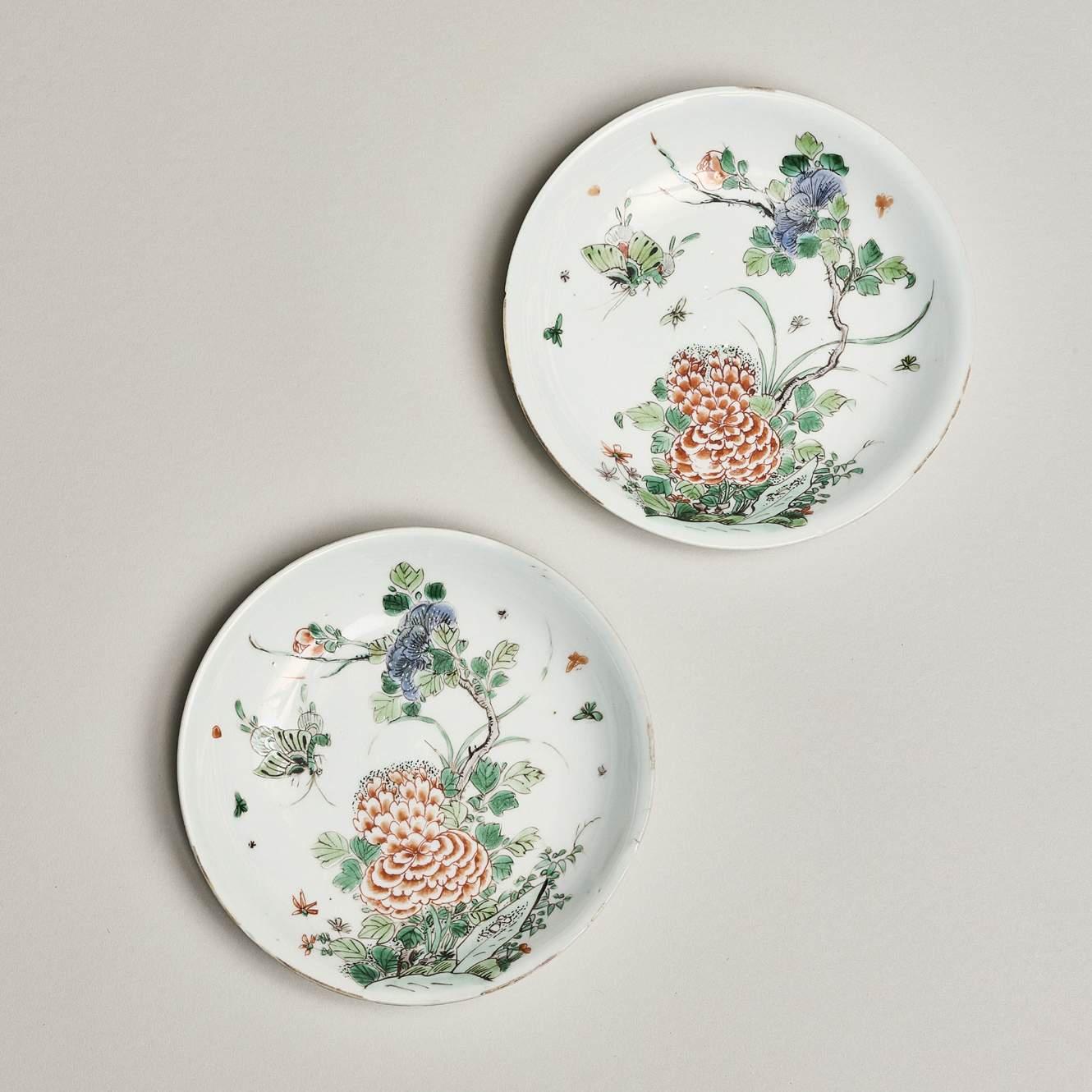
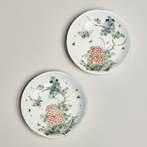
A pair of elegant saucer-dishes decorated in the famille verte palette, with peonies and butterflies. These shallow dishes, have raised sides and slightly flaring rims. They are boldly decorated with a flowering peony bush with green leaves and iron-red and blue blooms, standing next to a rock. One large green butterfly and several smaller butterflies hover above the flowers. The reverse is undecorated and they have a low foot-ring. Each dish has a rectangular label from Kunsthandel Morpurgo (Amsterdam) stating they are two small famille verte dishes and a stock number.
During the reign of Emperor Kangxi the development of over-glaze enamelling took enormous leaps forward, making a whole new range of colours possible. It saw the emergence of a new predominantly green colour palette, now referred to as famille verte. Around 1700 an overglaze blue enamel was also added to the new colour range. Before the later introduction of opaque pink enamels in c.1720, peony flowers - as on this dish - were often depicted in iron-red and sometimes other colours such as blue.
The design of butterflies and peonies has traditionally been a favoured motif in China for its highly auspicious qualities. Peonies (fuguiha), are emblems for wealth & honour. Butterflies (hudie or die) are a traditional symbol of joy, but often appear in combination with other emblematic objects. In combination, hudie (butterfly) is a pun for fudie, meaning an accumulation of blessings. Therefore when depicted together peonies and butterflies represent the message “may you accumulate great blessings, wealth and high social status” (fudie fugue).
The Royal Porcelain Collection, Dresden has a smaller saucer with a peony and butterfly (inv.nr. PO 6508). The Ashmolean Museum, Oxford has a comparable dish decorated, but with lotus flowers (acc.nr. EA1978.1212).
China, Kangxi period (1662-1722)
H: 10 cm | L: 15.5 cm
PROVENANCE
With Kunsthandel Morpurgo, Amsterdam
Private Collection, Belgium 2025
LITERATURE
Jörg 2011, p.135, nr.123
Suebsman 2015, p.168-169, fig.93
Welch 2008, p.18
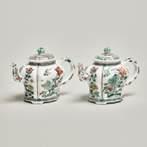
10 | Teapots
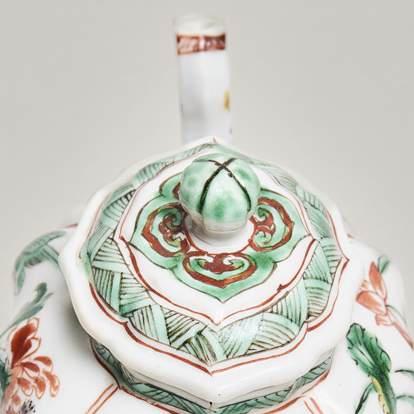
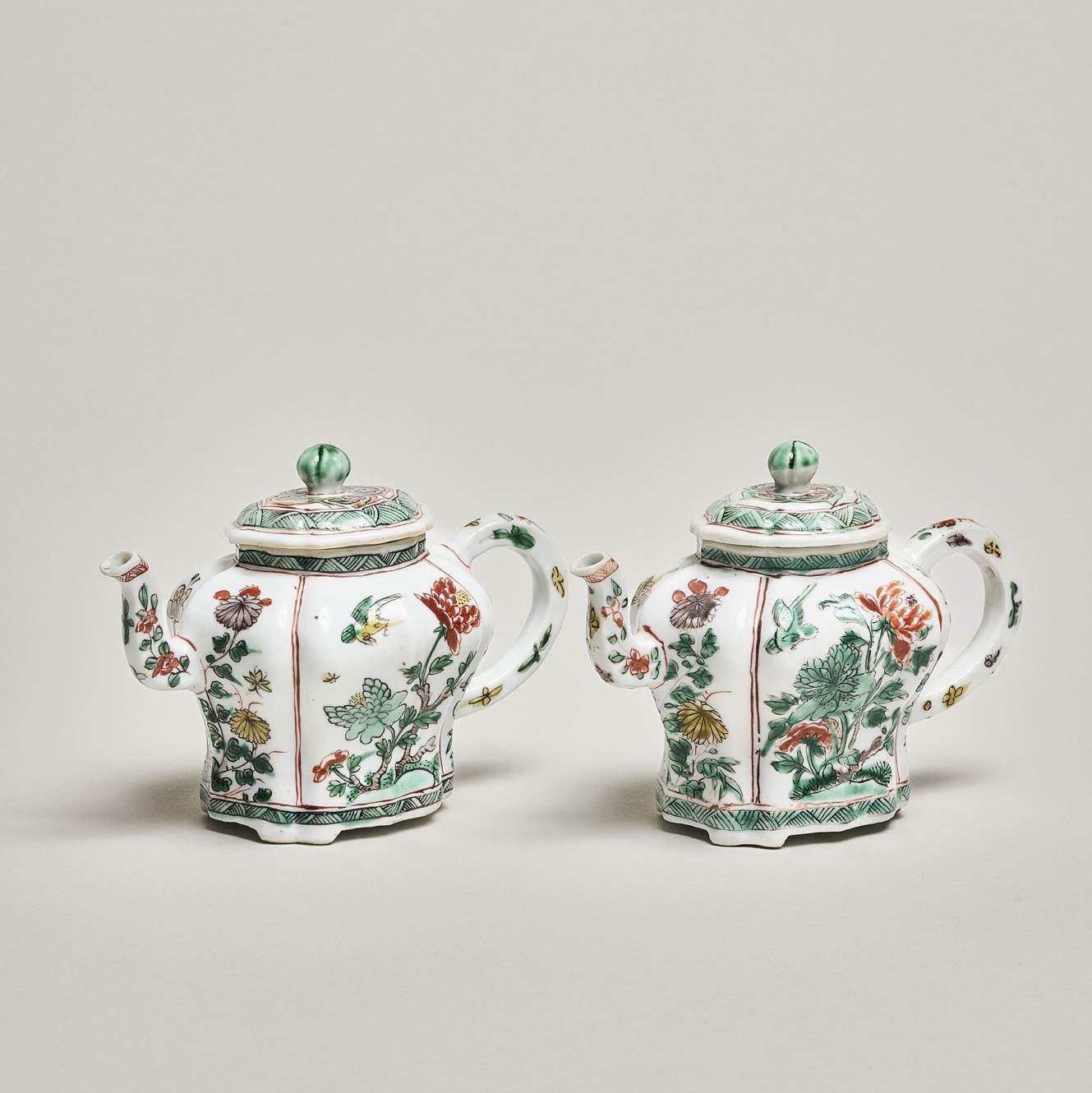
A pair of baluster-shaped ovoid lobed teapots, decorated in overglaze famille verte enamels with various plants, flowers, butterflies and birds. They have a low-domed lobed cover with a lotus bud knob. The s-shaped handles and curved spouts, are flat-sided and decorated with flower sprays. The bodies are divided into four panels of decoration, two wide and two narrow, separated by a double red line. Each panel has a different plant representing one of the four seasons: plum blossom, peony, lotus and chrysanthemum. Around the base, mouth and on the cover is a zigzag border in green, with red hatching. They stand on three low rectangular feet, the base is glazed and unmarked.
In China each season has a representative flower, when all four are represented together, they are known as “Flowers of the Four Seasons” (四季名花, Sìji Minghua). Each flower embodies qualities that resonate with the character of its season and the corresponding ideal human virtues. The plum blossom stands for the winter, as this hardy tree is the first to flower even in the harshest conditions and therefore symbolises perseverance, hope, and renewal. The peony embodies spring, a reflection of renewal, abundance and social prestige. The flower of summer is the lotus, a key symbol in both Buddhism and Daoism, it grows from mud emerging untainted; it therefore represents purity, moral integrity, and spiritual awakening. Chrysanthemums are the autumn flower, a symbol of resilience, longevity, and noble detachment.
Identical teapots are in the Royal Porcelain Collection, Dresden (inv.nr. PO6331) and Boijmans van Beuningen, Rotterdam (inv.nr. A.1863). The East Asia Museum, Stockholm also has a comparable example (nr. BS-2307).
China, Kangxi period (1662-1722), 1700-1720
H: 27.3 cm | Ø: 13.2 cm
PROVENANCE
With Bernhard Stodel, Amsterdam, after 1965 (label nr. BS3652)
Nieuwenhuys Collection, 1991
Private Collection, Belgium 2025
LITERATURE
Ayers 2016, p.251, nr.531-532
Boulay 1995, p.658
Jörg 2011, p.108, nr.99
Krahl 2024
Lunsingh Scheurleer 1982, p.82
Schumacher 2010, p.141, nr.40
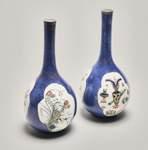
11 | Powder Blue & Verte
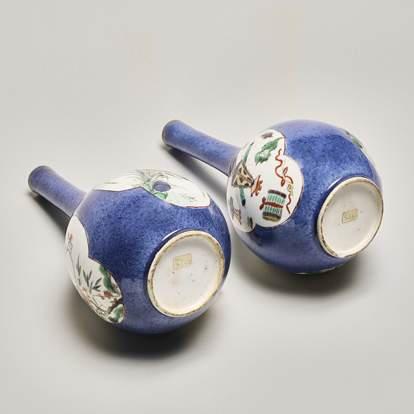
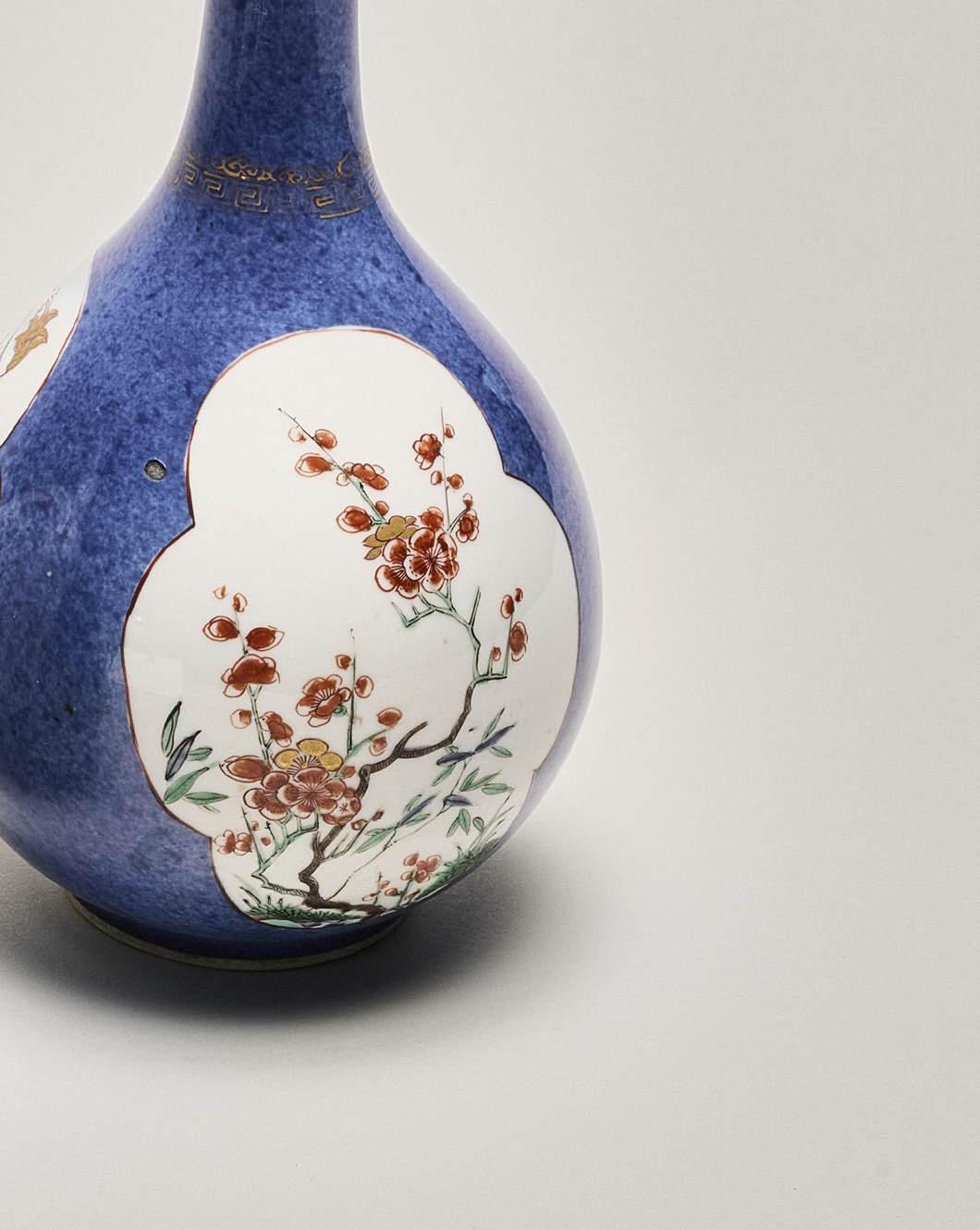
A pair of porcelain bottles with a pear-shaped body tapering into a tall, narrow neck. It is covered in a dark ‘powder blue’ glaze, with three reserved quatrefoil cartouches around the body - each outlined in iron-red. The cartouches are decorated with a distinct auspicious decoration in overglaze famille verte enamels, in greens, iron-red, aubergine, yellow and blue. The first panel has red, white and yellow chrysanthemums - one with a gilt day lily - growing from a grassy mound. The second has a large vase with peacock feathers and a branch of coral next to a censer on a stand, surrounded by various objects from the Hundred Treasures. The third panel is decorated with branches of red and gilt plum blossom with bamboo, issuing from a grassy ground. They are embellished with gilding on the flowers, as well as on the surface of the powder blue; which has a gilt meander and ruyi-head band around the shoulder, with a single meander repeated around the mouth. The bottom of the foot-ring is unglazed and the base of the bottles have a thin transparent glaze. They each have a stock label of the dealer Bernhard Stodel, Amsterdam.
The auspicious decoration on the reserved panels, would no doubt have been lost on the buyers in Europe. The plum blossom and the bamboo are both Chinese emblems of winter. As such they represent hardiness, steadfastness, perseverance, and resilience. The chrysanthemum and day lily are both flowers which thrive in autumn, creating a pairing representing enduring grace, familial love and steadfastness. The reserve with various objects, represents the Hundred Treasures (baibao) - also referred to as the Hundred Antiques (baigu). This motif does not always consist of exactly the same (or even a hundred!) objects, but a select combination of the entire range of possibilities - they all intended to express good wishes and good fortune. Here we can recognize items such as a conch shell, a ruyi scepter and a rabbit on a leaf.
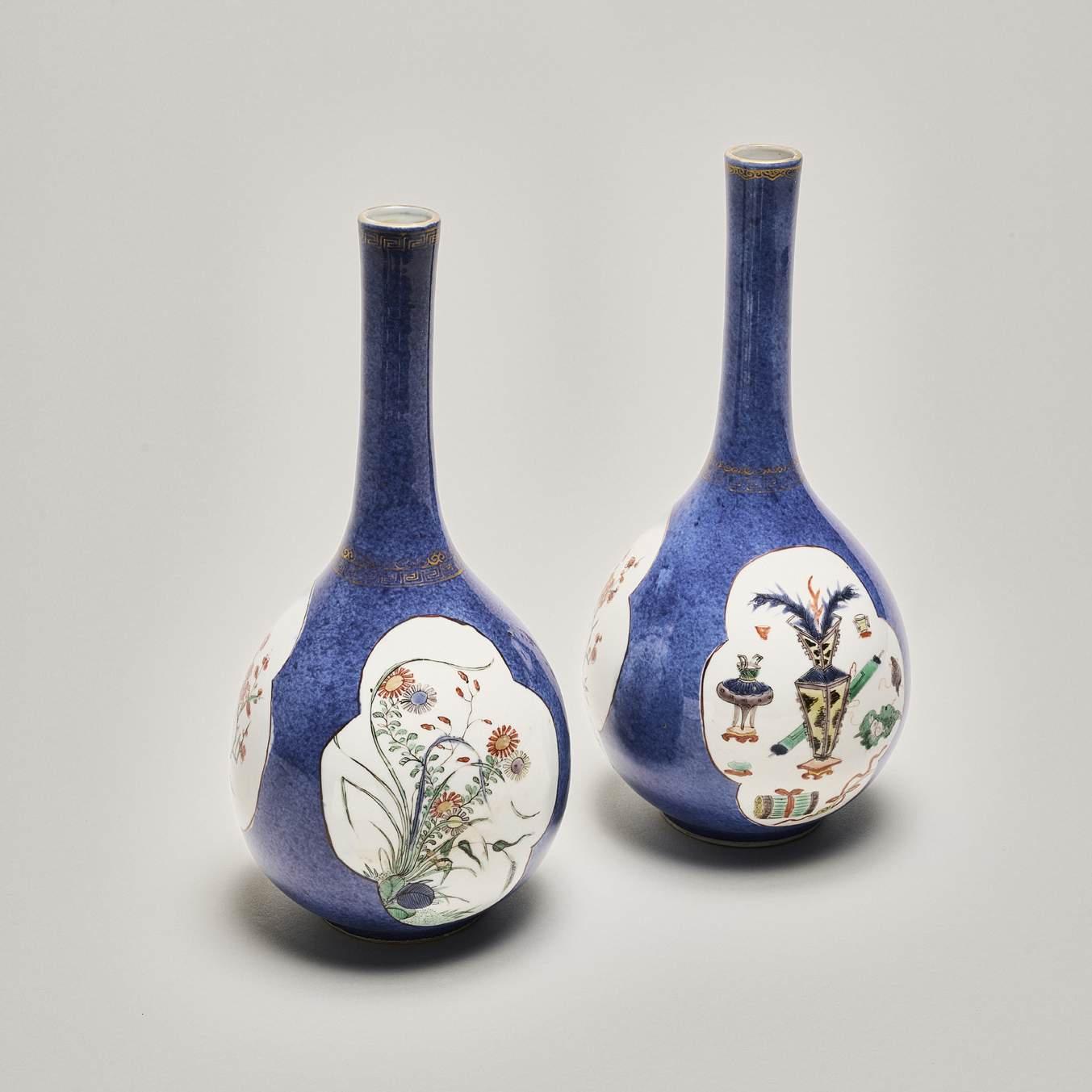
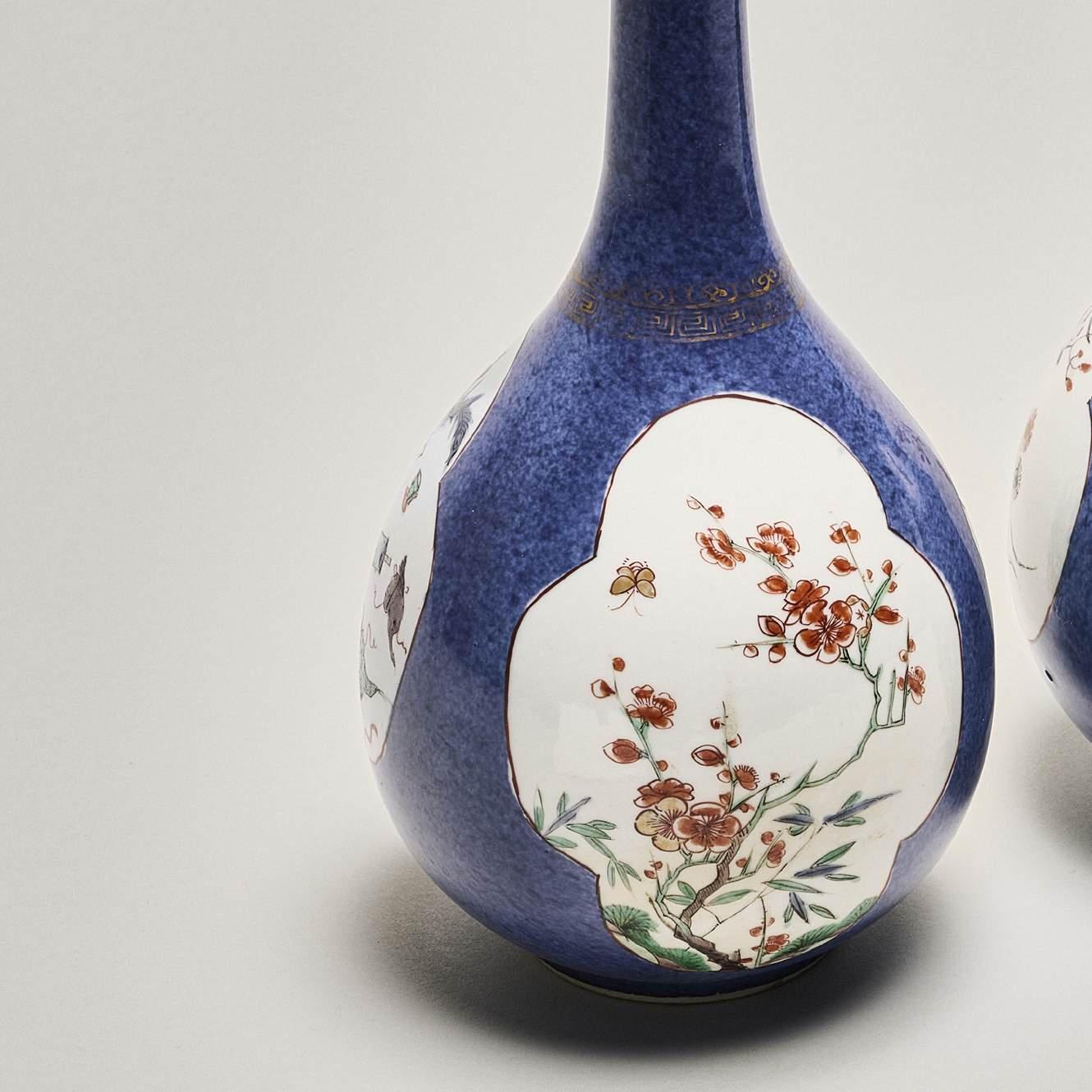
Many similar vases are in museum collections.
The Royal Collection Trust, UK holds a similar pair, but with more gilding on the body (RCIN 53119). The Taft Collection, Cincinnati has a pair (acc.nr. 1931.170), as does Musée Ariana, Geneva, from the Clare van Beusekom Collection (AR2007-186).
The Rijksmuseum, Amsterdam has a group of three (inv.nr. AK-NM6368 A-C). The British Museum, London has a pair with slight variations in the flower decoration (acc.nr. Franks.334 & 333).

POWDER BLUE
A recognizable category within the group of famille verte wares, are the powder blue objects. These usually have well-defined reserves in various shapes, each decorated with coloured enamels. During the Kangxi period, these wares were generally produced for export, until at least 1722. In that year, Jesuit father François Xavier d’Entrecolles (1644-1741), described in a letter from China how this technique was executed.
The powder blue glaze - known in Chinese as sa lan 洒藍 (‘sprinkled blue’) - was created using the usual cobalt pigments. However, the typical dappled effect was achieved by using a special technique, whereby the finely ground pigment was blown onto the unglazed porcelain body through a thin piece of gauze tied to the end of a bamboo tube. The tiny particles landed on the surface of the unfired porcelain, creating a speckled effect. Before application, paper cut-outs were strategically placed, to spare the intended white areas. A clear glaze would then be applied before the first firing. The second firing at a lower temperature, took place after the painter added the coloured enamels. A third and final firing (700°C800°C) was used to fix the additional delicate gold decoration.
China, Kangxi period (1662-1722)
H: 6.7 cm | W: 8.3 cm | L: 13.5 cm
PROVENANCE
With Galerie Duchange, Paris 2024
LITERATURE
Pinto de Matos 2019, p.312, nr.129
Rinaldi 1993, p.82-90
Vinhais & Welsh 2012, nr.34 Welch 2008, p.116-118
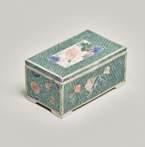
12 | Box & Cover
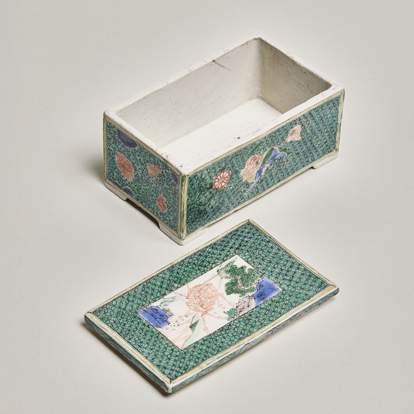
A rectangular box with a fitted lid, standing on four right-angled feet. It is decorated on the biscuit with polychrome enamels, in greens and iron-red with small areas of yellow and blue. The top of the lid and the long sides of the body have large rectangular panels with a black diaper pattern on a green ground. All the panels are framed by a narrow yellow band, edged with a fine black line. The centre of the lid has a large rectangular reserve, featuring a landscape with a large spotted red deer and a pine tree. The edge of the lid is green with a black wavy pattern. The long sides of the box, each have a frolicking lion-dog playing with a green-ribboned brocade ball. Both short sides, are decorated with black scrolling foliage on a green ground, with scattered red peony heads and some blue leaves along the edges. The base and the underside of the lid are unglazed.
This box was probably originally intended for a scholar’s studio and used for storage of seal paste. The thin layer of glaze lining the interior of the box, would have protected the biscuit porcelain from staining by the red seal-paste. The decoration on the box is very auspicious and particularly fitting for a Chinese scholar.
The red spotted deer, is one of the most potent auspicious symbols in Chinese culture. A deer 鹿 (lù), has the same pronunciation as 禄 (lù) - meaning official salary or emolument. Its depiction therefore represents a wish for a successful career as an official, with all its financial benefits. Particularly the red deer is strongly associated with the Daoist cult of longevity, as they were said to be able to locate and eat the fungus of immortality (lingzhi). The evergreen pine tree reinforces this message of longevity. Frolicking lion dogs (狮子, shīzi), not only represent protection and prosperity, but also a joyful, abundant life.
A similar box in size and style, but with a floral decoration, is in the Albuquerque Foundation, Sintra (inv.nr. 833). Another is in Musée Guimet, Paris (inv.nr. G5254). The Victoria & Albert Museum, London, has a comparative but smaller square box (acc.nr. C.1078 & A-1910). The Art Institute of Chicago also has a related rectangular box, but with a sliding lid and figural scenes on the inside (inv.nr. 1929.854a-b).
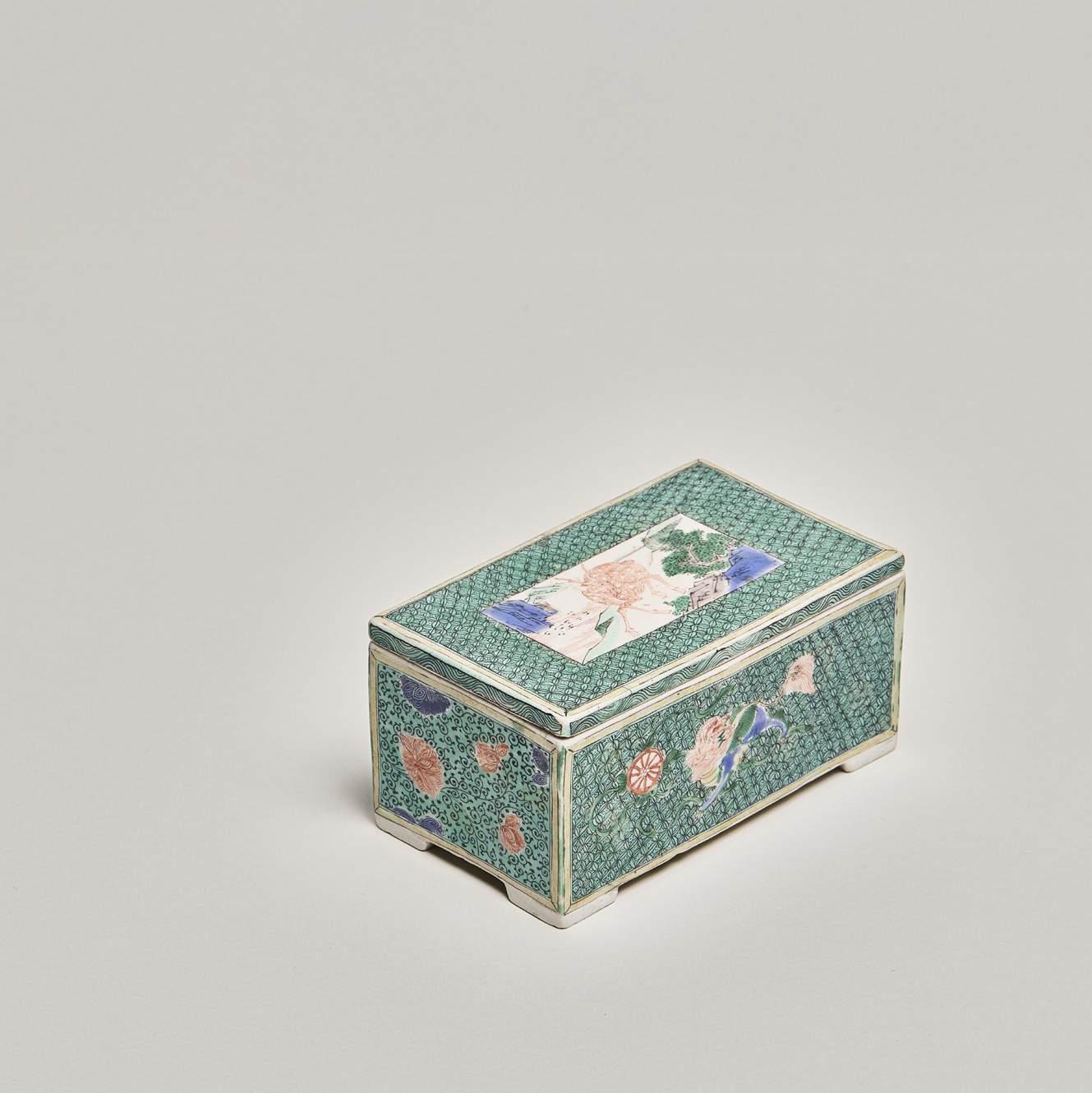
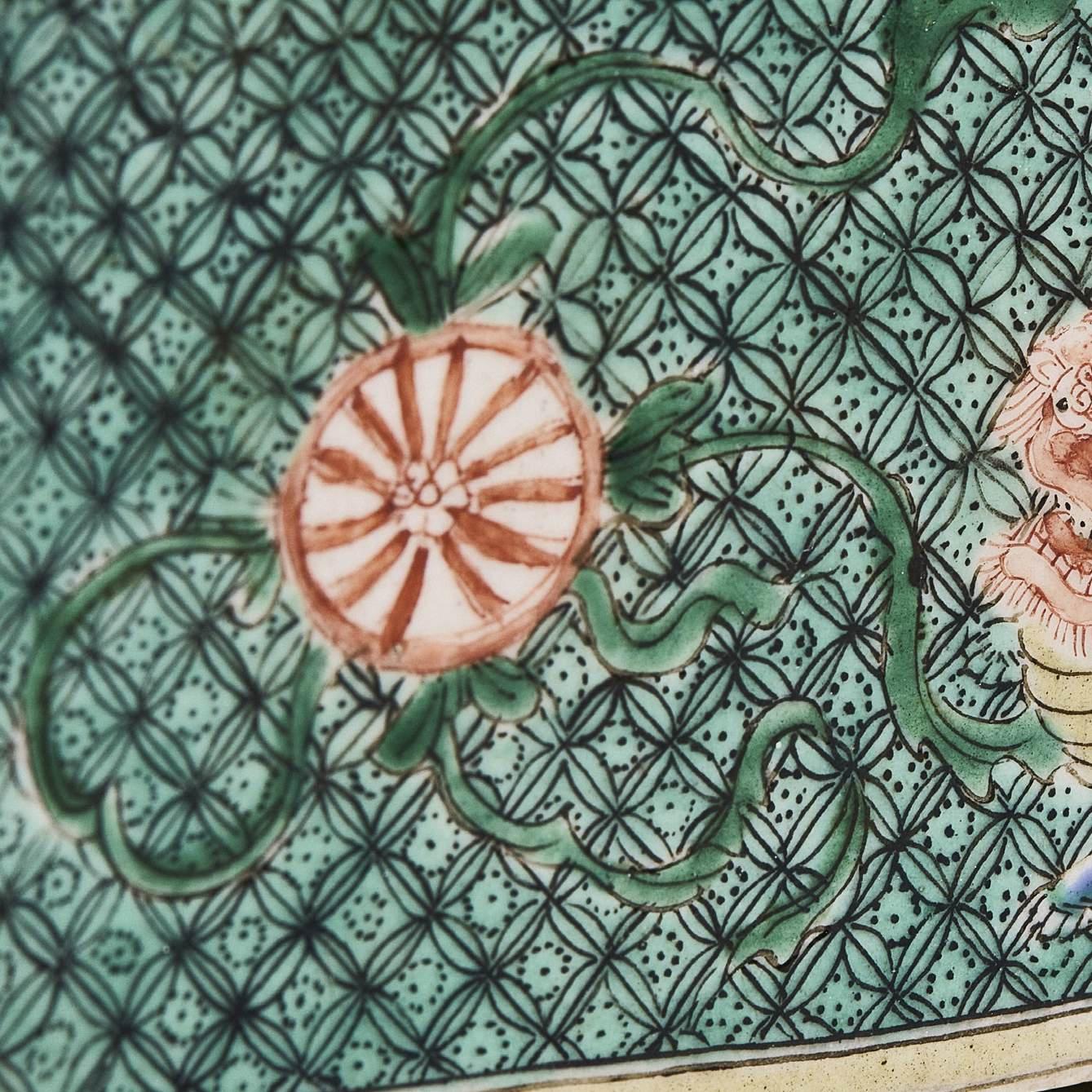
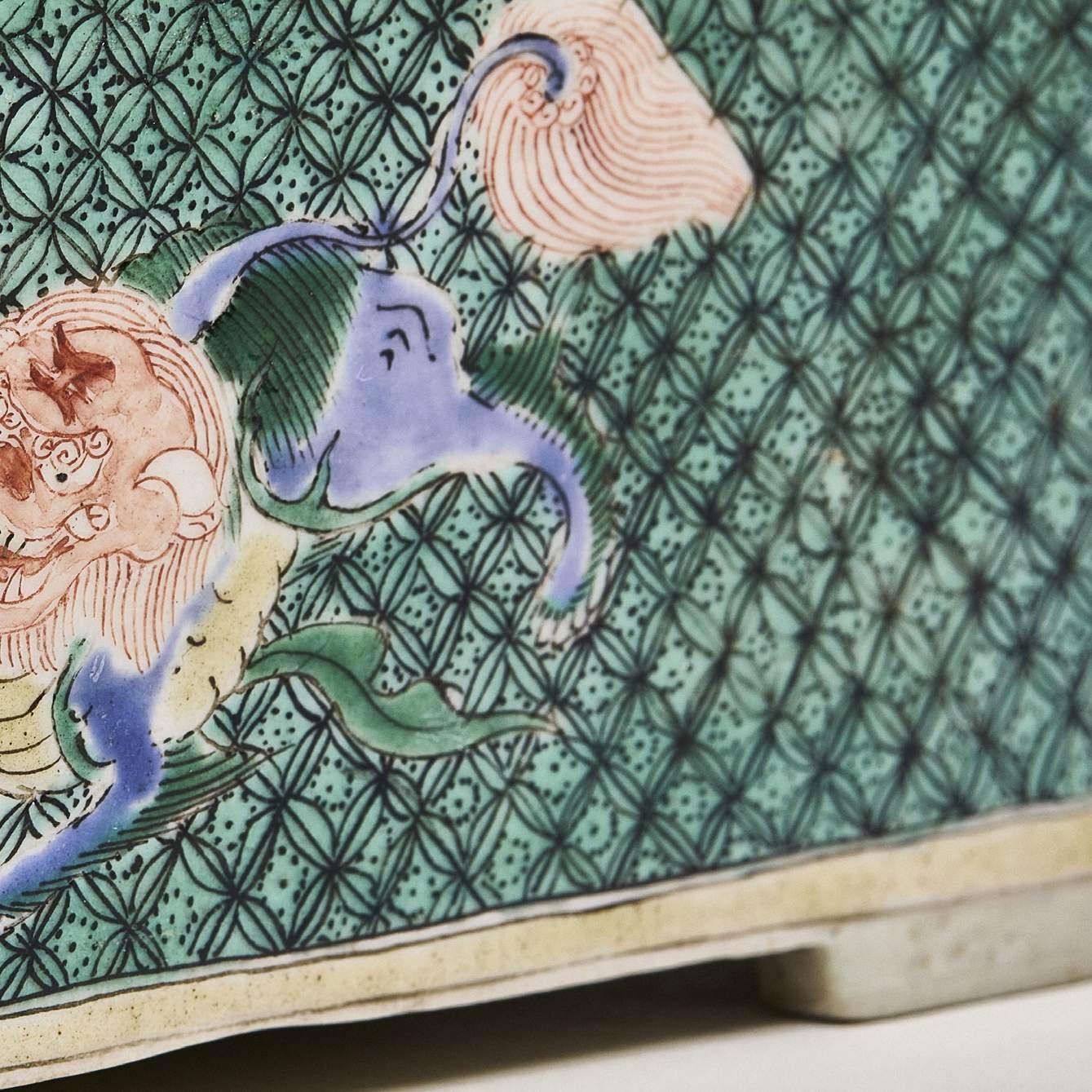
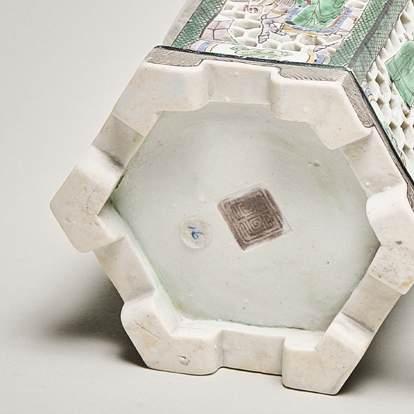
China, Kangxi period (1662-1722), c. 1700
H: 12.5 cm | Ø: 10.3 cm
PROVENANCE
Morgan Collection, 1911
With the Duveen Brothers, 1915
Harcourt Johnstone Collection, c. 1929
Van Heukelom Collection, 1937
With Morpurgo Gallery, Amsterdam (invoice)
Van Hees Collection, The Netherlands
1953
Nieuwenhuys Collection, The Netherlands 1991 (label nr.16)
Private Collection, Belgium 2025
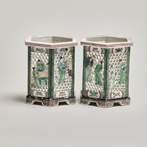
13 | Linglong Brushpots
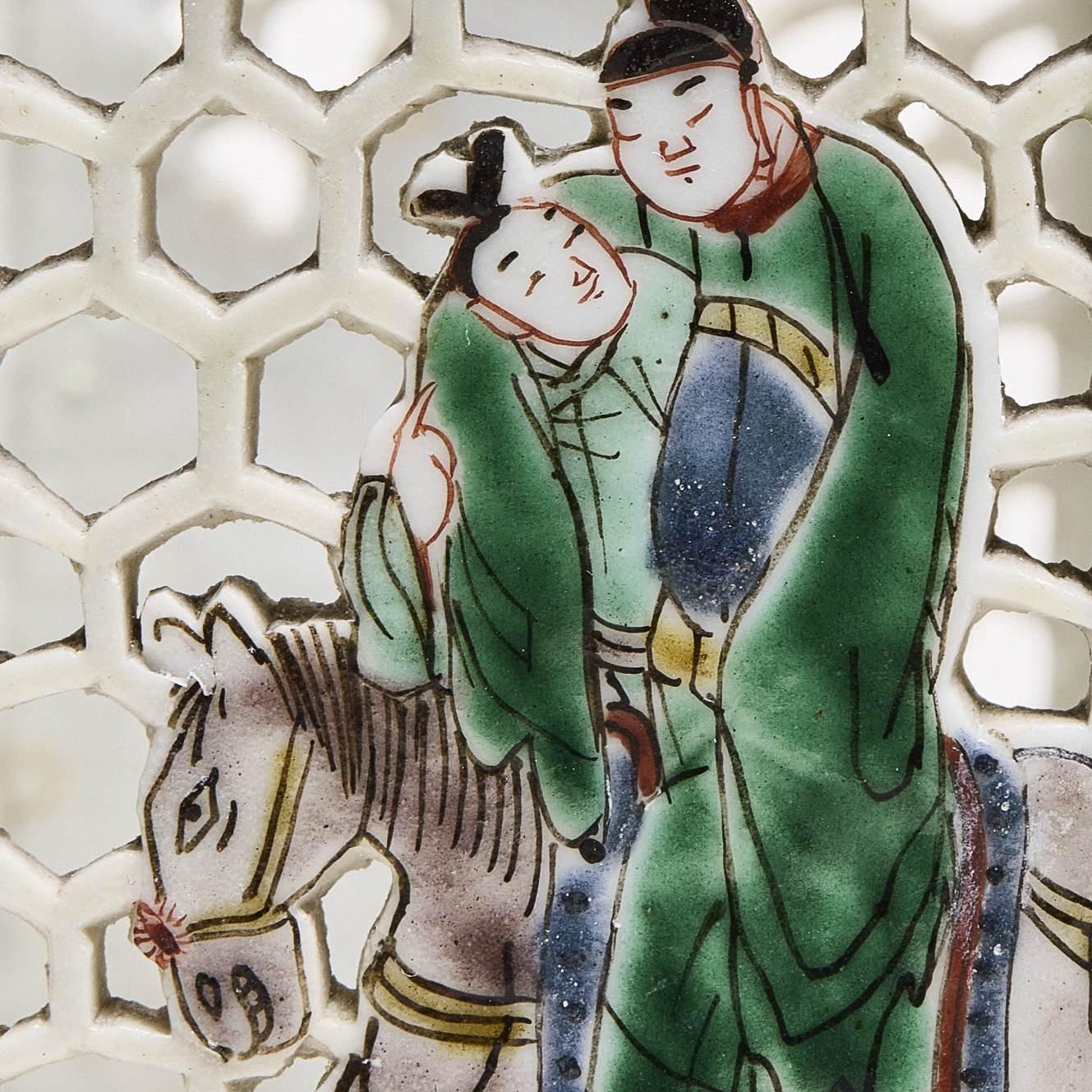
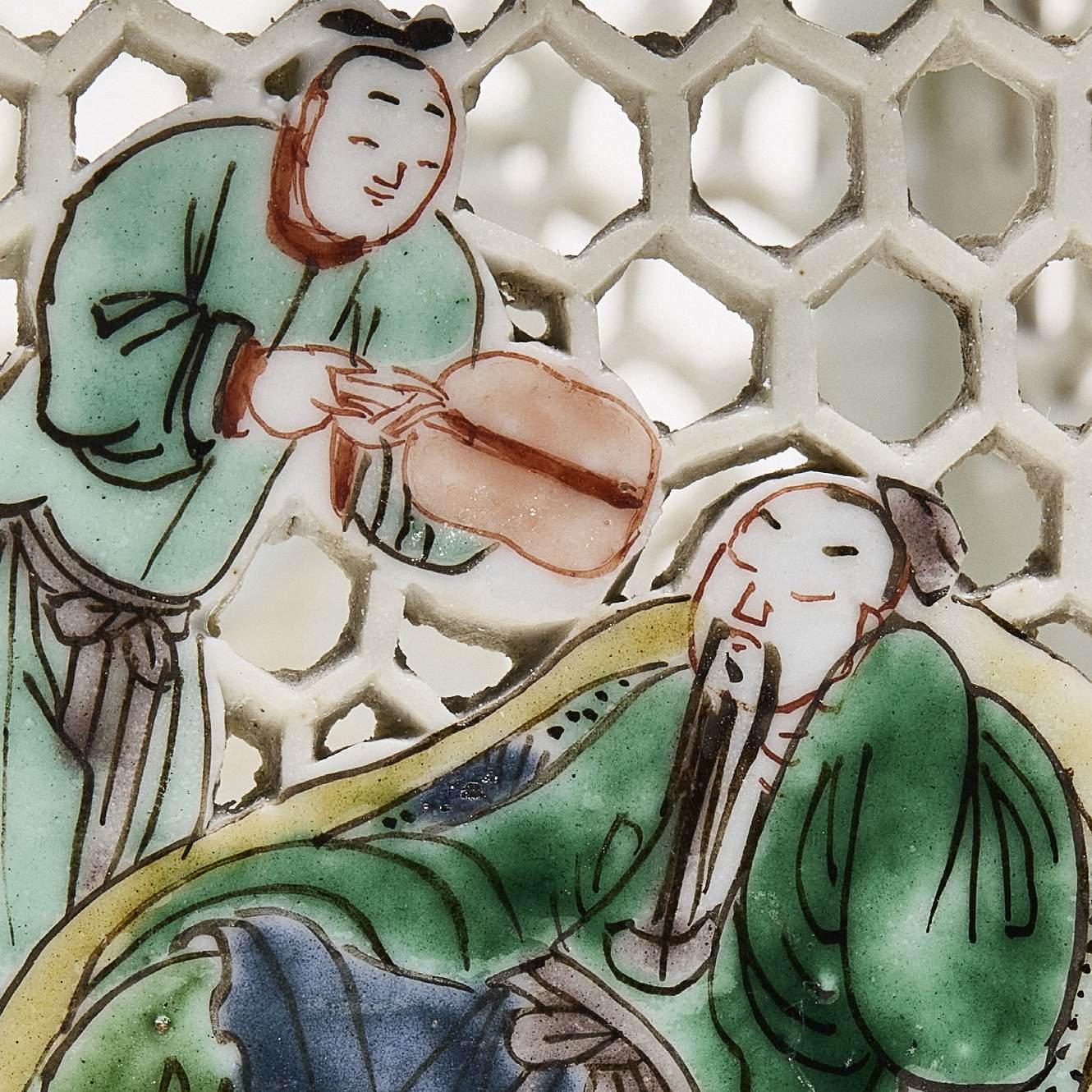
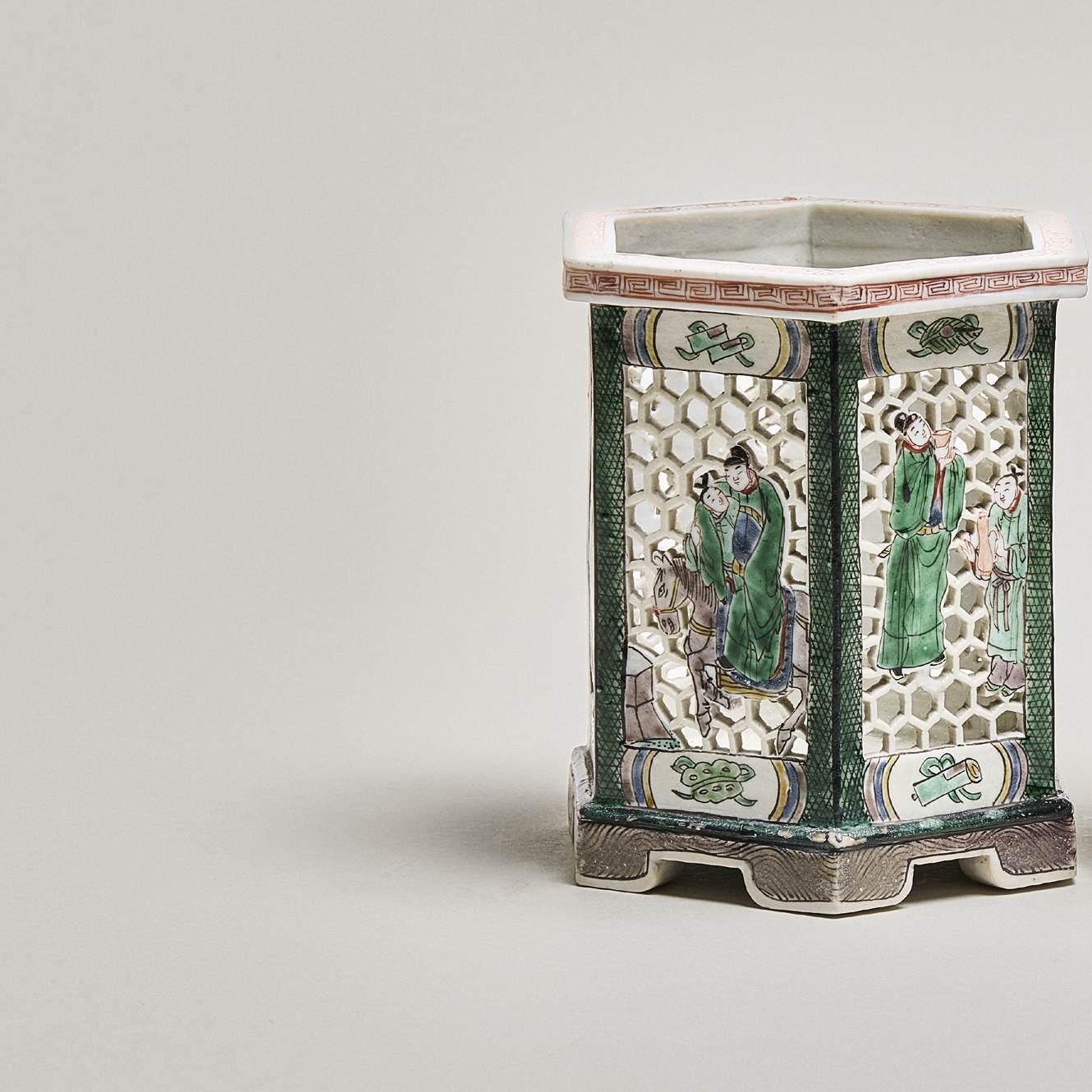
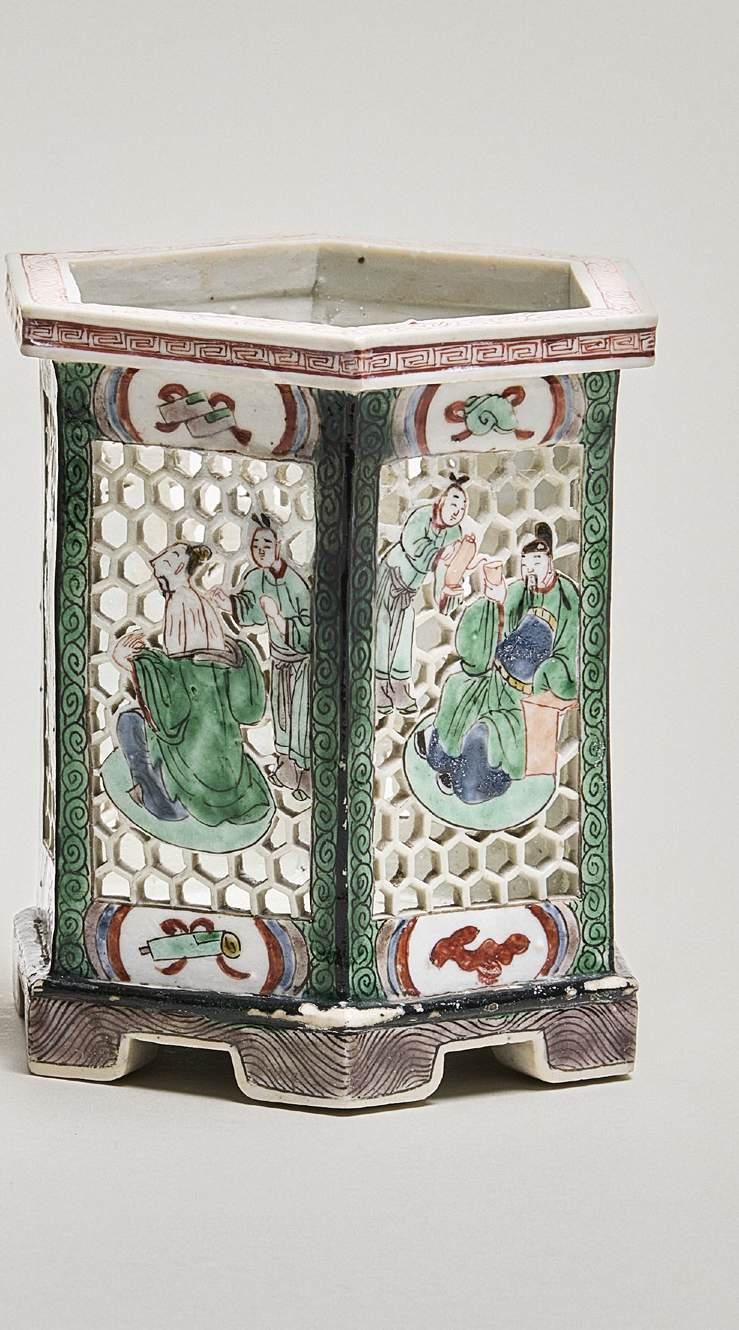
Two hexagonal reticulated brushpots, finely decorated in enamel on the biscuit in the famille verte pallet. Each side-panel is pierced with an hexagonal lattice pattern, around a scene with figures involved in various leisure activities. Between each panel is a vertical green column, with a diaper pattern in black – one pot with hatching, the other with stylised clouds. Above and below the panels is a decorative border with reserved panels, with various auspicious symbols from the Hundred Treasures. The thick projecting mouth rim, is decorated along the top and outside, with a red key fret border. The pots have bracket feet on each corner, enamelled around the outside with a wave pattern in black on an aubergine ground. The base has a thin transparent glaze, with a generic blessing character (fu), stamped in aubergine.
The 12 different scroll-like scenes, in each of the pierced panels, depict scholars and officials in various activities. The sequence appears to allude to the story of The Dream of the Yellow Millet (huangliang yimeng 黄粱一梦), a well-known Chinese allegorical tale. The main character is the ambitious scholar Lu Sheng, who rests at an inn. While waiting for his millet to cook, he drinks too much and falls asleep; in his ensuing vivid dream, his entire lifetime passes by. From youthful ambition and entry into officialdom, through success and honour, and finally into old age, retirement and disillusionment. The various scenes on these brushpots appear to depict these various stages in a life cycle. One pot depicts an aged, retired official, who drinks and dreams reflecting on his youthful ambition. The other pot looks to the future, through official success, aging, and withdrawal from public service. Whether read forward or backward, the message remains unchanged: fame, rank, and achievement are illusory and transient. This story is probably intended as moral reflection on the vanity of official life, making it especially appropriate for a scholar’s brushpot.
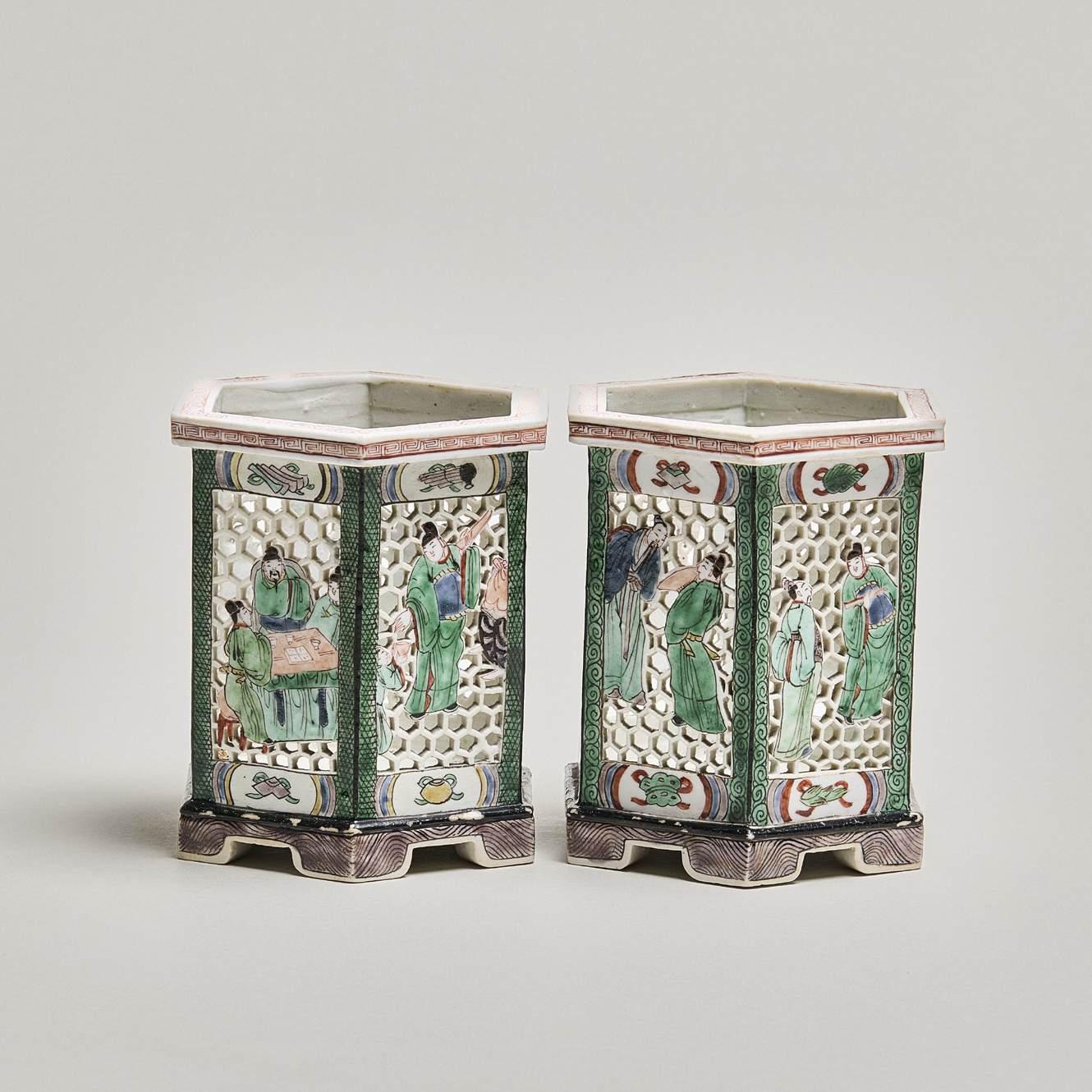
These brushpots have a truly exceptional provenance, which can be traced back to J.P. Morgan in whose catalogue they are recorded in 1911 (nr. 1164 & 1165). They are also depicted in the 1937 sale catalogue of renowned Dutch collector W.F. van Heukelom. Through the dealer Morpurgo in Amsterdam - who paid £300 at that auction - they entered the collection of another Dutch collector: banker B.J.V. van Hees. At his house De Ceder in Heemstede, they were photographed amongst his other Chinese porcelains. From here they were passed down through the family via the Nieuwenhuys collection to the last owners.
A similar shaped brushpot, but with a different decoration on the panels, is in the Percival David Collection (ac.nr. PDF 819). The Marsh Collection held a single comparable pot, with scenes from the Water Margin. A square reticulated flowerpot in the Victoria & Albert Museum, London (acc.nr. C11321910) from the salting bequest – has the same honeycomb piercing and comparable panels with scholars.
LITERATURE
Campen 2010, p.2-12
Canepa 2004, p.13-25
David 1958, p.5-6, nr.819, pl.III
Davids & Jellinek 2011, p.259-261 & 328
Jörg 2011, nr.52
Laffan & Clark 1911, Vol. 2, part 2, p.54, nr.1164 & 1165 & p.128, Case Q
Little 2000, p.325-326
London 1937, p.52, nr.184
Lunsingh Scheurleer 1982, p.77
Marsh 2020, p.258-259
Wilson 1998, p.158-159, nr.69
RETICULATED PORCELAIN
The term reticulated - from the Latin for ‘net’ - was first used to describe this type of openwork porcelain by Père Francois Xavier d`Entrecolles (1664-1741). In China it is known as linglong (玲瓏), meaning ‘delicate openwork’. The complaining potters at the Jingdezhen kilns also referred to this demanding technique as guigong or ‘devil’s work’, perhaps because of the devilish skill that was required to make it; or possibly as a wry nod to the ‘Foreign Devils’ (Europeans) for whom this porcelain was also made.
The intricate open design, must have been made by highly accomplished craftsmen. Each aperture was individually cut by hand, whilst the unfired clay was firm but still malleable - at the ‘leather hard’ stage. Both the carving and subsequent firing of these delicate pieces, would have required extraordinary skill. The production also carried an exceptionally high risk of failure because of the piercing. Even slight pressure or uneven drying could cause cracking or distortion, even before the piece reached the kiln. But the greatest challenge came during the actual firing: the openwork structure weakened the vessel’s integrity, making it prone to sagging, warping, or collapsing entirely under the intense heat. As a result, only a small proportion of attempted pieces survived firing intact. This extremely high wastage rate contributed to the rarity, cost, and status of linglong wares.
B.J.V. VAN HEES (1873-1953)
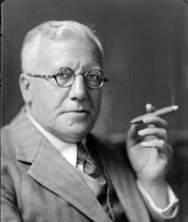
Ben (Bernardus Johannes Vincentius) van Hees (Haarlem 1873 - Heemstede 1953), was a successful Dutch Banker, owner of an investment and securities brokerage firm in Amsterdam. He was an avid collector of art and antiques, amassing a substantial collection including many pieces of Chinese porcelain. He married Anty (Anna Sophia Maria) Bijvoet (1881-1930) in 1911 and they had 5 children; Anty passed away at a young age, leaving Ben to look after their young children. Van Hees collected enthusiastically as his business continued to flourish, giving him the financial means to collect on a larger scale. He bought from many of the major art and antiques dealers in Amsterdam, including Morpurgo, Mossel and Stodel; as well as in London from Hancock’s. One documented purchase, was the acquisition of nine objects from the Van Heukelom Collection of Chinese Ceramics - which Kunsthandel Morpurgo brokered for him at Sotheby’s London in 1937. After his demise in 1953, the collection was registered and divided amongst his children.
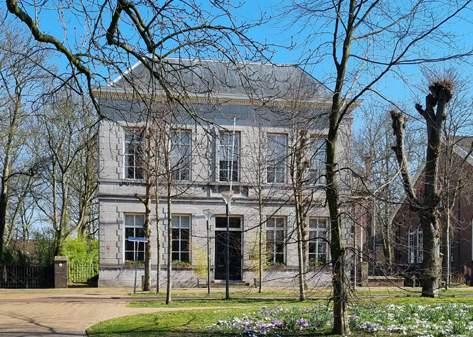
HUIS DE CEDER
In 1917, Van Hees managed to purchase a piece of land in Heemstede for 80,000 guilders. Around 1920, he commissioned architect Hendrik Korringa to design a villa which he named Huis de Ceder - after the monumental Lebanon cedar (Cedrus libani) in the front garden.
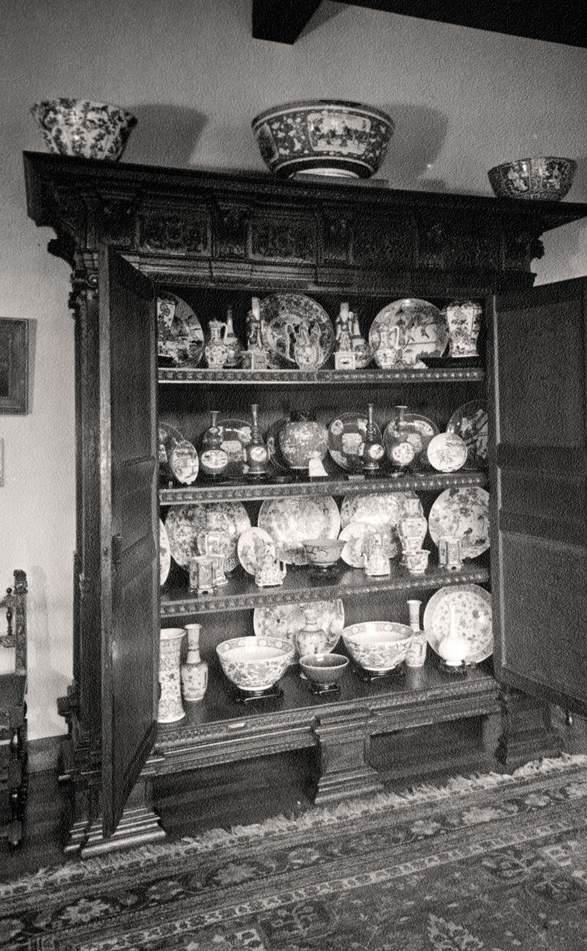
The ever-growing Van Hees collection which was housed there, was of such depth and interest that it became quite renowned. The house with the collection, was granted museum status in the 1950s; but could only be visited by special application to the director of the Rijksmuseum, Amsterdam. The house is well-documented in a photo album, showing images of the house and gardens; the detailed photos of the interiors showing the collection in situ.
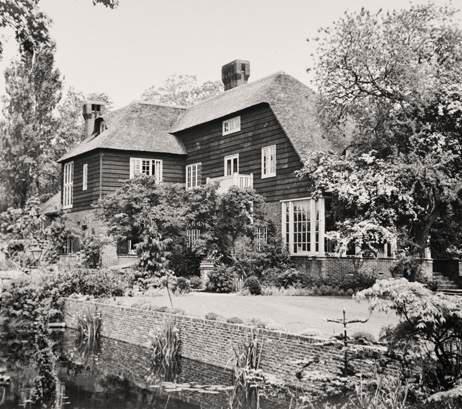
Huis de Ceder 1942
H.W.CHR. NIEUWENHUYS (1905–1991)
Henk (Hendrikus Wilhelmus Christianus) Nieuwenhuys (Amsterdam 1905 - Wassenaar 1991) was a prominent Dutch banker and partner at Theodoor Gilissen Bankiers, one of Amsterdam’s leading private banks. In 1934, he married Marianne van Hees (1912–1990), daughter of Bernard van Hees, financier and founder of the renowned Chinese porcelain collection at Huis de Ceder in Heemstede. Their marriage united two families with a long-standing tradition of collecting Chinese porcelain. Together, Marianne and Henk Nieuwenhuys had eight children.
The couple not only inherited important pieces of Chinese porcelain from both sides of the family, but also actively expanded their collection themselves. Nieuwenhuys worked near the Rokin in Amsterdam, close to many of the city’s most prominent antique dealers, such as Bernard Stodel, Kunstzalen Vecht and Kunsthandel Morpurgo whom he visited regularly to acquire objects. His passion for collecting had a lasting influence on the next generation. Particularly his son Henk B. Nieuwenhuys, who became known for gifting much of the family’s Chinese blue and white porcelain to the Shanghai Museum. Another sibling, who also inherited part of the Van HeesNieuwenhuys porcelain collection, expanded it again. This collection has now come onto the market and forms a substantial part of this catalogue.
Interior Huis de Ceder 1942
China, Kangxi period (1662-1722), 1700-1720
H: 20.4 cm
PROVENANCE
Private Collection, Belgium 2024
LITERATURE
Hobson 1915, pl.99
Kopplin 2004, p.74, nr.31
Krahl 1996, nr.224
Pomper, Stamen & Weiss 2009, p.104-110
Pomper 2024
Zimmerman 1923, pl.93
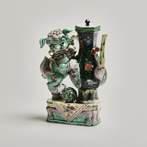
14 | Famille Noire Ewer
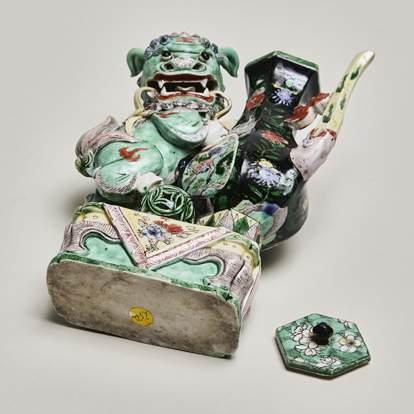
A group of a famille verte Buddhist lion supporting a famille noire ewer, standing on a table base. The green enamelled lion stands upright on its rear legs, the right leg resting on a green openwork ball; his white forepaws rest on the ewer. His head is turned to the right, with yellow ribbons issuing from his open mouth. The green ears and black eyes are moveable. The eyebrows are formed by tight curls enamelled in blue. On top of his head, around the neck and down his sides are aubergine curls, which run over into a smooth aubergine mane and tail with red accents. On his forehead is a red Chinese character 王 wang (king) and on his flanks scattered red flames – both indicate he is a heavenly lion.
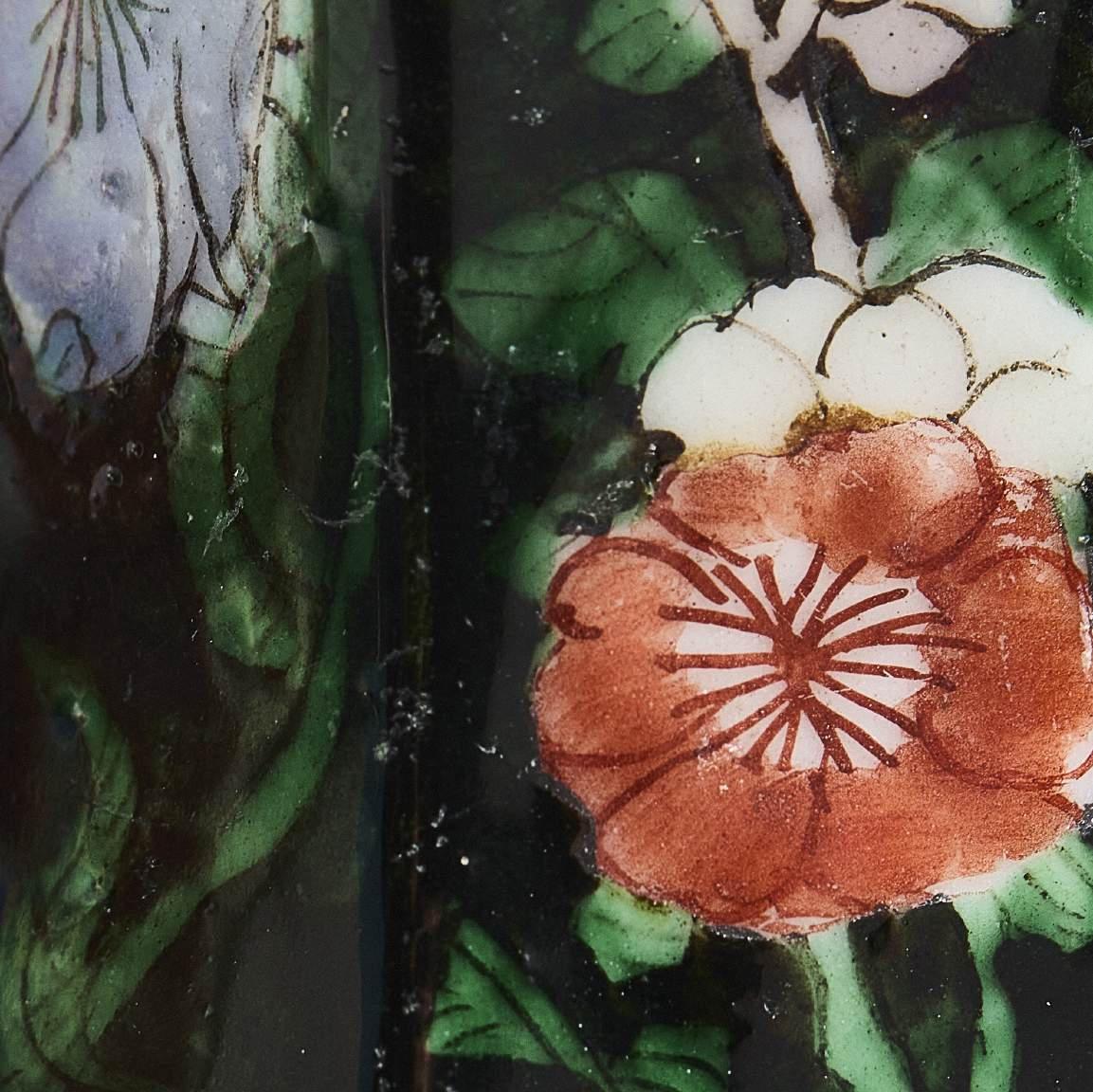
The hexagonal ewer, is strikingly enamelled in black, with green leaves and red plum blossom. On either side of the body, are two contrasting leaf-shaped reserves, decorated in famille verte enamels with a qilin in a landscape. The handle and spout, have a hexagonal section, and are enamelled in pale yellow with green flames. It stands on a high flaring foot, decorated with pointed leaves in green, aubergine and yellow with black veining. The lion and ewer stand on a plinth in the shape of an altar table, covered in a yellow cloth with flower sprays. The base is smooth and unglazed.
Famille noire objects form an unusual and rare group within the famille verte porcelain of the Kangxi period. They are enamelled on the biscuit, using a combination of black with the famille verte colour palette. The black colour was achieved by layering impure cobalt with coppergreen, which fused during firing forming a glossy black – often with a greenish undertone. The technical difficulty of this process, probably explains the relatively small number of extant early 18th-century famille noire objects and their smaller size.
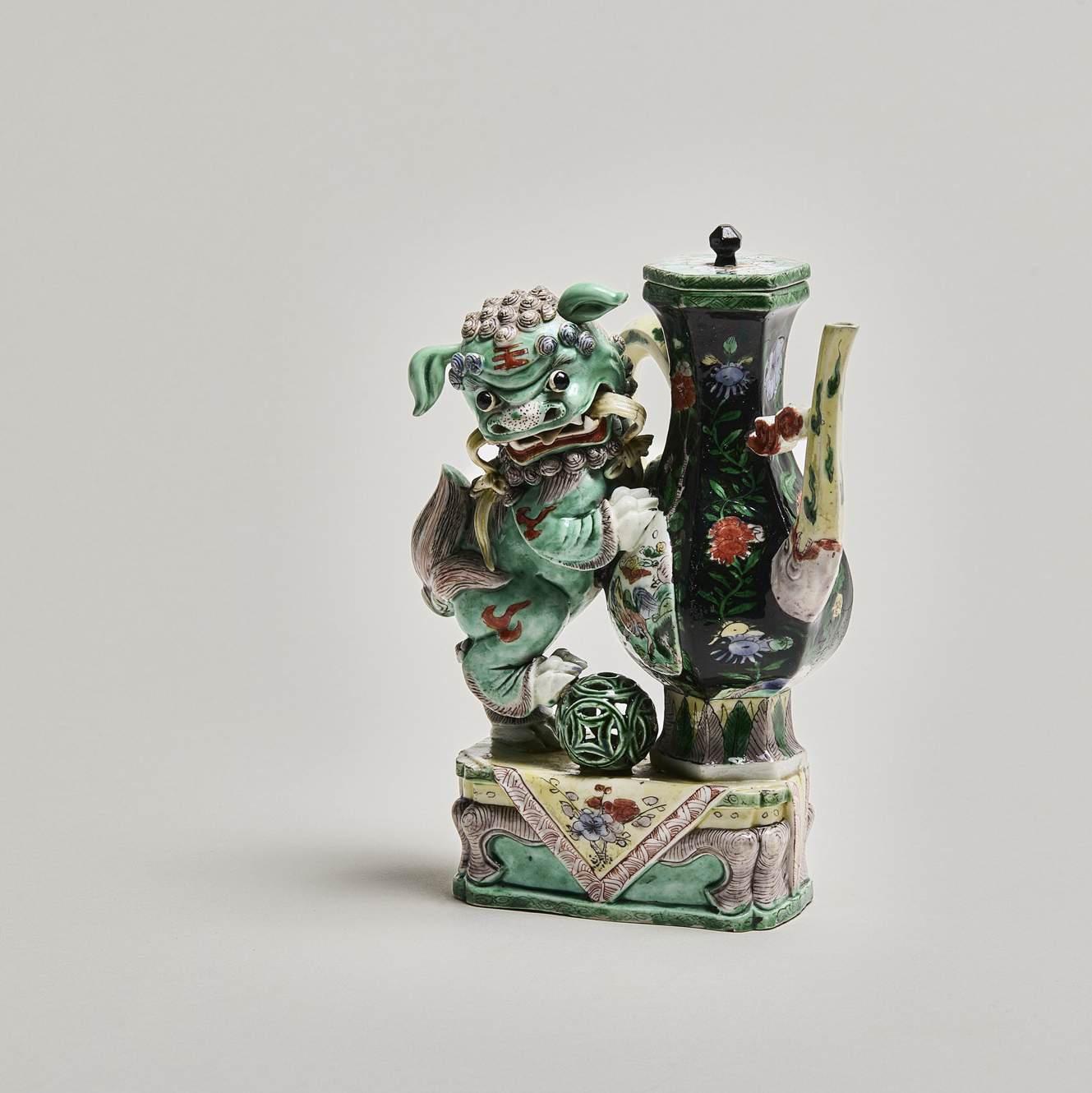
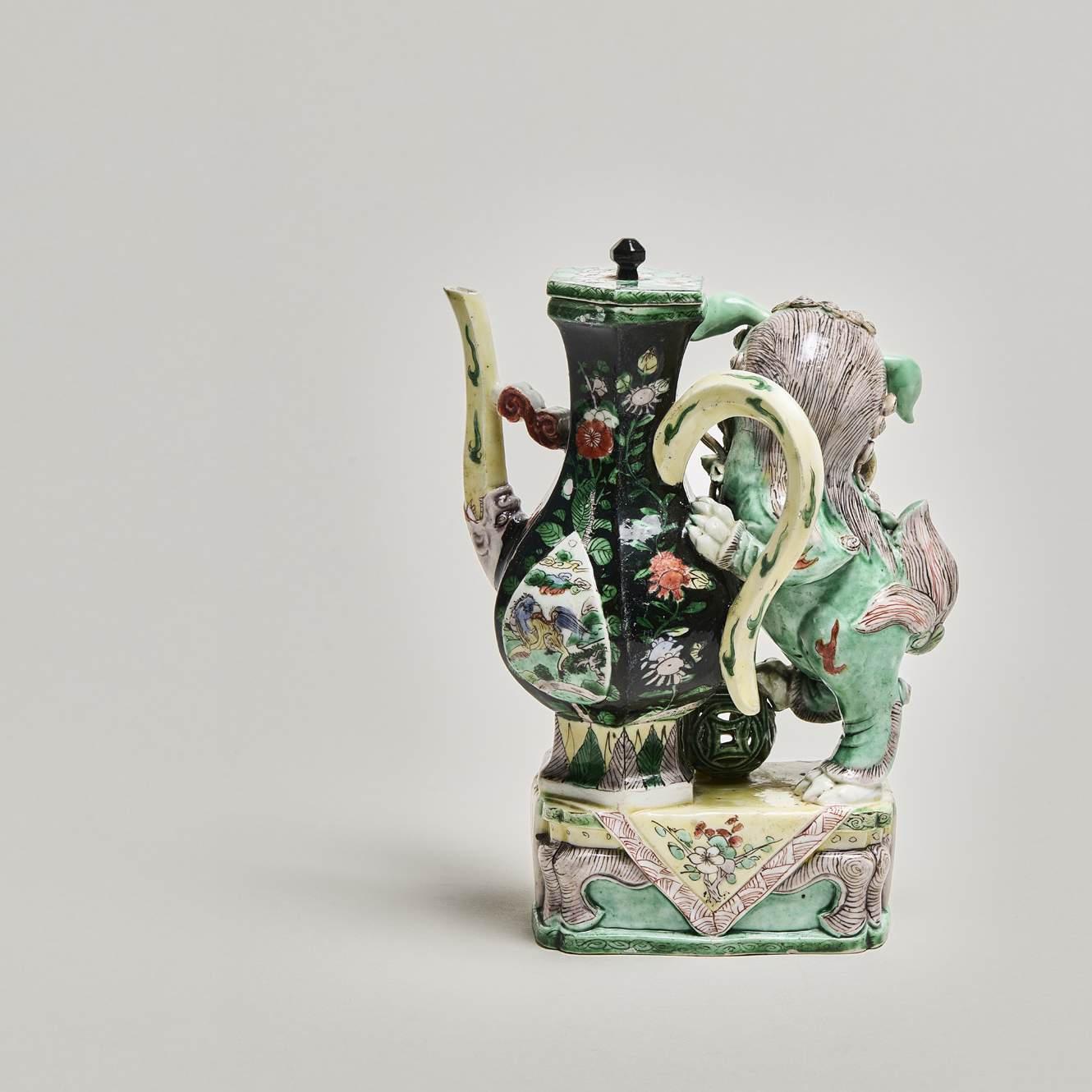
There are several similar examples in renowned museum collections, The Royal Porcelain Collection, Dresden has two examples (PO 4310 & 4311) – where they entered the collection before 1779. The Victoria & Albert Museum, London has a matching pair (acc.nr. 634 & A and 634 B & C-1903).
The Metropolitan Museum, New York also has a comparable example (acc.nr. 63.213.17a-b).
China, Kangxi period (1662-1722)
H: 29.5 cm | W: 11.7 cm
PROVENANCE
Nieuwenhuys Collection, 1991
Private Collection, Belgium 2025
LITERATURE
Boulay 1995, p.618-619
Hobson 1915, Vol. 2, pl.84
Kwok & O’Brien 1990, p.28
Little 2000, p.313-335
Welch 2008, p.176-7 & 179
Williams 2006, p.166
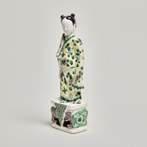
15 | Han Xiangzi
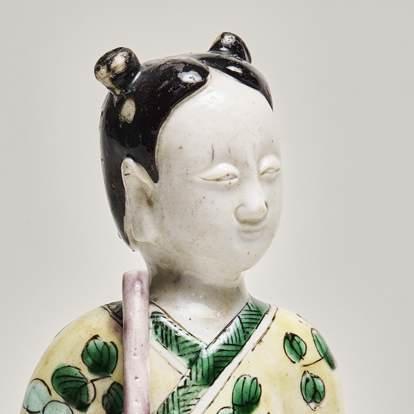
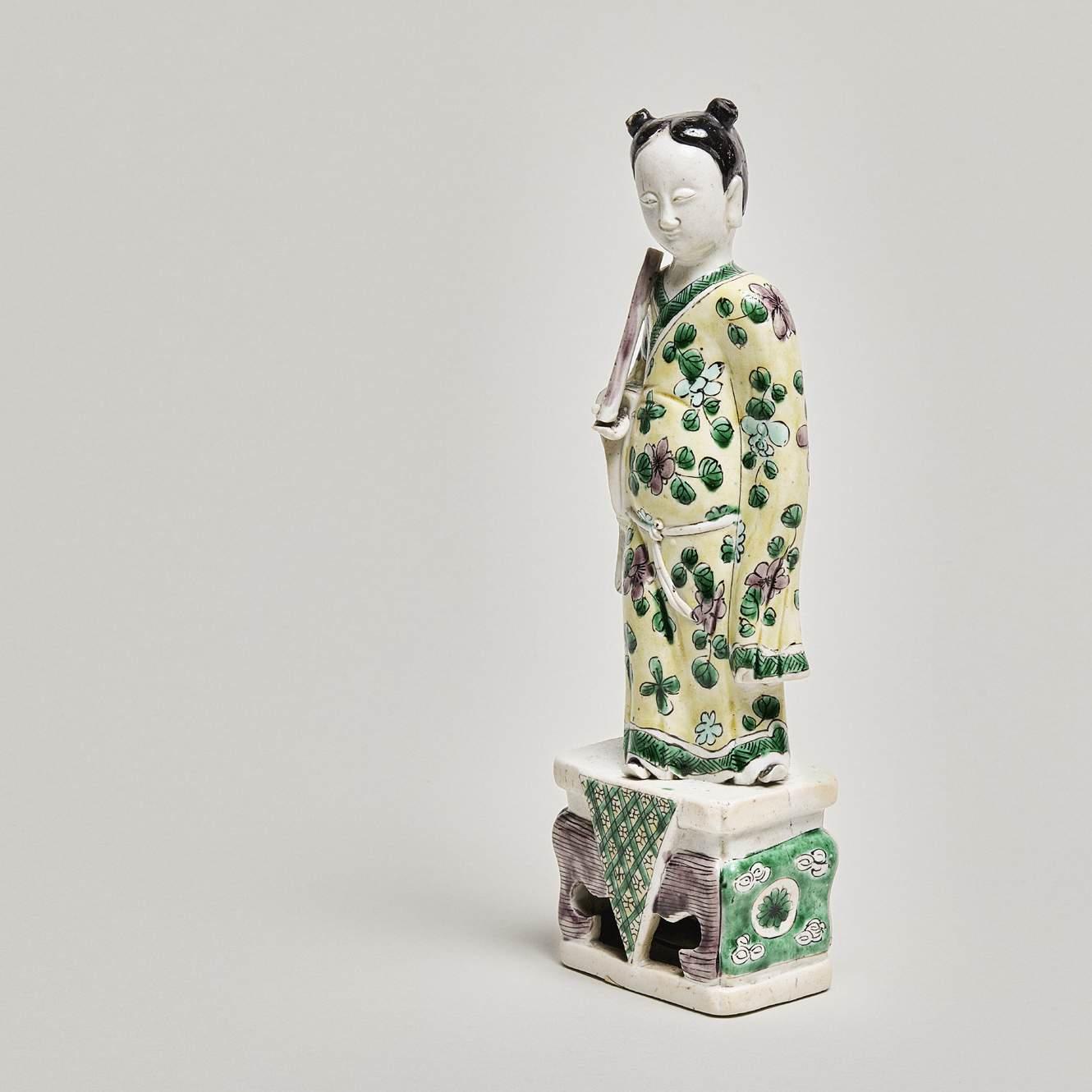
A figure of the Daoist Immortal Han Xiangzi, decorated on the biscuit in yellow, green and aubergine enamels. He is depicted standing upright, wearing long yellow robes with a green border; decorated with scattered flowers and leaves, and tied at the waist. His black pointed shoes peek out from under the hem. In his right hand he holds a flute, whilst the left hand is hidden in the wide sleeve. His head, with black hair tied in two top knots, tilts slightly to the right and his face has a gentle expression. The figure stands on a square table base, draped with a cloth decorated with a diaper pattern.
We can identify this figure as Han Xiangzi, one of the group of Eight Immortals (Baixian). This particularly popular group of Daoist deities, comprise seven male and one female figure. The stories and iconography connected to each of these figures, illustrate the transformation from the early philosophical Daoism to a more popular culture, involving magic and alchemy to achieve immortality. Each of the eight characters is based on a historical figure, Han Xiang reputedly being the grandnephew of a ninth century scholar. Known as a great poet and musician, he became the patron of musicians; he can be distinguished from the other immortals by his special attribute, a magical flute (dizi). A man of nature – lover of solitude and mountains - he is believed to have the ability to make flowers and fruit grow out of season, which is emphasized by the flower decoration on his robes.
This type of figure would have been popular for the domestic, as well as the export market. In the West these figures would have been admired as luxurious adornments representing foreign and exotic faraway lands.
The Cleveland Museum of Art has a similar figure, but wearing white (acc.nr. 1964.194) and the Victoria & Albert Museum, London (acc.nr. FE.13-1978) has one with a white flowery robe. The Taft Museum of Art, Cincinnati, has a group of four of the Eight Immortals, including Han Xiangzi (nr. 1931-40). Musée Guimet, Paris, has an example wearing black robes from the Grandidier Collection (nr. G 5332).
China, Kangxi period (1662-1722)
H: 16 cm | W: 9.5 cm
PROVENANCE
Nieuwenhuys Collection, 1991 (nr.4)
Private Collection, Belgium 2025
LITERATURE
Cohen & Motley 2008, p.212, nr.15.8
Krahl 1996, p.400, nr.223
Ströber 2011, p.74
16 | Buddhist Lions
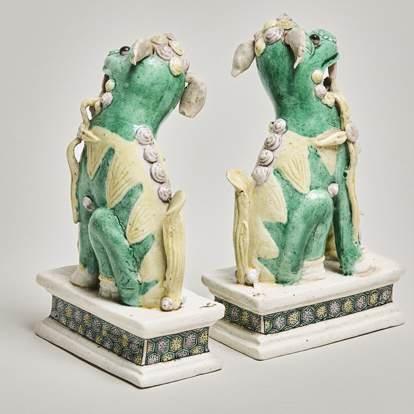
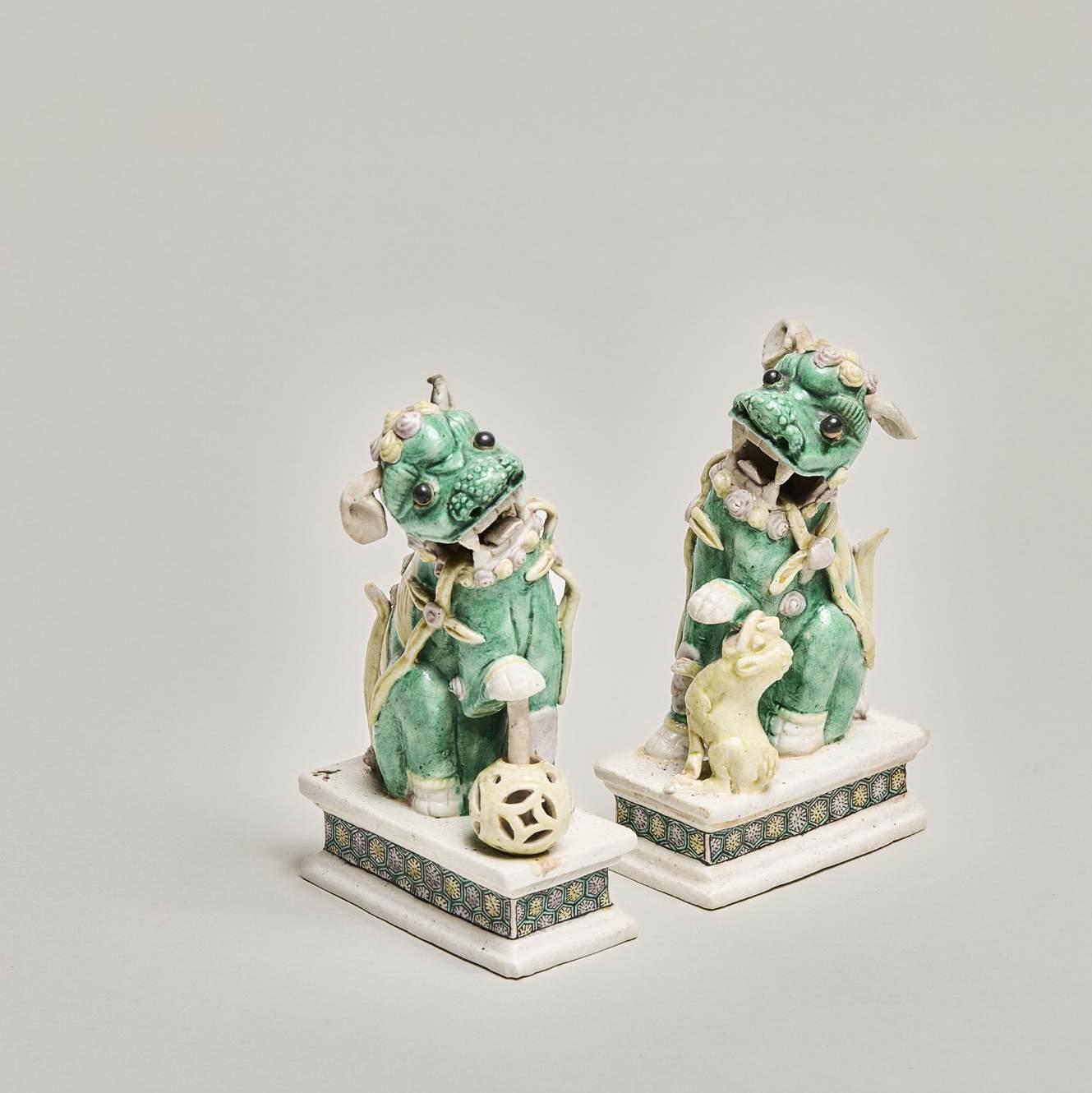
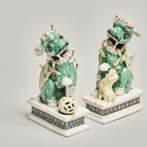
A pair of enamel on biscuit figurines of Buddhist lions (shizi 獅子), standing on low rectangular plinths. Their bodies are glazed with tri-coloured sancai enamels in green, yellow and aubergine. Their body is green, with the mane and tail in a contrasting yellow. Both lions have their mouths open, teeth bared with yellow pennant ribbons flowing from the corners of their mouths. They have their original articulated white pointed ears and protruding black eyeballs. Stylized yellow and aubergine curls decorate the top of their head, with four additional aubergine curls on their backs. The teeth, paws and ears are left unenamelled and covered with a thin transparent glaze. The female lion looks left, a lion cub jumping up her left leg. The male looks to the right, his right paw resting on a pole with a yellow moveable openwork ball.
The Buddhist Lion, also referred to in the West as a Fo Dog or Dog of Foo, is considered a very auspicious animal in China. Lions are not indigenous to China, though they were presented to the court by foreign embassies as early as the Han Dynasty (206BC-220AD). From the Ming Dynasty (13681644) onwards, their image takes on a more dog-like appearance, with bulging eyes, pug-like face and a short bushy tail. Traditionally, guardian lions are seen as protectors of Buddhist wisdom and as such often placed as guardians in front of buildings and temples. Usually they are portrayed seated in pairs - a male and female. They can easily be identified, as the female is portrayed protecting her cub and the male standing on a brocade ball.
The majority of later Buddhist lions, have the male on the right. This pair appears to be more interchangeable, so could also follow the more classical Chinese philosophy of “left for honour” - Zuo wei shan. This concept comes from ancient Chinese culture, which considered the left side to be the seat of honour. Therefore, placing the male (yang/power) on the left was a sign of reverence. Musée d’Ennery, Paris has a pair of similar lions configured in the same way. The Anthony de Rothschild Collection has a pair of a similar shape, also on a low plinth (inv.nr. 375).
China, Kangxi period (1662-1722)
H: 8.5 cm | L: 12.5 cm
PROVENANCE
Puissant-Baeyens Collection, Belgium 2009
With Vanderven & Vanderven, 2010 (label nr. 423)
Treves Collection, Amsterdam 2025
LITERATURE
Boulay 1984, p.233
London 2016, p.69, nr.34
Pei 2004, p.175
Rinaldi 1993, p.59-69
Scagliola 2012, p.252, nr.272 & 273
17 | Squirrel & Grapes
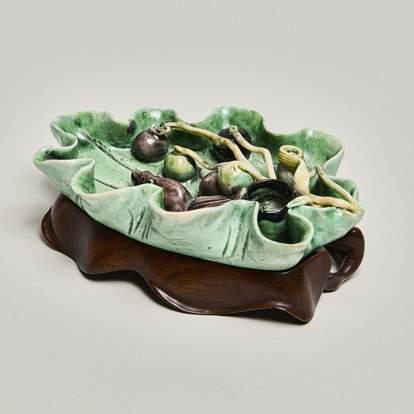
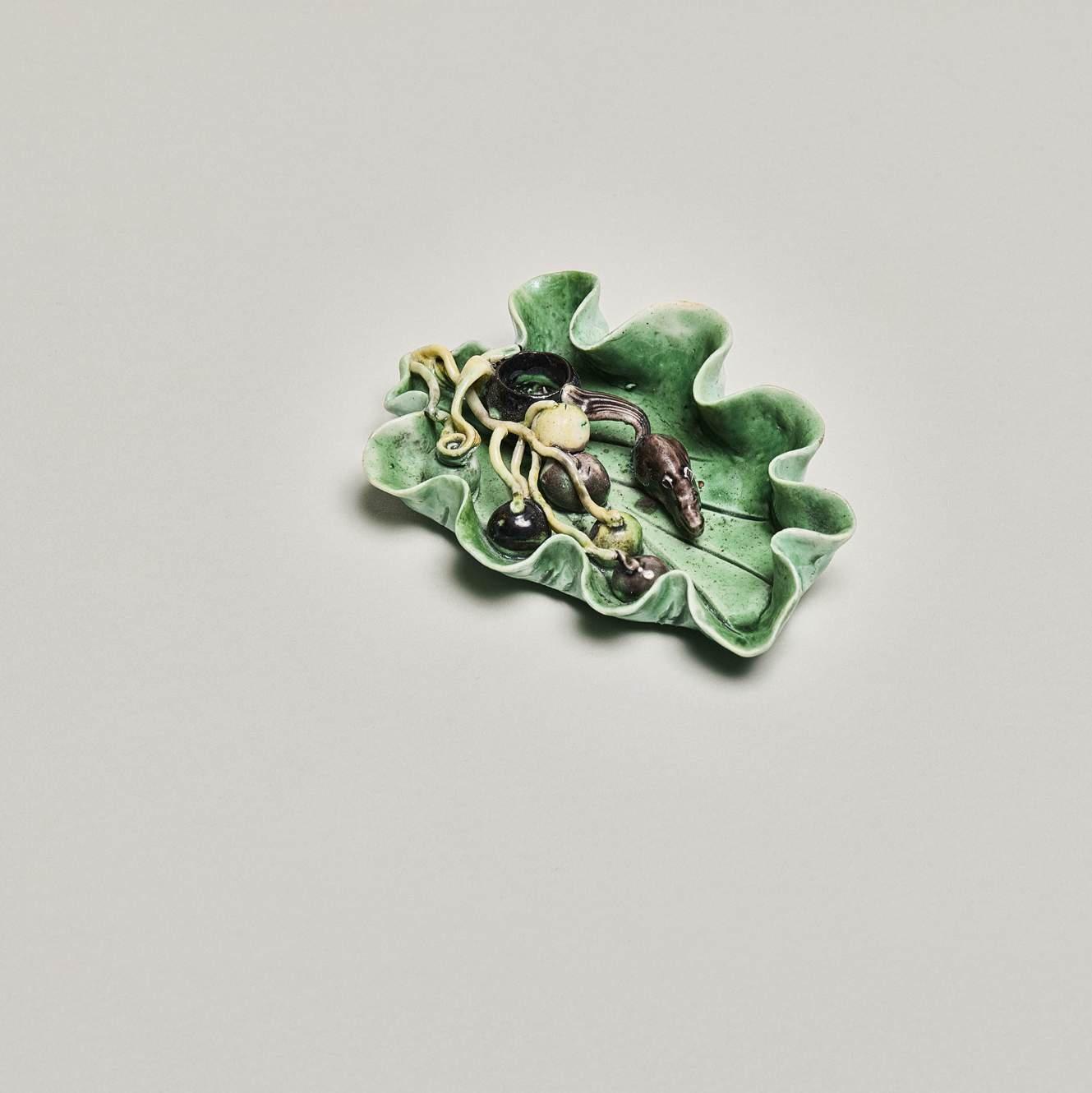
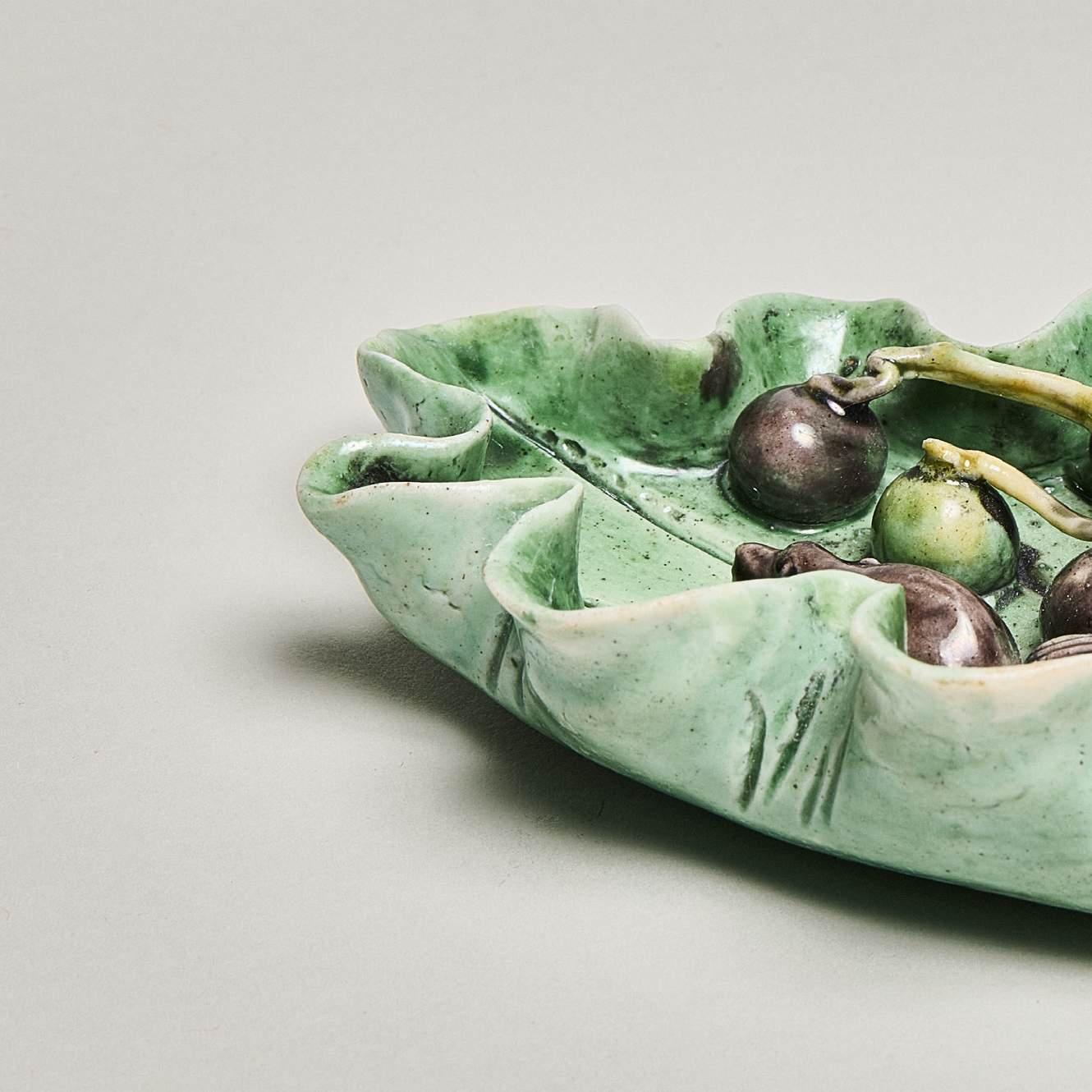
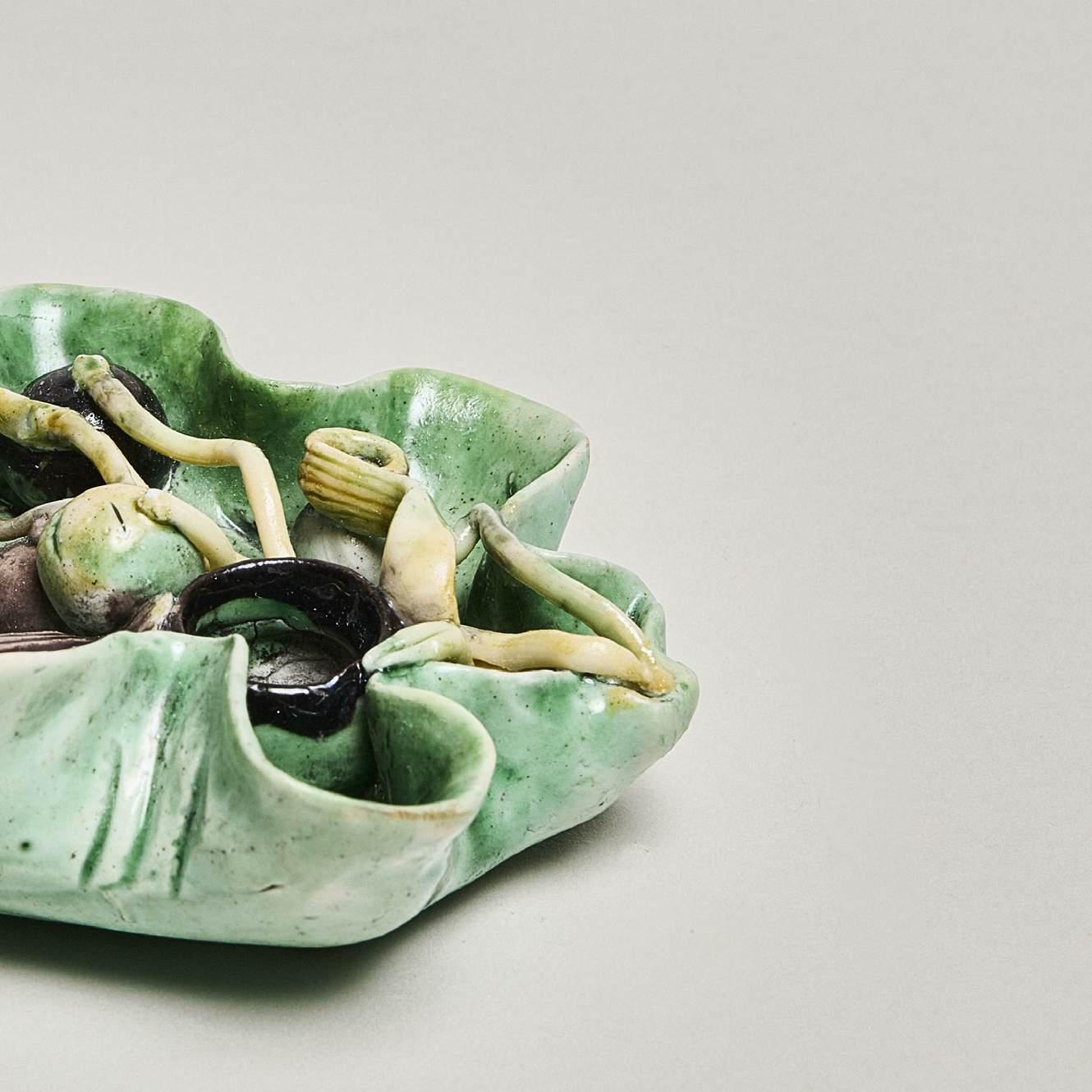
A charming sousancai brush washer, in the shape of a green furled lotus leaf. Within the leaf, a brown squirrel sits beside a trailing yellow vine, bearing large yellow, brown, black and green grapes. Next to the vine is a small black water jar. The base of the leaf is glazed green and has three nodules as feet. It is accompanied by a later wooden stand, carved in the shape of a leaf.
The Chinese name for the industrious and auspicious squirrel (songshu 松), literally translates as “pine tree rat” – as squirrels and rats share the same character (shu 鼠). The first part of its name - (song 松) pine tree – is also a popular emblem of longevity. Therefore, in Chinese visual culture, squirrels represent diligence, prosperity, and long life. The pairing of squirrels with grapes (songshu putao 松鼠葡萄), is a particularly popular auspicious motif. Grapevines, like squirrels, are associated with strong reproductive vitality, as its fruit grows abundantly in large clusters. Their winding, spreading branches also embody family lineage and continuity. When squirrels and grapes are depicted together, they convey a blessing for longevity and the flourishing of the family line through many descendants.
Brush washers, were essential objects on every Chinese scholar’s desk and used to hold water for rinsing ink from calligraphy brushes. Beyond their practical function, they were also appreciated as small works of art. Frequently adorned with auspicious imagery, they underlined scholarly ideals while expressing wishes for prosperity and long life, which enhanced their symbolic and aesthetic appeal.
Brush washers of this type and form do not seem to have been published in any reference work. However, there are several comparable examples of lotus leaves combined with small aquatic animals. The Royal Porcelain Collection, Dresden has two lotus leaves with shrimp (PO4404 & 4405). The Laura Collection, Italy, has one with a crab and a lotus pod; and another with a large shrimp.
Vines ( wan ) also represent plenty, in the sense of material wealth, as well as the wish for a profusion offspring
China, Kangxi period (1662-1722)
H: 20.4 cm
PROVENANCE
Vanderven & Vanderven, 2001 (label)
Treves Collection, Amsterdam 2025
LITERATURE
Avitabile 1992, p.169, nr.345
Gabbert 1977, p.166, nr.358
Hobson 1925-1928, Vol. V, p.27, pl.38, fig.E188
Jörg & van Campen 1997, p.184, nr.204 & 205
Manginis 2016, nr.25
Scagliola 2012, p.246, nr.251
Welch 2008, p.201-202
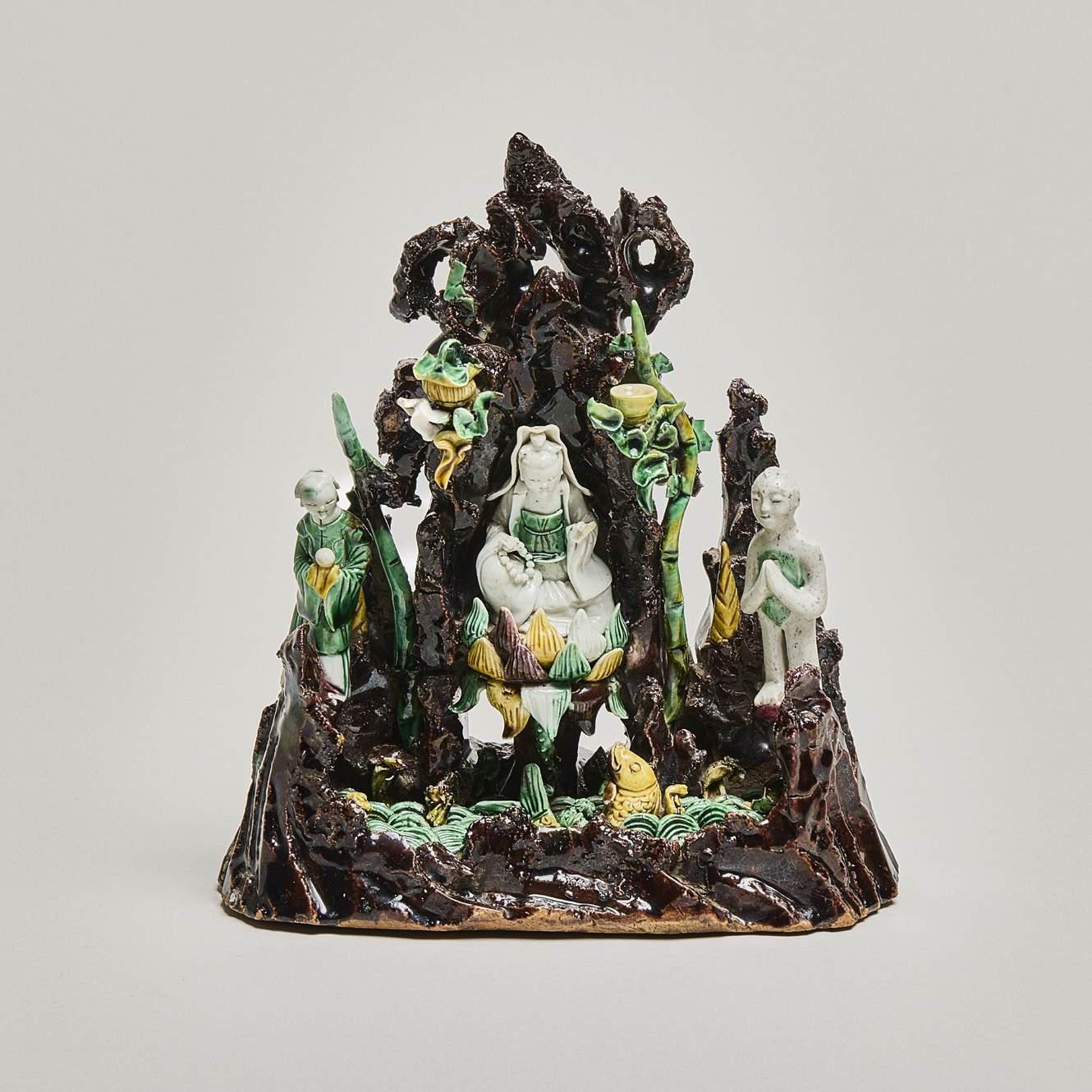
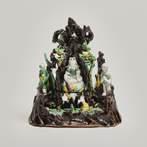
18 | Guanyin Shrine
This pierced rockery devotional shrine, enamelled on the biscuit in the sancai palette, is dedicated to the goddess Guanyin Avalokitesvara
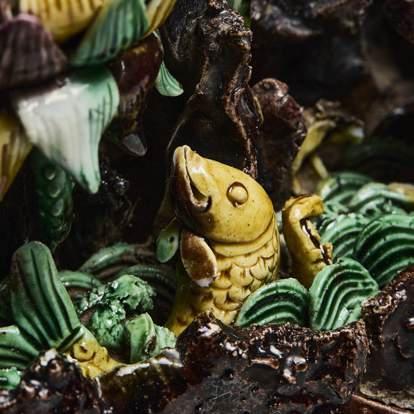
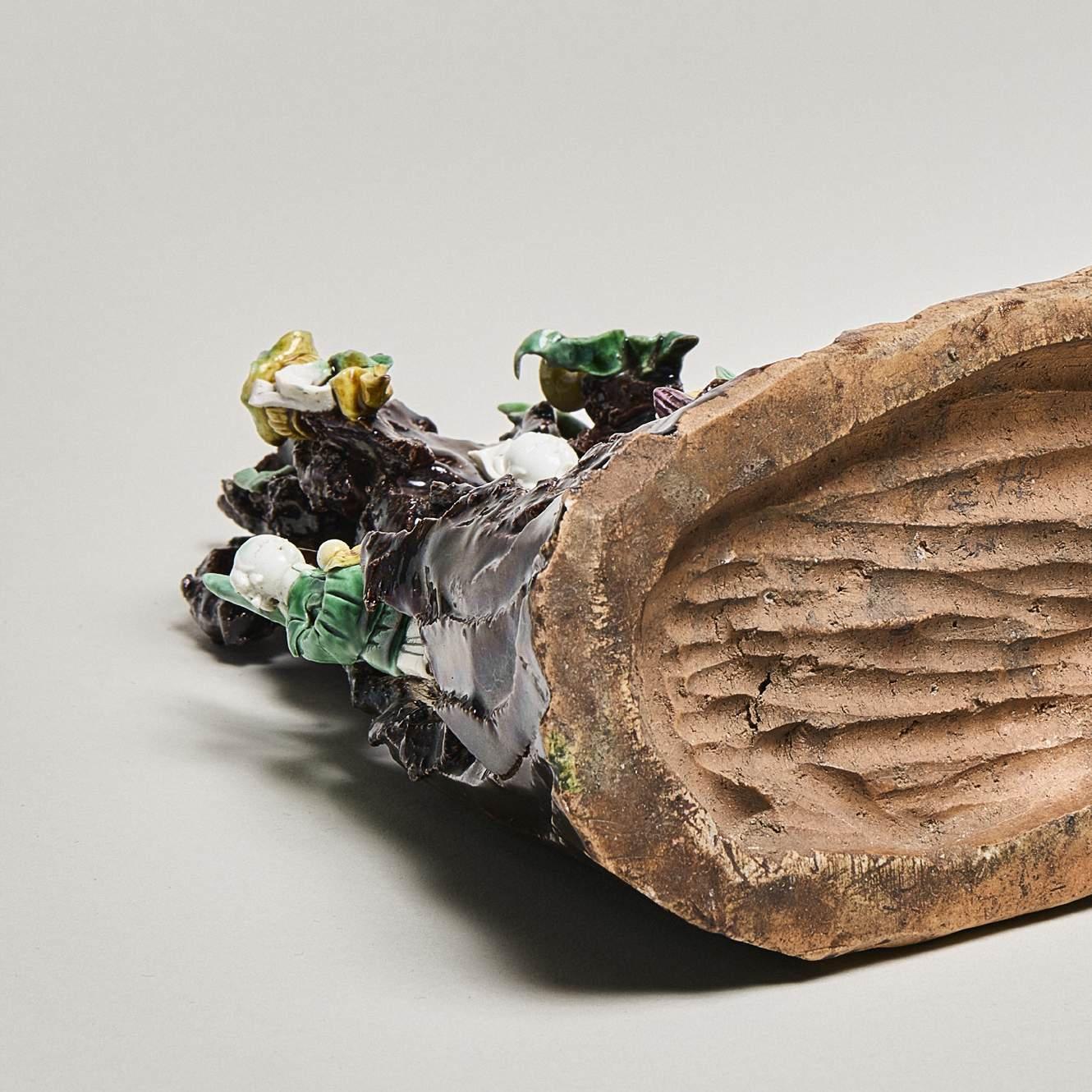
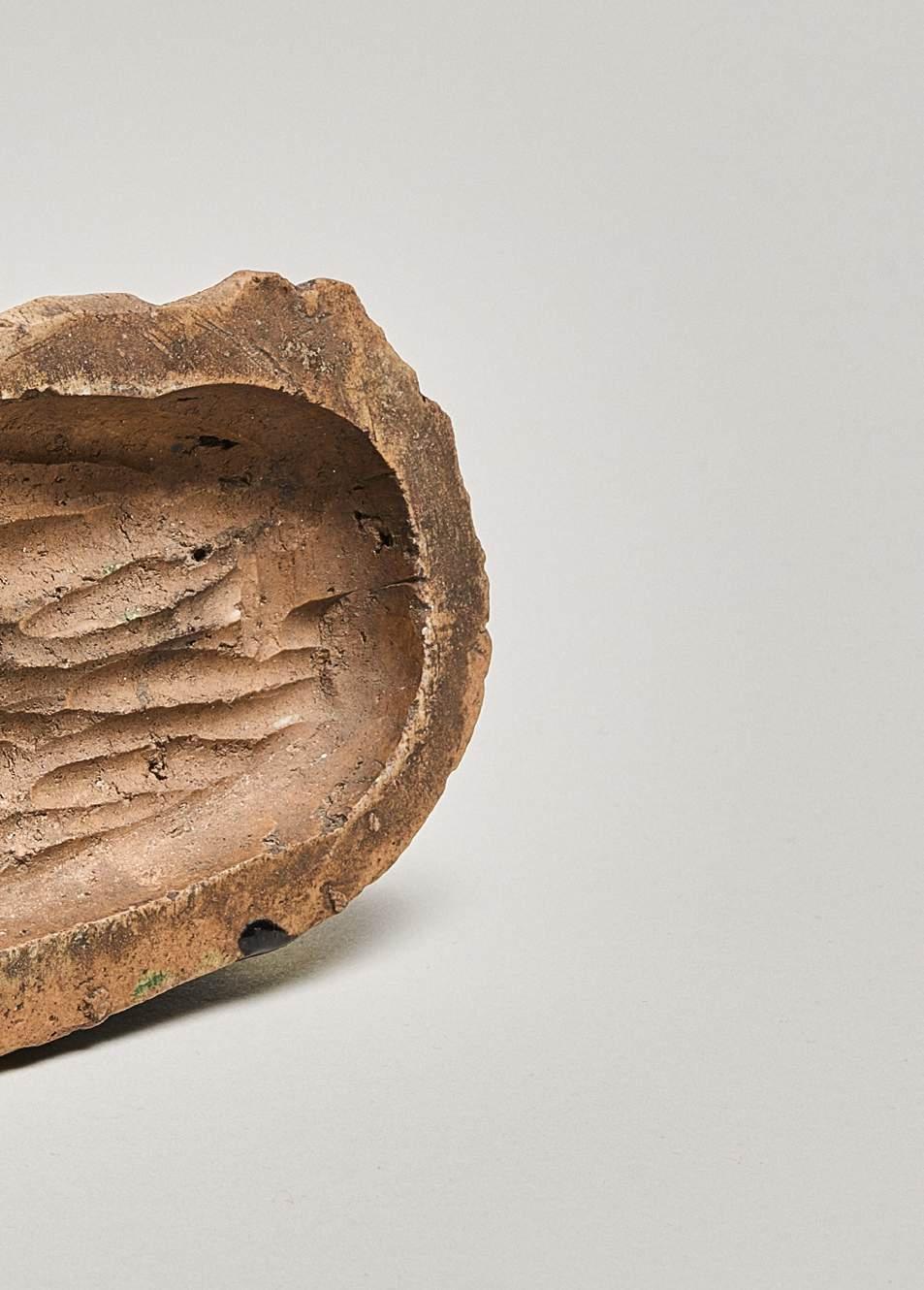
Portrayed as the ‘Goddess of Mercy’- she is seated in a brown grotto on a lotus throne, with green yellow and aubergine enamelled petals. She is dressed in long white robes, with a green bodice. Her hair, which is bound into a top knot, is covered loosely by a cloth. She is seated with an arm resting on her raised knee, a position known as ‘Royal Ease’ (Mahrajalilasana). In her right hand she holds Buddhist prayer beads (mala), symbolizing the guidance of beings from suffering to enlightenment. A tall stalk of bamboo grows on either side of her and below her a yellow carp emerges from the green waves. This alludes to a story from the Complete Tale of Avalokitesvara and the Southern Seas, in which Guanyin saves the son of the dragon king who was swimming in the guise of a carp. On the outer edges of the grotto stand two of her acolytes. The young boy on the right, wearing a short tunic and holding his hands together in prayer, is Shancai Tongzi (Child of Wealth). The figure on the left, in long robes holding the “pearl of light”, represents the young girl Longnu (Dragon Daughter). Above them on rocky outcrops are a yellow basket and a cup surrounded by leaves. The unglazed and uncoloured underside is roughly modelled - the fingers of the potter clearly visible in the clay. It has a later fitted wooden stand.
Shrines like this were likely intended for a small house altar, but were also exported to the West as an exotic luxury. The Laura Collection, Italy, holds a smaller but similarly shaped rockery. An example, formerly in the Eumorfopoulos Collection, is now in the Benaki Collection, Athens (nr. 2679). The Museum Angewandte Kunst, Frankfurt am Main (acc.nr. 10994) and the Rijksmuseum, Amsterdam (inv.nr. AK-NM 12467 & AK-MAK 659 & 573) also have comparable rockery shrines.
ENAMEL ON BISCUIT
Porcelain enamelled “on the biscuit” - known in Chinese as Sousancai 素三彩 - was a particular speciality of the Kangxi period. It is considered part of the famille verte family - although the production technique is markedly different. The main distinction lies in the method of manufacture. The porcelain body was moulded or shaped and then high-fired (1280-1350°C), entirely undecorated and unglazed, resulting in a vitrified but exposed biscuit surface. After this initial firing, coloured enamels were applied and the pieces were refired at a lower temperature (approximately 750-850°C) in a smaller secondary kiln, referred to as a muffle kiln.
The enamel palette is characteristic and relatively limited, consisting primarily of various greens (including turquoise), yellow, iron-red, overglaze blue and aubergine purple or brown. White areas are not actually enamelled, but reveal the porcelain body under a thin transparent glaze. Enamel on biscuit objects often have areas - such as the basewhich were left entirely unglazed, leaving the biscuit body exposed.
China, Kangxi period (1662-1722)
H: 14 cm
PROVENANCE
Private Collection, France
2007
Vanderven & Vanderven, 2008 (Label)
Treves Collection, Amsterdam 2025
LITERATURE
Bondy 1923, p.172
Sargent 1991, no.25, pp.70/1
Scagliola 2012, p.247, nr.253
Vinhais & Welsh 2012, p.218219, nr.60
Welch 2008, p.154-156
19 | Hehe Erxian
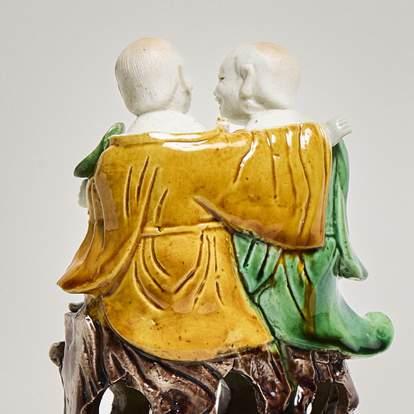
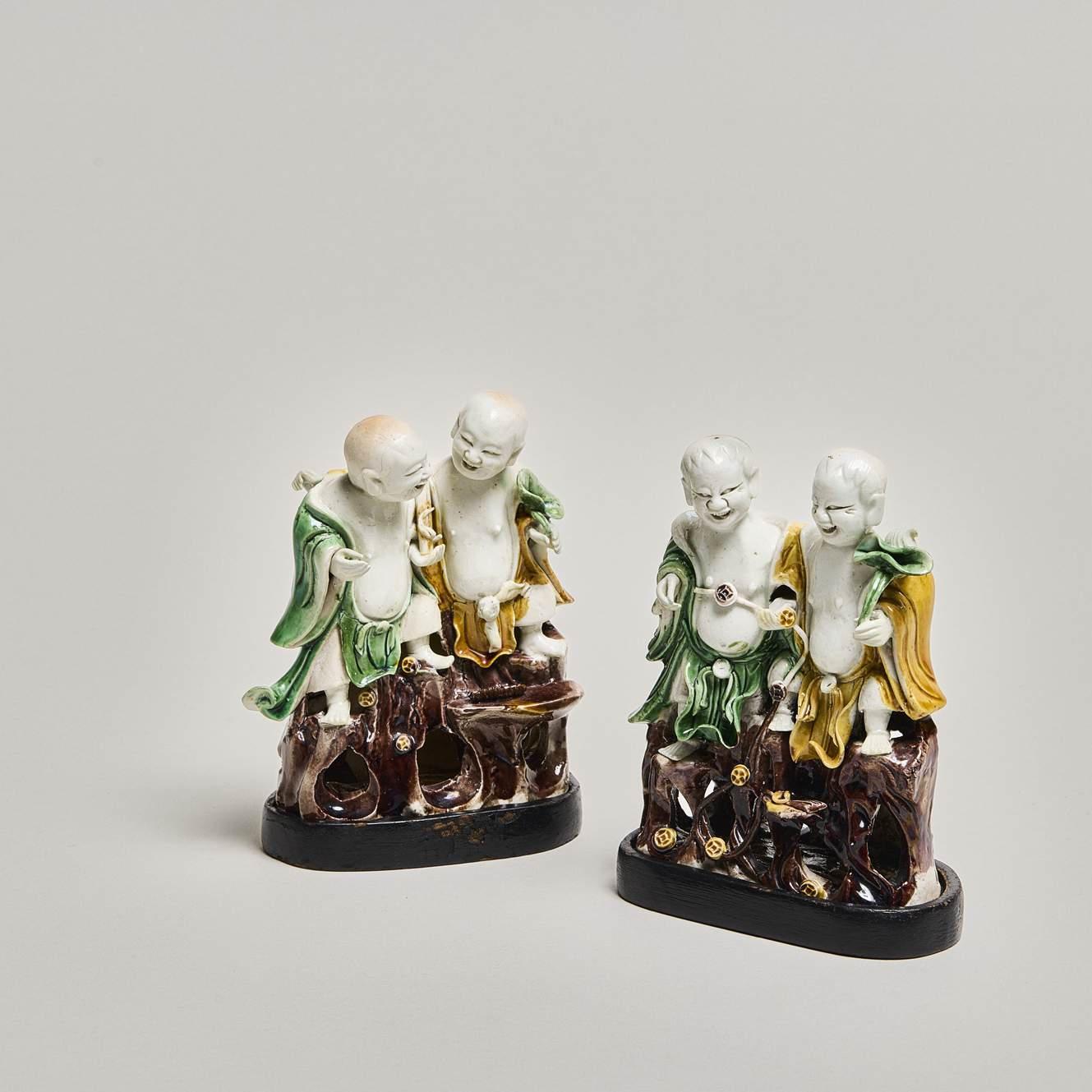
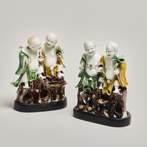
Two famille verte figural groups, depicting Hehe Erxian (和合二仙), the Daoist spirits of Harmony and Joy. Their bodies are modelled in undecorated white biscuit porcelain, covered with a clear glaze. They wear loose robes - alternately enamelled in yellow and green - which fall open at the front. One pair appears bald, whilst the other pair has moulded hair; slightly turned towards each other, they are laughing gleefully with their teeth showing. The figure in yellow has his right arm over the shoulder of his twin, whilst holding a lotus stem in his left hand. In one of the groups the figure in green, holds a string of yellow coins on a brown cord. Both Hehe Erxian groups stand on a high pierced rockwork base, enamelled in brown with scattered yellow coins. The underside is smooth and unglazed. They stand on later wooden stands.
Also referred to as the Laughing Twins, Heavenly twins or the Hoho Twins, these popular figures are generally depicted slightly unkempt, with mirthful expressions on their faces. Their personages were inspired by two Tang Dynasty (618-906) hermit monks - the poet Hanshan and his companion is Shide. They were such popular figures, that in 1733 Emperor Yongzheng officially elevated them to saints of harmony and unity. These twins also became the patron deities of Chinese merchants, often represented holding explicit symbols of wealth, such as coins or money boxes. As a duo, they generally personify the spirit of accord and can bestow blessings on marriages. Such figure groups would often be placed on family altars for marriage blessings, wishes for longevity or the desire for good business dealings.
The Laura Collection, Italy has a pair of similar figural groups. The Copeland Collection in the Peabody Essex Museum, Salem has a single Hehe Erxian group.
China, Kangxi period (1662-1722)
Ø: 18 cm
PROVENANCE
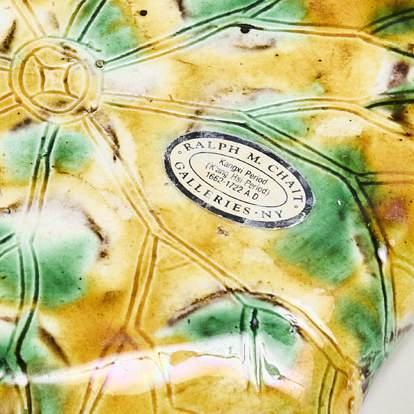
With Ralph M. Chait Galleries, New York 1989 (label)
Alan Oliner Collection, USA 2024
LITERATURE
Ayers 1999, p.75, nr.197
Bartholomew 2006, p.42 & 88-89
Kassel 1990, p.640, nr.310
Krahl 1996, p.406, nr.229
Rinaldi 1993, p.17-21
Scagliola 2012, p.252, nr.272
Welch 2008, p.94-95
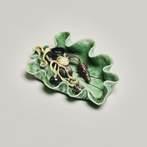
20 | Lotus & Crab
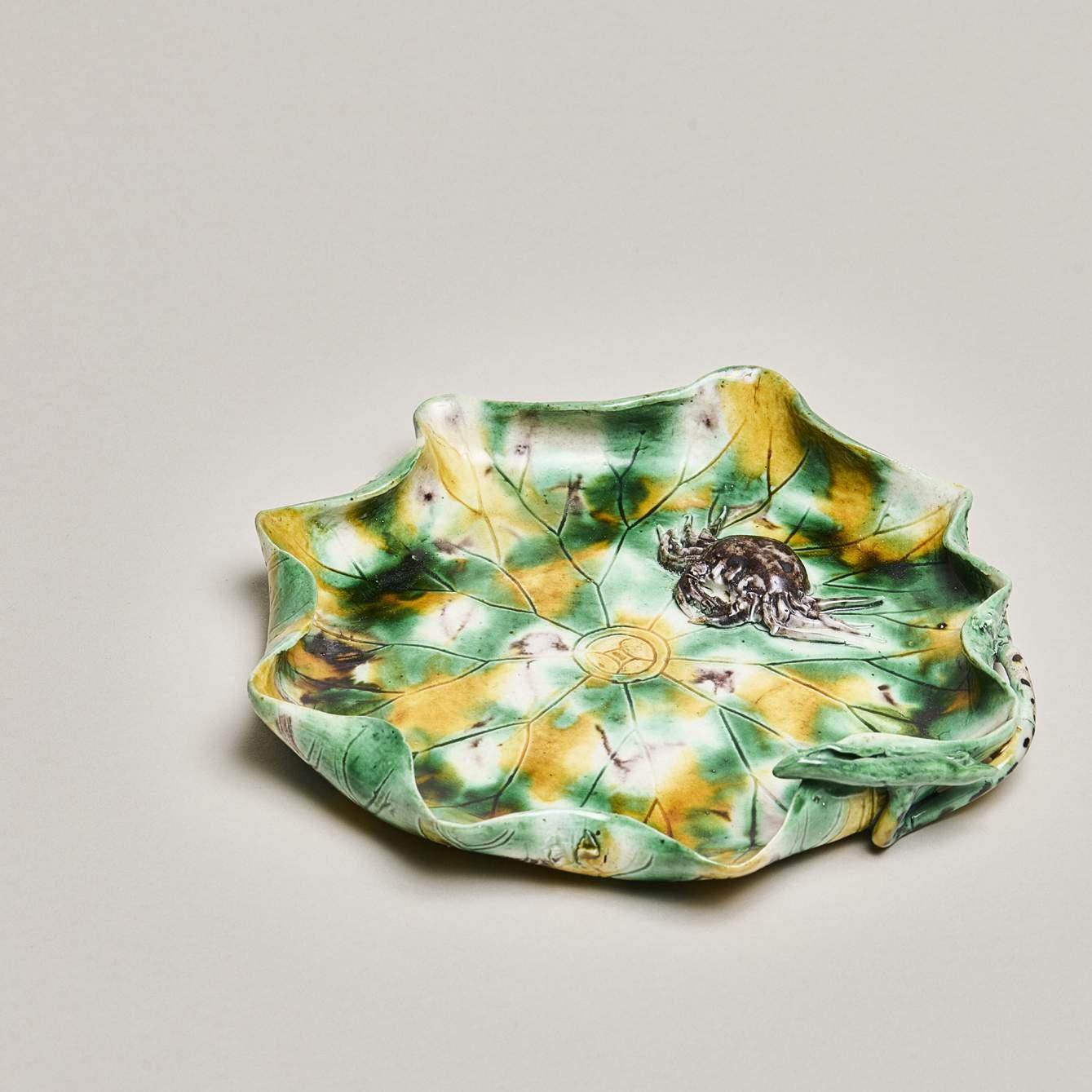
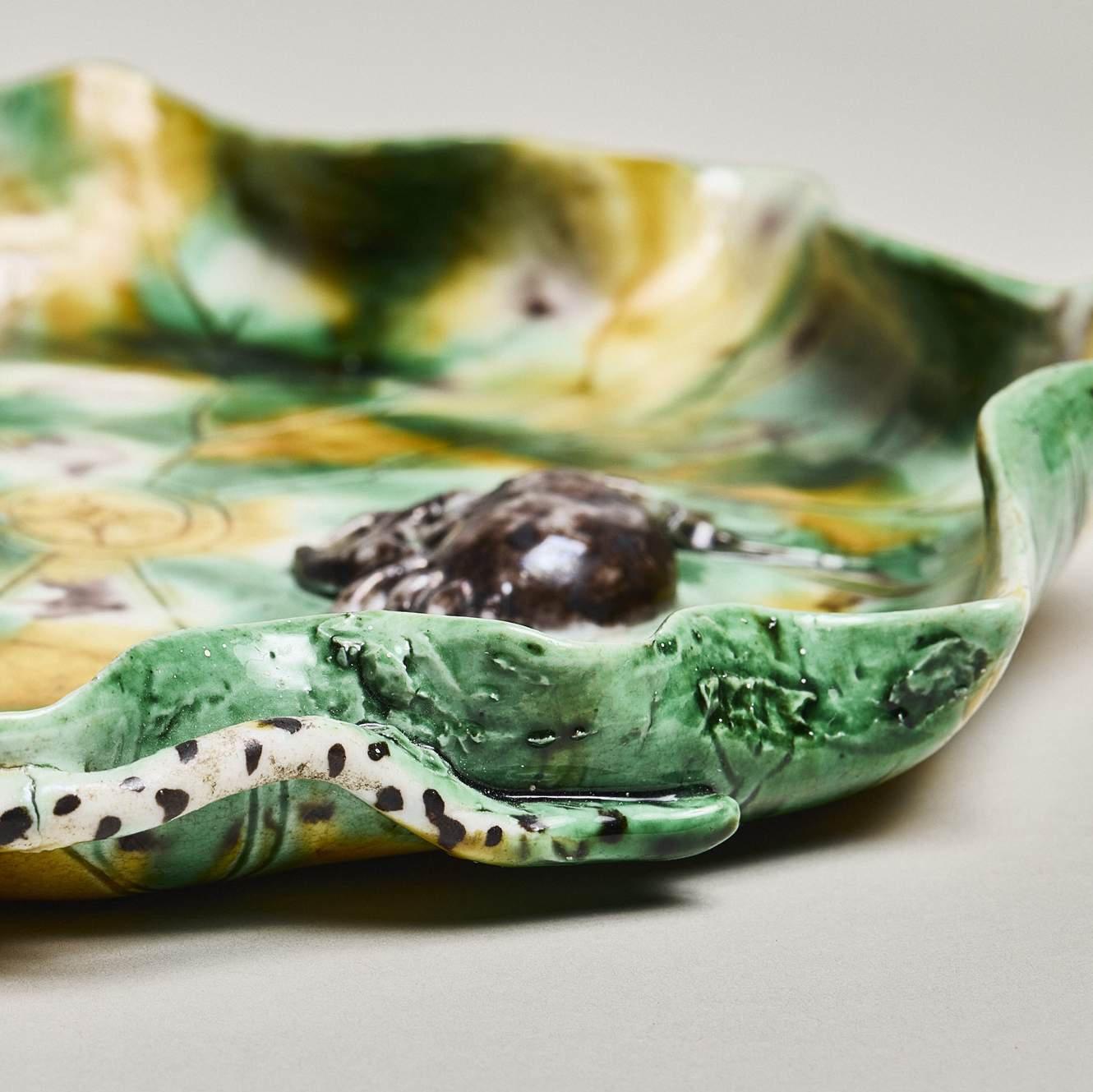
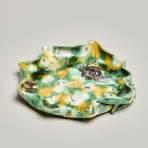
A sancai-glazed biscuit porcelain brush washer, in the shape of a lotus leaf with a brown crab resting on its surface. The round leaf is curled up and has an undulating edge, with realistic veining incised into the porcelain. On the edge of the dish is a furled leaf, its spotted stalk folded around the outside of the rim. The underside of the brush washer is decorated and incised in the same way. This distinctive splashed tri-colour enamelling in yellow, green and aubergine-brown, is known as Egg & Spinach decoration. In China this décor is known as the ‘hupiban’ (tiger-skin) and the French refer to it as ‘harlequin’. The aquatic theme of this brush washer, fits its function very well. This dish would have originally been used as a water reservoir, for wetting and cleaning calligraphy brushes.
This is a typical functional, but also charming and symbolic, object for on a Chinese scholar’s desk. The combination of a lotus leaf with a crab, is a recurring auspicious motif in Chinese art. The lotus leaf (he 荷) is associated with the word for harmony or peace (he 和), but is also a symbol of purity and resilience. As its flowers emerge unstained from muddy waters, it is an apt metaphor for the poor scholar who could attain success by passing the imperial examinations. The crab (xie 蟹), sounds similar to the word for harmony (xie 諧). But the crab shell (jia 甲), specifically represents “first” or “best”, specifically referring to achieving the highest score in imperial examinations (yijia) and assurance of a career as a government official. These allusions to harmony as well as success in exams, is why this is a very fitting theme for scholarly objects.
The Bauer Collection, Geneva has a similar large water dish, but with turquoise enamels (A466). The Staatliche Kunstsammlung, Kassel, also has a shallow lotus dish (inv.nr. KP OP294d). The Anthony de Rothschild Collection (UK), has a box and cover with a large crab sitting on a green lotus leaf. The Laura Collection, Italy has a smaller brush washer, with the same watery theme. The Royal Collection Trust has a lotus and crab combination in blanc-de-chine porcelain (nr. RCIN 58878).
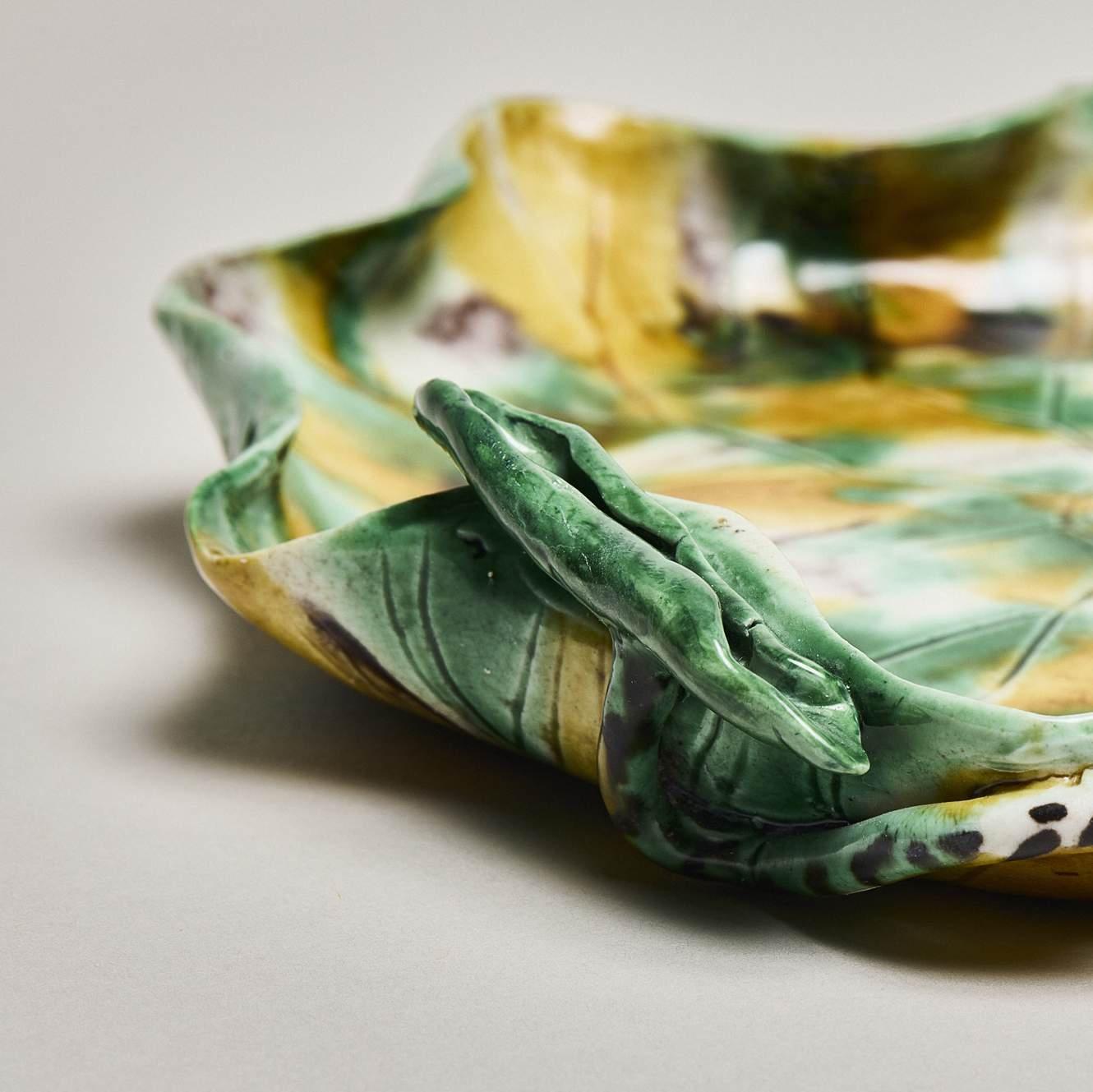
Splashed tri-colour enamelling in yellow, green and brown, is known as Egg & Spinach decoration
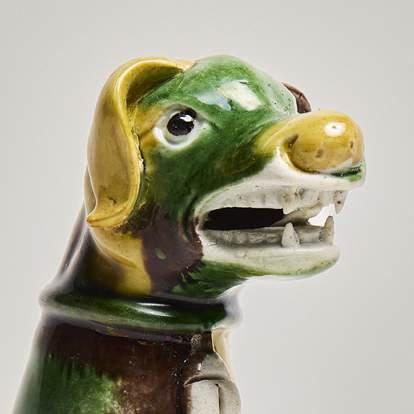
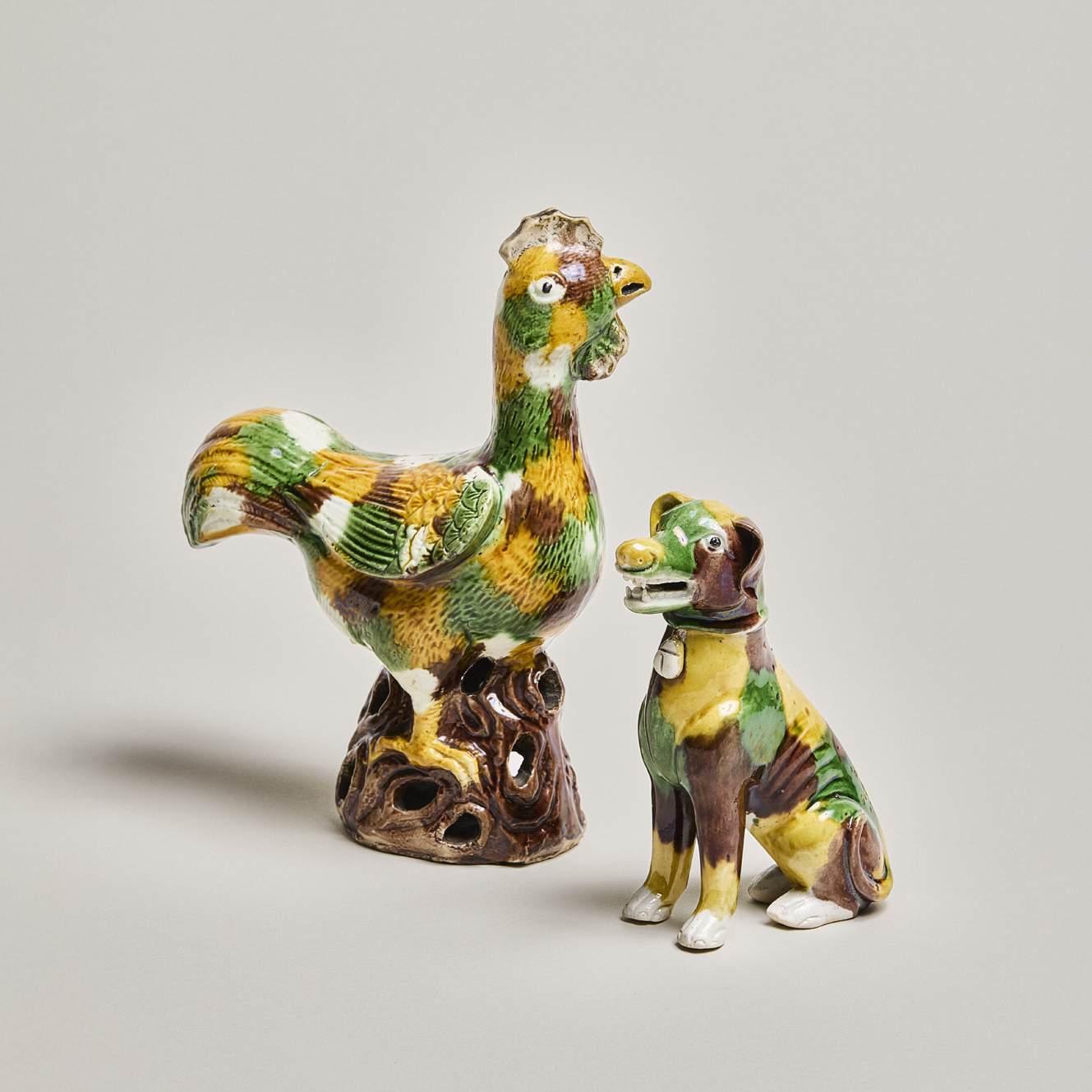
China, Kangxi period (1662-1722)
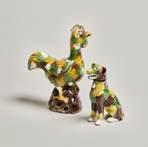
H: 22.9 cm (cockerel) | H: 15 cm (hound)
PROVENANCE
Private Collection, Paris 2023
LITERATURE
Cohen & Motley 2008, p.159-161, nr.11.1 & p.223, nr.16.4
Pinto de Matos 1996, p.263-266
Sargent 1991, nrs.33-35 & 63-66
Vinhais & Welsh 2012, p.188, nr.52
Welch 2008, p.85-87 & p.118-120
21 | Cockerel & Hound
Two enamel on biscuit figures of a cockerel and a hound, both decorated all over in bright Egg & Spinach enamels. The hound sits on its haunches, its head tilted to the left. It has a friendly countenance with floppy ears and long muzzle, the open mouth revealing its tongue and teeth. The sides of its sleek body are carved, to indicate ribs and its tail curls around its left hind leg. Around its neck is a collar with a bell. The cockerel, with its large feathery tail, stands upright and looks slightly to the left. The contours of feathers on the body, wings and tail are incised into the porcelain body. The prominent wattles are left uncoloured and the comb is unglazed biscuit. It stands on a brown enamelled pierced rockery base, which is left unglazed on the bottom.
The cockerel or rooster (Gong-Ji 公鸡), is the tenth animal of the Chinese zodiac. It is a common motif in the Chinese decorative arts and associated with a wide range of symbolic meanings. Five virtues are traditionally ascribed to the rooster: its comb symbolizes literacy and refinement, while its spurs represent martial bravery. It is respected for its courage and for its benevolence, as it calls the hens to share his food. The rooster is also seen as a model of reliability and faithfulness, as he never fails to mark the passing hours. The dog (gou 狗) is the eleventh sign of the zodiac and one of the Six Domestic Animals in China. It has a variety of symbolic meanings, but is typically represented as a symbol of fidelity. The more sleek elegant hounds, have also been associated with high rank and status. The breed of this model, possibly represents a smooth-coated greyhound, introduced by the Portuguese in the 16th century. However, this hound also resembles a long muzzled breed which is native to China. The various Chinese porcelain models of dogs – hounds, spaniels and pugs - were very popular in Europe, where they found eager buyers.
A pair of similar Egg & Spinach hounds, are in the Virgottis collection in Musée Ariana, Lausanne. A hound in the Copeland Collection in the Peabody Essex Museum, Salem, is similarly enamelled but stands on a famille verte base. This collection also holds two domestic fowl in Egg & Spinach enamels, as well as two pairs of famille rose roosters.
Chinese captions
1 | Auspicious Beasts
瑞獸雙瓶
中國·清康熙
高:48.5釐米 | 49.6釐米
2 | Conical Bowl
斗笠盞
中國·清康熙
高:8.3釐米 | 口徑:22釐米
3 | Rocks & Flowers
百花彩蝶長頸瓶
中國·清康熙
高:22 釐米 | 口徑:12 釐米
6 | Peach Ewer
桃式執壺
中國·清康熙
高:11.5 釐米
7 | Dresden Bowl & Plate
德累斯頓碗盤
(帶有奧古斯特二世藏品標記)
中國·清康熙(約 公元1700 年)
碗口徑:17.2 釐米 | 盤口徑:24.8 釐米
4 | Wine Pot
花鳥酒壺
中國·清康熙
高:18釐米
8 | Bitong
花鳥筆筒 中國·清康熙
高:14 釐米 | 口徑:11.7 釐米
5 | Qilin & Phoenix
麒麟鳳凰碗碟 中國·清康熙
碗高:6.1 釐米 | 碗口徑:12 釐米
碟高:3.4釐米 | 碟口徑:16.2 釐米
9 | Peonies & Butterflies
牡丹彩蝶雙碟 中國·清康熙
口徑:15.7 釐米
10 | Teapots
花鳥茶壺 中國·清康熙
高:10 釐米 | 長:15.5 釐米
11 | Powder Blue & Verte
藍釉對瓶
中國·清康熙
高:13.5 釐米 | 口徑:27.3 釐米
12 | Box & Cover
綠地方盒
中國·清康熙
高:6.7 釐米 | 寬:8.3 釐米
長:13.5 釐米
13 | Linglong Brushpots
鏤空六足筆筒
中國·清康熙
高:12.5 釐米 | 口徑:10.3 釐米
14 | Famille Noire Ewer
獅子戲球執壺
中國·清康熙
高:20.4 釐米
15 | Han Xiangzi
韓湘子像
中國·清康熙
高:29.5 釐米 | 寬:11.7 釐米
16 | Buddhist Lions
對獅
中國·清康熙
高:16 釐米 | 寬:9.5 釐米
17 | Squirrel & Grapes
松鼠葡萄筆洗
中國·清康熙
高:8.5 釐米 | 長:12.5 釐米
18 | Guanyin Shrine
南海觀音龕
中國·清康熙
高:20.4 釐米
19 | Hehe Erxian
和合二仙
中國·清康熙
高:14 釐米
20 | Lotus & Crab
蓮葉螃蟹筆洗
中國·清康熙
口徑:18 釐米
21 | Cockerel & Hound
素三彩雞犬
中國·清康熙
高:22.9 釐米,15 釐米
Bibliography
Altenburg 1998
Ostasiatische Porzellan in Altenburger Schloss – Sammlung Bernhard August von Lindenau, Sybillenkanbinett, Exhibition Catalogue Schloss- und Spielkartenmuseum, Altenburg, 1998
Avitabile 1992
Gunhild Avitabile & Stephan graf von der Schulenbrug, Chinesisches Porzellan; Aus Beständen Des museums Für Kunsthandwerk, Frankfurt am Main, 1992
Ayers 1985
John Ayers, Chinese Ceramics; The Koger Collection, London, 1985
Ayers 1999
John Ayers, Chinese ceramics in the Baur Collection, Vol. I & II, Geneva, 1999
Ayers 2004
John Ayers, The Chinese Porcelain Collection of Marie Vergottis, Lausanne, 2004
Ayers 2016
John Ayers, Chinese and Japanese Art in the Royal Collection of her Majesty the Queen, Vol. I-III, London, 2016
Bartholomew 2006
Terese T. Bartholomew, Hidden Meanings in Chinese Art, San Francisco, 2006
Beijing 1999
Treasures of the Imperial Court – The Complete Collection of Treasures of the Palace Museum; Porcelains in Polychrome and Contrasting Colours, (Gugong Zhenbao), Vol. 38, Beijing, 1999
Beurdeley & Raindre 1987
Michael Beurdeley & Guy Raindre, Qing Porcelain; Famille Verte, Famille Rose, New York, 1987
Bondy 1923
Walter Bondy, Kang-Hsi; Eine Blüte-Epoch
Der Chinesischen Porzellankunst, Munich, 1923
Boulay 1984
Anthony du Boulay, Christie’s Pictorial History of Chinese Ceramics, Oxford, 1984
Boulay 1995
Anthony du Boulay, The Taft Museum; Chinese Ceramic & Works of Art, New York, 1995
Bushell 1904
Stephen Bushell, Catalogue of the Morgan Collection of Chinese Porcelains, Vol. I & II, New York, 1904 (privately printed edition of 250)
Campen 2010
Jan van Campen, De Porseleinverzameling van W.F. van Heukelom, Vormen uit Vuur 208 (2010/1), Amsterdam, 2010
Canepa 2004
Teresa Canepa, Linglong, Exhibition Catalogue Jorge Welsh, London/ Lisbon, 2004
Canepa 2021
Teresa Canepa & Katherine Butler, Leaping the Dragon Gate; The Sir Michael Butler Collection of Seventeenth-Century Chinese Porcelain, London, 2021
Cohen & Motley 2008
Michael Cohen & William Motley, Mandarin and Menagerie; Chinese and Japanese Export Ceramic Figures, London, 2008
David 1958
Lady Sheila David, Illustrated Catalogue of Ch’ing Enamelled Wares in the Percival David Foundation of Chinese Art, London, 1958
Davids & Jellinek 2011
Roy Davids & Dominic Jellinek, Provenance: Collectors, Dealers & Scholars; Chinese Ceramics in Britain & America, England, 2011
Gabbert 1977
Gunhild Gabbert, Chinesisches Porzellan, Frankfurt am Main, 1977
Gorer & Blacker 1911
E. Gorer & J.F. Blacker, Chinese Porcelain and Hard Stones, Vol. I & II, London, 1911
Hildesheim 1990
Herbert Bräutingham, Schätze Chinas aus der DDR, Exhibition Catalogue Roemer- und Pelizaeus- Museum, Hildesheim, 1990
Hobson 1915
R. L. Hobson, Chinese Pottery & Porcelain, Vol. I & II, London, 1915
Hobson 1925-1928
R.L. Hobson, The Eumorfopoulos Collection; Catalogue of the Chinese, Corean and Persian Pottery & Porcelain, London, 1925 -1928
Jörg & van Campen 1997
Christiaan J.A. Jörg & Jan van Campen, Chinese Ceramics in the Collection of the Rijksmuseum, Amsterdam, Amsterdam/ London, 1997
Jörg 2002
Christiaan J.A. Jörg, Jan Menze van Diepen Stichting; A Selection from the Collection of Oriental Ceramics, Slochteren, 2002
Jörg 2011
Christiaan J.A. Jörg, Famille Verte - Chinese Porcelain in Green Enamels, Exhibition
Catalogue Groninger Museum, Groningen, 2011
Kassel 1990
Porzellan aus China und Japan; Die Porzellangalerie der Landgrafen von HessenKassel, Staatliche Kunstsammlungen Kassel, 1990
Koeppe 2012
Wolfram Koeppe, Suzanne G. Valenstein, et al., The Robert Collection; Decorative Arts, Vol. XV, The Metropolitan Museum of Art, New York, 2012
Kopplin 2004
Monika Kopplin (et al.), Schwarz Porcelain; Die Leidenschaft für Lack und ihre Wirkung auf das europäische Porzellan, Exhibition Catalogue Museum für Lakkunst, Munster, 2004
Krahl & Ayers 1986
Regina Krahl & John Ayers, Chinese Ceramics in the Topkapi Saray Museum, Istanbul; A complete catalogue, part III: Qing Dynasty Porcelains, London, 1986
Krahl 1996
Regina Krahl, The Anthony de Rothschild Collection of Chinese Ceramics, The Eranda Foundation, 1996
Krahl 2024
Regina Krahl, Powder Blue, ‘Bleu Soufflé’, Sa Lan 洒藍, In “Royal East Asian Porcelain,” online article in The Royal Dresden Porcelain Collection, edited by Christiaan J.A. Jörg and Cora Würmel, Dresden, 2024
Kwok & O’Brien 1990
Kwok Man Ho & Joanne O’Brien, The Eight Immortals of Taoism; Legends and Fables of Popular Taoism, New York, 1990
Laffan & Clark 1911
William Laffan & Thomas Clarke, Catalogue of the Morgan Collection of Chinese Porcelains privately printed by order of Mr. J. Pierpont Morgan, Part 1 & 2, New York, 1911
Lepke’s 1919
Porzellan und Waffen; aus den KGL Sächsischen Staatssammlungen in Dresden, Rudolph Lepke’s Kunst-AuktionsHaus Berlin, sale nr. 1835, Dreden, 7&8
October 1919
Little 2000
Stephen Little, Taoism and the Arts of China, Exhibition Catalogue The Arts Institute of Chicago, Chicago, 2000
London 1937
The Well-known collection of Fine Chinese Porcelain Of the Highest Quality; The Property of W.F. van Heukelom esq (decd) of Amsterdam, Auction Catalogue Sotheby’s & Co, London, 1937
London 2016
China Without Dragons; Rare Pieces from Oriental Ceramic Society Members, Exhibition Catalogue Oriental Ceramics Society, London, 2016
Lunsingh Scheurleer 1982
D.F. Lunsingh Scheurleer, Letters of Father d’Entrecolles, and accounts of Chinese Porcelain from Old European Publications, Alphen aan de Rijn, 1982
Manginis 2016
George Manginis, China Rediscovered; The Benaki Museum Collection of Chinese Ceramics, Exhibition Catalogue Benaki Museum, Athens, 2016
Marsh 2020
Sam Marsh, Brushpots; A Collectors View, Hong Kong, 2020
Pei 1997
Fang Jing Pei, Treasures of the Chinese Scholar, New York & Tokyo, 1997
Pei 2004
Fang Jing Pei, Symbols and Rebuses in Chinese Art; Figures, Bugs, Beasts, and Flowers, Berkeley, 2004
Petzäll & Engel 2002
Leif Petzäll (ed.) & Erik Engel, Chinese Ceramic Treasures; A Selection from Ulricehamn East Asian Museum, including The Carl Kempe Collection, Catalogue Museum of Far Eastern Antiquities, Ulricehamn, 2002
Bibliography
Pinto de Matos 1996
Maria A Pinto de Matos, Chinese Export Porcelain from the Museum Anatascio Gonçalves, Lisbon, London, 1996
Pinto de Matos 2003
Maria Antonia Pinto de Matos, Chinese Porcelain; in the Calouste Gulbenkian Collection, Lisbon, 2003
Pinto de Matos 2019
Maria Pinto de Matos, The RA Collection of Chinese Ceramic; A Collector’s Vision - Vol IV, London, 2019
Pomper, Stamen & Weiss 2009
Linda Rosenfeld Pomper, Jeffrey Stamen, & Norman Weiss, Research on the Question of Dating Chinese Famille Noire Porcelain, Scientific Research on Historic Asian Ceramics, Proceedings of the Fourth Forbes Symposium at the Freer Gallery of Art (ed. Blythe Ellen McCarthy et al.), London, 2009, p.104-110
Pomper 2024
Linda Pomper, Famille Noire, Published online in The Royal Dresden Porcelain Collection, Staatliche Kunstsammlungen Dresden, (eds. Christiaan Jörg and Cora Würmel), 2024
Rinaldi 1993
Maura Rinaldi, Ceramics in Scholarly Taste, Exhibition Catalogue Southeast Asian Ceramics Society, Singapore, 1993
Sargent 1991
William R. Sargent, The Copeland Collection; Chinese and Japanese Ceramic Figures, The Peabody Essex Museum, Salem, 1991
Scagliola 2012
Manuele Scagliola, Nera Laura (coll.
Rose Kerr & Luisa Mengoni), East Asian Ceramic; The Laura Collection, Turin, 2012
Schumacher 2010
Anne-Claire Schumacher, La donation
Clare van Beusekom-Hamburger; Faïences et Porcelaines des XVIe-XVIIIe siècles; Faiences et Porcelaine Des XVIE - XVIIIE Siècle, Geneva, 2010
Stamen & Volk 2017
Jeffrey P. Stamen, Cynthia Volk & Yibin Ni, A Culture Revealed; Kangxi-Era Chinese Porcelain From the Jie Rui Tang Collection, Boston, 2017
Ströber 2001
Eva Ströber, “La maladie de porcelaine…” East Asian Porcelain from the Collection of Augustus the Strong, Leipzig, 2001
Ströber 2011
Eva Ströber, Symbols on Chinese Porcelain; 10,000 Times Happiness, Keramiekmuseum Princessenhof, Leeuwarden, 2011
Suebsman 2015
Daniel Suebsman, Kangxi; Porzellanschätze der Kangxi-Zeit, Exhibition Catalogue
Hetjens Deutches Keramikmuseum, Düsseldorf, 2015
Vinhais & Welsh 2012
Luisa Vinhais & Jorge Welsh, Biscuit; Refined Chinese Famille Verte Wares, Exhibition Catalogue Jorge Welsh
Oriental Porcelain & Works of Art London, 2012
Welch 2008
Patricia Welch, Chinese Art; A Guide to Motifs and Visual Imagery, North Clarendon, 2008
Williams 2006
C.A.S. Williams, Chinese Symbolism & Art Motives; A comprehensive Handbook on Symbolism in Chinese Art Through the Ages, New York, 2006 (4th revised edition)
Wilson 1998
Ming Wilson, Rare Marks on Chinese Porcelain, Exhibition Catalogue the Percival David Foundation & the Victoria & Albert Museum, London, 1998
Zimmerman 1923
Ernst Zimmerman, Chinesische Porzellan und die übringen Keramischen Erzeugnusse Chinas, Vol. I & II, Leipzig, 1923
Zhang & Rasmussen 2008
Wei Zhang & Peter Rasmussen, Chinese Puzzles; Games for the Hands and Mind, Exhibition Catalogue The Chinese Culture Centre, San Francisco, 2008
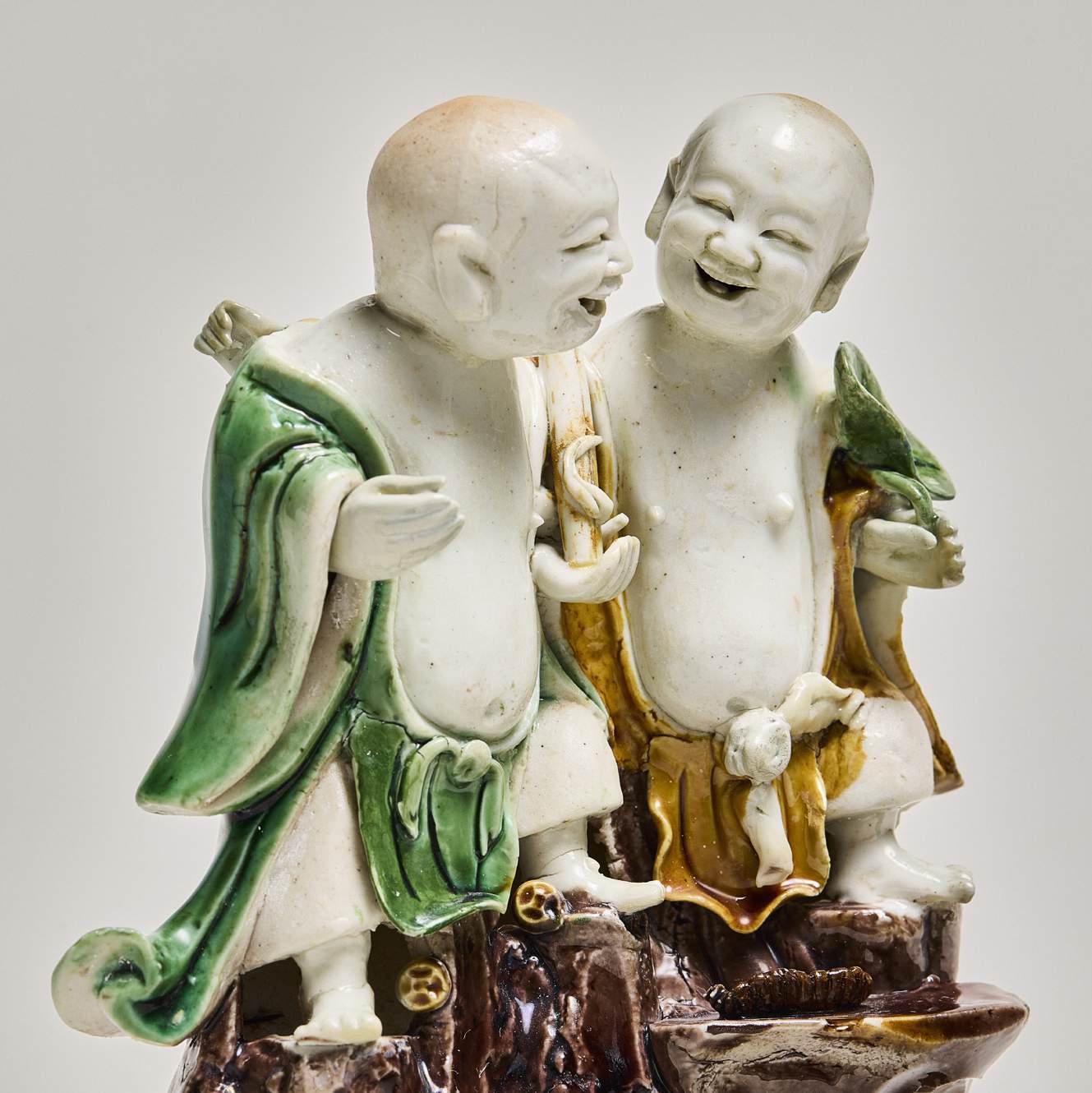
COLOPHON
FOR CHRISTIAAN JÖRG – WE STAND ON THE SHOULDERS OF HIS SCHOLARSHIP
EDITOR, TEXT & RESEARCH
NYNKE VAN DER VEN-VAN WIJNGAARDEN
OBJECTS
FLORIS VAN DER VEN
RESEARCH & PRODUCTION ASSISTANT
VITA NAESSENS
INTRODUCTORY ESSAY
PROF. DR. CHRISTIAAN JÖRG
LITERARY RESEARCH & CHINESE TRANSLATIONS
DR. MIN CHEN
PHOTOS
LEON VAN DEN BROEK PHOTOGRAPHY (OBJECTS)
ROEL MARIUS BROUWER (GALLERY)
BERNARD EILERS, FOTOMUSEUM ROTTERDAM (PORTRAIT BJV VAN HEES)
VAN HEES HEIRS (HUIS DE CEDER)
CONCEPT & DESIGN
ORANJE BOVEN, ’S-HERTOGENBOSCH
PRINTMAN, BREDA
WITH THE KIND SUPPORT OF:
MARIUS VAN DAM, JOSEPH ESTIÉ, MICHIEL VAN HEES,
ANNETJE VAN THIEL
© 2026 VANDERVEN ORIENTAL ART, THE NETHERLANDS
VANDERVEN ORIENTAL ART
NACHTEGAALSLAANTJE 1 5211 LE ’S-HERTOGENBOSCH
THE NETHERLANDS
TEL: +31 (0)73 614 62 51
INFO@VANDERVEN.COM
WWW.VANDERVEN.COM