LOOK GOOD FEEL GOOD
Early ‘70’s photo of the White Spot location at 1025 Robson St. PHOTO COURTESY OF CITY OF VANCOUVER ARCHIVES
LOCAL LEGENDS, GLOBAL FIRSTS, AND QUIRKY MOMENTS YOU PROBABLY NEVER NOTICED HIDING IN PLAIN SIGHT
Vancouver’s food culture has really boomed in recent years, but it’s been an interesting industry for decades.
From unusual themes to global empires, here are a few fun food facts to snack on.
1. Canada’s oldest restaurant chain
While chain restaurants are pretty dominant these days, that’s a more recent trend.
Many of the most well-known chains are only a few decades old. Starbucks can trace its roots back to 1971. Subway was started in 1965. McDonald’s is one of the oldest, founded in 1940.
In Canada, there are far fewer chains. Smitty’s, Tim Hortons and Pizza Pizza were founded in the 1960s. Harvey’s is a little older (1959), and Swiss Chalet first opened in the mid-1950s.
But it’s Nat Bailey’s White Spot that holds the title for the oldest restaurant chain in Canada.
The first brick-and-mortar White Spot opened in 1928, after Bailey ran a food truck for a few years.
2. Richmond McDonald’s has heritage golden arches
McDonald’s is pretty ubiquitous. It’s the first thing people think of when they hear “fast food” in most cases, and with more than 40,000 stores there are more places in the world to buy a Big Mac than any other burger.
But it wasn’t always a global empire. Back in the days when it was growing, Metro Vancouver was an important milestone for the company.
In 1967, the golden arches were erected for the first time on land not inside the U.S. That was at No. 3 and Bennett roads in Richmond.
3. The first non-Seattle Starbucks
Given Vancouver’s similarity and proximity to Seattle, it may not be a big surprise that the massive coffee corporation that sprang up out of the Emerald City landed in Vancouver before
anywhere else.
The first Vancouver location is still going at the old CPR station that’s now Waterfront Station.
It opened March 1, 1987, just a few months before the first Starbucks in Chicago, which marked the coffee chain’s expansion outside of Seattle.
There’s a plaque at the Vancouver location now.
4. Eat like you’re in the sky
These days airplane food has a less than remarkable reputation. Whether it be microwaved mush or bland dishes, the experience of eating midair is somewhat muted by what’s usually offered on longer flights.
But in the 1940s and ’50s the glamour of air travel led to the creation of a cafe in downtown.
Clancy’s Sky Diner was set up so people could (sort of) feel like they were dining on a plane.
Archival photos show the narrow cafe on Granville Street was remodelled to look like the inside of a plane, including a rounded ceiling with panels that looked like they could store bags. The windows also looked like they could have been from a plane.
5. Dad’s Cookies
Dad’s Cookies’ recognizable yellow packaging can be spotted at most chain grocery stores, and that’s thanks to a local bakery.
While the brand started in L.A. in 1929, it was franchised, and Ernest Wheeler started a bakery in 1930 at the corner of Broadway and Yukon, just steps away from city hall, according to a plaque located there.
The American franchise went under and it was Wheeler’s bakery, along with a couple of other Canadians, that kept the brand alive. The Vancouver company took over the other locations and ended up moving to Toronto, before Dad’s was sold. The brand is now part of Nabisco. ❚
WORDS: BRENDAN KERGIN
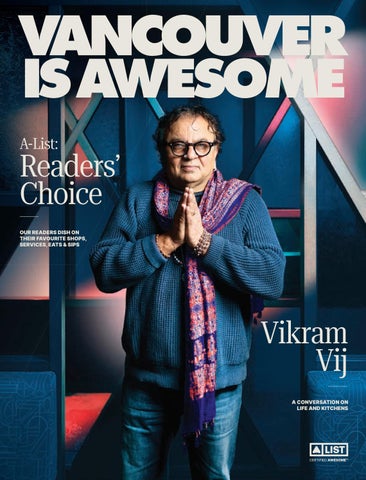
A conversation with VIKRAM VIJ
“MY LIFE IS ACTUALLY A KITCHEN”
After decades as one of Vancouver’s most recognizable chefs, Vikram Vij has finally figured himself out.
“When you’re 40, you struggle with it. It’s like, why am I doing this? What am I doing here?” he says. “At 62, it’s like another 20 years to go. Ain’t going to change.”
“It’s actually self-awareness, a little bit of denial and a lot of like, fuck it,” he adds. “There comes a point where it’s like, ‘What am I going to do? Stop being myself now?’”
Once described by chef, author and traveller Anthony Bourdain as “a strange and wonderful mix of idealistic hippy and smart businessman,” Vij is one of the longtime pillars of Vancouver’s food scene and a selfdescribed ambassador of India to a city with deep ties to the country.
For more than three decades he’s pushed the boundaries of Indian food in Canada, and in doing so hosted prime ministers, royalty (rock and regular) and stars of all stripes.
Life is like a kitchen
The kitchen is the perfect place for the drama and the chaos of Vij.
“Life reminds me of a kitchen. You’re
not just making a dish. You’re not just making a salad. You’re making a salad with a soup and garnishing this, and frying this and frying that,” he says.
Like a thick sauce, the metaphor extends.
“My life is actually a kitchen: sometimes a disastrous kitchen, sometimes a very organized kitchen, sometimes a messy kitchen, and sometimes, what am I doing in a kitchen? Like, what did I do? Why did I do this?”
“I could be homeless tomorrow, but if somebody looks at me and says, you know, that man changed the way Indian food is perceived in this country, I could die tomorrow and be fine,” he says.
When Vij’s opened in South Granville in 1994, he was pushing the limit and moving into an area that hadn’t experienced fine Indian dining.
Some may find that stressful, but the chaos keeps him centered.
“Chaos keeps me calm. If I don’t have chaos, I create chaos. I am the kind of person who, if I don’t have stress in life, I can’t survive,” he says. “That is my nature. My nature is constantly battling, arguing, fighting, discussing, thinking, overthinking, underthinking.
“Like, I don’t know how to relax and because I don’t smoke pot, my life is a constant jambalaya of so many things,” he says.
Fighting for Indian cuisine
Since he launched Vij’s, he’s fought for decades for Indian cuisine’s rightful place at the table.
“I was the first one who was not a hole in the wall, who had created a restaurant, a fine dining establishment with proper napkins and things like that.”
Now Vij’s has a Michelin Bib Gourmand Award, but Indian food hasn’t always gotten its share of respect.
“Don’t tuck it under the carpet, don’t call me ethnic, don’t call me brown, don’t call me this. If you’re going to pay $30 for a steak somewhere, you’re going to pay $30 for my curry as well, because of the love, the passion for the food.”
“Why should a samosa be cheap?” he adds. “It’s still hand-rolled, the people have to be paid properly, the potatoes are beautiful, and the flour is great. Why should a samosa be cheap?”
“But a croissant, which is the same amount of labour, same amount of love, the same amount of effort that goes into rolling that, you’re ok to pay $7 for it.” ❱❱
WORDS: BRENDAN KERGIN // IMAGES: ANDY WHITE
Bourdain and Vij visit Vancouver’s Punjabi Market
Respect for different foods, kitchen staff, and each other, was an important part of the relationship between Vij and Anthony Bourdain.
While in Vancouver, Vij and Bourdain visited Vancouver’s Punjabi Market together.
“All these people are coming up and saying hello to me and taking pictures with me and they want to talk to me,” Vij says. “And here’s Anthony Bourdain, like such a well-known chef, totally and
completely ignored. Like, nobody is coming and talking to him, nobody knows who he is, or why he is there.”
It was then Vij says he noticed Bourdain’s ego had been bruised a little.
“I just looked at him and said to him very politely, ‘Dude, this is my town.’ And he just looked at me, and he laughed, and that was a moment that we just both had so much respect for each other.”
“We had such great chemistry after that.”
He notes that while they were at Vij’s, Bourdain sat with the staff, a choice that mirrored the respect Vij has for kitchen workers.
“Even though the ladies in the kitchen didn’t speak a word of English and obviously he didn’t speak Punjabi,” Vij says. “Just eating humbly like everybody else, like eating spinach and a chapati, was such a big deal.”
Aside from putting a spotlight on Vij and his work, Bourdain had another impact on the Vancouver chef.
“What I learned from him was to explore the world, travel the world and that’s what we do. We, [my partner Jennifer Muttoo] and I, go on these trips … and experience food and enjoy food and experience things and that is what motivates us.” ❱❱
“I TOLD PIERRE ELLIOT TRUDEAU AND JUSTIN TRUDEAU THAT THERE WAS A 20-MINUTE WAIT FOR A TABLE, AND THEY WENT QUIETLY AT THE BACK AND WAITED LIKE EVERYBODY ELSE”
Famous guests
Aside from Bourdain, Vij has hosted numerous other notable names.
“One of my quintessential guests was Pierre Elliot Trudeau, coming with Justin at the time. That, to me, was very, very pivotal,” Vij says.
It was after Pierre’s stint as Prime Minister, but before Justin’s. And while Vij had arrived in Canada in 1990, after the former’s time as prime minister, he recognizes how Pierre impacted his life.
“For me, Pierre was not a celebrity,” Vij says. “He was a man who opened the doors, who put policies in place to allow me to come in and fulfill my dreams.”
That aside, the original Vij’s restaurant was first-come, first-served, so the father and son had to wait their turn.
“I told Pierre Elliot Trudeau and Justin Trudeau that there was a 20-minute wait for a table, and they went quietly at the back and waited like everybody else,” Vij says.
Years later, Justin returned with his young family.
“When he came with Sophie and the kids, I remember one night, I couldn’t get him in because it was so busy. And everyone was looking at me, saying, ‘Is he going to say no to him?’”
“And I’m like, ‘He just has to wait like everybody else does.’ And he went to the restaurant next door, which was Rangoli (Vij’s former sibling restaurant) and he had a fabulous dinner there.”
A more recent guest was a little more stressful, at first. ❱❱
VIKRAM VIJ
“Mick Jagger was amazing because they were supposed to come in at 7:30 p.m. on a Saturday night. It was so busy. It was packed. I was stressing out. I had no idea how I was going to do it.”
The rock star’s attitude worked in Vij’s favour, however.
“They showed up around 9:30 or 10 p.m., late at night, which eased the pressure. And he sat on the patio and he treated me with so much respect and love. And we talked about cricket and Canadian politics.”
Peacock book
Among his ventures outside the kitchen (sort of) is a recent book he published with Muttoo.
“It looks like a peacock. And the reason why it looks like a peacock is because we both believe we are peacocks,” Vij says. “We love our colors and we love dancing around and love being who we are.”
It should be noted Vij’s incoming project at the new Oakridge Timeout Market will be called Peacock.
The book, though, is called My New Indian Kitchen, but it’s not for people looking for traditional Indian recipes. Vij and Muttoo wanted to go beyond.
“The cookbook is not an Indian cookbook. It has no boundaries,” he says.
Inside are baking recipes, goulash, a rice bake of Mutu’s, cookies and chai tiramisu.
“It’s a global cookbook,” he adds.
Legacy of a local giant
While he’s collected awards, attention and accolades, there are two things Vij hopes he’s remembered for: treating his staff with respect and dignity and advancing Indian cuisine.
“A lot of restaurants at the time, I’m talking about 32 years ago, were quietly underpaying their kitchen staff because that was the norm at the time,” Vij says.
When he opened his restaurant, he wanted to change the norm, he says.
“You’re going to get a proper paycheque. You’re going to take the day off. You’re going to get the sick leave. You’re going to get all of that stuff,” Vij says.
“They managed to send their kids to proper schools and educate them,” he adds, “That to me is fundamentally giving freedom to someone.”
At the same time, his role in the food world is a key ingredient in his story, too.
“I think the Wikipedia page should say: ‘He came with the purpose of bringing awareness to the country and the cuisine that he loved. And he managed to be proud of both cultures.’”
“I THINK THE WIKIPEDIA PAGE SHOULD SAY: ‘HE CAME WITH THE PURPOSE OF BRINGING AWARENESS TO THE COUNTRY AND THE CUISINE THAT HE LOVED. AND HE MANAGED TO BE PROUD OF BOTH CULTURES.”
VIKRAM VIJ