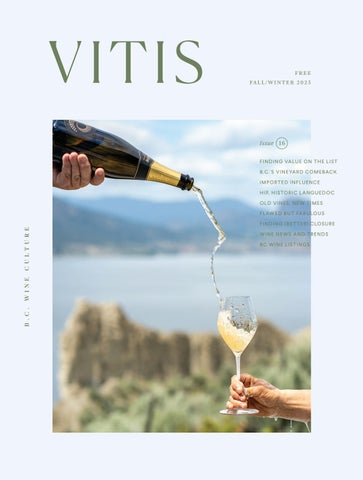
VITIS • Issue 16 • Fall/Winter 2025

Page 1


FREE FALL/WINTER 2025 Issue 16

FINDING VALUE ON THE LIST

B.C.’S VINEYARD COMEBACK IMPORTED INFLUENCE

HIP, HISTORIC LANGUEDOC

OLD VINES, NEW TIMES

FLAWED BUT FABULOUS FINDING (BETTER) CLOSURE

WINE NEWS AND TRENDS

BC WINE LISTINGS

06 – SIPS & NIBBLES

News and trends from wine country.

12 – WINE LIFE

Wine flaws that secretly make us swoon. by Cristine Campbell

16 – OENOPHILE

The newcomers who helped build B.C.’s wine culture. by Tim Pawsey

19 – WHAT SOMMS SAY

The secret to finding the best values on the wine list. by Kate

24 – MAKE IT MARITIME

Exploring the limits of cool-climate winemaking in New Brunswick. by Christine Sismondo

28 – WORLD OF WINE

Vast, historic Languedoc makes an inspiring comeback. by Tim Pawsey

32 – FOOD FOR THOUGHT

How Old Vines helped create the ideal of a winery restaurant. by Joanne Sasvari

36 – LISTINGS

Your guide to B.C.’s wineries.

42 – WINE GEEK

Stelvin: Finding closure. by Christine Campbell

PUBLISHER: Gail Nugent • gnugent@lodestarmedia.ca

EDITOR: Joanne Sasvari • jsasvari@glaciermedia.ca

DESIGN & PRODUCTION MANAGER: Tara Rafiq • trafiq@lodestarmedia.ca

COVER IMAGE: Evolve Sparkling House

SOCIAL MEDIA EDITOR: Stephanie Leblanc Vitis.ca @VitisMag

PUBLISHED BY: Lodestar Media

303 W. 5th Ave., Vancouver, BC V5Y 1J6 778-240-4010

© Vitis 2025 This issue is complimentary.

Photo courtesy of Magnetic Hill Winery
Photo courtesy of Evolve Sparkling House

Contributors

JOANNE SASVARI is editor of Vitis, The Alchemist and YAM magazines. She is a WSET-certified writer who covers food and drink for publications including Food & Wine and Edible Vancouver, and is the author of the bestselling Island Eats and Okanagan Eats cookbooks.

CHRISTINE CAMPBELL is a Vancouverbased freelance and travel writer, educator and host of the Wine Soundtrack Canada podcast. She is WSET-certified and is a French Wine Scholar. Follow Christine’s adventures in wine and abroad at girlsgogrape.com.

KATE DINGWALL is a WSET-trained wine professional and a writer, editor and photographer covering spirits, food, culture and travel for publications such as Food & Wine and Serious Eats

TIM PAWSEY writes and shoots at hiredbelly.com as well as for publications including Quench, TASTE and Montecristo. He’s a frequent wine judge and is a founding member of the B.C. Hospitality Foundation.

CHRISTINE SISMONDO is a National Magazine Award-winning writer who covers spirits, wine, bars and cultural history for numerous publications, and is the author of America Walks into a Bar.

C'MON OVER!

It’s no secret that, here at Vitis, we love wine. We love its aromas and flavours, we love supporting the people who grow it, make it and serve it, and we really, really love nerding out about obscure wine-soaked factoids.

Most of all, though, we love the way wine brings people together.

For millennia, wine has been at the centre of our gatherings. It has played an important role in social rituals dating back to the days of ancient Greece and Rome and even further back to 6000 BC Georgia. Consumed in moderation, it enhances conversation, breaks down barriers, improves the flavour of food and makes the stresses of the day seem less, well, stressful. As Benjamin Franklin once said: “Wine makes daily living easier, less hurried, with fewer tensions and more tolerance.”

You’d think, given that society is in the midst of a global loneliness epidemic, we’d be raising a glass to the power of wine to connect us. Instead, the exact opposite is happening. Young people especially are drinking (and socializing) less. So are older people. Both these groups are more likely to be lonely, and loneliness increases the risk of depression, anxiety, dementia and serious health conditions such as heart disease and stroke.

So last year an American wine journalist named Karen MacNeil, author of The Wine Bible, launched an initiative called Come Over October. The idea is simple: to encourage friends, family and colleagues to “come over” during the month of October, share some wine and celebrate in-person connection.

The idea has spread across the continent to become an international movement. It’s one we’re fully behind, though we’d like to suggest that any time is a good time to get together with the people you care for. A glass of wine—even non-alcoholic wine—just makes it all better.

The website comeoveroctober.com has loads of tips and ideas for hosting events indoors or out, at your home or your business. You don’t have to serve wine, of course, but where’s the fun in that?

Sasvari, editor

This fall, invite your friends to gather over a glass of wine. Photo courtesy of Wines of British Columbia

Sips & Nibbles

GOOD NEWS FROM B.C.’S VINEYARDS

Jeff Guignard is feeling optimistic, and he’s not the only one.

“There’s a palpable sense of excitement out there after a couple of difficult years,” says the CEO of Wine Growers BC. “There’s a lot of challenges, but there’s a lot of hope.”

Since stepping into the WGBC job in April, Guignard has been keeping a close eye on the state of B.C.’s vineyards and the recovery of an industry that contributes some $3.75 billion in provincial economic growth each year. And as harvest begins in wine country, he sees signs of promise.

“Zoom in and we are having a gorgeous, gorgeous crop out there. I suspect winemakers are going to be giddy with excitement,” he says. “I’m convinced we’re going to look at 2025 as one of our best vintages ever, especially after a couple of really hard years.”

But, he cautions, it’s not all good news: “Zoom out and it’s still a really small crop.”

Although the vines are loaded with exceptional fruit, the crop is expected to be 55 to 60 per cent of that harvested in 2022. That’s because of the high number of vines that had to be replanted or are still recovering after the devastating cold snap of 2024.

An average year sees a harvest of 30,000 short tons of grapes; in 2022, it was 44,000, an exceptionally large, high-quality, bumper crop. In 2023, only 18,000 short tons were harvested. In 2024, almost none.

One short-term solution for some wineries has been importing replacement grapes for the 2024 vintage. WGBC is close to finalizing an agreement with the government to bring in replacement grapes again this year for those who need it. “It was a matter of necessity for some people,” Guignard

says, but emphasizes that the intention is to return to 100 per cent B.C. grapes as soon as possible.

It has certainly been a challenging few years for B.C.'s wine industry. In addition to the deep freezes of December 2022 and January 2024, there have been heat domes, wildfires, the ban on short-term rentals and issues with cross-border sales. But all those stressors have also created opportunities. As Guignard says, “All of a sudden a lot of tough conversations become possible.”

Once the vineyards have been restored to health, he’s excited to get to work unlocking the economic and tourism potential of a region that typically draws 1,191,500 visitors a year. For instance, he’d love to see a five-star hotel and maybe a larger airport in Penticton, and perhaps even a Michelin-starred winery restaurant or two in the valley.

“People travel for food, wine and culture and we have all of that in B.C.,” he says. “We’re an economic and cultural treasure.”

Photo courtesy of Wine Growers British Columbia

TRAVEL PLANNING HUB FOR B.C. WINE LOVERS

If you’re the person in your friend group who always ends up planning your B.C. wine country adventures, you’ll be glad to learn that you now have help.

Wine Growers British Columbia has just revamped the WineBC.com website to become the ultimate planning tool for discovering the province’s wine regions. Designed to be a strategic tool to drive wine tourism, support local wineries and celebrate all that makes B.C.’s wine regions so remarkable, its relaunch is timed to coincide with WGBC’s “Extend Your Summer” campaign, which encourages visitors to make the most of harvest time.

Among its features are a winery finder that lists all of B.C.'s 300-plus wineries, including essential details about each and direct links to their websites for quick bookings. The website also offers regional pages that feature useful information about each, as well as curated itineraries by region.

The project was supported in part by Pacific Economic Development Canada (PacifiCan), the dedicated federal economic development agency for British Columbians.

“Every visit to BC is an invitation to discover the people and places that make our province unique,” Gregor Robertson, the minister responsible for PacifiCan, said in a press release. “Through PacifiCan, we are investing in a new tool that helps B.C.'s wine country attract more visitors, extend the tourism season and boost economic growth across our communities.”

DESIGNED TO SWIRL

The way the story goes, Maximilian Riedel came up with a line of stemless wine glasses when his beautiful Vinum stems wouldn’t fit into the cupboards in his New York kitchen. The “O” series he launched was fun, practical, affordable and solved a common problem.

So what to make of the Aequilibrium wine glass by Audacem? It, too, is stemless, but with a tilted base that comes to a point so it doesn’t sit flat, but rather rolls around, swirling your wine so you don’t have to. Inadequate swirling is not, perhaps, the most pressing concern for most wine drinkers, but there’s no denying that it’s hard to take your eyes off the Aequilibrium in action.

This luxe glass is hand-blown and Italian-designed, crafted in small batches by skilled artisans, designed to enhance the aromas and flavours of wine, and comes with the kind of price tag you would expect (around $120 apiece). audacem.co

Photo courtesy of Wine Growers British Columbia

MAKING BUBBLES IN THE NAME OF MOTHER NATURE

You could say that fighting for what is right comes naturally to Telmont Champagne.

The acclaimed house was founded in 1912 by Henri Lhôpitel, one of the leaders of the 1911 Champagne Riots, who battled to uphold the region’s high quality standards. Four generations later, as Telmont Champagne enters the Canadian market, the fight for excellence has a new aim: sustainability.

“We come to Canada with humility,” says Telmont’s CEO Ludovic du Plessis. “Canada is a land of nature lovers, and we believe Canadian bubble lovers will celebrate not only the taste of Telmont, but also the values we carry. In the name of Mother Nature!”

“In the name of Mother Nature” is no mere slogan. It’s the name of Telmont’s ambitious project to create the highest-quality Champagne while also becoming the first climate-positive Champagne house by 2030 and Net Positive by 2050.

Among its many initiatives, Telmont worked closely with glassmaker Verallia to develop the lightest bottle in Champagne—at only 800 grams, it’s 35 grams lighter than the standard. “We realized that our bottles are the main source of our carbon emissions … the less glass we use, the less CO2 is emitted,” says du Plessis.

Climate change threatens our world, our lives and our terroir. Therefore, embracing sustainability is not really a choice, it’s just common sense.

But lightweight bottles are just part of the fight. The bigger battle is against climate change.

“Climate change threatens our world, our lives and our terroir. Therefore, embracing sustainability is not really a choice, it’s just common sense,” says du Plessis.

Already average temperatures in Champagne have risen by 1.1°C. “We see harvests coming earlier, grapes ripening faster, acidity levels shifting. Frosts, droughts and hailstorms are more frequent and more violent. The very balance that gives Champagne its unique identity is under threat,” says du Plessis.

In response, Telmont is well on its way to converting all its vines to organic and regenerative viticulture and encourages consumers to seek out wines produced with organic grapes.

“Savour each glass for its quality, but also for the respect it shows to nature,” he says. “See for yourself how vibrant, radiant, full of life and energy are organic Champagne cuvées—I call them the ‘happy wines.’ ”

Photo courtesy of Telmont Champagne

RAISE A GLASS TO THE NEW EVOLVE

Is it possible to have too much bubble? We say no, and that’s why we’re so thrilled about Evolve Sparkling House, the newest winery on the Naramata Bench.

Even before it opened its doors in late July, Evolve had already been raking in the accolades—among other awards, it was recognized as Canada's Top Sparkling Producer and its 2018 Brut Nature crowned Canada’s Best Sparkling Wine at the 2025 All Canadian Wine Championships. Credit talented winemaker Lynzee Schatz, formerly of Chandon Australia, who blends classic technique with a deep belief in what the Okanagan can produce.

The wine is spectacular, but then so is the stylishly contemporary space with whimsical details like the chandelier that evokes champagne bottles or the witty LED sayings in the bathrooms (“Let’s get fizzical,” says one). This place may have some of the most comfortable furniture in wine country, and a killer view from its floor-to-ceiling windows and two large patios—just up the hill from Penticton, it overlooks the Kettle Valley Rail Trail, hoodoos and shimmering Okanagan Lake.

Evolve offers a variety of tasting options, food pairings crafted by Chef Bruno Terroso from OROLO Restaurant + Cocktail Bar and endless potential for the ‘gram. It’s the perfect blend of fun, style and substance—and of course, plenty of bubbles. timewines.ca/evolvesparkling-house

WINNING ON THE WORLD STAGE

Canada may be among the world’s smallest and youngest wineproducing nations, but it is steadily proving that it has the potential to be among the best.

Take the most recent Decanter World Wine Awards, announced in June. Of the 57 countries that submitted wines to the world’s largest international wine competition, Canada took home 347 medals and placed ninth overall, ahead of giants including Chile, New Zealand and the United States.

Of those medals, 148 were awarded to B.C. wineries, including a platinum for Inniskillin’s 2022 Riesling Icewine and five golds, for 1 Mill Road’s 2023

Chardonnay, CedarCreek’s 2022 Platinum Pinot Noir, South Kelowna Slopes, and 2022 Aspect Pinot Noir, Laughing Stock’s 2023 Blind Trust White and Mission Hill’s 2020 Quatrain.

What is remarkable is not just that Canada can compete with regions that produce many, many times more wine (Canada’s entire production is 28th in the world, slightly larger than Switzerland’s), but that it produces such a wide range of varieties and styles.

Meanwhile, B.C. wineries also shone at the 2025 WineAlign National Wine Awards of Canada.

Of Canada’s top 25 wineries, 15 were from B.C., including the top three: Mission Hill Family Estate, which was named Canada’s Winery of the Year for a remarkable sixth time; Laughing Stock Vineyards, which was named Best Performing Small Winery; and Meyer Family Vineyards.

And that’s not all—B.C. wineries also dazzled at the All Canadian Wine Championships. A total of 911 wines from 163 wineries were entered; of those, B.C. wineries took home three trophies as well as 20 double gold, 34 gold, 45 silver and 52 bronze medals.

Congratulations to all the winners!

For the full lists of winners visit decanter.com/ decanter-awards, allcanadianwinechampionships. com and winealign.com/awards.

Photo courtesy of Evolve Sparkling House
Photo courtesy of 1 Mill Road

EVENT CALENDAR

Clear your schedule for these wine-soaked experiences.

WINE CAPITAL WEEKEND

September 19 to 21

Swing by Oliver for three days of live music, dancing, good food, good wine and great fun. It all begins with the Kick-Off Party at District Wine Village, continues with the Cask & Keg Festival and wraps up with the familyfriendly Festival of the Grape, which features the hilarious Grape Stomp, food trucks, interactive Kids Zone and artisan Merchant Market. It’s the most fun you can have in wine country. visitoliver.com

SWIRL AROUND BC WINE EXPO

September 23

Held each fall in Vancouver, this is Wine Growers BC’s premier annual event, a day of immersive tasting and education at the Pan Pacific Vancouver. This event is exclusive to key wine trade and media professionals, including influential buyers, sommeliers, educators and journalists. winebc.com

MICHELIN GUIDE VANCOUVER LAUNCH

October 2

All Vancouver foodies will be eagerly awaiting the announcement of the 2025 entries into the prestigious guide. Catch the latest at: guide.michelin.com/ca/en/ british-columbia/ca-vancouver/restaurants.

VICTORIA INTERNATIONAL WINE FESTIVAL

October 2 to 4

Now in its 12th year, the festival has proudly shifted its spotlight to homegrown producers with a renewed focus on Canadian wine from Vancouver Island to Nova Scotia. At the same time, attendees will be able to sample over 450 wines from 15 different countries at the grand tastings to be held at the Victoria Conference Centre, which is also the location for master classes and seminars. vicwf.com.

OKANAGAN FALL WINE FESTIVAL

October 3 to 12

The festival returns with two signature events: British Columbia Wine Awards, October 3 at Okanagan College, Penticton Campus; and the Sunset Sip—The Ultimate Fall Wine Experience on October 11, featuring local wine stations all along Kelowna’s Sunset Drive. And don’t forget the online auction in support of the Okanagan Wine Festivals Society, one of Canada’s largest (and at 45 years old, longest-lasting) not-for-profit wine industry festival and marketing organizations. Check the website for details. thewinefestivals.com

WHISTLER CORNUCOPIA

November 6 to 16

Whistler’s annual celebration of food and drink returns this November for its 29th year with all the signature events, seminars, dinners, parties and tastings you love, including the flagship CRUSH Grand Tasting. whistlercornucopia.com

Future in the vines

SUSTAINABLE FARMING FOR GENERATIONS TO COME

When Christine Coletta and Steve Lornie purchased a previously undiscovered 320 acres tucked away in the hills behind Summerland, they were struck by its natural beauty. And while the land that’s now become Garnet Valley Ranch suited their purpose of establishing a unique, high-altitude vineyard, they knew from the beginning that they had to keep the scenic gem as much as possible in its natural state.

“From day one we’ve farmed this property respectfully,” says Coletta. “We haven’t changed the landscape or added infrastructure that can’t be undone. It’s one thing to convert an apple orchard to a vineyard. But once you start building on ALR [Agricultural Land Reserve] land, it changes it forever.”

The winery owner recalls famed enologist Alberto Antonini “pointedly” telling her that the project would be “30 to 40 years in the making—and by then you won’t be here.”

“It’s for the future, for the next generation to carry on the work we’ve started," Coletta says. "So it’s really important for us that we leave the site in a place where it's as farmable as possible.”

To that end, only a portion of Garnet Valley Ranch (about 20 per cent, all of it certified organic) is planted to vines. Some is given over to a variety of food crops, as well as the possibility of livestock in the future “to create balance and biodiversity,” but most of the land remains in its natural state.

This past year Coletta and Lornie have replanted about 10 acres of vines lost to the "big freeze" of 2024 and pulled up another five acres to replant and focus more closely on varieties such as Pinot Gris, Chardonnay, Gamay Noir and Pinot Noir. As protection against importing diseases such as crown gall, the winery uses only its own rooted plants.

Aside from vines, earlier this year they also opted to plant apple trees and berry plants, which will support the

launch of Orchard + Field, an apple-based low-alcohol beverage. At 5% ABV and lower sugar content, the crisp sparkler “makes a refreshing, quite ‘grippy’ drink on its own, or over ice with soda,” says Coletta. (Find it soon, in a lightweight, screw-top, resealable, 750 mL bottle, at Save On Foods and at better B.C. Lower Mainland wine retailers.)

While it may be secluded, Garnet Valley Ranch (along with neighbouring Solvero Winery) is only a few minutes’ drive from downtown Summerland, with visitors by appointment very much welcomed.

Breathtakingly beautiful, surrounded by wide open spaces, Garnet Valley Ranch is home to the small Outlook tasting room with its stunningly picturesque patio, as well as a newly added small pavilion for larger groups of up to 100 people.

Along with savouring a curated flight of six wines from the Garnet Valley and Free Form portfolios, guests also learn details about the project’s impressive sustainable initiatives. Most choose to linger longer over a favourite glass, perhaps with a handcrafted charcuterie board, to drink in the wilderness beauty.

“Being able to showcase the property is extremely rewarding," says Coletta. "Garnet Valley Ranch, truly, is a one of a kind.”

Lionel Trudel photo
Lionel Trudel photo

Perfectly imperfect

FIVE WINE FLAWS YOU SECRETLY THINK ARE SEXY

In the world of wine, faults are the skeletons in the cellar—uninvited, yet undeniably fascinating. They’re the quirks that make a sommelier lean in for a second sniff, or cause a winemaker to purse their lips in professional curiosity. While the aim is for purity and precision, some “flaws” have a way of enhancing character, intentionally or not.

Here are five that can win you over.

BRETTANOMYCES (A.K.A. BRETT)

The wild yeast Brettanomyces has a bad reputation for barnyard funk, sweaty saddle or “BandAid” notes. In excess, it can smother fruit and obliterate terroir. But in tiny doses, Brett can be a glorious seasoning, adding savoury complexity, earthy intrigue and a touch of rustic charm to Rhône or Bordeaux reds and certain old-school Italian bottlings. Think of it as the leather jacket of the wine world: edgy, but best worn in moderation.

OXIDATION

When oxygen has its way with wine, you’ll see it in amber hues and taste it in nutty, sherry-like notes. Left unchecked, oxidation is spoilage. But a deliberate flirtation with oxygen—through barrel aging, oxidative winemaking styles or simply a well-matured bottle—can yield haunting aromas of walnut, dried fruit and toffee. Vin jaune from Jura, tawny Port and even aged white Rioja from Spain wear oxidation proudly, proving that oxygen isn’t always the enemy.

REDUCTION

Reduction is the opposite of oxidation: a wine deprived of oxygen during fermentation or aging. At its worst, it can smell like rotten eggs, burnt rubber or canned asparagus. But handled with skill, reductive characters add tension and intrigue— think struck match, flint or smoky gunpowder. These notes can lift a Chardonnay into the realm

of the sublime, giving it a mineral drive that keeps you coming back for another taste.

VOLATILE ACIDITY

VA is mostly acetic acid (vinegar) and ethyl acetate (nail polish remover). High levels are a fault, creating sharp, unpleasant aromas. But a whisper of VA can make a wine sing—lifting aromas, adding aromatic intensity and giving reds like Barolo, Brunello or Amarone a head-turning perfume. In sweet wines, like Sauternes or Tokaji Aszú, it can bring brightness and prevent the wine from tasting cloying. The key is balance: Too much, and it’s a dealbreaker; just enough, and it’s complexity.

SULPHUR DIOXIDE

SO2 is the workhorse preservative of winemaking, guarding against oxidation and microbial spoilage. But it has a sensory side: Free SO2 can smell like struck matches or freshly lit candles. In large amounts, it’s distracting; in low doses, it’s a fleeting note that can add crispness and freshness to whites, especially Sauvignon Blanc or Riesling. For some wine lovers, that momentary whiff is part of the wine’s stylistic signature.

THE ALLURE OF IMPERFECTION

What unites these “sexy flaws” is intention and proportion. In the right hands, what is technically a fault can become a stylistic choice, adding dimension, complexity and emotional pull. The difference between ruin and refinement is control: Winemakers who understand these variables can coax them into the wine like a dash of seasoning, while those who don’t risk overpowering the final result.

Flaws, when tamed, can be part of a wine's story—adding depth, uniqueness and sometimes even beauty. Rather than dismissing them outright, it’s worth considering whether they contribute to the wine’s identity. After all, perfection in wine (or anything) is rarely as memorable as personality.

Oxidation may be a flaw in some wines, but it's also what gives oloroso sherry its distinctive nutty flavour. iStock/Getty Images Plus/barmalini photo

Thanksgiving in West Kelowna

FOLLOW THE WINE TRAIL TO TASTY BITES AND SEASONAL SIPS

is one of the

There’s a lot to be thankful for here in West Kelowna, where vines sprawl from the shores of Okanagan Lake right up the sides of Mt. Boucherie, the extinct volcano that gives the wines so much of their character.

There are 17 wineries in this small region, ranging from the small and quirky to the grand and impressive, including some of the oldest, best-established estates in all of B.C. And the best way to discover them is to follow the Westside Wine Trail, which winds its way through tastings, dining, live music, art shows, special events and some of the most spectacular scenery you’ll find anywhere.

Thanksgiving is one of the best times to visit West Kelowna. Harvest is well underway, and the weather is still warm and sunny. It's a perfect time for enjoying a glass of wine on a patio and, if you’re not in the mood to roast a turkey, for enjoying the exceptional dining options offered by many of the wineries.

The Terrace at Mission Hill Family Estate Winery and Old Vines Restaurant at Quails’ Gate Estate Winery are among the oldest and most highly regarded winery restaurants in all of B.C. TULA, which serves refined Indian cuisine at Little Straw Vineyards, is among the newest.

But there is also The Modern Butcher at Mt. Boucherie, the Beach Café at Frind, 31 Charkay at Grizzli Winery and the gourmet poutine and milkshakes at the Roots Sustainable Eats food truck at Off the Grid Organic Winery.

Then again, if you do plan to enjoy the full Thanksgiving feast, there is no better place to find a wine that pairs perfectly with the big bird and all its accompaniments. (See the sidebar for a handy pairing guide.)

It’s not just the wide range of grapes grown here, which range from elegant expressions of the familiar Chardonnay, Pinot Noir and Pinot Gris to the lesser-known Chasselas, Lemberger and Zweigelt. It’s also the long, hot sunny days, the cooling effect of the lake and a unique soil that’s loaded with mineral deposits as well as glacial till, volcanic rock and large boulders. It all combines to create characterful wines that are juicy and refined, bright with acidity, and perfectly food friendly.

It's fair to say that a day spent on the Westside Wine Trail, tasting wines and stocking the cellar, is a day very well spent.

For more ideas and information, or to plan your journey, be sure to visit thewestsidewinetrail.com.

Old Vines Restaurant at Quails’ Gate Winery
oldest winery restaurants in B.C.

WESTSIDE WINE TRAIL PAIRINGS FOR YOUR HOLIDAY FEAST

Ciao Bella Winery 2023 Pinozannte

Pairing: Smoked salmon canapés

Mt. Boucherie Reserve Syrah 2022

Pairing: Cheese and charcuterie boards

Niche Wine Company 2024 Sauvignon Blanc

Pairing: Oysters with green apple mignonette

Tender Hope Winery

2020 OH! Honey! Riesling

Pairing: Zucchini leek gratin

Mission Hill Family Estate

2022 Perpetua Chardonnay

Pairing: Brown butter gnocchi

Crown & Thieves 2019 Broken Wing Merlot

Pairing: Chorizo and red sauce rigatoni

Black Swift Vineyards

2023 Braided Hill Chardonnay

Pairing: Sablefish with mushroom risotto

The Hatch Winery 2024 Dynasty White

Pairing: Lemon and dill roast chicken

Kalala Organic Estate Winery 2015 Aspire

Pairing: Grilled marbled steak with brown butter

Beaumont Winery 2020 Gamay Noir

Pairing: Venison stew

Quails’ Gate Estate Winery

2022 Stewart Family Reserve Pinot Noir

Pairing: Roasted turkey and cranberry sauce

Volcanic Hills Estate Winery 2022 Eruption

Pairing: Red-wine-braised short ribs

Little Straw Vineyards 2022 Cabernet Sauvignon

Pairing: Herb-crusted rack of lamb

Off the Grid Organic Winery

2021 Blauer Montag-Zweigelt

Pairing: Mushroom chorizo flatbread

The Gallery Winery 2019 Inspiration Sparkling

Pairing: Cream puffs

Frind Estate Winery NV Sparkling Brut

Pairing: Triple cream brie and honeycomb

Grizzli Winery 2018 Late Harvest Riesling

Pairing: Caramalized pear bread pudding

WINE-INFUSED CRANBERRY SAUCE

Serves 6 to 8

INGREDIENTS

1 (12 oz) package of fresh or frozen cranberries (about 4 cups)

1½ cups white granulated sugar

1 Tbsp finely grated orange zest

½ cup freshly squeezed orange juice

¼ cup Volcanic Hills Gamay Noir

METHOD

Preheat oven to 325°F.

Rinse cranberries and pour into an oven-safe and non-reactive baking dish.

Stir in orange zest, orange juice, sugar and the wine.

Place in the oven and bake for approximately one hour, stirring after 30 minutes. You want the mixture to simmer slightly so that the sugar can dissolve.

Remove from oven and let it sit in a cool place until the cranberries gel together. There might be a lot of liquid left, but most of it becomes a syrup as it cools.

Serve warm or cold.

Recipe courtesy of Volcanic Hills Estate Winery.

Outside influence

IMPORTED TALENT IS JUST PART OF THE OKANAGAN VALLEY’S UNIQUE BLEND

Tim Pawsey

When Mission Hill Family Estate owner Anthony von Mandl lured New Zealand winemaker John Simes from Montana Wines in 1992, it marked a pivotal moment proving that the Okanagan was capable of attracting significant talent from elsewhere. Just two years later the owner’s bold move was validated. Von Mandl says that when Simes’s 1992 Mission Hill Reserve Chardonnay won Best Chardonnay at London’s prestigious International Wine & Spirit Competition, “It was the first time I knew my dream had legs.”

(An aside: When revealed to the judges that the winning wine was, of all things, Canadian, they decided they had to re-taste it, just to be sure.)

While B.C.’s new generation of award-winning winemakers is very much home-grown, the Okanagan owes a good portion of its early success to significant skills imported from elsewhere. When Simes arrived, there were only a score of grape wineries in B.C. Within a decade, that number had blossomed to more than 70, not a few helmed by leading lights from around the world.

The terroir may be unique to the Okanagan, but its potential was harnessed in the early days by newcomers from New Zealand, France and elsewhere. Photo courtesy of Wine Growers British Columbia

But how much outside influence actually shapes the wines is questionable. Rarely do winemakers from elsewhere replicate their previous experience, although it can happen, says Haywire chief winemaker Matt Dumayne, who is also originally from New Zealand. He says he initially might have been guilty of that “until I came to understand the nuances of the valley and our soils and microclimates.

“The biggest thing overseas experience brings to the table is adaptability,” says Dumayne, especially when it comes to dealing with the unexpected. “Every year here is different climatically. Plus throw in massive extreme weather events such as fire, snow, very hungry wild animals and, of course, the freezes.”

ON THE EDGE

In 2001 Pascal Madevon was hired as the inaugural winemaker for Osoyoos Larose. An experienced oenologist and viticulturist from Bordeaux, with family ties to Burgundy, he landed in the Okanagan just 10 days before harvest—knowing little about the valley.

Madevon was surprised to find just how large was his new backyard, as well as how well-suited the climate was to growing grapes. Not to mention the sheer range of varieties grown from Vernon to Osoyoos. “It’s incredible, all in 175 kilometres,” he marvels. The winemaker, now much in demand as a consultant, had also been unaware that irrigation was permitted as, at the time, it was not in Bordeaux. “It was totally new for me,” he says. “Irrigation means you can control to an optimum the quality of the grapes.”

As far as what’s changed since? “The quality of the people working in the winery or vineyards,” he says and adds, “We’re the same as in France. For me, that’s good!”

Sandra Oldfield recalls arriving in the valley in 1993. The Tinhorn Creek Winery co-founder was fresh out of the viticulture and oenology program at UCDavis in Northern California. When her instructors learned where she was headed, they told her it was “impossible to make wine north of the California-Oregon state line.”

As one of the new winery’s co-owners, Oldfield says she was concerned not only about winemaking, but other critical issues, such as tourism. “Where was the map of all the wineries,” she asked, “and restaurants and hotels? Well, there wasn’t one. I really did feel like I was on the edge.”

For the first few vintages, Oldfield maintained close contact with her UCDavis profs, sometimes sending them “the weirdest, crazy numbers. And they were, like, ‘Those numbers don’t make sense for winemaking.’”

Oldfield says she then realized: “It really is true. It really was different up here, in the sense that the acids were so much higher, and the pH’s were so different.”

The biggest thing overseas experience brings to the table is adaptability. Every year here is different climatically.
Celebrated New Zealand winemaker John Simes was among the first outside experts to realize the potential of the Okanagan Valley—he crafted the 1992 Mission Hill Chardonnay that became the first B.C. wine to win a major international prize. Photo courtesy of Mission Hill Family Estate

SHORT, SHORT, LONG

Vancouver-born, New Zealand-raised and -educated, Tantalus Vineyards general manager and winemaker David Paterson reckons: “You can come here with all the international talent you like. But you soon realize there's lots of nuance and pitfalls that are unique to the Okanagan.” The bottom line? “You need to tweak and change your winemaking style to pursue the Okanagan and the unique fruit that we have here.”

Paterson sees the Okanagan as being “unique to anywhere else on the planet that grows the varieties we do.” And he highlights the “short, short season that is long. ... From bud break to picking is one of the shortest in the world,” he explains, “because we get such long days through the summer [with] so much sunlight, and all our growing degree days in a shorter period of time than a lot of regions closer to the equator.” It was vastly different from his prior experiences in Adelaide Hills, Central Otago and Willamette Valley.

Like Oldfield, Paterson also shared some “screamingly high” Riesling chemistry with his Southern Hemi-

You need to tweak and change your winemaking style to pursue the Okanagan and the unique fruit that we have here.

sphere mentors. “What do you mean you’ve got 21 brix and 13 grams of acid?” they asked. “Is that possible?” And then, “How does the juice taste?” “Amazing,” said the winemaker. “Well, just make the wine and see what happens.” He did. Okanagan Riesling never looked so good.

“Global knowledge is a great help,” says Haywire’s Dumayne. But “the great thing about winemaking is the constant learning process: Every year you gain something you can apply to future vintages.” He adds that, after 37 vintages, he’s “come to accept and hopefully apply a certain calmness and composure to winemaking.” No matter what happens, he assures, everything is going to be OK.

“Hopefully,” he adds, “with the base that Mother Nature gives us, we can create something special and unique to the Okanagan and most importantly delicious and worth remembering.”

THREE TO TRY

Narrative Cabernet Franc 2019
(Okanagan Valley BC VQA, $27)
Concrete aged; cherries, strawberry, silky.
Tantalus Pinot Noir 2022
(Okanagan Valley BC VQA $36)
Cherries, earthy; blackberry, cranberry, rhubarb.
French Door Héritage 2020
(Okanagan Valley BC VQA, $52) Red berries; plum, cassis, spice, mocha.
What outside experts bring isn't their way of making wine, but an adaptability to the unique local conditions, says Matt Dumayne, chief winemaker at Haywire Winery. Jon Adrian photo

Value vintage

THE RULES FOR FINDING BARGAIN BOTTLES ON A WINE LIST MAY NOT BE WHAT YOU THINK THEY ARE

When I was young, my mother told me of the holiest commandments. Thou shall not add ice to your wine. Thou shall not drink red wine with fish. And when buying a bottle, thou shall order the second cheapest one on the list.

She’d learned this information from friends, who had learned it from other wine drinkers. These guidelines spread across countries and continents, until they became the unwritten rules of ordering wine.

Somehow, as rumour declared, the second cheapest slot on the wine list became a place where sommeliers hid the best bottles. Ordering that bottle felt like a badge

of honour, like you were privy to insider information. You were cheap, but chic. Ordering the least-expensive bottle? Meant you were just cheap.

On some menus, this trick will absolutely work. But there are plenty of other ways to find value on a wine list.

THE SECOND-BOTTLE PLAY

Christian Hamel, the wine director at Toronto’s just-reopened Harbour Sixty and the newly minted Arianna, is quick to dispel the myth of the second-cheapest bottle.

“The notion that the ‘second-cheapest bottle is the best value’ has always amused me,” he says.

Mike Cooke, the assistant GM and sommelier at Wildlight Kitchen + Bar, finds that modern wine lists are priced more transparently than in the past. Photo courtesy of Wildlight Kitchen + Bar

He’ll go so far to argue that cheaper bottles often offer less value, not more. “Most wine lists are priced on a dynamic scale, with the steepest markups reserved for the entry-level selections,” says Hamel. “A $15 wine might appear at $60 on a list—a fourfold increase—while a $40 wine could be listed at $120, closer to a threefold markup.

“In other words, by paying twice as much as the cheapest option, you are often drinking a wine that costs nearly three times more at its source.”

Mike Cooke, who runs the wine program at Wildlight Kitchen + Bar in Vancouver, agrees. “The old ‘second-cheapest bottle’ trick doesn’t really apply any more,” he says. “That pricing strategy was more common years ago, when lists were often structured to push people toward certain price points. These days, especially on well-curated lists, wines are priced more transparently based on quality and value—not to steer guests toward a particular option.”

Let’s look at how a wine list is built. At restaurants, wine markups can range from two to four times the retail

If ordering from a list organized by region, find the ‘other wines’ category—there’s sure to be some gems in there.

price—lower end for more casual places, and higher for Michelin-level and other more occasioned spaces. Some restaurants will put a blanket markup on all bottles, but a more popular approach is to massage prices based on demand. Lower-end bottles that sell quickly, like sparkling wine for mimosas, may be priced higher—those are your moneymakers.

Cooke points out that cult-ish bottles of Burgundian Pinot Noirs and Napa Cabernets will be heavily marked up. “When scanning a wine list for good value, avoid the bigname varietals from prestige regions—they’re often the most overpriced and rarely offer the best value on the list.”

Sarah McCauley, corporate wine director for the Glowbal Group, suggests finding value among the lesser-known regions, producers and varieties. Photo courtesy of Glowbal Group
Sommeliers can direct you toward overlooked opportunities: bottles from lesser-known regions, emerging countries or unconventional grape varieties.

On the flip side, many sommeliers will keep the deepcuts and sleeper hit bottles at more reasonable prices for people to discover—wines from alt regions, lesser-known varieties and up-and-comer producers.

“It’s less about price psychology now, and it’s more about integrity in curation,” says Cooke.

OPT FOR THE OUT-OF-THE-ORDINARY

Sometimes the high prices are warranted. Wine, like many things, is expensive these days. Burgundy prices have risen to astronomical levels, affected by rarity, climate change, land prices and labour costs. Almost every other region in the world is feeling the same burn.

“Value is not only about pricing structure,” says Hamel. “It’s also shaped by the economic realities of where wines come from.”

His solution? Take your favourite grape and find out where else it grows.

“Consider Pinot Noir in Burgundy versus Germany,” says Hamel. “Both regions cultivate the same grape, both can produce wines in remarkably similar styles, and their climates are not far apart, separated only by subtle terroir distinctions.

“Yet Burgundy commands far higher prices,” he continues. “Demand and prestige play a part, of course, but

so does scarcity: Burgundy produces significantly less Pinot Noir than Germany. The result is that even when quality and taste align, German Spätburgunder simply cannot command the same prices, a reality that filters directly onto restaurant wine lists.”

So stray from the familiar. “Look for wines that offer quality without the hype,” says Cooke. “Dry Rieslings, Sauvignon Blancs (especially from New Zealand), Pinot Gris, or interesting Italian picks like a Super Tuscan. Regions like Spain, Portugal and parts of Italy often deliver incredible wines at accessible prices.”

Sarah McCauley, corporate wine director for Vancouver-based Glowbal Group, suggests you start with the odd.

“If ordering from a list organized by region, find the ‘other wines’ category—there’s sure to be some gems in there,” McCauley advises. “You might find a crisp mineral-driven Kerner from the Alto-Adige region in Italy, or Mencía from Bierzo in Spain with lifted aromatics and crunchy red fruits. These selections didn’t fit into a section of their own, but for some reason couldn’t be left off the list.” Find out why—it’s likely they charmed the heck out of the sommelier.

TRUST THE SOMMELIER

The biggest piece of advice sommeliers will impart: Trust them.

While their job is to run profitable beverage programs, they’re also in the business of relationship building. They want a list full of surprises and delights—one guests will come back for again and again. Essentially? Their end goal is to find you a wine you like. “A good sommelier isn’t there to upsell you, they’re there to guide you to something delicious that fits your style and budget,” says Cooke. “Don’t be afraid to ask!”

Be open about what you’re looking for and if you don’t spot things you recognize, give the sommelier a general sense of your vibe. What do you drink at home? What regions do you gravitate towards? Anything you hate? Did you fall for Tuscan wines on a recent vacation?

“The guidance of a sommelier can be invaluable,” says Hamel. “Beyond describing what’s in the glass, they can direct you toward overlooked opportunities: bottles from lesser-known regions, emerging countries or unconventional grape varieties.”

The most important puzzle piece for finding value: Lay out your budget or a rough range of what you’re willing to spend. The best somms will find you treats that won’t reach too deep into your wallet.

If in doubt, ask the sommelier's advice—they can help you find something exciting, new and within your budget. iStock/Getty Images Plus/Liudmila Chernetska photo

New leadership at Phantom Creek Estates

EARLY HARVEST AND EXCITING UPDATES FOR WINE LOVERS

NEW DIRECTOR OF WINEMAKING

Phantom Creek Estates is pleased to announce that Jean-Marc Enixon has joined the team as Director of Winemaking.

Enixon grew up in Manot, France, where he helped with his family’s quarry, forestry and wine businesses. After graduating at the top of his class from the École Supérieure d’Agriculture de Purpan in Toulouse, with a focus on winemaking and viticulture, he gained international experience in California and China. Upon returning to France, he managed Chateau Puy Guilhem for 10 years before relocating with his family to Oliver in 2016.

In Canada, he led Osoyoos Larose Winery and later served as vineyard manager and winemaker at Culmina Family Estate Winery, spearheading the transition to organic farming and achieving certification in 2021.

Enixon now works closely with consulting winemaker Olivier Humbrecht MW, who specializes in white varieties and whose family has been crafting wine in Alsace since the 1620s. Together with Director of Farming Mike Anderson, they form an exceptional winemaking team at Phantom Creek Estates.

HARVEST 2025 UPDATE

Harvest kicked off early this year thanks to continued warm temperatures. Pinot Gris was recently picked in the Evernden vineyard in the Similkameen Valley, and harvesting of Merlot has begun at the Kobau vineyard on the Golden Mile Bench.

Every bottle crafted at the winery begins with grapes from a specific, carefully chosen, certified organic vine-

Phantom Creek Estates introduces its new team: Director of Winemaking Jean-Marc Enixon (left) and Director of Farming Mike Anderson.

yard plot, capturing the pure essence of unique terroir. The passion for single-variety wines highlights the individual character of each grape. By focusing on distinct vineyards and varieties, the wines produced embody their origins and showcase the natural flavours and aromas of each grape. This careful attention results in wines with remarkable clarity, depth and complexity, delivering a one-of-a-kind tasting experience that sets Phantom Creek Estates apart in the world of fine wine.

Work has already begun on a new product release, which will be announced next spring.

WINE CLUB ENROLMENT

By joining the wine club you enjoy the many benefits of membership! There are three tiers to choose from: Premier Cru, Grand Cru and Elite Cru. The top tier, Elite Cru, comes with a wide range of exclusive perks—including first access to new releases, special wines not available elsewhere, higher discounts and so much more.

SHOP ONLINE

Order your favourite wines online—stock up for the holiday season and be ready to welcome friends and family for Thanksgiving, Christmas and all your special gatherings. You can also purchase wines in store at participating retailers. See the website for a list of retailers near you.

2020 BECKER CUV É E

51% Merlot, 27% Cabernet Sauvignon, 22% Cabernet Franc

VINTAGE:

Nestled against the Okanagan Highland mountains, the historic Becker Vineyard produces wines with remarkable depth from the Black Sage Bench.

The 2020 Cuvée is rich and dense, blending ripe kirsch, plum and spiced blackberry with notes of dried sage, dark chocolate, cedar and a touch of oak. Full-bodied and balanced, it offers impressive fruit weight and a long, refined finish.

The 2020 growing season began with higher than average rainfall and mild temperatures throughout the spring. Hot and dry conditions, typical of the South Okanagan, prevailed from late spring until harvest. This resulted in smaller berry size, which contributed ripe, concentrated fruit flavours and elevated tannin.

Phantom Creek Estates

For more information, visit phantomcreekestates.com

Maritime climate

HYBRIDS AND HOPE MARK CANADA’S NEWEST WINE-PRODUCING REGION

Christine Sismondo
Magnetic Hill Winery near Moncton, N.B.
Photo courtesy of Magnetic Hill Winery
As I was picking grapes, I knew that’s what I wanted to do for the rest of my life. I wanted to be a winemaker.

One of my favourite home-entertaining hacks is to surprise guests with an elegant and fresh sparkling rosé that’s a perfect expression of the terroir found in Moncton, New Brunswick.

Folks in my Toronto-based kitchen are surprised, to say the least. But, to be fair to my pals, the news that roughly half of the province’s dozen wineries are using locally grown grapes to make first-rate wine has been slow to trickle out. Even many of the locals are in the dark. When I asked a restaurant owner in St. Andrews by-the-Sea about pairing his catch of the day with local wine, he said: “Well, we haven’t taken things that far.”

Fifteen years ago, the idea that you could make a high-quality wine from grapes in southeastern New Brunswick would have surprised even Moncton winemaker Zach Everett, the man responsible for the aforementioned delicious pink fizz, Magnetic Hill Winery’s Terroir Generator 2020 Sparkling Marquette.

“Originally our vision was that grapes didn’t survive here,” says Everett, who grew up on his parents’ nearby strawberry farm. “We promised ourselves we would never grow grapes, because the people who were trying were planting varieties that didn’t check all the boxes. We have a unique climate here with short summers and very cold winters that can go down to minus 30, so even things like Baco Noir and Marechal Foch don’t survive here.”

The Everett family established Magnetic Hill Winery as a fruit wine business 20 years ago, as a way to make the strawberry farm a more viable venture. Everyone was happy enough with the way the business was shaping up until Everett took a fateful trip to Germany, where a grape grower invited him to help with the harvest.

“It was one of those beautiful experiences where I didn’t have any expectations but, as I was picking grapes, I knew that’s what I wanted to do for the rest of my life,” he recalls. “I wanted to be a winemaker. So, I came back to Moncton and we had some fun conversations as a family.”

BY WAY OF WISCONSIN

All stories about cold-climate wine regions intersect with alarming news about global warming, but the successes Everett’s had at Magnetic Hill wouldn’t have been possible without pioneering work begun in 1943 by Wisconsin farmer Elmer Swenson. Although many others bred hybrids of European grapes and indigenous varieties before Swenson, this teetotalling hobbyist’s tireless efforts led to a body of hardy yet elegant cultivars, including “Edelweiss” and “Red Swenson,” which were released jointly with the University of Minnesota’s Grape Breeding and Oenology department.

Swenson, a.k.a. the “Father of Cold Climate Grape Growing,” did some of his work at U of M, but most of his inventions were born out of tinkering on the family farm in Osceola, Wisconsin, including one varietal, Osceola Muscat, that Everett thinks has a big future in New Brunswick. His own award-winning expression of it, The OC: Osceola by the Sea, is the province’s best-selling locally made wine.

Zach Everett, owner and winemaker at Magnetic Hill Winery, is excited by the potential of hardy hybrid grapes in a region where the extreme climate makes it hard to grow vitis vinifera Photo courtesy of Magnetic Hill Winery
We’ve shown that hybrids really are fabulous producing grapes and they’re really unique, so there’s a bit of newfound excitement around them.

“When I first tried working with Osceola, we did an orange wine and a sparkling, but to me, it’s a semi offdry, age-worthy Riesling-style wine,” says Everett. “The grapes grow by the ocean and, when you stand in the vineyard, you see boats full of lobster 100 metres away.

“To me, that's really the defining characteristic of what the future of wine in New Brunswick will be,” he continues. “It’s our beaches and our seafood and our wine.”

Cool-climate German viticulture might have provided Everett’s first inspiration for New Brunswick wine, but neighbouring Nova Scotia has given him the mod-

el that he thinks should be emulated to build the own province’s wine identity. Not only were Nova Scotia’s most popular wines light, fresh and beachy, its winemakers embraced hybrid grapes, despite the fact that they bear a stigma in some regions.

“I would say hybrids are really what got the industry started here in Nova Scotia,” says Geena Luckett of Gaspereau Valley’s Luckett Vineyards. “I always call L’Acadie Blanc our ‘hero grape,’ but most of our production consists of hybrids.”

Marquette, Osceola Muscat, Castel, Lucie Kuhlmann, Léon Millot, Marechal Foch and Cabernet

Luckett Vineyards in Nova Scotia's Gaspereau Valley produces wines that are light, fresh and beachy, most of them based on hybrid varieties such as L'Acadie Blanc.
Photo courtesy of Luckett Vineyards

Foch are all commonly used to make the province’s acclaimed wines, all obvious choices, she says, simply because they’re so much hardier than European grapes.

“Some hybrids that didn’t work elsewhere worked really well here, notably L’Acadie,” Luckett adds. “We’ve really proven a lot of people wrong. I would say that we’ve shown that hybrids really are fabulous producing grapes and they’re really unique, so there’s a bit of newfound excitement around them.”

MARQUETTE MAKES A MARK

Marquette, Osceola, Frontenac, Petite Pearl and Itasca are also helping winemakers establish thriving vineyards in Québec, Prince Edward Island and parts of Ontario that were once written off as too cold for grapes, but are now marginal, such as the Ottawa Valley. There’s even a famous Marquette Grand Reserve known as the “Appassimento from Tweed” that’s helped put this small town on the edge of the Canadian Shield on the global winemaking map.

“I worked with the University of Minnesota to get the first cuttings of Marquette to Canada in 2007,” says Sandor Johnson, winemaker at Potter Settlement Artisan Wines, noting that he’s been recognized by the grape growers of Ontario for having Canada’s first planting of Marquette.

Johnson loves the grape for pushing award-winning viticulture northward but, perhaps even more because he doesn’t have to use any fungicides on his vines. Like many hybrids, Marquette is also disease resistant.

“I’m just a generational caretaker here,” he says. “This is my great, great, great, great, great-grandparents’ farm and I've got a two-year-old who's going to inherit the place. I just want to get away from the stuff that’s poisoning the soil and the water and us.”

Pollution and climate change may be different issues, but it doesn’t take a genius to understand that efforts to stop one are often the very same things that will help curb the other. And, in both instances, hybrids are shaping up to be a big part of the course correction we need to start taking.

“Sometimes I think it’s easy for consumers to focus on the wine as a finished product and not consider how important hybrids are to the whole industry and environment,” says Geena Luckett. “A couple of years ago I thought, ‘Oh my gosh, are we going to be the Bahamas of Canada?’

“But now it’s the extremes and the fact that you have no warning,” she adds. “Whether it’s the polar vortex of a couple of years ago or the fact that, this year, we haven’t seen rain in a long time, hybrids are essential, not just here, but in many regions around the world.”

THREE TO TRY

Magnetic Hill Terroir Generator 2020 Sparkling Marquette (New Brunswick, $35)
Tight bubbles, great structure and subtle fruit.
Magnetic Hill Terroir Generator Marquette 2021 Appassimento (New Brunswick, $45)
Stunning dried fruit in an award-winning wine.
Magnetic Hill Levitation Rosé (New Brunswick, $35)
An elegant fizz with light, fresh, mild spice.
At Potter Settlement Artisan Wines in Northern Ontario, winemaker Sandor Johnson planted the first Marquette vines in Canada. Photo courtesy of Potter Settlement Artisan Wines

Lovely Languedoc

A FRESH TAKE ON ONE OF THE WORLD’S OLDEST WINE REGIONS

In picturesque Narbonne, the 2,000-year-old trading crossroads of the Côte du Midi, history beckons at every turn. Wander down the shady, tree-lined boulevard bordering the central Canal de la Robine, and you’ll eventually come across this sign on an unassuming building. Titled “1907— C’est notre histoire,” it commemorates the founding of La Confédération Générale des Vignerons, an agency that fosters viticultural research, commerce and more, including promotion “in defence of wine.”

Established in response to a massive demonstration by around 600,000 people protesting low prices and over-production, the CVG laid the groundwork for France’s co-operative winery movement, which turned Languedoc into a wine-producing powerhouse. And it’s a potent reminder that Narbonne and Languedoc at large have long been at the very heart of French wine.

VASTNESS AND VARIETY

The name “Languedoc” means, quite literally, “the language of Oc,” which refers to l’Occitanie, that vast swath of land across the south of France, stretching from Nice in the east to Perpignan on the Spanish border in the west.

With evidence of grape growing here dating from 125 BC, Languedoc lays claim to being one of the world’s oldest wine-producing regions. It’s believed that vines were first planted here by Phoenicians and Etruscans as early as the 5th century BC.

However, in 96 BC, the region’s viticultural prowess was cut short. Roman emperor Domitian decreed the vines be pulled out entirely, fearing the wines competed

The CVG laid the groundwork for France’s co-operative winery movement, which turned Languedoc into a wineproducing powerhouse.

too well with the colonizers’ own home producers. Perhaps it should come as no surprise that, even 2,000 years later, the CGV founders felt wine still needed to be “defended.”

Languedoc’s vast expanse, stretching about 200 kilometres across the Mediterranean coast and some 40 kilometres inland, means it can be challenging to get a handle on this region, especially given the array of different wine styles produced from 27 approved varieties (12 red, 15 white) in 23 appellations.

AOP Languedoc comprises 10 regional designations spanning 11 sub-regions, five elevated “villages” crus de Languedoc (Boutenac, Faugères, Fitou, La Clape and La Lavinière), four dessert-wine and three sparkling-wine appellations, all encompassing some 3,000 growers. The rewards of such scale are reflected in Languedoc’s remarkable diversity, fuelled by unswerving passion and youthful drive.

Generally speaking, the majority of whites (including dessert wines) come from appellations within coastal

ABOVE: Narbonne's sign of the times. Tim Pawsey photo LEFT: For centuries, the Canal de la Robine has made the city of Narbonne an important centre for trade, including in wine. Adobe Stock/ Flaviu Boerescu
Today’s Languedoc is very much not only about quality, but also sustainability in response to climate change.

proximity, while most red varieties are grown, at elevations up to 400 metres, on the foothills of the Massif Centrale, as well as on hills to the west that create a corridor between the Atlantic and Pacific, essentially a watershed between the two oceans.

The main exception is sparkling wines from Limoux, in the Pyrenees foothills. Here cooler conditions offer an ideal setting for Mauzac, the indigenous grape used to make Blanquette de Limoux, required by AOP regulation to comprise at least 90 per cent of the blend.

This historic sparkling wine was first produced in 1531 by Bénédictine monks at Limoux’s ancient Abbaye de Saint-Hilaire—a good century or more before Brother Dom was (allegedly) “tasting the stars” in Champagne. You can still visit the cellar where Blanquette de Limoux’s (likely unintentional) bottle-fermented arrival happened.

A COLLABORATIVE SPIRIT

Following the fall of the Roman Empire, the eventual return of viticulture through medieval times came about under the jurisdiction of the Christian church in its various forms—and with it, ultimately, more sophisticated winemaking.

Languedoc’s Middle Ages resurgence laid the foundation for what eventually would come. Sparkling wine is just one among many “firsts” for which Languedoc can claim credit. Others include: moving vineyards from the traditional valley floor to hillsides in the early 18th century; developing phylloxera-resistant grafting in the 1870s; and the staging of France’s first organic wine exhibition, in 1993.

While the 20th century gave birth to industrial viticulture on a massive scale, in the last 40 years the region has effectively reinvented itself, shunning co-op-produced bulk wines to focus instead on terroir and quality. Moreover, as the greater region continues to fine-tune and classify its 37,000 hectares, today’s Languedoc is very much not only about quality, but also sustainability in response to climate change.

While most of the old giant co-ops are now gone, the collaborative spirit still prevails. As for what’s happened to the former co-ops’ monolithic buildings, some are seeing new life, none so creatively as Musée Spiktri Street Art Universe in Ferrals-les-Corbières. The entire premises, having sat empty for 12 years, has been reincarnated as

one giant gallery, where every surface, from tanks to ceilings, has been artistically transformed—a true metaphor for Languedoc wine at large.

REGIONAL RENAISSANCE

Standing among the vines on the southwestern edge of the Massif Central, in Cabardès, Nicolas de Lorgeril, owner of historic Château de Pennautier, recounts how his family’s Domaine de Garille vineyard enjoys the best of both worlds, as warmer Mediterranean influences combine with Atlantic winds that waft across the eastern Pyrenees. The chateau’s winemaking history flows through 12 generations, since 1620.

Cabardès is the sole Languedoc AOP that blends at least 40 per cent “Atlantic” varieties (Merlot, Cabernet Sauvignon and Cabernet Franc) with a minimum of 40 per cent Mediterranean varieties (such as Syrah and Grenache). Soils are also unique, “a geological mosaic,” says de Lorgeril, as he explains contrasting sandstone, limestone with clay, schist, gneiss and granite elements, with ancient shell deposits, varying by altitude. He also points

In charming St. Hilaire, all signs point to something delicious to taste.
Tim Pawsey photo

out specially planted grasses whose roots, once turned over, provide beneficial bacteria and moist organic matter to help maintain the vines during the dry season.

Although 60 per cent of Languedoc wines are made from red varieties, there was a time when the region was known very much known for its whites. They, too, are enjoying a resurgence, with varieties such as Picpoul de Pinet, Chardonnay, Chenin Blanc, Roussanne, Marsanne, Viognier and Grenache Blanc at the fore (along with Mauzac). Used increasingly in blended wines is Rolle (known elsewhere as Vermentino), which performs well under the hotter conditions brought by climate change.

AOP Picpoul de Pinet, one of Languedoc’s longest-produced, most distinctive varieties, makes up the region’s largest white wine growing area. It’s also arguably the most marine influenced, being bordered by the Étang de Thau, a large salt-water lagoon. Interestingly, this variety’s origins may be traced back to the Romans. Its moderate acidity, with citrus, floral and often saline notes, make it an irresistible partner for freshly shucked, lagoon-raised oysters—another much-appreciated specialty of the region.

While it still prevails as the world’s largest single wine-producing area (with vineyards totalling three times those of nearby Bordeaux), increasingly the “new” Languedoc is proving capable of producing wines that compete with the best France has to offer. A fact, no doubt, of which its 1907 vignerons would have been immensely proud.

Gérard Bertrand La Forge 2019 (AOP Corbières – Boutenac, Languedoc, France, $88) Garrigue, spice, stony, red berries, herbs.

LEFT: A former wine-co-op facility has been transformed into the Musée Spiktri Street Art Universe. Adobe Stock/ Vincent Courceleaud photo
ABOVE: A poster for Blanquette Roi, the original sparkling wine. Tim Pawsey photo
THREE TO TRY
Ormarine Picpoul de Pinet 2024
(AOP Picpoul de Pinet, Languedoc, France, $22) Unoaked; floral, citrus, dry, crisp.
Domaine Ollier Taillefer Grande Reserve 2020 (AOP Faugères, Languedoc, France, $34) Plummy, ripe, roasted coffee, meaty.

Old Vines, new times

ONE OF THE OKANAGAN’S ORIGINAL WINERY RESTAURANTS CELEBRATES A MAJOR MILESTONE, DELICIOUSLY

Afew weeks back I had dinner at Old Vines Restaurant at Quails’ Gate Estate Winery in West Kelowna and it was just as magical as the very first time, which was longer ago than I’d like to admit.

There was that same mesmerizing view down the valley, the setting sun casting a rosy glow on the hills across the lake. There was that familiar warm hospitality, the elegant but unpretentious room, the menu sprinkled with names of local producers like Wise Earth Farm and Tanto Latte Cheese, and, of course, executive chef Roger Sleiman’s terrific food, each dish impeccably paired with the winery’s refined Pinots and Chardonnays.

It's roughly the same formula you’re likely to see at winery restaurants from Block One at 50th Parallel Estate Winery near Vernon to The Bear, the Fish, the Root and the Berry at Nk’Mip Cellars in Osoyoos: wine-friendly dishes made from locally sourced seasonal ingredients,

served in an approachably elevated setting with a spectacular view.

But Old Vines was among the first to establish that wine-country-dining formula and, 25 years after it opened, its execution is still among the very best.

FARM TO TABLE

Today winery + restaurant seems as natural a pairing in the Okanagan Valley as Pinot Noir + mushrooms or Chardonnay + buttered popcorn. In reality, the winery restaurant is a relatively new phenomenon in B.C. After all, VQA was only established in 1990 and while the idea of opening a restaurant was appealing to more than one winery owner, back in the ’90s the logistics were a tangled and highly daunting mess of red tape and stacks of application forms.

Diners take in the view from the Old Vines Restaurant patio at Quails’ Gate Estate Winery. Photo courtesy of Quails’ Gate Estate Winery
From the beginning, our approach has been to showcase the best of the Okanagan—what grows together, goes together.

As with so many pioneering initiatives in B.C., the late, great Harry McWatters was the first to open a winery restaurant, way back in 1980 at Sumac Ridge, the province’s first estate winery. He could only pull it off because there was a golf course attached to the project. It took nearly two decades for someone to do it again.

Old Vines opened in 1999 followed in 2002 by both The Terrace at Mission Hill and The Grapevine at Gray Monk (now The Lookout). Today there are at least 65 wineries in the valley that offer some sort of culinary experience. That’s quite possibly the greatest number in any wine region anywhere, and just one more reason to love the Okanagan Valley.

Those experiences range from charcuterie or tapas to pizza ovens, food trucks, the Joie Hot Dog Lounge, Indian-flavoured Manzil Restaurant at Kismet Winery and several other full-service restaurants including Terrafina at Hester Creek, the Sonora Room at Burrowing Owl, Miradoro at Tinhorn Creek, Home Block at CedarCreek and, expected to open sometime next year, the three restaurants that are in the works at O’Rourke Family Estate.

And then there’s Old Vines at Quails’ Gate.

The winery and its restaurant were the vision of the Stewarts, a family whose deep roots in this region date back to 1908 when Richard John Stewart arrived here from Ireland and established Stewart Brothers Nurseries soon after. It was his son, Dick Stewart, who bought the former Allison Ranch property on Mt. Boucherie Road in 1959 and planted the first vines on what is now the Quails’ Gate estate. In 1989, the year the Canada-U.S. free trade agreement took effect, Dick’s son Ben established Quails’ Gate Winery, one of only 19 in the province at the time.

A decade later, the Stewarts surmounted the considerable obstacles of opening a restaurant at the winery. From the beginning, when it was just a simple dining patio, it championed local farmers, foragers, producers and suppliers—a mission that was amped up when executive chef Roger Sleiman joined Old Vines in 2006 after 12 years of cooking in Whistler.

HALL OF FAME

Over the nearly 20 years he has been at Old Vines, Sleiman has created iconic dishes such as the game hen with smoked paprika, the roasted spring salmon with pommes Anna and the grilled summer peach and burrata salad (see recipe), several of which are making cameo appearances as “then & now” features on the menu this year. (In celebration of its quarter-century birthday, the restaurant is also offering a collection of limited seasonal specialties, including its own wildflower honey, quince paste and preserved cherries for the holiday season.)

In recognition for his role as a champion of all things local and for celebrating “farm-to-table” dining long before it became a trend, this fall chef Sleiman is being inducted into the BC Restaurant Hall of Fame. It’s just the latest in a barrel full of accolades that include OpenTable’s Top 100 Restaurants in Canada, Top 100 for Outdoor Dining in Canada, and Top 100 for Brunch & Lunch, as well as a nod from Vancouver magazine as one of the Best Okanagan Restaurants.

“From the beginning, our approach has been to showcase the best of the Okanagan—what grows together, goes together,” says Sleiman. “This restaurant is a reflection of the land, the people, and a philosophy of care and craft that goes far beyond the kitchen and beyond the plate.”

Even without all the anniversary treats and hoopla, Old Vines is still as delightful a place to visit as it was the first time I set foot in it all those years ago.

Old Vines Restaurant is located at Quails’ Gate Estate Winery, 3303 Boucherie Road, West Kelowna, quailsgate.com.

Roger Sleiman, executive chef of Old Vines Restaurant, pictured in the dining room. Photo courtesy of Quails’ Gate Estate Winery

GRILLED SUMMER PEACH AND BURRATA SALAD

This recipe from the Okanagan Eats cookbook highlights the valley’s famous peaches. True, they are long gone by fall, but while waiting for next summer’s bounty, you could replace them with early autumn pears or use preserved peaches and skip the grilling step. Reprinted by permission of Figure 1 Publishing.

Serves 4

Suggested wine pairing:

2024 Plume Pinot Gris

INGREDIENTS

Hazelnut crumb

1 cup brioche crumbs, toasted

¼ cup toasted hazelnuts, crushed

2 tsp olive oil

Salt

Vinaigrette

1 large shallot, peeled and cut into quarters

3 Tbsp apple cider vinegar

2 Tbsp lemon juice

1 tsp Dijon mustard

¼ cup packed fresh mint leaves

¼ cup packed fresh basil leaves

¼ cup olive oil

Salt and black pepper to taste

Peaches

4 ripe peaches, halved and pitted

Olive oil, for cooking

8 thin slices dry-cured ham, such as schinkenspeck or prosciutto

2 balls burrata cheese (about 4 oz each)

3 radishes, very thinly sliced

Arugula leaves

Basil leaves

Mint leaves

METHOD

Make the hazelnut crumb: In a bowl, combine all ingredients and mix well. Set aside.

Make the vinaigrette: In a blender, combine shallots, vinegar, lemon juice and mustard and pulse until combined. Add mint, basil, olive oil, salt and pepper and blend until smooth and bright green. Refrigerate until needed.

Prepare the peaches: Preheat a grill to medium. Lightly coat peaches with oil in a small bowl. Add to the grill, cut side down, and grill for 2 to 3 minutes, until slightly charred and caramelized. Remove from heat, quarter and set aside

On 4 plates, evenly distribute pieces of grilled peach and 2 slices of ham. Divide the balls of burrata in half and, using a spoon, scoop the creamy contents onto each plate alongside the peaches and ham.

Sprinkle hazelnut crumb gently over the peaches. Arrange radishes, arugula, basil and mint around the salad. Drizzle vinaigrette over top.

Jon Adrian photo

Vancouver Island and Gulf Islands

From the Saanich Peninsula to the Comox Valley to the Gulf Islands that dot the Salish Sea, this region features pockets of microclimates ideal for growing grapes, especially cooler climate varieties such as Pinot Noir and Pinot Gris. The wineries are mostly smaller, family-owned properties located in beautiful landscapes and surrounded by bountiful farms.

COURTENAY/ COMOX

40 Knots Estate Winery 40knotswinery.com

Beaufort Vineyard & Estate Winery beaufortwines.ca

Coastal Black Estate Winery coastalblack.ca

COWICHAN VALLEY

Alderlea Vineyards alderlea.com

Averill Creek Vineyard averillcreek.ca

Blue Grouse Estate Winery bluegrouse.ca

Cherry Point Estate Wines cherrypointestatewines.com

Cobble Hill Winery cobblehillwinery.ca

Divino Estate Winery divinowine.ca

Emandare Vineyard and Winery emandarevineyard.com

Enrico Winery enricowinery.com

Telltale Winery telltalewinery.com

Unsworth Vineyards unsworthvineyards.com

Venturi-Schulze Vineyards venturischulze.com

Zanatta Winery zanatta.ca

NANAIMO

Millstone Estate Winery millstonewinery.ca

SAANICH PENINSULA

Church & State Wines (Saanich) churchandstatewines.com

Deep Cove Winery deepcovewinery.ca

Invinity Sparkling Wine House invinity.ca

Neighbourly Wine Co. neighbourlywines.com

Prohibition Vineyard prohibitionvineyard.com

The Roost Farm Centre & Highland House Farm Winery roostfarmcentre.com

DENMAN ISLAND

Corlan Vineyard & Farm corlanvineyard.ca

HORNBY ISLAND

Hornby Heart Vineyard hornbyheartvineyard.com

Hornby Island Estate Winery hornbywine.com

PENDER ISLAND

Sea Star Estate Farm and Vineyards seastarvineyards.ca

SALT SPRING ISLAND

A Sunday in August asundayinaugust.com

Garry Oaks Estate Winery garryoakswinery.com

Kutatás Wines kutataswines.com

Vivezza Vineyard vivezza.com

QUADRA ISLAND

SouthEnd Farm Winery southend.ca

SATURNA ISLAND

Sage Hayward Vineyards sagehaywardvineyards.com

The new tasting room and production facility at Unsworth Vineyards. Photo courtesy of Unsworth Vineyards

Fraser Valley

It comes as something of a surprise to many people to learn that there are about two dozen wineries right on the doorstep of B.C.’s biggest city—including one right in Vancouver itself. Wineries in Surrey, Richmond, New Westminster, Delta, Langley, Aldergrove and Abbotsford produce wine from everything from rice to berries to vitis vinifera. Most are small, family-owned properties and several offer additional attractions such as farm tours or bistros.

ABBOTSFORD

Cannon Estate Winery cannonwinery.ca

Maan Farms Estate Winery maanfarms.com

Mt. Lehman Winery mtlehmanwinery.ca

Ripples Winery rippleswinery.com

Seaside Pearl Farmgate Winery seasidepearlwinery.ca

Singletree Winery singletreewinery.com

CHILLIWACK

Whispering Horse Winery whisperinghorsewinery.com

LANGLEY

Backyard Vineyards backyardvineyards.ca

Chaberton Estate Winery chabertonwinery.com

Glass House Estate Winery glasshouseestatewinery.com

Krause Berry Farms & Estate Winery krauseberryfarms.com

The Fort Wine Co. thefortwineco.com

Township 7 Vineyards & Winery (Langley) township7.com

Vigneti Marchetto vignetimarchetto.com

NEW WESTMINSTER

Pacific Breeze Winery pacificbreezewinery.com

RICHMOND

Isabella Winery isabellawinery.com

Lulu Island Winery luluislandwinery.com

Richmond Country Vines countryfarms.ca/ country-vines-winery

Sanduz Estate Winery sanduzwines.com

SURREY

1st R.O.W. Estate Winery 1row.ca

Cityside Winery citysidewinery.com

Gate 22 Winery gate22winery.com

Vinoscenti Vineyards vinoscentivineyards.ca

VANCOUVER

Vancouver Urban Winery vancouverurbanwinery.com

Okanagan Valley

When most people think B.C. wine, they think of the Okanagan Valley, which produces 84 per cent of the province’s wine. This is one of the most varied wine regions in the world, stretching from cool-climate Lake Country in the north to the blistering-hot desert around Osoyoos in the south. Everything from ice wine to big, tannic, fruit-driven reds is produced at wineries that range from small family-run boutique vineyards to big global players, many of them featuring fine restaurants, guesthouses and cultural experiences.

GOLDEN MILE BENCH

CheckMate Artisanal Winery checkmatewinery.com

Culmina Family Estate Winery culmina.ca

Fairview Cellars fairviewcellars.ca

Gehringer Brothers Estate Winery gehringerwines.ca

Hester Creek Estate Winery hestercreek.com

Road 13 Vineyards road13vineyards.com

Rust Wine Co. rustwine.com

Tinhorn Creek Vineyards tinhorn.com

KALEDEN Anthony Buchanan Wines anthonybuchananwines.ca

Birch Block Vineyard birchblockvineyard.com

Black Market Wine Co. blackmarketwine.ca

Farm Gate Winery farmgatewinery.com

Lakeboat Vineyard & Winery lakeboatwinery.com

Skaha Vineyard at Kraze Legz Winery krazelegz.com

KELOWNA

Ancient Hill Estate Winery ancienthillwinery.com

CedarCreek Estate Winery cedarcreek.bc.ca

Martin's Lane Winery martinslanewinery.com

Meadow Vista Honey Wines meadowvista.ca

Mirabel Vineyards mirabelvineyards.com

Nagging Doubt Winery naggingdoubt.com

Priest Creek Family Estate priestcreekwinery.com

Sandhill Wines sandhillwines.ca

Scorched Earth Winery scorchedearthwinery.ca

SpearHead Winery spearheadwinery.com

O’Rourke Family Estate ofestate.com

Peak Cellars peakcellars.com

NARAMATA BENCH

1 Mill Road Vineyard 1millroad.ca

Bench 1775 Winery bench1775.com

Black Widow Winery blackwidowwinery.com

Chain Reaction Winery chainrectionwine.com

Sperling Vineyards sperlingvineyards.com

St. Hubertus & Oak

Bay Estate Winery st-hubertus.bc.ca

Summerhill Pyramid Winery summerhill.bc.ca

Tantalus Vineyards tantalus.ca

The Vibrant Vine thevibrantvine.com

The View Winery theviewwinery.com LAKE COUNTRY

50th Parallel Estate 50thparallel.com

Arrowleaf Cellars arrowleafcellars.com

Blind Tiger Vineyards blindtigervineyards.ca

Ex Nihilo Vineyards exnihilovineyards.com

Gray Monk Estate Winery graymonk.com

Intrigue Wines intriguewines.ca

Coolshanagh Wines coolshanagh.ca

D’Angelo Estate Winery dangelowinery.com

Da Silva Vineyards & Winery dasilvavineyards.com

Daydreamer Wines daydreamerwines.ca

Deep Roots Winery deeprootswinery.com

Elephant Island Winery elephantislandwine.com

Evolve Sparkling House timewines.ca

Four Shadows Vineyard & Winery fourshadowsvineyard.com

Fox and Archer Wines foxandarcherwines.com

Foxtrot Vineyards foxtrotwine.com

Hillside Winery & Bistro hillsidewinery.ca

Howling Bluff Estate Winery howlingbluff.ca

JoieFarm joiefarm.com

Kettle Valley Winery kettlevalleywinery.com

La Frenz Winery lafrenzwinery.com

Lake Breeze Vineyards lakebreeze.ca

Lang Vineyards langvineyards.ca

Laughing Stock Vineyards laughingstock.ca

Lock & Worth Winery lockandworth.com

Marichel Vineyard and Winery marichel.ca

MOCOJO Wines mocojowines.com

Modesta Estate Winery modestawinery.ca

Moraine Estate Winery morainewinery.com

Nichol Vineyard nicholvineyard.com

Origin Wines originwines.ca

Poplar Grove Winery poplargrove.ca

Red Rooster Winery redroosterwinery.com

Roche Wines rterroir.ca

Ruby Blues Winery rubyblueswinery.ca

Serendipity Winery serendipitywinery.com

Terravista Vineyards terravistavineyards.com

High-altitude views at Niche Wine Company in West Kelowna. Photo courtesy of Niche Wine Company

Therapy Vineyards & Guest House therapyvineyards.com

Three Sisters Winery 3sisterswinery.com

Tightrope Winery tightropewinery.ca

Township 7 Vineyards & Winery (Naramata) township7.com

Upper Bench Estate Winery upperbench.ca

Van Westen Vineyards vanwestenvineyards.com

Wesbert Winery wesbertwinery.com

OKANAGAN FALLS

BC Wine Studio bcwinestudio.ca

Blue Mountain Vineyard & Cellars bluemountainwinery.com

Bonamici Cellars bonamicicellars.com

Echo Bay Vineyard echobayvineyard.ca

Liquidity Wines liquiditywines.com

Mayhem Wines mayhemwines.com

Meyer Family Vineyards mfvwines.com

Nighthawk Vineyards nighthawkvineyards.com

Noble Ridge Vineyard & Winery nobleridge.com

Rigour & Whimsy rigourandwhimsy.ca

See Ya Later Ranch sylranch.com

Stag's Hollow Winery & Vineyard stagshollowwinery.com

Synchromesh Wines synchromeshwines.ca

Wild Goose Vineyards & Winery wildgoosewinery.com

OLIVER

Bartier Bros. Winery bartierbros.com

Black Hills Estate Winery blackhillswinery.com

Burrowing Owl Estate Winery burrowingowlwine.ca

Cassini Cellars cassini.ca

Castoro de Oro Estate Winery castorodeoro.com

Church & State Wines (Okanagan) churchandstatewines.com

District Wine Village Featuring:

• Apricus Cellars

• Canter Cellars

• Foolish Wine

• Gneiss Wines

• JoiRyde Winery

• Nk’Mip Cellars

• One Faith Vineyards

• Q&A

• Winemaker’s CUT districtwinevillage.com

Domaine Artema domaineartema.ca

French Door Estate Winery frenchdoorwinery.com

Gold Hill Winery goldhillwinery.com

Here’s the Thing Vineyards heresthethingvineyards.com

Hidden Chapel Winery hiddenchapelwinery.com

Inniskillin Okanagan Vineyards inniskillin.com

Intersection Estate Winery xwine.ca

Jackson-Triggs Okanagan Estate jacksontriggswinery.com

Kismet Estate Winery kismetestatewinery.com

La Casa Bianca Winery lacasabianca.ca

Le Vieux Pin Winery levieuxpin.ca

Maverick Estate Winery maverickwine.ca

Nostalgia Wines nostalgiawines.ca

Phantom Creek Estate Winery phantomcreekestates.com

Pipe’ Dreams Vineyard and Estate Winery pipedreamswinery.com

Platinum Bench Estate Winery platinumbench.com

Quinta Ferreira Estate Winery quintaferreira.com

Rainmaker Winery rainmakerwines.com

Ramification Cellars ramwine.com

Red Barn Winery at Jagged Rock redbarn.wine

River Stone Estate Winery riverstoneestatewinery.ca

Silver Sage Winery silversagewinery.com

Soren Wine soren.wine

Squeezed Wines squeezedwines.ca

Stoneboat Vineyards stoneboatvineyards.com

Vasanti Estate Winery vasantiwines.com

vinAmité Cellars vinamitecellars.com

OSOYOOS

Adega On 45th Estate Winery adegaon45.com

Bordertown Vineyards bordertownwinery.com

Lakeside Cellars lakesidecellars.com

Lariana Cellars larianacellars.com

LaStella Winery lastella.ca

Liber Farm & Winery liberfarm.com

Moon Curser Vineyards mooncurser.com

Mythology Vineyard mythologyvineyard.ca

Nk'Mip Cellars nkmipcellars.com

Osoyoos Larose Estate Winery osoyooslarose.com

Over The Fence Winery overthefencewinery.ca

PEACHLAND

Fitzpatrick Family Vineyards fitzwine.com

Hainle Vineyards

Estate Winery hainle.com

PENTICTON

Little Engine Wines littleenginewines.com

Play Estate Winery playwinery.com

TIME Family of Wines timewinery.com

SKAHA BENCH

Blasted Church Vineyards blastedchurch.com

Crescent Hill Winery crescenthillwinery.com

Painted Rock Estate Winery paintedrock.ca

Pentâge Winery pentage.com

SUMMERLAND

8th Generation Vineyard 8thgeneration.com

Back Door Winery backdoorwinery.com

Dirty Laundry

Vineyard dirtylaundry.ca

Garnet Valley Ranch Winery okanagancrushpad.com/ garnet-valley-ranch-winery

Giant Head Estate Winery giantheadwinery.com

Haywire Winery haywirewinery.com

Heaven's Gate Estate Winery heavensgatewinery.ca

Lightning Rock Winery lightningrockwinery.ca

Lunessence Winery & Vineyard lunessencewinery.com

Observatory Wines observatorywines.ca

Sage Hills Organic Vineyard & Winery sagehillswine.com

Silkscarf Winery silkscarf-winery.com

Sleeping Giant Fruit Winery sleepinggiantfruitwinery. com

Mission Hill Family Estate Winery missionhillwinery.com

Mt. Boucherie Winery mtboucherie.com

Niche Wine Company nichewinecompany.com

Off The Grid Organic Winery offthegridorganicwinery.com

Quails' Gate Winery quailsgate.com

Rollingdale Winery rollingdale.ca

Tender Hope Winery tenderhopewinery.com

Solvero Wines solverowines.ca

SummerGate Winery summergate.ca

Thornhaven Estates Winery thornhaven.com

WEST KELOWNA

Beaumont Family Estate Organic Winery beaumontwinery.com

Black Swift Vineyards blackswiftvineyards.com

Ciao Bella Estate Winery ciaobellawinery.com

Crown & Thieves crownthieves.com

Frind Estate Winery frindwinery.com

Grizzli Winery grizzliwinery.com

Kalala Organic Estate Winery kalalawines.ca

Little Straw Vineyards Estate Winery littlestraw.bc.ca

Terralux Estate Winery terraluxwinery.com

The Gallery Winery thegallerywinery.com

The Hatch thehatchwines.com

Volcanic Hills Estate Winery volcanichillswinery.com

The luxe CheckMate Artisanal Winery perches atop the Golden Mile Bench. Photo courtesy of Iconic Wineries of British Columbia

Similkameen Valley

Known both as Canada’s organic capital and its best-kept-secret wine country, the sun-soaked Similkameen produces everything from fruit-driven reds to bright, flinty whites. Surrounded by rugged mountains that trap the heat and funnel mildew-banishing winds through the vineyards, the valley features a variety of soils including stone, gravel and silty loam from glacial rock formations. Although there are relatively few tasting rooms here, there are many vineyards that grow grapes for wineries in other regions.

CAWSTON

Bottega Wine Studio bottegawinestudio.ca

Crowsnest Vineyards crowsnestvineyards.com

Eau Vivre Winery & Vineyards eauvivrewinery.ca

Forbidden Fruit Winery forbiddenfruitwine.com

Other regions

Hugging Tree Winery huggingtreewinery.com

Little Farm Winery littlefarmwinery.ca

Orofino Vineyards orofinovineyards.com

Rustic Roots Winery rusticrootswinery.com

Scout Vineyard scoutvineyard.com

Seven Stones Winery sevenstones.ca

S’milka Vista smilkavista.com

Vanessa Vineyard Estate Winery vanessavineyard.com

KEREMEOS

Bella Wines bellawines.ca

Clos Du Soleil Winery closdusoleil.ca

Corcelettes Estate Winery corceletteswine.ca

Robin Ridge Winery robinridgewinery.com

Some of B.C.’s most exciting wines are being produced in regions that are so new, few people have heard of them. And, with our changing climate and improved technology, who knows where vintners will be planting grapes next?

THOMPSON VALLEY

Monte Creek Winery montecreekranch.com

Privato Vineyard & Winery privato.ca

Sagewood Winery sagewoodwinery.ca

LILLOOET

Cliff and Gorge Vineyards cliffandgorge.com

Fort Berens Estate Winery fortberens.ca

SHUSWAP

Baccata Ridge Winery baccataridgewinery.ca

Celista Estate Winery celistawine.com

Edge Of The Earth Vineyards edgeearth.ca

Larch Hills Winery larchhillswinery.com

Marionette Winery marionettewinery.com

Recline Ridge Vineyards & Winery reclineridgewinery.com

Sunnybrae Vineyards & Winery sunnybraewinery.com

Waterside Vineyard & Winery watersidewinery.com

KOOTENAYS

Baillie-Grohman Estate Winery bailliegrohman.com

Red Bird Estate Winery redbirdwine.com

Skimmerhorn Winery & Vineyard skimmerhorn.ca

Valley of the Springs Winery valleyofthespringswinery. com

Wynnwood Cellars wynnwoodcellars.com

PRINCE GEORGE Northern Lights Estate Winery Ltd. northernlightswinery.ca

The family-run Hugging Tree Winery in the Similkameen Valley. Photo courtesy of Hugging Tree Winery

Not just easy to open, Stelvin closures preserve wine’s freshness. iStock/Getty Images Plus/donald_gruener photo

FStelvin

THE TWISTY SCIENCE OF SCREWCAP CLOSURES

Screw caps are brilliant for preserving aromatic whites—think Riesling, Sauvignon Blanc, Pinot Gris—keeping them crisp and zesty for years.

Gris—keeping them crisp and zesty for years. They’re also gaining ground for reds, especially those intended to retain vibrant fruit rather than develop leathery, tertiary notes.

But here’s the twist: Wine can age beautifully under a screw cap; it just does so differently. Without much oxygen, evolution is slow and flavour development subtle. A 10-year-old Riesling under Stelvin might taste shockingly youthful, while the same wine under cork could show honeyed, nutty complexity. Neither is “better”—it’s simply a matter of style and winemaking intention.

rom freshness keeper to age-worthy ally, Stelvin closures are twisting tradition in all the right ways. Once upon a time, a screw cap meant “cheap plonk.” Today, the Stelvin closure can be as much a sign of quality as a grand cru label. But what’s actually happening under that sleek aluminum twist-off?

Invented in 1964 by Le Bouchage Mécanique (now part of Amcor) to solve cork taint woes, the Stelvin closure was first used commercially in 1970s France and made mainstream by Australia and New Zealand in the early 2000s.

Stelvin is an airtight closure lined with a thin, foodgrade layer—usually polyethylene with a tin or Saranex barrier—that keeps oxygen out and freshness in. This is its superpower: The wine inside ages more slowly and more predictably than under natural cork, which can allow up to three milligrams of oxygen a year to sneak through (and occasionally, that infamous cork taint). With Stelvin, oxygen ingress can be as low as a tenth of a milligram annually. In wine terms, that’s almost hermetically sealed.

The result? Screw caps are brilliant for preserving aromatic whites—think Riesling, Sauvignon Blanc, Pinot

Today’s winemakers even choose different screw-cap liners to fine-tune oxygen exchange, tailoring closures like they would oak barrels or yeast strains. The humble Stelvin is no longer just a lid—it’s a precision tool.

So next time you twist instead of pull, know you’re handling one of wine’s smartest pieces of tech. And you won’t need a corkscrew.

THREE TO TRY

Astrolab Province Sauvignon Blanc 2024 (Marlborough, New Zealand, $27.99) Crisp, refreshing. Lime, green apple, honeydew, slate.

Hester Creek Select Vineyards Cabernet Merlot 2022 (BC VQA Okanagan Valley, $21.99) Robust red blend with flavours of blackberry and mocha.

Gehringer Brothers Riesling (BC VQA Okanagan Valley 2020, $17.99) Classic aromatic Riesling from Golden Mile Bench;. fantastic with food.

Turn static files into dynamic content formats.

Create a flipbook
VITIS • Issue 16 • Fall/Winter 2025 by Drink & Culture Magazines – B.C. and Ontario - Issuu