TABOO, MAGIC
SPIRITS A Study of Primitive Elements in Roman Religion Eli Edward Burriss
VAMzzz
PUBLISHING
Taboo, Magic, Spirits A study of primitive elements in Roman religion Author: Eli Edward Burriss
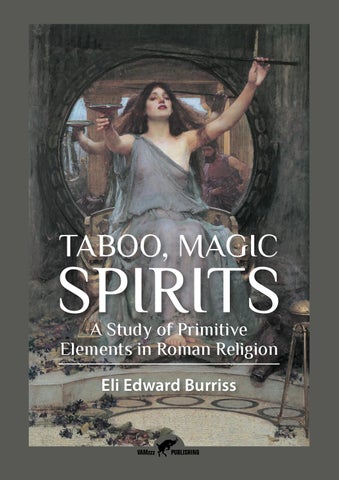
Original publication: 1931 Cover image: C irce Offering the Cup to Ulysses (1891) by John William Waterhouse (1849-1917) Lay-out: www.burokd.nl ISBN 978-94-92355-03-4 Š 2015 Revised publication by:
VAMzzz Publishing P.O. Box 3340 1001 AC Amsterdam The Netherlands www.vamzzz.com contactvamzzz@gmail.com
TABOO, MAGIC
SPIRITS A Study of Primitive Elements in Roman Religion Eli Edward Burriss
VAMzzz
PUBLISHING
4
contents
PREFACE 9 CHAPTER I Mana, Magic and Animism 13 The Mind of Primitive Man—13 Positive and Negative Mana—18 Magic—22 Animism—23 CHAPTER II Positive and Negative Mana (Taboo) 29 Blood—31 Women—40 Children—43 Death and Corpses—60 Leather—64 Days—65 CHAPTER III Miscellaneous Taboos 69 Sex—69 Men—75 Strangers —77 Slaves—80 Linen and Wool—81 Knots—85 Iron and Bronze—88 Places—92 CHAPTER IV Magic Acts: The General Principles 95 Homoeopathic and Contagious Magic—95 CHAPTER V Removing Evils by Magic Acts 109 Removing the Evil Effects of Dangerous Contact by Washing and Burning—113 Removing Evils by Sweeping and Striking—117 Keeping Away Evils by Drawing a Magic Circle—123 Removing Evils by Dancing: The Scapegoat—127
5
CHAPTER VI Incantation and Prayer 133 Prayer a Command—136 Prayers Chanted—137 Prayers Uttered in an Undervoice—138 Prayers Repeated—139 Exactness in Naming the God and in the Wording of the Prayer—140 Prayers for Ill—141 No God Involved—143 CHAPTER VII Naturalism and Animism 147 The Worship of Stones—148 Trees and Groves—151 Water—158 Fire—167
VAMzzz Publishing - More Occult and Esoteric Books
6
7
8
PREFACE
ROMAN RELIGION, as we meet it in historical times, is a congeries of many elements. One of the problems of the modern scholar is to separate and interpret these various elements—primitive, Latin, Etruscan, Greek, Oriental. Even the casual student of comparative religion, who is also familiar with Latin literature, cannot fail to recognize, running through the enormous mass of facts and ideas about religion and superstition, elements which are common to all religions, past and present, whether among savages or civilized men. Such elements, when discovered in a developed religion, may fairly be called primitive. In the study of the religion of any people, the starting point should be with these common elements. However, it has usually been the habit of scholars to trace the development of gods and goddesses, rites and priesthoods, to their historical sources, and to describe and interpret the Roman calendar with its many festivals; and if primitive elements have been treated at all, they have formed part of a larger work, or have been rather cursorily dismissed to clear the way for a study of the religion of the organized Roman State. Thus W. Warde Fowler, in The Roman Festivals of the Period of the Republic, and Georg Wissowa, in his Religion und Kultus der Romer, were concerned primarily with the facts of historical Roman religion. Fowler, to be sure, devoted two 9
chapters in The Religious Experience of the Roman People to a study of primitive elements, but he was clearly anxious to hurry on to his main theme. H. J. Rose, in his Primitive Culture in Italy, has discussed briefly, but with sound scholarship, primitive elements in Roman religion as part of the general subject of primitive culture in Italy; and Jesse Benedict Carter, following afar his master Wissowa, seems to have had slender knowledge of comparative religion. To Sir J. G. Frazer scholars owe much for his valuable collection of rites and ideas parallel to those of the Romans. The Golden Bough is a veritable mine of such information; and the author’s more recent work, his edition of the Fasti of Ovid, is indispensable to the student of the subject. The latter reached my hands after I had completed the first draft of my manuscript for publication. Because of the pertinence of his notes on the passages from Ovid’s Fasti which I have used in this work, I have included in the footnotes references to Frazer’s work wherever possible. No one has as yet, so far as I know, made an attempt to gather from the ancient sources those elements in the Roman State religion and in the popular religious life of the Roman people which are commonly termed primitive. Eugene Tavenner, in his Studies in Magic from Latin Literature, has given us a valuable body of facts about magic, but has made little effort to interpret the material. It is obviously difficult, and in many cases impossible, to determine what elements are truly primitive and what are not. There are certain traces which are unmistakably primitive. These I have treated at length: positive and negative mana, the principles of sym10
pathetic magic, naturalism, and animism. I shall discuss more fully certain subjects which have grown out of my study of the primitive elements, and of which a knowledge is necessary for the understanding of these elements. Most of the excerpts in this work have been obtained from a first-hand reading, over a period of five years, of the original sources. Some of this material was published, perhaps prematurely, in various periodicals, Classical Philology, The Classical Journal, The Classical Weekly, The Biblical Review, Art and Archaeology. It was only after I had gathered and classified and interpreted as best I could alone that I turned to the secondary sources. My debt both to these and to the original is indicated in the footnotes. The translations are, except in one case, my own. I have adopted Frazer’s practice of translating into English the names of festivals wherever these names could not be readily understood by the reader who was not classically trained. It remains to thank my associates, Professor Casper J. Kraemer Jr., and Miss Catherine Ruth Smith, for many helpful suggestions in preparing the manuscript.
Eli Edward Burriss, New York April, 1931
11
VAMzzz Publishing
Paper books VAMzzz Publishing is located in the very centre of old Amsterdam, in The Netherlands. Our publishing company creates high quality revised editions of five star occult, witchcraft, Gothic and esoteric classics, mostly written in the Fin de siècle-period and early 20th century. As a publisher, we deeply respect the writer of any book we choose, so we join our forces (top level graphic design & thirty years of occult studies) to produce enchanting volumes which maximize the reading pleasure and inform, often with extra added information. In contrast to the current trend of digital screen addiction, we think, this variety of literature needs to be presented on paper. No e-books, but real books! Apart from republications of valuable but forgotten books, we are also in the preparation of new publications on topics such as self-healing, magic, new astrology and more.
VAMzzz Publishing P.O. Box 3340 1001 AC Amsterdam The Netherlands contactvamzzz@gmail.com www.vamzzz.com 2
Previews of all books including a complete table of contents can be viewed on www.vamzzz.com. More books will be added to the list. VAMzzz Publishing strives to publish new volumes every month. Please visit our website regularly for the latest updates.
Recommended
Etruscan Magic & Occult Remedies Charles Godfrey Leland 628 pages, paperback ISBN 9789492355003 www.vamzzz.com
Etruscan Magic & Occult Remedies by Charles Godfrey Leland was first published in 1892 as Etruscan Roman Remains in Popular Tradition. Part One of the book offers complete and detailed insight in the Etruscan and Roman rooted pantheon of the Tuscan Streghe (witches). Part Two describes many of their spells, incantations, sorcery and several lost divination methods. Leland found himself at the crossroads of the academic and the romantic and it is precisely this, which makes the reading of his work so enjoyable. His primairy aim was to preserve this ancient traditional knowledge, as he feared, it would soon be wiped out by modernism. Much information in this book, Leland received first hand from the Tuscan witches Maddalena and Marietta. His second work on Stregheria: Aradia, or the Gospel of the Witches was published seven years later in 1899. One could state he reached his goal as his books are still of invaluable importance to both the Italian folklore and the modern practitioner of witchcraft. One of Leland’s readers was the late Gerald Gardner, which makes one wonder who was the true godfather of modern witchcraft‌ 3
Chaldean Magic It’s Origin and Development by François Lenormant 454 pages, Paperback, ISBN 9789492355027 The essentials of magic in Chaldea are presented inside a context of comparison or contrast to Egyptian, Median, Turanian, Finno-Tartarian and Akkadian magic, mythologies, religion and speech. Interesting is the Chaldean demonology, with its incubus, succubus, vampire, nightmare and many Elemental spirits, most of them coalesced with the primal powers of nature.
Aradia Gospel of the Witches by Charles Godfrey Leland 174 pages, Paperback, ISBN 9789492355010 This wonderful book describes the creation according to Italian witch-lore. We also read about the witch-meeting or sabbath (treguenda) and the book contains many original magical recipes, like spells for love and good fortune. Diana is further connected to the Moon and the fairy world.
Unicorn A mythological investigation by Robert Brown Jr. 124 pages, Paperback, ISBN 9789492355072 Brown Jr. believes the unicorn to be a lunar symbol, and draws on mythology from a wide range of sources all over the world to build his case. The author discusses the heraldic use of the unicorn, relates the creature to ancient goddesses like Astarte, Hecate en the Gorgon Medusa, and provides the reader with lost esoteric Moon-lore.
4
Là-Bas A Journey into the Self by Joris-Karl Huysmans 378 pages, Paperback, ISBN 9789492355058 The plot of Là-Bas concerns the novelist Durtal, who is disgusted by the emptiness and vulgarity of the modern world. He seeks relief by turning to the study of the Middle Ages. Through his contacts in Paris, Durtal discovers that Satanism is not a thing of the past but alive and kicking in turn of the century France. The novel culminates with a description of a black mass.
Devil-worship in France Or The Question of Lucifer by Arthur Edward Waite 240 pages, Paperback, ISBN 9789492355065 In Devil-Worship in France, Waite attempts to discern what is genuine from what is fake in the evidence of 19th century Satanism. To get the answers he spends a great deal of time investigating the French Masonic echelon, debunking a “conspiracy of falsehood” and determining what should be understood by Satanism and what not. Huysmans’ diabolical novel Là-Bas (1891) inspired Waite to write this sceptical analysis.
Testament of Solomon A First Century AD Grimoire 76 pages, Paperback, ISBN 9789492355041 A first century AD grimoire, and therefore the oldest, and least known, of all grimoires (magical instruction books) in the occult tradition. The book describes health inflicting demons of zodiacal decans, summoned by King Solomon, and how he controlled them to use their forces to build his temple and more. Translated by F. C. Conybeare, appeared first in the Jewish Quarterly Review of October, 1898. 5
Amazons - Two publications in one book I. The Amazons by Guy Cadogan Rothery II. R eligious Cults Associated With the Amazons by Florence Mary Bennett 328 pages, Paperback, ISBN 9789492355089 Contents I: The Amazons of Antiquity – Amazons in Far Asia – Modern Amazons of the Caucasus – Amazons of Europe – Amazons of Africa – Amazons of America – The Amazon Stones. Contents II: The Amazons in Greek legend – The Great Mother – Ephesian Artemis – Artemis Astrateia and Apollo Amazonius – Ares.
Ophiolatreia Rites and Mysteries of Serpent Worship Author: Hargrave Jennings 186 pages, Paperback, ISBN 9789492355126 An account of the rites and mysteries connected with the origin, rise and development of serpent worship in various parts of the world, enriched with interesting traditions, and a full description of the celebrated serpent mounds & temples, the whole forming an exposition of one of the phases of phallic, or sex worship.
Voodoos and Obeahs Phases of West India Witchcraft by Joseph J. Williams 374 pages, Paperback, ISBN 9789492355119 This work goes into great depth concerning the New World-African connection and is highly recommended if you want a deep understanding of the dramatic historical background of Haitian and Jamaican magic and witchcraft, and the profound influence of imperialism, slavery and racism on its development. Williams includes numerous quotations from rare documents and books on the topic. 6
Fairy Mythology (Volume 1) Romance and Superstition of Various Countries 1 by Thomas Keightley 404 pages, Paperback, ISBN 9789492355096 Fairy Mythology (Volume 2) Romance and Superstition of Various Countries 2 by Thomas Keightley 404 pages, Paperback, ISBN 9789492355102 The term Fairy covers all kinds of nature spirits, not just the tiny sugar sweet creatures hovering around flowers. A unique and impressive book on this subject, published in a revised 2 volume-edition. No wiccan or pagan can afford to leave these books unopened. About Elves, Dwarfs, Kobolds, Trolls, Changelings, Meremaids, Nisses, Fairies, Brownies, Puck and other Elemental spirits all over the world.
7
VAMzzz
PUBLISHING
Unveiling the magical shadow world of Ancient Rome In Ancient Rome Mana was the term used for a mysterious force, which could be helpful or harmful. When harmful it was called Taboo. Just like the Chinese Qi, Mana could empower both the positive and the negative. Taboo, Magic, Spirits: a Study of Primitive Elements in Roman Religion offers a still unique insight into the magical elements, beliefs, methods and rites of Rome in ancient days. Mana and Taboo play an important role, but the author also deals with the worship of stones, trees, groves, water and fire, with magical incantations, the removal of evil by washing, burning or dancing, with taboos on sex, blood, corpses, women, certain days, and much more. Eli Edward Burriss was an Associate-Professor of Classics at the New York University. No researcher before Burriss made an attempt to gather from the ancient sources those elements in the Roman State religion, and in the popular religious life of the Roman people, which are commonly termed “primitive�. His efforts have resulted in a fascinating work of micro-history, which will be appreciated by both the academic student and those interested in paganism, Wicca and magic.
9 789492 355034