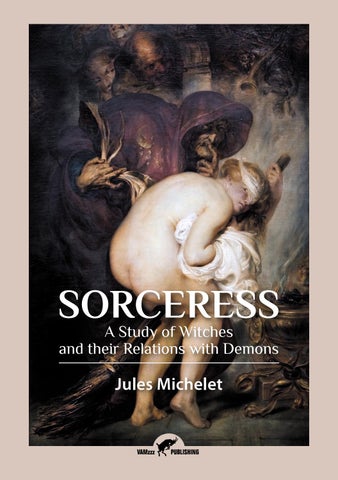
SORCERESS A Study of Witches and their Relations with Demons
Jules Michelet
VAMzzz
PUBLISHING
Sorceress A Study of Witches and their Relations with Demons Author: Jules Michelet
Original title: L a Sorcière Cover image: T he Young Sorceress, Antoine Wiertz Lay-out: www.burokd.nl
ISBN 978-94-92355-24-9 © 2017 Revised publication by:
VAMzzz Publishing P.O. Box 3340 1001 AC Amsterdam The Netherlands www.vamzzz.com contactvamzzz@gmail.com
SORCERESS A Study of Witches and their Relations with Demons
Jules Michelet
VAMzzz
PUBLISHING
Jules Michelet Paris, 21 August 1798 – Hyères, 9 February 1874
4
contents Introduction — 7 PART ONE 1 Death of the Gods — 23 2 What drove the Middle Ages to Despair — 33 3 The Little Demon of the Hearth and Home — 45 4 Temptations — 58 5 Diabolical Possession — 69 6 The Pact with Satan — 85 7 King of the Dead — 92 8 Prince of Nature — 101 9 Satan the Healer — 110 10 Charms and Love Potions — 124 11 Communion of Revolt Witches' Sabbaths - The Black Mass — 135 12 Black Mass Continued - Love and Death - Satan Disappears — 148 PART TWO 13 The Sorceress in her Decadence - Satan Multiplied and Vulgarised — 159 14 Persecutions — 170 15 A Hundred Years' Toleration in France — 186 16 The Basque Witches (1609) — 194 17 Satan Turns Ecclesiastic (1610) — 205 18 Gauffridi (1610) — 215 19 The Nuns of Loudun - Urbain Grandier (1633, 1634) — 240 20 The Nuns of Louviers and Satanic Possession - Madeleine Bavent (1640-1647) — 261 21 Satan Triumphant in the Seventeenth Century — 277 22 Father Girard and Charlotte Cadière — 286 23 Charlotte Cadière at the Convent of Ollioules — 322 24 Trial of Charlotte Cadière (1730, 1731) — 349 Epilogue — 377 Notes and Elucidations — 385 Principal Authorities — 409 Post Scriptum 5
3. “Down on your knees, and Amen say! Enough you’ve eat of grass and hay! Leave go old things, and up, away! 4. The new world puts the old to flight! Truth turns the gloomy dusk to light! Dawn’s brightness drives away the night!” Vetustatem novitas, Umbram fugat claritas, Noctem lux eliminat. (Rouen Ritual.) 5. See the Capitularies passim. 6. A very famous Breton (Renan), last man of the Middle Ages, but who was nevertheless a friend of my own, on the occasion of the quite ineffectual journey he made for the conversion of Rome, received brilliant offers when in the Eternal City. “What would you have?” the Pope asked him. “One thing and one thing only: a dispensation from the Breviary… I am sick to death of it.” 7. Such was Hincmar’s well-known admission. 8. A distinction too little appreciated, too little noticed, by writers who have enlarged upon personal surrender, “recommendation” to a superior, etc. 9. Grimm, Rechts Alterthümer; Michelet, Origines du Droit. 10. Grimm, on the word aleu (allodium). 11. This is what happened to the Comte d’Avesnes, when his free land was declared a mere fief, and himself a mere vassal, the man of the Comte de Hainault. Read also the terrible history of the Grand Chancellor of Flanders, the First Magistrate of Bruges, who for all this was nevertheless claimed, and successfully claimed, as a serf (Gualterius, Scriptores Rerum Francicarum, xiii. 334).
44
3
T he Little Demon of the Hearth and Home
THE EARLY CENTURIES of the Middle Ages, when the legends were in
making, give all the impression of a dream. Among rustic populations, deeply submissive to the Church and of a gentle spirit (the legends themselves attest this), we would gladly assume a high degree of innocence. Surely it must have been God’s own time, this. Nevertheless, in the Penitentiaries, where the most ordinary sins are noted down, strange and dishonouring forms of depravity are mentioned too, of rare occurrence under the reign of Satan. This is due to two causes—utter ignorance, and the habit of living in common, which brought near relatives into the closest contiguity. They seem to have had scarce an inkling of our morality. Their own, in spite of ecclesiastical prohibitions, appears to have been that of the Patriarchs, of the remotest antiquity, which looks upon marriage with strange women as wicked, and only allows the kinswoman to be a lawful bride. Allied families formed only a single household. Not daring as yet to disperse their dwellings over the wastes that surrounded them, tilling merely the outlying demesne of a Merovingian palace or of a monastery, they retired every night 45
together with their beasts under the roof of a vast villa. Hence inconveniences similar to those of the ergastulum of classical antiquity, in which slaves were herded promiscuously. More than one of these communities still existed in the Middle Ages, and even later. The Lord of the Soil recked little of what resulted from the arrangement. He regarded as forming a single family this tribe, this mass of human beings “getting up and going to bed together,”—”eating bread off one platter and meat out of one pot.” In this indiscriminate way of living, woman met with very little care or protection; the place she occupied was an extremely humble one. True, the virgin, the ideal woman, rose higher from century to century, but the woman of real life counted for mighty little in these rustic communities, these massed aggregates of men and cattle. Such was the unhappy but inevitable outcome of a state of things which could only change for the better when the common habitation was subdivided, when at length men plucked up courage to live apart, in separate hamlets, or to settle as isolated cultivators of fertile lands at a distance, and build huts in clearings of the forest. The separate hearth created true family life; the nest made the bird. Henceforth they have ceased to be chattels—they are living souls… The wife and mother has come into existence. A touching moment. At length she has a home; she can therefore be pure and holy at last, poor creature. She can brood quietly over a thought, and undisturbed, as she sits spinning, dream dreams while he is abroad in the forest. The hut is wretched enough, damp and ill-built, and the winter wind whistles through it; but to make up for all defects it is silent. There are dim corners in it where 46
her dreams can find a lodgement. She is an owner now, possesses something of her very own. Distaff, bed, chest is all the household has, as the old song says. [1] But soon a table will be added, a bench, or a couple of stools… A poorly appointed house! but its furniture includes a living soul. The firelight heartens it; the consecrated bush of box guards the bed, to which is often added a pretty bunch of vervain. The lady of this palace sits spinning at her door, watching a few sheep the while. They are not rich enough yet to keep a cow; but this will come in time, if God blesses the house. The forest, a bit of pasture land, a hive of bees that feed on the heath are their livelihood. They do not grow much wheat yet, having no certainty of reaping a crop so long in growing. This life, poverty-stricken as it is, is yet less hard upon the wife. She is not broken with fatigue, made old and ugly before her time, as she will be when the time of farming on a large scale has arrived. And she has more leisure too. Beware of judging her in any way by the coarse literature of the Noëls and fabliaux, the silly laughter and licence of the broad tales composed at a later date. She is alone, without neighbours. The evil, unhealthy life of dark little shut-in towns, the prying into each other’s affairs, the pitiful, perilous scandal-mongering,—none of this is begun yet! There is no old harridan yet, coming creeping at dusk down the narrow, gloomy street to tempt the young wife and tell her someone is a-dying of love for her. The serf’s wife we are describing now has no friend but her dreams, no one to gossip with but her beasts or the forest trees. They talk to her,—we know not what about. They awake in her 47
things her mother told her, her grandmother—old, old things that for century after century have been handed on from woman to woman. Harmless memories come back of the ancient spirits of the country, a gentle, genial family religion, which in the common life just quitted and its noisy promiscuity, had doubtless lost most of its force, but which now returns like a ghost and haunts the lonely cabin. A strange, dainty world of fairies and elves, made to appeal to a woman’s soul. Directly the great stream of invention that produced the saintly legends runs dry and stops, these other legends, older and equally poetical, but in a totally different way, come to share their vogue with them, and reign softly and secretly in gentle hearts. They are the woman’s especial treasure, which she fondles and caresses. A fairy is a woman too, a fantastic mirror in which she sees her own self, only fairer and daintier than the reality. What were the Fairies? What we are told is that in old days, queens of the Gauls, proud and fantastic princesses, at the coming of Christ and His apostles, were wickedly impertinent and turned their backs. In Brittany they were dancing at the time, and never stopped. Hence their cruel sentence; they are doomed to live on till the Day of Judgment. [2] Many of them are reduced to the tiny dimensions of a rabbit or a mouse; for instance, the kowrig-gwans (fairy dwarfs), who at night-time, at the foot of old Druidical stones, ring you round with their elvish dances; or to take another example, the lovely Queen Mab, who makes her royal coach out of a walnut-shell. They are a trifle capricious, and sometimes mischievously disposed,—and what wonder, considering their unhappy destiny? Whimsical and tiny as they are, they possess a heart, and crave to be loved. Sometimes 48
kindly, sometimes the reverse, they are full of fancies. At the birth of a child they come down the chimney, endow the babe with gifts good or bad, and fix its fate. They love good spinsters, and spin divinely themselves. To spin like a fairy, the goodwives say. In the Fairy Tales, disencumbered of the absurd ornaments the latest editors have dressed them out in, is found the people’s very inmost heart. They mark a poetical period between the coarse promiscuity of the primitive villa and the licence of the days when a rising bourgeoisie produced the cynical fabliaux. These Tales have a historical side, recalling the great famines,— in the ogres and so on. But as a rule they float in a higher ether than common history, soaring on the wings of Fantasy through the realms of eternal Poesy, expressing the desires of men’s hearts, which are ever the same and have an unchanging history of their own. The longing of the poor serf to get breathing time, to find rest, to discover a treasure that shall end his wretchedness, recurs again and again in them. More often still, by a nobler aspiration, this treasure trove is a soul to boot, a treasure of sleeping love that must be awaked,—as in “The Sleeping Beauty”; though often the charming heroine is found hidden under a mask by reason of a fatal spell. Whence that touching Trilogy, that admirable crescendo,—Riquet of the Tuft, Ass’s Skin, Sleeping Beauty. Love will take no denial; under all these hideous disguises, it pursues, and wins, the hidden fair one. The last of these three tales reaches the true sublime, and I suppose no one has ever been able to read it without tears. A very real and very genuine passion underlies it, that of unhappy, quite hopeless love, one that cruel Nature often sows between 49
VAMzzz
PUBLISHING
A nightmare, but a nightmare of the most extraordinary verisimilitude and poetical power... Sorceress (the English translation of La Sorcière) by Jules Michelet is still one of the most vivid, dark and confronting studies on witchcraft ever produced. Long before Murray, it positions the medieval witch within a diminishing ancient culture of nature worship and the ruthless efforts of Christianity – with its radical hostility towards nature and life – to overwrite it. Michelet’s was an authority on the history of the Middle Ages, and his insistence that history should concentrate on ‘the people, and not only its leaders or its institutions’ placed him ahead of his time as a godfather of micro-history. Starting in the 13th century the book moves on towards belladonna, the Sabbath and pacts with Satan, into the hells of the Burning Times – social contexts, church intrigues and mass hysteria always included. Via Basque witches, the Black Masses and demoniacal possessions we enter the satanic decadence of 17th century France, and finally the end of the witch burning era in 18th century, with the trial of Charlotte Cadière.
www.vamzzz.com
Though a solid work of history, the reader is not served a simple bone dry exposition of facts and theories, but something that tastes like a Bloody Mary.