RELIGION AND
LUST
or The Psychical Correlation of Religious Emotion and Sexual Desire
James Weir Jr.
VAMzzz
PUBLISHING
Religion and Lust or The Psychical Correlation of Religious Emotion and Sexual Desire Author: James Weir Jr.
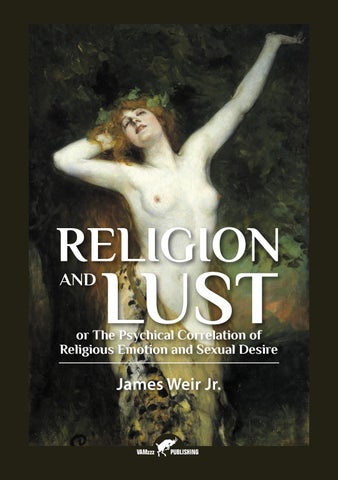
Cover image: B acchante, Ferdinant Leeke (1853-1921) Lay-out: www.burokd.nl
ISBN 978-94-92355-27-0 © 2017 Revised publication by:
VAMzzz Publishing P.O. Box 3340 1001 AC Amsterdam The Netherlands www.vamzzz.com contactvamzzz@gmail.com
RELIGION AND
LUST
or The Psychical Correlation of Religious Emotion and Sexual Desire
James Weir Jr.
VAMzzz
PUBLISHING
4
contents
CHAPTER I.
The Origin of Religious feeling — 7
CHAPTER II.
Phallic Worship — 25
CHAPTER III. The Psychical Correlation of Religious Emotion and Sexual Desire — 57
Viraginity and effemination — 68
Borderlands and Crankdom — 75
Genius and Degeneration — 85
The Effect of Female Suffrage on Posterity — 95
I. The Origin of the Matriarchate — 95
II. The Viragint — 99
III. The Decadence — 104
Is it the Beginning of the End? — 108
NOTES — 125 BIBLIOGRAPHY — 129
5
6
CHAPTER II.
Phallic Worship
PHALLIC WORSHIP, IN some form or other, has been practiced by
almost every race under the sun. Indeed, among primitive peoples, those who do not practice this cult are so few in number that they have, practically, no weight whatever in a discussion of this subject. Moreover, those primitive peoples who do not worship the generative principle, either directly or indirectly, are without any religion whatsoever, and are the very lowest of all mankind in point of intelligence. I have only to cite the Tierra del Fuegians, the Bushmen, the Australians, and the Akka or Ticki-Ticki, the Pygmies of Central Africa, to prove the truthfulness of this assertion. There are other peoples who would serve as examples, but it would be a work of supererogation to enumerate them to even the casual reader. D’Hancarville, in his magnificent work, has traced the progress of the worship of the generative principle over the entire world, while Knight, in his scholarly essay,[36] has brought out its psychological truths in a manner which cannot be surpassed. It is not my purpose to enter into a detailed account of this cult; I propose rather to discuss its probable origin in the beginning, and to give a brief outline 25
of its history, as it is to be observed among living peoples. I wish to show, also, its connection with certain religious ceremonies and festivals of Christian peoples, which had their origin, ab initio, in the worship of Priapus. And, before beginning the discussion of this subject, I beg to remind the reader that a priest of Priapus regarded his sistrum as being just as sacred as a Catholic priest now considers any vessel or robe used in the service of mass, and that the priests of Brahma look on the Lingam with as much reverence and awe as did the Levites on the Ark of the Covenant and the Holy of Holies. Phallic worship is a religion, the oldest abstract religion in existence. Fundamentally the Creator—the Life Giver—is the phallic worshiper’s god. Is he very far wrong in all that is absolutely essential? “Men think they know because they are sure they feel, and are firmly convinced because strongly agitated. Hence proceed that haste and violence with which devout persons of all religions condemn the rites and doctrines of others, and the furious zeal and bigotry with which they maintain their own, while, perhaps, if both were equally understood, both would be found to have the same meaning, and only to differ in the modes of conveying it.”[37] The Pueblo Indians of New Mexico are worshipers of the generative principle, and, like most religious sects, have evolved some very curious rites and ceremonies. The ancient temples of Venus or Aphrodite were filled with hetarae, who were necessary adjuncts for the proper performance of the mysteries of Priapus. These Indians, however, will not allow women to enter into their sacred ceremonies, but, on the contrary, emasculate men (by occasioning organic and functional degeneration of the sexual organs), who serve as hetaræ 26
to the chiefs and shamans or priests.[I] These androgynes are called mujerados, a term which aptly describes their sexual condition. “In order to cultivate a mujerado, a very powerful man is chosen, and he is made to masturbate excessively and ride constantly. Gradually such irritable weakness of the genital organs is engendered that, in riding, great loss of semen is induced. This condition of irritability passes into paralytic impotence. Then the testicles and penis atrophy, the hair of the beard falls out, the voice loses its depth and compass, and physical strength and energy decrease. Inclinations and disposition become feminine. The mujerado loses his position in society as a man. He takes on feminine manners and customs, and associates with women; yet, for religious reasons, he is held in high honor.”[38] The phallic ceremonies of the Pueblos take place in the spring, when the life principle is exceedingly active throughout all nature. In all probability the “botes” of the Montana Indians and the “burdachs” of the Washington tribes serve as masculine hetaræ to the chiefs and medicine men, though this has not been definitely determined. Dr. Holder described a typical “bote” of the Absaroke tribe in the New York Medical Journal, 1889. This androgyne, in many respects, resembled the mujerados of the Pueblo Indians, and probably served a like purpose in his tribe. According to Ross, a Konyaga woman, when she has a
I The Aleutians, according to the testimony of unimpeachable witnesses, make their neophytes pass through like physical exercises in preparing them for their duties in celebrating Priapic Rites. 27
good-looking boy, dresses him in girl’s clothes and brings him up as a female. When he arrives at a suitable age he is sent to wait on the priests of the tribe and is introduced by them into the sacred mysteries of their cult; in fact, he becomes a masculine hetara. When we read of such things we feel pretty much as Herodotus felt when he saw the naked women of Mendes submitting themselves openly: es epideixin anthrôpôn teras. To the embraces of the sacred goat.[J] To the Greek historian this act was simply horrible:]); and yet these Egyptians experienced no repugnance whatever. To them it represented the incarnation of the deity, and was, therefore, a sacred and holy action, just as masculine hetarism is regarded as a holy profession among the Konyagas. Phallic hetarism is one of the sacraments of the Konyaga church, and, as such, it is held in all that reverence and awe with which the savage devotee endows the mysteries of his faith.[K] The ancient Hebrews, ancestors of one of the most ancient of the civilized races of the earth, held it in high honor. Even wise King Solomon, in the days of his old age, turned from the abstractedly J Herodotus: Euterpe, 46. K Masculine hetarism is still in vogue among many primitive peoples, and is distinctly a religious rite. “The Kanats of New Caledonia frequently assemble at night in a cabin to give themselves up to this kind of debauchery.... In the whole of America, from north to south, similar customs have existed or still exist.” Letourneau: The Evolution of Marriage, p. 62. The same author says: “It was also a widely spread custom throughout Polynesia, and even a special deity presided over it. The Southern Californians did the same, and the Spanish missionaries, on their arrival in the country, found men dressed as women and assuming their part. They were trained to this from youth, and often publicly married to the chiefs. Nero was evidently a mere plagiarist. The existence of analogous customs has been proved against the Guyacurus of La Plata, the natives of the Isthmus of Darien, the tribes of Louisiana, and the ancient Illinois.” 28
pure religion of his father “to Astoreth, the goddess of the Zidonians, and to Milcom, the abomination of the Ammonites.”[39] He was guilty of constructing a “high place” for Chemosh, “the abomination of Moab.”[40] Any good modern biblical encyclopedia will tell the reader about Astoreth and her worship, and what the “high places” and the “groves” were. Even the “good kings,” such as Asa, Amaziah, et al., did not remove the high places and the groves, for we read that, notwithstanding the fact that these kings did that which was right in the sight of the Lord, they did not remove the high places. In the case of Amaziah, it is written: “And he did that which was right in the sight of the Lord, yet not like David, his father; he did according to all things as Joash, his father, did. “Howbeit, the high places were not taken away: as yet the people did sacrifice and burnt incense on the high places.”[41] All of the so-called “wicked kings” were phallic worshipers, and both male and female hetarism flourished during their reigns. We read of Josiah, a “good king,” “And he broke down the houses of the sodomites (kedescheim) that were by the house of the Lord.”[42] Here, in unmistakable terms (kedescheim), the phallic act of the hetara is specified. Herodotus wrote: “Almost all mankind consort with women in their sacred temples, except in Greece and Egypt.”[43] This is a queer mistake for a Greek to make, yet this historian is noted for his unreliability, and we should not feel surprised at this gross error. Concerning the Aphrodite of Abydos, what she was and what took place in her temples, is a matter of history. Indeed, this goddess was 29
surnamed Porne! In Corinth, delubral hetarism was openly practiced; also at Bubastis and Naucratis in Egypt. Royal princesses were pallacides in the temple of Ammon; in fact, they took pride in the title of pallakis! [L] “It is known what excessive debauchery took place in the ‘groves’ and ‘high places’ of the ‘Great Goddess.’ The custom was so deeply rooted that in the grotto of Bethlehem what was done formerly in the name of Adonis is to-day in the name of the Virgin Mary by Christian pilgrims; and the Mussulman hadjis do likewise in the sanctuaries of Mecca!”[44] [M] But let us return to primitive peoples, from whose customs and beliefs we can learn what our own ancestors must have believed before the besom of civilization swept aside the crudities of savagery. The Khonds of India are phallic worshipers, and, in the practice of their religion, Priapus saves many a girl who would be, otherwise, offered up on the bloody altars of their divinities. The pregnant woman is sacred, hence, religious prostitution is exceedingly prevalent. But it frequently happens that some unfortunate creature, who is not pleasing to the shamans, is seized, tied to the stake and butchered.[45] As the blood flows down and deluges the ground, “the divine spirit enters into the priest and inspires him.”[46] This sacrifice is of itself a phallic rite; the blood-offering is supposed to be exL Strabo, when writing of the Armenians, who were phallic worshipers, says: “It is the custom of the most illustrious personages to consecrate their virgin daughters to this goddess (Anaïtis). This in no way prevents them from finding husbands, even after they have prostituted themselves for a long time in the temples of Anaïtis. No man feels on this account any repugnance to take them as wives.” Strabo: vol. xi., 14; quoted also by Letourneau: The Evolution of Marriage, p. 46. M Brugsch Bey is of this same opinion. 30
ceedingly acceptable to Earth, the mother of all things. Blood is the essence of the life-giving principle; hence, the essence is returned to the great Giver, as a propitiatory offering.[N] In point of fact, the worship of the generative principle is everywhere prevalent in India.[O] In the Lingam, or holy altar of the Brahmins, we see a conjunction of the male and female sexual organs, while religious prostitution, in the shape of hetarism, crowds the inner courts and corridors of almost every temple in the land with hierodules and bayaderes. The Vedas abound in references, either direct or indirect, to phallic worship. Indeed, according to some authorities, the Hindu Brahma is the same as the Greek Pan,[P] “who is the creative spirit of the deity transfused through matter.”[47]
N Among certain peoples the blood and the semen bore a close relationship; by certain races they were considered analogous. The Old Testament, the Vedas, the Sagas, and many references of Greek, Latin, Egyptian, Hindu, and Persian mythology point to this as being conclusive. O Speaking of the ceremony of priestly prelibation as it was practiced in the Kingdom of Malabar, Forbes writes as follows: “The ecclesiastic power took precedence of the civil on this particular point, and the sovereign himself passed under the yoke. Like the other women, the queen had to submit to the right of prelibation exercised by the high priest, who had a right to the first three nights, and who was paid fifty pieces of gold besides for his trouble.” Forbes: Oriental Memoirs, vol. i, p. 446; quoted also by Letourneau: The Evolution of Marriage, p. 48. De Rémusat says that, in Cambodia, the daughters of poor parents retain their virginity longer than their richer sisters simply because they have not the money with which to pay the priest for defloration! P “The people have put the idol named Coppal in a neighboring house; there she is served by priests and Devadichi, or slaves of the gods. These are prostitute girls, whose employment is to dance and to ring little bells in cadence while singing infamous songs, either in the pagoda or in the streets when the idol is carried out in state,” writes Letourneau in The Evolution of Marriage, quoting from Letters édifiantes. Coppal was and is a Brahminical Venus, and her worship is wholly phallic in character. The ancient Indo-Iranians worshiped a similar deity. The worship of Coppal, both in ritual and in significance, is identical with that of the Greek Aphrodite. 31
VAMzzz
PUBLISHING
All Religions Originate in Fertility Worship In Religion and Lust author James Weir Jr. (1856–1906), investigates the origins of religious feeling, the once world wide spread fertility worship and the physical correlation of religious emotion and sexual desire. This publication is a revised edition of the 1905 version. It is unique, because a major part of the work is filled with a colourful collection of religious, or semi-religious, sexual rites, once practiced all over the globe, connecting the most “primitive” tribe to the most “civilized” nations. Some of them are really bizarre, like an extremely exhausting Pueblo masturbation-ritual, or the poring of wine over the phallus of a saint in France to make a medicine against barrenness. The volume is also a rich source of fertility gods and hence it provides valuable data for pagans, occultists and Wiccans. The final section of the study deals with early 20th century sexology, gender-issues and related pathology, as studied in those days, and often in correlation with religious dogmas or taboos.
www.vamzzz.com