OPHIOLATREIA Rites and Mysteries of Serpent Worship Hargrave Jennings
VAMzzz
PUBLISHING
Ophiolatreia Rites and mysteries of serpent worship Author: Hargrave Jennings
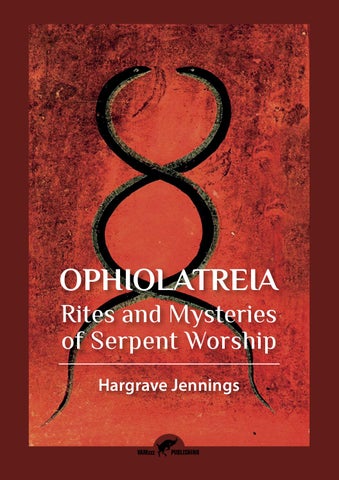
Original title: O phiolatreia: An Account of the Rites and Mysteries Connected with the Origin, Rise, and Development of Serpent Worship (1889) Cover image: A Pair of Snakes, a Basohli painting (c. 18th century) collected in Rawson’s ‘The Art of Tantra’ Lay-out: www.burokd.nl ISBN 978-94-92355-12-6 © 2015 Revised publication by:
VAMzzz Publishing P.O. Box 3340 1001 AC Amsterdam The Netherlands www.vamzzz.com contactvamzzz@gmail.com
OPHIOLATREIA Rites and Mysteries of Serpent Worship Hargrave Jennings
VAMzzz
PUBLISHING
4
contents
CHAPTER I 11 Ophiolatreia an extraordinary subject — Of mysterious origin — Of universal prevalence — The serpent a common symbol in mythology — Serpent-worship natural but irrational — Bacchic orgies — Olympias, mother of Alexander, and the Serpent emblam — Thermutis, the Sacred Serpent — Asps — Saturn and his children — Sacrifices at altar of Saturn — Abaddon — Ritual of Zoroaster — Theology of Ophion — The Cuthites — The Othiogeneis — The Ophiomans — Greek Traditions — Cecrops — Various Serpent worshippers.
CHAPTER II 25 Supposed Phallic origin of Serpent-worship — The idea of Life — Adoration of the Principle of Generation — The Serpent as a Symbol of the Phallus — Phallic Worship at Benares — The Serpent and Mahadeo — Festival of the “Nag pauchami” — Snakes and Women — Traces of Phallic Worship in the Kumaon Rock-markings — The Northern Bulb Stones — Professor Stephens on the Snake as a Symbol of the Phallus — The “Dionysiak Myth” — Brown on the Serpent as a Phallic emblem — Mythology of the Aryan Nations — Sir G. W. Cox and the Phallic Theory — Athenian Mythology.
CHAPTER III 35 Mythology of the Ancients — Characteristics of the Pagan Deities — Doctrine of the Reciprocal Principles of Nature — Creation of the Egg — Creation and the Phallus — The Lotus — Osiris as the active, dispensing, and originating energy — Hesiod and the generative powers — Growth of Phallic Worship.
5
CHAPTER IV 41 Ancient Monuments of the West — The Valley of the Mississippi — Numerous Earthworks of the Western States — Theory as to origin of the mounds — The “Defence” Theory — The Religious Theory — Earthwork of the “Great Serpent” on Bush Creek — The “Alligator,” Ohio — The “Cross,” Pickaway County — Structures of Wisconsin — Mr. Pigeon’s Drawings — Significance of the Earthmounds — The Egg and Man’s Primitive Ideas — The Egg as a Symbol — Birth of Brahma — Aristophanes and his “Comedy of the Birds” — The Hymn to Protogones — The Chinese and Creation — The Mundane or Orphic Egg — Kneph — Mr. Gliddon’s replies to certain enquiries — The Orphic Theogony and the Egg — The Great Unity.
CHAPTER V 67 The Sun and Fire as emblems — The Serpent and the Sun — Taut and the Serpent — Horapollo and the Serpent symbol — Sanchoniathon and the Serpent — Ancient Mysteries of Osiris, &c. — Rationale of the connection of Solar, Phallic, and Serpent Worship — The Aztec Pantheon — Mexican Gods — The Snake in Mexican Mythology — The Great Father and Mother — Quetzalcoatl, the Feathered Serpent — Researches of Stephens and Catherwood — Discoveries of Mr. Stephens.
CHAPTER VI 101 Mexican Temple of Montezuma — The Serpent Emblem in Mexico — Pyramid of Cholula — Tradition of the Giants of Anahuac — The Temple of Quetzalcoatl — North American Indians and the Rattlesnake — Indian Tradition of a Great Serpent — Serpents in the Mounds of the West — Bigotry and Folly of the Spanish Conquerors of the West — Wide prevalence of Mexican Ophiolatreia.
6
CHAPTER VII 127 Egypt as the Home of Serpent Worship — Thoth said to be the founder of Ophiolatreia — Cneph, the Architect of the Universe — Mysteries of Isis — The Isaic Table — Frequency of the Serpent Symbol — Scrapis — In the Temples of Luxore, etc. — Discovery at Malta — The Egyptian Basilisk — Mummies —Bracelets — The Caduceus — Temple of Cneph at Elaphantina — Thebes — Story of a Priest — Painting in a Tomb at Biban at Malook — Pococke at Raigny.
CHAPTER VIII 139 Derivation of the name “Europe” — Greece colonized by Ophites — Numerous Traces of the Serpent in Greece — Worship of Bacchus — Story of Ericthonius — Banquets of the Bacchants — Minerva — Armour of Agamemnon — Serpents at Epidaurus — Story of the pestilence in Rome — Mahomet at Atmeidan.
CHAPTER IX 147 Ophiolatreia in Britain — The Druids — Adders — Poem of Taliessin — The Goddess Ceridwen — A Bardic Poem — Snake Stones — The Anguinum — Execution of a Roman Knight — Remains of the Serpent-temple at Abury — Serpent vestiges in Ireland of great rarity — St. Patrick.
CHAPTER X 155 India conspicuous in the history of Serpent Worship — Nagpur — Confessions of a Snake Worshipper — The gardeners of Guzerat — Cottages for Snakes at Calicut — The Feast of Serpents — The Deity Hari — Garuda — The Snake as an emblem of immortality.
CHAPTER XI 165 Mr. Bullock’s Exhibition of Objects illustrating Serpent Worship.
Post Scriptum
7
8
Ophiolatreia
An account of the rites and mysteries connected with the origin, rise and development of serpent worship in various parts of the world, enriched with interesting traditions, and a full description of the celebrated serpent mounds & temples, the whole forming an exposition of one of the phases of phallic, or sex worship. –H argrave Jennings London, 1889
9
10
CHAPTER I Ophiolatreia an extraordinary subject — Of mysterious origin — Of universal prevalence — The serpent a common symbol in mythology — Serpent-worship natural but irrational — Bacchic orgies — Olympias, mother of Alexander, and the Serpent emblam — Thermutis, the Sacred Serpent — Asps — Saturn and his children — Sacrifices at altar of Saturn — Abaddon — Ritual of Zoroaster — Theology of Ophion — The Cuthites — The Othiogeneis — The Ophiomans — Greek Traditions — Cecrops — Various Serpent worshippers.
OPHIOLATREIA, the worship of the serpent, next to the adoration of the phallus, is one of the most remarkable, and, at first sight, unaccountable forms of religion the world has ever known. Until the true source from whence it sprang can be reached and understood, its nature will remain as mysterious as its universality, for what man could see in an object so repulsive and forbidding in its habits as this reptile, to render worship to, is one of the most difficult of problems to find a solution to. There is hardly a country of the ancient world, however, where it cannot be traced, pervading every known system of mythology, and leaving proofs of its existence and extent in the shape of monuments, temples, and earthworks of the most elaborate and curious character. Babylon, Persia, Hindostan, Ceylon, China, Japan, Burmah, Java, Arabia, Syria, Asia Minor, Egypt, Ethiopia, Greece, Italy, Northern and Western Europe, Mexico, Peru, America—all yield abundant testimony to the same effect, and point to the common origin of Pagan systems wherever found. Whether 11
the worship was the result of fear or respect is a question that naturally enough presents itself, and in seeking to answer it we shall be confronted with the fact that in some places, as Egypt, the symbol was that of a good demon, while in India, Scandinavia, and Mexico, it was that of an evil one. It has been remarked that in the warmer regions of the globe, where this creature is the most formidable enemy which man can encounter, the serpent should be considered the mythological attendant of an evil being is not surprising, but that in the frozen or temperate regions of the earth, where he dwindles into the insignificances of a reptile without power to create alarm, he should be regarded in the same appalling character, is a fact which cannot be accounted for by natural causes. Uniformity of tradition can alone satisfactorily explain uniformity of superstition, where local circumstances are so discordant. “The serpent is the symbol which most generally enters into the mythology of the world. It may in different countries admit among its fellow-satellites of Satan the most venomous or the most terrible of the animals in each country, but it preserves its own constancy, as the only invariable object of superstitious terror throughout the habitable world. ‘Wherever the Devil reigned,’ remarks Stillingfleet, ‘the serpent was held in some peculiar veneration.’ The universality of this singular and irrational, yet natural, superstition it is now proposed to show. Irrational, for there is nothing in common between deity and a reptile, to suggest the notion of Serpent-worship; and natural, because, allowing the truth of the events in Paradise, every probability is in favour of such a superstition springing up.” (Deane.) 12
It may seem extraordinary that the worship of the serpent should ever have been introduced into the world, and it must appear still more remarkable that it should almost universally have prevailed. As mankind are said to have been ruined through the influence of this being, we could little expect that it would, of all other objects, have been adopted as the most sacred and salutary symbol, and rendered the chief object of adoration. Yet so we find it to have been, for in most of the ancient rites there is some allusion to it. In the orgies of Bacchus, the persons who took part in the ceremonies used to carry serpents in their hands, and with horrid screams call upon “Eva, Eva.” They were often crowned with serpents while still making the same frantic exclamation. One part of the mysterious rites of Jupiter Sabazius was to let a snake slip down the bosom of the person to be initiated, which was taken out below. These ceremonies, and this symbolic worship, are said to have begun among the Magi, who were the sons of Chus, and by them they were propagated in various parts. Epiphanius thinks that the invocation “Eva, Eva,” related to the great mother of mankind, who was deceived by the serpent, and Clemens of Alexandria is of the same opinion. Others, however, think that Eva was the same as Eph, Epha, Opha, which the Greeks rendered Ophis, and by it denoted a serpent. Clemens acknowledges that the term Eva, properly aspirated, had such a signification. Olympias, the mother of Alexander, was very fond of these orgies, in which the serpent was introduced. Plutarch mentions that rites of this sort were practised by the Edonian women near Mount Hæmus in Thrace, and carried on to a degree of madness. Olym13
VAMzzz Publishing
Paper books VAMzzz Publishing is located in the very centre of old Amsterdam, in The Netherlands. Our publishing company creates high quality revised editions of five star occult, witchcraft, Gothic and esoteric classics, mostly written in the Fin de siècle-period and early 20th century. As a publisher, we deeply respect the writer of any book we choose, so we join our forces (top level graphic design & thirty years of occult studies) to produce enchanting volumes which maximize the reading pleasure and inform, often with extra added information. In contrast to the current trend of digital screen addiction, we think, this variety of literature needs to be presented on paper. No e-books, but real books! Apart from republications of valuable but forgotten books, we are also in the preparation of new publications on topics such as self-healing, magic, new astrology and more.
VAMzzz Publishing P.O. Box 3340 1001 AC Amsterdam The Netherlands contactvamzzz@gmail.com www.vamzzz.com 6
Previews of all books including a complete table of contents can be viewed on www.vamzzz.com. More books will be added to the list. VAMzzz Publishing strives to publish new volumes every month. Please visit our website regularly for the latest updates.
Recommended
Voodoos and Obeahs Phases of West India Witchcraft by Joseph J. Williams 374 pages, Paperback, ISBN 9789492355119
Voodoos and Obeahs: Phases of West India Witchcraft by the Jesuit anthropologist Joseph J. Williams (1875-1940) offers a careful documentation of the history and ethnography of Voodoo and reveals the connection of both Haitian Voodoo and Jamaican Obeah to snake worship (ophioletreia). In Jamaica, Obeah is the general term to denote those Africans who in the island practice witchcraft or sorcery. Williams includes numerous quotations from rare documents and books on the topic. This work goes into great depth concerning the New World-African connection and is highly recommended if you want a deep understanding of the dramatic historical background of Haitian and Jamaican magic and witchcraft, and the profound influence of imperialism, slavery and racism on its development. Williams is best known for his anthropological writings about African and Caribbean people, which include Whispering of the Caribbean, Whence the “Black Irish” of Jamaica?, Psychic Phenomena in Jamaica and Africa’s God. 7
Taboo, Magic, Spirits A study of primitive elements in Roman religion by Eli Edward Burriss 200 pages, Paperback, ISBN 9789492355034 In Ancient Rome Mana was the term used for a mysterious, magical medium, which could be helpful or harmful (Taboo). Just like the Chinese qi, it could empower the positive and the negative. Contents: Mana, Magic and Animism – Positive and Negative Mana (Taboo) – Miscellaneous Taboos – Magic Acts: The General Principles – Removing Evils by - Magic Acts – Incantation and Prayer– Naturalism and Animism.
Chaldean Magic It’s Origin and Development by François Lenormant 454 pages, Paperback, ISBN 9789492355027 The essentials of magic in Chaldea are presented inside a context of comparison or contrast to Egyptian, Median, Turanian, Finno-Tartarian and Akkadian magic, mythologies, religion and speech. Interesting is the Chaldean demonology, with its incubus, succubus, vampire, nightmare and many Elemental spirits, most of them coalesced with the primal powers of nature.
Amazons - Two publications in one book I. The Amazons by Guy Cadogan Rothery II. R eligious Cults Associated With the Amazons by Florence Mary Bennett 328 pages, Paperback, ISBN 9789492355089 Contents I: The Amazons of Antiquity – Amazons in Far Asia – Modern Amazons of the Caucasus – Amazons of Europe – Amazons of Africa – Amazons of America – The Amazon Stones. Contents II: The Amazons in Greek legend – The Great Mother – Ephesian Artemis – Artemis Astrateia and Apollo Amazonius – Ares. 8
Là-Bas A Journey into the Self by Joris-Karl Huysmans 378 pages, Paperback, ISBN 9789492355058 The plot of Là-Bas concerns the novelist Durtal, who is disgusted by the emptiness and vulgarity of the modern world. He seeks relief by turning to the study of the Middle Ages. Through his contacts in Paris, Durtal discovers that Satanism is not a thing of the past but alive and kicking in turn of the century France. The novel culminates with a description of a black mass.
Devil-worship in France Or The Question of Lucifer by Arthur Edward Waite 240 pages, Paperback, ISBN 9789492355065 In Devil-Worship in France, Waite attempts to discern what is genuine from what is fake in the evidence of 19th century Satanism. To get the answers he spends a great deal of time investigating the French Masonic echelon, debunking a “conspiracy of falsehood” and determining what should be understood by Satanism and what not. Huysmans’ diabolical novel Là-Bas (1891) inspired Waite to write this sceptical analysis.
Testament of Solomon A First Century AD Grimoire 76 pages, Paperback, ISBN 9789492355041 A first century AD grimoire, and therefore the oldest, and least known, of all grimoires (magical instruction books) in the occult tradition. The book describes health inflicting demons of zodiacal decans, summoned by King Solomon, and how he controlled them to use their forces to build his temple and more. Translated by F. C. Conybeare, appeared first in the Jewish Quarterly Review of October, 1898. 9
Fairy Mythology (Volume 1) Romance and Superstition of Various Countries 1 by Thomas Keightley 404 pages, Paperback, ISBN 9789492355096 Fairy Mythology (Volume 2) Romance and Superstition of Various Countries 2 by Thomas Keightley 404 pages, Paperback, ISBN 9789492355102 The term Fairy covers all kinds of nature spirits, not just the tiny sugarsweet creatures hovering around flowers. A unique and impressive book on this subject, published in a revised 2 volume-edition. No wiccan or pagan can afford to leave these books unopened. About Elves, Dwarfs, Kobolds, Trolls, Changelings, Meremaids, Nisses, Fairies, Brownies, Puck and other Elemental spirits all over the world.
Etruscan Magic & Occult Remedies (Two volumes in one book) Charles Godfrey Leland 628 pages, Paperback, ISBN 9789492355003 Part One of the book gives us a complete and detailed insight in the Etruscan and Roman rooted pantheon of the Tuscan Streghe (witches). Part Two describes many of their spells, incantations, sorcery and several lost divination methods. Much information in this book, Leland received first hand from the Tuscan witches Maddalena and Marietta. 10
Aradia Gospel of the Witches by Charles Godfrey Leland 174 pages, Paperback, ISBN 9789492355010 This wonderful book describes the creation according to Italian witch-lore. We also read about the witch-meeting or sabbath (treguenda) and the book contains many original magical recipes, like spells for love and good fortune. Diana is further connected to the Moon and the fairy world.
11
VAMzzz
PUBLISHING
Serpent worship and occult sex Ophiolatreia - Rites and Mysteries of Serpent Worship is one of the most substantial and complete books written on this subject. It was published anonymously in London in 1889 by the Freemason and Rosicrucian Hargrave Jennings. In several voluminous works, Jennings developed the theory that the origin of all religion is to be sought in phallic worship of the Sun and fire, which he properly called “phallism.” Ophiolatreia is just one of its expressions. Unlike many modern authors, for whom he word “phallic” implies the penis, Jennings used the word “phallic” in its nongendered sense, meaning “relating to the sexual organs”. Hargrave Jennings was a rival of Blavatsky and friend of the American sex magician and occult writer Paschal Beverly Randolph and both authors had a major influence on the twentieth century pioneers of sex magic. This collectors item describes the rites and mysteries connected with the origin of ophiolatreia and its rise and development in many parts of the world. The relation between snake worship, raw creation force and sexual energy includes Jennings analyses of Bacchic orgies and rites related to Saturn, Zoroaster, Abaddon, Dionysus and Osiris.
9 789492 355126