B R E A K I N G C U LT U R A L B O U N D A R I E S :
The Art of P. Solomon Raj C U R AT E D B Y Gregg Hertzlieb, Museum Curator of Education and Engagement, M.Ed., MFA Richard E. DeMaris, M.Div., Ph.D. September 15, 2026 – March 5, 2027 Brauer Museum of Art
INTRODUCING THE ART OF
P. Solomon Raj
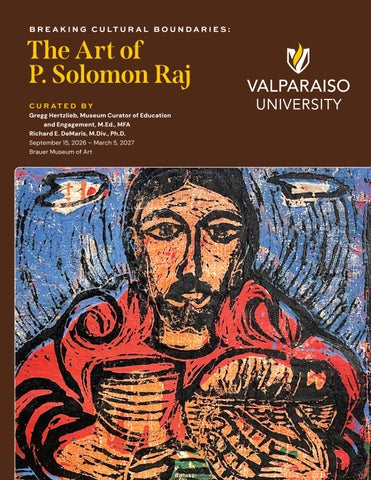
ON THE COVER P. Solomon Raj (1921–2019) The Bread from Heaven, 2009 Brauer Museum of Art, 2016.18.303
The Brauer Museum of Art is pleased to present Breaking Cultural Boundaries: The Art of P. Solomon Raj, an exhibition celebrating the remarkable works the artist created in a variety of media, ranging from relief and intaglio prints to batiks and unique paintings on paper and wood. We at the Brauer Museum and Valparaiso University have looked forward for many years to bringing this exhibition to the university community, celebrating a 2016 donation to the Brauer’s collection by David Zersen ’60, D.Min., Ed.D., and his wife, Julia Zersen, of more than 300 pieces by Raj. The works selected for the exhibition give a fine overview of Raj’s various styles and theological perspectives that lie at the heart of his creative efforts. Raj worked a great deal in the printmaking medium of woodcut, a relief printing method by which the artist carves into a block of wood so that the areas left raised after the carving can receive ink from a brayer rolling over the surface. Raj was talented in this medium, with his figuration consistently impressive in its directness and economy. His woodcuts are often from a single, black block, but in fully-colored prints, he both printed multiple colors and hand colored using watercolor. In all the pieces on display and to varying degrees, Raj frankly acknowledged his process, allowing the language of the medium to assert itself in creations that reflect precision and expression simultaneously. Viewers get the sense that working in a medium that produces multiples, the artist shared not only the message of his subject matter, but also the exuberant moment of the making of the work of art. In the intaglio print medium and in individual pieces as well, Raj shares his hand, that is, his process revealed through evident gestures. Through surface and scale, his work often offers an intimate communication of themes that speak to the spirit of Christianity, but also of India and the humanity that surrounded him. Exhibition co-curator and Senior Research Professor Richard E. DeMaris, M.Div., Ph.D., brought great sensitivity and close scholarly attention as a biblical scholar to his research and curatorial work, and David Zersen continued his support of the museum, exhibition, and artist through his correspondence, theological insights, knowledge of the artist’s life, and generosity. We also are grateful for the help of George Pati, Ph.D., professor of religious studies and department chair, who provided his expert insights during the initial exhibition planning stages. Finally, we acknowledge and appreciate the support of President Rev. Brian E. Konkol, Ph.D., Dean Trisha Mileham, M.A., and Provost Eric W. Johnson ’87, Ph.D. Please enjoy this exhibition of works that inspire with their honesty and faith.
Gregg Hertzlieb Curator of Education and Engagment Brauer Museum of Art
P. Solomon Raj’s New Homiletic to Engage the Seeker DAV I D Z E R S E N ’6 0, D. Min. , E d. D. President Emeritus | Concordia University Texas
It never occurred to me that a 2003 trip to Berlin might have a major impact on my life. As a former theology student of Joachim Jeremias in the mid-1960s in Göttingen, Germany, I was comfortable traveling to and within that country. But that was a long time ago. Something special was calling me this time. As a Lutheran theologian, I was fascinated that, in 2003, Lutherans and Roman Catholics in Germany would gather at an ecumenical conference for the first time. The Kirchentag (church conference) had taken place among German Protestants every two years since 1949, but this year would be different in that it would include Catholics. The expected number of attendees was astonishing; two hundred thousand people were registered. I knew I had to attend! While there, I stayed at the home of long-time Sorbian Roman Catholic friends, the Georg Mueller family. I explored various exhibits and attended worship services, sometimes with the Mueller daughters, especially the opening one. Actual attendance reached four hundred thousand! What had an even greater impact on me, however, was a visit to the Gropius Bau (an exhibition hall), where international artists exhibited their work exploring Anselm of Canterbury’s question, “Cur Deus Homo?” (Why Did God Become a Human?). Much of the art was fascinating and powerful, but the booth that captured me presented the work of P. Solmon Raj , an Indian native.1 A German Lutheran pastor represented his work. We began a chat about the art, and the pastor gave me Raj’s business card. When I returned to Austin, where I had recently retired as President of Concordia University Texas, I emailed Raj. That initial email led to many years of correspondence, a visit to India, and the introduction of Raj’s work in the United States and in several international galleries. The powerful themes in his art, the stunning colors, and the theological ideas expressed in them have traveled with me ever since. In one personal email chat, I asked him, as our friendship grew, “How does one make a good Indian
4
curry?” He replied, “You start with an old woman.” I have smiled about the implication of that comment for years because we were two old men who were beginning a new venture together. Raj was 82, and I, having recently retired, was 65. We began a conversation that led to planning exhibitions, often with university galleries where I had some contacts. Raj would send batiks and prints rolled in tubes, and my wife and I would either purchase or create frames for the art. At times, we would accompany the exhibits and serve as docents. Relying on my colleagues, we established prices, given that Raj was unknown in the markets where the works would be sold. All the receipts were sent to Raj’s bank in Vijayawada, India. The style and message of Raj’s art aroused curiosity in many cities around the world, but often only a university or a gallery would make a purchase.2 In 2012, we established a relationship with Eyekons, an online ministry to churches led by Phil Schafsma that published artists’ work for use in congregational bulletins. Our work became a joint
B R E A K I N G C U LT U R A L B O U N D A R I E S
effort, and Raj wrote that readers and viewers would see this as “our ministry, yours and mine.”3 Two old men had begun to share worldwide the stunning and often powerful art of an Indian intellectual who was a Lutheran polymath. In that same year, Raj suggested I should visit him in India. At 91, he was still active in the physical work of carving wood blocks and dipping cloth in dye vats, but his travel was limited. My wife and I, therefore, flew to Delhi and Vijayawada in the state of Andhra Pradesh. We visited the Raj home and his ashram in Vijayawada; a Roman Catholic colleague in Kerala, Dr. Jose Palakeel, Dean of Studies at Ruhalaya College of Theology in Ujjain; and a nephew in Hyderabad who had chronicled much of Raj’s work for Indian audiences.4 Highlights of that visit included meeting Mary (Saronjini), Raj’s wife, who was also an artist and whose paintings hung in their home. Raj had beautifully carved the two wooden front doors of the home in order to introduce visitors to the work of the Holy Trinity. Across the street was the Lalit Kala ashram, the building where Raj taught traditional music and dance, composed songs and poetry, carved sculptures and wooden blocks, and displayed racks of painted canvases and dyed batiks. Shelves of books and mountains of supplies were everywhere. It was an overwhelming experience for Westerners who had entered the world of an acharya (Sanskrit for a polymath) of Dalit heritage, whose remarkable curiosity led him to preach his Christian faith in as many ways as possible. After our return home, I penned introductions to many of Raj’s new books and wrote my own articles and books, sometimes with co-authors, analyzing the works of this unknown international artist with a Christian perspective. Presentations at conferences, both online and in person, followed. The current exhibition of over sixty works at the Brauer Art Museum at Valparaiso University is an important step in the promotion of Raj’s artwork.5
T H E A R T O F P. S O L O M O N R A J
As a result of my personal appreciation for Raj’s art, music, and literature, I have, as an American theologian, come to appreciate aspects of his genius that have not been fully considered in the United States. I offer these three reflections and accompanying images as an encouragement for further study. First, it’s important to appreciate Raj as a Lutheran Christian who speaks to us from India. American perspectives have typically focused on denominational churches established in India and still supported by American missions. Although Raj studied and taught in the United States, he shares a perspective shaped by roots in his Indian motherland. His Christian faith has roots as far back as 600 C.E., and according to the Thomasine tradition, as far back as 52 C.E.6 His personal heritage has roots in the Protestant beginnings in India, with Bartholomaeus Ziegenbalg and Heinrich Plütchau, sent to India in 1705 by the Lutheran Danish-Halle Mission. Even more personal is the arrival of the first Lutheran missionary from the U.S. sent to India in 1841, the Rev. John Heyer, who baptized Raj’s grandfather in Neggipudi! This background is important because Raj’s personal heritage and his academic experience at the University of Birmingham (Ph.D., 1983) led him to a profound understanding of inculturation, a view with which he wrestled for decades, both artistically and theologically. His dissertation and numerous books and essays probe how the Gospel is “lived out in the thought-forms of a culture as it is expressed in its vocabulary, art forms, and imagery.”7 On the one hand, Raj explores the Gospel by, for example, placing the figures of the nativity before Indian viewers in native Indian garb so they can see the historical Jesus as their own Jesus. On the other hand, Raj worries that Christians can too often package their cultural trappings with the Gospel and thereby prevent people from hearing/seeing Jesus’ real intent. Biblical literature itself is packaged in Jewish and Greek symbolism and structure, which
5
might obscure the message. The question he would want us to ask in viewing his art is this: If we study his visual treatment of a parable, for example, do we get lost in Indian history, or symbols, or clothing? Or can the viewer hear a clear message of grace or forgiveness in the action being portrayed? Second, Raj’s perspective can be an important guide to Americans as we reflect on our own social and political situations. We struggle with issues involving immigration and social justice, as Raj did in India. We may know little of the history and culture of India, yet through Raj’s subtle challenges to his own people, we can explore creative ways to speak truth to power in our own country. Two examples make this point. In 1947, India and Pakistan, after one hundred years of British East India rule and another ninety under the British Raj, separated. The division, largely religious (between Muslim and Hindu) and political (self-rule vs. British loyalists), led to two million deaths and forty million refugees! As a young Christian in this chaos, Raj, who was 26 at the time, certainly had his political opinions, but he chose to use his art to express his faith in a more personal and practical way. In the first image, we see the wire fence separating the two parties (Image 1). It is not necessary to state which were the Hindus and which were the Muslims, but it is important to grasp that they were destroying one another and that that destruction created millions of refugees. And where is Jesus in all of this? And who is this Jesus? He is the one standing with those who are deprived of home, food, family, and country! The second image shows a refugee family embraced by Jesus (Image 2). No political statement is made. However, the viewer learns that Jesus is the one who cares about families, and perhaps about the viewer as well! Third, Raj had been both an elementary school teacher and a university professor, so he knew how students learn. He knew that questions challenged confusion and led to understanding. Personally, I learned this from a liturgical artist, Wil Werling, who worked with Ernst Schwidder, an art teacher at Valparaiso University in the
IMAGE 1 P. Solomon Raj (1921–2019) Untitled (1947 division between India and Pakistan), undated
6
B R E A K I N G C U LT U R A L B O U N D A R I E S
IMAGE 2 P. Solomon Raj (1921–2019) The Refugees, undated Brauer Museum of Art, 2016.18.165
T H E A R T O F P. S O L O M O N R A J
7
1950s. Werling had created an Easter antependium (altar frontal) with some cryptic symbolism for the table-type altar at a new church in St. Charles, Illinois. I asked him what the symbol meant. He said, “If I tell you, that’s all you will ever know.” Raj understood this well and did not like to offer interpretations of his art. Rather, he encouraged a viewer to ponder it. He would ask questions: What do you see there? What does it mean to you? Countless examples of his art encourage this process. A batik, half covered with wheat and half with weeds, may be chosen by a purchaser because it suits the color scheme of his living area or business suite. But there is more! Raj is a Christian. Behind his mastery of drawing and batik is the encouragement to debate what the parable of the weeds among the wheat means (Matthew 13:24–30). Good and evil may live together uncomfortably in this life, but there is an ultimate judgment, and it is God’s alone. “Are you sure your judgment is correct in this case, or should we debate it”? That would be a good reflection from Raj. At some point in his life, he hand painted several strips of paper, each one two feet by three inches, with people marching. One strip clearly depicted Jesus’ Triumphal Entry into Jerusalem because at the center was Jesus on a donkey surrounded by people waving palm branches. “But who were the people on the other painted strips?” I asked him. “Oh, he said, they were just some experiments I was making. What do they mean to you?” I have framed three of them together and named them “Pilgrims All.” But what would you say? And that is the story of Raj’s conversation between the educator and the student, always helping us to learn. At numerous points in our partnership, Raj would write things like “I hope ardently that this will not be my last literary child” or “I won’t be around too long.” (The latter he said in 2010.) As it happened, he lived nine more years, continuing to be driven by curiosity, turning increasingly to poetry because it required less physical stamina, and still inspired by an abiding faith that God’s revelation in Christ gives reason to trust in mercy and to share it. I am convinced that in his creative output there is a new homiletic to address the seeker, whether through music, imagery, dance, or poetry. It was his inimitable Indian way, but in Christ it can become ours as well. V
8
B R E A K I N G C U LT U R A L B O U N D A R I E S
[1] For the sake of brevity, Raj will be the surname used throughout this essay. P. stands for Pulidindi, the family surname. Solomon and Raj are given names, Solomon referencing the wisdom of the great Hebrew king, and Raj (king) being an honorific designation encouraging personal potential. [2] Cities included Washington, DC; Irvine, California; Mequon, Wisconsin; St. Louis, Missouri; St. Meinrad’s Abbey, Indiana; Chicago, Illinois; and West Bend, Wisconsin. Some of the international sites included St. Catherine’s, Ontario; London, England (twice); Toronto, Canada; and Bethlehem, Palestine. [3] Email from Solomon Raj to David Zersen, January 21, 2010. [4] In Vijayawada, we met with Raj’s son, Augustine, who has been enormously helpful in providing historical information, and in Hyderabad, with Dr. B.S. Moses Kumar, the presiding bishop of IPHC Ministries in South India and President Emeritus of Hyderabad Bible College. He has been both a collaborator and an author esteemed in India for his work with Raj’s colleagues and about Raj himself.
[5] Here are some of my publications and other scholarly activities that reflect my twenty-year involvement with Raj’s ministry: the Introduction to Raj’s Biblia Pauperum: The Poor Man’s Bible (2008); “Solomon Raj and His Johannine Icons” in Raj’s St. John’s Gospel: A Gallery of Hieratic Art (2010); co-edited Planting in Native Soil: Studies in Gospel Inculturation (2014); the Foreword to Soliloquies in Solitude: Solomon’s Verse in His Nineties Depicting Cultural, Natural, Existential, Philosophical, and Christian Themes, by B. S. Moses Kumar (2017); “Seeking the Holy in Everyday Themes: Observing Advent with the Art of P. Solomon Raj,” The Cresset: A Review of Literature, the Arts, and Public Affairs (2018); “Meet the Artist-Theologian!” in Dynamics of Art, Faith and Culture: Theological Essays of Dr. P. Solomon Raj, edited by B. S. Moses Kumar (2021); “A Prophetic Artist: Pulidindi Solomon Raj Remembered on His 100th Birthday,” Living Lutheran (2021); “Inculturating the Gospel ofJoy: Exploring the Art of P. Solomon Raj, Ph.D.,” presented at Whatever is Lovely: The Role of Beauty in Theology and Ministry: A Symposium [at Concordia Seminary, St. Louis] (2021). [6] “ Christianity in India,” Wikipedia, Wikimedia Foundation, 4 June 2026, wikipedia.org. [7] P. Solomon Raj, “Inculturation,” Dictionary of Mission Theology: Evangelical Foundations, edited by John Carrie (Nottingham: Intervarsity Press, 2007), pp. 181–184.
T H E A R T O F P. S O L O M O N R A J
9
P. Solomon Raj, Becoming All Things to All People R I C H A R D E . D E M A R I S , M . D i v. , P h . D . Senior Research Professor of Religious Studies | Valparaiso University
P. Solomon Raj’s artwork represents only a sliver of his multi-faceted creative output over the course of his long life (1921–2019), just as the pieces in this exhibition represent a small fraction of his productivity in the visual arts. Raj was prolific as a visual artist, but that was only one outlet for his creative energies. The son of teachers in a small village in southeastern India, Raj completed a Bachelor’s degree and became a teacher himself. By the mid-1950s he had completed theological training and become a pastor in the Andhra Evangelical Lutheran Church. Initially, his creative output was primarily through the spoken, written, and sung word. He preached both from the pulpit and via radio broadcasts, but he was also an essayist, poet, and lyricist, expounding on theological topics, writing poetry in both Telugu and English, and composing dozens of songs and hymns. He knew something about choreography and dance, too, for early in his career he recruited young Hindu women to present biblical stories using classical Indian dance forms and gestures: gospel dance dramas (yakshagana). From early in his life, Raj also showed interest in art
an artist whose curiosity was all-embracing and
and characterized himself as an art hobbyist. As a
whose creative expression across many media was
young student he bicycled to a nearby village to
sweeping in its scope.
assist a screen painter, who created the backdrops
10
for staging Indian epics. He later took up drawing and
Solomon Raj would have described himself first and
painting. He must have had some artistic ability, for
foremost as an educator and communicator, but a
when he studied for a Master’s in Education at Indiana
communicator of a particular sort. He considered
University Bloomington, he also took advanced
himself a Christian evangelist. So, the content of Raj’s
courses in graphics, woodblock printing, etching,
communication throughout his career, via word or via
and engraving with distinguished print maker Rudy
image, was the gospel story. As is well known, the Bible
Pozzatti. This was in the mid-1960s, when Raj was in
speaks with many voices, and there are many ways
his mid-40s. Some years later, Raj also learned how
to tell the gospel story. The way Raj told the story in
to create batiks. He also worked with water colors
his writing and artwork reflected his time and place.
and acrylics. This exhibition of his artwork does not
The Indian society that Raj was born into was rigidly
include examples from all the media he worked in,
hierarchical, sorting individuals or groups into one of
but there is enough variety to demonstrate his wide-
four varnas or castes. The many social reforms that
ranging interests and skills in the visual arts. Add
came with India’s independence from British rule after
to this Raj’s accomplishments as speaker, writer,
World War II (1947) included the abolition of the caste
poet, and lyricist and what we have before us is
system, but social and economic discrimination based
B R E A K I N G C U LT U R A L B O U N D A R I E S
on caste persisted and continues to persist. Raj’s
dramatically exceeded what was expected of a Dalit,
status was so low that he fell outside the caste system;
but he was nonetheless regarded as a member of a
he was a Dalit or untouchable. His was the class of
marginalized class practicing a minority religion.
Indians restricted to the lowest forms of menial labor, activities considered polluting like latrine cleaning,
Raj rose above his humble beginnings, traveling and
street sweeping, and so forth, which limited Dalits from
studying widely and completing a doctorate at the
participating in Hindu social and religious life. They
University of Birmingham in the UK — he also lectured
were and to a great degree remain a detested class. It is
and conducted seminars there and elsewhere — but
not surprising, then, that western missionaries to India
he did not forget where he came from. His artwork
were successful in converting a significant portion of
reflects a Dalit perspective. As a consequence, when
the Dalit population to Christianity in the nineteenth
Raj told biblical stories through his art, he did so from
and twentieth centuries. But that did relatively little
the viewpoint of the disadvantaged and marginalized.
to lift Dalits out of poverty or otherwise ameliorate their degraded and oppressed social condition. Raj
In the Gospel of John’s telling of Jesus and the Samaritan woman meeting at a well in chapter four, the pivotal element is water, which is what Jesus requests from her (Image 1). But this simple story quickly becomes complicated as their dialogue continues, for Jesus introduces the notion of living water, which ends all thirst and leads to eternal life. Biblical scholars conjecture that the gospel may be referring to the Holy Spirit or spiritual sustenance. Raj acknowledges the superior water that Jesus offers by including a great flow of it emanating from him at the top of the picture. As chapter four continues, the reader learns of the ethnic rivalry and hatred between Israelites and Samaritans in Jesus’ day, to the point that they did not interact. Yet here at the center of the work, Raj makes a point of presenting the Samaritan women meeting Jesus’ request for water as he stands in close proximity to her. This biblical story was one of Raj’s favorites because he saw in her a member of a despised group, in other words, a Dalit, and he highlighted Jesus’ engagement with her as one who bridged a bitter ethnic and social divide.
IMAGE 1 P. Solomon Raj (1921–2019) Untitled (Woman at the Well; Gospel of John 4:1–30), 2009 Brauer Museum of Art, 2016.18.240
T H E A R T O F P. S O L O M O N R A J
11
Raj offered an additional take on the story when he paired this image with a short poem in his chapbook titled St. John’s Gospel: A Gallery of Hieratic Art .1 While he considered the Gospel of John rich in metaphor and symbol, the poem, titled “Water of Life,” is down to earth, reminding readers how essential a resource potable water is. The poem begins this way: “Thirst unquenched, Dryness and drought, People die of incessant thirst.” The poem introduces the theme of living water in the next several lines, but as it begins, it draws the reader’s attention to the fate of those lacking water, a common condition of the poor and disadvantaged. Thirst and ethnicity play key roles in another of Raj’s works, in this instance his portrayal of the rescue of Hagar and Ishmael, a story from a cycle of stories about Abraham and Sarah in the book of Genesis, chapter 21 (Image 2). Rescue has arrived in the form of a kindly angel who will direct Hagar to a source of water from which she can replenish her empty clay water jar. It is a happy ending to a story that does not IMAGE 2 P. Solomon Raj (1921–2019) The Deserted (or Hagar), 2006 Brauer Museum of Art, 2016.18.302
begin well. Sarah has been blessed with the birth of a son, Isaac, which now makes the son born to Hagar and Abraham an intolerable irritant to her. Sarah demands that Abraham drive their enslaved Egyptian servant away, which Abraham does. Minimally equipped by Abraham, she is sent out to wander in the wilderness of Beer-Sheba, where she will presumably die. The good news is that God intervenes in her fate, saving a low-status, non-Israelite woman and her now despised son, both abandoned by Abraham and Sarah. It is clear why Raj chose to depict this story from the thousands that comprise the Old Testament or Hebrew Bible: it complements the Jesus and Samaritan woman encounter in the New Testament. There is another connection between the two testaments that Raj makes in his artwork. This exhibition includes a series of nine mother-andchild images, to which the Hagar-and-Ishmael pairing belongs. There is a celebratory image of
12
B R E A K I N G C U LT U R A L B O U N D A R I E S
Mary and the child Jesus titled Adoration, which
Gospel of Matthew’s adoration scene we find mother,
includes two admiring women bracketing the pair
child, and Joseph fleeing to Egypt in order to escape
and bearing gifts. The star in the upper right-hand
Herod’s murderous plans for them (2:10–15). Notions
corner brings to mind the visit of the wise men
of flight, abandonment, and homelessness are at
(Magi) in chapter two of the Gospel of Matthew
work behind this set of images.
(three kings bearing gifts in later Christian tradition). Another image presents mother and child, both
The ease with which Raj joins the biblical and modern
with a halo or nimbus, with a star. Then come four
worlds is on display in this image and three others in
other visually similar presentations of mother and
this exhibition, all black-and-white woodcut prints. In
child. The exhibition also includes a black-and-white
the work titled The Refugees (Image 3) Raj depicts
woodcut print of an evidently homeless couple with
a procession of heavily-burdened men and women
child, with the mother preparing a meal outdoors
as refugees, who are evidently fleeing persecution
as her child hangs in a makeshift sling above her.
and seeking a safe place with what few possessions
Various iterations of the mother-and-child trope
they can carry. Joining them and carrying his own
underscore how important this configuration was
burden — the cross — is Jesus, clearly identifiable by
to Raj, and point to how he tied biblical story with
the crown of thorns he is wearing. It is this figure of
the contemporary reality faced by the rejected,
the burdened Christ — in some cases the physically
despised, and persecuted. Even the celebratory
stooped Christ — that runs through all four images in
adoration scene is relevant here, for shortly after the
various ways.
IMAGE 3 P. Solomon Raj (1921–2019) The Refugees, undated Brauer Museum of Art, 2016.18.166
T H E A R T O F P. S O L O M O N R A J
13
Christ bent over his cross dominates an adjacent print titled Man of Sorrows. The title comes from the Suffering Servant passages in the Hebrew Bible prophet Isaiah, specifically 53:3, which were understood very early in the Christian tradition as prophecy about Christ. The theme of vicarious suffering, or suffering for others, runs through all of chapter 53, and depictions of a suffering Christ, often identified as a Man of Sorrows, enjoyed great popularity as a devotional image in the Christian medieval West. Raj offers his version of the suffering servant here, with the crown of thorns and cross signaling the intense sacrificial suffering Jesus underwent. Omnipresent in these four woodblock prints is the figure of Jesus as a co-sufferer: he is sharing the suffering of the over-burdened refugees; he has stooped to assist a laborer with her heavy load (Laborers); he lowers himself to embrace a refugee family, this group from East Pakistan/Bangladesh (See the second image in the Zersen essay above. Raj applied the title The Refugees to several of his works). Raj made the following comment about this last image:
ere in the woodcut I mentioned Christ is actually taking the place with [sic] the H refugees and he is suffering with them. It is a reminder that the Lord is suffering with people today wherever there is oppression, injustice, hunger and pain. 2 If it is not clear already from the depictions of Christ treated so far, this next image makes it obvious that Raj saw Jesus as one in solidarity with the down and out and as the liberator of those held captive by various oppressions, be they physical or social (Image 4). This placed Raj squarely in the camp of Liberation Theology, a twentieth-century movement among (primarily Roman Catholic) Christians of the Global South that focused on liberating exploited individuals and groups from social and political oppression. Raj would have largely agreed with Liberation Theology’s claim that God has “a preferential option for the poor.” Key scripture for this movement is the implied mandate to assist the thirsty, hungry, naked, sick, stranger, and imprisoned – “the least of these” — in the Gospel of Matthew chapter 25 and the so-called Nazareth or Kingdom Manifesto in the Gospel of Luke chapter 4, where Jesus announced his mission “to bring good news to the poor … to proclaim release to the captives and recovery of sight to the blind, … to
IMAGE 4 P. Solomon Raj (1921–2019) Untitled (Fourfold Liberation [Fourfold Bondages]; Gospel of Luke 4:18), 1994 Brauer Museum of Art, 2016.18.154
14
set free those who are oppressed (Luke 4:18, citing Isaiah 61:1–2 and 58:6). In this image it is the chain link broken by Jesus that captures this theological program and that voices a call to action. Bracketing the broken chain at the top of the image are two elements that reveal another side of Raj’s artistic enterprise. Eager to tell the story of Christ — the Good News — across all cultural boundaries, Raj presents Jesus with a raised right hand, a sign of blessing or peace in the Christian tradition but also a gesture (abhaya-mudra) of protection, reassurance, and peace in the religious traditions of India, especially Buddhism. In the open hand is an eye, an image known in many cultures and religions. Whether understood as the Hand of Miriam (Jewish), Hand of Fatima (Islamic), or more generally the Hamsa (Arabic), the eye-in-palm feature is thought to offer protection against negative forces likes the evil eye. It is well-known across the Middle East and North Africa. In the upper right-hand corner of the image are footprints which bear the stigmata, the stylized wounds attesting to Jesus’ crucifixion. But footprints were not without significance outside Christian circles; they point to divine presence across many traditions. By including these elements, Raj clearly sought to engage viewers from diverse cultures. Altogether they serve as auspicious signs that mark Jesus’ liberating activity as divinely authorized.
IMAGE 5 P. Solomon Raj (1921–2019) Untitled (Eve and Mary) in Biblia Pauperum, undated Brauer Museum of Art, 2016.18.172
In his Liberation in Luke’s Gospel, Raj pairs this image of Jesus with a poem he composed titled “The Fourfold Bondage (Liberation from Bondages).”3 Is it possible that Raj had in mind The Four Noble Truths of the Buddhist tradition when he characterizes Jesus’ liberating action as fourfold? Like Christianity, Buddhism offers escape from a life filled with suffering, namely via the Noble Eightfold Path. Or perhaps Raj was echoing the Vedanta school of Hindu thought which talks about the impediments that keep humans from reaching liberation: the bondages of ignorance, desire, (selfish) action, and ego.
T H E A R T O F P. S O L O M O N R A J
15
While their pathways differ, perhaps Raj was framing the message of the gospel in terms familiar to a culture with deep roots in Buddhism and Hinduism. Raj saw the commonalities over the differences: Christians, Hindus, and Buddhists alike seek a way out of captivity. Alongside his attempts to communicate the gospel story across cultural and religious boundaries, Raj pursued the same goal among his own people, the Dalits. The literacy rate among Dalits is climbing but even today remains stubbornly low relative to other groups in Indian society. Raj attempted to work around that communication barrier by resorting to images to tell stories and thus educate the illiterate. This exhibition includes several instances of biblical scenes juxtaposed in order make connections between them and thereby articulate Christian theology (Image 5). In this image Raj sets the opening of Genesis alongside the opening of Luke: Eve’s encounter with the talking serpent and the angel Gabriel’s announcement to Mary that she will conceive and bear Jesus, the Son of God. It is the good news in a nutshell — that human alienation from God brought about by Adam and Eve will be undone by God’s gracious action through Jesus. The lively images here, especially the wiggling serpent and gesturing angel, are quite engaging, and would no doubt prompt questions from viewers.
IMAGE 6 P. Solomon Raj (1921–2019) Life of Christ (in Biblia Pauperum?), undated Brauer Museum of Art, 2016.18.052
16
B R E A K I N G C U LT U R A L B O U N D A R I E S
For those who could not read but wanted to know
male witnesses in his batik of Jesus’ ascension
more about Jesus, Raj borrowed an Ethiopian visual
(possibly inspired by late medieval and Renaissance
form to create a series of comic-strip panels,
painters in the West). Raj understood that the goal
highlighting key events in his life (Image 6). The panels
of Christian art — his art — was to convey what he
proceed in serpentine fashion — left to right, right
called a prophetic message.
to left — beginning with the Gabriel-Mary encounter (the annunciation; upper left) and culminating in Jesus’ ascent to heaven (the ascension; lower left). A panel depicting Jesus’ rescue of those in Hell derives from post-biblical tradition, namely the Harrowing of Hell (second to last panel). Raj harmonized the four gospel accounts, freely combining events
If one of my art pieces raises deep questions in the minds of people, if it disturbs the viewers somehow, if it stimulates people to re-examine their views and values … then I would consider my art work a good news. 4
unique to Luke (young Jesus instructing the Temple teachers) and John (Jesus’ washing of Peter’s feet),
Perhaps it is most accurate to say that Raj hoped
for instance, and creatively adding elements like fish
his art would be inspirational and even revelatory in
(an important post-biblical Christian symbol) to the
some way. To convey good news to as many viewers
menu of the Last Supper.
as possible motivated him to experiment with a wide range of techniques and media and to borrow
Employing visual forms, styles, symbols, media, and
symbols and elements from a wide range of cultures,
techniques from a host of traditions and cultures,
as this exhibition demonstrates. In doing so, Raj may
Solomon Raj endeavored to convey the gospel story
have been guided by the example of the widely-
by every means he could. He could at times be
traveled apostle Paul, who wrote, “I have become all
quite provocative in his rendition of familiar biblical
things to all people, that I might by all means save
stories, like presenting Eve turning a somersault in
some. I do it all for the sake of the gospel, so that I
the Garden of Eden, or adding a female to the all-
may share in its blessings” (1 Corinthians 9:22–23). V
[1] St. John’s Gospel: A Gallery of Hieratic Art (Vijayawada, India: St. Luke’s Lalit Kala Ashram, 2010), p. 40.
[3] Liberation in Luke’s Gospel: Image and Word (Vijayawada, India: St. Luke’s Dalitkala Ashram, 1996), p. 23.
[2] Dynamics of Art, Faith and Culture: Theological Essays of Dr. P. Solomon Raj, edited by B. S. Moses Kumar (Delhi: Christian World Imprints, 2021), p. 121.
[4] Living Flame and Springing Fountain: Batiks and Meditations (Delhi: Indian Society for Promoting Christian Knowledge, 1993), p. 94.
T H E A R T O F P. S O L O M O N R A J
17
Key Publications by or about P. Solomon Raj (IN CHRONOLOGICAL ORDER) • Raj, P. Solomon. 1986. A Christian Folk-Religion in India: A Study of the Small Church Movement in Andhra Pradesh, with Special Reference to the Bible Mission of Devadas. Studies in the Intercultural History of Christianity 40. Frankfurt: Peter Lang. • Raj, P. Solomon. 1993. Living Flame and Springing Fountain: Batiks and Meditations. Delhi: Indian Society for Promoting Christian Knowledge. Originally published in German in 1988 as Lebendige Flamme — sprudelnder Quell: Batiken und Meditationen. Edited by Heimo Ertle and Joe Ubelmesser. Nuremberg: Diözesan-Akademie. • Raj, P. Solomon. 1995. Palm Leaf Prayers: 14 Woodprints and Linocuts from India. Selected with texts chosen by Jörg H. Müller. Wuppertal: United Evangelical Mission.
• Raj, P. Solomon. 2008. Biblia Pauperum: The Poor Man’s Bible (The Story of the 15th C. Block Book). Bangalore: Asian Trading Corporation. • Raj, P. Solomon. 2009. Etched Icons: Art, Faith and Culture. Vijayawada, India: St. Luke’s Lalit Kala Ashram. • Raj, P. Solomon. 2010. St. John’s Gospel: A Gallery of Hieratic Art. Vijayawada, India: St. Luke’s Lalit Kala Ashram. • Zersen, David, and B. S. Moses Kumar. 2014. Planting in Native Soil: Studies in Gospel Inculturation. Austin, TX: Concordia University Press/Delhi: Indian Society for Promoting Christian Knowledge.
• Raj, P. Solomon. 1996. Liberation in Luke’s Gospel: Image and Word. Vijayawada, India: St. Luke’s Dalitkala Ashram.
• Kumar, B. S. Moses. 2017. Soliloquies in Solitude: Solomon’s Verse in His Nineties Depicting Cultural, Natural, Existential, Philosophical & Christian Themes. Christian Heritage Rediscovered 55. New Delhi: Christian World Imprints.
• Raj, P. Solomon. 2003. Fiery Wheels: Art Works and Meditations. Vijayawada, India: St. Luke’s Lalit Kala Ashram.
• Raj, P. Solomon. 2021. Dynamics of Art, Faith and Culture: Theological Essays of Dr. P. Solomon Raj. Edited by B. S. Moses Kumar. Delhi: Christian World Imprints.
• Raj, P. Solomon. 2003. The New Wine-Skins: The Story of the Indigenous Missions in Coastal Andhra Pradesh, India. Indigenous Christianity Series. Delhi and Chennai: Indian Society for Promoting Christian Knowledge and Mylapore Institute for Indigenous Studies.
18
B R E A K I N G C U LT U R A L B O U N D A R I E S
T H E A R T O F P. S O L O M O N R A J
19
Brauer Museum of Art Valparaiso University Center for the Arts 1709 Chapel Drive Valparaiso, Indiana 46383 219.464.5048 | brauer.museum@valpo.edu
V A L P O . E D U/ B R A U E R - M U S E U M - O F - A R T