Vol 22: #25 • Grocery Chains • (6-14-2026) Tidbits of Coachella Valley
by Kathy Wolfe
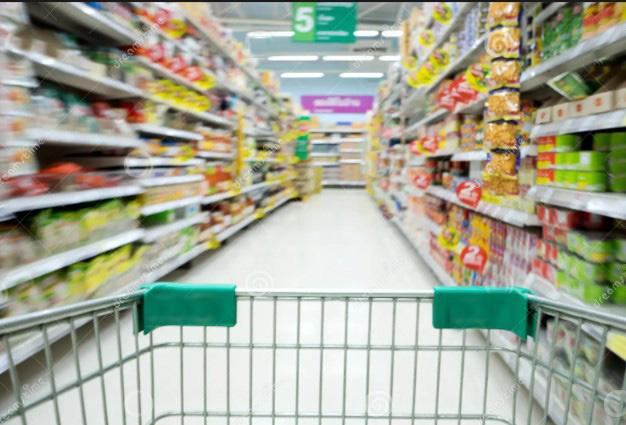
Back in the day, folks trekked for miles around to the general store to purchase all their needs, from groceries to shovels to pocket watches to farm equipment. Then along came stores that specialized in food products alone, called grocery stores. This week Tidbits searches through the aisles and records for some facts on the evolution of these now-mighty grocery chains that we collectively call supermarkets.
THE BEGINNING
• Before self-serve stores were ever heard of, customers who entered the general store would hand their list to the shopkeeper behind the counter. No one helped themselves to their purchases back then. Instead, the clerk dutifully walked through the inventory of goods collecting the needed items in a handbasket and carried them back to the counter, where the customer made the purchases.
• In 1883, when 23-year-old Bernard Kroger invested his life savings of $372 to open his first store in Cincinnati, Ohio, there was still no concept of self-
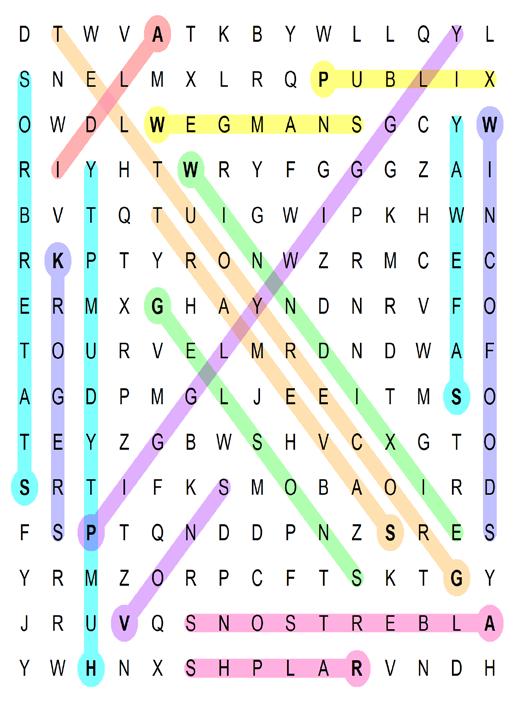
TRIVIA NEWSFRONTAIVIRT TNORFSWEN
(Answers on page 16)
1. TELEVISION: Who is the longtime host of the reality show “Survivor”?
2. MOVIES: What is the song playing when the lead characters dance the twist in “Pulp Fiction”?
3. U.S. STATES: The first president, George Washington, was born in which colony that would later become a state?
4. GEOGRAPHY: Which South American country controls Easter Island?
5. MYTHOLOGY: To which mythological character is the Parthenon dedicated?
6. LITERATURE: Which war is the background for Anthony Doerr’s novel “All the Light We Cannot See”?
7. MATH: What is the sum of the first five prime numbers?
8. INVENTORS: Which inventor developed more than 300 products from peanuts?
9. MUSIC: Who won Album of the Year at the 2026 Grammys?
10. HISTORY: In what year did U.S. women earn the right to open credit cards in their own names?
Answers
1. Jeff Probst.
2. “You Never Can Tell,” Chuck Berry.
Classic Games & Toys
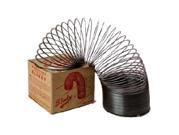
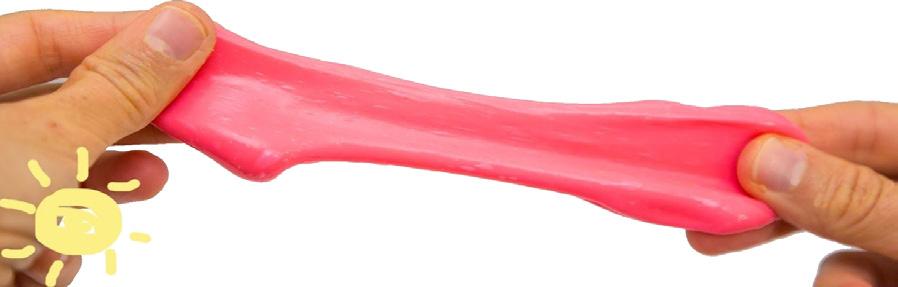
Back in the day, do you remember pressing Silly Putty onto the Sunday comics page to transfer the pictures into funny and stretchable images?
This week, Tidbits recalls the history of this fun and gooey substance we grew up with.
• The demand for rubber during World War II was enormous. It was badly needed for gaskets, hoses, seals, and tires for every jeep, truck, tank, bomber, and transport plane. One B-17 bomber required upwards of half a ton!
• In early 1942, Japan captured Southeast Asia, which was home to nearly all of the world’s natural rubber, wiping out the U.S. supply. Across the nation, chemists quickly went to work to create a synthetic rubber, experimenting with hundreds of materials.
• A chemist from Dow Corning, Earl Warrick, discovered that combining boric acid with silicone oil produced a sticky substance that bounced. There were seven ingredients in Dow Corning’s mixture, which was dubbed “3179 Dilatant Compound.”
• About the same time, another chemist, James Wright of General Electric, discovered the same process, happening upon a slime that was both firm and flexible and bounced off the floor. Both men filed a patent for basically the same process, Warrick in 1947 and Wright in 1951. Both men claimed they were the compound’s true inventor.
• However, the goop lacked the necessary properties to replace rubber in the wartime effort. That’s where a Connecticut advertising and marketing executive stepped in.
• Having happened on to a blob of the stretchable silicone, Peter Hodgson, who was writing a catalog of toys for a local store, kept it on his desk. Everyone who visited his office spent time fiddling with it, molding, stretching, and bouncing the stuff. People were amused by its
curious behavior and enjoyed toying with it. This started him thinking about ways he might put the strange substance on the market and sell it as a novelty item.
• Already $12,000 in debt in 1949, Hodgson borrowed $147 to purchase a batch of the goo from General Electric’s New Haven, Connecticut, factory. He hired a local Yale student to divide it into one-ounce portions and pack them in plastic eggs. Hodgson gave his innovation the name Silly Putty and sold the egg packages for $1 each.
• Sales were sluggish at first, but after Silly Putty was mentioned in an article in the New Yorker magazine, sales abruptly soared to 250,000 of the eggs in just three days. By 1950, Hodgson had already established a manufacturing plant in North Branford, Connecticut to produce and dispense the product.
• But when silicone, the putty’s main ingredient, was rationed in the midst of the Korean War in 1951, it nearly put Hodgson out of business. It took a year for the regulation to be lifted, enabling production to go forward once again.
• He got a major sales boost in 1957 when the popular kids program, The Howdy Doody Show, was the first on television to air commercials for Silly Putty. Kids loved it.
• Hodgson took his invention worldwide in 1961, expanding into Canada, Europe and the Soviet Union. In 1968, Silly Putty even went into space with the Apollo 8 astronauts, who used it not only as a squeezable stress reliever, but also as a practical way to stick their tools to the spacecraft’s walls and keep them from floating around the cabin during zero gravity.
• Although the original putty was orangey-pink, it now comes in glow-in-the-dark, colorchanging, and metallic varieties. Sold in 23 countries, annual sales now top $5 million. Indeed, a lot of eggs!
• It’s not just for fun anymore. Itʼs used by many for stress relief, and by physical therapists in the rehabilitation of hand injuries. It also has practical uses, such as lifting dirt, lint, pet hair, and even ink from certain surfaces.
Grocery Chains (from page one)
service stores. Krogerʼs idea was to create a new method of food merchandising by creating and selling his own products. Rather than customers buying meats, fish and bakery items from other suppliers, he envisioned the one-stop shop where all of these goods could be purchased at the same location.
• Kroger opened the first grocery store in America in 1901, which featured an in-store bakery. This was soon followed by its own in-house meat department, thus eliminating the need for a separate trip to the butcher store.
SELF-SERVICE REVOLUTION
• The one-stop grocery store concept was an immediate success and quickly revolutionized the food selling industry. Alerted to the change, other merchandisers soon opened their own markets offering similar shopping conveniences.
• Shopping carts were officially invented in 1937 by Sylvan Goldman, the owner of the Humpty Dumpty supermarket chain in Oklahoma City. He created the first wheeled “folding basket carrier” to help shoppers who stopped buying when their handheld baskets became too crowded and heavy. Once implemented, sales quickly increased by more than 20 percent.
A&P
• New York City’s wealthy Hartford family took over the Great Atlantic and Pacific Tea Company, focusing primarily on tea. By 1909, they had transitioned into the grocery business, known as A&P, offering basic “no frills” items at exceptionally low prices. The company became successful in a hurry, and within a short time, they were opening an average of one store every three weeks, one of the first chains to expand nationwide.
• From 1915 through 1975, A&P was the nation’s largest grocery retailer. In the 1930s it had
become the world’s largest retailer with 16,000 stores. Expanding into the manufacturing and bakery business allowed them to further cut costs and offer the best prices with their privatelabel products.
• But increased competition from other stores, such as Walmart, took its toll on A&P. When they failed to adapt to the change in market conditions and the lower prices found at other stores, the company began to fail. When the company first filed for Chapter 11 bankruptcy in 2010, the chain was down to 395 stores. The last A&P store shut down in November 2016.
SAFEWAY STORES
• In 1911, Sam Seelig opened the doors of his first grocery store in Los Angeles. Five years later, he had 15 stores, and by 1922, more than 100, and 322 stores by 1926.
• In 1926, Seelig left the grocery business to start a real estate company. M.B. Skaggs merged with Seelig’s company, and the name of the chain became Safeway, a corporation of 750 stores. It was one of the first chains to have customer parking lots by their doors. There are currently over 900 Safeway stores in the U.S.
PIGGLY WIGGLY
• In 1916, Clarence Saunders opened his first grocery store in Memphis, Tennessee, and changed the way people shopped. He called his store Piggly Wiggly, an odd name that Saunders simply thought people would easily remember.
• Saunders designed his store with items on open shelves. Customers followed a maze-like aisle system, guiding them to the checkout counter at the end. Although Saunders’ store experienced shoplifting theft with his concept, the profits gained from increased impulse buying more than covered the losses.
• In 1925, George Jenkins went to work at his local Piggly Wiggly as a stock clerk, moving up the ranks to become a manager. Five years after his first day at Piggly Wiggly, Jenkins opened the door of his own store in Winter Haven, Florida. He was 22 years old. Jenkins opened his second store in 1935.
PUBLIX STORES
• Ten years later, Jenkins purchased the 19 Piggly Wiggly stores. He first named it the All-American grocery chain, but began converting them to the Publix name. Publix stock was made available to its employees in 1959 for $10 a share, and Publix remains the largest employeeowned company in the United States. The
company operated stores in Florida alone until 1991, when it expanded into Georgia. There are now more than 1,400 stores in eight states, employing over 260,000 people, with sales of close to $63 billion annually. About 30 new stores are opened each year.
WINN-DIXIE
• The Winn-Dixie chain underwent several name changes after it was begun in Idaho in 1914 as
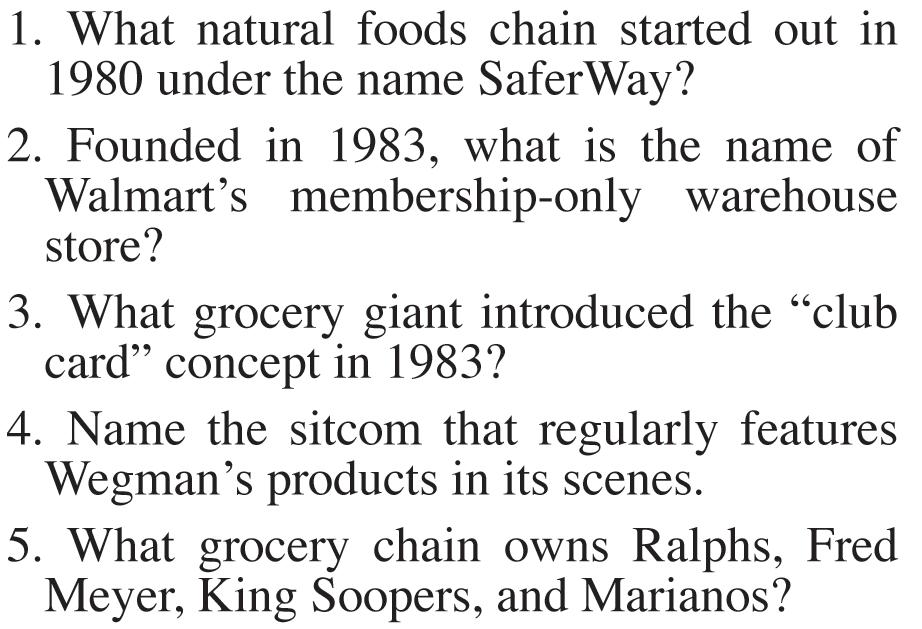
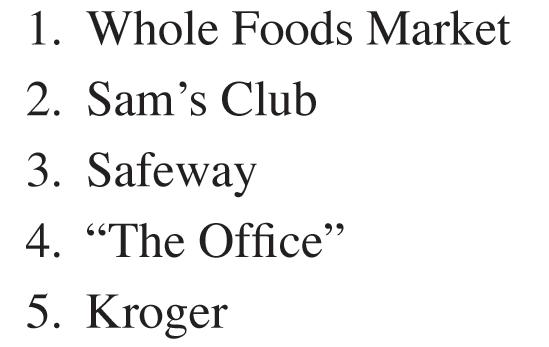
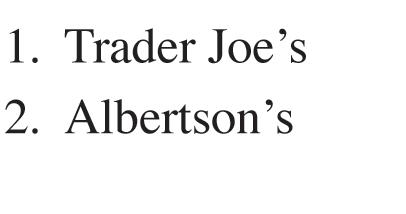
1. Name the "tiki-themed" grocery store founded in 1967 in Pasadena.
2. Vons, a grocery store chain established in 1906, is now owned by _______.
Founded in 1962 by Sam Walton with a single store in Rogers, Arkansas, Walmart became the world's largest company by revenue in 2010. The company operates nearly 11,000 stores in 19 countries and employs 2.1 million people, with 1.6 million of those in the United States.
by Mary Hunt
Ask Me Anything: Cost of Ice, DIY Whipped
Butter, Elderly Turkey, EC en Español
by Mary Hunt
DEAR MARY: My husband says that it costs more to make ice in the freezer than to buy it in bags. I find that hard to believe. Do you know the answer? -- J.M.
Dear J.M.: Let’s say a 10-pound bag of ice at the store costs $2. Two dollars’ worth of water from your tap would be nearly 350 gallons at the U.S. average price of about 0.0058 cents per gallon -- enough to make a lot of ice. You are already keeping the freezer at zero degrees F, so it will take no more energy to make ice in it than you’re spending now to freeze other stuff.
Your husband’s theory might hold water if he’s talking about buying a separate ice-making machine that will be an additional appliance in your home and draw its own electricity. Otherwise, I think he’s all wet.
DEAR MARY: How long will a turkey keep in the freezer? I still have an uncooked turkey in the freezer from Thanksgiving 2015. Should I toss it, or can I do something with it? -- Lina
Dear Lina: I just did a double take! I thought I read 2025, but now I see you’ve had this bird in your freezer for over 10 years. You may have a collector’s item on your hands -- petrified turkey! No, seriously, you need to dispose of it. My best sources assure us that a turkey frozen solid in its original packaging is good for up to one year. After that, it degrades into a tasteless, poorly textured, very old, terrible piece of poultry that should be tossed.
DEAR MARY: I was reading a Spanish newspaper cover to cover on a flight from Madrid to Miami. The newspaper, El Pais, features articles from The New York Times, Washington Post and others every week. Well, right there in one of the articles was a quote from you. Talk about reaching readers! On a recent extended visit to Spain, I didn’t have internet access like I have at home, but I checked your column at least three times a week in that newspaper while I was there.
Thanks for the job you do and for inspiring us. Congratulations on all your accomplishments. You are a blessing in my life.
-- Carmen
ADVERTISING PROOF
DEAR MARY: I love the soft texture of whipped butter, but the stuff in the tubs costs a fortune when compared pound for pound with stick butter. My favorite is the butter that is whipped with olive oil. Do you have any suggestions on how I can make my own whipped butter? I have no idea what type of proportions I would need, or if a third ingredient is necessary so it will spread easily. -- Sara
Dear Sara: You’ll need two sticks of real butter (that’s 1 cup, and please do not substitute with margarine), 1 cup of canola or olive oil, 1/2 teaspoon sea salt and an electric mixer. Allow the butter to come to room temperature in a mediumsize mixing bowl.
Dear Carmen: Who knew I could write in Spanish! Ha-ha. Seriously, oftentimes interviews that I do or articles I write are licensed to other
publications without my knowing. Many thanks you for your kind words, or perhaps I should say, “Gracias!”
Palm Springs Pointe c/o Nicolas Gonzalez 1/4 pg. BW 6x disc. June 14, 2026 • Vol. 22 - No. 25
Mary invites you to visit her at EverydayCheapskate.com, where this column is archived complete with links and resources for all recommended products and services. Mary invites questions and comments at https:// www.everydaycheapskate.com/contact/, “Ask Mary.” This column will answer questions of general interest, but letters cannot be answered individually. Mary Hunt is the founder of EverydayCheapskate.com, a frugal living blog, and the author of the book “Debt-Proof Living.”
Affordable rents are income-restricted in accordance with the HUD Section 8 and Low-Income Housing Tax Credit (LIHTC) programs and other regulatory agreements (see income limits below).
Palm Springs Pointe Senior Apartments will be opening its wait list beginning June 22, 2026 at 8:00 am pst. The PreApplication and Property information forms are available in person, via mail, or by email to all applicants requesting an application. The application will be collected in person, by fax, mail or email.
Final Changes DUE: 12:00 NOON
Mix it with the electric mixer on low speed for about 30 seconds or until it becomes creamy. Keeping the mixer running, add the oil in a small, steady stream. Add the salt. Keep mixing until it looks very light and fluffy. Store the whipped butter in an airtight container in the refrigerator. Even enjoy its spreadability straight from the refrigerator.
To enable us to process your applications, please make sure to submit a completed pre-application signed by each adult applicant. Incomplete pre-application will be rejected. Each household may only submit one pre-application.
Assistance is available for completing pre-applications during office hours of 10am-3pm Monday to Friday at Palm Springs Apartment. Reasonable Accommodations and Language translation services are available upon request.
There is no minimum income requirement at Palm Springs Pointe Apartments. The tenant portion of Section 8 rent is approximately 30% of the family’s monthly adjusted income in accordance with HUD regulations.
Admission is subject to program eligibility criteria and unit occupancy standards. Applicants are subject to Resident Selection Criteria and third-party income and asset verification to determine the household’s combined annual income in accordance with the Low-income Housing Tax Credit Program requirements and other regulatory agreements. Restrictions on full-time student households also apply. We strongly encourage all to apply. Let our team help you determine eligibility.
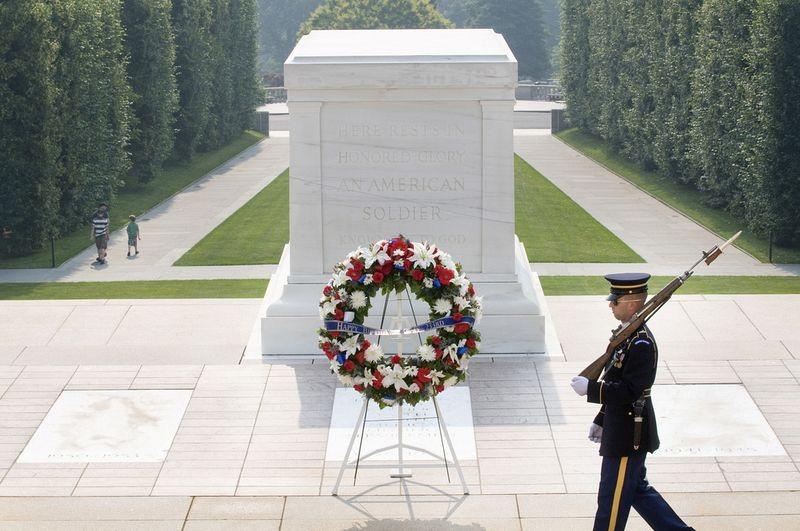
This week, Tidbits visits Arlington National Cemetery’s Tomb of the Unknown Soldier, a monument honoring soldiers who have died unidentified, a site visited by more than three million people every year.
• The tomb as we know it today was not completed until 1932, consisting of seven large marble slabs quarried from Marble, Colorado beginning in 1930. Construction costs were $48,000 (about $950,000 in today’s dollars) for the 79-ton tomb.
• The carvings on the monument were done by the renowned marble carvers, the Piccirilli Brothers, famous for carving the Lincoln statue inside the Lincoln Memorial and the lions outside the New York City Public Library.
• The first soldier to be interred was a World War I veteran chosen from four unknown remains exhumed from four different cemeteries in France. A U.S. Army Sergeant, who had been wounded in combat, was selected to decide
which of the four identical caskets would be laid to rest in the tomb. Edward Younger chose the third casket from the left and laid white roses on it as a sign.
• The remaining three were reburied in France. President Warren G. Harding officiated at the interment ceremony on November 11, 1921, the third anniversary of the armistice ending World War I.
• The unknown soldiers from World War II and the Korean War were both interred in 1958, with President Dwight Eisenhower officiating. Two soldiers were selected as candidates to represent World War II, one from the European Theater and the other from the Pacific Theater.
• A Navy Medal of Honor recipient was selected to choose which of the caskets would make its way to Arlington, while the other was buried at sea. The four Korean War candidates were disinterred from Hawaii’s National Cemetery of the Pacific, with an Army Master Sergeant making the final selection, and the remaining three re-interred in Hawaii.
• President Ronald Reagan presided over the ceremony to bury the unknown Vietnam soldier in 1984 after the casket had made its way from Hawaii.
• However, in 1998, the remains were exhumed from the Arlington tomb and tested, and the previously unknown soldier was identified as 24-year-old Michael Blassie whose plane had been shot down in 1972. His family then moved him to a St. Louis cemetery.
• The Vietnam crypt remains empty, and no replacement is likely due to advances in medical
DNA techniques. Instead, the crypt now bears a cover with the inscription, “Honoring and Keeping Faith with America’s Missing Servicemen, 1958 – 1975.”
• The Tomb has been guarded every minute of every day since 1937 by soldiers from the 3rd U.S. Infantry Regiment, nicknamed “The Old Guard,” a unit that has served the U.S. since 1784, America’s oldest active infantry unit.
• Nothing hinders the Guard from their duties, not the weather, not darkness, even when the cemetery is closed. This duty assignment is one of the most prestigious positions in the military. In order to even be considered, the candidate must go through an intense training period, including memorization of 35 pages on the tomb’s history.
• Their badge can be revoked for any on- or offduty action that is considered disrespectful to the Tomb. There is no insignia on their uniforms that identify their rank, since the identities and ranks of the interred soldiers are unknown, and a guard would not want to unknowingly outrank those soldiers.
• The guard changes every 30 minutes. The tour of duty is served an average of 18 months.
Tidbits of Coachella Valley
CLIP AND SAVE
by Dana Jackson
Q: Is the network going to replace Stephen Colbert with another host? I really liked Craig Ferguson’s show and wish he’d come back. -- L.D.
A: After the cancellation of “The Late Show with Stephen Colbert,” CBS filled the time slot with two comedy shows -- “Comics Unleashed” and “Funny You Should Ask.” The former is a round-table talk-show format that features comedians who trade jokes with host Byron Allen (who’s emphasized that they would avoid all political topics). The
second half-hour is a comedy game show hosted by Jon Kelley with comedians competing as guests.
In an interview with NPR, Allen, who produces both shows, said that he isn’t trying to replace Colbert. He calls him an “American treasure,” while also admitting: “Not everybody’s gonna love me. But there is that one or two percent that would be like, ‘Hell yeah, I’m rolling with you.’” You might not know this, but “Comics Unleashed” had already
1. Backrooms (R) Chiwetel Ejiofor, Renate Reinsve
2. Obsession
(R) Michael Johnston, Inde Navarrette
3. Star Wars: The Mandalorian and Grogu (PG-13) Pedro Pascal, Brendan Wayne
4. Michael (PG-13) Jaafar Jackson, Nia Long
5. The Breadwinner (PG) Nate Bargatze, Mandy Moore
6. The Devil Wears Prada 2 (PG-13) Meryl Streep, Anne Hathaway
7. Pressure (PG-13) Andrew Scott, Brendan Fraser
8. The Sheep Detectives (PG) Hugh Jackman, Brett Goldstein
9. Passenger (R)
been on the air in syndication for two decades before replacing “The Late Show” in May.
As for Craig Ferguson, who hosted “The Late Late Show” on CBS from 2005-2014, he’s now hosting a five-part documentary series on CNN with the same title as his 2009 memoir -- “American on Purpose” -- where he travels from coast to coast. According to the Hollywood Reporter, Ferguson’s journey explores “topics like the First Amendment, individualism, capitalism, patriotism, and the immigrant experience.” It also features appearances from Jay Leno, Tiffany Haddish and Jason Biggs.
***
Q: What ever happened to Ellie Kemper? I haven’t seen her in anything but commercials since the hilarious “Kimmy Schmidt” show ended. -- Y.N.
A: The talented Ellie Kemper went from “The Office,” to the hit comedy film “Bridesmaids,” to starring in her own Tina Fey comedy series “Unbreakable Kimmy Schmidt.” Her career has slowed down a little, but she’s probably just looking for a project of equal caliber.
In 2023, Kemper was set to star in a new comedy for ABC called “Drop-Off,” but for some reason, the network didn’t pick it up after the pilot was filmed. She does have a lucrative commercials deal with Kohl’s, but her fans are eager to see her in a scripted comedy once again. She’s also appeared as a guest host for almost 30 episodes of “Today’s” third and fourth hours, so perhaps she’s pivoting into hosting gigs, in addition to acting.
***
Q: Is it true that they’re canceling “Access Hollywood”? How long has it been on the air? -- G.G.
A: Yes, the long-running syndicated enter-
tainment magazine show “Access Hollywood” and its companion series, “Access Daily,” have been canceled.
According to Entertainment Weekly, NBCUniversal has chosen to end all of its first-run syndicated programming, which includes these two long-running shows. “Access Hollywood” has aired for roughly 30 years. Conversely, CBS Media Ventures just renewed competitor “Entertainment Tonight” for its 46th season.
* * *
Send me your questions at NewCelebrityExtra@gmail.com.
(c) 2026 King Features Synd., Inc.
Good Recipes from
Charred Corn Salsa
The grilled corn in this salsa gives it an intensely savory, smoky depth of flavor.
2 ears fresh corn
1 medium red onion
Kosher salt
Pepper
2 jalapenos (seeded for less heat, if desired)
1 clove garlic
2 tablespoons fresh lime juice
1 tablespoon olive oil
1/2 cup chopped fresh cilantro
1. Heat grill to medium-high. Brush corn and onion with olive oil and season with 1/4 teaspoon each salt and pepper. Grill, turning occasionally, until tender and slightly charred, 8 to 10 minutes total. Transfer to a cutting board. Cut the corn off the cob and chop the onion.
2. In a large bowl, combine the jalapenos, garlic, 1/2 teaspoon salt and 1/4 teaspoon pepper.
3. Add the corn, onion, lime juice and olive oil, and toss to combine. Fold in the cilantro. Makes 6 servings.
Classic Oven Fries
Serve this popular choice with your favorite beef or steak dish.
2 tablespoons olive oil
3 medium (about 8 ounces each) baking potatoes
3/4 teaspoon salt
1/4 teaspoon coarsely ground pepper
1. Preheat oven to 425 F. Brush 2 large cookie sheets with 1 tablespoon oil.
2. Cut each unpeeled potato lengthwise into quarters, then cut each quarter lengthwise into 2 wedges (or, cut potatoes crosswise into 1/4-inch-thick slices).
3. In a large bowl, toss potatoes with salt, pepper and remaining 1 tablespoon oil until evenly coated.
4. Divide potatoes between cookie sheets, spreading each batch into an even layer. Place cookie sheets on 2 oven racks and ovenfry potatoes 25 minutes or until tender and crisp, turning potatoes over once and switching pans between upper and lower racks halfway through cooking.
Lemony Oven Fries:
Prepare Classic Oven Fries as above in steps 1 and 2. In step 3, mix 1 teaspoon grated fresh lemon peel, 2 tablespoons fresh lemon juice, 1 tablespoon dried oregano and 1 large garlic clove, crushed with press, with salt, pepper and oil in bowl. Add potatoes and toss to coat. Complete recipe as in step 4.
Spicy Oven Fries:
Prepare Classic Oven Fries as above in steps 1 and 2. In step 3, mix 1 teaspoon onion powder, 1/2 teaspoon turmeric and 1/4 teaspoon ground red pepper (cayenne) with salt, pepper and oil in bowl. Add potatoes and toss to coat. Complete recipe as in step 4.
Each serving: About 205 calories, 5g
total fat (1g saturated), 0mg cholesterol, 450mg sodium, 38g total carbs, 3g dietary fiber, 4g protein.
By John Allen DIAMOND LIL
by Brett Koth
Donald Duck by Walt
NEXT WEEK in
Holidays & Observances This Week
6/14 National Flag Day
6/15 Magna Carta Day
6/16 Make Some Fudge Day
6/17 National Garbage Collectors Day
6/18 Autism Awareness Day
6/19 Juneteenth
6/20 Fathers Day / Summer Solstace
Dog Talk with Uncle Matty
By Matthew Margolis
Get Fit with Fido
During the season of beach bods and sixpack abs, it’s hard to remember that fitness isn’t just about looks. It’s about health -- and not just physical health.
Fitness is also about mental acuity, good behavior and an all-around feeling of happiness. This is true for humans, and it’s true for dogs.
No doubt you’ve heard the saying: A tired dog is a good dog. Well, it’s almost accurate.
If a dog that hasn’t been on so much as a walk around the block since winter suddenly finds himself jogging across town under a blazing sun, he’ll be tired, all right. But he might also be injured. Or in pain. Or dehydrated. Or feeling sick. This is not the objective, and it could backfire, as pain, injury and illness can trigger aggression.
Nor is it the goal of exercise to simply tire your dog out by setting him loose in the yard to mindlessly run around in circles. Tired is good. But tired in the right way is best.
What’s the right way? Depends on the dog. While it’s true that any exercise is better than none, in most cases, owners and dogs exercising together is optimal for many reasons:
-- You are there to bear witness to any injury your dog may suffer. Prompt attention and temporary restriction of activity if necessary can prevent a minor injury from becoming severe.
-- Your participation allows you to tailor the type of exercise to your dog’s needs. For example, herding dogs are intelligent and high energy by nature. Sports, games or even an obstacle course in the back yard will satisfy their need for physical exercise and mental stimulation. A Chihuahua, however, might be turned into a jittering bundle of nerves by such a regimen. This small breed’s exercise requirements would be easily satisfied with a couple of half-hour walks a day.
-- Exercising with your dog makes the entire experience as much about bonding as about getting in shape. If you carve out time every day for exercising with your dog and customize that exercise to accommodate his breed and your lifestyle, you will have created something that will both lengthen and strengthen your relationship.
Getting into the habit of playing various sorts of brain games can go a long way to helping us stay sharp, improve brain health, strengthen memory and slow cognitive decline.
They can help us focus our attention, process information more quickly and recall facts. Whether they are logic, word, number, memory, card or any other type of activity that requires focused thinking, playing these games give our brains a boost -- and we don't even have to leave home!
The AARP Games Center (www.aarp. org/games) is a great place to sample free games. There are various forms of solitaire, mahjong, lots of crossword and word games and trivia. If you're an AARP member and you sign in, there are even more games. Look for the Staying Sharp section for extra games. Games for the Brain (www.games forthebrain.com) is an interesting site that
Outside In
There is nothing that says summer better than getting in touch with nature: a trip to the beach, a swim in a lake or planting flowerbeds. Most of us love the casual comfort, color and charm of a garden setting. It is easy to transform your home into a garden oasis with a few simple design moves. It's even easier to refresh your home with a few botanical motifs. Nature is a classic theme in home decor. The relaxed appeal of outdoor-inspired interiors is one that your family and friends are sure to love.
The easiest and most obvious way to “garden up” your room is to bring in plants and flowers; the more the better. On one hand, plants are recommended to help improve the quality of the air in a room. On the other hand, select your plants with care, especially if someone in your household suffers from allergies.
doesn't require any registration. It appears that the games are created by a guy in Germany, but you'll also find familiar games like Chinese checkers and Minesweeper.
As a general rule, look for online games that don't require you to set up an account, but allow you to play by just going into their website. If you really want to play the games on a certain site and signing up is required, take a look at their privacy policy to see what information they collect about you using cookies. In such cases, it's a good idea to set up an extra email address that you only use for games exclusively.
If you prefer to add a social aspect to your game playing, check your local senior center and library for game days where you can play against others. Ask about card games, bingo, chess and checkers, Scrabble, crosswords or even jigsaw puzzles done as a group.
If money is not a concern, consider a membership at the BrainHQ site (www.brainhq. com). Their games are backed by years of research into improving cognitive function, but be sure to read their privacy policy.
* * *
Matilda Charles regrets that she cannot personally answer reader questions, but will incorporate them into her column whenever possible. Send email to columnreply2@gmail.com. (c) KingFeaturesSyndicate2026
Keep it simple. Lightweight furniture such as wicker and rattan are best suited for this type of design. Fabrics such as white cotton twill, plain canvas and floral chintzes are the best fabrics for bringing the outside indoors. Painted furniture is a must for creating an informal setting. If the paint or finish is a bit distressed or flaking, all the better. This furniture with “patina” is what some antique dealers and collectors covet, and they stress to buyers that the patina is what is so special about certain pieces of furniture.
The art on your walls also can help bring nature into your rooms. A painting of a vase with flowers or a collection of framed botanical prints or framed specimens of local plants with their Latin names handwritten neatly across the bottom of the frame are reminiscent of a garden.
Creating an inviting retreat needn’t require a complete redo of an entire room. Seek out a sunny corner or an underused space of any room. This can be transformed into the perfect place to read your favorite book or have a tall glass of iced tea. The casual character of gardens means that any light piece of furniture could be the starting point for your garden-inspired space. A grouping of a director’s chair, a skirted round table, a small area rug and a potted orchid is just enough to convey the spirit of an inviting retreat.
Accessories can be fun: a collection of rusted metal watering cans, rows of plantings in terracotta pots, or something as random as vintage luggage or garden books stacked to serve as a side table. The options are endless, and a bit of whimsy in this scenario is almost required. Bringing the outside indoors can help create a cozy corner or a delightful den. Surrounding yourself with serenity is completely within the realm of your do-it-yourself redecoration project. Add something for your other senses, as well. A candle will add a flicker of light and a favorite scent to your room.
Have fun, and enjoy it soon. Summer is always the fastest season to come and go.
* * *
Joseph Pubillones is the owner of Joseph Pubillones Interiors, an award-winning interior design firm based in Palm Beach, Florida. To find out more about Joseph Pubillones, or to read features by other Creators Syndicate writers and cartoonists, visit the Creators Syndicate website at www. creators.com.
COPYRIGHT 2025 CREATORS.COM
Here are a few ideas of the kind of exercise I am talking about. Again, do a little research into your dog’s breed to determine what kind of exercise would benefit him most:
-- Most dogs will benefit from at least one long walk every day. How long should be determined by breed and current fitness level. If your dog is out of shape, gradually increase the length and pace of your walks over time.
-- Supervised swimming is good exercise for most breeds. But don’t just toss your dog into the pool assuming he’ll be a great swimmer.
-- Hiking trails provide good exercise and stimulation for dogs -- on-leash, of course.
-- Set up an obstacle course in your yard for a good mental and physical workout.
-- Jogging and Frisbee are tried and true forms of exercise, as well. Just remember to always have water available for you and your dog.
Bottom line: Exercise isn’t about feeling tired. It’s about feeling -- and being -- your best.
Woof!
* * *
Dog trainer Matthew “Uncle Matty” Margolis is the co-author of 18 books about dogs, a behaviorist, a popular radio and television guest, and the host of the PBS series “WOOF! It’s a Dog’s Life!” Read all of Uncle Matty’s columns at www.creators.com, and visit him at www.unclematty.com.
the SSA take the money back? Some have alleged that the SSA was being too ruthless in its overpayment collection efforts.
YOUR SOCIAL SECURITY
by Tom Margenau
The Real Story Behind Social Security Overpayments
I have seen several news stories recently that were critical of the Social Security Administration and the way the agency handles overpayments -- money sent to Social Security beneficiaries that they were not due. I’m going to address that issue in today’s column. But before I do, I’ve got to put things in perspective.
If you had read any of these news reports, you likely would come away thinking something like this. “Those dumb bureaucrats. They can’t do anything right. They are sending millions of dollars in incorrect payments to people every year!”
But here is a dose of perspective you need to understand. Social Security is a $1.6 trillion per year program. And those millions of dollars in overpayments make up less than one-half of 1% of the program’s annual payout. Or to turn that around, more than 99.5% of the time, people are being paid correctly. So overpayments are a problem. But nowhere near as big a problem as sensational news stories would have you believe.
Still, millions of dollars is millions of dollars. And the Social Security overpayment problem is an issue that needs to be dealt with. Why do people get overpaid? The biggest reason has to do with a simple law that needs to be changed. More about that in a minute.
But first, let’s briefly deal with one of the issues discussed in the news stories. Once it’s been decided that someone has been overpaid, should
1. The book of Song of Solomon is found in the a) Old Testament b) New Testament c) Neither
2. In Matthew 5, to what did Jesus compare Christians besides salt of the earth? a) Warriors b) Bread c) Light d) Annointed messengers
3. Who became leader of the children of Israel after Moses' death? a) Aaron b) Joshua c) Isaac d) Jacob
4. What is the biblical word of "Didymus" translated as? a) Brother b) Beloved c) Twin d) Blessed
5. On what island did John write the book of Revelation? a) Cyprus b) Crete c) Malta d) Patmos
6. What was Paul's trade skill? a) Priest b) Tentmaker c) Rabbi d) Tax collector
In a nutshell, one part of the overpayment recovery rules says the incorrect benefits must be repaid if the person who got the extra money was at fault in causing the overpayment. Most people probably would agree that part of the rules makes sense.
But what if the overpayment was the agency’s fault? On the one hand, you could argue that even though the SSA made a mistake, the overpaid person still got money he or she was not due, and the money should be repaid. But others would argue that the government screwed up and they should write off the overpayment as a loss. The rulebook actually says that even if the overpayment was the SSA’s fault, it must be repaid IF the overpaid person can afford to repay it. And carrying out that rule can really get sticky and messy and be subject to different interpretations.
And on that issue, let me make this point. Many years ago, the SSA interpreted that part of the law much more liberally and was writing off (“waiving” is the legal term) many overpayments. And guess what? There were news stories back then critical of the agency for “wasting the taxpayers’ money” by not more aggressively collecting overpayments. So you can understand why an old civil servant like me might be inclined to throw up his hands and say: “OK, people, what do you want? Do you want us to collect these overpayments or do you want us to write them off?”
But we wouldn’t have to answer that question if a big part of the problem itself could be eliminated. So how do we do that? By getting rid of the major cause of overpayments: A provision of Social Security law that is rather archaically called the “annual earnings test.” It is sometimes also called the “retirement test.” (More about where those terms come from in a minute.) But I call it the Social Security earnings penalty, as I have never liked this law. Before I explain why, let me clarify what I am talking about.
The rules say that if you are a Social Security beneficiary who is under full retirement age and still working, one dollar must be deducted from your Social Security checks for every two dollars you earn over a limit that changes annually. It’s currently $24,480. (Once you reach your full retirement age, that penalty goes away.)
On the surface, the law seems pretty straightforward. You may wonder why it causes so many overpayments. Well, it’s because when you scratch beneath the surface, it is an absolute mess to administer. To illustrate, I’ll use an example.
Fred is 63, getting Social Security benefits, but takes a part-time job paying more than $24,480 annually. So he reports his anticipated earnings to his local Social Security office. They would adjust his benefits accordingly, applying the one-dollar deduction for every two dollars earned.
But then, as the year goes on, Fred ends up working a little overtime or otherwise picking up a couple of extra hours of work. He would dutifully report the increase in anticipated earnings to the Social Security people, and further adjustments would be made to his monthly retirement checks. More often than not, he’d be charged with an overpayment and be asked to return some of the Social Security funds already paid to him.
overpayment. And on top of that, they would ask for an estimate of his anticipated earnings for the new year, yet more adjustments would be made, and the whole vicious cycle would start over again. And of course, Fred is not alone. Millions of Social Security beneficiaries are under their full retirement age but working. And many of them are going through the same cycle of being either overpaid or underpaid.
I’ve always been puzzled by the earnings penalty law. From a philosophical perspective, I just don’t understand why someone should be punished if they try to work and earn a little money to supplement their Social Security benefits.
Having voiced that philosophical concern, I should point out that I know the practicality of the law. It goes back to the very beginning of Social Security in the 1930s. Retirement benefits were intended to replace the earnings a person loses when he or she retires. Or to put that another way, a person had to retire to get “retirement” benefits. And this provision of the law was a “test” of their retirement status. (Thus, the term “retirement test.”)
Initially, the law said you had to be completely retired. But over the years, Congress eased up on the restrictive nature of the original law. They said people over FRA could work full-time and get benefits. But they kept the messy earnings penalty for anyone under FRA. Why? I’m not sure. But get rid of that penalty and you will get rid of many millions of dollars in overpayments every year.
If you have a Social Security question, Tom Margenau has two books with all the answers. One is called “Social Security -- Simple and Smart: 10 Easyto-Understand Fact Sheets That Will Answer All Your Questions About Social Security.” The other is “Social Security: 100 Myths and 100 Facts.” You can find the books at Amazon.com or other book outlets. Or you can send him an email at thomas.margenau@comcast.net.
COPYRIGHT 2026 CREATORS.COM (Answers on page 16)
Next, let’s say Fred is laid off for a time, and so his anticipated 2026 earnings go down. Then he’d have to file yet another report with the SSA and there would be more adjustments to his benefits. And now perhaps the SSA owed him some extra money.
Eventually, once the year is over and Fred gets his W-2 form, he will make a final report of his earnings to the Social Security office, leading to yet another benefit adjustment -- usually another
A Tooth Extraction Presents a Risk for Osteonecrosis of the Jaw
DEAR DR. ROACH: I’m a 79-year-old female who’s in good health. I am 5 feet tall and weigh 95 pounds, and I’m very active.
I’ve been taking Prolia for the past two to three years for osteoporosis, which has since improved to osteopenia.
Right after my most recent Prolia shot, I developed discomfort in my mouth and was told that I have a cracked root in a molar. I previously had a root canal on this molar and was told that this tooth should be extracted. I realized that it’d be best to wait five more months to do this to be safe, out of concern of getting osteonecrosis of the jaw (ONJ).
My question is, what do I do in case of an emergency, especially if the tooth becomes infected and needs to be extracted sooner? Also, since I have a history of dental problems, how can I get off Prolia in the future and still protect my bone health? -- L.L.
ANSWER: Denosumab (Prolia) is a treatment for osteoporosis that is normally given as an injection every six months. Among its side effects is an increase in the risk of ONJ, which is a serious condition that consists of poor blood supply to the bone and causes death in part of the bone of the jaw. The lower jaw (mandible) is much more commonly affected than the upper jaw (maxilla).
Osteoporosis medicines that slow down the action of the osteoclasts -- the cells that break down bone so that it can be rebuilt -- put people at a higher risk of ONJ. These medicines include the bisphosphonate class, like oral alendronate (Fosamax) and risedronate (Actonel), as well as the intravenous drug zoledronic acid (Reclast) in addition to Prolia. Prolia has the highest risk of ONJ, followed by IV bisphosphonates and oral bisphosphonates.
A tooth extraction is a high-risk procedure for developing ONJ. For people who are on Prolia, the risk of ONJ is about 2.3%, which is much higher than the approximately 0.3% risk for people who are on oral bisphosphonates.
You are right that your best bet is waiting to get the extraction until just before the time that you’d have taken your next dose of Prolia. In one study, not a single person out of 76 people developed ONJ if they waited five to seven months after their previous dose. However, you don’t want to wait too long, as the osteoporosis will start to progress and a person can develop a fracture.
The timing needs to be critical, and the medication should be restarted as soon as the extraction site has healed.
Your dentist can minimize the risk of ONJ by using an antibiotic and a very careful extraction technique. Some evidence supports the use of platelet-rich fibrin in the extraction socket, but other studies haven’t found a benefit. Your dentist should do this even if you can wait the additional five months, and they should certainly do it if the tooth requires extraction sooner. Your doctor who’s prescribing Prolia should be discussing the plans with your dentist at this time.
As mentioned before, oral bisphosphonates have a lower risk of ONJ. But there are other classes of medication for osteoporosis that carry little to no risk of ONJ, such as the parathyroid hormone analog teriparatide (Forteo); the selective estrogen receptor modulator raloxifene (Evista); and the sclerostin inhibitor romosozumab (Evenity).
Dr. Roach regrets that he is unable to answer individual questions, but will incorporate them in the column whenever possible. Readers may email questions to ToYourGoodHealth@med.cornell.edu.
(c) 2026 North America Synd., Inc.
All Rights Reserved
VETERANS POST
by Freddie Groves
Only 24 Notes
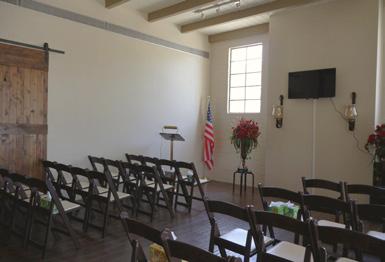
There are over 400 funerals each day at the National Cemeteries. Depending on the veteran and the location of the cemetery, the honors are likely to include two uniformed members of the military, folding and presentation of the flag, three rifle volleys, a horse-drawn caisson and the playing of Taps.
At a very minimum, we expect this. We expect to hear Taps at a veteran funeral. It’s part of how we say goodbye, hearing the National Song of Remembrance.
In some parts of the country, however, especially in rural cemeteries, there aren’t enough buglers, and Taps is played via a CD recording or a special electronic gadget inserted into a bugle that plays a prerecorded Taps. Live buglers are, of course, preferred and needed.
Can you help? Are you willing to be a bugler at veteran funerals in your area?
Before you decline, consider: If you took a semester of band, even in junior high, you’re halfway there. If there is a bugle (or trumpet) in your attic, you’re halfway there. Is there a high school or college with a music department near you? The department head will help you fine tune the playing of Taps. Best of all, there are only 24 notes in Taps.
Take a look at the organizations that provide buglers for veteran funerals:
• Bugles Across America (www.BuglesAcrossAmerica.org) has been providing this service for 26 years now. Read about Tom Day and why he started the group. According to the most recent Bugler’s Post newsletter, last year the group’s buglers provided 32,000 hours of their time. Members have provided Taps at 350,000 funerals since the group began in 2000. They have volunteer buglers in 49 states; only South Dakota is missing from the list.
• Taps For Veterans (www.TapsForVeterans.org) is headed up by former military musicians. See the website for more information and how to audition.
At this point, one-quarter of living veterans are over the age of 65; the number of veteran funerals is not going to decline anytime soon.
Freddie Groves regrets that he cannot personally answer reader questions, but will incorporate them into his column whenever possible. Send email to columnreply2@gmail.com.
(c) 2026 King Features Synd., Inc.
How to Use AI Safely and Protect Yourself from Scams
DEAR SAVVY SENIOR: With all the news about AI lately, I also keep hearing about how scammers are using it to steal private information from seniors. I’m a senior and not very tech savvy, and this has me cautious about even trying to use it. What should I know to protect myself? -- Suspicious Senior
Dear Suspicious: You’re not alone. Many older adults are asking the same question. Artificial intelligence, or AI, is becoming part of everyday life, from smartphones and internet searches to banking and customer service. It’s also making scams more convincing and harder to spot, which is why a basic understanding helps. The good news is you don’t need to be a tech expert to use AI safely and with confidence.
Know the basics
AI is technology that can create and analyze information in ways that seem human. It can write emails, answer questions, recommend products, generate images and even mimic voices. While this can be helpful, it also means things you see or hear online may not always be accurate or even true. If something seems unusual or too good to be true, it probably is. Take a closer look.
Use it wisely
A good way to get comfortable with AI is to start small. Many smartphones include voice assistants like Siri or Google Assistant that can set reminders, check the weather or answer questions. You can also try tools like ChatGPT or Claude to explain a news story, suggest recipes or help draft a message.
When I was at the grocery store I asked an employee where the cereal was, and he said, "I'll see," but he never came back. A couple of minutes later I asked another employee about the cereal, and she, too, said, "I'll see," and walked off. I never saw her again either. So I searched around for myself and finally found it in aisle C.
AI can also be useful for everyday tasks like comparing products, planning trips or organizing a to-do list. Think of it as a helpful assistant -- not a decision-maker.
Keep in mind that AI isn’t perfect. It can give answers that sound confident but may be outdated or incorrect. For important matters like your health, finances or legal issues, always double-check with a trusted source such as your doctor, bank or a government website.
Watch out for scams
Scammers are using AI to make their schemes more convincing. You may receive an email that appears to be from your bank or Medicare or a phone call that sounds like a family member. Be especially wary of urgent messages that pressure you to act quickly, warn that your account will be closed, or that legal action will be taken against you if you don't comply.
Protect yourself
The most important habit for avoiding scams is to slow down. If you receive a suspicious call, text or email, stop and assess the message. Don’t click links, download attachments or respond right away. Instead, contact the company or person directly using a phone number or website that you trust – not the one provided in the message.
Scammers now use AI to mimic voices and write convincing messages. Even if something sounds like it’s from a family member, friend or company, verify it another way before taking action.
Never share sensitive information like your Social Security number, bank details or passwords unless you initiated the contact yourself and trust the source. Banks and government agencies, including Medicare and Social Security, will not ask for this information by phone or email. Urgent requests for payment by gift card, wire transfer or cryptocurrency are also huge red flags that it's fake.
For added protection, use two-factor authentication, and keep your devices updated. You can even consider call-blocking services from your mobile service provider.
If something doesn’t look right, always take time to check it out or ask a trusted friend or family member before responding.
Keep learning
Technology is always changing, but there are ways to stay informed. Many libraries and senior centers offer free classes on digital skills and online safety. Trusted resources like AARP’s
Fraud Watch Network (aarp.org/fraudwatch) and the Federal Trade Commission (consumer. ftc.gov) also provide up-to-date scam alerts and protection tips. In addition, internet and mobile provider Cox Mobile (cox.com/mobilesafety) offers a library of research, tips and online safety tools to keep you informed and secure online.
AI may seem complicated at first, but a little awareness goes a long way. By staying cautious and developing a few smart habits, you can protect yourself and make this amazing technology work for you.
your senior questions to: Savvy Senior, P.O. Box 5443, Norman, OK 73070, or visit SavvySenior. org. Jim Miller is
-- by Jim Miller
JUNQUE
by Anne McCollam Creators News Service
Collectors Repurpose Ashtrays
Q: While shopping for antiques, I came across three Wedgwood ashtrays. One is green, one is blue and the third is yellow. I have enclosed a photo of all three. I have never seen a yellow one before and wonder if mine is rare.
They each measure 4 3/8 inches in diameter and 9/16 inches deep. The yellow one has some sort of berries on branches; the blue one is decorated with the image of the winged horse, Pegasus, and the green one is decorated with the image of a woman driving a chariot. The green and blue ashtrays have leaves on the edges. All images are white and in relief. Each is marked “Wedgwood -- Made in England.
I paid $5 each and would like to know if they are worth a little more than that.
A: Wedgwood was founded by Josiah Wedgwood in England in 1759. Your ashtrays are examples of jasperware, which was developed by Wedgwood in 1774. Jasperware has a matte finish and was made in several colors, including blue, yellow, green, lilac and black. Pieces were often decorated with Greek classical motifs in white and in relief.
Blue jasperware was the most common. The green ashtray figure is the goddess of the dawn, Aurora. The flowers on the yellow ashtray
are primroses. You are correct; the figure on the blue one is the winged horse, Pegasus. Although they were intended to be used as ashtrays, people often use them today to hold rings or pins.
Your ashtrays appeal to collectors of jasperware and also Tobacciana. They were made in the mid 1900s and can be found selling for $25 to $40 each.
* * *
Q: I have enclosed the mark that is on the bottom of a teapot that I bought at a yard sale over 20 years ago. The teapot is decorated with a young girl standing with two geese in front of a colonial home. The background is a cream color. The teapot stands about 7 inches tall and is in mint condition.
What can you tell me about the maker, age and value of my teapot?
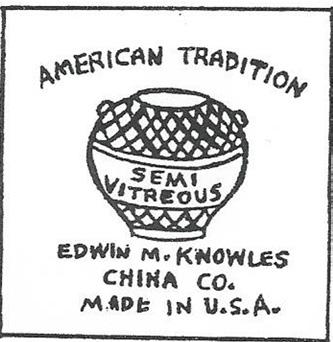
A: This mark was used by Edwin M. Knowles China Company. They made semi-vitreous china in Chester and Newell, West Virginia, from 1900 to 1963. “American Tradition” refers to a variety of designs inspired by early American to modern American motifs.
Knowles China Company was one of the leading manufacturers of dinnerware. After the firm was liquidated, the rights to use the Knowles name were sold to a distributor of collector plates. Your teapot was made in 1939 and would probably be worth $40 to $60.
* * *
Antiques expert and columnist Anne McCollam has since retired and no longer receives inquiries nor answers reader letters. Due to the popularity of her column, this publication will continue to reprint previous columns of interest to our readers.
To find out more about Anne McCollam and read features by other Creators Syndicate writers and cartoonists, visit the Creators Syndicate website at www.creators.com COPYRIGHT 2026 CREATORS.COM
* On June 15, 1667, French physician Jean-Baptiste Denis performed the first blood transfusion, on a feverish boy, but with lamb rather than human blood. While the boy survived and recovered, two more patients died following the same procedure, leading to a centuries-long ban on transfusions.
* On June 16, 1943, Oona O’Neill, the 18-year-old daughter of playwright Eugene O’Neill, married 54-year-old Hollywood legend Charlie Chaplin. It was his fourth marriage (and his third to a teenage girl). Oona’s father, who was Chaplin’s age, disapproved of the union so strongly that he disinherited his daughter. But the marriage, which produced eight children, was successful and only ended with Chaplin’s death more than three decades later.
* On June 17, 1976, the National Basketball Association announced a merger with its rival, the American Basketball Association, and acquired the latter’s four most successful franchises: the Denver Nuggets, the Indiana Pacers, the New York (later Brooklyn) Nets and the San Antonio Spurs.
* On June 18, 1979, at a summit meeting in Vienna, President Jimmy Carter and Soviet leader Leonid Brezhnev signed the SALT-II agreement dealing with limitations and guidelines for nuclear weapons. Roundly criticized in America as a sellout to the Soviets, the treaty never formally went into effect and did little, if anything at all, to slow the arms race.
* On June 19, 1865, on what is now known as Juneteenth, Union soldiers arrived in Galveston, Texas, with the news that the Civil War had ended and slavery in the United States had been abolished. Despite the fact that President Abraham Lincoln’s Emancipation Proclamation had been issued on Jan. 1, 1863, a lack of Union troops in the rebel state of Texas had made the order difficult to enforce.
* On June 20, 2003, the Wikimedia Foundation, an American nonprofit organization best known for being the host of Wikipedia, one of the world’s most-visited websites, was founded in St. Petersburg, Florida.
* On June 21, 2001, one of Mexican artist Frida Kahlo’s iconic self-portraits was featured on an American postage stamp, making her the first Hispanic woman to be honored in that manner.
(c) 2026 King Features Synd., Inc
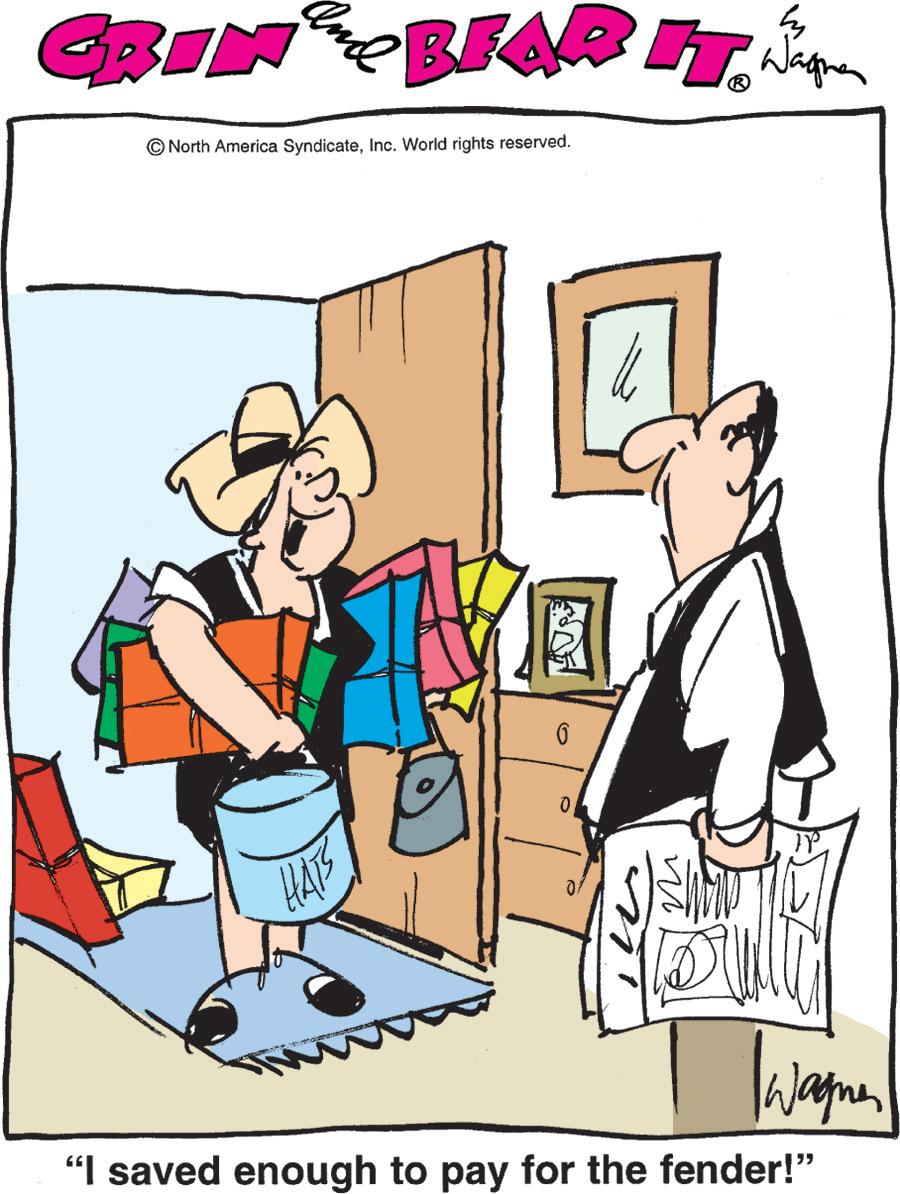
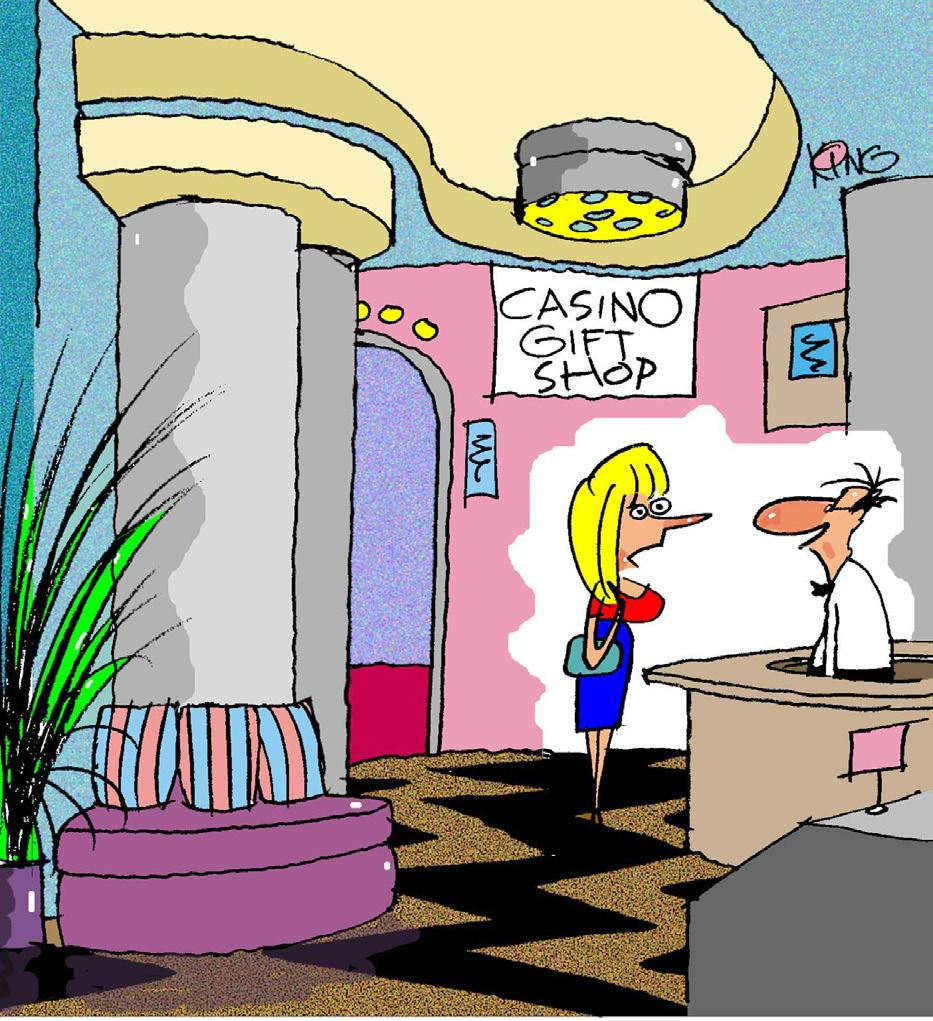
"Excuse me, but do you have any 'Play one in one more slot machine tournament and you can just forget this marriage' cards?"
Wedgwood was founded in England in 1759.
Edwin M. Knowles China Company was one of the leading manufacturers of dinnerware in the U.S.
Grocery Chains: (from page 3)
Davis Mercantile, a store started by William Davis. He moved to Florida in 1925, and purchased Miami’s Rockmoor Grocery. Once it had five stores, it became The Table Supply Stores. It took over Winn & Lovett’s 73 stores in 1939, a name that remained until 1955 when the Davis family acquired 117 Dixie Home Stores, finally becoming Winn-Dixie.
• Although Winn-Dixie’s ad slogan was “It’s a Winn-Win!”, the company closed nearly 600 stores from 2002 to 2006. The chain is now owned by another company, but still operates more than 400 stores under the Winn-Dixie name, but the process is underway to change to the Aldi name.
ALBERTSON'S
• Joe Albertson was a District Manager for Safeway Stores in 1939, when he stepped away to pool his $5,000 savings and a loan from his wife’s Aunt Bertie to open his own store in Boise, Idaho. He took on a partner, L.S. Skaggs, whose family had been instrumental in starting Safeway.
• He had stores in neighboring communities within two years, and opened his 100th store in 1963. By 1989, there were 500, and by the mid-1990s, 19 states had Albertson’s stores totaling 800. Today, there are about 2,270 stores in 35 states.
• In 2015, Albertson’s finalized a merger with Safeway, making it the second-largest supermarket chain in North America after Kroger.
WEGMANS
• Brothers John and Walter Wegman started out with a fresh produce pushcart business in 1916 in Rochester, New York, before opening their first grocery store in 1917. Today there are 114 stores in nine east-coast states.
• Wegmans seems to have a satisfied staff of happy employees, as evidenced by their spot on Fortune’s annual “100 Best Companies to Work For” since the magazine started the list in 1998. In fact, they’ve been in the Top 4 the last 10 years. The company still remains in the family after 110 years.
Give your golf-related advertising message targeted visibility in full color in this weekly 2” x 6” fixed location $159 per insertion reaches 70,000+ readers each week at the low cost of only $2.27 per 1,000 reader impressions!
TODAY
Game Changers
by Jason Jenkins
All Together Now
The takeaway has been one of the most varied topics in golf instruction over the years. While there is a wide range of preferences and parameters for club and body movement, the majority of top players tend to fall into a similar category of “one piece takeaways”. The term implies that the club movement away from the ball involves a unison of body movements rather than a drastic leading of one part over the others.
One of the common dangers of the takeaway is an overly dominant wrist action that forces the club well to the inside of the target line. By coordinating the arms, shoulders, torso, and hips to move together, with little independent hand action, the club will move in a neutral, on plane journey.
The first two feet of club travel should involve the chest turning to the right while the “triangle” of the arms and hands stays passive. The lower body many times has to make a slight shift and rotation to allow the upper body’s action. The grip end of the club may stay aligned to the navel during this sequence. Avoid excessive wrist or forearm rotation in this phase.