Vol 22: #20 • How Did They Get Those Street Names? • (5-11-2026) Tidbits of Coachella Valley
by Janet Spencer
A few issues back Tidbits gave you the inside scoop on how the different names were chosen for the cars we drive. So this got us thinking about how the names were thought up for the streets and highways that we drive these cars on -- who named them, and why? So hop in and ride along as we discover that a lot of these highways and byways were named with with some imagination -- and a sense of humor!
STRANGE STREETS
• Lois Lane in Lino Lakes, Minnesota, a suburb of Minneapolis, was named in honor of actress Noel Neill, the first person to play Superman’s love interest, Lois Lane, on screen in the 1948 TV series. Neill was originally from Minneapolis.
• Outside Caldwell, Idaho, in the 1930s, Morris and Laura Lamb wanted to have the road in front of their farm paved, but had reached nothing but dead ends. Mrs. Lamb solved the problem by graciously inviting Idaho Governor Ben Ross and his lovely wife Edna to dine with them at their house, accessible only by their unpaved road. They
TRIV
TRIVIA NEWSFRONTAIVIRT TNORFSWEN
(Answers on page 16)
1. MOVIES: What is the name of the blue diamond necklace in “Titanic”?
2. U.S. PRESIDENTS: Which president once said, “Speak softly and carry a big stick”?
3. GEOGRAPHY: What is New Zealand’s national bird?
4. MATH: How many sides does a tridecagon have?
5. BIBLE: What is the first book in the Bible called?
6. SPACE: How long does it take the International Space Station to orbit the Earth?
7. MYTHOLOGY: Who is the Greek god of the sun?
8. ANATOMY: Where are the carpus and metacarpus located in the human body?
9. GENERAL KNOWLEDGE: What is the largest hydroelectric power plant in the world?
10. LITERATURE: Who wrote the dystopian novel titled “The Testaments”?
1. “Heart of the Ocean.”
Theodore Roosevelt.
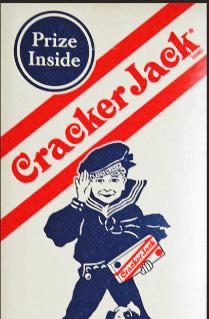
• In 1860, at the age of 14, Frederick Rueckheim came to Chicago from his native Germany. In 1871, after the Great Chicago Fire leveled the city, Rueckheim went into business selling candied popcorn. Together with his brother, they established the F.W. Rueckheim & Bro. Company to sell their popcorn. They chose the name Cracker Jack, a slang term for something first class and high quality.
• By 1899 they had perfected the iconic Cracker Jack box, making it one of America’s first prepackaged snacks.
• In 1910, the company began slipping coupons into its boxes that could be redeemed for watches, silverware, sewing machines, and other goods. At the time, plenty of other products were doing the same thing. To stand out from the crowd, the company began putting a small prize inside each box in 1912. The public immediately loved these little surprises, and sales went through the roof. The iconic Cracker Jack logo featuring Sailor Jack and his dog Bingo was introduced in 1918 to create a wholesome, patriotic mascot for the caramel-coated snack.
• Due to material shortages during World War II, prizes were made of paper instead of metal, such as tiny joke books, miniature note pads, and temporary tattoos. After the war, metal toys were produced by the Tootsie Toy company, which also produced Monopoly pieces.
• The company developed thousands of prizes. Each year, more than 100 million toy prizes were distributed, making them the largest toy distributor in the world. By 1922 they were also the world’s largest consumer of popcorn.
• The initial prizes were small, tangible items such as tiny metal toys, puzzles, itty bitty plates, stickers, decoder rings, tin whistles, tops, clickers, inch-long dolls, tin soldiers, Winky Watches, bookmarks, compasses, and miniature pinball games using a BB.
• Toys were often released as sets: pins, figurines, or charms, where kids were encouraged to “collect ‘em all!”
• The variety of prizes evolved over the decades: cowboys were all the rage in the 1950s; astronauts in the 1960s; ‘flower power’ in the 1970s. Collectors agree, however, that the 1930s
was the “golden age” of Cracker Jack toys.
• Today, many of the original prizes are worth considerable sums. One of the most iconic prize series was the baseball card sets issued in 1914 and 1915, featuring legendary players like Honus Wagner, “Shoeless” Joe Jackson, and Ty Cobb, which are now highly valuable, with some complete sets worth over $100,000.
• The company would buy up to 5 million prizes at a time in the 1950s. By the 1980s, they were buying 15 million at a time. They mixed up the prizes and loaded them in shakers to be distributed among the boxes. There were generally up to 600 different toys in each batch, lessening the chance that anyone would receive the same toy twice.
• The company was purchased by Borden in 1964 and sold to Frito-Lay in 1997. In 2016, Frito-Lay announced that toys would no longer be placed inside boxes of Cracker Jack. Instead, there’s a QR code that allows access to their website or app to play a game. This move prompted headlines like “Cracker Jack Is Getting Rid of the Best Thing About Cracker Jacks” (Fortune) and “Cracker Jack’s Prize In The Box Will Now Be Digitized” (NPR). Cracker Jack is now packaged mostly in foil bags rather than the familiar boxes.
• With so many toys, and so many available for a limited time, it’s not surprising that a collector’s market sprang up. There’s a Cracker Jack Collectors Association, and several books cataloguing the prizes.
• For over five decades Cracker Jack cost only a nickel. Over the course of 100 years, Cracker Jack has delivered over 23 billion tiny prizes.
The kiwi.
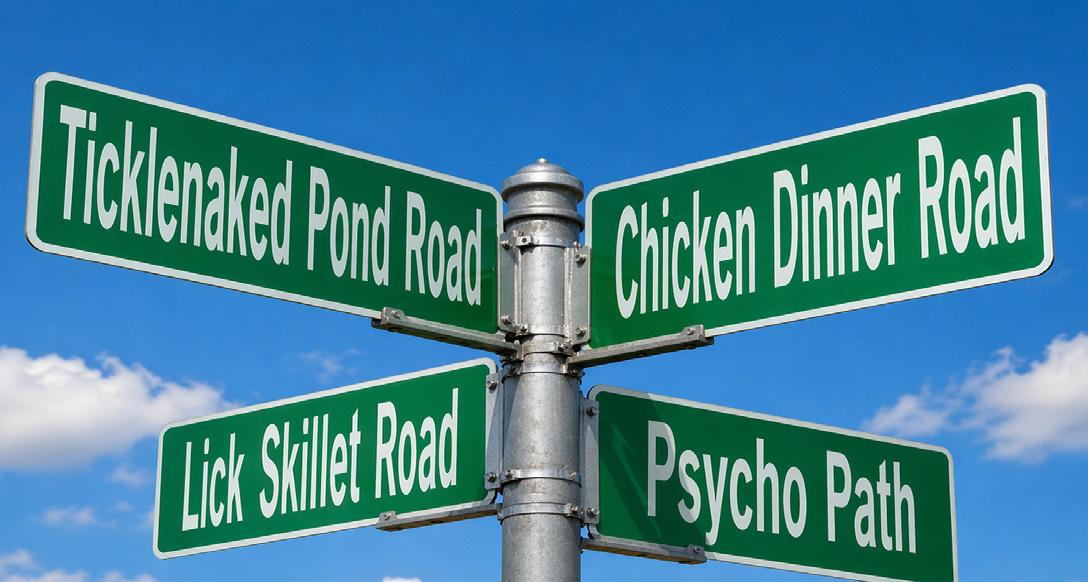
accepted the invitation, and by the time they reached the Lamb farm their jowls had been thoroughly jarred by the rough ride. As they sat to enjoy Mrs. Lamb’s delicious chicken dinner, the Governor agreed that if the Lamb family would take the responsibility of grading the road and spreading a gravel base, he would see to it that the state would cover the cost of having it paved. Thus, Chicken Dinner Road was named.
• At a small town in West Virginia, residents gathered to take a vote on what the municipality should be called, now that they had their very own post office. Someone voiced, “We should choose an odd name that people will remember!” No one could suggest an alternative, so today the unincorporated settlement of Odd, West Virginia, is where you’ll find Odd Road.
• Ticklenaked Pond Road leads to Ticklenaked Pond near Ryegate, Vermont. The name is likely either the poorly pronounced version of the Delaware Indian word “taugamochek” meaning “little beavers,” or the similarly mispronounced version of “took-nock-ett” meaning “riverbank.” Local folks jokingly shortened the translation to easy-to-pronounce “ticklenaked,” and the name stuck.
• In New Orleans, Louisiana, some streets in the historic French Quarter are named for royal houses of France. Many people mistakenly believe that Bourbon Street was named after the liquor, but it’s really named after the House of Bourbon, who was the ruling dynasty of France when the city was built. (Later, a county in Kentucky was named Bourbon County, and they invented the drink.)
• Likewise, Burgundy Street was named for the House of Burgundy rather than the wine. (The wine was developed in the area of France where the Burgundy family lived.) Other streets named for royalties include Dumaine, Toulouse, Conti, Dauphine, and Chartres. Street Stories (from page
NUGGETS
• Three cities kept growing until their borders touched, at which point they just agreed to become one town called Nebraska City. But when Old Nebraska City and South Nebraska City merged their borders, they both had a 9th Street, and they both had a 10th Street, and they didn’t quite align. What to call the street that ran in between the two? They decided to settle on the only alternative, and itʼs now Ninth and a Half Street.
• In 1962, Elvis Presley starred in a movie called “Follow That Dream.” It was filmed in and around Inglis, Florida. Today, Follow That Dream Parkway bisects the town, attracting Elvis fans from all over for selfies under the street sign.
• Curtis Springer was a radio evangelist, faith healer, and quack. What he needed was a hot spring spa where he could heal sick people and relieve them of their money. However, lacking a hot spring, he settled in the middle of California’s Mojave Desert, where he heated his own well water and claimed it was an all-natural mineral hot spring.
• He named the road leading to his compound Zzyzx Road (pronounced ZIE-zix), a totally made-up name, because he wanted to have “the last word in health.” In the mid-1970s, he was found to be squatting on the land illegally and evicted. But the Zzyzx Road still remains.
Municipal street-namers in Porters Lake, Nova Scotia, Canada, either ran out of ideas or had a joker among them. After much deliberation, three connecting streets are now named "This Street," That Street," and "The Other Street."
• The Latin verb “boāre” means “to roar, bellow, or call loudly.” This gives us the word “Boo!” as when jumping out to scare someone, a term that has been widely adopted by many languages. The root word “boo” results in other scary things, including “the boogeyman.” Therefore, Booger Branch Road in Knott County, Kentucky, follows a scary or haunted creek bottom.
• Lick Skillet Road in Lawrenceburg, Kentucky, winds its way through an area where “lickskillet” was once slang, describing people so poor they had to lick the skillet clean.
• In 1931, two guys in Arkansas did a comedy skit for their local Lions Club. It was so popular that they did the same skit for the local radio
station. This eventually led to a 25-year run of a nationwide radio show called “Lum & Abner.” In the show, the characters discussed the goings-on in their fictional hometown of Pine Ridge, Arkansas, where the locals typically gathered at the Jot ‘Em Down General Store. Not surprisingly, various municipalities started
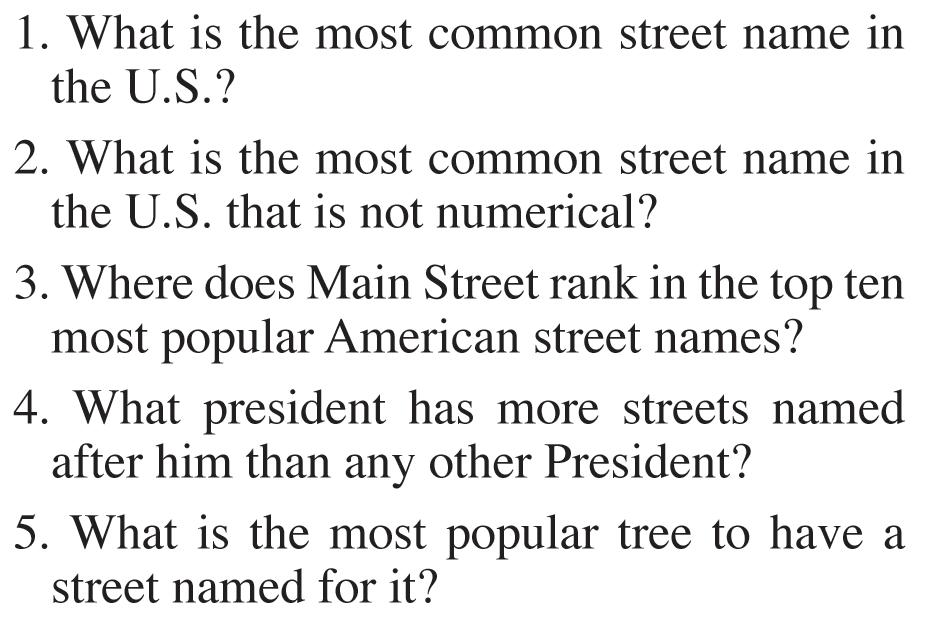
1. What is the most popular geographic feature found in street names?
2. What is the second most popular geographic feature found in street names? Ma'ipalaoa Road (pronunciation
is found in the town of Maili
the
of
It dead-ends at Surfer's Beach Park. It's a Hawaiian word referring to unmentionable parts of a whale. Even older generations do not know why this street was given that name.
unknown)
on
island
Oahu.
By Lucie Winborne
* More than 80% of the white sand around tropical coral reefs is actually the byproduct of parrotfish excretion.
* Regball, or rugball, is a tough Russian sport combining basketball, wrestling and rugby. As in basketball, players try to shoot a ball through a hoop, but there are no free throws and no need for dribbling. In addition, wrestling and takedowns are part of the action; in fact, there’s relatively little that’s not allowed.
* In the 15th and 16th centuries, jewelers purposely left cavities in some rings so wearers could fill them with aromatic substances to block offensive odors.
* The Dog Bark Park in Cottonwood, Idaho, which until 2024 offered guests the usual hotel amenities in a giant, dog-shaped building painted to look like a beagle dubbed “Sweet Willy,” is now a popular roadside attraction, free museum and gift shop.
* Though Luxembourg has one of the smallest populations in Europe (approximately 500,000), the country’s divorce rate is the world’s highest at 87%.
* One billion hours of video are watched on YouTube every day.
* The corpse lily blooms so infrequently that when that event finally occurs, it often makes local and even global headlines.
* Netflix is responsible for 15% of the world’s internet traffic.
* Catalan mechanic Enric Marco was a prominent public face of Spanish Holocaust survivors, until his story was discovered to be pure invention at the height of his fame in 2005.
* In four of America’s five largest cities, it’s cheaper to rely on Uber than own a car. ***
Thought for the Day: “A computer once beat me at chess, but it was no match for me at kick boxing.” -- Emo Philips
by Mary Hunt
Frugality on the Fun Meter of Life
Everyday CHEAPSKATE
I was not born with a natural bent toward frugality. Everything in me cries out to spend, acquire, spend, achieve, amass, spend, spend, spend! I am drawn to the extraordinary, the luxurious and the unique. I live with visions of grandeur and opulence. My fondest dreams include tailored clothing, domestic staffs, $600 silk bed sheets, manicured gardens, rich Italian leather, exotic cars, limousines and private jets. That’s just how I am.
by Mary Hunt
For me, practicing frugality is not really fun. Oh, there’s an occasional situation when scrimping might be slightly amusing, but on the fun meter of life, planning and budgeting, paring down, doing without when it seems that everyone else in the world is prospering beyond belief -- none of that can hold a candle to carefree shopping and living as if money were no object. Self-imposed financial limits are confining and often prevent the spontaneity and excitement of reckless abandon involving unlimited funds.
My dilemma is that I do not have the means to indulge in a lifestyle equal to my natural-born tendencies. Those of you familiar with my story know that my feeble attempts to play out my natural tendencies landed me in a lot of trouble. I took the treacherous path of incurring debt to acquire things I couldn’t afford. Living under mountains of ever-growing debt is not living; it feels like dying.
So if living naturally brings pain but living frugally isn’t fun, is there any hope for the unnatural frugal type? Yes! It requires new behaviors. Voluntarily.
Attitude is key. If you can change your attitude, everything else will follow. No one can do that for you because unless there is a heart change from deep inside, the behavior change will be neither genuine nor permanent. Here are some baby steps you can take to start the change.
DON’T CONFUSE FRUGALITY WITH POVERTY
The fear of feeling poor keeps many of us entrapped in financial bondage because the shopping and spending produce a false sense of richness. Both feelings are unfounded. Unless you are a permanent resident of Burundi (one of the poorest countries in the world), you probably have no idea what “poor” really is.
Frugality is a smart and dignified activity. It takes the ability to reason and apply self-discipline. Never forget that while you may not have it all, you have enough. And that’s more than many people in this world can say.
LEARN SELF-TALK
Non-frugal types often suffer from major cases of the I-wants whenever they find themselves within the vicinity of a mall or other commercial establishment, often resulting in compulsive purchasing. If this describes you, try a little shopping self-talk. Instead of coveting and envying every wonderful thing you see, assure yourself that if these things were really necessary (such as a kidney transplant or milk for the baby), you could find a way to purchase them. The necessity test usually dismisses the matter right then and there.
If the desire still lingers, make yourself consider what would be required if all those things really were yours. There’d be cleaning and maintenance, repairs and dusting, insuring and fueling and worrying about the possibility of theft, to say nothing of all of the packing required should you ever decide to move. By the time you get through that exercise, you should be sufficiently exhausted and thankful that you can enjoy those beautiful things without committing to ownership. Personally, I have many wonderful things that I “store” in the lovely shops at a local fancy-schmancy mall. They are well taken care of and I can visit anytime I want.
COME UP WITH REALISTIC ALTERNATIVES
I recently met a man whose wife works in a Nevada casino. She would put a roll of quarters into a slot machine every workday. He showed her that her weekly $50 could pay for the boat she really wanted in just two years if she would simply put the quarters in a savings account rather than in an electronic bandit. They now have their paid-for boat and she’s saving for her next dream, having given up the slots completely. It was just a change of attitude.
For me, practicing frugality is not always fun the way it must be for you natural-born tightwads. Actually, it’s rarely fun. But the results are so well worth the effort that I will never go back to the pain of living beyond my ability to pay. I haven’t bounced a check in 34 years. I have savings and investments. I buy with cash. I have no credit card debt. I don’t dread evening phone calls and I no longer have to hide the mail and shopping bags.
Now that I think about it, there are many things I’ve been called to do in my life that aren’t particularly fun -- such as dental visits, childbirth, cleaning toilets and weeding. But so far, I’ve not been excused simply because I don’t like them. I enjoy the results so much, I willingly repeat these activities over and over again.
Except for the childbirth!
* * *
Mary invites you to visit her at EverydayCheapskate.com, where this column is archived complete with links and resources for all recommended products and services. Mary invites questions and comments at https://www.everydaycheapskate. com/contact/, “Ask Mary.” This column will answer questions of general interest, but letters cannot be answered individually. Mary Hunt is the founder of EverydayCheapskate.com, a frugal living blog, and the author of the book “Debt-Proof Living.”
COPYRIGHT 2026 CREATORS.COM
(c) 2026 King Features Synd., Inc.
What is the difference between roads, streets, and avenues? Actually very little these days, but historically they were each assigned to convey specific characteristics. Read on and learn.
• A “road” would lead from one place to another, either connecting towns, or leading from a town to a landmark. The proto-European word “reigh” gives us “ride,” which turned to “road.”
• A “street” would typically lead from one place to another place, but only within the city limits. A street was typically lined on both sides with buildings, such as homes or businesses. The Latin “strata” meaning “paved road” gave us “street.” In England, King Henry decreed that in order to be named a “street” it must be wide enough for sixteen knights to ride abreast.
Cul-de-sac is French, meaning literally “the bottom of a sock.”
• A “way” is a minor offshoot of a main road, now used in many “ways” such as roadway, parkway, driveway, highway, and even Broadway. The word “way” began with the Old English “weg” meaning “track or path.”
• The word “drive” comes from the Old English “drifan” meaning “to compel, to impel, to move something forcefully.” So a person can drive a nail, drive a herd of sheep, drive a carriage, be lacking in drive, or drive someone crazy. Regarding the type of road now known as a “drive,” it used to denote a long road. A “driveway” was a short way that led off the long drive.
• Meanwhile, parkways were generally pastoral, traveling through fields. This is why we drive on a parkway and park on a driveway.
running diagonally are “Stravenues.”
• The freeway name was introduced with the advent of high speed vehicles. A freeway is a divided highway with full access control, featuring multiple lanes in each direction separated by a median, and no at-grade intersections, traffic signals, or direct property access.
STREET SMARTS ADVERTISING PROOF
• A causeway crosses water, springing from the Latin root meaning “to tamp down.”
• An interstate is a freeway that travels through more than one state, and is assigned a number that is preceded with the letter “ I”.
• US Interstate freeways are numbered using a grid system designated so that north-south routes are odd-numbered (low numbers in the West, high in the East) and east-west routes are even-numbered (low in the South, high in the North). Major, coast-to-coast interstates end in "0" or "5", while three-digit numbers indicate smaller, auxiliary spur or loop routes.
• To be named an avenue the thoroughfare would have to be wide, lined with trees, with little traffic, and residential. It’s from the Latin verb “advenire” meaning “to arrive.”
• The name “Lane” historically denoted a path wide enough for a beer barrel to be rolled along. It springs from the ancient Greek “elaúnō” meaning “to drive” as in driving a herd of sheep down a path.
• An alley is so narrow that it must be walked down rather than driven down. It’s from the Latin “ambulare” meaning “to walk.”
• The Dutch “bolwerc” was a road that was raised and fortified, which went into English as “bulwark.” In the French language the word “boulevard” applied to any avenue that was extra wide and therefore extra secure. It originates with the Dutch “bole” meaning plank or tree trunk, denoting a “work” constructed of piled logs.
• A “Place” is usually a dead end road or street. A “Court” is normally a circle, cul-de-sac or loop.
• An intersection is two roads meeting at the same grade (height), while an interchange has two roads crossing at different heights. Both are junctions, from the Latin “iunctio” indicating “the act of joining.”
DUE: 5:00 p.m..
• A turnpike is a freeway that charges a toll, literally “a pike that turns” like a subway turnstile, originally used to prevent horses and other livestock from accessing the road.
• Avenues usually run perpendicular to streets. In Manhattan, NY, Portland, OR, and Minneapolis, MN, roads running east–west are “Streets”, while north–south roads are “Avenues.” Yet in St. Petersburg, FL, Denver, CO, and Memphis, TN, all of the east–west roads are “Avenues” and the north–south roads are “Streets.” Tucson, AZ takes it one step further: north-south are Avenues; east-west are Streets, and roads
by Dana Jackson
Q: Is the Ethan Hawke series “The Lowdown” returning for another season? I really enjoyed it but don’t know anyone else who watched it. -- G.C.
A: Fortunately, enough people watched “The Lowdown” on FX and Hulu to earn a secondseason renewal back in January. Recent Oscar nominee Ethan Hawke (“Blue Moon”) will return as “truthsorian” Lee Raybon.
According to TV Insider, filming was set to begin this spring with returning cast members Ryan Kiera Armstrong and Keith David. Joining them will be Tommy Lee Jones (Oscar-winning actor of “The Fugitive”), Betty Gilpin (“GLOW”), and Austin Amelio (“The Walking Dead”).
Q: Is it true that Taylor Frankie Paul is still going to compete on “Dancing with the Stars” even after her “Bachelorette” season was scrapped? I find this hard to believe. -- F.T.
1. Michael (PG-13) Jaafar Jackson, Nia Long
2. The Super Mario Galaxy Movie (PG) Brie Larson, Virginia Dare Jelenic
3. Project Hail Mary (PG-13) Ryan Gosling, Sandra Hüller 4. Lee Cronin’s The Mummy (R) Jack Reynor, Laia Costa 5. The Drama (R) Zendaya, Robert Pattinson 6. Hoppers (PG)
A: There have been some misleading headlines lately that have led readers to believe that reality star Taylor Frankie Paul (“The Secret Lives of Mormon Wives”) would be competing on “Dancing with the Stars” this fall. However, when ABC canceled Paul’s season of “The Bachelorette” just days before it was set to air (after footage of her domestic violence arrest was taking over the internet), any chance of her doing the cha-cha live on Tuesday nights were reduced to zero.
So far, two other high-profile reality stars have been named as competitors for the upcoming fall season. Ciara Miller and Maura Higgins, both fan-favorite faithfuls from Peacock’s “The Traitors,” are the first to make the roster for season 35 of “DWTS.” The rest of the cast and their accompanying pros will be announced sometime in late August to early September.
In the meantime, a special spin-off competition will air this summer. “Dancing with the Stars: The Next Pro” will be hosted by recent mirrorball champion Robert Irwin, and judges will include Mark Ballas, his mother, Shirley, and Julianne Hough. Several other “DWTS” pros will serve as mentors.
Look for the 12 hopefuls to begin competing on Monday, July 13, on ABC at 8 p.m. ET.
Q: I was shocked to learn that “Law & Order: Organized Crime” has been canceled. I think the mistake was moving it to Peacock exclusively. Will Stabler now return to “SVU”? -- P.P.
A: Christopher Meloni’s very popular character of Detective Elliot Stabler led the “Law & Order: SVU” spin-off “Organized Crime” on NBC for four seasons. It was moved to Peacock because of its longer storylines and grittier style. Unfortu-
nately, not enough of its audience followed it, and the series was canceled.
This does open up a return for Meloni to return to “SVU” and reunite with his good friend/ former co-star Mariska Hargitay. However, he has a new series called “The Land” launching on Hulu, where he plays the head coach of an NFL football team. It’s reportedly still filming.
Meanwhile, “SVU” has been renewed for its 28th(!) season, and there doesn’t appear to be an end in sight. I’m almost certain that you’ll see Stabler on your TV screen at some point in the future.
Send me your questions at NewCelebrityExtra@gmail.com.
(c) 2026 King Features Synd., Inc.
Want to Work for Tidbits?
Tidbits is in need of independent contractor help distributing our newspapers to businesses in the Coachella Valley. A retired husband/wife team is preferred, who wish to supplement their monthly income by driving and distributing to a specified delivery route in the Palm Desert area. Requires year-round commitment of one day per week, either Thursday or Friday, during regular business hours. One person needed to drive; the other to place copies at delivery locations.
Interested parties must posess a responsible work ethic, furnish their own vehicle and auto insurance, and have a friendly demeanor when dealing with the public. Interested couples call Erik at 760-320-0997 for more details.
“The
Courtesy of FX
Ethan Hawke as Lee Raybon in “The Lowdown”
Bruschetta With Tomatoes and Basil
You'll find this easy-to-make Italian appetizer a tasty compliment to your meal.
1 loaf Italian bread
1 clove garlic
1 1/4 pound ripe plum tomatoes
2 tablespoons fresh basil leaves
2 tablespoons extra-virgin olive oil
1/4 teaspoon salt
1/8 teaspoon ground black pepper
1. Preheat oven to 350 F. Meanwhile, slice bread diagonally into scant 1/2-inch-thick slices; reserve ends for making breadcrumbs another day. Place bread slices on 2 cookie sheets.
2. Toast bread on 2 oven racks 15 minutes or until crusty and dry, turning slices over once and rotating cookie sheets between upper and lower racks halfway through baking. Transfer bread to wire racks to cool slightly. When bread is cool enough to handle, rub 1 side of each toast slice with cut side of garlic. Discard garlic.
3. Meanwhile, in small bowl, gently toss tomatoes, basil, oil, salt and pepper until combined.
4. To serve, spoon 1 heaping tablespoon tomato mixture on garlic-rubbed side of each toast slice. Serves 8.
Spicy Garlic-Chili Oil With Pasta
A trip to your pantry is all you need to whip up this Italian staple that’s as basic as can be -- with just four ingredients -- but alight with flavor. Once plated, jazz it up with grated Parmesan if you like.
1 pound pasta
1/4 cup olive oil
6 cloves garlic
1 red chili
1. Cook pasta according to package directions. Drain pasta and return it to the pot.
2. Meanwhile, heat the oil in a large skillet over medium-low heat. Add the garlic and cook, stirring occasionally, until beginning to turn golden brown, 3 to 4 minutes. Add the chili and cook, stirring, until the garlic is golden brown and the chili is just tender, 1 minute more. Toss with the pasta. Serves 6.
Fennel
Availability: September through April
Buying Tips: Fennel also is called finocchio. Buy firm, compact, unblemished bulbs. The
fronds, if attached, should be bright green and sprightly.
To Store: Refrigerate in the crisper drawer up to three or four days.
To Prepare: Trim off the fronds, if attached. Rinse fennel under cold running water. Trim the root end and remove the stalks. Cut the bulb lengthwise into wedges or slices; trim the central core.
To Cook: The mild licorice flavor and celery-like texture of fennel is accentuated by roasting.
By John Allen DIAMOND LIL
by Brett Koth
Donald
NEXT WEEK in TIDBITS SWEETENS THINGS UP WITH
Holidays & Observances This Week
5/10 Mother's Day
5/11 Hoarding Awareness Day
5/12 International Nurses Day
5/13 Children of Fallen Patriots Day
5/14 Stars and Stripes Forever Day
5/15 International Day of Families
5/16 Armed Forces Day
Dog Talk with Uncle Matty
By Matthew Margolis
Wrong Dog in the Doghouse
“Training is everything. The peach was once a bitter almond; cauliflower is nothing but cabbage with a college education.” -- Mark Twain
Usually, when I write of training, I’m referring to a dog. But there are times when only a coin flip can decide who -- dog or master -- is in greater need of education. This is one of those times.
“We got our Doberman, Sasha, from a breeder when she was 8 weeks old. She’s now 4.
“When she first came to live at our house, we had a male pug named Max and a female black Lab named Quincy, who stays outside in a kennel. Max and Sasha loved each other, but Sasha didn’t love Quincy. They got into a few fights when Quincy came inside on winter nights. Sasha always went after her neck, but Quincy was never hurt.
“A few weeks later, Max died from unknown diabetes. We tried to bring Sasha around other dogs, but she wouldn’t accept them.
“Then, when Sasha was a year old, we found kittens in a woodpile. She loved them! She thought they were her babies. So we kept a male cat we call Patch, and those two never had any problems, except for one time when Patch scratched Sasha. But Sasha didn’t fight back.
“We also have a parakeet that Sasha loves to stalk and chase around.
“So far, Sasha has bitten six people; three of them had to go to the hospital for stitches. Two of the people she bit live in the house, me being one and my mom the other. She bit me to the extent that I had to get plastic surgery on my cheek.
“She also has bitten my aunt and three friends who walked into my house without me accompanying them -- which is understandable but not tolerable.
“A few weeks ago, we brought a puppy that we wanted to keep home to see Sasha. He is a Boxer-black Lab mix. Sasha loved him. It’s obvious that she always wanted to play with other dogs, but was just too scared.
For years we’ve heard that getting 150 minutes of exercise per week was necessary for health, and many of us didn’t even try. Working out (or walking, dancing, doing anything moderately aerobic) was beyond us and we felt like failures.
Then there was the added confusion caused by differing opinions about just how long and how many daily steps ... not to mention the mammoth study that concluded the best health benefits were to be had with 700 minutes of exercise per week. (That’s over 11 hours!)
But, how do you feel about two minutes? It turns out that two little minutes of exercise can actually have an impact and help us live longer.
There was the study that showed reduced risk of cancer and heart disease was possible by just moving for two minutes three times a day, and the study that showed two minutes of walking after meals can prevent spikes in blood sugar, and so on.
Have It Your Way
As each month rolls around, so do the endless stacks of shelter magazines that arrive in mailboxes and newsstands around the world. Eager fans and designers wait with anticipation for the next round of design perfection. Most magazines choose a particular theme that celebrates a specific time of the year or the region in which they are located.
In these glimpses of what constitutes tasteful interiors, the viewer is led to a particular angle, which the photographer, designer or homeowner feels best shows off a room. While this is true of most publications, there are two main ways in which such magazines represent the idea of home: those that choose to present a perfect picture without a paper out of place, which terrifies any mortal into thinking they should live in sterility, and those that present a more candid view into people’s homes, still staged but more real and attainable.
So, how about these easy, small ways to be more active as a safeguard measure for our overall health:
- Take the stairs when they’re available. If you’re feeling especially strong, go up and down a few times.
- Do some strength training exercises (push-ups, squats, knee lifts) that target the major muscle groups, 30 seconds each of several types.
- Aim for short, intense movement: Walk briskly to the mailbox (this will also release endorphins). Cycle quickly on your exercise bike for one minute. Jog or walk in place during a TV commercial.
And what happens when we shoot for two minutes of exercise instead of a half hour that we know we can’t do? We often decide that yes, we can do a few minutes more, and suddenly that two minutes turns into five or 10.
To quote a professor of cardiology medicine, “It turns out that anything is better than nothing.”
Charles regrets that she cannot personally answer reader questions, but will incorporate them into her column whenever possible. Send email to columnreply2@gmail.
com.
how the spaces and furnishings are used. As far as I am concerned, there are no specific “rules” on how to arrange your spaces.
For example, I have had the following scenario on various occasions. The owners are empty nesters and neither of them is an avid cook, so why invest in an expansive state-of-the-art kitchen? Instead, such couples have chosen a smaller kitchen and even sacrificed the never-used living room for the space to build a custom bar. It was more important to them to have a place to receive guests for a drink and before going out to dinner.
Of course, to pull this off tastefully, the help of a designer goes a long way to keeping your bar from looking like it belongs in the lobby of a hotel or in a scene from “Studio 54.”
In other cases, a loving spouse has asked for a separate yet equal master bedroom suite for their snoring snuggle bunny. Sometimes all that is needed is a small sleeping alcove, and in other instances, a complete master suite with a separate bathroom and an adjoining door is requested. It’s your home. You should be able to write the rules.
Clients often ask “How should I live in this space?” or “Can my husband put his feet on the couch?” My answer is usually the same. You should live the way the space and furnishings entice you to live. And by the way, your husband should be able to put his feet anywhere you allow him to.
While it's true that interior designers are like stage set designers -- we create the stage for life to happen -- it is entirely up to the homeowner
People often are bound to the standard conventions of what constitutes a home and how it should look for the Joneses to approve. Yet the happiest and most satisfied clients are those who value comfort over the expectations of others. To reference a yester-year lingo of a certain fast-food chain, when it comes to your home, “have it your way.”
* * *
Joseph Pubillones is the owner of Joseph Pubillones Interiors, an award-winning interior design firm based in Palm Beach, Florida. To find out more about Joseph Pubillones, or to read features by other Creators Syndicate writers and cartoonists, visit the Creators Syndicate website at www.creators.com.
COPYRIGHT 2025 CREATORS.COM
Cody’s Corner (from page 9)
now. The second week, Sasha bit him on the nose when he tried to walk over to her food bowl. She has growled at Patch a few times when he did this, but she never bit. The puppy wasn’t hurt.
“Today, though, Sasha clamped down on the puppy’s head when he jumped up onto the couch where Sasha was sitting. The puppy might not survive.
“We love our Sasha with everything in us, and nobody wants to get rid of her or put her down. She really is a great dog! She has never been abused, beaten or deprived of anything, and we don’t understand why she acts like this. Is she just jealous?”
The issues at hand are plentiful, but jealousy is not among them. Multiple female dogs in one house is not advisable -- they are prone to fighting over dominance and territory. Providing an aggressive dog a throne, such as a couch, bed or other piece of furniture usually reserved for humans, only elevates an already existing sense of entitlement. And failing to act at the first sign of aggression invites the unwanted behavior to stay.
But primary among them stands the issue of judgment. The wrong dog is in the doghouse. Until the owners recognize this, no person, dog, cat or parakeet in this house is safe.
Woof!
* * *
Dog trainer Matthew “Uncle Matty” Margolis is the co-author of 18 books about dogs, a behaviorist, a popular radio and television guest, and the host of the PBS series “WOOF! It’s a Dog’s Life!” Read all of Uncle Matty’s columns at www.creators.com, and visit him at www.unclematty.com.
COPYRIGHT 2014 CREATORS.COM
Matilda
YOUR SOCIAL SECURITY
by Tom Margenau
Identity Theft: Usually Not a Social Security Issue
Q: My purse was stolen and now I worry that someone might be using my Social Security number. I called the Social Security office and was told to contact credit reporting agencies and possibly the police. And they gave me some website to look up. It seems to me they should have done more. Can’t they just cancel my old number and give me a new one? Was I informed correctly?
A: Yes, you probably were given correct information. When a Social Security card is stolen, so many people just naturally assume it is a problem for the Social Security Administration (SSA) to resolve. But when you think it through, it really isn’t.
And before I go on, let me give some advice. It’s too late for you. But it may help other readers. There is no need to carry your Social Security card in your wallet or purse. I haven’t carried my card around with me in more than 50 years. And I’ve never needed it. You generally might need to show your Social Security card to someone if you are applying for a job. Or maybe for some kind of government assistance. So if you are doing that, then carry your card with you on that day. Otherwise, just keep it away in a safe place at home.
The same used to be true for Medicare cards. I never put mine in my wallet unless I was going to the doctor. But now that Medicare cards no longer have our Social Security numbers on them, that is not such a big issue.
Anyway, back to the story of what the SSA can do for you in cases of identity theft. As a general rule, the SSA gets involved in your life for three reasons. Their first job is to issue you a Social Security number.
Their second job is to keep a lifetime record of all the earnings your employer reports under that SSN. Or if you are self-employed, to keep track of the income you report on the Schedule SE (the Social Security part) of your annual tax return.
And finally, the SSA’s third job is to pay you monthly retirement or disability benefits that are based on all those earnings that are posted to your Social Security account. Or if you die, they pay your widow(er) and/or children a survivor’s benefit based on those same earnings.
I don’t want to sound too flip or dismissive about this, but if someone steals your Social Security card, it’s really not the SSA’s problem. Or to put that another way, there isn’t all that much they can do about it.
About all they can do is help you monitor your Social Security earnings record. If you see earnings posted to that record that don’t belong to you, they can work with you to correct that record.
But I doubt if that is your major concern right now. You are probably much more worried about someone misusing your Social Security number and other personal information to create credit problems.
The first step you can take to get this resolved is to go to www.IdentityTheft.gov to report the theft and to start a recovery plan. (I am sure this was the website the Social Security people referred you to.) IdentityTheft.gov is a one-stop resource managed by the Federal Trade Commission, the nation’s consumer protection agency. Or you can call them at 1-877-IDTHEFT.
1. The book of Malachi is found in the a) Old Testament b) New Testament c) Neither
2. To save her son's life, what mother placed her baby son in a basket among the reeds of the River Nile? a) Eunice b) Rachel c) Hagar d) Jochebed
3. What evil mother instructed her daughter to ask for the severed head of John the Baptist? a) Athalliah b) Herodias c) Lucille d) Salome
4. Who brought a new little coat to her son Samuel every year at Shiloh? a) Hannah b) Elisabeth c) Priscilla d) Martha
5. Which mother bore six sons and one daughter to Jacob? a) Sarah b) Miriam c) Leah d) Hagar
6. From Judges 5:7, who arose herself as a mother in Israel? a) Deborah b) Esther c) Naomi d) Jezebel
Although this isn’t very common, the identity thief may also use your SSN to get a job. That person’s employer would report earned income to the IRS using your Social Security number. This could get you in trouble with the IRS because it will make it appear that you didn’t report all of your income on your next tax return. If you think you may have tax issues because someone has stolen your identity, go to www.irs.gov/identity-theftcentral
Also, you should file an online complaint with the Internet Crime Complaint Center (IC3) at www.ic3.gov. The IC3 gives victims of cybercrime a convenient and easy-to-use reporting mechanism that alerts authorities of suspected criminal or civil violations. IC3 sends every complaint to one or more law enforcement or regulatory agencies with jurisdiction. According to their website, the IC3 reflects a partnership between the Federal Bureau of Investigation, the National White Collar Crime Center and the Bureau of Justice Assistance.
Here’s another thought: you should also monitor your credit report periodically. You can get free credit reports online at www.annualcreditreport.com.
And I’m sure you’ve done this already, but if you haven’t, you should report your stolen purse to your local police department.
You wondered why the SSA didn’t just cancel your old number and give you a new one. That is something that can be done, but it really should be a worst-case-scenario solution. In other words, if you have taken all the steps you can to resolve your problems with no luck, a new SSN can be issued to you.
(such as the IRS and state motor vehicle agencies) and private businesses (such as banks and credit reporting companies) will have records under your old number. Along with other personal information, credit reporting companies use the number to identify your credit record. So using a new number won’t guarantee you a fresh start.
For some victims of identity theft, a new number actually creates problems. If the old credit information isn’t associated with her new number, the absence of any credit history under your new number may make it more difficult for you to get credit in the future
And finally, here is some advice for all readers. Identity theft doesn’t just happen when someone grabs your purse or picks your wallet. Nowadays, it happens more and more frequently online with scam artists posing as legitimate businesses. I get dozens of such emails and texts every day, supposedly from my bank, my cable provider, my credit card companies and even the SSA. They are usually bringing an alleged problem to my attention that requires me to send them account numbers or my SSN to resolve.
In the past, these clumsily-worded messages were easy to spot because they were obviously written by a hacker nerd living in his mother’s basement in Belarus using some bad Russian-toEnglish translation software. But today, AI computers send out remarkably sophisticated texts and emails. So you have to be ever more vigilant. It’s best to always be wary and cautious. If you’re even the least bit suspicious, hit the delete button.
If you have a Social Security question, Tom Margenau has two books with all the answers. One is called “Social Security -- Simple and Smart: 10 Easyto-Understand Fact Sheets That Will Answer All Your Questions About Social Security.” The other is “Social Security: 100 Myths and 100 Facts.” You can find the books at Amazon.com or other book outlets. Or you can send him an email at thomas.margenau@comcast. net. To find out more about Tom Margenau and to read past columns and see features from other Creators Syndicate writers and cartoonists, visit the Creators Syndicate website at www.creators.com. COPYRIGHT 2026 CREATORS.COM (Answers on page 16) For comments or more
But you should keep in mind that a new number probably won’t solve all your problems. This is because other governmental agencies
Remove Triggers for Migraines by Leading a Healthy Lifestyle
DEAR DR. ROACH: I read your recent column about migraines and strokes. About 40 years ago, I began having occasional visual interference episodes with zigzags like a kaleidoscope, blurry central vision, and more that lasted for about 30 minutes. My doctor described them as ocular migraines. When I read about migraines, the first possible cause that was listed were preservatives, so I started reading labels. My episodes only occurred after eating food with added nitrites and sulfates. It was very consistent, so now I read labels and avoid them. And thanks to the fact that more foods are now being made without them, at 85, I haven’t had an episode in many years. It has made me a more careful and healthy eater.
Would I still be more likely to have a stroke? Is this a common cause of these auras, or do causes vary in people? I would hope that others would find a sure cause and solution like I did. -- D.W.
ANSWER: Food additives, especially nitrites but also sulfites and sulfates, are known triggers of migraines in people who are susceptible. Finding and eliminating the triggers for migraines can be helpful, but not everyone is able to identify their triggers.
Red wine (which contains trace amounts of sulfites, even if more aren’t added) is one of the most common food triggers, but caffeine (and caffeine withdrawal) are another common cause. Poor sleep, excess stress and hormonal changes (especially in menstruating women) are also commonly reported.
Some perceived triggers may actually be an early part of a headache. Chocolate cravings can be part of the prodrome of a headache, so people may think that chocolate caused a headache when, in fact, the headache was already on its way before any chocolate was consumed.
Headache with aura can be confused with a stroke. My column from this past January tried to point out that positive findings like zigzag lines make a migraine with aura very likely, while transient ischemic attacks and strokes are exceedingly unlikely.
However, there is an increased risk of stroke in people who have migraines with aura. This is particularly the case in younger women. I suspect but cannot prove that having fewer migraines after removing the triggers (as you have) probably does mitigate the small increased stroke risk.
Still, it is important for all people with migraines to do what they can to reduce their stroke risk through a healthy lifestyle. Elevated blood pressure and cholesterol might be worth treating, even if they’re fairly mild. Diabetes should be as well-controlled as possible. Finally, with strong evidence showing that the shingles vaccine reduces stroke risk, I’d recommend that you make sure you’ve had the two-dose shingles vaccine.
DEAR DR. ROACH: I’m a 75-year-old female who’s hoping to keep her hair from falling out. I currently use minoxidil, but I’m not seeing any improvement. What else would you suggest? -- G.E.
ANSWER: Most women in their 70s lose some of their hair. The most typical pattern is a general thinning that is somewhat worse on the crown. I recommend seeing a doctor about this to be sure of the diagnosis. There are other patterns of hair loss, some of which are related to thyroid disease and -- less frequently -- serious systemic diseases.
If the diagnosis is confirmed as female pattern hair loss, then in addition to minoxidil (which can be used either topically or as a lowdose oral pill), spironolactone (or another antiandrogen) would be the other first-line treatment. Some physicians use prostate medicines like dutasteride, and ketoconazole shampoo can be helpful. These drugs are usually used in combination with each other.
Finally, laser or low-level light therapy, microneedling, and platelet-rich plasma have some benefit, although these are much more expensive options. A dermatologist is the expert when it comes to diseases of the hair and scalp.
Dr. Roach regrets that he is unable to answer individual questions, but will incorporate them in the column whenever possible. Readers may email questions to ToYourGoodHealth@med.cornell.edu.
VETERANS POST
by Freddie Groves
Abusing the Loan Program
It sounds like there was a lot of money to be made from Covid, at least according to investigation reports from the VA’s Office of Inspector General. Unfortunately for certain thieves, however, the OIG was all over them when the scams were revealed.
The head thief in one case was a part-time pastor who was nailed on four counts of wire fraud for Paycheck Protection Program (PPP) scams. He devised a scheme to apply for loans that were supposed to be used for payroll and business expenses during the Covid downturns. Not only that, but he approached and then coached church members (one of them a VA employee) on how to apply for the “free money” funds, including pretending they had actual businesses to run.
He then taught them how to apply for loan forgiveness (which was a bonus of the program if funds were actually used to pay employees) so they wouldn’t have to pay the money back. All they had to do, it seems, was to follow his instructions. It helped that he worked for a Small Business Administration-approved lender ... and split the money with him.
Part of their downfall came from inflating income figures from a real tax return -- which did not indicate that there was any kind of business income at all, not realizing that it would be a simple matter for one government agency to speak to another agency to verify facts.
Another mistake was leaving a paper trail of emails wherein he instructed one of his church members on the steps to take to apply for the loans. When sentenced, the pastor could get 20 years for each count of wire fraud. One coconspirator (who did not own a business) could get 60 years -- 20 for each of three counts.
The other (who also did not own a business but had a great paper trail of how-to instruction emails for applying for the fraudulent loans) is cooperating and likely will receive a reduced sentence of time behind bars.
Freddie Groves regrets that he cannot personally answer reader questions, but will incorporate them into his column whenever possible. Send email to columnreply2@gmail.com.
(c) 2026 King Features Synd., Inc.
Why write one?
The Letter Your Loved Ones Will Treasure
DEAR SAVVY SENIOR: I want to leave something meaningful for my children and grandchildren, beyond just money or property. I’ve heard about “legacy letters,” but I'm unclear about what information they should include or even how to start one. I'm hoping you can help me with some advice about the best way to begin composing something like this, something that would be meaningful to them. --Legacy Seeker
Dear Seeker: You’re asking a wonderful question. A legacy letter – sometimes called an ethical will – is a personal note to your loved ones where you can share your values, life lessons, cherished memories, hopes, and guidance. Unlike a traditional will, which focuses on legal matters, a legacy letter comes straight from the heart.
Many people think a legacy is just money or property. But often, it’s your words, values, and life lessons that leave the deepest mark.
A legacy letter gives your family something to hold onto – your stories, your traditions, and the experiences that shaped who you are. Children and grandchildren often return to these letters for comfort, guidance, or inspiration long after you’re gone. In many ways, it becomes an emotional last will and testament, answering some of the most important questions about your life. A legacy letter can also help explain the “why” behind your estate plan in a personal, thoughtful way.
While a will handles the legal and financial details, a legacy letter adds context – why you made certain decisions or what you hope your loved ones will do with what you leave behind. That added perspective can ease misunderstandings, strengthen family connections, and leave a lasting sense of closeness.
Getting started
Take a moment to reflect on what matters most to you. Consider asking yourself:
● What values or principles have guided my life?
● What moments or experiences am I most grateful for?
● What mistakes or regrets taught me the most?
● How do I hope to be remembered by my loved ones?
● What lessons, advice, or guidance do I want to leave for my family?
● Which family traditions, stories, or dreams do I want future generations to carry forward?
Keep it personal, informal and sincere. You can write one letter or several for different family members. Most letters run one to three pages, or more if you really want to pour your heart out. There’s no strict rules here.
If you’d like a little guidance as you get started, Trust & Will has a free legacy letter writing guide with step-by-step prompts to help you organize your thoughts and begin writing. You can find it at trustandwill.com/learn/legacyletter-writing-guide
If writing isn’t your thing, consider creating a legacy video. Speak directly to your loved
ones, sharing stories, guidance, and heartfelt reflections. Most smartphones now record high-quality video and sound, making it easy to create, store, and share. A video captures your voice, expressions, and surroundings in a way that a letter simply can’t convey.
Storing and sharing
Keep letters or videos in a safe, easy-tofind spot. Physical letters can go in a secure file, safe, or with your attorney, while digital files can be backed up to the cloud or an external drive. You can share them now or wait until later, after you’re gone. Be sure to include instructions in your will so family members know where to find them.
When it comes down to it, a legacy letter or video is truly the heart behind your will. It gives you the chance to share your values, tell your stories, and even explain the intentions behind your estate plan, leaving your loved ones with words that will matter long after you are gone. Written with generosity, empathy, and positivity, a few thoughtful pages or a short video can create an emotional imprint that money alone cannot provide.
Send your senior questions to: Savvy Senior, P.O. Box 5443, Norman, OK 73070, or visit SavvySenior. org. Jim Miller is a contributor to the NBC Today show and author of “The Savvy Senior” book.
-- by Jim Miller
with a woman standing between two trees and swinging a golf club. She is wearing a hat, a long brown skirt, a white blouse and a brown cape that is caught by the wind. Her image is outlined with an incised dark line. The glaze is a matte caramel that fades to blue-green at the top.
What can you tell me about my vase?
JUNQUE
by Anne McCollam Creators News Service
Vintage China More Than 100 Years Old
Q: This is a photo of several dishes in a set of china that I inherited. The set is a service for 12 and includes serving bowls, two covered bowls, platters, a gravy boat with attached tray, a cream pitcher, a sugar bowl and salt and pepper shakers. Each piece is marked the letters “H -- J -- Co” and is in perfect condition. The dishes are decorated with multicolored birds on a branch along with colorful blossoms.
I would appreciate any information you can provide about the name and location of the maker, the year of manufacture and the value of my dinner set.
A: Hertel, Jacob & Co. made your porcelain dinnerware. It was located in Bavaria, Germany, from 1906 to 1979. Your set was made around 1910 to 1922.
Sales of vintage porcelain sets have declined somewhat in the past 10 years. People often prefer dinnerware that is dishwasher- and microwave-safe and easy to maintain.
Similar sets sell in the range of $175 to $300.
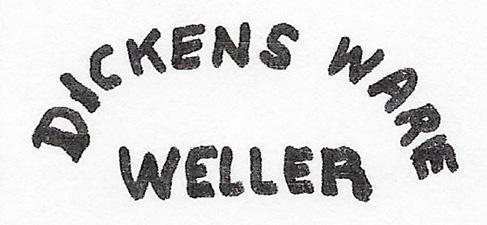
Q: This mark is on the bottom of a pottery vase that I own. It is around 8 inches tall and in mint condition. It is decorated
Weller Pottery made three lines of Dickensware.
A: Weller Pottery made your “Dickensware” vase. The pottery was founded by Samuel Weller in Fultonham, Ohio, in 1872. It moved to Zanesville, Ohio, in 1882. The Dickensware line was created by Weller art director Charles Babcock Upjohn.
There were three distinct lines. The caramel matte glaze that graduates to blue green, the sgraffito (incised lines) and the image of the golfer are characteristic of the second line.
Weller made a male golfer that is a companion piece to your vase. The second line also featured Native Americans, animals, monks and Charles Dickens characters.
Your vase is circa 1900 and would probably be worth $900 to $1400.
* * *
Antiques expert and columnist Anne McCollam has since retired and no longer receives inquiries nor answers reader letters. Due to the popularity of her column, this publication will continue to reprint previous columns of interest to our readers.
To find out more about Anne McCollam and read features by other Creators Syndicate writers and cartoonists, visit the Creators Syndicate website at www.creators.com
* On May 11, 1659, the Massachusetts Bay Colony passed a law banning the celebration of Christmas, with a prohibition on “feasting and similar satanic practices” accompanied by a five-shilling penalty. Nearly 40 years earlier, the governor of the Plymouth Colony, in similar Scrooge-like spirit, had actually (and personally) confiscated toys.
* On May 12, 1903, cameraman H.J. Miles filmed President Theodore Roosevelt as he rode in a parade in his honor. The resulting movie, later played on nickelodeons in arcades across the country, was unusual not just because Roosevelt was one of the first presidents to have an official activity recorded in that medium, but because his carriage was escorted by the Ninth U.S. Cavalry Regiment, an all-Black company.
* On May 13, 1920, the Socialist Party nominated Eugene V. Debs as its candidate for president in the upcoming November election, notably undeterred by the fact that he happened to be serving a decade-long sentence at an Atlanta federal penitentiary.
* On May 14, 1973, Skylab, America’s first space station, was successfully launched into orbit around the earth. Eleven days later, astronauts Charles Conrad, Joseph Kerwin and Paul Weitz rendezvoused with the station, repaired a jammed solar panel and conducted scientific experiments during their 28day stay aboard the station.
* On May 15, 1982, the Paul McCartney and Stevie Wonder duet “Ebony and Ivory” grabbed the coveted top spot on the Billboard Hot 100, holding it for seven weeks and eventually becoming the biggest hit record of McCartney’s post-Beatles career.
* On May 16, 1985, three scientists from the British Antarctic Survey announced, in the scientific journal “Nature,” their detection of abnormally low levels of ozone over the South Pole. Within two years, 46 nations signed the Montreal Protocol, pledging to phase out substances known to cause ozone depletion.
* On May 17, 2004, Marcia Kadish and Tanya McCloskey of Malden, Massachusetts, tied the knot at Cambridge City Hall in Massachusetts, becoming the first legally married same-sex partners in the United States. That same day, 77 similar couples wed across the state, while hundreds more applied for marriage licenses.
(c) 2026 King Features Synd., Inc.
"Yes, your resumé is quite impressive, however, there's great concern about your bathroom habits on the office carpet."
Hertel, Jacob and Co. was founded in Bavaria in 1906.
Street Stories: (from page 3)
up their own (real) versions of the Jot ‘Em Down store, often arranged so that farmers could keep a tab and pay for everything once the harvest was in. Jot Em Down Road in Gainesville, Georgia, resulted from this scenario.
• In Fountain, CO, an HOA insisted that a small local road needed to be officially named. Because it was actually a private driveway, the owners felt this was unnecessary. Pressure was relentless, so they finally named their driveway “A Dog Will Lick His Butt But Won’t Eat A Pickle Road.” Because it’s on private property, it’s not shown on any maps.
• A street in Jenkins Township, Pennsylvania, is named Divorce Court. But East Peoria, Illinois, does it one better with its Supreme Court, District Court, Appellate Court, and Circuit Court.
• Wildwood, Missouri, has a Kangaroo Court. And don’t forget Basketball Court in Holly Springs, Mississippi, or Squash Court in Beaufort, South Carolina.
• There’s no place like Kno Place in Rapid City, South Dakota, just outside Black Hills National Forest. Or you could live on Haviture Way in Eugene, Oregon. Uptha Road is located outside the town of Casco, Maine.
• Toe Jam Hill Road on Bainbridge Island, Washington, is a mispronunciation of an early settler named Torjoram, a Hebrew name.
• Washington, D.C. named 50 streets after each of the 50 states, which is why the White House is located at 1600 Pennsylvania Ave.
• In Columbus, Ohio, Chittenden Avenue near Ohio State University is informally referred to as “Chit,” reflected in local event names such as “ChitShow” and “ChitFest”.
• Gravy Train Lane in Topeka, Kansas, leads to the dog food factory. Doggie Drive is nearby.
• Seniomsed Avenue in Des Moines, Iowa, is pretty weird, as if it’s a foreign language, or a strange family name. But it’s really just “Des Moines” spelled backwards.
• An online poll asked readers to submit the silliest names for roads that they knew of. The handsdown winner was Psycho Path, a private road near Traverse City, Michigan.
Give your golf-related advertising message targeted visibility in full color in this weekly 2” x 6” fixed location $159 per insertion reaches 70,000+ readers each week at the low cost of only $2.27 per 1,000 reader impressions!
Game Changers
by Jason Jenkins
Pros Overlap
If there’s one area of the game of golf where the average golfer can copy some of the history’s best players, it’s in the putting grip. It doesn’t take years of practice, superhuman strength or flexibility, nor does it require a degree in engineering.
The Reverse Overlap putting grip has been around for decades, and the simplest version can be seen on many of today’s players. Great putters like Greg Norman, Brad Faxon, Tiger Woods, and Rory McIlroy all use a form of this grip.
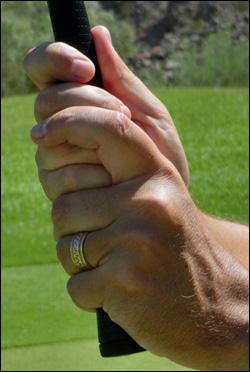
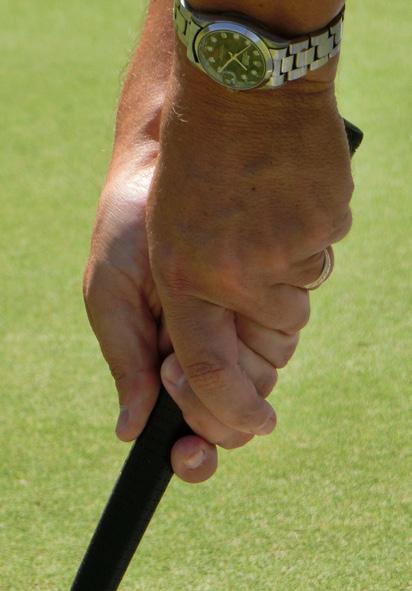
The basic adjustment for the Reverse Overlap is to allow the index of the left hand to overlay across the side of the right hand’s fingers. The hands should still connect closely, yet the left index finger is no longer on the club. The index does not simply overlap a top the pinky of the right, but goes across at least two to three fingers of the right hand.
The purpose of the overlap is to create a more stable wrist action with the left hand through the stroke
10. LITERATURE: Who wrote the dystopian novel titled “The Testaments”? Answers
1. “Heart of the Ocean.”
2. Theodore Roosevelt.
The idea of Go Figure is to arrive at the figures given at the bottom and right-hand columns of the diagram by following the arithmetic signs in the order they are given (that is, from left to right and top to bottom). Use only the numbers below the diagram to complete its blank squares and use each of the nine numbers only once.