Vol. 22: #32 • San Andreas Fault • (8-2-2026) Tidbits of Coachella Valley
by Janet Spencer
Geologists have for years studied the telltale evidence of a major north/south fault line that stretches almost the entire length of California. Itʼs predicted that one day the immense pressure of the two opposing tectonic plates deep below the surface will suddenly be released with catastrophic consequences. They warn that it's not a matter of “if” this will happen -- but when. This week Tidbits takes an analytical look at this ticking geologic phenomenon that lies beneath our feet, known as the San Andreas Fault.
RECOGNIZING THE RIFT
• In 1774, a Spanish missionary came through what is now central California, where he found a beautiful valley. Because it was the feast day of Saint Andrés (Spanish for Andrew, one of the apostles), the priest named the area after Andrés. The name was later corrupted and Americanized to San Andreas. The San Andreas Fault received its name later, after the 1906 San Francisco earthquake devastated the city.
• When geologist Alfred Wegener theorized in 1915 that continents move and collide, he was roundly ridiculed. The science of plate tectonics didn’t gain
San Andreas: Turn to page 3
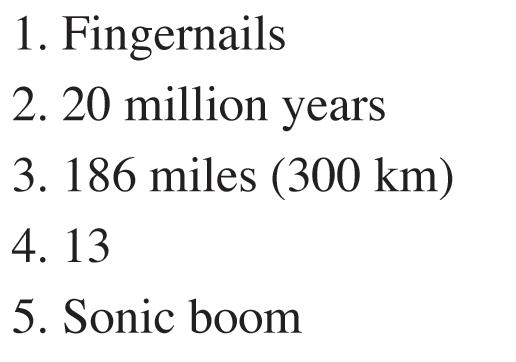
1. GAMES: What is the goal space in the board game Candy Land?
2. GEOGRAPHY: How many countries and territories border Spain?
3. TELEVISION: What are Captain Picard’s two favorite catchphrases in “Star Trek: The Next Generation”?
4. FOOD & DRINK: What is brioche?
5. CHEMISTRY: Which metal has the highest melting point?
6. LITERATURE: Who is credited as the author of “The Odyssey”?
7. U.S. STATES: Which state is home to Acadia National Park?
8. MOVIES: What is the name of Dottie’s team in “A League of Their Own”?
9. COMICS: Who is the archenemy of the Fantastic Four?
10. SCIENCE: What is the thickest layer of Earth?
1. King Kandy’s Castle.
Classic Games & Toys
• Cereal box toys were a major marketing strategy, beginning with their inception in 1909. The invention of injection-molded plastic in 1946 greatly boosted its popularity, which only tapered off around the year 2000. During their heyday, however, there were many interesting treasures to be found in cereal boxes.
• The first-ever cereal box giveaway was promoted by Kellogg’s in 1909. For just two box tops and a dime, kids could send off to receive a copy of the “Funny Jungleland Moving-Pictures Book.” Each page of this booklet was split horizontally into three separate parts. It was an amusement for children, allowing them to flip the pages to mix-and-match the head of a donkey with the body of an elephant and the legs and feet of a chicken. It was an instant hit - and sales soared.
• By 1912 Kellogg’s had distributed 2.5 million of the booklets. Building on this success, Kellogg continued to give away updated versions of the book until 1937.
• Not wanting to be left behind, General Mills jumped into the game. In 1931 the company started putting 12 different “Skippy Cards” in boxes of Wheaties in an effort to get kids to try to “collect them all!”
• In the 1950s Cheerios produced a cereal box with a frontier town printed on the back. Each one of the four different cardboard sets featured structures from the Lone Ranger’s Old West era: the blacksmith, sheriffʼs office, jail, livery stable, saloon, bank, and others. Once cut out and folded to stand up, kids had created their own wild west town to play with.
• In 1955 Quaker offered a memorable promotion when their boxes of Puffed Rice included a deed granting the consumer ownership of a onesquare-inch plot of land in the Yukon Territories.
• A popular prize that kids had to dig for arrived
in 1957 when Kellogg’s Corn Flakes included miniature plastic submarines and scuba-diving frogmen that could sink and resurface in water. Filling them with baking soda created bubbles, which propelled them.
• General Mills put a bicycle-sized metal license plate into each box of Wheaties, one plate for each state. The clever strategy encouraged kids to collect them all and trade them with friends. The genius program led to a 50% boost in sales. Kellogg’s soon added license plates for every Canadian territory and European country.
• Another creative concept came from Post’s Fruity Pebbles with their popular “Dino Eggs.” These small plastic eggs contained miniature dinosaur figures. When the eggs were placed in water, they would slowly dissolve, revealing the baby dinosaur inside.
• By the 1960s, the innovation continued: kids got both breakfast and a song pressed into a 45 RPM “flexi-disc.” These genuine vinyl records were attached to the back of the box and could be played on any record player.
• Not all promotions worked out well, however. One flop, for example, was the iron-on patches found in boxes of Honeycomb. Company CEOs didn’t forsee that children too young to handle hot irons would be trying to use them, causing painful burns and lawsuits by angry parents.
• In 1947 for just one box top from Kix cereal plus 15 cents, kids could mail away to receive a glow-in-the-dark Atomic Bomb Ring. The reason it glowed was because it contained tiny amounts of polonium-210, a radioactive isotope.
• Another disaster was the whistle found in Quaker Oats Cap’n Crunch. Designed to mimic the whistle of a sailor, it emitted a 2600 hertz tone that, when blasted into an open phone line, could deceive telephone routing machines, allowing clever callers to enter operator mode and make long-distance calls for free.
• Ultimately, the practice died off around the year 2000. Choking hazards became a concern, and the rise of environmentalism made it less popular to manufacture millions of disposable plastic toys. Additionally, the dawn of the digital age made it easier to give away codes for downloadable amusements and online games.
• But millions of treasure-hunting youngsters never tired of digging through the cereal boxes to find their surprise reward, and it was a lot of fun while it lasted.
San Andreas (from page one)
traction until the 1960s. So when San Francisco was nearly destroyed in 1906, no one really understood what happened.
• Although the ground shook for only 45 seconds, 28,000 buildings, amounting to 10% of the city, were ruined in the quake and the resulting firestorm. Over 3,000 people, or one out of every 300 citizens, were killed. We now know it was a quake measuring 7.8 on the Richter scale, ranking among the 20 largest quakes ever to strike North America. But at the time, little was known about the “underground shakings” that devastated this major city.
• Three days after the quake, one of the world’s most well-known geologists was on the scene, bringing 25 of his top researchers. Andrew Lawson from University of Calif., Berkeley, had previously noted a strange rift that ran through the city, but dismissed it as a mere anomaly.
• Now his team worked to map the damage, placing pins on maps to track the destruction. Every spot where roads buckled, railroad tracks twisted, stream beds shifted, and fence lines altered was noted and measured. Portions of the earth had shifted as much as 21 feet during the quake, a shocking discovery.
• When the dots were connected, they formed a straight line that ran half the length of the state. Everything jolted in the same direction: On the coastal side of the line, everything moved northwest. On the inland side of the line, everything jerked southeast. Because the line completely bisected the San Andreas Valley, Lawson named this rift the San Andreas Fault.
• It took many more decades before geologists could explain the tectonics (from the Greek “tekton” meaning “builder”) that caused the San Andreas Fault. And it wasn’t until a research paper was published in 1953 that the true scope
of the San Andreas Fault was understood. We now know that the San Andreas is one of the most active fault zones in the world.
MENACING MOVEMENT
• During millennia past, the Pacific plate slowly began shifting into the North American plate. At first, the Pacific plate disappeared underneath the North American Plate in a process called subduction. During this process, the mountain ranges of California were lifted. As time progressed, the Pacific plate shifted direction and started moving northward, while the North American plate remained largely stationary. This resulted in what’s called a strike-slip fault, where one tectonic plate scrapes sideways against the other. Itʼs during this period that the San Andreas Fault was born.
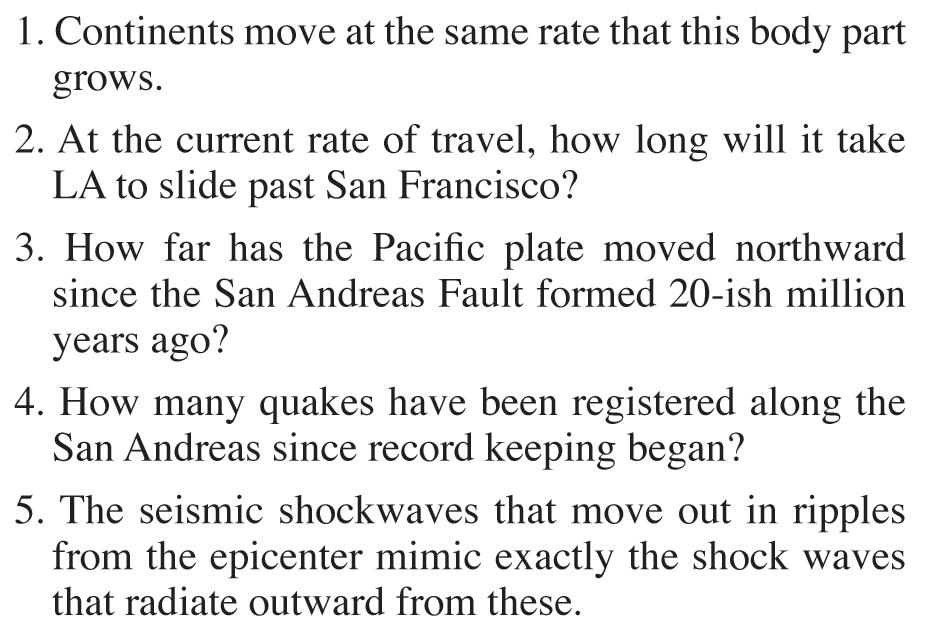
• The San Andreas Fault is not a single line, but a complex zone of networked faults that stretches 800 miles through nearly the entire length of California. The faults reach an average depth of 10 miles, and are often a mile wide. The Pacific plate moves at an average rate of an inch per year, or one foot per decade. Usually that movement comes in many small slips, but other times it occurs in a single catastrophic lurch.
• The San Andreas fault is split into three main sections: the northern, central, and southern segments. The northern segment (San Francisco) and southern segment (Los Angeles) tend to have infrequent large quakes, but the central segment, centered between Hollister and Parkfield, creeps quietly and consistently forward with frequent small quakes occurring on average once every 22 years, but never any large ones. Why is this?
TECTONIC TIMETABLE
• Geologists drilled at an angle down through the fault line, pulling up core samples of the rock layers nearly two miles deep. They found that central California rests atop a layer of serpentinite, a super-compressed form of talc. Talc is the world’s softest mineral, and is slippery and greasy. This layer lubricates the middle section of the fault. By contrast, the north and south segments cut through dense, solid and brittle granite.
• The southernmost segment, stretching from the Salton Sea near the Mexican border north to L.A., holds the greatest potential for catastrophe. Studies of stratification of sediments stretching back 1,500 years show that the area experiences a strong earthquake regularly once every 200
years. The last major earthquake in this area was 300 years ago. At that time, Los Angeles was a remote Spanish outpost with perhaps 100 inhabitants. It’s now the nation’s 2nd-largest city, with more than 11 million residents.
of Coachella Valley
By Lucie Winborne
* Masculine features are more attractive to a woman during her ovulation cycle, while softer, nurturing-looking features are preferred at other times.
* NBC’s “Saturday Night Live” has won more Emmys than any other TV show.
* The verb “lynch” is generally believed to have originated with Virginia landowner Charles Lynch, who during the American Revolution conducted unauthorized trials and punishments outside the formal court system.
* The irresistible desire to steal books is known as bibliokleptomania.
* In the popular 18th-century “Flying Boy” experiment, English scientist Stephen Gray harmlessly electrified a boy suspended by silk cords, astonishing audiences as the boy’s hair stood on end and sparks flew from his nose.
* Chewbacca’s voice in “Star Wars” was created by mixing the sounds of bears, lions, walruses and badgers.
by Mary Hunt
How to Water Your Lawn Without Being Wasteful This Summer
an added bonus, taller grass often crowds out weeds, which means less competition for water. Nature can help too.
Everyday CHEAPSKATE®
Every summer it happens.
by Mary Hunt
The weather turns hot, the lawn starts looking a little tired, and otherwise sensible people begin dragging sprinklers around the yard as though they’re trying to rescue the Sahara Desert one gallon at a time.
Water bills climb. Grass still looks unhappy. And somewhere in the neighborhood, there’s always one sprinkler faithfully watering the sidewalk.
A healthy lawn doesn’t necessarily need more water. It just needs smarter watering.
One of the biggest mistakes homeowners make is watering a little every day. It feels responsible. After all, plants need water, right? The problem is that frequent, shallow watering encourages grass roots to stay close to the surface, where they become dependent on daily drinks. Then, when temperatures soar, those shallow roots heat up and dry out quickly, leaving the lawn stressed and brown.
ADVERTISING PROOF
If your area receives a good soaking rain, resist the urge to turn on the sprinkler just because it’s “watering day.” Grass doesn’t own a calendar. It only needs water when the soil begins drying out. If footprints remain visible after you walk across the lawn, or if the grass develops a dull, grayish-green cast instead of springing back, it’s probably asking for a drink. Otherwise, let Mother Nature pick up the tab. While you’re thinking about water, take a slow walk around your sprinkler system.
You’ll probably discover at least one sprinkler head watering the driveway, the street, the neighbor’s fence or a shrub that has long since given up hope. Sprinkler heads can become clogged, tilted or damaged over time, quietly wasting surprising amounts of water. A quick inspection every few weeks can save both water and money.
If you have a rain barrel tucked beneath a downspout, don’t forget about it. You probably won’t water the entire lawn with collected rainwater, but it’s perfect for small dry patches, flower beds, containers or newly planted areas that need a little extra attention between storms. A modest roof can collect hundreds of gallons from a single inch of rainfall, making those barrels far more useful than many homeowners realize. Finally, remember that not every patch of brown grass is a crisis.
Final Changes DUE: 12:00 NOON
* The University of Bologna, Italy, which was founded in 1088, is the oldest university in Europe. The term “university” was coined at its creation and it is still considered a leader in European university systems. Its notable alumni include Pope Innocent IX and Copernicus.
* The first acoustic guitars made hundreds of years ago had four, as opposed to six, strings.
Earl’s Air Conditioning
pg H 4-C 13x
* Doctors leave sponges and other medical devices inside of their patients about 6,000 times a year.
A much better approach is to water deeply but less often. Lawn care experts generally recommend giving the lawn about an inch of water each week during extended dry periods. That encourages roots to grow deeper into the soil, making the grass much more resilient when summer heat settles in.
Timing also matters more than many people realize.
If you’ve been watering in the evening because it’s cooler outside, you may actually be inviting problems. Moisture that sits on grass overnight creates conditions that fungi enjoy every bit as much as your lawn doesn’t.
ADVERTISING PROOF
Midday isn’t much better. Much of the water evaporates before it has a chance to soak into the soil, meaning you’re paying for water that never reaches the roots.
Many lawns naturally slow down or go dormant during prolonged heat. That’s a survival mechanism, not necessarily a sign of failure. When cooler temperatures and rain return, healthy grass often greens up all by itself. Sometimes the greenest lawn on the block isn’t owned by the person who uses the most water. It’s owned by the one who knows when to put the hose away.
* * *
Mary invites you to visit her at EverydayCheapskate.com, where this column is archived complete with links and resources for all recommended products and services. Mary invites questions and comments at https:// www.everydaycheapskate.com/contact/, “Ask Mary.” This column will answer questions of general interest, but letters cannot be answered individually. Mary Hunt is the founder of EverydayCheapskate.com, a frugal living blog, and the author of the book “Debt-Proof Living.”
2026 Vol. 22 - No. 22
* Some critics theorize that zombies gnaw on humans because their warm flesh may have to do with a virus needing fresh DNA or some parasitic microorganism that receives a form of nourishment from live blood cells.
Contact your Tidbits representative immediately with changes or corrections.
Early morning is the sweet spot. The temperatures are cooler, winds are usually calmer, and the grass has plenty of time to dry after soaking up the moisture.
• Silicate minerals constitute 90% of Earth’s crust. Pure silica is quartz. When subjected to intense heat and pressure, quartz fuses with other minerals to form igneous (volcanic) rocks such as granite and basalt. Erosion of these minerals produces clay.
• Mud, dirt, and silt are all composed of decayed organic matter, while clay forms from decayed mineral matter. Clay particles are smaller than silt particles, silt is smaller than sand, and sand is smaller than gravel. If you can feel grains between your fingers, it is not clay. Wet clay feels smooth, like melted chocolate or warm candle wax.
• A major distinction between sand, silt, and clay lies not only in particle size but also in the shape of the individual grains. Sand and silt particles are angular and irregular, while clay particles are flat, slippery, and tightly packed, making them cohesive. Sand may hold its shape when wet, but only clay keeps its form when dry, and it retains that shape permanently after firing.
• Clay’s characteristics depend not only on its mineral composition but also the conditions of its weathering, including whether the environment was alkaline or acidic. Some clay deposits remain where they formed; others travel great distances, usually by water.
• Along the way, clay combines with various substances. One frequent additive is iron oxide (rust), which gives terra cotta its red or orange color. Terra cotta means “baked earth” in Italian. Porcelain and ceramics use different types of pure clay.
• Different clays vary in plasticity: some are highly moldable with little water, while others need much more water to shape. Some spread easily; others resist being rolled flat.
• Various clay products use specific clay types, blended with distinct additives, fired at different temperatures, and finished with unique glazes.
• In the rock cycle, clay transforms into other rocks over time. Although clay commonly forms through the weathering of silicate-rich rocks, it can become sedimentary rock such as soft mudstone, medium shale, and hard slate.
• Shale is the most abundant sedimentary rock on Earth. Grinding shale into powder returns it to clay. Clay readily bonds with sand to form sandstone and is also found in metamorphic rocks.
• When clay is fired in a kiln, the heat expels all moisture. This makes each clay platelet bond tightly to its neighbors, creating a hard and durable structure.
• Clay derived from vast volcanic ash beds is called bentonite. Its slipperiness makes it valuable for industrial lubrication. When dry, it excels at absorbing liquids, making it ideal for commercial use as kitty litter.
• The invention of pottery ranks among humanity’s greatest achievements. Durable clay vessels allowed people to store, transport, and heat food and water. Pottery developed independently
across the globe, though China was likely first. Clay vessels dating back 20,000 years have been found in a Chinese cave.
• Early pottery often involved molding wet clay inside woven baskets, which burned away, leaving imprints. Many ancient pots still bear the fingerprints of their creators. Clay tablets also provided the first writing surface.
• Humans interact with clay daily: toilet bowls, sinks, bathtubs; coffee mugs, bowls, plates; bricks, tiles, pipes; spark plugs, circuit boards, engine parts, heat shields, and much, much more.
Boxer
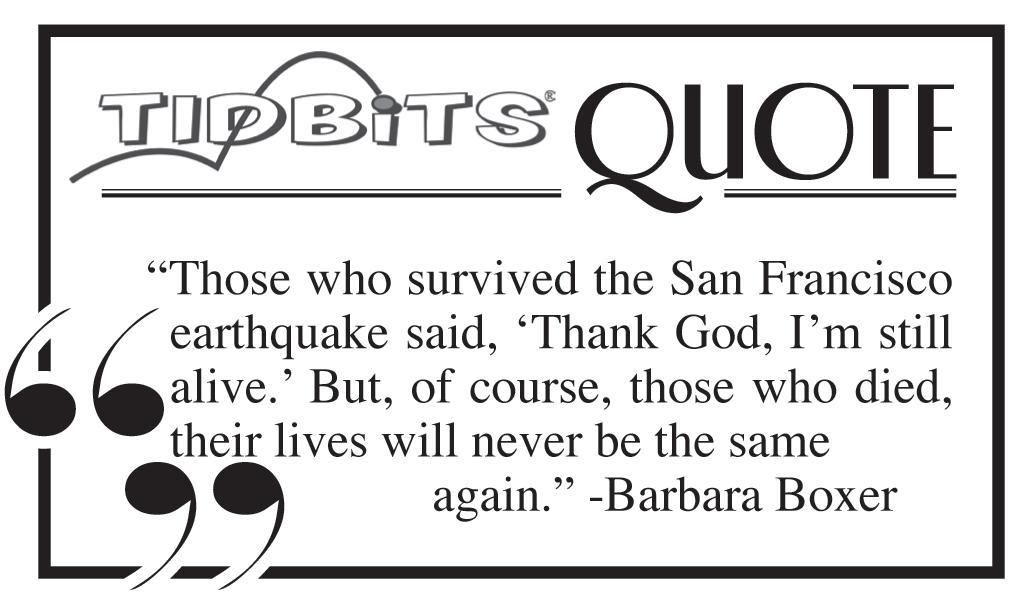
"Those who survived the San Francisco earthquake said, 'Thank God, I'm still alive.' But, of course, for those who died, their lives will never be the same again.'" -- Barbara
by Dana Jackson
Q: When are the Emmy Awards, and who’ll be hosting this year? I think Conan O’Brien should host them, like he does the Oscars. -- S.H.
A: While former late-night host turned podcaster Conan O’Brien has hosted the Primetime Emmy Awards by himself in both 2002 and 2006, he’s pretty much locked in as the permanent host of the Oscars. This isn’t a guarantee, but we’re all assuming that he’ll be back to host cinema’s most prestigious awards show for the third year in a row.
In recent years, the Emmys have been hosted by comedian Nate Bargatze, fatherson duo/”Schitt’s Creek” stars Eugene and Dan Levy, and sitcom actor Anthony Anderson. Jimmy Kimmel has hosted three times, but there hasn’t been a female solo host since actress Jane Lynch (“Only Murders in the Building”) hosted the ceremony in 2011.
New York Knicks fanatic and “Law & Order: SVU” star Mariska Hargitay has been chosen
1. The Odyssey
(R) Matt Damon, Tom Holland
2. Moana (PG) Dwayne Johnson, Catherine Laga’aia
3. Toy Story 5 (PG) Tom Hanks, Tim Allen
4. Minions & Monsters
(PG) Pierre Coffin, Trey Parker
5. Evil Dead Burn
(R) Souheila Yacoub, Tandi Wright
6. The Invite
(R) Seth Rogen, Olivia Wilde
7. Young Washington (PG-13) William Franklyn-Miller, Mary-Louise Parker
8. Obsession
(R) Michael Johnston, Inde Navarrette
9. Supergirl (PG-13) Milly Alcock, David Corenswet
10. Disclosure Day (PG-13) Emily Blunt, Josh O’Connor
by NBC to be this year’s emcee when the ceremony airs live on Sept. 14, at 8 p.m. ET.
However, a recent announcement stating that the live telecast would feature five fewer categories to make room for more musical performances and comedy sketches has the Hollywood community in an uproar.
Two of the categories that didn’t make the cut are Supporting Actor and Supporting Actress in a Limited or Anthology Series or Movie. According to Variety, the two talents projected to win in these respective categories this year are David Harbour for “DTF St. Louis” and Constance Zimmer for “Love Story.”
Q: Is it true that Robert Redford was supposed to star in “Yellowstone”? Was it the role that Kevin Costner played? -- L.G.
A: Before “Yellowstone” found its home with Paramount, its creator Taylor Sheridan pitched the show to HBO. He suggested actor Kevin Costner in the lead role of John Dutton, but HBO wanted a “generational talent” of Robert Redford’s stature, which Sheridan misunderstood to mean Robert Redford himself.
According to the Hollywood Reporter, Sheridan personally visited Redford to make him an offer (which the legendary movie star accepted), only to have to rescind it when HBO clarified that they wanted someone of Redford’s type but not age.
Costner went on to play Dutton for five seasons before departing the show. Meanwhile, Sheridan went on to dedicate the first episode of his most recent hit series “The Madison” to Redford, in what’s felt to be a fitting tribute. ***
Q: Are they still going to do an American version of “The Traitors” with noncelebrities? If so, when and where will it air? -- C.C.
A: Yes, “The Traitors: New Blood” will launch its two-hour premiere episode on NBC on Thursday, Sept. 17, at 8 p.m. ET. This version featuring civilian contestants will also be hosted by Alan Cumming, the two-time Emmy-winning host of Peacock’s “The Traitors.” It’ll be filmed at the Ardross Castle in the Scottish Highlands as well. Twenty-two contestants, who were chosen from a nationwide search of more than 60,000 applicants, will compete for the $250,000 prize -- and what’s sure to be a lucrative career on social media when it airs!
* *
Send me your questions at NewCelebrityExtra@gmail.com.
(c) 2026 King Features Synd., Inc.
Host of the 2026 Emmys Mariska Hargitay (“Law & Order: SVU”)
Depositphotos
Shrimp, Watermelon and Feta Salad
Get this fresh, protein-rich summer salad on the table in just 20 minutes.
4 tablespoons lemon-chive dressing
1 pound large shelled and deveined shrimp
1 bag (5 to 6 ounces) mixed baby greens
3 cups (from about 1 1/2 pounds with rind) diced (1 1/2-inch chunks) seedless watermelon
2 ounces (1/3 cup) crumbled feta cheese
1. In 12-inch nonstick skillet, heat 1 tablespoon dressing on medium 1 minute. Add shrimp and cook 6 to 8 minutes or until shrimp are opaque throughout, stirring occasionally.
2. Meanwhile, in large bowl, toss mixed greens, diced watermelon and remaining 3 tablespoons dressing until evenly coated. To serve, divide salad among 4 serving plates and top with shrimp and crumbled feta.
Each serving: About 280 calories, 14g total fat (3g saturated), 185mg cholesterol, 415mg sodium, 12g total carbohydrate, 1g dietary fiber, 27g protein.
Grilled Rosemary Lamb Meatballs
Change up typical spaghetti and meatballs with this simple recipe.
1. Combine ground lamb, breadcrumbs, garlic, rosemary and 1/2 teaspoon each salt and pepper. Divide mixture into 16 mounds; gently shape into balls.
2. Grill, covered, on medium for 10 minutes, turning occasionally. Toss tomatoes with penne and 1/4 teaspoon salt. Serve meatballs over penne, garnished with parsley. Serves 4.
Each serving: About 480 calories, 17g total fat (7g saturated), 29g protein, 53g carbohydrate, 4g dietary fiber, 540mg sodium.
Peach Salsa
Stirring in just a bit of peach or apricot jam
brings out the fresh sweetness of the peaches.
8 (about 3 pounds) ripe peaches, coarsely chopped
1 small red pepper, cut into 1/4-inch dice
2 green onions, chopped
1/4 cup peach or apricot jam
2 tablespoons balsamic vinegar
2 tablespoons olive oil
1. In large bowl, toss ingredients until combined. Cover and refrigerate until ready to serve or up to two days. Makes 12 (1/2-cup) servings.
Each serving: About 40 calories, 1g total fat, 8g carbohydrate, 2mg sodium, 1g fiber.
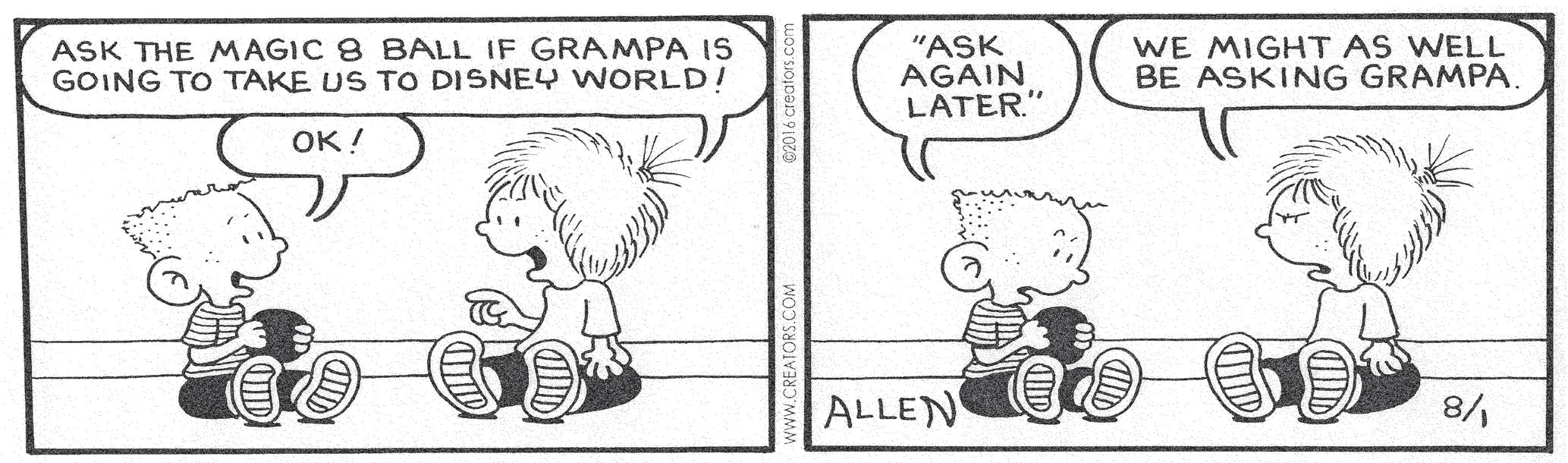
By John Allen DIAMOND LIL
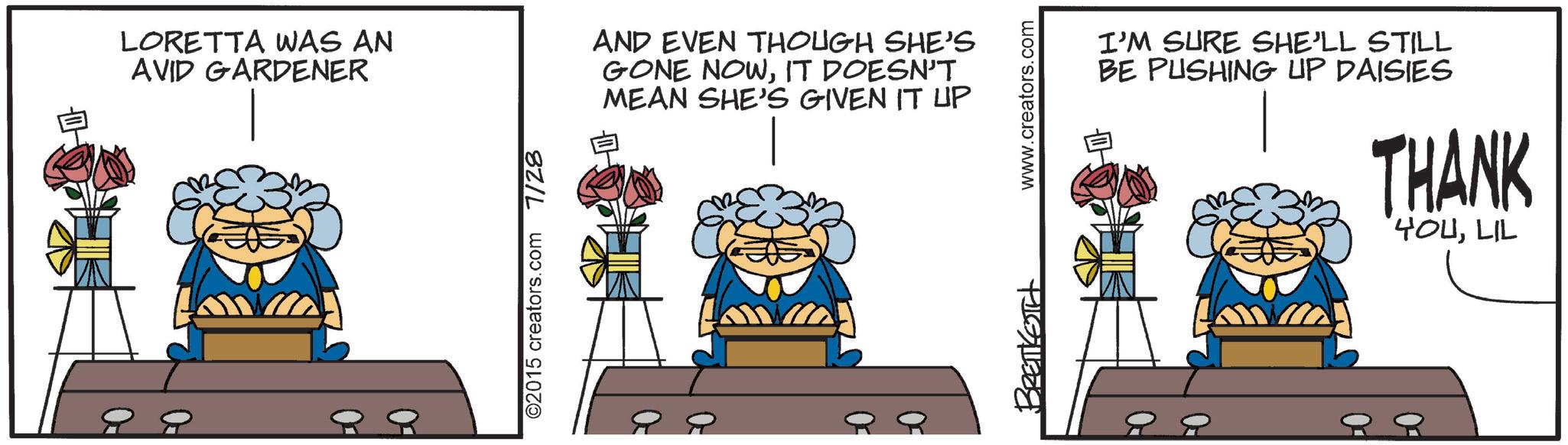
by Brett Koth
Donald
Holidays & Observances This Week
8/2 American Family Day
8/3 National Picnic Day
8/4 Coast Guard Day
8/5 Campfire Day
8/6 Hiroshima Day
8/7 Purple Heart Day
8/8 National Sleep Under the Stars Night
Dog Talk with Uncle Matty
By Matthew Margolis
Dog Petting Etiquette
From a reader:
“I was taught as a toddler: When around a new dog, hold still and present your hand palm up for the dog to sniff. Recently, I had a vet tech breeze up to my dog, Ruby, and lower her hand down over Ruby’s head. Ruby jumped up and “air bit” at the vet tech’s hand.
“Also, when I walk Ruby, people encourage their kids to come up and pet her whether or not I say it’s OK, including toddlers who want to grab her to steady themselves. I was taught to ask permission to approach someone’s dog. What is wrong with people?”
My advice:
Don’t reach out to pet a strange dog, even with the owner’s permission. Dog owners do not always provide the most accurate assessment of their dog’s temperament. This is sometimes a byproduct of denial, but by and large, it’s ignorance.
A dog owner who does not grasp the importance of socialization won’t understand that Fido’s good manners and sweet disposition at home aren’t guaranteed to hold true out on the streets with the rest of us. When a stranger asks for permission to pet Fido, his owner might give the go-ahead -- not realizing Fido’s inner Cujo hasn’t been tamed when it comes to strangers.
And the strangest of the strangers to a pooch? Children.
Children are awkward. They walk funny, fall over, flail their arms, shriek, clap, and their heads wobble all over the place. To a dog that hasn’t been raised around children, any of this may feel threatening.
I have four fantastic dogs at home. One of them has never been around children, and one of them gets nervous around quick, jerky movements. When my small nephew visits, I keep those dogs away from him. This is not about aggression; it’s about fear. And it’s the kind of “better safe than sorry” judgment call responsible dog owners should be equipped to make.
If you must pet a strange dog, make a knuckle sandwich. This will protect your fingers.
“It’s never too late to start.” That’s the word from a senior health professor at a large university on the topic of health behaviors as we age.
Specifically she was talking about habits we need to prioritize in our 60s and 70s. The long-term goal: to maintain mobility and our independence as we age further.
Here are two things they suggest:
Balance - Long-term studies show that seniors who can stand on one leg for 10 seconds or more had lower rates of mortality and falls.
Take a look at the Mayo Clinic site (www.mayoclinic.org). Do a search for “balance exercises” for good ideas on how to get the most out of this. Mayo recommends aiming for holding the balance position for 30 seconds for a more accurate measure of your ability. Another benefit of this excercise is strengthening your legs, ankles and core.
Chi: the Energy of Life
Your furniture, your lighting, the shapes of your accessories and even the colors should enable the flow of chi, the energy of life that, according to feng shui, supports harmony and well-being in one’s home.
Obstacle-free furniture plans are necessary. Furniture placement should ensure that all access points lead to ample pathways, avoiding obstacles, sharp corners and furniture edges, and furniture that could hinder the flow of chi. Allow enough space to open doors and windows freely. Place accessories and works of art to break straight lines between doors and windows. Hanging plant baskets, lamps and tall sculptures are great to promote harmony.
Strength training - It was pointed out that it’s too easy to just allow ourselves to become weak as we age. Whether we follow the U.S. Department of Health and Human Services guidelines of getting 150 minutes of moderate aerobic exercise a week or we focus on simple at-home exercises combined with daily walking, we just need to do something to prevent our muscles from becoming weak simply due to disuse.
When it comes to how many daily steps we do, that’s going to depend on what “expert source” we read, because they do vary. But most agree that if you’ve been very sedentary, try to start with 3,000 to 4,000 steps per day and ease your way up to the 6,000 to 8,000 range.
If that seems like too much in a day, break it down into groups of perhaps 10 to 15 minutes at a time. It’s not how many you do all at once; it’s how many you do in a day or a week. It all adds up to achieve a cumulative effect.
If you’ve allowed yourself to slip into the very sedentary category, consider checking YouTube for seated chair exercises.
Remember, just do something!
* * *
Matilda Charles regrets that she cannot personally answer reader questions, but will incorporate them into her column whenever possible. Send email to columnreply2@gmail.com. (c) KingFeaturesSyndicate2026
secure feeling.
Those who believe in feng shui also believe that a television should not be the focal point of a room. Even with today’s slim TV screens, it is best to place them inside a piece of furniture or frame the TV screens so they look like a work of art rather than just a technological amenity. Most households have TV screens, but they are found to be disruptive to conversation and family life.
Your home’s windows are what control the amount of light and chi that enters your home. If your views are beautiful, it is best to use very lightweight window treatments that are sheer or translucent. You can always use another layer for room darkening in bedrooms. Shapes and forms also contribute to the flow of harmony throughout your home. A room filled with sharp angles and edges is a no-no. According to the edicts of feng shui, the best rooms are a combination of rounded edges, oval shapes and straight angles. Each supports and balances the other for a harmonic ensemble.
Cody’s Corner (from page 9)
And don’t approach head-on, arm-extended. For many people, a rolled-up newspaper remains the weapon of choice in their futile attempts to correct canine missteps. To a dog, your arm looks suspiciously similar to that rolled-up paper.
Body language is important when dealing with dogs. Towering over a dog is taking a dominant position. As is petting the dog on the head. When greeting a new dog, the point is to make friends, not to assert your authority.
Word to the wise: With dogs, it’s all about territory. Everything is territory: the owner, the leash, the bed, the yard, the food, the toys. So when you approach a strange dog, even in the public domain, you are invading what they perceive to be their territory. The significance of this invasion depends on the degree of the dog’s territorialism.
Remember, dogs are wolves. They may be wearing sweaters and booties with bows on their heads, but the instincts of wolves are embedded deep in their DNA. If a wolf were trotting by, would you reach out to pet it?
Woof!
Dog trainer Matthew “Uncle Matty” Margolis is the co-author of 18 books about dogs, a behaviorist, a popular radio and television guest, and the host of the PBS series “WOOF! It’s a Dog’s Life!” Read all of Uncle Matty’s columns at www.creators.com, and visit him at www.unclematty.com.
Your furniture and its placement should help you create spaces that offer a sense of security and balance. This is why chairs and other seating should have high backs and unobstructed views of the door or entry to the room. Never face the back of a chair to the entrance of a room. Round tables facilitate a flow of energy, especially if overlooking an open view, and are the best shape for communication.
It’s a design basic to place your sofas, chairs and ottomans around a cocktail or coffee table, which should be a bit lower than the seating at the center and with reference to a focal point. Another idea is to anchor a freestanding or floating sofa with a console or sofa table for a
Earth colors are both warm and welcoming and conducive to relaxation. Best of all, earth colors easily can be combined with stronger, more vibrant colors in decorative accents such as pillows, vases and candles. Try mixing neutral earth colors with pale rose for a delicate color scheme. The color orange is a wonderful hue that inspires happiness and adds a punch to somber combinations. Likewise, red is a powerful color that symbolizes dynamism and can be used to improve the flow of chi within your home.
* * * Joseph Pubillones is the owner of Joseph Pubillones Interiors, an award-winning interior design firm based in Palm Beach, Florida. To find out more about Joseph Pubillones, or to read features by other Creators Syndicate writers and cartoonists, visit the Creators Syndicate website at www.creators.com.
was little money left over for what most people would consider the good things in life.
YOUR SOCIAL SECURITY
by Tom Margenau
Working Women vs. Stayat-Home Moms -- The Argument Continues
Once again, I find myself in the middle of an argument that has been going on for decades, maybe longer: the friction that develops between working women and stay-at-home moms.
I’m not an anthropologist. Nor am I a social scientist. And I’m sure folks in those professions would be able to find all kinds of underlying causes for the resentment felt by so many working women towards their gender counterparts who, for whatever reason, spent their lifetimes as full-time mothers and wives.
But this is a column about Social Security, not inter-gender politics. So why do I bring this topic up? Because Social Security rules can sometimes get in the middle of these heated discussions.
I’ve waded into the middle of this sea of disharmony in a couple of past columns. But some recent emails have caused me to do so once more.
Not long ago, I wrote a column in which I explained that a working woman will generally be paid her own Social Security benefit first. Only after that will they look to her husband’s record to see if she can get any additional benefits.
Part of that column included comments from a stay-at-home mom (now a grandma) who complained that she thought the benefits she was getting on her husband’s Social Security account were too small. And that triggered comments from more than a few working women.
One woman wrote to say: “These women, who claim that sitting at home all day changing a few diapers is a full-time job, should stop their griping. I do all that and I work 8 hours a day at Costco. And I won’t get half as much off my husband’s Social Security as these whiners will get!” Another woman wrote: “I wish I could sit at home all day living off a sugar-daddy husband and then get half of his Social Security when he retires. I work for a living and probably won’t get any of my husband’s Social Security!”
Those comments are just snippets of the hundreds of irate emails I’ve received over the years from working women who are upset that they oftentimes get reduced and sometimes no benefits from their husbands’ Social Security records. And then they find it doubly irritating that a woman who didn’t work outside the home gets to collect full Social Security spousal benefits from her husband’s or ex-husband’s account.
Whenever I get these kinds of emails, I think of my mother. I’ve shared her story before. And I guess it’s time to do so once again. It helps explain the Social Security rules.
My mom went through the last 25 years of her life carrying such a grudge against Social Security in general and a neighbor lady in particular.
My parents came from the wrong side of the economic tracks and spent their lives trying to inch their way into the middle class. My dad was a janitor. But that job simply didn’t bring enough money into our household. So, my mom always worked outside the home. She spent much of her adult life doing clerical work in a hospital. She took time off to have four kids. But within a year of the birth of each of those kids, she was always back to work to help pay the rent and buy groceries. There
But speaking of those good things, our neighbors behind us across the alley were living the American dream. (That alley was like the proverbial “tracks.” It divided the rich side of town from the poor side.) In their household, the husband and father was the vice president of a local bank. They had six kids. And his wife, although she had a degree in journalism, was a full-time stay-at-home mom. She never had to work outside the home because her husband’s salary brought in more than enough money to keep them living in comfort. My brothers and sisters enjoyed playing with the banker’s kids. (They had really nice toys and stuff!) But our parents never mingled and never visited one another. They simply ran in different economic circles.
Long story short: Both the husbands eventually died. The banker’s widow (she was over 65 at the time) started getting a rather substantial widow’s benefit from Social Security. But my mom got a very small monthly widow’s check from my dad’s account. And that’s because she was getting her own Social Security retirement benefit, and that benefit offset her widow’s payments -- dollar for dollar.
And because of their respective economic circumstances, the banker’s widow received a significantly higher monthly Social Security benefit than the combined payments my mom was getting. And this simply irritated my mother to no end.
By this time, I was working for the Social Security Administration, and if she asked me this once, she asked this a thousand times: “Why is THAT WOMAN across the alley, a woman who never worked a day in her life, getting more money than I am -- a woman who has spent 40 years working at a job and at home?”
The banker’s wife was just that: a “dependent.” She depended on her husband’s salary while he was alive. And so once he died, she was dependent on his Social Security.
My mom, on the other hand, had her own job and her own income. And because of that job, she received her own pension from the hospital where she worked and her own Social Security retirement benefit once she retired. In other words, she was not totally dependent on my father. But because my dad’s Social Security benefit was slightly higher than my mom’s retirement check, she did get a small widow’s supplement from Social Security.
My mom never bought that argument. She would say: “Your dad worked all his life, and I should be getting his Social Security now that he’s gone.” In other words, she wanted her own full retirement benefit and a full widow’s benefit from my dad’s account. And many working women today send me emails making the same points my mom did 50 years ago.
I tried to explain to my mom, and I still try to explain to those sending me emails today, that if the law allowed them to get both a retirement benefit and a dependent spousal benefit, where would we draw the line? Why can’t all working people in this country, both men and women, claim their own Social Security benefit AND spousal benefits from their husband or wife? Gosh, if we had been paying every working person in this country both their own retirement benefit and a dependent’s benefit from their spouse, the Social Security program would have gone belly up a long time ago!
I tried to explain to my mom that it all had to do with two of the basic concepts of Social Security. The first essentially says this: the more you pay into the system, the more you get out. And the second has to do with the reason behind spousal benefits -- those benefits were always intended to be paid to women who were “dependent” on their husbands’ income.
1. The book of Solomon is found in the a) Old Testament b) New Testament c) Neither
2. When he had a vision, who said, "Not so, Lord; for I have never eaten anything that is common or unclean"? a) Adam b) Paul c) Samson d) Peter
3. From Acts 7, who was the first person martyred for his belief in Jesus Christ? a) Philip b) Jehu c) Stephen d) Apollos
4. Besides Jonah, which other prophet ministered in Nineveh? a) Nathan b) Paul c) Nahum d) Philip
5. From 1 Kings 11, how many wives did King Solomon have? a) 30 b) 150 c) 300 d) 700
6. What is Yiddish for a small package or parcel? a) Peckel b) Abuncha c) Shiva d) Mishna
(Answers on page 16)
comments or more
Trivia go to www.TriviaGuy.com
Synd., Inc
Final Changes DUE: 12:00 Please review carefully.
If you have a Social Security question, Tom Margenau has two books with all the answers. One is called “Social Security -- Simple and Smart: 10 Easyto-Understand Fact Sheets That Will Answer All Your Questions About Social Security.” The other is “Social Security: 100 Myths and 100 Facts.” You can find the books at Amazon.com or other book outlets. Or you can send him an email at thomas.margenau@comcast. net. To find out more about Tom Margenau and to read past columns and see features from other Creators Syndicate writers and cartoonists, visit the Creators Syndicate website at www.creators.com.
Desert Stone Management c/o Curtis Lopez-Galloway BZ 1C 13x July 5, 2026 Vol. 22 - No. 28 Mon., June 29
COPYRIGHT 2026 CREATORS.COM
Expensive Injection Indicated for Prostate Cancer Patient
DEAR DR. ROACH: About six years ago, I was diagnosed with prostate cancer. I chose to have a high-intensity focused ultrasound (HIFU), which ultimately wasn’t successful. I was told that surgery after an HIFU was a high-risk option, so I chose to have radiation therapy to reduce the surgical risk of side effects like incontinence. Prior to the start of the treatments, I was given an injection of leuprolide, presumably to interfere with testosterone production. There’s also an injection that’s scheduled for a couple of months after the completion of the radiation. I asked if the second shot was necessary and didn’t get a definite answer.
What’s your opinion? Not to mention, the cost of the first shot was $11,814, most of which was paid for by insurance. It’s no wonder that insurance costs as much as it does. It can’t possibly cost this much to manufacture the drug.
-- E.B.
ANSWER: I can’t answer your question about whether leuprolide is necessary for you without knowing more about your type of prostate cancer. For men with high-risk prostate cancer, this hormone-blocking treatment significantly improves the possibility of a good outcome.
For men who are at a low risk or a “favorable intermediate” risk, testosterone-blocking drugs usually aren’t recommended. I suspect that you have a less-favorable intermediate risk, where four to six months of testosterone-blocking treatment is usually given.
The insurance cost that you were quoted is a retail price, and insurance companies negotiate a price that’s usually much lower. In fact, the charges that you see on a hospital bill have a limited relationship with reality. There are also generic versions available for less than $200. Finally, there’s a pill (relugolix) that’s cheaper and doesn’t produce the pain of the shot. It may work slightly better and faster. ***
DEAR DR. ROACH: I hear there are benefits to taking turmeric for arthritis. Can you please tell me about it? -- F.R.
ANSWER: Turmeric has shown benefit as a treatment for osteoarthritis -- the kind that most people get as they age. It isn’t a treatment for inflammatory arthritis, such as rheumatoid or psoriatic arthritis, which requires urgent treatment to prevent permanent joint damage. This discussion refers only to osteoarthritis.
Across many trials, turmeric has shown to have the equivalent effectiveness of traditional antiinflammatory medicines, such as ibuprofen or diclofenac (Voltaren). It appears superior to acetaminophen (Tylenol), even in a trial that directly compared the two. Turmeric helped most people with pain, stiffness and activity.
Although there are side effects that are asso
ciated with turmeric, they’re generally mild. The most common symptoms are gastrointestinal, especially diarrhea, but some people note nausea or an upset stomach. The risk of side effects isn’t much different from people taking a placebo (inactive) pill, and turmeric has significantly fewer side effects than antiinflammatory drugs (and even acetaminophen).
I found a single case report of liver failure that was thought to be attributable to turmeric. Turmeric has been used as a spice for millennia and is generally regarded as safe. The active ingredient in turmeric -- curcumin -- is often sold as a supplement, usually with another compound to improve its absorption such as piperine (an extract of black pepper).
For my patients who want to try a supplement for arthritis, I feel comfortable suggesting that they try turmeric or its extract, curcumin. In my opinion, at least a two-week trial is needed to see if there’s a benefit or if there are any side effects. A pain diary before and after starting the medicine can help a person see if they’re really receiving a benefit.
Dr. Roach regrets that he is unable to answer individual questions, but will incorporate them in the column whenever possible. Readers may email questions to ToYourGoodHealth@med.cornell.edu.
(c) 2026 North America Synd., Inc. All Rights Reserved
VETERANS POST
by Freddie Groves
Applying for VA Health Care
I ran into a guy recently, a fellow veteran, who I hadn’t talked to in years. And he was limping, badly. When I asked, he said he needed knee surgery and couldn’t afford it.
I asked if he’d looked into VA health care, and he replied that he’d applied years ago and got nowhere with the VA, so he gave up.
Before we even left the store, I had my phone out and placed a call to the local VSO (veteran service officer). I got the two of them hooked up with an appointment and the VSO is going to walk my friend through all the paperwork.
It should not be this hard for a veteran to get health care.
A big problem is that many veterans tried to deal with the VA years ago, became frustrated and gave up, not realizing that things have changed quite a bit.
If you were turned down for VA health care, apply again. The PACT Act has changed many things, including expanded locations for exposure to Agent Orange and two dozen new presumptive conditions. If you got hung up trying to get Community Care, try again. The rules are different now.
Or if you never had VA health care, sign up now. Go to the website (www.va.gov) and search for VA Form 10-10EZ. Check whether you’re eligible for VA health care. Have your DD214 handy and any other military paperwork you have. The online process takes about a half hour.
If you don’t think you can handle the online application process yourself, look for a local VSO. See www.va.gov/get-help-from-accredited-representative. Or call the MyVA411 information line at 800-698-2411. They’re open 24/7. You can also contact the American Legion near you or the DAV.
A VSO can do a lot of things for you: tell you about the benefits you’re supposed to get, assemble documents, help with appeals and so much more.
Or call the benefits hotline at 877-2228387 to ask about enrolling in VA health care by
Freddie Groves regrets that he cannot personally answer reader questions, but will incorporate them into his column whenever possible. Send email to columnreply2@gmail.com.
STORIES OF HOPE
How One CoachellaValley Doctor is Helping Military Families Beat Depression Without Medication
Medication-free depression care for those who served. FDA-cleared. Covered by
For over 20 years, Dr. Keerthy Sunder has proudly served service members, veterans, and military spouses – helping them achieve lasting relief from depression and anxiety. His commitment to serving them comes not only from the incredible outcomes he’s seen in his patients, but from what he witnessed in his own family growing upand a firm belief that those who have sacrificed much should have access to the best tools available.
Dr. Sunder’s own pain began early – much of his childhood was spent watching the people closest to him suffer, a pain that in some ways became his own.
I was raised in a military family and personally experienced the hardships of family members during periods of war. It’s given me a deep care and respect for service members and their families,” Sunder shares.
He also watched his mother face a rough battle with postpartum depression and a lifelong struggle with a treatment-resistant mood disorder - a difficulty that marked him deeply and ultimately became the catalyst for his career.
But through it all, he also witnessed his mother’s resilience and her daily effort to never give up.
That sense of fight was passed onto him, and it is that same fight he sees in his military patients and deeply respects.
I spent so much of my career in research and clinical practice, searching for better answers so that no one else would have to accept that kind of suffering as their story,” Sunder says.
That determination kept leading him back to the same problem. For years, the primary tool for depression and anxiety had been medication. Double board-certified in Psychiatry and Addiction Medicine, Dr. Sunder knew medication’s value – and its limits: side effects, diminishing returns, and patients cycling through prescription after prescription, never quite finding their way back.
But psychiatrists had always known the brain was never only chemical. Like the rest of the body, it is also electrical – it contains a living network of signals, each region communicating with the next to keep us thinking, feeling, and functioning. In depression, activity in certain regions of the brain can become reduced, and communication between different regions can weaken. But when those areas are gently restimulated, healthy function can be restored and depression relieved.
Dr. Sunder knew it was only a matter of time until technology caught up to science. So when the FDA cleared Transcranial Magnetic Stimulation (TMS) in 2008, he became one of the first physicians in the country to offer it. Today, TMS is included in the VA’s own guidelines for depression, is covered by TRICARE, and has been used by Dr. Sunder to help over 500 patients find relief.
500+ patients served
TMS is simple: you sit comfortably, awake and alert, while gentle magnetic pulses help restore healthy activity in the brain. No medication or anesthesia, no hospital, no downtime. Many say it feels like a light, massage-like tapping – some even fall asleep during their sessions. And most begin to feel like themselves again within weeks.
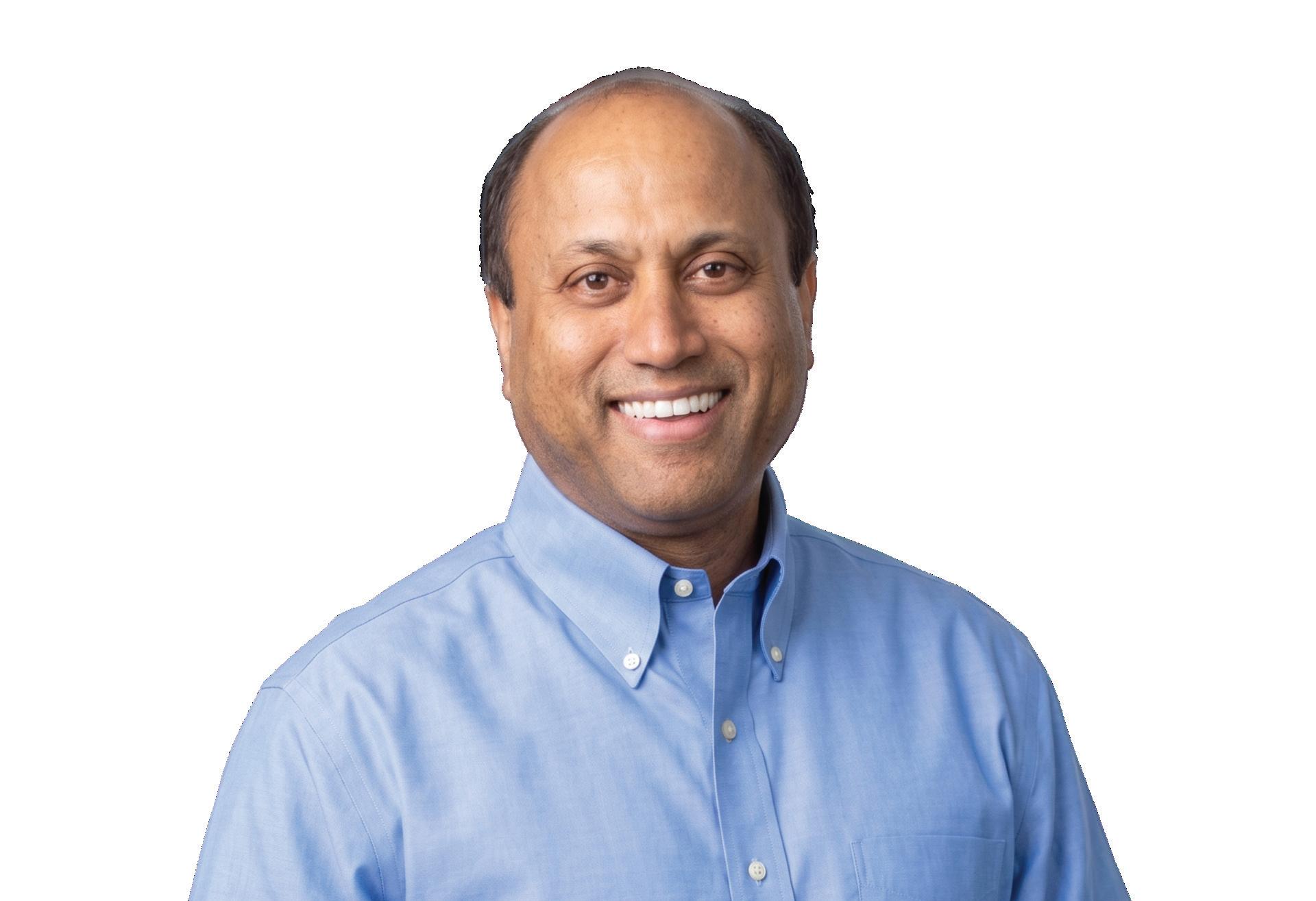
Dr. Keerthy Sunder, Integrative Psychiatrist
from retirement accounts or a pension.
With Social Security Uncertainty, Should You Claim Benefits Early?
DEAR SAVVY SENIOR: I turn 62 early next year and plan to retire soon after. Most advice says I should wait to claim Social Security because my monthly benefit will be higher. But with all the recent news about Social Security’s financial problems, I’m wondering if taking benefits early might be the safer choice. Is there ever a good reason to claim at 62? -- Ready to Retire
Dear Ready: You’re definitely not alone in asking this. The latest Social Security Trustees Report projects the retirement trust fund could be depleted around 2032 if Congress doesn’t act. If that isn't prevented from happening, Social Security would still collect payroll taxes and pay benefits, but retirees could face an across-theboard cut of about 22 percent.
Before you rush to file, it's wise to keep things in perspective. Most experts still expect Congress to step in, as it has before, to strengthen Social Security. And even if lawmakers don’t act, waiting would still produce a higher monthly benefit because any across-the-board benefit cut would apply to everyone. While claiming at 62 means collecting benefits sooner, it also permanently locks in a smaller check.
That said, there are several situations where claiming Social Security at 62 can make good financial sense.
How claiming age affects your benefits
You can start Social Security at 62, but doing so permanently reduces your monthly benefit by about 30 percent compared with waiting until full retirement age (67 for those born in 1960 or later). Delaying until 70 increases your benefit by about 24 percent.
For example, a $2,000 monthly benefit at full retirement age would drop to about $1,400 at 62, or rise to roughly $2,480 if you wait until 70.
When claiming early makes sense
For some retirees, claiming at 62 is a practical move. If you’ve stopped working and need income for basic expenses, Social Security can provide a steady check right away. It can also serve as a bridge if you retire early or lose a job in your early 60s while delaying withdrawals
You should also consider how the math works out if you opt for filing at age 62. For example, if you multiply that reduced $1,400 permonth payment by 12 months, it amounts to an annual payment to you totalling $16,800. Eight years later, when you've reached age 70, Social Security will have already paid you a total of $134,400.
You then need to decide for yourself if postponing any payments at all from Social Security until age 70 is worth that wait. You'll need to decide how many more years you will have to live after age 70 for the larger payment to catch up what you would have already received during those first 8 years.
Of course, your health is a big factor in the equation. Delaying to age 70 only pays off if you live long enough to collect those higher monthly checks. The break-even point between claiming at 62 and the full retirement age is around age 78 or 79. According to the most recent report from the CDC, the average life expectancy for U.S. males is 76.5 years, while the number is 81.4 years for females.
Some retirees also claim Social Security early to reduce withdrawals from their IRA or 401(k) during market downturns. The tradeoff is a permanently reduced lifetime benefit.
For married couples, timing can be coordinated as part of a broader strategy. One spouse may claim early to bring in income while the other delays to boost their future or survivor benefit.
If you’re still working, be careful here too. Before full retirement age, earnings above Social Security’s annual limit can temporarily reduce your benefit, and claiming early locks in that lower amount for life.
Why delaying helps
For many retirees, waiting means a larger guaranteed monthly benefit for life and often a higher lifetime payout if you live into your late 70s or beyond. It can also provide stronger protection against outliving savings.
For couples, delaying the higher earner’s benefit can increase the survivor benefit, which
may help provide more financial security for a surviving spouse.
Before deciding, it’s smart to review your numbers. You can create a free account at SSA. gov/myaccount to check your earnings record and estimate benefits at different ages. Tools like OpenSocialSecurity.com or MaximizeMySocialSecurity.com (a paid tool with a $49 fee) can also help you compare claiming strategies.
There’s no one-size-fits-all answer. For many people, waiting makes the most sense. But if you need income, have health concerns or are coordinating benefits with a spouse, claiming at 62 may be the better choice. The key is to base your decision on your own circumstances – not fear about Social Security's future.
Send your questions or comments to questions@ savvysenior.org, or to Savvy Senior, P.O. Box 5443, Norman, OK 73070.
* On Aug. 3, 1923, Calvin Coolidge was sworn in as the 30th president of the United States, hours after the death of President Warren G. Harding, who had died suddenly of a heart attack or stroke while on vacation in California. Coolidge’s oath was administered by his father, a notary public, under the light of a kerosene lamp while he was visiting family in Vermont.
* On Aug. 4, 1790, the first U.S. Congress authorized the construction of 10 vessels to patrol American ports from Massachusetts to Georgia. The United States Coast Guard, originally known as the Revenue Marine and then the Revenue Cutter Service, was the idea of Alexander Hamilton and designed to intercept marine smugglers and collect tariffs on imported goods.
* On Aug. 5, 1948, American diver Sammy Lee earned a gold medal at the London Olympics two days after his friend and fellow diver Vicki Draves won hers. They were the first Asian Americans to win Olympic gold medals for the United States. Draves was also the first woman to take home gold medals in both springboard and platform diving.
* On Aug. 6, 1890, William Kemmler, convicted of murdering his lover, Matilda Ziegler, with an axe, became the first person to be executed by electric chair, at New York’s Auburn Prison. Inventor George Westinghouse notably opined that “they would have done better with an axe.”
* On Aug. 7, 1987, Lynne Cox, clad in just a swimsuit, entered the near-freezing waters of Little Diomede in Alaska. Two hours and 16 minutes later she had crossed the international dateline and completed the first recorded swim from the United States to the Soviet Union, ending at Big Diomede in the Bering Strait.
What might you call
* On Aug. 8, 1844, Brigham Young was chosen to be the next leader of the Mormon Church, following the mob assassination of the church’s founder, Joseph Smith, and his brother Hyrum six weeks earlier.
* On Aug. 9, 1973, NASA asked Skylab astronauts to share a housefly-sized piece of their filet mignon with two spiders, Anita and Arabella, on the astronauts’ mission so the arachnids could maintain their experimental work on spinning webs in zero-G.
-- by Jim Miller
San Andreas: (from page 3)
• Some researchers theorize that the long delay is due to the loss of Lake Cahuilla. This gigantic prehistoric lake dried up when the Colorado River shifted course. Now, through diversion to the lowest point of the Coachella Valley, all that remains is a tiny remnant called the Salton Sea. The absence of the enormous weight of what was once a large inland sea may be responsible for the lack of major tremors.
• Yet geologists remain concerned because the central and northern sections have both experienced enough earthquakes over the past century to relieve much of the pressure in their area, while the southern section has not. This is the section that geologists warn is capable of generating an 8.1 or greater earthquake.
• The northern segment was responsible not only for the San Francisco quake of 1906, but also for the 6.9 magnitude Loma Prieta quake in 1989 which killed 63 people in the Bay area. The 6.7 Northridge quake in 1994 struck north of L.A. area on a previously unknown branch of the San Andreas. 72 people died in that quake and 12,000 were injured.
• Another area of concern is where the fault ends, just off the coast west of Eureka, CA. This is the point where the Juan de Fuca plate is plunging beneath the North American plate in the Cascadia subduction zone. Geologists fear that a major quake along the Cascadia subduction zone could trigger a rupture along the San Andreas Fault as well.
• The ability to predict major earthquakes within an accurate timeframe remains elusive. Scientists cannot predict earthquakes beyond saying which faults are likely to produce quakes and how big those quakes are likely to be. The U.S. Geological Survey, which tracks faults and measures earthquakes, has calculated that there’s a 72% chance of a magnitude 6.7 earthquake in the San Francisco Bay region by 2043. Furthermore, there’s a 60% chance of a quake of 6.7 or larger in that time frame in the Los Angeles region.
• While we donʼt know when the Big One is going to hit, itʼs certain that it will happen. And if youʼre like most wary folks, you hope you wonʼt be around to experience it.
Give your golf-related advertising message targeted visibility in full color in this weekly 2” x 6” fixed location
$159 per insertion reaches 70,000+ readers each week at the low cost of only $2.27 per 1,000 reader impressions!
TO RESERVE YOUR SPACE
Game Changers
by Jason Jenkins
While it may seem obvious to state that putts should get rolling as soon as possible, there is a hidden aspect of why you may be struggling to control distances on longer putts. To the naked eye, all putts seem to immediately roll after impact, but many putts take flight and bounce for a short duration.
All putters have some degree of loft, or inclination, to the putter face. The loft can be altered by the lean of the putter shaft by impact as well. When a putt is struck, two main things influence its roll or flight:
1. The effective loft at impact, which should be fairly minimal for most situations.
2. Where on the ball the putterhead made its contact. You can think of it as hitting below, on, or above its “equator”. Contact too low creates lift and backward spin.
In order to get the best immediate roll on your putts, practice hitting putts with two coins stacked behind the ball. Don’t let the putter strike the coins. Secondly, try leaning the putter shaft