Tidbits has some pretty sweet facts this week about a few individuals and family-owned companies who make our life a little sweeter by
SWEET START-UPS
• One little vowel makes the difference between two giant confection manufacturers, Ferrara and Ferraro. Salvatore Ferrara came to the United States in 1900, and in 1908, he and his brotherin-law opened a bakery in Chicago’s Little Italy neighborhood.
• Their specialty was candy-coated almonds they called “confetti,” (also known as Jordan almonds), the prevalent treat at Italian weddings. By 1919, the company operated a 15,000 sq.-ft. candy factory in the city. Ferrara debuted one of our favorite candies, cinnamon Red Hots in 1932. Another hot candy, Atomic Fire Balls, was also the creation of this company, as well as Lemonheads and Boston Baked Beans.
TRIVIA NEWSFRONTAIVIRT TNORFSWEN
(Answers on page 16)
1. LANGUAGE: What does the Latin phrase “carpe noctem” mean in English?
2. U.S. PRESIDENTS: Which president was a lifeguard in his earlier life and saved 77 people from drowning over a seven-year period?
3. MOVIES: Who is the primary nemesis of Professor X in “X-Men”?
4. GEOGRAPHY: English is the official language in which Central American country?
5. LITERATURE: Which English novel features characters such as Pip, Miss Havisham and Estella?
6. MUSIC: How many strings does a standard guitar have?
7. TELEVISION: Which TV sitcom stars a character named Eleanor Shellstrop?
8. HISTORY: Which European ruler is known as the Sun King?
9. U.S. STATES: Which state is home to Mount St. Helens?
Classic Games & Toys
One in a series
American Greetings, the world’s second-largest greeting card company after Hallmark, was responsible for the creation of one of our favorite lines of dolls and related merchandise, Strawberry Shortcake. This week, Tidbits dishes up the details on this unique toy franchise.
a plastic “straw” hat.
• There were two villains in the world of Strawberry Shortcake, the Peculiar Pieman Porcupine Peak, accompanied by his berry bird, Captain Cackle, and a female villain, Sour Grapes who came with her snake Dregs.
• The cast of friends and pets, all appropriately scented, continued to grow in size and popularity, and in 1980, the first of six animated television specials featuring Strawberry Shortcake and friends was aired.
ADVERTISING PROOF
• More and more merchandise was launched, including books, sticker albums, clothing, bedding, and a video game. The Strawberry Shortcake bicycle had estimated sales of one million units. Sales soared, with 1981 sales estimated between $300 and $500 million.
ADVERTISING PROOF
• The Sapirstein Greeting Card Company (later renamed as American Greetings) was founded in 1906 by 21-year-old Polish immigrant Jacob Sapirstein. The company has remained owned and operated by family members for 120 years.
Rolfing in the Desert (1 of 6) 1/8 pg BW 6x disc. Nov. 24, 2024
• In 1972, a freelance artist named Barbi Sargent was designing cards for American Greetings and created a whimsical character wearing a bonnet with a strawberry print and holding a daisy, which she named “Girl with a Daisy” and “Strawberry Girl.” The character first appeared on a 1973 Valentine’s Day card. When it proved to be very popular, Sargent created four additional cards using the strawberry garb.
• In 1982, the original illustrator Barbi Sargent sued American Greetings, claiming that her card was the foundation for the success. The company counter argued against Sargent, claiming that she was not the creator, but rather a subcontractor who was part of a bigger team.
• The courts sided with Sargent, but when she saw that her ownership would mean the end of the character, she returned the rights to American Greetings. For Sargent, it wasn’t about the money, she said. She only wanted the credit.
In a series of 10 sessions, Rolfing® actually changes the way your body is structured. You become straighter, taller, more graceful, flexible and free-moving. Possibly many aches and pains will disappear. How does this actually happen?
ROLFING:® How Does it Work?
• The Strawberry Shortcake doll, created from hard vinyl and manufactured by Kenner, made its debut in 1979, and the 5 ½-inch-tall, red-haired, freckled doll with a strawberry print outfit was an immediate hit. The hair was infused with a strawberry scent.
• It’s pretty tough to find an original complete Strawberry Shortcake doll. The clothes were so tiny that socks, tights, and shoes were easy to lose. Because of this, in 1984, Kenner stopped including shoes.
We manipulate connective tissue called fascia, a type of body tissue that holds the body together and gives it shape. Fascial planes shape broad areas of the body. Dr. Rolf’s discovery was that if you put certain kinds of pressure on fascia, the shape of the tissue will change in a lasting way. She worked with a very firm level of pressure. Since then, we have found that lighter pressure combined with your movement makes the body reshaping occur quicker. Call to schedule an appointment or for a free consultation:
• She was joined by her pet Custard Kitten. Soon after, friends and more pets were introduced to accompany the original, growing to a set of twelve, with each friend having its own dessertor fruit-themed distinctive scent in all different hair colors.
• Huckleberry Pie’s pet was Pupcake the dog, while Apple Dumplin’ was the owner of Teatime Turtle. Cheesecake the Mouse belonged to the doll Blueberry Muffin, and Raspberry Tart’s pet was Rhubarb the monkey.
• An international friend, Mint Tulip, arrived from the Netherlands with Marsh Mallard the duck, as did Crepe Suzette and her poodle Éclair from France. Café Ole from Mexico brought Burrito the burro, and Almond Tea came with Marza Panda. All of the characters lived in a magical world appropriately named Strawberryland.
• There was only one male doll in the collection, Huckleberry Pie, clothed in blue dungarees and
• A relaunch of the property in 2026 will focus on material produced for digital media platforms like YouTube, TikTok and Instagram.
anatomical order of increased balance and length, centering it around its vertical axis. Rolfed persons generally experience a marked increase in Flexibility by:
A: The physical manipulation of fascia, freeing layers of muscles that have become stuck to one another, and lengthening the myelin sheathing-enclosed muscle, which often become shortened with misuse and trauma. B: By aligning the body in its most structurally sound arrangement, Rolfing® allows each muscle to do its designated job and not be forced to overwork to compensate for a body dragged down by gravity. Still the only Rolfer in the Coachella Valley.
Week of March 1, 2026
• Years later in 1946, the Italian brothers Pietro and Giovanni Ferrero worked side-by-side in the family pastry shop in Alba, Italy. In 1964, the company introduced one of their mainstays, the chocolate-hazelnut spread, Nutella.
• The year 1979 brought another favorite, Ferrero Rocher, truffles consisting of chocolate, a wafer shell, and a whole roasted hazelnut in the center. Ferrero uses 25% of the world’s hazelnut supply to produce these treats. Ferrero is also the largest producer of candy canes and conversation hearts.
• Ironically, in 2017, the Ferrero Group acquired the Ferrera Candy Company. The following year, Ferrero purchased Nestle’s, taking over the production of Baby Ruth, Nestle Crunch, and Butterfinger brands.
MORE NEW COMPANIES
• Haribo gummy candies were created in Germany in 1920 as tiny gummy bears called “Gummibarchen.” The confectionary company was founded by Hans Reigel, Sr. in the city of Bonn, and he named his company accordingly – “Ha” for his first name,” Ri” for his surname, and “Bo” for Bonn.
• Reigel’s first supplies were a sack of sugar, a copper kettle, marble block, a rolling pin, and a brick oven. For the first three years, Riegel’s wife delivered their goods to customers on her bicycle, before the company was able to purchase a vehicle in 1923. Today, the company, still family-owned, has 16 manufacturing facilities worldwide that produce 100 million Goldbears every day, along with more than 1,000 other products.
FLEER'S DUBLE BUBBLE
• The Fleer Chewing Gum Company brought us Dubble Bubble gum in 1928. It was invented by one of the company’s accountants, whose hobby was concocting recipes for gum. The
accountant, 23-year-old Walter Diemer, had been experimenting with bubble gum that didn’t stick for about a year before his first successful batch. Fleer’s first chewing gum, Blibber Blubber, was a failure because it was too sticky, and the bubbles broke easily. Diemer added pink food coloring to his creation since it was the only food coloring available at the factory, unknowingly setting the standard color for bubble gum across the globe. • His first batch, priced at a penny per piece sold out in one day. By the end of the first year, sales of Dubble Bubble had exceeded $1.5 million. Fleer inserted a colored comic strip in the gum featuring the characters Dub and Bub. Dubble Bubble was the only bubble gum on the market until 1947, when Bazooka was introduced.
SNICKERS BAR
• The popular Snickers candybar was invented in 1930 by Frank C. Mars and his wife, Ethel V. Mars, founders of Mars, Incorporated. Developed in their Chicago factory, the candy bar was named after the Mars family's favorite horse, which passed away shortly before the product's launch. It was designed as a combination of peanut butter, nougat, caramel, and peanuts.
• Originally, the bars were hand-cut in the Chicago factory before mass production. Despite its enduring popularity, the bar was known as the “Marathon” bar in the U.K. until 1990 due to concerns that “Snickers” sounded too similar to “knickers”.
RUSSELL STOVER
• In 1921, Russell Stover teamed up with the inventor of the Eskimo Pie, Christian Nelson, to produce chocolate-dipped ice cream sandwiches. By the following year, the partners were raking in $30,000 a week in royalties.
• But it wasn’t long before other companies began making similar products, and although Nelson had a solid patent, the company was nearly forced out of business.
• Stover sold his share in 1923 for $25,000 and he and his wife started up a new company, making and selling boxed chocolates out of their Denver, Colorado, home. By 1924, the Stovers had several stores in Colorado, Missouri, and Nebraska.
• By the time Russell Stover died in 1954, the company was producing 11 million pounds (4,990,000 kg) of candy every year, distributing them in 40 shops and 2,000 department stores. Mrs. Stover ran the company until 1960 when
she sold it for $7.5 million (about $82 million in today’s dollars). In 2014, the company was sold again, this time to the Swiss chocolatier Lindt, who purchased it for $1.6 billion.
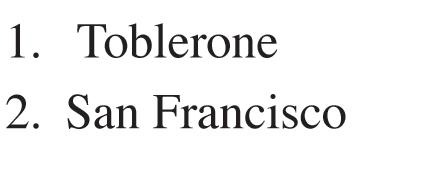
1. Which Swiss chocolate is shaped in a triangular prism?
2. What U.S. city was chosen by Dombringo Ghirardelli as the place to manufacture his chocolate?
By Lucie Winborne
* In ancient Greece, lipstick was seen as scandalous by most women and worn predominantly by sex workers.
* Ornithologists often use Cheetos to study behavior in crows. Along with being easy to spot because of their bright orange color, they’re also one of a crow’s favorite treats.
* Apollo 17 astronaut Harrison Schmitt is allergic to moon dust.
* Michigan still has a 1931 law on the books stating that “any man who shall seduce and debauch any unmarried woman shall be guilty of a felony.” If convicted, the man can be punished with up to five years in state prison or a fine of up to $2,500.
* Pentheraphobia is the intense and disproportionate fear of your mother-inlaw.
* Some throat singers are able to produce four tones simultaneously.
* The first Hershey’s chocolate bars with almonds were produced in 1908 because they were cheap to make. The nuts took the place of some of the more expensive milk chocolate, which meant Hershey’s could keep the price of the candy at a nickel.
* Eggplants are berries.
* English painter William Hogarth had a pug called Trump, who is famously featured in several of his paintings. LouisFrancois Roubiliac created a sculpture of Trump in terracotta to accompany a bust of Hogarth in 1741.
* In the U.S. alone, up to 500 million drinking straws are used every day. ***
Thought for the Day: “I love being married. It’s so great to find that one special person you want to annoy for the rest of your life.” -- Rita Rudner
by Mary Hunt
The Real Cost of Dipping Into a Retirement Account
Everyday CHEAPSKATE®
More people are taking loans from their retirement accounts (401(k), 403(b), etc.) than ever, simply because they can. Here’s the problem: seeing one’s retirement account as a savings account, or worse, a personal ATM machine. That’s so ridiculous I cannot even tell you. Sure, it’s your money, but it’s not your money now. It’s for later. It is out of your reach, so you need to get it out of your mind.
by Mary Hunt
The beauty of an IRS-approved retirement account is that you get to save pretax dollars. It’s no secret that what you see in your paycheck is not the full amount you earned.
In fact, the amount in your paycheck is shrinking, and many of our elected officials are trying to shrink that even further by increasing taxes. You know what I mean if you live in California -- one of the most heavily taxed states. (Did I mention my husband and I left California for this very reason?) But I digress.
A retirement account allows you to save your money before it gets taxed. If you take your money home, you have to earn about $1 to see 75 cents in your paycheck. But if you put that dollar into a retirement account instead, you get to deposit the entire $1. You get to invest the 25 cents that belongs to the government. It’s not a gift; you will have to pay that 25 cents to the government eventually. But for now, you get to keep all the growth you will achieve by investing the government’s money! Get it? And it’s all locked up, so it is safe from YOU. That’s the beauty of a retirement account.
Now, if you go and stick your hands in there and borrow some of that money, you really mess things up. There are rules, conditions and penalties for doing that. But the biggest penalty of all is that you stop the machine that makes those dollars grow. Sure, it can be slow growth, but it’s growth, nonetheless.
There are lots of reasons not to borrow from a retirement account, but I think the biggest is the rule that should you leave your job for ANY reason, that loan becomes all due and payable. You’ll have a couple of weeks to come up with the money. And if you can’t? That loan will be automatically converted to a cash withdrawal. Between the penalties and taxes you will owe on it right away, it could cost you up to 50%. Gone. Vanished into thin air. That is just too risky.
Here’s an example: You borrowed $15,000 from your 401(k) for your daughter’s wedding. You felt OK about that since you immediately started a repayment plan that includes interest to yourself.
A couple of months later, you got a pink slip -- a shocking, unexpected layoff. You get a notice that you have 14 days to come up with the entire amount owing, which is $14,650. You can’t do it!
The plan’s administrator immediately converts that $14,650 to a “cash withdrawal.” BAM! Just like that you owe 10% penalty on the entire $15,000. Then the entire $15,000 is immediately
reported to the IRS as ordinary income upon which you owe federal and state (if any) income tax. Your federal tax rate is 28%, and since you live in California you must also pay 10% to the state. Do the math: 14,800 x (10% + 28% + 10% = 48%) = $7,200. That’s what you owe in taxes. Can’t pay? Then you’ll have to agree to a payment plan with the feds and the state tax board -- plus interest, of course. Ka-ching! Whatever will you do? You don’t have a job; you can’t afford the bills you have already. How will you take on two more monthly payments to creditors who are anything but understanding, kind and forgiving, should you fall behind?
Thankfully, this was only an example. Whew! You still have time to reconsider taking a loan from your retirement account. Here’s my suggestion: Don’t! Do not even think about it. The money in your retirement account will become your safety net in the future. Live as if the money is not even there. Just save it and forget it.
* * *
Mary invites you to visit her at EverydayCheapskate.com, where this column is archived complete with links and resources for all recommended products and services. Mary invites questions and comments at https:// www.everydaycheapskate.com/contact/, “Ask Mary.” This column will answer questions of general interest, but letters cannot be answered individually. Mary Hunt is the founder of EverydayCheapskate.com, a frugal living blog, and the author of the book “Debt-Proof Living.”
COPYRIGHT 2026 CREATORS.COM
“I demand my rights!” is a familiar expression by those who feel that their birthright or privileges have been violated. The U.S. Constitution has established the actual rights that American citizens are entitled to, as recorded in our Bill of Rights. This week, Tidbits examines these guarantees of personal freedom.
• The Bill of Rights contains the first 10 amendments to the United States Constitution, which had been ratified in June 1788. Just a year later, the amendments were already being proposed to limit the federal government’s power, to pledge the civil liberties of individuals, as well as give each state its own rights that were not covered in the Constitution.
• The 38-year-old Congressman from Virginia, James Madison, drafted the first proposal of 12 amendments which were sent to the states for ratification in September 1789. The first two proposed amendments were defeated because they didn’t apply to the rights of U.S. citizens.
• The First Amendment encompassed several freedoms – freedom of religion, freedom of speech and of the press, the freedom to peaceably assemble, and to petition the government for compensation for any grievances.
• The Second Amendment guaranteed citizens the right to bear arms, while the Third prohibited the government from requiring citizens to house any militia. The Fourth protected citizens from illegal warrants, search and seizure.
• When we hear of people “pleading the Fifth,” they are refusing to testify in matters that could be used against them in a criminal case. We often assume it as an admission of guilt, but the Fifth Amendment often protects innocent people just as much as guilty ones, when statements can become twisted and used against the innocent.
• The Fifth Amendment also includes the Double Jeopardy Clause, protecting citizens from being prosecuted more than once for the same offense after final judgment has been rendered.
• The Sixth guarantees a speedy trial, the Seventh allows for the right to a jury, while the Eighth prohibits excessive bail and fines and cruel and unusual punishment.
• The Ninth Amendment states that the Constitution doesn’t contain a comprehensive list of all rights and liberties that Americans have, that there are other rights that may not be mentioned but are rights just the same.
• The Tenth Amendment states that the federal government only has the powers rendered by the Constitution, and the individual states have the remainder.
• George Washington ordered that 14 handwritten copies of the Bill be produced – one for each of 13 original colonies, and a copy for Congress.
• After more than 230 years, 12 of these originals still exist. Most are with the states and one can be seen in Washington, D.C.’s National Archives. Four states are missing theirs – Georgia, Maryland, New York, and Pennsylvania, although two unidentified copies have been discovered, and are located in the Library of Congress and the New York Public Library.
• During the Civil War, a Union soldier stole North Carolina’s copy as a souvenir, and it remained missing for almost 140 years. In 2003 an FBI
sting operation recovered the document from a group of antique dealers, when an undercover agent posing as a buyer brought a check for $4 million to a meeting, and authorities seized the document.
by Dana Jackson
Where do insects do their grocery shopping? The Flea Market!
1. Which kind of fish is the smartest?
According to “TVLine,” Wahlberg let the news slip that Len Cariou will appear on “Boston Blue” at some point. Fans who miss the Reagan family dinners and its patriarch, Henry, are no doubt thrilled to hear that Cariou will, in fact, appear in episode 13, which is scheduled to air on April 3.
2. Which are smarter: carnivores or herbivores?
3. Are coyotes, wolves, or foxes the smartest?
Q: When is “Boston Blue” coming back with new episodes? I hope it wasn’t canceled. -- F.F.
1. What genus of spider has the most members?
2. What spider species has the deadliest venom?
A: No worries. The “Blue Bloods” spinoff starring Donnie Wahlberg and Sonequa MartinGreen (“The Walking Dead”) has done so well on Friday nights that CBS has already renewed it for a second season. Like many network series, it took a break during and after the winter holidays but will be returning for the latter half of its debut season on Feb. 27.
While the show is carving its own space in “Blue Bloods’” former timeslot with new characters surrounding Wahlberg’s Danny Reagan, those who miss the original series will have some familiar faces to look forward to by season’s end. Marisa Ramirez, who played Danny’s former partner Maria Baez, will be back for another episode in April. Bridget Moynahan will also return as Danny’s sister for episode 17 in May.
Meal memory: A rat, after witnessing a goody being buried, will remember the spot only for a few seconds. A chimp, however, will go directly to the spot and retrieve the reward after
1. Wuthering Heights (R) Margot Robbie, Jacob Elordi
2. GOAT
(PG) Caleb McLaughlin, Gabrielle Union
3. Crime 101 (R) Chris Hemsworth, Mark Ruffalo
4. Send Help
3/1
(R) Rachel McAdams, Dylan O’Brien
5. Solo Mio (PG) Kevin James, Jonathan Roumie
6. Zootopia 2 (PG) Ginnifer Goodwin, Jason Bateman
3/7 National Cereal Day
7. Good Luck, Have Fun, Don’t Die (R) Sam Rockwell, Juno Temple
8. Avatar: Fire and Ash (PG-13) Sam Worthington, Zoe Saldana
9. Iron Lung
(R) Mark Fischbach, Caroline Kaplan
10. Dracula (R) Caleb Landry Jones, Christoph Waltz
Q: I saw that the stars of “Bones” are going to be on two new series but not together. Is there any chance “Bones” will come back someday as a reboot? -- K.S.
4. What state has the greatest number of spider bites?
5. How many spiders will you accidently swallow while asleep over the course of your lifetime, on average?
A: The hit series “Bones” ended in 2017 after 12 seasons on Fox, and while its fans miss it, most would agree that it ended the way it should. There was a rumor in 2025 of a possible reunion in the form of a limited series or film, but it never came to fruition. However, its two leads, David Boreanaz and Emily Deschanel, both have exciting new projects coming up.
Boreanaz has headlined three very successful prime-time series in his short career: “Angel,” “Bones” and “SEAL Team,” and next he’ll star in an updated version of the classic 1970s detective series “The Rockford Files.” As for Deschanel, she’s been tapped to star in a new crime procedural, also on NBC, based on real-life expert criminal profiler Dr. Ann Burgess. Both of these shows are still in the development stage.
“When spiders unite, they can tie down a lion.” -Ethiopian proverb
Q: I’m sad to see Billy Flynn go as Chad on “Days of Our Lives.” How many years was he on the show? Is someone else going to
Ron Howard 3/1/1954
Eddy Money 3/2/1949
Ira Glass 3/3/1959
Rick Perry 3/4/1950
Penn Jillette 3/5/1955
Michelangelo 3/6/1475
play the character next, or is Chad gone for good? -- W.E.
Q: What do you call it when a swarm of insects goes to Italy to dine?
A: A Venice fly trip!
A: Billy Flynn chose to leave “Days” after 12 years of playing Chad DiMera on the NBC (now Peacock) soap. You might not know, but he’s also been playing Cane Ashby on the CBS soap “The Young and the Restless” since last June. (The two soaps have drastically different filming schedules.) He left “Days” on good terms but wanted to work with former head writer Josh Griffith again, who is now “Y&R’s” head writer.
As for Chad DiMera, actor Conner Floyd will assume the role beginning April 21.
Send me your questions at NewCelebrityExtra@gmail.com, or write me at KFWS, 1800 Pembrook Dr., Suite 300, Orlando, FL 32810.
(c) 2026 King Features Synd., Inc.
Brian Cranston 3/7/1956 eats mainly bugs
Flamingoes can only eat with their heads upside-down. They are filter feeders and their pink color comes from tiny pink and reddish crustaceans that they eat.
2. The banana spider, also called the Brazilian wandering spider
DepositPhotos
Donnie Wahlberg plays Danny Reagan on “Blue Bloods
ADVERTISING PROOF
Good Recipes from
Charred Shrimp and Avocado Salad
Turn up the tropical vibes with this refreshing pineapple, avocado and shrimp combination your family and guests will love!
2 1/2 pounds large peeled and deveined shrimp
5 tablespoons olive oil
Kosher salt
Pepper
1/2 small pineapple, peeled, trimmed and sliced 1/2-inch thick
watercress and avocado. Serves 4.
Each serving: About 420 calories, 23.5g fat (3.5g saturated), 35g protein, 1,595mg sodium, 20g carbohydrate, 4g fiber
Portobello Parmesan
Stuff mushrooms with marinara, mozzarella and breadcrumbs for an easy, delicious dinner that will satisfy meat lovers and vegetarians, alike.
4 large portobello mushroom caps 1/4 teaspoon salt
1 cup marinara
4 slices fresh salted mozzarella 1/4 cup panko
ADVERTISING PROOF
2 tablespoons fresh lemon juice
1/2 small red onion, thinly sliced
1/2 English cucumber, sliced into halfmoons
1/2 bunch Upland watercress
1 ripe avocado, quartered
1. Toss shrimp with 2 tablespoons oil and 1/2 teaspoon each salt and pepper. Heat grill pan, grill or broiler. Brush pineapple with 1 tablespoon oil. Grill or broil (in batches on rimmed baking sheets) until pineapple is slightly charred and shrimp are opaque throughout, about 3 minutes per side on the grill, or 6 to 8 minutes in broiler (rotating pan and turning food over halfway through).
2. Meanwhile, in large bowl, whisk together lemon juice, remaining 2 tablespoons oil and 1/4 teaspoon each salt and pepper. Toss with onion.
3. Cut grilled pineapple into smaller pieces. Add to bowl with onion along with cucumber and shrimp, and toss to combine. Fold in
Freshly grated Parmesan, sauteed kale and sliced baguette, for serving
1. On foil-lined, rimmed baking sheet, place portobello mushroom caps smooth sides down; spray with nonstick cooking spray and sprinkle with salt. Bake in 450 F oven 10 minutes.
2. Spoon 1/4 cup marinara sauce into each
cap; top each with mozzarella slice, then 1 tablespoon panko. Spray all over with nonstick spray.
3. Bake 15 minutes longer or until cheese has melted and mushrooms are tender. Garnish with freshly grated Parmesan. Serve with sauteed kale and sliced baguette. Serves 4.
* Each serving): About 395 calories, 24g fat (11g saturated fat), 22g protein, 30g carbs, 6g fiber, 690mg sodium.
* * For thousands of triple-tested recipes, visit our website at www.goodhousekeeping.com/foodrecipes/ (c) 2026 Hearst Communications, Inc.
By John Allen DIAMOND LIL
by Brett Koth
Donald Duck by Walt
WEIRD MENU CHOICES OF HUNGRY CREATURES
Holidays & Observances This Week
3/1
3/2 Purim (begins at sundown)
3/3
3/4
3/5
3/6
3/7
Dog Talk with Uncle Matty
By Matthew Margolis
No More Denial
The word “acceptance” gets a bad rap. Acceptance is not resignation. It’s not defeatist or complacent. Acceptance is powerful and progressive -- a symbol that marks that point in time when a person seizes control of their life. Acceptance is the antidote to denial.
Denial fuels paralysis. It destroys relationships, drains bank accounts, limits potential, inhibits progress, wreaks havoc on our health and leaves questionable politicians in power for far too long. And it’s certainly no way to deal with a dog.
An acquaintance of mine is having trouble with his neighbors -- if you ask him. But if you ask them, they’re having trouble with his dogs.
I asked him what the problem was, and he said, “My neighbors say my dogs bark when I’m not home, but I don’t think they do.”
Not “but I know they don’t because I recorded them while I was out.”
Not “but I know they don’t because I pretended to leave and then caught the neighbor redhanded provoking my dogs.”
Nope. For him it was enough to simply deny the possibility outright and assume his neighbors are lying. The irony is that he is an elementary-school teacher. No one is more familiar with the frustrations of denial than a teacher of young children.
“Thank you for coming in, Mr. and Mrs. Smith. I want you to know that your son hid a dead squirrel in my desk drawer today.”
“Oh, but our Bobby would never do that. He a good boy and loves all God’s creatures.”
Thatʼs straight-up denial. Barking is a behavioral problem that frequently gets blown all out of proportion because of denial. Yes, barking is communication, it’s natural, it’s protection. But it’s also annoying and disruptive when excessive.
Barking isn’t the problem. Excessive barking is the problem. And if your dog is accused, the first step should be determining whether he is an excessive barker. If so, there are a multitude of options available to help manage or cure the problem behavior. But if we’re too busy denying it even exists, they’ll be of little help.
Nobody wants to think about it, but the day might come when we need the services of a nursing home to heal from an illness or injury. Or we might get to the point where we start thinking about getting some help, or even moving to a place where the help is already there.
One thing is certain: It’s less stressful if we plan in advance for the day those situations might arise. The first step is to understand the differences between the two: nursing home versus assisted living.
A nursing home has 24/7 medical staff if you need constant care. You’ll get food, baths, therapy if necessary, rehabilitation, medical treatment and more.
Medicare may or may not pay for some of the services you receive in a nursing home. The same for Medicaid, depending on your financial situation.
Assisted living can be quite different, the biggest being that you live in your own home
Bathroom Redux
Nothing embodies a sense of luxury more than nicely appointed bathrooms and powder rooms. This is one of the best improvements that can be done to any home, townhouse or condominium, as it adds both perceived and actual value.
Since the times of ancient Rome, baths have been a great place for cleanliness, but also for establishing a connection between body, mind and spirit. Baths were a refuge for one to go and think clearly and even, in some cultures, to negotiate the finer points of a business deal. In our world today, bathrooms are more private but just as important, nonetheless.
Today’s bathrooms are not just functional rooms of the house; they are an extension of one’s living space and are no longer clinical in design. Designs for these spaces have gone in many directions, often including saunas, hot tubs, massage tables and even exercise areas.
within the facility. You’ll have that private accommodation but also meals, recreational activities, visits from doctors and nurses, housekeeping and laundry services, and daily help with tasks you can’t do by yourself.
Many facilities offer both, with the option to move from assisted living to their nursing home if your health takes a downturn. A continuing care retirement community (CCRC) can offer the peace of mind of knowing that whatever level of care you need, it can be found in the same location.
Medicare probably won’t pay for much of the cost.
And therein lies the huge concern for anyone needing to learn about nursing homes and assisted living facilities: the cost.
Do your homework and ask a lot of questions about who pays for what. Here are a few places to start.
Look at the eldercare locator (eldercare. acl.gov/home) or call them at 800-677-1116 to find resources.
Compare local facilities at tinyurl. com/4ayaubhb
Also see the government’s long-term care website at acl.gov/ltc
* * * Matilda Charles regrets that she cannot personally answer reader questions, but will incorporate them into her column whenever possible. Send email to columnreply2@gmail.com.
(c) KingFeaturesSyndicate2025
in favor over the typical 5x7 bathrooms of yesteryear. Most homeowners are even willing to eliminate a spare room so that the square footage can be used for their new bathroom. Lounging areas are de rigueur, and this means space for a chaise or a pair of club chairs and ottoman.
Fixtures such as toilets, lavs and tubs are available in traditional styles to fit in with most conventional architectural styles. But some are also available in sleek versions that look like they have been designed by aeronautical engineers. Materials for fixtures have evolved to include the traditional porcelains and enameled irons, as well as newer materials such as resins and polyesters that can easily be molded into any shape while having the same sheen as earlier models.
Gone are many of the materials one used to expect in bathrooms: ceramic tile, traditional fixtures, tones of mint green, cherry pink and sky blue (unless you are involved in a historical restoration). These materials have been replaced with warmer tiles, slates and marbles in a variety of incredible colors. Some have textures; others are laser cut for intricate designs. Stones are mixed with glass and mirrors, and tiles and fixtures that glow in the dark are available.
Some of the newer bathrooms rival the size of their ensuite bedrooms. Larger spaces are
Custom cabinetmakers can make bathroom furniture in any style to fit your decor and lifestyle. The one caveat is to use materials that are not affected by direct contact with water or humidity. Today’s styles range from floating wall-mounted cabinetry to furniture-like pieces that completely conceal the fixtures.
The whirlpool tub was the must-have 10 or 20 years ago. Today, high-end plumbing fixtures are all the rage. Most whirlpool tubs are being removed for lack of use and are being replaced with larger showers -sometimes large enough for two. These sybaritic showers feature multiple massage sprays and rain showerheads and spa-like steam options. These features, once found only at therapeutic clinics and spas, now are commonplace as people search for antidotes to their hectic lives.
* * * Joseph Pubillones is the owner of Joseph Pubillones Interiors, an award-winning interior design firm based in Palm Beach, Florida. To find out more about Joseph Pubil
lones, or to read features by other Creators Syndicate writers and cartoonists, visit the Creators Syndicate website at
creators.com. COPYRIGHT 2025 CREATORS.COM
is a whole lot easier than dealing with all of the long-term difficulties denial ultimately presents: cold wars with neighbors, legal battles, court fees, time away from work, surprise visits from animal control. And then there are those pets that mysteriously disappear from the backyard or meet their maker suddenly and under questionable circumstances.
Of course, barking isn’t the only problem made worse by denial. I recently spoke with a man who had just adopted a dog from a shelter. He was distraught because the dog kept attacking his cats. I asked him what the folks at the shelter told him about the dog’s personality prior to the adoption. He said, “They told me he doesn’t like cats.” I rest my case.
Woof!
Dog trainer Matthew “Uncle Matty” Margolis is the co-author
of 18 books about dogs, a behaviorist, a popular radio and television guest, and the host of the PBS series “WOOF! It’s a Dog’s Life!” Read all of Uncle Matty’s columns at www.creators.com,
YOUR SOCIAL SECURITY
by Tom Margenau
Social Security Benefits Rarely Cut
In prior columns, I gave readers a brief history of Social Security by highlighting the major changes to the program brought about by annual amendments to the original Social Security law. Every once in a great while, there is a dramatic change, such as the addition of the disability program in 1956.
Most years, these amendments are minor and introduce only small technical changes to some of the program’s laws. And occasionally, the annual Social Security amendments introduce relatively modest reforms, such as the 1977 amendments that lowered the duration of marriage requirement for divorced women from 20 years to 10 years.
But the point I am getting at in today’s column is that almost without fail, every amendment to the original Social Security law over the years has expanded or increased outlays or liberalized the rules allowing more folks to qualify for the program’s various benefits.
In the 90-year history of the program, I can think of fewer than a half dozen times when Social Security benefits were actually reduced. Here is a brief overview of the Social Security cuts that have been made over the years.
Raising the Retirement Age
This change, brought about by the 1983 Commission on Social Security Reform, wasn’t a “cut” per se, in existing benefits. But by raising the retirement age from 65 to 67, it delayed the amount of time a person could collect his or her full retire-
1. The book of Isaiah is found in the: a) Old Testament b) New testament c) Neither
2. Whose first chapter begins, "The former treatise have I made, O Theophilus"? a) Matthew b) Acts c) Galatians d) Ephesians
3. From Acts 9, where did Peter cure Aeneas? a) Tyre b) Neapolis c) Lydda d) Nazareth
4. As found in Numbers 20, where did Aaron die? a) Mount Moriah b) Gilboa c) Pisgah d) Mount Hor
5. From Acts 24, what was Felix's wife, Drusilla? a) Jewess b) Gentile c) Judge d) Prophetess
6. In II Kings 1, what Philistine city worshipped Baalzebub? a) Succoth b) Gomorrah c) Antipatris d) Ekron
on page 16)
ment age benefit. By the way, this change, enacted in 1983, will not go fully into effect until people born in 1960 and later reach their full retirement age in 2027. And the point I am making here is that if Congress decides to raise the retirement age again as part of any upcoming reforms to the program, it won’t happen overnight. It will probably be implemented over many future decades.
Student Benefits
Since the very earliest days of Social Security, the dependent minor children of a retired or deceased parent and since the mid 1950s, the dependent minor children of a disabled parent, were eligible for monthly benefits on the parent’s Social Security record.
Those benefits were paid until the child turned 18, but could continue beyond age 18 in two circumstances: First, if the child was disabled, in which case they could continue for the rest of the child’s life, even into their adult years; and second, if the child was still in school, in which case they would continue until age 22.
In 1981, Congress decided to eliminate benefits to students over age 18. They reasoned that because so many other forms of government loans and grants were available to students, there was no need to further subsidize higher education through the Social Security program.
Mother’s Benefits Curtailed
Congress was looking for other ways to trim Social Security outlays in 1981 and widowed mothers and dependent wives/mothers of retired or disabled husbands with minor children ended up in their crosshairs.
For decades, the law had prescribed that wives and widows of any age with young children in their care could receive monthly benefits (in addition to the benefits paid to their kids) as long as at least one of their children was eligible for benefits. But in 1981, they changed the law to say that benefits to the mother would end when the youngest child turned 16. They figured that once all the children were over age 16, the mother ought to be able to work, if necessary, to help support her family.
(By the way, although these situations rarely occur, the same benefits and the same cutbacks also applied to widowed fathers and dependent stay-at-home husbands with minor children.)
Death Benefit Restrictions
In the early days of Social Security, Congress offered a one-time death benefit to the family members of a taxpayer who died before having a chance to collect Social Security benefits. Over the years, this partial refund of Social Security taxes morphed into an official Social Security death benefit payable to the family members of anyone who died, even if he or she had been a Social Security beneficiary.
Most people mistakenly referred to the one-time payment as a “burial benefit.” It was never meant to be that, especially considering that it was capped at $255 many years ago. As anyone who has ever planned a funeral knows, $255 would barely cover the cost of flowers, let alone all the other burial or cremation costs.
Anyway, in yet another attempt to curtail Social Security expenditures, Congress in 1981 decided that the death benefit should be paid only to a widow or widower who was living with the deceased at the time of death, or to any minor children.
Benefits to Prisoners Suspended
Before 1992, it was assumed that people getting Social Security had earned their benefits, so they were legally due their Social Security checks no matter where they lived. But in the early 1990s,
Congress came under intense pressure to suspend monthly benefits to anyone in jail or prison. People felt that since prisoners were already getting their room and board paid for by the taxpayers, they didn’t need taxpayer-funded Social Security checks.
Drug Addicts and Alcoholics
There was a rash of news stories in the mid 1990s highlighting certain disabled people who were allegedly spending the proceeds of their Social Security disability checks on drugs and alcohol.
Knuckling under the pressure to do something about this, Congress eventually passed a law that essentially denied such benefits to anyone whose only disabling condition was drug addiction or alcoholism.
The law was largely pointless, though, because most of these folks have other conditions that qualify for disability. For example, a hardcore alcoholic probably had some kind of kidney or liver damage and that impairment keeps the disability checks rolling in.
If you have a Social Security question, Tom Margenau has two books with all the answers. One is called “Social Security -- Simple and Smart: 10 Easyto-Understand Fact Sheets That Will Answer All Your Questions About Social Security.” The other is “Social Security: 100 Myths and 100 Facts.” You can find the books at Amazon.com or other book outlets. Or you can send him an email at thomas.margenau@comcast. net. To find out more about Tom Margenau and to read past columns and see features from other Creators Syndicate writers and cartoonists, visit the Creators Syndicate website at www.creators.com.
COPYRIGHT 2026 CREATORS.COM
Understand the Relationship Between HRT and UTIs
DEAR DR. ROACH: In a recent column, you wrote that hormone replacement therapy (HRT) should be considered in elderly women to prevent urinary tract infections (UTIs) by stopping bacteria from getting into the bladder in the first place. How does this work? Which is better: pills or vaginal creams? Isn’t HRT in postmenopausal women frowned upon these days?
I also wonder whether HRT in elderly men also helps prevent UTIs. (My husband, who died recently at 82, had a succession of UTIs during the final months of his life, which may have contributed to his death from pneumonia and sepsis.) -- J.H.
ANSWER: I’m glad that you wrote because I didn’t make this point clear enough. I specifically meant topical estrogen that can be a cream, tablet or ring -- all of which deliver estrogen locally. The tissue lining of the vulva and vagina are estrogen-sensitive, and the low levels of estrogen that occur after menopause often cause them to atrophy.
Not only can this cause dryness and discomfort, the urethra sometimes doesn’t seal properly. Bacteria can then get into the urine and make their way up into the bladder (and sometimes into the kidneys). Having a healthy lining reduces the risk of UTIs. Topical estrogen is not considered HRT.
While oral estrogen (which is considered HRT) also helps these tissues, there is an increased risk of heart disease if systemic estrogen (a pill or patch) is started at age 60 or more than 10 years after menopause, so topical estrogen is safer. Topical estrogen is not appreciably absorbed, so it does not have the potential for harm in the heart or the potential for blood clots. People with estrogen-sensitive tumors should still discuss topical estrogen with their oncologists as small amounts are absorbed when the lining is atrophied.
HRT is not an effective treatment to prevent UTIs in men. Although there are several reasons that older men can get UTIs, the most important one is that the prostate gland enlarges, making it more difficult for the bladder to be drained. In men with enlarged prostate glands, the urine can become “stale” and a breeding ground for bacteria. Testosterone replacement has many potential benefits, but it does not shrink the prostate. (It’s the reverse, unfortunately.)
Shrinking the prostate with medication or a surgical procedure is occasionally necessary in men with recurrent UTIs.
***
DEAR DR. ROACH: For at least a decade, I’ve had CT scans that noted an incidental “small” liver cyst. The latest CT scan mentions that the liver cyst is 3 cm. Is a 3-cm liver cyst considered small? I am trying to understand if the actual measurement now means that it’s no longer small. If this is the case, do I need to see a specialist?
Thank you for any assistance you can
provide. (I’m now 60, but the cyst was first noted when I was in my late 40s.) -- K.B.
ANSWER: Incidental findings on CT scans or MRIs are common, and sometimes it’s not clear what to do. But as we have gained more experience with liver (and kidney) cysts, there is now an accepted regimen. These cysts are common, with perhaps 10% to 20% of people having them appear in advanced imaging like a CT scan.
For a “simple” liver cyst (meaning that the cyst appears to be a single fluid-filled space with no walls and no enhancement with contrast) that is less than 4 cm, the risk is very small; no further testing is required for the cyst. The fact that yours is still small after at least a decade is further evidence that this is not one to worry about.
* * *
Dr. Roach regrets that he is unable to answer individual questions, but will incorporate them in the column whenever possible. Readers may email questions to ToYourGoodHealth@med.cornell.edu.
(c) 2026 North America Synd., Inc. All Rights Reserved
VETERANS POST
by Freddie Groves
Top Scores for VA Cemetery Services
It comes as a big surprise, given the seriousness of burying a loved one, but the VA’s National Cemetery Administration (NCA) just earned an extremely high score on satisfaction with its services. As measured by the American Customer Satisfaction Index (ACSI) of over 100 government services and agencies for 2025, the NCA ranked 98 out of 100, the highest score ever. The NCA twice earned a score of 97, while the average of other government agencies was 70.4.
Last year the NCA buried over 130,000 veterans and their family members at the 157 national cemeteries in 44 states. Burial and memorial benefits include a gravesite, perpetual care of the site, a Presidential Memorial Certificate, a marker or medallion, a burial flag given at the funeral and military funeral honors that include the playing of “Taps.”
If you’re a veteran, have you made your final plans yet? Are they in writing? When the time comes, it will be easier on your family if arrangements have already been concluded. You can do this by having a pre-need determination done (VA Form 40-100007) to determine your eligibility and approval for burial.
Start with va.gov/burials-memorials and click “Eligibility.” Have your DD-214 in hand. If you need help, call them at 800-535-1117.
To learn more about your burial and memorial benefits, see www.cem.va.gov/burial-memorial-benefits
As part of advance planning, consider the Veterans Legacy Memorial website (www.vlm. cem.va.gov)]. Each veteran buried at a VA national cemetery has a webpage listing name, dates of birth and death, war period served, decorations, rank and more. Family members can later add photos and documents if they wish. Your advanced planning might include a handful of photos and information you’d like to see added later. Include the phone number 866-245-1490 in your information in case your family needs help with uploading files when the time comes.
Be sure your family knows where you’re keeping your pre-need approval and Veterans Legacy Memorial documents.
* * *
Freddy Groves regrets that he cannot personally answer reader questions, but will incorporate them into his column whenever possible. Send email to columnreply2@gmail.com.
Medicare Can Help Older Smokers Kick the Habit
DEAR SAVVY SENIOR: Can you tell me if Medicare offers any coverage that helps beneficiaries quit smoking? -- New Beneficiary
Dear New: If you’re ready to quit smoking, Medicare can indeed help! Medicare Part B covers up to eight face-to-face counseling sessions per year to help you kick the habit, and if you have a Medicare Part D prescription drug plan, certain smoking-cessation medications are covered as well. Here’s a guide to help you get started.
It’s Never Too Late
According to the Center of Disease Control and Prevention (CDC) 8.3 percent of Americans age 65 and older still smoke. Many older smokers indicate that they would like to quit, but because of the nicotine, which is extremely addictive, it’s very difficult to do.
Tobacco use is a leading cause of pre-
ventable illness, responsible for a high number of deaths in the United States each year. But research shows that quitting, even after age 65, greatly reduces your risk of heart disease, stroke, cancer, osteoporosis and many other diseases. It also helps you breathe easier, smell and taste better, and can save you money.
How to Quit
The first step you need to take is to set a “quit date,” but give yourself a few weeks to get ready. During that time, you may want to start by reducing the number or the strength of cigarettes you smoke to begin tapering off.
Also check out over-the-counter nicotine replacement products – patches, gum and lozenges – to help curb your cravings (these are not covered by Medicare). And just prior to your quitting day get rid of all cigarettes and ashtrays in your home, car, and place of work, and try to clean up and even spray air freshener. The smell of smoke can be a powerful trigger.
Get Help
Studies have shown that you have a much better chance of quitting if you have help. So, tell your friends, family, and coworkers of your plan to quit. Having others be aware of your efforts and thus making yourself accountable can be a helpful motivator.
Then get some counseling. Don’t go it alone. Start by contacting your doctor about smoking cessation counseling covered by Medicare and find out about the prescription antismoking drugs (bupropion and varenicline) that can help reduce your nicotine craving.
You can also get free one-on-one telephone counseling and referrals to local smoking cessation programs through your state quit line at 800-QUIT-NOW or call the National Cancer Institute free smoking quit line at 877-44U-QUIT.
It’s also important to identify and write down the times and situations you’re most likely to smoke and make a list of things you can do to replace it or distract yourself. Some helpful suggestions when the smoking urge arises are to call a friend or one of the free quit lines, keep your mouth occupied with some sugar-free gum, sunflower seeds, carrots, fruit or hard candy, go for a walk, read a magazine, listen to music or take a hot bath.
The intense urge to smoke lasts about three to five minutes, so do what you can to wait it out. It’s also wise to avoid drinking alcohol and steer clear of other smokers while you’re trying to
quit. Both can trigger powerful urges to smoke.
For more tips on managing your cravings, withdrawal symptoms and what to do if you relapse, visit 60plus.SmokeFree.gov. There are also a variety of helpful quit smoking apps you can download like EasyQuit, QuitNow and Quit Genius.
* * Send your senior questions to: Savvy Senior, P.O. Box 5443, Norman, OK 73070, or visit SavvySenior. org. Jim Miller is a contributor to the NBC Today show and author of “The Savvy Senior” book.
-- by Jim Miller
are handles on each side and it stands around 6 inches tall. The word “Shawnee” and the number “805” are marked on the bottom. She knows nothing about its history and value. Is it worth keeping, or should it go in her upcoming yard sale?
by Anne McCollam Creators News Service
Porcelain Tea Set Made In
Czechoslovakia
Q: I would appreciate if you would tell me the value of the porcelain tea set seen in this photo. It was given to me by my aunt and must be 90 years old.
The set is a service for six and consists of cups, saucers, dessert plates and a sugar bowl and cream pitcher. The dishes are decorated with multi-colored flowers and gold trim all against a white background. Marked on the back of each piece are the words “Phoenix China” above an eagle. Below that are illegible numbers or words. Thank you for any information you can provide.
Phoenix China Company was located in Czechoslovakia.
A: Phoenix China Company made your tea set in the early 1900s. They were located in what was at that time, Czechoslovakia. Phoenix China Company was founded in 1876 by Carl Wiedemann.
After World War I, in 1918, the country of Czechoslovakia was formed. Bohemia emerged as a cosmopolitan area and the home of many successful porcelain manufacturers. In 1993, Czechoslovakia became two countries, the Czech Republic and Slovakia.
Your tea set was made around 1920 to 1940 and would probably be worth $150 to $200.
Q: My mother has a pottery vase that someone gave to her years ago. Still in perfect condition, it is green and decorated with embossed philodendron leaves. There
A: Your vase was made by Shawnee Pottery, a company that produced pottery in Zanesville, Ohio, from 1937 to 1961. They made vases, planters, kitchenware, dinnerware, cookie jars and lamp bases. Sears Roebuck, Procter and Gamble, and major dime stores were a few of the retailers who sold Shawnee Pottery’s products. Your vase was made around 1950 and would sell in an antiques shop anywhere from $25 to $50. If your mother likes her vase, she should keep it.
Q: This mark is on the bottom of a carnival glass pitcher that was my grandmother’s. It is purple, decorated with grapes, leaves, cables, stands about 8 inches tall, has a saw-tooth rim and a smooth handle. It is in mint condition. Someone told me the pattern is “Grape and Cable” and it was made by Northwood.
Anything you can tell me about its history, age and value will be appreciated.
A: Your information on the pattern and the maker is correct. Northwood Glass Company was founded by Harry Northwood in Wheeling, West Virginia, in 1901. Northwood produced both pressed glass and blown glass. They made beautiful carnival glass from 1908 to 1915.
The “Grape and Cable” pattern was available in myriad shapes that included pitchers, bowls, plates, berry dishes, creamers, sugar bowls, tumblers and spooners. The most popular colors of this pattern were amethyst (purple), marigold, green and blue.
Northwood discontinued making carnival glass in 1915 due to the high cost of manufacturing. After years of producing beautiful glass, the company closed in 1925.
Your amethyst water pitcher would probably be worth $225 to $250.
Antiques expert and columnist Anne McCollam has recently retired and no longer receives inquiries nor answers reader letters. Due to the popularity of her column, this publication will continue to reprint previous columns of interest to our readers.
* On March 2, 1933, construction officially began on Australia’s Sydney Opera House. The structure’s first performance occurred in a rather unusual way in 1960, when singer and labor activist Paul Robeson climbed the scaffolding and serenaded workers while they ate lunch.
* On March 3, 1965, more than 30 U.S. Air Force jets struck targets along the Ho Chi Minh Trail, a military supply route running from North Vietnam through Laos and Cambodia to South Vietnam. The route sent weapons, manpower, ammunition and other supplies from communist-led North Vietnam to their supporters in South Vietnam during the Vietnam War.
* On March 4, 1952, Ernest Hemingway finished his short novel “The Old Man and the Sea,” writing to his publisher the same day that it was the best writing he’d ever done. Critics agreed and the book not only won the Pulitzer Prize the following year but became one of his bestselling works. It would also be his last significant work of fiction before he died by suicide less than a decade later.
* On March 5, 1989, Michael Anderson Godwin, who’d been sentenced to death by electric chair for a 1980 murder sentence, accidentally took justice into his own hands when he electrocuted himself on his jail cell’s steel toilet after biting into a wire while trying to fix a pair of earphones.
* On March 6, 1987, the British Herald of Free Enterprise ferry, an 8,000-ton ship owned by Townsend Car Ferries, capsized after departing Zeebrugge, Belgium, drowning 188 passengers. The tragedy was attributed to poor safety procedures.
* On March 7, 2010, Kathryn Bigelow became the first woman to win a Best Director Academy Award for her film “The Hurt Locker,” about an American bomb squad that disables explosives in Iraq. Only three women had previously been nominated for the award.
* On March 8, 1981, a nuclear accident at a Japan Atomic Power Company plant in Tsuruga, Japan, exposed more than 50 workers to radiation when they were sent in to clean things up before the leak could escape the disposal building. Unfortunately, the plan was not successful and 16 tons of waste ended up in the Wakasa Bay.
(c) 2026 King Features Synd., Inc.
If crying people's melancholy drops always fall in aligned parallel pairs, I'd call them two-teared.
Northwood Glass Company made carnival glass.
Sweet Companies: (from page 3)
PETER PAUL CANDIES
• Peter Paul Halajian worked at a rubber factory for five years after immigrating to the U.S. from Armenia in 1890 before opening a candy shop in Naugatuck, Connecticut.
• In 1919, Halajian, along with five other Armenians, including his brother-in-law Cal Kazanjian, founded the Peter Paul Candy Manufacturing Company in New Haven. Their first product was the Konabar, a treat of chocolatecovered coconut, nuts, and fruit.
• The company’s famous Mounds bar wasn’t their invention – they acquired the dark chocolatecovered coconut bar from another Connecticut candy maker in 1929. During World War II, the U.S. military purchased 80% of Peter Paul’s Mounds production, about 5 million bars a month, to include in soldiers’ rations.
• In 1934, Peter Paul introduced the Dreams candy bar to consumers, a bar of diced almonds and coconut covered with dark chocolate. In the late 1930s, Mounds and Dreams were in the Top Five-selling candy bars in the U.S. But in 1946, the Dreams bar was modified to the Almond Joy bar, which used milk chocolate and a whole toasted almond on top. Mounds were sold in a red wrapper and Almond Joy in blue.
• Peter Paul gained the York Peppermint Patty in one of their acquisitions in 1972, but in 1978 Peter Paul was acquired by Cadbury for $58 million. Cadbury sold Peter Paul to the Hershey Company ten years later for $300 million.
TOOTSIE ROLL
• In 1907, Leo Hirschfield created a chocolate candy that wouldn’t melt in the heat. He named the candy after his daughter, Clara, who was nicknamed Tootsie, and the Tootsie Roll was born.
• Rather than owning his own company at the time, Hirschfield was employed by another business, the Sweets Company of America. Due to disagreements with the management, Hirschfield was forced out of the company in 1920.
• Today the product is manufactured by Tootsie Roll Industries, a major American candy company headquartered in Chicago. The company produces over 64 million Tootsie Rolls daily, along with other popular brands like Tootsie Pops, DOTS, and Charms.
Give your golf-related advertising message targeted visibility in full color in this weekly 2” x 6” fixed location $159 per insertion reaches 70,000+ readers each week at the low cost of only $2.27 per 1,000 reader impressions!
Game Changers
by Jason Jenkins
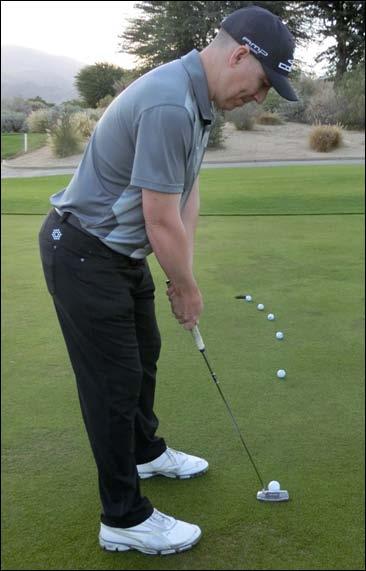
It can be quite difficult to make breaking putts where you have to aim more than a foot to the left or the right of the hole. It’s partly a guess on the line to take and then how hard to hit it on that intention. While many golfers will say that speed is everything, you’ll need a proper mix of line and speed to make those putts.
When practicing larger breaking putts, try laying down a half dozen balls in a pattern illustrated below. Start with the actual ball to be hit, but then place balls progressively from the hole backwards. You’ll focus on how the ball enters the hole, how much it may curve at the end of the putt, and visualize how the entire putt would look before you hit it. This illustration will give you a better understanding of line and speed that you need to guess on for that putt. There is no perfect combination, but keep in mind “higher and softer” usually results in less three putts from short range.