Vol. 22: #18 • Car Names • (4-26-2026) Tidbits of Coachella Valley
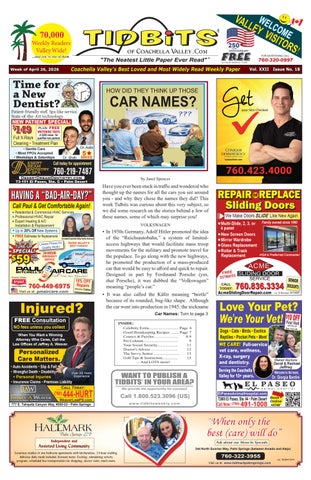
HOW DID THEY THINK UP THOSE
by Janet Spencer
●
Have you ever been stuck in traffic and wondered who thought up the names for all the cars you see around you - and why they chose the names they did? This week Tidbits was curious about this very subject, so we did some research on the stories behind a few of these names, some of which may surprise you!
VOLKSWAGEN
• In 1930s Germany, Adolf Hitler promoted the idea of the “Reichsautobahn,” a system of limitedaccess highways that would facilitate mass troop movements for the military and promote travel for the populace. To go along with the new highways, he promoted the production of a mass-produced car that would be easy to afford and quick to repair. Designed in part by Ferdinand Porsche (yes, that Porsche), it was dubbed the “Volkswagen” meaning “people’s car.”
• It was also called the Käfer meaning “beetle” because of its rounded, bug-like shape. Although the car went into production in 1945, the nickname
TRIV
TRIVIA NEWSFRONTAIVIRT TNORFSWEN
(Answers on page 16)
1. TELEVISION: What was the title of the final episode of “M*A*S*H”?
2. GEOGRAPHY: The Red Sea is an inlet of which ocean?
3. INVENTIONS: Which English scientist invented the color wheel?
4. ANIMAL KINGDOM: What do pandas mostly eat?
5. MOVIES: What is the name of the fictional college where “Animal House” is set?
6. HISTORY: What was the last Chinese imperial dynasty?
7. GEOMETRY: What is the distance around a circle called?
8. SCIENCE: The world’s first vaccine was developed to prevent which disease?
9. LITERATURE: Where is Stephen King’s novel “It” set?
10. BUSINESS: What is the Disney logo based on?
• Studying electrical engineering at college, Nolan Bushnell spent his summers working at an amusement park where he managed the arcade: a room full of pinball machines and coin-operated amusements. The popularity of these games impressed him.
• Bushnell later got a job in Silicon Valley in 1968, working for a computer company called Ampex. There, he met Ted Dabney, who was pioneering imaging and video technology in the earliest days of computer engineering.
• In 1963, the first video game was invented. Called “Spacewar,” but it required the use of a behemoth of a computer. Computers at the time were large, rare, and expensive, and because of the high cost only a few universities and labs had them.
• Recalling his days in the arcade, Bushnell wondered why you couldn’t shrink Spacewar enough to play it on a TV set instead of a computer. “If you could put a coin slot on it and put it into arcades,” he reasoned, “you could make a fortune!” Dabney agreed. In their evenings and on weekends, they worked to devise a video game without the power, memory, or physical size of a computer.
• The two hacked into the circuits of a standard black-and-white television to engineer their own version of Spacewar, creating a game called “Computer Space,” which did not require any connection to a computer.
• The game, though it was innovative and compact, didn’t sell well. They sold about 1,500 units, which only encouraged them to try again. So they quit their jobs at Ampex and set up their own firm. They called their company Atari, a Japanese word derived from the Asian game “Go,” meaning “to successfully strike a target.”
• Then, fatefully, they hired their first employee. Allan Alcorn, a UC Berkeley student, had a part-time job fixing TV sets. When Bushnell and Dabney hired him, they put him to work on a “test project” just to see if he had the skills they needed. Bushnell described the game he wanted: ping-pong on a TV.
• It took Alcorn three months to invent the game, and shortened the name to simply “Pong”. The
first Pong game was played on a black-andwhite Hitachi TV that Alcorn purchased for $75.
• Bushnell and Dabney were thrilled. In 1972, they built a case for it, attached a coin slot mechanism, took it down to a friend’s bar, and set it on a counter. A few days later, the bar owner called because the machine quit working and customers were complaining. Investigating the problem, they found that the coin receiver was jammed with quarters. It was an easy fix.
• They quickly turned out a dozen more machines. In 1973 they sold 2,500 units, then 8,000 in 1974, topping out in 1975 at 35,000. Each machine brought in up to $40 per day, four times as much as a pinball machine. The popularity of the Pong game continued to grow as arcade players were lining up to play.
• In 1976 Atari teamed up with Sears to debut the first home-based Pong game. They sold 150,000 units for $98 each that Christmas.
• Atari continued to expand: Super Pong, Ultra Pong, Doubles Pong. When Bushnell decided he needed a version of Pong that could be played solo, so he hired a couple of computer whizzes, Steve Jobs and Steve Wozniak. The result was a brick-bashing game called Breakout.
• In 1977, Atari released the Atari 2600, a cartridge-based game system that became the longest-running console in history.
• Today, Pong is considered to be the world’s first video game. Atari kicked off the entire video game industry, which in 2021 was estimated to be worth around $200 billion.
• Bushnell later went on to found a new business that he named Chuck E. Cheese.
CLIP AND SAVE
Car Names (from page one)
of “Beetle” didn’t become popular until the 1950s. The name “Beetle” was officially adopted by Volkswagen in 1968, and the name has since crossed into most languages. In France, it’s the Coccinelle (ladybug); in Japan, it’s the Bītoru (beetle); and in Russia it’s the Zhuk (beetle).
• In the 1970s, Volkswagen went through a phase of naming its new vehicles after different types of winds. Jetta is German for jet stream; Golf translates to gulf, referring to the Gulf Stream; Passat is short for passatwinde, the German word for trade wind; and Scirocco is a desert wind.
• In 1972, the 15 millionth Volkswagen Beetle was produced, surpassing the production record which had previously been held by the Ford Model T, making it the most popular car of all time manufactured off a single platform.
PORSCHE
• Ferdinand Porsche was born in 1875. As a young adult, he worked for a coachmaker, where he excelled in mechanical engineering, pioneering the design of gas/electric hybrid motors. In 1906, he was hired by the Daimler company in Germany, maker of the Mercedes Benz. He designed many improvements, but was rebuffed when he suggested manufacturing a smaller, sportier model of racing car.
• In 1934 Porsche went to work for the German government designing the Volkswagen car for Hitler. When the operation was suspended due to World War II, he began designing war machines: tanks, artillery, and the Panzer. When the war ended, Porsche was arrested and imprisoned as a war criminal. The German factories he oversaw used POWs as slave labor, often working the prisoners literally to death.
• While he was incarcerated, his son, also named Ferdinand Porsche but nicknamed Ferry, took
his father’s design for a compact, sporty race car to a newly-formed Italian/Austrian auto manufacturer.
• The company founders not only ransomed the senior Ferdinand Porsche, but also became the first manufacturers of the Porsche 356. They turned out only 49 of the cars before quitting the project as being unprofitable.
• Ferry Porsche took one of the 356 models on a tour of German VW dealerships, taking paid orders in advance, then presented those orders at the VW plant in Stuttgart, Germany. Ferry thought he could probably sell about 1,500 of them. Instead, 78,000 Porsche 356s were manufactured over the next 17 years.
• His father was awarded a stipend for every VW Beetle sold, with over 21 million rolling off the assembly line, providing him with a lavish income. Ferdinand Porsche died due to a stroke in 1951. Ferry carried on without him, dying at the age of 88 in 1998.
MERCEDES
• The Latin word “merces” means “mercy.” Throughout Spanish cultures, the derivative “Mercedes” became a popular girl’s name, particularly because it was associated with the Virgin Mary. Emil Jellinek, a wealthy Australian entrepreneur, named his newborn daughter Mercedes in 1890.
• Jellinek enjoyed driving and racing fine cars at a point in history when cars were first coming on the market, and racing was a brand-new and exciting sport. After ordering a Daimler, a car manufactured by Gottlieb Daimler, he became so enamored of the vehicle that he began selling them throughout Europe. To gain publicity, he also entered them in races—and nearly always won. He always added his daughter’s name on the racing cars, and he and his racing team became known as “Monsieur Mercedes.”
NUGGETS OF KNOWLEDGE
When Chevrolet unveiled the Camaro in 1966, they claimed the name was French slang for 'friend.' When French people said no such word existed, Chevrolet instead stated that a camaro was a "small, vicious animal that eats Mustangs." (The Ford Mustang was the car's competition). It was, in fact, just a fictional word picked from a list.
• Along the way, he offered Gottlieb Daimler plenty of advice on how to improve the car’s design, and later became a member of the company’s board. When he placed an order for 36 new vehicles for his European car dealership, he insisted that the newly revamped car be called the Mercedes, and this was immediately done.
• The new model won all the races, garnering
plenty of publicity. Sales went through the roof.
• After Gottlieb Daimler died, his company eventually merged with another company run by an innovator named Karl Benz. The MercedesBenz has been a pinnacle luxury brand ever since.
JEEP
• In 1940 the U.S. government approached car manufacturers, taking bids to produce a small 4-wheel-drive military vehicle. Ford won the
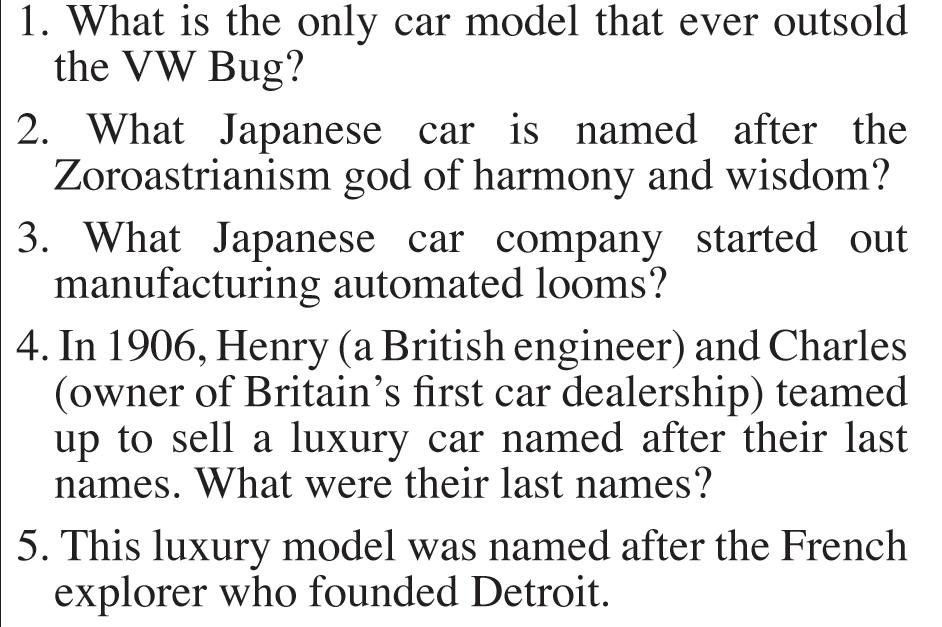
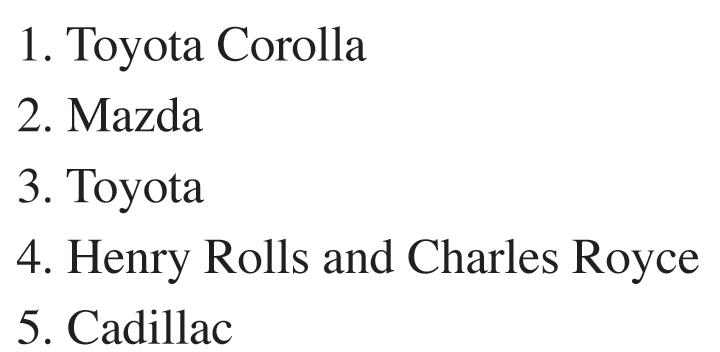
1. What does the Toyota RAV4 stand for?
2. What does the Nissan LEAF stand for?
By Lucie Winborne
* Composer Domenico Scarlatti wrote a piano piece, “Cat’s Fugue,” based on notes his cat walked across on his keyboard.
* Pupaphobia is the irrational and persistent fear of puppets, dummies and marionettes.
* Prior to the creation of antibiotics, some syphilis patients were deliberately infected with malaria, resulting in such high fevers that the syphilis bacteria was often killed off. Once that disease was under control, doctors would then treat the malaria with quinine.
* Michael Phelps’s total of 28 Olympic medals (23 gold, 3 silver, 2 bronze) places him ahead of more than 160 nations in the all-time gold medal rankings.
* To celebrate the end of France’s war with Russia, Napoleon organized a massive rabbit hunt. Things backfired when the thousands of animals acquired for the occasion swarmed toward him and his guests upon release from their cages, until even the legendary general was forced to beat a retreat to his carriage.
* A three-dollar bill issued by the Cook Islands features a topless Polynesian woman riding a shark.
* Due to his fear of flying, actor Sean Bean would hike for two hours to the set of “Lord of the Rings: The Fellowship of the Ring” in full costume while the rest of the cast took a helicopter.
* Cuscuta (witch’s hair) is a parasitic plant that lacks chlorophyll and feeds off other plants, using smell to identify the best hosts. ***
Thought for the Day: “Our greatest fear should not be of failure but of succeeding at things in life that don’t really matter.” -- Francis Chan
(c) 2026 King Features Synd., Inc.
by Mary Hunt
Easy Ways to Cut the High Cost of Pet Care
by Mary Hunt
If the cost to keep your pets fed, healthy, cared for, and looking good has gotten so high, you’re likely the one coughing up fur balls. But take heart, there are many little ways to cut the cost of pet care that will add up to big savings.
According to one survey, owning a dog costs an average of $1,480 in basic expenses annually. For cats, average annual expenses amount to roughly $902. Fish are the cheapest pets, coming in at about $750 a year to care for aquatic friends.
So how can you afford to care for your furry, feathered and scaled friends in sickness and in health? Make preventive maintenance your top priority as a pet owner, and then carefully track every expense.
Consider these tips to help cut your pet expenses without risking your pets’ health or well-being.
FREE EXAMS
Search for free initial exams. Local veterinarians often advertise a complimentary initial examination as part of marketing to attract new customers. Take advantage of the offer. This kind of office visit typically runs between $40 and $60.
MOBILE, LOW-COST CLIENTS
Check around for low-cost or mobile clinics for vaccinations, microchips, heartworm and flea preventatives.
While you may want to stick with the same vet for annual exams, you can save a bundle on preventive services. Search “low-cost animal clinic near me” to learn if such a clinic is available for you and your pets.
A fence or some other reasonable restraint is the best way to avoid big vet bills, advised the late David T. Roen, D.V.M., boardcertified veterinarian and founder of the Clarkston Veterinary Clinic in Clarkston, Washington. “I see more dogs in my office because of injuries sustained while unrestrained than for any other reason. Dogs should always be leashed, fenced or supervised,” he advised me.
CHOOSE THE RIGHT FOOD
Dr. Roen always urged his pet owners to skip all the fancy premium foods vets sell. Use name-brand pet food labeled “complete and balanced.” Or look for the seal of approval of AAFCO (the Association of American Feed Control Officials).
When your pet’s food is on sale, stock up with enough to last until the next time it goes on sale. Stick with the same brand. Switching abruptly can cause health issues for some animals. And less is better, as slightly underweight pets have fewer health problems.
SPAY AND NEUTER
Reproductive issues aside, the Animal Health Foundation reports that spayed and neutered dogs have fewer health and behavioral problems, which translates to lower vet bills and other health-related pet costs.
GET SECOND OPINIONS
Even if it’s an emergency, get a second
opinion if the estimate is for more than a few hundred dollars. If the estimate is for $800 and you can only afford $400, speak up, says Dr. Roen. There may be less aggressive and cheaper alternative treatments.
SHOP AROUND FOR PET MEDICATIONS
Don’t buy medication at the vet, as most veterinarians who sell these meds and supplements directly typically charge a big markup. Ask your vet for prescription drug samples to get started. Then call around to retailers such as Walmart or Costco pharmacies (many pet meds are the same for humans and animals) to compare prices. Your savings here can be huge. To save even more, sign your cat or dog up on prescription savings programs like the ones offered by Walgreens, Kroger, Rite Aid and Walmart.
FIND THE BARGAINS
Don’t rush to the pet store when you need a crate, cat carrier or other pet equipment. Instead, look at Craigslist.org and Facebook Marketplace. You won’t believe all the bargains in gently used, even brand-new, pet gear. Make sure you sanitize crates, carriers and the like, even if they look clean. A 50-50 ratio of either vinegar OR bleach (never mix the two) to water should do the trick.
LOOK FOR COUPONS
Just the other day, I saw a coupon in a flyer for a free nail trim at a local vet, a savings of $15. Keep your eyes open for coupons in the mail and at grocery and pet stores.
CHECK
YARD SALES
You can safely never again buy new toys for your pets when you think of yard sales instead. Instead of $12 for a new monkey or hedgehog, one from a yard sale will work just as well -- for a much better price of 25 cents to $1, which is typical. Most stuffed toys come out fine after a trip through the washer and dryer. Hint: Add Lysol to the wash cycle to sanitize and disinfect.
CREATE AN ACCOUNT
Seriously, you need to establish a savings account just for pet care, into which you regularly deposit money. Even $10 a week will turn into $520 in one year. Earmark that account for pet emergencies only, then congratulate yourself on being a responsible pet owner. Woof!
Mary invites you to visit her at EverydayCheapskate.com, where this column is archived complete with links and resources for all recommended products and services. Mary invites questions and comments at https://www.everydaycheapskate. com/contact/, “Ask Mary.” This column will answer questions of general interest, but letters cannot be answered individually. Mary Hunt is the founder of EverydayCheapskate.com, a frugal living blog, and the author of the book “Debt-Proof Living.”
COPYRIGHT 2026 CREATORS.COM
THE GREAT SALT LAKE
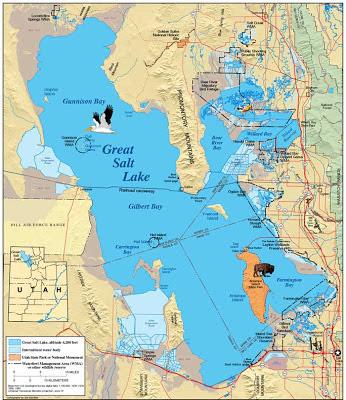
The Great Salt Lake in northern Utah is the largest inland body of salt water in the Western Hemisphere and one of the saltiest inland bodies of water in the world. Read on to learn more about this curious geologic phenomenon.
• The Great Salt Lake is a landlocked body of water that is up to 10 times saltier than the oceans. While the average ocean salinity is 3.5 percent, the saltiest parts of the Great Salt Lake average around 28%. It’s so salty, in fact, that it never freezes over completely. It is the largest lake west of the Mississippi River, and the 34th largest lake in the world.
• As large as the Great Salt Lake is, itʼs but a tiny remnant of the enormous ancient freshwater lake named Lake Bonneville, that once covered about 25% of Utah during the Pleistocene Epoch. Lake Bonneville was nearly 1,000 feet (300 m) deep. Around 14,500 years ago, a major collapse of a sandstone wall at Red Rock Pass, Idaho, allowed the entire lake to abruptly drain catastrophically in one of the most immense and cataclysmic flash floods in history. All that remained was a shallow lake bed, a fraction of the original size, so low and so flat that it had no outlet Thus, it's referred to as a “terminal lake.”
• The three rivers that now feed freshwater into the Great Salt Lake, the Bear, Weber, and Jordan, also bring dissolved minerals, primarily salt, which constantly accumulate, with evaporation as the only way water ever escapes. It’s estimated that about 1.1 million tons of minerals are added to the lake each year.
• River water and other small streams account for about 66% of the water in the lake. The rest comes from rain and natural springs.
• The nearby Bonneville Salt Flats, left behind by the draining of Lake Bonneville, are so large, flat, and smooth that they have become an automobile raceway, the site of many trials for world land-speed records.
surface area reached a high of 3,300 square miles (8,500 km²). Due to drought and diversion of river water for agriculture, the surface area dropped to a record low of 888 square miles (2,300 km²) in 2022. Keep in mind that Lake Bonneville stretched about 20,000 square miles (51,000 km²) and was once about the same size as Lake Michigan.
• The fresh- and salt-water wetlands, mudflats, and shorelines surrounding the lake provide critical habitat for millions of migratory birds, with up to 12 million birds from 339 species visiting annually. About 360,000 acres of wetlands surrounding the lake account for about 75% of Utah’s wetlands. This provides a wide variety of ecosystems for innumerable plants, invertebrates, reptiles, amphibians, and mammals.
• The only life that exists in the water are specialized algae, a species of brine shrimp, and the larvae of a type of fly. The lake is famous for its huge number of flies, sometimes numbering 370 million per mile of shoreline, providing food for the many birds.
• The lake sports around 10,000 miles (16,093 km) of shoreline, but because it is so shallow with gently sloping shores, even small variations in the water level greatly affect the extent of the shoreline. Shorelines can dramatically expand and contract between wet and dry years.
• A 30-mile-long (48 km) causeway cuts across the lake, initially built for a rail line. This divides the lake into two parts, with minimal water
mixing. Because the lake’s main tributaries enter from the south end of the lake, that end is several inches deeper than the north part of the lake, and much less salty.
• Should the lake ever go dry, it would be considered an environmental catastrophe.
• During the wettest years in the 1980s, the
by Dana Jackson
Q: What ever happened to the actor Eric Stoltz? The last film I saw him in was “Pulp Fiction.” I just recently learned that he was the original star of “Back to the Future” before Michael J. Fox was cast instead. -- C.F.
A: Even though his star status isn’t as high as it was in the ‘80s, Eric Stoltz is still acting. It had to be devastating for him to be replaced as the lead in the blockbuster hit film “Back to the Future,” but he’s still carved out an impressive career.
He was nominated for a Golden Globe for the role of Rocky Dennis, a teen who suffered from a physically altering genetic disorder in the 1985 film “Mask.” A few years later, he starred in the John Hughes’ film “Some Kind of Wonderful.” In television, Stoltz was a regular on “Chicago Hope” and “Madame Secretary.” However, he undoubtedly regrets turning down the meaty role of corrupt police officer Vic Mackey on “The Shield,” for which Michael Chiklis won an Emmy. He does, however, have two upcoming films -- the
1. The Super Mario Galaxy Movie (PG) Brie Larson, Virginia Dare Jelenic
2. Project Hail Mary (PG-13) Ryan Gosling, Sandra Hüller
3. The Drama (R) Zendaya, Robert Pattinson
4. You, Me & Tuscany (PG-13) Halle Bailey, Regé-Jean Page
5. Hoppers (PG) Piper Curda, Bobby Moynihan
6. BTS World Tour Arirang (NR) BTS
7. Faces of Death (R) Dacre Montgomery, Barbie Ferreira
8. Exit 8 (PG-13) Kazunari Ninomiya, Yamato Kochi
9. A Great Awakening (PG-13) John Paul Sneed, Jonathan Blair
10. Reminders of Him (PG-13) Maika Monroe, Tyriq Withers
2026
horror flick “The Autopsy of Albert Kemper” and the musical drama “Original Sound.” ***
Q: Why is there a different actor playing the son on “Boston Blue” than the actor who was on “Blue Bloods”? -- M.M.
A: In July 2025, People magazine confirmed that Andrew Terraciano, who grew up playing Sean Reagan on “Blue Bloods,” wouldn’t be returning for its spin-off. Brandon Margolis, a showrunner for “Boston Blue,” stated, “Once we realized we were telling a very new chapter in this character’s life, creatively it made sense to find an actor with a different energy.” Enter Mika Amonsen in the role of Donnie Wahlberg’s character’s son, who is now a patrolman with the Boston Police Department.
Amonsen hopes that in time, more viewers will accept him in the role. He did his homework by bingeing episodes of “Blue Bloods,” telling People that he “really [wants] to maintain Sean as close as [he] can ... out of respect for this character that everyone loves -- but also the character Andrew built.”
“Boston Blue” is Amonsen’s first role as a series regular. Prior to this, he had a guest-starring role on numerous primetime shows, including “Reacher” and “Designated Survivor.” As for his predecessor, Terraciano was just 7 years old when he was cast as a young Sean Reagan. He has since graduated from New York University and is interested in continuing his acting career.
***
Q: Is it true that Heather Locklear and Lorenzo Lamas are dating? If so, it’s nice to see him with someone age-appropriate. -- E.A.
A: Yes, it’s true that 68-year-old Lorenzo
Lamas (“Falcon Crest”) and 64-year-old Heather Locklear (“Melrose Place”) have found each other, and it doesn’t appear to be a publicity stunt. Locklear ended her five-year engagement to her high school sweetheart Chris Heisser, and Lamas’ last marriage (his fifth) ended in 2018. Sources told gossip mag TMZ that the couple’s adult children were planning to meet soon for the first time. Here’s to the former soap stars finding everlasting happiness in their golden years!
* * *
Send me your questions at NewCelebrityExtra@gmail.com.
(c) 2026 King Features Synd., Inc.
Want to Work for Tidbits?
Tidbits is in need of independent contractor help distributing our newspapers to businesses in the Coachella Valley. A retired husband/wife team is preferred, who wish to supplement their monthly income by driving and distributing to a specified delivery route in the Palm Desert area. Requires year-round commitment of one day per week, either Thursday or Friday, during regular business hours. One person needed to drive; the other to place copies at delivery locations.
Interested parties must posess a responsible work ethic, furnish their own vehicle and auto insurance, and have a friendly demeanor when dealing with the public. Interested couples call Erik at 760-320-0997 for more details.
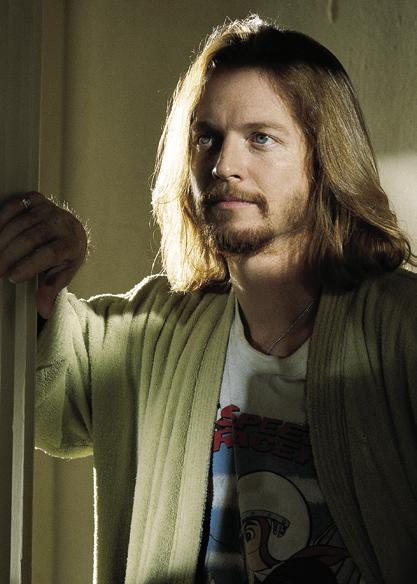
“The
Courtesy of Miramax Films
Eric Stoltz as Lance in “Pulp Fiction” (1994)
Good Recipes from
Broiled Cubed Steaks With Barbecue Sauce
1/3 cup bottled chili sauce
2 tablespoons brown sugar
2 tablespoons soy sauce
1/4 teaspoon hot pepper sauce
1 1/4 pounds beef cubed steaks
1. Preheat broiler if manufacturer directs. In medium bowl, mix chili sauce, brown sugar, soy sauce and hot pepper sauce.
2. If steaks are large, cut each into serving-size pieces. Dip each steak into chili-sauce mixture to coat. Place steaks on rack in broiling pan. With oven rack at closest position to source of heat, broil steaks 5 minutes without turning. Spoon any juices in bottom of broiling pan over steaks to serve. Serves 4.
Each serving: About 295 calories, 13g total fat, 85mg cholesterol, 860mg sodium.
New Macaroni and Cheese Casserole
1 (16-ounce) package rigatoni or ziti macaroni
2 tablespoons salad oil
1 small onion, chopped 1/3 cup all-purpose flour
1 quart milk
1/4 teaspoon salt
1/8 teaspoon white pepper
1/2 pound Fontina or mozzarella cheese, shredded
1 (10-ounce) package frozen peas
1/2 pound cooked ham, diced
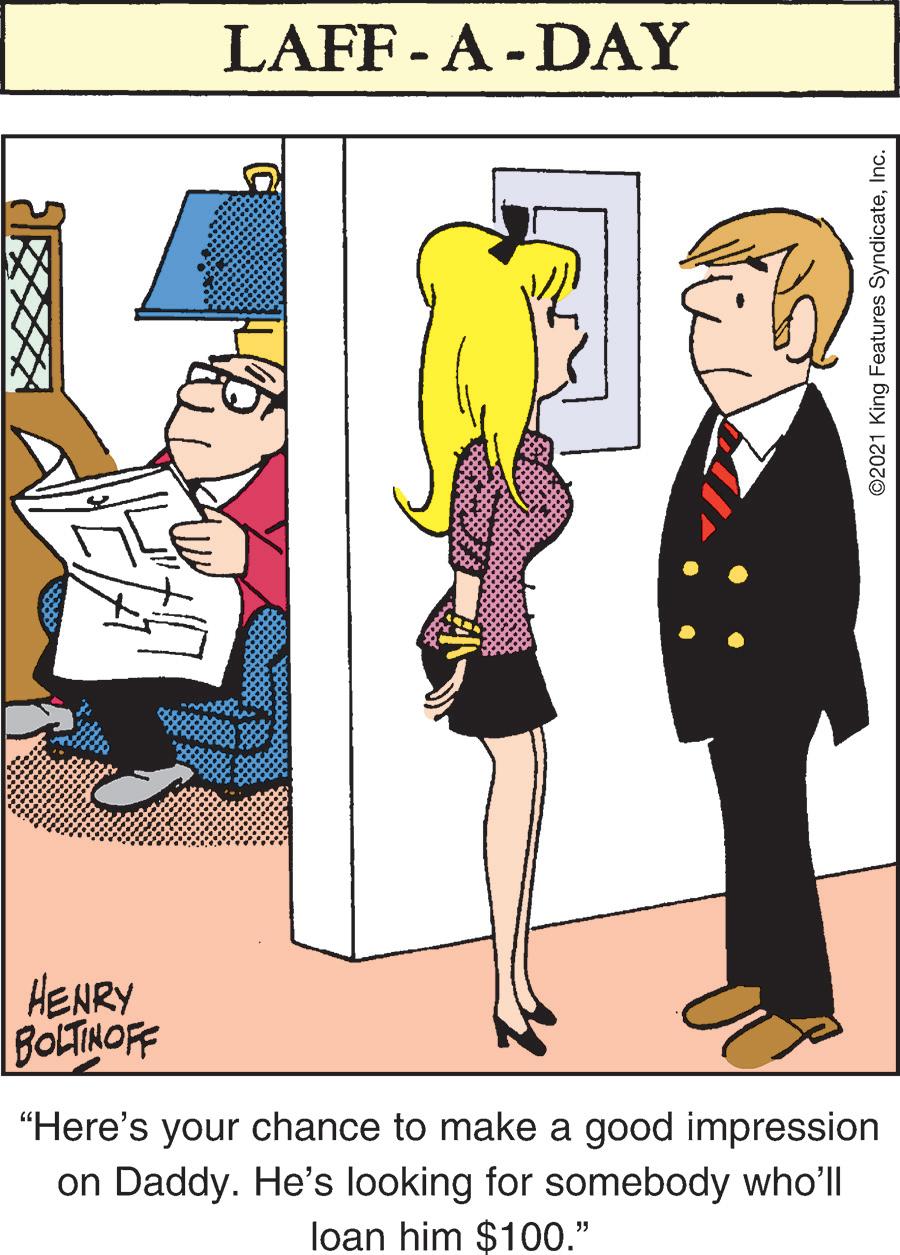
"Here's your chance to make a good impression on daddy. He's looking for someone to loan him $6 grand."
1. Preheat oven to 350 F. In saucepot, prepare rigatoni as label directs. Drain rigatoni; return to saucepot.
2. Meanwhile, in 2-quart saucepan over medium heat, in hot salad oil, cook onion until tender but not browned. Stir in flour; cook 1 minute. With wire whisk or fork, gradually stir in milk, salt and pepper until smooth; over high heat, heat to boiling, stirring constantly. Remove saucepan from heat; stir in half of cheese.
3. Into rigatoni, stir cheese sauce, frozen peas and diced ham. Spoon rigatoni mixture into shallow 3-quart casserole or 13-by-9-inch glass baking dish. Top with remaining cheese. 4. Bake rigatoni 25 to 30 minutes until mixture is hot and bubbly, and cheese melts and browns slightly. Makes 6 servings.
Each serving: About 725 calories, 29g fat, 89mg cholesterol, 980mg sodium.
Grapes With Sour Cream
Even when you’re pressed for time, you can make this easy treat.
2 cups seedless grapes
1/4 cup sour cream
1 tablespoon brown sugar
In small bowl, gently stir grapes, sour cream and brown sugar until well combined. Cover and refrigerate until ready to serve. Makes 4 servings.
Each serving: About 100 calories, 3g total fat (2g saturated), 1g protein, 18g carbohydrate, 6mg cholesterol, 11mg sodium.
For thousands of triple-tested recipes, visit our website at www.goodhousekeeping.com/foodrecipes/ (c) 2026 Hearst Communications,
NOT TOO LATE!
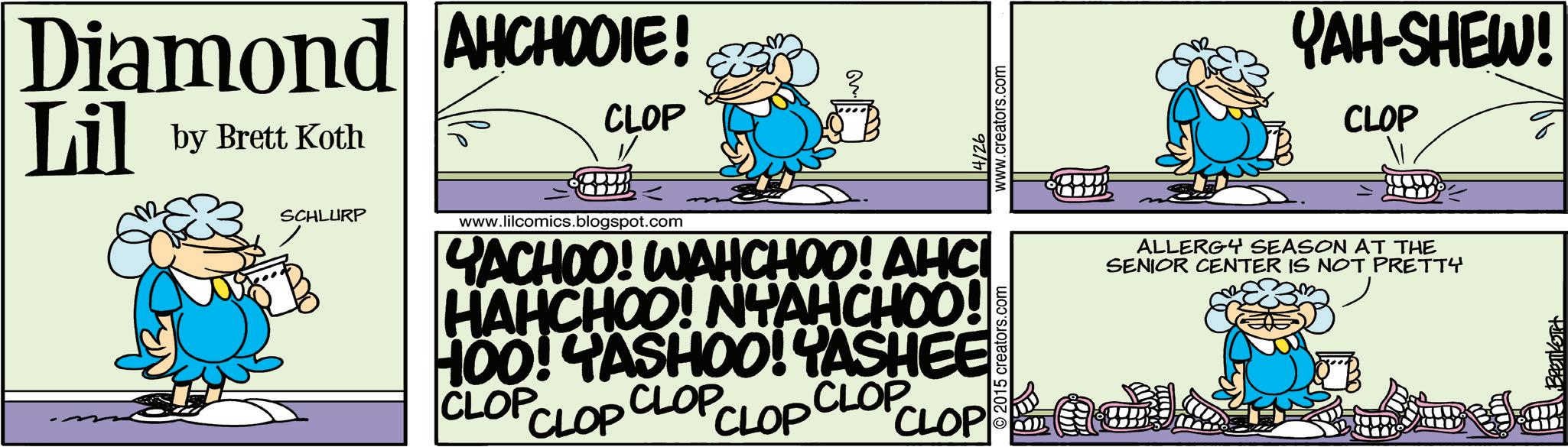
By John Allen DIAMOND LIL
by Brett Koth
Donald Duck by Walt
NEXT WEEK in TIDBITS
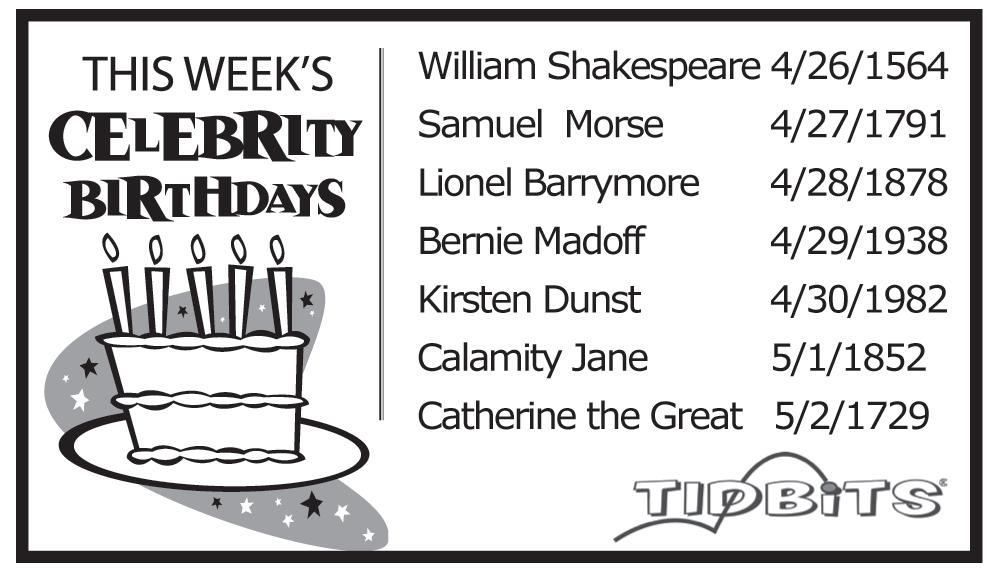
Holidays & Observances This Week
4/26
4/27
4/28
4/29
4/30
5/1
5/2
Dog Talk with Uncle Matty
By Matthew Margolis
A Tale of Two Adoptions
“It was the best of times, it was the worst of times.”
-- Charles Dickens, A Tale of Two Cities
Adopting a new dog can feel a lot like that famous opening line by Dickens. You’ve just come home with a new furry companion, in some cases plucked from the jaws of death. In all likelihood, he’s latched on to you as his new best friend, the person he loves more than any other in the world. It’s a great feeling. But there’s almost always more to the story.
Unless you live alone and prefer a solitary existence, your dog will have to get along with people other than you -- namely, your significant other, your children, neighbors, friends and extended family. If you plan to introduce him to the world beyond your home and yard, he’ll have to tolerate strangers, too.
The following two letters from readers tell the tale of two adoptions. I print them both here in the hopes that the writer of the first -- along with any readers experiencing the same -- will heed the inherent warning of the second.
The first reads as follows:
“I just adopted ‘Red’ a week ago from a woman who rescued her from a shelter. She is showing signs of fear aggression: She has growled twice while we were walking, once at a person rolling a suitcase, and once at a person bent over gardening. She has also growled while in our yard at people she could hear talking next door in their yard and also at the occasional inanimate object.
“Red plays well at the dog park and with my children. She displays no signs of food or toy aggression.
“I work full time and am concerned that I don’t have the time to train her properly for aggression issues. The growling was not disclosed to me upon adoption. Your advice would be appreciated.”
And this next letter could be right out of Dickens, with his stories of children forced to endure abuses at the hands of unfeeling or unthinking adults. It is what some might deem a “caution-
I’m doing things a little differently this year. Having made New Year’s resolutions in January, and having kept nearly none of them, I’ve decided to make some mid-year resolutions and go at it again.
One task where I failed was in keeping a regular schedule for online French lessons. I’d told myself I would devote 15 minutes a day to this, long enough to complete one small lesson section. Didn’t happen. Duolingo, a free online program (duolingo.com), has 40 different language courses, ranging from Japanese, German, Polish and Russian to Scottish Gaelic, Chinese, Welsh and Greek. By signing up, the website (with very cute animated graphics) keeps track of daily progress -- or the lack of it. I’m going to try again.
Another area where I failed to stick to a schedule was daily walking. This wasn’t entirely my fault, however. Weekly winter storms kept a
Who Collects What -- and Why or Why Not?
Most of us are collectors of some sort, whether we are aware of it or not. Choosing the items that surround us in our homes is a form of collecting. We start with toys and dolls as infants. Then the tween and teen years bring heartthrob posters, pet rocks and bottles filled with multicolored sand. The decor of college dorm rooms typically includes band paraphernalia and collections of the beer bottle ilk. As adults, our parents’ collections or our own burgeoning interests might be the source of our obsession. The quality or nature of the items we collect represents the stage of life in which we find ourselves. Seemingly, it is also a part of creating home -- filling our environment with the things we love.
coating of snow and ice on the roads, and the rec center kept closing for repairs. Now, with no more snow expected, I can (theoretically) keep up with my walking intentions.
I’d promised I would take an online course, and didn’t. The range of offerings on the internet is vast, so there’s no excuse. Coursera, MIT OpenCourseWare, Harvard, FreeCampus, Stanford, The Open University and others host free courses across a wide variety of interests. I’m going to start instead with a few short introductory courses in the arts and humanities sections.
How about you? Do you need to “reset” your activities and perhaps make some new goals for the rest of the year? Knowing where to start isn’t difficult. Do a search online for “resolutions for seniors,” and you’ll find lists of ideas. Or you might narrow it down to topics like “mental health goals for seniors” or “self-improvement goals.”
If you made resolutions already this year and have managed to stick with them, good for you! Perhaps maybe add one more to your list?
Matilda Charles regrets that she cannot personally answer reader questions, but will incorporate them into her column whenever possible. Send email to columnreply2@gmail.com. (c) KingFeaturesSyndicate2026
off their collections and become quite eloquent when asked about them.
Depending on the type of collection, a display takes many forms: from albums to archival boxes to racks and shelves and, of course, floor and wall space. Space certainly is a determining factor in the type of collection you undertake. A collection of figurines takes up less space than a collection of cars. Make sure you have enough space to display your wares -- and either make plans for future space, or set yourself up to rotate the items of your collection for your enjoyment, much like a museum.
Creating a collection can be fun, but it requires a lot of work in researching and, yes, shopping. A serious collector is never at “rest.” Their everyday outings are always hunts for a new find.
Who collects what and why? There are many types of collectors. Visiting clients’ homes, I have seen my share of unusual collections. Aside from works of art, almost anything goes: rare bird eggs to skulls of all kinds to chastity belts. But why? Some collect for the love of the unusual, others collect as an investment, and yet others simply collect because they can. How collections come to be is another thing. It might start with a visit to a museum where you discover a grouping that incites your passion, or it could blossom from a find at a garage sale.
One thing that is common to all collectors is their pride. Most collectors cannot wait to show
Don’t be embarrassed about what you like. Some of the most unexpected collections offer the greatest rewards. Take, for example, hubcaps. One or two or even a dozen might seem common, ubiquitous and boring, but when you amass a few dozen or a hundred, you can cover a wall and make a statement. Even the most jaded person will ooh and ahh at the variety of sizes, patterns and shiny chrome reflections created by such a grouping.
Find creative ways to incorporate your items -- underneath a glass table, for example, or hanging from the ceiling. Decorating with your collections is always the best route. Not only are you exhibiting your collections, but you get to enjoy them every day.
* * *
Joseph Pubillones is the owner of Joseph Pubillones Interiors, an award-winning interior design firm based in Palm Beach, Florida. To find out more about Joseph Pubillones, or to read features by other Creators Syndicate writers and cartoonists, visit the Creators Syndicate website at www. creators.com.
COPYRIGHT 2025 CREATORS.COM
ary tale,” and it’s what might happen should the writer of the previous letter opt not to make time in her busy schedule to get immediate and thorough professional training for Red:
“I have three children, ages 4, 2 and 1. We adopted ‘Ginger’ on Monday. Today is Sunday. So far: He mounted my 1-year-old and bit her ear while I was feeding her. He stole her bottle and growled at her when she took it back. He pinned my 4-yearold to the floor and ripped his pants.
“Ginger’s tail was tucked up under his body in all of these instances, and I had to physically remove him from my children. When he bit the baby’s ear, he saw me coming and let go. But while I was chasing him, he ran up to her and grabbed her ear again, biting and pulling on it until she was bleeding. I don’t know whether training will help. I just don’t know what to do.”
Training almost always helps. But in any situation involving an aggressive dog living with children, the answer is to find the dog a new home -- one without children and that includes an adult who is prepared to devote as much time as necessary to the training and socialization of an aggressive dog.
This may not be the popular answer, but it’s the truth. And in some lesser known words of Dickens, “There is nothing so strong or safe in an emergency of life as the simple truth.”
Woof!
* * *
Dog trainer Matthew “Uncle Matty” Margolis is the co-author of 18 books about dogs, a behaviorist, a popular radio and television guest, and the host of the PBS series “WOOF! It’s a Dog’s Life!” Read all of Uncle Matty’s columns at www.creators.com, and visit him at www.unclematty.com.
COPYRIGHT 2014 CREATORS.COM
YOUR SOCIAL SECURITY
by Tom Margenau
An Old and Whacky Social Security Rant
A reader shared with me an email he got from an acquaintance. It is a Social Security screed that is filled with half-baked ideas, exaggerations and outright lies. The reader said he had never heard of these allegations before. But I pointed out to him that the harangue has been around for decades. 40 years ago, it was passed from one naive knucklehead to another by regular mail and by fax. Today, of course, it floats around in the online world. Sadly, thousands, if not millions, read it and actually believe it to be true. I’ve tackled the tirade in more than a few past columns. But I guess it’s time to do so again.
It starts out with a couple of paragraphs lambasting the government for calling Social Security checks “federal benefit payments.” The writer says that Social Security is not a “benefit.” He says, “It’s our money that we earned. How dare the government call it a benefit?”
By the way, bear in mind that the guy (and I’ll bet my next ten Social Security checks it was a guy) who originally wrote this misleading missive did so 40 or 50 years ago and has probably long since died. But amazingly, his rant lives on. New generations of Gullible Gus’s read it and get hot under the collar.
But why? I’m sure that conspiracy-minded ninnies are convinced the wording is some sinister attempt by government officials to take away their rights and their money. But I mean -- come on! Everybody knows that you work and pay Social Security taxes and that one day the money comes back
1. The book of Ruth is found in the a) Old Testament b) New Testament c) Neither
2. What Old Testament prophet ordered a king to shoot arrows out of a window? a) Ezekiel b) Elisha c) Isaiah d) Jeremiah
3. What is the last book of the Bible in which the Lord's Church is mentioned? a) Acts b) Ephesians c) Jude d) Revelation
4. What prophet saw "the tents of Cushan in affliction"? a) Habakkuk b) Kings c) Obadiah d) Zechariah
5. Who asked Jesus, "Lord, increase our faith"? a) Apostles b) Pharisees c) Temple priests d) Lepers
6. What was Jesus' first public miracle? a) Healing the sick b) Raising the dead c) Loaves and fishes d) Water into wine
(Answers on page 16)
to you. And the money you get back is in the form of a “benefit” that comes from the “federal” government in a monthly “payment.” Federal ... Benefit ... Payment. These are just words. Don’t try to read evil or ominous meanings into them.
Next, the writer trots out the disingenuous claim that if you had taken all that money the mean-old government took from you in the form of Social Security taxes and invested it, you would be a multi-millionaire today.
Gosh, isn’t that wonderful! We would all be millionaires today if it weren’t for that devious old Social Security system that is stripping us all of untold riches. For example, just think back to those times before Social Security came along in the 1930s, when the country was just full of millionaires because no one was taking Social Security taxes out of their paychecks. Those sure were the good old days!
I’m not going to spend too much time discussing the fallacies of the “we’d all be millionaires” claims. But I am going to discuss the numbers people use to come up with these meaningless arguments. (And I said the numbers “people” use because it wasn’t just this one old goat 40 or 50 years ago who came up with these misleading allegations. Countless folks over the years have made the same misguided miscalculations.)
And here is where they all go wrong. When they are figuring out how much money has been taken away from them in Social Security taxes (money they supposedly would have been religiously investing), they always use the figure 15.3%. In other words, they claim that 15.3% of their income has been withheld from them.
But the money actually withheld from their paychecks for Social Security taxes is only 6.2%. So where do they get 15.3%? Well, first, they look at their own paycheck and see that 7.65% has been withheld from them. But that includes 1.45% that is used to fund the Medicare hospital insurance program. You just can’t add that Medicare portion of the tax into any Social Security payback calculations.
Then, the next mistake they make is to add in the employer’s portion of the Social Security/ Medicare tax. In other words, they claim the 7.65% employers pay into Social Security was their money that their employer was sending into Social Security on their behalf. But that is just not the case. What employers pay into Social Security is simply a tax that they pay to the government. It is not your money they are sending to the government.
If you want proof of that -- consider this. Say Social Security was abolished tomorrow. Do you think your employer is then going to turn around and say, “Hey, we are increasing your salary by 7.65% because, after all, this is your money we’ve been sending to Washington for you.” Not a chance! To repeat: it’s not your money. It’s just a tax that employers pay.
So anyway, when you are doing these “what did I pay into Social Security calculations,” you have to use 6.2% of your income, not 15.3%. (By the way, I totally understand that self-employed people pay 12.4% of their net profit into Social Security, but these screeds I am talking about are always written by wage-earners.)
Next, the rant writer brings up this timeworn and untruthful argument. It goes like this: “Congress has stolen Social Security money to pay for other programs.” That assertion comes from a misunderstanding of how the Social Security program is financed. In a nutshell, here is how it really works, As soon as every nickel in Social Security tax collections lands in Washington, D.C., it is immediately converted into U.S. Treasury notes. I own some treasury bonds. You probably do, too. What is the government doing with that money we invested in those bonds? It is spending it, of course.
But we still hold the notes. And when we redeem them, we get repaid, with interest. It works the same way with the treasury notes held by the Social Security system, except, of course, on a much larger scale. If you want to learn more about how that works, do a Google search for “Social Security Office of the Actuary” and noodle around in all the Social Security investment data they make available to the public.
Finally, the diatribe writer trots out the tired old “Social Security is a Ponzi Scheme” allegation. As I have pointed out a hundred times in this column, Social Security is not now, never has been and never will be an investment scheme. Instead, it is a social insurance program that, in addition to providing a base of income support to retirees, for people with disabilities and for the spouses and families of a worker who has died, is also intended to accomplish larger social goals for our country. If you need proof that the social goals of the Social Security program are being met, just consider this. Before Social Security was established in 1935, almost 80% of senior citizens in this country were living below the poverty level. Today, the number is less than 10%. And that’s even though we are not all millionaires because we never got a chance to invest the Social Security taxes stolen from us!
If you have a Social Security question, Tom Margenau has two books with all the answers. One is called “Social Security -- Simple and Smart: 10 Easyto-Understand Fact Sheets That Will Answer All Your Questions About Social Security.” The other is “Social Security: 100 Myths and 100 Facts.” You can find the books at Amazon.com or other book outlets. Or you can send him an email at thomas.margenau@comcast.net. To find out more about Tom Margenau and to read past columns and see features from other Creators Syndicate writers and cartoonists, visit the Creators Syndicate website at www.creators.com.
COPYRIGHT 2026 CREATORS.COM
Looking at Alternatives for Osteoporosis Meds
DEAR DR. ROACH: At age 48, I underwent a lumpectomy, chemo and radiation for stage I breast cancer. All is good so far, but I started experiencing osteopenia in my mid-50s, perhaps earlier than I would have because of the chemo and estrogen-blocking meds. My mother also had osteoporosis.
For the osteoporosis in my hip, I took alendronate for five years, but it didn’t stop the bone loss. I am now on Prolia, which has helped. I am healthy and fairly active.
How long can one take Prolia with breaks in between, and what are your thoughts on alternatives? I am concerned about “running out” of strong, effective alternatives to treat my osteoporosis. I walk 3-5 miles most days. --
A.M.L.
ANSWER: You are right that the estrogen-blocking drugs you needed for your breast cancer caused accelerated bone loss and early osteoporosis. Given your family history and young age, it’s very important to think about the future. Keeping up your exercise is excellent for your bones, for your overall health, and to reduce your risk of cancer.
Prolia works similarly to alendronate by slowing down the cells that break down bone, called osteoclasts. Unlike alendronate and similar drugs, Prolia stops working as soon as you stop taking it, so people who are on it need to take it continuously.
This is different from alendronate, where people can take “drug holidays” for years sometimes in order to keep the bone from becoming “frozen” and brittle, which can then put them at risk for atypical femur fractures. Between 8% and 10% of people who stop Prolia will get a fracture the following year unless they transition to a different treatment.
Bisphosphonate drugs like alendronate are often the choice for people once they stop Prolia, but they didn’t work for you. I’d be concerned about the absorption of the medicine since taking the medicine with any food (even with mineral water) can reduce absorption to the point that it isn’t effective.
In addition, you need enough calcium and vitamin D for bisphosphonate drugs (and Prolia) to work properly. But if you’ve been careful about these issues, it may just be that you are one of the people for whom bisphosphonate drugs aren’t a good option.
Anabolic agents like PTH analogues (teriparitide) are another good choice since these directly build up bone. Romosozumab both builds bone and decreases breakdown. However, one option that might be a particularly good choice for you is raloxifene, which decreases the risk of breast cancer and helps keep bones strong. I suggest you ask your prescribing physician about these alternatives.
DEAR DR. ROACH: I have a high-fiber diet, but I’m also adding specifically psyllium husks to my diet daily. Will this, along with
my dietary oats, grains and beans, reduce my LDL cholesterol levels? How much psyllium needs to be taken daily to make a difference with LDL cholesterol? -- R.P.
ANSWER: Psyllium is a common supplement to increase dietary fiber. High-fiber foods such as the grains and legumes you mentioned are part of a healthy diet, with many benefits such as the reduction of heart disease and some cancers. Fiber supplementation has been shown to improve gastrointestinal symptoms, especially constipation and diarrhea, but it’s also been shown to reduce LDL cholesterol.
In a study from years ago, psyllium husks at a dose of 10 grams per day (approximately 4 teaspoons, but it can vary with different brands) reduced LDL cholesterol levels by 6% to 15% on average. This is a significant drop. For people who take statins, this has about the same effect on their LDL levels as doubling their statin dose.
I strongly recommend starting slowly and building up the dose over weeks. Most people will experience bloating and discomfort if they start at such a high dose.
* * *
Roach regrets that he is unable to answer individual questions, but will incorporate them in the column whenever possible. Readers may email questions to ToYourGoodHealth@med.cornell.edu.
VETERANS POST
by Freddie Groves
Supporting the Honor Flights
Honor Flights for 2026 are in full swing now, with veterans from around the country making the trip already this year.
Honor Flights (www.honorflight.org) are free trips to Washington, D.C., for veterans to visit all the memorials (Tomb of the Unknown Soldier, Korean War Memorial, World War II Memorial and others) and be honored at special ceremonies.
Part of the success of each flight is due to the volunteers who step up. Whether it’s pushing a wheelchair, managing logistics, aiding with visits to memorials and meals, helping with buses and elevators, maneuvering through airports -- they are crucial to the success of each trip. Click on the “Find a Hub” link on the website and navigate to your state. You’ll find your local groups there with all of the contact information.
Honor Flight trips are free for the veterans, and a lot goes on behind the scenes. Sponsorship, for example, is what pays for the trips and hotel stays. Check the list of corporate sponsors on the website.
Want to donate as an individual to a worthwhile Honor Flight program? Read about the TLC flights, trips meant for seriously ill veterans who have one year left to live. Sponsorship covers a three-day trip to all the memorials for the veteran and a caregiver. Think about that.
You can donate in others way besides a cash donation. If you have a Southwest Airline account, you can donate your rewards points. If you’re sailing on a Norwegian Cruise Line trip, a portion of each stateroom is donated to Honor Flight.
Since the beginning, there have been 339,000 veterans who have been able to make the Honor Flights. And, at this point, there are in excess of 37,000 veterans who are on a wait list.
To learn more about the Honor Flights, see the website, contact them at 937-521-2400 or email them at info@honorflight.org.
Charity Navigator gives Honor Flight a 4 out of 4-star rating.
Freddy Groves regrets that he cannot personally answer reader questions, but will incorporate them into his column whenever possible. Send email to columnreply2@gmail.com.
2026 King Features Synd., Inc.
pick up locations are in Cathedral City and Palm Springs. We request that you do not make a reservation if your medical appointment is after 12 Noon as the van must return to the desert at that time. You can ask your doctor to schedule you for an early morning appointment if you explain that your transportation must return by 12 Noon.
You must make your reservation in advance by calling the reservation dispatcher at: (760) 832-8712
to validate the will and officially open the estate.
How to Prepare to Be an Executor of an Estate
DEAR SAVVY SENIOR: My uncle has asked me to serve as executor of his will when he dies. I feel honored that he asked me, but I’ve never done this before and I’m not exactly sure what is involved with this responsibility. I'm hoping you can give me some advice. -- Helpful Nephew
Dear Helpful: Being named executor is indeed an honor. It shows your uncle trusts you. But it can also be a significant responsibility, especially if his estate or family situation is complicated. Here’s a look at what the role involves so you can decide if it’s something you’re comfortable taking on.
Executor Duties
As executor, you’ll be responsible for settling your uncle’s affairs after his death. Depending on the estate, your duties may include:
• Filing paperwork with the probate court
• Locating and taking inventory of all assets involved.
• Paying outstanding bills, funeral expenses, and any taxes owed using estate funds.
• Notifying banks, government agencies (including Social Security), credit card companies, and the post office of his death.
• Preparing and filing his final income tax return.
• Distributing remaining assets to the beneficiaries named in the will.
Keep in mind that executor responsibilities and deadlines vary by state. Most state bar association websites offer probate guides or checklists that outline the rules where you live.
Get Organized
If you agree to serve, one of the best things you can do now is help your uncle get organized. Make sure his will is up to date and find out where important documents are stored – such as deeds, financial account statements, insurance policies, passwords, and contact information for advisors. Having ready access to these items will save you time and stress later.
If the estate is complex, you don’t have to handle everything alone. An estate attorney or tax professional can guide you through the process, and their fees are typically paid by the estate. To find qualified help, you can search directories at the National Association of Estate Planners & Councils (naepc.org) and the National Academy of Elder Law Attorneys (naela. org).
Avoid Family Conflicts
One of the biggest challenges executors face is family tension. Ask your uncle to clearly spell out his wishes to beneficiaries ahead of time in a written will. It should include who will receive personal belongings and family heirlooms. If these details are left for the executor to decide, it usually results in disagreements among survivors and cause uncomfortable friction for all.
If he hasn’t done this already, encourage him to create a written list outlining exactly how personal property should be distributed. Clarity now prevents conflict later.
Executor Fees
Executors are generally entitled to compensation, which is paid by the estate. In many states, fees are based on a percentage of the estate’s value, often ranging from 1 to 5 percent, depending on size and complexity.
However, if you’re also a beneficiary, you may choose to waive the fee. Executor compensation is taxable income, while inheritances typically are not subject to income tax.
If you’d like a step-by-step resource to guide you through the process, “The Executor’s Guide: Settling a Loved One’s Estate or Trust,” from Nolo, is a helpful reference and costs about $32 at nolo.com
Serving as executor can be time-consuming, but with pre-planning and good organization with clear communications, it’s a manageable responsibility, and a meaningful way to honor your uncle’s trust. * * *
Send your senior questions to: Savvy Senior, P.O. Box 5443, Norman, OK 73070, or visit SavvySenior. org. Jim Miller is a contributor to the NBC Today show and author of “The Savvy Senior” book.
-- by Jim Miller
in England and Japan. Having said that, manufacturer marks make all the difference when it comes to deciding vintage, value and maker.
JUNQUE
by Anne McCollam Creators News Service
Lemonade Set Is a Sweet Inheritance
Q: Enclosed is a photo of the ironstone lemonade set that my grandmother had in the late 1800s or early 1900s. The set includes a pitcher and six matching cups. It is decorated with purple flowers, green leaves against a white background that shades to green. The pitcher is about 8 inches tall, the cups around 6 inches and the handles on both the pitcher and cups are beaded.
The set was given to my mother, who had it from 1915 to the 1950s. She gave it to me as a wedding present, and I have cherished and protected it since then. It has a very prominent place in our living room.
Any information you can provide will be greatly appreciated.
A: Lemonade sets were very popular in the late 1800s and early 1900s. They were made in both the United States and Europe.
You didn’t mention if there were manufacturer marks on the pitcher and cups. Based on your photo, the set is very similar to those made by Goodwin Pottery Company. It was located in East Liverpool, Ohio, from 1844 to 1913. As a rule, they marked their sets with the image of a serpent and the words “USONA -- Goodwin.” “USONA” means “United States of North America.” The mark was used on their decorative line.
Many porcelain lemonade sets were also made by factories in Limoges, France, as well as
Lemonade sets made by Goodwin sell in the range of $200 to $300.
* * *
Q: I have a porcelain set of dinnerware that my father brought back from Germany. He was stationed there with the Army after World War II, around 1950.
The set is a service for eight and includes all the serving pieces. Each dish is decorated with gold bands on the edge against a white background. I have enclosed the mark that is on each piece.
I plan to pass this set along to my daughter and would like to provide her with its background and value.
A: Your set was made by Retsch and Company in Wunsiedel, Bavaria, Germany. The firm was founded in 1864. It is now in Arzberg, Germany, and uses the name Retsch Household World.
Your set would have an insurance value of $800 to $1,200.
Antiques expert and columnist Anne McCollam has since retired and no longer receives inquiries nor answers reader letters. Due to the popularity of her column, this publication will continue to reprint previous columns of interest to our readers.
To find out more about Anne McCollam and read features by other Creators Syndicate writers and cartoonists, visit the Creators Syndicate website at www.creators.com
COPYRIGHT 2026 CREATORS.COM
* On April 27, 1521, Portuguese navigator Ferdinand Magellan was killed during a tribal skirmish on Mactan Island in the Philippines. Earlier in the month, he had met with the local chief on the Philippine island of Cebu, who, after converting to Christianity, had persuaded the Europeans to assist him in conquering a rival tribe on a neighboring island. During the ensuing conflict, Magellan was hit by a poisoned arrow and left to die by his retreating fellow fighters.
* On April 28, 1953, inventor Howard Ross received a patent for a useful, if rather curious, garment called a “double coat,” with an outer layer that could be extended to cover two people at a time in athletic stadiums when it rained.
* On April 29, 1991, paroled felon Rodney King led police on a high-speed chase through the streets of Los Angeles County before eventually surrendering. Drunk and uncooperative, he resisted arrest and was beaten by three police officers who didn’t know they were being filmed by a nearby citizen. Upon release to the press, the video triggered outrage around the country and started a national debate on police brutality.
* On April 30, 1977, more than 2,000 protesters carrying signs saying, “Split Wood, Not Atoms” and “Go Fishing, Not Fission” occupied the Seabrook Nuclear Power Plant construction site in New Hampshire. More than half were taken into custody in what became one of the largest mass arrests in U.S. history.
* On May 1, 1958, the United States celebrated its first Law Day after President Eisenhower announced the observance to honor the role of law in the country’s creation. Three years later, Congress followed suit by passing a joint resolution establishing May 1 as Law Day.
* On May 2, 1972, after serving nearly five decades as FBI director. J. Edgar Hoover died, leaving the agency without the administrator who’d turned it into an efficient crimefighting machine.
* On May 3, 2007, shortly before her fourth birthday, Madeleine McCann of Rothley, England, disappeared during a family vacation at a resort in southern Portugal. Despite an international search, she remains missing.
(c) 2026 King Features Synd., Inc.
"I'm sorry, sir, but the only help Mr. McCoy is is looking for right now is a good criminal defense lawyer. But I'll be happy to pass your resume on to him as soon as he's out of jail."
Goodwin Pottery Company was in business from 1844 to 1913.
Signature logo mark of Bavarian porcelain and pottery maker Retsch and Company.
Car Names: (from page 3)
contract, and began turning out “Model GP” short for “General Purpose.”
• It’s often claimed that the name for the “Jeep” sprang from the abbreviation “GP.” However, the word “jeep” appeared during World War I, before the vehicle was made, referring to any unproven recruit or untested vehicle.
• Linguistic historians believe that the word Jeep actually came from a Popeye cartoon. In 1936, a cartoon depicts Popeye opening a gift sent from Olive Oyl’s uncle in Africa. Out pops an energetic critter, part dog, part cat, part bear. A letter states that the creature is named Eugene, and that the only sound he can make is to repeat: “Jeep! Jeep!” Eugene the Jeep was magical, able to walk through walls and climb ceilings.
• Some believe the Jeep vehicle got its name for its remarkable ability to go where no other vehicle dared tread, much like Eugene the Jeep.
VOLVO
• In 1907 Swedish inventor Sven Gustaf Wingquist revolutionized the manufacture of quality ball bearings. In turn, the new availability of quality ball bearings completely revolutionized industry, by making it possible to produce superior, smooth-running mechanical equipment with less friction.
• Wingquist then founded his own ball bearing company, Svenska Kullagerfabriken (“Swedish Ball Bearing Factory”), which was later abbreviated as SKF.
• When the firm needed to name their line of new, improved ball bearings, they turned to Latin. The Latin word “volvere” means “to roll” and “volvo” means “I roll.” This is the same root from which “revolve” springs, meaning “to roll again.”
• By the 1920s, the expanding firm turned to manufacturing sturdy cars that could withstand the harsh Scandinavian winters and rough roads. The vehicles also carried the Volvo moniker, as it was certainly a fitting name.
Give your golf-related advertising message targeted visibility in full color in this weekly 2” x 6” fixed location
$159 per insertion reaches 70,000+ readers each week at the low cost of only $2.27 per 1,000 reader impressions!
Game Changers
by Jason Jenkins
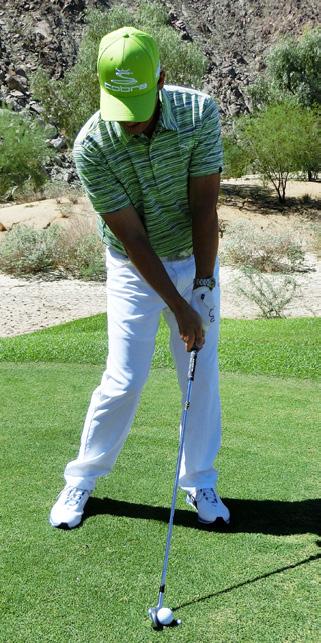
Don’t Hit Down
When the majority of amateurs misshit iron shots, they’re often told, “You didn’t hit down on it!” The implication is that the clubhead did not travel on a descending angle of attack whereby the ball is struck first and the ground second.
Many new golfers have the impression that you have to “get under the ball” in order to create a decent shot. This will result in an attempt to hit the ground first or pick the ball off the turf without any ground contact.
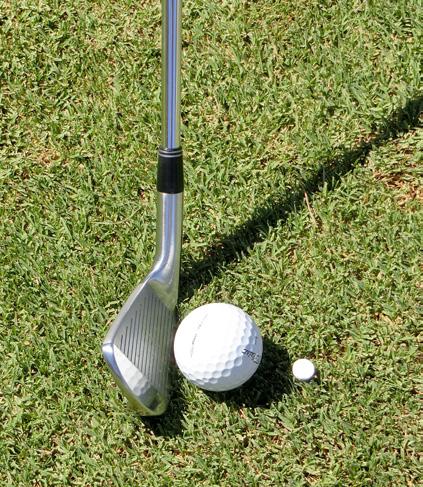
or getting under, try the concept of swinging through. Since the objective of an iron strike is to hit the ground past the ball, many golfers need to focus on swinging through the ball, almost as if to let it get in the way.
ground just in front of the ball, low enough that the clubhead has to hit the ground to knock it out. Make the swing pass through the ball and the tee, with hopes to clip the