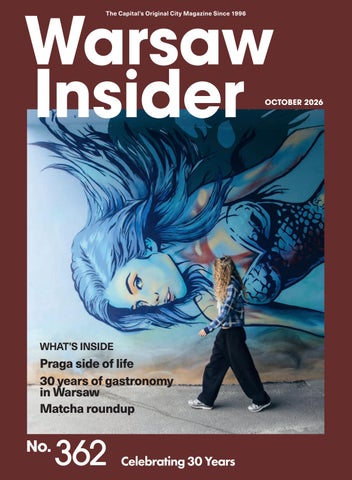
The Capital’s Original City Magazine Since 1996
OCTOBER 2026
WHAT’S INSIDE
Praga side of life 30 years of gastronomy in Warsaw Matcha roundup
No.
362
Celebrating 30 Years
Contents Features 30 years of Gastronomy in Warsaw – p. 7 Neighborhood spotlight: Praga – p. 31 Roundup:
38
Matcha – p. 48
Reviews Insider favorite: w Maśle – p. 45 Review: MADAMe – p. 46 Roundup:
Matcha – p. 48
Publisher Morten Lindholm mlindholm@valkea.com Creative Director Kevin Demaria kdemaria@valkea.com Client Solutions Director Ewa Szczesik eszczesik@valkea.com Sales Anna Czarnowska aczarnowska@valkea.com Katarzyna Pomierna kpomierna@valkea.com Małgorzata Tyborowska mtyborowska@valkea.com Marta Wilk mwilk@valkea.com
Distribution Manager Krzysztof Wiliński kwilinski@valkea.com Subscription
12 editions of the Insider zł. 150 (inc. VAT) in Poland. Orders can be placed through: insider@warsawinsider.pl
VALKEA MEDIA S.A., ul. Ficowskiego 15, Warszawa, Poland; tel. 801 800 278, 22 257 75 00 e-mail: insider@warsawinsider.pl All information ©2026 Warsaw Insider
7 31
48
warsawinsider.pl
PHOTOGRAPHS BY KEVIN DEMARIA
INSIDER TEAM
1
GREY WOLF WARSAW NOWY ŚWIAT 55 ALEJE JEROZOLIMSKIE 49
ADOBESTOCK (2)
Intel
Moose on the loose Warsaw Central Station has seen delayed trains, lost tourists and plenty of railway drama. A moose, however, is new. On September 13, an animal wandered onto the tracks, halting trains and giving commuters a story better than any delay announcement. Gazeta Wyborcza reports that it apparently followed the rail embankment and tunnel from Ochota, its adventure linked to rutting season in Kampinos Forest. Services were disrupted for around 80 minutes before the animal was safely removed. For one surreal Sunday evening, Poland’s busiest station became a wildlife crossing. Warsaw: where even the forest occasionally catches the train. No ticket required.
warsawinsider.pl
3
What's in
for October Tilda Swinton
Not a retrospective so much as a map of creative relationships, Tilda Swinton – Ongoing brings the actress’s artistic world to the former PAP printing works on Mińska. Archive material sits beside new work by collaborators including Pedro Almodóvar, Jim Jarmusch, Luca Guadagnino, Derek Jarman, Tim Walker and Apichatpong Weerasethakul. When: Ongoing until January 17, 2027 Where: Mińska 65
For ten days, Warsaw becomes a screening room as the 42nd Warsaw International Film Festival takes over cinemas across Warsaw. More than 120 feature films and over 50 shorts are planned, alongside filmmaker meetings and industry events. Expect premieres, discoveries and the kind of films that may never reach distribution. When: October 9-18 Where: various cinemas More info: wff.pl
4
Warsaw Insider | October 2026
Festiwal Fotoforma A major Warsaw gathering for photographers and filmmakers returns to PGE Narodowy with two days of talks, masterclasses, photo walks, portfolio reviews and hands-on gear testing. Fotoforma brings together working creatives, major brands and image obsessives, with exhibitions and practical sessions aimed at everyone from ambitious amateurs to seasoned professionals. When: October 5-6 Where: PGE Narodowy
ALL PHOTOGRAPHS PRESS MATERIAL
42nd Warsaw International Film Festival
AI film-making meetup Warsaw’s AI filmmaking crowd gathers at Państwomiasto for an informal evening of screenings, shop talk and shared experiments. Bring a two-to-three-minute piece to show, or simply watch and listen as creators compare tools, workflows, successes and failures. Free, in English, registration required. Space is limited. When: October 5, 18:30-21:30 Where: Państwomiasto, Jazdów 3/12
22nd Warsaw Beer Festival Legia Stadium becomes the capital of Polish craft brewing for three days as Warsaw Beer Festival returns with hundreds of new releases from selected breweries, cideries and mead makers, plus alcohol-free options. Beyond the bar: street food, brewer meet-and-greets, workshops and live music, all spread across the stadium complex itself. When: October 15-17 Where: Legia Stadium
warsawinsider.pl
5
30 YEARS OF GASTRONOMY IN WARSAW
For 30 years, we’ve had a front-row seat to Warsaw’s extraordinary culinary transformation, bringing our readers the newest openings, the tables worth booking and the restaurants worth the splurge. Along the way, we’ve watched a city find its appetite and then its confidence. From the pioneers who rewrote the rules in the 1990s to the chefs and restaurateurs defining Warsaw today, this is the story of a food city growing up, told through the people, places and ideas that changed the way Warsaw eats. warsawinsider.pl
7
30 years of gastronomy: THE BUILDERS
John Gabrovic arrived in Warsaw in 1992, just as the city was beginning to reinvent itself. Four years later, Blue Cactus opened and quickly became far more than a restaurant. In the days before Facebook, LinkedIn and group chats, it was one of the places that helped hold Warsaw’s international community together — where expats, diplomats, businesspeople and internationally minded Varsovians met, mixed and built friendships. With Tex-Mex food, margaritas and a distinctly more relaxed approach to dining out, Blue Cactus became part of the social fabric of a changing city. Thirty years later, Gabrovich looks back on the people, places and spirit that shaped both the restaurant and Warsaw itself. BY JOHN GABROVIC
I
arrived in Poland in 1992, when bananas were finally becoming widely available. That probably sounds ridiculous today. But in the early 1990s, you got tomatoes when it was tomato season. Same with strawberries. In winter, you ate a lot of bigos. At least I did.
8
Warsaw Insider | October 2026
In a little over 30 years, Poland has gone from a place where a banana could still feel exotic to one of Europe’s great economic success stories. Warsaw, meanwhile, has become a weekend destination, with extraordinary restaurants, bars, cafés and clubs. I feel fortunate to have witnessed that transformation firsthand, and, through Blue Cactus, to have played a small part in it. Those of us who experienced Warsaw in the 1990s remember what we jokingly called the “Wild East” with enormous affection. Dining out then could be an adventure. The old state-owned restaurants were cavernous and often half-empty. Near the kitchen, waiters in ruffled white shirts might sit smoking cigarettes. Eventually, one would bring us menus, almost as long as *Pan Tadeusz*. Then the game began. A friend would point to number 24. “Nie ma.” Someone else would try another dish. “Nie ma.” Sometimes you could detect a little smile from the waiter: “Ha! Got them again.” I learned quickly not to play. When my turn came, I ordered the one thing I knew they would probably have: kotlet schabowy, mashed potatoes and some grated root vegetable I never quite managed to identify.
A CITY BEING INVENTED
Warsaw felt completely different then. The skies seemed darker and the winters colder. There were no food halls, shops had limited selections, and there weren’t many restaurants, bars or clubs. And yet, I still think it was one of the best times to be here. Why? Because every day seemed better than the day before, and everybody knew it. A new product would appear on a shelf. A new business would open. Someone would travel abroad, see an idea and think: “Why don’t we have that in Warsaw?” Then they would come home and build it. The Kręglicki family opened Mekong on Wspólna and introduced Varsovians to an extraordinary range of cuisines and concepts. Artur Jarczyński’s Der Elefant became my go-to place and one of the first Warsaw restaurants that, for me, really understood hospitality. Jacek Raszetko opened Zanzibar on Plac Teatralny, a gathering place for expats and young Poles beginning to travel, work internationally and expect something different. Rabarbar and Barbados followed, turning that part of Warsaw into a nightlife strip before we really had a word for such a thing. Then there was Ground Zero. Opened by Marc Bushala and Todd Stump in 1993, it helped push War-
saw into its next phase as a party city. International DJs came through, musicians and celebrities appeared, and Wednesday student nights became legendary. By today’s standards, none of us needed very much. A cold EB beer. A Wyborowa shot. Johnnie Walker on ice. A pack of cigarettes — yes, you could smoke everywhere — and friends on your left and right. That was enough. Wherever you went, you inevitably ran into somebody you knew. The restaurant and nightlife community was tiny. But it was alive.
“HOW HARD CAN IT BE?”
After Ground Zero, Marc Bushala had another idea: let’s open an American-themed restaurant in the former Scheherezada in lower Mokotów. Our collective thinking was: “How hard can it be to run a restaurant?” Thirty years later, I can appreciate the comedy of that sentence. Blue Cactus opened in 1996, followed by Iguana Bar in 1999. Opening a restaurant then was very different. Poland didn’t yet have today’s network of specialist suppliers, but it did have extraordinary craftsmen. We relied on them. We had a 600-square-meter restaurant to build and were fortunate with the people who helped create it. Majed Zawahreh, then Head Chef at the Marriott Hotel, supported us on the culinary side. And if it weren’t for Wieslawa Szczep, our General Manager, we never would have achieved the success we did with Blue Cactus, nor had the ambition to open Boathouse Restaurant. Marek Rapallo, a Polish architect trained in the United States, designed the restaurant. Artist Darek Pala created more than 20 paintings for the walls and carved and painted furniture, some still used today. Marek Brodecki essentially painted the entire interior himself.
Why all that color? Because Warsaw could feel grey and serious, and we wanted the opposite: a place where friends, businesspeople and families could meet, drink, eat and celebrate life. Shared appetizers weren’t really part of Polish restaurant culture. The traditional structure was soup, main course and dessert — your food, on your plate. Sharing food? Eating with your hands? Kids running around during Sunday brunch? Not exactly the norm. We weren’t just introducing Tex-Mex food. We were trying to create a different social experience around eating.
THIRTY YEARS LATER
Blue Cactus has watched Warsaw change enormously, and eventually we changed with it. Leaving our original location was a major decision, but Fabryka Norblin has become a natural new home for the brand. The Warsaw around us today would have been almost unimaginable to me in 1992. It is international, confident and sophisticated. Varsovians have traveled the world, eaten everywhere and brought those expectations home. The restaurants are better, the cocktails are better and, thankfully, the beer is colder. But what people want from a restaurant hasn’t changed much. They want somewhere to meet friends, do business, celebrate a birthday, bring the kids, order another margarita and stay longer than they intended. That is still what Blue Cactus is about today. The setting has changed, but the idea remains: colorful food, generous drinks, a lively room and a place where people come together. After 30 years, Blue Cactus is still here and still evolving. When I arrived in 1992, finding a banana could still be noteworthy. Today, people fly here for the weekend to eat. Somewhere between those two realities, Warsaw grew up — and Blue Cactus grew up with it.
warsawinsider.pl
9
30 years of gastronomy: THE BUILDERS
Malinowa Restaurant at Bristol Hotel
Biala Dalia Restaurant in Konstancin
10
Warsaw Insider | October 2026
Piotr Kamecki has had a front-row
seat to Warsaw’s gastronomic transformation since joining Hotel Bristol in 1992. A sommelier and wine-industry veteran, he came of age professionally when the city’s grand hotels were setting new standards for service, training and wine culture. From those early years to the emergence of ambitious independent restaurants and a new generation of hospitality talent, Kamecki has witnessed—and helped shape—the shift from post-communist experimentation to the confident, internationally minded dining city that Warsaw is today.
Insider: When you think back to the Warsaw restaurant scene when you first started, what was it like, and what do you think you helped change? Piotr Kamecki: In the early 1990s, Warsaw’s restaurant scene was on the cusp of a major transformation. On one hand, there were restaurants that had long been well known and highly regarded, such as Fukier, Bazyliszek and Adria. On the other, the first modern restaurants were appearing, including those at the Marriott, Belvedere and, of course, the newly reopened Hotel Bristol. The guests were changing as well. There was a fascinating mix of established regulars, the first successful figures of Poland’s new economy and representatives of international companies entering the Polish market. It created an interesting melting pot of needs, expectations and, increasingly, money to spend. At first there were relatively few new restaurants, but they quickly began to multiply. The Marriott and Bristol acted, in a sense, as talent incubators. Their employees received extensive training and were introduced to new standards of service, quality, corporate culture and product knowledge. This was something new for Warsaw, but it soon became the benchmark. Staff trained at these hotels were quickly tempted away by new restaurants and hotels opening across the city. At the time, hotel restaurants were among Warsaw’s elite establishments. I joined the Bristol in 1992 and, after only a few months, I could already see that the combination of growing affluence, increasingly sophisticated restaurants and Polish hospitality was going to make Warsaw’s restaurant scene a success. And I was right.
Who worked with you and went on to make an important contribution to Warsaw’s food and drink scene? At the Marconi restaurant in the Hotel Bristol, I worked with Piotr Więcławski, who later became manager of the famous 99 restaurant, one of Warsaw’s top addresses in the early 2000s. Another was Paweł Oszczyk, head chef at the Bristol, who later became head chef at the Sobański Palace and then spent many years at the Hotel Le Regina. At the Bristol’s Malinowa restaurant, I worked with Waldek Czyż, who is now a key figure in the management of Piotr Popiński’s Good Food Concept group, behind restaurants including Elixir, Primitivo and Czerwony Wieprz. Many of my other colleagues followed a path similar to mine and found success in the wine industry, often joining the numerous wine-import companies that were beginning to appear at the time. Looking back, was there one restaurant, opening, person or moment that genuinely changed Warsaw’s restaurant culture? Why? A number of factors contributed to the development of Warsaw’s restaurant scene, but if I had to choose one moment, it would be Wojtek Amaro’s appointment at the Sobański Palace and Jan Wejchert’s ambitious vision of creating Poland’s first Michelin-starred restaurant. It ultimately took longer than the owners had anticipated and happened in a different form, but for me that moment marked the beginning of Warsaw’s pursuit of truly world-class gastronomy. If you had to bet on one person under 40 who will help shape Warsaw hospitality over the next 10–20 years, who would it be and why? There is an entire generation of people who combine serious gastronomic skills with a genuine vision for where the industry should go next. One of them is certainly my friend Piotr Pietras MS, who, together with chef Adrian Bęben, is consistently charting new directions that are already inspiring the next generation of restaurant openings. Finish this sentence: “Warsaw became a great food city when…” …Warsaw decided that its identity would be built on Polish cuisine, expressed in dozens of different forms.
Między Nami has been part of War-
saw’s cultural bloodstream since 1994, when Ewa Moisan, Markus Rademacher and their fellow founders opened the doors at Bracka 20. Inspired by ideas brought from Hanover, the place introduced lunches, weekend breakfasts and an entirely vegetarian menu long before any were commonplace. Yet its influence reached far beyond food: Między Nami became a home for the city’s emerging creative class, a meeting point for artists, photographers, designers, media people and independent culture in Warsaw.
Insider: When you think back to the Warsaw
restaurant scene when you first started, what was it like — and what do you think you helped change? Ewa Moisan: The idea for Między Nami came to Warsaw from Hanover. In 1994, Warsaw was perhaps no longer a gastronomic desert, but it still didn’t have a great deal to offer. Między Nami brought culinary trends already familiar in Western European cities to the capital. We introduced lunches and weekend breakfasts, while our first menu was entirely vegetarian, long before plant-based cooking became mainstream. But perhaps the most interesting part of the Między Nami story begins where gastronomy ends. Bracka 20 arrived at exactly the right moment for a bold generation coming of age alongside Poland’s transformation in the 1990s. Advertising agencies were opening, while fashion, photography, media and independent culture were developing rapidly. New professions and possibilities were emerging, but there was
warsawinsider.pl
11
30 years of gastronomy: THE BUILDERS still nowhere obvious for these “New People” to meet. Między Nami became that place. Even the name, derived from the German Unter Uns, meaning “among ourselves” or “between us”, proved remarkably fitting. For many people, Między quickly became a second home. Ewa and Markus helped create a safe space for those who were less interested in simply making money than in making something. Every evening, this colourful, slightly crazy world of people mixed together at Bracka 20. That creative ferment was one of the most important things Między Nami gave Warsaw. Many cultural and artistic projects began with a conversation, a chance encounter or an idea thrown across a table here. Who worked with you and went on to make an important contribution to Warsaw’s food and drink scene? Dariusz Kiercul worked at Między Nami as a bartender. Today, he is President of Browar Warszawski, Warsaw’s restaurant and craft-brewery complex. Looking back, was there one restaurant, opening, person or moment that genuinely changed Warsaw’s restaurant culture? Why? Of course, the opening of Między Nami in 1994. If you had to bet on one person under 40 who will help shape Warsaw hospitality over the next 10–20 years, who would it be and why? Basia Kłosińska. She is already an important figure in Warsaw hospitality, and we believe she will remain one for many years to come. Her creative energy seems inexhaustible, and we’re genuinely excited to see what she does next. Finish this sentence: “Warsaw became a great food city when…” …Między Nami opened in 1994.
12
Warsaw Insider | October 2026
Agnieszka and Marcin Kręgliccy
were building Warsaw’s restaurant culture before the city really had one. When Marcin opened Mekong in 1988, ingredients were difficult to source, dining out was still largely confined to hotels and special occasions, and even the idea of warm, informal service felt new. Agnieszka joined him on the floor, and together they introduced Warsaw not only to unfamiliar flavors, but to a different idea of what a restaurant could be. Over the decades that followed, the Kręglickis built restaurants, nurtured generations of chefs and restaurateurs, and created a platform for small producers at Forteca. Their story is not simply one of longevity, but of helping lay the foundations on which Warsaw’s modern food scene was built.
Insider: Take us back to the Warsaw in which you opened your first restaurants. What did the city’s restaurant scene actually feel like then? Agnieszka Kręglicka: The communist system had been collapsing for several years, the economic downturn was deepening, and the culinary scene was practically nonexistent. All we had were milk bars, shady hotel restaurants, and the mandatory snacks you had to order if you wanted to have a shot of vodka at a bar. When my brother Marcin decided to open a restaurant in 1988, the market lacked even the most basic products. There were no wholesale food suppliers, no importers, no Coca-Cola, not even fresh herbs or citrus. On top of that, we worked without the internet, cash registers or smartphones. Yet the enthusiasm brought by the political transformation was contagious. When a young, energetic restaurateur appeared on the market — welcoming guests with genuine warmth and joy, offering delicious food and a touch of the exotic — people were eager to experience it. This was true even though, until then, dining out wasn’t really a thing. In those early years, how much were you building a restaurant and how much were you building a market for something that didn’t yet exist? Take guest service, for example. In state-owned establishments, this was handled by stiff, pseudo-polite “professional” waiters. At Marcin’s place, the dining room was run by me and my university friends. We looked after our customers the same way you would welcome guests into your own home. We were always smiling, we spoke English, and we genuinely cared about making everyone’s time at Mekong, our first restaurant, a wonderful experience. Back then, it was revolutionary; today, it has become the standard. People didn’t visit our restaurant simply for a meal — it was the closest thing to an exotic journey. It meant discovering the taste of bamboo, tofu and bean sprouts, and learning how to eat with chopsticks. The Warsaw Restaurant Family Tree keeps growing. Who took their first steps with you? Over these nearly 40 years, we have met countless fantastic people. Some have stayed with us to this day, others spread their wings and started ventures of their own, and for many it was a youthful chapter before pursuing careers in other fields. Agata Wojda launched her career with us, starting as a kitchen assistant and going on to earn Warsaw’s first Michelin Bib Gourmand and the Woman Chef of the Year
warsawinsider.pl
13
30 years of gastronomy: THE BUILDERS title from Gault & Millau. Chef Theo Vogdanos, now the owner of Mykonos, Paros and El Greco, first worked with us at Santorini and Meltemi. Beniamin Bielecki of Bibenda and Barbara also learned the ropes of the restaurant business with us as a waiter. Meanwhile, Ania Łuczywek from Mleczna Droga, Monika Walecka from Cała w Mące and Kaja Przygońska from Bianca Mozzarella sold their very first products at our market at Forteca. It is an ongoing story. We are constantly welcoming new people, learning from one another and supporting each other’s growth. You’ve watched several generations of Warsaw gastronomy emerge. Was there one restaurant, chef, restaurateur or moment — not your own — when you realized the city had entered a completely new era? I would say that since 1989, we have been witnessing a permanent state of transformation and growth — an evolution in which we, too, continue to participate. The restaurants of the Gessler family and Daniel Pawełek, Robert Mielżyński’s wine bars and Justyna Kosmala’s bakeries have undoubtedly made a massive contribution. This growth has been driven equally by the talent of Wojtek Amaro, who won Warsaw’s first Michelin star, and Marcin Wojtasik, the creator of ramen bars. To me, however, the widespread success of different culinary projects matters more than individual stars that shine brightly for a brief moment. The fact that there are now places to gain culinary experience and education, and that the standard of living has risen enough for dining out to become a common part of life, means the number of restaurants continues to grow. This, in turn, fuels competition, quality and creativity. Warsaw did not become an attractive culinary destination overnight. It is the result of laying down one brick at a time. Who’s Next? It’s like asking who the stars will align for. Beyond personality, talent and a unique concept, so many factors have to fall into place — especially being in the right place at the right time, which was also true for us. New places open every single day, and each one — even the smallest bistro — contributes to the development of the entire culinary scene. As for our company, we are currently going through a moment of succession. My brother and I have new personal plans, while the second generation, who have the hospitality gene deeply ingrained in them, want to
14
Warsaw Insider | October 2026
“ Warsaw did not become an attractive culinary hotspot overnight; it is the result of laying down one brick at a time”
tell stories of their own. It is in their minds that new “by Kręgliccy” projects are currently taking shape. In the restaurant business, much like in fashion, we get excited by what is new and hot. The market constantly demands novelty, and a new wave of dreamers will always deliver it. From my perspective, however, the real artistry lies not in a short-lived flash, but in longevity. I don’t measure true progress by new concepts, photographs of marvelous dishes on Instagram or influencers frequenting the trendiest spots. While all of that is incredibly important, it is often fleeting. The real fun begins when you add the element of time to media and economic success, proving your viability over the span of years. That seems like a perfect note on which to conclude the celebration of your 30th anniversary, doesn’t it?
30 years of gastronomy: THE REVOLUTION predictable. Italian food was everywhere, sushi had become established, but truly authentic cuisines from more distant parts of the world were still relatively rare. Even when international dishes appeared, chefs often softened the recipes and spices to make them more familiar to Polish diners. At the same time, you could feel things beginning to change. Poles were starting to discover the food and culture of the Caucasus, and watching that curiosity grow gave me a strong feeling that the moment was right for an authentic Georgian concept. People were looking for something new, but also something comforting and genuine. Georgian cuisine offered exactly that: expressive flavours, warm hospitality, distinctive wines, fresh cheeses, herbs and dishes designed for sharing. I think Rusiko became part of a wider change in Warsaw — a moment when diners became more adventurous and increasingly wanted other cuisines to be presented authentically rather than adapted to what they already knew.
Davit Turkestanishvili helped introduce Warsaw diners to a more authentic expression of Georgian cooking at a time when the city’s international restaurant scene was still relatively narrow. Through Rusiko, he built a concept around the food, hospitality and traditions of Georgia, inspired above all by Rusudan “Rusiko” Turkestanishvili, whose name the restaurant proudly carries. His story reflects another important chapter in Warsaw’s gastronomic evolution: the moment diners became more curious, adventurous and open to cuisines presented on their own terms. Insider: When you think back to the Warsaw restaurant scene when you first started, what was it like — and what do you think you helped change? Years ago, Warsaw’s culinary landscape was much more
The Warsaw Restaurant Family Tree: who worked with you and went on to make an important contribution to Warsaw’s food and drink scene? Instead of naming someone who worked with us and later moved on, I would like to talk about the magnificent woman whose name our restaurant proudly carries: Rusudan Turkestanishvili, whom we all lovingly called Rusiko. She was my greatest inspiration, my rock and a truly brilliant cook. We worked side by side throughout our journey, sharing every challenge and every success. Sadly, she is no longer with us. In building this concept and continuing to cook her recipes, my greatest wish has been to honour her spirit and keep her memory alive for the people of Warsaw. Looking back, was there one restaurant, opening, person or moment that you believe genuinely changed Warsaw’s restaurant culture? Why? For many years, I have deeply admired what SAM has created and the way the concept has evolved. Its philosophy, the way the business is run, the consistency of the quality and the standard of service have all been remarkable. For me, SAM was one of those breakthrough concepts that demonstrated how modern and internationally minded Warsaw’s restaurant culture could become. It showed that a restaurant could build a strong identity, maintain high standards and grow without losing what originally made it distinctive.
warsawinsider.pl
15
30 years of gastronomy: THE REVOLUTION
BioBazar became more than somewhere to shop, it became a meeting point for people who cared about how food was grown, made and sourced. Was building that community always part of the idea? Always. I think of BioBazar as one big table for the people of Warsaw. Anyone can join us, at any time. And just like any good gathering around a table, it is about more than food. It is about meeting people, having conversations, exchanging ideas and enjoying a good atmosphere over something good to eat and a cup of coffee. That sense of community has always been fundamental to what BioBazar is.
When BioBazar opened in the old Fabryka Norblina halls on November 27, 2010, Warsaw was only beginning to develop a serious appetite for organic food. Agnieszka Saternus helped turn the pioneering market into a meeting point for farmers, artisans, chefs and shoppers interested in better ingredients. More than a place to buy food, BioBazar helped build awareness around provenance, seasonality and quality — and showed how strongly a city’s food culture can be shaped by what people cook and eat at home. Insider: When BioBazar started, what was Warsaw’s relationship with organic food like, and what did you feel was missing? Agnieszka Saternus: I think it was a mixture of both things. There was already an audience interested in eating better, but Warsaw definitely lacked the variety of fresh organic products that farmers were able to bring to our market. At the same time, part of our role as the operator of BioBazar was to help build awareness around why good food matters. That remains important today. Health and food quality are closely connected, and we wanted people to understand that what they buy and eat every day makes a difference.
16
Warsaw Insider | October 2026
Are people today more interested in seasonality, provenance, sustainability and knowing who made their food than they were when you began? Definitely. Awareness has grown enormously. People travel more and see how these ideas work in other countries, while social media has also helped spread awareness and promote local farmers, producers and artisans. Consumers today ask more questions. They want to understand where something comes from, who made it and how it was produced. That creates opportunities for smaller producers and encourages people to think more carefully about the food they buy. Restaurants usually get the credit for changing a city’s food culture, but markets can be just as influential. What role do you think BioBazar has played in raising expectations about ingredients and encouraging people to eat better at home as well as when dining out? There is a very strong connection between the two worlds. Many of the products sold by our vendors also find their way into Warsaw restaurants, and we regularly meet chefs shopping at the market. It works both ways. We also help our producers connect with new buyers and restaurants looking for particular ingredients. Recently, for example, we received an inquiry from a very good restaurant outside Warsaw looking for fresh dairy products. Markets and restaurants support one another. When chefs seek out better ingredients, they strengthen producers. And when people discover those same products at the market, they begin expecting better quality both at home and when they eat out.
warsawinsider.pl
17
30 years of gastronomy: THE REVOLUTION
today, we are still learning. That is probably one of the most important lessons: you can have a clear identity, but you also have to keep evolving with your guests.
Patryk Lempke and chef Daniel Leszek are the duo behind Soul
Kitchen, a Warsaw restaurant shaped by persistence, adaptability and a personal approach to hospitality. Founded in 2012, Soul Kitchen emerged as the city’s diners were becoming more curious, internationally minded and receptive to chef-led concepts. Over time, Lempke and Leszek have evolved with that audience, balancing their own instincts with what guests want from a night out: not simply food, but warmth, personality and an experience worth returning to. Insider: Soul Kitchen arrived at a moment when
Warsaw diners were becoming much more ambitious and curious. What did you feel was changing in the city when you opened? From the beginning, Soul Kitchen was conceived as a place for everybody, but with a very personal touch. When we opened, we knew the market, but over the following years both our guests and we ourselves evolved. Looking back, we like to think we helped point Warsaw gastronomy in a few new directions. Our approach to the business and to customer service has constantly adapted to changes in the market. Even
18
Warsaw Insider | October 2026
Warsaw has spent years looking abroad for inspiration, but increasingly its best restaurants seem comfortable being themselves. When did you feel Warsaw stopped trying to imitate other European food cities and began developing its own identity? I think an important change came when restaurateurs and chefs began paying much more attention to seasonality and regional products. Wojciech Amaro was a pioneer of that approach. His work helped raise awareness of what Polish ingredients could represent and, of course, he later became the first chef in Poland to receive a Michelin star. That helped encourage restaurants to look more closely at what was already around them rather than always searching elsewhere for inspiration. Soul Kitchen has survived in a city where restaurants appear and disappear remarkably quickly. What separates a restaurant that is fashionable for two years from one that actually becomes part of the city? You should watch Soul Kitchen, the film directed by Fatih Akin. Its main character struggles with many of the same things we have experienced. Of course, we have had to adapt constantly to the changing world of Warsaw gastronomy. Today, we know that even if you are doing what you know best, you still have to listen to what your guests need and what they want to experience. We have always tried to give people an experience, not simply food. That means paying attention, remaining flexible and knowing when to change without losing the identity of the restaurant. Which person, restaurant or opening from the generation before you made you think differently about what a restaurant in Warsaw could be? We are probably quite old-school in that respect. Our approach to the business came largely from our own experiences and passions rather than from one particular person or restaurant. Patryk brought experience in customer service from working abroad, while Daniel brought his experience of working in restaurants. We combined those different perspectives and built the concept from there. If we had to pass on one piece of advice, it would be: never stop exploring — and remember that you can always give up.
they visited only to celebrate. MOD became famous for the unlikely combination of ramen and donuts. What did their success tell you about how Warsaw’s tastes were changing? I think it was really about introducing new flavors and dishes that Warsaw simply hadn’t experienced before. In 2015, there wasn’t really anywhere serving ramen. And apart from the classic Polish pączek, nobody was really making artisanal donuts either. People were curious and willing to try things they knew from travelling or had seen elsewhere. It showed us how quickly Warsaw was opening up to new ideas.
When Kamila Mroczkowska and Patrycja Jaskólska opened MOD in 2015, with Singaporean chef Trisno Hamid in the kitchen, Warsaw was beginning to loosen up. Eating out was becoming part of everyday city life rather than something saved for birthdays and special occasions, and diners were suddenly far more willing to experiment. MOD landed directly in that moment. Its ramen, French-Asian cooking and extravagant American-style donuts helped ignite two of Warsaw’s biggest food crazes, while its design, attitude and informality captured a generation that wanted restaurants to feel culturally relevant as well as good. The team later followed with Regina Bar, taking the same restless approach into a New York-inspired collision of Chinatown and Little Italy.
Looking back, was there one restaurant, person or moment that you believe genuinely changed Warsaw’s restaurant culture? Definitely the opening of Charlotte. It changed the way people thought about going out. It was casual and social and you could go there throughout the day without needing a particular reason. That kind of approach became enormously important for Warsaw. What was Warsaw dining like before this new generation of restaurants appeared? It was much more formal and relatively expensive. Going to a restaurant was often connected with celebrating something rather than simply being part of everyday life. That has probably been one of the biggest changes. Restaurants became places you could use naturally — for breakfast, lunch, dinner, drinks, meeting friends or simply because you felt like going out. Who’s next? Who do you think will help shape the next chapter of Warsaw gastronomy? Us? Haha.
Insider: When MOD opened in 2015, what was changing in Warsaw and in the way people were eating out? Going out for lunch or dinner was becoming more and more of an everyday thing rather than something reserved for a special occasion. Warsaw was changing very quickly and people were becoming increasingly curious about food, travel and things they had experienced elsewhere. There was much more openness to trying something different. Restaurants could suddenly be more casual and more playful, and people were looking for places that felt like part of their everyday lives rather than somewhere warsawinsider.pl
19
30 years of gastronomy: THE REVOLUTION THE HALL THAT CHANGED WARSAW Ten years after reopening, Hala Koszyki remains one of the defining landmarks of Warsaw’s food-hall era, and a turning point in the way the city eats, drinks and gathers
W
hen Hala Koszyki reopened its historic gates in October 2016, Warsaw’s dining and social landscape experienced a seismic shift. As Warsaw Insider marks 30 years of documenting the capital’s culinary evolution—tracing back to the iconic days of pioneers like Blue Cactus—Hala Koszyki celebrates a decade of pioneering the modern food hall concept in Poland. While operating in two different eras of urban dining, both concepts fundamentally reshaped how Varsovians gather, eat, and celebrate city life.
ARCHITECTURAL HERITAGE & SECESSIONIST DETAILS Long before Koszyki became Poland's premier culinary destination, it was designed between 1906 and 1909 by architect Juliusz Dzierżanowski as a state-of-the-art municipal market hall. At the dawn of the 20th century, its soaring steel truss construction was a marvel of technical innovation, balanced by refined craftsmanship and rich decorative arts. To this day, attentive visitors looking upward can discover original carved stone bulls' heads, bas-reliefs depicting edible plants, metalwork accents, and the iconic Warsaw Mermaid embedded into the facade and structural piers.
20
Warsaw Insider | October 2026
When the revitalization was entrusted to the renowned studio JEMS Architekci, the team faced a profound heritage challenge. The original hall no longer existed as a complete physical entity; its historic steel frame had been dismantled, and detailed documentation was scarce. Rather than creating an artificial historical replica, JEMS embraced an authentic, layered dialogue between past and present. The architects integrated recovered historical materials, restored Art Nouveau elements, original store signage, and preserved Russian-script wall advertisements alongside modern glass and steel. The design concept evolved from a retail-focused market into an open space centered around gastronomy, art, and human interaction—where historic memory seamlessly intertwines with contemporary urban life.
THE PIONEER OF POLAND’S FOOD HALL FORMAT
When Koszyki opened in 2016, it introduced an entirely unprecedented format to Poland: a communal, multi-concept food hall. By breaking down the traditional walls between standalone restaurants, Koszyki created an open arena where high design, street-level energy, and culinary diversity meet under one dramatic roof.
“ Beyond the plate, Koszyki has evolved into Warsaw’s primary urban chic spot...” Today, Koszyki houses over 20 distinct culinary concepts, many of which were created specifically for this historic address. The lineup showcases notable culinary figures and diverse global flavors. Alongside vibrant food hall counters, the full-service restaurants pride themselves on custom-designed interiors tailored exclusively for this location, as well as a loyal community of dedicated guests and fans: Kago Sushi: Combining Japanese precision with interior harmony, its name pays homage to the site ("kago" translates to "basket" in Japanese, corresponding directly to "koszyki" in Polish), BRUT: Enchanting guests with seasonal menus, uncompromised craftsmanship, and honest cuisine, BAJS: Offering a fresh, contemporary interpretation of classic Polish comfort flavors, Portugalia Gourmet: A rare Warsaw gem featuring authentic Iberian deli specialties and curated wines, Port Royal & Warszawski Sen: Delivering high-end seafood feasts and business-class elegance, Omonia & Ragazzi Bar: Bringing vibrant Greek vacation vibes and relaxed Italian aperitivo culture to Southern Downtown.
A CONTEMPORARY URBAN LIVING ROOM WITH URBAN CHIC
Beyond the plate, Koszyki has evolved into Warsaw’s primary urban chic spot. It embodies the philosophy of urban hedonism where pleasure is derived equally from food, architectural aesthetic, and dynamic social atmosphere. The hall functions as a continuous stage set for city life. Visitors move effortlessly from morning coffee or business lunches to evening dinners, live music concerts, vintage fairs, art exhibitions, and interactive entertainment at Arcade Bee with private karaoke rooms. Surrounding outdoor courtyards encourage spontaneous, unscripted encounters that extend long into the night. Hala Koszyki remains the gold standard for adaptive reuse and food hall culture in Central Europe. A timeless address where Warsaw’s history and future continuously meet.
warsawinsider.pl
21
30 years of gastronomy: THE REVOLUTION
Andrea Camastra, Senses, 2015
Andrea Camastra belongs some-
where on the fault line between Warsaw’s gastronomic revolution and its new wave. Arriving in the city in 2011, the Italian chef entered a restaurant scene already changing quickly, then helped push it further. At Senses, and later with NUTA, Camastra brought an intensely personal approach to Polish cuisine — one built not around nostalgia for its own sake, but memory, technique and the traditions of the country he had adopted as home. His cooking has become part of a wider shift in Warsaw: away from looking abroad for validation and toward the confidence to interpret Poland on its own terms. For Camastra, that evolution mirrors the city itself — wealthier, more ambitious and increasingly certain of what it wants to be.
22
Warsaw Insider | October 2026
Insider: When you first arrived in Warsaw, what did you see in its restaurant scene that Warsaw itself perhaps did not yet see? Andrea Camastra: When I first came to Poland in 2011, Warsaw obviously was not what it is today. There were not many world-class restaurants, whether we are talking about Michelin-level restaurants or simply very good restaurants. But I could sense that something was changing, and a lot of it was connected to the economy. As Poland became more prosperous, people who had left the country years earlier in search of opportunities started coming back. They returned with experience from around the world. Some had become better chefs, and they were ready to open restaurants here. At the same time, people in Warsaw had more disposable income. They could afford to eat out more often, so suddenly there was an audience for these restaurants as well. You had both things happening at once: the money to create better restaurants and customers willing to spend money in them. And year after year, the level kept going higher and higher. It happened incredibly fast. Today, Warsaw might be one of the best food destinations in Europe. There is a lot of good happening here. You have spent years interpreting Polish flavors as someone who was not born into them. When did Polish cuisine begin to feel like part of your own culinary language? Straight away. First of all, I liked it. And my parents-in-law come from a very small, very traditional village in southern Poland, so almost from day one I was eating real, traditional Polish food. That made it quite natural for me. I came here after years of working in Western Europe and Michelin-starred restaurants. I am Italian, went to culinary school and had French training. I could have arrived in Warsaw and opened another Italian or French restaurant. Maybe it would have been fantastic, but it would also have been predictable. I wanted to do something new, both for the country and for myself. I wanted the challenge, but also the fun. Polish cuisine is much bigger than people outside Poland imagine. They think it is simply pierogi and a few other dishes, but there is so much more. For the past few years, we have spent a lot of time reinterpreting traditional Polish dishes. The textures might be different, the temperatures, colors and aesthetics might be different, but Polish guests recognize the taste immediately. It is somehow home food and not home food at the same time.
“ Warsaw is now very self-sustainable. We can probably even show others a thing or two” We have had people crying at the table because a dish brings something back to them. When that happens, you know you have done it properly. The danger with reinterpretation is processing something so much that you lose the integrity of the original dish. You have to understand where to stop. Everybody knows when to start; not everybody knows when to stop. Michelin changed the ambitions of Warsaw restaurants. Has it also changed what Warsaw diners expect from them? There is Michelin, Gault & Millau, The World’s 50 Best and many other guides and awards. But none of these guides tells you exactly what to do or how to do it. There is no script that you have to follow. Their job, essentially, is to tell people: there is quality here. They might then decide where on that pyramid of quality a restaurant sits, but the important thing is that they communicate to people around the world that something worth experiencing exists in that city. Of course, when you see a Michelin plaque or another award outside a restaurant, you walk in with certain expectations. But personally, I think quality should be expected anyway. If you decide to open a business called a restaurant, your priority should be to use good products, work seasonally and serve food that is genuinely good. Ideally, you should be doing something better than people can easily do at home. Otherwise, what is the reason to go out? The awards raise expectations, certainly, but quality should exist regardless of whether there is a plaque on the door. Ten or fifteen years ago, chefs often looked abroad for validation and inspiration. Does Warsaw still need to look outward, or has it developed a culinary identity strong enough to export? Definitely. From that point of view, Warsaw is now very self-sufficient. We can probably even show other cities a thing or two.
I think Warsaw is operating at a very high level internationally now. But in the end, it is not really about being competitive or proving that you are better than somebody else. What matters is having your own thing and being able to execute it technically at the highest level. I am Italian, and of course Italian cuisine has this enormous reputation and history, but I believe every country has something to offer. Every single one. The important thing is to understand what your own cuisine has and then do it properly, at the highest possible level. Warsaw does not need to imitate anybody anymore. It has its own thing going on, and now it has the technical ability and talent to present it as well as anyone else. If the last 30 years were about Warsaw catching up with the world's great restaurant cities, what should the next decade be about? I already think Warsaw is a great restaurant city. But it could become even greater if we began seeing more local and Polish restaurants alongside all the international ones. That might sound strange coming from the mouth of a foreigner, although after all these years I feel partly Polish myself. Warsaw is wonderfully cosmopolitan. You can find excellent Indian food, Japanese food, Mexican food, pizza and cuisines from all over the world, and I love that. But I think the picture would become even more complete if there were more really good Polish restaurants. And I do not only mean fine dining. I would love to see places serving regional Polish food and classic dishes using the best possible local ingredients — somewhere you could order a schabowy on the bone made with excellent Polish pork, for example, or discover dishes from different parts of the country. There are places doing this already, of course, but I think we need more. Polish cuisine has enormous regional diversity, and there is still so much that could be explored. Seasonality should be part of that as well. Every restaurant should work seasonally; for me, that should not be compromised. Poland has a very strong tradition of eating according to what is available at different times of year. Warsaw has already made this extraordinary jump. When I arrived, I could see it beginning, but during the last seven or eight years especially, the level has skyrocketed. The next step is not really about catching up anymore. It is about showing the rest of the world more clearly what Poland itself has to offer.
warsawinsider.pl
23
30 years of gastronomy: THE NEW WAVE
Piotr Pietras has become one of the
defining figures of Warsaw’s new wineand-dining culture. A Master Sommelier and restaurateur behind Kontakt, Wandal and NÓW, he has helped make serious wine feel less formal and ambitious cooking more spontaneous. His restaurants reflect a broader shift in the city: away from rigid categories and ceremony, toward sharing, curiosity and confident hospitality. For Pietras, Warsaw’s progress lies not in copying other capitals, but in developing restaurants with distinct identities of their very own. Insider: What did places like Kontakt change about the way people in Warsaw thought about going out to eat and drink? Piotr Pietras: I would be careful about saying that one place changed the way Warsaw goes out, but Kontakt was definitely part of a broader shift. We wanted to blur the traditional boundaries between a wine bar, a restaurant and a wine shop. You could come for one glass and a small plate, stay for dinner, open a serious bottle with friends or simply buy something to take home. We also wanted wine knowledge to feel accessible. We have always had a very strong and knowledgeable wine team, but the idea was never to make that knowledge intimidating. You could drink something rare or unusual,
24
Warsaw Insider | October 2026
ask as many questions as you wanted, or simply enjoy the bottle without needing a lecture. For me, the important change was showing that very good food and very good wine did not require a formal occasion. They could simply be part of an ordinary evening. The “sharing plates + serious wine” format now feels completely natural in Warsaw. Why do you think it connected so quickly with the city? Because it gives people freedom. You don’t have to decide in advance whether you are going out for dinner, for wine or simply to meet someone. You can order two dishes and a glass, or ten dishes and several bottles and turn it into a long evening. It also encourages curiosity. Sharing means that over the course of one dinner you can taste much more, both from the kitchen and from the cellar. I think Warsaw was very ready for that less structured, more spontaneous way of eating. For years, wine bars in Warsaw were often primarily about wine. What changed when food became equally central to the experience? The moment food becomes equally important, a wine bar becomes much more about hospitality than simply about wine. People are no longer coming primarily to taste a particular producer or grape variety. They are coming to spend an evening. The conversation between the kitchen, the wine team and the guest becomes much more interesting because neither food nor wine has to play a supporting role.
That was very important to us at Kontakt from the beginning: the kitchen couldn’t simply be something to eat alongside the wine. Do you think this new generation of wine bistros helped break down some of the formality that once surrounded both fine dining and serious wine in Warsaw? Absolutely, but I don’t think it was about lowering standards. It was about removing unnecessary ceremony. You can serve an exceptional bottle without giving someone a five-minute lecture before they drink it. In the same way, a kitchen can be extremely precise and ambitious without making guests feel that they have to behave in a particular way. That distinction between seriousness and formality has been very important to the development of Warsaw’s restaurant scene. Wandal, NÓW and Kontakt all approach hospitality differently, but they share a certain informality and confidence. What do you think that says about Warsaw diners today? Warsaw diners are much more confident themselves. They travel, they know restaurants, they know wine, and they have access to the same information and references as guests in London, Paris or Copenhagen. You no longer need to convince them that something is sophisticated simply by making it look sophisticated. Kontakt, Wandal and NÓW are very different restaurants, but in all three we try to concentrate on what is actually on the plate, what is in the glass and how the guest feels in the room.I think people increasingly appreciate that kind of honesty. How important has the idea of sharing become to the New Wave — not just sharing plates, but sharing bottles, dishes and the whole experience of a table? Very important, because restaurants are ultimately social places. Sharing plates was perhaps the most visible expression of it, but sharing a bottle is essentially the same idea. Someone chooses something, everyone tastes it, people talk about it, another dish arrives and the evening develops organically. It also changes the role of the guest. Instead of everyone following exactly the same predetermined structure, the table creates its own experience. Warsaw once looked heavily to London, Paris and Copenhagen for inspiration. Do you feel the city
now has a restaurant culture distinct enough that it no longer needs to imitate those places? Yes, although I don’t think we should ever stop looking outside Warsaw. Every great restaurant city influences and learns from others. The difference today is that Warsaw doesn’t need to copy them. Even five or ten years ago, there was perhaps more of a feeling that something was good because it looked like London, Copenhagen or Paris. Now chefs and restaurateurs here are much more comfortable filtering those influences through their own experiences, Polish products, local culture and the reality of Warsaw. A big part of that development comes from people. Many Poles who spent years working abroad have returned with experience from some of the world’s strongest restaurant cultures. At the same time, Warsaw has attracted more international chefs, restaurateurs and hospitality professionals, bringing their own backgrounds and traditions. That mix has helped the city develop its own identity much faster. There is also much less of an inferiority complex, and that is probably one of the biggest changes. If the last decade was about wine bars, natural wine and sharing plates, what do you think the next shift in Warsaw hospitality will be? I think the next shift will be less about one particular format or trend and more about restaurants developing stronger individual identities. Until quite recently, labels such as “natural wine bar,” “sharing-plates restaurant,” “Nordic-inspired” or “modern Polish” were useful because they described something genuinely new. Today, I think those definitions matter less. Guests are more experienced and more selective. They want a place to know exactly what it wants to be and to deliver that consistently. I also think durability will become more important. Opening something exciting is one thing, but creating a restaurant that people still want to return to five or ten years later is a much bigger achievement. We will probably see even more confidence in Polish ingredients and culinary references, but without feeling the need to define everything as “modern Polish cuisine.” And with wine, I hope we are entering a less ideological period. Natural wine opened many important doors and changed the conversation enormously, but the most interesting wine lists today can move freely between styles, regions and philosophies. The question becomes less about which camp a wine belongs to and more simply: is it good, and does it belong in this restaurant?
warsawinsider.pl
25
30 years of gastronomy: THE NEW WAVE
Michał Gniadek has worked across
several distinct chapters of Warsaw gastronomy, from the ambitious fine-dining worlds of Senses and Plato to Zoni, Klonn and, today, Yes Butcher! Shop & Bistro. His career mirrors a broader change in the city itself: away from complexity and formality as markers of quality, toward exceptional ingredients, sharper concepts and more relaxed hospitality. For Gniadek, the modern Warsaw restaurant is defined less by ceremony than by product, consistency and the desire to make people feel at ease.
26
Warsaw Insider | October 2026
Insider: You’ve worked through several different eras of Warsaw gastronomy — from Senses and Plato to Zoni, Klonn and now Yes Butcher!. How has the city’s idea of a great restaurant changed during that time? MIchał Gniadek: When I was starting my career in the kitchen, there was a widespread belief that an exceptional restaurant experience could only be found in fine dining. That was where trends were born, and every chef who wanted to develop their skills dreamed of doing an internship or working in Michelin-starred or fine-dining restaurants. At the time, casual restaurants were often seen as less ambitious and less inspiring, both by guests and by chefs. Today, the situation is very different. Casual dining has developed enormously, and within that segment you can now find restaurants for almost every occasion — from a relaxed lunch to an elegant dinner — without necessarily spending a fortune. Many of the best are run by acclaimed chefs, and it is increasingly in these restaurants that new gastronomic trends are emerging.
“ A great restaurant is somewhere we return For me, what distinguishes a great restaurant today is the quality of the product. It should be exceptional, to not only because of of known origin and served relatively simply, with only the food, but because enough additions to bring out its character and flavour. That is exactly the philosophy behind Yes Butcher! Shop we can relax there” & Bistro. Service is just as important. It should be professional, with staff who understand the menu completely, but also warm, friendly and welcoming. A great restaurant is somewhere we return to not only because of the food, but because we can relax there. Going out to eat today is about spending time well and having an experience. You came out of a very ambitious fine-dining environment, but Yes Butcher! is much more direct and product-driven. Was that shift personal, or do you think it reflects a broader change in Warsaw dining? It comes both from my own needs and from observing the market and talking to guests. A similar change is happening across Warsaw and, more broadly, throughout the restaurant world. Chefs who once worked in highly ambitious fine-dining restaurants have started simplifying their cooking or opening places with a more relaxed character. As a result, eating at a very good restaurant has become more accessible and no longer needs to be reserved for special occasions. At the same time, it has become clear that simpler cooking, when based on an exceptional product, can create just as much emotion as the most complex tasting-menu dish. Having more affordable but carefully conceived restaurants can also increase guests’ culinary awareness and contribute to the development of culinary tourism. Looking back at the restaurants you worked in, was there one place, person or moment that you think genuinely changed Warsaw gastronomy? For me, that person is Dariusz Barański. He was one of the first chefs in Warsaw to have the courage to move away from fine dining in favour of a simpler approach to cooking. He showed other chefs that a simpler format does not have to mean compromising on quality or lowering standards. I think his example encouraged many chefs to look for their own path and to create restaurants specialising in a particular product or built around a very clear idea, rather than following the old belief that the more elements you put on a plate, the more ambitious the cooking must be. Warsaw diners today seem more informed, more demanding and also more relaxed about where
good food can happen. How has the customer changed since you first started cooking in the city? The change is very clear. People can afford to eat out more frequently today, while increasingly treating restaurants as a way of saving time. They don’t necessarily want to spend the evening shopping, cooking and cleaning. And somehow, food cooked by someone else often seems to taste better. Guests are also much more knowledgeable. They travel, explore different cuisines, visit good restaurants, compare experiences, discuss them with friends and recommend places to one another. They understand that great food does not have to come in a very formal setting. Increasingly, diners appreciate a simple concept when it is built around good ingredients, hospitality and consistency. In the past, restaurants were primarily associated with elegance, slightly stiff atmospheres and carefully designed interiors. Today, more people understand that aesthetics are only one part of the experience. We go to restaurants to relax, not to sit at attention for three or four hours. When you look at the younger generation of Warsaw chefs and restaurateurs, who do you think will shape the city’s food scene over the next ten or twenty years — and why? I think it will be the people who have the courage to create clearly defined, bold concepts with a minimalist approach that puts product quality at the centre. It is no longer about having a huge menu and trying to satisfy every possible need. In fact, the more precisely defined a restaurant is, the easier it becomes for it to find its own audience. I also think we will see more places that combine a restaurant with a deli or retail element. At Yes Butcher! Shop & Bistro, for example, guests can eat on site but also buy steaks, soups, prepared dishes, roasted meats and accompaniments to take home. That gives a restaurant a second life beyond its own walls, and I think we will see more and more concepts developing in that direction.
warsawinsider.pl
27
30 years of gastronomy: THE NEW WAVE
Witek Iwański is one of the chefs who helped redefine what ambitious dining in Warsaw can look like. After years in hotel kitchens and stages at restaurants including Maaemo, Frantzén and Azurmendi, he increasingly turned his attention toward Polish products, seasonality and direct relationships with producers. At hub.praga, that experience comes together in cooking that is precise but unforced: serious without being stiff, rooted in place without becoming nostalgic, and built around a distinctly modern understanding of Polish fine dining. Insider: When you began cooking professionally, what did fine dining in Warsaw look like? What did the city have — and what was still missing? Witek Iwański: When I started cooking professionally, most of my experience came from hotel restaurants. That was where you found serious kitchens, good products and a certain standard of service. I spent many years in that environment, and it taught me discipline and precision. Outside the hotels, however, Warsaw’s restaurant scene was still relatively small. We had ambitious chefs, but the ecosystem around them was much weaker. There were fewer independent restaurants, fewer specialised suppliers and far less direct contact between chefs and producers. You could have a great idea for a dish, but sometimes simply getting the right product every week was the difficult part. For many years, ambitious Warsaw chefs looked to London, Paris, Copenhagen or Spain for inspiration. When did you feel Warsaw stopped simply following international fine-dining trends and began developing a culinary identity of its own? Travelling and doing stages abroad was an important
28
Warsaw Insider | October 2026
“ We can offer something deeply local at the same level of ambition” part of becoming a chef for me. I worked in places such as Maaemo, Frantzén and Azurmendi, and naturally you come home impressed by what you have seen: the organisation, techniques, products and the way people think about a restaurant. At first, I think many of us returned wanting to recreate some of that in Poland. Over time, my approach changed. I realised that the most valuable thing you bring home is not a particular dish or style, but knowledge. You can learn a technique in Oslo or Bilbao and then apply it to a Polish fish, a local vegetable or an ingredient from a producer you know personally. For me, that was when things became much more interesting. Your own cooking has increasingly focused on Polish ingredients, seasonality and local traditions. Do you think Warsaw diners have also changed — becoming more interested in where ingredients come from and in a distinctly Polish culinary language? Definitely. Earlier in my career, using a local product often required a lot of explanation. Today, guests are much more curious about where their food comes from. At hub.praga, we can tell someone that the flour, fish, vegetables or dairy they are eating come from a producer we know, sometimes from very close to Warsaw, and people genuinely want to hear that story. But I also try not to turn dinner into a lecture. My experience has taught me that provenance only matters if the food is good. A guest should enjoy the dish first. If they then discover that something they loved came from a small Polish producer rather than from the other side of Europe, that makes the experience even stronger. Over the course of your career, what has changed most about what is possible for a serious restaurant in Warsaw — suppliers, ingredients, staff, the expectations of guests, or simply the confidence of the city itself? For me, one of the biggest changes has been access to people and products. When I was younger, you could find very good Polish
ingredients, but consistency was difficult. A serious restaurant needs the same level of quality not once, but every day. Over the years, I began building direct relationships with farmers, fishermen and small producers, and today those relationships are fundamental to the way I cook. They are one of the things that made hub.praga possible. Instead of designing a menu first and then searching for the ingredients, sometimes we can begin with what a producer has available at that particular moment. Guests have changed as well. They travel more, eat in very good restaurants abroad and return with high expectations. That pushes Warsaw restaurants forward, but it also means we no longer need to imitate those places. We can offer something deeply local at the same level of ambition. Looking at Warsaw today through hub.praga, what does “fine dining” mean here now? Has the city moved beyond the old ideas of formality and luxury toward something more relaxed, personal and rooted in place? My background is quite classical. I spent years in hotel kitchens and restaurants where precision, service and consistency were extremely important, and I still believe strongly in all of those things. What I wanted to change with hub.praga was the form around them. I don’t think a guest should feel intimidated by a serious restaurant. I don’t want someone worrying about which fork they should use or whether they know enough about wine. The kitchen can be extremely precise without making the entire experience formal. My idea of luxury has also changed over the years. Earlier in my career, it was easy to associate luxury with expensive imported products. Today, I can get much more excited about an exceptional Polish fish, bread made from great local flour or a vegetable that is available for only a few weeks. For me, that is what fine dining in Warsaw can be today: very serious cooking, without taking the ceremony around it too seriously.
warsawinsider.pl
29
30 years of gastronomy: THE NEW WAVE Insider: You entered Warsaw gastronomy at a very different moment from the generation that built the scene in the 1990s and 2000s. What does it take to create a restaurant that matters in Warsaw today? Anna Kozachenko: We entered the Polish market relatively recently, in 2023, so we arrived when Warsaw already had a strong and diverse food scene with many established local players — but also at a moment when hospitality was beginning to evolve particularly quickly. What we noticed was that there was still room to differentiate through the overall experience. There were plenty of places with good food, but we saw an opportunity to invest much more deeply in everything around it: interiors, service, packaging, design details, communication and merchandise. We believe the “wow” rarely comes from one big idea. It comes from dozens of details working together. Good food is essential, but it is no longer enough on its own. Guests experience a restaurant as a whole: how it looks, how it feels, how they are treated and whether the place naturally fits into their lives. Being distinctive today does not necessarily mean inventing something nobody has seen before. It means having a clear point of view and expressing it consistently, down to the smallest detail.
Anna Kozachenko came to Warsaw
from Kyiv with a different perspective on what a restaurant could be. When Milk Bar opened at Elektrownia Powiśle in 2023, Warsaw was no longer a city waiting for someone to introduce it to the wider world of food. The challenge had changed. For Kozachenko, the new battleground is everything surrounding the plate: design, service, communication, merchandise, collaborations and the sense of belonging a restaurant can create. Her vision of Warsaw’s next chapter is correspondingly ambitious — a city whose strongest restaurants operate not simply as places to eat, but as fully formed cultural and lifestyle brands.
30
Warsaw Insider | October 2026
Warsaw has become an extraordinarily fast-moving food city. What is the new generation of restaurateurs doing differently? My perspective is not based only on Warsaw because I have been building restaurants in Kyiv for much longer, but I think the changes I saw there are very relevant to what is happening here. Guest expectations have risen dramatically — and, in many ways, restaurateurs themselves created those expectations. Healthy competition pushed the industry forward. Restaurants improved their food, design, service and communication, but they also began inventing more ways for guests to engage with them beyond simply having a meal. The strongest restaurant brands are no longer thinking only about the restaurant itself. They are building an ecosystem around it and increasingly becoming lifestyle brands. That can mean collaborations, events, merchandise, retail products, social media, special projects or completely new formats. But what matters is not how many things a brand does. It is whether they all express the same identity and values. The result is what I would call a “love brand.” People do not choose it only because they like the food. They identify with it. They bring friends there, celebrate important moments there, follow it online, buy its products and feel part of the community around it.
Praga side of life
Lively, artistic and defiantly alternative, Praga mixes tight-knit community life with Madonna shrines, street art, layered history and a restless creative energy. Spend the weekend drifting between old courtyards and new openings, hunting for vintage treasure, lingering over coffee and wine, and discovering the people and places that keep this side of Warsaw unmistakably its own.
warsawinsider.pl
31
Praga side of life hub.praga hub.praga feels less like a formal restaurant than a conversation with chef Witek Iwański. Set on Jagiellońska, in the heart of Praga, it combines ambitious cooking with an easy, intimate atmosphere, building tasting menus around Polish ingredients, sharp technique and flashes of international influence. Expect ideas that move confidently between local tradition and contemporary fine dining: oysters, Polish-Japanese beef tartare, forest mushrooms, river fish, crayfish and carefully handled vegetables all appear in changing combinations. What makes hub. praga memorable, though, is its lack of stiffness. Iwański’s
cooking is precise without becoming precious, while the room keeps things warm, personal and relaxed. It is serious gastronomy delivered with a distinctly human touch. ul. Jagiellońska 22
Brać
t Por k i s P ra
Brać made polish wine feel less like a patriotic obligation and more like something genuinely exciting. The shelves champion small domestic producers, while the bar encourages exploration by the glass. Come curious rather than knowledgeable; this is one of warsaw’s best arguments for drinking locally. ul. Józefa Sierakowskiego 4a/u3
Marcellino Deli Marcellino is what happens when an Italian deli develops impeccable taste in packaging. Shelves hold cheeses, cured meats, olive oils, preserves, chocolate and natural wine, selected with an eye for quality and beauty. It is dangerously easy to enter for salami and leave planning dinner. ul. Józefa Sierakowskiego 4a/u2
32
Warsaw Insider | October 2026
Rosalia Rosalia takes Polish tradition seriously without embalming it. Folk references appear in the room and the food, where familiar flavors are reworked with a lighter, more contemporary hand. Sharing plates suit the mood best: generous, sociable cooking made for a table that plans to linger. ul. Józefa Sierakowskiego 4a/u1
Antykwariat zakładka
Nostalgia
Look inside
One for readers who still enjoy the hunt. Zakładka packs its shelves with used books, rarities, postcards and old printed matter, with a particularly strong intellectual streak. Enter from Stalowa and browse slowly: the pleasure lies in finding something you did not know you wanted. ul. Środkowa 12
Football shirts are the headline at Nostalgia, but this is less sports shop than collector’s den. Vintage jerseys from clubs and countries around the world hang alongside books, records and memorabilia. Even non-fans may find themselves staring too long at some obscure 1990s away kit. ul. 11 Listopada 24
Look inside is the kind of vintage shop where fifteen minutes disappears into an hour. Twentieth-century furniture, clocks, ceramics, vinyl, posters and domestic oddities crowd the room, much of it with strong PRL flavor. Browsing is half treasure hunt, half accidental lesson in Polish design. ul. Wileńska 21
Autum views n
NOMAD NOMAD has quickly become one of those places that slips easily into your weekly routine. The menu casts a wide net, with enough comfort, freshness and indulgence to keep just about everyone happy, while the waitstaff are upbeat, attentive and genuinely engaged. My current obsession is the golden turmeric bowl with quinoa and black beans, especially with jalapeño hummus and miso-marinated grilled chicken — bright, punchy, healthy flavors I could happily eat every day. The setting helps, too. Looking out across Port Praski, with the water beyond and autumn leaves catching the light, NOMAD feels relaxed, contem-
porary and removed enough from the city rush to make lunch linger a little longer. ul. Józefa Sierakowskiego 1, nomadwarsaw.com warsawinsider.pl
33
Praga side of life u l. a ow St al
Rano
Peaches
Blisko
Rano helped put Stalowa on warsaw’s bakery map, and the smell alone still makes a persuasive case. Sourdough loaves, buttery pastries, brioches and seasonal sweets disappear quickly, often into bags carried across town. Arrive early; the best bakeries rarely reward people who sleep in late. ul. Stalowa 47
Peaches crossed the river and somehow became even more itself. The vegan cooking is bright, swaggering and happily uninterested in worthy clichés, pulling freely from Asia and Latin America. Add cocktails, an open kitchen and Stalowa’s new energy, and vegetables suddenly feel like nightlife food. ul. Stalowa 36
Natural wine, vinyl and a beautifully worn-in room make blisko feel as though it has occupied Stalowa longer than it actually has. Bottles lean low-intervention, the kitchen supplies clever small plates, and the mood lands somewhere between neighborhood bar and an unusually good house party. ul. Stalowa 36
GREEN CAFFÈ NERO A familiar name on Warsaw’s coffee map for more than 20 years, Green Caffè Nero feels especially at home in Koneser, where it has become a natural meeting point at the center of the complex. Coffee comes from the Caffè Nero roastery, while pastries and savory bites are prepared in the brand’s own Warsaw manufactory. The atmosphere is easygoing enough for a quick espresso, but comfortable enough to settle in for breakfast, lunch or a long catch-up with friends. Seasonal drinks add another reason to stop by: this autumn, the spiced pecan latte and cinnamon roll latte bring a warm, slightly indulgent note to
34
Warsaw Insider | October 2026
cooler days. Reliable, relaxed and always well placed for a pause. Plac Konesera 8 Budynek F
TWO SIDES OF BRZESKA. ONE TASTE OF PRAGA. ul. Brzeska 29/31
From hot pyzy and Warsaw-style flaki to fried fish, crispy potatoes and old-school favorites — come hungry and taste a little of the neighborhood
ul. Brzeska 4
Praga side of life EAT, SEE & SHOP:
Centrum Praskie Koneser A former industrial complex turned into a lively Praga destination where art, food, history and everyday Warsaw come together
Green Caffè Nero
FROM COFFEE TO DINNER
Koneser works just as well for a quick daytime visit as it does for a longer evening. Browse an exhibition, meet friends for coffee, grab lunch or stay for dinner and drinks – all within the same historic complex. Koneser is also a great place for a walk with family or friends – especially in autumn, when seasonal dishes, warming drinks and the flavours of the season make a visit even more inviting.
Koneser Grill
PRAGA ON A PLATE
From modern Praga flavours at Starlet to the sophisticated cooking at Michelin Bib Gourmand-awarded Koneser Grill, there is plenty to choose from around Koneser Square. The wider selection takes you from Italy at L’Osteria and ORZO to Asian flavours at AZIA Restaurants and Indian cuisine at Bombaj Masala. For sports fans, Spółdzielnia Koneser Sports Bar is a popular meeting point to watch major events. Plant-based options are also available, with Freya Cafe & Bistro offering a range of vegetarian and vegan-friendly dishes.
36
Warsaw Insider | October 2026
Giant Angel
MORE THAN A DAY OUT
Koneser is also part of everyday Praga life. Alongside restaurants, galleries and museums, you will find everyday shopping, including Aldi and Biedronka, as well as a range of amenities in the Koneser Passage, including Beverly Hills hair salon, EyeBar and other local businesses. This makes it easy to combine a cultural stop with your usual errands. Museum of Fantastic Art
ART AFTERNOON
Koneser is home to several places worth seeking out for art lovers. Visit ToTuart Gallery for contemporary exhibitions, then head to the Museum of Fantastic Art, featuring the work of Wiesław Wałkuski alongside works by Zdzisław Beksiński and Jerzy Duda-Gracz. Art can also be found outdoors, with sculptures by Marek Sułek displayed in the open spaces around the complex. The Giant Angel and animal sculptures are sure to catch the eye of younger visitors, but they are just as likely to appeal to adults.
ToTuart Gallery
Polish Vodka Museum
A GLIMPSE INTO KONESER’S PAST
The Polish Vodka Museum offers a look at the history of the site and the industrial heritage of the former Koneser complex. Located in the original factory buildings, it is a natural stop for anyone curious about how this part of Praga has changed over the years.
WHAT’S ON
From changing exhibitions to events and seasonal activities, there is always something happening at Koneser. Check koneser.eu for the latest programme. warsawinsider.pl
37
Praga side of life
al Locret S ec
Muzeum Maryjek Part gallery, part shrine, part neighborhood living room, Muzeum Maryjek – Ksiuty w Środku makes Marian devotion playfully contemporary. Locals treat the shop like a community center, celebrating Mary as their patron and thanking her for life’s blessings and good fortune. ul. Środkowa 14
Madonna Shrines Praga’s Madonna shrines are among the district’s most moving survivors. Most appeared during the German occupation, particularly in 1943, when neighbors gathered around them to pray, seek protection and preserve community amid terror. Many remain hidden behind tenement gates on Brzeska, Ząbkowska and Stalowa. If a gate is open, be brave: step inside respectfully and look around. Behind Praga’s battered facades, these extraordinary little sanctuaries are still quietly waiting today.
Praski Klondike Praski Klondike began life at the market and remains wonderfully unclassifiable. Catholic-themed rugs become wedding gifts, Pope John Paul II appears in improbable arrangements, and kitsch reaches perfection with lenticular prints of Britney Spears, alternately with hair and completely bald. ul. Ząbkowska 16
38
Warsaw Insider | October 2026
Toast One of praga’s best-looking brunch rooms, toast balances good design with the reassuring business of breakfast. The namesake toasts are the draw, but stay into the afternoon when coffee gives way to wine. Polished without feeling precious, it has become a natural targowa meeting point. ul. Targowa 76
Polish Vodka Museum Praga does history best when it refuses to feel embalmed, and the Polish Vodka Museum is a case in point. Set inside the former Koneser vodka factory, it traces Poland’s relationship with its national spirit through smart, interactive exhibits that move from production and politics to ritual, branding and, inevitably, tasting. Even vodka skeptics may leave with a little more respect for what is in the glass. Better still, the story does not end at the gift shop. In the same building, Setki Powodów keeps the mood going with cocktails, music and an easy-going menu built for sharing. Think globally minded comfort food, late-afternoon drinks and the kind of buzzy atmosphere that can turn one quick stop into an evening. And for those still not quite ready to call it a night, there is another cocktail bar upstairs waiting to be discovered. Taken together, the museum and Setki sum up modern Koneser rather neatly: industrial history polished up without losing its edge, with just enough vodka — and a few secrets — to keep things interesting for hours. Plac Konesera 1, muzeumpolskiejwodki.pl/en
Źródło Źródło makes a convincing argument for modern Polish cooking without turning dinner into a lecture. Local produce, fermentation and familiar flavors are sharpened into something smarter, while the scruffy-chic room keeps things grounded. Come for Polish ingredients given imagination, confidence and just enough mischief today. ul. Targowa 81 warsawinsider.pl
39
Praga side of life Museum of Fantastic Art Tucked inside Koneser, this compact gallery is devoted to Poland’s distinctive tradition of fantasy, surrealism and the beautifully unsettling. Rotating exhibitions have featured heavyweights such as Zdzisław Beksiński, Jerzy Duda-Gracz and Wiesław Wałkuski alongside a younger generation pushing the genre in stranger directions. Expect haunted landscapes, impossible architecture, ominous figures and images that reward a long, uneasy stare. The industrial surroundings work brilliantly: exposed brick and stripped-back interiors leave the paintings to do the theatrical work. Even visitors who think fantasy art is
not their thing may be surprised by its technical precision and psychological punch. It is one of Koneser’s more unexpected attractions, and all the better for it. ul. 31 Ząbkowska (Centrum Praskie Koneser)
The Social Praga It almost feels like The Social Praga has always been here, tucked into Brzeska with the confidence of a place that knows exactly what street it lives on. Open Thursday through Sunday, it deals in Cali-leaning Mexican bar food, cold drinks and loud guitars. Through a hidden bookcase door, the art space hosts revolving exhibitions—the “social” part made real. When the bands clock off, a seriously good vinyl collection takes over, filling the room with warm, velvety sound. Seasonal drinks keep things playful too: autumn’s Witch, Please! is essentially a boozy Frappuccino, which is exactly as dangerous as it sounds. ul. Brzeska 23
40
Warsaw Insider | October 2026
COMFORT FOOD WITH A PASSPORT Polish soul, European comfort and a Thai detour — all brought together at NOMAD Warsaw After 12 years in Thailand, NOMAD brings the journey home. Familiar flavors from Poland, Italy and France meet the energy, spice and unexpected turns of Asia — served all day at Port Praski.
Józefa Sierakowskiego 1 · Port Praski | Open daily 09:00–22:00 | nomad-warsaw.com | +48 795 077 373
Praga side of life Nami
Plotki i fotki
Nami gives Praga ramen with swagger. The room is playful, the kimchi sharply balanced and the ribs outrageously tender, but the bowls are the reason to cross the river. Shoyu is the benchmark: deep, clean and confident; bulgogi brings richness, heat and crunch beautifully together. ul. Ząbkowska 5
Part gallery, part café, part sandwich stop, plotki i fotki feels entirely at home on Brzeska. The food leans playful and Asian: katsu, panko-fried oyster mushrooms and slowcooked beef piled into toasted bread. Come hungry, then linger for the art and neighborhood chatter as well. ul. Brzeska 18
Le Cedre A Praga institution for decades, Le Cedre remains one of Warsaw’s most dependable addresses for Lebanese cooking. The hummus is among the best in town, joined by smoky baba ghanoush, generous mezze, grilled meats and warm flatbreads. Old-school, welcoming and reliably busy, it feels essential. Al. Solidarności 61
TWO FOODIE SPOTS ON BRZESKA Brzeska has always done things its own way, and these two addresses fit the street perfectly. At Pyzy Flaki Gorące (ul. Brzeska 29/31), old-school Warsaw comfort food comes with attitude: handmade pyzy served in jars, deeply savory flaki po warszawsku with meatballs and cheese, and rich toppings from crackling to Praga-style beef. Down the street, Rybka Frytka i Żużelek (ul. Brzeska 4) swaps dumplings for fish, with crisp cod, hake and miruna, smoky-butter potatoes and crunchy salads. The vibe at both is gloriously unfussy: colorful, characterful and unmistakably Praga. Come hungry, grab a table and expect big flavors and ignore the legends of Brzeska and make new friends.
42
Warsaw Insider | October 2026
Taste the Exotic Experience the Magic of the Middle East Belly Dance Show – Live Performance! Saturdays at 19:00 – Le Cedre 61
lecedre.pl | FB.com/lecedrepl | IG.com/lecedreinwarsaw Le Cedre 61 Al. Solidarności 61 tel. 22 670 1166
PHOTOGRAPHS BY KEVIN DEMARIA
Insider favorite
w Maśle makes restraint feel like a character flaw. The croque madame arrives bronzed and bubbling, its edges crisp, its center soft, crowned with a mountain of Parmesan that somehow seems excessive until the first bite. Then excess becomes logic. Butter works its way into everything here: the crunch, the richness, the unapologetic pleasure of it all. Warsaw has no shortage of brunch, but this feels like indulgence with purpose. Everything in life is better with w Maśle, with butter. w Maśle ul. Leona Kruczkowskiego 4 (City Center)
warsawinsider.pl
45
Review
Our Thai favorite finds the right room
46
Warsaw Insider | October 2026
W
e have been rooting for MADAMe for years. Back when Chattreeya was cooking from her tiny original spot on Jana Pawła II, it was already one of those places you recommended with a little extra conviction. Not because it was polished, fashionable or particularly grand, but because the food had personality. It tasted alive: sharp with lime, fragrant with herbs, properly hot when it needed to be, and never sanded down into the bland, vaguely “Asian” middle ground that still catches too many restaurants in Warsaw.
PHOTOGRAPHS BY KEVIN DEMARIA
MADAME RETURNS
MADAMe Thai al. Jana Pawła II 52/54, (Wola) madamethai.pl
Then came the move deeper into Wola. More space, more ambition, but somehow it never felt like the right fit. MADAMe’s strength had always been its immediacy, that feeling that you had stumbled into somebody’s favorite neighborhood Thai rather than a concept that had been scaled up. Now she is back where she belongs. The new MADAMe sits almost directly across the street from the original, taking over the corner at al. Jana Pawła II 52/54. And there is something satisfying about that. This particular stretch has seen a small procession of Asian restaurants come and go over the years, some better than others, but few leaving much of a mark. MADAMe feels like a genuine step forward for the address, and for us it remains one of the easiest recommendations to make when somebody asks where to eat Thai food in Warsaw. The new room gives the food more space without losing the personality that made the original work. There are still those dishes built around the balance that good Thai cooking depends on: sweetness kept in check by acid, heat cutting through richness, herbs and aromatics doing far more work than decoration ever could. Upstairs, things get looser. There is karaoke, a handful of additional dishes and enough room for the evening to become something more than dinner. It is exactly the sort of slightly chaotic addition we hoped MADAMe would grow into.
AT A GLANCE And then there is the mango sticky rice. Soft, warm, coconut-rich rice, ripe mango and that particular sweet-salty balance that makes you wonder why dessert ever needs to be more complicated. For our money, it is among the best in town. We loved MADAMe when she was tiny. We love her even more now that she has room to breathe.
What: Proper Thai cooking with personality, now in a bigger space and room for karaoke Go for: Bold, uncompromising flavors, the upstairs karaoke room and a night that can easily run longer than planned. Don’t miss: The mango sticky rice — among our favorites in Warsaw.
warsawinsider.pl
47
Matcha roundup Oromatcha at Concept 11 Old Town is not where you expect Warsaw’s most fashion-conscious matcha to be hiding, which is part of the fun. Inside Concept_11, Oromatcha looks more gallery installation than café, all polished surfaces and design-world confidence. Fortunately, the tea is not decoration. First-harvest Nōburu matcha has enough grassy depth to survive the menu’s more extravagant ideas: strawberry and collagen, bubble-tea riffs, even a signature number involving miso crumble, ice cream and kuromitsu. Come for the spectacle; stay because someone behind the bar clearly cares what the green powder tastes like here. ul. Szeroki Dunaj 11 (Old Town)
MOYA MATCHA At Moya Matcha Oleandrów, you’ll find much more than excellent matcha and Japanese teas. The menu also includes protein shakes, smoothies, matcha pastries and onigirazu, making it an easy stop for anything from a quick drink to a light bite. The space has its own pastry kitchen, where everything is prepared from scratch, including the fresh fruit purées used in matcha lattes and a rotating selection of Asian-inspired desserts. Seasonality plays an important role, with the menu regularly changing to reflect the time of year. Right now, autumn brings a comforting lineup of specials alongside the café’s regular favorites. It’s a
48
Warsaw Insider | October 2026
polished, contemporary take on matcha culture, with enough variety to appeal even to those who usually reach for coffee instead on a café run. ul. Oleandrów 6
Happa to Mame Happa to Mame helped teach Warsaw that matcha was more than green latte powder. Part tea house, part Japanese sweet shop, it pairs carefully prepared matcha with daifuku, dango and dorayaki. There is knowledge here, but never the dreary feeling of being lectured at all. ul. Hoża 43/49 (City Center)
Madare
Matcha Studio Matcha may be everywhere in Warsaw right now, but Matcha Studio is less interested in chasing the trend than explaining what sits behind it. This new concept turns the ritual into something more thoughtful, with workshops that explore where matcha comes from, what separates the good stuff from the merely green, and how to prepare it properly at home. Crucially, the tone is hands-on rather than preachy. Sessions are designed as much for curious newcomers as committed matcha obsessives, mixing tasting and practical know-how with the sort of slow-down moment Warsaw could probably use more of. The team clearly knows its subject, but the real appeal lies in making that knowledge approachable. Workshops can be booked individually or for groups, including in English, while companies can arrange private sessions as a standalone event or as part of a larger gathering. A smart, unusually focused addition to the city’s matcha boom. ul. Czeska 11, matchastudio.pl
Madare is Happa to Mame’s quieter, more contemplative sibling: a tiny Saska Kępa shopwindow devoted to Japanese tea and objects. Matcha is treated with restraint and precision, whether served straight, as a latte or as excellent soft serve. Worth crossing the river for, especially now. ul. Międzynarodowa 57A (Saska Kępa)
warsawinsider.pl
49
Matcha roundup It's a match(A)
Ocha Matcha
Okeh bakery
Here the matcha can be serious without becoming solemn. The tea has enough bitterness to keep the sweeter inventions honest, especially the excellent singed-marshmallow version, where caramelized sugar and smoke meet grassy green tea. Mochi makes the natural companion here, of course. ul. Solec 111 (Powiśle)
Ocha Matcha takes the bright, playful route: strawberry, mango, coconut, caramel and clouds of foam, all orbiting a dependable green core. The cream-cheese matcha sounds like stunt casting but works surprisingly well. This is matcha for people who enjoy their ritual with a little sugar. ul. Chmielna 11 (City Center)
Okeh treats matcha as something to drink, not photograph and forget. The Matcha Cloud is creamy, earthy and properly caffeinated; the mango version adds tropical brightness without burying the tea. Pair either with the absurdly soft Matcha Bun, then seriously consider another one. ul. Marszałkowska 8 (city Center)
QQ Warsaw QQ Warsaw has quickly become one of those places people recommend with a knowing nod. Matcha leads the way, but this is no one-trick café: Vietnamese coffee, playful toppings and seriously comforting Korean-style toast make it easy to linger. The Matcha Earl Grey Latte brings fragrance and depth, while the Cà Phê Muối balances strong coffee with a creamy, lightly salty finish. Our pick, though, is the Matcha Cream: honeyed matcha under a cap of salted cream. With Banana Coffee and Banana Cream Matcha joining the menu, plus a second location on the horizon, QQ feels less like a passing trend and more like a Warsaw habit in the making. ul.Żurawia 32/34
50
Warsaw Insider | October 2026
COME FOR THE MATCHA. STAY FOR THE TOAST.
Try QQ signatures including Matcha Cream, Matcha Earl Grey Latte and Cà Phê Muối – then make it your own with tapioca, grass jelly or cream
QQ WARSAW MATCHA • VIETNAMESE COFFEE • KOREAN TOAST Żurawia 32/34, City Center
warsawinsider.pl
51
The
Buzz Presenting the city’s most talked about venues, join us on a whistle stop tour of the cafes, pubs and cocktail dens and wine bars that you can’t afford to miss…
TOP COCKTAILS
WINE & DINE
Kontakt Sandomierska 13
Weaknesses do not exist in Kontakt, and if they do, they have yet to be formally identified by any who visit. Looking glorious in its deep shades of blue, its look is complemented by a 400-strong wine list slanted towards natural, bio-dynamic and organic wines. The five-star experience is aided by wonderful food. LOCAL WINES
Brać Nowowiejska 1 & Sierakowskiego 4A Resistant as tradi-
tionalists may be to the very notion of Polish wine, Brać have made it their mission to showcase its unknown quality. Presenting on-edge sips from niche domestic producers (including collabs with the Funky Fluid craft brewery!), all this is done in a stylish space that feels good to be in. From 2023, this was our favourite wine-related find! NATURAL WINE
Rascal Moliera 6
Warszawski Tygrys Plac Konstytucji 5 (City Center)
Warszawski Tygrys is one of Warsaw’s rare restaurants where the bar matters as much as the kitchen. Cocktails range from sharp classics and inventive signatures to playful frozen serves, while the food matches that ambition: superb duck croquettes, blood sausage dumplings, broad bean hummus and beautifully handled seasonal produce. The room is dramatic without overwhelming dinner, and the service feels alert and generous. Come for the cocktails, stay because the kitchen gives them something equally compelling to stand beside here.
Formerly a canteen for ballet dancers, this address now holds the largest bar in Europe specialising in natural wines – you weren’t expecting that! Entered past a lavish drape, this cool space has a suitably adventurous choice of rebel wines. BEER GEEKS
Jabeerwocky Nowogrodzka 12
Good old Jabbers will never let you down. A Warsaw institution, the adventurous choice of beers gives nods to international pioneers, domestic talents as well warsawinsider.pl
53
The Buzz as their own house beers. Pre-war floors and the welcome smell of spillage give it a great atmosphere that becomes a boisterous babble of international voices the later it gets. For something quieter, take your pint next door to their sister bar, Jabeerwocky Junior. CUTTING EDGE CRAFT Hopito Chmielna Chmielna 24
Opened last year as the younger sister of Hopito’s Żurawia venture, this branch feels a little more mature in its target audience, though every bit as fun in its beer selection - radicalized drinkers will love Hopito’s own crazy brews. OLD TOWN PINTS Same Krafty vis-à-vis Nowomiejska 11/13
Jammed between the Barbican gateway and the Rynek, Same Krafty’s pair of Old Town drinkeries face opposite each other to offer their own mini-pub crawl. Appearing as raucous and rugged tavern-like bars, the experimental craft beers are a league ahead of the mainstream fizz peddled by the other nearby bars. CREATIVE COCKTAILS Ave Pegaz Piłsudskiego 9
Inside a lively interior that doesn’t take itself too seriously (check the ‘ceiling garden’), swivel about to gawk at a mighty collection of corkscrews and drinking implements. In this alchemist’s workshop find yourself enjoying some of the most creative cocktails in Warsaw. COCKTAIL PORN VHS
54
Warsaw Insider | October 2026
Poznańska 7
The shoebox sized VHS pays tribute to the 80s and 90s and is a model for good times – boasting a flamingo and pictures of Mr T., the toilet says it all. The drinks are among the wackiest in Warsaw, and they’re as fun to drink as they are to photograph. THE ATMOSPHERE Beirut & Kraken Poznańska 12
Somewhere, amid all the junk relating to the Lebanese conflict (sandbags, ammo boxes…), you’ll find the spirit of Poznańska contained within this long, skinny bar. As fashionable now as it was when it opened, finish the evening in their connecting venture, the Pirates of the Caribbean-style Kraken. Evenings dissolve into a wild, happy whirl of international voices. INSIDER CLASSIC Pardon, To Tu Al. Armii Ludowej 14
Despite the upgrade in surrounds, they’ve retained the leftfield spirit of their old haunt thanks to flexi hours, a commitment to obscure sounds, and a well-spaced interior that references their former venue through its decadent colour scheme and wall of favoured musicians. The air of friendly, unforced cool is unmatched! FOR THE MUSIC Młodsza Siostra Dobra 14/16
Known for his ear for upcoming talent, the owner Michał isn’t averse to taking risks in order to broaden Warsaw’s musical palate. The scrappy backdrop of
bike repair garages give a vibe redolent of the shadowy courtyards of Berlin and Budapest, while inside it’s all creaking floorboards, mismatched furnishings and a clientele sourced from the local Academy of Fine Arts. REBEL SOUNDS
Chmury / Hydrozagadka 11 Listopada 22
Set in a fleapit courtyard, it’s hard to tell where one begins and the other ends, but both are spiritually cojoined by a devotion to eclectic live music. Tight and crowded, it’s a place where audience and band become one, feeding off each other to generate an electrifying atmosphere. A BIT OF EVERYTHING Foton Wilcza 9A
You know it’s been an epic weekend when you wake up on Monday knowing that Foton was involved. Conversation with strangers is natural after a few of Foton’s cocktails, and these are enjoyed to a cool backdrop made up of fleet of tumbling plants perched on steel-framed irrigational contraptions. PRE-CLUB DRINKS Bar Pacyfik Hoża 61
Based upon the kind of Tijuana dive bar you’d have happened upon during the Miami Vice era, Pacyfik is all candy floss pink and shades of teal: a raw-looking den that looks purposefully imperfect. Keeping the hip international crowd on the wrong side of drunk are kick-ass cocktails! LATE NIGHTER
Republica de San Escobar Poznańska 7
Lacking airs and graces, it’s a place where fun rules the roost. Tiny in size, find an interior filled with corrugated iron sheets, zappy neons, chunky woods and bike pedals on the footrests. The fun-loving spirit is irresistible, and the tight dimensions mean the party often spills onto the terrace outside. STUDENT CARNAGE
Shamrock Irish Pub on Zgoda. Though a lot smarter than its sister, the raucous sense of fun has carried over – as has the quality Guinness. ESSENTIAL CHECK-IN
Fabryka Norblina Żelazna 51/53
Without fail, the big winner of 2023 was Norblin – hell, we even saw Kieran Culkin walk-
ing through over summer! In terms of nightlife, winners include the elite MOXO and the craft-minded Uwaga. Packed in the evening, the atmosphere is squared out perfectly by the live music that frequently escapes from the Piano Bar. The Insider fave though remains Piano Bar, a place with fancy cocktails, a 12-foot chande-
Nowy Świat ‘Pavilions’ ul. Nowy Świat 26
For the highest condensation of bars in the capital head to ‘the pavilions’, a collection of ramshackle drinking cabins, shot bars and sheesha lairs inside a tight grid of shadowy back alleys. Adding to the gentle sense of confusion comes the realization that so many bars look the same – accessed through clattery, barred doors, visitors walk into murk and chaos. ALT. ENTERTAINMENT Worek Kości Bagatela 10
There is nothing ordinary about Worek Kości and that’s underlined by its collection of 400 replica skulls. Known for its burlesque nights, this passionate celebration of the beautiful and bizarre also has a busy roster of lectures dedicated to criminal profiling, forensics and serial killers. Oh, and the cocktails are good. LIVE SPORTS
Shamrock Sports Bar Krucza 51
At long last, Warsaw has the sports bar it deserves. Zapping in football, rugby and suchlike from around the world (but mainly Britain), this Irish-run spot is an offshoot of the atmospheric
A modern hotel in the heart of Warsaw Welcome to Warsaw’s newly emerging business district. Crowne Plaza@ Warsaw - The HUB hotel offers modern accommodation, award - winning conference space and superb food and beverage services. Join IHG@ One Rewards and get instant access to benefits and exclusive Loyalty Member deals at 6000 destinations globally. cpwarsawthehub.com | +48 22 377 37 37 | ihg.com/one
warsawinsider.pl
55
lier and a crowd that errs from late 20s upwards. THE PRAGA VIBE
W Oparach Absurdu Ząbkowska 6
Craft beers lurk within the fridge, but for the seminal Absurdu experience order a tray of vodka before bulldozing through the crowds that gather to listen to Balkan rock and Afro-Latin bands. Somewhere, hidden deep beneath the creaking antiques and moth-eaten Persian rugs, you might be lucky to find a wood-carved bar. NORTHERN NIGHTS Havana Słowackiego 16/18
Set on the first floor of a PRL era tower, the super cool interior offers up a coherent display of retro posters, luscious plants and light wood trimmings that are respectful of this space’s former life as a 1960s cafe. Perched among hip freelancers and theater types learning their lines, sip away on trendy bio wines, adventurous lemonades, craft swigs or specialty coffee sourced from local roasters. UPMARKET CLUBBING Sen Wioślarska 6
Some would say that Sen enjoys its heyday in the summer when the rooftop terrace opens to afford views of the illuminated bridges that span the river. But even outside these months it’s long enjoyed a reputation as Warsaw’s premier super-lux club. High class cocktails and a stringent door policy have helped maintain their name as the principal destination for glam, catwalk excess.
56
Warsaw Insider | October 2026
DESTINATION COFFEE
Café Pląs Puławska 113A (Królikarnia)
Set inside the Króliarnia Palace, it’s laidback and artsy-cool, something aided by the strategically placed plants, chillout beats and rare-find art books placed reverentially on the shelves. Specialty coffee, bio wines, alternative soft drinks and craft beer make it a highly versatile place to finish in after a brisk autumn walk around the palace grounds. COFFEE OF LEGEND Stor Tamka 33 / Bracka 18
For many there is no better café anywhere in Poland than Stor’s original on Tamka. When the sunlight slopes in through the window, there are few finer feelings than idling away in this plant festooned refuge. Famed for their glorious coffee and detail-driven approach, recognition should also be handed to their devotion to local causes and zero waste philosophy. FOR VINYL CHILLOUT Hałas Elsterska 10
Divide Hałas into two sections: first, a small chamber selling collectors classic vinyl and coffee sourced from some of Europe’s top roasters. Then, smuggled in the back, discover a Nordic-style living room arrangement that encourages afternoons spent sipping coffee while catching up on email. FOR QUICK ESPRESSO Błysk Słowackiego 22
Served over a PRL era counter, Błysk’s super-tight confines generate a natural air of familiarity. Often standing room only, the buzz and hubbub owes itself not just to the delicious espresso shots, but
also the homemade cookies and dog-loving owners that will spoil your pet. HIDDEN STAR
El Cafatero Marszałkowska 27/35 & (ul. Emilii Plater 8)
Tucked behind the patinated domes and intricate steeples of Zbawiciela, chilling in this little café has you thinking you’re somewhere cute and quaint like Vilnius or Lublin. Specialising in roasting their own African coffees, the super-hip vibe is highlighted by the wall of Polaroid snaps. CHAMPION BREWS Forum Elektoralna 11
Forum has it all: a fashionably frayed interior, a friendly dog nuzzling around (hi Apollo!), and a client base that expects nothing but the best – and at Forum, that’s exactly what they get. Marketing themselves as “the home of the Polish Aeropress and Polish Brewers’ Cup Champions”, these accolades say everything there is to know. NEIGHBORHOOD FAV Ciacho al. Niepodległości 80
In Mokotów, Ciacho stands apart as a true neighborhood institution — a bakery and breakfast spot that quietly draws locals back year-round. Hidden near Jordanowski Park, it shifts with the seasons: a lively family terrace in summer, a warm, oven-scented refuge in winter. Breakfast is the anchor, from creamy scrambled eggs on house sourdough to a cult-favourite kimchi brioche. Add excellent pastries and breads to take home, and Ciacho reveals itself as something rarer than a café: a steady, glowing hearth.
Dine &
THE MICHELIN STAR
Delight When only the best will do, we’ve cut through the chaff to present a curated choice of Warsaw’s top eateries – from ethnic comfort foods and under-the-radar gems all the way up to the city’s most exclusive dining rooms…
GREAT LUNCH
Nuta pl. Trzech Krzyży 10/14
Andrea Camastra’s restaurant is a magical enclave in which time stands still. Mixing his famed scientific techniques with artisanal processes, his tasting menu is expressive in its aesthetics and flavour, as if it were an extension of his own firecracker character. Even the cheeseboard is a mind-bender – on our April visit, jaws hit the floor as this arrived in the liquified form of a pear consommé topped with warm gorgonzola foam. A bold, world-class adventure, no other restaurant offers such a ride – a second Michelin star seems guaranteed. FORMAL & EXTRAORDINARY Epoka Ossolińskich 3
Nineteenth century cornices and baroque drapes lend an enveloping sense of luxury to this A-Class space. Epoka’s menu is based on Polish cookbooks from different epochs, with the dishes reconstructed in a way that’s innovative, unexpected and a roller coaster of thrills. La Liste officially rank it among the world’s Top 100 Restaurants. EXQUISITE Nolita Wilcza 46
Naan PHOTOGRAPH BY KEVIN DEMARIA
ul. Nowy Świat 43 (City Center)
Lunch on Nowy Świat has a dangerous tendency to become an afterthought. Naan makes a convincing argument against that. The tikka masala arrives smoky, tangy and unapologetically rich, while the butter chicken delivers exactly the kind of velvety comfort its name promises. Better still is the dal, earthy and fragrant with caraway, demanding another swipe of naan. Start with the Hara Bhara Tikki, crisp, green, spiced vegetable patties—and suddenly that quick lunch break starts looking suspiciously like an afternoon off.
Winning our 2022 award last year for ‘Outstanding Achievement’, chef Jacek Grochowina’s enclave of class looks dashing with its monochrome colors and muted gunmetal shades, but it’s the food that has made it the place Warsaw heads to live the life of the 1%. Treasuring detail and finesse, Nolita demonstrates fine dining hasn’t died. warsawinsider.pl
57
Dine & Delight ECLECTIC & UPMARKET Dyletanci Koszykowa 47
Subtle and stylish with its muted, neutral colors and pops of art, amid the light woods and sky-coloured walls, the assembled fine wines have been selected to dance in tandem with the cooking of Rafał Hreczaniuk. His cooking is elegant, eclectic and never short on sensational taste.
FOR THE TASTING MENU
DATE NIGHT
Fusing upmarket, casual styling with an exciting wine list, interactive service and the kind of atmosphere you can’t get enough of, Rozbrat 20 is a Warsaw gastro landmark. Under chef Bartosz Szymczak, the frequently changing menu has a real playful inventiveness to it.
Regularly adjusted to utilize the best items the season has to offer, the menu is a triumph of expertly balanced tastes and is admired for some of the most interesting cooking in the city – think elegant with a localized twist. Rounding out the experience is an intimate, labyrinthine design that’s ideal for when it’s cold and grim, and a decked courtyard terrace for when it’s not.
Rozbrat 20 Rozbrat 20
alewino Mokotowska 48
NEW WAVE
hub.praga Jagiellońska 22/LU1
LOCAL FAVORITE
Heading the kitchen is Witek Iwański, a chef whose past accolades include our very own ‘Top Talent’ title at our Best of Warsaw awards. The tan, beige and white interior is embellished with moon-shaped mirrors and statement art, and is twinned with tiny a’la carte courses that appear like miniaturised works of art. CASUAL SCENE
Bibenda Nowogrodzka 10
Siga Siga
ul. Willowa 9 (Mokotów)
Tucked away in Mokotów, Siga Siga channels the Greek philosophy of “slowly, slowly” through shared plates, vinyl records and the easy warmth of owner Aleks. Vegetables lead the way: whole cauliflower, Parmesan-dressed leek, harissa-roasted carrots and melting eggplant, though superb soutzoukakia meatballs steal the show. Order the Blind Date, trust the kitchen and settle in. Siga Siga is less about restraint than remembering dinner should be enjoyed.
58
Warsaw Insider | October 2026
With no reservations accepted, Bibenda’s enduring popularity ensures that queues often build at the entrance – even at the height of the Polish winter. Augmenting the warm interiors of raw red brick and dim yellow lighting, guests flock for a menu that celebrates the fields, forests and farmsteads of Poland. honey and peanut chili crisps. THE NEED TO KNOW The Eatery Koszykowa 49A
This attractive off-street space comes swathed in
white-on-white colors – blissfully cocooned from the outside world, and decorated orb-like installations, this chic but casual space gives Polish food a modernised translation. Visiting for our May issue, we were bowled over by the pork cheeks served with a punchy demi-glace and whirls of liquified peas and red cabbage. NEW POLISH Źródło Targowa 81
Hardwood floors, exposed pipes and a flurry of plants equip an open area decorated with blasts of contemporary art, recycled furnishings and extravagant light installations. Menu-wise, the food lights the soul. But more than just celebrating the power of local produce, there’s a refinement at play that speaks of a kitchen team that aims for magnificence.
including an old school schabowy the size of a small planet. POLAND FOR INSIDERS
Oma Radna 13
Stepping into Oma is like entering Babcia’s house for a holiday—a warm embrace of Polish tradition with a modern flair. Oma, named after the chef’s grandmother, exudes
Oma-goodness. Nestled in Powiśle, it charms with its vintage Polish decor and fresh flowers. The menu offers classic dishes with a twist: schabowy topped with Parmesan and zupa pomidorowa with garlic. Desserts like knedelki—a cottage cheese dumpling with apples and orange peel—are irresistible. The thoughtful vintage design and caricatures of Oma on the
Nova Wola
POLAND REIMAGINED Bez Gwiazdek Wiślana 8
Regarded as one of Warsaw’s gastronomic treasures, each month sees Robert Trzópek design a tasting menu inspired by a specific region of Poland. His creative interpretations of the nation’s culinary traditions are delicate, nuanced and beautifully balanced. The chic but casual setting reflects the philosophy. TRENDING POLISH Pod Gigantami al. Ujazdowskie 24
Once seen as a classic restaurant for ‘old people’, Pod Gigantami’s reinvention stretches to 3 a.m. finishes come the weekend. Marrying heritage with hip, during more normal hours enjoy thoughtfully cooked Polish classics
AUTHENTIC POLISH CUISINE Rondo Daszyńskiego 2 , Warsaw +48 22 377 38 01 novawola@ihg.com novawola.com
warsawinsider.pl
59
Dine & Delight servers’ shirts add a personal touch. Make a reservation to avoid heartbreak, as Oma’s popularity often leads to a full house. Dive into this cozy haven and savor the best of Polish summer cuisine, where every bite feels like a warm hug from Babcia herself. NEIGHBOURHOOD GREEK Mr. Greek Souvlaki Londyńska 16
Festooned with potted shrubs, the outdoor wooden deck is one of Saska’s finest outdoor check-ins. If that’s packed – and it often is – head inside where an atmosphere of gentle chaos reigns in the noisy open kitchen. Eschewing warmth and authenticity, the atmosphere fits well with the meaty skewers. SOUTH AMERICAN FLAIR Ceviche Bar Twarda 4
With Argentine chef Martin Gimenez Castro injecting his passion and personality into the venue, this is an address that punches through the greyness of everyday Warsaw. Ceviche is naturally the default order, and here it’s served in around five different forms. INSIDER FAVORITE Tuna Elektryczna 2
Resembling the scales of a fish, Tuna’s core decorative element are 18,000 tuna cans that sheathe the walls. Smartly appointed in dark metallic colors, visit for an exhilarating menu that includes salmon jerky, tuna sausages, an elaborately reconstructed dorada tail and the best-selling chili con tuna.
60
Warsaw Insider | October 2026
TOP ALL AROUND VEGAN Peaches Gastro Girls Stalowa 36
Peaches, Warsaw's vibrant vegan hotspot, serves up seasonal dishes with finesse. From their umami-packed grilled mushrooms to inventive cocktails, every bite and sip delights. The minimalist interiors and open kitchen make it an experience for both eyes and palate. VEGAN NOODLES
Vegan Ramen Shop Finlandzka 12 / Jana Pawła II 52/54 / Narabutta 43
Dubbed by some as “the best noodles in the world!” They’re definitely memorable, and the spicy miso ramen will for sure make new true believers. BRUNCH ANYONE? Seagull ul. Dobra 1, (Powiśle)
The menu carries a subtle Asian accent — eggs Benedict with yuzu hollandaise and shrimp, harissa-spiked chickpea toast, bright matcha and thoughtful non-alcoholic drinks alongside mimosas. It’s a neighbourhood spot for plans, conversation and clarity, where morning isn’t rushed through, but properly lived. SUSHI LOVERS MUST
Misaki Kawasaki Wybrzeże Kościuszkowskie 43B/3rd floor (Powiśle)
Paula Mycka cooks with global confidence, fusing Japanese precision, Thai vibrancy, Middle Eastern depth, and Peruvian playfulness. Highlights include bold vegetarian dishes, scallops in brown butter, a Wagyu Katsu Sando, and toro tartare on a sesame waffle with yuzu crème fraîche.
WELCOME TO GREECE! For authentic Greek food & hospitality, look no further than Mr. Greek Souvlaki! Walecznych 68a/3 (Saska Kępa)
COMMUNIT Y HUBS & FOOD HALLS FABRYKA NORBLINA
Żelazna 51/53, fabrykanorblina.pl Representing 200-years of history, the two hectare site is riddled with over 50 leftovers from the Industrial Revolution and these are set against attractions such as the luxury Kinogram cinema (champagne vending machines!), the immersive Art Box Experience, a factory museum and the Smart Kids Planet – a 1,600 sq/m project with nine zones that aim to promote logical thinking, healthy eating, motor functions, perception and creative thinking.
CENTRUM PRASKIE KONESER Plac Konesera 8, koneser.eu
Reopened in 2018 as a mixed-use project containing cultural sites, F&B outlets, A Class offices and loft-style apartments, no other investment has had a bigger impact on Praga’s overdue regeneration than Koneser. Culturally, it’s also done much thanks to the Polish Vodka Museum, the Museum of Fantastic Art and temporary exhibitions such as Banksy in 2021. For most though, the F&B lineup is the strongest attraction of all and this includes upmarket Indian from Bombaj Malasa, the casual eatery Spółdzielnia and the real feather in the cap, the Koneser Grill – a meat-centric venue of high sophistication.
BROWARY WARSZAWSKIE
Grzybowska 58, browarywarszawskie.com.pl Utilising elements of a historic brewery and setting them against an upmarket backdrop of freshly mapped streets and immaculate new build that feels contextually suited to the district, Features include a premium food hall, Robert Lewandowski’s Nine’s sports bar, the ever-popular Balkan eatery Munja, and Baila – a stunning live entertainment emporium.
HALA KOSZYKI
Koszykowa 63, koszyki.com Considered the grande dame of food halls, the brick and wrought iron interiors of this spot look beautiful with the F&B offer split between standalone restaurants such as the fancy Warszawski Sen to vendors like the fist-bumping, burrito boys at Gringo. For craft beer and grilled sausages then Kiełba w Gębie doesn't put a foot wrong, while the open-all-hours ĆMA is a legend in its own lifetime.
ELEKTROWNIA POWIŚLE
Dobra 42, elektrowniapowisle.com Elektrownia’s blended approach includes an exclusive top floor beauty hall filled with cutting edge beauty solutions and a retail offer than tends to shirk the mainstream to instead slant in on contemporary Polish design, upscale vintage, niche brands and established local talent. The food and drink has also been a major plus, with most attention going to a food hall that appears in an energetic sea of neon.
warsawinsider.pl
61
Catching up
Chris Niedenthal looks back at the decade when communism disappeared, capitalism came roaring in and, for one of Poland’s best-known photographers, history suddenly became alarmingly quiet
PHOTOGRAPH KEVIN DEMARIA
TEXT AND PHOTOGRAPHS BY KEVIN DEMARIA
warsawinsider.pl
63
CHRIS NIEDENTHAL
CULTURE
E
veryone knows the photograph. Chris Niedenthal’s Apocalypse Now: an armored personnel carrier outside Warsaw’s Kino Moskwa, parked beneath the enormous title of Francis Ford Coppola’s film in the first days of martial law. So, catching up with him one afternoon, I asked the obvious question: after more than four decades, was he ever sick of talking about it? Niedenthal chuckled and rather expertly avoided giving me an answer. Fair enough. There are worse things than having taken a photograph that refuses to go away. I asked if anything quite as exciting had happened to him since. “Not yet.” Which brings
64
Warsaw Insider | October 2026
us, in a roundabout way, to the 1990s. I remembered something Niedenthal had told Warsaw Insider when we spoke more than a decade ago: there was nothing particularly interesting to him about the ’90s. For a magazine now celebrating its 30th anniversary (we first appeared in 1996), it seemed a good place to begin again. Warsaw in that decade is currently undergoing its own nostalgia boom. To anyone who didn’t experience it, the city looks almost absurdly photogenic: improvised kiosks, cheap signage, battered cars, sudden advertising, sex shops, Western brands, new money, no money and the manic visual clutter of a country discovering capitalism at speed.
But context matters. Niedenthal had spent the previous years running on adrenaline. The ’80s meant Solidarity, martial law, strikes, demonstrations, visiting politicians, secret police and endless assignments for Western magazines hungry for whatever was happening behind the Iron Curtain. By the end of the decade, he was exhausted. And then the Berlin Wall came down. He remembers the euphoria of being there, the knowledge that communism was ending and that something almost unimaginably positive was happening. But professionally, another thought crept in. “I just felt as if the rug was being pulled out from under my feet.” He understood immedi-
ately that the world that had made his position so unusual was disappearing with the Wall. Western magazines had needed someone who knew Eastern Europe, who was already on the ground and who understood how to work in places that were difficult to reach and even harder to photograph. Now those places were becoming open, democratic and, from an editor’s point of view, increasingly normal.
CAPITALISM COMES TO WARSAW
Capitalism, meanwhile, was not exactly creeping into Warsaw discreetly. Niedenthal remembers expecting something more gradual, perhaps some hybrid of the old social protections and the new market economy. Instead, he says, it came in “like a house on fire.” You could see it on the streets. There were the szczęki (literally “jaws”) those metal trading kiosks that appeared everywhere, closed boxes by night and makeshift shops by day, their sides opening to reveal sweets, magazines, imported goods, tins, jars and whatever else the budding entrepreneur inside had managed to get hold of. They were crude, practical and entirely of their moment. Some people, Niedenthal points out, built serious fortunes from beginnings not much more sophisticated than that. Looking back, he dismisses some of those pictures as rather silly attempts to find a visual idea. But perhaps that was the ’90s. After years in which history had obligingly
supplied tanks, demonstrations and extraordinary characters, suddenly the photographer had to look harder. He was also having to rethink how to make a living. Eventually, his contract with Time disappeared. Why retain a photographer in a country that was no longer a crisis? So Niedenthal did what many people in Warsaw were doing at the time: he tried something new. Together with a Polish photographer who had spent years in Sweden, he opened a commercial studio. Advertising was booming, or at least booming enough to make opening a studio seem like a sensible idea. The money, unfortunately, never quite boomed in the same direction. What they did have, Niedenthal recalls, were some of the best parties in Warsaw. The studio began holding one-night exhibitions for well-known people who had creative lives away from whatever had made them famous: actors who painted, musicians who drew, personalities who took photographs. It was part gallery, part happening, part party. If you were invited, you saw the exhibition. By the next morning, it was gone. Among the first participants were Czesław Niemen and his wife. Niemen was not only one of Poland’s most recognizable musicians but also a graphic artist, while his wife painted. The problem was how to photograph them for the invitation. The answer was sitting uselessly behind a curtain. When Niedenthal and his studio partner had taken over their old
apartment, they had removed an enormous cast-iron bathtub. It was too beautiful to throw away and too bloody heavy to move very far, so it had simply become part of the studio furniture. Niedenthal looked at the bath, looked at the Niemens and put the two together. They climbed in. Fully dressed. No water. The picture worked. From then on, everyone invited to exhibit at one of their one-night shows had to sit in the bathtub for the invitation. What had begun as a piece of unwanted plumbing became the studio’s visual signature. The bathtub itself eventually disappeared. Like much of ’90s Warsaw, nobody appears entirely sure where it went.
GIVE IT 30 YEARS
Which makes his old assessment of the 1990s rather wonderful. Perhaps there really was nothing particularly interesting about them, at least not when you had just spent years photographing the collapse of communism. But give them 30 years. The szczęki are interesting now. The bad advertisements are interesting. The sex shops and campaign posters are interesting. So are the streets before they were polished, the businesses that vanished, the things Warsaw thought were temporary and the things nobody even noticed enough to think about losing. Maybe the photographer does not always get to decide which of his pictures will become important. Sometimes time makes that decision for him. warsawinsider.pl
65
SHOPPING
Quietly cool
Global labels, sharply edited on Tamka.
P
arki on Tamka is a menswear shop for people who like their clothes understated but never anonymous. Sebastian Rogowski’s edit moves easily from Japan to Copenhagen, London and India: Yoko Sakamoto and ssstein for beautifully considered fabrics and construction, mfpen and Sunflower for relaxed Scandinavian tailoring, Studio Nicholson for clean British proportions, and Kartik Research for something more artisanal. The common thread is quality you can feel, denim, knitwear and outerwear made to wear in, not wear out. It’s thoughtful fashion without the fashion lecture, and that’s exactly the appeal.
Parki Warszawa ul. Tamka 45A, parkiwarszawa.com
66
Warsaw Insider | October 2026
BROUGHT TO YOU BY SZKOLA PODSTAWOWA NUMER JEDEN
warsawinsider.pl
67
EDUCATION AMERICAN SCHOOL OF WARSAW
Students aged 3-5 are encouraged to try new things, ask questions, and take risks in a nurturing environment in which they learn life skills alongside academics. Following the Primary Years Programme (PYP), our young students become caring, active participants in a lifelong journey of learning. Contact admissions@ aswarsaw.org
68
Warsaw Insider | October 2026
BRITISH PRIMARY SCHOOL OF WILANOW
A values-driven school offering a world-class education based on the best of British Education. BSW is the first school in Poland to be accredited as Compliant by the Council of British International Schools (COBIS). Based in a purpose built premises in Wilanow BSW is accepting applications from Nursery to Year 9. Please email
admissions@bswilanow.org to organise a visit.
THE BRITISH SCHOOL WARSAW – EARLY YEARS CENTRE
Our Early Years Foundation Stage provides a play-based learning curriculum full of curiosity, wonder and discovery – the perfect springboard into Primary education. ul.
Dąbrowskiego 84, tel. 22 646 77 77, thebritishschool.pl
preschools THE CANADIAN SCHOOL OF WARSAW PRESCHOOL
Welcoming students from the ages of 2.5 to 6 years old, currently 45% of their admissions are international students. The dedicated, IB-trained teachers deliver an innovative program (PYP) in English designed for modern world needs. The program offers a combination of Literacy, Maths, Science, Physical Education, Arts & Culture, French and Polish classes. ul.
Ignacego Krasickiego 53, tel. 697 979 100, canadian-school.pl
CASA DEI BAMBINI & TODDLER SCHOOL
With three green and harmonious locations in Mokotów and Izabelin. The school in Izabelin is set in the quiet of the Kampinos Forest just outside the city. Teachers are fully trained in early-childhood education in English according to the Montessori philosophy. Registration open to children 12 months to 6 years of age. ul. Badowska 19, ul. Tatrzańska 5a (Mokotów), ul. Szkolna 16, (Izabelin), tel. 692 099 134, wmf.edu.pl
warsaw montessori family
Warsaw Montessori Schools accepting applications for our programs and locations: Infant & Toddler Tatrzańska 5a Badowska 19
schools
Casa dei Bambini Badowska 19 Szkolna 16, Hornówek
Elementary AMERICAN SCHOOL OF WARSAW AKADEMEIA HIGH SCHOOL
An academically selective international school in Warsaw, offering iGCSEs and A Levels while preparing students for the best universities in the world. The staff body consists of alumni of the world’s best universities, while facilities at what has become Poland’s most prestigious school include an art studio, auditorium, sports hall and roof garden. ul. Ledóchowskiej 2, akademeia.edu.pl
With over 50 nationalities, ASW has been welcoming students from around the world since 1953. As an IB Continuum school, our students follow the PYP, MYP and DP throughout their learner journey. Students graduate with either the IB diploma or an American high school diploma. All programs are conducted in English, with integrated EAL support for non-native speakers.
Contact: admissions@ aswarsaw.org or 22 702 85 00, ul. Warszawska 202 (Konstancin-Jeziorna), aswarsaw.org
Szwoleżerów 4
"Erdkinder" Middle School Tatrzańska 5a
Montessori High School Pytlasińskiego 13a
Montessori Farm School Białka 155, koło Radzynia Podlaskiego
Contact Office: 692 099 134
office@warsawmontessori.edu.pl
www.wmf.edu.pl warsawinsider.pl
69
EDUCATION BRITISH PRIMARY SCHOOL OF WILANOW
A values-driven school offering a world-class education based on the best of British Education. BSW is the first school in Poland to be accredited as Compliant by the Council of British International Schools (COBIS). Based in a purpose built premises in Wilanow BSW is accepting applications from Nursery to Year 9. Please email
admissions@bswilanow.org to organise a visit
THE ENGLISH PRIMARY THE BRITISH SCHOOL WARSAW
The mission of TBS is to balance academic success with character building and well-being. Students at The British School Warsaw learn an internationally respected curriculum, based on the best of British academics. They take pride in their excellent results at both International Baccalaureate Diploma Programme (IBDP) and IGCSE level, which are well above the global average. ul. Limanowskiego 15, tel. 22 842 3281, thebritishschool.pl
Newsletter Adventure Awaits – Every Week! Don't miss out — grab your exclusive scoop on all things Warsaw. All it takes is a scan!
70
Warsaw Insider | October 2026
The English Primary is designed specifically for children in the primary education ages, just as children experience in England but in an international community. Pupils are taken through the key learning stages so that they can achieve to the best of their ability through a fun learning experience. The Core Curriculum subjects include English, Phonics, Science, Mathematics, French, PE and Swimming, Music, Personal, Social and Health Education. ul.
Rzodkiewki 18, tel. 784 037 808, tep.edu.pl
schools THE CANADIAN SCHOOL OF WARSAW INTERNATIONAL ELEMENTARY AND MIDDLE SCHOOL
JOY PRIMARY SCHOOL
Located on two campuses in the Mokotów this is the only authorized IB School with PYP programs taught in English and Polish. French is taught as a third language. International staff, cultural events and challenging student initiatives create the perfect learning environment. ul. Bełska 7, tel. 692 411 573 / 885 420 044, secretary@canadian-school.pl or secretary. olimpijska@canadian-school.pl
Treating pupils with mutual respect but not at the expense of being demanding, the methods used are hard on the problem but soft on the person. Taking into account what students think, feel, learn and want for themselves and their world, Joy Primary teaches important life skills as well as respect, care for others, problem solving and co-operation. Here, children are challenged to discover their abilities and competences, while encouraged to explore personal strength and autonomy. ul. Syta 131A, tel. 722 305 333, sekretariat@joyprimaryschool.pl
WARSAW MONTESSORI MIDDLE SCHOOL
WARSAW MONTESSORI HIGH SCHOOL
Guided by trained specialists, students are responsible for managing their household, operating small businesses, caring for local flora and fauna as well as domesticated animals, taking charge of the younger children and much more. “Adolescence Program” activities, integrated with academic studies, help students discover their inner strength to meet real life challenges. ul. Tatrzańska 5A (grades 5-8), tel. 604 137 826, wmf.edu.pl
Warsaw Montessori High School aims to teach students the values which Maria Montessori outlined in her educational philosophy such as: responsibility for one’s own development, care for others, honesty, empathy, and service. The school continues to meet the principles of Maria Montessori through implementing the IB Diploma Program principles and practices. Warsaw Montessori High School is an authorized IB World School for the Diploma Programme – code 061201. ul. Pytlasińskiego 13A, tel. 787 095 835, wmf.edu.pl
WARSAW MONTESSORI SCHOOL
leader in the field of Montessori education, well-trained teachers guide students to independent and successful learning with both English and bilingual classroom provided. Located just steps from Łazienki Park the school resides in vibrant surroundings near to museums, embassies and natural settings which provide students with learning outside the classroom. ul. Szwoleżerów 4 (grades 0-4), tel. 608 488 420, wmf.edu.pl A
EDUCATE. INSPIRE. GROW.
Promote your school or course in Warsaw Insider – where the city's top learners look first! Email insider@warsawinsider.pl
warsawinsider.pl
71
LOOKING BACK
Spared by history
How Praga escaped the city’s worst destruction
72
Warsaw Insider | October 2026
B
y mid-September 1944, the battle for Warsaw had produced one of the war’s bitterest ironies. Soviet forces had reached Praga, taking the city’s eastern districts on September 14, while across the Vistula the Warsaw Uprising was entering its seventh desperate week. From the left bank, insurgents could see the front drawing closer. Yet the Red Army did not launch the large-scale crossing many had hoped for. Soviet artillery and aircraft provided some support, and units of the Soviet-backed 1st Polish Army attempted crossings between September 16 and 23, estab-
lishing small bridgeheads in Czerniaków and Żoliborz. Lacking sufficient reinforcement, the operation failed at heavy cost. Biuro Nowych Technologii Why the Soviet advance stopped remains one of the uprising’s most contested questions. Military explanations emphasize exhausted troops, stretched supply lines and renewed German resistance. Many Polish historians also point to Stalin’s hostility toward the Home Army, which remained loyal to the Polish government-in-exile and stood in the way of Soviet plans for postwar Poland. Warsaw capitulated on October 2. Soviet forces did not enter the ruined left-bank city until January 1945.
PHOTOGRAPH NAC
Praga, September 1944. Residents inspect the wreck of a German tank on Grochowska Street, between Czapelska and Męcińska, following the entry of the Red Army and the Polish 1st Army into the district.
GREY WOLF WARSAW ALEJE JEROZOLIMSKIE 49 NOWY ŚWIAT 55