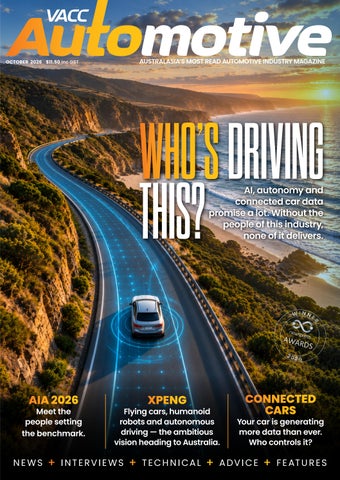
OCTOBER 2026 $11.50 inc GST
AUSTRALASIA’S MOST READ AUTOMOTIVE INDUSTRY MAGAZINE
WHO’S DRIVING THIS? AI, autonomy and connected car data promise a lot. Without the people of this industry, none of it delivers.
AIA 2026
Meet the people setting the benchmark.
XPENG
Flying cars, humanoid robots and autonomous driving — the ambitious vision heading to Australia.
CONNECTED CARS
Your car is generating more data than ever. Who controls it?
N E W S + I N T E R V I E W S + T E C H N I C A L + A D V I C E + F E AT U R E S
The ultimate in
LED replacement
The identical connection system to halogen bulbs Direct Fit is the ultimate way to upgrade your old halogen headlights to the power of LED. 5700K White Light
2 Headlight Bulbs per kit
IP65 Waterproof
Suitable for both Reflector & Projector Headlights
2 Year Limited Warranty
High Output Performance
Easy DIY Installation
Improved thermal management
Suitable for Projector & Reflector
High Output Performance
Premium Fan Cooling
Easy DIY Installation
Suitable for Projector & Reflector
LED Bulb Kit 12V–24V
Halogen Replacement 2500 Lumens per bulb Available in: H4 / H19, H7 / H18, H11 / H8 / H9 / H16, HB3 & HB4
High Stability Light Output
LED Bulb Kit 12V–24V
Halogen Replacement 2000 Lumens per bulb
Easy DIY Installation Premium TST Cooling Suitable for Projector & Reflector
LED Bulb Kit 12V–24V
Xenon HID Replacement
Available in: H1, H3, H4 / H19, H7 / H18, H11 / H8 / H9 / H16, H13, H27 (880/881), HB1 (9004), HB3, HB4, HB5 (9007) & HIR2
Up to 4500 Lumens per bulb Available in: D1S/R, D2S/R, D3S/R, D4S/R, D5S/R & D8S/R
Performance Upgrade with Built-in CANbus
Powered by an external driver module with built-in CANbus, the EVO10K range is ready to light up the night.
POWERING THE EVO10K
LED Bulb Kit
Built-in CANbus
12V
Substantially increased light output
5000 Lumens per bulb
High strength fan cooling & TST (Thermoelectric separation technology)
Halogen Replacement
Available in: H4, H7, H11, HB3
For further details contact Invision Sales: Ph: (03) 9336 2066 www.invisionsales.com * Not Approved for ADR, ECE or DOT
An external power module was required to achieve a stable, high output beam pattern. This module also contains CANbus support which will allow these bulbs to function to their full ability in known problematic vehicles.
CONTENTS This edition of VACC Automotive puts the spotlight on excellence, innovation and the rapid change reshaping our industry.
49 XPeng
XPeng has promised Australia its autonomous driving package, the law has other ideas.
17
We profile a selection of winners from the 2026 Automotive Industry Awards, spanning a range of award categories and businesses. Their stories provide an insight into what set them apart and why they were judged among the best of the best this year — from the way they lead their businesses and support their people, to the standards they set for service, skills and professionalism.
We also look firmly to the future. This edition explores how AI can be used in your business, what the growth of connected car data could mean for automotive operators, and the extraordinary Australian (re)launch of Chinese brand XPeng, with a vision that extends beyond electric vehicles to flying cars and humanoid robots. Together, these stories capture an industry that continues to evolve while recognising the people and businesses setting the benchmark today. As always, we welcome your feedback and story ideas at editor@vacc.com.au.
27
Hayley Barber
The connected car is here
We talk to the winner of the President’s Award – Employee of the Year.
Winner of Best Small Automotive Business – Metropolitan at the 2026 Automotive Industry Awards.
Off-road surge puts motorcycle sales back in gear.
XPeng has promised Australia its autonomous driving package, the law has other ideas.
40
33
Yarra Valley AG
49
Dirt delivers
Australia has no vehiclespecific law governing connected car data; instead it’s a patchwork.
20
36
53
The AI you already have
Waverley BMW
AI is already in your business, how to use it to your advantage.
Winner of Best Large Automotive Business – Metropolitan at the 2026 Automotive Industry Awards.
XPeng
Kate Presnell Bodyworks
Winner of Best Small Automotive Business – Tasmania at the 2026 Automotive Industry Awards
Some more reading... 04 Peter A. Jones
11 Nigel Muller
|
|
07 Daniel Hodges
13 John Khoury
|
|
09 Bruce McIntosh
15 John Caine
|
62 On This Day
57, 672 READERSHIP MANAGING EDITOR Karla Leach | 03 9829 1247 vaccautomotive@vacc.com.au ASSISTANT EDITOR Andrew Molloy DESIGNERS Faith Perrett | Gavin van Langenberg creativeservices@vacc.com.au
CONTRIBUTORS John Caine, Andrew Molloy, Mike Sinclair, John Khoury, Bruce McIntosh, Daniel Hodges, Nigel Muller, Karla Leach ADVERTISING John Eaton | 0407 344 433 jeaton@vacc.com.au
PRESIDENT Craig Beruldsen CHIEF EXECUTIVE OFFICER Peter A. Jones Official publication of the Victorian and Tasmanian Automotive Chambers of Commerce 650 Victoria Street, North Melbourne VIC 3051 03 9829 1111 ABN 63 009 478 209
VACC adheres to its obligations under National Privacy Principles legislation. Information on products and services contained in the editorial and advertising pages of this magazine does not imply the endorsement of any product or service by VACC. VACC Automotive is copyright and no part may be reproduced without the written permission of VACC. Advertisers and advertising agencies lodging material for publication in VACC Automotive indemnify VACC, its directors, board, employees, members, and its agents against all claims and any other liability whatsoever wholly or partially arising from the publication of the material, and without limiting the generality of the foregoing, indemnify each of them in relation to defamation, libel, slander of title, infringement of copyright, infringement of trademarks or names of publication titles, unfair competition, breach of trade practices or fair trading legislation, violation of rights of privacy or confidential information or licences or royalty rights or other intellectual property rights, and warrant that the material complies with all relevant laws and regulations. This publication is distributed with the understanding the authors, editors and publishers are not responsible for the results of any actions or works of whatsoever kind based on the information contained in this publication, nor for any errors or omissions contained herein. The publishers, authors and editors expressly disclaim all and any liability to any person whomsoever whether a purchaser of this publication or not in respect of anything and of the consequences of anything done or omitted to be done by any such person in reliance, whether whole or partial upon the whole or any part of the contents of this publication. Advertising accepted for publication is subject to the conditions set out in the VACC Automotive rate card, available from vaccautomotive@vacc.com.au
Connect with VACC
VACC Automotive
3
NEWS
Making sure our
4
VACC Automotive
industry is heard One of the VACC’s most important responsibilities is making sure the automotive industry has a strong voice with the people who make decisions that affect your businesses. That means engaging with government, but it cannot stop there. Effective advocacy requires relationships across Parliament – with the government of the day and the Opposition, as well as independents and minor parties. We need to sit down with decision-makers from across the political spectrum, explain what is happening on the ground in automotive businesses and make sure they understand the consequences of the policies they are considering. That work is particularly important as we head towards the Victorian election on 28 November. None of us knows what the next Parliament will look like. We do not know which party will form government. Individual MPs may also hold the deciding vote on important legislation. What we do know is that the VACC needs to be able to work constructively with whoever Victorians elect. For me, political engagement is not about party politics. It is about outcomes for members. We have seen why that matters with the Victorian Government’s proposed Work from Home legislation. VACC has been clear from the outset that the proposal does not properly reflect the reality of automotive workplaces. A mechanic cannot repair a vehicle from home. Much of our industry depends on people being physically present because the work itself demands it. We made our position known directly to government and publicly, while also joining with the broader business community to push for a better outcome. The Government subsequently delayed the proposed commencement of the legislation to allow more consultation. Since this article was first drafted, the position has shifted again. On 10 September, the Upper House voted 18–17 to refer the Work From Home Bill to a select committee, following a motion from Shooters, Fishers and Farmers MP Jeff Bourman. The Government had announced further amendments aimed at addressing business concerns, including a later commencement date and greater operational flexibility for employers, but the referral was still carried. The committee is due to report by 20 October, making it unlikely the Bill will pass before the 28 November election. That is a clear demonstration of why engaging beyond the major parties matters. On legislation that directly affects our members,
a crossbench MP can be just as important to the final outcome as a minister. The same principle applies across the other issues we are pursuing. In recent months, our team has met with Consumer Affairs Victoria about the impact of the Fair Fuel Phase 2 scheme and the compliance burden on service station operators. We have also met with the Minister for Roads and Road Safety about accident towing fees and the need for genuine consultation as reforms are considered. We have met with MPs outside government too, including David Limbrick, to discuss proposed changes affecting licensed motor car traders. Our position is straightforward: strong consumer protection is important, but legitimate businesses doing the right thing should not be caught by poorly designed regulation aimed at dishonest operators. We also continue to press the case on apprenticeship reform. Victoria has a serious skills shortage. The answer cannot be to make it harder for employers to take on apprentices by adding another layer of licensing and compliance. As the largest single employer of automotive apprentices in Australia, the VACC understands what employers need if we want more businesses to step up and train the next generation. These conversations do not always produce an immediate win. Advocacy rarely works that way. It is often about putting evidence in front of the right people early and challenging assumptions before they become legislation. It is also about building relationships so that when an issue reaches Parliament, our industry is not an afterthought. That is the value of having a strong industry association representing you. You are busy running your business and looking after your employees and customers. You should not have to track every piece of legislation or find the right person in Parliament to explain why a proposal will not work in an automotive business. That is our job. As the election approaches, the VACC will continue meeting with representatives from across the political spectrum. We will keep putting the priorities of automotive businesses directly in front of candidates and parties, backed by solid policy work and the experience of our members. Governments change and Parliaments change. Our responsibility to members does not. Whoever forms the next Victorian Government, the VACC will be ready to work with them – and with the entire Parliament – to make sure the automotive industry is heard.
"For me, political engagement is not about party politics. It is about outcomes for members."
VACC Automotive
5
GRAB THE FUTURE WITH
AUGMENTED REALITY
THE BG EXPERIENCE APP 6
VACC Automotive
NEWS
Working from home What the latest Fair Work decision means for members The Fair Work Commission has rejected calls for a broader right to work from home (WFH) under the Clerks – Private Sector Award 2020, instead supporting an approach that allows employers and employees to determine flexible working arrangements by agreement. For VACC members employing administrative and office staff covered by the Clerks Award, the decision provides welcome clarity about how WFH arrangements should be managed and confirms the view that workplace flexibility is best regarded as a matter for agreement rather than entitlement.
What happened? The Fair Work Commission recently considered whether employees covered by the Clerks Award should be granted stronger rights to work from home. After reviewing extensive evidence, the Commission found that WFH arrangements are already widely used in clerical employment and that most employee requests are approved, either fully or partly. The Commission concluded that the evidence did not support significant regulatory intervention requiring employers to provide broader access to WFH arrangements. Instead, it adopted a facilitative model that encourages employers and employees to reach agreement on flexible working arrangements. As a result, a limited number of changes to the Clerks Award have been made to facilitate flexible working arrangements where working from home is suitable for both parties.
What does this mean for employers? Importantly, the decision does not give employees an automatic right to work from home, nor does it require employers to approve WFH requests. Where working from home benefits both the employee and the business, the changes provide greater flexibility to agree on how ordinary hours and breaks are managed. This may be particularly useful where an employee wishes to vary their working hours while working from home for personal convenience. The Commission also rejected proposals to expand the Award's ordinary spread of hours. However, it indicated that where an employee chooses to work outside ordinary hours for their own convenience, rather than at the direction of the employer, overtime would generally not apply. Importantly, the Commission confirmed that the new WFH provisions would not alter existing entitlements relating to overtime, shiftwork, weekend work or public holiday rates.
What should VACC members do? Employers with staff covered by the Clerks Award should: •
review existing work from home or hybrid working arrangements;
•
ensure any agreed arrangements are documented in writing;
•
clearly identify agreed working hours and expectations;
•
distinguish between flexibility requested by the employee and arrangements directed by the employer; and
•
seek advice before implementing arrangements involving weekends, public holidays or work outside the Award’s ordinary span of hours.
The key takeaway The decision reinforces that workplace flexibility is best achieved through practical workplace arrangements that balance the needs of employees with the operational requirements of businesses. For VACC members, the outcome confirms that employers retain discretion when assessing WFH requests while maintaining the ability to agree on flexible arrangements that suit both parties. The decision is therefore consistent with VACC’s long-held position that workplace flexibility is most effective when determined at the workplace level rather than through prescriptive legislative or industrial regulation.
Need help? Members with questions about working from home arrangements, the Clerks Award or their workplace obligations can contact the VACC Workplace Relations team on 03 9829 1123 or ir@vacc.com.au.
Daniel Hodges
Workplace Relations
Contact ir@vacc.com.au for more information.
VACC Automotive
7
8
Australasian Automotive
NEWS
Tasmania's ageing fleet
The case for targeted roadworthy reform Tasmania has an unusual set of numbers. The state records the highest vehicle-per-capita rate in Australia — 895 vehicles per 1,000 people, 17 per cent above the national figure of 764 — across a registered fleet of roughly 516,000 vehicles. On an island where public transport thins out quickly beyond Hobart and Launceston, that dependency is structural rather than discretionary. It sits alongside a second number that should interest anyone operating a workshop, dealership, or inspection facility in this state. Tasmania's passenger fleet averages 13.2 years, against a national average of 11.3. Light commercials run to 14.1 years, compared with 11.6 nationally. That's the oldest registered fleet in the country, being asked to do more work per head of population than any other.
The market behind the fleet age Around 20,146 new vehicles were sold in Tasmania in 2025. Against a national total of more than 1.24 million, that's a modest share — and on a per-capita basis the state under-indexes significantly on new vehicle purchase, reflecting lower median household incomes and higher effective transport costs. The used market tells the more important story. Roughly 48,931 vehicles changed hands secondhand last year, more than double the new vehicle figure. For Tasmanian automotive businesses, that ratio is the defining commercial fact of the market. Acquisition happens predominantly through used channels, and that is precisely where
fleet age concerns concentrate.
tracking to a similar annual figure.
Nor is renewal likely to accelerate on its own. Nationally, 65 per cent of consumers report holding onto vehicles longer because of cost-ofliving pressure. On the electrification side, 38 per cent say they are open to buying an EV next time, but the barriers are consistent and practical: cost is cited by 53 per cent, absence of home charging setup by 43 per cent, and lack of public charging by another 43 per cent. Those national concerns are amplified here by limited fast-charging outside the major centres. Meanwhile 65 per cent expect their next purchase to be an SUV or ute, and consumers report willingness to pay an average premium of just 2 per cent for an EV.
Set against current Approved Inspection Station activity, that's a manageable increment. Total AIS inspections grew from 48,010 in 2024 to 50,495 in 2025, a 5.2 per cent rise, with lapsed and cancelled registration work the dominant category at 27,363 and interstate transfers at 11,828. Adding roughly 5,000 to 5,200 inspections annually represents about a 10 per cent lift on existing workload.
Translation for the trade: the internal combustion parc is going to remain the bulk of the servicing workload for some time yet, and it is ageing.
Where reform comes in Tasmania remains one of the few Australian jurisdictions without a compulsory roadworthy inspection at change of ownership. TACC's position is a targeted scheme covering vehicles 20 years and older at point of sale and registration transfer. The volumes are known rather than estimated. In 2025, 5,211 vehicles aged 20 years or more were transferred — around 10 per cent of all used transactions. The first quarter of 2026 recorded 1,569,
That is real, forecastable volume for inspection businesses — but it also requires capacity ahead of implementation. A scheme that outruns inspectorate capacity produces delays, and delays erode consumer confidence in the process. TACC has advocated for investment in AIS capacity ahead of any scheme start date for exactly that reason.
The industry position The argument for targeting 20-plusyear-old vehicles is that it addresses the highest-risk segment without imposing friction on the far larger volume of transactions involving newer, safer vehicles. Vehicles built before 2010 typically lack autonomous emergency braking and lane departure warning, and don't meet the structural crash performance of current designs. For the Tasmanian trade, fleet renewal and inspection reform aren't competing agendas. They're the same one.
Bruce McIntosh TACC Manager
You can contact Bruce at enquiries@tacc.com.au
VACC Automotive
9
DISC BRAKE ROTOR
RIGHT FIT, FIRST TIME! Engineered with Bendix’s proven metallurgy, the new General CT™ Disc Brake Rotors deliver superior heat dissipation to eliminate brake fade under demanding conditions. That means reduced comebacks, longer rotor life, and increased customer satisfaction.
FOR EVERY CUSTOMER. FOR EVERY BRAKE JOB. EBACKS REDUCE COM STOMER CU INCREASE IO N T C SATISFA HOP TRUST S BUILD WORK HT BENDIX SELL THE RFIG ST TIME SOLUTION IR
Progressive visual indicator Quick-check disc brake rotor wear
For optimum performance, match General CT™ Disc Brake Rotors with Bendix General CT™, 4WD/SUV™ and Heavy Duty™ Disc Brake Pads.
SCAN TO LEARN MORE. u/
rs
isc-brake-roto
d 6 1800 819 66 product-range/general-ctbendix.com.a
BENDIX. RIGHT FIRST TIME. EVERY TIME.
NEWS
Red tape must not become a barrier to apprenticeships Australia needs more skilled workers, and automotive is no exception. Across our industry, businesses are looking for qualified technicians and the next generation of people who will build their careers in the trades. Apprenticeships are central to meeting that need. But every apprenticeship opportunity starts with an employer willing to take someone on, invest in their training and support them through the years it takes to become qualified. At the VACC, we employ 610 apprentices, so we understand firsthand the responsibility involved. That commitment should never be taken for granted. Businesses provide wages, supervision, equipment, practical training and the workplace experience that allows an apprentice to develop their skills. Employers also manage workplace safety, industrial relations requirements, training obligations and the everyday pressures of running a business. For many automotive businesses, particularly smaller workshops, taking on an apprentice is a major commitment. That is why governments need to be careful about continually adding new layers of regulation, licensing and administration to the apprenticeship system. Every additional form, registration process, reporting requirement or licence might appear minor when considered in isolation. But for employers, the cumulative impact can be substantial. Time spent managing unnecessary administration is time taken away from customers and the apprentice themselves. More importantly, increasing the cost and complexity of employing apprentices risks changing the decision employers make about whether to participate at all. I regularly speak with automotive businesses that genuinely want to support the next generation. They understand the importance of developing skilled people and take enormous pride in seeing an
apprentice progress from their first day in the workshop through to becoming a qualified tradesperson. What we cannot afford is to make that commitment increasingly difficult. There must always be appropriate standards around safety, training and supervision. Apprentices deserve safe workplaces and quality training, and employers have an important responsibility to provide both. But good regulation needs to be proportionate. Introducing additional licensing or registration requirements simply because another layer of oversight appears desirable does not necessarily produce better outcomes. In some cases, it can duplicate obligations that employers are already meeting through existing workplace, safety, training and employment frameworks. Before introducing another requirement, government should first ask whether there is a genuine problem that needs to be addressed and whether existing systems can deal with it. It should also understand what the change will mean for the businesses expected to implement it. That is where genuine consultation with employers and industry becomes essential. Automotive businesses operate in the real world. They are managing customers, staff, rising costs, changing technology and increasingly complex compliance obligations. Most are not large organisations with dedicated teams to manage regulation and paperwork. When government is considering changes that affect apprenticeship employment, those businesses need to be part of the conversation early. Consultation should not occur after the major decisions have effectively been made. Industry should have an opportunity to explain how
proposed requirements will operate in practice and identify unintended consequences before they become embedded in regulation. The question should always be: will this make it easier or harder for a good employer to give someone an apprenticeship opportunity? If the answer is harder, we need to think carefully about whether the additional regulation is justified. This matters because the consequences extend well beyond individual businesses. When an employer decides that taking on an apprentice has become too complicated or carries too much administrative risk, a young person can miss the opportunity to start a trade. The industry loses a future skilled worker and existing workforce shortages become more difficult to address. We cannot continue talking about the need to address skills shortages while simultaneously making it more difficult for businesses to train the people we need. Employers are an essential part of the apprenticeship system. Government policy should recognise that and encourage more businesses to participate. That means removing unnecessary barriers, avoiding duplicate licensing and keeping administrative requirements practical and proportionate. It also means listening to the businesses that employ and train apprentices every day. If we want more people entering automotive trades, completing their apprenticeships and building longterm careers in our industry, we need employers who are prepared to give them that opportunity. Government should be making it easier for them to say yes, not giving them more reasons to say no.
Nigel Muller
Membership and Training
Contact autoapprenticeships@vacc.com.au for more information.
VACC VACCAutomotive Automotive 1111
12
VACC Automotive
NEWS
Estimate or quote? Why the difference matters in motor repair In a busy retail workshop, “estimate” and “quote” get used casually, and often interchangeably. It is an easy habit to fall into, and a risky one. For Australian repairers, the distinction is not just a matter of good communication. It shapes customer expectations, it tends to decide who comes out on top in a billing dispute, and it carries real weight under Australian Consumer Law.
What an estimate actually is An estimate is an informed approximation of the likely cost of work. It is the right tool where the full extent of the repair is not yet known, such as before diagnosis, dismantling or inspection. A workshop might estimate the cost of investigating an engine fault or repairing accident damage, while making it clear that the final figure may change once the vehicle has been properly assessed. The key point is that an estimate is a guide rather than a fixed price, and the paperwork should look like it.
And what a quote is A quote, by contrast, is generally a fixed price for a clearly defined scope of work. If the customer accepts it, that quote may form part of the repair contract. The repairer should not exceed the quoted amount or carry out additional chargeable work unless the customer has authorised the change first. That makes specificity essential. A proper quote identifies the work to be
done, the parts to be supplied, labour charges, GST, exclusions, assumptions and the period for which the quote remains valid. Anything vaguer is really an estimate wearing a quote’s clothing.
The job that changes underneath you Motor repair work often begins in uncertainty. A noise appears to come from one component and then, after removal or testing, reveals another fault entirely. A seized bolt, hidden collision damage or an unavailable part can all rewrite the job. In these situations the safest approach is to describe the first figure as an estimate and obtain the customer’s authority to diagnose, inspect or dismantle up to a stated limit. Once the full scope is known, the repairer can provide a firm quote before going any further. Two documents, two purposes, and no confusion about which one the customer agreed to.
Put it in writing, and keep it clean Clear written communication is critical. Repairers should avoid phrases such as “about $1,500” on a document headed “Quote” unless they are prepared to treat that amount as fixed. If the word quote sits at the top of the page, a tribunal
or an unhappy customer will read the number underneath it as a promise. An estimate should say that it is indicative only, explain why the final price may vary, and set out when the customer will be contacted for further approval. If additional work becomes necessary, pause and obtain express authorisation before carrying it out. Record who approved it, when it was approved and what amount was approved. A file note, a text message or an email trail costs nothing and settles the arguments that otherwise come down to one person’s memory against another’s.
Good terminology builds trust There is a commercial upside here too. Customers are far more likely to accept a changed price when they were told from the outset that the first figure was an estimate and that further approval would be sought. It is rarely the cost that damages a workshop’s reputation. It is the surprise. So the rule is a simple one. Use “estimate” when the cost is uncertain, use “quote” when the price and scope are fixed, and never let the paperwork promise more certainty than the workshop can reasonably give.
John Caine
Business and Consumer Affairs
Email jcaine@vacc.com.au for consumer affairs guidance.
Disclaimer: This article is general in nature only and should not be considered legal advice. For specific guidance regarding consumer guarantees and your individual circumstances, please consult with a qualified legal professional or relevant regulatory body.
VACC VACCAutomotive Automotive
13 13
ENSURE CLEAR VISION WITH
OUR WIPERS Force
Shield
Tech
Exact Fit
Clear
Ultra
® Premium beam blades engineered for superior windshield contact and high performance in all weather.
® Advanced frameless design for superior performance in all conditions.
® Budget-friendly conventional blade made from strong galvanised steel and 100% natural UV treated rubber.
® Weather-resistant hybrid wipers for Japanese and Korean vehicles.
® Tailored wipers that ensure a perfect match for your vehicle, maximising ease of installation.
® Premium conventional blade that offers flawless performance and exceeds OE standards.
WIPERS SAFETY CHECK
TRICO’S UNMATCHED QUALITY
WIDE PRODUCT RANGE
No matter the weather, ensure your wipers are inspected before you hit the roads!
Trico are the only wipers tested to 3 x OE standards (1.5m cycles)
Trico wipers fit more vehicles than anyone else!
tricowipers.com.au
SCAN THE QR CODE to find the right wipers for your vehicle
14
Australasian VACC Automotive Automotive
NEWS
Advocacy that keeps automotive moving Every workshop owner, technician and dealer principal knows the pressure points: customers delaying repairs because budgets are tight, insurers squeezing collision repair margins, compliance costs climbing, apprentices harder to attract and retain, and new technologies arriving faster than many businesses can afford to retool. These are not simply the costs of doing business; they are the daily realities of keeping vehicles safe, businesses viable and people employed. That is why advocacy matters. When theVACC and MTAA take these concerns to ministers, departments and regulators, they are not simply arguing for “business”. They are explaining how government decisions land on the hoist, at the parts counter, in the spray booth and across the family-owned businesses that keep Australia mobile.
Locked out of the job Right to repair shows advocacy at its most practical. A modern vehicle can arrive with a fault light on, a software-controlled component, or a service history locked behind a manufacturer portal. Without fair access to that data, the local workshop is not just inconvenienced; it is locked out of work it is qualified to perform. The VACC’s push to expand the Motor Vehicle Service and Repair Information Sharing Scheme rests on member evidence: fair access supports competition and consumer choice. Cost-of-living pressure is another front. Too many motorists are deferring servicing, tyres and crash
repairs, and for a workshop that looks like a customer declining rear tyres close to the legal limit, or asking for “just enough to get by” because the mortgage came first. The decision may feel unavoidable to the motorist. To the industry, it is a road safety red flag, and why the VACC has argued for targeted support to keep safe vehicles on the road.
Targets do not service cars The transition to zero-emission vehicles is a further case in point. Governments are setting ambitious targets, but targets do not service cars. Technicians do. Workshops need high-voltage training, insulated tools, battery handling procedures and premises upgrades. If a state licensing scheme forced workshops to call an external electrician before a qualified technician could safely depower an EV, the result would not be better safety. It would be more red tape, longer waits and fewer repairers willing to take on the work. Skills shortages remain one of the industry’s most serious constraints, with persistent gaps across mechanics, panel beaters and vehicle painters. Every member can put a face to the data: the apprentice who leaves because the wage gap is too wide; the regional workshop with no second technician. Advocacy on apprentice incentives, skilled migration and training pathways is a workforce
plan for an essential industry, not a plea for special treatment. Collision repairers, meanwhile, know the pressure of unrealistic repair times, disputed methodologies and delayed approvals, and the MTAA’s work on the Motor Vehicle Insurance and Repair Industry Code of Conduct is about restoring balance and enforceability. In retail, the Motor Car Traders Act review shows why industry must be at the table before rules are rewritten: a licensed dealer should not lose a sale to a backyard operator dodging every obligation legitimate businesses carry.
Turning frustration into influence The value of the VACC and MTAA is that they connect the front counter to the cabinet room. They gather member evidence, brief MPs, respond to consultations and keep issues alive long after the headlines move on. But advocacy is only as strong as the evidence behind it: the invoice showing an insurer dispute, the job card showing a delayed safety repair, the vacancy that cannot be filled. These details matter. The industry does not need slogans. It needs practical policy, fair regulation and decision-makers who understand the consequences of their choices. In a period of economic pressure and rapid change, that voice is not optional. It is essential to keeping businesses open, workers skilled, motorists safe and Australia moving.
John Khoury Industry Policy
Reach out to policy@vacc.com.au for more detail.
VACC Automotive
15
NEWS
GET THE BONUS TOOLS YOU WANT - ON US! SIMPLY PURCHASE ANY SPECIALLY MARKED SP TOOLS PRODUCTS FROM EITHER ANY SP TOOLS DEALER NATIONWIDE OR FROM THE SP TOOLS ONLINE STORE AND YOU WILL THEN BE ELIGIBLE TO RECEIVE THE SP APPRENTICE CASH AMOUNT ASSOCIATED WITH THAT PRODUCT, IN ONLINE VOUCHERS, TO USE TOWARDS YOUR NEXT PURCHASE ONLINE AT WWW.SPTOOLS.COM
WHAT YOU CHOOSE TO SPEND YOUR EARNED SP APPRENTICE CASH ON IS ENTIRELY UP TO YOU!
APPRENTICE CASH
REDEEM your APPRENTICE CASH THROUGH THE SP TOOLS ONLINE APPRENTICE PAGE: www.sptools.com/apprentice 16
T’s & C’s Apply - SP Apprentice Cash redemptions are available to current apprentices only. VACC Automotive Check out the Apprentice Cash Page at SPTOOLS.COM for full details.
NEVER IDLING
MEMBER NEWS
Payroll, parts, policies and a whole new inventory system. Hayley Barber's award-winning year - and why she's already onto the next thing. VACC Automotive
17
Hayley Barber walked into her brother’s wrecking yard to lend a hand. Ten years on she has won the President’s Award – Employee of the Year for Victoria and Tasmania — and is already onto the next thing. Count what passes through one pair of hands in a year at Ballarat Performance Auto Wreckers. Between three and five hundred parts photographed, tagged, listed and shelved every week. Seven people’s pay, run weekly without fail. An entire inventory system chosen, negotiated and rolled out. A fire evacuation plan drawn up from nothing. An OH&S policy, a bullying policy, a shelf of written procedures for every job in the building, and the training to go with them. Accounts payable and receivable, freight, customer complaints, and the phone ringing through all of it. That is Hayley Barber’s year. In 2026 it earned her the President’s Award – Employee of the Year for Victoria and Tasmania.
18
VACC Automotive
A family with oil under its fingernails Hayley didn’t so much choose the automotive industry as grow up inside it. Her parents ran their own automotive business, so the trade was simply what the family did — the conversation at the dinner table, the place everyone ended up on a Friday night. So when her brother Nathan started Ballarat Performance in 2016, chasing a gap nobody in the wrecking market was filling — performance and uppermarket vehicles, the optioned and tuned cars, HSV and FPV, alongside a deep 4WD range — Hayley came in to help him get it off the ground. “She was meant to be helping out,” Nathan says. “Neither of us can tell you when that stopped being the arrangement. At some point I realised I couldn’t take a day off without ringing her twice.” Ten years on, the business runs seven
staff, stocks around 20,000 parts and operates a VACC-accredited workshop alongside the yard — car servicing at one end, V8 conversions and engine builds at the other. Hayley’s title is Administration and Payroll Manager. It undersells her considerably.
The learner The pattern running through all of it is that Hayley cannot leave a thing halfunderstood. When the business needed a new inventory system, she didn’t learn the part that touched her own desk. She learnt the whole of it — the seminars, the Zoom calls, the contracts, the meetings with lawyers before anything was signed — and pushed the vendor to shape the build around how a wrecking yard actually runs, not how software companies imagine one does. “I can’t only learn half of something,” she says. “I go the full way and leave nothing unturned.” The eBay figures show what that was worth. Since the new system went in,
sales through the channel have climbed by around 40 per cent — on barely any change in the number of items sold. Parts catalogued, photographed and listed properly are simply worth more.
Writing it down Then she taught it. Her guide to scrapping a vehicle runs a staff member through the job end to end — check the donor car listing, print the tags, mark off anything damaged, photograph and bag the fragile parts, scan each one into its shelf location — and closes with a tick-box checklist so nothing is left to memory. There is a growing library of them, covering the jobs that trip people up — EFTPOS surcharges in Xero, eBay postage labels, reconciling refunds. The point is not paperwork for its own sake. “I write policies and procedures so new and current employees know they are doing the job correctly,” Hayley says. “It makes everyone’s life easier in the long run. In this industry we can’t afford for these procedures to be done wrong.”
Why the staff stay For the past three years Hayley has been studying mental health alongside the job — four days a week in the business, one day with her books. It shows in how she works. She runs the staff meetings, but also the quiet conversations — the one-on-one when someone isn’t travelling well, the check-in during the weeks when the yard is flat out and tempers fray. The result is a retention record most small workshops would envy. Every current employee has been there more than twelve months; several for more than four years, in a business only ten years old. “Good staff are hard to find and harder to keep, and replacing one sets you back months,” Nathan says. “We don’t lose them. That comes down to Hayley.”
The face of the business The public side has shifted too. Since Hayley began making the workshop’s video content — voiceovers, walk-
"She was meant to be helping out," Nathan says. "Neither of us can tell you when that stopped being the arrangement. At some point I realised I couldn't take a day off without ringing her twice."
arounds of the latest donor car, replies to the comments — a single post has gone from fewer than 2,000 views to more than 23,000. The Google page sits at 4.2 stars across more than 200 reviews, one of which singles out the young woman on reception who knew exactly which part the customer wanted. That detail is worth sitting with. Women remain a small minority of the automotive workforce, and smaller still outside the front office. But the work Hayley does — selecting systems, reading contracts, writing safety policy, designing training, steering the parts operation that has become the business’s strongest sales channel —
cuts straight across the old line between the office and the workshop floor. She keeps learning in public, too — seminars, networking with eBay, Manheim, WorkSafe and the VACC, and courses she goes hunting for on behalf of the staff as much as herself. The award recognises what she has built. Ask her about it and the conversation slides forward within a minute — to the next system, the next process, the thing that could run better than it does. “You can’t stand still in a wrecking yard,” she says. “Something new turns up on a truck every morning.”
VACC Automotive
19
MEMBER NEWS
MORE THAN MACHINERY
20
VACC Automotive
The people behind YARRA VALLEY AG
For Yarra Valley Ag, winning Best Small Automotive Business – Metropolitan at the 2026 Automotive Industry Awards is recognition of something the Lilydale business has been building for decades: a strong team, deep product knowledge and a determination to look after customers well beyond the initial sale. The business traces its history to 1948 and was formerly known as Rural Farm Equipment. Today, from
VACC Automotive
21
while Emma, who joined in 2020, manages office administration and supports the accounts function. That progression tells an important part of the Yarra Valley Ag story. Rather than seeing training as a box to tick, the business has made development part of the way it operates. Mechanics undertake regular manufacturer and industry training to keep pace with changing machinery and technology. Sales staff participate in product training, supplier open days and mentoring programs, while the parts team continues to build its expertise in inventory management and supplier relationships. its Maroondah Highway premises in Lilydale, Yarra Valley Ag supplies, services and supports machinery used across farming, horticulture, contracting, local government, hire businesses, wineries and residential property maintenance. Its range includes machinery from Kubota, Husqvarna, Segway, Landboss and other leading brands, backed by sales, spare parts and workshop support. At the centre of the operation are Roger and Michelle Anderson. Roger joined Rural Farm Equipment in 1985, working his way through
spare parts and sales before moving into management and ultimately ownership. Michelle joined in 1999 and brings extensive experience across administration, payroll and business operations. The next generation is now firmly part of the business. Sons Jake and Lachlan Anderson and daughter-inlaw Emma Anderson have each taken on important roles. Jake, who joined in 2018, progressed from the parts department to become Sales Manager. Lachlan similarly developed from parts interpreter to Parts Manager,
"Rather than seeing training as a box to tick, the business has made development part of the way it operates."
22
VACC Automotive
The investment pays off where it matters most: helping customers get the right machine and keeping it working. Yarra Valley Ag’s team includes 16 employees, seven mechanics, two workshops and four onsite repair vehicles. Its service capability extends from workshop repairs to field service, allowing technicians to travel to customers when machinery cannot easily be brought into Lilydale. The business can also service and repair a broad range of farm machinery beyond the brands it sells, while maintaining an extensive spare-parts inventory to help customers minimise downtime. For agricultural businesses, councils, contractors and other operators, downtime can quickly become expensive. That makes the people behind the counter, in the workshop and on the road just as important as the machinery itself.
The wider team reflects that approach. Christian Manna works across parts and service, assisting with parts enquiries, service bookings and workshop support, while Dave Anderson brings more than 15 years of automotive and sales experience to the sales team. The mechanical team includes Ben Midgley, Damian O’Leary, Junior Marshall, Alfie Idjao and Carlton Lopez, while VACC apprentice mechanic Joseph Maruzza represents the next generation of technical capability being developed within the business. Customer service is also deliberately structured around follow-up. After a machine is sold, the team contacts customers by phone and email to check how the machine is performing, answer questions and address concerns. The business actively seeks feedback and its strong customer satisfaction results and five-star reviews recognise the knowledge, responsiveness and workmanship of individual staff. That focus has been recognised beyond the AIA. Yarra Valley Ag received a Kubota Silver Dealer Excellence Award in 2025 and was also recognised for Best Heavy Machinery Display at the Wandin Silvan
VACC Apprentice Joseph Maruzza at work.
Field Days, reflecting both its dealer standards and its ongoing presence in the local agricultural community. The business is also working to improve how it operates behind the scenes. Mechanics use iPads for job documentation rather than printed job cards, invoices and quotes are increasingly handled electronically, and waste streams including filters, wood, cardboard and steel are separated for recycling. These changes may be practical rather than flashy, but they demonstrate the same
mindset that runs through the rest of the business: keep improving. For a company with roots stretching back more than 75 years, Yarra Valley Ag has managed to combine continuity with change. It remains a family-led business, but its success is clearly shared across the broader team. The 2026 AIA award recognises a small business with a large service footprint — one built on skilled people, strong product knowledge and long-term relationships with the customers and communities it serves.
A family affair: Michelle and Roger Anderson, with sons Jake and Lachlan, and daughterin-law Emma.
VACC Automotive
23
WORKSHOP EQUIPMENT & DESIGN
DISCOVER MORE
Explore our range of products or contact us to discuss how we can assist with your workshop. Free call 1800 685 577.
FLUID PUMPS
RAASM pumps have been an industry favourite for over 20 years. Ensuring performance and reliable flow throughout a workshop.
VEHICLE HOISTS
Space, operator experience and vehicles being lifted all contribute to selecting the right mix of 2 post and 4 post hoists for your workshop.
PIPE WORK & HOSE REELS Stainless steel pipework for air, water and oil all help ensure product integrity and distribution throughout the largest of workshops.
Member
tecalemit.com.au 24
VACC Automotive
Nostalgia sells, but will the faithful buy it? There's something powerful about a familiar badge.
In an industry undergoing one of the biggest technological shifts in its history, carmakers are increasingly looking backwards to move forward – reviving classic nameplates and reimagining them for a new generation. Ford's latest Bronco announcement in Melbourne is a good example. The Bronco name dates back to 1966, but the Australian-bound Basecamp is a long way from the rugged offroader that first wore the badge. Due in the second half of 2027, it's a Chinese-built monocoque SUV with an extended-range electric powertrain, its 1.5-litre petrol engine acting purely as a generator. It doesn't even share a platform with America's body-on-frame Bronco. Ford is far from alone. Honda has revived the Prelude, a nameplate that disappeared more than two decades ago. Rather than recreating the sporty coupés of the 1980s and 1990s, it's back as a hybrid grand tourer. It keeps the idea of an
accessible driver's car, but wraps it in electrification and digital technology. Renault has brought back both the 5 and the 4 in Europe as electric vehicles. The 5 in particular shows how nostalgia can soften the transition to electrification. It looks deliberately familiar, but underneath it's an entirely modern EV. None of this is new, of course. A quarter of a century ago, BMW turned the utilitarian British Mini into a premium lifestyle product, while keeping its round headlights, short overhangs and wheels-at-the-corners stance. Volkswagen pulled off much the same trick with the New Beetle. The original was rear-engined and air-cooled; its successor was front-engined and frontwheel drive. Visually, though, there was no mistaking where it came from. Others have taken a different route. Toyota's GR Supra stuck with the front-engine, rear-wheel-drive formula, while Alpine recaptured the original A110's light, agile character. Land Rover went further with the Defender, trading its ladder frame for an aluminium monocoque and independent suspension, while retaining those upright proportions. The most dramatic reinvention belongs to Hummer. Once synonymous with thirsty V8s and military-inspired excess, the badge returned in the USA as the GMC Hummer EV, an all-
electric performance off-roader. These examples reveal a shift in how manufacturers use heritage. The first wave of modern retro cars was largely about design. The New Beetle, MINI and Fiat 500 were familiar shapes rebuilt with modern mechanicals. Today, heritage is increasingly used to introduce new technology. EVs, hybrids and new vehicle architectures can feel unfamiliar to buyers, and a famous badge offers an emotional shortcut. Customers may not understand a new EV platform, but they understand names like Bronco, Prelude and Defender. The challenge is making sure the badge still means something. The most successful revivals do more than copy old styling. They identify what made the original special – simplicity, performance, practicality, adventure or personality – and reinterpret it for modern customers. But famous names come with long memories. For the rusted-on enthusiast who spent weekends under a '80s Bronco or chasing the redline in a VTEC Prelude, a range-extender SUV or an electric Hummer can feel less like a revival and more like a borrowed identity. Manufacturers are betting that nostalgia can lead new buyers towards new technology. The real test is whether it can bring the faithful along too – or whether, for those who remember the originals, some badges are best left in the shed.
VACC Automotive
25
26
VACC Automotive
THE CONNECTED CAR IS HERE. THE RULEBOOK ISN'T.
VACC Automotive
27
By Mike Sinclair
A vacuum with four landlords
The Australian Signals Directorate expects 93 per cent of new vehicles sold in Australia to be internetconnected within five years. Each one is a data-generating computer, collecting information about the vehicle and the people inside it and transmitting it to systems controlled by the manufacturer.
Australia has no vehicle-specific law governing connected car data; instead it’s a patchwork. The Privacy Act 1988 applies only because vehicle data is personal information; the Act says nothing about vehicles. Beneath it sits the Federal Chamber of Automotive Industries' (FCAI) voluntary code of conduct for automotive data, published in 2023 – a code not registered with the Office of the Australian Information Commissioner (OAIC). The Motor Vehicle Service and Repair Information Sharing Scheme, in force since July 2022, obliges manufacturers to share repair information with independent workshops – but expressly excludes data generated and transmitted while the vehicle is driven, along with GPS data. And no Australian Design Rule yet covers vehicle cyber security.
The law governing all of this was written in 1988. That mismatch has significant implications given the arrival of AI. Connectivity is now standard across the mainstream market and will soon expand through agentic in-vehicle technology, scaling at a pace no Australian regulatory process is currently scoped to meet. Rarely has legislation been so far behind technology – and for the businesses that sell, service, repair, tow and dismantle Australia's vehicles, the gap is far from academic.
28
VACC Automotive
Responsibility for filling the regulatory and legislative gaps is split across at least four Commonwealth
portfolios – Treasury, Infrastructure, the Attorney-General's Department and Home Affairs. The enforcement picture, meanwhile, points somewhere the political debate does not. While parliamentary questioning has focused on Chinese-made vehicles, the OAIC's two open connectedvehicle investigations concern Toyota and Hyundai, confirmed in answers to Senate Questions on Notice in April. In January, the regulator's first in-person privacy compliance sweep examined six sectors. Car dealerships were one of them. The scheme's enforcement record has just acquired a second entry. After a single infringement notice in its first four years – Honda, $18,780, over subscription-only diagnostic software – the ACCC filed Federal Court proceedings against Subaru Australia in August, its first court action under the scheme. The regulator alleges that between
July 2022 and August 2024 independent repairers were not offered software and technical information on the same basis as Subaru dealerships. The allegations are untested, but the case will define what the scheme's obligations actually mean. There is movement on the privacy side too. On 31 August, the Attorney-General's Department released the exposure draft of the Privacy Amendment (Personal Data Protection) Bill 2026 – roughly 40 proposals, including a fair and reasonable test for all handling of personal information and, notably, specific regulation of geolocation tracking data. Submissions closed on 18 September. Tellingly, the proposed right to erasure is confined to large digital platforms. It does not reach carmakers.
The stream Inside this vacuum, the sharpest contest is over telematics. Asked
for an example of a repair an independent workshop can no longer complete, Australian Automotive Aftermarket Association chief executive Stuart Charity declined the premise. "The issue is not that an independent workshop suddenly becomes technically incapable of completing a repair," he said. "The issue is that the vehicle is increasingly communicating diagnostic and service information directly to the manufacturer's server while it is being driven." The vehicle identifies a fault; the manufacturer or dealer network contacts the customer – often through the car itself. "At that point, the independent repairer may never get the opportunity to compete for the job." The FCAI does not support extending the scheme to telematics without what it says is a clearly demonstrated
repair need. It argues the stream carries far more than repair data – location, journeys, driving behaviour, account information – and that any mandated access would need strict authentication, permitteduse controls and clear liability. Nor do UN vehicle standards, which will help form new ADRs, solve cybersecurity concerns. These will govern how manufacturers manage risk, not who may access data. Charity's answer: "Cybersecurity should determine how access occurs – authentication, permissions, safeguards and auditing – not whether consumers can choose an independent repairer at all."
The handover The second pressure point arrives at every change of the vehicle’s ownership. A traded vehicle can carry the previous owner's contacts, call logs, home address and saved destinations – plus a live connected-
"Rarely has legislation been so far behind technology - and for the businesses that sell, service, repair, tow and dismantle Australia's vehicles the gap is far from academic."
VACC Automotive
29
VACC's view
Connected vehicles are changing the way cars are diagnosed, serviced and repaired, and regulation needs to keep pace.
Our position is clear: motorists must continue to have genuine choice over who services and repairs their vehicle. Where vehiclegenerated or telematics data is reasonably required to diagnose, service or repair a car, qualified and appropriately credentialled repairers should be able to access it with the vehicle owner’s authorisation. Cybersecurity and privacy protections are essential, but they should determine how information is accessed securely — not become a barrier to legitimate repair and maintenance.
There also needs to be greater clarity around connected vehicle data when a car changes hands. Consumers and automotive businesses would both benefit from a consistent industry-wide process for removing personal information and disconnecting previous owners from vehicle accounts.
Technology is moving quickly. Australia’s regulatory framework must move with it while protecting consumers, supporting competition and giving automotive businesses clear, workable rules.
30
VACC Automotive
"... from our understanding several OEMs have made data deletion of trade-ins a requirement". services account. Manufacturer systems typically involve two separate switches: an in-car reset, and a separate account termination on the departing owner's phone.
Some brands, some dealerships, no common standard – a customer's protection currently depends on which showroom the car passes through.
The FCAI distinguishes three categories of data – in the vehicle, in the account, and in manufacturer systems – and acknowledges a factory reset may address only the first.
Voortman's offer stands on the record: "AADA would be very much open to working with the FCAI or indeed the regulator to develop an industry standard."
Whose job is the rest? The FCAI says no standard change-ofownership process is prescribed, and the outgoing owner is primarily responsible. The Australian Automotive Dealer Association (AADA) describes something different on the ground: numerous dealers are embedding data deletion into used car reconditioning and, in chief executive James Voortman's words, "from our understanding several OEMs have made data deletion of trade-ins a requirement".
Getting it right The AADA and AAAA both support secure, credentialled, consumer-authorised access rather than manufacturerexclusive control. Indeed, sensible regulation here can benefit all. Treasury's response to the rightto-repair review, and the privacy consultation which closed last month, are the first tests of whether the framework can keep pace with the technology, because one thing’s for certain: the technology is not going to wait.
Bosch Automotive Technical Training Bosch offers training courses tailored to all levels of knowledge and experience. With the support of one of the world’s leading automotive innovators and manufacturers, Bosch Technical Training will provide you with the competitive edge. Experience Bosch Automotive Technical Training, the highly recommended program, where technicians can master new technologies and systems by learning from global industry experts. ■
Learn specialised industry-derived knowledge from a leading OEM partner.
■
Gain the competitive advantage with Bosch technical knowledge.
■
Reduce the safety risk, increase efficiency with Bosch training.
Scan the QR code to book from all Bosch training courses VACC Automotive
31
NEWS
DIVERSIFY YOUR WORKFORCE AND SHIFT THE GENDER BALANCE
Our program can help you create a safe, respectful, and productive environment for female apprentices, leading to higher completion rates and a skilled workforce for your company!
FOR MORE INFORMATION VISIT
apprenticeshipsupport.com.au or call us on 1300 363 831 32
VACC Automotive
MEMBER NEWS
People, performance and premium service at Waverley BMW A premium dealership experience is about much more than the cars on the showroom floor. At Waverley BMW, it is the people behind every customer interaction – supported by strong systems, training and attention to detail – that have helped the Glen Waverley dealership earn recognition as Best Large Automotive Business – Metropolitan at the 2026 Automotive Industry Awards. The award reflects a business that has spent recent years investing not only in its dealership, but in the people who bring it to life. Waverley BMW is part of Jowett Motor Group (JMG), the familyowned automotive group founded by Tony Jowett in 1995. Waverley BMW
opened in 2013 as JMG’s first BMW dealership and has since become an important part of a group that now encompasses 19 dealerships and more than 500 employees across Victoria, South Australia and the ACT. Tony continues as Managing Director, working alongside an executive leadership team that includes his son Chris Jowett as Chief Operating Officer. Led by Dealer Principal Nick Curcio, the business has focused on becoming stronger, smarter and more sustainable, with improvements ultimately designed to deliver a better experience for customers. One of the most visible developments has been the transformation of the dealership itself.
Following an extensive redevelopment, the new Waverley BMW and MINI Garage officially opened in December 2024. The site was transformed into a modern, purpose-built facility incorporating BMW’s latest retail identity and infrastructure designed around the customer journey. Importantly, the team continued operating throughout the redevelopment, maintaining sales and aftersales services while working in a significantly disrupted environment. The result is an impressive new facility, but Waverley BMW’s greatest investment remains its people. Training and development extends across the dealership. Managers undertake tailored development programs, employees
VACC Automotive
33
receive ongoing manufacturer training and the business actively supports apprentices, junior employees and cadets as they build their careers. There is also considerable experience within the team, with more than 40 Waverley BMW employees recognised through Jowett Motor Group tenure awards for service ranging from two years to more than 20 years. That depth of experience is particularly valuable in an industry where attracting and retaining skilled people remains a challenge. Long-serving employees provide continuity for customers while also passing their knowledge to the next generation. That approach can be seen on the workshop floor.
34
VACC Automotive
In 2026, an apprentice who undertook his workplace development at Waverley BMW completed his automotive apprenticeship through BMW’s #NextTech program. Supported by the dealership’s master technicians and service leaders, he progressed from apprentice to Registered BMW Technician. That achievement reflects the changing skills required in today’s automotive industry. Technicians are now working with advanced diagnostics, electronics, software and electrified vehicle technology alongside traditional mechanical systems. Developing those capabilities requires employers prepared to invest time, training and expertise in young people.
This is not the only example. Waverley BMW has supported other apprentices through to qualified technician roles and has also provided opportunities for school-based apprentices to gain hands-on experience alongside experienced BMW technicians. It demonstrates a commitment to creating pathways into automotive careers at different stages – from a young person taking their first steps into the industry through to becoming a qualified technician. The same focus on people extends beyond the workshop. Sales consultants need to understand increasingly sophisticated vehicle technology. Service Advisors need to translate technical information into clear advice. Parts teams require detailed product knowledge, while
"Following an extensive redevelopment, the new Waverley BMW and MINI Garage officially opened in December 2024." customer care and administration staff help create a consistent experience from the first enquiry through to years of vehicle ownership. Each role contributes to the overall customer experience. Customer feedback is therefore treated as more than a scorecard. Measures such as Net Promoter Scores and Google reviews are used alongside staff feedback to identify where the business is performing well and where it can improve. For Waverley BMW, the experience behind the number matters. It might be how easily a service was booked, whether an issue was clearly explained or how confident a customer felt using new technology in their vehicle. Together, those interactions provide an ongoing measure
of how effectively the dealership’s people and systems are working. The business has also worked to reduce the environmental impact of its operations. Everyday measures such as recycling and reducing disposable paper cups sit alongside larger investments. Around 1,000 solar panels have been installed to contribute to the dealership’s energy needs, while water tanks support its landscaped areas. Sustainability is increasingly being incorporated into normal operations rather than treated as a separate initiative. Taken together, these initiatives show that there is no single measure behind Waverley BMW’s success. The dealership provides the environment. Training builds capability. Experienced employees
provide knowledge and continuity. Apprenticeships develop the next generation. Systems create consistency and customer feedback provides the test. But people connect all of them. That makes the 2026 Automotive Industry Award as much a recognition of the team behind Waverley BMW as it is of the business itself. From apprentices learning their trade and technicians keeping pace with changing vehicle technology, to the sales, service, parts and support teams shaping every customer interaction, delivering a premium automotive experience is a collective effort. The cars may carry the BMW badge, but it is the people at Waverley BMW who ultimately deliver the experience.
VACC Automotive
35
NEWS
Dirt delivers Australia’s motorcycle market has posted its strongest first-half result since 2022, with an off-road boom powering sales higher and signalling renewed momentum across the sector. Australia’s motorcycle market shifted up a gear in the first half of 2026, with sales climbing 8.2 per cent compared with the same period last year. According to sales data released by the Federal Chamber of Automotive Industries (FCAI), a total of 46,023 motorcycles, scooters and off-highway vehicles were sold by reporting brands between January and June, up from 42,549 during the first half of 2025. It is an encouraging result for an industry that has spent several years navigating cost-of-living pressure and cautious discretionary spending. But beneath the headline figure is a more interesting story. Almost all of the growth is coming from off-road motorcycles. The category recorded 20,417 sales during the six-month period, an increase of 21.6 per cent year-onyear. Off-road motorcycles now
36
VACC Automotive
account for around 44 per cent of the reported market, making them comfortably the largest segment.
motorcycles were sold during the first half of 2026, around 0.5 per cent below the same period last year.
Demand has been particularly strong at two ends of the recreational market. Sales of kids’ motorcycles increased by 32 per cent, while the trail bike segment jumped 131 per cent compared with the first half of 2025. That performance means the off-road category alone added more units than the entire market’s net increase.
There are, however, signs the segment improved as the year progressed. Road motorcycle sales were down 3.2 per cent during the first quarter. With the six-month result finishing only marginally behind 2025, the numbers indicate sales strengthened during the second quarter.
For dealers and businesses servicing the motorcycle industry, it points to the continuing strength of recreational riding and potentially to a pipeline of new riders entering the sport through junior motorcycles. It also marks a considerable turnaround from the start of last year. In the first quarter of 2025, off-road motorcycle sales had fallen five per cent. By the first quarter of 2026, they were growing by more than 26 per cent.
Road bikes hold their ground The picture for road motorcycles is more subdued. A total of 16,170 road
Off-highway vehicles followed a similar pattern. After falling 9.2 per cent in the first quarter, OHV sales recovered to finish the half almost exactly in line with last year, at 6,764 units. Scooters were the only major category to record a clear half-year decline, with 2,672 sold, down 2.7 per cent. This reverses some of the momentum seen during 2025, when scooters had been one of the stronger parts of the market.
Best first half in four years Looking further back gives the 2026 result greater context. The 46,023 units recorded to June are above
Off-road surge puts motorcycle sales back in gear the equivalent totals for 2023, 2024 and 2025, making this the strongest first-half result since 2022.
already above the first-half 2022 result of 19,406 and are second only to 2021 among the past six first-half periods.
In 2025, 42,549 units were sold in the first six months. The figure was almost identical in 2024 at 42,541, while 2023 recorded 45,085. In 2022, sales reached 47,929. The market therefore remains around four per cent below its 2022 level and well below the exceptional pandemic-era result of 55,840 units recorded in the first half of 2021.
Road motorcycles have travelled in the opposite direction, with this year’s 16,170 units the lowest first-half road-bike figure across that same six-year comparison.
Again, however, offroad stands apart. Its 20,417 sales this year are
For motorcycle businesses, the message from the half-year figures is positive, but not uniform. The overall market is growing again, but recreational riding is providing most of the momentum, particularly through trail and junior motorcycles. Road bikes are showing signs of
stabilising, while OHVs recovered after a softer start to the year. The second half will show whether the off-road surge can continue and whether improving momentum elsewhere can turn an off-roadled recovery into broader industry growth. It is also worth noting that the FCAI figures do not capture every motorcycle sold in Australia, as some brands and importers do not participate in the reporting system. Even with that qualification, the direction is clear: after several years of relatively flat results, Australia’s motorcycle market has started 2026 with considerably more momentum — and for now, dirt is driving the comeback.
VACC Automotive
37
Is your super due for a service? Most of us service our cars more often than our super. A 10-minute check today could help keep your super on track.
10 MINS
At CareSuper, we can help you: Review your super balance and contributions Find lost or unclaimed super Check your investment strategy Understand your retirement transition options Review your beneficiary nominations Explore your insurance options Refer you to a financial adviser (if needed)
Check in with your super today!
caresuper.com.au/super-check-in
Driven by service. Committed to care. 1800 005 166 | caresuper.com.au
CareSuper Advice is a financial advice service available to CareSuper members through CareSuper Advice Pty Ltd (ABN 78 102 167 877, AFSL No. 284443) which is licensed to provide financial advice services and deal in financial products. CareSuper Advice Pty Ltd is a wholly owned company of CareSuper (Secretariat Co) Pty Ltd ABN 29 104 826 413, a related entity of CareSuper Pty Ltd ABN 14 008 650 628, AFSL No. 238718 (Trustee) which is the trustee of CareSuper ABN 74 559 365 913 (Fund) This is general information only and doesn’t take into account your objectives, financial situation or needs. Before making a decision about CareSuper, you should consider if this information is right for you. Consider the PDS and TMD at caresuper.com.au/pds. Issued by CareSuper Pty Ltd (Trustee) ABN 14 008 650 628, AFSL 238718. CareSuper (Fund) ABN 74 559 365 913. Any advice is provided by CareSuper Advice Pty Ltd (ABN 78 102 167 877, AFSL 284443).
VACC Automotive
39
NEWS
40
THE AI YOU ALREADY HAVE
VACC Automotive
"The fix is not more technology. It is fewer pieces that talk to one another."
Count how many places artificial intelligence runs in your business right now. Most owners say none. Most owners are wrong. If you use Outlook or Gmail, AI is already in your business. It has been for years. It decides what lands in your inbox and what disappears into junk. It finishes your sentences. It suggests replies, sorts your mail into categories you never set up, and quietly flags the invoice that does not look right. Nobody bought that. It arrived in an update. Look around the rest of the shop. Your accounts software is coding transactions and picking up anomalies without being asked. If you advertised a job recently, the job board almost certainly ranked the applicants for you. Someone at the front desk has worked out that a chatbot writes a better customer email than they do, and has been doing it for months without mentioning it. Your phone system may be transcribing calls. None of that was a decision. It accumulated.
Small business, same problem You do not need forty staff for this to matter. In a business of six or eight people, it matters more because no IT department notices.
The businesses getting this right ask a different question when they buy. Not "does this do the job", but "will it work with everything else we run". One customer record. One version of the truth about a job, a part or a staff member. Tools chosen because they connect, not because they impressed one person. The payoff is unglamorous. The front desk knows what was promised in the last email. You see the numbers as the work happens rather than a fortnight later. You get a picture of the whole business instead of three partial ones you reconcile by hand on a Sunday. Nothing futuristic about it.
The bit nobody wants to read If AI has entered your business accidentally, so have the risks. Staff are pasting customer details into free tools without knowing where that information ends up. Copy is being generated and sent without anyone checking it against consumer law. A reply drafted by a machine still binds the business that sent it. The Australian Consumer Law does not soften because nobody typed it.
When AI turns up department by department, or in a small shop, person by person, everyone solves their own problem, and nobody solves the business's. You pay for a couple of subscriptions that do roughly the same thing. The same customer details get typed into three systems that cannot see each other. What your bookkeeper learns never reaches the person answering the phone. The time saved in one corner gets spent again shifting information between corners.
This does not need a policy document with a spine on it. It needs someone who owns the answer. What staff can put into these tools and what they cannot. Who checks anything that goes to a customer. Where your data actually sits. An afternoon's work, and it puts you ahead of most.
And nobody owns it. Ask most owners who is responsible for AI in their business and you get a pause, then a name offered as a question.
The difference will be the businesses whose systems already speak to each other and whose people already know the rules.
Joining it up The fix is not more technology. It is fewer pieces that talk to one another.
Where this goes AI will stop being something you buy. It will be plumbing, built into your accounting, booking, and email software as standard. Everyone will have it, so having it will not be the difference.
So, back to the counting exercise. The question is not which AI tool to buy next. It is who here is responsible for the answer.
VACC Automotive
41
VACC’s new online store, designed for automotive businesses to purchase the products they need to operate.
marketplace.vacc.com.au
VACC Members receive 15% off on orders*
42
VACC Automotive
NEWS
MTAA NEWS
MTAA advocacy delivers gains for VACC members Bruce Billson has wasted no time since taking the reins as Executive Director of the Motor Trades Association of Australia on 1 July. In his first two months, MTAA has been active on issues that matter directly to VACC members, including insurer market power, right to repair and electric vehicle skills and regulation.
Code are continuing, with MTAA engaging closely with the Insurance Council of Australia on the updated Code. Discussions are focused on progressing the revised framework and ensuring the practical concerns of the automotive repair sector are appropriately reflected. Mr Billson is leading the process on MTAA’s behalf.
The proposed acquisition of RAC Insurance by IAG remains one of the most consequential competition issues facing the repair sector. MTAA has maintained its firm opposition, lodging a detailed response to the ACCC arguing that the remedies on offer fall well short of what is required.
There was also welcome news on right to repair, with the ACCC commencing Federal Court proceedings against Subaru Australia over alleged breaches of the Motor Vehicle Service and Repair Information Sharing Scheme.
At the heart of MTAA’s concern is a significant timing mismatch. IAG’s proposed undertaking would operate for five years, while its exclusive distribution arrangement with the RAC brand would run for 20 years. Mr Billson described the undertaking as “not a remedy” but “a fig leaf” and “window-dressing for what is nothing more than a waiting game”. “The offer says nothing about repair pricing, payment terms, parts selection, professional autonomy or consumer steering,” Mr Billson said. “These are the mechanisms through which market power actually affects repair businesses and consumers.” MTAA will continue pressing the case with the ACCC as the matter progresses. Separately, negotiations on the Motor Vehicle Insurance and Repair Industry
Mr Billson said the action “sends an important message about compliance with the scheme”, which is designed to give independent repairers fair access to the service and repair information they need. MTAA also briefed Treasury’s Right to Repair unit in mid-August, building on its earlier submission calling for improvements to the scheme. “The scheme is not a set-andforget policy,” Mr Billson said. “Without continuous improvement, the same barriers will simply reemerge in new forms as vehicles become more digitally complex.” On the skills front, MTAA joined VACC in meeting with the Federal Government on the DRIVEN program’s electric vehicle support stream. The Department subsequently sought further input on capability gaps, training pathways and support for regional
operators, which MTAA has provided. MTAA is also closely monitoring proposals that could require licensed electricians to undertake EV de-energisation and other work currently performed by appropriately trained automotive technicians. MTAA’s position is that de-energisation is an established automotive repair function, supported by nationally recognised training, workplace safety requirements and established standards. The Association is engaging with governments to ensure licensing and training frameworks recognise existing automotive competencies and do not unnecessarily restrict qualified technicians from undertaking EV servicing and repair. “Whether it is standing up for repairers in the insurance market, protecting fair access to repair information or ensuring automotive technicians can continue to service the vehicles of the future, our focus is on practical outcomes for the businesses we represent,” Mr Billson said. “That is what our message, ‘You choose your wheels. We keep you moving’, is about. Motor trades businesses keep Australians mobile every day, and our job is to ensure the policy and regulatory settings allow them to keep doing that safely, efficiently and competitively.” MTAA will continue working closely with VACC to ensure national advocacy delivers practical results for its members.
VACC Automotive
43
NEWS
When the world gets complicated, your business gets more valuable. A panel at the 2026 AADA Convention spent an hour on global instability. Almost none of it stops at the dealership door.
The Australian Automotive Dealer Association (AADA) brought the franchised dealer network together at ICC Sydney on 29 and 30 July for its 2026 Convention and Expo, under the
The Strait of Hormuz showing the strategic maritime chokepoint between Iran and Oman for global trade and logistics
44
VACC Automotive
theme Leading the Way. Two days of main stage sessions, workshops and expo floor conversation.
The session that lingered longest was not really about automotive retail at all. On Wednesday afternoon, AADA chief executive James Voortman moderated a keynote panel titled
Global Challenges – Dealer Impact.
Alongside Federal Chamber of Automotive Industries chief executive Tony Weber, Rob Cochran, chairman of the United States National Automobile Dealers Association, and Michael Croxon, chair of the Canadian Automobile Dealers Association. Rounding out
Discussion panel at the AADA Convention in Sydney.
the panel was Dr Merriden Varrall, chief executive of geopolitical advisory firm Vantage Geopol. For the better part of an hour, a room full of car people discussed tariffs, trade routes and energy security. It was pitched at franchised dealers, but very little of it stops at the dealership boundary. If you run a workshop in Bendigo or a body shop in Devonport, those forces are already inside your business too.
Geopolitics is now a business input. There was a line from Dr Varrall worth pinning above the service desk. Economic logic, she said, is now being overridden by geopolitical logic. For most of our working lives, the cheapest and most efficient option won. Supply chains stretched to wherever the maths made sense.
That era is closing. Governments are making decisions on national security grounds rather than market efficiency, and the rest of us live with the results. Dr Varrall called it structural change, not a rough patch. It sounds like a problem for diplomats. It isn't. Have a look at what came through your workshop last month.
The market changed while we were busy. Weber told the panel that Chinesebuilt vehicles accounted for four in every 10 new vehicles sold in Australia the previous month. China has now overtaken Japan as our largest source of new vehicles — a shift that has happened far faster than the rise of Japanese brands through the 1960s and ’70s, or Korean brands through the late ’80s and ’90s. What makes Australia unusual is not that Chinese brands arrived. It is that we let them in. The United States is holding the line with tariffs and software bans. Canada is moving slowly, after a period of 100 per cent tariffs. Australia simply opened the door. Consumers have done well out of it. Dealers have carried the cost in margin.
Electrification tells a similar story. Battery electric sales climbed from 8.4 per cent to over 48 per cent in five months, not because of a policy announcement this year, but because conflict in the Middle East pushed fuel prices up and households did the maths. Dr Varrall framed electrification as an energy security question rather than an environmental one, a logic Tasmanian operators will recognise immediately. The mix of vehicles arriving on your hoist shifted because of something that happened thousands of kilometres away, and nobody consulted you about it.
Both, not either. Before anyone reinvents their business, remember Weber's other observation. The average Australian car stays on the road for well over 15 years. Whatever the showroom does today takes two decades to work through the fleet. So the honest answer is both. Petrol and diesel work will pay the bills for years yet. EV and hybrid capability keeps you relevant when today's buyers start looking for an independent.
Trust is the asset. The most encouraging thing said all afternoon was Dr Varrall's argument that in a volatile market the network becomes more valuable, because consumers facing unfamiliar badges and complicated technology need somewhere to place their trust. Chinese model availability here is tipped to grow from around 72 nameplates this year to roughly 120 next year. Customers cannot possibly evaluate that. When something goes wrong, they will not ring a manufacturer in Shenzhen. They will ring whoever looked after the last one. That relationship is the asset. Everything else on the panel's list was really about protecting it.
VACC Automotive
45
46
VACC Automotive
ADVERTORIAL
How one Podium customer went without a receptionist, but never missed a call For independent automotive workshops across Australia, the phone is still where most business begins, and where it's most often lost. A missed call rarely means a missed conversation; it usually means a missed customer, gone to the next workshop down the road that happened to pick up first. That was the reality facing a full-service workshop in NSW, specialising in advanced diagnostics, diesel repairs, and everything from tyres to engine rebuilds. When the shop's long-time receptionist went on maternity leave, the owner and her team of service advisors were suddenly fielding every call themselves, on top of running the vehicles already in the shop. The team had already been using a text messaging platform for six years and had recently upgraded to a phone system, moving off an old system. That solved some problems, call recordings and transcripts brought accountability, and the relentless ringing disappeared, but a traditional press-1-for-this phone menu introduced a new one. Customers calling from the road, unable to legally touch their phones while driving, were abandoning calls or pulling over just to navigate the menu. New leads, unwilling to wait for a callback, were booking in elsewhere before the shop could even return their voicemail.
Enter Podium’s AI voice employee, Micky, purpose-built for workshops to pick up exactly where a human can't, or take over customer enquiries completely. Rather than routing every caller through a menu, the AI answers immediately, day or night, and can hold a natural, full conversation: booking a registration check, scheduling a 50,000km service, or answering questions about vehicle progress. It works from a customer's live, up-to-date profile, so even if a caller changes details midconversation, the booking reflects the latest information. Once the call ends, it sends a text confirmation and, for workshops using compatible software, drops the appointment straight into the diary as a booking request ready to be approved by the team, no manual entry required. And unlike a receptionist, it can handle multiple calls at once, so no customer is ever stuck in a queue. For this Podium customer, going live with Micky AI replaced the need to rehire a full-time receptionist entirely, a whole $55,000 salary saved and invested back into the business. But the impact went further than the balance sheet. "The productivity in the front office has just improved, because they're not constantly playing receptionist," the owner says. "They can now just concentrate on the vehicles that are in the shop." Service advisors, freed
from the phone, could refocus on estimates and the customers actually standing in front of them. The owner was also candid about a concern many owners share, that automating the phone might make the business feel less personal. Her answer came from experience: the same adjustment happened years earlier when she hired her first service advisor and customers still asked for her by name. "You just reassure them, and they get used to actually speaking to somebody else," she says. "You really just can't be that person that is doing everything all of the time, because your business just really isn't going to grow." Six months in, the owner says the shop is finally competing on equal footing with dealership networks nearby, answering every call, every time, without exception. "That helps us to be professional, on the admin and the customer-facing side of the business," she says. For workshops still tethered to a phone menu and a voicemail box, Micky offers something simpler: a call that always gets answered, a booking that always gets made, and a team that gets to spend its day back on the tools. Discover how Podium's AI Employee, Micky, can help your workshop capture every call here.
VACC Automotive
47
48
VACC Automotive
Hook turns and holding patterns XPeng has promised Australia its autonomous driving package, a humanoid robot and a flying car. The law has other ideas — and the bill for the gap between them tends to land in workshops.
By Andrew Molloy There was a lovely moment at XPeng’s recent Australian launch event. Having watched the brand’s autonomous system pick its way through Munich traffic — dodging cyclists, overtaking, threading urban intersections — a speaker wondered aloud how it might cope with a Melbourne hook turn. It got a laugh, as it was meant to. But it is also the entire story in miniature:
a genuinely difficult, deeply local problem, raised almost as an aside, inside a presentation that had just committed to deploying the technology here within about a year.
What was actually promised... Quite a lot, as it turns out. XPeng’s “Ultimate Tech” strategy for Australia and New Zealand runs to three pillars, and the middle one — Intelligence — is the ambitious one. Australia is to be
among the first overseas markets for the company’s physical AI ecosystem. That means intelligent driving, with the VLA 2.0 autonomous package slated to launch here before the end of next year. It also means the Iron humanoid robot, destined for stores, offices and factories. And it means the flying car: a two-seat eVTOL (electric vertical take-off and landing aircraft) with a claimed 7,000-plus pre-orders, plus a six-seat sibling pitched at city-to-city travel.
VACC Automotive
49
Australia, we were told, would be prioritised for both Iron the Robot, and the aircraft. Each of these commitments carried the same three-word rider: pending regulatory approval. Those three words are doing an enormous amount of work.
What the law actually says Start with the blunt version. Current Australian law does not permit automated vehicles to operate on public roads. Not “permits them with conditions” — does not permit them. What is coming is the Automated Vehicle Safety Law (AVSL), being developed by the Commonwealth off the back of the National Transport Commission’s in-service safety framework. Its central move is a reassignment of responsibility. Under the AVSL, safety accountability for an automated driving system sits with a corporation — the Automated Driving System Entity (ADSE) — rather than with the person in the driver’s seat. That entity must demonstrate it has the skills and capability to
look after the system across its entire operational lifetime. On timing: in November 2025, Transport Ministers agreed to permit conditional deployment of automated vehicles from 2027, in selected locations, with full national readiness to follow. Critically, that timeline depends on every state and territory updating its own legislation and building the capability to police it.
corporation has every conceivable incentive to keep hands off it — to define narrowly who may touch the sensors, the software and the structures they are mounted to. Lifetime liability and open aftermarket access pull in opposite directions. We should expect the liability to win unless somebody argues otherwise, loudly and early.
Here is where it stops being a policy story.
Then there is the volume of work these vehicles generate before autonomy is even switched on. Every additional camera, radar and lidar unit is a calibration event waiting to happen. Replace a windscreen, repair a quarter panel, adjust a suspension component, and something needs recalibrating to a documented tolerance. Who is authorised to do that? On whose equipment? Against which procedure, and available to whom?
The ADSE model quietly changes the commercial logic of repair. If a corporation carries legal responsibility for a driving system’s safety across its whole service life, that
Body repairers face the sharper end of it. Sensor-dense panels, manufacturer method statements, structural repairs on vehicles where a few millimetres of misalignment
So XPeng’s promise is not fantasy. But it is contingent on a chain of events the company does not control, in a window with almost no slack in it. And “selected locations” is unlikely to mean Bourke Street on a Friday afternoon.
Why any of this matters to a workshop
“In November 2025, Transport Ministers agreed to permit conditional deployment of automated vehicles from 2027, in selected locations, with full national readiness to follow.“
50
VACC Automotive
is not cosmetic but safety-critical. Insurers are already grappling with the cost consequences. Add an ADSE with lifetime obligations and the pressure to route that work into a closed network becomes considerable. And a question nobody has satisfactorily answered: what does a roadworthy inspection look like on a vehicle whose most safety-critical system is software? A licensed tester can check tyres and brakes. Nobody is auditing a neural network on a hoist.
The robot and the aircraft The eVTOL is a different conversation with a different regulator. Aircraft certification sits with CASA, and passenger-carrying electric aircraft do not have a well-trodden Australian pathway. Treat launch-stage timelines here with real caution. The Iron, meanwhile, is not a road vehicle problem at all. A humanoid robot working in a dealership or a workshop is a workplace safety question — risk assessment, exclusion zones, competent supervision. It is
an interesting question, but it belongs to WorkSafe rather than the ADRs, and it is worth separating the two before somebody conflates them.
The point None of this is an argument for XPeng to slow down. Ambitious entrants sharpen an industry, and a company willing to commit to a market this firmly deserves credit for it. But launch-stage promises and regulatory reality operate on different clocks, and the sector that sits in between — the dealers, the repairers, the technicians who will service these vehicles — has a narrow window to get its questions on the record. Access to calibration data. Clarity on who may repair what. A workable in-service inspection regime. Those conversations need to happen now, in 2026, while the framework is still being drafted. Not in 2027, when the first conditional deployment goes live and everyone discovers what was assumed. As for the hook turn: nobody has trained a model on it, because nowhere else has one. Which is rather the point.
VACC Automotive
51
Exclusive VACC Member Offer BIG for business
Enjoy 8¢ off every litre for 9 months, plus no card fees for 12 months.* We’re here to help
If you’d like a hand applying for your Shell Card, our Customer Service Centre is open Monday to Friday 8am-8pm AEST. Call us on 13 16 18 or email AccountsAdmin@VivaEnergy.com.au.
52
BIG savings exclusively for VACC members
Across 1,500+ Shell Card accepting service stations, that’s savings you’ll feel at every fill-up, helping keep overheads down and your business on the road for longer.
Apply Now! Scan the QR code or visit shell.com.au/VACC
VACC Automotive *Terms and conditions apply. Offer available to eligible VACC members. See full terms and conditions at shell.com.au/vacc
MEMBER NEWS
People, purpose and a deliberately different approach
VACC Automotive
53
"Behind that service is a firm emphasis on repair quality and safety. KPB promotes the use of genuine OEM aparts and positions the vehicle owner, rather than the insurer, as its customer." For Kate Presnell Bodyworks, being named Best Small Automotive Business – Tasmania at the 2026 Automotive Industry Awards is recognition of a business that has deliberately set out to do things differently. The win was the business’s second consecutive success in the category. Based in Invermay, Launceston, the family-run collision repair and automotive service business has roots stretching back to 1981, when it was established as Gary Presnell Bodyworks. Today, under Managing Director Kate Presnell, the business combines more than four decades of repair experience with a strong focus on workplace culture, customer care and developing the next generation of automotive professionals. Kate’s own path into the business was not a traditional one. Before returning to the family company, she built a career in human resources in Australia and overseas. That experience has helped shape the way she now leads the business, placing people, and professional development at the centre of its operations. She has also taken an active role in the wider industry as Vice Chair of the Tasmanian Automotive Chamber of Commerce. Trading as Kate Presnell Bodyworks since 2022, the business now employs 13 people, including four apprentices, and provides collision repairs alongside
54
VACC Automotive
mechanical services. Its wider service offering includes spray painting, detailing, auto electrical work, windscreens and paint protection. But the strongest thread running through the operation is its people. KPB has invested heavily in creating a workplace where staff can build skills and careers. Apprentices receive hands-on training and mentoring from experienced tradespeople, while more senior employees are encouraged to take on greater responsibility. Over the past year, a dual-qualified technician has progressed into the role of Workshop Coordinator, strengthening workflow while building internal leadership capability. That development focus is supported by practical changes to the workplace. New workshop hoists have been installed to improve efficiency and reduce manual handling, while heating has been added to improve comfort. The business has also retained a four-day working week — still unusual in automotive repair — as part of its approach to staff wellbeing, retention and work-life balance. That people-first approach was formally recognised in 2025 when Kate Presnell Bodyworks was named a Tasmanian Employer of Choice. The business was also a finalist in the Launceston Chamber of Commerce Business Excellence
Awards, adding to a growing list of state and national recognition. The same thinking extends directly into the customer experience. Collision repair often begins with an accident, an insurance claim and the inconvenience of losing access to a vehicle. KPB’s approach is to remove as much of that stress as possible. Customers are offered complimentary loan vehicles, pick-up and drop-off services in the Launceston area, one-on-one support from the administration team and proactive communication throughout the repair process. There are also smaller touches designed to make the experience more personal. Customers can be offered espresso coffee while at the business and receive a branded thank-you gift at handover, including locally inspired items and a card inviting feedback. It is part of an approach KPB describes as creating an experience that feels closer to hospitality than a traditional body shop. Behind that service is a firm emphasis on repair quality and safety. KPB promotes the use of genuine OEM parts and positions the vehicle owner, rather than the insurer, as its customer. Its values emphasise professionalism, honesty and a willingness to keep learning and improving. The business is also taking practical steps to reduce its environmental
footprint. Paper, cardboard, tyres, aluminium, steel, paint thinners and leftover paint are separated for recycling, while a water treatment plant and triple interceptor help manage workshop wastewater. Solar generation contributes to the site’s energy needs, and the four-day week also reduces weekly consumption of power, diesel and other resources. KPB has also used its industry voice to push for broader change. With bumper recycling no longer
available in Tasmania, the business has raised the issue through TACC, reflecting Kate’s wider commitment to improving standards beyond her own workshop. That combination of skilled repair work, workplace investment and customer care helped Kate Presnell Bodyworks secure Tasmania’s Best Small Automotive Business award for the second consecutive year in 2026. For a business that describes itself as “deliberately different”, the
recognition is fitting. Its success is not built around one initiative or one person. It comes from a team prepared to keep learning, improving and looking after customers at a time when they need it most. The vehicles may be what bring people through the door, but at Kate Presnell Bodyworks, it is the people — and the way they choose to do business — that set it apart.
VACC Automotive
55
AASRA
56
VACC Automotive
NEWS
Bronco returns with an electric twist
The Bronco name has been part of Ford’s global story for more than 60 years, but the model coming to Australia takes the famous badge in a distinctly modern direction. Expected in the second half of 2027, the five-seat Bronco Basecamp will be the first electrified Bronco. It features dual electric motors, all-wheel drive and a 49kWh battery, supported by a 1.5-litre turbocharged petrol engine that operates as an onboard generator. Ford expects the extended-range powertrain to provide approximately 800 to 900 kilometres of combined driving range, although final Australian figures are yet to be confirmed. The Basecamp also offers 6.6kW of onboard power for appliances and tools. The Outer Banks version will be available with an electrically operated pop-up roof, fold-flat seating, a warming and cooling compartment, and a rear utility table. Although its design references Bronco heritage, this Chinese-built SUV is very different from the petrol-powered model sold in North America. Pricing and final Australian specifications will be announced closer to launch.
Pajero legend prepares for Australian return Mitsubishi has unveiled an all-new Pajero ahead of its Australian launch in December 2026, reviving one of the country’s best-known four-wheel-drive nameplates.
Built in Thailand, the seven-seat Pajero retains a ladderframe chassis and will arrive with a specially developed 2.4-litre turbo-diesel engine producing up to 480Nm. It is paired with a new eight-speed automatic transmission. Mitsubishi’s Super Select 4WD-II system offers rearwheel drive, full-time four-wheel drive, locked-centredifferential and low-range settings. Super-All Wheel Control and seven selectable drive modes further support performance across gravel, mud, sand, snow and rock. Inside, two adjoining 14.3-inch displays bring the cabin firmly into the modern era. Other available technology includes MI-PILOT highway assistance, eight airbags and a 3D camera system capable of displaying the terrain beneath the front of the vehicle. First launched in 1982, the Pajero recorded total production of more than 3.29 million vehicles across four generations. Its return places a familiar and respected name back into Australia’s competitive large off-road SUV market.
www.agdiesel.com.au “AG DIESEL have specialised in Diesel Fuel Systems and turbochargers for nearly 40 years”
We service and repair for the general public, workshops and dealerships. AG Diesel has the latest diagnostic equipment, state of art testing and repairing facility with the highest level of qualified technicians to meet your requirements.
All makes and models including
• • • • • • • • •
Cars, 4WD, Trucks & Marine Agricultural Equipment Earthmoving Equipment EFI Testing Dyno Testing Inhouse Turbo Balancing Turbocharger Overhauls & Parts New & Exchange Components Comprehensive Spare Parts Sales
NISSAN,TOYOTA, MITSUBISHI, MAZDA, ISUZU, FORD, HOLDEN, HYUNDAI, BMW, MERCEDES BENZ, HINO, VOLVO,…
131 – 135 Westall Road, Clayton South VIC 3169 /
03 9547 1525 /
sales@agdiesel.com.au VACC Automotive
57
More than the sign out the front
Your logo is the smallest part of what customers actually judge you on Ask a workshop owner about their brand, and the conversation usually turns to the sign out the front. The logo looks dated, and the ute livery hasn't been updated since 2014. Someone has quoted a few thousand dollars to freshen it up. It's a fair question to ask, but it's the smallest part of a much bigger one. A logo is a signature. The brand is the reputation that signature stands for, and no designer can build that for you. For an independent workshop in Victoria or Tasmania, this distinction matters more than it does almost anywhere else in the automotive chain. A four-bay shop in Devonport or Wangaratta isn't competing on marketing budget with a dealer servicing department, and never will be. What it has instead is proximity, continuity and a name that people in the area already recognise. Those are brand assets, and you can't buy them at any price. The useful way to think about a brand is as the sum of every impression the business creates. In a service business built entirely on trust, most of those impressions have nothing whatsoever to do with graphic design. They happen on the phone, at the counter and in the ten minutes after a customer collects the car. The brand is, quite simply, what people say
58
VACC Automotive
about the workshop when nobody from the workshop is in the room. Consider how many of those moments occur in a single job. The phone is answered on the fourth ring, or the twelfth, or not at all. The quote is explained in plain language, or it's issued as a number the customer is expected to accept on faith. Additional work is discovered, and a call is made before proceeding, or an invoice arrives with a surprise on it. The car comes back with the seat where it was left and no grease on the door trim, or it doesn't. The invoice itemises what was done and why, or it says 'service' and a figure. None of that is marketing. All of it is brand. Then there are the impressions made before anyone walks through the door. The state of the reception area and the car park. Whether staff are in uniform or whatever they pulled on that morning. Signage that's legible from the road. A Google Business Profile with correct opening hours and photographs that aren't ten years old. Reviews that receive a reply, particularly the unflattering ones, because a considered response to a complaint often does more for a workshop's standing than a dozen five-star ratings. Consistency across all of these is what turns everyday activity into something
a customer can recognise and rely on. In regional Victoria and across Tasmania, there is another dimension. The brand and the owner are often one and the same. Sponsoring the local netball team, taking on an apprentice from the nearby secondary college, or having the family name above the door for generations — this is genuine community connection, and most workshops undersell it. The same applies to expertise. Ongoing training, specialist knowledge and investment in new technology all help demonstrate that a business is keeping pace with an increasingly complex industry. For customers, that combination of local trust and proven capability can be just as powerful as the logo on the front of the building. Ultimately, a brand is a promise about what happens next time. Where workshops come unstuck is rarely a dated logo. It's inconsistency — the excellent experience that can't be repeated because it depended entirely on one service adviser who has since moved on. Building a brand in this trade is far less about marketing spend than it is about operational discipline: deciding what the business does every single time, writing it down, and holding to it when the shop is full and the day has gone sideways.
VACC Automotive
59
ADVERTORIAL
SCAN FOR MORE INFO
When the driver is a machine Autonomous vehicles are often presented as the next major step in road transport. They promise fewer human errors, improved safety and more efficient movement of people and goods. But for repairers, workshops and motor trade businesses, the bigger question may be what happens after these vehicles arrive. As control shifts from the driver to software, sensors and connected systems, the way risk is assessed, priced and insured will need to change. Motor insurance has traditionally assumed a human driver is in control. When an accident occurs, the focus usually turns to what the driver did or failed to do. With autonomous and highly automated vehicles, that picture becomes more complex. Responsibility may sit with the vehicle owner, manufacturer, software supplier, fleet operator or another third party. That makes claims more technical, more data-driven and potentially more contested. For repairers, the impact is practical. Autonomous vehicles rely on cameras,
radar, LiDAR, sensors and advanced software. Even minor damage may require specialist diagnostics, recalibration and manufacturer-specific tools before the vehicle can safely return to the road. A vehicle that appears to only have cosmetic damage may still need detailed electronic testing. That means repair work is likely to become more complex, even if collision frequency falls. Workshops may need new equipment, new processes and deeper technical capability to keep pace with changing vehicle systems.
Repairing an autonomous or highly automated vehicle is not just about replacing parts. It may involve checking calibration, validating system performance, using diagnostic platforms and accessing repair information that is not always easy to obtain. As vehicles become more connected and dependent on software, repair businesses will need to keep pace with new technical requirements and evolving manufacturer standards.
consider different risk factors, including software updates, fleet behaviour, sensor performance and vehicle data logs. Claims processes may depend more on data from the vehicle itself, which can make disputes harder to resolve without access to system logs and performance records. Repairers may also face greater pressure to document work in detail, as insurers and manufacturers may require evidence that safety systems were restored correctly. The future of motor insurance is not just a question for insurers, it’s also a question of repair capability, information access and workshop readiness. If you’d like to discuss what this shift could mean for your business, speak with an OurAuto specialist. We can help you think through the insurance implications and identify practical steps to prepare for the road ahead.
This shift also has implications for insurance. Underwriting may need to
Disclaimer: Marsh Advantage Insurance Pty Ltd (ABN 31 081 358 303, AFSL 238369) (“Marsh”) arranges the insurance and is not the insurer. This publication contains general information and does not take into account your individual objectives, financial situation or needs. For full details of the terms, conditions and limitations of the covers, refer to the specific policy wordings and/or Product Disclosure Statements available from Marsh on request. The Victorian Automobile Chamber of Commerce (ABN 63 009 478 209) (“VACC”) receives a financial benefit when Marsh arranges an insurance policy for VACC members. This enables VACC to continue to provide further services to the automotive industry. © Copyright 2026 Marsh Advantage Insurance Pty Ltd. All rights reserved. LCPA 26/3540
60
VACC Automotive
Expert diagnostic, service and repair information to your workshop
Access to multiple online technical information systems, including the all-new Rego Look-up feature Access to VACC’s Melbourne-based TechAdvisory Service Access to VACC’s TechTalk magazine
1300 687 288 | motortech.com.au
ON THIS DAY
62
VACC Automotive
In Octo
ber 197 6, the V encoura ACC Jo ging bus u rn a l w as alrea inesses clear gu dy to give idance o e m n t h e ru ployees Its sugg le s of the w ested e orkplac mployee everyth e. ing from handbo o k w c orking h o holidays v e r e d ours, lu to sick nch bre leave, s and eve a k s a f a nd e ty, telep n “intox h o n e ca icating o n , the ll beverag s— languag es”. Fift e a nd w differen y years o r k p t, but th laces m e princip ay look set clea very le is rem r expec a r k t a a b t ly io n f a s, comm a n d ma miliar: ke sure unicate everyon t stand. P h e m well e know roof tha s where t good w t hey orkplac never re e comm ally goe unicatio s out of n date.
VACC Automotive
63
Real experts. Real protection. Real support. Comprehensive insurance solutions designed for automotive businesses of all sizes.
Tailored cover
Industry specialists
Fast, reliable claims
Insurance that understands the automotive industry. ourauto.com.au | 1300 687 288