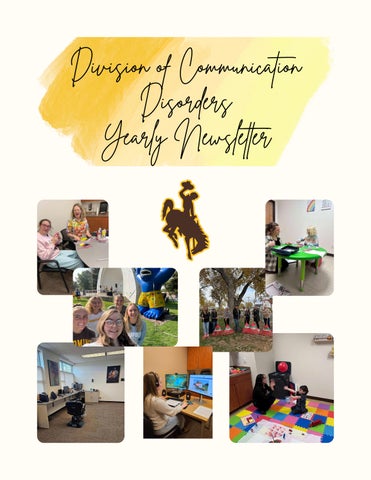
Division of Communication Disorders Yearly Newsletter
Table of Contents From the Director’s Desk
1
Meet Dr. Lian Arzbecker
2-3
By the numbers academic year 25-26
4
3D Printing the Speech and Hearing Systems
5
ASL Program Expansion
6
ASHA Centennial Sessions
7-8
Meet Hollie Descheneaux
9-10
UW NSSLHA: Outreach and Advocacy Efforts
11-12
Katelyn Kotlarek Named Maggie and Dick Scarlett Chair in Speech-Language Pathology at UW
13
From the
Director’s Desk Hello! I am honored to be writing to you this season as Interim Director of the UW Communication Disorders program. While the "interim" title is new for me, the pride I feel in this program and the people who make it exceptional is anything but. We have had a remarkable year, and I am excited to share some highlights with you. First, the news we have been building toward: the UW Speech and Hearing Clinic at Mountain View Medical Park is open and thriving. What has been an exciting vision over the past few years is now a fully functioning clinical home, and it has been wonderful to see our students, faculty, and clients settle into the new space. This space houses state of the art equipment and the most up-to-date materials to prepare our students to land in any clinical setting with confidence and skill. This fall, we welcomed 21 new students into the MS SLP program, the largest firstyear cohort in our program's history. They are talented, eager, and already making their mark in the classroom and in the clinic. We are so proud of the caliber of students choosing the UW Master’s of Speech-Language Pathology program, and their success is a reflection of the generosity of donors who make this program possible. We also have faculty achievements worth celebrating. This spring, Ms. Heidi Clark and Dr. Nora Gulick were both honored with the Mortar Board “Top Prof” award, a studentnominated recognition that is among the most meaningful a faculty member can receive. To be chosen by your students says everything about the excellence in teaching and mentorship that we work so hard for every day. This year also brought a bittersweet goodbye. Dr. Mark Guiberson, our longtime Division Director, has moved on to a new chapter. Mark's leadership shaped and grew this program in lasting ways, and while we will miss him deeply, we send him off with immense gratitude and warm wishes for what comes next. We are looking forward to welcoming a new Division Director to fill this position and continue leading us in our pursuit of being one of the best speech-language pathology training programs in the country. As always, none of what we do is possible without the support of our alumni, donors, and clinical partners. Thank you for believing in this program and in the students who will go on to serve Wyoming and beyond. It is a privilege to be part of this community. Warm regards, Breanna Krueger, PhD CCC-SLP
1
Meet Dr. Lian Arzbecker By Nora Gulick
This past fall, the Division of Communication Disorders saw many areas of growth and change. One of those included welcoming on board the first postdoctoral researcher to the team. Dr. Lian Arzbecker joined us as a part of Dr. Katelyn Kotlarek’s Speech Imaging Laboratory. After getting to know Dr. Arzbecker over the past year, we wanted to properly introduce her to the broader University of Wyoming Division of Communication Disorders community. Dr. Arzbecker sat down with us Dr. Lian Arzbecker to share more about her prior experience, her current work, and what she loves about living here in Laramie. Tell me about your background. What were you up to before joining us at the University of Wyoming? I’m originally from the Milwaukee area, and I’ve wanted to move west since I graduated high school. I went to undergrad at a Division III school in Wisconsin, partly because they had a strong Communication Sciences and Disorders program and partly to run cross country. By senior year, I realized I was more interested in researching speech therapy than practicing it. (I have immense respect for the work clinicians do!) I went on to complete my PhD in Speech and Hearing Science at Ohio State, where I focused on speech perception and acoustics. After that, I completed a two-year postdoc at the University at Buffalo in a motor speech disorders lab. There, I contributed to a large, multi-site study examining speech outcomes in individuals with Parkinson’s before and after surgical intervention. I really loved the work, but I was still hoping to move west – yet somehow my training kept taking me further east. When I saw the position at the University of Wyoming, I immediately applied. What led you to your current research interests? I’ve always been interested in acoustics, and I like that Communication Disorders lets us apply science to practical problems, both clinically and in the broader population. I’m also drawn to the “pop science” side of linguistics, things like whether people say “drinking fountain” or “bubbler,” or how “caramel” is pronounced. More broadly, I’m interested in quantifying the qualitative. For my dissertation, I studied accents of English, exploring which acoustic features in the speech signal drive perceptions of regional identity. I appreciate that the field bridges science and art.
2
What have you been working on this year since joining the UW Communication Disorders team? In the Speech Imaging Lab, I’ve worked on quite a few projects! The majority of my time has been spent helping finalize manuscripts for publication, which might be my favorite part of the job so far. I’ve also supported several student projects, which have given me experience across the entire research process, from initial conceptualization to revision for publication. Within that work, my research focus has been on velopharyngeal (VP) anatomy, and a major component involves using MRI to examine VP structure. More recently, I’ve started leveraging artificial intelligence, working on a deep learning model for MRI segmentation. Overall, my work combines imaging, perception, and applied methods to better understand VP function and its clinical implications. What are you excited for moving forward? Career-wise, I look forward to mentoring more students and improving my coding skills, especially around efficiency and statistics. And honestly, continuing to learn more about anything. On a personal level, I’m hoping to get involved with coaching cross country in Laramie. I coached during grad school and my postdoc and turns out I really enjoy working with middle and high school runners.
Aside from work, what has been the best parts about moving to Laramie, Wyoming? I promise I’m not paid by the city to say this, but it really is “Laradise.” There’s access to so many outdoor activities and open space. The university also offers a lot of resources, from gear rentals to rock climbing courses. Just this past weekend, I went cross country skiing in Medicine Bow and then took my dog to Lake Hattie to splash around. And from a practical standpoint, the city is very bikeable and very safe.
3
By the numbers academic year 25-26 ZERO CAA “dings” for the MS SLP program
42
CAA Acreditted through
2032
43 MS SLP students enrolled
off-site clinical placements completed by MS SLP students
2,009
1
total Speech & Hearing visits last year
MS student completed a thesis study
$57,457
17
ComDis scholarship dollars
ASL Studies certificates awarded
Total undergraduates in the program:
105
4
3D Printing the Speech and Hearing Systems By Nora Gulick and Alex Bright Anatomy and Physiology of Speech and Hearing is one of the courses that every Speech, Language and Hearing Science major completes. This course can be challenging given the expanse of anatomy that students learn and the complexity of the related physiology. We are always looking for ways to help this information come to life so it is clearer for students. This year as the current instructor and the teaching assistant for the course we sought out to create a range of 3D printed models of speech and hearing anatomy to support students’ learning. We were inspired by Drs. Zoe Kriegel and Katelyn Kotlareks’ prior work using 3D printing to create larynx models that help undergraduate and graduate students to understand the laryngeal anatomy and physiology that support us in voicing speech sounds. While collaborating on the project, Alex, an undergraduate teaching assistant for the course, took on the responsibility of printing each model. The process of creating the 3D printed models was a brand new experience and a bit challenging. It took some time to learn how to set up the files, use the printers, and figure out how to fix small issues when things did not go as planned. The staff at the Makerspace in the University of Wyoming Coe Library were extremely helpful which made it easier to become skilled with using the modeling program. A big part of the work also involved removing the supports from the models and assembling models with multiple parts. This hands-on part took patience, but it also made the experience more engaging and helped Alex to better understand the anatomy we were working with. After completing the project Alex reflected:
5
“For me, this project had a strong personal impact, especially since I want to pursue a career as an SLP in a medical setting. Working with these models helped me understand the structures in a much more real and hands on way compared to just looking at pictures or diagrams. It made me start to picture how this knowledge connects to real patients and clinical work, which increased my interest in going into a medical setting.” Over the course of the year, we were able to use open-source educational resources to create 3D models of the full hearing system, the cochlea, a dynamic model of the vestibular system, a magnetic model of the cranial and facial skeleton, and dynamic models of the larynx based on Dr. Kriegel’s prior design. These new resources will offer clear visuals to students working to learn the anatomy and physiology of speech and hearing. Students will be able to manipulate structures and even see some physiologic processes, like how endolymph fluid moves through the semicircle canals of the ear to help with our sense of balance. Our hope is that these hands-on resources will allow students to actively engage with the content they are learning leading to better understanding and longer retention of the information they learn. Dr. Gulick and Alex Bright
5
ASL Program Expansion By: Hannah Young American Sign Language (ASL) is a topic that has been taught through the Division of Communication for many years. In fact, the ASL program dates back to the 1970s. Since then, the program has experienced many changes. In 2020, the ASL Certificate program was developed. The certificate is a nominal recognition for students pursuing careers in speech language pathology, special education, language interpretation, nursing, and more. A large number of students have taken advantage of this opportunity. ASL classes are consistently full, and students are eager to learn more. Due to the program’s healthy enrollment and campus-wide interest, two new classes were added this academic year. Previously, the courses offered included ASL I, ASL II, Advanced ASL, Deaf Studies, and ASL Teaching Assistant. Now, thanks to the efforts of Esther Hartsky, ASL Studies Coordinator, students can enroll in ASL in Society and ASL for Medical and Educational Settings. When asked what draws students to this program, Ms. Hartsky said, “The reason is as diverse as my students, I believe. Anyone who works anywhere might have the opportunity to converse with the Deaf community, so it is an important skill to have no matter what career one chooses.” Strong student interest may also be due to the teaching style of instructors, which is highly interactive and engaging. Specifically, they employ a “voice-off, full immersion environment” which supports students’ attainment of the language, both receptively and expressively. The division looks forward to continued growth and expansion for this highly successful program!
ASL Professor Ms. Hartsky
6
ASHA Centennial Sessions By Nora Gulick This year’s American Speech-LanguageHearing Association Convention marked a historic milestone, the 100th anniversary of the American Speech-Language-Hearing Association. As a part of the celebrations, a limited number of centennial sessions were selected and showcased last November in Washington, D.C. These sessions highlighted forward-thinking research with the potential to shape the future of the field. Out of more than 3,700 submissions, only 191 were selected for this honor. Among those were the presentations of three outstanding University of Wyoming Division of Communication Disorders students. Kelsi Angelovich, Violet Davydzenka, and Natalie Schwab were each lead authors on presentations that earned this national recognition. Graduate student Kelsi Angelovich
Angelovich, a first-year master’s student in speech-language pathology, presented her project, Assessing the Social Impact of Developmental Communication Disorders: A Systematic Review . Findings emphasized the importance of understanding how communication disorders affect children’s social development. The project reflects years of dedicated research and collaboration as it was originally completed as her undergraduate honors thesis under the mentorship of Dr. Amy Peterson. Davydzenka, a senior majoring in speech, language, and hearing science, presented her research on listener perceptions of speech for an individual living with Primary Progressive Apraxia of Speech (PPAOS). With the support of an INBRE Student Grant to fund her work, Violet uncovered the ability for listeners to detect PPAOS disease progression and to improve their perceptions following a brief practice session. This work was completed under the mentorship of Dr. Zoe Kriegel. Schwab, a senior majoring in speech, language and hearing science, presented her research on optimizing treatment intensity for children with speech sound disorders. Mentored by Dr. Breanna Krueger, her presentation focused on practical tools that support school-based speech-language pathologists in delivering more effective care.
7
Through mentored research and their ASHA centennial sessions, these students created work that will help shape the field while also developing their own knowledge and roles in the field. As Schwab put it, “ Presenting at ASHA was an experience I’ll never forget especially as an undergraduate student... Even the atmosphere of the conference was transformative in a way. Being able to dive right into the deep end of so many topics and discussions made me want to soak up as much information as I possibly could. I took back with me not only a sense of pride in my school and the faculty that brought me through, but a want for more. More research, more knowledge, more questions, and more learning.” Undergraduate student Natalie Schwab
All three students reflected on their research experiences at large as being both highly enjoyable and transformational aspects of their education here at the University of Wyoming. Angelovich described that “ Research has been a cornerstone in my academic career.”
Dr. Krueger and Natalie Schwab
Davydzenka built on this with encouragement for other students as she shared “I hope that every student who has the opportunity to volunteer in a lab and conduct research takes it, since this is the best way to find your passion and learn about the profession you will work in for years to come." Congratulations again to Kelsi, Violet, and Natalie! We are all very proud of the work you have done, the ways you have grown, and how you represent the University of Wyoming Division of Communication Disorders.
8
Meet Hollie Descheneaux By: Hannah Young When she left Texas for Wyoming, our newest clinical faculty member wasn’t just changing states; she was embracing a new opportunity to teach, mentor, and connect in a different community. Now at the University of Wyoming, Hollie Descheneaux, M.A. CCC-SLP, brings years of experience and knowledge to the clinical faculty team. Since joining the division in the Fall of 2025, Hollie has embraced her new role, which she described as “a combination of teacher, clinician, supervisor, and team member.” Hollie originally earned her master’s degree in Speech Language Pathology from the University of Massachusetts Amherst. She then spent most of her professional career in Texas, where she worked across a variety of settings including private practice and early childhood intervention. For the past 14 years, she worked in a school district in Austin, Texas, serving students from elementary to high school, as well as young adults with intellectual disabilities and autism. About two years ago, Hollie and her family decided to make the transition from the South to the Mountain West. At this point in time, her two oldest sons were heading to or already in college, and the family was ready for a new chapter. Professionally, she was looking for something different and more challenging. After working within the educational system for about another year, Hollie learned that the Division of Communication Disorders was looking to hire an additional Assistant Clinical Professor. This is when “everything shifted”, and she bravely pursued a career in higher education. Ms. Descheneaux
9
Graduate student clinician Alejandra
Graduate student clinician Leah
Within her first year as an assistant clinical professor, Hollie has positively impacted several undergraduate and graduate students in the program. One way she does this is through her classroom teaching. Currently, Hollie is teaching Speech and Language Development in the undergraduate curriculum. When asked about her teaching philosophy, Hollie shared her aims to bring energy enthusiasm into the classroom. She encourages students to think, question, and make connections between theory and real-world practice. While this is her first experience teaching college students, she is certainly not new to helping others learn. For clients and college students alike, she seeks to provide supports which are flexible and responsive to each individual’s learning needs. When she is not teaching in the classroom, Hollie is supporting graduate students in the clinic and/or in the community. As a supervisor, Hollie’s main goals are to support, guide, and encourage students as they begin to see themselves as clinicians. She also wants them to feel confident asking questions, thinking critically, and trusting their clinical instincts. By allowing student clinicians to make mistakes in a safe space, she hopes to help them reflect and grow. Upon reflection of her first year at UW, Hollie stated, “I feel very grateful to be part of this program and this community. This transition- both professionally and personallyhas been a big one, and I’ve appreciated the support along the way.” The division is equally grateful to have Hollie as part of the faculty, and we look forward to the impact she continues to have on our students and community.
10
UW NSSLHA: Outreach and Advocacy Efforts By: Marisol Blazovich and Sydney Black The new NSSLHA officers have been elected, and they are excited to continue this year’s mission of outreach, outreach, and more outreach! Three recent/ongoing projects to highlight include teaching high school students about the field of communication disorders, increasing accessibility to the UW Speech and Hearing Clinic (UWSHC), and promoting the use of teletherapy across the state.
NSSHLA members tableing in the Union
NSSLHA members often table at events on campus for incoming freshman, high schoolers, and interprofessional events to get our degree and career out there. Many students, at any level, don't know that Communication Disorder sciences is an option, or maybe don’t know what our scope of practice entails. NSSLHA is excited to further prioritize outreach events and opportunities such as more tabling, visiting high school career fairs, and connecting with high school health-care related programs to ensure high schoolers know about this amazing, versatile career option. Not only is it a win for students to be aware of the major in general, but when they see the amazing culture and success rates of students here at Wyoming, joining NSSLHA is that next best step! The new clinic, which grad students have been so excited to learn in, is a bit far away from campus. As a result, it is not included in the UW bus routes. NSSLHA felt this was a great opportunity to advocate to UW transportation services that a bus route is needed for our students, professors, and clients who rely on public transportation. We expressed our concerns along with viable solutions to the transportation department. After several conversations and a few weeks of deliberation, the additional route proposal was sadly denied. However, NSSLHA is motivated now more than ever to advocate for the accessibility needs of our community members. We are hopeful it will be reconsidered in the future.
11
This year for Advocacy Day, NSSLHA is working closely with division faculty, especially Dr. Amy Peterson, to advocate for the importance of telehealth in a pioneer state such as Wyoming. Telehealth not only benefits those receiving speech therapy, but also their caregivers, and graduate students learning the profession. We are currently reaching out to individuals in the community who have been involved in telehealth. This includes clients, family members, clinicians, and students. We are so excited to hear all the amazing stories of how telehealth has been supportive for families, and to explore people’s opinions about its effectiveness as a therapy strategy. We look forward to collecting client testimonies, footage of our amazing graduate students using telehealth in the new clinic, and photos of clients' lives. Stay tuned for our telehealth promotional video, showcasing our amazing students, faculty, and community members.
VNSSHLA members vonlunteering at Washingtong Park
Teleheath session at the UW-Clinic
12
Katelyn Kotlarek Named Maggie and Dick Scarlett Chair in Speech-Language Pathology at UW In the 2025-2026 year, Katelyn Kotlarek, Ph.D., CCC-SLP was named as the Maggie and Dick Scarlett Chair in Speech-Language Pathology. Last year, Kotlarek was an associate professor with tenure within the Division of Communication Disorders of the College of Health Sciences. Kotlarek, who also held the title of President’s Distinguished Scholar, was recognized for her research and clinical innovation in craniofacial and cleft-related speech disorders. Her work bridges clinical practice and biomedical imaging to improve diagnosis and treatment for children with craniofacial differences.
She has published widely, including 39 peerreviewed manuscripts in leading journals, including the Cleft Palate-Craniofacial Journal, the Journal of Speech, Language, and Hearing Research, and the International Journal of Language and Communication Disorders among others. Kotlarek also serves as section editor for Cleft Palate–Craniofacial Journal for two areas: Anatomy and Basic Sciences and SpeechLanguage Pathology.
Kotlarek joined the University of Wyoming in 2019 as an assistant professor after completing her Ph.D. in Communication Sciences and Disorders at East Carolina University. She also holds master’s and bachelor’s degrees in “The Maggie and Dick Scarlett Chair recognizes communication science and disorders from faculty who demonstrate exceptional Florida State University and the University of scholarship, leadership, and commitment to Wisconsin–Madison, respectively. Kotlarek is also advancing the field of speech-language a licensed and certified speech-language pathology,” says Breanna Krueger, Ph.D., interim pathologist, who completed a competitive director and associate professor in the Division clinical fellowship at the University of Minnesota of Communication Disorders. “Dr. Kotlarek’s Cleft Palate and Craniofacial Clinics. research program exemplifies this mission through its creativity, rigor, and direct impact on clinical care.” Kotlarek’s research is currently supported by the National Institute on Deafness and Other Communication Disorders. Her work has also been funded by the American Speech-LanguageHearing Foundation, the Wyoming INBRE, and the National Institute of Dental and Craniofacial Disorders. Her current work uses magnetic resonance imaging (MRI) to characterize velopharyngeal anatomy in infants, providing foundational data for precision approaches to surgical and speech interventions. Total funding for her research throughout the course of her career has totaled over $800,000.
13