ANNUAL REPORT 2016
1
We train. We serve. We learn. We lead. Among the 30 schools of veterinary medicine in the nation, the University of Wisconsin School of Veterinary Medicine consistently ranks among the Top 5 for excellence in clinical training, clinical service, and biomedical research.
MORE THAN
50%
SERVING OUR STATE’S VETERINARIANS
PROVIDING COMPASSIONATE CARE
We have trained more than half of all the veterinarians in Wisconsin and serve as a resource and referral clinic for all.
Our teaching hospital began with 10 specialties. Today, it provides more than 20 services, including Special Species, Pain Management, and Equine Sports Medicine.
PREVENTING THE NEXT EPIDEMIC
TRANSFORMING THE DAIRY INDUSTRY
We are a campus and world leader in influenza, Ebola, Zika, and other infectious disease research. In fact, the SVM is responsible for 75% of all infectious disease research conducted at UW-Madison.
Our work with the livestock and dairy industries helps keep millions of animals healthy and productive — helping feed your family and the world.
AnimalsNeedHeroesToo.com 2
University of Wisconsin School of Veterinary Medicine Annual Report 2016
Administration Mark D. Markel Dean Dale Bjorling Associate Dean for Research and Graduate Training Ruthanne Chun Associate Dean for Clinical Affairs
Annual Report 2016
Robb Hardie Associate Dean for Professional Programs
4
Lynn Maki Associate Dean for Student Academic Affairs
Message from the Dean: From ‘Animals Need Heroes Too’ to Zika
6 Training Future Veterinarians 8 Delivering Compassionate Care 10
Making New Scientists and New Discoveries
12
Furthering the Wisconsin Idea
14
Fast Facts: Class of 2020, Financials
16
Advancing the SVM
17
Recognition for Excellence
18
Board of Visitors
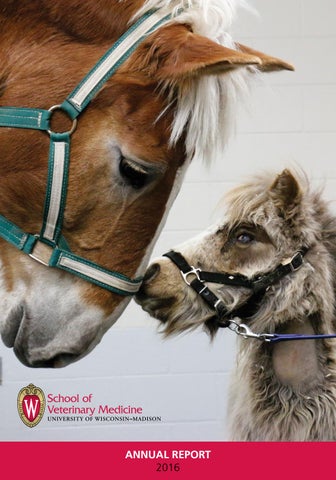
Ed Rodriguez Associate Dean for Budget and Finance Kristi V. Thorson Associate Dean for Advancement and Administration Ken Waller Assistant Dean for Clinical Affairs Editorial Writing, Editing, and Photography Nik Hawkins, Director of Communications Design Ashley Voss, Communications Specialist Additional Photography Jeff Miller, University Communications Bryce Richter, University Communications Logan Sechler Whitney Rupp Cover No patient too big, no patient too small. Draft horse Rusty and miniature horse China touch noses during a visit to UW Veterinary Care’s Morrie Waud Large Animal Hospital. (Photo: Nik Hawkins) Stay Connected
The UW School of Veterinary Medicine uses gift funds to produce its publications. To donate to the school, contact: Pat Bowdish Director of Development (608) 294-7661 pat.bowdish@supportuw.org
Heidi Kramer Director of Development (608) 327-9136 heidi.kramer@supportuw.org
This report is also available online at vetmed.wisc.edu/annual-reports ©2016 Board of Regents of the University of Wisconsin System
UW School of Veterinary Medicine vetmed.wisc.edu UW Veterinary Care uwveterinarycare.wisc.edu Facebook facebook.com/uwvetmed facebook.com/uwveterinarycare Twitter twitter.com/uwvetmed YouTube youtube.com/UWVetmed
3
Nik Hawkins (2)
MESSAGE FROM THE DEAN
FROM ‘ANIMALS NEED HEROES TOO’ TO ZIKA: A Year of Many Successes I am pleased to present to you the 2016 Annual Report for the University of Wisconsin School of Veterinary Medicine (SVM). We had an amazing year here at the school (July 1, 2015 to June 30, 2016), with almost too many successes to mention.
Speaking of education, we continue to do all we can to enhance the teaching and learning experience for our students. In 2015, we announced plans to build a new student-focused hub on the building’s south side; I am happy to report that construction for the Renk Learning Center began in May 2016. The project is expected to be completed in mid-December of 2016 and ready for use for the spring 2017 semester. As a reminder, this new area will include an active integrated learning space, a substantially expanded clinical skills training center, a meditation room, an additional counseling office, study spaces, and more. 4
Bryce Richter
Not long ago, we officially unveiled the naming of the Morrie Waud Large Animal Hospital in recognition of Morrie’s long tradition of giving to the school to support our students and equine health. I want to offer my sincere gratitude to Morrie for all that he has done— and continues to do—to enhance the clinical service we provide at UW Veterinary Care and the excellence of our students’ education.
We also continue to push boundaries in biomedical research. I have mentioned before that the SVM leads the UW-Madison campus in the study of infectious disease, and this past year has been no exception. Our faculty have been highlighted worldwide for their studies of the Zika virus outbreak, appearing in media outlets such as the Discovery Channel’s Daily Planet, Scientific American, Discover Magazine, The New York Times, The Guardian, and Smithsonian Magazine,
University of Wisconsin School of Veterinary Medicine Annual Report 2016
Nik Hawkins Submitted photo
Jeff Miller
Submitted photo
among many others. Further evidence of our leadership in this area was Yoshihiro Kawaoka’s receipt of the prestigious Japan Academy Award, presented by the Emperor and Empress of Japan in the summer of 2016, for his work on influenza. On the clinical service front, UW Veterinary Care had another record-breaking year in terms of caseload, managing more than 26,000 patient visits in a facility built to handle 12,000. As you might imagine, this has intensified the effects of our space crunch, but we have officially launched our Animals Need Heroes Too building expansion campaign with a major matching gift of $3 million from UW-Madison alumni Karen Walsh and Jim Berbee. Our goal is to begin design of this addition in 2018 with construction slated for 2020. This building will approximately double the size of our small animal hospital, dramatically improve our large animal facilities, centralize our imaging, triple the amount of infectious disease research space that we have available for our faculty, and increase our basic wet laboratory space by one third. All of these improvements will keep the SVM at the forefront of veterinary medicine in the coming decades, and I very much look forward to the initiation and ultimate completion of this important project.
Some highlights from the last year include the naming of the Morrie Waud Large Animal Hospital, the beginning of construction on the Renk Learning Center, a $3 million matching gift from UW alumni Karen Walsh and Jim Berbee, groundbreaking studies of Zika virus, and advancements in wound care.
One last highlight: I am extremely pleased that our students’ educational debt upon graduation has decreased substantially and is now about 50% less than the national average. This is the result of many factors, including the generosity of donors who support scholarships, the improved financial education of our students, and the return of 25% of new revenues from a recent tuition increase back to students in the form of scholarship support. We will continue to do all that we can to increase financial assistance for our students and minimize the impact of debt load on their final career decisions. Thank you for all that you do for the SVM. I hope you find this report to be illuminating and inspiring while serving as a strong validation of your support for the school. Sincerely,
Mark D. Markel, Dean
5
Nik Hawkins
TRAINING FUTURE VETERINARIANS
Third-year students gain valuable hands-on experience working with small mammals, including chinchillas, in a live-animal lab.
ACCREDITATION AND BEYOND In September 2015, following a months-long self-study and a three-day site visit from a review team, the UW School of Veterinary Medicine (SVM) was fully re-accredited by the American Veterinary Medical Association (AVMA) for the next seven years, the maximum time frame that can be assigned. The AVMA’s Council on Education reviews how schools of veterinary medicine meet numerous standards in areas such as physical facilities and equipment, clinical resources, curriculum, research programs, and more. The SVM has been fully re-accredited through this process every seven years since its founding. The review team found no deficiencies for the SVM in any category, a clear indication that the school’s graduates leave fully prepared to enter and succeed in the profession. But the school’s faculty and staff did not rest on this accomplishment and instead sought to improve the curriculum and overall experience for veterinary medical students in a variety of ways. 6
Focus on Mental Health The SVM has made a major commitment to supporting the mental health of its students with investments in new resources and training. For example, the school’s counseling psychologists taught two, eight-week mindfulness meditation sessions during the academic year. In addition, more than 40 faculty and staff have completed the Mental Health First Aid curriculum, which teaches participants how to identify, understand, and respond to signs of mental illness. This complements the individual support sessions already provided by counseling psychologists for DVM students.
University of Wisconsin School of Veterinary Medicine Annual Report 2016
Addressing Student Debt Much like mental health, the financial health of veterinary medical students has become a prominent part of national conversations related to the field. The SVM continued to target student debt by increasing scholarship opportunities through fundraising. During the 2015-16 academic year, the school offered 361 scholarships for a total of $766,179, as compared to 212 for a total of $230,670 a decade ago. When combined with fellowships, school awards, and dedicated funds from tuition revenue, the school provided $1.1 million in student aid in 2015-16. The SVM also began offering professional development workshops designed to help students make more informed decisions about their finances. These efforts seem to be making an impact. Educational debt for the school’s veterinary medical students remains consistently below the national average; in 2015, the average debt for SVM students was $106,546 compared to $154,160 nationally. These figures include all undergraduate, graduate, and professional school debt. This the third year in a row that student debt for the school’s recent graduates has declined.
Educational Enhancements The 2015-16 academic year saw several advancements in the Doctor of Veterinary Medicine curriculum. The SVM’s instructional designer continued to develop additional Core Competency Modules, which are “blended learning” courses featuring online activities that supplement lectures and labs and give students experience in seldom-seen clinical areas. These efforts brought the total number of modules now available to 61 in topics ranging from dermatology to internal medicine to surgery. Effectiveness measures for the modules were also implemented during the academic year to track changes in student performance and perceptions of the material. The SVM also launched a formalized Dual DVM/PhD Training Program, which is now fully integrated into the professional program curriculum. It is designed to expand options for veterinary medical students to engage in graduate and research training (see p.10).
Fast Facts AVERAGE DVM STUDENT DEBT LOAD* UPON GRADUATION
$175K
$150K
Nat’l Avg. $154,160
$125K
UW Avg.
$100K
$106,546
$75K
2011
2013
2014
2015
*Includes debt incurred during prior undergraduate/graduate education. Sources: UW-Madison Office of Student Financial Aid and American Veterinary Medical Association Senior Student Survey
STUDENT SCHOLARSHIP SNAPSHOT
87% 361 $2,122
Percentage of scholarship applicants who receive aid Number of scholarships awarded this year Average scholarship award, up from $1,088 in 2005-06
STUDENT JOB & INTERNSHIP PLACEMENT
Small Animal
Large Animal
[49]
(food animal & equine)
BY SEPTEMBER 2015
[19]
100% of the Class of 2015 had secured jobs in the field
Job Placement for Graduates The success of the SVM’s recent graduates in securing employment indicates that the school is preparing them well for careers in veterinary medicine. By September 2015, 79 new veterinarians—100% of graduates from the Class of 2015—had secured positions in the field. These students primarily went into private practice, but a good portion took on internships or other opportunities in areas like public health.
2012
Mixed Animal (food animal, equine & small)
Shelter Medicine
[1]
Lab Animal Public Health
[1]
[1]
[8]
7
Nik Hawkins
DELIVERING COMPASSIONATE CARE
The remodeled small animal surgery ward can now more comfortably accommodate patients like Zeus, an Akita mix puppy.
RECORD-BREAKING CASELOAD, FIRM FINANCIAL FOOTING For the third year in a row, UW Veterinary Care handled a record number of patient visits, topping 26,500 in 2015-16. Built to accommodate 12,000 patient visits annually, the growing caseload continues to put stress on the hospital’s space and staff. Measures have been taken to alleviate this pressure in some of the clinic’s busiest areas and make them more comfortable places for patients and those who provide their care. This includes completely remodeling the small animal surgery ward. By rearranging workstations, eliminating extraneous fixtures, and making better use of the space available, the ward can now comfortably accommodate more patients, and staff can work in a more efficient manner. Additional cages were installed in the Emergency and Critical Care triage rooms, which managed the third most patient visits of any service in the hospital in 2015-16. 8
While an ever-rising caseload brings challenges, it also brings benefits. Thanks to the added revenue that comes with more patients, as well as thorough business analysis and planning, UW Veterinary Care ended the year in a positive cash position for the first time since fiscal year 2009, which coincided with the earliest stages of the economic recession. This is no small feat given the costs associated with recruiting and retaining an exceptional staff as well as maintaining, upgrading, and replacing the advanced specialty equipment that the clinic relies upon for providing a high level of care.
University of Wisconsin School of Veterinary Medicine Annual Report 2016
Success Stories In Brief Equipment Upgrades for Improved Care UW Veterinary Care expanded and improved upon its repertoire of high-tech veterinary medical equipment in 2015-16. This included updating the clinic’s nuclear imaging technology with a faster, more sensitive gamma camera and a quieter, more mobile gantry, all of which enables more accurate diagnoses and reduces stress on patients. Also, thanks to generous donations, the hospital now boasts a portable electrocardiogram (ECG) monitor and a needle arthroscope unit. The new ECG unit is wireless and small enough to be strapped to the horse that is being monitored, allowing clinicians to track the electrical activity of the animal’s heart remotely, including while running or walking outdoors. This is especially useful because many heart conditions only become apparent during exercise. The small, flexible arthroscope unit allows clinicians to perform arthroscopy in joints with animals under sedation rather than general anesthesia, which allows them to view the structure of the joints under normal anatomical circumstances (i.e., standing) and poses less risk for the animals involved. Recovery times for procedures involving this unit are also shorter.
New Resources for Clients and Referring Veterinarians In January 2016, Kenneth Waller, assistant clinical professor and section head in diagnostic imaging, accepted a position as assistant dean for clinical affairs. In this role, he helps to ensure a high level of service for clients and referring veterinarians by responding quickly to concerns and suggestions. He is also key in maintaining employee morale, gathering and disseminating information about hospital facility improvements, and determining equipment needs and purchases, all of which has a direct bearing on the client and referring veterinarian experience. As another means of consistent communication with clients, the clinic began sending an e-newsletter called Compassionate Care in October 2015. The monthly publication includes useful tips for animal care, provides information about the hospital’s specialty services, highlights clinical studies that are recruiting patients, and more. UW Veterinary Care also created a new financial resources web page that gathers information about pet insurance, financing options, and organizations that provide assistance to animal owners in need.
Enhancements to UW Veterinary Care’s nuclear imaging technology benefit both horses and small animal patients.
Fast Facts Number of patient visits at UW Veterinary Care in 2016
26,567
2015 - 23,950 2013 - 20,870
2014 - 22,376 2012 - 21,202
PATIENT VISITS BY CATEGORY
26,567
patient visits
Canine - 19,466 Feline - 4,110 Equine - 1,182 Other* - 655
Avian - 485 Lapine - 367 Bovine - 302
*includes Rodentia, Reptile, Porcine, Mustelidae, Camelid, Insectivora, Caprine, Marsupial, Ovine, Primate, Fish, Amphibian, and Other Mammal patients.
9
Jeff Miller
MAKING NEW SCIENTISTS AND NEW DISCOVERIES
A LEADER IN INFECTIOUS DISEASE RESEARCH The UW School of Veterinary Medicine is responsible for about 75% of the infectious disease research on the UW-Madison campus, and its faculty and other researchers are consistently making breakthroughs in the fight against dengue, Ebola, West Nile, influenza, Zika, and more. For example, in the last year, Yoshihiro Kawaoka, a professor of pathobiological sciences and one of the world’s leading virologists, has developed two new strategies that could dramatically improve the production of influenza vaccines. One method uses cell cultures rather than fertilized chicken eggs as crucibles for growing vaccine viruses, which can make the mass production of vaccines simpler, quicker, and more efficient. Another method can more accurately forecast the molecular characteristics of the next season’s influenza virus; such predictive power enables the creation of well-matched vaccines that provide better protection against the disease.
Success Stories In Brief
making international headlines, SVM scientists were already working to better understand the disease. In fact, SVM researchers were part of the team that first confirmed the presence of Zika in Colombia. Since then, they have shown that a benign bacteria can be used to prevent mosquitoes from transmitting the virus and have also developed a new animal model for studying the disease. In addition, SVM scientists have joined a campus-wide collaboration looking to expand the world’s limited knowledge of the Zika virus. They have already discovered that one infection with Zika virus protects against future infection, a promising finding for vaccine design, and they continue to learn more about the mechanisms by which the virus causes birth defects. Ultimately, more knowledge will lead to better ways to fight the disease.
Zika: Taking On a New Threat Already recognized as an international leader in fields like influenza research, the SVM’s expertise has expanded into the realm of a previously little-known disease—one that has emerged as a global threat. The mosquito-borne Zika virus, which has been linked to cases of babies born with underdeveloped brains and small heads, reached pandemic proportions in 2016. But before Zika started 10
Research Training for DVM Students In fall 2015, the SVM launched a formal Dual DVM/ PhD Training Program that broadens opportunities for research and equips veterinary medical students with the skills necessary to advance the study of animal and human health. Its creation came in response to student demand as well as a call from the National Institutes
University of Wisconsin School of Veterinary Medicine Annual Report 2016
Nik Hawkins
(Left) Research Scientist Matthew Aliota, who was part of a team that first discovered the presence of Zika in Colombia, works with a strain of Aedes aegypti mosquito. (Right) Katherine Luethcke, a student in the SVM’s new Dual DVM/PhD Training Program, works on a genetics research project.
of Health for more clinician-scientists with veterinary medical training to apply their unique expertise to federally funded biomedical studies. The opportunity for combined DVM/PhD study has existed at the SVM for many years, but in the past it was handled through a less structured process. The formalized program incorporates PhD study into the DVM curriculum and makes the steps to those degrees clearer and more efficient, so students know their path from the beginning.
Fast Facts
Graduate Program Earns High Ranking
$25M
Even as funding opportunities declined, the SVM’s external research support remained relatively steady in fiscal year 2016, allowing the school to continue vital biomedical research and support assistantships for graduate students. Many of the faculty obtaining these research grants and awards serve as trainers for the school’s Comparative Biomedical Sciences (CBMS) graduate program; not surprisingly, the program was once again recognized for its exceptional research productivity with a top 10 ranking among programs in the veterinary medical sciences. CBMS has consistently earned this distinction from Academic Analytics, which gathers and aggregates a variety of metrics, such as grant dollars earned and number of books or articles published by faculty, from nearly 400 institutions across the nation.
TOTAL RESEARCH AND EXTRAMURAL AWARDS (in millions) Federal
Non-Federal
$30M
$28.6M
$24.1M $21.7M
$20M
$5.0M
$27.7M $6.1M
$5.6M
$4.4M $16.6M
$15M
0
$21.6M $18.5M
$10M
$5M
$23.6M
$4.3M
$17.3M $12.3M
FY12
FY13
FY14
FY15
FY16
11
Jeff Miller
FURTHERING THE WISCONSIN IDEA
PUBLIC OUTREACH AND SERVICE IN MANY FORMS Each year, faculty, staff, and students from the UW School of Veterinary Medicine (SVM) share their knowledge and expertise and contribute to the public welfare in a multitude of ways. Often this includes providing the news media with vital insight on issues in animal and human health; in 2015-16, the school and its personnel were cited in local, regional, national, and international media more than 715 times, and Sandi Sawchuk, clinical instructor and primary care veterinarian, made dozens of appearances on regional television and radio to field pet questions from the public. The SVM also served as a resource for the public at a wide variety of venues. This includes everything from overseeing the biosecurity check-in for thousands of cattle at the World Dairy Expo to teaching about the biomedical sciences at the Wisconsin Science Festival to bandaging injured dog claws at the Dog Paddle, a swimming day for canines at a community pool.
Species Health Service volunteered many hours at Dane County Humane Society’s Four Lakes Wildlife Center (FLWC), providing advanced, specialized care for sick and injured wildlife. In perhaps the highest profile case of the year, the special species volunteers worked with the FLWC and a local wildlife rehabilitator to treat and release a baby sandhill crane named B.C.
Community Partnerships that Save Animals
The school also continued its partnership with the Milwaukee Area Domestic Animal Control Commission (MADACC), which rescues and provides temporary shelter for more than 12,000 animals each year. Cats
The school continued its extensive work with external organizations that benefit animals. For example, faculty, residents, and students with UW Veterinary Care’s Special 12
University of Wisconsin School of Veterinary Medicine Annual Report 2016
Bryce Richter Submitted photo
Logan Sechler
Bryce Richter
The school serves as a resource for the community in a range of venues throughout Dane County, the state, and beyond.
From Dogs to Cats to Fish: Fighting the Spread of Viruses
and dogs from MADACC come to the SVM for spay and neuter surgeries, which gives the shelter a vital, costsaving service while providing real-world experience for students enrolled in the school’s junior surgery course. After surgery, junior surgery program coordinator Kristen Cooley promotes the animals that are available for adoption, and the majority of them find a home (often with a SVM student or staff member).
Maintaining the Human-Animal Bond for the Disadvantaged The WisCARES (Wisconsin Companion Animal Resources, Education, and Social Services) program, which, in partnership with the UW School of Social Work, provides holistic health care and housing support for Dane County’s disadvantaged residents and their pets, expanded its services in 2016. With grant funding from the Ira and Ineva Reilly Baldwin Wisconsin Idea Endowment, WisCARES hired a full-time social worker to offer additional assistance for clientele at its satellite clinic. The new staff member also provides educational support for undergraduate and graduate students who are working for the program.
The SVM continued to play a major role in preventing outbreaks of a strain of canine influenza virus (CIV) that is new to the United States as of 2015. In March 2016, Sandra Newbury of the SVM’s Shelter Medicine Program, in collaboration with Kathy Toohey-Kurth of the Wisconsin Veterinary Diagnostic Lab (WVDL), conducted tests at an animal shelter in Northwest Indiana that showed the virus could make the leap from dogs to cats and also spread between cats. This important discovery has implications for quarantine protocols at shelters dealing with CIV. And CIV wasn’t the only virus the SVM tackled in 201516. Tony Goldberg, a professor of epidemiology and pathobiological sciences, and Toohey-Kurth conducted a study showing that viral hemorrhagic septicemia virus (VHSv) is still circulating in Wisconsin’s Lake Winnebago. VHSv is deadly to 28 species of fish and has the potential to disrupt the state’s $2.3 billion-a-year sport fishing industry. The findings of the study, and the new diagnostic test upon which it relied, are aiding the DNR in efforts to monitor game fish in waterways throughout the state in addition to better informing its stocking efforts. Toohey-Kurth, who has a clinical associate professor appointment at the SVM, and fellow WVDL scientist Anna Wilson-Rothering developed the test, which is non-lethal and much more efficient than previous methods used to sample for the virus. 13
FAST FACTS
Class of 2020 Students from the Class of 2020 come to the UW School of Veterinary Medicine from a wide range of geographic regions and
88
41
different undergraduate colleges and universities
students accepted
out of a highly competitive pool of 1,221 applicants. [167 WI
residents & 1,054 nonresidents]
GENDER
RESIDENCY
Female 68 Male 20
WI Resident 60 Non-Resident 28
77%
RECENT CLASS STATS
68%
Female
CLASS
GPA
APPS
2020
3.66
1,221
2019
3.69
1,239
2018
3.72
1,209
2017
3.67
957
3.67
1,183
2016
WI Residents
Financials EXPENDITURES BY PURPOSE (in millions) Teaching Hospital
Student Aid $1.7M Instruction $29.4M
$60.7M
Other* $3.7M Research** $25.9M School
14
* Student services, public service, and academic support ** Primarily research grants and contracts
University of Wisconsin School of Veterinary Medicine Annual Report 2016
Academic Backgrounds of Enrolled Applicants The incoming students represent
21
different undergraduate majors. These include: • Agriculture & Environmental Science • Animal Science • Biochemistry • Biological Sciences
• • • • • • •
Biology Biotechnology Chemistry Elementary Education Engineering Environmental Studies Fisheries & Wildlife Science • Genetics
• • • • • • • • •
Microbiology Molecular Biology Natural Science Neurobiology Physiology Psychology Spanish Wildlife Ecology Zoology
Primary Areas of Interest
Students from the Class of 2020 have a diverse range of interests, as indicated on their applications.
Food Animal
Mixed
[21]
Large & Small Animal
Small Animal
Wildlife or Zoo Medicine
[24]
[8] Avian/Exotics
[6]
Other*
[3]
[15]
Equine
*Public health, lab animal, pathology, etc.
[5]
[6]
% OF BUDGET FROM STATE SUPPORT
EXPENDITURES BY SOURCE (in millions) Gifts $2.7M Grants $15.9M
$60.7M
Research/Industry
Program Revenue $17.0M Tuition $7.6M GPR* $17.5M * State appropriations (less estimated tuition and fees)
29% in 2016 2015 - 29% 2014 - 31% 2013 - 29% 2012 - 29% 2011 - 29%
15
ADVANCING THE SVM
Fast Facts TOTAL GIFTS* $20M
$15M
TOTAL DONORS
Deferred Gifts & Pledges
3K
2,872
Fulfilled Gifts *This chart only shows gifts made to the school through the UW Foundation and does not include gifts contributed through the UW Board of Regents.
$10.4M
$10M
$13.8M
2,554
2,540
2013
2014
2K
$4.1M
$4.2M
$5M
$5.8M $3.8M
$9.7M
1K
$6.2M
$2.0M
2013
2014
2015
2015
A SUCCESSFUL YEAR OF FUNDRAISING The UW School of Veterinary Medicine (SVM) enjoyed a great deal of fundraising success in 2015-16. Total dollars raised in 2015 increased by more than 33% from the previous year, and the total number of donors who gave to the school rose by 13%. These numbers reflect donors from all walks of life and donations of all sizes, all of which make a difference and are greatly appreciated. A few of the most generous and impactful gifts are highlighted here.
A Major Investment in the School’s Future UW-Madison alumni and UW Veterinary Care clients Karen Walsh and Jim Berbee are quintessential animal lovers, and they recognize and support the SVM’s extraordinary efforts to improve animal—and human— health. This is why they committed $3 million to match gifts of $25,000 or more toward the school’s Animals Need Heroes Too building expansion campaign. This truly transformative gift puts the school one step closer to achieving its goal of greater (and much-needed) space for teaching and learning, clinical care, and biomedical research. Read more at AnimalsNeedHeroesToo.com.
New Endowed Professorships Two $500,000 gifts have enabled the SVM to create a pair of endowed professorships, which will contribute greatly to the instructional, research, and service missions of the school. A pledge from Richard Dubielzig, a professor emeritus of pathology, and his wife, Doris, will fund the Richard R. 16
Dubielzig Professorship for Comparative Ocular Pathology. The new professorship will support the director of the Comparative Ocular Pathology Laboratory of Wisconsin (COPLOW), allowing the flexibility to redirect other funds to new areas of research and to improving the center’s diagnostic service for veterinarians. Melita Grunow, a long-time supporter of the SVM, leveraged matching funds from UW-Madison alumni John and Tashia Morgridge with her gift to create the Melita Grunow Family Professorship in Companion Animal Health. The professorship—currently held by Peter Muir, professor of orthopaedic surgery—will be bestowed upon a different SVM faculty member every five years, providing $45,000 annually to support research that benefits companion animals.
Renk Gift, Alumni and Friend Donations Make Learning Center a Reality The school received a tremendous response to its summer 2015 campaign to raise funds for a new learning center. More than 100 generous alumni and friends contributed $80,000 to the project, which will include an expanded clinical skills training center, new group and active learning areas, additional space for wellness and mental health support, a healthy dose of natural light through new south-facing windows, and much more. Campus funds and a lead gift from Walter and Martha Renk, two late UW-Madison alumni with a long and generous history of support for the university, capped off this strong fundraising effort.
University of Wisconsin School of Veterinary Medicine Annual Report 2016
RECOGNITION FOR EXCELLENCE
Whitney Rupp
AWARDS AND HONORS HIGHLIGHTS FROM 2015-16 Each year, the school’s faculty, staff, and students receive numerous accolades in a broad variety of fields, as demonstrated by the list below. This is not a comprehensive list of awards and honors; it is a representative sample from the 2015-16 fiscal year (July 1, 2015 – June 30, 2016). More at go.wisc.edu/svm-awards-honors. McLean “Mac” Gunderson Veterinarian of the Year Wisconsin Veterinary Technician Association
Karen Moriello Award for Outstanding Contributions to Feline Medicine International Society of Feline Medicine/Hill’s Pet Nutrition
Yoshihiro Kawaoka Carlos J. Finlay UNESCO Prize for Microbiology United Nations Educational, Cultural, and Scientific Organization/Cuban Government
Jason Soukup Excellence in Research and Education Award American Veterinary Dental Society/Hill’s Pet Nutrition
Japan Academy Prize Japan Academy
UW Veterinary Care Special Species Health Service Volunteer Veterinary Service of the Year Award Dane County Humane Society
Karen Mier University Staff Recognition Award University of Wisconsin-Madison
David Vail George Fleming Prize The Veterinary Journal
17
BOARD OF VISITORS
THANK YOU TO OUR 2015-16 BOARD The Board of Visitors for the UW School of Veterinary Medicine serves as an external advisory body to the dean of the school. Members of the board have attained prominence in their respective careers and are chosen because of their value in providing sound advice and counsel to the dean. Read more about the board members at www.vetmed.wisc.edu/board-of-visitors. Evelyn Fryer Carpentersville, Wis.
Esther Olson Belleville, Wis.
John Been*, DVM ‘88 Prairie du Sac, Wis.
Melita F. Grunow Lake Geneva, Wis.
Sarah Weston Orr, BA ‘90 Lake Forest, Ill.
Cheryl Brickman Mequon, Wis.
Peter Hanson*, MS 1994, PhD 1997 Bristol, Wis.
Jill Pelisek Milwaukee, Wis.
Debbie Cervenka Winter, Wis.
Janet Hoehnen Milwaukee, Wis.
Janet Raddatz Plymouth, Wis.
Terrence Clark*, DVM ‘87 Cottage Grove, Wis.
Phil Jennings, JD ‘93 Madison, Wis.
Thomas Torhorst, BS ‘65 Racine, Wis.
Tim Connor, EMBA ‘09 Fitchburg, Wis.
Diane Larsen*, BS ‘80, DVM ‘90, PhD ‘99 Duluth, Ga.
Karen Walsh, BA ‘81, MA ‘89 Madison, Wis.
Margo Edl Wayne, Ill.
Steve Larson, MS ‘70 Fort Atkinson, Wis.
Morrie Waud Long Grove, Ill.
Patrick S. Farrell*, MS ‘83, DVM ‘87 Russell, Pa.
Jeffry A. Neuenschwander, BBA ‘82 Chicago, Ill.
All degrees listed are earned from UW-Madison. * indicates alumni of the UW School of Veterinary Medicine.
Nik Hawkins
John Baumann, BA ‘82 Monroe, Wis.
18
University of Wisconsin School of Veterinary Medicine Annual Report 2016
For more than 30 years, the UW School of Veterinary Medicine has pushed the boundaries of animal and human medicine. We have developed countless therapies and technologies to treat injury and disease. Our work has reached from Wisconsin around the world, protecting economies, and helping to prevent pandemics.
To continue our groundbreaking work, we will need to break new ground.
AnimalsNeedHeroesToo.com
19
Non-profit Organization U.S. POSTAGE PAID MADISON, WI PERMIT NO. 658
Nik Hawkins
2015 Linden Drive Madison, WI 53706
20
We thank the generous donors who provided funding for the production of this publication.
University of Wisconsin School of Veterinary Medicine Annual Report 2016