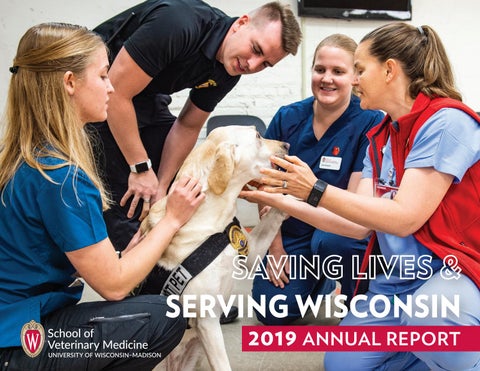
SERVING WISCONSIN 2019 ANNUAL REPORT
CONTENTS
4
MESSAGE FROM THE DEAN:
Building the Future
.
8
6
TRAINING FUTURE VETERINARIANS
DELIVERING COMPASSIONATE CARE
10
FOSTERING NEW SCIENTISTS & NOVEL DISCOVERIES
12
Administration MARK D. MARKEL Dean
FURTHERING THE WISCONSIN IDEA
14
ADVANCING THE SCHOOL
16
RECOGNITION FOR EXCELLENCE
Writing & Editing MEGHAN LEPISTO Publications & Media Relations Manager
RUTHANNE CHUN DVM’91 Associate Dean for Clinical Affairs
Design & Production ASHLEY VOSS Communications & Marketing Manager
ROBB HARDIE Associate Dean for Professional Programs LYNN MAKI Associate Dean for Student Academic Affairs NANCY PARKINSON Assistant Dean for Human Resources ED RODRIGUEZ Associate Dean for Budget & Finance
LAUREN TREPANIER Assistant Dean for Clinical & Translational Research
BOARD OF VISITORS & CAPITAL CAMPAIGN UPDATE COVER: Wisconsin State Capitol Police officer Mick Price and his K-9 partner Yacki get information about taking vital readings from Clinical Assistant Professor Corinne Lawson (far right) and students Zoie Schaefer DVMx’21 (right) and Madeline Gluck DVMx’20 (left), during a training program at Camp Randall Stadium. (Photo: Bryce Richter/UW-Madison)
Editorial Staff
DALE BJORLING Associate Dean for Research & Graduate Training
KRISTI V. THORSON Associate Dean for Advancement & Administration
18
2019 ANNUAL REPORT
Additional Design DENISE GARLOW Development Communications Specialist Photography DENISE GARLOW MEGHAN LEPISTO JEFF MILLER/UW-Madison BRYCE RICHTER/UW-Madison
vetmed.wisc.edu uwveterinarycare.wisc.edu animalsneedheroestoo.com @uwvetmed @uwveterinarycare @uwvetmed
KEN WALLER MS’07, DVM’07 Assistant Dean for Clinical Affairs The UW School of Veterinary Medicine uses gift funds to produce its publications. To donate to the school, contact: PAT BOWDISH Managing Senior Director of Development pat.bowdish@supportuw.org (608) 332-4750
HEIDI KRAMER Director of Development heidi.kramer@supportuw.org (608) 327-9136
This report is also available online at vetmed.wisc.edu/annual-report ©2019 Board of Regents of the University of Wisconsin System
MESSAGE FROM THE DEAN
BUILDING THE
FUTURE
When Wisconsin Governor Tony Evers signed the 2019-21 state budget into law in July, I saw 17 years of work flash before my eyes. Then I breathed a huge sigh of relief on behalf of all involved in reaching this momentous juncture.
BRYCE RICHTER / UW-MADISON
Included in the budget was the School of Veterinary Medicine's building project — a crucial expansion that has been in discussion at the SVM since 2002. With this result, our building is funded through the generosity and foresight of our governor and legislators and the support of friends like you. State-supported borrowing will fund approximately two-thirds of this $128 million project, with private gifts covering the rest (we’ve secured $24.7 million toward our $38 million fundraising goal). When the first conversations about building an addition to the school took place all those years ago, Daryl Buss was the dean and I had just become the associate dean for advancement. Fast forward to 2012 and we were able to demonstrate the importance of our project to University of Wisconsin–Madison leadership, leading to a feasibility study conducted by Flad Architects. 4
University of Wisconsin School of Veterinary Medicine
2019 ANNUAL REPORT
OPPOSITE PAGE: Governor Tony Evers (left) and Dean Mark D. Markel (right) talk during a tour of the Veterinary Medicine Building. LEFT: An aerial view of the Veterinary Medicine Building expansion from the feasibility study completed by Flad Architects in 2015.
This expansion and renovation will deliver desperately needed space to the school and position us to continue to excel in all that we do. The project will double the size of our small animal hospital, significantly enhance our large animal hospital, provide additional student learning areas, and expand the school’s research spaces, including those focused on infectious disease research. We are already hard at work with Flad Architects and Affiliated Engineers, Inc. on the building design. We hope to begin construction in the winter of 2021, with projected completion of the addition in 2023 and the renovation in 2024. In another significant stride forward, the new fivestory parking garage to the north of the SVM has now vetmed.wisc.edu
been designed and JP Cullen has been selected as the contractor. This is an important step in facilitating the school’s expansion. Groundbreaking is scheduled for October 2019 and completion is projected for December 2020 to accommodate our employees, students, and clients. Of course all the while we remain steadfast in the daily work that drives our mission — delivering state-ofthe-art instruction, clinical medicine, research, and outreach to benefit both animal and human health. As you’ll see in the pages of this annual report, our talented students, instructors, clinicians, scientists, and staff have collectively contributed to a year of tremendous growth and progress. Thank you to all of you who make this exciting work possible. Enjoy the 2019 Annual Report.
POTTER LAWSON
This study laid the groundwork for our efforts with campus and UW System leadership, political leaders, alumni, friends, and clients to highlight the critical nature of this expansion in our ability to serve the state of Wisconsin and the veterinary medical profession — a campaign that has been in high gear for the past several years. I am exceedingly grateful for the guidance, perseverance, and unwavering support demonstrated by so many who helped to drive this effort forward as we pressed our feet to the pedal to ensure that the building project was included in the final state budget.
ON, WISCONSIN!
Mark D. Markel Dean, UW School of Veterinary Medicine
An illustration of the new Lot 62 parking ramp scheduled to begin construction in October 2019.
5
TRAINING FUTURE VETERINARIANS
100%
OF SCHOLARSHIP APPLICANTS RECEIVE AID
Total student aid awarded (2018-19):
$1.98M
AVERAGE DVM STUDENT DEBT LOAD* UPON GRADUATION At the UW School of Veterinary Medicine, we believe in recruiting a diverse, high-caliber population of students and then doing all that we can to support their success. • Providing scholarships to 100 percent of applicants seeking aid? Check. • Delivering practical and engaging coursework that evolves to meet students’ needs? You can count on it. • Offering programming around financial planning, mental health and wellness, and inclusivity and diversity? Absolutely. We also know that students’ success is dependent on the expertise of our instructors. That’s why we’re committed to enlisting the best and brightest and presenting ongoing professional development in teaching.
THE END RESULT: An innovative professional curriculum that prepares students for a breadth of career endeavors and the opportunities and challenges ahead.
95% OFsecured THE CLASS OF 2019 jobs or continued 6
with their educational training by August 2019.
UY NH
* includes those with no DVM debt, total educational debt
LA KAY
UW AVERAGE
H
Career Exploration
For the second year in a row, in the summer of 2019 the SVM hosted local high school students from historically underrepresented populations for a six-week paid internship throughout our teaching hospital. The internship is part of a Madison Metropolitan School District program focused on careers and curriculum in the health sciences. For those closer to becoming a veterinarian, the school’s ninth annual career fair — preceded by a presentation on effective resumes and interviewing techniques — welcomed more than 30 employers from private practices, industry, and state and federal agencies to network with students and share shadowing, externship, and employment opportunities.
//
NATIONAL AVERAGE
$170,000
Debt Discussions
Teaching Excellence
This work is showing dividends. Our graduates’ low annual rate of increase in educational debt (0.13 percent for in-state graduates from 2006-18) and our efforts to provide specific financial literacy information that coincides with the decision period to request student loans were recognized nationally in industry publications this year.
SVM faculty and staff received numerous university and national awards in 2018-19 for distinguished contributions to teaching and mentoring, and for advancing the use of simulation in veterinary medical training.
As just one component of our larger commitment to addressing veterinary medical student debt and the financial health of the profession, the SVM continues to develop seminars for students around financial planning and wellness and how to appropriately use resources to support their DVM education.
Recognizing that the interns and residents in our teaching hospital play a pivotal role in teaching fourth-year students, in 2018 the school created a professional development program to help these graduate veterinarians hone their teaching knowledge. We also welcomed back for the summer an international expert in higher education to consult with our faculty and staff on teaching, learning, and curriculum development.
University of Wisconsin School of Veterinary Medicine
MEGHAN LEPISTO
Clinic as Classroom
The SVM continues to find novel ways to provide valuable hands-on clinical experience early in the curriculum, whether through a new introductory elective for first-year students or creative lab sessions in our recently expanded Clinical Skills Training Center. A collaboration launched in fall 2018 adds even further to these opportunities. Since October, the school has partnered with Madison Cat Project to host monthly high-volume spay and neuter clinics at the SVM. About 50 students and more than a dozen veterinarians, veterinary technicians, and other volunteers spay or neuter around 60 cats at each monthly clinic. The response from students has been so enthusiastic that there is at times a waiting list to assist.
Leading the Way
2018-19 was a shining year for student leaders in the SVM. In March, the Student American Veterinary Medical Association named Marie Bucko DVMx'21 its president-elect and installed Danielle Schuld DVMx'20 as secretary. In addition, Veterinarians as One Inclusive Community for Empowerment (VOICE), a national student-run organization that seeks to increase awareness, respect, and sensitivity to differences among all individuals and communities in the field of veterinary medicine, presented the National Chapter of the Year Award to the UW SVM chapter of VOICE. Our graduates also continue to be recognized as leaders in the profession. The Wisconsin Veterinary Medical Association named Judith Batker DVM'95 the 2018 Veterinarian of the Year. And the American Animal Hospital Association awarded Mark Thompson DVM'96 and his Country Hills Pet Hospital in Eden, Wisconsin, its 2018 Accredited Practice of the Year.
96
STUDENTS ACCEPTED out of a highly competitive pool of 1,318 applicants 158 WI RESIDENTS 1,160 NON-RESIDENTS
RESIDENCY WI Resident 62 Non-Resident 34
54
Undergraduate colleges & universities represented
WI Residents
PRIMARY AREAS OF INTEREST
Students from the Class of 2023 have a diverse range of interests, as indicated on their applications
FOOD ANIMAL - 21 OTHER* - 11
GENDER
Female Male
74 22
EQUINE - 7 WILDLIFE/ZOO - 7 MIXED - 6
77% Female
ACADEMIC BACKGROUNDS
ACROSS THE UNITED STATES, CANADA, & CHINA
SMALL ANIMAL - 36
65%
AVERAGE GPA
AVIAN/EXOTICS - 5 RESEARCH/INDUSTRY - 3 * Includes emergency and critical care,
lab animal, ophthalmology, public health, shelter medicine, & undecided
Different undergraduate majors represented • • • • • • • • • • • • • • • • • • • • •
Animal Science Anthropology Biochemistry Biological Sciences Biology Biomedical Engineering Biomedical Science Chemistry Dairy Science Ecology Economics Entomology Finance German History International Studies Microbiology Molecular Biology Neuroscience Spanish Zoology
2019 ANNUAL REPORT
Class of 2023 // AT-A-GLANCE
DELIVERING COMPASSIONATE CARE
From the ordinary to the extraordinary, UW Veterinary Care saw nearly 28,000 patient visits in 2018-19.
8
PATIENT VISITS // AT-A-GLANCE (2018-19)
D.Z. JOHNSON
Through all these cases and more, our hospital staff continues to work to maximize available space in the current hospital (which was built to see 12,000 patients annually) while planning ahead for the forthcoming building expansion and renovation. In the interim, the Morrie Waud Large Animal Hospital saw several improvements this year, including the installation of a large animal standing CT scanner – a state-of-the-art imaging tool for our patients – and the creation of a new workspace for clinicians and renovated student work area.
MEGHAN LEPISTO
There was Periwinkle, a blue crane who received a life-saving, rare surgery on her trachea. And Jerry, a senior poodle mix found abandoned on the side of a highway with an infected jaw fracture and dental disease so severe that all of his teeth had to be extracted. There was also Willow, a frisky feline who fractured both elbows but healed fully following orthopedic surgery and physical rehabilitation. And Shamrock, an incredible 1,800-pound camel treated by our Large Animal Surgery Service.
Canine - 19,701
Avian - 695
Feline - 4,681
Lapine - 444
Equine - 1,078
Bovine - 186
Other* - 1,031
*includes Rodentia, Reptile, Porcine, Mustelidae, Camelid, Insectivora, Caprine, Marsupial, Ovine, Primate, Fish, Amphibian, and other mammals.
MEGHAN LEPISTO (2)-
When a patient is both a treasured member of the family and a critical protector of the community, it’s a special honor to be part of their care team.
A Shot at Preventing Cancer At UW Veterinary Care, our expert clinicians are dedicated to providing compassionate and outstanding service to every animal we see, while also raising the standard of care in veterinary medicine. We do this using the latest technologies and therapies and through clinical research aimed at improving animal and human health. A myriad of clinical studies allow our clinicians and researchers to test and develop new diagnostic and treatment options, and to perhaps one day make the untreatable treatable. This means that many of our patients — like Trilly, a 9-year-old Gordon setter — have the chance to not only lead a healthier life but to also benefit other animals and people. In May, Trilly received the very first shot in the Vaccination Against Canine Cancer Study, a five-year clinical trial to investigate a vaccine strategy for the prevention of cancer in dogs. If the vaccine works in dogs, it might also work in people. Much like an influenza vaccine bolsters the body’s readiness to fight the flu, this preventative vaccine follows the same principle, “to have the immune system primed such that if a cancer cell develops, it will attack,” says David Vail, professor and Barbara A. Suran Chair in Comparative Oncology. The UW School of Veterinary Medicine is a national leader in the field of research known as comparative oncology. To date, clinical studies of novel cancer therapies in canine oncology patients at UW and elsewhere have yielded revolutionary technologies and more effective, less toxic treatments for both pets and people. vetmed.wisc.edu
In 2016, UW Veterinary Care launched a statewide K-9 health effort to make veterinary medical care even more accessible to Wisconsin police dogs and their departments through credited and discounted services. Since then, 57 law enforcement agencies throughout the state have signed agreements for care with UWVC — like the Manitowoc County Sheriff’s Office, which required assistance when injured hip flexor muscles sidelined K-9 Leon.
2019 ANNUAL REPORT
To Protect and Serve
Five sessions with Courtney Arnoldy, the hospital’s physical rehabilitation specialist, helped to strengthen Leon’s hip flexors and surrounding muscles and equip his handler with ways to prevent future injury. Now the six-yearold German shepherd is back to work. A dual-purpose police dog, Leon helps with drug detection, tracking of suspects or missing people, and other patrol duties. Arnoldy has provided rehab services to several other K-9s in recent years from Winnebago County, Racine County, and Fond du Lac, with all returning to duty. In 2019 UW Veterinary Care also announced plans to provide care for Milwaukee Police Department Mounted Patrol horses housed at MKE Urban Stables, a new facility that broke ground in April.
“
With all the technology and the doctors, anything you need you can get it here. You’re going to get the best of the best.” —Chris Hemauer a deputy sheriff with the Manitowoc County Sheriff’s Office and handler of K-9 Leon, a UW Veterinary Care patient 9
2018-19 yielded a litany of transformative research milestones and surprising discoveries from the school, all sparking progress toward a healthier world.
DENISE GARLOW
The research conducted at the UW School of Veterinary Medicine is not only world-class; it’s of worldly importance.
MEGHAN LEPISTO
A universal flu vaccine that could provide broader, longer coverage. Novel insights into female infertility. New opportunities to slow or reverse demyelinating diseases like multiple sclerosis. Targeted cancer therapies and broader prevention tools.
DANIEL RADECKI
DENISE GARLOW
FOSTERING NEW SCIENTISTS & NOVEL DISCOVERIES
TOTAL RESEARCH AND EXTRAMURAL AWARDS (2018-19)
$28.9M $15.6M FEDERAL $13.3M NON-FEDERAL
10
University of Wisconsin School of Veterinary Medicine
This year, SVM scientists — who conduct 75 percent of the infectious disease research at UW–Madison — provided a clearer understanding of the viral mechanics of Ebola and the antiviral antibodies produced by Ebola survivors. The findings carry potential implications for the design of antiviral therapies and vaccines to protect against this deadly disease. Our researchers also helped illuminate how obesity contributes to breast cancer risk; revealed an emerging role for androgens in the pathogenesis of preeclampsia, a serious medical condition that affects pregnant women; and shed light on the potential for hibernation and a related process, torpor, to aid human health in spaceflight and in treating traumatic medical events. In addition, the school took part in the largest genomic study of parasitic worms to date, predicting a variety of new potential drug targets and drugs; pushed forward understanding of the fundamentals of heartworm disease and methods of prevention; and translated studies of mosquito-pathogen interactions into new mosquito control methods. And our faculty showed that vaccination may reduce the impact of white-nose syndrome in bats, one of the most destructive wildlife diseases in modern times; identified two respiratory viruses of human origin sickening wild chimpanzee groups in Uganda; and played a part in field research of endangered grey crowned cranes in Rwanda.
Supporting Clinical Researchers With their deep familiarity with the comparative aspects of disease, veterinary specialists are uniquely positioned to contribute expertise to research teams. Yet a number of shortfalls globally have led to missed opportunities for veterinary clinicians to contribute to translational research. vetmed.wisc.edu
The more I learned about the institution as a whole, the more it felt like this was a place that would be invested in my success and supportive of interdisciplinary collaborative approaches to research questions.That is exactly the type of environment in which I thrive.” —LaTasha K. Crawford assistant professor, describing what attracted her to the UW School of Veterinary Medicine The School of Veterinary Medicine has launched several initiatives to stem this tide and equip clinicians with more confidence as researchers. Our vision is to develop sustained training programs in clinical research for faculty, staff, and students, thereby helping to address gaps in knowledge of animal and human diseases. Leading these efforts is Lauren Trepanier, a professor of internal medicine who in 2018 accepted a new 40-percent appointment as assistant dean for clinical and translational research. Specific efforts include a veterinary research elective for DVM students, a monthly clinical research seminar for house officers, and individual consultation on research design, execution, and grant writing. Trepanier also serves on the leadership of the Clinical and Translational Science Award One Health Alliance (COHA), a network of veterinary schools partnered with medical schools and other colleagues. The SVM has hosted two COHA-supported Translational Research Summits to bring together physician, veterinary, and PhD researchers and advance knowledge of shared disease interests. The summits — including a 2018 gathering on inherited diseases of the heart muscle in people, cats, and dogs — have yielded positive feedback and new cross-professional collaborations.
2019 ANNUAL REPORT
Tackling Global Health Challenges
“
A Leader in Graduate Training The SVM’s Comparative Biomedical Sciences (CBMS) graduate program trains scientists at the leading frontiers of biomedical research. The program continues to garner a top 10 national ranking for its research performance among 51 programs in veterinary medical sciences according to the Academic Analytics database — a distinction it has received for many consecutive years. More than 90 faculty from the SVM’s four academic departments and across the UW–Madison campus are trainers for this dynamic program. CBMS spans core areas of animal and human health, from genomics and infectious disease to biomedical engineering and developmental biology. Many students garner competitive research support; in 2018-19 this included fellowships from organizations including the National Science Foundation and American Heart Association. As another point of pride, the program’s highly talented and diverse pool of students complete the PhD program an average of one year before our Association of American Universities (AAU) peer institutions. The average CBMS time to degree completion is currently 4.3 years compared to AAU peer data of 5.2 years. 11
FURTHERING THE WISCONSIN IDEA
The Wisconsin Idea is a century-old philosophy, but its value is timeless. This core principle — encouraging the application of UW–Madison research, teaching, and outreach to improve lives beyond the classroom — drives the university and the School of Veterinary Medicine. Every day, the SVM makes lives better by training the next generation of veterinarians and biomedical researchers, conducting research that benefits both animals and people, and providing cutting-edge veterinary medical care for patients of our teaching hospital. We are dedicated to applying our expertise to serve the citizens of Wisconsin and beyond. Our faculty provide training to conservation staff to aid the rehabilitation of endangered species, consult with animal shelters to put in place precautionary measures when disease strikes, study threats to Wisconsin's fish and wildlife, provide specialized guidance and continuing education to veterinarians, and more.
12
DENISE GARLOW
Our outreach efforts also include offering timely insights to media and communicating to key audiences around the state the value and impact of the school. In 2018-19, the SVM and its faculty, staff, students, and alumni were cited in news outlets more than 1,200 times. Our faculty also delivered presentations to journalists from around the world on Ebola and ticks, mosquitoes, and human health.
University of Wisconsin School of Veterinary Medicine
Researchers at the school pioneered the use of ultrasound to diagnose bovine respiratory disease in calves and are now training large animal veterinarians to use this technique to keep the disease in check. Our scientists are also tackling Johne’s disease, an infection that costs the dairy industry $1.8 billion every year. We developed a smartphone app that helps veterinarians and farmers manage the disease and are working on a more effective vaccine to reduce its spread. And the SVM’s Dairyland Initiative provides producers the information they need to build well-designed cattle housing that optimizes cows’ well-being. The school’s work keeps farmworkers safer too. Dairy cows and their caretakers can contract tuberculosis from one another, endangering both. That’s why the SVM helps test and vaccinate farmworkers for the disease and tracks new outbreaks to stop them before they spread.
Tick Tracking Tech In advance of peak summer tick season in 2019, researchers at the Midwest Center of Excellence for Vector-Borne Disease — headquartered at UW–Madison and co-directed by Lyric Bartholomay PhD’04, professor in the School of Veterinary Medicine — developed a free smartphone app to better understand and limit people’s exposure to disease-carrying ticks. The Tick App asks users to log daily entries of whether they encountered ticks or not and where, helping scientists track the threat of tick-borne diseases. It also provides information on how to prevent tick bites and identify and remove ticks, offers a tick risk forecast by location, and alerts users when tick numbers are peaking. The app is one of many efforts from the Midwest Center to study illnesses transmitted by ticks and mosquitoes, train researchers to stop the diseases from spreading, and engage public health officials and the lay public in reducing disease exposure. vetmed.wisc.edu
— Chris Booth DVM’00 veterinarian and practice owner at Dairy Doctors in Plymouth, Wisconsin
Care for Injured & Orphaned Wildlife A snapping turtle who swallowed a fishing hook. A fox with severe mange. A baby owl who fractured a leg after falling from the nest. These are just a few of the nearly 4,000 animals served annually by Dane County Humane Society’s Wildlife Center with assistance from UW Veterinary Care’s Special Species Service. For the past five years, the SVM has delivered veterinary medical care to injured or orphaned native wild animals at the Wildlife Center. UW Veterinary Care faculty, veterinary residents, and fourth-year veterinary medical students visit the center at least once a week, consulting by phone and email in between. “It’s a symbiotic relationship,” says Christoph Mans, clinical associate professor of zoological medicine. “We train future veterinarians and make sure that animals at the wildlife center get the best possible veterinary care.”
A great horned owl treated at Dane County Humane Society’s Wildlife Center in partnership with UW Veterinary Care.
MEGHAN LEPISTO
The SVM is at the forefront of developing medical care to keep dairy cows healthy from birth onward and treat them when they’re sick — helping keep the $43 billion Wisconsin dairy industry safe and productive.
Our dairy clients demand industry-leading service and knowledge to help their businesses succeed. The SVM has helped us meet these expectations with five grads on staff and consistent creation of new resources, such as the Dairyland Initiative, to assist in continual improvements.”
2019 ANNUAL REPORT
Keeping Cows Healthy
“
13
ADVANCING THE SCHOOL
This year, the UW School of Veterinary Medicine celebrated many successes but also mourned the loss of one of our greatest friends and supporters, Morrie Waud. For more than 20 years, Waud was a treasured client and donor to the SVM, advancing equine health, student scholarships, and the school’s overall success through unparalleled generosity. But more than that, he was a beloved member of the collective SVM family. He made tremendous efforts to support the school’s dedicated veterinary medical students through a range of gifts and even went so far as to “walk a mile in their shoes,” following along as an honorary member of the Class of 2015 as they navigated the rigorous demands of earning a doctorate of veterinary medicine.
14
LORI STRELOW
Most recently, in spring 2017 Waud committed $5 million to match gifts and pledges toward the school’s Animals Need Heroes Too building expansion campaign. The match presented special opportunities for SVM students, alumni and their immediate families, faculty, and staff to have a significant impact on this critical campaign. In February 2019, the Morrie Waud Match was completed, generating a total impact of nearly $9 million raised toward the SVM expansion. Waud’s ongoing generosity and caring spirit forged a legacy of support that will drive the school for decades to come. Alongside his family, the SVM community proudly honored Waud during a celebration of his life held at the school in May 2019. University of Wisconsin School of Veterinary Medicine
The Animals Need Heroes Too building expansion campaign was a key focus for the school this year. With great elation, the expansion project was included in the 2019-21 Wisconsin budget that Governor Tony Evers signed into law in July. State-supported borrowing in the state budget will fund approximately two-thirds of this $128 million expansion and renovation project. We have secured $24.7 million toward our $38 million goal to support the remainder of the project. Our faculty and staff, alumni, and other friends of the school were incredibly generous in sharing their time and expertise throughout the capital budget process. The school hosted legislators and staff from more than 35 offices, including Governor Evers, and engaged numerous statewide advocates to communicate the importance of the building expansion project on the SVM’s behalf. Also in support of the campaign, the Wisconsin Union and SVM in May unveiled a dairy-inspired, limited-edition mini Terrace chair for sale through fall 2019. A portion of proceeds from the cow-printed keepsake will benefit the SVM's building expansion.
A Day, and Year, of Giving On April 9, UW–Madison celebrated the inaugural Day of the Badger. On this day of giving, SVM alumni and friends contributed more than 100 gifts to support the school’s building expansion campaign and other initiatives. Thanks to a generous match to all building gifts from the 512 Wingra Street Fund, the day had an overall impact for the school of more than $48,000. Then in May, the SVM exceeded its UW-Madison All Ways Forward campaign goal of $100 million; to date, the campaign total stands at $107 million. (Our goal was increased twice in the past five years, from the original $40 million to $70 million and later $100 million.) Funds raised through this campaign have not only supported the building expansion, but have also allowed for investments in our faculty, research, and substantial new commitments to scholarship support for our students. The school remains committed to maintaining the affordability of the education that we provide, with our veterinary medical students' indebtedness upon graduation ranking among the lowest in the United States. In addition, the campaign success includes future estate gifts that have been documented, which will ensure long-term investments in the school. In total in 2018, the school received the gracious support of 2,871 individual donors. We are particularly proud to note that 12 percent of the school’s alumni have made at least one gift to the SVM over the last three years, and 16 percent have made at least one gift in the last five years. Our graduates’ commitment to the school has fueled student scholarships, faculty research, the building expansion, and much more. vetmed.wisc.edu
2,871
TOTAL DONORS (2018) 16% OF SVM ALUMNI have made at least one gift to the school over the last five years.
Financials EXPENDITURES BY SOURCE
24%
% OF BUDGET FROM STATE SUPPORT IN 2019 2018 - 24% 2017 - 25%
2016 - 29% 2015 - 29%
EXPENDITURES BY PURPOSE (in millions) Teaching Hospital (20.8M)
(in millions)
$72.9M
2019 ANNUAL REPORT
Bolstering the Building Campaign
$72.9M
School (15.2M)
Gifts $4.8M
Student Aid $2.9M
Grants $16.4M
Instruction $36.0M
Program Revenue $21.6M
Other* $5.5M
Tuition $12.9M
Research** $28.5M
GPR* $17.2M * State appropriations (less estimated tuition and fees)
* Student services, public service, and academic support ** Primarily research grants and contracts
15
RECOGNITION FOR EXCELLENCE
Kristen Bernard
President-Elect American Society for Virology
Marie Bucko DVMx'21
President-Elect Student American Veterinary Medical Association
AWARDS & HONORS HIGHLIGHTS (2018-19) Each year, the school’s students, faculty, and staff earn numerous accolades in a wide variety of fields, as exemplified in the following list. This is not a comprehensive list of awards and honors, only a representative sample from July 1, 2018 – June 30, 2019. More at go.wisc.edu/svm-awards-honors.
Hannah Carey
Mentor of the Year Award Merck Animal Health and American Association of Bovine Practitioners
Peter Muir
Fellow Royal College of Veterinary Surgeons
President-Elect Federation of American Societies for Experimental Biology
Linda Schuler
Stephen Johnson
Marulasiddappa Suresh
Kim Keil
UW SVM VOICE Chapter
Kim Lord Plummer
Tim Yoshino
Mark D. Markel
Karen Young
Distinguished Veterinary Teacher Award Zoetis Women in Toxicology Postdoctoral Achievement Award Society of Toxicology Chancellor's Hilldale Award for Excellence in Teaching UW–Madison President-Elect Association of American Veterinary Medical Colleges
16
Sheila McGuirk
Hilldale Award UW–Madison
Award for Veterinary Research Excellence Zoetis National Chapter of the Year Veterinarians as One Inclusive Community for Empowerment (VOICE) 2019 Distinguished Service Award American Society of Parasitologists Slesinger Award for Excellence in Mentoring UW–Madison
University of Wisconsin School of Veterinary Medicine vetmed.wisc.edu
vetmed.wisc.edu
BRYCE RICHTER / UW-MADISON NIK HAWKINS
JOHN MADAY
NIK HAWKINS
HEIDI KRAMER
JEFF MILLER / UW-MADISON
2019 ANNUAL REPORT
TOP ROW (left to right): Professor Emeritus Tim Yoshino; Douglas Kratt DVM’98, Marie Bucko DVMx’21, and Dean Mark D. Markel; Lecturer Kim Lord-Plummer (center) with veterinary medical students. MIDDLE ROW (left to right): VOICE officers Kameron Montana DVMx’20, Makenzi Travis-Balac DVMx’20, Kyle Granger DVMx’20, Priscilla Marroquin DVMx’21, and Jessica Carag DVMx’20; Professor Peter Muir with patient Lambeau and veterinary technician Lindsay Brusda; Professor Hannah Carey. BOTTOM ROW (left to right): Professor Emerita Sheila McGuirk and Assistant Professor Terri Ollivett; Karen Young (far right) with students.
17
BOARD OF VISITORS
John Baumann ’82
Alan Holter
John Been DVM ’88*
Phil Jennings JD’93
Debbie Cervenka
Diane Larsen ’80, DVM’90, PhD’99*
Terrence Clark DVM’87*
Steve Larson MS’70
Tim Connor EMBA’09
Jeffry A. Neuenschwander ’82
Margo Edl
Esther Olson
Patrick S. Farrell MS’83, DVM’87*
Jill Pelisek
Charity Gottfredsen ’02, MS’07, DVM’07*
Janet Raddatz
Dan Grimm
Waterford, Wisconsin
John Schaefer ’81 Harshaw, Wisconsin
Melita F. Grunow
Karl Solverson ’94, DVM’99*
Peter Hanson MS’94, PhD’97*
Thomas Torhorst ’65
Janet Hoehnen
Karen Walsh ’81, MA’89
Monroe, Wisconsin
Prairie du Sac, Wisconsin
THANK YOU TO OUR 2018-19 BOARD The Board of Visitors for the UW School of Veterinary Medicine serves as an external advisory body to the dean of the school. Members of the board have attained prominence in their respective careers and are chosen because of their value in providing sound advice and counsel to the dean. Read more about the board members at vetmed.wisc.edu/board-of-visitors.
Duluth, Minnesota
Cottage Grove, Wisconsin Fitchburg, Wisconsin
Middleton, Wisconsin Russell, Pennsylvania Chicago, Illinois
Lake Geneva, Wisconsin Boston, Massachusetts Milwaukee, Wisconsin
Dodgeville, Wisconsin Madison, Wisconsin Duluth, Georgia
Fort Atkinson, Wisconsin Detroit, Michigan
Belleville, Wisconsin Milwaukee, Wisconsin Plymouth, Wisconsin
Westby, Wisconsin Racine, Wisconsin
Madison, Wisconsin
All degrees listed are earned from UW-Madison.
* Indicates alumni of the UW School of Veterinary Medicine. 18
University of Wisconsin School of Veterinary Medicine
CAPITAL CAMPAIGN // FAST FIGURES (2018-19)
PRIVATE GIFT TOTAL
$9 MILLION
toward the $38 million goal for the Veterinary Medicine Building’s expansion and renovation project.
MORRIE WAUD MATCH IMPACT
generated upon the completion of the special $5 million match for gifts and pledges made by SVM students, alumni, faculty, and staff in February 2019.
participated in the giving opportunity initiated by longtime friend and supporter of the school, Morrie Waud.
100+ GIFTS ON APRIL 9, 2019 from SVM alumni and friends in support of the school’s building expansion campaign on the inaugural campus-wide Day of the Badger giving experience.
Thanks to a generous match from the 512 Wingra Street Fund, the day had an overall impact of more than $48,000.
LEARN MORE ABOUT OUR PLANS FOR THE FUTURE: ANIMALSNEEDHEROESTOO.COM
STATE SUPPORT
for the School of Veterinary Medicine’s building project included in the state of Wisconsin’s 2019-21 budget signed by Governor Tony Evers in July 2019.
289 ANIMALS NEED BUCKY TOO replica statues distributed to capital campaign leadership donors.
2019 ANNUAL REPORT
$24.7M
Non-profit Organization U.S. POSTAGE PAID MADISON, WI PERMIT NO. 658
2015 Linden Drive Madison, WI 53706
MOO-VING ON Resident donor and teaching cows Maxine (pictured) and Lois Lane retired from service and departed the Morrie Waud Large Animal Hospital for new adventures in summer 2019. After helping hundreds of large animal patients in need through rumen fluid, blood, and plasma donations, and helping teach future veterinarians, the beloved Holstein cows are relaxing in greener pastures on a hobby farm owned by Eric Howlett DVM’18, who recently completed a Primary Care internship at UW Veterinary Care.
We thank the generous donors who provided funding for the production of this publication.