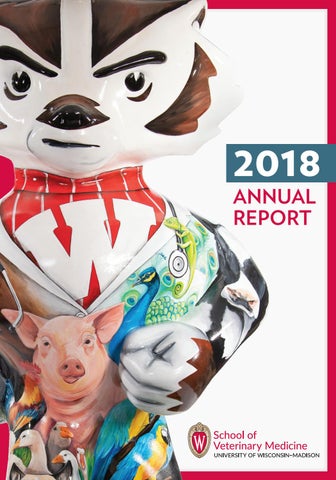
2018 ANNUAL REPORT
SAVING LIVES & SERVING WISCONSIN The UW School of Veterinary Medicine helps make both animal and human lives better. Our discoveries have advanced cancer treatments, we’ve created new ways to fight the flu, and we’re a world leader when it comes to figuring out what keeps cows healthy and happy.
MORE THAN
We have trained over half of the veterinarians in the state and serve as a resource and referral clinic for all.
Our livestock experts launched The Dairyland Initiative, a program that works directly with farms to optimize cow comfort, health, and production.
Our scientists conduct 75% of the infectious disease research at UW-Madison, including work to prevent pandemic influenza.
AnimalsNeedHeroesToo.com
Our teaching hospital provides exceptional care for animals throughout the state. Of our nearly 27,000 patient visits last year, 80% were from Wisconsin.
Administration MARK D. MARKEL, Dean DALE BJORLING, Associate Dean for Research and Graduate Training RUTHANNE CHUN DVM’91, Associate Dean for Clinical Affairs ROBB HARDIE, Associate Dean for Professional Programs LYNN MAKI, Associate Dean for Student Academic Affairs NANCY PARKINSON, Assistant Dean for Human Resources ED RODRIGUEZ, Associate Dean for Budget and Finance
PAGE 16
KRISTI V. THORSON, Associate Dean for Advancement and Administration LAUREN TREPANIER, Assistant Dean for Clinical and Translational Research KEN WALLER MS’07, DVM’07, Assistant Dean for Clinical Affairs
Editorial Staff
Writing and Editing MEGHAN LEPISTO, Publications and Media Relations Manager Design and Photography DENISE GARLOW, Development Communications Specialist ASHLEY VOSS, Communications and Marketing Manager Additional Photography Focal Flame Photography, Nik Hawkins, Jeff Miller and Bryce Richter, University Communications The UW School of Veterinary Medicine uses gift funds to produce its publications. To donate to the school, contact: Pat Bowdish, Managing Senior Director of Development (608) 294-7661 | pat.bowdish@supportuw.org Heidi Kramer, Director of Development (608) 327-9136 | heidi.kramer@supportuw.org This report is also available online at vetmed.wisc.edu/annual-reports ©2018 Board of Regents of the University of Wisconsin System
vetmed.wisc.edu uwveterinarycare.wisc.edu
ON THE COVER: Animals Need Bucky Too, the school's life-size Bucky Badger statue featured in the Bucky on Parade public art event in Madison and Dane County. (Photo: Focal Flame Photography) ABOVE: Dean Mark D. Markel and Kathy King, local artist and creator of the SVM's Bucky, at the statue's unveiling in May 2018.
2018 Annual Report 4
Message from the Dean: Positioning the School to Excel in the Coming Decades
6
8
Training Future Veterinarians Delivering Compassionate Care
10
Making New Scientists and New Discoveries
12
Furthering the Wisconsin Idea
14
Fast Facts: Class of 2022, Financials
16
Advancing the SVM
17
Recognition for Excellence
18
Board of Visitors
facebook.com/uwvetmed facebook.com/uwveterinarycare twitter.com/uwvetmed youtube.com/uwvetmed 3
MESSAGE FROM THE DEAN POSITIONING THE SCHOOL TO EXCEL IN THE COMING DECADES I am sure you will enjoy reading this annual report to learn about all that the University of Wisconsin School of Veterinary Medicine (SVM) has accomplished. Whether it is the successful enumeration for a new parking ramp to the north of the school that will begin to be constructed in fall 2019 (an important first step in facilitating the school’s building expansion), to raising over $23 million in gifts toward our expansion, to optimizing our students’ educational experience through the new Renk Learning Center that opened in 2017, to the continued pursuit of research that benefits both animal and human health, the school remains focused on positioning itself to lead our profession in the coming decades. We continue to speak with Wisconsin legislators, the governor’s office, UW System, and UW-Madison campus leadership about the impact of the SVM on Wisconsin and its citizens, benefiting both their health and their animals’ wellbeing. The veterinarians we train who establish their practices throughout the state, the continuing education we deliver, the veterinary medical care we provide in our hospital, and the scientific discoveries we generate that produce new treatments and industry partnerships are just a few of the ways in which the SVM plays an important role in serving Wisconsin. Over the next nine months, our goal is for the school’s expansion project to be included in the state’s 2019-21 budget. This critical project will double the size of our small animal hospital, significantly improve our large animal hospital, provide additional student learning spaces, and triple the school’s research spaces, particularly those focused on infectious disease research, allowing the SVM to continue to lead in all that it does.
In August 2018, the UW Board of Regents voted to include the SVM expansion in their priorities for the biennial capital budget request. We remain dedicated to raising the funds necessary to bring this project to its successful completion. Currently, the parking ramp is slated to be completed in fall 2020, with construction of the school’s expansion to begin in 2020 and be completed in 2022. Beyond the school’s expansion, an important focus of our leadership in the coming years includes supporting an inclusive, diverse, and welcoming environment for all. In fall 2018, we will again perform our biennial climate survey of faculty, staff, and students to identify both our successes as well as areas where we can enhance the climate within the school. As you’ll note in this report, the school continues to excel on every front. Over the past five years, the number of faculty at the SVM has increased 10 percent, hospital revenues have increased 38 percent, research expenditures increased 58 percent, and scholarship support increased 96 percent. I want to thank every one of you, whether you work or learn within the school, are a client in our hospital, a graduate, or a friend of the school, for all that you do to make the school what it is today and what it will become in the future. Enjoy the UW School of Veterinary Medicine’s 2018 Annual Report. On, Wisconsin! Mark D. Markel Dean
4
University of Wisconsin School of Veterinary Medicine
2018 ANNUAL REPORT
“The University of Wisconsin School of Veterinary
UW-MADISON STATE RELATIONS
Medicine creates the future of veterinary medicine through unparalleled excellence in education, clinical medicine, and research that benefit both animal and human health."
Dean Markel (right) chats with Bill Schultz, State Senator Duey Stroebel, and Representative Tyler Vorpagel (left to right) during a visit to Schultz's Lyn-Vale Farm in Waldo, Wisconsin in spring 2018.
vetmed.wisc.edu
5
TRAINING FUTURE VETERINARIANS FULLY PREPARED FOR THE OPPORTUNITIES AHEAD The UW School of Veterinary Medicine (SVM) is committed to providing an exceptional education to our students to prepare career-ready, collaborative veterinary professionals and set them up for success in the full range of opportunities that await them. A new course launched in fall 2017, Interprofessional Leadership in Public Health, is one more step along this path. The class is part of a series of interprofessional learning experiences developed by the UW Schools of Veterinary Medicine, Pharmacy, Medicine and Public Health, and Nursing to gather health sciences students to learn and solve problems together. Working across disciplines is a concept put into practice daily at our Wisconsin Companion Animal Resources, Education, and Social Services (WisCARES) clinic in South Madison, where veterinary medicine, social work, and pharmacy students play an integral role in operations and gain valuable perspectives on the differences and similarities between veterinary and human medicine.
Hands-On Experience
The SVM implemented new lab sessions, electives, and clinical skills training simulations in 2017-18 across a range of specialty areas to increase students’ hands-on experience through all four years of their veterinary medical education. Our expanded Clinical Skills Training Center — part of the new Renk Learning Center opened in 2017 — has quickly become a highly utilized space. New initiatives include small group labs for fourth-year students on topics such as dentistry, internal medicine, and small and large animal surgery, and an Introduction to Clinical Skills elective course that provides firstyear students with basic clinical experience early in the curriculum. In April, students participated in the first-ever Animal Forensic Lab in the Clinical Skills Training Center at the SVM, hearing from experts in the field about forensic necropsy, evidence tracking, and more, and then practicing these skills firsthand.
6
Translational Research
In response to student demand, in the 2017-18 academic year the SVM expanded the Introduction to Veterinary Research elective to both fall and spring sessions. This course covers study design, critical evaluation of data, laboratory research opportunities at the school, and research careers available to veterinary scientists. We also continue to offer the annual selective in Clinical Research Study Design, providing individualized hands-on training to develop a study suitable for grant submission. In May, our first four DVM graduates with a clinical researcher emphasis were recognized at commencement. We developed this emphasis to encourage the recruitment of applicants who want to incorporate research into their careers, provide a plan for opportunities in translational research during the DVM curriculum, and enhance the competitiveness of fourth-year DVM students for internship, residency, MS, and PhD programs.
BY AUGUST 2018
OF THE CLASS OF 2018 SECURED JOBS IN THE FIELD or continued with their educational training
PRACTICE/FIELD 34 - Small animal 14 - Food animal 4 - Equine 2 - Mixed 1 - Public health 1 - Shelter medicine 1 - USDA 1 - US Army
INTERNSHIPS 20 - Small animal 3 - Shelter medicine 2 - Equine EDUCATION 2 - Master of Public Health (MPH) 1 - PhD
University of Wisconsin School of Veterinary Medicine
2018 ANNUAL REPORT
“All of the feedback was incredibly positive. Students
thought it was an extremely educational experience and a lot of them wanted to spend even more time in the lab."
MEGHAN LEPISTO
NIK HAWKINS
—Bailee Stahl DVMx’19, describing the first-ever Animal Forensic Lab for veterinary medical students at the SVM
More Inclusive Community
For the first time, in fall 2017 the school partnered with the UWMadison Department of Counseling Psychology to engage all first-year DVM students in diversity dialogues — small-group discussions designed to enhance students’ understanding of diversity and provide an opportunity to share and learn from peer experiences. Admissions staff members also participated in a bias workshop, learning how to better facilitate the admissions decision-making process to include the more diverse perspective of applicants and their value to the educational environment. And the school continued its partnership with UW-Madison’s Precollege Enrichment Opportunity Program for Learning Excellence, ensuring that diverse student communities learn about veterinary medicine. In spring 2018, the SVM’s Veterinarians as One Inclusive Community for Empowerment (VOICE) student chapter partnered with the school’s Engagement, Inclusivity, and Diversity Committee on a student-led initiative to engage the SVM in social justice issues, highlighting the International Day of Tolerance, Autism Awareness Month, and more. In recognition of their leadership, creativity, and initiative in promoting diversity in veterinary medicine, the chapter received VOICE’s National Programming Excellence Award in March.
vetmed.wisc.edu
ABOVE: Daniel Chia DVMx’19 and Candace Lien DVMx’19 participate in a lab in the Clinical Skills Training Center. LEFT: Priscilla Marroquin DVMx’21 (left) and Clinical Assistant Professor Elizabeth Alvarez examine a canine patient at the WisCARES clinic.
100%
Percentage of scholarship applicants who received aid
$1.6M
TOTAL SCHOLARSHIP DOLLARS AWARDED
615
# OF SCHOLARSHIPS AWARDED IN 2017-18
AVERAGE UW -MADISON DVM STUDENT DEBT LOAD* UPON GRADUATION (2017) *Includes debt incurred during prior education
NATIONAL AVERAGE - $150,025
7
DELIVERING COMPASSIONATE CARE HEALING PATIENTS, SERVING PEOPLE Built to serve 12,000 patients annually, our award-winning teaching hospital, UW Veterinary Care (UWVC), now sees nearly 27,000 animals from across the state, the nation, and even the world. The hospital has grown from 10 specialties when we opened in 1983 to accommodating more than 20 in the same space today, each requiring unique equipment and space needs. To provide the best possible care for our patients and improve students' education, we continue to find ways to maximize available space as we work toward a more significant building expansion. From retrofitting rooms to repurposing storage areas, in 2017-18 we completed several improvements; among them, our Radiation Therapy and Physical Rehabilitation reception areas were remodeled to create three new examination rooms for oncology and rehab patients; a former laboratory and rounding space, along with two janitor offices, were converted into a ward for Medical Oncology (including a dedicated chemotherapy administration room); the Primary Care and Ophthalmology services were moved out of their hallway perches and into the former Medical Oncology ward; and the reception area welcoming clients to our Morrie Waud Large Animal Hospital was remodeled.
Wildlife Win-Win
Through a new partnership with the MacKenzie Center, a Wisconsin wildlife educational facility, UW Veterinary Care’s Special Species service provides veterinary medical care for a range of native mammals and birds of prey including gray wolves, lynx, a badger, bald eagle, and barred owl. The shared educational mission of the UW School of Veterinary Medicine (SVM) and the MacKenzie Center, which hosts tens of thousands of visitors annually, including K-12 students from across the state, makes the collaboration a natural fit. The partnership helps the center provide an advanced level of veterinary care within a limited budget, and allows the SVM to broaden learning opportunities for clinical trainees and students through exposure to novel species and procedures.
8
First of a Kind
Whether it’s delivering an easier, less stressful method of seizure medication for cats developed by an SVM neurologist or delicately repairing through orthopedic surgery the broken leg of a dog found shot and abandoned, the impact of our care, as well as treatments and technology pioneered here, are felt daily by patients and their people. Though small in stature, Ferguson, a 10-year-old miniature donkey, was one of the year’s biggest cases for UWVC. When Ferguson was rescued by Holyland Donkey Haven near Fond du Lac, Wisconsin, his left front hoof was so disfigured it had formed a large abscess. The bone was chronically deformed and infected and Ferguson could barely walk due to the pain. Today, Ferguson is standing strong after UWVC amputated part of his deformed leg and a prosthetist from UW Health fitted him with an artificial limb made of acrylic and carbon fiber – the first amputation with a prosthesis at our large animal hospital. Now back at Holyland, Ferguson is walking, playing, and socializing with fellow equids.
“When you go to UW Veterinary Care, you know you are getting the most knowledgeable and experienced care available. They put you at ease, and you know your pet is in really good hands.” —Joan Sanders owner of Izzie, a Shar Pei who received treatment for lymphoma at UW Veterinary Care in cooperation with her local veterinary clinic in Kaukauna, Wisconsin (SOURCE: APPLETON MONTHLY)
University of Wisconsin School of Veterinary Medicine
In summer 2018, UW Veterinary Care hosted seven high school students from the Madison Metropolitan School District, helping them gain hands-on skills in working as part of a veterinary medical team. The students were part of LEAP Forward, a six-week paid internship that exposes high schoolers to careers and curriculum in the health sciences. UW Veterinary Care was one of the only internship sites on campus that allowed interns to work in an actual clinical setting. Tasks included shadowing veterinarians and veterinary technicians, documenting patient physical examination data, drawing up vaccinations, cleaning and stocking examination rooms and wards, and interacting with animals. Lizzy Schmidt, a junior at La Follette High School, said the opportunity was a “once in a lifetime experience” that showed her what it’s like to be a veterinarian, and now she hopes to become one.
BRYCE RICHTER
2018 ANNUAL REPORT
A Leap Forward
26,837
TOTAL PATIENT VISITS TO UW VETERINARY CARE (2017-18) Canine - 19,110 Feline - 4,200 Equine - 1,144 Other* - 925 Avian - 754 Lapine - 436 Bovine - 268 *includes Rodentia, Reptile, Porcine, Mustelidae,
Camelid, Insectivora, Caprine, Marsupial, Ovine, Primate, Fish, Amphibian, and other mammal patients.
vetmed.wisc.edu
9
MAKING NEW SCIENTISTS AND NEW DISCOVERIES CRITICAL RESEARCH ENHANCES ANIMAL AND HUMAN HEALTH The research performed at the UW School of Veterinary Medicine (SVM) embodies the concept of One Health, carrying broad and significant benefits for both animals and people. SVM scientists hold international leadership in much of the research they conduct, yielding critical discoveries in areas as diverse as influenza, oncology, and demyelinating diseases. Their findings are incorporated into curriculum, clinical practice, and industry partnerships. Acquisition of extramural support for SVM research remains highly competitive; in 2017-18, we grew our research and extramural awards to $28.8 million. And our Comparative Biomedical Sciences (CBMS) graduate program once again ranked in the top 10 in the Academic Analytics Database for its research performance in the veterinary medical sciences discipline. About half of the 22 students in 2017’s incoming CBMS class were foreign students — a testament to the program’s international reputation.
New Faculty and Findings
The SVM conducts 75 percent of the infectious disease research on the UW–Madison campus and continued to generate important findings in this area in 2017-18, for example, showing that Zika virus could pose a far greater threat to pregnancy than recent studies of miscarriage and stillbirth in human infections have reported. Other research highlights from the year included the discovery that renewed but thin myelin sheaths are enough to restore the impaired nervous system and can do so for years after the onset of disease; promising results that could set the stage for a treatment for Alexander disease, a rare and usually fatal neurological disease with no known cure; and the receipt of grants to explore the relationship between maternal breathing dysfunction during pregnancy and increased risk for autism-like behavior in offspring, and to advance the use of CRISPR-mediated genome editing technology to model human disease. In the last year, the SVM hired nine new faculty, all outstanding in their respective fields, with strong research
10
expertise in immunology, neuropsychiatric disorders, vascular and placental biology, and much more.
Advancing Innovative Vaccines
Two vaccines with origins in the laboratory of Yoshihiro Kawaoka, an internationally known virus researcher at the SVM, saw important advancements in early 2018. A novel universal influenza vaccine developed by FluGen, a spinoff from UW–Madison co-founded by Kawaoka, was evaluated in a trial of 100 people, with initial results expected in early 2019. Due to the long lead time needed to produce vaccines in eggs, today’s influenza vaccines must be targeted at viral strains deemed dangerous many months before flu season begins. The problem is that the flu virus can change fast enough to evade those vaccines, undergoing “genetic drift” as it evolves and reasserts its genetics. FluGen’s innovative vaccine carries the dual benefits of faster production, which should allow less time for genetic drift, and broader protection. The essential technology was discovered by Kawaoka and Gabrielle Neumann, both at the SVM. Kawaoka is also leading a $3 million effort to produce as many as 1,000 doses of an experimental vaccine to confront Ebola. The vaccine, which has already been proven to work safely in monkeys, is planned for use in a phase 1 clinical trial in Japan and is the only wholevirus Ebola vaccine candidate under development. The technology behind the vaccine was devised by Peter Halfmann, a research scientist in Kawaoka’s lab. In 2017-18, scientific teams led by Kawaoka also documented for the first time active influenza infection in the lungs of living mice, using a tool they developed called FluVision. And, through a comprehensive and complex molecular study of blood samples from Ebola patients in Sierra Leone, they identified biomarker signatures of the virus that may aid in future treatment efforts.
University of Wisconsin School of Veterinary Medicine
—Yoshihiro Kawaoka, professor of pathobiological sciences at the UW School of Veterinary Medicine
TOTAL RESEARCH AND EXTRAMURAL AWARDS (2017-18)
KAWAOKA LAB
infected animals. It’s like we can shrink and go inside.”
2018 ANNUAL REPORT
“Now we can see inside of the body in real time in virus-
$28.8M $19.7M FEDERAL $9.1M NON-FEDERAL
75%
JEFF MILLER
THE SVM PERFORMS
OF THE INFECTIOUS DISEASE RESEARCH ON THE UW-MADISON CAMPUS and continued to generate important findings in this area in 2017-18
vetmed.wisc.edu
11
FURTHERING THE WISCONSIN IDEA PRIDE IN PUBLIC SERVICE The Wisconsin Idea — the principle that the university should improve people’s lives beyond the classroom — is the guiding philosophy behind the university’s outreach efforts in Wisconsin and throughout the world, and it drives the UW School of Veterinary Medicine (SVM) as well. Whether it is the veterinarians we train who work in Wisconsin as economic engines driving the success of their respective communities, the animals that we treat with clinical care of the highest caliber, or the research we conduct that aids both animal and human health, the SVM benefits Wisconsinites in every corner of the state. More broadly, the contributions of our faculty’s expertise can be felt in places as diverse as the woods of Wisconsin, helping to make the annual deer harvest safe through testing for chronic wasting disease; in police units across the state, aided by discounted veterinary medical care for their K-9 partners and training in canine first aid; in animal shelters across the country, helping to diagnose and stop the spread of illness or review and improve operations; and cattle barns around the globe, where dairy producers implement our science-based guidance on farm management and facility design to improve cow comfort and milk production. Our outreach efforts also include providing timely insights to news media; in 2017-18, the school and its faculty, staff, students, and alumni were cited in local, regional, national, and international outlets 2,000 times. A video story by the Associated Press and Huffington Post spotlighting the SVM’s Dairyland Initiative received more than 1.4 million views. And the one-of-a-kind collection of 58,000 animal eye specimens — ranging from the duck-billed platypus to the two-toed sloth — housed at the Comparative Ocular Pathology Laboratory of Wisconsin within the SVM drew widespread attention through coverage on National Public Radio, Big Ten Network, and more.
Supporting Pets, Empowering People
In spring 2018, Wisconsin Companion Animal Resources, Education, and Social Services (WisCARES) relocated to a 4,200-square-foot building on Madison’s south side with expanded hours and clinical offerings. An outreach partnership of the SVM and the UW School of Social Work, WisCARES provides veterinary medical care, pet boarding and fostering, housing support and advocacy,
12
and other social services to homeless and low-income pet owners in Dane County. And this summer, in partnership with the Dane County Humane Society, the SVM’s Shelter Medicine Program launched Pets for Life in South Madison. This innovative initiative delivers free veterinary medical care and supplies direct to the doorstep of underserved pet owners in neighborhoods where veterinary clinics and other pet resources are limited or non-existent. Both initiatives work to keep pets with their owners, improve their quality of life, and elevate the humananimal bond. Veterinary medical students play an integral role, seeing firsthand the barriers facing vulnerable communities and appreciating the impact of outreach and community service.
Combatting Vector-Borne Disease
The SVM leads numerous research and collaborative efforts to better understand and combat diseases acquired from vectors such as mosquitoes, ticks, and fleas — an ever more critical issue following a recent report from the U.S. Centers for Disease Control and Prevention (CDC) that noted the number of people who acquired vector-borne diseases tripled in the United States from 2004 to 2016. The CDC-funded Midwest Center of Excellence for Vector-Borne Disease, housed at UW–Madison and co-led by SVM medical entomologist Lyric Bartholomay PhD’04, works in coordination with universities, public health agencies, and mosquito control districts to bolster local agencies’ ability to monitor for, control, and prevent the spread of diseases transmitted by insect vectors and to train students to be able to collect, recognize, and control disease vectors. Following Hurricane Harvey, veterinary medical student Melissa Farquhar DVMx’20 traveled to Houston, Texas, to trap and identify mosquitoes and determine the effectiveness of control efforts. University of Wisconsin School of Veterinary Medicine
2018 ANNUAL REPORT
“Being in the community, talking to people and seeing them with their animals, brings up a kind of empathy you could never possibly teach, but you can show. And that showing is incredibly valuable.”
—Sandra Newbury DVM’03, clinical assistant professor
WFAA
MEGHAN LEPISTO
WISCONSIN HUMANE SOCIETY
and director of shelter medicine at the SVM
vetmed.wisc.edu
The SVM serves Wisconsin communities in a range of ways, from providing veterinary medical care to homeless and low-income pet owners in Dane County, to visiting homes in underserved areas of Madison and Milwaukee, to consulting with farmers and veterinarians across the state.
13
FAST FACTS Class of 2022
96
STUDENTS ACCEPTED out of a highly competitive pool of 1,341 applicants
52
UNDERGRADUATE COLLEGES AND UNIVERSITIES REPRESENTED
[170 WI RESIDENTS & 1,171 NON-RESIDENTS]
ACROSS THE UNITED STATES AND CANADA
RESIDENCY
AVERAGE UNDERGRADUATE GPA
WI Resident 63 Non-Resident 33
66%
WI Residents
PRIMARY AREAS OF INTEREST
Students from the Class of 2022 have a diverse range of interests, as indicated on their applications SMALL ANIMAL - 40 FOOD ANIMAL - 24
GENDER Female 80 Male 16
OTHER* - 17 EQUINE - 5 MIXED - 4
83% Female
RESEARCH/INDUSTRY - 4 AVIAN/EXOTICS - 2 * Includes aquatics, emergency and critical care, lab animal, ophthalmology, pathology, shelter medicine, and undecided
14
University of Wisconsin School of Veterinary Medicine
2018 ANNUAL REPORT
Financials
24%
ACADEMIC BACKGROUNDS The incoming students represent
% OF BUDGET FROM
STATE SUPPORT IN 2018
2017 - 25% 2016 - 29%
DIFFERENT UNDERGRADUATE MAJORS These include: • • • • • • • • • • • • • • • • • • •
Animal Biology Animal Science Biochemistry Biological Sciences Biology Chemistry Community and Nonprofit Leadership Community Development Dairy Science Food Science and Human Nutrition Kinesiology Molecular Biology Neurobiology Neuroscience Pre-Veterinary Medicine and Biomedical Sciences Psychology Veterinary and Biomedical Sciences Veterinary Science Zoology
vetmed.wisc.edu
2015 - 29% 2014 - 31%
EXPENDITURES BY SOURCE (in millions)
Gifts $3.3M Grants $17.6M
$69.5M
Program Revenue $21M Tuition $10.9M GPR* $16.7M * State appropriations (less estimated tuition and fees)
EXPENDITURES BY PURPOSE (in millions) Student Aid $2.6M
Teaching Hospital (21.6M)
Instruction $35M Other* $3.6M Research** $28.3M
$69.5M
* Student services, public service, and academic support ** Primarily research grants and contracts
School (13.4M)
15
ADVANCING THE SVM INVESTMENT IN OUR FUTURE The UW School of Veterinary (SVM) Medicine saw significant fundraising success in 2017-18.
Total dollars raised increased by 13 percent over the previous year, cash-based gifts grew by 28 percent, and the number of donors who gave to the school rose by six percent. To date, the school has raised more than $94 million toward our $100 million goal in UW–Madison’s comprehensive campaign. These numbers reflect donors from all walks of life and donations of all sizes, all of which make a difference and are greatly appreciated. A few of the most generous and impactful gifts are highlighted here.
Building Expansion Campaign
Approximately $23 million has been raised toward the $38 million private giving goal for the SVM’s Animals Need Heroes Too building expansion campaign. Our philanthropic success is due to the leadership of the many friends of the school, such as Karen Walsh and Jim Berbee, who committed a $3 million match for gifts of $25,000 or more to the campaign — a match that was met in October 2017. Morrie Waud, who has been so generous in his support of the school, has also driven our success. In spring 2017, Waud committed $5 million to match gifts and pledges toward the campaign, presenting special opportunities for SVM students, alumni, and their immediate families, as well as faculty and staff (past and present), to have a significant impact. To date, $3.5 million of Waud’s matching gift have been secured. More than half of all SVM faculty have contributed to the building campaign, with an impact of more than $1 million thanks to the Morrie Waud Match.
A Work of Art
FOCAL FLAME PHOTOGRAPHY-
Brightly adorned with one peacock, six dogs, three cats, two sheep, an iguana, and several other species, a life-size Bucky Badger statue, Animals Need Bucky Too, was unveiled in May as part of the free public art event Bucky on Parade. Created by local artist Kathy King and sponsored by Karen Walsh and Debbie Cervenka, co-chairs of the Animals Need Heroes Too campaign, the statue was one of 85 on display through September across Madison and Dane County. Through Karen and Debbie’s generosity, the statue will be displayed permanently at the SVM.
Scholarship Success
In the last five years, scholarship support for DVM students has nearly doubled and the school's scholarship 16
$22.4M TOTAL GIFTS* (2017)
$2.4M FULFILLED GIFTS $20M DEFERRED GIFTS & PLEDGES
*Total includes gifts made to the school through the UW Foundation and does not include gifts contributed through the UW Board of Regents.
3,212
TOTAL DONORS (2017)
endowment has grown from $8.9 million to $17.7 million. Through estate plans, generous donors have committed more than $10 million in future gifts to SVM scholarships. According to the most recent Association of American Veterinary Medical Colleges (AAVMC) cost comparison tool, of the 24 U.S.-based schools of veterinary medicine, our total educational costs are fifth lowest for resident students and second lowest for non-resident students. Our affordability, as reported by a 2017 joint report by the American Veterinary Medical Association and AAVMC, is second lowest among U.S. schools.
Enhancing Health Research
In 2018, the SVM’s Companion Animal Fund supported 18 new research projects aimed at improving animal health care with a total of $171,810 in grants for faculty and residents — six more projects than in 2017 and twice as many as in 2016. The fund is made possible by donations from veterinary medical clinics with strong ties to the school as well as individual donors. And the new John E. Butler Professorship in Comparative and Mucosal Immunology, established in spring 2018 through the generosity of Dr. John Butler, provides a five-year award to recognize outstanding faculty. Professor Marulasiddappa Suresh is the first recipient. University of Wisconsin School of Veterinary Medicine
JEFF MILLER
2018 ANNUAL REPORT
RECOGNITION FOR EXCELLENCE AWARDS AND HONORS HIGHLIGHTS (2017-18) Each year, the school’s students, faculty, and staff earn numerous accolades in a wide variety of fields, as exemplified in the list below. This is not a comprehensive list of awards and honors, only a representative sample from July 1, 2017 – June 30, 2018. More at go.wisc.edu/svm-awards-honors. Bernard Easterday MS’58, PhD’61
Anna Martel-Arquette DVM’15
William Gengler
Xuan Pan
President's Award Wisconsin Veterinary Medical Association Presidential Medal of Stewardship American Veterinary Dental College
Susan Hyland MS’73, PhD’78
President's Award Wisconsin Veterinary Medical Association
Yoshihiro Kawaoka & Gabrielle Neumann Highly Cited Researcher Clarivate Analytics
vetmed.wisc.edu
House Officer Manuscript Award Association of Avian Veterinarians
Young Investigator Award American Veterinary Medical Association/ American Veterinary Medical Foundation
Kim Sherman
Veterinary Technician of the Year Wisconsin Veterinary Technician Association
Christopher Snyder
Peter Emily Service Award American Veterinary Dental College
17
BOARD OF VISITORS THANK YOU TO OUR 2017-18 BOARD The UW School of Veterinary Medicine's Board of Visitors serves as an external advisory body to the dean of the school. Members of the board have attained prominence in their respective careers and bring a wealth of experiences that provide sound advice and counsel to the dean. Read more about our board members at vetmed.wisc.edu/board-of-visitors. John Baumann ’82 Monroe, Wisconsin
Dan Grimm Waterford, Wisconsin
Jeffry A. Neuenschwander ’82 Chicago, Illinois
John Been DVM’88* Prairie du Sac, Wisconsin
Melita F. Grunow Lake Geneva, Wisconsin
Esther Olson Belleville, Wisconsin
Debbie Cervenka Winter, Wisconsin
Peter Hanson MS’94, PhD’97* Bristol, Wisconsin
Jill Pelisek Milwaukee, Wisconsin
Terrence Clark DVM’87* Cottage Grove, Wisconsin
Janet Hoehnen Milwaukee, Wisconsin
Tim Connor EMBA’09 Fitchburg, Wisconsin
Alan Holter Dodgeville, Wisconsin
Margo Edl Wayne, Illinois
Phil Jennings JD’93 Madison, Wisconsin
Patrick S. Farrell MS’83, DVM’87* Russell, Pennsylvania
Diane Larsen ’80, DVM’90, PhD’99* Duluth, Georgia
Charity Gottfredsen ’02, MS’07, DVM’07* Chicago, Illinois
Steve Larson MS’70 Whitewater, Wisconsin
Janet Raddatz Plymouth, Wisconsin John Schaefer ’81 Harshaw, Wisconsin Karl Solverson ’94, DVM’99* Westby, Wisconsin Thomas Torhorst ’65 Racine, Wisconsin Karen Walsh ’81, MA’89 Madison, Wisconsin Morrie Waud Long Grove, Illinois
DENISE GARLOW
All degrees listed are earned from UW–Madison. * Indicates alumni of the UW School of Veterinary Medicine.
18
University of Wisconsin School of Veterinary Medicine
Morrie Waud Match Morrie Waud, long-time friend and donor, has committed $5 million to match gifts and pledges toward the School of Veterinary Medicine’s Animals Need Heroes Too building expansion campaign — the most important project the school will undertake in the next 30 years. All gifts and pledges of $5,000 or more qualify for the dollar-for-dollar Morrie Waud Match.
TOTAL COMMITTED (TO DATE) To learn more or make a multi-year pledge, contact:
Heidi Kramer
$1M
$2M
$3M
$3.5M
$4M
$5M
Director of Development heidi.kramer@supportuw.org 608-327-9136
“PLEASE JOIN ME IN MY EFFORT TO MAKE THIS BUILDING EXPANSION A REALITY, AND HELP IMPROVE THE LIVES OF ANIMALS AND PEOPLE AROUND THE WORLD.” MORRIE WAUD
To make your Morrie Waud Match gift today, visit supportuw.org/giveto/morriewaudmatch.
Non-profit Organization U.S. POSTAGE PAID MADISON, WI PERMIT NO. 658
DENISE GARLOW
2015 Linden Drive Madison, WI 53706
20
University of Wisconsin School of Veterinary Medicine
We thank the generous donors who provided funding for the production of this publication.