
EDGEWORKS: 2025 Scan Design Foundation Landscape Architecture & Ecological Urbanism

Page 1


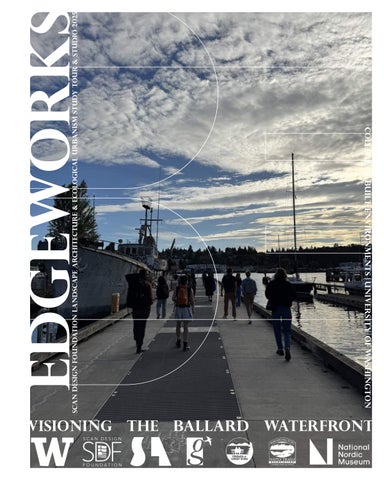
EDGEWORKS

VISIONING THE BALLARD WATERFRONT

SCAN DESIGN FOUNDATION LANDSCAPE ARCHITECTURE

Instructors

Vincent Javet, Scan Design LAEU Program Lead & Assistant Teaching Professor, University of Washington

Rasmus Arstup, Distinguished Visiting Professor, University of Washington & Design Principal, SLA

Nancy Rottle, Professor Emeritus, University of Washington

Davien Graham, Teaching Assistant, MARCH+MLA, University of Washington

Studio Participants

Sydney Bostater, MLA

Erik Byron, MUP

Iona Cich, MUP

Emma DeBorer, MLA

Walter Donovan Jr., MUP

Jake Ephron, MLA

Sheridan Heartwood, MLA

Merrel Judy, MARCH

Nicole Loeffler-Gladstone, MLA

Magnolia Mozayeni, MUP

Wesley Wesley Ahumada Newhart, MUP

Kaylin Hui, MLA

Thu Nguyen Anh Le (Emma Le), MLA

Oliver Qian, MUP

Acknowledgments

Aaron Luoma, Principal, HBB Landscape Architecture

Celina Balderas Guzmán, Assistant Professor, Landscape Architecture, UW CBE

Claire Farrington, Ballard Waterfront Park Coalition & Groundswell NW

Dave Boyd, Ballard Waterfront Park Coalition, Groundswell NW & Friends of Street Ends

Davidya Kasperzyk, Ballard Waterfront Park Coalition & Groundswell NW

Debra Guenther, Partner, Mithun

Elizabeth Umbanhowar, PhD Candidate + Lecturer, UW CBE

Erin Jacobs, Partner, Mithun

Jade Orr, Assistant Professor, Landscape Architecture, UW CBE

Jim Graham, Principal/Founder, Graham Baba Architects

Josh Seyfried, Principal + Founder, STUDIO SEYFRIED

Julie Parrett, Associate Teaching Professor, Landscape Architecture, UW CBE

Lisa Scribante, Partner, Mithun

Matt Grosser, PhD Candidate, UW

Mark Childs, Professor Emeritus, University of New Mexico

May So, Partner, Mithun

Nancy Rottle, Professor Emeritus, Landscape Architecture, UW

Rose James, Muckleshoot Indian Tribe

Stephanie James, Culture Director, Muckleshoot Indian Tribe

Tess Schiavone, Principal, GGN

The University of Washington acknowledges the Coast Salish peoples of this land, the land which touches the shared waters of all tribes and bands within the Suquamish, Tulalip and Muckleshoot nations.

P recedent S tudie S

Grønningen-Bispeparken

Cloudburst/Climate Park

Kaylin Hui

Sydney Bostater

Nicole Loeffler-Gladstone

Iona Cich

Thu Nguyen Anh Le (Emma Le)

Magnolia Mozayeni

Karens Minde Axis

Sheridan Heartwood

sund nature park

Merrel Judy

Kastrup Sbad

Jake Ephron

askØgade

Emma Deboer

Tip of Nordø

Walter Donovan Jr.

Køge Kyst

Oliver Qian

Copenhagen Harbour Baths

Erik Byron

the social spine

Historical evolution

Oliver Qian

Identity & heritage

Erik Byron

Industrial Systems

Kaylin Hui

Economic Drivers

Iona Cich

Social Dynamics & Demographics

Sheridan Heartwood

Land Use & Zoning

Wesley Newhart

Infrastructure & Circulation

Emma Le

Materiality & Built Fabric

Merrel Judy

Topography & Hydrology

Sydney Bostater

Vegetation & Ecology

Emma Deboer

Shoreline & Edge Conditions

Jake Ephron

Public Space & Access

Walter Donovan Jr.

Existing Work

Maggie Mozayeni

The Imaginary

Nicole Loeffler-Gladstone

S calar V i S ioning

Emma Le & Erik Byron

Kaylin Hui & Wesley Newhart

Jake Ephron & Oliver Qian

Merrel Judy & Sheridan Heartwood

Sydner Bostater & Walter Donovan Jr.

Nicole Loeffler-Gladstone & Magnolia Mozayeni

Emma DeBorer & Iona Cich

f oreword

Seattle’s working waterfronts are places of layered histories, ongoing industry, and emerging environmental challenges. Along Salmon Bay in Ballard, the meeting of maritime labor, infrastructure, ecology, and neighborhood life presents both tensions and opportunities. This year’s Scan Design Foundation Interdisciplinary Studio asked students to consider how this complex edge might evolve over time—how new forms of public space, ecological repair, and civic infrastructure could emerge without displacing the industrial activity that continues to define the character of the waterfront.

The studio focused particularly on the 24th Avenue NW street end and the adjacent Seattle Public Utilities pump station site, a small but strategic piece of publicly owned land along Salmon Bay. While primarily known today as infrastructure, the site also represents a rare point of potential access to the water in a stretch of shoreline largely defined by maritime industry. Students were asked to consider how this location could function as a catalyst: a place where infrastructure, ecology, and public life might intersect to demonstrate new possibilities for the Ballard waterfront.

Working across multiple time horizons, students developed long-term planning frameworks, mid-term site and park designs, and near-term urban activations capable of testing ideas in the present. These proposals explored how public access, habitat restoration, and maritime activity might coexist along the shoreline, and how relatively modest interventions could help initiate broader transformations over time.

The studio’s work was informed by precedents encountered during the Scan Design study tour to Denmark and Sweden, where students visited and analyzed built projects in Copenhagen and Malmö. These projects, many located along former industrial waterfronts, demonstrated approaches to climate adaptation, landscape infrastructure, and public space that integrate ecological systems with urban life. Through case studies developed from these visits, students examined how water management, mobility, biodiversity, and public activity are organized within contemporary European waterfront districts.
Back in Seattle, students applied these insights through detailed research and fieldwork along the Ballard waterfront. Teams investigated the site’s physical and environmental conditions such as topography, hydrology, shoreline ecology, and microclimate, alongside land use, infrastructure, and industrial systems. They also examined Ballard’s cultural identity, maritime history, and economic dynamics, developing a shared understanding of the waterfront as a living landscape shaped by environmental processes, labor, and community.

The studio’s long-term planning phase was grounded in cultural context and Indigenous knowledge through collaboration with the Muckleshoot Indian Tribe. At Cannonball Arts, students participated in Muckleshoot Cultural Arts & Heritage Day under the guidance of Stephanie James, Cultural Director for the Muckleshoot Indian Tribe. Through conversations with artists, carvers, and weavers, students were encouraged to consider deeper relationships between land, water, and stewardship in imagining the future of the Ballard shoreline.

Midway through the quarter, the studio welcomed Rasmus Astrup, Partner and Design Principal at the Copenhagen landscape architecture practice SLA, who served as Distinguished Visiting Professor. Astrup introduced students to nature-based design approaches and landscape strategies for climate adaptation and biodiversity in urban contexts. His lectures and critiques, together with lessons from the Scandinavian study tour, challenged students to think about how ecological systems and public life might be more deeply integrated into the design of waterfront environments.

Students also benefited from collaboration with local practitioners and community partners. Jim Graham, Principal and Founder of Graham Baba Architects, hosted the studio at the firm’s West Canal Yards project, sharing insights into the adaptive reuse of industrial sites and the architectural character of Seattle’s working waterfront districts. Later in the quarter, environmental artist Buster Simpson worked with the studio on temporary urban interventions, encouraging students to explore how small-scale actions and installations can reveal hidden systems and spark public engagement.

Working in interdisciplinary pairs that combined landscape architecture with urban planning or architecture, students developed proposals at both district and site scales. These ideas were refined through multiple rounds of critique and review with practitioners, community advocates, and faculty colleagues. The projects presented here explore how Ballard’s waterfront might become more accessible, resilient, and culturally grounded while maintaining the productive maritime activity that continues to define the neighborhood.

This studio continues the long-standing tradition of the Scan Design Interdisciplinary Studio, and we extend our sincere thanks to the Scan Design Foundation for their ongoing support of this extraordinary educational program. The Foundation’s commitment to international exchange and interdisciplinary collaboration enables the study tour and studio structure that connect Seattle and Copenhagen each year.

We are also grateful to the many partners and collaborators who contributed to the studio, including the Ballard Waterfront Park Coalition, Seattle Public Utilities, Seattle Parks & Recreation, Pacific Fisherman, the National Nordic Museum, and the Muckleshoot Indian Tribe. Their perspectives and expertise helped ground the studio in the real environmental, cultural, and economic conditions shaping the Ballard waterfront today. Finally, we thank the many professionals and academics who generously participated in reviews and discussions throughout the quarter. Their thoughtful feedback helped students refine their ideas and deepen their understanding of the challenges and possibilities facing Seattle’s working waterfronts.

We hope that the design explorations presented in this report contribute to ongoing conversations about Ballard’s future and illuminate new possibilities for the stewardship of Seattle’s industrial shorelines.

University of Washington College of Built Environments

S tudie S

g rønningen - b i SP e Parken c loudbur S t / c limate P ark

Location: 55.7122228°, 12.5344982° // Bispebjerg/Nordvest, Copenhagen, Denmark

Year: 2024

Team: SLA Architects; Kerstin Bergendal, Efterland [artists], Niras [engineer], Hofor [utilities]

Client: City of Copenhagen

Scale: 4.94 acres

Precedent Research: kaylin hui

A BRIEF OVERVIEW

In the Bispebjerg/Nordvest neighborhood, Copenhagen is tackling climate change-induced cloudburst events (sudden heavy rains) with projects such as the Grønningen-Bispeparken Cloudburst/Climate Park. Designed from 2020-2024, this urban park project was a successful collaboration between landscape architects, engineers, artists, and the surrounding community, and was integrated into the city of Copenhangen’s Cloudburst Management Plan.

The site is bisected by a major roadway and nestled between several 5-story yellow-bricked residential buildings, classic of Denmark’s major social housing projects of the twentieth century. To the north lies a private estate named Bispeparken (Danish for “Bishop’s Park”), while to the south lies a public estate named Grønningen (“The Green”) lies south. Beyond the site, Grundtvigs Kirke (Grundtvig’s Church) is a prominent cathedral visible from all areas of the park. Tagensbo Skole, an elementary school, borders the south edge. The park serves a diverse neighborhood that includes immigrants and established working-class families.

With a pathway that winds through the length of the park, Grønningen-Bispeparken provides areas for play, relaxation, games, and activities. Notably, it features 18 bioswales that can capture rain from cloudburst events; in the absence of rain, they are playfully named ‘social swales’ as they also provide space for flexible programming.

As if on cue, a thunderstorm hit Copenhagen only five days after the park’s inauguration. The Climate Park easily withstood the heavy rain, even welcoming the infiltration. As a result, the site swelled with lush flowers and plants, and the surrounding housing had no flooding issues.

At the Grønningen-Bispeparken Cloudburst/Climate Park, we see that rain is celebrated and openly showcased. With its successful mixture of environmental, social, and recreational design, visitors find a vibrant park tucked between dense housing.

“Wild,

The feeling of walking has been accentuated in a multitude of ways that I can’t remember having experienced in any other recent park.”

— Karsten Ifversen, Architecture Critic in Danish daily Politiken

BACKGROUND & PROCESS

In the early 20th century, the city of Copenhagen was experiencing a housing shortage. Thus, in the 1950s, the city government initiated a comprehensive social housing estate project in Bispebjerg. The project included an expansive lawn initially intended as an open space between the tall buildings; in practice, however, it was highly underused. Over the years, this lawn instead became a physical and social barrier between the two housing communities.

To repurpose this space, SLA gathered an internal, interdisciplinary team of landscape architects, geographers, and anthropologists. Most notably however, SLA also directly involved local residents in the design process. This included workshops, townhalls, open-microphone discussions, and interviews—all during the Covid-19 shutdowns. SLA’s approach for the project was to dive deeper into the desired atmosphere and uses for the park, as well as create space for free-flowing dialogue. Ultimately, this community knowledge was combined with SLA’s thorough research, including micro-climate studies, cultural investigations, and historic pollen analysis.

A NOD TO HISTORY

The park preserves key aspects of the neighborhood’s history. The historic visibility of Grundtvig’s Church as a major landmark was intentionally maintained. The yellow bricks that line the paths are a direct nod to the church. In addition, the park celebrates the original vision of C.Th. Sørensen, the landscape architect who designed Grønningen-Bispeparken. This includes his vision for children to access different environmental elements for play and

GRØNNINGEN, OPENING DAY SLA
SITE PLAN (LEFT), BIORETENTION SWALES (RIGHT) SLA

maintaining open space for all residents. Finally, many old-growth trees and plantings were preserved when possible.

MULTI-FUNCTIONAL SPACES

The park’s 18 bioswales not only capture 3000 cubic meters of rain, but also function as zones to promote different activities and goals:

• Bio Oases: Wetland areas that allow wildlife and ecology to thrive.

• Between the Trunks: Wooden play structures beneath trees.

• Common Lawns: Open meadows for flexible programming.

• Pocket Squares: Small social areas.

• The Bunker Hills: Repurposed Cold War bunkers that can be climbed on and used for sunbathing or sledding, depending on the season.

PLAYFUL ART

The Danish Arts Council supported artist Kerstin Bergendal’s project, Apropros en eng (“Concerning a Meadow”), to both engage residents and create art for the park. The result were a series of informal wooden art structures, scattered through the site, which invites users to play and explore.

PATHWAYS FOR WATER (TOP), WOODEN PLAY ELEMENTS (BOTTOM) SLA (Top), Kaylin Hui (Bottom)
BIOSWALE FLOODING WITH WATER SLA

EDGEWORKS: [re]Visioning the Ballard Waterfront

PERSPECTIVE OF GRØNNINGEN, LOOKING SOUTH Kaylin Hui

LESSONS LEARNED

Grønningen-Bispeparken was transformed into a highly functioning, cherished park. Here are a few lessons that could be applied to our Ballard site:

BEAUTIFUL SPACES CAN BE WILD

The Danish park embraces nature and asks, “How can we make this accessible for all residents and species?” The social swales allow both human activity and stormwater infiltration, so the park is functional yearround. By planting native grasses and trees, the park invites local biodiversity to thrive.

YEAR-ROUND USE FOR ALL

Grønningen-Bispeparken allows nature to grow at its own pace, with a maintenance plan that balances “wild” and “orderly.” Water is celebrated and openly showcased with flooded swales, rather than perceived as a threat. Our Ballard site has a strong opportunity to connect to the story of the water pump and Seattle’s yearly rainfall.

ACTIVE RESIDENT INVOLVEMENT

A major success of the park was the diverse opportunity for design input from local residents. The different strategies implemented by SLA allowed the park to capture all potential uses, and ultimately bridged the gap between the two quarreling housing units. Our Ballard site can be an opportunity to bridge a similar gap between stakeholders and create a useful, beautiful place.

SOURCES:

Apropros en eng (2024). Apropos en eng /Concerning a Meadow. https://aproposeneng.dk/en Landezine (2024). Grønningen-Bispeparken. https:// landezine.com/gronningen-bispeparken-by-sla/ SLA (2024). Grønningen-Bispeparken. https://www.sla.dk/ cases/gronningen/ UNI Editorial (2025). Grønningen-Bispeparken: A Groundbreaking Nature-Based Climate Park by SLA. https:// uni.xyz/journal/grnningen-bispeparken-a-groundbreaking-n

GRØNNIGEN-BISPEPARKEN ON BALLARD SITE OVERLAY 1/16”= 1’
Kaylin Hui
SECTION OF GRØNNIGEN
Kaylin Hui
© Francisco Tirado

The Opera park

Location: 55.681946°, 12.600556° // Holmen Island, Copenhagen, Denmark

Project Year: 2019-2023

Site Area: 5.3 acres

Architects: COBE

Client: The Opera Park Foundation

Donation: The A.P. Moller Foundation

Program: Public park including greenhouse with café and underground car park

Parking spaces: 300

Charging stations: 48 AC chargers and 1×2 DC chargers

Bicycle parking spaces: 100

Precedent Research: Sydney Bostater

OVERVIEW

“The Opera Park sets the stage for experiencing nature in the heart of Copenhagen. Like an opera stage, the park is a composed landscape with a foreground, a middle ground and a background. The 80,000 plants and 600+ trees are placed to naturally create a scenic setting facing the harbor. The terrain and trees are tallest where they create the background, and lowest in the foreground towards the harbor.”

The Opera Park (Operaparken) is a recently completed public green space in Copenhagen’s inner harbor. The site was once an industrial island, home to warehouses and shipping activity that served the city’s harbor for much of the 20th century. Following decades of disuse and neglect, the area was selected for redevelopment as part of Copenhagen’s broader initiative to reclaim and revitalize its waterfront. Positioned between the Royal Danish Opera, completed in 2005, and the forthcoming Paper Island project, the park transforms this former industrial site into a contemporary green oasis.

A key feature of the park is its year-round accessibility. In spring and summer, visitors enjoy vibrant gardens, shaded seating, and open lawns for leisure and informal gatherings. In fall and winter, evergreens and structural plantings maintain visual interest, while a covered pedestrian bridge connects the park directly to the Opera House, providing sheltered access to performances in any weather.

PROGRAM

The park’s layout provides a mix of spaces that accommodate a wide spectrum of activities. Curving paths encourage exploration, open lawns invite informal gatherings and play, and smaller garden areas offer shaded corners for rest or contemplation. Seating and overlooks are strategically placed to highlight views of the Opera House and the surrounding harbor, reinforcing the site’s relationship to the cultural and maritime setting. A multi-level parking facility is placed below the park surface, resolving infrastructure needs while allowing the ground plane to remain entirely green and pedestrianoriented. In this way, Opera Park functions as both a daily neighborhood retreat and a public extension of the Opera House’s cultural presence.

ECOLOGICAL PERFORMANCE

The Opera Park has been designed with ecological diversity, sustainable water management, and solar energy systems in mind. Its gardens draw inspiration from different global ecosystems, ranging from temperate woodland plantings to Mediterranean and Asian-inspired vegetation which fosters biodiversity and provides habitats for birds, insects, and pollinators. Rainwater is collected and used for the interior greenhouse irrigation. Permeable gravel pathways and rain gardens provide addition flood control during major stormwater events. Solar panels located on the Opera House rooftop provide power to the underground parking facility, the park, and the greenhouse.

© COBE
© COBE

SPATIAL PATTERN/ MATERIALITY

Opera Park is structured as a series of interconnected garden rooms, providing both expansive views and intimate retreats. Curving pathways and gentle changes in topography guide circulation while framing key vistas of the Royal Danish Opera and the harbor. Materials are selected for durability, visual contrast, and aesthetic quality: stone paving defines movement corridors, timber and metal are used for seating and furnishings, and glass walls enhance sight lines while offering weather protection. Dense plantings create a soft, immersive edge, and many of the materials incorporate recycled content, reflecting a commitment to sustainability.

Overlay | 1/16”=1’ Scale | © Sydney Bostater LESSONS FOR

SEATTLE

Both the Ballard Waterfront site and The Opera Park are similar in scale (as shown in the graphic above). The Opera Park, however, provides an excellent example of how a landscape can be integrated with neighboring sites, maximize green space, and offer extensive publicly accessible facilities. The underground parking and covered pedestrian bridge ensure year-round comfort while connecting the park directly to the Royal Danish Opera. The park also incorporates shared systems for rainwater management and solar energy, delivering mutual environmental benefits. By placing parking underground, the design maximizes both vehicle capacity and above-ground green space. Notable public amenities include a greenhouse café with indoor and outdoor seating, restrooms, bike parking, and ADA-compliant infrastructure. The primary limitation is the waterfront edge, which lacks sufficient comfortable seating to encourage visitors to fully engage with the water.

Site
“THE

FOREGROUND”

Featuring low-growing vegetation with expansive views of the Opera House and waterfront.

“THE BACKGROUND”

Featuring dense vegetation with limited views for more of an intimate experience.

SOURCES:

ArchEyes. (2023, November 22). The Opera Park by Cobe: A Green Oasis Amidst Urban Development. ArchEyes. https:// archeyes.com/the-opera-park-by-COBE-a-green-oasisamidst-urban-development/

Pintos, P. (2023, November 22). Opera Park / Cobe. ArchDaily. https://www.archdaily.com/1010027/opera-park-COBE

Reuben, J. (2020, August 20). A Park by the Opera House: Everything You Need to Know About COBE’s Latest Project. Scandinavia Standard. https://www.scandinaviastandard.com/apark-by-the-opera-house-everything-you-need-to-know-aboutcobes-latest-project/

Sydney Bostater
Sydney Bostater

RefshaleØen

Location: 55.6927° N, 12.6172° E // Copenhagen, Denmark

Year: In-progress

Team: Refshaleøens Ejendomsselskab published a 2025 structure plan and master plan with input from Arkitema, COBE, Henning Larsen, Tegnestuen Vandkunsten, and Tredje Natur

Client: City of Copenhagen

Scale: Initial development will be 47 acres; total development will be between 198-284 acres

A CULTURAL DISTRICT WITH MARITIME HERITAGE

Refshaleøen is an island neighborhood on the eastern edge of Copenhagen, Denmark. It was originally a shipyard and shares many similarities with Ballard’s urban waterfront. Today, Refshaleøen primarily serves as Copenhagen’s “creative and cultural district” while maintaining its maritime heritage through the creative reuse of industrial materials and a strong focus on activating quays and docks as public space.

Refshaleøens Ejendomsselskab (a property development company) and By & Havn (the City and Port of Copenhagen) jointly own the majority of Refshaleøen. Between 2023-2025, these entities conducted an outreach process that included community workshops, expert input, and an “ideas competition.” The resulting publication is called Parallelopdrag for en strukturplan for Refshaleøen og en masterplan for videreudviklingens første etape (Parallel assignment for a structure plan for Refshaleøen and a master plan for the first phase of development).

This document includes guidance and priorities for Refshaleøen’s large-scale planning, programming, cultural preservation, and environmental resilience. The area’s future as a new city district that may someday house 25,000 people (as described in COBE’s winning proposal) is described in four exclamatory vision statements:

1. We will be able to recognize Refshaleøen in the new district!

2. We will be ambitious in our green transition!

3. We will develop with space for urban nature, movement and strong communities!

4. We want to create an arch-Copenhagen district!

These statements might seem specific to Danish sensibilities, but they offer many insights for Ballard’s waterfront. The holistic approach to planning Refshaleøen’s future reflects a belief that dense urban space can support overlapping needs while ensuring a high quality of life for all inhabitants.

SITE HISTORY

Like Seattle, the area that’s now known as Refshaleøen was created through artificial fill. Copenhagen’s Port Authority began filling in shallow areas around a sandbar in 1868, and the Burmeister & Wain shipbuilding company moved to Refshaleøen in 1872. It would operate out of the site for more than 100 years.

KEY POINTS

• Co-owned by city government and a development group

• Built on fill; Nearby waste management and military facilities, and recreational marina

• Designated for focused redevelopment

CLOCKWISE FROM TOP: REFSHALEØEN, LOOKING SOUTHEAST; QUAYS, CIRCA 1870S; QUAYS TODAY

Source: Refshaleøen Structure Plan

The island continued to grow through fill as industrial technology expanded. Evidence of these changes can be seen in the enormous shipbuilding structures that remain on Refshaleøen.

B&W suffered a financial crisis in the 1980s and went bankrupt in 1996, despite attempts to rescue the company. A financial restructuring resulted in the creation of Refshaleøens Ejendomsselskab, which owns much of the area today.

The area was designated as a site for potential redevelopment in 2009, and was opened to the public that same year. Refshaleøens Ejendomsselskab has initiated and supported many of the cultural activities that now characterize Refshaleøen.

Adjacent facilities include wastewater treatment and waste management, and an active recreational marina.

EDGEWORKS: [re]Visioning the Ballard Waterfront

URBAN ECOLOGICAL FUTURES

Refshaleøen is unnatural, an industrial site constructed entirely on fill. Its ecologies thrive in harsh and often toxic conditions. Weedy plants sprout in the cracked foundation of former industrial buildings, while firstsuccession trees create patches of urban forest. In many ways, it’s one giant disturbed edge.

These qualities are recognized in the second and third of Refshaleøen’s four vision statements: “We will develop with space for urban nature…!” and “We will be ambitious in our green transition!”

The 2025 structure plan is particularly concerned with site biodiversity, on land and in the water, along with CO2 reduction via materials use, density, and transportation planning. The structure plan intends to continue marine cleanup and restoration efforts already taking place in Copenhagen’s port, and envisions a car-free district with a future rail line. Refshaleøen already boasts Øens Have, a certified organic urban farm and the largest of its kind in Scandinavia.

The plan identifies “diverse and noticeable urban nature, building on the island’s self-grown nature,” with the first phase of development employing a strategy of “activating the quay edges (the transition between land and water)” in order to create blue and green spaces that work in synergy.

Notably, Refshaleøen’s vision of urban nature is not anti-development. It assumes that planning for the needs of specific site users, human and otherwise, will “strengthen the bond between people and nature,” and contribute to a desirable neighborhood.

KEY POINTS

• Honor and accommodate emergent ruderal communities

• Land and water are on a gradient, rather than separate spaces

• Environmental planning can be holistic and ambitious at the same time

• Urban food production is key to any sustainability plan

WEEDY PLANT COMMUNITY; LOCAL WILDLIFE; SKETCH FROM ØENS HAVE

Source: Nicole Loeffler-Gladstone

SPATIAL COEXISTENCE

Just as Refshaleøen’s unique ecology emerged in response to the site’s maritime and industrial heritage, so to did its spatial organization and current programming. The island is known for huge buildings—used for concerts, events, recreation, and entrepreneurial spaces—and its activated edges that welcome boating, kayaking and swimming. The site’s maritime history is emphasized at every scale through the use of recognizable industrial materials and form.

Newer structures are almost entirely modular and/or temporary, demonstrating Copenhagen’s phased approach to urban planning and the city’s willingness to place new ideas in the midst of established sites.

The structure plan’s first and fourth vision statements seek to balance Refshaleøen’s current identity with the tremendous demand for housing in Copenhagen. The city aims to create a new district that “will preserve and transform all existing buildings, unless special circumstances speak against it.” The shipyard is recognized for its depth of history and its contribution to Refshaleøen’s identity.

The plan connects Refshaleøen to Copenhagen’s larger context by proposing a district that references the best of the city: “a dense district that you can explore…with crooked street layouts…distinctiveness…and hierarchy of urban space.”

Variety is intended to support diversity. Refshaleøen’s structure plan specifies a “significant” proportion of public housing, different housing sizes and types, and tiered rent levels for commercial spaces.

KEY POINTS

• Emphasize site history through creative (re)use of materials and form

• Spatial organization is key to site identity

• Plan and implement in phases

EDGEWORKS: [re]Visioning the Ballard

FROM TOP LEFT: SIGNAGE; RESIDENTIAL BOAT; MATERIALS REPURPOSED FOR LEISURE SPACE; MODULAR HOUSING; CHILDREN’S PLAY SPACE; MARITIME EDGES; MODULAR FOOD COURT; ADULT PLAY SPACE; MIXED USE IN INDUSTRIAL SPACE; LAND USE DIAGRAM

Source: Photos, courtesy SCAN Design 2025 study tour participants; Diagram, Nicole Loeffler-Gladstone

Refshaleøen land use types

GRADIENTS FROM LAND TO SEA

Life in Refshaleøen takes place on both land and water. Housing, recreation, innovation, and transportation occurs across green and blue spaces. This spatial organization results from the site’s maritime history, its unique industrial footprint, and the tendency for human and non-human life to activate edges.

Ballard’s urban waterfront shares many of these characteristics. The priorities in Refshaleøen’s structure plan are directly applicable to Seattle’s most ambitious aspirations and vision for itself as a sustainable city.

Site Comparison Diagram

Seattle urban context

24th Ave street end site

Refshaleøen

Can we use these shared characteristics, and Copenhagen’s quicker progress, as a roadmap toward creating a just and livable future here at home? Can we put our values into action through both our vision for the final product and the care we put into our approach? Site Comparison Diagram Source:

SOURCES:

Refshaleøens Ejendomsselska. (2025). Parallelopdrag for en strukturplan for Refshaleøen og en master plan for første etape. https://refshaleoen.dk/aktuelt/konkurrencer/

Refshaleøens Ejendomsselskab. Refshaleøen gør København større. https://refshaleoen.dk/

COBE. 1,000,000 m2. https://cobenotes.substack.com/ p/1000000-m2

ØsterGRO

Location: 55.7111453 N, 12.5643486 E // Østerbro, copenhagen, denmark

Year: 2014

Team:

Client: CSA Members, City of Copenhagen, the public

Scale: .148 acres

Precedent Research: Iona Cich

PROJECT DOCUMENTATION

ØsterGRO is located in Østerbro, the "Climate Quarter" of Copenhagen. ØsterGRO is situated on the roof of a former car auction house and it is Denmark’s first rooftop farm. The farm operates on a community-supported agriculture (CSA) model, supplying vegetables, honey, and eggs to its 40 members, a restaurant (Gro Spiseri) on the rooftop, cooking classes, and workshops. The project began in 2014 by landscape architects Kristian, Livia, and Sofie, who were inspired by a rooftop farm in New York City and wanted to reconnect citizens with local food systems.

The roots of ØsterGRO are tied to the broader urban climate strategy in Copenhagen. In 2011, a severe cloudburst caused more than $1 billion in damage in Copenhagen, revealing the inadequacy of the city’s stormwater management infrastructure. In response, Copenhagen launched the “Climate Quarter” (Klimakvarter) in Østerbro, emphasizing green infrastructure and neighborhood-scale climate resilience. The local municipality provided funding opportunities that residents could apply for, which enabled ØsterGRO's founders to secure a location and resources. The municipality also connected the team with the owner of the building, further playing an integral role in the creation of this project.

ØsterGRO’s success comes from combining ecological and social value with economic resilience. Many urban farms have struggled to survive after initial grants, but ØsterGRO has avoided this by building a diversified financial model where they gain revenue from sales from produce boxes, their restaurant, and governmental subsidies for their educational programming. This financial model and trial-and-error approach has allowed it to adapt and endure for over a decade.

ØsterGRO not only produces food according to organic principles (though it cannot be certified organic since it is located on a rooftop), but also fosters biodiversity in an otherwise unused space. The farm partners with a small family-run organic farm outside the city to supplement its CSA boxes.

"IN SUPERMARKERS, THE THINGS THAT ARE WORSE FOR US ARE CHEAPER, AND BETTER FOR US ARE MORE EXPENSIVE."

-LIVIA URBAN SWART HAALAND

DESIGN ANALYSIS

SPATIAL ORGANIZATION

Visitors reach ØsterGRO either by elevator or a narrow spiral staircase. The arrival point creates a sense of discovery: when you reach the roof, all you can see are colorful plants swaying in the wind. In the arrival area, two benches face a mural of a hand holding a plant (both above and below ground), framing entry into the garden. A central path bisects the roof lengthwise, leading toward the greenhouse restaurant before splitting to either side. The far end of the roof feels more private as that is where the chicken coop and restaurant are. Many vegetable rows spread from the path to the sides of the rooftop, which provides some organization to the landscape. Continuing upward on the spiral staircase brings visitors to a small lookout, where they can view the farm in its entirety and look across to other climate

adaptation projects in the district, such as SLA’s Skt. Kjelds Plads project.

MATERIALITY AND DETAILING

The main materials in the space are wood and metal. Wooden benches and raised beds lend a warm, handcrafted character. A patterned stone walkway contrasts with the dark soil, bright greenery, and bursts of colorful flowers. The greenhouse is constructed with glass and black metal accents, softened by older wood and corrugated metal elements on its sides and roof. These help soften the boundary between the lush farm and the rigid materials used for the greenhouse. The black metal matches the spiral staircase at the entrance to the site. String lights suspended above the rows of crops create a festive atmosphere, even during the day.

PROGRAM AND USE

ØsterGRO is a working farm, a social hub, and an educational space. Families collect CSA boxes weekly during the harvest season, while volunteers garden during open days (capped at 25 participants due to popularity). The greenhouse hosts Gro Spiseri, where seasonal meals are served at long communal tables, creating opportunities for collective dining. The space also accommodates workshops, tours, and special events.

THE BEGINNING STAGES OF THE ROOFTOP CONVERSION
ØsterGRO
ØSTERGRO IN SEPTEMBER 2025
Iona Cich

ECOLOGICAL PERFORMANCE

The site was transformed from an underutilized rooftop to a vibrant ecological system. A wide diversity of vegetables, herbs, and flowering plants not only provide food for community members but also creates habitat for pollinators, birds, and insects. This variety enhances biodiversity within the dense urban district, offering an oasis of greenery in the sky. Crops are cultivated according to organic principles, and the planting diversity ensures seasonal variation, soil health, and resilience. This building's location is ideal as the tall building next to it blocks a lot of the wind. There is also a shade structure by the entrance of the site, although it is the only one so the plants can have maximum sunlight.

SOCIAL QUALITIES

Inclusivity is central to ØsterGRO’s ethos. Volunteering is flexible, requiring no special skills or binding commitments, which allows people from different backgrounds to participate whenever they can. This is a special place for visitors and members alike to be in lush greenery in the middle of the city. The farm fosters a sense of belonging and shared purpose, encouraging people to rethink their relationship with food, agriculture, and urban space.

VIEW ACROSS THE ROOFTOP TO THE LOOKOUT
Iona Cich

CONTEXT SKETCH

CRITICAL REFLECTION

ØsterGRO demonstrates how a small, underutilized space can be transformed into a vibrant community asset. Its strength lies in its ability to connect food production with urban life, bringing people closer to the sources of what they eat while creating an important green space for people to spend time. Unlike many community farms that rely solely on short-term grants, ØsterGRO has built a financially resilient model to sustain themselves. Welcoming volunteers of all ages and backgrounds without strict commitments has fostered a strong sense of ownership and belonging among participants. The multipurpose programming, from farming and dining to workshops and special events, ensures that the space simultaneously serves ecological, educational, and social functions.

Still, there are shortcomings. The rooftop can be hard to find, making it feel more exclusive and closed off from the public. Its programming is primarily active (volunteering, classes, and dining) so there is limited space for passive recreation. While programming can be very valuable to sites, over programming can detract from a public space. Given the size of this site, programming every inch makes sense but it takes away the freedom to use a space as you want.

Several lessons from this site can be applied to our project site on the Ballard waterfront site. EDGEWORKS: [re]Visioning

ØSTERGRO AND CONTEXT + BALLARD SITE OVERLAY 3/32'= 1'
Iona Cich

First, ØsterGRO shows the power of a small space: even a small footprint can generate significant ecological and social benefits when designed intentionally. It has a similar footprint to the building on the Ballard site. This demonstrates what can be accomplished even with a tiny fraction of the site. It began as an empty concrete rooftop but was converted to a successful farm due to the passion of its founders, community investment, and municipal support.

Second, it highlights the importance of community involvement and ownership, where flexible opportunities for participation help residents feel connected and invested.

Third, its role as a multipurpose space for production, education, and gathering for a meal demonstrates the value of layering uses so the site remains relevant to many different groups. ØsterGRO underscores the need for inclusivity, creating a space that welcomes

people of all ages and abilities, making it a true public asset rather than a niche project. These strategies, if translated thoughtfully, could help ensure that the Ballard project site is resilient, accessible, and meaningful to everyone in its surrounding community.

SOURCES:

Cocoreado. (2023, August 31). ØsterGRO: Connects citizens to the food they consume. Cocoreado. Https://cocoreado.eu/ ostergro-connects-citizens-to-the-food-they-consume/

Danish Architecture Center. (n.d.). ØsterGRO: Rooftop farm above the concrete. Danish Architecture Center. Retrieved October 2, 2025, from https://dac.dk/en/magazine/places/ ostergro-rooftop-farm-above-the-concrete-161

Klimakvarter Østerbro. (n.d.). Klimakvarter.dk. Retrieved October 1, 2025, from https://klimakvarter.dk/en/om/

ØsterGRO. (n.d.). ØsterGRO. Retrieved October 1, 2025, from https://www.oestergro.dk/in-english

Tolderlund, L. (2023, September 22). Østerbro Klimakvarter: The first climate adaptation neighborhood in Denmark. Living Architecture Monitor. Retrieved October 3, 2025, from https://livingarchitecturemonitor.com/articles/sterbroklimakvarter-the-first-climate-adaptation-neighborhoodin-denmark-fa23

ANCHOR PARK

Location: 55.611361,12.976034 // Västra Hamnen, Malmö, Sweden

Year: 2001

Team: SLA - Stig L. Andersson, Hans Kragh, J.P.Berglund, Christian Restorff Liliegreen, Hanne Bruun Møller, Stine Poulsen

Client: Malmö City

Scale: 7.41 ac

Precedent Research: Thu Nguyen Anh Le (Emma Le)

INTRODUCTION

History.

The Anchor Park (or Ankarparken) is located on a peninsula to the north-west of the old City of Malmö area. This was an area of docklands reclaimed from the sea in the period between 1948 and 1987 when the economic downturn led to it being abandoned as a harbour. After a period lying unused, a new set of economic opportunities emerged following the opening of the Öresund Bridge in 2000. This area then became the site for the development of a new urban residential quarter, whose iconic symbol is the tower block known as the Turning Torso. In 1999, the City of Malmö invited SLA to build Anchor Park as part of the international housing exhibition BO01 (Urban Land Institute, 2003). Conceived as Framtidsstaden (City of Tomorrow), BO01 was intended to showcase sustainable urban design strategies and community identity (where individual housing units will have its own unique marker). Within that historical context, the park’s initial goals were to produce a public landscape that would stitch together the new BO01 district, providing identity, amenity, and ecological function. Plus, as itself was an exhibition zone, the park must also act as a showcase piece of sustainable urban life in a waterfront setting.

The surrounding.

The Ankarparken is somewhat a large courtyard of the Bo01 project, bounded by the sea to the north and west. To the south, it is adjacent to a recreational open-space buffer and the World Trade Center, while to the east it meets the former Saab factory complex within the old Kockums shipyard area. Because Ankarparken is positioned on Malmö’s Västra Hamnen shoreline, this coastal setting strongly influences the site’s microclimate: air temperatures are moderated by the sea and the exposure to prevailing western winds (Johansson, E., & Yahia, M. W., 2018, p.4). However, the surrounding buildings help to reduce wind speed by creating sheltered zones within the BO01 low-rise courtyard spaces and the Anchor Park.

“The Anchor Park is a ‘hydroglyph park’ – an aquatic park exploring the effects that water will have on the transformation of matter. The concept is to have a spatial composition that never seems static. Only time will determine how it looks.”

- SLA

“Hydroglyph park,” a term that is not a technical category but a poetic wordplay from SLA. The term comes from the ancient Egyptian writing system using pictorial or symbolic characters, called hieroglyphics. Together with the prefix hydro-, the phrase conveys the idea of a landscape that visibly registers the presence and movement of water—through reliefs that catch rain, canal fluctuations, and weathering of materials—so that the park itself becomes a kind of living inscription written by water.

We can actually see the resemblance between the characteristics of water and the design elements of Anchor Park. The ripple-like patterns cast into the concrete promenade and seating surfaces

WATER ELEMENTS Source: (1) SLA - https://www.sla.dk/cases/anchor-park/

Emma Le (Author)

Source: SLA - https://www.sla.dk/cases/anchor-park/

echo the movement of waves, visually connecting solid ground to the fluidity of the canal. Along the pathways, the designers played with the contrast of static and dynamic morphology of water. The soft green side takes on a wavy geometry, while the opposite hard building side remains still and linear, suggesting stability and control. This duality reflects the essence of waterfront life itself—the tension between water’s dynamic and the human desire to frame it.

The canal at Anchor Park is not a static water feature but part of a larger ecological system. Rainwater from the roofs and surfaces of the Bo01 buildings is channeled into the canal, where it mixes with saltwater inflows from the northern gateway. This creates a natural filtration system, gradually cleansing stormwater before it returns to the sea. By that, the canal becomes an active habitat, supporting life forms both above and below the surface (humans, ducks and algae).

Beyond ecological performance, the canal serves a critical role in urban climate adaptation. Acting as both a reservoir and a retention pond, it helps moderate stormwater surges during heavy rains while providing evaporative cooling in the summer. This will offer more comfortable microclimates for residents and visitors. By integrating hydrological processes, SLA designed the park more than scenic but functioning as green-blue infrastructure, ecological corridor, and community space for engaging with water. “Design places for life. All life”

ANCHOR PARK PLAN

METHODOLOGY

To find out how the users see the Anchor Park, I observed the behavior of the passerbys and asked some of them directly. I used the same set of questionnaires to 5 different people, my questions include: “Do you live nearby and how often do you go to the Anchor park?”; “That weird sculpture on the water, what do you think it is?”; and “Why do you choose to sit here instead of going to the waterfront nearby?”

The sample size for this study was relatively small due to time, geographical, and resource constraints of the study trip. While I can neither diversify the audience demographically nor account for all potential perspectives, the responses I received somewhat provide valuable data that show the impact of the project on its audience.

RESULT AND DISCUSSION

The Anchor Park on the day I walked around the area, Sunday, was very quiet which many residents would see presumably as a good thing but actually it seemed slightly dreary with a couple of people lying on the lawn and sunbathing on the benches. However, just when I pass through the courtyards of the ‘newly renovated fishing village’ enclosed by the apartment buildings, the atmosphere seems completely different. I saw a crowded

square with small stores, cafes and restaurants that seem to cater for a lot of visitors. Midrise apartments standing along the waterfront, creates a tall wind barrier for the inner village as they were many years ago in the old planning. If I have any criticism of the apartment buildings it is that they are rather boring in form and mainly rely on the arrangement of balconies and planters to provide some rhythmic facade pattern.

But at the end of the day I asked myself, why wouldn’t people get drawn to this park but instead the shore?

Anchor Park, partially enclosed by mid-rise buildings, receives less sunlight than the open shoreline and thus takes on a different role for nearby residents: a quieter, more reflective courtyard rather than a space of constant activity. As a semi-private retreat, it strengthens belonging and demonstrates that public space does not need to be crowded to be successful. In this sense, the park serves as a pedestal that elevates daily life and benefits the neighborhood as a whole.

HUMAN PARTICIPATION CONTRADICTION BETWEEN THE WATERFRONTS

Source: Emma Le (Author)

“DESIGN PLACES FOR LIFE. ALL LIFE” Source: Emma Le (Author)

SITE TO BALLARD:

Ballard neighborhood has a pretty similar history and layout of the Anchor Park and BO01 area. The precedent map was turned 90 degree to match with the site as to see the resemblence and griding layout. Yet, the intention was not to implement the ‘running canal’ part into the site but to see the posibility in proposing public spaces inside the existing neighborhood.

LARGE SCALE “HYDROGLYPH-ING”IMPRINTING THE ANCHOR

Source: Emma Le (Author)

SCALE: 1/32” = 1’

As the designers noted, “only time will determine how it looks.” Perceptions of the park—and especially its large metal sculpture—have shifted over time. In my survey, participants described it variously as a water bug, a kayak, or even a group of people carrying a kayak overhead. This range of interpretations shows how meaning in public space evolves through use, reminding us that landscapes are co-authored by their users.

CONCLUSION

Anchor Park demonstrates how stormwater and rainwater can be transformed from hidden infrastructure into a public experience. SLA’s design made hydrology visible by shaping edges, reliefs, and surfaces that collect and reveal water, turning everyday weather into a shared civic moment.

EDGEWORKS: [re]Visioning the Ballard Waterfront

This approach resonates strongly with the conditions at Ballard, a working waterfront situated in northwest Seattle. The City’s new Industrial and Maritime zoning seeks to preserve maritime employment while improving public access, and major infrastructure projects are already reshaping the area. In this setting, stormwater features could be integrated as visible and interactive design elements —bioswales, rain gardens, or permeable surfaces that both manage runoff and allow visitors to understand how water moves through the site. Just as Anchor Park carefully balanced the needs of nearby residents with public access, the Ballard waterfront must identify and define its public realm in ways that are user-oriented. This can be sum up to these two points:

• Designing spaces that are flexible enough to support both working-waterfront activity and community use

• Ensuring that ecological performance and cultural identity reinforce one another

SOURCES:

Urban Land Institute. (2003). Bo01, Malmö, Sweden (ULI Development Case Study No. C034014). Urban Land Institute. https://casestudies.uli.org/wp-content/uploads/2015/12/ C034014.pdf

Johansson, E., & Yahia, M. W. (2018). Wind comfort and solar access in a coastal development in Malmö, Sweden. Paper presented at 10th International Conference on Urban Climatology, New York, New York, United States. Alexandra Vindfeld Hansen (2024). Anchor Park. SLA. https:// www.sla.dk/cases/anchor-park/

THE FIRST GLANCE OF BALLARD
Source: Emma Le (Author)

FREETOWN CHRISTIANIA

Location: 55° 40’ 25” N, 12° 35’ 59” E // Amager Island, Freetown Christiania, Denmark

Year: September 26 1976 - Present

Team: Christiania Community Members “Christianites” and Denmark Government

Client: Christiania Community Members “Christianites”

Scale: 84 acres

Precedent Research: Magnolia Mozayeni

BACKGROUND

Located on Amager island, Freetown Christiania is an 84-acre anarchist commune founded on September 26th, 1971. On May 18th, 1971, a group of people from all over squatted the military base barracks of Bådsmandsstræde in efforts to create a junk adventure playground for the neighborhood children. Eventually, this turned into an intentional community that is self-governed under consensus democracy with a magical mix of peaceful, green village and metropolitan life. It became known as a pedestrian-oriented paradise for creative and recreational opportunity.

After the siege of Copenhagen during the Second Northern War, the ramparts were reinforced in the late 1600s under Christian V to develop a defense ring. Many of the ramparts were demolished in the 1800s, but those in Christianshavn remained. After back and forth of military takeover and people fighting back, it was finally approved as a social experiment with the Ministry of Defense in 1972. Christiania embraced the arts and craftsmanship, making theater and counter-culture activism at the forefront of their community values. They embraced “architecture without architects,” symbolism, and expression through murals, graffiti, and adaptive reuse. They now have about 850–1,000 residents.

Christiania developed the Green Light District, “Pusher Street”, allowing for the relaxed sale of hash, leading them to gain popularity with tourists and the local community. They eventually gained a reputation as the narcotics center of Europe, but they made efforts to prove they were much more than that. With this growth, the amount of junkies increased, and instead of getting help from Copenhagen, they were raided instead. They created a program for junkies, setting an ultimatum for them to dry out or move out, and they created plays to go along with this effort. Violence caused by the Bullshit motorcycle gang and the shootings in 2016 and 2023 over hash trade, eventually caused Pusher Street to shut down. They agreed on a plan with Copenhagen to buy the land and turn 3.75 acres into public housing development, with the agreement that new residents will be involved in Christiania’s culture.

SELF GOVERNMENT

Christiania is a society built on active participatory democracy dedicated to individual freedom and self-fulfillment. They build consensus through a series of meetings: common meeting, the area, the treasures economy, business, building, associates, and house meetings, as well as private and public conversations. The common meeting is the main settlement of disputes. Active participation in decisions and participation is key to seeing how it works, and it functions as a judiciary. Area meetings are for local problems such as building payment rent, held before the common meeting. Christiania is a valuable social experiment, seen as a challenge and inspiration for the Danish state and democracy.

FINANCES

They developed a common purse funded by residential rents, subscription, and payments from businesses. They work with a tight budget and maintain a savings account for unforeseen events. The 2004 budget was 18 million Danish crowns. Residents do not pay for housing, but pay to maintain. The budget is given through an assignment decision system. Renovation, electricity, and water consumption are paid, along with municipal rates and taxes.

DESIGN ANALYSIS

SPATIAL ORGANIZATION

The space is organized with a few entrances, ornamented with wood carvings and murals, indicating you’re leaving the EU and entering a new territory. The main entrance leads to the downtown commercial hub, exposing individuals to the vibrant village with shops, a history museum, and a gallery. Their community rules and way-finding maps are visible at the entrance. There are areas to sit, rest off, pray, and have a meal off the main path. There are hidden paths leading up green ramparts with views of the water and town. The spaces become more private and peaceful the further they are from downtown. The water holds symbolic energy, as many rituals are held there. Transitioning over the bridges leads to a neighborhood with homes, barrack artifacts, and local museums popping up. The excitement of exploration guides visitors.

MATERIALITY & DETAILING

Christiania embraces the concept of “architecture without architects,” viewing material use and construction as potential art forms and self-expression. They adaptively reuse and preserve military properties. They

ARCHITECTURE WITHOUT ARCHITECTS
Mozayeni, 2025
COMMUNITY MURAL Mozayeni, 2025

reuse everyday materials such as metal, wood, stone, shipping containers, and scraps. They offer a craftsmen engineering guide book for builders to follow, including a green enthusiasts fund, energy saving schemes, and preservation grants. They also have a space dedicated to communal item sharing.

PROGRAM & USE

The town was originally programmed for military use with moats for safety and protection. This has been transformed into an environment suitable for the range of human needs. The area is open to emerging uses and adapts accordingly.

ECOLOGICAL PERFORMANCE

In accordance with Christiania’s 1991 Green Plan, they utilize Nature Based Solutions in regards to wastewater treatment, habitat preservation, biodiversity monitoring, urban and coastal sustainability ideology, reed bed systems, constructed wetlands, green roofs, and overall green-blue infrastructure. They incorporate wooded areas, low street-lighting, water recycling, composting, earth toilets, green houses and houseboats, renewable wind and solar energy, and low energy heating, such as passive sun heat and shared wood-fires.

SOCIAL QUALITIES

Christiania embraces inclusivity, accessibility, safety, and delight throughout its being, as these are proudly held values. They provide public bathrooms, accessible guides, and embrace people of all backgrounds, including “social security recipients, prisoners, immigrants, clients from social institutions, unhoused, single mothers, jobless young people, Greenlanders, and vagabonds.”

VIEW OF WATER FROM ELEVATED PATH Mozayeni, 2025
HOUSES BUILT ALONG WATER Mozayeni, 2025

REFLECTION AND FUTURE APPLICATION

Freetown Christiania’s success comes from their ability to operate a consensus democracy, dealing with issues of disagreement, unhoused, non-payment, drug abuse, and allowing for freedom of expression. They occasionally fall short in terms of comfort, safety, clear organization, and decision making time duration.

FREETOWN CHRISTIANIA AND BALLARD SITE SCALE COMPARISON | 1/16”=1’ Mozayeni, 2025

Ballard historically has challenges with consensus building and having an arduous decision making process. Ballard has potential for adaptive reuse and programming shifts. Specific design strategies that can be applied in Ballard include consensus-building, art, recreational and theatrical areas, Nature Based Solutions, bazaars, biking, and sustainable systems. It would be meaningful for Ballard to honor the maritime industry through the reuse of industrial materials and preserving the graffiti boat, include exploratory public and private surprises along paths, and create opportunities for community expression. Pop-ups similar to the Ballard Living Room could be included. Ballard could further incorporate tribal symbology and honor their relationship with the water. Christiania teaches us that consensus can happen with consistent effort and creative adaptations.

DIAGRAMS- ROADS, BUILDING MASSING, TOWN PERIMETER Mozayeni, 2025

SITE MAP DRAWING Mozayeni, 2025

SOURCES:

Christiania. (2025). Christiania. https://www.christiania.org/

Christianites. (2005). Christiania – the green lung of the city [Tourist guide; English ed.]. Copenhagen: Christiania.

Morgado, M. H., Vastardi, D. V., Baudot Almeida, F.-E., & Dahy, H. (2025). “Spongetown” Christiania as an urban living lab: Nature-based solutions for resilient, circular, symbiotic, and regenerative transitions in urban waters. Nature-Based Solutions, 8.

Social-og Boligstyrelsen. (2025). History of the Christiania area. https://www.sbst.dk/bolig/christiania/history-of-thechristiania-area

Christiania. (1991). The Green Plan 1991. https://www. christiania.org/info/the-green-plan-1991/

MOMENTS THROUGHOUT SITE VISIT Mozayeni, 2025

Karens Minde Axis

Location: 55°38’48.0”N 12°31’44.4”E // sydhavnen, Copenhagen, Denmark

Year: 2023

Team: schonherr landscape architect, orbicon/wsp engineer, ebbe dalsgaard a/s contractor, vida local community partnership consultant, area renewal sydhavnen consultant

Client: copenhagen municipality and hofor

Scale: 9 acres

Precedent Research: sheridan heartwood

Overview

Karens Minde Axis is a recently finished storm water infrastructure and urban renewal project in the neighborhood of Sydhavnen (South Harbor). In a major rain event, water collects and flows south along a brick “riverbed” which transitions into a rice field meant to clean and absorb the water. At the southern end water collects in a pond, which is heavily vegetated around the bank to provide undisturbed habitat for animals.

When not holding water, the brick riverbed provides a dynamic pathway which facilitates play and invites visitors to explore the entirety of the park, which spans over 600 meters. The interventions by Schonherr blend seamlessly with the surrounding and pre-existing conditions, including a dog park, playground, cultural center, dance pavilion, library, petting zoo, and horse pasture.

Sydhavnen Neighborhood

Formally “Kongens Enghave” (King’s Garden), Sydhavnen was once pastoral land outside the city walls. During the industrial revolution, businesses developed the Southern Docklands and it became a working class neighborhood. With the loss of most industrial jobs in the 70s and 80s, Sydhavnen became known as a low-income area with considerable social housing. Today, there is an apparent divide between the Old Sydhavnen of the working class and the New Sydhavnen of modern waterfront developments.

In 2019, three protected green spaces were chosen to be rezoned for housing. One of the sitesStejlepladsen, is located in one of Copenhagen’s last original fishing communities. Up until construction, the park was used by fishermen to hang their nets for maintenance and residents enjoyed visiting the park to interact with nature. Although citizens protested the project, the city went forward with the developer and construction has begun. Residents grieved the loss of green space and the erasure of historically important land. Those living nearby fear that they will be displaced from their homes in coming years.

History of Karens Minde

The property where the park is located was first sold as farmland in 1809 and named “Karens Minde” after the owner’s grandmother. In 1879 it was purchased to build an asylum which operated for the next 100 years. The outdoor spaces accessible to patients were divided by fences and designated as walking gardens for “Men”, “Women”, and “Unruly Ones”. Some patients worked in the herb gardens and orchards, producing food for the kitchen.

In 1980, the institution closed and became the property of the city. It remained unoccupied and unmaintained for the next 15 years and was planned for demolition. Sydhavnen residents advocated strongly against demolition and convinced the city to restore the historic buildings for a cultural center. The first step of the project was to remove the fence and thick bushes around the property so that residents could see inside and start to imagine the future of the site.

The historic buildings are currently home to a cultural center, library, cafe, and event spaces for both private and public use. The 150-yearold Dance Pavillion is used by the community for dance, music, art, and political events. Karens Minde is at the heart of Sydhavnen and provides robust public space for meaningful interactions with both people and nature.

“to add as much, and take away as little as possible”

The motto of the project emphasizes the importance of the historical and cultural context of the site. The design team took inspiration from the original conditions of the land and worked collaboratively with the community to realize a shared vision that residents were proud of.

YELLOW BRICK RIVER

The brick riverbed sits in a low point which was previously a flood risk. The trajectory of the “river” avoids the drip lines of existing trees and is constructed with yellow bricks which are the same style as the buildings in the neighborhood. The brick was installed all the way to the historical buildings, indicating that the buildings are part of the park and public space.

Karens Minde Axis
KARENS MINDE ASYLUM 1963
Kgs. Enghave Local History Archive
KARENS MINDE BUILDINGS TODAY
Kgs. Enghave Local History Archive

BOARDWALK

The circular boardwalk in the middle of the park is placed purposefully, sitting where desire paths previously criss-crossed along the lawn. The boardwalk serves as a bridge, accessible pathway, seating, and gathering space. Instead of removing trees to accommodate for the desired size of the boardwalk, the boardwalk accommodates to the size of the trees.

URBAN CONNECTION

Much of the north side of the park remains the same in order to preserve the mature trees and dog park which were both loved by residents. The meandering brick pathway visually connects the north end to the south, which is separated by a main road. On weekends, a flea market pops up on these streetside edges.. The playground and basketball court are new, but placed in the same area as they were originally.

FARM CONNECTION

Gravel pathways run alongside the goat and horse enclosures, inviting visitors to interact with the animals. Children on ponies share the trail with pedestrians.

CIRCLUAR BOARDWALK AND BRICK RIVER
Photo by Kristian Langæble Pedersen

Ballard Waterfront Park

Like Sydhavnen, Ballard is a community at the axis of harborfront industry and urban redevelopment. It is worth looking to this neighborhood for inspiration as we consider how industry and green space can co-exist and what it means for a neighborhood to be divided into “Old” and “New” in the wake of redevelopment. We can also consider what it means to “To add as much and take away as little as possible” in both this project, and our future practice.

ILLUSTRATION OF KARENS MINDE AXIS

Sheridan Heartwood

SCALE COMPARISON OF BALLARD AND PRECEDENT

Sheridan Heartwood

AN ODE TO SYDHAVNEN

Kaj Thelander Jessen, former architect and lifelong Sydhavnen resident

The South Harbour is a magical place With oases full of peace It started with the landfill And dreams of the working class With tolerance of wide perspectives Imagination was allowed to flourish Next to the titans of industry Where cattle roam again And life is found in fishermen’s sheds Where nature is completely wild A stone’s throw from the town hall clock

SOURCES:

Arnt, J. and Mayer, S. (2024, July 7) From the Stone Age to Present Day: Kongens Enghave through 7,000 years. Kgs. Enghave Local History Archive, https://www. sydhavnenshistorie.dk/sydhavnens-historie/aarstalslist/.

Arnt, J. and Mayer, S. (2019, May) Karen’s Memory. Kgs. Enghave Local History Archive. https://www.sydhavnenshistorie.dk/sydhavnens-historie/proeve/karens-minde//. Dyreborg, V. and Waerseggers, C. (2024, Sept. 8) Fiskerihavnen: A Story of Gentrification in Copenhagen. CPH News. https://cphnews.mediajungle.dk/archives/10143 Jessen, A. Ode to Sydhavnen poem (2019, May 23). Youtube, uploaded by KobenhavnLIV. https://www.youtube.com/watch?v=TB--v0TTBGs.

Karens Minde Asken (n.d.) WSP. https://www.wsp.com/en-gl/projects/karens-minde-aksen

Karens Minde Aksen (2023, Oct. 19). Danske Landskabsarkitekter. https://www.landskabsarkitekter.dk/Aktuelt/postkort-fra-hvad-ved-jeg-arrangement-karens-minde-aksen/

Karens Minde Aksen: Cloudburst Park with a Grassroot Soul (2023). Danish Architecture Center. https://dac.dk/en/knowledgebase/architecture/karens-minde-aksen-2/

Karens Minde Axis (n.d.) Schonherr. https://www.schonherr.dk/projekter/karensminde-aksen.

Karens Minde Axis (n.d.) Landezine International Landscape Award. landezine-award.com/karens-minde-axis/ Mazer, S (2018, Sept. 3) Gentrification and Southern Copenhagen. Caught in Copenhagen. caughtincopenhagen.wordpress.com/2018/04/14/gentrification-and-southerncopenhagen/.

Stejlepladsen in Copenhagen’s South Harbour (n.d.) CPH Museum. https://cphmuseum.kk.dk/om-museet/historier-fra-koebenhavn/bygningshistorie/stejlepladsen-ikoebenhavns-sydhavn.

SOUTHWEST AXON OF MAERSK TOWER AND SUND NATURE PARK
SOURCE: ADAM MOERK FOR ARCH DAILY

sund nature park

LOCATION: 55.6982 N, 12.5580 E//

N Ø RREBRO, COPENHAGEN, DENMARK

Year: 2017

Team: Landscape Arch: Sla; Arch: C.f. M ø ller Architects; Engineering: Ramb ø ll

Client: University of Copenhagen, Faculty of Health & Medical Sciences

Scale: 9.14 acres

Precedent Research: Merrel Judy

A Brief Overview

SUND Nature Park, located in Nørrebro, Copenhagen, is a 37,000-square-meter campus landscape that surrounds the University of Copenhagen’s Faculty of Health and Medical Sciences. Conceived as part of the Maersk Tower development, the park was commissioned by the Danish Building and Property Agency in collaboration with the University, and designed by the Danish landscape architecture office SLA with architectural partner C.F. Møller Architects. The design process began after an invited competition in the early 2010s, with construction and realization completed in 2017.

The project redefines the typology of the modern university campus park by integrating architecture, public space, and ecological infrastructure. SLA’s design transforms the area around the tower into a biodiverse, accessible urban landscape, offering outdoor study zones, green roofs, and circulation routes that connect the campus to the surrounding neighborhood of Nørrebro. This integration ensures that the space functions both as a social infrastructure for the university community and as a public amenity for local residents.

The park is distinguished by its climate adaptation strategies. All rainwater from the site, including roof and paved areas, is collected, cleansed, stored in underground reservoirs, and reused, enabling the system to manage extreme rainfall and “cloudburst” events projected to occur once every 100 years. The 5,000-square-meter green roof was planted with a mixture of approximately sixty native species drawn from Copenhagen’s historical grazing commons, supplemented by select exotics to reflect both ecological resilience and the multicultural identity of Nørrebro. This strategy positions the park as a hybrid of ecological restoration and cultural expression, and it has been recognized through awards such as the Scandinavian Green Roof Prize.

Through this combination of ecological infrastructure, climate resilience, and civic programming, SUND Nature Park establishes itself as a model for integrated urban landscapes. It is both a living laboratory for sustainable campus design and an inclusive public space, demonstrating how a major institutional project can contribute to biodiversity support, climate adaptation, and social infrastructure simultaneously.

PROGRAM

Programmatically, the landscape combines rewilded ecologies with human-scaled infrastructure: meadows, hawthorn scrub, and oak groves support biodiversity, while a floating pedestrian and bicycle bridge stitches the site into the city’s mobility network and offers vantage points over the landscape. An underground parking facility for around one thousand bicycles underscores Copenhagen’s cycling culture and contributes to the project’s low-carbon orientation. Additional layers of program integrate cultural and recreational uses, including open lawns for seasonal festivals, play areas designed from natural materials, and outdoor classrooms that extend learning into the environment. Subtle infrastructure such as permeable paths, water-retention basins, and boardwalks through wet meadow zones allow visitors to experience the shifting ecologies of the site up close while also serving as climateadaptive infrastructure. Small-scale pavilions provide shade and shelter, acting as gathering points that are architecturally restrained to keep the emphasis on the landscape. Evening programming is supported by low-impact lighting, creating safe circulation without disturbing nocturnal wildlife. The result is a park that functions as both a living ecological system and a civic amenity, balancing rewilding with the everyday needs of an urban public.

ANNOTATED SITE PLAN

SOURCE: SLA SITE PLAN, ANNOTATED BY MERREL JUDY

SPATIAL PATTERN

From above, the park appears as a patchwork of ecological zones stitched together by a looping circulation system and tied into the larger city fabric by the dramatic linear gesture of the floating bridge. The park is conceived as both civic stage and ecological refuge, where plazas and pavilions invite cultural events, informal gatherings, and everyday leisure within a framework of restored green systems. Expansive lawns transition into groves of oak and hawthorn scrub, while meadows and wetland basins evolve as living ecologies that support biodiversity, absorb stormwater, and provide seasonal variation in color and texture. Circulation is structured as a network of diagonal and curving paths, some lifting as bridges and others narrowing to boardwalks, ensuring multiple ways to navigate the site while offering vantage points over zones of activity and retreat. This interplay of hard surface and soft edge balances civic use with ecological performance, producing a landscape that is legible both as infrastructure connecting bike routes, public transit, and neighborhood streets and as an immersive ground for urban nature. The underground bicycle parking facility reinforces this integration, while outdoor classrooms, play areas, and event lawns ensure the park supports everyday routines as well as larger collective gatherings.

BIRDS-EYE VIEW OF MAERSK TOWER AND PARK
SOURCE: ADAM MOERK FOR ARCH DAILY

MATERIALITY

The material character of the park is defined by its balance between raw, natural finishes and carefully detailed urban surfaces. Timber is left untreated to silver with time, echoing the seasonal cycles of the surrounding vegetation, while corten steel edges and railings introduce a warm, earthy contrast that grounds paths and overlooks. Stone is used sparingly in terraces and seating elements, its rough surfaces emphasizing tactility and durability under constant public use. The overall approach to materiality privileges weathering, texture, and sensory richness, ensuring that the park feels alive and continually transformed by light, moisture, and the passage of time.

ECOLOGICAL PERFORMANCE

Varied plant communities are arranged to create habitat layers that attract birds, insects, and small mammals. Wet basins and planted depressions slow and filter rainwater, reducing runoff while replenishing groundwater. Open soils and permeable surfaces support infiltration, while the mix of sun, shade, and moisture gradients enables ecological succession to occur over time. Together, these interventions ensure the landscape actively supports biodiversity, manages water, and adapts as conditions shift.

RAINWATER SYSTEM

SOURCE: LANDEZINE INTERNATIONAL LANDSCAPE AWARD

Through cycles of collection, reuse, infiltration, and evaporation, the park becomes a working water landscape that makes ecological processes functional, as seen in the above image, even though much of this system remains hidden from everyday experience, a limitation that the designers themselves have recognized.

SITE SECTION

SOURCE: C.F. MOLLER ARCHITECTS ON ARCH DAILY

SOURCE: MERREL JUDY

SITES COMPARED

Overlaying SUND Nature Park onto the Ballard waterfront makes the difference in scale immediately legible, as the Copenhagen precedent spans nearly three times the area of the Seattle site.

EDGEWORKS: [re]Visioning

Ballard Waterfront

SCALE OVERLAY

LESSONS FOR SEATTLE

SUND Nature Park demonstrates how a large civic landscape can be both grand in scale and intimate in experience, achieved through careful spatial patterning and layering of materiality. Compositional logic ensures that the park reads as a unified whole while offering spaces for movement, gathering, and pause, making ecological infrastructure legible and engaging rather than hidden. For Seattle, this offers a model of how layering materials and atmospheres can produce parks that are simultaneously infrastructural and inviting, large enough to serve the city yet detailed enough to belong to daily life.

SUND also illustrates that institutional and public funding woven together can realize a project that is simultaneously ecological infrastructure and a civic amenity. Flexible models might also include modest commerce like a café, food kiosk, or seasonal vendor that animates the site and generates revenue for maintenance. Integrating such uses does not diminish the civic quality of the park; rather, it ensures that the space remains active, financially resilient, and woven into daily urban routines. By layering ecological function with institutional funding and community-oriented commerce, Seattle could unlock a new generation of parks that are both self-sustaining and deeply public.

PROGRAMMATIC LAYERS

SOURCE: SLA SITE PLAN, MERREL JUDY DIAGRAM OVERLAY

SOURCES:

González, M. F. (2018, January 22). The Maersk Tower / C.F. Møller. ArchDaily. Retrieved from https://www.archdaily. com/887270/the-maersk-tower-cf-moller-architects

Landezine. (n.d.). SUND Nature Park. Landezine International Landscape Award. Retrieved from https://landezine-award. com/sund-nature-park/

SLA. (n.d.). SUND Nature Park. SLA. Retrieved from https:// www.sla.dk/cases/sund-nature-park/

Holmes, D. (2019, July 17). SUND Nature Park / SLA. World Landscape Architecture. Retrieved from https:// worldlandscapearchitect.com/sund-nature-parkcopenhagen-denmark-sla/

Extremis. (n.d.). SUND Nature Park. Extremis References. Retrieved from https://www.extremis.com/en/references/ sund-nature-park

Mats Eke

Kastrup Sbad

Location: 55.6454353° N + 12.6495333° E // Kastrup, Copenhage, denmark

Year: 2005

Team: White arkitekter

Client: Tårnby Municipality

Scale: 0.74 acres

Budget: €940,000

Precedent Research: Jake Ephron

“A LIVING SCULPTURE AND LEISURE DESTINATION FOR KØBENHAVN”

The Kastrup Sea bath, affectionately nicknamed Snegl or the snail, is located in the Ørestad region of Copenhagen. The sea bath can be found on the island of Amager, to the east of the city, at the southern end of Amagerstand park. Placed just past the expansive dunes of Amagerstand, Kastrup provides an idyllic contrast of nature to the urbanity of Copenhagen. Kastrup Sea Bath was completed by White Arkitekter in 2005 as a project for the Tarnby Kommune. The area of the project is quite small. The sea bath is made up of a 870 m² wooden structure and deck from where users can relax and swim. Changing and bathroom facilities are located within the bath structure and in an onshore auxiliary building.

Materiality

The wooden structure is constructed out of Azobé, also known as the red ironwood tree. This wood is commonly used in outdoor construction projects due to its strength and resilience to weathering. Azobé has a similar lifespan to steel, making for a durable and long lasting material. The natural redish hue of the wood provides a warmth and softness to what is a stark and more isolating setting on the water.

Site observations

On first view from shore, the sea bath sits perched on top of the water. The spiral shape unwinds gradually reaching upward towards the south and towards the sun, opening as if to help draw in the rays to warm the decks. Its wooden stilts position the bottom deck 1.2 meters over the water. The spindly legs and articulate form make it appear as a large sea monster out of Norse myth lying in wait off the coast of Amager.

The circular shape of the sea bath creates a parade of experiences. Bathgoers are able to place themselves into little nooks and crannies along the edge of the ring. The repeated stair heights and regular spacing of access around the ring of the bath create familiarity and rhythm as users move through the space. The ability to climb up onto the higher areas gives great views of Amagerstand park and increases the sense of enclosure as you are wrapped up into the bath.

Users are drawn in by the views until they find themselves with no choice but to fully immerse themselves with the water at the end of the curve.

Kastrup is a space to perceive and be perceived, it is a communal space and users are a part of that community. The sea bath provides a direct connection from land to the sea. The fact that there is no admission charged to access this giant sculpture is incredible.

When the weather is nice and users make the long walk out to the bath, they will find people of all ages and nationalities lounging on the decks and swimming in the central pool. In colder months indoor changing areas provide a warm shower and reprieve after a chilly dip into the water. The curling snail-like design of the structure helps to block the wind out of the north and east.

The dynamic form of the Kastrup is recognizable all over the world. During the off season in the winter months Kastrup is further enhanced through the use of LED lighting. The use of warm white light illuminating the enclosure, and cool blue light for the entrances to the water emphasize the sculptural nature of the site. The twenty years of use are evident on the site. The wooden structure

RELAXING AT SUNSET
Nicole Loeffler-Gladstone

is strong but well weathered. The metal railings are showing signs of rust. Sea weed and other marine flora and fauna grow on the pylons and stilts. These are not signs that Kastrup is tired, but that it is well loved by the sea and the users that come to enjoy its embrace.

Design Analysis

The area is famous for its circular, spiraling arrangement, something that separates it from some of the other popular swimming areas. The Ring like form of the swimming pool provides a consistent place for pool goers to sun themselves. This makes for a processional experience as users not only move through the space, but around it. This creates a feeling of climbing and shifting view perspective. The swim area is not just a place to engage with the views of the surrounding area, but also the site within itself.

The circulation creates various nooks and landing spaces for people, allowing for large groups to gather at the lower areas of the sea bath and providing for seclusion at the higher, more arduous decks to get to. Families and groups take up the booth-like bench spaces at the entrance.

The longer benches provide ample space for sunbathing. The high porches near the diving platform make a space for solitude among the chaos of the pool.

Finally the circular form is broken by a terminus; 3 meter and 5 meter diving platforms lead to a dramatic entrance into the north sea. Users are able to access the water from 5 staircases or they can opt to simply jump off the deck at any point. The two platforms provide the most delight and excitement in the space. Their location at the end of the spiral lends itself to sense of dread or excitment depending on the users perspective.

Key Points:

• Use architectural and design principals to enhance the environmental quality of the site

• Designing for seasonality increases potential usage

JUMPING IN Nicole Loeffler-Gladstone

Critical Reflection

This site represents a way to activate water beyond the shoreline. The act of extending the beach front to include an area that is not only swimmable but also sheltered from the elements allows for layering of programming that might be difficult to achieve on a busy shoreline. The changing areas and restrooms provide comfortable amenities, while the swimming area provides a multifunctional space of relaxation, contemplation and play.

EDGEWORKS: [re]Visioning the Ballard Waterfront

APPROACHING THE SEA BATH
Åke Eson Lindman

Although Shilshole Bay is an active industrial harbor, Kastrup Seabath can be inspirational in re-imagining how Seattleites envision public spaces on the water. Currently there is no designated public swimming area in Ballard. The shoreline street ends program provides limited access to public waterfront, and it is dubious whether the water quality near the shipyards is healthy to swim in.

By extending a potential swim area out and over the water at the end of the pier, users of the space are able to have a more complete experience of being on the water. Although this was originally used in Kastrup Sea Bath to solve the issue of making an enjoyable swimming experience in an area with a shallow seabed, this would also work in Ballard by creating distance from potential disturbances from industrial activities. Kastrup sea bath is an example something that Seattle and Ballard is currently missing, a place for leisure and recreation that is connected directly to the water.

SOURCES:

“Kastrup Sea Bath.” White Arkitekter, https://whitearkitekter. com/project/kastrup-sea-bath/. Accessed 3 Oct. 2025.

Wade, Steph. “Kastrup Sea Bath · Copenhagen, Denmark.” IGNANT, 11 Oct. 2021, https://www.ignant.com/2021/10/11/ kastrup-sea-bath-copenhagen-denmark/. Author, Citation (APA 7th)

haikuvankeuk. “Kastrup Sea Baths – Kastrup Søbad.” Living Landscape, 23 Jul. 2014, https://haikuvankeuk.wordpress. com/2014/07/23/kastrup-sea-baths-kastrup-sobad/.

SITE SKETCH OF KASTRUP SEA BATH
Jake Ephron
Amager Strand park and Kastrup Sobad within Ballard site context. Jake Ephron

ask Ø gade

Location: 55.7131269+12.5649493 // Ø sterbro, copenhagen, denmark

Year: 2018

Team: Neils Lutzen Landscape Architects

Client: city of copenhagen, local residents

Scale: 2.23 acres

Precedent Research: emma deboer

THE COURTYARD OF THE FUTURE ON ASKØGADE

The Courtyard of the Future on Askøgade is a residential courtyard and adjacent streetscape located in the Klimakvarter district of Østerbro, Copenhagen’s first climate-resilient neighborhood. Both spaces utilize climate adaptive design strategies to create beautiful, functional and resilient spaces, supporting residents’ needs, creating habitat and addressing water retention goals for the neighborhood. The site can handle enough water to fill five city buses, earning it the title of one of Denmark’s best climate-adaptation projects by Realdania in 2025.

The courtyard is apart of the city of Copenhagen’s continuing efforts in revitalizing residential courtyards, with a focus on bringing more nature into urban spaces and creating more recreational areas. As of 2025 the city has renovated 550 courtyards over the past 50 years. The city of Copenhagen is working with the Copenhagen utility company HOFOR, the Environmental Center of Østerbro and the residents of the neighborhood to complete these projects. This neighborhood is intended as a demonstration project, to inspire the rest of the city in the way extreme cloudbursts can be managed through green stormwater infrastructure.

The courtyard on Askøgade is one of three renewal projects in the Climate Resilient Neighborhood with the intention to develop rainwater solutions that can be replicated in other courtyards around Copenhagen. Courtyards make up a third of the total surface area in the neighborhood and serve as a great climate change adaptation opportunity. These future focused courtyards utilize roof water as a resource to create lush green courtyards, creating better growing conditions for plants and simultaneously improving habitat and biodiversity. These courtyards seek to link local stormwater management with improved life quality for the residents.

This project finds success in its ability to integrate climate resilient designs with the everyday needs of the space’s users. The movement of water is on display throughout the courtyard, water transportation and retention is not hidden, but instead is integrated into the design in a functional and whimsical fashion.

COURTYARD OF THE FUTURE:

In the future, all storm water is managed onsite to reduce flooding and sewage outflows while simultaneously creating lush green centers, increasing the quality of life of humans and non-humans alike.

DESIGN ANALYSIS

SPATIAL ANALYSIS

The courtyard is centered by an inner vegetated basin with a large paved path surrounding,leading to units, bike storage and programmed spaces. This large paved path serves the necessary function of daily use by residents and bike storage is equally distributed on each side. The two wooden bridges and several wooden steps leading to wooden platforms encourage more exploratory movement across the space. The dense vegetation and large tree cover creates a softness to the landscape, which is reinforced by the roundness of the walls and easy slopes

The defined program spaces are thoughtfully arranged within the courtyard. Two play areas are located at the far, inner end of the courtyard away from the entrance and allows for many eyes from the units above to see the spaces. The social spaces, including tables and grills, are located on the south facing side, allowing for maximum sun exposure as well.

MATERIALITY AND DETAILING

A range of materials were utilized on site, both inside the courtyard and in the street scape. The continuation of the multi-toned gray pavers from the courtyard extend out into the road, providing traffic control and allowing the lines of public space, semi-public and semi-private space to blur together.

The circle detail pattern on the corten steel drain cover reinforces the repeating form of circles across the site, though may add too much visual complexity paired with pavers. The gutters transporting roof runoff outflow into cobblestone pads that lead to cement runnels that run alongside path and planting edges until they reach cobblestone swales which end into the vegetated inner trench. This attention to detail in how water moves through the courtyard brings the stormwater management to the forefront of the design.

PROGRAMMING AND SOCIAL QUALITIES

This site is unique in that it is not a purely public space. The streetscape is public, but the courtyard itself, though open to all, feels semi-private. The play spaces include an area with swings and a play structure with a slide and a sandbox in a nearby area. The social spaces feature picnic tables, grills and benches. There is a glass structure containing

PAVERS EXTEND ACROSS ASKØGADE STREET FROM COURTYARD
Rozboz Zavari
BIRD’S EYE VIEW OF COURTYARD FROM ENTRANCE SIDE
Rozboz Zavari

lots of seating that offers an outdoor space for residents across climatic conditions.

The spatial organization of the courtyard fosters safety and creates a beautiful and natural space for residents to spend their time. The whimsical use of materials and form fosters a sense of delight that extends out into the streetscape.

ECOLOGICAL ANALYSIS

The goal of the streetscape design is to increase permeable surfaces and plantings alongside innovative rainwater management. The road runoff infiltrates the permeable surfaces, is stored underground and filtered through a substrate mixture of macdam, compost and bio-char.

The courtyard features connected habitat within the central water retention areas, and all stormwater runoff is collected on site via several pathways. Water is also collected in several small pools within the courtyard, serving as water supply for hand watering by residents. Additional vegetation is located on the roof of each bike storage structure creating habitat and slowing rain runoff from necessary functional spaces in the courtyard. There are several old trees on site, including one oak which provide habitat and food for hundreds of species.

WATER HOLDING CAPACITY:

The courtyard can hold up to five city busses worth of water in the retention basin during extreme cloud burst events Regular rain water is collected in pools for residents to use for watering plants.

ALL WEATHER SOCIAL SPACE ON SUN FACING SIDE
Emma DeBoer
THE PATH OF WATER THROUGH DIFFERENT MATERIALS
Emma DeBoer

1/16”= 1”

KEY LESSONS

1. Utilizing the adjacent streetscape to extend a design outward through material cohesion. By continuing the materials of the courtyard into the street, the design signals cars to slow and links the pedestrian public streetscape with the semi-private courtyard, helping to blur the line between them.

2. Thoughtful placement of programmed and functional areas. Sunlight, shelter and safety were all considered in the placement of social spaces, children’s play spaces, bike storage and water retention.

3. Integration of climate adaptive stormwater infrastructure and human activity. The storage and transportation of water on site is on display in a systematic and unique way, following human circulation and defining social spaces within the courtyard.

[re]Visioning

Emma DeBoer

BALLARD CONNECTIONS

As Ballard continues to experience residential development at a large scale, the Courtyard of the Future on Askøgade serves as a remarkable example of local stormwater management integrated with valuable outdoor space for residents.

With new development occurring closer to the water front, collecting and filtering roof and road runoff before it reaches our waterways is integral to protecting important local species like salmon. Including streetscapes into design projects and prioritizing collecting road runoff, particularly off of busy streets like Market and Shilshole, would have a positive impact on mitigating the amount of toxins running into the Salmon Bay.

Finally, the ability for the city of Copenhagen to partner with neighborhoods, public utility companies and private investors is an inspirational model to ensure that designs will function for residents and multi-species inhabitants for decades to come. Our site has a unique combination of actors and stakeholders that should be leveraged for the creation of quality public space.

SITE SKETCHES

SOURCES:

Askøgade - Innovative water management. (2023, February 20). State of Green. https://stateofgreen.com/en/solutions/askogade-innovative-watermanagement/

Courtyard of the Future - Askøgade - Saturday - Sep 20, 2025 Copenhagen Architecture Biennial by CAFx. (2025). Cafx.dk. https://www.cafx.dk/biennialevents/new-biennnial-event-be353

Klimakvarter Østerbro. (2022). Klimakvarter.dk. https://klimakvarter.dk/en/ gaardhaver/

Fremtidens Gårdhave 2 | Niels Lützen Landskabsarkitekter. (2018). NllandscapeDk. https://www.nllandscape.dk/fremtidens-gardhave

KEY LESSONS IN SPATIAL DESIGN AND STORMWATER MANGEMENT

Vognmandsmarken

Permeable Car and Bike Parking

Social Spaces

Bike Storage

Planted Areas

Children’s Play Spaces

Water Retention Basin

Pavers

Sunlight

Water Movement

Not Visible

Visible

Askøgade
Emma DeBoer

Tip of Nordø

Location: 55.706, 12.601 // Nordhavnen, Copenhagen, Denmark

Year: 2023

Team: Cobe, Vilhelm Lauritzen Architects, Third Architects

Client: PFA Ejendomme

Scale: 6.18 acres

Precedent Research: Walter Donovan Jr

PROJECT DOCUMENTATION

The Tip of Nordø is an office building located at the water’s edge of the Nordhaven neighborhood in Copenhagen. Designed by architecture firms Cobe, Vihelm Lauritzen Architects, and Third Architects, the Tip was created to be a bridge between the public spaces of the neighborhood with the private office spaces within the building to be a semi-public third place for residents, employees, and the general public. The building was commissioned and developed by PFA Ejendomme, the real estate investment fund arm of PFA Pension, a Danish public pension fund.

Prior to the Tip, the area that is now known as Nordø was an industrial site created using fill during the First World War, used primarily as a fuel depot and harbor. In 2015, a design competition was held by PFA Ejendomme to redevelop the harbor away from an industrial site to a mixed-use residential area in response to shifting land uses in the neighborhood, for which the design won first place. Constructed between 2015 to 2023, the Tip’s purpose is, in the words of Third Nature, “to create a building that signals openness, resilience, and dynamism, establishing a vibrant hub in the city where urban life can thrive year-round in synergy.” Since its opening in 2023, the Tip of Nordø has recieved multiple accolades including the 2024 Archello Building of Year award for both High Rise Tower and Office Building of Year, the City of Copenhagen’s 2025 Best New Build award, and has earned a DGNB Gold certification for sustainability.

The cylindrical design of the building is meant to represent the old silos that once dominated the area during its industrial years, and allow visitors to view the space from any angle, giving it a distinct look from the surrounding buildings. The angled windows encasing the structure simulates the hour-by-hour movements of the Sun, allowing for the optimal amount of light to enter the space without the issues of glare and overheating within the building and ensuring the plants within receive the sunlight they require.

“Square buildings relate to each other. When you design a circular building it seizes to relate to other types of geometry. It becomes unique. And unique forms should be used with caution as they automatically generate a strong identity.”

DESIGN ANALYSIS

SPATIAL ORGANIZATION

When stepping inside, the user is immediately drawn to the planting and trees spaced throughout, and looking up reveals a large circular skylight and linear fluorescent lights along the walls, which to me simulate falling rain. On the ground, the space simulates an indoor park, with bench seating along the trees as well as outdoor tables and chairs, inviting users to stay and relax. The flow of the space is non-linear, guiding users to wander around the space and explore different viewpoints by climbing up towards some of the trees. There is a gradual stone staircase that leads to an upper level, though along the base of the stairs are the words “No Public Access,” signifying the barrier between public and private space.

MATERIALITY & DETAILING

While the ground level uses smooth gray stone for both the floor and planters, the walls have a ribbed timber cladding that compliments the greenery of the space and creates the feeling of an indoor garden. The contractor Lindner, which provided the wall and ceiling claddings, states that the timber used for the walls is fire-resistant, with the gypsum cores of each slat being made from 100% recycled waste paper. The skylight of the rotunda allows for natural light to pour into the space, though with the artificial lighting along the walls and floodlights used to light the trees, can make the space feel too bright on a sunny day.

PROGRAM & USE

The space is meant for both employees and the public, with areas on the ground floor meant for both groups and floors above meant exclusively for employees. In practice, besides myself, the only people using the space were employees, which made me feel out of place during my visit. Despite this, I did see the employees use the public space as a place for meeting, discussion, and relaxation, with some people relaxing by the plants and looking up at the skylight above.

EXTERIOR VIEW
Vilhelm Lauritzen Architects
TOP-DOWN INTERIOR VIEW
Third Nature Architects, Photo by DroneRune

ECOLOGICAL PERFORMANCE

The space does a great job incorporating planting in the space, with various types of trees and shrubs spread throughout the ground level of the space that mimics the feel of an indoor park. The landscapers, Third Architects, wanted to create a ‘winter garden’ that could be enjoyed year-round by both the public and private employees. However, the space does not incorporate any other environmental systems such as water or soil features, and thus the greenery can feel separate from the rest of the space.

“Redefining boundaries to create an inclusive recreational space between public and private, making The Tip of Nordhavn accessible to all, at all seasons.”

— Pitch for The Tip, Third Architects

NIGHTTIME VIEW
PFA Ejendomme, Photo by DroneRune
GROUND FLOOR VIEW
Third Nature Architects, Photo by Morten Olivarius

CRITICAL REFLECTION

KEY LESSONS

The Tip of Nordø, with its unique design, public-private uses, and landmark status in Nordhaven, provides several architectural and planning lessons. For one, the distinction between what is public and private space must be made clear, which this site does well by making the ground floor public and labeling stairways leading to the upper levels as private. In addition, for a large

INTERIOR WITH GREENERY Walter Donovan Jr

space with high ceilings, balancing adequate lighting with comfortable temperatures is key, which the site achieves with the angling of its windows, large skylight, and interior cooling system. While the Tip does these things well, it also is a lesson of how to mkae a space too private. The entrances felt too much like entrances to an office building, the lack of greenery around the building made it less inviting and the lack of seating by the water made it not seem like a place to linger and relax.

LOOKING TO BALLARD

The Tip, including the surrounding buildings, all fit within the Ballard site, making it applicable in a size context. For design strategies, the use of greenery in indoor spaces, intentional design for adequate lighting, and blending of public and private spaces all could be applied to the Ballard site given its location near several private spaces and the current lack of greenery in the industrial site.

SKETCHES FROM SITE VISIT

SOURCES: Archello. (n.d.). Tip of Nordø. https://archello.com/project/ tip-of-nordo Architizer. (2025, August 26). Tip of Nordø. https://architizer. com/projects/tip-of-nordo/ BETA Architecture. (n.d.). The Tip of Redmolen. BETA. https:// www.beta-architecture.com/the-tip-of-redmolen-cobe/ Lindner. (n.d.). Redmolen Nordhavn. https://www.lindnergroup.com/en/references/redmolen-nordhavn Third Nature. (n.d.). The Tip. THIRD NATURE. https://www. thirdnaturearchitects.com/case/the-tip Vilhelm Lauritzen Architects. (n.d.). Tip of Nordø. VLA. https:// vilhelmlauritzen.com/project/tip-of-nordoe

Køge Kyst

Location: 55.4565, 12.1821 // Harbourfront (Søndre Havn), Køge, Denmark

Year: 2010-2035

Team: Juul | Frost Architects, Karres en Brands, LAgroup, SLA

Client: Byudviklingsselskabet Køge Kyst

Scale: Around 60 acres

Precedent Research: Oliver Qian

PROJECT OVERVIEW

Køge Kyst is a large-scale urban waterfront redevelopment project in Køge, Denmark, transforming about 60 acres of former harbor and industrial land into a vibrant mixed-use district. The project is a collaboration between Køge Municipality and Realdania By & Byg, operating under the joint client company Byudviklingsselskabet Køge Kyst P/S.

The project, first initiated in the late 2000s, with early phases completed around 2014-2018, Køge Kyst is planned as a 20+25 year transformation, linking the historic town with the new waterfront. The project aligns with Denmark’s approach to resilient, livable urbanism by balancing heritage, ecology, and modern urban development.

HISTORICAL CONTEXT

For much of the twentieth century, Køge’s South Harbor was dominated by shipping and industry, which created many jobs but disconnected the city from the waterfront. As shipping and industrial activities declined, large areas of the harbor were left underused.

In 1995, Køge City Council began to consider redeveloping the harbor. The two main challenges were activating the vacant lands and overcoming the barrier of the railway, which separated the town and the waterfront.

In 2009, an international competition was launched. The winning plan emphasized flexibility, cultural activation, and sustainability while addressing the area’s flooding and stormwater surges.

MASTER PLAN

The Køge Kyst Master Plan provides a framework for transforming 60 acres of former harbor and industrial land into a new waterfront district. Instead of a rigid blueprint, it is designed as a dynamic, phased plan capable of adapting itself to changing societies, economies, and environments within a framework of 20–25 years.

Three Sub-Areas:

• Station Area: a new urban gateway featuring dense, mixed-use developments connecting directly to the train station

• Søndre Havn: Transformation of the old harbor into housing, cultural venues, and a public waterfront.

• Collstrop Site: redevelopment of industrial land into residential and green areas.

Connections:

New pedestrian and bicycle bridges connect the town to the waterfront over the railway barrier, connecting the historic Køge town to Køge Kyst.

Public Realm First:

Open spaces, promenades, and place-based cultural activities are prioritized in the early stage of the construction, giving people an impression of activity and accessibility before all buildings are completed.

The Køge Kyst Master Plan is one of the largest waterfront projects in Denmark, aiming to double the size of Køge’s city center by extending it towards the harbor.

Resilience & Ecology

The waterfront is a dual-purpose flood shield and will integrate indigenous plantation, rain gardens, and biodiversity corridors within the urban fabric.

DESIGN ANALYSIS

The physical design of Køge Kyst reinforces its vision by weaving together space, ecology, and social life. The district consists of three sub-areas, joined together with courtyards, squares, and a linear waterfront that brings the town back out to the sea. The local material (brick and timber) anchors the new buildings within Køge’s character, but rain gardens and the overt channeling of stormwater

SØNDRE HAVN - KØGE KYST SLA
KØGE KYST VANDKUNSTEN

integrate climate adaptation into the dayto-day landscape. Housing, commercial, and cultural uses interpenetrate, meaning the area can support the needs of both daily living and communal activities, whilst the inclusion of co-housing and temporary cultural initiatives allows for adaptability during the lengthy development process. Most importantly, the inclusive nature of the designs—embodied in public open spaces and multi-modal housing typologies—creates a district built to be accommodating and resilient.

“LIFE BEFORE THE CITY - A CITY FOR LIFE” - CORE

DESIGN CONCEPT

One of the core design concepts of Køge Kyst. It means that the area should be active and inviting even before the construction is complete, and the long-term goal, “a city for life,” means to create a diverse and inclusive neighborhood where children, young people, adults, and seniors live side by side, supported by a healthy blend of homes, businesses, and cultural opportunities.

TEMPORARY URBAN SPACES IN KØGE KYST BOGL

KYST + BALLARD SITE OVERLAY

Qian

Køge Kyst shows how waterfront redevelopment can balance ecology, culture, and community. Lessons for Ballard include:

EDGEWORKS: [re]Visioning the Ballard Waterfront

KØGE
Oliver

Early Activation:

Temporary events and public art kept Køge’s harbor lively during construction. Ballard could use similar tactics to build identity before redevelopment is complete.

Water as Design:

Wet places like rain gardens or flood buffers are highlighted rather than obscured. Stormwater has an opportunity to be visibly seen and educative within the landscape at Ballard.

Mixed & Inclusive:

Housing mixed with cultural activity and green space creates opportunities for people from different backgrounds to interact. Ballard can accomplish this by a comprehensive program that is inclusive.

Development plan for Køge Kyst. (2019). Koegekyst.dk. https://koegekyst.dk/english/development-plan-for-koegekyst/

Køge Kyst P/S. (2011). Udviklingsplan / Development plan for Køge Kyst. https://koegekyst.dk/media/20le0xwg/koege_ kyst_folder_140x200_final_eng.pdf

Kaagaard, L. M. K. (2016). Planning for sustainability in urban redevelopment: A case study of Køge Kyst (Unpublished master’s thesis). Copenhagen Business School.

KØGE KYST COAST
Davien Graham
Oliver Qian

Copenhagen Harbour Baths

Location: Islands Brygge, Copenhagen, Denmark

Year: 2002

Team: Bjarke Ingels Group

Client: City of Copenhagen

Scale: 0.4 acres

Precedent Research: Erik Byron

PROJECT OVERVIEW

The Harbour Bath at Islands Brygge is among the city’s most iconic public spaces, located directly across Langebro Bridge and near the historic city center. Designed by Bjarke Ingels Group (BIG), the project was completed in 2002 as part of the City of Copenhagen’s “Blue Plan” a 42-kilometer redevelopment initiative transforming the harbor from an industrial port into a cultural/recreational node.

The project was designed to be an extension of the adjacent Harbour Park with the concept of bringing public open space into the water. This project re-thinks public swimming pools as open, urban landscape that integrates featutes such as docks, piers, boat ramps, playgrounds, sun decks, and diving tower with three jumping platforms.

The site has five pools: two shallow basins designed specifically for children, a 1.2 m pool meant for sports use, a main lap pool extending the site’s length, and a dedicated diving pool with platforms at 1, 3, and 5 meters. The site is well maintained with daily water-quality monitoring and lifeguards on staff during the summer, ensuring that it remains a pleasant and clean area for all. Beyond swimming, the site also accommodates informal uses such as sunbathing, picnicking, and winter bathing.

HIGHLIGHT:

These harbour baths function not just as a facility for swimming but also as a vibrant urban hub.

Programming, Social Qualities, and Site Features

An ambition of the Islands Brygge Harbour Bath project was to blur the boundary between land and water, built and un-built environment, and to extend the adjacent harbor park into the water. Rather than treating the waterfront as a hard barrier, the project features a series of stepped terraces that descend gradually into the harbor. This terraced form turns the waterfront into a soft edge that softens the transition from solid ground to water, creating both a visual and physical continuity.

The project’s form draws the eye naturally across the wooden decks towards the open water. Here, visitors are able to experience a wide variety of visual and physical engagement. This layered design produces a porous border where activity and programming can be fluid and adaptable, allowing people to rest, play, or swim

according to their own preference. The designers’ material choices further reinforce this land–water, built-unbuilt connection. The structure is built primarily from timber that enhances the experience through its warm sun-absorbing and soft tactile quality.

Socially, these harbour baths function not just as a facility for swimming but also as a vibrant urban hub. Through our visits, we saw a variety of users in the site such as families with children, dedicated athletes, young professionals, other tourists, and independent children all share the terraces. On hot summer days, the decks transform into a glowing gathering ground, while on weekdays, office workers often stop for a brief swim before heading home.

Numerous features enhance the site and help to make it so successful like the free admission (open to everyone), visibility from Langebro Bridge, and direct integration with the Harbor Park. As a symbol of more than just leisure, the Harbour Baths symbolize Copenhagen’s waterfront renewal, its commitment to equality in positive social life, and integration with climate and environment.

VIEW OF THE HARBOUR Bjarke Ingels Group
BATH SECTION
Bjarke Ingels Group

CRITICAL REFLECTION

This is a very successful example of public space as it allows people to visit and enjoy recreation and the positive aspects of climate year-round (although I am sure that it is very cold in winter). This is a well-used space that invites all types of people with a pleasant opportunity to relax, swim, socialize, and perhaps even enjoy the sun. It is relatively centrally located in the city, with easy connections to the rest of the municipality through ample bicycle infrastructure and the nearby Islands Brygge subway station.

The inclusion of the diving tower is very useful as it not only adds the opportunity to have a lot of fun for those (like myself and friends) to dive, but it also adds a lot of visual interest in the form of watching the divers as they go up and down the tower.

KEY LESSONS

Taking public space out into the water can be very impactful, both for recreational opportunities like swimming but also to emphasize a community’s connection to water and help to bridge built and un-built environments.

HIGHLIGHT:

This is a well-used space that invites all types of people with a pleasant opportunity to relax, swim, socialize, and perhaps even enjoy the sun.

SOCIAL INTERACTION AT THE SITE
Bjarke Ingels Group
A BUSY DAY AT THE BATHS
Photography by Julien De Smedt

OVERLAY

The size of the harbour baths, should it be dropped down and attached to the Ballard site, would only encompass a small part of the overall proposed park area. This shows that a large impact can be achieved with a relatively small intervention.

COPENHAGEN / BALLARD OVERLAY 1/16” = 1’
Erik Byron

The terraced edges of the Harbour Baths reframe the waterfront as an accessible edge rather than a barrier. More so, the diverse programming of the project (swimming, sunbathing, diving, socialization, etc) add resiliency and all-year use to the space. The centrality of the space within the city adds a layer of symbolism to the urban form of the city as a whole, anchoring this connection to water and unbuilt environment into the city’s identity.

These lessons can help us to design a resilient and well-used space that breaks down the separation between Ballard and its waterfront, reframing the local identity and offering pleasant opportunities year-round.

ONE SUMMER’S DAY

Photography by Astrid Maria Rasmussen

SOURCES:

VisitDenmark. (n.d.). The official guide to Denmark’s harbour baths. Retrieved October 3, 2025, from https:// www.visitdenmark.com/denmark/things-do/danish-nature/ harbour-baths

ArchDaily. (2009, January 5). Copenhagen Harbour Bath / BIG + JDS. Retrieved October 3, 2025, from https://www.archdaily. com/11216/copenhagen-harbour-bath-plot

BIG. (n.d.). Copenhagen Harbor Bath. Retrieved October 3, 2025, from https://big.dk/projects/copenhagen-harborbath-1525

JDSA. (n.d.). Bad. Retrieved October 3, 2025, from http://jdsa. eu/bad/

The Social Spine

Location: 55°40’00.9”N 12°36’10.8”E// Amagerbro, Copenhagen Denmark

Year: 2022

Team: SLA, arki_lab, Optimus, ABC

Client: FA09 and Øresundskollegiet

Scale: 0.36 acers

Precedent Research: Wesley Ahumada Newhart

PROJECT DOCUMENTATION

The Social Spine at Øresund College in Amagerbro is a 1,470-square-meter small transformation project that was completed in 2022. The goal of the project was to complement the social nature of the Øresundskollegiet and provide a vibrant public space for the student community. Øresundskollegiet is the largest student residential complex in Scandinavia, constructed in the 1970s in the brutalist style. It consists of seven residential towers that rise above a shared communal first floor. The Social Spine was constructed on the roof of the first floor and serves as a 160-meter connection for residents.

FA09 and Øresundskollegiet contracted SLA to serve as the lead landscape architect for the project. Due to the limited funds available to the students, the Social Spine had to be constructed with a limited budget of 370,000 Euros. The funding came primarily from the students of the college, but additional funding came from Amager Øst Lokaludvalg and Hofor. The 1,500 students at Øresundskollegiet were active participants in the design of the project, and the space was designed with their social needs in mind. The college views itself as a social college and the Social Spine was designed to bring the social atmosphere of the college outside and supplement it with lush, biologically diverse green space.

The rooftop where the Social Spine now exists was previously a disused space with little attraction or areas for social facilitation. The functionalist design of this rooftop, which is simply a space someone might pass through, stands in contrast to its current use, which expressly encourages lingering and socializing. The surrounding site is a mix of other student residences and other mid-rise structures. The space Immediately around Øresundskollegiet is made up of a mostly paved materal and is used for parking bikes and vehicles The Social Spine stands out in this space as an area of biological diversity with social programming for its intended users.

“We

have worked closely with the residents of Øresundskollegiet to uncover all the social values and powers that exist at the college and get them into the design.”

Design Analysis

SPATIAL ORGANIZATION

The space is arranged linearly, running from one end of the student housing complex to the other. A path meanders throughout the space, connecting access points from all eight adjacent towers and several staircases that run to ground level. The path, in contrast to the linear constraints of the rooftop, is not linear and curves as it makes its way through the green space. This provides the user of the space with an opportunity to slow down or meander through the space rather than just pass through.

The landscape architect intended for there to be distinct uses of space throughout the spine, with the spine ends functioning as relaxation spaces. Two central spaces, where the rooftop widens, are designated for production and partying, all connected by narrow study spaces in between

the residential towers. This division of space gives the user a clear destination on the spine for whatever they intend to use it for, and the furniture and programming, along with the physical space, convey the intended uses.

PROGRAM AND USE

Space programming is imperative to the success of the Social Spine. The project’s goal of fostering and highlighting social interactions that occur within the college is evident in how the space functions. Communal gardens, Communal Kitchens, and numerous picnic tables convey this sense of conviviality. Still, the design also allows for more intimate connections to be fostered on the site’s edges with smaller-scale furniture and increased privacy. I did not witness any usage of the space beyond students studying alone and walking through the space.

THE ROOFTOP AT ØRESUNDSKOLLEGIET PRIOR TO THE SOCIAL SPINE
arki_lab

MATERIALS

The materials used in the space are simple and effective. Bricks are used as the material for walkable spaces throughout the site, except at the site ends, where a softer material is used, indicating to users to slow down and linger. There is little separation or buffer between the path and the green plantings along the Spine. This creates a blending effect as the plants overhang the path in certain sections, adding to the elements of “wild” that are apparent throughout the site. The materials of the furniture in the space are simple with metal tables for eating, and wooden benches and hammock stands along the path.

ECOLOGICAL PREFORMANCE

The Social Spine has over 350 different plants and was designed to be a species rich space that fosters biological diversity. The plants are a mix of local plants and several exotic species to ensure a dense plant cover. The space repurposed trees and other plantings that were being removed due to construction elsewhere in the housing complex. The design uses the green spaces to form the edges of much of the spine, with users typically on a path near the center with lush foliage on either side of them. The plantings provide shade and privacy for the users of the space and create a sense of enclosure that would not be present on the rooftop without them.

SOCIAL QUALITIES

The Social Spine was intended to be a social transformation as much as it was intended to be an architectural transformation. Students have a vibrant natural setting for social interaction along the Spine, and the common areas provide these users with areas to gather in groups large and small. The space is accessible to only students with access to the building and not the surrounding community. This sets it apart from other college green spaces like the one at Tietgenkollegiet where access is less limited.

“The Social Spine is the backbone of our college’s sustainable, social responsibility.”

— Niels Kristian Bjerg, resident council chairman for Øresundskollegiet

THE SOCIAL SPINE COMPLETED arki_lab
SITE TREES BEING REPOURPOSED FOR THE SOCIAL SPINE SLA

OVERLAY OF THE SOCIAL SPINE AND BALLARD WATERFRONT

WESLEY AHUMADA NEWHART

CRITICAL REFLECTION

The Social Spine is successful in transforming an existing space on a limited budget. The space provides students with a connection to a diverse natural environment that they would not have otherwise had, and adds social spaces where previously there were none. By increasing biological diversity and enhancing opportunities for social engagement among students, the landscape architect was able to convey how these two goals can be symbiotic. The success of the space is in how it is used. During my site visit, I had a limited view into how the space was used, as I was only able to observe how people

EDGEWORKS: [re]Visioning the Ballard Waterfront

were actively using the “party” space on a quiet Thursday afternoon. While it seemed like a pleasant space, it was not active at this time, and only a few students were using the space, and ironically, they were studying despite there being designated other sections of the spine set aside for that use.

Several design strategies from the Social Spine project offer valuable lessons for a waterfront park in Ballard. The project’s tight budget encouraged repurposing existing trees and shrubbery. This is an approach that could be adopted in Ballard to conserve funds and promote ecological stewardship. Engaging the student community in the design process fostered a sense of ownership and relevance; similarly, involving Ballard’s diverse residents through participatory workshops and feedback tools could ensure the park reflects local needs. Lastly, the social spine is an adaptive reuse of an existing site. Its extensive use of natural elements and repurposing of an existing space saved money and made the project feasible. A smaller scale transformation like the Social Spine could have relevance for the Ballard Waterfront park, even if only to show that change is possible.

SOURCES: SLA. (2023). The Social Spine – Øresundskollegiet’s new rooftop park. SLA.

DL. (2023). Pecha Kucha 2023: Denmark – Landscape architecture projects. IFLA Europe.

arki_lab. (n.d.). Creating a greener roof terrace with the Students of Øresundskollegiet. arki_lab. (APA 7th)

SKETCH FROM SITE DETAILING TAKEAWAYS FROM VISIT
Wesley Ahumada Newhart

a naly S i S

hiStorical Evolution

Key Takeaways:

» Water as the backbone of identity

Ballard’s development has always centered on its connection to water.

» Adaptive reuse and continuity

Each era reshaped the waterfront rather than replacing it.

» Community and culture as anchors

Ballard’s transformation from industry to community was driven by civic pride and local culture.

» Honoring Heritage while evolving

From Bergen Place to the Nordic Museum, Ballard celebrates its past while adapting to new needs.

EARLY HISTORY OF BALLARD

The Seattle neighborhood of Ballard is often described as a “city within a city,” with a distinctly Scandinavian character shaped by its strong maritime heritage. Located at the northwest edge of Seattle, Ballard is defined by Salmon Bay and Shilshole Bay, two bodies of water that have long supported life and trade along Puget Sound. Before European settlement, the area was home to the Shilshole people, who lived around Shilshole Bay and Salmon Bay from time immemorial. The name Shilshole, meaning “threading a needle,” refers to the narrow channel where Salmon Bay empties into Shilshole Bay. The last known Shilshole person was Salmon Bay Charlie, who was half Samish and half Shilshole. He and his wife harvested clams, salmon, and berries to sell to the markets in Seattle. When his wife passed away in 1914, he was forced to leave his home and was sent to the Port Madison Reservation across the sound. The first non-Indigenous settlers arrived in the 1850s, and Ballard grew quickly through the second half of the 19th century. Because the Northern Railroad would route its train into Seattle from the North, the town’s land was platted, and real estate boomed. Many Scandinavian immigrants moved to Ballard because of the fishing and timber job opportunities, with its boast being “the shingle capital of the world.” Ballard incorporated as a city in 1890, and its citizens voted to annex to Seattle in November 1906.

SALMON BAY CHARLIE’S HOUSE, BEFORE AND AFTER Rob Casey
OLD LIQUOR STORE IN BALLARD, 1890 Seattle Municipal Archives

BALLARD LOCKS, JULY 25, 1916

https://www.ballardhistory.org/archives/search_popup.

php?searchterm=Ballard+lock

INDUSTRIAL TRANSFORMATION

Between 1910 and 1940, Ballard undertook three transformative infrastructure projects that redefined Ballard’s waterfront: the Ballard Locks, the Lake Washington Ship Canal, and the Ballard Bridge.

Ballard Locks

The Ballard Locks are one of Seattle’s most famous attractions. It moves vessels between bodies of water at different heights. It also connects Lake Washington and Lake Union to the Puget Sound and Pacific Ocean. Before the construction, only little boats and logs for lumber mills could pass through the small canal. Today, 40,000 vessels move through the locks, and 1.5 million visitors come to watch the vessels “lock through” each year.

Lake Washington Ship Canal

The Lake Washington Ship Canal opened on July 4, 1917, exactly 63 years after Seattle pioneer Thomas Mercer first proposed the idea of connecting the saltwater of Puget Sound to the freshwater of Lake Washington via Lake Union. The Ship Canal lowered the water level of Lake Washington by nine feet and raised that of Salmon Bay, changing it from a tidal inlet to a freshwater reservoir.

LAKE WASHINGTON SHIP CANAL, MAY 4, 1916

https://www.ballardhistory.org/archives/search_popup.

php?searchterm=Ship+Canal

Ballard Bridge

Ballard Bridge connects Ballard and Interbay across the Lake Washington Ship Canal at Salmon Bay. In 1933 the heavy creosotedwood deck was replaced with an open-mesh steel deck. In 1940 the by-then rickety and hazardous wooden approaches were replaced with concrete and steel approaches. In 1969 the four original towers were replaced with a single tower.

BALLARD BRIDGE, MARCH 13,1918
James P. Lee

SHAPING THE WATERFRONT

During the mid-20th century, Ballard’s waterfront began to evolve into a space where industry and leisure coexisted. On one side, Pacific Fishermen Shipyard kept Ballard’s working-class maritime tradition alive. Meanwhile, a new wave of restaurants along Shilshole Bay, led by the iconic seafood house Ray’s Boathouse, introduced a new relationship to the water.

Ray’s Boathouse

In 1939 the original owner, Ray Lichtenberger, moved his growing boat rental and bait house to the current location and in 1945 opened a coffee house. By 1952, he had built the neon sign that flashes “Ray’s” in bold red letters on the dock overlooking Shilshole Bay at the crossing point to Puget Sound and the Hiram M. Chittenden Locks leading to Lake Washington. In the 1960s, Ray’s boathouse operated as both a fish and chips cafe and boat rental. In 1973, Ray’s boathouse was sold to Russ Wohlers, Earl Lasher, and Duke Mosrip and they quickly refurbished the structure, transforming it into a nationally respected seafood restaurant while maintaining its atmosphere.

Pacific Fishermen Shipyard

The Pacific Fishermen Shipyard traces its roots back to 1871, when Norwegian immigrant

RAY’S BOATHOUSE

Ray’s Boathouse

Thomas William Lake established a modest shipyard along Salmon Bay. Over time it evolved through multiple ownerships and expansions, contributing to Puget Sound’s maritime industry. In 1946, a group of Norwegian fishermen formed a cooperative, Pacific Fishermen Inc., with a capital of $300,000 and ownership shared among 300400 fishermen (each buying one share). The coop model ensured that the shipyard remained “by and for fishermen,” providing repair, construction, and services tailored to the needs of local vessels. This structure has persisted over decades, preserving both tradition and community control.

FROM INDUSTRIAL TO CULTURAL IDENTITY

By the late 20th century, Ballard transformed from being primarily an industrial site to becoming a place for culture and heritage. Two iconic projects from this period, Bergen Place and the Nordic Heritage Museum, became symbols of this transformation, turning Ballard’s workingclass past into a proud expression of cultural identity and community life.

Bergen Place

Bergen Place Park is located in downtown Ballard in the heart of the business district on the triangular site between Leary Avenue,

22nd Avenue NW, and Market Street. It was developed utilizing Forward Thrust funds and dedicated by King Olaf of Norway in 1975. The Crown Hill/Ballard Neighborhood Planning Association proposed the redesign of Bergen Place Park in the 1998 neighborhood plan. Bergen Place was named for Bergen, Norway, one of Seattle’s International Sister Cities. In 2005, five granite, rune-like stones were installed in the park. The stones are carved by artist James Cole. Each stone features the name of a different Nordic country carved both in English and in the country’s native language.

National Nordic Museum

The Nordic Museum was established in 1979 to commemorate the history of numerous Nordic immigrants who arrived in the Northwest at the start of the 20th century. The museum opened to the public in 1980 as the Nordic Heritage Museum, leasing space in the historic Webster School in the Seattle neighborhood of Ballard. It was the only museum in North America to represent the five Nordic countries of Denmark, Finland, Iceland, Norway, and Sweden. 2018 marked a historic milestone when the renamed Nordic Museum opened a brand-new purpose-built 57,875 square feet facility in the heart of Ballard on Seattle’s working waterfront.

BERGEN PLACE
Seattle Parks and Recreation

REVIVING

Since the early 2000s, Ballard has grown into a vibrant community that blends its maritime past with modern urban life. Ballard Farmer’s Market and Ballard Commons Park reflect the transformation of Ballard from an industrial suburb to an active center for local arts, culture and everyday gathering.

Ballard Farmer’s Market opened in 2000; it is the first year-round neighborhood farmer’s market selling produce exclusively from Washington state farmers.

Its goal is to bring people together by creating a local marketplace. The market hosts about 100 vendors every Sunday from 9am to 2pm. It is also by far the most popular farmer’s market in Seattle, attracting about 603,000 visitors per year, 10,000-20,000 weekly.

Ballard Commons Park was completed in 2005 and is part of a small municipal center in Ballard, alongside the library and neighborhood service center. The design of

Commons Park reflects the neighborhood’s workingclass Scandinavian background. The fountain reflects the natural motion of liquid, such as a salmon or boats and shells, with the sculpture representing play in the water. The park has a skate bowl, water elements, public art, lawns, seating, and friendly paths.

BALLARD FARMER’S MARKET The Urbanist
BALLARD COMMONS PARK
The Seattle Times

BALLARD PUBLIC ART

Visit Ballard

SOURCES:

Ballard Bridge (Seattle). (n.d.). Www.historylink.org. https://www.historylink.org/File/11260 Seattle’s Ballard Bridge opens in December 1917. (2025). Historylink.org. https://www.historylink.org/File/3446

Seattle Neighborhoods: Ballard -- Thumbnail History. (n.d.). Www.historylink.org. https://www.historylink.org/file/983 Lake Washington Ship Canal (Seattle). (2017). Historylink.org. https://www.historylink.org/File/1444 Ballard - CityArchives | seattle.gov. (2020). Seattle.gov. https://www.seattle.gov/cityarchives/exhibits-and-education/onlineexhibits/annexed-cities/ballard

Waterfront Ballard from 1900 to 2022: A Photo Essay | School of Marine and Environmental Affairs. (2022, June 10). School of Marine and Environmental Affairs. https://smea.uw.edu/currents/waterfront-ballard-from-1900-to-2022-a-photo-essay/ Casey, R. (2024, November 3). Early History of Salmon and Shilshole Bays in Seattle. Substack.com; Paddling the Salish Sea, 80 Trips with Rob Casey. https://paddlingthesalishsea.substack.com/p/a-brief-early-history-of-salmon-and creative, efelle. (n.d.). About the Museum. National Nordic Museum. https://nordicmuseum.org/about Bergen Place Park and Mural. (2025). Atlas Obscura. http://atlasobscura.com/places/bergen-place-park-and-mural Tat Bellamy-Walker. (2024, March 25). This Seattle farmers market is known as the city’s best. The Seattle Times. https://www. seattletimes.com/life/culture/heres-why-the-ballard-farmers-market-is-the-best-in-seattle/

Welcome To Zscaler Directory Authentication. (2025). Filson.com. https://www.filson.com/blogs/journal/profiles-history-ofpacific-fishermen-shipyard-ballard

About. (2025, March 18). Ray’s. https://www.rays.com/about/

Identity & Heritage

Key Takeaways:

» The people of this area have always had a strong connection to the water: including the Indigenous peoples, Asian immigrants, Scandinavian immigrants, and others.

» The area has been in constant change throughout the entire history of its settlement.

» It is not just Scandinavians that have had a strong impact on Ballard’s culture and maritime traditions.

» Despite the rapid change taking place in the neighborhood, the impact of maritime industries and immigrant communities continue to define Ballard.

INDIGENOUS MARITIME HERITAGE

The narrative of the neighborhood begins long before the city of Ballard, Washington’s founding in 1887, when the area became a hub for shipyards and fishermen. For thousands of years before Euro-American settlement, the Duwamish and Coast Salish peoples lived, fished, and traveled through what is now Salmon Bay.

The local band of Duwamish that lived in this area were known as the Shilshole people. Like other Duwamish bands, they used cedar canoes to move between Lake Washington and Puget Sound, establishing seasonal villages and trading networks along the waterways. Their relationship with the land and tides shaped the area’s earliest maritime traditions long before shipyards and locks redefine

HALIBUT FISHERMAN, 1956 Josef Scaylea
THE LAST SHILSHOLE’S HOME, 1905 Seattle Public Library

the waterfront. When settlers arrived in the late 19th century, they quickly recognized what Indigenous people had long known: Salmon Bay’s sheltered waters and easy access to Puget Sound made it an ideal site for fishing and industry. By the time of settlement of the area by the people of the United States, there were only twelve Shilshole families remaining. In 1887, Captain William Ballard and others platted the town, and mills and boatworks soon followed. The construction of the Lake Washington Ship Canal and Hiram M. Chittenden Locks (1911–1917) permanently altered the landscape, lowering lake levels and cutting off the salmon runs that had sustained Native communities for generations. Two Shilshole remained in the area until 1914, a man known as “Salmon Bay Charlie” or Hwelchteed and his wife, Cheethluleetsa.

A DUWAMISH COUPLE, 1904
Seattle Public Library

Ballard is in the midst of transformation, but the underlying multi-cultural narrative and maritime traditions anchor its people to a common heritage.

SCANDINAVIAN IMMIGRATION

The neighborhood’s next defining wave came with Scandinavian immigrants who found a familiar new home in the northwest that reminded them of the forests and fishing villages they had left behind. Arriving in large numbers between 1890 and 1920, they built homes, churches, and social clubs, weaving their maritime traditions into

the economic fabric of Seattle. Norwegian ship carpenters and Swedish fishermen became the backbone of the local maritime trades, where small boatyards like Sagstad’s Ballard Boat Works and Kvichak Marine turned out sturdy wooden vessels that served Puget Sound and Alaska fisheries for decades.

ASIAN IMMIGRATION

While Scandinavian identity defined much of Ballard’s public image the maritime labor force was actually far more diverse. Asian immigrant workers, especially Filipino and Japanese men, played crucial roles in the regional fishing and cannery economies tied to Ballard.

Filipino migrants, many arriving after the U.S. colonized the Philippines in 1898, were recruited to work in Ballard canneries. More so, Ballard served as a seasonal home base for fishing, with Filipino fishermen joining Scandinavian crews on seiners and trollers. Despite segregation in bunkhouses and limited job mobility, their skill and endurance became indispensable to the fleet. Filipino-owned organizations like the Alaska Cannery Workers Association and later the Filipino American National Historical Society (founded in Seattle

A CHINESE CAFE MUSEUM IN BALLARD, 1943 Museum of History and Industry
SCANDINAVIAN DANCERS Museum of History and Industry

in 1982) have documented these important maritime contributions.

Similarly, Japanese fishermen and boat builders were active in Puget Sound waters before World War II, with some operating near Ballard. Their boats and net making techniques influenced local practices until wartime incarceration in 1942 forced Japanese Americans to abandon their livelihoods and homes. After the war, only a few returned to Ballard, but their imprint on the region’s fishing culture continues to persist.

BALLARD TODAY

By mid-century, Ballard’s maritime economy remained robust but increasingly mechanized. Wooden boat building gave way to steel fabrication, and the postwar boom brought modernization to fishing fleets. Yet, the community’s cultural heart remained distinctly maritime and multicultural.

SYTTENDE MAI PARADE Museum of History and Industry
FLAGS OVER BALLARD
Erik Byron

The neighborhood’s modern cultural narrative rests in the many festivals that the area hosts. The Ballard SeafoodFest, begun in 1974 to promote local businesses, grew into an annual celebration of maritime culture ands identity. Meanwhile, “Syttende Mai” parades through Market Street continued to honor Scandinavian heritage, though in recent decades these festivals have also expanded to reflect the neighborhood’s growing diversity.

The late 20th and early 21st centuries brought rapid transformation. Factors like deindustrialization, rising land values, and redevelopment turned many of Ballard’s shipyards and warehouses into condominiums and restaurants. This has greatly divided the cultural fabric of the area with longtime fishermen lamented losing moorage and workshops, while new residents celebrated Ballard’s walkability and cultural revival.

WELCOME TO BALLARD
The Point Studio
HISTORY AT MOORAGE
Erik Byron

MARITIME SYMBOLS

Erik Byron

SOURCES:

Pulkkinen, L. (2016, October 7). How Ballard became so Scandinavian: Not all is as it seems in Snoose Junction. Seattle PI. Seattle Municipal Archives. Ballard. In Exhibits & education: Annexed cities. City of Seattle. University of Washington Libraries, Special Collections. University of Washington Photo Archives. University of Washington Libraries.

Buerge, David (August 1984). “Indian Lake Washington” (PDF). Seattle Weekly. Crowley, W. (1999, March 31). Seattle neighborhoods: Ballard — Thumbnail history. HistoryLink.

Shaped by change: INDUSTRIAL SYSTEMS & LEGACY

Key Takeaways:

» Ballard was a strategic location for the Shilshole people and settlers, due to abundant saltwater and inland access and resources.

» Legacy industries include shingle production, shipbuilding, and fishing.

» Currently, Ballard houses commercial maritime, recreational maritime, and equipment supply companies.

» Though its industrial sector has seen ups and downs with employment, Ballard can lean into its industrial character, celebrate it, and embrace future changes to industry.

INDUSTRY & HISTORIAL CONTEXT

SHILSHOLE PEOPLE

What is now known as Ballard was a village originally inhabited by the Shilshole people. As the Lake People’s capital, Shilshole village sat along Salmon Bay with strategic access to (1) the salmon’s migration path, (2) both saltwater and inland resources, and (3) the saltwater itself, as the main mode of transportation was by canoe. The Shilshole people fished for salmon, perches, suckers, blackcaps, clams, and mussels; they also gathered berries and created canoes.

FISHERMEN’S TERMINAL AT SALMON BAY, CIRCA 1918 MOHAI, PEMCO Webster & Stevens Collection, 1983.10.2159.1
SHINGLE MILLS IN BALLARD, LOOKING FROM MAGNOLIA, 1903 Seattle Municipal Archives

SETTLERS, BURGEONING INDUSTRIES, KEY EVENTS

Beginning in the 1850s, white settlers arrived and established homesteads in Puget Sound. Then in 1855, the Point Elliott Treaty forcibly removed the Shilshole and Salmon Bay people. With full access to Ballard, settlers quickly leveraged the abundance of cedars and developed lumber and shingles industries. As more immigrants arrived, the sawmills expanded in numbers.

COLLAGE OF HISTORICAL EBBS & FLOWS OF INDUSTRY
Kaylin Hui

“Production of shingles on Puget Sound was unique nationally from 1890-1920 in that two-thirds of shingle output from the region came from mills engaged exclusively in shingle production.”

In 1887, seeing opportunity in the large wave of immigrants looking to purchase land, a group of early settlers formed a real estate venture named the West Coast Improvement Company (WCIC). Surveying several hundred acres in Ballard, the WCIC divided the property into residential lots and set aside waterfront areas for industrial use. Additionally, the WCIC connected Ballard to the Magnolia neighborhood by train, allowing freighters to enter the harbor and expand industry.

In 1917, the Ballard Locks opened, a positive development for commercial and industrial watercraft. The water east of the Locks transformed from brackish to freshwater, allowing for easier ship maintenance, and the new water connection increased trade. Because the tides were no longer present, boatyards and shipyards quickly sprung up. The Locks also became a hotspot for tourism.

During World War I and II, the shipbuilding and marine supply industries continued to thrive. With tax relief support from Washington State, the fishing industry likewise thrived during both wars as well as the Great Depression.

INDUSTRY EBBS & FLOWS

LEGACY INDUSTRIES

From forests to sawmills: Ballard was an ideal location for shingle production due to numerous cedars that towered over Shilshole Bay for thousands of years. Starting from the 1880s, forests were cleared, and logs were transported by water to waterfront sawmills. In 1899, after a catastrophic fire ripped through Seattle, Ballard

provided the lumber necessary to rebuild the city. In 1898, 9 mills boasted the largest output of wood shingles in the nation. This industry, peaking in 1905, helped Ballard gain the nickname “Shingle Capital of the World.” However, a decline of the industry came about with the combination of hazardous working conditions, public outcry against the smoke pollution, and roofing competition, with the final mill closing in 1984.

Fishing remains a key component of the Ballard and Seattle economies. In 2017, Seattle’s commercial fishing generated more than $671.2 million. The majority of vessels fish in Alaskan waters and travel to Seattle for processing or winter docking, as well as vessel maintenance. With Ballard’s adjacency to the water, shipbuilding has always

DRYING LUMBER AT SEATTLE CEDAR MILL, 1919 Seattle Now and Then, Webster & Stevens

existed and exploded in popularity with the construction of the Ballard Locks. Though there are fewer docks today, many older Ballardites recall the sound of mallets driving oakum between wooden planks of boats for watertightening.

CURRENT INDUSTRIES

The main industries of Ballard can be grouped into 3 main categories: commercial maritime, recreational maritime, and equipment supply companies.

Commercial maritime includes logistics, shipping, commercial fishing and seafood products, tugboats, passenger water transportation, and shipbuilding. Recreational maritime includes recreational boating and sightseeing transportation. Equipment supply companies service many industries, including fire, electronics, fuel, etc.

Other industrial sectors include environmental surveying and research.

“This is our community, this is our fishing village here, and it’s extremely important to maintain it, recognize that, and honor it.”

COMMERCIAL FISHING
North Seattle Industrial Association
LAND
Kaylin Hui

INDUSTRY FUTURES

In October 2023, the City of Seattle’s Industrial and Maritime Strategy rezoned Ballard’s waterfront to support industrial and maritime jobs, with nearly all of it zoned for maritime, manufacturing, and logistics. Industry remains an economic priority for Seattle and Washington, especially for maritime activity.

Industry has played a key role in Ballard’s development, but workers today perceive a loss in jobs and industrial space. Indeed, the industrial sector has undergone many changes, such as rapid nationwide deindustrialization in the 1980s, increased globalization and offshoring, rising land costs, closing of longstanding businesses, and the economic slump of the COVID-19 pandemic. Unemployment brings reduced standards of living for workers, their families, and displacement. According to Pacific Fishermen Shipyard’s current manager, the majority of their workforce live outside of Ballard.

For those tied to industry, these changes mean a loss of Ballard’s industrial character and livelihood. This has led many residents/ Ballardites/workers to feel threatened by the encroachment of non-industrial zoning in the area.

Rather than preserving the status quo, industry can both embrace the incoming change and celebrate its legacy. By linking itself to innovation and change, industry can cement its place in Ballard and invite further community collaboration. In fact, industries have already begun moving in this direction: students of all ages are connected to industrial job training, new technologies are being incorporated into into existing workflows, and many industries are adopting sustainability practices.

When it comes to designing in Ballard, its industrial history should be embraced. Through design, we can continue the story of Ballard’s industrial connection.

TOTAL EMPLOYMENT BY INDUSTRY, SEATTLE, 2017-2021 (LEFT), TOTAL REVENUE BY INDUSTRY, 2017-2021 (RIGHT) City of Seattle OED
DRYING LUMBER AT SEATTLE CEDAR MILL, 1919 King County

SOURCES:

City of Seattle OED (2023). Maritime, Manufacturing and Transportation & Warehousing Strategic Analysis. https://www. seattle.gov/economic-development/key-industries/maritime-manufacturing-and-logistics

Dorpat, Paul & Sherrard, Jean. (2018). Seattle Now & Then. Documentary Media Llc King County GIS Center (2025). King County. https://kingcounty.gov/en/dept/kcit/data-information-services/gis-center Lake Washington Ship Canal and Hiram M. Chittenden Locks (2025). US Army Corps of Engineers. https://www.nws.usace. army.mil/Missions/Civil-Works/Locks-and-Dams/Chittenden-Locks/ Maritime Blue (2025). Washington Maritime Blue. https://maritimeblue.org Museum of History & Industry (2025). MOHAI. https://mohai.org/ North Seattle Industrial Association (2025). NSIA. https://www.northseattleindustrialassociation.com/ Reinartz, Kay F. (ed.). (1988). Passport to Ballard: The Centennial Story. Seattle, Washington: Ballard New Tribune. Seattle Municipal Archives Digital Collections (2025). SMA. https://archives.seattle.gov/digital-collections/

VISION OF A BALLARD FUTURE
Kaylin Hui

ECONOMIC DRIVERS

Key Takeaways:

» Ballard has experienced significant redevelopment and infill in recent years, driven by its classification as an Urban Village and growing residential demand. There is a focus on densifying the urban core around NW Market Street.

» Ballard remains an active maritime economy, supported by new zoning, advocacy groups and trade associations that play a crucial role in preserving the industrial waterfront.

» Ballard’s economy has diversified in the 21st century (while continuing to rely on its industrial sector), with new startups and a rise of retail and restaurants in the commercial core to meet the new residential demands.

» The growth in Ballard has led to gentrification. Now, most residents are high-income and there are few residents employed in maritime industry.

CONTEXT

Located along Salmon Bay in northwest Seattle, Ballard’s economy has long been defined by the water. The waterfront supported shipbuilding, seafood processing, and the North Pacific fishing fleet, drawing in many immigrants who lived and worked nearby (Ballard Historical Society, n.d.). The Hiram M. Chittenden Locks, completed in 1917, remains an essential piece of infrastructure, facilitating over 40,000 vessels annually to pass between Lake Washington, Lake Union, and the Puget Sound (U.S. Army Corps of Engineers, n.d.).

PUBLIC PIER ON BALLARD WATERFRONT Iona Cich
BALLARD MURAL
Iona Cich

While maritime industries are still important in Ballard, the local economy has diversified and the demographics of its residents have changed drastically in the 21st century.

Ballard’s designation as an Urban Village under Seattle’s growth management strategy in the 1990s encouraged higher-density, mixed-use development around the urban core to reduce sprawl (Ballard Historical Society, n.d.). This policy and the resulting upzoning in the Ballard core led to Ballard’s transformation from a place where residents lived and worked in the maritime industry into a dense trendy residential and retail hub, with industrial Ballard often pushed to the periphery.

BALLARD INDUSTRIAL WATERFRONT
Iona Cich

COMMERCIAL GROWTH

Ballard’s economy has diversified in the 21st century. According to the Seattle Office of Planning and Community Development (OPCD), Ballard supports about 5,100 jobs, though it remains 750 below its 2024 employment goal, partly due to redevelopment displacing legacy employers (Seattle OPCD, n.d.).

Ballard’s commercial core –centered around Ballard Avenue NW and NW Market Street–features over 70 retail and 70 restaurant businesses, contributing to a lively downtown area (Ballard Alliance, n.d.). There is also weekly Sunday Farmers market on Ballard Ave NW that attracts visitors from all over Seattle. The Ballard Brewery District has grown since the 1990s into a regional attraction (Ballard Alliance, n.d.). The neighborhood also hosts startups and technology companies like Rad Power Bikes, Bookafy, and Optimize Health. There are also big local employers such as Swedish Medical Center. These shifts mark Ballard’s transition from a blue-collar industrial base to a mixed economy.

BALLARD ALLIANCE

The Ballard Alliance (formerly the Ballard Chamber of Commerce) plays a central role in shaping local economic development. It is a business and neighborhood improvement organization funded through assessments on residential and commercial properties in

BALLARD 47TH CENSUS TRACT

U.S. Census Bureau American Community Survey

Ballard’s Business Improvement Area (BIA), fundraising, and voluntary membership. In their strategic plan, they highlight their goal of having Ballard’s commercial, maritime, and industrial businesses thrive, creating a vibrant mixed-use community (Ballard Alliance, 2022). However, the BIA’s boundaries largely exclude the industrial waterfront.

The Ballard Alliance priorities include:

• Public safety and public health enhancement

• Clean environment and public realm

• Advocacy, urban design, and transportation

• Marketing and promotions

• Business development and retention

• Organizational management

DEMOGRAPHIC SHIFTS

Population and income growth have significantly reshaped Ballard. Between 2010 and 2023, Ballard’s population nearly doubled from 5,764 to 11,165 residents, and housing units increased from 3,799 to 7,304 (U.S. Census Bureau, 2010, 2023). Over the same period, median household income rose from $54,000 to $136,000, and 81% of current residents now hold a bachelor’s degree or higher.

Today, few residents work in the industrial waterfront. About 80% of Ballard residents are employed in management, business, science, and arts occupations. The average commute time of residents is 32 minutes, suggesting that most work outside of Ballard or remotely, as 39% of residents work from home (U.S. Census Bureau, 2023).

The rising affluence of residents has come with sharp increases in housing costs: median gross rent jumped from $943 in 2010 to $2,252 in 2023. Approximately 70% of households now rent, compared to 56% citywide and 44% countywide (U.S. Census Bureau, 2023). These demographic and economic shifts highlight how Ballard’s traditional live-work identity, where maritime workers lived close to the docks, has eroded under redevelopment pressures and rising costs.

INDUSTRIAL EMPLOYMENT

Seattle’s industrial areas employ about 100,000 people, roughly 15% of total employment in Seattle (PSRC, 2023). Ballard’s industrial waterfront is part of the BallardInterbay Northend Manufacturing Industrial Center (BINMIC), which contains about 900 acres of industrial land (Puget Sound Regional Council [PSRC], 2023). In Ballard, this mainly includes commercial and recreational maritime industries. Yet, the BINMIC’s employment composition has changed: only 37% of employment in the BINMIC is now industrial (PSRC, 2023).

OCCUPATIONS OF BALLARD RESIDENTS 2010 (TOP) VS 2023 (BOTTOM)
U.S. Census Bureau

Despite this decline, the maritime industry still plays an important economic role in Ballard. Fishermen’s Terminal, located nearby, serves as the home port for a lot of the North Pacific Fishing Fleet, which, together with other operations at the Port of Seattle, contributes to “44% of all gross earnings from the North Pacific Fisheries” (Port of Seattle, n.d.). Together, these maritime activities accounted for more than 2,600 jobs within the BINMIC in 2013 (PSRC, 2022).

INDUSTRIAL LAND PRESSURES

Ballard’s ongoing transformation has increased pressures on remaining industrial lands. Rising property values, speculative investment, and residential growth pressures have made industrial uses more vulnerable. A recent example is the Ballard Mill Marina, which sold for $9.5 million to a boutique real estate firm, reflecting the strong market demand for waterfront property and the economic forces pressuring industrial activity (Puget Sound Regional Council, 2023). The Ballard Mill Marina included 11 acres of upland and 5 acres of submerged land along Salmon Bay. It also includes a recreational marina. Such transactions demonstrate how traditional maritime and manufacturing spaces face encroachment from high-end residential and commercial redevelopment. Ballard’s proposed reclassification as a Regional Center could further intensify development pressures on industrial lands by allowing greater density in the urban core.

To address these challenges, Seattle’s 2023 Industrial and Maritime Strategy introduced new zoning updates to protect industrial jobs while allowing limited “industry-supportive” housing, such as maker studios or workforce units. The plan anticipates 565 new housing units within Ballard’s redefined urban industrial zones (City of Seattle, 2023).

Ballard has experienced significant gentrification in the past few decades so it is important to consider the consequences of future planning decisions in the area. Balancing industrial preservation with continued residential and commercial growth remains one of Seattle’s most complex planning challenges. As rapid transit is expanded to Ballard, these pressures are likely to intensify. When designing our site in Ballard, it will be important to keep in mind the displacement that has occurred in Ballard and create a space for all people, regardless of income.

SALE OF BALLARD MILL MARINA - NEWS HEADLINE
Ballard, Meghan Walker

INDUSTRIAL ZONING UPDATES IN 2023 INDUSTRIAL AND MARITIME STRATEGY

City of Seattle

REFERENCES

Ballard Alliance. (n.d.). Open a business in Ballard. https://ballardalliance.com/resources/businesses/open-a-business/

Ballard Alliance. (2022). Strategic plan. https://ballardalliance.com/

Ballard Alliance. (2024). 2024 work plan and budget. https://ballardalliance.com/

Ballard Historical Society. (n.d.). Ballard overview. https://www.ballardhistory.org/mapping-ballard-new/ballard-overview/

City of Seattle. (2023). Industrial and maritime strategy final director’s report. https://www.seattle.gov/documents/ Departments/OPCD/OngoingInitiatives/IndustrialMaritimeStrategy/IndustrialMaritimeFinalDirectorsReport2023.pdf

City of Seattle. (n.d.). Ballard Avenue Landmark District. https://www.seattle.gov/neighborhoods/historic-preservation/historicdistricts/ballard-avenue-landmark-district#history

North Seattle Industrial Association. (n.d.). Home. https://www.northseattleindustrialassociation.com/ northseattleindustrialassociation.com

Port of Seattle. (n.d.). Fishermen’s terminal history. https://www.portseattle.org/page/fishermens-terminal-history

Port of Seattle. (n.d.). Fishermen’s Terminal redevelopment. https://www.portseattle.org/projects/fishermens-terminalredevelopment-1

Puget Sound Regional Council. (2013). Ballard–Interbay Manufacturing/Industrial Center profile. https://www.psrc.org/ media/3362

Puget Sound Regional Council. (2023). Manufacturing and Industrial Centers overview. https://www.psrc.org/media/8716

Seattle Office of Planning and Community Development. (n.d.). Ballard Urban Design Study. https://www.seattle.gov/opcd/ vault/ballard-urban-design#background

U.S. Army Corps of Engineers. (n.d.). Hiram M. Chittenden Locks. https://www.nws.usace.army.mil/Missions/Civil-Works/Locksand-Dams/Chittenden-Locks/

U.S. Census Bureau. (2010, 2023). American Community Survey 5-Year Estimates. https://www.arcgis.com/apps/dashboards/ f1d03858ab394ba0ba77d09e49d1e0da ArcGIS

Walker, M. (2025, August 4). Ballard Mill Marina sells for $9.5 million to boutique real estate firm. MyBallard. https://myballard. com/2025/08/04/ballard-mill-marina-sells-for-9-5-million-to-boutique-real-estate-firm/ My Ballard

Demographics and social dynamics

Key Takeaways:

» Ballard’s designation as an “Urban Village” has lead to rapid growth and change since the 90s.

» Rapid growth has lead to gentrification and a changing population

» There is a sense of disconnection between the different zones and populations in Ballard

» Residents are grappling with ideas of change and preservation

» Designing in a gentrified neighborhood requires sensitivity and understanding

BALLARD DEMOGRAPHICS

1900s

In the early to mid 1900s, Ballard was mainly home to industrial workers and their families. Development of housing and businesses was directly tied to the needs of the industrial labor force. People who did not live or work in Ballard rarely visited the neighborhood, and Ballardites generally kept to themselves. The neighborhood

TEN FASTEST GROWING URBAN CENTERS AND VILLAGES BETWEEN 2000 AND 2010 BY POPULATION

Ballard Existing Conditions Report

Illustrated by Henry Chamberlain

GENTRIFICATION IMPACTS

Rickfes Construction

experienced economic hardship between the 80s and 90s due to loss of industrial jobs and increased business activity in other areas of the city.

EARLY 2000s

In the 1990s, Seattle established its Comprehensive Plan, designating Ballard as a Urban Village. Residents of Ballard worked together to do their own neighborhood planning. Development began and the urban core began upzoning. The population of Ballard increased by 24% between 2000 and 2010. Single family homes and low unit buildings were replaced with larger apartment buildings to house more people. Some homeowners in the urban village felt pressured to sell to developers, while homeowners in the residential area saw property values increase.

During this time, long-term residents began to be priced out due to rising rent and property costs. The blue-collar workers, who took pride in establishing Ballard as an economically important part of the city,

WHAT IS GENTRIFICATION?

“The displacement of an existing population because of new development. This displacement most often occurs when new development attracts wealthier, more highly educated, frequently white residents to a historically overlooked or underinvested neighborhood that is populated by lower- or working-class, minority residents.”

Trevino, 2022

could no longer afford to live there. Long-term residents mourned the loss of small businesses and bungalow-style houses in the Urban Village. Today people use the terms “Old Ballard” and “New Ballard” to describe the changes that have occurred in the neighborhood during the last two decades.

TODAY

Between 2010 and 2023, the population of Ballard has more than doubled. Residents are on average younger and more wealthy than previous years. There has been a decrease in the percentage of elderly residents and an increase in the percentage of children, though Ballard is still home to fewer families than the Seattle average.

RACE

Ballard has been a predominantly white neighborhood since the forced displacement of the indigenous people. Although Ballard has seen an overall rise in percentage of people of color since 2000, it has not been evenly distributed. There has been an increase in percentage of Asian and multi-racial residents, but a decrease in percentage of Black, American Indian/Alaskan Native, and Hispanic/Latino residents.

One concern among Ballard residents is that the gentrification of the neighborhood is leading to homogeneity.

OCCUPATION

Most people in Ballard now work management jobs, and 40% work from home. Most people employed in the Ballard area are in service, retail, or work in the industrial area. This means that higher-income people are living in Ballard, while lower income people are commuting in.

HOUSING

Census data shows that most housing developments in Ballard have more than 50 units, compared to 2010 when there was a greater diversity of small to large developments. Most of the units in these buildings are studios or onebedroom, meaning that these residents are living alone or with a partner, rather than in shared housing or roommate situations.

HOUSEHOLD INCOME DISTRIBUTION:

2010 (TOP) 2023 (BOTTOM)

American Community Survey Data

INCOME

In this graphic we can see that since 2010, the distribution of income in this area was a bellcurve, indicating a prodominantly imiddle class neighborhood. In 2023, the median income skyrocketed, showing that most households were making 200k or more a year, raising the median income from $54k to $146k.

NUMBER OF HOUSING UNITS WITHIN A SINGLE BUILDING STRUCTURE:

2010 (LEFT) 2023 (RIGHT)

American Community Survey Data

EDGEWORKS: [re]Visioning

SOCIAL DYNAMICS

DEFINING IDENTITY

A common theme in conversations about “Old Ballard” and “New Ballard” is one of authenticity. Residents wonder if the narrative of Ballard as culturally Scandinavian is relevant anymore, or if the culture of Ballard was always more based in blue-collar dock work than Scandinavia itself.

Many of the new Ballard residents are unaware of the kind of work that happens on the waterfront. One shipyard worker said that when he goes to the bar after work with his coworkers, they feel out of place. “They look at us like we’re homeless or something.” In the past, the patrons of Ballard bars were primarily industrial workers, now they cater to a different crowd

LOOKING FOR CONNECTION

While many people love Ballard for its walkability, some residents still feel disconnected from their wider neighborhood because of the way it is zoned, and the wide roads that cut through it. There seems to be a lack of community cohesion. In addition, many of the people living in Ballard are renters, who will not stay in the neighborhood long-term. This high turn-over means less community investment and consistency.

“THE MAJOR THOROUGHFARES FEEL LIKE RIVERS BETWEEN CANYONS OF NEW DEVELOPMENT”

GATEWAYS, HEARTS, LANDMARKS, NODES, AND EDGES

Ballard Existing Conditions Report

“People know how to connect within certain channels, like everyone kind of gets their own patterns going, but then to feel like you’re in tune with the neighborhood at large, I think, is a really challenging thing.”

Illustrated by Henry Chamberlain
Trevino, 2022
INTERVIEW WITH BALLARD RESIDENT Trevino, 2022

RESPONDING TO CHANGE

Ballard was recently recognized as an “Urban Hub”, meaning that residents can expect more change and growth in the coming years. For some, it is exciting to imagine the new opportunities for Ballard moving forward. With the planned Light rail expansion the neighborhood will experience a new level of connectivity with the city which may lead to greater diversity. Neighborhood leadership is interested in improving walkability and safety for both pedestrians and bikes. Other Ballard residents, especially those who are long-time residents, may be wary of change or resistant to it because of the negative impacts that gentrification has already had on their community. Those working in the industrial area of Ballard have concerns that future redevelopment may rezone their workplace for housing, causing fears about the future of their careers and the well-being of their families. While the city has insisted that industrial areas will stay industrial, recent housing development on the Salmon Bay shoreline has reignited these concerns.

DESIGN IMPLICATIONS

Designing in an area that is actively experiencing gentrification creates many challenges for both designer and community. It’s essential that the voices of the neighborhood are heard, understood, and respected in order to find a design solution that is exciting for the entire community. Ballard will not stop changing, so we should engage in change that supports connection and imagines a more equitable neighborhood and city.

A CONVERSATION WITH EDITH MACEFIELD Illustrated by Henry Chamberlain
KRÄFTSKIVA AT PACIFIC FISHERMEN
Photo by Yvonne Rogell

TONGUE-IN-CHEEK DESIGN SOLUTION FOR INTEGRATING OLD BALLARD ARCHITECTURE WITH NEW BALLARD DEVELOPMENT hugeasscity

SOURCES:

Bertolet, D. (2008, January 6). Genius Compromise on Ballard Denny’s. Hugeasscity. http://hugeasscity.com/2008/01/06/genius-compromiseon-ballard-dennys/

Chamberlain, H. (2013, October) Ballard Comics. Comics Grinder. https://comicsgrinder.com/tag/ballard/page/2/ City of Seattle. (2023). Neighborhood Profile Builder (Ballard)- American Community Survey [Data set]. Seattle City GIS. https://seattlecitygis. maps.arcgis.com/apps/dashboards/f1d03858ab394ba0ba77d09e49d1e0da

City of Seattle. (2014, March). Ballard Existing Conditions Report: In support of the Ballard Urban Design Framework. City of Seattle. Okowa, N., Nyole, F. (2023, April 11). Gentrification; Definition & Impacts. Rickfes Construction Ltd LinkedIn. https://www.linkedin.com/pulse/ gentrificationdefination-impacts-rickfeskenya

Rogel, Y. (2016, August 25) Celebrating summer Swedish style with an Old Ballard Kraftskiva. The Seattle Globalist. https://seattleglobalist. com/2016/08/25/swedish-summer-crawfish-party-old-ballard-kraftskiva/55402

Trevino, P. (2022) Formal Planning and Neighborhood Change in Ballard, Seattle: An Assessment of the Impacts of 1900’s Policy on Attachment and Identity. University of Washington.

Land Use and Zoning analysis

Key Takeaways:

» The proposed Ballard Waterfront Park site lies entirely within the Maritime, Manufacturing & Logistics (MML) zone, which prioritizes industrial and maritime uses and limits non industrial development.

» While park space is technically allowed, the zone’s intent to preserve working waterfronts could cause tension between recreational use and industrial continuity.

» Ownership of the site and surrounding parcels is fragmented across public and private entities each with distinct operational needs and land use priorities.

» Ballard’s designation as a future Regional Center under the One Seattle Plan signals increased development pressure and demand for public open space, making it critical to assess how zoning protections, adjacent uses, and ownership dynamics may support or constrain the long-term viability of a waterfront park.

DIAGRAM OF LOCATIONAL CRITERIA AND GENERAL INTENTION FOR MML ZONING

Seattle Office of Planning and Community Development

CRITICAL REFLECTION

The proposed Ballard Waterfront Park sits on a site with new specific zoning rules, an incompatible current land use, and a variety of surrounding land uses and owners. These factors create both possibilities and challenges for building a neighborhood park. To move forward, the project will need to navigate the site’s industrial zoning, the zoning of nearby areas, and how the land is currently used. It will also need to address potential conflicts between different property owners and land uses that may affect access, compatibility, and long-term success.

CURRENT ZONING

The proposed Ballard Waterfront Park is located in the Maritime, Manufacturing & Logistics (MML) zone. The MML zone was created in 2023 as part of

MARITIME INDUSTRY NEAR SITE
Wesley Ahumda Newhart

2023 MAP OF NEW INDUSTRIAL ZONES IN BALLARD AND INTERBAY

Seattle Office of Planning and Community Development

Seattle’s Maritime and Industrial Strategy to protect and strengthen maritime, manufacturing, and logistics land uses across the city. The MML designation was developed by the Office of Planning and Community Development with input from over 60 stakeholders, including traditional and emerging industrial and maritime businesses, labor groups, housing developers, workforce development organizations, and community representatives from affected neighborhoods. The zone’s goals are to preserve industrial and maritime activity and prevent incompatible encroachment. Previous industrial zoning allowed non-industrial uses to move in; the MML developments that conflict with maritime functions, such as mini-storage facilities and big-box retail. After the One Seattle Plan is adopted, the City will prepare a new Ballard–Interbay–Northend Manufacturing and Industrial Center Subarea Plan to replace the 1998 BINMIC plan.

After the One Seattle Plan is adopted, the City will prepare a new Ballard–Interbay–Northend Manufacturing and Industrial Center (BINMIC) Subarea Plan to replace the outdated 1998 BINMIC plan.

Our site and the immediately adjacent parcels are zoned MML U/65. The U/65 suffix is a localized designation that sets a maximum building height of 65 feet and establishes different setback and floor-area-ratio standards than other MML areas in Seattle. Importantly for Ballard Waterfront Park, the MML zoning permits park space and other recreational uses. The MML zone covers all lots that interface with our property; however, three parcels currently under development as mixed-use housing that face the pump station and future waterfront park are zoned NC3P-75.

North and East of Ballard’s industrial waterfront is the Ballard Hub, a Neighborhood Commercial area that allows dense, mixed-use development.

Under the One Seattle Plan the Ballard Urban Village is proposed to become the Ballard Regional Center, which would allow more intensive development and higher housing densities in the core. This upzoning is intended to accommodate future growth in Ballard, which is already one of Seattle’s fastest-growing neighborhoods.

OWNERSHIP AND ADJACENCIES

Seattle Public Utilities (SPU) owns the proposed Ballard Waterfront Park site and currently uses it as office space for the Ship Canal Water Quality Project. SPU also controls adjacent parcels used for parking and logistics related to the Ballard Pump Station construction. To the east is the Stinson Marina and its parking lot, while across 24th Avenue and the public dock sits the active, historic Pacific Fisherman Shipyard. Further north along 24th Avenue are additional Pacific Fisherman parcels used for employee parking, a rail corridor owned by the Seattle Department of Transportation (SDOT), and a new mixeduse development at 2401 Market Street by Deal Investments LLC.

SEATTLE PUBLIC UTILITIES BALLARD OPERATIONS BUILDING Walter Donovan Jr

Stinson Marina, Seattle’s largest covered and sprinklered marina, occupies parcels along the southwestern waterfront and eastern edge of the proposed park site. These parcels are currently used for boat storage and parking. Although there was a past proposal to convert the site to office use, it did not move forward. Alongside Pacific Fisherman, Stinson Marina represents one of two adjacent water-dependent uses, reinforcing the maritime character of the area, but not an industrial one.

The SDOT-owned rail corridor is used infrequently by Ballard Terminal Railroad to deliver materials to Salmon Bay Sand and Gravel. However, its future is uncertain, as the lease may not be renewed. Proposals to convert the corridor into an extension of the Burke-Gilman Trail have sparked controversy, with industrial stakeholders opposing the change and trail advocates pushing for public access.

The mixed-use development at 2401 Market Street will stretch from Market Street to NW 54th Street and 24th Avenue NW, approximately 450 feet from the proposed park. It includes 5,400 square feet of retail space on both the Market Street frontage and the rear corner facing the park. With up to 178 housing units, it will introduce the closest residential population to the site, making it a key stakeholder in shaping park access, visibility, and neighborhood-serving amenities.

CONFLICTS AND ANALYSIS

The proposal that Ballard Waterfront Park faces several direct conflicts that could impact its future development. Seattle Public Utilities (SPU) may choose to retain the site for office use after the completion of the Ballard Pump Station, thereby preventing its conversion into a park. Other government entities could also propose alternative, non-park uses. Additionally, existing maritime and industrial operations— protected under the Maritime, Manufacturing & Logistics (MML) zone—may resist changes that could disrupt their operations or compromise long-standing land-use protections. Logistics (MML) zone—may resist changes that could

THE SPU OWNED BALLARD PUMP STATION SITE BEHIND SDOT OWNED LAND USED PRESENTLY AS RAIL
Wesley Ahumada Newhart
PARCELS IDENTIFIED FROM KING COUNTY PARCEL VIEWER AS IMPORTANT TO SITE
Wesley Ahumda Newhart

disrupt their operations or compromise longstanding land-use protections.

Nearby active uses further complicate the site’s future. Pacific Fisherman’s shipyard relies on access via 24th Avenue NW, and any redesign of this corridor must accommodate truck turning radii and operational needs. The arrival of new residents from the mixed-use development at 2401 Market Street—just 450 feet from the park—could intensify tensions over the future of the adjacent rail corridor and the long-debated “Missing Link” of the Burke-Gilman Trail. The future of this rail line, currently used by Ballard Terminal Railroad, remains uncertain and could significantly affect park connectivity and the integration of public art and green space planned for the SPU site.

Design materials from both SPU and Deal Investments LLC have omitted the Pacific Fisherman parking lot and the rail line at the corner of Shilshole Avenue and 24th Avenue NW. This area currently serves as an uninviting “front door” to the park site. This omission highlights the need for a more holistic and transparent approach to site planning. The evolving land use context including the upzoning of the adjacent Ballard Urban Village presents both opportunities and challenges. While the growing residential population increases demand for public open space,

the park must also respect the needs and identities of legacy maritime businesses that have long shaped the Ballard waterfront.

Any future park design must reconcile these competing interests through inclusive, in-depth stakeholder engagement. It should reflect the values of both new residents and long-standing industrial users, ensuring the space is functional, welcoming, and contextsensitive. The upcoming subarea plans for the Ballard Regional Center and the BINMIC will play a key role in shaping the area’s growth and priorities. Engaging the community during this planning period will be essential to building support and realizing a shared vision for a resilient and inclusive waterfront park.

RENDERING OF PROPOSED DEVELOPMENT AT 2401 NW MARKET ST VIEWED FROM ACROSS 24TH ST Deal Investments LLC
NEIGHBORHOOD

SOURCES:

Deal Investments LLC. (n.d.). 2401 NW Market St Design Review [PDF]. Seattle Department of Construction & Inspections. https://web.seattle.gov/SDCI/ShapingSeattle/File/Get/9727018

KOMO News Staff. (2023, October 18). Choo choo! There’s a short rail line in Ballard. KOMO News. https://komonews.com/ seattle-refined/choo-choo-theres-a-short-rail-line-in-ballard

Office of the Mayor. (2023, April 11). Mayor Harrell advances innovative industrial and maritime strategy. City of Seattle. https://harrell.seattle.gov/2023/04/11/mayor-harrell-advances-innovative-industrial-and-maritime-strategy/

Seattle Office of Planning & Community Development. (2023). Industrial and Maritime Strategy: Final Director’s Report [PDF]. https://www.seattle.gov/documents/departments/opcd/ongoinginitiatives/industrialmaritimestrategy/ industrialmaritimefinaldirectorsreport2023.pdf

Seattle Office of Planning & Community Development. (2025, May). One Seattle Plan: Proposed Center Boundaries [PDF]. https://www.seattle.gov/documents/Departments/OPCD/SeattlePlan/OneSeattlePlanProposedCenterBoundariesMay2025. pdf

Seattle Public Utilities. (n.d.). Ship Canal Water Quality Project – Ballard. City of Seattle. https://www.seattle.gov/utilities/ neighborhood-projects/ship-canal#ballard

Stimson Marina. (n.d.). Stimson Marina. https://www.stimsonmarina.com

THE PROPOSED PUBLIC ART FOR THE BALLARD PUMP STATION FACING 24TH AVE
Seattle Public Utilities n

infrastructure & circulation

Key Takeaways:

» The current limit access to the waterfront demonstrated by pedestrians, cyclists review about the waterfront as a series of disjointed “islands.”

» Ballard pump station demonstrates how urban infrastructure can change its purpose—becoming both a functional and educational landscape.

» Plenty of potential for connectivity can be achieved by designing the spaces between the intersections, sidewalks, and street ends that translate mobility into public experience.

PATHWAYS OF CONNECTION

The Ballard waterfront represents a complex interface between Seattle’s maritime industry, neighborhood life, and the city’s evolving mobility priorities. Historically designed for the movement of goods rather than people, the area’s infrastructure continues to privilege freight, trucks, and private vehicles over pedestrians, cyclists. Despite its cultural and ecological significance, access to the waterfront remains fragmented and uneven. This analysis examines the physical systems (transportation networks, water lines, and public facilities) from a top-down systematic scope to human eye-view experience toward the infrastructure. And then concludes with strategies that can serve future related research, as well as design approaches that could transform Ballard’s waterfront into a more inclusive public realm.

VEHICLE COUNT
Source: Author (Emma Le)

CURRENTUSERCIRCULATION ROADHIERARCHY WATERSUPPLY

THE OVERLAPPING OF INFRASTRUCTURE SYSTEMS

Work flow

Residential flow

Leisure flow

Primary route

Secondary Route

Local Road

Water mains

6’ pipe

8’ pipe

10’ pipe

Hydrants by Water Main Capacity

500-1000

1001-1500

1501-3000

3001-8000

Private Drainage Main

Private Sanitary Main

Private Combined Main

Data collected from Development Services Office-Water and Sewer Research Map & Seattle GeoData (June 18, 2024)

TRANSPORTATION

Streets dominated by motorized traffic. The streets hierarchy favors throughput over experience. More than 60 percent of the road surface in this area is allocated to motorized vehicles. This dominance produces noise, safety risks, and poor air quality while discouraging walking and cycling. Freight routes are necessary, but their geometry (14ft in width for loading lanes, intersections with other routes are not clearly highlighted, and minimal crossings) creates a psychologically and physically hostile environment for non-drivers.

ONE CIRCULATION SHAPED ANOTHER:

High speed traffic-dominated streets have produced a hierarchy of access: vehicles at the center, people at the margins

Plus, the dominance of motorized traffic along Shilshole Avenues has created a circulation pattern that creates a barrier to the waterfront for the pedestrian and leisure flows. Trucks, cars and service vehicles occupy most of the street space so pedestrians often have to reroute to avoid truck activity. The waterfront feels semiprivate, despite being a public resource.

Cross Sections

The existing street cross sections along the Ballard waterfront are primarily engineered for motorized traffic and freight rather than for people. The roadway configuration typically includes two to six vehicle lanes ranging 8-10ft wide, accommodating both heavy trucks and private cars. In certain sections, a 14-foot lane is designated for loading activities, while a

EXISTING ROAD SECTIONS

Source: SDOT Report on the Burke-Gilman Trail Missing Link, April 29, 2024

23-foot-wide parking lane occupies valuable waterfront frontage. These generous vehicular dimensions emphasize industrial efficiency but leave little room for pedestrian comfort or ecological function.

Green space is minimal—most edges are paved in asphalt or gravel, offering neither shade nor permeability. This condition is partly cultural and historical: Ballard’s Nordic heritage has long shaped its public realm, where open skies and sunlight are deeply valued. The community traditionally avoids heavy shading, preferring clear views and bright, open spaces reminiscent of northern coastal towns. As a result, vegetated buffers are sparse, and the visual identity of the waterfront remains exposed and sunlit.

Water lines: Ballard Pump station

The sewer distribution system does not yet cover the entire community, leaving certain areas reliant on outdated or incomplete connections.

THE BUILT AND UNBUILT PART OF THE MISSING LINK
Source: Author (Emma Le)

While the overall system efficiently serves industrial operations, it neglects ecological performance and fails to address runoff quality. Much of the waterfront’s surface— streets, shipyards, and industrial yards— is highly impervious, generating rapid stormwater runoff that overwhelms the system during heavy rainfall. The drainage network depends largely on combined sewers, meaning that both stormwater and sewage share the same pipelines. The pump station demonstrates how urban infrastructure can change its purpose—becoming both a functional and educational landscape. Yet its success will depend on how effectively it links with future promenade improvements and adjacent redevelopment sites, ensuring it does not remain an isolated node within an otherwise fragmented waterfront.

Public facilities

Along with the existing public buildings in the area, there are two major public infrastructure projects shaping the future of mobility at the Ballard waterfront are the Burke-Gilman

STREET END NO. 144 & NO.145
Source: SDOT Shoreline Street Ends App

Trail “Missing Link” and Ballard Link extension. This 1.4-mile gap of the Burke-Gilman Trail remains unresolved after decades of disputes, which symbolizes the tension between Seattle’s industrial heritage and its desire for sustainable urban mobility. Its incomplete condition undermines the continuity of the waterfront promenade, leaving the experience fragmented and inconsistent. Cyclists and pedestrians report discomfort using the new path segments (functional but not inviting) and the stagnant process of the rest of the project. (u/godogs2018, 2024)

The forthcoming Ballard Link Extension, on the other hand, is a public-connection transportation hub, linking Ballard to downtown Seattle. It is planned to locate near 15th Avenue NW and Market Street, approximately ten minutes’ walk from SPU pump station. This project will serve as a transit endpoint and a gateway to the waterfront. (Sound Transit, 2025)

SDOT Shoreline Street end Program

The Seattle Department of Transportation (SDOT) designates several “street ends” along Salmon Bay as potential public access points to the water. The program promotes partnerships with local volunteers to open, restore, and maintain these sites, which

vs

have often been blocked, overgrown, or encroached upon by adjacent property owners. For the Ballard waterfront, these street ends could serve as smallscale nodes for water access and public gathering. (Seattle Department of Transportation, n.d.)

Pedestrian Experience

Pedestrian flow along the Ballard waterfront is poorly supported and often neglected at key connection points. Sidewalks are discontinuous, crossings are unclear, and walking routes are frequently interrupted by vehicular obstacles such as tree bollards, parked trucks, and loading zones that extend into pedestrian

VEHICLE OBSTACLES VERSUS PEDESTRIAN OBSTABLES
Source: Author (Emma Le)
PEDESTRIAN VIEW OF INFRASTRUCTURE
Source: Author (Emma Le)

friendly add way findings

WHAT DESIGN APPROACHES COULD BE USED?

Source: Author (Emma Le)

space. At the same time, pedestrian obstacles like broken glass, debris, and poorly maintained pavements make walking unsafe and uncomfortable. The result is a waterfront designed around vehicle efficiency rather than human experience. To restore balance, future design must establish continuous, safe, and legible walking paths—integrating generous sidewalks, shaded seating, and clear separation from industrial activity

SOURCES:

u/godogs2018. (2024). Is the Burke-Gilman “missing link” finally getting built? [Online forum post]. Reddit. https://www. reddit.com/r/Seattle/comments/1e4tzjk/is_the_burkegilman_missing_link_finally_getting/ https://www.seattle.gov/designcommission/meetings-and-projects/project-archive/ballard-pumpstation#projectdocuments

Sound Transit. (2025, February). Ballard Link Extension: NEPA scoping summary report. Sound Transit. https://www. soundtransit.org

Seattle Department of Transportation. (n.d.). Shoreline street ends. City of Seattle. https://www.seattle.gov/transportation/ permits-and-services/permits/shoreline-street-ends

green buffer and seperate bike lanes

MATERIAL IDENTITY:

THE RESOURCES & CRAFT THAT SHAPED BALLARD

Source: Seattle Municipal Archives (image 10525)

Key Takeaways:

» Materials drawn from regional resources, shaped by Indigenous knowledge and immigrant craft, give Ballard its distinct architectural character

» The globalization of building materials has produced architecture that feels ubiquitous and stripped of local identity, erasing distinction within the built environment

» History can be honored by revisiting and reapplying traditional materials and craft, using them as tools for authentic placemaking

JUNE 19, 1936: FISHING BOATS AT SALMON BAY.

MAP OF REGIONALLY AVAILABLE MATERIALS

Source: Merrel Judy

HOW BALLARD’S CHARACTER CAME TO BE

In what ways have Ballard’s locally sourced materials and the building skills of Indigenous and immigrant peoples together formed a lasting architectural identity that reflects both the industrial history and the ecological systems of the waterfront?

Ballard’s character emerged from a convergence of regional resources and working knowledge that were deeply tied to the surrounding landscape. The forests of the Olympic and Cascade regions supplied abundant Douglas fir, a strong and adaptable softwood that became the backbone of Ballard’s construction and shipbuilding industries. Its straight grain and durability made it ideal for structural framing, docks, and mill timbers, the literal framework of the neighborhood’s early architecture. Along the wetter lowlands and shores of Puget Sound, western red cedar thrived. Cedar’s natural resistance to moisture and decay made it indispensable for shingles, siding, and boat hulls, and it became the signature material of the shingle mills that defined Ballard’s waterfront identity.

From the south end of Seattle and along the Duwamish River valley, clay deposits were harvested and fired into brick, providing a fire resistant alternative to wood construction for commercial buildings and civic structures. Meanwhile, granite quarried from the Skykomish region in the Cascade foothills was shipped by rail and barge into the city, where it was cut for curbs, foundations, and bridge abutments, materials that still form the physical base of Ballard’s historic core.

As regional industry expanded, new materials arrived from Tacoma and its growing industrial district, where foundries and mills produced corrugated steel, rolled sheet metal, and large panes of glass. These modern materials allowed Ballard’s waterfront to evolve from a timber and shingle economy into a landscape of warehouses, shipyards, and workshops that reflected the broader industrialization of Puget Sound.

THE PEOPLE WHO SHAPED BALLARD

The material story of Ballard begins long before industrial mills and immigrant carpenters arrived. The Indigenous Coast Salish peoples, particularly the Shilshole, Duwamish, and Suquamish, lived and worked along the waterways that now define Ballard’s identity. Their villages lined Salmon Bay, where cedar and fir forests met tidal flats rich in clams, salmon, and reeds. These communities were not only stewards of the region’s ecological systems but also the first to shape its timber culture, using local wood species for architecture, tools, and transport that reflected a profound understanding of the material environment. When Scandinavian and European immigrants began arriving in the late nineteenth century, they encountered a landscape already shaped by Indigenous craft.

As the timber frontier expanded and the Puget Sound region industrialized, waves of immigrants

arrived in Ballard bringing with them specialized craft knowledge. Many of these new residents were Scandinavian carpenters, shipwrights, and mill workers that transformed Ballard from a wooded inlet into a thriving mill town and maritime district whose built character expressed both local material resources and the technical traditions of its people.

Source: All images from Ballard Historical Society, Timeline made by Merrel Judy
“INDIAN CHARLEY”
Source: Ballard Historical Society

SHINGLE TO CRAFTSMAN

Ballard’s shingle mills and shipyards gave rise to a residential form shaped by the same hands that built them. Scandinavian workers skilled in boat building and timber joinery used local cedar and fir to craft simple houses that echoed the precision and honesty of maritime construction. The mill shed and worker cottage evolved into the Craftsman bungalow, a modest yet refined expression of industrial labor, regional material, and immigrant craft.

MASONRY

With prosperity came masonry. Danish, Swedish, and Italian builders used Duwamish Valley clay and regional granite to create Ballard’s brick commercial core and its 1904 City Hall. These structures replaced timber with permanence, their measured facades signaling a civic identity linked to Seattle’s growing industrial network.

ENGINEERING ON THE WATER

Ballard’s identity was forged through advanced craft and engineering that made building on the water possible. Norwegian and Icelandic shipwrights applied their boat building knowledge to docks, shipyards, and

Source: Ballard Historical Society

boathouses, while immigrant engineers and stonemasons extended that precision to civic works such as the Ballard Locks. Using Douglas fir, cedar, granite, and concrete drawn from the region, they created a continuous landscape of maritime industry and infrastructure where skill, material, and water were inseparable.

TYPOLOGY TIMELINE CONTINUED

Source: All images from Ballard Historical Society, Timeline made by

PUGET SOUND CIRCUIT NORWEGIAN LUTHERAN SYNOD
BALLARD MAY 19-21 1908
Merrel Judy

NEW BALLARD

The story of Ballard’s built character mirrors the broader evolution of material sourcing in the Puget Sound region. What began as a culture of regional making, where every structure could be traced to nearby forests, quarries, or river valleys, slowly shifted toward industrial dependence and eventually to global outsourcing.

Today, Ballard’s new buildings depend on global supply networks that stretch far beyond Puget Sound. Fiber cement panels arrive from Asia and Europe, aluminum cladding from international factories, and glass systems from multinational suppliers. These materials, engineered for durability and uniformity, create a surface language that could appear in any city. The architectural result is flattened identity, a landscape of neutral facades that bear little trace of the local ecology or the people who build and live within it.

This transition from place based production to globalized fabrication represents more than an economic change; it marks a loss of material intimacy. The cedar shingle once connected to forest, mill, and hand has become a pre-finished panel disconnected from any sense of geography. Ballard’s waterfront, once a working edge of timber, iron, and craft, now reflects the smooth anonymity of the international construction market.

The apartment complex above, Søren, presents itself as a gesture toward Ballard’s Scandinavian heritage, but the connection stops at its name. While the use of a Nordic word suggests an awareness of the neighborhood’s immigrant past, the building itself offers little that embodies that legacy. There is no evidence of the craftsmanship, warmth, or human scale that defined Ballard’s early Scandinavian-built homes and maritime structures. The result feels more like branding than remembrance, a surface-level nod to cultural identity without the substance of local material or design continuity.

Source: www.sorenapts.com

This shallow attempt at historical acknowledgment underscores the broader challenge in new Ballard: names alone cannot carry the weight of heritage. To truly honor the past, design must engage the material, spatial, and social values that made this place distinct.

DESIGNING WITH SENSITIVITY TO PLACE

To be a sensitive designer in Ballard today is to look backward as much as forward. As Ballard changes, many residents sense an emotional loss, a quiet disconnection from the neighborhood’s past. The pace of new construction and the influx of global materials have created buildings that feel detached from the character that once made this place distinct. The familiar warmth of weathered wood and the rhythm of brick and shingle are being replaced by smooth, anonymous surfaces that reveal little of where they come from or who made them.

Designing with sensitivity means acknowledging this loss and responding to it through material and form. It means using regional resources not only for sustainability but as a language of memory and belonging. By engaging the physical history of Ballard, the textures, proportions, and craft that shaped its waterfront and neighborhoods, architects can create work that restores continuity between past and present. In doing so, new design can help heal the emotional distance that rapid change has created, allowing the next generation of Ballard to feel rooted once again in the place that built it.

SOREN APARTMENTS IN BALLARD

COMPREHENSIVE MATERIAL MATRIX: FROM REGIONAL CRAFT TO GLOBAL SUPPLY

Source: Merrel Judy

SOURCES:

https://www.ballardhistory.org

Ballard News-Tribune. (1988). Passport to Ballard: The centennial story. Ballard Centennial Committee. https://smea.uw.edu/currents/waterfront-ballard-from-1900-to-2022-a-photo-essay/ https://www.seattle.gov/cityarchives/exhibits-and-education/online-exhibits/annexed-cities/ballard

topography, hydrology, & soil analysis

Key Takeaways:

• Water flow shaped by topography and surfaces: Runoff concentrates along slopes, roads, and impervious areas.

• Soil and material impact infiltration: Mulched or vegetated areas retain water; compacted soils and asphalt increase runoff.

• Contamination informs design: Industrial history and groundwater pollutants require careful management.

• Slow, Sink, Spread approach: Slow runoff, promote infiltration, and distribute water across the site.

CONTEXT

Source | Sydney Bostater

At the site scale, understanding hydrology begins with reading the terrain—locating the highest and lowest elevation points to visualize how water moves through the landscape. As illustrated in the diagram above, the highest elevation lies just beyond the site along NW Market Street, while the lowest point occurs at Salmon Bay. The section cut below traces this flow, revealing significant topographic variation across the site. The looping segments in the flow line indicate where slopes become steeper and water accelerates, highlighting areas of potential erosion or surface runoff concentration.

Source | Sydney Bostater

WATER FLOW ACROSS 24TH AVE NW

THE GEOLOGICAL MAP OF SEATTLE (2005)

Source | USGS

Graphic edits | Sydney Bostater

Soil composition further influences how rainwater interacts with the site. According to the USGS Geological Survey Map (2005), the area falls within zones of Vashon subglacial till and artificial fill. The Vashon till is a compact mixture of silt, sand, and rounded gravel deposited beneath glacial ice, while the artificial fill contains a range of human-placed materials such as gravel, sand, silt, concrete, and slag, often extending more than two meters deep. Although the map primarily depicts soil conditions, it also reveals the broader Seattle watershed—illustrating how historic shorelines and waterways were reshaped through filling and land modification.

ELEVATION, SLOPE, & DRAINAGE

As shown in the analysis graphic below, the site experiences an elevation change of approximately 30 feet from the top of NW Market Street down to the edge of Salmon Bay across a distance of about 0.12 miles. This gradual descent shapes how surface water moves through the site and interacts with its built and natural features.

The combined slope and water flow analysis highlights key topographic conditions, including roadways, terraces, and building forms. Notably, the study reveals how the existing street network aligns with patterns of water movement—indicating that runoff tends to collect and travel in greater volume along roadway corridors. These relationships emphasize how the site’s constructed surfaces and grading influence drainage behavior and the distribution of surface flow.

WATER FLOW SLOPE

ELEVATION

SITE CONTEXT

ELEVATION, SLOPE, & WATER FLOW ANALYSIS

Source | Sydney Bostater

EDGEWORKS: [re]Visioning

MATERIALITY

Assessing the existing soil and surface material conditions on site is essential to understanding how water interacts with the ground plane. This analysis begins to inform potential design interventions—strategies that could either enhance the movement of water in certain areas or slow and retain it in others. The graphic to the left presents a series of site photographs focused on the micro-scale characteristics of surface materials. These images are organized from top to bottom according to their hydrological performance: materials with the highest surface runoff and lowest water retention, such as solid asphalt, transition to those with the lowest runoff and highest retention, such as heavy mulch layered over topsoil.

Overall, the site is dominated by impermeable or compacted surfaces—primarily asphalt, exposed soils, and limited areas of vegetation. Even the vegetated zones tend to consist of invasive grasses with shallow root systems that retain minimal moisture compared to deeper-rooted groundcovers or multilayered plant communities. In contrast, areas with heavier mulch support greater microbiological activity, increasing soil porosity and water exchange, which enhances overall retention. This relationship directly contrasts with asphalt surfaces, which offer no infiltration capacity and confirm earlier hydrology observations that roadways carry the highest volumes of surface flow.

Given the site’s industrial character, the predominance of asphalt, concrete, and compacted gravel is expected. These materials, combined with extensive building infrastructure, shape surface drainage patterns by directing water away from structures and toward roadways—reinforcing the observed flow concentrations across the site

CONTAMINANTS GRAPH | SALMON BAY CENTER

Source | Department of Ecology State of Washington

CONTAMINANTS

The site lies within a heavily industrialized area that extends from the main streets down to the water’s edge. As a result, contamination from historical and ongoing industrial activity is a major concern when evaluating existing conditions and identifying potential design interventions. The chart above presents contamination data initially collected in 2016, with the most recent updates from 2024. The Washington State Department of Ecology categorizes this information as part of broader “cleanup areas” across the region. Data from the adjacent parcel provides valuable insight into potential contaminants that may also exist within the project site boundaries.

Within the dataset, two classifications are of particular importance: “S” denotes contaminants suspected to be present based on historical land use, regional pollutant patterns, or proximity to known contamination sources, while “C” indicates contaminants that have been confirmed on site and pose potential risks to humans and other living systems. Among

these, the presence of arsenic in groundwater represents the highest area of concern, as water functions as a primary transport medium that can disperse contaminants more readily across the site and into Salmon Bay. Additional pollutants found within soil layers also warrant attention, particularly given the prevalence of impervious surfaces and concentrated water flow that may contribute to erosion and further contamination of adjacent waterways.

GROUNDTRUTH: SOIL SAMPLING

To gain preliminary insights into subsurface conditions, soil samples were collected from all areas with exposed soil. As shown in the graphic to the right, samples were taken at approximately one-foot depth, placed in jars with water, shaken, and allowed to settle. Once settled, the different soil layers—typically including organic matter, clay, silt, and sand—become visible.

Examining these upper soil layers provides valuable information about the composition and hydrological behavior of different site areas. The samples generally align with earlier research, confirming that much of the site is composed of compacted silt and sand. In contrast, areas with abundant woodchips show higher levels of organic material, indicated by darker soil color, a thick mycelium layer binding the material, and the presence of organisms such as worms. These conditions suggest reduced surface runoff and increased water retention. Conversely, samples with minimal organic content appear lighter in color, reflecting soils that are more prone to higher runoff and lower retention capacity.

POTENTIAL DESIGN

INTERVENTION: SLOW, SINK, SPREAD

Based on the site analysis of topography, soil conditions, surface materials, and contamination, design strategies should follow the slow, sink, spread framework to manage water effectively. Slowing runoff focuses on

SITE SOIL SAMPLES TAKEN ON 10.08.2025

Source | Sydney Bostater

reducing the speed and volume of water along impervious surfaces and roadways. Techniques such as bioswales, terraced planting beds, check dams, and textured surface treatments help water linger longer on the site, reducing erosion, limiting contaminant transport, and creating microhabitats for plants and invertebrates.

The sink approach prioritizes areas where water can infiltrate and be retained. Organicrich soils, mulched areas, and deep-rooted plantings can be enhanced to absorb more water, while compacted or potentially contaminated zones may require engineered soils, raised planters, or phytoremediation to safely increase infiltration. These sinks also support groundwater recharge and promote healthier soil microbial activity, further improving water retention and nutrient cycling.

Finally, spreading water across the landscape prevents accumulation in any single location, distributing flow evenly and supporting ecological diversity. Gentle grading, permeable surfaces, and linear planting arrangements guide water across slopes, reduce stress on hard surfaces, and reconnect site hydrology with the broader watershed. Together, these interventions create a resilient, multifunctional landscape that balances water management, ecological restoration, and site usability.

Understanding the interplay between topography, soil composition, surface materials, and contamination allows water to be managed as a resource rather than a hazard. Slowing, retaining, and distributing runoff not only mitigates erosion and pollutant transport but also enhances soil health, supports vegetation, and strengthens ecological connections to Salmon Bay. Collectively, these strategies create a resilient and multifunctional landscape, demonstrating how careful observation and targeted interventions can transform an industrial, compacted site into a more sustainable and ecologically productive environment.

SOURCES:

Seattle Design Commission. (n.d.). Ballard Pump Station. Seattle.gov. Retrieved October 13, 2025, from https://www. seattle.gov/designcommission/meetings-and-projects/projectarchive/ballard-pump-station

Washington State Department of Ecology. (n.d.). Salmon Bay Center (823). Retrieved October 13, 2025, from https://apps. ecology.wa.gov/cleanupsearch/site/823

ORGANIC MATERIAL CLAY SILT SAND & ROCK

Vegetation & ecology

Key Takeaways:

» The ecology of Salmon Bay has been dramatically altered via the creation of the Ballard Locks. The artificial separation of salt and freshwater has depleted critical estuarine habitat with consequences for the species who rely on this ecosystem, most of all migrating salmon.

» The site is positioned at a key point in salmons’ migration, just upstream of the Locks. Juvenile salmon spend days to weeks near the site before moving through the Locks. Water temperature and dissolved oxygen are key to salmon health.

» The minimal vegetation on site consists of many noxious species, some of which pose a great threat to native species. There are several mature trees that should be considered in the future design.

ECOLOGICAL CONTEXT

The Ballard Locks were installed in a naturally narrow section of Salmon Bay in 1916, dividing what used to be a tidally influenced salt water estuary in half, creating a salt water and freshwater portion. The physical separation of the freshwater in Lake Washington and the marine waters of the Puget Sound in this way has resulted in one of the most modified estuary systems on the west coast of North America.

HISTORICAL ECOLOGY OF SALMON BAY

The historical conditions of Salmon Bay included brackish water and saltwater marshes. The water

SALMON BAY VIEWED FROM MAGNOLIA CIRCA 1900
Seattle Municipal Archives
SALMON LIFECYCLE AND MIGRATION CONDITIONS THROUGH SALMON BAY
Data from King County, WA Dept. of Fish and Wildlife and Franko Maps ltd. Assembled by Emma DeBoer

24TH AVE STREET END

COMMODORE PARK

DISCOVERY PARK

ADJACENT HABITAT CORRIDORS AND KEY SPECIES

level changed significantly with the tide, and the bay was practically dry at low tide. The bay supported a rich ecosystem and earned its name from the salmon that migrated through the area. Salmon specifically rely on the gradual transition from saltwater to freshwater that estuaries provide, and are now faced with abrupt changes in salinity, temperature and dissolved oxygen over extremely short temporal and spatial scales.

ADJACENT HABITAT CORRIDORS

Salmon Bay is located adjacent to several existing habitat corridors, the closest of which obviously being the Ballard Locks. The Locks are home to numerous species, and the adjacent Commodore Park serves as an integral Blue Heron nesting site, the largest in Seattle. Within the

Emma DeBoer

In the first year of counting, 1972, the annual sockeye salmon count was 242,359. In 2024, the count was only 23,188.

waters near the Locks Harbor seals and California Sea lions are commonly seen, and are dangerous predators for migrating salmon. There are also osprey and bald eagle nesting sites nearby, and the newly restored Salmon Bay natural area is the last wooded stretch along the estuary. The Kiwanis Ravine leads up from near Commodore Park and extends toward Discovery Park.

EXISTING ECOLOGICAL CONDITION

The estuarine habitats such as saltwater marshes, shallow intertidal mudflats, overhanging natural vegetation, and freely moving brackish transitional zones that local species rely on are essentially nonexistent in the Lake Washington Ship Canal.

The Ship Canal system has extremely high water temperatures in the summer and early fall. Water temperatures in the Ship Canal have steadily increased over the last 30 years due to increases in air temperature and surface temperatures of Lake Washington. Temperature and dissolved oxygen content in water are the most important factors for salmon health across their life cycle, therefore this increase in water temperature has serious implications for salmon’s ability to successfully migrate and reproduce.

The vast majority of the Lake Washington Ship Canal shoreline has artificial structures and the riparian zone is largely developed. Juvenile salmon avoid over water structures and this development has affected juvenile salmon’s ability to orient toward the shoreline.

THE SITE AND SALMON

Our site is at a key point in a salmon’s journey: directly upstream of the Locks. Adult salmon reach the highest thermal signature of their migration directly adjacent to our site, underscoring the importance of water temperatures as they transition from colder salt water to warmer fresh water. Juvenile salmon spend hours to weeks near our site for short-term and longterm holding before they exit the locks. The importance of quality habitat, shelter and cooler water temperatures is of critical importance for the health of juvenile salmon as they prepare to transition from fresh to salt water, with huge changes in salinity, dissolved oxygen and temperature.

ELODEA CANADENSIS FORMING A THICK MAT IN THE WATER
Emma DeBoer
JUVENILE CHINOOK SALMON
U.S. Fish and Wildlife Service

OTHER EXISTING FAUNA

A number of water fowl and shore bird species have been observed, including mallards, various gulls, cormorants and osprey. Several species of wasps and dragonflies have also been observed. Urban mammals like rats and raccoons likely utilize the site but were not directly observed.

EXISTING FLORA

The existing vegetation on site is a mix of noxious weeds, landscaped planting, some shoreline restoration plantings and aquatic vegetation. There are nine species of trees on site, including several mature native species with strong ecological value.

There are at least nine noxious species, species that are designated as harmful to natural habitats or ecosystems, directly observed on site. The Himalayan Blackberry and Yellow Flag Iris specifically were overgrowing and impeding the growth of other native species on site.

There were still examples native species persevering through harsh conditions, including Soft Rush competing the Yellow Flag Iris, Thimbeberry amongst the Himalayan Blackberry, Pearly Everlasting growing up between rail road steel, and Licorice Fern and Black Cottonwood seedlings growing on an abandoned water craft.

EMERGENT VEGETATION ON AN ABANDONED WATERCRAFT

VEGETATION TYPOLOGIES:

The plant species on site can be organized into four different assemblages: Aquatic, Shore, Streetscape and Landscaped. Several noxious species occur across typologies.

Emma DeBoer
DIFFERENT VEGETATION TYPOLOGIES FOUND ON SITE
Emma DeBoer

CRITICAL REFLECTION

The location of our site is at a very important point in both adult and juvenile salmon migration. Utilizing the construction of a park at this site should also focus on improving aquatic habitat and softening the shoreline edge. For adult salmon, designs should seek to lower water temperatures at our site and aid in minimizing the delay of fish passage to improve adult survival. For juvenile salmon, restoration should focus on improving the fine scale habitat for growth and development. This includes shoreline softening, riparian plantings and removal of overwater structures.

To address terrestrial habitat degradation, removal or control of the most harmful noxious plant species on site should be considered. Increased native plantings and tree cover are necessary to increase biodiversity and improve habitat conditions

for shoreline species. The maintenance of existing mature trees on site should be considered within the design to conserve their ecological value.

Further research into the specific plant species, edge conditions and substrate needs of juvenile salmon is needed to create an ecologically sound habitat along the shore of the site.

INVENTORY OF PLANT SPECIES COLLECTED AND OBSERVED ON SITE

FIELD WORK
Emma DeBoer
Emma DeBoer

SELECT EXISTING VEGETATION

Emma DeBoer

Legend

Mature Trees

1 Acer sacharum

2 Acer circinatum

3 Liquidambar styraci ua

4 Platycladus orientalis

5 Populus trichocarpa

6 Pseudotsuga menzesii

7 Styphnolobium japonicum

Immature Trees

8 Betula pendula

9 Populus tremuloides

Shrubs

10 Buddleja davidii (Noxious)

11 Iris pseudocarpa (Noxious)

12 Rubus armeniacus (Noxious)

13 Juncus e usus

14 Rubus parvi orus

15 Salix lasiandra

16 Symphoriocarpus albus

Herbaceous

17 Anaphalis margaritacea

18 Nymphaea odorata (Noxious)

19 Polypodium glycyrrhiza

Typologies

Aquatic

Streetscpe

Shore

Landscaped

ILLUSTRATIVE TRANSECT FROM QUAKING ASPEN TO WATER

Emma DeBoer

SOURCES:

Groundswell NW. (n.d.). Salmon Bay WIldlife Corridor [Review of Salmon Bay WIldlife Corridor]. Seattle Public Utilities. https://www.seattle.gov/documents/Departments/ParksAndRecreation/ELCs/SalmonBayMap iNaturalist. (2024). Observations · iNaturalist. INaturalist. https://www.inaturalist.org/observations

Lake Washington salmon counts. (n.d.). Washington Department of Fish & Wildlife. https://wdfw.wa.gov/fishing/reports/counts/lake-washington#sockeye-annual Noxious weeds - King County, Washington. (2024). Kingcounty.gov. https://kingcounty.gov/en/dept/dnrp/nature-recreation/environment-ecology-conservation/noxious-weeds Seattle GeoData. (n.d.). Data-Seattlecitygis.opendata.arcgis.com. https://data-seattlecitygis.opendata.arcgis.com/ Tabor, R. (2021). Juvenile Chinook Salmon [Photo Juvenile Chinook Salmon]. https://www.fws.gov/media/juvenile-chinook-salmon Urgenson, L., Kubo, J., & DeGasperi, C. (2021). Synthesis of

Shorelines & edge Conditions

Key Takeaways:

» Construction of the Ballard Locks between 1911-1917 reshaped the shoreline of Ballard.

» 96% of the shoreline is armored or contains overhead structures.

» 4 points of public access between the Ballard Locks and Ballard Bridge.

CHANGING CONDITIONS

Salmon Bay is the body of water defined, by the neighborhood of Ballard to the north, and Lawton Wood and Fisherman’s terminal to the south. Referred to as šilšul in Lushootseed, translates to “threading a needle”. This “threading of the needle refers to the tight narrow tide bound channel that

BALLARD TIDE LANDS, 1915 Seattle Municipal Archives, 51954
CONSTRUCTING THE BALLARD LOCKS IMPACTS THE SHORELINE
Urgenson, L., Kubo, J. Degasperi, C. 2021.

used to form in the bay prior to the construction of the Lake Washington Ship Canal, Montlake Cut, and Ballard Locks starting in 1911. Building the locks dramatically altered the shoreline of Salmon Bay and transformed a former tidal inlet, into separate salt and freshwater systems. The creation of a freshwater port in Seattle sparked the upstart of the shipbuilding and fishing industries that has dramatically shaped the character of the bay and continues to see much economic success today. But these successes and developments are also currently detrimental to the salmon that rely on Salmon Bay as resting space on their journeys back towards their home streams.

Waterfront development has lead to the formation of extensive overhead structures such as docks and piers, and bulkheads. These structures are detrimental to juvenile salmon through

BALLARD SHORELINES THROUGH TIME City of Seattle; Waterlines Project

ALTERNATIVE SHORELINES:

Riprap and other permeable shoreline armoring help to potentially preserve structural complexity and habitat diversity.

a variety of factors. The shading from docks and piers is advantageous to predators. The removal of logs and potentially downed trees from shore has erased most of the potential refuge for juvenile salmon. Bulkheads remove the existence of shallow water habitat that is important for juvenile fish to use as refuge from predatory species like Cutthroat trout and Largemouth bass. Shoreline restoration and alternative methods of erosion control are potential opportunities to restore salmon habitat in Salmon Bay. The irony in all of this is that the industries that have shaped Salmon Bay into its modern iteration, fishing, ship building, boating, may be destroying the very fish that enabled them to thrive in the first place.

SHORELINE ACCESS

Today, Salmon Bay has some of the least public Shoreline access in Seattle. With four shoreline street end parks nestled among the industrial yards of Ballard, there is extremely limited

public access. These street ends provide limited opportunities for members of the public to recreate, moor boats, and places to hand launch personal watercraft. However, the quality of these sites is subpar. There is limited greenery, and the right of ways are interrupted by heavy equipment or active construction sites. Access is even more restricted on the South side of Salmon Bay, with no public shore access between the Ballard Bridge and Ballard Locks. This lack of access is shocking to think about when considering the greater Seattle Area. Beach and Shoreline parks are immensely popular in the summer. Beach goers flock to Golden Gardens year round, to cold plunge, play volleyball or soak up the sun.

This lack of access is a symptom of the industrial history of Lake Union and the Lake Washington Ship Canal. For the last 100 years the dry docks and shipyards have built and serviced boats and ships from around Puget Sound and the world. Seattle still has a working freshwater waterfront, but this is starting to conflict with a growing population and demand for housing and recreational spaces. This potential conflict between industrial and historical uses with current demands is something that is symptomatic for the city as a whole. Seattle is changing and growing, and how the city envisions its waterfront is must change too.

INDUSTRIAL AND NATURAL EDGES
Jake Ephron
SITE EDGES
Walter Donovan Jr.

Typologies

There are currently 3 typologies of shoreline conditions found in Salmon Bay. The first and majority of shoreline is a reinforced bulkhead. These bulkheads serve to protect against coastal erosion and help maintain deepwater for boats and marinas. Bulkheads do not disperse wave or wake energy and be prone to overtopping or spraying during storm or rough water events.

The 2nd typology of shoreline found in Salmon Bay is riprap. Similar to bulkheads, riprap is designed to help maintain embankments through the use of stone or debris piles. Riprap helps to disperse wave energy by allowing water to move through the hardscape. However, poorly installed riprap can be prone to fall apart, and needs some maintenance. Both the former typologies have the potential to leak contaminants into the water depending on their construction material.

The final typology, and the hardest to find in Salmon Bay is a softened or natural edge. Although there is no original shoreline in

SHORELINE RESTORATION IN ACTION. Washington Association of Land Trusts
SHORELINES AND EDGES AT THE SITE LEVEL
Jake Ephron

Salmon Bay, the limited soft edges create a more inviting experience on the waterfront. The soft edge currently provides for more ecological and recreational interest.

CRITICAL REFLECTION

Salmon bay leaves much to be inspired when it comes to healthy shoreline habitat. The nearshore ecosystems that were destroyed when the bay level rose with the digging of the Montlake cut, and construction of the Ballard Locks, never recovered. These habitats have been further stymied with the armoring and protection of shorelines through the development of marinas and industrial shipyards. These businesses are necessary for maintaining the heritage of the area, and as regional economic drivers. However, there is a better balance to be struck between industrial shorelines, public access for recreation, and healthy ecosystems. Although they may seem at adds, the restoration of shorelines and maintaining healthy economic factors, can go hand in hand. The City of Seattle has

already finished several projects focused on restoring natural edges and providing shoreline access for swimming, and tidepooling along Elliot Bay. Providing When thinking about further design interventions, we must consider how can we interface soft and hard edges together. An integrative design approach to reimagining the water front is one of a patch work of edges. A successful design would enable ecology, recreational access, and industry to coexist and thrive together.

SALTWATER AND FRESHWATER DIVIDE
SHORELINE
Jake Ephron

SECTION TYPOLOGIES

Jake Ephron

SOURCES:

“File:Washington Edu Salmon Bay Charlie’s House at Shilshole w Canoe Offshore, c 1905, 83.10.9067.Jpg.” Wikipedia, 28 Dec. 2023. Wikipedia, https://en.wikipedia.org/w/index.php?title=File:Washington_edu_ Salmon_Bay_Charlie%27s_house_at_Shilshole_w_canoe_offshore,_c_1905,_83.10.9067.jpg&oldid=1192206273#filelinks.

info. “Beaches Rebound in the Sound.” Washington Association of Land Trusts, 8 May 2018, https://walandtrusts.org/news/beaches-rebound-sound/. NOAA Shoreline Data Explorer. https://nsde.ngs.noaa.gov/. Accessed 8 Oct. 2025.

“Pocket Beach.” Salish Magazine, 5 Sep. 2024, https://salishmagazine.org/pocket-beach/. Issue 24. Seattle Municipal Archives Photograph Collection. https://clerk.seattle.gov/search/

Urgenson, L., Kubo, J. Degasperi, C. 2021. Synthesis of Best Available Science: Temperature and Dissolved Oxygen Conditions in the Lake Washington Ship Canal and Impacts on Salmon. Prepared for the Lake Washington, Cedar, Sammamish Watershed (WRIA 8) Salmon Recovery Council.

Waterlines: The Waterlines Project Map. https://www.burkemuseum.org/static/waterlines/project_map.html. Accessed 8 Oct. 2025. results?s1=170353&S2=&S3=&l=100&Sect7=THUMBON&Sect6=HITOFF&Sect5=PHOT1&Sect4=AND&Sect3=PLURON&d=PHO2&p=1&u=/~public/phot1.htm&r=1&f=G. Accessed 12 Oct. 2025. Waterman, T. T. Puget Sound Geography. Edited by Vi Hilbert et al., Lushootseed Press, 2022.

public space & access

Key Takeaways:

» The majority of lots in and around the site are private, showing a need for public space in the area

» Better define street ends for all users using practical and easy-to-implement solutions, such as road markings and signage

» Increase greenery along 24th Avenue NW and use soft barriers to make the space more inviting and still useful for industrial purposes

» Create a public park space that can be used as a place for relaxation and gathering for workers, residents, and visitors

ANALYSIS OF SITE

HISTORY OF BALLARD WATERFRONT

The Ballard Waterfront site, located at the Seattle Public Utilities (SPU) building and the future Ballard Pump Station along Salmon Bay, has historically been a contentious area for public space and access. Before its contemporary uses, the site was home to

CROSS-SECTION OF SITE WITH ISSUES

CONSTRUCTION ON SITE Walter Donovan Jr
Walter Donovan Jr

the Shilshole band of the Duwamish people, who lived along the waterfront and used the bay as fishing grounds for thousands of years (Carr, 2022). In the early 1900s, industrial uses took over the site, with shingle and lumber mills and maritime activities becoming prominent sources of labor and income for many living in Ballard (Ballard Historical Society, n.d.). While the mills largely disappeared by the end of World War II, the area continued to be a hub for maritime activity, including the establishment of the Pacific Fishermen Shipyard in 1946, which is situated adjacent to the site. The current SPU building was formerly The Canal Restaurant, built in 1977, which became known as the Yankee Diner and briefly as the Yankee Grill & Roaster during the 1990s before closing in 2006 (Ballard Waterfront Coalition, 2025). Throughout most of its contemporary history, the site has largely been a private space used for various commercial

BARRIER WALLS OF PUMP STATION
Walter Donovan Jr

purposes. However, as the SPU building is being sold and potentially torn down, there is the potential for public space and access to return to the site, and as such, its current conditions must be evaluated. Maritime activity, including the establishment of the Pacific Fishermen Shipyard in 1946, which is situated adjacent to the site. The current SPU building was formerly The Canal Restaurant, built in 1977, which became known as the Yankee Diner and briefly as the Yankee Grill & Roaster during the 1990s before closing in 2006 (Ballard Waterfront Coalition, 2025). Throughout most of its contemporary history, the site has largely been a private space used for various commercial purposes. However, as the SPU building is being sold and potentially torn down, there is the potential for public space and access to return to the site, and as such, its current conditions must be evaluated.

EXISTING USES AND ISSUES

Currently, the majority of the site is still dedicated to private uses, most notably the Ballard Pump Station, the Ballard Terminal Railroad, which runs perpendicular to the site, and Pacific Fishermen, who owns two lots in the area (the shipyard and a small gravel lot along Shilshole Ave NW) (KCGIS Center, n.d.). While 24th Ave NW remains a public right-of-way, it is largely used by Pacific Fishermen trucks and construction

vehicles working on the Pump Station. The only public space that exists on the site is the 24th Ave Public Dock, which currently does not see much use. One reason for this is the roadway access to the site along 24th Avenue and Shilshole Avenue NW, which has a wide and awkward intersection, broken pavement, and unlabeled street ends, most notably at the intersection of NW 54th Street and 24th Avenue. For cyclists and pedestrians, this is especially problematic, as the road also has a steep decline that, along with the uneven ground, makes it difficult for those with disabilities to access the site safely.

In addition, the site has a lack of greenery along 24th Ave, with only a few trees and shrubs near the waterfront. This, along with the presence of construction barriers and the large iron fence used by Pacific Fishermen, makes the space feel uninviting to potential users of the space. At the dock, while it has been recently refurbished, it lacks several key amenities, such as seating for visitors, adequate ladders for recreational maritime uses, such as kayaking, and is currently blocked on one side by an abandoned vessel. These issues highlight the need for an inclusive design that makes the space enjoyable for future users while maintaining the industrial uses the site has always been known for.

WATER EDGE NEAR POTENTIAL PARK Walter Donovan Jr
ARCHWAY ON PACIFIC FISHERMEN LOT Walter Donovan Jr

DESIGN APPROACHES

With the issues of the site addressed, several key design choices could be utilized to improve overall public space and access at the Ballard Waterfront site. Regarding the roadway access along Shilshole and 24th Avenue, the use of road markings and signage along NW 54th Street would help to better define the street ends leading into the site, while repaving 24th Avenue and decreasing the grade would make it more accessible to cyclists and pedestrians. In addition, an archway similar to the one found on the gravel lot owned by Pacific Fishermen could be used to frame the site and be a visual draw for visitors, while also being a reminder of the industrial history and current use of the area. Addressing the lack of greenery and barriers surrounding the site, small trees and plants could be placed along 24th Avenue where they do not interfere with the right-of-way of vehicles, while the use of soft barriers such as glass, wire fences, and hedges could make the space more inviting while ensuring the industrial needs of the area are fulfilled. The current SPU building, which has plans to be either repurposed or torn down, could be home to a new public park. This would serve as a new hub for public space in Ballard for visitors, residents, and workers, and add to the green space in the neighborhood.

24TH AVE PUBLIC PIER
Walter Donovan Jr
GREENERY NEAR WATER’S EDGE
Walter Donovan Jr

NEXT STEPS

Before any design approaches can be applied to the Ballard Waterfront site, some important steps need to be taken to ensure the right design choices are made. As with any planning change, a public inquiry must be made with the users of the site, including workers, visitors, and nearby residents. This would include asking them about the space’s accessibility, invitingness, and emotions evoked from the area, how they use the space, and what design choices they would like to see. In addition, research into circulation movements in and around the site could help determine how to attract pedestrians and cyclists to the waterfront, while research on native greenery could help determine what plants and trees should be used in the public park and lacking along 24th Avenue.

SPU BUILDING AND FUTURE SHORELINE
Walter Donovan Jr
Walter Donovan Jr

WALKING DISTANCE OF BALLARD PARKS Walter Donovan Jr

SOURCES:

Ballard Historical Society. (n.d.). Mapping historic ballard overview. https://www.ballardhistory.org/mapping-ballard-new/ ballard-overview/ Ballard Waterfront Park Coalition. (2025, September 9). A Ballard Waterfront Park. https://drive.google.com/drive/ folders/1OnsvyaPsbRT5Ni1lq28M4iBWZ6EkVyAH Carr, G. (2022, June 10). Waterfront ballard from 1900 to 2022: A photo essay. School of Marine and Environmental Affairs. https://smea.uw.edu/currents/waterfront-ballard-from-1900-to-2022-a-photo-essay/ KCGIS Center. (n.d.). Parcel Viewer. King County Parcel Viewer. https://gismaps.kingcounty.gov/parcelviewer2/

Existing work

Research: Magnolia Mozayeni

Key Takeaways:

» More proposals & studies done than actual built projects

» Many of the same organizations have been covering this topic over time- limited voices

» Increase in real estate development articles over time

M ain T he M es :

» Site/On-site Infrastructure

» Street Ends & Parks

» Real Estate

» Urban Design & Planning

» Maritime Industry

» Utilities

» Public Engagement

» Transportation

» Museums

» Community Organizations

KEYWORD MENTIONS

24th Ave NW Street End

Ballard Pump Station Project

Public Space

Engagement & Survey

Marina

Property & Redevelopment

Habitat & Environment

SCALES OF EXISTING WORK
Magnolia Mozayeni
SITE, URBAN & CONTEXT IMAGES FROM SITE VISIT Magnolia Mozayeni

Urban

Context

Marinas & Street Ends

Pump Station Sites & Storage Tunnel

GIS STORYMAP EXISTING WORK

METHODOLOGY & FINDINGS OVERVIEW

Spaces & Parks

Site

To compile the existing projects, I documented related projects on GIS Storymap and researched frameworks, reports, surveys, and news articles that were most relevant to our site and planning intent. I found about 60 resources, then found the most common keywords in them and on the web as a whole. There seemed to be a lack of mentions for the environment, habitat, and indigeneity, and more mentions for project announcements, neighborhood studies, and real estate developments. The most common authors were Seattle Public Utilities, Ballard Alliance, My Ballard, City of Seattle, SDOT, and the Seattle Design Commission.

Magnolia Mozayeni

The immediate site is impacted most by the Pump Station development, local maritime industries, residential and commercial developments, transportation and pedestrian access, street-end plans, and public art initiatives. Existing railroad infrastructure also influences the site.

Early work for the Ballard Pump Station began in 2018 and has undergone multiple bids since then. Their original design was halted and redeveloped with intent to add community input. Plans now include a tree farm, an architectural tower, and other landscaping features.

An industrial survey was conducted in 2019 when bids were posted and a community survey for the 24th Avenue street end was completed in 2020. There have been four proposals for the street end that the community voted on in 2021, though it is unclear what will come of them. The project team sends emails twice a month with updates on the project.

URBAN

The neighborhood extends to commercial, industrial, and residential zones, parks, public art installations, the Nordic Museum, Ballard Yards and new residential developments, the recently

sold storage property, Ballard Locks, the Salmon Bay Marine Center, Stimson Marina, and the Fishermen’s Terminal.

Multiple reports have been conducted on the Missing Link, including analyses by Gehl, who proposed alternative, safer one-way bike lanes as a potential solution to the Missing Link. The area encompasses industrial, commercial, and residential zones, as well as key sites such as the Pacific artifact property.

CONTEXT

The greater Seattle context extends to other marinas and Pump Station locations through Fremont, Queen Anne, and beyond. Reports have been conducted on greenways and green spaces, urban design frameworks have been produced by the Design Commission with questionnaires sent out to community members, and Ballard Alliance design standards.

Larger scale projects also include the greater street end developments that are still underway and the healthy streets and greenways project.

PUMP STATION Seattle Public Utilities

Seattle Public Utilities has noted Adjacent Developments to the Ballard Pump station that they have presented to community members in 2021. The Ballard Alliance public arts project has done many public arts works near our site. They are still developing them and could include more on our site.

REFLECTION & APPLICATION

There have been many proposals for the 24th Avenue street end, along with reports and analyses on the local environment and infrastructure, but many of them have not been realized. I believe we should take these past proposals into account, consider why they weren’t enacted, consider the voices and dynamics at play, and observe what voices and analyses are missing from this body of work. We must see where our project and ideals fit into this network, but also connect it to ecological, indigenous, water, and industrial networks.

Additionally, stakeholders mentioned potential for ferry and boat connections to our site, so the 24th Ave dock has potential to connect to the marinas & terminals across Salmon Bay. There are also ferry tours currently underway that go through the Ballard Locks, which could connect to

our site as well. Connections can be made with the Ballard Alliance’s Public Arts initiative, Street Ends project, greenways, and marinas. There is potential for integrating these elements to create a cohesive community and environmental space, while honoring the maritime industry.

SALMON BAY MARINE CENTER Marinas Website
STREET ENDS, ADJACENT DEVELOPMENTS, HEALTHY STREETS, GREENWAYS & PUBLIC ARTS Friends of Street Ends, Seattle Public Utilities, Healthy Streets, Ballard Alliance

the imaginary

FINDING BALLARD

The “imaginary” suggests something unreal or pretend. Yet in sociological terms, it refers to a constructed and collective vision that defines a society’s values and beliefs. It is not an institutional form of control nor an explicit set of social expectations. Instead, it is an implicit understanding of the social whole that helps us “imagine” how we can live together.

Ballard has experienced rapid change for the past several decades. Profit-driven housing and commercial development, population growth and demographic shifts, COVID-19, an opioid epidemic, and other factors have contributed to the neighborhood’s transformation. This imaginary is evident in the ways Ballard identifies itself: parts of town and types of work that receive the most attention, visual culture in public space, and the possibilities that Ballard residents imagine for the future.

EDITH’S HOUSE, THE LAST HOLDOUT AT BALLARD BLOCKS

For design and planning purposes, the imaginary can be sought through spatial/temporal patterns, and the presence or absence of symbolic representation. Urban forms are implemented through explicit directives, but the imaginary suggests urban forms, like all other material conditions, are influenced by implicit values and beliefs.

The house on the left is known as Edith’s house (to those who remember who used to live there). It’s the only holdout from a row of similar cottages, now literally surrounded by the Ballard Blocks commerical development. It is a symbolic and physical manifestation of refusal, and a powerful example of the imaginary in action. Edith’s values and beliefs temporarily disrupted a seemingly inevitable process. The resulting presence of a lone house and the absence of commercial space demonstrates that the imaginary can become stronger than the material forces moving around us, impacting urban forms.

How is possibility forecloesd through the imaginary? How is it ignited? This section investigates who, what, and where Ballard is, seeking answers in the built environment. It attempts to identify a few ways that design and planning can disrupt existing imaginaries and contribute to new collective visions.

BALLARD HIGHLIGHTS

Ballard neighborhood compared to areas that receive the most attention on traditional and social media outlets. In expressing its identity, are these parts of Ballard more important than the whole?

WHERE IS BALLARD?

Ask a Ballard resident where the edge of town is, and you’re likely to get a variety of answers. The map on the previous page is based on one from the Seattle City Clerk’s office, but even it comes with a warning that it’s not official.

Real estate marketing copy, internet searches and social media conversations are one way to assess where Ballard places its own edges. Golden Gardens park, the Ballard Locks, Ballard Ave, the Brewery Distric, and the waterfront receive disproportionate attention as characteristic of the neighborhood. Descriptions and depictions of Ballard tend to pass over the vast residential tract.

Ballard’s conceptual dimensions are not aligned with its physical dimensions. The neighborhood concentrates its identity in a few unique destinations at the expense of the whole. This approach runs the risk of calcifying a handful of streetscapes as emblematic, justifying generic development nearby.

The three streetscapes below are all in Ballard, yet only one of them is recognizably so (Ballard Ave). The other two (Shilshole and Market) are generic industrial and commercial corridors, devoid of distinguishing characteristics.

Urban grain and human scale in Ballard

WHAT WE’RE TOLD

INTERNET SEARCH TERMS. TOP TO BOTTOM: HUMANGENERATED CONVERSATIONS ON REDDIT; GOOGLE’S AISUGGESTED CONTENT

Source: GoogleTrends; Google search for “Ballard, Seattle;” Reddit All About Ballard r/AskSeattle; Reddit r/BallardSeattle

One is not necessarily better than the other but the Ballard Ave streetscape, with its variety and texture, has become symbolic of place even as neighborhood development moves further away from these supposedly desireable characteristics.

Ballard should assess its distinct spaces and distill the qualities that form the most recognizable parts of its identity. Design and planning can help reinforce these qualities throughout the entire neighborhood.

WHAT IS BALLARD?

What are the qualities that make Ballard itself? According to the word clouds on the opposite page, AI-suggested content emphasizes Scandinavian heritage, the maritime industry, shopping and dinning districts, special events, and outdoor recreation.

The human conversation, however, focuses on walkability, regional transit connections, safety, cost of living, and opportunities to socialize. Scandinavian heritage and the maritime industry do not figure into the conversation to the same degree.

It’s not surprising that Ballard’s spatial and temporal imaginaries emphasize the waterfront, maritime industry, and Scandinavian heritage. These forces are meaningful, important and real, but their conceptual presence exerts a disproportionate influence on the neighborhood’s identity.

Viewing Ballard at the human scale, as evidenced in the photos on the opposite page, reveals patterns that are misaligned with human concerns—even within the spaces that are most recognizably “Ballard.”

The waterfront is all but invisible. Ballard Ave, celebrated for its relatively finer grain, remains visually dominated by asphalt and space for cars.

Design and planning can use the lens of the imaginary to ask whether our values, beliefs, and visions for the future are being actualized. Do we see what we think is important, in material space, proportional to how important we think it is? This approach can both reinforce and disrupt collective visions, while addressing material concerns.

WHO IS BALLARD?

Ballard’s waterfront is critical to the neighborhood’s identity. Unfortunately, the imaginary’s ability to foreclose possibility is evident when we consider which people are made visible and which people are erased through the waterfront’s spatial and temporal patterns.

Waves of immigration brought diverse cultures to Ballard, including people with a variety of culturally specific fishing and boating practices. The Indigenous peoples of the Salish Sea region were and continue to be people defined by their relationship to water. Notably, Indigenous artwork dots the Ballard waterfront, but there is little space for Indigenous maritime practices thanks to the lack of public access.

As a result, the waterfront remains spatially disconnected and mostly symbollically homogenous.

SPECIFIC WATERCRAFT. TOP TO BOTTOM: CHINESE JUNK; FILIPINO BANGKA; JAPANESE TARAIBUNE; MUCKLESHOOT CANOE; NORWEGIAN
THE BALLARD WATERFRONT...?

In the imaginary, it represents cultural ties to the sea. In material reality, it’s devoted to industrial fishing practices—a globalized force quite the opposite of cultural specificity.

Ballard has an opportunity to address the conceptual and actual waterfront space, through an expansive imaginary that includes cultural practices in addition to cultural symbols.

In this case, the imaginary can ignite possibility. What might the Ballard waterfront look like if we made room for a diversity of maritime practices? How might that diversity influence neighborhood identity in form, texture, and scale?

As Ballard continues to change and grow, it should plan for an improved balance between public waterfront and industrial use. Creating space for cultural practices provides the foundation for an expanded imaginary that may one day prioritize a diversity of maritime relationships.

CONSTRUCTING A COLLECTIVE VISION

The imaginary is defined through our interactions, so it is not itself a “real” thing. Yet our interactions take place in a world that is very real. The collection of signs behind a fence at Pacific Fishermen Shipyard (seen on the opposite page) functions similarly to Edith’s house at the Ballard Blocks. It is a symbolic and actual space, a set of beliefs externalized through built forms. Edith’s house and the signs at PFS are relics from a spatial imaginary that could not ultimately be prevented from becoming real.

Design moves fluidly through spatial and temporal scales, between built projects and speculative proposals. It is a useful and effective tool to disrupt existing social imaginaries, propose new ones, or reinforce what matters most.

Key Takeaways:

» Enhance the power of the imaginary by introducing its characteristics across the entire urban fabric.

» Integrate competing imaginaries by speculating on what has previously been considered impossible.

» Change requires an appeal to beliefs, not just perception.

» Blur the imaginary and the actual through interventions that spatialize stated values and beliefs.

» Temporary interventions/ tactical urbanism provide testing grounds for a more expansive imaginary.

Source All images and diagrams courtesy of the author, unless noted differently

ONE LESS VIKING IN BALLARD
Photo by Brian LeBlanc

Reference to the Scandinavian practice of chewing snus, and a band my partner played in, in high school

SOURCES:

1. Burke Museum. (n.d.). “Launching the Coast Salish canoe.” Burke Museum. Retrieved from [https://www.burkemuseum.org/ news/launching-coast-salish-sdxwil-canoe](https://www.burkemuseum.org/news/launching-coast-salish-sdxwil-canoe) ([Burke Museum][1])

2. WoodenBoat Magazine. (2003, March/April). “A Nordlandsbat for Maine: An American Sailor Orders a Norwegian Icon.” *WoodenBoat Magazine*.

3. BBC. (2020, July 18). “The revolutionary electric boat powered by the ocean.” BBC. Retrieved from [https://www.bbc.com/future/ article/20200718-the-revolutionary-electric-boat-powered-by-the-ocean](https://www.bbc.com/future/article/20200718-therevolutionary-electric-boat-powered-by-the-ocean)

4. Lim, Y., & Chng, C. H. (2024, June 4). *A legacy sails again: The allure of a traditional Fujian-style wooden ship*. *The Straits Times*. Retrieved from [https://www.straitstimes.com/life/a-legacy-sails-again-the-allure-of-a-traditional-fujian-style-wooden-ship] (https://www.straitstimes.com/life/a-legacy-sails-again-the-allure-of-a-traditional-fujian-style-wooden-ship) ([The Straits Times][2])

5. Merchant & Makers. (2017, March 16). *The craft of Japanese wooden boatbuilding (with Douglas Brooks)*. Retrieved from [https://www.merchantandmakers.com/the-craft-of-japanese-wooden-boatbuilding-with-douglas-brooks/](https://www. merchantandmakers.com/the-craft-of-japanese-wooden-boatbuilding-with-douglas-brooks/) ([Merchant & Makers][3])

6. Visit Seattle. (n.d.). *Ballard*. Retrieved from [https://visitseattle.org/neighborhoods/ballard/](https://visitseattle.org/ neighborhoods/ballard/)

7. The Emerald Palate. (n.d.). *Things to do in Ballard, Seattle*. Retrieved from [https://www.emeraldpalate.com/things-to-do-inballard-seattle/](https://www.emeraldpalate.com/things-to-do-in-ballard-seattle/)

8. Visit Ballard. (n.d.). *Visit Ballard*. Retrieved from [https://www.visitballard.com/](https://www.visitballard.com/)

9. Reddit user. (n.d.). *All about Ballard* [Online forum post]. Retrieved from [https://www.reddit.com/r/AskSeattle/ comments/1i664en/all_about_ballard/](https://www.reddit.com/r/AskSeattle/comments/1i664en/all_about_ballard/)

10. Ballard Yards. (n.d.). *The unexpected neighborhood guide to Ballard in Seattle, WA*. Retrieved from [https://ballardyards. com/blog/the-unexpected-neighborhood-guide-to-ballard-in-seattle-wa](https://ballardyards.com/blog/the-unexpectedneighborhood-guide-to-ballard-in-seattle-wa)

Zesto
The
Roaster

V i S ioning

Ballard Bloodline

Key Issues: Cultural patrimony, heritage, adaptive re-use, active transportation, public art, history, smart growth, public transit connectivity, quality of life

INTRODUCTION & CONTEXT

Ballard is rapidly transforming into one of Seattle’s densest and most dynamic neighborhoods, fueled by significant population growth, new zoning designations, and expanded transit infrastructure. As Seattle approaches a population of one million by 2050, Ballard will continue to play a key role in Seattle’s growth and identity, but the neighborhood faces a critical shortfall in public park and cultural space needed to support its rapidly increasing population.

This framework plan proposes three interconnected solutions: a new, vibrant Ballard Waterfront Park which will be ecologically sustainable and realized through collaboration with cultural institutions and indigenous partners; the “Ballard Bloodline” pedestrian path that will link the neighborhood core with a new waterfront park, and the completion of the Burke-Gilman Trail which will enable seamless cycling and pedestrian access to the neighborhood. This plan will unfold in three phases: Life, Memory, and Movement.

Ballard, Seattle, is in the midst of a dramatic transformation. Since 2010, Ballard’s population has grown over 54%, making it one of Seattle’s fastest-growing neighborhoods. Seattle itself is expected to reach approximately 1 million residents by 2050, driven largely by densification and ambitious upzoning policies under the upcoming Comprehensive Plan update, in which Ballard has been designated as a “Regional Center,” adopting the same mixed-use zoning as downtown Seattle enabling dense housing throughout the area.

This evolution is supported by the upcoming Ballard Link extension, with an underground station near 14th and Market Street, which will connect Ballard directly to South Lake Union Downtown Seattle, and the rest of the region and increasing foot traffic and population density significantly.

These changes reinforce the necessity for enhanced urban amenities, like public space and cultural institutions. It also reinforces the need to solve the ongoing question of the BurkeGilman Trail by constructing it along its original location on Shilshole Avenue NW, connecting the neighborhood with safe cyclist and pedestrian connections.

IDENTIFIED PROBLEM

Despite this rapid population and density increase, Ballard currently does not have sufficient park, recreation, or cultural space. Without substantive intervention, thousands of new residents, including both workers in the maritime and technology industries, will experience diminished quality of life, inadequate access to open space, and lost connections to Ballard’s maritime and multicultural heritage. Therefore, there is an urgent need for new public spaces that serve the community, support sustainability, and honor local history.

PROPOSED SOLUTIONS

This framework plan addresses that problem with three interlinked initiatives:

1. The “Ballard Bloodline” Pedestrian Connector

This new pathway, stitched from existing alleys, parking lots, and side streets, forms a direct and legible connection from Ballard’s retail core and future Link station to the waterfront park. The “Bloodline” embodies both a physical and cultural thread through Ballard, highlighting diverse heritage via art, signage, and landscape interventions.

2. A New Waterfront Park

This public space on the water, created via partnership with the National Nordic Museum and local tribes, will feature indoor and outdoor cultural exhibits, adaptive reuse of heritage buildings (such as the old diner), landscaping complete with native plantings, and amenities like restrooms, picnic areas, and seating. The park will serve as a “third place” for pop-up events, recreation, and water access, recognizing both Ballard’s industrial legacy and its future as a dense urban center.

3. Completed Burke-Gilman Trail Segment A fully integrated trail connection along Shilshole Avenue will complete the cycling route, directly linking the waterfront park to neighborhoods such as Fremont and the University District, and to other cycling paths throughout the city. Connecting directly with the “Ballard Bloodline” and the new waterfront park, this infrastructure will ensure that Ballard is safe and connected for all users.

Native Plantings Proposed, Erik Byron

The framework for achieving these solutions is phased into three thematic “triangles” that shape the project’s trajectory:

Phase 1: Life

Activate underutilized “gap spaces” along the Bloodline corridor with rain gardens, public plantings for pollinators, permeable surfaces, and pocket plazas.

Restructure shoreline and green areas to bring people closer to nature, integrating native species and stormwater infrastructure aligned with RainCity and city ecological programs.

The park will be a node in the “green network,” revitalizing neglected lands for biodiversity and supporting community life through active spaces and amenities such as bathrooms and shaded seating.

SCULPTURE GARDEN VISION I
Emma Le
BLOODLINE INTENTIONS
Emma Le

Phase 2: Memory

The waterfront park acts as a living archive, with interpretive art and signage reflecting Ballard’s maritime, industrial, and cultural histories.

Collaboration with the National Nordic Museum and indigenous partners will inform public art and programs—museum spaces repurposed from historical structures foster ongoing education, community, and communication.

Flexible, permeable networks (rather than static heritage markers) will allow the waterfront to respond to evolving community narratives, maintaining Ballard’s roots while encouraging new initiatives and inclusion.

Phase 3: Movement

Seamlessly connect Ballard’s dense retail core, transit station, and waterfront via accessible pedestrian and bike infrastructure.

The Bloodline and completed Burke-Gilman Trail support active transportation options and knit together fragmented communities, reinforcing Ballard’s role as a movement nexus linking downtown, and regional transit systems.

Public spaces will facilitate communication and social cohesion, with the park serving as a flexible terminus for transit, commuters, and recreation.

DESIGN DETAILS & STRATEGIES

Art & Heritage: Indigenous-designed public art installations featured in the park enforcing its place as the heart of Ballard’s green/ blue network, interpretive signage, and outdoor exhibits co-developed with the National Nordic Museum as well as local tribes.

Sustainability & Ecology: Rain gardens at curbs, permeable pavements, and coastal planting systems manage stormwater and support pollinators. The park’s environmental design advances Seattle’s climate resilience and sustainability goals.

Programming & Amenities: Event spaces, kayak/paddle board launches, restrooms, water fountains, bike repair stations, and food kiosks support vibrant public life.

SITE LANDSCAPE PLAN
Emma Le
RIGHT OF WAY PLAN
Emma Le
SCULPTURE GARDEN VISION II
Emma Le

Main Values: Harmony with Nature & Cultural Space for All

The main feature will be a new Ballard Museum. This will focus on being a cultural center for all parts of the neighborhood’s rich heritage. The Nordics are well-represented by their own museum, so this would likely focus more on local tribes (Shilshole history & Coast Salish overall) as well as the Maritime Industry (focused more on Ballard than MOHAI). The park will also include outdoor public art (much indigenous art building off the octopus lady sculpture) as well as exhibits showing Ballard’s history (sign museum, for example).

The remaining space will be focused on offering access to the restored shoreline, and thinking ahead for its future use in terms of swimming, paddle boarding, kayak, etc. The park will also feature water management features and native plantings throughout the entire site. Finally, there will be a high emphasis on quality of life amenities. These include public restrooms open to all built into the museum, water fountains, comfortable seating, shade, and bike repair / air fill stations.

More so, it will be designed in a way that integrates seamlessly with a completed Burke-Gilman Trail, as well as the “Ballard Bloodline” pedestrian connection component. It will also allow for eventual connection to a proposed “Ballard Waterfront Promenade.”

SMALL-SCALE IMPROVEMENTS

These medium- and large- scale plans will be first advertised through a series of pop-up installations, including new seating, planters, and a wishing tree.

The activation is structured around a clear user journey that transforms casual passersby into active participants. Visitors first arrive by encountering the installation unexpectedly, drawn in by signage and visual cues. As they discover the space, they explore native plant displays that highlight local ecology and Coast Salish cultural connections. Moving deeper into the installation, visitors pause in the seating area, experiencing firsthand how even temporary comfort, shade, and greenery can change the feel of the waterfront.

VEHICULAR ACCESS PLAN

The interpretive boards then invite them to envision future park concepts, reviewing potential design features, ecological benefits, and recreational opportunities.

Finally, through the expression stage, visitors contribute directly to the shaping of the project. At the Wishing Tree, they write memories, hopes, and ideas on tags, creating a collective expression of community identity. QR codes embedded throughout the installation encourage participants to leave digital feedback, vote on design preferences, and sign up for project updates. As they share photos, stories, and hashtags online, the effort continues to spread through social networks, extending engagement beyond the physical site. Ideally, these interventions will invite public input in a playful and endearing way.

Emma Le

SHORT-TERM PROGRAM

Erik Byron

United habitat

Scale: Ballard Locks to Vernon Pl [Burke-Gilman Extension to NW 46th]

Key Issues: connecting open space, habitat creation, industrial belonging, shoreline renaturalization

OVERVIEW

United Habitat is a design proposal to reconnect the fragmented systems that define Ballard today–physically, socially, and ecologically. The neighborhood of Ballard has become a mix of disconnected elements. Maritime and manufacturing workers, who were once central to its identity, have been displaced. The waters of Salmon Bay, which once followed the natural ebb and flow of the tides, are now separated from the Sound. As a result, residents find themselves disconnected from the waterfront, unable to engage with the waters that once shaped the community.

The Burke-Gilman Trail, a vital active transportation corridor, is broken in Ballard, interrupting pedestrian and cyclist movement and severing connections between neighborhoods. Ballard’s downtown, parks, and institutions exist as isolated islands and lack the infrastructure and programming to link them meaningfully. Ballard itself feels less connected to the rest of Seattle than other neighborhoods, both in terms of physical access and shared identity. Ecologically, the fragmentation is even more pronounced. The Hiram M. Chittenden Locks (Ballard Locks) physically separate saltwater from freshwater, which impedes the migration of salmon and fragments the marine environment, severing a critical ecological pathway. The upcoming opening of the Ballard Pump Station, part of the Ship Canal Water Quality Project, underscores the urgent need to repair our waterways and embrace natural solutions to water quality.

We propose to reconnect these fragmented elements with a cohesive and resilient framework centered on their shared relationship to water. This pilot project will connect people, places, and ecosystems through a network of active transportation trails, water transit routes, waterfront access points, affordable housing, and ecological improvements. Our work will strengthen neighborhood connections, support current and future marine workers, and improve environmental health. By reconnecting Ballard’s diverse communities and landscapes, we aim to create a waterfront that serves as a shared habitat for everyone.

FRAGMENTED ISLANDS

Ballard is currently fragmented: physically, socially, and ecologically. We have identified several pockets of open space throughout the neighborhood, all of which are disconnected from one another. We propose to reconnect these fragments to create a United Habitat, where people, industry, and ecology can thrive as one cohesive unit.

KEY POLICY CONSIDERATIONS

Seattle’s Industrial and Maritime Strategy (2023) established the Maritime, Manufacturing, and Logistics (MML) zone, which encompasses the majority of the project site and limits allowable

non-maritime land uses. This strategy was adopted to protect, strengthen, and preserve the maritime industry critical to the city’s economy. While implementation of United Habitat will require a rezone, an analysis was undertaken to ensure the proposed design does not displace existing industrial uses and is intended to coexist alongside active marine operations.

A further consideration for United Habitat is the One Seattle Plan, which will guide future growth and land use across the city. Currently, Ballard is one of Seattle’s fastest growing neighborhoods. As of late 2025, the plan proposes expanding Ballard’s Urban Village, located directly north of the project site, to accommodate anticipated population growth Together, these policies

Kaylin Hui & Wesley Ahumada Newhart
POCKETS OF OPEN SPACE
Kaylin Hui
CONNECTING THE FRAGMENTED ISLANDS
Kaylin Hui

position United Habitat as a project that balances industrial land preservation, housing needs, and long-term neighborhood growth. The proposal aligns with both planning frameworks by supporting growth without displacing existing industrial activities.

HABITAT FOR ALL

ECOLOGICAL RESTORATION

United Habitat aims to begin the renaturalization of Salmon Bay’s shoreline and increase the number of native plant species in Ballard. The project will increase shallow tidal habitat, particularly for juvenile salmon to feed and rest during their migration. It will also invite people to reintegrate themselves with the natural environment, combining an ecologically diverse space with recreation and natural stormwater management. Given the Ballard Pump Station’s role in preserving water quality by managing stormwater overflow, incorporating sponge city concepts like Bioswales allows our park to provide a naturalized counterpoint to the engineered systems required in the built environment.

HOUSING

Affordable Housing and the acknowledgment of the connection that workers have to the communities they work are integral to United Habitat’s vision. This element is inspired by

Shirley Chisholm Village in San Francisco, a multifamily development with 135 apartments reserved for teachers and their families. This precedent highlights how city governments can proactively ensure that essential workers, often priced out of the communities they serve, are able to live where they work. Our design adopts this framework to support Ballard’s workforce and strengthen community ties. Although the One Seattle plan has not yet been adopted as of December 2025, United Habitat’s proposal for affordable housing serving maritime workers and their families aligns with the Housing and Affordability goals of the One Seattle Plan.

CONNECTION

United Habitat proposes to complete the Burke-Gilman Trail with dedicated paths for both cyclists and pedestrians, linking Ballard to greater Seattle. The water taxi proposed from the park site fosters connectivity from Ballard’s core to waterfronts throughout the city, drawing inspiration from the Harbor Buses in Copenhagen, which feature frequent service and electric watercraft to serve Ballard residents and visitors alike. The bridge running through the redeveloped Magnum Storage site to the water, connecting the Ballard core to the Salmon Bay waterfront draws inspiration from the Marion Street Pedestrian Bridge connecting the Washington State Ferry Terminal up to 1st Ave.

SHIRLEY CHISHOLM VILLAGE MidPen Housing
PIONEER SQUARE HABITAT BEACH Alliance For Pioneer Square

Our implementation approach is divided into short-term, medium-term term and long-term strategies and interventions that will culminate in a United Habitat for a shared Ballard waterfront.

YEARS 0-5: ACTIVATION & VISIONING

This initial phase will be driven by pilot projects and temporary interventions that will (1) build public awareness and (2) enable the public to visualize our design.

Each year, there will be projects implemented to continue renewed interest in the site. We begin with temporary activation at central points for our design: furniture on the 24th Avenue Public Dock, a “modular public living room” in the parking lot behind the former Magnum Self Storage along Ballard Avenue, art along the future BurkeGilman trail, and a living art piece using old cedar logs on the waterfront. All of these projects will serve to drive interest and buy-in from the local residents and industry workers. At the same time, advocates should pursue a public purchase of the Magnum warehouse, parking lot, and other sites of interest and identify a developer interested in transforming it into workforce housing. There will also be enhanced wayfinding throughout the

SUMMER 2026: ACTIVATION OF 24TH AVE PUBLIC DOCK
Kaylin Hui, Picture: Wesley Ahumada Newhart
MURAL ON INDUSTRIAL BUILDINGS (TOP), TEMPORARY ART SERIES ALONG PROPOSED BURKE-GILMAN EXTENSION (BOTTOM)
Kaylin Hui, Picture: Wesley Ahumada Newhart

neighborhood—particularly near the site— which will play an important role in helping the public access both the pump station and the waterfront. On-site improvements can complement the water tower, such as closing 24th Ave NE to vehicular traffic south of the Pacific Fisherman driveway.

The One Seattle Plan states that the city should “Provide for public access to the shoreline where appropriate, while balancing ecological protection and water-dependent uses.” Our effort to expand and enhance public uses at the 24th Ave street end contributes to this goal. Achieving this will require advocacy with local organizations such as the nonprofit Friends of Street Ends and collaboration with the Seattle Department of Transportation and Parks.

1

2

3

4

5

PUBLIC “LIVING ROOM”

Kaylin Hui, Picture: Google Maps
INTERVENTION PHASING AXONOMETRIC
Kaylin Hui
CEDAR TREE DATUM INSTALLATION
Kaylin Hui, Picture: Walter Donovan Jr

YEARS 5-10: TRANSITION & INFRASTRUCTURE

This stage represents the first large-scale interventions on our site. By this point, we anticipate that the persistent efforts of local advocates will have resulted in the completion of the Burke-Gilman Trail, while the groundwork laid in the near term will have made possible the transformation that connects Ballard Avenue to our site through the redevelopment of the Magnum property. At the same time, the SPU tree farm will be phased out, the Yankee Diner site will stand vacant, and the footprint around the tower will be reduced to 23257 sq ft. These changes create the conditions for our vision of a natural park

to begin taking shape, with the expansion of a naturalized shoreline and ecological restoration serving as central features. The One Seattle Plan emphasizes the importance of restoring Seattle’s shorelines’ ecological functions while allowing for water-dependent uses and public access, a directive that holds particular significance for degraded waterways such as Salmon Bay. The park is organized along a gradient, with more durable, hardscape materials concentrated near the pump station, gradually transitioning into softer, more natural materials and increasingly wild landscaping toward the waterfront

At this stage, we also anticipate the completion of workforce housing at the Magnum site, alongside

OVERLOOKING THE WATERFRONT PARK FROM BRIDGE
Kaylin Hui
PROPOSED WATER TAXI PLAN
Wesley Ahumada Newhart

the establishment of a pedestrian bridge from Ballard Avenue through a redeveloped Magnum site over Shilshole and to the waterfront. These interventions will strengthen the relationship between the neighborhood and the waterfront. The completed Burke-Gilman Trail, running through the site and along Shilshole, will further enhance access both east and west.

This phase also requires careful visioning of the transition between our site and adjacent properties. A permeable barrier will be introduced with the larger Stinson site, while temporary activation of disused parking lots will be pursued in collaboration with the Marina. These spaces can host programming that complements the park and enhances community life, such as sport courts or ecological interventions like temporary planters. In this way, the transition areas become active contributors to the broader project, supporting both social and environmental goals. A further design step at this stage is the repurposing and reconfiguring of the pier to serve as a stop along an urban water ferry service, connecting the site to the West Canal Yards Development across Salmon Bay and the Ship Canal Trail, but also to the growing neighborhoods of Fremont and South Lake Union. As Seattle grows and transportation demand increases, colocating a public transportation stop on the park site can increase access and serve as yet another draw for the community to engage with the space.

GREEN SPACE

MATERIAL GRADIENT

CIRCULATION

HYDROLOGICAL FLOW

PARK AXONOMETRIC

INDIGENOUS ART

PIECE: SPINDLE WHORL

SECTION OF PEDESTRIAN BRIDGE LINKING PARK’S SHORELINE TO DOWNTOWN BALLARD

Kaylin Hui

WATERFRONT
Kaylin Hui
WORKFORCE HOUSING
PEDESTRIAN BRIDGE
NEW DOWNTOWN POCKET PARK
NEW BURKEGILMAN TRAIL
Concrete permeable paver Brick Decomposed granite Green space Gravel
Bicycle Trail Pedestrian Routes
Water Flowlines Sewer Main

Kaylin Hui

YEARS 10-25: TRANSFORMATION & LEGACY

Over this period, the full extent of the park will emerge as a connected network of green spaces, integrating the SPU site, the Stimson Marina, and parcels throughout the Ballard Waterfront. To achieve this vision, the Stimson Marina and its parking lots will be acquired and rezoned, enabling the development of workforce housing, commercial, and office space along its northern boundary with Shilshole, continuing the urban grain of Ballard’s urban core. The parkland behind the new development on Shilshole, the park will follow a natural progression to the waterfront.

The natural edge established during the 5–10 year phase will be significantly expanded to increase shallow waters for juvenile salmon. This expansion will also include an oxbow that brings water into the site. The result will be a truly natural environment where water becomes the defining feature.

The long-term goal is for the site to become a centerpiece of Ballard, a place where habitat is shared and where residents can interact with one another, with nature, and with the history and elements that have shaped their neighborhood both past and present.

SOURCES:

City of Seattle. (2023). Industrial and maritime strategy legislation overview. Seattle Office of Planning and Community Development.

City of Seattle. (2025). One Seattle Plan: Seattle’s comprehensive plan update.

Friends of Waterfront Seattle. (2023). Visit Pioneer Square Habitat Beach | Waterfront Park Seattle.

MidPen Housing. (2024). Shirley Chisholm Village. MidPen Housing

PEDESTRIAN PATHWAYS

INDUSTRY HOUSING COMMERCIAL & OFFICE SPACE

NATURALIZED & SHALLOW SHORELINE

LARGE-SCALE AXONOMETRIC

RENATURALIZED SHORELINE

Kaylin Hui
Kaylin Hui

Selvedge

Scale: Ballard, Salmon Bay

Key Issues: Our project reframes the waters of salmon bay as our site, linking people, industry, ecology, and history together through waterfront design.

CONTEXT and CONCEPT

Salmon Bay is one of the least appreciated landscapes in Seattle. Not because it is not important, but because it is hard to see and even harder to get to. The bulk of the waterfront is obscured by industrial yards, fenced maritime operations, and isolated parking lots, leaving very few continuous public spaces in which to take in the water.

At the same time, the bay’s ecological role is largely invisible. Salmon migration routes, tidal shifts, and underwater habitats occur out of sight, overshadowed by ships and vehicles. This opacity of industry, inaccessibility, and infrastructural dominance means that while Salmon Bay plays an important functional role, culturally, it is relatively understated. Our project is opened by interrogating what would change if we were to see the bay not as a gap or an obstruction, but as a mutually shared, connective space–and what new forms of relation would arise if we were to invite people back to the water.

Our project sees Salmon Bay not as the separation between two neighborhoods but as the central place that can reconnect Ballard and Interbay. Beginning with the water instead of the land, we es- tablish a framework that treats the bay as a contiguous, connective landscape. The core of our idea is to design an integrated Salmon Bay waterfront network—a green streets system, ferry connections, habitat corridors, mixed-use edges, and public access points that connect the shores together and turn the shoreline into a cohesive whole that can accommodate movement, restore ecological function, and offer areas for gathering and play. Engaging the water and the shore edge, our proposal recasts Salmon Bay as a place where people move across, along, and into—turning a forgotten bay into a shared public and ecological space for the future.

This project works to restore the shore’s softness from a hard line into a place to live. Bringing water into the landscape engages direct contact and reestablishes the waterfront as a zone of common ground between land and water.

Circulation

At the medium scale, the project focuses on the movement of people and their interaction with the waterfront under daily and seasonal conditions. Two key interventions reshaped how the site is accessed and experienced. A new water bus dock becomes a primary mode of circulation of the park. At the shoreline, the hard edge is reworked into smoother and more accessible

gradients through which people are able to arrive, occupy, and engage with water. Beyond the key interventions, a couple more interventions also refine the movement through the site. A shared street is introduced within the park, allowing cyclists to move through the landscape instead of around it, park the bikes in the park, and either rejoin the street or go to the water bus. In addition, the pump station site is repurposed as a parking area to support access while minimizing vehicular flow into the park. The pump station building itself is kept as a landmark that will maintain an industrial presence while anchoring memory in the transforming waterfront.

Programming

The site is programmed to support a spectrum of activities across both land and water, ranging from passive to active activities. Water-based programs, including the floating island, publicize the waterfront and support activities such as kayaking, casual congregation, and seasonal gatherings. On land, the event plaza and skate park focus on higher-intensity activities and social exchange, while the overlook mound gives elevated, more discrete spaces for observation, rest, and contemplation. Collectively, these spaces create a layered public landscape where the overlapping of activity types allows users to select their own level of engagement while reinforcing the waterfront as a multipurpose and inclusive park.

KAYAKING ON A RAINY DAY
Jake Ephron
BALLARD WATERFRONT AT SUNSET
Jake Ephron

ISLAND PROGRAMMING + ACTIVITION ZONES

Qian

MULTI-MODEL CIRCULATION

Qian

Water Land

Passive

SITE ACTIVATIONS

Qian

Oliver
Oliver
Oliver

The Large Scale

At the large scale, the project reimagines the Ballard waterfront as an important connector between neighborhoods, shorelines, and regional waterways. A key objective is to solidify the connection between the Ballard and Interbay sides of Salmon Bay, which are separated by infrastructure and limited cross-water access. The former Time Oil Company site on the Interbay side is identified as a fertile site for future redevelopment, and the addition of a second water bus station on this shore establishes a straightforward and legible connection from one side of the bay to the other. In combination, these water transit nodes reconfigure the waterway from a barrier to a main artery of circulation.

At the landscale level, the proposal reorients the street network to better serve pedestrians, cyclists, and public transit. New bicycle channels and a relocated bus stop enhance multimodal access to the waterfront, and the transformation of Shilshole Avenue into a one-way street frees up space for broader sidewalks, on-street parking, and safer pedestrian flows. Ballard Avenue itself is redesigned as a vehicular-free street, amplifying its role as a civic backbone that connects the neighborhood fabric directly to the water and shifts the locale away from autocentered circulation to a more human-scale public domain.

SALMON BAY FRAMEWORK PLAN
Jake Ephron & Oliver Qian

Inside the Ballard site itself, water is no longer considered an edge condition but instead a direct component of the landscape. The creation of real, inhabitable islands allows water to permeate deeper within the site, enhancing ecological function and generating new public stops. These islands are both recreational and habitat-supporting, reinforcing the waterfront’s identity as a boundary between land and water, rather than a clear dividing line between the two.

At the regional scale, the project imagines an expanded water bus network that extends beyond Salmon Bay, tying together Seattle’s freshwater and saltwater systems. By linking up neighborhoods across Ballard, Fremont, South Lake Union, and the University of Washington, the water bus emerges as a feasible substitute for land-based transit, bridging communities throughout Seattle and reaching out to Bellevue and Kirkland. This large-scale idea positions water transit as an infrastructural as well as social connector, reinforcing water’s importance as a unifying element within the metropolitan landscape.

FUTURE WATER BUS ROUTES
Oliver Qian
L-SCALE SITE PLAN
Oliver Qian

Ecology and Shoreline Integration

The sectional approach frames the waterfront as an evolving ecological system rather than a rigid barrier separating land and water. Blurring the coast and diversifying water depth creates a habitat gradient that accommodates aquatic species, birdlife, and native plants while remaining within people’s access. Shallow areas, under-swash planting, and emergent landforms enable ecological processes to continue outward, reinforcing the waterfront as a living space influenced by tidal and seasonal variation.

This system, rather than superimposing itself on a human infrastructure, recognizes human structures as part of its natural fabric. Ferry landings, piers, and sidewalks align with the ecological functions, enabling people to pass through the area without interrupting habitat flow. This multi-tiered section accommodates

a range of interactions from observation and leisure to active water use, while still offering space for species to live in tandem with everyday public activity.

The arrival of the ferry is planned as a gradual transition rather than an end condition, permitting passengers to circulate between the water and the landscape. The dock, canopy, and pathways are merged with the shoreline portion, reducing visual and physical intrusion while providing clear orientation and access. By incorporating the arrival experience into the softened edge, the ferry joins the everyday public realm. This incorporation strengthens the waterbased transit as an extension to the park, not a separate piece of infrastructure for public use.

ToBallardLocks
Chinook

SITE MATERIALITY

Jake Ephron

The Small Scale

At the small scale, the project designs floating islands as inhabitable landscape elements that expand public space onto the water. These islands encompass a variety of ecological and social functions and allow soil, vegetation, and programmed surfaces to coexist with transient water conditions. Various island typologies can accommodate varying styles of activity and occupation, from planted islands functioning as habitat spaces and quiet retreats to socially active platforms that facilitate gathering, play, and seasonal events. Additional typologies within this typology, like a floating sauna, place water-based wellness and cultural practices and encourage direct engagement with the waterfront throughout the year.

The floating island buildings provide an opportunity to have partnerships with local shipyard firms, which will allow the existing industrial knowledge along the Ballard waterfront to facilitate adaptable fabrication and future extension. It also will connect the local enterprises and the changing public surroundings.

Floating Islands Placement

At the small scale, the placement of floating islands is informed by existing maritime circulation, water movement, and access patterns. Islands should be placed in a way to avoid conflicts with active nautical pathways while still staying as close as possible to pedestrian and aquatic entrances. We studied marine circulation and then identified the potential island spacing areas for floating islands to be placed. This approach ensures that the islands function as part of a coherent waterfront system rather than as standalone features.

Seasonal Configuration

These floating islands have been constructed in such a way that they can change their configuration and utilization in response to the seasons. In warmer months, their grouping will become more dispersed, allowing for more gathering, recreation, and greater time on the water. In colder weather, the islands will be closer together and more focused on providing shelter, visual connection, and minimizing exposure, while keeping the islands accessible.

Shoreline Over Time

The shoreline is understood as a dynamic habitat shaped by water movement, ecological processes, and human activity. Instead of fixing the edge, the project envisions the shoreline to soften and evolve, providing space for sediment deposition, vegetation growth, and changing water levels. The floating islands complement this approach, accepting activity and spreading out the scope of use to the water while decreasing the strain on the shoreline. Collectively, these techniques create a waterfront that is a flexible habitat, evolving over extended periods and strengthening longterm resilience while maintaining constant public accessibility.

FLOATING TYPOLOGIES

MARITIME CIRCULATION
Jake Ephron & Oliver Qian
ISLAND SPACING
Jake Ephron & Oliver Qian
WARM WETAHER ISLAND MASSING
Jake Ephron & Oliver Qian
COLD WEATHER ISLAND MASSING
Jake Ephron & Oliver Qian
Jake Ephron

MEMORY & CONFLUENCE

Scale: Shilshole ave from market st to the eastern end of stimson marina, waterfront between pacific fishermen and salmon bay sand and gravel

Key Issues: Social dynamics, material evolution, participatory landscapes, and sense of discovery

PROJECT SUMMARY

The project establishes a set of major spatial and social moves that reorient the Ballard waterfront toward public life, ecological care, and revisited material identity. The adaptive reuse of the former Yankee Diner anchors the site with a civic presence for workers and community members, adding raised garden beds and meadow to a landscape that has long been dominated by pavement and industrial edges. The removal of a large asphalt parking lot in Stimson Marina opens the ground for new forms of planting, water treatment, and community access, creating a more porous and legible connection between Ballard Avenue, Shilshole, and the shoreline. A living shoreline reinforced with gabion structures introduces a new relationship between water and land, bringing habitat into the daily experience of the site and restoring a sense of natural rhythm that had been lost. Brick and turfstone return familiar textures to the ground plane, tying the project to the material memory of older Ballard while creating a continuous path that guides movement across the site. Brick cobblestone and turf stone additionally slow vehicular traffic for a more pedestrian accessible area. Visual access is strengthened by reducing the density of docks and allowing long views to extend from inland streets toward the water. Affordable living is introduced on the docks so that people who work along the waterfront can remain part of the district, creating a direct connection between labor and home. Together these moves form a coherent framework that binds ecology, access, and community life into a renewed vision for the working edge of Ballard.

PHASING PLAN

Sheridan Heartwood

Editing by Merrel Judy

These precedents offer a set of lessons about how water, habitat, and public space can be shaped with sensitivity to natural processes.

PRECEDENTS

DELAWARE LIVING SHORELINES

The Delaware Living Shorelines project demonstrates how organic materials can provide stability through softness, rather than rigid construction. Coco coir provides a buffer which protects plants from wakes and creates space for sediments to build and plants to take root. Over time, the shoreline is able to stablize and grow out on its own, creating precious wetland habitat for future generations of plants and animals.

DUWAMISH RIVER FLOATING WETLAND

This project shows how ecological work can occur even when the shoreline is constrained, and that modular planted systems can extend habitat into areas that remain industrial. These buoyant plantings create a movable surface that cleans water while offering refuge for juvenile salmon and other species that rely on sheltered edges.

University of Washington Green Futures Lab

FRITZ HEDGES PARK

Fritz Hedges Park offers a civic expression of these ideas by shaping a public edge that blends recreation, habitat, and education in one continuous landscape. It shows how the urban waterfront can serve people and ecology together by making the shoreline visible and approachable.

COBBLESTONE IN COPENHAGEN

The cobblestone surface in the Strøget district shows how material texture can shift a street from fast movement to pedestrian access. The uneven stone makes vehicles slow down, which gives walkers priority and creates a setting where people can move safely and comfortably through a commercial district. This demonstrates that material choice alone can guide behavior. By using brick and other textured surfaces near the waterfront, the ground can naturally slow movement, invite people in, and create a more walkable connection from Ballard Avenue to the water without relying on barriers or heavy infrastructure.

LIVING SHORELINE Delaware Government
DUWAMISH RIVER FLOATING WETLAND

Applied to the Ballard project, these precedents support a shift from hard surfaces to softer, more permeable ones. They guide the creation of a living shoreline that restores habitat while opening new forms of access, and they support the use of floating or modular planting where docks limit ground work. They also introduce the value of textured and human scaled ground surfaces that naturally slow movement and create a more walkable environment leading toward the water. Together these lessons inform the design of paths, overlooks, and shoreline edges that bring people to the water while maintaining ecological function. They help transform the site from an industrial boundary into a place where community life, working water, and ecological repair coexist.

CONNECTING TO THE PUMP STATION

The stormwater conveyance at the Ballard pump station provides a working model for how runoff can be guided through stepped structures and planted areas before reaching the water. The project takes this existing system as a starting point and expands it by extending the conveyance into a larger bioswale that runs through the site. This added landscape collects rainwater from surrounding streets, slows it within planted bioswale, and increases the amount of

sediment captured before the flow reaches the shoreline. By linking the existing engineered system with a new ecological one, the project creates a continuous treatment corridor that manages water more visibly and supports healthier conditions along the waterfront.

STRØGET DISTRICT IN COPENHAGEN Project for Public Spaces
FRITZ HEDGES PARK Ozborn Consulting

EXPLODED SITE AXONOMETRIC

Merrel Judy

MATERIAL MEMORY

Our work begins with the recognition that a clear social boundary divides the Ballard of working waterfront culture from the Ballard shaped by rapid redevelopment inland. Building on our understanding of division and material change, the project translates these observations into clear actions through the built form and ground plane.

ADAPTIVE REUSE

The former Yankee Diner becomes a central point of reconnection. By revealing its old growth Douglas fir structure and removing later layers that obscured its craft, the building reconnects to the industrial origins of the waterfront. The exposed timber becomes an ode to the Stimson logging era and to the early enterprises that shaped Ballard as a working district along Salmon Bay. This act of uncovering the structure is not about restoring a relic but about acknowledging the labor, material knowledge, and regional industry that built the neighborhood. In its renewed form, the diner is intended to be a place where everyone is welcome, yet the craft of the workers who defined Ballard remains

visible and celebrated. It becomes a space where the memory of labor is carried forward through the built framework itself, offering a space of gathering that honors the industrious identity at the core of Ballard with programming centered around teaching and making.

ZONING TRANSECTION
Merrel Judy
BALLARD’S MATERIAL EVOLUTION
Merrel Judy
BRICK FORM DEVELOPMENT
Merrel Judy

CUES TO SLOW DOWN AND STAY

Around the pump station and the diner, the landscape shifts from hard industrial edges to soft edges. Meandering trails weave through treecover and meadow, allowing people to move slowly and experience the site as more than a corridor. This softscape also expands the ecological function of the area, capturing runoff with the bioswale and framing the pump station as part of a larger civic landscape rather than a fenced utility.

Along Shilshole Avenue and NW 54th Street, hardscape in the form of brick cobblestone replaces fast driving surfaces. Its texture slows movement and signals that the street belongs to people as much as vehicles. This material choice reconnects the site to Ballard’s historic ground and establishes a continuous pedestrian link between the inland commercial center and the water. The brick does not serve as a decorative reference but as a working surface that shapes behavior and restores character where it has been lost.

As the hardscape transitions into new greenspace at the water’s edge, the site becomes more welcoming and open to the public. The introduction of planting, soft ground, and clear pedestrian movement frames the waterfront as a place meant to be entered rather than avoided. This shift in atmosphere allows visitors to see what is actually happening on the industrial shoreline.

“A lot of folks in Ballard don’t know what we do down here. They order seafood at the restaurants and don’t realize that we’re doing maintainence on the same boats that caught the fish they’re eating.”

ENCOURAGING CURIOUSITY

The end of the gabion system becomes an important feature in this experience. While the gabions support ecological processes, their termination also creates a defined point where people can look directly into the working waterfront. This moment of visibility honors the active maritime life of Ballard and allows the community to engage with the industry that continues to shape the identity of the neighborhood.

Within the former Yankee Diner, the program reinforces the goal of celebrating Ballard’s working identity while creating a space that welcomes the entire community. The ground level becomes an exhibition hall where the craft of the waterfront is made visible. Tools, methods, and stories from the maritime and industrial trades are displayed in a way that honors active labor rather than presenting it as distant history. Adjacent working spaces support demonstrations, workshops, and gatherings that keep the culture of making alive within the building.

3. GABION SWALE
2. LIVING SHORELINE
1. GABION BREAKWATER

The gabion system along the shoreline builds on the project’s commitment to reuse materials already present on the site. The gabions are filled with the depaved asphalt removed from the Stimson Marina lot, a material that is treated with a geopolymer coating to prevent hazardous leakage and to strengthen its structural performance. This approach keeps material on site, reduces waste, and transforms an industrial surface into a functional part of the restored shoreline. The welded gabions are stacked to form a stable edge, creating a breakwater which will protect the living shoreline from wakes caused by boat traffic through the canal. The gabions provide a walkway out into the water for people and also a structure from which wetland plants can grow. These planted shelves create a vegetated buffer that softens the meeting point between land and water.

SITE PROGRAM
Merrel Judy
SITE SECTION
Merrel Judy

“Workers shouldn’t merely be compensated better, they ought to own and control the means of production themselves, for the benefit of humanity”

FINDING MEANING & CONNECTION

Our work begins with the recognition that a clear social boundary divides the Ballard of working waterfront culture from the Ballard shaped by rapid redevelopment inland. Around our site, this divide is written directly into the materials themselves. At the water’s edge, industrial steel, concrete, and weathered timber reflect a time when Ballard was defined by labor, resource industries, and a strong working class identity. Moving inland, these materials give way to more ubiquitous and globalized surfaces that have diluted the sense of place that once tied the neighborhood together. This shift in material character is more than an aesthetic change. It mirrors the lived experience of the people who work and live in “Old Ballard” and do not feel a sense of connection to “New Ballard.” Their exclusion is not the result of distance, but of a gradual erosion of shared space, shared identity, and shared visibility. These observations from our site analyses guide the direction of the project, positioning the work as an attempt to understand and dissolve this divide, and to bring the old and new expressions of Ballard back into conversation with one another.

In response, the project commits to repairing the break between old and new Ballard in a way that avoids the museification of the waterfront. Preserving heritage does not mean presenting it as an exhibit or fixing it in a static past. Instead of treating industrial culture as something to protect behind glass, the project recognizes it as an active force that continues to shape daily life along Salmon Bay. The goal is to keep this working identity present, legible, and accessible without turning it into a spectacle. This approach creates conditions where the rhythms of maritime labor, community movement, and ecological processes can coexist in the same shared ground.

To achieve this, the project relies on access, visibility, and shared space rather than symbolic gestures. It opens new routes that draw people toward the water and toward each other. It uses material continuity, clear sight lines, and public gathering areas to weave inland Ballard and the working shoreline back into a single lived environment. These moves allow people to encounter a culture that is still in motion, shaped by the hands and histories of those who work on the water every day. The project therefore positions the waterfront not as a curated display but as a living and evolving landscape that welcomes the broader community while honoring the industry that gave Ballard its character.

“TOUCH A BOAT” FAMILY DAY
TOGETHER AT THE OLD YANKEE DINER

TEACHING CARE TO THE NEXT GENERATION

COMMUNITY GARDENING

LIVEABOARDS

TURFSTONE BRICKS AND
IMAGES FROM SHORT FILM: “MADE WITH LOVE” by Sheridan Heartwood
“I love working here. There’s not many places left that do what we do.”

“It’s

one thing for developers to build new, updated buildings. But it’s another to just tear down and throw those materials away. We need to be better about using what we already have.”

“To caulk a wooden ship we hammer oakum between the cracks with these tools. Oakum is a tarred fiber. What I have here is hemp.”

“People have tried to invent machines to do this, but they have never invented something that can match the skill of human hands.”

“When the Locks were built, it caused the Black River to dry up. That’s where my people lived. That’s where the animals found food and water.”

“We make all of our canoe carving tools by hand. You can’t buy them at the store. Each one has a specific purpose and we know what we need.”

MAP AND NARRATIVES
Sheridan Heartwood

Coming back to ballard:

a MORE-THAN-HUMAN CONNECTION

Location: 17th Ave NW to Ballard Locks

Key Terms: Flâneur, More-Than-Human, Spaces, Places, Network

LARGE SCALE CONECPTUAL FRAMEWORK

DEFINITION OF TERMS

Our large-scale plan for the Ballard Pump Station, titled “Coming Back to Ballard”, focuses on the idea of returning to the neighborhood with a new perspective that is inclusive of all aspects that make the site what it was and is. To understand this framework, we believe it is important to define some terms that we use throughout our explanation. The first of these terms is flâneur, which is the French term meaning “to wander with no purpose.” It is an opposition to the classic gridded street system that looks to connect humans to ‘place’ without any specified destination, breaking away from the mold of an A to B mindset. The next term, more-than-human, acknowledges life beyond a human-centric perspective which includes flora, fauna, and the ephemeral qualities of life such as land, earth, water, and sky which we decided to use instead of multispecies, as it does not include said ephemeral elements. The terms ‘spaces’ and ‘places’ are also used, with ‘spaces’ referring to the physical properties of a location, including buildings, streets, and parking lots, that

HUMAN DISPLACEMENT

HUMAN CONNECTION TO NATURE

are devoid of human connection and experience. ‘Places’, on the other hand, are spaces that have been given meaning through experience and emotional connection. Finally, the term network is used to describe systems of interconnectivity in which human, nonhuman, and non-living entities move, and was used instead of circulation due to that term’s human-centric approach to movement.

“WHERE WE ARE NOW”

The history of Ballard has been marked primarily by multiple levels of human displacement. Initially, Indigenous communities were pushed out by industry along the waterfront; currently, industry is showing signs of displacement due to non-industry activities in the form of gentrification; and in the future, non-industry is poised to continue to grow in prevalence until it may be pushed out by some other force. These three groups have typically been viewed as distinct and separate, despite the influence they have had on one another’s prevalence in the area. Beyond these inter-human dynamics, our

relationship with more-than-human entities has typically been viewed rigidly, with humans as the central focus in this world and all other entities as things we interact with rather than as equals. These current ways of thinking are the crux of our decision to create a new conceptual framework for how we can view our site.

“WHAT OUR FUTURE COULD BE”

In our new framework, the human displacement model is reframed to be a circular diagram, where the Indigenous, industry, and nonindustry groups are interconnected, with the central identity made up of the morethan-human entities that also play a role with these human groups. In addition, our framework reworks the previous human connection diagram to instead focus on the interconnectedness of more-than-human groups, with humans playing a smaller role in the overall scope, and instead living among these entities rather than away from them. In both of these diagrams, the concept of more-

Sydney Bostater and Walter Donovan Jr

than-humanness is represented by four “layers” that make up our site: sky, land, earth, and water. We utilized these layers in conjunction with the human dynamics present throughout the history of Ballard to help us develop our site interventions.

DECISION TREE

To represent the four layers of sky, land, earth, and sky, we needed to find key species that would fit within the context of our site. To accomplish this, we created a decision tree that started with the site’s ecological zone, that being the Central Puget Sound Lowlands. Using the four layers to divide our search, we listed a few general species that could be present in each, such as coyotes, rabbits, squirrels, and mice for the Land element. From there, we chose one that we believed fit best, given the context of our site, and listed a few species that would be native to our site’s ecological zone. Finally, we chose one species for each layer based on which would thrive best in an urban environment like ours. Through this process, we decided on the blue orchard bee for the Sky layer, red squirrel for Land, oyster mushroom for Earth, and Chinook salmon for Sea. With these key species, we could lay out our large-scale plan for the site.

HUMAN NETWORK MAP

The current conditions of the site cater mostly to humans and more specifically to motorized vehicles on land and vessels in the bay. The presence of accessible multi-use pedestrian paths is currently lacking, which affects the ability to meander through the city. Using King County parcel data, we divided buildings and parking lots into different groups based on the likelihood they would be present in 30 years to find potential for future redevelopment or reuse. We were then able to re-imagine new meandering paths that stemmed from three already existing publicly accessible waterfront parks that serve as connection points into Salmon Bay.

‘ALL-TOGETHER’ NETWORK MAP
Sydney Bostater and Walter Donovan Jr

‘ALL-TOGETHER’ NETWORK MAP

Combining the four element maps as well as the human map creates a view of Ballard that is both unique and lays out how all of these species move and interact with the site. The goal of this ‘all-together’ map is to reframe the site and neighborhood and prompt discussion of how the community can plan this area from a more-than-human approach that allows for all groups to live and thrive together.

SKY | BLUE ORCHARD BEE NETWORK MAP

To represent the sky element, the blue orchard bee was chosen because it is solitary, which means it is able to survive in fragmented environments, it pollinates a wide range of plants, which promotes biodiversity, and it is a friendly companion to humans. They are typically found in natural tree cavities, as found in the current and proposed green spaces, as well as the proposed bee bus stops, which provide forage. The yellow circles in diagram represent the 500-meter distance that they travel from their hive. Each yellow circle was placed on top of each bee bus stop, and the overlapping of circles shows potential zones for bee habitat that the bee bus stops could service. To the right, are some interventions at different scales that could support this species.

LAND | RED SQUIRREL NETWORK MAP

For the land element, the red squirrel was chosen as they can easily adapt to living in urban environments, aiding in the spread of fungi spores (another key species), and their presence would increase biodiversity, as they are not as common in urban areas as other squirrel species. They tend to reside in areas with dense trees, which are found in the proposed green spaces, and their movements tend to be sporadic as they jump and/or hop from tree to tree. We aim to increase the amount of forage provided, which helps reduce the distance they need to travel for forage and ensures safe passage while crossing busy roadways, which will hopefully reduce car-related squirrel fatalities.

EARTH | OYSTER MUSHROOM NETWORK MAP

For the earth element, the oyster mushroom was chosen as they can easily be grown on various organic wastes such as mulch material, can filter harmful chemicals from nearby water sources via myco-filtration, transfer nutrients through their mycelium network, and is edible to humans and other animals. As they are found along decomposing materials like trees, their homes would be in the current and proposed green spaces. Unlike the other species, their movement is limited to a confined location within city limits, which restricts mycelium connectivity. Therefore, we propose a multi-use greenway which includes Silva-Cell installation underground along with dense tree plantings that connect both humans and mycelium simultaneously.

WATER | CHINOOK SALMON NETWORK MAP

For the water element, the Chinook salmon was chosen as we want to increase the population in Salmon Bay, which allows for the transfer of ocean-based nutrients into freshwater areas. They can also increase aquatic habitat diversity via gravel movement caused by females making nests for their eggs. Many Coast Salish communities are referred to as the “Salmon People,” highlighting the species’ vital role in their identity and history. Currently, their habitat is lacking, and their movements are restricted within Salmon Bay, so we propose a new habitat with naturalized shorelines and floating wetlands to aid Salmon travel from the Ballard Locks in and around our site.

Hugelkulter Mounds
Mushroom Garden
Silva Cells
Gabion Wall
Floating Wetland

SITE SCALE PLAN

OVERVIEW

Taking our conceptual framework and applying it to our site, we aim to connect more-than-human experience alongside the experience of Humans through thoughtful placement and use of local materials. The presence of brick signals a meadow habitat for bees, permeable cobblestone, which signals dense oak trees ideal for squirrel forage, heavy mulch debris, which signals the presence of

SITE MAP
Sydney Bostater and Walter Donovan Jr

mycelium within the soil, and grated Corten steel walkways signal the presence of water retention and filtration, which benefits salmon. Of these interventions, the two major changes would be the trasnformation of the pier and the former Yankee Diner.

GRATED STEEL PIER & FLOATING WETLAND

By keeping the existing pier, we would remove the existing buffers to allow for seating all along the edge. It also makes it easier for people to get in and out of smaller watercrafts. Currently, the pier is not salmon safe because salmon have no protection against avian predators, and the pier does not allow for much light or water to pass through, which affects the climate and quality of the water below. In order to make the pier salmon-safe, we would remove the existing rectangular panels and replace them with grated Corten steel, which would allow more water and light to pass through. Now that more light and water can pass through, we would install floating wetlands underneath the pier, which would help cool down the temperature of the water, filter the water (which is needed in such a high industrial zone), and create a safe zone for salmon to be

GRATED STEEL PIER & FLOTING WETLAND
Sydney Bostater and Walter Donovan Jr
This is such a nice resting place!

protected from avian predators. The revitalized pier would also create a launch point where large canoes and kayaks have easy access to the water, largely inspired by Stephanie James, Culture Director of the Muckleshoot Indian Tribe and her daughter Rosie.

COMMUNITY ROWHOUSE

In order to stay within the current zoning requirements for this area and encourage more community engagement for water-based activities, we decided to repurpose the old Yankee Diner into a community rowhouse, which would also be an indoor/outdoor cafe. We imagine people would be able to rent canoes and kayaks for a reasonable cost, but also have access to various classes and events centered around indigenous practices. Without changing the existing topography of the site and keeping the existing footprint and first floor of the old Yankee Diner, we would

Let us know if there is anything else we can do!
Thank you for filtering the water runoff!
COMMUNITY ROWHOUSE
Sydney Bostater and Walter Donovan Jr

The facade of the building would be a mixture of brick and steel. Some of the bricks would be “Bee Bricks,” which would provide housing for native solitary bee species. The green roof also provides a comfortable climate for the building below with ample insulation, filters, and captures rainwater, and aids in noise reduction.

MYCELIUM MULTI-USE PATH

CAR & BIKE PARKING

Community Rowhouse Underpass View
Community Rowhouse Greenroof View
Sydney Bostater and Walter Donovan Jr
WATER PUMP PLAZA
Sydney Bostater and Walter Donovan Jr
MEADOW GREENWAY
Sydney Bostater and Walter Donovan Jr

remove the second level and replace it with a publicly accessible land bridge and green roof that would blend into the existing higher topography beside it. This not only creates an incredible view of Salmon Bay, but also provides essential habitat for bees through the mix of low-growing meadow scaping and a dense hedgerow which includes native shrubs, grasses, and flowers.

TEMPORARY INSTALLATION

OVERVIEW

Drawing on inspiration from artists Karoline Hjorth and Riitta Ikonen and their book Eyes as Big as Plates, we invite the community of Ballard to reimagine the possibilities of place by “blending” into the landscape. Not only will this temporary art installation be able to show what a greener waterfront could look like, but it also connects us humans deeper into the landscape through a more-than-human lens.

EYES AS BIG AS PLATES (ARTIST INSPIRATION)

These artists travelled around the world and took photos of people “blended” into the landscape from which they are from, utilizing only local materials.

SITE INSTALLATIONS

Drawing on inspiration for Eyes As Big As Plates, we imagine our temporary installation to include anyone from the community to participate in the act of blending into the landscape, just like the people in the initial images that would also relate to the habitat of the four more-than-humans that we selected. The best part about this installation is the fact that participants get to sit silently in place covered in local green materials, which would help deepen the connection to morethan-humans, plus it would show the potential for green space in that area, and after the event is finished, all the materials are completely biodegradable.

MORE-THAN-HUMAN VISION

In order to understand how our four more-than-human speices would view these temporary interventions, we researched the different ways in which they ‘see’ the world around them and applied those changes to the images.

EYES AS BIG AS PLATES Karoline Hjorth and Riitta Ikonen

POSSIBLE INSTALLATION LOCATIONS ON SITE

MORE-THAN-HUMAN PERSPECTIVES

BLUE MASON BEE VISION

Ultraviolet (UV) range, blue, green

Flowers reflect UV light, which is how they can find flowers at high speeds.

RED SQUIRREL VISION

Dichromatic (blue-green)

Squirrels have red-green color blindness (like humans); greens can appear yellow.

OYSTER MUSHROOM VISION

Photoreceptors (can sense light intensity but cannot “see”)

Shows where light is most intense in white and shaded areas in black.

CHINOOK

Tetrachromatic (can see RGB and UV light)

Colors appear more vivid to salmon (cannot show what UV light looks like)

Sydney Bostater and Walter Donovan Jr
SALMON VISION
Sydney Bostater and Walter Donovan Jr

STITCHING CULTURAL GEOMETRIES

Scale: North to South: Ballard Commons Park to 24th Ave NW Street End; East to West: Hiram Chittenden Locks to 20th Ave NW

Key Issues: Maritime Practices, Cultural Diversity, Ecological Restoration, Economic Resiliency

VISION We envision a Ballard neighborhood identity and spatial organization that reflects diverse forms of maritime practices, in an effort to generate connection with place through labor, care and reciprocity.

Our design approach seeks to make space for culturally specific water practices as a way to restore community identity.

PROBLEM Ballard’s waterfront is critical to the neighborhood’s economy, history, heritage and visual identity, yet it remains cut off from the rest of the community due to the existing industrial footprint. Ballard’s characteristic areas are experienced as islands with wide gulfs of generic “urban village” redevelopment between them. There is little connectivity and neighborhood legibility at the human scale. Further, current zoning prioritizes profit-driven housing development and reliance on private vehicles, and prevents Tribal nations from easily accessing the water.

KEY RECOMMENDATIONS

• Activating underutilized spaces: Integrating diverse maritime practices into the urban landscape through craft and visible labor (e.g. multicultural boat building techniques)

• Human-scale streetscapes: Wayfinding and maritime history education, public art, multimodal streets and green infrastructure

• Maritime industrial evolution: A variety of maritime industrial entities extend from the waterfront into the surrounding neighborhood; Cultivate a regional market for sustainable raw materials, knowledge/practices and refined products; Overlapping economic systems and small-scale production to reduce industrial vulnerability and improve sustainability

• Promote ecological resilience through a variety of edges, land-use types and spatial scales; green infrastructure supports gray infrastructure for longevity and multispecies wellbeing

CONCEPT DIAGRAM: STITCHING SPACES

Magnolia Mozayeni & Nicole Loeffler-Gladstone

CONCEPT DIAGRAM: REARRANGING EXISTING URBAN SPACES

Nicole Loeffler-Gladstone

CONCEPT Cultural priorities + Physical geometries = Cultural geometries

Existing zoning represents a set of priorities that insist on a specific physical footprint for contemporary maritime industries. We propose priorities that make room for a diversity of maritime practices at various scales, reaching from the waterfront into Ballard’s characteristic areas. We describe this revised set of priorities as “cultural geometries.” Ballard’s identity and values should be reflected in spatial terms by using public space, empty lots, adaptive reuse and righ-of-ways to weave maritime cultures into the human-scale neighborhood experience.

CULTURAL PRIORITIES

We propose that Ballard’s waterfront has been and will continue to be the defining neighborhood characteristic because of its unifying presence. All the neighborhood’s diverse cultures have oriented themselves toward the water, but their disparate values have resulted in spatial relationships with different priorities.

We examine these values in the diagrams below, by abstracting economic and cultural relationships to water into a relationship with the shoreline edge. Over time, this relationship moves from a pre-colonial relationship of reciprocity to a post-colonial/ industrial relationship of extraction to today’s relationship of recreation and symbolism. finally to today’s impenetrable edge. Our structure plan recognizes that these relationships were important to certain people at specific times in history, and suggests that Ballard is ready to transition its relationship with the water’s edge through new spatial priorities and cultural geometries reaching from the water into the surrounding neighborhood.

PHYSICAL GEOMETRIES

Our structure plan begins to examine possibilities for new physical and spatial arrangements, achieved through pushing and

pulling the existing urban fabric. These moves could include the adaptive reuse of existing industrial buildings, creating linkages among existing public spaces, removing car lanes and expanding pedestrian/public transit infrastructure, and more. Our structure plan proposes a reprioritization of existing spaces, phased out over the course of 50-75 years.

VALUES DIAGRAMS
Magnolia Mozayeni

Our structure plan on the right shows a proposed reprioritization of space, bring maritime heritage and character into the surrounding neighborhood context via land use and program. It suggests a final phase in which Ballard has reprioritized its spatial arrangements for economic and ecological resilience, resulting in a cohesive neighborhood experience that visibly celebrates diverse maritime cultures.

The diagrams below suggest potential phasing for public art and the restoration of viewsheds, working in alignment with the linkages and phases described in the larger structure plan. These approaches reconnect Ballard residents with their waterfront across a variety of scales and spatial types, but could be prioritized during early phases as a way of orienting Ballard residents to newly interconnected spaces.

The diagrams on the following page show existing land-use types and a phased approach for building connections between the neighborhood and the waterfront. These phases identify increasingly complex reconfigurations of urban space, ranging from activating exisiting public parks empty lots, to lane closures and adaptive reuse of buildings. Taken together, the phased approach lays the groundwork for the proposed reprioritization of Ballard’s urban fabric.

The final page shows a potential prototype plan and sections, offering suggestions for how cultural geometries might be phased into a key Ballard corridor. Tactical interventions and street closures will act as informative experiments to see the feasibility and effects of making permanent interventions, leading to policy change.

STRUCTURE PLAN PHASES I AND II: EXISTING AND POTENTIAL PUBLIC ART

PHASE 1: PUBLIC SPACE AND EMPTY LOTS | 0-10 YEARS

Nicole Loeffler- Gladstone

PHASE 2: PARKING LOTS AND CUTTHROUGHS | 10-30 YEARS

Nicole Loeffler-Gladstone

STRUCTURE PLAN PHASES I AND II: EXISTING & POTENTIAL VIEWSHEDS

PHASE 3: KEY STREETS AND AT-RISK BUILDINGS | 30-60 YEARS

Nicole Loeffler-Gladstone

ALL PHASES: REVEALING A NEW FORM

Nicole Loeffler-Gladstone

Magnolia Mozayeni
Magnolia Mozayeni

M-SCALE: SITE DESIGN

Our site plan translates conceptual and physical geometries to the scale of an urban park. As described in our structure plan, the Yankee Diner site is identified as a space to connect to a larger maritime heritage corridor. Its formal organization and relationship to site topography and the shoreline edge reflect our interest in gradually transitioning the existing industrial footprint, rather than erasing what is already there.

Circles and spirals form the primary site geometry. The pump station tower rises from underground, built as a cylinder to best withstand earthquakes. We designed a gathering space in dialogue with that existing form, sunk into the ground and built as a circle to best promote community interaction. These shapes provide visual and energetic balance to the site. Circulation, program and planting design are informed by a series of spirals emanating from the gathering circle.

Feedback from Muckleshoot tribal members helped us understand this site as both cultural and recreational. It could become a stop on the annual Canoe Journey and as such, provides a point of arrival by both land and water. As a city park, it provides universal recreational space while prioritizing our region’s most persistent maritime culture.

SITE BIRD’S EYE VIEW
Nicole Loeffler-Gladstone
SITE GEOMETRIES CONCEPT DIAGRAMS
Nicole Loeffler-Gladstone & Magnolia Mozayeni

SITE PLAN

Proposed: Gathering circle

SECTION COMPARISON OF GATHERING CIRCLE & YANKEE DINER

Nicole Loeffler-Gladstone

ILLUSTRATIVE SECTION OF GATHERING CIRCLE

Nicole Loeffler-Gladstone

Existing: Yankee Diner
Existing: Boat house
Existing: Docks

M-SCALE: SITE PROGRAM, MATERIALITY, PHASING

Our full site design would be realized over approximately 10 years. It builds off of known infrastructure changes, including the pump station landscape design, sidewalk and tree farm. Eventually, ornamental plantings and trees will be replaced with native and culturally relevant species for educational and ceremonial harvest.

Circulation & Program Phasing

We extend the pump station sidewalk into a path leading to the site’s high point and a shady, densly planted native forest. Visitors may also choose to continue toward the gathering circle, meadow and shoreline. The re-naturalized shoreline encourages access to the site via human-powered watercraft, while the existing public dock invites larger boats.

We anticipate that the “site” will continue to expand eastward, beyond the current Seattle Public Utilites property and into the neighboring Stimson Marina parking lot. Our depaving logic, described on pages 26-27, uses the rectilinear geometry of a parking spot to phase in a checkerboard of meadows and permeable pavers. Wedge-shaped extrusions disrupt the flat topography to provide privacy and invite play.

Circulation & Program Phasing

Existing

2032 SPU parcel becomes park

Existing

This expansion works within Maritime Industrial Zone restrictions to create direly needed flexible, low-cost space supporting a variety of maritime industries. Nonprofits, startups and other small businesses could occupy temporary structures like shipping containers, creating a semi-public innovation zone.

Plantings in this area include open meadows and ground cover suitable for foot traffic and light vehicle traffic, as well as native shade trees.

As described in our structure plan, we believe that stitching Ballard’s cultural geometries requires open access to the waterfront, with cultural and industrial maritime practices placed squarely within the public realm.

Circulation & Program Phasing

Existing

2027: Pump station park

2032 SPU parcel becomes park

2027: Pump station park ≈ 2032 SPU parcel becomes park

2037 Stimson parking lot transition

2037 Stimson parking lot transition

PLANTING DIAGRAM

Materials

MATERIAL DIAGRAM: GATHERING CIRCLE, MAIN PATH, & PARKING LOT LOGIC

Nicole Loeffler-Gladstone

Typha latifolia Carex obnupta Salix hookeriana
Crataegus douglasii
Corten steel
Concrete
Cedar decking
Concrete pavers
Meadow Concrete pavers

VIGNETTE VIEWPOINTS

Nicole Loeffler-Gladstone

VIGNETTE A: GATHERING CIRCLE ENTRANCE

EDGEWORKS: [re]Visioning the Ballard Waterfront

Nicole Loeffler-Gladstone
View of Gathering Circle and Meadow from Restored Shoreline
VIGNETTE G: GATHERING SPACES IN REVITALIZED PARKING LOT
Nicole Loeffler-Gladstone
VIGNETTE D: VIEW OF GATHERING CIRCLE AND MEADOW FROM RESTORED SHORELINE
Nicole Loeffler-Gladstone
VIGNETTE F: ENTRANCE PATH OF REVITALIZED PARKING LOT
Nicole Loeffler-Gladstone & Magnolia Mozayeni
VIGNETTE C: VIEW OF GATHERING CIRCLE FROM MEADOW
Nicole Loeffler-Gladstone
VIGNETTE B: GATHERING CIRCLE INTERIOR
Nicole Loeffler-Gladstone & Magnolia Mozayeni
VIGNETTE E: VIEW OF GATHERING CIRCLE AND RESTORED SHORELINE FROM PUBLIC DOCK
Nicole Loeffler-Gladstone & Magnolia Mozayeni

PARKING

Spiralling our site into the Stimson parking lot strategically repurposes underutilized industrial space and imagines how it could be used to enhance public access while supporting a diversity of maritime practices.

S-SCALE INTERVENTIONS

We envision beginning the process of stitching Ballard’s cultural geometries through a series of smallscale street interventions.

These interventions are strategically placed off the site itself to serve as thresholds and introductions to the design. We begin with public art in the form of crosswalk murals to aid in wayfinding and build a visual connection between the site and its surrounding context. Next, modular planters temporarily carve out protected pedestrian space, providing ecosystem services, and further guiding people toward the site. Finally, our interventions become permanent through a depaving strategy that connects the site to its surrounding context through materials and program.

This approach phases in a vibrant street life that encourages agency and engagement long before ground has been broken on the park itself. As a result, community members are already oriented toward their new park and prepared to make the most of it.

STIMSON PARKING LOT CONTEXT Google Earth
PARKING

PARKING LOT LOGIC: SURFACE PLUG-INS

Below are options that could fill parking lot spaces, from shipping contatiners for small-scale maritime practices and business, to permeable pavement, decking, and a range of habitats for stormwater management, as this site floods easily.

Parking Lot Depaving Strategy

Building Removal & Adaptation

Building

Spot Geometry Transformation

Spot Geometry Transformation

STIMSON
Mozayeni

SHILSHOLE ILLUSTRATIVE SECTION

PHASE 4

PHASE 3

PHASE 1 PHASE 2

PHASE 3

SHILSHOLE INTERVENTION & PHASING

Magnolia Mozayeni
Magnolia Mozayeni

We focused our small-scale design on a Shilshole Ave NW crossing, and the former Spirit gas station on the corner of 24th Ave NW and NW Market St.

SHILSHOLE AVE NW: There is potential for adaptive reuse of the existing (and currently empty) Mini Storage building on Shilshole, paired with a pedestrian connection through the building to Ballard Ave NW. Even without a major reuse project, the pump station landscape design includes a sidewalk on Shilshole that will likely increase foot traffic across the road.

The implementation of our small-scale phases transforms an unsafe and neglected right-ofway into a vibrant, multi-modal shared street. It merges site design into its surrounding urban context.

SPIRIT GAS STATION: The Spirit gas station sits in the center of our 24th Ave NW prototype, as described in our structure plan. It has the potential to serve as a cultural node and neighborhood fulcrum.

Food trucks currently use the gas station parking lot, but the space is otherwise defunct. Our design phases in small-scale intervention to transform the outdoor space into a public meeting spot and preview of the new waterfront park.

The building itself could function as a community hub with pop-up markets, classes, waterfront tours, and industry events. Our three-part phasing of views, access and connection radiates outward from this site, pulling the waterfront into the heart of Ballard, and vice versa.

SPIRIT GAS STATION INTERVENTION & PHASING
Nicole Loeffler Gladstone & Magnolia Mozayeni

COMMUNITY EVENTS

New cultural geometries arise from political will and social interest. Our smallscale design interventions generate buy-in for a new waterfront park by demonstrating the benefits of flexible public space.

Year-round civic events like the Ballard Farmer’s Market could spill over into the Spirit gas station and eventually to the waterfront park itself.

Institutions like the National Nordic Museum could lead maritime history tours along the entire waterfront, from the new park to Shilshole Marina.

Indigenous events and practices, such as Canoe Journey, Veteran’s Powwow, food harvesting and more could take place in the waterfront park, with the former gas station reserved for public education.

These existing and proposed (in red) events ground the concept of cultural geometries not only in urban forms but in how people use those forms.

We believe that through access and activation, Ballard’s waterfront can welcome the diverse practices that make it unique.

THE QUILTED WATERFRONT

Team: IONA CICH & EMMA DEBOER

Scale: Ballard, Seattle : Ballard Locks to 15th Ave NW

Key Issues: Green Multi-Modal Corridors, Reclaiming Public Space, Habitat Creation, Coexistence

INTRODUCTION

Ballard is one of Seattle’s fastest-growing neighborhoods, and its designation as a Regional Hub in the One Seattle Plan will intensify development pressures over the next two decades. Despite its waterfront location, public access to the water remains extremely limited: most of the shoreline is controlled by private industrial uses, with only small public street-end access points such as 24th and 28th Avenues NW. As a result, streets like Shilshole Avenue NW and NW 54th Street function as the primary “public” spaces near the water. Although these corridors are critical connections between Ballard’s residential core, employment areas, and the waterfront, their current design prioritizes vehicle movement, creating unsafe and uninviting conditions for pedestrians and cyclists, effectively cutting many people off from the water. These vehicle-oriented streets also degrade ecological health, with minimal tree canopy, extensive impervious surfaces, and toxic roadway runoff flowing into Salmon Bay, harming vulnerable salmon populations. As Ballard continues to grow, it is imperative to reclaim streets and waterfront edges as safe, public, and ecological spaces. Our vision transforms the right-of-way into healthy, connected public spaces that support the flow and wellbeing of people, water, and species, creating a more resilient and welcoming waterfront for all.

PHASING STRATEGY

Phase 1 (0-5 years): Phase 1 begins with low-cost, tactical interventions on existing street ends and underutilized spaces to draw people closer to the waterfront. It also includes street redesigns to provide safe access to the future park and programming of these streets to foster connections among residents, industry workers, Indigenous community members, and visitors.

Phase 2 (5-10 years): Phase 2 includes the completion of the multimodal street redesigns and the creation of a waterfront park near the existing 24th Ave NW street end. These spaces create safe, welcoming, and ecologically restorative areas for residents, visitors, workers, and species.

Phase 3: (10-20 years): Phase 3 creates a mixed-use, quilted waterfront where industry, housing, and public life co-exist. Safe, multimodal streets act as connective threads, bringing together diverse uses and communities while sustaining a working and publicly accessible waterfront.

“Equitably expand access to existing public spaces, including by providing safe, multi-modal connections to surrounding communities.”

STREET INSPIRATIONS

Bracka St, Warsaw

Bracka Street in Warsaw, Poland, demonstrates a greener shared street model, using dense plantings, seating, and a narrowed movement zone to slow vehicles and create a safe space for people. This precedent informed our approach by showing how design and greenery can be used to reclaim streets and prioritize multimodal use.

Sankt Kjeld’s Square & Bryggervangen

The Sankt Kjelds redesign in Copenhagen demonstrates that we can choose what our streets prioritize: rather than defaulting to car movement, we can reclaim space for different species, stormwater management, and safe multimodal travel. The project’s thoughtful integration of bioswales, native plantings, and human-scaled spaces informed our vision for Ballard’s green multimodal corridors as vibrant, shared public spaces that support both people and local habitat.

WATERFRONT INSPIRATION

Te Ara Tukutuku

The Te Ara Tukutuku project transforms a former petrochemical site on Te Waitematā Harbor into a public waterfront that reconnects people, land, and sea. Guided by the wisdom of 13 local iwi, the project centers healing soil, water, and community through the creation of new ecological, cultural, and gathering spaces. Once inaccessible, the site now functions as an inclusive shared space that fosters environmental regeneration and strengthens Indigenous connections to place. This precedent demonstrates how industrial and formerly contaminated shorelines can be reimagined as public assets that support habitat, connections to place, and community life.

Expedia HQ Campus

The design approach of the Expedia HQ campus informed our waterfront park, particularly the restored shoreline and native plantings. The stepped terraces inspired our terrace leading down to the water, providing layered spaces for gathering and observation. Unlike the campus, which is a semi-private space, our waterfront park will be fully public, ensuring access and enjoyment for all community members.

BRACKA ST SHARED STREET, WARSAW Architektura & Biznes

POLICY ALIGNMENT

One Seattle Plan

This project is in alignment with the One Seattle Plan, drawing inspiration from key goals and policies within it and structuring our phases according to its 2044 timeline. In places where we believe the plan falls short, we propose targeted policy adjustments.

WA Senate Bill 5595

This bill establishes the shared streets typology in Washington, allowing speed limits of 10 mph and more flexible right-ofway design.

2024 Seattle Transportation Levy

Eight-year $1.55 billion transportation levy that can fund multi-modal infrastructure improvements like new sidewalks.

Industrial and Maritime Strategy

Outlines strategies and policies to support industrial zones like the BINMIC, which covers the Ballard waterfront.

NEW POLICIES

Shading and Cooling Requirements

Require minimum tree canopy coverage and shading in all waterfront access corridors to reduce urban heat and improve comfort.

Public Space Dedication Requirement

Require all new waterfront developments to

dedicate at least 15% of their site area as public space, with clear pedestrian connections.

Green Industrial Performance Standards

Establish mandatory sustainability requirements for marine-industrial parcels such as onsite stormwater treatment, minimum tree canopy coverage, and the reduction of polluted runoff into Salmon Bay.

ONE SEATTLE PLAN COVER One Seattle Plan

“Make safety a top priority, especially for people traveling outside the protection of a vehicle, and incorporate Vision Zero and Safe System approaches into every project and program.”

FRAMEWORK PLAN

Our Framework Plan imagines the coexistence of land uses, habitats, and street typologies across the Ballard waterfront. Together, these elements form a cohesive waterfront that supports safe mobility, ecological health, and equitable public access to the water.

STREET TYPOLOGIES

Our project has established four primary street typologies: Local Access, Freight Access, Shared Street, and Multi-Modal Corridor. Each typology is designed with different primary users, movement priorities, and circulation patterns in mind, reflecting the unique needs of residents, industry, visitors, and ecological flows.

Local Access

Local Access streets are designed to minimize traffic volumes by primarily allowing vehicles serving local businesses, residents, and essential deliveries to pass through. By reducing vehicle

volumes, these streets become safer for pedestrians and cyclists, as well as ideal spaces for community programming, such as temporary street closures for events, markets, or public gatherings. In our plan, NW 54th Street is an important Local Access street, providing safe, accessible, connections between the neighborhood and the waterfront starting in Phase 1.

Freight Access

The Freight Access road offers a dedicated route with wider lanes for industrial vehicles serving waterfront industrial businesses. Bioswales along the road capture runoff from trucks, reducing pollution and supporting the health of nearby aquatic habitats.

Shared Street

Shared Streets, or woonerfs, are spaces where pedestrians, cyclists, and drivers coexist safely. Unlike conventional streets, pedestrians are giving priority, and vehicles are treated as guests, moving slowly and respectfully in a shared zone. Enabled by WA Senate Bill 5595, Shared Streets are a new and evolving typology in Washington, providing us with an amazing opportunity to reimagine safety and equity in the middle of right-of-way. The shared streets that we have identified are Ballard Ave NW and NW 22nd Ave.

Multimodal Corridor

Multimodal corridors prioritize safe and equitable movement for people walking, biking, and driving, while supporting ecological health. Shilshole Avenue NW, where the unfinished Burke-Gilman Trail currently forces cyclists to travel in the road with vehicle traffic, will be transformed into the key multimodal corridor. With a rightof-way of nearly 100 feet wide, Shilshole has ample space to accommodate wide sidewalks, a two-way protected bike lane, and bioswales that capture runoff and support habitat. By reclaiming underutilized space, the street will shift from a vehicle-dominated arterial to a healthy corridor that integrates mobility, public space, and environmental wellbeing.

BALLARD AVE NW - EXISTING AND PROPOSED SHARED STREET

MATERIALS AND SYSTEMS EXPLODED ISONOMETRIC EMMA DEBOER

RECONNECTING TO THE WATER: A NEW WATERFRONT PARK

The new waterfront park at the 24th Ave NW street-end is designed to connect and support all life along the Ballard waterfront and reclaim views of and access to the water. Maintaining familiar maritime forms and materials, alongside the existing mature trees and few native species on site, allows the new space to feel integrated into the current waterfront aesthetic while creating valuable new public space and habitat. Spaces are defined by the reuse of existing industrial artifacts and materials sourced onsite.

EDGEWORKS: [re]Visioning the Ballard Waterfront

The spatial organization of the park intends to provide a sequence of views and experiences that connects and leads people down to the water. The park features flexible open space with ample seating to support a diverse number of users and programs with a focus on reconnecting to the existing waterfront.

The circulation around the site has been significantly improved through a series of right-of-way interventions that prioritize safety, multimodal access, and ecological protection. NW 54th St has been reconfigured as a one-way street that splits into an upper Local Access street and a lower Freight Access road. While grade-separated paths currently exist along NW 54th St, the lower route is interrupted in several locations by private industrial storage within the public right-ofway. Reclaiming this space will improve freight access, and reduce the need for freight vehicles on the upper level.

The intersection of Shilshole Ave NW and NW Market St is currently dangerous, with multiple serious injury collisions over the past five years (Seattle Geodata). This issue is worsened by drivers attempting left turns where 24th Ave NW merges with Shilshole Ave NW, immediately south of the intersection. To address this, we have decided to close 24th Ave NW north of NW 54th St, which also enables the creation of an upper park on the former street and adjacent parking lot. To supplement this closure, we have expanded NW 54th east to Shilshole Ave NW and added a signalized intersection. Both the new Shilshole Ave NW/ NW 54th and Shilshole Ave NW/NW Market St intersections are designed as Dutch-style protected intersections, incorporating design elements such as corner islands, bike signals, and setback crosswalks to reduce conflicts between pedestrians, cyclists, and vehicles. These designs show how thoughtful street design can support safe and comfortable travel for all modes, balancing freight movement with walking and biking so that all users can coexist within the right-of-way.

PROGRAM DIAGRAM
EMMA DEBOER
CIRCULATION DIAGRAM
IONA CICH

“Provide sustainable public access to shorelines by improving shoreline street ends, applying shoreline regulations, acquiring waterfront land, removing shoreline armoring, and restoring coastal habitat.”

PARK PRIORITIES

The design of the new park in Ballard prioritizes both visual and physical access to the water. The removal of a gravel parking lot and redesigned intersection allows for the establishment of an upper meadow park. This park features meandering paths and ample seating amongst dense pollinator friendly plantings, allowing vistors to take in views of Salmon Bay and the existing maritime industry.

The lower park is located on the site of the former Yankee Diner and parking lot and features flexible open public space and seating under the cover of a diverse tree canopy. Wooden structures mimicking the dry docks already lining the industrial waterfront connect the two parks and define the space within the plaza. The lower park provides physical access to the water and

the establishment of a waterfront promenade allows for pedestrian movement along the restored shoreline.

A key priority of the park’s design is to create valuable habitat for juvenile salmon, an important local species that migrates through Salmon Bay. The creation of vegetated bioswales throughout the park and on roadsides cleans and captures runoff before it reaches the bay. Removing the existing armored shoreline and minimizing overwater structures, and maximising native vegetation on the beach, helps increase dissolved oxygen, lower water temperatures and provide food and shelter at a key point in the salmon’s lifecycle.

UPLAND FOREST PLAZA TO RESTORED SHORELINE SECTION
EMMA DEBOER

UPPER

SHORELINE ACCESS POLICY 13:

“Discourage, and reduce over time, vehicle parking on waterfront lots in the shoreline district.”

LONGITUDENAL SECTION COMPARISON

EMMA DEBOER
MEADOW PARK PERSPECTIVE
EMMA DEBOER

“Design neighborhoods to be walkable and accessible by enhancing pedestrian connections, public open spaces, walking and biking infrastructure, and wayfinding, and by encouraging buildings with retail and active uses that flank the sidewalk.”

Phase 1

Phase 1 (Now–2030) focuses on low-cost, flexible activations to the waterfront in the near term and establishing the conditions needed for lasting safety and access improvements. This phase begins with placing modular seating on the 24th Ave NW pier so people can safely sit, linger, and enjoy views of the water, activities that are currently discouraged by design due to the lack of seating. Additional activations occur through coordinated pop-ups on underused parcels, such as a parking lot east of the 26th Ave NW entrance to NW 54th Street, which could host weekly food truck events. These events would include publicly available tables and chairs, allowing people to bring their own food or purchase from vendors, ensuring there is no economic barrier to using the space. Shared meals create opportunities for residents, industrial workers, visitors, and nearby employees to share space. These spaces would also have habitat installations like planters with pollinator-friendly species, insect hotels, and decaying logs, introducing multispecies activity alongside human use.

This phase then initiates the physical redesign of NW 54th Street as it is the most immediate

opportunity to improve access to the waterfront. New, continuous sidewalks will be constructed, leveraging funding from the 2024 Seattle Transportation Levy, along with amenity zones aligned with existing sightlines to the water. These zones include seating, pedestrian-scale lighting, bike parking, and vegetation, creating comfortable spaces for people outside of vehicles and slowing traffic through design. Once these street improvements are in place, a year of structured programming activates the corridor and builds long-term community investment. Events are intentionally designed to engage a wide range of stakeholders, including maritime and industrial workers, residents, students from nearby Adams Elementary School, National Nordic Museum, and members from the Muckleshoot Tribe, cementing the waterfront as a shared space for all community members.

Simultaneously, this phase includes piloting a temporary shared street on Ballard Ave NW within the Ballard Avenue Landmark District. With new signage, paint, and modular furniture, the street will function as a pedestrian-priority environment that slows vehicles and tests shared-street conditions before a permanent redesign. Together, these short-term actions encourage community ownership over the area, test new street typologies, and build excitement and momentum for future phases. Without the early infrastructure upgrades and public buy-in established in Phase 1, safe and equitable access to a future waterfront park would not be possible, making this phase essential to the success of the overall vision.

2028 PROGRAMMING OF NW 54TH STREET:

A Year of Events to Activate the New Waterfront Corridor and Integrate New Residential Developments with Existing Industry

CONTAINER PORT POLICY 1.19:

“Work with nonprofit, community-based, private, and public stakeholders to formulate plans for public open space, shoreline access, and fish- and wildlife-habitat improvements that incorporate community needs and area-wide habitat priorities with the need to maintain sufficient existing marine industrial lands for present and anticipated cargo-container needs.”

Image: Nicole Loeffler-Gladstone

Turn static files into dynamic content formats.

Create a flipbook