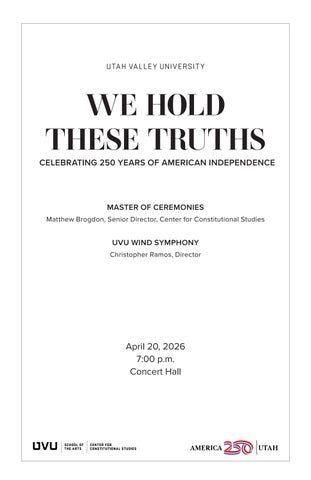
UTAH VALLE Y UNIVERSIT Y
WE HOLD THESE TRUTHS
CELEBRATING 250 YEARS OF AMERICAN INDEPENDENCE
MASTER OF CEREMONIES Matthew Brogdon, Senior Director, Center for Constitutional Studies
UVU WIND SYMPHONY Christopher Ramos, Director
April 20, 2026 7:00 p.m. Concert Hall
PROGRAM Declaration (2024)
James Stephenson (b.1969)
George Washington, “Letter to Henry Laurens” Charles R. Mosher as George Washington
New England Triptych (1959) II. When Jesus Wept III. Chester
Lincoln Portrait (1951)
William Schuman (1910–1992)
Aaron Copland (1900–1990) arr. Walter Beeler Governor Gary Herbert, Narrator
Frederick Douglass, “What to a Slave is the Fourth of July?” Yahosh Bonner as Frederick Douglass
Susan B. Anthony, “Is It a Crime for a Citizen of the United States to Vote?” Melonie Cannon as Susan B. Anthony
America, the Beautiful (1882/1963)
Samuel Augustus Ward (1847–1903) Katherine Lee Bates (1859-1929) arr. Carmen Dragon Bradly Olson (BS, Music Education), Guest Conductor
The Stars and Stripes Forever (1896)
John Philip Sousa (1854–1932)
UVU Wind Symphony Christopher Ramos, Director Flute Jessica Allen Cami Bartholomew Martha Peterson Jenifer Swanson* Ashley Toomey Oboe Ayden Wiggins* Luca de la Florin Bassoon Eric Christensen* Joshua Magnusson Ellie Sorenson Clarinet Adrian Blanco Kaydence Butler Conner Hodson Julia McHenry, Alto Jeffrey Rawlings* Alec Russell, Bass Julia Taniguchi Robyn Ward Kathleen Williams, Eb
Saxaphone Gideon Baker, Bari Addy Hogan, Tenor Ruth Payne, Alto Logan Stanford, Alto* Trumpet Arye Arteaga Brandon Ard Katherine Goehring Bradly Olson* Connor Perkins Jordon Toomey Horn Steven Dulger* Cora Jackson Sean Knowlton Michael Rodeback Andrew Williams Trombone Michael Ferrier* Steven Gravley Jay Henrie, Bass Mackay Hill Millie Knowlton, Bass
Euphonium Abdallah Elhaddi Gabriel Nelson Tuba Sam Hikida Alex Jensen Jarom Lewis* Giovanni Ochoa Percussion Jordan Bushman James Hatch* Aaron Slighting Stephen Tullis Elliot Uffens Nick Walker String Bass Alexander Willey Piano Anna Peterson Harp Travis Lunt
* Denotes Section Principal
CONDUCTOR’S STATEMENT Musical form is rarely, if ever, born whole. More often, it begins with an often fragile idea and then asks to be worked on. Themes return altered. Harmonies strain, fracture, and reassemble. What we recognize as coherence is usually not stability, but development: a willingness to engage the material honestly, to test it, to stretch it, and to allow it to become something more than it was at first utterance. The music on tonight’s program is bound together by that act. Stephenson’s Declaration announces its presence with confidence, but almost everything you hear afterward grows out of what is planted in the opening measures. Billings’s hymn tunes are not preserved in amber by Schuman, but wrestled with, reframed, and pressed into expressive service. Copland constructs Lincoln Portrait not around spectacle, but rather around the patient unfolding of a sonic argument, clearing space so Lincoln’s words can arrive with gravity rather than force. Even Sousa’s march, so often treated as a victory lap, achieves its exhilaration through the careful accumulation and transformation of familiar materials. And development is more than just a process. For us musicians, it is our ongoing responsibility. And that idea sits at the heart of the Declaration of Independence itself. The document does not merely announce freedom; it establishes a standard. As Frederick Douglass later observed, its principles are “saving principles,” a “ring-bolt to the chain of your nation’s destiny.” The Declaration articulates the aspiration that all are created equal, and then dares all to take that aspiration seriously. But the Declaration is not a constitution for government, and thus it assumes incompletion. It invites correction, expansion, and moral labor. What follows in our nation’s history, and in tonight’s program, is the long, often difficult process of living into that claim. George Washington’s winter at Valley Forge reveals that development is rarely glamorous. It is cold, uncertain, and sustained by trust that effort itself matters. Lincoln reminds us that nations, like themes, are tested when the contradictions within them can no longer be ignored — when the question becomes whether what was “conceived in liberty” can endure honest examination. Frederick Douglass and Susan B. Anthony speak not as outsiders to the American project, but as its most serious readers, insisting that the logic of equality be followed wherever it leads.
In musical terms, this is rigorous development: refuse to abandon the motive, and also refuse to pretend it has already arrived. Katherine Lee Bates’s text for America the Beautiful captures this posture beautifully. It is not a triumphant stance, but it is rather a prayerful one. “God mend thine every flaw,” she writes, acknowledging both love and unfinished work. Her vision crowns the nation not with dominance, but with restraint, care, and responsibility. It is the sound of a theme yearning toward its fullest realization. For the students in the wind symphony, this concert marks a moment in their own development; the music is not easy, and they have grown tremendously in their preparation of this concert for you. For all of us in the hall, it offers a reminder that inheritance without engagement becomes hollow. What gives both music and democracy life is the shared commitment to listen, to refine, and to act with purpose over time. Development asks patience, humility, thoughtfulness, and courage. It asks that we believe transformation is possible not in spite of tension, but because of it. Tonight’s music does not claim arrival. Instead, it invites us into the work itself. “We mutually pledge to each other our Lives, our Fortunes and our sacred Honor,” wrote the Founders. And that invitation, perhaps, is the most American gesture of all. -C.R.
Scan to read more about each artist and the works on the program.
DEPARTMENT OF MUSIC MISSION STATEMENT
The Department of Music provides an inclusive environment for professional training of aspiring performers, educators, composers, producers, and scholars. Through rigorous study with exceptional faculty, as well as education and industry partners, music students grow their artistry, develop a professional network, and expand their thinking and actions to include diverse views and experiences as global citizens. While fostering student achievement, the department engages with community members through our state-of-the-art facility by hosting concerts, festivals, and outreach activities.
UVU CENTER FOR CONSTITUTIONAL STUDIES MISSION STATEMENT
The UVU Center for Constitutional Studies is a nonpartisan, academic institute that promotes the instruction, study, and research of constitutionalism. The Center examines important constitutional issues found at the intersection of political thought, public policy, religion, law, history, and economics. We employ a multidisciplinary approach to equip a new generation of citizens and leaders with a broad understanding of the ideas and practices critical to the perpetuation of constitutional government, ordered liberty, and the rule of law.
UVU SCHOOL OF THE ARTS MISSION STATEMENT
Students in the School of the Arts become exceptional, original, and engaged artists by studying with distinguished faculty in state-of-the-art facilities, working with industry professionals, and collaborating with a diverse group of fellow students. SOA student artists are driven by purpose, committed to their field, and prepared to become successful professionals and conscientious citizens of the world. In an environment that is inclusive, specialized training in the School of the Arts builds on a foundation of general education coursework and engages the community in performances, exhibitions, and outreach activities.
Your gift impacts UVU music students for a lifetime. SCAN TO BECOME A DONOR
Donate to the Department of Music today and support the next generation of upcoming artists.