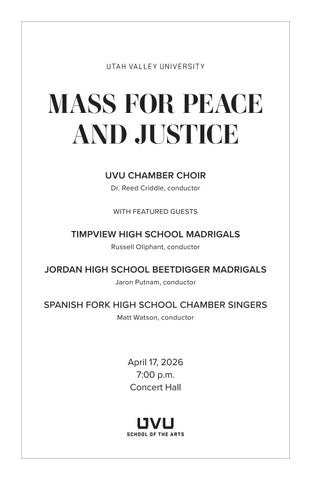
UTAH VALLE Y UNIVERSIT Y
MASS FOR PEACE AND JUSTICE UVU CHAMBER CHOIR Dr. Reed Criddle, conductor WITH FEATURED GUESTS
TIMPVIEW HIGH SCHOOL MADRIGALS Russell Oliphant, conductor
JORDAN HIGH SCHOOL BEETDIGGER MADRIGALS Jaron Putnam, conductor
SPANISH FORK HIGH SCHOOL CHAMBER SINGERS Matt Watson, conductor
April 17, 2026 7:00 p.m. Concert Hall
PROGRAM UVU Chamber Choir Dr. Reed Criddle, conductor La Otra (“The Other Woman”)
J. Michael Saunders (b. 1989)
Nathan Mills, cello Bethany Rasmussen, soprano Ashley Vazquez, piano Songs of Nonattachment
Reed Criddle (b. 1981)
I. Dancing Gold or Withered Plume II. Wear Dreams Like Clothing Jonah Walker & Caryn Allen, soloists Ashley Vazquez, piano Nikolai Kedrov (1871–1940)
Otche Nash Jonathan Peterson, conductor
Jordan High School Beetdigger Madrigals Jaron Putnam, conductor Earth Song
Frank Ticheli (b. 1958)
Spanish Fork High School Chamber Singers Matt Watson, conductor Set me as a seal
René Clausen (b. 1953)
Timpview High School Madrigals Russell Oliphant, conductor Even When He is Silent
Kim André Arnesen (b. 1980)
Adelaide Wingate, conductor
INTERMISSION
UVU Chamber Choir Reed Criddle, conductor Misa por la Paz y la Justicia (1981, Utah premiere)
Ariel Ramirez (1921–2010)
Introduction Kyrie Boston Bean, soprano soloist Gloria Psalm 84 & 71 Halleluja Sermon Credo Sanctus Agnus Dei Communion Psalm 150 Anthony Ruiz, tenor soloist Ben Perry, charango Nathan Mills, berimbau pequeño Caryn Allen & Samantha Castleton, sikus & quena Clark Slater, guitar Ross Hagen, twelve-string electric guitar David Baker, electric contrabass Ashley Vazquez, piano Charlie Han, organ Benjamin Holt & James Hatch, percussion Reed Criddle, conductor
PROGRAM NOTES By Jonathan Peterson, UVU Chamber Choir assistant conductor La Otra Justice is dead, and we have killed her. With hatred, division, and neglect, we have left her to die. We have left her to die because we did not love her. This is the theme of Gabriela Mistral’s poem “La Otra,” or “The Other.” After the death of her first love by suicide, much of Mistral’s poetry reflects violence, death, and loss. In this poem, Mistral sees this “other” as part of the narrator, something inside themself that was not worth preserving despite its beauty. Songs of Nonattachment It would be impossible to discuss one of these two songs without mentioning the other, as the two Songs of Nonattachment were written to be performed together. Reed Criddle initially wrote the first song, Dancing Gold or Withered Plume, as a solo piano piece in spring 2025. Afterward, Criddle made the decision to add choir singing poetry he wrote. The text uses an allegory of a conversation between oak and birch trees to discuss the concept of nonattachment, or the ability to be receptive to new ideas, rather than holding to old beliefs. Criddle wrote Wear Dreams Like Clothing as a companion to the first song, extending the theme of nonattachment to identity. This philosophy argues that a person and their identity are not static, they are ever-changing, and that this should be embraced rather than resisted. Otche Nash In 1922, Nikolai Kedrov left his native Russia for Germany. While the reasons for his departure are unclear, the persecution of sacred artists, of which Kedrov was one, leaves us with a good guess. Among Kedrov’s first compositions in his selfimposed exile was this setting of the Lord’s Prayer in Old Slavonic, the liturgical language of the Russian Orthodox Church. As the music pleadingly crescendos on the words “lead us not into temptation,” one can imagine that Kedrov asks God not to lead others into the temptations of despotism.
Misa por la paz y la justicia Introduction After the death of the enormously popular Argentine president Juan Perón in 1974, the country entered a period of serious political turmoil. Perón was succeeded by his wife and vice president, Isabel, who was much less capable of unifying the various factions in the Peronist government. After less than a year in office, Isabel Perón was overthrown by a military junta led by General Jorge Videla, who began a military dictatorship that would last until December 1983. During Argentina’s military dictatorship, the government engaged in a brutal campaign against its opposition known as the “Dirty War,” in which contemporary CIA documents estimate between 10,000 and 30,000 people were killed. This period of terror inspired Ramirez’ mass and its plea for peace and justice. The text of this movement, taken from Jeremiah 31:15, reflects the terror of the people of Argentina as fathers and mothers weep for their children, who are dead. Senor ten Piedad Ramirez sets the text of this movement, in Latin the “Kyrie,” to the folk music genre known as the baguala, which comes from indigenous peoples in what is now Peru and northern Argentina. As Ramirez scholar Andrew David Alegria notes, the baguala uses a three-tone scale that outlines a single triad. Pay close attention to the tenor soloist to hear that nearly every note he sings is one of the three notes, though the octave may vary. Gloria a Dios The Gloria of this mass utilizes both a folk dance – the cueca – and a folk music style – the triste jujeño. The movement begins with the cueca, a partner dance that is often thought to symbolize the courting dance of roosters and chickens. Both the man and the woman in the dance hold a handkerchief in the air throughout the dance. In the middle of the Gloria, the dance-like feel of the cueca is interrupted by the triste jujeño, a sad style of folk music that often uses texts about love in a slow tempo. Many of the instruments that help establish the rhythm of the cueca also stop playing, leaving a single guitar to accompany the soloist and, later, the choir. After this section of the triste jujeño, the electric guitar returns to establish the livelier tempo of the cueca.
Salmo Responsorial For most of the Catholic Church’s history, mass was required to be performed in Latin. Then, from 1962-1965, clergy of the Catholic Church met in the Second Vatican Council to redefine the role of the Church and its practices. Among these was an end to the requirement of a liturgy in Latin, instead encouraging the use of the vernacular language in services. In a piece of music as topical as Misa por la paz y la justicia, the message of liberation would not be so poignant in Latin. Writing in the vernacular allows a deeper connection between the congregation and the meaning of the words. Alleluia One of the largest indigenous groups in Argentina are the Toba people in what is now northern Argentina. Alegria explains that Toba music emphasizes percussion and rhythm to create the feeling of dance in the music. The syncopation of the percussion in the Alleluia creates a feeling of excitement that accentuates the joyous proclamation of the text. Homilia The homily of a mass is an opportunity for the priest to speak directly to the people of his parish, giving direct counsel to their needs and interpreting scripture. The text for this movement comes from a homily delivered by St. John Paul II on New Year’s Day 1979. John Paul II’s papacy, which started in 1978 and lasted through the end of the Soviet Union, was marked by resistance to authoritarianism in the Eastern Bloc and around the world. This homily exemplifies John Paul II’s process of using scripture and Christian doctrine to instruct Catholics in their resistance to authoritarianism: with courage and unity in calling for peace. Creo en Dios The Credo is usually one of the most joyous sections of a mass, with a text (in Catholic mass, this is the Nicene Creed) discussing belief in God. Ramirez uses the folk dance style of a malambo, which is typically performed by two gauchos, or Argentine horsemen, dancing back and forth in competition. The defining component of a malambo is footwork in which the dancer stomps, kicks, and brushes his foot across the ground. All these movements cause the spurs of his boots to jingle. Listen for the percussion as it mimics the spurs.
Santo es el Señor This movement is in the style of the balecito, a partner dance from Bolivia and northwest Argentina that fuses European and Indigenous elements. According to Alegria, the bailecito performed in Argentina utilizes indigenous instruments such as the charango (a stringed instrument like a small guitar) and the quena (an indigenous style of flute). Ramirez departs briefly from the dance for a much slower duet between two flutes in the middle of the movement. Cordero de Dios The traditional Latin version of this text, the Agnus Dei, says, “Lamb of God, You who take away the sins of the world.” In Ramirez’ setting, the singular “sin” is used, rather than the plural. Alegria argues that this reflects John Paul II’s teachings that the original sin was a break both with God and between each other. Comunion The text of Comunion is a dialogue between God and those who come to worship. In a worship setting, this movement would be sung as churchgoers receive the Eucharist from the priest. In the text, God reminds the congregation that to receive the Eucharist is to join in a “new humanity” – one built on peace, justice, liberation, and love. Salmo 150 The last psalm in the Bible discusses praising God with trumpet, psaltery, harp, cymbals, and other instruments native to the time it was written. Ramirez replaces many of the instruments listed to reflect the instruments familiar to the Argentine people. All the instruments used in this Spanish version are also used in the instrumentation of the mass. As they are mentioned, each instrument gets a brief feature in the music. In 1979, Ramirez attended a mass in which the priest, Father Rafael Braun, asked God to compose a new mass centered around peace and justice. Ramirez took that as instruction to compose it himself, spending the next two years on the project. After the first performances and recording in 1981, the Argentine military dictatorship banned the mass’s public performance. Two years later, the dictatorship ended. While the initial cause for the writing of the mass is gone, the meaning remains prescient. We must all call for the old order to pass away and replace it with one of peace and justice.
UVU Chamber Choir Dr. Reed Criddle, conductor Soprano 1 Megan Benson Charlotte Hill Hélène Loosli Bethany Rasmussen *
Alto 2 Caryn Allen * Madison Partridge Olivia Robbins Robin Van Cott
Soprano 2 Boston Bean Makinley Brown Carissa Sharp Lindsey Uhl
Tenor 1 Danny Di Girolamo * Tyler Gladden Benji Lopez Anthony Ruiz
Alto 1 Emma Carbine Samantha Castleton Mallory Keele
Tenor 2 Luc Faucette Clinton “CJ” Miller Jonathan Peterson+ Kaleb Shelley
Bass 1 Logan Bishop William Bradshaw Ryan Call * Trenton Chandler Scott Schilling Bass 2 Braden Johnson Nathan Mills Talmage Ricks Daniel Turgeon Jonah Walker
* Section leader + Assistant Conductor
Your gift impacts UVU music students for a lifetime. SCAN TO BECOME A DONOR
Donate to the Department of Music today and support the next generation of upcoming artists.