‘Bapple is treated different’: University Liquors sells out, expects more in stock
Page 2
@utkdailybeacon


Wednesday, April 29, 2026



‘Bapple is treated different’: University Liquors sells out, expects more in stock
Page 2
@utkdailybeacon
Wednesday, April 29, 2026
ALEX SARKIS Asst. Sports Editor
Momentum is a fickle aspect of sports. Tennessee baseball had none of it as it welcomed Alabama to Lindsey Nelson Stadium to start a day earlier than any usual SEC series. Not even 24 hours later, the Vols had claimed their first home league series win over a ranked opponent since last season’s conference-opening set against Florida, all before the calendar even flipped to Saturday.
LEE Staff Writer
Days after a gunman opened fire at the annual White House Correspondents’ Dinner, a UT student who attended the dinner shares her firsthand perspective.
Gail Fanning, senior political science and journalism major, is the University of Tennessee’s fifth recipient of the Carter Holland Memorial Scholarship, which sends one student each year to represent UT at the dinner, which is traditionally attended by the president and vice president.
Fanning entered the banquet hall of the Washington Hilton at 7 p.m. as the dinner commenced Saturday, April 25.
“It felt super real to me, like, ‘this is really happening, and I’m so happy I get to be here,’” Fanning said. “We are closer to the president than we are to the exit doors.”
Attendees had not made it past appetizers when chaos erupted.
“I hear this clattering, clanking,” Fanning said. “I look over, and I just see people rushing in, and they’re all yelling, ‘get down!’”
Fanning said that though she didn’t hear gunshots, she realized something was happening based on the way the audience reacted, and her first instinct was to hide and call 911.
“While I’m on the phone with them, I text my family’s group chat,” Fanning said. “I say, ‘Oh my God, I’m under a table.’”
Fanning got in contact with her mother, who had traveled to Washington with her and was staying in a room floors above the banquet hall as the at-
tack happened, to figure out what was going on.
“I’m in a ballroom with 2,000 people. I can’t see anything,” Fanning said. “I felt so scared.”
The reality of what happened didn’t hit her until 1 a.m. as she watched the night’s events recounted on news stations across the country. Fanning said she felt “devastated” when she realized that the weekend she had looked forward to for months was over.
“I had it scheduled out in my calendar since I found out in November,” Fanning said. “In the week leading up to it, I was so anxious about it.”
When she landed in Washington earlier in the weekend for the dinner, Fanning said the nerves went away, and she was faced with pure excitement.
“I texted in my family’s group chat coming from (Ronald Reagan Washington National Airport) that I was in my happy place, which was a WMATA Metro car,” Fanning said.
The experience, Fanning said, is one she will not get back.
“You can go to D.C. as many times as you want,” Fanning said. “You only get honored at the White House Correspondents Dinner once.”
When asked if she would relive the weekend again if she knew how it would play out, Fanning gave an answer some might not expect.
“I would absolutely do it all over again,” Fanning said. “I got to meet so many amazing people. … I wish I’d been able to meet more.”
The suspected shooter, 31-year-old Cole Tomas Allen of California, has been charged with attempting to assassinate President Donald Trump.

Tegan Kuhns’ near-flawless start in the middle game not only bailed Tennessee out of having to use a spent bullpen after a poorly pitched series opener, but it set the tone for a day of redemption that the Vols had been searching for, providing a boost to their own morale and the outlook of their postseason hopes as the regular season nears a conclusion.
“I was just ready to kind of set the tone,” Kuhns said. “I think the guys needed it. They just needed a better start out of a starter, and I just did that for them.”
Tennessee’s get-back came in the form of a doubleheader sweep, a pair of decisive victories over the No. 13 Crimson Tide that each featured some of the Vols’ cleanest play of an up-and-down campaign. Kuhns tossed an eight-inning complete-game shutout to avenge his fellow arms’ woes from a game before, while rubber match hurler Evan Blanco came up with a quality start of his own.
The bats contributed plenty, too, posting double-digit runs in each contest. Tennessee made the plays it had to in the field, got the hits it needed at the plate and silenced the Alabama offense from the mound to assert nearly 18 innings of dominance. It came at the perfect time.
“It’s really tough what we did today, and our guys know that,” head coach Josh Elander said. “And just so much respect for this league. It is to win one, but to win two in one
day, the credit all goes to the players because their response from how they played poorly yesterday to great today is a really good sign for our club moving forward.”
Trent Grindlinger and Blaine Brown helped steer the positive direction of Tennessee’s vast offensive successes throughout the series. The Vols scored 29 total runs over the three games, their highest total all year.
The pair each launched a pair of homers, but Grindlinger’s seven hits were just enough to best Brown’s six. For Grindlinger, the freshman finds his success by keeping things as simple as possible. It’s all about slowing the game down.
“Just not trying to do too much,” Grindlinger said. “Just sticking to my approach, trying to shoot some low line drives around the yard.”
The Huntington Beach, California, native doesn’t need any fancy or complicated method to find his solace in the batter’s box.
“Breathing,” Grindlinger said. “I talk to all the older guys about it, like (Henry) Ford and (Reese) Chapman, all the time. Just breathing and having confidence as well.”
As far as Brown is concerned, he registered his first series with at least six hits since Tennessee’s season-opening slate with Nicholls State back in February. The 6-foot5 lefty hadn’t posted consecutive multi-hit games since that sweep over the Colonels until his two-knock and three-hit showings in the doubleheader with Alabama.
It was a long time coming.
“I wouldn’t say it’s been the greatest,” Brown said. “But, for sure, it’s just keep going each day at a time and keep putting your head down and working. Pages will flip, and you just got to keep going, taking it one day at a time.”
It’s no secret that the Vols have met their fair share of adversity. They’ve experienced inefficiencies in every area of their game this season, a reality that still slots them with a 10-11 record in SEC play.
Even if this series win came under unusual circumstances, wrapping up before some other teams around the country could even begin their weekend matchups, Tennessee managed to answer the call. The Vols left little room for doubt.
“We’ve been in these scenarios where your back’s against the wall and you got to figure out what you got,” Elander said. “You can play tight and tense and try hard, or you can just cut it loose and play baseball. I thought our guys did that today.”
CAYMAN JACKSON Contributor
Known for humorous social media skits, assistant professor of advertising Matthew Pittman doesn’t usually cover heavy topics.
But his latest work is contributing to a research initiative that could help survivors of human trafficking rebuild their lives.
Every year, approximately 27.6 million people worldwide are human-trafficked, many for forced labor or sex. While many states allow survivors to vacate, expunge or seal criminal records tied to their exploitation, there are limits on what can be sealed.
In many cases, survivors are only allowed to expunge prostitution and drug charges, failing to account for other offenses they were forced to commit. This often prevents survivors from successfully rebuilding their lives.
“If I would’ve seen someone that had a prostitution charge or a drug possession charge, and I owned a small business like a bakery, I’m not gonna hire her. She’s a criminal. But a lot of these women were put in a bad situation,” Pittman said.
That’s why Pittman, alongside his sister, Margaret “Meg” Kelsey, formed a partnership between Regent
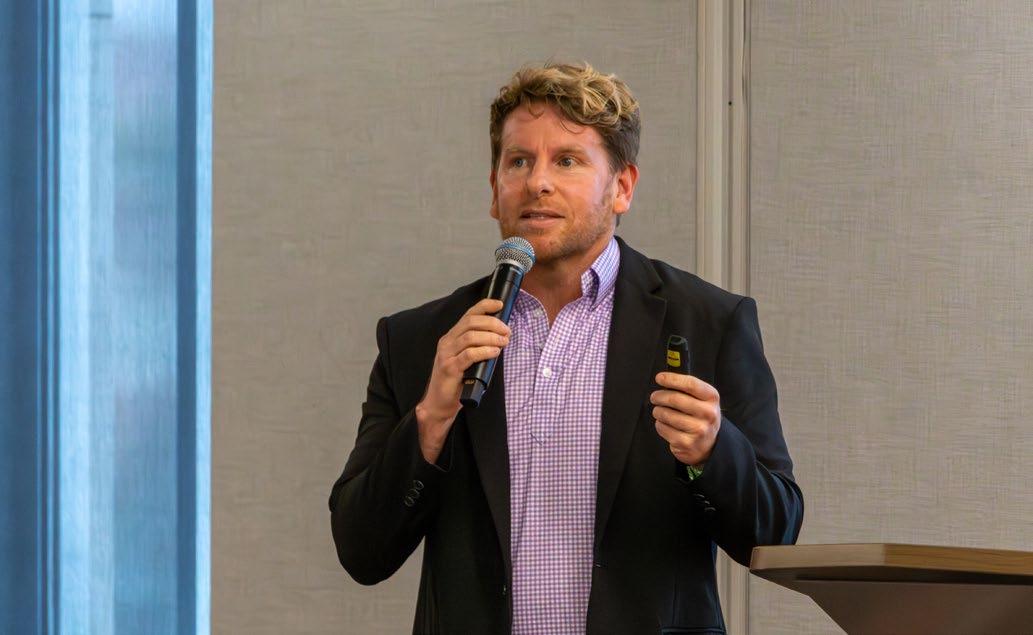
CCI Professor Matthew Pittman speaks during a lecture. Friday, April 17, 2026. Jaden Vitt / The Daily Beacon
University School of Law’s Center for Global Justice and UT’s Tombras School of Advertising and Public Relations.
Pittman and Kelsey, a clinical professor and director of the center, have received a $25,000 grant by the Sociological Initiatives Foundation to conduct a two-year research study to gather data about human trafficking cases and how they are treated in the criminal justice system. The study will include two surveys — the first for survivors, asking about their experiences with the criminal justice system, including whether they were arrested, convicted, identified or supported during their interactions.
The second survey will be distributed to the general public to gauge their perception about human trafficking. By combining these survey results, they will move beyond anecdotes to provide lawmakers with the empirical data necessary to push legislative reform. While Kelsey’s expertise and experience allows her to handle the legal side, she reached out to Pittman to utilize his skills in survey science and data analytics to help turn personal stories into data, which they hope will help challenge narrow ideas about what human trafficking is.
SEE ‘PITTMAN’ PAGE 2

KELA FIFER Contributor
Over the course of the spring semester, Brendon Crum has become quite familiar with latenight campus walks in his swim trunks.
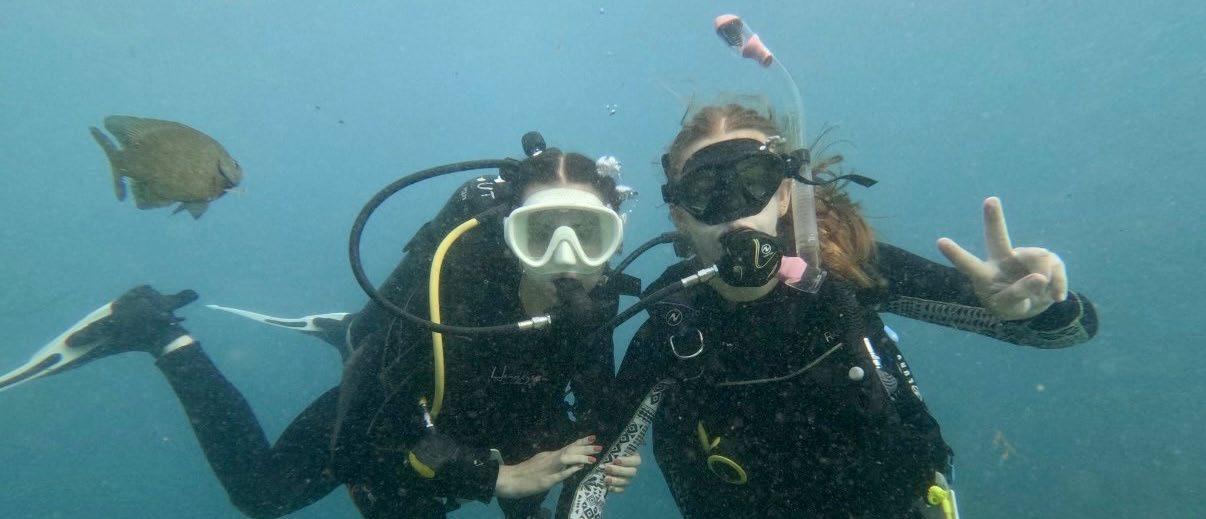
Scuba diving and Tennessee are two elements that most wouldn’t think to pair together. However, Crum, a political science major, as well as other students, are trying their hand at combining the two through the scuba courses offered here on Rocky Top.
“It’s unlike anything I’ve ever done before,” Naomi Winn, a junior double majoring in Spanish and political science, said.
Though an unexpected course, diving has been available to students since the 2000s. Offered through the department of kinesiology, recreation and sports studies, the scuba curriculum has now grown to include five
courses: scuba diving, advanced scuba diving, rescue scuba diving, master scuba diving and scuba dive master, and even a recently offered minor.
“Being able to offer this as a minor was a huge goal and process,” scuba instructor Greg Blankenship said.
For those just jumping into their scuba diving journey, PYED 261: Scuba is the go-to course.
According to Blankenship, this introductory course adheres to a “hip pocket” style of learning, something that he gained from his time serving as a Marine.
Instruction in the course balances a classic element of online learning with hands-on underwater experience that provides students with all the basics they need to know about open water diving.
With the help of instructors and dive masters there to supervise, students get familiar with basic elements of diving such as their dive kit, which includes an
oxygen tank, a buoyancy compensator and a regulator, along with a mask, fins and a snorkel. This equipment is provided by scuba instructor Don Orr and is completely covered in the students’ lab fee. Additional instruction focuses on safety, diving theory, diving communication and other foundational skills.
“The teaching style we have implemented has been a whole lot more productive for us,” Blankenship said. “With (the National Association of Underwater Instructors) using the e-learning to introduce the topic and then us reinforcing and implementing that topic, we’ve seen a market difference in how our students learn and retain stuff versus doing a stand up lecture.”
Students’ PYED 261 journey begins with a simple swim test and comes to a close with a potential diving certification. At the end of PYED 261, students have the opportunity to hit the

Tuesday, but Bapple is treated different,” Morton told The Daily Beacon April 28. “They may bring it by itself in a van on Monday.”
open water and earn their NAUI certification. With this lifetime certification, students gain the ability to dive around the world.
Over spring recess, Blankenship led a group of roughly 150 students to Vortex Spring in Florida to complete their checkout dive. For those in the intro course, their checkout dive consisted of four dives spread out over two calendar days. Advanced divers completed six dives and master divers completed eight dives over the course of the trip.
The UT scuba program has proven itself to be successful over the years and even has grown to become one of NAUI’s largest collegiate academic programs, according to Blankenship.
But before hitting the open water, students learn to overcome a few learning curves.
Adjusting to manually breathing underwater, swimming with dive equipment and getting acclimated to underwater pressure are a few things students have
had to get comfortable with.
Thankfully, a supportive community of instructors and assistive dive masters has made the transition relatively easy, allowing students to enjoy their experience while still learning.
“I definitely recommend it to other people,” Winn said. “It has been a really cool experience. The instructors are all awesome and very knowledgeable in what they do.”
Even if students don’t end the course with a certification, they learn transferable skills like teamwork, communication, problem solving and critical thinking skills. And they’ll walk away with a new topic for conversation.
“Getting to do this my last semester has been a really good focal point of my senior year that I’ll remember for years from now,” Crum said. “I’ve really enjoyed it, and it’s one of those fun classes that you get to tell people about.”
“Phones ringing off the hook. The people want to know,” Sterchi Morton Jr., chief operating officer of University Liquors, said. “Bapple madness.” Busch Light Apple, referred to as “Bapple” by its enjoyers, quickly sold out after returning to University Liquors the morning of Thursday, April 23.
“We will sell it as soon as we get it,” Morton said prior to the release.
University Liquors said additional 12-packs of the popular beer will be hitting shelves early next week.
“Eagle Distributing usually delivers to us on
Twelve-packs will cost between $17.99 and $19.99, Morton said.
“We will likely increase price when we get down to the last cases because supply is so limited,” Morton said. “We just get whatever they give to us, and that is it.”
Excitement over the beverage’s return sparked in January after a social post from Anheuser-Busch teased a limited sale.
“We heard you really like Busch Light Apple,” Anheuser-Busch said in the post. “Coming back SOON for a limited time only.”
They aim to advocate for lawmakers in Washington, D.C., and Virginia to pass legislation making it easier to expunge records.
“We were using the Virginia law and realized it was much too narrow. And when we were going to lawmakers to try and explain why the law needed to be expanded, we had individual stories, but anecdotes really only get you so far,” Kelsey said. “One-off stories or even a dozen stories isn’t really enough to convince them that this is happening at scale, and so I realized we needed better data to get better laws passed.”
This grant research comes at a pivotal moment — Virginia, where Pittman and Kelsey grew up,
signed a new law expanding “vacatur,” the legal process that allows survivors to have certain crimes removed from their records.
Despite the recent win, many laws remain narrow. Kelsey, who worked as a criminal prosecutor before being named director, believes that the narrowness is due to the struggle of recognizing instances of trafficking.
“It’s really hard to get data when everything is so hidden and survivors or people who are being exploited often don’t identify themselves as victims of human trafficking,” Kelsey said. “They don’t know that what’s happening to them counts as trafficking.”
EMMA KATE MURPHY Contributor
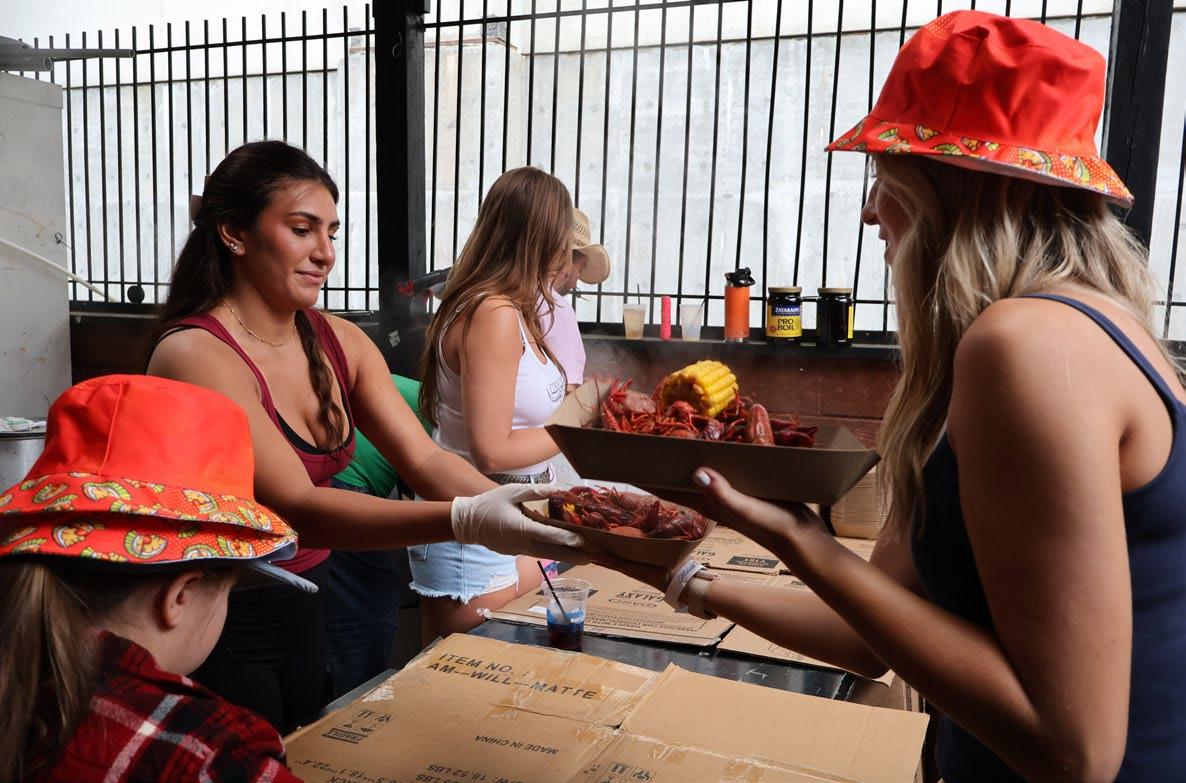
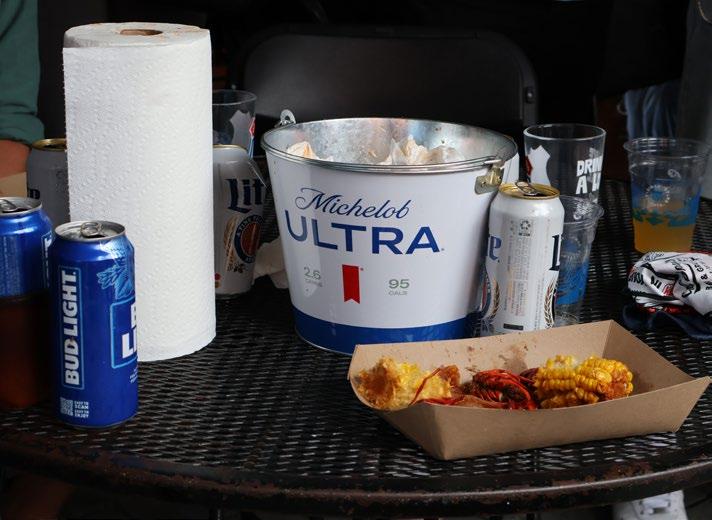
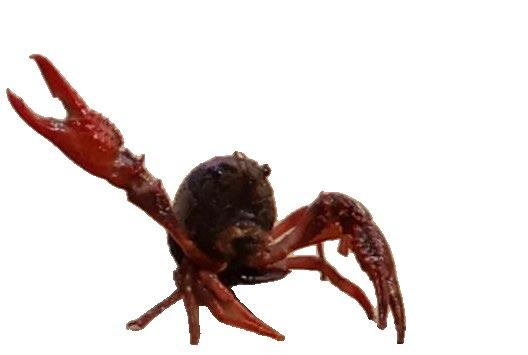
Cool Beans Bar and Grill held a successful annual crawfish boil in partnership with SweetWater Brewing this past Saturday, April 25.
This year marked 25 years of boiling for Cool Beans, with every year being bigger than the last. This year, 600 pounds of crawfish were flown in and boiled for the all-you-can-eat event.
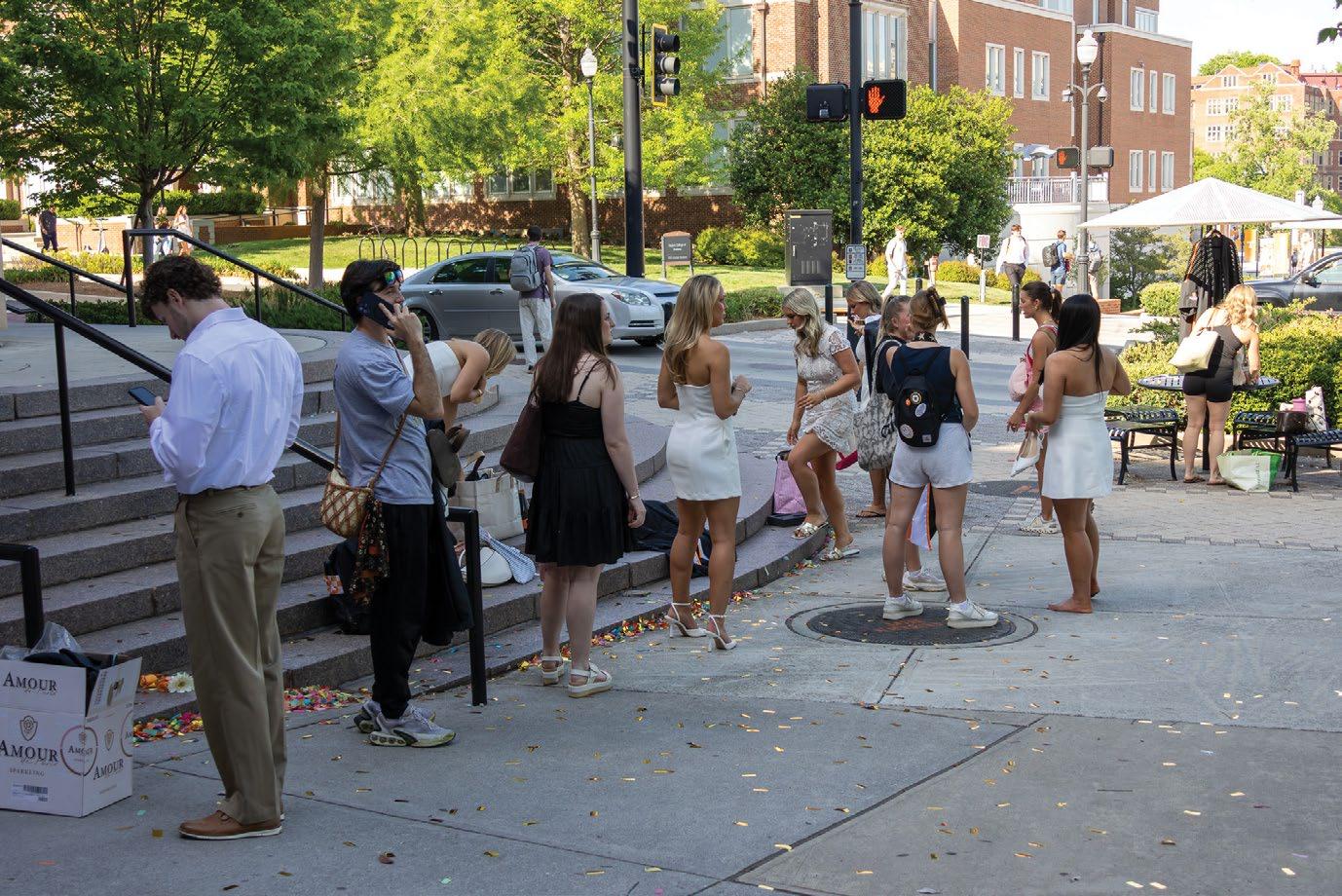
With graduation quickly approaching, many seniors are making their final memories on campus before starting their next chapter.
It is a closing of what many often call “one of the best times of their lives.”
Between classes, internships and the pressure of post-grad plans, that “adult free trial” is starting to expire — and no one remembers signing up in the first place. Students are finding ways to slow down and soak in the moment.
From long-standing campus traditions to simple gatherings with friends, these final weeks offer time to reflect, celebrate and honor the connection that defined their time at UT.
One tradition that continues to resonate with students is gathering around the Torchbearer statue for s’mores. The statue represents light and guidance for students during their collegiate journey. For many seniors, returning to this landmark transforms a simple activity into something more meaningful.
Off campus, students are also taking advantage of Knoxville’s natural scenery. Spots like Augusta Quarry and Meads Quarry have become popular scenes for seniors to escape the stress of senior year. Whether they are sitting in the sun, swimming or paddleboarding, these spots have offered seniors a break from academics and job applications.
“It has always been spontaneous, but going on more hikes,” Thomas Ketavongsa, a senior kinesiology major, said. “There is a lot of scenery around here that I haven’t been able to see.”
Social traditions are just as important to others. Weekly events such as Wine Wednesday at Sunspot draw in seniors who are looking to unwind. From discounted wine, music and a lively rooftop atmosphere, it offers seniors a chance to celebrate together before graduation separates them.
“Once you’re no longer young, you will not be able to sit at the same table as your friends as you would in undergrad,” Ketavongsa said. “Just like the advice I was given a long time ago: ‘work hard, play hard.’” Loud settings are not for everyone — quieter moments can be just as special. A picnic at the HSS lawn can create a space for seniors to share meals with friends, play music and have conversations. Whether it is reminiscing about their earlier years or sharing future plans, the small gatherings can create a big impact.
“Since time is limited, it feels more meaningful to be around everyone,” Allysa Esguerra, a senior majoring in psychology, said.
Intimate moments aren’t the only items on seniors’ to-do lists — so is upholding the Volunteer spirit. From volunteering with animals, children and shelters, students want to make a meaningful contribution before they walk across the stage.
“I’ve also been volunteering at a Center of English, helping non-English speakers learn level one English. I wanted to leave a positive impact before I graduate,” Esguerra said.
Students are also finding new ways to celebrate their final semester, such as trying out rooftops at The Hub or The Mark. These locations feature rooftop pools and city views, offering a spot to relax and take in their surroundings one last time.
While every student’s bucket list may look different, the intentions are the same — they want to leave campus with memories to carry forward after they put away their cap and gown.
Once you’re no longer young, you will not be able to sit at the same table as your friends as you would in undergrad. Just like the advice I was given a long time ago: ‘Work hard, play hard.’”
THOMAS KETAVONGSA Senior
Tickets were sold both in advance and at the door, with a $10 upcharge. Those who opted for the pre-sale were entered in a raffle to win an electric scooter and received a SweetWater pint two tickets to be exchanged for a pint of SweetWater beer and a T-Shirt with this year’s crawfish boil logo.
Seniors Rylee Short and Samantha Limongelli decided to come out to the boil after seeing it heavily advertised. Many UT students excitedly look forward to the day they turn 21 and can finally go to the famed Cool
SHELBY WILSON Contributor
The rise of social media could be elongating a famed senior tradition: graduation pictures.
At the end of each semester, hundreds of seniors schedule a photoshoot as part of their farewell checklist of finishing college. But there are some downsides to this process, especially as the school’s popularity flourishes and social media becomes a bigger factor in daily life.
Abby May is a senior kinesiology major who took graduation photos with her club lacrosse team recently.
“We had to wait like an hour to get our picture on the seal,” May said. “We didn’t end up going to Ayres Hall because we had heard from other people that the line was just as bad (as the seal) and that it was taking people like an hour to get through it.”
Due to the increasing class sizes and the “expectation” of taking professional photos to wrap up time in college, it is getting harder and more expensive to get a photo session done.
“We were only supposed to be with (the photographer) for about an hour, but because of how long the wait time was, we ended up being with him for, I want to say, close to two hours,” May said. “But he was very nice and didn’t charge us anything more than the initial price.”
Pricing for graduation pictures is typically in the hundreds. May worked with her photographer throughout her lacrosse season, and believes her photos were on the “lower side,” at around $150.
Online, many photographers charge much more than that — in some cases,
Rivera
Beans.
“We’ve seen it advertised every year,” Limongelli said.
Attendees included college students enjoying a special day at their favorite dive bar and mud bug enthusiasts spending the day with their families. Some patrons wore the T-shirt included in the pre-sale ticket purchase, while others came decked out in their crawfish best. Most unique: a crawfish-shaped purse.
“This is actually my first time I’ve ever had a crawfish before. I was a little hesitant, but it was good,” Short said. In addition to the crawfish, the festivities also included live music. DJ Voltage played a set from 11 a.m. to 1 p.m., followed by the Brandon Krul Band from 1 to 5 p.m. when the event wrapped up.
Despite on-and-off rain, plenty of people showed up to enjoy a delicious crawfish boil and overall good vibes.
“It’s a perfect crowd. When it’s too busy here, it’s kind of overwhelming, but it’s a perfect crowd,” Limongelli said.
Coolers held the live crawfish until it was their turn to be dumped into one of three boiling pots, eventually churning out 600 pounds of crawfish served alongside corn, potatoes, onions and sausage.
“It was honestly pretty quick getting the crawfish, too,” Short said. Despite this being Short’s first time eating crawfish, she highly recommends it for everyone in the future. So mark your calendars for next April when Cool Beans will return with their annual crawfish boil.
It’s a perfect crowd. When it’s too busy here it’s kind of overwhelming, but it’s a perfect crowd.”
up to $575 per hour.
Senior kinesiology major Gigi Molloy was also familiar with her photographer beforehand.
“My photographer has been taking photos for me and my family for about 15 years, so I knew what to expect going into it,” Molloy said.
Adult photographers in the area are not the only available hires. Many students at UT also take graduation pictures as a side gig.
Jake Rodriguez is a senior majoring in global studies.
“Currently I charge $250 a session base price, but as a college student, I know that students are on a tight budget and things like that, and I don’t want certain people to not get that experience,” Rodriguez said. “I try to
work with people as much as possible.”
Seniors say that the timing of it all takes longer than one would expect.
“A stressful part was when I had all my friends meet me at Cool Beans for photos and we ended up hanging out there longer than expected, which made the rest of the shoot feel a bit rushed,” Molloy said. “The only place we didn’t make it to was the G1 parking garage in front of Neyland.”
May recommended picking a time when not as many people are on campus.
“I know some people have done them in the middle of the day on weekends, and I feel like that probably is a better time just to avoid wait times and people in the background of your photos,” May said.
This book tore me apart, and then somehow, put me back together.
I was hooked from the beginning, engaged in a journey through a complex family story spanning generations. Inspired by the four sisters in “Little Women,” “Hello Beautiful” tells the story of a group of Chicago sisters who eventually become intertwined in the life of one boy: William Waters. However, you find that the boy matters much less than the bonds built between the sisters and their kin.
This book is for the girls, the young women who are constantly pulled between self-preservation and desire, love and hurt. We all seek acceptance — an identity associated with a group. When you read this book, you become a part of this group of sisters, finding parts of yourself in each of these beautifully built characters.
You even find yourself in Waters, who is deeply flawed yet recognizes the depth and beauty of Julia Padavano and her sisters. You find yourself in Julia Padavano, who is the eldest daughter of the family. She is deeply ambitious and driven, yet guarded and often unemotional. Slyvie Padavano is quite the opposite, deeply empathetic and a dreamer, sometimes to her detriment. The twins, Cecelia and Emeline Padavano, bring together the family through their energy and emotion, fearless in their thoughts and expressions and nurturing and attentive in their actions.
There is a sort of intentionality that each sister possesses for the other, and a deep love that can be felt beyond the pages of the book.
One scene of the book finds Sylvie and Julia Padavano sleeping on a couch together, melting into one as their breathing syncs and their bodies relax completely. These moments within this book remind me of times when I lay with my mother at night, telling her the most minuscule details of my day.
While reading, I was constantly reminded of my mother’s grace, elegance and ambition exemplified by Julia Padavano, and her deep empathy and optimism occupied within the pages by Sylvie Padavano. I was reminded by the twins of my mother’s nurturing nature and — for fear of spoiling the entire book — the sacrifices each character makes for each other and their children.
I hope that you read this book and find yourself and others around you in these deeply stunning, yet flawed characters.

We are human after all, and we are such complex beings — especially the type of woman who finds identity and comfort within this novel. Emotions are complicated, relationships are strange and people are hard to understand sometimes. Yet, it is the learning about another’s life, their feelings, how they think, what they love and hate, and seeing how they grow that ends up being some of the best parts of your life. We all deserve companionship as deep as what these sisters find in each other, and we deserve to be loved so intentionally. However, we have to let ourselves love another first. This book shows that eventually, we will find that it’s these relationships we’ve built with each other that matter the most. Things will happen, people will hurt you, but this is the essence of living a life that is worth it. So reach out, be intentional, appreciate the good in others, and allow yourself to feel deeply and love even deeper. Grab it now for $4.89 online from Thiftbooks or $10.40 on Amazon!

EDITORIAL
EDITOR-IN-CHIEF: Caden Dyer
PRINT MANAGING EDITOR: Emily Hurst
DIGITAL MANAGING EDITOR: Ansley Graves
COPY CHIEF: Lauren Holladay
NEWS EDITOR: Patrick Busch
ARTS & CULTURE EDITOR: Harper Brabson
SPORTS EDITOR: Trevor McGee
ASSISTANT SPORTS EDITOR: Alex Sarkis
OPINIONS EDITOR: Natalie Dripchak
PHOTO EDITOR: Jackson Clavier
DESIGN EDITOR: Lindsay Favre
ENGAGEMENT EDITOR: Sarah Portanka
AUDIENCE DEVELOPMENT EDITOR: Sophie Mehta
COVER DESIGN: Lindsay Favre
PAGE DESIGNERS: Emma Fingeret, Ashley Cammarota, Renee Allen, Maya Williams, SaraJane Weber, Ava Balducci, Ava Edwards, Soma Fulwiler, Kate Wims, Lili Ellis
GRAPHICS BY: Lindsay Favre, Emma Fingeret, Maya Williams, Soma Fulwiler, Lili Ellis
ADVERTISING/PRODUCTION
ADVERTISING MANAGER: Abigail Cheslock
ADVERTISING REPRESENTATIVE: Joe Slott
CONTACTS
TO REPORT A NEWS ITEM OR SUBMIT A PRESS RELEASE, please email editorinchief@utdailybeacon.com or call (865) 974-2348
TO PLACE AN AD, please email admanager@utk.edu.
LETTERS POLICY: Letters to the Editor must be exclusive to The Daily Beacon and cannot have been submitted to or published by other media. Letters should not exceed 400 words and can be edited or shortened for space. Letters can also be edited for grammar and typographical errors, and Letters that contain excessive grammatical errors can be rejected for this reason. Anonymous Letters will not be published. Authors should include their full name, mailing address, city of residence, phone number and e-mail address for verification purposes. Letters submitted without this information will not be published. The preferred method to submit a Letter to the Editor is to email the Editor-in-Chief.
CORRECTIONS POLICY: It is the Daily Beacon’s policy to quickly correct any factual errors and clarify any potentially misleading information. Errors brought to our attention by readers or staff members will be corrected and printed on page two of our publication. To report an error please send as much information as possible about where and when the error occurred to managingeditor@ utdailybeacon.com, or call our newsroom at (865) 974-5206.
The Daily Beacon is published by students at The University of Tennessee on Wednesday during the fall and spring semesters. The offices are located at 1345 Circle Park Drive, 11 Communications Building, Knoxville, TN 37996-0314. The newspaper is free on campus and is available via mail subscription for $200/year or $100/semester. It is also available online at: www.utdailybeacon.com
How do you begin to grieve someone you initially thought you “hated”?
When my dad passed away last December, like many others who have endured the journey of grief, I found myself asking how I should deal with it and what emotions I was supposed to feel. I never thought of someone close to me passing away, and you don’t truly hear about the slow and quiet moments behind someone passing away before your eyes.
Although I was very aware that my dad did not have much time with us, it was a surreal experience to know he wasn’t going to be here anymore. People around you don’t really prepare you for what you will experience, and it isn’t emphasized how many times you will hear “sorry for your loss,” even from people you have never met.
As the days passed, my dad’s funeral arrived before I could even process what had happened. I remember the funeral very vividly, but it was a fever dream in which I didn’t know how to “properly” behave and feel. I remember discussing with my mom and sister how the funeral was not a true goodbye but instead a way for everyone else to find closure. Weeks before, we had already said our goodbyes in a cold, empty hospital room.
As I dealt with my grief, I didn’t always think I was feeling the right emotions, and I often felt disconnected from my family because my relationship was so conflicted. What I initially thought was hatred was truly resentment toward my dad’s actions and behavior, which created a nuanced relationship where I felt I deserved more from him as a dad.
I know many people say grief is not linear and there is no right way to grieve, but there is a socially “acceptable” way of doing it. People are used to hearing about the sadness that grief can enthrall you in, but emotions like anger, resentment and everything in between are taboo. Those unanswered questions that keep you up at night aren’t what people think of when they hear grief. It isn’t a one-dimensional feeling but instead explores all parts of your relationship and

emotions toward a person. Now, my relationship with my dad can no longer be amended, no matter how much I ponder on what I could have done differently. Growing up, I always felt more inclined toward my mom and spent most of my time by her side, mostly because my dad spent his days at work or away from family. Although we lived under the same roof for over 18 years, I never really got to know who he was as a person and vice versa. My senior year of high school was spent ignoring the hole of what you could barely call a father-daughter relationship by prioritizing my own mental and emotional peace. Even though at the time I felt that I was doing what was best for me, I will never be able to know if a few simple conversations could have mended our relationship. My dad was a flawed man, and at times, I didn’t understand his actions and words. As I grew into friendships and relationships, I started to reflect on how I could give such mercy toward others who have hurt me, but it was so difficult to take the next steps to heal our relationship.
I now mourn the many missing pieces of what having a dad growing up would have been like. Although he lived with me, I
never really felt his warmth and embrace as a parent.
I appreciated all his hard work as an immigrant chasing the American dream, but I often overlooked it when it came to who he was as a husband and dad. Now that he is gone, I am left with flowers on a grave and someone who will never speak to me. As much as I was conflicted in the past with what role my dad played in my life and how to handle it, I can no longer continue to develop that relationship.
It’s been a year into grief, and I don’t claim to know how to navigate my emotions, but I try not to ponder the “could have done” or “could have said.” I am still grieving the loss of a relationship. Although my experience is not typical when losing a loved one, I always aim to listen to my mind and emotions.
As flawed as people can be, I try to be more open as a person, to not only see one side of someone, but also view them for every part of their lives. It is easy to pinpoint a single choice someone makes as who they are, but truly seeing someone for all they are capable of is what strengthens relationships. As simple as it sounds, every day that passes allows me to become more in
touch with my empathy and understanding that begins with listening and talking. Sometimes it’s not someone you have had the best relationship with. But it makes me appreciate my relationships more and start to understand people’s experiences and motives in life. I’ll never get to know my dad as a person, and I’ll never know how his mind truly worked, but navigating this new and unfamiliar outlook on how I communicate with the people around me makes the process of grief feel a bit lighter. Don’t leave things unsaid.

Ahh, finals season. The most stressful time of the year.
It’s not just the workload. The tension between the last four weeks of class and summer break is palpable. It’s senioritis all over again, every year.
As I start on my third Canvas discussion post of the day, I can’t help but ask myself — what’s the point? It might as well be over already.
It’s all piling up. The work, the pressure, the burnout-fueled fantasies of brighter days. And just when you think it can’t possibly get any worse, you get hit with the news no college student wants to hear.
A massive group project is due two days before the final. The professor is picking the groups. All work is to be done outside of class. Oh, and it’s 20% of your final grade.
Just kill me.
I can’t contain my sigh of disapproval. We get sorted into groups, and I end up with three upperclassmen who haven’t been to class in three weeks. Two of them are student athletes. I look over at my friend on the opposite side of the room. We say a silent goodbye. It feels like we’re going to war.
The college group project sucks for a number of reasons. When you’re in middle school, coordinating work time for the biology group project on the food chain isn’t that hard. We all have the same schedule, no jobs, no real obligations. Sure, it gets a little harder in high school, but again — not that hard.
But asking a random group of college students with different jobs, class schedules, extracurricular commitments, living and vehicular situations to coordinate their lives to create a 15-page report with a 20-plus slide visual aid and a video presentation is a reach, to say the least.
But nothing’s impossible. And it’s 20% of my final grade, so I have no choice but to suck it up. So we meet. We spend the first three minutes awkwardly staring at each other, waiting for someone to speak up. I decide to suggest an idea — a rough draft, really — and every-
one grunts in approval. I have now become the de facto leader.
Despite the detailed instructions and the 10-page rubric posted on Canvas, I have now become the source of all information on this project. I’ve given these students the permission to be slackers.
I know whatever work they do will end up being pasted onto the Google Doc from ChatGPT and that won’t be good enough to warrant a C, so I’ll probably end up doing most, if not all, of this project.
But this is what I expected. As a relatively high-achieving and academically driven student, I knew my fate the minute I met my group members. I don’t say that to be mean. We’re all entitled to do whatever we want in college. We don’t all have to go to class, do the homework and complete the assignments. That’s the point — let each student get the grade that accurately reflects their level of commitment to their education. They can do their work the night before, and I can have mine submitted a week in advance.
The irony of assigning a group project in college is that it’s during a time meant to teach us independence, accountability and individual responsibility. You do your own shopping, make your own budget, work your own job. For the first time in your life, you get to choose. What you do, what you study and who you want to be.
The group project holds you hostage, takes you back to high school and rips away the reality college is dangling in front of your face. They are wildly inconvenient, unfair and hardly ever end with each student actually doing an equal amount of work. I’m suffering because I want a good grade? Not fair. These last three weeks are dragging by. I’m so close to the end, yet it feels so far away. Texting in the group chat is like putting a papyrus scroll into a glass bottle, throwing it in the ocean, and praying that I get a response by next week.



‘This
NATHAN MILES Contributor
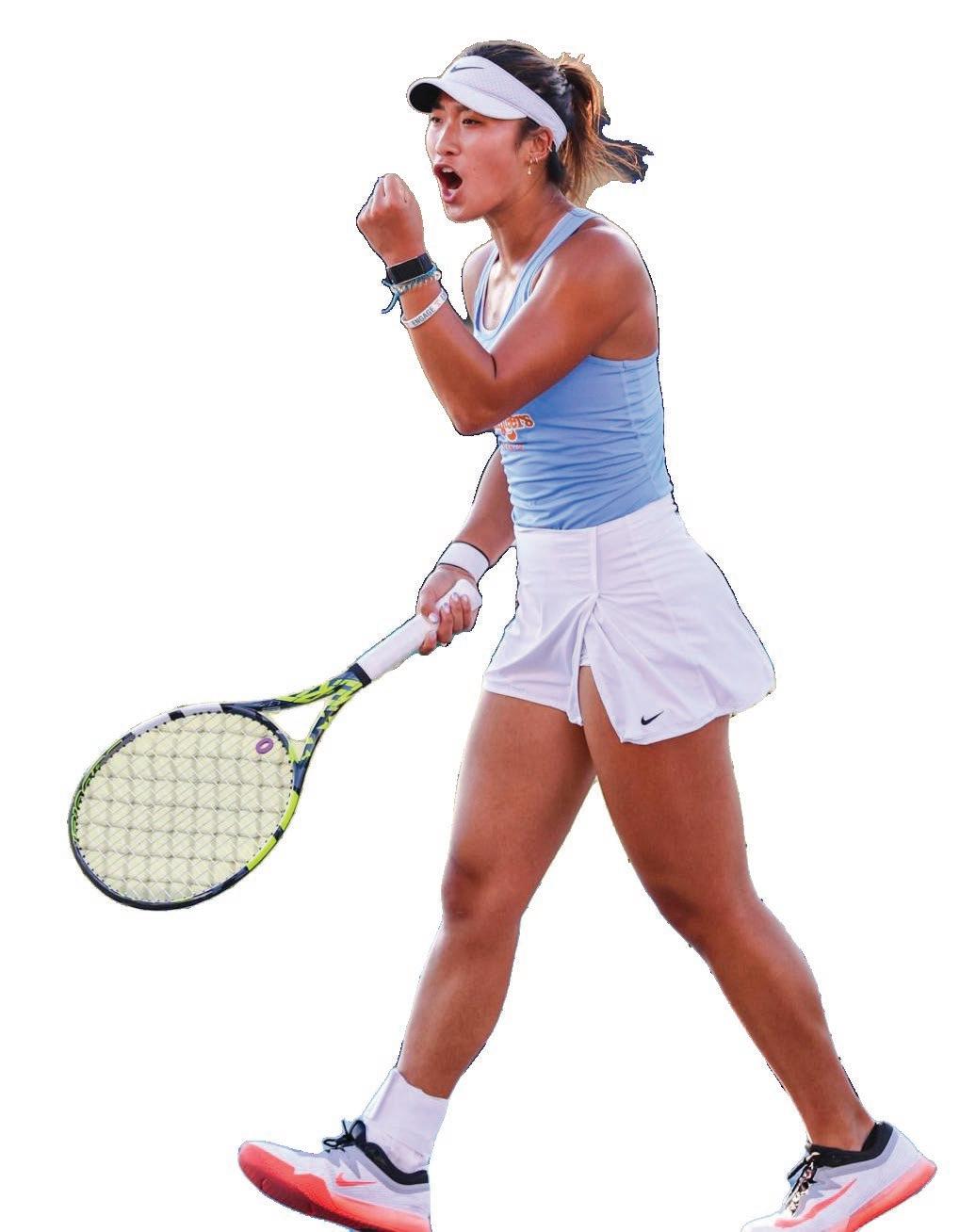
Catherine Aulia remembers the moment she became a leader.
It was May 11, 2024, and the then-sophomore for Tennessee women’s tennis stood in the huddle. The 16-seed Lady Vols were facing a giant, a top-seeded and unbeaten Oklahoma State, and had dropped doubles to open the NCAA Super Regional match.
Tennessee head coach Alison Ojeda was, in Aulia’s words, “mad,” and called for one of her five seniors to give a message to set the tone before singles play. Yet none of her veterans spoke up.
Then, the young Aulia broke the silence.
“They didn’t say anything, so I was just like, ‘It’s OK, guys, we’ve got this,’” Aulia said.
It wasn’t anything profound, but Aulia’s optimism was key for the Lady Vols, who went on to upset the undefeated Cowgirls en route to a Final Four run. Aulia picked up a crucial singles win for her team, but she also learned something about herself.
“My sophomore year, I didn’t really feel like a leader or anything, but I knew I had to step into that role,” Aulia said. “But after that match, I was like ‘OK, maybe I can do this.’”
Fast forward two seasons and Aulia is a Lady Vols veteran. The Rosebery, Australia, native has grown into the leader she learned she could be on that court in Stillwater, and her leadership is essential if Tennessee wants to make a run this postseason.
Just like that 2024 run, Tennessee will be entering the postseason as underdogs. The Lady Vols will be heading to Durham, North Carolina, to begin NCAA Tournament play, facing Old Dominion on May
match.”
Tennessee was eliminated from the SEC Tournament when Britez Risso dropped just her second singles match of the season against LSU’s Kayla Cross, a three-set battle on Court 2. Coming so close against an LSU team that went on to defeat Oklahoma and Georgia and was a third-set tiebreak away from winning the SEC Championship just inspires Britez Risso to keep working.
“Watching back the match, I think I was really close,” Britez Risso said. “Thinking that we were right there, it makes me feel good, but at the same time, it makes me want to be eager just to work harder and be better next time.”
Britez Risso has grown from a player who barely saw the court during her freshman year to the most consistent winner for the Lady Vols. She credits Ojeda with bringing out the best in her.
“Discipline, responsibility and being accountable with myself and my teammates,” Britez Risso said. “Coming here, I wanted to win in a certain type of way, but (Ojeda) has taught me that that’s not the only right way to win, and that I can be disciplined — I can be responsible.”
Ojeda’s belief in Britez Risso is as firm as ever after developing her for four years.
“They were over at the house for dinner, and her dad asked me, ‘How good do you think she can be?’” Ojeda said. “And the question is, honestly, right now, how good does she want to be? Because she just fights for every point, and so she’s going to be in every single match.”
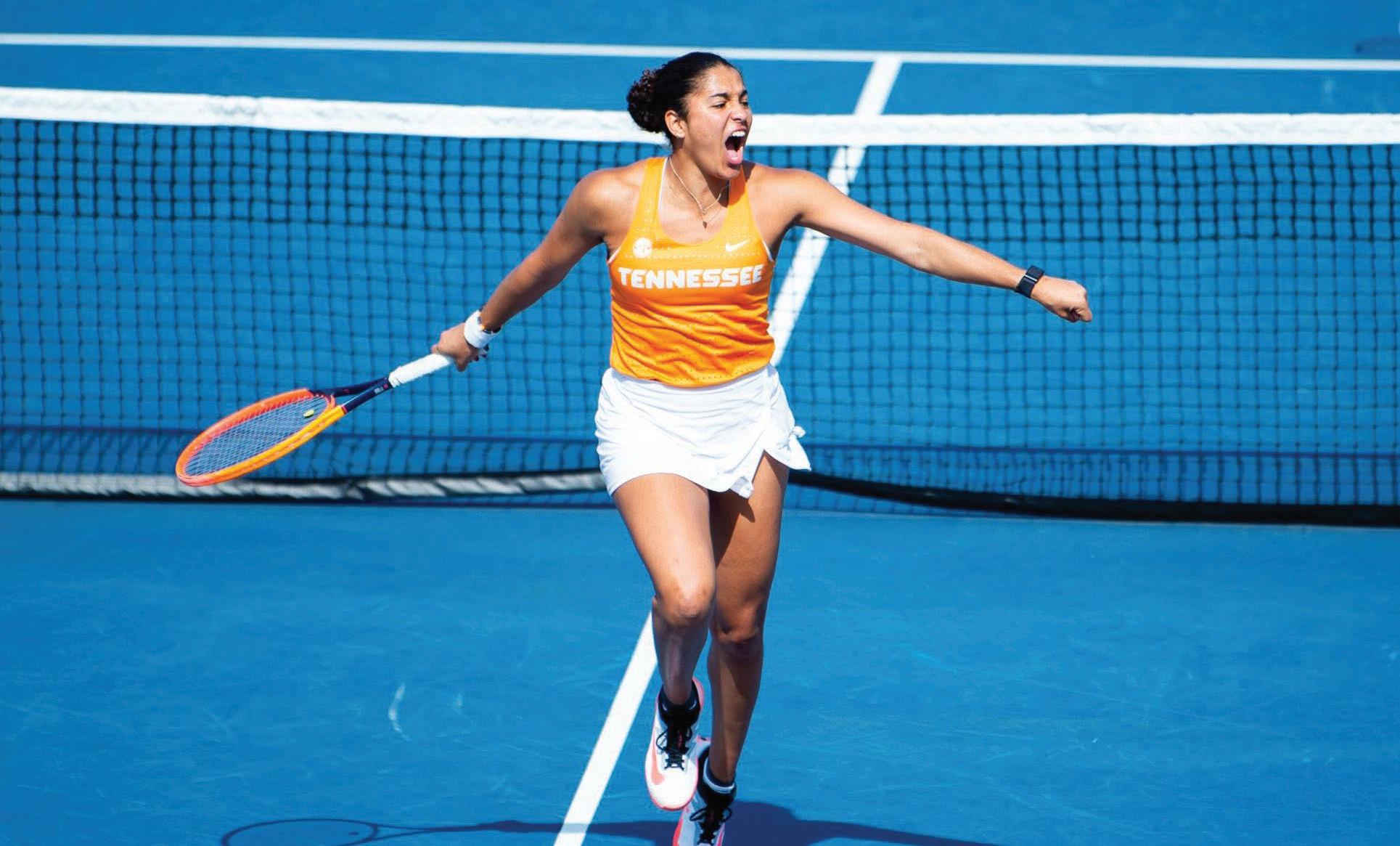
Aulia has brought leadership, Britez Risso has provided consistency, but the Lady Vols’ energy comes from their third senior, Vanesa Suarez.
Ever since she won a third-set tiebreak against Clemson to send Tennessee to the ITA Indoor Championships, Suarez
struggle, you know? So definitely just finding a way through that proves to me that I can do it and I’m strong enough to keep moving forward.”
There is one result that both seniors can look to: a road win against top-10 Texas on March 22. While Britez Risso suffered her only regular-season loss that day, Suarez and Aulia both took three-set wins to help snap the Lady Vols’ three-match losing streak.
Suarez’s result was especially impressive. Her oppo nent in that match, An astasia Abba gnato, now sits at No. 6 in the ITA singles rankings. But not fixated on that win, or the tough losses that followed.
“I think I’m just looking for ward,” Suarez said. “I know if I’m focused and giving my all at ev ery moment, I can do great stuff.”
Aulia found a way to clinch the match after dropping her first set 6-1.
“Honestly, it was big for me in that moment,” Aulia said. “Even though I didn’t feel like I was playing my best, I was still able to find a way to win. So it’s good to think about that match and see the moment, but, like (Suarez) said, we’re trying to stay focused on what’s in front of us.”
Now, what’s in front of the Lady Vols is the NCAA tournament. Ojeda has led her team to a Final Four and Elite Eight in back-to-back seasons based on a philos-
1. It’s the first time the Lady Vols were not selected as a top-16 seed and host site since 2022, and they will likely have to go through 15-seed and regional host Duke in order to reach their fourth consecutive NCAA Super Regional.
The Lady Vols faced a daunting SEC schedule this spring, and they were far from unscathed, ending the season at 8-7 in conference play. The seven defeats included 4-3 heartbreakers to Oklahoma and Vanderbilt at home, and a flat performance against an inferior South Carolina on the road.
The Lady Vols also stacked impressive wins against top-10 teams like Texas, Virginia and LSU, but they aren’t dwelling on those results, focused only on what’s ahead.
“We’ve known the whole season how good we are and the potential that we have to be one of the best teams in the country,” Aulia said. “I think we are, but obviously we’ve had some tough losses. So I think this is a really good opportunity for us to flip the switch and see where the tournament takes us.”
Another senior, Leyla Britez Risso, is a big reason to believe the Lady Vols can flip the switch. The Asuncion, Paraguay, native has been ultra-consistent all season long, finishing with a 16-2 record in singles and earning second team All-SEC honors.
“The last few years, I’ve just found this place where I’m confident in myself,” Britez Risso said. “Every time I step on the court, I love to problem-solve. Even if things are not going well, I really enjoy being in the moment and trying to figure things out just to win.”
Britez Risso emphasizes deliberate practice as a key to her success.
“I’ve always worked hard and knew that I have to practice well,” Britez Risso said. “But coach Ojeda really got me understanding that, if you do things well in practice, that’s what’s going to work in a
has shown all season long that she loves comebacks and high-pressure moments. She also loves to be a sparkplug for her teammates and cheer them on even when she’s struggling.
“You’re not always going to win your matches, so at least you have to contrib ute to your team in some way,” Suarez said. “And for me, I like to be loud and give them energy. You never know what’s going to happen if you cheer for them for one point and then they are like, ‘OK, I can win this and turn it around.’ The biggest thing for me is just to make them feel that I’m there.”
Since transferring to Tennessee, Suarez has proven that she can fight through the ugly parts of a match when things aren’t going her way. But that wasn’t always the case. It took Ojeda to bring that out of Su arez after she joined the Lady Vols from Kansas State as a junior.
“On the court, I think I have grown a lot,” Suarez said. “(Ojeda) has taught me so many things, like how to play smart tennis. Because before, I just liked to play pretty, but it wasn’t always pretty, so she taught me how to play when it’s ugly and figure out some ways to win.”
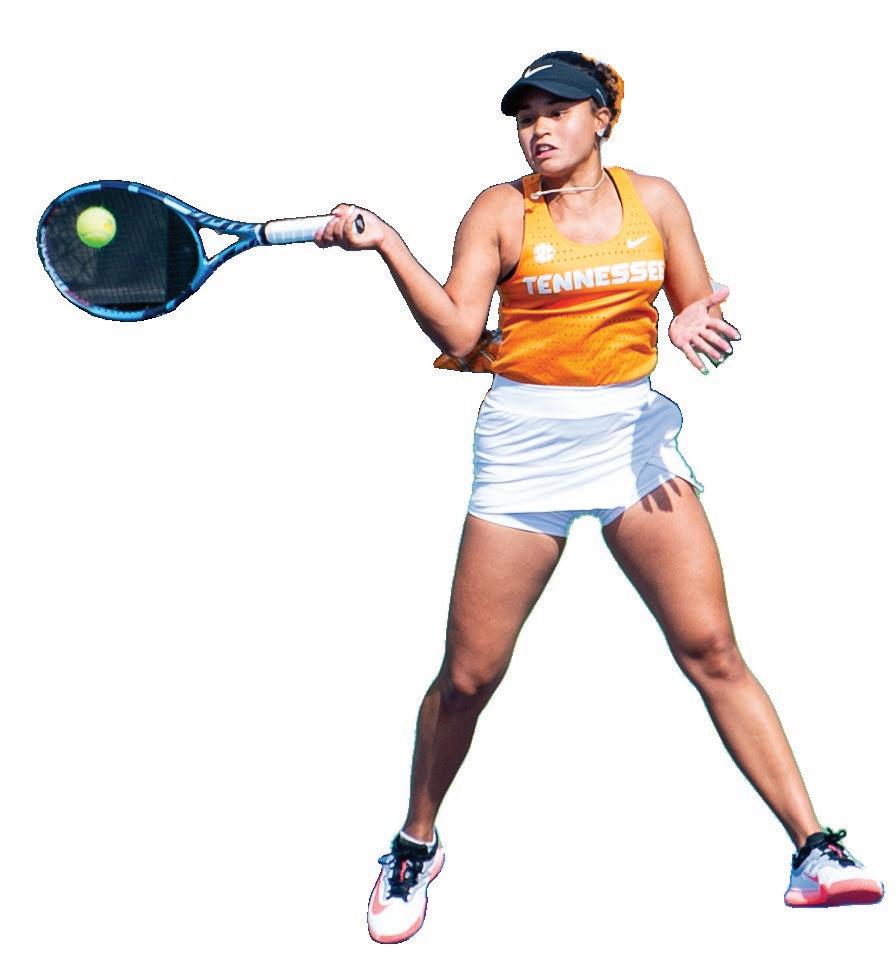
Suarez has also learned that she can be an encouraging voice for her team.
“This team has taught me how to use my voice to help others,” Suarez said. “It just gave me so many good friendships and relationships, so I just love this place.”
Statistically, Aulia and Suarez haven’t had ideal seasons. Suarez has lost five singles results in a row. Aulia was just 2-6 at the Court 4 position after a 9-9 record at Court 2 last year, and many matches she was on track to win went unfinished.
Both seniors recognize the rise of competition in college tennis, but they’re also honest about how tough it’s been.
“It’s very hard to accept losing,” Aulia said. “I mean, none of us want to lose. Everyone goes through periods where they
other, so we care so much. I think that’s just going to carry on during the tournament. We know we have a really, really good team, and we’re going to give our best at every point, so whatever happens, we just know we’re going to give it all.”
Suarez says she is “more motivated than ever” because it’s her senior year. Aulia and Britez Risso echo the sentiment.
“I want to play with this team as long as I possibly can,” Aulia said. “I love all of them so much, and I love competing next to them and practicing with them, just having fun and seeing their faces every day. So I think, however long we can keep this going, we will.”
Leadership, consistency, energy. That’s what Aulia, Britez Risso and Suarez bring to the Lady Vols. And they’re ready to do it again when it matters most, in the NCAA tournament.
“For me, this is why we play,” Aulia said.
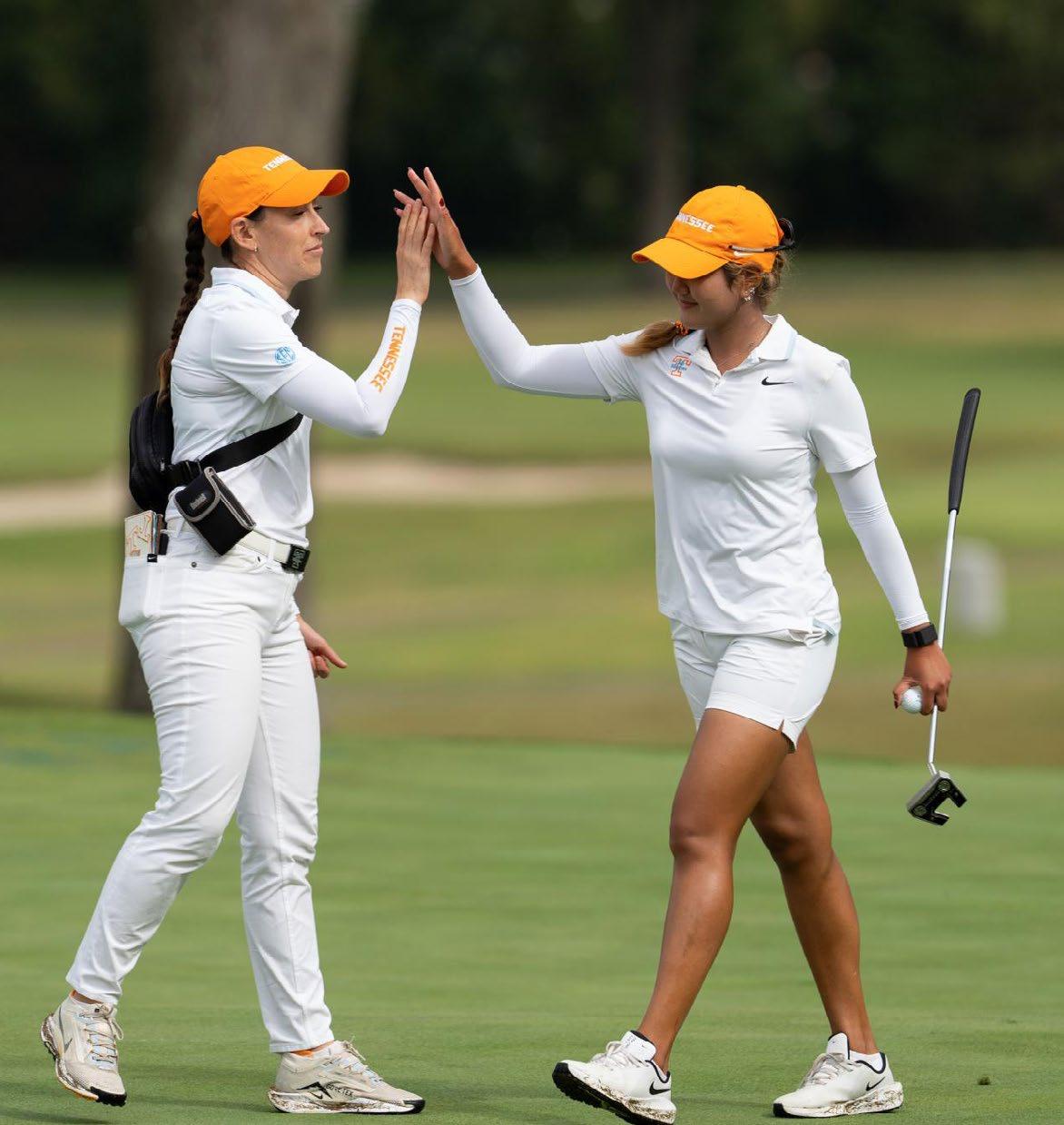
For the first time in program history, Tennessee women’s golf stands atop the SEC.
The Lady Vols captured the SEC title on Tuesday, defeating Auburn 3-2 in the championship round of match play at Pelican Golf Club in Bellaire, Florida, to secure the program’s first-ever conference championship.
After three days of stroke play to determine seeding, Tennessee entered match play as the No. 6 seed, stringing together three straight match play victories to claim the championship.
In the quarterfinals, the Lady Vols rolled past three-seed Oklahoma with a dominating 4-1 victory. Junior Sofie Engesæth led the way with a commanding six-hole victory. Sophomore Kyra Van Kan came back from down two with six holes to play to win her match by two holes. Senior Manassanan Chotikabhukkana and freshman Madison Messimer would secure the remaining two victories for Tennessee.
The semifinals would be a
much tighter battle. The Lady Vols beat seven-seeded Texas A&M 3-2. Van Kan would dominate in a match where she led from the first hole, ultimately winning by four holes. Down one with one hole to play, Engesæth carded a massive birdie for the Lady Vols, forcing a playoff. In the playoff, she made quick work of her opponent, winning in one hole, a win that put Tennessee in the driver’s seat for the match. The Aggies responded with a match victory of their own to make it 2-2 heading into the final match. Messimer led for most of the match, but a double-bogey on hole 15 brought the match to within one. She responded with back-to-back birdies to close out the match, winning by three holes and sending the Lady Vols to the championship round. In the final, the Lady Vols faced No. 4 seed Auburn. Carrying momentum from her clutch semifinal victory, Engesæth dominated her match, winning by six holes. Sophomore Sophie Christopher also produced a dominant sixhole victory, carding four birdies. Van Kan secured the final victory for Tennessee in her match. On
hole 16, she bogeyed to cut her lead to only one with two holes to play. The Johannesburg, South Africa, native responded with an SEC Championship-securing birdie on hole 17, sinking the final putt to end her match with a victory.
Engesæth and Van Kan led the way in match play, both going a perfect 3-0 during the Lady Vols’ run. Their consistency and clutch play across all three rounds provided crucial match victories and helped power Tennessee to the program’s first SEC title.
With the historic moment secured, the Lady Vols now turn their attention to NCAA postseason play, looking to carry momentum and confidence into the final stage of the season. Tennessee’s performance not only marked a major milestone for the program but also signaled its emergence as a national title contender.
The Lady Vols will return to action on May 11 for the NCAA regionals. Depending on their results, the Lady Vols can advance to the NCAA Championships from May 22 to 27 at Omni La Costa Resort in Carlsbad, California.
THEO COLLI Senior Staff Writer
After the conclusion of the 2026 NFL Draft, Tennessee football saw its total number of draftees increase by five.
Since 1936, the Vols have seen 396 draft picks enter the NFL, and this season’s class ties a Josh Heupel era record, matching the 2022 and 2023 drafts. Since his first draft class in 2022, the Vols have seen 22 draftees under Heupel.
Here’s where former Tennessee football players will begin their professional careers.
Colton Hood — Second round, 37th overall (New York Giants)
The first Vol to hear his name called, Colton Hood transferred in from Colorado after his sophomore season where he filled in for an injured Jermod McCoy, becoming the team’s main option at cornerback.
A 2025 All-SEC second team honoree and a Jim

Thorpe Award semifinalist, Hood was lockdown his junior year, tallying an interception with 50 tackles and nine pass-deflections.
“It kind of feels unreal still to this day,” Hood said in his introductory interview. “Like, I’m in the New York Giants facility, like, it’s kind of crazy. I’m just happy to be here. I’m ready to go to work, honestly. If we could practice tomorrow, I’d throw my cleats on right now.”
Hood joins a room that needs some reinforcement after a rough 2025-26 season.
Chris Brazzell II — Third round, 83rd overall (Carolina Panthers)
An interesting prospect throughout the drafting process, Chris Brazzell is another former transfer who found success once coming to Tennessee.
After departing from Tulane in 2023, he immediately saw sparks in his game, despite only finishing his first season with the Vols with 333 receiving yards.
His next season, Brazzell tallied 1,017 yards over 62 receptions in a dominant junior year.
“Just the body of work,” new Carolina Panthers head coach Dave Canales said. “His ability to have the vertical speed and threat, but then his ability to drop his weight, get in and out of breaks really efficiently is one of the things that I was so impressed with. And in our conversations, as we’re going through the process, I was like, ‘Guys, look at this.’ Typically, when a guy’s 6-foot-4, they don’t have that type of bend and flexibility and power to stop on a dime and get out.”
For Brazzell, it’s an opportunity to don colors he’s dreamt of.
“I’ve been a fan,” Brazzell said in his introductory press conference. “I’m a long-time Panther fan. I’ve been a Panther fan since I was in third grade, so it’s a dream come true.”
Jermod McCoy — Fourth Round, 101st overall (Las Vegas Raiders)
The biggest story of the weekend for Vols prospects was the fall of projected first-rounder McCoy, who wound up being picked with the first selection in the fourth round.
Reports surfaced that McCoy may need an additional surgery on his knee, in addition to the ACL injury he suffered in January 2025 that kept him from a season of participation. That contributed to his slide.
Despite missing the full season and not participating in the NFL Draft Combine, there was still hype surrounding McCoy and a possible first-round pick.
“I was watching (the draft) for sure,” McCoy said in his introductory press conference. “I mean, because this ain’t something you could take for granted. This is everyone’s dream. So, it’s not something you could just say, ‘I didn’t get drafted where I wanted, so I’m not going to watch the draft no more.’ This is still a blessing to get drafted. So, I mean, I was in there watching it, got the call, super excited, ready to get to work.”
Joshua Josephs — Fifth round, 147th overall (Washington Commanders)
An edge defender that spent all four of his college seasons at Tennessee, Josephs finished his career with 9.5 total sacks, 22 tackles for loss and 104 total tackles. His illustrious career earned him a late-round selection with the Washington Commanders in the fifth round.
“Honestly, I guess a sigh of relief or like a breath of fresh air,” Josephssaid in his introductory press conference. “The wait’s finally over. And now that I’m here, I’m just blessed to be in this position, and I’m very grateful that I’m a Commander.”
Josephs joins a defensive-heavy staff in Washington, led by head coach Dan Quinn — who his mother is particularly a fan of.
“I feel like, when I got to a point in my age where football started to kind of take over,” Josephssaid. “He was at the Falcons at the time, and since she lived in Georgia, she just adopted that culture, and she always believed he was an amazing coach, and she just respected him and got a lot of appreciation towards him.”
Tyre West — Seventh round, 222 overall (Detroit Lions)
The final Vols’ selection of the weekend is defensive lineman Tyre West.
West tallied ten sacks and 20.5 tackles for loss over four seasons at Tennessee, where he played 48 games.
“I definitely proved that I’m a versatile player. Wherever you put me, wherever I line up, I’m always going to do my best to make plays,” West said in a Sports Illustrated interview before the draft. “I think I’ve managed to stand out throughout this process. I believe I did that at Tennessee this past season as well. I made plays and stood out on tape.”
Other Vols
Quarterback Joey Aguilar quickly landed himself an undrafted free agent contract with the Jacksonville Jaguars.
The defensive line group of Bryson Eason, Dominic Bailey and Jaxson Moi all earned opportunities as well. Eason inked an undrafted free agent deal with the 49ers, Bailey signed with the Houston Texans and Moi signed with the Los Angeles Rams.
Tight end Miles Kitselman will join West in Detroit, signing an undrafted free agent deal with the Lions after the conclusion of the draft. Cornerback William Wright heads to the Mile High City after signing with the Denver Broncos.
Teammates Jalen McMurray and Star Thomas will be in a familiar setting in Tennessee. McMurray signed an undrafted free agent deal with the Tennessee Titans, while Thomas accepted a rookie minicamp invite.
Each player will have an uphill battle to make the teams’ 53-man rosters. The NFL preseason begins August 6.
How Tennessee softball got revenge on Alabama to take series win
THEO COLLI Senior Staff Writer
Tennessee softball coach Karen Weekly had a simple message for her team following Saturday’s uncharacteristic loss: flush it. While the task was easier said than done, the Lady Vols delivered over the next two games. After losing 12-0 in game one, the Lady Vols clinched the series by winning the next two games 2-0 and 4-1, respectively.
“Everyone knows we’ve been struggling, and they never stopped fighting,” Weekly said. “You look at Saturday — I’m sure a lot of people wrote us off. We didn’t write ourselves off. We kept believing.”
The weekend started with a celebration for the three Lady Vol seniors, including pitcher Karlyn Pickens. Yet the celebration halted not long into Pickens’ Saturday start. She made it just 2.2 innings and exited the third with five runs to her line, with two of them being earned.
Weekly maintained that the game, from Pickens to the offense and the defense in between, was uncharacteristic on all fronts. On Saturday, the staff yielded nine free passes to first base, six walks and three hit-by-pitches.
The offense didn’t do any picking up either, recording just two hits all night, one from Sophia Knight to lead off the bottom of the first, and the other being a two-out double from Taelyn Holley in the second inning. Only one batter reached base the remainder of the game in the Lady Vols’ five-inning run-rule loss to open the series. With all the momentum, the Crimson

Tide’s red-hot offense lined up against Sage Mardjetko for the Lady Vols with a chance to win the series on Sunday. Mardjetko delivered one of the biggest starts of her career, a seven-inning shutout performance where she allowed just one hit, drowning any of the bad feelings left on the field the night prior. “Just knowing that every game is a different game in this series and the SEC,” Mardjetko said on Sunday. “So flushing yesterday just coming out here and competing, doing whatever it took to give ourselves a chance.”
Even though Mardjetko didn’t need much help from the offense with her pitching, Emma Clarke and Gabby Leach brought it anyway with two separate solo home runs, which were the game’s only runs scored.
Two polar opposite games led to one rubber match game with all the implications.
The Lady Vols had to continue to flush away the feeling from Saturday. It wouldn’t get any easier as Jocelyn Briski, Alabama’s game one starter, returned to the circle on Monday.
Erin Nuwer started in opposition, but according to Weekly’s plan, she was taken out after her first time through the order, where she was replaced by Pickens.
Just over a day removed from a rough start for Pickens, all she could do was repeat the same message Weekly had been preaching all weekend long: flush it.
“That’s just part of the game, being able to flush games like that and move on to the next,” Pickens said. “(Mardjetko) did an outstanding job the next day to pick me up, gave me a time to just flush that performance and focus on my teammates.”
Pickens did just that. She finished the night by shutting the door on the Crimson Tide. She posted five innings, struck out 11 batters, walked none and allowed one home run on a solo shot in the seventh.
A statement performance from the Lady Vols, which can also serve as revenge for the last meeting these two teams had at Sherri Parker Lee Stadium. The last time the rivals met on the diamond, Alabama stole the final two games of an NCAA Super Regional in 2024, ending the Lady Vols’ season.
Revenge was best served with cigars on the freshly painted Lady Vols logo in center field after the series win on Monday.
“They smoked cigars on that field,” Weekly said. “They celebrated on our logo. When somebody does that on your home field, you’re not going to forget it.”
While flushing out feelings was a theme, perhaps holding onto prior steam was an important factor in the Lady Vols’ series win. They face a quick turnaround before taking on Missouri on the road beginning Thursday, April 30, to close the regular season.