

Local Knoxville bar Cool Beans has partnered with mobile nightlife ticketing corporation LineLeap to implement a new line skip fee for customers. After social media rumors circulated about a new cover charge, Cool Beans denied the false claims.
“It’s just a line skip fee. There is no cover. So the whole narrative that, you know, ‘Cool Beans hasn’t had a cover in 26 years and now they’re charging a cover’ is not accurate by any means. We don’t have a cover. It costs $0 to walk in this bar. If somebody wants to skip the line, just like at any of the other locations around town, they can pay money and skip the line,” Cool Beans manager Brandon McDermott said.
LineLeap, popular in other college towns, has not been integrated into any Knoxville bar until Cool Beans.
“We’re grateful for Cool Beans and the relationship we’ve developed with them as kind of being the first mover on this,” LineLeap co-founder Max Schauff said.
He emphasized LineLeap’s mission of being “open and transparent” for customers at bars like Cool Beans.
“The bar should benefit, but the customer should have an elevated experience as well in having that optionality, and then of course for us, the value, too, is just giving that option to the customers,” Schauff said.
Heidi Browning, a University of Tennessee senior and agricultural communications major, said she had seen a false post about the bar charging cover on Instagram. As a Cool Beans customer, she described the importance of the bars’ previous policy of a singular, charge-free line.
“It’s the one bar on campus that I can think of that never has had a cover, no matter the time of day, no matter the season, no matter what event is going on,” Browning said.
“You know that you can go to Cool Beans, get a cheap drink and still have a really good time and a really fun atmosphere. And I think it just proves to the other bars on campus that
people will still come and wait in an incredibly long line because of just how promising the atmosphere there is.”
Because of the reliable role Cool Beans has played in the Knoxville bar scene, the addition of a line skip fee may cause confusion among students like Browning, who called the fee “unnecessary,” and said that it “defeats the purpose of saying that they don’t have a cover, because majority of the people are going to pay to skip that line.”
This will be Cool Beans’ first time implementing a line skip fee since their opening in 2000.

The Haslam College of Business christened its students’ new home on April 17 in a Topping Off ceremony.
Students and faculty alike flocked to the construction site to “sign the beam.”
The 3,000-pound beam became riddled with the marks of students eager to enjoy this new building, designed to create space for Haslam’s increasing enrollment numbers.
Announced to be named Boyd Hall after UT President Randy Boyd, its sole purpose is to support the needs of the increasing student and faculty population.
“This new building will create a business triangle of sorts,” Haslam College of Business Dean Stephen Mangum said. “Three buildings serving over 11,000 business students in addition to the broader campus community. We are confident it will be a transformative gathering place for students, faculty, staff, community and industry partners for decades to come.”
This new building will span 240,800 square feet, holding eight classrooms, two 300-person auditoriums, three research labs and a full-service Panera.
“This will be a place where students flock to build their skills, build their confidence and where faculty lead students to realize their skills, realize their dreams. It is and will be a place where innovation and partnership thrive,” Provost and Senior Vice Chancellor for Academic Affairs John Zomchick said.
This project is the result of multiple teams of people. McCarty Holsaple McCarty Architects, Inc. and Robert A. M. Stern Architects have teamed up with the design and architecture, while Blaine Construction has been working diligently to finish this project by the fall of 2027.
“We’re very excited about the new building. We’re obviously very grateful to the state, to the university and particularly to the many alumni donors who have made it possible,” Mangum said. “I think our students are, I think our alumni do a great job of paying back and paying forward, and so we’re just excited about the opportunities this represents for future Vols.”
This project has taken $227 million to come together, and tremendous alumni support has showcased a deep love for UT.
“The state of Tennessee, we were fortunate that they gave about $83 million toward the project. Chancellor Donde Plowman, the campus, gave about $44 million. And then we’ve been responsible on the college front to raise the $100 million. And we’re about close to the $70 million mark. So we still have a little bit more work to do, but we’re getting there,” Mangum said.
The Topping Off Ceremony was met with energy as faculty and donors buzzed with excitement for the promise and potential of this new building. Mangum, Zomchick, Boyd and Jim Haslam all gave remarks. With the tradition of Ayres Hall looking over the construction site, the metaphor was not lost on the audience members.
“This will be the greatest decade in the history of the University of Tennessee, and it’s days like (these) that will define this,” Boyd said. “This project is exciting and important. We have incredible students, we have incredible faculty and they deserve incredible facilities. It’s exciting and important because it delivers on the mission of the University of Tennessee. We are the land grant University of Tennessee. We’re here to serve the people of Tennessee. We do that in a lot of ways, but one of the most important ways is to provide the opportunity to grow enrollment and grow graduates, to provide opportunities for students and for our employers.”
At the end of the presentation, with shouts and cheers to “raise the beam,” the signed steel beam was lifted to the top floor of the newly christened Boyd Hall — the beam, and the future of Haslam, bolted in place in Tennessee history.
“Now we have a saying around here, ‘It’s great to be a Tennessee Vol,’ and it is an especially exciting time to be a Tennessee Vol as we make great strides toward realizing our goals of growing our impact here in Tennessee and beyond,” Zomchick said. “We are all taking the University of Tennessee to the next level, providing volunteers with the best experience in the country and delivering impactful research that changes lives.”
KELA FIFER Contributor
Through the efforts of the Student Government Association senate, big changes could be popping up across Rocky Top. As the semester nears the end, senators ramped up their work to deliver a heavy load of 12 pieces of legislation at the final meeting of the academic year, held on April 14. This number is significantly more than previous sessions. Notable adjustments that could be making their way to campus include a potential outdoor classroom, a reformed Canvas tab and increased safety measures at parking lots.
First readings: Canvas additions, space redevelopments
A new tab may be making its way to UT students’ Canvas pages. Over the years, UT has consistently displayed a commitment to providing
accessible resources that support students academically. Resolution 26-7, sponsored by Sen. Niya Angelova and First-Year Council, calls on the university to create a Canvas tab that encompasses all of these academic resources to increase their visibility to students.
The proposed tab will conveniently contain information regarding resources such as tutoring, study spots and events, final exam schedules and more.
Resolution 26-7 passed with a vote of 100-0-0.
Sens. Jed Baso, Madeline Malone and Grace Armstrong sponsored Resolution 265, which calls upon the university to give an outdoor space near the Humanities and Social Science building a more definitive purpose. The senators proposed creating a garden plaza for those across campus to utilize for studying, outdoor instruction and events.
This resolution passed the senate with a vote 93-4-4.
Other resolutions passed during this time include a charger check-out system within the student union, a designated microwave section in the student union and increased advertising surrounding suitemate groups.
Unlike bills, resolutions must only go through first readings.
In addition to these proposed resolutions, the senate passed two proclamations during first readings. The first recognized the work and continuous support of former SGA advisor Lindsay Davis, while the second noted April’s delineation as Sexual Assault Awareness Month by honoring the strength of survivors of sexual assault.
Second readings: Parking lot safety, seat representation At UT, parking is a pressing concern of students. Students call not only for increased parking across campus but also for a sense of safety while using these spaces.
Sen. Anika Bhushan recognized this concern and aimed to address it in Bill 26-4: the Metron Center Way Safety Bill. This bill will bring the Kingston Pike non-commuter remote parking lot up to standards in terms of safety. The parking lot will be revamped with the reinstallation of street lights as well as the installation of a blue light emergency system. Bill 26-4 passed with a vote of 100-0-0.
Continue reading at utdailybeacon.com

CHAPMAN WORD Contributor
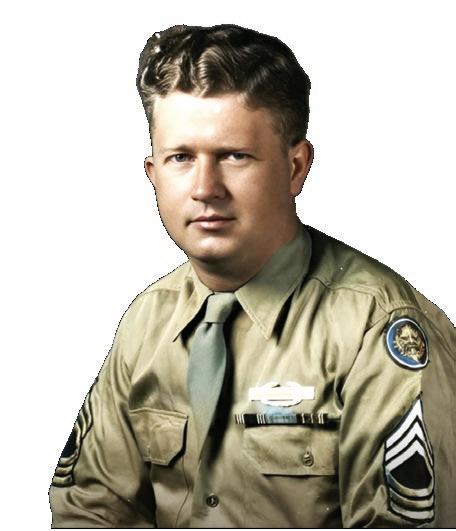
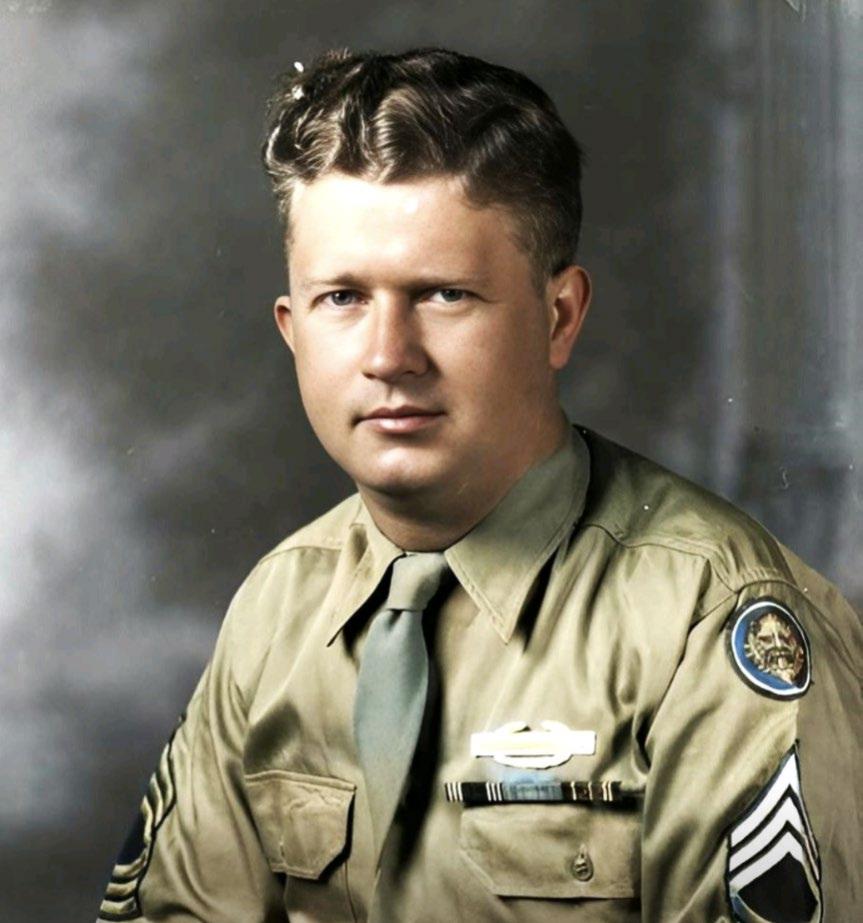
Lifelong Knoxvillian Roddie Edmonds was awarded the Medal of Honor at a White House ceremony in March.
For his actions during the Second World War, Master Sgt. Edmonds became the most recent in a long list of East Tennesseans stretching back over 100 years to receive the Medal of Honor — America’s highest military award.
“We’re grateful for Dad, but he was just a good ol’ East Tennessee boy,” Chris Edmonds said of his father, Roddie Edmonds. “He had moral clarity and moral courage. You know, he loved the good Lord, and he followed the good book.”
Roddie Edmonds grew up just across the Tennessee River from the University of Tennessee campus on Redwine Street, a location from which he could often smell the scent of fresh baked bread from Kern’s Bakery or hear the whistles and shouts of coach Robert Neyland’s legendary football teams practicing at Shields-Watkins Field.
Roddie Edmonds passed away in 1985, but his legacy and moral code have lived on through his son, as well as the men who served with him.
Through the work of Chris Edmonds and other friends like Staff Sgt. Lester Tanner, Roddie Edmonds received the recognition of the Medal of Honor — a process that lasted nearly 13 years. Standard procedure calls for the award recommendation to be submitted within three years of the relevant action. Outside of this window, a special act of Congress is required, which further complicates the already strenuous process.
Former President Abraham Lincoln established the Medal of Honor in July 1862 and first awarded it to a group of Union soldiers who escaped from captivity in Chattanooga after taking part in the Great Locomotive Chase.
The criteria to be a Medal of Honor recipient is someone who “distinguishes himself conspicuously by gallantry and intrepidity at the risk of his life above and
beyond the call of duty.” Since 1862, it has been awarded to just 3,552 out of the millions who have served in the United States Armed Forces.
For those who were there with Roddie Edmonds on the frigid morning of Jan. 27, 1945, the criteria were most certainly met. Chris Edmonds retold his father’s story, using friends’ accounts and his own recollection of Roddie Edmonds’ tales.

OLIVIA LEE Staff Writer
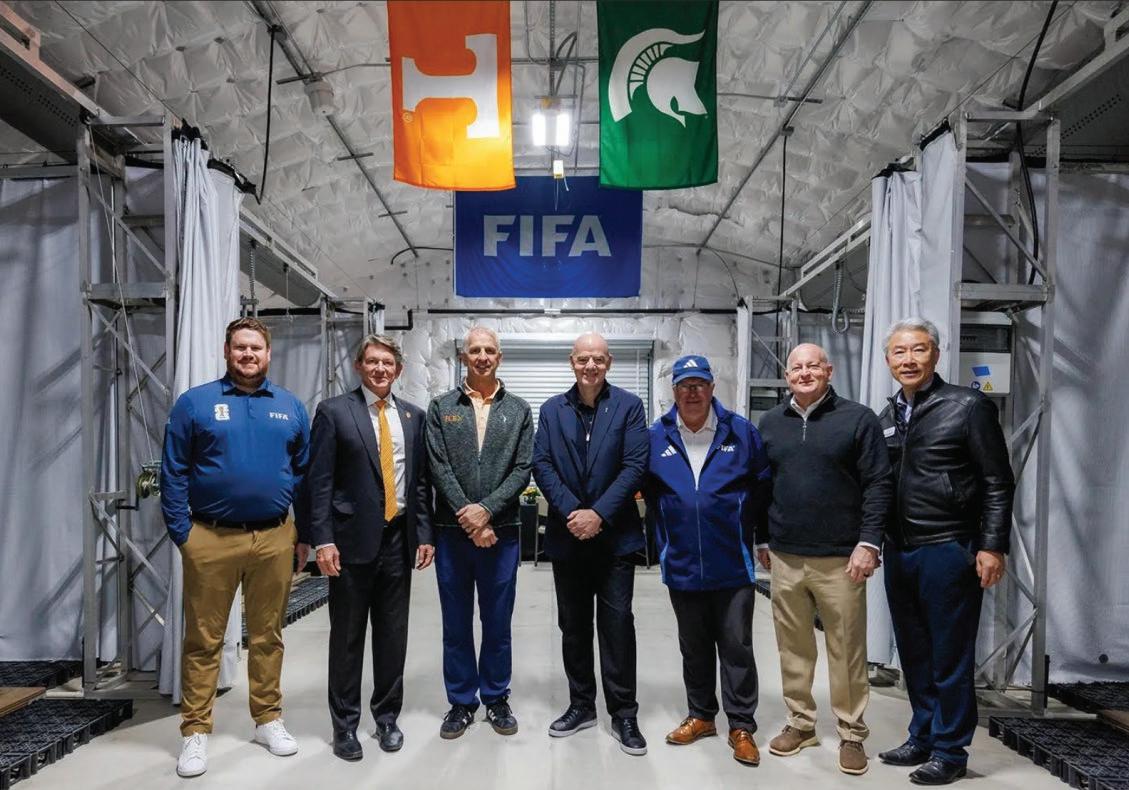
“It started over a cup of tea and biscuits in London in 2018,” UT professor John Sorochan said. Sorochan, distinguished professor of turfgrass science and management, has spent years developing turfgrass research that FIFA is now using in the 2026 World Cup.
With five indoor stadiums at play in this year’s World Cup, keeping consistent pitch conditions is important to maintaining player safety and creating an environment that players feel confident in.
“This is the world’s biggest stage,” Sorochan said. “More eyes are on this than anything in the world.” Alan Ferguson, FIFA’s senior pitch management manager, has helped coordinate research efforts between UT and Michigan State University since his initial conversation with Sorochan eight years ago.
“One of the easiest decisions I have made around this tournament so far was the partnering of UT and MSU universities,”
monds said. “Just the Jews, no one else. All who disobeyed would be shot, were the orders.”
Roddie Edmonds found the proposition unacceptable.
“Without hesitation, (Roddie Edmonds) turned to all of us men and said, ‘We’re not doing that. Tomorrow morning, we all fall out.’ He said he sent orders to the other four barracks of Americans,” Chris Edmonds said, recounting Tanner’s account.
The next morning, Maj. Ziegmund, a German officer who had arrived at the camp to acquire the Jewish prisoners, met with the whole American contingent of 1,300 soldiers. He stood there, incredulous.
“He’s issued the orders, he’s there to take the Jews away like he has been doing in the other POW camps, and no one has ever disobeyed his orders, and so he’s … he’s irate,” Chris Edmonds said. “So, Ziegmund walks over to my father, gets up in his face, and he screams, ‘They can’t all be Jews.’ To which my father declared, ‘We are all Jews here.’”
Roddie Edmonds’ act of defiance stunned the major and the men. He continued to resist, offering only his name, rank and serial number, items required under the Geneva Conventions.
This further enraged the German officer, who snapped and thrust his pistol into Roddie Edmonds’ forehead with his finger on the trigger.
Germany had been captured during the German winter offensive known colloquially as the Battle of the Bulge in December 1944, and Roddie Edmonds found himself incarcerated at the Stalag IXA prisoner-of-war camp in Ziegenhain.
“Late on the evening of Jan. 26, the Germans sent orders to my father that only the Jewish Americans were to report for the next morning’s roll call,” Chris Ed-
“‘But even with the gun to his head,’ (Tanner) said, ‘Your father leaned into the major, ensured eye contact, and he, and he spoke,’” Chris Edmonds said. “He said, ‘Major, you can shoot me, but you’ll have to kill all of us, because you’ll be a war criminal when we win this war, and you will pay.’” Maj. Ziegmund turned white as a ghost upon hearing this, and the arm holding the gun to Roddie Edmonds’ head began to quiver ever so slightly.
Finish reading at utdailybeacon.com
TESSA NACKE Staff Writer
Senior Joey Pickus emerged victorious over his opponents at the U.S. Intercollegiate Boxing Association National Tournament.
“I didn’t really know what to expect, but for collegiate boxing, it’s a close-knit, niche type of group. So one of the coolest parts about the atmosphere of it was just making all types of new friends,” Pickus said.
Pickus has been boxing for over five years and decided to put his training to the test at the tournament held in Las Vegas, Nevada.
“I thought it was a once in a lifetime opportunity. I’ve been training all throughout college, so I thought, ‘I’ll never get this opportunity again.’ I thought I’d go out and do my best to compete for University of Tennessee, the best I could. And I was happy to bring home the championship,” Pickus said.
An accomplishment like this doesn’t come without discipline and training. Pickus regularly trains at Eppolito Boxing Gym, a boxing gym in Knoxville.
“I’ve been running five days a week. I’ve been lifting two days a week. I just ran the marathon. So, definitely a lot that went into it — running, boxing, training, watching film, eating right, sleeping right, hydrating right. There’s a lot that went into it,” Pickus said.
Ferguson said. “Both already had world-leading reputations, both already led by world-leading turf professors. I didn’t want to reinvent the wheel. It was already here.”
UT hosted Ferguson and other FIFA officials in March at a research field day event to celebrate the research and discuss its progress 100 days out from the tournament.
“Each time we come to UT, we see how much momentum this research collaboration has created,” Ferguson said. “UT and Michigan State have helped FIFA turn complex research into practical venue-ready guidance. With the tournament fast approaching, the progress we reviewed at this field day reinforces how valuable this collaboration has been in preparing natural grass pitches that can perform consistently across all host venues.”
Sorochan has developed a strong relationship with FIFA throughout his years working with the company, bringing that connection back to UT as a professor and mentor. FIFA hired two UT students after their work in the project, Sorochan said.
Eppolito Boxing Gym is more than just a training facility — it’s a home and a safe space for boxers of all levels.
“You’re not going to come to a boxing lesson and learn how to box. You learn how to box, and you get life lessons on top of that, which is super cool. And everyone here is super welcoming,” Jonah McMillen, a sophomore studying management, said.
Those life lessons and the gym’s rich history of boxers helped Pickus in the tournament, creating a strong support base.
“Coach Frank Eppolito and all the guys I trained with, I definitely wouldn’t have been able to do it without them. Such a great support base here, which I feel like is second to none here at this gym,” Pickus said. “Without my family and all my amazing teammates here, it wouldn’t be possible to achieve something like this. All those people were such a great support base for me, and they were with me every step of the way. I wouldn’t be able to achieve that without them.”
Pickus is graduating in May, and while settling into his future career, he still has his eyes on boxing. He plans to train for the Wisconsin Golden Gloves and have the same level of confidence that helped him win the national tournament in March.
“I came in very confident, but that confidence didn’t come out of any-
“They’re supporting research and science at an independent university, and it’s a good image,” Sorochan said. “I think it’s a great story, and it’s been a privilege and an honor to be able to work with FIFA.”
Sorochan pointed out the research’s alignment with UT’s broader campus goals.
“It falls in line with the mission of the university of making life better, starting with our students at UT, to people that are going to be around the world that are going to have better, safer sports fields because of this,” Sorochan said. “And that’s thanks to UT and FIFA.”
Chancellor Donde Plowman has spent years emphasizing UT’s place as a research university, saying in her 2025 flagship address that building a larger research footprint will take UT to the “next level.” Plowman shared her goal of reaching $550 million in research expenditures by 2030 at a UT board of trustees meeting in March.
“Her vision is academics and student experiences, research and athletics,” Sorochan said. “We tick all three boxes.”
Coach (Frank) Eppolito and all the guys I trained with, I definitely wouldn’t have been able to do it without them. Such a great support base here, which I feel like is second to none here at this gym. Without my family and all my amazing teammates here, it wouldn’t be possible to achieve something like this.”
JOEY PICKUS
where. It came from the preparation I put into the tournament,” Pickus said. “I would definitely give my advice to prepare very hard. And that’s where you get your confidence from with boxing — go hard in the gym. Go hard on your runs. Eat right, sleep right and that’s where you get your confidence, which is essential when it comes to fighting.”
After a successful boxing career and a successful college career, Pickus remains a Volunteer at heart.
“It’s a huge honor representing the University of Tennessee,” Pickus said. “It’s definitely one of the greatest schools out there. It’s such a great honor.”
As the tournament nears, Sorochan said he has been able to reflect on the project with more satisfaction than stress.
“Two years ago, I was waking up every night at 1, 2, 3 (a.m.) worrying about this,” Sorochan said. “I’m actually starting to sleep better as it’s getting within
60 days of the World Cup.” Sorochan said he is planning to attend two of the tournament’s games to see the outcome of his research in action.
“We’ve done so much work to prepare for it,” Sorochan said.
“Now it’s becoming exciting as a researcher and a fan.”
GIA SCHEELS CONTRIBUTOR

I feel like the sport of racing that I love is going to be here for years to come with programs like this.”
RICKY STENHOUSE
JR.
Rocky Top Racing and UT’s Formula SAE Club welcomed NASCAR Cup Series driver Ricky Stenhouse Jr. on April 9 for the official launch of the University of Tennessee’s collegiate race program.
In the Q&A below, The Daily Beacon spoke with Ricky Stenhouse Jr. about his involvement in the sport of racing and the importance of community in groups like UT’s Society of Automotive Engineers Club.
Q: What brought you here today, and what does it mean to you to be here speaking to this next generation of motorsports?
RSJ: Just connections. I feel like that’s what motorsports is. I think a program like this allows these kids to have those connections, to get to the sport of NASCAR, if that’s what they desire. But either way, it gives the kids a great platform and channel to get into motorsports as a career, and there are so many different things you can do in this sport of racing.
To me, it was really cool to get here and see all these kids interested in the sport that I love that I’ve been doing since I was five years old. So, just a really cool moment to come here, and then, I didn’t realize there were 65 universities doing the same thing — it’s got me super pumped up. I feel like the sport of racing that I love is going to be here for years to come with programs like this.
I was very fortunate to be born into it. Not everybody is. It might be these kids’ first time being introduced to motorsports, but at least they’re introduced to it and can keep building the family of racing, because it’s a huge family. It’s a big sport, but it’s family, too.
Q: Beyond just racing, what do you think motorsport gives to the people who are part of it, and what has it given to you?
RSJ: I think racing is a community, you know, and it’s people who all have the same interest. A program like this, you’ll have all these kids from probably a lot of different backgrounds wanting to work in motorsport, super interested in it, but totally different avenues of it.
Like, when I look at what NASCAR is, you know, I’m on one team, but I’m friends with just about everybody on every other team, and there are 36 teams. Some of the teams have 600 employees, and those jobs need to be filled at some point.
Right now is a perfect opportunity for a program like this because there are a lot of people who have been in NASCAR, specifically on the race teams, who have been there for a long time and are going to eventually retire. There’s a big shift right now in that, and bringing in the new crowd is really important. You’ll get a huge family out of it. These kids will have a bond from here on out, no matter where they go, through a program like this.
EMMA KATE MURPHY CONTRIBUTOR
Knoxville’s numerous gardens and green spaces are perfect for soaking up the sun in our screen-dependent world. April, widely recognized as Earth Month, is a time for recognizing environmental issues and supporting sustainability and conservation efforts. The month’s celebrations culminate on Earth Day, April 22.
UT Gardens
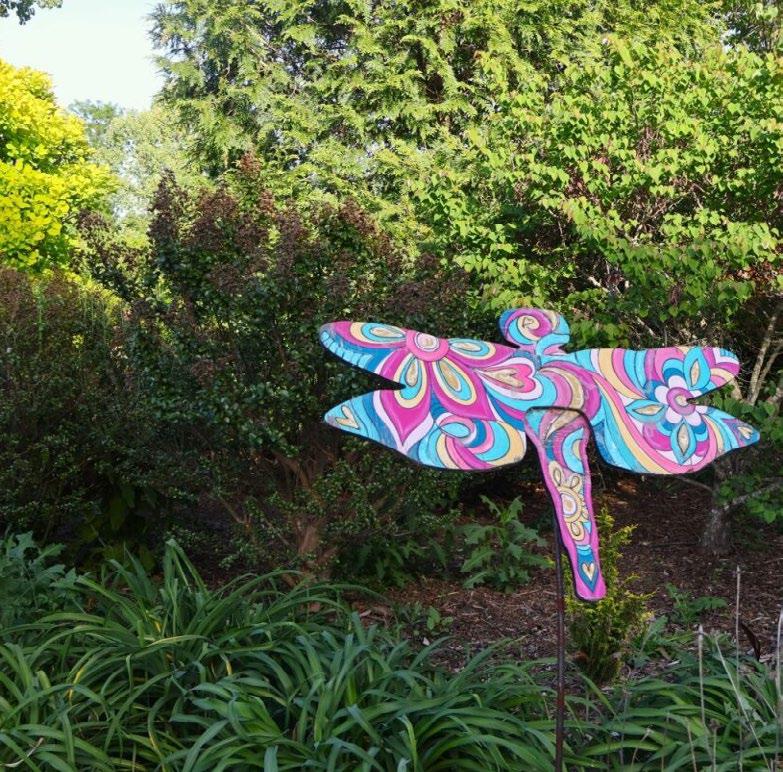
Located on the agriculture campus, the UT Gardens offer walking paths and greenery. The gardens include a one-mile loop trail, perfect for a leisurely stroll or run through the foliage. One of the three State Botanical Gardens of Tennessee, UT Gardens is free to visit and welcomes all who want to learn about plants or just pass by them. Various tributes, memorials and sculptures can be found throughout the garden. It is also an outdoor event space with a gazebo and pavilion. As you walk the trail, pay attention to the plaques by some of the plants to learn more about them.
Knoxville Botanical Gardens
The Knoxville Botanical Gardens stretch across 44 acres of the former Howell Nurseries. It offers walking trails, garden displays, historical buildings and two miles of distinct stone walls, as well as advertise numerous events encouraging people to visit, connect with and learn about plants.
Located five minutes away from downtown off Wimpole Avenue, the gardens are open from dawn to dusk every day. They are always seeking


volunteers to help out around the gardens, regardless of experience.
Ijams Nature Center
Ijams Nature Center sits off the Tennessee River and includes a host of activities and sights. From hiking or biking, to climbing Knoxville’s only outdoor rock climbing area at Ijams Crag, to paddleboarding or kayaking on Meads Quarry, Ijams Nature Center has something for everyone. It is perfect for both those wanting to challenge themselves and those looking to relax in nature. The grounds are open from 8 a.m. until dusk, and parking costs $5. Ijams occupies 318 acres and offers over 14 miles of trails.
Sequoyah Park Down Cherokee Boulevard off Kingston Pike, you’ll find the 2.6-mile trail and adjacent greenery of Sequoyah Park. With the river to one side and quaint homes to the other, Sequoyah is the perfect place to unwind and enjoy life. The park also features three sport fields and a playground for children. Parking and access to the park are both free. You can wade onto small sandy beaches along the river or stretch out on the grass to soak up some Vitamin D.
Lakeshore Park
Lakeshore Park boasts views of the Tenessee River and the Smoky Mountains in the distance. The park’s expanse covers 185 acres and offers walking trails, green space, sports fields, playgrounds and a central event space. Complete with public restrooms, it is the perfect place to spend all day lounging on a picnic blanket. If you’re not a fan of eating a packed lunch on the ground, the park also has several covered pavilions with picnic tables. Lakeshore Park is open daily from dawn to dusk and is a short 10-minute drive east of campus. Knoxville has many beautiful parks and gardens to spend your time in this Earth Month. Instead of spending your time glued to screens, going for a walk or spending time in any of these green spaces around campus is sure to boost your mood.



and stable significance.

EDITORIAL
EDITOR-IN-CHIEF: Caden Dyer
PRINT MANAGING EDITOR: Emily Hurst
DIGITAL MANAGING EDITOR: Ansley Graves
COPY CHIEF: Lauren Holladay
NEWS EDITOR: Patrick Busch
ARTS & CULTURE EDITOR: Harper Brabson
SPORTS EDITOR: Trevor McGee
ASSISTANT SPORTS EDITOR: Alex Sarkis
OPINIONS EDITOR: Natalie Dripchak
PHOTO EDITOR: Jackson Clavier
DESIGN EDITOR: Lindsay Favre
ENGAGEMENT EDITOR: Sarah Portanka
COVER DESIGN: Lindsay Favre
PAGE DESIGNERS:
TO PLACE AN AD, please email admanager@utk.edu.
LETTERS POLICY: Letters to the Editor must be exclusive to The Daily Beacon and cannot have been submitted to or published by other media. Letters should not exceed 400 words and can be edited or shortened for space. Letters can also be
for
and typographical errors, and Letters that contain
errors can be rejected for this
Anonymous Letters will not be
Authors should include their full name, mailing address, city of residence, phone number and e-mail address for verification purposes. Letters submitted without this information will not be published. The preferred method to submit a Letter to the Editor is to email the Editor-in-Chief.
CORRECTIONS POLICY: It is the Daily Beacon’s policy to quickly correct any factual errors and clarify any potentially misleading information. Errors brought to our attention by readers or staff members will be corrected and printed on page two of our publication. To report an error please send as much information as possible about where and when the error occurred to managingeditor@ utdailybeacon.com, or call our newsroom at (865) 974-5206.
The Daily Beacon is published by students at The University of Tennessee on Wednesday during the fall and spring semesters. The offices are located at 1345 Circle Park Drive, 11 Communications Building, Knoxville, TN 37996-0314. The newspaper is free on campus and is available via mail subscription for $200/year or $100/semester. It is also available online at: www.utdailybeacon.com
I don’t watch horror movies. I despise them. I’m the world’s biggest hater of jump scares, and I can’t understand how someone finds something enjoyable that would plague my nightmares.
The other day, my friends and I were figuring out what to watch for movie night, and a classic horror film was brought up – I immediately vetoed it. Why in the world would I want to watch “The Nun”? I love nuns! Apparently, that isn’t a shared feeling. What I learned from that night — and many more conversations that followed — was that most people are absolutely creeped out by nuns.
I was shocked. So I decided to do some digging and find out what made these women so terrifying to everyone else. My biggest, most obvious conclusion was that it stemmed from these movies I refused to see.
As I went through my internet deep dive, I learned a lot about the history of a process known as “nunsploitation.” This theme all began in the ‘70s as nuns got introduced to psychological thrillers and horror movies, which depicted nuns as an array of things: violent murderers, possessed psychos, sexually repressed lustful creatures and just plain scary.
Although this all started so long ago, iconic horror films that star creepy nuns have continued to come out more recently. Significantly, “The Conjuring 2” came out in 2016, “The Nun” was released in 2018, and “Immaculate,” starring the infamous Sydney Sweeney, recently hit the theaters in 2024.
As cancel-culture particularly thrives, and the internet decided they hated Sweeney — especially after her blue jeans/genes ad — her image on the face of a nun did not do much to help the dwindling reputation and stereotype nuns have.
But this doesn’t answer my question — why did the movie industry become so interested in religious sisters all of a sudden? And why was the public so receptive to it?
The movie industry itself is always trying to come up with new ideas to spice up or change films and the genres within them. The most viral things are always controversial. Directors and scriptwriters knew this and wanted to challenge viewers’ beliefs about nuns and sisters. Postmodernist themes of unstable, changing meanings were becoming the norm, rather than a single, correct
rent, car payment, insurance, etc., and then “smaller” purchases you make each month.
Meredith and Marcus Harmes perfectly explain the realities behind imagery in film revolving around nuns in a recent article, published by The Irish Catholic.
“What we see is disconnected from reality,” Meredith and Marcus Harmes said. “Nuns in full habits and gothic convents in film are not like the plain clothed nuns of reality, who are more likely to be found in a community centre than a creepy old convent.”
By showing nuns as evil and horrific, film directors said they intended to challenge beliefs and make something different. However, their mental provocations ended up becoming the foundation of a drastically untrue stereotype that most people hold about nuns.
I can’t hate a director for doing their job and being creative, but I can hate the misconceptions that ensued from it. Nevertheless, I cannot attribute the whole stereotype to the movie industry, although I believe that it is the biggest cause, as older generations have had more real-life experiences.
During the baby boomer generation, the amount of nuns who taught in schools peaked, and they left a name for themselves.
If you’ve ever talked to someone who went to a religious school back then, they probably have lots of unpleasant memories to share. Sisters were heavy on corporal punishment, and the image of a nun with a ruler in hand became the icon associated with their name.
However, as the world progressed and people moved forward, so did the way nuns went about teaching in schools. Once characterized by physical punish
ment and verbal abuse, nuns are again recognized by their kindness and compassion.
In 2011, corporal punishment was officially banned from the last school, St. Augustine High School in New Orleans, that was still actively using it. In a 2011 article published by EWTN News, Archbishop Gregory Aymond said, “My image of Jesus is that he said, ‘Let the children come to me.’ I cannot imagine Jesus paddling anyone.”
Although I’ve never known a nun as anything other than nice, I can understand where these ideas come from. But again, why do people still hold onto these ideas of violence when the sisters no longer teach in that manner?
The peak of violence by nuns in schools was also the peak of their presence in schools in general. Today, the number of nuns who are teachers has diminished to over half of what it was. As their pres-

ence declines significantly, they become much less well-known to the average person. Their reputation from previous decades is what sticks with them in modern times. There is this everlasting preconception people have towards nuns because of their history, which is now shameful and unfair. Nuns becoming less common in schools reflects their overall rarity. As with any fear, people are more afraid of what they do not see or regularly come into contact with. From what I’ve found, the decrease in people joining the sisterhood and the sisterhood’s misguided representation directly correlate with an increase in people becoming afraid of them. What I’m confused about is why, in a world where people care so much about breaking stereotypes and accepting everyone, no one has moved to do the same for nuns. Why are they not receiving the same inclusive treatment?
Anyone online will receive incredible amounts of hate and threats for mocking or shaming other religious and cultural groups. But it feels like no one bats
an eye when people make sexual jokes about nuns or show them as literal demons. Ignorance has led people to leave their biases and stereotypes unchecked. I urge you to reconsider the opinions you hold about women you might never have met. Everyone gets so upset that this world is full of evil and difficulties, but then they sit down and watch a film that portrays the organized, honest women demonically and sexually. If there is already so much corruption in our world that you don’t like, why sit down and create or enjoy a film that ruins one of the few bits of pureness we have left?
Growing up, one of the first “adult” things you learn about is the unavoidable disappointment of the real world: Bills. It stinks, but you still had a while until you had to deal with it, at least.
Well, now we are adults, and it still stinks. But hey, it’s the world of technology now, we have all the budgeting resources at our fingertips to manage it!
Except, now that the budgeting program requires a subscription, you have to include the budgeting app in your budget. In my mind, “grown up” finances are split into two categories: “big,” consistent bills, such as a mortgage,
Ideally, once you account for the big purchases, you know how much you have left for your smaller ones each month. In theory, things like Netflix would be under those smaller purchases, and maybe 10 years ago, it was. But now, when everything requires a subscription, how “small” can you really label them?
I’m sure you know the feeling — you’re trying to watch your favorite TV show, and you look it up just to discover it’s only available on some random streaming service you’ve never heard of. Or, maybe it’s available on one of the streaming subscriptions you do have, but not the “version” you’re paying for. How can I be paying for everything
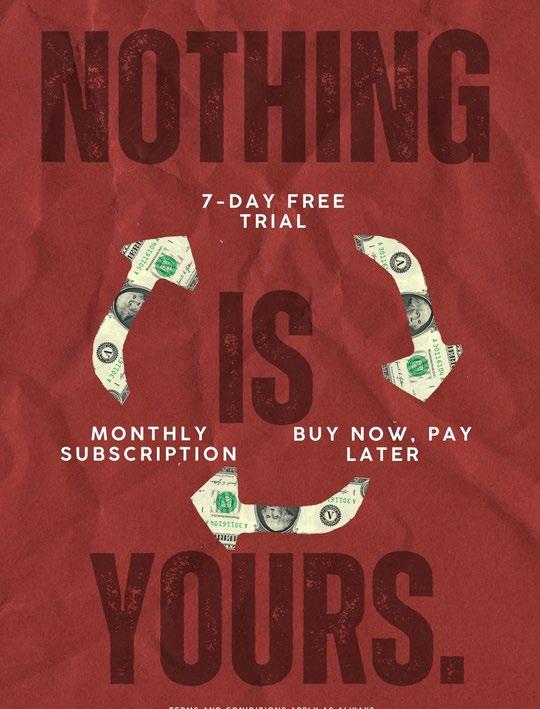
but have access to nothing? Today, cable has effectively been replaced by streaming services. What’s been left even further behind, however, is owned media. The days of DVDs, VHS tapes and CDs are long gone. So if you really want to watch that favorite TV show, you’re most likely going to resign and get that random streaming service. And it goes far beyond what we watch on TV. Everything is asking for a subscription. It feels like I can barely download any apps or buy any products without paying for a monthly or yearly subscription. In the past week, I’ve downloaded apps for planning, financial tracking and even a mental health log, all of which immediately informed me I’d need to pay a monthly fee to actually use 95% of the features. As annoying as the sneaky app subscriptions are, what’s even more frustrating is the amount of products that require subscriptions to use them to their full capability. My $200 Hatch alarm I got as a Christmas gift? Yearly subscription. My Birdie safety alarm I got for my keys? Yearly subscription. I recently found out that Oura rings, which are already $500, have a monthly subscription. Even newer cars have introduced subscription models to use all of their features — features that are already programmed into the vehicle, just inaccessible until you pay the fee. You can spend $40,000 on something and still have features hidden behind a monthly paywall. Beyond these subscriptions being clear evidence that these billion-dollar companies are still nickel-and-diming their customers, it also means we don’t actually own these items. We may have purchased them, spent hundreds or even thousands on them, but if we can’t fully use the item unless we buy into their monthly fee, it isn’t truly ours. At least with those “big” finances I mentioned earlier, such as a mortgage and a car payment, you will eventually own the house and car. (Except, now even the car may be on a case-by-case basis ... ) These “little” monthly payments quickly become big monthly payments when you factor in how many
you’re buying into, making it easier to spend money that you don’t have because it’s just $5 here and there. Soon enough, you’re paying $50 monthly on random things, without counting your six different streaming services you have to have if you want to watch anything. Perhaps the biggest culprit in getting people to spend money they don’t have, however, is the “buy now, pay later” services that pop up every time you place an online order. Why pay $20 for your DoorDash when you can pay $5 for four months? You can place that big Amazon order you’ve been looking at since it’s really only $30 outright, and you can just pay the rest later after you get paid. Except that it sets off a slippery slope of overspending, since these purchases don’t seem expensive. Then, your $50 a month on random subscriptions really doubles because you financed things you wouldn’t have bought otherwise. And, once again, you still don’t really own these items until you finish your payments. As college students, most of us are just now learning how to budget our money and be more financially independent than we were at home. On top of that, we’re at an age when we want to be cool and keep up with trends as they come along. So, financing your new clothes lets you seemingly get more for less and paying for a subscription to watch the show everyone’s talking about doesn’t even feel like a big deal. All of these monthly payments are the price of keeping up with everyone else. It may be easier to criticize the consumers buying these items, but the audience is not the problem. You can laugh at the people buying a $200 alarm clock to begin with (I still love it, though — laugh all you want), but that doesn’t actually address the bigger issue. In a society full of Instagram comparisons and influencer sponsorships, we do place value on image and status. While you personally may not, it’s undeniable that those pressures exist in our society — especially for people our age. I would say that most people in college care about their image. I’ll be
the first to admit that I do, at least. How can we not? We’re still figuring ourselves out — who we want to be, what we want to do, our goals and aspirations. We develop those things from experiences and the people around us. Because of this, we are the target demographic for companies to market to. And despite how mature and put-together we may feel, we’re still young and impressionable. Especially in the digital age, we are constantly told to think about our digital footprint following us into our future careers and not presenting ourselves in any way we wouldn’t want future employers to see. If fitting in feels like the easiest way to get through each day without risking our reputation, then sometimes fitting in is the best we can do. It’s not our fault for buying into the system we exist in — it’s the billion-dollar companies’ fault for finding any way to get an extra dollar out of us monthly, yearly or for the rest of our lives.
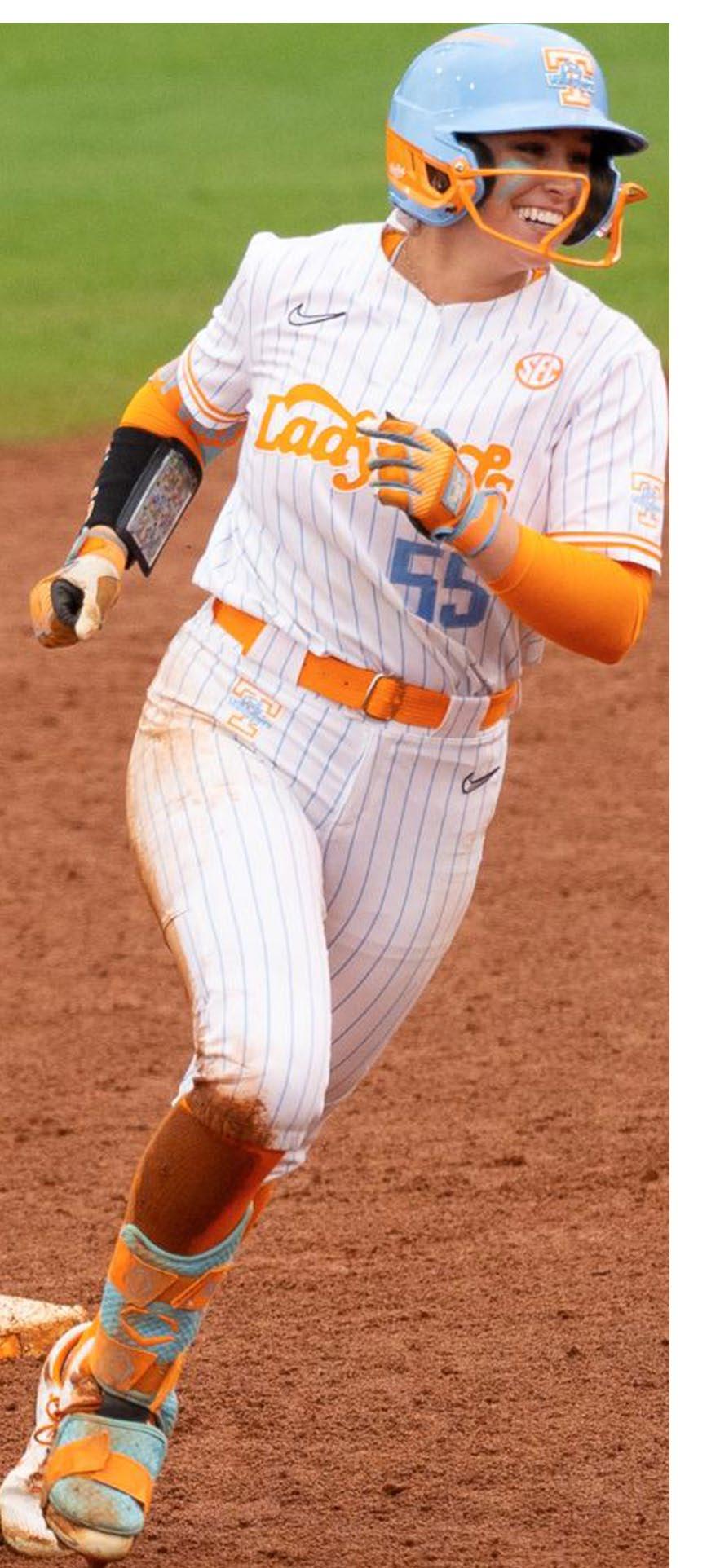
sideline cheers for the same orange and white threads.
“When you’re younger and have older siblings, you want to do what they’re doing,” Gabby
ANNA REIFFER Contributor
Early days, lasting impact
Long before the home runs, rankings and SEC crowds, the Leach sisters’ story began in The Woodlands, Texas, where competition and connection grew side by side. Their father, Todd Leach, fondly remembered how Gabby Leach and Alannah Leach ran around the house, sliding into pillows on the floor as if they were bases. What initially looked like play quickly evolved, with even the smallest moments becoming opportunities to compete and improve one another.
“Even at young ages, they wanted to win, no matter what they were playing,” Todd Leach said. “There was healthy competition from the earliest ages, and it con tinued on up through.”
The twins made their softball debut at age 4 and, by age 11, were playing travel ball at Texas Sudden Impact, further immersing them in a competitive environment that strengthened their love for the sport.
“We were blessed in the sense that we surrounded them with good quality people and teammates as they grew,” Todd Leach, who served as the coach of the Texas Sudden Impact’s 18U team, said. “They just kind of naturally evolved for the love of
During their high school careers, Gabby and Alannah Leach both earned All-District honors and found themselves ranked in the top 20 play ers nationally in the class of 2023, according to Extra Inning Softball.
While the accolades were exciting, college recruiting became a challenge. When the twins decided they wanted to stick together, it narrowed the list of potential collegiate programs that would value their individuality and goals alike.
“There are only so many programs out there that need two left-handed outfielders that are similar in offense, similar in defense,” Todd Leach said.
Growing up coming to watch their sisters play for the Lady Vols made the twins approach the recruit ing process with a level of familiarity that made Tennessee the early frontrunner.
“Tennessee just felt like home,” Alannah Leach said. “It was so welcoming in just the support that everyone had around.”
Gabby and Alannah Leach verbally committed to the Lady Vols in October 2021, sealing their family’s kismet of all four sisters playing for the orange and white and bringing their story from the stands to the field.
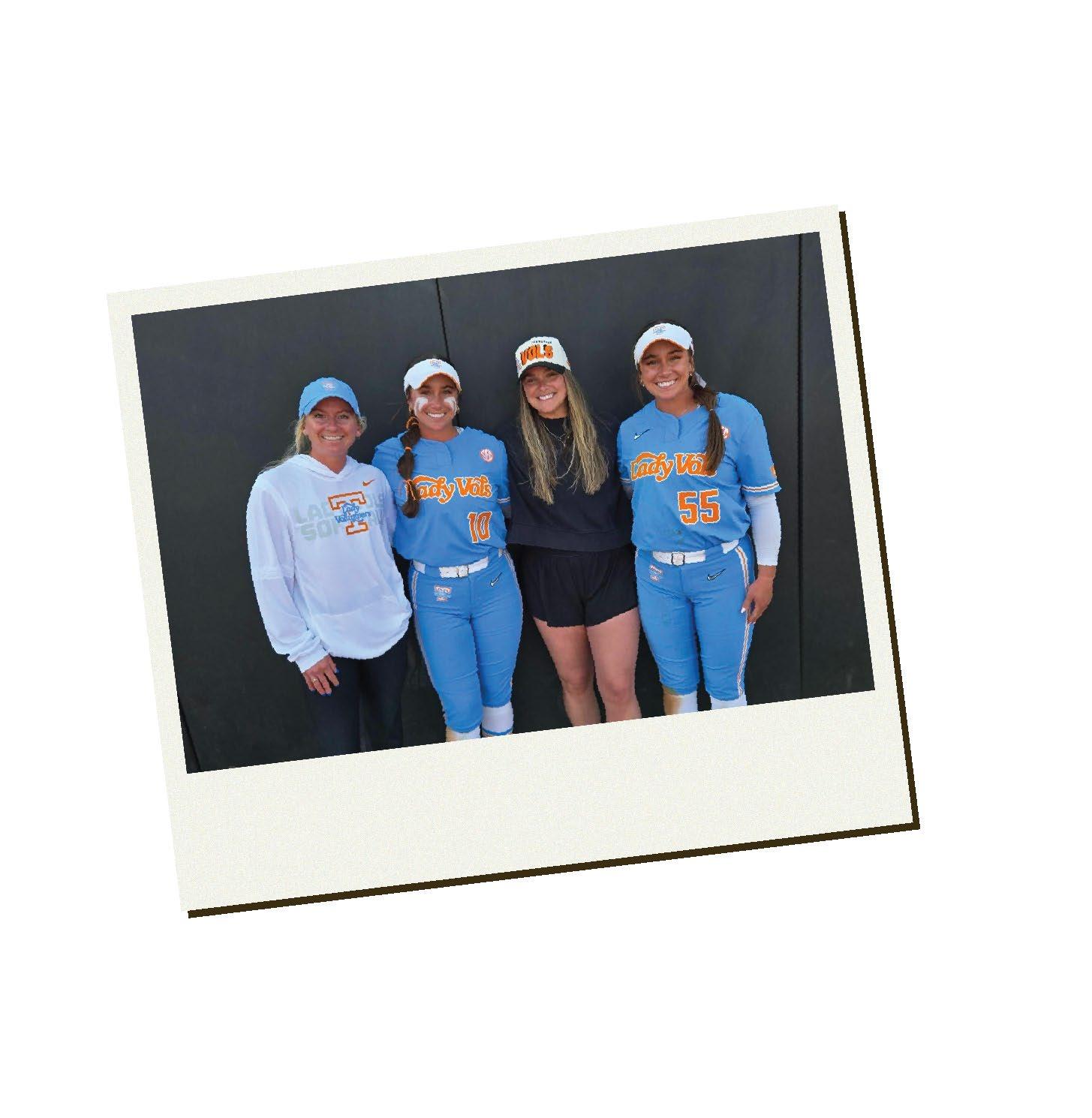
Writing their chapter
When they arrived in Knoxville, Gabby and Alannah Leach immediately proved to be a significant addition to
Both made their collegiate debut in a 15-0 win over UT Arlington on Feb. 8, 2024, each recording their first collegiate hit. Both hits came in the top of the fifth inning, with Gabby Leach hitting a single to the pitcher, later scoring on Alannah Leach’s two-run double to left field.
mance against LSU in early March, with three home runs in the three-game series, including a walk-off threerun blast on March 8.
Alannah Leach has produced high-octane offense of her own, with a .340 batting average and 10 home runs over 45 games played. Her solo shot on March 24 against Tennessee Tech sealed a run-rule victory. Weeks later, she delivered again, hitting two home runs against Kentucky on April 13 to help the Lady Vols clinch their first conference sweep of the season.
On March 7 at home against LSU, Alannah Leach was put in to pinch-hit in the sixth inning, and as she

Adjusting to the pace and expectations of SEC softball, the twins quickly found ways to contribute, relying on both their preparation and connection with each other to ease the transition to the college level.
“We continue to push each other,” Gabby Leach said. “We know that we both have each other’s back, every time we go out.”
In the Lady Vols’ 2025 run in the Women’s College World Series, Gabby and Alannah Leach played pivotal roles in their journey to the semi-
The two connected in Game 5 against Florida, with Gabby Leach contributing a triple to get the scoring started and Alannah Leach tacking on four RBIs, including the one that would give the Lady Vols the 11-3 run-rule victory.
Now in their junior year, the twins have rewritten history, becoming the first pair of sisters to hit back-to-back home runs in Tennessee softball
While twins, Todd Leach explained that the two differ greatly in both personality and approach, with Gabby Leach often taking on a more outgoing presence and Alannah Leach carrying herself in a quieter, more reserved way.
Those differences have shaped how each of them handles pressure, prepares for games and responds to success and failure, ultimately bringing them closer together.
“They’re a little different in that respect,” Todd Leach said. “But they know they can learn from each other and help each other out.” For Todd Leach, those differences are part of what has made watching his youngest daughters’ journey so meaningful, as the same traits that once showed up in childhood now define who they are as players.
“Sometimes it seems like it’s been a long time,” Todd Leach said. “But it feels like yesterday they were strapping those gloves on their wrists.”
Now, those same gloves have been replaced by college uniforms and packed stadiums, but the memories remain just as vivid.
“It’s been a good journey,” Todd Leach said. “Perfect.”
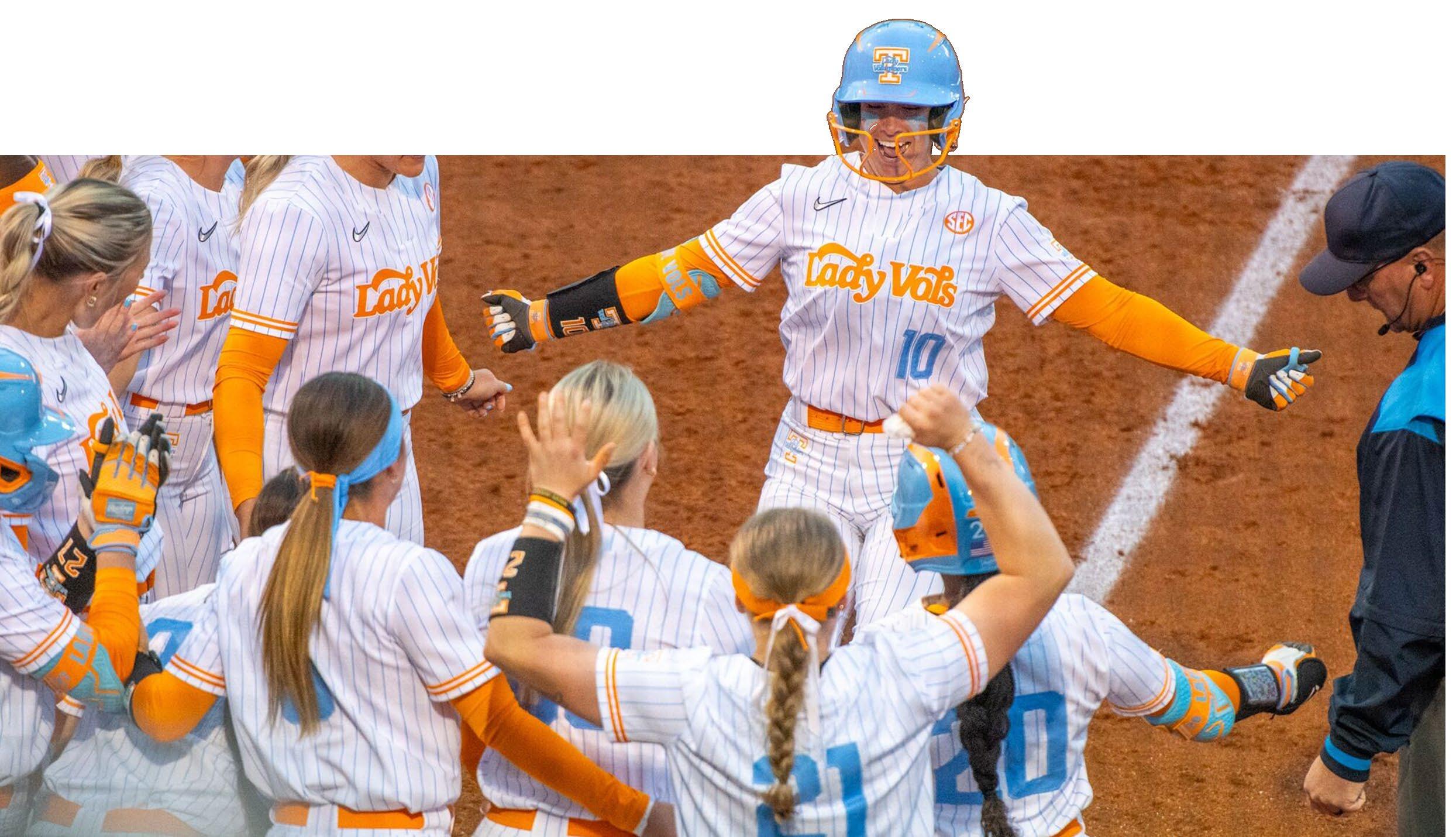
Alannah Leach (10) celebrates a walk-off home run during a game against Tennessee Tech at Sherri Parker Lee Stadium. Tuesday, March 24, 2026. Cole Moore / The Daily Beacon
TREVOR MCGEE Sports Editor
All Tennessee baseball could do was laugh.
Blake Grimmer launched his third home run into the Vols’ bullpen in right, capping off a day at the plate that had been desired the two days prior.
In a game that head coach Josh Elander alluded to as the most important Sunday game of the season, his squad ponied up for six home runs — a season-best — including a program-record tying three-blast day from Grimmer. They earned a pair out of Levi Clark and one from Henry Ford en route to a 14-hit, 13-run day to shy away from a sweep on home turf against Ole Miss.
“Horses ran today,” Elander said.
By the time the third inning ended on Sunday, the Vols already had six hits and five runs.
“It’s basically us knowing what we’re capable of doing,” Grimmer said. “Every single day we come to the field and having faith in the guys that we have out there. And we know everybody on the field can get the job done, and we’re working hard to continue to do that every single day.”
Tennessee accounted for only five runs on nine hits Friday and Saturday. The Vols were two-hit in game two, posting a lone run on a Trent Grindlinger solo blast in the ninth inning to prevent a shutout.
Its big hitters have been missing in action more times than not, while slumps have gotten the best of them. Point in case, a two-game skid to open up the series against Ole Miss, posting a .145 batting average with a pair of losses.
At the heart of those struggles have been the guys who stepped up Sunday, though.
Grimmer’s strikeout numbers have been appalling as well, in a more pertinent fashion. He struck out three times in six atbats, with just one hit to show in

the first two games against Ole Miss. That includes two strikeouts on three pitches in Saturday’s fall-apart loss.
The answer included a historic performance that lands him as just the eighth player in program history to hit three bombs in a game. Grimmer tallied blasts in the third, seventh and eighth innings as part of a 4-for-5 day at the plate.
“Baseball is a hard game, and some days it’s not going your way, and some days it is,” Grimmer said. “And to be honest, we’re trying to grind every single day and play our baseball. We’re still yet to have played our best baseball.”
Grimmer’s second blast snuck off the foul pole — one he thought had no chance of staying fair. His third took off at 110 mph without a doubt.
“I think the only thing everyone can do is kind of just laugh
when he hit the third one,” Clark said. Ford had 26 strikeouts in conference play — four less than he had in 50 starts at Virginia a year ago. He answered with a 4-for5 day, a triple shy of the cycle, with the only out recorded being a groundout.
“It helps everybody out,” Grimmer said. “Obviously, (Ford) is an amazing ball player, and when he’s on, he’s one of the best players in the country, so having him hit like he did today, it really takes some stress off the other guys to try and just play free, basically.”
Clark’s struggles have been season-long. The slugger hit the epitome of a sophomore slump, but the belief in him never wavered — it just meant a new slot in the lineup. With Clark at a season average of .178 and one hit to show in the first two games, Elander bumped him to
the very bottom of the order. And that just happened to be the change of scenery Clark needed. He produced his first-career three-hit day, sending 425-foot and 438-foot rockets to the deepest parts of the park.
“I try not to look at the batting average too much, but I felt good at the plate today, so that gives me a good amount of confidence,” Clark said.
In five games as Tennessee’s nine-hole hitter, Clark is batting .444 with eight RBIs. He has a hit in every contest, accounting for a third of his season hit total in that spot. He is batting .154 anywhere else on the card.
“We had jokes at one point, ‘He’s the best nine-hole hitter in America,’” Elander said.
Grindlinger, Manny Marin and Blaine Brown were the only hitters to leave without a hit on Sunday, but each finished with a
walk to reach base safely. Searching for consistency is an art Tennessee baseball still cannot master. It put a three-game series on film at Mississippi State that could be built upon — then lost a home series to Ole Miss. In game three against the Rebels, it showed back up to the park with the tools to succeed and just one reason why it hasn’t been replicated consistently to this point.
“Sometimes just trying a little bit too hard,” Grimmer said. “That’s all I got.” But consistency is more than just results, too.
“I think it’s clear if you look at the league, the back and forth and the parity, it’s definitely some challenges, but we don’t go consistency solely based on results,” Elander said. “We’re trying to go consistency in behaviors, and our routines, and how do you respond when things are going well and things are not? We’re looking at — the players joke all the time — over the course of 56 games, what works? Behavior-wise, habits-wise? So that’s where our consistency focus is.”
Tennessee can get caught up in what the league presents each weekend — after all, the remaining schedule has three top15 series and a road bout at Kentucky. Getting lost in what the league has is a recipe for disaster in a season where the Vols have been dealt a jab, cross, hook and uppercut, sometimes all at once.
“It’s all about resiliency and how do you respond when you get punched?” Elander said. “We’ve been punched plenty now, but you know, we got to put ourselves in a position where, hey, we’re attacking each game as we go, but we want to be in the hunt, and we are right now.”
Tennessee’s next series is a challenge in itself, navigating the first Thursday through Saturday set of the season. They’ll welcome Alabama to Lindsey Nelson Stadium to cap off the homestand beginning April 23.
THEO COLLI Senior Staff Writer
Since being named head coach at Tennessee in 2021, Josh Heupel has seen 17 players drafted and reach the NFL.
The 2026 class features four surefire picks in the first few rounds, with some additional players rounding out the late-round projections.
Here’s a rundown of the Vols’ projected picks for this Thursday’s NFL Draft.
Cornerback Jermod McCoy
One of the most interesting cases in not only the Vols’ class, but the entire draft, Jermod McCoy enters the draft having not played in a live game since the 2024 season.
After an ACL tear sidelined McCoy for his entire junior year, he has made noise and still holds a year of work in 2024 that is first-round-worthy.
McCoy finished his sophomore year with four interceptions, 44 tackles, 26 solo tackles and seven passes defended.
In ESPN Jordan Reid’s April 20 mock draft, he projected McCoy to land at No. 15 in the first round with the Tampa Bay Buccaneers.
“Looked like (McCoy) out there today,” Heupel said after his Pro Day performance. “From his 40 to the vertical jump, he did a great job testing, which we all anticipated. Great to see him back at 100%. Dealing with the adversity of last year and everything that he had to do to get back, just really proud of how he handled that process and ultimately how he performed today and set himself up to have a great draft day.”
Wide receiver Chris Brazzell II
Projected to be Heupel’s fifth wide receiver selected during his tenure with the Vols, Chris Brazzell has the potential to become one of the most explosive wideout alumni yet.
During his Pro Day, Brazzell ran a 40-yard dash that clocked in at 4.37 seconds, while standing at 6-foot-4, 198 pounds. His 4.37 time was tied for ninth among receivers for fastest time, but at that height, Brazzell brings a lot of skill to the table. During his 2025 season, Brazzell posted 62 receptions for 1,017 yards and nine touchdowns. Brazzell projects as a day two pick, with the majority of mock drafts eyeing him as a late second to early third round pick, though there’s a chance he may slot up on boards.
Cornerback Colton Hood
Projected as a late first to early second round pick, Colton Hood marks as the second defensive back from the Vols, more than likely to land in the early goings of this week’s draft.
Hood, a transfer from Colorado, made his mark on the defense in McCoy’s absence. Hood posted 50 total tackles, eight pass deflections and an interception. “He’s a smart, tough, relentless competitor that cares about the people around him,” Heupel said. “You look at his performance today, at the combine, he’s setting

himself up to have a great career.”
A player who has landed in the top 15 in mock drafts all the way to mid-second round projections, Hood will undoubtedly hear his name called — it’s just a matter of how soon.
Edge rusher Joshua Josephs
An impact player for the Tennessee defense since his sophomore season in 2023, Joshua Josephs has grown both physically and mentally as a player in four seasons with the Vols. Now, Josephs heads to the draft with 9.5 career sacks. He also tallied 33 total tackles in his senior season with three forced fumbles.
In terms of what his game can be compared to, another former Tennessee Vol comes to mind.
“Definitely got to say Byron Young,” Josephs said. “Because if you watch him, from his first year to his most recent year, he’s progressively gotten better. Especially with the use of his hands.”
Josephs is projected to hear his name called during round three of the draft, with Reid’s ESPN seven-round mock landing Josephs with Jacksonville for pick 88.
Other draftables
The Vols will still have some more names called in the final rounds of the draft, including the chance of Joey Aguilar, Miles Kitselman, Tyre West and Bryson Eason. Aguilar has been projected to be picked No. 236 by the Green Bay Packers, according to Chad Reuter’s seven-round mock for NFL.com, while West was projected to be picked No. 228 by the Jets in Dane Brugler’s seven-round Athletic draft. In Reid’s ESPN seven-round draft, Eason landed pick No. 180 to the Cowboys, and while Kitselman is ranked according to PFF’s big board, he has not landed any projected spots. It marks eight possible players that may have their name called over the weekend, as the players’ new journeys start Thursday night.