

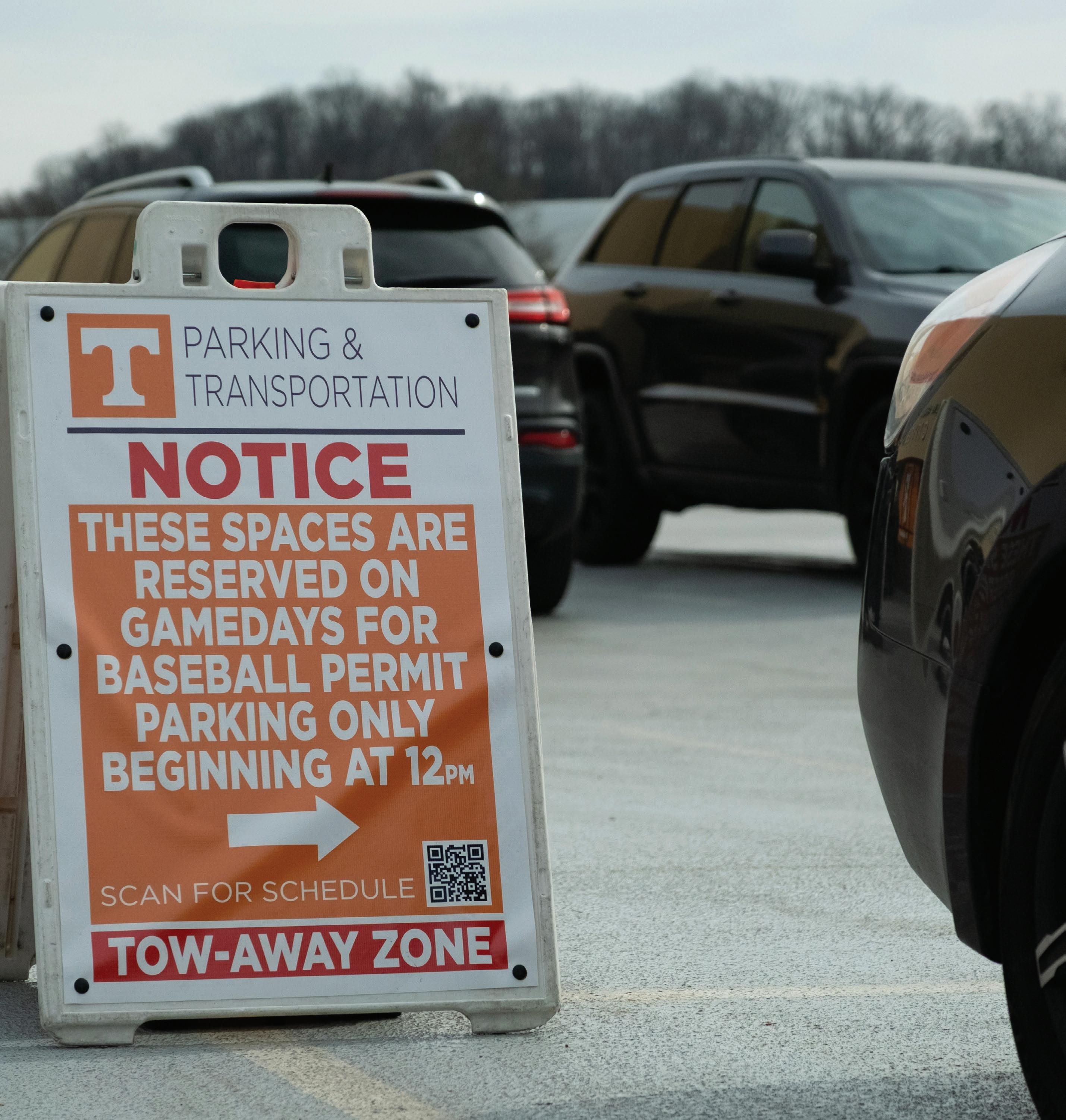
SPRING SPORTS PARKING WOES


EDITOR-IN-CHIEF: Caden Dyer
PRINT MANAGING EDITOR: Emily Hurst
DIGITAL MANAGING EDITOR: Ansley Graves
COPY CHIEF: Lauren Holladay
NEWS EDITOR: Patrick Busch
ARTS & CULTURE EDITOR: Harper Brabson
SPORTS EDITOR: Trevor McGee
ASSISTANT SPORTS EDITOR: Alex Sarkis
OPINIONS EDITOR: Natalie Dripchak
PHOTO EDITOR: Jackson Clavier
DESIGN EDITOR: Lindsay Favre
ENGAGEMENT EDITOR: Sarah Portanka
AUDIENCE DEVELOPMENT EDITOR: Sophie Mehta
COVER DESIGN: Lindsay Favre, Jackson Clavier
PAGE DESIGNERS: Emma Fingeret, Ashley Cammarota, Renee Allen, Maya Williams, SaraJane Weber, Ava Balducci, Ava Edwards, Soma Fulwiler, Kate Wims, Lili Ellis
GRAPHICS BY: Lindsay Favre, Emma Fingeret, Soma Fulwiler, Kolby White, Maya Williams
ADVERTISING/PRODUCTION
ADVERTISING MANAGER: Abigail Cheslock
ADVERTISING REPRESENTATIVE: Joe Slott
TO REPORT A NEWS ITEM OR SUBMIT A PRESS RELEASE, please email editorinchief@utdailybeacon.com or call (865) 974-2348
TO PLACE AN AD, please email admanager@utk.edu.
LETTERS POLICY: Letters to the Editor must be exclusive to The Daily Beacon and cannot have been submitted to or published by other media. Letters should not exceed 400 words and can be edited or shortened for space. Letters can also be edited for grammar and typographical errors, and Letters that contain excessive grammatical errors can be rejected for this reason. Anonymous Letters will not be published. Authors should include their full name, mailing address, city of residence, phone number and e-mail address for verification purposes. Letters submitted without this information will not be published. The preferred method to submit a Letter to the Editor is to email the Editor-in-Chief.
CORRECTIONS POLICY: It is the Daily Beacon’s policy to quickly correct any factual errors and clarify any potentially misleading information. Errors brought to our attention by readers or staff members will be corrected and printed on page two of our publication. To report an error please send as much information as possible about where and when the error occurred to managingeditor@utdailybeacon. com, or call our newsroom at (865) 974-5206.
The Daily Beacon is published by students at The University of Tennessee on Wednesday during the fall and spring semesters. The offices are located at 1345 Circle Park Drive, 11 Communications Building, Knoxville, TN 37996-0314. The newspaper is free on campus and is available via mail subscription for $200/year or $100/semester. It is also available online at: www.utdailybeacon.com
ZOE MANDEL Contributor
In the spring, two sports heavily increase the amount of traffic coming onto campus: baseball and basketball.
Baseball, running from February to May, and basketball, running from November to March, complicate afternoon and evening parking on campus.
Both the mens’ and womens’ basketball teams draw in large crowds of students, parents and fans alike. While SEC sports bring money into the school, they also add stress for those who live and work on or around campus, as the influx of cars and traffic increases.
“When there’s home basketball games, they have all of Neyland Drive shut down for cars coming into campus, especially on the back behind the stadium and getting into G10," Allie Owens, a journalism senior, said.
It’s not just Neyland Drive that’s affected. The agriculture campus is used as a park-and-ride, stoplights on campus are turned off in favor of human-directed traffic and parking lots surrounding the stadium are quickly filled in as pay-to-park options.
“As I leave I feel it, I feel the cars everywhere. Which is no one's fault. I think I feel that traffic because I teach right next to the arena,” Shannon Scovel, an assistant professor of sports communication in the school of journalism and media, said.
This semester, Scovel is teaching in the College of Communication and Information building and parks in the lot outside, which is right by Food City Center. Scovel has been teaching at UT for multiple years and understands how parking on game days works, but explained that it took adjusting to.
“It was a new thing for me to learn that, even though I pay for my parking spot, if I wanted to park there during game day, I'd still have to pay game day parking,” Scovel said.
Now, if she needs to come to campus late while a game is happening, she’ll arrange for another way to commute. Faculty and staff parking rates vary, but most pay between $264.60 and $661.56 yearly to park on campus. If they want to park during game time, their normal passes don’t work — they’re expected to pay the additional fee as well.
"As with any university campus, the University of Tennessee, Knoxville, hosts a variety of classes, programs and events after business hours. On evenings without special events, students with valid parking permits may park on campus in commuter or unreserved staff areas from 5 p.m. un-

til 2 a.m. On evenings with special events, several lots are reserved exclusively for student parking. Those areas can be viewed on the interactive campus map,” the University of Tennessee said in a statement.
The way many people arrive to campus is via Neyland Drive, where a two-lane road splinters into multiple entryways onto the main campus and into different parking lots.
“I understand why there’s traffic, and I do appreciate all these people coming out to support our school, but a lot of people take Neyland who aren’t going to the game,” Owens said.
Owens is a member of the VolWake wakeboarding and wakesurfing team, which meets five days a week from 4:30 to 7:30 p.m. The team will park at the Volunteer Landing Marina, which is right off of Neyland Drive. Both the VolWake practices and the basketball games tend to end around the same time, meaning that a stampede of cars are trying to take Neyland Drive to go home.
“It really slows us down, cause when we leave the marina that way, we all leave left toward campus, so when they’re letting everyone out, they shut down both lanes so we’re stuck waiting,” Owens said.
What normally would be a short drive can take double its usual time because of the amount of cars on the road. Being stuck waiting is frustrating for anyone, but for busy college students with limited time, every moment spent in traffic is one less minute they could’ve spent on homework.
“I feel like we need a new system that’s more efficient so people who do take Neyland aren’t just stuck there,” Owens said.
Scovel adds that when she’s leaving campus at the end of her 4:05 to 5:20 class, it’s congested, making the experience more stressful.
“It's overwhelming to leave at the same time as a basketball game in general,” Scovel said.
Similar to many large state-school campuses, UT is designed to be pedestrian friendly, so vehicle traffic flow came second when planning layouts. For daily life, this is fine, but for big events that draw in large influxes of people and cars, the hierarchy becomes apparent.
“I don’t have this problem, obviously, because I don’t live on campus, but a lot of our freshmen, when they let out of the basketball games … it’s really hard for them to get back to their dorms in a timely manner,” Owens said.
Owens said that the way transportation handles these issues doesn’t take into account the people in the area who aren’t going to the basketball games, and that the decisions they make are “affecting a lot more people than just themselves.”
“They’re not the friendliest people. When you try to bring up these issues they don’t really listen,” Owens said.
Scovel acknowledged that it might not be perfect, but they’re doing the best they can with the layout of the campus and the tools they are given.
“They have a job to do, and I get that, it's a tough job and they’re out there, they’re clear, you can’t miss them, you see them and people respond to them, but they have to do their job and can’t really compromise,” Scovel said. “I think they’re doing as well as they can with the enormous challenge that is event parking.”
GIA SCHEELS Contributor
Most scoffed when Jacob Mink said he was forming a college race team at the University of Tennessee.
Just a few months later, Rocky Top Racing will compete in the new Collegiate Racing Series and make history.
CRS began only a year ago in early 2025 and has already amassed a large following and eager participants. With the 2026 season on the horizon, Rocky Top Racing is ready to triumph both on the track and as a team.
“Our mission is to train students on all the aspects you need to have of running a motorsports team,” Mink said. “That comes down to learning about engineering, finance, marketing, PR, vehicle dynamics and the mechanics of it.”
Mink and his teammates are taking the challenge head-on, currently focused on fundraising and building the team’s visibility.
Rocky Top Racing’s current drivers include Mink, his roommate Trenton Sparks and Dillon Hodge. Sparks is a former dirt oval racer who raced in the United States Auto Club Series, while Hodge is a former driver in the NASCAR Whelen Series Late Model Division.
Mink is excited to be behind the wheel again after racing go-karts for six years, from ages 12 to 18. During college, Mink had the opportunity to work behind the scenes with NASCAR through Lee Ann Egolf. Egolf, a PR representative for Spire Motorsports, helped fuel Mink’s passion for the sport even after he stepped away from karting.
The CRS is a spec series, meaning teams will not be allowed to modify their cars beyond basic setup adjustments. This emphasizes driver skill during racing and helps keep costs low for the teams.
Each team has the opportunity to lease a spec ND MX-5 through CRS, sponsored by Mazda. While the car cannot be modified, teams can design the livery, or visual design, on its exterior.
Rocky Top Racing is going with Tennessee’s classic orange-and-white checkerboard, determined to make a name for themselves and grow support on and off campus.


“This is another thing where Tennessee can show its brute force and show that we’re the best in college athletics,” Mink said. “And, even if we don’t win, if we can go out there and put that car on track and be competitive, that’s my biggest goal for this season.”
Motorsport interest has seen a huge spike since 2024, particularly due to F1.
Yet, Mink said his biggest challenge has been convincing people that CRS is the real deal, and it’s happening right now.
“It’s just the idea of college racing, it’s so foreign and new that it took a lot of convincing to be like, OK, here’s how we’re gonna do it,” Mink said.
His everyday task is getting new people on board and convincing them that it is
achievable. Mink is extending an invitation to alumni interested in getting in on the action through partnership or hands-on involvement with the team.
“If any alumni live within the radius of Tennessee, we invite them to come work on the car with us, come meet us,” Mink said. “If they’ve got partners that might be interested in us, it’s very cool.”
Races will begin on the last weekend in July and run until the end of December. There will be nine total races in the 2026 season, starting at Michelin Raceway Road Atlanta on July 31.
“The racing is going to be very intense. … And the competition is going to be fierce. It’s real racing, and it’s real fun,” Mink said.
Until then, Rocky Top Racing will focus on getting its drivers licensed and getting to know the car as a team.
There is a place for everyone in Rocky Top Racing, and they are always looking for new members to join the excitement. Whether you are interested in marketing, engineering, communications or simply love motorsports, you will have a chance to engage in as much of the club as you want.
“The involvement that you can have with some really cool people will go a long way for your development in college,” Mink said. “I started this club with my best friends, and we’re about to start traveling the country together. We’re about to start building a race car together. I mean, you will find your best friends in this club.”
MOLLIE POKELWALDT Contributor
Rep. Justin Lafferty, a Republican in the Tennessee House of Representatives, dropped his push in HB2581 to end the ability for public universities in the state to award tenure on Feb. 18.
In a meeting of the Higher Education Subcommittee, Lafferty voiced that he has “struggled” with the future of this bill after researching the history of tenure.
Lafferty alluded to many examples when tenure was beneficial in American history, and even went so far as to pull examples from the Vietnam era.
Many University of Tennessee officials have warned the lawmakers of this bill that it will have extremely consequential effects and could tarnish the reputation of the university.
Charles Noble, president of the UT faculty senate in Knoxville, upheld this sentiment.
“We would see drops in rankings,” Noble said. “We would have a hard time getting recruiters.”
Lawmakers also discussed Tamar Shirinian, a former assistant professor on the tenure track, during the meeting. A tenured Shirinian would have most likely seen protections against suspension from UT, as it is designed to safeguard academic freedom.
Although the bill is no longer being supported, Rep. Lafferty has still opened up the idea of revisiting the law.
While some thought an exception may have been carved for UT, that never came up in conversation surrounding the bill.
would have taken effect before the fall 2026 semester began. However, with support backing out, it will not take effect at all.
MARGARET WHITE Staff Writer
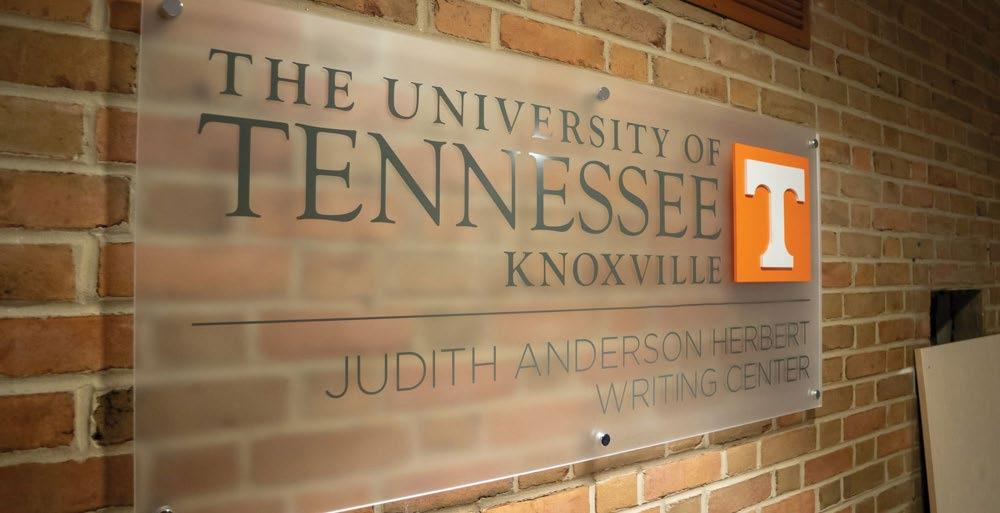
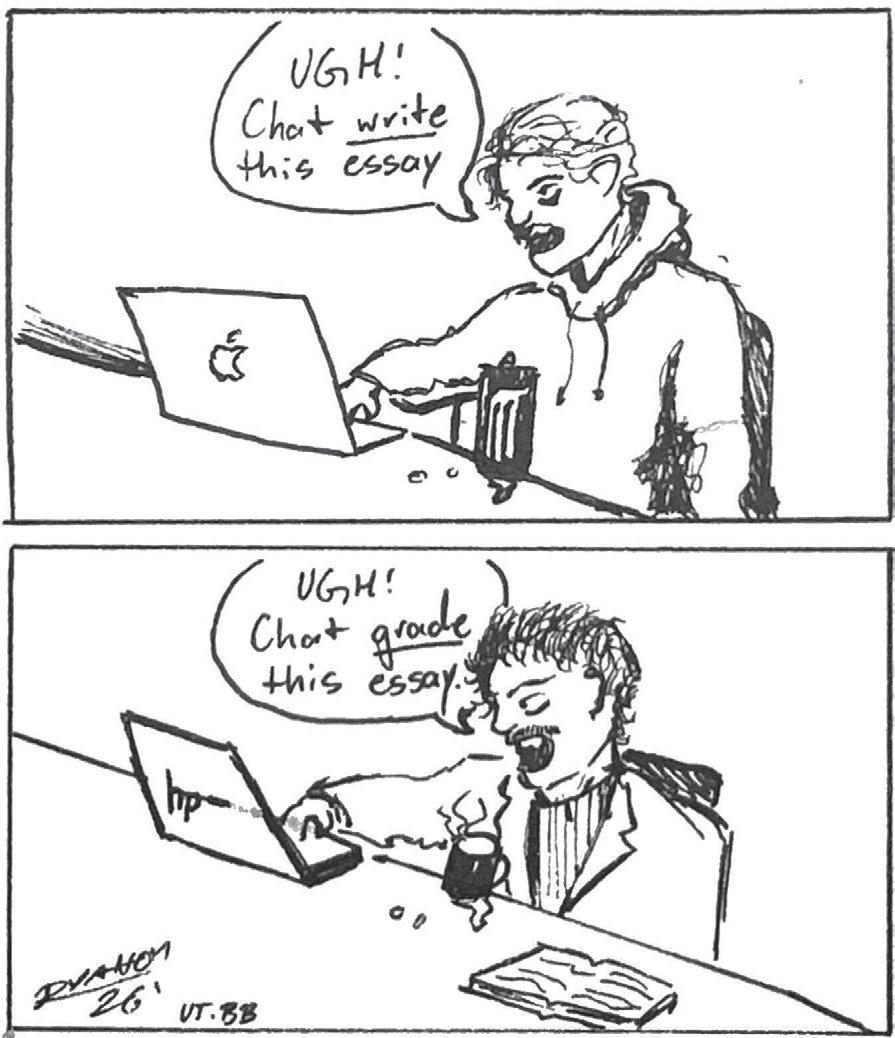
As artificial intelligence becomes more integrated into student life and academia, UT’s Judith Anderson Herbert Writing Center remains a valuable resource not only for writing, but for navigating generative AI as a tool as well.
Writing Center Executive Director Kirsten Benson said that one of the center’s top priorities is to help students seek out AI literacy.
“It keeps on developing,” Benson said, “and it really is important for everyone to know how AI works when it comes to writing.”

A main way the center believes that they can help is by having open conversations about AI usage with student writers.
“We feel like we could talk with them more,” Benson said. “We wish that there was a little bit more openness, because we could help students make decisions about
The center is also focused on informing students that they are not going to judge or police the AI use of student writers.
“We’re not the police, we’re not the AI police, and that’s not a reputation that we want,” Izzy Alexander, a writing center tutor, said. “I want, as a consultant, to have honest conversations with students about their work, because that’s what I’m interested in, that’s what makes me
excited.”
Due to the increase in AI use since generative platforms like ChatGPT have been popularized, UT writing center tutors have all been educated in AI literacy. Tutors were provided with a module during their year-long training process that taught them about the different kinds of generative AI, how to prompt it and what kind of text it outputs.
Alexander, an English masters student at UT in addition to being a tutor, believes that understanding AI in this way allows for tutors to better help students.
“I want to be able to actually give you tips that you feel like can make your practice more productive,” Alexander said. “Having that honest conversation with students really helps.”
Benson agrees that the job of consultants in the center is to help someone make those decisions for themselves. When it comes to AI in the center, the biggest concern expressed by Benson is the decision making process for writers.
An integral part of the writing process — and something that is involved in every step — is making choices. According tothe writing center at the University of Madison, Wisconsin, the human brain makes over 1,000 decisions during one project alone. Whether it be topic selection, picking out evidence, organization or word choice, the writing process involves thinking critically and deeply.
“The thing we have to be able to do is, again, make those choices, and AI can’t
make those choices for you,” Benson said. “So, using AI will not help anyone develop what we call ‘writing intelligence.’”
Giving students the confidence and self-efficacy to write something on their own is something the center highlights.
“We feel that emphasis on becoming more confident in what you feel about yourself as a writer and getting to that feeling where it’s just like, ‘I can do this as a writer,’” Benson said. “We can do that much better than any AI can do.”
This is why, according to Benson, the writing center wants to help students navigate the ways to use AI as a tool and not a replacement. While AI may improve a paper grammatically or give somebody an idea for their essay, the center’s goal is for students to improve individually as writers by making a lasting impact.
One of the more common ways students are using platforms like ChatGPT is brainstorming topics for writing projects, something the writing center has done with students since its formation.
Alexander described how students aren’t necessarily brainstorming in the traditional ways anymore, like working with a consultant or word-dumping on paper.
Instead of rebuking ChatGPT’s hold on the writing process of students, the center is set on understanding, aiding and growing with new technology.
“We are here to help writers at every stage, and part of that is working with AI too,” Alexander said.
KELA FIFER Contributor
During the fall semester, UT’s Student Government Association internalized their mission of serving the student body and oriented themselves in the direction of continued representation and fostering relationships across the university network. SGA made insights into the specific accomplishments of the fall semester available to students, staff and the broader public on Feb. 11 with the release of its Fall 2025 Semester Report.
“I love being a part of student government because I feel like we are at such a unique place where we can actually make an impact on campus and see it come to fruition,” Caroline Marcus, the administration’s chief of staff, said.
Torch initiative
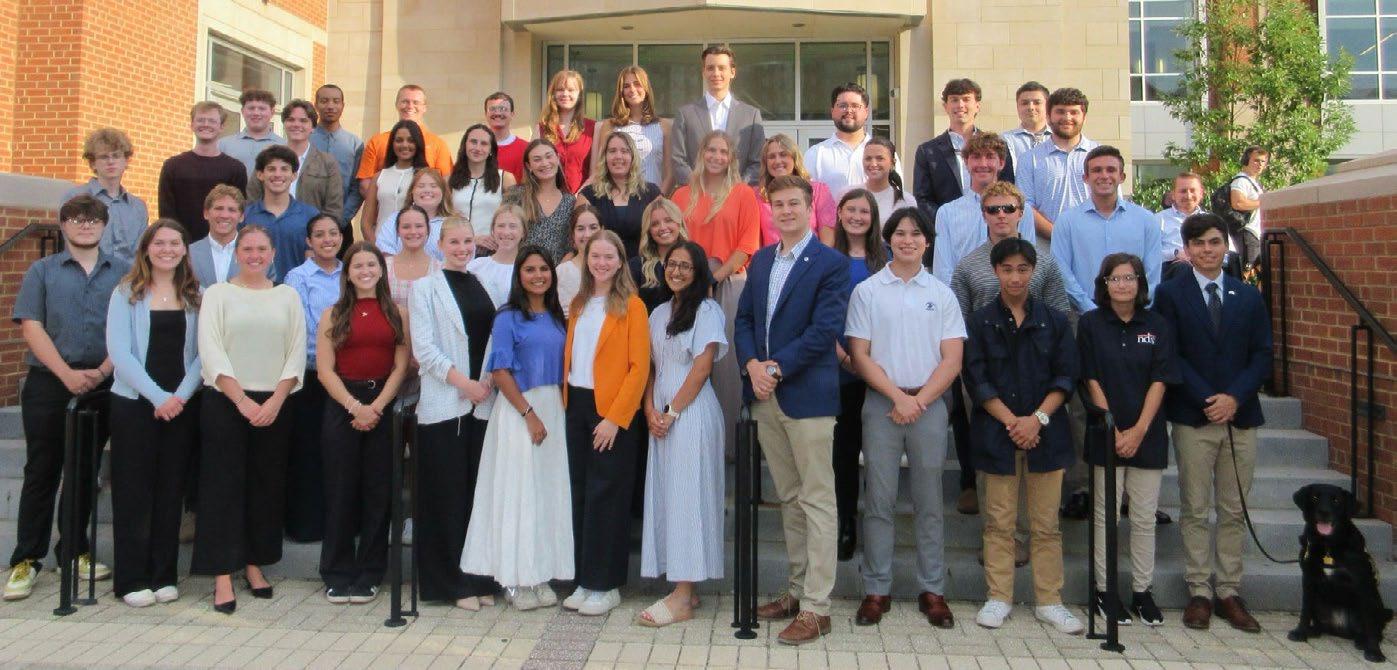
Members of SGA’s executive board such as Student Body Vice President Ella Blair and Executive Advisor Mansi Bhimani identified the need for stronger, more supportive resources for transfer students eager to get involved on campus. While some SGA executives were in the airport traveling to SEC Exchange, the idea of Torch was born. Once summer subsided, the Torch program hit the ground running.
Modeled after SGA’s First Year Council, Torch focuses on leadership development, community building and preparing transfer students to further their role as members within student government.
During its debut semester, the Torch program released its Torch Guide Book, a guide for transfer students by transfer students to accompany their transition to Rocky Top. The guide book, handed out during Vol 103 in January, contains information regarding scholarships, housing, financial aid and more. The Torch cohort has plans to release a guide book every semester moving forward.
“Our motto as a student government association is that ‘everyone is a member,’ so we were thinking of how we could better live out that motto,” Blair said. “That helped us identify that there was a need to create a better way for transfer students to easily get involved in student government.”
Streamlining mental health resources
Last semester, a new tool made its way to students’ Canvas pages. The Student Wellness module, located on the Canvas tool bar, serves as a readily available campus mental health resource.
This project, spearheaded by Student Body President Chase Darwin, began to take shape during his campaign for student body president as he saw a need to prioritize student well-being. Meetings during the summer latched onto this idea and helped to get the ball rolling in the fall.
The module came to fruition relatively quickly, helped along by collaboration with Vice Chancellor for Health & WellBeing Dr. Jill Zambito and the Center for Health Education & Wellness. Other universities such as Clemson have even reached out and are looking to implement
a similar module for their students.
“That was really a fun thing to see happen,” Darwin said. “It really showed that mental health and student wellness is not just a student life priority but a priority among all departments and all divisions on campus.”
Senate supplies legislation
The undergraduate student senate serves as SGA’s primary governing body. It consists of 60 elected undergraduate students.
“Student demand is the call to action for every senator,” Speaker of the Senate Campbell Butler said. “You (the senators) are here to represent your fellow peers and you have to be communicating with your peers, and engaging in the friendships and relationships you have to understand the student experience.”
Going into the fall semester, Butler had a few things in mind for the senate — mainly, the building and fostering of relationships within the senate body. Strong foundational connections within this branch of SGA serve as a launching pad for effective legislation. Butler sought to make a few system changes internally that would make
passing legislation easier and more efficient for involved parties.
In particular, she worked closely with senate executives to standardize the legislation workflow by creating an email template that clearly communicates legislation between senate and respective campus administrations.
Within the past semester, the undergraduate student senate passed one bill, three resolutions and one proclamation, as well as created and published a comprehensive guide for SGA’s 2026 election season.
Notable legislation that left the senate chambers in the fall includes Resolution 25-1 and Bill 25-1.
Resolution 25-1, sponsored by Sen. Alli Conkle, advocated for the addition of accommodation-support instruction and resources to the campus wide syllabus, which went into effect this semester. Additionally, Bill 25-1 works to promote the Safe at UT app by awarding students with T-Credits upon downloading.
As the senate goes through the second half of the spring semester, they hope to churn out more legislation and continue implementation efforts.
Within the fall semester, SGA leaned into maintaining momentum coming out of last year’s record-breaking election season, which saw the highest voter turnout yet. Through various initiatives, legislation and events, SGA continues to bridge the gap between students and campus administration. During the spring semester, SGA will begin to turn its attention toward elections as voting will take place on March 25.
“I am really excited to see how elections go this year,” Blair said. “I could not be more excited for the next administration. I feel like every year SGA improves upon itself and whoever next year’s leaders will be, I am confident that they are going to do an amazing job.”
Goes (for)
President Macron
Ray of "GoodFellas"
Rent payer 24 Caterer's heater
26 Talk back to
___-stop shop
29 Feel sorry about
Implied
35 Ethan Hunt portrayer
38 Hale or Thicke
39 Hot under the collar
40 Place for polish 65 "Giant" author 11 Opinion piece
Persistent pain 41 Japan castle city Ferber 12 Very much
43 Set to rest 66 Eases up on the 13 Sofer of the site
44 NY time zone gas soaps
Leader of the
45 Pen's point 67 Disavow 19 Network, e.g. pack
46 Crime-stopper 21 Shipshape
Seek out for spray DOWN 25 Part of a drum kit help
48 Second of two 1 Orange variety
51 Sister of Calliope 2 Some Japanese
Former Voice of
Feudal lord
Jude Law's
55 Aviator Earhart films America org. "Cold Mountain"
57 Doing a theater 3 Looks like 31 Slippery role job 4 Hired guns 32 Break, as a
Intense suffer-
59 Know-how 5 Puts forth, as a horse ing
61 Verne's captain case
62 Genesis skipper 6 Only
Woe is me
Complexion
Ben Cartwright, concern
63 John who sang 7 Track shapes for one
Kind of ring or "Daniel" 8 Cow's chew 36 Cereal grain swing
64 "A Visit from the 9 Lavish living 37 Ignorant
Garbage boat Goon Squad" 10 Spike for climb- 39 Impersonates
Building wing author ing 42 Loosen a

Solution to Crossword:

TESSA NACKE Staff Writer
Playa Bowls Knoxville is the newest addition to the Strip.
The acai and smoothie bowl franchise opened its new location with a grand opening on Feb. 21, drawing in over 250 customers eager to feel the summery vibes that Playa Bowls has to offer. The grand opening was complete with free bowls for the first 100 visitors, a DJ and a visit from Cowboy Cannolis for the customers in line.
Owner Henry Anderson has been eyeing Knoxville as a location since the franchise’s beginning. Anderson also owns locations in downtown Nashville and Murfreesboro.
“Knoxville was probably, like, my top market that I wanted to focus on. I thought that the UT campus, somewhere close to campus, would be a great spot for a Playa Bowls. There’s a lot of students here that live out of state and they already know what the brand is. So getting a spot close to campus where we’re on the Strip here, and we have students walking down and back all the time,” Anderson said.
Placing importance on clean, healthy options, Playa Bowls has something for everyone. It offers a large variety of acai bowls, smoothies, juices, oatmeal and cold brew. If you can’t decide what you want, you can also customize and make your own creation.
“I think what sets us apart from just like a regular acai shop, is the fact that we have six different bases. We have acai, mango, coconut and banana. We have a green base that has some kale in it. And then we also have pitaya. And then we’ll always have different limited time specials, seasonal specials,” Anderson said.
The large range of options leave customers coming back for more, eager to try new things. The most popular acai bowls are the Nutella Bowl and the Pura Vida Bowl.
walls are decorated with a blend of beachy scenes, local tie-ins and an overall unique
and word has spread fast.
“I think that it’s going to do really well

Inside the new Knoxville location, the
shop or something. We try to make it feel like it’s different. Our muralist did a great job of setting that vibe,” Anderson said. That vibe has been received by students,
for their business, and also the location is definitely going to help out with it being right in the middle of the dorms and the apartments. They can get a demographic of all of the grades,” freshman Jenny Jaros
This beachy vibe also extends to their products, where they pride themselves on finding the cleanest and healthiest options for their customers.
“We try to source the highest quality strawberries, blueberries, all the produce, and then all of our smoothies don’t use any granulated sugar that we’re dumping in. We don’t have a bunch of additives. It’s just a very clean menu,” Anderson said.
This clean and healthy alternative right on Cumberland Avenue is rare, and Playa Bowls is excited to continue to grow in this new space.
“I think it’s really something that we need on campus, because we have a lot of fast food, and that’s not as fresh. I feel like having something like Playa Bowls is really beneficial, and it’s a good location, so I’m really happy about it,” Jaros said.
As this new Playa Bowls location gets their footing, their priority is always the students and the
be thinking of
going to the pool and the quarry. I think especially the timing is gonna be really good
“We’re just excited to be here … we really want to get involved in the school and the community supporting different organizations, different groups, different teams on campus. Always happy to get involved,” Anderson said.
AUBREY HOLLAND
Contributor
Collective gasps echoed throughout the theater at the opening scene of “Wuthering Heights.”
On Feb. 17, the English department paid for students to view the film adaptation at the Regal Theatre on Gay Street. The movie gained large controversy on social media due to its comparison to the original novel, and many students were left speechless after watching it.
“It was not what I expected at all,” Laney Kubit, a junior at UT, said.
“Wuthering Heights,” directed by Emerald Fennell, possessed a cinematic beauty heightened by romanticized settings, fashion and colors. Actors Margot Robbie and Jacob Elordi portrayed the two main characters, Catherine and Heathcliff, who share a passionate romance throughout the movie. Many have praised the adaptation for its modern take on the book by spotlighting the epic love story.
This version of the story showcases Heathcliff and Catherine becoming close as children after Catherine’s father brings him home as her new “pet.” After a time jump, the two are seen as even closer, with Catherine gaining interest in their new neighbors at Thrushcross Grange, the Lintons. She later marries Edgar Linton
to save herself from the degradation of marrying Heathcliff, whom she truly loves.
Healthcliff leaves, later returning after Catherine’s marriage as a rich man. They engage in a secret affair, hurting all those around them in the process. Heathcliff marries Isabella Linton, Edgar Linton’s ward, after Catherine says it’s too late for them to be together. Catherine later dies in childbirth.
According to some students, the film did not do justice to its source as an adaptation.
“Wuthering Heights,” written by Emily Brontë, is a gothic classic about obsession, revenge and death. Neither Lockwood, the beloved narrator of the book who conveys the violent story of Heathcliff and Catherine, nor the entire second half of the novel, appeared in the movie.
The novel begins with the narration of Lockwood, the new tenant of Thrushcross Grange. He then meets Nelly Dean, Catherine’s former housekeeper, who relays to him the whole story of Catherine and Heathcliff’s past relationship. All that happened in the movie did take place, just with very different details. However, Catherine gives birth to her daughter before she dies in childbirth, continuing on to the second part of the novel.
“Emerald Fennell literally murdered the second half of that book,” Nathaniel Adams, a senior at UT, said. “She completely
eliminated the whole point of the framing of the Gothic narrative from happening.”
One of the most significant points of the novel is that this story is not a romance.
Fennell’s version of “Wuthering Heights” debunks this. The entirety of the movie is its love story, even the maddening parts of it. She found a way to make this Gothic novel into a film all about Romanticism. However, this change diminishes Brontë’s message on racism, classism and marriage rights in the 19th century.
Arguably, the largest issue of the adaptation is Heathcliff’s character. In the novel, he is a man of color who is abused and treated unfairly for his ethnicity. In the movie, this entire aspect of his character does not exist, as he is played by a white actor. This takes away such a large part of Heathcliff’s story, character and relationship with Catherine. Though the movie still executes his story as a poor orphan, its disregard of his struggle with racism does not reflect well on the director’s perception of the story.
“I’m sorry, there’s no getting around white Heathcliff. The marriage rights and racism and classism are bad. Like — that’s the whole book,” Grace Brooks, a sophomore at UT, said. “And so, it (the movie) looked pretty and ripped out everything important.”
Continue reading on our website.

GIA SCHEELS
Contributor
Knoxville’s music identity stretches far and wide, from garage bands performing at popular venues to one-man shows popping up on local stages.
You might have heard of some Knoxvillenative groups like The Dirty Guv’nahs or Cereus Bright. They started in Knoxville and grew into something much bigger, each boasting over 50,000 monthly listeners on Spotify.
These artists helped shape the music genre now known as ‘Knoxville Indie,’ a blend of folk, alternative rock and indie sounds that emphasize lyricism and soulful melodies. What separates Knoxville Indie, though, is its Appalachian influence that VOLT-FM describes as “laid-back” and “rootsy.”
While The Dirty Guv’nahs and Cereus Bright have made their presence known on wider stages, smaller garage bands remain underground, sacred favorites. Here are a few local bands you’ve probably never heard of that have largely contributed to Knoxville’s soundscape and remain hidden
gems for those who listen.
Sweet Years
Artists Zach Gilleran and Dakota Smith arrived at the name Sweet Years after a running pun on “The Suite Life of Zack & Cody” gave them their early name, Zach and Kota’s Sweet Life. The pair made their debut all the way back in 2012 after acquiring bass player Travis Bigwood and deciding they wanted to perform live.
Their last EP was released in 2018, and the band has separated since, but their sound lives on. With riffs reminiscent of The Strokes and chord progressions similar to Pinegrove, the Knoxville trio’s music is a pure representation of Knoxville Indie.
“Our songs are very earnest, almost to the point where you’ll cringe — and then we try to change directions,” Smith said in an interview for Knoxville Mercury in 2015. “I think that we’re like a profile of a dead Facebook friend, where there’s this smiling face and a collection of images and recollections on top of a morbid reality.”
Royal Bangs
Although there aren’t many record labels
hanging around Knoxville’s college scene, the Royal Bangs’ unique sound managed to get them signed to Black Keys drummer Patrick Carney’s label, Audio Eagle.
The group, which started playing together in 2005 just for fun, began gaining traction after releasing their first album, “We Breed Champions,” in 2008.
Their fourth and final album was released in 2013, featuring their most popular song, “Better Run,” which has over one million streams on Spotify. The group’s melodic indie sound resembles bands like Cage the Elephant, but their lyricism gives it that homey sound of the Knoxville Indie genre.
The Crumbsnatchers, like Sweet Years, were established in 2012 and are the only ones of the three still making music. After returning to Knoxville in 2011, vocalist Samuel Guetterman reunited with old friends, and they began playing makeshift songs in Guetterman’s apartment.
The band started like most Knoxville garage bands, by playing house shows around the Fort area, before eventually
moving to Nashville. Their first album, “Big House,” was released in 2016, and their latest single, “Tell Me Lies,” came out in September 2025.
Their grunge, upbeat, alt-rock feel gives off vibes of Rainbow Kitten Surprise and Vampire Weekend, and remains a proud staple of the Knoxville Indie genre.
ISABELL NORMAN Contributor
It’s Sunday night, and anticipation hangs in the air as people gather around their TVs, hoping their parlay finally hits. What drives this obsession with sports betting? Is it the adrenaline of watching your favorite player execute a seamless play, the conversation and community that form around the game, or something else? It surely isn’t the money lost that keeps people gambling.
In 2018, the United States Supreme Court struck down the Professional and Amateur Sports Protection Act of 1992. This federal statute had previously limited legal sports betting nationwide. It is now up to the states to sanction, regulate and tax sports

betting. States saw an opportunity for tax revenue, and this was well-received by the sports community.
Major league sports began shifting their stance on sports betting, seeking to create a more organized way for fans to bet. Since then, 39 U.S. states have legalized sports betting.
The first step was legalizing it, but the transformative step was mobilizing betting. Typing “sports betting” in the search bar of your phone’s app store will bring forward plenty of options. Apps like DraftKings, FanDuel and PrizePicks are all very popular platforms in the sports betting market right now. Within these apps, you must verify your identity and your location to ensure you are within a legal jurisdiction. Bettors can then simply link their bank account and start gambling.
The ease of betting from personal devices has transformed gambling into an activity driven by instant gratification. You can place a wager moments before a game and
have your payout at the end of said game. In fact, many bettors find it helpful to wait until right before kick-off, or tip-off, to catch better odds.
How did we get from horse racing to college football?
Betting on sports or an athlete’s performance is nothing new. We all love a good Kentucky Derby race party, especially here in the south where they have been thrown since the early 1900s. Back in the day, betting on the race caused people to be “money mad.” This culture had everyone wanting to go for gold, believing that winning bets on the Kentucky Derby race was a fast track to wealth.
To be honest, putting your paycheck in the hands of a horse seems chaotic but thrilling. Sports betting used to be a niche pastime, whereas now it is 24/7 wagering on our smartphones. In recent years, we have expanded our sports betting selection,. While it is more common to bet on the NFL, college football and basketball, plenty of gambling also takes place on golf, soccer, UFC and tennis matches.
Sports betting has become the main event of the game. It is impossible to deny that we see and hear about betting within our conversations, across social media and now embedded in the live broadcasting
commentary throughout games. The United States has had to consider this growing interest in gambling and manage the craze through new policies and stricter NCAA regulations.
Continue reading on our website.

Isabell Norman is a freshman at UT this year studying journalism. She can be reached at kml965@vols.utk.edu.
Columns and letters of The Daily Beacon are the views of the individual and do not necessarily reflect the views of the Beacon or the Beacon’s editorial staff.
CLAIRE THATCHER Staff Writer
Most women I know currently have or at some point have undergone some sort of cosmetic procedure.
In 2026, it’s common — nay, expected — for women to make aesthetic changes in order to adhere to society’s ever-changing beauty standards.
Recirculate the blood from my left arm into my face, burn the top layer of my skin off to stimulate new stem cell growth, a little CoolSculpt around the jaw. The skinny BBL, the fox eye lift, the upper blepharoplasty, 360-degree liposuction, the fated 18th birthday rhinoplasty.
In 2024, the global cosmetic surgery and procedure market size was evaluated to be worth just shy of $84 billion. While men dabble (ahem, Todd Chrisley and those guys from “Botched”) the clientele is majority women.
As a woman, your reputation and career success often feel heavily contingent on the way you present yourself. As a man, bald and fat doesn’t directly translate to lazy slob. Fat and old can be jolly, wise or wealthy. He could just be comfortably
aging.
While I think we can all agree that men aren’t burdened with the same level of societal expectations that women are, they obviously have insecurities too. Why do you think every medium-height man you know is 5-foot-11?
But it’s the receding hairline that is the kiss of death for a young man. Why do you think the hat stays on in the pool? In the gym? Most men make peace with the hat, accepting that it will stay on indefinitely, now an extension of themselves.
Enter the Turkish hair transplant.
Like many major cosmetic surgeries, it’s exponentially cheaper to go outside of the U.S. Go to Mexico for a new rack, Brazil for a new a** and South Korea if you want double eyelid surgery. Turkey just happens to be the hair transplant capital of the world.
In America, a standard hair transplantcosts upwards of $13,000. In Turkey, the procedure comes to under four grand — and that’s including travel and lodging.
Countless TikTok videos of swollen, bandaged heads shamelessly crowding the Istanbul airport — men vlogging their own experiences with the procedure and
promoting their transformative results. Millions of views and impressions later, the Turkish hair transplant is competing directly with your raggedy baseball hat.
In 2022, as a result of its virality, one million people traveled to Turkey specifically for hair transplants. This contributed approximately $2 billion to the total $4 billion in revenue coming from health tourism overall.
In recent years, the discourse has heavily evolved around plastic surgery. The increasing accessibility and casual attitude have made cosmetic work feel standard. It’s just another step in the self-care routine. Now, most clinics recommend women start Botox in their early 20s. It’s preventative. It’s just maintenance. It’s not something you need to hide.
So much of modern entertainment goes directly from creator to consumer, so authenticity is both ideal and lucrative. Kylie Jenner telling TikTok that her boob job was exactly “445cc, moderate profile, half under the muscle” just makes her that much more relatable and down to earth.
Despite the changing attitudes around plastic surgery, most men aren’t as brazen about their surgical tweaks.
A number of male celebrities have
been rumored to have undergone hair transplants. Adam Levine, Chris Evans, Tom Brady, David Beckham, the list goes on. And, in my personal opinion, Harry Styles wasn’t just taking a two-and-ahalf-year break from music. It would be weird if Brady came out and said, “3,500 graft FUE, single-hair grafts in the front, doubles behind, temple points rebuilt.”
But things are changing. With the help of the Turkish hair transplant, not only can men defy aging for the low, low price of $4,000.99, but the virality of the procedure is helping to destigmatize men’s participation in the beauty economy.
Continue reading on our website.
Claire Thatcher is a freshman at UT this year studying journalism and media. She can be reached at qtq974@vols.utk.edu.
Columns and letters of The Daily Beacon are the views of the individual and do not necessarily reflect the views of the Beacon or the Beacon’s editorial staff.
‘I think we’re fine’: Tennessee
ALEX SARKIS Asst. Sports Editor
The formula for winning baseball is straightforward.
No matter the level, if a team can throw strikes, cash in with runners on base and play good defense, good things usually come as a result. During the second weekend of Tennessee baseball’s season, those winning traits came few and far between.
The Vols dropped a non-conference series for the first time since 2020 in their final weekend before heading to face nationally acclaimed competition at the Amegy Bank College Baseball Series in Arlington, Texas. Among the laundry list of things Tennessee would like to tighten up after its weekend obligations with Kent State, fundamentally sound baseball is one of the most poignant.
“You just better respect the game and your opponent at all times,” head coach Josh Elander said. “Because anybody can beat you at any time. What remains true is the fundamentals of the game are the absolutes. If you don’t play catch, do the little things right, you can get beat any day.”
In the bookend contests of the weekend, Vols’ pitching made things fairly easy for Golden Flashes hitters. Tennessee awarded its opponent 23 free bases over the course of the three-game set, adding some poorly timed wild pitches to help advance runners into scoring position. Catcher Stone Lawless allowed eight stolen bases in the trio of games behind the plate.
The Vols’ starting rotation proved to be solid, receiving one-run efforts from Tegan Kuhns and Landon Mack in consecutive contests. Tennessee’s defense didn’t do much to bail out its arms, committing five errors in the pair of losses, three of which directly yielded runs.
“That’s been the main focus on what we’ve been working on,” outfielder Jay Abernathy said. “Just trying not to allow those free passes. But, just trust in these guys and keep them going. We’re going to have a great week of practice and bounce back this weekend. I think we’re fine.”
At the plate, the Vols went cold in the middle game of the series, a lingering slump that carried over into the rubber match. Tennessee failed to notch a hit with a runner on base in its first loss of the season, going 0-for-15 in those spots. A streak of 13 empty at-bats with men in
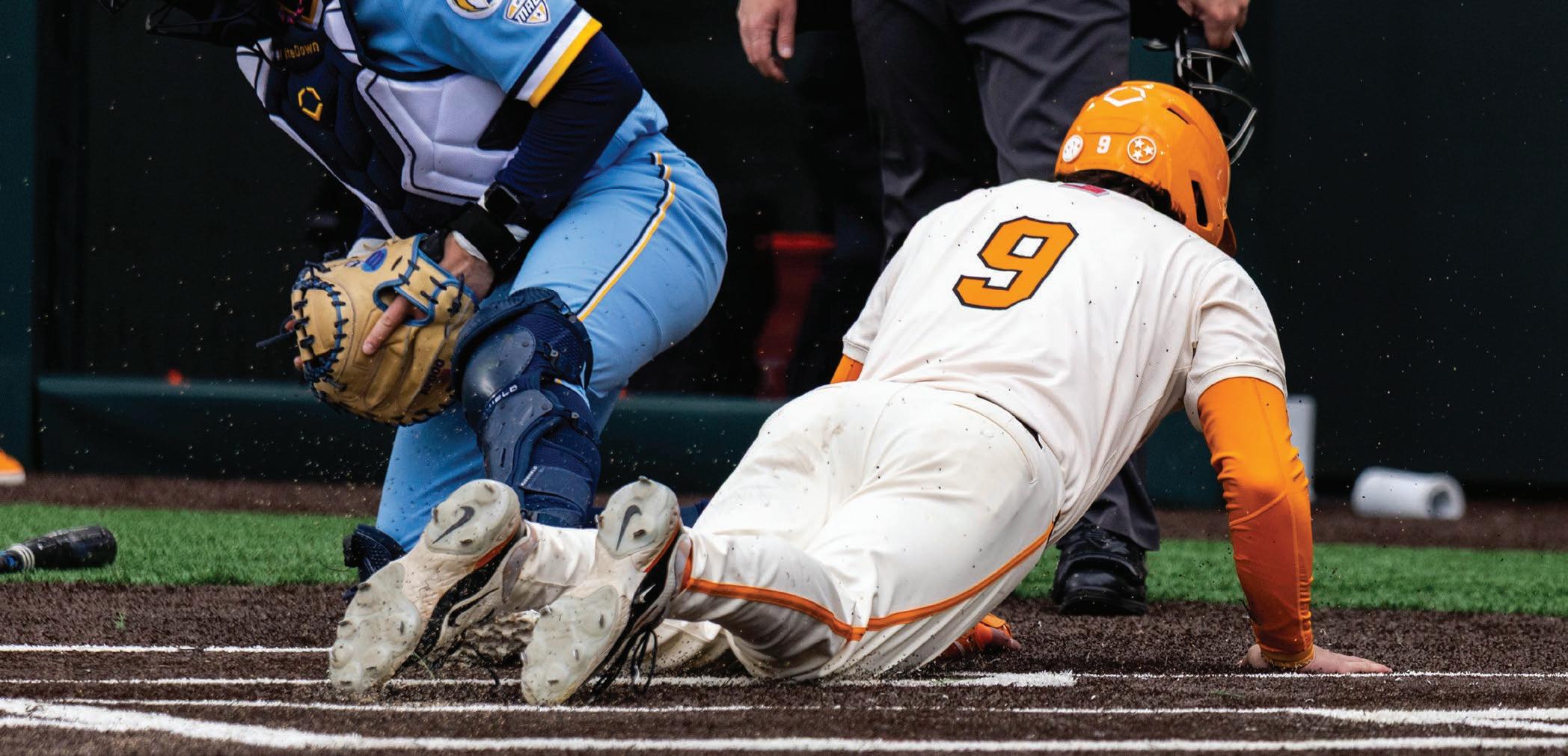
scoring position bled into Sunday’s effort before Henry Ford put an end to things with an RBI single.
Even after the exhale in the deciding game, the Vols only picked up one hit in the final four innings. Nine straight hitters failed to reach base to close things out, all while the Golden Flashes continued to mount a comfortable lead with clutch hitting.
For now, Tennessee can find some silver linings in these early-season struggles.
“The game’s full of adversity,” Ford said. “It’s how you handle it, how you bounce back. I think this is a great opportunity for us to come together and really grow from it.”
Ford and Abernathy acted as the Vols’ brightest spots in the lineup, each contributing four hits in the series and a pair of RBIs. Though pedestrian numbers over a three-game span, they led the charge on offense, combining for two homers.
Tennessee will still need much more than that when it heads to Globe Life Field this upcoming weekend.
“You got to get it done when you got this Power T on your chest,” Elander said.
“I’m excited to see how our guys respond. I know they’ll get back to work. We’ll have a good week, and we got a good test of four good opponents last week.”

KEIRA EVERETT
Contributor
The last time the SEC Championships took place in Knoxville, the Lady Vols claimed the conference title. Four years later, Allan Jones Intercollegiate Aquatic Center hosted the title meet again, but success was measured differently for Tennessee swim and dive.
It did not come by way of team conference titles in 2026, but the No. 9-ranked Vols and Lady Vols took multiple personal records and titles.
The Lady Vols finished second, while the Vols finished third. Tennessee tallied nine gold medal finishes, 10 silver and 13 bronze. The program also rewrote history books seven different times with program-best marks, earning 35 new top-10 times.
Camille Spink (50-yard freestyle, 20.87 seconds), Emily Brown (200-yard butterfly, 1:51.52), Gabe Nunziata (200yard breaststroke, 1:50.59) and Koby BujakUpton (500-yard freestyle, 4:12.56) sit atop individual record marks.
The men’s 800-yard freestyle relay, women’s 200-yard medley relay and 400yard medley relay also broke the No. 1 spot on Tennessee’s top-10 times.
Spink made a splash, claiming three individual golds and four relay medals. Spink’s 1:41.71 time in the 200-yard freestyle earned her an SEC title and a lifetime best, placing her second in Tennessee’s top-10 times. Spink followed it up with a blazing 46.01 in the 100-yard freestyle, bringing home the title for the third year in a row, putting up another second-place spot in the top times. Spink also captured another gold in the 50-yard freestyle, beating her own Tennessee record with a 20.87.
Bennett Greene took the only first-place medal on the men’s side. He performed outstandingly in the preliminaries, holding the first-place spot with a strong 372.85 in the 1-meter. That carried over to the finals, where he posted a best score of 400.80 — moving from third to first place with one dive. He also managed a second-place finish in the 3-meter with a 421.20.
“Last year I was thinking maybe I don’t belong here. Like, ‘Oh, these, all these seniors and all these great divers,’ and now it’s more like, ‘OK, I belong,’” Greene said. “I’ve worked hard enough to be here, and I can win this event. So that confidence really helps.”
Freshman Frazer Tavener also had a great showing at his first SEC Championships, maintaining a podium spot throughout the heat. Tavener capped off finals with a third-place finish with a 403.90, bringing home some much-needed points for the Vols.
The Lady Vol divers also made an impact in the 3-meter springboard, with freshman Desharne Bent-Ashmeil clinching sixth place in the final. Lynae Shorter followed close behind with a 304.50.
“We want to contribute to the whole team’s points to give us this shot, to be the best we can be,” diving coach Jane Figueiredo said. “And I just want to see them enjoy themselves.”
The Lady Vol swimmers kicked off day two with a first-place finish in the 200yard medley relay. The team — comprised of Mizuki Hirai, McKenzie Siroky, Ella Jansen and Spink — not only set the fastest time in Tennessee history but also broke the SEC Championship record with a time of 1:32.80.
The 800-yard freestyle relay did not disappoint either, with the team of Jansen, Emily Armen, Amelia Mason and Emily Brown going a blazing 6:54.56, placing third in the final.
Jillian Crooks managed to have a spectacular showing as well, claiming gold in the 100-yard backstroke. Crooks also managed a new lifetime best of 50.50, which lands her second among Tennessee’s top 10 times.
Hirai, just off her spectacular relay performance earlier in the week, showed off her versatility by finishing sixth in the 100-yard backstroke and second in the 100yard butterfly.
Jansen and Brown, teammates who claimed a third-place finish in the 800yard freestyle relay, also placed well individually in the 200-yard butterfly. Brown took second place at 1:51.52 while Jansen claimed third at 1:52.08.
Both also made waves in the 400-yard individual medley. Jansen not only reached her lifetime best at 4:01.97, but brought home a new SEC title in the event. Brown came in third place in the same event, then podiumed again in the 200-yard IM.
The Lady Vols also showed off in the breaststroke as well, with sophomore Emelie Fast scoring a ninth-place finish, right off her lifetime best. NCAA Finalist Siroky carried a second-place preliminary finish into a silver medal in the 100-yard breaststroke. Simone Moll followed close behind to place third, boasting a 58.47 and earning the sixth-best time in Tennessee’s record books.
The Vols carried this energy through to the last relays, where the Lady Vols managed to score an SEC Championship title in the 400-yard medley relay. The women boasted a new Tennessee record of 3:24.58 with Crooks, Siroky, Hirai and Spink.
Spink, Armen, Brown and Jansen followed with a 3:09.02 in the 400-yard freestyle relay, finishing second place to
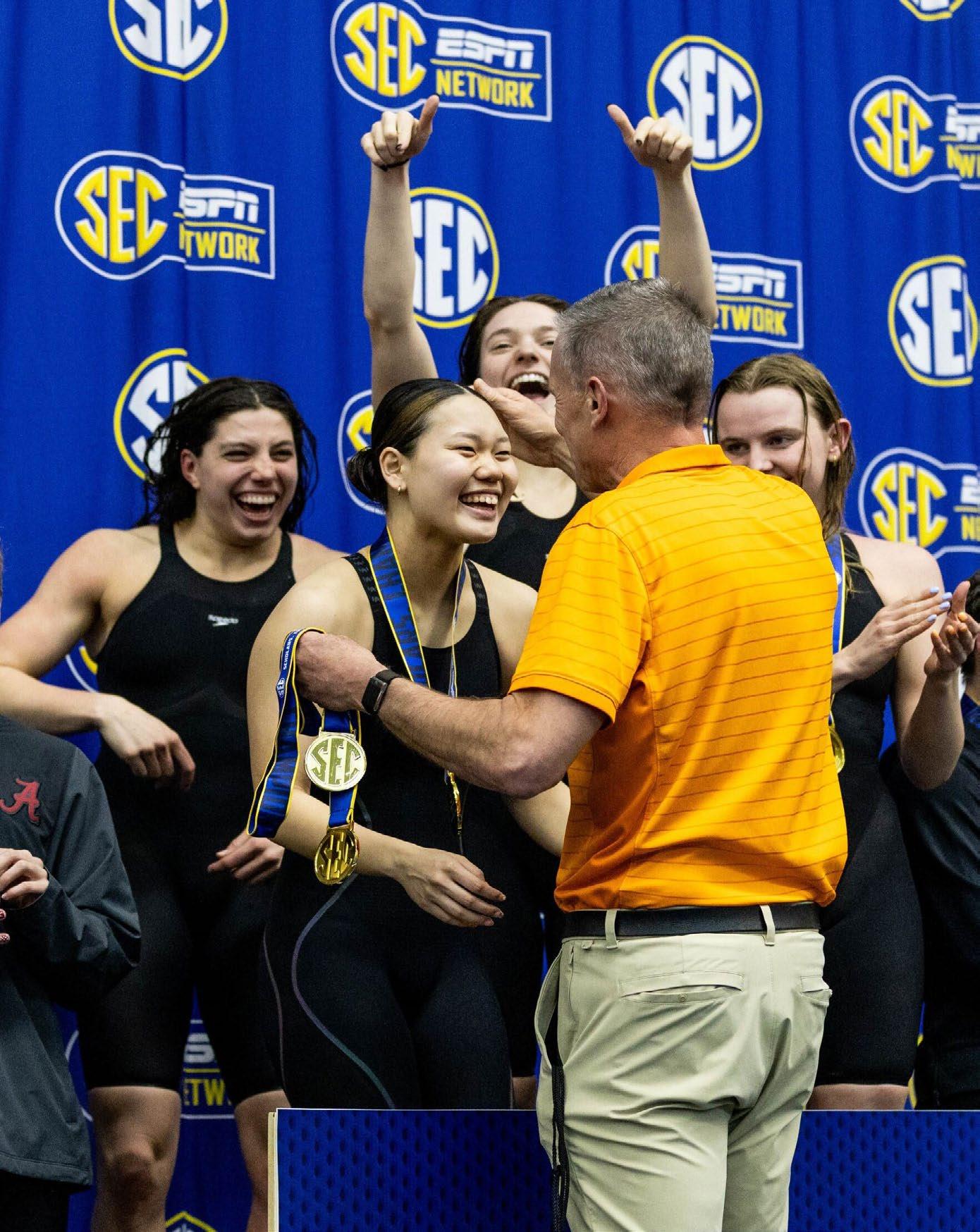
Tennessee swim and dive swimmers (left to right) McKenzie Siroky, Mizuki Hirai, Ella Jansen and Camille Spink celebrate with Tennessee head of swim and dive Matt Keidrich after winning gold in the Women’s 200 Medley Relay with a time of 1:32:80 on Day 2 of the SEC Swimming and Diving Championships at the Allan Jones Intercollegiate Aquatic Center. Tuesday, Feb. 17, 2026. Luke Goins / The Daily Beacon
rank fourth all-time in Tennessee’s record books.
Vols shone across the meet as well.
The men placed second in the 800-yard freestyle relay, with a stellar finish of 6:10.31. The team of Bujak-Upton, Nikoli Blackman, Nunziata and Ben Bricca made a refreshing statement in Knoxville.
Senior Martin Espernberger also had a fantastic final conference championship, as the senior experience shone through as he managed fourth in the 200-yard butterfly with a 1:40.42. Grayson Nye followed this performance up with a strong finish in the 100-yard breaststroke, coming out with a time of 53.31. Nunziata did not hold back in the event, either. The freshman managed both a lifetime best of 51.35 and a fourthplace finish.
Gui Caribe finished second in the 100yard butterfly with a 43.93, a new lifetime best for the senior. Caribe also earned a second-place slot in Tennessee’s top 10. Caribe also boded well in the 100-yard freestyle, coming out with a lifetime best in the event at 40.45 seconds. His trio of silver medals also featured an 18.49-second 50yard freestyle.
The men also had a slew of fantastic relays to finish off the meet. The quartet of Pedro Sansone, Blackman, Bujak-Upton and Caribe earned a bronze finish in the 400-yard freestyle relay.
The Vols will hit the water again on Friday, Feb. 27, at the aquatic center for the Last Chance Meet.
Tennessee press row will now have an empty chair as Wes Rucker, a sports reporter who spent over two decades covering Tennessee athletics, passed away at 43 years old on Feb. 19. His presence was as constant as the checkerboard end zones in Neyland Stadium, but now the space will feel noticeably empty.
Rucker spent over half of his life covering Tennessee Athletics, beginning in 2000 when he joined The Daily Beacon as a freshman at the University of Tennessee. He later became the assistant sports editor. At a university where sports shape the daily rhythms on campus, Rucker quickly found his place documenting the wins, losses and everything in between with class and consistency.
Cliff Hightower, managing editor at Johnson City Press, worked as the editor-in-chief for The Daily Beacon while Rucker held the position of assistant sports editor.
“He was a shrine for the Beacon,” Hightower said.
Hightower explained that Rucker became synonymous with sports journalism at Tennessee, with the selfconfidence to tackle any and every assignment with grace. He praised Rucker’s journalistic integrity and confidence in the field.
“He not only shared his journalism to the world, he shared himself,” Hightower said.
Rucker’s professionalism extended into the various outlets he contributed to throughout his career. In college, he contributed freelance reporting for The Farragut Press Enterprise, The Daily Times and The Chattanooga Times Free Press. After graduating in 2003, the Times Free Press hired Rucker full-time.
At the Times Free Press, Rucker covered a wide range of sports, including SEC football and basketball, Major League Baseball and even professional cycling. Covering SEC sports requires stamina and precision as seasons unfold. Those early years laid the foundation for what would be a 25-year tenure in Tennessee sports media.
Following his time in Chattanooga, Rucker returned to Knoxville to become a Vols beat writer for 247Sports, marking a full-circle moment as he returned to

the university where his career in sports journalism first began. Through his work with GoVols247, Rucker developed a loyal readership with Vols fans in addition to personal and professional relationships he developed with his colleagues.
Colleagues said that consistency defined Rucker’s career. Whether Tennessee won by double-digits or lost in heartbreaking fashion, Rucker approached each story with the same measured tone, never shying away from criticism while not over-sensationalizing his writing.
“Whenever he was in the room, you knew he was in the room for good reasons,” Grant Ramey, who worked with Rucker at 247Sports for six years between 2016 and 2022, said.
Ramey described how Rucker was known for his dedication to the field and confidence in his work.
“He started from scratch, and he built up this really big following that everybody knew,” Ramey said. “He was so consistent, and it started where he just kind of knew what he wanted to do.”
Over the years, Rucker involved himself in many areas of sports journalism, even hosting two radio shows for ESPN.
“The Wes Rucker Show” and “Swain & Rucker” aired across ESPN Radio

Knoxville, drawing hundreds of viewers from around the area. His voice, as calculated and intentional as his writing, became just as recognizable as his byline.
In August 2025, Rucker joined the team at WBIR as a multi-faceted journalist, where he continued to cover games for Tennessee athletics and eventually launched his own streaming show, “10 at 3 with Wes Rucker” in November 2025. The move to television allowed him to reach an even broader audience with his analysis, becoming accessible for viewers all across East Tennessee.
The show became widely popular, with one review on Apple Podcasts describing it as having “a unique eye into the world of Tennessee sports, but delivering it in an interesting way.” The show blended game breakdowns with behind-thescenes insight that reflected Rucker’s breadth of knowledge he’d acquired over the previous two decades.
“He always did it his way,” Bill Martin, the associate athletics director of strategic communications for Tennessee athletics, said. “His columns were thoughtful, and he was always the very last person to leave the press box.”
Martin emphasized that Rucker’s work ethic stood out among other veteran reporters, noting that he rarely rushed to be first if it meant sacrificing accuracy.
Rucker’s influence extended past the relationships he had with his colleagues and into the lives of those he covered. In his press conference Friday morning, Tennessee basketball head coach Rick Barnes took a moment to acknowledge Rucker’s impact on the Tennessee Athletics community.
“He loved what he did, he loved his family and I’m just thankful that God allowed him to be a part of my life,” Barnes said.
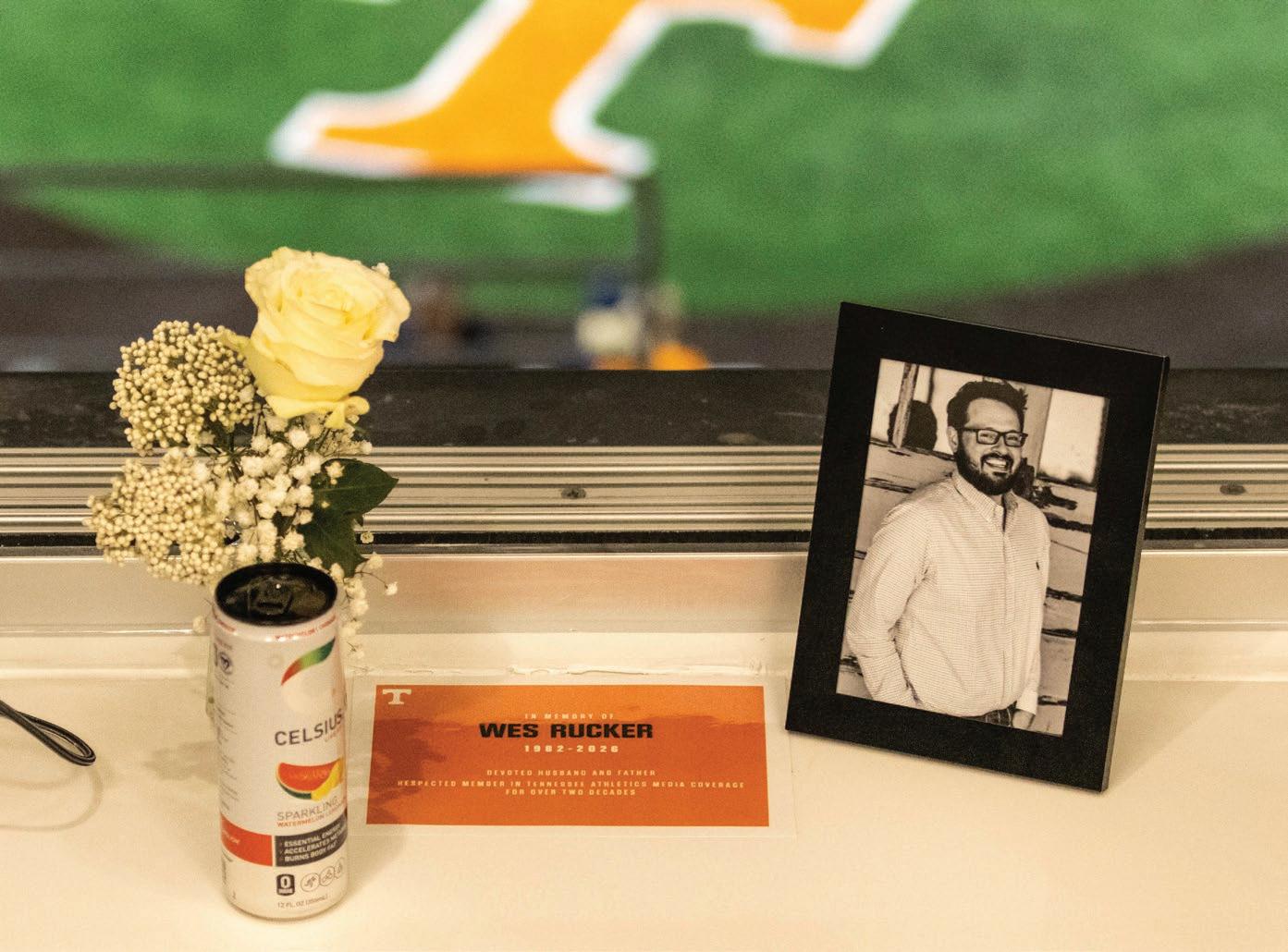
Friday evening, Vol baseball paid tribute to Rucker before their game against Kent State with a moment of silence before the first pitch. Additionally, Vol baseball posted a photo of flowers and a picture of Rucker at his seat in the press box overlooking Lindsey Nelson Stadium with the caption, “You’ll always have a spot waiting for you here at Lindsey Nelson.”
Following the game, head coach Josh Elander commented on Rucker’s passing by saying, “Wes has been a day one guy for us,” and “we’re going to miss seeing him here.” Elander then asked for thoughts and prayers for Rucker’s family. “That’s from everyone here at Tennessee baseball,” Elander said.
Across social media, former players, colleagues and fans shared memories and Rucker’s impact in an outpouring of love and grief following his passing, reflecting the reach of his work beyond the written page.
For all the hours spent dissecting Tennessee athletics, Hightower, Ramey and Martin conveyed how Rucker’s favorite moments happened away from stadium lights. More than Rucker would want to be remembered as a journalist, he would want to be remembered for his family life.
Martin described how Rucker would gush over his family, both online and in the press box.
“I think people connected with his persona and charisma on social media,” Martin said. “He just loved his family.” While Tennessee athletics demanded late nights and weekends, Rucker’s family remained at the center of his being. After games, he would speak about getting home to his wife and son, Hank.
“Ultimately, I think that people will remember him for being a loving father and a loving husband,” Hightower said.
Rucker is survived by his wife, Lauren, and son, Hank. The family is expecting a daughter in May.