THE UTS ALUMNI MAGAZINE
SPRING 2026
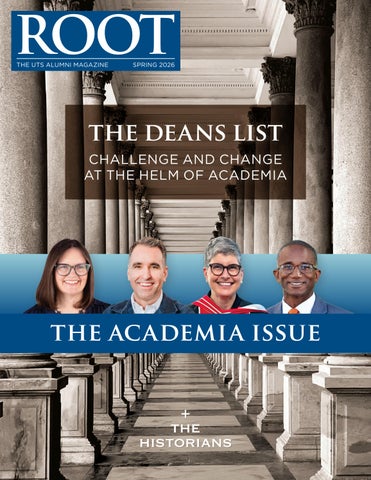
the deans list CHALLENGE AND CHANGE AT THE HELM OF ACADEMIA
the academia issue + the historians
PRESIDENT’S REPORT
Avanti Ramachandran ʼ09 PRESIDENT, UTSAA
US
M
UNIVER SI
LU VE
T
TORON OF TO
LS HOO SC
TY
AR RA BOR ITA
Commitment and Community Carry Us Forward If this past year has shown me anything, it’s that commitment and community aren’t just words we put on a banner – they’re things you can actually feel when UTS alumni get together. Our recent Alumni Reunion saw an incredible turnout, and it was encouraging to watch the community embrace the shift to a daytime gathering at the school. That energy has carried forward: a return of the UTS on Bay Street networking event took place in early June and an inspiring entrepreneurship panel happened in April, both driven by the enthusiasm so many of you have shared for more opportunities to connect. Community works when there’s real commitment behind it – and that begins with us. In my fall message, I talked about being a genuine support system for our newest graduates, and about making sure all alumni feel a sense of belonging, not just those from a particular era or background. Delivering on that meant looking inward first. The UTS Alumni Association Board made a deliberate commitment to ensuring our leadership reflects the full breadth of the UTS community, and I’m proud to say we are now operating at full capacity. Our directors span from the Class of 1963 to 2013, with different generations, experiences and perspectives all pulling in the same direction. Now I’ll ask for yours. Not in any grand way – just by being part of the conversation. Our Board profiles will be live on the UTS website by the time this issue of The Root reaches you. I’d love for you to take a look, see who’s working on your behalf and reach out. Share an idea, suggest an event format or simply introduce yourself. We’re especially open to new ways of gathering that come from the community itself; if there’s something you want to see happen, we want to help make it real. Your ideas will only strengthen what is already a remarkably engaged community. More than 120 alumni volunteer their time, nearly 500 are donors and many more show up simply by bringing people together. That generosity extends in another important direction, too: ensuring this community remains open to everyone who belongs in it. As our fundraising priorities have shifted back to bursary, your support helps guarantee that the next generation can access the same UTS experience – and the same network – regardless of their financial circumstances. Commitment and community got us here. I’m confident they’ll carry us forward. ■
UNIVERSITY OF TORONTO SCHOOLS ALUMNI ASSOCIATION 371 Bloor Street West, Room 250 Toronto, Ontario M5S 2R7 Phone: 416-978-3919
UTSAA BOARD OF DIRECTORS PRESIDENT
PAST PRESIDENT
Avanti Ramachandran ’09
Aaron Dantowitz ’91
Avanti.Ramachandran@utschools.ca
Leanne.Foster@utschools.ca
VICE PRESIDENT
TREASURER
HONORARY VICE PRESIDENT
Aaron Chan ’94
Hana Dhanji ’05
Aaron.Chan@utschools.ca
LinkedIn: University of Toronto Schools
Hana.Dhanji@utschools.ca
Garry Kollins
GKollins@utschools.ca
SECRETARY
Geoffrey Hung ’93
Geoffrey.Hung@utschools.ca
Web: www.utschools.ca/alumni Instagram: @utschools
Dr. Leanne Foster
Aaron.Dantowitz@utschools.ca
E-mail: alumni@utschools.ca Facebook: www.fb.com/utschools
HONORARY PRESIDENT
DIRECTORS
Winnie Cheng ’11
Winnie.Cheng@utschools.ca
Isabella Chiu ’13
Isabella.Chiu@utschools.ca
Rose Dotten
Rose.Dotten@utschools.ca
David Grant ’72
David.Grant@utschools.ca
Ian Lee ’87, P ’27 Ian.Lee@utschools.ca
David Morgan ’63
David.Morgan@utschools.ca
Julia Pomerantz ’12
Julia.Pomerantz@utschools.ca
Lily Quan ’87
Lily.Quan@utschools.ca
Luke Stark ’02
Luke.Stark@utschools.ca
Tina Yuan ’12
Tina.Yuan@utschools.ca
Meg Proctor ’84
Meg.Proctor@utschools.ca
UTS acknowledges we are situated on the traditional territory of many Indigenous nations including the Anishnabeg peoples – the Mississaugas of the Credit, and the Chippewa – as well as the Haudenosaunee and the Wendat peoples, which is now home to many diverse First Nations, Inuit and Métis peoples. We also acknowledge that the land is covered by Treaty 13 with the Mississaugas of the Credit. We are grateful to honour this land through our dedication to learning and ongoing commitment to Truth and Reconciliation.
CONTENTS 8
13
Challenge and Change at the Helm of Academia, featuring Jennifer Andrews ’89, Lesleigh Cushing ’89, Kevin Davis ’87 and Chris Essert ’97
A Moment in Time featuring Michael Morgan ’97, Julia Torrie ’91, Catherine Ellis ’89, Andrea Freeman ’86, Timothy Brook ’69 and Adam Chapnick ’94
THE DEANS LIST
THE HISTORIANS
REGULAR FEATURES UTS Board Report . . 4
In School. . . . . . . . . . . . 6
Principal’s Report. . . 4
Alumni News. . . . . . . 20
Giving Back. . . . . . . . . 5
PUBLISHER
PHOTOGRAPHY
ON THE COVER
Martha Drake
Martha Drake, Kimberley Fehr, Emma Jenkin ’03, Dahlia Katz, Jennifer Kelly, Janet Williamson, Paul “Harv” Wright ’70.
Lesleigh Cushing ’89, provost and dean of the faculty at Colgate University; Chris Essert ’97, dean of the University of Toronto’s Henry N.R. Jackman Faculty of Law; Jennifer Andrews ’89, dean of the Faculty of Arts and Social Sciences at Dalhousie University (photo by Genevieve MacIntyre/Dalhousie University); and Kevin Davis ’87, former vice dean for global affairs at New York University (photo: Rosinei Coutinho/STF).
MANAGING EDITOR AND STAFF WRITER
Kimberley Fehr PROOFREADERS
CONTRIBUTORS
David Haisell Meg Proctor ’84 DESIGN
PageWave Graphics Inc. PRINTER
Colour Systems Inc.
Peter Buzzi ’77, Garth Chalmers, Martha Drake, Dr. Leanne Foster, Avanti Ramachandran ’09, Matt Semansky.
ABOVE
Four UTS Foundation students learned about leading with empathy at the Canadian Accredited Independent Schools (CAIS) Middle School Leadership Conference in Calgary, Alberta this May, which included a day trip to Banff. PHOTO: Jennifer Kelly
Published spring and fall, The Root is available to all alumni, parents and friends of UTS. The Root is also available at: www.utschools.ca/root. Contact us at alumni@utschools.ca or 416-978-3919 to update your address or to receive your copy electronically.
UTS BOARD REPORT
Peter Buzzi ’77
Board Chair, UTS
PRINCIPAL’S REPORT
Dr. Leanne Foster Principal, UTS
4
THE ROOT | SPRING 2026
We are better together. A year after UTS officially became accredited through Canadian Accredited Independent Schools (CAIS), the impact is resonating through our school in tangible, transformative ways. Our CAIS membership connects us to a network that is uniquely Canadian: a shared commitment to continuous learning that puts UTS in a league alongside nearly 100 junior, middle and senior schools in our country. Although each CAIS school has its own unique history and mission, we work towards the same goal: creating the best future for our students. And we grapple with similar challenges, including how to create meaningful, effective education in the age of artificial intelligence. Through CAIS, we’ve articulated our commitment to continuous improvement. We’ve become more accountable, not just to ourselves but to 12 Canada-wide standards for independent schools that include aspects such as governance, leadership, teaching, facility management and more. We’re evaluating our progress through continuous reflection, data collection, evolution and improvement. Throughout this process, the UTS Strategic Plan lights our way. CAIS gives us an invaluable window into other independent schools. Every year, Principal Dr. Leanne Foster and I have the opportunity to attend the annual CAIS Heads and Chairs Conference and talk with our peers about the issues inherent in leading a school. Principal Foster, members of the UTS Senior Leadership Team and I have participated on peer review teams to evaluate CAIS schools across the country. From this process, we see first-hand the possibilities of what it means to be an independent school in Canada, while enhancing our understanding of best practices and new ideas that we can bring home to UTS. UTS also has a personal CAIS connection – our school’s former head of academics Anand Mahadevan has been the executive director of CAIS since 2022, guiding the organization forward in these times of rapid change. That is one more reason why we are extremely proud to be part of the CAIS community, working in tandem with schools across the country to enhance our collective excellence. ■ Throughout its history, University of Toronto Schools has met every challenge with determination, creativity, thoughtfulness and an ability to reimagine itself to meet changing times. This resilience is in our DNA. Only four years after UTS began as a University of Toronto lab school for boys in 1910, over 400 of our students and staff went to war. Two decades later, nearly 1,000 UTS community members fought in World War II. Despite the impact of the wars on their education, our students become some of the most illustrious leaders of their times. When times changed as women’s equality came to the forefront, our school changed too, and in September 1973, girls joined UTS for the first time. We lost funding. Tuition increased by almost 80 per cent from 1993 to 1995 after the Ontario government removed our funding as a public laboratory school, and yet we endured. We forged a new identity as an independent not-for-profit school and U of T affiliate in 2004, no longer part of the Ontario Institute for Studies in Education, and were told to prepare for the end of financial support from U of T by 2010. In the face of this existential threat, we came together to demonstrate the school’s immeasurable value and in 2015 signed a 50-year affiliation agreement with U of T. Through the generosity of our community to the Building the Future campaign, UTS secured our future. Change kept coming. During construction, the school relocated to 30 Humbert. We faced a pandemic and adapted to remote school. And we came home to a renewed school building with a goal to make UTS a place where all members of our community feel that they belong. In our history, change has been our constant, making us more certain of who we are and who we can become. Now, with the proliferation of generative artificial intelligence, we are taking the best of what we are and moving forward with purpose and intention. With excellence as our ethos and resilience in our DNA, we rise to meet the challenges of our ever‑changing world. ■
GIVING BACK: A TWO-MAN MISSION FOR YOUNG ALUMNI ENGAGEMENT! Ashwin Krishan ’24 and Hugo Ip ’24 are on a two-man mission, and they are inviting their UTS peers to join them! Ashwin and Hugo are best friends because of UTS. Like other UTS alumni of their cohort, this inseparable duo is quick to advocate for the school and volunteer their time. They are proud donors to UTS and regular attendees at UTS alumni and donor events. What inspired these two young alumni to make the early leap into the community of UTS supporters when most young graduates need time and space to move forward before looking back? Both share that their UTS experience was formative. Hugo recalls how the Class of 2024 lived through significant disruptors including the COVID-19 pandemic, the move to 30 Humbert and back to 371 Bloor, and the advent of artificial intelligence which upended assessment protocols for academic work. Some students might have become disenfranchised, but Ashwin and Hugo embraced their beloved UTS community more closely. Ashwin became deeply involved in the life of the school as a student. Whether on stage performing in a music ensemble or behind a camera bringing a fresh vision to how SHOW was documented, his creative energy and sense of initiative defined his time at UTS. Ashwin gives back today because of “the culture of collaboration, the friendships built across years of shared experiences and the feeling that you were part of something that actually mattered.” Mentorship is a driving theme for Hugo, who was deeply engaged in the UTS Music program, taking on several leadership positions, including producer of Nocturne and principal bassist in the Orchestra. Hugo shares his gratitude for the mentorship that he received as a UTS student, with his passion for teaching, supporting and building up others in the UTS community. When observing Ashwin and Hugo in action at our school, whether at Stage II Admissions Interviews, alumni and donor events or in the hallways of UTS where they come back to visit staff and students, another motivation for their generosity is obvious – the simple joy they experience being part of our community! Today, their mission is to encourage other Grads of the Last Decade (GOLD) to join them as advocates, volunteers and donors and share that sense of belonging, community and joy. Ashwin and Hugo are living proof you don’t have to wait decades to make a difference. By transforming their gratitude into action, they are paving the way for a new generation of GOLD alumni to stay connected, give back and keep the vibrant UTS legacy alive. You are invited to join them on their mission – you’re never too young to start giving back!
Martha Drake
Executive Director, Advancement
Ashwin Krishan ’24 and Hugo Ip ’24.
THE UTS ALUMNI MAGAZINE
5
IN SCHOOL
As the M3 (grade 9) Drama students improvised a story, the scene materialized on the big screen before their eyes, magically transforming with every word they spoke. They were on a field trip to the University of Toronto’s BMO Lab for Creative Research in the Arts, Performance, Emerging Technologies and AI, playing with Voice Scroll, a generative AI large language model developed by BMO Lab Director David Rokeby. UTS teachers Melissa Shaddick, Dr. Christine Balt and Gabrielle Kemeny used the interdisciplinary workshop to teach students about AI. “Students were realizing this thing isn’t a magic box. It’s trained on data and it struggles sometimes,” says Christine, who used the lesson to study AI literacy as well as AI and creativity in her role as the research and innovation associate at the Eureka! Research Institute at UTS, with its Director Dr. Kim MacKinnon. The Drama teachers shared the experience with UTS staff at a noon‑hour talk.
“Even though we know these people for only 10 minutes, in the drumming circle it felt like we knew each other forever,” said Bayview Glen grade 8 student Anita, after the drumming workshop at the largest-ever Brilliancy and Resiliency Conference, organized by the UTS Black Equity Committee. This was one of many transformative learning experiences at the gathering, attended by 166 Black students from grades 7 to 12 who are part of the Black Students Affinity Network, a member-led initiative for the Conference of Independent Schools of Ontario community. From Socacize fitness to headwrapping and sustainable materials to sneaker culture and much more, the event celebrated the wide range of cultures and identities in the Black diaspora, wrapping up with a keynote from Justice Donald McLeod, co-founder of the 100 Strong Foundation, and his son Caleb, a U of T student. As one of a few Black students at her school, Anita says, “This conference shows me that I’m not alone.”
6
THE ROOT | SPRING 2026
Clean drinking water is a challenge in remote Alaskan Indigenous communities, where water can cost US$50 for 1,000 gallons. At this year’s Global Ideas Institute, the UTS team – S5s (grade 11s) Katerina, Xuezhen, Eriko, Catherine, Alexandra and Rhiya pitched their solution: Local Infrastructure and Network for Knowledge (LINK) Kits that make it easy for Alaskan communities and people to test the water themselves, and connect them with support to address water quality issues. Their idea was one of 37 solutions to the world’s water woes presented in April by teams from across the Greater Toronto Area and beyond at the Institute’s Final Symposium. Offered by University of Toronto’s Munk School of Global Affairs and Public Policy in partnership with UTS, the Institute is a seven-month program that partners teams with Munk student mentors and provides learning from university instructors to help students create solutions to the major issues facing our world.
In School
PHOTO: Janet Williamson
S5 (grade 11) Edlyn and her sibling Nico built an AI-detection tool in a month, after Nico’s friend was wrongly accused of using AI by a teacher. Their tool, Aidify, is a Chrome extension that tracks student activity in Google Docs, helping teachers verify authenticity of the work. After raising $18,000 in pitch competitions, they pitched Aidify on Dragon’s Den in January asking for $10,000 for 50 per cent equity. All five dragons went all in – offering a total of $50,000 for 50 per cent. “We see the future of Canada in front of us right now,” said Dragon Wes Hall. UTS helped support Aidify’s development with Dr. Jennifer Pitt-Lainsbury, vice principal of academic operations, giving Edlyn the green light to reach out to her M3 (grade 9) teachers who piloted the app and provided vital feedback. “Dragon’s Den was really surreal,” said Edlyn. “We applied, sort of on a whim, to see where it would take us. We didn’t expect it to become this big.”
When Stacey Kay, a Juno Award-winning and Canada’s Got Talent musician, was younger, industry executives told her she needed to change her appearance and stop rapping to succeed. She did and became miserable until she realized she had a different option: “I can continue being my 100 per cent authentic self.” At the UTS Day of Pink assembly in April, Stacey, who is married to UTS Teacher Mark Laidman, showed us what it means to stand in solidarity with the 2SLGBTQ+ community, and to be our authentic selves, through her incredible performance. After her keynote, the UTS community came together, led by the Day of Pink Committee and Teacher Chris Walasek, to provide 24 different workshops for students to learn about 2SLGBTQ+ experiences. As always, it ended with a pizza celebration, in pink!
This year, the UTS Senior Arts Trip took place in London, U.K. In typical UTS fashion our Drama, Interdisciplinary Arts, Music and Visual Arts students packed it all in, immersing themselves in some of the most significant artistic and cultural institutions in the world: the British Museum, Tate Britain, London Symphony, Royal Opera House and much more. “The UTS London trip gave me the opportunity to experience performances and places that I likely would never have seen otherwise,” says Jacob, a Drama student. After seeing the musical Cabaret at the Kit Kat Club, he raved: “The immersive layout and unforgettable performance made it unlike anything I had experienced before, and it was something I kept thinking about long after we left the theatre.” Experiences like these can last a lifetime!
For more UTS news and views, check out our website at utschools.ca.
THE UTS ALUMNI MAGAZINE
7
THE DEANS LIST
UTS
By Matt Semansky
Challenge and Change at the Helm of Academia
graduates share a proud history of paying education forward. Over the decades, many of the school’s alumni have gone on to assume important leadership roles in the postsecondary education sector. As deans, provosts, department heads and more, these grads shape the way students learn at universities and colleges across North America and around the world. Talk to a UTS alum currently serving in one of these positions and you will invariably discover a passion for the venerable mission of higher education: to develop open-minded critical thinkers who can analyze and apply knowledge to solve a wide variety of problems. “I love this job,” says Jennifer Andrews ’89, dean of the Faculty of Arts and Social Sciences at Dalhousie University in Halifax, Nova Scotia. “And part of the reason I do it is because I get to sit with these really smart undergraduates, watch them do these presentations and learn about things I wouldn’t otherwise know. “At the end of it, I’m probably a better person, a better teacher, a better researcher, for having had that exposure.” Jennifer’s former classmate Lesleigh Cushing ’89, provost and dean of the faculty at Colgate University in Hamilton, New York, agrees that building strong young minds is both the central purpose of her role and one of its best perks. “Our job is to show [students] something in the world that they’ve never thought about and why it’s relevant, why it’s meaningful and why it might be a lens for thinking about other things,” she says. “That sense of sparking curiosity and an invitation to new ways of thinking is really, really exciting.” For all of this excitement, however, contemporary academic leadership also comes with a host of challenges. Artificial intelligence is changing the way course material is both learned and taught, impacting everything from ethics to student evaluation. Current students have grown up almost entirely in a world of mobile phones and social media, their technological savvy counterbalanced by diminished attention spans. Beyond the constant churn of tech innovation, higher learning leaders also face financial and political pressures that affect pedagogy, research and even institutional values. In a rapidly shifting world, the job of deans and other senior postsecondary leadership has never been more complex.
“ I’m not convinced that AI actually is an excellent writer. I think it’s a middling writer that folks can use for a kind of middling essay or assignment.”
PHOTO: Danny Abriel/Dalhousie University
PHOTO: Danny Abriel/Dalhousie University
– JENNIFER ANDREWS ’89
For Chris Essert ’97, who assumed his role as dean of the University of Toronto’s Henry N.R. Jackman Faculty of Law in February 2026, tackling this complexity means, at the high level, keeping things simple. “Post-secondary education viewed in its best light is fundamentally an exercise in teaching people how to think about the world,” Chris says. “If we keep our eye on the core mission, there’s some sense that we already know what to do.”
AI AND OTHER TECH TRIALS As it is in virtually every aspect of society, artificial intelligence is a hot topic in the higher education sector. Academic leaders are pondering the pros and cons of AI technology for students and faculty, while AI evolves at a breakneck pace. “AI is front and centre,” says Jennifer. “We need to educate students to understand that AI is a tool, not an answer, and that they need to actually engage with the tool in a critical way.” Kevin Davis ’87, Beller Family professor of business law and faculty director of the Hauser Global Law School at New York University (NYU) as well as former vice dean for global affairs at NYU from 2012 to 2017, sees both benefits and drawbacks to AI adoption.
“One optimistic idea is that it can radically enhance access to legal services for the middle class, which is something that would be sorely needed in both Canada and the U.S.,” Kevin says. “What I think about a lot are the implications for pedagogy. When do we restrict access to new technologies? And once we allow access, how do we train people? What do we have to do differently in the classroom?” According to Lesleigh, Colgate professors are adapting evaluation methods to ensure that students genuinely understand the material they submit for grading. There is more emphasis on oral presentation, with students asked to discuss their essays with faculty or classmates in a conversational environment. In a world where answers can be just a short prompt away, this can remind young scholars that the process is as important, if not more so, than the correct result. “Your prof actually already knows the answer,” she says. “But if you can’t explain what you’ve written, it’s a pretty good indicator that you didn’t write it. “Assignment design has changed radically. I think the straight-up, boring paper, where you just go find some answers and put them together, is over.”
LEFT: Jennifer Andrews ’89, dean of the Faculty of Arts and Social Sciences at Dalhousie University, presents a degree to a new graduate at Convocation 2025. RIGHT: Jennifer Andrews celebrates a milestone moment with James Dixon, the first Dalhousie grad with a major in Black and African diaspora studies to cross the Convocation stage, and Dr. Isaac Saney, coordinator of the Black and African diaspora studies program at Dalhousie.
THE UTS ALUMNI MAGAZINE
9
– Lesleigh Cushing ’89
As provost and dean of the faculty at Colgate University, Lesleigh Cushing ’89 welcomed first-year students at Arrival Day in August 2022.
10
To Chris, students using AI to cheat is simply a new technological twist on a longstanding problem. “As long as there’s been academics, people have always found ways to submit work that they didn’t do themselves,” he says. “When I was in school, you’d see a sketchy handwritten note on a lamppost and call somebody and meet them in a darkened alley to get them to write an essay for you. Now you just have to ask your computer to do it. And I think the temptation for students is really hard to resist.” Especially when young people view AI assistance as the norm. “The generations that are in high school and going into undergrad now are having a harder time even seeing it as cheating,” Chris says. “For them it’s no different than Googling something.” Academic leaders interviewed for this story were quick to clarify that they don’t believe AI-aided cheating has reached epidemic levels. Lesleigh says many Colgate students steer clear of large language model (LLM) applications altogether to avoid even the appearance of misconduct. Furthermore, there is a caveat emptor aspect of relying too heavily on AI, which can promise quickness but not quality. “I’m not convinced that AI actually is an excellent writer,” says Jennifer. “I think it’s a middling writer that folks can use for a kind of middling essay or assignment.” Students who use it as a crutch are compromising their own educational experience, says Chris. “The accurate metaphor here is taking a forklift to the gym and getting the forklift to lift the weights for you.” Another, more established technological hindrance to the exercise of intellectual muscles is
THE ROOT | SPRING 2026
PHOTO: Mark DiOrio/Colgate University
“ Our job is to show [students] something in the world that they’ve never thought about and why it’s relevant, why it’s meaningful and why it might be a lens for thinking about other things.”
widespread social media and phone dependency. Professors must now compete for the attention of students distracted by the devices in their hands. Lesleigh says Colgate is addressing this issue head-on. In the 2025-26 academic year, professors formed a reading group to study the effects of social media on the brain and how they can be mitigated through course and assignment design. First-year seminar classes have also focused on attention and deep, thoughtful reading. “We’ve had a lot of campus-wide conversations about close reading or deep attention,” says Lesleigh. “And I think it’s really trickling down into how people are thinking about their teaching.” Colgate is also considering more classes of longer duration, where reading is accompanied by group discussion. “You’re fostering not just the habits of mind that come with deep reading, but also creating these distraction-free environments that allow an almost monastic way of thinking about text.” Chris, meanwhile, says the particulars of legal education partially insulate his faculty from this problem. “The model of legal education is far less about delivery of information from the front of the room. We have a really interactive educational program where, right from the jump, students are being asked to at least metaphorically be on their feet and answer questions in class.” Regardless of the impact of AI and social media in the classroom, legal scholars like Chris and Kevin say the big questions resonate beyond the confines of higher learning. “Obviously, the question everyone is worried about is: what will this do for the demand for legal services and for lawyers?” says Kevin, who recalls leading a reading group on AI and law a decade
MONEY, POLITICS AND EDUCATION Although many people would consider her to be a member of Dalhousie’s senior leadership team, Jennifer sees the day-to-day of being a dean a little differently. “I describe it as managing up and managing down. You have a responsibility to your faculty, staff and students, but you also have to think about the university. It’s a pretty serious balancing act.” Part of that balance involves navigating budget constraints. For public institutions like Dalhousie, those pressures can be eased or exacerbated based on who holds the reins of government. “What we know in Canada is that universities are struggling, that there’ve been cuts to budgets all across the country,” she says. “Those pragmatic things come to weigh on you as an administrator, because you have to make those difficult decisions around how you’re going to allocate your resources.” Along with cuts in government funding, Canadian universities have had to contend with a cap on international students in recent years. According to an April 2026 article in Inside Higher Ed, the number of new international study visas issued to students to matriculate in Canada dropped by close to 90 per cent between September 2023 and September 2025. This decrease has further cut into an important revenue stream for post-secondary institutions, as international students typically pay higher tuition costs.
Philanthropy, such as the endowment from University of Toronto and UTS alumnus Henry “Hal” Jackman, OC, OOnt ’50, which funds the Faculty of Law where Chris works, can offset some of the impact. “It’s transformative in terms of the way it allows us to be much more agile and to think big thoughts about how things are going to be in the future,” says Chris. Kevin, whose Hauser Global Law School program is also funded through an endowment, echoes the sentiment. The gift, he says, allows his school to welcome faculty, research fellows and students from outside the U.S. But even with the backing of philanthropy, he sees the effects of an American government that is less inclined to support higher learning than it was in the past. “Here in the U.S., they’ve put caps on student loan funding, or the availability of government support for student loans,” Kevin says. “And for me, the number one concern is restrictions on travel and entry to the country for students and scholars – that the government’s action on the immigration front will just make it impossible or significantly more difficult for us to do what we want to do.” Like NYU, Colgate also relies significantly on tuition. In America, where demographic trends have led to a reduced pool of university-aged potential students – and increased competition – enrollment presents yet another financial challenge. “The number of students in total is getting smaller, and the number of students whose families can afford to pay a considerable amount of tuition, if not the full amount, is diminishing,” Lesleigh says. “So we are in an incredibly competitive market for students.”
PHOTO: Rosinei Coutinho/STF
ago in which students expressed deep concern for future job prospects. But I know for a fact, we’ve been worrying about that for 10 years now.”
Kevin Davis ’87, former vice dean for global affairs at New York University, presented at Brazil’s Supreme Federal Court on a book project he co-edited called Legal Heterodoxy in the Global South.
“ One optimistic idea is that [AI] can radically enhance access to legal services for the middle class, which is something that would be sorely needed in both Canada and the U.S.” – Kevin Davis ’87
THE UTS ALUMNI MAGAZINE
11
“ The fundamental mission of my faculty – research, teaching, training leaders and lawyers for the future – I find that an absolutely thrilling thing to be thinking about.” – CHRIS ESSERT ’97 Chris Essert ’97, dean of the University of Toronto’s Henry N.R. Jackman Faculty of Law, pictured outside the faculty’s historic Flavelle House, built in 1902.
All of this is to say nothing of the other ways that politics can infiltrate the higher education space. More than any time in recent memory, governments on both sides of the border are tying support to ideological litmus tests. “When we advertise for tenure stream jobs, faculty who are already tenured at universities in the South are now showing up in our pools,” Lesleigh says. “They are interested in places where governments aren’t deciding what they can teach or not.” Jennifer feels an important part of her job is to resist the pushback against institutional values like equity, diversity and inclusion, even in the face of political pressure. “Alberta’s a good example of that, where they’re banning books. The government is actively engaging in that,” she says. “One of the things that we’ve really focused on in my faculty is holding onto those EDI values and principles and making them front and centre.”
HOPE FOR THE FUTURE Being a university dean means being inundated by a wide array of issues, from the pedagogical to the financial to the administrative. It’s not a job for the faint of heart. 12
THE ROOT | SPRING 2026
And the UTS alumni who currently occupy these roles wouldn’t have it any other way. “At a moment in time when the world is blowing up, literally, it makes the work of the university even more significant,” says Jennifer. “It becomes even more critical for people to do that kind of world-class research, to be engaged in these really difficult and important questions and these public conversations, and not to shy away from those things. “As a dean, I think a lot of what you have to do is say, ‘Okay, I’m going to get enjoyment from helping other people.’ And when you can say to somebody, ‘I think I can swing this for you, or I can get you that resource that you really need,’ it’s really rewarding.” In the context of this increasingly complex world, Kevin sees a heightened role for the global-minded approach to law espoused by his school. “There is now, more than ever, a need for international exchange and collaboration and dialogue around law,” he says. “From my perspective, it’s obvious that the world is extremely interdependent, and I think that’s being demonstrated every day through the headlines.” To Chris, it all comes back to the core purpose of legal education. “The fundamental mission of my faculty – research, teaching, training leaders and lawyers for the future – I find that an absolutely thrilling thing to be thinking about. And what excites me is just to see where we’re going to be able to take that over the next few years and beyond.” For Lesleigh, the different hats she gets to wear, and the unexpected problems that arise, are a plus, not a detriment. “No day is the same as another day. Meeting to meeting, the kinds of demands are just totally different,” she says, adding that the collegial meeting of minds with her peers – including the weekly salon-style chats she organizes to discuss specific topics – keeps her job interesting and invigorating. That, and the curious minds of her students, give her hope that the future of higher education, for all the perils it faces, remains bright. “There is just a kind of recognition on our campus that we can’t get anywhere if we can’t do dialogue and discourse better than we have. And the big question is, how to then scale that up to national and international levels? “But you start with the 3,000 students you have and hope that it makes a difference.” ■
the historians a moment in time By Kimberley Fehr
T
he fall of the Ming dynasty in 17th century China. The scorched earth policy invoked against the Iroquois Confederacy in the American Revolutionary War by President George Washington: “Ruin their crops on the ground.” The day East Berlin citizens broke through the wall. The toppling of the Egerton Ryerson statue at Toronto Metropolitan University on June 5, 2021 after suspected unmarked graves of Indigenous children were detected on the site of a former residential school in Kamloops, B.C. These are times when undeniable change has come – visceral moments in history that are core to the work of UTS alumni who are historians. But history is more than a moment in time. Whether written in stone, scratched on parchment paper or whispered on the wind, our understanding of the past takes root in the context. UTS historians seek truth in nuances and untold stories, and find discovery on the cutting edge of history. While they study the past, what they learn
gives insight into the complex global challenges and political uncertainties facing our world today. Michael Morgan ’97 arrived at Yale University for his doctorate in 2002, as once-secret Cold War documents were being declassified and historians were rushing to study them. International diplomacy, security, borders and human rights became the basis of his thesis, and his book, The Final Act: The Helsinki Accords and the Transformation of the Cold War, which received the 2018 Edgar S. Furniss Award for best first book in international security. “The Helsinki Accords, signed in 1975, arose from the most ambitious set of diplomatic negotiations of the entire Cold War, involving 35 countries, and hundreds of diplomats and officials,” says Mike, a history professor at the University of North Carolina at Chapel Hill. “They provided a blueprint for building a post‑Cold War world, laying down principles that proved influential in bringing the Cold War to an end and establishing a new international order.”
THE UTS ALUMNI MAGAZINE
13
Photo: Jan Prosiński
Michael Morgan ’97, a history professor at the University of North Carolina at Chapel Hill, delivers the keynote at the 13th European Remembrance Symposium and International Conference in Helsinki on the 50th Anniversary of the signing of the Helsinki Accords.
14
The leaders who signed the non-binding agreement committed not to use force to change frontiers or intervene in each other’s domestic affairs. They also acknowledged fundamental human rights and agreed to promote the freer movement of people and information. The mutual acceptance of these ideals proved to be a watershed moment that helped end the Cold War 15 years later. Mike’s book paints the picture of this diplomatic saga, which began in the 1960s, from a multitude of perspectives. His research took him to Ottawa, Washington, London, Paris, Brussels, Berlin and Florence. He interviewed retired Canadian, U.S., British, French, Irish and Soviet diplomats. In Paris, he made friends with archivists at the French foreign ministry, becoming one of the first people to see newly declassified documents. The Helsinki Accords are a testament to the power of diplomacy, proof the world can come together for the common good. They formed the basis of post-Cold War Europe, Mike says, adding, “Now with the war in Ukraine and many other changes in the last few years, there’s a lot of debate about whether this international order still survives.” In June 2025, Mike returned to Finlandia Hall where the Helsinki Accords were signed. As the keynote speaker at the 50th anniversary conference, his message was that things can change quickly. A few years before the Accords were
THE ROOT | SPRING 2026
signed, reaching an agreement seemed impossible; and yet nations found common ground, signed the Accords and made history. Amid the Harvard Library stacks, another young historian found her calling. While conducting doctoral research, Julia Torrie ’91 came across a series of Security Service documents from Nazi Germany about the state of the population and popular opinion during World War II. A report on a group of women protesting in the industrial town of Witten stood out. Not only did they return home in defiance of an evacuation order, but when they were denied ration cards, they staged a disruptive protest that led to the police being called. “These women demonstrated in the middle of the Third Reich, and didn’t get killed,” says Julia. “That seemed to make no sense. This was the Nazi Germany dictatorship. Why did the police not act?” The matter escalated to head of Reich propaganda Joseph Goebbels, who ordered local authorities to reverse the ration card decision and allowed these women to choose whether or not they evacuate. Julia’s analysis: The regime had a strong rationale for not upsetting the women who were privileged German nationals, married to skilled industrial workers. By supporting their husbands, feeding them and fuelling their coal stoves, the women helped the war effort. Julia’s dissertation became a book, For Their Own Good: Civilian Evacuations in Germany and France, published in 2010. “I am interested in questions of consent and how you get a population to obey in a situation where you might think, because it’s an authoritarian system, that there’s no question the population will obey,” says Julia, who is a history professor at St. Thomas University in Fredericton, N.B. “Regimes like the Nazi regime are incredibly dependent on popular opinion. They’re constantly trying to figure out what the population thinks, and they’re very, very concerned.” Rather than historical leaders and war strategy, Julia’s research drills down to the experiences of average people. Her second book, German Soldiers and the Occupation of France, 19401944, published in 2018, explores why citizens support authoritarian regimes. “Occupation is a form of violence,” says Julia, yet a stint in occupied France was viewed almost as a vacation for soldiers, a cushy post removed
At certain junctures, a society becomes ready for change. At TMU, Catherine served as history department chair for seven years and was a member of the university’s Board of Governors. But her most transformative role was co-chair of the Standing Strong Task Force to address the legacies of the university’s former namesake, Egerton Ryerson, alongside Joanne Dallaire, university Elder and senior advisor, Indigenous relations and Reconciliation. The Task Force worked during the pandemic and never met in person. Their innovative engagement process eschewed town halls, where the loudest voices dominate. Instead, community conversations were held without Task Force presence, to encourage candid, anonymous sharing. The Task Force targeted outreach to Indigenous and Black people and groups on campus. Their anonymous third-party form had space for people to identify as part of an equity-deserving group, so participation gaps could be addressed. Over two months, they received 12,000 submissions. “We kept hearing that the name Ryerson University was causing harm,” she says. Catherine applied the power of history to make history. She oversaw the Task Force’s historical research team, which created a timeline of the life and legacies of Egerton Ryerson, the founder of Ontario’s public education system. The colonial educational ecosystem in which Ryerson worked was based on systemic racism, sexism and white
Julia Torrie ’91 gave a presentation at a symposium on ‘Europe and Germany 1939-45: Violence in the Museum’ at the German Historical Museum (Deutsches Historisches Museum, DHM) in Berlin in March 2022.
PHOTO: ©DHM/David von Becker
from the frontlines. The Germans organized tours for their troops of Paris and the Eiffel Tower, and Mont St. Michel on the coast. Everywhere they went they took photos to send home, creating an effective public relations campaign for the masses. “People talk about bread and circuses, but that’s what it is,” she says. “You distract people from the terrible things they’re doing by offering them a full plate. You feed them good news and make sure that they’re being rewarded through tourist experiences and opportunities to buy things. They have a wonderful time and that augments support for the regime.” Julia’s current research focuses on the industrialization of frozen food – how fast-freezing technology enabled Germany to extract fish and other food from occupied territories like Norway. She connects these wartime endeavours to broader patterns of colonial exploitation. Her career took root at UTS, when she studied German in grade 11, only because her sister, Catherine Ellis ’89, took Spanish. When the Berlin Wall fell on November 9, 1989, Julia’s German exchange partner was staying with the Torrie family – and in 1990, during her exchange, Julia saw the broken wall firsthand. Her proficiency in German and other languages became integral to her career, securing her a role as a research assistant while still an undergrad. With both parents being teachers, the sisters grew up discussing history around the dinner table and touring historical sites, planting the seeds for their future careers. Catherine, an associate professor of history at Toronto Metropolitan University (TMU), specializes in post-war Britain, with a keen interest in the Labour Party’s pendulum popularity swings. “The Labour Party was elected in 1945 promising a new kind of Britain,” said Catherine. “And they were exceptional in completing virtually everything that they promised.” And yet, the Conservatives ousted them in 1951 and remained in power for the next 13 years. “Labour thought their strong electoral mandate meant British people wanted a socialist society,” says Catherine. “But it’s one thing to say you support broad democratic socialist ideas, and entirely something else to make it happen. Mechanical reforms take a government a long way, but if you don’t have the critical mass of the population on board, you won’t get buy-in, and more fundamental reforms won’t be successful or enduring.”
THE UTS ALUMNI MAGAZINE
15
Associate Professor of History Catherine Ellis ’89 served as co-chair of Toronto Metropolitan University’s Standing Strong Task Force, which worked to address the legacies of the university’s former namesake, Egerton Ryerson.
PHOTO: Alex Jacobs Blum/Toronto Metropolitan University
Sisters Julia Torrie and Catherine Ellis at the German castle of Burg Hohenzollern, the ancestral seat of the Prussian Royal House and the Hohenzollern princes.
supremacy, which also underpinned Canada’s residential school system for Indigenous children. The university’s Board of Governors approved all 22 Task Force recommendations. Changing the name to Toronto Metropolitan University and not reinstating the Egerton Ryerson statue were the most tangible, but the recommendations went far deeper to reflect the university’s values. “We’re thinking about seven generations, in Indigenous terms,” says Catherine. “This includes the changes that affect us now. But looking ahead, we’re thinking about where our community aspires to be in seven generations or more.” Change is an ongoing process, and Catherine carries the work forward through TMU’s Next Chapter initiatives. Another alumna employing the power of history to drive present day change is Andrea Freeman ’86, renowned for coining the term “food oppression.” Ruin Their Crops on the Ground: The Politics of Food in the United States, from the Trail of Tears to School Lunch is a heartbreaking manifesto calling for the reinvention of U.S. corporate and government food systems. Her book won the coveted Los Angeles Times Book Prize for History and the James Beard Award for Food Issues and Advocacy.
16
THE ROOT | SPRING 2026
From the titular quote, “Ruin their crops on the ground,” which came from George Washington’s 1779 order against the Haudenosaunee peoples during the Revolutionary War, Andrea, who is the second century chair professor of law at Southwestern Law School in Los Angeles, guides the reader through systemic racism that fuels inherent inequalities in food systems, from colonization and slavery through to current times. The book is both revelatory and deeply disturbing. Andrea chronicles the saga of ‘guv’ment’ cheese, the product of when the U.S. Department of Agriculture began purchasing surplus dairy to prop up farmers in the Great Depression, and converted the dairy to cheese for storage. In the 1980s, the government began distributing the cheese through programs in schools, Indigenous reservations and lower-income neighborhoods. They ceased funnelling the cheese to low-income neighborhoods and schools in the 1990s, but started again in 2016, even though, Black, Indigenous and Latine people, who use these programs at higher rates, tend to have an inability to digest milk, and face higher rates of dairy‑related health problems. “At the height of the pandemic, the government dumped more and more cheese at emergency food banks – the main source of food for many Black and brown people fighting off sickness and hunger,” she writes. Alongside this saga lies another travesty: milk became a symbol used by white supremacists, who celebrate their ability to digest it, and even include milk glass icons in their social media handles. Black, Indigenous and Latine people suffer from major food-related diseases at higher rates than white people and Andrea says that food law, policy and corporate influence are directly responsible for these disparities. “The hope was to make people aware of how systemic food oppression is and how food choices and nutritional health are circumscribed by government and corporations,” she says. “There’s so much individual blame in the culture around food and a sense of personal responsibility that is a real distraction from the truth, and very negative for people to take on. I hope the book helps people understand the breadth of the system that determines what we eat, and inspires them to speak out against it.” Researching this book over nearly two decades, Andrea uses writing to further her activism that began when she was a University of Toronto
history student. Her first book was Skimmed: Breastfeeding, Race, and Injustice and her next one will examine racial injustice and debt. For 15 years after university, she held a variety of jobs, from working in domestic violence shelters to the film industry to bookstores, before attending the University of California Berkeley School of Law. “UTS made me feel like I could accomplish a lot,” Andrea says. “My friends did incredible things and moved around the world, and that inspired me to go places. The community broadened my horizons.” Changes takes root in ideas. Ruin Their Crops on the Ground calls for the complete transformation of the U.S. food system, separating corporations from government programs. The book also calls for reparations – for corporations to channel profits into promoting health in the communities that have been harmed. That spirit of looking at the world, not as it is, but how it could be, drives UTS historians to uncover new truths in the stories we thought we knew. Even centuries after an event, facts can change and evolve with our understanding of the world. The 2023 book, The Price of Collapse: The Little Ice Age and the Fall of Ming China, by Timothy Brook ’69, told an illuminating story about the fall of the Ming Dynasty (1368 to 1644). An internationally renowned expert and professor emeritus of Chinese and world history at the University of British Columbia (UBC) in Vancouver, Timothy gathered price data on the Ming dynasty, looking to understand the lives of ordinary people. During pandemic lockdowns, he dove deep into grain prices printed in gazetteers, reports made by local officials, and found price hikes correlated to dips in precipitation and temperature during the Little Ice Age, with the extreme cold and drought of the final, most intense phase from 1629 to 1644 crippling agriculture. “The fall of the Ming Dynasty was seen as a failure of the leadership, bureaucracy and intellectual class, and in fact, wasn’t any of that,” said Timothy. “It was that there was not enough food, and not enough tax income for the government to operate. And so the Manchus moved in and took over the country.” He proved climate change brought an end to one of the most powerful, far-reaching dynasties in Chinese history. Throughout his distinguished career, Timothy aimed to understand China in a global context, authoring 15 books including the definitive Great State: China and the World, and
co-authoring and editing many more, as well as countless academic publications. With his book, Vermeer’s Hat: The Seventeenth Century and the Dawn of the Global World, winner of the Mark Lynton Prize, Timothy deepened our understanding of world history. By analyzing objects in six Johannes Vermeer paintings, he showed that globalization, thought to be a 20th century phenomenon, had 17th century roots. The presence of Chinese merchandise in these paintings reframed China as a major player, not merely a recipient of European commerce. How does a Canadian youth with no cultural ties to Asia, attending UTS in the sixties, become one of the world’s leading experts in Chinese history? It begins at the University of Toronto, where he discovered Buddhism, “a highly responsible, thoughtful orientation to the world.” Changing his major to Chinese studies, he learned Mandarin and Japanese. After his doctorate at Harvard in 1984, he taught at Toronto, Stanford and Oxford universities, before serving as UBC’s Republic of China Chair for 18 years. Among many honours and awards, he was named a corresponding fellow to the British Academy in 2022. His next book, to be published later this year, is John Selden’s Library of the World: Above
Andrea Freeman ’86 is the author of the book, Ruin Their Crops on the Ground: The Politics of Food in the United States, from the Trail of Tears to School Lunch, which won the 2025 James Beard Award for Food Issues and Advocacy and the Los Angeles Times Book Prize for History. Pictured with television producer/ host, food expert and author Padma Lakshmi, host of the James Beard awards ceremony.
THE UTS ALUMNI MAGAZINE
17
Through his research, Timothy Brook ’69, an internationally renowned expert and professor emeritus of Chinese and world history at the University of British Columbia, proved that climate change brought an end to China’s Ming Dynasty.
18
All Else, Liberty, on the 17th century English lawyer who amassed an astonishingly diverse collection of 8,000 rare manuscripts, printed books and Oriental, Greek, Arabic, Hebrew and Latin materials. An author as well, John Selden ended his books with “above all else, liberty.” “His idea of liberty wasn’t that you do whatever you want,” said Timothy. “It was to concede liberty to other people, as well as to take it for yourself – a very progressive orientation at the time. While the English civil war raged, he was a voice of tolerance and political calm.” Timothy is a man of the same mind. Now in his seventies and living in Victoria, B.C., he worries our world is returning to the “age of empires.” “It’s really unhealthy for empires to re-emerge,” he says. “The famous English historian, Eric Hobsbawm, labelled the 19th century the age of empires, and we thought that was over. In the
THE ROOT | SPRING 2026
21st Century, we’re back in the age of empires, I fear, with Russia, China and the U.S. seeking world domination.” For political historian Adam Chapnick ’94, the age of empires escalates demand for his expertise on Canadian foreign policy and Canada‑U.S. relations. A professor of defence studies at the Royal Canadian Military College and deputy director of education at Canadian Forces College, he teaches the equivalent of an MBA and executive MBA, with historic foreign policy and government strategy case studies providing present day context. “History teaches folks there’s much less new than people think,” Adam says. “Historians call it presentism – ‘We’ve never seen anything like this before!’ Quite often, actually, we have seen similar things before. History doesn’t repeat itself, but it rhymes. I try to draw attention to ‘Why do we do things this way right now? What brought us to this place?’ because when you have that context, you’re better able to empathize. And empathy is a critical character trait for leaders in any institution.” Adam is the co-author of the 2024 book Canada First, Not Canada Alone, a definitive history of Canadian foreign policy since the 1930s that uses case studies to show how cooperation with other states is essential for Canada to effectively safeguard its own interests. He’s also the author of nine other books, and over 50 academic essays and book chapters. Recently, Adam went to Ottawa to speak at a Rideau Club event sponsored by the Centre for International Governance Innovation, discussing a history of the Office of the National Security and Intelligence Advisor to the Prime Minister that he co-authored, and now he’s working on a short history of Canadian techniques to manage relations with the U.S. Since Canada-U.S. tensions escalated, the media keep calling from Canada and abroad. “When the prime minister spoke at Davos, I received several calls about the significance of his talk,” he says. “When the U.S. president called Canada the 51st state, they asked how we should respond to that, saying, ‘Is this normal? What does it mean?’” A regular interviewee in the Globe and Mail, Adam features in articles ranging from ‘Why Trump would regret making Canada a state’ and ‘Canada should craft its own national security policy’ to topics such as anti-landmine advocacy and the Israel-Gaza War. He co-authored an op‑ed, ‘Ottawa needs to nail the appointment
of next national security advisor,’ calling for an internal hire for the position. Adam’s love for history was inspired by UTS teacher Mike Gendron. As a student, he wanted to be a history teacher just like Mike, and then realized he could teach university instead. One of his most satisfying career moments came this year in one of his classes: “The 12 people together created a learning environment that you just don’t get every time... Because I’ve been doing this for long enough, I could see what was happening, live in that moment and really take in an incredible learning experience in the class.” Amid the Canadian-U.S. turmoil, Adam believes “calm and steady” is the best response. “That’s what we’ve used in the past where America hasn’t been as reliable as we’d like it to be and we’ve gotten through. Now, we’ve received a wake-up call that Canada as a country and Canadians as people have to be resilient.” We’ve been able to take resilience for granted, because for much of our history, we’ve had an American neighbour who supported us, he says. “Historians tend to take the long view. If you look back in 20 or 30 years, the odds are this period will have been awful, but it will just be one of many things that we’ve had to overcome.” As Canada attempts to secure its place in our changing world, teaching Canadian history and teaching it well is profoundly important, says Mike Morgan, who lives in the U.S. but remains proudly Canadian. “You can’t understand who you are unless you understand your history,” says Mike. “That’s true for a person, and a country. Understanding Canadian history has profound consequences for our national identity and democracy.” Early in his career, before his family moved to North Carolina, Mike landed his dream job as the inaugural Raymond Pryke Chair at U of T’s Trinity College, helping to launch the Trinity One program, innovative at the time for fostering critical thinking and leadership skills through small group discussion. Writing is also a fundamental premise of humanities education, he says. In the age of artificial intelligence, there lies a profound difference between information and understanding. “History is not just a list of dates. History is about trends, questions, problems, patterns and context, far bigger and deeper than just facts. Writing is thinking. With feedback from teachers, you develop a capacity not only to write, but to reason.”
“ Historians tend to take the long view. If you look back in 20 or 30 years, the odds are this period will have been awful, but it will just be one of many things that we’ve had to overcome.” – Adam Chapnick ’94
Mike’s work as a historian applies to the present day. Last year, he provided expert testimony to the Federal Government’s Hogue Commission on Foreign Interference, prompted by concerns of Chinese, Russian and other foreign interventions in Canadian elections. Power can be found by defining our shared norms and values, he says, like the Helsinki Accords did. “International affairs can change very quickly, for the worse and also for the better. Moving in a better direction requires visionary leadership, faith and confidence in one’s own fundamental values and principles. I hope that Canada, and Western countries more generally, recover their self-confidence and their belief that what they do matters.” In these times of complex global tensions and rapid-fire change, what we do matters more than ever. UTS alumni historians learn from the past so we can understand the present and shape the future. Their lives are dedicated to a quest for deeper truth that can create a better world. ■
Adam Chapnick ’94, pictured at the Canadian Forces College, was inspired by his teacher, Mike Gendron, to teach history which he now uses to teach defence studies and strategies to Canada’s military leaders.
THE UTS ALUMNI MAGAZINE
19
ALUMNI NEWS
Notes on the milestones and achievements in the lives of our alumni. There are plenty of ways to stay in touch! connect.utschools.ca alumni@utschools.ca @utschools @utschools University of Toronto Schools
// During the week of the historic coronation of King Charles III and Queen Camilla in May 2023, a group of five Class of 1989 UTS alumnae also celebrated their own landmark occasion together – their belated 50th birthdays – on a much smaller island. Their lives had taken them in different directions, so they met in the middle ground of the Azores in the Atlantic Ocean. In the spirit of the occasion, Ursula Holland, who flew to São Miguel from Berlin where she worked at the Embassy of Canada to Germany, presented everyone with King Charles commemorative tea towels, featuring his image in full scarlet military regalia. (She has since returned to Global Affairs Canada headquarters in Ottawa.) Neera (Panchmatia) Steinke arrived from Switzerland, bearing Swiss chocolate to the delight of her fellow travellers. She has lived there since 1999 and works as head of education and integration at Frauenzentrale Zug, a regional non-governmental organization. The rest came from Toronto. Stephanie Parkin manages a policy unit specializing in employment standards at the Ontario Ministry of Labour, Immigration, Training and Skills Development. “I can’t recall if I cringed or laughed uproariously at the tea towels… Likely both!” she says. Catherine (Torrie) Ellis, as a historian of modern Britain and a history professor at Toronto Metropolitan University, was in her element with the coronation (see more about her in ‘The Historians’ feature article on page 13). Molly McCarron is a director in the Strategic Policy Division at the Ontario Ministry of the Solicitor General and a writer. “Our trip to the Azores felt magical, especially as we were still coming out of a few low-travel COVID years,” says Molly. “We’d never all travelled together, but somehow, meeting on tiny, wind-swept islands in the Atlantic, the years and the distance receded into the background and we were laughing like we’d all just been together yesterday.” The trip also proved creatively fruitful. Molly wrote a Queen’s Quarterly piece called ‘Homecoming: São Miguel, Azores, Portugal’ about how many émigré Azoreans returned home for the Senhor Santo Cristo dos Milagres religious festival. Catherine contributed a chapter ‘Carlos III e Camila: Notes from a Very Small Island’ for a book called Mass Observing the Coronation of Charles III: Monarchy about the experience seeing the coronation with her UTS friends from the distant vantage of the Azores.
LEFT TO RIGHT: From the Class of 1989, Catherine (Torrie) Ellis, Stephanie Parkin, Neera (Panchmatia) Steinke, Molly McCarron and Ursula Holland.
20
THE ROOT | SPRING 2026
Alumni News
Former UTS vice principal Garth Chalmers and former UTS principal Michaele Robertson reunited on sunny
PHOTO: Shay Markowitz
Vancouver Island at Brentwood College School, where he is head of school.
quotes and swear words-into the app. From there, I used the voice clone every day to talk with family and friends.” Allen works from home, using the voice app for presentations, but types in the chat for online meetings. Last May, when he married his longtime partner Ken Salzer in Toronto, he pre-programmed his vows and wedding speech into the app. “It was the first time most people had heard the voice clone. The guests were blown away.” His longtime UTS friend, Lily Quan ’87, helped ghostwrite the article.
Violinist Conrad Chow ’99 won his first Juno Award as part of the creative team behind Kimiko’s Pearl, which took the award for Best Classical Album (Small Ensemble). Produced by Bravo Niagara Festival of the Arts for the first ballet based on Japanese Canadian internment during World War II, the album blends contemporary music with traditional Japanese sounds. “Working on Kimiko’s Pearl was a dream project for me,” says Conrad. “It was an insightful, inspired and deeply personal collaboration with some of my dearest friends in the music industry.” When they won, after sharing the news with his wife, parents and two sons, the first people to reach out were his UTS friends. “I have kept up weekly dinner meetings with some of this group for the past three decades. It is a great reminder that having a lifelong community to share these milestones with is just as rewarding as the work itself.”
Papyrologist Prof. Robert L.H. Fowler ’72 , a
professor emeritus of Greek at Bristol University, jointly sponsored the Herculaneum: Contexts, Present Progress and Future Prospects conference as chair of the Herculaneum Society, held at the University of London last October. Topics such as the Digital Herculaneum, Speculative Memories of Buried Vesuvian Cities and much more were discussed. The May issue of Macleans included a powerful, poignant memoir by Allen Braude ’87 – ‘How AI Gave Me My Voice Back.’ He describes how bulbaronset ALS took his voice, and how he used AI from the U.S. company ElevenLabs to create his voice clone from old recordings. “The first time I typed a sentence into my phone and heard it spoken back to me in my own voice, I loved it. It genuinely sounded like me. I went wild on day one, typing all sorts of things – everyday phrases, movie
Ken left and Allen right at their wedding.
In Game 7 of the 2025 American League Championship Series, the Toronto Blue Jays defeated the Seattle Mariners 4-3 to advance to the World Series and Aaron Dantowitz ’91 performed O Canada with his choir, Forte – Toronto Gay Men’s Chorus. He says, “There is so much I could say about the experience but I guess maybe the most apt thing is that it took me back to my first time learning to sing O Canada in harmony, which was at UTS with Music Teacher John Fautley!”
Photo: Conrad Chow left, with flutist Ron Korb and cellist Mariko Anraku.
THE UTS ALUMNI MAGAZINE
21
Alumni News
Shang-Chi role in Avengers: Doomsday, scheduled for a December 2026 release. Grant Oyston ’09
as senior manager of fan engagement and activation on the Global Events team. It’s inspiring to see proud Lewis Vikings having an impact in the sports industry!
submitted to the Toronto Star call for One Great Idea to make Toronto better and made the top 10. His wonderful idea, which came third, was to allow more of Toronto’s local parks to host small kiosks serving things such as espresso, ice cream and simple sandwiches with a few seats and tables scattered nearby. UTS is making its mark behind the scenes at the National Basketball League (NBA)! Sara Hwang ’14, the NBA’s director of direct-to-consumer strategy and operations, was named to Sports Business Journal’s New Voices Under 30 for 2025. Last fall, Alex Levy ’13 joined her at the New York City office
PHOTO: Emilio Madrid
Marvel star Simu Liu ’07 fulfilled his long-time dream to act on Broadway, making his debut in the hit comedy Oh, Mary! as Mary’s teacher, from February 3 to April 21. Written by Tony Award winner Cole Escola and directed by Tony Award winner Sam Pinkleton, the play follows Mary Todd Lincoln in the days before her husband Abraham Lincoln’s assassination. Simu told People magazine: “The whole experience is both exciting and terrifying. There’s always that moment, when I’m waiting in the wings before I come on for my first scene, where I feel like I’m just going to blank and not know anything. But that anxiety is both bad and good, in a way. It keeps you on your toes, keeps you feeling alive. And I don’t think that’s ever going to go away.” He also spoke with The National’s Ian Hanomansing about Asian representation at the box office, saying “traditionalist and very conservative” decision-makers at the top are afraid to take risks on new talent. Simu has reprised his iconic
Learning flows both ways at our school. Last fall, UTS teachers Kristen Chen, Mita Bhattacharyya and Maureen McCarthy took part in a co-design workshop, ‘Designing for Digital Critical Thinking Tools’ at the Toronto offices of GPTZero, a company founded by UTS students, CEO Edward Tian ’18 and chief technology officer Alex Cui ’16. “They used the three of us as subjects to figure out an AI-related critical-thinking problem teachers face and then each small group brainstormed solutions to that problem,” said Maureen.
John Cameron Mitchell and Simu Liu in Oh, Mary!
MARK YOUR CALENDARS SATURDAY, OCTOBER 24
Annual Alumni Reunion
22
THE ROOT | SPRING 2026
PHOTO: Edward Tian ’18, Maureen McCarthy, Mita Bhattacharyya and Alex Cui ’16 (Kristen Chen missed the photo).
Alumni News
Martine Duffy ’17
published an article in Vogue magazine entitled ‘At the Trans+ Passover Seder in Brooklyn, an Evening of Queer Jewish Joy’ about their work as a non-binary Jewish community organizer and spiritual leader organizing the Seder. About 40 people attended the event, in its second year. “As America becomes an increasingly dangerous and complicated place to be both trans and Jewish, I started the Trans+ Seder project to create an event where people striving to embrace all of these identities can come together in a meaningful and celebratory way.” They also describes the Seder as “a course correction, fighting against years of the marginalization and erasure of trans participation in communal Jewish life.” The work of scientific illustrator Henry Sharpe ’19 is on display at the Royal Ontario Museum in the Dawn of Life gallery. A highly accomplished and prolific scientific illustrator, his work has appeared in countless museums and publications. As a paleontology student at the University of Alberta, he discovered a new jaw muscle, a finding that helps better understand how dinosaurs ate. Lily Barker ’20, an intern at the
Canadian Space Agency, took their photo with Artemis II astronaut Jeremy Hansen, when he came to look
at their program for the lunar lander. Lily reportedly loves their job and is enjoying the amazing experiences and the people they’ve had the opportunity to meet. They have also presented work to Canadian retired astronaut Chris Hadfield, O.C. Sterling Huang ’25 became inspired to
start biking while in Copenhagen with his exchange partner during his trip with the UTS Global Citizenship Program. Back in Toronto using BikeShare, he found Google and Apple maps suggested arterial roads with no dedicated bike lanes that were completely unsafe. To fix that, he launched the BikeTO app, in the Apple App store. “If we want to build true transit-oriented communities, we need people to think of the TTC and biking as one system, rather than two isolated silos.” The BikeTO app was born also out of the idea of citizen science, when governments were debating the value of bike lanes in our city. “It’s really a moment for citizens to step in, which is why BikeTO has a specific feature to suggest low-traffic roads and small neighbourhood roads that are perfectly safe… Once more people are biking, I hope there’s more political will for having conversations on supporting biking infrastructure.”
LITERARY NEWS Richard (Dick) D. Tafel ’49
wrote a book to help improve the state of democracy, and donated a copy to the Evans Library at UTS. His book, YOU Can Control Your Governments: How to Restore Real Democracy to the Citizen, describes how citizens who are concerned about issues can have an impact and improve their communities. At age 94, Tim Armstrong, K.C., OOnt ’50
has published his memoir, Law, Labour, and a Canadian Life in Public Service, about his highly successful legal and political career, where he served as Ontario’s deputy minister of labour in the turbulent seventies and eighties, Ontario’s agent general for the Asia-Pacific region and Ontario’s deputy minister of industry, trade and technology. UTS features prominently as his “schooling highlight.” Tim wrote about losing his father before starting at UTS, saying, “There were roughly 25 masters, and I would say as many as half of these, in various ways, were for me almost replacement fathers. They were not only brilliant teachers, but most made themselves available for advice and guidance on non-curriculum issues…” The Skyscraper and the City is a beautiful new book of watercolour paintings by Donald Le Pan ’71 , a retrospective of his three-decade career. The Kirkus THE UTS ALUMNI MAGAZINE
23
Alumni News
Reviews said, “[The book] features dynamic urban scenes in which light operates without conventional logic… The artist’s loose, gestural approach offers a refreshing departure from the rigid linear representations that typically characterize urban landscapes.” The Skyscraper and the City includes images from as far afield as Cape Town, London and Sydney, but the primary focus is North American cities including Calgary, Chicago, Los Angeles, New Orleans, New York and Vancouver. Don is also the founder and CEO of the academic publisher Broadview Press.
ALUMNI AT UTS Robert (Bob) Perigoe ’61 came in from
Culver City, California and dropped into UTS for a tour. During the visit, he stopped by the Office of Advancement and found this old photo of himself in the 1960 Twig when he was Eaton’s Junior Executive rep. While some things have changed, he’s still got that amazing smile!
Catherine Bush ’79
released her new short story collection, Skin, with Goose Lane Editions in 2025. “Ranging from the realistic to the speculative, the stories of Skin tackle the condition of our restless, unruly world amidst the tumult of viruses, climate change and ecological crises, bringing to life unusual and perplexing intimacies…” reads the publisher’s description. Her sixth work of fiction and first book of stories, the book made the 49th Shelf website’s best fiction of the year list, the Hamilton Review of Books April bestseller list and is a 2025 finalist for the Foreword INDIES Book of the Year Award. An associate professor of creative writing at the University of Guelph, she has recently published essays in Springs, The Walrus and on Lit Hub.
Members of the UTS alumni and parent community shared their legal expertise as volunteer judges for the UTS Mock Trial Tournament, overseen by Canadian and World Studies Teacher Rebecca Levere. “Our students were sharp, composed and genuinely impressive. It brought back so many memories of my own time at UTS and the early moments that shape how you think, advocate and show up,” shares UTS Alumni Association Board Director and Treasurer Hana Dhanji ’05, who served as a judge. Presiding this year were commercial
litigator Phil Underwood ’05, partner at Lax O’Sullivan Lisus Gottlieb LLP; Ian Lee ’87, P ’27, associate professor at U of T’s Henry N.R. Jackman Faculty of Law; Vincent de Grandpré P ’26, a partner/intellectual property lawyer at Bennett Jones LLP; Ontario Superior Court Justice Sandra Nishikawa P ’26; Navin Joneja P ’24, ’29, co-chair of Blakes’ competition, antitrust and foreign investment group; Donny Surtani P ’29, ’31, arbitrator, mediator and counsel; Danny Kastner ’98, P ’21, a partner at Kastner Ko LLP; Daron Earthy ’99, legal counsel at the Ministry of Municipal Affairs and Housing; and Hana Dhanji ’05, a lawyer turned entrepreneur/CEO at Cognitrex Inc. Teacher Jon Bitidis ’99 and retired history teacher Maureen McCarthy, who have both coached Mock Trial in the past, also judged a round together. When Rebecca Moranis ’16 was an M3 (grade 9) student, she taught her music class how to waltz. This April, while in town from New York to dance in Opera Atelier’s Pelléas et Mélisande, she stopped by UTS to provide advice to young musician Emily and Ian Tulloch’s S5 (grade 11) Music class. At UTS, Rebecca aspired to be a flutist in an orchestra, or pursue a career involving math. She began dancing with Opera Atelier in S5 and toured with the company to the Royal Opera at the Château de Versailles a few years later. Now as a PhD candidate in music theory and analysis at The City University of New York’s the Graduate Center, Rebecca is re-writing the
Vincent de Grandpré, Navin Joneja, Hana Dhanji, Ian Lee and Donny Surtani.
24
THE ROOT | SPRING 2026
Alumni News
narrative on Canadian folk singer Joni Mitchell’s vocal evolution, inspired by music reviewers’ comments that Mitchell’s age and smoking changed her voice. “I wanted to use data to understand if that was true. I wrote different programs to extract information from Mitchell’s body of music. One visualized Mitchell’s vocal agility across nearly 40 years, using the data of the highest and the lowest pitches in each song as a proxy.” Her award-winning research determined that Mitchell’s vocal changes also stemmed from “a decades-long process of creative decision‑making.” Looking back on her education, she says, “I approached my undergrad the same way as UTS, which was, ‘If I wasn’t working, I wasn’t doing anything valuable’ – not a long-term way to live.” Now, Rebecca values work-life balance. “It’s difficult to be curious when all the hours in the day are booked. How can creativity happen under duress? When I made time for myself not to be scheduled, it made me more creative. It gave me time to be curious.”
It was the opportunity of a lifetime for Emma Meinrenken ’17. The virtuoso violinist earned an audition to become associate first violin at the New York City Ballet and quickly realized that playing for the world of dance required a different musical style. She turned to fellow UTS alumnus Aaron Schwebel ’06, the concertmaster of The National Ballet of Canada and director of the UTS Artists-in-Residence Echo Chamber Toronto, which intertwines chamber music with dance.
// The UTS team, K-Pop Demon Dealmakers, is one of 50 that advanced to the Wharton Global High School Investment Competition semi-finals, thanks in part to the support of alumni volunteers who provided their support and advice: UTS Board Director Max Bai ’16, a vice president at TPG Credit Solutions in New York, Angela Chen ’13, entrepreneur and Stanford educator, and Frank Li ’12, an investor at Washington Harbour Partners in the U.S.
Their busy concert schedules aligned one late December day when Emma was in Toronto. For a short hour and a half, Aaron helped her refine the most difficult Swan Lake, Sleeping Beauty and Apollon Musagete excerpts. “Aaron had such wonderful insights, helping me imagine the timing of a dancer’s steps and lifts, talking about the special sound quality required in the concertmaster role, and encouraging me to take more creative and technical risks in my solos. It really was a full-circle moment, to be guided on my journey by another UTS graduate.” The preparation paid off as Emma is now the New York City Ballet’s associate first violin, a role equivalent to associate concertmaster! Emma paid it forward, stopping by UTS to visit Music Teacher Sarah Shugarman and provide career and music advice to young violinist M4 (grade 10) Christie in January.
EVENTS UTS at Anne of Green Gables –
alumni and their guests travelled to the Stratford Festival in November to see the enchanting new adaption of Anne of Green Gables by playwright/director Kat Sandler ’04 (front, fourth from left). They enjoyed an exclusive postperformance talkback with Kat and David Auster ’86, executive producer at Stratford (front, third from left).
WE LOVE TO HEAR ABOUT
YOU!
Share your news with us at
alumni@utschools.ca (And send us your new address if you move!)
THE UTS ALUMNI MAGAZINE
25
Alumni News
The Summer of ’96 team – Sarah Cooper, Shaun Doody, Amanda Martyn, Ilan Muskat and Karl Schabas reigned supreme at UTSAA Alumni Trivia Night in March. A group of 45 alumni,
ranging from the Class of 1973 to 2025, came out for the in-person event. The Gan’s Army team, consisting of Alex Hutchinson ’93, Vonnie Yeung ’93, Lan Djang ’93, T. J. Lou ’93 and guest Daniel Wong, finished second.
The UTS Parents’ Association hosted a panel on Artificial Intelligence at UTS and Beyond, moderated by Principal Dr. Leanne Foster (right) and Director of AI Integration Adnan Zuberi (second from right). Alumni panel members included Angela Chen ’13 (screen top), a Stanford entrepreneurship instructor; Adam Lerer ’05 (screen bottom), a member of the technical staff at OpenAI; Steve Engels ’94 (left), a professor at the University of Toronto department of computer science; and Luke Stark ’02 (second from left), assistant professor at Western University in the Faculty of Information and Media Studies. Lakshmi Baskaran P ’31 (centre), senior director of engineering at Microsoft, rounded out the speakers.
hosted by the UTS Alumni Association (UTSAA) and the UTS Parents’ Association (UTSPA) in April. Hana Dhanji ’05, UTSAA board director and treasurer who is the founder and CEO of Cognitrex Inc., moderated the panel, which also included Hafeez Ladha ’03, a founding partner of Sustained Impact Partners, and Nicole Campbell ’05, co‑founder of Grape Witches.
Hana Dhanji ’05, Ali Jiwani ’09, Nicole Campbell ’05 and Hafeez Ladha ’03.
A group of 21 alumni, ranging from the Class of 1972 to 2015, hit the ice in April for the popular annual UTSAA Hockey Match. UTS hockey coach Connor Droog also joined our alumni for this game, which finished in a celebration at the Duke of York.
BRANCH EVENTS
“What do you want to change about the world?” Entrepreneurship can take root when we seek to solve the problems facing the world around us, said Slay School Co‑founder Ali Jiwani ’09, one of four UTS alumni speaking at The Entrepreneurial Mindset, a hybrid panel
Play in style with UTS polo shirts! shop.utschools.ca 26
THE ROOT | SPRING 2026
Something magical happens when UTS alumni get together. Maybe it’s the curiosity – that state of open inquisitiveness that UTS fosters. Maybe it’s a shared worldview that endures across generations of graduates. The magic was out in full force at the Montreal Branch event in October, with 20 alumni attending. Half of them were Graduates of the Last Decade (GOLD) alumni, as 10 alumni from the Classes of 2024 and 2025 came out to the reception at the McGill Faculty Club, hosted by UTS Principal Dr. Leanne Foster and Executive
Alumni News
Director, Advancement, Martha Drake. For six of the young alumni, this was their first UTS alumni event! At our Vancouver Branch reception in April, about 35 alumni turned up for the reception at Terminal City Club in the city’s downtown, with Dr. Leanne Foster, Martha Drake and Associate Director, Advancement, Carole Zamroutian. Alumni from the Class of 1970, right up until our most recent graduates from the Class of 2025 gathered to share networking tips, life experiences and general camaraderie. Word had spread that former UTS vice principal Garth Chalmers, now head of school at Brentwood College School on
Vancouver Island, would be attending and our young alumni came out in force, including Sterling Huang ’25 from Toronto, dropping in on a layover en route to Bangkok, Thailand for a summer experiential learning program. While in B.C., Dr. Foster and Martha Drake travelled to Victoria to share tea with one of our school’s oldest alumni, 100-year-old Allan Sutherland from the Class of 1944, who had celebrated his centenarian birthday in March! Even though Allan lives half a continent away and graduated more than 80 years ago, he still remains very close to our school in spirit, having established the Robert J. Sutherland bursary in memory of his brother who graduated
in 1937. That is the magic of UTS connections.
Allan Sutherland ’44 with Dr. Leanne Foster.
REUNIONS
PHOTO: Paul “Harv” Wright ’70
PHOTO: Paul “Harv” Wright ’70
Holiday festivities abounded as the Class of 1967 gathered in December at the Duke of York to share their good cheer with UTS Principal Leanne Foster and Executive, Director, Advancement, Martha Drake.
ABOVE: Vancouver Branch reception. BELOW: The Class of 1970 at their 55th reunion.
Nearly 26 members of the Class of 1970 travelled from California, Vancouver and all over Ontario to attend their 55th anniversary reunion at UTS in November. After lunch at the Duke of York, Martha Drake and Alumni Advancement Officer Rebecca Harrison guided them on a school tour, where they took pride in seeing the contributions of their classmates manifested in the renewed building. Donald Schmitt, C.M , principal and founder of Diamond Schmitt Architects, provided the vision and design. The generous contributions of UTS Founders, Board Director Sandy McIntyre and David Lang, are honoured respectively in the McIntyre Gymnasium and Lang Innovation Lab. Paul “Harv” Wright writes that, “The beauty of the facility was overwhelming. We felt so very welcomed and connected.” More classmates joined them for dinner at the Royal Canadian Yacht Club, bringing their total to nearly 40. THE UTS ALUMNI MAGAZINE
27
Alumni News
Much merriment ensued as the Class of 1972 hosted their annual holiday celebration at Shakey’s in Bloor West Village in December. Judy Fleming, wife of teacher and coach Al Fleming ’54, also attended, meeting up with her husband’s former students.
Through your support, students find the power to lead and the vision to change the world.
UTSAA Alumni Reunion // Good-natured camaraderie abounded at the UTSAA Alumni Reunion, held at UTS on a November Saturday afternoon. Over 150 alumni ranging from the Class of 1949 to 2020 attended, and the Class of 1975 celebrated their Golden Jubilee. Guests enjoyed school tours led by current UTS students. They also convened in the Withrow Auditorium for UTS Taiko performances and award presentations. UTS Principal Dr. Leanne Foster inducted the 2020 Senior Girls Volleyball team into the UTS Hall of Fame, represented by Adrienn Virag ’20, for being the only volleyball team in UTS history to win gold at OFSAA. Their dedication, teamwork and excellence on the court exemplifies the UTS spirit. Team members included: Ella Chiang ’22, Hannah Joo ’20, Sarah Joo ’22, Layla Kazerouni ’20, Sophie Lynn ’21, Christina Shao ’21, Georgia SmeatonKatzenberg ’20, Shuyu van Kerkwijk ’22, Adrienn Virag ’20, Alison Xie ’20 and coaches Garry Kollins, Mark Laidman and Shannon Clancy. The H.J. Crawford Award was presented to F. David Rounthwaite ’65, P ’01 and Thomas MacMillan ’67, GP ’29, ’31, for their extraordinary contributions to our school. David played a central role in guiding UTS to become self-governing and self-supporting, helping to establish its first Board of Directors, and negotiating key affiliation agreements with the University of Toronto. Tom worked with dedication and flair to bring our community together, serving nine years on the Board and playing vital roles on the Building the Future Campaign Cabinet and Project Steering Committee that helped build our renewed school. He has also been an inspiration helping to coach the UTS Hockey team.
UTS Alumni Association President Avanti Ramachandran ’09.
Make your gift now at utschools.ca/donate or scan the QR code!
Thank you!
UTSAA Alumni Reunion Saturday, October 24 Details to come via email.
28
THE ROOT | SPRING 2026
Save the date!
Alumni News
H.J. Crawford Award honouree Thomas MacMillan ’67, GP ’29, ’31.
UTS Principal Dr. Leanne Foster with Hoodini, the UTS mascot.
UTS Principal Dr. Leanne Foster presents the H.J. Crawford Award to F. David Rounthwaite ’65, P ’01.
Adrienn Virag ’20 accepts the UTS Hall of Fame honour on behalf of the 2020 Senior Girls Volleyball team.
PHOTOS: Dahlia Katz
THE UTS ALUMNI MAGAZINE
29
Alumni News
Members of the Class of 1978 kicked off their holiday season with a class reunion on Yonge Street at The Bull: A Firkin Pub in early December. The Class of 1980 gathered for a reunion on an October Saturday, attended by 40 alumni and their guests. As part of their reunion festivities, 15 members of the class toured our school on the Friday.
When the Class of 1985 was deciding where to host their reunion, they needed to look no further than one of their own. Brent Klassen hosted his classmates at the pastoral Heartwood Farm and Cidery near Erin, Ont., which he runs with his spouse, Val Steinmann. Over delicious homemade soup and cider, the alumni shared how UTS influenced the direction of their lives. Brent led them on a tour of Heartwood’s sustainable operation, including the adorable chickens, pigs, sheep and llama. “Many of us hadn’t seen each other in 40 years, so it was great to reconnect in a warm, relaxed setting,” says Anne Fleming.
The first reunion is the sweetest! Only six months had passed since Graduation and the Class of 2025 returned to UTS for their Homecoming, reunited with each other and staff members in December. 30
THE ROOT | SPRING 2026
IN MEMORIAM
BILL SAUNDERSON ’52 1933-2026 The Honourable Bill Saunderson
loved UTS and remained connected to the school throughout his lifetime, making a difference at pivotal moments. In the 1990s, when the provincial government ceased funding UTS, Bill stepped up to provide philanthropic leadership during the Preserving the Opportunity bursary campaign. In the 2000s and 2010s when UTS was in danger of losing its affiliation with the University of Toronto, Bill stepped up again to volunteer for the Building the Future campaign, and helped bring UTS home to our renewed building.
In addition to Bill’s unwavering support of UTS as a donor, volunteer and all-around champion, perhaps Bill’s greatest legacy to our school was the UTS Foundation. Bill was instrumental in the creation of the UTS Foundation, serving as its inaugural president and board chair from 2006 to 2018. Today, the UTS Foundation holds assets of approximately $60 million, providing ongoing support to UTS students through bursaries, scholarships and more. Beyond UTS, Bill has had a very successful and distinguished career. A chartered accountant and retired officer of the Royal Canadian Navy, Bill was a co-founder and vice president of Sceptre Investment Counsel Ltd. He served as Ontario’s minister of economic development, trade and tourism, and held numerous board
Alumni News
Dr. Betty Buchanan
Beyond academics, Betty was a dedicated member of the UTS community. She could frequently be found sharing coffee with colleagues at the Tartu College Buffeteria (the Buff), chaperoning at Camp Tawingo and supervising the curling team. Betty was a fierce advocate for her discipline, tirelessly defending the Geography curriculum through major provincial changes, which resulted in program changes at UTS. Though she retired in 2005 and returned to the north near Iron Bridge, Ont., where she had spent much of her youth, she briefly came back to UTS in 2006 to cover a colleague’s leave. A lung cancer survivor, Betty is remembered fondly by family, friends and the generations of students she inspired. – Garth Chalmers, former UTS vice principal and geography teacher
joined the UTS faculty as a senior tutor in 1989, returning to education after raising her daughters and completing her PhD in historical geography at McMaster University, where Dr. Peter George, C.M., OOnt ’58 was the dean. Betty quickly became a cornerstone of the UTS Geography department, influencing countless students over her 15-year tenure. Betty was renowned for her hands-on approach, most notably through the Urban Trail in M4 (grade 10) Geography. Rain or shine, students would trek west along Bloor Street into the Annex to conduct fieldwork, visiting landmarks like Jane Jacobs’ home and studying Toronto’s architectural history. In the classroom, she was an expert in Canada’s geologic origins (former students may recall the Craton Theory) and the collapse of the cod fishery, interspersing her teaching with stories about her beloved pet bunny. Betty also continued to teach at University of Toronto and made contributions to the Historical Atlas of Canada. Later in her career, she helped lead an exploration of the Dynamics of Borderland Regions with a school in Italy.
DR. WILLIAM LYON MACKENZIE KING III ’59 1940-2025 Life was an adventure for Dr. William (Bill) King ’59, known to UTS classmates as “Mack.” He lived in the service of others, helping to heal and care for vascular patients for over 30 years at North York General Hospital. Later in life, he derived tremendous satisfaction from his work with the College of Physicians and Surgeons of Ontario, reflecting his enduring commitment to both the medical profession and the public. Bill was the grand-nephew of former Canadian prime minister William Lyon Mackenzie King. At a very young age, he lost his father, Dr. William Lyon Mackenzie King II. His mother, Margery King, became the matriarch, raising her children while earning her PhD at Western University. Following his medical training at the University of Toronto in 1965, he travelled to England with his spouse Joan and their sons as he began a
and advisory roles across the education, arts, healthcare and charitable sectors. In 2015, Bill was honoured by UTS with the Crawford Award for his work in shaping the UTS Foundation and service as its inaugural president and board chair. His efforts have both ensured accessibility to a UTS education for bursary students and helped preserve the school’s merit-based admission for years to come. Bill is survived by his wife Meredith and children, Janet (Ian), Brian (Susan) and Pamela (Stephen). He was a proud grandfather to nine grandchildren and five great-grandchildren. MARY ELIZABETHANN (BETTY) BUCHANAN 1943-2025
year of specialized vascular training. Afterwards, they embarked on six months of van travel through Europe, with their sons age five and six. Bill’s passion was the outdoors. Beginning with a canoe trip to Temagami with his boys in 1974, he became a lifelong canoe tripper, flying all over Canada and even naming a river in the Northwest Territories. Bill was a president and long-time member of the Wilderness Canoe Association. Travel was a shared family passion with trips to every corner of the globe and a Fernie, B.C. family retreat. Bill also played the piano entirely by ear, filling their home with music on holidays and celebrations to create cherished family memories. An active member of the Rotary Club of Willowdale, he formed lasting friendships and found great purpose in giving back to his community. In later years, he walked alongside his bride Joan through her courageous battle with breast cancer. Bill will be deeply missed and fondly remembered by all who had the privilege of sharing in his journey. – Condensed Dignity Memorial obituary
What will you do? To designate UTS in your will or as a designation for memorial gifts, please contact Martha Drake, Executive Director, Advancement. • 416-946-0097 • mdrake@utschools.ca
THE UTS ALUMNI MAGAZINE
31
LOOKING BACK UTS has a very distinguished history in the discipline of history. Our school gave rise to two of Canada’s most preeminent historical scholars: Colonel Charles Perry “C. P.” Stacey, O.C., 1923 and Prof. James (J.M.S.) Careless, O.C., OOnt ’36, both of whom won the Governor-General’s Award for Nonfiction for their books (James won twice) and taught at the University of Toronto. History in the making – C. P. Stacey (1906–1989) began studying the history of World War II as it happened, interviewing soldiers, documenting battles and helping High Command understand morale and operations. He wrote the three-volume Official History of the Canadian Army in the Second World War, and many other books; and was Canada’s top military historian for decades. Before the war he taught at Princeton University, where he had earned his doctorate in philosophy. Afterwards, he served as the army’s chief historian and then became a U of T professor from 1959 to 1976. According to the Canadian War Museum, C.P.’s awardwinning official histories “laid the foundation for the future study of Canada’s war effort.” J.M.S. Careless (1919–2009), a Harvard PhD, is equally revered in historical circles for his seminal works on George Brown, urban history and change in Canada. He became a U of T professor in 1945 and chair of the history department in 1959. His contributions to historical research include an analytical framework to study the rise of Canadian cities and the incorporation of ideas. He believed local history was vital to understanding our country. These two giants shaped the study of history of in Canada.