
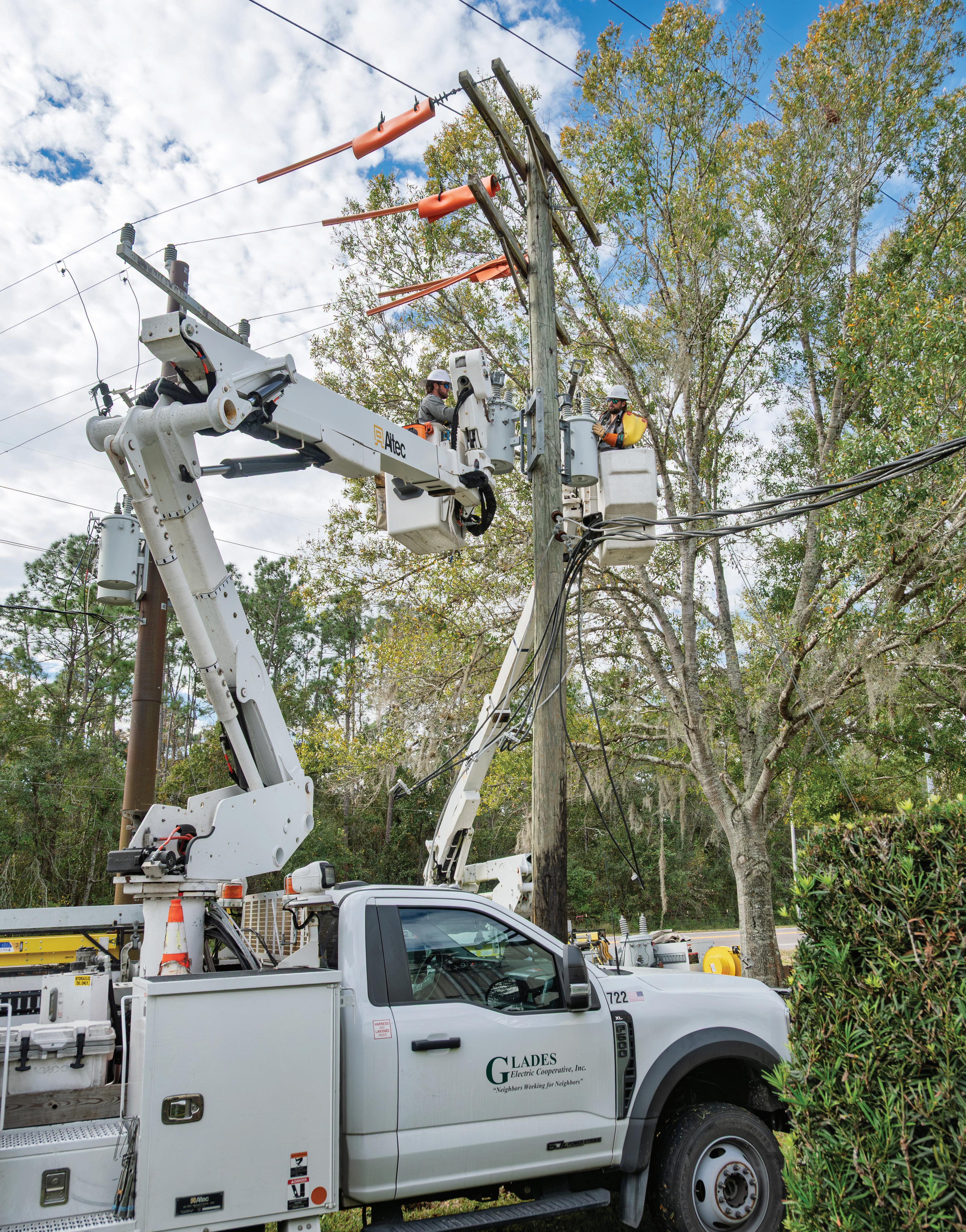


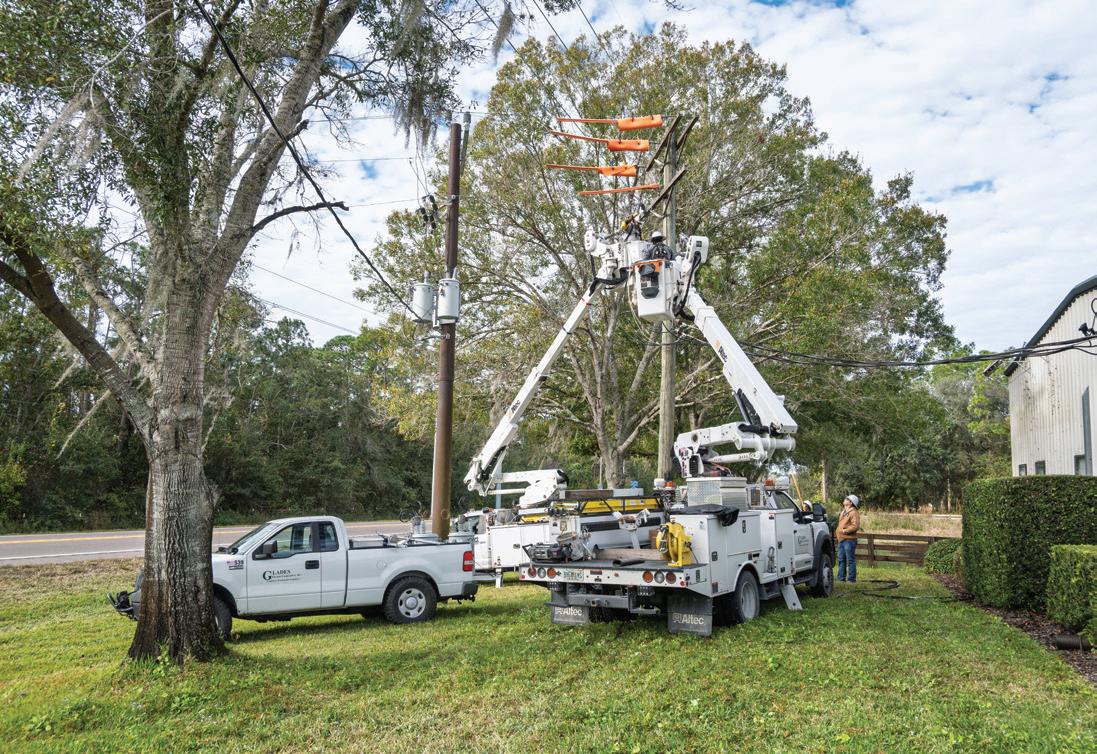
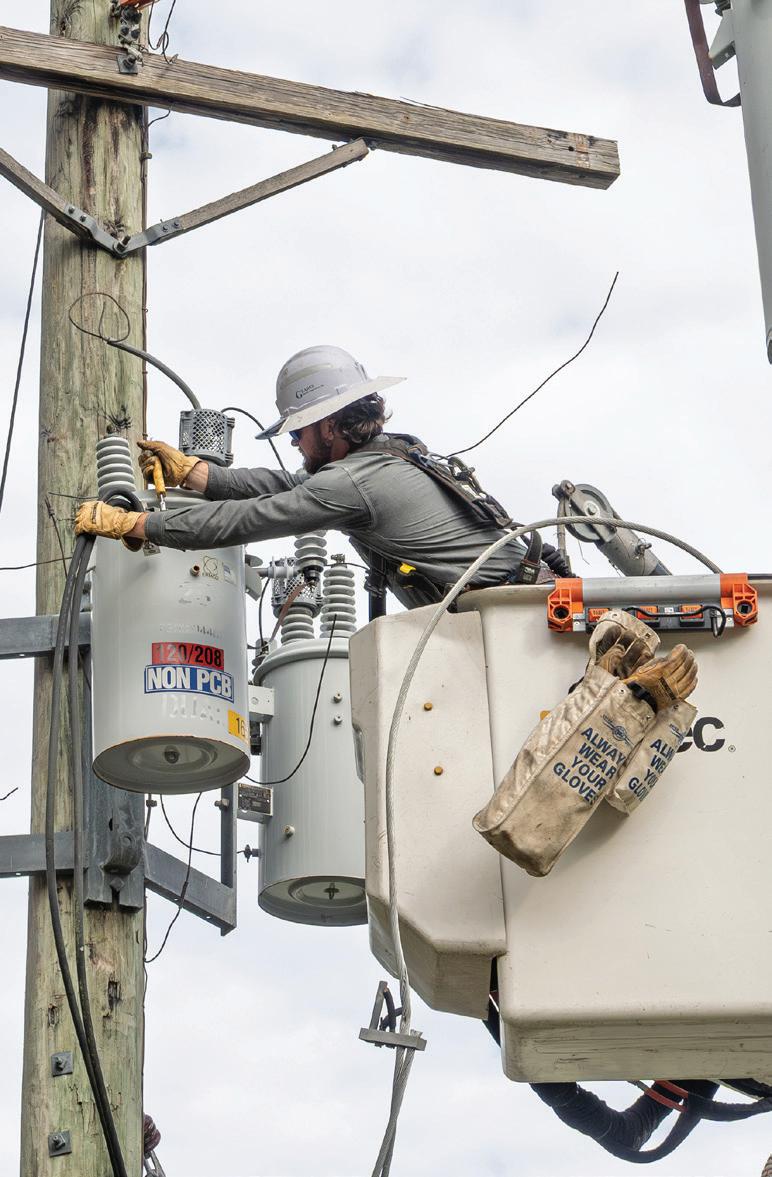
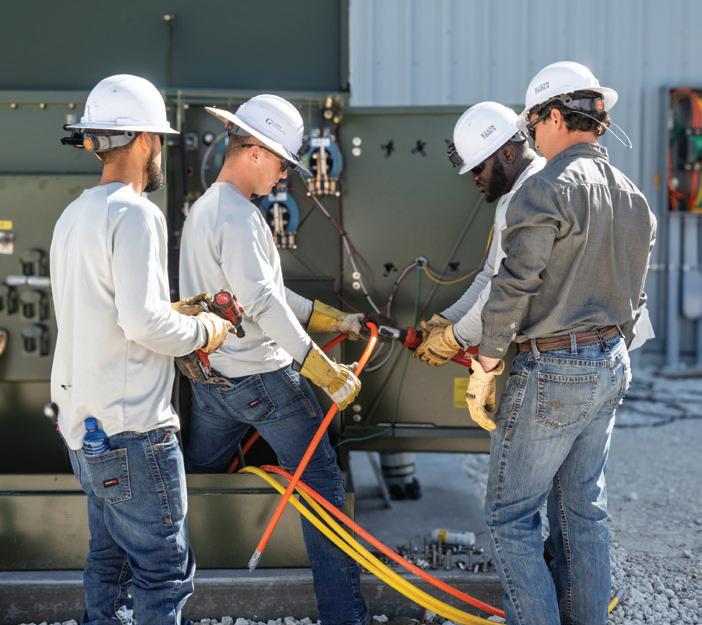
Journeyman Lineman Wesley Banks and second-year Apprentice
Lineman Tyler Colquitt work as a team to change out transformers.
PHOTO BY JENNIFER KOUKOS


Where engineering excellence meets sleek design - a lightweight, safe, customizable, and stylish scooter for UNLIMITED FREEDOM. Numerous scooters with various features and capabilities are on the market, making it crucial to select the one that best suits your requirements.
At the age of 56, a back operation left me dependent on a cane, significantly impacting my daily life. Simple tasks like going to the store or meeting friends became challenging, and I even had to cancel a long-awaited anniversary trip to Italy.


Airline approved. Spacious legroom, comfortable seat




My husband purchased a scooter for me, but it was cumbersome and uncomfortable for everyday use, leaving me feeling more constrained than liberated. However, everything changed when I came across the ATTO SPORT. This remarkable scooter proved to be a game changer. Not only is it robust and reliable, but it also conveniently splits into two pieces, allowing me to effortlessly lift it into my car trunk on my own. I was even able to stow it in the overhead compartment on the plane, enabling us to finally take that trip to Italy! I am now independent once more, able to go wherever I please and do so with a striking sense of style. In fact, I now find that my husband struggles to keep up with me!

Independence and convenience: Easy to use and conveniently folds into a compact suitcase size for simple storage. It easily separates into two parts in seconds, with the heaviest piece weighing just 37 pounds, making it easier to lift into your car trunk.
Go anywhere: Conquer any terrain with puncture-proof, shock-absorbing tires and a 4-inch ground clearance. Equipped with electronic stability control for added safety on descents and turns, it is also flight-approved, ideal for air travel and cruise ships. With a driving range of up to 12.5 miles (25 miles with the XL battery), a top speed of 6.2 MPH, and a maximum weight capacity of 300 pounds, this durable scooter is designed for longevity.
Top-Notch Engineering: Guaranteeing both comfort and durability, this scooter offers ample legroom and a big comfortable seat. The ATTO is super portable and lightweight, and still rides like a heavy-duty scooter.
Unmatched Stylish Design: You deserve a mobility solution that doesn't just get you from A to B but makes you feel great while doing so. ATTO stands out from the crowd with its stunning design.
Splits into 2 lightweight parts for easy lifting



Folds in 3 seconds, rolls like a trolley suitcase








April 2026 • Volume 15, No. 6
CEO Michael Shepard
VICE PRESIDENT OF CONTENT Leon Espinoza
EDITORIAL DIRECTOR Chasity Anderson, CCC
DEPUTY EDITORIAL DIRECTOR
Noble Sprayberry
SENIOR EDITOR Jennifer Paton, CCC
LEAD CONTENT EDITOR Victoria Hampton, CCC
FLORIDA CURRENTS EDITORS
Valeri Saldanha Rosa; Sable Riley, CCC
ASSISTANT EDITORS David Herder, CCC; Nina Todea, CCC
PUBLICATIONS PRODUCTION
SENIOR MANAGER
Elizabeth Beatty
SENIOR PUBLICATIONS COORDINATOR
Alyssa McDougle
Members acknowledge that $4.89 a year, plus postage, is the cost to publish 12 issues a year of FLORIDA CURRENTS ISSN 23276304 (USPS 8300). Published by Pioneer Utility Resources Inc., 5625 NE Elam Young Parkway, Suite 100, Hillsboro, OR 97124—a not-for-profit Oregon cooperative corporation—the magazine serves the communication needs of consumerowned electric utilities in Florida. Preferred Periodicals postage paid at Hillsboro, OR 97123 and at additional mailing offices.
Postmaster: Send address changes to 5625 NE Elam Young Parkway, Suite 100, Hillsboro, OR 97124-6422.
HOW TO CONTACT FLORIDA CURRENTS
Subscription services:
Nonmember subscriptions $15 U.S. a year; $25 foreign a year. Prepayment required. Allow 4-8 weeks for first issue. Identify local edition desired. Have a problem receiving your magazine? Utility members should contact their utility office. Nonmembers call 503-357-2105 or email mailingdept@pioneer.coop.
Back issues:
Back issues and extra copies are $3 each, prepayment required. Supply is limited. Identify edition, month and year. Call first to check availability. Contact Pioneer Utility Resources: P.O. Box 1306, North Plains, OR 97133-1306; 503-357-2105; email: mailingdept@pioneer.coop.
DISPLAY ADVERTISING INQUIRIES
American MainStreet Publications 611 S. Congress Ave., Suite 504 Austin, TX 78704-1714; 800-626-1181 or 512-441-5200; amp.coop.
© 2026 Pioneer Utility Resources. All rights reserved. Reproduction in whole or in part without written permission is prohibited. Direct reprint requests to editor@floridacurrents.com or for more information, visit www.pioneer.coop.
Lineworkers are ready when it matters most












By Michael J. Roberge



As CEO of Glades Electric Cooperative, I have the unique privilege of seeing firsthand what it truly takes to keep the lights on for our members. In April, we take time to pause and recognize the brave men and women who make that possible every single day—our lineworkers.
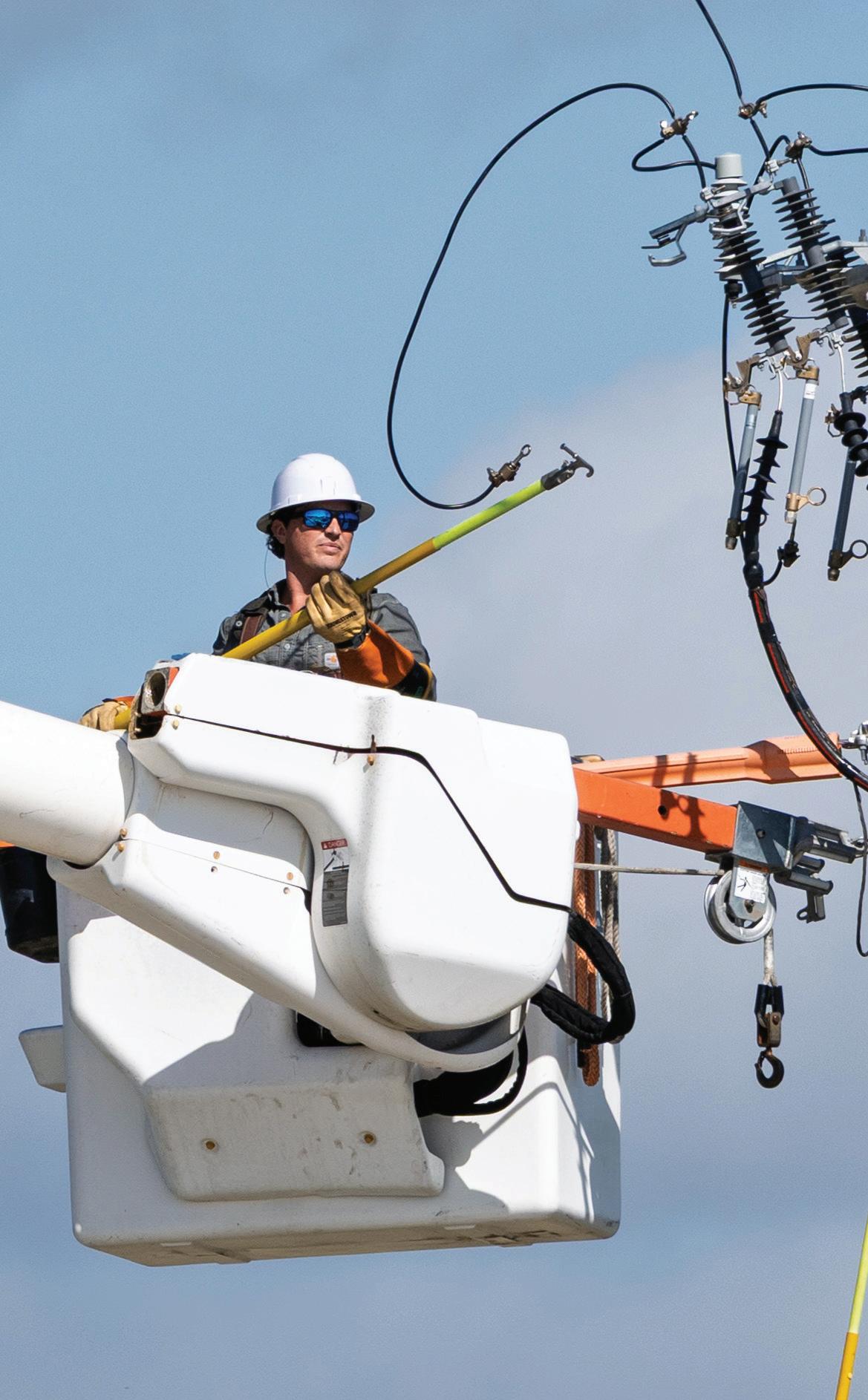
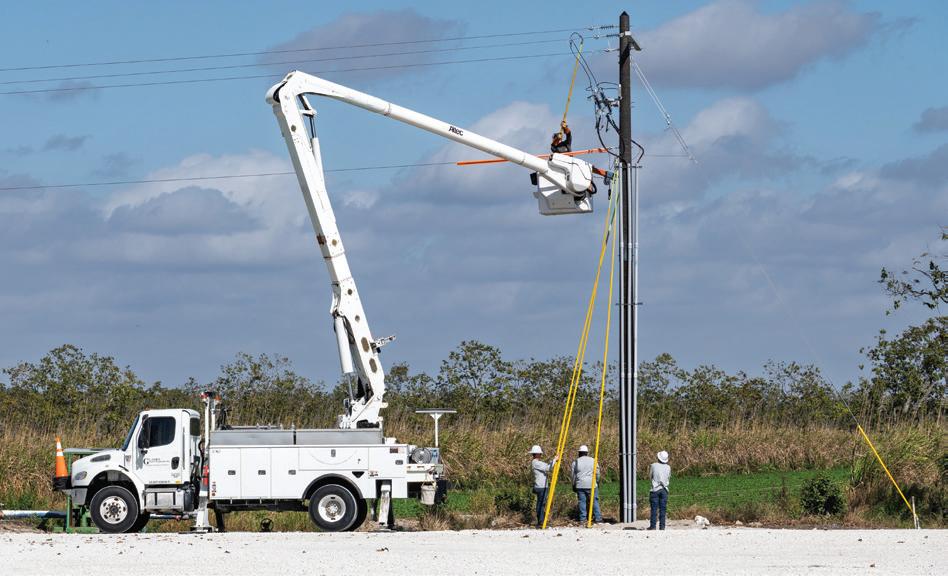
When storms impact our communities and outages occur, many people experience the inconvenience, but our lineworkers see a call to action. Our crews are always ready when it matters most—missing family dinners, working through the night, and heading into challenging conditions to restore power as safely and quickly as possible. That readiness is not accidental. It comes from rigorous training, deep experience and a shared commitment to serving others.
When the recent cold weather caused a break in one of our lines in Lakeport, our crews responded in the dark of night with a wind chill of 20 degrees to find the fault and restore power to keep homes warm.
What makes lineworkers especially remarkable is that they aren’t just restoring power to a system, they’re restoring power to their own communities. They live here. They raise their families here. They understand that electricity is more than a convenience. It’s essential to daily life, to local businesses, to schools, farms and emergency services. Powering the places we call home is personal to lineworkers.
Electric cooperatives like ours were built on the principle of

PAGE

neighbors helping neighbors, and our lineworkers embody that spirit every day. They are the first to respond and the last to leave, often working long hours behind the scenes. At times, serving our neighbors means going beyond our own service territory through a process known as mutual aid.
During major outage events, Glades Electric crews stand ready to assist neighboring co-ops—close to home and across state lines—to help restore power. This spirit of mutual aid strengthens all cooperatives and ultimately benefits the members we serve.
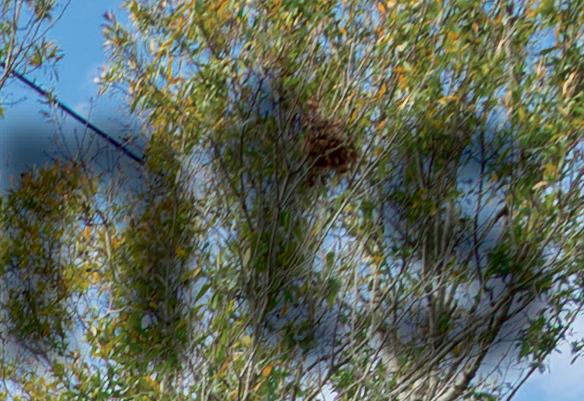
We understand any time the lights go out it can be frustrating, bringing everyday life to a halt. We are incredibly grateful to our members for your patience and encouragement during these times. In fact, our team received a kind, handwritten note from members in Venus following the recent cold weather. That support means a lot to all of us.
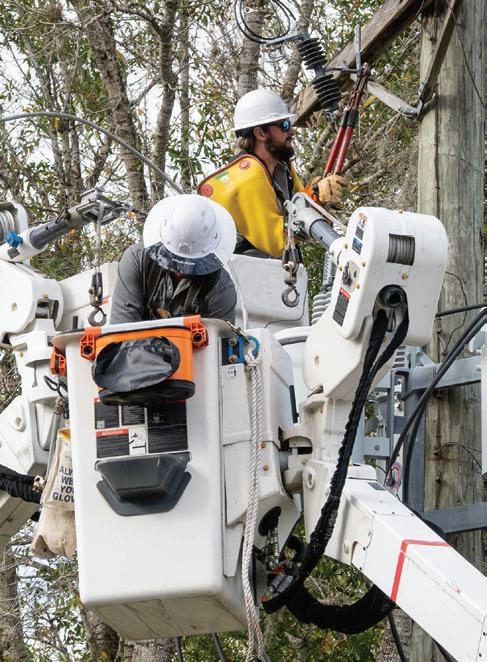
Line work is demanding and physical, and it can be dangerous. Our crews approach each job with a focus on safety and teamwork. They take pride in their craft and in the trust of our members.
On April 13, we will celebrate Lineworker Appreciation Day, but one day is hardly enough. Every day, we thank lineworkers for their service and dedication, which are the backbone of our cooperative.
To our lineworkers: Thank you for your hard work, your readiness and your unwavering commitment to the communities we serve. We are proud to stand behind you and grateful for all you do.

Glades Electric Cooperative has selected Gabriel Gonzalez and Ellise Mills as its 2026 Electric Cooperative Youth Tour delegates to Washington, D.C., in June.
The Electric Cooperative Youth Tour is a national program that brings outstanding high school juniors from across the country to the nation’s capital for a week of learning, leadership development and civic engagement. Delegates gain a firsthand look at how the federal government works, meet with elected officials, explore historic landmarks, and connect with peers who share a commitment to service and leadership.
“Each year, Youth Tour gives students a unique opportunity to grow as leaders while learning about the cooperative difference,” Glades Electric Chief Communications Officer Jennifer Koukos says. “Gabriel and Ellise exemplify the values of leadership, service and community that define our cooperative, and we are proud to have them represent Glades Electric in Washington, D.C.”
High school juniors living in Glades, Highlands, Hendry and Okeechobee counties are eligible to apply each year. Winners are selected based on video submissions, leadership and letters of recommendation.
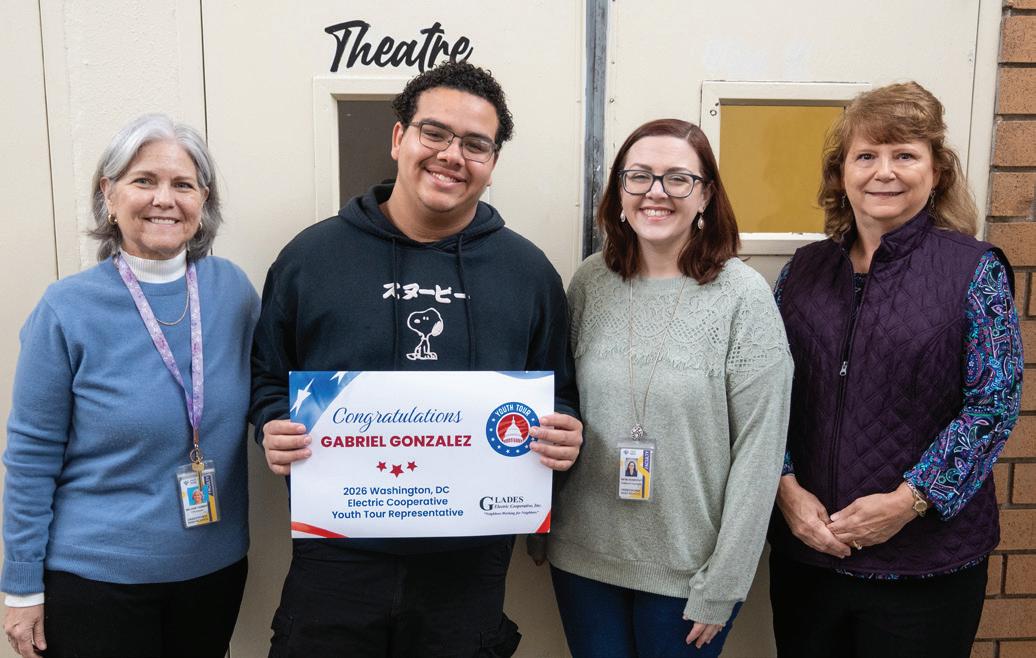
Gabriel Gonzalez is a student at Okeechobee High School. He takes part in the Career and Technical Education Fire and Rescue and Auto Mechanics programs.
Gabriel has been actively involved for two years with the Okeechobee County Public Safety Leadership Cadets, participating in numerous volunteer service initiatives.
Gabriel placed in the top three statewide in competitions hosted by the Florida Sheriff Explorer Association and was named head of
the State Project for 30 Florida counties. He also has participated twice in the Florida Police Explorer Boot Camp.
In addition to his leadership and service activities, Gabriel has worked as a bagger and cashier at Publix since age 14.
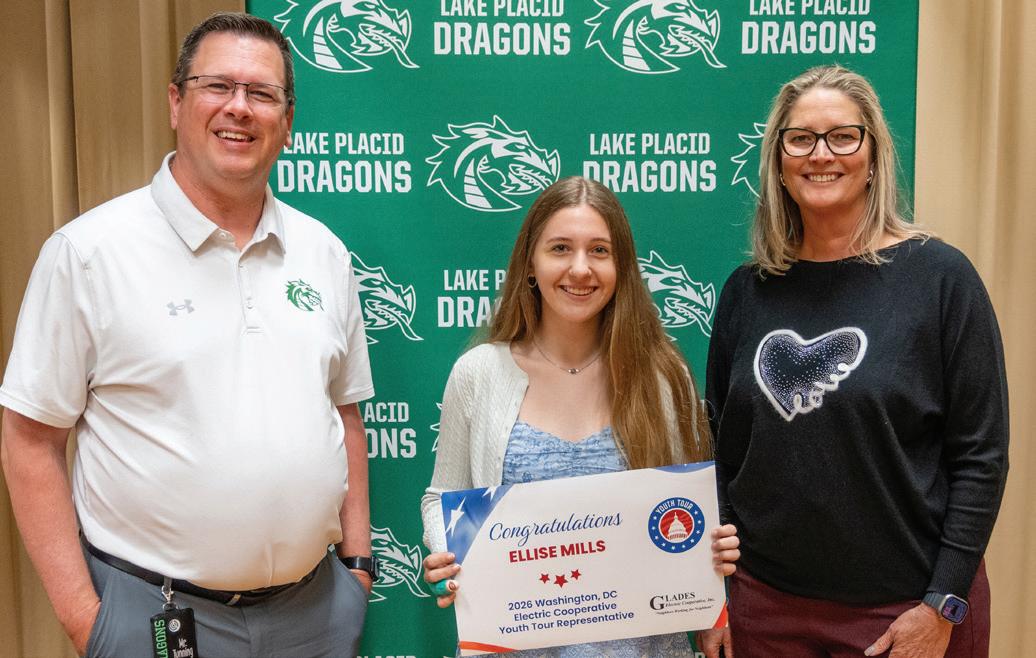
Ellise Mills is a student at Lake Placid High School and is active in academics, athletics and service. She serves as treasurer for the Class of 2027 and the Interact Club, and she competes as a catcher on the varsity softball team.
Ellise is a member of the creative writing, crochet and Bible clubs, National Honor Society, and the Mason G. Smoak Youth Leadership Highlands Program. She mentors through Big Brothers Big Sisters of America and volunteers at Placid Lakes Baptist Church.
She won the 2025 Rotary Club speech contest and the 2025 Thakkar Civic Award. Ellise was selected as the 2025 Hugh O’Brian Youth Leadership Seminar representative for Lake Placid High School and was 2025 Miss Lake Placid First Runner-Up.
Ellise contributes to Lake Placid’s arts community through her involvement with the Caladium Arts and Crafts Cooperative. She crochets, paints and sews, donating handmade items to charities that support women and children.
Gabriel and Ellise will travel with other Florida delegates and join hundreds of students from electric cooperatives nationwide for the 2026 Electric Cooperative Youth Tour. They will return home with new perspectives on leadership, public service and the role electric cooperatives play in their communities. n
For more information about Glades Electric Cooperative’s Youth Tour and other student programs, visit www.gladeselectric.com/community/student-programs-information.

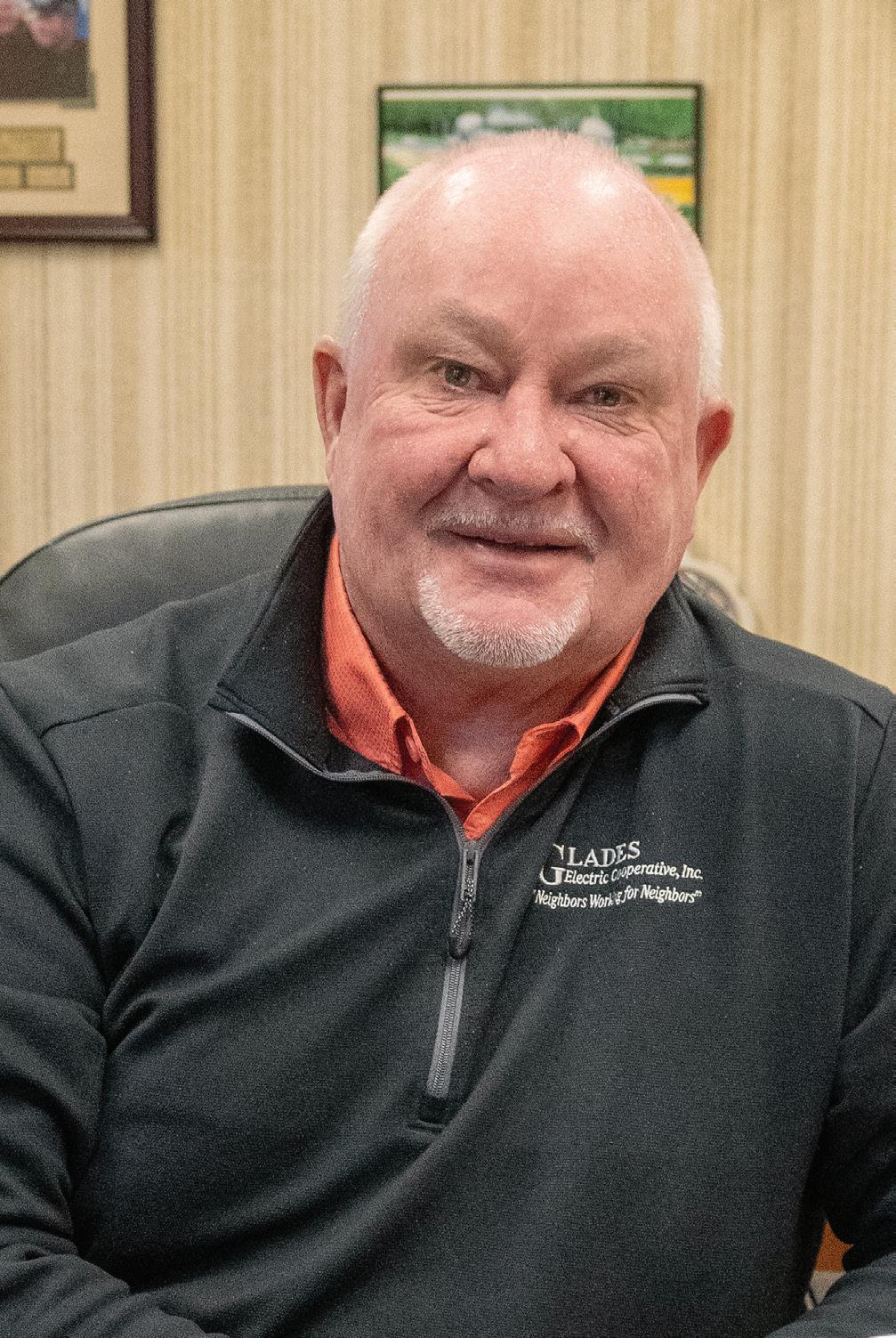
After serving as acting general manager since May 2025, Michael J. Roberge was named Glades Electric Cooperative chief executive officer by the Board of Trustees at the January 2026 meeting. Mike, as he’s known to the team, succeeds Jeff Brewington, who retired after 25 years of service to the cooperative.
For Mike, this appointment represents more than just a career milestone—it’s a continuation of a lifelong commitment to the cooperative model and the members it serves.
“I’ve spent my entire nearly 40-year career in the cooperative world because I believe in what we do,” Mike says. “Cooperatives are different. We exist to serve our members, not stockholders. Every decision we make is about what’s best for you and your communities.”
That dedication runs deep. Mike has worked for generation and transmission cooperatives and distribution co-ops across the country, gaining perspectives from every angle of the cooperative business model. Before joining Glades Electric as chief operating officer in 2023, he held management positions at Florida Keys Electric Cooperative; Habersham EMC, in Georgia; SECO Energy, in Florida; and Great Lakes Energy and Wolverine Power Cooperative, in Michigan.

His experience includes developing reliability improvement programs, managing major storm restorations and overseeing the implementation of broadband internet service—all focused on serving members better.
“My goal as CEO is to continue improving our member engagement experiences,” Mike says. “This includes enhancing member service interactions, reducing outages and power quality events, and continuing to provide fast, reliable internet access to our members and communities, while being good stewards of our members’ capital resources.”
Mike earned a bachelor’s degree in electrical engineering from Michigan Technological University and has completed the NRECA Management Internship Program and Certified Key Accounts Executive Program. He’s been part of teams making key decisions at cooperatives most of his career.

However, Mike’s connection with cooperatives goes beyond professional experience—it’s personal. He met his wife, Teresa, in the late 1980s when they both worked for a generation and transmission cooperative in Michigan. The Roberges have been married 36 years and have one son, Wesley, who works in the music production industry near Denver.
After decades of Michigan winters, the couple made the move to Florida in 2013.
“We came for the beautiful winter weather and year-round fishing opportunities,” Mike says. “No more ice fishing.”

As Mike steps into this new role, he brings not only decades of technical expertise and leadership experience, but a genuine understanding of what makes cooperatives special.
The Glades Electric team welcomes Mike to his new role.

What is it?
Operation Round Up is a program that allows members to round up their monthly bills to fund projects benefiting community members in need.
Nine members serve on the board of directors for Glades Electric Charitable Trust, a 501(c)(3) nonprofit organization. Directors review applications and approve grants.


Paula

$57,111.12 in Operation Round Up funds were awarded to organizations and members in need in 2025.
How does it work?
$153 55 cents to your neighbor in need. The average yearly contribution is $6 per member.


9 raised by Operation Round Up and Round Up Plus in January 2026.
Funds from Operation Round Up go right back into the communities we serve.




$4,288.27








8,290 accounts participate in Operation Round Up or Operation Round Up Plus. Round Up Plus allows members to add any set amount, $1 or more, to their bills each month.
44%


How can I help?
Sign up for Operation Round Up in the SmartHub app or on your payment stub, stop by the office or call 855-940-3810.

How can I get help?
If you or a member you know needs financial assistance, please complete an application at: www.gladeselectric.com/community/operation-round-up. $152.45 Amount due: Power Bill UP ROUND














The participation rate that would raise more than $70,000 annually to support our communities. 75%























Naval aviator landed in Milton and immediately hit the trail


By Colette Boehm
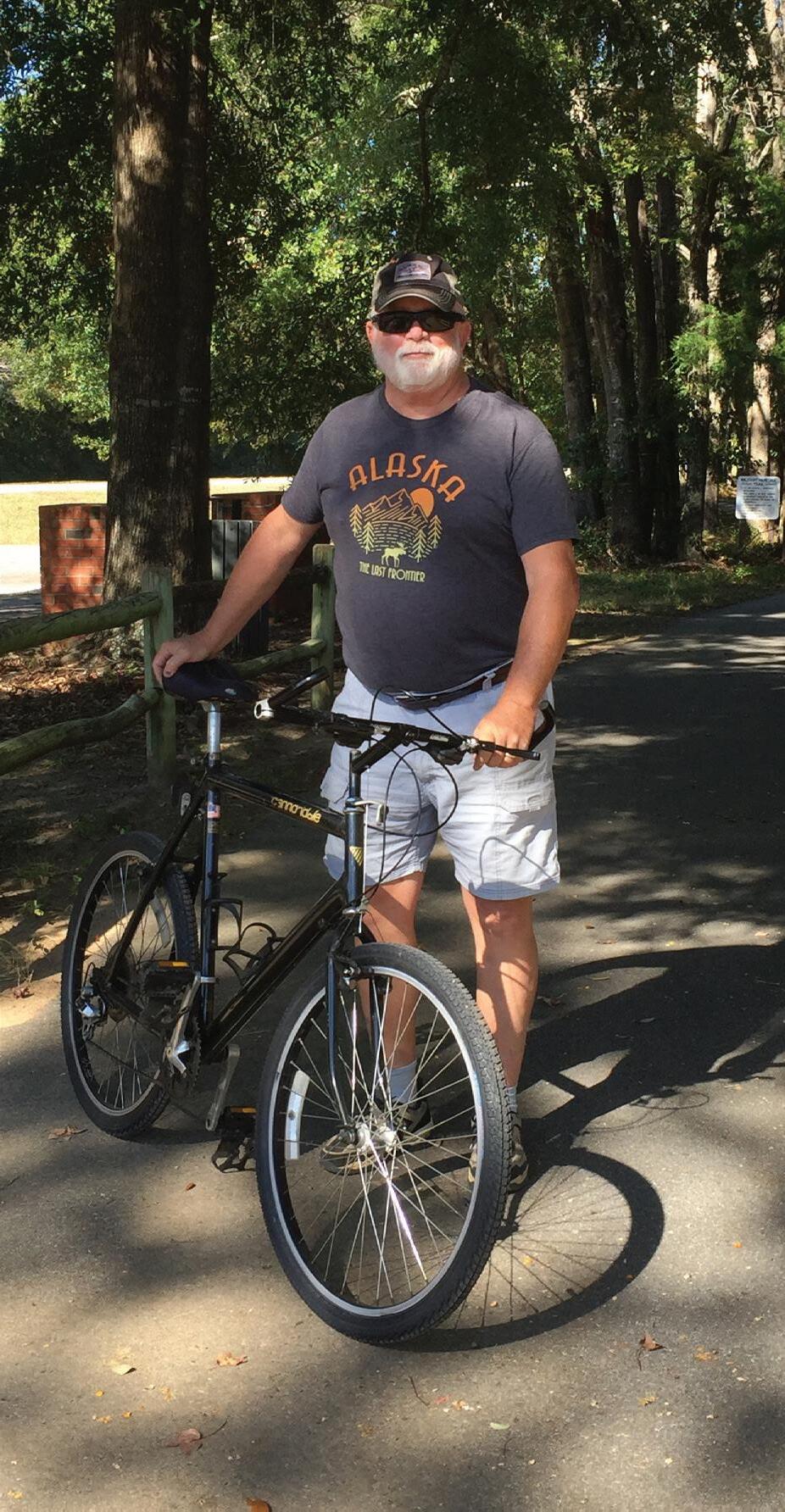
Walt Schumann traveled the world as a naval aviator. After training in Pensacola, the avid cyclist took his bike aboard ship each time he was deployed. As a result, the Michigan native pedaled along trails across the globe.
“I’ve ridden in Israel, Greece, Italy, Spain,” Walt says. “I always wanted to be in an area with cyclist trails.”
That desire led him back to Northwest

Florida. For more than two decades, Walt has been a driving force in supporting Blackwater Heritage State Trail in Milton.
The 8.1-mile paved path was designated in 1999 as part of the Florida State Parks system and is the state’s westernmost Railto-Trail route. Blackwater Heritage winds through the historic town of Milton and into the surrounding rural landscape. It is popular with runners, walkers and birders, as well as cyclists, and a portion is designated for equestrian use.
All users can enjoy views from wooden bridges over several creeks and patches of native wildflowers along the way. There are several picnic areas on the trail, and access is easy from one of its five trailheads. The


trail’s northern terminus joins the U.S. Navy’s 1.5-mile Military Heritage Trail, which ends at Naval Air Station Whiting Field.
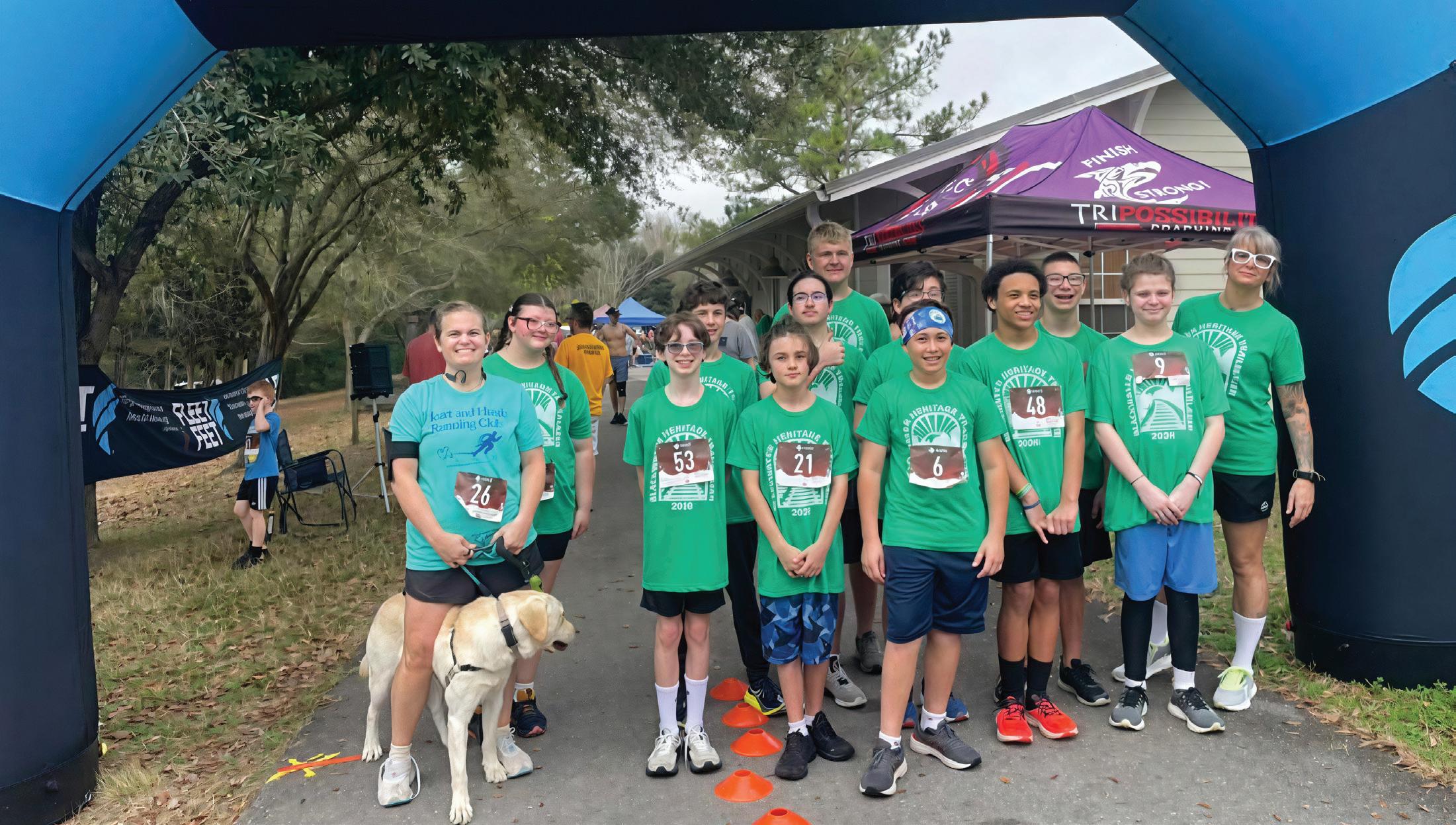
The Blackwater Heritage Trail Citizen Support Organization, or CSO, was created to provide support to the trail. The nonprofit’s activities include promoting events and activities that generate trail recognition and use. One example of that is the annual Blackwater Heritage Trail Blazer Run, held each March. This year, the event drew more than 200 participants.
In addition to raising public awareness of the trail, CSO members spend a lot of time assisting with trail funding, construction and maintenance needs.
Shortly after moving to the area, Walt got involved with Leadership Santa Rosa. That program introduced him to the trail group. He has been involved ever since.
Walt says the CSO takes on any need identified on the trail, whether on its own or in support of the state park staff.
“Our CSO does it all,” he says. “I’ve planted trees. We sponsor different events throughout the year. I fundraise for the trail. All that canopy of trees, all those benches— that’s what we do. We are here to support whenever they need something.”
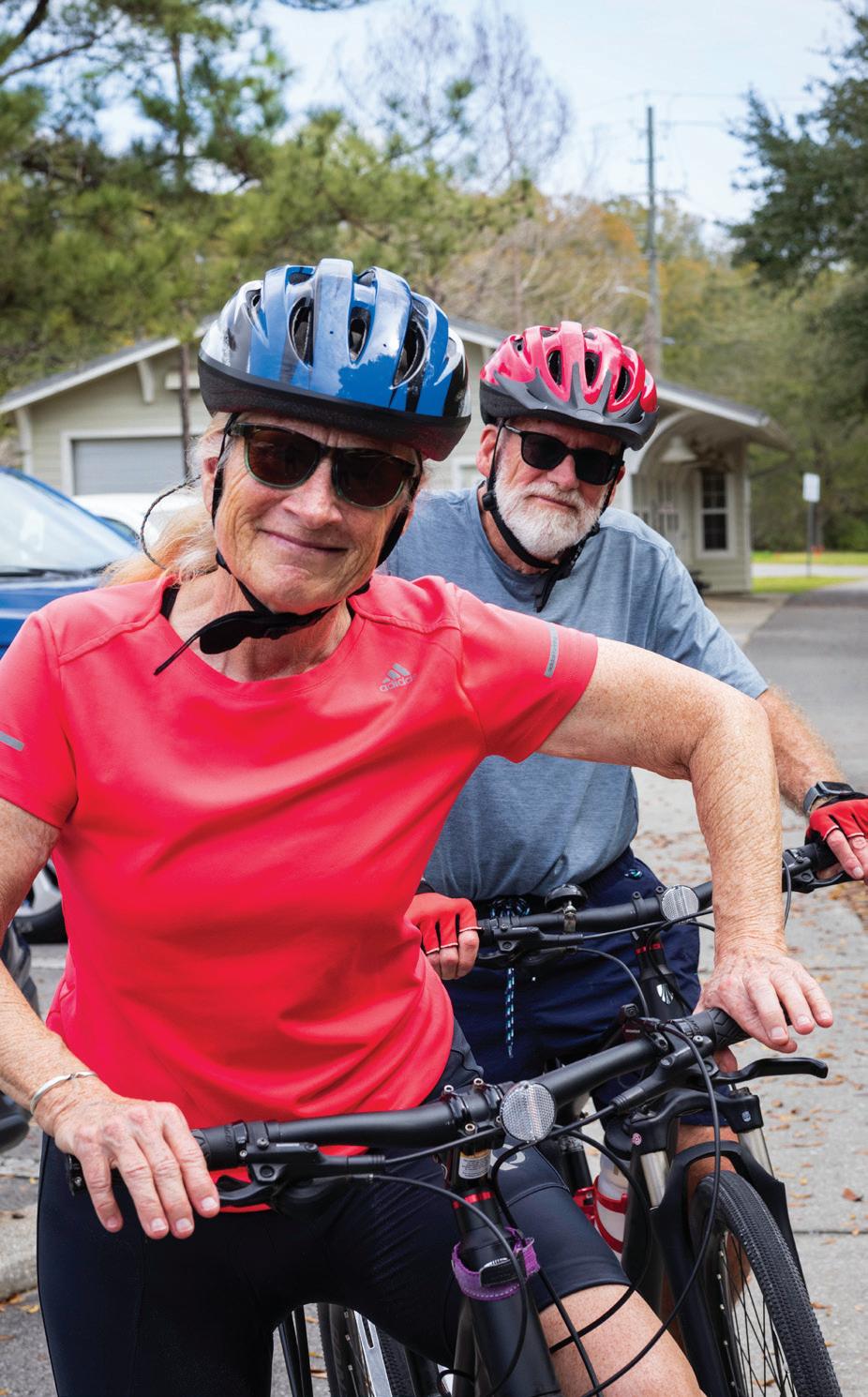
A Devoted Fanbase Word is out about the trail, and it appeals to a variety of users. Lisa Riehl and Bob
Wickhem are retirees from Wisconsin who enjoy traveling. They are members of an online group that shares information about the best paved bike paths in the country.
“That’s how we pick places to go,” Bob says. “We pick places with trails.”
They added the Blackwater trail to their list and, in March, explored it while spending two weeks in the area.
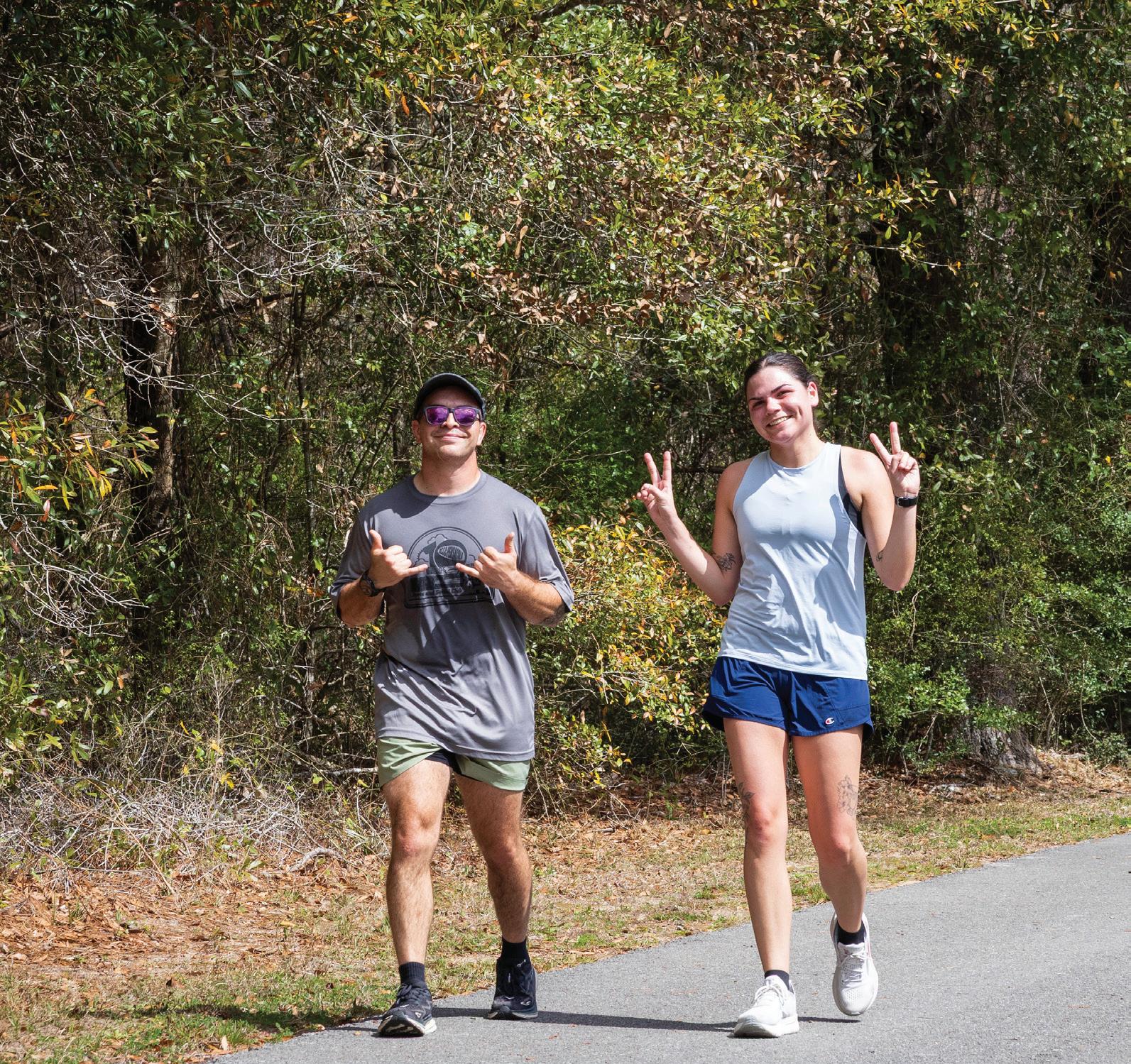
Errolyn, who just moved to the area from Texas, discovered the trail in March, too, when she ran it with a friend for the first time. For her, the easy access from local highways—combined with the feeling of being “away from it all” while on the trail—is compelling.
“Also, the width,” she says. “It’s very easy to share with other users.”


“We’d like to provide even more support,” he says.
That support, Walt says, results in connections that not only bring visitors from around the country, but build pride locally, too.
“When you go by it and look down the trail, you see all these people enjoying it,” he says, noting the resulting sense of community. “It goes right through town. It has connected this town.”
Blackwater River State Park offers many hiking trails. Four trails have paths through wooded areas and along riverbanks, from the half-mile Juniper Lake Nature Trail loop to the 8-mile Juniper Creek Trail.


While Walt still enjoys riding the trail, these days much of his time is devoted to supporting and improving it. He is vying for a grant to provide Americans with Disabilities Act-complaint access from a lower parking lot to the trail visitor center.
Other projects have included raising funds for projects ranging from weed eaters to a $75,000 comfort station with a composting toilet inside and a bike rack outside.




There is also an accessible boardwalk to a day-use area overlooking the banks of the Blackwater River.


Walt notes the group raised $1,500 to install two traffic counters. In many cases, he says, documenting use is important when seeking funding and grants.

Walt says they’re always soliciting volunteers. With more people involved in the CSO, more work can be done.















By Cheré Coen

Della Scott-Ireton received an unusual present for her high school graduation—a scuba diving class. That gift set the course for her life.
The Santa Rosa County native later earned degrees in anthropology and historical archaeology at the University of West Florida, along with a Ph.D. in anthropology from Florida State University. She’s since worked studying and preserving the thousands of shipwrecks lining the Florida coast.
“I married the two,” she says of diving and marine archaeology.
Della worked with Pensacola Shipwreck Survey, West Florida Historic Preservation, Florida Bureau of Archaeological Research and the
government of the Cayman Islands before joining Florida Public Archaeology Network in Pensacola, or FPAN. The organization is a UWF program working to conserve, study and promote the public’s understanding of Florida’s archaeological heritage. In addition to being an author on the subject, Della serves as associate director of FPAN.
“We basically do education and outreach around the state of Florida,” she says.
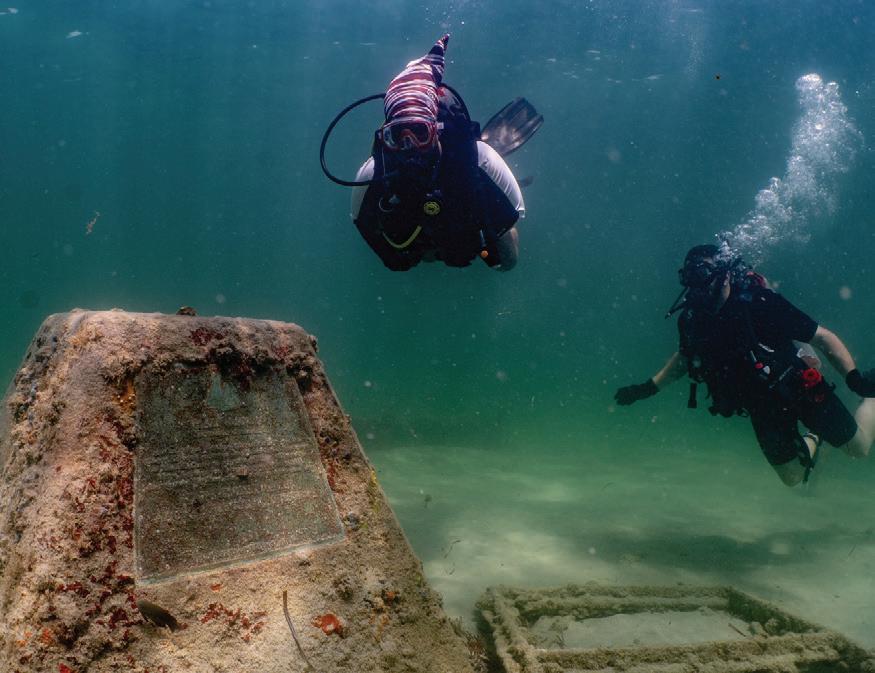
The outreach includes lectures, presentations, training and workshops to audiences ranging from children to park rangers. Shipwrecks are among the hot topics. One of the most unique aspects of Della’s work is helping develop 12 parks within Florida where scuba divers may

visit underwater shipwreck sites. These “museums of the sea” showcase the history not only of the ships that once traversed the waterways in and around Florida, from
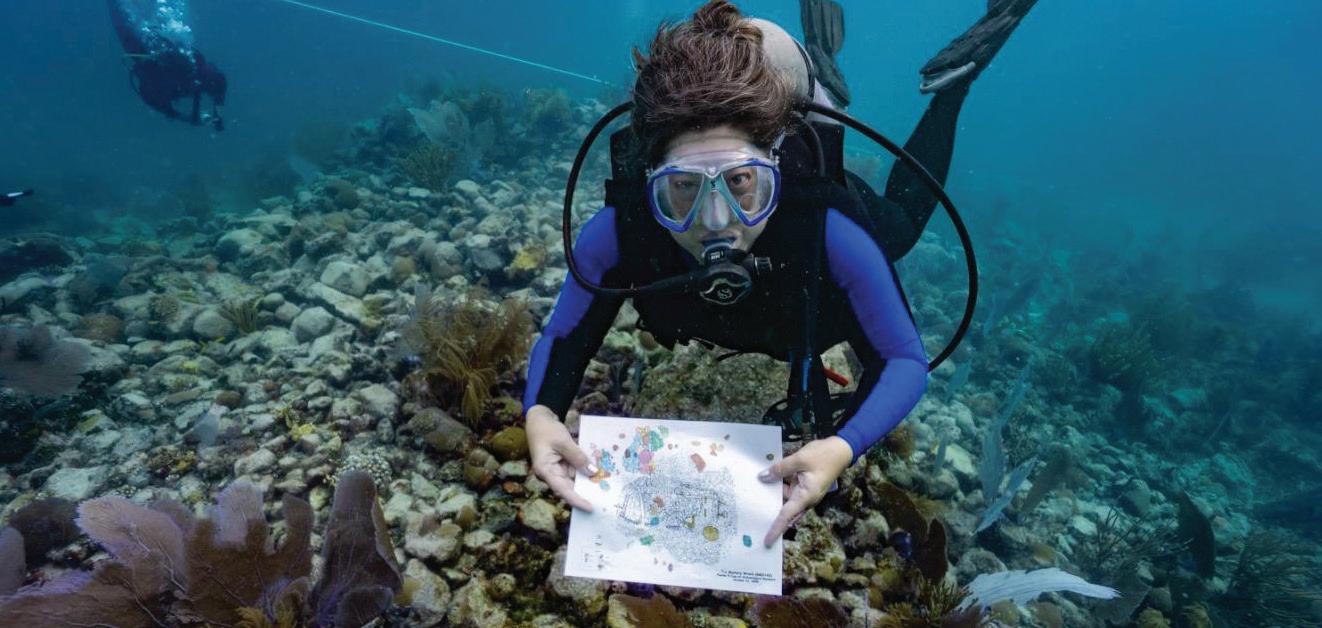
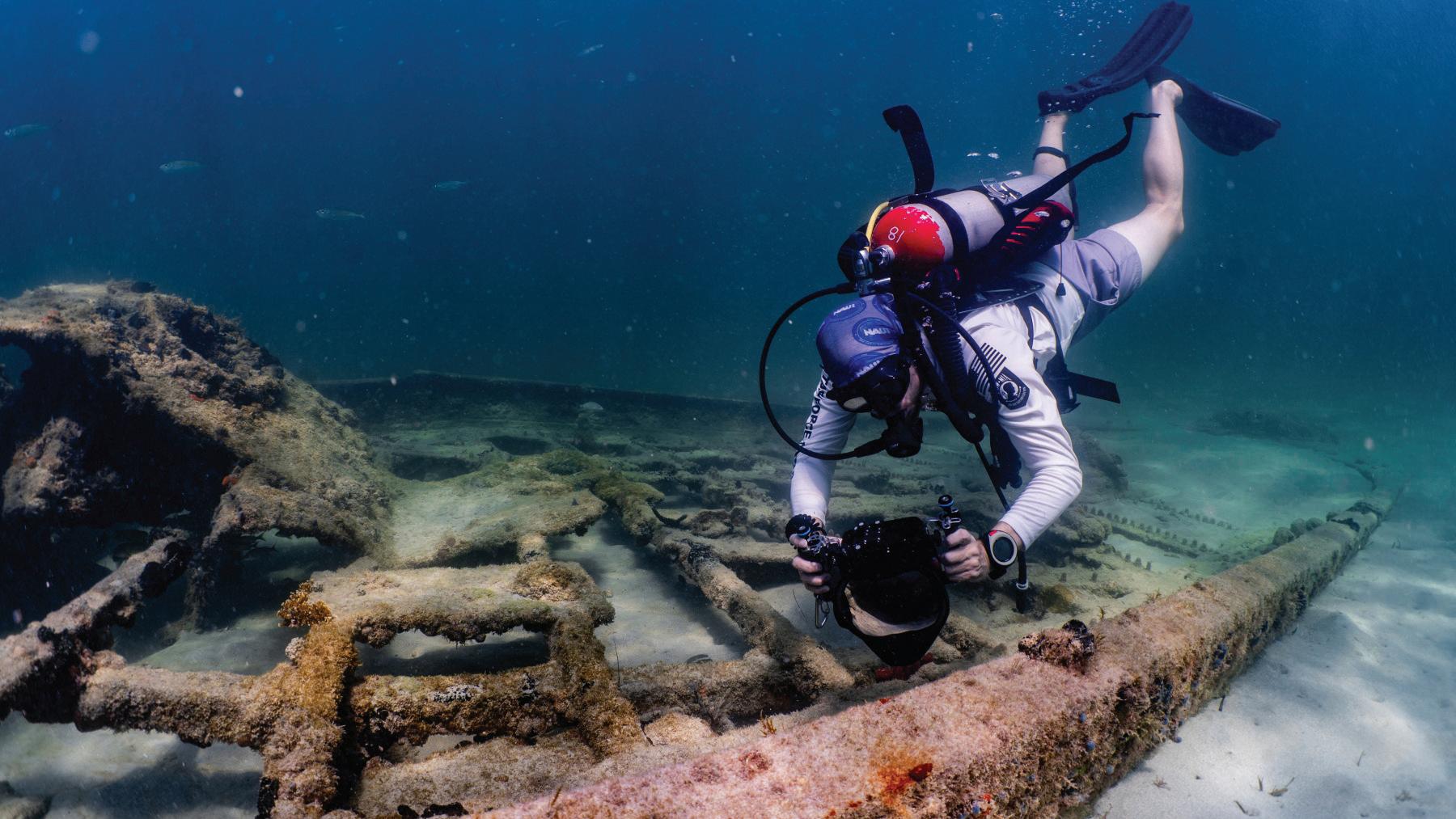
Native Americans to the present, but of the people who served them.
“The Gulf is an interesting body of water,” Della says. “It used to be called the Spanish Sea. It was used by Native Americans, British colonists and more. It was very much a crossroads.”
The Atlantic side saw its share of commerce throughout the Americas and Europe. Inland waterways moved cargo throughout Florida and the Southern states.
Many of those vessels that traveled through Florida remain—some shipwrecked in storms or disintegrated by neglect.
“The Florida shores are literally littered with our maritime past,” Della says.
Divers may download information on Florida’s shipwreck parks from the FPAN site to “know what it is they are looking at,” Della says. They can explore the

shipwrecks but cannot enter the vessels for safety reasons.
In addition to the sunken ships, divers may encounter a wealth of sea life, including Atlantic spadefish, grunts, Gulf flounder, angelfish, urchins and spotfin butterflyfish.
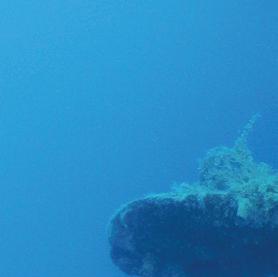
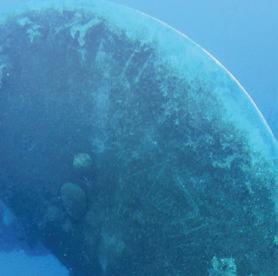
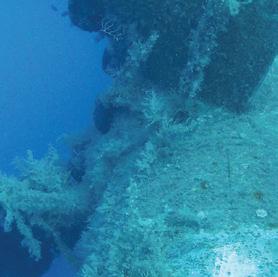
The vessels range from Spanish galleons from the 1700s to a decommissioned battleship sunk in 1921 to be used for target practice. Following is a sample


BELOW: Florida Underwater Archaeological Preserve has 12 sites. PHOTO COURTESY FLORIDA PUBLIC ARCHAEOLOGY NETWORK AND FLORIDA BUREAU OF ARCHAEOLOGICAL RESEARCH
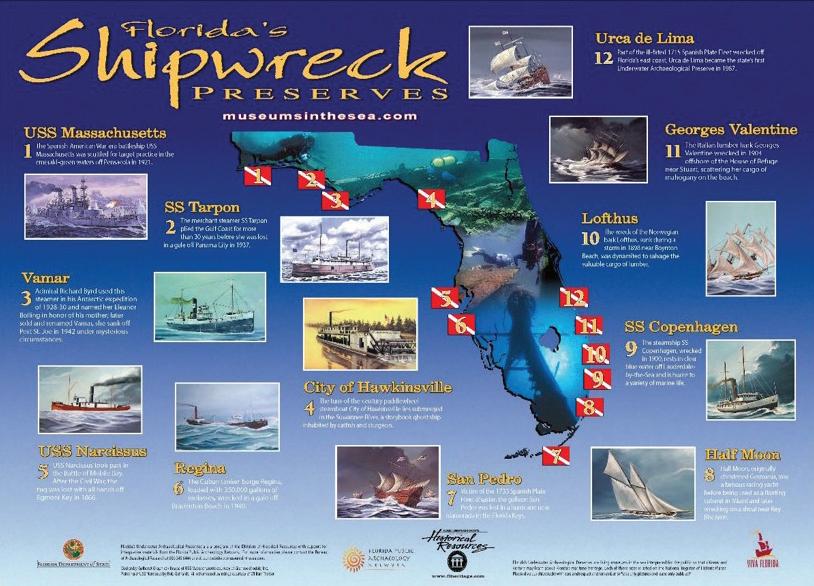
of what divers may find in a Florida Underwater Archaeological Preserve Park.
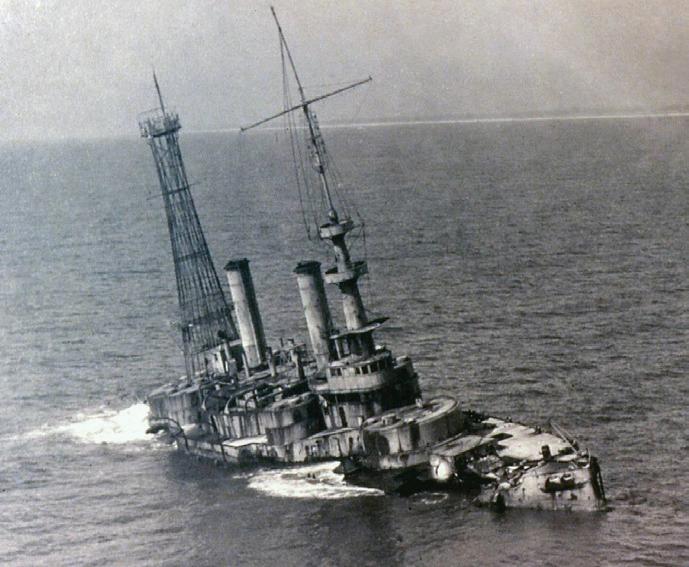
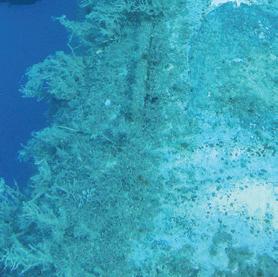
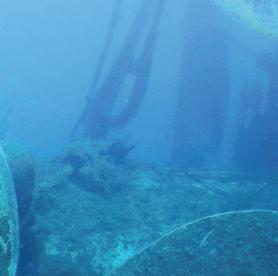
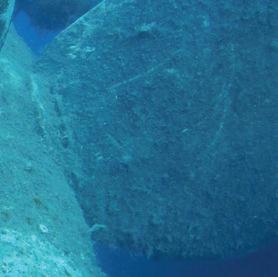
Three Indiana-class coastal battleships were commissioned in the late 19th century for the new Steel Navy, some of the most powerful U.S. battleships of their time.
Built in 1896, the USS Massachusetts was one of three, stretching more than 350 feet long with a beam of 69 feet.
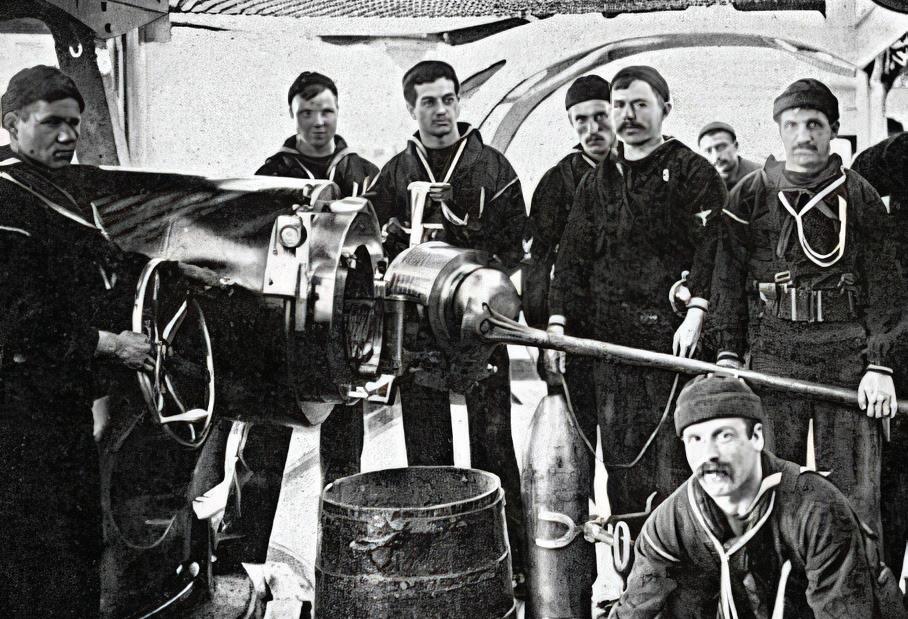
“At the time, the USS Massachusetts was the biggest, baddest ship,” Della says. “But by World War I, she became obsolete.”
The ship blockaded the Cuban ports of Cienfuegos and Santiago during the Spanish-American War and patrolled the Atlantic coast and eastern Caribbean after the war. Decommissioned in 1919 and stripped, the ship was towed to Pensacola in 1921, where the military used it for experimental artillery practice near the entrance to Pensacola Bay. She lay in the Gulf for years until Florida took possession in 1950.

“It’s been a favorite site,” Della says of the shipwreck. “It is beautiful, such a cool dive.”
A patrol gun boat with a long history rests 3.7 nautical miles north of the Mexico Beach channel leading into St. Joseph Bay. Shifting cargo was blamed for the shipwreck, but mystery surrounds the 1942 incident, which occurred during World War II.
It was built in 1919 and originally christened Kilmarnock, then renamed Chelsea.
were saboteurs of war who intentionally sank the boat to block the channel. No evidence supported these claims, but the mystery remains.
Urca de Lima

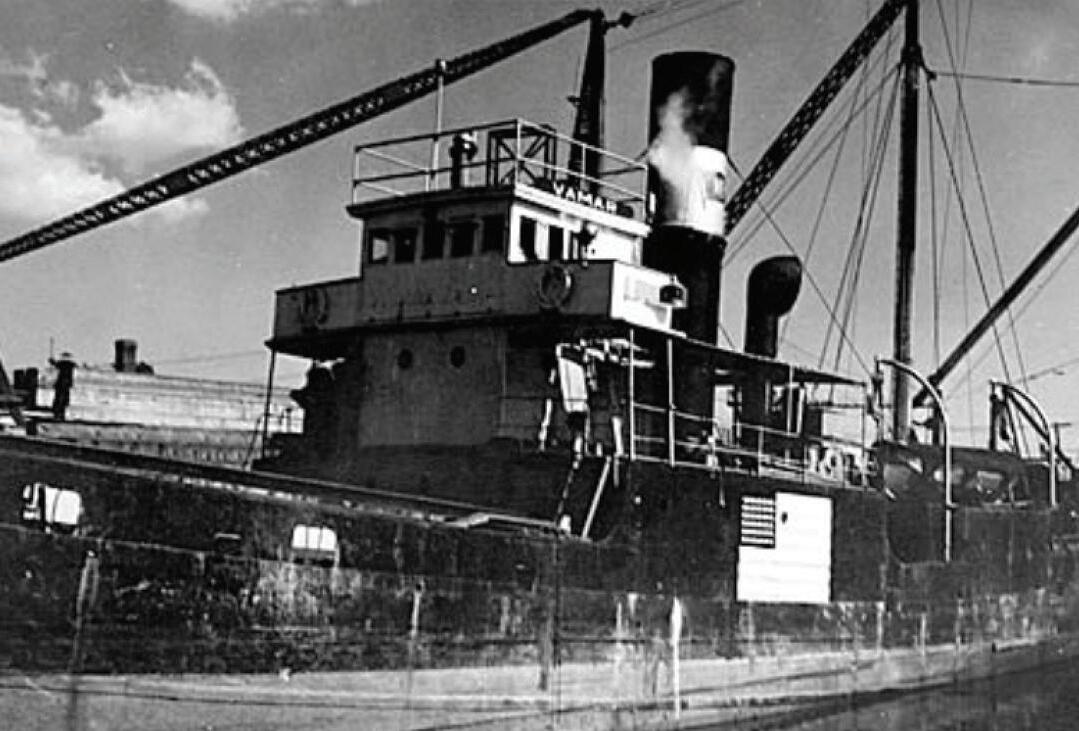
In 1928, the ship carried Rear Adm. Richard E. Byrd on his first expedition to Antarctica. Byrd upgraded the vessel and renamed the steamer Eleanor Bolling after his mother, Eleanor Bolling Byrd. It became the first metal-hulled vessel used in Antarctic waters. After its service, the ship returned to New York to much fanfare.
The ship’s fame diminished when it was later bought by Vamar Shipping Co. and renamed Vamar. Slipping into poor condition, she was used as a freighter.
Her last trip was March 19, 1942, when a Yugoslavian, Cuban and Spanish crew attempted to move lumber from St. Joseph Bay to Cuba. The top-heavy cargo forced the ship to list, then sink and eventually settle out of the channel while the crew made it back to town.
The Coast Guard investigated the sinking. Rumors ran rampant that the crew
Urca de Lima, owned by Spaniard Don Miguel de Lima, met its demise in 1715 from a hurricane, crashing along the Florida coast near present-day Fort Pierce. The 305-ton, Dutch-built vessel had little damage, and its cargo helped serve storm survivors from other ships. Spanish crews arrived from Havana and burned the ship to conceal her from the English, who also traveled along the Atlantic coast.
Salvagers in the 20th century hoped to discover treasure aboard the sunken ship, but they found nothing of value. In 2001, Urca de Lima became the first preserve of Florida’s Underwater Archaeological Preserve system and is now listed on the National Register of Historic Places.
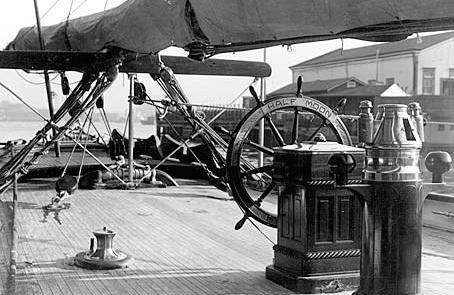
Half Moon
This steel sail-powered German yacht built in 1908 was a wedding gift from Bertha Krupp—the Krupp family produced large artillery nicknamed “Big Bertha” in World War I—to her husband,
Count Gustav von Bohlen und Halbach. The 154-foot-long racing sailboat was one of the fastest of her day, winning the German Kaiser’s Cup and participating in other European races.
Originally named Germania, the sailboat arrived in England for the 1914 Cowes races at the start of World War I and was seized by the British. Her crew became the first German prisoners of the war.
The boat was later moved to New York and then Miami, where she was renamed Half Moon after the explorer Henry Hudson’s 17th-century ship and used as a floating saloon until she sank in the early 1930s.
She rests between Key Biscayne and Virginia Key.
Regina
Regina was a steel steamer built in 1904 in Belfast, Ireland, for one service: to move molasses from the Caribbean to ports in the United States for use by rum and animal feed manufacturers.
Later converted to a tanker barge, the ship—nicknamed “Sugar Barge”—was on her way to New Orleans in 1940 with more than 350,000 gallons of molasses when a cold front forced her into Tampa
Stories abound of pirates patrolling the Florida coast and burying their treasures, but Della Scott-Ireton, associate director of Florida Public Archaeology Network in Pensacola, insists that isn’t true.
“Why would a pirate bury his treasure?” she asks with a laugh.
Another myth is that divers who find shipwrecks own the discovery.
Bay. Her tow lines broke in the storm, and Regina drifted toward Anna Maria Island, breaking apart on a sandbar off Bradenton Beach.
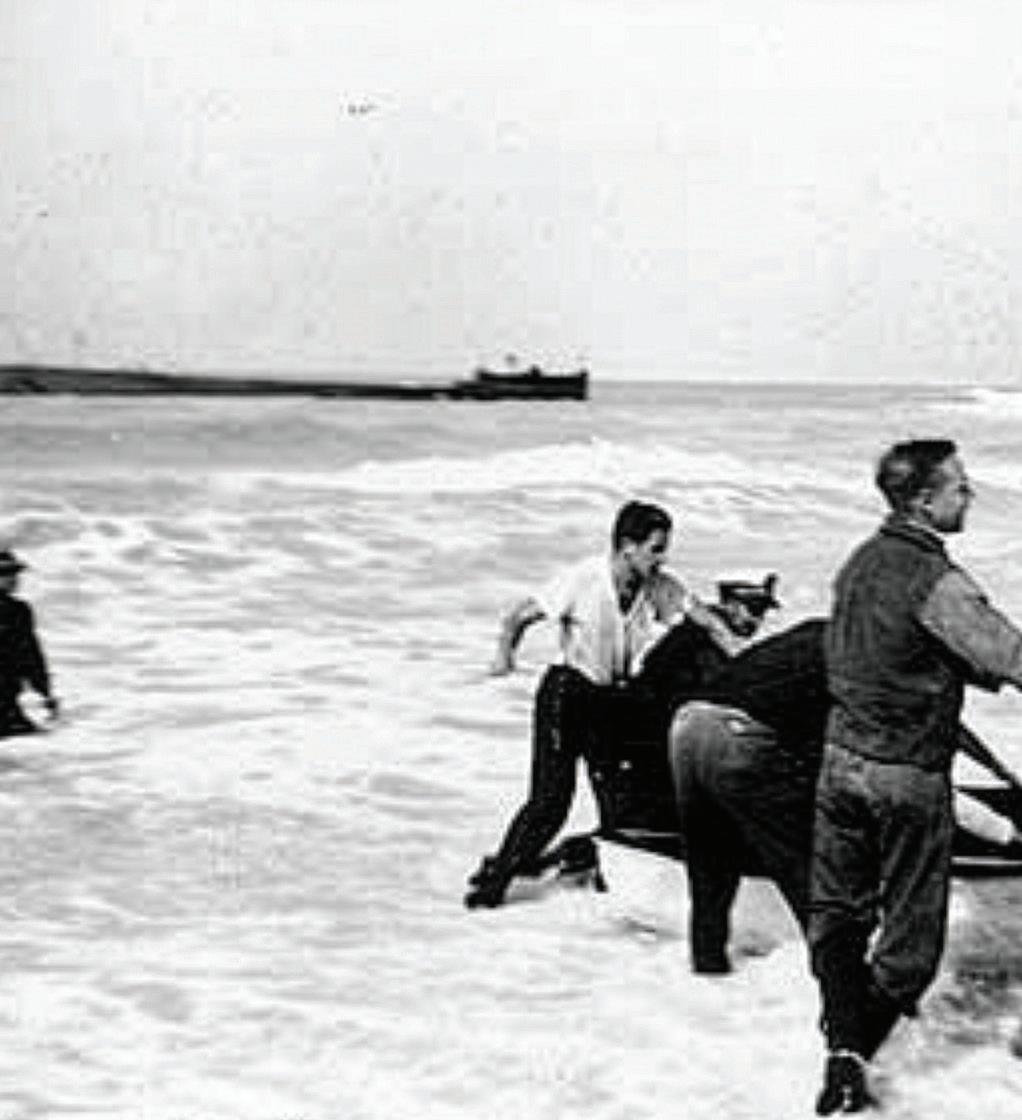
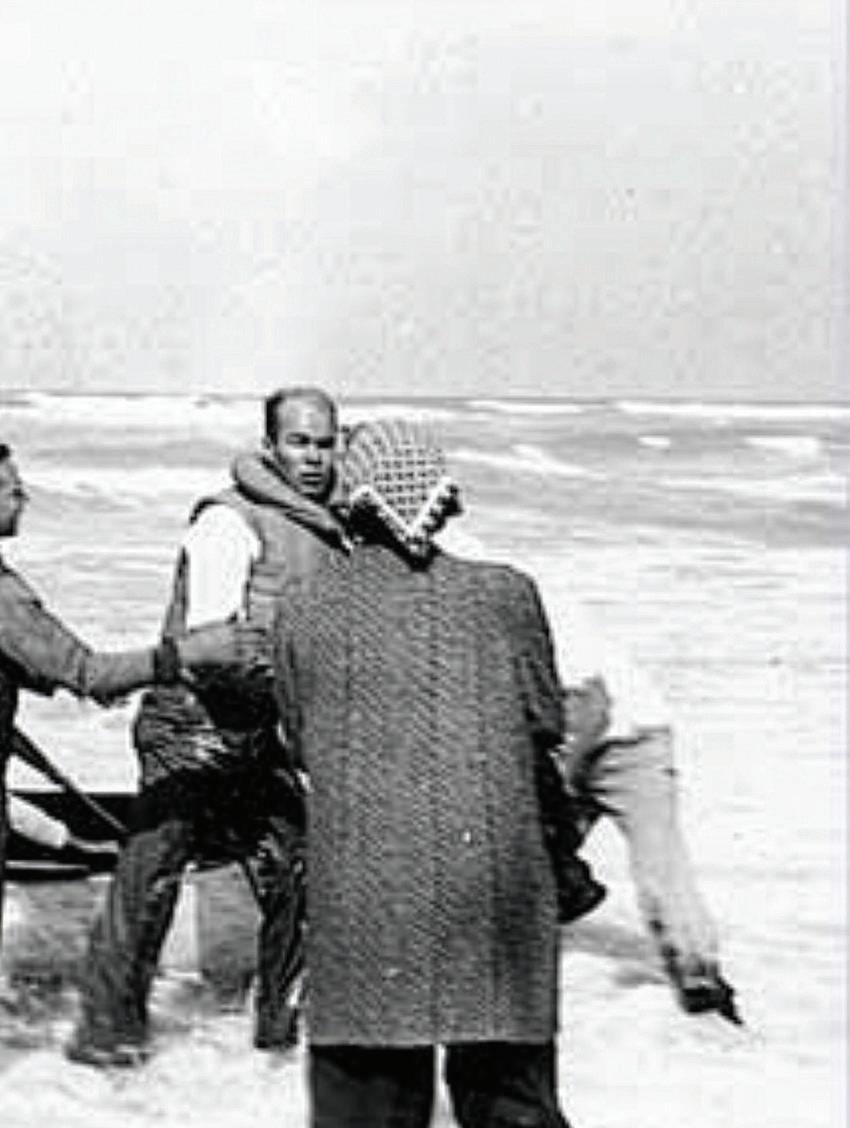
Residents on the island, the St. Petersburg Coast Guard and a Coast Guard seaplane arrived to help the crew, but weather prevented their rescue. One crew member who attempted to swim ashore, followed by his German shepherd, drowned in the process. A small dinghy reached the crew and capsized by the beach. Residents, linking hands, managed to bring the crew ashore.
The wreck of the Regina lies on the western side of Anna Maria Island, approximately 75 yards off the shore of Bradenton Beach.
City of Hawkinsville
Not all shipwrecks lie in salt water. The 19th-century coastal steamboat city of Hawkinsville—built in Georgia in 1896 for the Hawkinsville Deepwater Boat Lines—was used on the Suwannee River for the booming lumber industry and the construction of the rail bridge at Old Town.
She was abandoned in 1922 and now rests in shallow water on the western bank of the Suwanee River south of the railroad trestle at Old Town. Only advanced-level divers should explore her remains due to water conditions.
Visit museumsinthesea.com to learn more about Florida Public Archaeology Network.

“They think that if it’s underwater, it’s up for grabs, and that’s just not true,” Della says. “All historic shipwrecks in U.S. waters are protected from salvage, unlawful disturbance or collecting of artifacts under the federal Abandoned Shipwreck Act of 1988, as well as state law and, in some places, county and/or city ordinance. Federal law gives ownership of historic shipwrecks to the states in whose waters they are located and charges those states to protect and manage the shipwrecks for the benefit of the people of that state.”
Much like finding an artifact on land, drivers who find a shipwreck in U.S. waters should contact the state archaeologist or the state historic preservation officer, Della says.




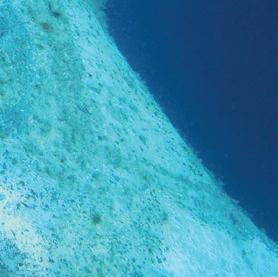






Sweet Potato Black Bean Chili
1 tablespoon avocado or extra-virgin olive oil
½ yellow onion, diced
3 cloves garlic, minced
1 jalapeno, minced
2 15-ounce cans black beans, drained and rinsed
2 15-ounce cans cannellini beans, drained and rinsed
24-ounce can diced tomatoes

1 medium sweet potato, peeled and diced
1 tablespoon ground cumin
1 tablespoon chili powder
2 teaspoons salt
3 cups spinach, chopped
2 cups cooked brown or white rice, prepared to package instructions
1⁄3 bunch fresh cilantro, chopped
Warm oil in a Dutch oven over medium heat. Once hot, add onions, garlic and jalapeno. Saute for 3-5 minutes or until onions have softened. Add beans and 1 cup of water. Stir until well combined. Stir in diced tomatoes, sweet potato, cumin, chili powder and salt. Cook for 20 minutes or until sweet potatoes are tender. Stir in spinach. Cook for another 5 minutes. Season chili to taste. Serve over rice, and garnish with cilantro.



Chorizo and Sweet Potato Breakfast Bowl
2 large sweet potatoes, peeled and diced into half-inch chunks
3 tablespoons olive oil, divided
Sea salt, plus more for seasoning
Freshly ground black pepper, plus more for seasoning
½ teaspoon garlic powder
½ teaspoon onion powder
Heat oven to 450 F.
½ teaspoon smoked paprika
4 precooked chorizo links, diced into ½-inch pieces
4 cups kale, roughly chopped
10-ounce bag frozen cauliflower rice
4 large eggs
1 avocado thinly sliced
Cilantro, for garnish
Fresh lime juice, to taste
Line a large baking sheet with parchment paper. Place potatoes in a large bowl. Toss with one tablespoon oil, salt, pepper, garlic powder, onion powder and smoked paprika. Roast potatoes for 25 minutes or until browned and crisp on the outside and soft on the inside.
While potatoes cook, prepare remaining components. Heat a skillet over medium-high heat, and add a tablespoon of oil. Add chorizo to skillet. Cook, stirring, until thoroughly browned. Remove to a plate, and cover to keep warm.
Lower heat to medium. Add kale. Saute and season with salt and pepper, then add to plate with chorizo. Saute cauliflower rice until just softened. Set aside. Add remaining oil to skillet. Cook eggs to preference, and season with salt and pepper. To assemble bowls, arrange layers of potatoes, chorizo, kale and rice. Top with avocado, lime juice and eggs. Garnish with cilantro.
Sweet Potato Taco Bowl
2 tablespoons chili powder
1 tablespoon sweet smoked paprika
1 tablespoon ground cumin
2 teaspoons kosher salt
1 tablespoon dried oregano
1 teaspoon garlic powder
1 teaspoon onion powder
¼ teaspoon cayenne pepper
1 pound sweet potatoes, peeled and chopped into 1- to 2-inch cubes
Heat oven to 400 F.
1 tablespoon vegetable oil
1 pound extra-lean ground beef
14-ounce can black beans, drained and rinsed
1 cup corn
Optional garnishes: sliced avocado, sour cream, sliced jalapenos, sliced green onion, chopped cilantro, lime slices
Sweet Potato Chowder
3 ounces thinly sliced pancetta
5 tablespoons butter, divided
1 cup chopped onion
½ cup chopped carrot
½ cup chopped celery
2 garlic cloves, minced
2½ pounds medium sweet potatoes, peeled and chopped into 1-inch cubes
5 cups chicken broth
1 teaspoon salt
1 teaspoon dried sage leaves
½ teaspoon dried thyme
½ teaspoon smoked paprika
¼ teaspoon crushed red pepper flakes
¼ teaspoon black pepper
1 cup half-and-half, warmed
3 cups chopped fresh kale
Roasted pepitas
Minced fresh sage
Heat a Dutch oven to medium heat. Cook pancetta until browned and crisp, 4-5 minutes. Remove to a paper towellined plate.
Add 2 tablespoons butter, onion, carrot and celery to pot. Cook, stirring often, until softened and lightly browned, 9-10 minutes. Add garlic. Cook until fragrant, 30-60 seconds. Transfer mixture to a bowl, and set aside.
Add remaining butter to pot. Stir in potatoes. Cook until slightly soft, 7-8 minutes, stirring occasionally. Stir in broth, salt, sage, thyme, paprika, red pepper, black pepper, cooked vegetable mixture and 2 tablespoons pancetta. Bring to a boil, then reduce to a simmer. Cook until potatoes are tender, 5-7 minutes, stirring occasionally.
Whisk about 1/4 cup of hot broth into half-and-half. Slowly add mixture to soup, stirring constantly. Stir in kale. Simmer until wilted, 4-5 minutes. Remove from heat.
Ladle soup into bowls. Top each with remaining pancetta, pepitas and sage. Serve immediately.
Sweet Potato Parsnip Bisque
2 cups sweet potato cubes
2 medium parsnips, peeled and chopped
3 tablespoons grapeseed or coconut oil, divided 2 cloves garlic, minced
1 teaspoon ginger, minced 14-ounce can cannellini beans
Heat oven to 375 F.
2½ cups coconut milk
2 cups water
1 bouillon cube
1 teaspoon black pepper
½ teaspoon cayenne pepper
Fresh arugula, cilantro or parsley for garnish
In a small bowl, mix chili powder, paprika, cumin, salt, oregano, garlic power, onion powder and cayenne pepper. Toss potatoes with vegetable oil and half the seasoning mixture from the small bowl, about 2 tablespoons. Bake for 15-20 minutes until tender and cooked through.
Meanwhile, cook beef over medium-high heat for 5-7 minutes until cooked through. If necessary, drain any large quantities of fat from skillet, leaving about 1 tablespoon. Add beans, corn, tomatoes and remaining seasoning mixture. Toss to fully coat beans and beef with seasoning. Continue to cook until beans and corn are heated through.
To serve, place a layer of potatoes in a bowl. Add beef, bean and corn mixture. Top with desired garnishes.
Line a baking sheet with parchment paper. Toss potatoes and parsnips with 1½ tablespoons oil. Spread evenly on baking sheet. Roast for 30 minutes, until tender.
Once vegetables are cooked, heat remaining oil in a large, heavy-bottomed pot. Add garlic and ginger. Saute until garlic turns slightly golden. Add roasted vegetables and beans, reserving a handful for garnish.
Stir in coconut milk and water. Bring to a boil, then stir in bouillon. Reduce heat to a low simmer. Cook for 10 minutes. Remove pot from heat. Stir in black and cayenne peppers. Use an immersion blender to puree soup until smooth. Alternatively, allow soup to cool before transferring it to a blender and blending smooth.
Serve bisque garnished with herbs and reserved beans.

NIKON D810

180mm lens


ISO 100 f/6.3 at 1/1600






By Dave LaBelle
Saying something more than once for emphasis is a powerful tool to get attention. It’s true with words, and it can be true with photographs.
While a poet might use repeating words or phrases, photographers and artists recognize the power of repeating forms—objects, lines, tones, shapes or actions—to produce patterns and rhythm.
Repeating tones, lines, shapes or actions in a photograph can produce a visual melody, just as repeating notes in a musical composition creates an audio melody.
For example, while one giant wind turbine alone on a hillside might be eye-catching, hundreds of them working side by side is a very different visual experience. It feels almost otherworldly.
Similarly, one elk walking alone through an open field can be beautiful and serene, but a herd of elk racing across that same field— hundreds of heads and legs kicking up dust or grass—creates a powerful pattern.
Repeating forms in a composition creates patterns and can make your photos come alive with visual music.
Slow down, make time to notice the patterns around you, from designs found in nature to human-made structures. See if you can capture an image that produces a visual harmony.
Email your best image—just one—with caption information, including an explanation of how it affects you, to gph@pioneer.coop. We may share submissions on our website and social media channels.
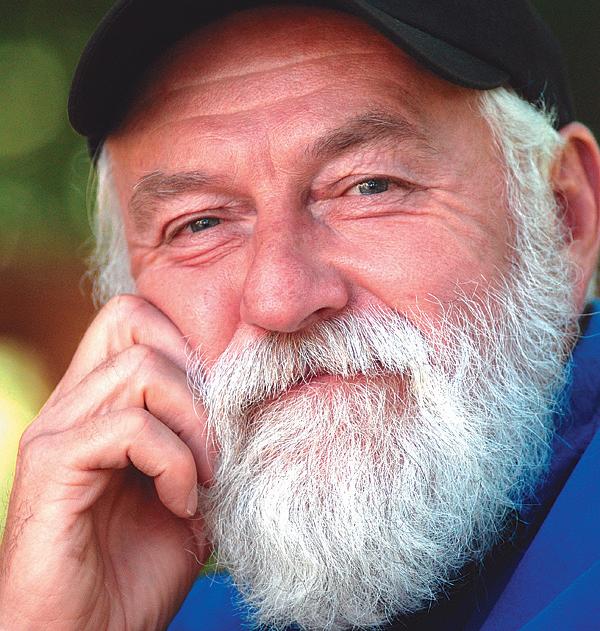
Internationally renowned author, photographer and lecturer Dave LaBelle has captured special moments for more than half a century. He has shared photo tips and life perspectives with readers since 2009. For more of his writings, visit davidlabelle.com and bridgesandangels.wordpress.com.













































































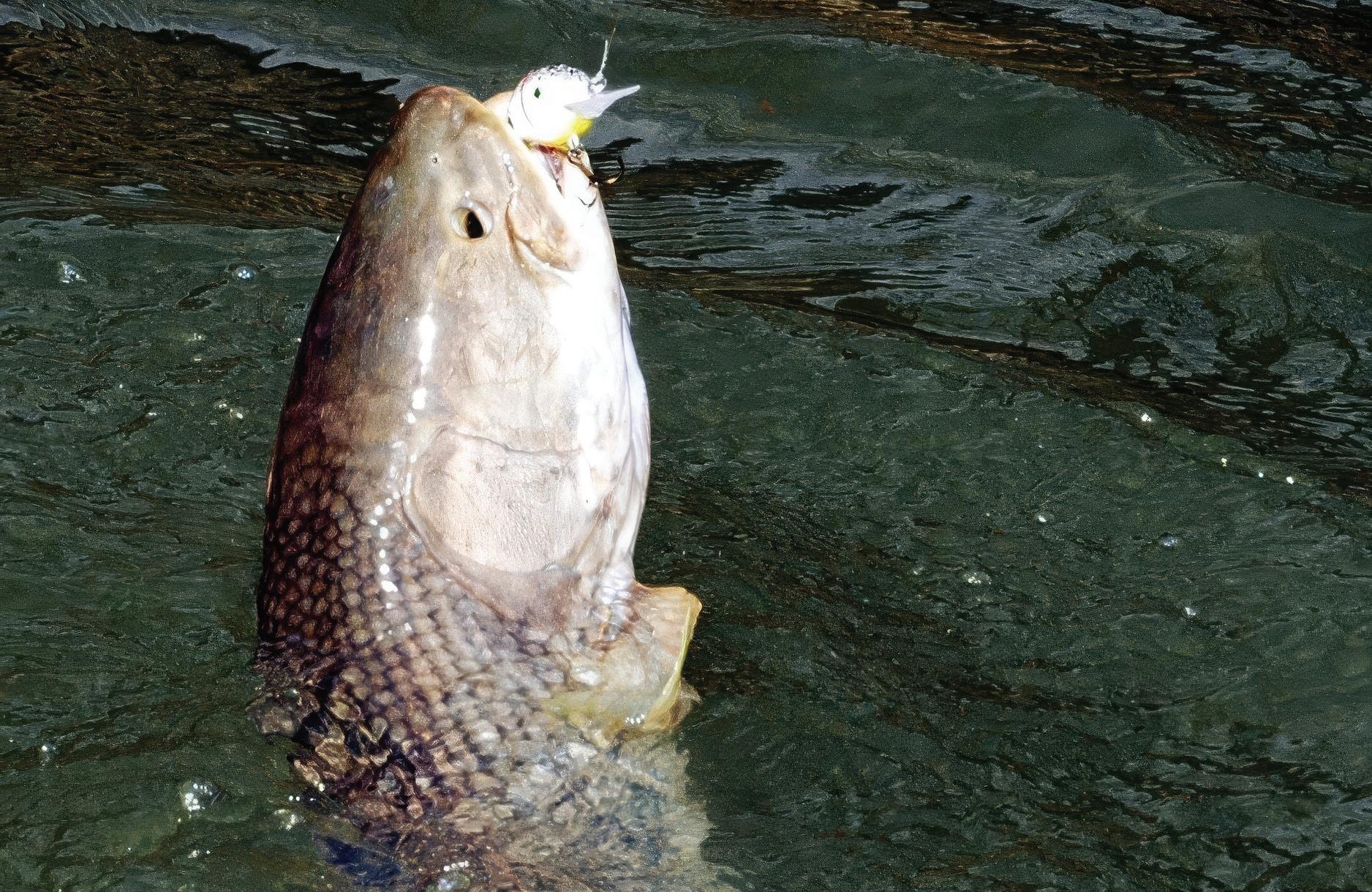
The chartreuse spinnerbait landed outside the lily pads growing along the Withlacoochee River shoreline near Dunnellon. The angler slowly worked the bass lure, its blades flickering in the black water.
Suddenly, the lure disappeared as a huge green head engulfed it. The rod doubled over as the angler battled the catch, imagining a giant largemouth on the line. The reel screamed as the powerful fish fought against the drag until subdued. The angler landed the large, snakelike fish, but not the one he hoped to pull from this river.
Anglers derisively call them grinnel, cypress trout, mudfish and other names. Bowfin thrive in freshwater systems throughout the Sunshine State. The cylindrical fish with a huge head and a mouth full of small, but sharp teeth can exceed 3 feet in length and weigh more than 20 pounds. The Florida state record, once a world record, weighed 19 pounds and came from Lake Kissimmee.
A bowfin looks similar to an eel, but is thicker with greenishbrown scales. Bowfin date back at least to the Jurassic period about 150 million years ago. Considered a “living fossil,” these amazing fish witnessed the extinction of the dinosaurs and the giant Ice Age megafauna, yet they remain unchanged as the only surviving representative of their ancient order.
Their swim bladders serve as primitive lungs, allowing bowfins to breathe air and live practically anywhere. They often inhabit the most stagnant waters with little oxygen, but might even show up in the famous springs of Florida. Bowfins can live for long periods out of water if they keep moist. People sometimes find live ones in semidry ponds resembling little more than mud puddles. Farmers




‘Living fossils’ can still put up a spirited fight
even reported seeing them alive in soggy fields after floods.
Few people intentionally fish for them. Most anglers hold bowfins in contempt because of their notoriously unsavory table reputation. Bowfins also display a talent for mangling tackle and breaking lines, then swimming off with expensive lures.
Most anglers reluctantly catch them by accident while fishing for bass or something else. Bream, crappie and catfish anglers sometimes catch them when using live minnows, worms, shad or other natural baits. These voracious marauders eat almost anything including fish, insects, crawfish, frogs and small animals.
However, these prehistoric predators can put up a formidable fight. Bowfins might hit anything that could tempt bass, especially lures that mimic shad, bluegills or crawfish. These aggressive meateaters commonly strike spinnerbaits, crankbaits, and soft-plastic swimbaits that resemble baitfish or any lures giving off vibrations. They also like plastic worms and jigs dragged along the bottom.
Anyone venturing into the backwaters to tempt bowfins probably won’t see much competition. When other fish won’t cooperate, these remarkable survivors could create a memorable day, especially for young anglers enjoying tackle-busting, line-pulling fun.
John N. Felsher is a freelance writer, broadcaster, photographer and editor. He’s written more than 3,500 articles on a wide variety of outdoor topics. Contact him at j.felsher@hotmail.com or through Facebook.


— Nancy R. Peoria, IL


















Our Double-Spin Wind Spiral isn’t just a decoration — it’s a living sculpture. Two shimmering copper spirals move independently, creating a hypnotic dance of overlapping circles and swirling reflections. The moment the breeze stirs, the magic begins.
And here’s the secret: The inner spinner is completely separate from the outer spiral. That means double the motion. Double the shimmer. Double the impact. Even the faintest whisper of wind sets it gracefully turning, thanks to ultrasensitive swivel hooks.





No wind? No problem. The rich copper-plated strands catch the light beautifully even when still — a striking focal point for your garden, porch, or deck.
Hang it from a tree limb. A shepherd’s hook. Your front porch. Wherever it spins, guests will stop. Conversations will start. Compliments will follow.


Once it starts spinning, you won’t be able to look away.
Why You’ll Love It:
• Double independent spinning action
• Copper-plated for warm, glowing shimmer
• Ultra-sensitive — spins in the slightest breeze
• Unique kinetic garden art (10" x 11" plus 3" chain)
• Weather-durable for season after season of enjoyment



All ages can find something new and exciting around every corner of the state. Filled with rich history, abundant natural beauty and diverse events all year, Florida has fun options for everyone.
April 3-5
Afro Roots Fest
This festival has historically celebrated the influence Africa continues to have on music and furthers the mission of fostering an appreciation of arts and culture through education. It’s as much about root African culture as it is about the syncretism of it with Western cultural traditions. Enjoy live music, cultural performances and delicious cuisine celebrating African heritage at the Florida Keys Brewing Company. www.communityartsandculture.org/events
April 4
Easter Egg Roll
Join in on the ninth year of the egg roll from 9-11 a.m. at the Truman Little White House. Register for the egg hunts at 9:30 or 10:30 a.m. Enjoy arts and crafts, live music, refreshments, photos with the Easter Bunny and a commemorative wooden egg. The event is free for all ages. bit.ly/4sMyZB9; 305-294-9911

April 11
Parkinson’s Disease Awareness Walk
April 4, 11, 18 and 25
Palafox Market
Join us from 9 a.m. to 2 p.m., rain or shine, to shop for farm-fresh produce, plants and baked goods from more than 200 local businesses while enjoying live music by the String Farm Band. The market is located at two historic downtown parks: Martin Luther King Jr. Plaza on Palafox Street just north of Garden Street, and Plaza Ferdinand at Palafox and Government streets. www.palafoxmarket.com; 850-434-9095
April 6
Puppy Pals Live
Part of the new Family Fun Series, this event features a diverse lineup of shows, carefully selected to entertain and inspire families at the Tennessee Williams Theatre. From shelters to showbiz, these pups perform spectacular stunts and breathtaking feats. Wesley Williams leads the puppies and audience through challenging and comical tricks. This is more than just a show. It’s a fun family experience. www.twstages.com/events-calendar/puppypalslive2026; 305-296-1520

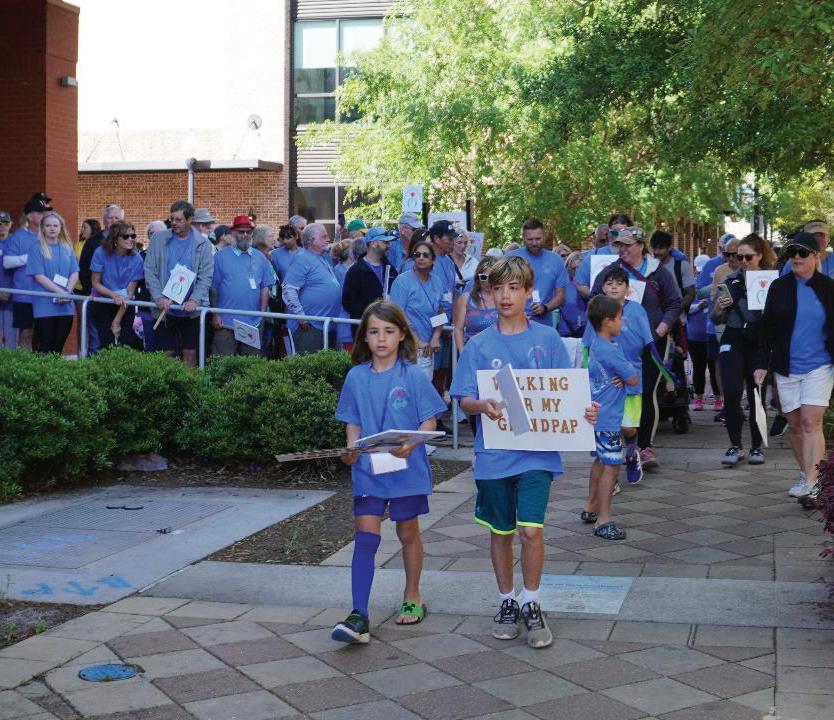
This family event from 9 a.m. to noon at Bear Levin Studer Family YMCA is free, and walking is optional. The goal is to raise community awareness of a debilitating neurodegenerative disease that is progressive, has no cure and is difficult to diagnose. Among other things, Parkinson’s Disease causes tremors, slowness in movement and speech, stiffness, and lack of balance. The disease occurs when brain cells that make dopamine—a neurotransmitter that coordinates movement—stop working. It affects more than 1 million people in the United States and more than 10 million worldwide. On World Parkinson’s Disease Day, we’ll walk; learn more about the disease and its impact to self, family and community; share a light meal; and raise awareness within our community. To register, email lc121902@yahoo.com with your name, phone number and shirt size. Sign up by March 24 to receive a walk shirt. A donation is requested but not required. This donation will go toward the cost of T-shirts, food, drinks and other items needed to make this a successful event. 850-982-3309




April 11
7-Mile Bridge Run
Experience this scenic 7-mile course at 6:45 a.m. as you run across the Overseas Highway. This run is limited to 1,500 participants. The registration fee is $100. Register online. Packet pickup is April 10. Proceeds benefit children’s charities. www.7mbrun.com/race-day-details
April 11
Navy Federal 5K
Whether you run or walk, everyone is invited to participate in the 16th annual event. Early registration is open at a discounted rate of $18 for adults and $15 for youth, ages 5-13. Children 6 and younger can also participate in the Sammie Sprint, a free quarter-mile race around Plaza Ferdinand. Participation in this event benefits Vet’s Wish, a local foundation dedicated to honoring the service and sacrifice of our military veterans by creating memorable experiences for them and their families. www.runsignup.com/Race/FL/Pensacola/NavyFederalCreditUnion5K; 888-842-6328
April 16
Third Thursday Art Walk
Experience the vibrant Morada Way Arts & Cultural District Art Walk on Morada Way. Enjoy local art, food, live music and unique shops along a lively, walkable corridor. Join us for an unforgettable evening, celebrating creativity and community in paradise. www.moradaway.org/art-walk-info
April 18
Swim Across America
The fifth annual open water swim in the Florida Keys is at Founders. Swimmers of all ages and skill levels are welcome to help us fight against cancer in the Florida Keys with the Miami Cancer Institute. Open water swims include 0.5-, 1- and 2-mile options with a kids splash available for younger participants. For those not in the Florida Keys but who still want to participate, a virtual option is available. A rolling start begins at 9:45 a.m., and post-event celebrations are at 11:30 a.m. Funds raised go to cancer research and patient care programs. Register online. Swimacrossamerica.org/floridakeys
April 19
Coastal Cat Cafe Outdoor Market
Spend your Sunday strolling through this outdoor market filled with local vendors, vintage finds, sweet treats, coffee and cozy fall vibes—all just outside the Coastal Cat Cafe. The event is free. Whether you’re hunting for the perfect gift or just want to spend the afternoon surrounded by cats, coffee and community—you won’t want to miss this one. www.coastalcatpcola.com/event-details/coastal-cat-cafe-outdoor-market-2; 850-359-1133

April 4
Easter Egg Hunt
Bring your children for the annual Easter egg hunt put on by the city from 10 a.m. to noon in Frank Brown Park. Children 10 and younger are welcome to join in on the hunt. The Easter Bunny is also available for photos. 850-233-5070
April 28
Spring into Sports
Bring your family and friends to the second annual Spring into Sports event from 9 a.m. to noon at Frank Brown Park. With a range of sports, activities and vendors, this event offers something for all ages. Enjoy a complimentary hot dog lunch prepared by the Optimist Club of the Beach and sodas provided by Buffalo Rock. The event is free. The playground, walking trails and picnic areas are also open for use.
www.pcbfl.gov/departments/parks-recreation-department; 850-233-5045

Want to share a family-friendly event with the readers of Florida Currents?
Head online and enter the details at tinyurl.com/FloridaCurrents or use the QR code for easy access. Make sure to submit the item at least 60 days before the event (due to press deadline).
If you own rights to a print-quality photo promoting your event, include it with photo credit information.


Problem areas in the landscape are opportunities for creativity. With thoughtful plant selection and a bit of design know-how, even a soggy trouble spot in your lawn can be transformed. There are appealing alternatives to traditional turf that are well-suited for moist, poorly drained areas.
Many plants are naturally adapted to wet, poorly drained sites. Look to natural wetlands for an inspiring palette of colorful blooms and foliage. Many native plants thrive in moist soil and can bring beauty and resilience to challenging areas.
Blue flag iris (Iris virginica) is a native perennial that flourishes in wet conditions. With attractive blue flowers and upright, evergreen foliage, it’s an excellent choice for filling in persistently soggy spots.
Scarlet hibiscus (Hibiscus coccineus) is another standout native perennial. Reaching 3 to 7 feet tall and thriving in full sun to partial shade, it produces large, crimson flowers, 4 to 8 inches wide, throughout the summer. These dramatic blooms are highly attractive to pollinators and people alike.
A grouping of pink muhly grass offers another lowmaintenance option. This adaptable grass tolerates fluctuations in moisture from dry to wet and adds soft, airy plumes of pink in the fall.
For lower-growing options, consider mowable groundcovers. Sunshine mimosa thrives in wet soil, produces abundant pink puffball flowers and can be mowed, making it a practical choice for replacing sections of turf or blending into existing lawn areas.
If you prefer something larger, a single specimen shrub or grouping of shrubs can add structure to the landscape. Attractive native shrub options for moist sites include beautyberry (Callicarpa americana), Virginia sweetspire (Itea virginica), summersweet (Clethra alnifolia) and buttonbush (Cephalanthus occidentalis).
By choosing plants that naturally thrive in wet conditions, you can turn problem areas into functional features that support local ecosystems and reduce maintenance in the long run.
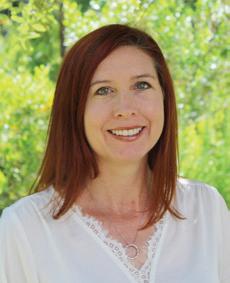

Terra Freeman is the Florida-Friendly Landscaping and Commercial Horticulture Extension Agent for UF/IFAS Extension
St. Johns County. She provides education and outreach to support sustainable landscape practices across residential and commercial sectors. With more than 25 years of experience in horticulture, she is dedicated to helping communities protect Florida’s natural resources through science-based, environmentally responsible landscaping.
It’s that time of year when homeowners spruce up yards and freshen landscapes. However, if you’re considering planting a tree, carefully select its location and call 811 to have underground utilities marked before you begin digging.
Glades Electric Cooperative and Safe Electricity offer tips on how to safely pick an optimal location.
A mature height of less than 15 feet is recommended if planting near power lines. Some trees that are generally not tall enough to interfere with lines include crepe myrtle, some holly trees, silver palm and majesty palm.
If trees are planted in the wrong location, they can be expensive to maintain and even dangerous. Trees should never be planted directly under power lines, near poles or too close to electrical equipment.
Once you select a tree, call 811 before putting a shovel in the ground. Call Before You Dig is a free service that locates and marks public underground utilities on your land. Call several business days before you plan to dig. Locators will mark public underground utilities such as electric, gas, water, cable and fiber. The service does not mark privately owned lines or pipes.
Know its mature height before deciding where to plant
• If your established trees are growing into power lines, contact Glades Electric at 855-940-3810 to ask about them. The cooperative will trim the tree, depending on its location. If it’s your responsibility, do not take on the task yourself. Only tree trimmers who are line-clearance certified are legally allowed to prune and trim trees within 10 feet of power lines.
• It’s important to have trees trimmed. Limbs can fall on power lines during bad weather, resulting in power outages or flickering lights. Broken or drooping limbs are a fire hazard.
• Tall-growing trees with a mature height greater than 45 feet should be planted at least 45 feet away from lines to avoid future pruning. These trees include oaks and most pines and maples.
• Be sure no one climbs a tree near power lines. If branches touch the wires, the tree could be energized. Even branches that do not touch power lines could become energized if a child’s weight on a limb causes it to touch the line or if they reach out to touch the line.
For more information about electrical safety, visit safeelectricity.org.
The larger the tree, the farther it should be from a power line. Avoid planting
The larger the tree, the farther it should be from a power line. Avoid planting beneath power lines, near poles or close to electrical equipment. beneath power lines, near poles or close to electrical equipment.
Large Trees (46' and taller)
Medium Trees (26'-45' tall)
Small Trees (up to 25' tall)










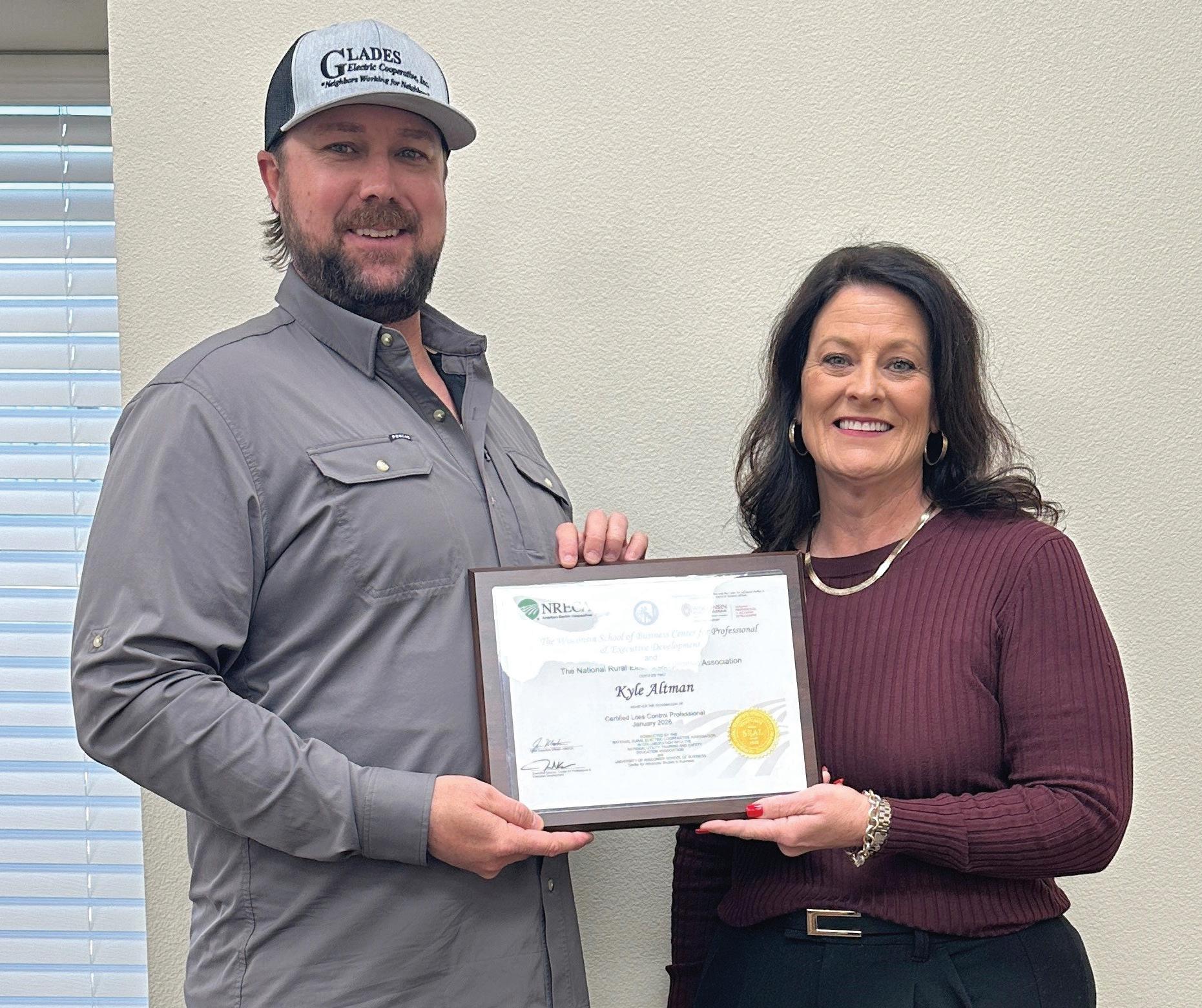

Glades Electric Cooperative Director of Safety and Loss Prevention Kyle Altman completed an intensive program in electric utility safety and loss control.
The Certified Loss Control Program is a series of workshops offered by the National Rural Electric Cooperative Association in conjunction with the National Utility Training & Safety Education Association. The program is designed to instruct participants in many areas related to electric utility industry safety.
Nearly 4 million injuries occur annually in the workplace, according to the Occupational Safety and Health Administration. One of the goals of a certified loss control professional is to help ensure a safe work environment for utility workers and the public in general. Avoiding workplace accidents reduces down time and can ultimately lead to lower utility rates.
Kyle is one of only a few electric utility professionals in the country who will receive the certification this year. The program requires participants to complete a rigorous series of seminars and tests, a 30-hour OSHA course and a detailed final project. Kyle’s chosen topic for the latter was safety audits.
Loss Control participants complete four weeklong sessions designed to challenge and educate them in new, innovative safety techniques. Participants must maintain certification by attending courses every year to stay on top of changes in the industry.
Kyle has been with Glades Electric for nearly 20 years, starting as a lineworker. Glades Electric promotes continuing education for its dedicated team of skilled professionals. We celebrate Kyle’s achievement and pursuit of certification for expanded knowledge to promote safety for our employees and members.
PHOTO BY JENNIFER KOUKOS






Families and businesses count on reliable electricity at an affordable price. However, with the demand for power continuing to climb and the supply of always-available power sources at risk, smart energy policies are more important than ever.
At Glades Electric Cooperative, our job goes beyond keeping the lights on. We are responsible for advocating on behalf of our members in Washington, D.C., to make sure decisions at the federal level protect reliable, affordable power in our communities.
While you may not consider it daily, electricity is essential and underpins nearly every aspect of modern life.
Understanding today’s evolving energy landscape is important as it shapes how electricity is produced, delivered and consumed. Advocating on behalf of Glades Electric Cooperative’s members is a critical part of our commitment to you. These policy priorities support the same goal: making sure our members have safe, reliable and affordable power now and in the future.
In 2026, America’s electric cooperatives are focused on a few key issues that directly impact our members:
Faster Disaster Recovery: We support the bipartisan FEMA Act of 2025. The Federal Emergency Management Agency is a critical partner in helping electric co-ops restore power and rebuild their systems in the wake of natural disasters, but it could be more effective and responsive to the needs of rural America. If the Fixing Emergency Management for Americans Act passes, it will help utilities restore power more quickly after storms and disasters—while keeping costs lower for rural families and businesses. Learn more at www.electric.coop/fema.
Cutting Through Red Tape: Outdated and overly complex permitting rules slow down essential upgrades to power lines and substations. Streamlining these processes helps us keep up with growing demand and improve reliability. We’re urging Congress to pass comprehensive permitting reforms, including the SPEED Act and PERMIT Act, both of which cleared the House in December. Learn more at www.electric.coop/issues-and-policy/permitting-reform.
Keeping Reliable Power Plants Online: We’re advocating for realistic energy regulations that don’t force dependable power plants to shut down before reliable replacements are ready. Mandating emissions limits based on unavailable technology would force critical power plants off the grid and restrict the operation of new natural gas plants. Learn more at www.electric.coop/issues-and-policy/epa-power-sector-rules.
Smarter Land Management Policies: We’re advocating for smarter land management policies like the Fix Our Forests Act that would allow electric cooperatives to better maintain power lines on public lands and mitigate wildfire risk. Learn more at www.electric.coop/electric-co-ops-praisehouse-passage-of-fix-our-forests-act-a-crucial-tool-for-reducing-wildfire-hazards.
Maintaining Funding for Grid Innovation and Investments: Federal loan and grant programs help co-ops strengthen the grid, prepare for extreme weather, improve cybersecurity and explore new energy technologies—without shifting costs to members. Learn more at www.electric.coop/issues-and-policy/energy-innovation.
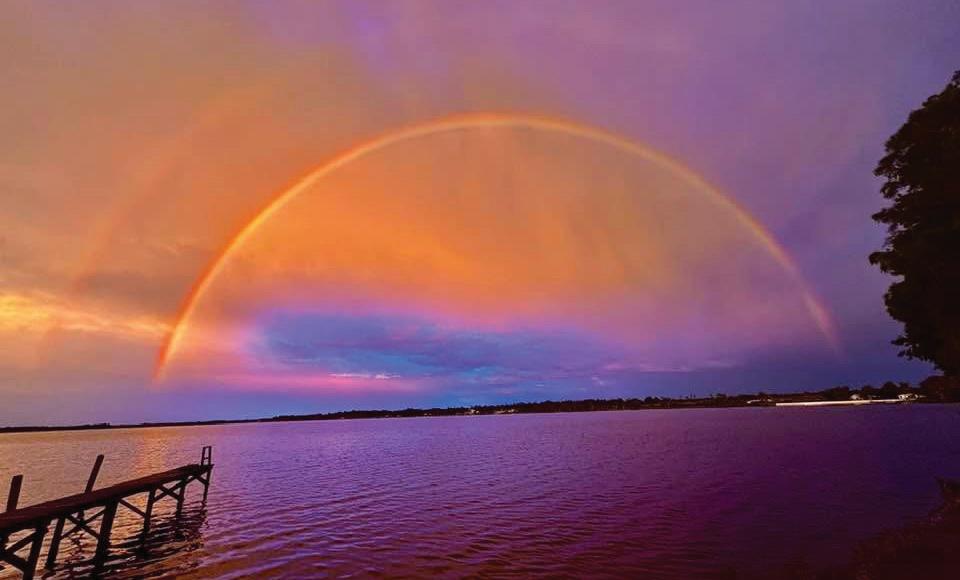
From time to time, we share some readers’ photos in this space. Submit your photo by emailing a JPEG to photos@floridacurrents.com. Include “Before You Go” in the subject line. Share a bit about what inspired you to make your photo.

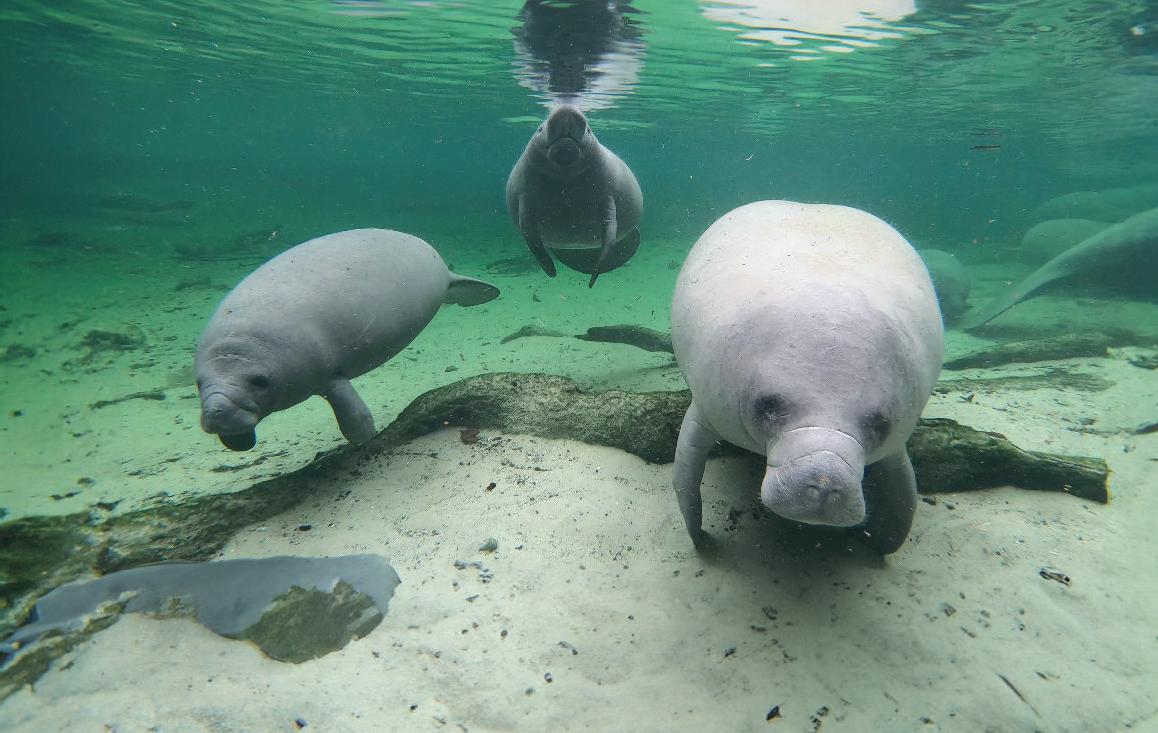




PICTURE A CHILD STRUGGLING WITH HUNGER. WHAT DO THEY LOOK LIKE? DO YOU IMAGINE A CERTAIN AGE, ETHNICITY OR PART OF THE COUNTRY? TRUTH IS CHILD HUNGER CAN BE HARD TO RECOGNIZE BECAUSE THE 1 IN 7 AMERICAN KIDS FACING IT CAN LOOK LIKE ANYONE ESPECIALLY ME. I WAS CREATED BY ARTIFICIAL INTELLIGENCE FROM PHOTOS OF THE 11 MILLION KIDS STRUGGLING WITH HUNGER IN THIS COUNTRY. A FACE THAT CHALLENGES YOU TO SEE HUNGER IN A DIFFERENT LIGHT. I AM WHAT HUNGER LOOKS LIKE IN AMERICA LEARN MORE AT IAMHUNGERINAMERICA.ORG


. .




Electric Cooperative, Inc. “Neighbors Working for Neighbors”
CONTACT US
855-940-3810
www.gladeselectric.com
7 a.m. to 6 p.m. Monday through Thursday
26733 U.S. Highway 27
P.O. Box 519
Moore Haven, FL 33471
214 SR 70 W. Lake Placid, FL 33852
REPORT AN OUTAGE
Via the SmartHub app ~ 855-940-3810 (24/7 outage reporting)
Please have your account number ready.
BOARD OF TRUSTEES
Lee Henderson, President, District 6 Highlands Park, 863-633-9281
Barney Goodman, Vice President, District 2 Hendry County, 561-414-8737
Shannon Hall, Secretary/Treasurer, District 4 Lakeport and Brighton, 863-946-3242
Donnie Lundy, Trustee, District 1 Moore Haven, 863-634-7314
Mike Pressley, Trustee, District 3 Ortona and Palmdale, 863-673-9158
Brad Oxer, Trustee, District 5 Venus and Hicoria, 863-441-1866
Fred Tagtmeier, Trustee, District 7 Lorida, 863-214-4994
Vicki Pontius, Trustee, District 8 Lake Josephine, 863-414-2917
Angela Hodges, Trustee, District 9 Okeechobee, 863-801-3140
The next monthly board meeting is at 9 a.m. April 23 at Moore Haven headquarters. Any changes are posted in the lobby of both district offices.
EXECUTIVE STAFF
Michael Roberge, Chief Executive Officer
Renee Bass, Chief Administrative Officer
Courtney Brown, Chief Personnel Officer
Jennifer Koukos, Chief Communications Officer
Jennifer Manning, Chief Financial Officer
Believe it or not, no two electric utility bills are the same. Utilities have different components in their bills, and members all have unique usage patterns. So, how does the utility decide what to charge?
Well, as luck would have it, we are working with a consulting group that performs rate studies. They are helping us develop an overview of our revenue requirements, cost-of-service breakdowns and rate design options.
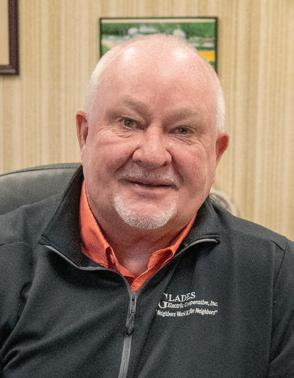
The revenue requirements portion of the study is an overall view of how much it costs to properly own and operate the cooperative utility. They look at all aspects of activities on the system, such as new installations, energy delivery to members, maintenance and the costs for all aspects of running the cooperative. They also compare the total revenues—how much the cooperative collects from its members and other partners— to the total costs and then calculate the total amount of revenue that should be collected to meet or exceed the minimum financial ratios and goals that the cooperative and its lenders have established.
The cost-of-service portion of the rate study dives deeper into the costs of running the cooperative and sorts them into types of costs. For instance, all power supply costs are not the same. Some costs are fixed and don’t fluctuate with volume, and some are variable based on fuel volumes and prices. Some costs are related to the capacity or demand requirements. This process is reviewed for all of the cost components and sorted into the designated types.
The rate design options are the most important portion of the rate study. This determines how much we collect from each group of members, such as residential, commercial and irrigation. The overall goal is to collect sufficient revenue to meet our financial benchmarks and to collect it from the right groups of members. The groupings of members are key to this portion of the process to ensure the collection of revenue from each group fairly approximates the actual cost to provide our service to each individual group.
We have more than 19,000 services, and for practical purposes, no two services impact the system the exact same way. It’s the cooperative staff’s job to develop the groupings of members based on like system needs and usages.
Not all residential services are the same. We have very large energy users and very small energy users in our residential rate class. We will be looking to better sort our residential members into a few separate groups based on their use and system needs. The same disparity is true for our small commercial customer class, which will also be reviewed.
We are in the process of reviewing data for the grouping of like services and will then develop rates that allow us to collect the revenue from members with as little cross-subsidization as possible. Next month, I’ll share more about the specific billing determinants—the factors by which you are charged—including what they mean and how they fit into our cost-of-service puzzle. Stay tuned.