CONNECTION SEPTEMBER/OCTOBER 2022
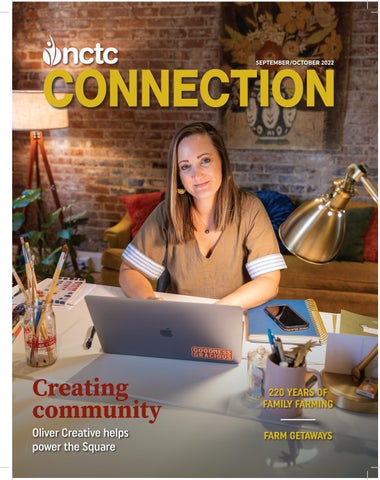
Creating community Oliver Creative helps power the Square
220 YEARS OF FAMILY FARMING FARM GETAWAYS
INDUSTRY NEWS
A bridge to the future Rural Connections By SHIRLEY BLOOMFIELD, CEO NTCA–The Rural Broadband Association
Faster broadband benefits rural America
A
s the chief executive officer of NTCA– The Rural Broadband Association, I am proud to represent 850 small, independent broadband providers who are offering some of the highest possible broadband speeds to some of the most remote parts of the country. Thanks to NTCA members, many rural Americans have higher internet speeds than I have where I live just outside Washington, D.C. We currently have a once-in-a-generation opportunity through billions of dollars of funding recently made available by the Bipartisan Infrastructure Law and other federal programs to bridge the digital divide and bring broadband to those who still lack it. As broadband is deployed thanks to this funding, we must ensure that recipients are using it to provide the best possible services. Recently, Federal Communications Commission Chairwoman Jessica Rosenworcel initiated a process to redefine what it means to have broadband-speed internet, raising the standard. This move continues us down the path needed to give rural residents the internet service they not only need but also deserve as they connect to vital resources like telemedicine, online education, employment opportunities and much more. A new, more realistic, standard provides a range of benefits, including clarifying the true needs of rural areas and the funding required to serve them. We have long advocated that, as a nation, we need to aim higher and do better when it comes to setting broadband objectives. We applaud Chairwoman Rosenworcel’s efforts. We look forward to continuing to work with the FCC and other agencies to bridge the digital divide.
2 | September/October 2022
Your communications provider is your link to vital resources
The digital world increasingly weaves its way into our lives, replacing formerly physical resources, tasks and tools. Consider restaurants, for example. For some, scanning a QR code with your phone to view the options online has replaced physical menus. Rapid expansion of digital resources was a trend before the pandemic, but it’s only accelerated in the years since. In an article this year for Wired — “The Digital Divide Is Coming for You” — Bhaskar Chakravorti, dean of global business for The Fletcher School at Tufts University in Massachusetts, described having broadband and mobile internet as table stakes. Without those services, you don’t exist digitally, he says. Your rural internet service provider is committed to bridging the digital divide between you and vital resources like these:
BANKING
STREAMING TV
HEALTH CARE RECORDS
GOVERNMENT RESOURCES
EVENT TICKETS
WEATHER ALERTS
WEATHER ALERT
GAMING
HOME SALES AND PURCHASES
COLLEGE APPLICATIONS
What’s the password? How to build — and remember — strong passwords
I
t’s difficult to do anything online without piling up a few passwords. Using the same one for multiple sites can leave your private information vulnerable to cyberattacks, and devising strong passwords full of random letters and symbols can make them impossible to remember. A good password doesn’t have to be unintelligible, but it does need to be random enough to avoid any clear patterns. Here are a few helpful tips for building passwords that will keep your online accounts secure without forcing you to hit the “Forgot my password” link every time you want to log in. At least 12 characters — the longer your password, the more difficult it will be to crack. In general, you should create passwords with a minimum of 12 to 14 characters. But more is always better. Change it up — using a mix of different characters like numbers, symbols, capital and lowercase letters makes your passwords stronger. Avoid full words — using your favorite team’s name as a password
doesn’t cut it anymore. In fact, you should avoid using any full words you might find in the dictionary. That goes for any common phrases, too. Diceware — one exception to the above rule is the Diceware method. By stringing truly random words together, you can build a secure passphrase that is easier to remember than a jumble of letters and numbers. To help with this process, search for the Diceware Password Generator. It can randomly select between two and eight words to build your passphrase. Avoid obvious substitutions — “Password” doesn’t become stronger if you change it to “P@ssword.” Avoid substituting obvious symbols for letters. If it has occurred to you, it has probably occurred to a hacker. Go to the manager — if you’re having trouble keeping track of all your logins, a password manager can help. Programs like Dashlane, LastPass and Keeper manage your passwords across numerous sites and devices, making it easier to avoid repeats. All you need to remember is one strong password, and you’re set.
Tired of passwords? Apple may have the answer At its Worldwide Developers Conference earlier this year, Apple demonstrated a new “passkeys” feature that may spell the end for passwords. Rather than inputting a password for every site you visit, passkeys would use a biometric sign-in like the Touch ID or Face ID that currently exists on iPhones and iPads. Websites and apps on non-Apple devices would provide a QR code that sends authentication to the user’s phone or tablet. Just a month earlier, Apple joined with Google and Microsoft to support the development of new passwordless logins on both mobile and desktop devices. So, even if passkeys don’t crack the code, you may not need to juggle passwords for much longer.
September/October 2022 | 3
FROM THE CEO
The power of a cooperative Your voice guides our mission
W
hen it comes to a for-profit business, some would say a company is what it sells. The nature of the product defines the culture, the business’s interactions with customers and how it spreads its message. For instance, a manufacturer with a production plant creating physical goods is fundamentally different than a local real estate agency or medical facility. The day-to-day realities of the many job roles and policies needed to make that product possible can shape how a business operates, how consumers view it and even how employees view themselves. For North Central Telephone Cooperative, there’s no doubt about our products or the expertise needed to make them possible. Simply put, we know rural communications better than anyone. Our roots are in telephone networks. After all, not that long ago, copper wires strung from pole to pole throughout our area were our primary ties to the world. We’ve moved well past those JOHNNY days, and we’re now far more than a telephone company. MCCLANAHAN Today, we’re a true communications hub using fast internet President/CEO service to link you to the information you need. Our systems keep pace with the latest innovations to create the best experience for you. Now, telephone services are only a single part of that product mix — one component of the complex, powerful and reliable infrastructure we’ve created to link our community to all the resources now at our fingertips. Streaming television and music. Telemedicine and online learning. Movies and social media. These are all modern necessities, and we make it possible for you to connect to them. Our technical experts have the skills to maintain and support the latest systems. We train our staff to not only anticipate the questions you may have about your services, but also to have the knowledge to provide clear answers. At a very basic level, the services we provide do define NCTC — at least in part. You see, we’re more than simply a communications company. We are also part of a national community of organizations responsible for bringing services to areas larger national companies would not serve. Unlike businesses that put profit or stock values above all else, cooperatives proudly go a different direction. We put your needs and the needs of the communities we serve first. Does that mean we’re not worried about income? Of course not. We’re vigilant stewards of the cooperative’s finances. In a world of escalating costs and ever-changing technology that’s no small task. As a cooperative, though, we’re also governed by you through a board of directors elected by you. Other communications companies can’t say the same, particularly the large national providers. We are part of the community, devoted to making life here better for everyone. In fact, that’s a central principle of every cooperative — concern for the community. We support local organizations and businesses through donations, scholarships and more. The members of our team live here, shop here and enjoy our rural way of life just as you do.
CONNECTION SEPTEMBER/OCTOBER 2022
The North Central Connection is a bimonthly newsletter published by NCTC, © 2022. It is distributed without charge to all member/ owners of the cooperative.
North Central is a member-owned corporation dedicated to delivering advanced telecommunications technology to the people of Northern Middle Tennessee and Southern Kentucky, including Macon County, Tenn., Allen County and Warren County, Ky. NCTC also serves portions of Sumner, Trousdale, Smith and Clay counties in Tennessee. North Central 872 Highway 52 Bypass, East P.O. Box 70 Lafayette, TN 37083 Telephone: 615-666-2151 www.nctc.com BOARD OF DIRECTORS Glen Hardcastle Chairman of the Board Scottsville Exchange West Randy Harston Vice Chairman of the Board Scottsville Exchange East Calvin Graves Secretary of the Board Bethpage/Oak Grove Exchanges Martha Bowser Westmoreland Exchange Kevin Dickerson Defeated/Pleasant Shade Exchanges Donnie Steen Lafayette Exchange East Jeff Flippin Lafayette Exchange West Chad Evitts Hillsdale/Green Grove Exchanges Chad Owens Red Boiling Springs Exchange Johnny McClanahan President/CEO Guy Holliman General Counsel
Produced for North Central by:
On the Cover: Jennifer Oliver opened her branding agency, Oliver Creative, on the Square in 2020. See story Page 8.
Photo by Tony Young.
4 | September/October 2022
VOL. 9, NO. 5
NCTC NEWS
N 5
Save the date!
NCTC’S
ANNUAL MEETING Saturday, Nov. 5
North Central Telephone Cooperative is happy to announce its annual meeting will take place in person on Saturday, Nov. 5, at Macon County Junior High School. Entertainment begins at noon, and the business meeting begins at 1 p.m. Information on the director elections in October will be mailed to our members with details for each service area. Remember to like our Facebook page for the latest community news and information!
Nondiscrimination statement
Take a load off In observance of the Labor Day holiday, NCTC offices will close on Monday, Sept. 5. We wish you a relaxing and safe holiday!
North Central
In accordance with federal civil rights law and U.S. Department of Agriculture (USDA) Civil Rights regulations and policies, the USDA, its agencies, offices, and employees, and institutions participating in or administering USDA programs are prohibited from discriminating based on race, color, national origin, religion, sex, gender identity (including gender expression), sexual orientation, disability, age, marital status, family/parental status, income derived from a public assistance program, political beliefs, or reprisal or retaliation for prior credible activity, in any program or activity conducted or funded by USDA (not all bases apply to all programs). Remedies and complaint filing deadlines vary by program or incident. Persons with disabilities who require alternative means of communication for program information (e.g. braille, large print, audiotape, American Sign Language, etc.) should contact the responsible agency or USDA’s TARGET Center at 202-720-2600 (voice and TTY) or contact USDA through the Federal Relay Service at 800-877-8339. Additionally, program information may be made available in languages other than English. To file a program discrimination complaint, complete the USDA Program Discrimination Complaint Form, AD-3027, found online at http://www.ascr.usda.gov/complaint_filing_cust.html and at any USDA office. Or write a letter addressed to USDA and provide in the letter all of the information requested in the form. To request a copy of the complaint form, call 866-632-9992. Submit your completed form or letter to USDA by: 1) mail: USDA, Office of the Assistant Secretary for Civil Rights, 1400 Independence Ave. SW, Washington, D.C. 20250-9410; 2) fax: 202-690-7442; or 3) email: program.intake@usda. gov. USDA is an equal opportunity provider, employer and lender. September/October 2022 | 5
TRAVEL
GETTING AWAY to the farm
A few days in a pastoral setting can do wonders for the heart and mind
T
he South’s diversity of rolling pastures, mountain vistas, natural springs and lakes makes it an appealing getaway. But why book a hotel stay when you can wake up to the call of a rooster and go to bed with the hoot of an owl? Farm stays are one of the best ways to absorb nature, eat homegrown food and learn about rural life. Farmers are welcoming guests by turning their barns and unused dwellings into overnight accommodations for a vacation you’re likely to remember for years to come. And who knows? Maybe you’ll realize farm living is the life for you. It’s a win-win for guests and farmers. These stays give guests a few days off the beaten path, and they allow landowners to bring in income while educating the public about working the land. “It’s a way for farmers to show the inner workings of their farms, what it takes to grow food for their tables, who we are and the stories we
th Farm
Fai Photo courtesy of By
hold. Also, it’s nice to welcome city dwellers to our farm to bridge a growing urban-rural divide and offer them our countrysides for relaxation, calm, play and connection,” says Scottie Jones, a farmer and founder of the U.S. Farm Stay Association. And for small farmers, it’s a way to make much-needed money for new equipment and for upkeep and repairs of old farm equipment. The extra funds also help with costs like insurance, retirement savings and college funds. “In the last decade, the concept of hosting guests on one’s farm has risen to the surface, especially as booking sites such as Airbnb and VRBO have made the daunting task of taking reservations much more easy to handle,” Scottie says. So, if you’re considering something different for your vacation this year, here are some Southern farms opening their gates to overnight guests.
Devoted to feeding the hungry, By Faith Farm creates opportunities for visitors to pitch in and help. 6 | September/October 2022
Photo courtesy of Lori Birkhead
Story by ANNE BRALY
ding Photo courtesy of Kokovoko Bree
Farm
Photo courtesy of Lori Birk hea
d
Left: Visitors to By Faith Farm enjoy an interactive experience.
REVIVAL HILL FARM Cullman, Alabama Milk cows, pick herbs from the garden, gather eggs from the henhouse or just sit back and enjoy life at Revival Hill Farm. The farm stay has one bedroom and a roomy living area with couch, television chairs and kitchenette. It’s attached to the farm store/milking parlor with a private outdoor entrance and access to farm animals, garden, fire pit, pond, pasture and woodlands with numerous trails for hiking. If you need more space, Revival Hill also has a house you can rent. This three-bedroom, two-bath accommodation is located across the street and has a full kitchen, laundry room, open-concept living area and beautiful covered back porch. The farm is a stone’s throw from Smith Lake Park, so tow your boat. There’s plenty of boat parking at the farm. Nightly rate: $172 Reservations: Airbnb
spend a day touring the city and then come back to the country to unwind. Nightly rate: $95 Reservations: Airbnb
Above: The carriage house at Kokovoko Breeding Farm can sleep five — perfect for families or friends traveling together.
BY FAITH FARM Joelton, Tennessee This farm works a little differently than some others. With a mission to grow healthy food for those in need, 100% of your nightly rate will go toward feeding the hungry in surrounding communities. It’s a farm stay with a purpose. Stay in a 1,500-square-foot, two-bedroom, two-bath modern loft apartment with kitchen and living room above a red barn. Wander the fields, hike the trails or sit beside a pond and reflect on your peaceful surroundings just 15 miles outside the busyness of Nashville. Pick vegetables from the donation gardens or help harvest food for By Faith Farm’s food bank collections. Nightly rate: $275 Reservations: Airbnb or byfaithfarm.com
STONEWOOD FARM Ridgefield, South Carolina Enjoy life at a slower pace at this farm with its menagerie of goats, chickens, horses, dogs and friendly felines. The farm offers overnights, glamping-style, in a 14-by-20-foot tent on a raised platform with an outdoor dining area set up for roasting s’mores at night or for drinking your coffee in the morning. The tent sleeps six and comes complete with lanterns, heaters, snacks, a coffee maker and a television with a large selection of movies. The farm is located in the South Carolina Lowcountry, not too far from Charleston and Hilton Head, so you can
Middle: At By Faith Farm in Joelton, Tennessee, the goal is to grow healthy food for those in need, and money raised from visitors helps feed the hungry.
KOKOVOKO BREEDING FARM Corinth, Kentucky Pop a tent out in the open fields or make reservations for the carriage house. Either way, you’ll spend time in the beautiful outdoors of Central Kentucky’s horse country. Swedish Gotland ponies and Lincoln Longwool sheep graze over 150 acres of Kentucky rolling hills and forest. It’s unspoiled. It’s organic. It’s totally natural. Bring your binoculars — the bird-watching is great. Or sign up for a fiber workshop. And helping out with the farm chores is always appreciated.
The carriage house can sleep five, so bring the family — but leave your electronics at home. They won’t work here. This is a chance to immerse your family in a totally different way of life. Stroll down the country roads, look for wildlife, play in the creek, baa at the sheep and visit the ponies — they always love a good brushing. Nightly rate: $50-$200 Reservations: farmstayus.com
THE SHAGGY GOAT Waleska, Georgia Pet the goats, feed the chickens, learn about beekeeping, try your hand at gardening or hike or bike the nearby mountain trails. Or just spend the day lolling in your hammock. It’s up to you. Your time is your own at The Shaggy Goat, a farm in the beauty of the Southern Appalachians of North Georgia. Overnight accommodations are in a one-bedroom cottage on the property with views of the working farm, so join in and learn a thing or two. There’s a pool just a few yards from the cottage — don’t forget your bathing suits. On warm days, take your pillow outside and nap on the sleeping porch. Bring your own food, but don’t be surprised to find the makings for s’mores in the evening or fresh-from-thefarm eggs and honey for breakfast. Nightly rate: $226 Reservations: Airbnb September/October 2022 | 7
CO M I N G H O M E Scottsville native returns to invest in community Story by JEN CALHOUN
W
hen Ada Oliver left for Georgetown College shortly after graduating from Allen County-Scottsville High School in 2005, it felt like an ending to her life in Scottsville. The opportunities for an advertising creative like herself weren’t available in her hometown, and Nashville seemed like a better fit. But a bad economy and fate brought Oliver to work as a designer at advertising agencies in nearby Bowling Green in 2012. At these companies, she honed her skills in branding, web design and app and game design with some big-name clients, including Billy Crystal, the NBA and the actor Tom Hanks. “I helped build his typewriter app,” says Oliver, explaining that Hanks is an avid collector of vintage typewriters. “So, we created an app for him that would allow your keyboard to type in the different fonts from his collection.”
COMING HOME Ten years after starting her career, Oliver quit her job and started her own advertising and branding business from her home in Bowling Green. And on March 13, 2020, she decided to open up Oliver Creative just off the Square in downtown Scottsville. She describes Oliver Creative as a brand strategy and design company. They offer everything from logo creation to website design, helping with marketing strategies and other problem-solving ideas. “I never really intended to be back in Scottsville,” Oliver says. “But there was an opportunity to lease a building here. It was in my price range, and it gave me the ability to operate this agency I’d started right in my hometown.” 8 | September/October 2022
Oliver Creative designer Bonnie West, left, and owner Ada Oliver go over plans at the agency’s downtown Scottsville office.
She wanted a few things from the business, she says. First, she hoped to invest in the city that gave her so much and also be part of the rebirth of the historic Scottsville Square. “Every time I was in town, I’d look out and think, ‘If we don’t do something now, will these buildings be here in 50 years? We need to take care of them now. We need to maintain the integrity of our own downtown.’” She also wanted a little more freedom to serve her clients on her own terms. “I work for long hours, but I also love to talk to people,” Oliver says. “I love to be outdoors, and this has provided me flexibility and a lifestyle that allows me to enjoy some of the passions I have outside the office.” Building her own business also gave her the opportunity to do things in a more personal, less superficial way. “I like to have meaning behind what I do,” Oliver says. “I
like to talk to my clients and find out what drives them, why they do the things they do. It serves them better. It brings more meaning to whatever they offer, and it connects their customers to them.” She describes how one famous brand does this. “Oftentimes, we look at branding as the logo, like the Nike swoosh,” she says. “But really, it’s the gut feeling that you get when you think about Nike. It’s the urge to run or to accomplish something.”
BRAVING THE PANDEMIC When she signed her first lease on March 13, 2020, it turned out to be a bigger day than Oliver imagined. That same day, the president declared a national emergency for the COVID-19 outbreak. “It was the day the world shut down,” Oliver says. “Everybody else was going home to work, and I was doing the opposite.” Her largest client at the time stopped North Central
al
During the early days of the pandemic, Oliver Creative designed and sold T-shirts like these to keep afloat.
Oliver works on a design for one of her clients.
West and Oliver study a design for one of their clients.
Photos by Tony Young
its marketing functions, which left Oliver scrambling. For the first few weeks, she sold Scottsville T-shirts to make ends meet. But soon, she gained more local clients, including restaurants looking for new ways to reach customers during a time of shutdowns. Soon, however, businesses sought her out to rebrand themselves or make changes they’d been too busy to implement before the pandemic. “I think people realized they were going to have to get creative with their businesses and how they reached people,” she says.
FORGING AHEAD Oliver Creative’s fiber internet connection with NCTC helped in a big way, she says. While other towns and cities across the country were struggling to meet the increased demands for bandwidth, Scottsville wasn’t. “I started in an older building with older wiring, but NCTC came and got me set up on fiber broadband,” Oliver says. “I work with a lot of large files and graphics that I have to not only build but send back and forth to clients. I wouldn’t be able to do the work I do in Scottsville if it wasn’t for NCTC’s fiber internet. The efficiency of North Central
the internet here is a huge, essential part of this business.” Soon, Oliver outgrew the space and found a new building directly on the Square. She’s gained even more clients, some of which are outside the region. She’s also helped smaller businesses with branding on a pro bono basis. She calls it the branding fairy, and it’s her way of giving back to her community. “It’s hard work, but it’s rewarding,” she says. “I love being part of all this.”
What’s your brand? Oliver Creative is a boutique branding agency that helps clients with marketing, web design and other strategies. The office is at 110 E. Public Square in Scottsville. To find out more, visit the website at olivercreative.co, or find them on Facebook and Instagram.
September/October 2022 | 9
Find your wavelength Podcasts let you tune in to your passions
P
odcasts have seen an explosion in popularity in recent years, thanks to their variety and the connections hosts forge with their listeners. If you’ve never listened to a podcast before, you can think of them like prerecorded radio shows on your favorite topics. But, because listeners can download podcasts to a phone or computer and play them at any time, audiences can go as deep or as light as they want on a given topic. Podcasts also don’t require the full attention video does, meaning you can drive to work, answer emails or cook dinner — all while continuing to enjoy your favorite programming. In the early days of podcasting, following your favorite show meant navigating a technological obstacle course of downloads and synced devices. Today, the process is as easy as downloading an app. Apps like Apple Podcasts and Stitcher make it easy to search thousands of the latest podcasts and subscribe to your
10 | September/October 2022
favorites for free. If you have the Spotify app, you’re already set. Just go to the Search tab and choose “Podcasts & Shows” to start adding new discoveries to your list. Not sure where to start? Here are a few of our favorites to get you going:
“The Big Picture” — Struggling to keep up with the latest movie releases? Hosts Sean Fennessey and Amanda Dobbins run down all the movies you need to see while also discussing old favorites and interviewing the people behind them twice a week.
“Criminal” — One of the first true crime hits, even before “Serial” hit the scene, “Criminal” tells the “stories of people who’ve done wrong, been wronged, or gotten caught somewhere in the middle.” Going beyond tales of murder, it takes a critical look at the impact of crime on its victims and perpetrators.
“Lore” — Truth is scarier than fiction in this documentary podcast series that explores the dark corners of history. Gather around the audio campfire to listen in on true historical tales, legends and folklore biweekly.
“This American Life” — “This American Life” has been on the air since 1995, so there are plenty of stories to catch up on. Described as little movies for radio, each episode is also a little different. But they all tell the true, entertaining and often surprising stories of the people and events shaping our American lives.
“Sound Opinions” — Chicago music critics Jim DeRogatis and Greg Kot know everyone’s a critic. Each week, they get together to discuss music’s greats, talk shop with artists and share their opinions on the latest releases on this independent radio show and podcast.
While the Twitch website and app are still the most popular, other platforms have sprouted up as well. YouTube
Youtube’s gaming section, youtube.com/gaming, has functions similar to Twitch, and it’s gaining popularity with amateur streamers because its optimized search engine makes it easier for a beginner’s content to get noticed.
The newest spectator sport Streaming platforms like Twitch let gamers build massive followings
G
amers have thriving online communities, including platforms like Twitch, that give millions of fans from around the world a place to share their knowledge and experience, while also providing countless hours of entertainment.
feature an interactive chat where viewers can talk with the streamer and other viewers. These connections with like-minded people and interesting personalities keep people interested and coming back for more.
WHY WATCH INSTEAD OF PLAY?
WHAT ARE THE BENEFITS OF STREAMING YOUR GAMING?
Staying up to date with the latest and greatest video games can be expensive and time consuming. Sometimes game descriptions and reviews aren’t enough — it’s better to see a game in action. Avid gamers can check out a Twitch stream to see if a game is right for them, gain insight into a game’s features, and find updates and creative fixes to problems. Many people subscribe to Twitch channels just for the entertainment value. It’s also a way to engage with others in the gaming community. Live broadcasts
There are many incentives for live-streamers. The revenue potential can be sky high — some streamers have built careers, earning millions and striking deals with game publishers to get exclusive early access to the newest games. The higher a streaming channel’s subscriber count, the more opportunities the streamer has for exclusive marketing partnerships. Viewers can also donate to the channel during the broadcast. The biggest Twitch streamers get most of their income from paid subscription fees.
The audience is shared with YouTube, so the potential pool of viewers is vastly greater than on Twitch. For streamers, YouTube has greater potential for earnings from advertisements.
Facebook Gaming
Facebook Gaming is growing as existing Facebook users check out the video gaming hub that can be easily accessed through the main social media site or FB.gg. There’s also a Facebook Gaming app enthusiasts can download to discover content, connect with other gamers and casually play mobile games. Like the other popular streaming platforms, Facebook allows users easy access to uploads from their favorite streamers. But, like its main site, Facebook Gaming users can join groups and like topics to tailor their timelines to their specific interests.
September/October 2022 | 11
FARM LORE Century Farms Program documents rural histories Story by JEN CALHOUN
R
onnie Johnson’s farm and family link together in a way that’s tough to separate. Since 1804 or before, at least 115 acres of Johnson’s farm in Macon County has been under the ownership of someone in his family. The thought overwhelms him at times, especially when he’s looking out across the rolling hills and steep, wooded hollows of what he now calls 4 J Farm. It’s as if he can feel the grit and determination of his ancestors who struggled with, and against, the land to keep their families fed.
“Their blood, sweat and tears are on this land,” he says.
RURAL HERITAGE Johnson’s strong connection to the land and his family led him to register 4 J Farm with the Tennessee Century Farms Program in 1985. The program started as a way to recognize and document Tennessee’s agricultural heritage. Today, 4 J Farm is one of 2,085 farms certified as a Century Farm, says Dr. Antoinette van Zelm, assistant director of Middle Tennessee State University’s Center for Historic Preservation, which oversees the Century
Ronnie Johnson was born and raised on a Macon County farm that’s been in his family for generations.
Farms Program and archives the documents of the state’s rich rural history. Going through the certification process is more a labor of love on the part of the farm families than anything, van Zelm says. For some, it’s a way to get started on ancestry research they’ve been putting off for years. For others, it’s the knowledge that their family’s history is going to be preserved in a safe place so others can learn. Not all of the 2,085 farms are still certified. Some have been sold. Some lands have been sold out of the original families. But the histories are still documented.
4 J Farm is one of the oldest consecutively owned family farms in the state.
12 | September/October 2022
North Central
al
Clockwise from left: Shirley and Ronnie Johnson made a commitment to keeping the farm in the family. An old school house on 4 J Farm offers a glimpse inside the farm’s 200-year history. The Johnsons collect old farm implements and display them with their Century Farm sign. Today, 4 J Farm in Macon County raises beef cattle.
The notion of selling the family farm isn’t a new one, Johnson says. “The economic problem with farms has been around for years — high interest rates, high inflation, low prices. Lots of people didn’t have a choice but to sell. But I know that for the people who were reared on the land, it would be hard to give up.” A friend from another county told Johnson they stopped raising everything but houses on their land. “Real estate pays more than agriculture,” Johnson says. “You’ve got to have a commitment, in my opinion. Otherwise, you just cash out. I can understand how it can get to that, too.” But the thought of selling his land hurts Johnson’s soul. Family is everything to him, and the farm is so intertwined with his family that he can’t imagine them separated. “I am a Johnson, but my great-grandmother was a Jenkins,” he says, starting a winding tale of ancestry and ownership that travels back to possible land grants issued sometime after America’s War of Independence. “Her great-grandfather was Noah Jenkins, and he was the first person to own this land. This land is tied to the family. We’ve been working on it for more than 200 years.” From what Johnson has learned, Noah Jenkins accumulated about 1,400 acres by the time he died. Over the next two centuries, heirs sold or subdivided parts of the land while also purchasing new sections. North Central
Photos by Tony Young
RAISING HOUSES, NOT CROPS
KEEPING IT TOGETHER Like his father and grandfather before him, Johnson held another job to keep the taxes paid and the farm running on the side. His grandfather and father ran a sawmill. Johnson himself graduated with a degree in agriculture from the University of Tennessee and worked a full-time job off the farm. Since buying the farm from a family member in 1972, Johnson and his wife, Shirley, have continued to raise beef cattle and grow hay and other forage crops. “This land is pretty rough, so farming has never been something that most of the family could make a business on,” he says. “But there aren’t many of these old family farms around.” Johnson’s grown daughters are set to inherit the farm eventually, and they’ve told him they don’t plan to sell or subdivide, but no one can know what the future holds or what challenges could arise, he says. For the most part, he simply hopes they understand how much the farm is a part of them. “It’s important they know their heritage,” he says. “I hope we gave them some roots and some wings.”
THE HISTORY OF US The Center for Historic Preservation at Middle Tennessee State University administers the Tennessee Century Farms Program. The center identifies, documents and recognizes farms the same families have owned for at least 100 years. The CHP maintains a database of information and photographs of these farms, most of which come from the families that own them. This database offers a wealth of historical information about the state, its people and the land itself. For more on Tennessee Century Farms and the requirements to become one, visit tncenturyfarms.org. You can also find them on Facebook at Tennessee Century Farms Program.
September/October 2022 | 13
SOUTHERN KITCHENS
It’s time to go
low and slow
Cooking ribs at a low temperature for a long time tenderizes the meat and adds delightful flavor.
T
he aroma of smoke wafting through the air as meat slowly cooks goes hand in hand with a lazy summer afternoon. Smoking is not the same as grilling. There’s a science to it that scares off some cooks, but break it down step by step, and you can become quite adept at making tender briskets and fall-off-thebone ribs. Smoking, more commonly known as barbecuing, takes time and patience. Defined simply, the technique takes a tough piece of meat and cooks it slowly over indirect heat for extended periods — often 12 to 16 hours and sometimes even more — while the smoke flavors the meat and gives it its mouthwatering flavor and texture. Any expert will tell you that the key to the best barbecue — that kind that wins competitions — is cooking it low and slow. Cooking over high heat tends to dry the meat out very quickly. Any moisture within the meat is essentially blasted out, leaving it tough, dry and difficult to chew. Smoking meat slowly at a low temperature, on the other hand, keeps the moisture from evaporating too quickly, allowing you to achieve the perfect combination of tenderness and juiciness. Here are two recipes that are good for beginners. The 3-2-1 rib recipe is one many home smokers use. This method is easy and generally foolproof, creating ribs that are so tender you can pull the meat off the bone with your fingers. And pork butt is basically a no-brainer. Just rub it down with your favorite blend of seasonings or use the recipe that follows. Place it on the smoker and within just a few hours, you’ll have tender pork perfect for sandwiches. Add a side of beans and some potato salad, and you’ll have the makings of a beautiful, tasty summer dinner.
FOOD EDITOR ANNE P. BRALY IS A NATIVE OF CHATTANOOGA, TENNESSEE. Photography by MARK GILLILAND | Food Styling by RHONDA GILLILAND
14 | September/October 2022
3-2-1 RIBS METHOD 1 rack of ribs Your favorite rub Your favorite barbecue sauce STEP THREE: Liberally coat the ribs with rub and allow them to “marinate” while you bring the smoker to 225 F. Place the ribs in the smoker, and add whatever wood chunks you want — cherry or hickory are popular. Smoke the ribs for 3 hours, maintaining the 225 F temperature. If you are smoking thinner back ribs, you may want to smoke them for just 2 hours. Any longer, and you may find the ribs dry out too much. STEP TWO: The second stage is when the
meat tenderizes. Remove the ribs from the smoker and wrap them tightly in foil. This steams the meat and the result is tender, juicy ribs. Just before closing each rack of ribs in the foil, put a little bit of beer or apple juice in with the ribs. This helps the steaming process. Put the ribs, wrapped in foil, back in the smoker for 2 hours at 225 degrees. STEP ONE: This final stage is when you sauce the ribs. Use your favorite barbecue sauce to liberally coat the ribs on both sides before placing them back in the smoker for a final hour. The result should be a rack of ribs you’ll never forget.
SMOKED BUTT Smoked pork butt is a good one for beginners. The meat is not expensive, and the result is a mouthful of summer. 1 (7-8 pound) bone-in pork butt Olive oil Water Dry rub: 1/4 cup light brown sugar packed 2 tablespoons black pepper, coarsely ground 2 tablespoons kosher salt 1 tablespoon paprika 1 tablespoon garlic powder 1 tablespoon dried minced onions 1 teaspoon cayenne pepper Spritz: 1/4 cup apple juice 1/4 cup apple cider vinegar Prepare the smoker: Fill the hopper of your smoker with wood pellets, applewood, hickory, pecan or cherry. Start the smoker on the smoke setting for 5 to 10 minutes. Increase heat to 250 F.
Fill a small baking dish with water and set aside. Prepare the pork butt: Place all dry rub ingredients in a small bowl and stir with a fork to combine. Place pork butt on a baking sheet and rub the entire butt with olive oil. Sprinkle the seasonings over it and rub them in, covering every bit of the butt. Place the baking dish filled with water on the grate on one side of the smoker. Fill a small spray bottle with the apple juice and apple cider vinegar and set aside. Place pork shoulder on the grate and close the lid. Keep the smoker temperature around 250 to 275 F while smoking during these first several hours. Smoke for approximately 4 hours, spritzing with the spray bottle every hour. Check the internal temperature of the pork using a meat thermometer. By this time, the pork should be at least 145 F. Completely spritz the pork one last time and carefully wrap it in aluminum foil. Place pork back into the smoker and lower temperature to 225 F. Smoke pork about
A perfectly cooked pork butt is a great start to a summer sandwich.
another 4 hours, but do not spritz during this stage of cooking. Check the internal temperature of the pork shoulder using a meat thermometer. You're looking for your pork shoulder to be about 200 F. Anywhere from 195 to 205 F is a good range. Remove pork from the smoker and let rest for at least 20 minutes but up to 2 hours. Shred or chop as desired. September/October 2022 | 15
P.O. Box 70 Lafayette, TN 37083
Don’t be afraid of something new!
Get a spooktacular television experience with NCTC TV. WE’VE GOT THE FEATURES YOU LOVE: Pause and restart live TV, simultaneously stream on multiple devices, CatchupTV, Network DVR, On Demand Subscriptions, WatchTVEverywhere. Visit nctc.com to find your package and sign up, or call 615-666-2151.
Check out the new
TV