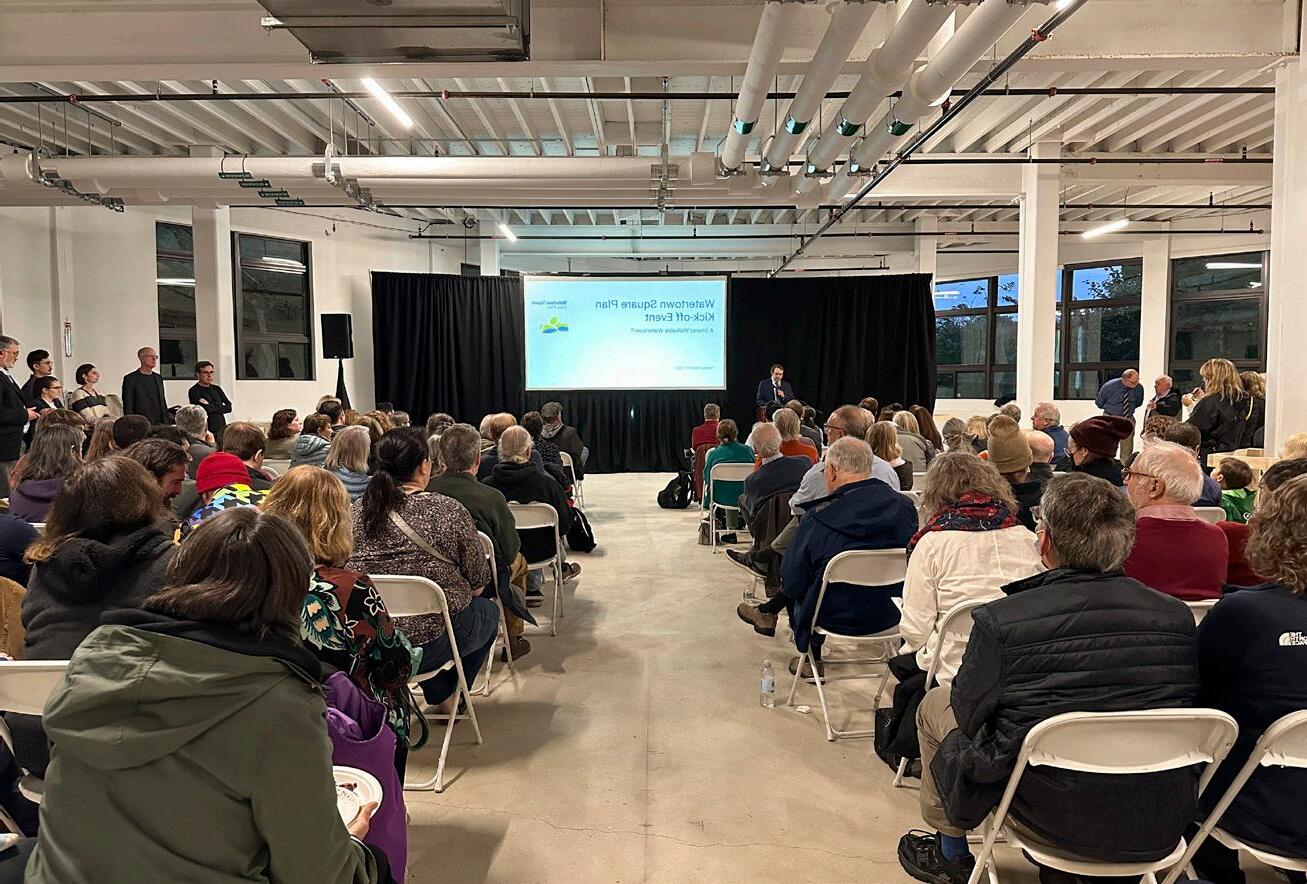
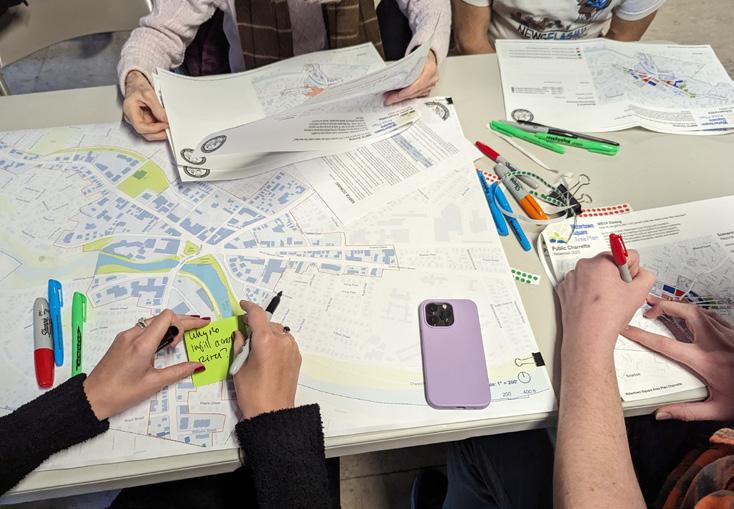
Steve Magoon, Assistant City Manager for Community Development and Planning
Gideon Schreiber, Director of Planning and Zoning
Gregory St. Louis, Superintendent of Public Works
Tyler Glode, City Engineer
Larry Field, Senior Planner/Housing
Zeke Mermell, Senior Transportation Planner
Laurel Schwab, Sustainability Program Manager
Liz Helfer, Public Arts and Culture Planner
Katie Swan, Environmental Planner
Stephanie Venizelos, Community Wellness Program Manager
Antonio Mancini, Zoning Enforcement Officer
Tyler Cote, Community Engagement Specialist
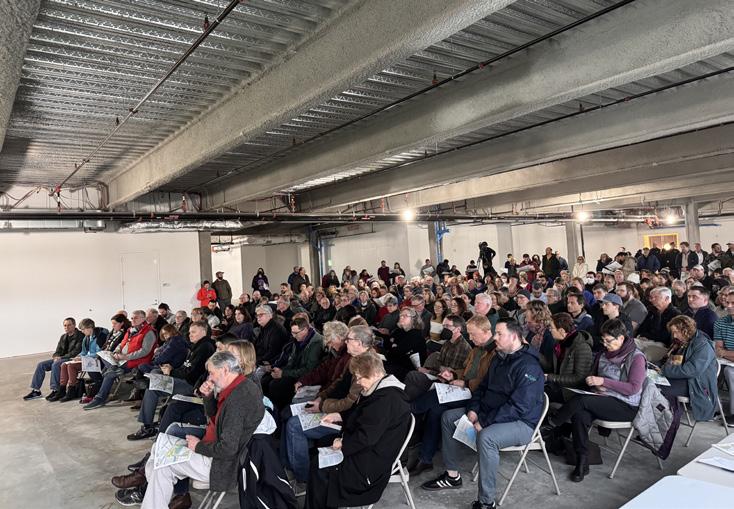
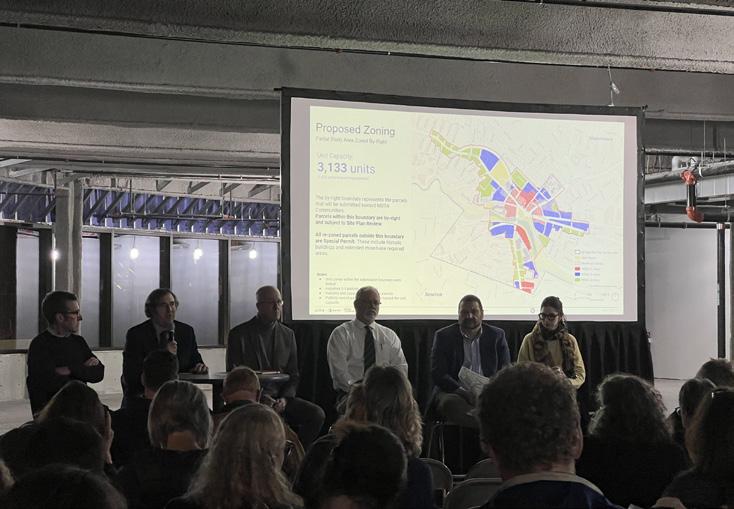
The public meetings were supported by other city employees including those in the City Communications Team, Commander’s Mansion, Public Buildings, and Public Works.
Watertown Community Conversations, Watertown Business Coalition, and Watertown Cable Access TV were all instrumental in supporting the public process and community dialogue.
City Council
Mark S. Sideris, President, Vincent J. Piccirilli, Vice-President, Nicole Gardner, Lisa J. Feltner, Emily Izzo, John Airasian, Caroline Bays, John G. Gannon, Anthony Palomba
Planning Board
Janet Buck, Jason Cohen, Abigail Hammett, Rachael Sack, Payson Whitney
Consultant Team
Utile, Urban Planning and Design
Tim Love, Loren Rapport, Kevin Chong, Courtney McCracken, Jessy Yang, Xiaoran Zhang
Stantec, Transportation Planning
Ralph DeNisco, Erin Cameron, Liza Cohen, Ethan Rankin, Jason Schreiber, Rory Weilnau
Speck Dempsey, Urban Design Vision
Jeff Speck
Landwise, Real Estate Analysis
Jon Trementozzi, Amy Fater
Regina Villa Associates, Community Outreach
Sarah Paritsky, Kristine McNulty, Kyle Olsen
An Introduction from the City Manager
As we embark on what I have called “the end of the beginning” of the long process to improve Watertown Square, I’d like to reflect on the progress we have made and the process we have taken to get to the publication of this plan. We have completed work going back to October of 2023 that has included:
• 210 participants in our kick-off meeting
• 604 sign ups with 274 participants in our three-day design charrette
• 240 participants in our February follow-up meeting
• 450 individual comments during and after the February meeting
• 334 participants in our April 2024 meeting
• 499 feedback forms from the April meeting
I appreciate the involvement of so many participants in this process. I have been participating in public processes and plans for decades, and this is the most robust public involvement process that I have been involved in. I believe it is also the most robust process that Watertown has been involved in.
We advertised the start of this process online, through Watertown News, mentioned it at regular council meetings, and included notes about it in multiple tax bill inserts, as well as with signage at businesses and in public places throughout the city.
This process has ultimately resulted in this thorough plan document. With each meeting, the City staff and consultants have taken time to reflect, review comments, make substantive changes and return with an updated plan that is based upon a blend of:
• Professional expertise and understanding of the circumstances in the Square
• A review of extensive data on traffic and related issues
• Community comments, ideas and concerns
• Reflect on the likely feedback that we don’t have from residents who do not participate, future residents who have not yet moved here, and the others that our staff often call ‘the people not in the room’
• A review of our other relevant planning documents like the Comprehensive Plan and the Climate Action Plan
After reviewing the 499 comments received since the April meeting, the staff and consulting team published this complete draft plan two weeks before the first Joint Hearing, held on June 13, 2024. City staff released it online, and, in the days that followed, made copies available at city hall, at the library and at the senior center for residents to take.
For its next step, the plan sits before the Planning Board and elected City Council to discuss, deliberate, take-in further public comment, and ultimately decide whether to endorse or not. There is no requirement in any state law or process that requires
endorsement of an ‘Area Plan’. Comprehensive plans, like the one recently approved in Watertown, require Planning Board approval, but not City Council approval. However, it has been a best practice here (and other places I have worked) to have high-level plan documents endorsed by the chief elected board. It is our way, as City staff, of asking the question: Are our elected officials ready to work with us to take this plan through the next step?
What you have before you is a plan. It is not zoning, it is not an engineering design. It is a blueprint for moving forward on the Square, albeit one with significant community process and input. If endorsed, there are three aspects of the plan to implement. Each of these actions require multiple discussions and decision points to move forward, and this plan is a living document that will be continually considered as we move to the next steps:
1. Approve zoning: This requires staff to write zoning that reflects the approved plan, to bring zoning to public hearing(s) before the Planning Board and City Council.
2. Design and build a public realm: This requires partnering with State Agencies, hiring landscape architects and engineers, designing finer details, dealing with underground utilities, coordinating with property owners, and much more.
3. Partnering on public land: The City Council will need to discuss and decide on what potential reuse should and must include. If we move forward, we will need to identify how or if we work with a developer or developers to build projects that are partially or fully on current city land. We’d have to have conversations with owners of neighboring properties and see if we can sort out a way to move this forward.
The most common questions we received over the past few months are: “Why are we doing this?” And “Why are we doing it all together at once?”
We didn’t need to do the streetscape redesign and the MBTA Communities rezoning together. There are easier ways to meet the MBTA rules. We also could have left the intersection to operate as it has for another generation. But just because it is easier does not necessarily mean it is the best thing for Watertown.
Watertown Square was once a bustling, busy commercial core in the 1940s and 1950s. It was the place for Watertown residents to come and go shopping and meet up with neighbors. It was a very successful downtown.
The Massachusetts Turnpike extension through Newton opened in 1964. The Massachusetts Department of Transportation responded to the arrival of the turnpike by working to speed traffic through Watertown Square into surrounding communities. Even as the highway revolt reached Boston in 1970, our state transportation leadership thought it was important to use our street network here in Watertown to get traffic from the Turnpike to Cambridge and beyond. They turned Mt. Auburn Street into four lanes – a highway of its own. They replaced the rotary that had been built in a previous generation with the intersection we have today – one that prioritizes moving and storing cars. After all that, Watertown Square became a place to pass through – a place to wait two minutes at a red light before moving along to somewhere else. While we have some valuable and well-loved local businesses in the Square, we don’t have a cohesive center.
The plan we put forth is based completely on one thing – returning the Square to a place where Watertown residents both present and future can shop and meet-up with neighbors. Why should we let the people who want to get from Wayland to Cambridge determine the decisions of what we do in our downtown? This is your city, your Square, your downtown. We can stop pandering to the cut through traffic. There is nothing radical about trying to take back your downtown.
It is not going to be the same as it was in the past. This plan will not bring back Woolworths and Fox Drug. It won’t bring back the 35-cent sandwiches that residents were recently reminiscing about online. But the plan can create a new, present-day version of a great Watertown Square. It will be different. It will have more buildings. But they are right-sized for a mid-size inner-core downtown served by extensive bus service. We can do this. We can do it in a way that respects and includes our existing small business and immediate neighbors. We can do it in a way that offers our residents the ability to continue to get here by driving, biking and walking. We can do it in a way that ensures we have the services downtown that we need for our residents. We can do it in a way that respects and enhances green space and tree canopy.
It will be much better than we have today, and it will be something we can all look back on and say that we did together. In order to accomplish all this, there’s three simple things that need to be done:
1. We need to prioritize people who are out of their cars. This doesn‘t mean we expect everybody not to have a car, because we still want people who prefer to drive to still come to the Square, and that is the only way that some people can get around. Therefore, we need to have options for short-term parking, for people to go out to dinner, visit the library, or come to work here daily. But it is important for us to make sure that once those people get out of their car, they are a pedestrian, and they are the priority. The same thing goes for those who walk or bike to the Square. They eventually find themselves on a downtown sidewalk – so let’s make sure those sidewalks are what they need to be to make everything work.
2. Second, retail needs housing. The time when an automobile oriented single-use mall could replace all retail is gone. Now, time and time again, malls want to build housing because of the positive impacts it can have. Any recent case study on revitalizing a town center or a dying shopping mall – housing is the key to the short and long-term success of those efforts.
It is a simple formula, but having enough people living here who can walk around and spend money here is key to the prospects of bringing back a downtown. Even if that’s the only reason to support housing, it’s a good enough reason if you want the Square to be successful. This strategy has been what worked in downtown Lowell when I worked there, it’s working in Beverly, Quincy, Salem and Malden as they’ve added housing around their retail cores. People need to live here for this to work. It’s the secret sauce that makes Arsenal Yards work where an old, enclosed mall didn’t work. For those who might be saying “but I wouldn’t want to live there” – “I wouldn’t want to live without a car” – “I wouldn’t want to live in a mixed-income multi-family building over a store” – “I wouldn’t want to live without a yard” – that is okay. Many of us want a house with a yard. But that doesn’t take away the many other people that DO want to live in a walkable downtown. Many people may be living in a big five-bedroom house in Watertown and looking to downsize. Others may be living with family and looking to get their own place. Some may be looking to move closer to work. Living a car-free, low-carbon-footprint, walkable downtown lifestyle is desirable for many people – and just because they are in a different place than others, does not mean we shouldn’t meet those needs as well.
3. Lastly, we need to make great public spaces. That means great trees, great river connections, places where we can have lush, green landscapes in the middle of the city. And we need those spaces to work for a downtown environment. We discussed what that means at one of the public meetings, in that there is a ‘transect’ of solutions for different levels of growth and development. We have different solutions to ecology, to stormwater and to streets in different contexts. The ecological solution to land is different if you are on a farm, in a neighborhood of single-family homes in the West
End of Watertown, or in our downtown. How we address stormwater is different, how we address trees is different.
Downtown, we need to put our walking people first and that includes having robust street trees and green spaces. We also know that we can’t force green onto every small private lot. Instead, most of our downtown green space should be in shared public spaces. This plan reclaims over three acres of shared public space, and that’s quite a bit for a downtown. Those spaces need to be great, they need to contribute to ecological sustainability and they need to be green. And they will.
So, why do this all together? The issues of traffic, housing and sustainability will have separate solutions, but we understand that they must first be addressed as a single plan as a way of understanding their synergies and shared benefits. This is an opportunity to make a real positive difference in our community at the right time on these several issues that are all very closely interrelated.
Sustainability:
My staff and I have been asked on many occasions about how this plan meets the sustainability plans for Watertown. The reality is that there is nothing more ecologically sound than a walkable downtown.
Every family that moves into our walkable downtown and not into a suburban cul-de-sac in Boston’s outer suburbs is doing amazing things for the environment. They are:
• Taking the bus to their daily job, instead of getting in a car that would be driving every day through Watertown Square.
• Walking to go out to dinner, get to the pharmacy and get their daily needs met.
• Taking a bike ride to nearby parks and amenities, including using the path along the river.
• Having their kids walk to school
• Living in a housing unit with more shared space, in an energy-efficient building, with solar panels, and built under the new specialized stretch energy code.
• And, likely, living in a one-car family (or maybe with no car at all)
This is everything we want our climate plan to be.
Transportation:
Watertown Square moves a lot of traffic every day. Those traffic movements are often slow, with intersections creating congestion, but this is not too different than other town centers where road networks converge. What is different is that Watertown has responded to the regional traffic that cuts through Watertown by providing a significant amount of pavement to store those cars. They wait at each leg of the intersection for a red light to turn green, and then clear out that storage area, leaving behind empty pavement. This makes it difficult for pedestrians to enjoy the Square as a destination. Watertown Square will always have traffic congestion. But, if we develop a more efficient road network, we don’t need to have all that pavement. And, if, through that process, we convince some of those cut-through drivers to stay on the turnpike and work their way to their destinations through other communities, that’s not a bad outcome.
The plan changes traffic movements in two ways to reduce the need for car storage. It removes one leg, Charles River Road, from the intersection, thereby shortening the total time spent for all the other legs of the intersection. It also restores traffic movements to the current bus stop area at the delta, further dissipating overall traffic. The plan then reduces
total travel lanes, picking up that important three acres of open space for trees, sidewalks, outdoor seating, etc. This should continue to serve traffic about as well as the square does today.
Housing:
Retail centers need nearby housing to succeed. But, furthermore, building new housing contributes to addressing a larger issue: our housing shortage is the greatest threat to our regional economic development goals. We need to do our part, and our neighboring communities also need to do their part.
We fully understand that this plan alone won’t solve the housing crisis all by itself. It also does not help that the current financial and construction markets make it challenging to build the housing that we propose in this zoning.
But, there have been several economic studies looking at housing in recent years and they confirm that housing follows the most basic of economic strategies: building lots of supply stabilizes the increase in prices. We’ve seen that in places like Austin, TX where the answer to the hot housing market has been to build more housing, and rental prices are now stabilizing and coming down.
We are not proposing that we over-build Watertown. Watertown has contributed substantially to our regional housing needs, most significantly with a growth in multifamily housing along Arsenal Street and the Pleasant Street Corridor between 2010 and 2019. But, since housing provides such a clear advantage to our downtown’s future, we do think this is the right housing in the right place. If we work to meet the greater Boston area’s 200,000+ unit housing unit shortage by letting the growth happen in subdivisions in Bellingham, Shrewsbury and Southern New Hampshire, we will clog our roads with more and more cars as people try to get to jobs close to Watertown. If we build it in our downtown, we will support our walkable retail.
In our next steps, we will break the plan’s component pieces apart and start digging deeper. We’ll be back with more meetings and more conversation about how to implement the steps of the plan, and with more opportunities to hear from the Watertown community. We will build upon what we have here and refine it to create zoning, streetscapes and public spaces that will create a better Watertown Square.
This is just the end of the beginning of this process, but this plan can and should be the beginning of the future of Watertown Square.
Sincerely,
George J. Proakis City Manager | City of Watertown, Massachusetts
Introduction
The City of Watertown has developed an ambitious area plan for Watertown Square that integrates all physical and human-centered aspects of the study area, including streets, sidewalks, open spaces, and the buildings that define and activate them. Watertown achieves this goal through the comprehensive integration of two factors: a design vision for the public realm that will be implemented by the City of Watertown using a range of funding sources; and a design vision for future buildings that will be implemented primarily by private landowners as a result of a new zoning code.
These new regulations both meet the requirements of the MBTA Communities Act and provide a regulatory framework that responds to the comprehensive urban design vision developed during the planning process. In addition, the resulting “form-based” zoning code will combine more predictable design outcomes based on the vision of the plan with a streamlined development review and approval process that still incorporates public input into individual project designs.
The plan includes street designs that promote walking and biking, lively public spaces, and enhanced access to the Charles River. At the same time, the proposed street reconfigurations will make navigation through Watertown Square safer and more intuitive for all modes of travel. Just as important, the enhanced public realm and more logical street layout will encourage new private investment, resulting in improvements to existing properties, thoughtful new development projects, and a wider range of sidewalk-activating retail spaces that will complement the mix of existing commercial businesses.
The City of Watertown is committed to moving this plan forward with the same level of public engagement that has shaped the plan to date.
Impetus for the Plan
For decades, Watertown Square has been seen as an intractable transportation and urban design problem as a result of larger changes to transportation priorities and the growth of Boston’s suburbs. The decision to locate a major Mass Pike intersection at the south end of Galen Street accelerated the evolution of the Square into an automobile-dominant space, a trend that was initiated in the 1920s when the Galen Street bridge rotated so that it would align with Mount Auburn Street to the north. The Pike interchange, the first one west of the Cambridge/Storrow drive exit, created new regional traffic patterns, including an influx of Belmont commuters who passed through Watertown Square on their way to the Pike, and commuters from the western suburbs who used the Newton/Watertown exit, Galen Street, and Mt. Auburn Street as an alternate route to job centers in Cambridge.
In Watertown Square, the solution was to welcome this cut-through traffic by adding travel and turn lanes, which required the narrowing of sidewalks and the elimination of street parking. The increase in the large number of lanes, combined with the large number of streets that converge in the Square, led to signal cycles with many phases, resulting in long waits at the main intersection for both cars and people.
At the same time that the Pike interchange was putting Watertown Square in the middle of a rapidly expanding car-centric commuting pattern, the MBTA was disinvesting in bus and trolley service that was already suffering delays from streets filled with private vehicular traffic. The relocation of the terminal bus stops of several bus routes to the west side of the Square further complicated traffic patterns and added yet more tarmac to an already asphalt-dominant landscape.
Fast forward to September, 2023, when the City adopted an updated Comprehensive Plan. Throughout the public planning process, there was a clear consensus that revitalizing Watertown Square should be a major priority. This policy direction outlined the necessity for a more detailed area plan and zoning update for Watertown Square, and included using this planning process to develop zoning to comply with the MBTA Communities Act by the December 31, 2024 deadline. The Area Plan also is a key tool for supporting implementation of the recently adopted Resilient Watertown Climate and Energy Plan, which directs the City to adapt to and prepare for climate change through greening, transportation mode shift, and sustainable building standards, among other actions. The Comprehensive Plan process also provided a useful road map for how the Watertown Square Area Plan should be conducted, including the role of public design “charrettes” to help inform, shape, and refine the plan.
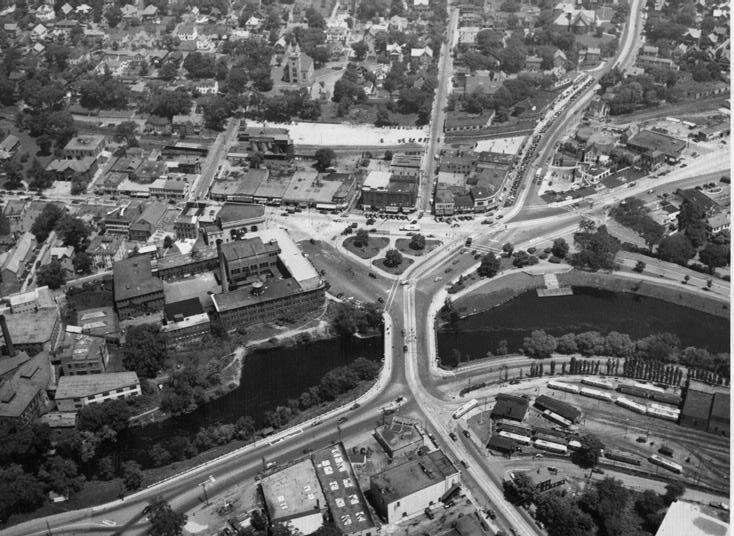
Top: An aerial image of Watertown Square from the 1940s showing the growth of car-dominant street planning
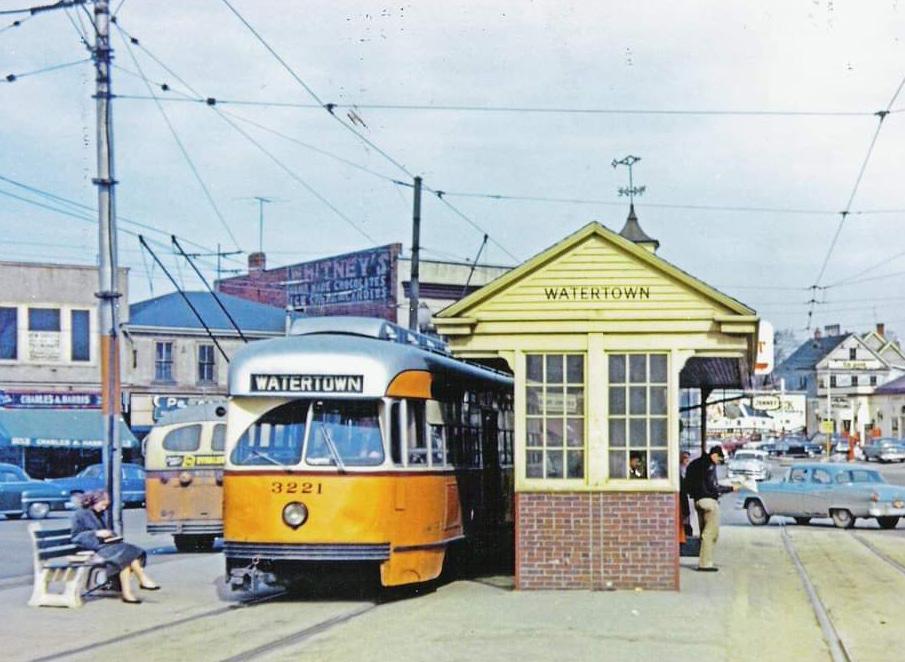
Middle: An image of the old trolley and shelter in the Square, circa 1950s
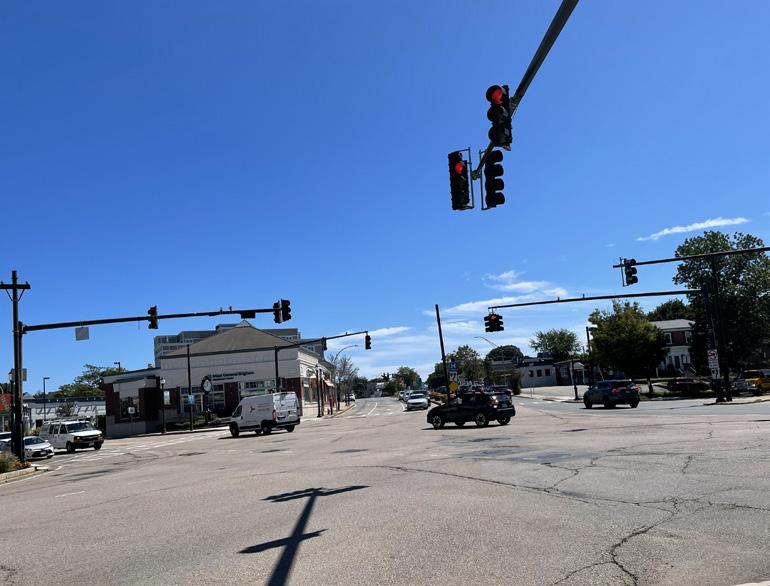
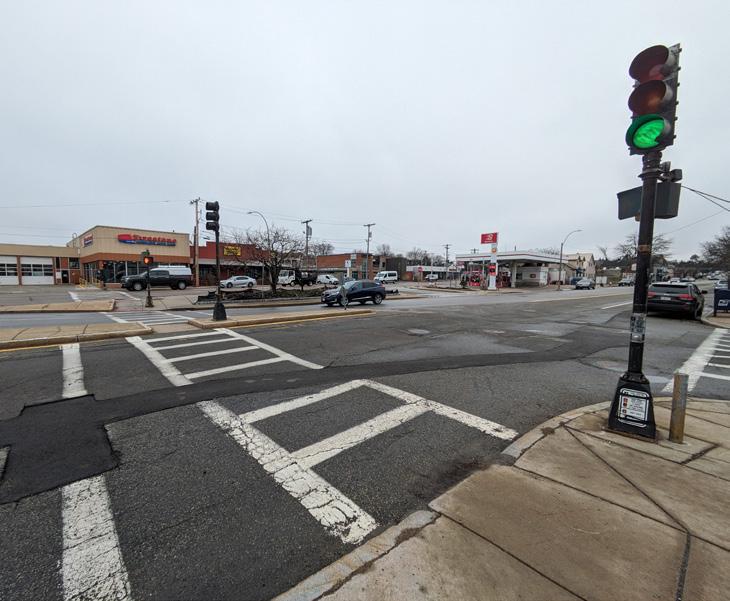
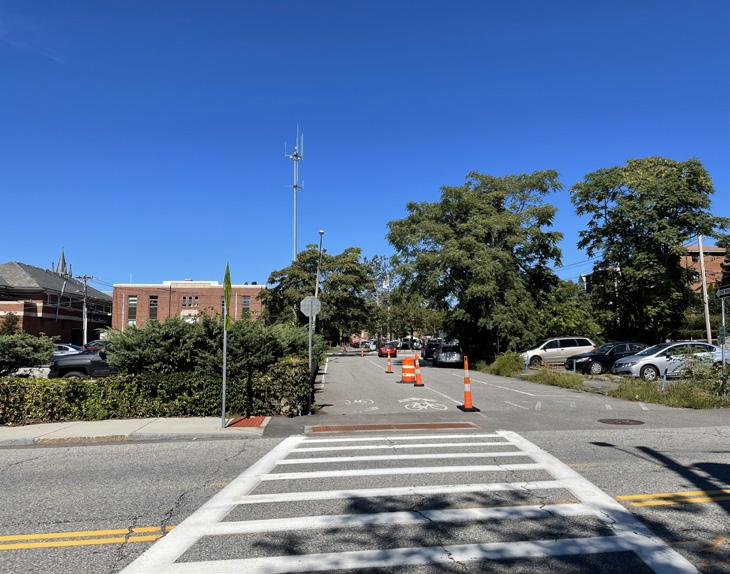
Bottom: Watertown Square today, characterized by a large 6-way intersection with long crosswalks
A Case for Housing
The Boston area is facing an unprecedented housing crisis. As the region continues to be an attractive place to live and a magnet for high-paid technical professionals, it becomes more and more difficult for many residents to afford a place to live. Over the past decade, Watertown has contributed to meeting our regional housing needs by building new housing along the Arsenal Street and Pleasant Street corridors. These new developments have added to our diverse local tax base, while providing a home in Watertown for new families. Meanwhile, many communities in our region have not built new housing. This has led to recent state initiatives on housing growth and housing affordability, including the MBTA Communities Act and recent housing bond bills.
Nonetheless, housing continues to be a complex regional problem that impacts affordability and economic growth throughout the Commonwealth. While much of this new housing will need to be subsidized to be affordable in perpetuity, those subsidies are expensive, and can only serve a portion of our overall housing growth. The greatest need is for new housing production throughout our region, which study after study has established would mitigate increased costs. Without substantial new housing production, we cannot address the crisis of affordability. Nonetheless, production alone will not address those with the greatest housing need, and therefore affordable housing also needs incentives to be a part of the mix of new development.
Within this context, Watertown has limited areas that are most appropriate to contribute to our regional housing need, as we are being asked to do through the new MBTA Communities law. Widespread change to existing walkable neighborhoods of small single- and two-family homes would not be consistent with the Comprehensive Plan’s goal to “conserve” these neighborhoods. Instead, placing housing near transit, and focusing on redeveloping sites with low-density commercial uses and more automobile-oriented uses will allow for the evolution of a more vibrant and walkable center for Watertown.
But, that is not the only reason more housing in the Square makes sense. In addition to a demonstrated need to tackle the redesign of the public realm in order to enhance walkability, existing and future sidewalk-activating businesses in the Square will only thrive if there are more people living in and around it. This is partly true because a large percentage of the retail business geared to everyday household needs has shifted to gig economy providers like Amazon. Meanwhile, more residents work partially or fully remote jobs, allowing them to spend days and evenings at home with breaks to visit nearby businesses.
Within this evolving context, brick and mortar retail establishments can only succeed when there is both a critical mass of households within a 2-3 minute walk and enough synergies between retail businesses that a walkable urban destination is created. As a result, the call for an increase in housing supply in Watertown Square is as much a place-making imperative as it is a response to the regional housing crisis, the primary driver of the MBTA Communities housing law.
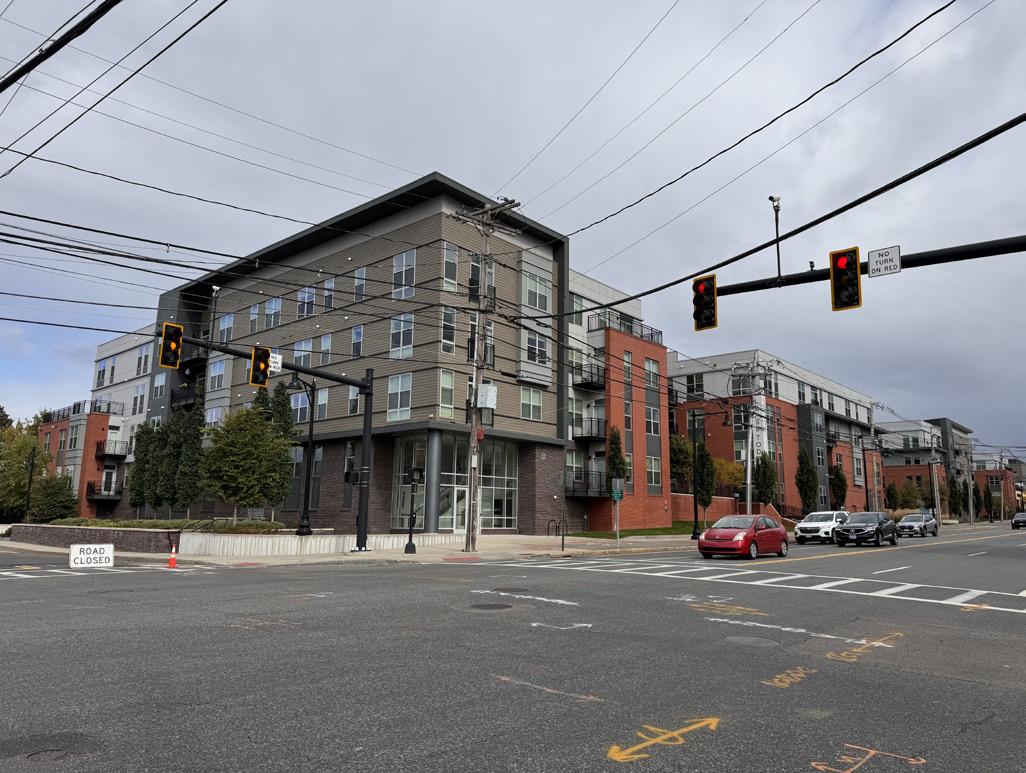
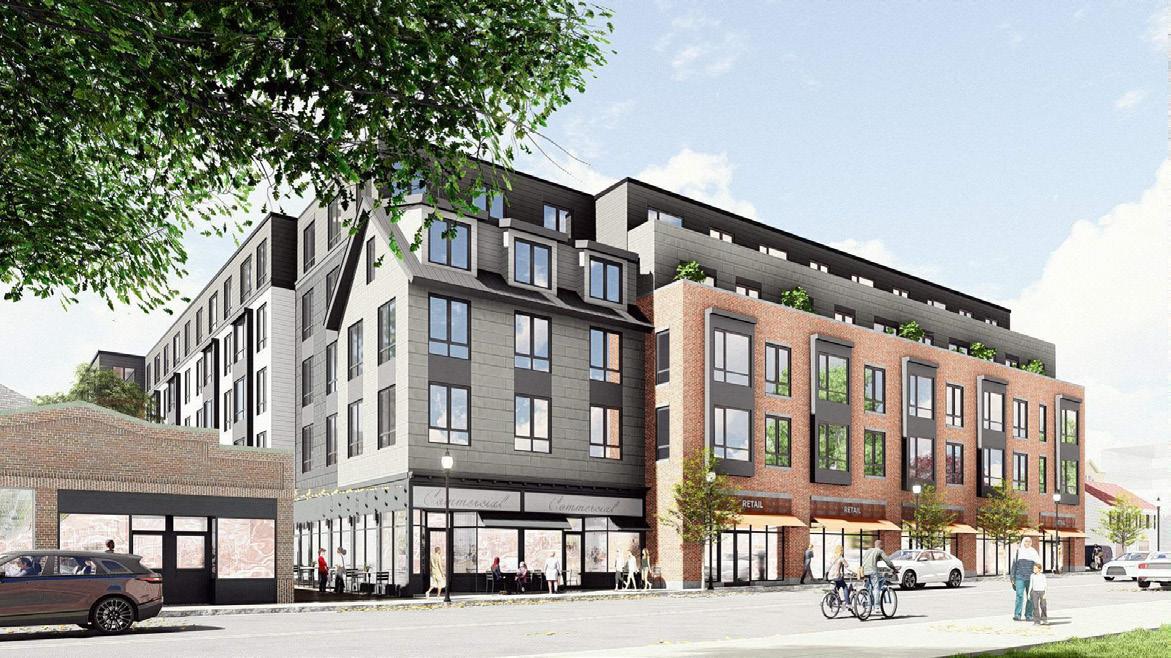
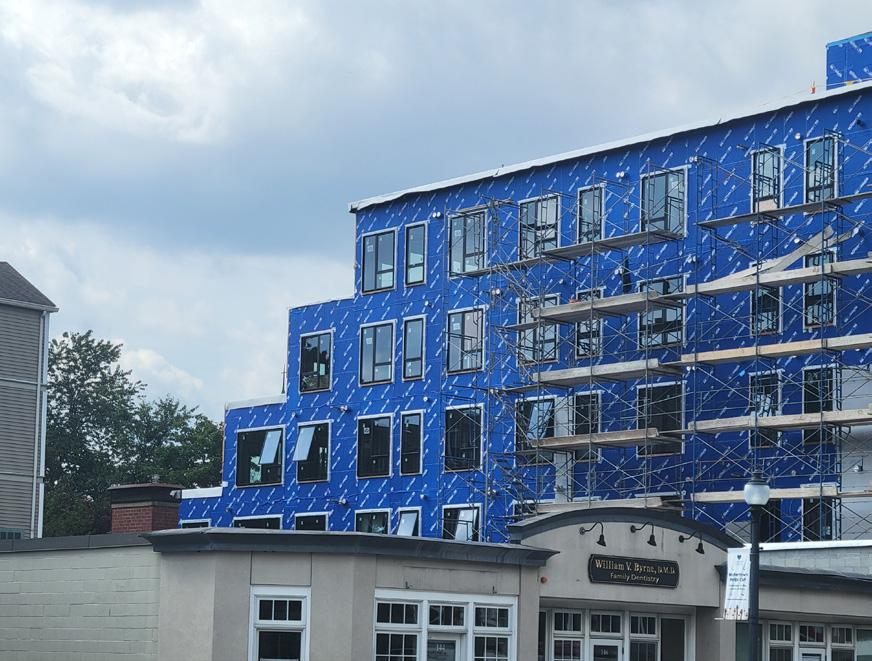
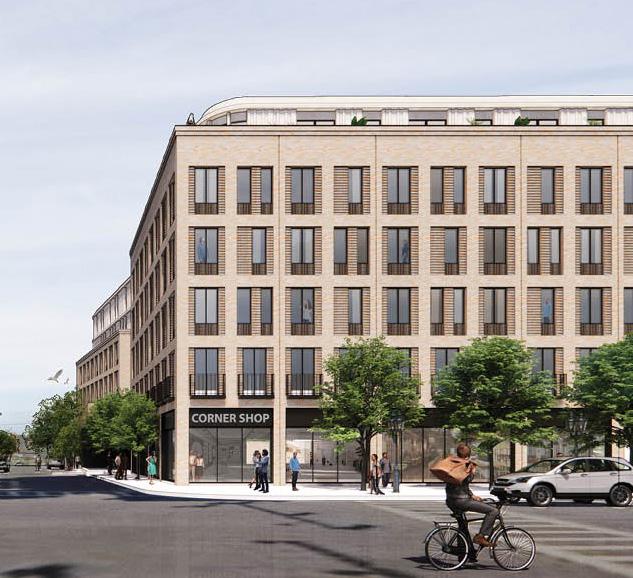
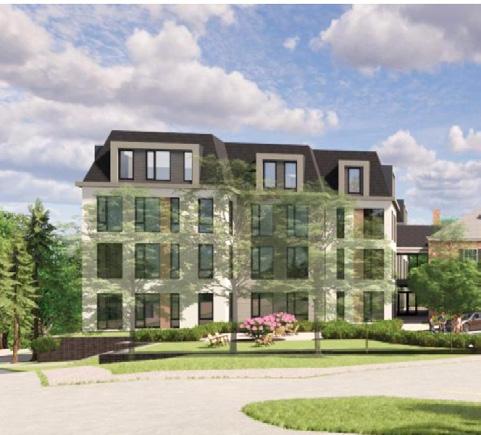
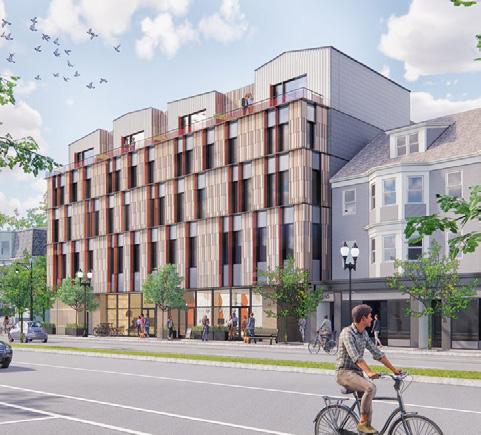
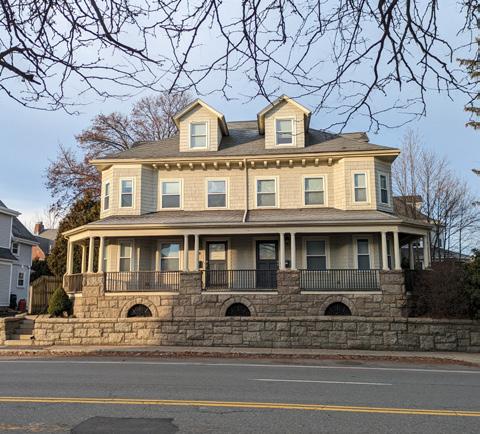
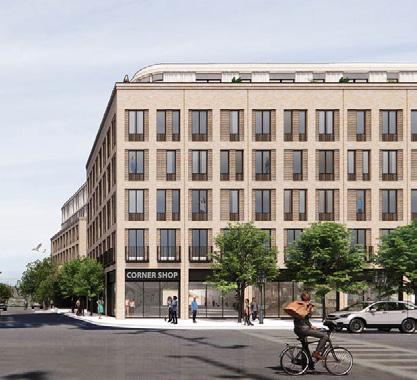
Residential projects recently developed and/or under development around Watertown Square Clockwise from left: 101 North Beacon Street, 130 Arsenal Street, 166 Main Street, 104-126 Main Street
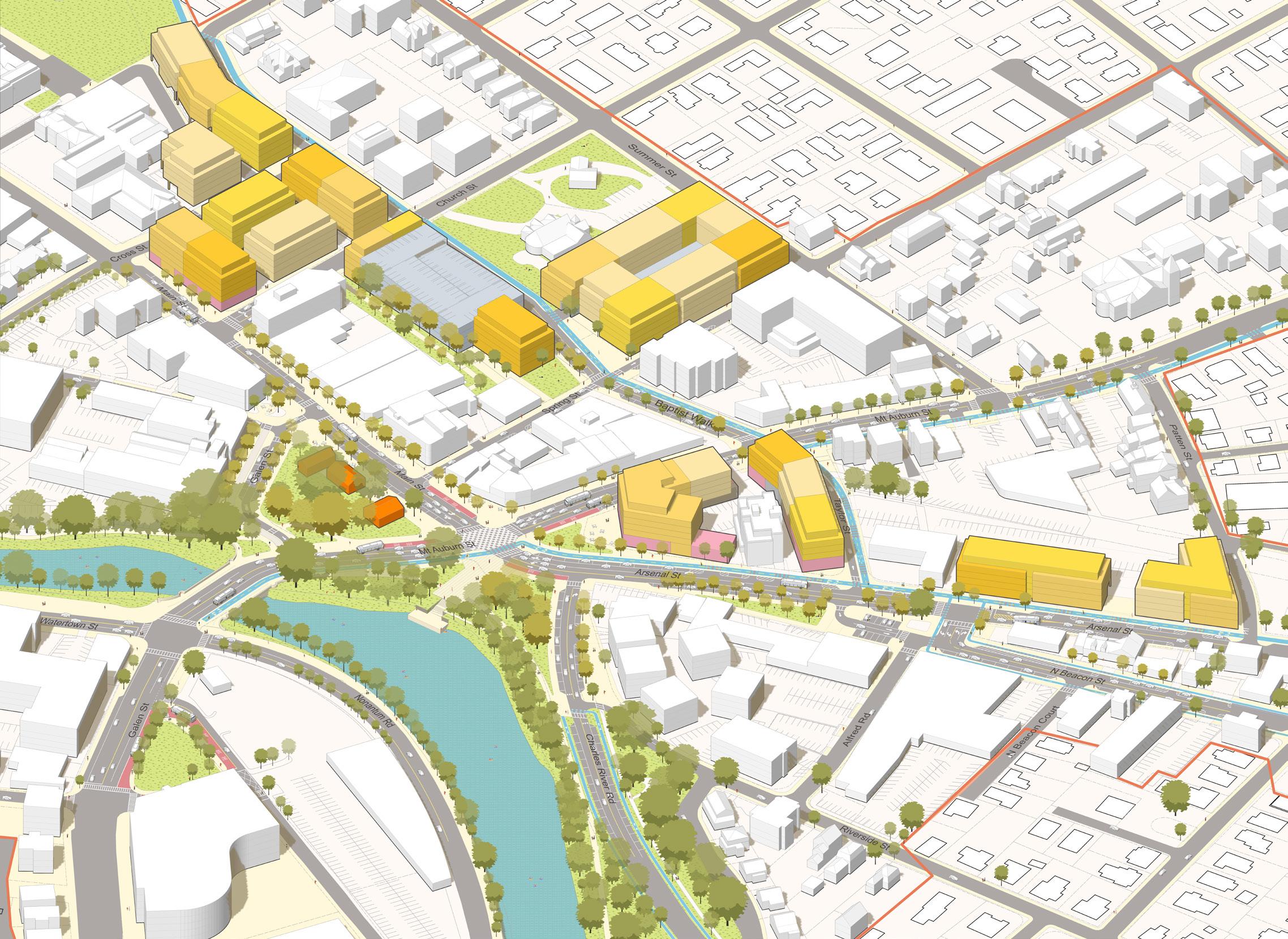
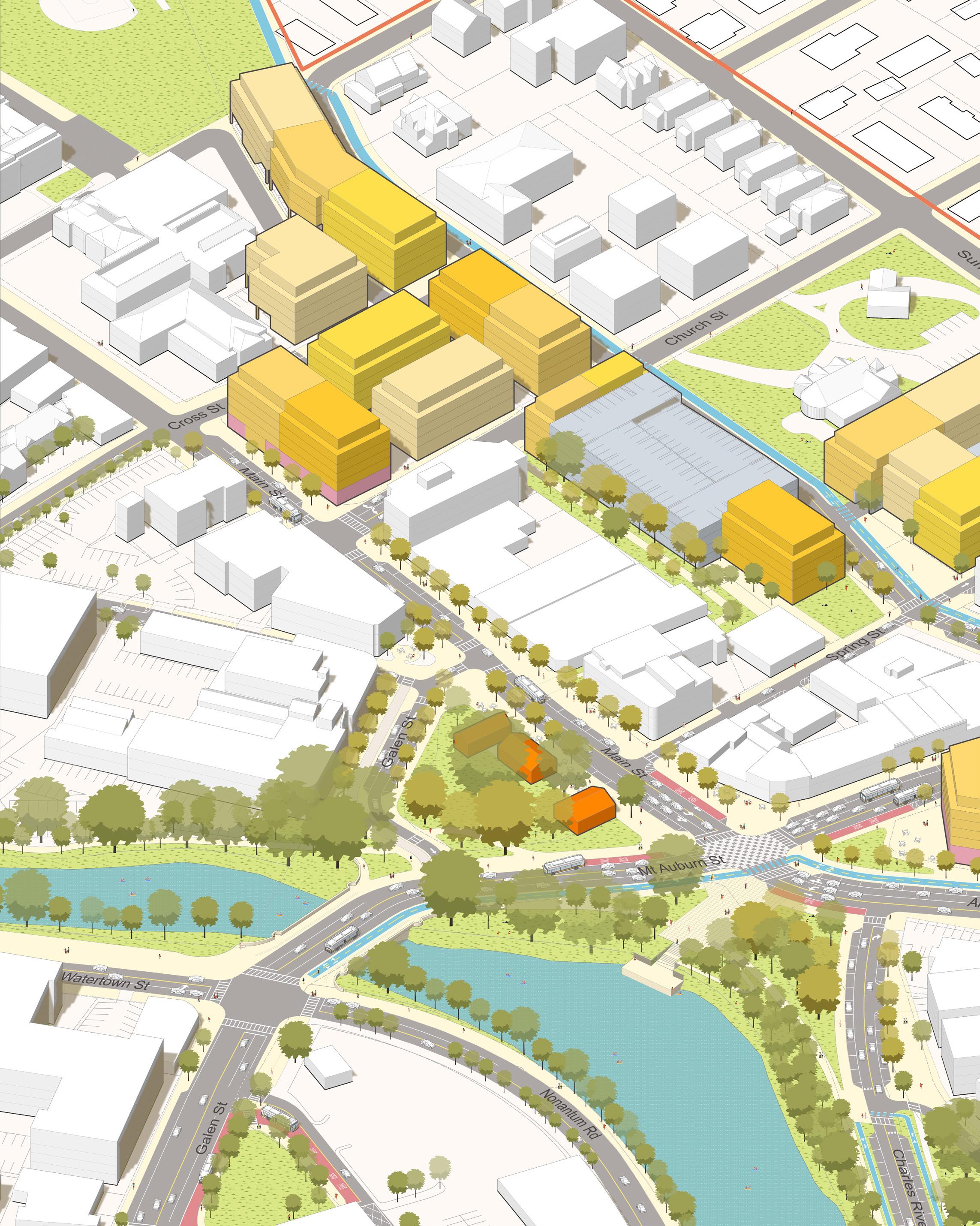
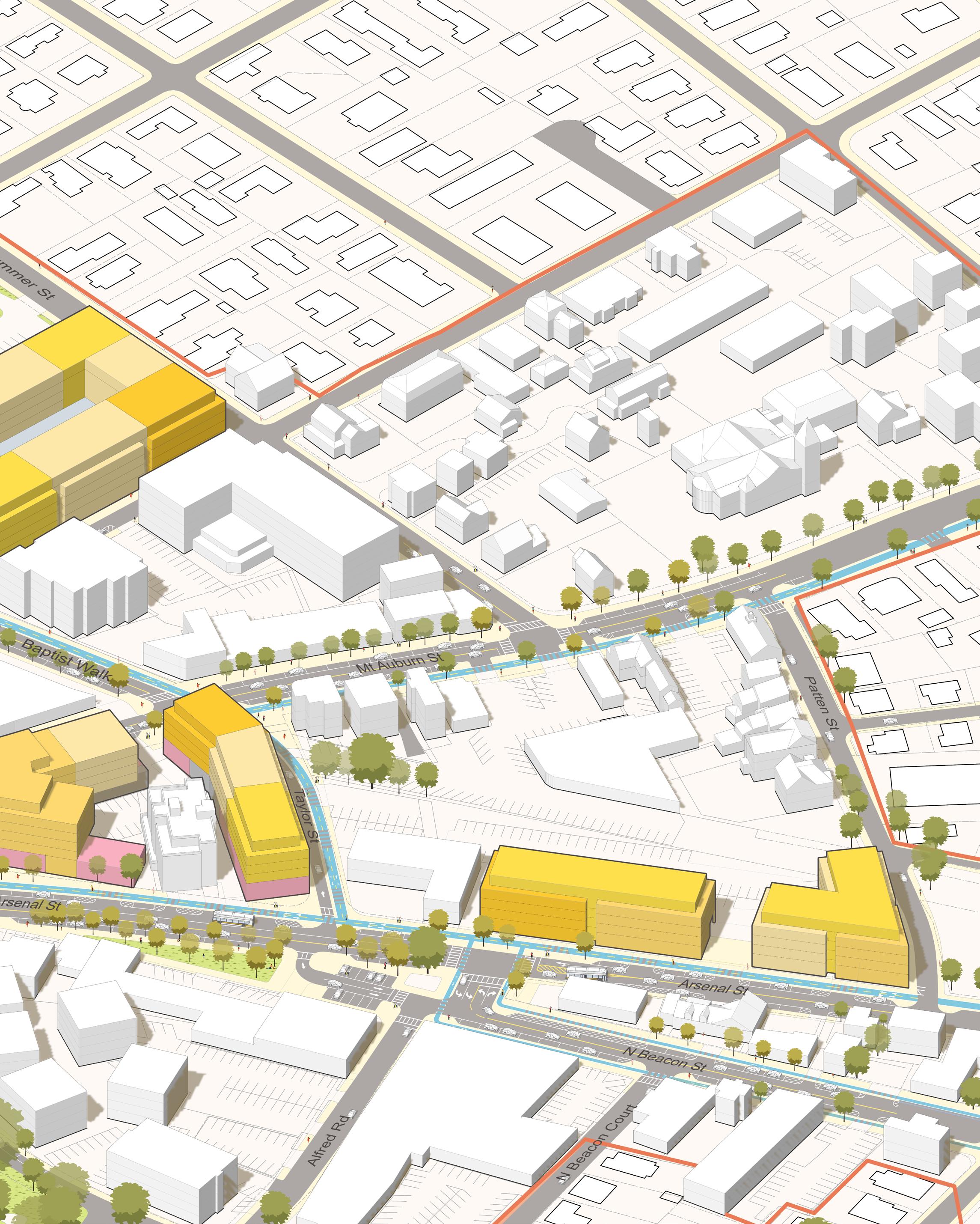
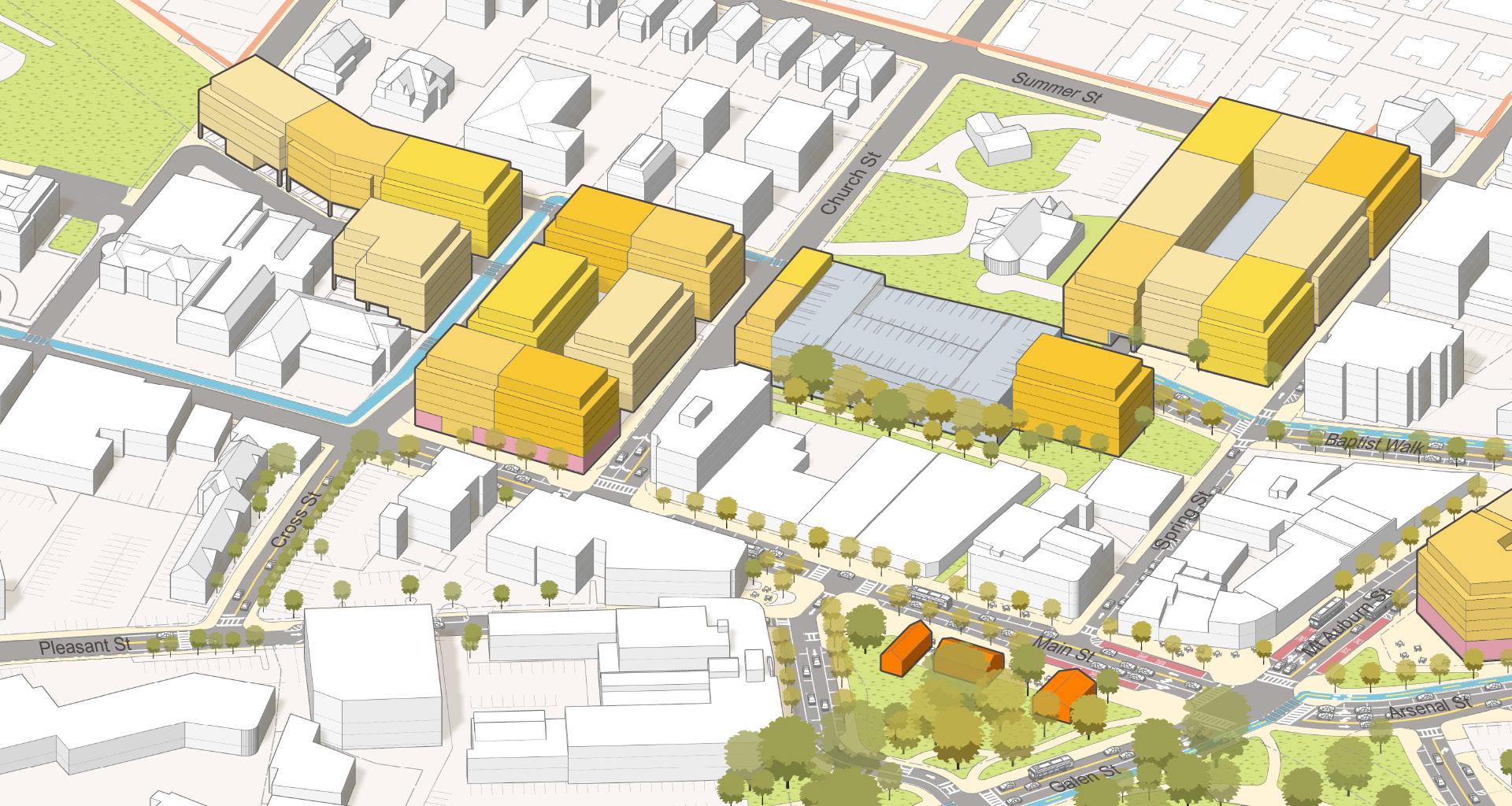
Aerial view showing streetscape and public realm recommendations and the maximum build-out of representative sites following the proposed form-based zoning recommendations.
Please note that the change in color tone on the buildings shows the consequences of the maximum facade length requirements included as part of the non-discretionary design standards embedded within the zoning code.
Plan Recommendations
Public Realm
Summary of Benefits and Street Redesign Approach
The recommended reconfiguration of the streets and open spaces in Watertown Square achieves the following objectives:
1. A decrease in the amount of roadbed as a percentage of the total area of the public right-of-ways
2. A corresponding increase in public open space both within the Delta and between the reconfigured streets and the Charles River, equaling approximately 3.4 acres
3. Wider sidewalks, including the stretch of Main Street between Merchants Row and Mt. Auburn Street, and the important Mt. Auburn/Main Street corner
4. The introduction of parallel parking, important for the success of sidewalk-activating retail and to create a buffer between cars and pedestrians and protected bike lanes
5. A simple four-way intersection that reduces signal phases and pedestrian crossing times
6. A more logical and intuitive street network that is easier for motorists, pedestrians, and cyclists to safely navigate
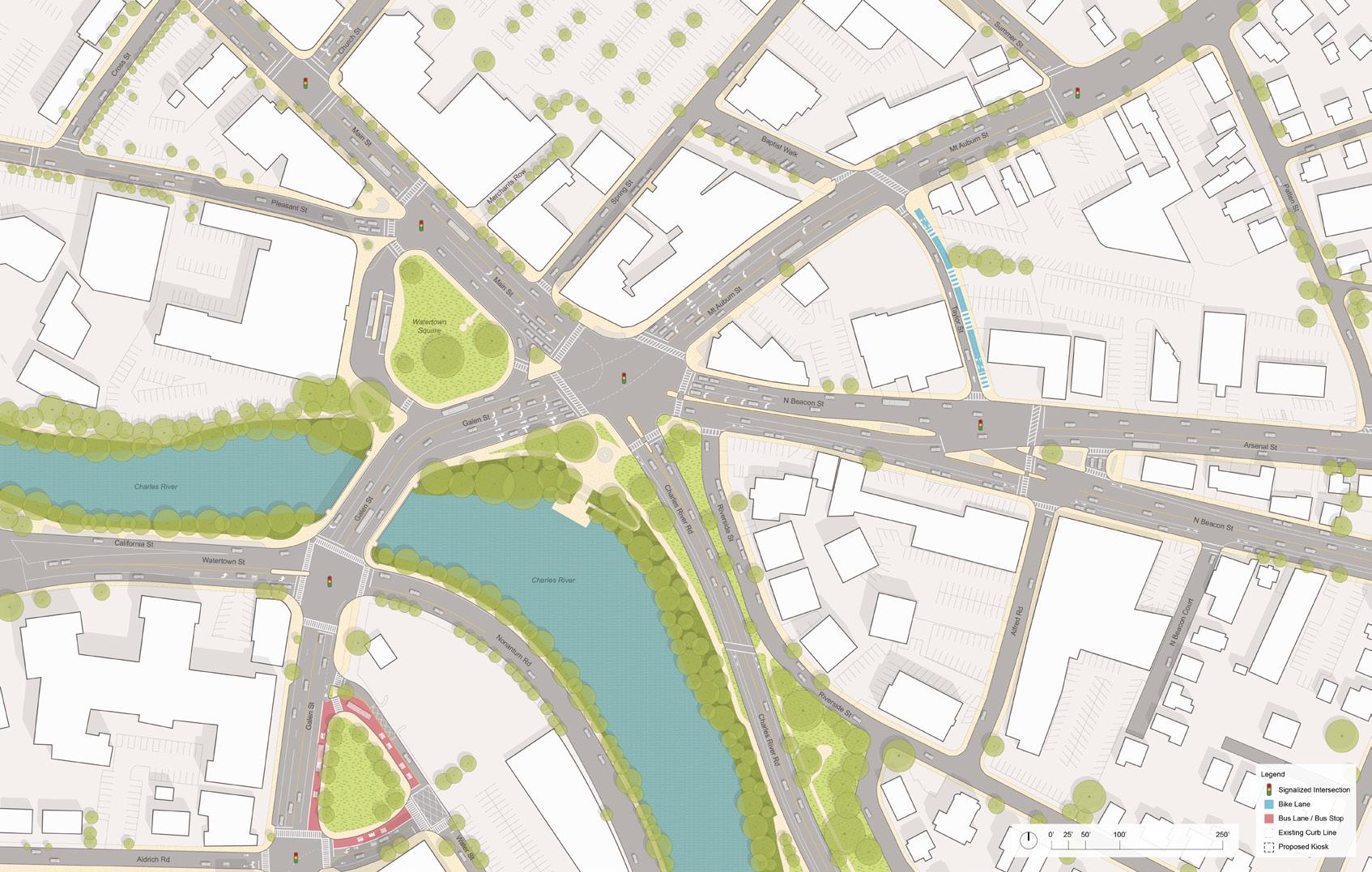
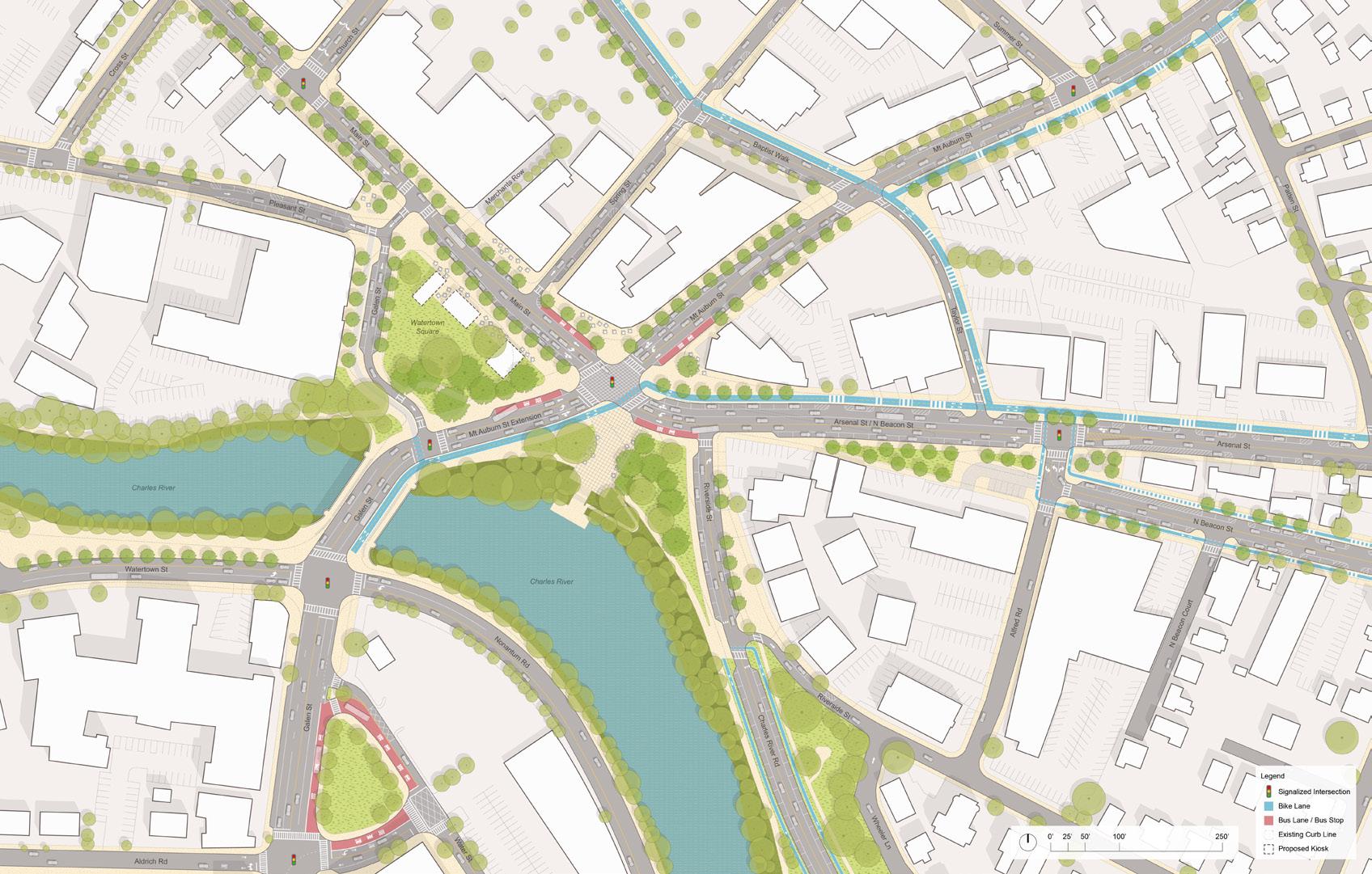
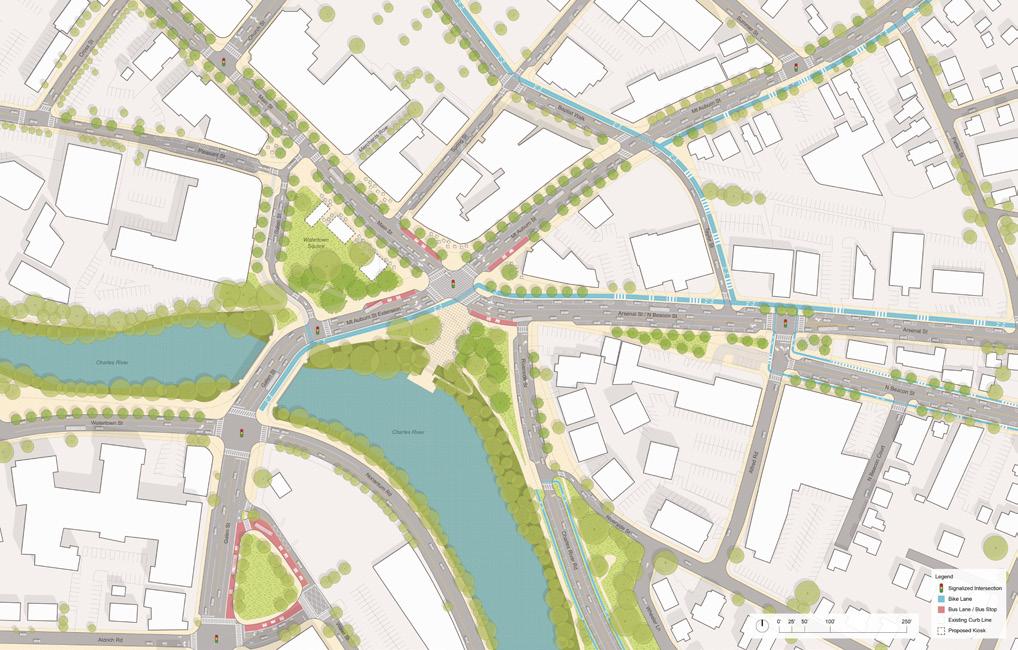
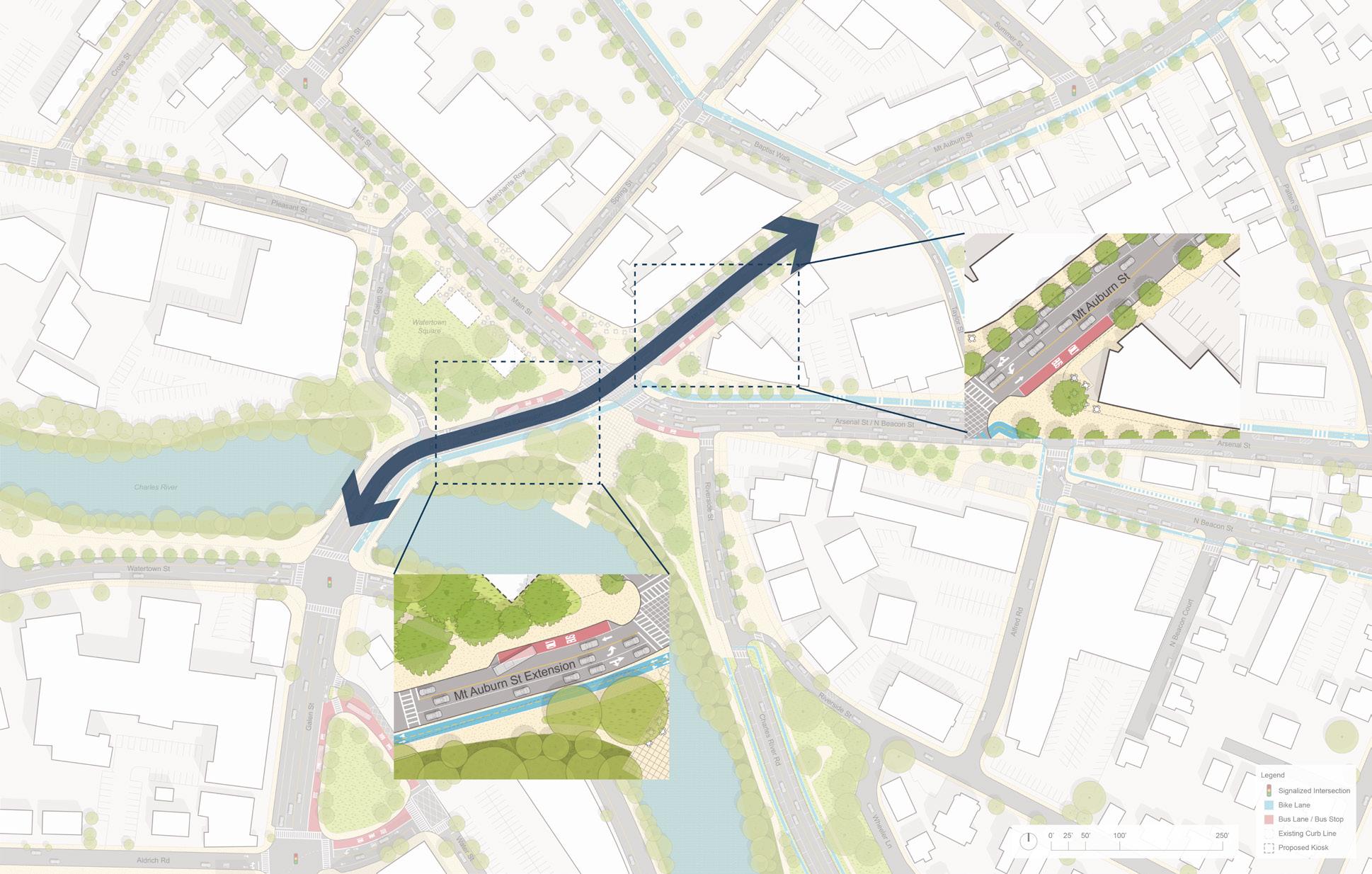
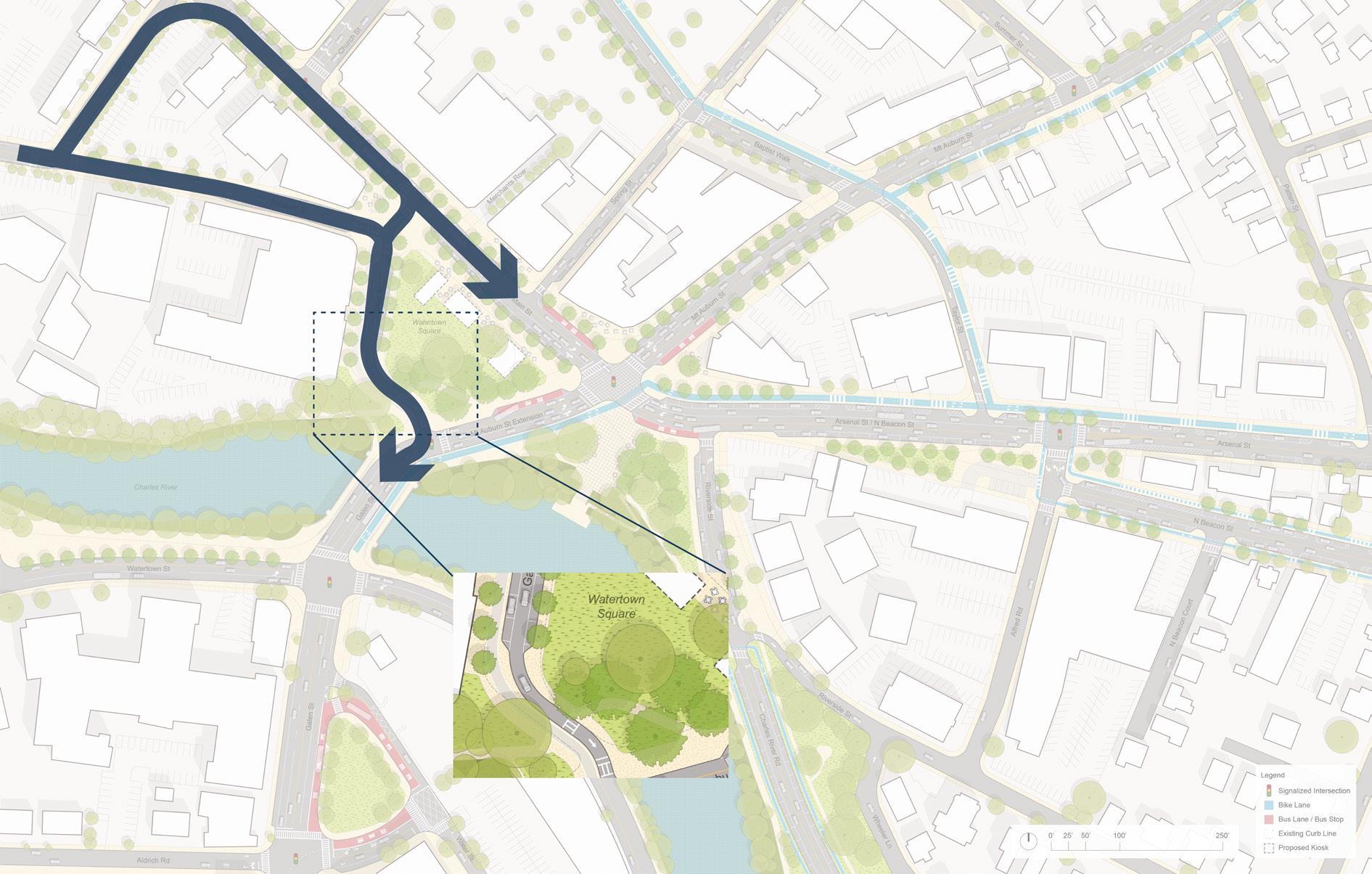
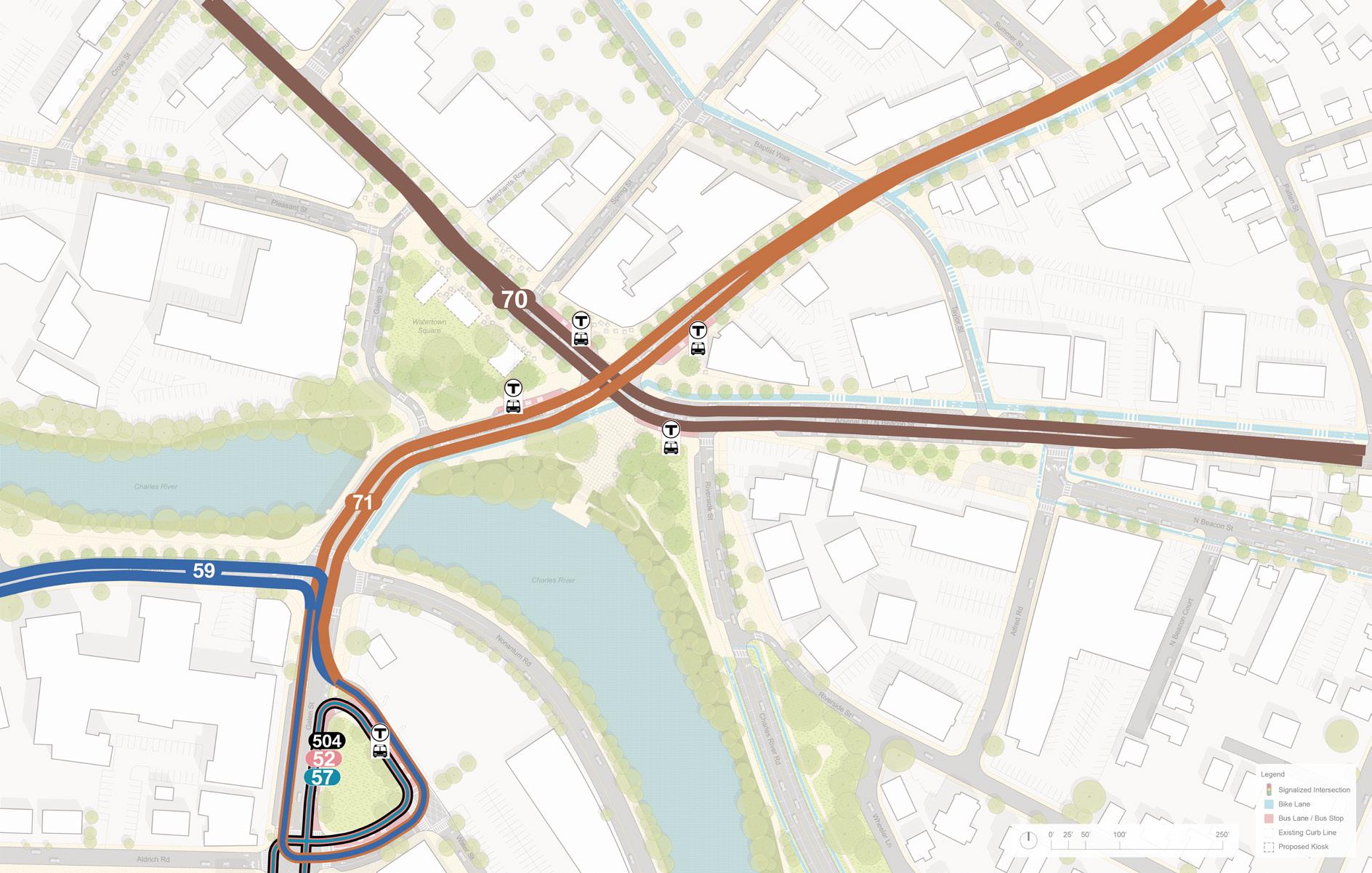
These benefits are partly a result of reducing the number of streets that converge in the Square from six to four. This was achieved by connecting North Beacon Street to Arsenal Street east of the Square at Alfred Street and bending the alignment of the western terminus of Charles River Road away from the Square and into the right-of-way of Riverside Street where it currently meets North Beacon Street. The Pleasant Street signal as well as the MBTA Bus terminal have also been removed from the signal configuration at Main Street in the Square in favor of a one-way southbound-only movement to Galen Street, which serves to remove additional traffic from the main intersection.
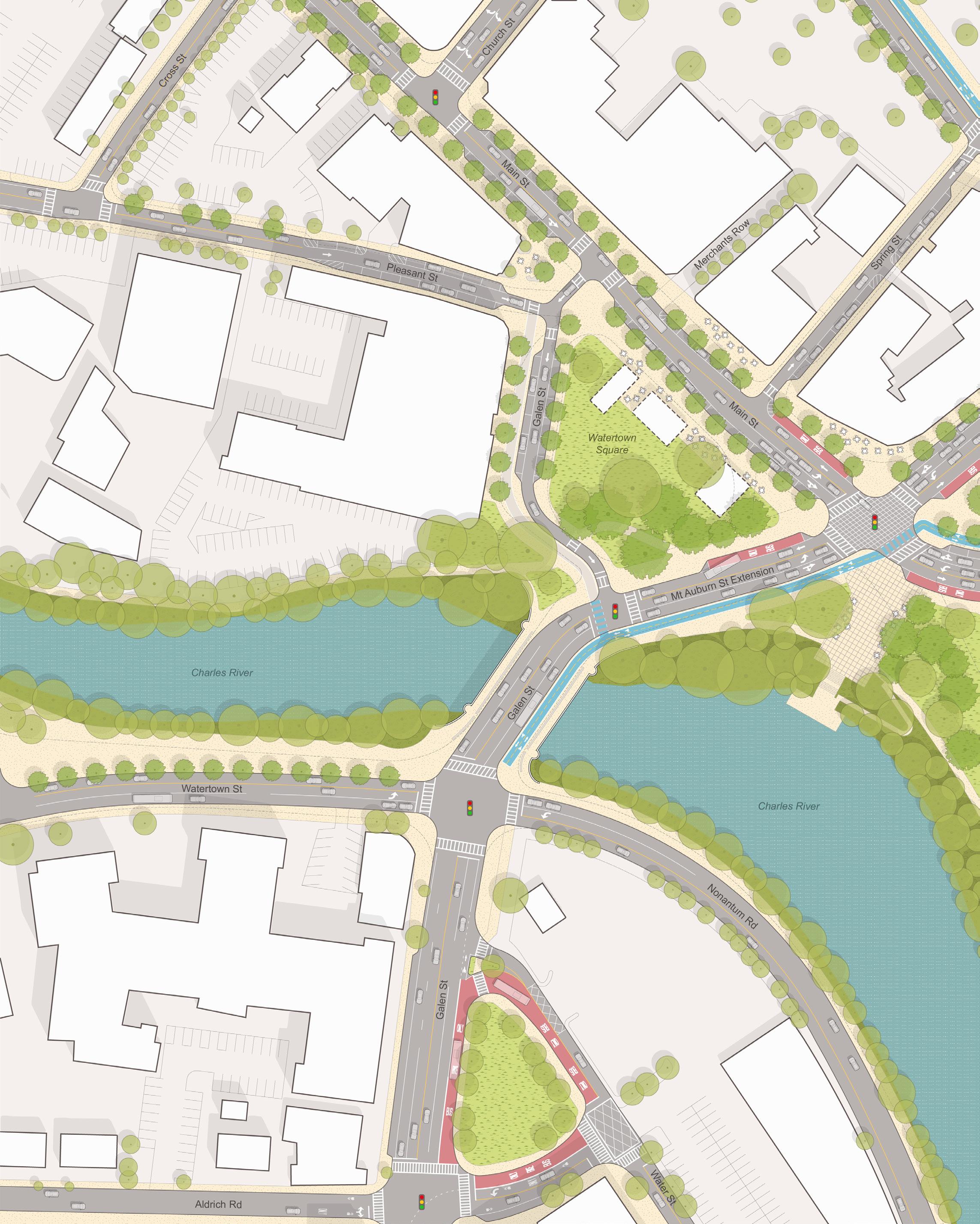
Since the future location of bus stops was going to have an impact on the final street configuration, the design team coordinated with the MBTA early in the planning process and developed a plan to terminate Route 71 and Route 59 in Watertown Yard, rather than the bus hub west of the Watertown Square Delta. This allows the bus terminal, a vestige of the original alignment of Galen Street north of the River, to be reclaimed as a conventional city street. The resulting new single lane street, with parallel parking on both sides, helps to better connect the Delta to open space along the river and provides a direct connection between the terminus of Pleasant Street and the Galen Street bridge, thus reducing eastbound traffic on Main Street.
Bike and Pedestrian connections along the River will also be improved by the installation of an actuated signal to allow direct flow east to west. While this will extend the travel time for these two bus routes, they will still have stops near the Square prior to crossing the Galen Street bridge. Potential impacts on the relocation of the terminus are further mitigated by the MBTA’s decision, as part of the bus network redesign project, to transform the 71 bus into a high frequency “Key Bus Route.” This means that the MBTA will commit to service at least every 15 minutes or better throughout most of the service schedule.
Concept “after” plan of proposed Four Corners intersection, based on a simpler and more intuitive street network layout
The advantages include much-reduced pedestrian crossing times, an increase in open space, wider sidewalks, the introduction of parallel street parking adjacent to sidewalkactivating retail, connections between existing, planned, and future bicycle accommodations, and enhanced connections between the heart of the Square and the Charles River open space and trail network, with improved safety throughout.
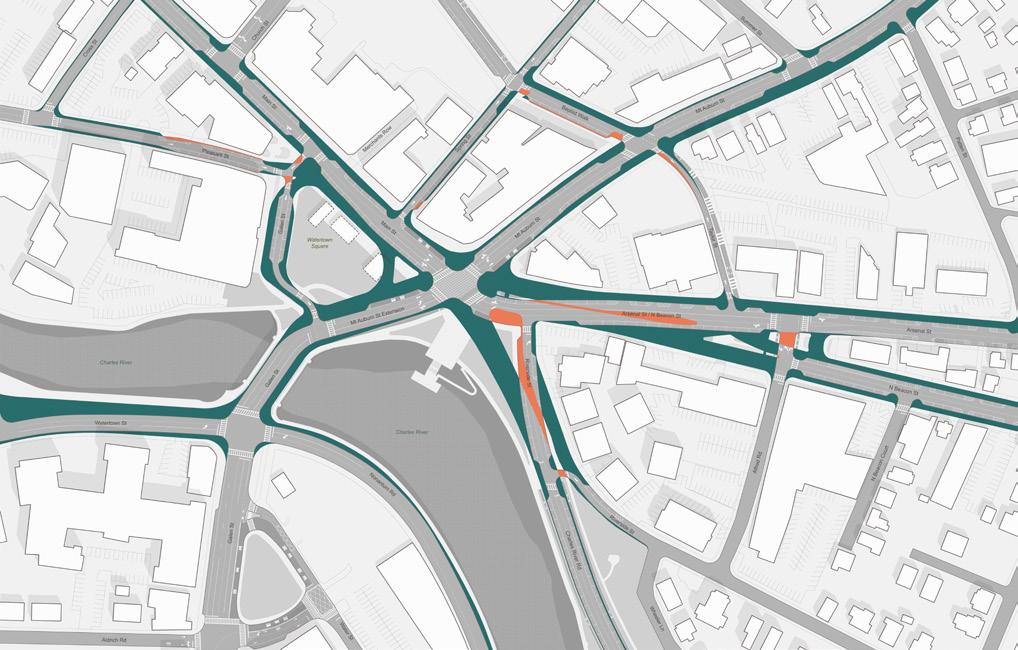
Gained Space (including Delta):
156,730 SF
Lost Space: 10,220 SF
Net Gained Space: 146,510 SF (3.36 acres)
Additional Urban Design Features and Benefits
In addition to reducing the number of streets that converge in the Square, roadbed is recaptured as a result of a reduction of lane widths to 11’ for transit lanes, 10’ for twodirection non-transit streets, and 12’ for one-way street segments. The amount of pavement is also reduced through the tightening of radii at intersections and the shortening of left turn lanes, made possible by the Pleasant Street to Galen Street connection and other adjustments to the street network. The resulting 3.4 acres of space has been redeployed for an expanded Delta, larger open spaces along the Charles River, wider sidewalks, an expanded off-street bicycle network, additional on-street parking, and shorter crosswalks.
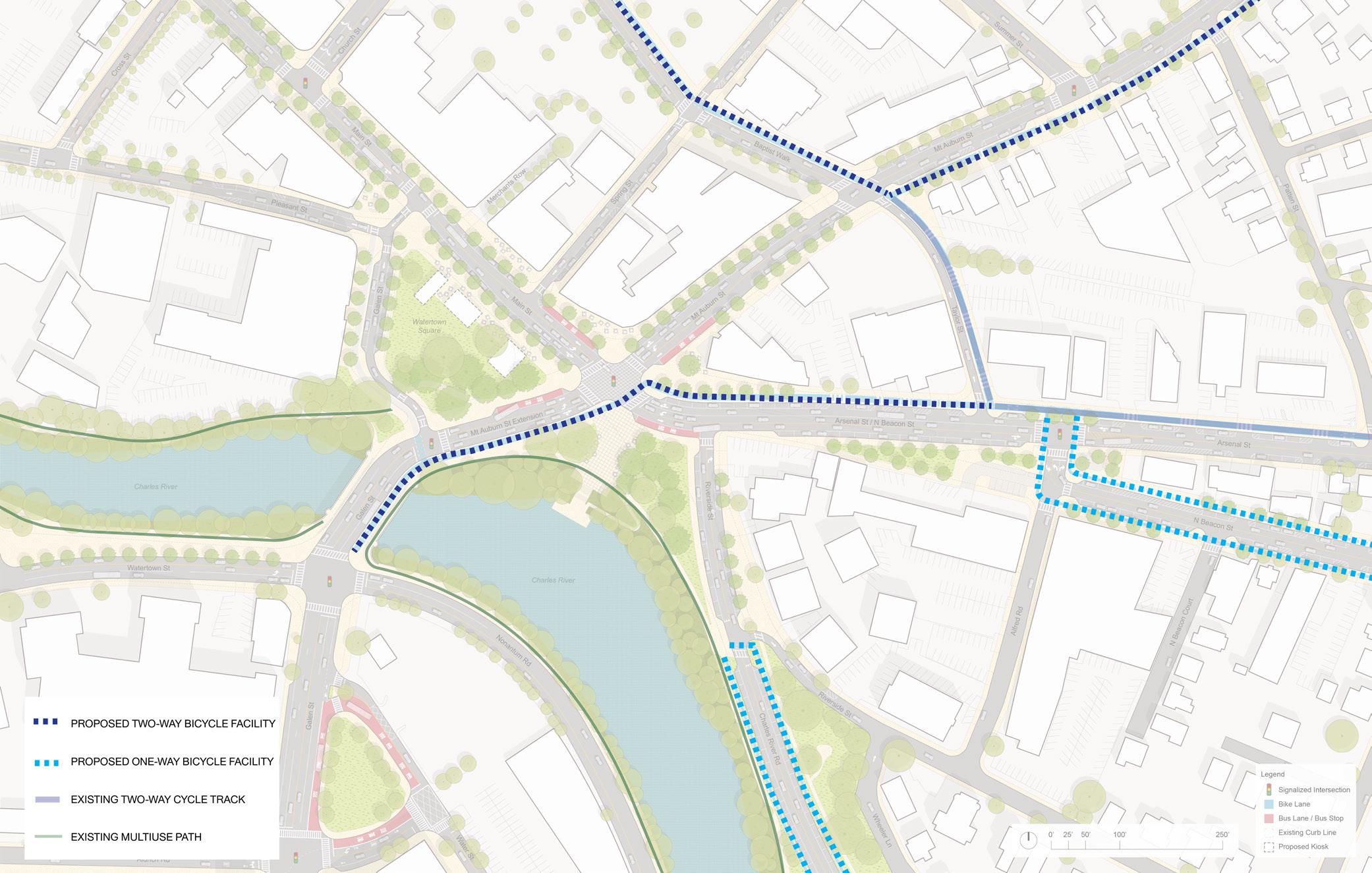
The sum total of these improvements will be a more walkable and bikeable Square that can better attract and support sidewalk-activating retail and housing. Besides the redesign of the streets, sidewalks, and bicycle infrastructure, the public realm plan also includes suggestions for new off-street paths that connect the “four corners” to the Charles River path network on both the west and east sides of Galen Street and Mt. Auburn Street.
These transportation improvements allow for a reimagined public realm that promotes the City’s Resilient Watertown Climate and Energy Plan. The design process can make Watertown Square an inviting environment, including plantings that support our climate and energy goals as well as bringing natural elements that better connect the urban landscape to the adjacent Charles River corridor. The City will hire a design team and landscape architects that specialize in creating a high-quality public realm. This design will include a focus on resilient and meaningful landscape design to enhance the open space and plazas and contribute to the community’s long-term sustainability goals. The Plan will encourage the use of native species, pollinator gardens, and other innovative green infrastructure to enhance the area’s natural environment.
The improved intersection design reclaims almost 3.4 acres of roadbed for public realm.
Retail Pavilions
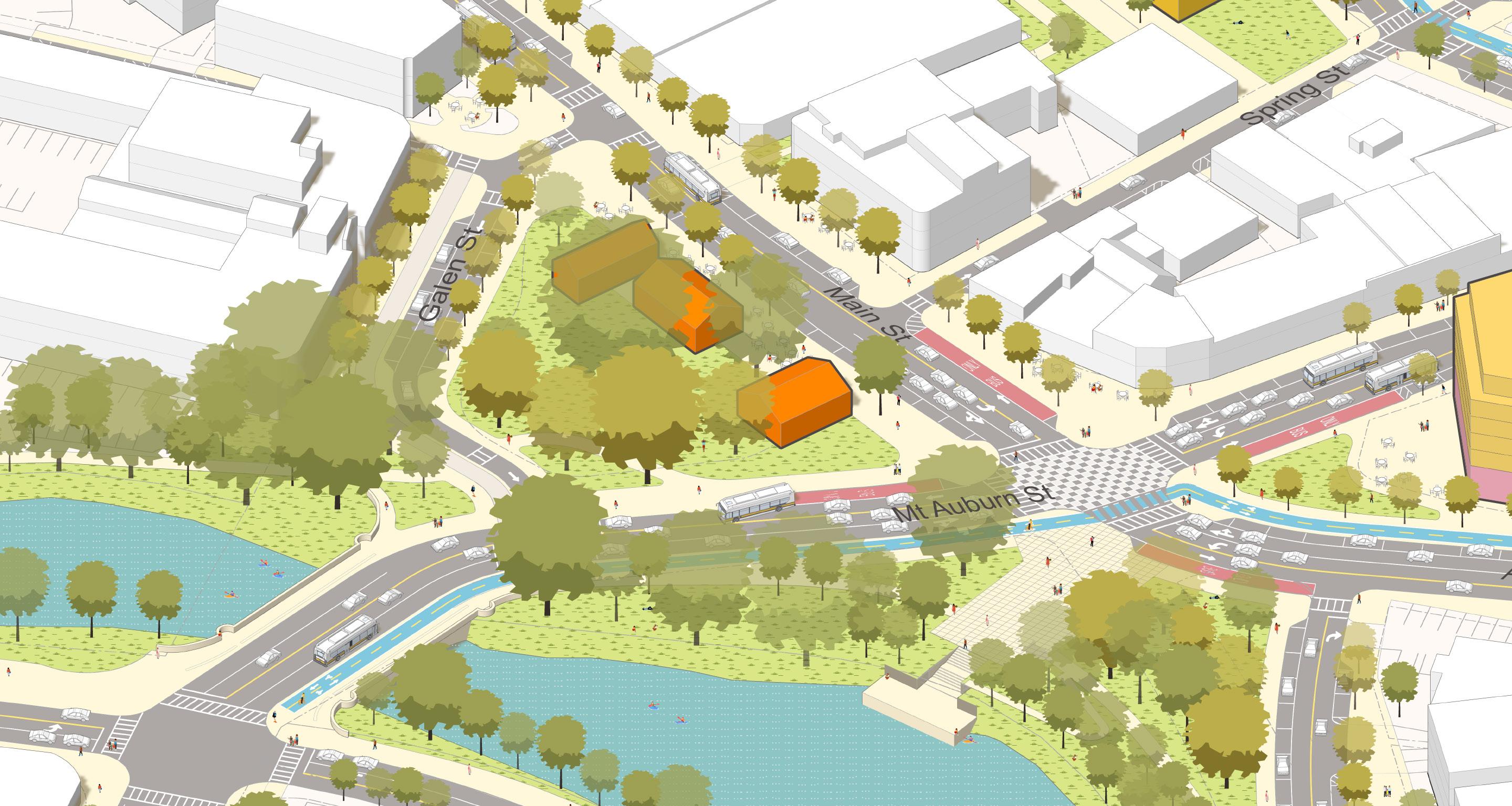
The Plan recommends the addition of retail pavilions in the Delta south of Main Street for two important reasons. The first is to create a two-sided retail experience along the eastern end of Main Street and the newly reclaimed portion of Galen Street. This will increase the likelihood that existing and future retail on the west side of Galen Street and north side of Main Street will thrive. Enhancing the activation of these streets will also increase the chances that a walkable retail district can expand north along Spring Street and Merchants Row. The structures, primarily conceived as cafe, beer garden, or restaurant pavilions with outdoor seating, will attract pedestrian activity to the Delta, an open space at the heart of the Square that is currently cut off by several lanes of traffic.
Retail pavilions in an expanded Delta open space
Two or three retail pavilions on the south side of Main Street will create a two-sided retail street, increasing the likelihood that the walkable retail district will thrive. The structures have primarily been conceived as cafe or restaurant pavilions with outdoor seating, in order to activate the enlarged open space in the Delta and strengthen connections between the heart of the Square and the Charles River.
Opportunities for Civic Art
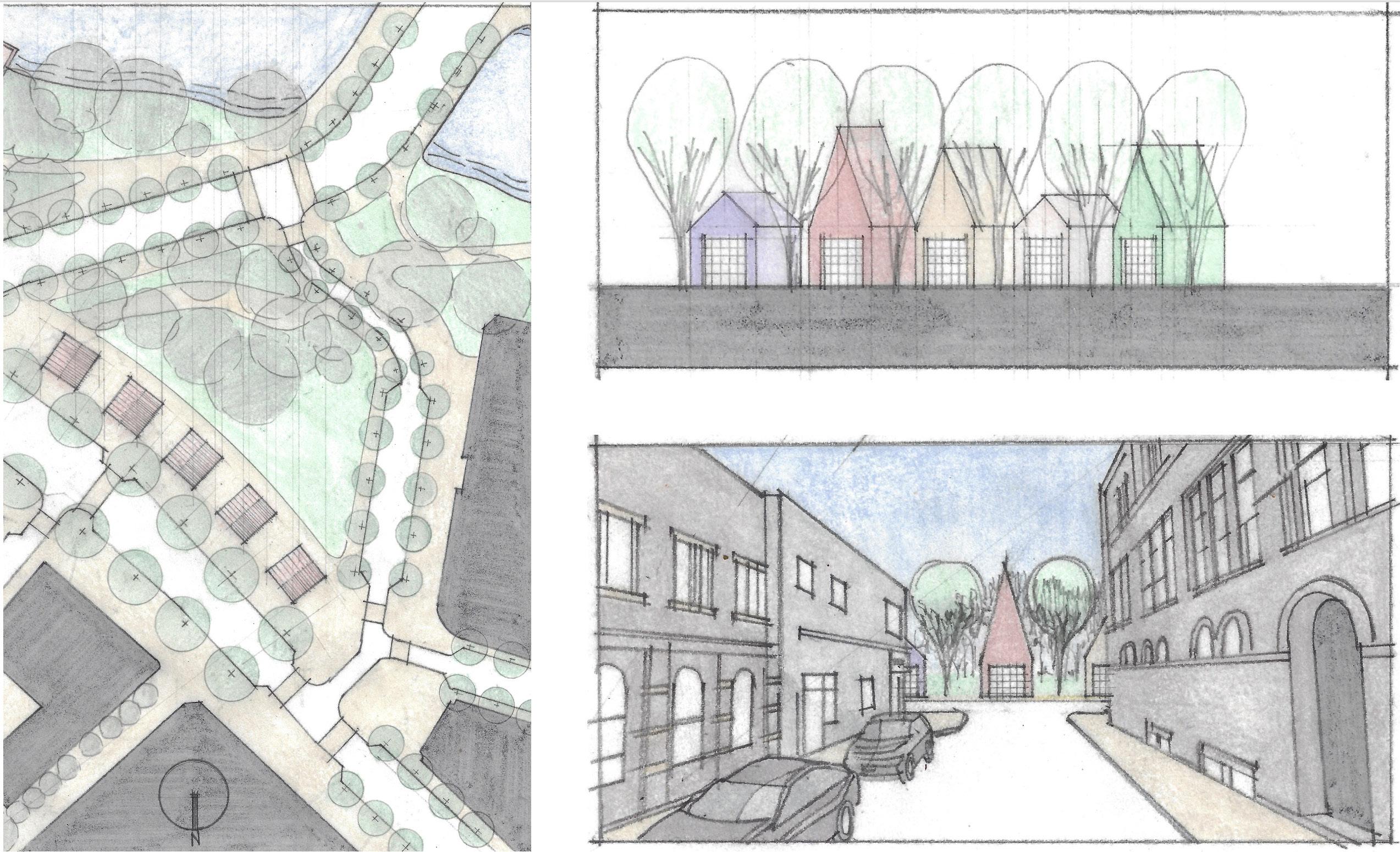
In addition to creating two-sided retail streets, retail pavilions with sculptural rooflines provide an opportunity to introduce visual whimsy to the heart of the Square. In a version of the pavilions drawn by Jeff Speck, FAICP, during the design charrette, small pavilions with a diverse range of colors and rooflines are meant for a different tenant mix than the restaurants and cafes in the scenario depicted above. Instead, they are intended to incubate new businesses in a highly visual location in the heart of the Square. Their self-conscious flamboyance combines creative placemaking with a targeted economic development strategy. The success of this concept will depend on subsidized rents and on-going curation of the tenant mix by the City or another public-minded entity.
Beyond the opportunities afforded by the retail pavilions, the expanded public realm provides a unique opportunity for a robust civic art program. As planning continues, there should be creative thinking about the location and type of art that will help make Watertown Square a lively destination.
In addition to creating a two-sided retail street, retail pavilions present an opportunity to introduce small-scale landmarks to the Delta, while also anchoring views south on both Spring Street and Merchant’s Row.
Sketches of retail pavilions by Jeff Speck. FAICP
Additional Mobility Infrastructure Benefits
The simple four-way intersection at the heart of the recommended street reconfiguration creates a people-friendly downtown by reducing signal phases and pedestrian crossing times and narrowing pavement width on roadways approaching Watertown Square. The Plan also results in wider sidewalks and dedicated bicycle facilities, protected by new parallel parking along Mount Auburn Street, Galen Street and Main Street.
The key elements of the design, developed over several days during the design charrette and informed by conversations with members of Watertown’s visually impaired community early in the streetscape design process, include:
• Narrowed roadways to encourage Watertown Square as a space for people, not cars
• Preservation of primary east-west vehicular movements, from Main Street to Arsenal Street, since data suggests that they are mostly used by Watertown residents and employees
• Maintenance of the Galen Street/Mount Auburn Street alignment to optimize bus operations
• Relocation of the Route 59 and Route 71 terminus to the Watertown Yard south of the Charles River
• Reclamation of Galen Street between Main Street and Charles River Road for southbound vehicles from the west and maintaining two southbound travel lanes across the Galen Street bridge
• Relocation of the Charles River Road/North Beacon Street intersection to the east, away from the primary intersection
• Consolidation of vehicles on North Beacon Street and Arsenal Street east of the Mount Auburn Street intersection (see proposed plan on page 24)
• Two-way Cross Street and signalized Cross Street/Main Street intersection, with preemptive control for emergency vehicles
• A shorter overall traffic signal cycle, requiring less pavement area to store cars as they wait for green lights
• Safer and shorter accessible pedestrian crossings throughout the Study Area
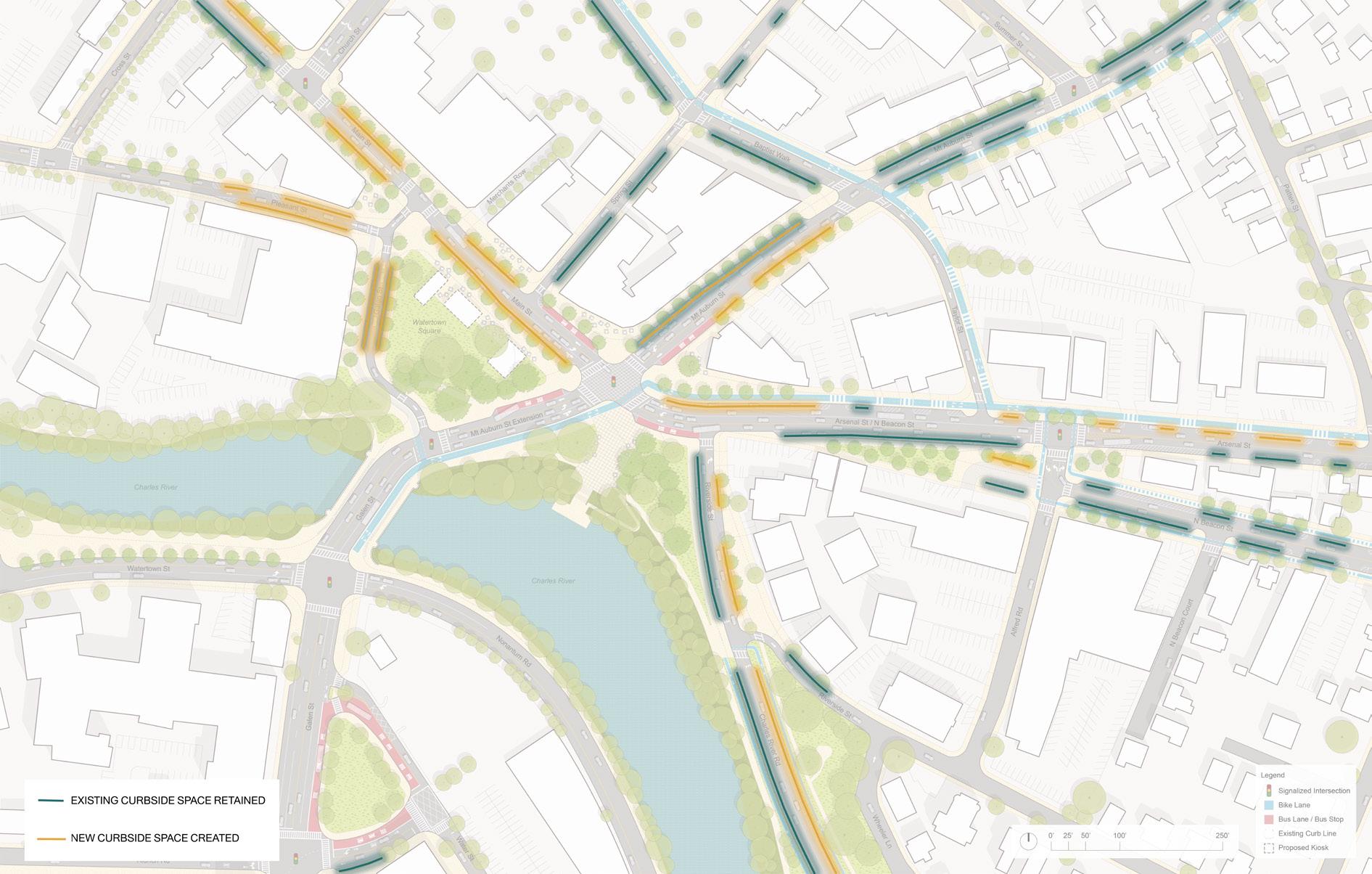
• Addition of significant curbside use and parking, especially in critical areas adjacent to retail frontages, providing several benefits:
◦ Pedestrian buffers
◦ Curbside space for restaurant deliveries and food delivery services pickup
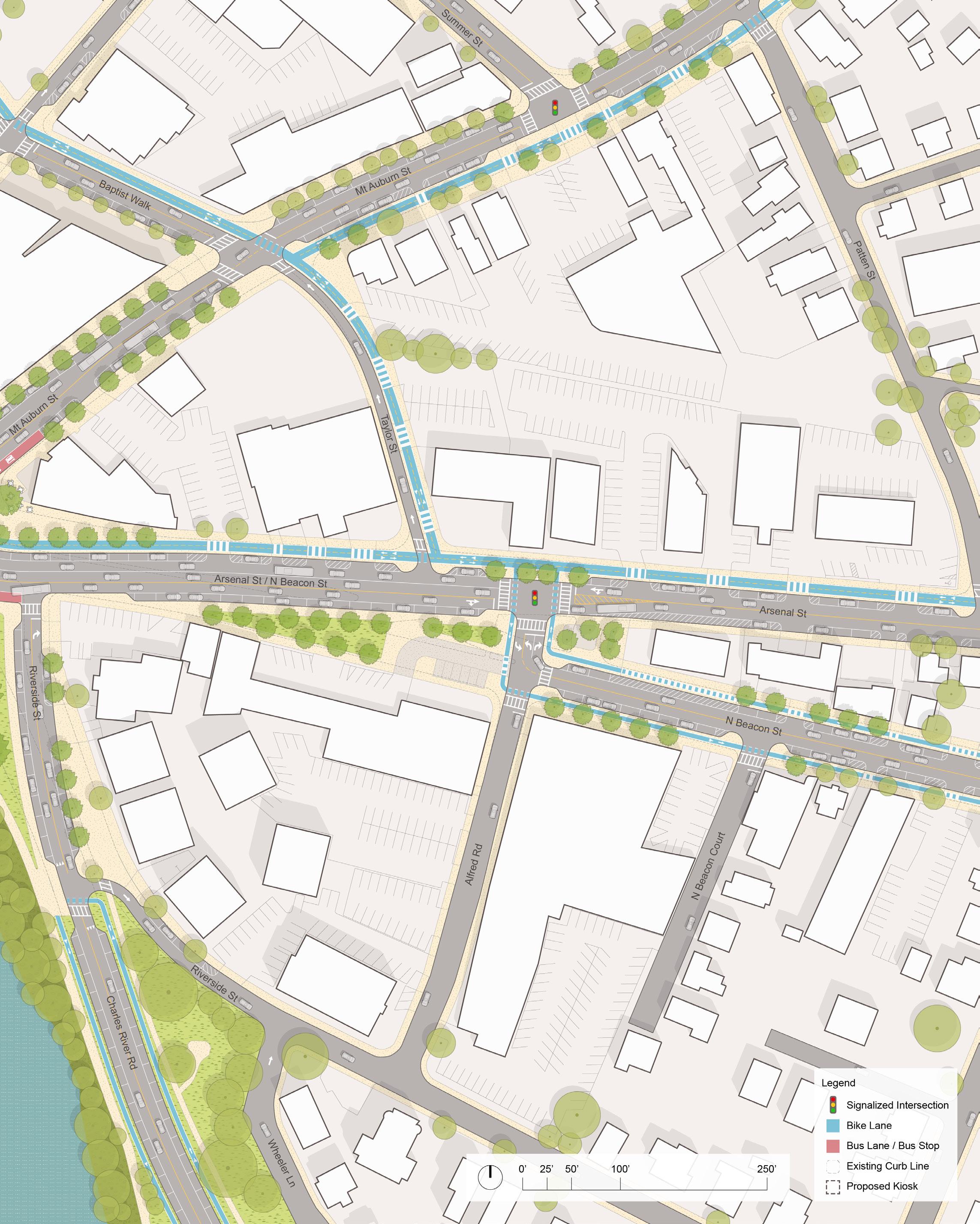
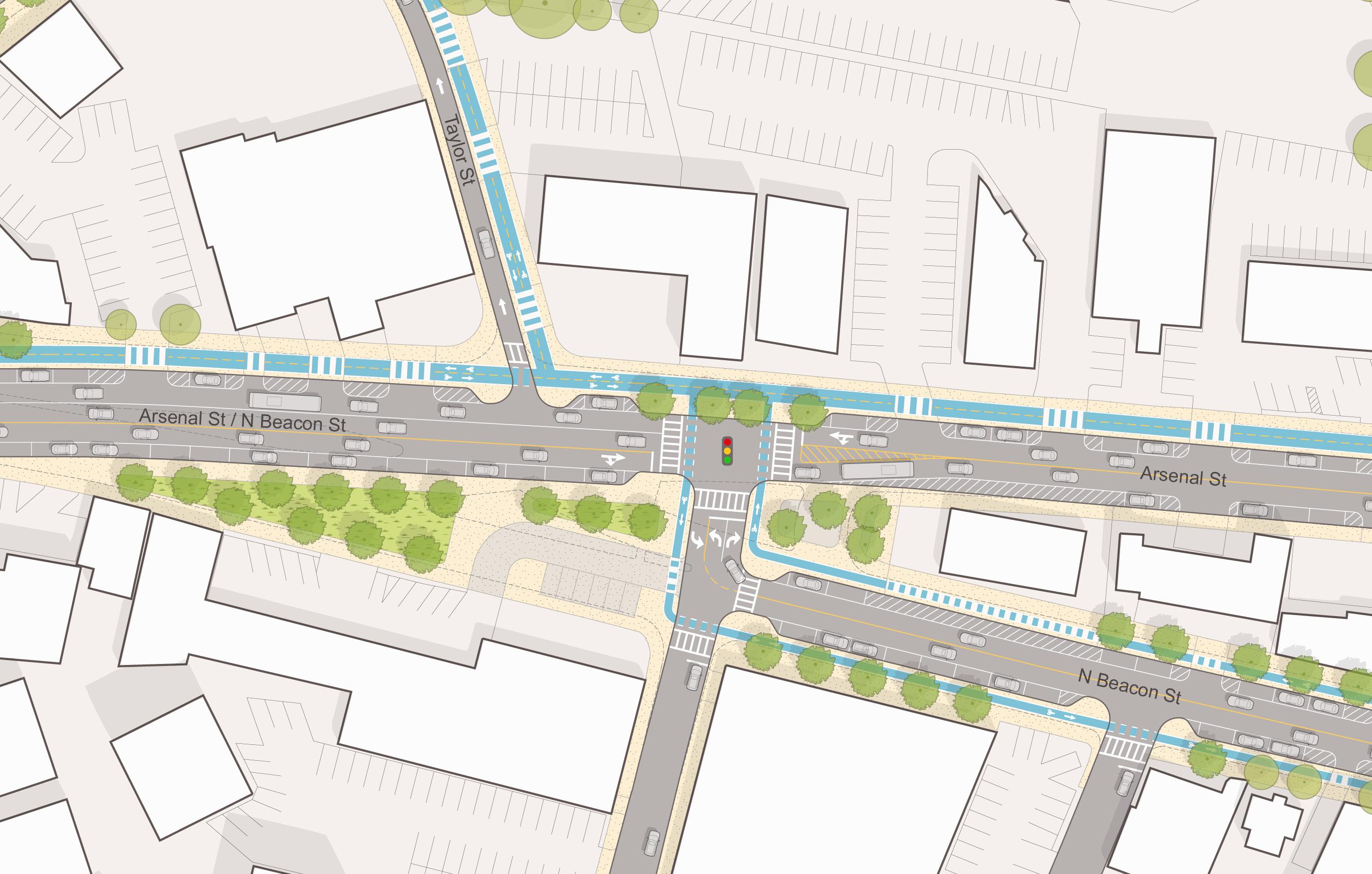
The Plan proposes a narrowed intersection for North Beacon Street and Arsenal Street, which will create wider, more pedestrian-friendly sidewalks.
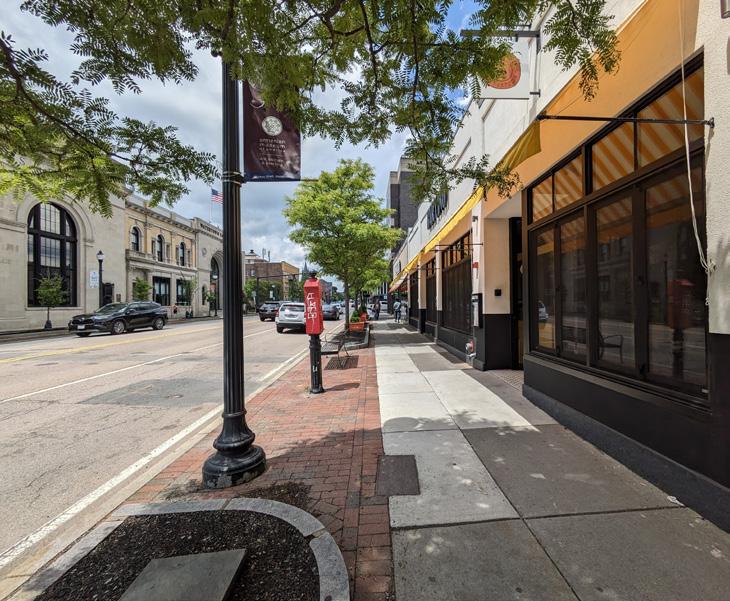
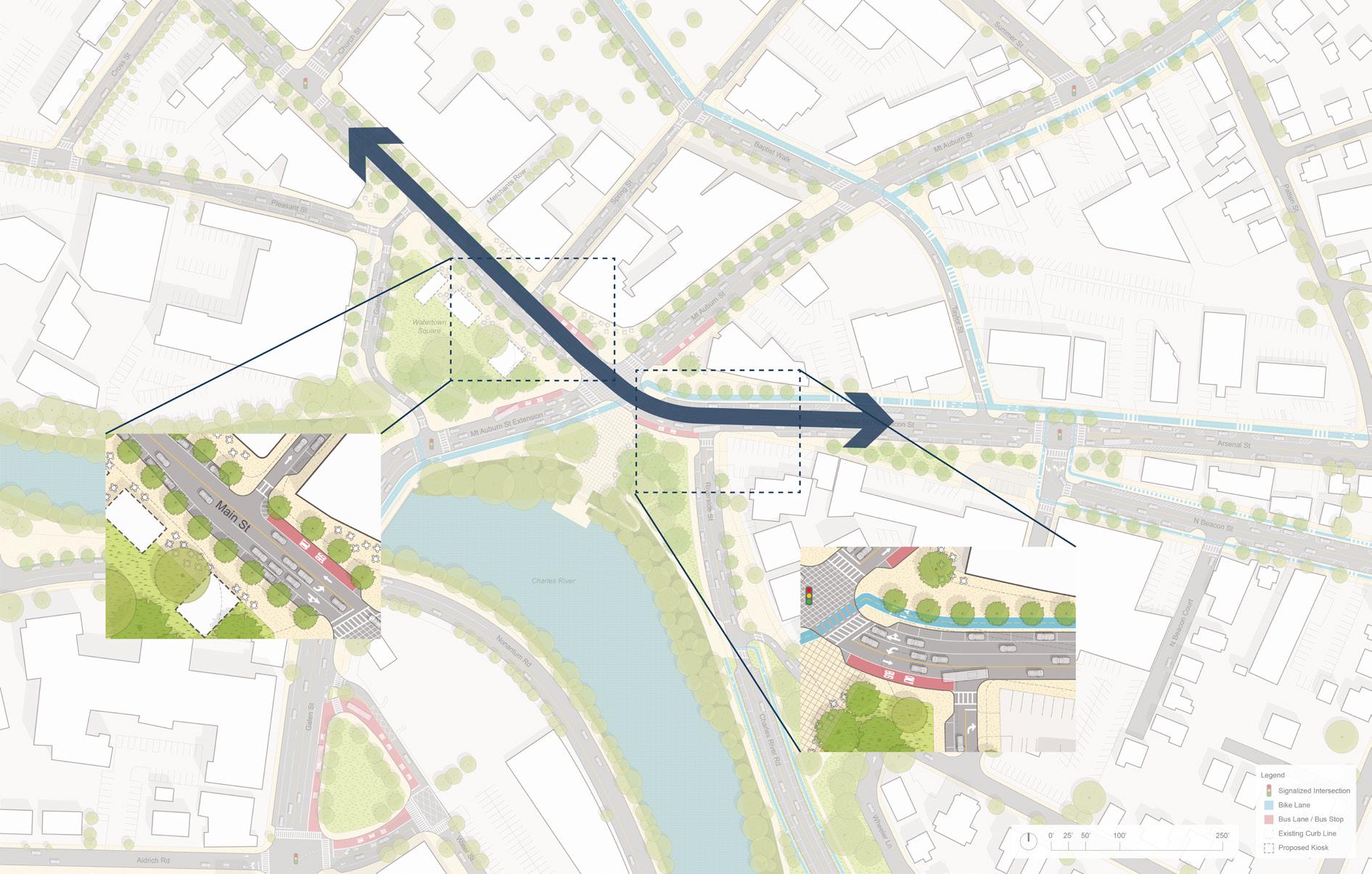
The Plan provides on-street parking along key retail frontages adjacent to the Square, including Main Street (shown here), Pleasant Street, Mount Auburn Street, and Arsenal Street / North Beacon Street.
By reclaiming the original Galen Street west of the Watertown Delta for vehicles rather than bus layover, Main Street can be narrowed through the elimination of the existing right-turn slip lane. Southbound Main Street and Pleasant Street vehicles will be able to use this one-way segment of the original Galen Street (in the opposite direction of the current bus traffic flow) to bypass the main intersection when traveling towards Nonantum Road and the Massachusetts Turnpike. Combined with the removal of Charles River Road from the Watertown Square intersection, where Mount Auburn Street meets Main Street and North Beacon Street, Watertown Square results in an intuitive four-way intersection, simpler for motorists, pedestrians, and cyclists to navigate, while preserving all movements accommodated in Watertown Square today.
The Plan removes vehicular lanes and pavement now primarily serving as queue storage space across the system, in exchange for wider sidewalks and expanded curbside use in the downtown core. By simplifying operations and modifying traffic signals, the main Watertown Square intersection can be expected to
maintain a similar level of operation to the current alignment. This is primarily accomplished through the simplification of the approaches, redistribution of vehicular patterns and the balancing of levels of service across multiple signalized intersections in the study area.
In subsequent more engineering-intensive design phases, the phasing and timing of traffic signal operations will be fine-tuned, including the accommodation of transit, both at intersections and at a new bus terminal just south of the Watertown bus yard. The signalization design process will also address the traffic pattern on side streets between Charles River Road and North Beacon Street, with a focus on ensuring that residents of these streets seeking to get through and past the Square have access by way of North Beacon Street; while at the same time, keeping regional traffic from using neighborhood streets to cut through from Charles River Road after it is realigned out of the Square. Beyond these sitespecific benefits, a modernized signalization system will have the long-term ability to be adapted to future circumstances.
Detailed concept plan showing the simplified intersection of Alfred Road with Arsenal Street and North Beacon Street
More generally, the Plan results in a more redundant street grid that is flexible for ingress and egress when streets are closed for emergencies or events. For example, the reclaimed original Galen Street builds in another way to get through the Square area, and the enhanced and extended Baptist Walk adds to the street grid and its connectivity throughout.
Transit priority will be incorporated into the plan’s public realm design and implementation. Improving safety, access, efficiency and mobility for public transit passengers (in coordination with the MBTA) is an important goal of the plan. Each bus or shuttle has the potential to carry significantly more people than an automobile and this street network redesign was used as an opportunity to improve the commutes of substantially more of the community who rely on transit. This focus is especially important for disadvantaged groups, those with lower income
and resources, and others that are solely dependent on public transportation for mobility. Since buses and shuttles use roadways more efficiently than automobiles, particularly compared to singleoccupant vehicles, the prioritization of transit is in alignment with Watertown’s Comprehensive Plan and Climate & Energy Plan goals.
This plan improves opportunities for taking transit (with best practice design and planning for improved service) to pair with more efficient and right-sized streets and the overall roadway network. The City will continue to coordinate with the MBTA to improve and ensure consistent and frequent bus service, and assist with implementation of the MBTA Bus Network Redesign plan that commits to high frequency bus service on the 57, 70 and 71 bus routes.
The north-south approach on Mount Auburn Street offers little to no change to existing travel patterns and provides one lane approaches to the intersection.
A feature of the street concept includes reclaiming Galen Street west of the Delta. This key connection in Watertown Square activates the Delta and 9 Galen Street frontage. This can now be imagined as a secondary main street, rather than a place for bus layover.
Heading east-west along Main Street and Arsenal / North Beacon Streets, the Plan proposes one lane approaches with left turn pockets. The reclaimed roadway space is used for wider sidewalks and additional curbside parking.
More curbside space is reserved for parking, bus stops, passenger and service loading, or on-street eateries. This space is important for the success of sidewalk-activating retail and to create a buffer between cars and pedestrians.
MBTA is supportive of relocating Route 71 and Route 59 terminus to Watertown Yard, eliminating the need for bus layover in Watertown Square.
Recommended Public Realm Next Steps
The proposed public realm improvements will require a phasing plan and significant additional design and engineering work. Future steps should also include a thorough study of the bus routing and layover space in Watertown Yard, as well as a comprehensive review of the proposed bicycle network and facilities.
Scope of the Streetscape Construction Project
In order to achieve the seamless integration with surrounding neighborhoods, the scope of work for the streetscape construction project should encompass all of the key streets in the study area, including the full lengths of Main Street, Galen Street, Arsenal Street, North Beacon Street, Mt. Auburn Street (and incorporating the previously planned improvements for Mount Auburn north of Patten Street), and Pleasant Street. This will ensure a continuity of treatments for sidewalks, crosswalks, traffic calming, complete streets strategies, muti-modal infrastructure, lighting, street furniture, and wayfinding. A broader streetscape construction project will also ensure that the public realm is legible as a single cohesive walkable environment, inviting residents from adjacent neighborhoods to walk to downtown amenities.
Refinement of the Open Space Design
The recapture of more than three acres of open space for community use is one of the primary achievements of the Plan and provides a once-in-a-lifetime opportunity to rethink the design of all of the open spaces in the Square with a fresh eye. Thoughtfully-designed gathering spaces, while conceived for the entire community, will be especially important to residents of existing and future multi-family buildings in and around the Square. Although the expanded open spaces depicted in the plan show specific recommendations for pathways, tree canopy, and areas of turf versus hardscape, the full potential of these spaces will be refined as the plan advances through the next steps of the design process.
Since a high-quality and well-designed public realm is essential to the success of the project, the design team for future phases of the project should include a lead role for a landscape architecture firm. The inclusion of this disciplinary expertise will ensure that the landscape design prioritizes diverse plantings, native species, and pollinator plants while maximizing the addition of new tree canopy in order to provide expanded ecological benefits, address issues related to climate resilience, and fully leverage the place-making potential of the Plan.
The Square has unique natural assets and open spaces that would benefit from detailed landscape design expertise to create a more cohesive public realm experience.
In addition to the specific aspects of the street design plan described above, the Plan includes these additional features and benefits:
• Adjustments to MassDOT’s proposed design for California Street, including the removal of the slip lane and expansion of recreation space along the Charles River between Galen Street and California Street
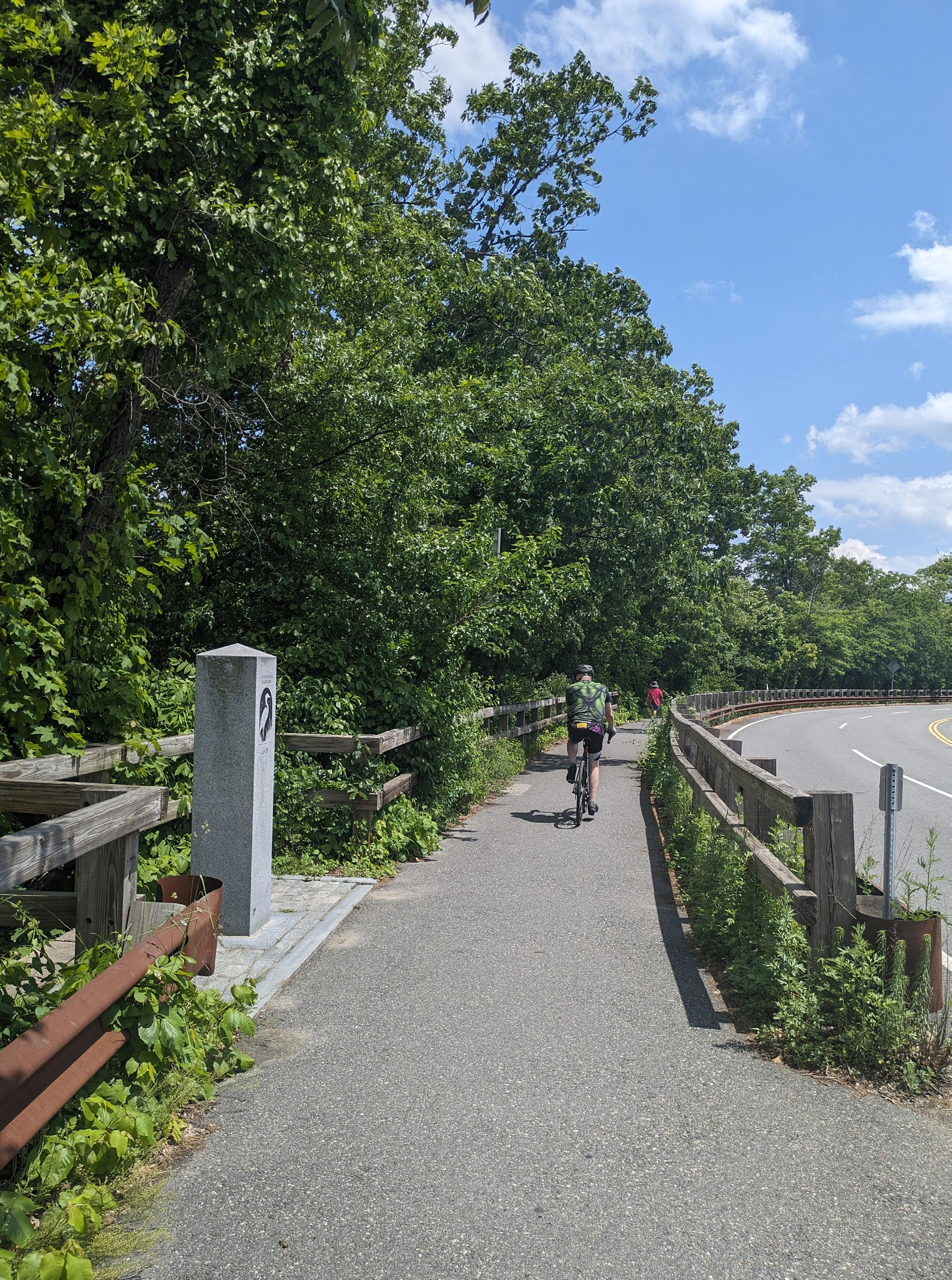
• Completion of the Community Path through the current parking lots and incorporation into future development.
• Coordinated improvements to the Community Path along Arsenal Street and Taylor Street
• Full integration with the City’s proposed improvements to Mount Auburn Street, resulting in a seamless connection from Patten Street to Common Street
• No costly modifications to the historic MassDOT bridge
• Removal of any remaining catenary infrastructure
• Recommendations for clear and concise wayfinding
Details for facilities and network alignments will be thoroughly reviewed during the design process.
Bicycle Network Concept
Coordination of the Public Realm Plan and Construction
1. As part of design, consider the zoning and urban design opportunities and context on adjacent private properties, for potential expanded planting to support canopy trees and sustainable plantings in the public realm.
2. Incorporate spaces for outdoor seating and expanded sidewalks to enhance the pedestrian environment.
3. In the design, incorporate curbside best management practices with consideration for the competing interests of the curb, especially in high demand areas adjacent to retail frontages.
4. Continue to coordinate with MassDOT, MBTA, and DCR for adjustment to MassDOT’s proposed design for the roadway reconfiguration of Galen Street at Nonantum and Watertown Street and the bridge, including the removal of the California Street slip lane and expansion of recreation space along the Charles River between Galen Street and California Street, and the MBTA Watertown Yard frontage.
5. Collaborate with DCR on the design and implementation of the DCR’s open space and reconfiguration of Charles River Road and Watertown’s Riverside Street.
6. Coordinate improvements to the Community Path along Arsenal Street and Taylor Street. As part of this, redeveloped private properties should strive to incorporate open space that includes segments of an additional off-street route for the Community Path between Taylor Street to Irving Street along the former rail alignment.
Zoning Redesign
Summary of Zoning Approach
The recommended regulatory framework for the study area is a zoning code that is primarily framed by three form-based design standards, in addition to dimensional standards common to conventional codes:
1. A maximum allowable number of stories
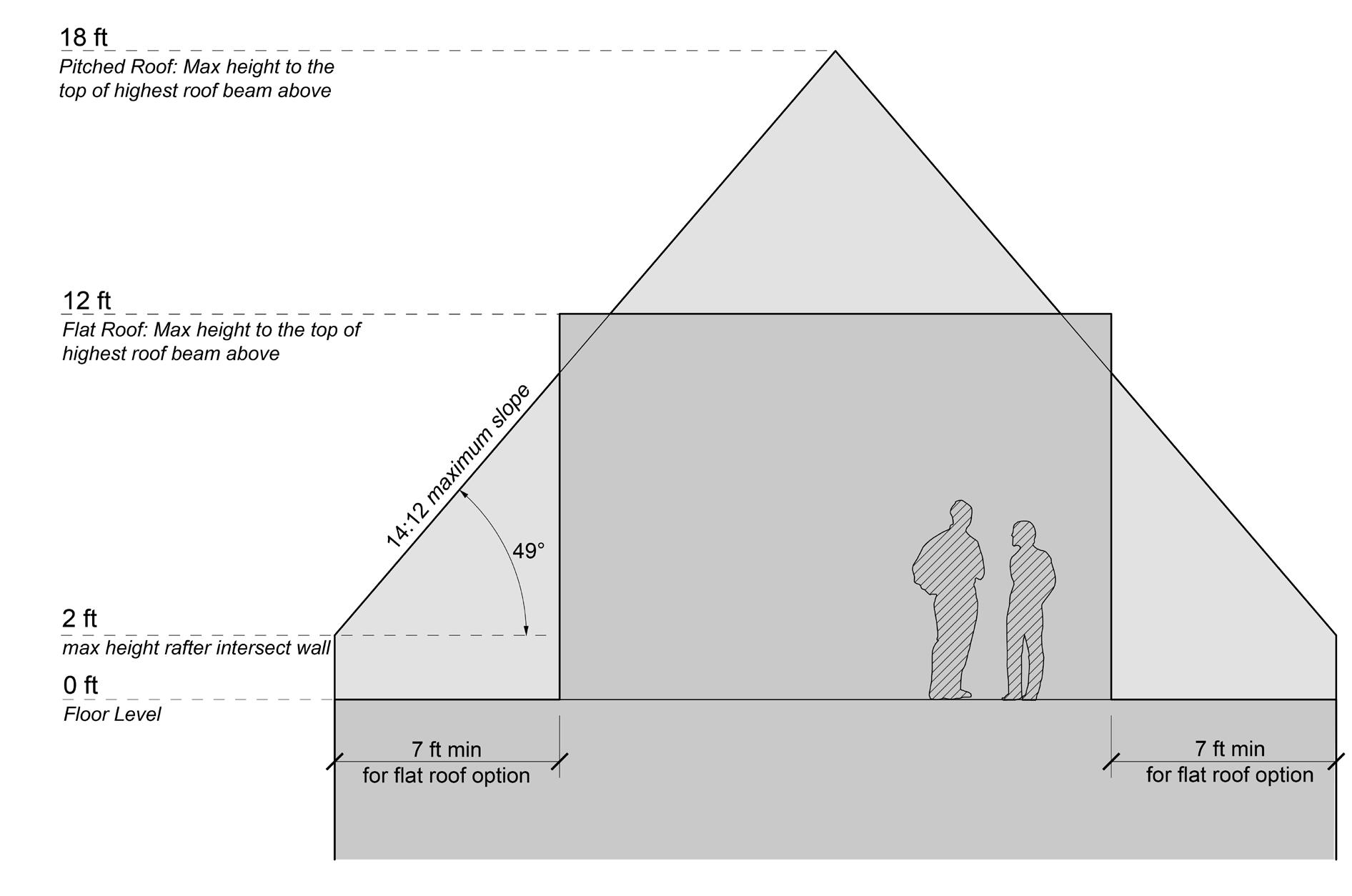
2. A requirement that buildings include an articulated top floor, either shaped as an occupiable pitched roof or a penthouse that steps back a minimum of seven (7) feet from the primary facade plane below
3. Rules for the maximum length of uninterrupted facades and the design requirements at their terminus and/or transitions
Form-based Zoning Diagrams
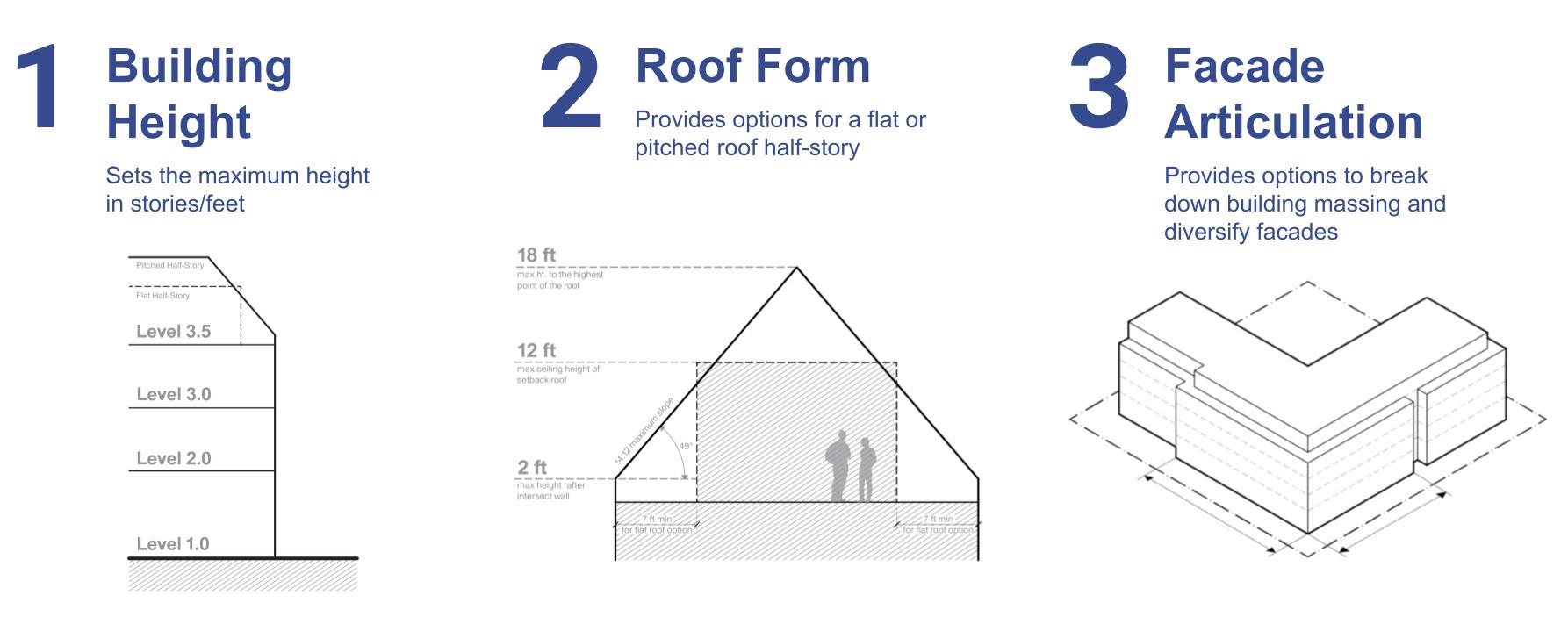
The proposed zoning code is predicated on three fundamental form-based criteria: 1) the maximum number of stories, 2) the requirement that the top floor (the + floor) be shaped as a pitched roof or a penthouse stepped back from the facades below, and 3) the requirement that a single facade expression can’t be longer than 100 feet, in order to make large buildings look like two or more buildings.
Beyond these design standard fundamentals, the code recommendations include more detailed requirements for open space, parking areas, and architectural components like dormers that make the occupation of the top floor feasible.
The code will still have a table of uses, but the list of uses will be simplified from what is used in other zoning districts in Watertown. Retail and restaurant ground-floor uses will be allowed throughout the district, and required in the portion of the core of the Square that requires first-floor retail. While upper story housing is a key component of the district, office uses will also be allowed. Large scale biotech lab / R&D uses will not be permitted in the new districts in the Square, as these uses generally require consolidating into large lots that are not consistent with the design goals for the study area.
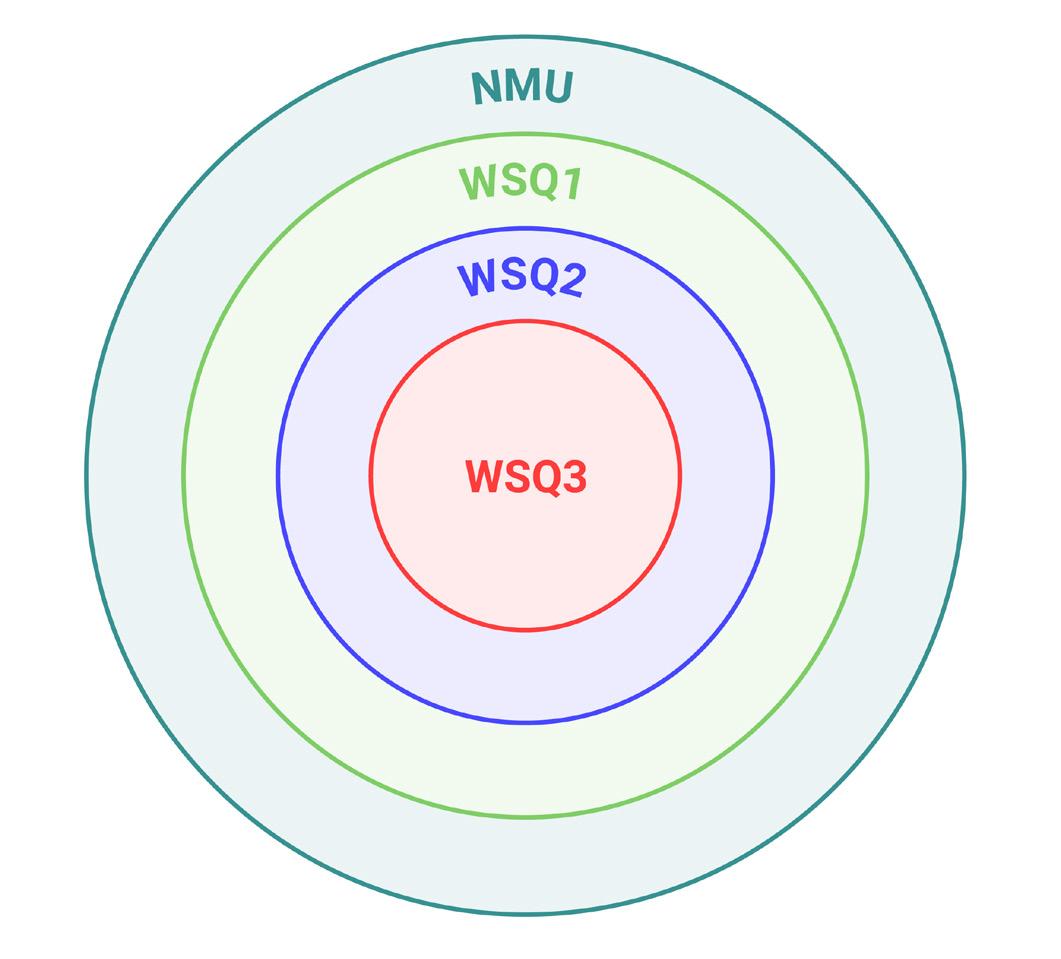
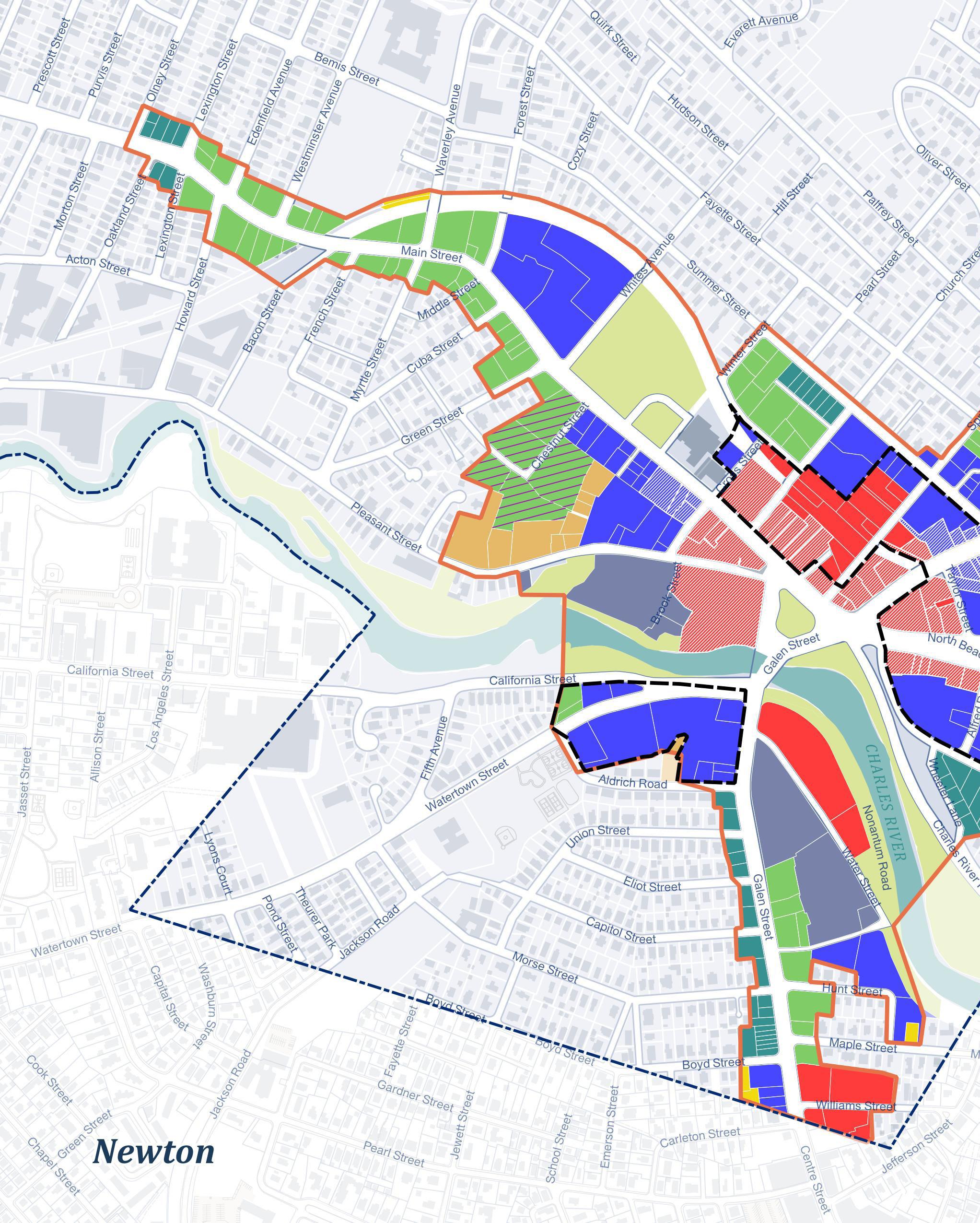
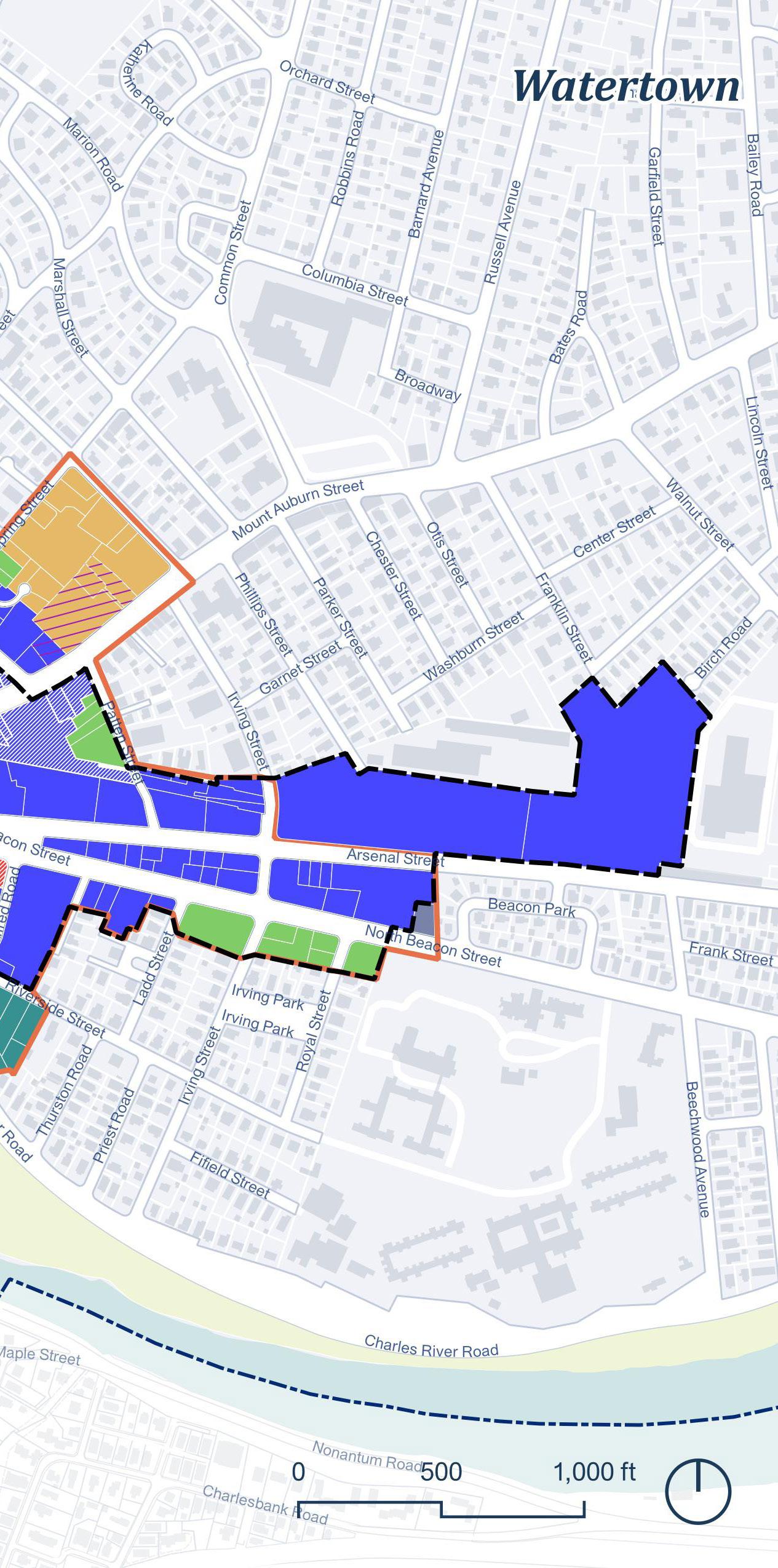
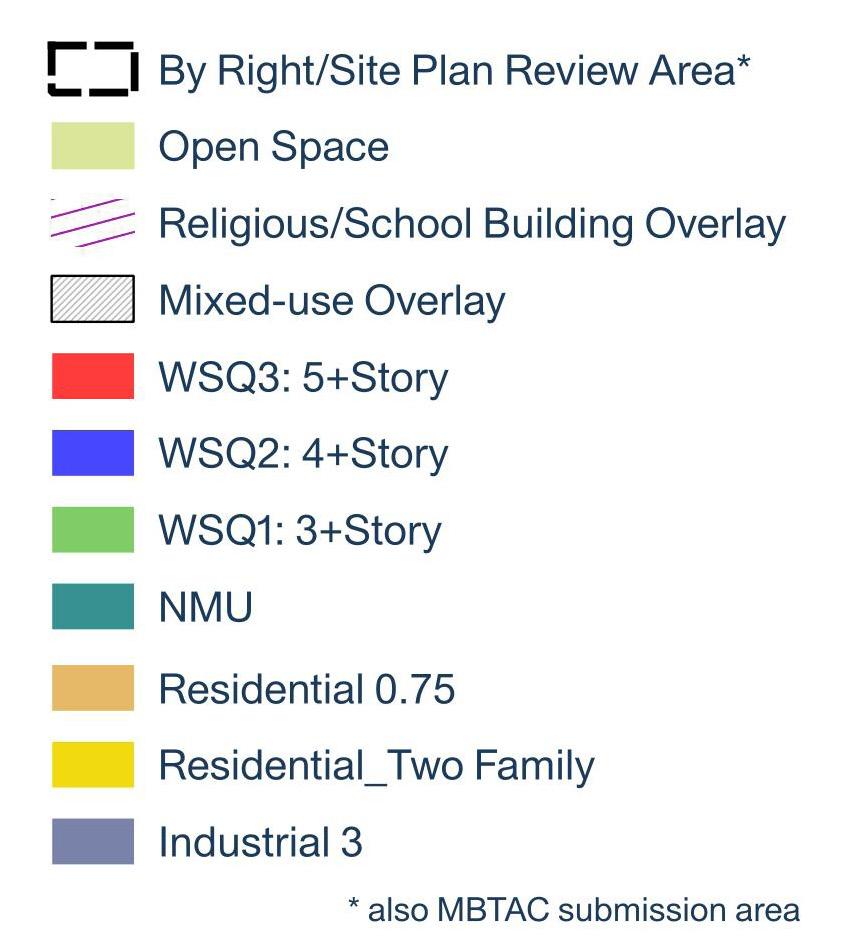
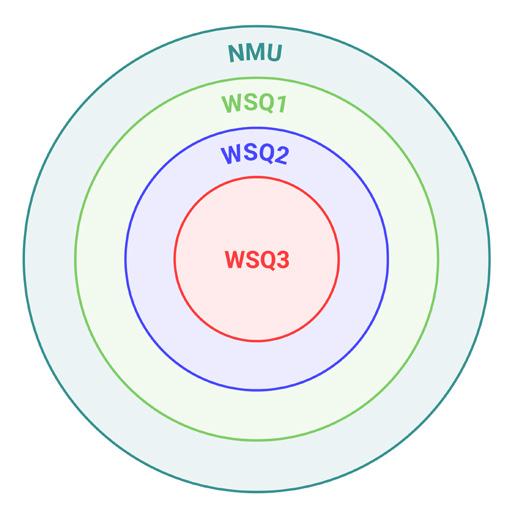
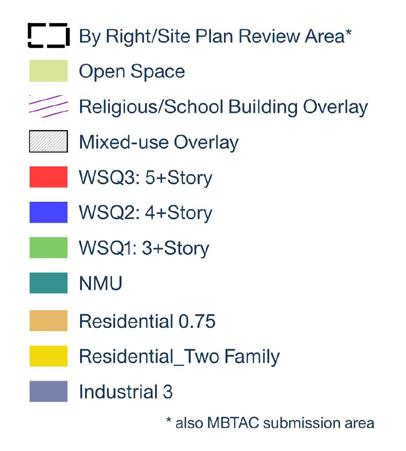
In order to ensure a smooth transition to smaller-scale residential areas, a tiered zoning approach with four sub-districts are proposed, with each allowing a different maximum number of stories:
• Neighborhood Mixed Use (NMU): 2+ stories
• Watertown Square 1 (WSQ 1): 3+ stories
• Watertown Square 2 (WSQ 2): 4+ stories
• Watertown Square 3 (WSQ 3): 5+ stories
In each case, the plus (+) story represents either the occupiable roof or the penthouse floor described above. Given the design requirements of these two approaches, the floor area of the top floor of buildings built under the new code will be smaller than the typical floors below.
In addition to stepping up building heights as they get closer to the heart of the Square, the proposed code requires first-floor retail on designated parcels along Main Street, Mount Auburn Street and Arsenal Street / North Beacon Street. The combination of taller buildings in the heart of the Square and mixed-use requirements will increase vibrancy as the result of additional residents on the floors above and the preservation and expansion of sidewalk-activating retail.
of the Tiered Zoning Framework
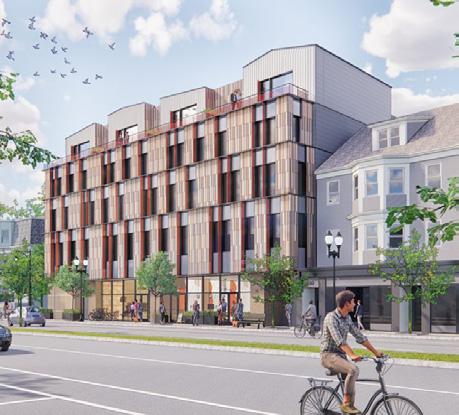
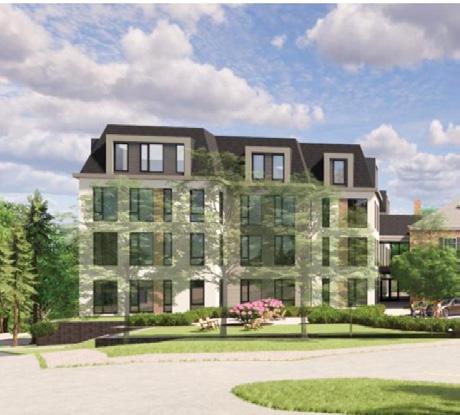
The proposed zoning code is predicated on a tiered zoning approach based on the maximum allowable number of stories in each of the sub-zones. The + (plus) floor is an additional floor on top of the floors below that must be located under a pitched roof or stepped back 7 feet from the facades below. This strategy will help lower the perceptible height of buildings by lowering the cornice line and will result in a more interesting skyline than what would result from flat-roofed buildings.
NMU: 2+ stories
Diagram
WSQ3: 5+ stories
WSQ2: 4+ stories
WSQ1: 3+ stories
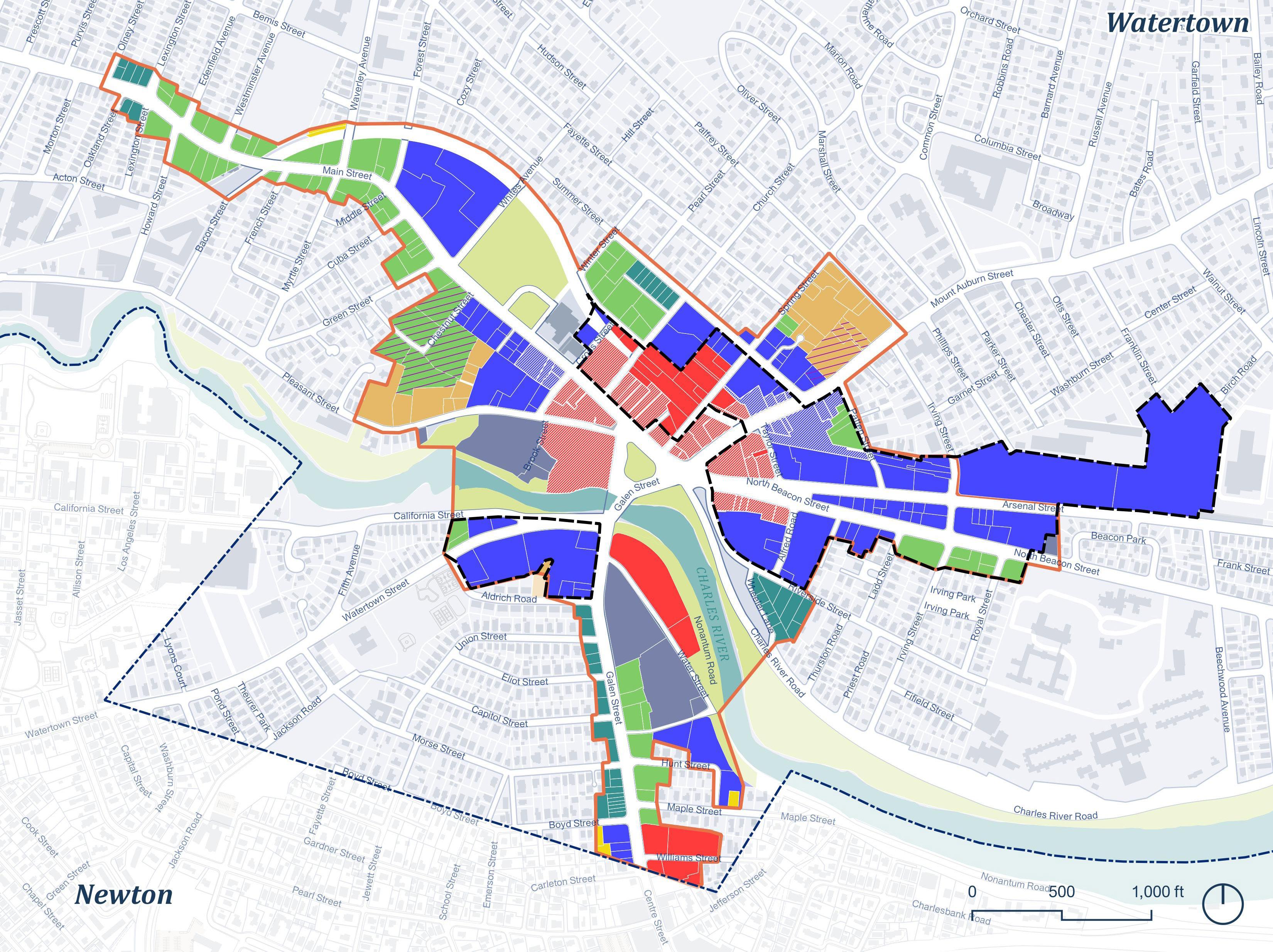
Map of the Proposed Zoning
The color-code of the map is keyed to the bullseye diagram above. Each district allows a different maximum number of stories, from the tallest in the heart of the Square (WSQ3 at 5+ stories) to the lowest in the NMU district at 2+ stories.
Rationale for and Benefits of the Zoning Approach
Conventional zoning frameworks either establish the maximum allowable floor area of a building by applying a Floor Area Ratio (FAR), a dimensionless multiplier of the parcel area to determine maximum building area, or the residential density, established by a maximum number of dwelling units allowed per acre. While the maximum potential development yield of these zoning standards are easy to calculate, they are not a reliable predictor of the resulting urban form; and therefore, are not suitable for the kind of as-of-right zoning framework required by the MBTA Communities housing law (see more on the requirements and the recommended approach for Watertown Square below).
Instead of applying these abstract tools, buildings of different heights and configurations were tested on a few potential redevelopment sites in Watertown Square in order to test potential maximum building heights, the appropriateness of different configurations of shaped top floors, and to understand the impacts of maximum facade length requirements. After discussing the design scenarios internally and sharing them at the public charrette, the zoning code was reverseengineered to create the dimensional standards for the code.
The resulting code will provide more predictable and betterdesigned outcomes. Some portions of the district will allow by-right development, but the Planning Board, through the site plan review process, will have the ability to place reasonable design conditions on these by-right projects to address site-specific design details that are not directly addressed in the code. This predictability means that the future entitlements process will be more streamlined than the current special permit path, while still keeping the public informed and participating. It is hoped that by reducing the risks and costs of project permitting, higher-quality projects will result that contribute to a more walkable Square.
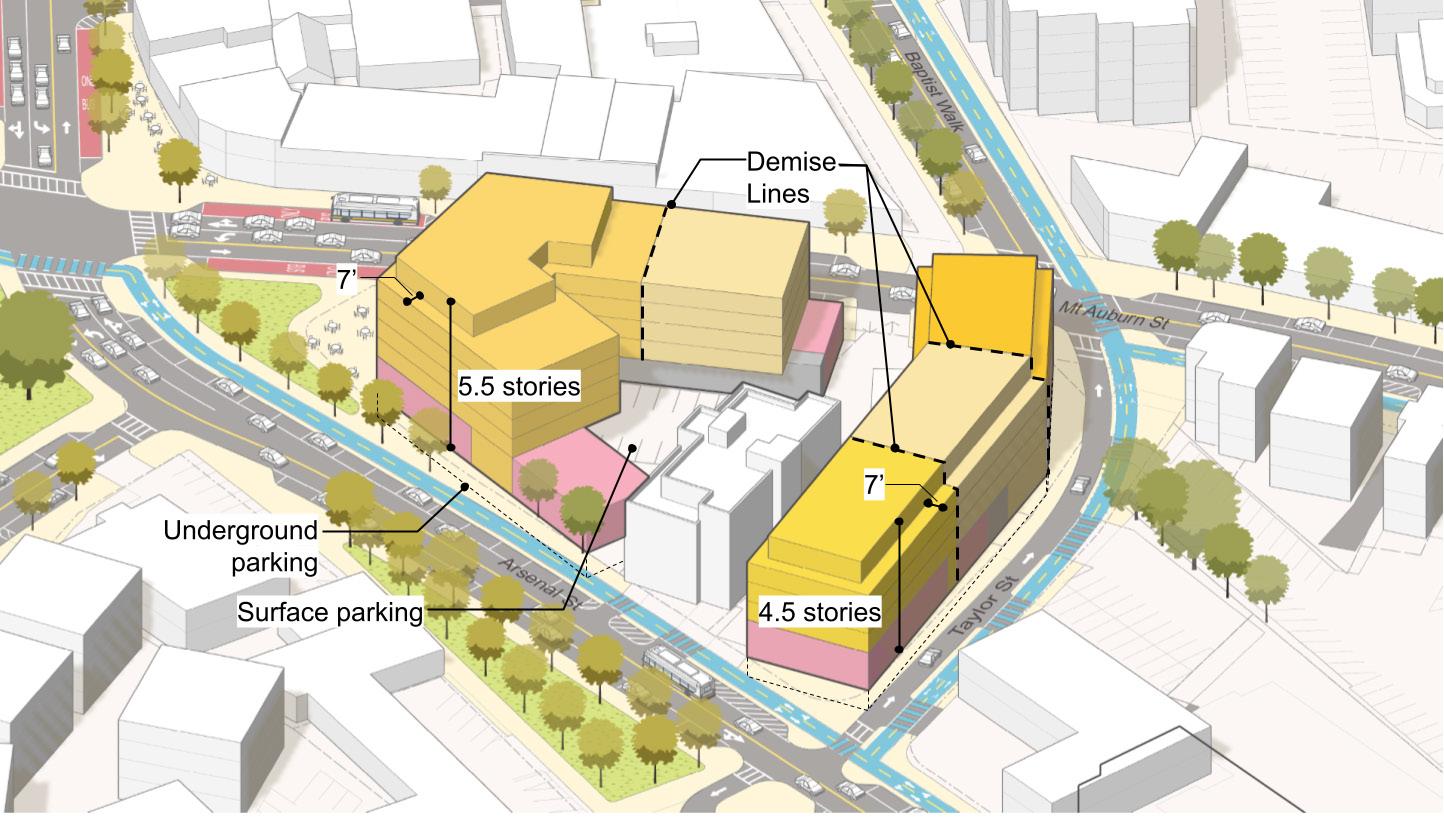
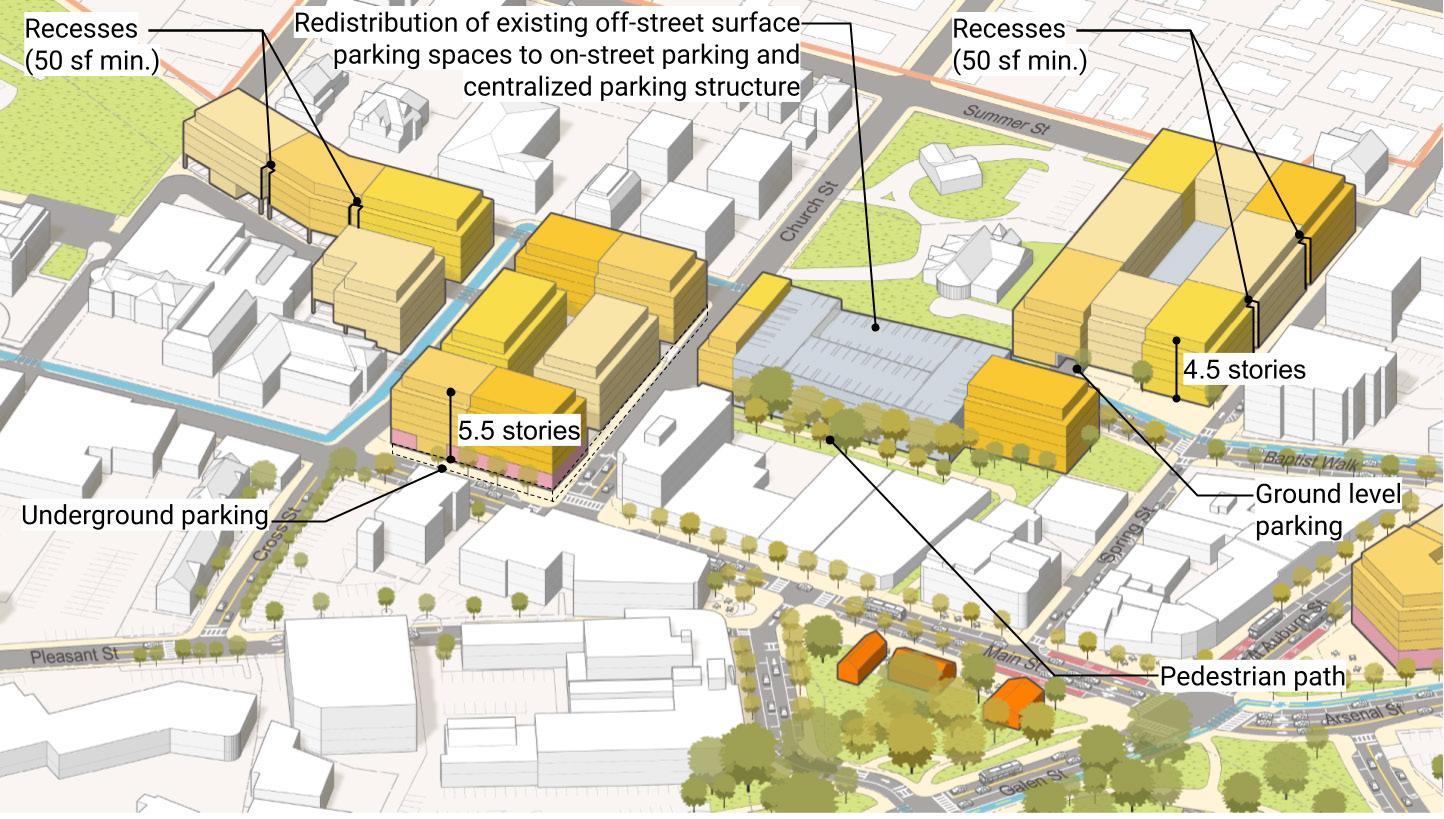
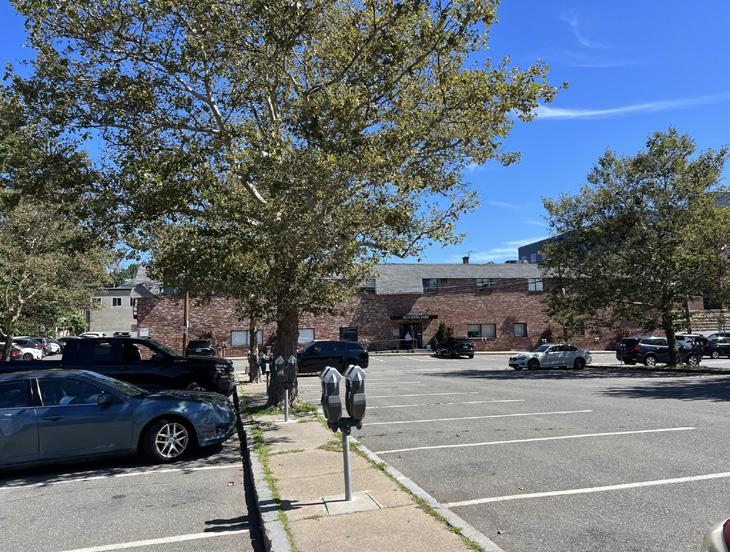
Several parcels in Watertown Square were studied to understand the impact of proposed zoning regulations on the potential build-out of the sites. The issues that were explored included maximum heights, maximum facade lengths, and the impact of different parking ratios on the viability of development. The test-fits of the City of Watertown parking lots also helped determine the feasibility of replacing the existing parking lots with a parking garage, as part of a larger public/private development project.
Top: Zoning regulation test-fit on the triangular block bounded by Taylor St, Mount Auburn St, and N. Beacon St
Bottom: Zoning regulation test-fit on municipal parking lot site
Integration of the Zoning Code with Urban Design Goals
In concert with the public realm activation achieved by the street reconfiguration plan, the zoning reinforces positive urban design by promoting wider sidewalks throughout the study area. The new code requires new development in the WSQ1, WSQ2, and WSQ3 districts to be set back an additional distance so that at least twelve (12) feet of sidewalk is provided between the back of curb and exterior building facade. This allows adequate space for a clear accessible sidewalk, a furnishing zone along the street that also includes adequate space for canopy trees and sustainable plantings, and space for outdoor seating along the edges of buildings. The code also proposes zero lot lines along the front and side setbacks in the denser districts, along with a minimum facade build out ratio, in order to promote a more vibrant and walkable Square.
Integration of the Zoning Code with Open Space Goals
Open space on individual lots needs to be contextual to location and considered within the same tiered framework as allowable building heights. The homes in Watertown’s residential areas, those marked “conserve” in the City’s Comprehensive Plan, typically have their own yards. Modest multi-family buildings can often provide high-quality shared open space,
but planners must take care to ensure those spaces are gathering spaces and not just slivers of grass in the areas where buildings are not built. Downtown buildings typically may have a balcony or roof-deck, but the value of land makes it difficult to provide individual on-site open spaces. Instead, these places benefit from high-quality public parks in a community’s downtown core area.
Given these considerations, outdoor space requirements in the Plan are recommended in the lower-height districts, with the potential for small lots (lots less than ¼ acre, that are unlikely to get more than slivers of grass) to opt out by providing a reasonable payment in lieu of on-site open space that will be used to improve nearby city parks. This will encourage private development in these districts to provide quality outdoor space, without burdening lots that may be inadequately sized or spatially constrained. Mid-sized, more urban sites will not have on-site open space requirements. Instead, the residents of these buildings will rely on nearby city parks to meet their open space needs. A minimum amount of civic space is recommended for large lots (lots greater than ¾ acre), to ensure that the largest of projects add to the total amount of publicly-accessible public space in the Square. The programming and design of these new privately-owned public spaces (POPS), whether parks, plazas, playgrounds, and/or community gardens, will be determined during site plan review during the entitlements process.
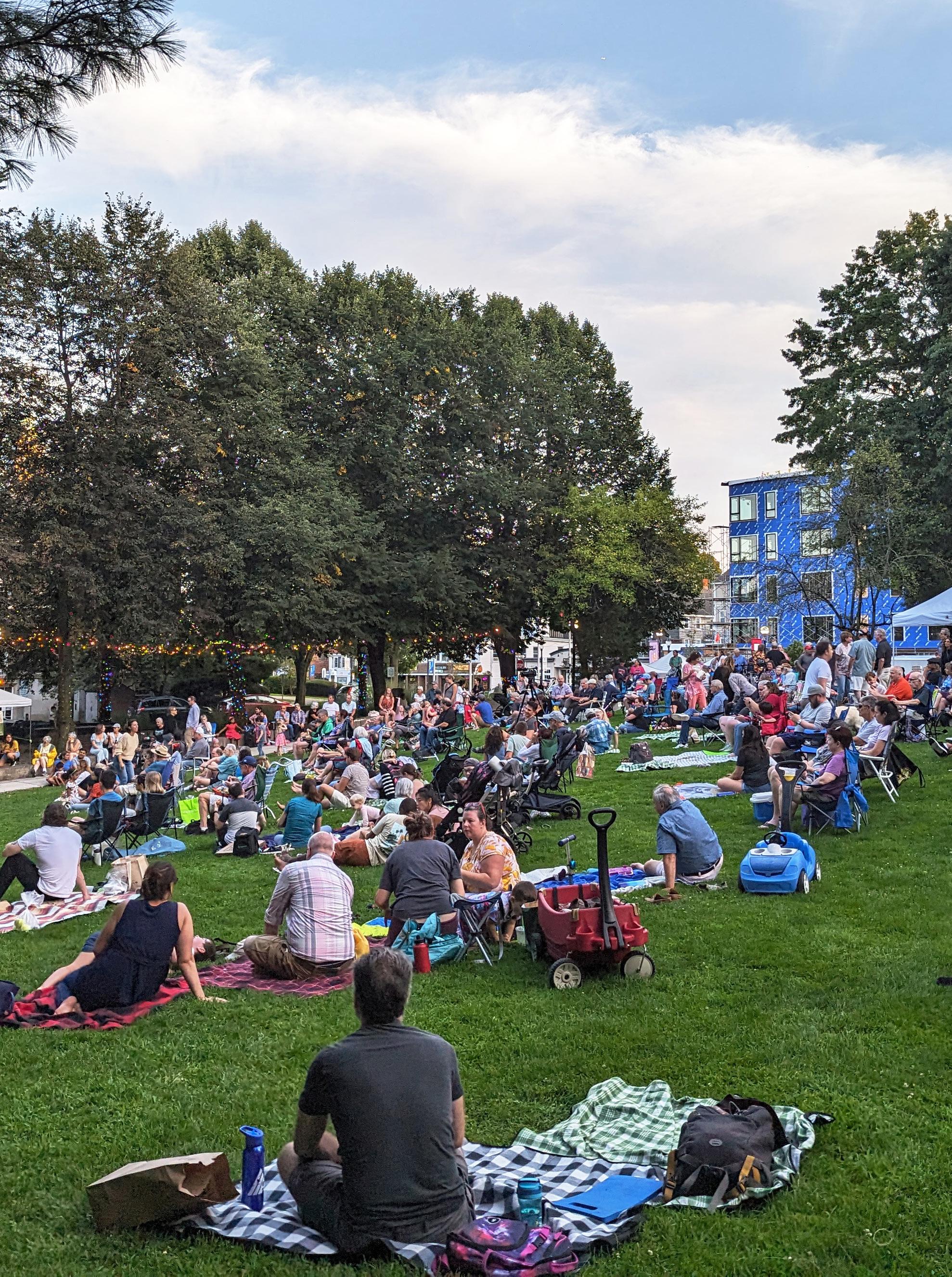
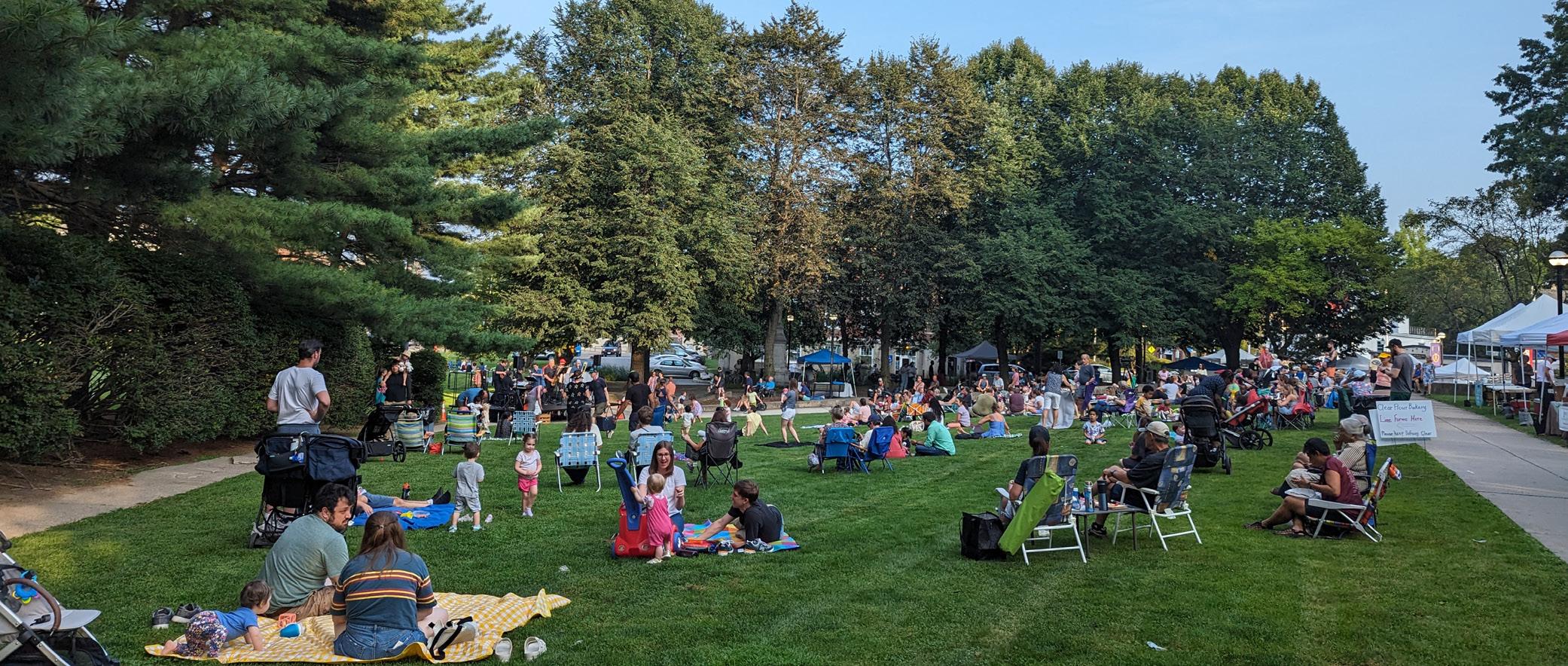
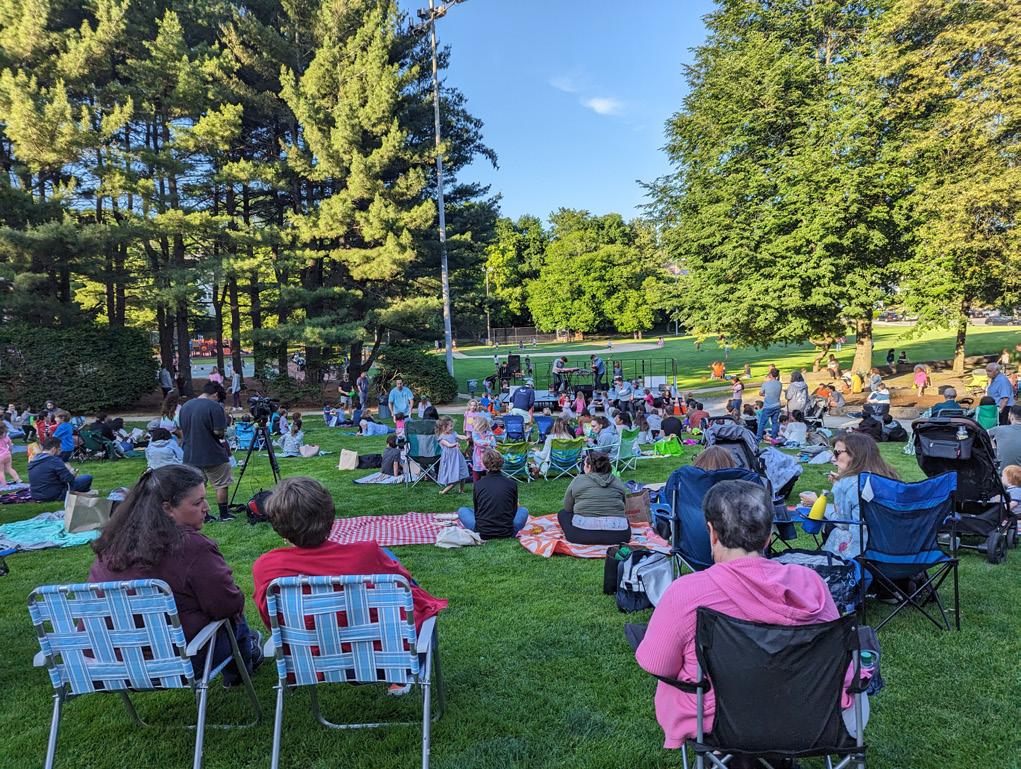
Watertown's parks and playgrounds provide space for the community to rest, play, and gather for seasonal events, as shown above.
Building Placement
Abutting
Setbacks
1 A range based on the amount of sidewalk needed to meet the requirement of 12’.
2 R-Districts include all residential-only zoning districts.
Building / Story Height
Building Height in Stories/Feet (max)
Roof
Ground Story Height (min/max)
Roof Level (+ Story) Height (max)
Flat Roof Stepback (min)
on all sides of the building
Plus (+) Story Roof Articulation Diagram New buildings can accommodate the plus (+) floor in one of two ways. It can either be an occupiable gable end/or hip roof with dormers, or a penthouse stepped back a minimum of seven (7) feet from the facade edges below. This diagram shows the dimensional standards for both options in a single cross-section.
Rationale for Building Heights
There often is a tradeoff between allowing additional height (which makes buildings more economically feasible, especially in challenging areas and with the community benefits that municipalities often require) and other considerations, such as transition to lower heights in residential neighborhoods. The tiered approach to building height in the Plan is designed to make this tradeoff in a logical way.
A key factor in establishing the maximum heights in the Plan was to identify where additional height is necessary to transform underutilized sites that don’t contribute to the future vision for the Square. A site with an existing tire shop, for example, may be more likely to transform if the land can be reused for a five-story building than it might be for a threestory building, especially if the business is profitable. Several parcels along Arsenal and North Beacon Streets, now dominated by auto use, is one area where additional height will be an incentive for existing owners and developers to move away from the existing businesses toward the mixed-use and residential uses that will be important to Watertown Square.
Sites are also more difficult to transform if they have substantial new infrastructure costs, like the City-owned parking lot sites, since redevelopment would require the construction of replacement parking in the guise of a new parking garage. Finally, the requirements for inclusionary housing and stormwater control add additional costs to new housing development that can partly be mitigated by allowing additional building height.
Potential redevelopment of the parcels in the heart of Watertown Square is particularly challenging for a variety of reasons, including:
• The need to aggregate smaller parcels and/or deal with a multi-tenant site can add complexity and cost (e.g., because of complex ownership structures, outstanding leases, and old easements)
• The need for public/private partnerships for projects that include some or all of the City-owned parking lots
• Older infrastructure and utility networks that must be updated for new development
• The need for upper-story residential development to cross-subsidize ground floor retail rather than rely on retail rents to help drive the financial returns, both because of larger structural changes in the retail real estate market and because subsidized retail will give developers more flexibility to curate the mix of tenants
Nonetheless, there are some limitations to maximum heights. Residential construction is expensive, and those expenses can be controlled by avoiding the need to use expensive steel- or concrete-frame “high rise” construction. Per the regulations of the state building code, mixed-use residential buildings under seven stories can avoid those higher-cost codes by combining a non-combustible ground floor “podium” with five stories of wood-framed floors on top. Recent analysis of development projects in greater Boston by the consultant team indicates that high-rise buildings only start to pencil out at eleven stories or more, since the added costs of more expensive framing types and other features required by the high-rise code, require more density to overcome the costs. This economic reality means that 8, 9, and 10-story buildings are not economically viable.
In the Watertown Square planning effort, participants showed little interest in new buildings taller than 10 stories. Based on this, buildings between three and six stories, with the top floor to be shaped as an occupiable roof or a penthouse floor, makes the most policy sense for Watertown. The code also includes a provision for a bonus story, or more, for projects with a substantial number of subsidized affordable units, although this additional story(ies) will probably not be added in the tallest district for the economic reasons described above.
The maximum building height suggested for each tier is designed to provide flexibility for differing uses and design choices. The zoning recommendation incorporates real estate market requirements for the floor-to-floor heights of typical upper level residential floors (10’-6” or 10’-8”) and ground floor commercial spaces (ranging from 13’ to 15’) and then adds a little bit of wiggle room, in case specific developers want to build slightly taller ceilings, especially important for condominium projects or those that choose to incorporate office uses in their buildings. In addition, slightly taller floor-to-floor heights are allowed for penthouse floors and the total allowable heights are designed to accommodate the additional height required for a pitched roof.
Overall, the limits in total stories are not radically different from what is allowed today in much of the Square. But, combined with the form-based code and new by-right / site plan review process for key parcels to meet the MBTA Communities Act, the new zoning
will prioritize moving from automobile-centered development to more walkable buildings in and around the Square.
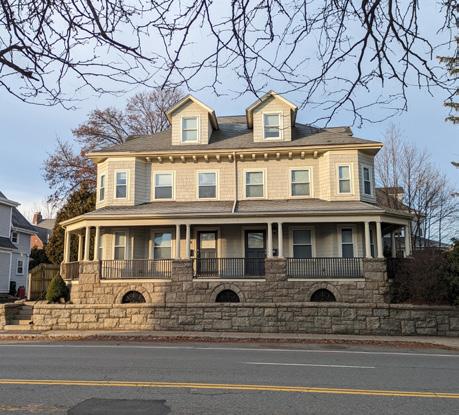
Applying new zoning standards to an already-built environment always involves judgments about how to transition to existing structures--and how to view existing structures that do not conform to the new standards. Two notable examples of this are the west side of Galen Street and taller buildings like Whitney Towers and the Williams Street Condos.
The Plan proposes use of the new NMU zone along most of the west side of Galen Street because of this segment’s existing development pattern and proximity to low-scale residential blocks; it proposes the WSQ-3 zone along another segment as the corridor transitions to Newton corner. Most of the west side of Galen Street is zoned for two-family only – even though many buildings have mixed-uses on them – and abuts low-scale residential homes. The lots along this segment are fairly shallow and many historic building features are intact. NMU zoning will allow more flexibility in uses and some potential for increased housing, likely through additions to the more historic fabric of this neighborhood edge. In contrast, farther south, there are more underdeveloped blocks as Galen Street transitions into Newton Corner. WSQ-3 is appropriate there.
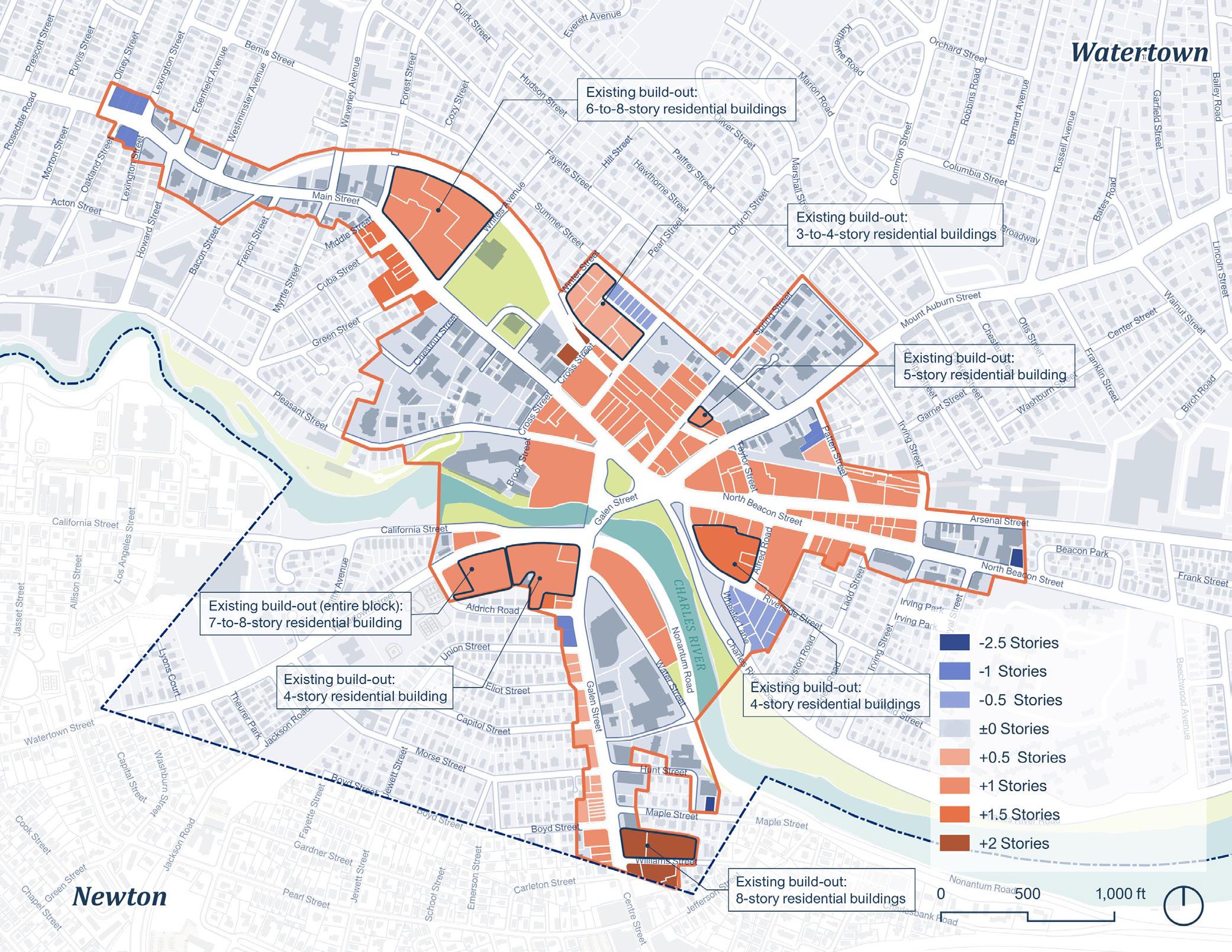
Whitney Towers and the Williams Street Condos are non-conforming under current zoning because of their height. The proposed zoning would maintain them as non-conforming, as there is no proposed district with heights that match these buildings. Within the Plan, the two 8-story residential buildings located on the west side of Galen Street would be in the highest WSQ-3 Zone as it transitions to Newton Corner. The Whites Avenue block with 7-8 story buildings along Main Street/west of Saltonstall Park would be in the second highest zone (WSQ-2) as it transitions to Linear Park and lower scale residential development directly to its north. While it may seem incongruous to adopt zoning with lower heights than these existing buildings, this is common in zoning. Under the rules for non-conforming structures, the existing buildings are allowed to remain, they can be modified through a review by the Zoning Board of Appeals, and, in the event of a disaster, could be rebuilt as they exist today.
Architectural Design Standards
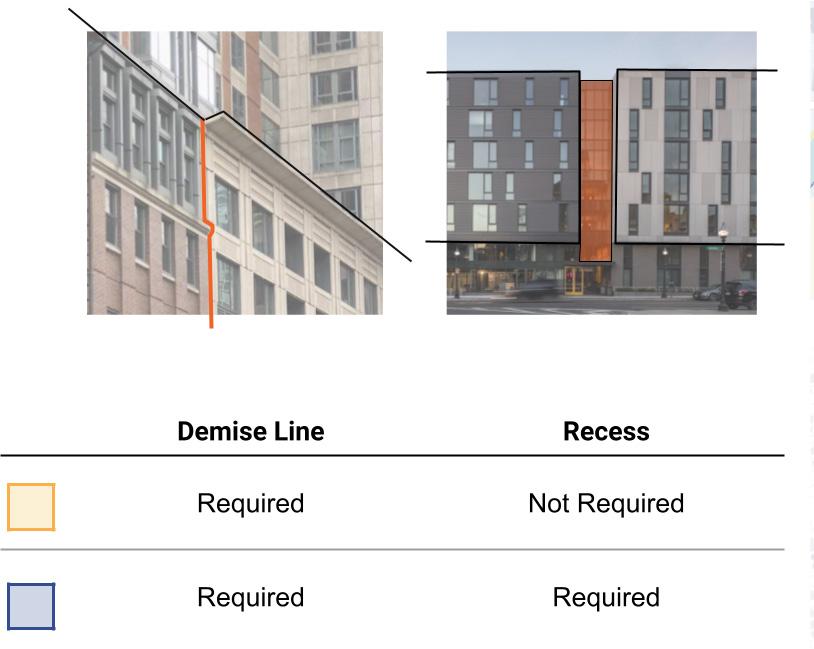
In addition to standards that regulate the overall building and individual story height, the proposed zoning code also limits the length of a continuous facade to 100’ before requiring either a demise line or facade offset or recess. This facade length limitation will help break up the appearance of larger buildings by making them look like an assemblage of two or more abutting structures. Facade designs can be differentiated by a change in cornice, roof eave or parapet; a change in wall material or color; and/or a pilaster or column on either side of the division between each facade.
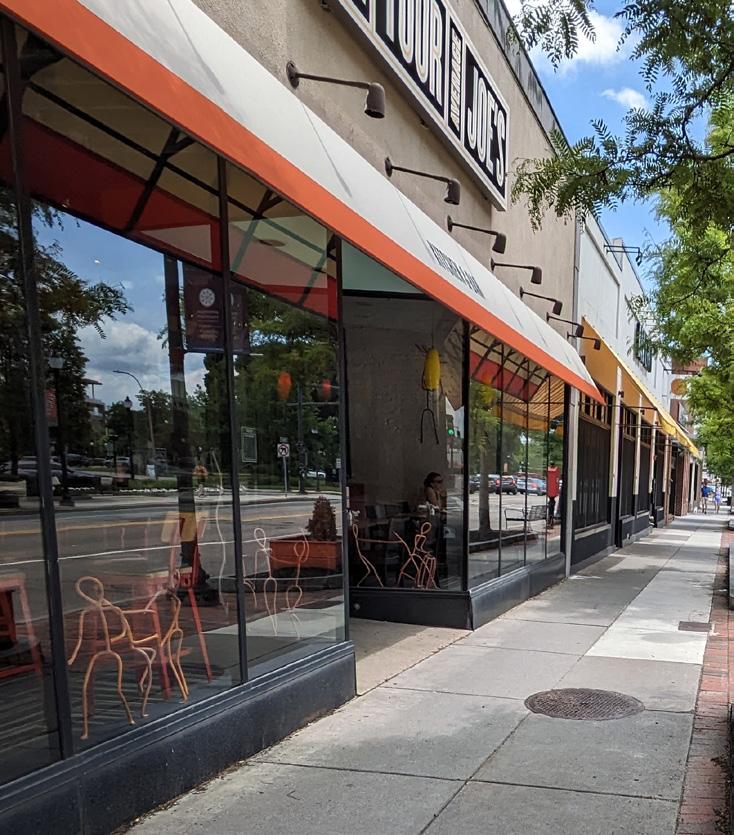
In addition to the facade length requirement, the code also includes design standards for the ground floors of buildings, including requirements for a minimum percentage of fenestration, with higher fenestration minimums proposed for parcels designated as mixed-use with a first-floor retail component. Additional standards are proposed for architectural features such as bay windows, balconies, and awnings in order to encourage architectural variety in new developments. The accompanying tables provide detailed recommendations to guide the shaping of facades and architectural features on new buildings.
Facade
The proposed zoning recommends higher fenestration standards for ground story retail spaces.
Architectural Features
Bay Width of each bay (max)
Clearance above grade within the right of way (min)
Balcony
of each balcony (min/max)
Awning
of each awning (min)
of the ground story
Facade Articulation Zones
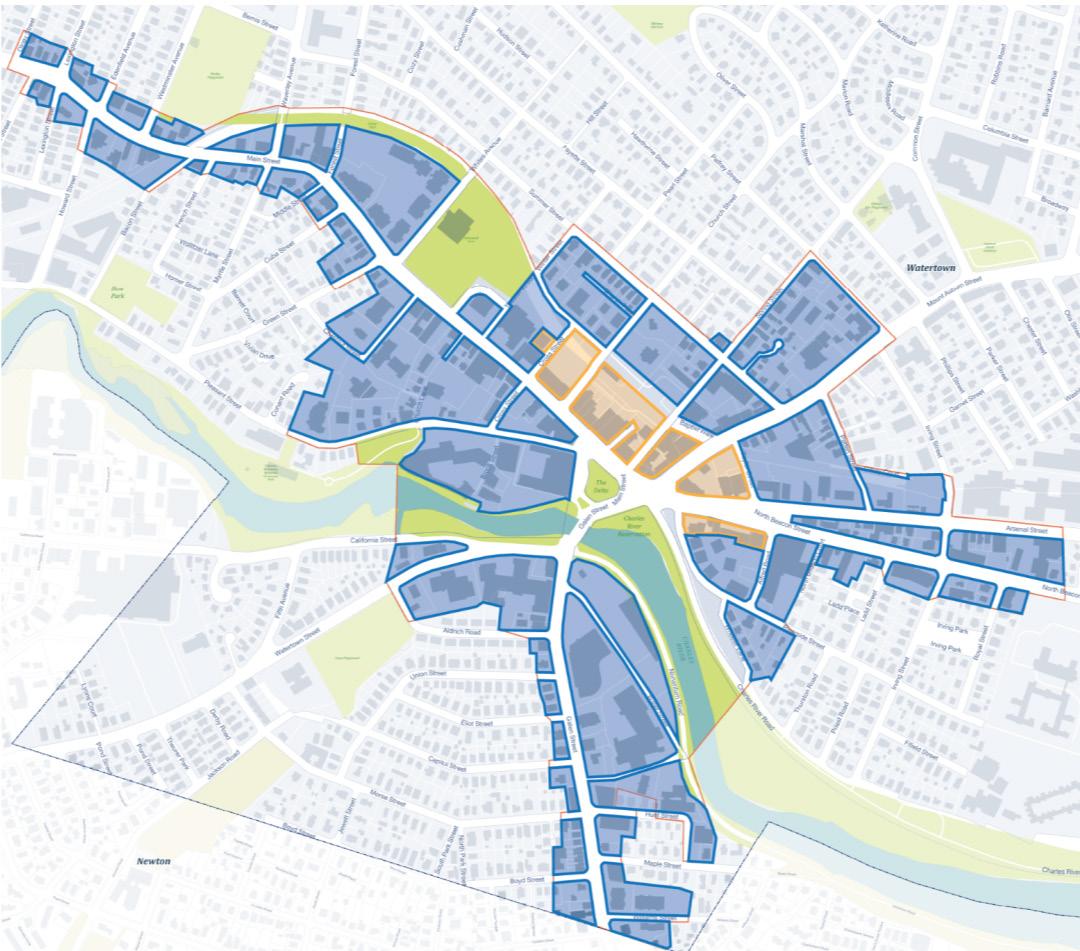
In order to break up larger buildings, the proposed zoning recommends establishing two facade articulation zones: at the heart of the Square (shown in the orange zone), development will be required to provide a facade demise line after a minimum of 100’ of facade length; the rest of the proposed districts (shown in the blue zone), require a facade demise line and a facade recess or offset.
Resilient Design Standards
Watertown has led the way on sustainable building requirements that ensure development provides for comfortable, safe, and resilient neighborhoods into the future. It was the first municipality in Massachusetts to establish solar panel requirements and pass the new specialized stretch code. The proposed zoning will follow this trajectory, by including meaningful sustainable development standards for both by-right and special permit developments, including:
• An energy assessment requirement
• Resilient roof treatment (reflective, solar, or vegetated)
• Location of HVAC and other utility equipment outside of or above potential flood areas
• Meaningful greening of sites through a flexible menu of options
• Deep energy efficiency and electrification of buildings to the extent feasible
• Updated bicycle and electric car charging requirements
Rationale for Reduced Parking Minimums
The proposed zoning both within the as-of-right zone and in the larger overlay area requires a minimum of 0.5 parking spaces per residential unit and a maximum of 1.0 spaces/unit3. Developments can exceed this maximum by special permit if they provide shared parking or are renting parking spaces to the general public. This range provides flexibility for developers, but does not require projects to overbuild parking to the detriment of other urban design, placemaking, and mobility priorities. The proposed zoning also eliminates the parking requirement for ground floor retail uses, which has been a barrier to new retail and restaurant uses. Visitors to those uses can park in public lots or, if built, a public garage.
The proposed zoning also allows for additional reductions by special permit. Allowing for less than the required amount of parking spaces may help incentivize the reuse of existing structures that contribute meaningfully to the historic character of the Square, since the space might not be available to accommodate adequate parking on site. It will also allow for construction of buildings with housing on lots that have small frontage on Main Street, since a garage door along this frontage would be detrimental to the walkable streetscape that is envisioned in the Plan. While the criteria for such a reduction will need to be specified in the zoning, it would make sense to require an approved Transportation Demand Management Plan and to track the criteria from Massachusetts G.L. Chapter 40A/Section 9. This section of the state’s Zoning Act allows a municipality to reduce parking ratios by majority vote through a special permit process as long as the reduction qualifies as a “public good” in “the area in which the development is located” and not result in “a substantial adverse effect from the reduction in parking.” Another approach would be to include specific factors that affect parking demand (e.g., lot placement and frontage, unit mix, distance from public transit,etc.)
Reduced parking requirements are likely to make Watertown Square a more attractive place to do development projects since parking is expensive to build in a downtown context. These requirements do not preclude the developer from building more parking, but they let the market decide the need and balance it against the cost of building garage space. The requirements are likely to ensure that new development does not invest in unnecessary parking instead of investing in well-designed buildings, great streetscapes, inclusionary housing, tree planting and the other priorities of the Plan.
Recent studies of new multi-family housing in Watertown have found that, while these projects are typically full (with vacancy rates under 5%), their parking garages are not full. Therefore the 1+ space requirement in existing districts is likely too high. In addition, a building with no attached parking will typically draw tenants who do not have cars. There is a significant subset of the population seeking housing that have no interest in owning a car. Targeting units to this population increases pedestrian activity and bus usage in the Square while limiting increases to traffic. In general, car-free residential housing allows for new housing, a larger tax base, and enhanced vibrancy, without new traffic - the best possible outcome for Watertown.
In conjunction with reducing parking minimums, the Plan proposes a central garage and more onstreet parking. The garage will provide parking for the various retail and office uses and also may be able to support adjacent residential units that would be added. The garage could have an area dedicated to short-term parking for retail and incorporate a number of safety measures. In addition to the potential reconfiguration of the municipal lot and garage parking, there are a substantial number of onstreet parking spaces proposed; these tend to be the most desirable for retail customers making short visits and therefore support local business success.
3 With reduced parking minimums for vehicles, bicycle parking requirements must be independent (bicycle parking spaces are now tied to vehicle parking spaces). The zoning will include new bicycle parking requirements that vary depending on use and whether parking is for short-term or long-term. Commercial development has more demand for short-term spaces with a range suggested between 1 space per 1,000 to 1 space per 20,000 Square feet based on the use, as well as long-term parking of between 1/ 2,500 to 1/ 5,000 Square feet. Residential demand suggests accommodating one space dedicated to each unit as well as short-term parking of one space for every 10 units.
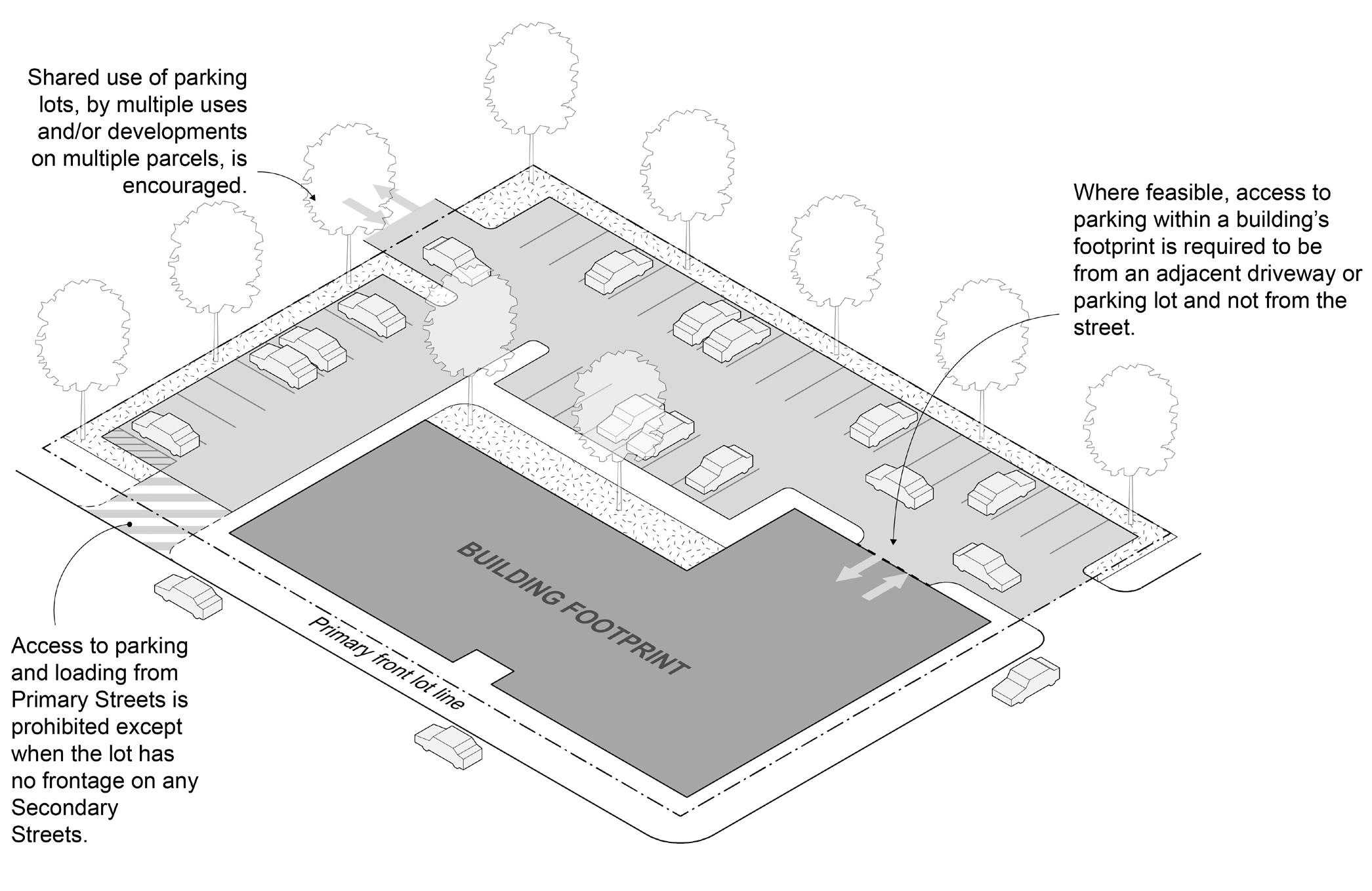
Parking Access Standards
Affordable Developments
The City’s inclusionary zoning requirements have been effective in adding affordable units in the 60 to 80 percent Area Median Income (AMI) range. But, the requirement for 15% of units as affordable - a requirement we will extend through this plan area - pushes against the cap of how much affordable housing can be cross-subsidized by a private development seeking to build a financeable and profitable new building.
For the City to create deeper affordability, developments must be funded with federal, state and local affordable housing resources. These are typically created by developers that specialize in affordable housing, and are familiar with the steps to securing affordable units. Most of these developers are seeking to do projects that are a majority affordable if not fully affordable. And, while they can be a part of the growth of new housing in the Square, these types of projects are challenging to finance and implement, and therefore rare. The City will continue to seek partners and opportunities to develop these higher-affordability projects as a part of the mix of development in Watertown Square - but they need subsidy. One way to help that subsidy is to provide a lower land cost per unit, but allowing more floor area than a market-rate project would be allowed to do. For that reason, the Plan proposes that affordable developments (50% or more affordable units) be allowed an additional floor if the affordable units are at an AMI level at or below 80% and a second additional floor if they are at or below 65% AMI, at each of the four tiers and have a parking minimum of 0.25/unit.
The City should also consider whether there are zoning, permitting or other incentives to increase the percentage of “family housing” (including 2 bedrooms, 3 bedrooms or more) in new developments.
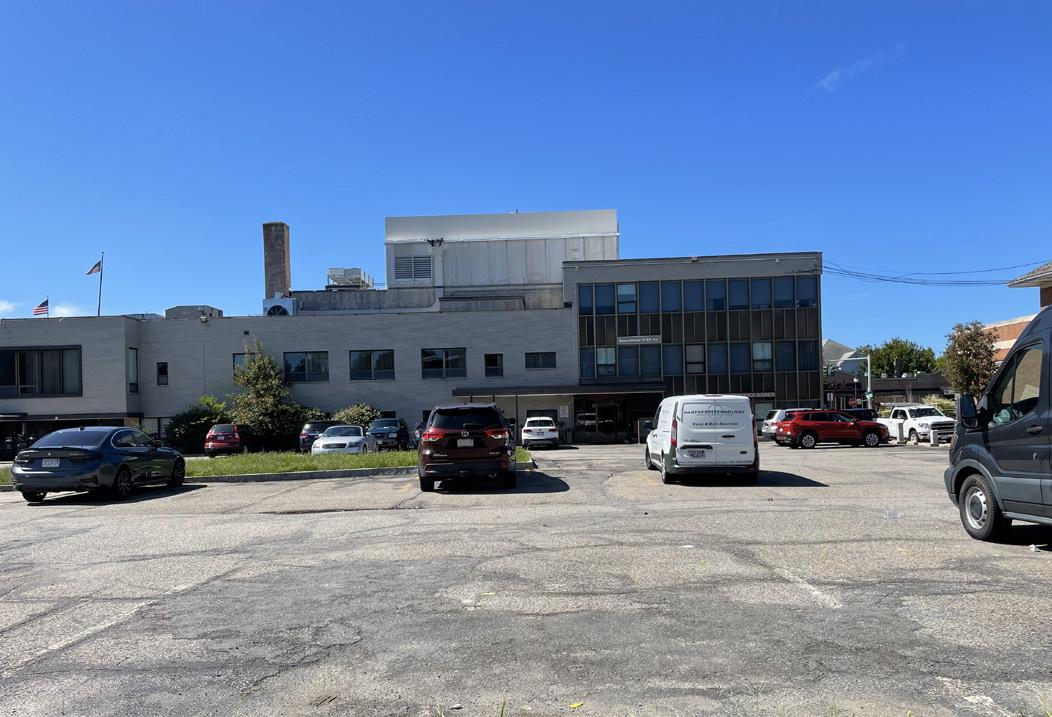
Left: Any development of the municipal parking lots would be by-right with site plan review.
Right: Any new development on the Watertown Savings Bank parcel would require a special permit.
Compliance with MBTA Housing Law Requirements
Per the Executive Office of Housing and Livable Communities (EOHLC) Watertown is required to approve zoning that results in a capacity of at least 1,701 multi-family housing units. EOHLC, which must approve the proposed district, encourages locations which meet criteria like transit access, proximity to an existing downtown, and the availability of underutilized land that can be redeveloped into new multifamily housing. Watertown Square fully meets these criteria. The 2023 Comprehensive Plan and the work done in preparing this Plan point to the importance of additional housing in transforming Watertown Square. This planning process has focused on a form-based approach to zoning that will address design issues up-front, allowing for a simpler process for individual project review. It is, therefore, logical to propose part of the Watertown Square study area for the required MBTA zoning district, and use the new form-based elements in zoning to ensure any by-right project meets the expectations of the planning process.
In proposing where Watertown should draw the boundaries for this required district, we focused on where using “as-of-right” zoning would best serve the Plan’s goals—and where using a “special permit” approach would best serve those goals. The result, based on block-by-block analysis, is a recommendation of as-of-right zoning that exceeds the minimum required unit capacity, but is restricted to a small area in and near the center of the Square. The rest of the study area should follow the same zoning framework, but with project approval requiring a special permit process. In these areas, the special permit process will provide a better platform to discuss and refine design decisions for these more sensitive sites.
Several criteria were used to determine where the Plan’s goals were best served by using as-of-right or special permit zoning for particular areas:
1. By-right/site plan review permitting is desirable in areas where the City wants to encourage transformation since development is more likely in areas with zoning that offers more certainty.
2. By right/site plan review is desirable for publiclyowned parcels (e.g., the municipal parking lots) as significant community and City Council involvement will be built into redevelopment of these sites.
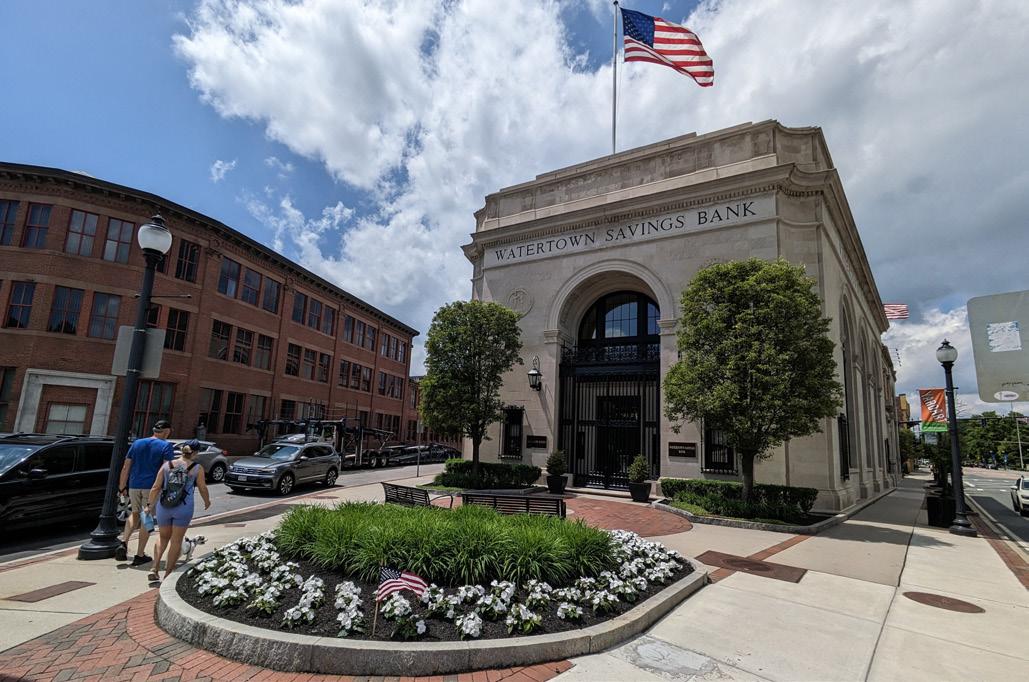
3. On the other hand, buildings that contribute to the existing character of the Square and/or contain important legacy businesses (e.g., the Watertown Savings Bank and Otis buildings) should not be zoned to allow for them to change by-right. If a new project, or change in use, was to be proposed on these sites, they should follow a special permit process. Using a special permit approach also provides the mechanism to maintain the existing ground floor retail requirement in these areas.
4. Finally, parcels that abut lower-density residential zoning districts should continue using the special permit process, since it allows for discretion and greater sensitivity to these important transitions.
Recommended Zoning and Design Next Steps
The following steps are needed to adopt zoning that implements the Plan’s recommendations:
1. City staff proposes and submits zoning, architectural standards, and map amendments reflecting the plan recommendation. September 2024
2. Formal review and approval of proposed zoning/ design and map amendments by Planning Board and City Council, including public hearing(s). Fall 2024
3. Economic Feasibility Assessment (required by state to maintain inclusionary zoning requirements in MBTA zoning district). The Assessment will be completed by Metropolitan Area Planning Council (MAPC), supported through an in-kind grant to the City by Massachusetts Housing Partnership. Fall 2024
4. Submission of MBTA zoning package to Executive Office of Housing and Livable Communities for review and approval. Winter 2024
Destination Square
The 2023 Comprehensive Plan includes the vision of Watertown Square as a destination that builds on its existing anchors and adds complementary new uses that could include restaurants, music and entertainment venues, and other cultural, institutional, educational organizations. The 2023 Plan also envisioned a Watertown Square where small businesses could thrive. The Watertown Square Area Plan fulfills this commitment by identifying the significant public realm and zoning changes that will be necessary to make the Square a lively destination and a great place to live.
Several specific aspects of the Area Plan will help encourage the desired mix of uses. The proposed zoning design standards, for example, pay careful attention to ground floor heights and plan depths to encourage attractive restaurant and retail spaces in new developments. In addition, the elimination of parking requirements for active ground floor uses addresses a major impediment to new businesses. The proposed streetscape improvements will add new on-street parking and loading spaces that will better serve both existing and new small businesses. As discussed elsewhere, the retail pavilions proposed for the Delta could be used as “incubators” for food or retail start-ups before they “graduate” to larger spaces in the Square. Introducing more housing will increase foot traffic and the enhanced green spaces and connections to the Charles River will provide more reasons for people to visit, linger, and choose to live in Watertown Square.
These public realm and zoning changes align well with other recent initiatives. The Watertown Square Cultural District designation is pending with the state. This is a joint marketing effort to enhance the Square as a cultural destination and includes 24 cultural partners, including the Watertown Free Public Library, Armenian Museum of America, Perkins School, Mount Auburn Cemetery, and Gore Place are all governing partners of the district, among others. The Public Arts & Culture Committee and the Watertown Business Coalition are developing recommendations to update live music policy for restaurants to enhance the appeal of operating a local venue. The City is adding an economic development planner who can develop the toolkit of policies, programs, and funding opportunities to support small business owners proposed in the Comprehensive Plan. The recommendations to consider assistance for façade or interior store improvements and small business planning, as well as a review of licensing/ regulatory requirements, will be in that planner’s portfolio.
The City should also consider whether there are zoning, permitting or other incentives to encourage building owners, particularly in new developments, to devote storefront space to small businesses. Similar consideration should be given to incentives that would encourage owners/developers to preserve all or part of the historic facades that are important to the Square.
The Square has many cultural assets and activities that make it lively, including the Armenian Museum of America, the Farmers’ Market, Summer Concert Series, and Community Sculpture Walk.
Priority Redevelopment Opportunities
The Plan recommends that four potential catalyzing redevelopment projects be studied further:
1. A public/private partnership for development of the City-owned parking lots
2. The expansion of the library on the former police station site or adjacent parking area
3. The redevelopment of the Watertown/Belmont Church on Mt. Auburn Street
4. The development of the MBTA Watertown Yard site
Initial thoughts about these projects are summarized below, partly to help frame a scope of work for future planning studies.
The City-owned Parking Lots
Redevelopment of the parking areas behind Main Street businesses, requires a public/private partnership both to deliver the right mix of uses but also because the construction of a structured parking garage is the only way to convert the existing parking lots into developable parcels. A public/private partnership is also the best framework for exploring strategies for including affordable retail space geared to local small businesses in the new buildings and nearby locations such as the kiosks on the Delta.
The City will need to outline a range of development goals for the sites, require the potential developer to participate in site preparation, and establish minimum goals for open space and a mix of small businesses. The City may undertake an economic analysis of proposed public benefits to ensure that the cumulative effect of preferred public benefits still results in a financeable project.
The City may also explore funding sources to engineer and implement utility and infrastructure upgrades, since they are the enabling projects that catalyze significant new housing production.
The proposed Community Path goes through these parking lots. In the short-term, the existing concept plans should be used for an interim “quick build” path that connects the completed east and west portions of the path. The long term locations and design for the path should be included, along with the new grid of streets, in planning for redevelopment of these lots.
The municipal parking lots offer an opportunity for substantial redevelopment in the Square.
The Plan tested 4+ and 5+ story residential buildings on the site of the municipal parking lots, including a 4-story garage.
The Library Expansion
As the library continues its strategic planning process, the City planning team should work with the library trustees on a few potential alternative library expansion scenarios. These are two options:
1. Expand the library onto the site of the former police station.
2. Expand the library onto the site of the parking lot behind the library, requiring replacement of library parking, either below the new building or in a garage on an adjacent site.
As the library reviews strategic priorities, they should consider moving the Hatch program into the expanded main library, providing space for additional quiet study areas, and establishing effective locations for new priority programs. Either scenario could also consider including other municipal uses into a new building or addition.
Additional library space in one or both of these sites could be incorporated in a mixed-use building wing (or building wings) with affordable and/or market rate housing on the upper floors. Implementation of a mixed residential/library use project would benefit from a public/private partnership with a market or not-for-profit developer. A financial partnership with the City, the convenient walkable location, and co-location with the library would be particularly attractive to an affordable housing developer.
Implementation Steps for Considering the Use of City-Owned Properties
The municipally owned properties (including the library lot, former police station lot, and various parking and former rail lots) are used and managed in significantly different ways but because these priority opportunities are related and are municipally owned, the implementation should consider the opportunities and options for a city-led property/facility reuse process.
The Watertown/Belmont Church on Mt. Auburn Street
The Watertown/Belmont Church property on Mt. Auburn Street is both a historic asset and an important redevelopment opportunity. In recent years, the Church has unsuccessfully attempted to sell a portion of the property while keeping the Church itself for religious and community use. The Church’s congregation recently voted to sell the entire property, with affordable housing and/or mission-driven uses preferred. The City should work with the Church to explore redevelopment scenarios.
With the entire site available for redevelopment, it may be realistic for an affordable housing developer to reach the scale necessary for federal and state funding. Such a plan would reuse the historic Church structures with one or more additions that are compatible with the Historic District. It is also possible that the other structures on the property could be reused or expanded. The site may also be able to accommodate municipal or community uses in spaces that do not work as affordable housing. Redevelopment should retain the prominent landscape space on Mt Auburn Street.
To facilitate adaptive reuse of the Church, the City should apply the Religious/School Building Overlay District (R/SOD) to the property. While zoning has not been the central impediment to redevelopment, the R/SOD allows for more flexible use of the site. Under the R/SOD, any of the uses permitted in the Residential R.75, Residential R1.2 and Neighborhood Business Districts would be allowed, and a number of other uses would be allowed by Special Permit. It would also provide more flexible dimensional requirements. Use of R/SOD zoning requires the preservation of the historic structures on the site.
The next steps to consider this opportunity include:
1. Watertown Affordable Housing Trust (using an on-call architectural firm) assesses potential for using all or part of Watertown-Belmont Methodist Church ("Church") property for affordable housing. September 2024
2. City staff assesses potential for using all or part of Church property for community programs. Fall 2024
3. Based on affordable housing/community program assessments, and conversations with the church leadership, City staff reports to City Council on feasibility of acquiring Church property or supporting acquisition by an affordable housing partner, and, depending on assessments, options for the City to consider. Winter 2024/25
The Watertown/Belmont Church
The MBTA Bus Yard Site
The MBTA Bus Yard at Watertown Yard is an important redevelopment opportunity because of the prominent location of the site at a sweeping bend in the Charles River and directly across from Watertown Square. Importantly, the site is also conveniently located between all of the proposed future bus stops in Watertown Square and directly across the street from the reconfigured bus stops for the 52, 57, 59, 71, and 504 routes. As a result, it’s the best transit-oriented development site within the study area of the Plan. Given these parameters, a mixed-use residential development is the best development program for the site. In addition to capitalizing on the site’s location, a residential development, consistent with proposed zoning, will balance and complement the new lab building and proposed future commercial development along Water Street.
Since the site is controlled by the MBTA, the City plans to work with the Authority to frame development expectations in any future request for development proposals (RFP). These are likely to include a desire for active ground floor uses at the corner of Galen Street and Nonantum Road, guidelines for preferred massing configurations that include ample green space, and diagrams that clarify how a MBTA bus layover facility will continue to be accommodated on the site.
The next implementation steps include:
1. It is expected that the MBTA real estate department will formulate a Request for Proposal (RFP) for redevelopment of the MBTA Yard site consistent with amended zoning. City staff will work with the MBTA to coordinate efforts where appropriate. Since the Yard is state-owned and any redevelopment requires balancing MBTA service needs with proposed reuse, expected implementation of this step depends upon a timeline established by the MBTA.
2. After RFP issuance, the MBTA would need to do an evaluation of proposals, selection of a developer/development team, contract negotiation, coordination with the City on a specific redevelopment proposal, submission of a redevelopment proposal, and public process (including community meetings, public hearing and formal review by the applicable city board(s).
For future development, the City and MBTA can work together to frame development expectations for potential uses on the MBTA Yard site that will best serve the Square.
Infrastructure Improvements
Implementing the Watertown Square Area Plan, including the priority redevelopment opportunities, will require substantial infrastructure improvements. The proposed phasing plan can provide a preliminary list of those projects and their nexus to the outcomes desired by the City. The improvements will require a combination of local funds, state infrastructure grants, and private investment. In anticipation of the need for local funding as a part of this project, the City Council has already set aside $1.8 million in a Watertown Square stabilization fund for this purpose, and the City Manager has requested an additional $1.8 million for this fund in the coming fiscal year.
As previously noted, redevelopment of the municipal and private parking lots behind Main Street will require the relocation of utilities, creation of a street grid, and continuation of the Community Path, all while working around the City of Cambridge’s water supply line that runs through an easement across these lots. These improvements will integrate this area into the overall fabric of Watertown Square and will help unlock the catalytic residential development proposed in this Plan.
While the City may be able to obtain state infrastructure grants to help with these utility/street grid improvements, it must rely on private investment or local funding for a new central garage. State grants to fund parking garages have become highly disfavored in the past ten or more years, partly because potential projected parking revenue doesn’t come close to covering the costs of debt financing of municipal bonds or the ongoing operation and maintenance of the garage. That is why the Plan recommends that any garage or garages built to replace the City-owned surface parking lots be funded in conjunction with significant private development, with the potential for City involvement, if necessary. Such a level of private investment requires the zoning and the redevelopment process for the lots to allow the building heights proposed in this Plan.
There are a number of subsurface utilities that must be coordinated for any development projects on the municipal and private parking lots behind Main Street, including the Stony Brook Supply Conduit and sewer, stormwater, and water supply lines.
Left: Map of Easements in the Study Area
Right: Map of Sewer and Stormwater Utilities in the Study Area
The Public Engagement Process
The City and consultant team developed the plan during a robust multi-tiered engagement process that included informal conversations in people’s homes, multiple surveys, a multi-day public charrette, and well-attended public meetings. These touch points were carefully coordinated with the technical work to ensure that stakeholders and members of the general public were providing advice and feedback at steps in the process when the consultant team had the flexibility to be responsive.
At the same time, the City and consultant team made sure that the multiple audiences for the evolving plan had been given the appropriate background technical information so their feedback would be grounded in a general understanding of zoning regulations, transportation issues, real estate market dynamics, and the MBTA’s ongoing bus service redesign project. The engagement steps are described below. Additional information about the engagement process, including the alternative public realm and zoning scenarios that were shared and discussed, can be found in the Appendix 1: Public Engagement Materials and Results.
Kitchen Table Conversations
The engagement process was launched with a series of informal conversations conducted by the Watertown Community Conversations, a resident-led group that had participated productively in the engagement process for the Comprehensive Plan. Their participation helped bridge the gap between the plans and make explicit the connection between the two efforts. Discussions with the Kitchen Table Conversations volunteers provided the consultant team with a more robust understanding of the potential project issues than they would have gotten from the City staff alone.
Several major themes emerged from the conversations, including the need to invite and foster community, improve walkability and connectivity, foreground accessibility issues and green space, and to have special considerations for unique and historic buildings around the Square. There was less consensus on issues related to parking and transit, with participants expressing divergent opinions on the importance of parking and car-focused development versus making improvements to bus service in the Square.
Engagement Touchpoints:
• Number of individual meetings: 20
• Number of participants: 168
See the results of community feedback in the Appendix 1: Public Engagement Materials and Results.
Polis
The Polis Survey is an online engagement tool that asks respondents to both react to statements and, optionally, to supply their own statements for future respondents to react to. This feature gives participants more agency than conventional surveys and provides the algorithm that undergirds the survey enough responses to be able to sort respondents into opinion groups, based on patterns of response.
Typically, two or three sub-groups emerge that can generally be defined as “open-minded and open to change,” “resistant to change”, and sometimes but not always “somewhere in the middle.” While the Polis data is dependent upon who chose to participate, this sorting out has the advantage of clarifying the relative percentage of those respondents in each category, and very often, the results can reveal that the relative percentage of people in each camp is different from perceptions of public opinion gleaned at conventional public meetings.
Sharing the Polis survey early in the planning process was helpful in gauging public opinions on a wide variety of topics related to the Plan. The survey was immensely well-used, with over 1,000 individual interactions and over 100 votes submitted per user on average. The results of the survey culminated in the formation of two opinion groups: Group A represented 27% of the participants and was more likely to agree with statements that prioritized the convenience of easy parking and minimizing traffic, while Group B represented 73% of participants, who were more likely to agree with de-prioritizing cars and providing dense housing in the Square.
Despite differences in opinion, there were a number of areas in which participants shared overlap on key issues, including the desire to see a diversity of retail stores, shops and cafes in the Square, as well as the desire to provide easier access to the Charles River. Additional shared themes included the aspiration to create more affordable housing development, provide faster and more reliable transit through the Square, and to create spaces for outdoor dining, socializing, and lingering.
Engagement Touchpoints:
• Number of respondents: 1,076 unique voters (based on logins or individual devices)
• Number of votes cast: 112,174
• Statements submitted: 1,073
• Average votes per individual login/device: 104.25
See the results of community feedback in the Appendix 1: Public Engagement Materials and Results.
Polis Opinion Groups Diagram
The Polis survey resulted in the formation of two opinion groups: Group A represented the minority opinion and was more likely to agree with statements that prioritized the convenience of parking and minimizing traffic; Group B represented the majority opinion, and was more likely to agree with deprioritizing cars and providing dense housing in the Square.
Public Meetings
In addition to the three-day charrette, three public meetings were held at various points during the planning process to present the proposed streetscape and zoning updates and hear feedback directly from the community.
First Public Meeting/October 17
The first public meeting aligned with the project kick-off, but after some of the initial feedback from the Kitchen Conversations could be reported back. The kickoff meeting also included a talk by Jeff Speck that was meant to highlight the opportunities and potential strategies for making Watertown Square a more walkable mixed-use destination.
Engagement Touchpoints:
• Number of in-person and online signups: 210
• Number of survey forms: 37 paper survey submissions
See the results of community feedback in the Appendix 1: Public Engagement Materials and Results.
Photos from the project launch, which included a talk by Jeff Speck.
Three-day Public Charrette
A three-day public design and planning workshop (“charrette”) was at the center of the planning process. The presentations, meetings, and design sessions were carefully timed to coincide with the consultant team’s own technical analysis and initial studies. This ensured that the designers and planners were well-prepared for the sessions but didn’t yet reach a point where they had created preconceived plans for the best approach for the redesign of the streets or zoning.
The sessions held during the first day of the three-day charrette were designed as teach-ins, with technical experts outlining the issues, followed by robust discussions with attendees. The discussions were fueled by challenging questions and far-ranging suggestions that helped frame next steps. In addition to the consultant team - which included experts in transportation, zoning, urban design, streetscape design, and transportation planning - City of Watertown staff and the MBTA made presentations, fielded questions, and engaged in discussions about alternative solutions.
Day two of the charrette provided opportunities for the planning and design team to sketch through alternative concepts and share and discuss them with small groups of the general public. Their work culminated in a presentation to more than 180 people that evening. After the talk, the consultant team and City staff were able to discuss the alternative concepts in more detail in front of the boards of the proposals that were distributed around the room.
Based on feedback during the previous evening, the consultant team zeroed in on two alternative scenarios in more detail: Four Corners, and Mini-Main Street, (see more details about these and other scenarios, including the “Deltabout” scheme, in the Appendix). The pros and cons of these schemes and a few initial zoning concepts were presented at the third and final evening of the charrette. The feedback from this and the other meetings held during the three-day workshop provided the necessary fodder for the consultant team to dig into the schemes from a technical standpoint.
Engagement Touchpoints:
• Total signups: 604
• Different people: 274
See the presentations of planning and design alternatives, working group results, and other information about the charrette in the Appendix 1: Public Engagement Materials and Results.
Photos from the charrette depict the consultant team as they present during different design sessions, as well as engaging with members of the community to brainstorm responses to key design prompts.
Second Public Meeting/February 29
At the second public meeting, follow-up work done by the consulting team after the charrette was presented. This included refinements to the Four Corners and Mini-Main Street public realm proposals and a convincing case for dropping the third “Deltabout” streetscape option. The consultant team also made initial zoning recommendations based on a tiered, form-based zoning approach that stepped down building heights from five stories plus an occupiable roof to four stories with an occupiable roof to three stories with an occupiable roof.
In addition to a presentation of the potential design outcomes of the draft code on a few future development sites, the consultant team also calculated the unit capacity for two scenarios using the Executive Office of Housing and Livable Communities’ (EOHLC’s) compliance model. One proposed making the entire plan area into a by-right zoning area under the MBTA Communities Act rules. The other proposed a ‘collar’ that would limit by-right to a smaller portion of the project area. The majority of participants in the meeting supported the by-right zoning in the entire district, but feedback submitted during and after the meeting expressed concerns about how by-right zoning would impact buildings in the historic core of the Square and adjacent to current lower-height residential properties.
Engagement Touchpoints:
• Number of attendees signed-in: 181
• Number of individuals watching live online: 60
• Number of feedback form submissions: 215
• Number of comments written on boards: 236
See the results of community feedback in the Appendix 1: Public Engagement Materials and Results.
The Second Public Meeting offered live polling during the presentation, where those attending in-person and online could submit responses to help guide the consultant team toward developing a preferred option for both the streetscape and proposed zoning schemes.
Third Public Meeting/April 4
As a result of public feedback and technical analysis, the City and consultant team determined that the Four Corners scheme best balanced the goals established at the outset of the project and reinforced and clarified during the charrette. These included the increase of pedestrian connectivity in and through the Square, more intuitive navigation of the Square by vehicles and bicycles, and enhanced placemaking potential to drive economic development and sidewalk activation. This recommendation, along with an updated zoning proposal, was presented at the third and final public meeting.
The adjustments to the zoning recommendation were mostly focused on refining the area where the new zoning code would be as-of-right. This was done by introducing an updated “collar” boundary where the new code would be as-of-right, and ensuring that key historic properties in the Square as well as those outside the Square that are adjacent to smaller residential properties would still require special permits.
The April public meeting included a large in-person crowd that asked many questions about the current process. Staff and the consulting team took the time to answer these questions, and the meeting took over three hours. Following the meeting, a feedback form was provided to participants in the room and on-line. The form had 499 responses, providing extensive feedback about the process and outcomes through the April meeting.
Engagement Touchpoints:
• Number of attendees signed-in: 219
• Number of individuals watching live online: 115
• Number of feedback form submissions: 499
See the results of community feedback in the Appendix 1: Public Engagement Materials and Results.
The Third Public Meeting was one of the most wellattended project events. The meeting included an extensive Q+A session where participants asked questions to a panel of both City and consultant team members.
Since April
After the April public meeting, the team reviewed the feedback of 499 form submissions. These responses provided a variety of thoughts on the Plan, ranging from opinions on the need for higher or lower buildings, suggestions on changes to zoning districts; policy suggestions for implementing the Plan; ideas about open space, sustainability, trees and river impacts; as well as feedback on traffic, bus, bike and pedestrian flow through the proposed new road network. City staff and the consulting team sorted and reviewed the feedback and incorporated the suggestions when there was substantial support for an idea.
More generally, responses identified areas of consensus and areas where there is still a divided opinion on specific issues in the plan. Nonetheless, it reconfirmed that there is support amongst the participants in this process for new housing, the form-based elements in zoning, the intersection redesign, the open space enhancements, and streetscape strategies.
Finally, while there is majority support of respondents to the general strategy of the zoning, there is a substantial minority of the respondents with concerns about building heights particularly at the edges of the project area. For this reason, the zoning recommendation in the Plan has been refined to include a new NMU 2+ story district at key points where taller buildings would have the most impacts on existing single-family areas. The Plan, nonetheless, maintains the tallest buildings with the 5+ story district since this height was supported by the majority of those commenting and increases the likelihood that the financing of projects in the heart of the Square will be financially feasible while helping to catalyze the necessary parallel public improvements.
Appendix 1: Public Engagement Materials and Results
• Watertown Community Conversations’ Kitchen Table Conversations Summary Report (link)
3-Day Design Charrette & Polis Results
• Watertown Square Charrette Presentation Part 1, including Polis Results Snapshot (link)
• Watertown Square Charrette Presentation Part 2 (link)
• Design Charrette Final Presentation Leading to Two Designs (link)
• Watertown Square Area Plan Design Charrette Workshop Groups Summary (link)
• Public Participation & Design Studio Charrette Drawings (link)
February 29, 2024 Public Meeting & Feedback Form
• 2/29/24 Public Meeting Feedback Review (link)
• Public Meeting Streetscape Presentation with Agenda (link)
• Public Meeting Urban Design and MBTA Communities Zoning Presentation (link)
April 4, 2024 Public Forum & Feedback Form
• 4/4/24 Public Forum Feedback (link)
• Urban Design, MBTA Communities Zoning, and Streetscape Handout (link)
• Public Forum Presentation (link)
Appendix 2: Staff Response to Questions/Comments on Watertown Square Area Plan
Introduction
The following provides brief responses to some common questions and comments received as part of the June 13, 2024 public hearing.
For context, it is important to note the role of the Watertown Square Area Plan. This is a Plan to provide guidance and direction to the efforts of the City as to a vision for the future of Watertown Square. This document is not an engineered design, nor is it a zoning code with specific regulations. If a Plan is adopted, it will provide the roadmap for the next steps to make the vision a reality. The first step will be to make amendments to the Zoning Ordinance and map. The detailed work that will create the ordinance will be guided by the Plan but will inevitably involve some refinements and adjustments that will be part of the adoption process. This process will need to happen first, as we are under a deadline associated with the MBTA law to have compliant zoning in place by December 31, 2024. Similarly, when the City is ready to implement changes to the transportation network, the detailed engineering work will result in adjustments and refinements that will be part of the public process regarding implementation of the Plan. Plans for development on city land, including the library expansion, will also need to go through adjustments and refinements should they go forward.
The staff looks forward to answering questions from the City Council and Planning Board at the next meeting on June 27th. In the meantime, here are answers to some questions that came up at the June 13th meeting:
1. How many housing units do we have now? How many more will we build? The 2020 Census determined that there were 16,936 homes in Watertown. Based on building permits pulled in 2021-23 (51 new units), we are at approximately 17,000 homes now. In the last 13 years, growth has mainly occurred within the Arsenal and Pleasant Street corridors. Under the proposed plan, more of the city’s future housing growth can occur around Watertown Square, contributing to a more vibrant Square and more customers for our small businesses. Predicting the actual amount of new development is not feasible because there are so many variables. Most property is privately owned and has a number of constraints that limit possible reuse. Additionally, there are a number of factors that make it difficult to predict when redevelopment might happen, including federal interest rates (financing), existing use, complex ownership, and physical and environmental property constraints. But, in general, a very small portion of land is developed to its full zoning capacity each year, and any “build-out” of this area would likely be over many years. As an example, the current CB Zoning in Watertown Square has allowed 5-story commercial or mixed-use buildings to be built for many years but only a few new projects were actually developed in the last several decades.
2. Then why do I keep hearing we are going to build 3000+ more units? 4,423 is the “unit capacity” of the proposed MBTA Communities zoning district under their state law. It is not the number of new units that will or must be built. It is what could be built if nothing
were on any of the lots and if every landowner decided to develop their lot to the maximum extent allowed by zoning. Multi-unit housing could be built on many of the sites in the proposed district under current zoning rules (although requiring a special permit), but these sites remain tire shops, gas stations, car dealerships, and small retail buildings. Making more sites by right will likely result in more housing being built, but it won’t be 4,423 new units – and likely not even 1,701 (the unit capacity required by the state).
3 What will be the impact of this Plan on the City's financial situation? Will this help our tax base? Shouldn't we be chasing more commercial development instead? The net impact for new development will be beneficial to the City, even when considering any need for additional services. Multiple studies of multi-family housing in the similar communities have shown a net fiscal positive impact from new walkable downtown housing. To continue to support the City’s strong financial base, the Comprehensive Plan identified support for existing business clusters, but also supported looking for ways to diversify the tax base. Watertown is further constrained by a 1980’s era law that caps the portion of our taxes that can be raised from commercial buildings. We’ve received some relief from this rule via a home rule petition approved by the state, but if we continue to rely on commercial development alone, this will not allow us to build new taxable buildings without also impacting existing residential homeowners. By adding new multi-unit residential buildings, the value of commercial and residential development becomes more balanced.
4. What will be the impact of new housing on our schools? The anticipated new growth will allow Watertown Schools to maintain and modestly grow our student population, consistent with our planning. Watertown Schools saw decades of declining student population. So, there may be some increase in student population. But, based on local data about where students live, one cannot substantiate the assumption that larger scale residential development increases the student population. And, while the MBTA Communities Act encourages communities to develop housing for families, and we will work to make sure that new units are friendly to families with children, families with children will not be the dominant group in new housing. Only a very small proportion of students are living within the larger scale developments, especially when compared to the single-and two-family homes. During the most recent timeframe in which new multi-family housing was built in Watertown (2016-2000) we added over 1000 housing units with a net reduction in student enrollment during this time.
5. Where is the green space in this Plan? Will there be more and will it be great landscaping with native trees and plants and pollinator gardens, etc.? The streetscape plan adds 3.3 acres of new open space. While some of this will be dedicated to streets and sidewalks, much of it will be green space. The design and construction phase for street reconfiguration will include the creation of a reimagined public realm with newly created open spaces and new streetscapes. The City will hire a design team with landscape architects that specialize in creating a high-quality public realm. This design will include a focus on resilient and meaningful landscape design to enhance the open space and plazas and contribute to the community’s long-term sustainability goals. The design process can make Watertown Square an inviting environment including plantings that support our climate and energy goals as well as bringing natural elements that better connect the urban landscape to the adjacent Charles River corridor. As part of public realm improvements, the design will also incorporate innovative green infrastructure to enhance and support a more sustainable planting program. This can also improve the health of existing and new public and street trees.
6. How does this interact with our climate plan? This Plan is consistent with the City’s Resilient Watertown Climate and Energy Plan. The Plan furthers the City’s efforts to
promote a shift in transportation modes, encourages Watertown Square as a destination for the City (not merely an intersection), and incorporates the improvement and expansion of green spaces within the Square. The Plan encourages the use of native species and pollinator gardens to enhance the area’s natural environment as well.
7. Why is the maximum height (88 feet) so much higher than a typical 6 story residential building? This was included to provide flexibility for appropriate floor to ceiling heights, particularly first floor commercial. The proposed heights of between 38’ for the lowest zoning district to 88’ for the highest district will allow for needed flexibility for appropriate design, particularly for ground floor retail, while still allowing for the lower typical floor to ceiling heights (residential has an average of 11’ floor to floor) for residential floors/buildings. The maximum height for each proposed district includes a height for a pitched roof and a flat roof. The 88’ number is only for a pitched roof within the tallest district. The height also provides for some flexibility to ensure that first floor retail spaces have enough clear height to be successful, allow needed clear heights for all floors of commercial only buildings, and allow for the sloped roof design. This height also allows upper story office buildings so that a building could be built to include a mix of office and/or housing. In general, this office space would require higher floors as well.
8. Can we change the building code to allow single-stair and/or mass-timber buildings? The Massachusetts Building Code governs when new technologies or revised safety requirements can be utilized locally. This is out of the control of a local government in Massachusetts. Both the single-stair building (which allows for smaller buildings to be constructed) and the mass-timber construction (which would allow more than seven stories without the need for steel construction) would potentially change the economics of construction. But neither is likely to become permitted in Massachusetts until the state further investigates these construction methods. The state is planning to roll out its latest update (the 10th Edition) later this year. We don’t recommend building a zoning ordinance around the possibility of having these new codes, although we would consider zoning implications if these new codes were to be approved.
9. Will there be open and available parking spaces for retail? Will the garage be safe? While there are many details that are undetermined, the concept for the garage is that it would provide parking for the various retail and office uses and also may be able to support some adjacent residential units that would be added. The garage could have an area dedicated to short-term parking for retail. It could also incorporate a number of safety strategies. In addition to the potential reconfiguration of the municipal lot and garage parking, there are a substantial number of on-street parking spaces proposed; these tend to be the most desirable for retail customers making short visits and therefore support local business success.
10.Why isn't 104 and 166 Main "in the plan area"? Both of these mixed-use developments are in the plan area (104 Main Street was permitted in late 2023 and 166 Main Street was substantially completed this year). The blocks where they are located would remain in the area where special permits are required. The Plan proposes specific blocks that would use by right process (versus special permit) based on logical criteria (e.g., areas we want to transform and areas where there will be heightened public process and control).
11.The proposed zoning is NMU on Galen Street, when the zoning should allow higher and more density. Why? The west side of Galen Street is directly adjacent to lower scale residential areas. The existing parcels in this corridor were all zoned for twofamily only, even though many had mixed-uses on them. A segment of this corridor is underdeveloped and transitions into the Newton Corner commercial area, so the proposed zoning for that segment would allow taller buildings. The middle portion of the segment has a number of 2-3 story developments with a mix of primarily neighborhood
business/residential uses. The lots are fairly shallow and many historic building features are intact. Based on these qualities, staff suggested use of the new NMU zoning. This zoning will allow more flexibility in uses and some potential for increased housing, most likely through additions to the more historic fabric of this neighborhood edge.
12.Why isn’t there a proposed zone to reflect or match existing taller buildings like Whitney Towers and Williams Street Condos? These are two examples of taller residential buildings built prior to the current zoning. Their heights make them non-conforming under current zoning. As the question notes, the proposed zoning would maintain them as non-conforming, as there is no proposed district with heights that match these buildings. Within the Plan, the two 8-story residential buildings located on the west side of Galen Street would be in the highest WSQ-3 Zone as it transitions to Newton Corner. The Whites Avenue block with 7-8 story buildings along Main Street/west of Saltonstall Park would be in the second highest zone (WSQ-2) as it transitions to Linear Park and lower scale residential directly to its north. Although the alternative of WSQ-3 zoning for the Whites Avenue block could allow some flexibility by allowing for greater height than the WSQ-2, the buildings would still be taller (therefore, still non-conforming). While we could develop a district that just matches these buildings, it isn’t necessary. There was no recommendation to add new buildings at these heights, and under the rules for non-conforming structures, the existing buildings are allowed to remain, they can be modified through a review by the Zoning Board of Appeals, and, in the event of a disaster, could be rebuilt as they exist today.
13.What is a test-fit and why don’t the test-fit illustrations reflect existing property lines? Prior to and during the charrette, the design team worked on a series of ‘what-ifs’ to look at how potential redevelopment would work. The test-fits were intended to test out scale and placement using real Watertown lots as examples. The test fits highlighted underutilized areas, looked at combining adjacent parcels, or considered incremental redevelopment versus the potential of combining lots to create something bigger. The test fit drawings are not meant to suggest that those exact lots will be developed as shown. Some may not be built out under new zoning. Others that are not illustrated may be built out under new zoning. Therefore, these test fits informed our thinking on zoning and were not intended to reflect any build-out or denote the actual maximum zoning ‘box’ of the proposed zoning districts.
14.What do we mean by "affordable housing"? For purposes of the Plan, “affordable housing” refers to rental and ownership units legally restricted to households at certain income levels. Those units are created in two ways: (1) “inclusionary” units in market-rate developments (the city requires 15%) with no public funds spent in building the units, and (2) units in developments where 50% or more of the units are affordable, which requires public funding to build (typically some local money, along with significant state subsidies). The household income levels can vary depending on what the city requires for inclusionary zoning (type 1) or the specific federal/state funding program if an affordable development built with public money (type 2).
15.From what we hear, “affordable housing” isn’t really affordable. Can you explain this? Inclusionary zoning is created by private developers, taking money from their profits and/or cross-subsidizing from market-rate rents. To make that work, household income levels (and therefore rents) are based on median incomes for the Boston-Cambridge region. In Watertown, these units are based on making at or below 80% (or, under the second tier, below 65%) of that median area income. Since regional incomes are rising rapidly, so are rents. On the other hand, affordable developments that use federal/ state subsidies can be targeted at lower household incomes, and those subsidies can allow those projects to work with lower rents. That’s exactly why Watertown needs more affordable developments (50% or more of the units are affordable) because, in those projects, all the affordable units are publicly subsidized.
16.Can we allow the extra affordable housing floor without a special permit? The Plan allows a qualified development (50% or more affordable units) to have an extra floor (i.e., no special permit required).
17.Can we allow affordable projects in the special permit area without a special permit? Making all affordable developments in the special permit portion of the Plan area “by right” is inconsistent with our goal to use special permits where we want more discretion (e.g., blocks with important buildings and blocks transitioning to lower density residential neighborhoods).
18.Can we allow more than 15 percent inclusionary zoning? The MBTA Communities law limits our ability to increase the inclusionary zoning requirements in the “by right” district. The state is concerned that cities/towns could increase inclusionary zoning requirements to discourage development. This concern reflects a genuine issue about inclusionary zoning: if requirements are set too high, it leads to fewer market-rate units and fewer affordable housing units.
19.What traffic studies have been done to date and what is still to be done? The project team performed in-depth traffic modeling that analyzed existing conditions and looked at key scenarios during the design process. This was based on data provided by the city and supplemented by the consultant, with supplemental source data including cellphone data. City provided data included traffic studies for recent development that effected the study area, city-wide quarterly traffic counts that included key intersections/ street segments in the study area, and the existing traffic model of Watertown Square and its surrounding intersections. The model was updated and expanded for the preferred concept plan, with updates made to the concept to resolve operational issues for turns from Arsenal St to the Galen St Bridge and from the south at the Galen St Bridge. Specifically, the City and project team reviewed proposed traffic conditions at traffic signals, along major and minor streets, and considered transit operations and other modes and focused on pedestrian safety and design. Although confident that the operation can be similar to current conditions, it is noted that the plans are at a conceptual level and will need to be further refined during the design and engineering phase. Details identified in the review that will be considered include options for improved transit operations, which must be coordinated with MBTA and DCR. The City is also continuing to coordinate with the MBTA to implement transit signal priority in combination with other techniques like que jump and/or select dedicated lanes to ensure the community has the best bus access and improved service within the study area.
20.Are our public safety departments OK with this plan? The City has had a series of meetings that involved our DPW/Engineering, Planning, Police, and Fire Departments’ staff. Public safety is a priority of the project design, and staff input has informed the plan to improve the public realm. The recommended design and plan highlight measures to ensure that public safety access and operations continue to be met or improved. The concept designs will continue to be refined to provide a better, safer, and improved public realm, in continued coordination across departments.
21.How does this plan address public transit? Will this slow my ride on the 71 bus? Why can't we build a bus hub north of the river? Maintaining and improving mobility for public transit passengers is one of the most important considerations in the Area Plan. The project team meets regularly with MBTA planners to ensure the best outcome for transit. For instance, with the 71 Bus being proposed to cross the River and the 70 route having a new stop on the far side of Main St at Mt Auburn, bus transfers will be safer, quicker and more pleasant for all bus routes within the Square. Bus stops for all bus routes will be moved in accordance with transit best practices, typically on the far side of intersections for safer pedestrian crossings and to minimize delays at traffic signals.
71 bus service is improved in a number of ways with better signal design and bus stop placements and total trip times for passengers should be improved despite the addition of the river crossing with improved key stop locations. Bus service is expected to be further improved, as bus lanes at relevant locations, queue jumps (buses being expedited at intersections) and other tools in the transit planning toolkit are used.
22.Why can't we have bike lanes on Main Street? Main Street is the “living room” of our community. Main Street has been prioritized for pedestrians, in order to give as much space as possible for walking, sitting, resting, eating at sidewalk café tables, etc. The Community Path (our multi-use cycling and walking path) is one block to the north of Main, while bike routes along the river are one block south. Best practice bikeways for all ages and abilities and bike racks are planned to connect directly to and from Main Street. The City recognizes that walking and cycling visits lead to more income for retail and restaurants compared to visits using automobiles.
23.Who has jurisdiction to allow the streetscape design to be built? The jurisdiction of publicly owned lands includes mostly City owned Right of Way (ROW) but also includes property owned by the MBTA (Watertown Yard), DCR (Charles River Road/Riverfront Park, Charles River Reservation/Greenway), MassDOT (Galen Street Bridge and Main Street west of Bacon Street). All of these partners have been a part of the discussions of the Watertown Square plan.
24.What's all this talk about a redevelopment authority? What do they do? Will we give up control? Will they use eminent domain? As mentioned by the City Manager, if there is to be a redevelopment of public properties in concert with some adjoining private properties, a redevelopment authority is the way to make these relationships work. With a redevelopment authority, the city and the private neighbors can work collaboratively to find solutions that will be of benefit to all parties. State law makes it very difficult for cities and towns to do these partnerships without the involvement of a redevelopment authority. This is the strategy Watertown used to address the Watertown Arsenal site when it was sold by the federal government. It will work well if the City Council wants to pursue a plan to do any sort of partnership on the city’s parking lots. If a redevelopment authority is to be created, it will take an extensive process with numerous hearings and votes by the City Council to make it a reality. The Plan does contemplate redeveloping some areas on the Square where an authority would be needed, and therefore mentions this as a tool to move forward.
25.Why is the Zoning for the Methodist Church property not including a change to the base zone to allow more flexibility? The base zone was not changed but an overlay was added to allow more flexibility if the site is redeveloped. The base zone could be changed to add further flexibility, but as the site remains within the Historic District, all changes to the exterior of the buildings, additions, and/or new buildings will require a Historic District review and approval.
Appendix 3: Change in Height Map
Comparison of proposed vs. existing zoning heights
The proposed zoning does not substantially increase building heights compared to what is currently possible with the existing zoning in the Square.
Half of the parcels in the study area will have no change in height under the proposed zoning, with the other half increasing in height by 0.5 - 1 story.
There are some instances where the existing buildings on site are taller than the proposed zoning, as noted on the map.
Appendix 4: MBTA Communities Zoning Update
MBTA Communities Zoning Update Summer 2024
MBTA Communities Zoning Map
WSQ1: 3+ Story
WSQ2: 4+ Story
WSQ3: 5+ Story
Urban Design Considerations
• From the beginning, our goals have emphasized the Square as a vibrant destination with thriving businesses, walkable streets, better community spaces and more people. We need more people to support businesses and keep the Square our community center.
• The Square’s look and feel matter. The proposed plan uses a form-based zoning approach with required design standards to shape future development. The proposed standards include building height, stepback requirements, varied facades, roof, and architectural features. They will apply in both “by right/site plan review” and “special permit” areas.
• There is a “tiered” approach to density, with higher density (red) mainly in the downtown core, medium density (blue) around that core, and medium and lower density (blue and green) as a transition to lower density residential neighborhoods. Each will be a separate zone.
• Higher density makes sense in the downtown core to support a strong Watertown Square identity and increase the opportunity for new housing in the area that has the best access to public transit and is the most walkable.
• We want meaningful buildings in the downtown core to thrive and offer ground floor retail. Much of the downtown core should remain under a discretionary “special permit” process with a ground floor retail requirement.
MBTA Communities Considerations
• Some blocks in the WSQ3, WSQ2, and WSQ1 zones would be by right/site plan review and comply with the MBTA Communities law. The NMU zone would be special permit only.
• By right/site plan review permitting is proposed for some of the downtown core as well as the Galen Street gateway and the Arsenal/North Beacon Street gateway (where auto uses are now dominant). Zoning for these blocks would comply with the MBTA Communities law.
• Most other portions of the study area, e.g., going west on Main Street, provide a transition to lower density residential neighborhoods and/or don’t present important opportunities for change. Special permits should continue to be required for these blocks.
• “Unit capacity” is the state’s way of measuring compliance with the MBTA Communities law—it is a theoretical measure of the maximum number of units that could be built and assumes the land is vacant. The “unit capacity” of the MBTA Communities zone in the proposed plan is 4,423 units. The required number is 1,701 units.
• Publicly-owned parcels, such as the municipal parking lot, cannot count towards compliance with the MBTA Communities modeled unit capacity requirements. These publicly-owned parcels are proposed as by right/site plan review to promote redevelopment as part of a coherent vision for Watertown Square.
Stay connected by visiting watertownsquareimprovements.com or following @watertownmagov on Instagram.